1. Introduction
In regression analysis, the ordinary least squares (OLS) estimator is one of the most widely used techniques, relying on the assumptions that the explanatory variables are independent and that the error terms are homoscedastic and devoid of outliers. In the presence of multicollinearity and outliers in the predictor variables, OLS estimates become unstable, often exhibiting wrong signs and inflated variances that lead to incorrect inferences. Multicollinearity, a condition characterized by strong linear relationships among predictors, was first introduced by Ragnar Frisch in the 1930s [
1]. It has since emerged as a fundamental area of interest in econometrics and regression modeling [
2]. Severe multicollinearity reduces the clarity of regression coefficient interpretation, increases their standard errors, and lowers the overall precision and reliability of the model. Although ridge regression may enhance prediction accuracy through variance reduction, its dominance over OLS is not universal; it depends on the quantity of multicollinearity, the signal-to-noise ratio, and the error variance. As a result, it becomes difficult to discern the distinct contributions of each predictor, which could have a negative impact on model inference and prediction. Ridge Regression (RR) [
3] provides a strong substitute to get around these restrictions by providing a controlled bias via a shrinkage parameter. This modification lowers variation, lessens the negative impacts of multicollinearity, and improves the general stability and accuracy of the coefficient estimations. More precisely, RR adds a bias term that is managed by the ridge tuning parameter
. The selection of
k has a direct impact on the estimator’s mean squared error (MSE) and is essential in establishing the trade-off between bias and variance. Various methods for selecting the optimal
k have been proposed in the literature, reflecting the continuous evolution of ridge-type estimators, see e.g., Hoerl and Kennard [
3], Kibria [
4], Khalaf et al. [
5], and Dar and Chand. [
6]. Outliers are observations that significantly depart from the typical data pattern. They can cause heteroscedasticity and skew model estimate. Gujarati and Porter [
7] highlighted that such extreme observations may violate the constant variance assumption, thereby compromising the reliability of OLS estimates. The presence of outliers not only biases parameter estimates but also inflates residual variability, making traditional estimation techniques less effective.
To address the dual challenge of multicollinearity and outliers, Silvapulle [
8] proposed the robust ridge or ridge M-estimator (RM), which combines the principles of RR and M-estimation. By incorporating robust loss functions and adaptive ridge parameters, the RM estimator enhances stability in the presence of both multicollinearity and data contamination. Recent studies have extended this framework, suggesting modified ridge M-estimators (MRM) that yield improved performance in terms of MSE and robustness, e.g., Ertas [
9], Yasin et al. [
10], Majid et al. [
11], Wasim et al. [
12], Alharthi [
13,
14], and Akhtar et al. [
15].
To address the challenges posed by multicollinearity and outliers, this study introduces a class of Kibria-type ridge M-estimators designed to achieve robustness and stability under such adverse conditions. Following the structure of Kibria [
4], we proposed five ridge-type estimators that simultaneously address high predictor intercorrelation and data contamination, thereby improving estimation efficiency and reliability. Using extensive simulations and two real-world datasets, the performance of the proposed estimators is compared with that of well-known existing estimators through the MSE criterion.
The remainder of this paper is structured as follows:
Section 2 elaborates on the methodological framework, providing an overview of the existing ridge-type estimators and the formulation of the proposed estimators.
Section 3 outlines the Monte Carlo simulation design used to evaluate the performance of the estimators.
Section 4 presents a detailed analysis of the simulation findings along with their interpretation.
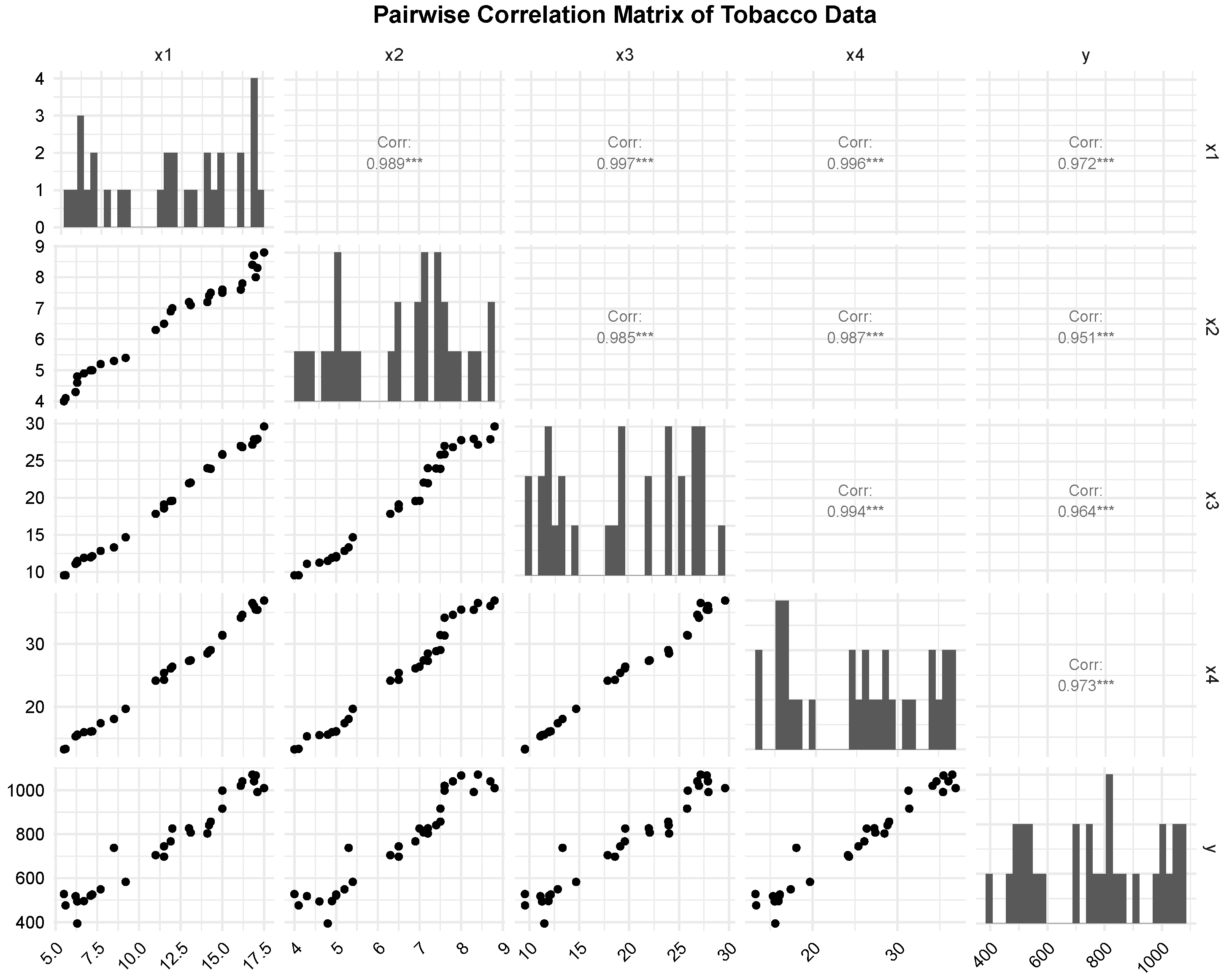
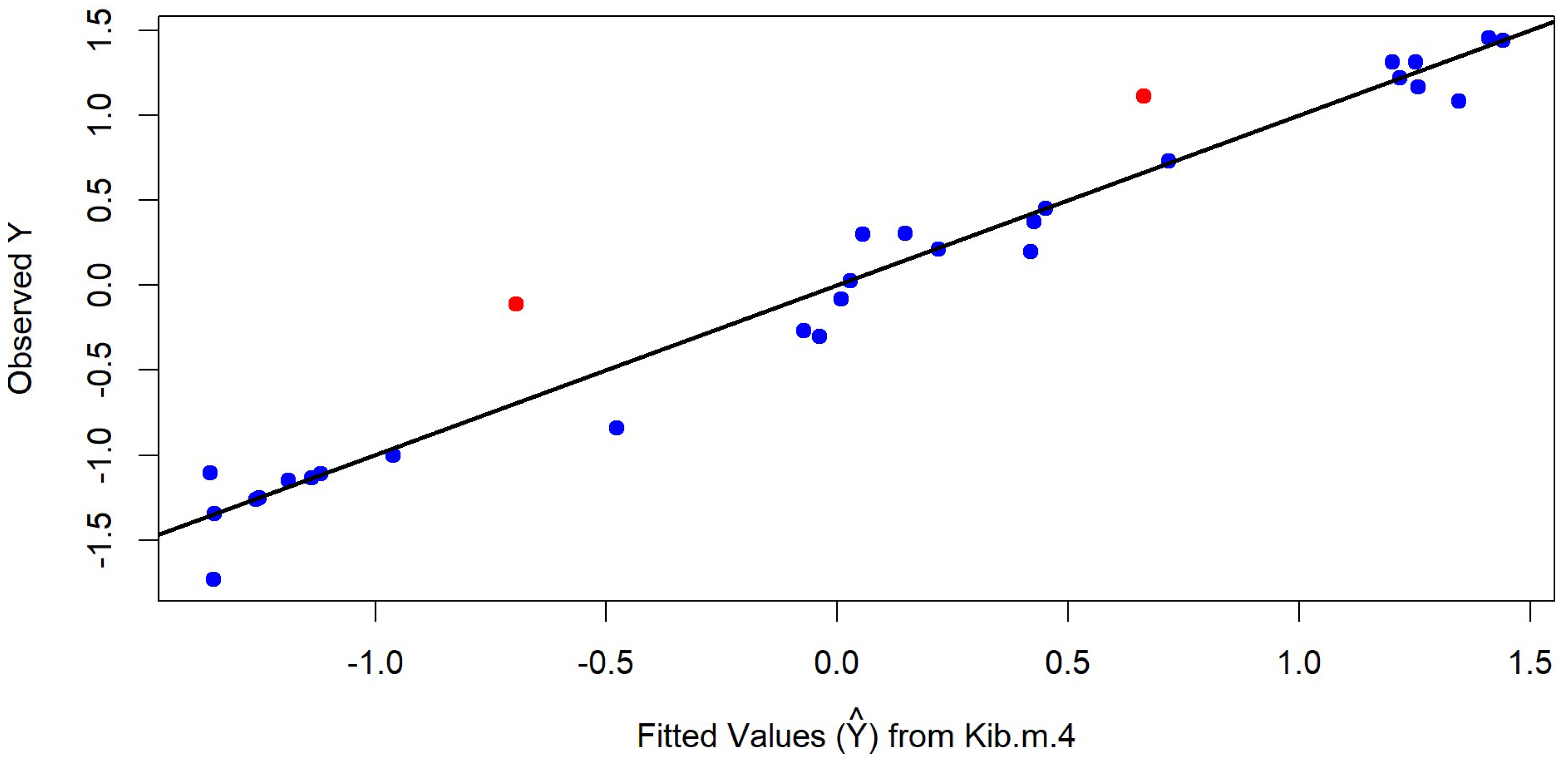
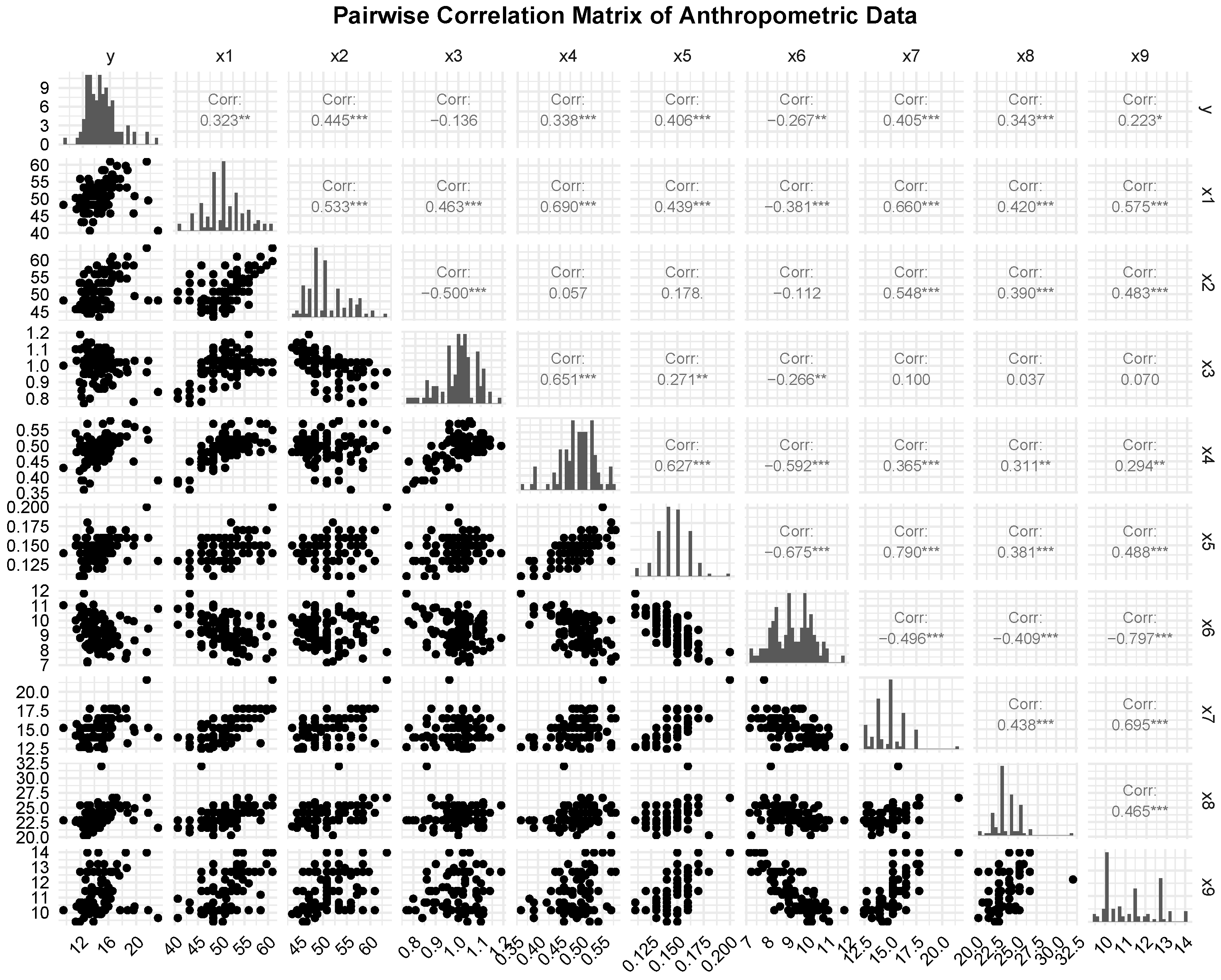
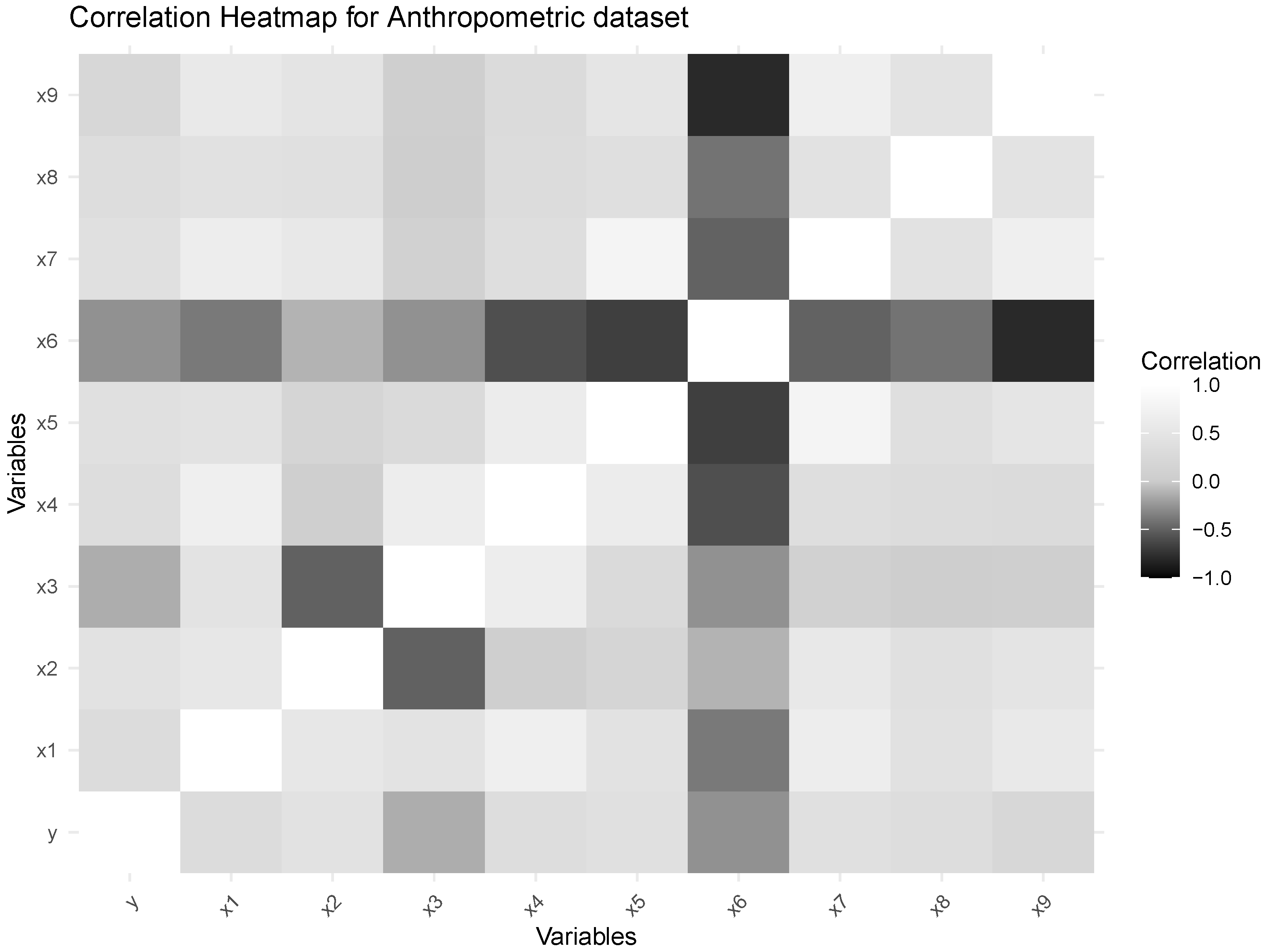
Section 5 demonstrates the applicability and practical relevance of the proposed estimators through two real-data examples. Finally,
Section 6 summarizes the key findings and concludes the study with possible directions for future research.
2. Methodology
Consider the standard multiple linear regression model:
where
is an
vector of response variable and
is a
matrix (also known as design matrix) of the observed regressors,
is a
vector of unknown regression parameters, and
is an
vector of random errors.
is independently and identically distributed with a zero mean and a covariance matrix
, where
represents an identity matrix of order
n. The OLS estimator can be estimated as
which depends primarily on the characteristics of the matrix
, that is, when the predictors are perfectly correlated, it is impossible to find the inverse of the matrix
, so that the matrix becomes ill-conditioned [
16,
17].
To address this issue, Hoerl and Kennard [
3] introduced the concept of the RR. In this method, a non-negative constant, known as the ridge parameter (
k), is added to the diagonal elements of
. This adjustment helps control the bias of the regression estimates towards the mean of the response variable, thereby stabilizing the estimator variability and mitigating the effects of multicollinearity. The RR estimator is defined as
Then, the equation can be written as
where
. The
estimator may exhibit bias; however, it generally has a lower MSE compared to the OLS estimator.
In the presence of multicollinearity and outliers, the MSE of both the OLS and RR estimators are inflated. To address this issue, Silvapulle [
8] proposed a robust ridge M-estimator (RRM) by substituting
with
in Equation (
3), as follows:
where
is called M-estimator which can be obtained by solving the equation
and
, where
are the residuals and obtained as
and
is a function used to adjust how much weight each residual contributes to the overall fitting process. This function also depend on whether the estimator has good large sample theory [
18]. The above equations together describe the conditions under which the robust estimator achieves a balance between the residuals and the predictor variables, with
function ensuring that outliers have a limited effect on this balance. According to Montgomery et al. [
19],
s is a robust estimate of scale. A popular choice for
s is the median absolute deviation defined as:
The tuning constant 0.6745 makes
s an approximately unbiased estimator of
if
n is large and the error distribution is normal. The choice of
function depends on the desired level of robustness and the type of deviations from the classical assumptions (e.g., outliers, heavy tails) [
20].
2.1. Canonical Form
Suppose that
Q is a (
) orthogonal matrix such that
and
, where
contains the eigenvalues of the matrix
. Then, the canonical form of model (1) is expressed as:
Given that
, the vector of estimates
can be expressed as
, where
. Moreover, the MSE of
is equal to the MSE of
. The canonical form for Equations (
2)–(
4) can be written as:
where
,
for j=1,2, …, p. Following [
21], the MSE of above estimators are given as follows:
where
represents the least square estimator of error variance of the model
1,
is the
value of
and
is the
eigenvalue of the matrix
,
are the diagonal elements of the matrix
. Furthermore, ref. [
21] showed that
if
, where
2.2. Existing Estimators
This section describes some of the popular and widely used ridge estimators defined in Equations (
7)–(
13). The pioneer work of [
3] introduced the estimator of
as the ratio of estimated error variance
and
estimate of
using OLS as
where
.
Later, ref. [
3] suggested the following estimator to determine a single value for k,
where
.
In another study, ref. [
22] proposed the ridge parameter by using harmonic mean of
as
Furthermore, ref. [
4] introduced five additional ridge estimators, which are defined as follows:
where GM stands for geometric mean.
where HM stands for harmonic mean.
where max stands for maximum.
where min stands for minimum.
2.3. Proposed Estimators
Previous studies by McDonald and Galarneau [
23], McDonald [
24], and Majid et al. [
25] demonstrated that the optimal choice of the biasing parameter for the RM is primarily influenced by several factors, including the degree of multicollinearity, presence of outliers, number of predictors, error variance, the underlying error distribution, and sample size. According to Suhail et al. [
26], when datasets exhibit severe multicollinearity combined with a large number of predictors, substantial error variance, and large sample sizes, the conventional RM estimators often fail to achieve the minimum MSE. To address these limitations, it becomes essential to develop improved RM estimators that maintain efficiency under adverse conditions, such as high multicollinearity, large error variance, increased sample size, and the presence of influential outliers in the response direction.
Following the suggestion of Silvapulle [
8], the robust version can be obtained by replacing
with
and
with
. Using Huber function [
20],
can be obtained as
where
denotes the Huber weight function,
n is the sample size, and
p is the number of predictors. Building upon this idea, we propose the following robust versions of the ridge estimators originally introduced by Kibria [
4].
where
,
, max, and min are defined as mentioned above. Each of these proposed estimators incorporates a robust measure of dispersion (
) and modified eigenvalue structure (
), thereby enhancing stability and reliability in the presence of multicollinearity and influential observations.
3. Simulation Setup
A simulation-based investigation was carried out in which the datasets were deliberately constructed to reflect predefined levels of multicollinearity. Using these datasets, the performance of the ridge estimators and the proposed ridge M-estimators was evaluated. The simulation study generated data sets that varied across several factors: the number of regressors (
), the sample size (
), the degree of multicollinearity among predictors (
), and the presence of outliers in the response variable. Additionally, different levels of error variance were considered by setting
, enabling a thorough evaluation of estimator performance in a range of data scenarios. Following ref. [
23] and the more recent implementations in ref. [
27], the predictor variables were generated as
where
are independent draws from the standardized normal distribution, and
controls the pairwise correlation between predictor variables. To study different levels of multicollinearity. The dependent variable was generated by the usual linear model
where
. In line with ref. [
26], and ref. [
27], we set
and chose the coefficient vector
to be the normalized eigenvector corresponding to the largest eigenvalue of the
matrix so that
.
To examine robustness, we contaminated the response by introducing outliers by considering 10% and 20% contamination levels. For each contamination level, a corresponding fraction of observations was replaced by outliers whose errors were drawn from a distribution with inflated variance. Concretely, if the nominal error variance is , the contaminated error variance was taken as
Additionally, to evaluate the performance of the proposed estimators under heavy-tailed error structures, the error term is modeled using the standardized Cauchy distribution, i.e.,
, having mean 0 and scale parameter 1. This distribution is known for its heavy tails and the absence of finite variance, providing a challenging environment to assess the robustness of the estimators. For each configuration we performed 5000 Monte Carlo replications. All computations were implemented in the R programming language. In contrast with robust estimation, the objective function (Huber loss) [
20] was used to compute M-estimators via the
rlm() function (from the
MASS package). In a code-style notation, it can be written as
where
formula is the fitted model (e.g.,
),
weights is an optional prior-weights vector, and
acc sets the convergence tolerance for the iterative algorithm. The Huber loss is widely used in robust regression because it combines quadratic behavior near zero (efficiency) with linear tails (robustness) [
19].
The MSE criterion has been used to compare the performance of estimators. Mathematically, it is given as
where
indicates the number of Monte Carlo runs. The objective is to achieve an MSE value close to zero. The MSEs of the ridge estimator are influenced by the shrinkage parameter
k, which in turn depends on factors such as the sample size
n, the number of predictors
p, the variance
, and the correlation
.
4. Results and Discussion
Table 1 lists the MSE values of the OLS, ridge-type (RR, HKB, KIB1–KIB5), M-estimator, and proposed Kibria M-type estimators (KIB.M.1–KIB.M.5) under various levels of multicollinearity (
) and error variances (
) for
,
, and a 10% outlier contamination in the response direction. The results indicate that the OLS and conventional ridge estimators (RR, HKB) exhibit substantially higher MSE values under strong multicollinearity and higher variance conditions. In contrast, the proposed KIB.M estimators, particularly KIB.M.1 and KIB.M.2 consistently yield smaller MSE values across most settings, demonstrating greater robustness to outliers and efficiency compared to existing estimators. These findings highlight the improved performance of the proposed estimators, especially when both multicollinearity and outliers are present in the data.
Table 2 displays the MSE values of the OLS, ridge-type, M-, and proposed KIB.M estimators for the case of
,
, and 10% outliers in the response (second scenario). The results are reported under varying degrees of multicollinearity (
) and different error variances (
). As expected, the MSE values of the conventional estimators (OLS, RR, and HKB) increase sharply with higher
and
, indicating their sensitivity to multicollinearity and outlier contamination. In contrast, the proposed KIB.M estimators, particularly KIB.M.1, KIB.M.2, and KIB.M.3, maintain smaller and more stable MSE values across all conditions indicating their improved efficiency and robustness properties when compared with traditional and ridge-type estimators. The results further confirm that the proposed estimators perform consistently well even when sample size increases, demonstrating their reliability and adaptability under different error structures for large sample.
Table 3 tabulates the MSE values of different estimators when considering
,
, and 10% outliers in the response (third scenario) with varying levels of multicollinearity (
) and different error variances (
). It is evident that the MSE values of OLS, RR, and HKB estimators increase rapidly with higher correlation and larger error variance, reflecting their sensitivity to multicollinearity and the presence of outliers. Conversely, the proposed KIB.M estimators, particularly KIB.M.1, KIB.M.2, and KIB.M.3, continue to demonstrate superior performance with substantially lower MSE values across all settings. This indicates that the proposed estimators are not only robust to outliers but also maintain their efficiency as the sample size increases. Overall, the results confirm that the KIB.M family performs consistently better than traditional and ridge-type estimators in large-sample scenario affected by multicollinearity and outlier contamination.
Table 4,
Table 5 and
Table 6 present the estimated MSEs of the OLS, ridge-type, M, and proposed KIB.M estimators under varying conditions of sample size (
), number of explanatory variables (
) with the presence of 10% outliers in the response direction. Each scenario was analyzed for different degrees of multicollinearity (
) and error variances (
).
From
Table 1,
Table 2,
Table 3,
Table 4,
Table 5 and
Table 6, one can note that the MSE values of OLS, RR, and HKB estimators increase when both multicollinearity and error variance increased which reflecting their sensitivity to such adverse conditions. On the other hand, the proposed KIB estimators, and especially their M-type extensions (KIB.M.1–KIB.M.5), exhibit remarkable stability and consistently achieve lower MSE values across all configurations. Moreover, as the sample size increases from
to
, the proposed estimators show improved efficiency, maintaining robustness when the predictorrs are increased from (
) to (
), confirming their ability to effectively handle both multicollinearity and contamination in the data. Furthermore, the results reveal that the compatibility of the KIB.M family becomes more pronounced with higher error variance and stronger correlation levels, where traditional estimators tend to break down. Overall, the findings validate the robustness, efficiency, and practical reliability of the proposed KIB.M estimators, demonstrating their effectiveness in both low- and moderate-dimensional regression frameworks under outlier-influenced environments.
In case 20% outliers are introduced in the response direction, the performance of various estimators in terms of MSE is listed in
Table 7 considering
,
,
, and
. These results indicate that the MSE values of the OLS, RR, and HKB estimators further deteriorate with both higher
and larger
, confirming their lack of robustness to outliers and multicollinearity. In contrast, the proposed KIB.M estimators exhibit improved stability, particularly at higher correlation levels, with significantly lower MSEs compared to the rest. To be more specific, KIB.M.1, KIB.M.2, KIB.M.3 and KIB.M.5 demonstrate outstanding performance across all contamination levels, maintaining remarkably low MSE values even when the data are heavily influenced by outliers suggesting their strong robustness and efficiency. These results show that while classical estimators deteriorate rapidly under high contamination, the proposed KIB.M estimators preserve their accuracy and reliability, making them highly effective for regression models affected by both multicollinearity and outlier contamination.
In the case of increased sample size
and 20% outliers in the response direction, one can see that the OLS, RR, and HKB estimators again exhibit considerably high MSEs, particularly when
and
increase, indicating that they remain highly sensitive to both multicollinearity and contamination. In
Table 8, the proposed KIB.M estimators provide notable improvements in estimation accuracy, with substantially reduced MSE values across most scenarios, especially for high-correlation cases. Notably, KIB.M.1, and KIB.M.5 consistently outperform others across all combinations of
and
, showing remarkable consistency and reliability even under strong multicollinearity and heavy contamination. Overall, the findings validate that the proposed KIB.M estimators retain efficient performance in the presence of both high correlation among predictors and substantial outliers, outperforming traditional and ridge-type estimators by a significant margin.
Table 9,
Table 10,
Table 11 and
Table 12 summarize the estimated MSE values for various estimators under the presence of 20% outliers in the response, across different sample sizes (
), numbers of predictors (
), error variances (
), and correlation levels (
). Note that the OLS, RR, and HKB perform poorly, exhibiting large MSEs that increase sharply with higher correlation and error variance. This indicates their vulnerability to both multicollinearity and contamination. On the contrary, the proposed KIB estimators, particularly their M-type variants (KIB.M.1–KIB.M.5), consistently demonstrate superior robustness and stability across all scenarios. The KIB.M.1 and KIB.M.5 estimators, in particular, achieve the smallest MSE values even in extreme conditions (
and
). These results confirm that the proposed estimators effectively mitigate the adverse effects of multicollinearity and outliers, outperforming conventional methods and maintaining reliable efficiency in contaminated data environments.
Table 13 lists the MSEs of various estimators when the error term follows a heavy-tailed standardized Cauchy distribution with location 0 and scale 1. The table compares the results for two sample sizes (
and
) with two dimensions (
and
) and four multicollinearity levels (
). From these results, one can see the OLS estimator performs extremely poorly in all cases, yielding very large MSE values, particularly as
approaches unity. This degradation occurs because OLS is highly sensitive to both multicollinearity and heavy-tailed noise, leading to unstable coefficient estimates and inflated variances. The RR and HKB estimators offer moderate improvements but still exhibit substantial MSEs when
is high, indicating limited robustness to Cauchy errors. Among the conventional ridge-type estimators, the KIB family (KIB1–KIB5) shows notable stability, with a substantial reduction in MSEs as compared to OLS, RR, and HKB. Notably, the KIB5 estimator consistently provides the lowest MSEs among its group, suggesting that its penalty structure effectively mitigates multicollinearity while offering some resistance to heavy-tailed errors.
When robustness is introduced through the M-estimation framework (KIB.M.1–KIB.M.5), the performance improves further. The M-based versions yield remarkably smaller MSEs, especially for higher values, highlighting their improved performance to handle outliers and non-Gaussian noise. In particular, the KIB.M.5 estimator demonstrates the minimum MSEs in almost all scenarios, showing excellent robustness and stability across different settings of n, p, and . In summary, the results indicate that the OLS, RR, and HKB estimators are highly unstable in the presence of Cauchy-distributed errors. The proposed KIB estimators outperform classical ridge estimators under heavy-tailed conditions. The robust versions (KIB.M series), especially KIB.M.5, achieve the smallest MSE values, confirming their effectiveness for regression models affected by both multicollinearity and outliers. These findings emphasize the importance of incorporating robustness through M-estimation techniques when dealing with non-normal, heavy-tailed error distributions, such as the Cauchy case.
Finally,
Table 14 listed a summary of the best-performing proposed estimators that yield the minimum MSE under varying conditions of contamination, sample size (
n), and dimensionality (
p). The results are organized according to the percentage of outliers (10% and 20%) and the error variance (
) levels. From this table, it can be observed that the performance of the proposed KIB.M estimators remains stable across different configurations, demonstrating robustness in the presence of heavy-tailed errors and outliers. Specifically, KIB.M.1, KIB.M.2, and KIB.M.5 frequently appear as the estimators with the smallest MSE values, indicating their strong resistance to outlier contamination and model irregularities.
6. Conclusions
In this study, we explored the combined impact of multicollinearity and response-direction outliers on the performance of several classical and newly proposed estimators. It was observed that the traditional OLS and RR estimators do not perform efficiently in terms of the MSE when multicollinearity coexists with outliers in the response direction. Although robust M-estimators are generally employed to handle such issues, their performance deteriorates when severe multicollinearity and large error variance are present simultaneously. To overcome these limitations, five new modified Kibria M-estimators have been proposed.
Extensive Monte Carlo simulations indicate that the proposed estimators, particularly KIB.M.1, KIB.M.3, and KIB.M.5, outperform existing OLS, RR, and RM estimators by yielding lower MSE values across various levels of multicollinearity and data contamination. Additional simulations under heavy-tailed error distributions, specifically the standardized Cauchy distribution, further confirm the robustness of the proposed estimators. In this challenging scenario, where traditional estimators such as OLS, RR, and HKB produced extremely large MSEs due to the infinite variance of the Cauchy errors, the KIB.M estimators exhibited remarkable stability. Notably, KIB.M.5 tends to perform best, and achieved the lowest MSE across all configurations of sample size, number of predictors, and multicollinearity levels, highlighting its exceptional resilience to both multicollinearity and heavy-tailed noise. Furthermore, analyses of two real datasets, using MSPE criterion, demonstrate that the KIB.M estimators, particularly KIB.M.4, deliver the most stable and efficient estimates, outperforming all competing methods.
Future research may extend the proposed methodology in several directions. First, applying the proposed estimators to generalized linear models or high-dimensional settings would broaden their applicability. Second, developing adaptive data-driven approaches for optimal biasing parameter selection could enhance computational efficiency. Finally, exploring Bayesian or machine learning-based frameworks for robust ridge-type estimation may further improve robustness and predictive accuracy in the presence of complex data structures and severe multicollinearity.