1. Introduction
The statistical modeling of real data exhibiting skewness and heavy-tailed behavior remains a major challenge in the mathematical and statistical sciences. In domains as varied as actuarial risk assessment, environmental extremes, reliability engineering, and economic time series, practitioners routinely encounter data that may exhibit rapid initial failure rates, long right-hand tails, or non-monotonic hazard shapes, which may not be satisfactorily captured by classical parametric distributions, including exponential, Weibull, and gamma distributions [
1,
2,
3].
Different studies have extended and improved the flexibility of most traditional distributions to better capture the complexities of real-world data. Among this is the study of [
4], who combined the Sine and Lomax distributions to form the Sine–Lomax distribution. The Sine–Lomax distribution performed better when compared to the Lomax distribution, with its extensions using real-life data from remission times of bladder cancer patients and survival times of guinea pigs injected with different amounts of tubercle bacilli. In a similar study, ref. [
5] introduced an additional parameter to the Sine transformation family and called it the alpha-Sine-G family distribution, using the total annual rainfall recorded at the Los Angeles Civic Center and the failure times of eight components at three different temperatures. They concluded that their proposed model performed better when compared to the Sine inverse Weibull, the inverse Weibull, Weighted generalized quasi Lindley, and the Sine Burr XII distributions. The expansion of the Burr family of distributions [
1] has continued along other fronts, particularly its Type III variant. It has been widely adopted for modeling lifetime and income data owing to its ability to produce heavy tails and a variety of monotone or bathtub-shaped hazard functions [
2,
3]. Its two shape parameters,
c and
k, permit simultaneous control over tail thickness and the rate at which the density decays as
. Numerous extensions of the Burr III distribution have been proposed in the literature. The Marshall–Olkin extension [
6] introduces an additional parameter to enrich upper-tail flexibility; the beta-generated class [
7] embeds a baseline cumulative distribution function (CDF) within a beta transformation to modulate skewness and kurtosis; the Kumaraswamy-generated family [
8] offers similar benefits via the Kumaraswamy CDF. While these approaches broaden the range of attainable shapes, they often sacrifice closed-form hazard functions or require intricate numerical integration for inference.
Furthermore, the literature has increasingly focused on extending the Burr distribution through trigonometric transformations, such as the bivariate trigonometric Burr XII [
9], Sine–Lomax [
4], Sine–Burr III loss [
10], Gamma Burr XII [
11], beta Burr XII [
12], Log–Burr III [
13,
14], and Sine Exponentiated Burr III [
15] distributions. For instance, ref. [
16] developed a new generalization by applying a Sine inverse transformation to the Lomax distribution, the
Sine inverse Lomax generator (SIL-G). This family of distributions introduces a scale parameter
that governs skewness and tail behavior through a simple yet powerful mapping:
where
is the baseline CDF, and
is a scale parameter.
This formulation produced a family of distributions that has closed-form expressions for key statistical functions and allowed improved modeling of extreme tail skewness and a spectrum of hazard shapes. Four special cases (
Sine Inverse Lomax–Exponential,
Sine Inverse Lomax–Rayleigh,
Sine Inverse Lomax–Fréchet, and
Sine Inverse Lomax–Lomax) were studied. Ref. [
17] introduced the
Inverse Lomax–G (IL-G) and derived closed-form expressions for its density, quantile function, and moments. By re-mapping the baseline odds through a Lomax kernel, the IL-G family attains tail and skew control that neither the original generator nor the classical Burr III could achieve on its own. They also demonstrated through application to breaking-strength data that the IL-G model often outperforms both exponentiated-
G and beta-
G. In a subsequent paper, they further refined this concept by combining the
exponentiated-G approach with the inverse Lomax transform. They introduced a third parameter
by first forming
and then applying the IL-G construction to
, yielding the
Inverse Lomax–Exponentiated G (IL-EG) family. This offers greater flexibility, particularly in shaping non-monotonic hazard rates, and has been shown to deliver an improved fit on biomedical survival data, reducing bias in tail-quantile estimation. Recognizing that certain applications involve naturally bounded lifetimes, such as treatment-response times or material-fatigue limits, ref. [
18] proposed a
truncated IL-G variant. They defined the support of the IL-G distribution on an interval
. It was applied to biomedical recovery-time data; this truncation provided a better account of plateauing hazard behaviors than unbounded models. Collectively, these Lomax-based generators underscore the power of odds-ratio transforms in enriching baseline distributions. Yet, none of these studies considered the
Sine inverse Lomax generator introduced by [
16].
This paper bridges these gaps by embedding the Burr III baseline within the Sine inverse Lomax family of distributions, yielding the Sine Inverse Lomax Burr III (SILBIII) distribution. We derive some statistical properties, discuss some methods of estimation and risk measures, and illustrate their usefulness/flexibility through simulations and applications to real data. After deriving the SILBIII’s closed-form CDF and probability density function (PDF), we explore its statistical properties in depth.
Moreover, no study has combined the two-parameter Burr III distribution with the Sine inverse Lomax family of distributions. While some recent studies have extended the Sine-G framework to various baseline models in the literature and developed flexible Burr III-type distributions for heavy-tailed data, combining these two generator families remains unexplored. The Sine Inverse Lomax Burr III (SILBIII) distribution proposed in this paper fills this gap and demonstrates enhanced theoretical and practical flexibility. The motivation stems from the fact that the Burr III distribution is widely recognized for its heavy-tailed behavior, yet its two-parameter structure limits its capacity to model highly complex or heterogeneous datasets. By embedding it within the Sine inverse Lomax framework, the proposed model gains additional shape control, enabling it to capture diverse skewness, kurtosis, and hazard rate patterns. This increased adaptability improves both goodness-of-fit and interpretability across a broader range of real-world applications. In estimating the SILBIII parameters, we compare five methods (maximum likelihood (MLE), least squares (LS), weighted least squares (WLS), percentile matching (PC), and Anderson–Darling (AD)) via a Monte Carlo simulation study under two parameter settings. We demonstrate the application of the SILBIII distribution by fitting it to monthly tax revenue data. Against several competing models (including Sine Inverse Lomax–Rayleigh, Marshall–Olkin modified Burr III, and standard Burr III), the SILBIII provides the best fit according to AIC, BIC, and goodness-of-fit tests. This application highlights the model’s ability to capture complex skewness and tail behavior in real economic data.
The rest of this paper is organized as follows:
Section 2 introduces the Sine Inverse Lomax Burr III (SILBIII) distribution.
Section 3 presents some mathematical and statistical properties, including the moment structure discussed earlier.
Section 4 presents the risk measures relevant to actuarial and financial applications.
Section 5 details the parameter estimation methods.
Section 6 reports a Monte Carlo simulation study to evaluate the finite-sample performance of the estimators.
Section 7 illustrates the practical utility of the SILBIII model through a real-data application. Finally,
Section 8 concludes with a summary, limitations and directions for future research.
2. Sine Inverse Lomax Burr III
Making use of the SIL-G family of distributions in Equation (
1), which was proposed by [
16], we propose the Sine Inverse Lomax Burr III (SILBIII) distribution by considering the Burr III distribution as a baseline distribution with the CDF and PDF given by
and
, respectively, for
and
. Substituting the CDF and PDF of the Burr III distribution into Equation (
1), we obtain the SILBIII distribution. The CDF of the SILBIII distribution is given by
where
is a scale parameter, and
c and
k are shape parameters.
To examine whether Equation (
2) is a valid CDF, we can rewrite Equation (
2) as
Let
. Since
,
So Equation (
3) becomes
We check whether Equation (
4) satisfies the following properties:
- i.
The Limit at the Boundaries
We show that and .
Considering ,
. This implies that . Since .
So, .
Also, considering , and
since , . This implies that .
Since , . Thus, .
- ii.
Range
We show that for all x.
For , we have , ,
that is, . Multiplying by , the Sine function lies in the interval .
This mean that the Sine function maps the interval to . Hence, for all x.
- iii.
Non-decreasing
Let . Then, . Using the chain rule, we have .
Considering , since , this implies that .
Considering , we have
. It can be observed that ,, and Hence, . Since both and are positive, this implies that is strictly increasing.
- iv.
Right continuity
- i.
Non-negativity
Equation (
5) can be rewritten as
It can be observed that are all positive. Hence, . , , which is positive. Also, , so is positive. From the proof in the CDF we know that , then ranges from Therefore, ranges from . In the first quadrant , . Since all factors are positive, for all .
- ii.
Normalization
. This implies that
.
From the CDF proof, we know that , and
This implies that .
Reliability Characteristics
The reliability functions of the SILBIII distribution are given by
and
where Equations (
6) and (
7) are the survival and hazard functions respectively.
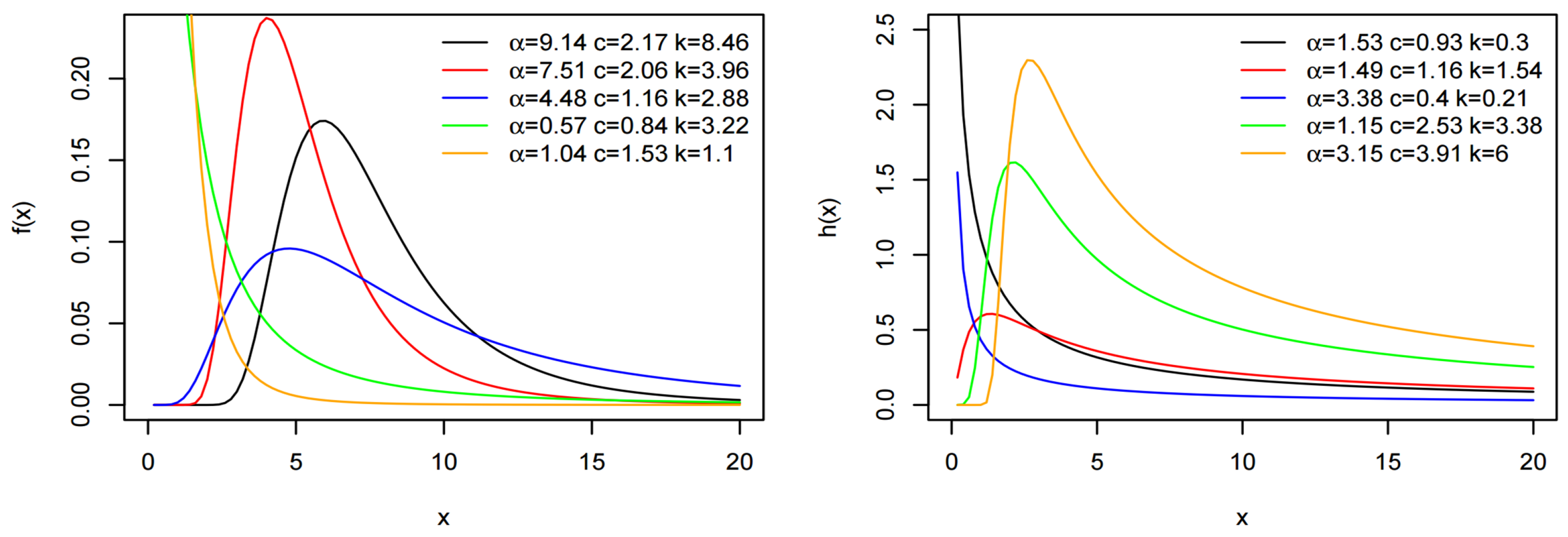
Plots of the density and hazard rate functions of the SILBIII are shown in
Figure 1. The plots of the density function show decreasing, right-skewed, and approximately symmetric shapes. The hazard rate plots show decreasing and upside-down bathtub shapes. The density plot demonstrates the distribution’s ability to model various shapes of probability density, ranging from monotonic decreases to distinct right-skewed peaks. When
is relatively large (
), the density function exhibits a unimodal shape (a single peak). This is typical for data that clusters around a central value. When
is small (
), the density is monotonically decreasing (J-shaped). This indicates that the highest probability of an event occurring is near
, with probability dropping off rapidly as
x increases. When
is small (
), the density is monotonically decreasing (J-shaped). This indicates that the highest probability of an event occurring is near
, with probability dropping off rapidly as
x increases, that is, the parameter
acts as a primary shape switch, determining whether the data is concentrated near zero or distributed around a mode. Also, comparing
,
,
and
,
,
, it can be observed that there are differences in skewness and tail weight.
At , the curve is sharper and more peaked (leptokurtic), suggesting data is tightly clustered around the mode (approximately ). At , the curve is flatter and broader. Crucially, it exhibits a heavier right tail. Even at , the blue curve has a visible non-zero probability, whereas the red curve has nearly vanished. This suggests that the model can accommodate datasets with significant outliers or extreme values by adjusting c and k.
The hazard rate plot illustrates the flexibility of the hazard rate, which is crucial for survival analysis and reliability engineering. The legends in the two plots represent different parameter sets, but they illustrate the general capabilities of the family. At , , and , , the hazard rate starts high and decreases rapidly. This shape typically models infant mortality or early failures, where the risk of failure is highest at the beginning of the lifecycle and decreases as the item survives longer. Low values of k () appear to drive this decreasing behavior. At , , and , , the hazard rate starts at zero, rises to a peak, and then decreases. This upside-down bathtub shape is useful for modeling scenarios where risk accumulates over time to a maximum point (e.g., a specific period of high vulnerability) and then tapers off for the remaining survivors. Higher values of k () seem to induce this unimodal hazard structure. The parameter c likely influences the location and height of this peak.
From [
16], the expansion of the PDF of the SIL-G family of distributions can be rewritten as
where
is a vector parameter.
Equation (
8) can further be expanded as follows:
letting
,
From Equation (
9), using binomial expansion, we have
.
Therefore, Equation (
9) becomes
where
.
Hence, the mixture representation of the SILBIII distribution is given by
3. Statistical Properties
In this section, some statistical properties of the SILBIII distribution, including the quantile function, moments, moment generating function, stochastic ordering, mean residual life, Identifiability, and order statistics, are presented.
3.1. Quantile Function
The quantile function is important in describing the random variable of a distribution. It also helps in generating random samples. The quantile function of the SILBIII distribution for
is given by
Proof. By definition, the quantile function is given by
. Thus, we have
Let
. After some simplification, we have
that is,
□
3.2. Moments
The moments of a distribution are important in estimating measures of variation like the variance, standard deviation, coefficient of variation, mean deviation, median deviation, kurtosis, skewness and so on.
The
non-central moment by definition is given as
Substituting Equation (
11) into Equation (
13), we have
Letting implies that when , , and if , . Again, .
After some simplification and employing the beta function
with
, we get
Table 1 display the values for the first four moments, namely, the standard deviation (
), coefficient of variation (CV), coefficient of skewness (CS), and coefficient of kurtosis (CK), which are defined as
,
,
, and
respectively. Four sets of parameter values are used: I = (
,
,
), II = (
,
,
), III = (
,
,
), and IV = (
,
,
).
The
incomplete moment by definition is given as
Substituting Equation (
11) into Equation (
16) and making use of the identity
and simplifying, the
non-central moment of the SILBIII distribution becomes
3.3. Moment Generating Function
The moment generating function (MGF) helps in determining the moments of a random variable. By definition, the moments of a random variable
X are given as
, only if they exist. Applying series expansion,
. Therefore,
where
is a beta function and
.
3.4. Identifiability
Identifiability of a distribution refers to the existence of distinct parameter values corresponding to distinct probability distributions, meaning that if two parameters are different, their associated distributions will also be different. A model is considered generically identifiable if the set of non-identifiable parameters is of measure zero within the parameter space.
Proposition 1.
The SILBIII distribution is identifiable.
Proof. Let
. The PDF in (
5) simplifies to
where
. Integrating yields the closed-form CDF:
Assume
for all
, where
. Applying
and taking logarithms gives
Therefore, as
,
. The dominant polynomial decay rate uniquely identifies
c. As
,
, and the coefficient of
in (
21) identifies the product
. Since the mapping
is strictly monotonic in each parameter and injective over
, we conclude that
. □
3.5. Mean Residual Life (MRL)
The MRL function is defined as
. Using the substitution
, we obtain the tractable integral form:
This representation allows efficient numerical evaluation and confirms that is finite for all .
3.6. Order Statistics
In the life testing of components and a reliability study, order statistics are very useful. Let
be a random sample of size
n that follows the SILBIII distribution and
be the corresponding order statistics. Then, the PDF of the
order statistics is defined as
Substituting Equations (
2) and (
5) in Equation (
23), we obtain
The PDF of the
order statistics is defined as
Substituting Equations (
2) and (
5) in Equation (
25), we have
The PDF of the first order statistics is defined as
Substituting Equations (
2) and (
5) in Equation (
27) will give
3.7. Stochastic Ordering
Stochastic ordering is established via the likelihood ratio (LR) order. Let and . We say if the ratio is non-decreasing in x.
Proposition 2
(likelihood ratio order). If and , then .
Proof. Consider the log-ratio
. After simplification:
Under and , each term is non-negative for all , implying . Hence, , which further implies (hazard rate order) and (usual stochastic order). □
4. Risk Measures
In this section, we present some risk measures, including the value at risk (VaR), tail value at risk (TVaR), and tail variance (TV) of the SILBIII distribution.
4.1. Value at Risk
The value at risk represents the percentage of loss in portfolio value that will be equaled or exceeded only X percent of the time. The value at risk of the SILBIII distribution is given by
4.2. Tail Value at Risk
The tail value at risk is used in estimating the risk beyond a certain probability level. The TVaR of random variable
X is defined by
Substituting Equation (
11) into Equation (
31), we have
4.3. Tail Variance
The tail variance is essential in estimating the risk at the tails. The TV of a random variable X is defined by
Considering
, we have
On solving Equation (
33), we obtain
Now, substituting Equation (
34) into Equation (
32), we obtain the TV of the SILBIII distribution as
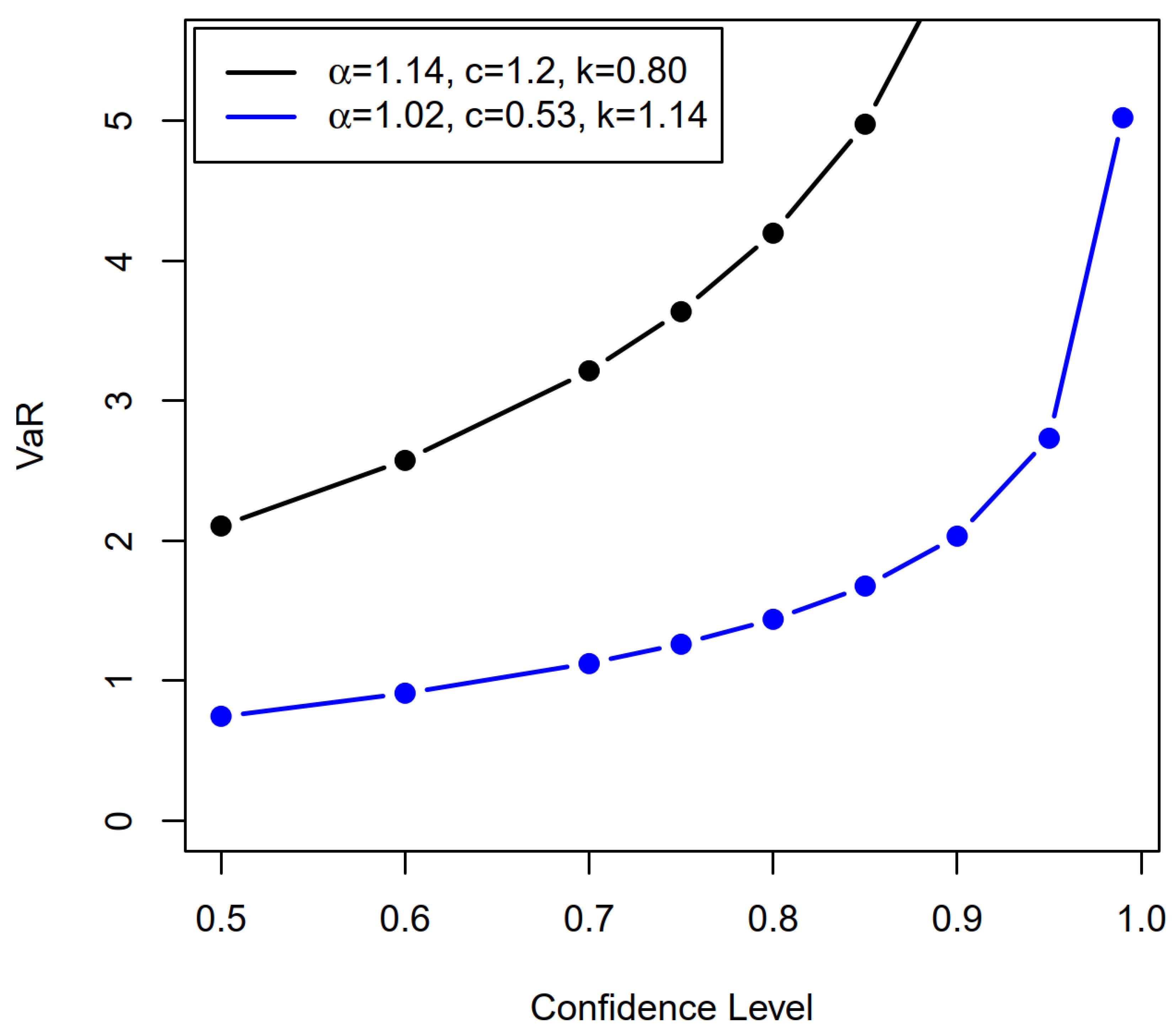
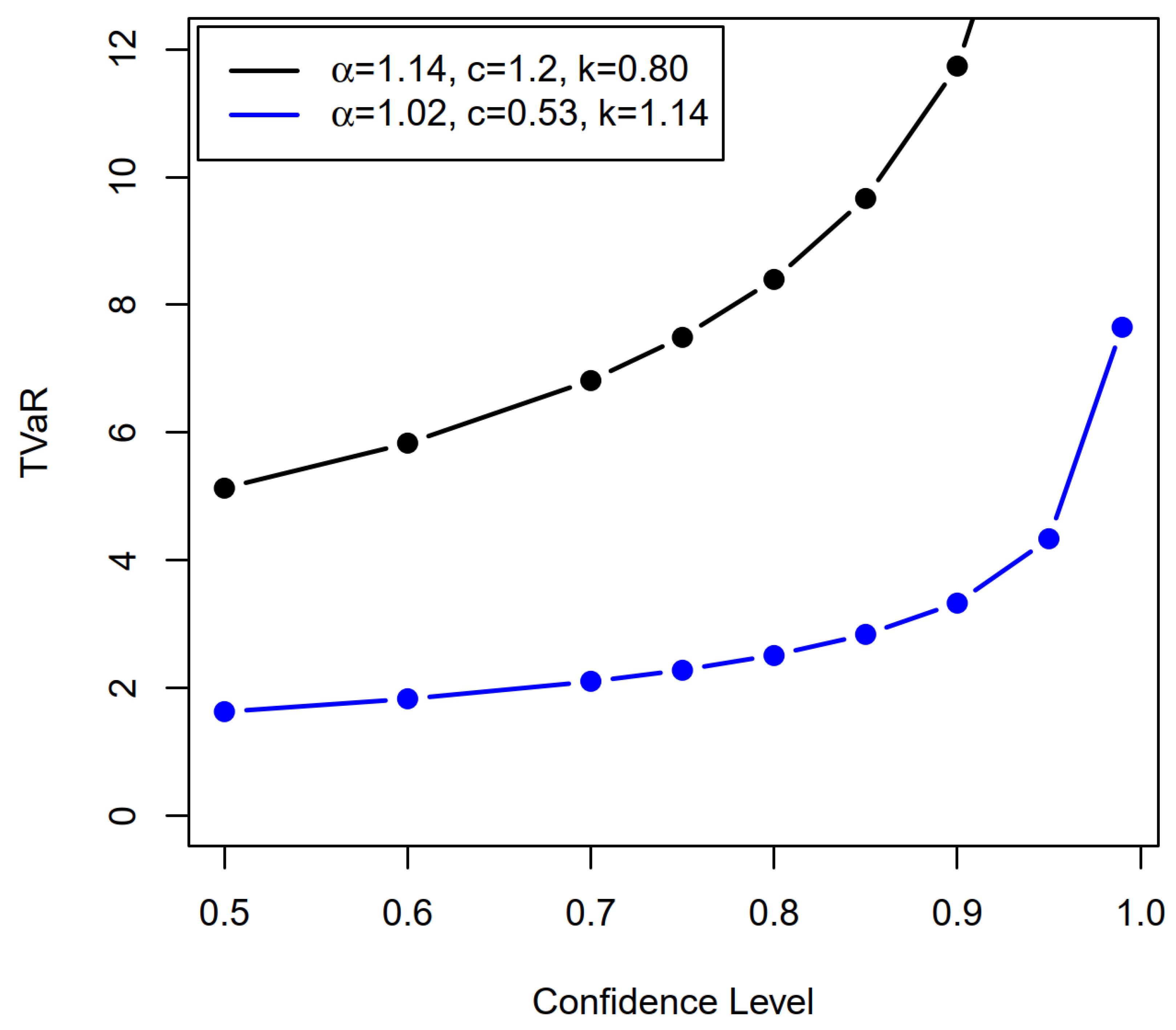
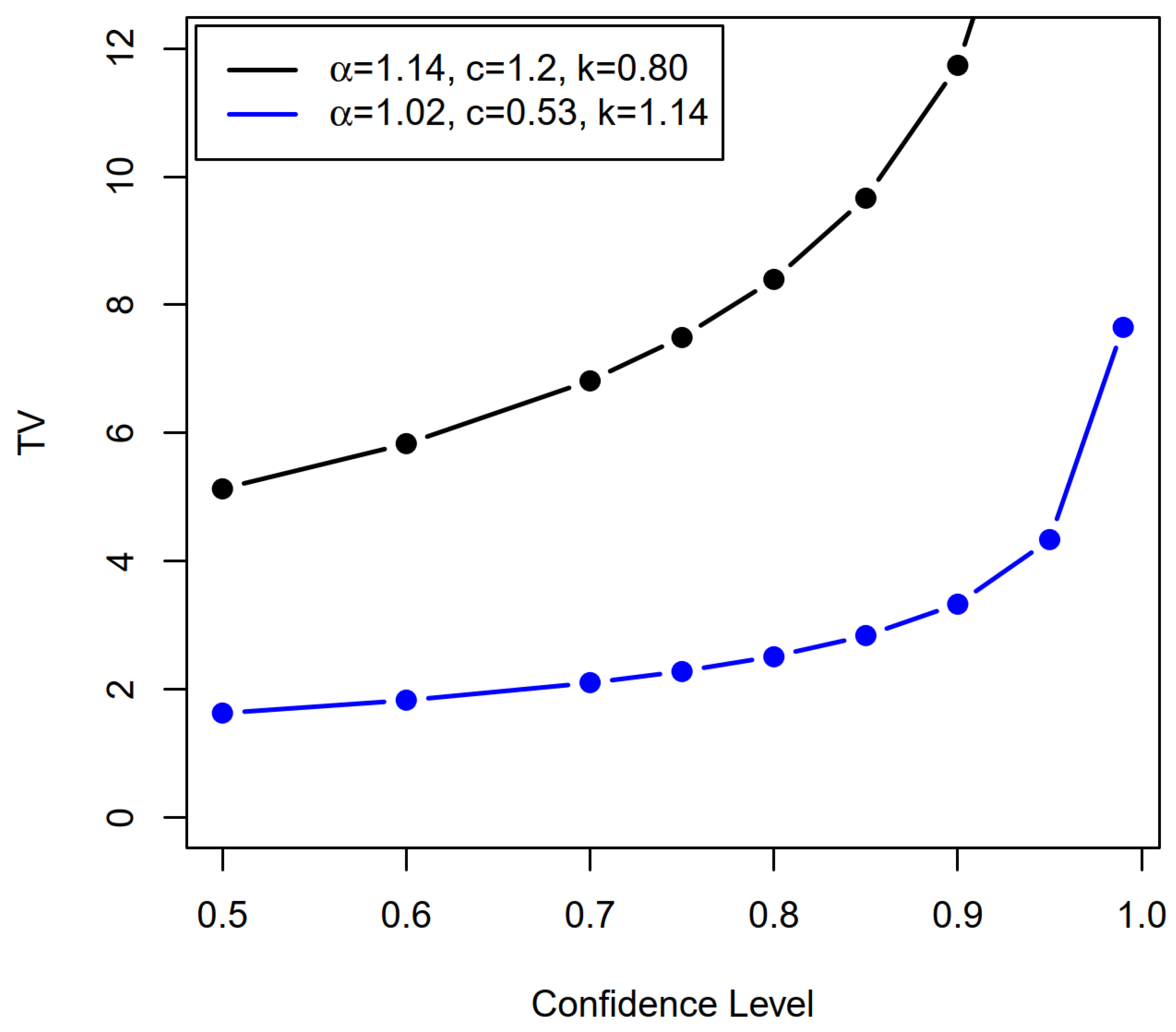
Table 2 shows the simulation results for the actuarial measures for
and a different set of parameter values. At confidence level
,
represents the threshold loss value that is exceeded with probability
. For instance, with parameters
,
,
,
, which implies that losses exceeding this value occur in approximately 1% of scenarios. This metric is widely used for regulatory capital requirements but does not quantify the severity of losses beyond the threshold. For TVaR, it can be seen that
provides the expected loss given that the loss exceeds the VaR threshold. For the same parameter set,
indicates that when extreme losses occur (the worst 1%), the average loss is nearly twice the VaR threshold. This measure is coherent and more sensitive to tail behavior, making it preferable for solvency assessment. The tail variance quantifies the dispersion of losses in the tail region. A large TV relative to TVaR signals high uncertainty in extreme loss predictions. Notably, for
,
,
,
is substantially larger than
, reflecting significant volatility in catastrophic loss scenarios.
Moreover, the progression of risk measures across confidence levels give strong evidence of heavy-tailed behavior in the SILBIII distribution, that is, for the non-linear growth of VaR, in the first parameter set (, , ), VaR increases from 2.1061 at to 18.6242 at , an approximate 8.8-fold increase over the upper half of the distribution. This acceleration is characteristic of distributions with power-law tails, where extreme quantiles grow rapidly. The ratio increases with , rising from 2.44 at to 1.76 at for the first parameter set. While this ratio decreases slightly at very high confidence levels, the absolute difference expands dramatically (from 3.02 to 14.10), indicating that the conditional tail mean diverges from the threshold—a hallmark of heavy tails. The most striking indicator is the tail variance. For , for the first parameter set, compared to only 19.5569 for the second set (, , ). This difference highlights how the parameter (in the first set) induces substantially heavier tails, leading to greater uncertainty in extreme loss predictions. Finally, comparing the two scenarios, that is, for , , , with , this produces a distribution with pronounced heavy-tail behavior. The rapid escalation of TV at high confidence levels suggests suitability for modeling catastrophic risks, such as natural disaster losses or large liability claims, where extreme events, though rare, have outsized financial impact, and for , , , with , yields a distribution with comparatively lighter tails. The TV values remain moderate even at , making this parameterization more appropriate for modeling operational risks or moderate insurance lines, where extreme losses are less volatile. Thus the SILBIII distribution is a heavy-tailed distribution.
The simulation steps are as follows:
- 1.
A random sample of size is generated from the SILBIII distribution, and parameters have been estimated via the maximum likelihood method.
- 2.
A total of 5000 repetitions are made to calculate the VaR, TVaR and TV for the SILBIII distribution.
6. Simulations
In this section, the simulation to assess the performance of the five estimation methods is carried out. The nlminb function in the R program is used in the simulation. The function uses the L-BFGS-B optimization method. The simulation steps are as follows:
- i.
Generate an sample of size from the quantile function of the SILBIII distribution.
- ii.
Compute the MLE, AD, LS, PC, and WLS parameter estimates of the sample obtained in (i).
- iii.
For each parameter estimate, calculate the average absolute bias (AB) and mean square error (MSE) defined as
and
for
, respectively.
- iv.
Steps (i) and (iii) are repeated for two sets of parameter values:
and .
As shown in
Table 3 and
Table 4, the MLE exhibits the smallest AB and MSE across all sample sizes and both settings, with error decaying at approximately
. The AD and WLS estimators follow closely, with AD slightly outperforming WLS in estimating
and
c when
. The LS estimator yields moderate performance, consistently better than PC but inferior to AD and WLS. The PC method shows the largest bias (particularly for the heavier-tailed scenario
I) and converges most slowly as
n grows. These findings are consistent with the findings from [
17,
19], where the authors found that MLE achieved the lowest root mean squared error among likelihood-based, moment-based, and percentile methods in breaking-strength and biomedical survival applications. Similarly, studies of beta-generated and Kumaraswamy-generated distributions [
7,
8] have consistently shown MLE to deliver a superior bias–variance trade-off, with goodness-of-fit estimators, such as AD, providing a robust alternative under small samples and percentile methods generally underperforming in skewed, heavy-tailed contexts.
The simulation study confirms that for the SILBIII model, just like other flexible, transformed families in the literature, MLE remains the method of choice. The AD estimator offers a viable compromise between efficiency and robustness, while WLS may be preferred for its numerical stability. By contrast, LS and PC estimators should be used with caution, since their inflated bias and MSE may lead to misleading inference in practice.
7. Application to Data
In this section, we demonstrate the application of the SILBIII distribution using tax revenue data. This dataset consists of the monthly actual tax revenue from Egypt between January 2006 and November 2010. The dataset is displayed in
Table 5.
Recently, it was used by [
20] and fitted the odd Burr III Lomax distribution. The descriptive statistics of the monthly actual tax revenue data are shown in
Table 6. The results show that the data is positively skewed and leptokurtic.
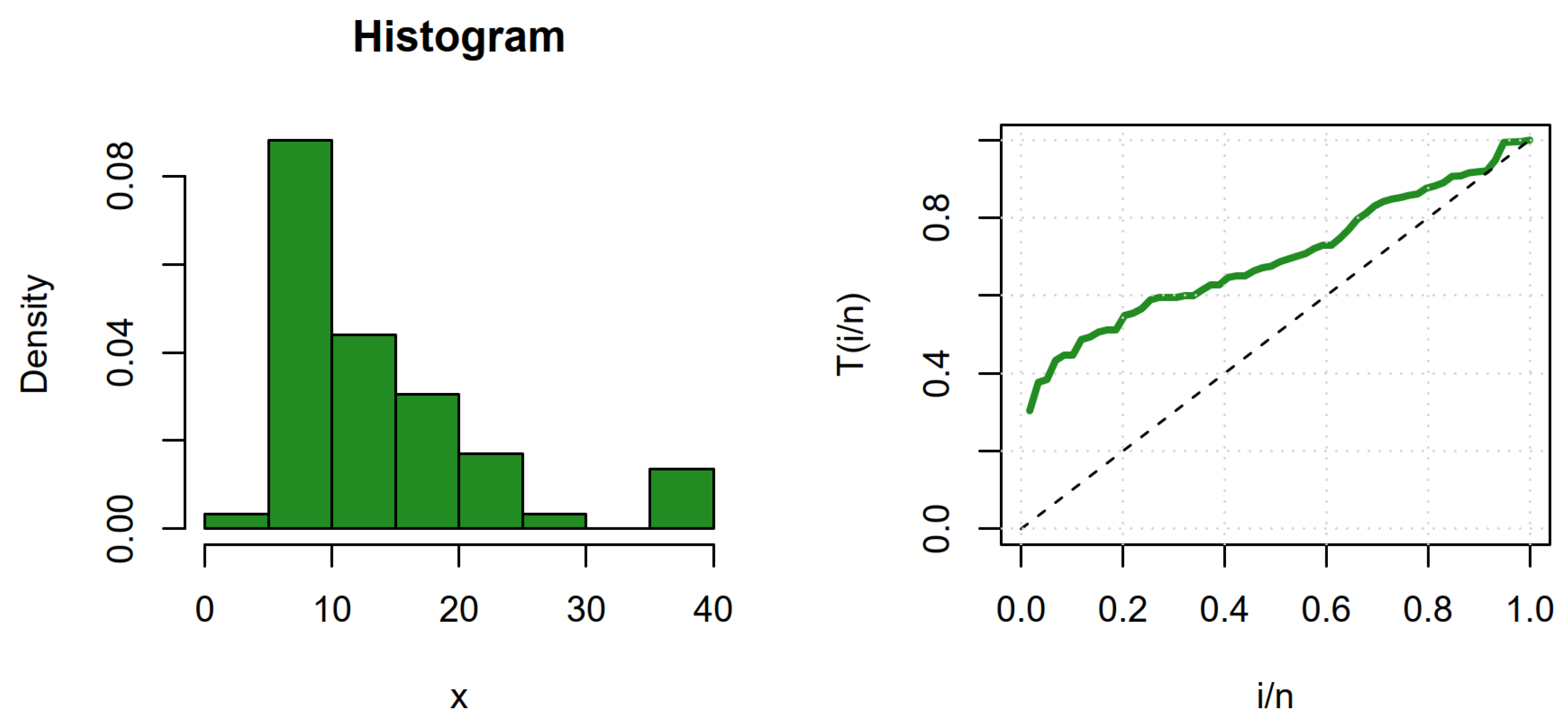
Figure 5 shows the non-parametric plots of the monthly actual tax revenue data. From the histogram (left), there is evidence of non-normality. The TTT plot shows the empirical scaled total time on the test statistic against normalized failure ranks, with the green curve lying consistently above the 45° diagonal reference line. This geometric configuration definitively indicates a decreasing hazard rate (DFR) pattern, meaning the instantaneous failure probability declines as time progresses.
The proposed model is compared with six competing models, including the Sine Inverse Lomax–Rayleigh (SILR) distribution, Marshall–Olkin modified Burr III (MOMBIII), modified Burr III (MBIII), Burr III, and new modified Burr III (NMBIII), with the PDF given by
and
respectively.
The first two columns in
Table 7 present the MLEs of the parameters and their standard errors. Columns four through six report
, AIC and BIC, where lower values indicate a better trade-off between fit and parsimony. The final column gives the Kolmogorov–Smirnov statistic and its
p-value, testing the null hypothesis that the model and empirical distributions coincide. The SILBIII distribution achieves the smallest
(376.92), AIC (382.92) and BIC (389.15), as well as the highest K–S
p-value (0.9638), indicating the best overall fit. The NMBIII follows closely but remains marginally suboptimal in all three information criteria and exhibits a slightly lower
p-value. The classical Burr III, Marshall–Olkin modified Burr III, and modified Burr III each yield larger information-criterion values, reflecting a poorer balance between fit and complexity. The Sine Inverse Lomax–Rayleigh (SILR) model performs worst, with
and the lowest
p-value (0.0701), showing a significant lack of fit. These results confirm that the SILBIII model provides the most accurate and parsimonious description of the monthly tax revenue series, followed closely by BIII and NMBIII distributions.
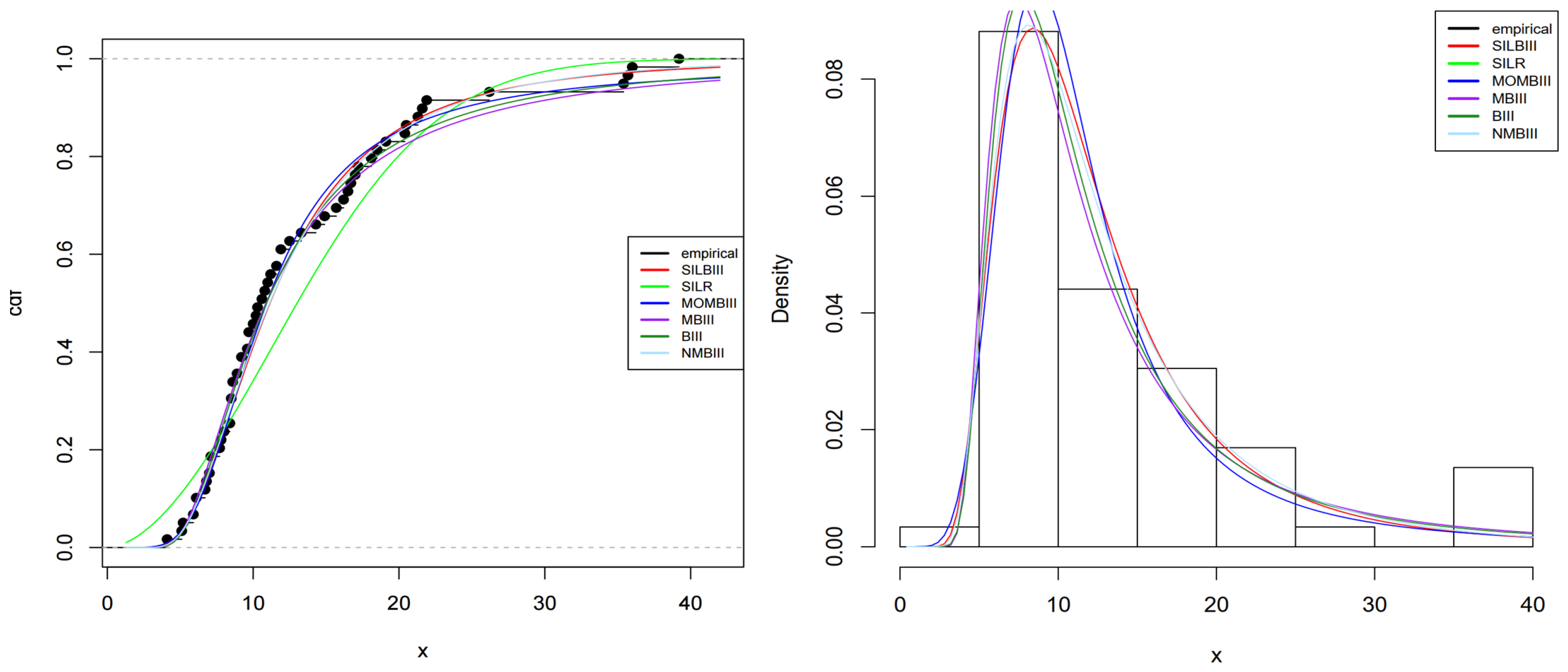
Figure 6 shows the plots of the empirical density, the fitted density (right), and the empirical CDF and the CDF (left) of the fitted distributions using the monthly actual tax revenue dataset. The plot shows that the SILBIII distribution is among the distributions that provide a good parametric fit to the dataset.
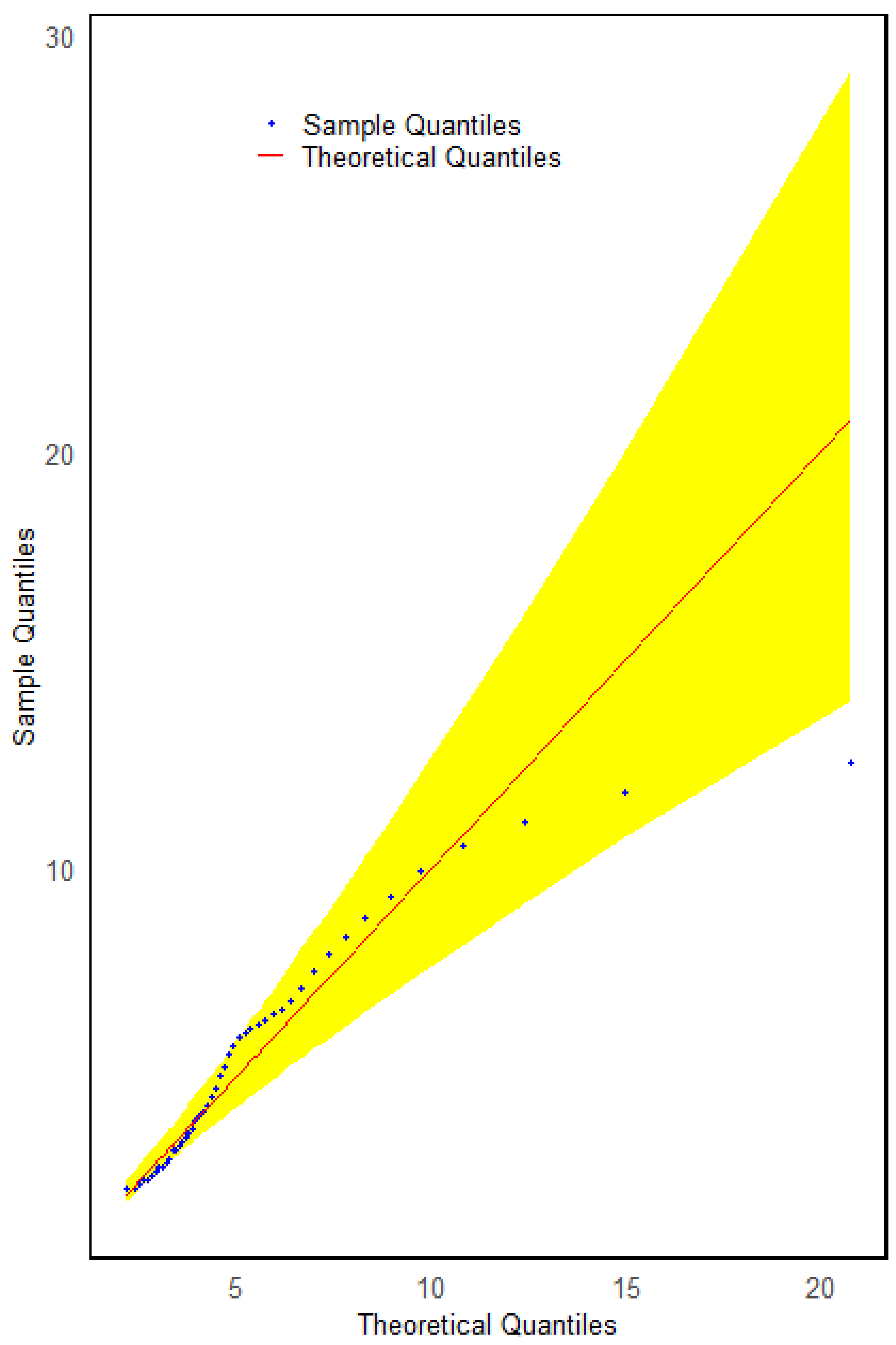
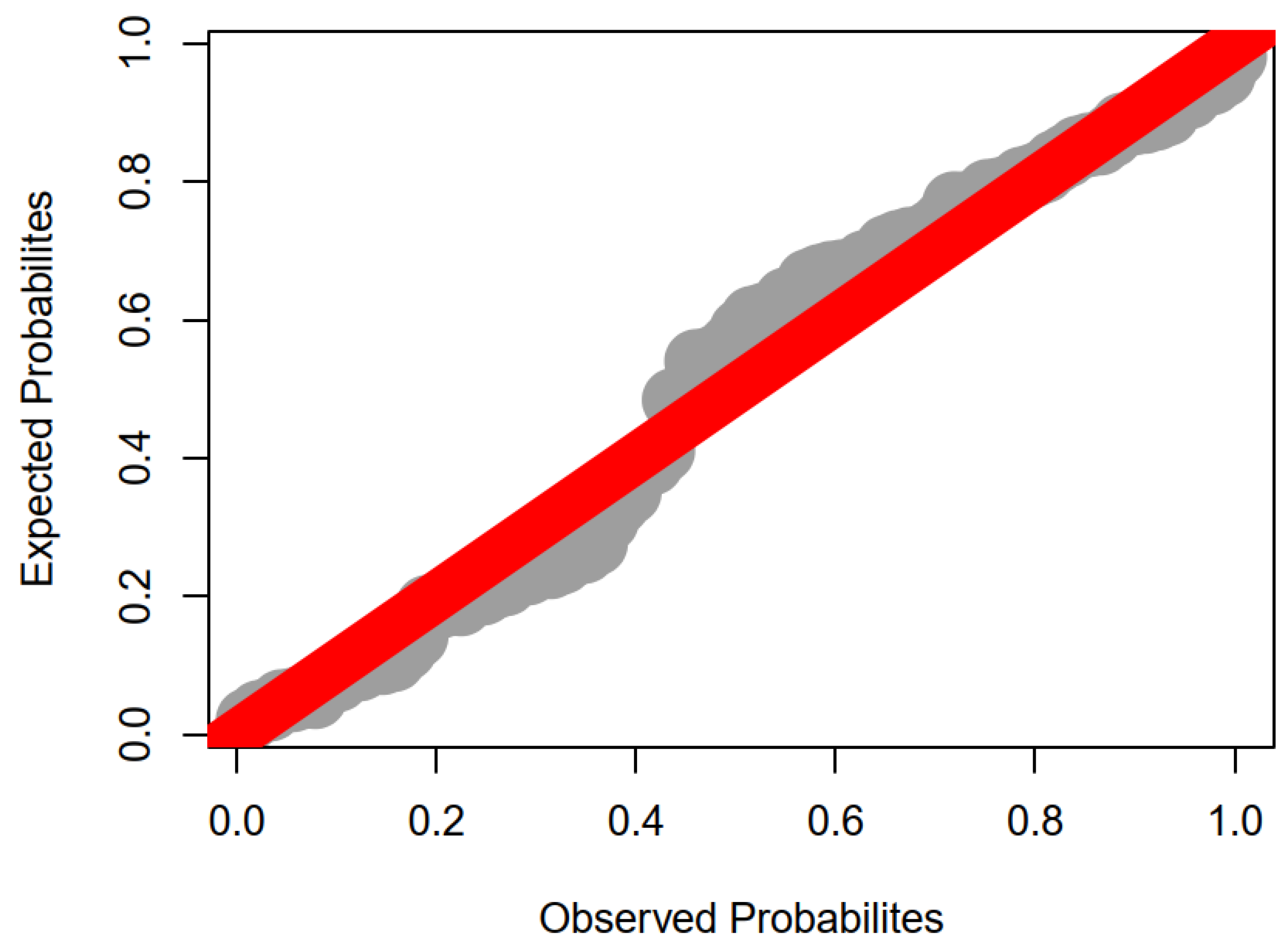
Figure 7 and
Figure 8 show the PP and QQ plots of the SILBIII distribution for the tax revenue dataset. It confirms that the SILBIII distribution provides a better parametric fit to the data.
8. Conclusions
In this paper, we have introduced the Sine Inverse Lomax Burr III (SILBIII) distribution, a flexible distribution that combines the two-parameter Burr III with the Sine inverse Lomax generator. The CDF, PDF, hazard function, and quantile function are obtained, and key statistical properties (moments, generating function, and order statistics) are established. Risk measures, including the value at risk, tail value at risk, and tail variance, are derived and studied. A Monte Carlo study demonstrated that maximum likelihood estimation attains the smallest bias and mean square error, with the Anderson–Darling estimator providing a robust alternative in small samples. When fitted to Egyptian monthly tax revenue data, the SILBIII model achieved the lowest information criteria and superior goodness-of-fit metrics relative to the six competing distributions. These results show that the SILBIII is also flexible and that it can be considered as an alternative heavy-tailed distribution. From a practical standpoint, the SILBIII distribution offers risk analysts a mathematically tractable framework for quantifying extreme events that conventional symmetric or light-tailed models often underestimate. Its analytical risk measures facilitate straightforward computation of regulatory capital buffers, reinsurance retention layers, and stress-testing thresholds, aligning well with Solvency II and Basel III requirements for tail-risk disclosure. However, while the proposed method is flexible, certain computational limitations exist. The evaluation of the log-likelihood function and the inversion of the observed Fisher information matrix require numerical optimization, which can increase computational overhead for high-frequency or large datasets. Convergence of gradient-based algorithms may also be sensitive to initial parameter values, particularly when the shape parameters produce flat likelihood ridges or near-singular Hessian matrices. Future research directions include extending the SILBIII structure to multivariate copula-based frameworks for modeling dependent heavy-tailed risks, developing Bayesian inferential procedures with informative priors to stabilize estimation in small samples, and adapting the likelihood construction to accommodate Type I, Type II, and progressive censoring schemes common in survival analysis.