Article

Assessment of Arsenic and Lead in Urban Park Soils in Newark, New Jersey, USA

Department of Earth and Environmental Sciences, Rutgers University, Newark, NJ 07102, USA
*
Author to whom correspondence should be addressed.
Soil Syst. 2026, 10(2), 34; https://doi.org/10.3390/soilsystems10020034
Submission received: 29 December 2025 / Revised: 13 February 2026 / Accepted: 16 February 2026 / Published: 21 February 2026

Abstract

Soils in seven urban parks in Newark, New Jersey (NJ), United States, were evaluated for arsenic (As) and lead (Pb) by field and laboratory methods. Surface (S1, 0–3 cm) and near-surface (S2, 4–7 cm) soils in high-contact areas of the parks were analyzed by portable X-ray fluorescence (XRF) spectroscopy. Median concentrations of As and Pb in S1 profiles were higher than median concentrations in NJ Urban soils. In S1 and S2 profiles, 39–50% of As and 56–58% of Pb concentrations exceeded the NJ Department of Environmental Protection limits for residential soils, with most hotspots located in two of the seven parks. The contamination factor ( C F A s = 1.5–4.3; C F P b = 1.7–9.8), enrichment factor ( E F A s = 1.7–4.6; E F P b = 2.0–10.4), and geoaccumulation index ( I g e o   A s = −0.1–1.5; I g e o   P b = 0.1–2.7), calculated relative to NJ Rural soil concentrations, confirmed the contamination of park soils with As and Pb, with higher contamination and enrichment indices for Pb. Tessier sequential extraction indicated the metals were mostly in the reducible fraction, with median values of 80% As and 65% Pb bound to iron and manganese oxides. The fractionation suggests limited environmental mobility of the metals under current soil conditions. However, human exposure to As and Pb remains a concern as the soils are located in high-contact recreational areas.

1. Introduction

Lead (Pb) and arsenic (As) are prevalent in urban systems due to a range of anthropogenic activities, including construction, industry, transportation, waste incineration, fossil fuel burning and manufacturing processes [1,2]. Metals released to the urban environment can subsequently accumulate in soils, which serve as a major repository for contaminants [2]. The occurrence and accumulation of metals have been observed in soils across urban areas in the United States (US) [3,4,5,6,7,8,9] and worldwide [10,11,12,13]. Lead (Pb) is a commonly detected metal and has been extensively studied due to continued elevated concentrations in soils despite decreased emissions from leaded gasoline since the 1990s [14]. Other sources of Pb in urban systems include Pb pipes, Pb-based paint, mining, industrial and combustion emissions, glazed ceramics and cookware, batteries, and cosmetics [4,14]. Arsenic (As) has also been frequently detected in urban soils [15,16,17,18] due to inputs from industry, insecticides and herbicides, wood treatment, batteries, waste disposal, and incineration [16,19].
A primary metal exposure pathway for humans is ingestion of contaminated dust and soil [20]. This can be exacerbated in the summer months, when outdoor activity is high and where dry conditions and wind can mobilize dust and soil particles, making them airborne, increasing the possibility of ingestion or inhalation [20]. Given the high population density in urban areas, concerns escalate regarding human exposure to heavy metals via contaminated soils through the ingestion pathway. Research has been conducted on soils in urban commercial and industrial areas close to metal sources [20,21,22,23]. However, the occurrence of heavy metals in soils in urban residential areas and public green spaces may be of greater concern due to the potential for high human contact [24,25,26]. The metals As and Pb have been detected in elevated concentrations in urban residential areas [27], green spaces [28] and community gardens [1,5,6,7,9,29,30]. Several studies have also evaluated playgrounds and parks, which are high-contact areas for children [26,31]. An investigation of heavy metal contamination in public playgrounds in Cluj-Napoca, Romania using portable X-ray fluorescence (pXRF) spectroscopy found that Pb ranged from 14 to 67 mg kg−1 and was elevated in high traffic or industrial areas, while As ranged from 10 to 25 mg kg−1 and was detected more in urban green spaces and play areas [26]. In Ankara, Turkey, Pb concentrations of up to 44 mg kg−1 were detected in urban soil dust samples near playgrounds [31]. The Pb geoaccumulation index ( I g e o ) and enrichment factor ( E F ), calculated using the average crustal abundance values as background concentrations, indicated that the urban playgrounds exhibited significantly elevated heavy metal contamination, which can pose a potential health risk to residents [31]. In Toledo, Ohio, US, 137 soil samples collected from schools, residential yards, and a community garden, analyzed by pXRF, had 7% of Pb samples and 73% of As samples exceeding regional standards [32]. Urban playgrounds and parks in Barcelona, Spain, had significant enrichment of Pb [33]. A study of urban park soils in Grand Forks, North Dakota, showed significant enrichment ( E F ), high contamination (contamination factor, C F ), and moderate pollution ( I g e o ) for As and moderate enrichment ( E F ), moderate contamination ( C F ), and unpolluted to moderately polluted ( I g e o ) for Pb [34]. Urban parks in Kaifeng [35], Beijing [36] and Guangzhou [37] in China contained several heavy metals, including As and Pb. Sequential extraction of the Guangzhou park soils indicated that Pb was mainly in the reducible and residual fractions [37] and therefore not very mobile. These studies demonstrate the importance of investigating heavy metals in soils located in urban residential areas and green spaces, where human contact and risk of exposure may be high.
The current work focuses on soil metal contamination in green spaces in the post-industrial city of Newark, New Jersey, US. Due to legacy and current anthropogenic activity, soils are impaired by a range of pollutants, and there are several known contaminated and superfund sites throughout the city. Though Newark is one of the most densely populated cities in the state, there is limited information regarding the occurrence of heavy metal pollutants in soils in residential areas and green spaces. A study of Newark community garden soils across the city found that Pb concentrations in ~20% of soil samples exceeded the New Jersey Department of Environmental Protection (NJDEP) soil remediation standard for Pb in residential soils [9]. The Pb C F and I g e o , calculated using NJ rural concentrations as background values, revealed that soils had average classifications of very high for C F and moderately to strongly contaminated for I g e o [9]. The elevated Pb concentrations in these soils highlight a need for the evaluation of soils in other green spaces in the city of Newark, such as parks.
This study assesses As and Pb concentrations in soils from seven parks in Newark, NJ using a combination of field and laboratory analysis. Arsenic was selected as another commonly detected contaminant in New Jersey [38] and in urban park soils [36]. Field measurements were conducted in the parks using pXRF spectroscopy, and concentrations were compared to the NJDEP soil remediation standards for the ingestion-dermal pathway for As and Pb in residential soils [39]. These standards are used to determine human exposure to contaminants in soil by incidental ingestion or absorption through the skin, and are determined using the chemical and physical properties and toxicity of the contaminant [39]. To evaluate the extent of contamination relative to other NJ soils, As and Pb concentrations were compared to median metal concentrations for NJ Urban and NJ Rural soils [40]. To quantify the extent of As and Pb pollution and the soil quality relative to other NJ soils, C F , E F , and I g e o were calculated using NJ Rural soil concentrations as the background. The fractionation of metals in the soil was determined using the Tessier sequential extraction procedure (TSEP) [41]. The TSEP determines metal partitioning between exchangeable, carbonate-bound, reducible, oxidizable, and residual soil fractions, and is therefore an indicator of metal speciation, environmental mobility and potential bioavailability. The investigation of As and Pb in urban park soils in Newark, NJ adds to the understanding of metal pollution and the overall safety of recreational areas in a highly urbanized post-industrial city in the US. This study contributes to the literature by assessing heavy metal contamination in urban green spaces, focused on urban park soils as high-use public environments; comparing and quantifiying metal concentrations in the context of regional rural and urban soils and state regulatory limits; and determining metal soil fractionation as a proxy for environmental mobility.

2. Materials and Methods

2.1. Site Description

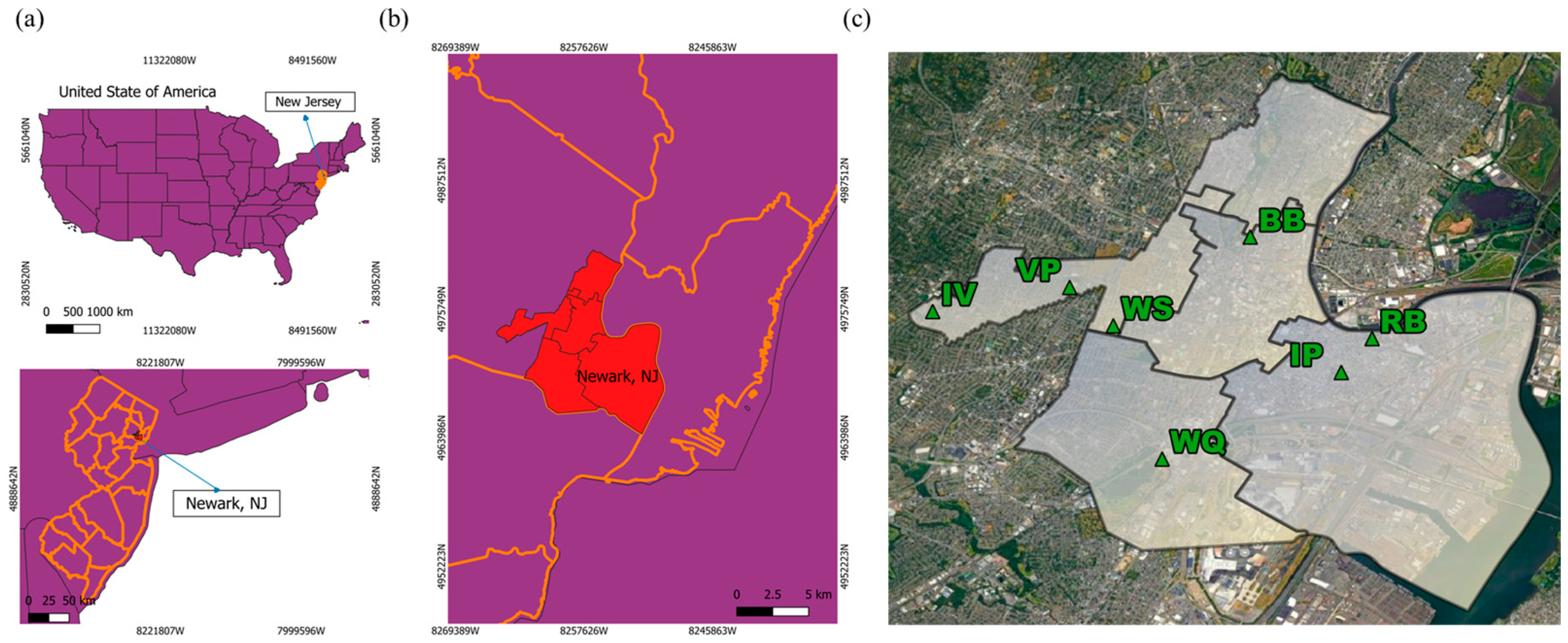
Seven parks located in Newark, NJ were selected for evaluation: BB, IP, IV, RB, VP, WQ, and WS (Figure 1). Five of the parks were near major highways, four were located near active or inactive superfund sites, six were in commercially zoned areas and three were under industrial zoning [42]. Vegetation in the parks was primarily grass and tree cover. Detailed datasets for plant type and species, vegetation age, and associated biotic characteristics were not readily available. Soils in this area are generally silt loam, sandy loam, and red sandstone [43]. However, park soils are frequently modified, disturbed, or imported during construction and maintenance, making it difficult to classify these soils.

2.2. Portable X-Ray Fluorescence Spectroscopy Analysis and Soil Sampling

Soil analysis and sampling were conducted in high-contact areas of the parks, such as playgrounds, sports facilities, recreational areas, and footpaths. Soil analysis was performed using pXRF spectroscopy (X550, SciAps, Andover, MA, USA) using procedures and methods for elemental analysis of soils and sediments [44] and soils in urban areas [45]. Surveys were conducted in the summer months, from July to August, when park use and human interaction are high. At each site, a minimum of 14 soil locations were analyzed. Prior to analysis, debris such as rocks, weeds, and leaves on the soil surface was cleared, and a moisture level of <20% [44,45] was confirmed using a soil moisture meter. The pXRF was calibrated by performing an auto-calibration system check, and instrument precision was evaluated by measurement of standard reference materials (NIST 2709a, 2710a, 2711a, Gaithersburg, MD, USA). Measurements were taken at two soil depths. Soil 1 (S1) measurements were obtained from the surface layer at 0–3 cm and Soil 2 (S2) measurements were taken at a depth of 4–7 cm, representing the near-surface of the soil. Of potentially toxic metals, As and Pb were the most consistently detected and were present in highest concentrations. In cases where the As and Pb concentrations exceeded the NJDEP Residential limit at either depth, composite samples of mixed S1 and S2 soils were collected for laboratory analysis.

2.3. Soil Quality Indicators

To estimate the extent of metal contamination in park soils relative to uncontaminated background levels, the average pXRF concentrations for As and Pb in each park were used to calculate C F , E F and I g e o . These soil quality indicators aid in understanding anthropogenic changes in toxic metal concentrations in soils relative to background values. For all calculations, the metal concentration in NJ Rural soils [40] was used as the background concentration, representative of uncontaminated soils in the study region. The NJ Rural concentrations are part of an established dataset of ambient metals in NJ topsoil as determined by acid-extraction and analysis by atomic absorption spectroscopy [40]. A limitation of using this dataset is the potential discrepancy between pXRF and acid-extracted concentrations, especially for uncontaminated soils. However, in the absence of statewide pXRF topsoil concentrations, the acid-extracted NJ Rural concentrations are the most appropriate regional baseline for comparison, and more relevant than the typically used continental crust concentrations.
The C F (Equation (1)) [46] was determined from C n , the measured concentration of the metal “n” in the soil (mg kg−1), and B n , the background concentration of the metal “n” (mg kg−1).
C F = C n B n
For E F (Equation (2)) [47], C n and B n are the same as in C F (Equation (1)). These concentrations are compared to a reference element where C r e f is the measured concentration in the soil and B r e f is the NJ Rural soil concentration of the reference element. The reference element is a conservative element that is minimally impacted by anthropogenic inputs, typically iron (Fe) or aluminum (Al), and normalization with this element reduces variability in metal concentrations due to soil properties [47,48,49]. The reference element used in this study is Fe because it is a common component in topsoil [48] and was abundant in the urban park soils. Though Fe can be generated from urban sources, the median Fe concentration in the samples was 15,018 mg kg−1 and that of the NJ Rural soil was 14,800 mg kg−1 [40], indicating background levels in the studied soils. Therefore, for these soils, Fe appears to be minimally influenced by anthropogenic inputs. Though there may be synergies between naturally occurring As and Fe in environmental systems, Fe concentrations in these samples are likely to be several orders of magnitude higher than those of As, and the As is likely to be anthropogenic in origin.
E F = C n C r e f s a m p l e B n B r e f b a c k g r o u n d
The calculation of I g e o in the Muller equation (Equation (3)) [50] involves taking the logarithm base 2 of the metal concentration over its background concentration. In this equation, C n and B n are the same as in the C F and E F equations, and 1.5 is a correction that accounts for variations in background and small changes in anthropogenic inputs [51,52,53].
I g e o = l o g 2 C n 1.5 B n
The average concentration of each metal in the S1 and S2 profiles for each park was used to determine the C F , E F , and I g e o .

2.4. Tessier Sequential Extraction

Soil composites collected from field sites were oven-dried for 24 h at 105 °C, thoroughly mixed and homogenized, and sieved to 2 mm for laboratory analysis. To determine soil pH, 2 g of soil was mixed with 10 mL of deionized water, agitated for 5 min and then allowed to settle for 1 h before taking a pH measurement. The soil samples were subject to a 4-step Tessier sequential extraction procedure (TSEP) to determine metals in the exchangeable (step 1), carbonate-bound (step 2), reducible (step 3) and oxidizable (step 4) soil fractions. For step 1, 8 mL of 1.0 M MgCl2·6H2O (Fisher Scientific, Fair Lawn, NJ, USA) was added to 1 g of soil, agitated for 1 h at room temperature on a shaker table, and then allowed to settle for 30 min. Samples were then centrifuged, and the extractant collected. The residual soil samples were washed with 8 mL deionized water (DI H2O), and left to air dry for at least 24 h before proceeding to the next extraction step. Centrifugation to recover the extractant and washing and drying of residual soils were repeated for all subsequent steps. For step 2, 25 mL of 1.0 M NaOAc (Fisher Scientific, Fair Lawn, NJ, USA) (pH 5) was added to the residual step 1 soil. Samples were agitated for 5 h at room temperature and allowed to settle for 1 h prior to centrifugation. For step 3, 20 mL of 0.04 M NH2OH·HCl (Fisher Scientific, Fair Lawn, NJ, USA) in 25% w/w HOAc (Fisher Scientific, Fair Lawn, NJ, USA) was added to the residual step 2 soil. The samples were immersed in a 95 °C water bath for 7 h, cooled for 90 min, and then centrifuged. For step 4, 3 mL of 0.02 M HNO3 (Fisher Scientific, Fair Lawn, NJ, USA) and 5 mL of 30% w/v H2O2 (Avantor, Radnor PA, USA) were added to the residual step 3 soil. Samples were placed in a water bath at 85 °C for 2 h and then allowed to sit for 15 min before the addition of 3 mL of 30% w/v H2O2. The samples were returned to the water bath and reacted for an additional 3 h, then allowed to sit for another 15 min before adding 5 mL of 3.2 M NH4OAc (Fisher Scientific, Fair Lawn, NJ, USA). The samples were placed on a shaker table and reacted at room temperature for 30 min prior to centrifugation. All extractants from each step were analyzed for elemental concentration using inductively coupled plasma-optical emission spectroscopy (ICP-OES, 5110 Synchronous Vertical Dual View, Agilent, Santa Clara, CA USA).

3. Results

3.1. Portable X-Ray Fluorescence Spectroscopy Analysis

3.1.1. Overall Trends in as and Pb Concentrations

Data collected from pXRF measurements were used to determine the low, high, mean, and median concentrations of As and Pb in S1 and S2 soil profiles from the seven parks (Table 1). Out of 110 samples each, 45 S1 and 35 S2 samples had detectable As and Pb concentrations. The lowest detected concentration was reported as the low value, and only detected concentrations were included in calculations for median and mean concentrations. The metal concentrations were compared to benchmark values for soils in NJ [40] and the US [54] (Table 1). For these benchmark values, the NJ Rural and US Background concentrations for As and Pb are all within the same range. In NJ Urban soils, As concentrations are consistent with NJ Rural concentrations, but Pb concentrations are elevated by a factor of 4. The NJDEP Residential limit, which is the soil remediation standard for the ingestion-dermal exposure pathway, is ~2–3 times higher than As and Pb concentrations in NJ Urban soils.
The low concentrations for As and Pb in S1 (0.9, 7.7 mg kg−1) and S2 (0.6, 1.2 mg kg−1) profiles were below the US Background and NJ Rural levels, indicating certain areas are depleted of these metals relative to uncontaminated soils. The median concentrations for As and Pb in S1 (12.7, 147.3 mg kg−1) and As in S2 (8.1 mg kg−1) profiles are shifted to higher concentrations relative to other NJ Urban soils. The high concentrations for As and Pb exceeded NJDEP Residential limits in both S1 (67.2, 670.3 mg kg−1) and S2 (52.2, 716.8 mg kg−1) profiles, indicating some areas of the parks are metal contamination hotspots. Despite elevated concentrations in some areas, the mean concentrations of As and Pb in S1 (13.3, 146.4 mg kg−1) and S2 (11.5, 129.8 mg kg−1) profiles were below NJDEP Residential limits. The mean metal concentrations were somewhat higher in the S1 relative to the S2 profile (Table 1), suggesting accumulation of metals at the soil surface. This surface accumulation for Pb could be attributed to sources such as vehicular emissions, road dust, landfill and industrial emissions [4,14,33], while the source of As may be industrial emissions and use of herbicides [16,19,36].

3.1.2. As and Pb Concentrations in Individual Parks

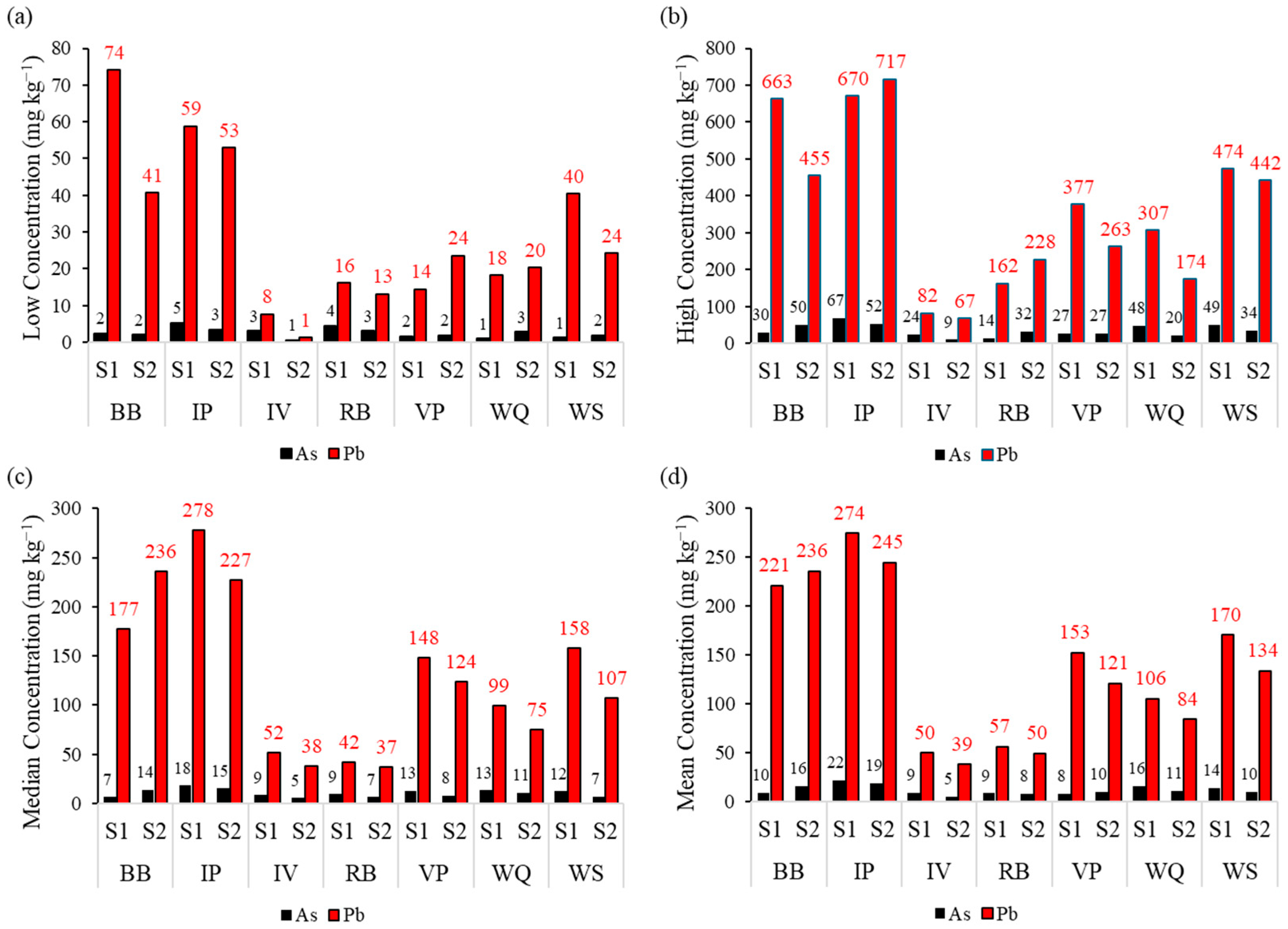
The low, high, median, and mean concentrations of As and Pb in S1 and S2 profiles were evaluated for each of the seven parks—BB, IP, IV, RB, VP, WQ, WS—(Figure 2) relative to benchmark values (Table 1). The low concentrations of As were close to NJ Rural values, while Pb concentrations ranged between NJ Rural and NJ Urban values, with BB having the highest Pb concentration (Figure 2a). The high concentrations (Figure 2b) were used to identify which parks had contamination hotspots relative to the NJDEP Residential limit. The high As and Pb concentrations in all of the parks and in both profiles, except for IV S2, RB S1 and Pb in IV S1 and WQ S2, exceeded the limit. Therefore, all parks had soils with metals above the NJDEP Residential limit. The park IP had the highest overall As (52–67 mg kg−1) and Pb (670–717 mg kg−1) concentrations at 3–4 times the NJDEP Residential limits. The median As concentrations in both profiles for all parks (Figure 2c) exceeded the NJ Urban value. Median Pb concentrations were higher than the NJ Urban value in both profiles for BB, IP, and VP. These three parks, therefore, had elevated levels of As and Pb in surface soils relative to other urban areas in NJ. Mean As and Pb concentrations were highest for IP, followed by BB (Figure 2d, Equations (5)–(7)). The mean Pb concentrations were above the NJDEP Residential limit for both of these parks. The mean As concentrations were below NJDEP Residential limits for all parks except for As in both IP soil profiles.
As S1 = IP > WQ > WS > BB > IV > RB > VP
As S2 = IP > BB > WQ > VP > WS > RB > IV
Pb S1 = IP > BB > WS > VP > WQ > RB > IV
Pb S2 = IP > BB > WS > VP > WQ > RB > IV
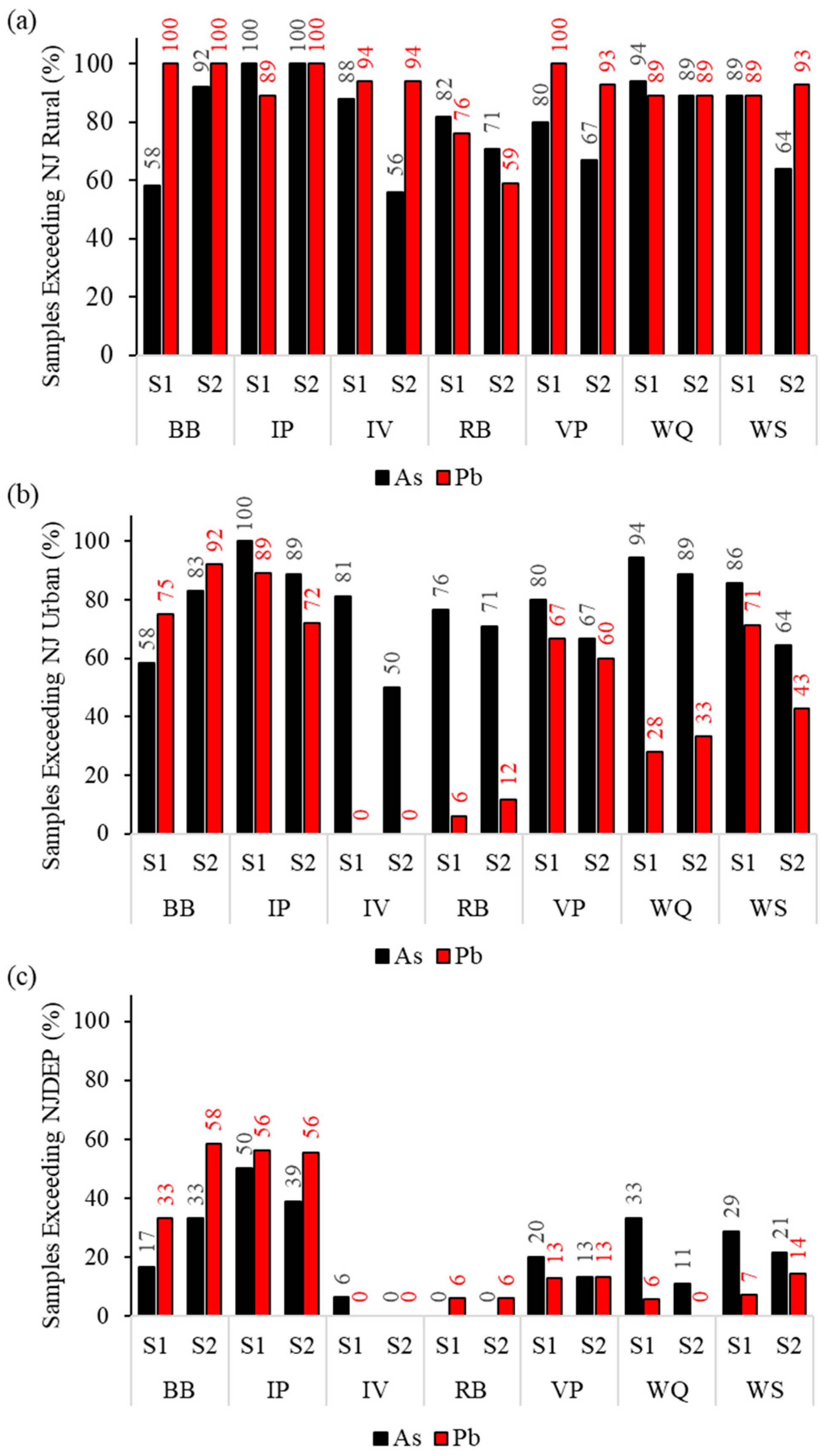
To further understand metal concentrations in relation to NJ soils, the percentage of soil samples exceeding NJ Rural and NJ Urban values, and NJDEP Residential limits in the S1 and S2 profiles were determined for each park (Figure 3). In general, the percentage of samples exceeding any given benchmark for all metals was somewhat higher for S1 compared to S2 samples, suggesting surface deposition and inputs as a major source of the metals. The highest percentage of Pb samples exceeded the NJ Rural value (Figure 3a), indicating a significant contribution of urban activities to Pb in these soils. Across all parks, for As, 58–100% S1 and 50–89% S2 samples exceeded the NJ Urban value (Figure 3b). For Pb, the percentage of samples exceeding the NJ Urban value ranged widely from 0–89% in S1 and 0–92% in S2 (Figure 3b), with IV on the low end and BB and IP on the high end. Soil concentrations higher than the NJ Urban value suggest additional inputs to soils in Newark compared to other urban areas in NJ. Potential sources are industrial, commercial, transportation, and other activities that are highly concentrated in Newark relative to other urban areas.
The percentage of samples exceeding the NJDEP Residential limit was lowest for all parks compared with other benchmark values (Figure 3c). For all parks, the maximum percentage of samples above the NJDEP Residential limit in S1 and S2 profiles was higher for Pb (56%, 58%) than As (50%, 39%). The individual parks with the highest percentages of each metal exceeding the NJDEP Residential limit in S1 and S2 profiles were IP (50%, 39%) for As, and IP (56%, 56%) and BB (33%, 58%) for Pb. Overall, IP and BB were the most impacted parks in terms of elevated metal concentrations, whereas IV and RB were the least impacted, with the lowest overall percentages of metals (0–6%) exceeding NJDEP Residential limits.

3.2. Soil Quality Indicators

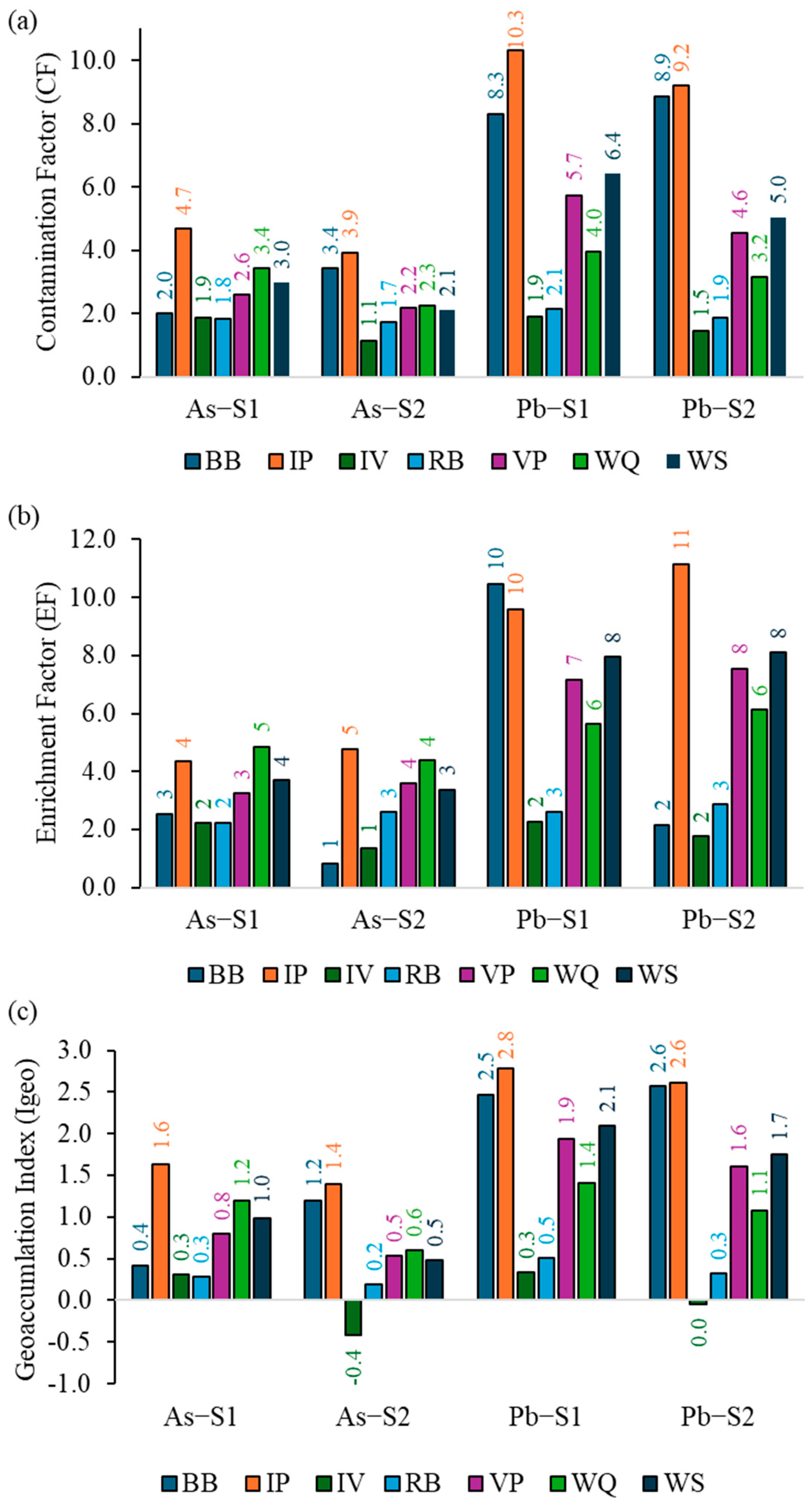
The extent of pollution in the parks was quantified using the contamination factor ( C F , Equation (1)), enrichment factor ( E F , Equation (2)), and geoaccumulation index ( I g e o , Equation (3)). The soil quality indicators were calculated for As and Pb in each park, with C n as the concentration of the metal in averaged profiles (Table 2) and separate S1 and S2 profiles (Figure 4), and B n as the NJ Rural values (Table 1). The average C F A s and C F P b ranged from 1.5–4.3, and 1.7–9.8, with contamination ranging from moderate to considerable, and moderate to very high (Table 2). Overall, Pb had the highest C F values with very high contamination in BB and IP parks in both S1 and S2 profiles (Figure 4a). The average E F A s and E F P b ranged from 1.7–4.6, and 2.0–10.4, classifying soils as no enrichment to moderate enrichment, and moderate enrichment to significant enrichment (Table 2). Higher E F was also observed for Pb, with highest values in BB S1 and IP S1 and S2 profiles (Figure 4b). Since the main difference between C F and E F data is the inclusion of a reference metal, these values were compared. The E F classifications for most of the samples remain unchanged relative to the C F . However, there is a notable difference for As and Pb in the S2 layer for BB (Figure 4b), whereby the E F value indicates a lower classification for both of these metals with As going from considerable contamination to minimal enrichment and Pb from very high contamination to moderate enrichment (Table 2). This is due to significantly higher Fe concentrations in this soil at 77,108 mg kg−1 relative to all other samples, which have an average concentration of 14,215 mg kg−1. This suggests anomalously high Fe concentrations in this sample relative to NJ Urban areas at 14,600 mg kg−1 and the NJ Rural background at 14,800 mg kg−1 [40]. The I g e o A s and I g e o P b ranged from −0.1–1.5, and 0.1–2.7, with classifications of uncontaminated to moderate, and uncontaminated/moderate to moderate/strong (Table 2). Negative I g e o values as observed in IV S2 As and Pb profiles indicate that these specific soils are unpolluted and that an anthropogenic source may not contribute to the heavy metal concentration (Figure 4c). The highest I g e o A s and I g e o P b were observed for IP S1 and S2 profiles.
When evaluating the C F , E F , and I g e o values, it appears that E F results in more conservative values for the soil with an unusually elevated concentration of the reference element Fe, effectively lowering the classification of the metals. This may present a false sense of security, as the absolute concentrations of both As and Pb in the sample in question are high. In this scenario, the C F and I g e o values that directly compare measured metal concentrations to a background concentration may therefore be more reliable for determining soil quality.

3.3. Tessier Sequential Extraction

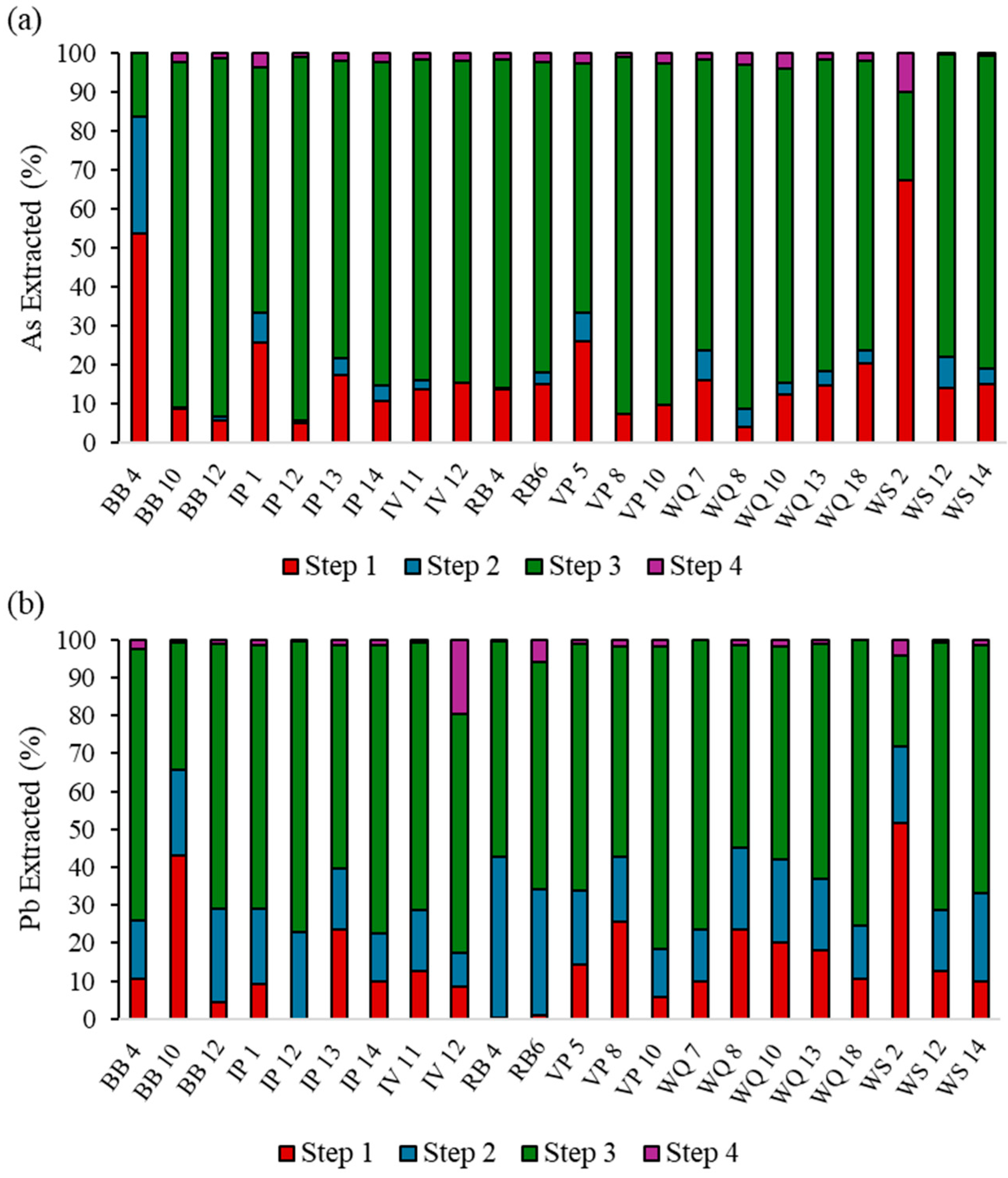
The Tessier sequential extraction procedure (TSEP) was conducted for select soils with As and Pb concentrations above the NJDEP residential limit. For most soils, the largest percentage of As (Figure 5a) and Pb (Figure 5b) was in the reducible fraction, bound to Fe/Mn oxides, with median percentages of 80% and 65% As and Pb, respectively. Some Pb extracted with this fraction may also be associated with insoluble phosphate minerals [9]. Metals associated with Fe/Mn oxide or phosphate mineral phases will have limited environmental mobility. Both As and Pb were also detected in the exchangeable fraction, bound to particle surfaces with the potential for exchange with soil water. For this fraction, a correlation (R2 = 0.61) between soil pH, which ranged from 4.0 to 7.66, and Pb concentration was observed, whereby the concentration of extracted Pb increased with decreasing pH. This is consistent with increased Pb mobility at lower pH values. No relationship between soil pH and As or Pb in any other fraction was observed. The percentage of As in the exchangeable fraction was highest for WS 2 and BB 4 soils, at 67% and 54%, respectively. For Pb, WS 2 (pH 4.40) and BB 10 (pH 4.01) soils had 52% and 43% exchangeable Pb, respectively. The highly mobile As and Pb in these samples may be due to recent anthropogenic input, with addition of metals in the dissolved phase or as a highly soluble solid phase.
Relative to As, a notable fraction of Pb was also in the carbonate-bound fraction, associated with carbonate minerals. On average, 20% of Pb was in the carbonate-bound fraction, with highest values ranging from 33 to 42% for RB 4 and RB 6 soils. This suggests the presence of Pb-carbonate minerals and the potential for mobilization with changes in soil water pH. Due to a notable percentage of Pb in the exchangeable and carbonate-bound fractions, this metal may be more susceptible to mobilization than As from these soils. Most soils also have a small percentage of As and Pb in the oxidizable fraction due to metal binding with organic phases. This is highest for IV 12, with 20% Pb and WS 2 with 10% As associated with organics. Metals in this fraction have the lowest mobility relative to the other fractions. However, for both As and Pb, organic matter was found to play a minimal role in metal sequestration relative to Fe/Mn oxide minerals, particle surfaces, and carbonate minerals.

4. Discussion

The elevated As and Pb concentrations in Newark, NJ park soils, compared to metal concentrations in rural and other urban areas in NJ, point to anthropogenic activity as the dominant source of metals in these environments. All parks had samples that exceeded the NJDEP remediation standard for residential soils, highlighting the presence of localized contamination hotspots. This anthropogenic influence is quantified by the soil quality indices ( C F , E F , and I g e o ) with moderate to high contamination for As and Pb across all seven parks. Higher index values were observed for Pb, suggesting more pronounced anthropogenic input relative to As. Elevated concentrations and soil quality indices for these metals have been observed in other urban parks in the US and internationally. A study in Grand Forks, North Dakota, US reported significant enrichment of As and moderate enrichment of Pb in urban parks, attributed to anthropogenic activity such as vehicular emissions, fertilizers, and pesticides [34]. In parks in Beijing, China, both Pb and As concentrations exceeded background values, with the source of Pb attributed to traffic activity in the area, and As due to pollution with pesticides and herbicides from previous usage as farmland [36]. The individual parks in the current study are bounded by mixed land-use types including residential, commercial and industrial zones [42]. They are also in close proximity to major transportation corridors and known contaminated and superfund sites from past industrial activity. The accumulation of metals in surface and near-surface soils in the parks is therefore aligned with established urban soil contamination pathways, such as atmospheric deposition from transportation and industrial emissions, and legacy sources.
Sequential extraction showed that As and Pb were predominantly associated with the reducible fraction, suggesting limited mobility under current soil conditions [55]. In urban park soils in Guangzhou, China, Pb was also primarily in the reducible fraction [37], and As in urban residential soils was found to be in the reducible fraction associated with Fe-oxides [56]. More Pb was associated with the carbonate-bound fraction compared to As. Therefore, under acidic conditions, more Pb may be labile as a result of carbonate mineral dissolution. Both As and Pb were in the exchangeable fraction, indicating recent anthropogenic inputs and relatively high environmental mobility. Based on their fractionation, most of the As and Pb in these soils is relatively immobile. However, if soil conditions change these metals could be mobilized. Disturbance such as water-induced soil erosion and flooding could transport and release readily exchangeable metal. If perturbation results in changes in soil chemistry, Pb may pose a higher chance of partitioning to solution under acidifying conditions, and both Pb and As may be released under reducing conditions. Human exposure to As and Pb via the ingestion pathway still remains a concern.
Overall, though the mean values for As and Pb concentrations were below the NJDEP limits, across all parks, the presence of localized hotspots and the mobility of the metals in several samples raise concerns for public health, especially in locations frequented by children. These findings therefore warrant management and continuous upkeep of the parks with respect to soil quality. This includes routine monitoring of metal concentrations in soils, incorporating concentration thresholds and soil quality indices in risk assessment, and replacing soils to reduce human exposure and environmental pollution. Metal fractionation also needs to be considered, as this provides insight into the potential for metal mobility with physical or chemical changes. In addition, the impacts of flooding, soil erosion, transportation and environmental and climate-driven changes should be included in the long-term management plan.

5. Conclusions

The As and Pb concentrations in soils from seven Newark, NJ parks were analyzed by pXRF spectroscopy. The concentrations were compared to those found in NJ Rural and NJ Urban soils and to the NJDEP residential soil remediation standards. For soils across the seven parks, 58–100%, 53–100% and 50–61% of samples exceeded the NJ Rural, NJ Urban, and NJDEP Residential values for As, while 53–100%, 0–75%, and 0–58% of soil samples exceeded the NJ Rural, NJ Urban, and NJDEP Residential values for Pb. The parks IP and BB had the overall highest percentage of samples exceeding the NJDEP Residential limit for the ingestion-dermal pathway. The soil quality was evaluated by calculating the C F , E F , and I g e o , which indicated higher contamination and enrichment of Pb relative to As. Of the parks studied, IP and BB had the highest As and Pb concentrations and levels of contamination, and IV had the lowest contamination levels. For samples with elevated Pb and As concentrations, sequential extraction revealed that the metals were mostly associated with the reducible fraction, bound to Fe/Mn oxides, with low environmental mobility. However, these metals may still pose a hazard to human health if conditions change or soil is ingested. Metal accumulation in these soils may be attributed to high anthropogenic activity in this region, such as commerce, industry and transport, with sources such as vehicular and industrial emissions and pesticide and herbicide usage. Overall, this research provides an assessment of As and Pb in urban park soils in a post-industrial city in the US while integrating local regulatory benchmarks with contamination indices and applying sequential extraction to assess metal mobility. This raises awareness of soil contamination in high-contact areas of highly populated urban areas and contributes to an understanding of the environmental quality, risks and management of these urban soils.

Author Contributions

Conceptualization, S.Y. and A.A.R.; methodology, S.Y.; formal analysis, S.Y.; investigation, S.Y.; resources, A.A.R.; writing—original draft preparation, S.Y.; writing—review and editing, A.A.R.; visualization, S.Y.; supervision, A.A.R.; project administration, A.A.R.; funding acquisition, A.A.R. All authors have read and agreed to the published version of the manuscript.

Funding

This research was funded by National Science Foundation Grant No RISE 2228124, EAR 2138057 and HRD 1905142.

Data Availability Statement

The raw data supporting the conclusions of this article will be made available by the authors on request.

Conflicts of Interest

The authors declare no conflicts of interest.

Abbreviations

The following abbreviations are used in this manuscript:
NJNew Jersey
USUnited States
pXRFPortable X-ray fluorescence spectroscopy
C F Concentration factor
E F Enrichment factor
I g e o Geoaccumulation index
NJDEPNew Jersey Department of Environmental Protection
ICP-OESInductively coupled plasma-optical emission spectroscopy
TSEPTessier sequential extraction procedure (TSEP)

References

  1. McBride, M.B.; Shayler, H.A.; Spliethoff, H.M.; Mitchell, R.G.; Marquez-Bravo, L.G.; Ferenz, G.S. Concentrations of lead, cadmium and barium in urban garden-grown vegetables: The impact of soil variables. Environ. Pollut. 2014, 194, 254–261. [Google Scholar] [CrossRef] [PubMed]
  2. Wang, Z.; Wade, A.M.; Richter, D.D.; Stapleton, H.M.; Kaste, J.M.; Vengosh, A. Legacy of anthropogenic lead in urban soils: Co-occurrence with metal(loids) and fallout radionuclides, isotopic fingerprinting, and in vitro bioaccessibility. Sci Total Environ. 2022, 806, 151276. [Google Scholar] [CrossRef]
  3. United States Environmental Protection Agency, National Center for Environmental Assessment. Urban Soil Lead Abatement Demonstration Project; Office of Research and Development: Washington, DC, USA, 1996. Available online: https://nepis.epa.gov (accessed on 21 September 2023).
  4. Battelle Memorial Institute, United States Environmental Protection Agency. Sources of Lead in Soil: A Literature Review Final Report; EPA 747-R-98-001a; U.S. Environmental Protection Agency: Washington, DC, USA, 1998. Available online: https://www.epa.gov/lead/sources-lead-soil-literature-review-final-report-epa-747-r-98-001a-february-1998 (accessed on 17 September 2024).
  5. McClintock, N. Assessing soil lead contamination at multiple scales in Oakland, California: Implications for urban agriculture and environmental justice. Appl. Geogr. 2012, 35, 460–473. [Google Scholar] [CrossRef]
  6. Mitchell, R.G.; Spliethoff, H.M.; Ribaudo, L.N.; Lopp, D.M.; Shayler, H.A.; Marquez-Bravo, L.G.; Lambert, V.T.; Ferenz, G.S.; Russell-Anelli, J.M.; Stone, E.B.; et al. Lead (Pb) and other metals in New York City community garden soils: Factors influencing contaminant distributions. Environ. Pollut. 2014, 187, 162–169. [Google Scholar] [CrossRef]
  7. Cheng, Z.; Paltseva, A.; Li, I.; Morin, T.; Huot, H.; Egendorf, S.; Su, Z.; Yolanda, R.; Singh, K.; Lee, L.; et al. Trace Metal Contamination in New York City Garden Soils. Soil Sci. Interdiscip. Approach Soils Res. 2015, 180, 167–174. [Google Scholar] [CrossRef]
  8. Nezat, C.A.; Hatch, S.A.; Uecker, T. Heavy metal content in urban residential and park soils: A case study in Spokane, Washington, USA. Appl. Geochem. 2017, 78, 186–193. [Google Scholar] [CrossRef]
  9. Goswami, O.; Rouff, A.A. Soil lead concentration and speciation in community farms of Newark, New Jersey, USA. Soil Syst. 2021, 5, 2. [Google Scholar] [CrossRef]
  10. Kelly, J.; Thornton, I.; Simpson, P.R. Urban geochemistry: A study of the influence of anthropogenic activity on the heavy metal content of soils in traditionally industrial and non-industrial areas of Britain. Appl. Geochem. 1996, 11, 363–370. [Google Scholar] [CrossRef]
  11. Luo, X.; Yu, S.; Zhu, Y.; Li, X. Trace metal contamination in urban soils of China. Sci. Total Environ. 2012, 421–422, 17–30. [Google Scholar] [CrossRef]
  12. Manta, D.S.; Angelone, M.; Bellanca, A.; Neri, R.; Sprovieri, M. Heavy metals in urban soils: A case study from the city of Palermo (Sicily), Italy. Sci. Total Environ. 2002, 300, 229–243. [Google Scholar] [CrossRef] [PubMed]
  13. Zgłobicki, W.; Telecka, M.; Hałas, P.; Bis, M. Impact of traffic and other sources on heavy metal pollution of urban soils (Lublin, Poland). Environ. Nanotechnol. Monit. Manag. 2025, 23, 101058. [Google Scholar] [CrossRef]
  14. Agency for Toxic Substances and Disease Registry (ATSDR). Toxicological Profile for Lead; Department of Health and Human Services, Public Health Service: Atlanta, GA, USA, 2020. [Google Scholar] [CrossRef]
  15. Chirenje, M.A.; Ma, L.Q.; Szulczewski, M.; Littell, R.; Portier, K.M.; Zillioux, E. Arsenic distribution in Florida urban soils: Comparison between Gainesville and Miami. J. Environ. Qual. 2003, 32, 109–119. [Google Scholar] [CrossRef]
  16. Luo, W.; Lu, Y.; Wang, G.; Shi, Y.; Wang, T.; Giesy, J.P. Distribution and availability of arsenic in soils from the industrialized urban area of Beijing, China. Chemosphere 2008, 72, 797–802. [Google Scholar] [CrossRef]
  17. Landrot, G.; Tappero, R.; Webb, S.M.; Sparks, D.L. Arsenic and chromium speciation in an urban contaminated soil. Chemosphere 2012, 88, 1196–1201. [Google Scholar] [CrossRef]
  18. Hashimoto, Y.; Imoto, Y.; Nishikata, M.; Suga, H.; Wang, S.; Yasutaka, T. Unveiling the potential mobility and geochemical speciation of geogenic arsenic in the deep subsurface soil of the Tokyo metropolitan area. J. Hazard. Mater. 2025, 484, 136580. [Google Scholar] [CrossRef]
  19. Agency for Toxic Substances and Disease Registry (ATSDR). Toxicological Profile for Arsenic; U.S. Department of Health and Human Services, Public Health Service: Atlanta, GA, USA, 2007. [Google Scholar] [CrossRef]
  20. Laidlaw, M.A.; Filippelli, G.M. Resuspension of urban soils as a persistent source of lead poisoning in children: A review and new directions. Appl. Geochem. 2008, 23, 2021–2039. [Google Scholar] [CrossRef]
  21. Aelion, C.M.; Davis, H.T.; McDermott, S.; Lawson, A.B. Soil metal concentrations and toxicity: Associations with distances to industrial facilities and implications for human health. Sci. Total Environ. 2009, 407, 2216–2223. [Google Scholar] [CrossRef]
  22. Goncharov, G.; Soktoev, B.; Farkhutdinov, I.; Matveenko, I. Heavy metals in urban soil: Contamination levels, spatial distribution and human health risk assessment (the case of Ufa city, Russia). Environ. Res. 2024, 257, 119216. [Google Scholar] [CrossRef] [PubMed]
  23. Cobbina, S.J.; Edu, A.R.; Bosso, E.E.; Bampoe, E.; Gautam, S. Impact of industrial activities on soil quality in urban settings: A study of heavy metal concentrations in Lamashegu, Ghana. Discov. Soil 2025, 2, 68. [Google Scholar] [CrossRef]
  24. Alloway, B. Sources of Heavy Metals and Metalloids in Soils. In Heavy Metals in Soils: Trace Metals and Metalloids in Soils and Their Bioavailability; Alloway, B.J., Ed.; Springer: Berlin/Heidelberg, Germany, 2013; pp. 11–50. [Google Scholar] [CrossRef]
  25. Binner, H.; Sullivan, T.; Jansen, M.A.K.; McNamara, M.E. Metals in urban soils of Europe: A systematic review. Sci. Total Environ. 2022, 854, 158734. [Google Scholar] [CrossRef] [PubMed]
  26. Ghircoias, O.R.; Tănăselia, C.; Chintoanu, M.; Crisan, I.; Hible, A.; Stefan, R.; Dîrja, M. Relevance of Soil Heavy Metal XRF Screening for Quality and Landscaping of Public Playgrounds. Toxics 2023, 11, 530. [Google Scholar] [CrossRef]
  27. Yesilonis, I.; Pouyat, R.V.; Neerchal, N.K. Spatial distribution of metals in soils in Baltimore, Maryland: Role of native parent material, proximity to major roads, housing age, and screening guidelines. Environ. Pollut. 2008, 156, 723–731. [Google Scholar] [CrossRef]
  28. Gkoltsou, V.S.; Papadimou, S.G.; Bourliva, A.; Skilodimou, H.D.; Golia, E.E. Heavy metal levels in green areas of the urban soil environment of Larissa City (Central Greece): Health and sustainable living risk assessment for adults and children. Sustainability 2025, 17, 4421. [Google Scholar] [CrossRef]
  29. Bassetti, O.G.; McDonough, R.A.; Shakya, K.M. Soil contamination in community gardens of Philadelphia and Pittsburgh, Pennsylvania. Environ. Monit. Assess. 2023, 195, 782. [Google Scholar] [CrossRef]
  30. McDonough, R.; Shakya, K.M. Trace metal contamination in community gardens in Pittsburgh, Pennsylvania. Environments 2025, 12, 159. [Google Scholar] [CrossRef]
  31. Isinkaralar, K.; Świsłowski, P.; Isinkaralar, O.; Rajfur, M.; Nguyen, T.N.T.; Di Palma, A.; Gautam, S. Assessing heavy metal pollution in urban children’s playgrounds: Comparative analysis of soil, dust, and moss bioaccumulation. J. Environ. Sci. 2026, 160, 700–712. [Google Scholar] [CrossRef]
  32. Burris, K.R. Heavy Metal Soil Concentrations in the Urban Toledo, Ohio Area: Legacy of Human Activities. Master’s Thesis, Graduate College of Bowling Green State University, Bowling Green, OH, USA, 2021. [Google Scholar]
  33. González-Romero, A.; Rico, P.E.; Alastuey, A.; Moreno, N.; Querol, A.; Sola, P.C. Spatial variability of metal pollution in sands and sandy soils of playgrounds and parks in the Barcelona metropolitan area: Assessing the impact of urban and industrial activities. Air Qual. Atmos. Health 2025, 18, 1713–1727. [Google Scholar] [CrossRef]
  34. Saleem, M.; Sens, D.A.; Somji, S.; Pierce, D.; Wang, Y.; Leopold, A.; Haque, M.E.; Garrett, S.H. Contamination assessment and potential human health risks of heavy metals in urban soils from Grand Forks, North Dakota, USA. Toxics 2023, 11, 132. [Google Scholar] [CrossRef] [PubMed]
  35. Li, J.; Duan, H.; Li, J.; Liu, Y.; Huang, W. Characteristics and health risks of heavy metal pollution in the soil of parks in Kaifeng City. Environ. Geochem. Health 2025, 47, 451. [Google Scholar] [CrossRef]
  36. Liu, L.; Liu, Q.; Ma, J.; Wu, H.; Qu, Y.; Gong, Y.; Yang, S.; An, Y.; Zhou, Y. Heavy metal(loid)s in the topsoil of urban parks in Beijing, China: Concentrations, potential sources, and risk assessment. Environ. Pollut. 2020, 260, 114083. [Google Scholar] [CrossRef]
  37. Gu, Y.-G.; Lin, Q.; Gao, Y.-P. Metals in exposed-lawn soils from 18 urban parks and its human health implications in southern China’s largest city, Guangzhou. J. Clean. Prod. 2016, 115, 122–129. [Google Scholar] [CrossRef]
  38. Vowinkel, E.F.; Balaban, N.H.; Barringer, J.L.; Szabo, Z. Distribution of Arsenic in the Environment in New Jersey; USGS Water-Resources Investigations Report 02-020; U.S. Geological Survey: Reston, VA, USA; New Jersey Department of Environmental Protection: Trenton, NJ, USA, 2002. Available online: https://wwwbrr.cr.usgs.gov/projects/GWC_chemtherm/FinalAbsPDF/vowinkel.pdf (accessed on 3 February 2026).
  39. New Jersey Department of Environmental Protection. N.J.A.C. 7:26D; Remediation Standards; Department of Environmental Protection: Trenton, NJ, USA. Available online: https://dep.nj.gov/srp/guidance/rs/ (accessed on 1 May 2021).
  40. Sanders, P.F. Ambient Levels of Metals in New Jersey Soils. In Research Project Summary: Environmental Assessment and Risk Analysis Element; NJDEP: Trenton, NJ, USA, 2003. [Google Scholar] [CrossRef]
  41. Tessier, A.; Campbell, P.G.; Bisson, M. Sequential extraction procedure for the speciation of particulate trace metals. Anal. Chem. 1979, 51, 844–851. [Google Scholar] [CrossRef]
  42. City of Newark, Department of Economic & Housing Development. Newark Zoning Map. Available online: https://newgin.maps.arcgis.com/apps/webappviewer/index.html?id=8364d36c5a204dfc8b60b4330af8b1df (accessed on 9 September 2022).
  43. United States Department of Agriculture, Natural Resources Conservation Service. Web Soil Survey. 2019. Available online: https://websoilsurvey.sc.egov.usda.gov/App/WebSoilSurvey.aspx (accessed on 23 November 2022).
  44. United States Environmental Protection Agency. EPA Method 6200—Field Portable XRF Spectrometry; U.S. Environmental Protection Agency: Washington, DC, USA, 2007. [Google Scholar]
  45. United States Department of Agriculture, Natural Resources Conservation Service, USDA-NRCS. Soil Screening for Soil Science and Urban Agriculture Portable X-Ray Fluorescence (pXRF) User Guide; U.S. Department of Agriculture: Washington, DC, USA, 2025. [Google Scholar]
  46. Hakanson, L. An ecological risk index for aquatic pollution control. A sedimentological approach. Water Res. 1980, 14, 975–1001. [Google Scholar] [CrossRef]
  47. Ergin, M.; Saydam, C.; Baştürk, Ö.; Erdem, E.; Yörük, R. Heavy metal concentrations in surface sediments from the two coastal inlets (Golden Horn Estuary and İzmit Bay) of the northeastern Sea of Marmara. Chem. Geol. 1991, 91, 269–285. [Google Scholar] [CrossRef]
  48. Sappa, G.; Barbieri, M.; Andrei, F. Assessment of trace elements natural enrichment in topsoil by some Italian case studies. SN Appl. Sci. 2020, 2, 1409. [Google Scholar] [CrossRef]
  49. Masri, S.; LeBrón, A.M.W.; Logue, M.D.; Valencia, E.; Ruiz, A.; Reyes, A.; Wu, J. Risk assessment of soil heavy metal contamination at the census tract level in the city of Santa Ana, CA: Implications for health and environmental justice. Environ. Sci. Process. Impacts 2021, 23, 812–830. [Google Scholar] [CrossRef]
  50. Müller, G. Index of geoaccumulation in sediments of the Rhine River. Geojournal 1969, 2, 108–118. [Google Scholar]
  51. Loska, K.; Wiechuła, D.; Korus, I. Metal contamination of farming soils affected by industry. Environ. Int. 2004, 30, 159–165. [Google Scholar] [CrossRef] [PubMed]
  52. Li, Z.; Ma, Z.; van der Kuijp, T.J.; Yuan, Z.; Huang, L. A review of soil heavy metal pollution from mines in China: Pollution and health risk assessment. Sci. Total Environ. 2014, 468–469, 843–853. [Google Scholar] [CrossRef]
  53. Abdullah, M.I.C.; Sah, A.S.R.M.; Haris, H. Geoaccumulation Index and Enrichment Factor of Arsenic in Surface Sediment of Bukit Merah Reservoir, Malaysia. Trop. Life Sci. Res. 2020, 31, 109–125. [Google Scholar] [CrossRef]
  54. Smith, D.B.; Solano Federico Woodruff, L.G.; Cannon, W.F.; Ellefsen, K.J. Geochemical and Mineralogical Maps, with Interpretation, for Soils of the Conterminous United States; Scientific Investigations Report 2017-5118; U.S. Geological Survey: Reston, VA, USA, 2019. [Google Scholar] [CrossRef]
  55. Ali, J.; Tuzen, M.; Shaikh, Q.; Jatoi, W.B.; Feng, X.; Sun, G.; Saleh, T.A. A review of sequential extraction methods for fractionation analysis of toxic metals in solid environmental matrices. TrAC Trends Anal. Chem. 2024, 173, 117639. [Google Scholar] [CrossRef]
  56. Amaibi, P.M.; Entwistle, J.A.; Kennedy, N.; Cave, M.; Kemp, S.J.; Potgieter-Vermaak, S.; Dean, J.R. Mineralogy, solid-phase fractionation and chemical extraction to assess the mobility and availability of arsenic in an urban environment. Appl. Geochem. 2019, 100, 244–257. [Google Scholar] [CrossRef]
Figure 1. Map of (a) the United States and New Jersey; (b) the location of the city of Newark within the state of New Jersey, and (c) the location of the seven evaluated parks in the city of Newark.
Soilsystems 10 00034 g001
Figure 2. The (a) low, (b) high, (c) median and (d) mean concentrations of As and Pb in S1 and S2 profiles in Newark, NJ park soils.
Soilsystems 10 00034 g002
Figure 3. Percentage of samples exceeding (a) NJ Rural (b) NJ Urban, and (c) NJDEP Residential limits for As and Pb in S1 and S2 profiles in Newark, NJ park soils.
Soilsystems 10 00034 g003
Figure 4. Soil quality indicators (a) contamination factor ( C F ), (b) enrichment factor ( E F ) and (c) geoaccumulation index ( I g e o ) for As and Pb in S1 and S2 profiles in Newark, NJ park soils.
Soilsystems 10 00034 g004
Figure 5. Percent (a) As and (b) Pb in Tessier exchangeable (Step 1), acid-soluble (Step 2), reducible (Step 3), and oxidizable (Step 4) fractions in select Newark NJ, park soils.
Soilsystems 10 00034 g005
Table 1. Concentrations of As and Pb in Newark, NJ park soils, in the S1 and S2 profiles and in New Jersey and United States soils.
Sample/BenchmarkMeasureAs (mg kg−1)Pb (mg kg−1)
S1 (0–3 cm)
n = 45
Low0.97.7
High67.2670.3
Median12.7147.3
Mean13.3146.4
S2 (3–7 cm)
n =35
Low0.61.2
High52.2716.8
Median8.1107.4
Mean11.5129.8
NJ Rural [40]Median4.826.6
NJ Urban [40]Median5.2111
NJDEP Residential [39]Limit19200
US Background [54]Mean6.425.8
Median5.218.1
Table 2. The contamination factor ( C F ), enrichment factor ( E F ), geoaccumulation index ( I g e o ), and classifications for As and Pb in averaged S1 and S2 profiles for Newark, NJ park soils.
As Soil Quality Indicators
Park C F A s Contamination E F A s Enrichment I g e o   A s Contamination
BB2.7Moderate1.7No Enrichment0.8Uncontaminated/Moderate
IP4.3Considerable4.5Moderate1.5Moderate
IV1.5Moderate1.8No Enrichment−0.1Uncontaminated
RB1.8Moderate2.4Moderate0.2Uncontaminated/Moderate
VP2.4Moderate3.4Moderate0.7Uncontaminated/Moderate
WQ2.8Moderate4.6Moderate0.9Uncontaminated/Moderate
WS2.5Moderate3.5Moderate0.7Uncontaminated/Moderate
Pb Soil Quality Indicators
Park C F P b Contamination E F P b Enrichment I g e o   P b Contamination
BB8.6Very High6.3Significant2.5Moderate/Strong
IP9.8Very High10.4Significant2.7Moderate/Strong
IV1.7Moderate2.0No Enrichment0.1Uncontaminated/Moderate
RB2.0Moderate2.7Moderate0.4Uncontaminated/Moderate
VP5.1Considerable7.4Significant1.8Moderate
WQ3.6Considerable5.9Significant1.2Moderate
WS5.7Considerable8.0Significant1.9Moderate
Disclaimer/Publisher’s Note: The statements, opinions and data contained in all publications are solely those of the individual author(s) and contributor(s) and not of MDPI and/or the editor(s). MDPI and/or the editor(s) disclaim responsibility for any injury to people or property resulting from any ideas, methods, instructions or products referred to in the content.