Article

Drivers of Input and Stabilisation Control Subsoil Organic Carbon Content in Perennial Pasture Grazing Systems


1
Faculty of Science and Engineering, Southern Cross University, Lismore, NSW 2480, Australia
2
Cooperative Research Centre for High Performance Soils, Callaghan, NSW 2308, Australia
3
CSIRO Agriculture and Food, Commonwealth Scientific and Industrial Research Organisation, Urrbrae, SA 5064, Australia
4
Department of Soil & Physical Sciences, Faculty of Agriculture & Life Sciences, Lincoln University, Lincoln 7647, New Zealand
*
Author to whom correspondence should be addressed.
Soil Syst. 2026, 10(2), 33; https://doi.org/10.3390/soilsystems10020033
Submission received: 4 December 2025 / Revised: 4 February 2026 / Accepted: 10 February 2026 / Published: 20 February 2026

Abstract

Subsoil (30–100 cm) soil organic carbon (SOC) is a poorly constrained but potentially significant component of terrestrial carbon budgets. While controls on subsoil SOC are likely to differ from those affecting topsoil, few studies have quantified them. This study quantified subsoil (30–100 cm) SOC stocks and identified the controls on its spatial distribution across perennial grazing systems in northeast New South Wales, Australia. SOC was measured to 1 m depth across 54 long-term perennial pasture grazing paddocks on nine farms. A Random Forest regression model was then used to determine the relationship between subsoil SOC and drivers represented by the scorpan model of soil formation. Subsoil SOC contributed ~50% of total SOC stocks in the top metre of soil, with a median of 65.8 t ha−1 stored in subsoil. Our study found that drivers of SOC input and turnover (subsoil total nitrogen, 10–30 cm SOC content, and climate), as well as pedogenic processes influencing SOC stabilisation (weathering index), were the most important factors in the determination of subsoil SOC content. This contrasts with previous findings where abiotic factors linked to parent material and soil properties were the major controls on subsoil SOC distribution and highlights links between both input and stabilisation in perennial grazing systems.

1. Introduction

Soil is the largest terrestrial organic carbon (C) reservoir [1]. However, loss of an estimated 75 Gt C in the top metre of soil has occurred globally since the conversion from natural to agriculturally managed ecosystems [2]. This indicates potential for soil organic carbon (SOC) to be restored in these systems through practices that increase C input to soil and mitigate losses [3]. Due to the large proportion of land under agricultural management, Australia has been recognised as having large potential to contribute to the global 4 per mille SOC sequestration strategy for agricultural soils; proposed to address soil degradation and mitigate climate change [4]. For example, recent studies estimate a 21 Gt mineral-associated organic carbon deficit in Australian soils under permanent pasture in the top 30 cm of soil [5]. As a result, agricultural land use change and management effects on SOC have been widely studied for topsoil (0–30 cm), where root density and SOC content are highest [6,7,8]. Despite evidence that land use and management effects extend into subsoil [9,10,11] and that key drivers of storage differ between topsoil and subsoil [12,13,14], agricultural management effects on subsoil (30–100 cm) SOC have received little attention [15]. The bias towards topsoil overlooks a large proportion of soil’s potential to sequester SOC, with Jobbágy and Jackson [12] reporting that 58% of SOC stocks stored in the first metre of soil occur below 20 cm. Additionally, subsoil is proposed to be more suitable for long-term storage than topsoil [16], and few studies in Australia consider SOC deeper than 30 cm under grazing management [17]; therefore, the controls on subsoil SOC formation and the associated scope for sequestration under perennial grazing remain unknown. It is therefore important to quantify the controls on SOC formation and storage at depth under perennial grazing to inform land management and climate policy.
Stocks of SOC are controlled by the balance of C inputs and losses [18] influenced by both biotic and abiotic properties at different spatial scales [19] and depths [13]. The soil depth profile is thought to represent gradients of influence of these two factors controlling C input, turnover, and retention [14]. Most studies report a decrease in the importance of climate, vegetation, and land use with depth [20,21,22] and an increase in the importance of parent material and soil properties in controlling subsoil SOC content [21], stocks [22,23,24], and sequestration potential [25]. In topsoil, climate and vegetation are major controls on SOC formation due to the regulation of C inputs through vegetation growth, C losses through heterotrophic respiration, and microbial turnover of SOC. However, with increasing depth, soil physical and chemical properties (e.g., clay content, pH, and mineral composition) are thought to have increasing importance in the turnover and retention of SOC through mechanisms protecting SOC from decomposition and leaching [1,26].
Since relatively few studies measure SOC at depths > 30 cm [15], there is limited understanding of how differences in topsoil and subsoil conditions may influence subsoil potential to accumulate and retain SOC [14,16]. While subsoils (30–100 cm) receive little C input, with 80–90% of roots found in the top 30 cm of soil [27], there is increasing interest in their unmet potential for SOC storage and long-term persistence [16]. This is because subsoils are known to contain less C, often having greater abundances of clay and mineral surfaces for the sorption of C, lower microbial activity, and longer residence of SOC; this is attributed to differences in soil physical, chemical, and environmental properties compared to topsoil [13]. Investigating the relative contributions of these factors on subsoil SOC formation therefore warrants investigation within the context of land management for climate change mitigation.
To better understand the complex interactions governing SOC formation in perennial pasture grazing systems, we sampled 54 paddocks across nine perennial pasture grazing sites in northeast New South Wales (NSW), Australia. These sites encompassed a diversity of soil types, allowing us to gain a deeper understanding of the role of soil properties in subsoil SOC accumulation and persistence. The objectives of this study were to quantify (1) current SOC content and stocks under long-term perennial pasture grazing and compare differences across depths (0–10, 10–30, 30–100 cm); and (2) the relative importance of key soil and environmental factors driving subsoil SOC content across diverse soil types in perennial grazing systems. We hypothesised that (1) subsoil would be a large contributor to SOC stocks in the top metre, but this would differ across soil types; and (2) abiotic factors controlling SOC stabilisation (soil properties, parent material, age) would have greater influence on subsoil SOC than drivers of input and turnover (climate, vegetation). Soil properties were measured to calculate SOC content and stocks across depths, and environmental variables were mapped across the study region. This data was used to implement a Random Forest (RF) regression to model the relationship between subsoil SOC and the soil forming factors as a function of soil (s), climate (c), organisms (o), relief (r), parent material (p), age (a), and time (n), as defined by the scorpan model [28,29].

2. Methods

2.1. Study Region

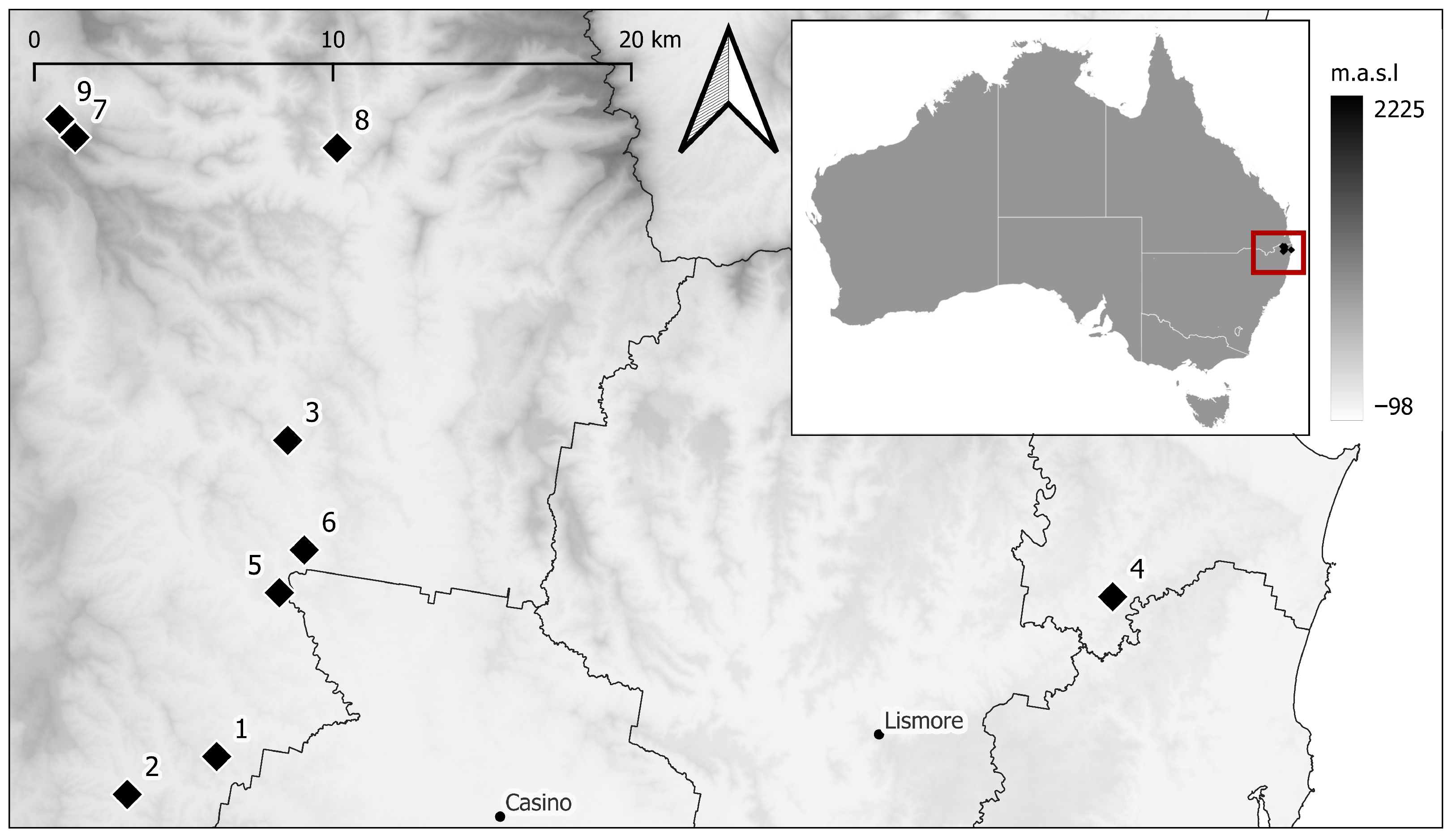
The study was conducted across the Northern Rivers region of northeastern New South Wales, Australia, spanning 20,733 km2 (Figure 1) (sites spanning −28–−29° S, 152–153.5° E). The region was selected for its diversity of soil types and consistent land use as perennial pasture grazing, with extensive clearing of native forests and the establishment of improved pastures occurring throughout the early 1900s. All sites are similarly managed with rotational grazing of perennial pastures, dominated by Setaria (Setaria sphacelate var. sericea), Rhodes grass (Chloris gayana), Kikuyu (Pennisetum clandestinum), and Broadleaf Paspalum (Paspalum mandiocanum)—tropical C4 grasses with a summer-dominant growing season [30]. The diversity of soil types across short distances enabled us to test the relative importance of abiotic properties of soil and parent material on subsoil SOC storage while constraining climate, vegetation and land use in relation to previous large-scale studies (e.g., Hobley and Wilson [21]).
The study sites encompassed five distinct soil types according to the Australian Soil Classification (ASC) (with approximate corresponding World Reference Base (WRB) soil): Kurosols (Acrisols/Lixisols), Kandosols (Acrisols/Cambisols), Dermosols (Luvisols/Cambisols), Vertosols (Vertisols), and Ferrosols (Nitisols) [31,32]. The Australian Soil Classification provides a nationally consistent framework to describe key soil characteristics to inform soil function and management. World Reference Base soils are provided for comparison to international studies but are approximations based on available data [33]. The region’s climate ranges from subtropical to temperate, according to the Köppen Classification System [30]. Across study sites, mean annual precipitation (MAP) was in the range of 1052–1686 mm, and mean annual temperature (MAT) spanned 16.1–19.2 °C. Elevation was in the range of 21–444 m (Figure 1), with gently inclined to steep slopes (4.2–22.4°) [34].

2.2. Soil Collection and Sample Preparation

Soil cores (n = 324) were collected across nine sites (Figure 1) using a 50 mm diameter hydraulic corer, with a total length of 150 cm. Soil samples were collected over the pasture growing season (summer), between December 2022 and February 2023. At each site, six paddocks were sampled, with six cores collected from each. Paddocks were determined based on land use history being identified as perennial grazing by the landholder, having visually uniform topography, vegetation, and accessibility. Core locations were distributed evenly across each paddock, with the minimum distance between adjacent cores 15 m to ensure separate pixels could be sampled from the remote-sensed data. At each individual core site, a 50 × 50 cm quadrat was thrown randomly within 5 m to ensure unbiased determination of the final sampling location. Soil cores were collected to a maximum depth of 135 cm, unless bedrock was reached, and immediately divided into 0–10 cm, 10–30 cm (collectively, topsoil (0–30 cm)), and 30–100 cm (subsoil) intervals. Soil sections were stored in an insulated container and transported to Southern Cross University, East Lismore, NSW, where they were dried at 40 °C [35] until a stable weight was achieved. Subsamples for bulk density were further dried at 105 °C to ensure complete removal of moisture from the mineral soil fraction [35].
After drying, soils were crushed (Vibrotechnik JC 6M, St. Petersburg, Russia) and passed through a 2 mm sieve to remove gravel and coarse organic fragments. Removal of coarse organic fragments (>2 mm) ensures the reliable estimation of SOC, removing undecomposed root and plant litter not associated with the fine earth fraction of soil; this was uniformly done to all soil depths for consistency of results. The fine fraction (<2 mm) was mixed thoroughly through a riffle splitter (Vibrotechnik, St. Petersburg, Russia) before subsamples were taken to determine subsoil physicochemical properties. Additional subsamples were further ground to a fine powder using a FLSmidth ring mill (Copenhagen, Denmark) in a ceramic mill bowl to be analysed for organic C and total nitrogen (N), and natural abundance stable isotope ratios (δ13C and δ15N).

2.3. Data Collection for Regression Analyses

2.3.1. Environmental Covariates

Environmental covariates were selected to represent each of the scorpan soil-forming factors, developed by Jenny [28] and expanded by McBratney et al. [29], into scorpan-SSPFe (soil spatial prediction function with spatially autocorrelated errors) for digital soil mapping (DSM) (Equation (1)):
S = f s , c , o , r , p , a , n + e
This equation describes the factors influencing soil forming processes, where S represents the soil property of interest (e.g., SOC) as a function (f) of selected soil and environmental covariates; s represents soil properties or soil type characteristics determined from maps and laboratory analysis during this study; c is climate variables at a given point; o is organisms, including vegetation and land use; r is relief, or topography; p is parent material; a is age, representing the factor of time; and n refers to the spatial position. The e represents spatially correlated residuals, represented by the mean square error (MSE) calculated from the RF model.
Environmental co-variates were retrieved from existing spatial databases, preferencing those used for previous DSM projects in Australia [20,21,36] (Table 1). Soil variables included measured subsoil physical and chemical properties. Topsoil SOC measured from the 0–10 cm and 10–30 cm core depths were also included to assess evidence for top-down movement of SOC.
Climate variables were represented by MAP and MAT, sourced through the SEED portal (https://datasets.seed.nsw.gov.au/, retrieved: 29 October 2024), created from ANUCLIM software for the period 1976–2005 [37]. This dataset aligns this study with previous DSM studies and was selected to represent long-term climate data, with SOC more tightly linked to long-term climate than short perturbations [38]. Land use was constrained by the selection of permanent pasture grazing sites with improved perennial pastures under rotational grazing, identified by land managers. Discriminating different grazing intensities was not possible; therefore, we chose to exclude land management as a distinct variable, instead opting for normalized difference vegetation index (NDVI) to represent organisms. As NDVI was the only variable to represent organisms, data were sourced from the Sentinel 2 level-2A dataset for its fine resolution (10 m), facilitating unique pixels for each sample location. NDVI is widely used to infer the density of vegetation from satellite imagery by quantifying the greenness of an area, by difference of near-infrared and red-light reflectance. Higher values indicate denser vegetation. The NDVI was calculated from the Sentinel 2 level-2A dataset surface reflectance in Google Earth Engine (Equation (2)):
( N I R R e d ) ( N I R + R e d )
where NIR is reflectance in the near-infrared portion of the electromagnetic spectrum (band 8; central wavelength = 0.842 μm), and Red is reflectance in the red portion of the electromagnetic spectrum (band 4; central wavelength = 0.665 μm).
Relief variables included shuttle radar topography mission digital elevation model (SRTM DEM-S), slope (°), aspect, and topographic wetness index (TWI), all sourced through the TERN DSM Raster Covariate Stacks [39]. Aspect was converted to a value between 1 (N) and −1 (S) to represent deviation from the north–south axis using the equation by Beers, et al. [40,41]. The TWI is used to understand how water flows and accumulates in different areas based on topographic features including upslope contributing area and slope, where higher values indicate wetter areas in the landscape.
Parent material variables included radiometric measurements of potassium (K), uranium (U), and thorium (Th), as well as silica index (Si), also sourced through TERN [39]. Radiometric K, U, and Th infer soil parent material characteristics [36], providing continuous rather than categorical data. Silica index represents the silica content (%) of parent material, where higher values indicate more resistant parent materials and coarser soil texture [33,36]. For post-modelling interpretation, lithology was identified using simplified surface lithology classes [33] used for DSM projects in Australia [42], sourced through TERN at 90 m resolution. These lithology classes have been classified by distinct parent material properties, including range in silica content (%) and base cation oxides (%), and have shown to have a strong relationship between 6 key diagnostic properties of ASC classes [33]. Weathering index was used to represent soil ‘age’ [42], reflecting the degree of weathering of parent material and soil, based on gamma-ray spectrometry and SRTM DEM [43].
All data sourced through the TERN DSM Raster Covariate Stacks (https://doi.org/10.25919/jr32-yq58, retrieved: 14 May 2025) were at 30 m resolution, unless otherwise specified, and loaded into QGIS as Cloud Optimised Geotiffs. Values from each environmental covariate dataset were extracted for each sampled core using the Sample tool in QGIS [44], QGIS 3.38 (http://www.qgis.org/, retrieved: 29 October 2024).

2.3.2. Soil Physical and Chemical Analyses

Particle size distribution was determined using mid-infra-red (MIR) spectral data, calibrated against a subset (n = 72) of samples measured using the Bouyoucos hydrometer method [45]. Calibration samples were selected to represent the range in soil types and textures. Particle size prediction was done with partial least squares regression (PLSR), using the ‘prospectr’, ‘pls’, and ‘caret’ packages to model and validate results [46,47,48] in the R software environment [49]. Soil pH was measured using a Horiba PH210-K (Irvine, CA, USA) pH meter and 7 g of soil in a 1:5 (mass to volume) soil to water suspension. For bulk density, a 15 g homogenised subsample was dried at 105 °C for 24 h (oven-dry weight), following initial drying at 40 °C. The oven-dry weight of the soil subsample was used to correct the 40 °C dry weight of the <2 mm fraction and calculate the whole earth bulk density using the core volume.
Total SOC and N content and respective stable isotope ratios (δ13C, δ15N) were determined by dry combustion. Samples containing carbonates were identified by pH values above 7.4 [10] and a positive fizz test on application of 1 M HCl. For these samples, total SOC and δ13C were determined following removal of carbonates via acidification with 10% HCl. Fine-milled subsamples were weighed into tin capsules (10 mm, Sercon SC1318) and analysed for elemental C and N content (as a percentage of dry-weight soil) and δ13C and δ15N at Southern Cross University. These samples were measured using a Thermo Fisher Delta V plus isotope ratio mass spectrometer (IRMS), coupled to an elemental analyser (Flash EA, Thermo Fisher, Waltham, MA, USA), via a Conflo IV interface (Thermo Fisher, MA, USA). Samples were measured alongside working standards (caffeine: δ13C = −32.0, δ15N = −4.2; glucose: δ13C = −10.5; collagen: δ13C = −21.5, δ15N = 4.8), calibrated against international reference standards (USGS64: δ13C = −40.8, δ15N = 1.8; USGS65: δ13C = −20.3, δ15N = 20.7; USGS64: δ13C = −0.7, δ15N = 40.8) [50], with a precision of ±0.15‰ δ13C and ±0.3‰ δ15N. Total C and δ13C values represent the total SOC for carbonate-free samples. Stable isotope ratios are expressed in delta notation as δ13C and δ15N per mil (‰), relative to Pee Dee Belemnite and atmospheric N, respectively.

2.4. Soil Organic Carbon Stocks

Total SOC stocks were calculated across the 0–10, and 10–30 cm depths for topsoil, and 30–100 cm depth for subsoil, to determine SOC stocks in tonnes per hectare for each depth [18] (Equation (3)):
S O C s t o c k t   h a 1 = S O C % × B D × 1 g c 100 × D × 10 2 t   h a 1
where SOCstock is SOC stock in tonnes per hectare (t ha−1); SOC% is the SOC content of the soil fraction (%) for the measured depth; BD is the bulk density (g cm−3); gc is the gravel content (%) determined by the ratio of gravel to soil for the measured depth (assumed to have SOC% = 0); and D is the depth of the soil layer. In instances where cores were greater or less than 100 cm, SOC stock calculations were normalized to 100 cm.

2.5. Data Cleaning and Statistical Analyses

All statistical analyses were completed in the R software environment [49]. Data were analysed to determine significant differences in subsoil properties and environmental covariates, between sites. Data distributions were assessed for normality using the Shapiro–Wilk test, where values <0.05 were considered not-normally distributed. Skewness and kurtosis were also evaluated using histograms. As data were not normally distributed, we implemented a Kruskal–Wallis and post-hoc Dunn test for pairwise comparisons with a Holm-adjusted p-value, using ‘rstatix’ [51]. Subsoil physical and chemical properties varied across sites, as did environmental covariates (p < 0.001). Differences in SOC content, stocks, and C:N ratio of SOC with depth were also tested for significance with Kruskal—Wallis and post-hoc Dunn test. Differences in topsoil and subsoil SOC content and stocks were also tested for significance across lithology classes and soil type with Kruskal—Wallis and post-hoc Dunn test. All results are reported in median (IQR25−75) unless otherwise stated. All figures were created in R using ‘ggplot2’ and ‘tidyverse’ [52,53].

2.6. Random Forest Regression

We used RF regression [54] to model relationships between subsoil SOC and scorpan factors. Multiple linear regression models have often been used to correlate environmental variables with SOC through a DSM framework [29,55]; however, machine learning techniques are proving more powerful, with greater potential for detecting non-linear relationships [55,56]. The advantages of RF are that predictor variables can be continuous and categorical, it is robust to noise, and there is low correlation between individual trees, as only a set number (mtry) of random predictors are used to find the best split at each node [57]. For SOC studies, the ntree of 1000 has commonly been used to increase the stability of results in the estimation of variable importance [57], which we implemented in this study, with default values for regression studies used for mtry and nodesize. Due to the relatively small sample size (n = 324), the model was trained on all data, with model performance evaluated by out-of-bag (OOB) error, and 10-fold cross validation (CV) after training [57].
Data to be used in the model were analysed to address multicollinearity, to reduce possible overfitting of the model, using the ‘corrplot’ and ‘car’ packages [58,59]. Correlation analysis using Spearman’s rank correlation was used to detect collinearity between predictor variables, set at a threshold of r ≥ 0.8 [60]. Variance inflation factors (VIFs) in regression analysis were also used to test the degree of correlation, as they quantify how much the variance of a regression coefficient is inflated due to multicollinearity. Variables with VIFs ≥10 are indicative of high multicollinearity and therefore were iteratively removed and excluded from the RF model until all values were below threshold [60]. Correlation analysis revealed collinearity between clay and sand. Clay content was kept because we expected it to have a greater influence on subsoil SOC in the RF model, and silica index, used as a parent material variable, can be used to infer coarser textured soils. Elevation was also removed to reduce VIFs for MAP and MAT. Removal of these variables brought VIFs below 10 for all other variables to be included in the model.
The RF regression model was executed using the ‘randomForest’ package [61] in the R software environment [49], with 10-fold CV done using the ‘caret’ package [48]. Variable importance and partial dependence plots, also facilitated by the ‘randomForest’ package in R, were used to understand the influence of variables on subsoil SOC content. When growing individual trees, one-third of the data left out of training (OOB samples) were used to estimate prediction error (Equation (4)) and variable importance.
M S E O O B = 1 N i = 1 N y i y i O O B 2
where MSEOOB is the mean square error; y i O O B is the OOB prediction for observation y i . Variable importance was determined by the “%IncMSE” metric from the RF model, indicating the increase or decrease of prediction accuracy in nodes where the values of a variable are randomly permuted in the OOB data of a tree. The larger the increase in MSE, the greater the effect when the variable is randomly permuted. Variables with little importance have limited effect on MSE when randomly permuted. Partial dependence plots assess the average marginal influence of individual predictors, and these were created using the ‘pdp’ package in R [62], by fixing each predictor over its observed range while averaging predictions from the fitted RF model across all other predictors and trees.

3. Results

3.1. Model Covariates

3.1.1. Site Summary of Environmental Covariates

Environmental covariates were mapped to describe the range in scorpan factors across sites (Table 2). Scorpan environmental covariates varied significantly across some sites (p < 0.001). Site 4, occurring on Ferrosol soil derived from mafic parent material, had the highest MAP across all sites except site 8, which was dominated by Vertosol soils on mafic parent material (Table 2). NDVI was also the highest at site 4 (0.58–0.68) compared to all sites except site 7 (0.52–0.65) (Table 2). Site 4 had the highest MAT (18.9–19.2 °C), compared to all sites except site 6 (18.5–18.7 °C) (Table 2). Site 7 had the lowest MAT (16.1–17) compared to all sites except site 9 (17.5–17.9), and both had higher elevation than all other sites (Table 2). Sites 2, 4, 5, and 6 had a higher weathering index (Table 2), where Kurosol soils tended to occur at sites with siliceous parent materials (2, 5, 6), and Dermosol and Ferrosol soils tended to occur at sites with mafic parent materials. Sites 4, 7, and 8 had the lowest radiometric Th (Table 2) and K (Table 2) and were dominated by mafic or intermediate upper parent material, with lower silica content (58–69%) and Ferrosol, Dermosol, and Vertosol soil types. Radiometric U and Th was highest for siliceous parent materials, often co-occurring with Kurosols and Kandosols, and lowest for mafic parent materials (Table 2).

3.1.2. Measured Subsoil Physical and Chemical Properties

Subsoil SOC and total N varied among sites (Table 3). Soils formed on mafic parent material had the highest subsoil SOC and total N content, while soils formed on siliceous parent material had the lowest subsoil SOC and total N (Table 2 and Table 3). Study site 4, a Ferrosol soil on mafic parent material, had significantly higher subsoil SOC (2.34 ± 0.84%), and total N (0.13 ± 0.04%, Table 3), compared to all other sites. The C:N ratio was highest at site 4 (18.5 ± 6.37); however, this difference was only significant between sites 6, 7, and 9 (sites dominated by intermediate upper parent material). Site 9, dominated by Kurosol soils on intermediate upper parent material, had the lowest subsoil SOC content (0.71 ± 0.47%), although this was only significantly lower than sites 4, 5, and 8 (sites dominated by mafic parent material) (Table 2 and Table 3). Mean clay content was in the range of 28–59% across the study sites, and sand content was 21–49%. The contribution of subsoil to SOC in the top metre of soil varied across sites (Table 3) and soil types (Table 4). At sites 2, 4 and 6, subsoil contributed >50% of SOC stocks; these sites were among those with the highest weathering index (Table 2 and Table 3).

3.2. Vertical Distribution of SOC Content, Stocks and C:N Ratio

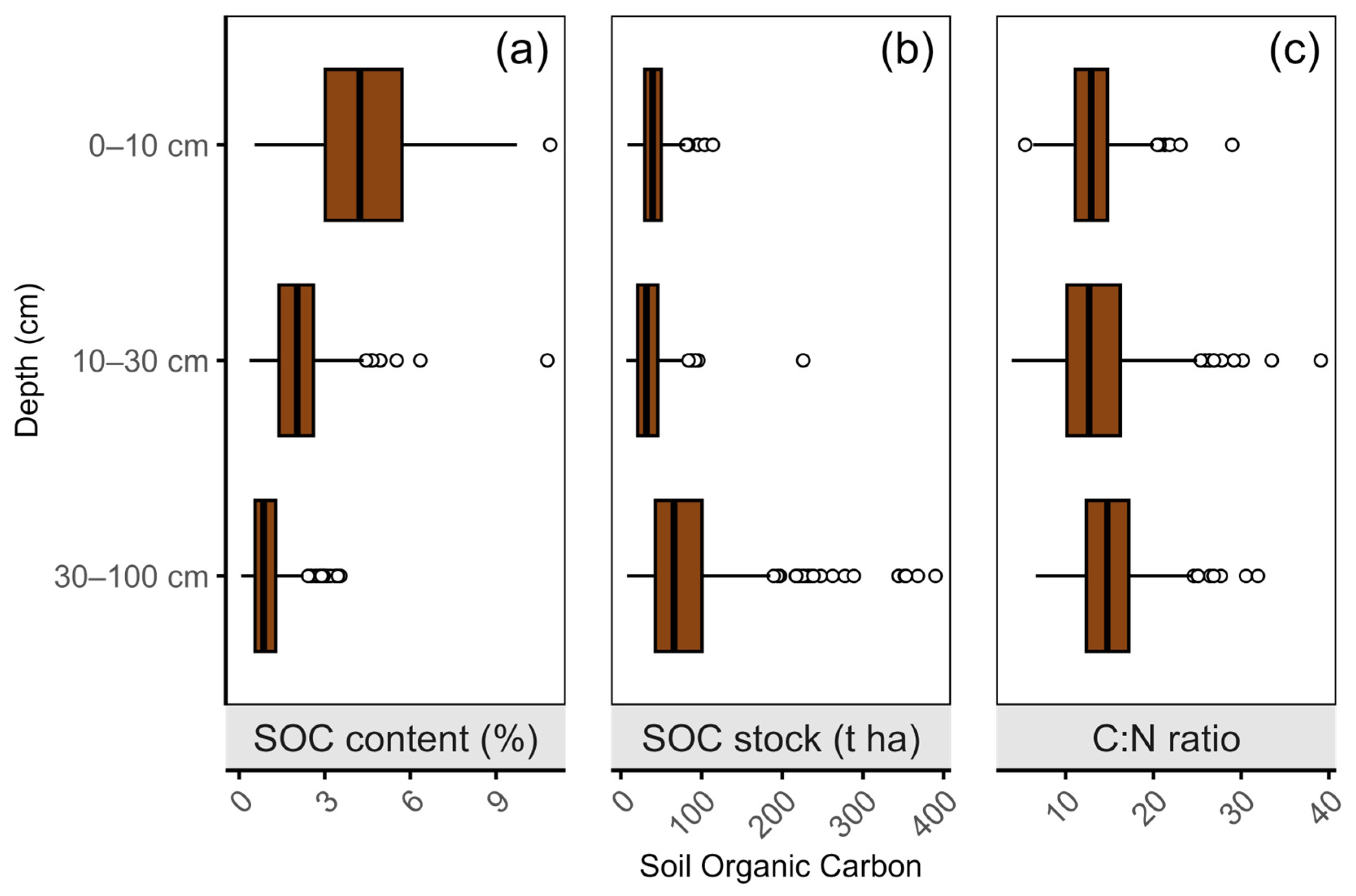
The SOC content of soil decreased with depth from 4.2% (IQR25−75 3.02–5.71) at the surface (0–10 cm) to 0.86% (IQR25−75 0.56–1.28) in subsoil (Figure 2, H(2) = 557.91, p < 0.001). The SOC stocks (Equation (1)) from 30–100 cm (median = 65.8; IQR25−75 42.7–101 t ha−1), were greater than SOC stocks from 0–10 cm (median = 39.3; IQR25−75 29.5–49.9 t ha−1; H(2) = 250.49, p < 0.001). SOC stocks were greater at 0–10 cm than at 10–30 cm depth (median = 31.6; IQR25−75 20.8–45.6 t ha−1) (Figure 2). The C:N ratio increased from topsoil (0–10 and 10–30 cm) 12.9 (IQR25−75 11.1–14.8) and 12.7 (IQR25−75 10.1–16.2), respectively, to 14.8 (12.4–17.2) in subsoil (H(2) = 55.68, p < 0.001). There was no difference in C:N between 0–10 cm and 10–30 cm (median = 12.7, IQR25−75 10.1–16.2).
Total SOC stocks (0–100 cm) were in the range of 31.9–497 t ha−1 (Median = 143, IQR25−75 108–202 t ha−1), with subsoil accounting for almost half of this (49.6 ± 13.9%; median stock of 65.8 t ha−1 (IQR25−75 42.7–101 t ha−1)) (Figure 2). Total topsoil (0–30 cm) stocks had a median of 73.5 t ha−1 (IQR25−75 53.3–95.1 t ha−1). There were significant differences in SOC stocks across soil types; however, these trends were not consistent across the two depths. Topsoil SOC stocks were highest in Ferrosols and Dermosols (85.8 ± 25.2 and 77.3 ± 15.1 t ha−1) than Kurosols and Kandosols (59.2 ± 40.4 and 54.2 ± 29.6 t ha−1), and Vertosols were similar to both groups (76.2 t ha−1) (Table 4). Subsoil SOC stocks were highest only in Ferrosols (187.1 ± 86.7 t ha−1) compared to all other soil types (Table 4). Dermosols and Vertosols were similar (65.1 ± 40.9 and 68.8 ± 40.82 t ha−1), Vertosols and Kurosols were similar (68.8 ± 40.8 and 57.6 ± 52.1 t ha−1), and Kurosols and Kandosols were similar (57.6 ± 52.14 and 38.4 ± 43 t ha−1). When considering the proportion of SOC stocks contributed by topsoil or subsoil, relative to the top m, Ferrosols had the greatest proportion of subsoil SOC stocks relative to topsoil (74 > 26%), which was significantly different to all other soil types (Table 4).

3.3. Model Performance and Variable Importance

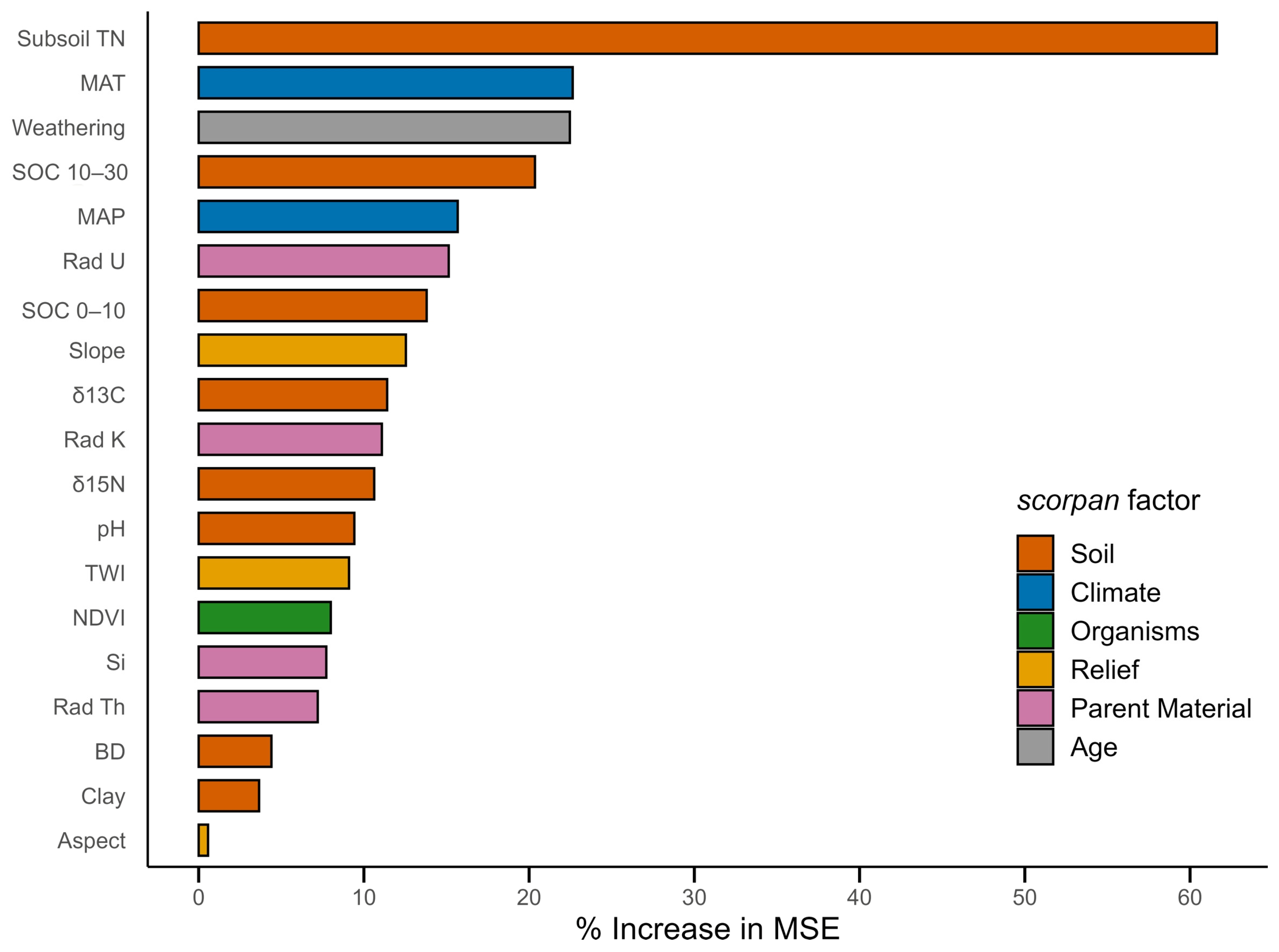
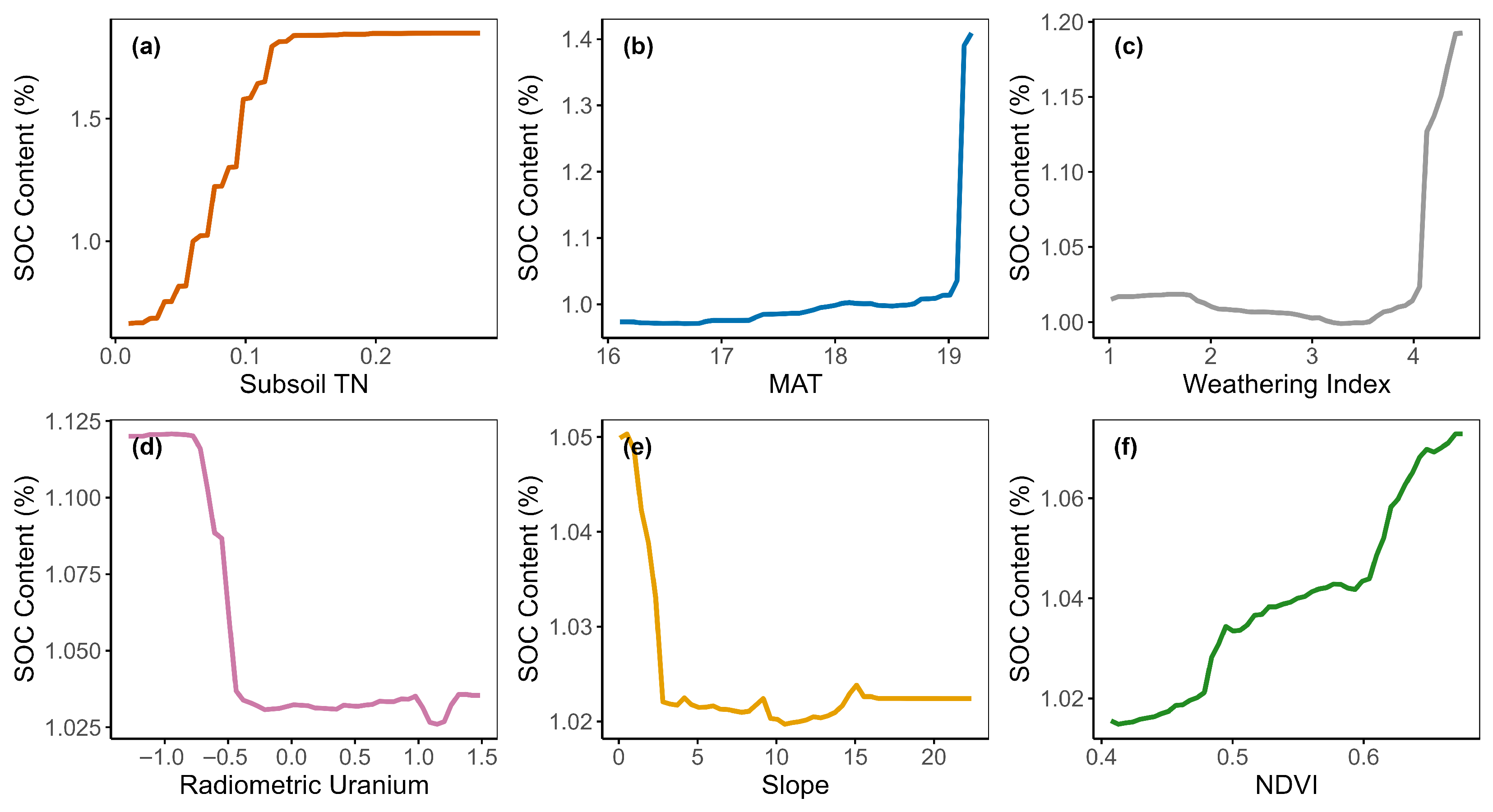
Soil properties (subsoil TN and SOC 10–30), climate (MAT), and age (weathering index) were the most important variables for explaining spatial variability in subsoil SOC content across our study region, with >20% increase in MSE (%IncMSE) when randomly permuted (Figure 3). There were positive relationships between subsoil SOC and TN 30–100 cm, SOC 10–30 cm, MAT, and weathering index, and negative relationships for radiometric U and slope (Figure 4). The 19 scorpan factors selected for the regression model explained most of the variance of subsoil SOC content (ROOB2 = 87.42% and MSEOOB of 0.06%) at this regional scale. The model was further validated using 10-fold CV repeated three times to check for overfitting, since all data were used in training the model (ROOB2 = 87.7% and a MSEOOB of 0.06%). Similar results between CV and OOB data confirm reasonable model performance without overfitting.
Total N content in the subsoil was the most important soil variable for explaining subsoil SOC content across the study region, with a 62% increase in the mean square error (%IncMSE) when randomly permuted in the OOB set (Figure 3); model performance was impacted when subsoil N was removed (ROOB2 = 73%, MSEOOB 0.14). Topsoil SOC contents at 0–10 cm and 10–30 cm depth were important predictors, with both variables ranked in the top 10 most important variables; however, SOC at 10–30 cm depth ranked higher than SOC at 0–10 cm depth (20.4 > 13.8%IncMSE). Clay content had little effect (%IncMSE = 3.66%).
Of the climate variables, MAT was more important than MAP (22.6 > 15.68%IncMSE); there was a sharp increase in subsoil SOC content when MAT reached 19 °C (Figure 4). NDVI was the only variable representing organisms; NDVI had <8% impact on MSE and a positive relationship to subsoil SOC content (Figure 4). At this regional scale, relief variables, including slope, TWI, and aspect, were not strong predictors of subsoil SOC variability (<15%IncMSE). Slope was the most important relief variable, with higher subsoil SOC for slopes < 2.5°. Aspect had little effect (0.5%IncMSE). None of the parent material indicators (U, K, Th, and silica index) increased MSE by >15%. Radiometric U was the highest ranked parent material variable, with a negative relationship demonstrated by the partial dependence plot between subsoil SOC content and radiometric U (Figure 4). Radiometric U was highest for siliceous parent materials and lowest for mafic parent materials. Weathering index, representing age, increased MSE by 22.5%, equal to MAT. Subsoil SOC content sharply increased when weathering index was ~4 (Figure 4).

4. Discussion

Although SOC content decreased with depth (0–100 cm) from 4.2–0.86%, subsoil (30–100 cm) accounted for almost half (49.6%) of SOC stocks in the top metre of soil; however, this varied with soil type, from 42.5% for Kandosols to 74.4% for Ferrosols (Table 4). While the 0–10 cm soil depth had higher SOC content and stocks, 10–30 cm SOC content was a more important determinant of subsoil SOC content. This may suggest that subsoil SOC content is related to processes governing transfer and turnover across depths; more work is required to establish a mechanism for this association outside of autocorrelation. We hypothesised that abiotic factors would have greater influence on subsoil SOC content, through properties responsible for SOC stabilization. However, the RF model revealed that drivers linked to C input and turnover (climate, SOC, subsoil TN) and drivers of pedogenic processes (weathering index), which influence soil properties linked to stabilisation, remain relevant drivers of SOC to depths of 1 m (Figure 3) in perennial grazing systems. In addition, 87% of variance was explained by the variables included in the model, a stronger fit than previous subsoil studies [20,23].
Subsoil contributes around half of total SOC stocks in the top metre of soil, at global [12,63,64] and continental scales [24,65]. However, across different climates [20,24,66], vegetation/land use [12,22], and soil types [67,68], this can vary from 30–70% [20], indicating a complex interaction between pedo-climatic conditions and subsoil storage potential. In the Australian context, Gray et al. [20] predicted subsoil SOC stocks ranging from 30–190 t C ha−1 across moist to wet climates of Eastern Australia with the same lithology classes included in the current study. A review by Cotching [67] summarised SOC stocks of 85–137 and 132 t ha−1 for Kurosols and Kandosols, 77–228 and 75–328 t ha−1 for Dermosols and Vertosols, and 60–228 t ha−1 for Ferrosols to 1 m depth across the eastern states of Australia, similar in order of increasing SOC across the same soil types in this study. Our study also indicated a wide range in SOC stocks to 1 m depth (32–497 t ha−1) across different soil types; topsoil was in the range of 53–95 t ha−1, and subsoil was 43–100 t ha−1. The proportion of SOC stored in the subsoil of Ferrosols was higher than topsoil (74 > 26%) and significantly higher than all other soil types (74 > 42–48%; H(4) = 45.86, p < 0.001; Table 4). This variability indicates that soil type and lithology influence subsoil SOC retention and storage potential. Around half of total SOC stocks to 1 m depth were accounted for by subsoil in this study, supporting our hypothesis that subsoil SOC is a significant component of the regional SOC budget. Given that most studies report stocks only in the top 30 cm of soil, it is therefore also an overlooked component.
Based on the previous literature, we hypothesised that abiotic properties linked to SOC stabilisation would be the dominant drivers of subsoil SOC, while drivers linked to input and turnover would have lesser effect. This is because biotic activity decreases with depth, while the abiotic influence of soil minerals increases [69]. If abiotic factors were the dominant controls on subsoil SOC, we would expect measured soil properties and parent material metrics to be among the highest importance variables, however, scorpan factor groupings were spread throughout. Soil properties linked to SOC input and turnover (subsoil N and SOC 10–30 cm), climate (MAT, MAP), and age (weathering index) were the most important variables explaining spatial variability of subsoil SOC content across study sites. Vegetation, clay content, parent material metrics, and relief variables had lesser effect (Figure 3).
Parent material [20,25], soil type [23], clay content [12,70,71], clay mineralogy [72,73,74], and geological stratigraphy [13,22] have been linked to SOC content, stability, and storage potential, linking the important role of abiotic factors to the stabilisation and retention of SOC in subsoil. In our study, however, soil and parent material properties, including clay content, BD, silica index, and radiometric measurements of Th and K, were among the lowest ranked variables (Figure 3). Radiometric U was the highest ranked parent material metric in this study, with a negative relationship between subsoil SOC content and increasing radiometric U. Radiometric U was highest for siliceous parent materials and lowest for mafic parent materials, with subsoil SOC content also lowest for soils occurring on siliceous parent materials. The small influence of clay in this study may reflect the uniformly high clay content of subsoil across study sites. Other studies have indicated that soil geochemistry is a stronger predictor for SOC, especially for wet regions with highly weathered soil [72,73,74] such as our study region.
Weathering index was used to represent soil ‘age’; however, weathering describes the pedogenic processes responsible for the alteration of parent material constituents through the loss of soluble elements, the enrichment of immobile elements, and the alteration and formation of secondary minerals [75]. Mafic parent materials weather faster than siliceous parent materials [75], while also having a greater abundance of Fe compared to Al [76]. Mikutta et al. [77] found that constituents containing oxalate-extractable Al were less efficient at C stabilization than those containing oxalate extractable Fe. Weathering index was the third most important variable in this study. Where weathering index was high (sites 2, 4, 5, 6), siliceous parent materials resulted in texture contrast Kurosols, indicating clay accumulation with depth, from sandy surface textures to clay subsoils, while mafic parent materials resulted in well-structured Ferrosols and Dermosols (Table 2). At sites 2, 4, and 6, subsoil contributed >50% of the total SOC stocks in the top metre, despite soil type and parent material, and were among sites with the highest weathering index, suggesting that regardless of parent material geochemistry, greater alteration and transformation of primary to secondary minerals increased the retention of subsoil SOC content. Secondary minerals such as Fe sesquioxides commonly occur in highly weathered soils formed on mafic parent materials and are a defining characteristic of Ferrosols (>5% Fe), such as those occurring at site 4, where SOC content, total N, C:N ratio, and the proportion of subsoil stocks relative to the top metre were highest. Recent studies indicate that Fe and Al oxides have a greater influence on SOC stabilisation than clay content alone [73,74]; this is attributed to the large surface area of the poorly crystalline structure of these minerals for SOC sorption [67]. Both von Fromm et al. [72] and Lyu et al. [73] found that Fe and Al oxides were the most important factors for SOC content in subsoils, while Bruun et al. [74] found that the lability of SOC in tropical topsoil was more influenced by clay mineralogy (Fe- and Al-hydroxides) than content, when compared across contrasting clay minerals. The expression of clay mineral properties is influenced by weathering processes, providing a link between the primary minerals in parent material and their alteration to secondary clay minerals and oxides [43]. This highlights the importance of considering variations of properties such as weathering, and subsoil mineral composition rather than clay content as a broad indicator at regional scales [19], or where clay content is uniformly high. Further investigation of the key differences in the type and abundance of minerals in the clay-sized fraction of subsoil may provide more useful insight into regional variability of subsoil SOC content and residence times.
Drivers of C input and turnover, including climate (MAT, MAP) and vegetation, have been widely reported as the main factors influencing SOC in topsoils; however, with increasing depth, studies have demonstrated a weakened effect [12,20,21]. This was true for vegetation in our model; however, climate variables remained relevant drivers in subsoil. Other studies have found precipitation to be more important than temperature for subsoil SOC formation [13,20,24,25]. However, we found that MAT outranked MAP (22.6 > 15.68% increase in MSE) across our study region. This result is similar to findings by Lyu et al. [73] for tropical soils. We attribute the sharp increase in SOC at temperatures over 19 °C (Figure 4) to growing conditions of tropical grasses and the length of active growing season, directly influencing the amount of C input to soil.
Carbon and N dynamics reflect neither biotic nor abiotic factors exclusively but may provide links between subsoil SOC content, input and turnover. Net primary productivity and SOC are coupled through the N cycle, and inclusion of the N cycle is important for predictions of terrestrial C balance [78]. Subsoil N was the most important variable for explaining spatial variability of subsoil SOC, similar to results from Ge et al. [24] for subsoils, and Were et al. [60] for topsoils. This is not surprising given the tightly coupled relationship between C and N in soil organic matter [79]. Few studies have included total N [60], but given that model performance suffered without its inclusion, we consider that total N may represent a unique control on subsoil SOC formation and cycling. These could be due to processes not captured in the environmental covariates, such as microbial turnover, the delivery of C to depth, or N limitation affecting the stabilisation of organic matter. The observed increase in C:N ratio with depth is contrary to previous findings, where C:N decreased with soil depth [80,81,82,83]. The plateau shown in the partial dependence plot, where subsoil N is ~0.15, may indicate a stoichiometric threshold related to these processes or SOC decomposition equivalent to further gains; however, more work is needed to elucidate this control.
Topsoil SOC was included in the model to assess evidence for top-down input and movement of SOC. If subsoil SOC was primarily controlled by leaching of topsoil SOC, we would expect differences across soil types observed for topsoils to be reflected in subsoil. However, in our study, soil types with significantly higher topsoil SOC stocks did not translate to the same significance across soil types for subsoils, where Ferrosols were the only soil type with significantly higher subsoil SOC stocks. While topsoils have greater SOC content, a greater proportion occurs as particulate organic carbon, which is more vulnerable to decomposition and change [84]. It is assumed that particulate organic C becomes broken down to smaller size, enhancing water solubility and reactivity to mineral surfaces [1]. This is evidenced by decreasing proportions of particulate organic C with depth, while mineral-associated organic C increases [9,84,85]. While direct contributions of recent C from deep rooted perennials can be expected for our subsoils, with roots observed throughout subsoil cores [86], recent contributions are likely small [64]. Dissolved organic carbon (DOC) is thought to be the primary source of C reaching the subsoil; Kaiser and Kalbitz [80] propose that vertical migration of DOC favours partially degraded and transformed C compounds, more easily desorbed into DOC. The increase in variable importance of SOC at 10–30 cm depth supports this vertical migration of increasingly aged C down the profile. We propose that despite high SOC content in the uppermost topsoil (0–10 cm), much of this C is available for microbial degradation, while SOC content at 10–30 cm depth is likely more stabilised through sorption to mineral surfaces following partial degradation and vertical transport. However, perennial grasses may also provide unique advantages for deeper SOC accumulation through prolonged photosynthetic activity, permanent groundcover, deeper roots, and greater root biomass [87], increasing the potential for direct contribution of C to subsoil. The high-ranking importance of climate and soil properties linked to C input (subsoil TN, SOC 10–30 cm) indicate that, for perennial pasture grazing systems, subsoil SOC is driven by input down the soil profile, while weathering may influence the stability and storage of subsoil SOC through controls on the abundance and formation of clay minerals and oxides responsible for stabilisation across different depths.
This paper aimed to evaluate the influence of scorpan covariates on the accumulation of subsoil SOC content under perennial pasture grazing, due to its underrepresentation in SOC studies. Future work should consider how to translate these into a mechanistic and process-based understanding to inform soil carbon sequestration science and policy and inform the modelling of subsoil SOC content and stocks through a DSM framework. As this paper was exploratory, the role of depth of sampling and spatial autocorrelation were not explicitly handled to maintain the largest possible sample size. Future work should incorporate these by designing a sampling strategy that can map subsoil SOC.
We propose that further studies should consider the contribution of C4 perennial grasses to SOC stocks in subsoil and assess variations in clay mineralogy across soil types to better understand interactions between input and retention in subsoils under perennial grazing. This work should encompass how grazing management can improve SOC sequestration from these pastures. In addition, differences in grazing intensity and duration could be considered to evaluate the importance of grazing management on subsoil SOC content and stocks through a time-series approach to detect differences over time. Given the spatial variability and longer turnover times of subsoil SOC, extensive sampling strategies over decadal timeframes may be necessary to measure this change. Future sampling should consider using an equivalent soil mass approach in the calculation of SOC stocks if changes in BD are evident to ensure comparisons are equivalent. As knowledge and interest in the role of soil microbiology increases, future studies should also consider quantifying changes in the type and abundance of microbial communities over depth, as well as how the stoichiometric balance of C:N and other important nutrients may regulate the turnover and retention of SOC in these grasslands.

5. Conclusions

This study quantified SOC content and stocks across three soil depths (0–10, 10–30, and 30–100 cm) under perennial pasture grazing in northeast NSW, Australia. Current SOC stocks in the top metre of soil were in the range of 32–497 t ha−1, half of which was accounted by subsoil, indicating that subsoil is an overlooked component of SOC budgets. A RF regression model indicated that the most important variables determining the variability of subsoil SOC included subsoil N (30–100 cm), MAT, weathering index, SOC (10–30 cm), and MAP. Controls on subsoil SOC in this study present somewhat contrary findings from what was expected, where studies have reported decreasing influence of climate and vegetation, and increasing importance of soil and parent material properties with increasing depth, highlighting that SOC to depths of 1 m is driven by processes linked to both input and stabilisation in perennial grazing systems. Our findings highlight the complexity of relationships between SOC input, turnover, and retention, and how these vary across depths and soil types. Differences in the contribution of topsoil and subsoil to SOC stocks of the top metre across soil types, and the relative importance of SOC content in the 10–30 cm depth, indicate that surface soil measurements cannot be assumed to translate to subsoils. To meet the IPCC’s ambitious goal of increasing SOC in agricultural soils by 4‰, it is essential to include subsoils in measurement and monitoring. However, the capacity of soil to accumulate SOC is dependent on complex interactions between soil physical, chemical, and biological processes. Therefore, not all soils have equivalent potential to sequester SOC, particularly in subsoils where C accumulation is limited by input. Our results help to elucidate the controls of subsoil SOC content under perennial pasture grazing, indicating that drivers linked to C accumulation and drivers of pedogenic processes linked to stabilisation of SOC in the soil matrix are important determinants of the variability of subsoil SOC. While topsoil SOC content was an important predictor at both depths, the higher importance of SOC at 10–30 cm, despite lower content, indicates that vertical transportation and storage of SOC is not merely determined by top-down C input but the processes mitigating turnover and losses at different depths within the soil matrix. Future work should consider the influence of grazing management, soil microbiology, and differences in C fractions and stability across soil types and depths.

Author Contributions

Conceptualization, E.M., A.J.G., M.F., J.O., and N.S.W.; methodology, E.M.; validation, E.M.; formal analysis, E.M.; investigation, E.M.; resources, A.J.G., N.S.W., M.F., and J.O.; data curation, E.M.; writing—original draft preparation, E.M.; writing—review and editing, E.M., A.J.G., J.O., M.F., and N.S.W.; visualization, E.M.; supervision, J.O., N.S.W., M.F., and A.J.G.; project administration, J.O.; funding acquisition, N.S.W., and J.O. All authors have read and agreed to the published version of the manuscript.

Funding

This project and APC were funded by the Co-operative Research Centre for High Performance Soils through project number SPJA2.S.004.

Institutional Review Board Statement

Not applicable.

Informed Consent Statement

Not applicable.

Data Availability Statement

Data for this research article can be accessed at Figshare. DOI: 10.6084/m9.figshare.30758888.

Acknowledgments

This work has been supported by the Cooperative Research Centre for High Performance Soils whose activities are funded by the Australian Government’s Cooperative Research Centre Program.

Conflicts of Interest

The authors declare no conflict of interest. The funders had no role in the design of the study; in the collection, analyses, or interpretation of data; in the writing of the manuscript; or in the decision to publish the results.

Abbreviations

The following abbreviations are used in this manuscript:
SOCSoil organic carbon
CCarbon
NNitrogen
C:NCarbon to nitrogen ratio
FeIron
AlAluminium
RFRandom Forest
ASCAustralian Soil Classification
WRBWorld Reference Base
MAPMean annual precipitation
MATMean annual temperature
SRTM DEMShuttle radar topography mission, digital elevation model
DSMDigital soil mapping
MSEMean square error
NDVINormalised difference vegetation index
TWITopographic wetness index
KPotassium
UUranium
ThThorium
SiSilica index
MIRMid-infra-red
PLSRPartial least squares regression
CVCross validation
VIFVariance inflation factor
OOBOut-of-bag
MMafic
IUIntermediate upper
SMSiliceous mid
SUSiliceous upper
IQRInterquartile range
%IncMSE% Increase in mean square error
DOCDissolved organic carbon

References

  1. Lehmann, J.; Kleber, M. The contentious nature of soil organic matter. Nature 2015, 528, 60–68. [Google Scholar] [CrossRef] [PubMed]
  2. Sanderman, J.; Hengl, T.; Fiske, G.J. Soil carbon debt of 12,000 years of human land use. Proc. Natl. Acad. Sci. USA 2017, 114, 9575–9580. [Google Scholar]
  3. Lal, R. Soil Carbon Sequestration Impacts on Global Climate Change and Food Security. Science 2004, 304, 1623–1627. [Google Scholar] [CrossRef]
  4. Minasny, B.; Malone, B.P.; McBratney, A.B.; Angers, D.A.; Arrouays, D.; Chambers, A.; Chaplot, V.; Chen, Z.-S.; Cheng, K.; Das, B.S.; et al. Soil carbon 4 per mille. Geoderma 2017, 292, 59–86. [Google Scholar] [CrossRef]
  5. Viscarra Rossel, R.A.; Webster, R.; Zhang, M.; Shen, Z.; Dixon, K.; Wang, Y.-P.; Walden, L. How much organic carbon could the soil store? The carbon sequestration potential of Australian soil. Glob. Change Biol. 2024, 30, e17053. [Google Scholar] [CrossRef] [PubMed]
  6. Guo, L.B.; Gifford, R.M. Soil carbon stocks and land use change: A meta-analysis. Glob. Change Biol. 2002, 8, 345–360. [Google Scholar] [CrossRef]
  7. Poeplau, C.; Don, A. Sensitivity of soil organic carbon stocks and fractions to different land-use changes across Europe. Geoderma 2013, 192, 189–201. [Google Scholar] [CrossRef]
  8. McDonald, S.E.; Badgery, W.; Clarendon, S.; Orgill, S.; Sinclair, K.; Meyer, R.; Butchart, D.B.; Eckard, R.; Rowlings, D.; Grace, P.; et al. Grazing management for soil carbon in Australia: A review. J. Environ. Manag. 2023, 347, 119146. [Google Scholar] [CrossRef]
  9. Hobley, E.; Baldock, J.; Hua, Q.; Wilson, B. Land-use contrasts reveal instability of subsoil organic carbon. Glob. Change Biol. 2017, 23, 955–965. [Google Scholar] [CrossRef]
  10. Tautges, N.E.; Chiartas, J.L.; Gaudin, A.C.M.; O’Geen, A.T.; Herrera, I.; Scow, K.M. Deep soil inventories reveal that impacts of cover crops and compost on soil carbon sequestration differ in surface and subsurface soils. Glob. Change Biol. 2019, 25, 3753–3766. [Google Scholar] [CrossRef]
  11. Eeswaran, R.; Lazicki, P.A.; Mengistu, A.; Jagadamma, S. Biophysical and management drivers of soil organic carbon accumulation in operational farms across Tennessee, USA. Soil Tillage Res. 2026, 257, 106977. [Google Scholar] [CrossRef]
  12. Jobbágy, E.G.; Jackson, R.B. The Vertical Distribution of Soil Organic Carbon and Its Relation to Climate and Vegetation. Ecol. Appl. 2000, 10, 423–436. [Google Scholar] [CrossRef]
  13. Hobley, E.; Wilson, B.; Wilkie, A.; Gray, J.; Koen, T. Drivers of soil organic carbon storage and vertical distribution in Eastern Australia. Plant Soil 2015, 390, 111–127. [Google Scholar] [CrossRef]
  14. Rumpel, C.; Kögel-knabner, I. Deep soil organic matter—A key but poorly understood component of terrestrial C cycle. Plant Soil 2011, 338, 143–158. [Google Scholar] [CrossRef]
  15. Yost, J.L.; Hartemink, A.E. How deep is the soil studied—An analysis of four soil science journals. Plant Soil 2020, 452, 5–18. [Google Scholar] [CrossRef]
  16. Button, E.S.; Pett-Ridge, J.; Murphy, D.V.; Kuzyakov, Y.; Chadwick, D.R.; Jones, D.L. Deep-C storage: Biological, chemical and physical strategies to enhance carbon stocks in agricultural subsoils. Soil Biol. Biochem. 2022, 170, 108697. [Google Scholar] [CrossRef]
  17. Orgill, S.E.; Condon, J.R.; Conyers, M.K.; Greene, R.S.B.; Morris, S.G.; Murphy, B.W. Sensitivity of soil carbon to management and environmental factors within Australian perennial pasture systems. Geoderma 2014, 214–215, 70–79. [Google Scholar] [CrossRef]
  18. Amundson, R. The Carbon Budget in Soils. Annu. Rev. Earth Planet. Sci. 2001, 29, 535–562. [Google Scholar] [CrossRef]
  19. Wiesmeier, M.; Urbanski, L.; Hobley, E.; Lang, B.; von Lützow, M.; Marin-Spiotta, E.; van Wesemael, B.; Rabot, E.; Ließ, M.; Garcia-Franco, N.; et al. Soil organic carbon storage as a key function of soils—A review of drivers and indicators at various scales. Geoderma 2019, 333, 149–162. [Google Scholar] [CrossRef]
  20. Gray, J.M.; Bishop, T.F.A.; Wilson, B.R. Factors Controlling Soil Organic Carbon Stocks with Depth in Eastern Australia. Soil Sci. Soc. Am. J. 2015, 79, 1741–1751. [Google Scholar] [CrossRef]
  21. Hobley, E.U.; Wilson, B. The depth distribution of organic carbon in the soils of eastern Australia. Ecosphere 2016, 7, e01214. [Google Scholar] [CrossRef]
  22. Vos, C.; Don, A.; Hobley, E.U.; Prietz, R.; Heidkamp, A.; Freibauer, A. Factors controlling the variation in organic carbon stocks in agricultural soils of Germany. Eur. J. Soil Sci. 2019, 70, 550–564. [Google Scholar] [CrossRef]
  23. Mayer, S.; Kühnel, A.; Burmeister, J.; Kögel-Knabner, I.; Wiesmeier, M. Controlling factors of organic carbon stocks in agricultural topsoils and subsoils of Bavaria. Soil Tillage Res. 2019, 192, 22–32. [Google Scholar] [CrossRef]
  24. Ge, J.; Xu, W.; Xiong, G.; Zhao, C.; Li, J.; Liu, Q.; Tang, Z.; Xie, Z. Depth-Dependent Controls Over Soil Organic Carbon Stock across Chinese Shrublands. Ecosystems 2023, 26, 277–289. [Google Scholar] [CrossRef]
  25. Chen, S.; Martin, M.P.; Saby, N.P.A.; Walter, C.; Angers, D.A.; Arrouays, D. Fine resolution map of top- and subsoil carbon sequestration potential in France. Sci. Total Environ. 2018, 630, 389–400. [Google Scholar] [CrossRef]
  26. Sokol, N.W.; Sanderman, J.; Bradford, M.A. Pathways of mineral-associated soil organic matter formation: Integrating the role of plant carbon source, chemistry, and point of entry. Glob. Change Biol. 2019, 25, 12–24. [Google Scholar] [CrossRef]
  27. Jackson, R.B.; Canadell, J.; Ehleringer, J.R.; Mooney, H.A.; Sala, O.E.; Schulze, E.D. A global analysis of root distributions for terrestrial biomes. Oecologia 1996, 108, 389–411. [Google Scholar] [CrossRef]
  28. Jenny, H. Factors of Soil Formation: A System of Quantitative Pedology; Courier Corporation: North Chelmsford, MA, USA, 1994. [Google Scholar]
  29. McBratney, A.B.; Mendonça Santos, M.L.; Minasny, B. On digital soil mapping. Geoderma 2003, 117, 3–52. [Google Scholar] [CrossRef]
  30. Gibson, A.J.; Gout, M.J.D.; Sutherland, N.M.; Kearney, L.; Rose, T.J. Yield and soil impacts of pasture renovation methods in an Australian subtropical grazing system. Soil Tillage Res. 2025, 253, 106670. [Google Scholar] [CrossRef]
  31. Isbell, R. The Australian Soil Classification; CSIRO Publishing: Clayton, Australia, 2016. [Google Scholar]
  32. IUSS Working Group WRB. World Reference Base for Soil Resources: International Soil Classification System for Naming Soils and Creating Legends for Soil Maps, 4th ed.; International Union of Soil Sciences (IUSS): Vienna, Austria, 2022. [Google Scholar]
  33. Gray, J.M.; Bishop, T.F.A.; Wilford, J.R. Lithology and soil relationships for soil modelling and mapping. Catena 2016, 147, 429–440. [Google Scholar] [CrossRef]
  34. National Committee on Soil and Terrain. Australian Soil and Land Survey Field Handbook, 4th ed.; CSIRO Publishing: Clayton, Australia, 2024.
  35. Rayment, G.E.; Lyons, D.J. Soil Chemical Methods: Australasia; CSIRO Publishing: Clayton, Australia, 2011; Volume 3. [Google Scholar]
  36. Wang, B.; Gray, J.M.; Waters, C.M.; Rajin Anwar, M.; Orgill, S.E.; Cowie, A.L.; Feng, P.; Liu, L.D. Modelling and mapping soil organic carbon stocks under future climate change in south-eastern Australia. Geoderma 2022, 405, 115442. [Google Scholar] [CrossRef]
  37. State Government of NSW; NSW Department of Climate Change Energy the Environment and Water. D. ANUCLIM Raster Layer; NSW Department of Climate Change Energy the Environment and Water: Parramatta, Australia, 2025. [CrossRef]
  38. Gibson, A.J.; Hancock, G.R.; Verdon-Kidd, D.C.; Haverd, V. Temporal stability of soil organic carbon in grazing lands of Eastern Australia. Aust. Geogr. 2023, 54, 387–404. [Google Scholar] [CrossRef]
  39. Searle, R.; Malone, B.; Wilford, J.; Austin, J.; Ware, C.; Webb, M.; Roman Dobarco, M.; Van Niel, T. TERN Digital Soil Mapping Raster Covariate Stacks, v2; TERN: Brisbane, Australia, 2022. [Google Scholar]
  40. Beers, T.W.; Dress, P.E.; Wensel, L.C. Aspect transformation in site productivity research. J. For. 1966, 64, 691–692. [Google Scholar] [CrossRef]
  41. Gibson, A.J.; Hancock, G.R.; Bretreger, D.; Cox, T.; Hughes, J.; Kunkel, V. Assessing digital elevation model resolution for soil organic carbon prediction. Geoderma 2021, 398, 115106. [Google Scholar] [CrossRef]
  42. Gray, J.; Karunaratne, S.; Bishop, T.; Wilson, B.; Veeragathipillai, M. Driving factors of soil organic carbon fractions over New South Wales, Australia. Geoderma 2019, 353, 213–226. [Google Scholar] [CrossRef]
  43. Wilford, J. A weathering intensity index for the Australian continent using airborne gamma-ray spectrometry and digital terrain analysis. Geoderma 2012, 183–184, 124–142. [Google Scholar] [CrossRef]
  44. QGIS.org. QGIS Geographic Information System, Version 3.34 ‘Grenoble’; QGIS Association: Laax, Switzerland, 2024.
  45. Gee, G.W.; Or, D. 2.4 Particle-Size Analysis. In Methods of Soil Analysis; Dane, J.H., Topp, G.C., Eds.; Soil Science Society of America, Inc.: Madison, WI, USA, 2002; pp. 255–293. [Google Scholar]
  46. Stevens, A.; Ramirez-Lopez, L. An Introduction to the Prospectr Package. 2025. R Package Vignette R Package Version 0.2.8. Available online: https://cran.r-project.org/package=prospectr (accessed on 18 June 2025).
  47. Liland, K.; Mevik, B.; Wehrens, R. pls: Partial Least Squares and Principal Component Regression. 2024. R Package Version 2.8-5. Available online: https://doi.org/10.32614/CRAN.package.pls (accessed on 18 June 2025).
  48. Kuhn, M. Building Predictive Models in R Using the caret Package. J. Stat. Softw. 2008, 28, 1–26. [Google Scholar] [CrossRef]
  49. R Core Team. R: A Language and Environment for Statistical Computing; R Foundation for Statistical Computing: Vienna, Austria, 2025. [Google Scholar]
  50. Schimmelmann, A.; Qi, H.; Coplen, T.B.; Brand, W.A.; Fong, J.; Meier-Augenstein, W.; Kemp, H.F.; Toman, B.; Ackermann, A.; Assonov, S.; et al. Organic Reference Materials for Hydrogen, Carbon, and Nitrogen Stable Isotope-Ratio Measurements: Caffeines, n-Alkanes, Fatty Acid Methyl Esters, Glycines, l-Valines, Polyethylenes, and Oils. Anal. Chem. 2016, 88, 4294–4302. [Google Scholar] [CrossRef] [PubMed]
  51. Kassambara, A. rstatix: Pipe-Friendly Framework for Basic Statistical Tests. 2023. Available online: https://CRAN.R-project.org/package=rstatix (accessed on 30 September 2025).
  52. Wickham, H. ggplot2: Elegant Graphics for Data Analysis; Springer: New York, NY, USA, 2016; Available online: https://ggplot2.tidyverse.org (accessed on 30 September 2025).
  53. Wickham, H.; Averick, M.; Bryan, J.; Chang, W.; McGowan, L.D.A.; François, R.; Grolemund, G.; Hayes, A.; Henry, L.; Hester, J.; et al. Welcome to the Tidyverse. J. Open Source Softw. 2019, 4, 1686. [Google Scholar] [CrossRef]
  54. Breiman, L. Random forests. Mach. Learn. 2001, 45, 5–32. [Google Scholar] [CrossRef]
  55. Hengl, T.; Heuvelink, G.B.M.; Kempen, B.; Leenaars, J.G.B.; Walsh, M.G.; Shepherd, K.D.; Sila, A.; MacMillan, R.A.; Mendes de Jesus, J.; Tamene, L.; et al. Mapping Soil Properties of Africa at 250 m Resolution: Random Forests Significantly Improve Current Predictions. PLoS ONE 2015, 10, e0125814. [Google Scholar] [CrossRef]
  56. Taghizadeh-Mehrjardi, R.; Nabiollahi, K.; Kerry, R. Digital mapping of soil organic carbon at multiple depths using different data mining techniques in Baneh region, Iran. Geoderma 2016, 266, 98–110. [Google Scholar] [CrossRef]
  57. Grimm, R.; Behrens, T.; Märker, M.; Elsenbeer, H. Soil organic carbon concentrations and stocks on Barro Colorado Island—Digital soil mapping using Random Forests analysis. Geoderma 2008, 146, 102–113. [Google Scholar] [CrossRef]
  58. Wei, T.; Simko, V. corrplot: Visualization of a Correlation Matrix, Version 0.94; UTC: Chattanooga, TN, USA, 2024. Available online: https://github.com/taiyun/corrplot (accessed on 8 July 2025).
  59. Fox, J.; Weisberg, S. An R Companion to Applied Regression; Sage Publications: Thousand Oaks, CA, USA, 2018; Available online: https://www.john-fox.ca/Companion/ (accessed on 8 July 2025).
  60. Were, K.; Bui, D.T.; Dick, Ø.B.; Singh, B.R. A comparative assessment of support vector regression, artificial neural networks, and random forests for predicting and mapping soil organic carbon stocks across an Afromontane landscape. Ecol. Indic. 2015, 52, 394–403. [Google Scholar] [CrossRef]
  61. Liaw, A.; Wiener, M. Classification and regression by randomForest. R News 2002, 2, 18–22. Available online: https://CRAN.R-project.org/doc/Rnews/ (accessed on 8 July 2025).
  62. Greenwell, B.M. pdp: An R package for constructing partial dependence plots. R J. 2017, 9, 421–436. Available online: https://journal.r-project.org/archive/2017/RJ-2017-016/index.html (accessed on 8 July 2025). [CrossRef]
  63. Batjes, N.H. Total carbon and nitrogen in the soils of the world. Eur. J. Soil Sci. 1996, 47, 151–163. [Google Scholar] [CrossRef]
  64. Balesdent, J.; Basile-Doelsch, I.; Chadoeuf, J.; Cornu, S.; Derrien, D.; Fekiacova, Z.; Hatté, C. Atmosphere–soil carbon transfer as a function of soil depth. Nature 2018, 559, 599–602. [Google Scholar] [CrossRef] [PubMed]
  65. Gregory, A.S.; Kirk, G.J.D.; Keay, C.A.; Rawlins, B.G.; Wallace, P.; Whitmore, A.P. An assessment of subsoil organic carbon stocks in England and Wales. Soil Use Manag. 2014, 30, 10–22. [Google Scholar] [CrossRef]
  66. Hounkpatin, O.K.L.; Op de Hipt, F.; Bossa, A.Y.; Welp, G.; Amelung, W. Soil organic carbon stocks and their determining factors in the Dano catchment (Southwest Burkina Faso). Catena 2018, 166, 298–309. [Google Scholar] [CrossRef]
  67. Cotching, W.E. Organic matter in the agricultural soils of Tasmania, Australia—A review. Geoderma 2018, 312, 170–182. [Google Scholar] [CrossRef]
  68. Poeplau, C.; Jacobs, A.; Don, A.; Vos, C.; Schneider, F.; Wittnebel, M.; Tiemeyer, B.; Heidkamp, A.; Prietz, R.; Flessa, H. Stocks of organic carbon in German agricultural soils—Key results of the first comprehensive inventory. J. Plant Nutr. Soil Sci. 2020, 183, 665–681. [Google Scholar] [CrossRef]
  69. Hicks Pries, C.E.; Ryals, R.; Zhu, B.; Min, K.; Cooper, A.; Goldsmith, S.; Pett-Ridge, J.; Torn, M.; Berhe, A.A. The Deep Soil Organic Carbon Response to Global Change. Annu. Rev. Ecol. Evol. Syst. 2023, 54, 375–401. [Google Scholar] [CrossRef]
  70. Angst, G.; Messinger, J.; Greiner, M.; Häusler, W.; Hertel, D.; Kirfel, K.; Kögel-Knabner, I.; Leuschner, C.; Rethemeyer, J.; Mueller, C.W. Soil organic carbon stocks in topsoil and subsoil controlled by parent material, carbon input in the rhizosphere, and microbial-derived compounds. Soil Biol. Biochem. 2018, 122, 19–30. [Google Scholar] [CrossRef]
  71. Yu, M.; Wang, Y.-P.; Jiang, J.; Cao, N.; Chang, Z.; Zhang, S.; Yan, J. Soil Organic Carbon Stabilization Is Dominated by Non-Sorptive Process Among the Subsoils from Different Parent Material. J. Geophys. Res. Biogeosci. 2023, 128, e2022JG007286. [Google Scholar] [CrossRef]
  72. von Fromm, S.F.; Hoyt, A.M.; Lange, M.; Acquah, G.E.; Aynekulu, E.; Berhe, A.A.; Haefele, S.M.; McGrath, S.P.; Shepherd, K.D.; Sila, A.M.; et al. Continental-scale controls on soil organic carbon across sub-Saharan Africa. SOIL 2021, 7, 305–332. [Google Scholar] [CrossRef]
  73. Lyu, H.; Ashida, K.; Urayama, S.; Hartono, A.; Kilasara, M.; Mvondo Ze, A.D.; Nakao, A.; Sugihara, S.; Dahlgren, R.A.; Funakawa, S.; et al. Controls on soil organic carbon across soil depths in tropical and temperate non-volcanic regions. Geoderma 2025, 458, 117335. [Google Scholar] [CrossRef]
  74. Bruun, T.B.; Elberling, B.; Christensen, B.T. Lability of soil organic carbon in tropical soils with different clay minerals. Soil Biol. Biochem. 2010, 42, 888–895. [Google Scholar] [CrossRef]
  75. Le Blond, J.S.; Cuadros, J.; Molla, Y.B.; Berhanu, T.; Umer, M.; Baxter, P.J.; Davey, G. Weathering of the Ethiopian volcanic province: A new weathering index to characterize and compare soils†. Am. Mineral. 2015, 100, 2518–2532. [Google Scholar] [CrossRef]
  76. Reichenbach, M.; Fiener, P.; Garland, G.; Griepentrog, M.; Six, J.; Doetterl, S. The role of geochemistry in organic carbon stabilization against microbial decomposition in tropical rainforest soils. SOIL 2021, 7, 453–475. [Google Scholar] [CrossRef]
  77. Mikutta, R.; Kleber, M.; Jahn, R. Poorly crystalline minerals protect organic carbon in clay subfractions from acid subsoil horizons. Geoderma 2005, 128, 106–115. [Google Scholar] [CrossRef]
  78. Schimel, D.S.; Braswell, B.H.; Holland, E.A.; McKeown, R.; Ojima, D.S.; Painter, T.H.; Parton, W.J.; Townsend, A.R. Climatic, edaphic, and biotic controls over storage and turnover of carbon in soils. Glob. Biogeochem. Cycles 1994, 8, 279–293. [Google Scholar] [CrossRef]
  79. Kirkby, C.A.; Kirkegaard, J.A.; Richardson, A.E.; Wade, L.J.; Blanchard, C.; Batten, G. Stable soil organic matter: A comparison of C:N:P:S ratios in Australian and other world soils. Geoderma 2011, 163, 197–208. [Google Scholar] [CrossRef]
  80. Kaiser, K.; Kalbitz, K. Cycling downwards—Dissolved organic matter in soils. Soil Biol. Biochem. 2012, 52, 29–32. [Google Scholar] [CrossRef]
  81. Schneider, F.; Amelung, W.; Don, A. Origin of carbon in agricultural soil profiles deduced from depth gradients of C:N ratios, carbon fractions, δ13C and δ15N values. Plant Soil 2021, 460, 123–148. [Google Scholar] [CrossRef]
  82. Skadell, L.E.; Schneider, F.; Bauke, S.L.; Amelung, W.; Don, A. Long-term management effects on depth gradients of 13C, 15N and C/N ratio in agricultural soils. Geoderma 2025, 458, 117341. [Google Scholar] [CrossRef]
  83. Gregory, A.S.; Dungait, J.A.J.; Watts, C.W.; Bol, R.; Dixon, E.R.; White, R.P.; Whitmore, A.P. Long-term management changes topsoil and subsoil organic carbon and nitrogen dynamics in a temperate agricultural system. Eur. J. Soil Sci. 2016, 67, 421–430. [Google Scholar] [CrossRef]
  84. Román Dobarco, M.; Wadoux, A.M.J.C.; Malone, B.; Minasny, B.; McBratney, A.B.; Searle, R. Mapping soil organic carbon fractions for Australia, their stocks, and uncertainty. Biogeosciences 2023, 20, 1559–1586. [Google Scholar] [CrossRef]
  85. Wilson, B.R.; Lonergan, V.E. Land-use and historical management effects on soil organic carbon in grazing systems on the Northern Tablelands of New South Wales. Soil Res. 2013, 51, 668–679. [Google Scholar] [CrossRef]
  86. Jackson, L.; Roy, J. Growth patterns of mediterranean annual and perennial grasses under simulated rainfall regimes of southern France and California. Acta Oecologica Oecologia Plant. 1986, 7, 191–212. [Google Scholar]
  87. Marshall, A.H.; Collins, R.P.; Humphreys, M.W.; Scullion, J. A new emphasis on root traits for perennial grass and legume varieties with environmental and ecological benefits. Food Energy Secur. 2016, 5, 26–39. [Google Scholar] [CrossRef] [PubMed]
Figure 1. Numbered sites, located across the Northern Rivers of NE NSW, Australia, with a shuttle radar topography mission digital elevation model (SRTM DEM) base map in metres above sea level (m.a.s.l). Lighter colours indicate lower elevation, and darker colours indicate higher elevation. The red frame in the inset map highlights the study regions locality.
Soilsystems 10 00033 g001
Figure 2. Box plots showing changes in the median and distribution of SOC content (a), stocks (b), and C:N ratio (c) over depth, across nine perennial grazing sites in northeastern NSW, Australia (n = 324). Differences are significant between all depths for SOC content (H(2) = 557.91, p < 0.001), and stocks (H(2) = 250.49, p < 0.001). The C:N ratio was higher in subsoil than both topsoil depths (0–10 and 10–30 cm) (H(2) = 55.68, p < 0.001).
Soilsystems 10 00033 g002
Figure 3. Variable importance plot, showing the importance of predictor variables in the determination of subsoil SOC content, determined by the % increase in MSE when randomly permuted at the node. Variables were selected to represent scorpan soil forming factors, with colours used to show the group they belong to. Measured subsoil properties include subsoil total N (subsoil TN), δ13C, δ15N, pH, BD, and clay content. Measured topsoil properties include SOC content at 0–10 and 10–30 cm (SOC 0–10 and SOC 10–30). Environmental covariates extracted from GIS at 30 m resolution include mean annual temperature (MAT), mean annual precipitation (MAP), normalised difference vegetation index (NDVI), slope, topographic wetness index (TWI), aspect, radiometric uranium (Rad U), radiometric potassium (Rad K), radiometric thorium (Rad Th), silica index (Si), and weathering index (weathering).
Soilsystems 10 00033 g003
Figure 4. Plots showing the partial dependence of subsoil SOC content on the most important predictor from each scorpan factor: subsoil N (a), mean annual temperature (b), weathering index (c), radiometric uranium (d), slope (e), and normalized difference vegetation index (f). Trendlines are coloured by scorpan factor grouping. Non-linear trendlines indicate non-linear relationships between response and predictor variable. Plotted lines indicate the direction and magnitude of relationship between subsoil SOC and predictor. The change in subsoil SOC content (%) is shown on the y-axis, relative to the increase in predictor variable shown along the x-axis.
Soilsystems 10 00033 g004
Table 1. Environmental covariates used in spatial analysis to represent scorpan soil forming factors for DSM [28,29]. Variables are listed according to their scorpan factor grouping, to cover soil, climate, organisms, relief (topography), parent material, and age.
Covariatescorpan
Factor
Scale/Resolution and YearSource
Australian Soil
Classification (ASC)
Soil1:250,000SEED portal—ASC map
Mean Annual
Precipitation (MAP)
Climate1 s
1976–2005
SEED Portal—ANUCLIM Annual Mean Rainfall raster layer
Mean Annual
Temperature (MAT)
Climate1 s
1976–2005
SEED Portal—ANUCLIM Annual Mean Temperature raster layer
Normalised Difference Vegetation Index (NDVI)Organisms10 m
2019–2023
Sentinel 2 SR, level-2A dataset. Google Earth Engine
SRTM DEM-S
(elevation)
Topography30 m
2000
TERN DSM Raster Covariate Stacks
Slope (degrees)Topography30 mTERN DSM Raster Covariate Stacks
AspectTopography30 mTERN DSM Raster Covariate Stacks
Topographic wetness
index (TWI)
Topography30 m
2015
TERN DSM Raster Covariate Stacks
Radiometric
potassium (K)
Parent
material
30 m
2019
TERN DSM Raster Covariate Stacks
Radiometric
uranium (U)
Parent
material
30 m
2019
TERN DSM Raster Covariate Stacks
Radiometric
thorium (Th)
Parent
material
30 m
2019
TERN DSM Raster Covariate Stacks
Silica index (Si)Parent
material
30 mTERN DSM Raster Covariate Stacks
Simplified Surface
Lithology
Parent
material
90 mTERN DSM Raster Covariate Stacks
Weathering Index (WI)Age30 m
2018
TERN DSM Raster Covariate Stacks
Table 2. Summary of mapped environmental covariates, showing range in sampled values across sites with listed soil types. Significant differences are denoted by superscript letter, determined by Kruskal—Wallis and post-hoc Dunn test with a Holm-adjusted p-value (n = 324, df = 8, p < 0.001). Surface lithology class codes in order of increasing silica content are M—mafic; IU—intermediate upper; SM—siliceous mid; SU—siliceous upper. Sample counts for soil type and lithology class included in brackets. There was no statistical analysis for aspect, as all sites encompassed all aspects.
Site No.
Mapped ASC (Number of Samples)
1
Kurosol (30), Kandosol (6)
2
Dermosol (18), Kurosol (18)
3
Kurosol (31), Vertosol (5)
4
Ferrosol (36)
5
Kurosol (36)
6
Kurosol (34), Vertosol (2)
7
Dermosol (36)
8
Vertosol (28), Dermosol (8)
9
Kurosol (23), Kandosol (9), Dermosol (4)
MAP (mm)1062–1120 a1066–1098 a1093–1231 b1623–1686 c1052–1103 a1068–10.95 a1142- 1264 b1222–1278 bc1080–1095 a
MAT (°C)18.0–18.5 ab17.9–18.3 ac17.7–18.7 ab18.9–19.2 d18.3–18.7 ef18.5–18.7 de16.1–17.0 g18.1–18.5 bf17.5–17.9 cg
NDVI0.44–0.64 ab0.45–0.56 ac0.43–0.64 c0.58–0.68 d0.46–0.58 abc0.50–0.57 abc0.52–0.65 de0.45–0.59 be0.41–0.52 f
Elevation71.0–129.7 a101.3–163.9 a56.3–174.6 a20.5–83.6 b45.8–212.0 b45.3–85.4 b401.7–444.4 c80.4–127.4 a184.0–248.3 c
Slope (°)1.02–8.26 ab0.06–9.97 acd0.76–12.15 ab0.28–14.36 cd0.18–7.14 cd0.12–4.88 c1.42–22.37 ab0.27–15.04 ad1.35–12.60 b
Aspect−1.0–1.0−1.0–0.99−1.0–0.99−0.98–1.0−1.0–1−1.0–1.0−1.0–1−1.0–0.95−1.0–0.99
TWI6.64–11.50 ab5.70–15.88 a4.87–19.26 ab5.19–19.03 a6.23–19.99 a6.62–11.58 a5.89–13.15 ab5.27–13.15 ab5.54–14.30 b
Thorium4.12–6.02 a3.90–8.05 a2.74–7.66 a3.07–4.95 b3.97–7.15 a2.60–7.76 a1.02–5.35 b0.99–3.62 b2.17–7.29 a
Potassium0.21–0.53 a0.10–0.77 ab0.25–0.94 ab0.11–0.56 c0.15–1.04 ab0.24–0.99 ab−0.52–1.59 c0.20–1.24 b−0.14–0.52 c
Uranium0.92–1.31 ab0.42–1.22 a0.71–1.49 ab0.95–1.15 a1.17–1.37 c1.0–1.36 bc−0.48–0.34 d−1.29–−0.03 d−0.75–0.46 d
Silica79–79 a66–79 b58–79 ab58–69 c58–69 c69–79 ab66–66 c58–69 c66–66 c
WI2.98–3.69 a2.82–4.21 b2.49–4.11 a3.0–4.48 b3.30–4.3 b3.38–4.17 b1.02–3.48 c1.52–3.29 c2.69–3.75 ac
Lithology classesSU (36)IU (30), SU (6)IU (3), SM (12), SU (21)M (36)M (34), IU (2)IU (22), SU (14)IU (36)M (36)IU (36)
H-statistic: MAP 269.08; MAT 287.29; NDVI 212.27; elevation 268.27; slope 80.44; TWI 30.94; thorium 181.56; potassium 129.19; uranium 258.74; silica 199.15; weathering index (WI) 183.85.
Table 3. Subsoil physical and chemical properties (mean ± standard deviation) across sites with listed soil types. Significant differences denoted by superscript letter, determined by Kruskal—Wallis and post-hoc Dunn test with Holm-adjusted p-value (n = 324, df = 8, p < 0.001). Site numbers are listed, with mapped ASC soil types [31] and sample counts. Approximate equivalent WRB soil types [32] are Dermosols = Luvisols/Cambisols, Ferrosols = Nitisols, Kandosols = Acrisols/Cambisols, Kurosols = Acrisols/Luvisols, Vertosols = Vertisols.
Site No.
Mapped ASC Soil Type (Number of Samples)
Organic
Carbon (%)
Total
Nitrogen (%)
C:N
Ratio
BD
(g cm3)
pHSand
(%)
Silt
(%)
Clay
(%)
Subsoil Proportion (% Relative to Top m)
1
Kurosol (30), Kandosol (6)
0.75 a
± 0.61
0.04 a
± 0.03
17.02 a ± 2.321.28 ab
± 0.28
6.4 abc
± 1.33
49 ab
± 17
10 a
± 5
38 ab
± 13
46.33 abc
± 11.49
2
Dermosol (18), Kurosol (18)
0.89 ab
± 0.48
0.06 abc
± 0.03
15.33 ab ± 2.341.38 a
± 0.2
6.74 abd
± 0.66
30 cd
± 19
21 bc
± 5
48 acd
± 14
53.71 ad
± 10.64
3
Kurosol (31), Vertosol (5)
0.77 ab
± 0.41
0.05 ab
± 0.03
16.85 a ± 3.731.02 cd
± 0.22
7.02 ad
± 0.78
40 ac
± 16
17 ab
± 4
44 ac
± 15
45.42 abc
± 11.83
4
Ferrosol (36)
2.34 c
± 0.84
0.13 d
± 0.04
18.52 a ± 6.371.2 bc
± 0.24
5.41 e
± 0.4
21 d
± 13
22 cd
± 2
59 d
± 12
66.01 d
± 14.89
5
Kurosol (36)
1.05 b
± 0.48
0.06 bc
± 0.03
16.84 a ± 3.621.49 ab
± 0.55
6.83 abd
± 0.52
25 d
± 15
22 cd
± 3
53 cd
± 13
45.83 abc
± 13.83
6
Kurosol (34), Vertosol (2)
0.78 ab
± 0.44
0.06 abc
± 0.03
12.99 bc ± 2.611.36 ab
± 0.19
6.12 bce
± 1.12
23 d
± 20
23 cd
± 6
54 cd
± 16
57.82 d
± 11.71
7
Dermosol (36)
0.91 ab
± 0.37
0.08 c
± 0.03
11.57 c ± 1.741.02 d
± 0.16
5.8 ce
± 0.64
58 b
± 7
21 bc
± 1
28 b
± 7
39.19 b
± 8.27
8
Vertosol (28), Dermosol (8)
1.11 b
± 0.55
0.07 bc
± 0.03
15.13 ab ± 2.811.07 cd
± 0.18
7.27 d
± 0.27
41 ac
± 9
22 cd
± 2
39 a
± 8
49.02 ac
± 11.57
9
Kurosol (23), Kandosol (9), Dermosol (4)
0.71 a
± 0.47
0.05 ab
± 0.02
13.19 bc
± 4
1.29 ab
± 0.18
7.17 ad
± 0.98
26 d
± 2
24 d
± 4
48 acd
± 16
43.28 bc
± 8.67
H-statistic: subsoil OC 97.42; TN 114.95; C:N 99.63; BD 110.99; pH 112.02; sand 128.64; silt 129.36; Clay 108.48; subsoil proportion (%) 99.5.
Table 4. Summary table showing the median, standard deviation (SD) and interquartile range (IQR25−75) of SOC stocks for topsoil (0–30 cm) and subsoil (30–100 cm), and the median proportion relative to the top metre of soil, across soil types. Significant differences are denoted in superscript letter, determined by Kruskal—Wallis and post-hoc Dunn test with a Holm-adjusted p-value.
Soil DepthASC Soil TypeMedian Stocks
(t ha−1)
SDRange
(IQR25−75)
Median Proportion
(% Relative to Top m)
0–30 cmDermosol85.84 a25.1674.93–98.5554.44 a
Ferrosol77.3 a15.1069.89–96.7625.65 b
Kandosol54.17 b29.6122–75.1957.54 a
Kurosol59.24 b40.4243.14–90.1853.42 a
Vertosol76.2 ab22.9964.9–90.4252.45 a
30–100 cmDermosol65.08 a40.8952.11–108.4445.56 a
Ferrosol187.12 b86.65116.75–232.0574.35 b
Kandosol38.41 c43.0128.13–47.9942.46 a
Kurosol57.58 cd52.1438.12–85.2146.58 a
Vertosol68.75 ad40.8254.25–116.6147.55 a
H-statistic: topsoil (0–30 cm) stock 34.87; subsoil (30–100 cm) stock 76.37; subsoil proportion 45.86; df = 4, p < 0.001.
Disclaimer/Publisher’s Note: The statements, opinions and data contained in all publications are solely those of the individual author(s) and contributor(s) and not of MDPI and/or the editor(s). MDPI and/or the editor(s) disclaim responsibility for any injury to people or property resulting from any ideas, methods, instructions or products referred to in the content.