Article

Optimal Timing of Lime Application for Reducing Cadmium Accumulation in Rice: A Growth-Stage-Dependent Study


1
School of Earth and Environment, Anhui University of Science and Technology, Huainan 232001, China
2
Jiangxi Institute of Red Soil and Germplasm Resources, Nanchang 330096, China
3
Key Laboratory of Soil Environment and Pollution Remediation, Institute of Soil Science, Chinese Academy Sciences, Nanjing 211135, China
*
Author to whom correspondence should be addressed.
Soil Syst. 2026, 10(2), 30; https://doi.org/10.3390/soilsystems10020030
Submission received: 5 January 2026 / Revised: 5 February 2026 / Accepted: 9 February 2026 / Published: 12 February 2026

Abstract

Soil cadmium (Cd) pollution poses a significant threat to rice production and food safety. Although lime amendment is known to reduce Cd bioavailability in soils, the optimal growth stage for its application remains unclear. This study employed pot experiments with the rice cultivar Wuyouhuazhan as the test material to investigate the effects of lime (Ca(OH)2) application during four critical rice growth stages, namely seedling (LS), tillering (LT), booting (LB), and filling (LF), on Cd availability, soil properties, and Cd accumulation in rice. Results showed that lime application at all stages significantly reduced soil-available Cd by 53–63%, primarily by promoting the transformation of exchangeable Cd into more stable residual forms. Lime also increased biomass across rice tissues by 1–153%, with the most pronounced effects observed when applied at the seedling stage. Following lime application at different stages, Cd concentrations in all rice tissues showed a decreasing trend. Compared to CK (without lime application), Cd concentrations decreased by 2–26% in roots, 33–80% in stems, and 8–62% in grains. Among the treatments, LS was the most effective in reducing Cd levels, while LT, LB, and LF exhibited progressively weaker reductions. Structural equation modeling indicated that soil pH and stem Cd concentrations were key factors influencing grain Cd accumulation. These findings demonstrate that lime application at the early seedling stage is most effective in mitigating Cd uptake by rice, providing a practical strategy for safe rice production in Cd-contaminated soils.

1. Introduction

Soil pollution has become an urgent global eco-environmental and agricultural issue [1]. Worldwide, 14–17% of the farmland is contaminated with toxic metals, and it is estimated that between 0.9 and 1.4 billion people live in areas of heightened public health and ecological risks [2]. Especially in Asia, the fast development of industrial and mining activities has led to Cd contamination in paddy soils [3,4]. A national survey in China revealed that 19.4% of farmland soil sampling points exceeded soil quality standards, with cadmium (Cd) showing the highest rate at 7.0% [5], resulting in high Cd concentrations in rice grains across many provinces in China [6,7,8]. Cd accumulation in soil not only affects crop growth, yield, and quality but also endangers human health through the food chain. Therefore, measures need to be taken to address the issue of Cd contamination in agricultural soils [9].
Immobilization of Cd in the contaminated soils using various amendments has gained widespread attention due to its low cost and easy operation [10]. Organic materials (e.g., rice straw, biochar, and green manure) and inorganic materials (e.g., lime, sepiolite, and phosphate rock) are commonly used to reduce the bioavailable fractions of Cd in soil, thereby decreasing its accumulation in the edible parts of crops [11]. Lime, one of the most frequently used amendments, is effective in immobilizing Cd in acidic soils and reducing Cd concentrations in crops [12,13,14,15]. Studies have shown that lime application significantly reduces the Cd concentrations in the soil-available fraction and in rice grains by 83% and 42%, respectively [16], primarily due to an increase in soil pH [17]. However, some research suggests that lime application can promote Cd accumulation in crops by decreasing the availability of iron (Fe), manganese (Mn), and zinc (Zn) in the soil [18,19]. It has also been reported that applying lime at low rates may increase cadmium levels in rice grains [20]. These inconsistent results indicate that lime application does not always produce positive effects, suggesting that various factors influence its effectiveness in remediating Cd-contaminated agricultural soils.
In recent years, studies have examined the remediation effects of lime application timing on Cd-contaminated paddy fields, confirming that lime application at the seedling stage immobilizes soil Cd by adjusting soil pH [21], while supplemental lime application at the tillering stage maintains the stability of the soil’s Cd-suppressing environment [22]. However, significant research gaps remain: existing studies have predominantly focused on the early rice growth stages (seedling and tillering stages), neglecting the booting and filling stages—critical periods for Cd uptake, translocation, and accumulation in rice grains, during which more than 90% of Cd is translocated from stems and roots to the grains [23,24,25]. This gap has resulted in lime application techniques that do not cover the entire critical period of rice Cd accumulation, leading to a lack of theoretical support for lime application during the mid-to-late growth stages in production practices. Consequently, the optimal lime application window throughout the entire rice growth cycle remains unclear. Therefore, elucidating the regulatory effects and differences in lime application at different growth stages (seedling, tillering, booting, and filling stages) on Cd transformation in paddy fields, as well as its influence on Cd uptake and translocation in rice plants, has become a critical scientific question urgently requiring resolution. In this study, we investigated the effects of lime application at different growth stages on soil physicochemical properties, soil Cd bioavailability, and Cd accumulation in rice through a pot experiment. The main objectives were: (1) to explore the impact of lime on the bioavailability of soil Cd; (2) to evaluate the differential effects of lime application at different stages on Cd uptake and accumulation in rice tissues; and (3) to identify the key period of Cd accumulation in rice grains and determine the optimal lime application period for the entire rice growth cycle in practical production.

2. Materials and Methods

2.1. Experiment Design

Soil samples (0–20 cm depth) were collected from a contaminated agricultural field in Guixi, Jiangxi Province, China. The soil properties were as follows: pH 5.84, organic matter content 30.1 g/kg, cation exchange capacity 8.05 cmol/kg, total Cd concentration 0.88 mg/kg, and available Cd (CaCl2-extractable) concentration 0.23 mg/kg. Rice seeds of the Wuyouhuazhan variety were purchased from a local seed company. Slaked lime (Ca(OH)2) was purchased from the local market, with a pH of 13.36 and a total Cd concentration of 1.99 mg/kg.
The pot experiment was conducted at Anhui University of Science and Technology from July to November 2021. The experiment included five treatments: (1) control (without lime, CK); (2) application of lime (0.2%) at the seeding stage (LS); (3) application of lime (0.2%) at the tillering stage (LT); (4) application of lime (0.2%) at the booting stage (LB); and (5) application of lime (0.2%) at the filling stage (LF). All treatments were repeated three times. After pre-treatment, rice seeds were sown directly into bottom-sealed frustoconical PVC pots (28.5 cm in diameter, 19 cm in height), with three sowing holes per pot and three seeds in each hole. Each pot was filled with 6 kg of air-dried and sieved contaminated soil to a filling height of 15 cm. Base fertilizers were applied at rates of 0.1 g N kg−1 soil, 0.05 g P kg−1 soil, and 0.05 g K kg−1 soil, using CO(NH2)2, CaH2PO4 ⋅H2O, and K2O, respectively. Additionally, approximately 0.04 g N kg−1 and 0.1 g K kg−1 fertilizers were top-dressed during the booting stage, using CO(NH2)2 and KCl. The pots were flooded with a 2–3 cm water layer until the booting stage. To monitor the dynamics of pH and Cd2+ in the soil pore water, soil solution samplers were installed at depths of 5 cm and 10 cm below the soil surface in each pot.

2.2. Rice Cultivation and Sample Collection

Rice seeds were sterilized in 15% (v/v) H2O2 for 15 min, rinsed several times with deionized water, and then soaked in deionized water in the dark at 25 °C for 24 h. The soaked seeds were placed on moist gauze for 24 h. Once 90% of the seeds had developed shoots measuring 1–2 mm in length, they were transplanted into pots. The pots were kept flooded from the seedling to the booting stage and drained during the filling stage. Soil solution was collected during the rice maturing stage.
Soil samples were collected during the maturing stage of rice growth. These samples were air-dried and sieved to particle sizes of 2 mm (for measuring soil pH) and 0.149 mm (for measuring Cd concentration in soil after digestion). During the rice maturing stage, soil solutions were extracted using solution extraction devices to obtain a consistent volume of 50 mL. Each soil solution sample was filtered through a 0.45 μm membrane filter, acidified with nitric acid, and stored at 4 °C. Rice plants were harvested and divided into roots, stems, leaves, and brown rice (grain without husk). Plant samples were dried at 105 °C for 30 min, then at 70 °C until a constant weight was achieved. The rice grains were subsequently dehusked. Finally, the rice plant tissues (roots, stems, leaves, grains, and husks) were ground into powder for Cd analysis.

2.3. Bioconcentration Factor of Cd

The bioconcentration factor (BCF) is the ratio of the heavy metal concentration of the tissues of the plant to the heavy metal concentration of the corresponding soil sample [26].
BCF = C i   C s
where Ci represents the Cd concentration of rice roots, stems, leaves, husks, and brown rice, and Cs represents the soil Cd concentration.

2.4. Sample Analysis

The main physicochemical properties of the soil pH, cation exchange capacity, and total Cd were measured according to the method described by [27] (Text S1). The soil was mixed with 0.01 mol/L CaCl2 solution (liquid to solid ratio of 5:1), and the mixture was shaken and centrifuged to determine the concentration of available Cd [28]. Exchangeable (EX-Cd), carbonate-bound (CA-Cd), iron-manganese-bound (Fe/Mn-Cd), organic-matter-bound (OM-Cd), and residual (Res-Cd) cadmium fractions were quantified following the method outlined by [29] (Text S2). Rice organs were digested using HNO3-HClO4 (v/v = 5:1). The concentrations of Cd in the digestions and soil solutions were determined using a graphite furnace atomic absorption spectrophotometer (A3, Persee General Instrument, Beijing, China). National standard reference material rice samples (GBW10010) and blank samples were used for quality control, with a recovery rate of 93.2% to 107%. Soil standard reference material (GBW07405) blank controls were included for quality control, with recovery rates ranging from 87.4% to 118%. Instrument blanks were below the detection limit. All instruments were calibrated using standards matched to the sample matrix. Quality assurance procedures included the analysis of blanks, spiked samples, and duplicate samples in each batch to verify precision and accuracy.
Experimental data were analyzed using SPSS 26.0 software. Results are presented as mean ± standard deviation, and graphs were generated using Origin 2021. Data showing significant differences were analyzed by one-way ANOVA. Duncan’s test (p < 0.05) was used to analyze the statistical significance among different treatments. Pearson’s correlation coefficient was applied to examine the relationships between the chemical fractions of metals and soil properties.

3. Results and Discussion

3.1. Pore Water pH and Cd2+ at Different Growth Stages

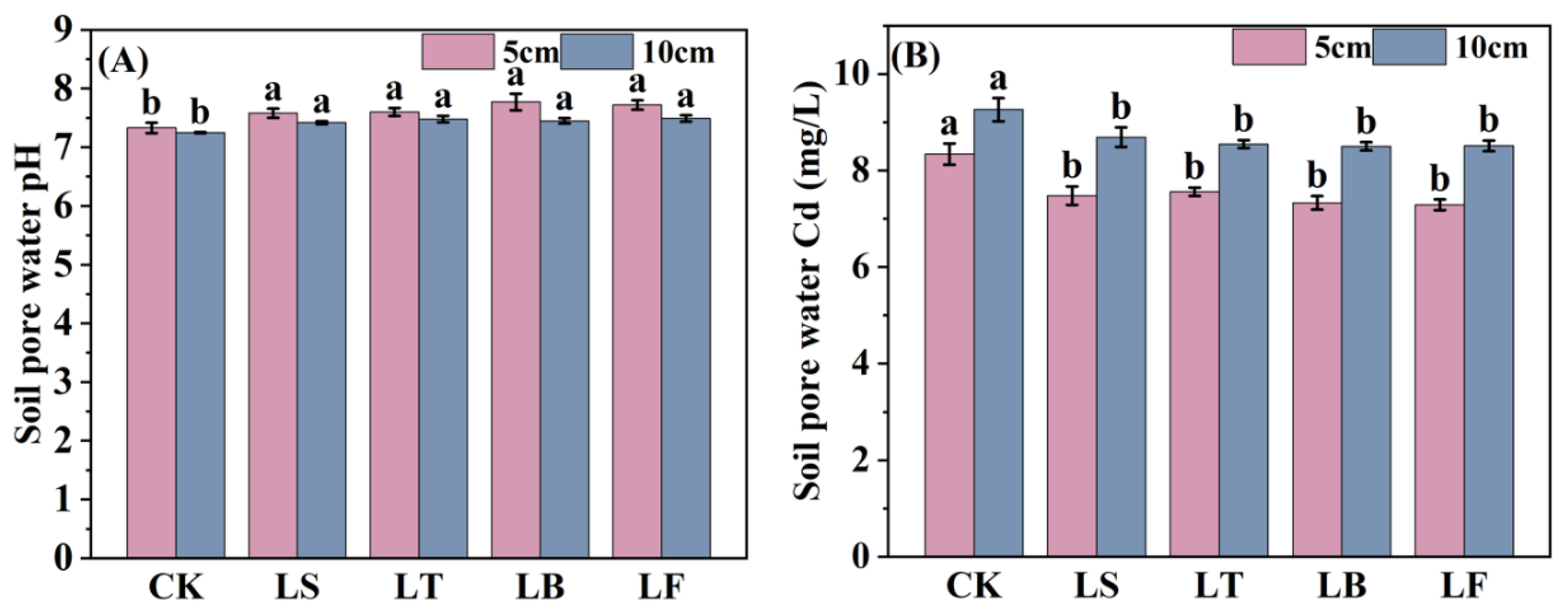
All treatments significantly changed soil pore water pH compared to the control soil at depths of 5 cm and 10 cm (Figure 1A), with soil pore water pH ranging from 7.25 to 7.77. Compared to CK, soil pore water pH at 5 cm depth in LS, LT, LB, and LF treatments increased significantly by 0.25, 0.27, 0.44, and 0.39 units, respectively (p < 0.05). At 10 cm depth, soil pore water pH in LS, LT, LB, and LF increased significantly by 0.17, 0.23, 0.20, and 0.24 units, respectively (p < 0.05). The application of lime materials increased soil pH and alleviated soil acidification [30]. Additionally, soil pore water pH at 5 cm depth was slightly higher than that at 10 cm for the same treatment. This is because as the lime solution permeates downward, lime concentration is higher in the shallower layers and decreases with increasing soil depth [31]. For example, pore water pH at 5 cm was 0.16 and 0.32 units higher than that at 10 cm in LS and LB treatments, respectively.
Soil pore water is the aqueous medium found in the interstitial spaces between soil particles. It serves as the primary vehicle for transporting soil solutes and is a direct source of nutrients for plants. Rice plants accumulate Cd by absorbing this pore water. Furthermore, rice can modify the physicochemical properties of pore water during its critical stages of Cd accumulation [32]. The changes in pore water Cd2+ concentrations were inversely related to those in pore water pH (Figure 1B). At a depth of 5 cm, pore water Cd2+ concentrations in the LS, LT, LB, and LF treatments were 0.10, 0.09, 0.12, and 0.13 times lower than those in CK, respectively. Similarly, at a depth of 10 cm, pore water Cd2+ concentrations in the LF, LT, LB, and LF treatments were 0.06, 0.08, 0.08, and 0.08 times lower than those in CK. Additionally, soil pore water Cd2+ concentrations at 10 cm depth were higher than those at 5 cm for the same treatment. For example, Cd2+ concentrations at 10 cm were 0.16 and 0.13 times higher than at 5 cm in LS and LT, respectively. After lime application, the increase in soil pH significantly reduced the solubility of metals in rice paddy soil [33]. Correlation analysis revealed a significant negative correlation between pore water pH and Cd2+ concentration (Figure S1). Within the same treatment, Cd2+ concentrations at 10 cm depth were consistently higher than at 5 cm because lime application promoted metal fixation by increasing the proportion of inorganic heavy metal precipitates in the soil solution at shallower depths. The topsoil (5 cm) was in direct contact with lime particles and exhibited low irrigation water permeability, resulting in a more pronounced pH increase. The elevated pH environment facilitated the formation of Cd(OH)2 precipitates through the reaction of Cd2+ with OH, thereby reducing Cd concentrations in the topsoil pore water [31].

3.2. Cd Availability and Chemical Speciation in Soils

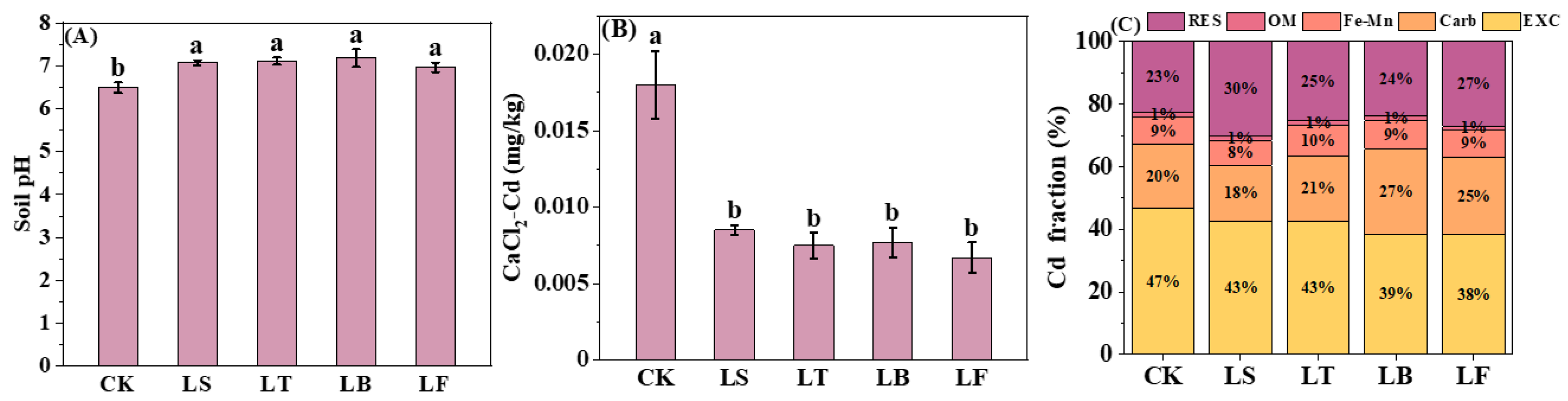
Compared to CK, the soil pH in lime-treated soils increased significantly by 0.47 to 0.69 units (Figure 2A). Lime raises soil pH by alleviating soil acidity and reducing the toxicity of Al3+ and Mn2+ ions [34]. Additionally, the concentration of available Cd in the soil was significantly reduced by 52.78% to 62.78% compared to CK after lime application at different growth stages (p < 0.05) (Figure 2B). Generally, Cd availability decreases as soil pH increases [20,35]. Lime application increases soil pH, causing Cd to exist mainly in the form of CdOH+, Cd2(OH)3+, and Cd(OH)2 [36]. This reduces the solubility of heavy metals and enhances the adsorption capacity of soil particles by increasing the net negative charge of variably charged colloids [37]. In our study, correlation analysis revealed that available Cd concentration was significantly negatively correlated with soil pH and positively correlated with EXC-Cd, stem Cd concentration, and leaf Cd concentration (Figure S1). These results suggest that applying lime at different growth stages leads to a gradual decrease in soil-available Cd concentration during maturation. However, the effects of lime in raising soil pH and immobilizing Cd diminish over time. When lime was applied during the seedling stage, the Cd initially immobilized by lime became desorbed as soil pH gradually declined [38].
There was no significant difference in total soil Cd concentration among treatments after rice harvest; however, soil Cd speciation differed among treatments (Figure 2C). Compared to CK, EX-Cd concentrations in the LS, LT, LB, and LF treatments decreased by 4.88%, 9.76%, 17.07%, and 17.07%, respectively. Lime application was found to enhance the conversion of EX-Cd to CA-Cd, Fe/Mn-Cd, OM-Cd, and Res-Cd fractions, which are relatively stable and exhibit low bioavailability to plants [39]. Correlation analysis also showed that EXC-Cd was significantly negatively correlated with soil pH (Figure S1). Carb-Cd in the LB treatment significantly increased by 33.33% (p < 0.05). Fe/Mn-Cd significantly increased by 10.39% in the LT treatment (p < 0.05), compared with CK. OM-Cd in the LF treatment was increased by 15.38%. RES-Cd increased by 5% to 35%, with notable changes observed in the LS treatment. Adding lime early provides ample time to consistently create an alkaline environment, enhancing both soil adsorption and the transformation of soluble Cd into residual Cd [40,41]. The results suggested that adding lime at different stages led to a gradual decrease in EXC-Cd concentration. Due to the low application rate of lime and its rapid reaction in the soil, the weakening alkalinity over time caused Carb-Cd to convert into EXC-Cd. Consistent with previous research findings, lime applied earlier resulted in higher EXC-Cd concentration than that applied later [42].

3.3. Biomass, Cadmium Accumulation, and Bioconcentration Factors in Rice

Rice tissue biomass increased in all treatments compared to the control (Table 1). Compared to CK, the biomass of stems and brown rice in LS and LT significantly increased by 153.24%, 144.18%, 89.58%, and 104.24%, respectively (p < 0.05). Additionally, the biomass of stems and rice in LS was significantly higher than in the other treatments. It was found that adding lime could increase soil nutrient concentrations, which may explain the increase in rice yield [43]. Leaf biomass increased at different stages following lime application, with the highest leaf biomass observed in LS, showing a significant increase of 48.20% and being significantly higher than in LB and LF. Adding lime can raise the soil pH and reduce the available phosphorus (AP) in the soil by alleviating soil acidity through the reduction in Al3+ and Mn2+ toxicity, which contributes to higher rice yields [34,44]. Research findings showed that lime application during the seedling stage resulted in significantly higher biomass (roots, stems, leaves, and grains) in rice plants compared to other treatments. This effect was attributed to lime application enhancing soil calcium (Ca) and magnesium (Mg) nutrient levels, with earlier application producing more pronounced effects [45]. Applying lime before rice planting can significantly enhance organic matter mineralization and soil microbial activity, thereby facilitating nutrient uptake by rice plants and improving both plant growth and grain yield [46,47].
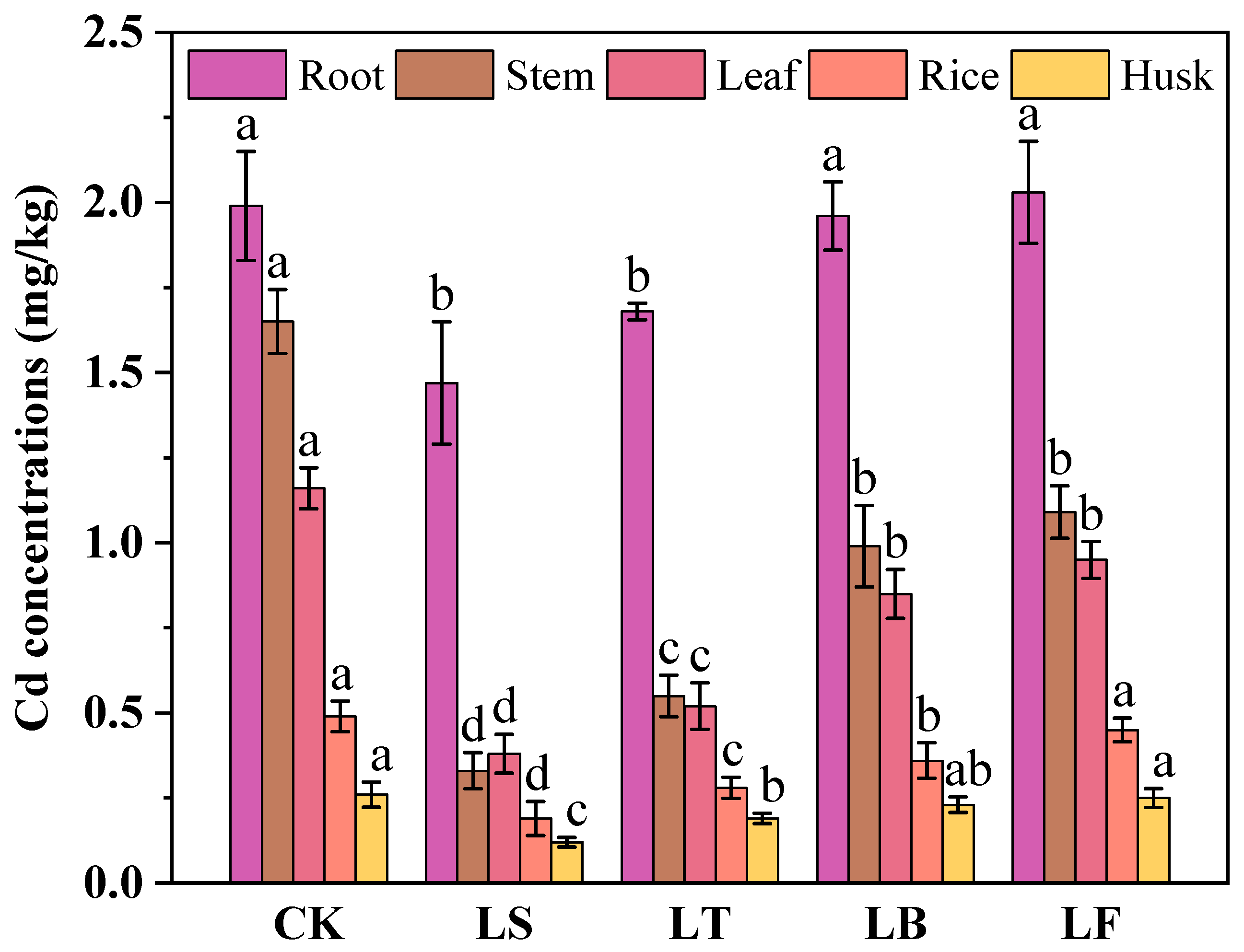
Lime applications at different growth stages effectively decreased Cd concentrations in rice tissues (Figure 3). The Cd concentration in the roots was significantly reduced by 26.13% and 15.58% in the LS and LT treatments, respectively (p < 0.05), compared to CK. Stem Cd concentration significantly reduced by 80.00%, 66.67%, 40.00%, and 33.94% in the LS, LT, LB, and LF treatments, respectively (p < 0.05). Leaf Cd concentration in LS, LT, LB, and LF treatments significantly decreased by 67.24%, 55.17%, 26.72%, and 18.10%, respectively (p < 0.05). Rice husk Cd concentration significantly decreased by 53.85%, 26.92%, and 11.54% in the LS, LT, and LB treatments, respectively (p < 0.05). Compared to CK, brown rice Cd concentration in LS, LB, LT, and LF treatments decreased by 61.22%, 42.86%, 26.53%, and 8.16%, respectively, with rice Cd concentration being significantly lower in LS than in other treatments. The reduction in Cd uptake can be attributed to the decline in soil-available Cd, which limits Cd availability for plant absorption [48], and soil EX-Cd, a form of Cd that is readily absorbed and utilized by plants [49]. Moreover, a significantly negative correlation was observed between rice Cd concentration and soil pH (Figure S1). These results indicate that lime application during the seedling stage most significantly reduced Cd levels in all parts of rice plants (roots, stems, leaves, and grains). Research findings show that applying lime during the early stages of rice cultivation reduces Cd levels in rice throughout the entire growth period, fundamentally decreasing the likelihood of Cd uptake by plant roots [50,51,52]. Lime application creates an alkaline environment that promotes the transformation of Cd2+ in the soil into CdCO3 and Cd(OH)2 precipitates, thereby reducing cadmium bioavailability. Furthermore, early lime application prolongs the duration of its effect and accelerates the reaction process, ultimately forming stable carbonate precipitates and oxide adsorption sites [53,54]. In summary, the LS treatment was significantly more effective than the others and demonstrated the best overall treatment effect.
Lime application at different stages significantly reduced the bioconcentration factor of Cd in rice (Table 2). Compared to CK, the bioconcentration factor of root Cd decreased by 1.77% to 26.11% across treatments. The stem Cd bioconcentration factor significantly reduced by 79.79%, 66.49%, 40.43%, and 34.04% in the LS, LT, LB, and LF treatments, respectively (p < 0.05). The bioconcentration factor of leaf Cd significantly decreased by 17.56% to 67.18% (p < 0.05), with LS showing the most pronounced change. Rice husk Cd significantly decreased by 51.72% and 24.14% in the LS and LT treatments (p < 0.05). Additionally, the rice grain Cd bioconcentration factor significantly decreased by 60.00%, 43.64%, and 25.46% in the LS, LT, and LB treatments, respectively (p < 0.05). Research has demonstrated that lime reduces Cd mobility in soil by increasing soil pH, thereby decreasing Cd uptake by rice roots. Consequently, Cd concentrations decrease in all tissues of the rice plant [55]. The results showed that applying lime during the seedling stage significantly reduced the bioconcentration factor of Cd in all rice plant organs compared to other treatments. For example, compared to LS, the root bioconcentration factor decreased significantly by 12.12%, 24.77%, and 24.43% in the LT, LB, and LF treatments, respectively (p < 0.05). This was because after lime application, the surface charge of soil colloids (such as clay minerals and organic matter) becomes more negative with increasing pH, significantly enhancing their adsorption capacity for cationic Cd2+. During the seedling stage, rice roots secrete fewer organic acids, and the high-pH environment created by lime more stably maintains the colloidal adsorption of Cd. However, when lime is applied at later growth stages, rice roots secrete large amounts of organic acids to absorb nutrients. These organic acids slightly lower the pH around the roots, causing partial desorption of Cd2+ adsorbed by colloids [56,57,58]. Furthermore, lime addition increases soil levels of Ca and Mg nutrients, which inhibits Cd translocation within the plant. In Cd-contaminated soil, elevated Ca and Mg concentrations reduce cadmium translocation in rice tissues. Earlier lime application supplies these nutrients sooner, allowing them to react fully and thereby decreasing Cd uptake by the roots [59,60].

3.4. Cd Concentration Correlation Among Rice Tissues and Soil Properties

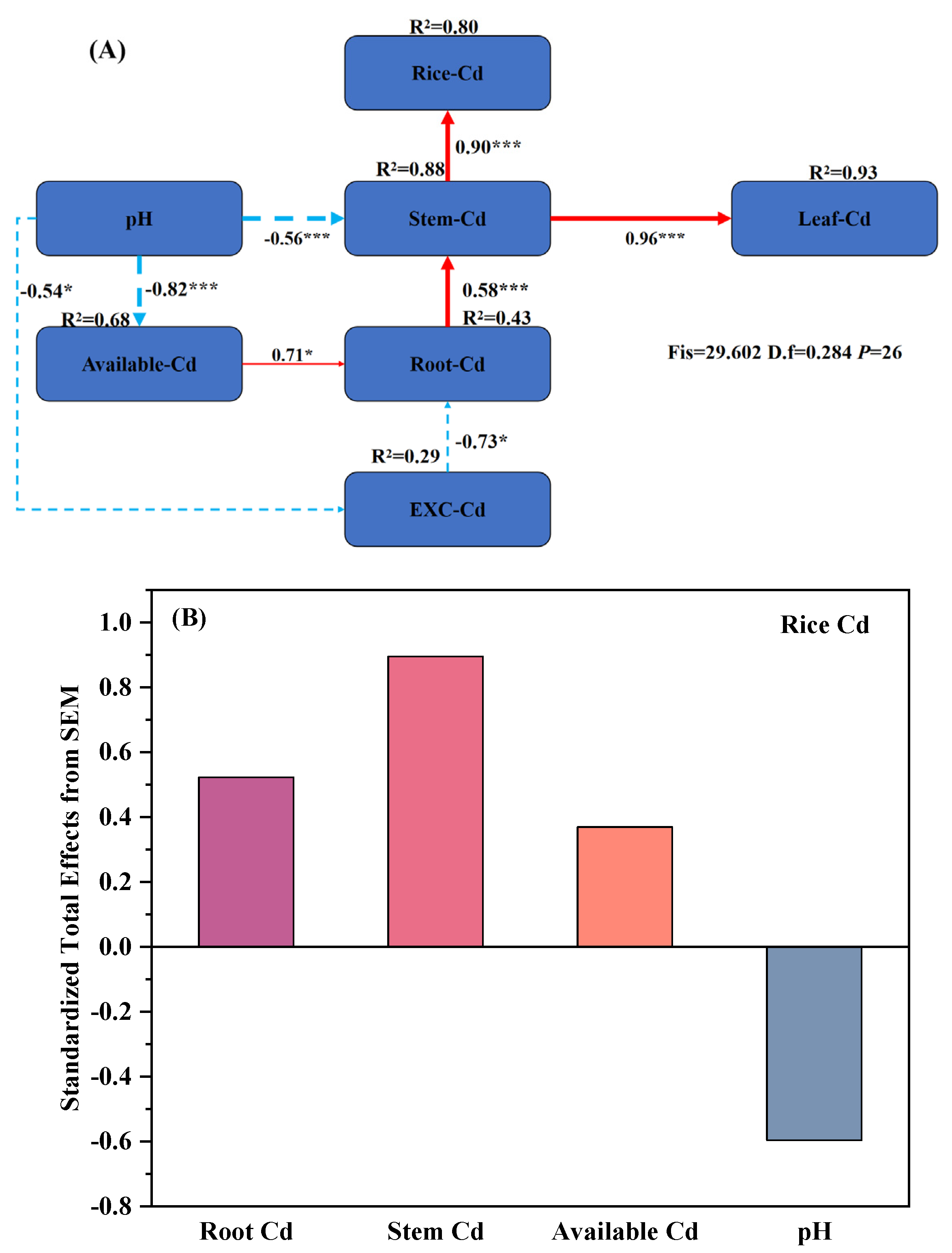
To clarify the effect and relative importance of lime treatment on Cd concentration in rice, a structural equation model (SEM) was constructed to examine the relationships between lime application, target soil pH, and other relevant indicators affecting grain Cd concentration (Figure 4A). The results indicated that the SEM effectively captured the correlations between these indicators and Cd concentration in rice grains. The fitted model explained 78% of the variance in rice Cd. Stem Cd exhibited a significant direct positive effect on rice grain Cd and leaf Cd concentrations, while it was primarily influenced by root Cd concentration and soil pH. Soil pH indirectly affected grain Cd and had a significant negative impact on available Cd and EXC-Cd (Figure 4A). Additionally, stem Cd was identified as the most important predictor of rice grain Cd, with the highest standardized total effect (sum of direct and indirect effects) of 0.90, followed by soil pH, root Cd, and available Cd (Figure 4B).

4. Conclusions

Soil lime applications at different growth stages reduced available Cd, decreased Cd uptake by rice, and improved rice biomass and soil properties. Lime is cost-effective and easy to apply, making it suitable for acidic, moderately polluted farmland. Experimental results indicate that the seedling stage is the optimal time to apply lime to promote the transformation of cadmium in soil into stable forms, significantly increasing the proportion of RES-Cd and reducing Cd concentration in rice grains, while achieving the lowest bioconcentration factor (BCF). Structural equation model (SEM) results indicate that stem Cd has a significant direct positive effect on rice grain Cd and is the most important indicator. Soil pH influences grain Cd indirectly and exerts a significant negative effect on available Cd and EXC-Cd. These results confirm that applying lime at the seedling stage is more effective in reducing Cd risks. Therefore, lime application during the seedling stage is a practical method for the safe and high-quality cultivation of rice in Cd-contaminated farmland.

Supplementary Materials

The following supporting information can be downloaded at: https://www.mdpi.com/article/10.3390/soilsystems10020030/s1, Text S1: Determination methods [61]; Text S2: Soil cadmium (Cd) sequential extraction procedure [29]; Figure S1: Correlation analysis of soil properties and Cd bioavailability; Table S1: Chemical speciation of Cd in different treatments (mg/kg). Different letters within the same column indicate significant differences between treatments at the p < 0.05 level, while identical letters indicate no significant differences between treatments; Table S2: Cd concentration in various tissues of rice under different treatments (mg/kg). Different letters within the same column indicate significant differences between treatments at the p < 0.05 level, while identical letters indicate no significant differences between treatments.

Author Contributions

Conceptualization, H.C., L.Z. and J.Z.; methodology, H.C., Z.L. and B.B.; formal analysis, H.C. and Z.L.; investigation, B.B. and S.Z.; writing—original draft preparation, H.C. and Z.L.; writing—review and editing, L.Z. and J.Z.; funding acquisition, H.C. and J.Z. All authors have read and agreed to the published version of the manuscript.

Funding

The Project was Supported by the Anhui Province Natural Science Foundation, China (2208085MD87), the Opening Foundation of Anhui Province Engineering Research Center of Water and Soil Resources Comprehensive Utilization and Ecological Protection in High Groundwater Mining Area (Grant No. 2024-WSREPMA-03), the Open Research Grant of Joint National-Local Engineering Research Centre for Safe and Precise Coal Mining (KJ2020ZD35), and Bonanza Precision Mining and Environmental Protection, Guizhou Provincial Academician Expert Workstation (KXJZ[2024]003).

Data Availability Statement

The data presented in this study are available on request from the corresponding author due to privacy.

Conflicts of Interest

The authors declare no conflicts of interest.

References

  1. Zou, R.; Li, W.; Li, Y.; Tong, Z.; Huo, W.; Chi, K.; Fan, H. Cadmium Absorption and Translocation of Amaranth (Amaranthus mangostanus L.) Affected by Iron Deficiency. Environ. Pollut. 2020, 256, 113410. [Google Scholar] [CrossRef]
  2. Hou, D.; Jia, X.; Wang, L.; McGrath, S.; Zhu, Y.; Hu, Q.; Zhao, F.; Bank, M.S.; O’cOnnor, D.; Nriagu, J. Global Soil Pollution by Toxic Metals Threatens Agriculture and Human Health. Science 2025, 388, 316–321. [Google Scholar] [CrossRef] [PubMed]
  3. Bolan, N.S.; Makino, T.; Kunhikrishnan, A.; Kim, P.J.; Ishikawa, S.; Murakami, M.; Naidu, R.; Kirkham, M.B. Cadmium Contamination and Its Risk Management in Rice Ecosystems. Adv. Agron. 2013, 119, 183–273. [Google Scholar] [CrossRef]
  4. Yang, Q.; Lan, C.; Wang, H.; Zhuang, P.; Shu, W. Cadmium in Soil–Rice System and Health Risk Associated with the Use of Untreated Mining Wastewater for Irrigation in Lechang, China. Agric. Water Manag. 2006, 84, 147–152. [Google Scholar] [CrossRef]
  5. Ministry of Environmental Protection of the People’s Republic of China. National Soil Contamination Survey Report; MEP: Beijing, China, 2014. [Google Scholar]
  6. Cheng, F.; Zhao, N.; Xu, H.; Li, Y.; Zhang, W.; Zhu, Z.; Chen, M. Cadmium and lead contamination in japonica rice grains and its variation among the different locations in southeast China. Sci. Total Environ. 2006, 359, 156–166. [Google Scholar] [CrossRef]
  7. Xiao, G.; Hu, Y.; Li, N.; Yang, D. Spatial Autocorrelation Analysis of Monitoring Data of Heavy Metals in Rice in China. Food Control 2018, 89, 32–37. [Google Scholar] [CrossRef]
  8. Zhan, J.; Wei, S.; Niu, R. Advances of Cadmium Contaminated Paddy Soil Research and New Measures of Its Safe Production in China: A Review. J. Agro-Environ. Sci. 2012, 31, 1257–1263. [Google Scholar]
  9. Pan, B.; Cai, Y.; Liu, Q.; Cai, K.; Lv, W.; Tian, J.; Wang, W. Abatement of Cd in Rice Grain and Toxic Risks to Human Health by the Split Application of Silicon at Transplanting and Jointing Period. J. Environ. Manag. 2022, 302, 114039. [Google Scholar] [CrossRef]
  10. Liu, J.; Jun, Z.; Wu, Z.; Tian, X.; An, X.; Zhang, Y.; Zhang, G.; Deng, F.; Meng, X.; Qu, J. Concurrent Elimination and Stepwise Recovery of Pb(II) and Bisphenol a from Water Using β–Cyclodextrin Modified Magnetic Cellulose: Adsorption Performance and Mechanism Investigation. J. Hazard. Mater. 2022, 432, 128758. [Google Scholar] [CrossRef]
  11. Tang, W.; Zhong, H.; Xiao, L.; Tan, Q.; Zeng, Q.; Wei, Z. Inhibitory Effects of Rice Residues Amendment on Cd Phytoavailability: A Matter of Cd-Organic Matter Interactions? Chemosphere 2017, 186, 227–234. [Google Scholar] [CrossRef]
  12. Marković, J.; Jović, M.; Smičiklas, I.; Šljivić-Ivanović, M.; Onjia, A.; Trivunac, K.; Popović, A. Cadmium Retention and Distribution in Contaminated Soil: Effects and Interactions of Soil Properties, Contamination Level, Aging Time and in Situ Immobilization Agents. Ecotoxicol. Environ. Saf. 2019, 174, 305–314. [Google Scholar] [CrossRef]
  13. Rehman, M.Z.u.; Rizwan, M.; Khalid, H.; Ali, S.; Naeem, A.; Yousaf, B.; Liu, G.; Sabir, M.; Farooq, M. Farmyard Manure Alone and Combined with Immobilizing Amendments Reduced Cadmium Accumulation in Wheat and Rice Grains Grown in Field Irrigated with Raw Effluents. Chemosphere 2018, 199, 468–476. [Google Scholar] [CrossRef] [PubMed]
  14. Rehman, M.Z.u.; Khalid, H.; Akmal, F.; Ali, S.; Rizwan, M.; Qayyum, M.F.; Iqbal, M.; Khalid, M.U.; Azhar, M. Effect of Limestone, Lignite and Biochar Applied Alone and Combined on Cadmium Uptake in Wheat and Rice under Rotation in an Effluent Irrigated Field. Environ. Pollut. 2017, 227, 560–568. [Google Scholar] [CrossRef]
  15. Rehman, M.Z.u.; Rizwan, M.; Ghafoor, A.; Naeem, A.; Ali, S.; Sabir, M.; Qayyum, M.F. Effect of Inorganic Amendments for In Situ Stabilization of Cadmium in Contaminated Soils and Its Phyto-Availability to Wheat and Rice under Rotation. Environ. Sci. Pollut. Res. 2015, 22, 16897–16906. [Google Scholar] [CrossRef] [PubMed]
  16. Huang, G.; Ding, X.; Liu, Y.; Ding, M.; Wang, P.; Zhang, H.; Nie, M.; Wang, X. Liming and Tillering Application of Manganese Alleviates Iron Manganese Plaque Reduction and Cadmium Accumulation in Rice (Oryza sativa L.). J. Hazard. Mater. 2022, 427, 127897. [Google Scholar] [CrossRef]
  17. Yang, Y.; Chen, J.; Huang, Q.; Tang, S.; Wang, J.; Hu, P.; Shao, G. Can liming reduce cadmium (Cd) accumulation in rice (Oryza sativa) in slightly acidic soils? A contradictory dynamic equilibrium between Cd uptake capacity of roots and Cd immobilisation in soils. Chemosphere 2018, 193, 547–556. [Google Scholar] [CrossRef] [PubMed]
  18. Guo, J.; Chen, M.; Huang, Y.; Xie, S.; Zhang, X.; Zuo, T.; Hu, C.; Wang, G. Chloride Application Weakens Cadmium Immobilization by Lime in Paddy Rice Soil. Ecotoxicol. Environ. Saf. 2022, 241, 113761. [Google Scholar] [CrossRef]
  19. Shaheen, S.M.; Rinklebe, J. Impact of Emerging and Low Cost Alternative Amendments on the (Im)Mobilization and Phytoavailability of Cd and Pb in a Contaminated Floodplain Soil. Ecol. Eng. 2015, 74, 319–326. [Google Scholar] [CrossRef]
  20. Huang, Y.; Sheng, H.; Zhou, P.; Zhang, Y. Remediation of Cd-Contaminated Acidic Paddy Fields with Four-Year Consecutive Liming. Ecotoxicol. Environ. Saf. 2020, 188, 109903. [Google Scholar] [CrossRef]
  21. Zhang, J.; Kong, F.; Lu, S. Remediation Effect and Mechanism of Inorganic Passivators on Cadmium Contaminated Acidic Paddy Soil. Environ. Sci. 2022, 43, 4679–4686. [Google Scholar] [CrossRef]
  22. Zhang, Z.; Ji, X.; Xie, Y. Effects of Quicklime Application at Different Rice Growing Stages on the Cadmium Contents in Rice Grain. J. Agro-Environ. Sci. 2016, 35, 1867–1872. [Google Scholar] [CrossRef]
  23. Huang, H.; Chen, H.; Kopittke, P.M.; Kretzschmar, R.; Zhao, F.; Wang, P. The Voltaic Effect as a Novel Mechanism Controlling the Remobilization of Cadmium in Paddy Soils during Drainage. Environ. Sci. Technol. 2021, 55, 1750–1758. [Google Scholar] [CrossRef] [PubMed]
  24. Huang, H.; Ji, B.; Cheng, L.; Zhao, F.; Wang, P. Free Radicals Produced from the Oxidation of Ferrous Sulfides Promote the Remobilization of Cadmium in Paddy Soils during Drainage. Environ. Sci. Technol. 2021, 55, 9845–9853. [Google Scholar] [CrossRef]
  25. Wang, J.; Wang, P.; Gu, Y.; Kopittke, P.M.; Zhao, F.; Wang, P. Iron–Manganese (Oxyhydro)Oxides, Rather than Oxidation of Sulfides, Determine Mobilization of Cd during Soil Drainage in Paddy Soil Systems. Environ. Sci. Technol. 2019, 53, 2500–2508. [Google Scholar] [CrossRef] [PubMed]
  26. Huang, M.; Zhou, S.; Sun, B.; Zhao, Q. Heavy Metals in Wheat Grain: Assessment of Potential Health Risk for Inhabitants in Kunshan, China. Sci. Total Env. 2008, 405, 54–61. [Google Scholar] [CrossRef]
  27. Cui, H.; Yang, X.; Xu, L.; Fan, Y.; Yi, Q.; Li, R.; Zhou, J. Effects of Goethite on the Fractions of Cu, Cd, Pb, P and Soil Enzyme Activity with Hydroxyapatite in Heavy Metal-Contaminated Soil. RSC Adv. 2017, 7, 45869–45877. [Google Scholar] [CrossRef]
  28. Houba, V.J.G.; Temminghoff, E.J.M.; Gaikhorst, G.A.; Vark, W.V. Soil Analysis Procedures Using 0.01Mcalcium Chloride as Extraction Reagent. Commun. Soil. Sci. Plant Anal. 2000, 31, 1299–1396. [Google Scholar] [CrossRef]
  29. Tessier, A.; Campbell, P.; Bisson, M. Sequential Extraction Procedure for the Speciation of Particulate Trace Metals. Anal. Chem. 1979, 51, 844–851. [Google Scholar] [CrossRef]
  30. Wang, Y.; Wang, K.; Wang, T.; Liang, T.; Liu, J.; Chen, X.; Xu, C.; Cao, W.; Fan, H. Joint Utilization of Chinese Milk Vetch and Lime Materials Mitigates Soil Cadmium Risk and Improves Soil Health in a Double-Cropping Rice System. Chemosphere 2024, 363, 142784. [Google Scholar] [CrossRef]
  31. Cui, H.; Zhao, Y.; Hu, K.; Xia, R.; Zhou, J.; Zhou, J. Impacts of atmospheric deposition on the heavy metal mobilization and bioavailability in soils amended by lime. Sci. Total Environ. 2024, 914, 170082. [Google Scholar] [CrossRef]
  32. Wei, X.; Kong, S.; Cai, D. Interface mechanism of Cd bioavailability by porewater prediction in paddy field system. J. Hazard. Mater. 2025, 481, 136453. [Google Scholar] [CrossRef]
  33. Kashem, M.A.; Singh, B.R. Metal Availability in Contaminated Soils: I. Effects of Floodingand Organic Matter on Changes in Eh, pH and Solubility of Cd, Ni andZn. Nutr. Cycl. Agroecosyst. 2001, 61, 247–255. [Google Scholar] [CrossRef]
  34. Holland, J.E.; White, P.J.; Glendining, M.J.; Goulding, K.W.T.; McGrath, S.P. Yield Responses of Arable Crops to Liming—an Evaluation of Relationships between Yields and Soil pH from a Long-Term Liming Experiment. Eur. J. Agron. 2019, 105, 176–188. [Google Scholar] [CrossRef]
  35. Hussain, B.; Ashraf, M.N.; Shafeeq-ur-Rahman Abbas, A.; Li, J.; Farooq, M. Cadmium Stress in Paddy Fields: Effects of Soil Conditions and Remediation Strategies. Sci. Total Environ. 2021, 754, 142188. [Google Scholar] [CrossRef]
  36. Chen, S.; Chen, L.; Wang, D.; Wang, M. Low pe+pH Induces Inhibition of Cadmium Sulfide Precipitation by Methanogenesis in Paddy Soil. J. Hazard. Mater. 2022, 437, 129297. [Google Scholar] [CrossRef]
  37. Pan, Y.; Bonten, L.T.; Koopmans, G.F.; Song, J.; Luo, Y.; Temminghoff, E.J.; Comans, R.N. Solubility of Trace Metals in Two Contaminated Paddy Soils Exposed to Alternating Flooding and Drainage. Geoderma 2016, 261, 59–69. [Google Scholar] [CrossRef]
  38. Mahar, A.; Wang, P.; Li, R.; Zhang, Z. Immobilization of Lead and Cadmium in Contaminated Soil Using Amendments: A Review. Pedosphere 2015, 25, 555–568. [Google Scholar] [CrossRef]
  39. Wang, Y.; Wang, K.; Liang, T.; Wang, T.; Liu, J.; Chen, X.; Xu, C.; Cao, W.; Fan, H. Milk vetch returning combined with lime materials alleviates soil cadmium contamination and improves rice quality in soil-rice system. Sci. Total Environ. 2024, 951, 175770. [Google Scholar] [CrossRef] [PubMed]
  40. Bolan, N.S.; Adriano, D.C.; Curtin, D. Soil Acidification and Liming Interactions with Nutrient and Heavy Metal Transformation and Bioavailability. Adv. Agron. 2003, 78, 215–272. [Google Scholar] [CrossRef]
  41. Zeng, F.; Ali, S.; Zhang, H.; Ouyang, Y.; Qiu, B.; Wu, F.; Zhang, G. The Influence of pH and Organic Matter Content in Paddy Soil on Heavy Metal Availability and Their Uptake by Rice Plants. Environ. Pollut. 2011, 159, 84–91. [Google Scholar] [CrossRef]
  42. He, Y.; Huang, D.; Zhu, Q.; Wang, S.; Liu, S.; He, H.; Zhu, H.; Xu, C. A Three-Season Field Study on the in-Situ Remediation of Cd-Contaminated Paddy Soil Using Lime, Two Industrial by-Products, and a Low-Cd-Accumulation Rice Cultivar. Ecotoxicol. Environ. Saf. 2017, 136, 135–141. [Google Scholar] [CrossRef]
  43. Liao, P.; Huang, S.; van Gestel, N.C.; Zeng, Y.; Wu, Z.; van Groenigen, K.J. Liming and Straw Retention Interact to Increase Nitrogen Uptake and Grain Yield in a Double Rice-Cropping System. Field Crops Res. 2018, 216, 217–224. [Google Scholar] [CrossRef]
  44. Liao, P.; Liu, L.; He, Y.; Tang, G.; Zhang, J.; Zeng, Y.; Wu, Z.; Huang, S. Interactive Effects of Liming and Straw Incorporation on Yield and Nitrogen Uptake in a Double Rice Cropping System. Acta Agron. Sin. 2019, 46, 84–92. [Google Scholar] [CrossRef]
  45. Wang, H.; Teng, L.; Mao, X.; He, T.; Fu, T. Comparing the Effects of Lime Soil and Yellow Soil on Cadmium Accumulation in Rice during Grain-Filling and Maturation Periods. Plants 2024, 13, 2018. [Google Scholar] [CrossRef] [PubMed]
  46. Liao, P.; Huang, S.; Zeng, Y.; Shao, H.; Zhang, J.; Van Groenigen, K.J. Liming Increases Yield and Reduces Grain Cadmium Concentration in Rice Paddies: A Meta-Analysis. Plant Soil 2021, 465, 157–169. [Google Scholar] [CrossRef]
  47. Shi, L.; Guo, Z.; Liang, F.; Xiao, X.; Peng, C.; Zeng, P.; Feng, W.; Ran, H. Effect of Liming with Various Water Regimes on Both Immobilization of Cadmium and Improvement of Bacterial Communities in Contaminated Paddy: A Field Experiment. Int. J. Environ. Res. Public Health 2019, 16, 498. [Google Scholar] [CrossRef] [PubMed]
  48. Yin, D.; Wang, X.; Peng, B.; Tan, C.; Ma, L.Q. Effect of Biochar and Fe-Biochar on Cd and As Mobility and Transfer in Soil-Rice System. Chemosphere 2017, 186, 928–937. [Google Scholar] [CrossRef]
  49. Rashid, I.; Murtaza, G.; Dar, A.A.; Wang, Z. The Influence of Humic and Fulvic Acids on Cd Bioavailability to Wheat Cultivars Grown on Sewage Irrigated Cd-Contaminated Soils. Ecotoxicol. Environ. Saf. 2020, 205, 111347. [Google Scholar] [CrossRef]
  50. Chen, H.; Zhang, W.; Yang, X.; Wang, P.; McGrath, S.P.; Zhao, F. Effective Methods to Reduce Cadmium Accumulation in Rice Grain. Chemosphere 2018, 207, 699–707. [Google Scholar] [CrossRef]
  51. Hong, C.O.; Lee, D.K.; Chung, D.Y.; Kim, P.J. Liming Effects on Cadmium Stabilization in Upland Soil Affected by Gold Mining Activity. Arch. Environ. Contam. Toxicol. 2007, 52, 496–502. [Google Scholar] [CrossRef]
  52. Xiao, R.; Huang, Z.; Li, X.; Chen, W.; Deng, Y.; Han, C. Lime and Phosphate Amendment Can Significantly Reduce Uptake of Cd and Pb by Field-Grown Rice. Sustainability 2017, 9, 430. [Google Scholar] [CrossRef]
  53. Ding, Y.; Luo, W.; Xu, G. Characterisation of Magnesium Nutrition and Interaction of Magnesium and Potassium in Rice. Ann. Appl. Biol. 2006, 149, 111–123. [Google Scholar] [CrossRef]
  54. Loganathan, P.; Vigneswaran, S.; Kandasamy, K.; Naidu, R. Cadmium Sorption and Desorption in Soils: A Review. Crit. Rev. Environ. Sci. Technol. 2012, 42, 489–533. [Google Scholar] [CrossRef]
  55. Liu, K.; Fang, L.; Li, F.; Hou, D.; Liu, C.; Song, Y.; Ran, Q.; Pang, Y.; Du, Y.; Yuan, Y.; et al. Sustainability Assessment and Carbon Budget of Chemical Stabilization Based Multi-Objective Remediation of Cd Contaminated Paddy Field. Sci. Total Environ. 2022, 819, 152022. [Google Scholar] [CrossRef] [PubMed]
  56. Li, P.; Wang, X.; Zhang, T.; Zhou, D.; He, Y. Distribution and Accumulation of Copper and Cadmium in Soil-Rice System as Affected by Soil Amendments. Water Air Soil Pollut. 2009, 196, 29–40. [Google Scholar] [CrossRef]
  57. Zhang, Y.; Li, J.; Zhang, W. Advance in Rice Root Exudates Research. J. Plant Nutr. Fertil. 2024, 30, 1987–1999. [Google Scholar] [CrossRef]
  58. Zhao, F.; Ma, Y.; Zhu, Y.; Tang, Z.; McGrath, S.P. Soil Contamination in China: Current Status and Mitigation Strategies. Environ. Sci. Technol. 2015, 49, 750–759. [Google Scholar] [CrossRef]
  59. Lee, T.M.; Lai, H.Y.; Chen, Z.S. Effect of Chemical Amendments on the Concentration of Cadmium and Lead in Long-Term Contaminated Soils. Chemosphere 2004, 57, 1459–1471. [Google Scholar] [CrossRef]
  60. Li, X.; Teng, L.; Fu, T.; He, T.; Wu, P. Comparing the Effects of Calcium and Magnesium Ions on Accumulation and Translocation of Cadmium in Rice. Environ. Sci. Pollut. Res. 2022, 29, 41628–41639. [Google Scholar] [CrossRef]
  61. Ma, J.; Sun, W.; Dong, R.; Lai, S. Study and Comparison on Determination Methods of Soil Cation Exchange Capacity. Guangzhou Chem. Ind. 2025, 53, 160–162. [Google Scholar] [CrossRef]
Figure 1. Changes in soil solution pH (A) and Cd2+ (B). Different letters represent a significant difference between treatments at the p < 0.05 level, and the same letters represent non significant difference between treatments. (Comparing values and significance across bar charts of the same color.)
Soilsystems 10 00030 g001
Figure 2. The changes in soil pH (A), available Cd (B), and chemical speciation (C) of cadmium. Different letters represent a significant difference between treatments at the p < 0.05 level, and the same letters represent non significant difference between treatments.
Soilsystems 10 00030 g002
Figure 3. Cd concentrations in rice different tissues (root, stem, leaf, brown rice, husk) (mg/kg). Different letters represent a significant difference between treatments at the p < 0.05 level, and the same letters represent not significant difference between treatments. (Comparing values and significance across bar charts of the same color).
Soilsystems 10 00030 g003
Figure 4. Structural equation model (SEM) framework showing the relationships between soil pH, available Cd, EXC-Cd, root Cd, stem Cd, leaf Cd, and rice Cd. * p < 0.05, *** p < 0.001. (A) and Standardized total effects from SEM (B).
Soilsystems 10 00030 g004
Table 1. Biomass of various organs in different treatments (g/pot). Different letters within the same column indicate significant differences between treatments at the p < 0.05 level, while identical letters indicate no significant differences between treatments.
TreatmentStemLeafRice
CK29.45 ± 1.10 c15.25 ± 2.09 c19.83 ± 0.37 d
LS74.58 ± 2.83 a22.60 ± 1.10 a48.42 ± 1.57 a
LT55.83 ± 1.4 b19.84 ± 0.67 ab40.50 ± 2.18 b
LB32.90 ± 1.47 c17.75 ± 1.51 bc27.95 ± 0.14 c
LF30.24 ± 0.72 c15.39 ± 0.66 c21.02 ± 0.68 d
Table 2. BCF of Cd in rice organs after liming at different growth stages. Different letters within the same column indicate significant differences between treatments at the p < 0.05 level, while identical letters indicate no significant differences between treatments.
TreatmentRootStemLeafHuskRice
CK2.26 ± 0.18 a1.88 ± 0.11 a1.31 ± 0.07 a0.29 ± 0.04 a0.55 ± 0.05 a
LS1.67 ± 0.21 c0.38 ± 0.06 d0.43 ± 0.07 d0.14 ± 0.02 c0.22 ± 0.06 d
LT1.90 ± 0.03 b0.63 ± 0.07 c0.59 ± 0.08 c0.22 ± 0.02 b0.31 ± 0.04 c
LB2.22 ± 0.12 a1.12 ± 0.13 b0.97 ± 0.08 b0.26 ± 0.03 ab0.41 ± 0.06 b
LF2.21 ± 0.06 a1.24 ± 0.09 b1.08 ± 0.06 b0.29 ± 0.03 a0.52 ± 0.04 a
Disclaimer/Publisher’s Note: The statements, opinions and data contained in all publications are solely those of the individual author(s) and contributor(s) and not of MDPI and/or the editor(s). MDPI and/or the editor(s) disclaim responsibility for any injury to people or property resulting from any ideas, methods, instructions or products referred to in the content.