
Article

Effects of Magnetized Saline Irrigation on Soil Aggregate Stability, Salinity, Nutrient Distribution, and Enzyme Activity: Based on the Interaction Between Salinity and Magnetic Field Strength

1
College of Hydraulic and Civil Engineering, Xinjiang Agricultural University, Urumqi 830052, China
2
Xinjiang Key Laboratory of Hydraulic Engineering Security and Water Disasters Prevention, Urumqi 830052, China
3
Xinjiang Future Irrigation District Engineering Technology Research Center, Urumqi 830052, China
*
Authors to whom correspondence should be addressed.
Soil Syst. 2026, 10(1), 6; https://doi.org/10.3390/soilsystems10010006 (registering DOI)

Submission received: 13 November 2025 / Revised: 17 December 2025 / Accepted: 22 December 2025 / Published: 30 December 2025
(This article belongs to the Special Issue Land Use and Management on Soil Properties and Processes: 2nd Edition)

Abstract

Freshwater scarcity in arid regions is driving increased use of saline irrigation, yet salinity severely degrades soil structure and suppresses enzymatic function. To address this critical challenge for sustainable soil management, this study systematically evaluated magnetized saline water (MSW) across three salinity levels (1, 3, and 6 g L−1) and four magnetic field strengths (0, 0.2, 0.4, and 0.6 T), confirming the magnetic field intensity (C) × salinity (S) interaction. The comprehensive analysis integrated data on aggregate stability, key ion concentrations (Ca2+, Mg2+, Cl), and major enzyme activities. Structural Equation Modeling (SEM) was utilized to quantify the underlying mechanisms, demonstrating that structural improvement is primarily driven by strong indirect pathways, mediated by optimized ion dynamics and increased enzyme-mediated organic matter turnover. The moderate-salinity (3 g L−1), moderate-magnetic-field (0.4 T) regime emerged as the optimal balanced strategy for overall soil health. These findings offer a scalable approach, guiding future field-scale research toward long-term agricultural sustainability.

1. Introduction

Soil salinization and structural degradation have emerged as critical challenges for global agricultural sustainability, particularly in arid and semi-arid regions where water scarcity necessitates the adoption of alternative irrigation strategies [1,2]. Irrigation practices using marginal-quality waters (e.g., treated wastewater) and saline water have been widely explored to mitigate water stress, yet their long-term impacts on soil aggregate stability and enzymatic activity remain poorly characterized. For instance, long-term irrigation with saline or marginal-quality water can increase soil salinity/ sodicity indicators (e.g., SAR and EC), thereby promoting aggregate dispersion and reducing hydraulic conductivity [3]. In addition, magnetized water may alter water physicochemical properties and wetting patterns under drip irrigation, affecting soil–water interactions [4]. However, the interactive effects of salinity and magnetic field strength on soil aggregate stability and enzyme activities involved in nutrient cycling remain underexplored, limiting the development of optimized saline water management strategies in agriculture. Specifically, it remains unclear how magnetization-induced changes in irrigation water quality (e.g., pH/EC and ion behavior) translate into soil property responses, including aggregate stability, ion partitioning, and enzyme-mediated nutrient cycling across salinity gradients.
Saline water irrigation has gained traction as a viable solution in water-scarce regions, offering benefits such as reduced freshwater dependency and enhanced nutrient availability. Treated wastewater, a common type of marginal-quality irrigation water, contains soluble salts and organic matter that can improve aggregate stability (mean weight diameter, MWD) in the long term [5]. Additionally, magnetized saline irrigation has been reported to modify water pH and ion distribution, which may subsequently influence soil salinity conditions and aggregate-associated processes [6]. Despite these advantages, unmanaged saline irrigation exacerbates soil salinization, leading to decreased aggregate stability (MWD reduction by 9.3–10.5%) and impaired enzymatic functions crucial for nutrient cycling. For example, high salinity conditions have been reported to reduce urease activity by 15–20%, disrupting nitrogen metabolism in soils [7]. The contradictory effects of salinity highlight the need for integrated approaches to mitigate its detrimental impacts on soil health.
Recent advances in magnetized water technology have demonstrated its potential to alleviate salt-induced soil degradation [8]. Magnetized water treatment has been shown to modify the hydrogen bonding structure of water molecules, which may lead to decreased surface tension and enhanced ion solubility [9]. Such changes may facilitate soil aggregation and structural stability; for example, in homogeneous soils, magnetized water irrigation increased the proportion of water-stable aggregates (>0.25 mm) and reduced microaggregate fractions, thereby enhancing aggregate stability. Furthermore, magnetic field exposure has been shown to alter the activity of soil enzymes involved in nutrient cycling, such as phosphatase and dehydrogenase, by modulating the microenvironment around enzyme-active sites [10]. Collectively, these findings suggest that magnetized saline irrigation may influence soil structure and biochemical processes via changes in salinity indicators (pH/EC) and ion redistribution.
Based on the theoretical framework of magnetic-field effects on water properties, we hypothesized that magnetized irrigation could partially alleviate the adverse impacts of salinity on soil by modifying ion-related processes in the soil–water system and promoting cation bridging, thereby helping to maintain aggregate stability and soil enzymatic activities. To test this hypothesis, this study addressed the following research questions: (1) How does the interaction between salinity and magnetic field intensity affect soil aggregate stability and aggregate-size distribution? (2) Does magnetized irrigation alter the distribution of base cations (Ca2+, Mg2+) and anions (Cl) among different aggregate size fractions? (3) What are the relationships between soil enzyme activities and changes in aggregate stability under magnetized saline irrigation? By answering these questions, we aim to provide a theoretical basis for optimizing the use of saline water in arid agriculture.

2. Materials and Methods

2.1. Experimental Site and Soil Properties

The experiment was conducted in an indoor controlled environment at the Key Laboratory of Modern Water-Saving Irrigation of Xinjiang Agricultural University, China. The loam soil used in the study was collected from the 0–20 cm depth of a farmland in Xinjiang, with a bulk density of 1.55 g/cm3. Prior to the experiment, the soil was characterized for its physical and chemical properties: the particle size distribution (clay: 18.7%, silt: 42.3%, sand: 39.0%) was determined by the hydrometer method; initial pH (1:5 soil-water ratio) was 7.42; organic matter content was 12.3 g/kg; and initial nutrient concentrations were 46.97 mg/kg NH4+-N, 90.03 mg/kg available phosphorus (AP), and 95.62 mg/kg available potassium (AK).

2.2. Experimental Design

A two-factor completely randomized design was employed, with three salinity levels [1 g/L (S1), 3 g/L (S3), 6 g/L (S6)] and four magnetic field intensities [0 T (C0), 0.2 T (C2), 0.4 T (C4), 0.6 T (C6)], resulting in 12 treatments with three replicates each (36 soil columns total). Each soil column represented an independent experimental unit. For the analyses reported here, soil samples were collected from the 0–20 cm layer of each column. Within each column, five undisturbed cores were collected from 0 to 20 cm and composited into one sample to reduce within-column spatial heterogeneity; these cores were treated as subsamples and were not considered independent replicates in statistical analyses. Saline water was prepared by dissolving NaCl, MgSO4, and CaCl2 in deionized water at a mass ratio of 0.5:0.25:0.25 to simulate typical saline irrigation water in arid regions.
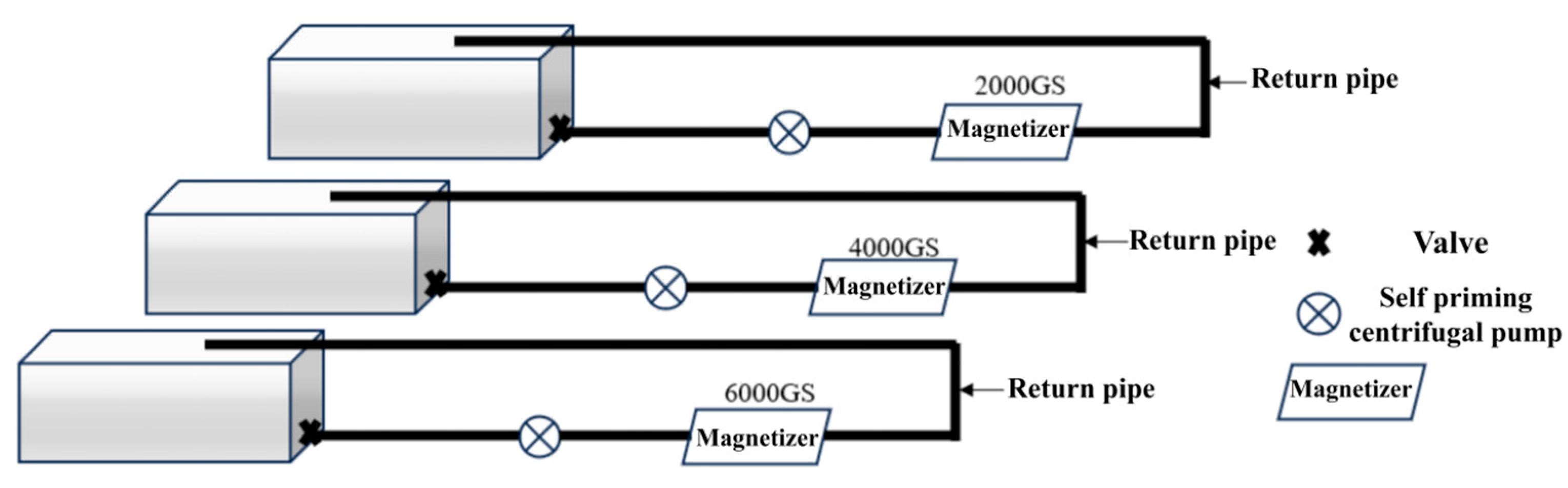
The magnetic treatment system (Figure 1) consisted of a 150 L polyethylene tank, a self-priming centrifugal pump (flow rate: 5 L/min), and serial-connected magnetic reactors with varying strengths (2000 GS, 4000 GS, 6000 GS, corresponding to 0.2 T, 0.4 T, 0.6 T). The reactors were constructed with 32 mm PVC pipes wrapped by permanent neodymium iron boron magnets, ensuring uniform magnetic field distribution. Saline water was circulated through the system for 30 min to achieve stable magnetization. Magnetic flux density was measured using a Gauss meter (Model GT-10, Beijing Huaxia Maglev Technology, Beijing, China). The instrument was calibrated and zeroed according to the manufacturer’s instructions before measurements. The probe was inserted into the pipe and readings were taken at the inlet, midpoint, and outlet; the reported value was the mean of the three measurements. Values were recorded in Gauss and converted to Tesla (1 T = 10,000 G).

2.3. Soil Column Setup and Irrigation Protocol

Cylindrical soil columns (50 cm height, 20 cm inner diameter) were packed with the loam soil to a depth of 40 cm, with a 5 cm quartz sand layer at the bottom for drainage. A Mariotte bottle (15 cm diameter) was used to deliver irrigation water at a constant flow rate of 2.49 ± 0.09 L/h, ensuring a cumulative infiltration of 5.4 L per column to simulate typical field irrigation conditions. Irrigation was applied as a single event for each column. To minimize variability in soil moisture among treatments, all columns received the same irrigation input under the identical flow rate and cumulative infiltration volume. Excess water was allowed to drain freely through the quartz sand layer at the bottom of the columns, thereby avoiding prolonged ponding and maintaining comparable moisture conditions across treatments. The columns were randomly arranged to minimize positional effects, with 30 cm spacing between columns to prevent lateral water flow [11].

2.4. Soil Sampling and Sample Preparation

Soil samples were collected from 0 to 20 cm depth layer before irrigation (baseline) and 10 days after the final irrigation. In each column, five undisturbed soil cores (5 cm diameter) were collected from the 0–20 cm layer, composited into one sample, and air-dried at room temperature (25 ± 2 °C) for 7 days. Stones and plant residues were removed, and samples were gently crushed to pass through a 1 cm sieve for aggregate analysis. Subsamples were ground to pass through a 0.15 mm sieve for nutrient and enzyme assays, with all samples stored in airtight plastic bags at 4 °C until analysis.

2.5. Measurement of Soil Physical and Chemical Properties

2.5.1. Aggregate Stability

The size distribution of mechanically stable soil aggregates was determined by dry sieving. A nest of sieves with mesh openings of 2, 1, 0.25 and 0.053 mm was stacked from largest to smallest, and 100 g of air-dried soil was placed on the top sieve. Aggregates in the >2, 1–2, 0.25–1, 0.053–0.25 and <0.053 mm size classes were collected and weighed, and the proportion of each size class in the total sample mass was calculated [12,13]. Aggregate stability indices were calculated as follows Equations (1)–(3):
R 0.25 = M i > 0.25 M T × 100
M W D = i = 1 n x i × w i
G M D = exp i = 1 n w i × ln x i i = 1 n w i
where R0.25 is the percentage of mechanically stable aggregates larger than 0.25 mm (%); Mi>0.25 is the weight of aggregates larger than 0.25 mm (g); MT is the total weight of the aggregate sample (g); MWD and GMD represent the mean weight diameter (mm) and geometric mean diameter (mm), respectively; xi is the mean diameter of the i-th size fraction (mm); wi is the proportion of the total sample weight retained in the i-th size fraction; and n is the number of size fractions.

2.5.2. Salinity and Ions

Soil soluble salts were extracted by mixing 10× g of soil with 50 mL deionized water (1:5 soil-water ratio) and shaking at 200 rpm for 30 min, followed by centrifugation at 3000 rpm for 10 min. Electrical conductivity (EC) of the supernatant was measured using a DDSJ-308F conductometer (Shanghai Leici, Shanghai, China). Major ions were determined as follows: Cl by Mohr’s method with AgNO3 titration; Ca2+ and Mg2+ by EDTA complexometric titration using Eriochrome Black T and Calmagite indicators, respectively [14].

2.5.3. Nutrients and Enzymes

Soil alkali-hydrolyzable nitrogen (AN) was determined using the alkali-hydrolysis diffusion method. For available phosphorus (AP), extraction was performed with 0.5 M sodium bicarbonate (NaHCO3) at pH 8.5, followed by quantification via molybdenum-blue colorimetry. Available potassium (AK) was extracted using 1 M ammonium acetate (CH3COONH4) and measured by flame photometry [14].
Enzyme activities were assayed through standardized incubation protocols. Urease activity was determined by incubating 5 g of soil with 10 mL of 10% urea solution and 20 mL of citrate buffer (pH 6.7) at 37 °C for 24 h; released ammonia (NH3) was quantified using phenol-sodium hypochlorite colorimetry at 578 nm. Sucrase activity involved incubating 5 g of soil with 5 mL of 8% sucrose solution and 5 mL of phosphate buffer (pH 5.5) at 37 °C for 24 h, with glucose production measured by 3,5-dinitrosalicylic acid colorimetry at 540 nm. Alkaline phosphatase activity was assessed by incubating 5 g of soil with 5 mL of 0.5% sodium phenyl phosphate solution and 5 mL of borate buffer (pH 9.0) at 37 °C for 24 h, and the released phenol was quantified via colorimetry at 660 nm using 4-aminoantipyrine and potassium ferricyanide. Enzyme activities were expressed as international units (IU) per gram of dry soil (IU/g), where 1 IU denotes the formation of 1 μmol of product per hour at 37 °C [15].

2.6. Data Analysis

Statistical analyses were performed using SPSS 22.0 (IBM, Armonk, NY, USA). Two-way analysis of variance (ANOVA) with Fisher’s least significant difference (LSD) post hoc test (p < 0.05) was used to compare treatment means. Spearman rank correlation analysis was conducted to evaluate relationships between soil properties. Structural equation modeling (SEM) was performed using R 4.4.1 (Vienna, Austria) to explore the direct and indirect effects of salinity, magnetic field strength, ions, pH, electrical conductivity (EC), nutrients, and enzyme activities on soil aggregate stability [16]. Figures were generated using Origin 2024 (Northampton, MA, USA), with error bars representing the standard deviation of three replicates (n = 3). Prior to ANOVA, data were checked for normality using the Shapiro–Wilk test and for homogeneity of variance using Levene’s test.

3. Results

3.1. Soil Aggregation and Structural Stability

Soil aggregate composition and stability were significantly influenced by magnetized saline water irrigation, with the effects governed by the highly significant (p < 0.001) main and interactive effects of magnetization intensity (C) and salinity (S). While irrigation with non-magnetized water at low salinity (C0-1) degraded soil structure relative to the initial soil (JD), magnetic treatments effectively counteracted this disruption, as evidenced by a significant increase in MWD from 0.804 mm (non-magnetized) to 1.056 mm (0.4 T) under low salinity conditions (Table 1 and Table 2). At low salinity (1 g/L), the C4-1 treatment was optimal, increasing the MWD to 1.056 mm and the resistance to fragmentation (R0.25) to 68.60%. The most pronounced improvements were observed at higher salinities, where magnetization was critical for mitigating dispersion. At moderate salinity (3 g/L), the C6-3 treatment yielded superior results, achieving an R0.25 of 75.20% and an MWD of 1.307 mm. Under high salinity (6 g/L), the C6-6 treatment emerged as the definitive optimal strategy, producing the highest overall stability with an R0.25 of 77.80%, an MWD of 1.388 mm, and a geometric mean diameter (GMD) of 0.838 mm.

3.2. Soil pH and Electrical Conductivity

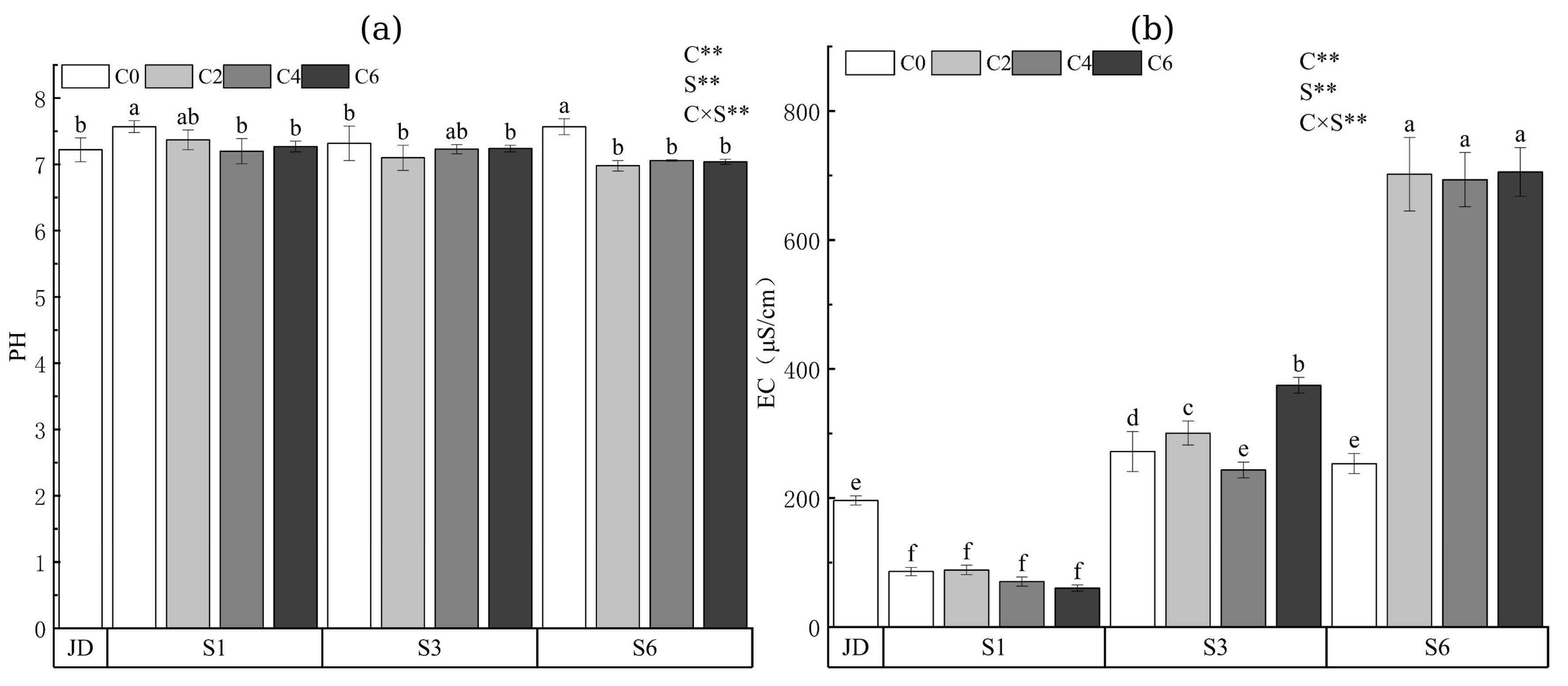
Soil pH exhibited salinity and magnetic field-dependent responses, primarily influenced by ionic speciation and surface charge modifications (Figure 2a). At 1 g/L salinity, magnetized treatments (0.2–0.6 T) decreased pH relative to the control (C0-1, 7.58), with the most pronounced reduction at 0.4 T (C4-1, 7.25). In contrast, at 3 g/L salinity, magnetized treatments increased pH compared to the control (C0-3, 7.12), reaching 7.32-7.39. At 6 g/L salinity; however, magnetized treatments lowered pH relative to the control (C0-6, 7.53), with values ranging from 7.13 to 7.21. Two-way ANOVA showed that both magnetization strength (C) and salinity (S) had significant main effects on soil pH, but the C × S interaction was not significant.
Soil electrical conductivity (EC), a proxy for ionic mobility and concentration, displayed contrasting trends across salinity gradients (Figure 2b). At low salinity (1 g/L), EC decreased under 0.4–0.6 T (C4-1, 88.7; C6-1, 71.2 μS/cm). At 3 g/L salinity, EC exhibited dual responses: 0.2–0.6 T increased EC in C2-3 (322) and C6-3 (389 μS/cm) but decreased it in C4-3 (197.3 μS/cm). At high salinity (6 g/L), magnetized treatments drastically elevated EC (647–670 μS/cm vs. control 207 μS/cm), Two-way ANOVA showed that both magnetization strength (C) and salinity (S) had significant main effects on electrical conductivity (EC), and the C × S interaction was significant. These alterations in soil physicochemical conditions likely drove the observed changes in soil nutrient availability, as detailed in the following section.

3.3. Soil Nutrients

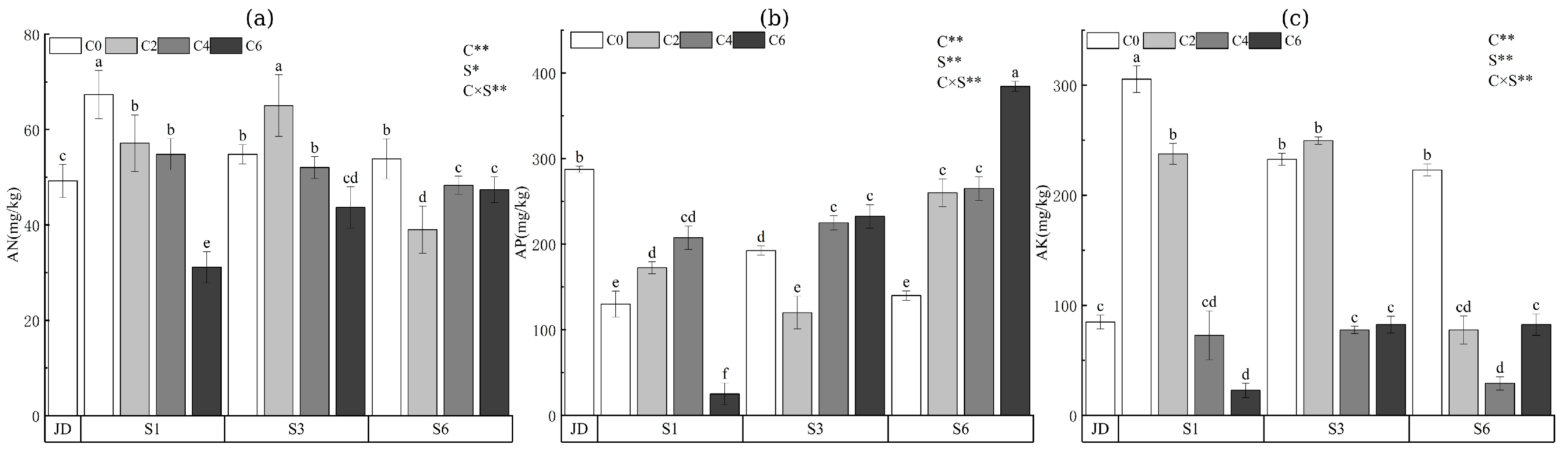
Soil AN concentrations responded differentially to magnetized saline water across salinity gradients (Figure 3a). At 1 g/L salinity, the control treatment (C0-1, 62.1 mg/kg) exhibited a 32.2% increase in AN compared to the non-saline control (JD, 46.97 mg/kg). Magnetic treatments reduced AN relative to C0-1, with the most pronounced decline at 0.6 T (C6-1, 31.90 mg/kg, −48.6%). At 3 g/L salinity, the 0.2 T treatment (C2-3, 60.12 mg/kg) increased AN by 16.4% compared to the control (C0-3, 51.66 mg/kg). Higher magnetic fields (0.4–0.6 T) decreased AN to 42.53–49.06 mg/kg. At 6 g/L salinity, all magnetized treatments reduced AN relative to the control (C0-6, 50.97 mg/kg), with the lowest value at 0.2 T (C2-6, 38.48 mg/kg, −24.5%).
AP concentrations displayed a salinity-dependent promotion under magnetized saline water (Figure 3b). At 1 g/L salinity, the control (C0-1, 136.26 mg/kg) showed a 51.6% decrease in AP compared to JD, but magnetic treatments at 0.2–0.4 T (C2-1, 173.79 mg/kg; C4-1, 193.75 mg/kg) increased AP by 27.5–42.2%.The 0.6 T treatment (C6-1, 47.85 mg/kg) drastically reduced AP. At 3 g/L salinity, magnetic treatments at 0.4–0.6 T (C4-3, 218.66 mg/kg; C6-3, 224.38 mg/kg) further increased AP by 14.8–17.9% relative to the control (C0-3, 190.41 mg/kg). At 6 g/L salinity, magnetized treatments caused a dramatic AP surge, with C6-6 (360.49 mg/kg) showing a 47.4% increase over the control (C0-6, 145.75 mg/kg).
AK concentrations consistently decreased with increasing magnetic field strength across all salinity levels (Figure 3c). At 1 g/L salinity, the control (C0-1, 285.74 mg/kg) exhibited a 198.8% increase in AK compared to JD. Magnetic treatments at 0.2–0.6 T reduced AK to 29.35–226.90 mg/kg, with the steepest decline at 0.6 T (C6-1, −89.7%). At 3 g/L salinity, magnetic treatments at 0.4–0.6 T (C4-3, 89.20 mg/kg; C6-3, 93.98 mg/kg) decreased AK by 57.8–59.9% relative to the control (C0-3, 222.57 mg/kg). At 6 g/L salinity, magnetized treatments further exacerbated AK depletion, with C4-6 (46.50 mg/kg) showing a 78.4% decrease relative to the control (C0-6, 215.06 mg/kg). Two-way ANOVA showed that magnetization strength (C), salinity (S), and their interaction (C × S) significantly affected soil AN, AP, and AK.

3.4. Soil Salinity Ion Composition and Characteristics

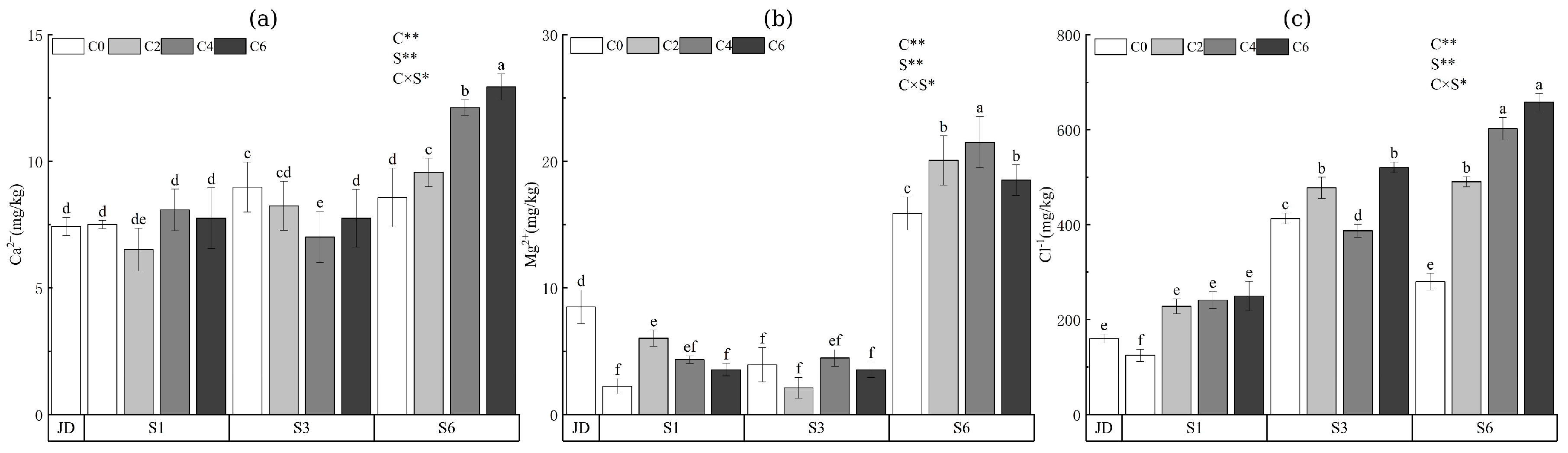
Soil Ca2+ concentrations exhibited salinity-dependent responses to magnetic fields, with notable retention under high-salinity magnetized treatments (Figure 4a). At 1 g/L salinity, magnetic treatments significantly reduced Ca2+ concentrations compared to the control (C0-1), although the magnitude of reduction was small, while at 3 g/L, the 0.4 T treatment (C4-3, 6.04 mg/kg) induced a 24.7% decrease relative to the control (C0-3, 8.02 mg/kg). High salinity (6 g/L) promoted a consistent Ca2+ increase with magnetic field strength, reaching 11.47 mg/kg in C6-6, a 52.9% increase over C0-6.
Mg2+ concentrations consistently increased with magnetic field strength across low and moderate salinities (Figure 4b). At 1 g/L, magnetic treatments increased Mg2+ by 74.3–75.6% relative to C0-1, with C4-1 (210.59 mg/kg) demonstrating optimal mobilization. At 6 g/L, C6-6 (520.49 mg/kg) showed a 115% increase over C0-6.
Cl behavior reflected complex interactions between salinity, magnetic fields, and ion migration (Figure 4c). Low salinity (1 g/L) saw modest Cl increases under magnetic fields (2.93–5.22 mg/kg), with C2-1 (5.22 mg/kg). High salinity (6 g/L) induced a striking Cl surge in C2-6 (18.27 mg/kg) and C4-6 (19.54 mg/kg), exceeding C0-6 by 23.4–32.0%. The unexpected drop in C6-6 (2.56 mg/kg) was also observed. Two-way ANOVA showed that salinity (S) and the C × S interaction significantly affected soil Ca2+, Mg2+, and Cl. The effect of magnetization strength (C) varied by ion: C had no significant effect on soil Ca2+, whereas it significantly affected Mg2+ and Cl.

3.5. Linkages Between Soil Matrix Ions and Soil Aggregate Stability

Table 3 results demonstrate that the effects of magnetized saline water irrigation on the calcium-magnesium ratio (Ca2+/Mg2+) in soil aggregates exhibited significant size-fraction specificity and salinity dependence. Two-way ANOVA revealed that magnetic treatment (C), salinity (S), and their interaction (C × S) had significant or highly significant effects on the Ca2+/Mg2+ ratio across all aggregate size fractions. Overall, the Ca2+/Mg2+ ratio in large aggregates (>2 mm) showed the greatest sensitivity to external treatments. Under low salinity (1 g/L), the 0.6 T magnetic treatment (C6-1) significantly increased the Ca2+/Mg2+ ratio in >2 mm aggregates to 9.62; whereas at medium salinity (3 g/L), the 0.2 T and 0.4 T treatments (C2-3, C4-3) elevated it to 9.35 and 5.47, respectively. In contrast, the response patterns varied among other aggregate size fractions. For instance, the 1–2 mm fraction maintained a relatively high ratio under low-salinity magnetic treatments, while the Ca2+/Mg2+ ratios in micro-aggregates and silt-clay particles (<0.053 mm) were generally low. Salinity emerged as another critical regulating factor. As salinity increased from 1 g/L to 6 g/L, the Ca2+/Mg2+ ratios in nearly all treatments and size fractions decreased sharply. Under high salinity conditions, the ratios dropped to very low levels with minimal differences between treatments.
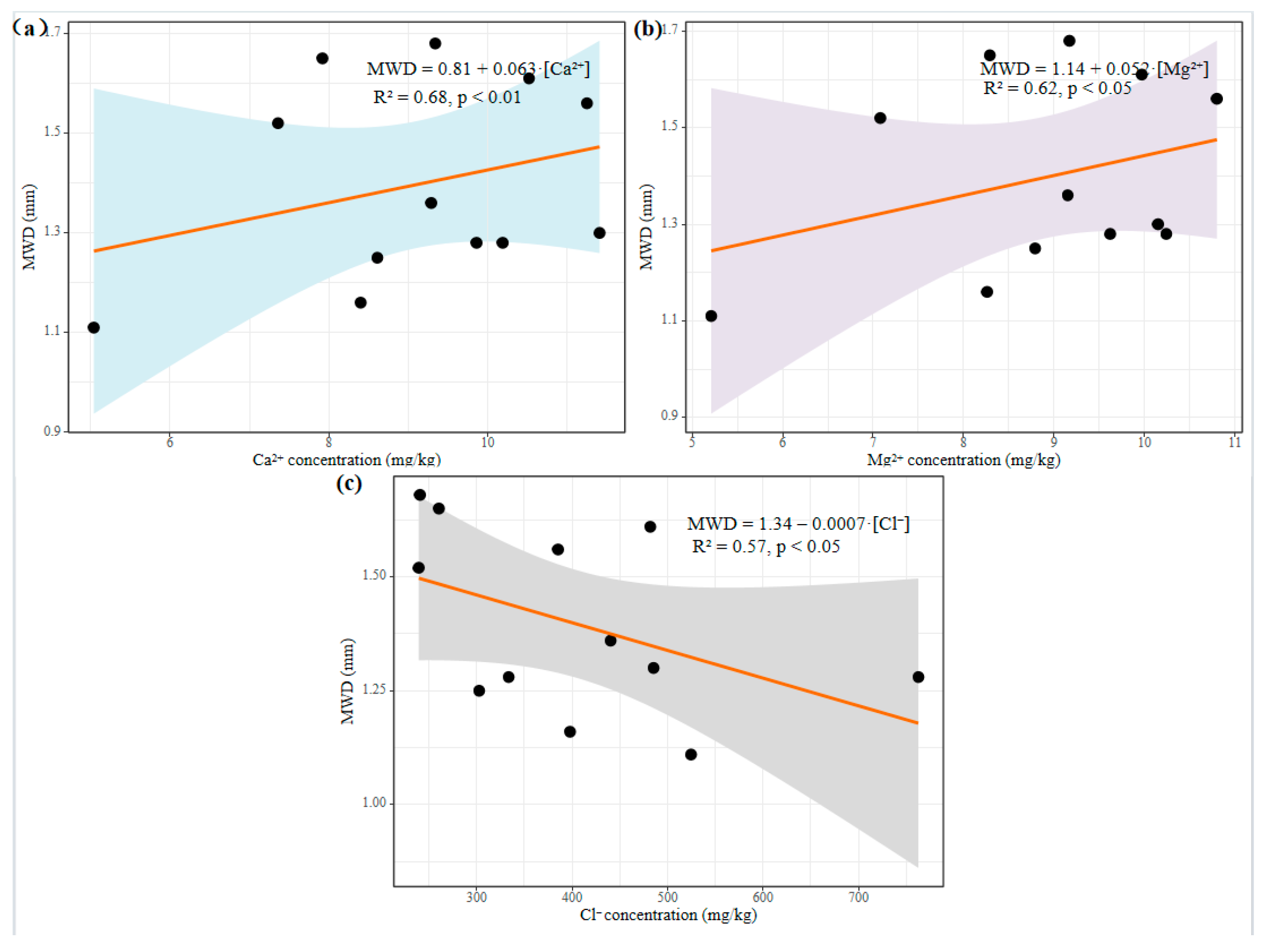
Magnetized saline water significantly modulated the relationship between cation/anion concentrations and soil MWD, a key indicator of aggregate stability. Ca2+ exhibited the strongest positive correlation with MWD (R2 = 0.68, p < 0.01), with a regression slope of 0.012 ± 0.003 (Figure 5a). Exposure to magnetic fields (0.4–0.6 T) further enhanced this effect, increasing the Ca2+–MWD slope by approximately 23% at 6 g/L salinity. In contrast, Cl showed a significant negative correlation with MWD (R2 = 0.57, p < 0.05; slope = −0.08 ± 0.02), but magnetization mitigated this effect, reducing the Cl–MWD slope by about 41% under high salinity (Figure 5c).
Mg2+ displayed a positive correlation with MWD at low salinity (1 g/L, R2 = 0.62), though this relationship weakened at 6 g/L. (Figure 5b). The optimal magnetic intensity (0.4 T) at 3 g/L salinity maximized MWD, yielding an 18% increase relative to non-magnetized controls.

3.6. Effects of Magnetized Saltwater on Soil Enzyme Activity

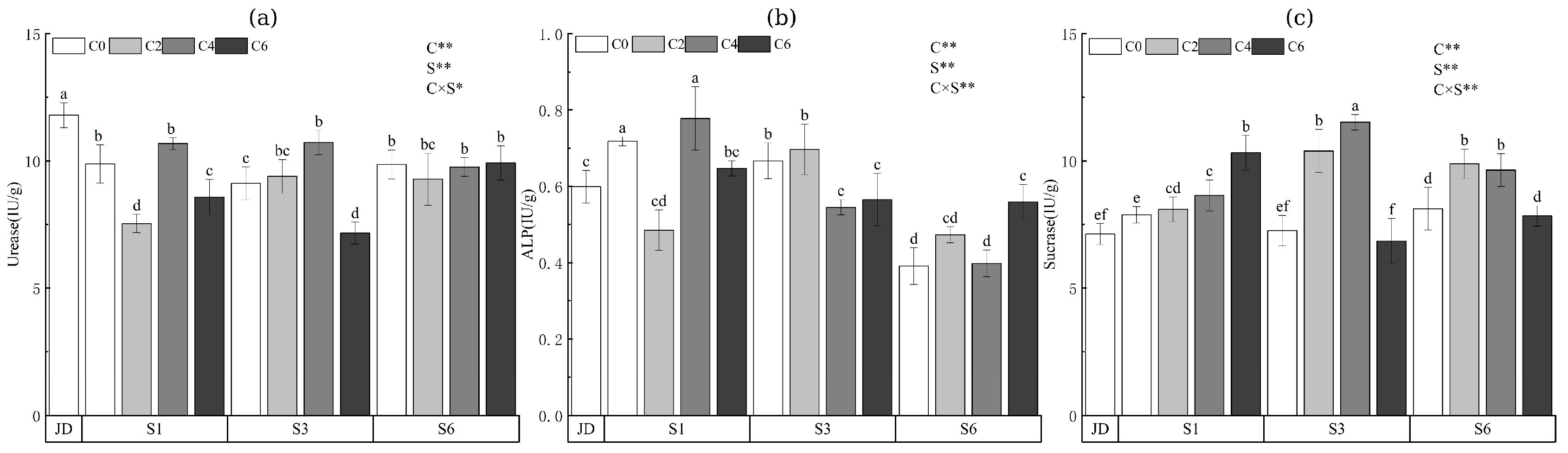
Urease activity exhibited distinct fluctuations across different salinity and magnetic field intensity combinations (Figure 6a). At a salinity of 1 g/L, urease activity first decreased and then increased with increasing magnetic field strength, reaching 8.64 IU/g at 0.6 T (C6-1), which was 11.7% lower than that in the non-magnetized treatment (C0-1, 9.79 IU/g). Notably, C4-1 enhanced urease activity to 10.46 IU/g, a 7.0% increase from the control. At 3 g/L salinity, C4-3 significantly promoted urease activity to 10.68 IU/g. At 6 g/L salinity, the activating effect of the magnetic field on urease was weakened.
ALP activity was more sensitive to salinity changes (Figure 6b). At 1 g/L salinity, C4-1 increased ALP activity to 0.75 IU/g, a 4.2% rise from the non-magnetized control (C0-1, 0.72 IU/g). At 3 g/L salinity, ALP activity first increased and then decreased with magnetic field strength, peaking at 0.69 IU/g in C2-3 and decreasing to 0.55 IU/g in C4-3. At 6 g/L salinity, ALP activity generally decreased, whereas the 0.6 T treatment (C6-6, 0.55 IU/g) increased activity by 44.7% compared to the non-magnetized control (C0-6, 0.38 IU/g).
Sucrase activity showed significant activation under magnetized saline water treatments (Figure 6c). At 1 g/L salinity, the 0.6 T magnetic field (C6-1, 10.43 IU/g) enhanced sucrase activity by 33.2% compared to the control (C0-1, 7.83 IU/g). At 3 g/L salinity, the 0.4 T magnetic field (C4-3, 11.50 IU/g) achieved the highest activity, while the 0.6 T treatment (C6-3, 6.87 IU/g) decreased activity by 8.4% relative to the control (C0-3, 7.50 IU/g). At 6 g/L salinity, the0.2 T magnetic field (C2-6, 10.03 IU/g) increased sucrase activity by 20.6% from the non-magnetized control (C0-6, 8.32 IU/g). Two-way ANOVA showed that magnetization strength (C) and the C × S interaction significantly affected soil Urease, ALP, and Sucrase. The effect of salinity (S) varied by enzyme: S had no significant effect on soil Sucrase, whereas it significantly affected Urease and ALP.

3.7. Structural Equation Model–Based Analysis of Factors Affecting Soil Aggregate Stability

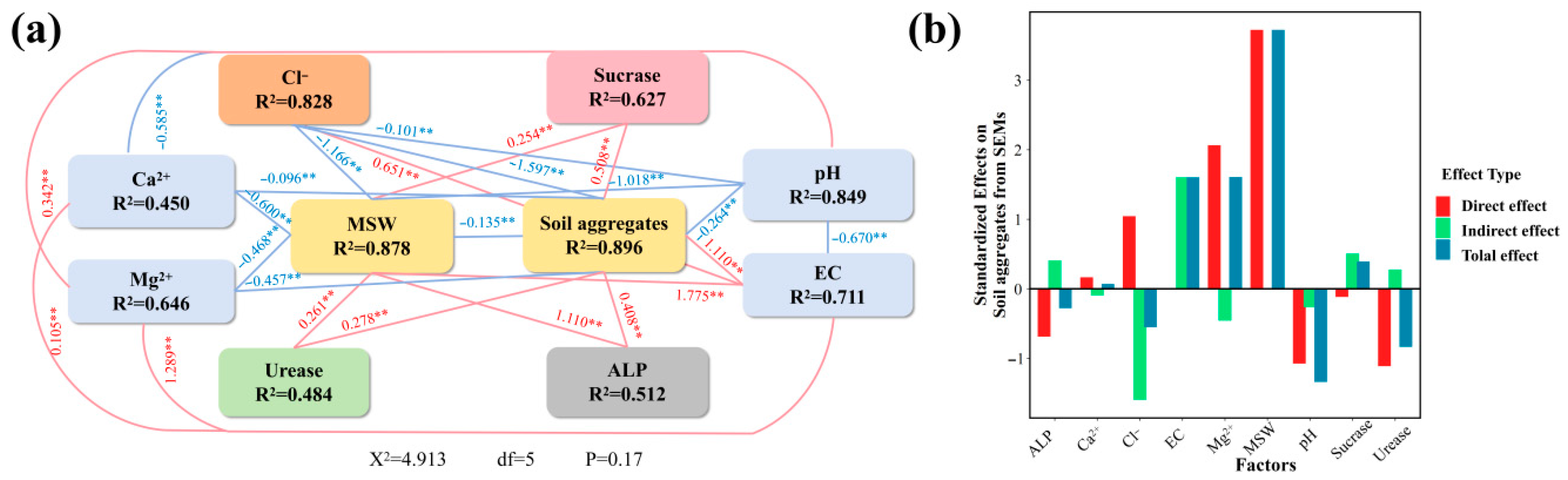
Structural equation modeling (SEM) was used to evaluate both direct (−0.135, p < 0.05) and indirect pathways by which magnetized saline water (MSW) influences soil aggregate stability under varying salinity (1, 3, 6 g/L) and magnetic field intensities (0–0.6 T) (Figure 7). Importantly, this effect was outweighed by strong positive indirect pathways (total = 3.08), mediated through ion dynamics (Mg2+, Cl, Ca2+), enzyme activities (urease, sucrase, ALP), and soil physicochemical properties (pH, EC).
Among all mediators, electrical conductivity (EC) played the most critical role. MSW significantly increased EC (1.775, p < 0.01), which in turn strongly enhanced aggregate stability (1.603, p < 0.001). Ion-specific effects were evident: Mg2+ (1.289) and Cl (0.651) exerted strong influences on EC, while Ca2+ (0.105) contributed modestly. MSW reduced their availability (−0.468, −1.166, −0.600, respectively). Enzyme activities, positively regulated by MSW (ALP: 1.11, urease: 0.261, sucrase: 0.254), enhanced aggregates both directly (0.408, 0.278, 0.508, respectively) and indirectly via EC and pH. Although MSW slightly acidified the soil (−1.018), this effect indirectly enhanced EC (+1.093). The net positive total effect (2.95, p < 0.001), calculated as the sum of the negative direct effect (−0.135) and the positive indirect effect (3.08), was observed.

4. Discussion

4.1. Magnetized Saltwater Irrigation Affects the Soil Aggregate Stability

The application of magnetized saline irrigation substantially improved soil aggregate stability. Collectively, the significant C × S interaction confirms that the efficacy of magnetic treatment is salinity-dependent, identifying specific C × S combinations as tailored solutions for significantly enhancing soil structural stability in saline environments [17].
The substantial improvement may be associated with changes in divalent-cation availability/redistribution (e.g., Ca2+) under magnetized irrigation, which can favor interparticle bridging and flocculation processes and thereby enhance aggregate stability [18]. Notably, the optimal magnetic field (0.4 T) at 3 g/L salinity maximized aggregate stability by balancing cation bridging and osmotic stress. This finding contrasts with non-magnetized saline irrigation, where high salinity typically reduces aggregate stability via Na+-Ca2+ exchange [18,19]. Furthermore, at the higher salinity level of 6 g/L, the 0.2 T treatment at 6 g/L may partly reduce Na+-associated dispersion risk, as reflected by the concurrent changes in solution ionic conditions (EC) and aggregate stability metrics under that C × S combination [20].The underlying mechanisms, encompassing ion dynamics and enzyme-mediated processes, were quantitatively analyzed using a Structural Equation Model (SEM) to explore these integrated effects in detail (Section 4.6).

4.2. Magnetized Saltwater Irrigation Affects Soil Physicochemical Properties

Magnetized saline irrigation altered soil physicochemical properties mainly by shifting soil-solution conditions (as reflected by EC) and ion partitioning between the soil solution and solid-phase pools (e.g., exchange sites and aggregate-associated domains). At low salinity (1 g/L), moderate magnetic intensities (0.4–0.6 T) decreased soil EC, suggesting a reduction in soluble-ion concentration in the soil solution, potentially due to enhanced retention/association of ions with soil colloids and aggregates and/or preferential redistribution away from the soil solution phase [21]. The minor EC increase at 0.2 T implies that the effect was weak or inconsistent at low magnetic intensity. In contrast, under high salinity (6 g/L), magnetic treatment markedly increased soil EC, which more plausibly indicates increased soluble-salt concentrations in the soil solution driven by salinity-dependent dissolution/desorption and exchange processes under high ionic strength conditions [9]. Overall, these contrasting EC responses indicate that magnetized irrigation can either reduce or increase solution ionicity depending on salinity level, highlighting strong salinity × magnetic intensity interactions. Among the treatments, C4-1 and C4-3 consistently reduced EC relative to their controls, suggesting potential for mitigating salinity stress via regulating soil-solution ionic strength and ion redistribution [22]. These EC dynamics are directly relevant to subsequent aggregate stability because electrolyte concentration governs diffuse double-layer interactions and flocculation/dispersion behavior in saline soils [22].
Soil pH exhibited a non-linear response that depended on both salinity level and magnetic intensity. At low salinity (1 g/L), pH decreased, which may reflect shifts in soil solution equilibria and exchange reactions, including enhanced release of acidic components and changes in proton balance at the soil–solution interface under magnetized irrigation [23]. At 3 g/L, pH increased under magnetized treatments, consistent with cation-exchange processes favoring alkaline earth cations (Ca2+, Mg2+) and reducing the relative activity of H+ in solution [24]. Under high salinity (6 g/L), pH decreased again, which may be associated with ionic-strength effects on solution equilibria and exchange reactions that promote H+ release or reduce buffering efficiency under saline conditions [25]. These pH shifts are important because they regulate nutrient solubility (e.g., P availability) and microbial-mediated processes, thereby indirectly influencing aggregate stability and soil functioning through altered soil-solution chemistry [21]. Notably, C4-3 and C6-3 maintained pH values closer to neutral, a range generally favorable for soil biological activity and nutrient cycling [26].

4.3. Magnetized Saline Irrigation Influences Soil Nutrient Availability and Dynamics

The soil’s physicochemical modifications, particularly the changes in pH and EC discussed in the preceding sections, strongly influenced the availability of major nutrients (AN, AP, and AK) in a complex and salinity-dependent manner.
At low salinity (1 g/L), magnetic treatments reduced AN, which may reflect changes in soil-solution conditions (pH/EC) and N retention processes (e.g., adsorption/retention in the soil matrix) under different C × S combinations. In contrast, at intermediate salinity (3 g/L), the 0.2 T treatment increased AN, which may indicate enhanced retention of alkali-hydrolyzable N under moderate salinity and mild magnetic intensity, possibly via salinity- and EC-dependent shifts in soil-solution conditions. This may influence the partitioning of extractable N within the soil matrix. However, higher magnetic intensities (0.4–0.6 T) decreased AN, suggesting that stronger magnetic treatment under this salinity level may be associated with reduced extractable N, potentially linked to altered soil-solution ionic conditions and N redistribution within the soil matrix. At high salinity (6 g/L), reduced AN may reflect salinity-driven constraints on N availability and retention under elevated ionic strength, consistent with the widely reported decline in N availability/transformations under saline conditions [27]. Notably, the C2-3 treatment maintained high AN levels, suggesting that moderate magnetic intensity at 3 g/L may help preserve alkali-hydrolyzable N under intermediate salinity, which could be beneficial in nitrogen-limited soils [8].
AP concentrations were salinity-dependent. At low salinity, magnetic treatments (0.2–0.4 T) increased AP, which may reflect pH/EC-dependent shifts in P dissolution–adsorption equilibria and the release of labile phosphate under magnetized irrigation [24]. The 0.6 T treatment reduced AP, which may be associated with a shift toward lower soluble/labile P under that condition, potentially via precipitation and/or stronger sorption under the prevailing soil-solution chemistry. At 3 g/L salinity, magnetic treatments (0.4–0.6 T) further increased AP, suggesting that under moderate salinity, magnetized irrigation may favor higher labile P through changes in soil-solution chemistry (pH/EC) and dissolution–sorption equilibria. At 6 g/L salinity, the marked AP increase may reflect strong ionic-strength and pH/EC effects on P solubility and partitioning, shifting P toward higher extractable forms in the short term. Collectively, these results suggest that magnetized irrigation can modulate extractable P in a salinity-dependent manner, implying that appropriate magnetic intensity selection may help manage P availability under saline irrigation regimes [28].
AK concentrations consistently decreased with increasing magnetic field strength across all salinity levels. This decline may indicate reduced extractable K under magnetized irrigation, potentially associated with stronger retention within the soil matrix and/or redistribution among soil K pools (e.g., exchange-related vs. more strongly retained forms) under the prevailing ionic conditions. At 3 g/L salinity, magnetic treatments (0.4–0.6 T) decreased AK, suggesting that under moderate salinity, magnetized irrigation may reduce extractable K via changes in soil-solution chemistry (EC/pH) that influence K partitioning and retention. At 6 g/L salinity, AK decreased further, consistent with competitive cation effects under saline conditions (e.g., higher Na+ activity influencing K+ partitioning) and associated shifts in the soil-solution environment [18]. Among treatments, the control (C0-1) retained the highest AK, highlighting that low-salinity conditions without magnetic treatment may preserve potassium availability; however, under saline conditions, structural risk is more strongly governed by electrolyte concentration and cation composition (monovalent vs. divalent balance) than by K availability alone [29].

4.4. Magnetized Saltwater Irrigation Affects the Soil Salt Ions Distribution in Soil Aggregates

Ca2+ concentrations exhibited notable retention under high-salinity magnetized treatments. High salinity (6 g/L) promoted a consistent Ca2+ increase with magnetic field strength, reaching a 52.9% increase over the control at C6-6. The increases in Ca2+ under some magnetized–saline treatments may reflect shifts in soil solution chemistry and exchange equilibria under different ionic strengths (as indicated by EC) and pH conditions. In saline systems, changes in electrolyte concentration and cation composition can modify Ca2+ partitioning between the soil solution and exchange sites, thereby influencing divalent-cation bridging and aggregate flocculation/dispersion processes [30,31]. Therefore, the observed Ca2+ changes are more plausibly interpreted as a redistribution among solution–exchange–aggregate pools rather than direct evidence of molecular-scale water-structure effects.
Mg2+ concentrations consistently increased with magnetic field strength across low and moderate salinities. Similarly, the observed Mg2+ increases can be interpreted as changes in Mg2+ partitioning between the soil solution, exchange sites, and aggregate-associated pools under varying ionic strength and pH conditions. Because divalent cations contribute to interparticle bridging and flocculation in saline soils, a higher availability of Ca2+/Mg2+ in relevant pools may support aggregate stability; however, the relative balance between Ca2+ and Mg2+ can also matter for structural outcomes [30,31,32].
The contrasting Cl patterns across salinity levels likely reflect differences in salt transport and retention among aggregate-size fractions under the imposed irrigation regime [24,33]. Because Cl is generally weakly retained, its distribution may primarily indicate where soluble salts accumulate or are preferentially leached, which can be indirectly constrained by aggregate stability and pore connectivity [19,22,24].
Magnetized irrigation reshaped ion distribution across aggregate sizes. At 1 g/L, magnetic fields enhanced Ca2+ and Mg2+ retention in macro-aggregates (>2 mm), supporting cation bridging [33]. The distribution behavior of Cl exhibited a distinct salinity-dependent contrast: under low salinity (1 g/L), Cl preferentially accumulated in microaggregates (increasing by 32.0%), whereas high salinity (6 g/L) shifted this accumulation towards macroaggregates (23.4–32.0%). This reversal suggests that Cl redistribution among aggregate-size fractions is salinity-dependent, likely reflecting differences in salt transport and retention under contrasting ionic strengths [24,33]. However, the Ca2+/Mg2+ ratio declined under magnetization, especially at 3 g/L, suggesting that a shift toward relatively higher Mg2+ compared with Ca2+ may weaken Ca2+-dominated bridging [34]. Thus, aggregate stability depends not only on absolute ion concentrations but also on balanced cation ratios. The quantitative contribution of these ion ratios and their correlation with MWD are integrated and demonstrated by the Structural Equation Model in Section 4.6.
Statistical analysis revealed that Ca2+ exhibited the strongest positive correlation with MWD (R2 = 0.68, p < 0.01), highlighting its role in cation bridging that promotes aggregate flocculation. Exposure to magnetic fields (0.4–0.6 T) further enhanced this effect, increasing the Ca2+–MWD slope by approximately 23% at 6 g/L salinity, likely reflecting greater divalent-cation availability for interparticle bridging and flocculation under high ionic strength conditions [30,31,32]. In contrast, Cl showed a significant negative correlation with MWD (R2 = 0.57, p < 0.05). Magnetization mitigated this negative effect, reducing the Cl–MWD slope by about 41% under high salinity, possibly because improved aggregate stability and soil structure can enhance salt transport/leaching and reduce soluble-salt accumulation within structural domains under saline irrigation [19,22,24].

4.5. Magnetized Saltwater Irrigation Affects the Soil Enzyme Activities

Soil enzyme activity, which reflects critical soil health and biogeochemical processes, was distinctly modulated by the interaction between magnetic field intensity and salinity (C × S). This response was strongly salinity- and enzyme-specific. The enhancement of enzyme activity, particularly under optimal conditions, fundamentally links to nutrient cycling (e.g., urease drives nitrogen availability; alkaline phosphatase regulates phosphorus release). Furthermore, this activity is crucial for promoting organic matter turnover and the formation of organic binding materials, thus indirectly contributing to aggregate stabilization [12].
Urease activity showed complex fluctuations, yet C4-3 (3 g/L and 0.4 T) was identified as the optimal treatment, significantly promoting urease activity and supporting enhanced nitrogen turnover [31]. At low salinity (1 g/L), the 0.4 T treatment (C4-1) enhanced urease activity, which is potentially attributed to a more favorable soil physicochemical microenvironment (e.g., pH/EC and ionic conditions) for urease activity under magnetized irrigation [35]. In contrast, higher salinity (3 g/L) combined with a strong magnetic field (C6-3) suppressed activity, likely due to salinity-induced ionic/osmotic stress and unfavorable changes in the soil solution environment that can suppress microbial activity and enzyme functioning [18]. The maintenance of relatively high activity at C6-6 may reflect a more favorable soil structure and soil-solution environment under magnetized irrigation, which can support substrate diffusion and microbial functioning under saline conditions [36].
ALP activity, highly sensitive to salinity, was best preserved at 6 g/L and 0.6 T (C6-6), showing a significant increase compared with the non-magnetized control [26]. This is notable because non-magnetized treatments may exhibit suppressed ALP activity under high salinity due to ionic/osmotic stress and reduced microbial functioning; magnetized irrigation may mitigate this inhibition by alleviating adverse soil-solution conditions (e.g., EC/pH and ion balance) and maintaining a more favorable microenvironment for phosphatase activity [37]. At moderate salinity, C4-1 enhanced ALP activity, possibly due to changes in soil pH/EC and P availability that influence phosphatase expression and activity [38]. However, the decline at higher magnetic intensity may reflect less favorable soil-solution conditions for ALP at that salinity level [38]. Overall, these patterns suggest that magnetized irrigation may help preserve ALP activity under severe salinity stress.
Sucrase was the most responsive enzyme overall, peaking at C6-1 (1 g/L and 0.6 T), showing the maximal enhancement. This response may be associated with improved soil-solution conditions and enhanced microbial carbon turnover under magnetized irrigation [39]. The highest recorded activity (11.50 IU/g) at C4-3 may reflect improved soil-solution conditions and observed ion redistribution under magnetized irrigation, supporting a more favorable microenvironment for sucrase activity. Conversely, the 0.6 T treatment at medium salinity (C6-3) resulted in a decrease in activity likely due to salinity-induced inhibition under less favorable ionic conditions [21]. At severe salinity (6 g/L), the 0.2 T magnetic field helped alleviate salinity-induced suppression of enzyme activity caused by high salinity, leading to a significant increase in activity over the control.
The combined analysis indicates that different enzymes respond optimally under different C × S conditions, but overall, moderate salinity (3 g/L) with 0.4 T provides the best balance across multiple enzymes (Urease and Sucrase reached high levels, while ALP remained stable). The SEM analysis suggested that magnetized saltwater enhanced enzyme activities primarily through shifts in soil-solution conditions (EC and pH) and ion redistribution, thereby influencing microbial processes and biogeochemical cycling. In addition, C4-1 also demonstrated prominent activities, suitable for regulating enzyme activity under low-salinity conditions. The limited magnetic field efficacy in ameliorating Sucrase activity under extreme high-salinity stress indicates a limitation of the treatment.

4.6. Possible Synergistic Effects on Soil Aggregate Stability, Salt Ion Distribution, and Soil Enzyme Activity Under Magnetized Saline Irrigation

Salinity-magnetic field interactions synergistically influenced soil structure and function. SEM provided a quantitative framework, confirming that the net positive total effect (2.95, p < 0.001) on aggregate stability was overwhelmingly driven by strong positive indirect pathways (total = 3.08). Prior statistical analysis confirmed strong correlations between aggregate stability and Ca2+/Mg2+ ratios, consistent with established principles of divalent-cation bridging and salinity/sodicity-related dispersion risks (e.g., Na+-associated clay swelling and aggregate breakdown) [23,40,41,42,43].
Among all mediators, electrical conductivity (EC) was a critical factor [29]. In the integrated SEM dataset, MSW was positively associated with EC (1.775, p < 0.01), and EC subsequently showed a strong positive linkage with aggregate stability (1.603, p < 0.001). This relationship is consistent with colloidal interaction principles: higher ionic strength compresses the diffuse double layer, reduces electrostatic repulsion, and can promote particle flocculation under saline conditions [30]. Notably, EC responses were salinity-dependent in the observed results (Section 4.2), indicating that EC can act as a key mediator in the overall pathway while still varying across salinity levels and magnetic intensities.
Ion-specific effects were clearly demonstrated. Mg2+ (1.289) and Cl (0.651) exerted strong influences on EC, while Ca2+ (0.105) contributed modestly. In the SEM, MSW showed significant associations with ion-related variables (−0.468, −1.166, −0.600), indicating that the EC response likely reflects the combined outcome of ion redistribution among solution–exchange–aggregate pools and overall solution chemistry, rather than a simple increase in all measured ion concentrations [34,40].
Enzyme activities, notably ALP (1.11), urease (0.261), and sucrase (0.254), were positively regulated by MSW. These enhanced enzyme activities strengthened aggregates both directly (0.408, 0.278, 0.508, respectively) and indirectly via EC and pH. The direct pathway is likely attributable to facilitating the production of organic cementing agents like microbially derived organic binding materials [39]. Furthermore, the SEM indicated an overall negative association between MSW and pH (−1.018), while the measured pH responses were salinity-dependent (Section 4.2). This suggests that pH may function as a secondary mediator in the integrated pathway, potentially influencing ion solubility and microbial functioning under different salinity–magnetization combinations. Crucially, the EC-driven flocculation effect outweighed the potential dispersive impact of lower pH.
The net positive total effect (2.95, p < 0.001), calculated as the sum of the small negative direct effect (−0.135) and the dominant positive indirect effect (3.08), confirms that MSW strengthened aggregates primarily through cascading improvements in ion dynamics, enzyme-mediated organic matter turnover, and electrochemical balance.
The dominant stabilization mechanism shifts significantly with salinity level. The optimal treatment (3 g/L with 0.4 T) achieved the best overall balance through the convergence of three mechanisms: Ca2+-mediated flocculation; balanced Ca2+/Mg2+ ratios reducing osmotic stress; and sustained enzyme activities supporting nutrient cycling. Although ALP was not maximal under this condition, it remained relatively high, making this treatment the most balanced overall. These findings highlight that the dominant mechanism governing aggregate stabilization shifts with salinity level: At low salinity, MSW primarily enhanced EC-driven aggregation; at moderate salinity (3 g/L), exposure to a 0.4 T magnetic field optimized enzyme activities, promoting the synthesis of organic binding materials contributing to aggregate stabilization that stabilized soil aggregates; and at high salinity (6 g/L), maintaining divalent-cation-associated flocculation and structural integrity became increasingly important to counteract Na+-associated dispersion risks, while Cl patterns primarily reflected salt accumulation/leaching dynamics that are constrained by aggregate stability and pore connectivity [31,34,40].

5. Conclusions

This study systematically evaluated the synergistic effects of salinity and magnetic field intensity on soil structure and function under magnetized saline irrigation, providing a basis for tailoring water management practices in arid and semi-arid environments. The C × S interaction was identified as a key factor modulating many key soil properties, underscoring the need to consider salinity and magnetic intensity as a coupled management regime.
  • In terms of scientific novelty and mechanisms, the work provides a quantitative and integrated understanding of the multi-scale processes involved. Structural equation modeling (SEM) showed that the enhancement of soil aggregate stability was mainly driven by indirect pathways, in which EC-associated flocculation/dispersion processes (consistent with DLVO-type colloidal interactions) and enzyme-mediated organic matter turnover acted as key mediators. This helps to open the “black box” of magnetic treatment by supplying quantitative evidence for the cascade of physical, chemical and biological responses.
  • From an application perspective, the study proposes salinity-dependent optimization strategies. A moderate-salinity (3 g L−1), moderate-magnetic-field (0.4 T) regime emerged as an optimal, balanced strategy for overall soil health, simultaneously improving aggregate stability and maintaining high levels of multiple enzyme activities. In contrast, the high-salinity, high-magnetic-field treatment (C6-6) produced the strongest structural improvements, highlighting its potential for targeted remediation under more severe salinity.
  • Mechanistic insights indicate that magnetic treatment may shift soil-solution physicochemical conditions (particularly EC and pH) and ion redistribution, which together provide a plausible linkage between soil structure and biological functioning in saline soils. Future research should prioritize long-term field trials across diverse soil types, and explicitly couple these responses to crop productivity and microbial community dynamics beyond enzyme activity. Such efforts are essential to refine magnetized saline irrigation as a sustainable, non-chemical management option for mitigating soil degradation.

Author Contributions

Conceptualization, Z.M. and Y.M.; methodology, Z.M. and Y.M.; software, Y.F. and Z.W.; validation, Y.F., P.A., F.L., T.H. and Z.W.; formal analysis, Y.F. and Z.M.; investigation, F.L., T.H., and Z.W.; resources, Y.X., Z.M. and Y.M.; data curation, Y.F.; writing—original draft preparation, Y.F.; writing—review and editing, P.A., F.L., T.H. and Z.M.; visualization, Y.F. and T.H.; supervision, P.A., F.L., T.H., Y.X., Z.M. and Y.M.; project administration, P.A., Y.X., Z.M. and Y.M.; funding acquisition, Y.X., Z.M. and Y.X. All authors have read and agreed to the published version of the manuscript.

Funding

This research was funded by the Major Special Science and Technology Project of Xinjiang Uygur Autonomous Region: 2024A03007-4; 2023A02002-5, Tianshan Leading Talent Program (2024TSYCLJ0013), National Natural Science Foundation of China (52569012), Research Project of the “Key Laboratory of Hydraulic Engineering Safety and Water Disaster Prevention in Xinjiang”: ZDSYS-YJS-2024-19, 2024 Open Project of the “Key Laboratory of Hydraulic Engineering Safety and Water Disaster Prevention in Xinjiang”: ZDSYS-JS-2024-11, Basic Research Funds for Autonomous Region Universities (XJEDU2022P053), Youth Science Foundation of the Autonomous Region (2023D01B28).

Institutional Review Board Statement

Not applicable. This study did not involve humans or animals.

Data Availability Statement

The data that support the findings of this study are not publicly available due to privacy. However, they are available from the corresponding author upon reasonable request.

Acknowledgments

We would like to thank Y.M. for his guidance on the research direction, and Z.M., and Z.W. for their extensive participation in the experiment.

Conflicts of Interest

The authors declare no conflicts of interest.

Abbreviations

The following abbreviations are used in this manuscript:
MSWMagnetized saline water
SEMStructural Equation Modeling
JD Initial soil
C Magnetic field intensity
S Salinity level
C × SInteraction between magnetic intensity and salinity
R0.25Percentage of mechanically stable aggregates larger than 0.25 mm
MWDMean weight diameter of soil aggregates
GMDGeometric mean diameter of soil aggregates
PHSoil pH
ECElectrical conductivity of soil solution
ANSoil ammonium nitrogen
APAvailable phosphorus
AKAvailable potassium
UreaseSoil urease activity
SucraseSoil sucrase activity
ALPAlkaline phosphatase activity

References

  1. Sodaeizadeh, H.; Hokmollahi, F.; Ghasemi, S.; Sadeghian, M.; Tarrah, S. Cyanobacteria inoculation mitigates salinity stress by regulating plant growth, photosynthetic performance, elemental concentrations and yield in wheat. S. Afr. J. Bot. 2025, 180, 857–869. [Google Scholar] [CrossRef]
  2. Rahmani, F.; Sodaeizadeh, H.; Yazdani-Biouki, R.; Hakimzadeh-Ardakani, M.-A.; Kamali Aliabadi, K. Effect of bio-priming on morphological, physiological and essential oil of chamomile (Matricaria chamomilla L.) under salinity stress. S. Afr. J. Bot. 2024, 167, 630–642. [Google Scholar] [CrossRef]
  3. Wang, L.; Blanchy, G.; Cornelis, W.; Garré, S. Changes in soil hydraulic and physio-chemical properties under treated wastewater irrigation: A meta-analysis. Agric. Water Manag. 2024, 295, 108752. [Google Scholar] [CrossRef]
  4. Al-Ogaidi, A.A.M.; Wayayok, A.; Rowshon, M.K.; Abdullah, A.F. The influence of magnetized water on soil water dynamics under drip irrigation systems. Agric. Water Manag. 2017, 180, 70–77. [Google Scholar] [CrossRef]
  5. Levy, G.J.; Fine, P.; Goldstein, D.; Azenkot, A.; Zilberman, A.; Chazan, A.; Grinhut, T. Long term irrigation with treated wastewater (TWW) and soil sodification. Biosyst. Eng. 2014, 128, 4–10. [Google Scholar] [CrossRef]
  6. Al-Akhras, M.-A.H.; Al-Quraan, N.A.; Abu-Aloush, Z.A.; Mousa, M.S.; AlZoubi, T.; Makhadmeh, G.N.; Donmez, O.; Al Jarrah, K. Impact of magnetized water on seed germination and seedling growth of wheat and barley. Results Eng. 2024, 22, 101991. [Google Scholar] [CrossRef]
  7. Yang, F.; Wu, P.; Zhang, L.; Hang, Y.; Wei, Y. Effects of irrigation-mediated continuously moist and dry-rewetting pattern on soil physicochemical properties, structure and bacterial community. Appl. Soil Ecol. 2025, 205, 105767. [Google Scholar] [CrossRef]
  8. Zhou, B.; Yang, L.; Chen, X.; Ye, S.; Peng, Y.; Liang, C. Effect of magnetic water irrigation on the improvement of salinized soil and cotton growth in Xinjiang. Agric. Water Manag. 2021, 248, 106784. [Google Scholar] [CrossRef]
  9. Abdelghany, A.E.; Abdo, A.I.; Alashram, M.G.; Eltohamy, K.M.; Li, J.; Xiang, Y.; Zhang, F. Magnetized saline water irrigation enhances soil chemical and physical properties. Water 2022, 14, 4048. [Google Scholar] [CrossRef]
  10. Kishore, G.; Saxena, C.; Rajwade, Y. Magnetic treatment of irrigation water: Its effect on water properties and characteristics of eggplant (Solanum melongena). Emir. J. Food Agric. 2022, 34, 784–791. [Google Scholar] [CrossRef]
  11. Zhou, S.; Gao, Y.; Zhang, J.; Pang, J.; Hamani, A.K.M.; Xu, C.; Dang, H.; Cao, C.; Wang, G.; Sun, J. Impacts of saline water irrigation on soil respiration from cotton fields in the North China Plain. Agronomy 2023, 13, 1197. [Google Scholar] [CrossRef]
  12. Lu, G.; Tian, H.; Tan, X.; Megharaj, M.; He, Y.; He, W. Distribution of soil nutrients and enzyme activities in different aggregates under two sieving methods. Soil Sci. Soc. Am. J. 2020, 84, 331–344. [Google Scholar] [CrossRef]
  13. Bach, E.M.; Hofmockel, K.S. Soil aggregate isolation method affects measures of intra-aggregate extracellular enzyme activity. Soil Biol. Biochem. 2014, 69, 54–62. [Google Scholar] [CrossRef]
  14. Bao, S.D. Soil Agricultural Chemical Analysis, 3rd ed.; China Agricultural Press: Beijing, China, 2000; ISBN 978-7-109-06644-1. [Google Scholar]
  15. Guan, S.Y. Soil Enzyme and Its Research Methods; Chinese Agricultural Press: Beijing, China, 1986. [Google Scholar]
  16. Rosseel, Y. Lavaan: An R package for structural equation modeling. J. Stat. Softw. 2012, 48, 1–36. [Google Scholar] [CrossRef]
  17. Shaban, K.A.H.; Ahmed, M.A.; El-Sayed, H.A.M. Effect of magnetic irrigation saline water and pre-sowing of grains treated with magnetic field on saline soil fertility and wheat productivity and quality. Asian J. Adv. Agric. Res. 2023, 23, 41–58. [Google Scholar] [CrossRef]
  18. Kamel, Y.; Hegab, S.; Youssef, M.; Abd El-Gawad, A. Effects of magnetized saline irrigation water and fertilizers on soil prosperities and wheat productivity. Arch. Agric. Sci. J. 2023, 6, 113–141. [Google Scholar] [CrossRef]
  19. Yan, S.; Zhang, T.; Zhang, B.; Zhang, T.; Cheng, Y.; Wang, C.; Luo, M.; Feng, H.; Siddique, K.H.M. The higher relative concentration of K+ to Na+ in saline water improves soil hydraulic conductivity, salt-leaching efficiency and structural stability. Soil 2023, 9, 339–349. [Google Scholar] [CrossRef]
  20. Yuan, H.; Zhang, A.; Zhu, C.; Dang, H.; Zheng, C.; Zhang, J.; Cao, C. Saline water irrigation changed the stability of soil aggregates and crop yields in a winter wheat–summer maize rotation system. Agronomy 2024, 14, 2564. [Google Scholar] [CrossRef]
  21. Tao, J.; Liu, X. The effect of soil salt content and ionic composition on nitrification in a Fluvisol of the Yellow River Delta. Soil Tillage Res. 2024, 235, 105907. [Google Scholar] [CrossRef]
  22. Wang, D.; Wang, Z.; Zhang, J.; Zhang, Y.; Chen, P. Effects of salinity of magnetized water on water–salt transport and infiltration characteristics of soil under drip irrigation. Agronomy 2024, 14, 2873. [Google Scholar] [CrossRef]
  23. Abdelsalam, H.; Mostafa, H.; El-Ansary, M.; Awad, M.; Sultan, W. Magnetization treatment effect on some physical and biological characteristics of saline irrigation water. Sci. Rep. 2025, 15, 19803. [Google Scholar] [CrossRef]
  24. Xin, M.; Zhao, Q.; Qiao, Y.; Ma, Y. Magnetized saline water drip irrigation alters soil water-salt infiltration and redistribution characteristics. Water 2024, 16, 2693. [Google Scholar] [CrossRef]
  25. Ben Amor, H.; Elaoud, A.; Ben Hassen, H.; Ben Salah, N.; Masmoudi, A.; Elmoueddeb, K. Characteristic study of some parameters of soil irrigated by magnetized waters. Arab. J. Geosci. 2020, 13, 1007. [Google Scholar] [CrossRef]
  26. Ouyang, Z.; Tian, J.; Yan, X. Effects of mineralization degree of irrigation water on yield, fruit quality, and soil microbial and enzyme activities of cucumbers in greenhouse drip irrigation. Horticulturae 2024, 10, 113. [Google Scholar] [CrossRef]
  27. Guo, X.; Du, S.; Guo, H.; Min, W. Long-term saline water drip irrigation alters soil physicochemical properties, bacterial community structure, and nitrogen transformations in cotton. Appl. Soil Ecol. 2023, 182, 104719. [Google Scholar] [CrossRef]
  28. Li, J.; Wu, S.; Jiao, X.; Guo, W.; Adeloye, A.J.; Tianao, W. Effects of magnetized saline water irrigation on maize photosynthesis, growth and WUE under reduced phosphorus fertilizer. SSRN Electron. J. 2022. [Google Scholar] [CrossRef]
  29. Wang, J.; Zhou, Q.; Chen, R.; Wang, Z. Rationale saline-water irrigation also serves as enhancing soil aggregate stability, regulating carbon emissions, and improving water use efficiency in oasis cotton fields. Ind. Crops Prod. 2025, 223, 120144. [Google Scholar] [CrossRef]
  30. Yang, S.; Tian, R.; Wang, H.; Zhang, Y.; Li, H. Specific cation effects on soil water infiltration and soil aggregate stability–Comparison study on variably and permanently charged soils. Soil Tillage Res. 2025, 247, 106385. [Google Scholar] [CrossRef]
  31. Liu, B.; Gao, R.; Ndzana, G.M.; An, H.; Huang, J.; Liu, R.; Du, L.; Kamran, M.; Xue, B. Nutrient addition affects stability of soil organic matter and aggregate by altering chemical composition and exchangeable cations in desert steppe in northern China. Land Degrad. Dev. 2023, 34, 1430–1446. [Google Scholar] [CrossRef]
  32. Yan, S.; Zhang, T.; Zhang, B.; Feng, H.; Siddique, K.H.M. Adverse effects of Ca2+ on soil structure in specific cation environments impacting macropore-crack transformation. Agric. Water Manag. 2024, 302, 108987. [Google Scholar] [CrossRef]
  33. Ju, Z.; Du, Z.; Guo, K.; Liu, X. Irrigation with freezing saline water for 6 years alters salt ion distribution within soil aggregates. J. Soils Sediments 2019, 19, 97–105. [Google Scholar] [CrossRef]
  34. Jiang, Z.; Wang, Q.; Ning, S.; Wei, K.; Hu, X. Effects of magnetized ionized water and Bacillus subtilis on water and salt transport characteristics and ion composition in saline soil. Irrig. Drain. 2025, 74, 998–1009. [Google Scholar] [CrossRef]
  35. Liu, G.; Zhang, X.; Wang, X.; Shao, H.; Yang, J.; Wang, X. Soil enzymes as indicators of saline soil fertility under various soil amendments. Agric. Ecosyst. Environ. 2017, 237, 274–279. [Google Scholar] [CrossRef]
  36. Lu, P.; Zhang, Y.; Ji, B.; Yan, Y.; Wang, Z.; Yang, M.; Zhang, S.; Yang, X. PhoD harboring microbial community and alkaline phosphatase as affected by long term fertilization regimes on a calcareous soil. Agronomy 2023, 13, 363. [Google Scholar] [CrossRef]
  37. Song, K.; Zhou, C.; Li, H.; Zhou, Z.; Ni, G.; Yin, X. Effects of rumen microorganisms on straw returning to soil at different depths. Eur. J. Soil Biol. 2023, 114, 103454. [Google Scholar] [CrossRef]
  38. García, C.; Hernández, T. Influence of salinity on the biological and biochemical activity of a calciorthird soil. Plant Soil 1996, 178, 255–263. [Google Scholar] [CrossRef]
  39. Horchani, F.; Bouallegue, A.; Namsi, A.; Abbes, Z. Exogenous application of ascorbic acid mitigates the adverse effects of salt stress in two contrasting barley cultivars through modulation of physio-biochemical attributes, K+/Na+ homeostasis, osmoregulation and antioxidant defense system. Russ. J. Plant Physiol. 2023, 70, 219. [Google Scholar] [CrossRef]
  40. Pedroza-Sandoval, A.; González-Espíndola, L.Á.; Jacobo-Salcedo, M.D.R.; Gramillo-Ávila, I.; Miranda-Rojas, J.A. Magnetized saline water modulates soil salinization and enhances forage productivity: Genotype-specific responses of Lotus corniculatus L. Horticulturae 2025, 11, 428. [Google Scholar] [CrossRef]
  41. Zhang, S.; Chen, T.; Bao, Y.; Tang, Q.; Li, Y.; He, X. The impacts of the hydrological regime on the soil aggregate size distribution and stability in the riparian zone of the Three Gorges Reservoir, China. Water 2023, 15, 1791. [Google Scholar] [CrossRef]
  42. Shi, H.; Luo, G.; Sutanudjaja, E.H.; Hellwich, O.; Chen, X.; Ding, J.; Wu, S.; He, X.; Chen, C.; Ochege, F.U.; et al. Recent impacts of water management on dryland’s salinization and degradation neutralization. Sci. Bull. 2023, 68, 3240–3251. [Google Scholar] [CrossRef] [PubMed]
  43. Hamza, A.H.; Shreif, M.; Abd El-Azeim, M.; Mohamed, W. Impacts of magnetic field treatment on water quality for irrigation, soil properties and maize yield. J. Mod. Res. 2020, 3, 51–61. [Google Scholar] [CrossRef]
Figure 1. Schematic diagram of magnetization cycle device.
Soilsystems 10 00006 g001
Figure 2. Impacts of irrigation with magnetized saline water on soil properties: (a) soil pH; (b) soil electrical conductivity. Note: Different lowercase letters above the bars indicate significant differences between treatments at the p < 0.05 level. Error bars represent standard deviation (n = 3). JD, initial soil; pH, soil pH; EC, electrical conductivity; C, magnetic field intensity; S, salinity level; C × S, interaction effect. The legends C0, C2, C4, and C6 represent magnetic field intensities of 0, 0.2, 0.4, and 0.6 T, respectively. ** indicate statistical significance at p < 0.01.
Soilsystems 10 00006 g002
Figure 3. Effects of magnetized saline-water irrigation on soil nutrients: (a) alkali-hydrolyzable nitrogen (AN, mg kg−1); (b) available phosphorus (AP, mg kg−1); (c) available potassium (AK, mg kg−1). Note: Different lowercase letters above the bars indicate significant differences between treatments at the p < 0.05 level. Error bars represent standard deviation (n = 3). JD, initial soil; C, magnetic field intensity; S, salinity level; C × S, interaction effect. The legends C0, C2, C4, and C6 represent magnetic field intensities of 0, 0.2, 0.4, and 0.6 T, respectively. * and ** indicate statistical significance at p < 0.05 and p < 0.01, respectively.
Soilsystems 10 00006 g003
Figure 4. Effects of magnetized saline-water irrigation on salt ion contents in soil aggregates: (a) Ca2+ content; (b) Mg2+ content; (c) Cl content. Note: Different lowercase letters above the bars indicate significant differences between treatments at the p < 0.05 level. Error bars represent standard deviation (n = 3). JD, initial soil; C, magnetic field intensity; S, salinity level; C × S, interaction effect. The legends C0, C2, C4, and C6 represent magnetic field intensities of 0, 0.2, 0.4, and 0.6 T, respectively. * and ** indicate statistical significance at p < 0.05 and p < 0.01, and respectively.
Soilsystems 10 00006 g004
Figure 5. Linear regression between salt ion concentrations and aggregate stability (MWD): (a) MWD vs. Ca2+ concentration; (b) MWD vs. Mg2+ concentration; (c) MWD vs. Cl concentration. Note: The solid lines represent the fitted linear regression models, and the shaded areas indicate the 95% confidence intervals. MWD, mean weight diameter; Ca2+, soil calcium ion content; Mg2+, soil magnesium ion content; Cl, soil chloride ion content. R2, coefficient of determination; p, statistical significance level.
Soilsystems 10 00006 g005
Figure 6. Effects of saline-water irrigation on soil enzyme activities: (a) urease activity; (b) alkaline phosphatase activity (ALP); (c) sucrase activity. Note: Different lowercase letters above the bars indicate significant differences between treatments at the p < 0.05 level. Error bars represent standard deviation (n = 3). JD, initial soil; Urease, soil urease activity; ALP, alkaline phosphatase activity; Sucrase, soil sucrase activity; C, magnetic field intensity; S, salinity level; C × S, interaction effect. The legends C0, C2, C4, and C6 represent magnetic field intensities of 0, 0.2, 0.4, and 0.6 T, respectively. * and ** indicate statistical significance at p < 0.05 and p < 0.01, respectively.
Soilsystems 10 00006 g006
Figure 7. (a) Structural Equation Model (SEM) illustrating the direct and indirect pathways influencing soil aggregate stability. (b) Standardized direct, indirect, and total effects of environmental factors on soil aggregates. Red arrows indicate positive relationships, and blue arrows indicate negative relationships. Numbers adjacent to arrows represent standardized path coefficients. Numbers inside boxes (R2) indicate the proportion of explained variance. MSW, magnetized saline water treatment; ALP, alkaline phosphatase activity; Urease, soil urease activity; Sucrase, soil sucrase activity; EC, electrical conductivity; Ca2+, calcium ion; Mg2+, magnesium ion; Cl, chloride ion. ** indicate statistical significance at p < 0.01, respectively. Model fit indices: Chi-square = 4.913, degrees of freedom (df) = 5, probability level (P) = 0.17.
Soilsystems 10 00006 g007
Table 1. Effects of magnetized saltwater irrigation on soil aggregate composition.
TreatmentAggregate Size Fraction (mm)
>2 mm1–2 mm0.25–1 mm0.053–0.25 mm<0.053 mm
JD0.00 ± 0.00 d23.92 ± 1.20 a41.61 ± 2.08 a33.51 ± 1.68 a0.96 ± 0.05 d
C0-111.90 ± 1.25 d11.50 ± 1.15 c35.10 ± 1.80 b35.30 ± 1.80 a6.20 ± 0.65 a
C2-118.40 ± 1.85 c10.20 ± 0.95 c32.30 ± 1.65 bc34.50 ± 1.75 a4.60 ± 0.45 b
C4-119.20 ± 1.90 b14.50 ± 1.45 b34.90 ± 1.75 b28.90 ± 1.50 b2.50 ± 0.30 c
C6-116.10 ± 1.65 bc12.50 ± 1.25 c31.80 ± 1.60 c35.90 ± 1.80 a3.70 ± 0.40 b
C0-318.90 ± 1.65 b14.20 ± 1.45 b36.40 ± 1.85 b27.90 ± 1.45 b2.60 ± 0.30 c
C2-323.20 ± 1.80 b15.40 ± 1.55 b32.50 ± 1.65 bc27.60 ± 1.40 b1.30 ± 0.20 d
C4-329.60 ± 2.05 a15.10 ± 1.55 b27.20 ± 1.40 d24.80 ± 1.30 c3.30 ± 0.35 b
C6-327.50 ± 2.00 a16.90 ± 1.70 b30.80 ± 1.55 c23.70 ± 1.25 c1.10 ± 0.15 d
C0-616.70 ± 1.55 bc14.70 ± 1.50 b36.20 ± 1.85 b29.80 ± 1.55 b2.60 ± 0.30 c
C2-622.50 ± 1.75 b18.20 ± 1.80 ab29.10 ± 1.50 cd28.00 ± 1.45 b2.20 ± 0.25 c
C4-626.10 ± 1.95 ab18.50 ± 1.85 ab32.60 ± 1.65 bc21.30 ± 1.15 c1.50 ± 0.20 cd
C6-629.90 ± 2.10 a18.20 ± 1.80 ab29.70 ± 1.50 cd21.00 ± 1.10 c1.20 ± 0.15 d
P (C)<0.001 0.00170.025<0.001<0.001
P (S)<0.0010.00160.0049<0.001<0.001
P (C × S)<0.001 0.0760.034<0.001<0.001
Note: Values are presented as mean ± standard deviation (n = 3). JD, initial soil; C, magnetic field intensity; S, salinity level; C × S, interaction between magnetic intensity and salinity. In the treatment codes (e.g., C0-1), the number following ‘C’ denotes magnetic intensity (0, 0.2, 0.4, or 0.6 T) and the number following the hyphen denotes salinity level (1, 3, or 6 g L−1). Different lowercase letters within the same column indicate significant differences among treatments at p < 0.05 (Fisher’s LSD test). Two-way ANOVA was used to test the effects of salinity (S), magnetic field intensity (C), and their interaction (C × S); p-values are reported at the bottom of the table.
Table 2. Effects of magnetized saltwater irrigation on soil aggregate stability.
Soil Aggregate Stability
TreatmentR0.25MWD GMD
JD65.53 ± 1.50 d0.670 ± 0.030 e0.460 ± 0.020 f
C0-158.50 ± 1.20 e0.804 ± 0.025 d0.415 ± 0.015 f
C2-160.90 ± 1.55 de0.960 ± 0.040 cd0.484 ± 0.018 ef
C4-168.60 ± 1.70 cd1.056 ± 0.035 c0.588 ± 0.022 de
C6-160.40 ± 1.45 de0.925 ± 0.032 cd0.480 ± 0.019 ef
C0-369.50 ± 1.75 cd1.050 ± 0.040 c0.591 ± 0.024 de
C2-371.10 ± 1.80 c1.172 ± 0.045 b0.668 ± 0.026 cd
C4-371.90 ± 1.82 c1.323 ± 0.048 a0.719 ± 0.028 bc
C6-375.20 ± 1.90 b1.307 ± 0.047 a0.770 ± 0.030 b
C0-667.60 ± 1.65 cd0.994 ± 0.038 c0.558 ± 0.021 e
C2-669.80 ± 1.78 cd1.173 ± 0.046 b0.654 ± 0.025 cd
C4-677.20 ± 1.95 ab1.297 ± 0.049 a0.780 ± 0.031 ab
C6-677.80 ± 2.10 a1.388 ± 0.052 a0.838 ± 0.033 a
P (C)<0.001<0.001<0.001
P (S)<0.001<0.001<0.001
P (C × S)<0.001<0.001<0.001
Note: Values are presented as mean ± standard deviation (n = 3). JD, initial soil; R0.25, percentage of water-stable aggregates > 0.25 mm; MWD, mean weight diameter; GMD, geometric mean diameter; C, magnetic field intensity; S, salinity level; C × S, interaction between magnetic intensity and salinity. In the treatment codes (e.g., C0-1), the number following ‘C’ denotes magnetic intensity (0, 0.2, 0.4, or 0.6 T) and the number following the hyphen denotes salinity level (1, 3, or 6 g L−1). Different lowercase letters within the same column indicate significant differences among treatments at p < 0.05 (Fisher’s LSD test). Two-way ANOVA was used to test the effects of salinity (S), magnetic field intensity (C), and their interaction (C × S); p-values are reported at the bottom of the table.
Table 3. Effects of magnetized saltwater irrigation on Ca2+/Mg2+ ratio in soil aggregates.
TreatAggregates Size
>2 mm1–2 mm0.25–1 mm0.053–0.25 mm<0.053 mm
JD0.00 ± 0.00 d4.88 ± 0.25 a5.26 ± 0.52 a3.72 ± 0.19 a3.56 ± 0.18 b
C0-11.81 ± 0.09 c2.05 ± 0.10 b1.58 ± 0.08 c3.42 ± 0.17 a2.33 ± 0.12 c
C2-12.05 ± 0.10 c4.75 ± 0.24 a1.48 ± 0.07 c0.83 ± 0.04 c7.20 ± 0.86 a
C4-11.65 ± 0.08 c3.32 ± 0.17 a4.14 ± 0.21 b4.14 ± 0.21 a2.51 ± 0.13 c
C6-19.62 ± 0.48 a3.19 ± 0.16 a2.60 ± 0.13 bc3.79 ± 0.19 a2.95 ± 0.15 c
C0-33.31 ± 0.17 b3.59 ± 0.18 a4.29 ± 0.21 b2.89 ± 0.14 b8.70 ± 0.99 a
C2-39.35 ± 0.47 a3.91 ± 0.20 a2.36 ± 0.12 bc1.36 ± 0.07 c3.08 ± 0.15 c
C4-35.47 ± 0.27 b2.46 ± 0.12 b4.76 ± 0.24 b2.81 ± 0.14 b3.43 ± 0.17 b
C6-35.28 ± 0.26 b3.05 ± 0.15 a1.57 ± 0.08 c1.35 ± 0.07 c1.96 ± 0.10 c
C0-60.72 ± 0.04 c2.15 ± 0.11 b2.78 ± 0.14 bc2.05 ± 0.10 b1.53 ± 0.08 c
C2-60.50 ± 0.03 c0.55 ± 0.03 c0.58 ± 0.03 d0.55 ± 0.03 c1.38 ± 0.07 c
C4-60.75 ± 0.04 c0.57 ± 0.03 c0.58 ± 0.03 d0.51 ± 0.03 c0.53 ± 0.03 d
C6-60.61 ± 0.03 c0.61 ± 0.03 c0.59 ± 0.03 d0.47 ± 0.02 c0.52 ± 0.03 d
P (C)<0.001<0.001<0.001<0.001<0.001
P (S)<0.001<0.001<0.001<0.001<0.001
P (C × S)0.00150.0026<0.0010.00130.0027
Note: Values are presented as mean ± standard deviation (n = 3). JD, initial soil; Ca2+/Mg2+ ratio, ratio of calcium ion content to magnesium ion content; C, magnetic field intensity; S, salinity level; C × S, interaction between magnetic intensity and salinity. In the treatment codes (e.g., C0-1), the number following ‘C’ denotes magnetic intensity (0, 0.2, 0.4, or 0.6 T) and the number following the hyphen denotes salinity level (1, 3, or 6 g L−1). Different lowercase letters within the same column indicate significant differences among treatments at p < 0.05 (Fisher’s LSD test). Two-way ANOVA was used to test the effects of salinity (S), magnetic field intensity (C), and their interaction (C × S); p-values are reported at the bottom of the table.
Disclaimer/Publisher’s Note: The statements, opinions and data contained in all publications are solely those of the individual author(s) and contributor(s) and not of MDPI and/or the editor(s). MDPI and/or the editor(s) disclaim responsibility for any injury to people or property resulting from any ideas, methods, instructions or products referred to in the content.