4.2. Predictability of Drug Shortages
Anticipating which pharmaceutical products are at risk of shortage is of critical importance—not only to ensure continuity of clinical care but also to reduce unnecessary hospital admissions, prevent complications that impose additional costs on the healthcare system, and avoid compounding the multifaceted challenges already faced by patients with cancer.
A previous study analyzing the characteristics of drugs prone to shortages introduced the concept of the product life cycle. In this framework, factors such as therapeutic class, target age group, reimbursement status, and patient population size were identified as key determinants in predicting shortage risk. According to the Anatomical Therapeutic Chemical (ATC) classification, drug shortages have most frequently affected medications targeting the nervous system (ATC: N), with analgesics (ATC: N02) being the most impacted subgroup [
12].
Oxycodone hydrochloride, the focus of our study, is classified under N02AA05 as an opioid analgesic. Thus, our findings reflect a meaningful example of shortage-related challenges within the analgesic drug category.
In product life cycle analyses, shortages are evaluated with respect to their duration, frequency, and the specific active substances affected across the stages of market introduction, growth, maturity, and decline. It has been demonstrated that drugs that have long been available on the market, are widely prescribed, and are covered by reimbursement schemes are particularly vulnerable to shortages during the maturity and decline stages of their life cycle [
12]. In Turkey, oxycodone hydrochloride has been present in the pharmaceutical market for an extended period, is routinely prescribed, and is directed toward a relatively stable patient population. Moreover, it is supported by reimbursement under the National Social Security Institution’s Health Implementation Guideline. These characteristics suggest that the product is currently in the maturity stage of its life cycle. However, its availability in only a single commercial formulation and lack of market competition may contribute to reduced innovation or production investment. This combination may signal a transition toward the decline stage, thereby increasing its susceptibility to shortages [
13].
Nevertheless, beyond the structural dynamics of the pharmaceutical market, the most important consideration remains the clinical implications of such shortages at the patient level. Accordingly, it is essential to discuss the real-world reflections of these supply disruptions in clinical practice.
4.3. Clinical Implications and Management Strategies
Cancer pain management is inherently multimodal and may involve pharmacological treatment, radiotherapy, interventional procedures, palliative care, and psychosocial support depending on individual patient needs [
13]. Opioid analgesics remain a cornerstone of treatment for moderate-to-severe cancer pain, and opioid rotation is an established strategy typically used to optimize analgesia or improve tolerability [
14]. However, unlike routine clinical practice where opioid switching is guided by patient-specific considerations, the treatment modifications observed in our cohort were primarily driven by an unexpected medication shortage. Such disruptions may affect not only pharmacological pain control but also treatment continuity, patient confidence, and the overall stability of the pain management process [
15].
The Global Opioid Policy Initiative (GOPI), which evaluated challenges related to opioid access in cancer pain management, collected survey data from oncology and palliative care clinicians working across Africa, Asia, the Middle East, Latin America, and the Caribbean. The survey was designed to assess whether patients with a valid prescription were able to obtain opioid medications in practice, even when these medications were formally approved and available within the country, as well as the accessibility of centers and pharmacies capable of dispensing opioids for cancer pain management. The GOPI study reported that only 7.5% of the world’s population resides in countries with adequate opioid consumption levels, highlighting substantial global inequalities in access to strong opioids used for cancer pain treatment [
16].
Notably, oxycodone was included in the 2025 WHO Model List of Essential Medicines for the first time. Although the reasons underlying this decision are beyond the scope of the present study, its inclusion highlights the recognized importance of oxycodone in pain management and underscores the need to ensure reliable access to essential opioid analgesics for patients with cancer pain [
17].
Supply disruptions have had notable consequences at the clinical level, particularly by necessitating practices such as opioid rotation. At the time of writing, the pharmaceutical opioid formulations available in Turkey include codeine-containing combination products, tramadol tablets, oxycodone hydrochloride tablets, morphine sulfate tablets, injectable morphine sulfate solution, transdermal fentanyl, and injectable fentanyl solution. Importantly, several formulations that are widely used in many other countries are not available in Turkey. These include controlled-release oral oxycodone, hydromorphone, oxymorphone, methadone, oral transmucosal fentanyl, and hydrocodone. The absence of these formulations considerably limits the options for opioid rotation. During the period of oral oxycodone shortage in Turkey, clinicians were left with only two practical alternatives among strong opioids: transdermal fentanyl and oral morphine sulfate. This restriction not only reduced flexibility in tailoring pain management strategies but also posed challenges in maintaining stable analgesia during treatment transitions.
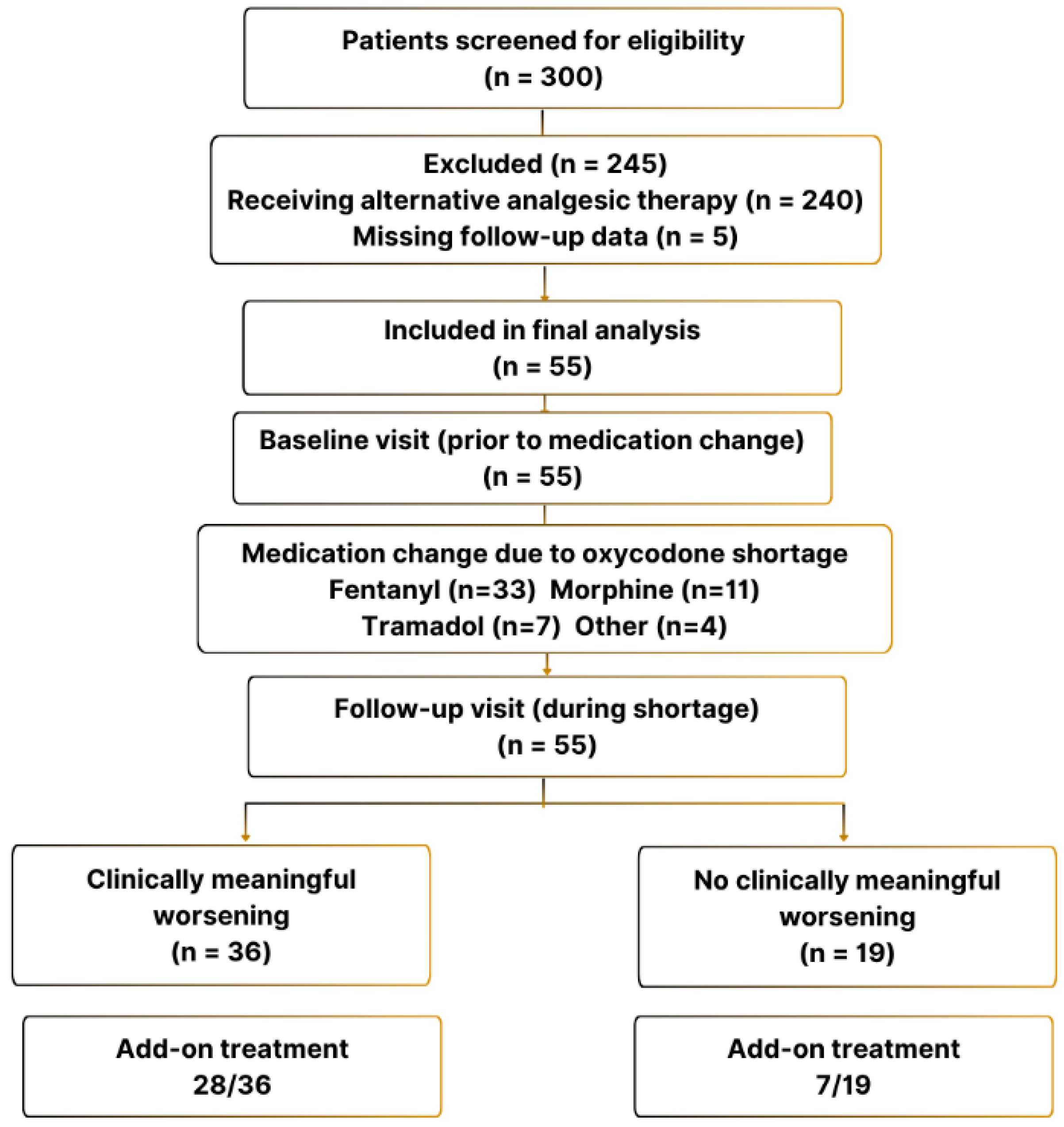
In our cohort, 24 of 55 patients (43.6%) were receiving a multimodal opioid strategy in which transdermal fentanyl and immediate-release oxycodone hydrochloride were administered concurrently. Since oral transmucosal fentanyl is not available in Turkey, the rationale behind this approach was to use long-acting fentanyl for the control of persistent baseline pain, while employing short-acting oxycodone for the management of breakthrough pain episodes. However, the unavailability of immediate-release oxycodone, combined with the absence of transmucosal fentanyl, may have created a therapeutic gap in the management of breakthrough pain [
8].
During the oxycodone shortage, the most frequent management strategy was fentanyl-based treatment (
n = 33, 60.0%) (
Table 2). Among these patients, 24 (72.7%) required escalation of their previously prescribed fentanyl dose. The predominance of elderly individuals in our cohort may have influenced this clinical decision. Fentanyl undergoes minimal hepatic and renal elimination, offering a potentially safer pharmacological profile compared with agents prone to metabolite accumulation. In this context, increasing the fentanyl dose may represent a pragmatic approach to maintaining treatment safety.
In our study, during the period of oxycodone unavailability, morphine sulfate was used as an alternative treatment in 11 patients (
Table 2). A Cochrane systematic review evaluating controlled-release (CR) oxycodone versus CR morphine in adults with cancer pain reported that both opioids provided comparable analgesic efficacy, with no statistically significant differences in their adverse effect profiles [
18]. In line with these findings, the transition to morphine sulfate observed in our cohort can be considered a pharmacologically appropriate and evidence-based approach for pain management.
As shown in
Table 2, no statistically significant association was observed between substitute medication type and clinically meaningful worsening of pain intensity (
p = 0.11). However, subgroup comparisons should be interpreted with caution due to small and imbalanced group sizes. Furthermore, no a priori power calculation was performed for this secondary analysis, and the study may have been underpowered to detect clinically meaningful differences between treatment groups. Therefore, the absence of a statistically significant association should not be interpreted as evidence of equivalence between substitute analgesic strategies. Across all treatment groups, clinically meaningful worsening was frequently observed. This finding may reflect both the limited sample size and the challenges in maintaining stable analgesia during the period of oxycodone unavailability. The clinical difficulty may have been related to the abrupt discontinuation of oxycodone and the need for unplanned treatment modifications, rather than differences in the intrinsic efficacy of individual agents.
At follow-up after opioid rotation, clinically meaningful worsening was observed in 36 patients (65.5%), while 19 patients (34.5%) did not exhibit such worsening (
Table 3). Among patients with clinically meaningful worsening, 28 (77.8%) required additional medication, whereas 8 (22.2%) were managed without add-on therapy. In contrast, among patients without worsening, 7 (36.8%) required additional medication, while 12 (63.2%) did not. This difference was statistically significant (
p = 0.003).
The observed worsening in pain intensity may also be related to interindividual variability in opioid responsiveness. Differences in opioid pharmacodynamics and receptor-level responses may contribute to reduced analgesic efficacy following opioid conversion, despite the application of equianalgesic dosing principles [
19,
20,
21].
Disease progression, the development of new metastatic lesions, changes in oncologic treatment, and psychological distress may also have contributed to the observed changes in pain intensity. Among these factors, modifications in oncologic treatment may also contribute to pain fluctuations through treatment-related adverse effects or transient symptom exacerbation. In some cases, treatment initiation may be associated with tumor flare phenomena, characterized by a temporary worsening of symptoms, including tumor-related pain [
5].
Previous studies have demonstrated that advanced disease burden and functional decline are closely associated with increased pain and poorer quality of life in patients with cancer. Furthermore, psychological factors such as depression and emotional distress are common among patients with advanced cancer and have been shown to correlate with pain severity and pain-related suffering [
22].
Moreover, worsening pain control may not solely reflect pharmacological or treatment-related factors but could also be influenced by the psychological distress and uncertainty associated with limited drug availability. Opioid shortages have been reported to exert adverse psychosocial effects beyond their direct pharmacological consequences, negatively affecting patients’ trust in treatment, perceived symptom control, and overall quality of life, which may in turn contribute to heightened pain perception [
23].
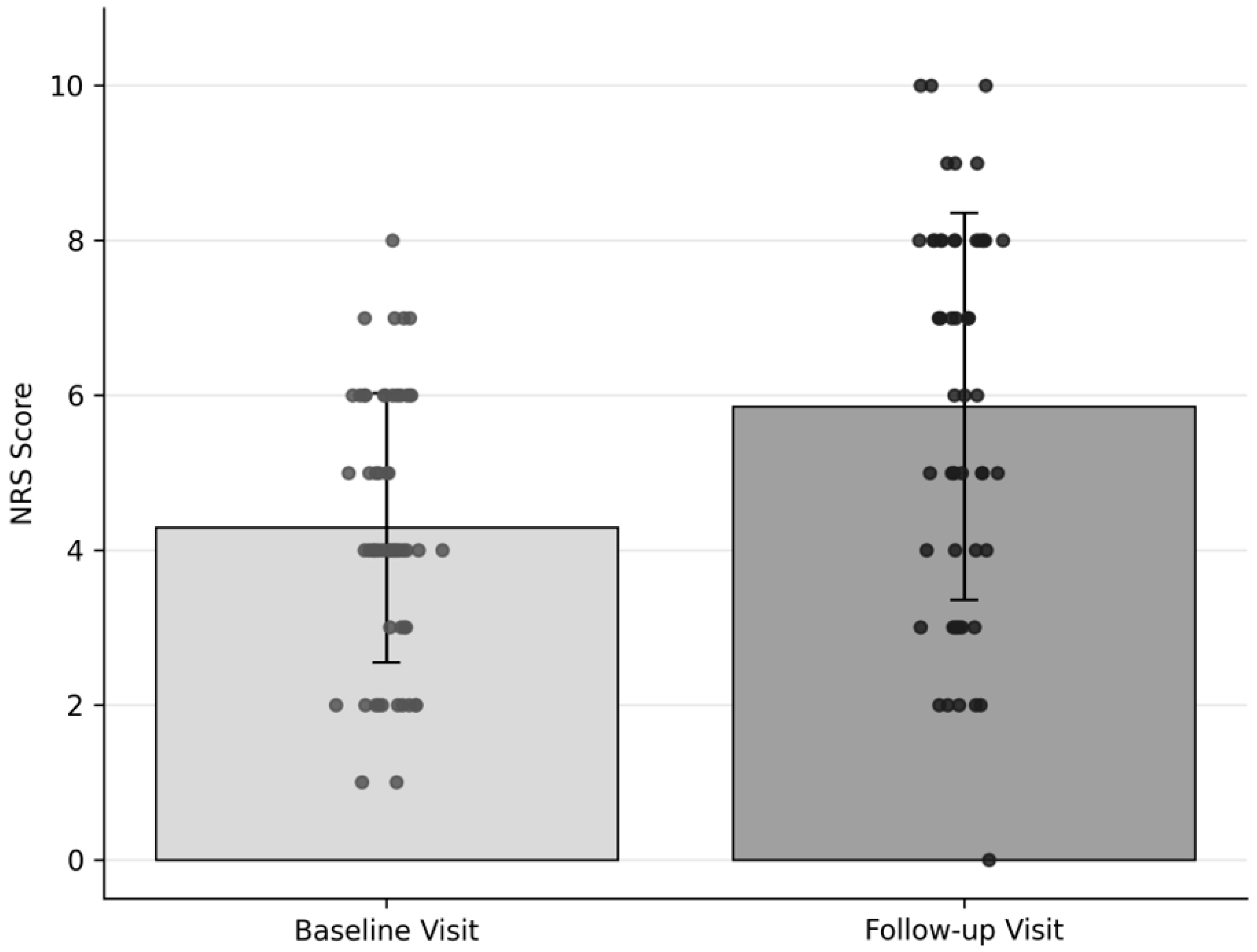
Therefore, although the worsening pain scores observed in our cohort occurred after treatment modifications necessitated by the oxycodone shortage, the contribution of these unmeasured confounding factors cannot be excluded. Because the shortage occurred unexpectedly in routine clinical practice and the study was conducted retrospectively, these variables were not systematically recorded and could not be incorporated into the analysis.
Nevertheless, the primary objective of this study was to evaluate the short-term clinical consequences of an unexpected interruption of ongoing oxycodone therapy due to the drug shortage. To minimize the potential influence of longer-term changes in disease status, pain outcomes were assessed shortly after treatment modification, aiming to capture the immediate clinical impact of oxycodone unavailability.
The limited number of publications in this field underscores the value of our study in providing an important observational perspective both within Turkey and in the global context. The present study retrospectively examines the clinical implications of an unexpected oxycodone shortage in a real-world cancer pain population.
Collaboration among physicians, healthcare administrators, and pharmacists is essential to anticipate potential shortages and to prepare patients within the framework of multidimensional pain management. Such collaboration may facilitate safer and more controlled therapeutic transitions. In light of these findings, ensuring the consistent availability of essential opioid preparations for patients with cancer and expanding the diversity of available agents may help mitigate potential treatment disruptions in the future.
This study has several limitations. First, its retrospective, observational, and single-center design inherently restricts the generalizability of the findings. In addition, due to the retrospective nature of the study, causality cannot be established, and the observed changes in pain intensity should be interpreted as associations rather than direct effects of oxycodone shortage. It should also be noted that drug shortages typically arise abruptly and unpredictably, making prospective data collection and standardized management approaches difficult to implement in real-world settings.
The relatively small sample size further reduced the statistical power, particularly in subgroup analyses by type of substitute analgesic. Furthermore, although pain intensity was assessed using NRS scores, other potential confounders—such as disease progression, recent oncologic interventions, performance status, and concurrent medications—could not be comprehensively evaluated due to incomplete records. These factors may have influenced pain outcomes independently of opioid substitution.
In addition, the follow-up assessment was conducted approximately two weeks after opioid rotation. Assessing outcomes shortly after treatment modification may have reduced the potential influence of time-dependent confounding factors, such as disease progression, changes in oncologic treatment, performance status, and other clinical variables that could affect pain intensity independently of opioid substitution. However, this relatively short follow-up period may not fully reflect long-term analgesic stabilization. Longer-term follow-up data were not available.
Another limitation is that pain outcomes were evaluated exclusively using NRS pain intensity scores. While pain intensity remains a key indicator of analgesic effectiveness, it does not fully capture the broader impact of cancer pain on patients’ quality of life and functional status [
3]. Because these outcomes were not systematically documented in the available retrospective records, they could not be evaluated in the present study. Future prospective investigations should incorporate multidimensional outcome measures to better characterize the overall clinical impact of opioid shortages.
Finally, the limited number of published studies specifically addressing opioid shortages made it difficult to conduct a comprehensive literature review and fully contextualize the findings. Despite these limitations, the study provides valuable real-world evidence regarding the potential clinical implications of opioid shortages. Importantly, this study does not aim to critique any specific healthcare system; rather, it seeks to highlight the challenges encountered in clinical practice during unexpected disruptions in medication availability.




 ,
,