
Gastric Polyposis Due to Foreign Bodies and H. pylori Infection: Case Report and Literature Review


 ,
,
Abstract
1. Introduction and Clinical Significance
2. Case Presentation
2.1. General Data
2.2. Clinical Data
2.3. Endoscopy Results
2.4. CT Scan
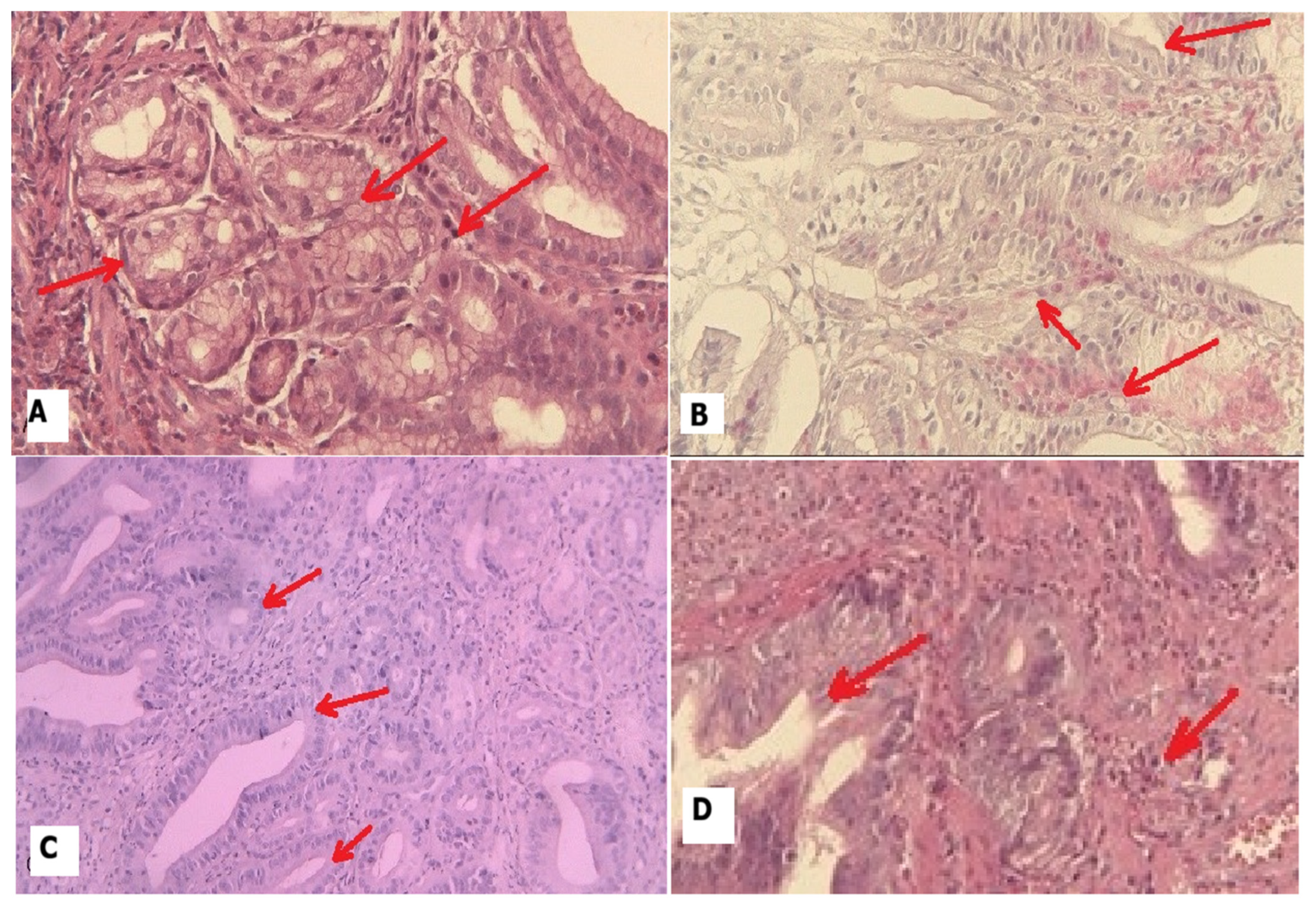
2.5. Histopathology Results
2.6. Laboratory Results and Other Investigations
3. Discussion
4. Conclusions
Author Contributions
Funding
Institutional Review Board Statement
Informed Consent Statement
Data Availability Statement
Conflicts of Interest
References
- Arteaga, C.D.; Wadhwa, R. Gastric Polyp. In StatPearls; StatPearls Publishing: Treasure Island, FL, USA, 2025. Available online: http://www.ncbi.nlm.nih.gov/books/NBK560704/ (accessed on 17 February 2026).
- Ambe, P.; Weber, S.A.; Schauer, M.; Knoefel, W.T. Swallowed foreign bodies in adults. Dtsch. Arzteblatt Int. 2012, 109, 869–875. [Google Scholar] [CrossRef]
- Oh, Y.E.; Moon, H.S. Upper Gastrointestinal Tract Foreign Bodies. Korean J. Helicobacter Up. Gastrointest. Res. 2024, 24, 24–30. [Google Scholar] [CrossRef]
- Demiroren, K. Management of Gastrointestinal Foreign Bodies with Brief Review of the Guidelines. Pediatr. Gastroenterol. Hepatol. Nutr. 2023, 26, 1–14. [Google Scholar] [CrossRef]
- Mikhail, E.S.; Ghatol, A. Hypereosinophilic Syndrome. In StatPearls; StatPearls Publishing: Treasure Island, FL, USA, 2025. Available online: http://www.ncbi.nlm.nih.gov/books/NBK599558/ (accessed on 17 February 2026).
- Hrabar, D.; Duvnjak, M.; Lerotic, I.; Tomasic, V.; Supanc, V.; Bilic, B. Gastric foreign body. Gastrointest. Endosc. 2006, 63, 498–499; discussion 499. [Google Scholar] [CrossRef] [PubMed]
- Ridolo, E.; Melli, V.; De’ Angelis, G.; Martignago, I. Eosinophilic disorders of the gastro-intestinal tract: An update. Clin. Mol. Allergy 2016, 14, 17. [Google Scholar] [CrossRef] [PubMed]
- Malfertheiner, P.; Megraud, F.; Rokkas, T.; Gisbert, J.P.; Liou, J.-M.; Schulz, C.; Gasbarrini, A.; Hunt, R.H.; Leja, M.; O’Morain, C.; et al. Management of Helicobacter pylori infection: The Maastricht VI/Florence consensus report. Gut 2022, gutjnl-2022-327745. [Google Scholar] [CrossRef]
- Rajak, V.S.; Srivastava, A.K.; Yadav, S.S.; Mehta, A. The Application of Giemsa Staining in Identifying Helicobacter pylori in Oral Biopsies: A Comparative Study with Immunohistochemistry. J. Pharm. Bioallied Sci. 2025, 17, S1380–S1382. [Google Scholar] [CrossRef]
- Daneshbod, Y.; Talei, A.; Negahban, S.; Soleimanpour, H.; Aledavoud, A.; Bagheri, N.; Khanlari, M.; Daneshbod, K. Problem of foreign body in GI tract. Sci. World J. 2011, 11, 2147–2149. [Google Scholar] [CrossRef]
- Okasha, H.H.; Alzamzamy, A.E.; Delsa, H.; Othman, H.F.; Alsibaie, A.S.; Abdellatef, A. Gastric foreign body granuloma resembling gastric cancer: A case report. Egypt. J. Intern. Med. 2024, 36, 18. [Google Scholar] [CrossRef]
- Behzad, C.; Hasanjani Roushan, M.R.; Alijanpour, A.; Ghorbani, H.; Shahabandaz, H. Interesting coincidence of liver abscess secondary to foreign body and gastric inflammatory fibroid polyp. Turk. J. Gastroenterol. 2020, 31, 673–675. [Google Scholar] [CrossRef]
- Shen, G.; Zhai, Y.; Zhao, H.; Guo, R.; Xu, H.; Huang, S.; Zhang, S. Gastric perforation with foreign body granuloma formation caused by a short hair—A case report. Front. Pediatr. 2025, 13, 1521428. [Google Scholar] [CrossRef] [PubMed]
- Rossi, P.; Montuori, M.; Balassone, V.; Ricciardi, E.; Anemona, L.; Manzelli, A.; Petrella, G. Inflammatory fibroid polyp. A case report and review of the literature. Ann. Ital. Chir. 2012, 83, 347–351. [Google Scholar] [PubMed]
- Dupont, D.H.; Umejiego, L.M.; Satoskar, S.; Soumya, N.; Rosa Santana, M.; Sikka, A.; Ayele, N.; Riera Gonzalez, C.; Bahadur, N.; Singh, A. Fishbone Foreign Body Ingestion with Gastric Impaction and Intestinal Micro-perforation in an Adult Female: A Case Report. Cureus 2024, 16, e72099. [Google Scholar] [CrossRef]
- Kurimoto, M.; Honjo, H.; Yoshida, S.; Okai, N.; Otsuka, Y.; Masuta, Y.; Masaki, S.; Kamata, K.; Minaga, K.; Maenishi, O.; et al. Enlargement of Gastric Hyperplastic Polyps Arising from Helicobacter heilmannii sensu stricto-infected Mucosa after the Successful Eradication of Helicobacter pylori and the Long-Term Use of a Proton Pump Inhibitor. Intern. Med. 2025, 64, 1677–1683. [Google Scholar] [CrossRef] [PubMed]
- Lim, S.-A.; Yun, J.-W.; Yoon, D.-W.; Choi, W.-J.; Kim, S.-H.; Choe, J.-W.; Kim, M.-N.; Kang, E.-J.; Park, J.-J.; Joo, M.-K.; et al. Regression of Hyperplastic Gastric Polyp after Helicobacter pylori Eradication. Clin. Endosc. 2011, 42, 74–82. [Google Scholar]
- Sugimoto, M.; Furuta, T.; Yamaoka, Y. Influence of inflammatory cytokine polymorphisms on eradication rates of Helicobacter pylori. J. Gastroenterol. Hepatol. 2009, 24, 1725–1732. [Google Scholar] [CrossRef][Green Version]
- Ohkusa, T.; Takashimizu, I.; Fujiki, K.; Suzuki, S.; Shimoi, K.; Horiuchi, T.; Sakurazawa, T.; Ariake, K.; Ishii, K.; Kumagai, J.; et al. Disappearance of hyperplastic polyps in the stomach after eradication of Helicobacter pylori. A randomized, clinical trial. Ann. Intern. Med. 1998, 129, 712–715. [Google Scholar] [CrossRef]
- Ouyang, Y.; Zhang, W.; Huang, Y.; Wang, Y.; Shao, Q.; Wu, X.; Lu, N.; Xie, C. Effect of Helicobacter pylori eradication on hyperplastic gastric polyps: A systematic review and meta-analysis. Helicobacter 2021, 26, e12838. [Google Scholar] [CrossRef]
- Elhanafi, S.; Saadi, M.; Lou, W.; Mallawaarachchi, I.; Dwivedi, A.; Zuckerman, M.; Othman, M.O. Gastric polyps: Association with Helicobacter pylori status and the pathology of the surrounding mucosa, a cross sectional study. World J. Gastrointest. Endosc. 2015, 7, 995–1002. [Google Scholar] [CrossRef]
- Cho, Y.S.; Nam, S.Y.; Moon, H.S.; Kim, T.H.; Kim, S.E.; Jung, J.T. Helicobacter pylori eradication reduces risk for recurrence of gastric hyperplastic polyp after endoscopic resection. Korean J. Intern. Med. 2023, 38, 167–175. [Google Scholar] [CrossRef]
- Kang, K.H.; Hwang, S.H.; Kim, D.; Kim, D.H.; Kim, S.Y.; Hyun, J.J.; Jung, S.W.; Koo, J.S.; Jung, Y.K.; Yim, H.J.; et al. The Effect of Helicobacter pylori Infection on Recurrence of Gastric Hyperplastic Polyp after Endoscopic Removal. Korean J. Gastroenterol. 2018, 71, 213–218. [Google Scholar] [CrossRef]
- Ji, F.; Wang, Z.-W.; Ning, J.-W.; Wang, Q.-Y.; Chen, J.-Y.; Li, Y.-M. Effect of drug treatment on hyperplastic gastric polyps infected with Helicobacter pylori: A randomized, controlled trial. World J. Gastroenterol. 2006, 12, 1770–1773. [Google Scholar] [CrossRef]
- Nam, S.Y.; Park, B.J.; Ryu, K.H.; Nam, J.H. Effect of Helicobacter pylori infection and its eradication on the fate of gastric polyps. Eur. J. Gastroenterol. Hepatol. 2016, 28, 449–454. [Google Scholar] [CrossRef] [PubMed]
- Nam, S.Y.; Lee, S.W.; Jeon, S.W.; Kwon, Y.H.; Lee, H.S. Helicobacter pylori Eradication Regressed Gastric Hyperplastic Polyp: A Randomized Controlled Trial. Dig. Dis. Sci. 2020, 65, 3652–3659. [Google Scholar] [CrossRef] [PubMed]
- Nam, S.Y.; Park, B.J.; Ryu, K.H.; Nam, J.H. Effect of Helicobacter pylori eradication on the regression of gastric polyps in National Cancer Screening Program. Korean J. Intern. Med. 2018, 33, 506–511. [Google Scholar] [CrossRef] [PubMed]
- Rokkas, T.; Rokka, A.; Portincasa, P. A systematic review and meta-analysis of the role of Helicobacter pylori eradication in preventing gastric cancer. Ann. Gastroenterol. 2017, 30, 414–423. [Google Scholar] [CrossRef]
- Zhu, F.; Zhang, X.; Li, P.; Zhu, Y. Effect of Helicobacter pylori eradication on gastric precancerous lesions: A systematic review and meta-analysis. Helicobacter 2023, 28, e13013. [Google Scholar] [CrossRef]
- Choi, I.J.; Kim, C.G.; Lee, J.Y.; Kim, Y.-I.; Kook, M.-C.; Park, B.; Joo, J. Family History of Gastric Cancer and Helicobacter pylori Treatment. N. Engl. J. Med. 2020, 382, 427–436. [Google Scholar] [CrossRef]
- Piazuelo, M.B.; Bravo, L.E.; Mera, R.M.; Camargo, M.C.; Bravo, J.C.; Delgado, A.G.; Washington, M.K.; Rosero, A.; Garcia, L.S.; Realpe, J.L.; et al. The Colombian Chemoprevention Trial: 20-Year Follow-Up of a Cohort of Patients with Gastric Precancerous Lesions. Gastroenterology 2021, 160, 1106–1117.e3. [Google Scholar] [CrossRef]
- Yoo, H.W.; Shin, C.M.; Yang, H.J. Helicobacter pylori eradication reduces gastric cancer risk in patients with gastric dysplasia: A nationwide cohort study. Gastrointest. Endosc. 2024, 99, 345–354. [Google Scholar]
- Jung, D.H.; Kim, J.-H.; Chung, H.S.; Park, J.C.; Shin, S.K.; Lee, S.K.; Lee, Y.C. Helicobacter pylori Eradication on the Prevention of Metachronous Lesions after Endoscopic Resection of Gastric Neoplasm: A Meta-Analysis. PLoS ONE 2015, 10, e0124725. [Google Scholar] [CrossRef] [PubMed]
- Vindigni, C.; Galgani, P.; D’Amuri, A.; Angeloni, G. Displasia Gastrica: Regressione dopo Eradicazione di H. pylori. Osservazione su Due Casi (Gastric Dysplasia Regression After Helicobacter pylori Eradication: Report of Two Cases). Available online: https://www.researchgate.net/publication/328133742_Gastric_dysplasia_regression_after_helicobacter_pylori_eradication_About_two_cases (accessed on 1 February 2026).




| Test | Normal Range | April 2018 | June 2018 | September 2018 | January 2022 | Janurary 2025 |
|---|---|---|---|---|---|---|
| White blood cells | 4.00–10.40 × 10³/µL | 10.9 | 12.6 | 5.5 | 6.25 | 5.04 |
| Red blood cells | 4.3–15.7 × 1003/µL | 3.5 | 4.38 | 4.01 | 4.10 | 4.46 |
| Hemoglobin | 13.0–17.0 g/dL | 8.6 | 12.8 | 12.2 | 11.9 | 12.7 |
| Hematocrit | 40–52% | 26.8 | 37.3 | 35.6 | 36.3 | 38.2 |
| MCV | 80–96 fL | 76.7 | 85.1 | 88.8 | 88.4 | 85.6 |
| MCH | 26–32 pg | 24.7 | 29.1 | 30.4 | 29.1 | 28.5 |
| MCHC | 32–36 g/dL | 32.2 | 34.2 | 34.2 | 32.9 | 33.2 |
| Platelets | 150–400 × 1003/µL | 595 | 322 | 243 | 357.1 | 302.1 |
| Neutrophiles% | 45–72% | 42.3% | 16.7% | 35.7% | 66.2% | 62.8% |
| Lymphocites% | 25–38% | 17.5% | 17.4% | 37.9% | 22.6% | 24.5% |
| Monocites% | 0–8% | 4.8% | 3.1% | 7.6% | 7.1% | 10.0% |
| Eosinophiles% | 0–5% | 34.8% | 62.5% | 18.4% | 3.1% | 2.4% |
| Basofiles% | 0–1% | 0.6% | 0.3% | 0.4% | 0.2% | 0.21% |
| Neutrophiles | 1.8–7.5 × 10³/µL | 4.6 | 2.1 | 2.0 | 4.1 | 3.16 |
| Lymphocites | 1–4 × 10³/µL | 1.9 | 2.2 | 2.1 | 1.4 | 1.24 |
| Monocytes | 0–0.8 × 10³/µL | 0.5 | 0.4 | 0.4 | 0.4 | 0.505 |
| Eosinophiles | 0–0.5 × 10³/µL | 3.8 | 7.9 | 1.0 | 0.1 | 0.121 |
| Basofiles | 0–0.1 × 10³/µL | 0.1 | 0.0 | 0.0 | 0.0 | 0.011 |
| Gastroscopy | Gastric polyposis and erosions | - | Gastric polyposis and erosions | Antral erithema | - | |
| Histopathology | Low-grade/moderate-grade dyslpasia | - | Low-grade/moderate-grade dysplasia | H. pylori negative gastritis | - |
| Nr. | First Author/Year/Ref. | Article Type | Main Features and Case Particularities | Diagnostic Tools and Clinical Interventions | Main Outcomes |
|---|---|---|---|---|---|
| 1. | Daneshbod et al., 2011 [10] | Case report | A duodenal foreign body (peach kernel) mimicked a gastric polypoid tumor on endoscopy. Biopsy misread as malignancy. | Endoscopy, biopsy, and surgery | Shows how FBs can mimic gastric polyps; important diagnostic consideration. No true polyp formation observed. |
| 2. | Okasha et al., 2024 [11] | Case report | Gastric granuloma formed around a fishbone; lesion appeared polypoid/submucosal on EUS. | Endoscopic ultrasound and histopathology | Demonstrates FB-induced granulomatous reaction resembling polyp. Not a true epithelial polyp. |
| 3. | Behzad et al., 2020 [12] | Case report | Coexistence of a gastric inflammatory fibroid polyp (IFP) and a liver abscess caused by FB. No direct causal link shown. | Endoscopy and histopathology | Suggests possible inflammatory polyp in setting of FB-related inflammation, but authors concluded coincidence. |
| 4. | Shen et al., 2025 [13] | Case report | Hair ingestion caused a gastric perforation with FB granuloma formation. Appeared as submucosal mass. | Imaging, surgery, and pathology | Granulomatous tissue mimicked mass lesion; relevant as differential for FB-associated pseudopolyps. |
| 5. | Rossi et al., 2012 [14] | Case report and literature review | Inflammatory fibroid polyps described in stomach. No link to FBs, but important differential diagnosis for submucosal gastric lesions. | Review of histologic cases | Establishes typical IFP appearance vs. FB-related granulomas; useful for comparison. |
| 6. | David H Dupont et al., 2024 [15] | Case report | Fish bone impactation of stomach and colon, as well as microperforation of the small bowel. | CT scan, gastroscopy, and colonoscopy | Non-surgical management even if organ perforation was present. |
| Nr. | Author(s), Ref. | Year | Study Design | Key Findings | Methodology | Relevance |
|---|---|---|---|---|---|---|
| 1 | Ohkusa T, Fujiki K, Takashimizu I, et al. [19] | 1998 | Prospective cohort | Most hyperplastic polyps disappeared after H. pylori eradication | Observational follow-up of patients with hyperplastic polyps before and after eradication | Shows regression of polyps after eradication; supports eradication as first-line intervention |
| 2 | Nam SY, Park BJ, Ryu KH, et al. [25] | 2016 | Prospective cohort | Significantly higher regression rates of hyperplastic polyps in patients with eradication vs. persistent infection | Follow-up endoscopy of H. pylori-positive patients with hyperplastic polyps | Confirms eradication efficacy in Korean population |
| 3 | Ouyang Y, Li Y, Ma Y, et al. [20] | 2021 | Meta-analysis | H. pylori eradication markedly increases odds of complete regression of hyperplastic polyps | Systematic review and meta-analysis of published trials | High-level evidence for eradication effect; provides quantitative support |
| 4 | Elhanafi S, Saadi M, Lou W, et al. [21] | 2015 | Cross-sectional | Hyperplastic polyps associated with H. pylori; fundic gland polyps inversely associated | Endoscopic biopsy and histopathology analysis | Highlights polyp type-specific associations with H. pylori; relevant for differential diagnosis |
| 5 | Cho Y-S, Chung W-C, Kim J-Y, et al. [22] | 2022 | Cohort post-EMR | Recurrence of hyperplastic polyps significantly lower after eradication | Endoscopic mucosal resection followed by repeated endoscopy | Supports eradication to prevent recurrence post-polypectomy |
| 6 | Kang KH, Hwang SH, Kim D, et al. [23] | 2018 | Retrospective cohort study | Recurrence higher with persistent H. pylori (42.9%) vs. eradicated/negative (18.9%) | Follow-up after EMR; H. pylori status assessed | Shows importance of eradication in preventing recurrence after polyp removal |
| 7 | Nam SY, Park BJ, Ryu KH, et al. [26] | 2020 | Prospective cohort | Disappearance rate: 83.7% after eradication vs. 34.1% non-eradicated | Screening cohort with follow-up endoscopy of polyps <10 mm | Strong evidence of eradication effect in population screening context |
| 8 | Nam SY, et al. [27] | 2020 | Randomized controlled trial | All patients in eradication arm showed regression; none in control arm | Open-label single-center RCT; follow-up endoscopy | Confirms causality between eradication and polyp regression |
| 9 | Woo Chul Chung [22] | 2023 | Prospective observational study | H. pylori eradication reduces recurrence of gastric hyperplastic polyps after EMR; recurrence: 8.1% (eradication) vs. 19.2% (non-eradication) | 18-month follow-up; comparison between eradication and non-eradication groups | Supports H. pylori eradication to prevent recurrence in gastric hyperplastic polyps post-EMR |
| 10 | Ji F, Wang Z-W, Ning J-W, et al. [24] | 2006 | Randomized controlled trial | Treatment group: 68% polyp disappearance at ~6.5 months; controls had no change | PPI + clarithromycin + bismuth + tinidazole; follow-up endoscopy | Provides controlled evidence of pharmacologic eradication efficacy for small hyperplastic polyps |
Disclaimer/Publisher’s Note: The statements, opinions and data contained in all publications are solely those of the individual author(s) and contributor(s) and not of MDPI and/or the editor(s). MDPI and/or the editor(s) disclaim responsibility for any injury to people or property resulting from any ideas, methods, instructions or products referred to in the content. |
© 2026 by the authors. Licensee MDPI, Basel, Switzerland. This article is an open access article distributed under the terms and conditions of the Creative Commons Attribution (CC BY) license.
Share and Cite
Dănilă, C.; Mocan, L.; Pop, O.L.; Pop-Crisan, A.; Faur, L.; Cavalu, S.D. Gastric Polyposis Due to Foreign Bodies and H. pylori Infection: Case Report and Literature Review. Reports 2026, 9, 84. https://doi.org/10.3390/reports9010084
Dănilă C, Mocan L, Pop OL, Pop-Crisan A, Faur L, Cavalu SD. Gastric Polyposis Due to Foreign Bodies and H. pylori Infection: Case Report and Literature Review. Reports. 2026; 9(1):84. https://doi.org/10.3390/reports9010084
Chicago/Turabian StyleDănilă, Cătălina, Lucian Mocan, Ovidiu Laurean Pop, Andrea Pop-Crisan, Lucian Faur, and Simona Daniela Cavalu. 2026. "Gastric Polyposis Due to Foreign Bodies and H. pylori Infection: Case Report and Literature Review" Reports 9, no. 1: 84. https://doi.org/10.3390/reports9010084
APA StyleDănilă, C., Mocan, L., Pop, O. L., Pop-Crisan, A., Faur, L., & Cavalu, S. D. (2026). Gastric Polyposis Due to Foreign Bodies and H. pylori Infection: Case Report and Literature Review. Reports, 9(1), 84. https://doi.org/10.3390/reports9010084