Technical Note

The X and Gamma-Ray Imager and Spectrometer Onboard THESEUS—Status and Technological Progresses

by
Giulia Mattioli
1,2,*,
Claudio Labanti
1,
Enrico Virgilli
1,
Lorenzo Amati
1,
Riccardo Campana
1,
Giuseppe Baldazzi
1,2,
Smiriti Srivastava
1,
Edoardo Borciani
1,2,
Paolo Calabretto
1,
Ezequiel J. Marchesini
1,
Ajay Sharma
1,
Evgeny Demenev
3,
Francesco Ficorella
3,
David Novel
3,
Giancarlo Pepponi
3,
Giovanni La Rosa
4,
Paolo Nogara
4 and
Giuseppe Sottile
4
1
INAF-OAS, National Institute for Astrophysics-Osservatorio di Astrofisica e Scienza dello Spazio, Via Piero Gobetti 93/3, 40129 Bologna, Italy
2
Physics and Astronomy Department, University of Bologna, Viale Berti Pichat 6/2, 40126 Bologna, Italy
3
Fondazione Bruno Kessler—FBK, Via Sommarive 18, Povo, 38123 Trento, Italy
4
INAF-IASF, National Institute for Astrophysics-Istituto di Astrofisica Spaziale e Fisica Cosmica, Via Ugo la Malfa 153, 90146 Palermo, Italy
*
Author to whom correspondence should be addressed.
Particles 2026, 9(1), 3; https://doi.org/10.3390/particles9010003
Submission received: 29 September 2025 / Revised: 22 December 2025 / Accepted: 31 December 2025 / Published: 8 January 2026

Abstract

Gamma-Ray Bursts (GRBs) are intense bursts of high-energy photons which, in just a few seconds, outshine all other γ -ray emitters in the sky. Due to their extreme luminosity, GRBs are not only important as high-energy astrophysical phenomena but also serve as valuable probe models of the far, high-redshift Universe. The importance of these events has pushed the High-Energy Astrophysics community to propose new mission concepts over the past decade, prompting dedicated research and development efforts to achieve the required technological readiness levels. The X and Gamma-Ray Imager and Spectrometer (XGIS) is one of the two GRB monitors onboard the proposed, upcoming THESEUS space mission. Building on strong heritage from previous studies, ongoing developments and optimizations are focused on enhancing the instrument’s capabilities and increasing its technological maturity. This work presents the current status of the XGIS instrument and the latest technological advancements achieved in preparation for its deployment on THESEUS.

1. Introduction

Gamma-Ray Bursts (GRBs) are short, energetic flashes of γ -rays and are the manifestation of the most intense phenomena in the Universe. Despite being discovered over half a century ago, many fundamental questions about their origin, emission mechanisms and progenitors remain open. Since the successful launch of GRB-dedicated missions such as Swift [1] and Fermi [2], multi-wavelength follow-up observations from ground-based facilities have enabled significant progress in characterizing GRBs and their host galaxies, offering deeper insight into the underlying physics of these events. Because of their brightness, GRBs are unique and irreplaceable tools for investigating the Early Universe and for advancing the field of Multi-Messenger Astrophysics. It is then crucial to study all classes of GRBs in a broad energy range band.
Over the past decades, several space missions have contributed significantly to our understanding of GRBs. Early discoveries were made by Vela satellites in the late 1960s, followed by systematic observations with BATSE on CGRO [3], which established the isotropic distribution of GRBs. Subsequent missions such as BeppoSAX [4], INTEGRAL [5] and AGILE [6] provided key insights into GRB localization, timing and spectroscopy, enabling the identification of afterglows and host galaxies. Swift and Fermi further enhanced multi-wavelength follow-up capabilities, allowing for detailed studies of GRB light curves, spectra and energetics. These missions collectively established the observational foundations upon which current and future facilities are built. Among them, the Transient High-Energy Sky and Early Universe Surveyor (THESEUS) has emerged as a prominent mission concept [7].
THESEUS is designed not only to shed light on these still unexplained phenomena, but also to fully exploit their potential as probes to investigate the Early Universe. The mission has been proposed in response to the European Space Agency (ESA) calls for M-class missions [8]. It has been developed by the ESA Study Team in collaboration with the THESEUS Consortium, a partnership involving several ESA member states, with Italy playing a leading role.
The scientific potential of THESEUS has made it a competitive candidate within the ESA selection process. It was selected for the M5 call and completed a three-year Phase A assessment study. Although not ultimately selected as the final mission for M5, THESEUS was later re-submitted and selected again for the M7 call, initiating a new Phase A in 2023.
The THESEUS payload includes two GRB monitors—the Soft X-ray Imager (SXI [9]) and the X and Gamma-ray Imager and Spectrometer (XGIS [10])—as well as the InfraRed Telescope (IRT [11]). This combination enables comprehensive observation of GRBs across a wide energy range, from 0.3 keV to 10 MeV, and facilitates the rapid identification and characterization of electromagnetic counterparts (X-ray, optical, IR) to gravitational wave events, as well as an onboard measurement of the GRB redshift thanks to IRT. The two monitors observe the sky and when a high-energy transient is detected, the field of view (FoV) of IRT is placed on the source, thanks to the fast slewing capabilities of the satellite. SXI has high location accuracy (2 arcmin) and operates in the 0.3–5 keV energy band, while XGIS has a location accuracy of about 15 arcmin and operates from 2 keV to 10 MeV. The FoVs are co-aligned and of 61° × 31° and 117° × 77° for SXI and XGIS, respectively.
This synergy makes THESEUS a key asset for the next generation of gravitational wave detectors and a cornerstone for future Multi-Messenger Astronomy. Specifically, THESEUS will play a central role in the 2030s by detecting and localizing the electromagnetic counterparts of gravitational wave sources, which next-generation detectors are expected to discover at unprecedented rates. By providing rapid identification, accurate localization and multi-wavelength characterization of these sources, THESEUS will enable profound insights into fundamental physics and cosmology through multi-messenger observations [12]. The mission’s wide energy coverage and large field of view will enable a step-change in our ability to detect and study GRBs (even at z > 6 ) and to use them as powerful tools to explore the distant Universe [7].

2. X and Gamma-Ray Imager and Spectrometer: Heritage and Progresses

The XGIS system consists of two coded-mask X-/ γ -ray cameras. It provides imaging capabilities up to 150 keV, thanks to the combination of coded-mask and a position-sensitive detection plane (fine pixeled: mask elements of ∼1 cm2 and pixels of ∼25 mm2, with a distance between mask and detection plane of 63 cm), and is designed to detect GRBs over an unprecedentedly broad energy range (from 2 keV to 10 MeV). This is achieved through an innovative hybrid detection plane, which employs a configuration of Silicon Drift Detectors (SDDs) and CsI(Tl) scintillators, enabling efficient photon detection across both the hard X-ray and the soft γ -ray bands.
The detection plane follows a highly modular and segmented design: the single detection element, or Pixel, consists of two SDDs cells positioned on either side of a central scintillator bar. A group of 64 pixels forms a Module, while 10 modules make up a SuperModule. Each XGIS camera contains 10 SuperModules, resulting in a total of 6400 pixels per camera.
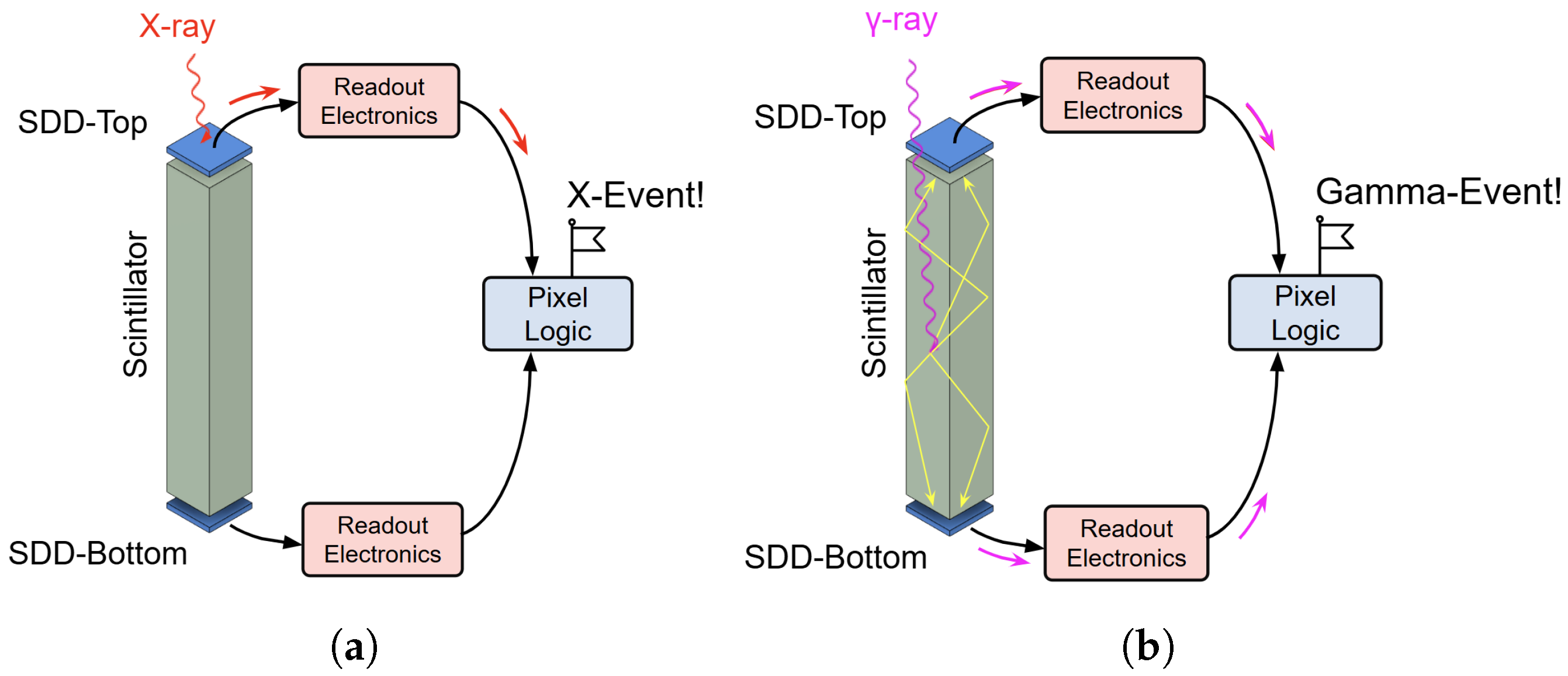
Being a Silicon-Scintillator Sandwich (Siswich) detector, XGIS is able to discriminate between incoming X and γ radiation (Figure 1). X-ray photons interact directly in the top SDD, while higher-energy photons deposit their energy in the scintillator, producing scintillation light. The optical light is then simultaneously collected by both SDDs, enabling γ -ray event identification. Event processing is managed by the dedicated front-end and back-end electronics chain known as ORION, which handles the signals and classifies the events.
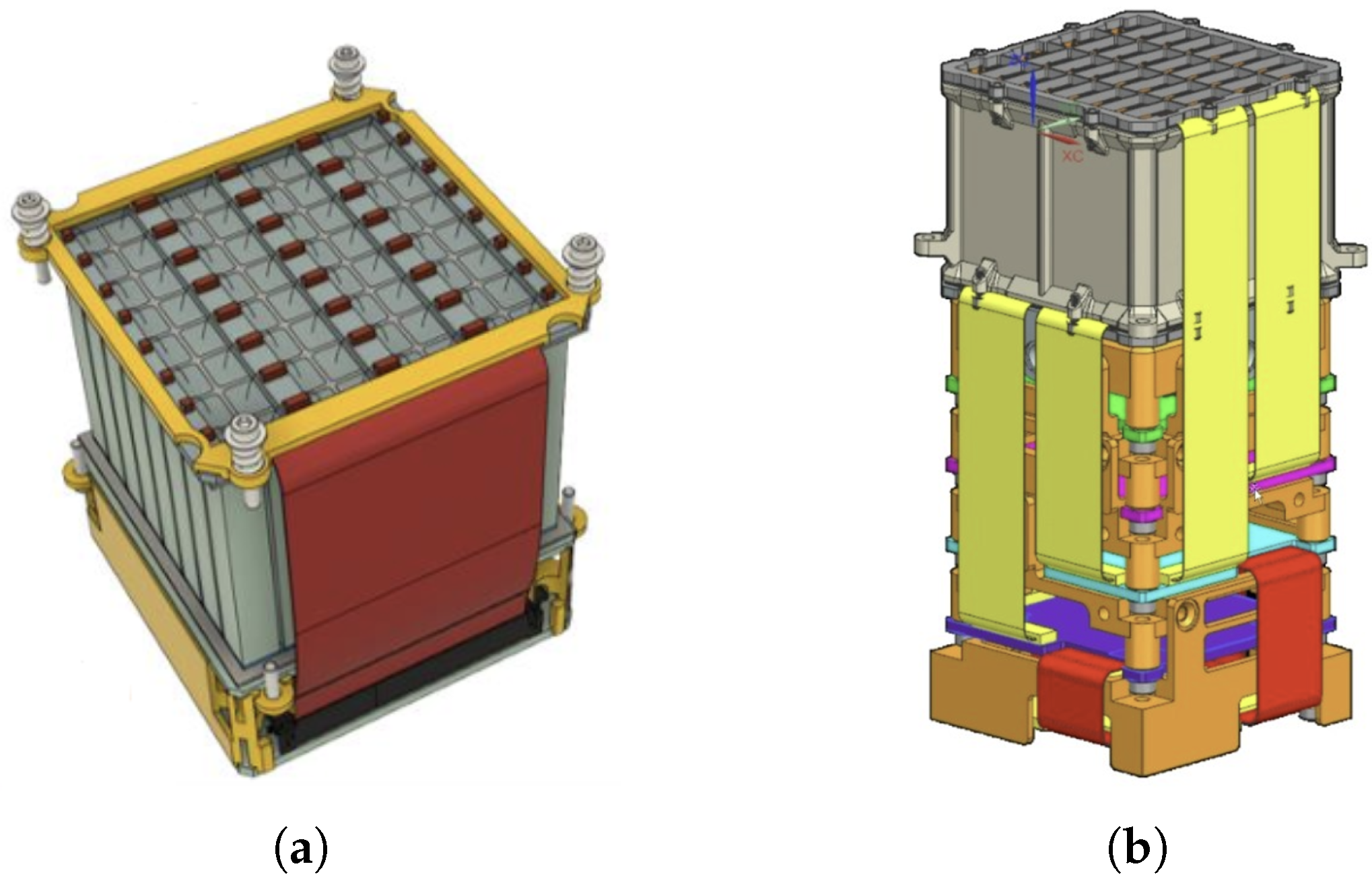
Ongoing development and validation activities for the XGIS detector, build upon the heritage of the THESEUS-M5 Phase A study, are focused on design optimization and performance enhancement. A preliminary mechanical study has introduced a modular approach to the Demonstration Plane Detector Module (DPDM, Figure 2), dividing it into two sub-modules: the Detector Core Assembly, made of active detector elements and Front-End Assembly, and the Back-End Assembly. This architecture aims to improve integration, accessibility and scalability. The Back-End Assembly will manage data acquisition, signal processing, power distribution and system interfacing. Mechanical, electrical and optical optimizations are underway to ensure robustness and readiness for upcoming qualification phases.
The following sections provide an overview of the technological status of the XGIS subsystems—the hybrid SDD/scintillators detection plane, the dual-ASIC ORION readout electronics and the module mechanics—outlining their current development level and associated TRL (Technology Readiness Level) progression toward Phase-B qualification.

2.1. Silicon Drift Detectors

The Silicon Drift Detector (SDD) array developed for the THESEUS/XGIS instrument enables the joint detection of X-ray and γ -ray photons. Each device comprises a 64-pixel matrix (8 × 8) with a 5 mm pitch, yielding an active area of 42.4 × 42.4 mm2. External guard structures ensure optimal charge collection at the periphery, while a 0.5 mm wide metallic grid on the entrance window is needed for optical insulation and to allow for coupling to the 4.5 × 4.5 mm2 CsI(Tl) scintillator cross-section.
This work extends the SDD technology [15] matured in the ReDSoX program (INFN/FBK) and uses the heritage accumulated during the THESEUS-M5 Phase-A activities.
Consequently, XGIS enables simultaneous high-resolution X-ray spectroscopy and γ -ray scintillation measurements over an energy range of 2 keV–10 MeV, and timing resolution of the order of μs.
The design of the SDD has been driven by several considerations. The 5 × 5 mm2 crystal size is selected as an optimal compromise between imaging performance, detection efficiency, spatial resolution and mechanical integration. The geometry of the drift cathodes, specifically their pitch and width, is tailored to minimize surface-generation dark current while maintaining the required X-ray detection efficiency. A silicon thickness of 450 μm ensures adequate stopping power up to 30 keV. Moreover, each matrix incorporates a metalized optical-separation grid to suppress optical cross-talk between adjacent cells.
Device simulation and layout are performed by INFN-Trieste, University of Udine and FBK (prototype topologies comprehending single-pixel devices and 2 × 2 matrices). Fabrication is carried out at the FBK Micro-Nano Facility, followed by wafer-level electrical validation and detailed post-dicing characterization at FBK and TIFPA-TN, in collaboration with INFN-TS.
This integrated approach establishes the technological foundation for a scalable SDD/scintillator detector suited to the scientific objectives of the THESEUS mission.
A first prototype of the full 8 × 8 SDD array for the XGIS detector was developed to validate both the design and fabrication process. The initial batch included 20 wafers processed at FBK. Despite being a Multi-Project Wafer (MPW) run, this batch provided essential validation. It included an 8 × 8 XGIS array and four 2 × 2 arrays (XGS) for scale testing.
Special attention was given to silicon substrate doping uniformity, as it directly affects the depletion voltage, which in turn impacts the uniformity of the electric field across large-area detectors. FBK produced dedicated test diodes to map doping variations and to verify that uniformity was within acceptable limits, confirming suitability for XGIS arrays.
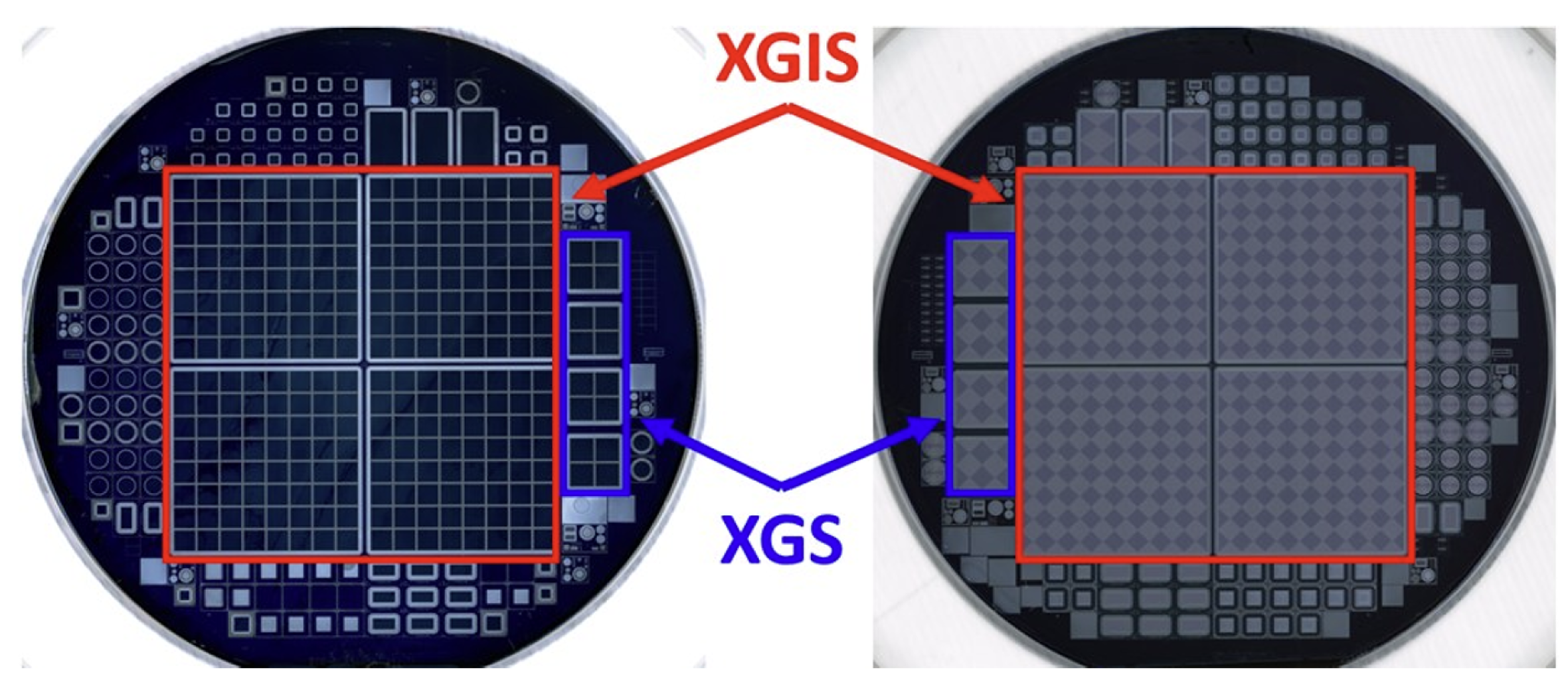
To address yield challenges, FBK introduced a “anti-defect” protocol (scratches due to handling, lithographic defects, etc.) based on a quality protocol already adopted for large-area detector processing. By consolidated practice during the processing, the wafers were systematically inspected. A second MPW batch was produced in 2020 (Figure 3), improving layout optimization by placing four 8 × 8 arrays centrally to enhance yield. This batch provided most of the functional SDD arrays currently available for the THESEUS-M7 activities.
Further optimizations are being studied, including corner removal of dead areas on the XGS devices, in order to improve assembly tolerance and minimize breakage risk. Custom jigs have been developed to handle diced devices during probe testing, allowing for direct comparison between pre- and post-dicing performance.
Based on the demonstrated maturity of the technology, supported by the existing heritage from the progress achieved during THESEUS-M5, the current SDD design is considered technologically consolidated and suitable as the baseline for the Flight Model. Testing across multiple MPW batches has confirmed that the design and fabrication process is robust and reproducible. This provides strong confidence that the technology can be reliably scaled up for full Flight Model production. Final characterization and mechanical integration studies are ongoing to bring the detector to TRL 6. Also, radiation hardness aspects are part of the ongoing qualification campaign, in order to ensure compatibility with the THESEUS orbit environment.

2.2. ORION Front-End and Back-End

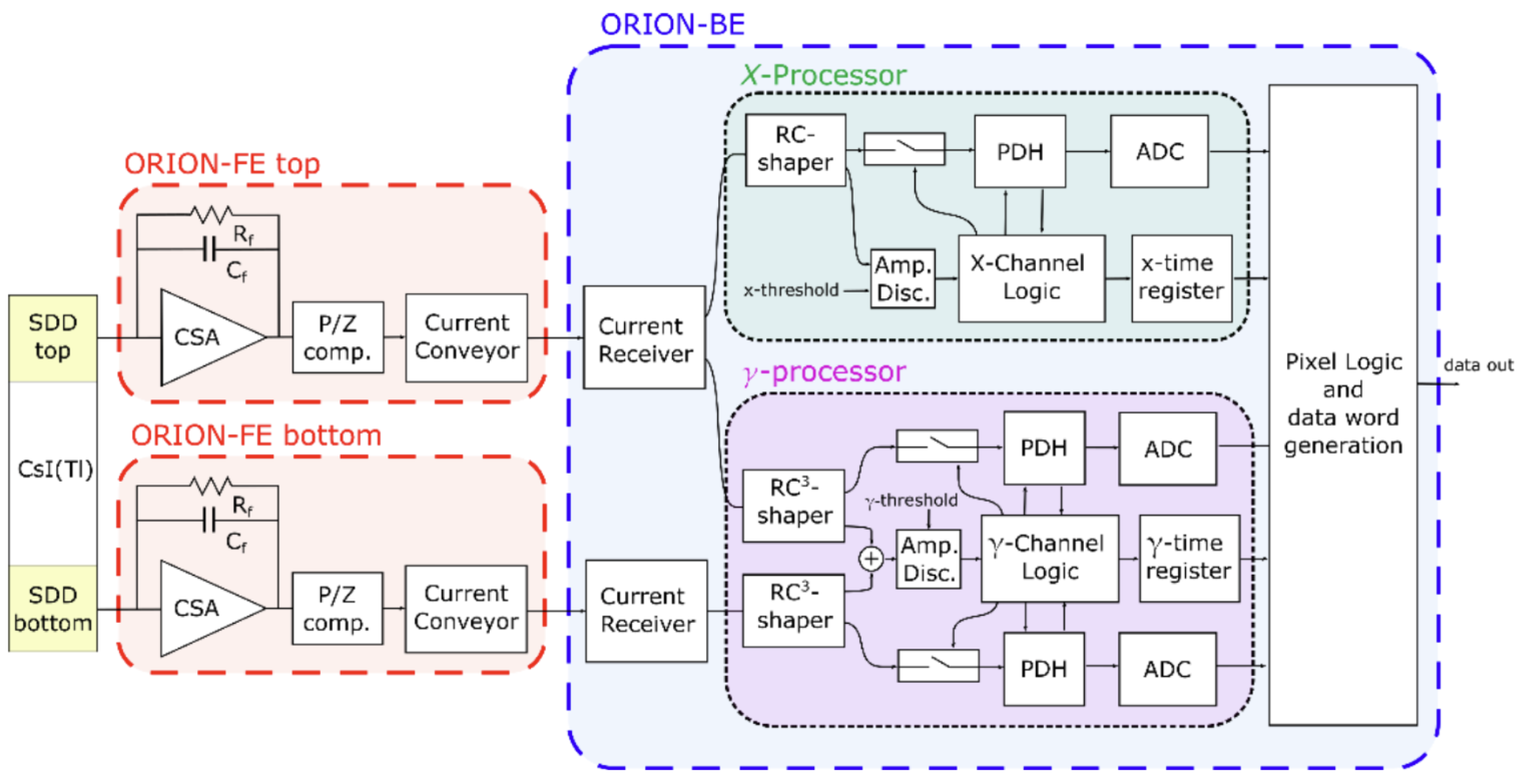
XGIS employs a dual-ASIC architecture, named ORION [13], for signal readout from Silicon Drift Detectors. The ORION readout chain is split into ORION-FE (Front-End) and ORION-BE (Back-End), whose block diagram is shown in Figure 4. This configuration optimizes performance by placing the small, low-noise preamplifier (ORION-FE) close to the SDD anode, thereby minimizing input capacitance, while the larger ORION-BE, located a few centimeters away (in order not to reduce the open area of the detector), handles analog and digital signal processing [13].
The analog front-end features a Charge Sensitive Amplifier (CSA) and a current-mode output driver. Initial prototypes demonstrated successful signal acquisition and processing from dual ORION-FE inputs on a dedicated test board, validating the analog–digital interface and X/ γ processing chains.
ORION-BE ASIC design evolution led to a single-pixel (two-channel, top and bottom) configuration per chip as the baseline, simplifying the electronics and improving system modularity. The BE ASIC implements energy processing and time tagging, and generates a 64-bit data word per triggered event. To optimize the S/N, the top SDD signal is processed by an amplifier, with 1 μs shaping time, that collects the charge produced by X radiation interacting with the Si of the SDD, while for γ interaction in the scintillator, the top and bottom signals are processed by a 3 μs shaping time amplifier. In addition, a Rise Time Protection (RTP) function is implemented in the ASIC logic to isolate digital operations (specifically the stretching of the shaped signal for ADC conversion) and thereby mitigate significant pile-up events. The electronics that process data produced by ORION allow for discrimination between X and γ signals: discrimination is performed by exploiting coincident detection in the top and bottom SDDs (more precisely, on the amplitude of the bottom signal—as shown in Figure 1, a top signal is always present, while a significant bottom signal is generated only after a γ interaction), considering the optimized shaping and processing chains for each photon type. Thanks to the highly segmented design of the detection plane and the small pixel size (0.25 cm2), the architecture effectively minimizes event pile-up, thereby ensuring accurate event reconstruction and maintaining optimal performance even under high photon flux conditions.
A demonstration setup integrating 2 × 2 SDD arrays and four CsI(Tl) scintillator bars in fact validated full-pixel performance, including X/ γ discrimination, time tagging and ADC response under realistic operating conditions. Performance characterization was carried out using electrical test pulses and radioactive sources (e.g., 241Am, 55Fe, 137Cs). The ORION prototype achieved the following [17]:
  • Energy resolution of 434 eV FWHM at 13.7 keV for the X-branch;
  • Electronic noise of 44 e RMS at room temperature for the X-branch, reduced to 30 e RMS at −20 °C;
  • Minimum detectable energy thresholds of ∼0.8 keV for X-rays and ∼20 keV for γ -rays;
  • Linearity up to ∼40 keV for the X-processor and up to ∼5.3 MeV for the γ -processor branches.
The results demonstrate that the ORION architecture fulfills the requirements of XGIS (Table 1), offering high dynamic range, excellent energy and timing resolution and efficient event classification in a compact, scalable solution.
The design of the ORION-FE was constrained by the mechanical layout requirements of the Module, necessitating careful control over chip dimensions, but also the methods that could be adopted for mounting the ASIC on the board are reflected in the topology of the chip.
For a wire bonding connection between SDD and FE, a dual-channel ORION-FE chip was developed and fabricated through a MPW run, enabling optimized positioning where each channel serves an SDD on opposite sides of a PCB rib.
To support another promising bonding method, the Tape Automated Bonding (TAB), a dedicated ORION-FE-TAB prototype, was also developed, integrating four front-end circuits with varying input pad dimensions to balance low-noise performance and bonding reliability. The final demonstrator adopted a conservative approach, selecting 60 × 60 μm pads for maximum assembly robustness.
In parallel, an optimized single-channel ORION-BE ASIC was designed by POLIMI and UNIPV and submitted for fabrication in November 2024. The chip integrates signal processing for a single pixel (top and bottom SDD), including three shaping chains (X, Gamma-Top, Gamma-Bottom), three dedicated 12-bit ADCs, digital signal processing, event timestamping and a 64-bit SPI-based data interface. Each event is encoded in a 64-bit word containing 12 bits for each signal channel (X, Gamma-Top, Gamma-Bottom), 24 bits for timestamping (up to 100 ns resolution, depending on the clock used for time marking the events), 3 event type flag bits and 1 spare bit. The ASIC clock can operate at 10 MHz and supports a Pulse Per Second (PPS) synchronization signal to align events with satellite time. The system allows for several methods of I/F and external readout.
The ORION ASIC architecture is built with significant heritage from earlier space-grade mixed-signal ASICs, including StarX32 [18], VEGA [19], RIGEL [20] and LYRA [21]. The latter, developed for the HERMES mission [22], validated the distributed FE-BE architecture that ORION refines and extends.
Based on the current maturity, the ORION ASIC system has reached TRL 4, with TRL 5 expected upon completion of single-channel BE prototype validation. Advancement to TRL 6 is foreseen with the integration and full-system testing of the next-generation Detector Plane Demonstration Module, planned during Phase B.

2.3. Module Mechanics

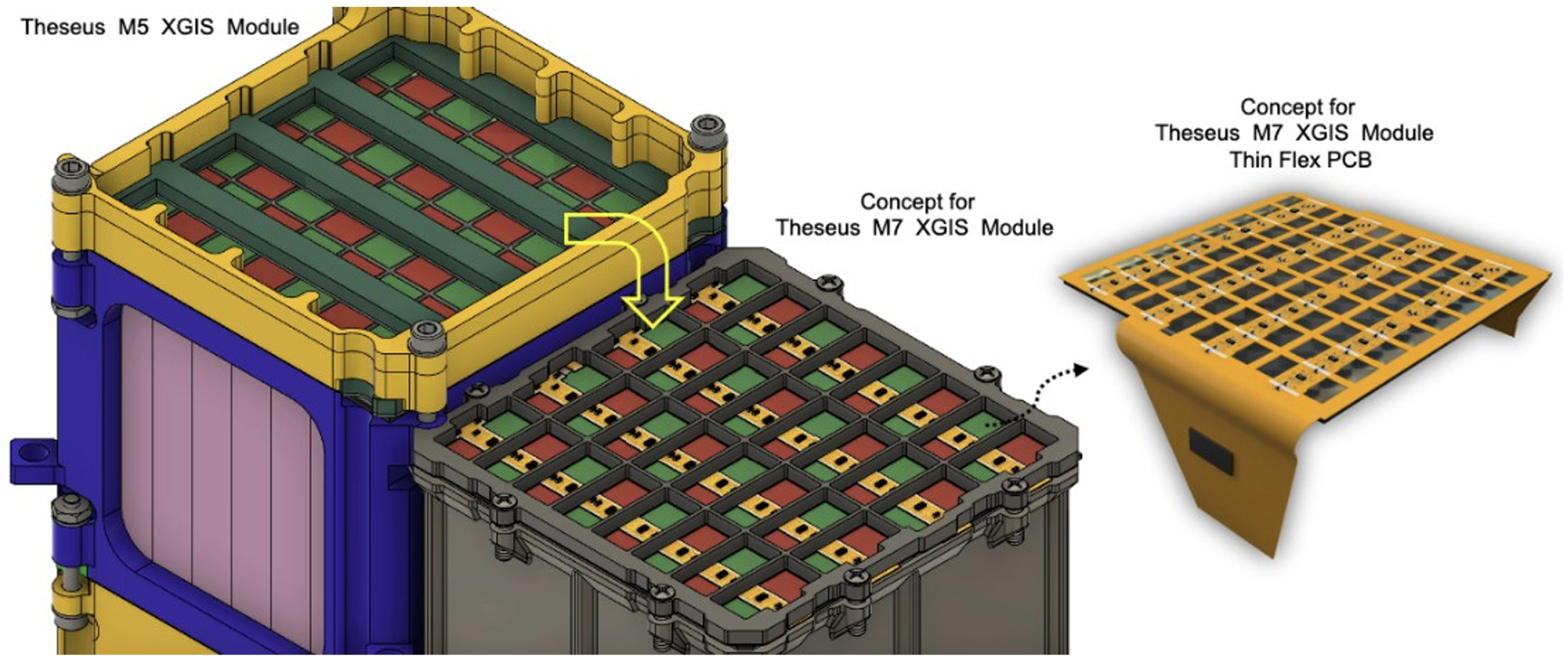
To improve the compactness, mechanical robustness and integration efficiency of the XGIS DPDM, FBK has initiated R&D activities focused on the replacement of traditional 1.6 mm thick standard PCBs with thin, flexible printed circuit boards below 0.2 mm in thickness (Figure 5). This transition, first proposed during December 2023, is aimed at maximizing the active detection area and improving mechanical and electrical integration [23,24].
Two flex PCB variants are currently under development and evaluation:
  • Copper-based flex PCB: using commercially available copper flex technology, this solution employs conventional wire bonding for establishing electrical connections between the ORION-FE and the SDDs.
  • Aluminum-based FlexBond Technology: developed at FBK in collaboration with the University of Trento and University of Turin, FlexBond utilizes ultra-thin aluminum-polyimide stacks and a low-material-budget architecture. Electrical interconnections are implemented via single-point Tape Automated Bonding (spTAB), which allows for direct bonding of aluminum traces to ASIC pads, offering enhanced mechanical reliability. This technology is currently patent-pending, declared in the Background Intellectual Property Rights (BIPR).
As of the Mission Consolidation Review (MCR) in February 2025, copper-based flex PCBs have been fabricated and are ready for electrical validation with 2 × 2 SDD arrays. Fabrication of the FlexBond-based variant is ongoing in FBK, with upcoming TAB tests across multiple ORION-FE designs featuring varying pad sizes. Subsequent qualification tests will be conducted in compliance with the standards and procedures defined by the European Cooperation for Space Standardization (ECSS [25]).
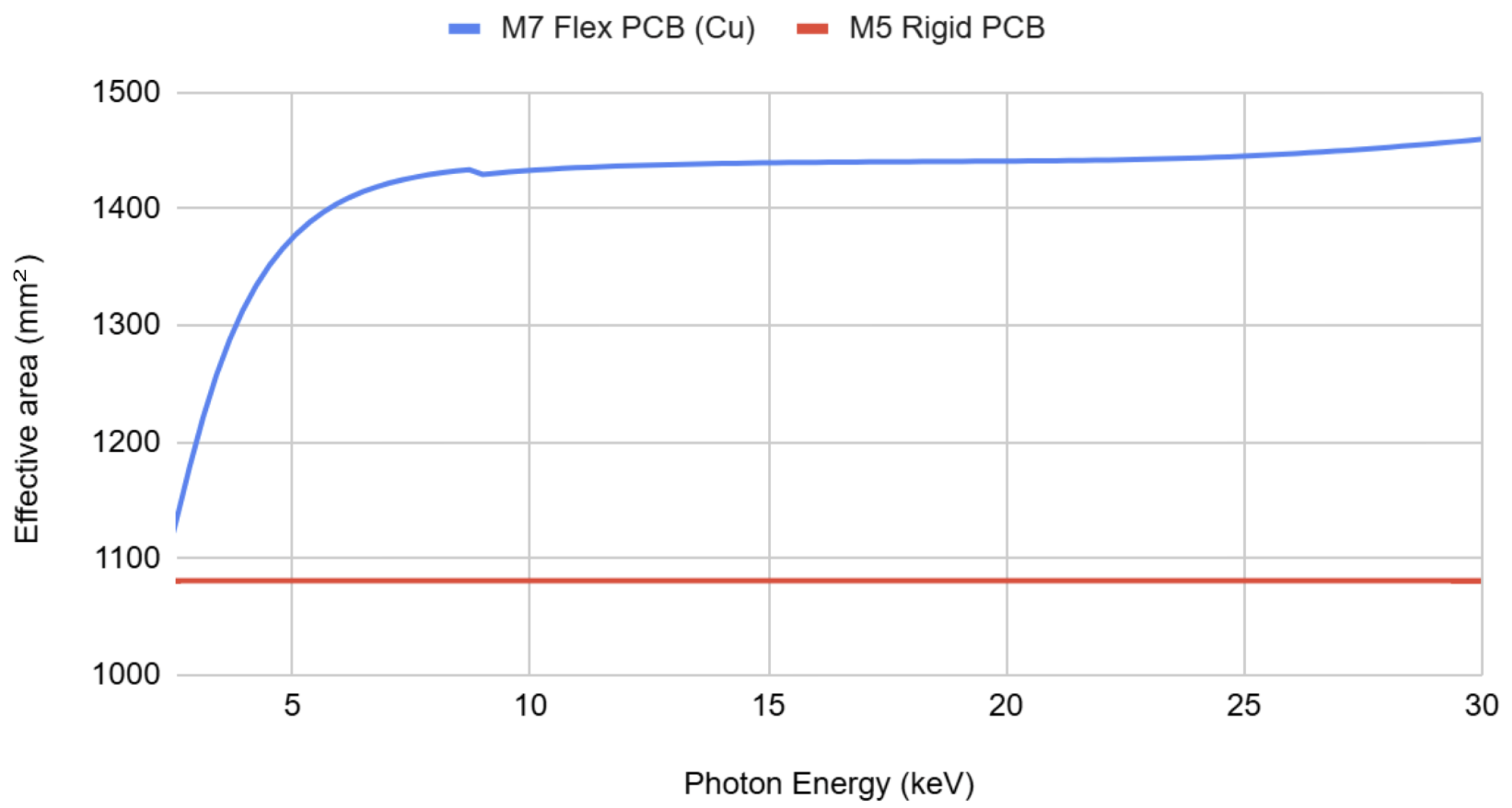
Preliminary studies on the material absorption properties of the PCB indicate that adopting a flex PCB architecture can significantly enhance the effective area of the DPDM at low X-ray energies (Figure 6). This improvement is crucial for XGIS to achieve high detection efficiency in the hard X-ray energy range (2–10 keV), corresponding to the lower end of the full XGIS energy band (Table 1).

3. Conclusions

The XGIS instrument, as part of the THESEUS mission payload, represents a significant advancement in the detection and characterization of Gamma-Ray Bursts across a broad energy range. The ongoing development efforts, building upon the heritage of the M5 Phase A study, have led to substantial progress in the design, fabrication and validation of key subsystems, including the hybrid SDD/scintillator detection plane, the ORION front- and back-end ASIC architecture and the modular mechanical layout.
Prototype detectors and readout electronics have been developed and tested, providing essential feedback for the ongoing optimization of the detection chain. Mechanical innovations such as the use of thin flexible PCBs are expected to further enhance the detector’s compactness, effective area and integration capabilities. These results confirm that the technological maturity of the XGIS subsystems is steadily advancing, with several components approaching or reaching TRL 5 and a clear roadmap toward TRL 6 during Phase B.
The continued optimization and qualification of the XGIS system will be key to ensuring mission readiness and maximizing the scientific return of THESEUS.

Author Contributions

Methodology: C.L., E.V., R.C., G.B., F.F., E.D., D.N., G.P., G.L.R., P.N. and G.S.; Investigation: G.M., S.S., E.B., P.C., E.J.M. and A.S.; Resources: F.F., E.D., D.N. and G.P.; Writing—original draft: G.M.; Supervision: C.L., E.V., L.A. and R.C.; Project administration: C.L., E.V., L.A. and R.C.; Funding acquisition: L.A. All authors have read and agreed to the published version of the manuscript.

Funding

This research was supported by ASI-INAF agreement n.2024-17-HH.0 and by the grant “Potenziamento dei Laboratori Spaziali dell’Istituto Nazionale di Astrofisica” 2023.

Acknowledgments

The ESA/M7 Phase-A study of THESEUS and XGIS instrument in Italy was supported by ASI-INAF agreement n.2024-17-HH.0. Authors would like to acknowledge the members of THESEUS consortium for their continued contributions.

Conflicts of Interest

The authors declare no conflicts of interest.

References

  1. Gehrels, N.; Chincarini, G.; Giommi, P.E.; Mason, K.O.; Nousek, J.A.; Wells, A.A.; White, N.E.; Barthelmy, S.D.; Burrows, D.N.; Cominsky, L.R.; et al. The Swift Gamma-Ray Burst Mission. Astrophys. J. 2004, 611, 1005–1020. [Google Scholar] [CrossRef]
  2. Thompson, D.J.; Wilson-Hodge, C.A. Fermi Gamma-Ray Space Telescope. In Handbook of X-Ray and Gamma-Ray Astrophysics; Springer: Singapore, 2022; pp. 1–31. [Google Scholar] [CrossRef]
  3. Band, D.; Matteson, J.; Ford, L.; Schaefer, B.; Palmer, D.; Teegarden, B.; Cline, T.; Briggs, M.; Paciesas, W.; Pendleton, G.; et al. BATSE Observations of Gamma-Ray Burst Spectra. I. Spectral Diversity. Astrophys. J. 1993, 413, 281. [Google Scholar] [CrossRef]
  4. Boella, G.; Butler, R.C.; Perola, G.C.; Piro, L.; Scarsi, L.; Bleeker, J.A.M. BeppoSAX, the wide band mission for X-ray astronomy. Astron. Astrophys. Suppl. Ser. 1997, 122, 299–307. [Google Scholar] [CrossRef]
  5. Jensen, P.L.; Clausen, K.; Cassi, C.; Ravera, F.; Janin, G.; Winkler, C.; Much, R. The INTEGRAL spacecraft—In-orbit performance. Astron. Astrophys. 2003, 411, L7–L17. [Google Scholar] [CrossRef]
  6. Tavani, M.; Barbiellini, G.; Argan, A.; Boffelli, F.; Bulgarelli, A.; Caraveo, P.; Cattaneo, P.W.; Chen, A.W.; Cocco, V.; Costa, E.; et al. The AGILE Mission. Astron. Astrophys. 2009, 502, 995–1013. [Google Scholar] [CrossRef]
  7. Amati, L.; O’Brien, P.; Götz, D.; Bozzo, E.; Tenzer, C.; Frontera, F.; Ghirl, G.; Labanti, C.L.; Osborne, J.P.; Stratta, G.; et al. The THESEUS space mission concept: Science case, design and expected performances. Adv. Space Res. 2018, 62, 191–244. [Google Scholar] [CrossRef]
  8. Final Three for ESA’s Next Medium Science Mission. 2023. Available online: https://www.esa.int/Science_Exploration/Space_Science/Final_three_for_ESA_s_next_medium_science_mission (accessed on 15 September 2025).
  9. O’Brien, P.; Hutchinson, I.; Lerman, H.; Feldman, C.; McHugh, M.; Lodge, A.; Willingale, R.; Beardmore, A.; Speight, R.; Drumm, P. The soft x-ray imager on THESEUS: The transient high energy survey and early universe surveyor. In Proceedings of the Space Telescopes and Instrumentation 2020: Ultraviolet to Gamma Ray, Online, 14–18 December 2020; SPIE: Bellingham, WA, USA, 2020; Volume 11444. [Google Scholar] [CrossRef]
  10. Labanti, C.; Amati, L.; Frontera, F.; Mereghetti, S.; Gasent-Blesa, J.L.; Tenzer, C.; Orleanski, P.; Kuvvetli, I.; Campana, R.; Fuschino, F.; et al. The X/Gamma-ray Imaging Spectrometer (XGIS) on-board THESEUS: Design, main characteristics, and concept of operation. In Proceedings of the Space Telescopes and Instrumentation 2020: Ultraviolet to Gamma Ray, Online, 14–18 December 2020; SPIE: Bellingham, WA, USA, 2020; Volume 11444. [Google Scholar] [CrossRef]
  11. Götz, D.; Basa, S.; Pinsard, F.; Martin, L.; Arhancet, A.; Bozzo, E.; Cara, C.; Sanz, I.E.; Frugier, P.A.; Floriot, J.; et al. The Infra-Red Telescope (IRT) on board the THESEUS mission. In Proceedings of the Space Telescopes and Instrumentation 2020: Ultraviolet to Gamma Ray, Online, 14–18 December 2020; SPIE: Bellingham, WA, USA, 2020; Volume 11444. [Google Scholar] [CrossRef]
  12. Ciolfi, R.; Stratta, G.; Branchesi, M.; Gendre, B.; Grimm, S.; Harms, J.; Lamb, G.P.; Martin-Carrillo, A.; McCann, A.; Oganesyan, G.; et al. Multi-messenger astrophysics with THESEUS in the 2030s. Exp. Astron. 2021, 52, 245–275. [Google Scholar] [CrossRef]
  13. Mele, F.; Dedolli, I.; Gandola, M.; Grassi, M.; Malcovati, P.; Amati, L.; Bellutti, P.; Borghi, G.; Campana, R.; Demenev, E.; et al. ORION, a Multichip Readout Electronics for Satellite Wide Energy Range X-/γ-Ray Imaging Spectroscopy: Design and Characterization of the Analog Section. IEEE Trans. Nucl. Sci. 2021, 68, 2801–2809. [Google Scholar] [CrossRef]
  14. OHB-Italia. Available online: https://www.ohb-italia.it/ (accessed on 15 September 2025).
  15. Agostini, G.; Ambrosino, F.; Antonelli, M.; Aquilanti, G.; Bellutti, P.; Bertuccio, G.; Borghi, G.; Bosisio, L.; Campana, R.; Cautero, G.; et al. Silicon drift detector monolithic arrays for X-ray spectroscopy. Front. Detect. Sci. Technol. 2025, 3, 1551757. [Google Scholar] [CrossRef]
  16. Mele, F. Application Specific Integrated Circuits for High Resolution X and Gamma Ray Semiconductor Detectors. In Special Topics in Information Technology; Springer International Publishing: Cham, Switzerland, 2022; pp. 31–42. [Google Scholar] [CrossRef]
  17. Srivastava, S.; Labanti, C.; Amati, L.; Campana, R.; Virgilli, E.; Marchesini, E.; Borciani, E.; Mele, F.; Dedolli, I.; Bertuccio, G.; et al. The XGIS instrument on-board THESEUS: Detector principle and read-out electronics. J. Instrum. 2024, 19, C02005. [Google Scholar] [CrossRef]
  18. Ahangarianabhari, M.; Bertuccio, G.; Caccia, S.; Grassi, M.; Macera, D.; Malcovati, P. From StarX32 to VEGA: Low-power and low-noise mixed-signal ASICs for X-ray detectors in space and medical applications. In Proceedings of the 2015 IEEE International Conference on Electronics, Circuits, and Systems (ICECS), Cairo, Egypt, 6–9 December 2015; pp. 388–391. [Google Scholar] [CrossRef]
  19. Ahangarianabhari, M.; Macera, D.; Bertuccio, G.; Malcovati, P.; Grassi, M. VEGA: A low-power front-end ASIC for large area multi-linear X-ray silicon drift detectors: Design and experimental characterization. Nucl. Instrum. Methods Phys. Res. Sect. A Accel. Spectrometers Detect. Assoc. Equip. 2015, 770, 155–163. [Google Scholar] [CrossRef]
  20. Dedolli, I.; Mele, F.; Ceraudo, F.; Gandola, M.; Grassi, M.; Bellutti, P.; Borghi, G.; Campana, R.; Caselle, M.; Cirrincione, D.; et al. Experimental Characterization of the RIGEL Sparse Readout ASIC for Soft X-Ray PixDD Detector. In Proceedings of the 2022 IEEE Nuclear Science Symposium and Medical Imaging Conference (NSS/MIC), Milano, Italy, 5–12 November 2022; pp. 1–3. [Google Scholar] [CrossRef]
  21. Gandola, M.; Grassi, M.; Mele, F.; Malcovati, P.; Bertuccio, G. LYRA: A Multi-Chip ASIC Designed for HERMES X and Gamma Ray Detector. In Proceedings of the 2019 IEEE Nuclear Science Symposium and Medical Imaging Conference (NSS/MIC), Manchester, UK, 26 October–2 November 2019; pp. 1–3. [Google Scholar] [CrossRef]
  22. Evangelista, Y.; Fiore, F.; Campana, R.; Baroni, G.; Ceraudo, F.; Della Casa, G.; Demenev, E.; Dilillo, G.; Fiorini, M.; Ghirlanda, G.; et al. The HERMES (High Energy Rapid Modular Ensemble of Satellites) Pathfinder mission. In Proceedings of the Space Telescopes and Instrumentation 2024: Ultraviolet to Gamma Ray, Yokohama, Japan, 16–21 June 2024; SPIE: Bellingham, WA, USA, 2024; p. 74. [Google Scholar] [CrossRef]
  23. Novel, D.; Lega, A.; Facchinelli, T.; Iuppa, R.; Beolé, S.; Bellutti, P. Evolution of flexible PCBs in particle detection: From ALICE ITS1 to future frontiers in microfabrication for ALPIDE chip integration. Nucl. Instrum. Methods Phys. Res. Sect. A Accel. Spectrometers Detect. Assoc. Equip. 2024, 1069, 169840. [Google Scholar] [CrossRef]
  24. Novel, D.; Lega, A.; Facchinelli, T.; Iuppa, R.; Beolé, S.; Bellutti, P. Tape Automated Bonding of an ALPIDE Chip with Flexible PCBs. In Proceedings of the 2024 IEEE 10th Electronics System-Integration Technology Conference (ESTC), Berlin, Germany, 11–13 September 2024; pp. 1–5. [Google Scholar] [CrossRef]
  25. European Cooperation for Space Standardization. Available online: https://ecss.nl/standards/ (accessed on 15 September 2025).
Figure 1. Schematic view of an XGIS pixel, composed of two SDDs and a CsI(Tl) crystal bar. The event is processed by the Readout Electronics, ORION-FE, and a single-channel processor for the event identification, ORION-BE. The event discrimination logic is represented for (a) an incoming X photon and (b) an incoming γ photon [13].
Particles 09 00003 g001
Figure 2. DPDM designs developed during M5 (a) and M7 (b), where a modular approach has been introduced by dividing Detector Core Assembly (gray housing) and Back-End Assembly (orange housing). The difference in structure depends on an improved design for the BE electronics, coherent with XGIS requirements. Courtesy of OHB-Italia Industries [14].
Particles 09 00003 g002
Figure 3. Sides of a wafer from the THESEUS batch, highlighting the monolithic SDD array designed for the XGIS instrument and the XGS prototypes. (Left) Optical window, input side for the scintillation light. (Right) Anode and drift electrodes side, input side for X radiation. Courtesy of FBK.
Particles 09 00003 g003
Figure 4. Block diagram of ORION electronics and logic for a single pixel, separated into ORION-FE and ORION-BE [16].
Particles 09 00003 g004
Figure 5. (Left) Comparison between XGIS module of M5 and a concept for M7. The two designs are shown side-by-side for visual comparison only; they are independent modules and are not physically connected. The checked red and green plane represents the SDD array: in M5 design the rigid PCB ribs partially obscure the detection plane, while in the M7 concept the use of a thin flex PCB (mechanically supported by the upper metal grid visible in the figure) increases the effective area. (Right) Concept of thin flex PCB which has been proposed for the M7 DPDM. Courtesy of FBK: image presented by David Novel at the conference ASAPP25.
Particles 09 00003 g005
Figure 6. Plot showing the gain in effective area obtained by adopting a copper-based flex PCB (blue) in the DPDM, compared to the standard rigid PCB (red).
Particles 09 00003 g006
Table 1. Main functional requirements of XGIS [10]. The results obtained from testing the 2 × 2 prototype fulfill the technical instrument requirements for XGIS.
XGIS
Energy band (keV)2–150150–10,000
Energy resolution≤1200 eV FWHM≤6% FWHM
at 6 keVat 600 keV
Timing accuracy7 μs
Disclaimer/Publisher’s Note: The statements, opinions and data contained in all publications are solely those of the individual author(s) and contributor(s) and not of MDPI and/or the editor(s). MDPI and/or the editor(s) disclaim responsibility for any injury to people or property resulting from any ideas, methods, instructions or products referred to in the content.