Article

Research on the Dynamic Characteristics of a New Bridge-and-Station Integrated Elevated Structure

1
Key Laboratory of Urban Underground Engineering of Ministry of Education, Beijing Jiaotong University, Beijing 100044, China
2
School of Civil Engineering, Beijing Jiaotong University, Beijing 100044, China
3
Fengtai Engineering Section of China Railway Beijing Group Co., Ltd., Beijing 100071, China
*
Author to whom correspondence should be addressed.
Vibration 2025, 8(4), 76; https://doi.org/10.3390/vibration8040076 (registering DOI)
Submission received: 22 October 2025 / Revised: 20 November 2025 / Accepted: 1 December 2025 / Published: 3 December 2025

Abstract

Elevated stations are essential auxiliary structures within the high-speed rail (HSR) network. The newly constructed integrated elevated station for bridge building possesses a distinctive construction and intricate force transmission pathways, complicating the assessment of the dynamic coupling of train vibrations. Consequently, it is essential to examine the dynamic reaction of trains at such stations. This study utilises numerical simulation and field measurement techniques to examine the dynamic features of the newly constructed integrated elevated station for bridge building. Initially, vibration tests were performed on existing integrated elevated stations for bridge construction to assess their dynamic properties. The collected data were utilised to validate the modelling approach and parameter selection for the numerical model of existing stations, yielding a numerical solution method appropriate for bridge-station integrated stations. Secondly, utilising this technology, a numerical model of the newly integrated elevated station for bridge construction was developed to examine its dynamic features. Moreover, the impact of spatial configuration, train velocity, and operational organisation on the dynamic characteristics was analysed in greater depth. The vibration response level in the waiting hall was assessed. Research results indicate that structural joints alter the transmission path of train vibration energy, thereby significantly affecting the vibration characteristics of the station. The vibration response under double-track operation is notably greater than that under single-track operation. When two trains pass simultaneously at a speed of 200 km/h or higher, or a single train passes at 350 km/h, the maximum Z-vibration level of the waiting hall floor exceeds 75 dB, which goes beyond the specification limit.

1. Introduction

Modern urban transportation hubs, particularly high-speed railway (HSR) stations, are increasingly constrained by limited land resources and complex spatial environments. Elevated stations, which significantly reduce land occupation, have become a widely adopted solution. Elevated stations are categorised into two primary categories based on the attachment of track beams to station structures: “building-bridge integrated” and “building-bridge separated” [1]. Based on the location of the waiting hall, integrated bridge-station structures are primarily categorised into two structural configurations: the side-type waiting hall and the overhead waiting hall. For stations with side-type waiting halls, the laterally positioned waiting halls require additional land occupation and fail to effectively utilise the space beneath the bridge, resulting in relatively low overall space utilisation efficiency. For stations with overhead waiting halls, the waiting area is situated above the track-bearing level. As a result, transferring passengers must first descend from the intermediate platform level to the underground exit level, and then ascend through access passages on both sides to reach the top-level waiting hall. This configuration leads to circuitous transfer routes and considerably longer travel times. The new integrated bridge-station elevated railway station (IBSE) blurs the conventional lines between structure and function. It achieves a high level of integration and integrated design between the station building, which offers passenger boarding and alighting services, and the elevated bridge structure, which performs the function of train operation, particularly the waiting hall. The primary passenger service areas, including waiting areas, entry/exit corridors, and a portion of commercial service facilities, are positioned right beneath the elevated bridge, making this the most noticeable spatial element. This design significantly improves the efficiency of space usage and radically alters the spatial organisation logic of elevated railway stations. However, in the new station design, primary passenger service spaces such as the waiting hall are situated directly beneath the HSR lines. This alteration in the vibration transmission path from the rails to the waiting hall could lead to increased vibration and structure-borne noise levels within the hall. Consequently, dedicated investigation into this phenomenon is warranted.
The integrated elevated station, which incorporates building and bridge constructions, results in significant disparities in structural stiffness and mass distribution, both horizontally and vertically. This integration poses issues such as complex load transfer channels, elucidating dynamic coupling from train vibrations, and an absence of standardised design protocols during the design phase. A multitude of scholars have investigated these challenges, conducting comprehensive on-site studies at elevated stations. Cai et al. [2] examined the vibration properties of elevated stations, analysing vibrations in waiting areas and platforms throughout temporal and frequency domains. They identified variations in vibration responses attributable to trains arriving, departing, and traversing. Yu et al. [3] examined the effects of high-speed train loads on waiting room and commercial floors’ vibrations, assessing vibration serviceability with data from Zhengzhou East Railway Station. Liu et al. and Yang et al. [4,5] conducted tests and analyses on environmental vibrations in various areas of elevated stations, including platforms and waiting halls, to explore the propagation of train-induced vibrations. Ba et al. [6] conducted field tests to assess background and structure vibrations at diverse speeds, evaluating effective vibration acceleration at multiple locations. Furthermore, high-speed trains impact nearby buildings with vibrations [7,8,9]. Xia et al. [10,11] explored the mechanisms behind train-induced vibrations at elevated stations, examining the effects of train type, speed, and proximity on nearby buildings. Sanayei et al. and Hesami S et al. [12,13] corroborated finite-element models with field data, studying the impact of train speed, soil properties, and structural traits on building vibrations caused by trains. Li et al. [14] performed empirical research on vibrations and noise at large high-speed railway stations due to passing trains, exploring structural vibration patterns during train operations. Other researchers have proposed various numerical models for simulation calculations. Deng et al. [15] suggested taking the load time-history from the train–bridge sub-model dynamic calculations as the external excitation acting on the bridge–station sub-model. They conducted time-history analysis to compute the dynamic response caused by trains passing through the elevated station and evaluated the station’s vibration serviceability. Xu et al., Xie et al., Yang et al., and Cui et al. [16,17,18,19] established a train–station vibration analysis system to explore station dynamics and train-induced vibration patterns, focusing on station structure vibration level. Alan and Caliskan [20] investigated vibration control for train-induced vibrations at an Ankara station. They simulated the station–foundation interaction with springs and dampers in a finite-element model, aligning with Turkish environmental noise laws. Zhang et al. [21] used rigid body dynamics for a train subsystem-model and the mode superposition method for a structural model. They explored the analysis method for the train–station structure coupling system under braking force. Zhang et al. [22] devised a numerical model for analysing vibrations in large-scale integrated building–bridge structures (IBBS), focusing on HSR stations and evaluating vibration mitigation effectiveness. Yang et al. [23] introduced a two-step time-frequency prediction method for superstructures to predict and analyse train-induced vibrations in buildings above subway tunnels. Liang et al. [24] utilised a physics-informed deep learning approach to investigate the structural dynamic reaction to moving loads, with the objective of improving the precision of forecasting structural vibration responses under these loads. Xu et al. [25] investigated the measurement of vibration source intensity produced by subway trains on conventional and floating slab tracks, and provided an effective approach for determining the vibration source intensity generated by these trains. Liang et al. [26] investigated the propagation characteristics of ground vibrations caused by train operations and provided an effective model for predicting ground vibrations. Ma et al. [27] concentrated on the intricate transmission pathway of “overlapping subway lines-strata-historical buildings” by utilising on-site vibration measurements and statistical data analysis to examine the response patterns of train vibrations on historical structures and evaluate the extent of vibration impact. Qu et al. [28] conducted a thorough examination of the complete propagation chain of subway vibrations, integrating empirical data with theoretical research. They performed categorization, identification, and quantitative analysis of multiple elements that may induce vibration variability and pinpointed the principal contributing factors. Guo and Wang [1] studied the structural dynamic characteristics of the multi-line bridge-integrated elevated station. Numerous researchers have explored the vibration characteristics of station structures during train operations, including aspects of safety and environmental vibration level. Li [29] proposed an optimisation strategy for bearing stiffness in the frame-type “bridge-building integration” structure to control environmental vibration. Feng et al. [30] examined railway station structures, collected data via vibration measurements during train transit, assessed environmental vibration according to the ISO 2631-1 standard, and suggested strategies for environmental vibration control, including increasing structural damping and modifying track fastener stiffness. Gao and Li [31] focused on the vibration issues caused by traffic loads in elevated stations, analysed its impact on the environmental vibration of station areas, and recommended adopting track vibration reduction measures to control environmental vibration. Zhao et al. [32] conducted shaking table tests to study the seismic performance of the integrated bridge-station structure. By comparing the dynamic responses under different seismic wave inputs, they discovered the development pattern of plastic hinges in key structural locations (such as beam–column joints) and proposed a displacement-based seismic design method to enhance overall ductility. Xie et al. [33] conducted a study on the impact of vibration induced by pedestrian activities on environmental vibration in the elevated waiting hall of Fengtai Station in Beijing. They proposed a scheme to control environmental vibration of the waiting hall by adding tuned mass dampers (TMDs) and optimising the structural stiffness distribution. Cui and Su [34] established a finite-element model for the elevated station–track coupling system to study the impact of vibration response on environmental vibration under resonance conditions. They revealed that when the wavelength of track irregularities matches the natural frequency of the structure, it can amplify vibrations and seriously aggravate environmental vibration. They proposed an environmental vibration control strategy by adjusting track stiffness and increasing structural damping to avoid the resonance range. Despite extensive research on bridge-station integrated structures, existing studies have critical gaps that highlight the necessity of this work—especially for the novel vertical-integrated system with the waiting hall directly beneath tracks. Key limitations are summarised as follows: First, research objects focus on traditional/simplified structures, not the novel vertical-integrated system. Most studies [1,2,3,6] target “building-bridge separated” or “simplified integrated” designs, where waiting halls are not under tracks. These lack the novel system’s significant stiffness/mass disparities and complex vertical load transfer paths, leaving its dynamic characteristics unaddressed. Second, mechanistic analysis of dynamic coupling is superficial, with no quantitative exploration of key factors. Prior work [2,3,10] remains phenomenological, failing to quantify impacts of structural joints, double-line operation, or 350 km/h speeds on track-waiting hall coupling—the novel system’s core challenge. Vibration mitigation strategies [30,34] are general, not tailored to its unique needs. Third, numerical models are ill-suited for high-integration structures. Existing models [15,22] were developed for conventional designs and lack validation for the “waiting hall under tracks” configuration, limiting reliable design tools. Fourth, high-speed adaptability and scenario-specific environmental vibration assessment are inadequate. Most tests [3,6] are ≤300 km/h, with no targeted environmental vibration level analysis for the novel system’s exposed waiting hall or comparisons of single/double-line operations. In summary, existing research does not address the novel structure’s dynamic mechanisms, key influencing factors, or high-speed environmental vibration performance. This study is necessary to fill these gaps, providing theoretical and engineering support for its design and optimisation.
Therefore, this study takes a new type of elevated station that integrates bridge and building as the research object. A model for high-speed train–track coupling is developed utilising a rigid–flexible coupling methodology, and the vibration load of high-speed trains is analysed using Simpack 2021. The model’s accuracy is validated using empirical data. A three-dimensional dynamic numerical model of the station is developed utilising Abaqus 2022 software, with the model construction methodology and parameter selection validated against empirical data. A comparative analysis of vibration propagation patterns and their affecting elements is performed for the innovative “integrated bridge and building” elevated station structure, and the vibration environment within the waiting hall is assessed. The insights obtained can serve as a reference and foundation for the structural optimisation design of new elevated stations.


2. New Bridge-Station Integrated Elevated Structure Type

The new IBSE is characterised by vertical integration of the station building beneath the elevated bridge structure, enabling highly efficient land use. When passengers arrive at the new station, they can simply descend from the elevated platform to the waiting hall level to freely choose between exiting the station or entering the waiting hall for transfers. This innovative design not only significantly improves spatial efficiency and reduces construction costs, but also minimises transfer distances and shortens travel time. This configuration offers several key advantages: (1) Enhanced spatial efficiency: By stacking train operations above and passenger services below, the design accommodates both transportation and large-scale public functions within the same footprint, significantly increasing land use intensity. (2) Reduced land acquisition: Locating the waiting hall and other primary functions beneath the bridge minimises the need for additional surface-level land, alleviating pressure and costs associated with land expropriation and demolition. (3) Optimised passenger flow: Placing the waiting hall directly under the platforms shortens walking distances and transfer times. Ground-level connections to metro, bus, taxi, and private vehicle facilities can interface directly with the waiting hall level, creating efficient vertical and horizontal transfer paths. (4) Construction efficiency: Structural integration allows concurrent construction of bridge and station elements, reducing overall construction time and investment costs.
A schematic of the proposed structure is shown in Figure 1. Designed for a maximum train speed of 350 km/h, the station features two platforms and six tracks, with the central two designated as main lines. The structure employs a cast-in-place spatial frame system, composed of three primary levels: (from top to bottom) platform level, track-bearing level, and waiting hall level. The respective heights above ground are 14.725 m, 12.225 m, and 8.8 m, respectively.
The station measures 100 m in length and 56 m in width, with four rows of piles arranged transversely. Columns cantilever 2.5 m beyond the outer edges. Longitudinally, the structure comprises four 25 m spans without expansion joints. The transverse beams of the waiting hall roof share piers with the bridge and are rigidly connected. Material grades vary by level: platform beams and columns use C40 concrete, and slabs use C35; track-bearing level beams, columns, and floor slabs use C45; waiting hall columns and slabs use C40; and pile foundations use C35.

3. Establishment and Verification of the Reference Numerical Model

Because the proposed station has not yet been built, a validated modelling strategy was first established using an in-service elevated facility. Field vibration data were acquired at Fuzhounan Station and used to calibrate the modelling assumptions, element types, damping ratios and soil–structure interaction parameters. Once the predicted and measured responses agreed to within engineering accuracy, the same strategy was transferred to the new station.

3.1. Fuzhounan Railway Station Description

Fuzhounan Station is a typical bridge-station integrated elevated HSR station. The station layout comprises 15 platforms and 30 tracks (two main lines and 28 arrival/departure). Functionally, the structure is stacked in three levels: (1) Ground level: Exit hall and multimodal transfer waiting hall; (2) Mezzanine level: Longitudinal, side-platform waiting halls on east and west sides; (3) Platform level: 15 platforms linked by two passenger corridors. The project is an expansion: the west half (Zone 1) is the original building, the east half (Zone 3) is new construction, and Zone 2 is a transition block introduced to accommodate differential stiffness and construction joints. The platform adjacent to the upstream main line sits directly above the Zone 1/Zone 2 interface; its supporting columns are two independent members rather than a monolithic pier. Between 08:40 and 23:00 on the test day, 10 trains on Track I and 9 trains on Track II passed this location at approximately 250 km/h. Uniaxial and triaxial accelerometers were installed on the platform slab, waiting hall slab, and column bases beside the main line piers to capture vertical and lateral acceleration time histories (Figure 2). Point A is situated at the floor slab directly beneath the main line, 4.75 m from the column centreline of the main line. Point B is located 0.5 m above the ground on the left side of the main column. Point C is positioned at the centre of the platform, 12.5 m from the nearest point to the main line. In this study, an INV3060S environmental vibration acquisition instrument (coinv, Beijing, China), with a maximum sampling frequency of 51.2 kHz, along with sensors featuring a measuring range of 0.12 g, a frequency ranges of 0.2–600 Hz, and a resolution of 0.5 μg, was used to test the vertical vibration at three points (A, B, and C). The vibration performance was assessed using the VLzmax criterion. Figure 2 and Figure 3 depict the schematic representation of the measuring points and the actual measurement diagram, respectively.

3.2. Numerical Model

Due to the enormous footprint and highly subdivided layout of Fuzhounan Station, a fully detailed FE model would be computationally prohibitive. Structural joints fully decouple the track-bearing layer into three independent vibration domains; only the deck of Platform 3 mechanically bridges Zones A and B. Consequently, Zones A and B, together with Platform 3, were modelled as three separate, laterally connected objects.
The foundation was represented by a single homogeneous soil layer. Infinite-element boundaries were placed on the four vertical sides and the base to prevent spurious wave reflections. Rayleigh damping was adopted for internal energy dissipation. Because the station waiting hall is buried beneath the rigid Fuzhounan Metro building, surface-re-radiated energy is negligible, and soil–structure interaction below the foundation level can safely be ignored, gaining a major speed-up without loss of accuracy.
The numerical model consists of two primary components: the superstructure and the supporting soil. These are precisely integrated according to the engineering design specifications. During modelling, Beam elements were employed to simulate the beam–column components of the superstructure, while Shell elements modelled the floor slabs of each level. Track slabs were modelled using Solid elements. The computational parameters for columns, beams, and floor slabs in the Fuzhounan Station model are detailed in Table 1.
Mesh generation primarily considers computational efficiency and the reliability of numerical simulations. To ensure the reliability of numerical simulations, the mesh size Δ x must satisfy the fundamental criterion Δ x λ / π . For a harmonic wave, let the wave period be T and the propagation speed in the medium be c . Then, the corresponding wavelength is λ = c T . Therefore, to obtain accurate computational results, the element size must satisfy:
Δ x C s 6 f max
where Δ x is the unit of model grid cell size; C s is the shear wave velocity in m/s; f max is the upper limit of analysis frequency band in Hz.
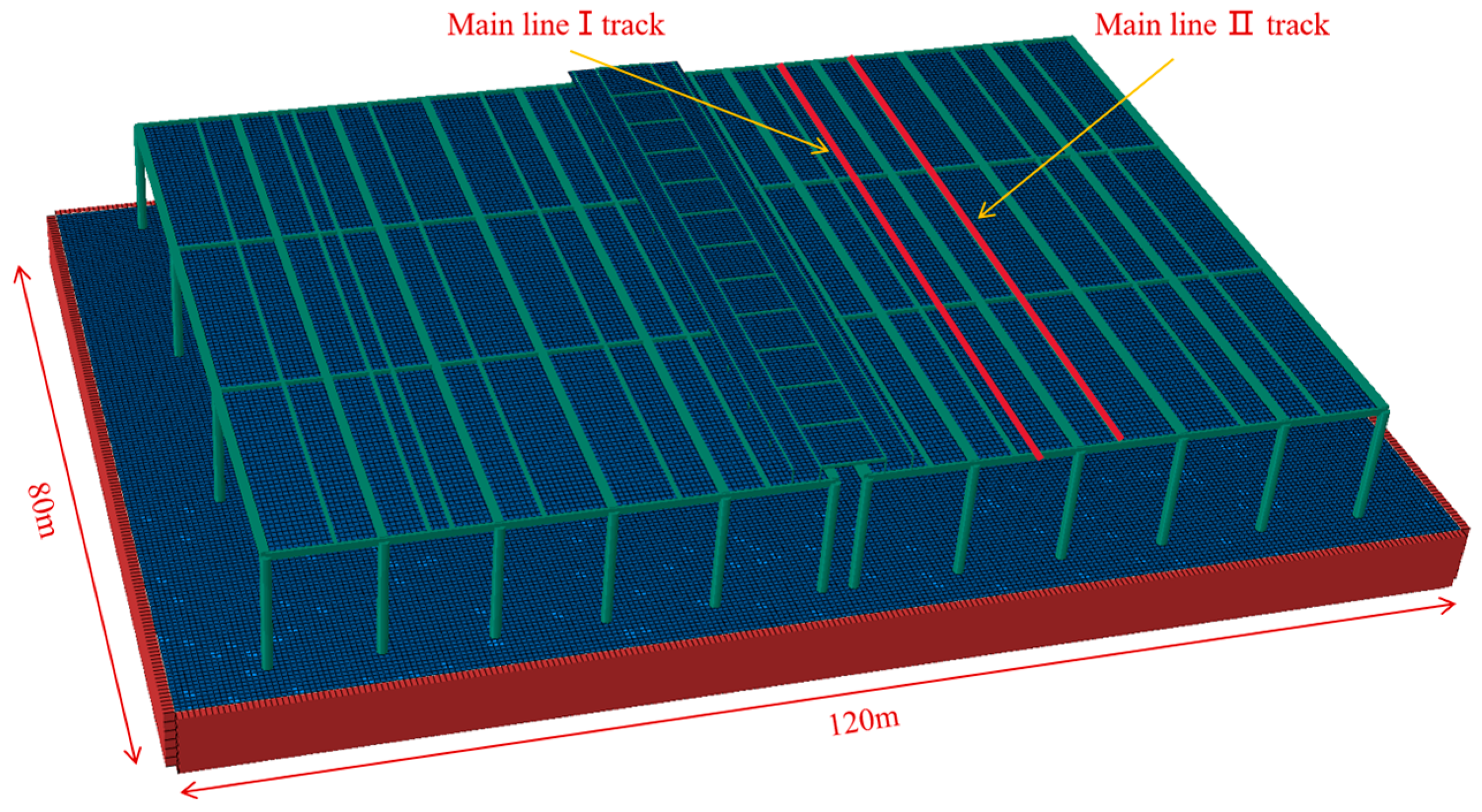
The shear wave velocity of concrete in this project is 1500 m/s, with an analysis frequency range of 1–500 Hz. Consequently, the minimal dimension of the numerical model must not surpass 1500/(6 × 500) = 0.5 m. Due to computational constraints, a grid size of 0.5 m is implemented for essential sites, including the vibration source, propagation path, and pickup spots. The shear wave velocity of the soil layer is established at 500 m/s. The soil layer just functions to absorb vibration waves, so the maximum frequency of interest is established at 200 Hz, with a mesh size not surpassing 0.4 m. The mesh size for the load application region of the track bed is 0.6 m in the train running direction and 0.5 m perpendicular to it, determined by the parameters of the track structure. The completed model consists of 1,397,826 elements, as illustrated in Figure 4. The green part is the beam element (B31) for simulating beams and columns, the blue part is the shell element (S4R) for simulating floor slabs, the red part is the solid element (CIN3D8) for simulating infinite element boundary, and the invisible part in the middle of the infinite element boundary is the solid element (C3D8R) for simulating soil.
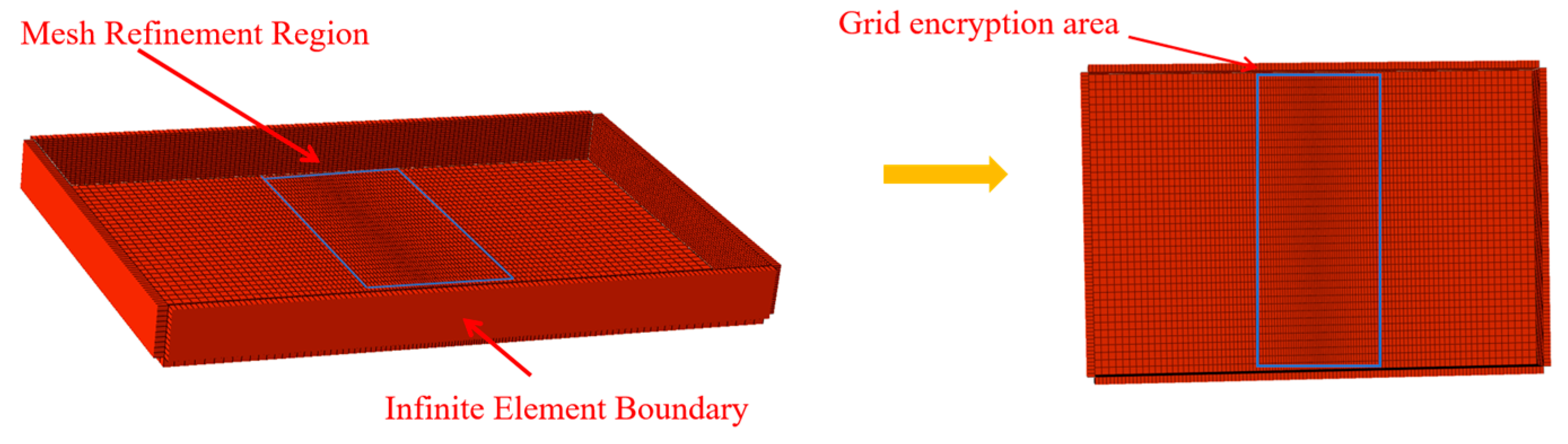
In finite-element modelling, proficient management of model scale is essential for guaranteeing computational efficiency and precision. Vibration waves in actual foundations propagate unimpeded in infinite domains, without necessitating the consideration of boundary effects. Nevertheless, modelling infinite media with finite discrete models leads to artificially truncated boundaries, which result in wave energy reflection and substantially undermine the precision of computational outcomes. This article utilises infinite-element technology to manage model boundaries, thereby effectively mitigating this numerical mistake [37]. Conventional meshing is initially performed within the CAE interface while modelling. Consequently, the C3D8 elements in the boundary region are transformed into CIN3D8 elements by modifying the inp file to incorporate endless elements. This method is grounded in the theoretical frameworks established by Zienkiewicz [38] and Lysmer [39], facilitating precise simulation of wave propagation issues [40]. The established numerical model features infinite element boundaries on all four sides and the bottom surface, with fixed limitations imposed on the bottom elements. This study mainly observes the vibration response around the main line, so the grid around the main line for 30 m is gradually densified to obtain more accurate results. Figure 5 depicts the finalised infinite element boundary model.
The frequency range of interest for the vibration analysis in this paper is 1–500 Hz, with two end-point frequencies selected at 1 Hz and 500 Hz. The natural frequencies of each order within the range of 1–500 Hz are solved through numerical simulation, and the first two orders of natural frequencies corresponding to the main vibrations in this frequency band are selected as modal parameters [37,41]. The damping ratio for ordinary concrete structures typically ranges between 2% and 5%. Following the reference [1], a value of 2% is adopted for similar structures in this study.
The Rayleigh damping is employed herein, assuming the damping matrix [ C b ] is determined through a linear combination of the stiffness matrix [ K b ] and the mass matrix [ M b ].
C b = α M b + β K b
where ξ is the structural damping ratio, and Rayleigh damping coefficients α and β can be expressed as:
α β = 2 ξ ω m + ω n ω m ω n 1
ω m and ω n represent the natural frequencies of the m-th and n-th modes, respectively. Using the Rayleigh damping model, the corresponding damping coefficients for the concrete structure were calculated as: α = 0.2508 and β = 1.2707 × 10⁻⁵.

3.3. Calculation of Vibration Forces in High-Speed Rail Trains

This article utilises a coupled simulation methodology to develop a vehicle–track coupled dynamics model for the computation of excitation forces in high-speed trains. Deng et al. [15] used the same two-step decoupled method to analyse the structural vibration of Changsha Railway Station, achieving a measured-simulated error of 0.6 dB (consistent with our 0.40–0.53 dB). Alan and Caliskan [20] also decoupled the track–station interaction when designing vibration isolation for Ankara High-Speed Train Station, noting that decoupling “does not compromise accuracy for most engineering applications focused on station structural response.” Zhang et al. [22] applied the decoupled method to large-scale integrated building-bridge structures (IBBSs) for high-speed railways, and their results were validated by on-site tests (error < 0.8 dB). Utilising the vehicle–track coupling model creation methodology from Bai [42], a detailed vehicle dynamics model is established based on the actual technical specifications of the CRH380A train. Upon finalising the whole vehicle multi-body dynamics model, it is imperative to develop a finite-element model of the flexible track system. Utilising the commonality between Simpack 2021 and finite-element software, the research team chose Abaqus 2022 to develop a precise finite-element model of the rails. Upon importing the rail model into the dynamic simulation environment through a common data interface, a wheel–rail contact coupling mechanism was created to replicate the dynamic interaction between the vehicle system and the track structure.
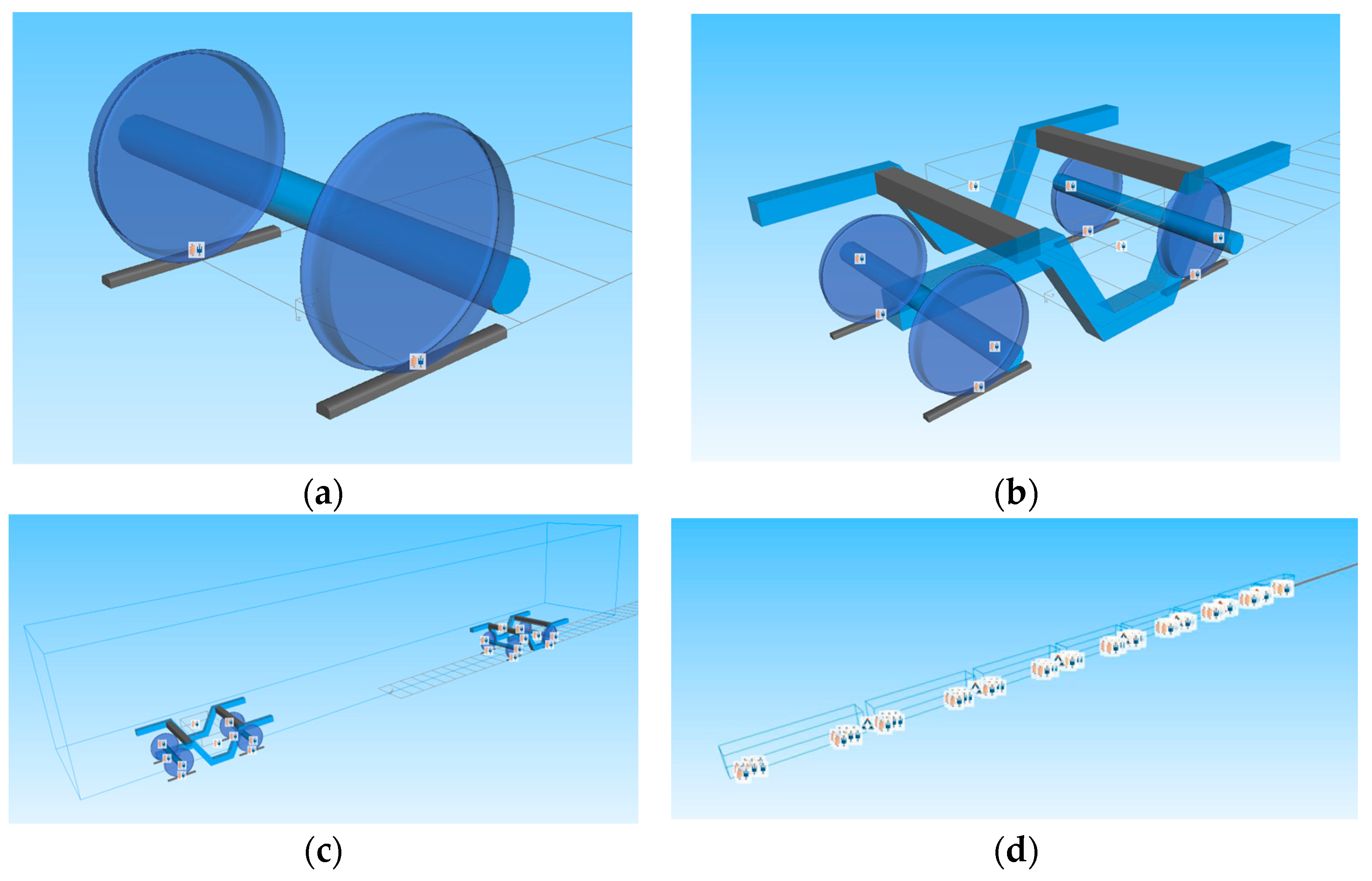
Based on the principles of vehicle–rail dynamic coupling, this study developed a multi-rigid-body system model for an eight-car train formation. Using substructure assembly and parametric design methods, the model was constructed by sequentially modelling the wheel-set subsystem, bogie assembly, and car body structure, with reference to the CRH380A train’s actual technical parameters in Table 2 and Table 3. Dynamic coupling relationships between components were established through force elements to reflect realistic physical characteristics, ultimately forming a complete vehicle system model, as shown in Figure 6.
Numerical simulation of track geometric deviations is a critical component of the vehicle–track coupled system dynamics analysis. Rails on operational lines inevitably deviate from ideal geometric profiles, with spatial deviations primarily manifesting as irregular variations in track elevation and alignment. These deviations act upon the wheel–rail coupling system as a continuously varying random excitation process along the route mileage. To quantitatively characterise this random behaviour, the power spectral density (PSD) function is widely adopted in engineering practice for mathematical description. Railway authorities in the United States, Germany, and Japan have established comprehensive track inspection systems and developed track spectrum databases for different grades of lines within their respective networks based on massive amounts of measured data. In the field of HSR dynamics simulation, the German high-speed rail low-disturbance track spectrum is internationally adopted as the standard input [45].
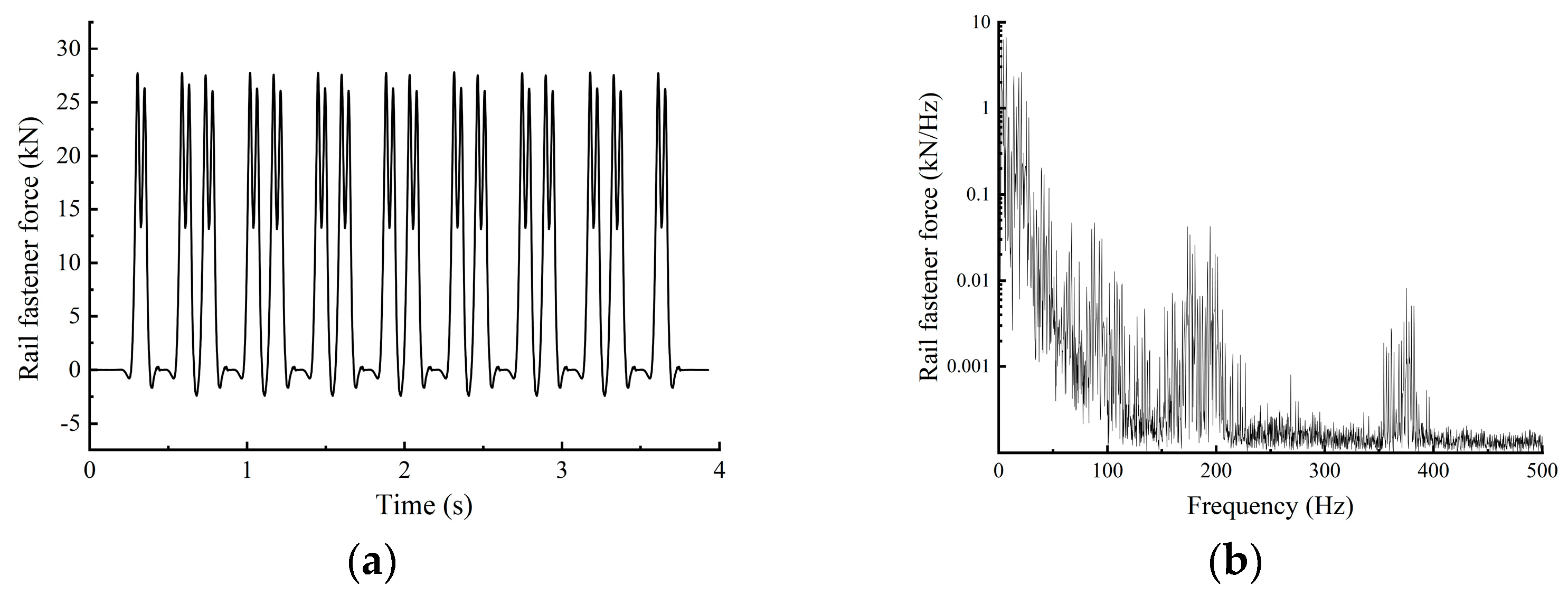
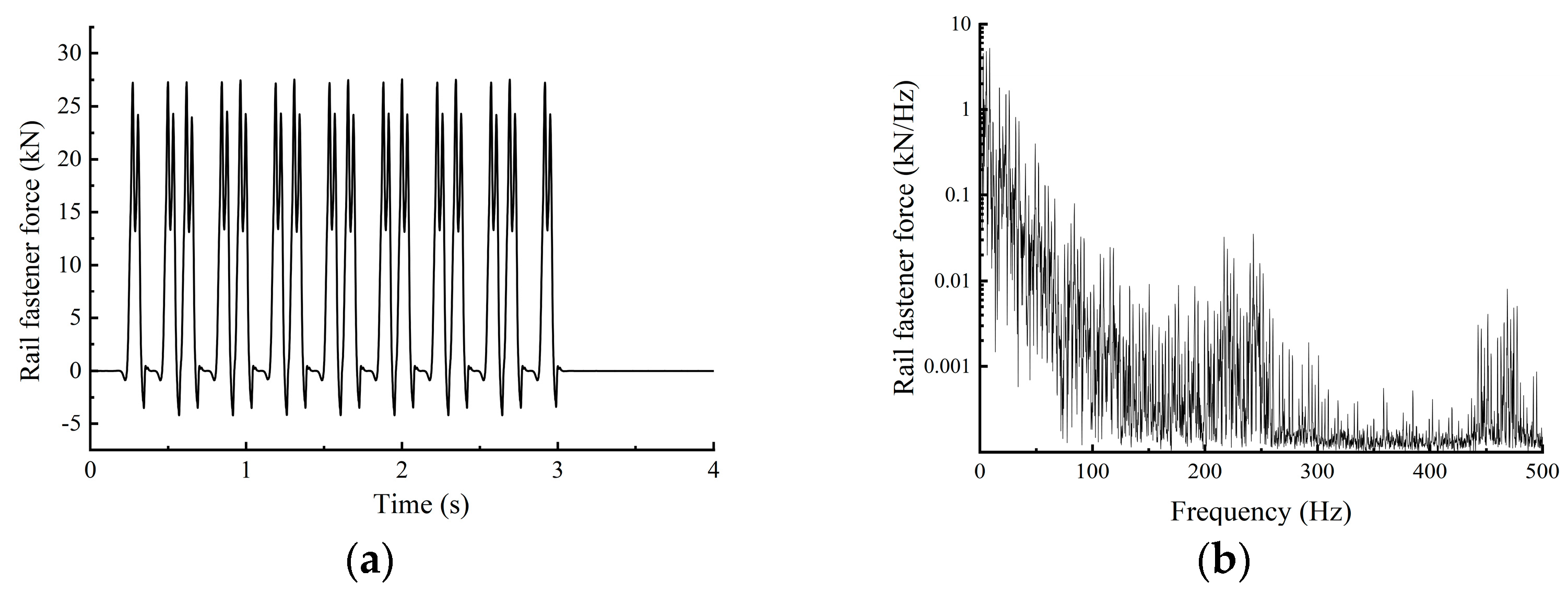
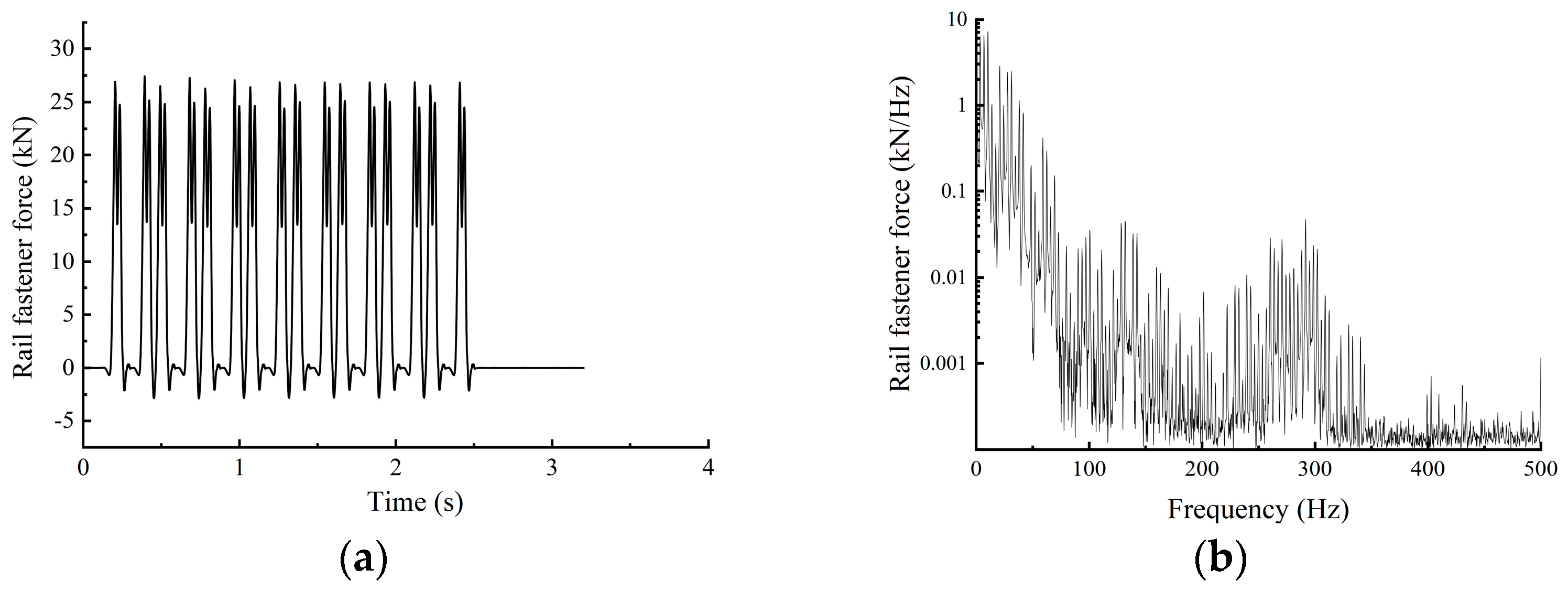
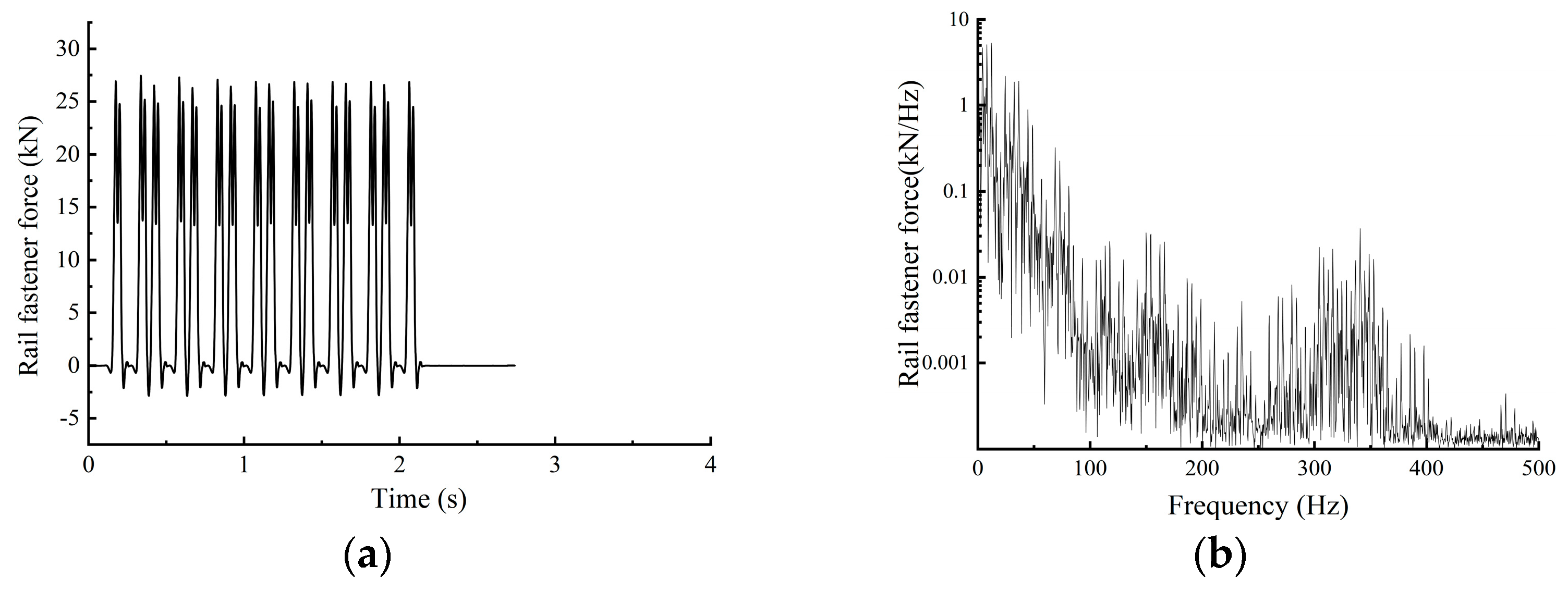
This study primarily examines the vibration response characteristics of high-speed trains on mainline parts of elevated stations, considering four operational speeds: 200 km/h, 250 km/h, 300 km/h, and 350 km/h. The reaction forces of the fastening support derived from the joint simulation model created with these input velocities are illustrated in Figure 7, Figure 8, Figure 9 and Figure 10. Analysis indicates that the dynamic fastener forces display distinct periodic peak features during the passage of an eight-car train. As train speed escalates, the duration of force applied per axle pair diminishes, although the peak force amplitude remains largely same. Simultaneously, the vibration amplitude demonstrates an overall decline within the 0–500 Hz frequency range. At velocities of 200 km/h and 250 km/h, two peaks coexist within the 200–250 Hz and 400–500 Hz frequency ranges, respectively. As velocity escalates, the frequency of peak occurrence progressively transitions to elevated frequencies. At velocities of 300 km/h and 350 km/h, peaks are exclusively observed within the 250–350 Hz frequency range. Elevating train speed markedly enhances the magnitude of the vibration response, although the essential properties of vibration propagation remain consistent.

3.4. Numerical Model Solution and Verification

Identify measurement points A, B, and C in Figure 2 and Figure 3 to compare the computed and observed values of vibration acceleration.
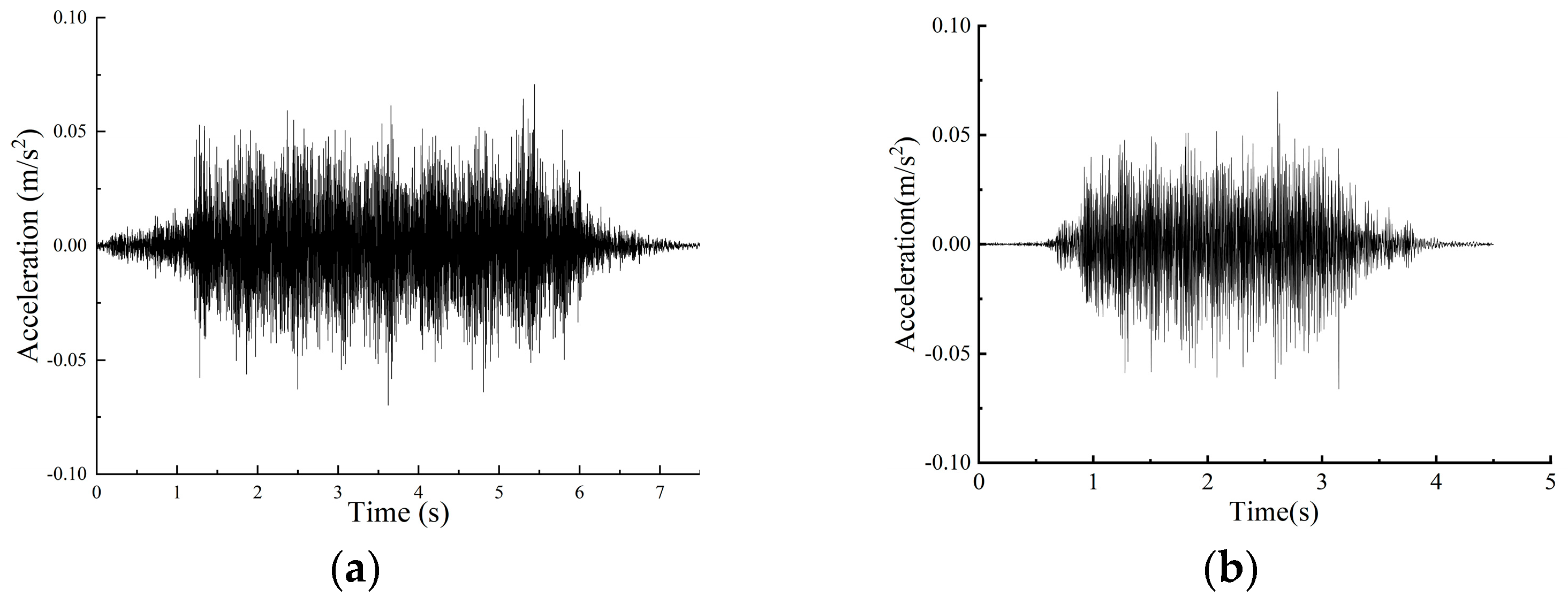
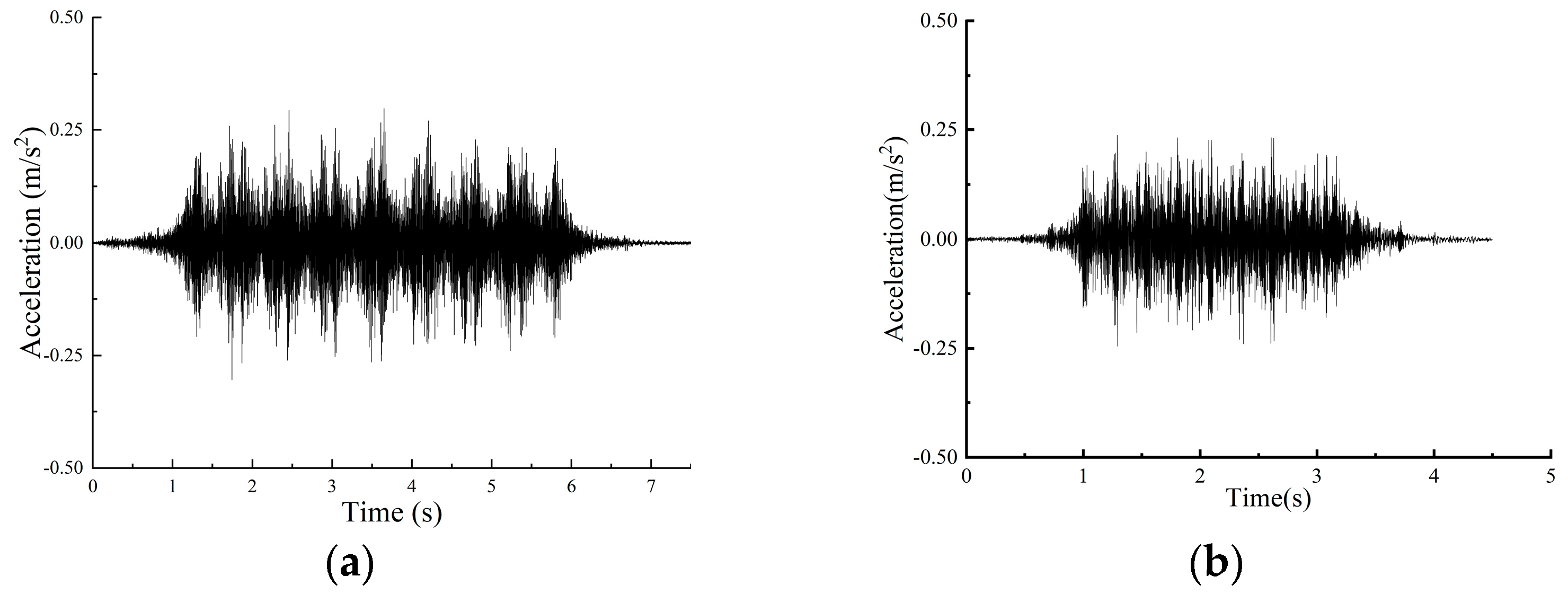
Due to the extensive scale of the three-dimensional numerical model, and in consideration of computational efficiency and the periodic characteristics of train wheel-set impact loads, the duration of the vibration response in numerical calculations is established at 5 s, whereas the recorded vibration response duration is 7 s. Both sets have the same peak acceleration values and peak-to-peak interval characteristics. The acceleration amplitudes of both observed and estimated values vary from −0.05 to 0.05 m/s2, thereby providing a basis for verification. Figure 11 illustrates the time-history data for both measured and computed findings at vibration pickup site A, located beneath the main track at the waiting hall level, as the train traverses Track I at a speed of 250 km/h.
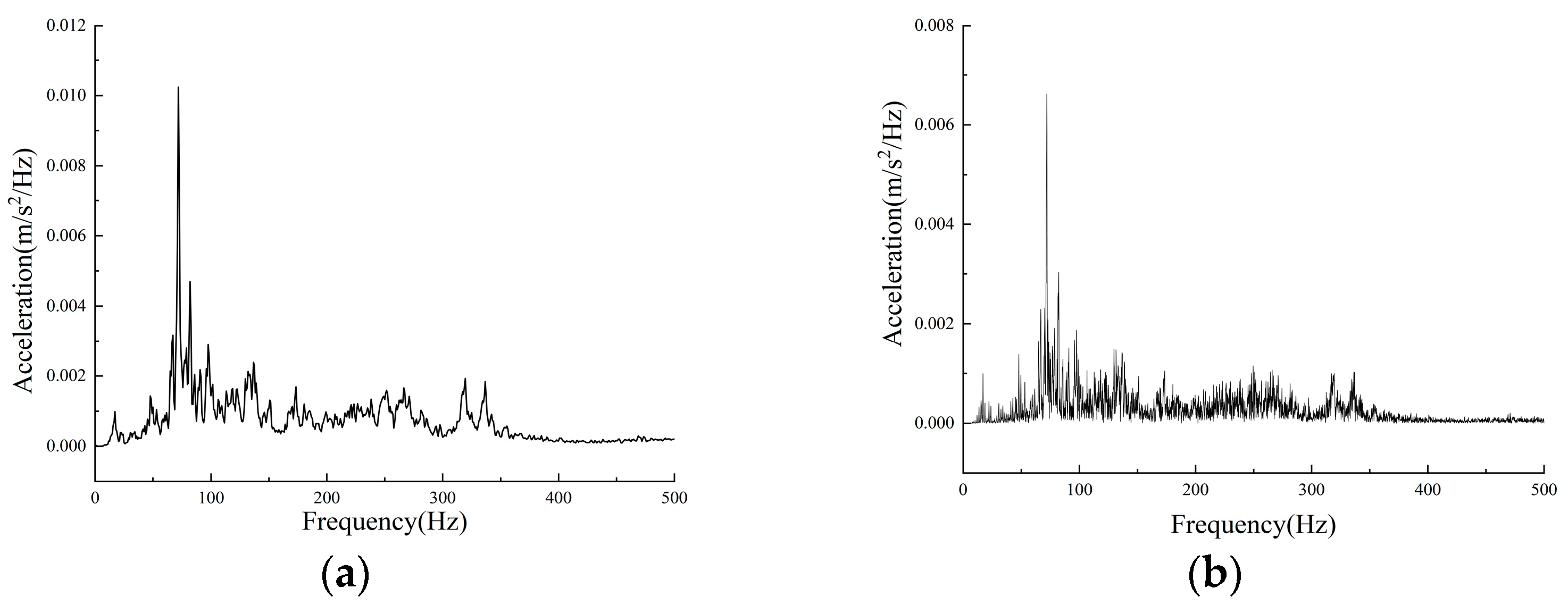
Figure 12 displays the frequency domain data for both the measured and numerically derived values at vibration pickup point A on the main line column base. The primary frequency range of the measured values is between 50 and 100 Hz, with a peak amplitude of 0.01 m/s2 at around 70 Hz. The computed findings indicate that the pre-dominant frequency range is roughly 60–90 Hz, with a peak at approximately 80 Hz and a peak amplitude of 0.007 m/s2. The spectral fitting exhibits strong concordance.
Figure 13 displays the time-history data for the observed and simulated results at vibration pickup point B on the main line column base. The observed acceleration amplitude varies from −0.25 to 0.25 m/s2, but the predicted acceleration amplitude ranges from −0.2 to 0.2 m/s2. The vibration response at the pickup site in the model is marginally inferior to that in the actual scenario.
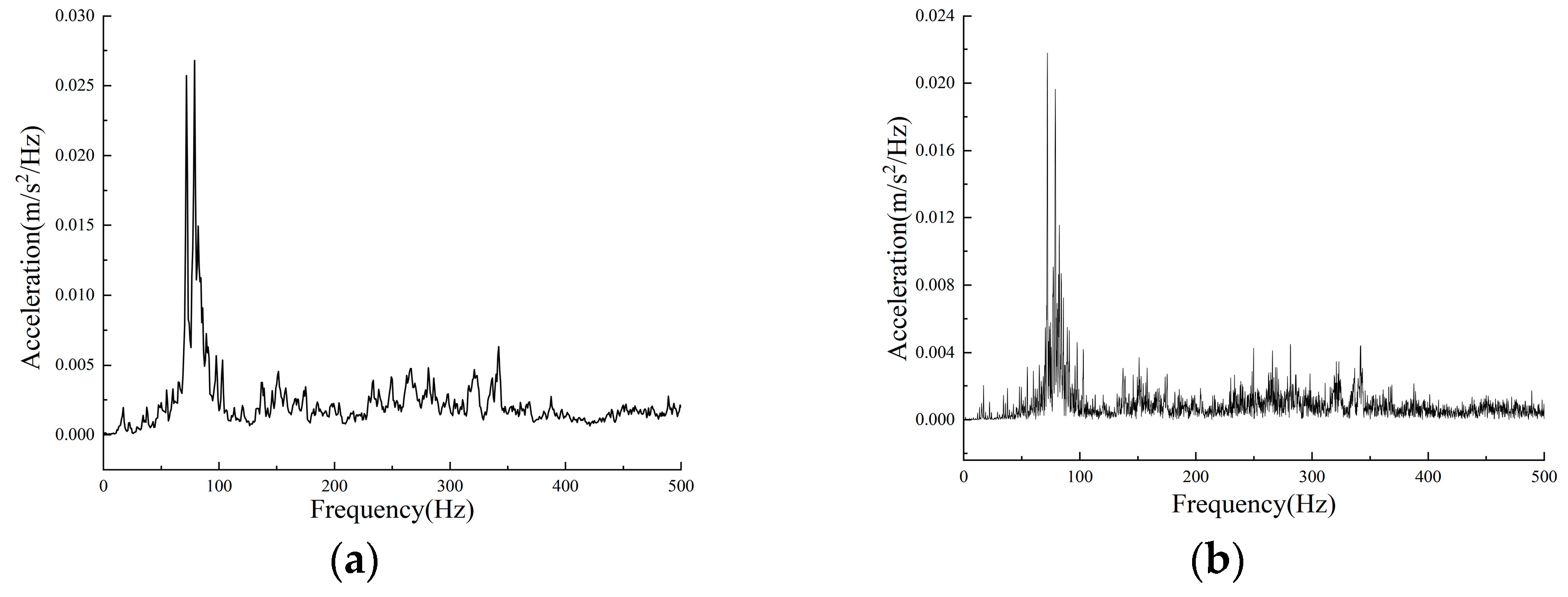
The frequency spectrum data for vibration pickup point B at the base of the main line column is illustrated in Figure 14. The primary frequency range of the measured values is between 70 and 90 Hz, with a peak amplitude of 0.025 m/s2 at around 80 Hz. The simulation findings indicate that the predominant frequency range is between 60 and 120 Hz, with a peak at around 75 Hz and a peak amplitude of 0.022 m/s2.
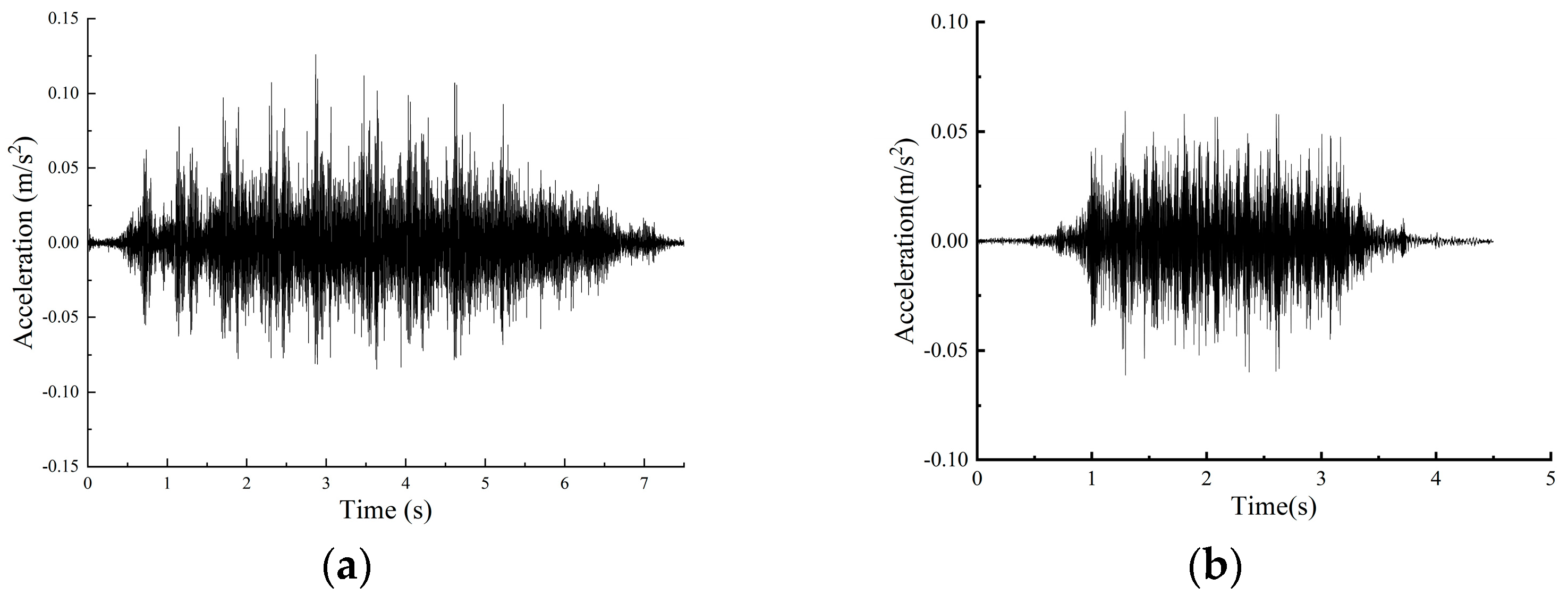
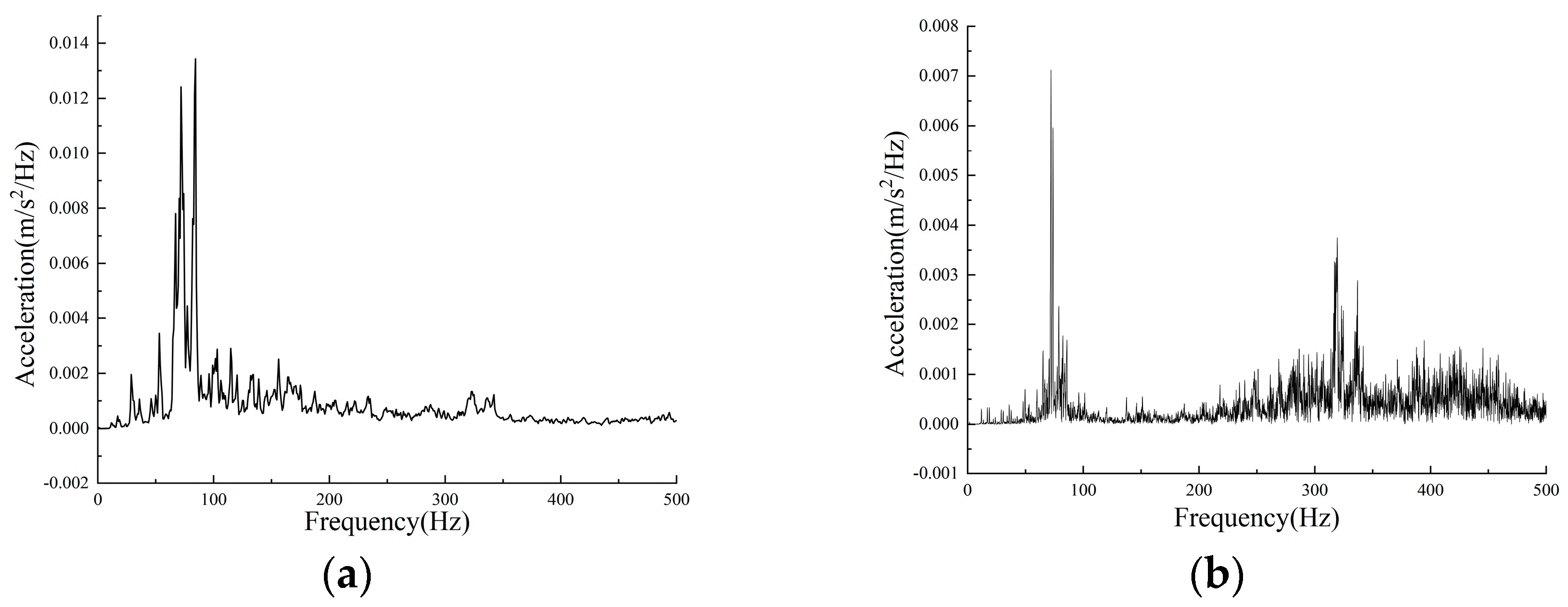
Figure 15 displays the time-history data for both observed and computed findings at platform vibration pickup point C. The observed acceleration amplitude varies from −0.1 to 0.07 m/s2, whereas the computed acceleration amplitude constantly remains between −0.05 and 0.05 m/s2. The calculated peak acceleration values are marginally inferior to the measured ones. This disparity occurs due to the difference in stiffness between the platform layer in the simulation model and the actual stiffness. As a result, the numerical computations produce reduced peak acceleration values conveyed to the platform vibration sensor at point C during train transit. Nonetheless, most of the acceleration curves roughly correspond with the measured values.
Figure 16 displays the measured frequency spectrum data for the platform’s vibration point C. The primary frequency range of the recorded values is between 70 and 90 Hz, with a peak at approximately 80 Hz. The maximum amplitude attains 0.014 m/s2. The computed findings indicate that the predominant frequency range is roughly 80–100 Hz, with additional energy observed between 300 and 400 Hz. The apex is situated at around 80 Hz, with a peak amplitude of 0.007 m/s2.
The comparative results reveal that discrepancies between the numerical model and intricate real-world situations result in slight variances between computed and measured values at the platform level. The acceleration time histories and spectral distribution patterns at the majority of vibration measurement points exhibit similarity, with analogous amplitudes, indicating high fitting accuracy. The vibration acceleration level is a frequency-weighted metric that highlights the actual effects of vibrations on individuals or particular objects. It functions as a standard technical metric for evaluating vibration levels. The 1/3-octave band spectrum serves as an efficient frequency-domain analysis technique distinguished by a reduced number of spectral lines and narrower frequency bandwidths. Both experimental and computational outcomes depict vibration signals as time functions at various sensor locations. Random signal analysis is conducted by Fourier integral transform to derive vibration acceleration spectra, which are subsequently analysed in the frequency domain using 1/3-octave band spectra. The vibration acceleration level VAL is defined by the “Environmental Vibration Standards for Urban Areas” (GB10070-1988) [46].
V A L = 20 lg a r m s a 0
In the formula, the effective value of vibration acceleration is denoted in m/s2 and is computed accordingly; the reference vibration acceleration is established at 1 × 10⁻⁶ m/s2.
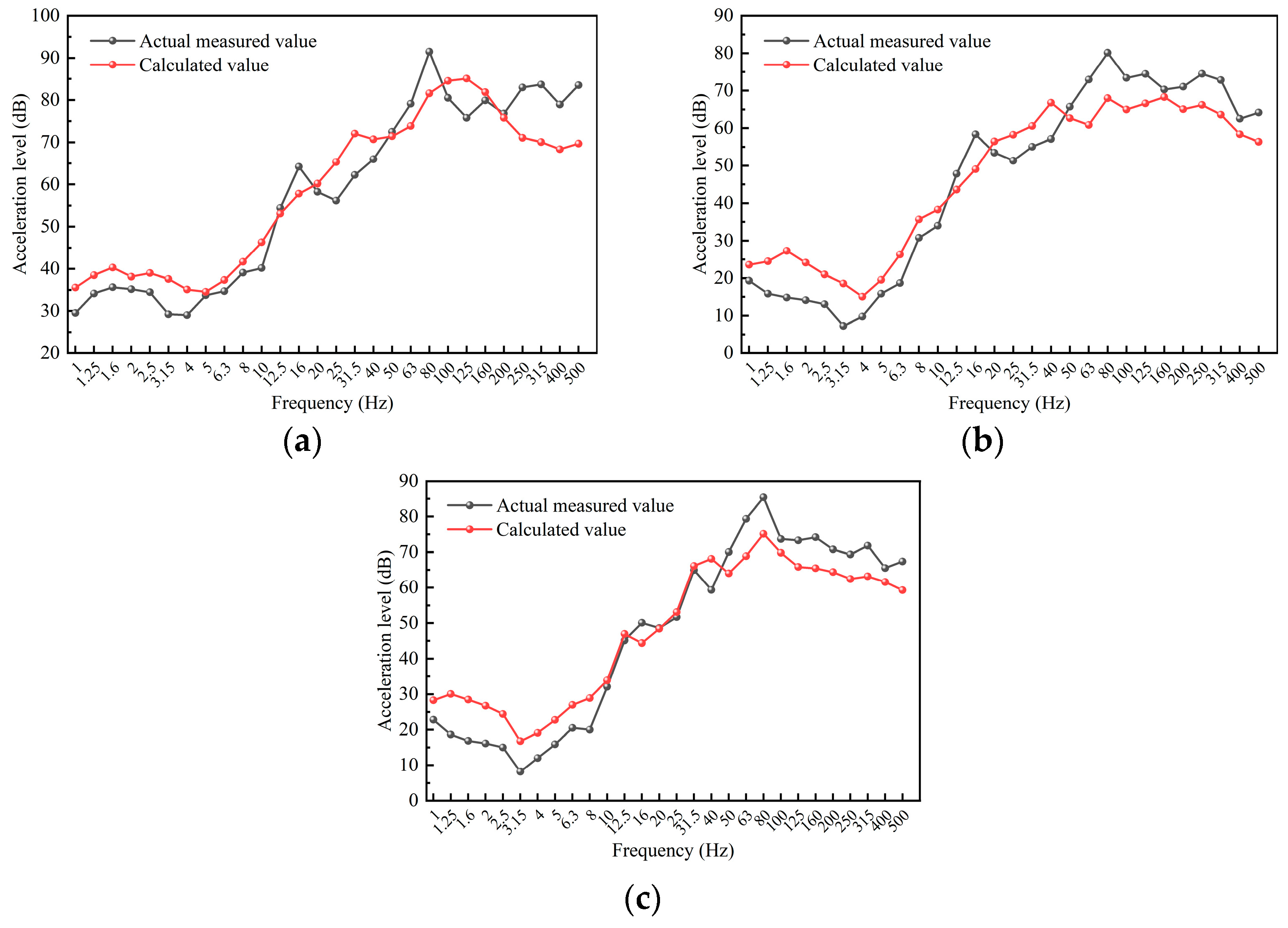
Figure 17 illustrates the 1/3 octave band comparison of simulated and measured vibration response values at each sensor site, facilitating a clearer analysis of the discrepancies between computed and observed data.
The calculated acceleration level at vibration pickup point A on the station waiting hall floor slab beneath the main line in the 1–5 Hz frequency region is approximately 5 dB more than the measured value. In the 16–125 Hz range, the computed value deviates from the observed value by approximately 8 dB. Beyond 200 Hz, the discrepancy is considerable, with computed values falling short of actual values by 10–15 dB. The predicted acceleration level at vibration pickup point B, located at the column base of the main line, is 5 to 10 dB more than the measured value within the 1–10 Hz and 20–50 Hz frequency bands. Within the 50–500 Hz frequency range, the observed values frequently surpass the computed values by 2 to 15 dB. At platform vibration pickup point C, acceleration levels demonstrate considerable discrepancies between 1 and 12.5 Hz, with computed values surpassing actual values by as much as 20 dB. In the frequency range of 20–50 Hz, the estimated values exceed the measured values by 5–10 dB, but in the range of 125–500 Hz, the calculated values are 5–10 dB lower than the actual values.
The examination of the 1/3-octave band acceleration spectra at all vibration pickup locations indicates that both the measured and computed acceleration levels typically escalate with increasing centre frequencies within each 1/3-octave band. Maximum values are observed in the 80–100 Hz range for both measured and computed acceleration levels. Furthermore, computed values surpass measured values in the 1–10 Hz low-frequency spectrum; however, they are inferior to the measured values in the 160–500 Hz high-frequency spectrum. Potential causes encompass excessively idealised model boundary conditions that overlook soil–structure interaction in real foundations and discrepancies between train loads and reality conditions. The model utilises a vibration source that simulates moving loads by altering the position and magnitude of fastener forces, but it does not accurately recreate the high-frequency components of actual loads. Background noise interference and structural complexity are inevitable during vibration testing. Thus, essential simplifications were implemented in the numerical modelling. The model achieves a compromise between computational accuracy and efficiency by optimising mesh density and streamlining loads to improve computational feasibility. This method yields acceptable discrepancies between simulated and measured data within specific frequency ranges, while accurately representing the structure’s fundamental vibration attributes.
This study seeks to validate the HSR station model by comparing numerical simulations with empirical data. The spectrum analysis of the obtained data indicates that the structural vibration energy is predominantly concentrated in the 1–500 Hz frequency range. Consequently, the verification emphasis is on juxtaposing the computed total vibration energy with the measured values within this frequency range. The verification approach utilising total energy per frequency band effectively assesses the model’s overall performance across primary vibration frequencies, reducing the influence of inconsistencies at specific frequency points on the verification outcomes. The error computation η is averaged as outlined below:
η = 1 n i = 1 n ( x i x ¯ )
In the formula, n denotes the quantity of values to be calculated, x i signifies the i-th value to be computed, and the x ¯ symbol indicates the mean value.
The computations produce the mean errors for each vibration sensor location across zones, as illustrated in Table 4. The cumulative energy discrepancies between computed and observed values for pickup point A (station waiting hall level), pickup point B (mainline column), and pickup point C (platform level) are 14.92 dB, 11.14 dB, and 14.52 dB, respectively. The mean errors across frequency bands are computed as 0.53 dB, 0.4 dB, and 0.52 dB.
A comparative comparison of numerical calculation results versus measurable data reveals that calculation errors at each vibration pickup site are maintained within an acceptable range. These discrepancies primarily arise from the following factors: The intrinsic intricacy of the building structure required simplifications in the modelling process. Secondly, considerations of computational economy prompted suitable optimizations in load simulation and mesh generation. Nonetheless, the total error stays within permissible bounds, indicating that the developed numerical model and its parameter configurations satisfy accuracy standards and are appropriate for further investigation and analysis of vibration propagation characteristics.

4. Analysis of Vibration Response Characteristics for New Integrated Bridge-Station Elevated Railway Station Structures

4.1. Model Establishment and Analysis Condition Configuration

A numerical model for the new IBSE was developed based on the modelling approach and parameter selection validated by actual station measurements. The structural parameters of the station are derived from Table 1. Given a concrete shear wave velocity of 1500 m/s and an analytical frequency range of 1–500 Hz, the minimal dimension of the numerical model should not surpass 1500/(6 × 500) ≈ 0.5 m. Due to computational limitations, a grid size of 0.5 m is utilised at essential places such as the vibration source, propagation path, and sensor points. The shear wave velocity of the soil layer is established at 500 m/s. The soil layer solely functions to absorb vibration waves. Hence, the highest frequency of interest is limited to 200 Hz, with a mesh size not surpassing 0.4 m. In the track-bearing layer load application zone, considering the characteristics of the track structure, the mesh size in the direction of train movement is 0.6 m, whereas the mesh size perpendicular to this direction is 0.5 m. The foundation soil utilises a single-layer soil model, with infinite element boundaries implemented at the base and periphery of the defined model. The unit type and attribute are consistent with the previous model. The damping coefficient is determined using Formulas (2) and (3). Four operational velocities are evaluated for high-speed train excitation forces: 200 km/h, 250 km/h, 300 km/h, and 350 km/h. The results previously calculated in Section 3.3 are directly utilised.
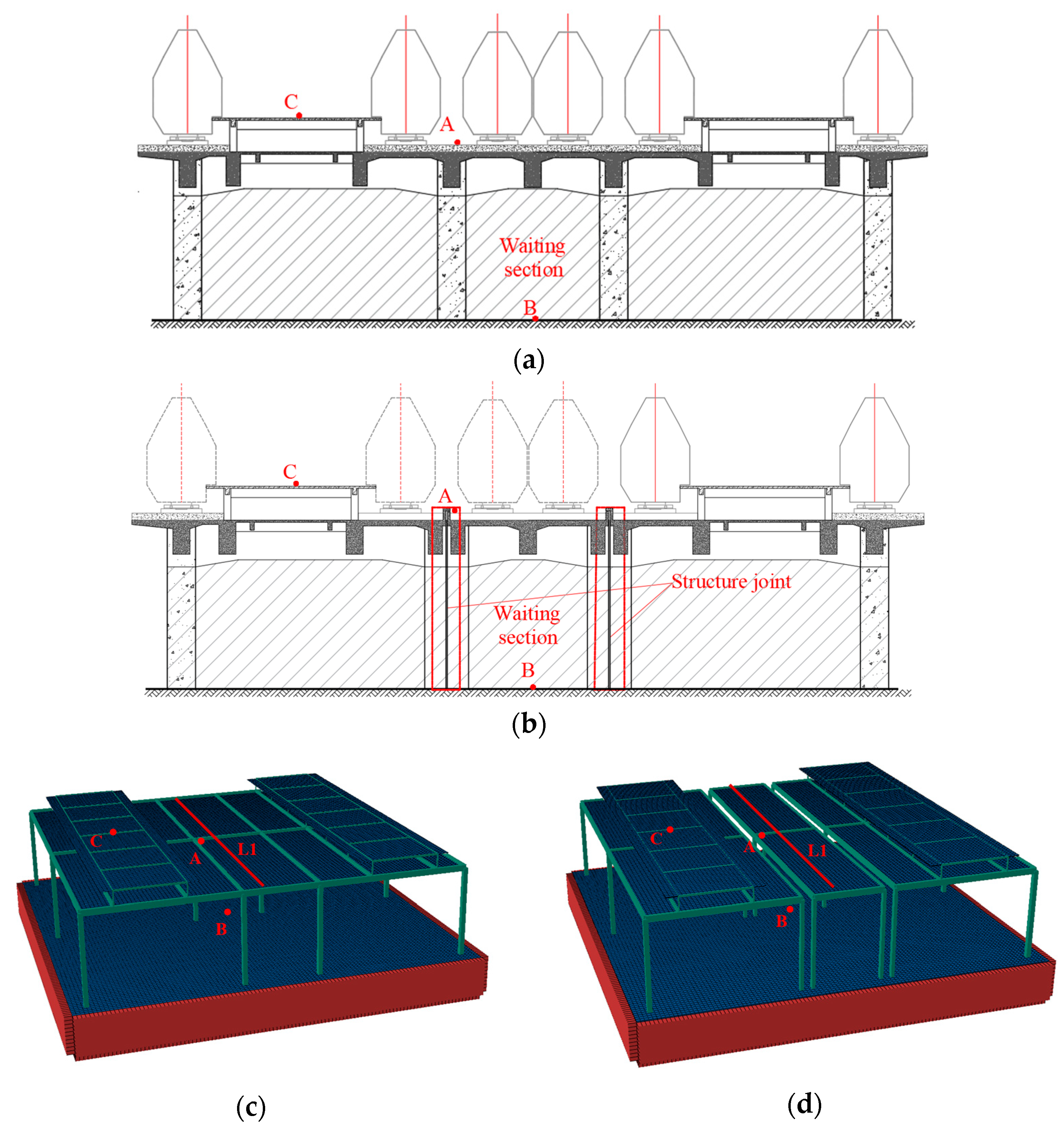
To assess vibration responses at several places within the elevated station, typical measurement points A, B, and C were designated on the track-bearing layer, waiting hall layer, and platform layer, respectively, as illustrated in Figure 18. Vibration point A is situated 2.5 m from the centreline of the primary track on the track bed layer. The vibration point B is located near the centre of the floor slab in the waiting hall. The vibration point C is located near the centre of the floor slab of the platform. The primary track lines are labelled L1 and L2.
This paper primarily examines the impact of three factors—station spatial structure, train velocity, and train operational organisation—on the vibration response of station structures. Seven operational conditions have been defined, as indicated in Table 5. Station spatial structures consist of two categories: Station I, which lacks structural joints, and Station II, which incorporates structural joints. Train velocities encompass 200 km/h, 250 km/h, 300 km/h, and 350 km/h; traffic organisation methods comprise single-track operation on main track L1 and concurrent double-track operation on main tracks L1 and L2. Vibration measurement locations A, B, and C were designated at the track-bearing level, platform level, and waiting area level, respectively. The vertical acceleration at these locations was utilised as the subject of investigation to analyse the dynamic response of the structure during train transit under various operating conditions.

4.2. Analysis of Parameter Influence Patterns

4.2.1. Station Spatial Structure

Choose operating conditions 1 and 2 to examine the impact of spatial structure on the dynamic characteristics of the station.
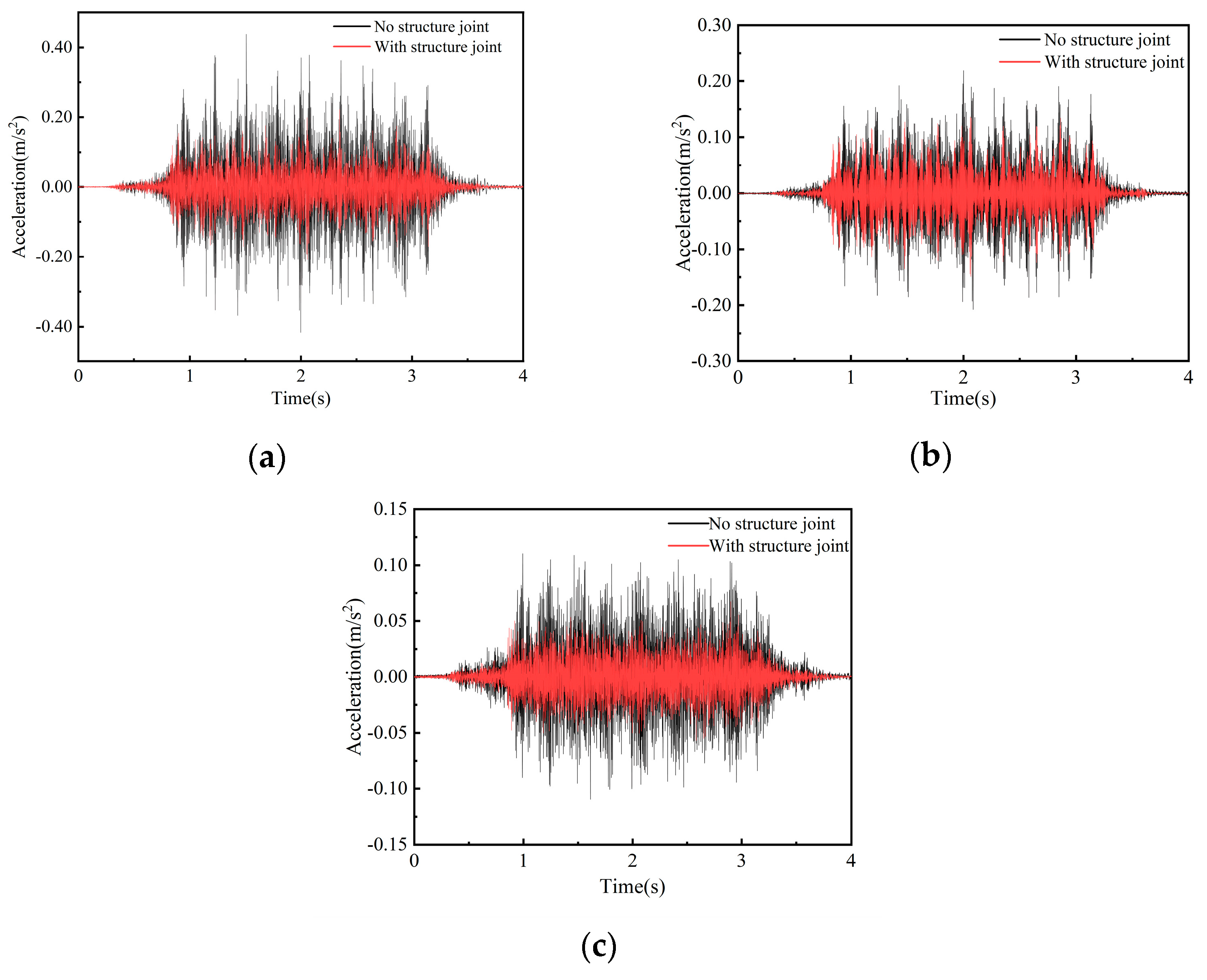
Analysis of the peak acceleration values at various sensor positions under differing operating conditions, as depicted in Figure 19 and summarised in Table 6, reveals that for the track bed layer, Station I demonstrates higher peak accelerations than Station II, recording 0.42 m/s2 and 0.37 m/s2, respectively. The maximum acceleration values at both locations are approximately equivalent, measuring 0.12 m/s2 and 0.14 m/s2, respectively. At the platform level, the maximum acceleration at Station I is 0.15 m/s2, which exceeds the 0.08 m/s2 recorded at Station II. This signifies variations in peak vibration acceleration among different segments of the two stations. The differing levels of peak acceleration at each sensor position under both operation situations demonstrate that the existence or nonexistence of structural joints affects vibration response. Station constructions featuring structural joints demonstrate elevated peak acceleration values in their vibration response. The reason why the peak acceleration at the vibration pickup point on the platform of Station I is significantly greater than that of Station II is that the vibration energy generated by the train is directly transmitted to the platform layer through the track-bearing layer. However, due to the existence of structural joints in Station II, the vibration energy must first be transmitted to the soil through the main line columns, and then further transmitted to the platform layer via the main line columns. The peak acceleration at the vibration pickup point in the waiting hall of Station II is slightly greater than that of Station I because most of the train vibration energy is transmitted to the soil through the main line column, and only a small part of the energy can be transmitted to the track-bearing level. Similarly, the peak acceleration at the vibration pickup point of the track-bearing layer in Station II is slightly lower than that in Station I because the vibration capacity cannot be transmitted through the structural joint.
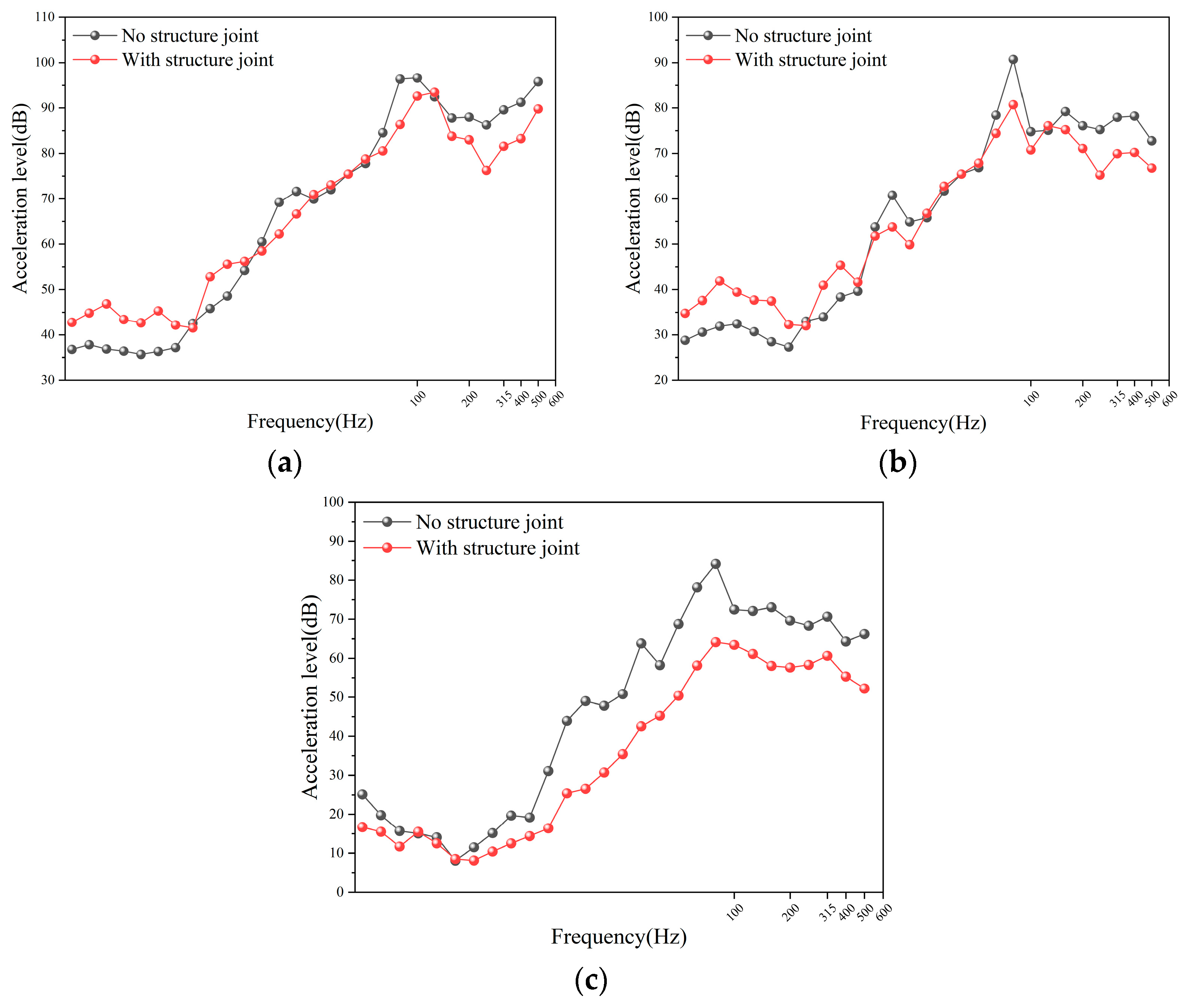
To analyse the disparities in vibration characteristics across identical pickup points at the two stations, the 1/3-octave band spectra of the vibration responses at each point under varying operating conditions were compared, as illustrated in Figure 20.
The acceleration level variation patterns for the track-bearing layer and waiting hall are analogous under both station operating situations. In the 1–5 Hz frequency range, Station I demonstrates reduced acceleration levels compared to Station II, with a disparity of 5–8 dB. In the 80–500 Hz frequency range, Station I exhibits elevated acceleration levels compared to Station II, with a difference of 2–10 dB. The maximum acceleration values for both stations are observed at around 80 Hz, exhibiting a peak discrepancy of 10 dB. The acceleration values at the platform level vary considerably between the two stations under operational conditions. In the 10–500 Hz frequency range, Station I demonstrates elevated acceleration levels compared to Station II, with a disparity of 10–20 dB. The origin of these discrepancies is attributed to the segregation of the primary track structure from the arrival/departure track structure at Station II. This gap decreases the rigidity of the primary track’s bearing layer, lessening the attenuation of low-frequency vibration energy (1–10 Hz) while markedly attenuating vibration energy over 100 Hz. As vibrations travel from the waiting hall to the platform level, energy dissipation increases, leading to diminished acceleration levels.
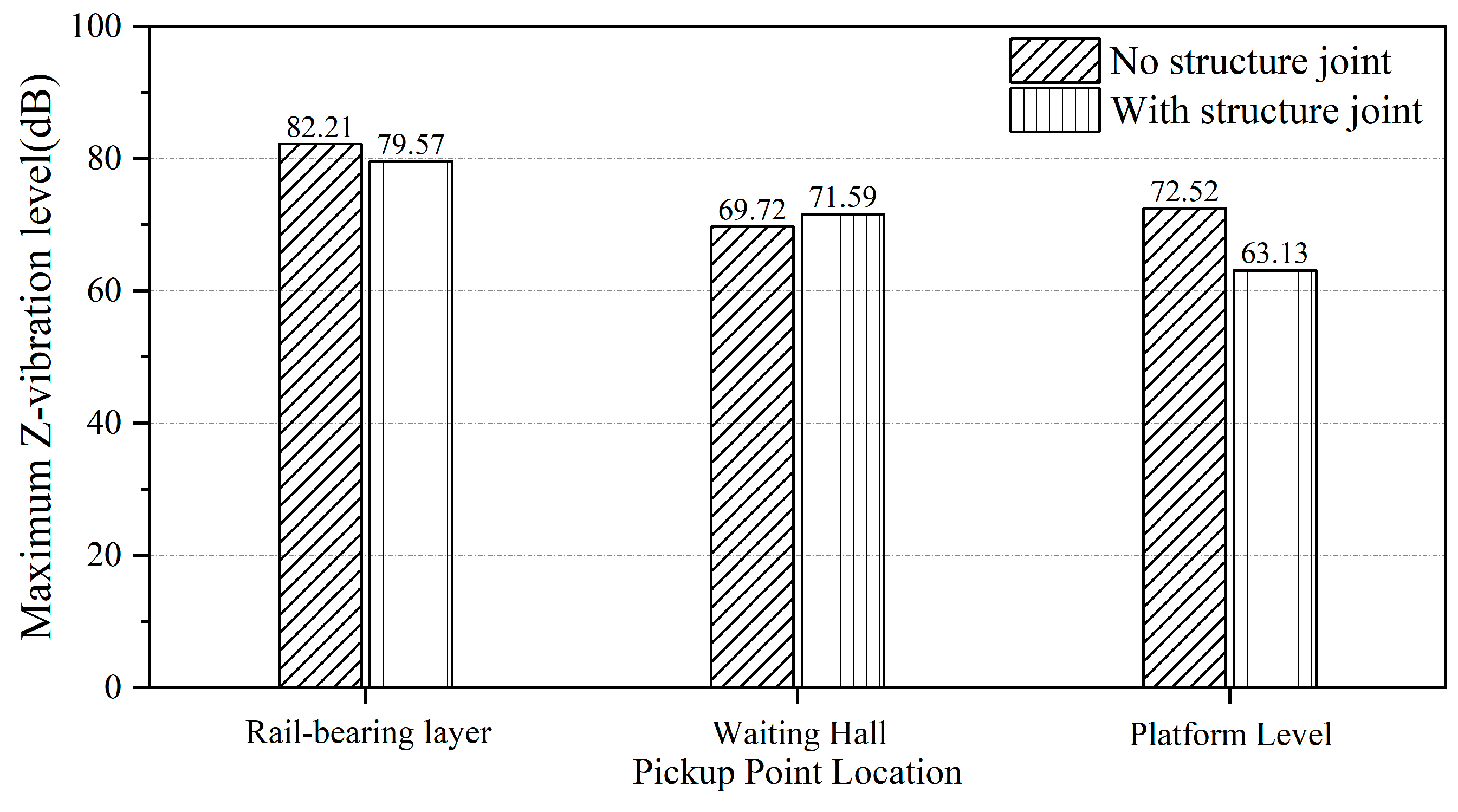
The maximum Z-vibration level (VLzmax) at each sensor point during mainline train passage was computed and analysed to assess the vibration characteristics of the proposed elevated station. Figure 21 illustrates the VLzmax at each sensor location.
Figure 21 illustrates that the VLzmax at the waiting hall for both station structures is approximately similar. The VLzmax at the rail bed and platform levels demonstrates a significant disparity, with Station I (lacking structural joints) exhibiting elevated values. The disparity at the track bed is 3.7 dB, whereas at the platform level, it is 8.4 dB. The principal cause of this disparity is that at Station II, the structural joint facilitates the transmission of vibrations from the track-bearing layer through columns to the waiting hall, then through the waiting hall floor and soil layer to the neighbouring platform level. This intricate transmission pathway leads to the dissipation of vibration energy, resulting in a diminished vibration response at the platform level. Conversely, Station I is devoid of structural joints, permitting vibrations to transmit directly from the track bed to the neighbouring platform. This more direct and concise gearbox route reduces energy loss, leading to an amplified vibration response at the platform level. This illustrates that structural joints induce discontinuities in the track bed, thereby interrupting direct vibration routes. This enhances both the distance and intricacy of energy transmission pathways, thereby diminishing platform vibration response dramatically.

4.2.2. Operating Speed

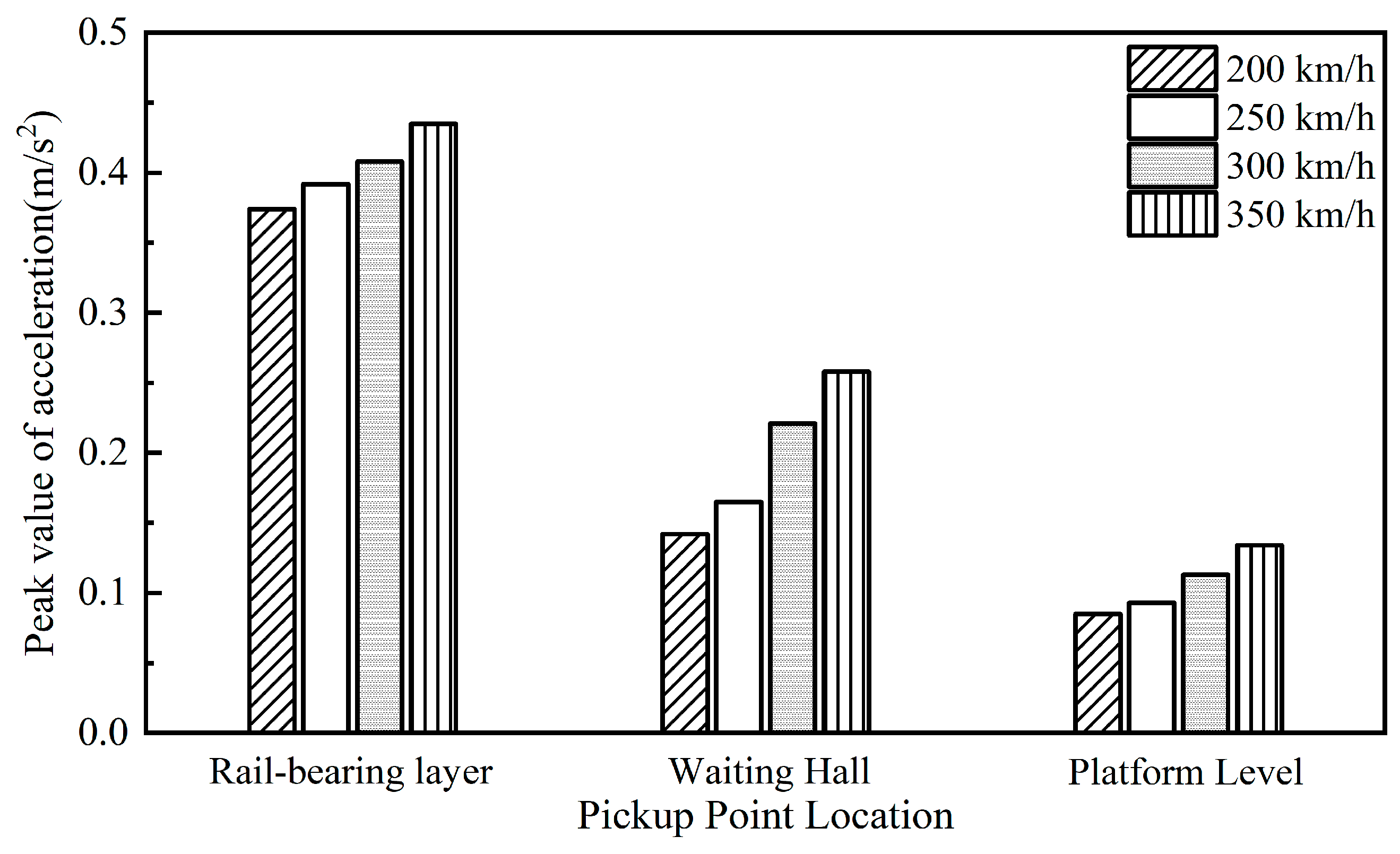
Choose operating conditions 2–5 to examine the impact of vehicle speed on the dynamic characteristics of the station. Figure 22 illustrates the maximum acceleration values at each vibration pickup location under the four operating circumstances.
The highest acceleration at each vibration measuring site increases with the train’s speed. As the train speed increases from 200 km/h to 350 km/h, the maximum acceleration at the track bed measurement location escalates from 0.374 m/s2 to 0.435 m/s2. The acceleration peak at the platform layer sensor point rose from 0.085 m/s2 to 0.134 m/s2. The most significant alteration transpired at the waiting hall sensor site, where the acceleration peak escalated from 0.142 m/s2 to 0.258 m/s2, indicating an 81.7% augmentation. This suggests that variations in train speed have the greatest impact on vibration intensity in the waiting hall.
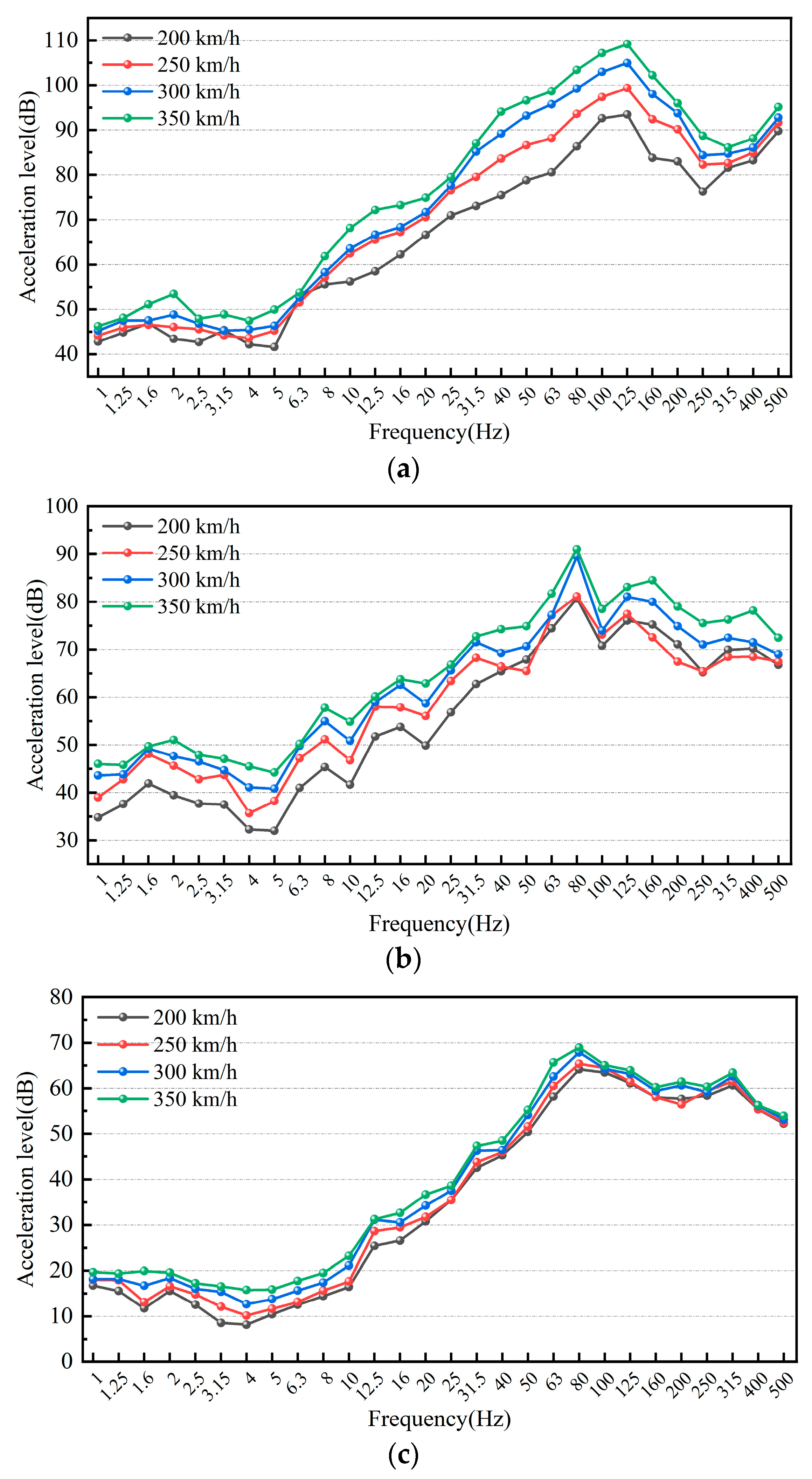
To systematically evaluate the influence of speed variations on spectral distribution patterns at each vibration measurement location, the 1/3-octave band spectra of vibration responses were computed for each area under differing train speed conditions, as illustrated in Figure 23.
The examination of the 1/3-octave band spectra from many vibration pickup locations indicates that acceleration levels across all frequency bands escalate with increasing train speeds, although the patterns of variation remain consistent. For the track bed, acceleration levels in the 10–250 Hz range escalated by 10–35 dB when speed increased from 200 km/h to 350 km/h, whilst levels in the 1–10 Hz and >315 Hz ranges grew by 5–10 dB. In the waiting hall, acceleration levels rose by 15–20 dB in the 1–31.5 Hz range and by 7–15 dB in the 31.5–500 Hz range when speed escalated from 200 km/h to 350 km/h. At platform levels, as speed escalates from 200 km/h to 350 km/h, acceleration levels within the 1–100 Hz frequency range rise by 5–10 dB, but levels exceeding 100 Hz increase by 0–5 dB.
As train velocity escalates, the vibration energy at the platform level demonstrates minimal fluctuation. This is due to the extended propagation path of vibrations from the track to the platform layer, along with structural dampening effects encountered en route. Thus, the augmentation of vibration energy within the 1–100 Hz frequency range is negligible, while vibration energy over 100 Hz remains largely unaffected by changes in speed.
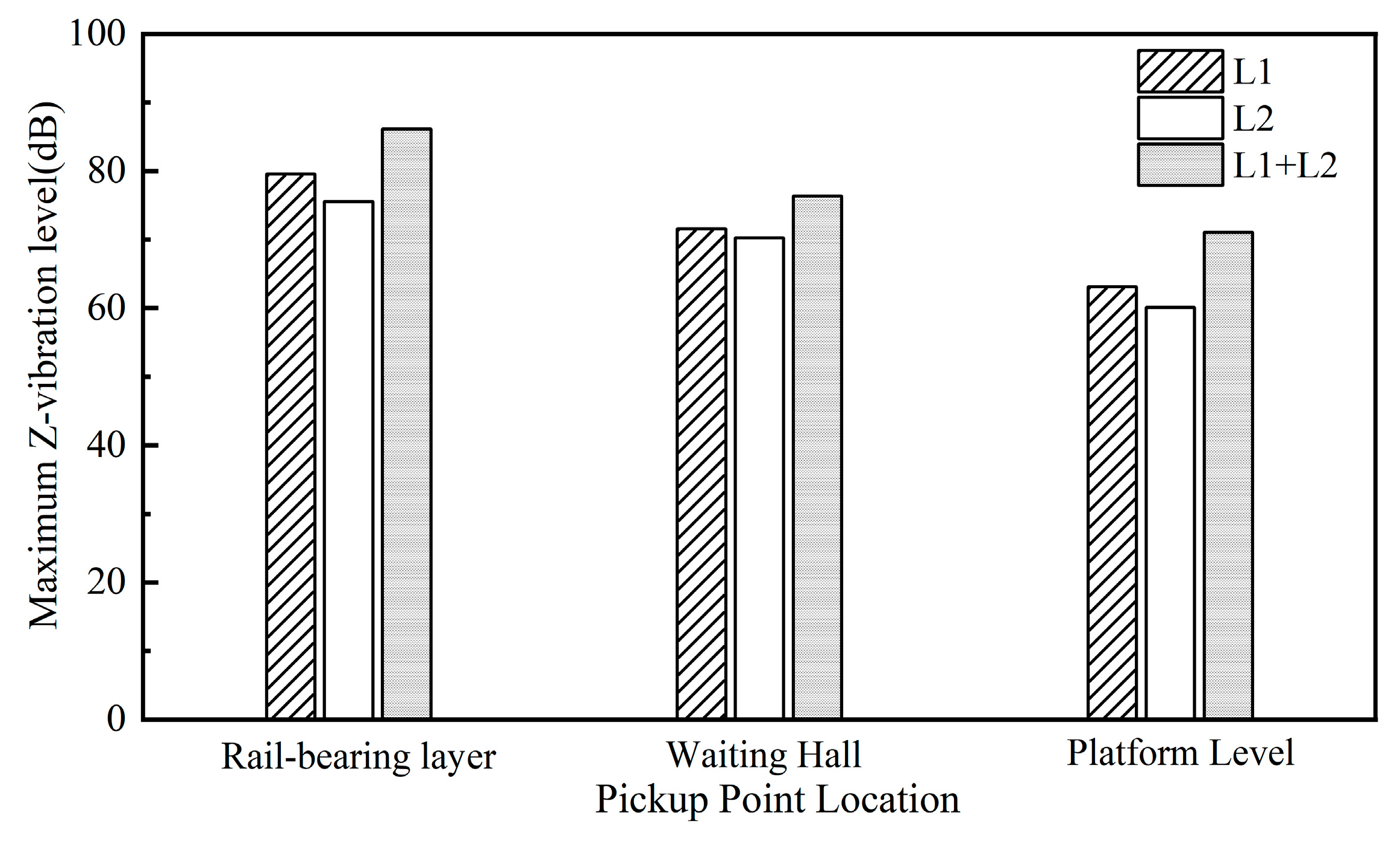
Figure 24 presents a statistical study of the VLzmax at each vibration pickup location across different speed conditions.
The VLzmax at each vibration pickup site increases with elevated train speed. The VLzmax at the pickup locations for the track bed layer increased by 3.12 dB, 4.34 dB, and 6.09 dB, respectively, throughout the four operating conditions as speed increased. In the waiting hall, the VLzmax at the vibration pickup point rose by 1.50 dB, 2.23 dB, and 3.29 dB, respectively, as speed escalated under the four operational conditions. At the platform level, the VLzmax at the vibration pickup point rose by 1.42 dB, 1.53 dB, and 1.75 dB, respectively, as speed increased under the four operational conditions.
The escalation in VLzmax at each pickup site does not demonstrate a linear correlation with speed; instead, the amplitude of the increase in VLzmax also intensifies as train speed escalates. The peak VLzmax at the track-bearing layer exhibits the most significant fluctuation with velocity, due to heightened wheel–rail excitation forces at elevated speeds. In contrast, the VLzmax at the platform layer demonstrates minimal variation with speed, principally attributable to the extended vibration energy transmission path and increased attenuation, leading to reduced amplitude fluctuations.

4.2.3. Traffic Organisation

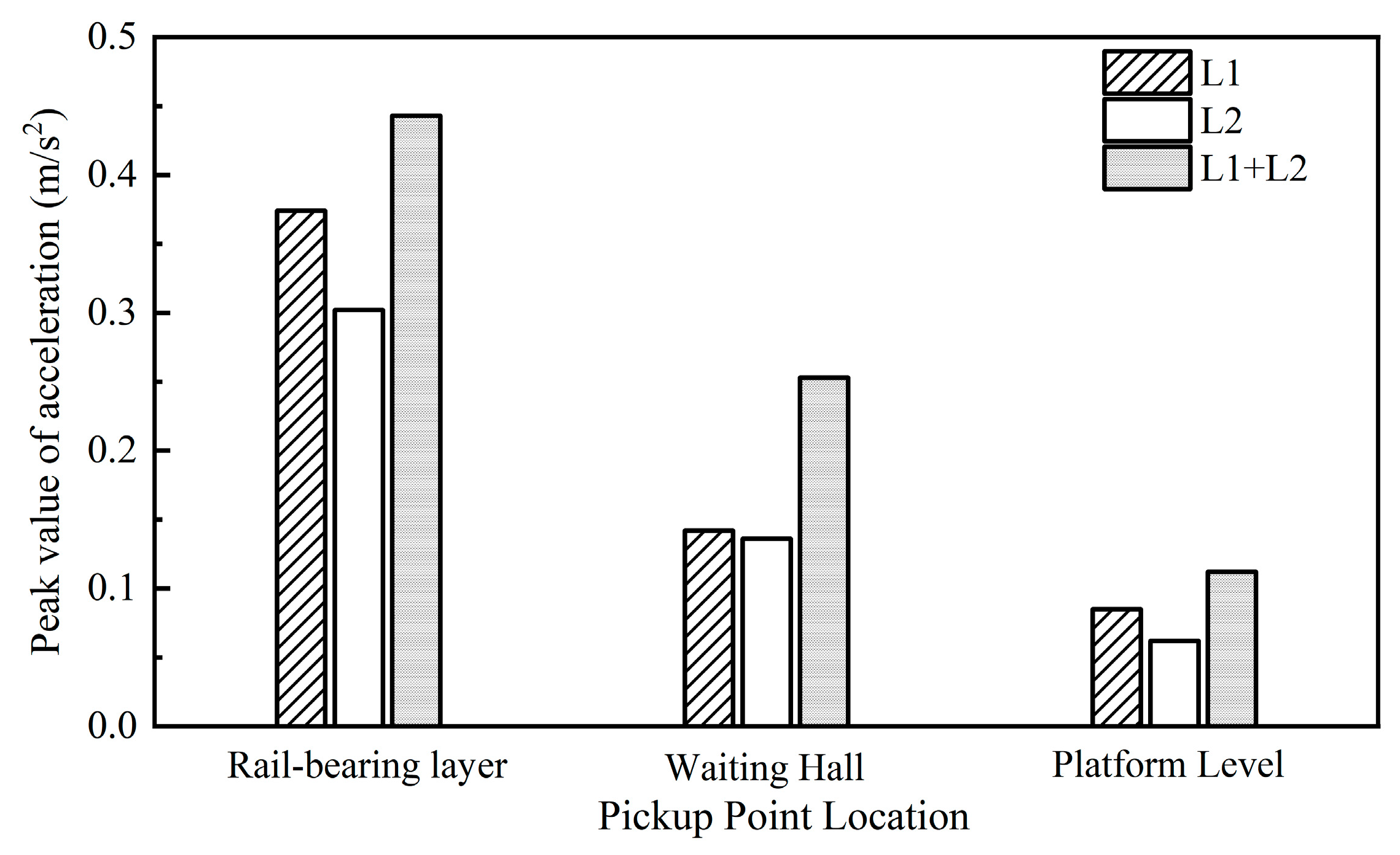
Choose operating conditions 2 and 6–7 to examine the impact patterns of train operations on the dynamic features of the station. Calculations were conducted for single-track train transit through L1, single-track train transit through L2, and the simultaneous passage double-track trains at the station’s central section. Figure 25 displays the peak vibration acceleration response data for each structural layer under both single-track and double-track operation circumstances.
Figure 25 illustrates that, under the two operational scenarios of single-track train passage, the peak acceleration values at both the track bed and platform level vibration measurement spots are greater for the L1 track condition compared to the L2 track condition. This signifies that vibration transmission to the track bed and platform level is less diminished under the L1 track condition. The acceleration peaks at the waiting hall sensor positions are almost identical under both situations, recorded at 0.142 m/s2 and 0.136 m/s2, respectively. This signifies comparable degrees of attenuation in vibration transmission to the waiting hall in both circumstances.
The proximity of the sensor point to the L1 track results in a larger vibration response magnitude from a single train traversing the L1 track compared to that of a single train on the L2 track. The sensor point in the waiting hall is situated at the midpoint between the two primary tracks. The structural symmetry ensures that the vibration energy received at the sensor site in the waiting hall is the same when trains traverse either the L1 or L2 track under single-track conditions, yielding little disparity. The vibration response during concurrent double-track train passage surpasses that of single-track passage. In comparison to the single-track L1 passage situation, the peak accelerations at the track bed, waiting hall, and platform levels rose by 18.4%, 78.2%, and 31.8%, respectively, demonstrating that double-track operation significantly influences vibrations in the waiting hall.
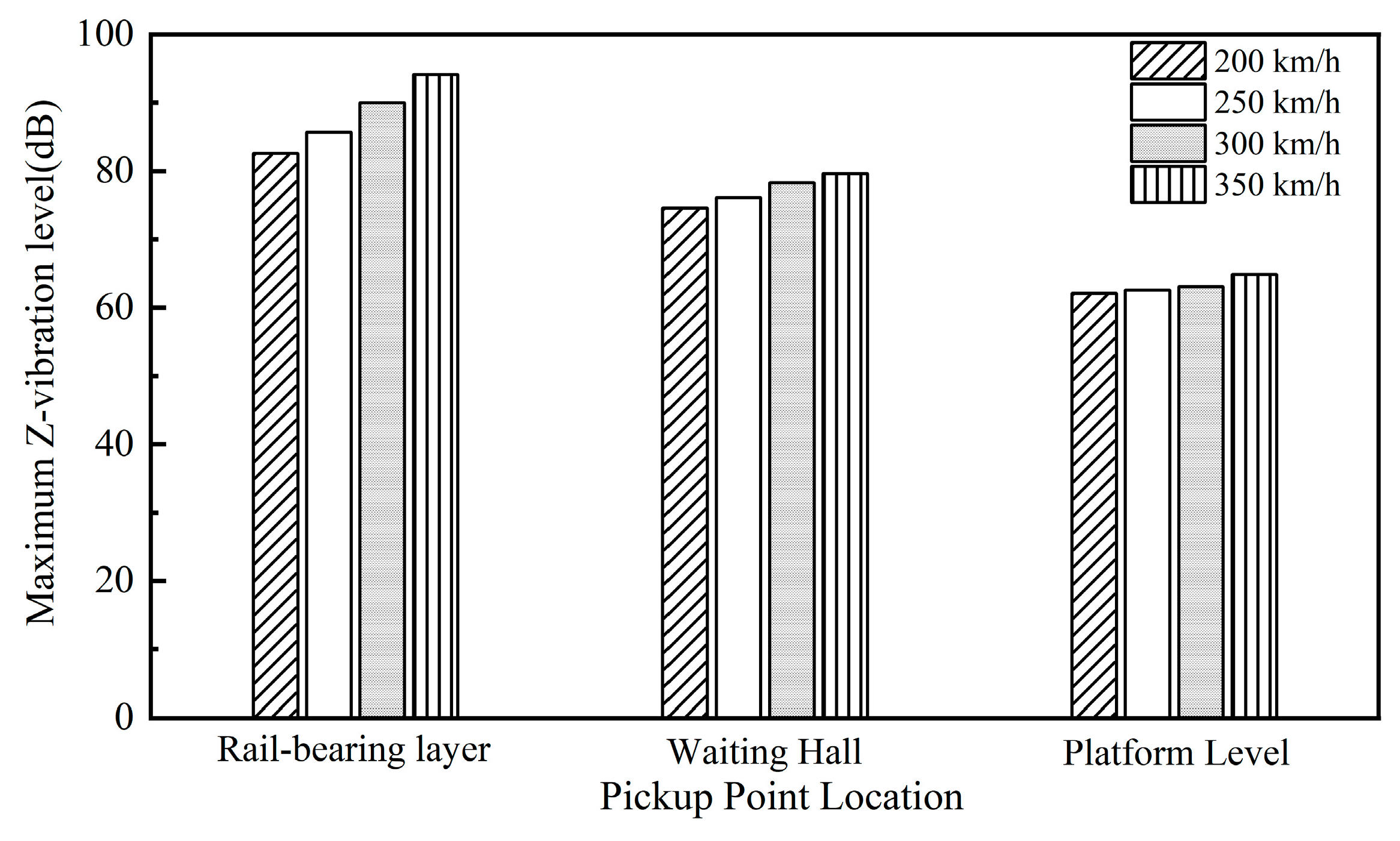
To methodically examine the impact of single- and double-track operations on the distribution of vibration spectrum energy, the 1/3-octave band spectra of vibration responses were computed for each zone under different speed settings, as seen in Figure 26.
Figure 26 illustrates that when trains traverse either Track L1 or Track L2 independently, or when they navigate both tracks concurrently, the 1/3 octave band curves at each vibration pickup location have analogous profiles. This signifies that the vibration response patterns generated under these three operational circumstances are inherently constant. The vibration levels generated by dual-track simultaneous transit are markedly greater than those produced by single-track passage. For the track-bearing layer, peak acceleration levels across all situations are observed at around 100 Hz, with acceleration levels in the 1–250 Hz frequency region being greater in the double-track scenario compared to the single-track scenario. The disparity between the double-track situation and the single-track L1/L2 scenarios varies from 2 to 5 dB and 2 to 10 dB, respectively. The maximum acceleration level in the waiting area is seen at 80 Hz in all conditions. The acceleration values of L2 train passing conditions are essentially comparable across all frequency bands. The dual-track configuration produces greater acceleration levels compared to single-track train passage, with variations between 3 and 7 dB. The disparity in acceleration levels between the two single-track train passing conditions at the platform level is negligible. The dual-track train passing situation generates greater acceleration levels than the single-track L1 train passing condition throughout all frequency bands, with variations between 2 and 4 dB. This suggests that alterations in the running line layout have minimal impact on the vibration response at the platform level. The transmission path of vibrations from the track to the platform level is quite lengthy, leading to considerable attenuation and low transfer of vibration energy to the platform level.
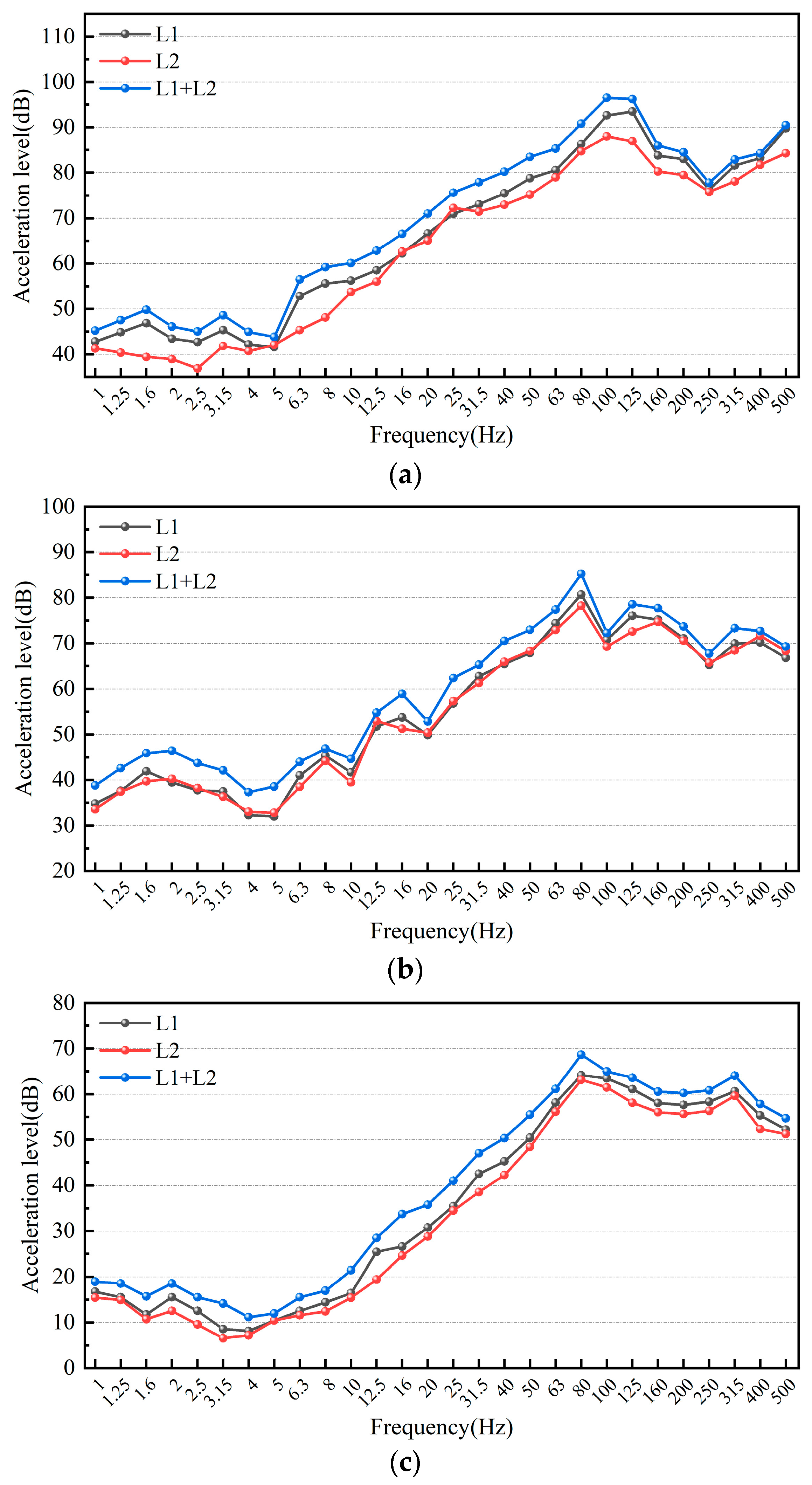
The maximum Z-level vibration response was computed for each single- and double-track transit scenario. The outcomes are illustrated in Figure 27.
Figure 27 illustrates that, for the identical vibration measurement point, the VLzmax across all operational conditions adhere to a consistent hierarchy: the peak occurs during double-track train passage, succeeded by single-track train passage on Track L1, whereas the minimum VLzmax is recorded during single-track train passage on Track L2. The VLzmax at the track bed, waiting hall, and platform levels for the two single-track passing circumstances differed by 4.03 dB, 1.33 dB, and 3.01 dB, respectively. The proximity of the vibration pickup locations at the track bed and platform level to Track L1 leads to reduced vibration propagation distances. As a result, reduced energy is dissipated, resulting in an enhanced vibration response. The measurement site in the waiting hall is situated immediately beneath the centreline of both main tracks, receiving equivalent vibration energy from trains in all circumstances.
In comparing L1 track passing with double-track passing, the VLzmax at the track bed, waiting hall, and platform level varied by 6.6 dB, 4.75 dB, and 2.92 dB, respectively. The track bed demonstrates the most significant alteration in VLzmax, while the platform level exhibits the least change. The longer transmission distance from Track L2 to the platform level results in greater attenuation during transmission compared to Track L1, hence diminishing its contribution to the vibration response at the platform level.

5. Waiting Hall Environmental Vibration Evaluation

To assess the vibration level of the waiting hall located beneath elevated station bridges, the vibration response of the waiting hall floor slab under diverse operation situations constitutes the essential data. Evaluation metrics stated in pertinent regulations or standards are used to analyse the vibration response levels of the waiting hall floor slab under various operation conditions.

5.1. Selection of Standards

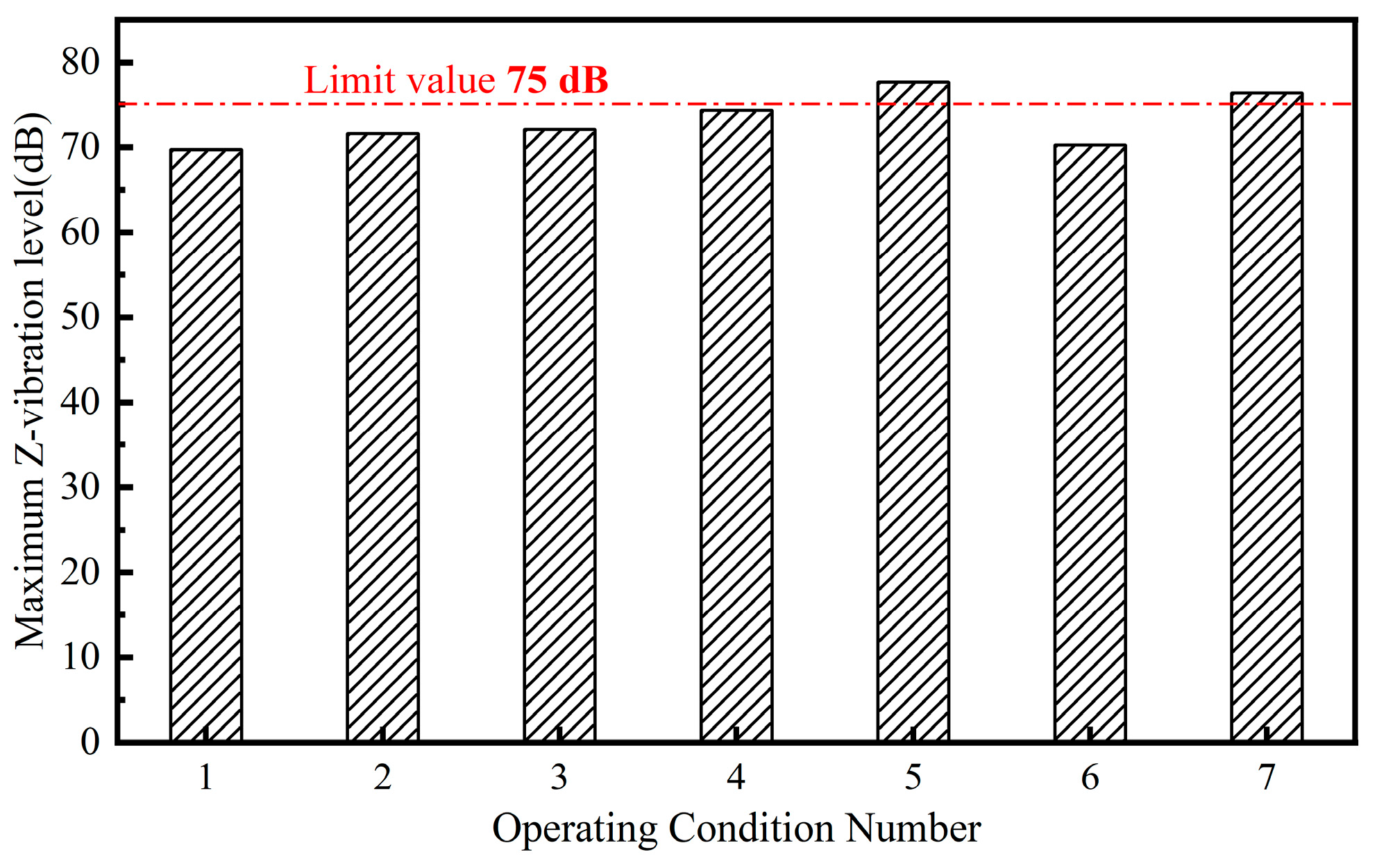
At present, there is a wide variety of evaluation indicators for environmental vibration, and the calculation methods of different indicators vary to a certain extent. This paper discusses the Z-level VLzmax, utilised by Zhi et al. [47] as a metric for assessing vibration level, and juxtaposes it with the VLzmax threshold values (refer to Table 7) outlined in the China Standard (JGJ/T 170-2009) [48], to quantitatively assess the vibration in the waiting hall under diverse operational scenarios. Considering the large passenger flow and short passenger stay time in the waiting hall, the applicable scenario is classified as a daytime mixed area or commercial area (daytime), with a limit standard of 75 dB.

5.2. Environmental Vibration Evaluation

Acceleration time records of vibration responses at the pickup spots in the waiting hall under different operating conditions were selected. The Z-weighted vibration acceleration levels for the centre frequency of the 1/3 octave bands were computed. The VLzmax was selected as the definitive evaluation metric. Statistical analysis was conducted on the computed VLzmax at the pickup spots in the waiting hall under each operational state, as illustrated in Figure 27.
Figure 28 illustrates the VLzmax at the vibration measurement locations in the waiting hall under different operational situations. The VLzmax at the vibration pickup points in the waiting hall, under varied operation conditions, is roughly 70 to 80 dB. The VLzmax at the vibration pickup points in the waiting hall under working parameters 5 and 7 are 77.61 dB and 76.34 dB, respectively, surpassing 75 dB. Consequently, when a train traverses a single track at 350 km/h and a double-track main line at 200 km/h, the VLzmax on the waiting hall floor substantially exceeds the permissible limit. Consequently, during the design and operation of the station, particular emphasis must be placed on the velocity of trains traversing the main line and the functioning of double-track trains. It is advisable to implement efficient vibration reduction and isolation strategies to ensure that the vibration levels in the waiting hall comply with standard criteria.

6. Conclusions

A hybrid method of field vibration testing and numerical simulation is used to create and validate a finite-element modelling and solution technique that accurately depicts bridge-station integrated elevated stations’ dynamic characteristics. This technology was used to calculate the vibration response of the revolutionary bridge-station integrated elevated station during high-speed train travel. The study meticulously studied the vibration response of the track-bearing level, platform level, and waiting hall level under various structural joint configurations, train velocities, and operational situations. The waiting area’s environmental vibration level was analysed using the Standard JGJ/T 170-2009. Main conclusions of the investigation:
For Type II IBSE, the installation of structural joints can effectively separate the main line track-bearing layer from the arrival-departure line track-bearing layer, thereby reconstructing the vibration transmission path. Specifically, the vibration energy generated when a train passes through the main line is first transmitted from the main line track-bearing layer to the main line columns, and then conducted to the soil layer; after part of the energy is dissipated in the soil layer, it is transmitted to the arrival-departure line track-bearing layer via the arrival-departure line columns. This process not only extends the vibration transmission path but also increases the types of energy dissipation media, ultimately leading to a significant reduction in the vibration response of the arrival-departure line platform.
Regarding the vibration response inside the waiting hall, although there are differences in the vibration transmission paths between the two types of station structures, the core transmission path of vibration energy is consistent: both are transmitted to the soil layer through the main line columns and then further conducted to the interior of the waiting hall. Therefore, the difference in vibration response inside the waiting hall between the two types of structures is relatively small.
The environmental vibration levels in the waiting halls of the two new types of IBSE generally meet the requirements of relevant Chinese standards. However, they may exceed the standard limits under specific operating conditions: specifically, when a single-line train passes at a speed of 350 km/h, and when double-line trains meet or pass at a speed of 200 km/h or above, the environmental vibration level in the waiting hall exceeds the specified limits. It is recommended to take targeted vibration and noise reduction measures to ensure that the vibration level complies with the standard requirements.

Author Contributions

Formal Analysis, K.H. and R.Y.; Writing—Original Draft Preparation, K.H., R.Y. and R.H.; Writing—Review and Editing, X.S. and M.M.; Supervision, X.S.; Funding Acquisition, X.S. All authors have read and agreed to the published version of the manuscript.

Funding

This research was supported by the Scientific and Technology Research and Development Programme of China State Railway Group Co., Ltd. (No. L2023Z002), Fundamental Research Funds for the Central Universities (2024JBZY014), and Beijing Natural Science Foundation (L231022).

Data Availability Statement

The raw data supporting the conclusions of this article will be made available by the authors on request.

Conflicts of Interest

R.Y. is employees of Fengtai Engineering Section of China Railway Beijing Group Co., Ltd. The paper reflects the views of the scientists and not the company. The other authors declare no conflicts of interest.

References

  1. Guo, X.; Wang, S. Research on the Dynamic Response of the Multi-Line Elevated Station with “Integral Station-Bridge System”. Buildings 2024, 14, 758. [Google Scholar] [CrossRef]
  2. Cai, C.; Deng, S.; He, X.; Zhou, Y.; Yu, K.; Wu, Y. Vibration Measurement and Analysis of an Elevated Station of Dongguan-Shenzhen Intercity Railway. J. Railw. Sci. Eng. 2022, 19, 1395–1403. [Google Scholar]
  3. Yu, Y.L.; He, W. Comfortable Evaluation of Bridge-Station Combined Large Span High Speed Railway Station under High Speed Train Load. Appl. Mech. Mater. 2013, 477–478, 727–731. [Google Scholar] [CrossRef]
  4. Liu, Q.M.; Zhang, X.; Zhang, Z.J.; Li, X.Z. In Situ Experimental Study of Environmental Vibration Induced by CRH on Elevated Railway Station. Adv. Mater. Res. 2013, 639–640, 930–934. [Google Scholar] [CrossRef]
  5. Yang, N.; Guo, T.; Sun, G. Train-Induced Vibration on Elevated Railway Station. J. Cent. South. Univ. 2013, 20, 3745–3753. [Google Scholar] [CrossRef]
  6. Ba, Z.; Jiao, P.; Liang, J.; Liu, G.; Gao, Y. Actual Measurement and Analysis of Station Vibration Induced by High-Speed Train. J. Tianjin Univ. 2020, 53, 1211–1217. [Google Scholar]
  7. Nielsen, J.C.O.; Anderson, D.; Gautier, P.; Iida, M.; Nelson, J.T.; Thompson, D.; Tielkes, T.; Towers, D.A.; de Vos, P. Ground-Borne Vibration due to Railway Traffic: A Review of Excitation Mechanisms, Prediction Methods and Mitigation Measures. In Noise and Vibration Mitigation for Rail Transportation Systems; Springer: Berlin/Heidelberg, Germany, 2015; Volume 126, pp. 253–287. [Google Scholar]
  8. Connolly, D.P.; Marecki, G.P.; Kouroussis, G.; Thalassinakis, I.; Woodward, P.K. The Growth of Railway Ground Vibration Problems—A Review. Sci. Total Environ. 2016, 568, 1276–1282. [Google Scholar] [CrossRef]
  9. Kaynia, A.M.; Madshus, C.; Zackrisson, P. Ground Vibration from High-Speed Trains: Prediction and Countermeasure. J. Geotech. Geoenviron. 2000, 126, 531–537. [Google Scholar] [CrossRef]
  10. Xia, H.; Zhang, N.; Cao, Y.M. Experimental Study of Train-Induced Vibrations of Environments and Buildings. J. Sound. Vib. 2005, 280, 1017–1029. [Google Scholar] [CrossRef]
  11. Xia, H.; Gao, F.; Wu, X.; Zhang, N.; de Roeck, G.; Degrande, G. Running Train Induced Vibrations and Noises of Elevated Railway Structures and Their Influences on Environment. Front. Struct. Civ. Eng. 2009, 3, 9–17. [Google Scholar] [CrossRef]
  12. Sanayei, M.; Moore, J.A.; Brett, C.R. Measurement and Prediction of Train-Induced Vibrations in a Full-Scale Building. Eng. Struct. 2014, 77, 119–128. [Google Scholar] [CrossRef]
  13. Hesami, S.; Ahmadi, S.; Ghalesari, A.T. Numerical Modeling of Train-Induced Vibration of nearby Multi-Story Building: A Case Study. KSCE J. Civ. Eng. 2016, 20, 1701–1713. [Google Scholar] [CrossRef]
  14. Li, X.-Z.; Gao, W.; Lei, K.-N.; Hu, X.-H.; Liang, L. Vibration and Noise Measurement of Railway Station Hall Induced by High-Speed Trains. J. Southwest Jiaotong Univ. 2020, 55, 1067–1075. [Google Scholar]
  15. Deng, Z. Structural Vibration Analysis and Vibration Control Study on the New Changsha Railway Station. Ph.D. Thesis, Central South University, Changsha, China, 2010. [Google Scholar]
  16. Xu, M.-D.; Wei, M.-Y.; Ye, J.-N.; Yang, Y.-Z.; Xie, W.-P. Vibration Serviceability of the Subway Elevated Station of “Combination of Bridge and Construction” Type. J. Railw. Sci. Eng. 2022, 19, 230–238. [Google Scholar]
  17. Xie, W.-P.; Ma, C.-P.; Zhou, D.-J.; Cao, L.-C.; Hua, Y.-M. Research on Vibration Response and Serviceability of Four Lane Elevated Station of “Combination of Bridge and Construction”. J. Wuhan Univ. Technol. 2022, 44, 31–37. [Google Scholar]
  18. Na, Y.; Min, W.; Shuai, Z. Vehicle-induced Vibration Response Analysis and Comfort Evaluation of “Building-Bridge Integration” Structure. J. Hunan Univ. 2016, 43, 96–104. [Google Scholar]
  19. Cui, C.; Lei, X.; Zhang, L. Study on Vehicle-induced Vibration Response Characteristics of an Integrated Traffic Hub. Noise Vib. Control 2017, 37, 144–150+172. [Google Scholar]
  20. Alan, S.; Caliskan, M. Vibration Isolation Design of Railroad Tracks within Ankara High Speed Train Station. J. Acoust. Soc. Am. 2015, 137, 2343. [Google Scholar] [CrossRef]
  21. Zhang, N.; Xia, H.; Cheng, Q.; De Roeck, G. Analysis Method for a Vehicle Structure Coupled System under Braking Force. J. Vib. Shock 2011, 30, 138–143. [Google Scholar]
  22. Zhang, X.; Ruan, L.; Zhao, Y.; Zhou, X.; Li, X. A Frequency Domain Model for Analysing Vibrations in Large-Scale Integrated Building–Bridge Structures Induced by Running Trains. Proc. Inst. Mech. Eng. Part F J. Rail Rapid Transit. 2020, 234, 226–241. [Google Scholar] [CrossRef]
  23. Yang, J.; Zhu, S.; Zhai, W.; Kouroussis, G.; Wang, Y.; Wang, K.; Lan, K.; Xu, F. Prediction and Mitigation of Train-Induced Vibrations of Large-Scale Building Constructed on Subway Tunnel. Sci. Total Environ. 2019, 668, 485–499. [Google Scholar] [CrossRef]
  24. Liang, R.H.; Liu, W.F.; Fu, Y.G.; Ma, M. Physics-Informed Deep Learning for Structural Dynamics under Moving Load. Int. J. Mech. Sci. 2024, 284, 109766. [Google Scholar] [CrossRef]
  25. Xu, L.H.; Gao, M.; Tan, X.Y.; Zou, C.; Ma, M. Fast Prediction of Vibration Source Intensity Induced by Metro Trains Moving on Regular and Floating Slab Tracks. J. Zhejiang Univ.-Sci. A 2025. [Google Scholar] [CrossRef]
  26. Liang, R.H.; Liu, W.F.; Ma, M.; Liu, W.N. Efficient Model for Predicting the Train-Induced Ground-Borne Vibration and Uncertainty Quantification Based on Bayesian Neural Network. J. Sound Vib. 2021, 495, 115908. [Google Scholar] [CrossRef]
  27. Ma, M.; Liu, W.N.; Qian, C.Y.; Deng, G.H.; Li, Y.D. Study of the Train-Induced Vibration Impact on a Historic Bell Tower above Two Spatial Overlapping Metro Lines. Soil Dyn. Earthq. Eng. 2016, 81, 58–74. [Google Scholar] [CrossRef]
  28. Qu, X.Y.; Thompson, D.; Ma, M.; Li, M.H.; Ntotsios, E. Sources of Variability in Metro Train-Induced Vibration. Proc. Inst. Mech. Eng. Part F-J. Rail Rapid Transit. 2022, 237, 490–499. [Google Scholar] [CrossRef]
  29. Li, X. Dynamic Effect Analysis of Vehicle-Induced with Frame-Type “Integration Construction-Bridge” Structure. Master’s Thesis, Chang’an University, Xi’an, China, 2019. [Google Scholar]
  30. Feng, D.; Yu, Z.; Xu, H.; Yang, J. Test and Analysis of Train-Induced Vibration Comfort of Railway Station Structure. In Proceedings of the First International Conference on Rail Transportation 2017, Chengdu, China, 10–12 July 2017; American Society of Civil Engineers: Reston, VA, USA, 2017; pp. 288–296. [Google Scholar]
  31. Gao, R.; Li, C. Traffic-induced Structural Vibrations and Noises in Elevated Railway Stations. In IABSE Symposium Report; International Association for Bridge and Structural Engineering: Zürich, Switzerland, 2003; pp. 1–7. [Google Scholar]
  32. Zhao, Y.; Zhang, Y.; Xu, J.; Yu, P.; Sun, B. Shaking Table Test on Seismic Performance of Integrated Station-Bridge High-Speed Railway Station. Structures 2022, 46, 1981–1993. [Google Scholar] [CrossRef]
  33. Xie, W.; Zhang, J.; Liang, H.; Zhang, Z.; Lu, Y.; Wei, P. Analysis of Human-Induced Vibration Response in Elevated Waiting Hall of Beijing Fengtai High-Speed Railway Station. Structures 2023, 58, 105348. [Google Scholar] [CrossRef]
  34. Cui, K.; Su, L. Dynamic Finite Element Analysis of an Elevated Station-Track Structure Coupled System under Resonance. Teh. Vjesn. 2019, 26, 449–456. [Google Scholar]
  35. Lv, J.; Lin, D.; Wu, W.; Huang, J.; Li, Z.; Fu, H.; Li, H. Mechanical Responses of Slurry Shield Underpassing Existing Bridge Piles in Upper-Soft and Lower-Hard Composite Strata. Buildings 2022, 12, 1000. [Google Scholar] [CrossRef]
  36. Ding, S.; Wang, W.; Yang, X.; Wang, S.; Chen, L. Study on strength and durability of fair-faced concrete in underground station of urban rail transit. IOP Conf. Ser. Mater. Sci. Eng. 2020, 794, 12068. [Google Scholar] [CrossRef]
  37. Augusti, G. Dynamics of structures: Theory and applications to earthquake engineering. Meccanica 1996, 31, 719–720. [Google Scholar] [CrossRef]
  38. Zienkiewicz, O.C.; Bando, K.; Bettess, P.; Emson, C.; Chiam, T.C. Mapped Infinite Elements for Exterior Wave Problems. Int. J. Numer. Methods Eng. 1985, 21, 1229–1251. [Google Scholar] [CrossRef]
  39. Lysmer, J.; Kuhlemeyer, R.L. Finite Dynamic Model for Infinite Media. J. Eng. Mech. Div. 1969, 95, 859–877. [Google Scholar] [CrossRef]
  40. Bettess, P. Infinite Elements. Int. J. Numer. Methods Eng. 1977, 11, 53–64. [Google Scholar] [CrossRef]
  41. Zou, D.G.; Liang, R.H.; Ma, M. Influence of Rayleigh damping coefficient determination methods on seismic response of high earth-rock dams. J. Hydraul. Eng. 2025, 56, 89–102. [Google Scholar]
  42. Bai, W. Study on the Vibration Propagation Law of Underground High-Speed Rail and Metro Composite Sources in Urban Areas. Master’s Thesis, Beijing Jiaotong University, Beijing, China, 2023. (In Chinese). [Google Scholar]
  43. Zhai, W.; Liu, P.; Lin, J.; Wang, K. Experimental investigation on vibration behaviour of a CRH train at speed of 350 km/h. Int. J. Rail Transp. 2015, 3, 1–16. [Google Scholar] [CrossRef]
  44. Liu, W.; Guo, D.; Zhang, Z.; Chen, D.; Yang, G. Effects of Bogies on the Wake Flow of a High-Speed Train. Appl. Sci. 2019, 9, 759. [Google Scholar] [CrossRef]
  45. Garg, V.K.; Dukkipati, R.V. Dynamics of Railway Vehicle Systems; Academic Press: Cambridge, MA, USA, 1984. [Google Scholar]
  46. GB 10070-1988; Standard of Environmental Vibration in Urban Area. National Environmental Protection Agency: Beijing, China, 1988. (In Chinese)
  47. Zhi, G.L.; Guo, T.; Zhang, L.N.; Hu, L.W.; Wang, S.L. Analysis of Vehicle-Induced Vibration Comfort in New Double-Layer High-Speed Rail Station Structures. J. Southeast Univ. (Nat. Sci. Ed.) 2023, 53, 765–776. (In Chinese) [Google Scholar]
  48. JGJ/T 170-2009; Standard for Limit and Measuring Method of Building Vibration and Secondary Noise Caused by Urban Rail Transit. Ministry of Housing and Urban-Rural Development of the People’s Republic of China: Beijing, China, 2009. (In Chinese)
Figure 1. Schematic diagram of new IBSE: (a) Station I (no structural joints); (b) Station II (with structural joints).
Vibration 08 00076 g001
Figure 2. Schematic diagram of station building profile and measuring point layout of Fuzhounan Railway Station.
Vibration 08 00076 g002
Figure 3. Schematic diagram of actual measurement points layout at Fuzhounan Railway Station building site: (a) Point A; (b) Point B; (c) Point C; (d) Points A and B.
Vibration 08 00076 g003
Figure 4. Station model grid division.
Vibration 08 00076 g004
Figure 5. Infinite element schematic diagram.
Vibration 08 00076 g005
Figure 6. The establishment process of the whole vehicle model (a) wheel set; (b) tie-rod and primary suspension; (c) secondary suspension and vehicle model; (d) the eight groups of train.
Vibration 08 00076 g006
Figure 7. Vertical support reaction forces of fasteners at a train speed of 200 km/h: (a) time-history; (b) Fourier spectrum.
Vibration 08 00076 g007
Figure 8. Vertical support reaction forces of fasteners at a train speed of 250 km/h: (a) time-history; (b) Fourier spectrum.
Vibration 08 00076 g008
Figure 9. Vertical support reaction forces of fasteners at a train speed of 300 km/h: (a) time-history; (b) Fourier spectrum.
Vibration 08 00076 g009
Figure 10. Vertical support reaction forces of fasteners at a train speed of 350 km/h: (a) time-history; (b) Fourier spectrum.
Vibration 08 00076 g010
Figure 11. Comparison of vibration response time-history curves at waiting hall level pickup point A beneath the main line: (a) measured value; (b) calculated value.
Vibration 08 00076 g011
Figure 12. Comparison of vibration response frequency–spectrum curves at ground pickup point A beneath the main line: (a) measured value; (b) calculated value.
Vibration 08 00076 g012
Figure 13. Comparison of vibration response time-history curves at vibration pickup point B of the main line pillar foot: (a) measured value; (b) calculated value.
Vibration 08 00076 g013
Figure 14. Comparison of vibration response frequency–spectrum curves at vibration pickup point B of the main line pillar foot: (a) measured value; (b) calculated value.
Vibration 08 00076 g014
Figure 15. Comparison of vibration response time-history curves at platform pickup point C: (a) measured value; (b) calculated value.
Vibration 08 00076 g015
Figure 16. Comparison of vibration response frequency-spectrum curves at vibration pickup point C on platform: (a) measured value; (b) calculated value.
Vibration 08 00076 g016
Figure 17. Calculated and measured data for each pickup point at 1/3 octave bandwidth: (a) ground vibration point A below the main line; (b) vibration pickup point B at the base of the main line column; (c) platform vibration detection point C.
Vibration 08 00076 g017
Figure 18. Layout diagram of vibration pickup point: (a) structural diagram of Station I; (b) structural diagram of Station II; (c) vibration pickup point of finite-element model for Station I; (d) vibration pickup point of finite-element model for Station II.
Vibration 08 00076 g018
Figure 19. Comparison of time-history curves at each vibration point for the two stations: (a) track-bearing level; (b) waiting hall section; (c) platform.
Vibration 08 00076 g019
Figure 20. Comparison of 1/3-octave band spectra at each pickup point for the two stations: (a) track-bearing level; (b) waiting hall; (c) platform.
Vibration 08 00076 g020
Figure 21. Comparison of VLzmax at two Stations.
Vibration 08 00076 g021
Figure 22. Peak value of acceleration at vibration pickup points in each region.
Vibration 08 00076 g022
Figure 23. 1/3-octave band spectra of vibration pickup points in each region: (a) track-bearing layer vibration detection point; (b) vibration detection point in the waiting hall; (c) platform level vibration detection point.
Vibration 08 00076 g023
Figure 24. Maximum Z-vibration level under various operating conditions.


Vibration 08 00076 g024
Figure 25. Comparison of peak accelerations across structural layers under different vehicle routes.
Vibration 08 00076 g025
Figure 26. 1/3-octave band spectra at each pickup point under various operating conditions: (a) track-bearing layer; (b) waiting hall; (c) platform level.
Vibration 08 00076 g026
Figure 27. Comparison of maximum Z-level vibration for each structural layer under different train routes.
Vibration 08 00076 g027
Figure 28. VLzmax at vibration pickup points in the waiting hall under various operating conditions.
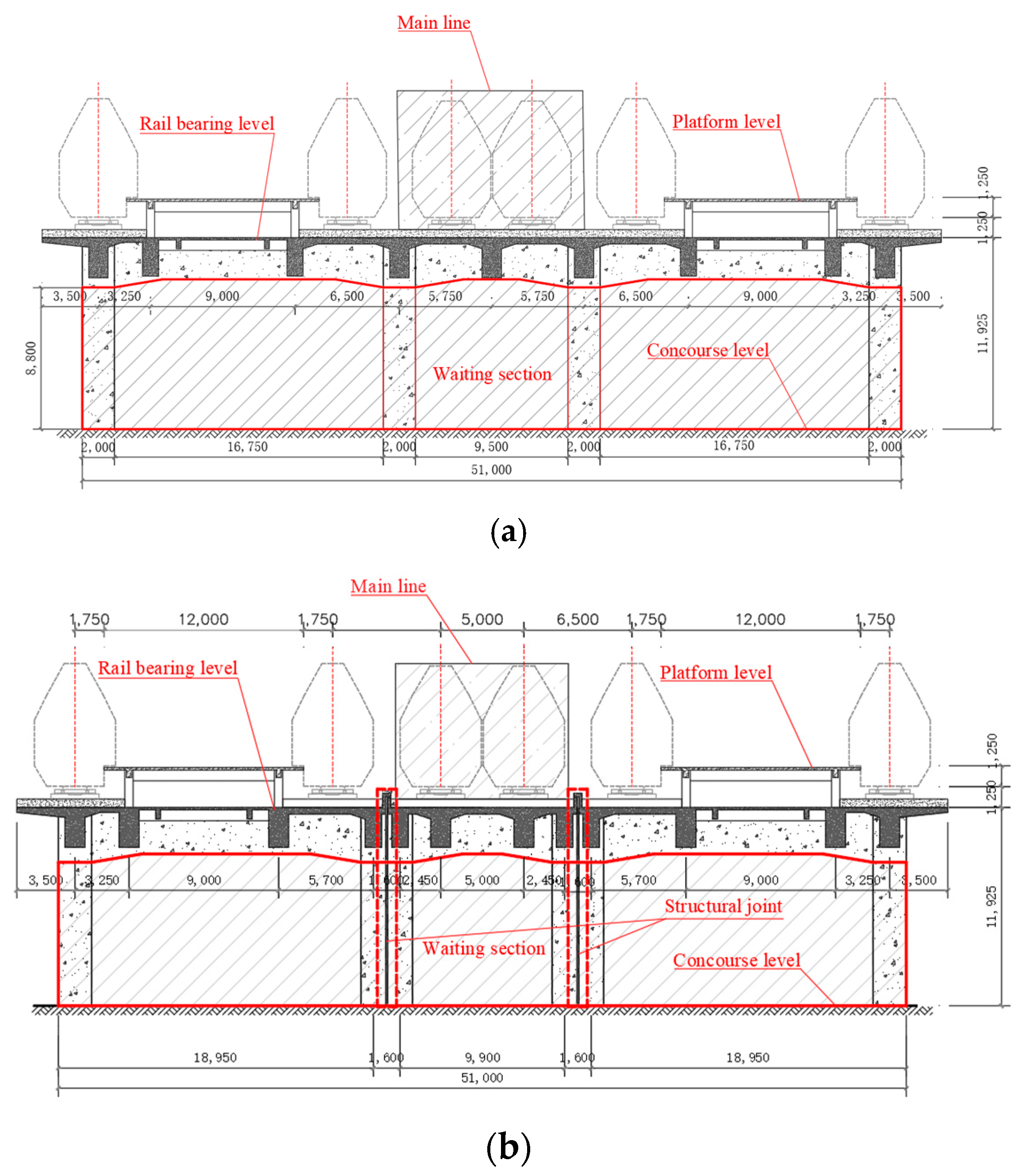
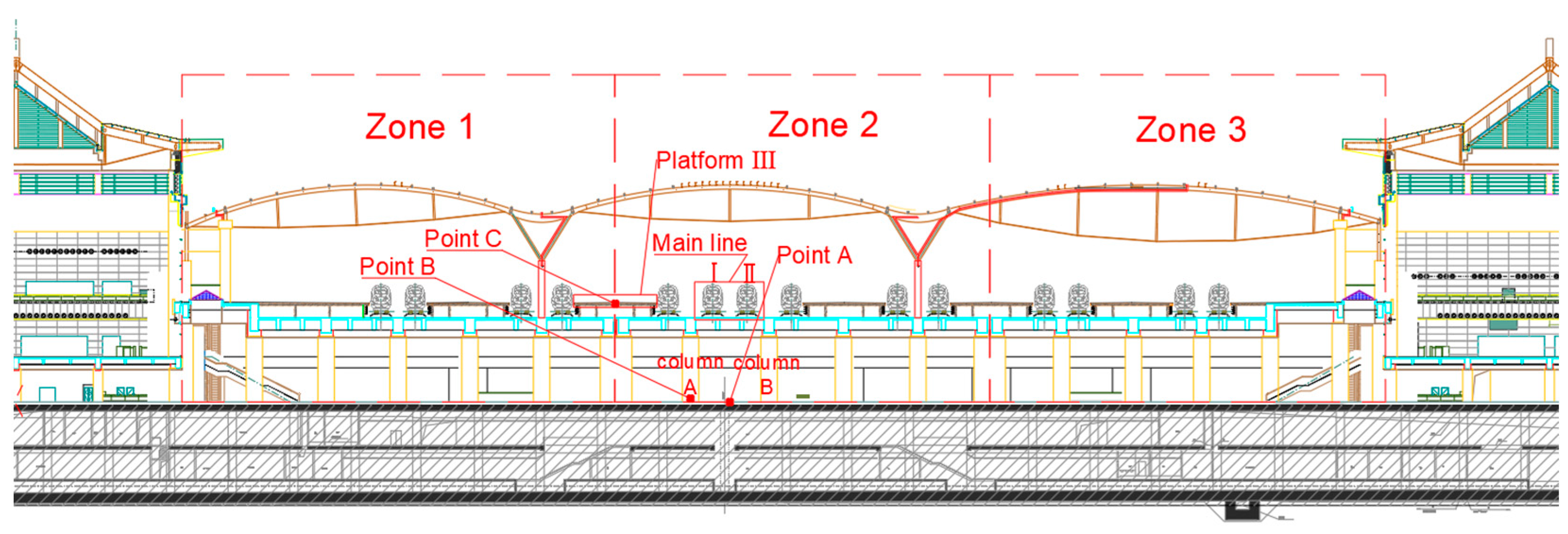
Vibration 08 00076 g028
Table 1. Station structure parameters [35,36].
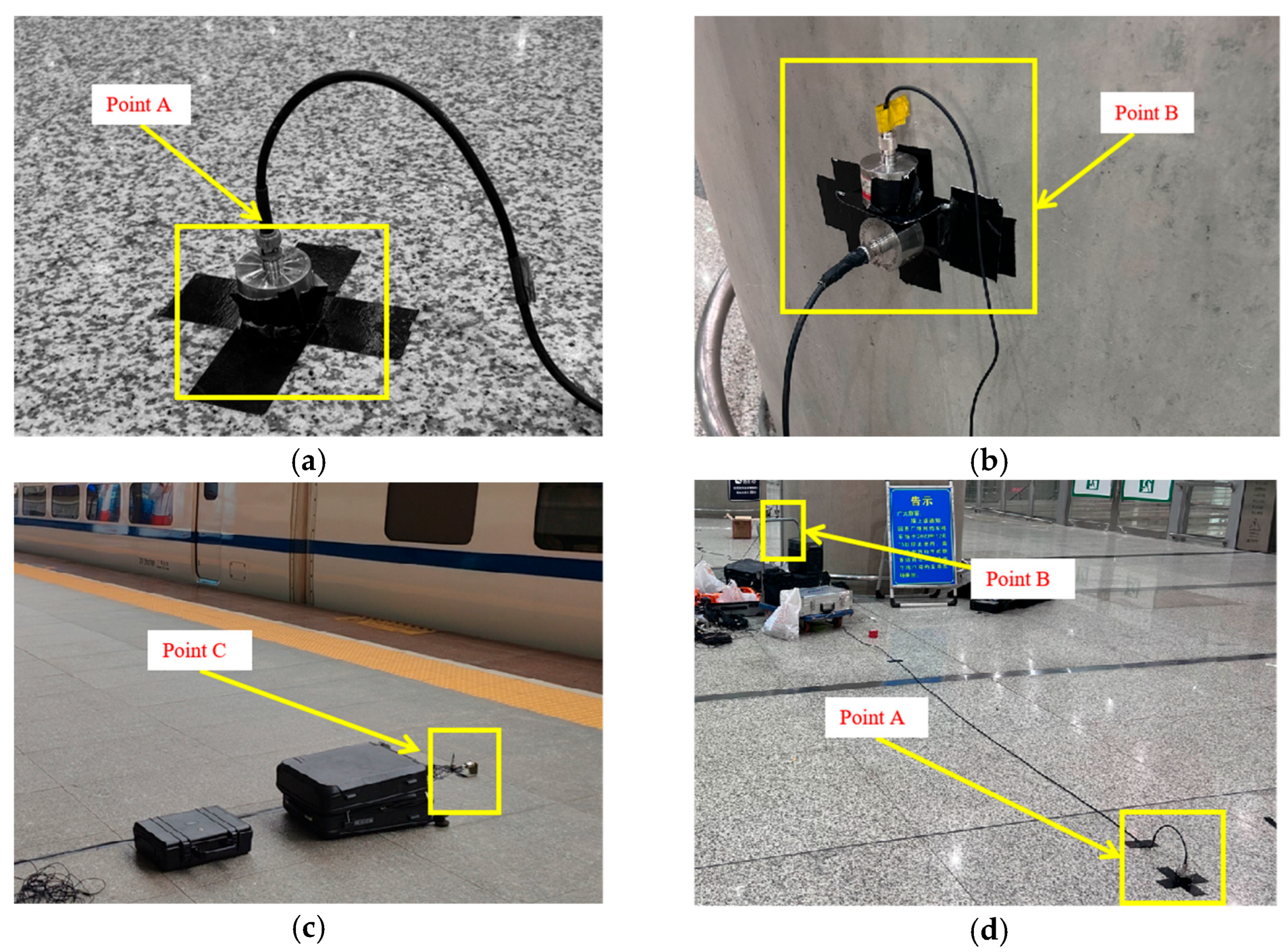
ComponentDynamic Modulus of Elasticity (MPa)Poisson RatioDensity (kg/m3)Damping RatioElement Type
Column35,0000.2025000.02Beam element
Beam35,0000.2325000.02Beam element
Floor slab31,0000.2225000.02Shell element
Track plate34,5000.2025000.02Solid element
Soil90000.3016000.03Solid element
Table 2. Parameters of CRH380A train [43,44].
Parameter NameNumerical Value
Mass of full-load trains (kg)29,600
Structural mass (kg)1800
Wheel-set weight (kg)1900
Moment of inertia of wheel set around x axis (kg·m2)1067
Moment of inertia of wheel set around y axis (kg·m2)140
Moment of inertia of wheel set around z axis (kg·m2)1067
The rotational inertia of the component around the x-axis (kg·m2)1600
The rotational inertia of the component around the y-axis (kg·m2)1700
The rotational inertia of the component around the z-axis (kg·m2)1700
The moment of inertia of the car body around the x-axis (kg·m2)58,020
The moment of inertia of the car body around the y-axis (kg·m2)2,139,000
The moment of inertia of the car body around the z-axis (kg·m2)2,139,000
Half of the span of two rolling circles (m)0.7456
Half of the axial span of the bogie (m)1.2
Half of the transverse span of the primary suspension (m)0.978
Half of the transverse span of the secondary suspension (m)0.978
The centre of gravity of the car body to the upper plane of the secondary suspension (m)1.415
The plane under the secondary suspension to the centre of gravity of the frame (m)0.081
A series of suspension from the upper plane to the centre of gravity of the frame (m)0.14
Rolling radius (m)0.46
Half of vehicle fixed distance (m)9
Longitudinal stiffness of primary suspension (kN/m)24,000
Transverse stiffness of primary suspension (kN/m)5100
Vertical stiffness of primary suspension (kN/m)873
Longitudinal stiffness of secondary suspension (kN/m)1200
Lateral stiffness of secondary suspension (kN/m)300
Vertical stiffness of secondary suspension (kN/m)410
Vertical damping of primary suspension (kN·s/m)30
Lateral damping of secondary suspension (kN·s/m)25
Vertical damping of secondary suspension (kN·s/m)108.7
Table 3. Parameters of steel [43].
NameNumerical Value
Mass (kg)60.64
Elastic modulus (Pa)2.1 × 10¹¹
Vertical bending stiffness (kN·m2)6.62 × 10⁶
Cross flexural rigidity (kg·m2)1.25 × 10⁶
Poisson ratio0.3
Table 4. Statistical table of average error of each vibration pickup point.
Vibration Pickup PointTotal Energy Difference (dB)Average Error (dB)
Waiting hall layer pickup point A14.920.53
The vibration pickup point B of the main line column foot11.140.40
Platform layer pickup point C14.520.52
Table 5. Calculated work condition.
ConditionTrain Speed (km/h)Line OperationStation
1200L1I
2200L1II
3250L1II
4300L1II
5350L1II
6200L2II
7200L1 + L2II
Table 6. Peak acceleration of each vibration pickup point.
Type of Station StructurePeak Acceleration (m/s2)
Track-Bearing LevelWaiting SectionPlatform
I0.420.120.15
II0.370.140.08
Table 7. Indoor vibration limits for buildings.
Scope of Application ZoneDaytime (dB)Night (dB)
Special residential area6565
Residents, education area7067
Mixed zone, commercial centre area7572
Industrial concentration district7572
Both sides of the traffic trunk road7572
Both sides of the railway trunk line8080
Disclaimer/Publisher’s Note: The statements, opinions and data contained in all publications are solely those of the individual author(s) and contributor(s) and not of MDPI and/or the editor(s). MDPI and/or the editor(s) disclaim responsibility for any injury to people or property resulting from any ideas, methods, instructions or products referred to in the content.