Article

Bureaucratic Design and Cross-Boundary Governance in Addressing Wildfire Resilience

Department of Public Administration, School of Public and International Affairs, College of Humanities and Social Sciences, North Carolina State University, Raleigh, NC 27695, USA
*
Author to whom correspondence should be addressed.
Fire 2026, 9(5), 209; https://doi.org/10.3390/fire9050209
Submission received: 5 March 2026 / Revised: 16 May 2026 / Accepted: 18 May 2026 / Published: 20 May 2026
(This article belongs to the Section Fire Social Science)

Abstract

Institutional design and bureaucratic structure have long been recognized as central to organizational performance. These features remain highly relevant today, particularly for understanding complex natural hazards and resource management challenges where fragmented bureaucratic arrangements can hinder coordination across ecological and jurisdictional boundaries. Wildfire management exemplifies this problem. States vary widely in how they organize themselves around wildfire and its inherently complex, cross-boundary nature. In this study, we offer a comparative framework for assessing state-level wildfire governance based on three dimensions: administrative proximity to the governor, integration between forestry and fire management functions, and the span of control of these administrative units. We apply this framework to analyze the organizational structures and cross-boundary coordination mechanisms in eleven western U.S. states. By highlighting how bureaucratic structure can enable or constrain collaborative wildfire management, this research provides insights that may help states strengthen interagency coordination and enhance overall wildfire resilience.

1. Introduction

As highlighted by recent executive orders calling for the restructuring of the administrative design of wildland fire at the federal level, institutional design is tightly linked to organizational capacity and function. The institutional design of wildfire governance also plays a critical role in shaping the capacity of states to address wildfires. Institutional design varies across states, particularly with respect to the level of the administrative unit, the degree of integration among relevant administrative units, and the extent to which wildfire responsibilities are an administrator’s singular focus or one of many. Understanding these institutional differences is essential for explaining variation in how wildfires are governed across states. Because wildfires routinely transcend administrative and jurisdictional boundaries, fragmented bureaucratic systems can exacerbate coordination challenges. In this paper, we consider key features of wildland fire governance that vary by state and reflect potentially consequential institutional design elements. By examining these elements, this research offers a comparative framework for assessing how structural arrangements inform policy and administration aimed at enhancing collaboration and resilience in disaster management, ultimately contributing to more integrated and adaptive responses to wildfire.
Disaster scholars have long argued the need for greater attention to institutional design as a critical element of resilient disaster response [1,2]. While substantial scholarship has emerged to address this domain, this literature has been dominated by concern for institutional designs to support inter-organizational and cross-jurisdictional coordination and governance (e.g., [3,4,5,6]). Comparatively limited attention has been paid to variation in the internal bureaucratic arrangements of state-level disaster or wildfire governance systems and how these configurations may shape coordination capacity both within and across complex bureaucracies. This study addresses this gap by examining how state-level administrative structures shape the institutional logics through which agencies coordinate and engage in cross-boundary collaboration.
Institutional design refers to the organizational structure and governance mechanisms associated with a given organization, department, or agency. Structural contingency theory suggests that no single organizational design is best, but that institutional arrangements are more or less appropriate depending on the complexity, uncertainty, and interdependence of their tasks [7]. At the same time, ample theory and research have also emphasized that institutional design does not always reflect alignment between task demands and desired outcomes. Rather, scholars have demonstrated that public bureaucracies are nested within complex institutional environments which shape and constrain bureaucratic design choices, at times decoupled from technical rationality [8,9].
Regardless of the forces that shape variation in design, organizational structure is widely recognized as fundamental to steering how lower order units coordinate, share information, and allocate resources for managing complex, cross-boundary problems [10,11,12]. In complex bureaucracies, fragmentation, where agencies operate in rigid silos with competing priorities and distinct cultures, often hinders effective collaboration [13]. This structural rigidity can obstruct timely decision making and resource mobilization, particularly in crises that require integrated responses. Structural analysis helps identify inefficiencies in institutional frameworks and informs governance reforms that enhance interagency coordination, adaptability, and accountability [5,14]. In wildfire resilience, for example, poorly designed bureaucracies can lead to duplication of efforts, gaps in service delivery, or delays in response, whereas well-structured institutions foster cooperative networks that improve preparedness and recovery [4,15]. By designing institutions that are flexible, networked, and capable of interorganizational collaboration, public administrators and policymakers can mitigate the risks of bureaucratic inertia and enhance resilience in the face of complex environmental challenges.
Building from this logic, we offer a comparative examination of wildfire governance structures in eleven western U.S. states identifies three key dimensions of institutional design that may shape wildfire response: administrative distance of responsible agencies from the governor’s office, the co-location or separation of wildfire and forest management functions, and the span of control held by administrative leaders. These structural characteristics offer insights into why states may differ in their approaches to wildfire response. More broadly, they may illustrate how institutional design can influence coordination capacity and on-the-ground wildfire response.
This paper contributes to wildfire governance literature by advancing the study of institutional design and bureaucratic fragmentation in the context of state-level wildfire governance. It introduces a framework for analyzing state bureaucratic structures, emphasizing three key dimensions: distance from the governor, integration, and span of control. This framework provides a systematic approach to understanding how bureaucratic organization affects cross-boundary coordination, a critical challenge in managing complex natural disasters like wildfires. This paper also extends structural contingency perspectives to wildfire governance by showing how variation in bureaucratic structure may shape the coordination capacity of and challenges faced by states affected by complex disaster environments. Empirically, the study examines the bureaucratic structures of eleven Western U.S. states, offering comparative insights into the variation in institutional design and its implications for wildfire resilience. By linking organizational structure to coordination capacity, the paper highlights how bureaucratic design may influence management efforts and identifies opportunities for improving governance to enhance cross-boundary collaboration. This work demonstrates that institutional design remains central to understanding how human systems organize for resilience in an era of increasing ecological and environmental complexity.

2. Materials and Methods

2.1. Bureaucratic Design, Division, and Coordination

Classic bureaucratic design, rooted in Weber’s theory of bureaucracy, emphasizes hierarchical authority, formalized rules, specialization, and merit-based advancement [16]. Similar characteristics appear across other foundational management theories, including Taylor’s [17] scientific management and Fayol’s [18] principles of management, each of which sought to enhance organizational efficiency through strategic use of divisionalization and specialization. Historically, these models provided a rational and structured approach to governance, ensuring efficiency and predictability in collective action [19]. Traditional bureaucratic design principles remain the dominant design of government institutions in the United States to this day. However, due to critiques of rigidity, inefficiency, and a lack of responsiveness to complex, dynamic environments, more contemporary scholarship has emphasized the importance of more adaptive, network-based models of governance, emphasizing flexibility, interdependence, and decentralized coordination across and between administrative units [19,20,21].
Given the interconnected nature of modern society and the indifference of wildfire for human-imposed boundaries, wildfire disaster planning, response, and recovery are inherently networked endeavors [3,5,14,22,23]. This means that no single organization or agency possesses the jurisdictional authority, legitimacy, or capacity to manage all aspects of wildfire mitigation, response, and recovery. As a result, effective wildfire management necessitates coordinated efforts among agencies, organizations, and groups at local, state, and federal levels, facilitated through both formal and informal mechanisms [14]. At the same time, however, division and fragmentation are built into our bureaucratic systems. Governance is divided across local, state, and federal levels and further segmented by public, private, and tribal entities, as well as by areas of specialization. For example, structural firefighting focused on homes and office buildings is managed by different organizations than those responsible for wildfire management on private and state lands, which, in turn, differs from the agencies with jurisdictional authority over wildfires on federal land. Wildfire response networks are therefore inherently complex, with relevant stakeholders shifting over time as conditions evolve [24]. The ability to prepare for, respond to, and recover from wildfires requires resources far beyond the scope or ability of any single entity, making interagency collaboration essential.
Communities are embedded within broader institutional structures and often rely on support from higher-level entities, such as state, regional, and federal institutions. The effectiveness of these larger systems depends on both their resources and their capacity to adapt and remain functional under stress. Institutional resilience refers to the capacity of organizational systems at various scales to prepare for, mitigate, and effectively respond to wildfire. Its core elements include adaptability, robust infrastructure for communication and coordination, and the ability to mobilize resources efficiently under dynamic conditions [15]. Because disaster events like wildfires are chaotic, complex, and time-sensitive [5], effective response requires institutions to swiftly adapt and maintain well-defined mechanisms for communication, coordination, and control [4,5,25,26,27,28]. As disasters increase in size and severity, they become more complex, thus reinforcing the need for interagency collaboration [4,5,25,26,27,28]. The effectiveness of disaster response is shaped by proactive measures to build institutional resilience, including mitigation efforts, response time capabilities, and the capacity to work collectively [4,5,29]. Given that disaster management depends on a network of actors operating across different levels, institutional resilience is ultimately determined by the strength and coordination of these networks [29].
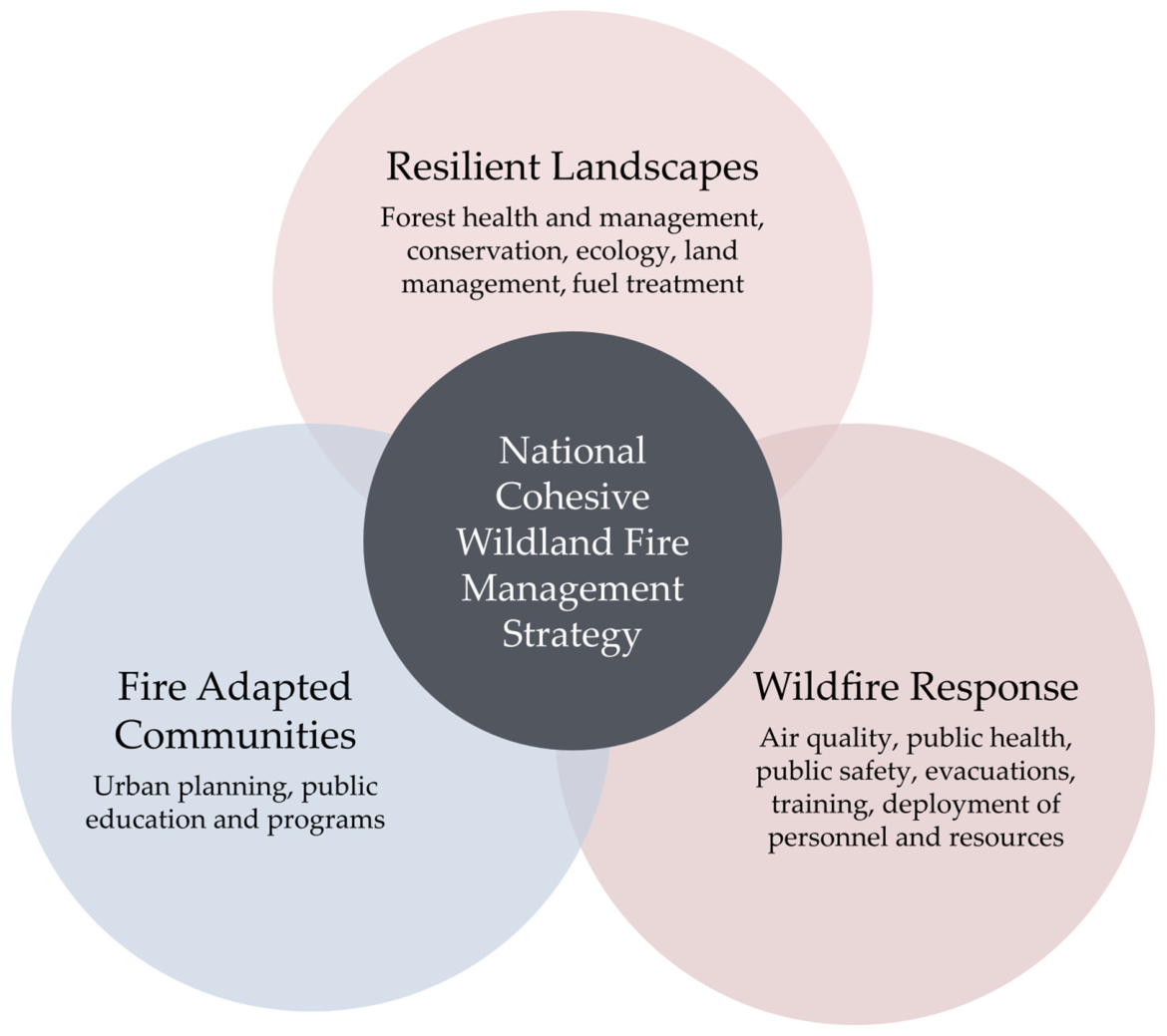
One example of a broad institutional approach to wildfire management is the National Cohesive Wildland Fire Management Strategy, which outlines a three-pronged framework for wildfire resilience. This framework includes resilient landscapes, fire adapted communities and a safe, effective, risk-based wildfire response (Figure 1) [30]. This strategy was created by the Wildland Fire Leadership Council, an intergovernmental committee created to support the Federal Fire Management Policy. Implementing this strategy requires the coordination of a broad network of organizations and agencies, each contributing resources toward fire management, forest management, emergency response, and community planning and risk mitigation. Each actor in this network is embedded within its own institutional framework. Effective coordination, therefore, requires an understanding of the distinct governance structures that shape decision making within these organizations. For instance, state and federal land management agencies have different missions and objectives which must be reconciled to implement the Cohesive Strategy effectively at the landscape level.
Wildfire resilience governance is broad, varied, and complex, so one of the primary challenges in wildfire governance is how states organize their agencies and offices to manage these efforts effectively. Some may be housed within a single administrative unit, while others may exist as separate departments or subunits of different administrative structures. This fragmentation raises a critical question: How can numerous state government offices coordinate and collaborate, both internally and with external agencies, especially during a wildfire event when time is critical? Bureaucratic arrangement of state offices can either facilitate or hinder coordination. Functions nested within a single office reporting to the same agency administrator are likely to be the most tightly coordinated. Coordination between two offices reporting to the same administrator is likely to be moderate but may be less effective if the administrator oversees a large and diverse portfolio of responsibilities. The degree of integration and communication across these agencies plays a crucial role in the state’s ability to manage wildfire resilience effectively.

2.2. A Framework for Examining State Wildfire Efforts

Wildland fire response in the United States is managed through a jurisdictionally complex network of actors spanning local, state, federal and private jurisdictions. In general, each jurisdiction is responsible for prevention, readiness, response, and recovery activities related to wildfire on their land unless they have contracted arrangements with another entity to provide suppression support. In the Western United States, states generally bear primary legal responsibility for wildland fire protection on state and private lands, although this responsibility is often shared with local jurisdictions. Federal agencies retain fire suppression authority over federal lands unless alternative agreements are in place.
Institutional design shapes coordination capacity, resource allocation, and interorganizational interaction [7,10,11,12]. In the context of wildfire governance, design choices structure how agencies interact, authority is distributed, and resources are mobilized. Despite this importance, there has been little attention to how variation in institutional design at the state level may shape wildfire mitigation and response systems. To address this gap, we draw on theory from public administration and organizational design to identify structural features that are likely to influence prioritization and coordination in complex governance systems. Organizational theory asserts that vertical layering [7,11], functional integration [12,31], and administrative scope [32] are critical design considerations which influence organizational behavior and outcomes. Building on these insights, we develop a framework that focuses on three core dimensions of state wildfire governance: positionality, co-location, and span of control.
First, states differ in the number of hierarchical levels between state wildfire management entities and the governor’s office. This variation in unit level, or positionality, may signal the prioritization of wildfire governance in relation to other state concerns, thus influencing access to agenda setting in the policy process and resource allocation.
Second, states vary in the level of integration of fire and forest management functions. Some states maintain separate offices for fire and forest management, while others integrate these functions under a single administrative authority. This distinction offers clues about these functions are viewed: co-location suggests a shared problem definition that requires tight coordination, whereas fragmentation may reflect or reinforce distinction between fire response and land management.
Third, among states that co-locate wildfire-related functions, the number and nature of additional responsibilities vary. One state may have a dedicated unit focused solely on fire and forest management, while another may assign these functions to be one among many under a single administrator. A narrower span of control may indicate greater attention and resources, with wildfire management being seen as a unique challenge worthy of narrow focus. A broader span of control, on the other hand, may signal competing priorities and diluted administrative capacity.
Together, these dimensions provide a framework for analyzing variation in state-level wildfire governance structures (Table 1).
We apply this framework to analyze wildfire governance structures in eleven Western states: Arizona (AZ), California (CA), Colorado (CO), Idaho (ID), Montana (MT), Nevada (NV), New Mexico (NM), Oregon (OR), Utah (UT), Washington (WA), and Wyoming (WY). These states were selected based on their above-average exposure to billion-dollar wildfire disasters between 1999 and 2020, a period during which US states experienced an average of 6.25 such events [33]. The states in this study experienced between eight and thirteen events, making them particularly relevant cases for examining institutional response to recurring wildfire risk.
Following case selection, we conducted a review of publicly available archival sources between March 2025 and April 2026, including state websites, organizational charts, and official reports, to identify structural features of wildfire governance systems. Guided by the National Cohesive Wildland Fire Management Strategy framework, we systematically coded each state’s wildfire governance structure along the three framework dimensions: (1) the positionality of wildfire-related units within the bureaucratic hierarchy, (2) whether fire and forestry units were co-located or separated, and (3) the span of control associated with the overseeing administrative unit. Subsequent web-based searches were conducted to identify examples of cross-boundary network structures designed to facilitate coordination among state agencies, local governments, private entities, and nonprofit organizations.
While the framework we propose focuses on institutional design, broader contextual factors may also shape state-level bureaucratic structure. To omit these factors would be to ignore the context in which states operate. As such, to account for these influences, we incorporate data regarding four antecedent conditions for each state: (1) the share of federally owned forest land, (2) the historical frequency of billion-dollar wildfire disasters, (3) political culture, and (4) state budgetary capacity.
States with a higher share of federally owned forest land may be less likely to develop tightly integrated or co-located fire and forestry agencies, as federal entities such as the U.S. Forest Service often assume primary management and response responsibilities within federal jurisdictions. Conversely, states that have experienced a greater number of severe wildfire disasters with costs of one billion dollars or more may be more likely to establish integrated and coordinated state-level structures as a result of accumulated experience and learning. Political culture, identified in this paper as the political party of the governor, may influence preferences about centralized versus fragmented governance structure, while variation in budget capacity may affect the ability to create or sustain specialized agencies or units. These contextual factors are not part of the formal analytical framework but serve as antecedent conditions that offer valuable insight into variation in state institutional design.
This paper offers a framework for analyzing institutional design in wildfire governance and demonstrates its applicability across high-risk states. More broadly, it illustrates how structural features identified in organizational theory such as hierarchy, integration, and scope manifest in practical governance systems and ultimately have theoretical implications for organizational action and interaction. Importantly, this framework is intended to be a broad preliminary starting point for future research by identifying measurable dimensions of institutional design. The following analysis is structured around the three pillars of the National Cohesive Wildland Fire Management Strategy and highlights the institutional differences seen in these neighboring western states.

3. Results

3.1. Variation in Institutional Design of State Level Wildfire Management

The comparative assessment of state-level structures reveals substantial variation in how wildfire management responsibilities are organized across the three dimensions of the framework (Table 2). It also provides an important distinction regarding variation in co-location: fire management may be formally integrated with forestry, located as a subunit within forestry, or separated across distinct units. A complete table of our findings can be found in Appendix A.

3.2. Positionality of Forestry and Fire Management Units

Forest and wildfire management units operate at the division level in most states within this sample, placing them one step further removed from direct gubernatorial oversight compared to those in Arizona, California, and Oregon. In these latter states, forest management functions are housed at the department level. This distinction marks an important divide between elevated and embedded institutional arrangements.
Arizona’s Department of Forestry and Fire Management [34], California’s Department of Forestry and Fire Protection, commonly known as CalFire [35], and Oregon’s Department of Forestry [36] represent the clearest examples of elevated positionality. This placement suggests a higher priority for these functions within their respective state governments, which may facilitate more direct communication with the governor’s office and improve their ability to coordinate with other units. However, it is important to note that CalFire is embedded within the California Natural Resources Agency which operates at the cabinet level, a structural feature that is not seen in any other state in this study. This additional layer of integration may further strengthen CalFire’s authority to coordinate interdepartmental efforts. In contrast, all other states locate forestry and wildfire governance at the division level, embedding them in broader natural resource or land agencies.
The positionality dimension distinguishes between elevated structures, with wildfire governance positioned at the department level, and embedded systems, where wildfire governance is located within a broader natural resources portfolio. Elevated units may facilitate direct executive attention, but embedded units may allow wildfire governance to work more closely with other natural resource divisions. While positionality offers a signal of importance, it must be considered in conjunction with co-location and span of control.

3.3. Administrative Co-Location of Wildfire and Forest Management

Another area where states differ is whether wildfire and forest management are co-located under the same administrative structure. This is potentially consequential in understanding the nature of the linkage between land and fire management in state governance. With the exception of Colorado and Washington, all states in the sample co-locate these functions, suggesting that co-location is the dominant institutional approach, though there is variation in the degree of integration.
Arizona, California, Idaho, and Utah offer the clearest examples of units that are not only co-located but fully integrated with one another. In these states, the name of the unit itself signals integration: Arizona’s Department of Forestry and Fire Management, California’s Department of Forestry and Fire Protection, Idaho’s Division of Forestry and Fire, and Utah’s Division of Forestry, Fire, and State Lands. Arizona and Utah distinguish between their forestry and fire units within their divisions [34,37], while California and Idaho do not [35,38]. In this way, California and Idaho underscore their holistic approach to wildfire management. The integrated structural designs signal that wildfire management is not separate from nor a subset of forestry. Instead, these units are closely interdependent, reflecting the states’ high prioritization of ensuring close coordination between forest management and fire management functions.
A similar logic is evident in other states that co-locate these functions: Montana, Nevada, New Mexico, Oregon, and Wyoming. However, rather than integrating forestry and fire management units, the relationship can be characterized as a subunit model. Montana, Nevada, and Wyoming are most similar with their wildfire units nested within their forestry divisions [39,40,41]. Oregon also uses a subunit structure, but with fire management at a division level nested within the Oregon Department of Forestry [36]. New Mexico is more nuanced because the Division of Forestry does not have a formal fire subunit in the same way as other states with this structural model, but wildland fire protection is included in the division’s description of responsibilities [42].
Colorado and Washington are the only states without co-located forestry and fire units. However, they differ in their scale of separation. Colorado’s approach to wildfire management is unique in that it involves two separate state departments. The Colorado Department of Natural Resources oversees wildfire mitigation efforts through its Division of Forestry, which focuses on public education, programs, and resources related to fire prevention [43]. Separately, Colorado’s Department of Public Safety houses the Division of Fire Prevention and Control, which primarily serves professionals such as firefighters and public safety personnel [44]. Within this division, the Wildland Fire Management Section functions as the state’s leading agency for wildfire response and works across federal, state, and local levels to coordinate fire management efforts. Notably, Colorado is the only state examined in this study that places the majority of its wildfire-related functions within a public safety department. The departmental separation appears to reflect a distinction between public-facing mitigation activities and professional emergency response functions, which may pose coordination challenges by dividing wildfire response efforts across agencies with different missions and audiences.
Washington, on the other hand, has its units separated within a single department: the Forest Resilience Division and Wildland Fire Management Division are both located within the Washington State Department of Natural Resources [45]. Placing the fire and forest management units within a single department suggests a recognition of the need for coordination between fire management and forestry. However, the formal structure does not indicate whether these two divisions are more closely connected to one another than they are to other divisions in the department.
In summary, co-location is a common strategy for linking forest management and wildfire governance, but it operates on a continuum. Fully integrated units embed fire and forestry in a single administrative identity. Subunit structures connect fire and forestry within a shared division or department but maintain internal differentiation. Non-co-located systems are likely to require stronger formal coordination mechanisms due to the institutional separation of forestry and fire responsibilities.

3.4. Span of Control

Span of control analyses focus on the number of lower-order units that directly report to the same administrative executive. This feature also varies across states and is potentially consequential. Lower spans of control (i.e., fewer units) are often associated with higher executive oversight and attention whereas high spans of control are often associated with greater independence of lower-order units as the executive’s attention is spread more thinly. Notably, this measure must distinguish between co-located and non-co-located forestry and fire management units because the coordination burden differs depending on whether they are housed together or must coordinate across separate units. The analysis excludes programs and boards because they do not typically represent equivalent administrative units with the same reporting relationship to the executive; including them would risk overstating administrative complexity and making comparisons across states less consistent.
Arizona, California, Idaho, Oregon, and Wyoming have the narrowest spans of control, with no additional units competing for attention within the relevant co-located structure. Arizona, California, and Idaho have fully integrated forestry and fire management units with zero other units. Arizona’s Department of Forestry and Fire Management is organized into two primary divisions. The fire division oversees wildland fire suppression, fire prevention, wildfire information, state forestry crews, cooperators and fire business, dispatch, and training. Meanwhile, the forestry division focuses on urban and community forestry, stewardship, utilization and marketing, forest and woodland health, and a forest legacy program. With no additional divisions, the department benefits from a narrow span of control, allowing for streamlined communication and coordination between these two divisions [34]. In California, CalFire manages fire protection, wildfire prevention, and natural resource management. It also houses the State Fire Marshal and the Board of Forestry and Fire Protection, streamlining its focus on wildfire-related efforts. CalFire operates under the cabinet-level California Natural Resources Agency, which includes seven other departments, but CalFire’s span of control remains narrow due to its integration of wildfire management efforts [35]. Idaho’s Forestry and Fire Division is located within the Idaho Department of Lands, which also includes divisions for operations, trust land management, and minerals, navigable waters, oil, and gas [38]. However, the state’s span of control remains narrow because it is an integrated unit of forestry and fire.
Utah, New Mexico, and Nevada each have narrow but not exclusive spans of control. The Utah Division of Forestry, Fire and State Lands includes one subunit beyond forestry and fire: state lands [37]. Similarly, although New Mexico’s Forestry Division does not have formal subunits, its responsibilities include watershed management along with forest management and wildland fire protection [42]. The Nevada Division of Forestry has a relatively narrow scope of responsibility, including Natural Resource Management and the Fire Adapted Nevada Partnership units in addition to its Wildland Fire Management unit [40]. Centralizing wildfire resilience efforts within a single division with only one or two additional yet related units may facilitate more effective coordination than if these responsibilities were one among many that may have less obvious relationships. These narrow spans of control suggest a relatively focused structure, though the inclusion of other natural resource units indicate that wildfire governance is connected to broader land or water management responsibilities.
Montana has the most expansive co-located span of control with five units of responsibility in addition to forest management and fire protection. The Forestry and Trust Lands Division’s other units include Forestry Assistance, Agriculture and Grazing Management, Real Estate Management, Minerals Management, and Recreational Use and Public Access [46]. This structure preserves co-location for wildfire management but introduces additional responsibilities for the division administrator that may require the balance of wildfire governance with other land or resource management functions.
Washington and Colorado require separate interpretation because they are not co-located. Washington’s State Department of Natural Resources includes Wildland Fire Management and Forest Resilience divisions among six other divisions related to aquatic resources, recreation, engineering, and others [45]. This creates a broad span of control even though forestry and fire are located within the same parent department. In Colorado, the Department of Natural Resources manages divisions responsible for avalanche safety, mining, energy and carbon initiatives, parks and wildlife, and water resources in addition to the Division of Forestry [43]. This board scope requires careful coordination within the department. For example, the Division of Forestry may advocate for controlled burns as a wildfire mitigation strategy, while Colorado Parks and Wildlife may oppose such activities due to concerns about wildlife habitat preservation. This structure highlights the need for collaborative planning across divisions to balance priorities and manage interdependencies effectively. The Colorado Department of Public Safety oversees the Division of Fire Prevention and Control alongside four other divisions, including the Division of Homeland Security and Emergency Management (DHSEM), which aims to “lead and support Colorado’s effort to prevent, protect, mitigate, respond to and recover from all-hazards events” [44]. This structural organization creates a unique challenge for Colorado: wildfire mitigation and response are not only housed separately but also embedded in parent units that contain multiple other priorities.
Overall, span of control reveals variation that is not captured by positionality or co-location alone. Narrow spans of control may support focused attention and clearer internal coordination, while a broader span of control for unit administrators suggests that wildfire management may not receive dedicated attention as a distinct priority, especially in states where department administrators also oversee areas such as mining, wildlife, oil, or aquatic resources. Broad spans of control may require an increased need for formal planning and cross-unit communication but also offer opportunities for wildfire governance to be integrated into other natural resource priorities.

3.5. Typology of Institutional Configurations

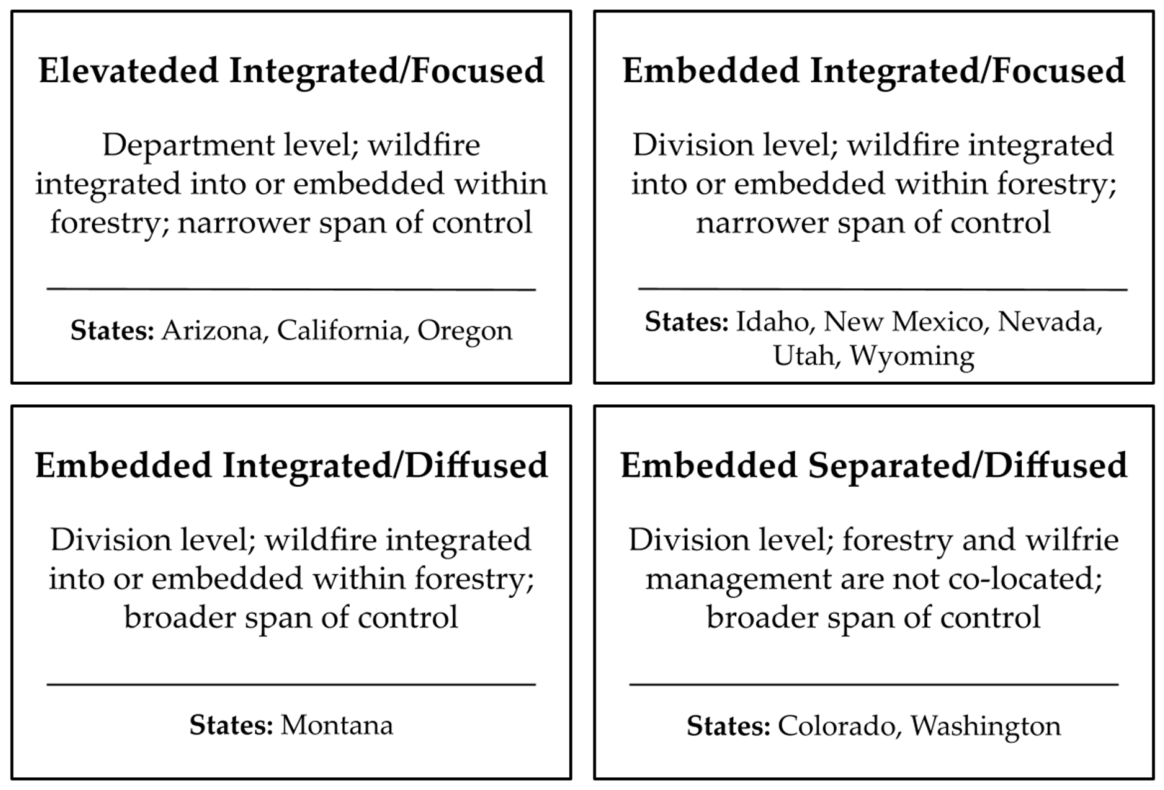
When considered together, the three dimensions of institutional design reveal four institutional configurations (Figure 2). This typology demonstrates that states cluster around recurring combinations of hierarchy, integration, and span of control. Furthermore, it clarifies that a single dimension bureaucratic structure is insufficient for understanding institutional design and the coordination challenges and needs of wildfire response and resilience.
The first type of institutional design configurations can be identified as elevated integrated/focused. Arizona, California, and Oregon fall into this type. Each houses forestry and wildfire responsibilities at the department level, elevating these units closer to the executive branch than is commonly seen in other states. In addition, wildfire is integrated or embedded within the forestry structure and the span of control is relatively narrow. Arizona’s Department of Forestry and Fire Management and California’s CalFire represent the most explicitly integrated examples at this elevated level. Oregon’s structure only differs in that the Fire Protection Division is embedded into the Oregon Department of Forestry. These cases suggest a relatively high degree of institutional prioritization: forestry and wildfire governance are elevated within the state bureaucracy, co-located within the same administrative structure, and do not include other unrelated units. California is somewhat distinct because CalFire is nested within the California Natural Resources Agency, but its forestry and fire functions remain integrated within a department-level unit. Overall, this configuration provides the clearest example of centralized authority and focused administrative attention.
Idaho, New Mexico, Nevada, Utah, and Wyoming are examples of embedded integrated/focused configurations. These states differ from the first group in that forestry and wildfire responsibilities are located at the division level rather than the department level. However, like the first group, they maintain administrative integration between forestry and wildfire and have relatively focused spans of control. Idaho and Utah have fire management explicitly integrated with forest management, while New Mexico, Nevada, and Wyoming locate fire management as a subunit of the forestry division. The Nevada Division of Forestry includes two additional units, Natural Resource Management and the Fire Adapted Nevada Partnership. Because these units are closely related to wildfire resilience, the span of control remains narrow. This configuration suggests that division-level placement does not necessarily imply weak integration or diffuse attention. Instead, states may retain close administrative connections between forestry and fire management while situating those functions within a broader department of land management.
The third configuration can be described as an embedded integrated/diffuse structure. Montana is the clearest example of this group. Like the states in the second group, Montana locates forestry and fire management at the division level and co-locates these responsibilities within the Forestry and Trust Lands Division. However, Montana differs because the division also includes a broader set of additional units beyond wildfire governance. As a result, Montana combines administrative integration with a broader span of control, suggesting that the main coordination challenge may be the potential diffusion of administrative attention across responsibilities rather than a structural separation of forestry and fire management.
The final configuration is embedded separated/diffused. Colorado and Washington fall into this group because both fragment forestry and fire management responsibilities at the division level. However, they differ in the scale of location of separation. Colorado’s units are divided across two distinct departments and, within each department, administrators must give attention to a number of other unrelated units such as mining or criminal justice. Washington’s separation is more contained because both units are housed within the same parent department. However, forestry and wildland fire management are located in separate divisions. Furthermore, the department includes several other divisions including aquatics and engineering. Both states may face wildfire response and resilience challenges due to both the fragmentation of units and presence of unrelated units.

3.6. Patterning Across States

Broader contextual factors may correspond to institutional configurations identified in the typology. To examine this, Table 3 attempts to identify patterning between institutional configurations and four antecedent conditions: federally owned forest land, historical billion-dollar wildfire disaster events, political culture, and state budgetary constraints.
The share of federally owned forest land [47] shows potential but inconclusive patterning. The elevated integrated/focused states cluster in the middle range of forest ownership, from 50% in Arizona to 60% in Oregon. By contrast, the embedded integrated/focused group includes several of the highest federal ownership cases in this sample: Nevada at 96%, Wyoming at 81%, Idaho at 80%, and Utah at 77%. This suggests that states with especially high shares of federally owned forest land may be more likely to position wildfire governance units at the division level with few additional units to manage. However, this is not uniform across the sample. New Mexico has the same configuration despite having only 49% of federally owned forest land, while Colorado and Washington are both embedded separated/diffused despite having very different levels of federal forest ownership at 70% and 44%, respectively.
Wildfire disaster history also shows some suggestive but inconclusive patterning. A count of billion-dollar wildfire disaster events is illustrative as half of states with the highest counts have an elevated integrated/focused configuration (Arizona at 11, California at 13, and Oregon at 12), but states with similar counts are spread across the other configurations: Idaho at 12 and Montana and Wyoming each at 11 [33]. A more informative metric may be the share of costly wildfire disasters out of all wildfires in each state, included in Table 3 as a normalized measure of billion-dollar wildfire events per 1000 total wildfires. Total wildfire counts between 1999 and 2020 for each state were calculated using spatial wildfire occurrence data [48]. The normalized measure is revealing: the elevated integrated/focused states have high counts of costly wildfires, but their normalized rates are comparatively low at 23% or less. Meanwhile, shares of costly wildfires in embedded integrated/focused states range between 25% and 60% per 1000 wildfires. Importantly, however, the normalized rate is best understood as supplemental to the count of billion-dollar wildfires due to potential differences in detection and reporting practices across states and agencies. Additionally, the range of billion-dollar wildfire events in this data is limited, so it may be possible that a wider range of events would reveal more of a pattern. Another potential reason for this limited finding is that states succumb to institutional pressure, copying the structure of other states rather than responding to the needs of their landscape. Regardless, these findings offer an opportunity for further research and discussion into the factors that influence state structure of wildfire resilience efforts.
Political culture, measured as the percentage of years between 1999 and 2020 with a Republican governor [49], does not show a clear relationship with institutional configuration. The elevated integrated/focused states and embedded integrated/focused states vary widely, between 0% in Oregon and 73% in Arizona in the first group and between 55% in New Mexico and 100% in Idaho and Utah in the second. A correlation between political party and institutional structure is not demonstrated here; however, the sample and time frame are limited. It is possible that a larger set of data would reveal a pattern. Like with wildfire history, political culture offers an opportunity for further research into how political culture affects institutional design at the state level.
The average state expenditures per capita between 1999 and 2020 similarly shows little consistent relationship to institutional configuration. Annual state expenditure data were obtained from two datasets from the US Census Bureau: Annual Survey of State Government Finance and State and Local Government Finance [50,51]. For each state year, total state government expenditures were extracted and merged with annual state population estimates [52] to calculate annual expenditures per capita. These data were then averaged across 1999–2020 for each state. The elevated integrated/focused and embedded integrated/focused groups both include wide variation. States in the embedded separated/diffused group, Colorado and Washington, have similar values in the middle of the distribution, but the sample is too small to make an inference. Again, this offers an additional opportunity for further research into the relationship between fiscal capacity and institutional configuration, especially since budgetary constraints are likely to influence available resources for wildfire mitigation and response efforts.

3.7. Efforts Toward Collaboration

Given the complexity of wildfire management, effective cross-departmental coordination is essential. Just as states differ in their institutional design of forestry and fire management, they also vary in the mechanisms they use to coordinate across agencies, levels of government, and sectors. Across states in this sample, these mechanisms illustrate that wildfire governance often extends beyond forestry and fire management, including others such as public health, emergency management, and transportation.
Arizona’s forestry and fire management unit, although integrated, sits at the department level so collaborates across departments through its Integrated Preparedness Plan, which facilitates coordination among key state agencies and community organizations. The Department of Health Services manages the plan, working alongside the Department of Emergency and Military Affairs, the Department of Education, and community organizations such as the Arizona Coalition for Healthcare Emergency Response to ensure a comprehensive disaster response strategy [53].
Through California’s Wildfire Mitigation Advisory Committee within CalFire’s Office of the State Fire Marshal, representatives from various state departments, the Governor’s Office of Emergency Services, tribal government, local fire service, community organizations, and private industry, are offered an opportunity to bridge existing boundaries and work collaboratively toward wildfire mitigation efforts in the state [54].
Colorado’s recognition of the need for cross-agency collaboration is evident in a DHSEM planning document on wildland fire recovery, which outlines the roles of various entities at different levels of government [55]. Planning documents such as memoranda of understanding, standardized protocols, and information-sharing platforms are boundary objects, artifacts that serve as a shared reference point among different actors within a network that enable coordination and communication. At the federal level, agencies such as the U.S. Forest Service and the Bureau of Land Management play key roles in the DHSEM planning document. At the state level, involved agencies include the Colorado Department of Public Health and Environment, the Colorado Department of Agriculture, the Colorado Department of Human Services, and the Colorado Department of Transportation. Local governments also participate in fire response and recovery efforts. However, the document does not explicitly mention the state’s Department of Natural Resources nor its Division of Forestry, despite its significant role in wildfire mitigation.
Cross-boundary coordination in Idaho includes the Air Division within the Department of Environmental Quality, which administers the Wildfire Smoke Event Response Protocol. This protocol involves the Department of Health and Welfare, the Homeland Security & Emergency Management Agency’s Office of Emergency Management, and various federal and tribal agencies [56]. This example illustrates how wildfire coordination may be organized around a particular hazard, such as smoke exposure, rather than around fire suppression or forest management alone.
Montana provides an example of coordination through statewide forest planning. The Montana Forest Action Plan [57] from the Montana Department of Natural Resources and Conservation frames forest health and wildfire risk as challenges that require cross-boundary collaborative efforts. It acknowledges partners from other state agencies: Disaster Emergency Services, Environmental Quality, and Fish, Wildlife and Parks. Its partners extend to the federal level including the U.S. Fish and Wildlife Service and the Bureau of Land Management.
Nevada’s emergency management functions are handled by the Division of Emergency Management/Homeland Security, which was moved from the Department of Public Safety to the Nevada Office of the Military in 2021 [58]. Additionally, Nevada uses the Fire Board of Directors as a platform for cross-boundary collaboration between state agencies, federal entities such as the Bureau of Land Management, and local fire service organizations Nevada does not have the lush, green forests seen in the Pacific Northwest, but its forestland includes mostly single leaf pinyon and Utah juniper [47]. Strikingly, 96% of Nevada’s forest land is federally owned, with no state or local government ownership. This federal dominance in land ownership makes coordination between state and federal agencies particularly critical for wildfire management and resource planning.
The New Mexico Department of Health (NMHealth) and the Department of Homeland Security and Emergency Management (NMDHSEM) each administer disaster-related programs [59,60]. For instance, NMHealth’s Healthcare Preparedness and Response Program collaborates with New Mexico’s Regional Healthcare Coalitions [61], while NMDHSEM’s Ready, Set, Go! Program provides public guidance on wildfire preparedness and response [62]. However, there is no clear indication that either agency works closely with the Forestry Division. Within the state, the New Mexico Fire Planning Task Force facilitates coordination among the Forestry Division and federal, local, and tribal representatives. However, this task force does not include NMHealth or NMDHSEM. The Forest and Watershed Health Coordinating Group serves as another avenue for cross-agency collaboration, including NMDHSEM and external organizations such as the Forest Stewards Guild and The Nature Conservancy [63].
Outside of Oregon’s Department of Forestry, its Department of Emergency Management (ODEM) provides public resources and information related to disaster preparedness. In cross-agency efforts, ODEM collaborates with the Oregon Health Authority on the Health Security, Preparedness, and Response program. It also works with the state’s Departments of Transportation and Environmental Quality to develop and implement the Oregon Wildfire Debris Management Task Force [64].
Utah provides an example of coordination through its Catastrophic Wildfire Reduction Steering Committee. Created in 2012 following a severe fire season, the committee was tasked with developing a strategy for addressing catastrophic wildland fires in the state. The committee was designed to bring together a number of state units, including the Department of Agriculture and Food and the Governor’s Public Lands Policy Coordination Office, as well as federal agency directors, county commissioners, and national nonprofit organizations [65]. This approach illustrates how cross-boundary coordination can include a variety of levels and sectors to address wildfire.
To enhance cross-agency collaboration, Washington’s Department of Natural Resources has developed a strategic plan that facilitates cooperation with other state agencies, including the Department of Ecology, the Department of Fish and Wildlife, and the Emergency Management Division. Additionally, the plan encourages engagement with federal, local, and tribal entities, private-sector stakeholders, and non-governmental organizations [66].
Wyoming provides an example of coordination through its All-Hazards Incident Management Team structure. The teams are described as multi-agency and multi-jurisdictional, designed to support complex incidents that require coordination across local, regional, and state resources [67]. Coordinating agencies include the State Fire Marshals Office, Department of Health, the Division of Forestry, and representatives at the local level.
Taken together, these examples suggest that states do not rely on a single model for wildfire coordination. Rather, they may use advisory committees or boards, strategic plans, cooperative agreements, or other means of cross-boundary coordination. These mechanisms are important because institutional design can shape how units connect with each other to address wildfire mitigation, response, and resilience.

4. Discussion

Wildfire response is inherently networked, meaning that the impacts and responses to disasters transcend jurisdictional and organizational boundaries, necessitating coordination among multiple entities at various levels of governance. Building resilience must therefore rely on networks that facilitate collaboration and resource sharing. However, the bureaucratic fragmentation embedded in our systems often impedes these efforts. Examining institutional design at the state level can provide insights into where division exists and highlight the need for cross-boundary mechanisms to enhance resilience capacity.
This study illustrates the fragmentation and coordination attempts within eleven states in the United States. By providing a framework for analyzing state institutional designs, we contribute to a broader understanding of how organizational structures shape wildfire governance. The three dimensions of the framework matter conceptually: the proximity of wildfire management units to the governor’s office can signal prioritization; the co-location of forestry and fire functions can facilitate coordination; and a narrower span of control can concentrate administrative attention on wildfire resilience. The framework connects bureaucratic management to disaster governance by showing how internal administrative configurations may shape a state’s capacity to participate in broader, multi-level systems of disaster mitigation, response, and recovery.
Findings from this study speak to structural contingency theory by demonstrating that institutional design cannot be evaluated apart from the complexity of the environment. Wildfire governance requires coordination across land ownership boundaries, functional areas of expertise, and jurisdictional authorities. However, the states examined here vary considerably in how they organize wildfire-related responsibilities. This variation suggests that states have developed different administrative configurations for managing a broadly similar governance challenge and opens up important questions about what factors drive variation in the institutional design of wildfire governance across states. External factors do not appear to align with correspondingly different design choices. This inconsistency underscores both the contextual complexity of state systems and the need for further inquiry into how and why states make distinct institutional design choices. Future research should investigate additional historical, political, and administrative factors shaping these arrangements and explore whether specific configurations are associated with improved coordination, resource efficiency, or resilience outcomes.
Much of the disaster governance scholarship emphasizes collaboration and intergovernmental coordination before, during, and after a disaster. This study compliments that work by drawing attention to the institutional structures through which states enter those collaborative systems. The findings suggest opportunities for disaster governance scholars to pay attention to the internal design of public agencies, not only the relationships among or between them. Future research should build on this framework and incorporate additional data via interviews, surveys, or process-tracing to gain a better understanding of patterns of coordination.
The implication of this study is that institutional design should be treated as a potentially consequential feature of disaster governance that deserves explicit attention from both researchers and policymakers. However, given the limited empirical research on how state-level administrative structures shape wildfire governance outcomes, we caution against offering prescriptive policy recommendations at this stage. Instead, these findings suggest that a more targeted policy agenda relating to institutional structure and governance outcomes may be beneficial. States may benefit from examining whether their wildfire-related administrative structures align with the coordination demands they face. Without deliberate structuring, critical agencies may operate in silos, leading to inefficiencies, duplication of efforts, and missed opportunities for integrated disaster response and mitigation. Where responsibilities are embedded within broader agencies with large spans of control, states may need to consider whether administrative attention and resources are sufficient. Institutional neglect risks leaving states ill-equipped to navigate the increasingly complex interdependence between state, federal, and local jurisdictions, particularly in contexts where land ownership and authority are divided. Recognizing that state governments organize wildfire responsibilities in meaningfully different ways is important because those differences may shape the conditions under which coordination occurs.
Several limitations should be noted. First, this study relies primarily on documentary sources including state agency websites, organizational charts, and publicly available administrative materials. These sources are useful for identifying formal structures, but they may not fully capture informal coordination practices, internal decision making, or the practical importance of specific administrative arrangements. As a result, the analysis describes formal institutional design rather than the full range of functionality through which wildfire governance occurs. Second, the study is limited to eleven U.S. states. Although these states are highly relevant for examining wildfire governance, findings cannot be generalized to all U.S. states nor other national contexts without additional research. Third, this study uses a descriptive-comparative design to identify variation across cases and propose a framework for analyzing institutional design; it does not test causal relationships.
States throughout the US are encouraged to examine their organizational structures, make note of the administrative units that must closely work together for disaster mitigation, response, and recovery, and take advantage of opportunities to integrate multi-jurisdictional, multi-level mechanisms for cross-boundary coordination. Additionally, scholars must engage more deeply with these institutional and governance dynamics to advance our understanding of how states can better structure their wildfire and disaster resilience systems. There is a pressing need to examine the intersection of network governance, institutional design, and resilience-building. By shedding light on these critical relationships, we can contribute to more effective disaster governance and inform policy recommendations that promote adaptive, cross-boundary solutions for managing risk in an increasingly interconnected world.

Author Contributions

Conceptualization, N.R.Y.B. and B.N.; Methodology, N.R.Y.B. and B.N.; Validation, B.N.; Formal analysis, N.R.Y.B.; Data curation, N.R.Y.B.; Writing—original draft, N.R.Y.B. and B.N.; Writing—review & editing, N.R.Y.B. and B.N.; Visualization, N.R.Y.B.; Supervision, B.N.; Project administration, B.N. All authors have read and agreed to the published version of the manuscript.

Funding

This research received no external funding.

Data Availability Statement

All data is included in the Appendix A and Appendix B.

Acknowledgments

During the preparation of this study, the authors used ChatGPT 5.5 for the purposes of collecting and calculating data for the mean expenditure per capita in Table 3. The authors have reviewed and edited the output and take full responsibility for the content of this publication.

Conflicts of Interest

The authors declare no conflicts of interest.

Abbreviations

The following abbreviations are used in this manuscript:
AZArizona
CACalifornia
CalFireCalifornia Department of Forestry and Fire Protection
COColorado
DHSEMDivision of Homeland Security and Emergency Management (Colorado)
IDIdaho
MTMontana
NMNew Mexico
NMHealthNew Mexico Department of Health
NMDHSEMNew Mexico Department of Homeland Security and Emergency Management
NVNevada
ODEMOregon Department of Emergency Management
OROregon
U.S.United States
UTUtah
WAWashington
WYWyoming

Appendix A

Table A1. State organizational structure.
StateForest UnitWildfire As Subunit or IntegratedFire UnitForestry Parent UnitAll Units within Span of Control of Forestry Unit (If Co-Located, Excluding Programs and Boards)Count of Other Units Within Co-Located Span of ControlAll Units Within Span of Control of Parent Unit (If Not Co-Located)Count of Other Units Within Parent Span of Control If Not Co-Located
AZDept. of Forestry & Fire ManagementYes, integratedn/anoneDEPT. OF FORESTRY & FIRE MANAGEMENT:
none
0n/an/a
CADept. of Forestry & Fire Protection (CalFire)Yes, integratedn/aCalifornia Natural Resources AgencyDEPT. OF FORESTRY AND FIRE PROTECTION:
none
0n/an/a
CODivision of Forestry
Includes Wildfire Mitigation section that provides education, programs & resources for mitigating risk and preparation
NoDivision of Fire Prevention and Control
Provides fire management on non-federal lands; has Wildfire Management program and includes the following sections: Wildland Fire Management, Colorado Fire Commission, Colorado Fire Incident Reporting System, and Wildfire Information Center
Division of Forestry parent unit: Colorado Dept. of Natural Resources
Division of Fire Prevention and Control parent unit: Colorado Dept. of Public Safety
not co-locatedn/aDEPT. OF NATURAL RESOURCES:
Forestry;
Avalanche Information Center;
Mining Reclamation & Safety;
Energy & Carbon Management Commission;
Parks & Wildlife;
Water Resources
DEPT. OF PUBLIC SAFETY:
Fire Prevention & Control;
Bureau of Investigation;
State Patrol;
Criminal Justice;
Homeland Security & Emergency Management
5/4
IDDivision of Forestry and FireYes, integratedn/aIdaho Dept. of LandsDIVISION OF FORESTRY AND FIRE:
none
0n/an/a
MTForest Management,
within Forestry and Trust Lands Division
Yes, subunitFire ProtectionMontana Dept. of Natural Resources & ConservationFORESTRY AND TRUST LANDS DIVISION:
Fire Protection;
Forestry Assistance;
Forest Management;
Agriculture & Grazing Management;
Real Estate Management;
Minerals Management;
Good Neighbor Authority
5n/an/a
NVDivision of ForestryYes, subunitWildland Fire Management,
within Division of Forestry
Nevada Dept. of Conservation & Natural ResourcesDIVISION OF FORESTRY:
Natural Resource Management;
Wildland Fire Management;
Fire Adapted Nevada Partnership
2n/an/a
NMDivision of ForestryYes, subunitno formal subunit, but responsibilities of the division include forest management, watershed management, and wildland fire protection; the division houses a Fire Planning Task ForceNew Mexico Dept. of Energy, Minerals, & Natural ResourcesDIVISION OF FORESTRY:
none
1n/an/a
ORDept. of ForestryYes, subunitDivision of Fire ProtectionnoneDEPT. OF FORESTRY:
Forest Resources Division;
State Forests Division;
Fire Protection Division
0n/an/a
UTDivision of Forestry, Fire and State LandsYes, integratedn/aUtah Dept. of Natural ResourcesDIVISION OF FORESTRY, FIRE AND STATE LANDS:
Forestry;
Fire;
State Lands
1n/an/a
WADivision of Forest ResilienceNoWildland Fire Management DivisionWashington State Dept. of Natural Resourcesnot co-locatedn/aDEPT. OF NATURAL RESOURCES:
Aquatic Resources
Engineering
Forest Resilience
Forest Practices
Washington Geological Survey
Product Sales and Leasing
Recreation
Wildland Fire Management
6
WYForestry DivisionYes, subunitFire ManagementWyoming Office of State Lands and InvestmentsFORESTRY DIVISION:
Forest Management;
Fire Management
0n/an/a

Appendix B

Appendix B.1

Table A2. Total collected antecedent data, land ownership.
StateTotal Land (Acres)Non-Forest Land (%)Forest Land (Acres)% Forest Land (of Total Land)Federally Owned Forest Land (Acres)% Federally Owned Forest Land% Fed Owned Forest Land of Total Land
AZ72,808,29774%19,010,95226%9,505,47650%13%
CA99,565,17368%31,571,00732%17,995,47457%18%
CO66,347,36266%22,712,43234%15,898,70270%24%
ID52,878,48859%21,878,05141%17,502,44180%33%
MT93,008,52172%26,223,35928%17,831,88468%19%
NV67,363,20884%10,587,30316%10,163,81196%15%
NM77,674,77469%24,207,88531%11,861,86449%15%
OR61,209,95151%29,765,52049%17,859,31260%29%
UT52,810,26666%17,869,60534%13,759,59677%26%
WA42,307,62248%22,031,60352%9,693,90544%23%
WY62,097,65983%10,824,88517%8,768,15781%14%

Appendix B.2

Table A3. Total collected antecedent data, wildfire data.
State$B Wildfire Disaster Events, 1999–2020% of Total US $B Wildfire Disaster EventsState Total Wildfire Incidents 1999–2020% $B Wildfire Events of State Total
AZ117.33%79,11613.904%
CA138.67%192,7936.743%
CO96.00%59,14015.218%
ID128.00%29,53740.627%
MT117.33%40,65527.057%
NV96.00%15,63657.559%
NM85.33%31,68525.249%
OR128.00%52,31222.939%
UT85.33%28,96527.620%
WA117.33%31,21635.238%
WY85.33%16,12049.628%

Appendix B.3

Table A4. Total collected antecedent data, political and expenditure data.
StateYears of Republican Governor (1999–2020)Percent Republican YearsAvg. Budget per Capita (1999–2020)
AZ1673%$4677.19
CA836%$7031.11
CO836%$5012.63
ID22100%$4901.15
MT627%$6041.62
NV2091%$7825.94
NM1255%$4456.31
OR00%$6865.89
UT22100%$5471.59
WA00%$6254.02
WY1464%$8750.73

References

  1. Boin, A.; Lodge, M. Designing Resilient Institutions for Transboundary Crisis Management: A Time for Public Administration. Public Adm. 2016, 94, 289–298. [Google Scholar] [CrossRef]
  2. Tierney, K. Disaster Governance: Social, Political, and Economic Dimensions. Annu. Rev. Environ. Resour. 2012, 37, 341–363. [Google Scholar] [CrossRef]
  3. Ansell, C.; Boin, A.; Keller, A. Managing Transboundary Crises: Identifying the Building Blocks of an Effective Response System. J. Contingencies Crisis Manag. 2010, 18, 195–207. [Google Scholar] [CrossRef]
  4. Comfort, L.K. Crisis Management in Hindsight: Cognition, Communication, Coordination, and Control. Public Adm. Rev. 2007, 67, 189–197. [Google Scholar] [CrossRef]
  5. Kapucu, N.; Arslan, T.; Collins, M.L. Examining Intergovernmental and Interorganizational Response to Catastrophic Disasters: Toward a Network-Centered Approach. Adm. Soc. 2010, 42, 222–247. [Google Scholar] [CrossRef]
  6. Waugh, W.L., Jr.; Streib, G. Collaboration and Leadership for Effective Emergency Management. Public Adm. Rev. 2006, 66, 131–140. [Google Scholar] [CrossRef]
  7. Burns, T.; Stalker, G.M. Mechanistic and Organic Systems of Management. In The Management of Innovation; Oxford University Press: Oxford, UK, 1994; pp. 96–125. [Google Scholar]
  8. Meyer, J.W.; Rowan, B. Institutionalized Organizations: Formal Structure as Myth and Ceremony. Am. J. Sociol. 1977, 83, 340–363. [Google Scholar] [CrossRef] [PubMed]
  9. Pfeffer, J.; Salancik, G.R. The External Control of Organizations: A Resource Dependence Perspective; Stanford University Press: Redwood City, CA, USA, 2003. [Google Scholar]
  10. Galbraith, J. Designing Complex Organizations; Addison-Wesley: Reading, MA, USA, 1973. [Google Scholar]
  11. Mintzberg, H. The Structuring of Organizations. In Readings in Strategic Management; Asch, D., Bowman, C., Eds.; Macmillan Education UK: London, UK, 1979; pp. 322–352. [Google Scholar]
  12. Thompson, J.D. Organizations in Action; McGraw-Hill: New York, NY, USA, 1967. [Google Scholar]
  13. Agranoff, R.; McGuire, M. Big Questions in Public Network Management Research. J. Public Adm. Res. Theory 2001, 11, 295–326. [Google Scholar] [CrossRef]
  14. Nowell, B.; Steelman, T.; Velez, A.-L.K.; Yang, Z. The Structure of Effective Governance of Disaster Response Networks: Insights from the Field. Am. Rev. Public Adm. 2018, 48, 699–715. [Google Scholar] [CrossRef]
  15. Comfort, L.K.; Boin, A.; Demchak, C.C. Designing Resilience: Preparing for Extreme Events; University of Pittsburgh Press: Pittsburgh, PA, USA, 2010. [Google Scholar]
  16. Weber, M. Economy and Society: An Outline of Interpretive Sociology; University of California Press: Oakland, CA, USA, 1922. [Google Scholar]
  17. Taylor, F.J. The Principles of Scientific Management; Harper & Brothers: New York, NY, USA; London, UK, 1911. [Google Scholar]
  18. Fayol, H. Administration Industrielle et Générale; Dunod: Malakoff, France, 1916. [Google Scholar]
  19. Park, J.; Comeaux, J.F. The Legacy of Max Weber in Contemporary Scholarship: Rethinking Bureaucracy’s Role in Public Administration and Governance. In Mastering Public Administration: From Max Weber to Dwight Waldo; CQ Press: Washington, DC, USA, 2014. [Google Scholar]
  20. Merton, R.K. Bureaucratic Structure and Personality. Soc. Forces 1940, 18, 560–568. [Google Scholar] [CrossRef]
  21. Simon, H.A. Administrative Behavior: A Study of Decision-Making Processes in Administrative Organization. In The Oxford Handbook of Classics in Public Policy and Administration; Oxford University Press: Oxford, UK, 1947. [Google Scholar]
  22. Boin, A.; ’t Hart, P. Public Leadership in Times of Crisis: Mission Impossible? Public Adm. Rev. 2003, 63, 544–553. [Google Scholar] [CrossRef]
  23. Steelman, T.; Nowell, B.; Velez, A.-L.; Scott, R. Pathways of Representation in Network Governance: Evidence from Multi-Jurisdictional Disasters. J. Public Adm. Res. Theory 2021, 31, 723–739. [Google Scholar] [CrossRef]
  24. Nowell, B.; Velez, A.-L.K.; Hano, M.C.; Sudweeks, J.; Albrecht, K.; Steelman, T. Studying Networks in Complex Problem Domains: Advancing Methods in Boundary Specification. Perspect. Public Manag. Gov. 2018, 1, 273–282. [Google Scholar] [CrossRef]
  25. Ansell, C.; Gash, A. Collaborative Governance in Theory and Practice. J. Public Adm. Res. Theory 2008, 18, 543–571. [Google Scholar] [CrossRef]
  26. Bryson, J.M.; Crosby, B.C.; Stone, M.M. The Design and Implementation of Cross-Sector Collaborations: Propositions from the Literature. Public Adm. Rev. 2006, 66, 44–55. [Google Scholar] [CrossRef]
  27. Emerson, K.; Nabatchi, T.; Balogh, S. An Integrative Framework for Collaborative Governance. J. Public Adm. Res. Theory 2012, 22, 1–29. [Google Scholar] [CrossRef]
  28. O’Leary, R.; Vij, N. Collaborative Public Management: Where Have We Been and Where Are We Going? Am. Rev. Public Adm. 2012, 42, 507–522. [Google Scholar] [CrossRef]
  29. Nowell, B.; Stutler, J. Public Management in an Era of the Unprecedented: Dominant Institutional Logics as a Barrier to Organizational Sensemaking. Perspect. Public Manag. Gov. 2020, 3, 125–139. [Google Scholar] [CrossRef]
  30. U.S. Department of Agriculture; U.S. Department of the Interior. The National Strategy: The Final Phase in the Development of the National Cohesive Wildland Fire Management Strategy; United States Department of the Interior: Washington, DC, USA, 2014. [Google Scholar]
  31. Lawrence, P.R.; Lorsch, J.W. Differentiation and Integration in Complex Organizations. Adm. Sci. Q. 1967, 12, 1–47. [Google Scholar] [CrossRef]
  32. Gulick, L. Notes on the Theory of Organization. In Papers on the Science of Administration; Gulick, L.H., Urwick, L.F., Eds.; Institute of Public Administration: New York, NY, USA, 1937. [Google Scholar]
  33. NOAA National Centers for Environmental Information (NCEI) U.S. Billion-Dollar Weather and Climate Disasters. 2025. Available online: https://www.ncei.noaa.gov/access/billions/ (accessed on 14 April 2026).
  34. Arizona Department of Forestry and Fire Management. Available online: https://dffm.az.gov/ (accessed on 13 February 2025).
  35. California Department of Forestry and Fire Protection. Available online: https://www.fire.ca.gov/ (accessed on 13 February 2025).
  36. Oregon Department of Forestry. Available online: https://www.oregon.gov/odf/Pages/index.aspx (accessed on 13 February 2025).
  37. Utah Department of Natural Resources Forestry, Fire & State Lands Website. Available online: https://ffsl.utah.gov/ (accessed on 28 April 2026).
  38. Idaho Department of Lands. Available online: https://www.idl.idaho.gov/ (accessed on 13 February 2025).
  39. Montana Department of Natural Resources & Conservation Forestry & Fire. Available online: https://dnrc.mt.gov/forestry/ (accessed on 28 April 2026).
  40. Nevada Department of Conservation and Natural Resources; Nevada Division of Forestry. Available online: https://forestry.nv.gov/ (accessed on 13 February 2025).
  41. Wyoming Office of State Lands and Investments Forestry Division. Available online: https://wsfd.wyo.gov/ (accessed on 28 April 2026).
  42. New Mexico Department of Energy, Minerals, and Natural Resources Forestry Home. Available online: https://www.emnrd.nm.gov/sfd/ (accessed on 13 February 2025).
  43. Colorado Department of Natural Resources; Colorado State Forest Service. Available online: https://csfs.colostate.edu/ (accessed on 13 February 2025).
  44. Colorado Department of Public Safety About the Division of Fire Prevention and Control. Available online: https://dfpc.colorado.gov/ (accessed on 13 February 2025).
  45. Washington State Department of Natural Resources. Available online: https://dnr.wa.gov/ (accessed on 28 April 2026).
  46. Montana Department of Natural Resources & Conservation Department of Natural Resources and Conservation Organizational Chart. 2025. Available online: https://dnrc.mt.gov/_docs/directors-office/Org-Chart_DNRC_2025_021.pdf (accessed on 17 May 2026).
  47. U.S. Forest Service. Forest Inventory and Analysis One-Click State Factsheets. Available online: https://research.fs.usda.gov/products/dataandtools/forest-inventory-and-analysis-one-click-state-factsheets (accessed on 12 March 2025).
  48. Short, K.C. Spatial Wildfire Occurrence Data for the United States, 1992–2020 [FPA_FOD_20221014], 6th ed.; Forest Service Research Data Archive: Fort Collins, CO, USA, 2022. [Google Scholar]
  49. Kaplan, J. United States Governors 1775–2020; Inter-University Consortium for Political and Social Research: Ann Arbor, MI, USA, 2021. [Google Scholar]
  50. U.S. Census Bureau. 1999 Annual Survey of State Government Finances Datasets. Available online: https://www.census.gov/data/datasets/1999/econ/state/historical-datasets.html (accessed on 28 April 2026).
  51. U.S. Census Bureau. 2020 State & Local Government Finance Historical Datasets and Tables. Available online: https://www.census.gov/data/datasets/2020/econ/local/public-use-datasets.html (accessed on 28 April 2026).
  52. U.S. Census Bureau. Population and Housing Unit Estimates Tables. Available online: https://www.census.gov/programs-surveys/popest/data/tables.html (accessed on 28 April 2026).
  53. Arizona Coalition for Healthcare Emergency Response Integrated Preparedness Plan 2023. Available online: https://azcher.org/wp-content/uploads/2023/07/Integrated-Preparedness-Plan_V2_FINAL.pdf (accessed on 17 May 2026).
  54. California Department of Forestry and Fire Protection. Wildfire Mitigation Advisory Committee. Available online: https://osfm.fire.ca.gov/committees/wildfire-mitigation-advisory-committee (accessed on 12 March 2025).
  55. Colorado Department of Public Safety Planning for Recovery from Wildland Fire. 2021. Available online: https://hermes.cde.state.co.us/islandora/object/co%3A35114 (accessed on 4 March 2026).
  56. Idaho Department of Environmental Quality Wildfire Smoke. Available online: https://www.deq.idaho.gov/air-quality/smoke-and-burning/wildfire-smoke/ (accessed on 24 January 2025).
  57. Montana Forest Action Advisory Council. Montana Forest Action Plan 2020; Montana Forest Action Advisory Council: Helena, MT, USA, 2020. [Google Scholar]
  58. Nevada Office of the Military. Nevada Division of Emergency Management/Homeland Security: Helping People Before, During, and After Emergencies. Available online: https://dem.nv.gov/ (accessed on 13 February 2025).
  59. New Mexico Department of Health. A Healthier New Mexico. Available online: https://www.nmhealth.org/ (accessed on 13 February 2025).
  60. New Mexico Department of Homeland Security and Emergency Management. Building a Resilient New Mexico. Available online: https://www.dhsem.nm.gov/ (accessed on 13 February 2025).
  61. New Mexico Department of Health. Healthcare Preparedness and Response. Available online: https://www.nmhealth.org/about/erd/bhem/hpr (accessed on 13 February 2025).
  62. New Mexico Department of Homeland Security and Emergency Management. Wildfires. Available online: https://www.dhsem.nm.gov/preparedness-for-residents/wildfires/ (accessed on 13 February 2025).
  63. New Mexico Department of Energy, Minerals, and Natural Resources. Forest and Watershed Health Coordinating Group. Available online: https://www.emnrd.nm.gov/sfd/forest-and-watershed-health-office/forest-and-watershed-health-coordinating-group/ (accessed on 13 February 2025).
  64. Oregon Department of Emergency Management. Available online: https://www.oregon.gov/oem/pages/default.aspx (accessed on 29 April 2026).
  65. Utah Catastrophic Wildfire Reduction Steering Committee. Catastrophic Wildfire Reduction Strategy: Protecting the Health and Welfare of Utahns and Our Lands. 2013. Available online: https://ag.utah.gov/documents/CatFireFinalReport120213.pdf (accessed on 17 May 2026).
  66. Washington State Department of Natural Resources. Washington State Wildland Fire Protection 10-Year Strategic Plan: Solutions for a Prepared, Safe, Resilient Washington. 2019. Available online: https://dnr.wa.gov/publications/rp_wildfire_strategic_plan.pdf (accessed on 17 May 2026).
  67. Wyoming Department of Homeland Security. All-Hazards Incident Management Team Qualification System. Available online: https://hls.wyo.gov/programs/ahimt (accessed on 28 April 2026).
Figure 1. Functions of institutional resilience to wildfire as they relate to the pillars of the National Cohesive Wildland Fire Management Strategy [30].
Fire 09 00209 g001
Figure 2. Typology of institutional configurations at the state level.
Fire 09 00209 g002
Table 1. Framework for analysis of state-level institutional design.
DimensionStructural FeatureVariationImplications
PositionalityLevel of units within bureaucratic hierarchyDepartment (closer to governor); Division or office (more distant)Prioritization, agenda access, resources
Co-locationAdministrative arrangement of relevant functionsLocated within a single unit;
Separated across units
Shared problem definition, coordination capacity
Span of ControlBreadth of responsibilities assigned to overseeing unitNarrow (focused, specialized);
Broad (multiple competing functions)
Administrative capacity, attention
Table 2. State level findings.
StateStructural Evidence of Interest
Level of
Forestry Unit
Co-Located
with Fire
# of Other Units
Within Admin Control
ArizonaDepartmentYes, integrated0
CaliforniaDepartment 1Yes, integrated0
ColoradoDivisionNo5/4 2
IdahoDivisionYes, integrated0
MontanaDivisionYes, subunit5
NevadaDivisionYes, subunit2
New MexicoDivisionYes, subunit1
OregonDepartmentYes, subunit0
UtahDivisionYes, integrated1
WashingtonDivisionNo6 3
WyomingDivisionYes, subunit0
1 California’s department is nested within a cabinet-level agency. 2 Forestry and fire divisions are not co-located within one department: the Forestry Division is co-located with 5 other units; the Fire Prevention & Control Division is co-located with 4 other units. 3 Forestry and fire are co-located within the Dept. of Natural Resources, but the fire division is not integrated into nor a subunit of the forestry division.
Table 3. State-level antecedents.
Institutional ConfigurationStateAntecedent
Federally Owned Forest Land (2021)$B Wildfire Events (1999–2020)$B Wildfire Events per 1000 (1999–2020)Years with Republican Governor (1999–2020)Mean Expenditure per Capita (1999–2020)
Elevated Integrated/
Focused
AZ50%1113.90%73%$4677.19
CA57%136.74%36%$7031.11
OR60%1222.94%0%$6865.89
Embedded Integrated/
Focused
ID80%1240.63%100%$4901.15
NV96%957.56%91%$7825.94
NM49%825.25%55%$4456.31
UT77%827.62%100%$5471.59
WY81%849.63%64%$8750.73
Embedded Integrated/
Diffused
MT68%1115.22%27%$6041.62
Embedded Separated/
Diffused
CO70%935.24%36%$5012.63
WY44%1127.06%0%$6254.02
Disclaimer/Publisher’s Note: The statements, opinions and data contained in all publications are solely those of the individual author(s) and contributor(s) and not of MDPI and/or the editor(s). MDPI and/or the editor(s) disclaim responsibility for any injury to people or property resulting from any ideas, methods, instructions or products referred to in the content.