1. Introduction
In the building fire prevention and control system, early fire warning is the core link to curb fire spread and reduce casualties and property losses. The early stage of a fire is generally accompanied by a smoldering combustion process. Unlike open flame combustion, smoldering combustion does not produce visible flames but mainly emits white or greenish-white smoke. However, under sufficient oxygen supply or airflow disturbance, smoldering combustion has a high probability of rapidly transitioning to open flame combustion, and even triggering compartment flashover. Due to the highly concealed nature of the smoldering process, it is difficult to detect it timely at the incipient stage of a fire. Therefore, achieving accurate and rapid smoke detection during the smoldering stage is the core objective of research on early fire-warning technology.
In current engineering applications, the mainstream smoke detection technologies are dominated by photoelectric smoke detection methods, which are mainly divided into two categories: point-type photoelectric smoke detectors and linear beam smoke detectors. Both are implemented based on the interaction principle between smoke particles and light: point-type smoke detectors convert light signals into electrical signals to trigger an alarm through the scattering effect of smoke particles in the detection chamber on the emitted light; linear beam smoke detectors determine the presence of smoke by monitoring the attenuation of the parallel beam intensity between the transmitter and the receiver. Such detectors feature mature principles, simple structure, and convenient installation, which have been widely used in conventional civil and industrial building scenarios, and have addressed the fire alarm requirements in conventional scenarios to a certain extent. In addition, image-based fire detection technology based on machine vision has also developed rapidly. Early studies mainly focused on traditional machine learning methods, such as using support vector machines (SVM) combined with vision sensors for fire detection [
1], or developing detection algorithms based on irregular flame patterns and hierarchical Bayesian networks [
2]. With the advancement of deep learning, various advanced models have been applied to smoke and fire detection tasks, including self-attention networks [
3], capsule networks [
4], deep separable convolutional neural networks [
5], and end-to-end 3D convolutional object detection networks [
6]. These image-based methods perform real-time analysis on surveillance video streams through image processing and deep learning algorithms, extract visual features of smoke (such as color, texture, and diffusion characteristics) to achieve recognition and positioning [
7,
8,
9], and have the technical advantage of large-scale monitoring.
However, in high and large-volume building scenarios such as long-span workshops, transportation hubs, exhibition centers, and warehousing logistics parks, existing detection methods have inherent shortcomings that are difficult to overcome, and cannot meet the requirements of high-reliability and all-weather early fire detection. Specifically: First, point-type and linear beam smoke detectors have strict limitations on coverage and installation height. The effective protection radius of point-type smoke detectors is typically limited, and linear beam detectors can only effectively monitor the linear area between the transmitter and the receiver, requiring extensive and dense deployment to achieve full coverage of high and large-volume spaces. Second, image-based fire detection technology has insufficient environmental anti-interference ability and scene adaptability. The strong uncertainty of smoke morphology and diffusion laws makes it difficult to stably guarantee the recognition accuracy of the algorithm [
10]. Meanwhile, this technology is highly prone to false alarms caused by environmental factors such as bright light, white floating objects, and light-colored static objects, and its detection reliability is greatly reduced in low-light scenarios such as nighttime, which cannot meet the demand for all-weather stable operation in high and large-volume spaces.
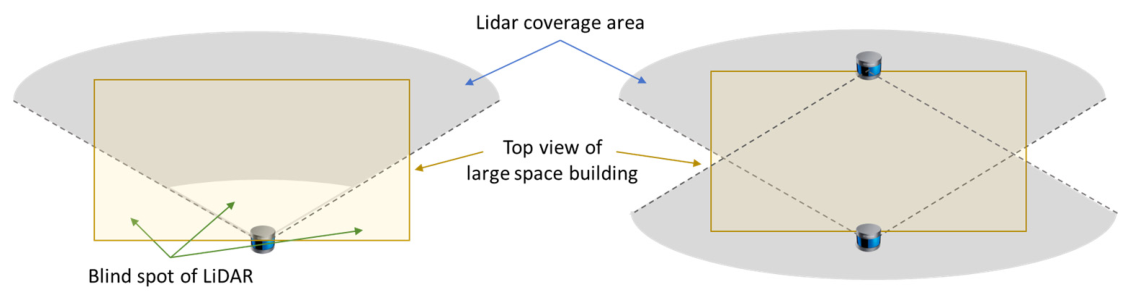
Light Detection and Ranging (LiDAR), as a high-precision environmental perception sensor widely used in the field of autonomous driving, can effectively solve the pain points of existing smoke detection technologies in high and large-volume scenarios with its inherent technical characteristics. LiDAR accurately obtains three-dimensional spatial information and reflection characteristics of the target by emitting laser beams and receiving the echo signals reflected by the target, based on the Time-of-Flight (ToF) principle of light. It has four core advantages suitable for smoke detection in high and large-volume spaces: (1) Long detection range and wide coverage. Its effective detection radius can reach the hundred-meter level, and the detection field of view is a fan-shaped surface, which is significantly superior to the linear coverage of linear beam detectors, and a single device can achieve effective monitoring of a large-scale space. (2) No installation height limitation. Theoretically, smoke can be effectively detected as long as it is within the LiDAR’s field of view, which is fully adaptable to the floor height requirements of high and large-volume spaces. (3) Strong environmental anti-interference performance. Detection performance is not affected by lighting conditions, and it can operate stably all day and night, fundamentally avoiding the failure of image-based detection in low-light environments. (4) Self-transmitting and self-receiving working mode. No additional independent receiving end is required, which avoids the optical path alignment problem during installation and the impact of building displacement during long-term operation. Meanwhile, it can accurately locate the spatial position of smoke based on the echo signal, making up for the inability of traditional scattering-based detection methods to achieve spatial positioning.
Based on this, this paper conducts research on a LiDAR-based smoke detection method in view of the inherent shortcomings of traditional smoke detection technologies in high and large-volume scenarios, and systematically explores the feasibility and technical advantages of LiDAR for early fire smoke detection in high and large-volume spaces from four dimensions: theoretical analysis, experimental verification, algorithm design, and performance comparison. The main research and contributions of this paper are as follows:
- (1)
Based on the scattering and reflection theory of laser and particulate matter, a mobile lifting tower experimental platform was built to collect the smoke particle size distribution data of standard smoldering fires of cotton rope and wood blocks at different heights. Meanwhile, the quantitative measurement of the reflectivity of smoke particles at the mainstream LiDAR operating wavelengths was completed. The theoretical feasibility of LiDAR for smoke detection was clarified from the aspects of optical characteristics and physical parameters, and the theoretical basis of this technology was improved.
- (2)
A mobile LiDAR point cloud data acquisition platform was built, and LiDAR smoke irradiation experiments were carried out at different detection distances and installation heights. The LiDAR point cloud morphology and spatial distribution characteristics of smoldering smoke were obtained. Meanwhile, the differences in point cloud characteristics between smoke and typical interferences such as water vapor and dust were compared and analyzed, which verified the feasibility of LiDAR smoke detection from the experimental level and provided a physical feature basis for subsequent algorithm design.
- (3)
A LiDAR smoke point cloud dataset containing 1200 labeled smoke samples and 200 interference samples was constructed, covering the full scene combination of different height and detection distance in high and large-volume spaces. Based on this dataset, mainstream 3D point cloud object detection algorithms were tested and verified, and a visible-light-assisted dual-modal fusion detection algorithm was designed to further improve the detection accuracy in complex scenarios.
- (4)
Multi-height and multi-working condition comparative experiments were carried out between the LiDAR-based smoke detection method and traditional point-type and linear beam smoke detection methods, which quantitatively verified the significant technical advantages of the LiDAR smoke detection method in response speed, detection range, and height adaptability.
The remainder of this paper is organized as follows:
Section 2 reviews the research progress related to the principle of photoelectric smoke detection, LiDAR technology, and point cloud object detection algorithms.
Section 3 analyzes the particle size distribution and optical characteristics of smoldering smoke particles, and completes the theoretical feasibility verification of LiDAR smoke detection.
Section 4 carries out LiDAR smoke irradiation experiments, and analyzes the point cloud characterization characteristics of smoke and the distinguishing features between smoke and interferences.
Section 5 presents the construction of the LiDAR smoke detection dataset, the design of the detection algorithm, and the corresponding experimental validation.
Section 6 conducts an in-depth comparative analysis of LiDAR technology with mainstream large-space smoke detection technologies from multiple dimensions such as detection principle, performance, anti-interference ability and full lifecycle cost, and clearly defines their applicable scenarios and competitive boundaries. Finally, the conclusions and prospects of the full study are given at the end of the paper.
2. Related Works
2.1. Principles of Photoelectric Smoke Detection
The photoelectric-based point-type smoke detector [
11,
12,
13], a kind of commonly utilized smoke detector, is primarily composed of two components: optical sensing and photosensitive element. The optical sensing part comprises a transmitter and a receiver: The transmitter continuously emits light into the air, and when smoke enters the detector’s range, the smoke particles scatter the light, with a portion thereof being scattered to the receiver, triggering the detector’s alarm mechanism. A photosensitive element is situated within the receiver to detect alterations in the intensity of the scattered light. Once the scattered light is received, the photosensitive element generates an electrical signal and transmits this signal to the alarm controller. The alarm controller determines whether a fire exists based on the strength of the electrical signal.
A beam smoke detector consists of a transmitter and a receiver: The transmitter emits a parallel beam of light; the receiver is positioned on the opposite side of the beam and incorporates a receiver element to receive the beam. When there is no smoke interference, the beam reaches the receiver element directly, enabling it to remain operational. When smoke enters the beam coverage area, the smoke scatters the light and only a fraction of the light is received by the receiver, resulting in a reduction in the intensity of the light signal received by the receiver element. When the intensity of the light signal received by the receiver element is reduced to a certain extent, the detector will trigger a fire alarm signal.
Both types of detection methods exploit the nature of the interaction between smoke particles and the laser for fire detection. In our study, we draw upon the principle of the interaction between smoke particles and the laser, detecting the presence of smoke within the monitoring area by means of analyzing the reflected echoes from the LiDAR.
2.2. LiDAR
LiDAR (Light Detection and Ranging) is a type of prevalently employed sensor in the domain of autonomous driving, which acquires highly precise 3-dimensional information regarding the surrounding environment by emitting a laser beam and gauging its return time. LiDAR operates on a straightforward yet effective principle: a laser emits a laser beam, which strikes surrounding objects and is reflected back. LiDAR receives these reflected signals and computes the round-trip time of the beam, and based on the speed and time of light, the distance to the object can be determined. By rotating the LiDAR or employing multiple laser beams, information on the position, shape, and distance of the object can be attained, thereby realizing accurate perception of the surrounding environment. Beyond its core application in autonomous driving, LiDAR has also emerged as a pivotal technology in fire science and forest fuel management, with its high-precision point cloud data widely used for 3D vegetation fuel characterization, wildfire behavior modeling, and forest fuel classification [
14,
15].
With the attributes of high resolution, long detection range, stability, and reliability without being influenced by bright light or lightless conditions, LiDAR is capable of providing accurate environmental maps and real-time sensing data for self-driving vehicles, which can assist the vehicles in making prompt decisions and driving safely. Hence, in the field of autonomous driving, LiDAR is extensively utilized in vehicle sensing, path planning, and obstacle avoidance navigation.
In our work, we take the advantages of a long detection distance, wide coverage and no influence from the light environment of LiDAR to analyze and process the point cloud echo generated by the smoke particle, to accurately detect the smoke in the early stage of fire.
2.3. LiDAR Object Detection Algorithm
Object detection employing LiDAR in the domain of autonomous driving primarily utilizes the point cloud data collected by LiDAR for object detection and identification, which typically encompasses the following steps: (1) Point cloud preprocessing: The point cloud data collected by LiDAR undergoes preprocessing operations such as filtering and segmentation, to eliminate noise and irrelevant information. Moreover, the point cloud data is transformed into an acceptable input format for the neural network model, usually by representing the point cloud data as coordinates or features of multiple points; (2) Feature extraction: Features with discriminatory ability are extracted from the point cloud data through feature extraction algorithms (e.g., normal estimation, curvature computation, etc.); (3) Object detection and recognition: The extracted features are employed for object detection and recognition by utilizing machine learning/deep learning algorithms to achieve accurate recognition of vehicles, pedestrians, obstacles, and other objects in the surrounding environment.
LiDAR-based object detection algorithms play a vital role in automatic driving, and numerous mature algorithms and implemented applications have emerged, providing a reference for the research of Lidar-based smoke detection technology [
16,
17,
18].
3. Particle Size and Optical Characteristic Analysis of Smoke Particles
The detection capability of LiDAR for smoke is determined by the reflection and scattering effects generated by the interaction between laser and smoke particles, while the particle size distribution and optical reflection characteristics of particles are the key physical parameters that dominate these effects. Aiming at the deficiencies in existing research, including insufficient characterization of particle size distribution characteristics of early smoldering smoke in high and large-volume spaces and the lack of quantitative data on the reflectivity of smoke particles in the laser operating band, this chapter takes the TF2 cotton rope and TF3 beech wood smoldering fires specified in the ISO 7240-9 [
12] as the research objects. We built a smoke particle characteristic acquisition platform adapted to high and large-volume space scenarios, systematically tested the particle size distribution law of smoldering smoke at different heights and different combustion stages, and carried out optical characteristic analysis combined with the scattering and reflection theory of laser and particulate matter. In addition, the quantitative measurement of smoke particle reflectivity in the mainstream operating band of LiDAR was completed. This chapter systematically clarifies the theoretical feasibility of LiDAR for early fire smoke detection in high and large-volume spaces from the perspective of physical characteristics, and provides a complete physical basis and theoretical support for subsequent LiDAR detection experiments, algorithm design and engineering applications.
3.1. Construction of the Smoke Particle Characteristic Acquisition Platform for High and Large-Volume Spaces
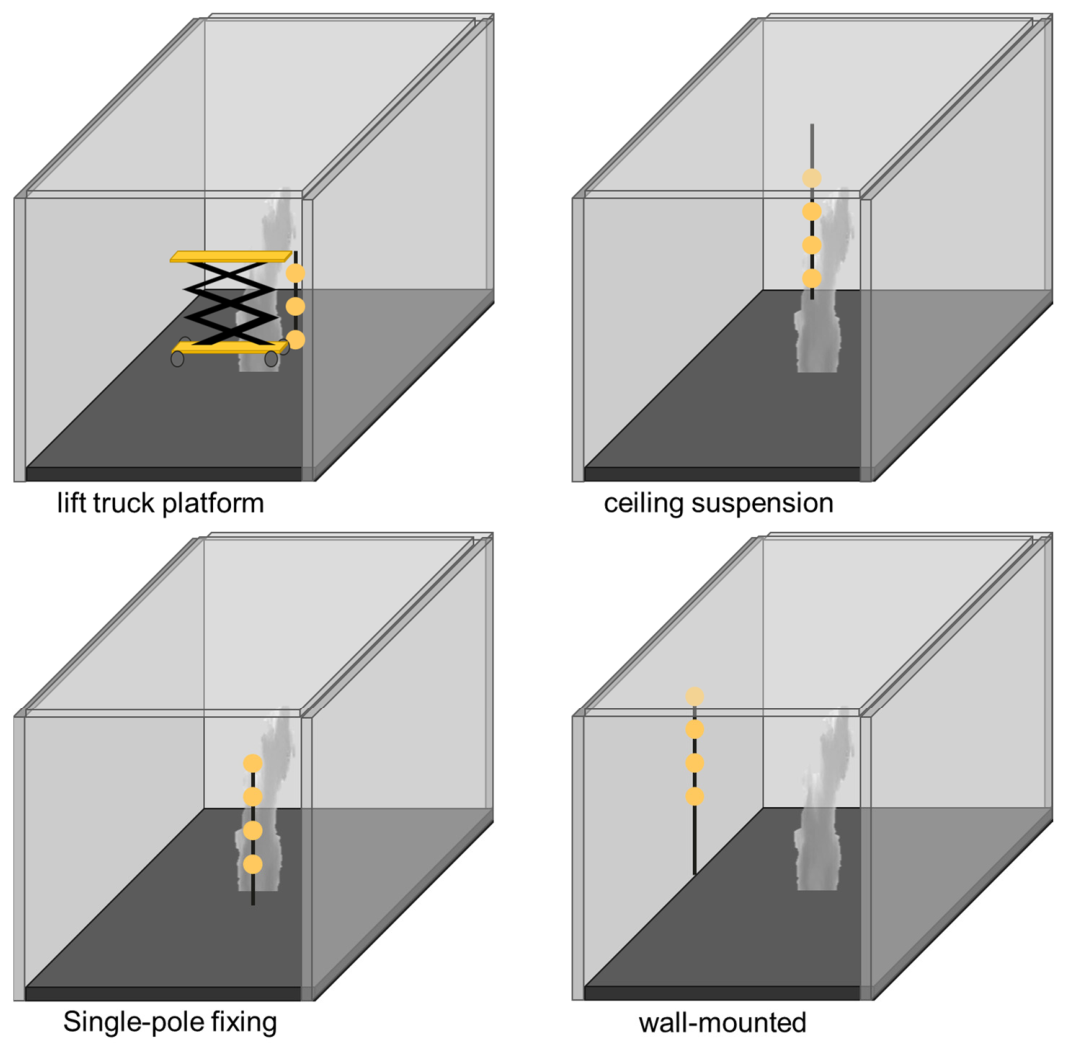
To obtain the real physical characteristics of smoldering smoke in the early stage of fire in high and large-volume scenarios, it is necessary to build an experimental platform that can realize multi-height and whole-process acquisition of smoke particle parameters. In existing studies, sensors are usually arranged by methods such as lift truck lifting, ceiling rope suspension, long pole fixing, and wall mounting to collect smoke parameters. As shown in
Figure 1. Although these methods can obtain relevant data to a certain extent, they have obvious experimental limitations in high and large-volume scenarios:
The lift truck platform will form physical occlusion to the longitudinal diffusion of smoke, which directly interferes with the natural diffusion process of smoke, leading to deviations between the collected data and the real fire scene.
The ceiling suspension scheme is limited by the building floor height, which makes the layout and adjustment of sensor positions difficult, and has extremely low practical feasibility in ultra-high and large-volume spaces.
The single-pole fixing scheme cannot realize the layout of sensors at ultra-high heights, and it is difficult to meet the multi-height data acquisition requirements of high and large-volume spaces above 12 m.
The wall-mounted scheme can only collect the edge area data after smoke diffusion, and cannot obtain the overall smoke characteristics of the central area in high and large-volume spaces, resulting in insufficient data representativeness.
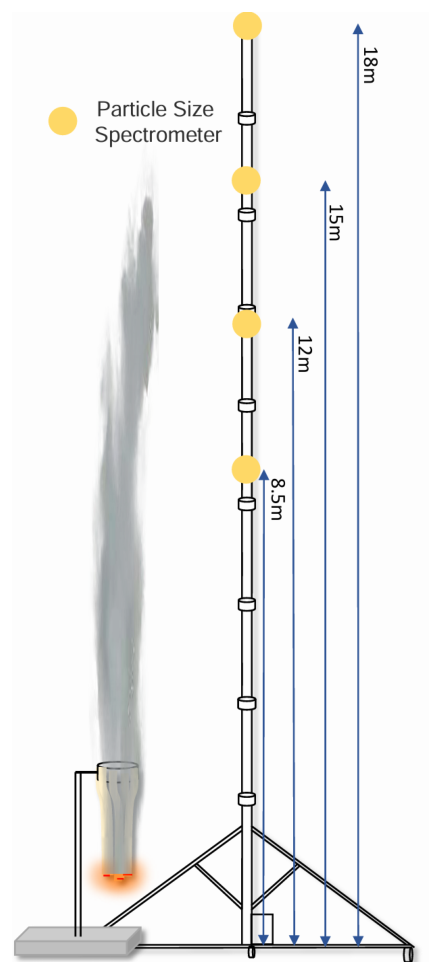
To address the above problems, this study independently designed a set of mobile lifting tower experimental platforms for the whole-process acquisition of early fire smoke particle characteristics in high and large-volume spaces. The platform is driven by electric power, with a maximum lifting height of 18 m and a rated load of 60 kg. The bottom is equipped with lockable moving wheels and anti-slip and anti-overturning triangular brackets, which not only ensures the flexibility of platform movement, but also guarantees the structural stability during the lifting process. The top of the lifting rod is equipped with a multi-sensor adaptive installation system, which can fix multiple sets of particle testing equipment at the same time to realize synchronous acquisition of smoke parameters at different heights. Compared with existing acquisition schemes, this platform has the advantages of wide height coverage, flexible movement, safety and stability, and no occlusion of smoke diffusion, which can perfectly adapt to the smoke characteristic acquisition requirements of high and large-volume scenarios. The structure of the platform is shown in
Figure 2.
Based on this platform, in strict accordance with the ISO 7240-9 standard, we used TF2-grade cotton rope and TF3-grade beech wood as smoldering fire sources respectively, and arranged the fire points directly below the lifting tower to generate standard smoldering smoke. The NOVA-SDS029 particle size spectrometer was adopted as the core testing equipment, which works based on the single-particle laser scattering principle and is equipped with 31 particle-size channels ranging from 0.25 μm to 20 μm, which can fully cover the whole particle-size range of early fire smoke particles. In the experiment, particle-size spectrometers were arranged at four heights of 8.5 m, 12 m, 15 m and 18 m of the lifting tower respectively, to synchronously collect the particle-size distribution data of smoke particles at different heights and different combustion stages.
3.2. Analysis of Particle-Size Distribution Law of Smoldering Smoke Particles
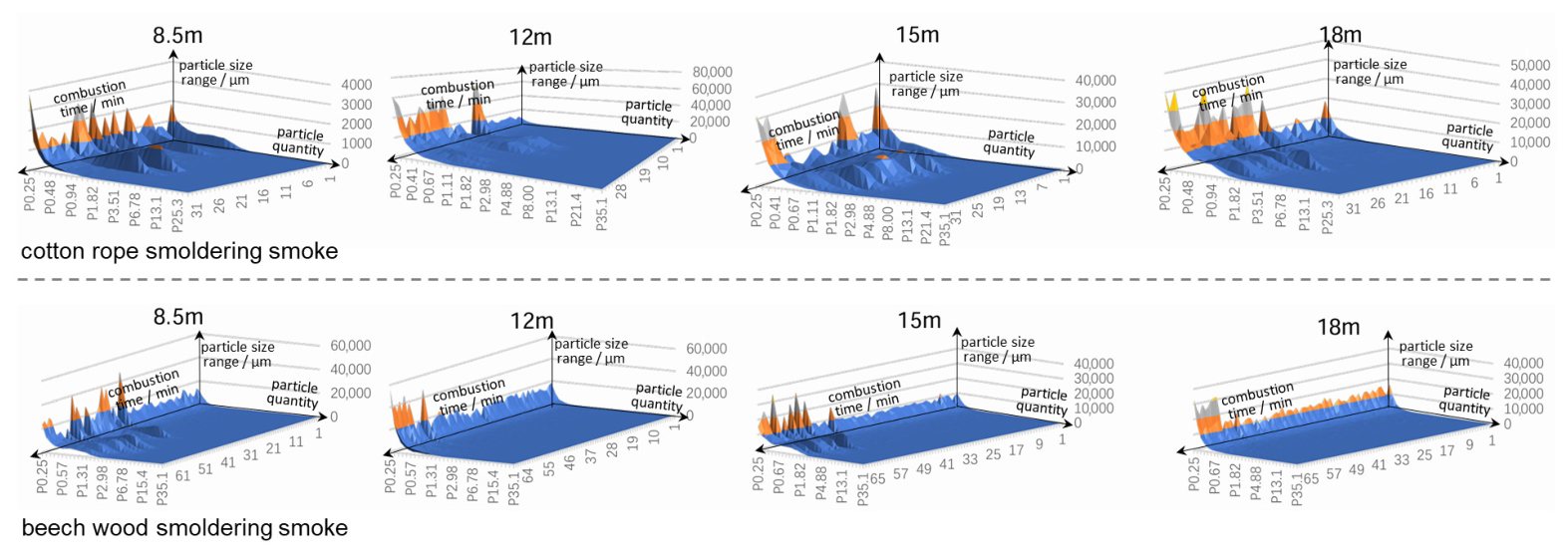
Based on the above experimental platform, we completed the acquisition of smoke particle-size data during the whole 32 min smoldering process of cotton rope and the whole 62 min smoldering process of beech wood. The test results of particle-size distribution at different heights are shown in
Figure 3. In the figure, the horizontal axis represents the duration of smoldering combustion, the left vertical axis represents the particle-size interval, and the vertical axis represents the mass concentration of particles with the corresponding particle size. Among them, the upper four groups are the test results of cotton rope smoldering smoke, and the lower four groups are the test results of beech wood smoldering smoke.
The particle-size distribution laws of smoldering smoke particles in high and large-volume spaces can be summarized from the test results:
Small-sized particles always dominate during the whole smoldering process. For the smoke generated by cotton rope smoldering, particles with a size below 0.7 μm are continuously generated throughout the combustion cycle, which is the particle-size interval with the highest number proportion. Although the proportion of small-sized particles in beech wood smoldering smoke is lower than that in cotton rope, submicron particles are still the main component in the initial combustion stage.
The number of large-sized particles increases significantly with the extension of smoldering time. During the diffusion process, smoke particles will collide with particles undergoing Brownian motion in the air, and undergo agglomeration and coagulation under the action of van der Waals forces, gradually forming larger aggregate structures. This leads to a continuous increase in the mass concentration of large-sized particles with the combustion duration. In the middle and late stages of cotton rope smoldering, a large number of particles with diameters ranging from 1.82 μm to 3.51 μm appear at the heights of 12 m, 15 m and 18 m. During the smoldering process of beech wood, a considerable number of particles with diameters ranging from 1.31 μm to 2.98 μm are also detected at the heights of 8.5 m and 18 m.
There are sufficient large-sized particles meeting the laser reflection requirements at different heights in high and large-volume spaces. The test results show that in the full height range of 8.5 m to 18 m, the smoke generated by cotton rope and beech wood smoldering contains a large number of particles with a size larger than 1 μm. With the increase in height, the agglomeration effect of particles is more obvious, and the proportion of large-sized particles has no significant attenuation. This provides the essential physical condition for LiDAR smoke detection in the full height range of high and large-volume spaces.
3.3. Theoretical Analysis of Optical Characteristics of Laser–Smoke Particle Interaction
When a laser is incident on smoke particles, two core optical phenomena, reflection and scattering, will occur. Specifically, reflection means that part of the laser beam is reflected back from the surface of smoke particles following the law that the angle of incidence equals the angle of reflection, while scattering means that part of the laser is absorbed by smoke particles and then re-radiated into the whole space. The occurrence law and proportion of these two phenomena are directly determined by the wavelength of the incident laser and the particle size of smoke particles. When the wavelength of the incident laser is larger than the particle size of smoke particles, the scattering phenomenon is dominant, and the laser will be scattered by the particles in all directions, making it difficult to form a directional echo. On the contrary, when the wavelength of the incident laser is smaller than the particle size of smoke particles, the reflection phenomenon is dominant, and the laser can be directionally reflected by the particles to form an effective echo signal that can be received by LiDAR, which is also the core theoretical basis for LiDAR to realize smoke detection.
At present, the Vertical-Cavity Surface-Emitting Laser (VCSEL) used in commercial LiDAR has two mainstream operating wavelengths in the near-infrared band: 905 nm and 1550 nm. Combined with the particle size test results in
Section 3.2, it can be seen that the smoke generated by cotton rope and beech wood smoldering contains a large number of particles with a size larger than 1550 nm, and the proportion of particles exceeding 905 nm is even higher. This fully meets the reflection-dominant condition that the particle size is larger than the laser wavelength, and can generate directional reflected echoes that can be effectively received by LiDAR under laser irradiation. From the perspective of the interaction mechanism between laser and particles, the theoretical feasibility of LiDAR for early fire smoke detection is confirmed.
3.4. Quantitative Measurement and Analysis of Laser Reflectivity of Smoke Particles
The intensity of the LiDAR echo signal is directly determined by the reflectivity of the detected target, which is the core physical parameter affecting the sensitivity, effective detection range and signal-to-noise ratio of LiDAR smoke detection.
Section 3.3 has clarified the interaction mechanism between laser and smoke particles at the theoretical level, and verified the theoretical feasibility of LiDAR for smoke detection, but the quantitative characterization of the reflectivity of smoke particles in the LiDAR operating band has not been carried out. Therefore, based on the customized gradient reflectivity calibration plates, this section builds a smoke particle reflectivity measurement system, carries out quantitative measurement of reflectivity for smoke particles from cotton rope and beech wood smoldering at the wavelength of 905 nm, clarifies the reflectivity range and variation law of smoke particles, and provides a quantitative basis for the hardware parameter selection and algorithm threshold setting of subsequent LiDAR detection experiments.
3.4.1. Measurement System and Experimental Scheme
In this study, a set of gradient reflectivity standard calibration plates were customized as the metrological reference for the measurement of smoke particle reflectivity. The calibration plates are made of high-precision optical coating materials with a physical size of 200 mm × 200 mm, which can completely cover the LiDAR laser spot and avoid the interference of the spot edge effect on the measurement results. Each calibration plate has been metrologically calibrated, with reflectivity of 2%, 10%, 20%, 30%, 40% and 50% at the wavelength of 905 nm respectively, which can fully cover the potential reflectivity range of combustion smoke particles.
Based on the above calibration plates, a smoke particle reflectivity measurement system was built, which is composed of three parts: LiDAR detection module, reflectivity calibration plate module, and smoke generation module:
The LiDAR detection module adopts the same LiDAR as that used in subsequent experiments, which is fixed on a three-dimensional adjustable platform to realize the vertical incidence of the laser beam to the calibration plate or smoke measurement area, ensuring the consistency of measurement conditions.
The calibration plate is fixed on a high-precision lifting bracket made of non-reflective black material to avoid the interference of secondary laser reflection on the measurement results.
The smoke generation module continues to use TF2 cotton rope and TF3 beech wood in accordance with the ISO 7240-9 standard as smoldering materials. The smoke is generated in a closed transparent acrylic test chamber with a concentration regulator, which can precisely control the mass concentration of smoke.
Before the formal measurement, the calibration plates with different reflectivity were placed on both sides of the smoke occurrence position in turn. The three-dimensional platform of LiDAR was adjusted to make the laser beam vertically incident on the center of the calibration plate, the detection distance was fixed at 20 m, and the echo signal intensity of each calibration plate was collected.
3.4.2. Measurement Results and Analysis
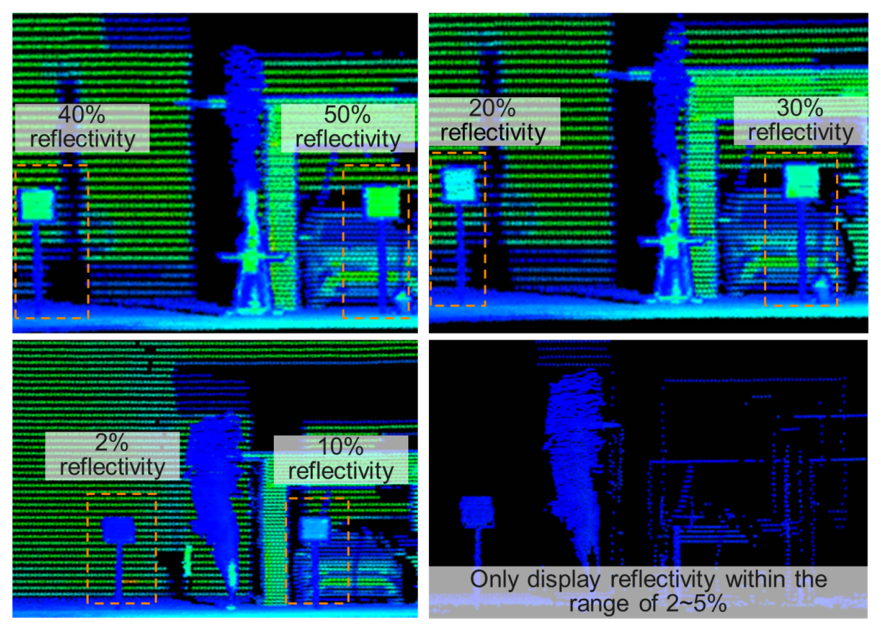
The results of the reflectivity of cotton rope and beech wood smoldering smoke particles at a 905 nm wavelength are shown in
Figure 4, and the variation laws of smoke particle reflectivity can be summarized as follows:
The smoke particles are in the low reflectivity interval under the LiDAR operating band, and there is an obvious material difference. The reflectivity of smoke particles from the two smoldering materials is in the range of 2~5% as a whole. Among them, the reflectivity of beech wood smoldering smoke is significantly higher than that of cotton rope. The reason is that the smoke from beech wood smoldering contains more carbonized solid particles with relatively smooth surfaces, while the cotton rope smoke is dominated by fibrous organic particles with rough surfaces and a higher light absorption rate, resulting in weaker reflection ability.
The reflectivity of smoke particles shows a slow upward trend with the extension of smoldering time, which is completely consistent with the particle size change law in
Section 3.2. With the increase in smoldering time, smoke particles continue to collide and agglomerate, the particle size increases, so the laser reflection ability is enhanced accordingly.
Based on the core reflectivity distribution interval of 2~5% for smoldering smoke particles, efficient preprocessing and interference filtering of LiDAR point cloud data can be realized. By setting the reflectivity threshold of 2~5%, irrelevant background point clouds such as building structures with high reflectivity and environmental noise with low reflectivity can be effectively eliminated, which greatly reduces the data volume and computational complexity of subsequent point cloud processing. At the same time, reflectivity can be integrated into the smoke detection algorithm as a core feature dimension, and the accurate distinction between smoke point cloud and background and interferences can be realized by using the difference in reflectivity. This provides a key parameter basis for feature extraction and target recognition of subsequent point cloud data, and effectively improves the detection accuracy and operation efficiency of the algorithm.
4. Experimental Verification of LiDAR-Based Smoke Detection
Section 3 has completed the theoretical feasibility verification of LiDAR for smoke detection from three dimensions: the particle size distribution of smoke particles, the interaction mechanism between laser and particles, and the quantitative characterization of laser reflectivity. To further intuitively verify the point cloud characterization ability of LiDAR for early fire smoldering smoke, clarify the characteristic law of smoke under LiDAR detection, and eliminate the influence of typical interferences in actual engineering scenarios on the detection results, this chapter builds a mobile LiDAR smoke point cloud data acquisition platform, carries out systematic LiDAR smoke irradiation experiments in a full-scale high and large-volume fire laboratory, analyzes the evolution law of smoldering smoke point cloud morphology at different detection distances, and compares the differences in point cloud characteristics between smoldering smoke from different materials and typical interferences such as water vapor and dust. This chapter verifies the feasibility of LiDAR for early smoke detection in high and large-volume spaces from the experimental level, and provides a physical feature basis for the design and optimization of the subsequent detection algorithm.
4.1. Design of Experimental Platform and Scheme
4.1.1. Experimental Environment and Equipment
This experiment was carried out in a high and large-volume fire laboratory with a length of 100 m, a width of 30 m and a height of 18 m. During the experiment, the doors, windows and smoke exhaust system were closed to ensure a windless environment without ambient light interference in the laboratory, so as to restore the real scene of natural smoke diffusion in fire accidents. Before the experiment, an 80 m detection range was calibrated in the laboratory, and a scale mark was set every 20 m to collect smoke point cloud data at different detection distances.
To realize synchronous acquisition of smoke point cloud data in the whole scene with flexible movement, a mobile LiDAR smoke point cloud data acquisition platform was built. The platform consists of a LiDAR, an industrial computer, and a portable monitoring terminal. The whole platform can realize flexible adjustment of the detection position and real-time acquisition, storage and visualization of point cloud data. The performance parameters of the LiDAR used in this experiment are shown in
Table 1. Its operating wavelength is 905 nm, which is consistent with the main detection band of the smoke particle reflectivity test in
Section 3, ensuring the consistency of experimental conditions and the comparability of data.
4.1.2. Design of Experimental Scheme
The experimental fire sources strictly follow the ISO 7240-9 standard, using TF2-grade cotton rope and TF3-grade beech wood as smoldering materials respectively, which are consistent with the fire sources used in the particle size and reflectivity tests in
Section 3 to ensure the standardization of experimental samples. During the experiment, the smoldering fire source was first ignited at the calibrated position in the laboratory. After the smoke entered the stable diffusion stage, the acquisition platform was moved backward along the calibrated route, and the LiDAR point cloud data of smoldering smoke from cotton rope and beech wood were collected synchronously at the detection positions of 20 m, 40 m, 60 m and 80 m.
To further clarify the anti-interference performance of LiDAR smoke detection, in the same experimental environment, we collected the LiDAR point cloud data of two typical interferences in engineering scenarios of large spaces—water vapor (generated by a humidifier) and dust (generated by a standard test dust generator), and carried out a comparative analysis with the point cloud characteristics of smoldering smoke to clarify the distinguishing boundary of characteristics between smoke and interferences.
4.2. Analysis of LiDAR Point Cloud Characterization Characteristics of Smoldering Smoke
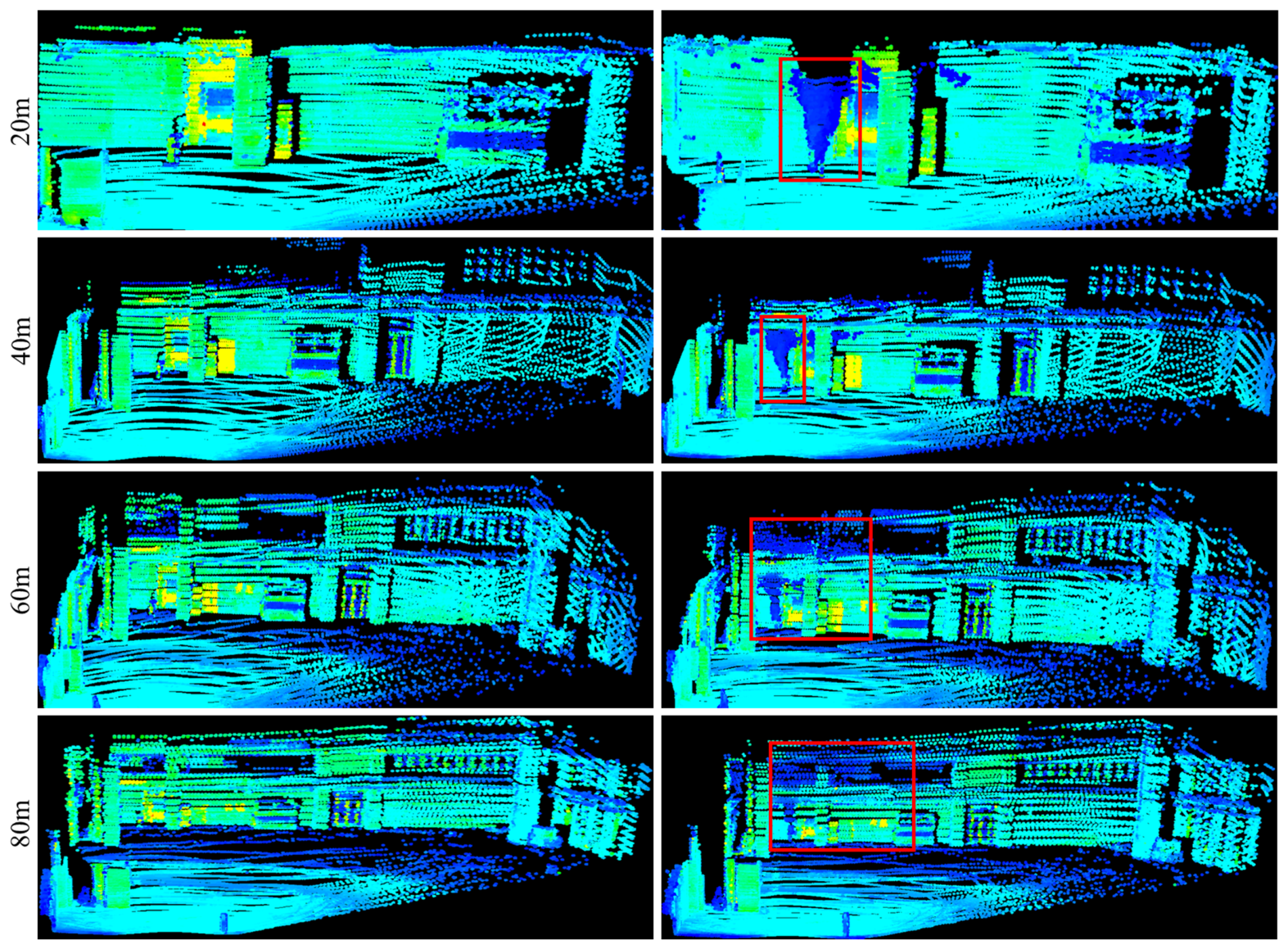
The LiDAR point cloud imaging effect of cotton rope smoldering smoke at different detection distances is shown in
Figure 5. The left side of the figure is the background point cloud in the smoke-free environment, and the right side is the point cloud of the smoke diffusion scene at the corresponding detection distance. Combined with the experimental data and point cloud imaging results, the LiDAR point cloud characterization laws of smoldering smoke can be summarized as follows:
LiDAR can clearly capture the whole dynamic characteristics of the smoke diffusion process. During the experiment, with the continuous progress of cotton rope smoldering and the backward movement of the acquisition platform, the morphological change in the smoke point cloud completely restored the whole process of smoke diffusion upward and far away from the fire source. At the close distance of 20 m, the smoke was in the initial diffusion stage, and the point cloud presented a concentrated and dense clustered distribution characteristic, which directly corresponded to the position of the fire source. As the detection distance increased to 40 m and 60 m, the smoke gradually diffused and diluted, the distribution range of the point cloud clusters expanded, and the density decreased. When the detection distance reached 80 m, the smoke had fully diffused and was relatively thin as a whole, but LiDAR could still capture the diffusion outline of the smoke, and a clear cloud-like point cloud morphology could still be presented after amplification. This result directly proves that even at a long distance of 80 m, LiDAR can still generate effective point cloud data through the reflected echo of smoke particles, and has the capability of long-distance early smoke detection.
The echo characteristics of the smoke point cloud are highly consistent with the theoretical analysis results in
Section 3. In the experiment, smoldering smoke can form stable and identifiable point clouds for two core reasons: on the one hand, there are a large number of particles with a size larger than the 905 nm laser wavelength in the smoke, which can produce directional reflected echoes and provide a physical basis for point cloud generation; on the other hand, the cumulative reflection effect of smoke particle groups can significantly improve the echo signal intensity. Even if the reflectivity of a single particle is in the low-reflectivity interval, the superimposed echoes of a large number of particles can still be effectively received by LiDAR to form identifiable point cloud features.
There are distinguishable characteristic differences in the smoke point clouds from different smoldering materials. The comparative analysis results of the point clouds of cotton rope and beech wood smoldering smoke show that both present the characteristics of clustered continuous distribution, but there are obvious detailed differences. The smoke particles from cotton rope smoldering have smaller particle size and more uniform spatial distribution, so the overall point cloud density is higher. A continuous cloud-like point cloud cluster can be formed in the full detection range of 20~80 m, the edge is only slightly dispersed with the increase in distance, and the core area outline is always clear. The particle agglomeration effect of beech wood smoldering smoke is more significant, so the point cloud density presents the distribution characteristic of local high aggregation and overall looseness, and there is an obvious density gradient inside the point cloud cluster, which forms a significant distinction from the uniform distribution characteristics of cotton rope smoke. This result indicates that LiDAR can not only realize the presence detection of smoke, but also distinguish different types of smoldering smoke through point cloud characteristics, which provides data support for the prediction of fire types.
4.3. Analysis of Point Cloud Feature Differences Between Smoke and Typical Interferences
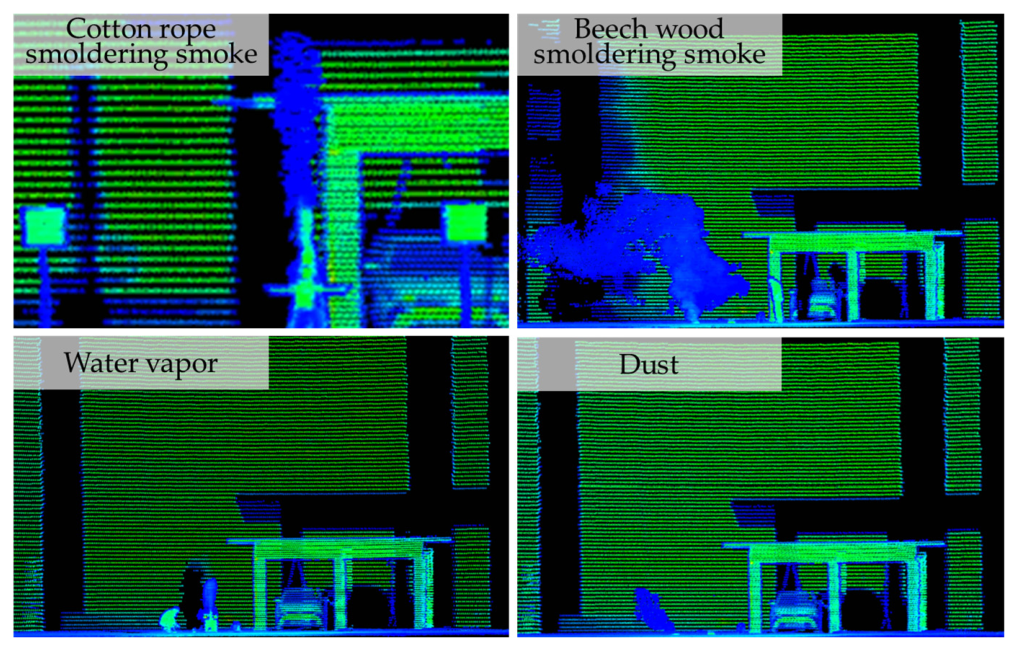
In the engineering scenarios of high and large-volume spaces, water vapor and dust are the most typical interference factors that cause false alarms of traditional smoke detection equipment. To clarify the anti-interference ability of LiDAR smoke detection and establish the feature recognition criteria for smoke and interferences, this chapter carries out a systematic comparative analysis on the LiDAR point cloud data of four types of samples: cotton rope smoldering smoke, beech wood smoldering smoke, water vapor, and dust. The essential characteristic differences between smoke and interferences are clarified from three core dimensions: point cloud distribution morphology, density characteristics, and spatial diffusion law; the results are shown in
Figure 6.
The following conclusions can be drawn from the comparative results:
- (1)
There are essential differences in point cloud characteristics between water vapor and smoldering smoke. The LiDAR point cloud of water vapor has no stable clustered structure, presenting an irregular discrete distribution state, and the connectivity between point cloud particles is extremely poor. It will dissipate rapidly with the ambient airflow, and cannot form a stable and continuous point cloud cluster like smoke. At the same time, the diffusion of water vapor has no fixed law, which is completely inconsistent with the upward diffusion characteristic of smoke driven by thermal buoyancy. Therefore, water vapor can be effectively distinguished from smoke through the point cloud structure and spatial diffusion law.
- (2)
There is a significant boundary between the point cloud characteristics of dust and smoldering smoke. Although the dust point cloud has a slight aggregation, its overall density is much lower than that of smoldering smoke. Moreover, due to the difference in the reflection characteristics of dust particles, the intensity of the point cloud echo signal fluctuates greatly, presenting a sporadic point-like sparse distribution without the continuous cloud-like outline of smoke point clouds. Meanwhile, the spatial distribution of dust is dominated by gravity, mainly vertical downward settlement, which is completely opposite to the upward diffusion law of smoke. It can be accurately distinguished from smoke through density characteristics and the diffusion trend.
The above differences in point cloud characteristics between smoke and interferences provide a key physical basis for feature extraction, interference suppression and false alarm filtering of the subsequent LiDAR smoke detection algorithm. In the algorithm design, recognition criteria can be constructed through multi-dimensional features such as point cloud density, distribution morphology, and spatial diffusion law, which can effectively filter the influence of interference factors such as water vapor and dust, and greatly improve the anti-interference ability and detection accuracy of the LiDAR smoke detection system.
5. Design and Experimental Verification of LiDAR-Based Smoke Detection Algorithm
The previous chapters have systematically verified the feasibility of LiDAR for early smoldering smoke detection in high and large-volume spaces from both theoretical and experimental aspects, and clarified the particle size distribution, optical reflection characteristics of smoke particles, and the LiDAR point cloud characterization laws of smoke. On this basis, aiming at the engineering application requirements of high and large-volume space scenarios, this chapter constructs a special LiDAR smoke point cloud dataset adapted to the characteristics of smoldering smoke and typical interference scenarios, and designs a smoke detection algorithm based on LiDAR point cloud. The training, performance testing and embedded engineering deployment of the algorithm are completed, and multi-condition comparative experiments with traditional point-type and linear beam smoke detection methods are carried out in a full-scale high and large-volume fire laboratory. The comprehensive performance of the proposed method in this paper is quantitatively verified, which provides complete algorithm support and performance validation for the engineering implementation of LiDAR smoke detection technology.
5.1. Construction of LiDAR Smoke Point Cloud Dataset for High and Large-Volume Spaces
A high-quality annotated dataset with comprehensive scene coverage is the foundation for the development and performance optimization of deep learning-based point cloud object detection algorithms. At present, there is no public special LiDAR point cloud dataset for fire smoke in high and large-volume spaces in the industry, which restricts the development and application of related algorithms. For this reason, based on the experimental platform built in the previous chapters, this paper constructs a special LiDAR smoke point cloud dataset containing smoldering smoke samples and typical interference samples in a full-scale high and large-volume fire laboratory, to provide data support for algorithm design and performance verification.
5.1.1. Data Acquisition Platform and Experimental Environment
The data acquisition experiment was carried out in a high and large-volume fire laboratory with a length of 100 m, a width of 30 m and a height of 18 m. The experimental environment is consistent with the previous particle size test and point cloud characterization experiment, ensuring the consistency of data and the authenticity of the scene. A mobile LiDAR point cloud data acquisition platform was built, with the Hesai AT128 LiDAR (Hesai Technology Co., Ltd., Shanghai, China) as the core perception device. This device operates at a wavelength of 905 nm, which is consistent with the main detection band in the previous chapters. Its maximum detection range can reach 210 m for targets with 10% reflectivity, and the field of view is 120° × 25.4°, which can realize high-density point cloud data acquisition in a large-scale space. The platform is also equipped with angle-adjustable optomechanical mounting components and an industrial computer to realize real-time acquisition, storage and preprocessing of full-field point cloud data.
The experimental fire sources strictly follow the ISO 7240-9 standard, using TF2-grade cotton rope and TF3-grade beech wood as smoldering materials respectively, which are consistent with the experimental samples in the previous chapters to ensure the uniformity of samples. During the acquisition process, the smoldering process of cotton rope and beech wood was precisely controlled, and the smoke point cloud data of different combustion stages in the whole smoldering cycle were synchronously collected within a different detection distance and height. Meanwhile, to verify the height adaptability of the algorithm, acquisition points were arranged at different elevations on the surrounding fences of the laboratory to collect smoke point cloud data. The point cloud reconstruction results show that the smoke presents a dense cluster structure, and the point cloud has high-concentration reflection characteristics; even when the smoke diffuses to 80 m and becomes relatively thin, the point cloud can still maintain a clear diffusion morphology, which is completely consistent with the results of the point cloud characterization experiment in
Section 4, providing high-quality raw data for dataset construction.
5.1.2. Dataset Construction and Sample Composition
Based on the collected raw point cloud data, this paper constructs a special LiDAR smoke point cloud dataset containing the spatial distribution and reflection intensity information of smoke. During the dataset construction process, preprocessing operations such as denoising, ground segmentation and background filtering were first performed on the raw point cloud data to eliminate the static background of the environment and random noise point clouds, and retain the effective point clouds of smoke targets and potential interference targets. Subsequently, professional point cloud annotation tools were used to perform 3D bounding box annotation on the preprocessed point cloud data, and the annotation categories include three classes: “smoldering smoke”, “water vapor interference” and “dust interference”.
The final constructed dataset contains a total of 1400 groups of annotated samples, of which 1200 groups are annotated smoldering smoke samples, covering the full scene combination of 8.5~18 m height and 20~80 m detection distance, including smoke samples at different combustion stages such as the initial smoldering stage, development stage and stable diffusion stage. The other 200 groups are typical interference samples, which are water vapor samples generated by a humidifier and dust samples generated by a standard test dust generator respectively.
To ensure the reliability and generalization ability of model training and testing, we adopted a stratified random sampling method to divide the 1400 annotated samples into training, validation and test sets in a ratio of 7:2:1. The division process strictly followed the scene balance principle, ensuring that each subset covered the full height range of 8.5~18 m, the full detection distance range of 20~80 m, and the three combustion stages of initial smoldering, development and stable diffusion. Meanwhile, the 6:1 ratio of smoke samples to interference samples was unchanged to avoid the impact of data distribution bias on model training and testing results. The specific statistical information of the dataset is as follows: the training set contains 980 groups of samples, including 420 groups of cotton rope smoke, 420 groups of beech wood smoke, 70 groups of water vapor interference and 70 groups of dust interference; the validation set contains 280 groups of samples, with the number of various types of samples reduced proportionally; the test set contains 140 groups of samples, which is used for the final algorithm performance evaluation.
The construction of the dataset fully considers the real engineering application scenarios of high and large-volume spaces, and the addition of interference samples can effectively improve the anti-interference ability of the subsequent detection algorithm, providing sufficient and engineering-relevant data support for model training and performance verification.
5.2. Design of Single-Modal LiDAR Point Cloud Smoke Detection Algorithm
Aiming at the requirements of real-time performance, high accuracy and high reliability for smoke detection algorithms in high and large-volume space scenarios, this paper selects PointPillars [
22] as the core algorithm for single-modal LiDAR point cloud smoke detection. This algorithm is a mainstream 3D point cloud object detection algorithm widely used in the autonomous driving industry, which has the advantages of high detection accuracy, fast inference speed and strong engineering adaptability, and can meet the real-time requirements of smoke detection in high and large-volume spaces. For the special characteristics of fire smoke, such as non-rigid, diffuse and low reflectivity, this paper carries out feature adaptation optimization on the original algorithm to make it more suitable for the point cloud characterization characteristics of smoke.
5.2.1. Algorithm Principle and Processing Flow
The core innovation of the PointPillars algorithm is that it converts sparse 3D point cloud data into dense 2D pseudo feature maps through pillarization processing, which can be directly adapted to mature 2D convolutional neural networks. While ensuring the detection accuracy of 3D targets, it greatly reduces the computational complexity of the model and improves the inference speed. The optimized algorithm processing flow for the smoke detection task is divided into three core stages:
Point cloud pillarization and preprocessing: The 3D point cloud space collected by LiDAR is divided into a number of uniformly distributed grids on the horizontal plane, and each grid corresponds to a pillar in the vertical direction, completing the pillarization discretization of the point cloud space. Then, the point cloud data in each pillar is sorted and feature-enhanced. In addition to the original three-dimensional coordinates and reflection intensity information, dimensions highly correlated with smoke characteristics such as point cloud density, spatial distribution variance, and relative coordinate offset are additionally integrated, to provide richer input information for subsequent feature extraction.
Pillar feature encoding and feature extraction: Feature encoding is performed on the point cloud in each pillar through a simplified PointNet network to extract discriminative deep features, and complete the feature vector representation of each pillar. Then, the feature vectors of all pillars are mapped according to their spatial positions, and aggregated to generate a two-dimensional pseudo feature map, realizing the conversion from 3D point cloud features to 2D dense features.
Object detection and bounding box regression: In-depth feature learning is performed on the pseudo feature map through a 2D convolutional backbone network to further extract the high-dimensional semantic features of smoke targets. Then, the classification confidence prediction and 3D bounding box regression of smoke targets are completed through the detection head, and finally the category, spatial position, confidence and contour information of smoke targets within the detection range are output, realizing the accurate identification and positioning of smoke targets.
5.2.2. Algorithm Optimization for Smoke Detection Task
Aiming at the characteristics of irregular shape of smoke targets and reasonable deviation allowed in spatial positioning, this paper redefines the accuracy evaluation criterion for smoke detection tasks. We continue to use the comprehensive evaluation system of category information and bounding box information in 3D object-detection tasks: as long as the algorithm model judges the target category as “smoke”, and the Intersection over Union (IoU) between the predicted 3D bounding box and the actual annotated bounding box is ≥70%, the alarm is determined as accurate identification, and the accuracy of this sample is counted as 100%. Meanwhile, the single-frame inference time is adopted as the evaluation index of algorithm real-time performance to evaluate the engineering deployment capability of the model. The experimental results show that the improved IoU PointPillars smoke detection algorithm can achieve a detection accuracy of 91.2%, with an inference time of about 0.2 s, verifying the feasibility of the LiDAR-based smoke detection algorithm.
5.3. Visible-Light-Assisted Dual-Modal Fusion Smoke Detection Algorithm
The single-modal LiDAR point cloud detection algorithm can realize stable smoke detection under all-weather and all-illumination conditions, but, limited by the feature dimension of single modality, there is still room for improvement in detection accuracy in complex scenarios. In contrast, the smoke detection algorithm based on visible light images is severely restricted by lighting conditions and is prone to failure in low-light and night scenes, but in scenes with good lighting conditions, it can accurately capture the visual features such as color gradient and texture diffusion of smoke, forming a good complement to LiDAR point cloud features.
For this reason, based on the single-modal LiDAR point cloud algorithm, this paper introduces the YOLO11-seg [
25] image segmentation model as the visible light auxiliary module, and designs a dual-modal fusion smoke detection algorithm with LiDAR point cloud as the main body and visible light image as the supplement. Through a decision-level joint confirmation mechanism, the algorithm fuses the smoke color and texture features extracted from visible light images with the smoke morphology and spatial distribution features extracted by the PointPillars LiDAR point cloud object detection model, to further improve the smoke detection accuracy in complex scenarios.
5.3.1. Dual-Modal Fusion Strategy and Joint Confirmation Mechanism
This paper adopts a decision-level fusion scheme. Compared with data-level and feature-level fusion, this scheme does not require spatiotemporal registration of the original data of the two modalities, with stronger algorithm robustness, which is more suitable for the complex application scenarios of high and large-volume spaces. The core principle of the fusion strategy is as follows: the LiDAR point cloud detection results are taken as the core judgment basis to ensure the detection stability of the algorithm under complex lighting conditions such as strong light, night and low illumination; the visible light image detection results are used as auxiliary supplements to improve the detection accuracy and reduce the false alarm rate in well-lit scenes.
Specifically, the implementation workflow of the decision-level fusion is as follows: First, the LiDAR and the visible light camera collect data independently and perform preprocessing respectively. The LiDAR point cloud is denoised and ground-segmented before being input into the PointPillars model, which outputs the 3D bounding box, class confidence and spatial coordinates of the smoke. The visible light image is preprocessed and then input into the YOLO11-seg model, which outputs the pixel-level segmentation mask, class confidence and 2D bounding box of the smoke. Finally, decision fusion is performed according to the designed joint confirmation rules.
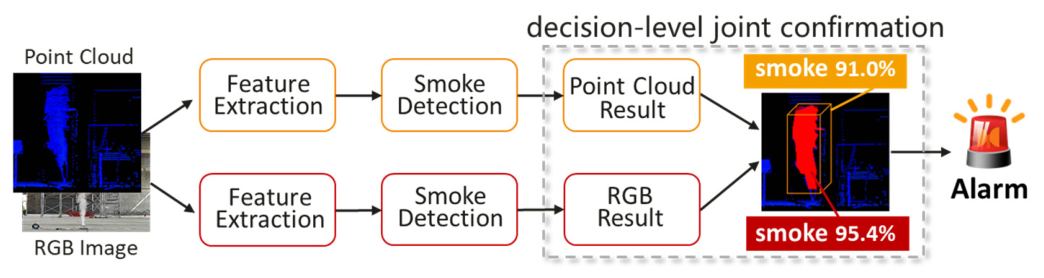
Based on the above principles and implementation workflow, a dual-modal joint confirmation mechanism and alarm trigger conditions are designed. The specific structure of the network is shown in
Figure 7. The final alarm state is determined by the logical correlation of the detection results of the two modalities, and the specific trigger rules are as follows:
When the smoke confidence detected by LiDAR point cloud is ≥85%, the fire alarm is triggered directly regardless of the visible light image detection result, to ensure alarm reliability under extreme lighting conditions.
When the smoke confidence detected by LiDAR point cloud is ≥70% and <85%, the fire alarm can be triggered only if the smoke confidence of visible light image detection is ≥80%, so as to reduce the false alarm rate through dual-modal cross-validation.
When the smoke confidence detected by LiDAR point cloud is <70%, no alarm is triggered regardless of the visible light image detection result, to avoid false alarms of the system caused by misjudgment of visible light images.
This fusion strategy not only ensures the detection stability of the algorithm under all-illumination conditions relying on LiDAR technology, but also makes full use of the visual feature advantages of visible light images to improve the detection accuracy in well-lit scenes, realizing the complementary advantages of the two detection modalities. At the same time, the algorithm has low inference complexity and can adapt to the real-time requirements of embedded platforms.
To fully balance the high-precision advantage of dual-modal fusion and the all-weather reliability of LiDAR-only detection, this system is designed with a fully automatic seamless mode switching mechanism as an important supplement to the dual-modal joint confirmation mechanism. The system monitors the average brightness value of each frame of image collected by the visible light camera in real time, and presets 5 lux as the mode-switching threshold in combination with actual engineering scenarios. When the average brightness of three consecutive frames is lower than 5 lux, the system will automatically switch to the LiDAR-only operation mode. At this time, the visible light module stops participating in the detection decision-making, and the system completely relies on the density, reflection intensity and spatial distribution variance of LiDAR point clouds for smoke identification and alarm. When the ambient brightness recovers and the average brightness of three consecutive frames is higher than 5 lux, the system will automatically switch back to the dual-modal fusion operation mode, reintroducing the color, texture and edge gradient features of visible light images to achieve higher detection accuracy and a lower false alarm rate. The entire switching process requires no manual intervention and will not cause any detection interruption or delay, realizing the all-weather detection capability of high precision under sufficient lighting and high reliability under insufficient lighting.
5.3.2. Design of Visible Light Auxiliary Module
The visible light auxiliary module adopts the YOLO11-seg instance segmentation model, which is the latest lightweight model of the YOLO series. It has the advantages of high detection accuracy, fast inference speed and small model volume, and can realize pixel-level segmentation and confidence prediction of smoke targets. The lightweight yolo11s-seg.pt is selected as the pre-trained weight of the model, and transfer learning is carried out based on the self-built visible light image dataset of smoke in high and large-volume spaces. The dataset contains 1500 groups of smoke image samples and 500 groups of interference samples collected synchronously with LiDAR point cloud data, to ensure the adaptability of the model to the smoke scene in high and large-volume spaces.
During the model training process, aiming at the characteristics of blurred boundaries and irregular shapes of smoke targets, data augmentation strategy is introduced to simulate scene changes under different lighting conditions through brightness adjustment, contrast transformation, noise addition, and other methods, to improve the environmental robustness of the model. The trained model can output the category, confidence, segmentation mask and spatial position information of smoke targets in visible light images, providing input for dual-modal fusion decision-making.
5.4. Algorithm Performance Test and Result Analysis
5.4.1. Algorithm Implementation and Training Environment
Both the single-modal and dual-modal smoke detection algorithms designed in this paper are implemented based on the PyTorch 1.8.1 deep learning framework. The training environment is built on a high-performance server equipped with 4 NVIDIA RTX3080 GPUs (10G) (NVIDIA Corporation, Santa Clara, CA, USA). During the training process, the training parameters of the PointPillars algorithm follow the optimal settings in the existing literature to ensure the rationality of the model structure. For the YOLO11-seg model, the number of iterations is set to 300 epochs, the Batch Size is set to 64, the Adam optimizer is adopted, the initial learning rate is set to 0.001, and the cosine annealing strategy is used to adjust the learning rate, so as to guarantee the convergence effect and generalization ability of the model.
To verify the engineering deployment performance of the algorithm, the trained model is transplanted to the NVIDIA Jetson AGX Orin (32G) (NVIDIA Corporation, Santa Clara, CA, USA) embedded development board for inference performance testing. This development board has the characteristics of high computing power, low power consumption and miniaturization, which fully meets the hardware requirements for on-site deployment in high and large-volume spaces.
5.4.2. Algorithm Performance Test Results
The performance test of the single-modal LiDAR smoke detection algorithm, the visible-light-assisted dual-modal fusion algorithm, and the classic mainstream 3D point cloud object detection algorithms were all carried out on the self-built LiDAR smoke point cloud dataset for high and large-volume spaces. All algorithms were trained and tested under completely consistent dataset division, hardware environment, and hyperparameter configuration to ensure the fairness, comparability and reproducibility of the experimental results. The specific test results are shown in
Table 1.
From the test results of the algorithms designed in this paper, the optimized single-modal PointPillars algorithm for smoke detection tasks achieves a detection accuracy of 91.2%, with a single-frame average inference time of only 0.19 s on the NVIDIA Jetson AGX Orin embedded platform, corresponding to a frame rate of 6.2 FPS. The algorithm can stably complete point cloud processing and smoke target recognition under all lighting conditions such as strong light, low light and complete darkness, which fully meets the real-time response and all-weather reliable operation requirements of early fire smoke detection in high and large-volume spaces. After introducing the visible-light-assisted decision-level fusion strategy, the detection accuracy of the dual-modal fusion algorithm is further improved to 95.8%, which is 4.6 percentage points higher than that of the single-modal algorithm. The single-frame inference time is slightly increased to 0.32 s, and the corresponding frame rate is 0.8 FPS. Although a small amount of additional computation is introduced by the visible light image processing module, the inference speed is still within the reasonable range of real-time fire early warning, and the significant improvement in detection accuracy can effectively reduce the false alarm rate of the system in complex interference scenarios, which has higher engineering application value.
To further verify the rationality of the algorithm selection in this paper, we selected 6 classic 3D point cloud object detection algorithms for comparative experiments based on the MMDetection3D open-source toolbox [
26]. The results show that all classic 3D point cloud detection algorithms have achieved a recognition accuracy of more than 89% in the smoke detection task, which further verifies the feasibility of LiDAR point cloud for early smoldering smoke detection from the algorithm level. However, due to the differences in network structure design and feature encoding methods, there is a significant gap in the real-time inference performance of different algorithms, and the adaptability to the smoke detection task in high and large-volume spaces is also significantly different:
For the PointNet series algorithms, the single-stage PointNet uses a unified point-wise feature extraction structure, which has a simple network and relatively fast inference speed (2.6 FPS), but it lacks multi-scale hierarchical feature learning ability, and has insufficient capture ability for the non-rigid, diffuse and low-density features of smoke targets, so the detection accuracy is only 89.6%, which is the lowest among all comparison algorithms. The improved PointNet++ introduces a multi-scale grouping feature extraction structure, which improves the detection accuracy to 92.1%, but the computational complexity is significantly increased, and the inference frame rate is reduced to 1.9 FPS, which has difficulties in meeting the high real-time requirements of fire early warning.
For the voxel-based 3D detection algorithm represented by VoxelNet, it converts sparse 3D point cloud data into regular 3D voxel grids and uses 3D convolution for feature extraction. However, for the sparse point cloud of early thin smoke, this method will produce a large number of invalid calculations of empty voxels, resulting in extremely high computational complexity. Its inference frame rate is only 0.9 FPS, and the detection accuracy is only 89.3%, which has no advantage in both accuracy and real-time performance for smoke detection tasks.
For the two-stage 3D detection algorithms represented by PointRCNN and PV-RCNN, they complete target detection through the two-stage process of “candidate box generation + fine classification and regression”, which has stronger feature learning ability for targets. The detection accuracy of PointRCNN and PV-RCNN reaches 93.5% and 92.9% respectively, which is higher than that of the single-stage PointPillars algorithm. However, the two-stage structure leads to a long inference pipeline and huge computational overhead. The inference frame rates of the two algorithms are only 0.3 FPS and 0.7 FPS respectively, which cannot meet the millisecond-level real-time response requirements of early fire warning in high and large-volume spaces, and has poor engineering deployability.
In contrast, the PointPillars algorithm selected in this paper converts sparse 3D point cloud data into dense 2D pseudo feature maps through pillarization encoding, which not only retains the spatial distribution and reflection intensity features of smoke targets, but also reuses the mature and efficient 2D convolutional neural network, greatly reducing the computational complexity of the model. It achieves the highest inference frame rate of 6.2 FPS among all comparison algorithms, while maintaining a high detection accuracy of 91.2%, achieving the best balance between detection accuracy and real-time performance, which is the most suitable for the engineering application requirements of smoke detection in high and large-volume spaces. The dual-modal fusion algorithm proposed in this paper further improves the detection accuracy to 95.8% on the basis of the single-modal algorithm, which exceeds all the comparison single-modal 3D detection algorithms, and the inference speed still maintains a reasonable level for real-time early warning. The above results fully verify the effectiveness of the algorithm optimization and dual-modal fusion strategy designed in this paper, and provide sufficient algorithm support for the engineering implementation of LiDAR smoke detection technology.
Regarding the real-time capability of the system, it should be noted that the diffusion speed of early fire smoldering smoke is relatively slow, with a typical horizontal diffusion distance of no more than 0.5 m per second and a vertical rising velocity of no more than 1 m per second. The single-frame inference time of the single-modal PointPillars algorithm in this system is 161 ms (6.2 FPS), and the single-frame inference time of the dual-modal fusion algorithm is 1250 ms (0.8 FPS). Both are significantly faster than the diffusion speed of smoke, enabling timely detection and alarm at the initial stage of smoke formation, and fully meet the real-time requirements of early fire warning in large-volume spaces.
Among them, the single-modal algorithm has a higher inference speed and is suitable for networked deployment scenarios in ultra-large spaces with extremely high real-time requirements. Although the dual-modal fusion algorithm increases the computational overhead of visible-light image processing and decision-level fusion, it brings a 4.6% improvement in accuracy and a lower false alarm rate. It is a reasonable trade-off between accuracy and speed, and is more suitable for most conventional large-volume scenarios.
5.5. Engineering Construction of the LiDAR Smoke Detection System
To carry out comparative experiments with traditional smoke detection methods and verify the engineering application performance of the proposed method, this paper builds a miniaturized, field-deployable LiDAR smoke detection system based on LiDAR and NVIDIA Jetson AGX Orin embedded development board.
Comprehensively considering the detection accuracy and inference real-time performance, the optimized single-modal PointPillars algorithm is selected as the core detection algorithm of the system, and the embedded transplantation of the algorithm and TensorRT inference acceleration optimization are completed. The hardware of the system consists of LiDAR and an embedded development board. The overall structure is highly integrated with a compact volume. During the experiment, the system only needs to be fixed on the fence at the specified height of the high and large-volume laboratory to realize real-time smoke detection in a wide range of space. There is no need for complex optical path alignment and supporting facility construction, and the convenience of engineering installation is significantly better than that of traditional linear beam smoke detectors.
The system realizes the communication between LiDAR and the embedded development board through the network cable. After the point cloud data collected in real time by LiDAR is transmitted to the development board, the built-in algorithm model completes real-time processing and smoke identification. When the smoke target is identified and the alarm trigger conditions are met, the system can output the alarm signal, the spatial position of the smoke and the video stream visualization results in real time, realizing the whole process of early fire warning.
5.6. Comparative Experiment and Result Analysis with Traditional Smoke Detection Methods
To systematically verify the comprehensive performance of the LiDAR smoke detection method in high and large-volume space scenarios, this paper carries out multi-height and multi-fire source comparative experiments between the built LiDAR detection system and the traditional point-type smoke fire detector and linear beam smoke fire detector in a full-scale high and large-volume fire laboratory, and quantitatively compares the alarm reliability, response speed and detection coverage of different detection methods.
5.6.1. Experimental Environment and Scheme Design
The experiment was carried out in a large-space fire laboratory. During the experiment, the smoke exhaust system, doors and windows were closed throughout the process to ensure a windless indoor environment and restore the real scene of natural smoke diffusion. A liftable movable ceiling is set in the middle of the laboratory, which can simulate high and large-volume building scenarios with three different floor heights of 10 m, 15 m and 20 m, covering the limit installation height of traditional detectors and ultra-high- and large-space scenarios.
The layout scheme of the test equipment is as follows: The point-type photoelectric smoke fire detectors adopt the GST9611 (Gulf Security Technology Co., Ltd., Qinhuangdao, China), which complies with the national standard GB 4715-2005 [
27]. Point-Type Smoke Fire Detectors. Its response threshold is ≥0.15 dB/m, and the ratio of the maximum response threshold to the minimum response threshold is ≤1.6. These detectors are densely installed on the movable ceiling at an interval of 1 m. The linear beam smoke detector adopts the GST102 model from the same manufacturer, which complies with the national standard GB 14003-2005 [
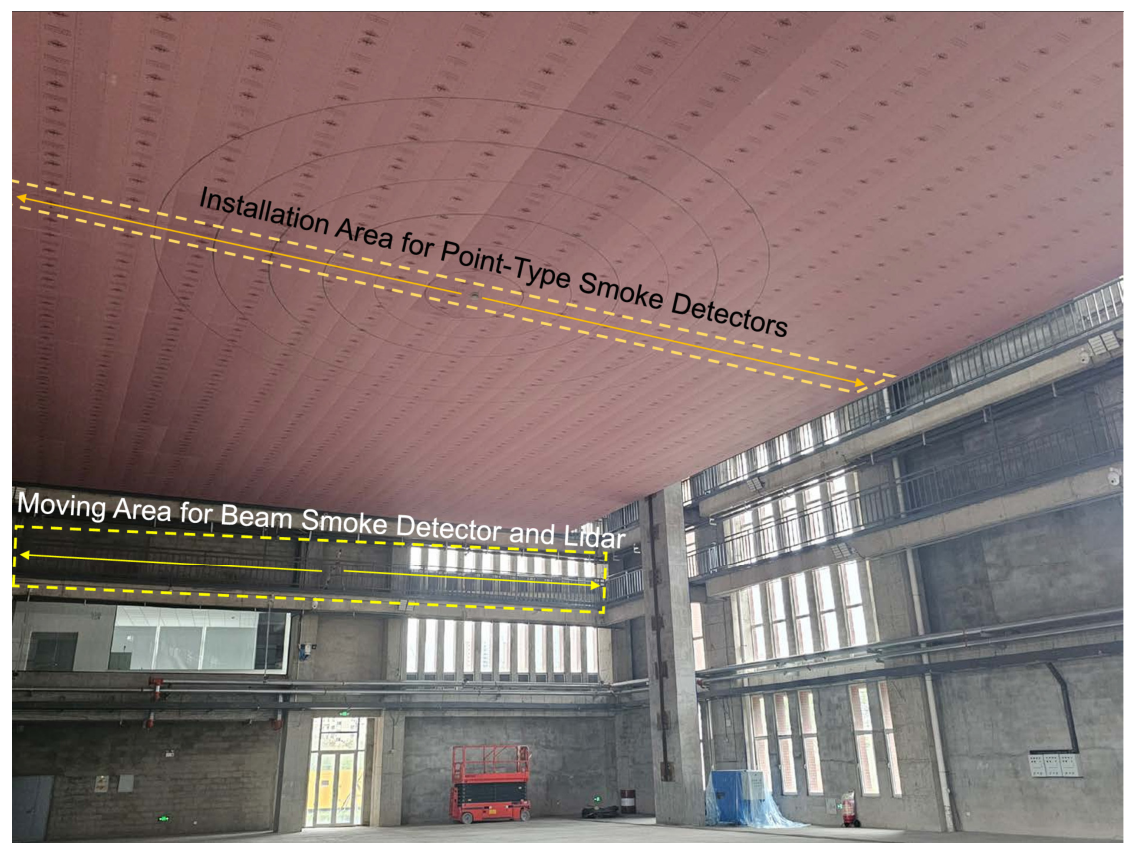
28]. Linear Beam Smoke Fire Detectors (Gulf Security Technology Co., Ltd., Qinhuangdao, China). Its response threshold is ≥0.5 dB/m, and the ratio of the maximum response threshold to the minimum response threshold is also ≤1.6. The transmitter and receiver of the linear beam smoke detector, as well as the LiDAR detection system, are respectively installed on the fences at both ends of the laboratory, and the installation height is consistent with the height of the ceiling as shown in
Figure 8. During the experiment, all detectors were deployed in strict accordance with the installation specifications required by national standards, eliminating the interference of equipment performance differences on the experimental results.
The experimental fire sources adopt TF2 cotton rope smoldering fire and TF3 beech wood smoldering fire in accordance with the ISO 7240-9 standard. The ceiling was raised to three heights of 10 m, 15 m and 20 m respectively, and multiple groups of repeated experiments were carried out to record the alarm status, alarm time and effective detection range of different detection methods.
5.6.2. Experimental Evaluation Indicators
The performance of different detection methods is quantitatively evaluated from three core dimensions:
Alarm effectiveness: Determine whether the detection method can realize an effective alarm for smoldering smoke at the corresponding floor height, to verify its applicability in high and large-volume space scenarios.
Alarm response time: The time consumed from the ignition of the fire source to the alarm triggered by the detector, which is used to evaluate the sensitivity of the detection method. The shorter the response time, the stronger the early warning capability.
Effective detection range: Based on the center of the fire source, the maximum lateral distance where the detector can realize effective alarm, which is used to evaluate the spatial coverage capability of the detection method.
During the experiment, the effective monitoring width of the point-type smoke detectors was measured through the detectors arranged at 1 m intervals. By moving the linear beam detector and the LiDAR system laterally with a step of 1 m, the effective detection width of the two at the heights of 10 m, 15 m and 20 m was measured.
5.6.3. Experimental Results and Analysis
The comparative test results of cotton rope and beech wood smoldering fires are shown in
Table 2 and
Table 3 respectively.
Combined with the experimental data, the following conclusions can be drawn:
At the conventional floor height of 10 m, the response speed and coverage of the LiDAR detection system are significantly better than those of traditional detectors. At the height of 10 m, all three detection methods can effectively alarm the smoldering smoke of cotton rope and beech wood, but the alarm response time of the LiDAR system is much shorter than that of traditional detectors. In the cotton rope smoldering scenario, the alarm time of LiDAR is only 2 min 10 s, which is 65.4% shorter than that of the linear beam detector and 85.2% shorter than that of the point-type detector. In the beech wood smoldering scenario, the alarm time of LiDAR is only 2 min 6 s, which is 76.4% shorter than that of the linear beam detector and 86.6% shorter than that of the point-type detector. The core reason is that LiDAR can trigger an alarm as long as the smoke forms an identifiable point cloud cluster within the field of view, while traditional point-type and linear detectors require smoke to enter the detection optical path and continuously affect the light intensity to reach the alarm threshold. Therefore, their sensitivity to early thin smoke is significantly lower than that of the LiDAR system.
In terms of detection coverage, the effective detection range of point-type and linear beam detectors is only ±2 m from the center of the fire source, while the LiDAR system can realize accurate detection within ±13 m from the center of the fire source when the installation angle remains unchanged, and the coverage range is more than 6 times that of traditional detectors. This is because the smoke forms a distribution pattern of “narrow at the bottom and wide at the top” during the upward diffusion process, and forms a “pie-shaped” diffusion area centered on the fire source near the ceiling. Traditional detectors can only monitor the linear or point area where the optical path is located, while the large-field-of-view design of LiDAR can fully cover the entire smoke diffusion area, which greatly improves the spatial coverage capability of a single device.
At the ultra-high floor heights of 15 m and 20 m, traditional detectors are completely invalid, while the LiDAR system still maintains stable detection performance. The smoke is fully diffused during the ascent process and becomes very thin when reaching the ceiling, which cannot effectively affect the optical path of traditional detectors. Both point-type and linear beam smoke detectors cannot trigger an effective alarm and completely lose the detection capability. In contrast, the LiDAR system can quickly and accurately detect the smoke only by adjusting the pitch angle to make the field of view cover the ground fire source area, without being at the same height as the smoke. The alarm response time at 15 m and 20 m height has no significant difference from that at a 10 m height, and still maintains an extremely fast response speed of about 2 min, with only a slight attenuation of the effective detection range. This fully proves that the detection performance of LiDAR is minimally affected by the installation height, which is perfectly suitable for fire detection requirements in ultra-high and large-volume spaces.
5.6.4. Comprehensive Performance Comparison Conclusion
The comparative experiments fully verify that the LiDAR-based smoke detection method proposed in this paper has technical advantages that traditional detection methods cannot match in high and large-volume space scenarios. First, it has a long detection distance and wide coverage, and a single device can realize effective monitoring of a large-scale space, which greatly reduces the engineering deployment cost. Second, it has a fast response speed and significantly higher sensitivity to early smoldering thin smoke, which can realize ultra-early warning of fire. Third, it has strong height adaptability and is not limited by the installation height, and can still maintain stable detection performance in ultra-high and large-volume spaces, which fundamentally solves the core pain points of traditional detection methods in high and large-volume space scenarios.
At the same time, the experiment also identifies two current shortcomings of LiDAR smoke detection technology, and puts forward the corresponding engineering solutions: On the one hand, limited by the physical structure, LiDAR has a detection blind spot for close-range targets. To solve this problem, we can learn from the multi-sensor fusion scheme in the field of autonomous driving, and arrange multiple LiDARs in a cross layout or match with short-range point-type detectors to fill the detection blind spots and realize full-coverage and dead-angle-free fire detection in high and large-volume spaces. On the other hand, the detection algorithm based on deep learning has a strong dependence on data. If multiple LiDARs are installed in different scenes and different installation positions, it is necessary to collect smoke point cloud data from corresponding scenes for incremental training, so as to further improve the detection accuracy and scene adaptability of the model.
6. Analysis and Competitive Boundary Delineation of Large-Volume Space Smoke Detection Technologies
Smoldering smoke is a dynamically diffused, non-uniform gas–solid two-phase mixture. Its concentration, particle size distribution and diffusion law vary significantly in different engineering scenarios. The performance parameters of Aspirating Smoke Detectors (ASD) and Video Image Detection (VID) systems from different manufacturers in the market are uneven and greatly affected by hardware configuration and algorithm optimization level. Therefore, it is difficult to provide unified and absolutely accurate quantitative comparison indicators at the current research stage. Accordingly, this chapter systematically compares and analyzes the three mainstream large-volume space smoke detection technology solutions, namely Light Detection and Ranging (LiDAR), ASD and VID, from the dimensions of macro technical characteristics and engineering applications, and clearly defines their applicable scenarios and competitive boundaries in combination with the scale of the monitoring area.
From the perspective of core detection principles, both LiDAR and VID adopt non-contact passive detection methods, which can realize long-distance and large-scale spatial monitoring without direct contact with smoke. In contrast, ASD is an active aspirating detection technology that requires pre-laying a dense sampling pipeline network throughout the monitoring area. It can only complete detection by drawing ambient air and smoke into the optical detection chamber inside the detector host through a fan. The complex pipeline system not only greatly increases the complexity of early engineering design and construction, but also significantly raises the cost and difficulty of later maintenance work such as pipeline cleaning and filter element replacement. In terms of detection sensitivity, the LiDAR system can capture the point cloud features formed by thin smoke generated in the early smoldering stage. Its alarm response speed is significantly better than that of traditional point-type, linear detectors and VID systems, and is at a similar level to high-sensitivity ASD. Furthermore, the detection performance of LiDAR does not show obvious attenuation with the increase in detection distance. In terms of anti-interference ability, the LiDAR system performs recognition based on the reflection intensity and spatial distribution characteristics of laser echoes. Its suppression ability against dust and water mist interference is significantly better than that of VID systems relying on visual features, and also superior to ASD systems which are susceptible to long-term dust accumulation in sampling pipelines.
A further comparison of the core performance differences between modern AI-based Video Smoke Detection (VSD) systems and the LiDAR system proposed in this study is as follows: In terms of performance, modern VSD systems can achieve a detection accuracy of over 90% for thick smoke in well-lit scenarios without obvious interference, but the detection accuracy for thin white smoke generated by early smoldering is only 60~70%. Moreover, their performance will drop sharply or even fail completely under conditions such as nighttime, strong light and backlight. In contrast, the LiDAR system in this study is not affected by lighting conditions, and its detection accuracy for early thin white smoke can reach 91.2%, which is further improved to 95.8% after dual-modal fusion. In terms of limitations, VSD systems are susceptible to interference from white floating objects, light-colored walls and light reflections, resulting in a high false alarm rate; while LiDAR systems have no detection capability for completely transparent gases and have short-range detection blind spots. In terms of applicability, VSD systems are suitable as auxiliary monitoring means for indoor large-volume spaces with good lighting, or for the upgrading and transformation of existing video surveillance systems, while LiDAR systems are more suitable for core areas with high early warning requirements, complex environments and variable lighting conditions, such as large warehouses, transportation hubs and industrial plants, and can provide all-weather and highly reliable fire detection services.
In terms of full lifecycle cost, due to the large differences in product configurations, performance levels and engineering construction standards among different manufacturers, it is difficult to provide absolutely accurate unified prices, and only rough estimates can be made based on mainstream commercial products. Taking a typical large-volume building of 100 m × 30 m × 18 m as an example, the initial equipment procurement and installation cost of the Aspirating Smoke Detector (ASD) system is approximately 10 times that of the LiDAR system, and its annual maintenance cost (including regular pipeline cleaning and annual filter element replacement) is about five times that of the LiDAR system. The initial cost of the Video Image Detection (VID) system is approximately three times that of the LiDAR system, but its annual maintenance cost (including regular camera cleaning and iterative algorithm updates) is about 10.5 times that of the LiDAR system. It is particularly worth emphasizing that with the rapid development of the global autonomous driving industry, the large-scale mass production of LiDAR is continuously driving the rapid decline in its hardware cost. Industry forecasts indicate that the unit price of LiDAR will drop by more than 50% in the next 3–5 years, which will further significantly improve the comprehensive cost-effectiveness and market competitiveness of LiDAR technology in the field of large-volume space fire detection.
Based on the comprehensive comparison of the above technical characteristics, performance and cost dimensions, we clearly define the competitive boundaries of the three technologies according to the spatial scale of the monitoring area. For small enclosed spaces with an area of less than 500 square meters, traditional point-type smoke detectors or a single set of VID systems can meet the basic fire alarm requirements and have obvious cost advantages. For medium- and large-volume spaces ranging from 500 to 5000 square meters, the LiDAR system has become the optimal technical choice with the best comprehensive cost-effectiveness due to its core characteristics of wide coverage per device, low maintenance cost and high reliability. For ultra-large-volume spaces with an area exceeding 5000 square meters, a networking deployment of multiple LiDARs can be adopted to achieve full-area coverage. Its overall deployment cost, engineering complexity and later maintenance difficulty are far lower than those of ASD systems requiring long-distance sampling pipelines and VID systems requiring dense camera deployment.
7. Conclusions and Future Work
Aiming at the inherent bottlenecks of traditional point-type and linear beam smoke detection technologies in high and large-volume building scenarios, such as limited detection coverage, restricted installation height, low sensitivity to early smoldering smoke, as well as the poor environmental anti-interference ability and vulnerability to failure in low-light conditions of image-based detection technologies, this paper conducts research on an early fire smoke detection method for high and large-volume spaces based on Light Detection and Ranging (LiDAR). The feasibility and technical advantages of LiDAR for smoldering smoke detection are systematically explored from four dimensions: theoretical mechanism, experimental verification, algorithm design, and engineering performance comparison. A complete theoretical system and implementable technical scheme of LiDAR-based smoke detection suitable for high and large-volume space scenarios have been established. The main research conclusions of this paper are as follows:
First, from the perspectives of the physical characteristics of smoke particles and the optical interaction mechanism between laser and particles, the theoretical feasibility of LiDAR for early smoldering smoke detection has been fully verified. The independently designed mobile lifting tower experimental platform in this paper can realize interference-free collection of smoke particle characteristics in the full height range of 8.5~18 m in high and large-volume spaces, which solves the inherent defects of existing collection schemes, such as blocking smoke diffusion, poor layout flexibility, and insufficient data representativeness. The test results of ISO standard cotton rope and beech wood smoldering fires show that during the entire smoldering process, there are a large number of particles with sizes larger than the mainstream LiDAR operating wavelengths of 905 nm and 1550 nm in the full height range of 8.5~18 m, which meet the particle size requirement for laser directional reflection. The quantitative measurement of smoke particle reflectivity has been completed through customized gradient reflectivity calibration plates, clarifying the reflectivity range of the two types of smoldering smoke, supplementing the quantitative physical parameters for LiDAR smoke detection, and improving the theoretical foundation of this technology.
Second, through systematic LiDAR smoke irradiation experiments, the effective detection capability of LiDAR for early smoldering smoke has been intuitively verified, and the point cloud feature distinction boundaries between smoke and typical interferences have been clarified. The experimental results in the full detection distance range of 20~80 m show that LiDAR can fully capture the entire diffusion process of smoldering smoke. Even at a long distance of 80 m with thin smoke, it can still generate effective point cloud data with clear contours, demonstrating the capability of long-distance early smoke detection. The point clouds of cotton rope and beech wood smoldering smoke both present clustered continuous distribution characteristics with distinguishable detailed differences. There are essential differences between the two types of smoke and the two typical interferences (water vapor and dust) in three dimensions: point cloud distribution morphology, density characteristics, and spatial diffusion law. Effective distinction can be achieved by constructing recognition criteria through multi-dimensional features, which provides a key physical basis for the anti-interference design of the detection algorithm.
Third, a special LiDAR smoke point cloud dataset suitable for high and large-volume space scenarios has been constructed, and a high-precision and real-time smoke detection algorithm system has been formed. The dataset constructed in this paper includes 1200 annotated smoldering smoke samples and 200 typical interference samples, covering the full scene combination of 8.5~18 m height and 20~80 m detection distance, which fills the gap of relevant special datasets in the industry. The optimized single-modal PointPillars detection algorithm designed for the non-rigid and diffuse characteristics of smoke achieves a detection accuracy of 91.2% on the self-built dataset, with a single-frame inference time of only 0.19 s on the embedded platform, which can meet the real-time detection requirements of high and large-volume space scenarios. The proposed dual-modal fusion algorithm with “LiDAR point cloud as the main body and visible light image as the supplement” further improves the detection accuracy to 95.8%, which not only ensures the detection stability under all illumination conditions, but also realizes high-precision detection in complex scenarios, combining reliability and engineering practicality.
Fourth, the full-scale high and large-volume space comparative experiments have quantitatively verified the significant engineering advantages of the LiDAR smoke detection method compared with traditional technologies. The miniaturized LiDAR smoke detection system built based on the embedded platform in this paper has been subjected to multi-height comparative experiments with traditional point-type and linear beam smoke detectors. The results show that at the conventional floor height of 10 m, the alarm response time of the LiDAR system for cotton rope and beech wood smoldering smoke is more than 65% shorter than that of traditional detectors, and the effective detection range is greatly improved compared with traditional detectors, showing significant advantages in early warning capability and spatial coverage. At the ultra-high floor heights of 15 m and 20 m, traditional detectors are completely invalid due to thin smoke, while the LiDAR system can maintain an extremely fast response speed of about 2 min and stable detection performance only by adjusting the pitch angle, fundamentally solving the pain point of restricted installation height of traditional detection methods in high and large-volume space scenarios.
The research results of this paper not only fully verify the feasibility of LiDAR for early fire smoke detection in high and large-volume spaces from three aspects (theory, experiment, and algorithm), but also break through the application bottlenecks of traditional fire detection technologies in high and large-volume space scenarios. A complete set of implementable engineering technical schemes has been formed, including the single-modal LiDAR smoke detection algorithm, the visible-light-assisted dual-modal fusion mechanism, and the practical deployment guidelines.
Notably, constrained by the inherent physical structure and optical design of LiDAR, a single device has unavoidable field-of-view blind spots. This paper intuitively illustrates the blind spot distribution characteristics of a single LiDAR through
Figure 9, and proposes a targeted upper–lower cross-layout deployment scheme as a solution. As shown in
Figure 9, a single LiDAR device with a 120° horizontal field of view (FoV) has two types of undetectable blind spots when installed alone: (1) A 0~2 m short-range blind spot directly below the device, caused by the minimum detection distance limitation of the laser transceiver module; and (2) two triangular blind spots on the left and right sides of the rectangular space, caused by the limited horizontal FoV. The proposed upper–lower cross-layout scheme installs two identical LiDAR devices at the top center and bottom center of the monitoring area respectively, with their 120° FoV facing each other. Under this deployment mode, the short-range blind spot of each LiDAR is completely covered by the long-range detection range of the opposite device, and the side blind spots are also fully filled, achieving 100% dead-angle-free detection of the entire large space. This scheme is particularly suitable for long and narrow large-volume buildings such as warehouses, subway stations and factory workshops.
This research provides a brand-new idea and technical path for the research of early fire warning technology for high and large-volume buildings, and has important theoretical significance and engineering application value for improving the fire prevention and control capability of large-space buildings.
Meanwhile, this research still has certain limitations, and further research and optimization are needed in the future:
- (1)
This study mainly verifies the detection performance of a single LiDAR device and dual-modal fusion system. Although the upper–lower cross-layout deployment scheme has been proposed and theoretically analyzed, the multi-LiDAR collaborative detection algorithm and networking communication mechanism have not been experimentally verified. In the future, in-depth research on multi-LiDAR data fusion and collaborative decision-making technology will be carried out to realize more reliable full-coverage fire detection in complex high and large-volume spaces.
- (2)
The current algorithm is mainly trained based on standard smoldering fire samples (ISO 7240-9 TF2 cotton rope and TF3 beech wood), and there is still room for improvement in the adaptability to smoke scenarios under different combustion materials (such as plastics and liquid fuels) and complex air flow environments. In the future, the LiDAR point cloud dataset of multi-scenario and multi-type fires will be expanded, and the algorithm network structure will be optimized for the non-rigid and dynamic diffusion characteristics of smoke to further improve the generalization ability and complex scenario adaptability of the model.
- (3)
Engineering demonstration applications of the LiDAR smoke detection system will be carried out in typical large-space buildings such as large warehouses and transportation hubs in the future. The system layout scheme and parameter configuration will be optimized in combination with actual building scenarios and operation conditions to promote the large-scale engineering implementation of this technology.