
Slope–Wind Coupling Effects on Fire Behavior and Emission Dynamics During Prescribed Burning in Mountainous Yunnan Pine Forests
 , , , , ,
  , and
, and 
Abstract
1. Introduction
2. Materials and Methods
2.1. Study Area
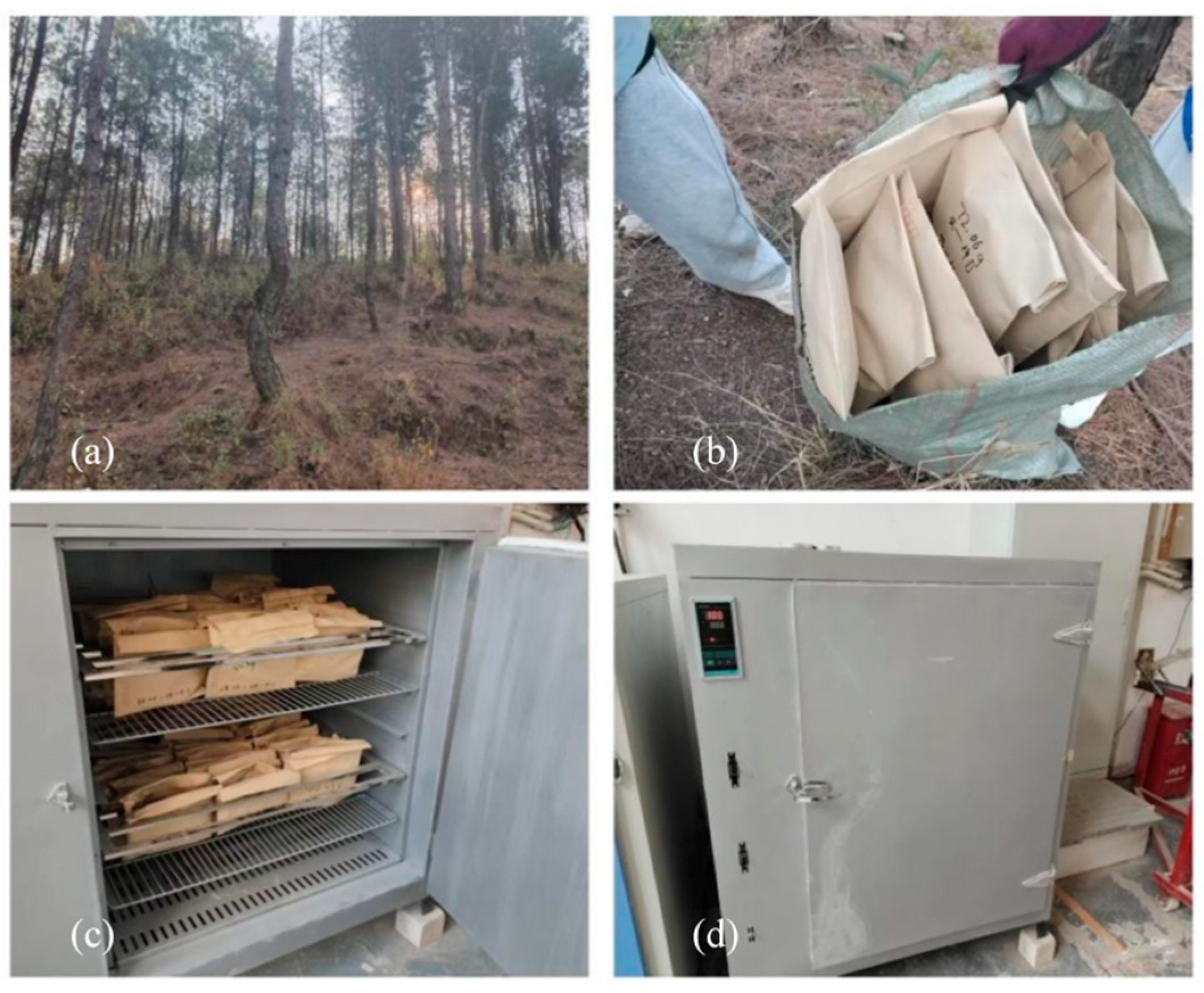
2.2. Fuel Data and Laboratory Measurements
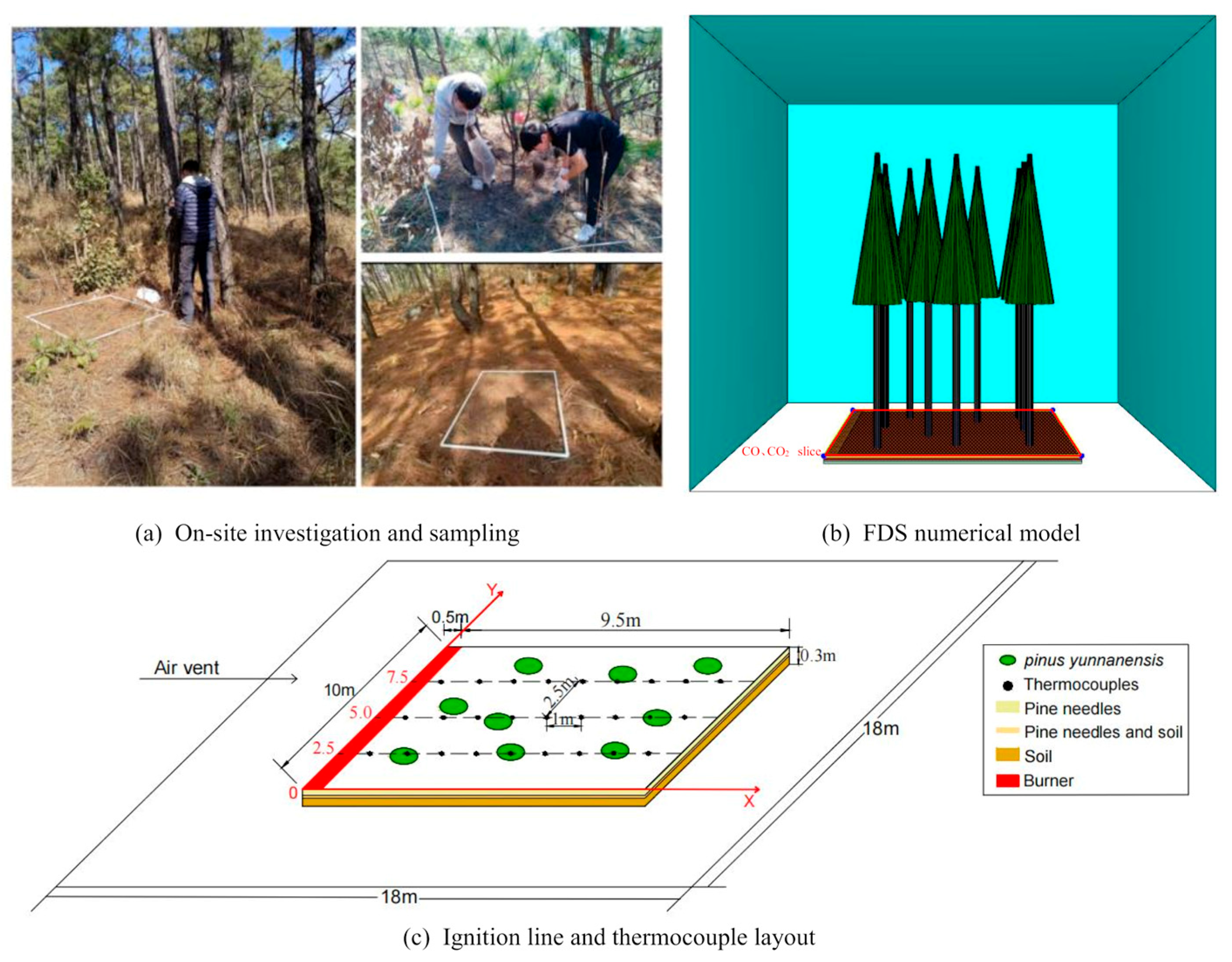
2.3. Fire Dynamics Simulator Configuration and Ignition Setup
2.3.1. Computational Domain Construction
2.3.2. Surface and Fuel Bed Parameterization
2.3.3. Boundary Condition and Output Settings
2.3.4. Ignition Configuration
2.3.5. Monitoring Layout and Data Collection
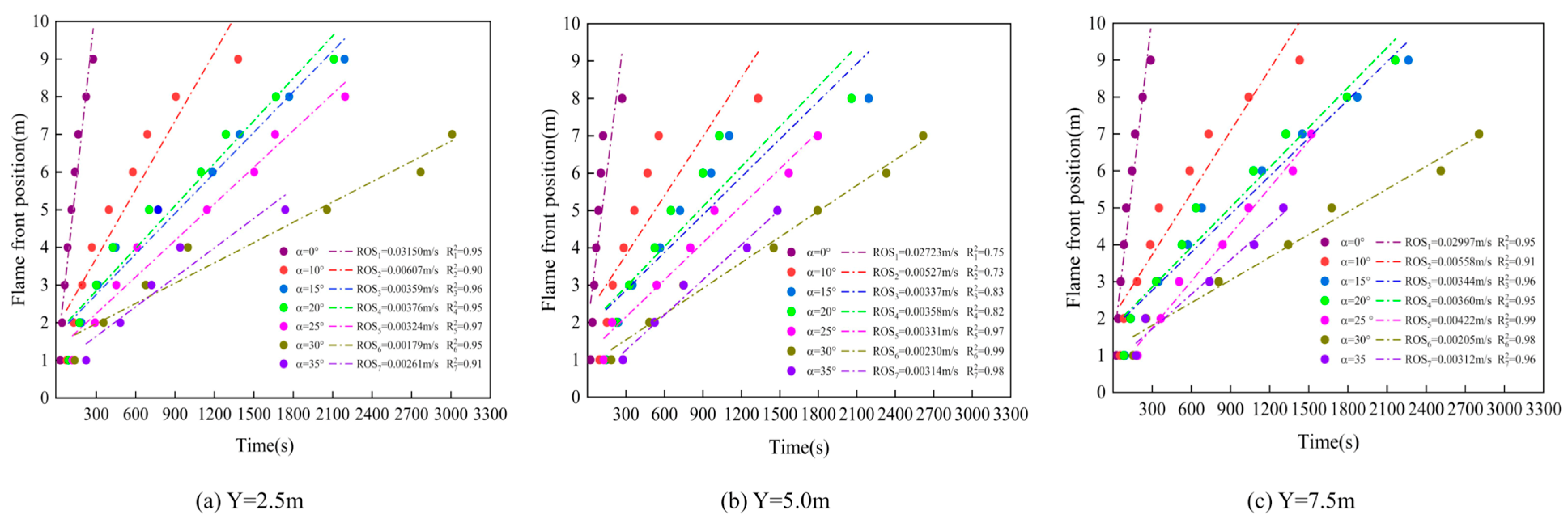
2.3.6. Computation of the Rate of Spread (ROS)
2.4. Computation of Combustion Efficiency
2.5. Simulation Scenario Design
2.6. CO2 and CO Emission Computation
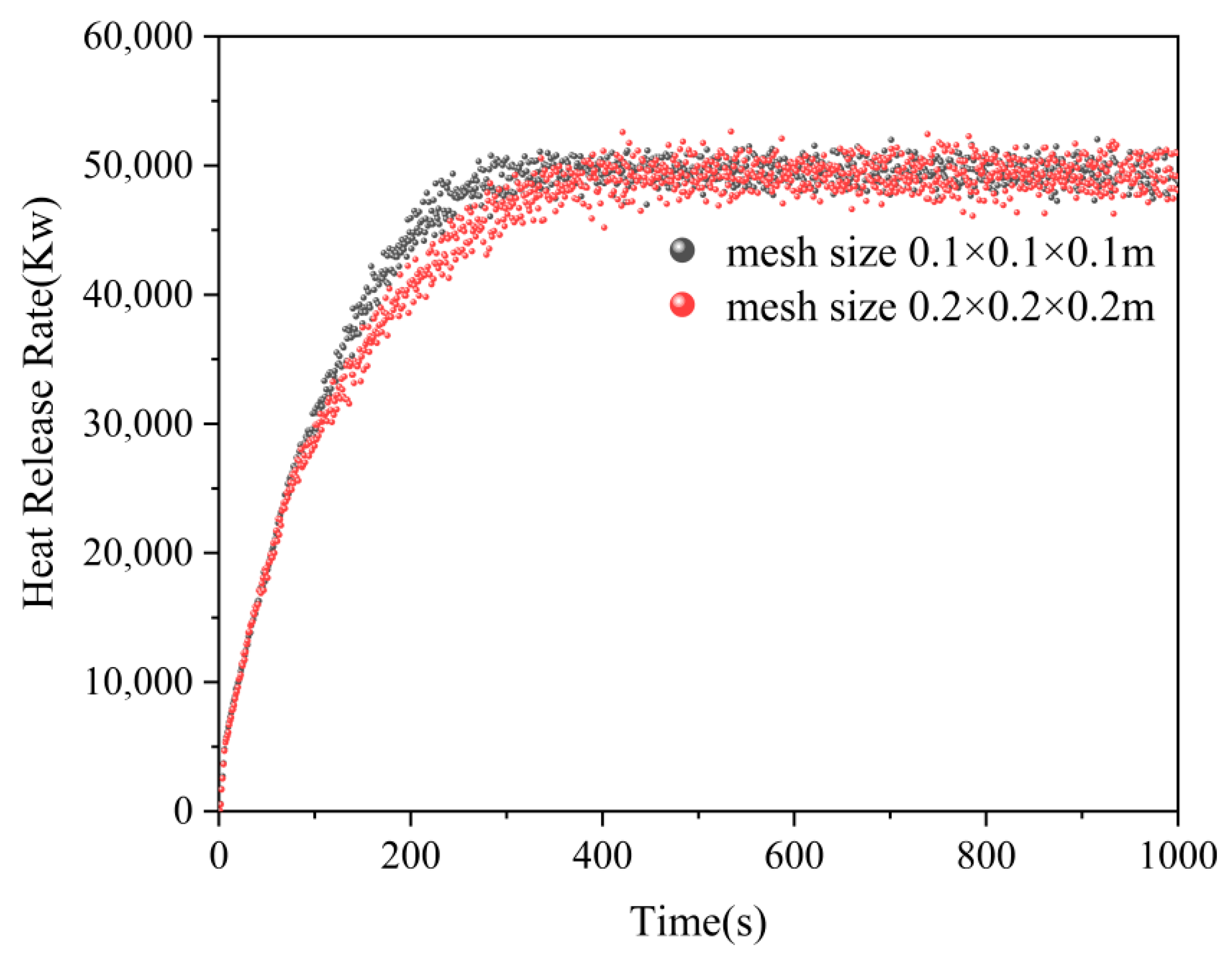
2.7. Grid Resolution Determination
2.8. Statistical Analysis of the Fire Spread Rate
3. Results
3.1. Grid Convergence and Spatial Sensitivity Analysis
3.2. Effects of the Slope Angle on Fire Propagation and Thermal Dynamics
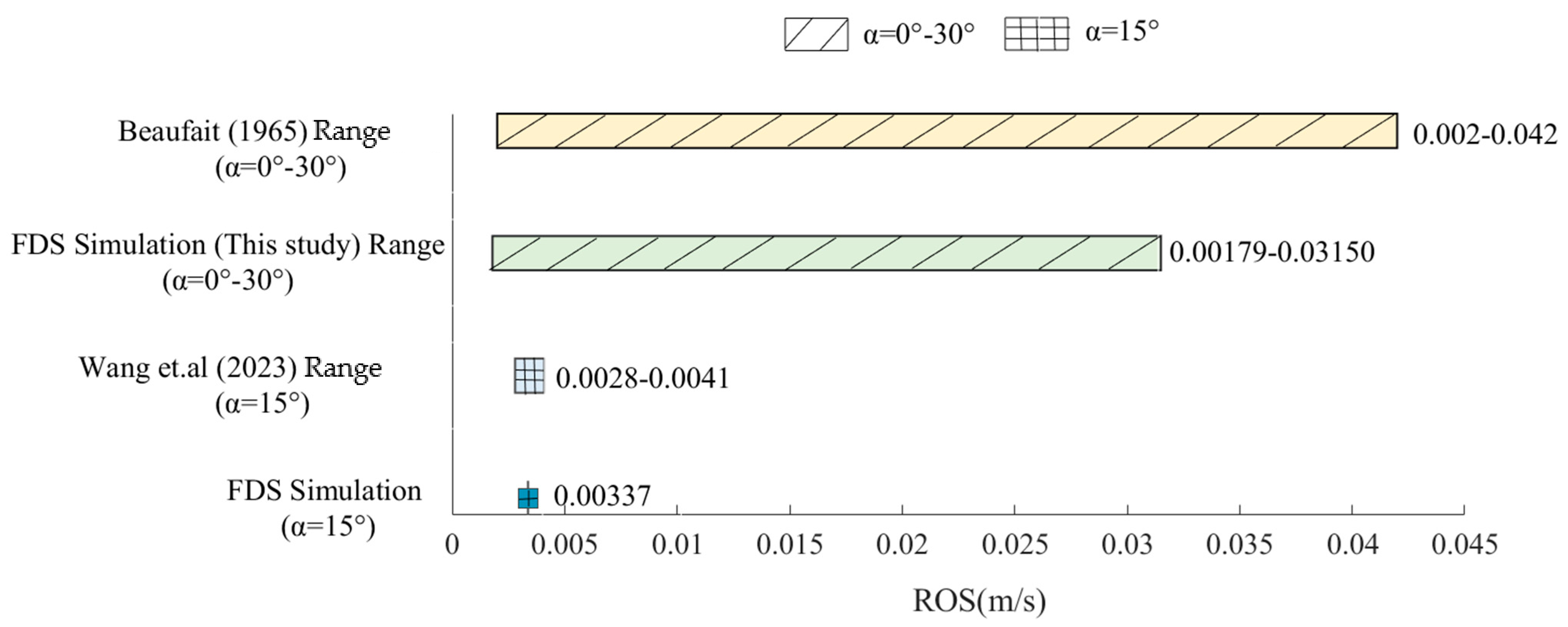
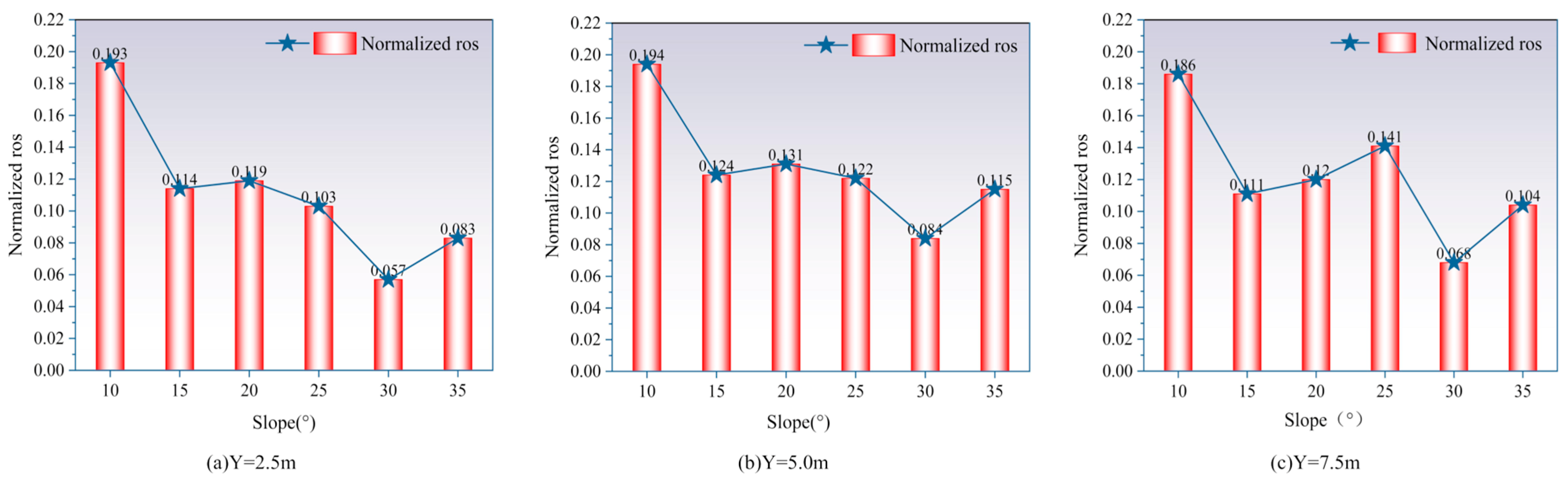
3.2.1. Rate of Spread
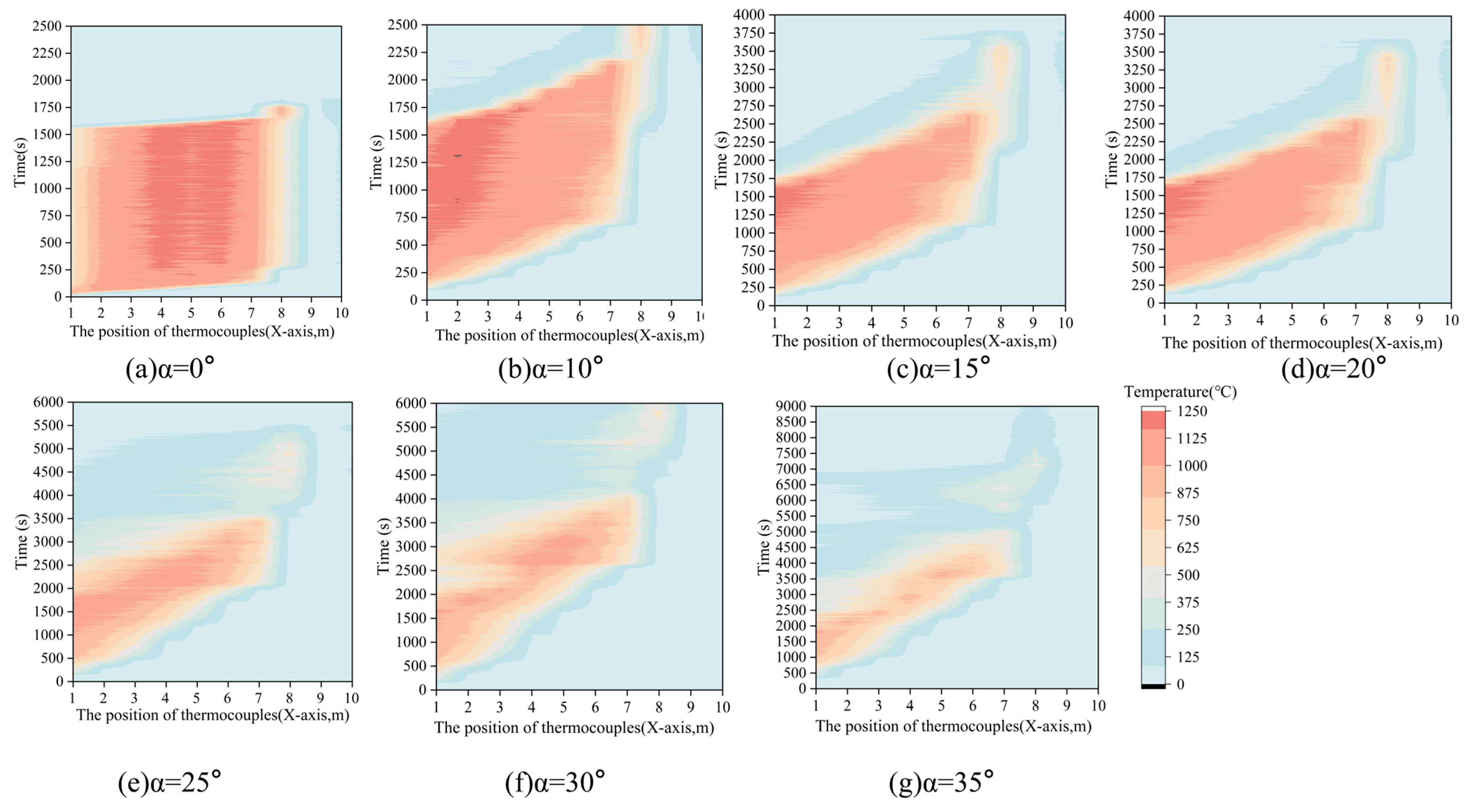
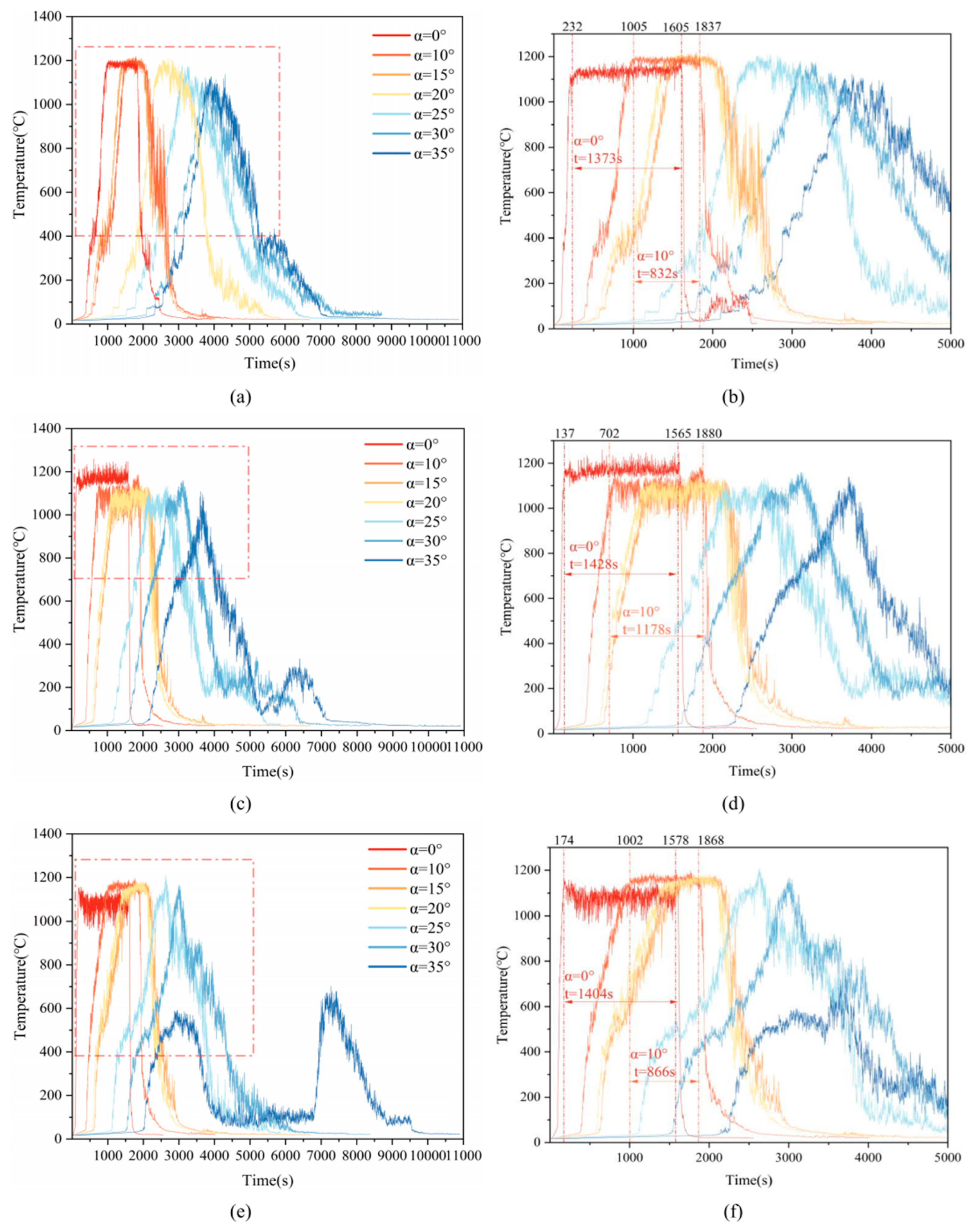
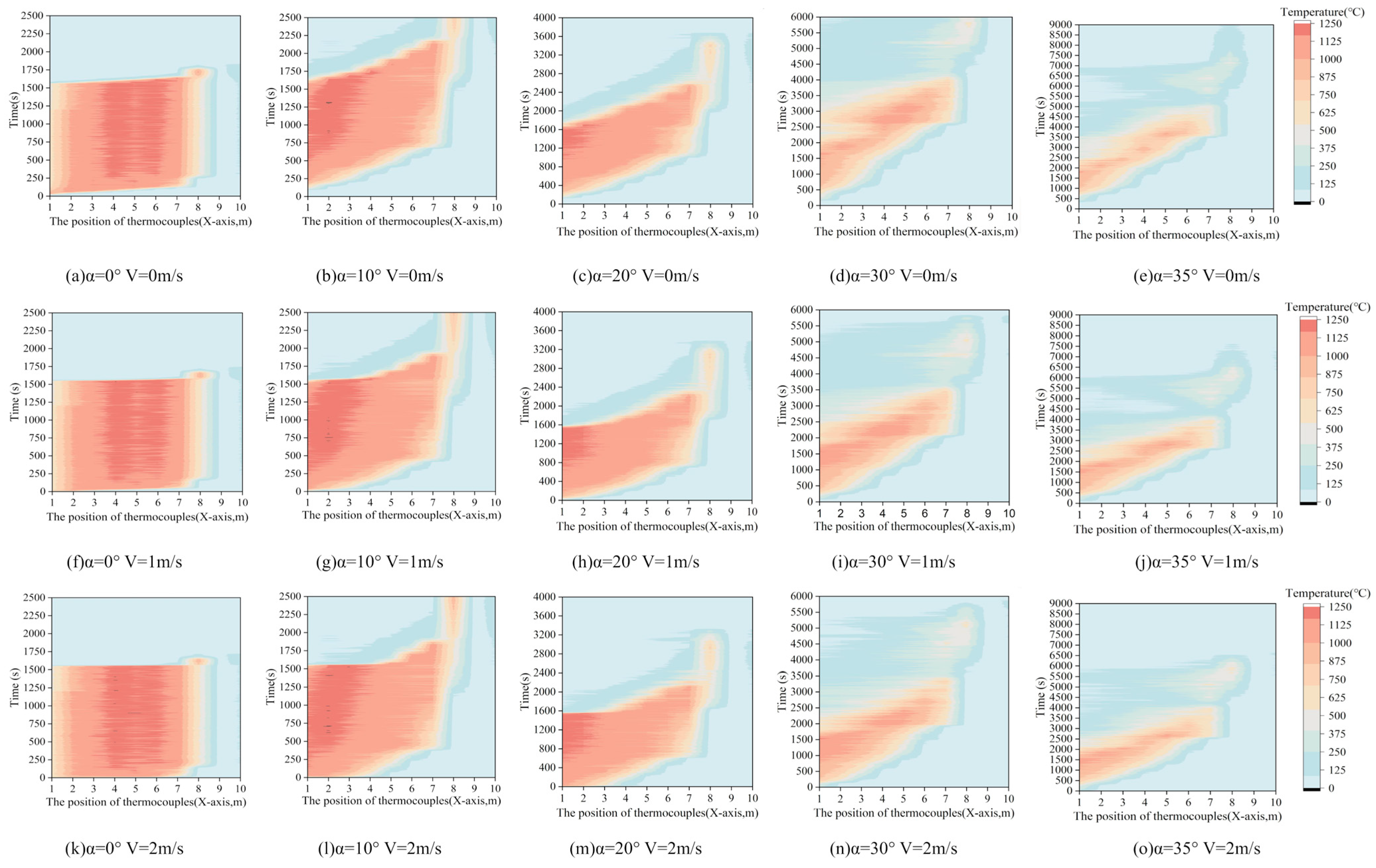
3.2.2. Thermal Dynamics
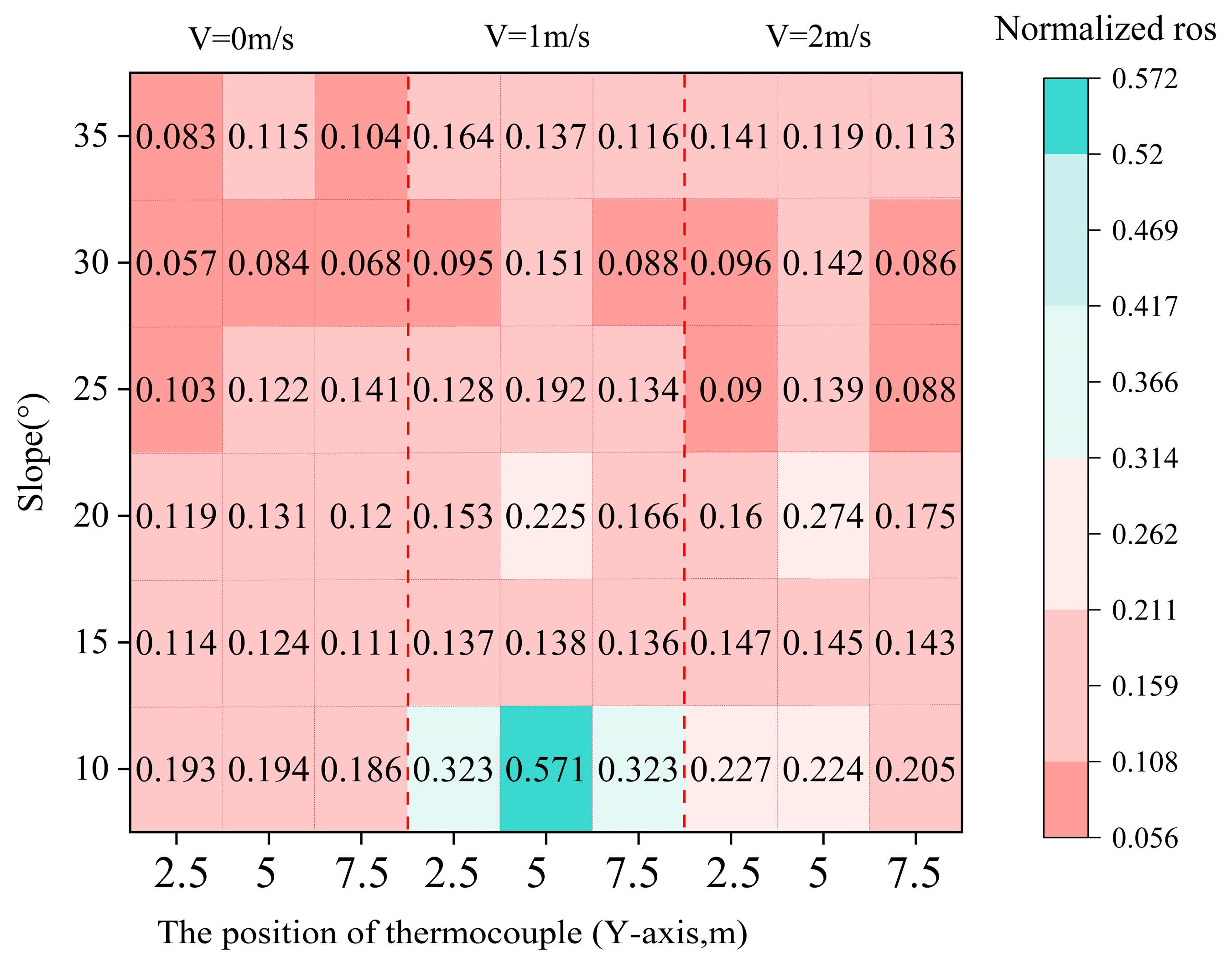
3.3. Interactive Effects of Slope and Wind Speed on Fire Propagation Dynamics
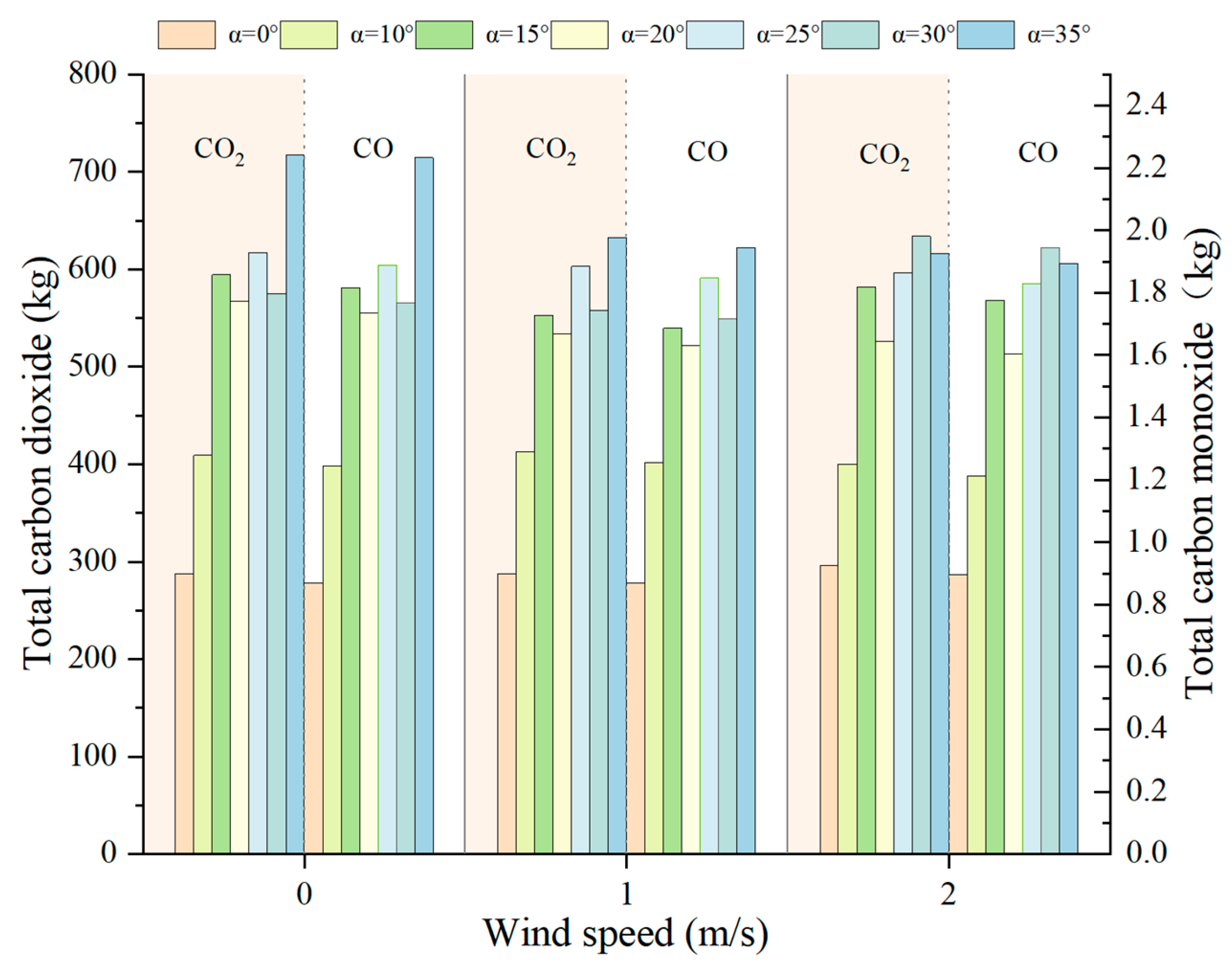
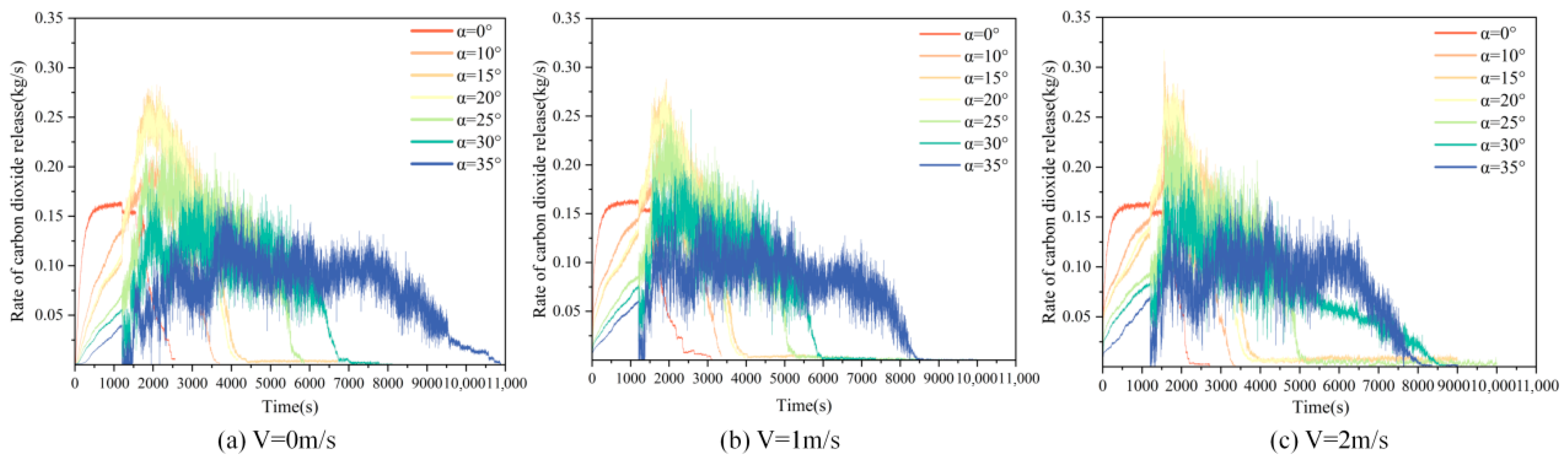
3.4. Combustion Characteristics and Gaseous Emissions
4. Discussion
4.1. Non-Monotonic Downslope Spread with Slope and Its Risk Implications
4.1.1. Shift in the Slope–Wind Coupling from Synergy to Competition
4.1.2. Decoupling of CO2 Emissions from the ROS and Temperature
4.2. Management Implications and Practical Applications
4.3. Study Limitations and Future Directions
5. Conclusions
Author Contributions
Funding
Data Availability Statement
Conflicts of Interest
References
- Williams, A.P.; Abatzoglou, J.T.; Gershunov, A.; Guzman-Morales, J.; Bishop, D.A.; Balch, J.K.; Lettenmaier, D.P. Observed impacts of anthropogenic climate change on wildfire in California. Earth’s Future 2019, 7, 892–910. [Google Scholar] [CrossRef]
- Mansoor, S.; Farooq, I.; Kachroo, M.M.; Mahmoud, A.E.D.; Fawzy, M.; Popescu, S.M.; Alyemeni, M.N.; Sonne, C.; Rinklebe, J.; Ahmad, P. Elevation in wildfire frequencies with respect to the climate change. J. Environ. Manag. 2022, 301, 113769. [Google Scholar] [CrossRef]
- Gonzalez, P.; Neilson, R.P.; Lenihan, J.M.; Drapek, R.J. Global patterns in the vulnerability of ecosystems to vegetation shifts due to climate change. Glob. Ecol. Biogeogr. 2010, 19, 755–768. [Google Scholar] [CrossRef]
- Foster, C.N.; Barton, P.S.; Robinson, N.M.; MacGregor, C.L.; Lindenmayer, D.B. Effects of a large wildfire on vegetation structure in a variable fire mosaic. Ecol. Appl. 2017, 27, 2369–2381. [Google Scholar] [CrossRef] [PubMed]
- Steel, Z.L.; Foster, D.; Coppoletta, M.; Lydersen, J.M.; Stephens, S.L.; Paudel, A.; Markwith, S.H.; Merriam, K.; Collins, B.M. Ecological resilience and vegetation transition in the face of two successive large wildfires. J. Ecol. 2021, 109, 3340–3355. [Google Scholar] [CrossRef]
- Brando, P.M.; Paolucci, L.; Ummenhofer, C.C.; Ordway, E.M.; Hartmann, H.; Cattau, M.E.; Rattis, L.; Medjibe, V.; Coe, M.T.; Balch, J. Droughts, wildfires, and forest carbon cycling: A pantropical synthesis. Annu. Rev. Earth Planet. Sci. 2019, 47, 555–581. [Google Scholar] [CrossRef]
- Zhao, B.; Zhuang, Q.; Shurpali, N.; Köster, K.; Berninger, F.; Pumpanen, J. North American boreal forests are a large carbon source due to wildfires from 1986 to 2016. Sci. Rep. 2021, 11, 7723. [Google Scholar] [CrossRef]
- Oliveras Menor, I.; Prat-Guitart, N.; Spadoni, G.L.; Hsu, A.; Fernandes, P.M.; Puig-Gironès, R.; Ascoli, D.; Bilbao, B.A.; Brotons, L.; Carmenta, R.; et al. Integrated fire management as an adaptation and mitigation strategy to altered fire regimes. Commun. Earth Environ. 2025, 6, 202. [Google Scholar] [CrossRef]
- Labarre, C.; Domec, J.C.; Brèteau-Amores, S.; Musandi, D.S.; Loustau, D. The impact of climate change, disturbance and forest management on ecosystem service distribution across Europe’s largest plantation forest in the 21st century. Landsc. Ecol. 2025, 40, 219. [Google Scholar] [CrossRef]
- Jain, P.; Barber, Q.E.; Taylor, S.W.; Whitman, E.; Acuna, D.C.; Boulanger, Y.; Chavardès, R.D.; Chen, J.; Englefield, P.; Flannigan, M.; et al. Drivers and impacts of the record-breaking 2023 wildfire season in Canada. Nat. Commun. 2024, 15, 6764. [Google Scholar] [CrossRef]
- Hu, Y.; Yue, X.; Tian, C. Climatic drivers of the Canadian wildfire episode in 2023. Atmos. Ocean. Sci Lett. 2024, 17, 100483. [Google Scholar] [CrossRef]
- Byrne, B.; Liu, J.; Bowman, K.W.; Pascolini-Campbell, M.; Chatterjee, A.; Pandey, S.; Miyazaki, K.; van der Werf, G.R.; Wunch, D.; Wennberg, P.O.; et al. Carbon emissions from the 2023 Canadian wildfires. Nature 2024, 633, 835–839. [Google Scholar] [CrossRef] [PubMed]
- Hiers, J.K.; O’Brien, J.J.; Varner, J.M.; Butler, B.W.; Dichinson, M.; Furman, J.; Gallagher, M.; Godwin, D.; Goodrick, S.L.; Hood, S.M.; et al. Prescribed fire science: The case for a refined research agenda. Fire Ecol. 2020, 16, 11. [Google Scholar] [CrossRef]
- Francos, M.; Úbeda, X. Prescribed fire management. Curr. Opin. Environ. Sci. Health 2021, 21, 100250. [Google Scholar] [CrossRef]
- Sangha, K.K.; Evans, J.; Edwards, A.; Russell-Smith, J.; Fisher, R.; Yates, C.; Costanza, R. Assessing the value of ecosystem services delivered by prescribed fire management in Australian tropical savannas. Ecosyst. Serv. 2021, 51, 101343. [Google Scholar] [CrossRef]
- Wu, H.; Miller, Z.D.; Wang, R.; Zipp, K.Y.; Newman, P.; Shr, Y.H.; Dems, C.L.; Taylor, A.; Kaye, M.W.; Smithwick, A.H. Public and manager perceptions about prescribed fire in the Mid-Atlantic, United States. J. Environ. Manag. 2022, 322, 116100. [Google Scholar] [CrossRef]
- Davis, K.T.; Peeler, J.; Fargione, J.; Haugo, R.D.; Metlen, K.L.; Robles, M.D.; Woolley, T. Tamm review: A meta-analysis of thinning, prescribed fire, and wildfire effects on subsequent wildfire severity in conifer dominated forests of the Western US. For. Ecol. Manag. 2024, 561, 121885. [Google Scholar] [CrossRef]
- Mo, Y.; Bu, X.; Chen, W.; Xing, J.M.; Wang, Q.H.; Song, Y.L. Prescribed burning enhances the stability of soil bacterial co-occurrence networks in Pinus yunnanensis forests in Central Yunnan Province, China. Microorganisms 2025, 13, 2070. [Google Scholar] [CrossRef] [PubMed]
- Li, X.; Pan, Y.; Pan, H.; Yang, H.; Yang, A.; Wang, J.; Xu, Y.; Wang, Q. Effects of prescribed burning on species diversity of understory in Pinus yunnanensis forests of Southwestern China. Forests 2025, 16, 1312. [Google Scholar] [CrossRef]
- Wang, J.; Hong, R.; Ma, C.; Zhu, X.; Xu, S.; Tang, Y.; Li, X.; Yan, X.; Wang, L.; Wang, Q. Effects of prescribed burning on surface dead fuel and potential fire behavior in Pinus yunnanensis in Central Yunnan Province, China. Forests 2023, 14, 1915. [Google Scholar] [CrossRef]
- Zhu, X.; Xu, S.; Hong, R.; Yang, H.; Wang, H.; Fang, X.; Yan, X.; Li, X.; Kou, W.; Wang, L.; et al. How prescribed burning affects surface fine fuel and potential fire behavior in Pinus yunnanensis in China. Forests 2025, 16, 548. [Google Scholar] [CrossRef]
- Hong, R.; Zhu, X.; Ma, C.; Xu, S.; Wang, J.; Wang, H.; Qin, L.; Yan, X.; Fang, X.; Bai, W.; et al. The effect of prescribed burning on the growth and regeneration of Pinus yunnanensis. For. Ecol. Manag. 2025, 578, 122460. [Google Scholar] [CrossRef]
- Airey-Lauvaux, C.; Pierce, A.D.; Skinner, C.N.; Taylor, A.H. Changes in fire behavior caused by fire exclusion and fuel build-up vary with topography in California montane forests, USA. J. Environ. Manag. 2022, 304, 114255. [Google Scholar] [CrossRef]
- Beaufait, W.R. Characteristics of Backfires and Headfires in a Pine Needle Fuel Bed; US Department of Agriculture, Forest Service, Intermountain Forest & Range Experiment Station: Ogden, UT, USA, 1965; Volume 39.
- Nelson, J.R.M. An effective wind speed for models of fire spread. Int. J. Wildland Fire 2002, 11, 153–161. [Google Scholar] [CrossRef]
- Viegas, D.X. Slope and wind effects on fire propagation. Int. J. Wildland Fire 2004, 13, 143–156. [Google Scholar] [CrossRef]
- Sharples, J.J. Review of formal methodologies for wind–slope correction of wildfire rate of spread. Int. J. Wildland Fire 2008, 17, 179–193. [Google Scholar] [CrossRef]
- Accary, G.; Morvan, D. How can CFD contribute to the understanding of wildfire behaviour? Comput. Fluids 2024, 279, 106322. [Google Scholar] [CrossRef]
- Hayajneh, S.M.; Naser, J. Wind and slope influence on wildland fire spread, a numerical study. Fire 2025, 8, 217. [Google Scholar] [CrossRef]
- Hilton, J.E.; Sullivan, A.L.; Swedosh, W.; Sharples, J.; Thomas, C. Incorporating convective feedback in wildfire simulations using pyrogenic potential. Environ. Model. Softw. 2018, 107, 12–24. [Google Scholar] [CrossRef]
- Guo, H.; Xiang, D.; Kong, L.; Gao, Y.; Zhang, Y. Upslope fire spread and heat transfer mechanism over a pine needle fuel bed with different slopes and winds. Appl. Therm. Eng. 2023, 229, 120605. [Google Scholar] [CrossRef]
- Ren, X.; Sluder, E.T.; Heck, M.V.; Grumstrup, T.P.; Finney, M.A.; Mäkiharju, S.A.; Gollner, M.J. Surface flow characterization of fires under the combined effect of slope and wind. Fire Technol. 2025, 61, 5445–5460. [Google Scholar] [CrossRef]
- Butler, B.W.; Finney, M.A.; Andrews, P.L.; Albini, F.A. A radiation-driven model for crown fire spread. Can. J. For. Res. 2004, 34, 1588–1599. [Google Scholar] [CrossRef]
- Simpson, C.C.; Sharples, J.J.; Evans, J.P.; McCabe, M.F. Large eddy simulation of atypical wildland fire spread on leeward slopes. Int. J. Wildland Fire 2013, 22, 599–614. [Google Scholar] [CrossRef]
- Rossa, C.G.; Davim, D.A.; Viegas, D.X. Behaviour of slope and wind backing fires. Int. J. Wildland Fire 2015, 24, 1085–1097. [Google Scholar] [CrossRef]
- Mehr, R.S.; Bishe, E.M.; Farhanieh, B.; Afshin, H. Numerical investigation of the combined effect of terrain slope and wind velocity on fire spread rate in natural pastures. Modelling 2025, 6, 15. [Google Scholar] [CrossRef]
- Zhang, W.; Yan, X.; Wang, Q.; Long, T.; Li, X.; Pu, J.; Ding, Z. Effects of prescribed burning on fire behavior of surface fuel in Pinus yunnanensis forest land. J. Beijing For. Univ. 2022, 44, 69–76. [Google Scholar] [CrossRef]
- Wang, J.; Zhang, W.W.; Wang, Q.H.; Cao, H.M.; Zhang, X.Y.; Bai, W.H.; Li, X.N.; Gao, G.Q. Characteristics of fire behavior in prescribed burning under Pinus yunnanensis forest. J. Zhejiang AF Univ. 2023, 40, 828–835. [Google Scholar] [CrossRef]
- Long, T.T.; Li, J.L.; Wang, J.; Wang, Q. Effect of prescribed fire intensity on the Yunnan pine forest in central Yunnan. J. For. Eng. 2022, 7, 164–170. [Google Scholar] [CrossRef]
- Li, J.L.; Long, T.T.; Wang, J.; Wang, Q. Effects of prescribed burning on understory plants of Pinus yunnanensis pure forest. Fire Sci. Technol. 2023, 42, 392–396. [Google Scholar]
- Johnston, J.M.; Wheatley, M.J.; Wooster, M.J.; Paugam, R.; Davies, G.M.; DeBoer, K.A. Flame-front rate of spread estimates for moderate scale experimental fires are strongly influenced by measurement approach. Fire 2018, 1, 16. [Google Scholar] [CrossRef]
- Sun, R.; Jenkins, M.A.; Krueger, S.K.; Mell, W.; Charney, J.J. An evaluation of fire-plume properties simulated with the Fire Dynamics Simulator (FDS) and the Clark coupled wildfire model. Can. J. For. Res. 2006, 36, 2894–2908. [Google Scholar] [CrossRef]
- Boboulos, M.; Purvis, M.R.I. Wind and slope effects on ROS during the fire propagation in East-Mediterranean pine forest litter. Fire Saf. J. 2009, 44, 764–769. [Google Scholar] [CrossRef]
- Goetz, G.O. A Statistical Investigation of How Slope Affects a Wildfire’s Rate of Spread. Doctoral Dissertation, University of British Columbia, Vancouver, BC, Canada, 2021. [Google Scholar]
- Zhang, Y.; Fang, J.; Tian, F.; Song, L.; Singh, A.V. Upward flame spread over discrete thick fuels under mixed convection flow. Fire Saf. J. 2023, 135, 103723. [Google Scholar] [CrossRef]
- Liu, N.; Wu, J.; Chen, H.; Zhang, L.; Deng, Z.; Satoh, K.; Viegas, D.X.; Raposo, J.R. Upslope spread of a linear flame front over a pine needle fuel bed: The role of convection cooling. Proc. Combust. Inst. 2015, 35, 2691–2698. [Google Scholar] [CrossRef]
- Eftekharian, E.; Ghodrat, M.; He, Y.; Ong, R.H.; Kwok, K.C.S.; Zhao, M.; Samali, B. Investigation of terrain slope effects on wind enhancement by a line source fire. Case Stud. Therm. Eng. 2019, 14, 100467. [Google Scholar] [CrossRef]
- Sullivan, A.L.; Sharples, J.J.; Matthews, S.; Plucinski, M.P. A downslope fire spread correction factor based on landscape-scale fire behaviour. Environ. Model. Softw. 2014, 62, 153–163. [Google Scholar] [CrossRef]
- Mehr, R.S.; Bishe, E.M.; Jafari, M.; Farhanieh, B.; Afshin, H. Numerical investigation of the effect of land slope on the rate of fire spread in natural pastures. Mater. Chem. Mech. 2023, 1, 15–22. [Google Scholar] [CrossRef]
- Tang, W.; Miller, C.H.; Gollner, M.J. Local flame attachment and heat fluxes in wind-driven line fires. Proc. Combust. Inst. 2017, 36, 3253–3261. [Google Scholar] [CrossRef]
- Sluder, E.T. Understanding the Influence of Wind and Slope on Flames in Wildland Fires. Master’s Thesis, University of Maryland, College Park, MD, USA, 2019. [Google Scholar]
- Zhou, K.; Zhang, L.; Huang, M.; Zhou, M.; Wang, C. Experimental study on flame interaction and geometrical features of two identical fires on a slope. Fire Saf. J. 2021, 126, 103463. [Google Scholar] [CrossRef]
- Ju, X.; Ren, X.; Sluder, E.; Yang, L.; Gollner, M.J. Flame attachment and downstream heating effect of inclined line fires. Combust. Flame 2022, 240, 112004. [Google Scholar] [CrossRef]
- Xie, X.; Liu, N.; Lei, J.; Shan, Y.; Zhang, L.; Chen, H.; Yuan, X.; Li, H. Upslope fire spread over a pine needle fuel bed in a trench associated with eruptive fire. Proc. Combust. Inst. 2017, 36, 3037–3044. [Google Scholar] [CrossRef]
- Abu-Zidan, Y.; Rathnayaka, S.; Mendis, P.; Nguyen, K. Effect of wind speed and direction on facade fire spread in an isolated rectangular building. Fire Saf. J. 2022, 129, 103570. [Google Scholar] [CrossRef]
- Li, M.; Liu, N.; Xie, X.; Gao, W. Flame attachment state and control mechanism in inclined trench condition. Proc. Combust. Inst. 2024, 40, 105419. [Google Scholar] [CrossRef]
- Li, H.; Liu, N.; Xie, X.; Zhang, L.; Yuan, X.; He, Q.; Viegas, D.X. Effect of fuel bed width on upslope fire spread: An experimental study. Fire Technol. 2021, 57, 1063–1076. [Google Scholar] [CrossRef]
- Innocent, J.; Sutherland, D.; Khan, N.; Moinuddin, K. Physics-based simulations of grassfire propagation on sloped terrain at field scale: Motivations, model reliability, rate of spread and fire intensity. Int. J. Wildland Fire 2023, 32, 496–512. [Google Scholar] [CrossRef]
- Wang, H.; Zhang, J.; Zhong, H.; Chen, L.; Fan, C. Effects of slope on fireline shape and heat transfer in surface fires. Appl. Therm. Eng. 2025, 275, 126914. [Google Scholar] [CrossRef]
- Su, C.; Hu, Y.; Ma, Y.; Yang, J. Simulation study and proper orthogonal decomposition analysis of buoyant flame dynamics and heat transfer of wind-aided fires spreading on sloped terrain. Fire 2025, 8, 139. [Google Scholar] [CrossRef]
- Surawski, N.C.; Sullivan, A.L.; Meyer, C.P.; Roxburgh, S.H.; Polglase, P.J. Greenhouse gas emissions from laboratory-scale fires in wildland fuels depend on fire spread mode and phase of combustion. Atmos. Chem. Phys. 2015, 15, 5259–5273. [Google Scholar] [CrossRef]
- Alves, C.; Vicente, A.; Nunes, T.; Goncalves, C.; Fernandes, A.P.; Mirante, F.; Tarelho, L.; Campa, A.M.S.; Querol, X.; Caseiro, A.; et al. Summer 2009 wildfires in Portugal: Emission of trace gases and aerosol composition. Atmos. Environ. 2011, 45, 641–649. [Google Scholar] [CrossRef]
- Hu, Y.; Fernandez-Anez, N.; Smith, T.E.L.; Rein, G. Review of emissions from smouldering peat fires and their contribution to regional haze episodes. Int. J. Wildland Fire 2018, 27, 293–312. [Google Scholar] [CrossRef]
- Stubbs, D.C.; Humphreys, L.H.; Goldman, A.; Childtree, A.M.; Kush, J.S.; Scarborough, D.E. An experimental investigation into the wildland fire burning characteristics of loblolly pine needles. Fire Saf. J. 2021, 126, 103471. [Google Scholar] [CrossRef]
- Xu, Q.; Westerling, A.L.; Notohamiprodjo, A.; Wiedinmyer, C.; Picotte, J.J.; Parks, S.A.; Hurteau, M.D.; Marlier, M.E.; Kolden, C.A.; Sam, J.A.; et al. Wildfire burn severity and emissions inventory: An example implementation over California. Environ. Res. Lett. 2022, 17, 085008. [Google Scholar] [CrossRef]
- Urbanski, S.P.; Reeves, M.C.; Corley, R.E.; Silverstein, R.P.; Hao, W.M. Contiguous United States wildland fire emission estimates during 2003–2015. Earth Syst. Sci. Data 2018, 10, 2241–2274. [Google Scholar] [CrossRef]
- Faulstich, S.D.; Schissler, A.G.; Strickland, M.J.; Holmes, H.A. Statistical comparison and assessment of four fire emissions inventories for 2013 and a large wildfire in the Western United States. Fire 2022, 5, 27. [Google Scholar] [CrossRef]
- Smith, J.E.; Billmire, M.; French, N.H.F.; Domke, G.M. Application of the wildland fire emissions inventory system to estimate fire emissions on forest lands of the United States. Carbon Balance Manag. 2024, 19, 26. [Google Scholar] [CrossRef] [PubMed]
- Brancatelli, G.I.E.; Yezzi, A.L.; Zalba, S.M. Fire as a management tool for invasive woody plants in natural environments: A systematic review. Biol. Conserv. 2024, 293, 110602. [Google Scholar] [CrossRef]
- Agbeshie, A.A.; Abugre, S.; Atta-Darkwa, T.; Awuah, R. A review of the effects of forest fire on soil properties. J. For. Res. 2022, 33, 1419–1441. [Google Scholar] [CrossRef]
- Luciani, C.; Tihay-Felicelli, V.; Martinent, B.; Santoni, P.A.; Morandini, F.; Barboni, T. Influence of fuel moisture content on the burning of cistus shrubs exposed to a low-intensity fire. Fire Saf. J. 2024, 146, 104168. [Google Scholar] [CrossRef]
- Linn, R.R.; Goodrick, S.L.; Brambilla, S.; Brown, M.J.; Middleton, R.S.; O’Brien, J.J.; Hiers, J.K. QUIC-fire: A fast-running simulation tool for prescribed fire planning. Environ. Model. Softw. 2020, 125, 104616. [Google Scholar] [CrossRef]
- Gupta, P.; Shukla, A.K.; Shukla, D.P. Machine learning-based forest fire susceptibility mapping of Southern Mizoram, a part of Indo-Burma biodiversity hotspot. Environ. Sci. Pollut. Res. 2025, 32, 31433–31454. [Google Scholar] [CrossRef]
- Hayajneh, S.M.; Alzghoul, M.I.; Naser, J. Wind and Slope Effects on Wildland Fire Spread: A Review of Experimental, Empirical, Mathematical, and Physics-Based Models. Fire 2026, 9, 100. [Google Scholar] [CrossRef]
- Dyer-Hawes, Q.; Romanic, D.; Huang, Y.; Gyakum, J.R.; Douglas, P. Analysis of urban wind conditions and wildfire smoke dispersion for downtown Montréal using computational fluid dynamics. Build. Environ. 2024, 266, 112103. [Google Scholar] [CrossRef]




| Surface Layer | Thickness (m) | Combustible in FDS | FDS SURF ID | Material Composition |
|---|---|---|---|---|
| Mineral Soil | 0.15 | No | Soil | Soil:1.0 |
| Soil–litter mixture | 0.05 | No | Pine needle and soil | Yellow Pine: 0.75; Soil: 0.25 |
| Pine needle litter | 0.10 | Yes | Pine needle | Yellow Pine: 1.0 |
| Material | Density (kg m−3) | Conductivity (W m−1 K−1) | Specific Heat (kJ kg−1 K−1) | Heat of Combustion (kJ/kg) | Source |
|---|---|---|---|---|---|
| Soil | 1300 | 0.25 | 2.00 | - | Inert material |
| Yellow Pine | 640 | 0.14 | 2.85 | 20,137.37 | NIST NRC validation |
| Soil–litter mixture | 735 | 0.17 | 2.64 | Mass fraction mixing |
| Term | Symbol | Coefficient | Interpretation |
|---|---|---|---|
| Slope (linear) | b1 | −0.0057 | An increasing slope has a primary suppressive effect on the spread rate. |
| Wind (linear) | b2 | +0.0081 | The wind is a dominant accelerating factor for flame propagation. |
| Slope (quadratic) | b11 | +0.00014 | U-shaped response to slope, with rROSmin occurring at moderate θ. |
| Wind (quadratic) | b22 | −0.020 | Diminishing accelerative effect of wind at high V. |
| Interaction | b12 | +0.0021 | Slope and wind interact synergistically to enhance fire spread. |
Disclaimer/Publisher’s Note: The statements, opinions and data contained in all publications are solely those of the individual author(s) and contributor(s) and not of MDPI and/or the editor(s). MDPI and/or the editor(s) disclaim responsibility for any injury to people or property resulting from any ideas, methods, instructions or products referred to in the content. |
© 2026 by the authors. Licensee MDPI, Basel, Switzerland. This article is an open access article distributed under the terms and conditions of the Creative Commons Attribution (CC BY) license.
Share and Cite
Long, T.; Liu, Y.; Pu, X.; Li, Z.; Li, S.; Wang, Q.; Han, L.; Lu, N.; Wang, L.; Xu, W. Slope–Wind Coupling Effects on Fire Behavior and Emission Dynamics During Prescribed Burning in Mountainous Yunnan Pine Forests. Fire 2026, 9, 155. https://doi.org/10.3390/fire9040155
Long T, Liu Y, Pu X, Li Z, Li S, Wang Q, Han L, Lu N, Wang L, Xu W. Slope–Wind Coupling Effects on Fire Behavior and Emission Dynamics During Prescribed Burning in Mountainous Yunnan Pine Forests. Fire. 2026; 9(4):155. https://doi.org/10.3390/fire9040155
Chicago/Turabian StyleLong, Tengteng, Yun Liu, Xiaohui Pu, Zhi Li, Shun Li, Qiuhua Wang, Li Han, Ning Lu, Leiguang Wang, and Weiheng Xu. 2026. "Slope–Wind Coupling Effects on Fire Behavior and Emission Dynamics During Prescribed Burning in Mountainous Yunnan Pine Forests" Fire 9, no. 4: 155. https://doi.org/10.3390/fire9040155
APA StyleLong, T., Liu, Y., Pu, X., Li, Z., Li, S., Wang, Q., Han, L., Lu, N., Wang, L., & Xu, W. (2026). Slope–Wind Coupling Effects on Fire Behavior and Emission Dynamics During Prescribed Burning in Mountainous Yunnan Pine Forests. Fire, 9(4), 155. https://doi.org/10.3390/fire9040155