Article

Experimental and Numerical Study of Vegetation Moisture Content on Wildfire Intensity: The Seasonal Effect


by
Dominique Cancellieri
1,
Valérie Leroy-Cancellieri
1,*,
Jean-Louis Rossi
1,
Thierry Marcelli
1,
Sofiane Meradji
2 and
François-Joseph Chatelon
1
1
UMR CNRS SPE 6134, Université de Corse, 20250 Corte, France
2
Laboratoire IMATH, EA 2134, Université de Toulon, 83160 Toulon, France
*
Author to whom correspondence should be addressed.
Submission received: 9 January 2026 / Revised: 18 February 2026 / Accepted: 20 February 2026 / Published: 25 February 2026

Abstract

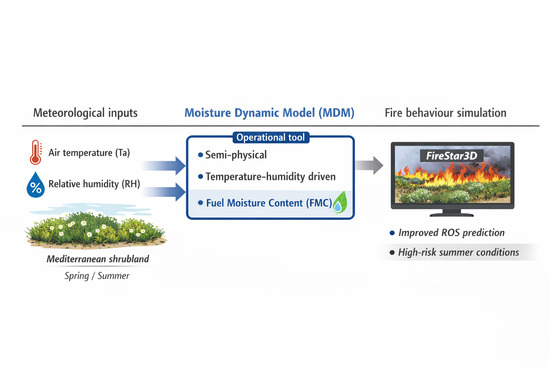
This study presents the Moisture Dynamic Model (MDM), a new semi-physical formulation designed to estimate Fuel Moisture Content (FMC) using only air temperature and relative humidity. The core innovation of this work lies in the introduction of an Arrhenius-type kinetic term into a fuel moisture prediction framework, allowing temperature-driven desorption processes to be explicitly represented within a lightweight operational model. Its predictive capability was assessed through experimental campaigns on Cistus monspeliensis shrublands in Corsica and validated using FireStar3D simulations. A second major contribution is the coupling of the MDM with the physical wildfire simulator FireStar3D to quantify how FMC prediction errors propagate into fire spread predictions. The MDM accurately reproduced the seasonal variability of FMC, achieving strong correlation with experimental data during dry summer periods. When coupled with FireStar3D, discrepancies in the predicted rate of spread remained below 4% under high-risk meteorological conditions. While the model performed robustly during summer, its accuracy decreased during spring, when rainfall events and microclimatic variability introduced greater uncertainty. This work represents a proof of concept demonstrating the potential of a simple physically interpretable FMC model for operational fire behaviour prediction.

Graphical Abstract

1. Introduction

Wildfires pose a growing global threat, increasingly driven by the combined effects of climate change and human expansion into fire-prone landscapes [1]. Rising temperatures and prolonged droughts have led to widespread vegetation desiccation and the accumulation of flammable materials, intensifying the frequency and severity of fire events. This trend has been clearly demonstrated by catastrophic wildfires in recent years across Europe, North America, and Australia [2]. For 2025, according to the most recent data from the European Commission’s Joint Research Centre via the European Forest Fire Information Service [3], the total burned area in the European Union has already exceeded 1 million hectares, marking the highest cumulative burn extent on record for a fire season since systematic reporting began in 2006. Mediterranean regions are particularly vulnerable due to the convergence of hot, dry climates, flammable vegetation types, and dense human activity, which together create ideal conditions for recurrent and intense events. Fuel Moisture Content (FMC), defined as the ratio of water mass to dry vegetation mass, is a key determinant of ignition, fire spread and intensity, and constitutes a critical operational indicator for fire danger assessment, prescribed burning and fuel consumption prediction [4,5,6,7]. Consequently, FMC has become widely recognized as a reliable indicator of overall fire danger [8]. However, it cannot be easily measured in situ, since direct methods rely on destructive gravimetric sampling or specialized equipment. These approaches are labor-intensive, costly, and often spatially limited. Consequently, there is a strong need for FMC models that are based on simple and widely available atmospheric variables such as air temperature and relative humidity, which can be easily accessed from weather stations or forecast products. A variety of models have been developed to estimate FMC and its influence on fire behavior. Empirical models have historically been used to estimate fuel moisture content based on temperature and relative humidity. Foundational contributions by [9,10,11] underpinned systems such as the Forest Fire Danger Index (FFDI). These empirical models provided valuable insights into the relationship between meteorological variables and FMC but often struggled to generalize across diverse ecosystems. Fuel moisture equilibrium (EMC) is the steady-state water content a fuel reaches under constant atmospheric conditions. Classical models, such as those of Nelson [12], Van Wagner and Pickett [13], and Viney [14], describe EMC as a function of temperature and humidity through empirical or semi-analytical formulations. Recent advances include machine learning prediction models, satellite-based FMC retrievals, and cross-ecosystem analyses highlighting the spatial variability of fuel moisture dynamics [15,16,17,18]. However, many operational formulations still rely on equilibrium moisture concepts derived from controlled laboratory conditions. Although foundational, these models assume stable environments rarely encountered in nature, focus mainly on fine dead fuels, and overlook both sorption–desorption kinetics and species-specific hygroscopic traits. Physically based models, on the other hand, including those proposed by Matthews [19], provide mechanistic descriptions of moisture transport and exchange. Although mechanistic models provide a physically based representation of fuel moisture dynamics by accounting for heat and moisture exchanges, radiative processes, and canopy effects, they rely on numerous input variables (e.g., solar radiation, fuel temperature, precipitation) and are computationally demanding, which limits their applicability in operational fire danger forecasting. To address this gap, this study proposes a new semi-physical formulation, the Moisture Dynamic Model (MDM), designed to estimate FMC using only air temperature and relative humidity. The model incorporates an Arrhenius-type kinetic term to represent thermally activated moisture desorption processes, while retaining a simple functional structure suitable for operational applications. An empirical constraint is introduced to account for extreme hydric stress conditions, under which vegetation moisture is assumed to converge toward atmospheric humidity due to the progressive breakdown of physiological water retention mechanisms. This formulation aims to provide a compromise between empirical simplicity and physical consistency, enabling integration into fire danger assessment tools and fire behaviour models without requiring extensive input data. The predictive capability of the proposed model was evaluated using experimental FMC measurements collected on Cistus monspeliensis shrublands in Corsica. This species is widespread in Mediterranean ecosystems and is characterized by a high proportion of fine fuels and strong sensitivity of flammability to variations in moisture content. The model was further assessed through its integration within the physical wildfire simulator FireStar3D in order to quantify how uncertainties in FMC estimation propagate into fire behaviour outputs, particularly the rate of spread. Two contrasting seasonal periods were considered: spring, corresponding to the main prescribed burning season, and summer, corresponding to peak wildfire risk and extreme meteorological conditions. The objective of this study is therefore to develop and evaluate a lightweight semi-physical FMC model based on readily available meteorological variables and to examine how its prediction uncertainty influences fire behaviour simulations.
In this framework, the present study addresses the following research questions:
(1) Can a semi-physical model based solely on air temperature and relative humidity reproduce the seasonal dynamics of live fuel moisture content in Cistus monspeliensis Mediterranean shrublands?
(2) To what extent does uncertainty in FMC prediction propagate into fire behaviour outputs, particularly the rate of spread, when the model is coupled with a physical wildfire simulator?
(3) Is the proposed formulation sufficiently robust to provide reliable estimates under extreme summer meteorological conditions relevant to operational fire risk assessment?
It should be emphasized that this work constitutes a proof of concept rather than a comprehensive validation across multiple ecosystems. The objective is to evaluate the internal consistency, physical plausibility, and operational potential of the proposed formulation under controlled and representative conditions, and to explore its capacity to improve fire behaviour prediction when coupled with a physical model. The remainder of this article is organized as follows. The Materials and Methods section describes the study area, experimental protocol, model formulation, and numerical implementation. The Results section presents the experimental FMC dataset, model performance, and the influence of FMC uncertainty on fire spread predictions. The Discussion section examines the implications, limitations, and perspectives of the proposed approach. Finally, the Conclusion summarizes the main contributions of the study.

2. Materials and Methods

2.1. Reference Fuel: Cistus Monspeliensis

Firstly, Cistus is one of the dominant species in Mediterranean shrubland, a dense, low-lying shrubland typical of fire-prone environments. As such, this vegetation type is crucial for studies of wildfire behavior because it provides a realistic representation of the combustible material found in Mediterranean regions. Moreover, Corsica, a Mediterranean island, hosts extensive Cistus-dominated vegetation, making it a representative species for modelling and studying wildfire behavior in this specific geographic area. The prominence of Cistus in Corsica further underscores its relevance for developing predictive models tailored to local wildfire risks. It is well known that this plant plays a significant ecological and structural role in Mediterranean vegetation, particularly due to its prevalence and adaptability to dry, fire-prone climates. Indeed, it is very common in the first stages of regeneration of the vegetation after wildfires. High temperatures associated with fires break the dormancy of its seeds [20]. In regions experiencing frequent wildfires, with recurrence intervals of approximately six years, Cistus species can become dominant throughout the entire shrubland [21]. Finally, Cistus is known for its high flammability due to its specific physical and chemical properties, which significantly influence fire propagation. The species is particularly relevant for modelling wildfire behavior because its structural properties, such as its fine dead and live fuel, make it highly responsive to changes in Fuel Moisture Content (FMC). The selection of this fuel is therefore justified by the combination of these key factors.

2.2. Study Area

The study was conducted on a 1460 m2 Mediterranean maquis plot dominated by Cistus monspeliensis, located near the town of Corte, Corsica (42°18′42.77″ N, 9°9′37.31″ E), at an elevation of approximately 500 m. The location of the experimental site is shown in Figure 1. The plot is flat and visually homogeneous in terms of vegetation structure and species composition, with vegetation consisting mainly of mature Cistus monspeliensis shrubs showing relatively uniform height and density across the site. The selected plot is visually representative of widespread Cistus monspeliensis shrublands commonly found across Corsican and broader Mediterranean landscapes. It was deliberately chosen within a homogeneous stand in order to limit structural variability of the fuel bed and to focus the analysis on the influence of meteorological drivers, namely air temperature and relative humidity, on fuel moisture content.

2.3. Fuel Structural and Physicochemical Properties for Numerical Modelling

Fuel properties required for numerical simulations with FireStar3D were determined using a combination of laboratory measurements and targeted field characterization. Thermochemical properties of Cistus monspeliensis (thermal capacity, heat of combustion) were obtained in the chemistry laboratory of the University of Corsica following procedures described in previous studies [24,25,26]. Structural fuel properties, which depend on local vegetation characteristics, were assessed in situ within the selected homogeneous plot. Two representative 1 m2 plots were used to characterize the reference fuel bed used in the simulations. Within these plots, fuel load was measured, and fuel bed height was estimated from twenty vertical measurements between the ground and the top of the vegetation. Fuel volume fraction was then calculated from the measured fuel load, particle density, and mean vegetation height. The structural and thermochemical properties obtained are reported in Table 1. These measurements were not intended to quantify spatial variability at the landscape scale but rather to define a consistent and representative reference fuel bed for the coupled experimental–numerical analysis. Similar approaches based on representative fuel beds are commonly adopted in fire behaviour modelling studies when the objective is to isolate process-level relationships rather than describe spatial heterogeneity.

2.4. Fuel Moisture Sampling and Weather Conditions

Fuel moisture content (FMC) sampling was designed to prioritize temporal replication while ensuring spatial representativeness within the study plot. The plot was divided into five zones of similar surface area. Sampling was conducted daily over a one-month period during each experimental campaign. Two sampling sessions were performed each day: a morning session (09:00–10:00) and an afternoon session (14:00–15:00). During each session, five independent samples were collected, with one sample taken within each of the five zones. Within each zone, sampling locations were rotated among pre-identified Cistus monspeliensis individuals to avoid repeated clipping of the same plant and to minimize sampling-induced effects. This strategy ensured spatial independence of samples while preserving the representativeness of the plot. For each sample, a representative portion of plant material (leaves and fine apical twigs, diameter < 6 mm) was collected from healthy, mature individuals using clean pruning shears. Sampling was standardized by targeting similar plant parts and exposure conditions. Each sample was immediately placed in a labeled airtight plastic bag to limit evaporative water loss, stored in a cooled container in the field, and transported to the laboratory shortly after collection. All samples were oven-dried at 60 °C for 48 h to determine gravimetric fuel moisture content. In total, 920 individual FMC measurements were obtained across the two experimental campaigns. This sampling design allowed robust characterization of the temporal dynamics of FMC under contrasting seasonal meteorological conditions.
For ambient weather conditions, relative humidity (RH) and air temperature (Ta) were monitored using a Kestrel 5500 weather meter [27]. The meteorological measurements were performed at 1.5 m above ground, close to the sampled vegetation, in order to characterize local atmospheric conditions.

2.5. MDM Formulation

While complex mechanistic models can describe FMC dynamics in detail, they require numerous parameters and high computational cost, making them less suitable for operational applications. To address this, a lightweight yet physically motivated model was developed, grounded in thermodynamic principles, allowing the direct estimation of FMC using only ambient air temperature and relative humidity. The model builds on the analogy between fuel drying and thermally activated desorption processes, in which the rate of moisture release increases exponentially with temperature. At the same time, ambient humidity slows down the drying process by reducing the vapor pressure gradient between the fuel and the atmosphere. Combining these effects, the model assumes that FMC approaches an equilibrium state determined by relative humidity, but modulated by a temperature-dependent kinetic constraint. The formulation is expressed as:
F M C v = 1 n 1 n [ 1 ( R T a n χ υ E a ) ] ln ( 1 R H n )
where F M C v is the Fuel Moisture Content of the vegetation type υ,
n is the number of samples,
R is the universal gas constant: 8.31 J·mol−1·K−1,
T a is the air temperature in K,
χ υ is a vegetation-specific scaling factor,
E a is the activation energy associated with moisture desorption: 42 kJ·mol−1,
R H is the relative humidity expressed as a fraction.
χ υ is a dimensionless parameter interpreted as a fuel-bed structural scaling factor. In fire behaviour studies, the response rate of fuel moisture depends on structural descriptors such as fuel load, bulk density (packing) and surface-area-to-volume ratio. For the studied Cistus shrubland (Table 1), these structural properties indicate a relatively compact fuel bed; the calibration yielded a single constant value χ υ = 0.34, which was kept unchanged for both seasonal datasets in order to evaluate the robustness of the formulation under contrasted meteorological conditions. The parameter is therefore treated as a fuel-type constant representing structural effects while preserving the operational simplicity of the model rather than a species-specific physiological property. In this formulation, kinetic theory is accounted for by introducing an Arrhenius-like term, whose effect is statistically weighted according to the logarithmic dependence on relative humidity. The result is a robust yet computationally light model, called MDM, that directly yields FMC estimates without needing to simulate time-evolution dynamics. In this formulation, the numerator represents a thermally controlled “desorption potential” which decreases linearly with temperature and vanishes once a threshold is reached. The denominator accounts for the influence of ambient relative humidity, acting as a normalization factor that scales the desorption kinetics and ensures consistency with equilibrium moisture conditions. Together, this fractional structure formalizes the balance between temperature-driven drying and humidity-driven stabilization, thus providing a semi-physical representation of the vegetation moisture dynamics. A vegetation-specific scaling factor was introduced into the Arrhenius-type kinetic term in order to adjust the thermal sensitivity of the drying process. This parameter does not change the physical structure of the model but modulates the magnitude of the temperature response, ensuring consistency between the theoretical formulation and the experimentally observed FMC dynamics for Cistus monspeliensis. In practice, the scaling factor accounts for species-dependent structural and chemical characteristics that influence moisture desorption efficiency. By providing a physically interpretable yet operationally simple estimation of FMC, the MDM offers a robust input variable for wildfire behaviour models. To assess how FMC variations influence the rate of spread and fire intensity under realistic conditions, the model was subsequently integrated into the FireStar3D physical wildfire simulator, described in the following section.

2.6. FireStar3D: A Computational Tool for Wildfire Behavior Analysis

FireStar3D is a computational code based on a multiphase formulation, developed to enhance the understanding of wildfire behavior [28]. The tool is available in both 3D and quasi-2D versions. Inspired by Grishin’s model [29], FireStar3D provides a detailed representation of the physical and chemical phenomena occurring during wildfires, from vegetation degradation to the turbulent flame front development above the vegetation layer in a porous medium. This section outlines the model’s framework and provides an overview of its methods. FireStar3D employs a multiphase approach with a low Mach number approximation. The model incorporates key factors in wildfire propagation, including detailed fuel characteristics, meteorological conditions, and terrain topography. The solid phase is represented as a porous medium, while the fluid phase is modelled as a gas mixture of air and pyrolysis products. The gas phase evolution is governed by conservation equations for mass, momentum, and energy, involving species such as O2, N2, CO, CO2, and H2O. The combustion rate in the gas phase is determined using the Eddy Dissipation Concept (EDC) for turbulent diffusion [30,31]. Turbulent flows are resolved using the Large Eddy Simulation (LES) method. Additionally, soot particle volume fractions in the gas phase are computed through transport equations. Vegetation degradation is modelled in three successive phases: dehydration, pyrolysis, and combustion. The vegetation consists of various solid particle families, such as stems, leaves, and trunks, each with specific properties including shape, size, surface area-to-volume ratio, and density. The degradation process is represented by temporal changes in the solid phase’s constituents, including water content, dry matter, charcoal, and ash. This process is governed by ordinary differential equations describing the evolution of the solid’s total mass, temperature, and volumetric fraction. The interaction between the gas and solid phases involves heat and mass transfer. The solid phase’s presence is incorporated through aerodynamic drag terms in conservation equations. Heat transfer between the gas mixture and the solid fuel is evaluated using empirical correlations for convective heat transfer coefficients, combined with radiative heat transfer equation solutions. The quasi-2D version of FireStar3D solves problems in a vertical plane. In contrast, FireStar3D accounts for the three-dimensional effects observed in real fires [32]. The main difference lies in the flame front representation: FireStar3D, in its quasi-2D version, models it as a homogeneous obstacle, whereas FireStar3D captures the flame front’s heterogeneity, influenced by thermoconvective instability. This improvement leads to more realistic predictions, including the interaction between the flame front and vegetation [33]. FireStar3D’s comprehensive physical approach allows the study of wildfire propagation in homogeneous fuels such as grass [34,35], needle beds [36], or Mediterranean shrubland [37], as well as heterogeneous vegetation with multiple layers, such as pine forests [38]. It serves as a predictive tool for various configurations and scales [28,35,39]. Additionally, FireStar3D aids in wildfire prevention by evaluating the effectiveness of management techniques, such as optimizing fuel load reductions and designing fuel breaks [40,41]. In this study, the quasi-2D version of FireStar3D was used, as only the flame front rate of spread is relevant. This situation corresponds to a flame of infinite width, for which only the dynamics of the fire are of interest. Some duly chosen configurations launched in 3D lead to ROS values very close comparatively to their counterparts in quasi-2D configurations.

3. Results

3.1. Meteorological Data

This section presents the field measurements collected during two distinct study periods: spring conditions (April) and summer conditions (June). The experimental results illustrate the evolution of air Temperature (Ta), Relative Humidity (RH), and the relationship between Fuel Moisture Content (FMC) and RH at the study site. FMC values presented correspond to the mean across the five sampling zones for each sampling time. The temperature data during the study periods highlight significant differences between the two conditions (Figure 2 and Figure 3). During spring, the average temperature was 12.59 °C, with daily fluctuations ranging from 6.8 °C to 21.1 °C. Conversely, in summer, the average temperature increased to 23.4 °C, with peaks exceeding 36 °C, reflecting the typical Mediterranean summer conditions that contribute to vegetation desiccation and increased fire risks.
Relative Humidity followed an inverse trend compared to air temperature (Figure 3). Under spring conditions, the average RH was recorded at 59.85%, with variability throughout the period. In summer, RH values dropped significantly, averaging 45.08%, with minima falling below 35%, a level indicative of increased vegetation flammability and reduced FMC. These results underscore the critical role of RH in influencing fuel moisture levels.
The relationship between FMC and RH, illustrated in Figure 4, reveals the dependence of vegetation moisture on ambient relative humidity. These experimental findings provide a foundational understanding of the site-specific climatic factors influencing FMC and fire behavior.
The behaviour illustrated in Figure 4 reflects a progressive change in the structure of the data distribution. Under moderate temperatures and relatively high humidity, fuel moisture content (FMC) spans a broad range of values, showing that comparable atmospheric conditions may lead to markedly different moisture levels. This dispersion indicates the influence of storage processes, microclimatic heterogeneity and recent hydrological inputs. With increasing air temperature and decreasing relative humidity, the variability of FMC diminishes progressively. The points gather within a narrower interval of moisture values, especially under low humidity conditions where the spread observed at lower temperatures disappears. This concentration indicates that vegetation moisture becomes increasingly governed by atmospheric conditions. The distribution thus reveals a shift from a storage-dominated regime, characterized by high variability, toward a regime controlled by atmospheric drying in which fuel moisture responds more uniformly to environmental forcing. This observed convergence provides the basis for defining a practical criterion used later in the model formulation to identify this regime.

3.2. Global Approach

Building on the observed relationships between air temperature, relative humidity, and fuel moisture content, an empirical adjustment was incorporated into the Moisture Dynamic Model (MDM) to improve its responsiveness under extreme meteorological stress. Field data indicated that, during periods combining high temperatures and very low humidity, vegetation experienced rapid and irreversible desiccation that the standard formulation tended to underestimate. To capture this behavior, a threshold condition was introduced: when the ratio of air temperature (°C) to relative humidity (%) exceeds 30, the fuel moisture content (FMC) is assumed to equal the ambient relative humidity (FMC = RH) (Figure 5). This formulation is intended to represent fuel moisture behaviour under extreme drying conditions relevant to wildfire spread rather than the full seasonal evolution of live fuel moisture. Recent studies have shown that fuel moisture dynamics may shift from a hydrologically influenced regime to a regime primarily controlled by atmospheric conditions during fire-prone periods [16,17,18]. Outside this regime, additional hydrological processes dominate fuel moisture variability. The seasonal behaviour of the dataset supports this interpretation: during summer, fuel moisture variability decreases and becomes strongly correlated with meteorological conditions, whereas during spring larger dispersion is observed. The threshold therefore identifies a transition toward an atmosphere-controlled moisture regime, allowing the model to reproduce the rapid drying phase observed under fire-prone conditions.

3.3. Comparison of Experimental and Modelled FMC

The experimental and theoretical results for the fuel moisture content (FMC) of Cistus are compared for two distinct periods: spring (April) and summer (June). Figure 6 and Figure 7 illustrate these comparisons, highlighting the performance of the proposed model in predicting FMC under varying meteorological conditions.
In April, the FMC obtained through field measurements and the model shows significant variation, with the experimental FMC displaying higher fluctuations compared to the modelled FMC. The r2 value of 0.41 indicates a weak correlation between the observed and modelled data. This variation is likely due to the relatively high relative humidity and cooler air temperatures, which lead to localized moisture retention and variability in the field that the model does not fully capture. It also reflects additional hydrological influences, such as recent precipitation and soil water availability, introducing memory effects in vegetation moisture that are not represented in the present formulation. During the summer period (June), the comparison shows a much stronger agreement between the experimental and theoretical FMC values, with an r2 value of 0.81. This higher correlation demonstrates the model’s ability to perform more accurately under hot and dry conditions, where RH and Ta exert a more stable and predictable influence on vegetation moisture. Both the measured and modelled FMC decrease steadily during this period, reflecting the drying effect of elevated Ta and reduced RH on Cistus. The comparison between measured and modelled FMC highlights two distinct behaviours, as observed in Figure 8 and Figure 9.
Under dry conditions, most points are distributed close to the 1:1 reference line, indicating that the formulation captures the main moisture variations controlled by air temperature and relative humidity. Under wetter seasonal conditions, a much larger dispersion appears, with similar atmospheric conditions corresponding to markedly different measured moisture values. This variability reflects additional environmental influences not represented in the formulation, such as recent precipitation and moisture storage effects.

3.4. Impact of FMC Modelling Accuracy on Fire Propagation Predictions

The predictive reliability of fire behaviour simulators such as FireStar3D largely depends on the accuracy of the fuel moisture content (FMC) model. As FMC governs the flammability and energy release characteristics of vegetation, even minor deviations between modelled and measured FMC can lead to substantial errors in the predicted rate of spread (RoS).
In this study, the differences between experimental and numerical data for FMC and RoS are quantified as DFMC and DRos, respectively. DFMC represents the difference between the modelled FMC (FMC_mod) and the experimentally measured FMC (FMC_exp), while DRos represents the difference between the rate of spread simulated using the FMC predicted by the MDM (RoS_mod) and that obtained using the experimentally determined FMC (RoS_exp). The influence of environmental variables such as relative humidity (RH) and air temperature (Ta) is further detailed in Table 2 and Table 3.
When FMC_mod overestimated FMC_exp, the largest positive deviation of DFMC/FMC_exp was observed in the 27–30 °C temperature range, reaching +15.28% (Table 3). This overestimation of fuel moisture resulted in a decrease in DRos/Ros_exp by 2.15%, indicating that the simulator predicted slower fire propagation rates under conditions where moisture content was overestimated. Conversely, when FMC_mod underestimated FMC_exp, negative DFMC/FMC_exp values were associated with in-creased fire spread predictions. For instance, in the 24–27 °C temperature range, a DFMC/FMC_exp of −13.67% corresponded to an increase in DRos/Ros_exp of 5.13% (Table 3), reflecting an amplification of the simulated rate of spread under underesti-mated moisture conditions.
Under low RH conditions (30–40%), DFMC/FMC_exp reached −7.65%, resulting in an overprediction of RoS by 4.37%. At intermediate RH levels (40–50%), a positive moisture discrepancy (+10.04%) led to a slight reduction in predicted fire spread (−1.71%). In contrast, higher RH conditions (50–60%) were associated with a larger negative DFMC/FMC_exp (−13.28%), corresponding to a 3.69% increase in RoS predictions.
Similarly, temperature variations modulated the magnitude and direction of the discrepancies. While moderate positive DFMC/FMC_exp values were observed at higher temperatures (e.g., +5.94% in the 35–40 °C range), their impact on DRos/Ros_exp remained limited (0.71%). In contrast, stronger underestimations of FMC at lower temperatures (24–27 °C) produced more pronounced amplification effects on fire spread predictions.
A linear regression performed on the complete dataset (excluding 12/04/2021, n = 27) revealed a statistically significant inverse relationship between DFMC/FMC_exp and DRos/Ros_exp (slope = −0.187 ± 0.064, t = −2.92, F(1, 25) = 8.54, p = 0.0073, r2 = 0.255). The 95% confidence interval of the slope ranged from −0.318 to −0.055, confirming that the relationship does not include zero and is therefore statistically robust.
However, the moderate coefficient of determination indicates that only about 25% of the variability in DRos/Ros_exp is explained by DFMC/FMC_exp when considering all environmental conditions together. This confirms that no strong global linear correlation governs the discrepancies across the full dataset. The detailed statistical outputs supporting this regression analysis are provided in the Supplementary Material.
Rather than defining a universal predictive relationship, the regression suggests that the influence of FMC modelling inaccuracies on RoS predictions is conditional upon specific environmental regimes. The analysis should therefore be interpreted as exploratory, aiming to highlight regime-dependent trends rather than to establish a generalized predictive statistical model.
The combined influence of RH and Ta on the relationship between DFMC/FMC_exp and DRos/Ros_exp is illustrated in Figure 10.
The dispersion of the data points confirms the absence of a uniform global trend across the full dataset, while suggesting that stronger correlations may emerge within specific RH and Ta ranges. This regime-dependent behavior explains the variability observed in fire spread pre-dictions under different environmental conditions.

4. Discussion

4.1. Model Performance and Validation

The Moisture Dynamic Model (MDM) demonstrated robust and operationally relevant predictive performance under Mediterranean summer conditions, characterized by high air temperatures and low relative humidity. The strong agreement between modelled and experimental FMC values (r2 = 0.81) confirms the model’s ability to capture vegetation moisture dynamics during dry, high-risk periods. Previous studies have shown that fuel moisture dynamics tend to shift toward an atmosphere-controlled regime governed by vapor pressure deficit (VPD) under dry conditions [17,18]. Because VPD is directly determined by air temperature and relative humidity, the transition identified here toward an atmosphere-controlled regime corresponds to high-VPD conditions. The proposed formulation therefore implicitly represents this physical control through a simplified criterion based only on temperature and relative humidity. When integrated into the FireStar3D physical wildfire simulator, the MDM yielded fire spread predictions consistent with those obtained using experimentally measured FMC, with discrepancies in the predicted rate of spread remaining below 4% under extreme meteorological conditions (35–40 °C and 30–40% RH). These results highlight the model’s capacity to represent both the thermodynamic and kinetic aspects of fuel desiccation, providing reliable input for physically based wildfire simulations. The introduction of an empirical threshold condition (FMC = RH when Ta/RH > 30) further improved the model’s responsiveness under severe hydric stress, reflecting the progressive collapse of vegetation water retention capacity under extreme heat and dryness. This adjustment enhances the realism of FMC estimates during heatwaves, which are critical periods for wildfire initiation and rapid propagation.

4.2. Seasonal Limitations and Model Sensitivity

Despite its strong performance during summer, the accuracy of the MDM decreases under spring conditions. The lower correlation observed between modelled and experimental FMC values (r2 = 0.41) reflects increased variability in both fuel moisture and microclimatic conditions during this period. Intermittent rainfall and localized humidity fluctuations introduce heterogeneity that the current model does not fully capture. This behaviour is consistent with hydrological memory effects following recent precipitation and soil water availability, which influence vegetation moisture independently of instantaneous atmospheric conditions. This limitation is inherent to the present structure of the model, which is primarily designed to describe drying kinetics driven by temperature and atmospheric humidity, rather than moisture gain processes following precipitation. These findings highlight the need for further model development, including the integration of additional environmental drivers such as precipitation, soil moisture, and microclimatic variability. Extending the calibration to multiple vegetation types beyond Cistus monspeliensis would also improve the model’s generalizability across Mediterranean and other fire-prone ecosystems.

4.3. Operational Implications for Wildfire Management

From an operational standpoint, the MDM provides a simple yet physically interpretable framework for estimating fuel moisture content using only air temperature and relative humidity, two variables that are readily available from weather stations and forecast products. This simplicity makes the model well suited for real-time fire danger assessment, prescribed burning planning, and early warning systems, particularly during periods of elevated wildfire risk.
The results presented in Table 2 and Table 3 show that errors in fuel moisture content estimation can translate into substantial errors in the rate of spread, reaching up to 11.7% under high temperature conditions between 35 and 40 °C. From an operational wildfire management perspective, such an underestimation is nontrivial. A rate of spread that is underestimated by approximately 12% implies that the fire front may advance significantly faster than anticipated, thereby reducing the time available for suppression actions, fireline construction, or tactical repositioning of resources. In fast moving fires, particularly under extreme weather conditions, this reduction in temporal margin may lead to ineffective fireline placement, increased likelihood of line breaches, and heightened safety risks for firefighting personnel. These findings also highlight the asymmetric nature of rate of spread prediction errors in operational contexts. While overestimation generally results in conservative and safer decisions, systematic underestimation, especially under severe fire weather, can lead to overly optimistic tactical planning. Consequently, defining an acceptable error threshold for rate of spread predictions appears necessary when such models are used to support decision making. For short-term tactical applications, a relatively low tolerance on the order of 5 to 10% may be required, whereas higher tolerances may be acceptable for strategic planning or scenario analysis, provided that uncertainty is explicitly acknowledged. In this context, the adoption of an operational safety margin applied to modelled rate of spread values could be recommended, particularly under high temperature and low fuel moisture conditions. Such an approach would help mitigate the risks associated with fuel moisture-induced underestimation of fire spread and improve the robustness of fire behaviour predictions used in wildfire management.
By providing dynamic FMC estimates without requiring destructive sampling, the model can be integrated into decision-support platforms or coupled with large-scale fire simulators such as FireStar3D to improve predictive accuracy in fire-prone regions. In practice, the model can be applied to standard meteorological data to produce spatial FMC estimates before fire behaviour calculations. Moreover, the model’s semi-physical formulation bridges the gap between empirical and mechanistic approaches. It retains physical interpretability while remaining computationally efficient, enabling use in both research and operational contexts. For fire management agencies, this approach can inform proactive fuel management and optimize the timing of prescribed burns, especially during transitional seasons.

5. Conclusions

This study introduced a semi-physical fuel moisture content (FMC) prediction model based only on air temperature and relative humidity and incorporating an Arrhenius-type kinetic formulation. The model provides consistent estimates under dry seasonal conditions while remaining simple and operationally accessible. The coupling of the MDM with the FireStar3D simulator allowed quantification of the sensitivity of fire spread predictions to FMC estimation errors, highlighting the importance of reliable moisture inputs for fire behaviour modelling. Because it relies only on commonly available meteorological data, the approach can be used to generate fuel moisture inputs for fire behaviour simulations and fire danger assessment workflows. The proposed framework therefore provides a practical bridge between empirical indices and fully physical models, offering a computationally efficient way to supply moisture conditions for wildfire simulations in Mediterranean environments. The results also indicate that inaccurate FMC estimation may lead to non-negligible underestimation of the rate of spread under severe fire weather, potentially reducing the available response time in operational contexts. Improving FMC prediction is therefore essential for increasing the reliability of fire behaviour forecasts and supporting safer tactical planning during high-risk Mediterranean wildfire conditions. However, it should be explicitly stated that this work represents a proof of concept rather than a comprehensive validation. Further developments are required to improve model performance during wetter seasons and to extend its applicability across a wider range of vegetation types and climatic contexts.

Supplementary Materials

The following supporting information can be downloaded at: https://www.mdpi.com/article/10.3390/fire9030098/s1.

Author Contributions

Conceptualization, D.C. and V.L.-C.; methodology, D.C., V.L.-C. and J.-L.R.; software, T.M., S.M. and F.-J.C.; validation, all the authors; formal analysis, all the authors; writing—original draft preparation, J.-L.R. and D.C.; writing—review and editing, all the authors; supervision, D.C. and J.-L.R. All authors have read and agreed to the published version of the manuscript.

Funding

This work was funded by the Corsican Region and the French state in the framework of the collaborative project GOLIAT (CPER: 40031).

Data Availability Statement

The datasets are available on request to the corresponding author.

Acknowledgments

The authors sincerely thank Carmen Awad, Jacky Fayad, and Nicolas Frangieh for their valuable contributions to this study. Their dedication and expertise in conducting and collecting field experimental data were essential to the success of this work. Centre de Calcul Intensif d’Aix-Marseille is acknowledged for granting access to its high-performance computing resources.

Conflicts of Interest

The authors declare no conflicts of interest.

Abbreviations

The following abbreviations are used in this manuscript:
DFMCFuel Moisture Content Discrepancy
DRoSRate of Spread Discrepancy
EDCEddy Dissipation Concept
EMCEquilibrium Moisture Content
FFDIForest Fire Danger Index
FMCFuel Moisture Content
LESLarge Eddy Simulation
MDMMoisture Dynamic Model
RHRelative Humidity
RoSRate of Spread
TaAmbient Temperature

References

  1. Rossi, J.-L.; Komac, B.; Migliorini, M.; Schwarze, R.; Sigmund, Z.; Carmen, A.; Chatelon, J.; Goldammer, J.; Marcelli, T.; Morvan, D.; et al. Evolving Risk of Wildfires in Europe—The Changing Nature of Wildfire Risk Calls for a Shift in Policy Focus from Suppression to Prevention; United Nations Office for Disaster Risk Reduction (UNDRR) Europe: Brussels, Belgium, 2020.
  2. San-Miguel-Ayanz, J.; Durrant, T.; Boca, R.; Maianti, P.; Liberta’, G.; Jacome, F.O.D.; Branco, A.; De, R.D.; Suarez-Moreno, M.; Ferrari, D.; et al. Forest Fires in Europe, Middle East and North Africa. 2023. Available online: https://publications.jrc.ec.europa.eu/repository/handle/JRC139704 (accessed on 8 January 2026).
  3. EFFIS—Statistics Portal. Available online: https://forest-fire.emergency.copernicus.eu/apps/effis.statistics/estimates (accessed on 14 August 2025).
  4. Weise, D.; Hartford, R.; Mahaffey, L. Assessing Live Fuel Moisture for Fire Management Applications; U.S. Forest Service or Relevant Agency: Fort Collins, CO, USA, 1998.
  5. Dennison, P.E.; Moritz, M.A. Critical Live Fuel Moisture in Chaparral Ecosystems: A Threshold for Fire Activity and Its Relationship to Antecedent Precipitation. Int. J. Wildland Fire 2009, 18, 1021–1027. [Google Scholar] [CrossRef]
  6. Fernandes, P.M. Scientific Support to Prescribed Underburning in Southern Europe: What Do We Know? Sci. Total Environ. 2018, 630, 340–348. [Google Scholar] [CrossRef] [PubMed]
  7. Prichard, S.J.; Kennedy, M.C.; Wright, C.S.; Cronan, J.B.; Ottmar, R.D. Predicting Forest Floor and Woody Fuel Consumption from Prescribed Burns in Southern and Western Pine Ecosystems of the United States. For. Ecol. Manag. 2017, 405, 328–338. [Google Scholar] [CrossRef]
  8. Cruz, M.G.; Sullivan, A.L.; Alexander, M.E. Fire Behaviour Knowledge in Australia; Bushfire Cooperative Research Centre: East Melbourne, Australia, 2014. [Google Scholar]
  9. Mcarthur, A.G. Fire Behaviour in Eucalypt Forests; Forestry and Timber Bureau: Yarralumla, Australia, 1967. [Google Scholar]
  10. Simard, A.J. The Moisture Content of Forest Fuels: A Review of the Basic Concepts. I.; Forest Fire Research Institute, Department of Forestry and Rural Development: Ottawa, ON, Canada, 1968.
  11. Sneeuwjagt, R.J.; Peet, G.B. Forest Fire Behaviour Tables for Western Australia; WA Department of Conservation and Land Management: Perth, Australia, 1985. [Google Scholar]
  12. Nelson, R.M., Jr. A Method for Describing Equilibrium Moisture Content of Forest Fuels. Can. J. For. Res. 1984, 14, 597–600. [Google Scholar] [CrossRef]
  13. Van Wagner, C.E.; Pickett, T.L. Equations and FORTRAN Program for the Canadian Forest Fire Weather Index System; Canadian Forestry Service: Ottawa, ON, Canada, 1985; ISBN 978-0-662-13906-5. [Google Scholar]
  14. Viney, N. A Review of Fine Fuel Moisture Modelling. Int. J. Wildland Fire 1991, 1, 215–234. [Google Scholar] [CrossRef]
  15. Quan, X.; Yebra, M.; Riaño, D.; He, B.; Lai, G.; Liu, X. Global Fuel Moisture Content Mapping from MODIS. Int. J. Appl. Earth Obs. Geoinf. 2021, 101, 102354. [Google Scholar] [CrossRef]
  16. Ruffault, J.; Martin-StPaul, N.; Pimont, F.; Dupuy, J.-L. How Well Do Meteorological Drought Indices Predict Live Fuel Moisture Content (LFMC)? An Assessment for Wildfire Research and Operations in Mediterranean Ecosystems. Agric. For. Meteorol. 2018, 262, 391–401. [Google Scholar] [CrossRef]
  17. Dragozi, E.; Giannaros, T.M.; Kotroni, V.; Lagouvardos, K.; Koletsis, I. Dead Fuel Moisture Content (DFMC) Estimation Using MODIS and Meteorological Data: The Case of Greece. Remote Sens. 2021, 13, 4224. [Google Scholar] [CrossRef]
  18. Kranz, J.; Bauer, K.; Pampanoni, V.; Zhao, L.; Marrs, C.; Mauder, M.; Poděbradská, M.; van der Maaten-Theunissen, M.; Yebra, M.; Forkel, M. Assessing Predictors for Fuel Moisture Content in Central European Forests. Agric. For. Meteorol. 2025, 371, 110590. [Google Scholar] [CrossRef]
  19. Matthews, S. A Process-Based Model of Fine Fuel Moisture. Int. J. Wildland Fire 2006, 15, 155–168. [Google Scholar] [CrossRef]
  20. Luna, B.; Piñas-Bonilla, P.; Zavala, G.; Pérez, B. Timing of Fire during Summer Determines Seed Germination in Mediterranean Cistaceae. Fire Ecol. 2023, 19, 52. [Google Scholar] [CrossRef]
  21. Castro, F.X.; Tudela, A.; Sebastià, M.T. Modeling Moisture Content in Shrubs to Predict Fire Risk in Catalonia (Spain). Agric. For. Meteorol. 2003, 116, 49–59. [Google Scholar] [CrossRef]
  22. H 237, O. English: Map of the Mediterranean Sea with Subdivisions, Straits, Islands and Countries. Available online: https://commons.wikimedia.org/w/index.php?title=File:Mediterranee_02_EN.jpg&oldid=1165523401 (accessed on 19 February 2025).
  23. Ikonact Geographic Map of Corsica in English. Limits of the Map. Available online: https://commons.wikimedia.org/wiki/File:Corsica-geographic_map-en.svg (accessed on 19 February 2025).
  24. Leroy-Cancellieri, V.; Augustin, P.; Filippi, J.B.; Mari, C.; Fourmentin, M.; Bosseur, F.; Morandini, F.; Delbarre, H. Evaluation of Wildland Fire Smoke Plume Dynamics and Aerosol Load Using UV Scanning Lidar and Fire–Atmosphere Modelling during the Mediterranean Letia 2010 Experiment. Nat. Hazards Earth Syst. Sci. 2014, 14, 509–523. [Google Scholar] [CrossRef]
  25. Rahib, Y.; Leroy-Cancellieri, V.; Cancellieri, D.; Quilichini, Y. Fire Hazard Analysis of Mediterranean Genista Salzmannii: Pyrolysis and Kinetic Characterization. J. Anal. Appl. Pyrolysis 2022, 168, 105726. [Google Scholar] [CrossRef]
  26. Rahib; Leroy-Cancellieri, V.; Cancellieri, D.; Fayad, J.; Rossi, J.-L.; Leoni, E. Study on the Combustion Indices of Forest Species Using Thermogravimetric Analysis. J. Therm. Anal. Calorim. 2023, 148, 12919–12935. [Google Scholar] [CrossRef]
  27. Kestrel 5500 Handheld Weather Station & Wind Speed Meter—Kestrel Instruments. Available online: https://kestrelinstruments.com/kestrel-5500-weather-meter?srsltid=AfmBOordHDpwj7eUZZD53tfQ7BwFHRh7yb7wzeBYohsT8ZAnfLjWZn6u (accessed on 8 January 2026).
  28. Morvan, D.; Accary, G.; Meradji, S.; Frangieh, N.; Bessonov, O. A 3D Physical Model to Study the Behavior of Vegetation Fires at Laboratory Scale. Fire Saf. J. 2018, 101, 39–52. [Google Scholar] [CrossRef]
  29. Grishin, A.M. Mathematical Modeling of Forest Fires and New Methods of Fighting Them; Publishing House of the Tomsk State University: Tomsk, Russia, 1997; ISBN 978-5-7511-0840-3. [Google Scholar]
  30. Magnussen, B.F.; Hjertager, B.H. On Mathematical Modeling of Turbulent Combustion with Special Emphasis on Soot Formation and Combustion. Symp. (Int.) Combust. 1977, 16, 719–729. [Google Scholar] [CrossRef]
  31. Cox, G. Combustion Fundamentals of Fire; Combustion treatise; Academic Press: London, UK, 1995; ISBN 978-0-12-194230-4. [Google Scholar]
  32. Linn, R.R.; Canfield, J.M.; Cunningham, P.; Edminster, C.; Dupuy, J.-L.; Pimont, F. Using Periodic Line Fires to Gain a New Perspective on Multi-Dimensional Aspects of Forward Fire Spread. Agric. For. Meteorol. 2012, 157, 60–76. [Google Scholar] [CrossRef]
  33. A Study of Two High Intensity Fires across Corsican Shrubland. Atmosphere 2023, 14, 473. [CrossRef]
  34. Morvan, D. Numerical Study of the Effect of Fuel Moisture Content (FMC) upon the Propagation of a Surface Fire on a Flat Terrain. Fire Saf. J. 2013, 58, 121–131. [Google Scholar] [CrossRef]
  35. Frangieh, N.; Morvan, D.; Meradji, S.; Accary, G.; Bessonov, O. Numerical Simulation of Grassland Fires Behavior Using an Implicit Physical Multiphase Model. Fire Saf. J. 2018, 102, 37–47. [Google Scholar] [CrossRef]
  36. Morvan, D.; Dupuy, J.L. Modeling of Fire Spread through a Forest Fuel Bed Using a Multiphase Formulation. Combust. Flame 2001, 127, 1981–1994. [Google Scholar] [CrossRef]
  37. Numerical Study of an Experimental High-Intensity Prescribed Fire across Corsican Genista Salzmannii Vegetation. Fire Saf. J. 2022, 131, 103600. [CrossRef]
  38. Frangieh, N.; Accary, G.; Morvan, D.; Méradji, S.; Bessonov, O. Wildfires Front Dynamics: 3D Structures and Intensity at Small and Large Scales. Combust. Flame 2020, 211, 54–67. [Google Scholar] [CrossRef]
  39. Awad, C.; Morvan, D.; Rossi, J.-L.; Marcelli, T.; Chatelon, F.J.; Morandini, F.; Balbi, J.-H. Fuel Moisture Content Threshold Leading to Fire Extinction under Marginal Conditions. Fire Saf. J. 2020, 118, 103226. [Google Scholar] [CrossRef]
  40. Dupuy, J.; Morvan, D. Numerical Study of a Crown Fire Spreading toward a Fuel Break Using a Multiphase Physical Model. Int. J. Wildland Fire 2005, 14, 141–151. [Google Scholar] [CrossRef]
  41. Frangieh, N.; Accary, G.; Rossi, J.-L.; Morvan, D.; Meradji, S.; Marcelli, T.; Chatelon, F.-J. Fuelbreak Effectiveness against Wind-Driven and Plume-Dominated Fires: A 3D Numerical Study. Fire Saf. J. 2021, 124, 103383. [Google Scholar] [CrossRef]
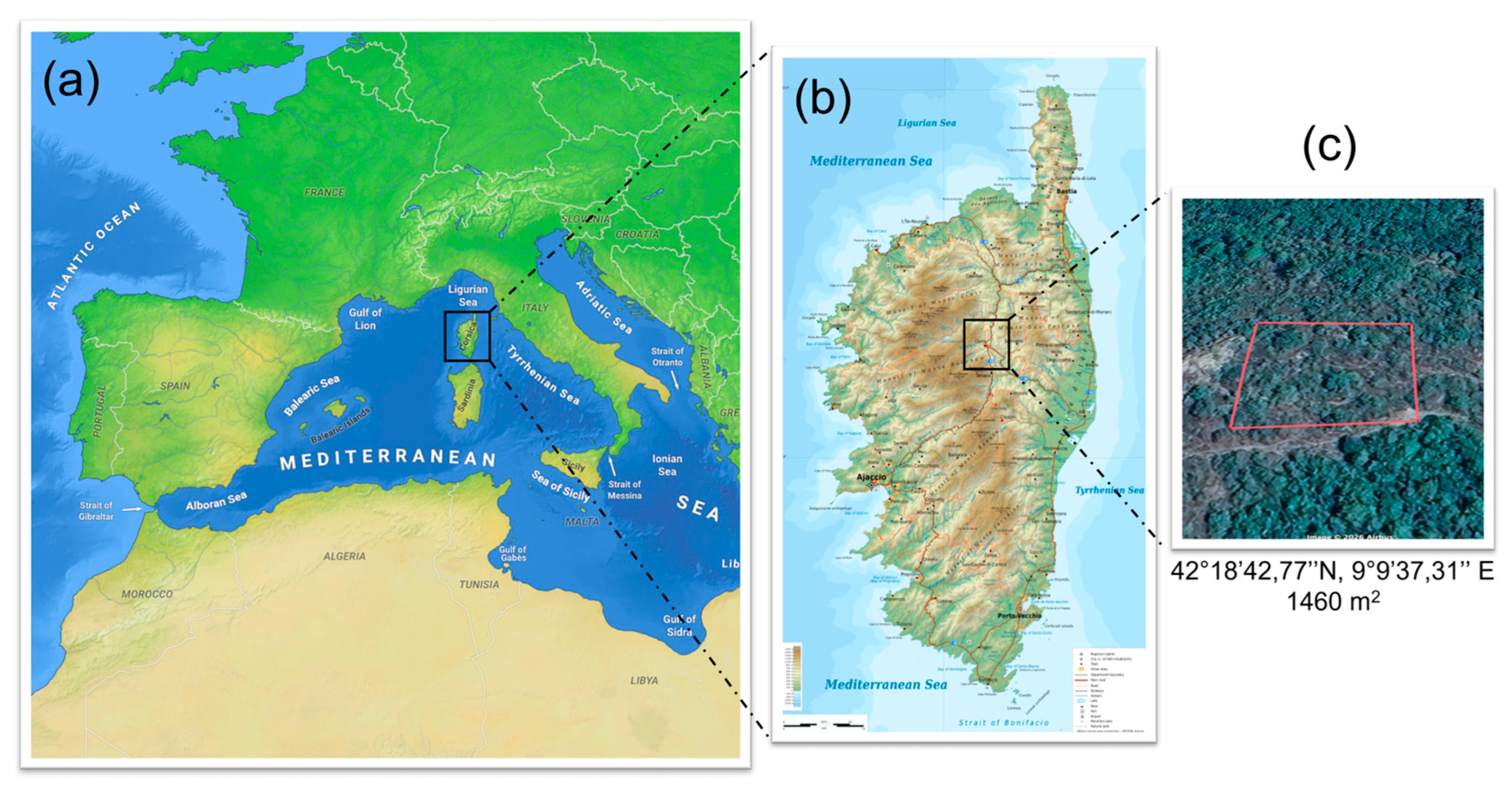
Figure 1. Geographic location of the study area using a progressive spatial zoom. (a) Position of Corsica within the Mediterranean basin in Southern Europe; (b) location of the Corte area within Corsica; (c) detailed view of the experimental sampling plot. The black squares indicate the successive zoomed areas. Base maps adapted from Wikimedia Commons contributors [22,23].
Fire 09 00098 g001
Figure 2. Meteorological data (Temperature and Relative Humidity) during spring conditions. Asterisks indicate days influenced by precipitation.
Fire 09 00098 g002
Figure 3. Meteorological data (Temperature and Relative Humidity) during summer conditions.
Fire 09 00098 g003
Figure 4. Three-dimensional representation of the combined effect of air temperature (T) and relative humidity (RH) on the fuel moisture content (FMC).
Fire 09 00098 g004
Figure 5. The empirical threshold condition applied to field data when Ta/RH > 30.
Fire 09 00098 g005
Figure 6. Temporal evolution of experimental and modeled FMC for Cistus monspeliensis during spring conditions.
Fire 09 00098 g006
Figure 7. Temporal evolution of observed and predicted FMC for Cistus monspeliensis during summer conditions.
Fire 09 00098 g007
Figure 8. Experimental vs. modeled FMC for Cistus monspeliensis in spring conditions.
Fire 09 00098 g008
Figure 9. Experimental vs. modelled FMC for Cistus monspeliensis in summer conditions.
Fire 09 00098 g009
Figure 10. Regime-dependent distribution of DFMC/FMC_exp and DRoS/RoS_exp as a function of air temperature and relative humidity.
Fire 09 00098 g010
Table 1. Structural and thermochemical properties of a representative Cistus monspeliensis shrubland fuel bed.
Fuel Characteristics
StructuralFuel bed depth, e (m)0.85
Fuel load, σ (kg/m2)1.25
Surface-area to volume ratio, s (m−1)2400
Particle density, ρv (kg/m3)288
ThermochemicalThermal capacity, Cp (J/kg/K)1440
Yield heat, ΔHc (kJ/kg)10.52
Table 2. Impact of Relative Humidity (RH) on FMC and RoS Discrepancies.
RH (%)DFMC/FMC_exp (%)DRos/Ros_exp (%)
30–407.654.37
40–5010.041.71
50–6013.283.69
Table 3. Impact of Air Temperature (Ta) on FMC and RoS Discrepancies.
Ta (°C)DFMC/FMC_exp (%)DRos/Ros_exp (%)
24–27−13.675.13
27–3015.282.15
30–35−3.420.15
35–405.940.71
Disclaimer/Publisher’s Note: The statements, opinions and data contained in all publications are solely those of the individual author(s) and contributor(s) and not of MDPI and/or the editor(s). MDPI and/or the editor(s) disclaim responsibility for any injury to people or property resulting from any ideas, methods, instructions or products referred to in the content.