
Article

Fire Simulation of Battery Electric Car Transporters in Road Tunnels: A CFD Study

Department of Mechanical and Product Design Engineering, Swinburne University of Technology, Hawthorn, VIC 3122, Australia
*
Authors to whom correspondence should be addressed.
Fire 2026, 9(3), 125; https://doi.org/10.3390/fire9030125
Submission received: 14 January 2026 / Revised: 8 March 2026 / Accepted: 11 March 2026 / Published: 13 March 2026
(This article belongs to the Special Issue Intrinsic Fire Safety of Lithium-Based Batteries)

Abstract

The adoption of electric vehicles (EVs) has posed new challenges to fire safety, especially when multiple EVs are transported on electric trailers, as limited studies exist on heavy electric vehicle transportation and little research has been conducted on fire development during EV tunnel transport. The aim of this study is to investigate the temperature, smoke, and tenability conditions produced by an electric trailer transporting eight EVs, where a fire initiates and spreads to all eight EVs, under two scenarios: natural ventilation and longitudinal tunnel ventilation. The Fire Dynamics Simulator (FDS) was used, and the combined peak heat release rate (HRR) of the vehicles was found to exceed 76 MW. Air temperatures around the fire source exceeded 1100 °C, while temperatures above 950 °C were recorded at the tunnel ceiling. The simulations captured thermal behaviour, smoke propagation, and the accumulation of carbon dioxide (CO2) and carbon monoxide (CO). Longitudinal ventilation was shown to reduce upstream smoke spread and help maintain tenable conditions for evacuation and emergency response. These findings raise critical safety concerns regarding EV transportation in tunnels and support improved decision-making for tunnel infrastructure design and emergency responders.

1. Introduction

Global transportation systems are increasingly challenged by rising fuel prices and the necessity to cut carbon emissions. Thus, EVs have come to play a more sustainable role by being free from reliance on fossil fuels and by removing direct emissions of greenhouse gas. The ability to travel long distances rapidly and safely by vehicle is important for development in a country. But with this increasing adoption of electric vehicles comes a new set of fire safety issues, especially when transporting vehicles on trailers and lorries. When compared to traditional (ICEV) fires, EV fires burn more intensely, spread faster, are difficult to extinguish, and spew more hot, toxic gases [1]; the hazards associated with EV fires are unique and call for specific techniques. The primary challenges come from the batteries themselves as well as the complexity of managing a fire involving a battery electric vehicle (BEV), given the potential for thermal runaway (a chain reaction of exothermic events that, once initiated, can be extremely difficult to suppress), as reported in previous studies [2,3]. EV FireSafe [4] reports a steady increase in EV fire incidents between 2020 and 2024, largely reflecting the rapid growth in the number of EVs on the road. Based on projected EV adoption rates, an average of six EV fires per million vehicles is estimated, consistent with global trends; this equates to approximately 9–10 incidents per year by 2030, increasing to 37–42 by 2040, and reaching between 84 and 95 annual incidents by 2050 [5]. This figure of six fires per million vehicles represents an early conservative projection based on trends observed at the time of analysis [5]; more recent global datasets indicate a somewhat higher but still very low incidence rate compared to internal combustion engine vehicles.
The transportation of multiple EVs simultaneously has emerged as a critical safety concern following several high-profile incidents within the past five years. An incident recently occurred when a car trailer loaded with Tesla electric vehicles ignited a fire in August 2025 on the Interstate 5 Freeway in Sylmar, California (USA), producing toxic smoke that restricted access on southbound roads for several hours [6,7]. The incident underscored the dangers posed by lithium-ion battery (LIB) fires when being transported along public roads. In Sydney, Australia, Fire and Rescue NSW attended to a trailer fire at Denham Court, which burned five of the prime mover’s new hybrid vehicles [8]. The LIBs in these hybrid vehicles led to much greater operational complexity and overall increased the duration of the firefighting response. Referring to the National Transportation Safety Board (NTSB) [9], fires involving electric semi-truck LIBs need about 50,000 gallons of water to control. Additionally, in September 2023, an LIB in Sydney Airport’s car park destroyed five vehicles, which raised concern regarding thermal runaway propagation in vehicle space situations [10]. These terrestrial accidents and maritime catastrophes, such as the Felicity Ace (February 2022) incident, with about 4000 cars, and the Fremantle Highway incident (July 2023), involving 3783 cars and resulting in 1 death, are leading safety organizations and authorities to reconsider the necessary fire suppression capabilities and emergency-response procedures for transporting EVs [11,12].
Fire incidents in electric buses and trucks are significantly less frequent than those involving internal combustion engine vehicles. According to data published by the Swedish Civil Contingencies Agency (MSB) [13], fire incident rates are approximately 19 times lower for electric buses and 4 times lower for electric trucks. Similarly, tunnel fire data compiled by PIARC from 12 countries indicate that fires involving internal combustion engine heavy goods vehicles (HGVs) occur 1 to 4 times more frequently than those involving smaller vehicles [14].

Literature Review

Full-scale experimental studies have greatly improved the understanding of EV fire behaviour, particularly the unique hazards associated with LIB thermal runaway in confined or transportation settings. Sturm et al. [15] conducted full-scale fire tests in road tunnels on BEVs of different classes (compact car, van, SUV) and found that peak heat release rates (PHRR) for BEVs often exceeded those of comparable ICEVs, driven by rapid thermal runaway and intense smoke generation. Kang et al. [16] performed full-scale tests in simulated underground car parks, reporting temperatures approaching 1000 °C and near-total visibility loss within minutes due to heavy soot and toxic emissions.
Research on multi-vehicle propagation and suppression has shown significantly faster fire spread in EVs compared to ICEVs. Cui et al. [17] demonstrated that flame spread between EVs occurs much more rapidly than between ICEVs, primarily due to jet flames and cascading thermal runaway. Funk et al. [18] tested EVs surrounded by ICEVs and observed flame spread to neighbouring vehicles in 3–46 min, with gas temperatures peaking near 1000 °C. Suppression studies have highlighted variable effectiveness: Cui et al. [19] showed that water-based systems and specialized EV fire extinguishers reduced HRR by 40–60% and slowed propagation, while Olona & Castejón [20] found fire blankets effective only in the early stages (5–10 min post-ignition), with efficacy declining sharply once multiple battery cells entered thermal runaway. Chemical analysis by Held et al. [21] identified high levels of toxic emissions (HF, heavy metals) and associated risks of infrastructure contamination and environmental damage.
Numerical simulations using FDS have been widely employed to validate and complement experimental studies [22,23], particularly in tunnel and confined-space environments. Raza et al. [24] evaluated battery electric bus (BEB) fires in tunnels, finding longer evacuation times and higher soot production compared to ICE bus fires, which reduced overall user safety. Caliendo et al. [25] compared BEB and ICE bus fires in tunnels, demonstrating that BEB fires produce far more hazardous conditions, especially due to elevated concentrations of toxic gases such as HF, which significantly increase the risk to occupants and emergency responders. Gao et al. [26] identified optimal water spray parameters and nozzle configurations for smoke control in tunnels with new energy vehicle fires. Bai et al. [27] provided essential HRR and temperature distribution data for LIB fires in tunnel environments, critical for planning safety systems. Zhang et al. [28] modelled vehicle-to-vehicle fire spread in realistic traffic scenarios, confirming a “domino effect”, with rubber ignition as a key trigger and peak temperatures reaching up to 1800 °C.
Recent numerical studies have begun addressing large electric vehicles in tunnels. Dessì et al. [29] used FDS to simulate a large battery electric truck fire in a road tunnel, comparing scenarios with and without longitudinal ventilation; they reported prolonged high-temperature conditions, significant smoke concentration, and visibility reduction, highlighting qualitative risks to evacuation and structure compared to fossil-fuel vehicles. Complementary work includes that of Zhao et al. [30] on electric vehicle fires in confined Ro-Ro ship compartments and that of Leone et al. [31] on BEV fires in underground parking facilities, both reinforcing the challenges of toxic gas dispersion and tenability in enclosed environments.
Despite these contributions, most prior research has focused on single vehicles, buses, or open/enclosed car parks, with limited attention to long vehicles powered by new energy batteries or multi-EV configurations capable of producing combined HRR values far exceeding single-vehicle fires. Comparative evaluations of natural versus longitudinal ventilation under high-intensity multi-EV events in road tunnels remain scarce. Moreover, existing tunnel fire safety standards and ventilation guidelines (e.g., Austroads Guide to Road Tunnels Part 2 [32], AS 4825 [33], and NFPA 502 [34]) were developed primarily for ICEV thermal hazard profiles and do not fully account for the rapid propagation, toxicity, and HRR scaling observed in modern battery-electric heavy transporters.
This study addresses these gaps by simulating fire initiation and propagation in an electric trailer carrying eight EVs in a road tunnel, using FDS 6.10.1 and PyroSim 2025.1 [35]. The work evaluates temperature distribution, smoke propagation, visibility reduction, toxic gas dispersion, and tenability under both natural and longitudinally ventilated conditions over a 20 min period, with the objective of assessing the ability of existing ventilation systems to control backlayering and maintain safe egress during high-fire-intensity multi-EV events. The findings aim to inform potential refinements to tunnel safety standards and emergency response protocols for battery-electric vehicle transportation.

2. Methodology

2.1. Computational Fluid Dynamic Overview

This study employed PyroSim software version 2025.01 [36], a graphical interface for FDS version 6.10.1, developed by the National Institute of Standards and Technology (NIST) for fire-driven fluid flow [35]. FDS uses Large Eddy Simulation (LES) to solve the Navier–Stokes Equations (1)–(5), which govern fluid flow, heat transfer, and combustion processes in fire scenarios.
  • Equation (1)—Conservation of mass:
ρ t + · ( ρ v ) = 0
where ρ is the gas density (kg/m3), v is the velocity vector in (m/s), and t is time (s).
  • Equation (2). The mass conservation equation can be written in another expression as follows
( ρ v ) t + · ρ v v + P = ρ g + f + · τ
where P is the pressure (Pa), g is the gravitational acceleration vector (m/s2), τ is the viscous stress tensor of a Newtonian fluid (m2/s), and f is the external force applied in (N).
  • Equation (3)—Conservation of momentum:
t ρ h + · ρ h v = D p D t + q ˙ · q + τ v
where h is the sensible enthalpy (J/kg), q ˙ is the volumetric heat release rate from combustion (W/m3), q is the total heat flux vector (conductive + radiative; W/m2), D p D t is the rate of change in pressure over time, and τ   v is the viscous dissipation function (W/m3).
  • Equation (4)—Conservation of energy:
t ( ρ Y i ) + · ( ρ Y i v ) = · ( ρ D i Y i ) + m ˙ i
where Y i is the mass fraction of species i, D i is the effective diffusion coefficient of species i (m2/s), and m ˙ i is the mass production or consumption rate of species i per unit volume (kg/m3·s).
  • Equation (5)—State for perfect gas:
P = ρ R T M ¯
where P is pressure (Pa), T is the absolute gas temperature (K), R = 8.314 J/(mol·K) is the universal gas constant, and M ¯ is the mixture-averaged molecular weight (kg/mol).

2.2. Tunnel Geometry

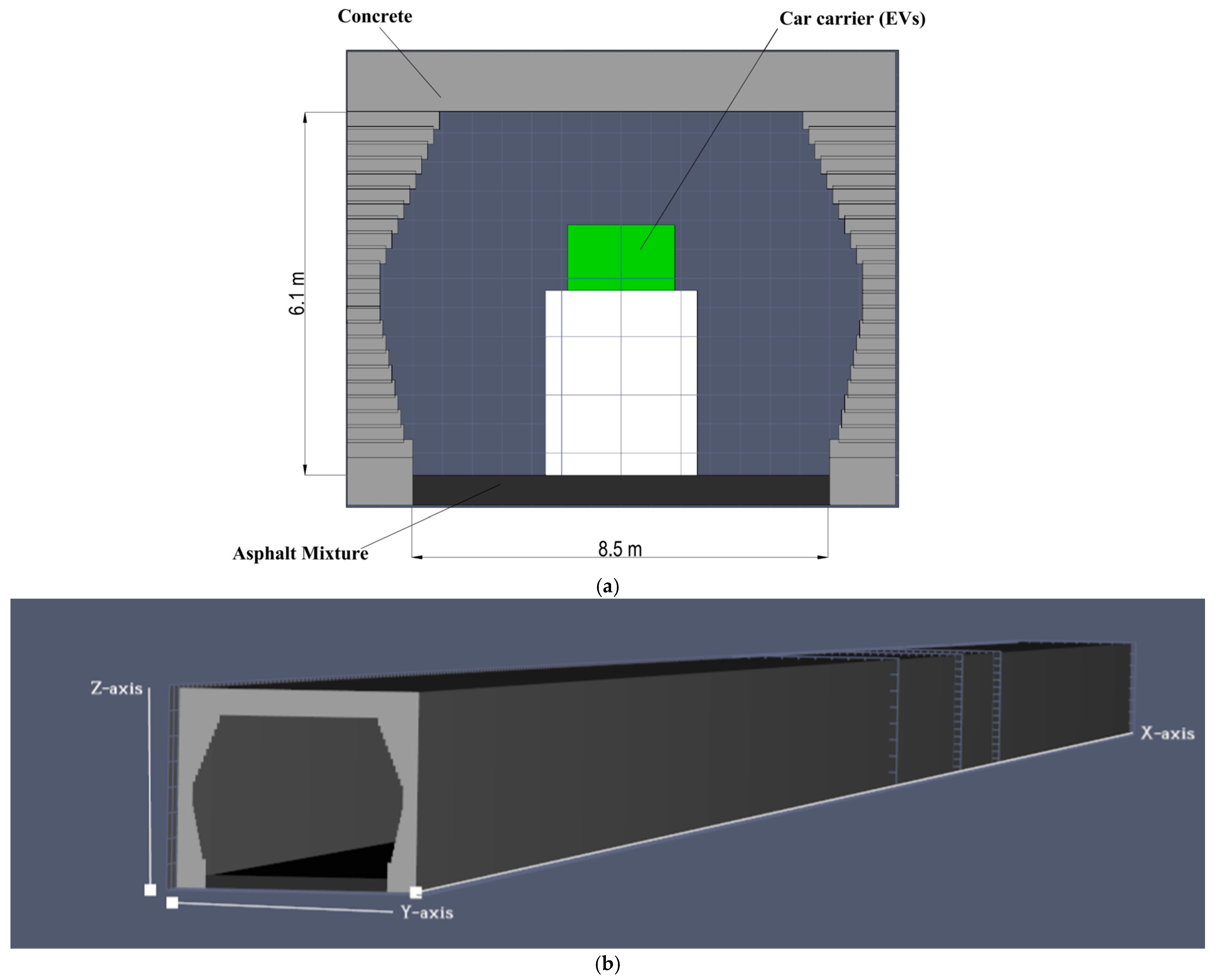
A road tunnel was chosen as reference in this study. The model includes a horseshoe-shaped cross-sectional model with a close adaptation for the full scale BEV fire experiments at the Zentrum am Berg facility [15,37]. The tunnel has length of 400 m and the internal elevation of the tunnel is 6.1 m in height with a cross-section of about 52 m2, surrounded by a 0.5 m thick reinforced concrete ceiling and walls. Figure 1a displays the tunnel cross-section, and 1b displays the three-dimensional PyroSim model.
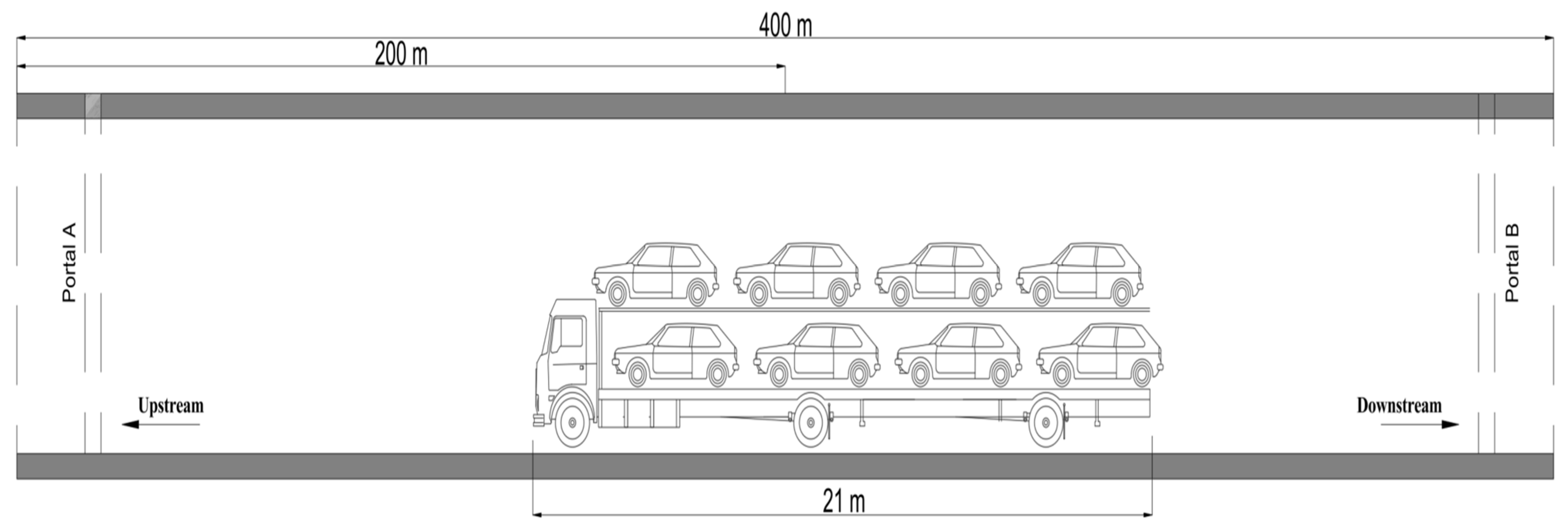
The longitudinal arrangement of the tunnel and the position of the EV car carrier within the computational domain are shown in Figure 2. The vehicle is positioned at the midpoint of the 400 m tunnel length, with equal upstream and downstream distances to the portals.

2.3. Boundary and Initial Conditions

To ensure full reproducibility and methodological transparency, this subsection provides a clear and centralized description of the boundary and initial conditions used in the FDS simulations. These settings adhere to standard practices outlined in the FDS 6.10.1 [35], and are consistent with previous numerical studies of fires in road tunnels.
The initial conditions inside the computational domain represent a typical ambient tunnel environment before ignition: ambient gas temperature of 21 °C, atmospheric pressure of 101.325 kPa, relative humidity of 40%, standard air composition (oxygen mass fraction Y_O2 = 0.2323, nitrogen Y_N2 = 0.7677), and a quiescent (zero-velocity) flow field. Tunnel portals were defined as OPEN boundaries to impose ambient hydrostatic pressure and permit free inflow and outflow of air, smoke, and combustion products. The tunnel ceiling and walls are made of concrete with a thickness of 0.5 m, while the road surface is modelled as an asphalt mixture. The significant thermal characteristics of these materials—specific heat, density, thermal conductivity, and emissivity—are provided in Table 1 [38,39]. Heat conduction through the walls, ceiling, and floor was enabled using these properties.
For the longitudinal ventilation scenario, jet fans were modelled as velocity boundaries delivering a uniform downstream airflow of 3 m/s across the tunnel cross-section. The system was activated at t = 150 s [40] to suppress backlayering; details are provided in Section 2.8. In the natural ventilation scenario, no forced airflow was applied. The computational domain was extended 5 m beyond each portal with OPEN boundary conditions to minimize artificial boundary effects. The total simulation duration was 1200 s (20 min), which was sufficient to capture the full fire development, peak heat release rate, and tenability conditions relevant to evacuation.

2.4. Mesh Size

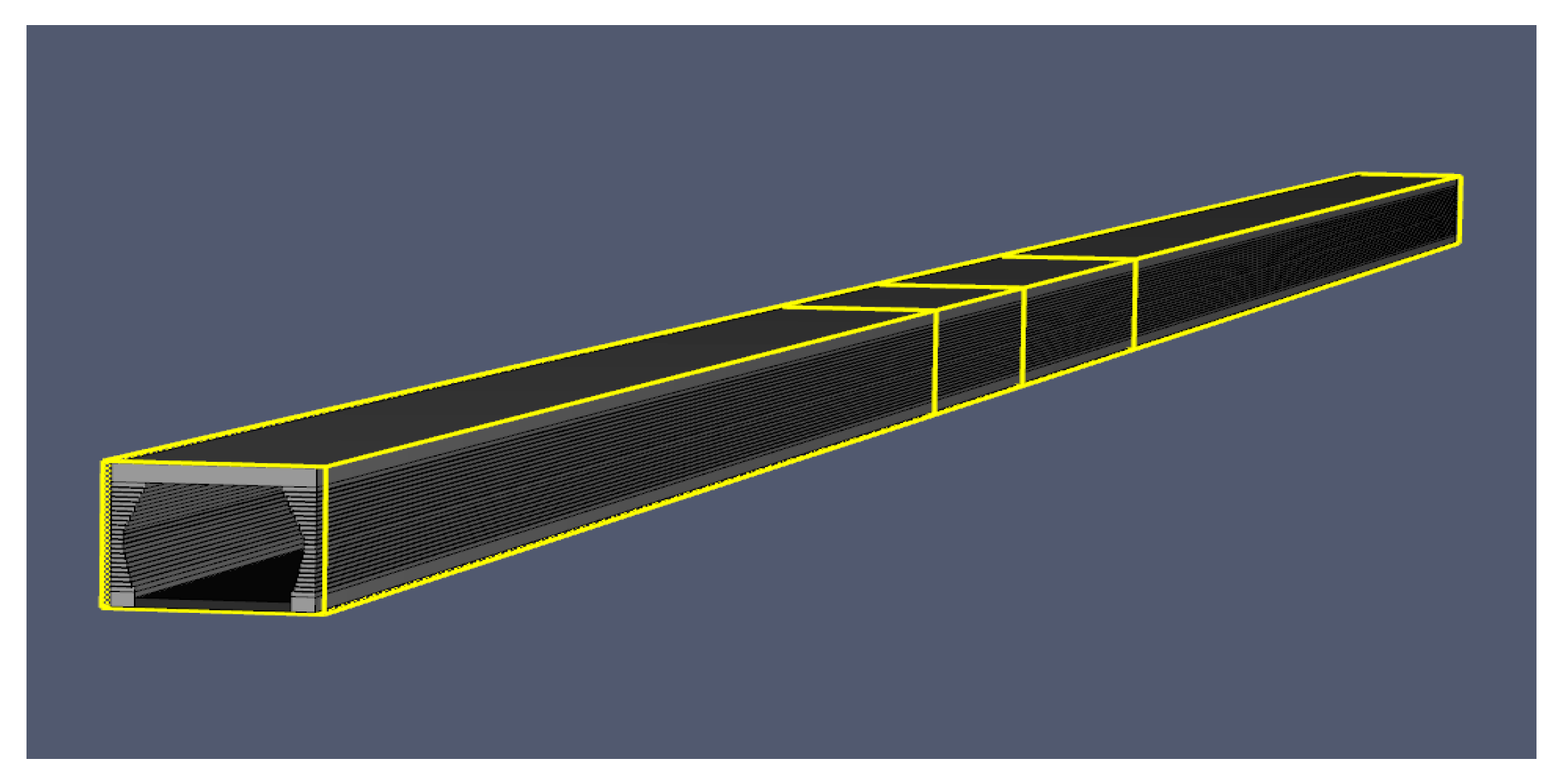
In tunnel fire modelling, the choice of grid size plays a key role in determining the accuracy of the numerical simulation results. The computational domain was discretized using four uniform structured meshes in the streamwise direction, as illustrated in Figure 3.
An appropriate grid resolution to achieve accurate fire simulations is the key component for accurate computation. There are two significant factors that balance the geometric density of the grid with computational efficiency: numerical accuracy and computational efficiency. Realistic simulation accuracy is generally achieved if the ratio of the fire’s characteristic diameter, D*, to the size of the grid (σ) is between 4 and 20 [41,42]. In this regard, D* (in metres) is the characteristic diameter of the fire source, while σ refers to the dimension of one cell in the computational mesh, which is stated in Equation (6).
  • Equation (6):
D * = ( Q ρ 0 C p g T 0 ) 2 5
Here, Q represents the maximum HRR source power [in kW]; ρ 0 is the air density, typically taken as 1.29 kg/m3; C p is the specific heat capacity of air, typically taken as 1.005 kJ/(kg·K); g is the gravitational acceleration, with a value of (9.81 m/s2); and To is an ambient temperature with a value of 293.15 K (20 °C). The calculated value of D* is 5.02. To achieve an appropriate balance between accuracy and computational cost, the cell size should be between (D*/4) and (D*/20), which corresponds to values between 1.26 m and 0.25 m, respectively.
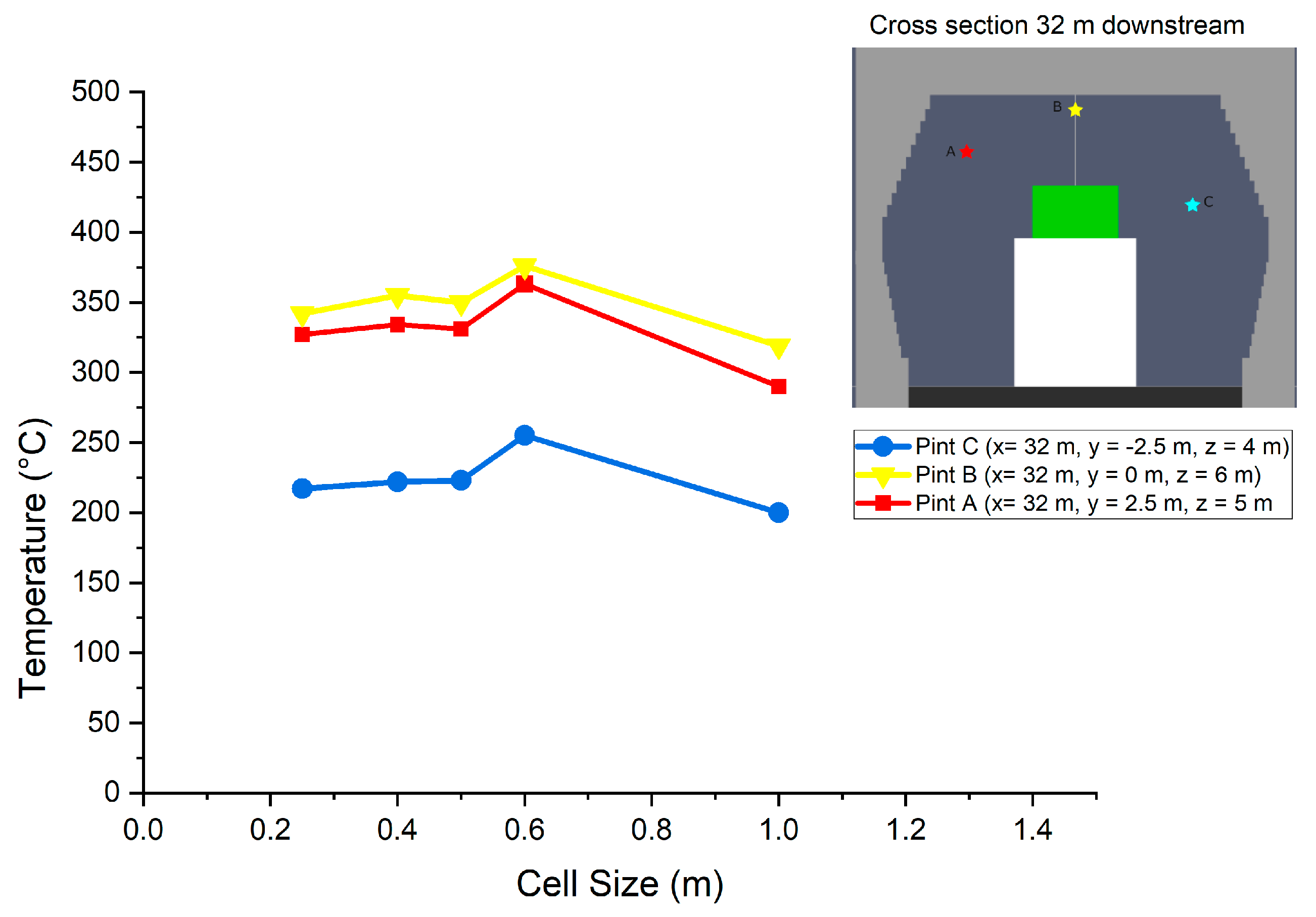
To assess grid independence, temperature predictions were evaluated as a function of cell size at five uniform grid resolutions: 0.25 m, 0.4 m, 0.5 m, 0.6 m, and 1.0 m. These assessments focused on three monitoring points (A, B, and C) located 32 m downstream of the fire source in the tunnel cross-section, as illustrated in Figure 4 (inset). Point A is positioned at (x = 32 m, y = 2.5 m, z = 5 m), Point B at (x = 32 m, y = 0 m, z = 6 m), and Point C at (x = 32 m, y = −2.5 m, z = 4 m), where z denotes height from the tunnel floor and y is the lateral offset from the tunnel centre line.
The results of this mesh sensitivity analysis are presented in Figure 4 and summarized in Table 2, which demonstrate that predicted gas temperatures exhibit dependence on cell size, with convergence observed at finer resolutions.
As shown in Table 2, cell sizes ranging from 0.25 m to 0.5 m yield highly consistent temperature predictions, with differences not exceeding 3%. Finer meshes (e.g., 0.25 m) provide marginally improved accuracy but substantially increase computational demand. To balance precision and computational efficiency, a non-uniform mesh was adopted: a cell size of 0.5 m was applied in regions with lower spatial gradients (less affected by the fire), while a refined cell size of 0.25 m was implemented in the vicinity of the fire source and areas requiring high resolution for capturing detailed flow and thermal phenomena. The final mesh configuration is detailed in Table 3.

2.5. Car Trailer of EVs New Model

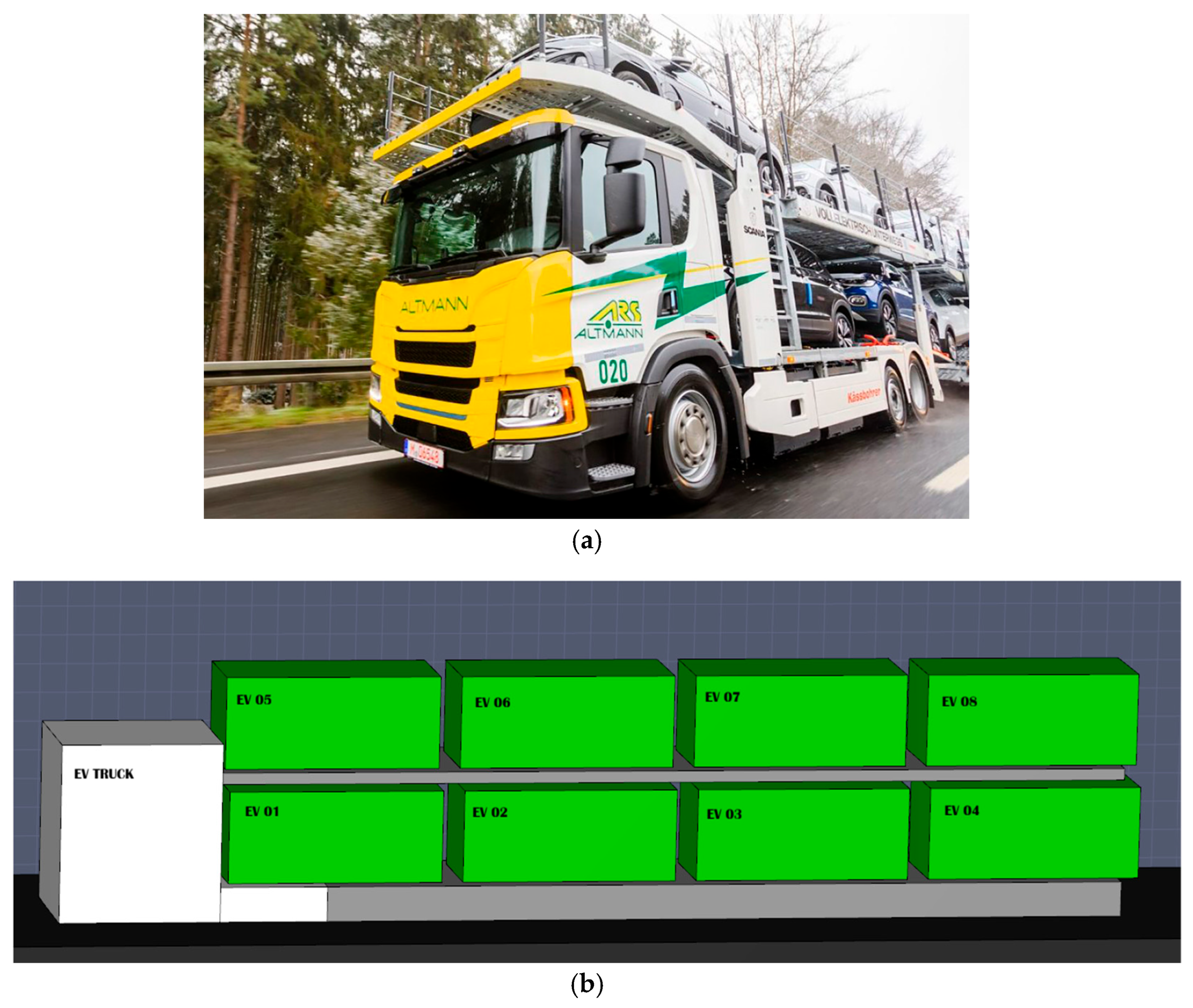
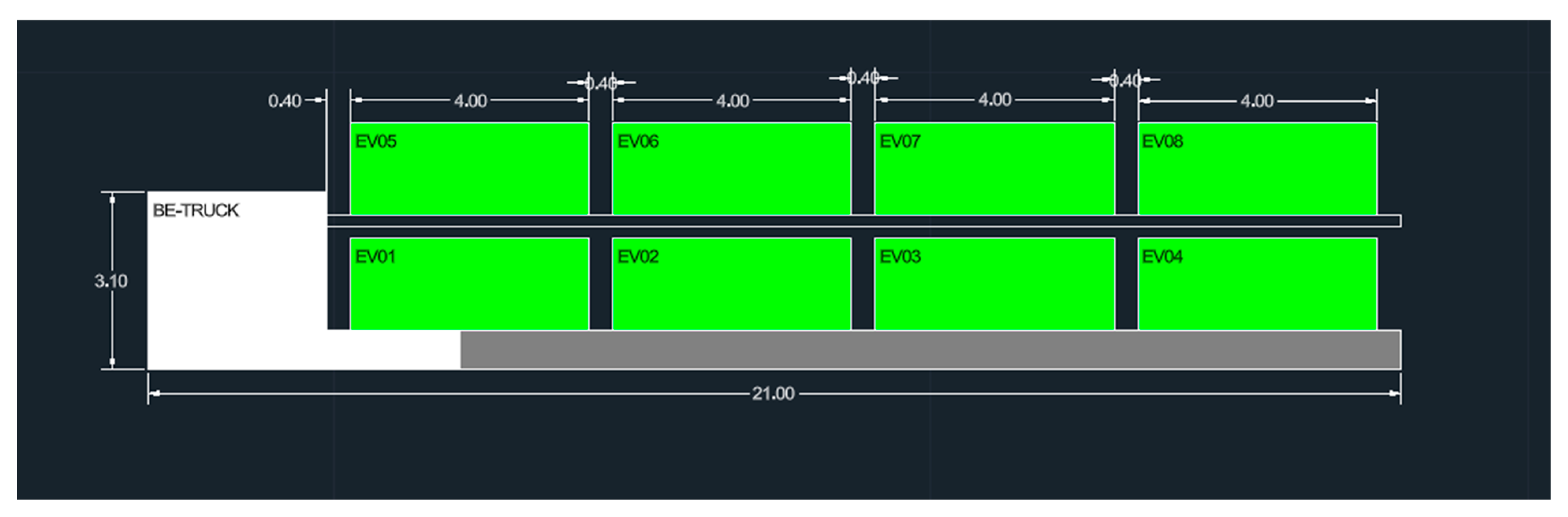
The geometric configuration central to this simulation is based on the world’s first standard all-electric car transporter truck, introduced in 2023 [43], consisting of a Scania P 25 battery-electric vehicle equipped with a Kässbohrer body and trailer (operated by ARS Altmann Automobillogistik). The loaded combination has an overall length of approximately 21 m, a width of 2.55 m, and a height of 3.1 m. The Scania P 25 is powered by a 300 kWh LIB system. Eight passenger EVs are loaded in a double-deck arrangement, with all EVs modelled as identical in dimensions and specifications. In the PyroSim environment, each EV is represented using the geometry of the 2020 Hyundai Kona Electric [44], featuring a length of 4.18 m, a width of 1.80 m, a height of 1.55–1.61 m, and a usable battery capacity of 64 kWh. All vehicle batteries are assigned a 100% State of Charge (SOC). Figure 5 shows (a) a real photograph of the Scania P 25 car carrier and (b) the geometric representation of the loaded EVs in PyroSim.

2.6. Fuel Sources

2.6.1. Material and Battery Specifications

To model LIBs used in EVs and Scania P 25 BEV trailers correctly, the NMC 622 battery was chosen (composed of 60% nickel, 20% manganese, and 20% cobalt). The model includes realistic proportions of battery weight: an LIB pack of 20%, which constitutes 20% of vehicle weight on average. The percentage composition of the minerals for the NMC cells is reported in Table 4 [44,45]. For the Scania P 25 BEV truck, which also includes NMC 622 batteries, the material requirements were obtained from SCANIA company documentation specification [46]. The mass fractions used in simulations for EVs and SCANIA trucks are given in Table 5. All pertinent thermophysical properties of the materials used in the simulation are provided in Table 6 [35,47].

2.6.2. Combustion Reaction

In FDS, combustion is often modelled using a mixing-controlled approach, where the reaction rate is governed by fuel–oxidiser mixing, and chemical reactions occur instantaneously once mixing is sufficient. The fuel is represented as a surrogate compound defined by its elemental composition (C, H, O, N), enabling efficient simulation of large-scale fires while preserving heat release and major species generation [25,48]. This approach is suitable for LIB fires, where detailed kinetics are difficult to model but overall combustion behaviour is dominated by heat release and toxic gas production.
In this study, thermal runaway of NMC 622 LIBs was assumed as the ignition source at the EV battery surface. A surrogate fuel in FDS was defined based on vent-gas compositions reported by Shen et al. [49], including CO2 (35.3%), CO (32.4%), H2 (23.4%), CH4 (4.1%), C3H8 (3.1%), and C3H6 (1.7%). Treating these as mole fractions, the elemental composition was calculated as C = 0.862, H = 0.982, and O = 1.03, which normalizes to an approximate surrogate fuel of C1H1.14O1.19. This ensures that the surrogate fuel reflects the stoichiometry and energy release of the vent gases within the mixing-controlled combustion framework.
Combustion parameters were specified to reflect typical LIB fire behaviour. CO yield was set to 0.032 kg/kg fuel, soot yield to 0.044 kg/kg fuel, and radiative fraction to 0.35, consistent with hydrocarbon-rich EV fires [50,51]. The vent-gas composition informed the surrogate fuel definition, while yields and radiative properties were independently assigned to realistically capture thermal and toxic species generation.
This approach provides a computationally efficient and physically consistent model for LIB fires, ensuring that the surrogate fuel and combustion parameters reproduce the dominant thermal and chemical behaviour observed experimentally.

2.6.3. Heat Release Rate

The car carrier was modelled within the FDS using rectangular parallelepiped geometries to represent the whole model. A specific inter-vehicle spacing of 0.4 m was implemented, which accurately approximates the typical operational range of 0.2 m to 1.0 m. The fire was assumed to be initiated at the LIB of EV 01, which is located directly above the E-trailer pack battery. Figure 6 shows the CAD design for the E-trailer, with spacing between EVs. Within the PyroSim interface, EVs were specified as rectangular blocks with five surfaces assigned as burner surfaces, excluding the bottom surface to represent the ignition point of the fire. The geometrical simplification used herein is a necessary operation to provide a realistic quantitative analysis of fire behaviour. However, it cannot represent complex morphological features of real vehicle geometry.
The key parameters used to characterize a burner are the heat release rate per unit area (HRRPUA) and the rise time. The HRRPUA expresses how much thermal energy is released during combustion per unit surface area (kW/m2), and it is determined using Equation (7).
  • Equation (7):
HRRPUA = HRR max A burner
Recent studies [1,25,29] have quantified the peak heat release rate (PHRR) of vehicles by aggregating the individual contributions of LIB systems and other combustible vehicle components. In the context of a car carrier transporting multiple EVs, the cumulative PHRR can increase substantially due to the additive effects of several high-energy battery packs and combustible structural and interior materials. The total fire load is predominantly governed by the thermal runaway of LIB packs within the transported EVs, supplemented by the combustion of interior furnishings, plastics, seating, tyres, wiring insulation, and structural elements of both the vehicles and the carrier platform [51].
With specific reference to the propulsion system, it should be noted that, unlike ICEVs, where the contribution of liquid fuel to the PHRR may decrease as the fuel is consumed, the contribution from LIBs in electrical mobility remains relatively consistent during a fire. This is because battery thermal runaway can continue to release energy regardless of vehicle operation prior to the incident, and the heat output does not significantly diminish with distance travelled or vehicle usage history [51]. Therefore, in the case of a car carrier transporting multiple EVs, the PHRR is expected to exceed that of a single conventional vehicle fire due to the cumulative and sustained heat release from multiple battery systems undergoing combustion.
Based on this approach, the empirical correlation proposed by Sun et al. [2] was adopted to estimate the association of PHRR with lithium-ion battery fires. This correlation provides a relationship between the battery energy capacity and the corresponding heat release rate and is expressed in Equations (8) and (9).
  • Equation (8):
P H R R = HRR   battery + HRR vehicle
  • Equation (9):
H R R b a t t e r y = 2 × E B 0.6
Here, H R R battery , expressed in MW, represents the additional HRR associated solely with the combustion of the LIB, and E B is the battery energy capacity in Wh. For the E-trailer (Scania P25), which has a battery capacity of 300,000 Wh [52], the value of H R R battery , associated with LIB combustion, was calculated to be approximately 3.866 MW. Accordingly, the total incremental heat release rate for the electric trailer, H R R m a x E . t r a l i e r , was determined to be 20.866 MW. This value was obtained by combining a baseline HRR of 17 MW ( HRR vehicle ), representing the combustion of conventional vehicle materials (a value close to the lower bound of the NFPA range for heavy vehicle fires), with the calculated battery contribution from Equation (9).
For a single EV, the PHRR was determined to be 7 MW, corresponding to the output of Equation (9) for an installed battery capacity of 80,000 Wh. This value is consistent with the BEV used in the full-scale experiment study conducted by Sturm et al. [15], which investigated fire scenarios involving BEVs of comparable size in tunnel environments. In that study, a fully charged battery pack was ignited using an external heating plate, producing a PHRR of approximately 7 MW. Therefore, the PHRR input adopted for a single EV in the present study was set to 7 MW, consistent with the experimental findings reported by Sturm et al. [15].
For the entire model, representing a car carrier transporting multiple EVs, the PHRR was assumed to be equal to the combined contributions of the E-truck and the transported EVs. This relationship is expressed in Equation (10).
  • Equation (10):
P H R R = P H R R E . t r a l i e r + n × P H R R E V
where n is the number of transported electric vehicles.
For the scenario considered in this study, a total of eight EVs were assumed, meaning that the total PHRR consisted of the truck fire’s contribution combined with the additional heat release from multiple EVs undergoing combustion. The fire value of 76 MW adopted in this design represents a fully loaded electric car carrier transporting eight electric vehicles. This assumed PHRR falls within the range for large vehicle fires in tunnels specified by NFPA 502 (20–200 MW) and is consistent with recommendations provided by PIARC and French tunnel fire safety guidelines for heavy goods vehicles operating in tunnels and restricted-access environments [53,54].
The other parameter affecting the burner is the rise time (or ramp-up time), i.e., the time it takes for the thermal energy released to reach the PHRR in the case of a fire. Wang et al. [3] studied 50 Ah (NMC622) cells, similar to those utilized in the SCANIA P 25 model, and reported a rise time of 429 s.
Sturm et al. [15] found that the ramp-up time of a BEV with a battery size of 80 kWh and (NMC 622) to reach a PHRR of 7 MW was 270 s from the time of ignition initiation in the LIB. This corresponds well with other experimental studies and NFPA 502 [34,54,55], which demonstrated that the PHRR of passenger vehicle fires will be between 5 and 10 MW within 0–30 min, depending on the environment, state of charge (SOC), and kind of LIB. Furthermore, the time to PHRR for long vehicles, buses, and HGVs is summarized in Table 7 [34,53,55].

2.6.4. Fire Spread and Thermal Runaway Propagation Modelling

Fire spread between EVs on the E-trailer is modelled using a physically grounded approach that emphasizes radiative heat transfer as the dominant mechanism in the tightly packed bumper-to-nose configuration (vehicle-to-vehicle surface spacing of 0.4 m). The fire spread prediction is based on three complementary methods, all calibrated and validated against full-scale experimental data.
Fire Spread Based on PSM and FTP Coupling
The Point Source Model (PSM) serves as the primary engineering method to estimate incident radiative heat flux from a burning vehicle to adjacent ones. PSM approximates the flame volume as an isotropic point source located at the geometric centroid of the fire (typically near the battery pack or cabin), a simplification validated for predicting ignition timing in multi-vehicle fire spread scenarios [56,57].
The incident radiative heat flux q i at distance r is calculated as
  • Equation (11):
q i = χ r P H R R 4 π r 2
where χ r = 0.35 is the nominal radiative fraction for sooty vehicle and LIB fires, and r = 0.4 m is the specified spacing. These fluxes substantially exceed established critical heat flux thresholds for ignition of EV exterior materials and battery casings (20–50 kW/m2) [18,24].
The time-to-ignition t ig of adjacent vehicles is predicted using the flux-time product (FTP) criterion, a standard method for assessing piloted ignition of thermally thick materials (e.g., vehicle body panels and plastics). The cumulative FTP integrates the net heat flux over time until a material-specific threshold is reached [25,56].
  • Equation (12):
FTP = i = 1 n ( q i q cr ) · Δ t i
where q i is the incident heat flux during the time interval Δ t i , and q cr is the critical heat flux (typically 20 kW/m2 for piloted ignition in vehicle applications) [19]. Ignition occurs when FTP reaches a material-specific value (FTP ≈ 150–200 kJ/m2).
These PSM and FTP predictions indicate extremely short ignition times at 0.4 m spacing, reflecting the intense radiative and jet-flame exposure characteristic of modern EV fires.
Fire Spread Time Based on Heat Flux Measurements
Experimental studies provide essential calibration and validation for these theoretical estimates. Full-scale tests comparing EVs and ICEVs of similar classes measured heat flux at multiple positions (front, sides, rear), revealing consistently higher peak values for EVs attributable to battery thermal runaway and jet flames [54,58].
In enclosed underground car park simulations, incident heat flux levels of approximately 20 kW/m2, a threshold linked to spontaneous autoignition in confined spaces, were observed in adjacent areas approximately 1 min after initial deflagration, with recurrence within 2 min and 47 s [19].
Fire Spread Time from Direct Multi-Vehicle Fire Spread Experiments
Limited but critical full-scale tests of parallel-placed EVs measured flame propagation rates and ignition delays. Cui et al. [19] conducted a full-scale fire test between EVs with battery packs of 38.1 kWh and derived a flame propagation rate of 0.0046 m/s using Equation (13).
  • Equation (13):
Δ t = d V
where V is the fire propagation rate (m/s), d is the lateral distance (m) between two adjacent vehicles, and Δ t is the time interval (s) between the appearance of flames on the side of the adjacent vehicle and its ignition. ICEV propagation studies documented secondary vehicle ignition 5–28 min after the primary fire, primarily from radiative heating of rubber components (e.g., tyres) at distances of 0.4–0.8 m, using older vehicle models [58]. Modern EVs exhibit markedly accelerated spread due to thermal runaway and intense jet fires [19,20].
In the present study, the E-trailer is loaded with multiple EVs arranged in a bumper-to-nose configuration. To simulate a worst-case scenario, fire initiation is assumed at the battery of EV01. Ignition of adjacent vehicles is determined using the three methods above, yielding ignition times consistent with experimental observations of thermal runaway propagation: those immediately adjacent ignite approximately 2 min after EV01, while vehicles further away ignite between 4 and 8 min after. These assumptions are consistent with NFPA and experimental data [15,19,20,51,56], which indicate that a single EV fire reaches peak HRR roughly 10 min from external ignition, depending on battery type and state of charge (SOC).
To align with real-world conditions, the simulation time is set to 1200 s (20 min), reflecting the typical response time of fire bridges in tunnel incidents, which ranges from 7 to over 20 min [55,59,60]. Table 8 presents the estimated peak HRR values, burner areas, and time to peak HRR for each vehicle, derived from the literature data and scaled for multiple EV configurations.

2.7. Measurement Devices

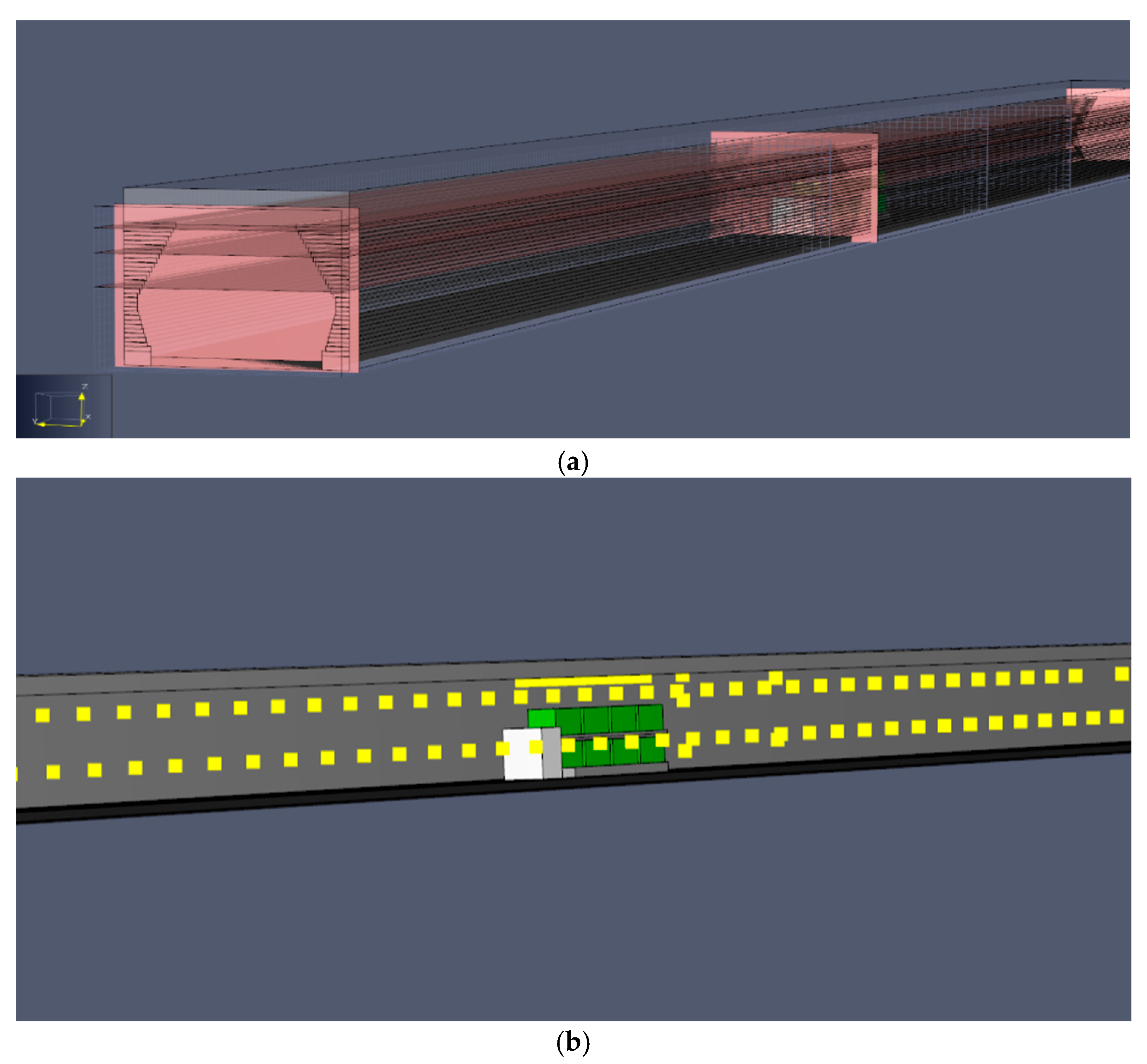
The experimental devices also provide a simulation record of essential fire parameters for the valid evaluation of fire development within the tunnel. These instruments provide excellent spatial and temporal measurements of temperature, gas concentration, and visibility. 2D temperature slices are defined at y = 0 m, z = 4, 5, 6 m, and x = 0 (at fire source). More sensors were kept along the soffit directly above the fire source on a vertical surface, spaced at 5–10 m intervals, at z = 5 m and z = 6 m, to have a visual measure of temperature vertically and in the long range. For the study of the production of toxic gases and smoke propagation, 2D and 3D models of the temperature, visibility, and distribution of CO and CO2 were generated, and gas-phase scales were produced from gas-phase measurements carried out every 5–10 m at an elevation level of 2 m (which is commonly used as an average level that people breathe at). Figure 7a shows the spatial configuration of 2D temperature and visibility slices, and Figure 7b shows the temperature, gas, heat flux, and FED monitoring points.

2.8. Extract Fans

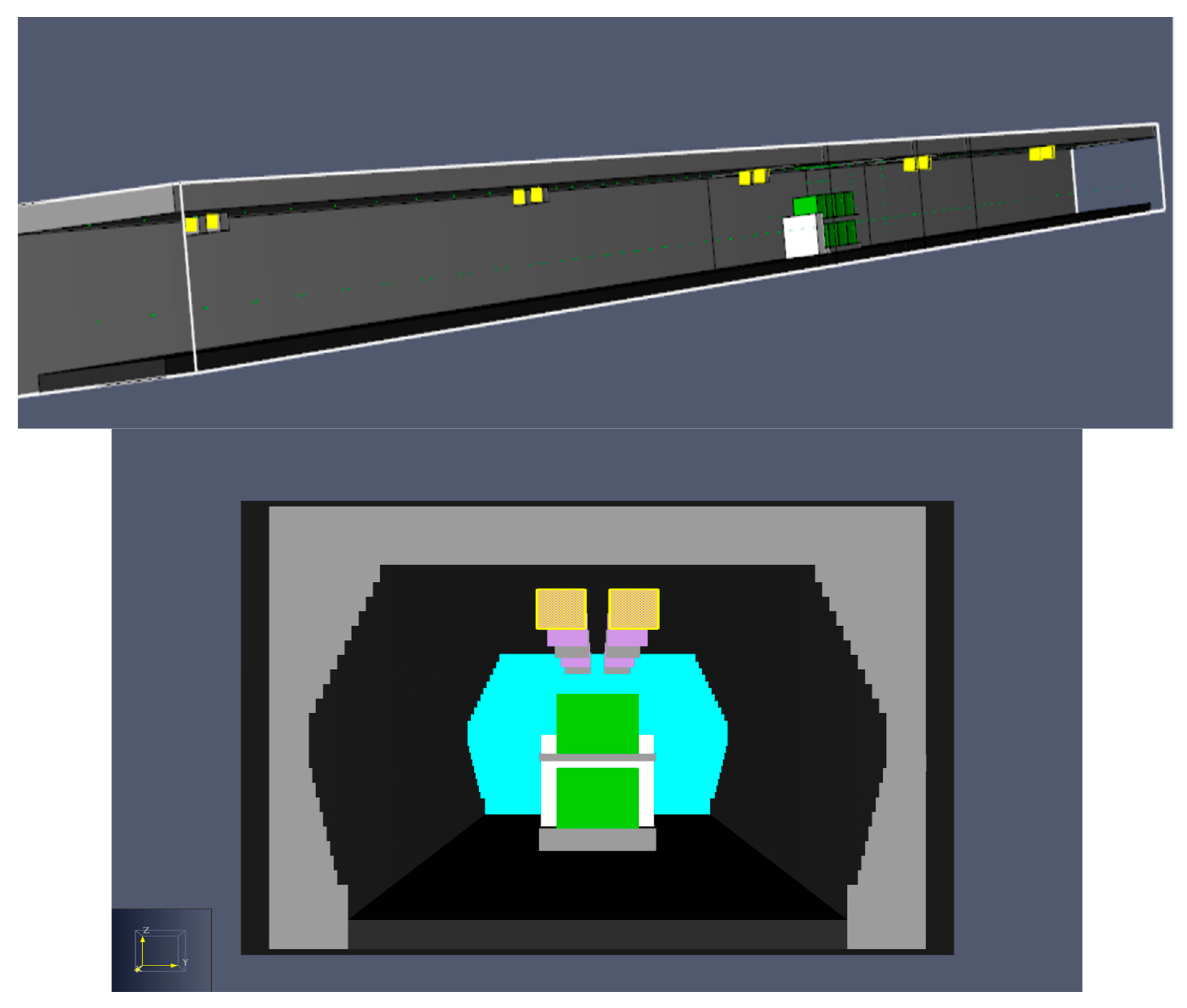
Longitudinal airflow in the tunnel arises from two main sources: the piston effect of moving vehicles and the mechanical ventilation system, comprising multiple pairs of ceiling-mounted jet fans. As noted by Dessì et al. [29], such systems are designed to achieve a critical longitudinal velocity sufficient to prevent smoke backlayering near the fire source. For fires in the 50–100 MW range, the recommended critical velocity is 2.5–3.5 m/s [59]. In this model, jet fans are installed in pairs at 80 m intervals along the ceiling. Each fan is 1.9 m long and 0.8 m wide, producing a total thrust of 605 N at an outlet velocity of 14.9 m/s [60]. All jet fans are designed to respond simultaneously after the fire alarm has been triggered at t = 150 s [40]. The placement and spatial arrangement of the jet fans in the PyroSim model are also depicted in Figure 8.

3. Results and Discussion

3.1. Validation Single EV Fire Scenario

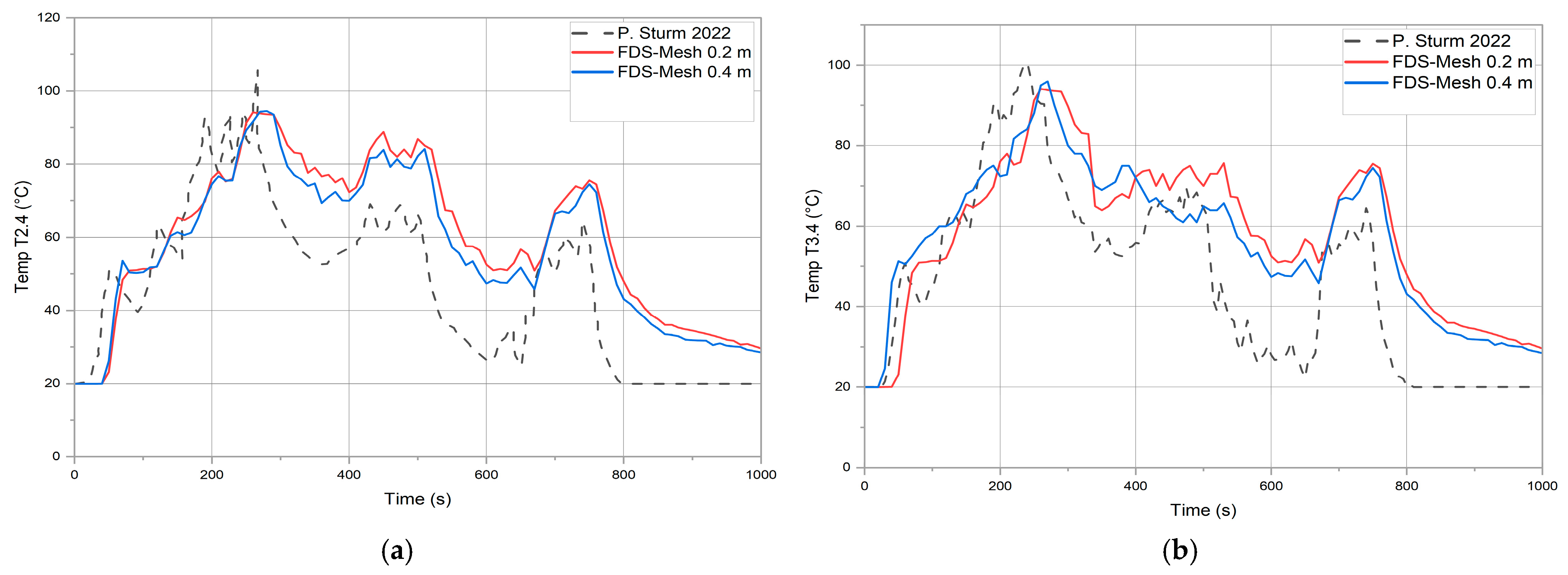
In the initial phase of this study, a single BEV fire scenario was simulated to evaluate the predictive capability of the numerical model implemented in FDS. Two grid resolutions were tested: 0.2 m and 0.4 m. The validation focused on the gas temperature histories at two representative measurement locations (sensors T2.4 and T3.4) positioned 16 m and 32 m downstream of the fire source, at ceiling heights of 6 m, respectively. These locations and heights were selected to correspond directly to the experimental instrumentation reported in the full-scale tunnel fire tests conducted by Sturm et al. [15].
Figure 9a,b present the comparison of simulated and measured gas temperatures at sensors T2.4 and T3.4 over the duration of the fire event (s). The results demonstrate good overall agreement in both the temporal evolution and the magnitude of peak temperatures, particularly in capturing the onset of the hot upper gas layer and the subsequent quasi-steady heating phase. Minor discrepancies observed during the early growth stage are attributed to small differences in ignition timing and localized heat release rate development, which are common in comparisons between CFD simulations and large-scale experiments. This comparison confirms the reliability of the numerical model for subsequent analyses.

3.2. Phase II Car Carrier Fire Scenario

3.2.1. Effect Heat Release Rate

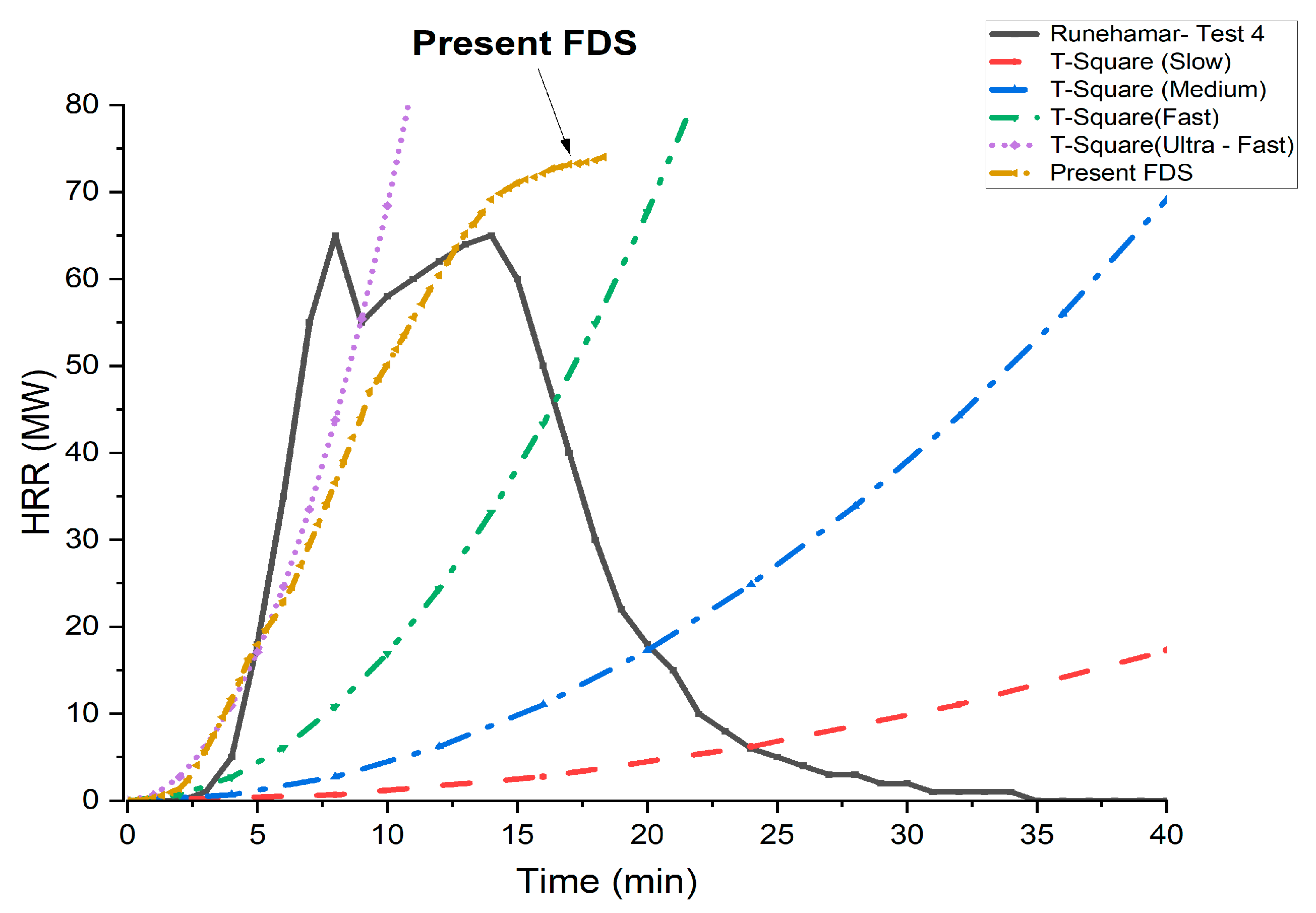
Ingason and Lönnermark [61] derived the peak HRRs from the four full-scale HGV fire tests in the Runehamar road tunnel. According to their analysis, peak HRR values occurred between 7.1 and 18.4 min post-ignition, with the HRR in test No. 4 reaching around 65 MW at approximately 16 min and that in other tests exceeding 100 MW due to the volume of the loaded material. As full-scale long vehicles powered by lithium batteries were not available, the current FDS was compared with test 04 of the Runehamar HGV test experiments. The finding shows the PHRR is approximately 76 MW at about 18 min, demonstrating close alignment with the early growth stage and peak magnitude observed in the full-scale data. Figure 10 depicts this evolution of HRR compared with standard T-square growth rates described in the SFPE Handbook [47]. The simulated growth rate is between the “Fast” and “Ultra-Fast” design fire categories, suggesting much more development than commonly associated with ICEVs.
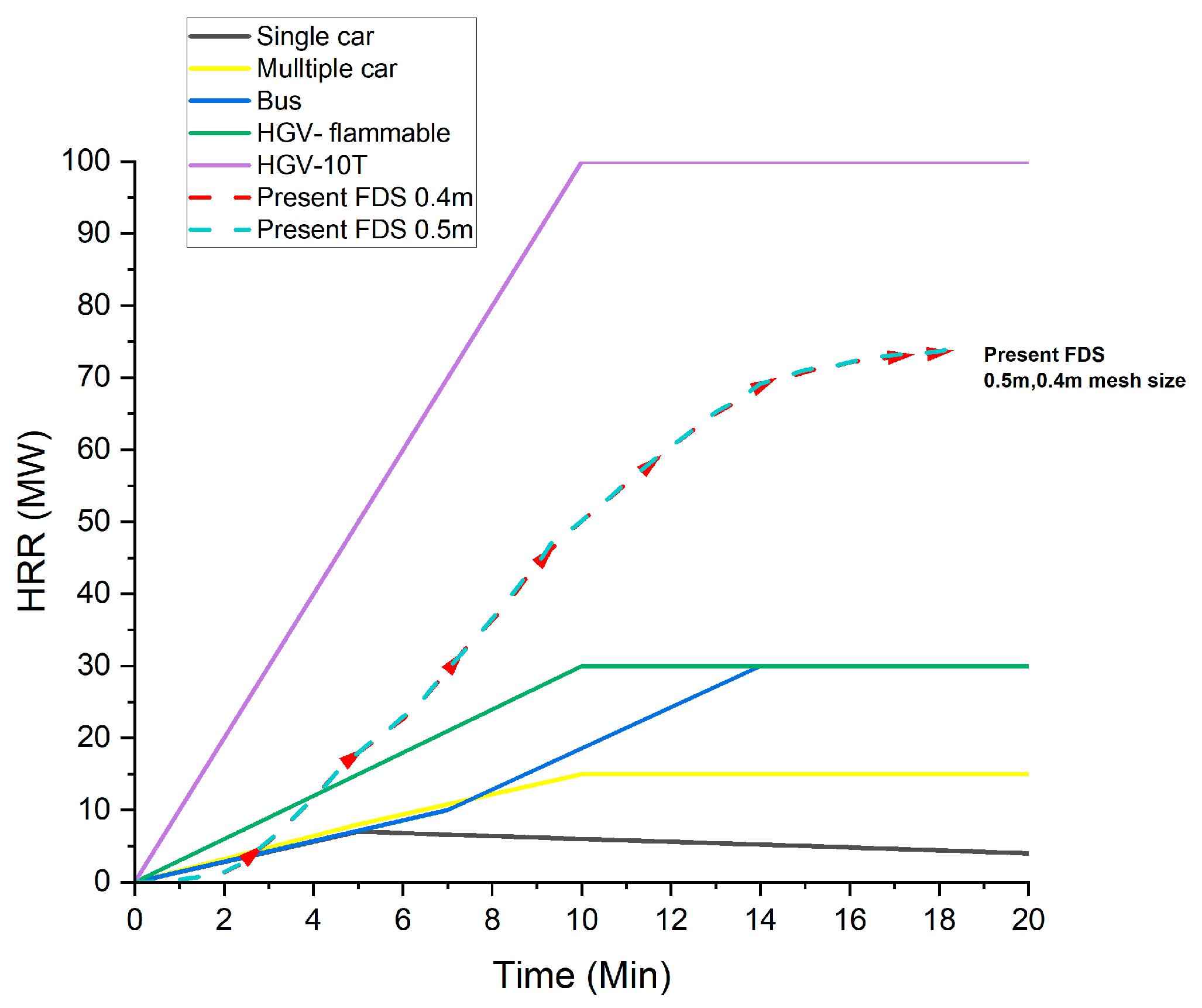
As illustrated in Figure 11, the HRR curve from the present FDS simulation of the car carrier fire is compared with standard design fire scenarios commonly used in tunnel engineering practice, NFPA 502, and PIARC guidance [14]. These reference curves include a single passenger car (5 MW plateau), multiple passenger cars (15 MW plateau), a bus (20–30 MW), an HGV with ordinary combustible cargo (30 MW), and an HGV with flammable goods (>100 MW).
The simulated HRR shows rapid initial growth in the opening minutes, exceeding the plateaus for passenger-car and multi-car design fires (5 MW and 15 MW, respectively). The HRR continues to increase and stabilizes at approximately 76 MW after about 18 min. This peak significantly exceeds the design values for buses and ordinary-cargo HGVs (30 MW) but remains below the upper-bound value for HGVs carrying highly flammable goods (≥100 MW).

3.2.2. Temperature Distribution

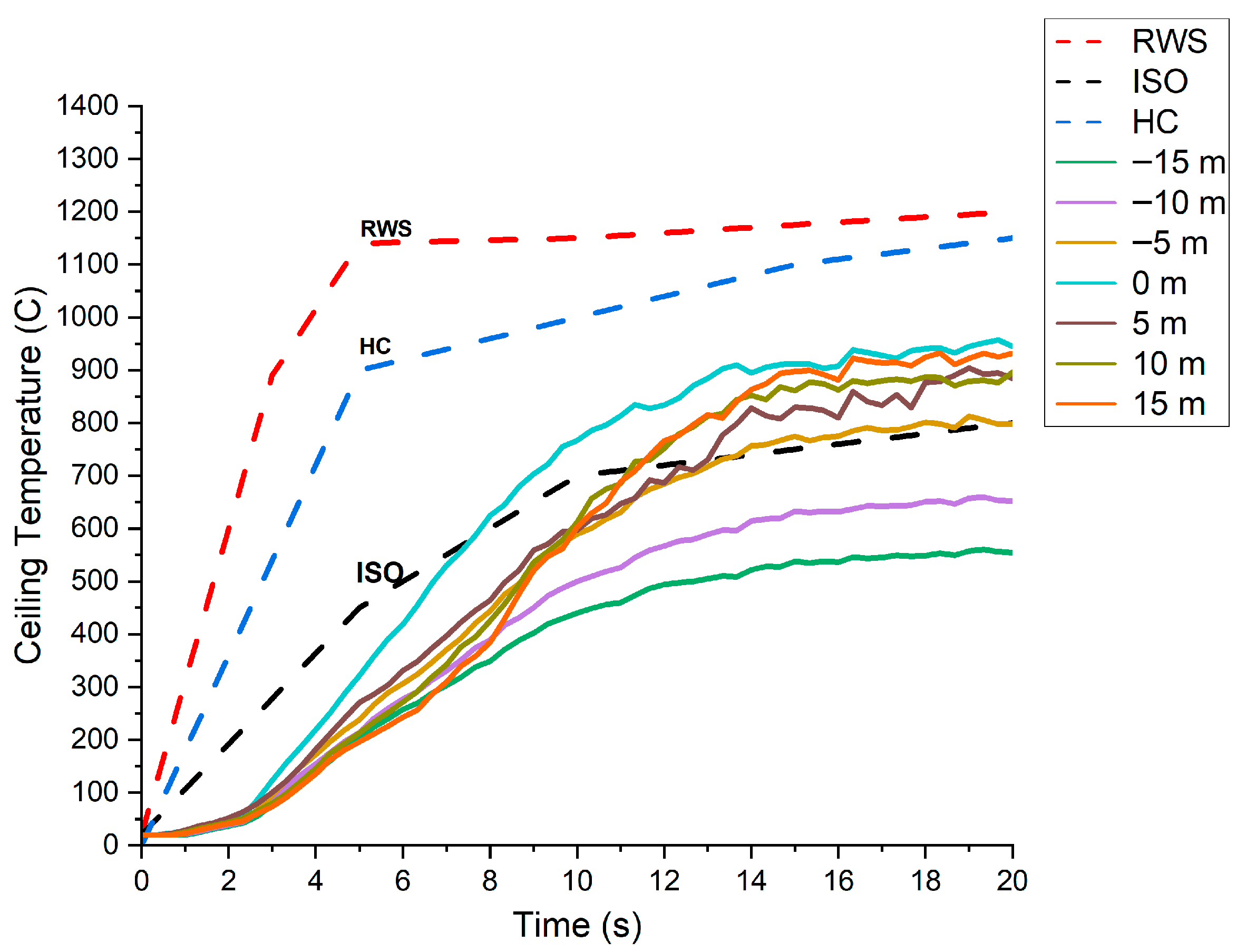
Additionally, as for the validation of temperature, it is necessary to compare simulated ceiling gas temperatures to the well-known standard design fire curves: RWS (Rijkswaterstaat) curve, hydrocarbon (HC) curve, and standard ISO 834 flame curve for the validation of tunnel structural fire resistance. These curves are also important for confirming the endurance of the tunnel structure in the face of sustained extreme heat, and thus protection against cave-in during an epic-scale fire. Of these, the RWS curve shows the most severe and conservative fire situation for road tunnels with a maximum temperature value of about 1200 °C, the highest sustained duration, followed by an HC curve of 1100 °C severity, while the ISO 834 curve shows a generalized fire scenario of lower severity [14,63]. In our temperature validation. As shown in Figure 12, the maximum simulated ceiling temperature at z = 6 m, at and around the fire source (x = 0 m), at approximately 18 min, reached 957 °C. This value remains significantly below the peak temperatures of the RWS and HC curves, yet exceeds the ISO 834 curve. Consequently, if the tunnel structure is designed to the more severe RWS or HC standards, it would provide a substantial safety margin against the thermal conditions observed in this simulation.
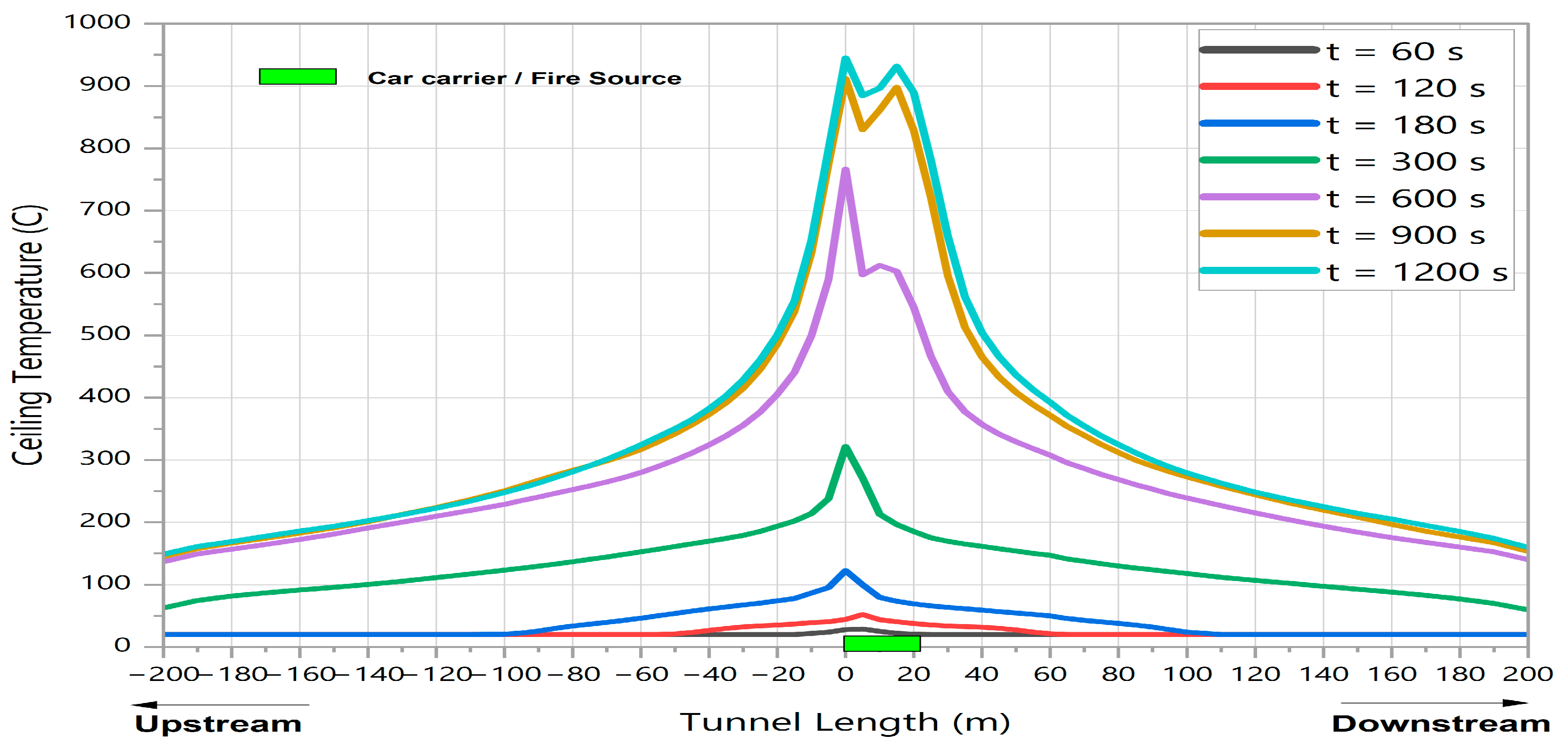
Furthermore, as shown in Figure 13, the ceiling temperature profiles along the tunnel length exhibit a characteristic asymmetric distribution at various time intervals. The peak temperature occurs near x = 0 m, corresponding to the fire source position at the electric vehicle car carrier trailer.
The analysis focuses on seven key time points—60 s (initial fire development), 120 s, 180 s, 300 s, 600 s, 900 s, and 1200 s—selected to capture the full progression of the fire from ignition through to maximum intensity and sustained burning.
The temperature data reveal progressive escalation with time. At 60 s, ceiling temperatures remain moderate, consistent with the early growth phase of the fire. By 300 s (5 min), temperatures directly above the fire source reach approximately 320 °C, indicating rapid fire development.
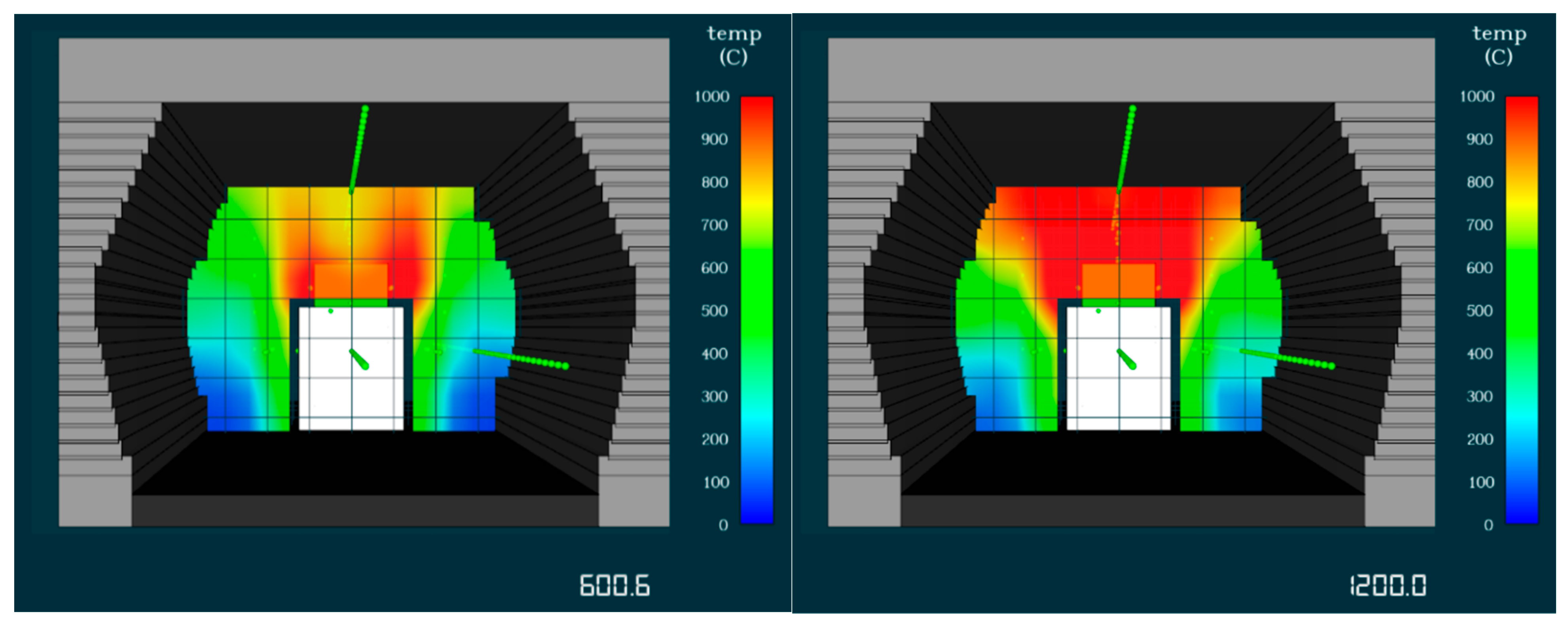
Peak severity occurs between 600 s and 900 s, when ceiling temperatures exceed 950 °C immediately above the fire source, with elevated temperatures extending 50–60 m in both directions along the tunnel axis. Cross-sectional temperature distributions at 600 s and at the simulation end (1200 s) are presented in Figure 12 and Figure 14, respectively. As shown in Figure 14, a well-defined thermal stratification is evident, with temperatures approaching 970 °C in the vicinity of the burning trailer. By 1200 s, the E-trailer surface temperature exceeds 1100 °C.
The hot gas layer exhibits strong buoyancy-driven behaviour, rising vertically from the fire source before spreading laterally along the ceiling. At a critical height [33,64,65] of 2 m above the road surface, relevant for occupant safety, temperatures range from 350 to 500 °C near the fire source, rendering conditions untenable for evacuation or emergency response.
The vertical temperature gradient is pronounced, with ceiling temperatures exceeding 950 °C, decreasing to approximately 500 °C at mid-height (3–4 m above the road surface), and further declining to around 200 °C near the lower levels. This stratification pattern is consistent with typical tunnel fire behaviour in the absence of mechanical ventilation or significant natural convection.
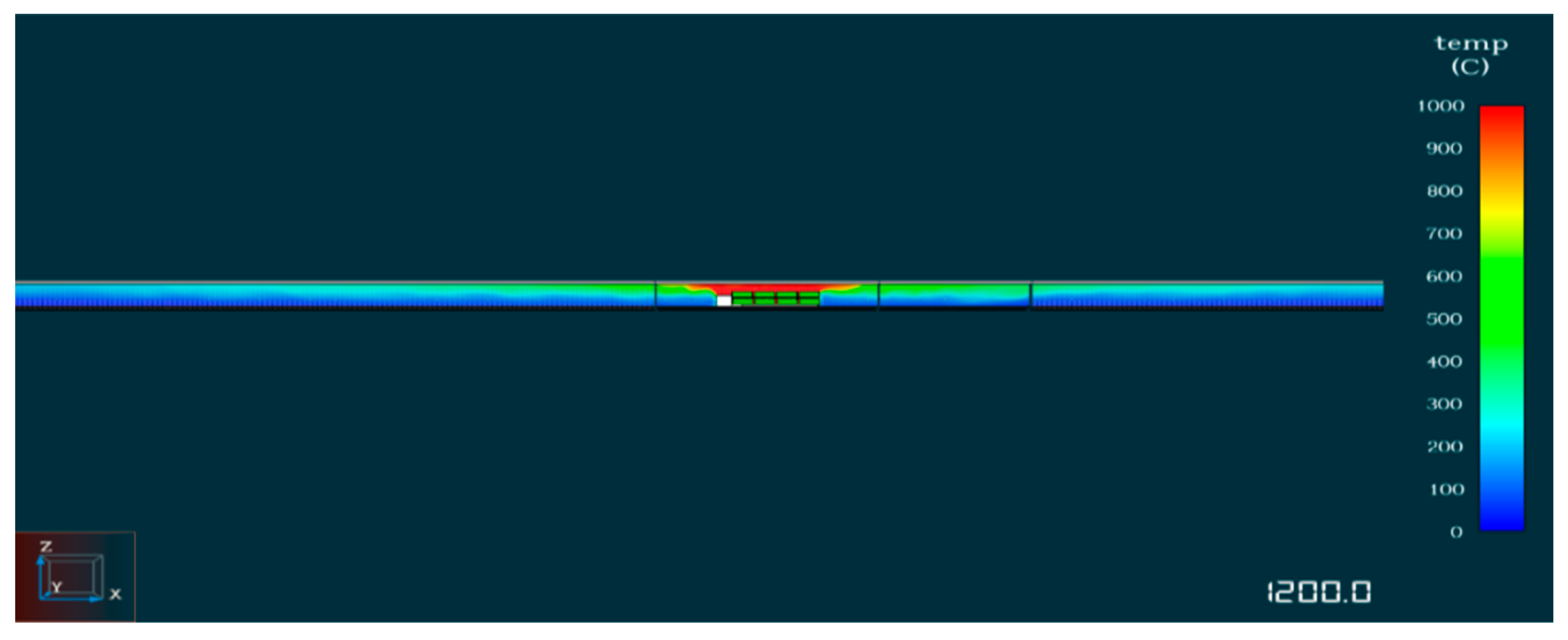
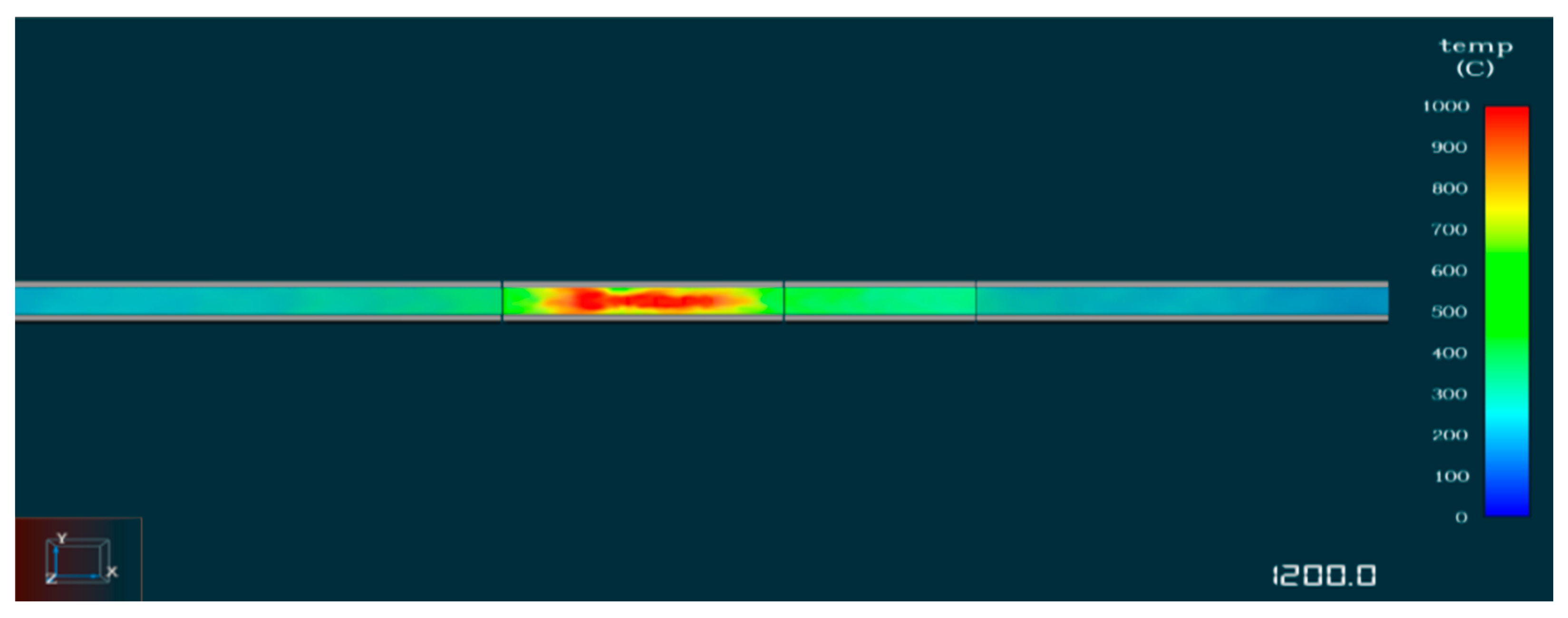
As shown in Figure 15 and Figure 16, the longitudinal ceiling temperature distribution at 1200 s confirms that the most severe thermal exposure remains confined to the vicinity of the fire source. The peak ceiling temperature of approximately 600 °C extends roughly 40 m downstream and 30 m upstream. Beyond this zone, temperatures decrease progressively, reaching 350–450 °C at 60–70 m from the fire source and 250–300 °C at 100 m distance.
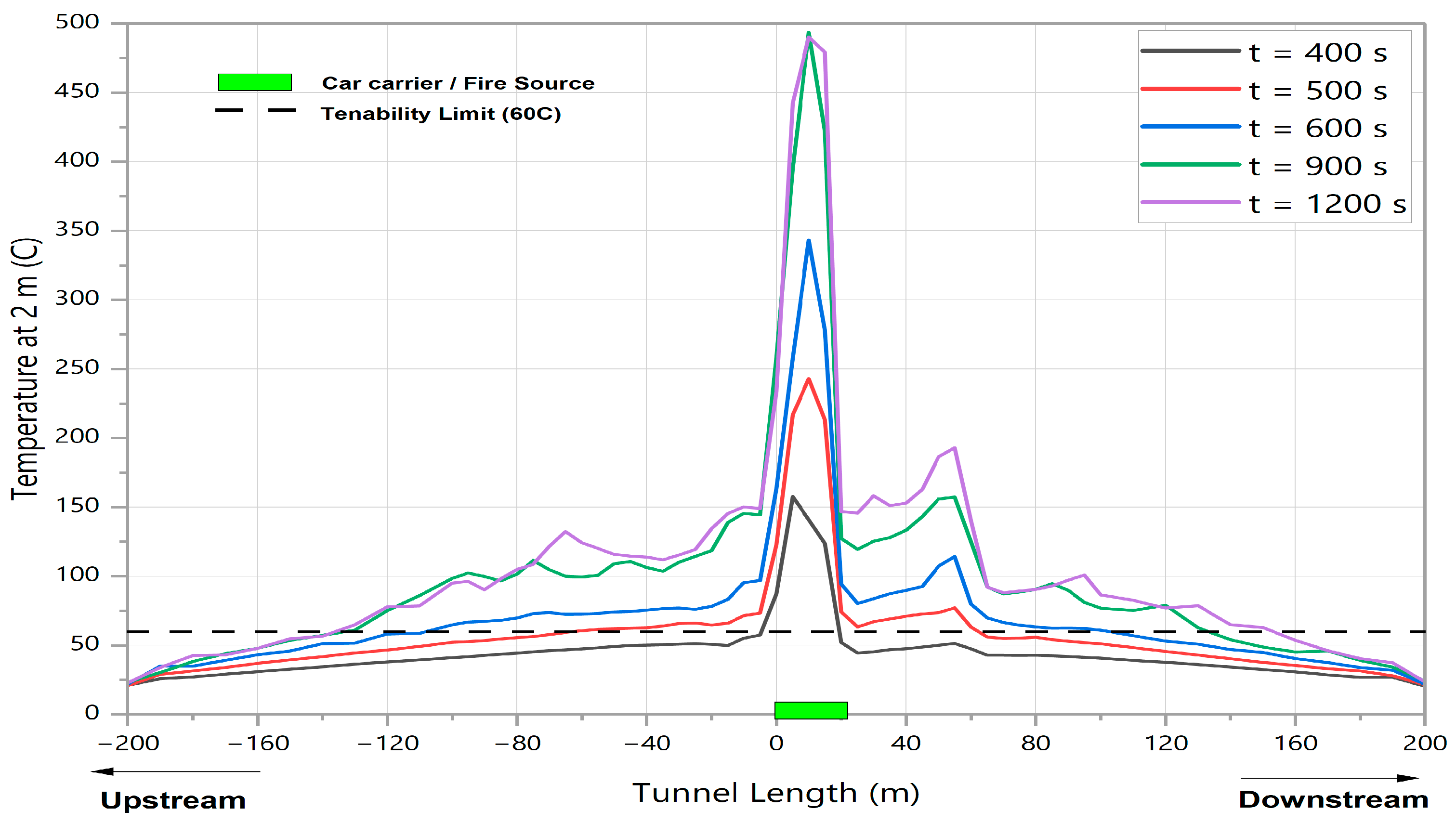
As shown in Figure 17, the longitudinal temperature distribution along the escape path at a height of 2 m is presented at 400 s, 500 s, 600 s, 900 s, and 1200 s after ignition.
Up to 400 s, temperatures on both sides of the fire source remain below the tenability limit of 60 °C. Beyond this point, temperatures exceeding 60 °C extend progressively downstream due to the spread of smoke and hot gas layers in the naturally ventilated tunnel: approximately 60 m at 500 s, 70 m at 600 s, 140 m at 900 s, and over 170 m by 1200 s.
To maintain tenable conditions [25,33] (≤60 °C at 2 m height), tunnel users must evacuate within roughly 7–8 min from ignition. Immediate response to fire detection or alarm activation is critical, as additional delays for detection, alarm transmission, and pre-movement would further reduce the available safe egress time.

3.2.3. Smoke Spread and Toxic Gas Concentration

Once initiated in a tunnel, an EV fire can rapidly escalate through the involvement of adjacent vehicles on the car carrier, creating a highly hazardous scenario in a short time. Lithium-ion battery combustion generates substantial volumes of toxic smoke, primarily composed of CO2, CO, and soot particles. The concentrations of these species significantly determine the tenability of the tunnel environment for evacuation and rescue operations.
Hot smoke rises due to buoyancy and spreads along the tunnel ceiling in both longitudinal directions, with concentrations increasing as the fire intensity grows and thermal runaway propagates across multiple battery packs. This behaviour is characteristic of large-scale vehicle-carrier fires in confined tunnel spaces.
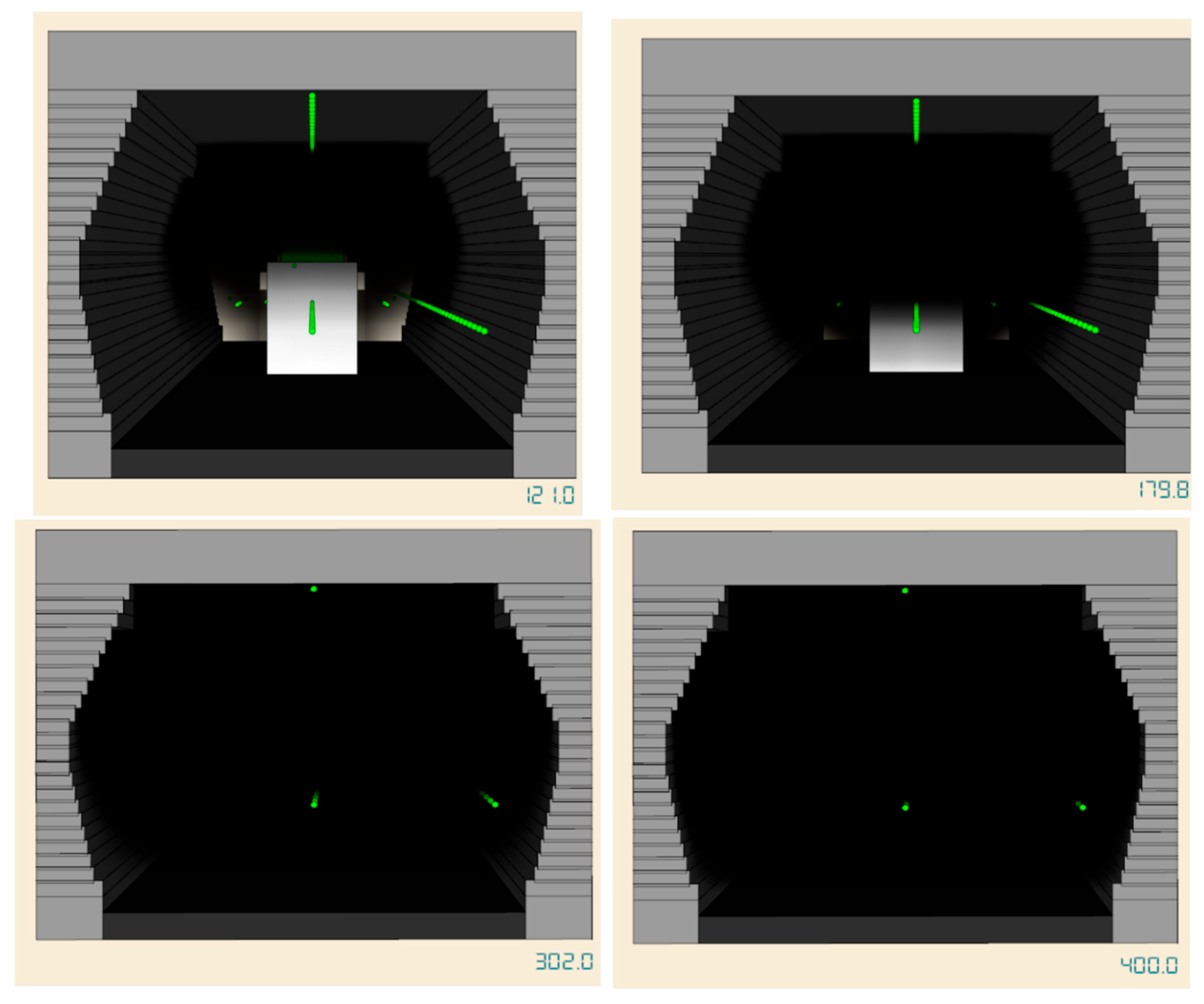
The spatial and temporal evolution of smoke spread is illustrated in Figure 18, which presents 2D slices of smoke optical density at the fire source cross-section (x = 0 m) at t = 120 s, 180 s, 300 s, and 400 s.
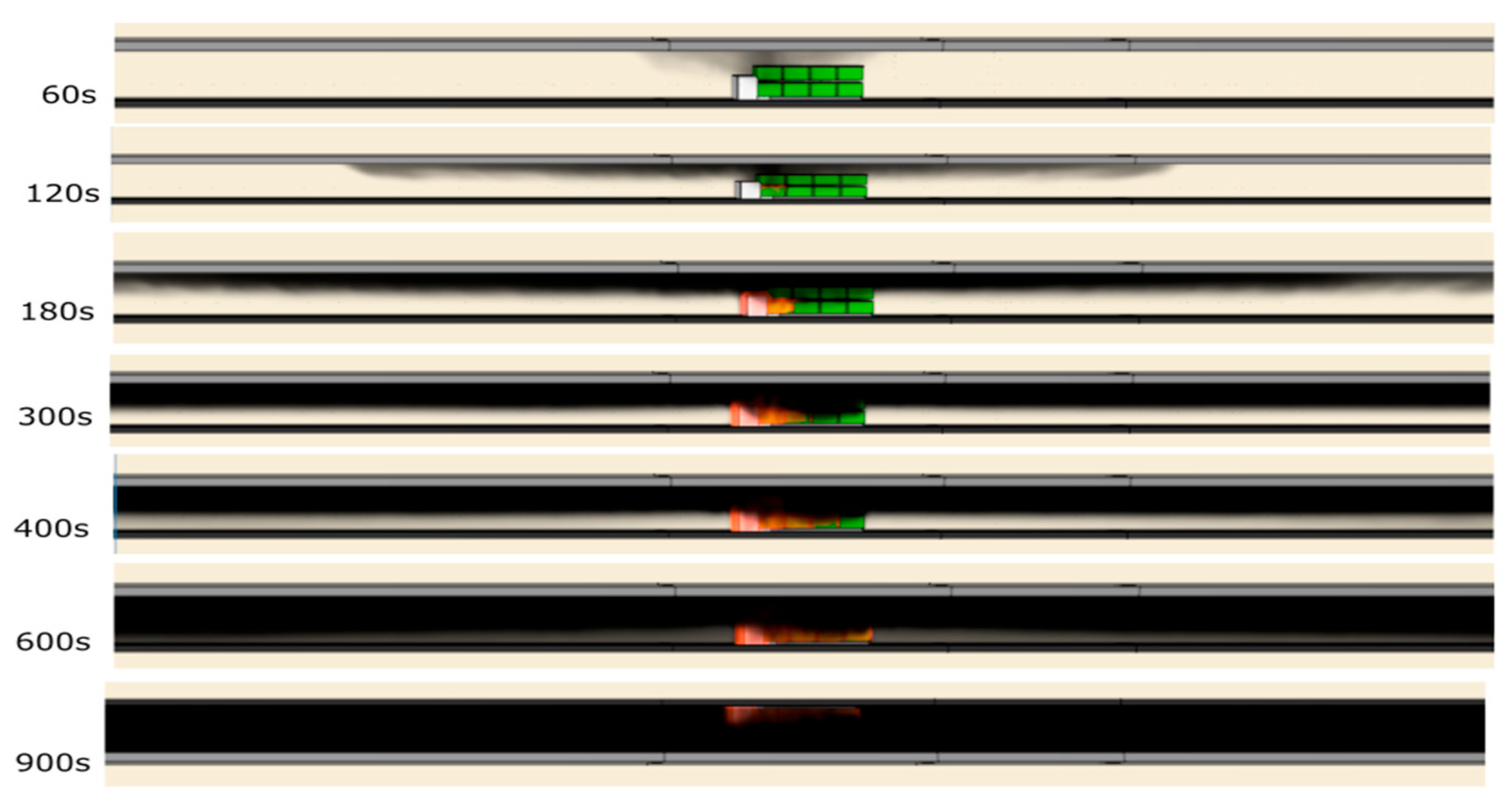
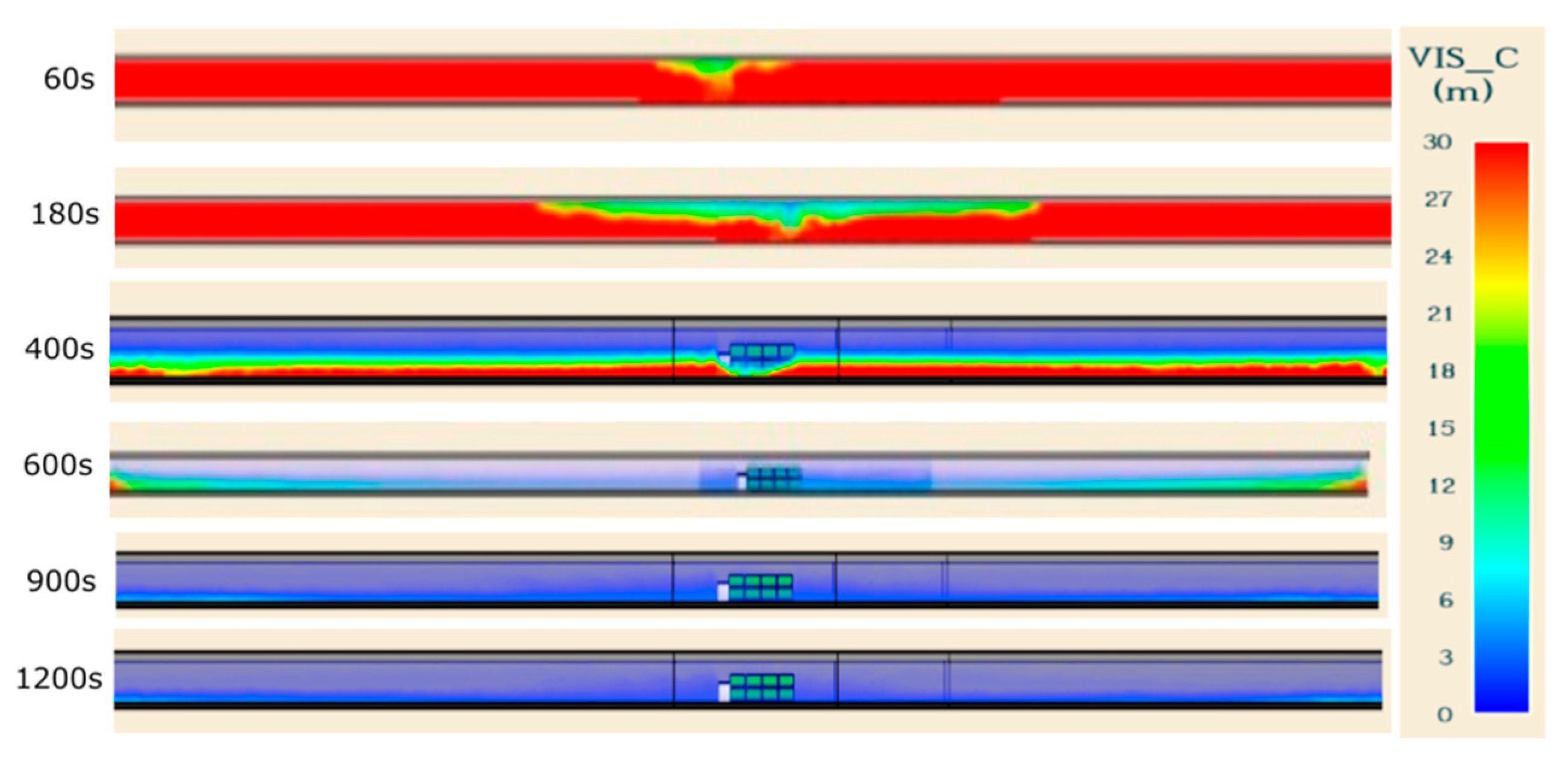
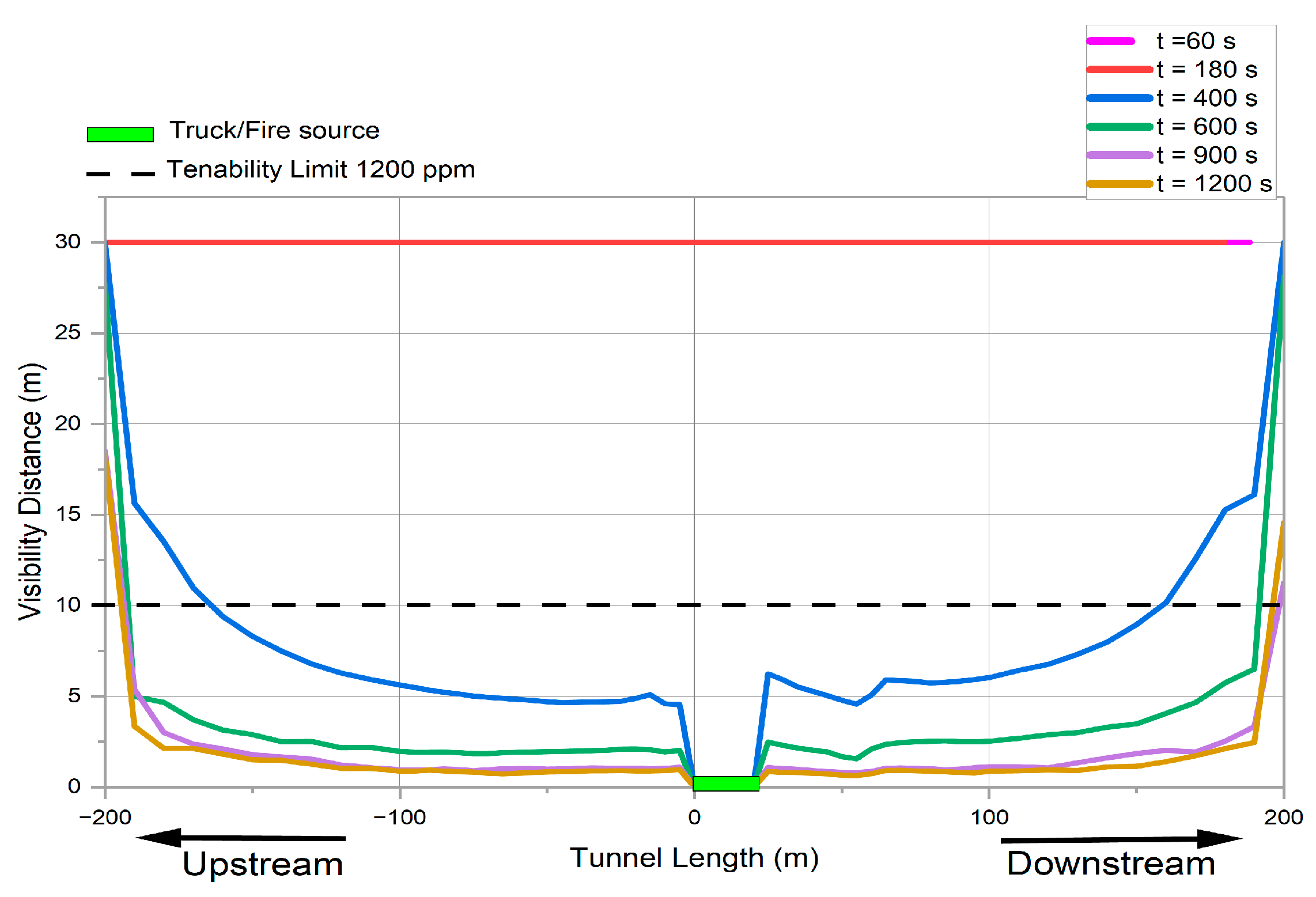
As shown in Figure 19, Figure 20 and Figure 21, the evolution of smoke spread and visibility reduction in the tunnel is presented at multiple time steps during the simulation. Smoke optical density increases progressively, leading to a rapid decline in visibility distance. By 350 s, visibility falls below 10 m in significant portions of the tunnel, with further deterioration and widespread smoke accumulation observed after 600 s.
Tenability criteria commonly applied in tunnel fire safety assessments specify a minimum visibility threshold of >10 m at occupant eye level (approximately 1.8–2.0 m above the floor) [65]. Consequently, visibility conditions between approximately 300 s and 500 s likely become untenable for safe evacuation, indicating a substantial threat to occupant escape in this naturally ventilated scenario.
CO and CO2 Concentration
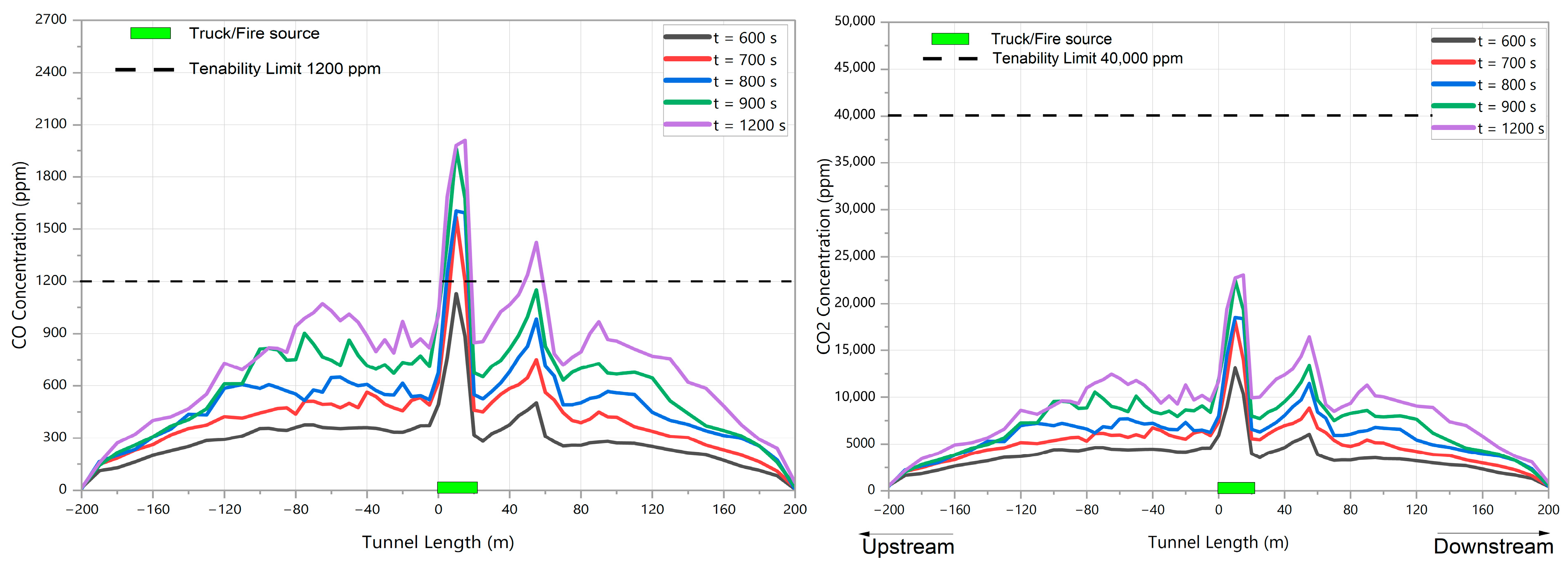
The change in CO and CO2 concentrations along the escape route, at a height of 2 m, 10 min after the fire starts and until the end of the simulation, is depicted in Figure 22. The results show that the largest CO and CO2 concentrations were below their respective tenability limits of 1200 ppm and 40,000 ppm [65], respectively.
Fractional Effective Dose (FED) Toxic Gases Value
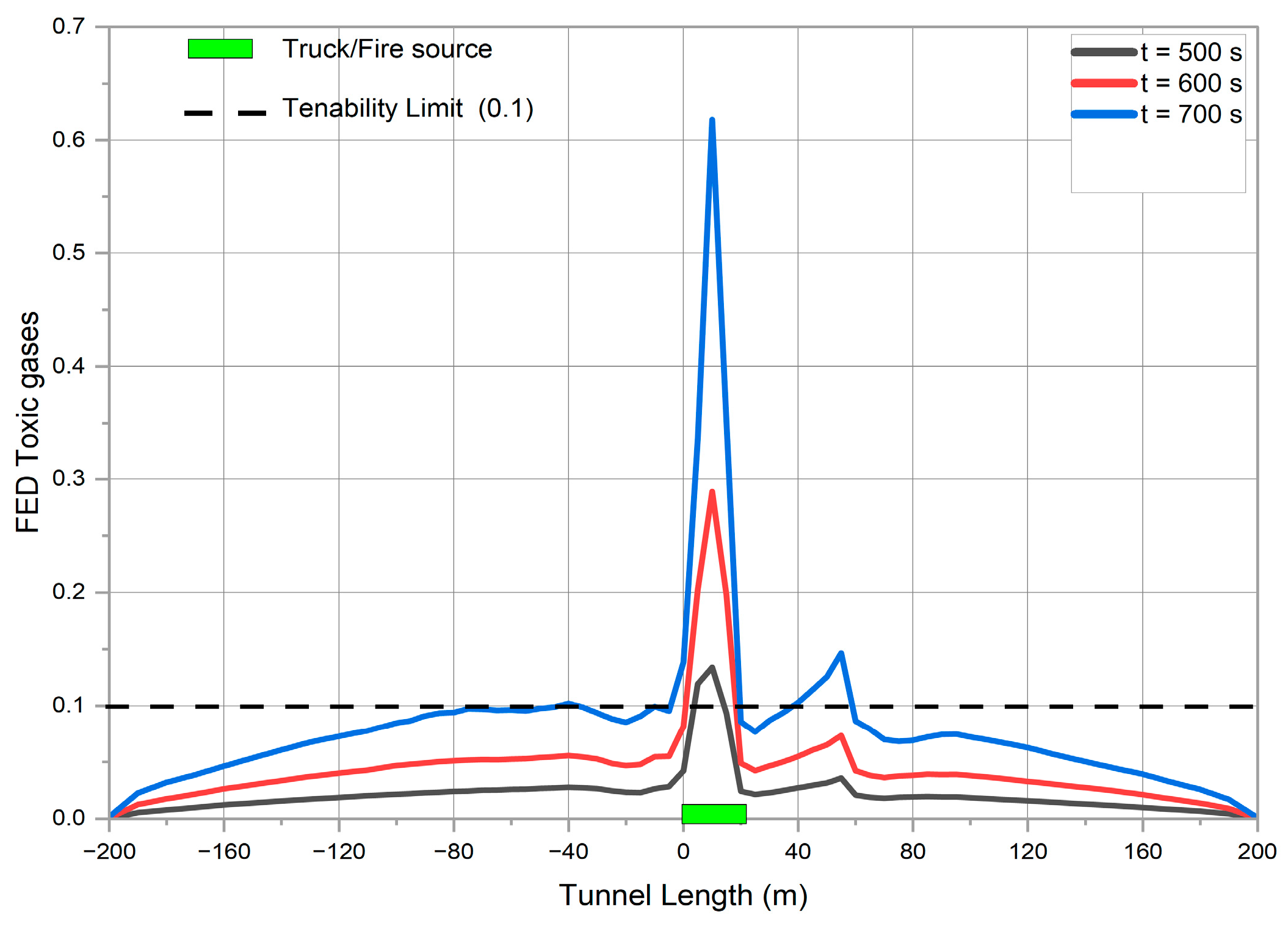
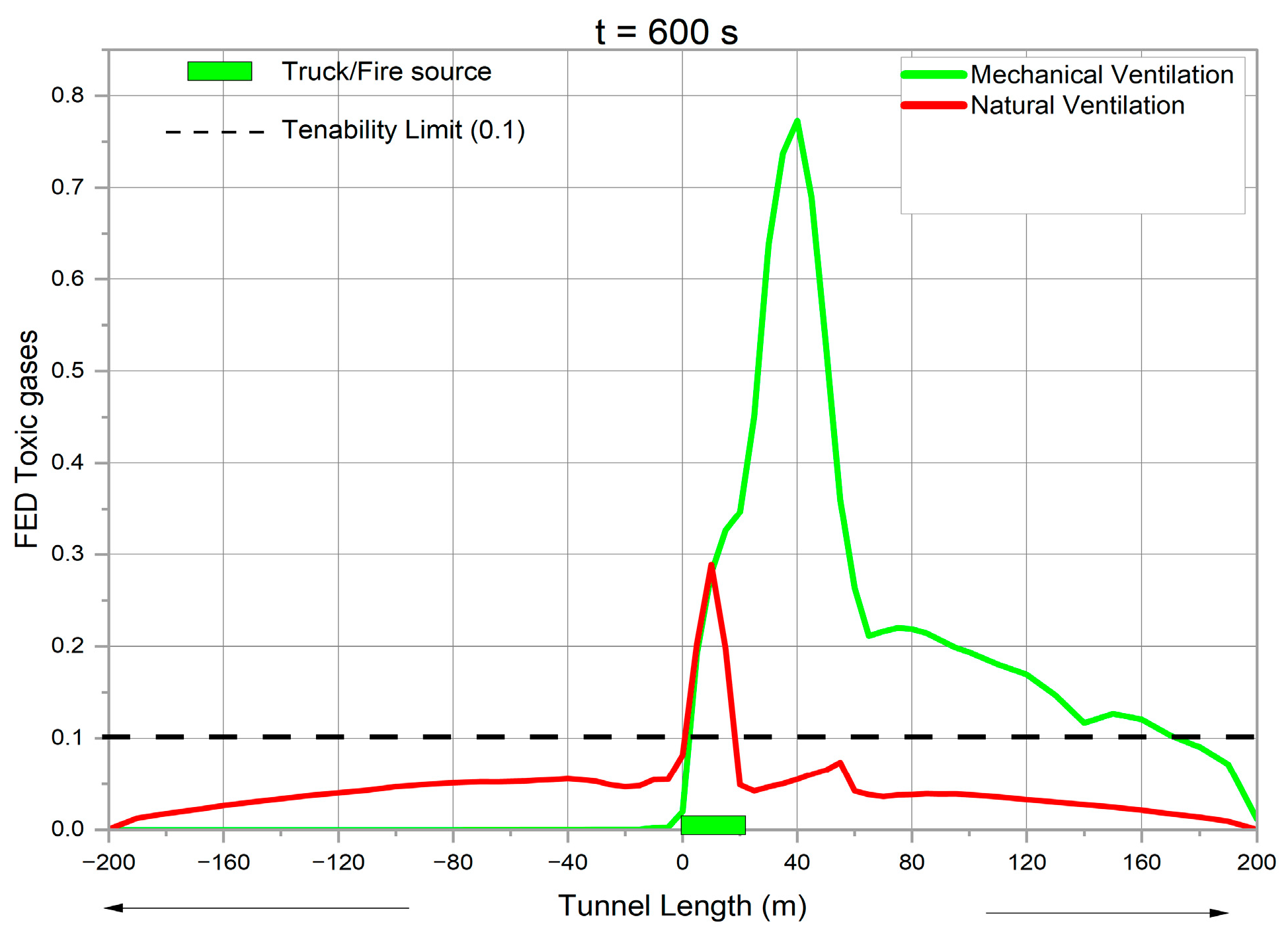
As shown in Figure 23, the longitudinal distribution profiles of FED for toxic gases are presented at a height of 2 m on both sides of the fire source for t = 500 s, 600 s, and 700 s. The results indicate that FED values remain below the tenability threshold of 0.1 [65,66] from the fire source to the tunnel portals for times up to 600 s after ignition. This suggests that toxic gas exposure does not reach incapacitating levels within the first 10 min in the naturally ventilated scenario.
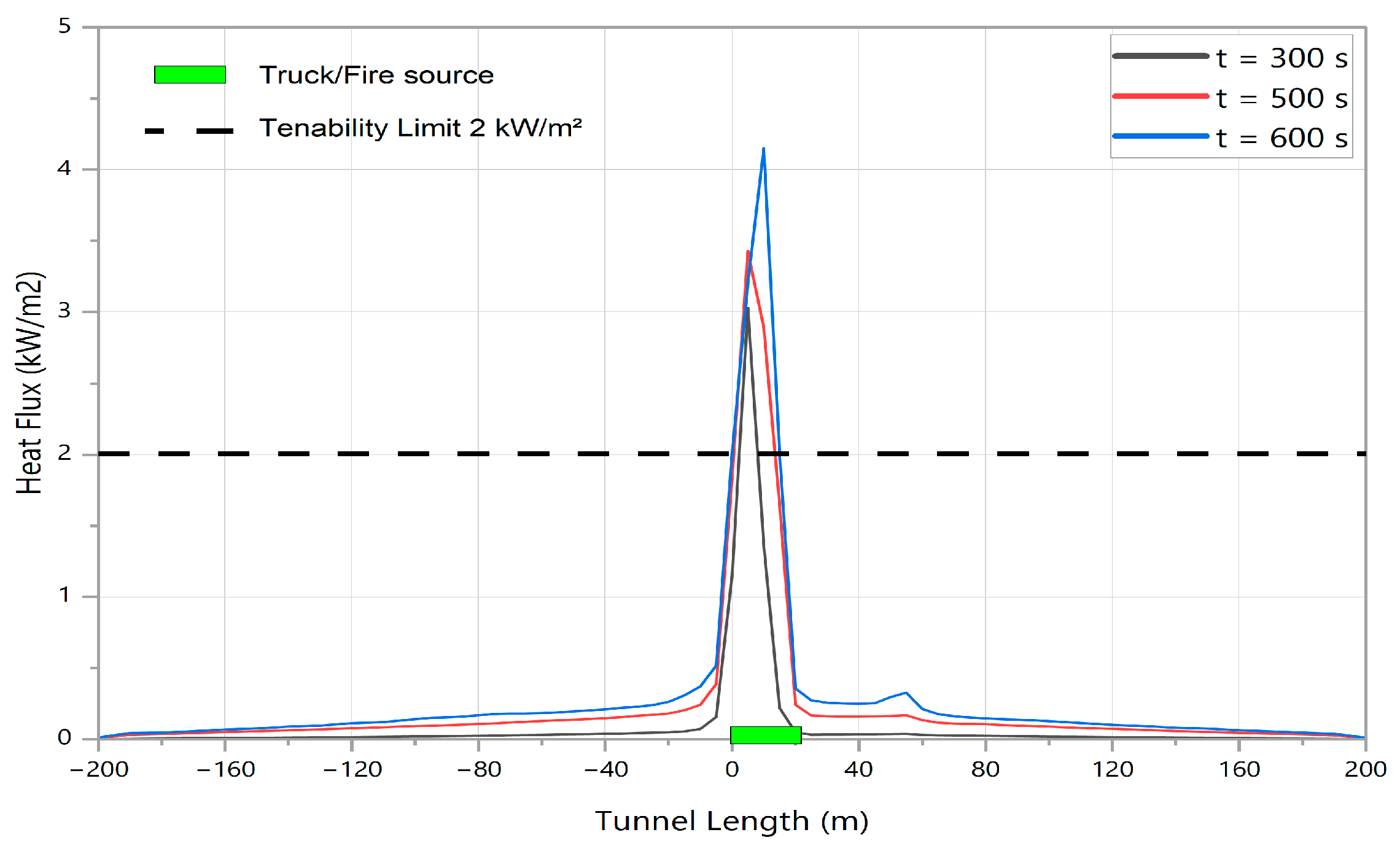
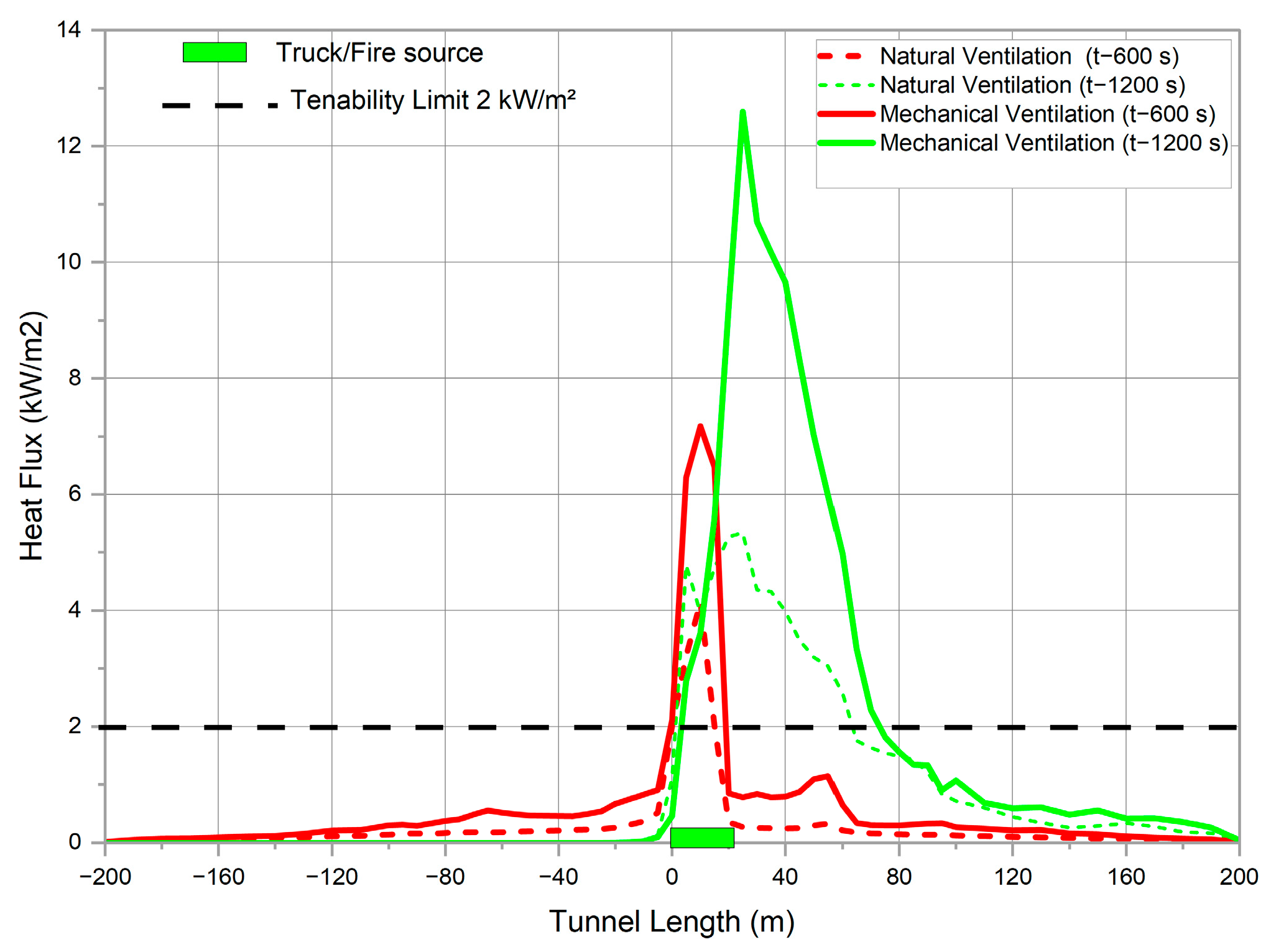
The longitudinal radiant heat flux along the escape route at 2 m height, measured at 600 s after fire initiation, is presented in Figure 24. The maximum radiant heat flux remains at or below 2 kW/m2 [65,66], at distances ≥ 20 m from the fire source on both sides of the tunnel, consistent with tenable conditions for short-term exposure during evacuation.

3.2.4. Effect of Mechanical Ventilation Fans

Ceiling Temperature with Mechanical Ventilation
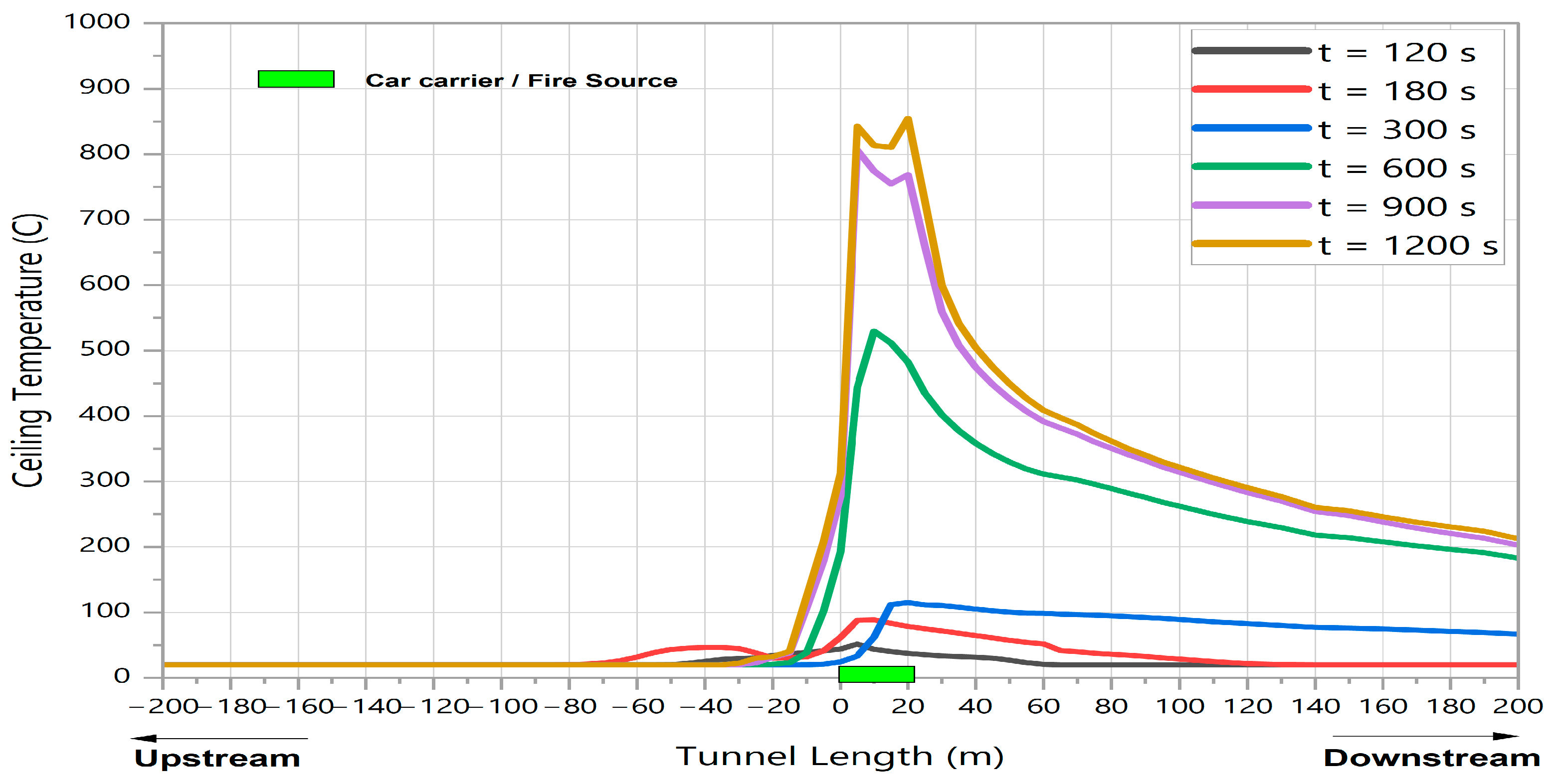
Longitudinal ceiling temperature profiles at multiple time intervals (120 s, 180 s, 300 s, 600 s, 900 s, and 1200 s) are presented in Figure 25 and Figure 26. At 120 s and 180 s (prior to or immediately following fan activation), temperature variations along the tunnel remain minimal, reflecting limited fire development and smoke spread.
Following fan activation, forced convective cooling induces a significant temperature reduction. By 300 s, the peak temperature at the fire source (x = 0 m) decreases by at least 65%, from approximately 320 °C to 110 °C. At 600 s, the maximum temperature drops from ~790 °C to ~510 °C, shifting downstream to the rear of the vehicle (x = 10–20 m) due to ventilation-induced convective transport of heat and smoke. Beyond 40 m downstream, temperatures decline to 200–300 °C.
The upstream section (against the ventilation direction) maintains near-ambient conditions (~20 °C), establishing a safe evacuation path with controlled backlayering and reduced thermal exposure. These results demonstrate the effectiveness of longitudinal mechanical ventilation in mitigating ceiling temperatures and enhancing tenability during large-scale electric vehicle car carrier fires in tunnels.
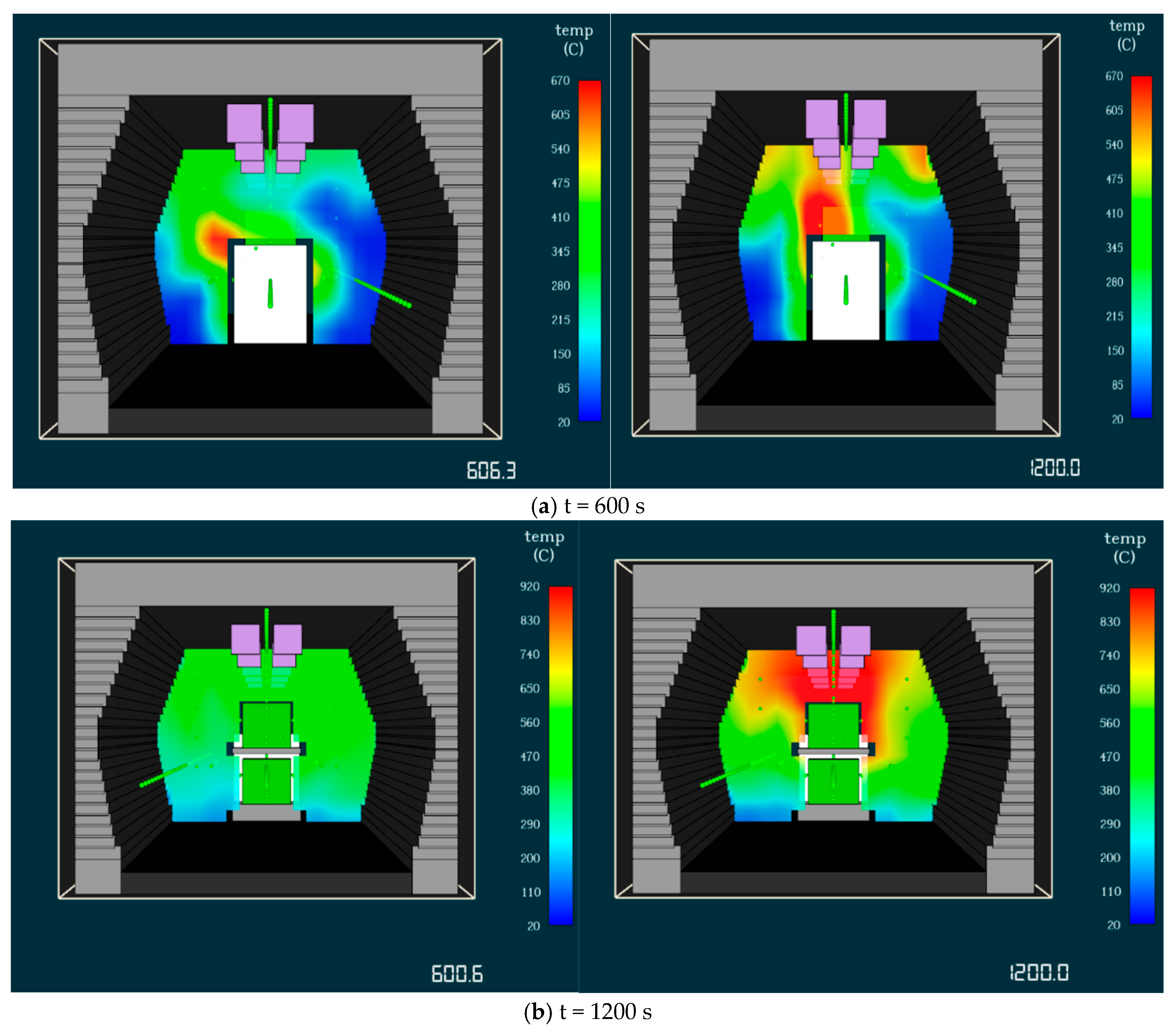
Peak temperatures of 600–670 °C are observed around the vehicle at the fire source (x = 0 m), with an asymmetric distribution: values reach ~670 °C above and to one side due to buoyancy effects. Downstream at x = 20 m, temperatures increase to 700–920 °C as forced ventilation drives the transport of hot gases and combustion products. Tunnel wall temperatures rise to approximately 400 °C, demonstrating effective heat containment and limited thermal impact on the surrounding infrastructure.
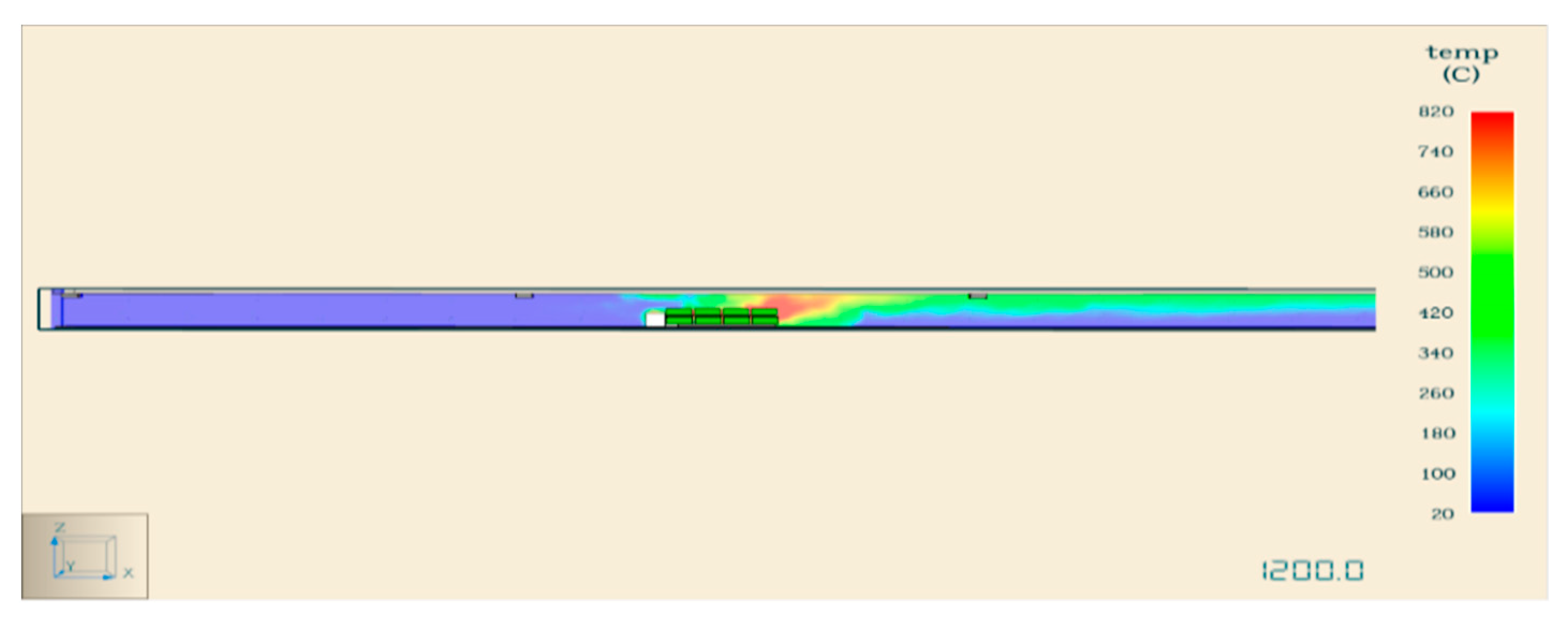
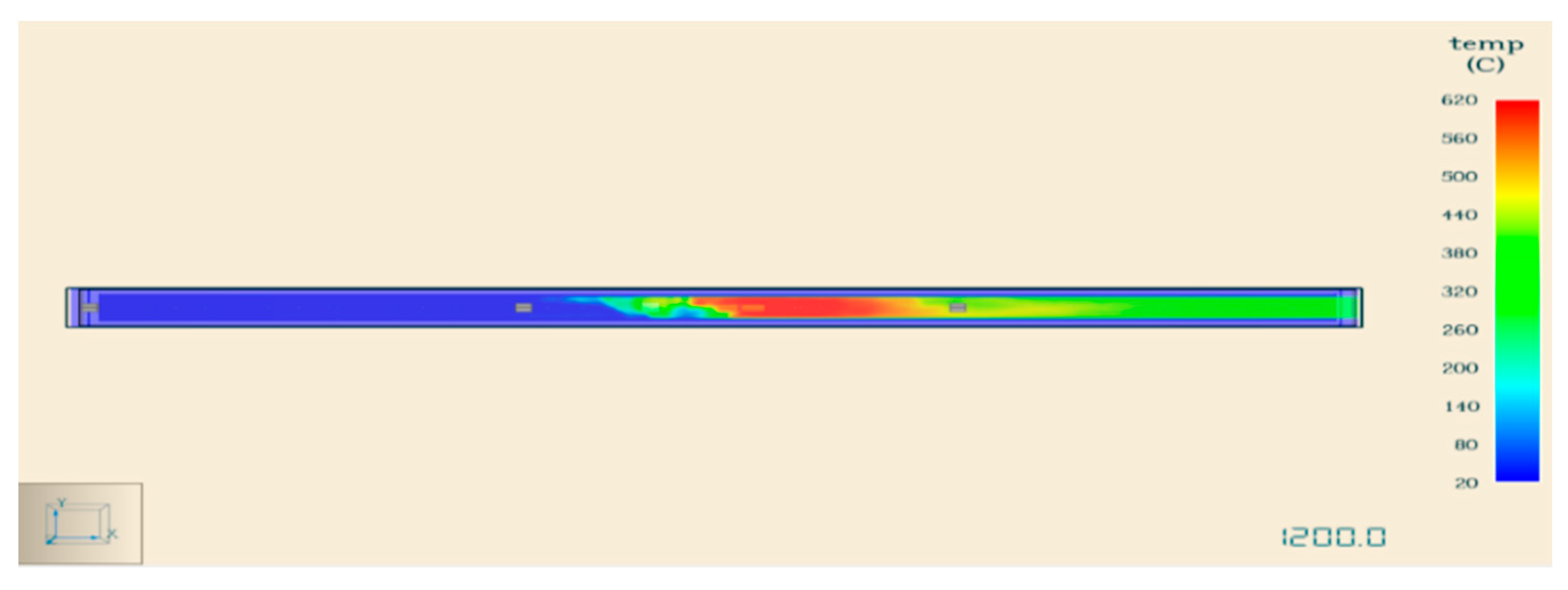
Figure 27 and Figure 28 present longitudinal side and top views (at ceiling level, z = 6 m) of the temperature distribution at 1200 s under mechanical ventilation conditions, illustrating the thermal stratification and downstream propagation of the fire plume.
The fire zone exhibits localized peak temperatures of 740–820 °C concentrated at and immediately above the vehicle, forming a strong thermal plume that extends downstream along the ceiling. Temperatures decrease progressively with distance: from ~580 °C near the source to 260–340 °C at greater downstream locations.
Distinct vertical stratification is evident, with hot combustion products (420–580 °C) accumulating in the upper tunnel layers, while the lower breathing zone (≈2 m height) remains significantly cooler (80–180 °C). Heat is concentrated along the tunnel centreline, with cooler regions (180–260 °C) near the side walls. The tunnel floor stays at 20–100 °C, supporting safe ground-level evacuation, and the upstream section maintains near-ambient conditions (80–140 °C), confirming effective thermal isolation of the entrance area from fire effects.
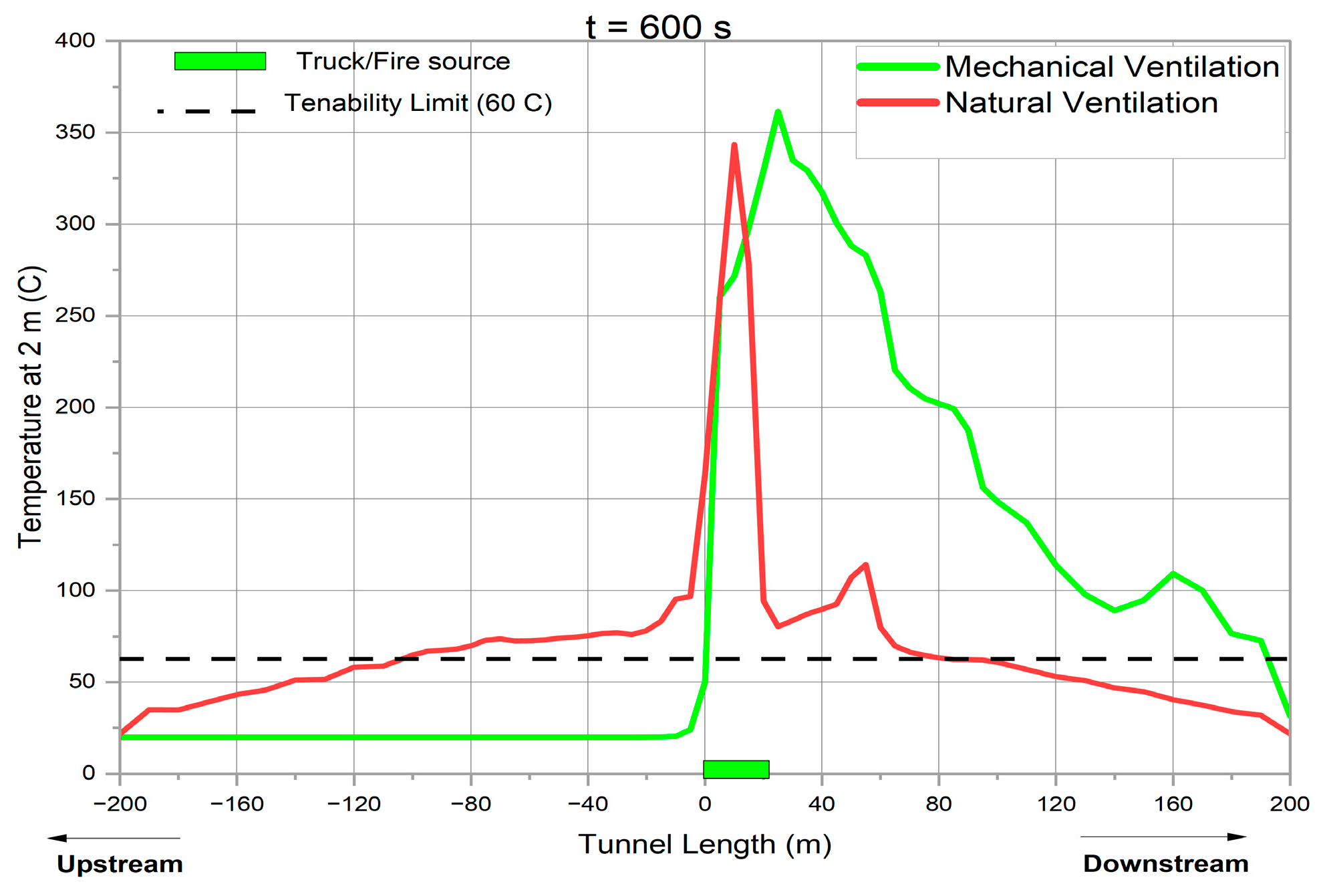
As shown in Figure 29, under mechanical ventilation, upstream temperatures remain near ambient (~20 °C), effectively suppressing backlayering and creating a safe evacuation path. Downstream of the fire source, however, forced ventilation drives hot gases farther along the tunnel, causing temperatures to exceed the tenability limit of 60 °C and stay elevated for nearly 180 m from the centre of the burning car carrier.
In contrast, natural ventilation results in more symmetric but less controlled spread, with higher upstream exposure and slower downstream propagation. These findings illustrate the trade-off between improved upstream tenability and increased downstream thermal hazard when applying longitudinal mechanical ventilation in electric vehicle car carrier tunnel fires.
Smoke and SOOT Visibility
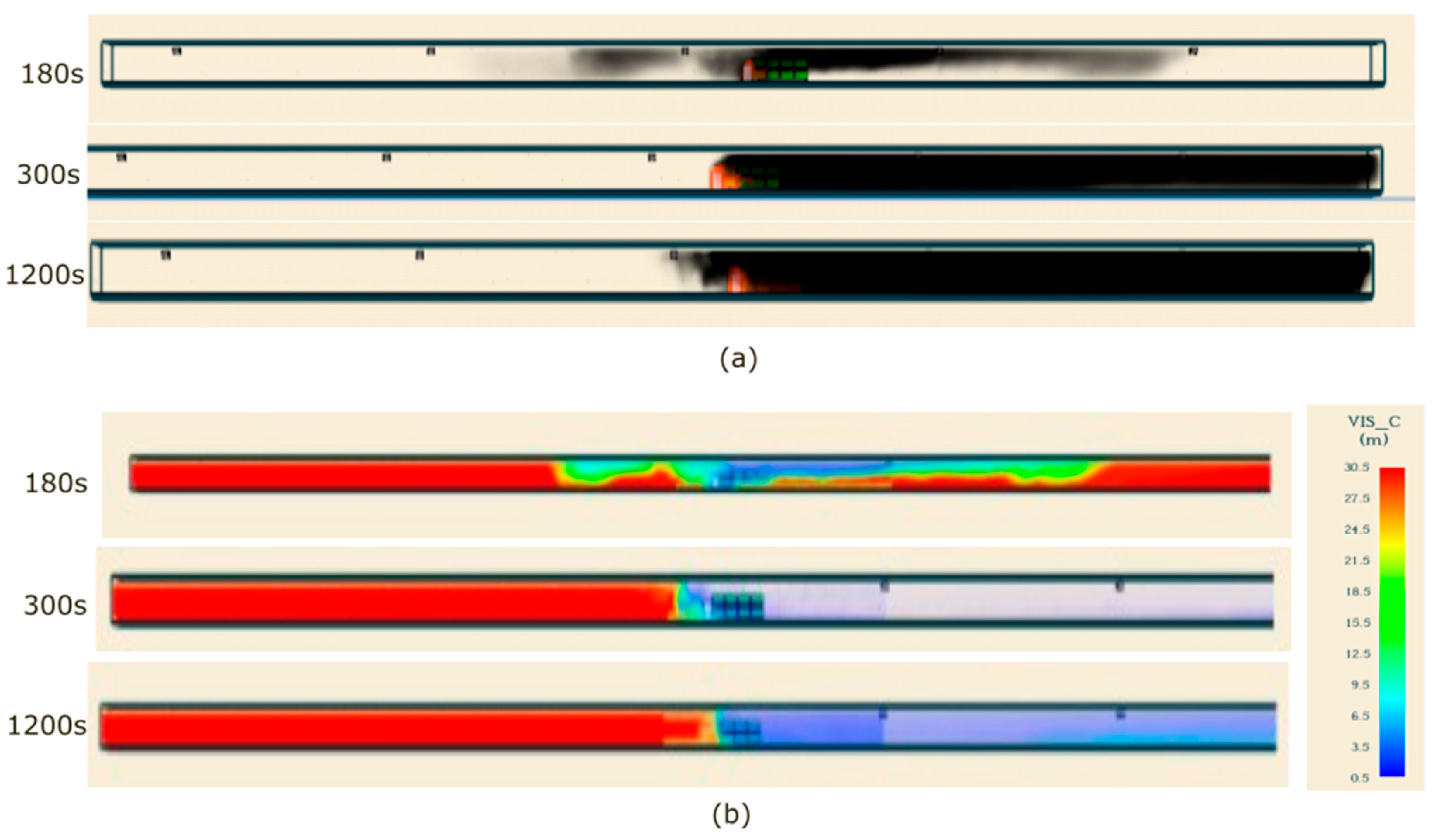
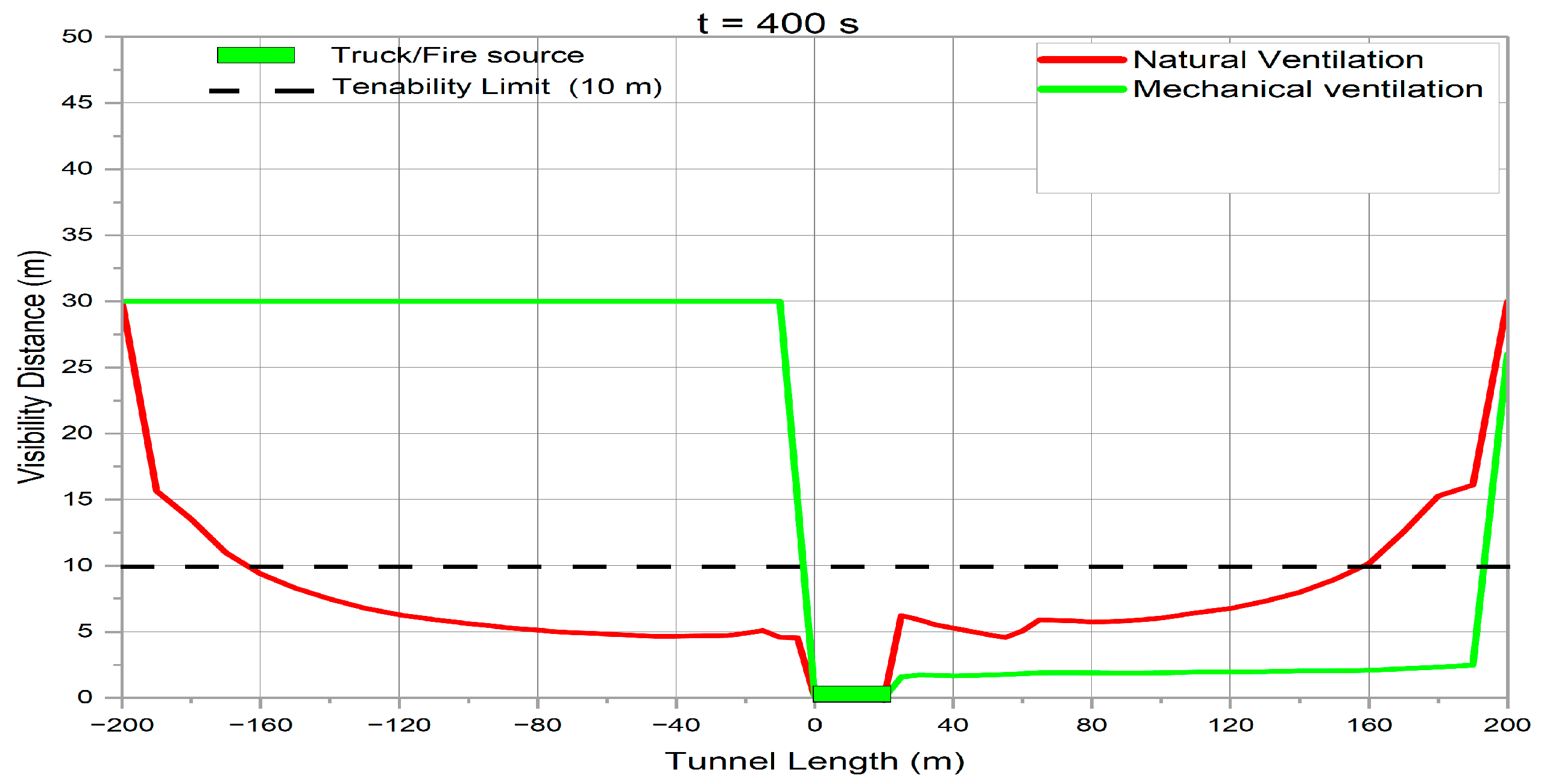
Figure 30 illustrates the longitudinal development of smoke and soot visibility (at occupant eye level, 2 m height) along both sides of the tunnel when mechanical ventilation is activated at 150 s, in comparison with natural ventilation conditions.
Under natural ventilation, visibility decreases rapidly and drops below the tenability threshold of 10 m throughout the tunnel by approximately 400 s, creating untenable conditions over extended distances.
With mechanical ventilation, upstream visibility (against the flow direction) remains greater than 10 m throughout the simulation, significantly improving the safety of the escape path by limiting smoke backlayering. However, forced ventilation transports smoke and soot farther along the tunnel, resulting in severely reduced visibility (2 m) over the affected length.
As shown in Figure 31, under natural ventilation, visibility deteriorates symmetrically on both sides of the fire source, with large sections of the tunnel falling below the tenability threshold of 10 m, indicating poor evacuation conditions throughout the affected area.
In contrast, mechanical ventilation effectively prevents smoke backlayering upstream of the fire, maintaining visibility distances greater than 10 m in that direction and supporting a safer escape path. However, downstream, the forced flow drives smoke and soot farther along the tunnel, resulting in severely reduced visibility (<10 m) over an extended length.
Overall, the comparison highlights that while mechanical ventilation offers clear upstream benefits by limiting backlayering, it concentrates high-hazard (low-visibility) conditions downstream. Natural ventilation, although producing more uniform visibility loss across the tunnel, results in broadly untenable conditions without directional control.
CO and CO2 Concentration
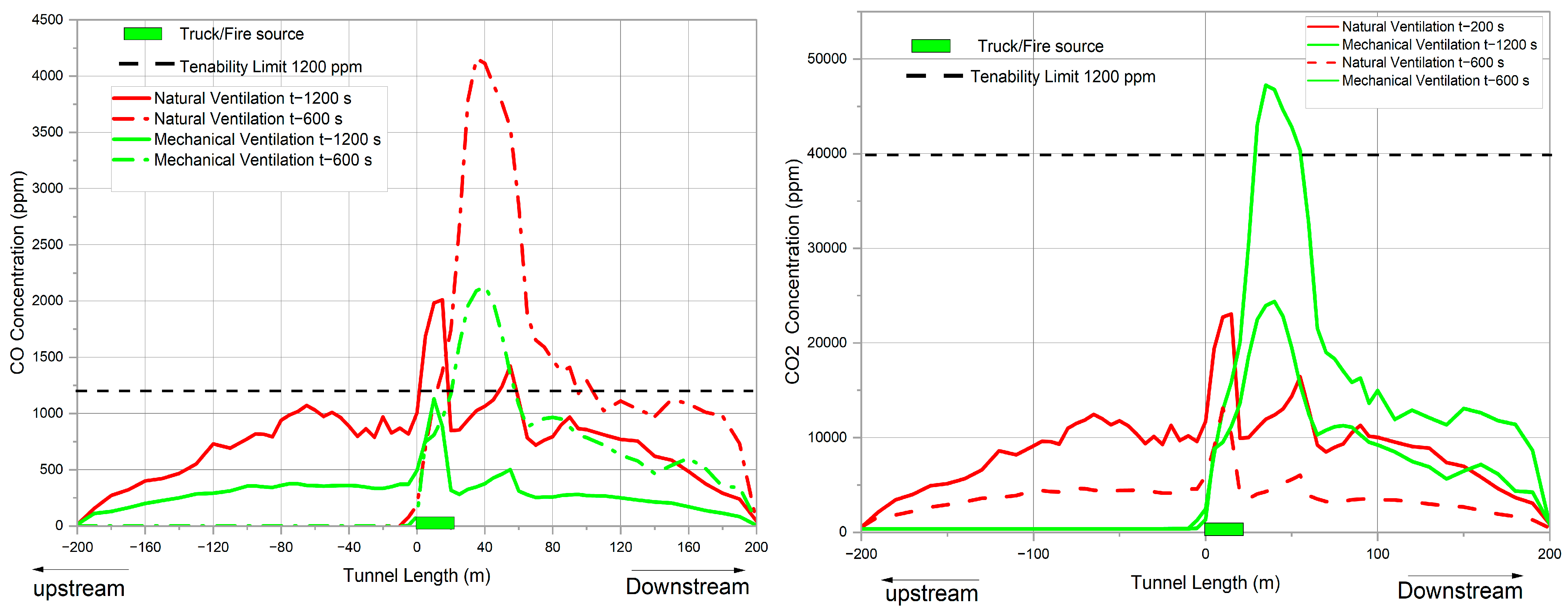
Figure 32 presents longitudinal profiles of CO and CO2 concentrations at a height of 2 m at t = 600 s and 1200 s, comparing natural ventilation and mechanical ventilation conditions.
As shown in Figure 32, longitudinal mechanical ventilation effectively directs CO and CO2 toward the downstream side of the tunnel. Upstream of the fire source, CO concentrations remain near zero, providing a safe evacuation path with negligible toxic gas exposure. Downstream, CO levels increase progressively, exceeding the tenability limit [65,66] of 1200 ppm only in the later stages of the simulation (t = 900–1200 s) and near the fire source.
In contrast, natural ventilation results in higher peak CO and CO2 concentrations near the fire source due to symmetric spread and accumulation. However, CO2 concentrations in both scenarios remain well below the acceptability threshold of 40,000 ppm throughout the simulation [65,66]. These results demonstrate that mechanical ventilation significantly reduces toxic gas accumulation upstream and near the fire source, although it extends elevated downstream concentrations over a greater distance.
Radiant Heat Flux and FED
Figure 33 illustrates the longitudinal radiant heat flux profiles at 2 m height and t = 600 s and 1200 s under mechanical ventilation. Downstream of the fire source, radiant heat flux increases significantly, with elevated values extending approximately 80 m beyond the burning vehicle and exceeding the tenability limit of 2 kW/m2 [65,66]. This intensification arises from the forced downstream movement of hot gases and flames induced by the ventilation flow.
Figure 34 presents the FED profiles for toxic gases at 2 m height and t = 600 s. Under mechanical ventilation, upstream FED values remain near zero and below the tenability threshold of 0.1 due to the effective control of backlayering. However, FED levels remain above 0.1 and reach a peak of approximately 0.75 at roughly 40 m from the fire source at 600 s.
In the naturally ventilated scenario, upstream FED stays close to zero, while downstream FED accumulates more symmetrically without the pronounced peak observed under mechanical ventilation. These contrasting patterns, as depicted in Figure 33 and Figure 34, underscore the trade-off: mechanical ventilation enhances upstream tenability but concentrates radiant heat and toxic gas exposure downstream.

4. Conclusions

This study aimed to evaluate the fire hazards posed by a fully loaded electric car carrier (E-trailer) in a road tunnel, a scenario that has received limited attention despite the rapid growth in electric vehicle (EV) transport and the increasing use of lithium-ion battery (LIB) systems in heavy vehicles. The worst-case scenario was simulated: a fire originating in the trailer battery and propagating sequentially to eight passenger EVs (each with an 80 kWh battery, total ~640 kWh at 100% SOC). Simulations were performed in a 400 m horseshoe-shaped road tunnel under two conditions—natural ventilation and longitudinal mechanical ventilation—using the Fire Dynamics Simulator (FDS).
The results demonstrate that such an event generates significantly higher fire loads than those from individual passenger vehicles or conventional internal combustion engine heavy goods vehicles (HGVs). The combined peak heat release rate (PHRR) reached 76 MW within 18 min. Under natural ventilation, ceiling temperatures above the fire source exceeded 950 °C, vehicle surface temperatures surpassed 1100 °C, and smoke spread rapidly. Visibility at 2 m height fell below the 10 m tenability limit within approximately 6 min and remained untenable across nearly the full tunnel length. Breathing-level temperatures exceeded the 60 °C limit up to 170 m downstream by 20 min. While individual CO and CO2 concentrations remained below lethal thresholds, the combined fractional effective dose (FED) together with radiant heat flux rendered immediate evacuation conditions untenable in the affected zone.
In accordance with EU Directive 2004/54/EC [67], mechanical ventilation is not mandatory for trans-European road tunnels shorter than 1000 m; however, this longitudinal ventilation scenario clearly demonstrates its value. Activation of jet fans at t = 150 s prevented smoke backlayering, maintaining a low-temperature (20–25 °C) upstream evacuation path toward the tunnel exit. This strategy redirected the thermal and toxic plume downstream, resulting in elevated temperatures (>60 °C), severely reduced visibility (<3 m), and CO concentrations exceeding 1200 ppm over 150–180 m toward the exit. Overall, mechanical ventilation shifted the hazard from a symmetric to an asymmetric distribution: it markedly improved upstream safety but intensified downstream risks compared with natural ventilation. These findings confirm that mechanical ventilation plays a critical role in supporting evacuation, firefighting, and emergency response, provided the associated trade-offs are well understood and managed.
A notable limitation of the present simulations is that hydrogen fluoride (HF), a highly toxic acid gas commonly released during thermal runaway of LIBs, was not explicitly modelled or transported as a separate species. FDS simulations relied on the mixing-controlled combustion model with a simplified surrogate fuel and yield-based production of CO, CO2, and soot only. While CO and CO2 concentrations remained below their individual tenability thresholds, and the combined FED for major combustion products stayed low, HF can pose a significant additional hazard even at low concentrations (e.g., incapacitation possible at 50–100 ppm and severe effects at 100–200 ppm short-term exposure [2,25]). The literature on full-scale EV battery fires consistently reports HF generation rates of 20–200 mg/Wh of battery capacity, leading to dangerous levels in enclosed or poorly ventilated spaces. The absence of HF in the model means the tenability assessment (based on temperature, visibility, CO/CO2, FED, and heat flux) is likely conservative with respect to overall chemical toxicity. In real tunnel EV fire incidents involving multiple batteries, HF could substantially reduce available safe egress time and increase risk to occupants and responders beyond what is indicated by CO/CO2 and FED alone. Future simulations should incorporate HF production (e.g., via user-defined species with appropriate yield values derived from battery vent-gas experiments) and include HF-specific tenability criteria (e.g., 50 ppm short-term exposure limit) to provide a more comprehensive hazard evaluation.
Future research should prioritize full-scale experimental studies to support tunnel fire safety strategies, ventilation design, and emergency response procedures for battery-electric heavy vehicles. Further experimental work is needed to understand the behaviour of fires involving multiple high-voltage electric vehicles in confined spaces such as road tunnels, including the effects of new battery technologies and extended vehicle configurations.

Author Contributions

Conceptualization, M.I.A.; Methodology, M.I.A.; Software, M.I.A.; Validation, M.I.A.; Investigation, M.I.A.; Resources, J.N.; Data curation, M.I.A.; Writing—original draft, M.I.A.; Writing—review & editing, S.M.H. and J.N.; Supervision, J.N. All authors have read and agreed to the published version of the manuscript.

Funding

This research received no external funding.

Data Availability Statement

The data presented in this study are available on request from the corresponding authors.

Conflicts of Interest

The authors declare no conflict of interest.

References

  1. Hodges, J.L.; Salvi, U.; Kapahi, A. Design fire scenarios for hazard assessment of modern battery electric and internal combustion engine passenger vehicles. Fire Saf. J. 2024, 146, 104145. [Google Scholar] [CrossRef]
  2. Sun, P.; Bisschop, R.; Niu, H.; Huang, X. A review of battery fires in electric vehicles. Fire Technol. 2020, 56, 1361–1410. [Google Scholar] [CrossRef]
  3. Wang, Z.; Zhu, K.; Hu, J.; Wang, J. Study on the fire risk associated with a failure of large-scale commercial LiFePO4/graphite and LiNixCoyMn1-x-yO2/graphite batteries. Energy Sci. Eng. 2019, 7, 411–419. [Google Scholar] [CrossRef]
  4. EV.FireSafe. PASSENGER EV LIB FIRE INCIDENTS, Global, as of 30th JUNE 2024. 2024. Available online: https://www.evfiresafe.com/ (accessed on 10 March 2026).
  5. Hassan, M.K.; Hameed, N.; Hossain, M.D.; Hasnat, M.R.; Douglas, G.; Pathirana, S.; Rahnamayiezekavat, P.; Saha, S. Fire incidents, trends, and risk mitigation framework of electrical vehicle cars in Australia. Fire 2023, 6, 325. [Google Scholar] [CrossRef]
  6. Teslarati. Tesla Clarifies LA Car Carrier Fire Started in Diesel Semi, Not EV Batteries. 2025. Available online: https://www.teslarati.com/tesla-clarifies-la-car-carrier-fire-started-diesel-semi-not-ev-batteries (accessed on 10 September 2025).
  7. ABC7 Los Angeles. Car-Carrier Truck Loaded with Teslas Causes Hazmat Fire on 5 Freeway in Sylmar. 2025. Available online: https://abc7.com/post/car-carrier-truck-loaded-teslas-causes-hazmat-fire-5-freeway-sylmar/17562538 (accessed on 20 September 2025).
  8. Fire and Rescue NSW. Carrier Truck Fire Destroys Five Cars—Denham Court; Fire and Rescue NSW: Sydney, Australia, 2025. Available online: https://www.fire.nsw.gov.au/media/news/2025/20250327-carrier-truck-fire-destroys-five-cars-7c-denham-court-denham-court (accessed on 10 September 2025).
  9. Swaim, T.; Barth, R.; National Transportation Safety Board (NTSB). Electric Truck-Tractor Roadway Departure and Postcrash Fire 2024. Available online: https://www.ntsb.gov/investigations/Pages/HWY24FH015.aspx (accessed on 12 August 2025).
  10. Fire and Rescue NSW. Lithium-ion battery causes fire destroying five cars at Sydney Airport. In FRNSW Annual Report 2023–24; Fire and Rescue NSW: Sydney, Australia, 2024. Available online: https://www.fire.nsw.gov.au/__data/assets/pdf_file/0021/4935/annual_report_2023_24.pdf (accessed on 22 February 2025).
  11. Yılmaz, F. Safety of Electrical (Battery-Powered) Ships: An Overview of IMO’s Safety Regulations and Class Rules/Requirements. Int. J. New Find. Eng. Sci. Technol. 2025, 30–38. [Google Scholar] [CrossRef]
  12. Kilinc, N.U. The Revolutionary Architecture and Legal Framework for Autonomous Ship Systems and Digital Twin Integration. 2025. [Google Scholar] [CrossRef]
  13. Brunzell, S.; Radjab Adel, J. Brandsäkerhet i framtidens miljöer: Batteriskåp som skydd mot batteribränder. 2024. Available online: https://odr.chalmers.se/items/e896d1f7-7fe5-4558-9a4e-13265c7613a1 (accessed on 10 March 2026).
  14. Caliendo, C. Experience with significant incidents in road tunnels. In Experience with Significant Incidents in Road Tunnels; World Road Association (PIARC): Paris, France, 2017; pp. 1–68. [Google Scholar]
  15. Sturm, P.; Fößleitner, P.; Fruhwirt, D.; Galler, R.; Wenighofer, R.; Heindl, S.F.; Krausbar, S.; Heger, O. Fire tests with lithium-ion battery electric vehicles in road tunnels. Fire Saf. J. 2022, 134, 103695. [Google Scholar] [CrossRef]
  16. Kang, S.; Kwon, M.; Choi, J.Y.; Choi, S. Full-Scale Fire Testing to Assess the Risk of Battery Electric Vehicle Fires in Underground Car Parks: Full-Scale Fire Testing to Assess the Risk. Fire Technol. 2025, 61, 4133–4163. [Google Scholar] [CrossRef]
  17. Collivignarelli, M.C.; Miino, M.C.; Cillari, G.; Bellazzi, S.; Caccamo, F.M.; Abbà, A.; Bertanza, G. Estimation of thermal energy released by thermophilic biota during sludge minimization in a fluidized bed reactor: Influence of anoxic conditions. Process Saf. Environ. Prot. 2022, 166, 249–256. [Google Scholar] [CrossRef]
  18. Funk, E.; Flecknoe-Brown, K.W.; Wijesekere, T.; Husted, B.P.; Andres, B. Fire extinguishment tests of electric vehicles in an open sided enclosure. Fire Saf. J. 2023, 141, 103920. [Google Scholar] [CrossRef]
  19. Cui, Y.; Liu, J.; Cong, B.; Han, X.; Yin, S. Characterization and assessment of fire evolution process of electric vehicles placed in parallel. Process Saf. Environ. Prot. 2022, 166, 524–534. [Google Scholar] [CrossRef]
  20. Zhao, C.; Hu, W.; Meng, D.; Mi, W.; Wang, X.; Wang, J. Full-scale experimental study of the characteristics of electric ve-hicle fires process and response measures. Case Stud. Therm. Eng. 2024, 53, 103889. [Google Scholar] [CrossRef]
  21. Held, M.; Tuchschmid, M.; Zennegg, M.; Figi, R.; Schreiner, C.; Mellert, L.D.; Welte, U.; Kompatscher, M.; Hermann, M.; Nachef, L. Thermal runaway and fire of electric vehicle lithium-ion battery and contamination of infrastructure facility. Renew. Sustain. Energy Rev. 2022, 165, 112474. [Google Scholar] [CrossRef]
  22. Hayajneh, S.M.; Naser, J. Fire Spread in Multi-Storey Timber Building, a CFD Study. Fluids 2023, 8, 140. [Google Scholar] [CrossRef]
  23. Hayajneh, S.M.; Naser, J. Wind and Slope Influence on Wildland Fire Spread, a Numerical Study. Fire 2025, 8, 217. [Google Scholar] [CrossRef]
  24. Raza, H.; Li, S. The impact of battery electric bus fire on road tunnel. In Expanding Underground-Knowledge and Passion to Make a Positive Impact on the World; CRC Press: Boca Raton, FL, USA, 2023; pp. 3280–3288. [Google Scholar]
  25. Caliendo, C.; Russo, I.; Genovese, G. A numerical evaluation for estimating the consequences on users and rescue teams due to the fire of an electric bus in a road tunnel. Appl. Sci. 2024, 14, 9191. [Google Scholar] [CrossRef]
  26. Gao, Y.; Jiang, C.; Cui, K.; Fu, Q.; Li, Y. Numerical study on the effects of blocking ratio and spraying angle on the smoke flow characteristics of new energy vehicle fires in tunnels. Therm. Sci. Eng. Prog. 2023, 42, 101927. [Google Scholar] [CrossRef]
  27. Bai, Z.; Yu, Y.; Zhang, J.; Hu, H.; Xing, M.; Yao, H. Study on fire characteristics of lithium battery of new energy vehicles in a tunnel. Process Saf. Environ. Prot. 2024, 186, 728–737. [Google Scholar] [CrossRef]
  28. Zhang, Y.; Ye, J. Simulation study on tunnel temperature field evolution considering vehicle-to-vehicle fire spread in real traffic scenarios. Fire Technol. 2025, 61, 4557–4579. [Google Scholar] [CrossRef]
  29. Dessì, R.; Fruhwirt, D.; Papurello, D. A Study on Large Electric Vehicle Fires in a Tunnel: Use of a Fire Dynamics Simulator (FDS). Processes 2025, 13, 2435. [Google Scholar] [CrossRef]
  30. Zhao, Y.; Chen, W.; Guo, J.; Bao, J.; Wu, Y.; Ai, D.; Wang, Q. Fire Simulation and Optimization of Fire Control System in Vehicle Compartment of Ro-Ro Passenger Ship. Fire 2025, 8, 443. [Google Scholar] [CrossRef]
  31. Leone, E.; Papurello, D. Fire Safety Analysis of Alternative Vehicles in Confined Spaces: A Study of Underground Parking Facilities. Fire 2025, 9, 20. [Google Scholar] [CrossRef]
  32. Louis, L.; Tziotis, M.; Peglas, T.; Thompson, L.; Leow, D. Guide to Road Tunnels Part 2: Planning, Design and Commissioning; ARRB Group Limited: Melbourne, Australia, 2021.
  33. Ernst, S.L.; Bergeson, W.; Harelson, S.; Williams, D.; Bilson, M. Tunnel Fire Protection Using Fixed Firefighting Systems: Advanced Practices from Australia and New Zealand; Federal Highway Administration: Washington, DC, USA, 2018.
  34. NFPA 502; Standard for Road Tunnels, Bridges, and Other Limited Access Highways. National Fire Protection Association: Quincy, MA, USA, 2017.
  35. McGrattan, K.; Hostikka, S.; Mcdermott, R. Fire Dynamics Simulator (Version 4.07)–Technical Reference Guide; NIST Special Publication: Gaithersburg, ML, USA, 2006; Volume 1018.
  36. Thunderhead Engineering. PyroSim User Manual; Thunderhead Engineering: Manhattan, KS, USA, 2025; Available online: https://www.thunderheadeng.com/docs/2025-1/pyrosim (accessed on 10 March 2026).
  37. Monatsh, B.H. Feierliche Eröffnung des ZaB–Zentrum am Berg. Berg Huttenmann. Monatshefte 2021, 166, 631–643. [Google Scholar]
  38. Material Properties, Website about Elements and Materials, Material Properties. 2025. Available online: https://material-properties.org/ (accessed on 10 March 2026).
  39. The Engineering Toolbox. Solids, Specific Heats. 2025. Available online: https://www.engineeringtoolbox.com/specific-heat-solids-d_154.html (accessed on 10 March 2026).
  40. Brinckerhoff, B.; Brinckerhoff, P. Memorial Tunnel Fire Ventilation Test Report; Massachusetts Highway Department: Boston, MA, USA, 1995.
  41. Ang, C.D.E.; Rein, G.; Peiro, J.; Harrison, R. Simulating longitudinal ventilation flows in long tunnels: Comparison of full CFD and multi-scale modelling approaches in FDS6. Tunn. Undergr. Space Technol. 2016, 52, 119–126. [Google Scholar] [CrossRef]
  42. Li, J.; Guo, S.; Qi, S.; Wei, Q.; Zheng, B.; Zou, Y.; Li, Y.; Zhang, Y.; Lu, X. Spatial variations of deformation along a strike-slip fault: A case study of Xianshuihe fault zone, southwest China. Appl. Sci. 2024, 14, 2439. [Google Scholar] [CrossRef]
  43. Scania. World’s First All-Electric Scania Standard Car Transporter Goes into Service. 2023. Available online: https://www.scania.com/ph/en/home/about-scania/newsroom/news/2023/worlds_first_all_electric_scania_standard_car_transporter_goes_into_service.html (accessed on 10 March 2026).
  44. Hyundai KONA Electric Specification. 2020. Available online: https://www.evspecifications.com/en/model/bdc8115 (accessed on 12 November 2024).
  45. Bhutada, G. Breaking Down the Key Minerals in an EV Battery. 2022. Available online: https://elements.visualcapitalist.com/the-key-minerals-in-an-ev-battery/ (accessed on 20 April 2025).
  46. Burul, D.; David, A. Life Cycle Assessment of Distribution Vehicles: Battery Electric vs Diesel Driven. 2021. Available online: https://trid.trb.org/View/2093214 (accessed on 20 April 2025).
  47. Hurley, M.J.; Gottuk, D.; Hall, J.R.; Harada, K.; Kuligowski, E.; Puchovsky, M.; Torero, J.; Watts, J.M.; Wieczorek, C. SFPE Handbook of Fire Protection Engineering; Springer: New York, NY, USA, 2025. [Google Scholar]
  48. Wang, X.; Wang, M.; Jiang, R.; Xu, J.; Li, B.; Wang, X.; Lei, M.; Su, P.; Liu, C.; Yang, Q.; et al. Impact of battery electric vehicles on ventilation design for road tunnels: A review. Tunn. Undergr. Space Technol. 2023, 134, 105013. [Google Scholar] [CrossRef]
  49. Shen, H.; Wang, H.; Li, M.; Li, C.; Zhang, Y.; Li, Y.; Yang, X.; Feng, X.; Ouyang, M. Thermal Runaway Characteristics and Gas Composition Analysis of Lithium-Ion Batteries with Different LFP and NCM Cathode Materials under Inert Atmosphere. Electronics 2023, 12, 1603. [Google Scholar] [CrossRef]
  50. Kun, B.; Rong, Q.; Yong, J.; Jingchuan, Z. Reconstruction of a bus fire based on numerical simulation. JUSTC 2010, 40, 387–394. [Google Scholar]
  51. Mohd Tohir, M.Z.; Martín-Gómez, C. Evaluating fire severity in electric vehicles and internal combustion engine vehicles: A statistical approach to heat release rates. Fire Technol. 2025, 61, 2957–2998. [Google Scholar] [CrossRef]
  52. Scania. Scania-Battery Electric vs Diesel Driven. 2022. Available online: https://www.scania.com/content/dam/group/press-and-media/press-releases/documents/Scania-Life-cycle-assessment-of-distribution-vehicles.pdf (accessed on 20 April 2025).
  53. Kang, S.; Kwon, M.; Choi, J.Y.; Choi, S. Full-scale fire testing of battery electric vehicles. Appl. Energy 2023, 332, 120497. [Google Scholar] [CrossRef]
  54. Tohir, M.Z.M.; Spearpoint, M.; Fleischmann, C. Prediction of time to ignition in multiple vehicle fire spread experiments. Fire Mater. 2017, 42, 69–80. [Google Scholar] [CrossRef]
  55. Drakulić, M.; Brandt, R.; Borchiellini, R.; Del Ray, I.; Dix, A.; Fresta, M.; Harvey, N.; Huijben, H. Design Fire Characteristics for Road Tunnels; World Road Association (PIARC): La Défense Cedex, France, 2017. [Google Scholar]
  56. George, J. Analysis of Electric Vehicle Fire Risks in Car Parks. Master’s Thesis, International Master of Science in Fire Safety Engineering, Ghent, Belgium, 2023. [Google Scholar]
  57. Watanabe, N.; Sugawa, O.; Suwa, T.; Ogawa, Y.; Hiramatsu, M.; Tomonori, H.; Miyamoto, H.; Okamoto, K.; Honma, M. Comparison of fire behaviors of an electric-battery-powered vehicle and gasoline-powered vehicle in a real-scale fire test. In Proceedings of the 2nd International Conference on Fires in Vehicles-FIVE, Chicago, IL, USA, 27–28 September 2012; pp. 195–206. [Google Scholar]
  58. Negreanu, G.P.; Terziev, A.; Vlăduţ, N.V. Study of the fire dynamics in a burning car and analysis of the possibilities for transfer of fire to a nearby vehicle. In E3S Web of Conferences; EDP Sciences: Les Ulis Cedex A, France, 2019; Volume 112. [Google Scholar]
  59. Chen, F.; Chien, S.-W.; Lee, Y.-P.; Lin, C.-F.; Sie, H.-R. The integrated strategies for fire safety of long road tunnels in Taiwan. Procedia Eng. 2013, 62, 36–45. [Google Scholar] [CrossRef]
  60. Borghetti, F.; Frassoldati, A.; Derudi, M.; Lai, I.; Trinchini, C. Road tunnels operation: Effectiveness of emergency teams as a risk mitigation measure. Sustainability 2022, 14, 15491. [Google Scholar] [CrossRef]
  61. Ingason, H.; Lönnermark, A. Heat release rates from heavy goods vehicle trailer fires in tunnels. Fire Saf. J. 2005, 40, 646–668. [Google Scholar] [CrossRef]
  62. PIARC. Experience with Significant Incidents in Road Tunnels; World Road Association: Paris, France, 2016. [Google Scholar]
  63. Ingason, H.; Li, Y.Z.; Lönnermark, A. Tunnel Fire Dynamics; Springer: Berlin/Heidelberg, Germany, 2015. [Google Scholar]
  64. McDaniel, K.H. A New Methodology to Evaluate Critical Fire Life Safety and Emergency Preparedness in Vehicular Road Tunnels; Colorado School of Mines: Golden, CO, USA, 2017. [Google Scholar]
  65. Confederation of Fire Protection Associations Europe. Fire Safety Engineering Concerning Evacuation from Buildings; CFPA-E Guideline No. 19:2009; CFPA Europe: Wallisellen, Switzerland, 2009. [Google Scholar]
  66. Findlater, K.; Funke, N.; Turton, A. An Assessment of the Relationship Between the Government, the Mining Industry and the Role of Science in the Far West Rand of South Africa; Council for Geosciences: Pretoria, South Africa, 2007. [Google Scholar]
  67. Directive 2004/54/EC of the European Parliament and of the Council of 29 April 2004 on Minimum Safety Requirements for Tunnels in the Trans-European Road Network. 2004. Available online: https://www.google.com.hk/url?sa=t&source=web&rct=j&opi=89978449&url=https://eur-lex.europa.eu/LexUriServ/LexUriServ.do%3Furi%3DOJ:L:2004:201:0056:0076:EN:PDF&ved=2ahUKEwiAgYekz5yTAxUt1zQHHa1rHWgQFnoECBYQAQ&usg=AOvVaw1p4MM1DSxpFjRg_Aiat4ZI (accessed on 10 March 2026).
Figure 1. (a) Tunnel cross-section showing the main dimensions, materials, and the EV car carrier location. (b) Three-dimensional PyroSim model showing the extruded tunnel geometry over a length of 400 m.
Fire 09 00125 g001
Figure 2. Tunnel longitudinal section: location of the EV car carrier positioned at the tunnel midpoint, indicating the upstream and downstream sections relative to Portals A and B.
Fire 09 00125 g002
Figure 3. Division of the computational domain into four uniform structured meshes along the longitudinal direction.
Fire 09 00125 g003
Figure 4. Predicted gas temperatures at monitoring points A, B, and C (located 32 m downstream of the fire source) as a function of computational cell size, demonstrating grid convergence for sizes ≤ 0.5 m. (Inset: schematic of the tunnel cross-section).
Fire 09 00125 g004
Figure 5. (a) Real image of the Scania P 25 car carrier, and (b) the geometric representation of the loaded EVs in PyroSim.
Fire 09 00125 g005
Figure 6. AutoCAD (2025 edition) design for BE truck lorry with spacing between EVs.
Fire 09 00125 g006
Figure 7. (a) Configuration of 2D temperature and visibility slices. (b) Arrangement of the temperature, gas, Heat flux, and FED monitoring points.
Fire 09 00125 g007
Figure 8. Modelled jet fans at PyroSim.
Fire 09 00125 g008
Figure 9. Comparison of temperature (°C) disruption over time between FDS for single EV and experiment data. (a,b) Measurement locations (sensors T2.4 and T3.4), positioned 16 m and 32 m downstream of the fire source, at ceiling heights of 6.1 m and 5.0 m, respectively.
Fire 09 00125 g009
Figure 10. Present FDS HRR (MW) over time (s) with different fire growths (ultra-fast, fast, medium, slow) compared with Runehamar HGV fire test No.04.
Fire 09 00125 g010
Figure 11. Comparison of the heat release rate (HRR) obtained from the present FDS simulations (0.4 m and 0.5 m mesh sizes) with standard HRR curves for various vehicle types. The reference HRR curves for a single car, multiple cars, a bus, an HGV with flammable materials, and an HGV carrying a 10 t load are adapted from the PIARC tunnel fire design guidelines [62].
Fire 09 00125 g011
Figure 12. Tunnel ceiling temperature at fire source, upstream, and downstream every +/−10 m, compared with RWS curve, ISO curve, and HC curve.
Fire 09 00125 g012
Figure 13. Simulated ceiling gas temperature distributions along the tunnel at 60 s, 120 s, 180 s, 300 s, 600 s, 900 s, and 1200 s, illustrating the temporal and spatial evolution of the thermal field from ignition to peak intensity.
Fire 09 00125 g013
Figure 14. 2D-temperature slice at x = 0 m (fire source) and t = 600, 1200 s of simulation.
Fire 09 00125 g014
Figure 15. Vertical temperature slice along the tunnel centerline (y = 0 m) at 1200 s.
Fire 09 00125 g015
Figure 16. Horizontal temperature slice at ceiling level (z = 6 m) at 1200 s.
Fire 09 00125 g016
Figure 17. Longitudinal temperature profiles at 2 m height along the tunnel escape path at t = 400 s, 500 s, 600 s, 900 s, and 1200 s.
Fire 09 00125 g017
Figure 18. 2D slices of smoke distribution at the fire source plane (x = 0 m) at t = 120 s, 180 s, 300 s, and 400 s, respectively, demonstrating the progressive accumulation and vertical stratification of smoke in the early stages of the fire.
Fire 09 00125 g018
Figure 19. 2D slices of smoke spread (optical density) along the tunnel centreline (y = 0 m) at t = 60 s, 120 s, 180 s, 300 s, 400 s, 600 s, and 900 s, illustrating the progressive longitudinal and vertical accumulation of smoke.
Fire 09 00125 g019
Figure 20. 2D slices of visibility distance distribution along the tunnel centreline (y = 0 m) at t = 60 s, 180 s, 400 s, 600 s, 900 s, and 1200 s, showing the temporal degradation of visibility due to smoke obscuration.
Fire 09 00125 g020
Figure 21. Tunnel visibility distance profiles after 400 s till end of the simulation at a height of 2 m along the tunnel at both sides.
Fire 09 00125 g021
Figure 22. Longitudinal CO and CO2 concentration profiles at 2 m height on both sides of the fire source at t = 600 s, 700 s, 800 s, 900 s, and 1200 s.
Fire 09 00125 g022
Figure 23. Longitudinal FED toxic gas distribution profiles at 2 m height on both sides of the fire source at t = 500 s, 600 s, and 700 s.
Fire 09 00125 g023
Figure 24. Longitudinal heat flux profiles (kW/m2) at 2 m height along the escape route at t = 300 s, 500 s, and 600 s, demonstrating the temporal increase and spatial extent of radiant heat exposure.
Fire 09 00125 g024
Figure 25. Longitudinal ceiling temperature profiles along the tunnel with mechanical ventilation activated, at t = 120 s, 300 s, 600 s, 900 s, and 1200 s, demonstrating the effect of forced convective cooling and reduced backlayering on thermal conditions.
Fire 09 00125 g025
Figure 26. Two-dimensional cross-sectional temperature distributions under mechanical ventilation at the fire source (x = 0 m) and downstream at x = 20 m, for t = 600 s and 1200 s.
Fire 09 00125 g026
Figure 27. Longitudinal side view: 2D temperature slice along the tunnel centre line (y = 0 m) at t = 1200 s, showing vertical stratification and plume propagation.
Fire 09 00125 g027
Figure 28. Longitudinal top: 2D temperature slice at ceiling level (z = 6 m) at t = 1200 s, illustrating the lateral and downstream extent of elevated temperatures.
Fire 09 00125 g028
Figure 29. Compares longitudinal temperature profiles at a height of 2 m along the tunnel at t = 600 s under natural ventilation and mechanical ventilation conditions.
Fire 09 00125 g029
Figure 30. Two-dimensional slices along the tunnel centreline (y = 0 m) at t = 180 s, 300 s, and 1200 s under mechanical ventilation (activated at 150 s): (a) smoke distribution and (b) soot visibility distance, highlighting the contrasting effects on upstream and downstream sides.
Fire 09 00125 g030
Figure 31. Tunnel visibility distance profiles at a height of 2 m and t = 400 s, in both cases with natural and mechanical ventilation.
Fire 09 00125 g031
Figure 32. CO and CO2 concentration profiles at 2 m height and t = 600 s and 1200 s under natural and mechanical ventilation conditions.
Fire 09 00125 g032
Figure 33. Comparison of radiant heat flux and toxic gas exposure under natural and mechanical ventilation conditions (2 m height).
Fire 09 00125 g033
Figure 34. Comparison of FED toxic gas exposure under natural and mechanical ventilation conditions at occupant height (2 m).
Fire 09 00125 g034
Table 1. Thermophysical properties of the materials of the constructed tunnel.
MaterialsDensity
ρ [kg/m3]
Thermal Conductivity
K [W/mK]
Specific Heat
Cp [kJ/kg·K]
Emissivity
ε [-]
Concrete22801.81.040.9
Asphalt21000.7561.670.98
Table 2. Grid sensitivity analysis: temperature data.
Temperature A, B, C
Cell Size (m)AError (%)BError (%)CError (%)
0.25327-342-217-
0.43342.143553.8221.92.26
0.53311.223502.342232.76
0.636311.013769.925517.5
129011.33196.732007.83
Table 3. Computational mesh boundary as per the proposed model.
MeshCell Size
(m)
Number of Cell (x, y, z)Total Number of Cells per Mesh
Mesh 010.5 × 0.5 × 0.487376, 20,16120,320
Mesh 020.25 × 0.25 × 0.243276, 40, 23225,280
Mesh 030.5 × 0.5 × 0.48760, 20, 1619,200
Mesh 040.5 × 0.5 × 0.487276, 20, 1688,320
Total453,120
Table 4. LIBs Composition of NMC cell.
MineralComposition of the CellPercentage %
GraphiteAnode28.1
AluminumCathode, Casing, and Collectors18.9
NickelCathode15.7
CopperCollectors10.8
SteelCasing10.8
ManganeseCathode5.4
CobaltCathode4.3
LithiumCathode3.2
IronCathode2.7
Table 5. Mass fractions for the E-truck and Hyundai KONA used in the simulation.
MaterialsSCANIA 25 P2020 Hyundai KONA
Steel0.490.5385
Cast iron0.18-
Aluminum0.09460.1435
Copper0.0340.027
Coolant0.003-
Polymer0.096-
Palladium0.001-
Glass0.020.037
Graphite0.03650.071
Nickel0.02460.039
Manganese0.0070.014
Cobalt0.00560.011
Lithium0.00420.008
Iron0.00350.008
Plastic-0.075
Rubber-0.019
Others-0.009
Table 6. Thermophysical properties of the materials used in car carriers and EVs.
Density ρ [kg/m3]Thermal Conductivity k [W/m·K]Specific Heat cp [kJ/kg·K]Emissivity ε [-]
Copper89603950.3870.65
Graphite220016000.720.9
Aluminum27002000.880.1
Cobalt89001000.420.93
Lithium53084.73.560.9
Iron7840730.460.82
Palladium12,02071.80.2440.15
Nickel8900650.440.29
Cast Iron7200500.5020.3
Steel7500220.5020.79
Polymer1000151.670.93
Manganese72007.820.480.79
Glass220010.6770.85
Coolant10000.41.430.93
Plastic12000.21.50.9
Rubber5000.110.9
Table 7. Fire experiments data for vehicles in accordance with NFPA 502 and PIARC.
VehiclesPHRR (MW)Time to Peak HRR (min)
Passenger car5–100–30
Multiple passenger cars (2–4 vehicles)10–2010–55
Bus20–307–10
Heavy goods vehicles (HGVs)70–20010–18
Tanker200–300
Table 8. The ignition and peak HRR times and corresponding peak HRR values [in kW/m2].
VehiclesBurner Area [m2]Peak HRR (kW/m2)Time to Peak HRR (s)
EV 0125.76271.7270
EV-trailer41.7500549
EV 0225.76271.7720
EV 0325.76271.7840
EV 0425.76271.7960
EV 0525.76271.7780
EV 0625.76271.7840
EV 0725.76271.7840
EV 0825.76271.71080
Disclaimer/Publisher’s Note: The statements, opinions and data contained in all publications are solely those of the individual author(s) and contributor(s) and not of MDPI and/or the editor(s). MDPI and/or the editor(s) disclaim responsibility for any injury to people or property resulting from any ideas, methods, instructions or products referred to in the content.