
Who Does What? Shared Responsibility for Wildfire Management and the Imperative of Public Engagement: Evidence from Whistler, Western Canada
Abstract
1. Introduction
2. Shared Responsibility and the Imperative of Public Engagement
3. Insights from Research on Public Wildfire Engagement
4. Study Area and Methods
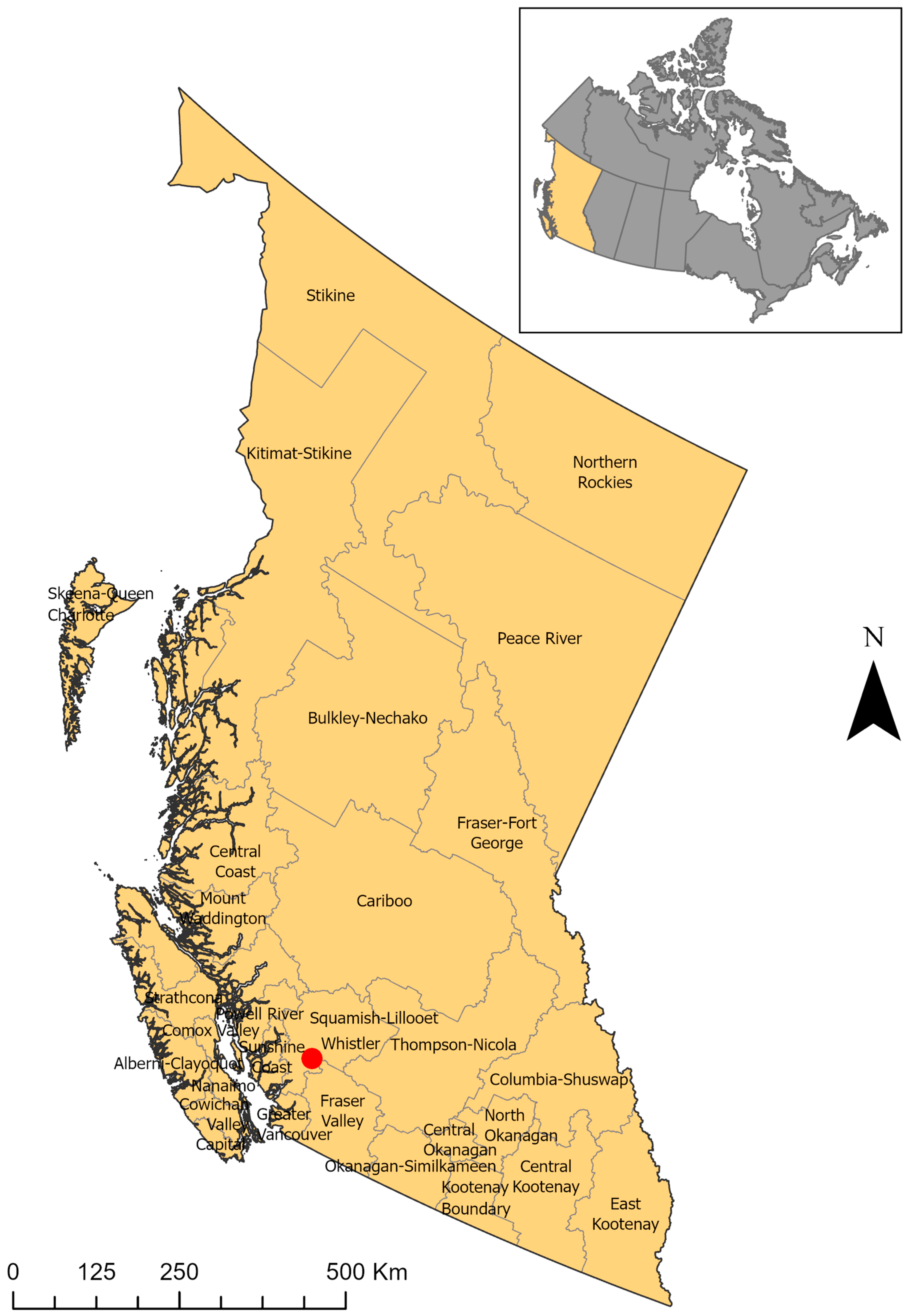
4.1. Study Area
4.2. Methods
4.3. Demographic and Residential Characteristics
5. Findings
5.1. Wildfire Risk Perception
5.2. Level of Preparedness
5.3. Level of Completion of Mitigation Actions
5.4. Allocation of Responsibility
6. Discussion
7. Conclusions
Funding
Data Availability Statement
Acknowledgments
Conflicts of Interest
References
- Parisien, M.-A.; Barber, Q.E.; Hirsch, K.G.; Stockdale, C.A.; Erni, S.; Wang, X.; Arseneault, D.; Parks, S.A. Fire deficit increases wildfire risk for many communities in the Canadian boreal forest. Nat. Commun. 2020, 11, 2121. [Google Scholar] [CrossRef]
- Coogan, S.C.; Daniels, L.D.; Boychuk, D.; Burton, P.J.; Flannigan, M.D.; Gauthier, S.; Kafka, V.; Park, J.S.; Wotton, B.M. Fifty years of wildland fire science in Canada. Can. J. For. Res. 2021, 51, 283–302. [Google Scholar] [CrossRef]
- Asiyanbi, A.; Davidsen, C. Governing Wildfire Risk in Canada: The Rise of an Apparatus of Security. Ann. Am. Assoc. Geogr. 2023, 113, 1207–1223. [Google Scholar] [CrossRef]
- Sankey, S. Blueprint for Wildland Fire Science in Canada (2019–2029); Natural Resources Canada; Canadian Forest Service, NFC: Ottawa, ON, Canada, 2018; Available online: https://natural-resources.canada.ca/forest-forestry/wildland-fires/blueprint-wildland-fire-science-canada-2019-2029 (accessed on 2 February 2026).
- CWFS. Canadian Wildland Fire Strategy. A 10-Year Review and Renewed Call to Action; Canadian Forest Service Publications, Natural Resources Canada: Ottawa, ON, Canada, 2016. [Google Scholar]
- McGee, T.; McFarlane, B.; Tymstra, C. Wildfire: A Canadian Perspective. In Wildfire Hazards, Risks, and Disasters; Elsevier: Amsterdam, The Netherlands, 2014; pp. 35–58. [Google Scholar] [CrossRef]
- IPCC. IPCC Sixth Assessment Report: Impacts, Adaptation and Vulnerability. 2022. Available online: https://www.ipcc.ch/report/ar6/wg2/ (accessed on 2 February 2026).
- Tymstra, C.; Stocks, B.J.; Cai, X.; Flannigan, M.D. Wildfire management in Canada: Review, challenges and opportunities. Prog. Disaster Sci. 2020, 5, 100045. [Google Scholar] [CrossRef]
- Wang, X.; Parisien, M.-A.; Taylor, S.W.; Candau, J.-N.; Stralberg, D.; Marshall, G.A.; Little, J.M.; Flannigan, M.D. Projected changes in daily fire spread across Canada over the next century. Environ. Res. Lett. 2017, 12, 25005. [Google Scholar] [CrossRef]
- NRCan. Canada’s Record-Breaking Wildfires in 2023: A Fiery Wake-Up Call, 2023. Natural Resources Canada. Available online: https://natural-resources.canada.ca/simply-science/canadas-record-breaking-wildfires-2023-fiery-wake-call/25303 (accessed on 2 February 2026).
- NRCan. Cost of Wildland Fire Protection in Canada, 2025. Natural Resources Canada. Available online: https://www.nrcan.gc.ca (accessed on 2 February 2026).
- Tymstra, C. The Chinchaga Firestorm: When the Moon and Sun Turned Blue; University of Alberta: Edmonton, AB, Canada, 2015. [Google Scholar]
- Copes-Gerbitz, K.; Dickson-Hoyle, S.; Ravensbergen, S.L.; Hagerman, S.M.; Daniels, L.D.; Coutu, J. Community engagement with proactive wildfire management in British Columbia, Canada: Perceptions, preferences, and barriers to action. Front. For. Glob. Change 2022, 5, 829125. [Google Scholar] [CrossRef]
- Copes-Gerbitz, K.; Hagerman, S.M.; Daniels, L.D. Transforming fire governance in British Columbia, Canada: An emerging vision for coexisting with fire. Reg. Environ. Change 2022, 22, 48. [Google Scholar] [CrossRef]
- Partners in Protection. FireSmart: Protecting Your Community from Wildfire, 2nd ed.; Partners in Protection: Edmonton, AB, Canada, 2003. [Google Scholar]
- McDonald, J.; McCormack, P.C. Responsibility and risk-sharing in climate adaptation: A case study of bushfire risk in Australia. Clim. Law 2022, 12, 128–161. [Google Scholar] [CrossRef]
- Beilin, R.; Paschen, J.A. Risk, resilience and response-able practice in Australia’s changing bushfire landscapes. Environ. Plan. D Soc. Space 2021, 39, 514–533. [Google Scholar] [CrossRef]
- Crosweller, M.; Tschakert, P. Disaster management and the need for a reinstated social contract of shared responsibility. Int. J. Disaster Risk Reduct. 2021, 63, 102440. [Google Scholar] [CrossRef]
- Cooper, V.; Fairbrother, P.; Elliott, G.; Walker, M.; Ch’ng, H.Y. Shared responsibility and community engagement: Community narratives of bushfire risk information in Victoria, Australia. J. Rural Stud. 2020, 80, 259–272. [Google Scholar] [CrossRef]
- Reid, K.; Beilin, R.; McLennan, J. Shaping and sharing responsibility: Social memory and social learning in the Australian rural bushfire landscape. Soc. Nat. Resour. 2018, 31, 442–456. [Google Scholar] [CrossRef]
- Lukasiewicz, A.; Dovers, S.; Eburn, M. Shared responsibility: The who, what and how. Environ. Hazards 2017, 16, 291–313. [Google Scholar] [CrossRef]
- McLennan, B.; Weir, J.K.; Eburn, M.; Dovers, S.; Norman, B.J.; Dovers, S. Negotiating risk and responsibility through law, policy and planning. Aust. J. Emerg. Manag. 2014, 29, 22–28. [Google Scholar]
- McLennan, B.J.; Handmer, J. Reframing responsibility-sharing for bushfire risk management in Australia after Black Saturday. Environ. Hazards 2012, 11, 1–15. [Google Scholar] [CrossRef]
- Atkinson, C.; Curnin, S. Sharing responsibility in disaster management policy. Prog. Disaster Sci. 2020, 7, 100122. [Google Scholar] [CrossRef]
- Henstra, D.; Thistlethwaite, J. Flood Risk and Shared Responsibility in Canada: Operating on Flawed Assumptions? Policy Brief No. 116; Centre for International Governance Innovation: Waterloo, ON, Canada, 2017. [Google Scholar]
- Henstra, D.; Thistlethwaite, J. Overcoming Barriers to Meeting the Sendai Framework for Disaster Risk Reduction; Policy Brief No. 105; Centre for International Governance Innovation: Waterloo, ON, Canada, 2017. [Google Scholar]
- Insurance Bureau of Canada. 2024 Shatters Record for Costliest Year for Severe Weather-Related Losses in Canadian History at $8.5 Billion. 2025. Available online: https://www.ibc.ca/news-insights/news/2024-shatters-record-for-costliest-year-for-severe-weather-related-losses-in-canadian-history-at-8-5-billion (accessed on 21 January 2026).
- Sandink, D. The Resilience of the City of Kelowna: Exploring Mitigation Before, During and After the Okanagan Mountain Park Fire; Institute for Catastrophic Loss Reduction: Toronto, ON, Canada, 2010. [Google Scholar]
- Zahara, A. Breathing Fire into Landscapes that Burn. Engag. Sci. Technol. Soc. 2020, 6, 555–585. [Google Scholar] [CrossRef]
- McFarlane, B.L.; McGee, T.K.; Faulkner, H. Complexity of homeowner wildfire risk mitigation: An integration of hazard theories. Int. J. Wildland Fire 2011, 20, 921–931. [Google Scholar] [CrossRef]
- McGee, T.K. Preparedness and experiences of evacuees from the 2016 Fort McMurray Horse River wildfire. Fire 2019, 2, 13. [Google Scholar] [CrossRef]
- Henstra, D.; Thistlethwaite, J.; Brown, C.; Scott, D. Flood risk management and shared responsibility: Exploring Canadian public attitudes and expectations. J. Flood Risk Manag. 2019, 12, e12346. [Google Scholar] [CrossRef]
- Eriksen, C. Gender and Wildfire: Landscapes of Uncertainty; Routledge: Oxfordshire, UK, 2013. [Google Scholar]
- McLennan, B.; Eburn, M. Exposing hidden-value trade-offs: Sharing wildfire management responsibility between government and citizens. Int. J. Wildland Fire 2014, 24, 162–169. [Google Scholar] [CrossRef]
- Blackburn, S.; Pelling, M. The political impacts of adaptation actions: Social contracts, a research agenda. WIREs Clim. Change 2018, 9, e549. [Google Scholar] [CrossRef]
- Essen, M.; McCaffrey, S.; Abrams, J.; Paveglio, T. Improving wildfire management outcomes: Shifting the paradigm of wildfire from simple to complex risk. J. Environ. Plan. Manag. 2023, 66, 909–927. [Google Scholar] [CrossRef]
- Paveglio, T.B.; Moseley, C.; Carroll, M.S.; Williams, D.R.; Davis, E.J.; Fischer, A.P. Categorizing the social context of the wildland urban interface: Adaptive capacity for wildfire and community “archetypes”. For. Sci. 2015, 61, 298–310. [Google Scholar] [CrossRef]
- Paveglio, T.B.; Prato, T.; Edgeley, C.; Nalle, D. Evaluating the characteristics of social vulnerability to wildfire: Demographics, perceptions, and parcel characteristics. Environ. Manag. 2016, 58, 534–548. [Google Scholar] [CrossRef]
- Canosa, I.V.; Ford, J.; Pearce, T.; Whitehead, J.; Torgerson, O.; Paavola, J.; Ostberg, M.; Shea, J.M. Exploring wildfire preparedness, perceptions, and responses in Western Canada: Insights from Valemount, British Columbia. Weather Clim. Soc. 2025, 17, 699–714. [Google Scholar] [CrossRef]
- Kirschner, J.; Clark, J.; Boustras, G. Governing wildfires: Toward a systematic analytical framework. Ecol. Soc. 2023, 28, 6. [Google Scholar] [CrossRef]
- McCaffrey, S. Community wildfire preparedness: A global state-of-the-knowledge summary of social science research. Curr. For. Rep. 2015, 1, 81–90. [Google Scholar] [CrossRef]
- McCaffrey, S.; McGee, T.K.; Coughlan, M.; Tedim, F. Understanding wildfire mitigation and preparedness in the context of extreme wildfires and disasters. In Extreme Wildfire Events and Disasters; Elsevier: Amsterdam, The Netherlands, 2020; pp. 155–174. [Google Scholar]
- Santana, F.N.; Gonzalez, D.J.; Wong-Parodi, G. Psychological factors and social processes influencing wildfire smoke protective behavior: Insights from a case study in Northern California. Clim. Risk Manag. 2021, 34, 100351. [Google Scholar] [CrossRef]
- Eriksen, C.; Simon, G. The Affluence–Vulnerability Interface: Intersecting scales of risk, privilege and disaster. Environ. Plan. A 2017, 49, 293–313. [Google Scholar] [CrossRef]
- Bogdan, E.; Krueger, R.; Wright, J.; Woods, K.; Cottar, S. Disaster awareness and preparedness among older adults in Canada regarding floods, wildfires, and earthquakes. Int. J. Disaster Risk Sci. 2024, 15, 198–212. [Google Scholar] [CrossRef]
- Cote, D.W.; McGee, T.K. An exploration of residents’ intended wildfire evacuation responses in Mt. Lorne, Yukon, Canada. For. Chron. 2014, 90, 498–502. [Google Scholar] [CrossRef]
- Christianson, A.; McGee, T.K.; L’Hirondelle, L. Community support for wildfire mitigation at Peavine Métis settlement, Alberta, Canada. Environ. Hazards 2012, 11, 177–193. [Google Scholar] [CrossRef]
- Faulkner, H.; McFarlane, B.L.; McGee, T.K. Comparison of homeowner response to wildfire risk among towns with and without wildfire management. Environ. Hazards 2009, 8, 38–51. [Google Scholar] [CrossRef]
- McGee, T.K.; McFarlane, B.L.; Varghese, J. An examination of the influence of hazard experience on wildfire risk perceptions and adoption of mitigation measures. Soc. Nat. Resour. 2009, 22, 308–323. [Google Scholar] [CrossRef]
- Peterson, K.F.; Eskelson, B.N.I.; Monleon, V.J.; Daniels, L.D. Surface fuel loads following a coastal–transitional fire of unprecedented severity: Boulder Creek fire case study. Can. J. For. Res. 2019, 49, 925–932. [Google Scholar] [CrossRef]
- Daniels, L.D.; Gray, R.W.; Brett, B.; Pickell, P.D.; Pisaric, M.J.F.; Chavardès, R.D.; Greene, G.A.; Marcoux, H.M.; Comeau, V. Disturbance Regimes in the Maritime to Submaritime Forests of the South Coast of British Columbia: Status of Knowledge and Understanding; Report to the British Columbia Ministry of Forests, Lands and Natural Resource Operations: Victoria, BC, Canada, 2017. [Google Scholar]
- PCIC. Summary of 2050s Climate Projections for Whistler Area; Pacific Climate Impact Consortium; University of Victoria: Victoria, BC, Canada, 2016. [Google Scholar]
- RMOW. Resort Municipality of Whistler Wildfire Protection Strategy December 2016; BA Blackwell and Associates Limited: Vancouver, BC, Canada, 2016. [Google Scholar]
- Pique Magazine. Whistler Confronts Wildfire Uncertainty with Bold New Plans and Collaborative Science. 16 May 2025. Available online: https://www.piquenewsmagazine.com/local-news/whistler-confronts-wildfire-uncertainty-with-bold-new-plans-and-collaborative-science-10660587 (accessed on 2 February 2026).
- Statistics Canada, Government of Canada. Profile Table, Census Profile, 2021 Census of Population—Whistler, District Municipality (DM) [Census Subdivision], British Columbia. 9 February 2022. Available online: https://www12.statcan.gc.ca/census-recensement/2021/dp-pd/prof/index.cfm?Lang=E (accessed on 2 February 2026).
- Oulahen, G. Flood hazards, environmental rewards, and the social reproduction of risk. Geoforum 2021, 119, 43–51. [Google Scholar] [CrossRef]
- Moser, C.A.; Kalton, G. Survey Methods in Social Investigation; Routledge: Oxfordshire, UK, 2017. [Google Scholar]
- NRCan. Jasper Wildfire Complex 2024: Fire Behaviour Documentation, Reconstruction and Analysis. Canadian Forest Service Information Report NOR-X-433; Northern Forestry Centre: Edmonton, AB, Canada, 2024. [Google Scholar]
- Hamilton, M.; Salerno, J.; Fischer, A.P. Cognition of complexity and trade-offs in a wildfire-prone social-ecological system. Environ. Res. Lett. 2019, 14, 125017. [Google Scholar] [CrossRef]


| Demographic and Residential Characteristics | Count | Percent | |
|---|---|---|---|
| What is your age range? (n = 191) | Below 18 | 0 | 0.0% |
| 18–34 | 5 | 2.6% | |
| 35–44 | 24 | 12.6% | |
| 45–54 | 38 | 19.9% | |
| 55–64 | 50 | 26.2% | |
| 65 and above | 74 | 38.7% | |
| What is your gender? (n = 191) | Male | 93 | 48.7% |
| Female | 94 | 49.2% | |
| Non-binary/third gender | 0 | 0.0% | |
| Prefer not to say | 4 | 2.1% | |
| What is the range of your earning per annum after tax? (n = 189) | Less than $35,000 | 2 | 1.1% |
| $35,000–$70,000 | 39 | 20.6% | |
| $70,000–$150,000 | 54 | 28.6% | |
| More than $150,000 | 54 | 28.6% | |
| Undisclosed | 40 | 21.2% | |
| Ownership of residence (n = 233) | Owner | 203 | 87.1% |
| Part owner | 6 | 2.6% | |
| Renting | 23 | 9.9% | |
| Residing based on other arrangements | 1 | 0.4% | |
| Property type (n = 231) | Detached | 143 | 61.9% |
| Semi-detached including duplex and fourplex | 42 | 18.2% | |
| Row-townhouse | 25 | 10.8% | |
| Apartment | 18 | 7.8% | |
| Others | 3 | 1.3% | |
| How long have you lived in the current property in years (n = 232) | Less than 5 | 59 | 25.4% |
| 5–14 | 91 | 39.2% | |
| 15–24 | 30 | 12.9% | |
| 25 or more | 52 | 22.4% | |
| ‘1’ Very Concerned | ‘2’ Concerned | ‘3’ Neutral | ‘4’ Unconcerned | ‘5’ Very Unconcerned | Mean | Std. Deviation | ||
| Concerned about wildfires in Whistler? (n = 230) | 51% | 40% | 7% | 2% | 0% | 1.61 | 0.74 | |
| ‘1’ Extreme | ‘2’ High | ‘3’ Moderate | ‘4’ Low | ‘5’ No Risk | ‘6’ Unknown | |||
| Perceived risk to Whistler from wildfire? (n = 230) | 25% | 55% | 19% | 1% | 0% | 0% | 1.95 | 0.69 |
| Perceived risk property from wildfire? (n = 230) | 17% | 47% | 32% | 4% | 0% | 0% | 2.24 | 0.78 |
| ‘1’ Strongly Agree | ‘2’ Agree | ‘3’ Neutral | ‘4’ Disagree | ‘5’ Strongly Disagree | ||||
| Threat to property warrants mitigation (n = 229) | 36% | 48% | 12% | 3% | 1% | 1.86 | 0.83 |
| ‘2’ Yes | ‘1’ No | Mean | S.D. | |
|---|---|---|---|---|
| If evacuated, I have a place to go aside from the emergency shelter (n = 220) | 73% | 27% | 1.73 | 0.444 |
| I have a grab-and-go bag ready in case of an evacuation (n = 223) | 36% | 64% | 1.36 | 0.481 |
| I know where in the community to find information during an emergency (n = 222) | 64% | 36% | 1.64 | 0.480 |
| I have a fireproof safe for valuables (n = 221) | 26% | 74% | 1.26 | 0.441 |
| My household has a plan in place in case of an evacuation order (n = 221) | 40% | 60% | 1.40 | 0.491 |
| If I have a suggestion on wildfire management, I know where to provide it (n = 218) | 36% | 64% | 1.36 | 0.480 |
| I am aware of the wildfire management process in my community (n = 219) | 53% | 47% | 1.53 | 0.500 |
| I have healthcare coverage in addition to the provincial healthcare plan (n = 218) | 69% | 31% | 1.69 | 0.462 |
| Completed | To Complete in 1 Year | To Complete in 2 Years | To Complete in 3 Years | Not Applicable | |
|---|---|---|---|---|---|
| Screen or enclose the undersides of decks and porches (n = 199) | 20% | 10% | 6% | 13% | 51% |
| Install stucco, metal, brick or other fire-resistant exterior siding on your house (n = 196) | 28% | 3% | 1% | 11% | 58% |
| Screen house vents, gutters and the underside of eaves with metal mesh (n = 206) | 32% | 11% | 7% | 11% | 39% |
| Landscape with fire-resistant materials and vegetation (such as rocks, aspen) (n = 206) | 39% | 11% | 6% | 7% | 37% |
| Thin shrubs or trees so that nearby plants and trees do not touch (n = 211) | 50% | 24% | 4% | 4% | 18% |
| Prune large trees by removing all branches that are close to the ground (n = 209) | 55% | 22% | 4% | 3% | 17% |
| Remove needles, leaves and overhanging branches from the roof and gutters (n = 207) | 61% | 14% | 3% | 2% | 19% |
| Keep grass short and water frequently during the spring, summer and autumn (n = 214) | 63% | 4% | 0% | 0% | 33% |
| Remove shrubs, trees or fallen branches close to your house (n = 212) | 65% | 19% | 2% | 3% | 11% |
| Install metal, asphalt, slate, tile or other fire-resistant roofing materials on your roof (n = 205) | 70% | 1% | 0% | 6% | 22% |
| Install double or thermal pane or tempered glass in windows and exterior glass (n = 204) | 71% | 2% | 0% | 9% | 17% |
| Ranking | Preparedness | Mitigation | Response | Relief and Recovery |
|---|---|---|---|---|
| 1 | Municipal Government (M = 2) | Municipal Government (M = 1.93) | Municipal Government (M = 1.7) | Provincial Government (M = 2.49) |
| 2 | Homeowner (M = 2.82) | Provincial Government (M = 2.76) | Provincial Government (M = 2.26) | Municipal Government (M = 2.89) |
| 3 | Provincial Government (M = 3.07) | Homeowner (M = 3.1) | Federal Government (M = 3.91) | Private Sector (e.g., Insurance) (M = 3.52) |
| 4 | Local Community (M = 3.72) | Local Community (M = 3.69) | Local Community (M = 3.94) | Federal Government (M = 3.61) |
| 5 | Federal Government (M = 4.62) | Federal Government (M = 4.32) | Homeowner (M = 4.39) | Homeowner (M = 4.99) |
| 6 | Private Sector (e.g., Insurance) (M = 5.4) | Private Sector (e.g., Insurance) (M = 5.61) | Private Sector (e.g., Insurance) (M = 5.77) | Local Community (M = 5.06) |
| 7 | NGOs (e.g., Red Cross) (M = 6.38) | NGOs (e.g., Red Cross) (M = 6.59) | NGOs (e.g., Red Cross) (M = 6.03) | NGOs (e.g., Red Cross) (M = 5.44) |
| Variable Description | Score | Mean | S.D. |
|---|---|---|---|
| Ownership of residence | 1 = Owner, 2 = Part Owner, 3 = Renting, 4 = Other | 1.24 | 0.637 |
| Wildfire threat to property warrants mitigation | 1 = Strongly Agree, 5 = Strongly Disagree | 1.86 | 0.830 |
| To what degree is fuel management effective? | 1 = Very Effective 5 = Very Ineffective | 2.13 | 0.883 |
| Maximum one-off payment for a FireSmart assessment? | 1 = No cost, 2 = $250, 3 = $500, 4 = $750, 5 = $1000, 6 = $1500 | 1.69 | 1.017 |
| I have the skills for wildfire mitigation work. | 1 = Strongly Agree, 5 = Strongly Disagree | 3.05 | 1.115 |
| Property type | 1 = Detached, 2 = Semi-Detached, 3 = Townhouse, 4 = Apartment, 5 = Other | 1.68 | 1.030 |
| How familiar are you with FireSmart activities? | 1 = Very Familiar, 5 = Unfamiliar | 1.99 | 1.058 |
| Have you had a FireSmart assessment done for your residence? | 1 = No, 2 = Yes | 1.44 | 0.497 |
| It is difficult to find money for wildfire mitigation work | 1 = Strongly Agree, 5 = Strongly Disagree | 2.40 | 0.956 |
| Mitigation will significantly reduce damage to my property | 1 = Strongly Agree, 5 = Strongly Disagree | 2.06 | 0.887 |
| Variable Description | Score | Mean | S.D. |
|---|---|---|---|
| How concerned are you about wildfires in Whistler? | 1 = Very Concerned, 5 = Very Unconcerned | 1.61 | 0.740 |
| What do you perceive as the risk to Whistler of a potential wildfire? | 1 = Extreme, 5 = No Risk, 6 = Unknown | 1.95 | 0.690 |
| What do you perceive as the risk to your property of a potential wildfire? | 1 = Extreme, 5 = No Risk, 6 = Unknown | 2.24 | 0.780 |
| To what degree are you prepared for a future wildfire event? | 1 = Very Prepared, 5 = Unprepared, 6 = Unsure | 3.13 | 0.951 |
| To what degree do you think your community is prepared for a future wildfire event? | 1 = Very Prepared, 5 = Unprepared, 6 = Unsure | 3.35 | 0.996 |
| Have you had a FireSmart assessment done for your residence? | 1 = No, 2 = Yes | 1.44 | 0.497 |
| Variable Description | Score | Mean | S.D. |
|---|---|---|---|
| Have you ever been evacuated or placed on evacuation alert because of a wildfire? | 1 = Yes, 2 = No | 1.91 | 0.283 |
| Do you have fire insurance coverage? | 1 = No, 2 = Not sure, 3 = Yes | 2.75 | 0.525 |
| If evacuated, I have a place to go aside from the emergency. | 1 = No, 2 = Yes | 1.73 | 0.444 |
| I have a grab-and-go bag ready in case of an evacuation order. | 1 = No, 2 = Yes | 1.36 | 0.481 |
| I know where in the community to find information during an emergency. | 1 = No, 2 = Yes | 1.64 | 0.480 |
| I have a fireproof safe for valuables. | 1 = No, 2 = Yes | 1.26 | 0.441 |
| My household has a plan in place in case of an evacuation order. | 1 = No, 2 = Yes | 1.40 | 0.491 |
| At what point do you think the resources of Whistler’s fire department are no longer sufficient to address a fire event? | 1 = 2 houses on fire, 2 = 5 houses, 3 = 10 houses, 4 = 20 houses, 5 = 50 houses | 2.11 | 0.832 |
| Variable Description | Score | Mean | S.D. |
|---|---|---|---|
| Do you have a fire insurance coverage? | 1 = No, 2 = Not sure, 3 = Yes | 2.75 | 0.525 |
| I have access to healthcare insurance coverage in addition to the provincial healthcare plan. | 1 = No, 2 = Yes | 1.69 | 0.462 |
Disclaimer/Publisher’s Note: The statements, opinions and data contained in all publications are solely those of the individual author(s) and contributor(s) and not of MDPI and/or the editor(s). MDPI and/or the editor(s) disclaim responsibility for any injury to people or property resulting from any ideas, methods, instructions or products referred to in the content. |
© 2026 by the author. Licensee MDPI, Basel, Switzerland. This article is an open access article distributed under the terms and conditions of the Creative Commons Attribution (CC BY) license.
Share and Cite
Asiyanbi, A.P. Who Does What? Shared Responsibility for Wildfire Management and the Imperative of Public Engagement: Evidence from Whistler, Western Canada. Fire 2026, 9, 114. https://doi.org/10.3390/fire9030114
Asiyanbi AP. Who Does What? Shared Responsibility for Wildfire Management and the Imperative of Public Engagement: Evidence from Whistler, Western Canada. Fire. 2026; 9(3):114. https://doi.org/10.3390/fire9030114
Chicago/Turabian StyleAsiyanbi, Adeniyi P. 2026. "Who Does What? Shared Responsibility for Wildfire Management and the Imperative of Public Engagement: Evidence from Whistler, Western Canada" Fire 9, no. 3: 114. https://doi.org/10.3390/fire9030114
APA StyleAsiyanbi, A. P. (2026). Who Does What? Shared Responsibility for Wildfire Management and the Imperative of Public Engagement: Evidence from Whistler, Western Canada. Fire, 9(3), 114. https://doi.org/10.3390/fire9030114