
Article

DC Series Arc Fault Detection in Photovoltaic Systems Using a Hybrid WDCNN-BiLSTM-CA Model

1
School of Resources and Safety Engineering, University of Science and Technology Beijing, Beijing 100083, China
2
Research Institute of Macro-Safety Science, University of Science and Technology, Beijing 100083, China
3
Joint Innovation Key Laboratory of Ministry of Emergency Management for Emerging Risk Identification, Prevention and Control in Safety Production, Beijing 100083, China
4
Yangtze Memory Technologies Co., Ltd., Wuhan 430078, China
5
Process Safety and Disaster Prevention Laboratory, Department of Safety, Health, and Environmental Engineering, National Yunlin University of Science and Technology, 123, University Rd., Sec. 3, Douliou, Yunlin 64002, Taiwan
*
Authors to whom correspondence should be addressed.
Submission received: 18 December 2025 / Revised: 5 February 2026 / Accepted: 7 February 2026 / Published: 12 February 2026
(This article belongs to the Special Issue Photovoltaic and Electrical Fires: 2nd Edition)

Abstract

Arc fault is the dominant cause of fire in photovoltaic (PV) systems, making its accurate identification crucial for PV fire prevention. This study investigates the influence of voltage (200, 300, and 400 V) and current (3, 5, 7, 9, and 11 A) on the DC series arc fault characteristics in PV systems obtained through experimental analysis. The results show that voltage variation has a negligible impact on arc fault behavior, while higher current levels substantially increase noise in the arc fault signals. To effectively mitigate noise, this paper proposes a denoising method that combines an improved moss growth optimization algorithm (IMGO) with improved complete ensemble empirical mode decomposition featuring adaptive noise (ICEEMDAN). It is found that the IMGO-ICEEMDAN denoising algorithm can effectively diminish noise in current signals, broaden characteristic frequency bands, and ameliorate arc feature discernibility. Subsequently, an integrated multi-scale spatiotemporal model is developed to extract arc fault features from the denoised signals. The model employs wide deep convolutional neural networks (WDCNNs) and bidirectional long short-term memory (BiLSTM) networks for parallel feature extraction, supplemented by a cross-attention (CA) module to optimize feature integration. The proposed WDCNN-BiLSTM-CA model ultimately achieves a detection accuracy of 99.89%, demonstrating superior detection performance over conventional methods, such as CNN-GRU and 1DCNN-LSTM models. This work provides a reliable framework for arc fault detection and fire risk reduction in PV systems.

1. Introduction

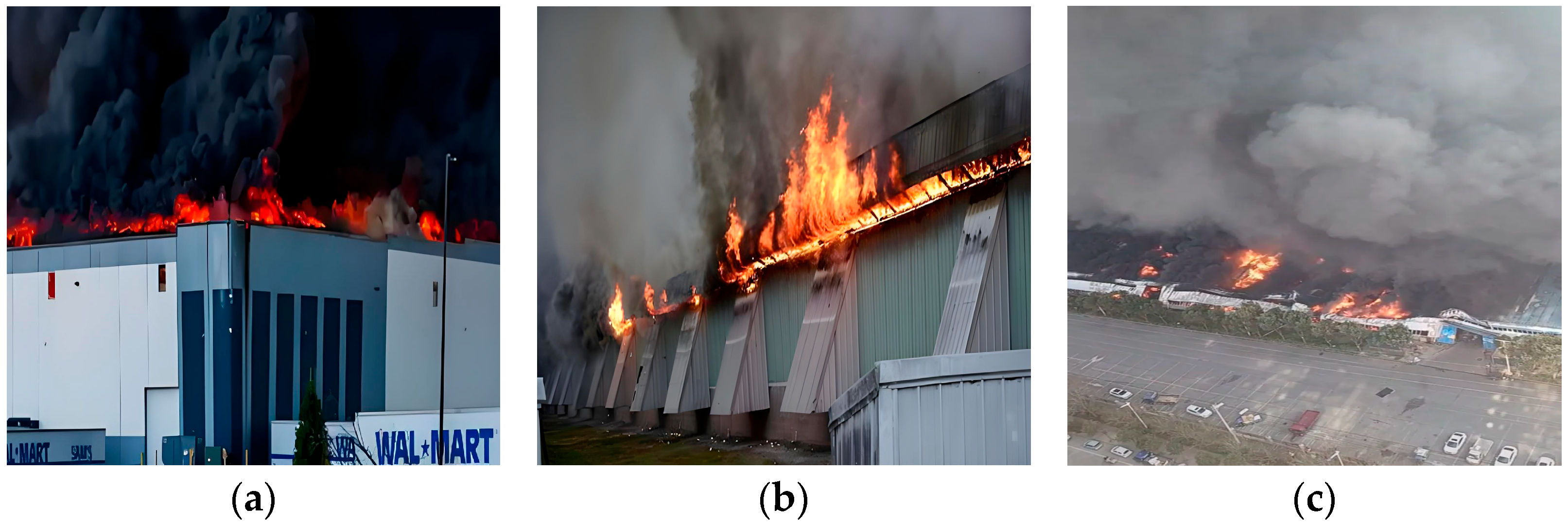
Solar energy is broadly recognized as a key renewable resource and is experiencing expeditious global expansion in installation [1,2,3]. The growing deployment of PV systems at higher voltage and current levels increases their susceptibility to DC arc faults [4]. These faults can be triggered by various causes, including cell damage, solder joint detachment, rodent damage, conductor corrosion, and cable insulation deterioration [5,6]. Arc faults release tremendous energy, generating temperatures of several thousand degrees Celsius [7,8] and posing a pronounced fire hazard worldwide [9,10]. Statistics indicate that 28.9 fires occur per GW installed [9]. Such fires frequently lead to substantial economic losses, as shown in Figure 1. A case in point is the fire at Jinko Solar’s production base in Shanxi, China, on 26 April 2024, which alone resulted in a direct economic loss of approximately RMB 1.5 billion [11]. Research from Germany’s BAM further shows that electrical faults—primarily arc faults—account for 62% of all PV fire incidents [12]. Consequently, developing reliable arc fault detection methods is crucial for fire prevention in PV systems.
In recent years, extensive research has been devoted to investigating the characteristics of DC series arc faults in PV systems. These studies have revealed that the current and voltage signals during arc faults exhibit distinctive features, including fluctuations in current amplitude [16,17], drops in voltage [18,19], and an increase in high-frequency noise [20,21]. Lu et al. [16] analyzed the voltage and current behavior of DC arc faults and proposed that the current drop rate, the rate of change in the average current, and the standard deviations of the AC components of the current and voltage could serve as indicators for arc fault identification. Park et al. [18] observed that a characteristic voltage drop manifests upon the occurrence of a DC series arc fault. Leveraging these electrical attributes, numerous methods for arc fault detection have been developed [22,23,24,25]. Conventionally, techniques such as Fourier transform [26,27] and wavelet transform [28,29] have been employed to extract relevant features from fault signals, with detection decisions primarily based upon predefined thresholds.
Powered by artificial intelligence, machine learning approaches have become capable of efficiently processing large volumes of arc fault data [30,31,32,33]. By employing deep learning methods, such as convolutional neural networks (CNNs) and temporal convolutional networks (TCNs), these approaches can automatically learn discriminative features from input datasets, thereby notably improving recognition performance [34,35,36]. Dang et al. [31] trained eight types of classifiers using time domain statistical features. Their results demonstrated that over half of the algorithms achieved an accuracy exceeding 97%, while the remaining ones reached over 91%. Yan et al. [35] presented a model based upon TCNs for extracting features from current signals, which attained an accuracy of 99.88% at a sampling rate of 250 kHz. Xing et al. [36] adopted a time–frequency analyzer to extract features from the DC-side circuit and applied a CNN to capture spatial patterns from these features. They also integrated a long short-term memory (LSTM) network to model dynamic temporal dependencies. Their experimental results showed that this hybrid approach achieved an overall accuracy of 98.43% in arc fault diagnosis. Nevertheless, most existing deep learning-based detection models are trained on datasets gleaned under limited laboratory conditions, raising concerns about their generalizability and robustness in real-world environments—especially under challenging scenarios involving strong noise interference and noteworthy signal attenuation.
This study addresses the stated limitation by deliberately pushing the boundary of laboratory-based validation. We designed DC series arc fault experiments at the noise-susceptible string end, incorporating a line impedance network to emulate real-world signal attenuation under varying operating conditions, and explicitly treated scenarios like cloudy weather and inverter startup as key interference sources. The frequency domain and time–frequency domain characteristics of arc faults in PV systems were extracted and subsequently denoised using the improved moss growth optimization algorithm–improved complete ensemble empirical mode decomposition with adaptive noise (IMGO-ICEEMDAN) method. To improve the detection accuracy of DC series arc faults, a hybrid multi-scale spatiotemporal model—the WDCNN-BiLSTM-CA model—was developed, which integrates wide deep convolutional neural networks, bidirectional long short-term memory networks, and cross-attention. The performance of the proposed model was evaluated and compared with conventional detection methods.

2. Experimental

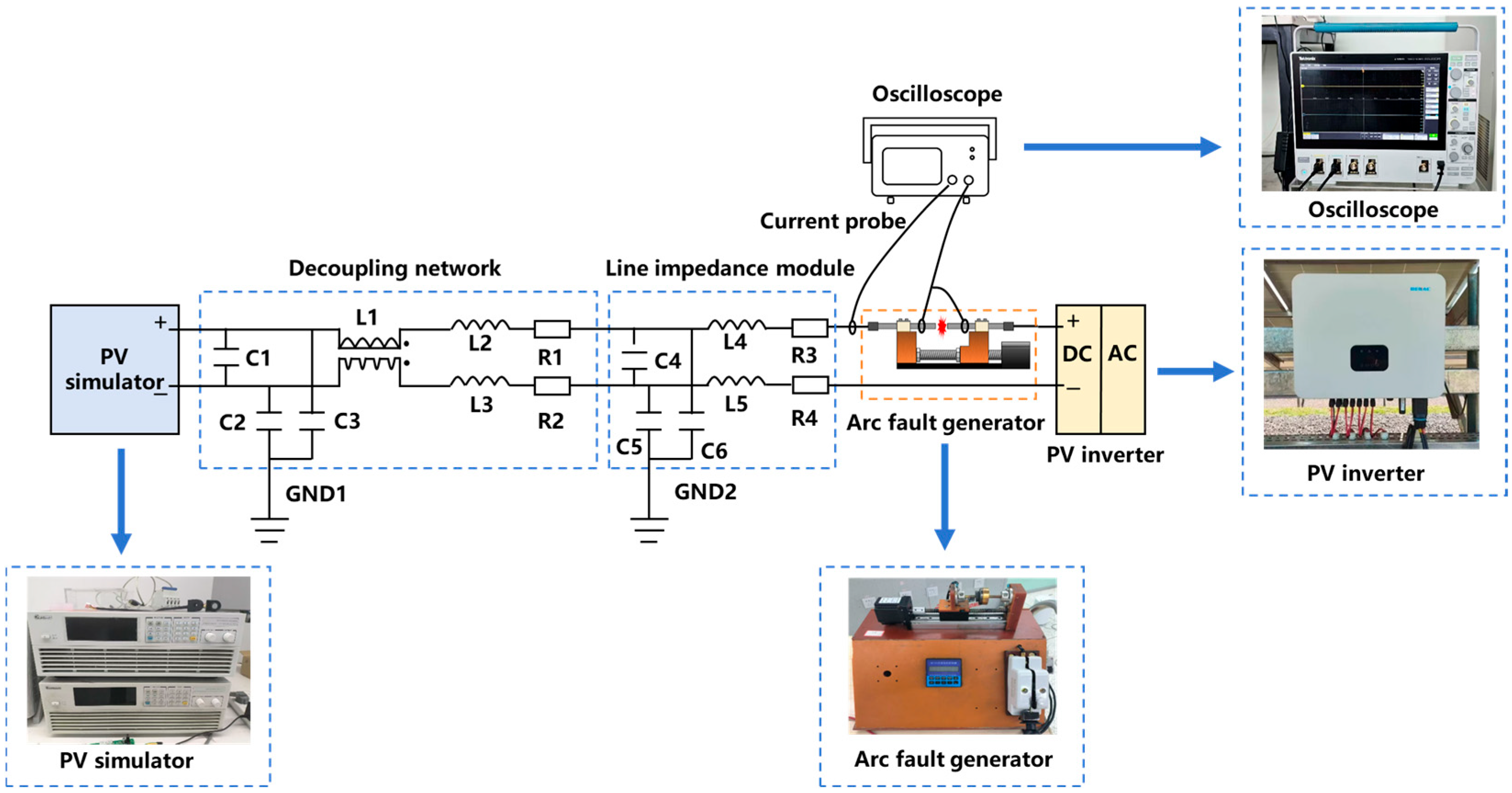
The experimental facility for DC series arc faults in PV systems was constructed in accordance with the UL1699B [37] standard, as illustrated in Figure 2. The facility primarily comprises the following components: (1) a PV simulator (Chroma 62150H-1000S model), capable of a peak voltage of 1000 V and a peak current of 15 A; (2) a PV inverter (Natong R3-50k model), featuring a maximum input current of 50 A, and an operating voltage range of 180–1000 V for maximum power point tracking (MPPT); (3) an oscilloscope (Tektronix MSO4 model), with a sampling rate of 6.25 GS/s, a record length of 31.25 M, and a waveform capture rate exceeding 500,000 wfms/s; (4) current probes (Tektronix TCP305A), with a frequency range spanning DC to 50 MHz and a current range from 5 mA to 50 A; (5) an arc fault generator, utilizing tungsten electrodes with a diameter of 6.3 mm for both the moving and stationary electrodes. To mitigate interference from the power supply, a DC decoupling network is implemented. Furthermore, a line impedance network is employed to simulate the attenuation of arc signals caused by the PV array and cable length in real application scenarios. The relevant parameters of the DC decoupling network and line impedance network are detailed in Table 1.
In the experiments, three voltages of 200, 300, and 400 V, along with five currents of 3, 5, 7, 9, and 11 A, were employed, leading to a total of 15 experimental conditions. Each condition was named sequentially based upon the voltage and current values. For instance, the test with a voltage of 200 V and a current of 3 A was abbreviated as “200 V/3 A”. During the experiments, the gap between two electrodes was set to be 3 mm. The string tail position was selected to simulate the worst scenario, as signal attenuation is most severe there, making arc identification most difficult [6]. According to UL 1699B [37], the characteristic energy of photovoltaic DC series arc faults is primarily distributed below 100 kHz. To capture the signal characteristics within this range, this study employed a sampling frequency of 500 kHz. Therefore, the acquired current signal characteristics covered a frequency range from 0 to 250 kHz, guided by the Nyquist sampling theorem which stipulates a minimum sampling frequency of twice the highest signal frequency.

3. Analysis

As shown in Figure 3, observations of the PV simulator operating at 200 V/3 A revealed that the current waveform remained stable over a broad 2000 ms window. However, at the finer resolution of 0.5 ms, the transient characteristics of arc faults closely resembled background noise. This indicated that noise obscures discriminative information and made pure time domain analysis prone to misjudgment. To address this limitation, the present study adopted a combined frequency domain and time–frequency domain approach.

3.1. Frequency Domain Analysis

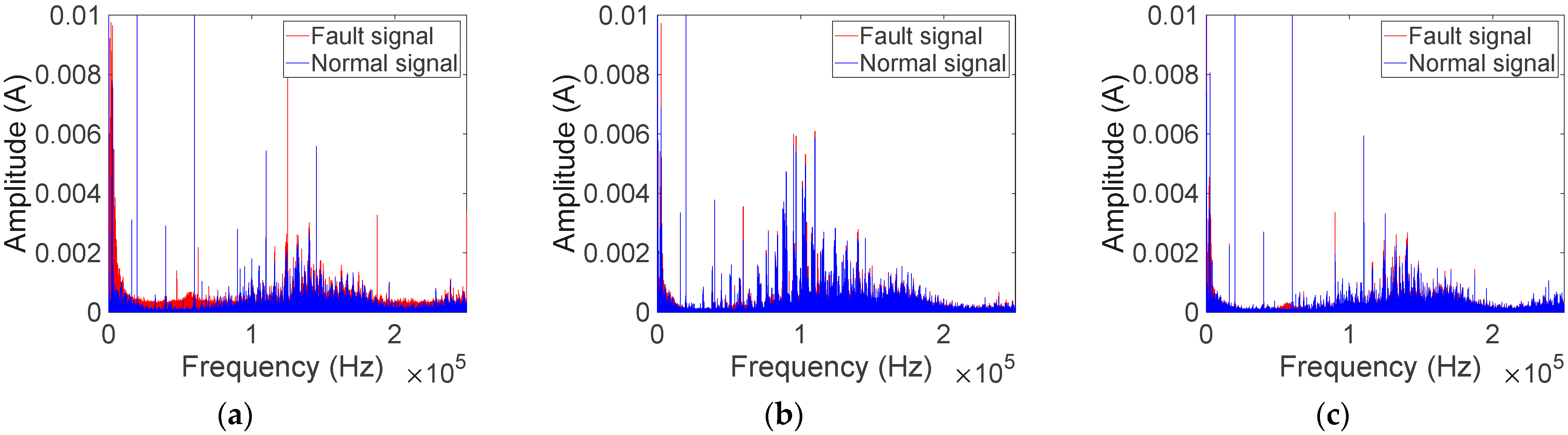
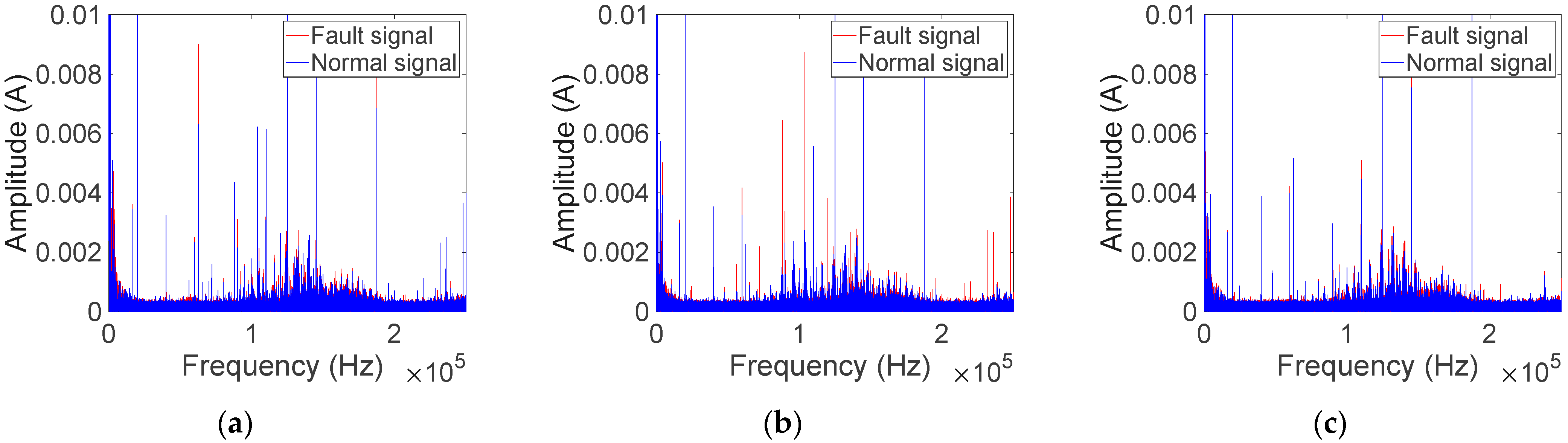
Based upon the current signals collected under varying voltage and current conditions, fast Fourier transform (FFT) was employed to extract frequency domain characteristics of arc faults. To better highlight the subtle but critical differences between low-amplitude spectral features, a constrained y-axis range was intentionally employed in the frequency domain plots. Figure 4 displays the frequency domain distributions under different voltage levels at a constant current of 3 A, while Figure 5 shows those under different current levels at a fixed voltage of 200 V. The results indicate minimal discernibility between normal and fault signals across all tested conditions. Neither normal nor fault signals exhibited consistent variations with increasing voltage or current. Furthermore, frequency domain peaks consistently occurred in the range of 130–150 kHz. Owing to the lack of notable distinction between normal and fault signals, reliable diagnosis of arc fault was quite challenging.

3.2. Time–Frequency Domain Analysis

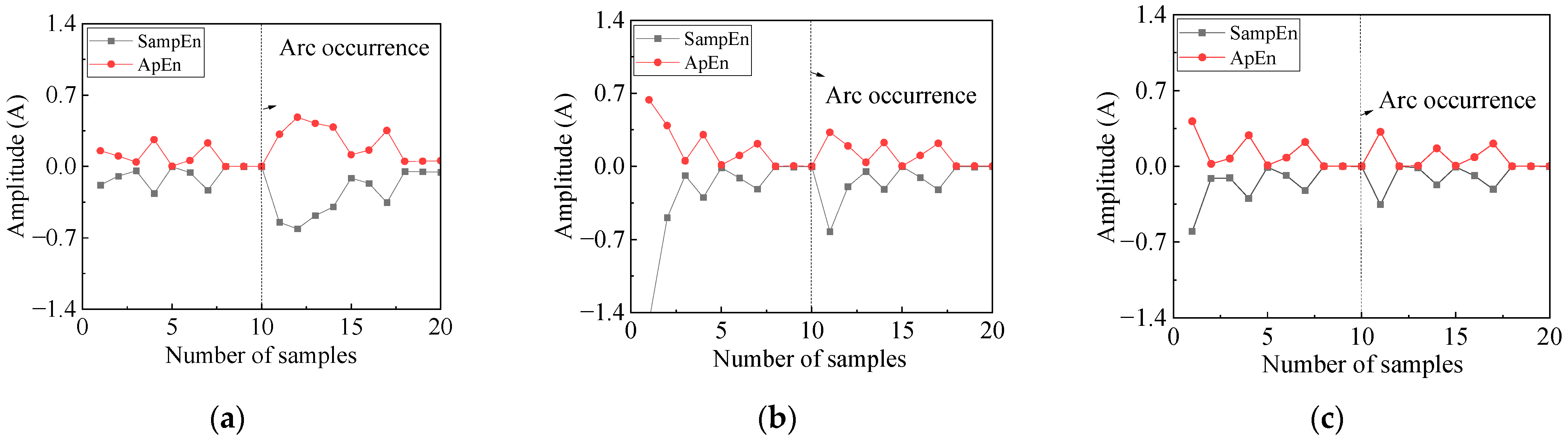
Stationary wavelet transform (SWT) was applied to current signals to extract time–frequency features of arc faults, including fuzzy entropy, energy entropy, approximate entropy (ApEn), and sample entropy (SampEn). However, as fuzzy entropy proved less suitable for time–frequency analysis of arc faults and energy entropy exhibited limited variation and discriminative capability, this study selected approximate entropy and sample entropy for subsequent feature analysis.
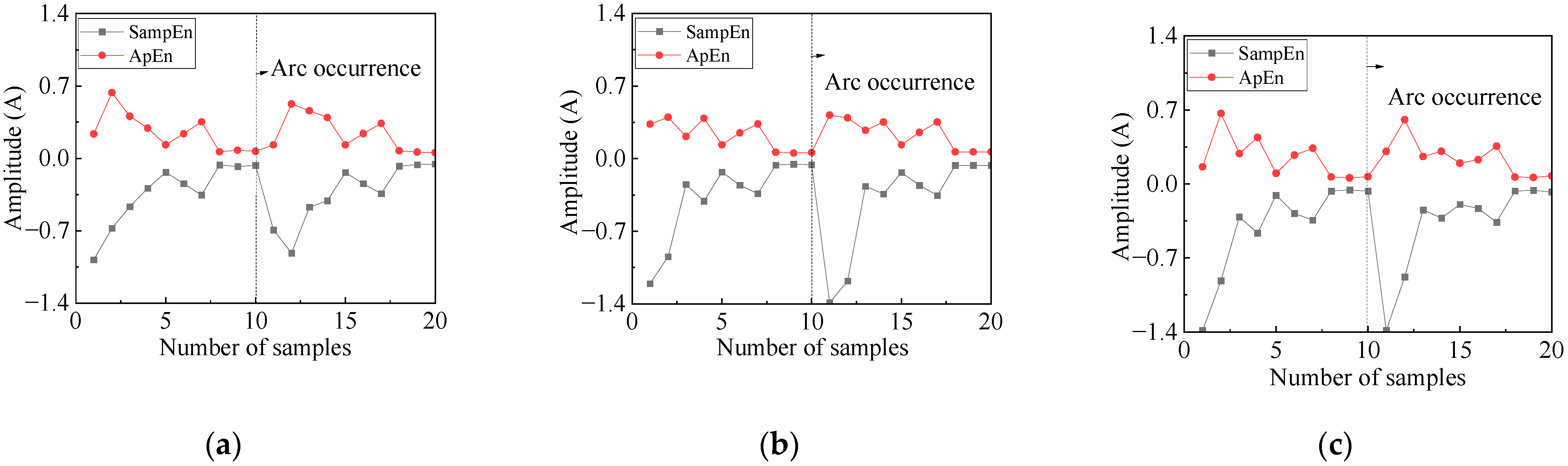
Figure 6 depicts the approximate entropy and sample entropy under different voltage conditions at a constant current of 3 A, while Figure 7 illustrates the corresponding data under various current conditions at a fixed voltage of 200 V. The results indicate that sample entropy and approximate entropy were distributed in a roughly symmetric pattern for both normal and fault signals across different operating conditions. However, no clear distinction between normal and fault states can be observed, nor do the values demonstrate consistent trends with increasing voltage or current. Because of this lack of discernible patterns, denoising of both the frequency domain and time–frequency domain characteristics was essential to enhance the identifiability of arc faults.

4. Denoising

4.1. Denoising Algorithm Based upon IMGO-ICEEMDAN

Owing to the inconspicuous characteristics of series arc faults in both frequency domain and time–frequency domain analyses, denoising is applied to the current signals to ameliorate feature discernibility. Commonly employed denoising methods typically decompose the original signal into multiple components across different frequency bands and subsequently reconstruct the signal to achieve denoising. However, these methods suffer from several limitations, such as mode mixing, an unstable number of intrinsic mode functions (IMFs), and a heavy reliance on manual hyperparameter selection.
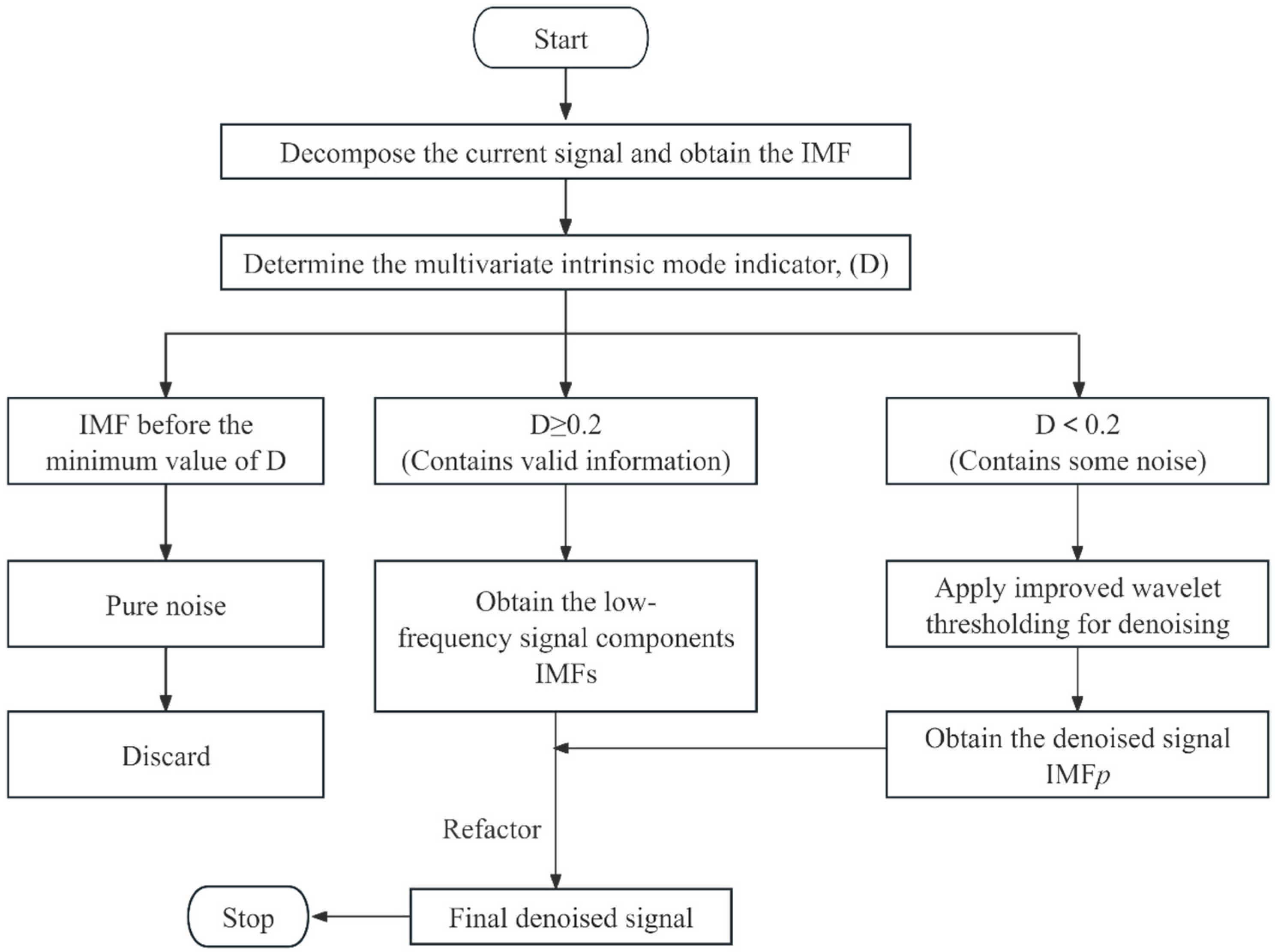
To address these issues, the ICEEMDAN method [38] was adopted. By introducing adaptive noise and a complete integration strategy, this approach effectively mitigates mode mixing during the decomposition process while preserving signal integrity, thereby improving decomposition accuracy. Furthermore, the moss growth optimization (MGO) algorithm can optimize parameter selection in empirical mode decomposition and improve decomposition efficiency [39]. However, since the MGO algorithm involves collaboration and competition among multiple sub-populations, it incurs a high computational load and exhibits slow convergence during the initial search phase. To overcome these drawbacks, an IMGO algorithm was proposed. By incorporating mechanisms from particle swarm optimization, IMGO accelerates convergence and enhances parameter update efficiency. Figure 8 presents a flowchart illustrating the denoising process for DC series arc fault signals in the PV system.
The ICEEMDAN algorithm was employed to decompose photovoltaic DC arc fault signals into IMFs. In this implementation, minimum envelope entropy was utilized as the fitness function for the optimization of the parameters noise time–structure dependence (Ntsd) and noise reduction (NR). The following outcome is achieved by introducing Gaussian white noise into the original signal that is to be decomposed, as expressed in Equation (1):
r 1 = 1 P i = 1 I M x + a 1 ω ( i ) i = 1,2 , , N I M F 1 = x r 1  
where x denotes the original signal, a 1 indicates the signal-to-noise ratio (SNR), ω ( i ) represents the i -th realization of Gaussian white noise, M ( . ) signifies the operator for deriving the mean value via the EMD algorithm, P stands for the length of the PV DC signal, r 1 expresses defined as the first residual component, and I M F 1 exhibits the first modal component.
The n-th residual component r n (Equation (2)) and n-th model component I M F n (Equation (2)) are calculated as follows:
r n = 1 P i = 1 I M r n 1 + ε n 1 E n ω ( i )   I M F n = r n 1 r n     ( n = 3 , 4 , 5 , , N )  
where E n ( x ) is the n-th intrinsic mode function (IMF) of the original signal after empirical mode decomposition (EMD), and ε i is the noise figure.
A residual R is obtained through calculation, as illustrated in Equation (3):
R = x i = 1 I I M F n
For each IMF derived from IMGO-ICEEMDAN decomposition, three indices are calculated: the correlation coefficient ρ (Equation (4)), kurtosis γ (Equation (5)), and the variance contribution rate λ (Equation (6)):
ρ = C o r r X , Y = C o v X , Y σ X σ Y
γ = E [ ( X μ ) 4 ] σ 4
λ = σ X 2 σ Y 2
where X and Y represent the target and original signal, respectively, μ expresses the mean of X , and σ X , σ Y stand for the standard deviations of X and Y .
After normalizing ρ , γ , and λ to receive ρ , γ , and λ , a multivariate intrinsic mode index D is determined using coefficient of variation weighting, as expressed in Equations (7)–(9):
C ρ = σ ρ μ ρ C γ = σ γ μ γ C λ = σ λ μ λ
W ρ = C ρ C ρ + C γ + C λ W γ = C γ C ρ + C γ + C λ W λ = C λ C ρ + C γ + C λ
D = W ρ ρ + W γ γ + W λ λ
where W   is the weight based upon the coefficient of variation.
IMFs preceding the first D minimum are discarded as pure noise. For the remaining components, a threshold of 0.2 is applied for discrimination [40]:
If D 0.2 , the component is regarded as containing useful information and is retained.
If D < 0.2 , the component is considered to still contain noise interference and requires secondary denoising via wavelet thresholding.
Discrete wavelet transform (DWT) uses the db4 wavelet basis to perform three-level wavelet decomposition of the noisy components, yielding high-frequency coefficients W j , k , where j denotes the decomposition level and k represents the coefficient index. The visushrink threshold t is computed as shown in Equation (10):
t = m e d i a a b s W j , k 0.6745 2 l n N
where N is signal length, and 0.6745 is an adjustment factor for noise variance.
The wavelet coefficients W j , k obtained at level j are processed by an improved wavelet threshold function to obtain denoised low-frequency coefficients W ^ j , k . The improved threshold function is expressed as shown in Equation (11):
W ^ j , k = s i g n W j , k W j , k t 1 + α W j , k max W j , k , t β tanh ( α W j , k t ) ,   W j , k > t 0                                                                       ,   W j , k 1 s i g n W j , k α 1 + α W j , k e γ t W j , k 3 ,   W j , k t
where α > 0 , β > 0 , and 0 < γ < 1 are tuning factors that address limitations of conventional soft/hard thresholding in noise suppression and signal preservation, thus preserving more effective signal components and improving denoising performance.
The secondary denoised component is reconstructed with the residual component to form I M F s , while the signal processed through wavelet denoising employing the modified threshold function is reconstructed as I M F p . Subsequently, the final denoised signal S is obtained by reconstructing I M F s , I M F p , and the residual component R , as shown in Equation (12):
S = I M F s + I M F p + R

4.2. Denoising Effects Based upon IMGO-ICEEMDAN

4.2.1. Denoising Effects on Frequency Domain Features

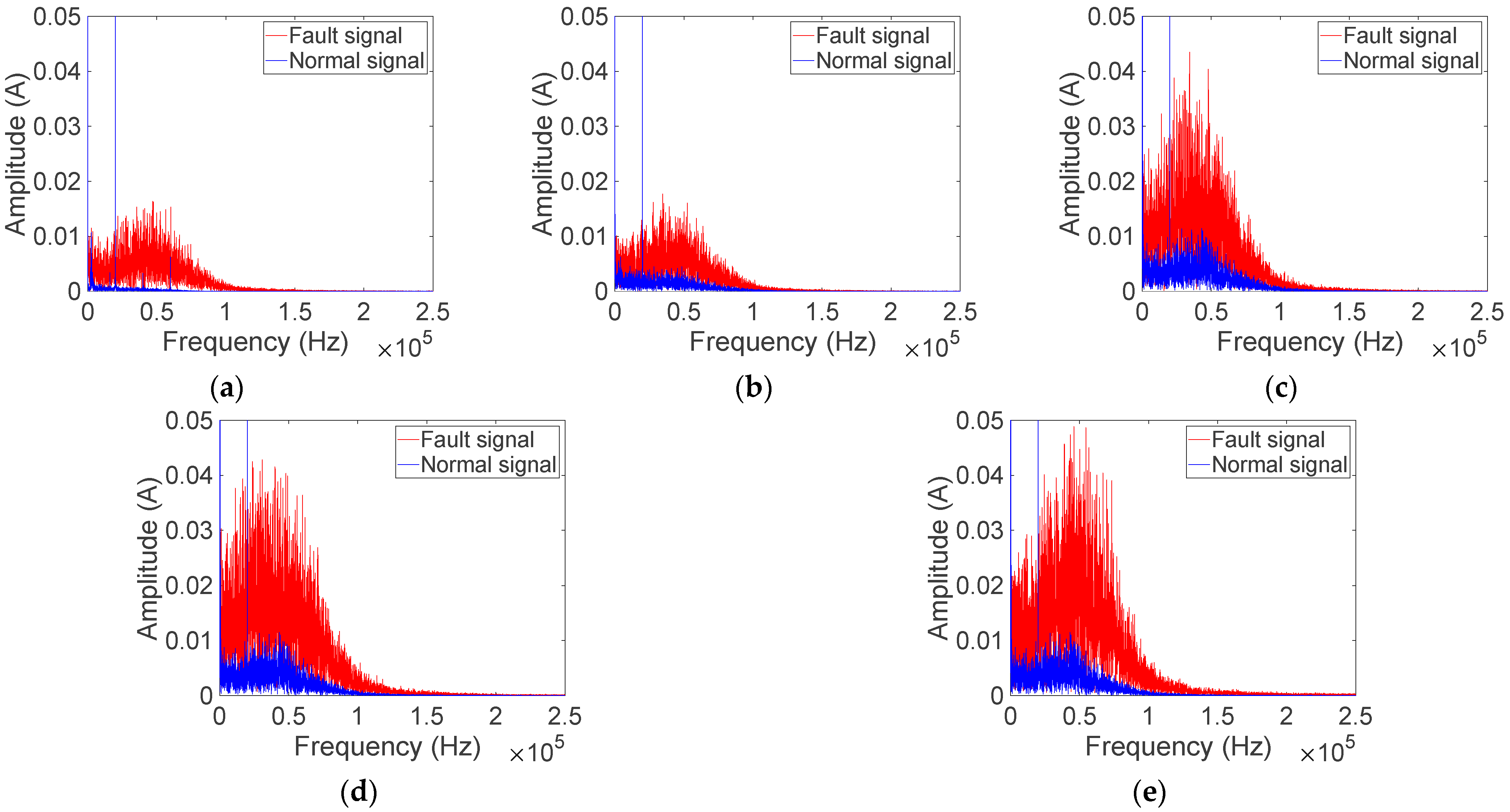
Figure 9 shows the denoised frequency domain plots of the tests with a voltage of 200 V as examples under currents ranging from 3 to 11 A. Through comparison with data before denoising under the same testing conditions presented in Figure 5, it can be noted that the fault characteristics after denoising across all current conditions are concentrated within 0–100 kHz, with a remarkable increase in amplitude. Concurrently, the amplitude in the high-frequency band (100 to 250 kHz) of the denoised current signals decreases substantially. Furthermore, the amplitude of the fault-characteristic signals increases progressively with the applied current. This observation aligns with the principle that effective noise filtering prioritizes signal-to-noise ratio (SNR) enhancement over absolute signal preservation. Although absolute amplitudes may be attenuated, the process makes the key diagnostic features more distinct and preserves their discriminative relationships, thereby enabling more robust fault differentiation.
To better quantify the spectral characteristics of arc faults under diverse operating conditions, a method involving the calculation of segmented spectral energy was employed to pinpoint their characteristic frequency bands. The frequency span from 0 to 100 kHz was divided into five 20 kHz bands, labeled f 1 to f 5 , while the range from 100 to 250 kHz was designated as the f 6 band. The spectral energy ratios of both the fault and normal signals within each of the f 1 f 6 bands were computed. The calculation results before and after denoising are presented in Table 2.
Before denoising, the spectral energy ratio gradually declined as the current increased. This was because the increase in current caused the spectral energy of the normal current signal to surge substantially, while the growth of the arc fault current signal’s energy was comparatively slow. This disparity abated the overall ratio and attenuated the fault characteristics. After denoising, the characteristic frequency bands of arc faults could be accurately identified under all current conditions. Moreover, the spectral energy ratios in the f 3 f 6 bands increased more than tenfold. The denoising process provided a robust basis for PV series arc fault identification.

4.2.2. Denoising Effects on Time–Frequency Domain Features

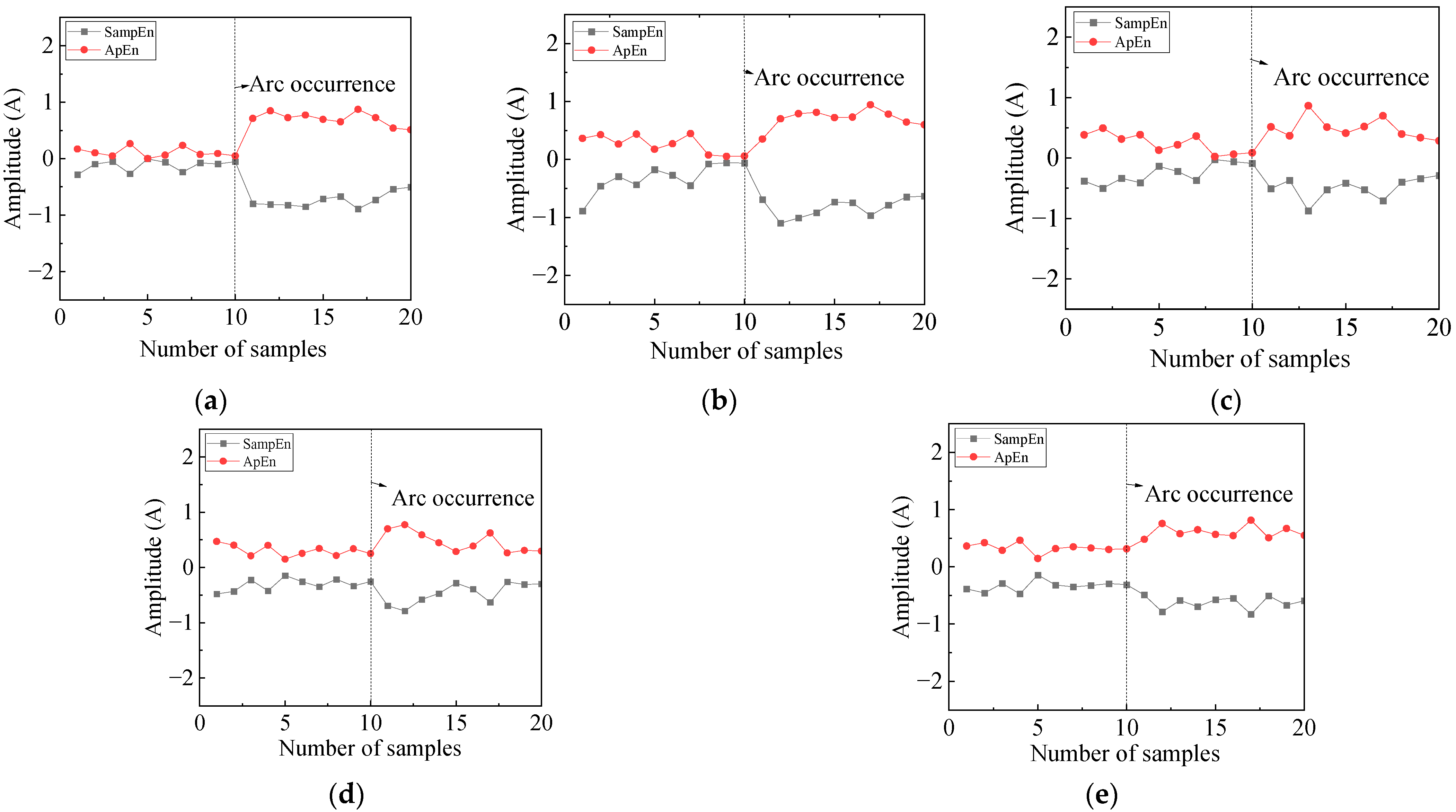
To address the issue of weak arc fault characteristics in the time–frequency domain, the original signals were first denoised and then processed using a wavelet transform. Subsequently, sample entropy and approximate entropy of the extracted signals were calculated. Taking tests with a voltage of 200 V as examples, the time–frequency domain plots under current conditions ranging from 3 to 11 A are delineated in Figure 10. A comparison with Figure 7 (which shows the results before denoising) reveals that, after processing, distinct differences in sample and approximate entropy between fault and normal signals were evident under all current conditions. The sample and approximate entropy of the fault signals were pronouncedly higher and more stable than those of normal signals. In contrast, the entropy values of normal signals varied as the current increased.
To quantify these differences, we calculated the ratios of sample entropy and approximate entropy between fault and normal signals, both before and after denoising. The results are presented in Table 3. After denoising, these ratios increased 1–2 times compared to their pre-denoising values. This enhancement in discriminative features enabled the effective identification of photovoltaic DC series arc faults.

5. Detection

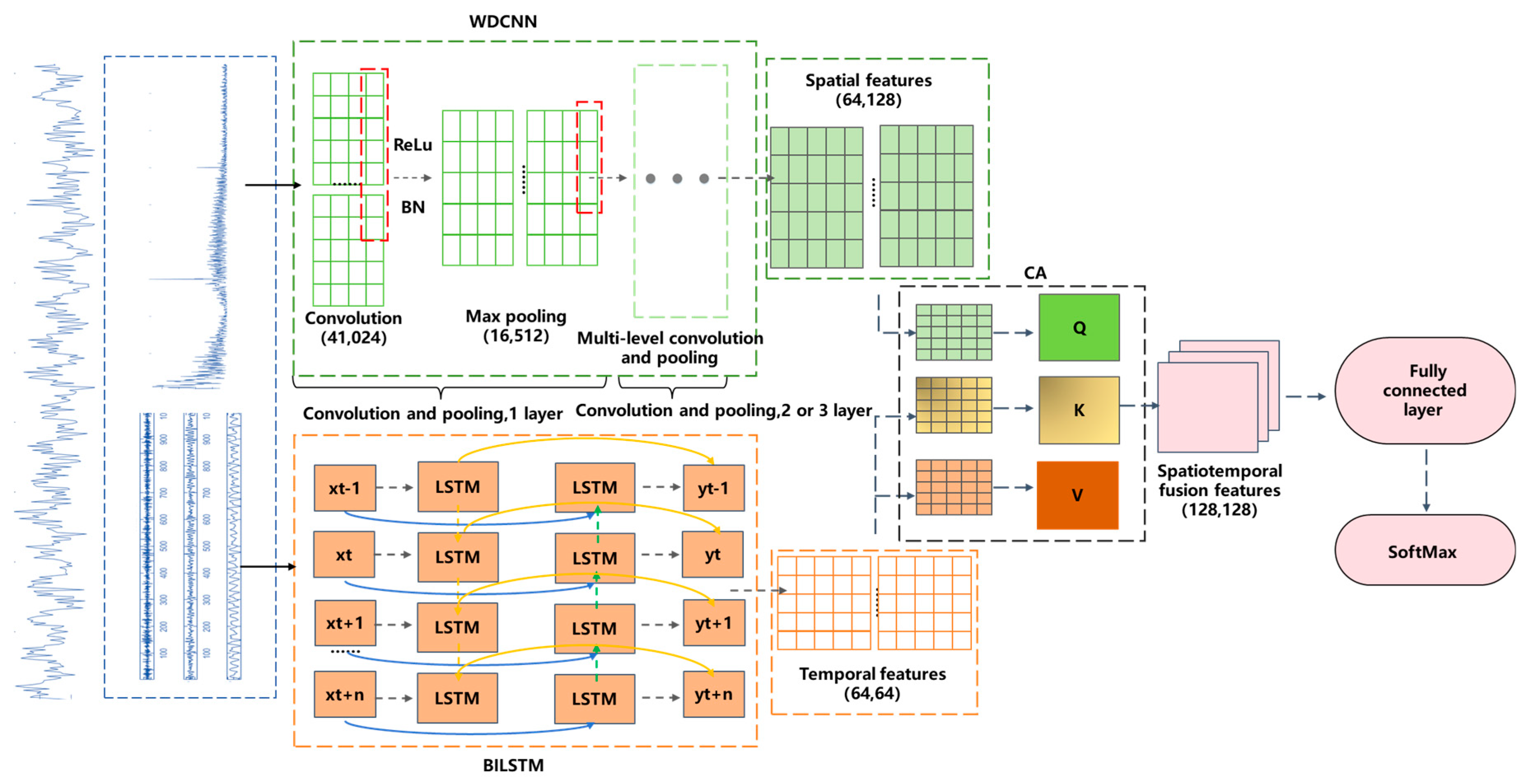
5.1. Detection Method Based upon Multi-Scale Spatiotemporal Feature Fusion Using WDCNN-BiLSTM-CA

To lessen parameter quantity and enhance generalization capability, a deep convolutional neural network with wide first-layer kernel (WDCNN) was adopted for fault diagnosis. Its key innovation is a multi-scale feature extraction strategy wherein a large-kernel convolutional layer at the input stage suppresses noise and extracts robust short-time transient features, while subsequent layers employ small 3 × 1 kernels to construct a deep network [41].
Afterwards, a BiLSTM module was integrated with the WDCNN, forming a parallel hybrid architecture to further capture the long-range temporal dependencies inherent in complex fault signals. This architecture processed photovoltaic DC series arc fault data through two dedicated pathways: The WDCNN module extracted spatial features through a structure comprising wide-kernel convolution, batch normalization (BN), ReLU activation, max pooling, and subsequent convolutional pooling blocks for hierarchical feature learning. Simultaneously, the BiLSTM module processed the sequential data via a two-layer bidirectional structure to capture temporal dependencies. Furthermore, the resulting spatiotemporal features were integrated through a CA module that calculates attention weights, allowing the model to focus on the most discriminative features. The fused representation then underwent dimensionality reduction through average pooling before being passed to a fully connected layer for classification. This integrated framework, denoted as the WDCNN-BiLSTM-CA model, is illustrated in Figure 11.

5.2. Model Training

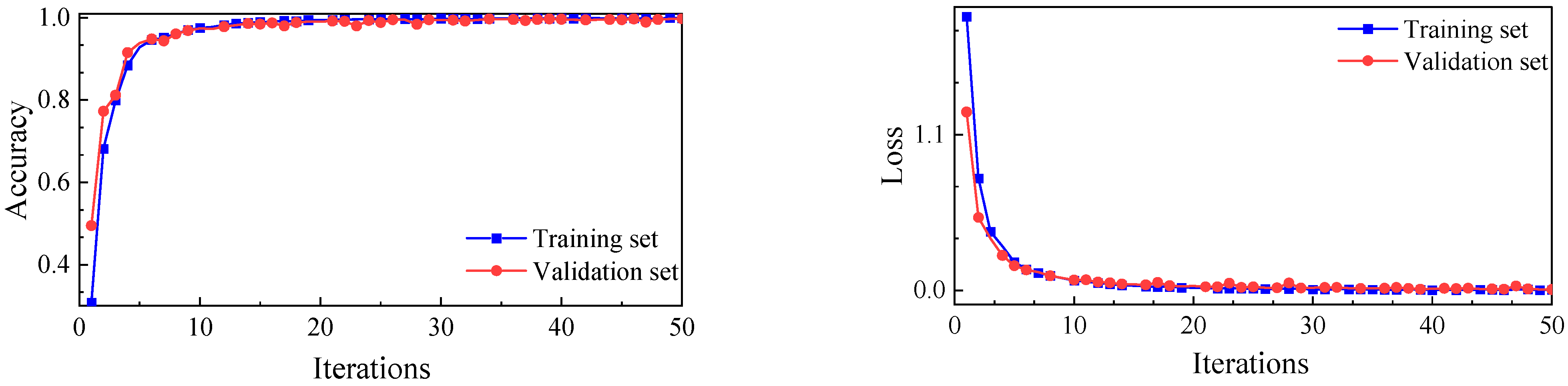
The model was implemented in Python 3.11 using the PyTorch framework. The model was optimized with the cross-entropy loss function and the Adam optimizer. The dataset comprises current data significantly affected by noise interference, and it was partitioned into training, validation, and test sets in an 8:1:1 ratio. Throughout training, the loss and accuracy metrics for both training and validation sets were recorded at each epoch. Figure 12 illustrates the resulting learning curves, depicting the model’s performance throughout the training process. At the beginning of training, the model exhibited an accuracy of 30.78% and a loss of 1.9339 on the training set, compared with a 49.50% accuracy and a loss of 1.2592 on the validation set. By the fourth epoch, the model’s training accuracy increased to 90.09% and the training loss decreased to 0.2948. The validation accuracy and loss also improved noteworthily to 92.69% and 0.2297, respectively. At the 50th epoch, the validation accuracy peaked at 99.61% with a corresponding loss of 0.0117. Overall, the WDCNN-BiLSTM-CA model demonstrates favorable performance, characterized by swift convergence and a high final accuracy. Furthermore, the training process is stable, without prominent fluctuations in accuracy or loss.

5.3. Model Evaluation

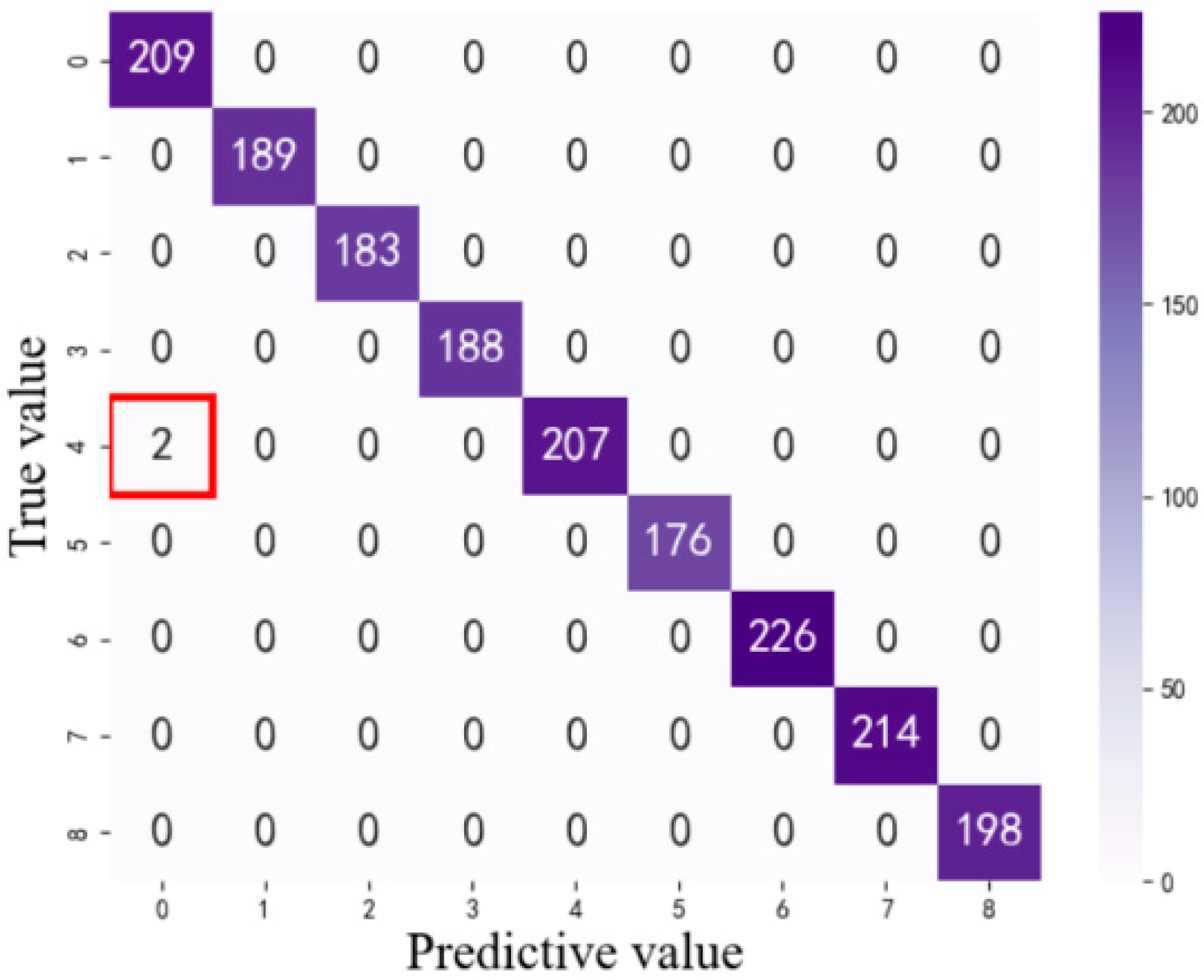
During the model evaluation phase, the testing set was fed into the fully trained model. Relevant evaluation metrics, including accuracy, precision, recall, and F1 score, were then calculated. The dataset is categorized into labels 0 through 8 according to different operating and fault conditions. Labels 0 to 2 correspond to the normal class, representing normal operation at 200 V with currents of 7 A, 9 A, and 11 A, respectively. Labels 3 to 5 represent series arc fault conditions under the same voltage (200 V) and current levels (7 A, 9 A, and 11 A). Labels 6 to 8 denote three distinct non-fault scenarios: cloud shading, evening low-current operation, and inverter startup, respectively. A confusion matrix was also constructed to comprehensively assess the model’s generalization capability and prediction accuracy. Since the samples in the testing set were completely unseen during training, this approach ensures the reliability and validity of the evaluation. To further evaluate its performance, we compared the proposed WDCNN-BiLSTM-CA model against other methods using an experimentally collected dataset. The results, as presented in Table 4, showed that our model prominently outperforms all other models on the test set. It achieved perfect scores of 99.89% across all key metrics: accuracy, precision, recall, and F1 score. This exceptional performance indicates that the model exhibits not only high accuracy but also robust generalization capabilities.
Figure 13 shows the confusion matrix of the WDCNN-BiLSTM-CA model on the test set, where red borders highlight the categories and quantities of misclassified samples. The analysis reveals that the model exhibits highly accurate prediction performance on the test set, with an overall accuracy of 99.89%. A detailed analysis of the confusion matrix showed that two 200 V/7 A arc fault samples were misclassified as normal states. This result not only validates the high-precision performance of the model but also, by identifying these specific misjudgments via the confusion matrix, renders a direction for future optimization targeted at arc fault characteristics.

5.4. Ablation Experiments

To validate the effectiveness of each module in the WDCNN-BiLSTM-CA model, a series of ablation tests were conducted on the photovoltaic DC arc fault dataset. Four architectural variants were evaluated: WDCNN, WDCNN-LSTM, WDCNN-BiLSTM, and WDCNN-BiLSTM-CA. As summarized in Table 5, the results demonstrate that the progressive incorporation of BiLSTM and CA modules yielded consistent improvements in accuracy, precision, and recall. In contrast, integrating a standard LSTM module resulted in a performance degradation across all metrics compared with the WDCNN module. This indicates that in scenarios characterized by noise or weak temporal correlations, unidirectional LSTMs are susceptible to capturing spurious temporal dependencies, which adversely affects performance. However, the bidirectional nature of the BiLSTM architecture mitigates this limitation by leveraging both past and future context, enabling more robust temporal feature extraction. The incorporation of the CA module further enhances the model’s performance, yielding a 4.17% improvement in overall accuracy. This represents a substantially greater gain compared with using BiLSTM alone. The superior performance can be attributed to the CA module’s effective fusion of the spatiotemporal features extracted by the WDCNN and BiLSTM modules.

6. Conclusions

This study systematically investigated series arc fault characteristics through laboratory experiments employing a PV simulator. The experiments were conducted under varying voltage (200 V to 400 V) and current (3 A to 11 A) conditions, and incorporated typical interference scenarios—such as cloudy conditions, evening operation, and inverter startup. The key findings drawn are as follows:
  • While the difference between normal and arc fault current signals remained almost imperceptible as voltage increased, the characteristics of arc faults became more difficult to detect as the current rose due to increased noise.
  • An IMGO-ICEEMDAN-based denoising algorithm was developed, which markedly enhanced arc fault features in both frequency and time–frequency domains. After denoising processing, the frequency domain characteristics of arc faults became prominent within the 0–100 kHz band, with a substantial increase in amplitude. In the time–frequency domain, the sample entropy-to-approximate entropy ratio of the denoised signals increased by a factor of 1 to 2.
  • A WDCNN-BiLSTM-CA model was proposed for arc fault detection, which achieved accuracy, precision, recall, and F1 scores all reaching 99.89%, outperforming the traditional models. The ablation experiments further confirmed the distinct roles of the BiLSTM and CA modules, and revealed that the CA module improved the overall performance by 4.17%.
  • The arc fault identification method proposed in this study was validated using a PV simulation source. Consequently, its performance under real-world conditions remains to be fully ascertained. A limitation lies in the fact that the typical interference sources considered were all generated by the simulator. This controlled environment may not adequately capture the complexity and stochastic nature of actual PV installations, where environmental dynamics, diverse load profiles, and system-level electrical noise interact in more intricate ways. Therefore, the robustness and generalization capability of the method require further investigation through field tests on operational PV systems. Ultimately, upon technological maturation, we aim to implement the method via embedded chips, thereby realizing real-time monitoring and identification of arc faults and reducing fire hazards in PV installations.

Author Contributions

Conceptualization, L.Z.; methodology, L.Z.; writing—original draft, L.Z. and M.H.; writing—review and editing, L.Z. and C.-M.S.; funding acquisition, L.Z.; investigation, M.H. and Z.Z.; data curation, Z.Z. and J.Z.; validation, J.Z.; formal analysis, C.-M.S.; resources, H.J.; supervision, H.J. All authors have read and agreed to the published version of the manuscript.

Funding

This work was supported by the Ministry of Science and Technology of the People’s Republic of China (Grant no. 2023YFC3009801) and the Beijing Municipal Science and Technology Commission (Grant no. Z231100003823024).

Institutional Review Board Statement

Not applicable.

Informed Consent Statement

Not applicable.

Data Availability Statement

The data that support the findings of this study are available from the corresponding author upon reasonable request.

Acknowledgments

The authors would like to thank the Qingdao Topscomm Communication INC for providing the experimental site.

Conflicts of Interest

Author Zheng Zeng is employed by Yangtze Memory Technologies Co. The remaining authors declare that the research was conducted in the absence of any commercial or financial relationships that could be construed as a potential conflict of interest.

Nomenclature

x Original signal
ω ( i ) Gaussian   white   noise   with   an   i -th realization
M . The mean value using the EMD algorithm
P The length of the PV DC signal
a 1 The specified signal-to-noise ratio
r 1 The first residual component
I M F 1 The first model component
r n The   n -th residual component
I M F n The   n -th model component (n > 3)
E n ( x ) The n-th intrinsic mode function of the original signal after empirical mode decomposition
ε i The noise figure
R Residual component
I M F s The signal reconstructed from the secondary denoising component and the residual component
I M F p The signal reconstructed using wavelet denoising
D Multivariate intrinsic mode index
W j , k High-frequency coefficients
t The visushrink threshold
NSignal length
W ^ j , k .Denoised low-frequency coefficients
S Final denoised signal
α Tuning factor
β Tuning factor
γ Tuning factor
ρ Correlation coefficient
γ Kurtosis
λ Variance contribution rate
X Target signal
Y Original signal
μ Mean   of   X
σ X Standard   deviation   of   X
σ Y Standard   deviation   of   Y
ρ Normalized   ρ
γ Normalized   γ
λ Normalized   λ
C ρ Coefficient   of   variation   to   ρ
C γ Coefficient   of   variation   to   γ
C λ Coefficient   of   variation   to   λ
W ρ The   weight   based   upon   C ρ
W γ The   weight   based   upon   C γ
W λ The   weight   based   upon   C λ

References

  1. Gao, W.; Jin, H.; Yang, G. Series arc fault diagnosis method of photovoltaic arrays based on GASF and improved DCGAN. Adv. Eng. Inform. 2022, 54, 101809. [Google Scholar] [CrossRef]
  2. Sepúlveda Oviedo, E.H.; Travé-Massuyès, L.; Subias, A.; Alonso, C.; Pavlov, M. Feature extraction and health status prediction in PV systems. Adv. Eng. Inform. 2022, 53, 101696. [Google Scholar] [CrossRef]
  3. Lu, S.B.; Phung, B.T.; Zhang, D.M. A comprehensive review on DC arc faults and their diagnosis methods in photovoltaic systems. Renew. Sustain. Energy Rev. 2018, 89, 88–98. [Google Scholar] [CrossRef]
  4. Cabrera-Tobar, A.; Ciccariello, V.; Lamanna, E.; Leva, S.; Matera, N.; Ogliari, E.; Ramaschi, R. General rules and safety guidelines for a battery energy storage and photovoltaic system framework in commercial and industrial installations. IEEE Trans. Ind. Appl. 2025, 61, 5328–5337. [Google Scholar] [CrossRef]
  5. Chen, S.; Li, X.; Xiong, J. Series arc fault identification for photovoltaic system based on time-domain and time-frequency-domain analysis. IEEE J. Photovolt. 2017, 7, 1105–1114. [Google Scholar] [CrossRef]
  6. Han, B.; Zou, G.; Zhang, X.; Niu, Z.; Wang, W. Modeling and feature analysis of photovoltaic DC series arc faults. Meas. Sci. Technol. 2025, 36, 046113. [Google Scholar] [CrossRef]
  7. Babrauskas, V. Electrical Fires. In SFPE Handbook of Fire Protection Engineering; Hurley, M.J., Gottuk, D., Hall, J.R., Harada, K., Kuligowski, E., Puchovsky, M., Torero, J., Watts, J.M., Wieczorek, C., Eds.; Springer: New York, NY, USA, 2016; pp. 662–704. [Google Scholar] [CrossRef]
  8. Gao, Z.; Zhang, H.; Yang, W.; Wu, W.; Yang, R. A review on ignition characteristics of arc faults in wire system of aircraft. Aerosp. Traffic Saf. 2024, 1, 27–42. [Google Scholar] [CrossRef]
  9. Salmerón-Manzano, E.; Muñoz-Rodríguez, D.; Perea-Moreno, A.; Hernandez-Escobedo, Q.; Manzano-Agugliaro, F. Worldwide scientific landscape on fires in photovoltaic. J. Clean. Prod. 2024, 461, 142614. [Google Scholar] [CrossRef]
  10. Abuhashish, M.N.; Refaat, A.; Kalas, A.; Hamad, M.S.; Elfar, M.H. Towards accurate and reliable fault diagnosis in PV systems: Techniques, challenges, and future directions. Process. Saf. Environ. Prot. 2025, 198, 107217. [Google Scholar] [CrossRef]
  11. A Major Fire ‘Burns Away’ 1.5 Billion Yuan! Re-Examining the Fire Accident in Shanxi’s 50-Billion-Yuan Investment Project. 2025. Available online: https://baijiahao.baidu.com/s?id=1836424467666036929&wfr=spider&for=pc (accessed on 1 July 2025).
  12. BAM. BAM Report 2021/22: Sicherheit im Wandel; Annual Report; Bundesanstalt für Materialforschung und -prüfung: Berlin, Germany, 2022; Available online: https://www.bam.de/_SharedDocs/DE/Downloads/bam-report-2021-22.html (accessed on 6 February 2026).
  13. The Institute for Energy Research. Walmart and Amazon Sue Tesla, Solar Panels Blamed for Fires. 2019. Available online: https://www.instituteforenergyresearch.org/renewable/solar/walmart-and-amazon-sue-tesla-solar-panels-blamed-for-fires/ (accessed on 13 September 2019).
  14. Breaking News: Fire at Photovoltaic-Powered Farm Kills Over 20,000 Chickens from Smoke Inhalation. 2023. Available online: https://www.163.com/dy/article/IC1R0TT90514DRR7.html (accessed on 13 August 2023).
  15. Zhang, M.; Zhou, Z.; Gong, Y.; Yuan, J.; Ding, Y. Research Progress on Fire Hazards of Solar Photovoltaic Modules. Saf. Environ. Eng. 2025, 32, 127–136+169. (In Chinese) [Google Scholar] [CrossRef]
  16. Lu, Q.W.; Ye, Z.Y.; Su, M.M.; Li, Y.S.; Sun, Y.C.; Huang, H.Q. A DC series arc fault detection method using line current and supply voltage. IEEE Access 2020, 8, 10134–10146. [Google Scholar] [CrossRef]
  17. Dhar, S.; Patnaik, R.K.; Dash, P.K. Fault detection and location of photovoltaic based DC microgrid using differential protection strategy. IEEE Trans. Smart Grid 2018, 9, 4303–4312. [Google Scholar] [CrossRef]
  18. Park, H.P.; Kim, M.; Chae, S. Smart DC optimizer for DC series arc fault detection and extinguishing. IEEE Trans. Power Electron. 2022, 37, 10117–10121. [Google Scholar] [CrossRef]
  19. Amiri, A.; Samet, H.; Ghanbari, T. Recurrence plots based method for detecting series arc faults in photovoltaic systems. IEEE Trans. Ind. Electron. 2022, 69, 6308–6315. [Google Scholar] [CrossRef]
  20. Gu, J.C.; Lai, D.S.; Wang, J.M.; Huang, J.J.; Yang, M.T. Design of a DC series arc fault detector for photovoltaic system protection. IEEE Trans. Ind. Appl. 2019, 55, 2464–2471. [Google Scholar] [CrossRef]
  21. Chae, S.; Park, J.; Oh, S. Series DC arc fault detection algorithm for DC microgrids using relative magnitude comparison. IEEE J. Emerg. Sel. Top. Power Electron. 2016, 4, 1270–1278. [Google Scholar] [CrossRef]
  22. Yin, Z.D.; Ouyang, H.X.; Lu, J.C.; Wang, L.; Yang, S.S. A time–frequency composite recurrence plots-based series arc fault detection method for photovoltaic systems with different operating conditions. Fractal Fract. 2025, 9, 33. [Google Scholar] [CrossRef]
  23. Han, B.; Zou, G.; Wang, W.; Li, J.; Zhang, X. Photovoltaic DC series arc fault detection method based on two-stage feature comprehensive decision. Sol. Energy 2025, 285, 113084. [Google Scholar] [CrossRef]
  24. Jia, F.; Luo, L.; Gao, S.; Ye, J. Logistic regression based arc fault detection in photovoltaic systems under different conditions. J. Shanghai Jiaotong Univ. Sci. 2019, 24, 459–470. [Google Scholar] [CrossRef]
  25. Kavi, M.; Mishra, Y.; Vilathgamuwa, M. DC arc fault detection for grid-connected large-scale photovoltaic systems. IEEE J. Photovolt. 2020, 10, 1489–1502. [Google Scholar] [CrossRef]
  26. Artale, G.; Caravello, G.; Cataliotti, A.; Cosentino, V.; Di Cara, D.; Guaiana, S.; Panzavecchia, N.; Tinè, G. Characterization of DC series arc faults in PV systems based on current low frequency spectral analysis. Measurement 2021, 182, 109770. [Google Scholar] [CrossRef]
  27. Kanemaru, M.; Kokura, K.; Mori, M.; Shindoi, T.; Yamamoto, M. Identification technique of DC series arc-fault strings in photovoltaic systems. Electr. Eng. Jpn. 2019, 207, 12–19. [Google Scholar] [CrossRef]
  28. Raj, A.; Mishra, C.S.; Joga, S.R.K.; Elzein, I.M.; Mohanty, A.; Lika, S.; Mahmoud, M.M.; Ewais, A.M. Wavelet analysis- singular value decomposition based method for precise fault localization in power distribution networks using k-NN classifier. Int. J. Robot. Contr. Syst. 2024, 5, 530–554. [Google Scholar] [CrossRef]
  29. Ahn, J.B.; Jeong, S.J.; Cho, C.G.; Ryoo, H.J. DC series arc fault detector with differential DWT and variable threshold method for photovoltaic systems. IEEE Trans. Ind. Inform. 2024, 20, 9343–9351. [Google Scholar] [CrossRef]
  30. Cao, F.; Xu, Z. PSO-SVM based DC series arc fault detection method in photovoltaic systems. In Proceedings of the 11th Frontier Academic Forum of Electrical Engineering (FAFEE2024); Springer Nature: Singapore, 2024; Volume 1288, pp. 697–705. [Google Scholar] [CrossRef]
  31. Dang, H.L.; Kim, J.; Kwak, S.; Choi, S. Series DC arc fault detection using machine learning algorithms. IEEE Access 2021, 9, 133346–133364. [Google Scholar] [CrossRef]
  32. Lu, S.B.; Sirojan, T.; Phung, B.T.; Zhang, D.M.; Ambikairajah, E. DA-DCGAN: An effective methodology for DC series arc fault diagnosis in photovoltaic systems. IEEE Access 2019, 7, 45831–45840. [Google Scholar] [CrossRef]
  33. Park, H.P.; Kwon, G.Y.; Lee, C.K.; Chang, S.J. AI-enhanced time–frequency domain reflectometry for robust series arc fault detection in DC grids. Measurement 2024, 238, 115188. [Google Scholar] [CrossRef]
  34. Li, J.; Zhu, Y.; Dong, Z.; Yang, H.; Cheng, X.; Xue, Z. A lightweight arc fault detection model integrating multi-objective architecture search with dynamic noise-augmented training. Measurement 2026, 257, 118649. [Google Scholar] [CrossRef]
  35. Yan, J.; Li, Q.; Duan, S. A simplified current feature extraction and deployment method for DC series arc fault detection. IEEE Trans. Ind. Electron. 2024, 71, 625–634. [Google Scholar] [CrossRef]
  36. Xing, L.; Wen, Y.H.; Xiao, S.; Zhang, D.; Zhang, J. A deep learning approach for series DC arc fault diagnosing and real-time circuit behavior predicting. IEEE Trans. Electromagn. Compat. 2022, 64, 569–579. [Google Scholar] [CrossRef]
  37. UL 1699B; UL Standard for Safety for Photovoltaic (PV) DC Arc-Fault Circuit Protection. Underwriters Laboratories: Northbrook, IL, USA, 2018. Available online: https://www.doc88.com/p-7129981868401.html (accessed on 6 February 2026).
  38. Zhao, H.; Huang, X.; Xiao, Z.; Shi, H.; Li, C.; Tai, Y. Week-ahead hourly solar irradiation forecasting method based on ICEEMDAN and TimesNet networks. Renew. Energy 2024, 220, 119706. [Google Scholar] [CrossRef]
  39. Zheng, B.; Chen, Y.; Wang, C.; Heidari, A.; Liu, L.; Chen, H. The moss growth optimization (MGO): Concepts and performance Open access. J. Comput. Des. Eng. 2024, 11, 184–221. [Google Scholar] [CrossRef]
  40. Chen, B.; Wang, L.; Shu, B.; Li, X.; Qu, W.; Wu, H.; Qian, Y.; Wu, Z. GNSS Landslide Monitoring Coordinate Time Series Noise Reduction Methods Based on Composite Divisional Indicator Index and CEEMD-WT. Geomat. Inf. Sci. Wuhan Univ. 2024. (In Chinese) [Google Scholar] [CrossRef]
  41. Zhang, W. Study on Bearing Fault Diagnosis Algorithm Based on Convolutional Neural Network. Master’s Thesis, Harbin Institute of Technology, Harbin, China, 2017. (In Chinese) [Google Scholar] [CrossRef]
Figure 1. Photovoltaic fire incidents. (a) March 2018, Ohio, United States [13]; (b) August 2023, Treviso Province, Italy [14]; (c) January 2024, Henan Province, China [15].
Fire 09 00084 g001
Figure 2. PV simulator-based series arc fault testing facility.
Fire 09 00084 g002
Figure 3. Oscilloscope capturing current signal under operating condition of 200 V/3 A.
Fire 09 00084 g003
Figure 4. Comparison of frequency spectra between arc fault and normal current signals under different voltages. (a) 200 V/3 A; (b) 300 V/3 A; (c) 400 V/3 A.
Fire 09 00084 g004
Figure 5. Comparison of frequency spectra between arc fault and normal current signals under different currents. (a) 200 V/7 A; (b) 200 V/9 A; (c) 200 V/11 A.
Fire 09 00084 g005
Figure 6. Variation in time–frequency characteristics under different voltages. (a) 200 V/3 A; (b) 300 V/3 A; (c) 400 V/3 A.
Fire 09 00084 g006
Figure 7. Variation in time–frequency characteristics under different currents. (a) 200 V/7 A; (b) 200 V/9 A; (c) 200 V/11 A.
Fire 09 00084 g007
Figure 8. The flowchart for the noise reduction process based on IMGO.
Fire 09 00084 g008
Figure 9. Frequency spectrum comparison of normal and fault signals after denoising. (a) 200 V/3 A; (b) 200 V/5 A; (c) 200 V/7 A; (d) 200 V/9 A; (e) 200 V/11 A.
Fire 09 00084 g009
Figure 10. The time–frequency characteristics of normal and fault signals under different current levels after denoising. (a) 200 V/3 A; (b) 200 V/5 A; (c) 200 V/7 A; (d) 200 V/9 A; (e) 200 V/11 A.
Fire 09 00084 g010
Figure 11. Architecture of WDCNN-BiLSTM-CA model.
Fire 09 00084 g011
Figure 12. Loss and accuracy changes with epochs under the WDCNN-BiLSTM-CA model.
Fire 09 00084 g012
Figure 13. Confusion matrix of WDCNN-BiLSTM-CA.
Fire 09 00084 g013
Table 1. DC decoupling and line impedance network parameters.
ComponentParameter ValueComponentParameter ValueComponentParameter Value
C120 μFL110 mHR1, R210 Ω
C2, C322 nFL2, L350 μHR3, R420 Ω
C410 μFL4, L540 μH
C5, C61 nF
—: Not applicable.
Table 2. The ratio of frequency domain energy before and after denoising.
Frequency Band200 V/3 A Ratio200 V/5 A Ratio200 V/7 A Ratio200 V/9 A Ratio200 V/11 A Ratio
BeforeAfterBeforeAfterBeforeAfterBeforeAfterBeforeAfter
f1(0–20 kHz)5.683.242.542.071.094.661.844.831.047.35
f2(20–40 kHz)1.195.241.013.241.088.6719.401.0211.83
f3(40–60 kHz)4.8918.681.7318.521.1212.411.0715.401.0217.72
f4(60–80 kHz)4.8221.131.3524.801.0515.581.0425.101.0329.44
f5(80–100 kHz)3.0617.921.2522.811.2113.401.1223.700.9627.70
f6(100–250 kHz)2.535.631.144.621.124.771.067.510.967.63
Table 3. Time–frequency characteristics of fault and normal signals before and after denoising.
Time-Frequency Features200 V/3 A200 V/5 A200 V/7 A200 V/9 A200 V/11 A
RatioRatioRatioRatioRatio
After denoisingSampEn0.31 1.33 0.99 0.90 1.05
ApEn0.36 1.08 1.04 0.94 1.00
Before denoisingSampEn0.17 0.38 0.51 0.66 0.53
ApEn0.16 0.36 0.50 0.65 0.54
Table 4. Model evaluation metrics for datasets.
ModelEvaluation Indicators
Accuracy (%)Precision (%)Recall (%)F1 Score (%)
WPA-IGA-BP96.6396.8396.6396.60
CNN-GRU97.8397.9597.8397.81
1DCNN-LSTM98.0598.0498.0298.03
CBAM-CNN98.5698.7698.5698.52
WDCNN-BiLSTM-CA99.8999.8999.8999.89
Table 5. Ablation experimental results.
ModuleAccuracy (%)Precision (%)Recall (%)
WDCNN94.7494.7494.74
WDCNN-LSTM94.5094.5594.16
WDCNN-BiLSTM95.4295.4295.42
WDCNN-BiLSTM-CA99.8999.8999.89
Disclaimer/Publisher’s Note: The statements, opinions and data contained in all publications are solely those of the individual author(s) and contributor(s) and not of MDPI and/or the editor(s). MDPI and/or the editor(s) disclaim responsibility for any injury to people or property resulting from any ideas, methods, instructions or products referred to in the content.