4.1. Influence of Covariables on Flammability
Fuel flammability depends, in part, on different environmental conditions and on the vegetation. Fuel moisture content (FMC) is an important covariable affecting flammability for both woody vegetation [
29,
37,
38,
39,
40] and grass [
29,
41]. In our work, it was, indeed, one of the most important covariables (affecting most variables) acting on the flammability of the vegetation treated by MS in contrast to the other treatments (PB, MMR, MMwR, and SW). Regarding the roadside grass treatments, the results agreed with [
36,
42], who found that FMC may only have a secondary effect on flammability (apart from ignitability).
For PB and MS, litter depth also affected most of the flammability variables recorded during the experiments, which indicates its importance in terms of flammability, litter being an important part ofvegetation flammability study [
28,
43]. Site exposure and average temperature over the last 30 days also heavily influenced the flammability of the vegetation treated by MS, suggesting that differences in conditions and vegetation regrowth specific to each forested land could affect post-treatment vegetation flammability.
Regarding fuel treatments on roadside grasses, different covariates affected flammability depending of the fuel treatment considered. For MMR, the main covariables were vegetation bulk density, which is already known to be a key driver of grass flammability [
20,
22,
29,
44], as well as the lab covariables: ambient temperature and relative humidity. MMwR and SW were mainly affected by precipitation, with the addition of the FMC for SW. It has been shown that FMC often plays an important role in grass flammability [
29,
42,
45]. On the other hand, precipitation directly influences FMC [
46] and directly affects the freshness of roadside grasses. The other covariables affected fewer flammability variables and even none to one (date and temperature over the last 30 days). Laboratory variables still have an effect on flammability, illustrating the sensitivity of herbaceous vegetation once harvested.
4.2. Effect of Fuel Treatment on Woody Vegetation Flammability
Concerning PB and MS, the treated vegetation flammability was overall successfully reduced. Both treatments did not affect ignitability, since no difference was observed between the treated samples and the control for ignition frequency and time-to-ignition, despite the airflow, agreeing with previous studies [
20,
21]. The lack of ignition measured in the samples treated by PB could be partly due to the reduction in ground fuels and fuelbed depth during the treatment implementation, as observed in [
47]. For the samples treated by MS, this poor ignition was probably due to the presence of coarser residues that are more difficult to ignite, but this result should be taken with caution, as the probability of ignition (and fire behaviour in general) in shredded areas is not yet well understood, with sometimes conflicting results found regarding the effect of these residues [
9,
48,
49,
50].
Sustainability was not affected by fuel treatments, as flame duration remained similar in the treated vegetation and the control. In contrast, some studies have found that the transformation of the vegetation and the increase in surface fuel load after mastication could promote long flaming and smouldering durations [
9]. In addition, the vast majority of the fuel available in our samples burned consistently for each fuel treatment method, showing that the treatment methods had no effect on consumability. However, this was not the case for combustibility, which was heavily affected by the fuel treatment, since almost all flammability variables related to this component were reduced after both PB and MS.
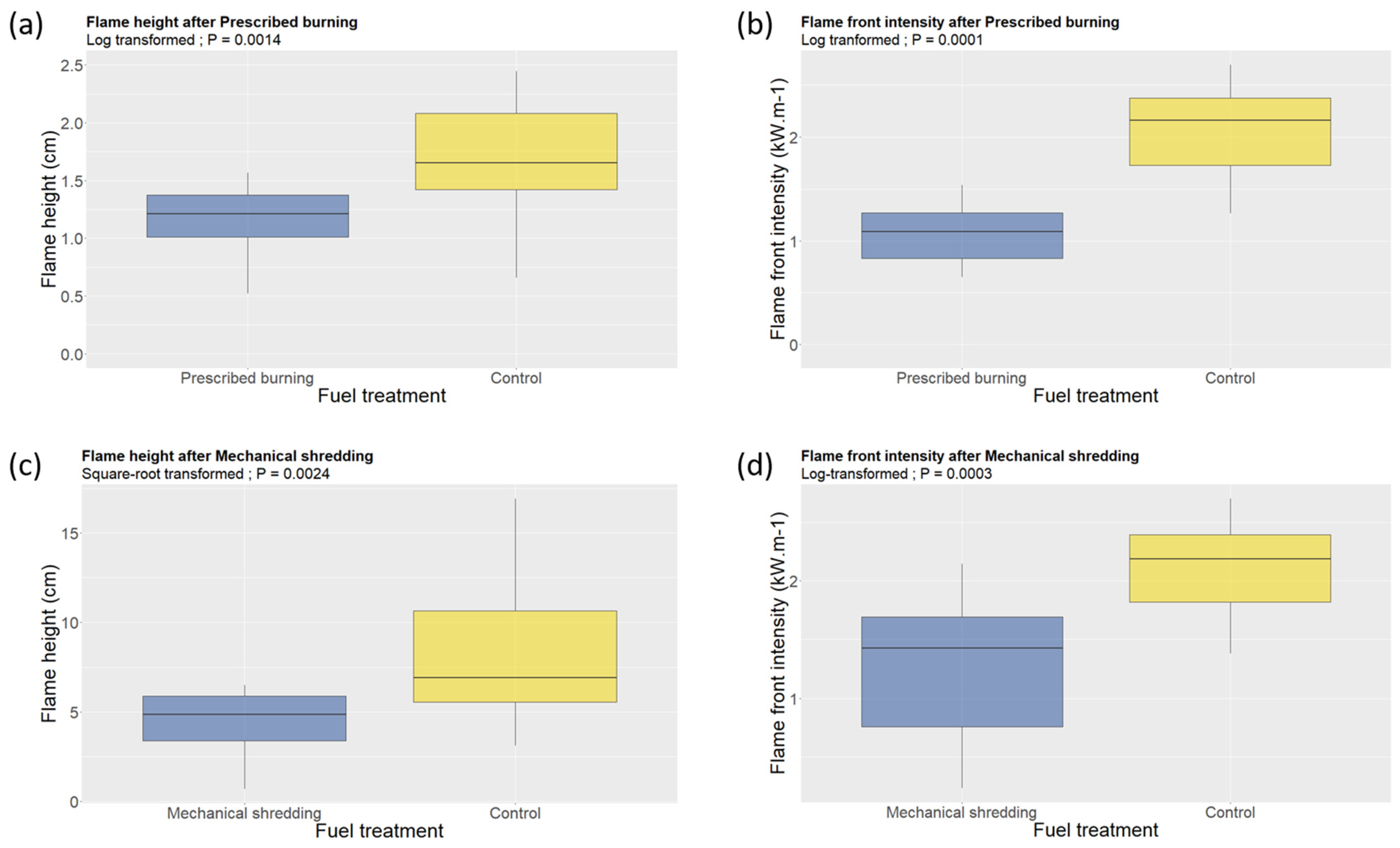
One of the effects of the fuel treatment is a reduction in vegetation height and in litter depth, which has been found to be positively correlated with flame height [
17,
21,
30,
51]. Prescribed burning generally significantly reduced surface fuels, both litter and aboveground vegetation (e.g., [
52,
53]), therefore reducing flammability. When we collected our samples, the treated vegetation had had time to regrow a little bit (as a minimum of six months elapsed since the treatment), but the litter layer remained thin in our PB-treated areas, preventing the flames from becoming too high. For MS, some studies also showed that flame height values were lower in areas that had been shredded [
9,
54,
55,
56]. In addition, previous works highlighted that flame propagation and temperatures were also affected by litter depth [
17,
30]. This relation between litter depth and flame temperature was clearly observed in our result, since PB had the thinnest litter depth and had a significantly lower temperature at our two measured heights.
MS was also effective in reducing maximum flame temperature, but only at 40 cm. The lack of effect on temperature at 10 cm should be due to the presence of coarser shredded residues that could burn at higher temperatures, and since they were located on the ground, only the thermocouple located at 10 cm recorded the increase in temperature. Despite no variation in flame spread, the thin litter layer in the samples treated by PB slowed down the rate of spread in the treated vegetation, which was not the case for the MS-treated samples. The authors of [
21] suggested that the wind was an important factor affecting rate of spread; however, we could not verify this result, as our propagation tests did not use a wind source.
The other goal of fuel treatment is to reduce the fuel load available for the fire [
57,
58], which plays a key role in flux emissions [
59,
60] and fire intensity [
61,
62,
63]. Indeed, after both PB and MS, the lower fuel load entailed a decrease in the heat released during combustion and in flame front intensity. As explained earlier, MS and PB reduced flame height in the vegetation treated, yet this variable is also related to the amount of heat emitted by the flames and, by extension, to flame front intensity [
64,
65]. Therefore, lower flame height in the samples treated by PB and MS was an early indicator of lower total heat flux and flame front intensity, as observed in our results.
4.3. Effect of Fuel Treatment on Roadside Grass Flammability
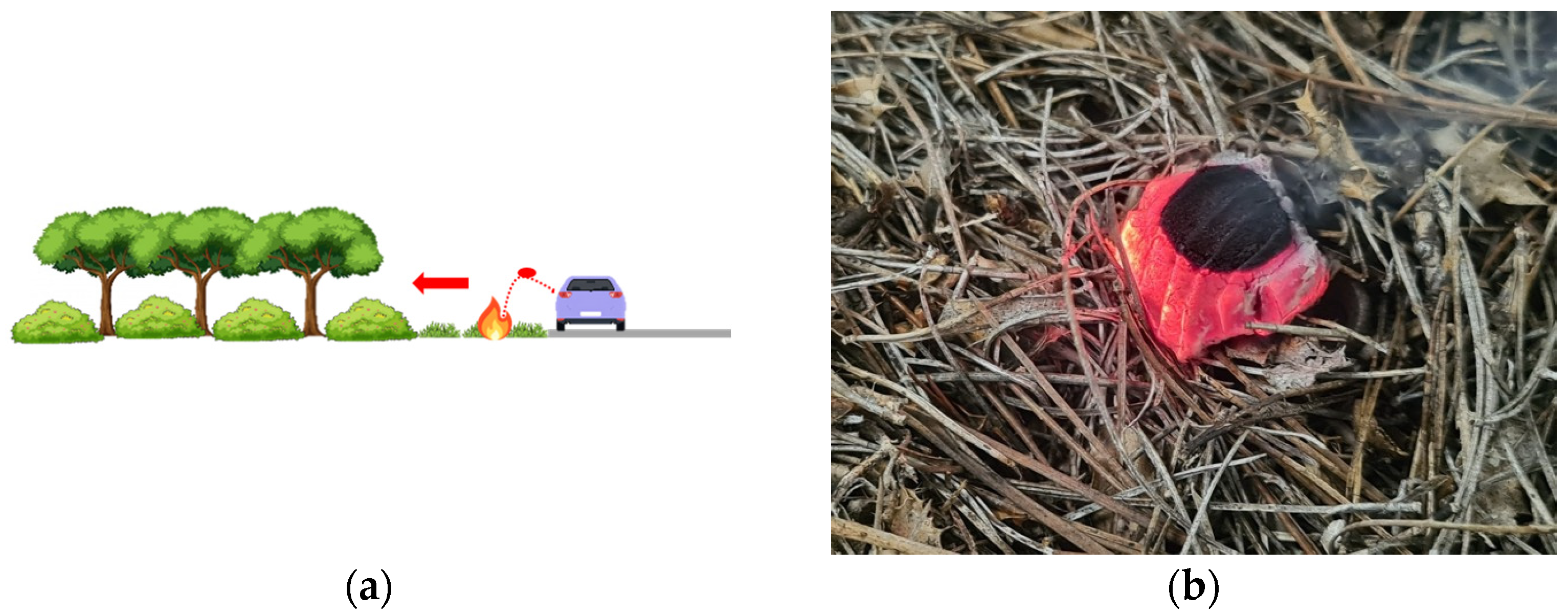
Concerning the fuel treatments used on roadside grass, the effects on flammability tended to be variable according to the method. Surprisingly, mechanical mowing with (MMR) or without residues (MMwR) overall increased the flammability (which was not the effect intended after treatment), in contrast to manual mowing with a string weeder (SW). Testing the sample ignitability using a glowing firebrand as ignition source, we observed higher ignition frequency for MMR and MMwR compared to the control. This higher ignition frequency obtained in the samples treated by mechanical mowing with residues could be explained by the fact that MMR residues tend to form a dry, flat, dense mat not impeding air flow, allowing the firebrand to have a large contact surface area with this dry vegetation, therefore making it highly suitable for ignition. This was also the case when removing the residues (MMwR), which made available the litter (mostly composed of dead grass leaves) naturally present at the basis of the grass stems, which is also very dry in summer. Together with the mowed grass stems, the litter also forms a homogeneous fuel stratum, providing a large contact surface area between the firebrand and the vegetation, as was the case when the residues were left (MMR). In contrast, no ignition was observed in samples treated by manual mowing with a string weeder (SW). Indeed, with this method, the pieces of mowed vegetation (whole or parts of grass stems or leaves) were scattered on the ground with different orientations and with little continuity (as opposed to the dense mat obtained with mechanical mowing). Therefore, when the firebrand fell on these residues, the insufficient contact surface area between them did not produce enough heat transfer, preventing ignition. Ignition also rarely occurred in untreated roadside grasses, as the firebrand (a cigarette butt, for example) was trapped between the grass stems before reaching the ground, which strongly hindered the contact surface area with the vegetation and therefore the heat transfer, as well as the air flow [
36]. Our results confirmed that the vegetation structure therefore plays an important role in flammability, according to previous studies [
42,
66].
Similar to ignitability, combustibility greatly varied depending on the method applied, with MMR and MMwR mostly enhancing this flammability component in contrast to SW. Flames better spread in the vegetation treated by MMwR due to the dry fuel continuity, whereas in MMR, flame spread was similar to that of the control, due to higher vegetation bulk density. For SW, the structure of the scattered residues made it more difficult for the flames to spread. Flame height was higher in the samples treated by MMR since more fuel, with higher bulk density, was concentrated on the ground.
The relationships between flame height and fuel amount and density have already been highlighted by [
29]. However, it should be mentioned that [
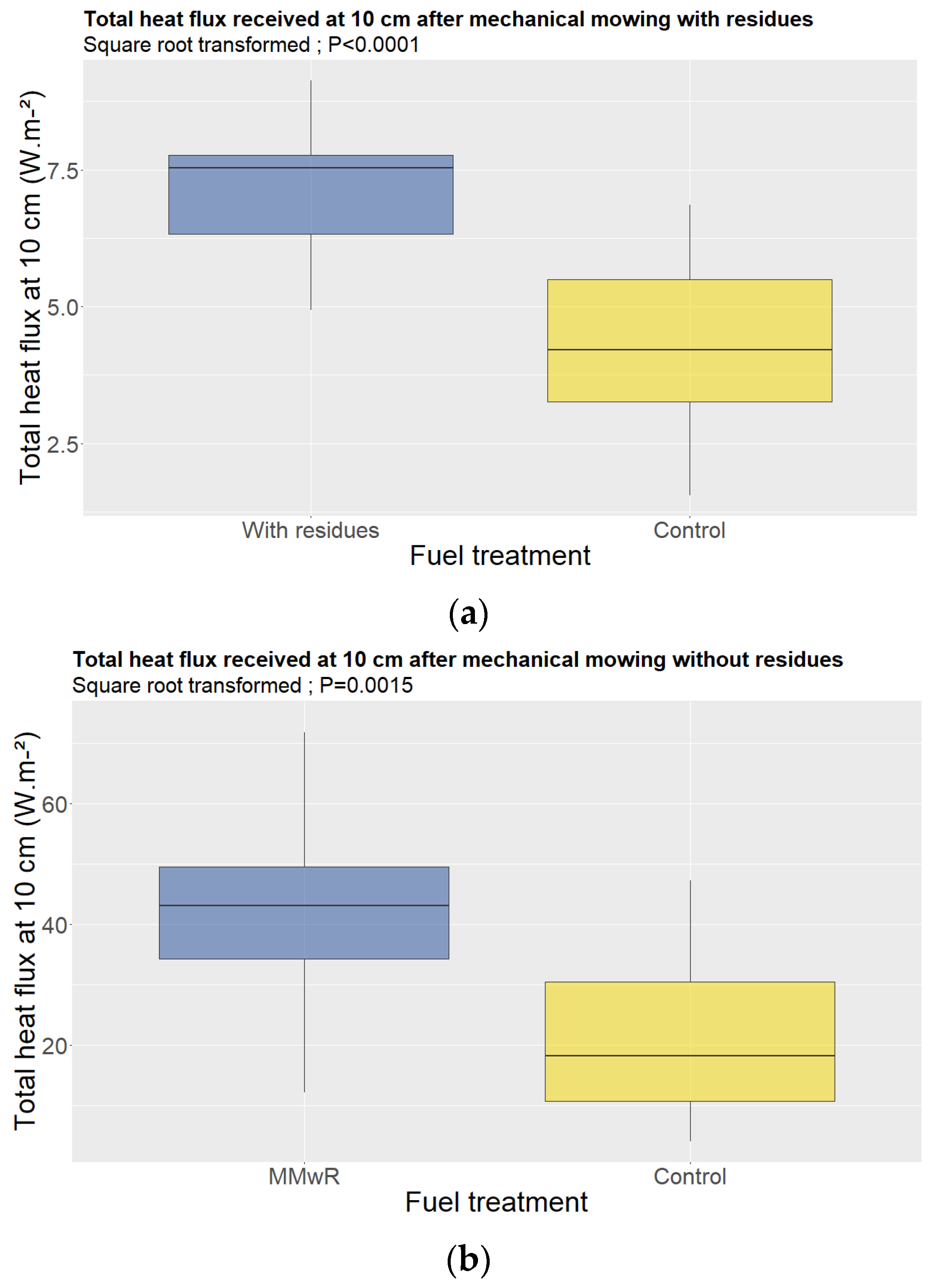
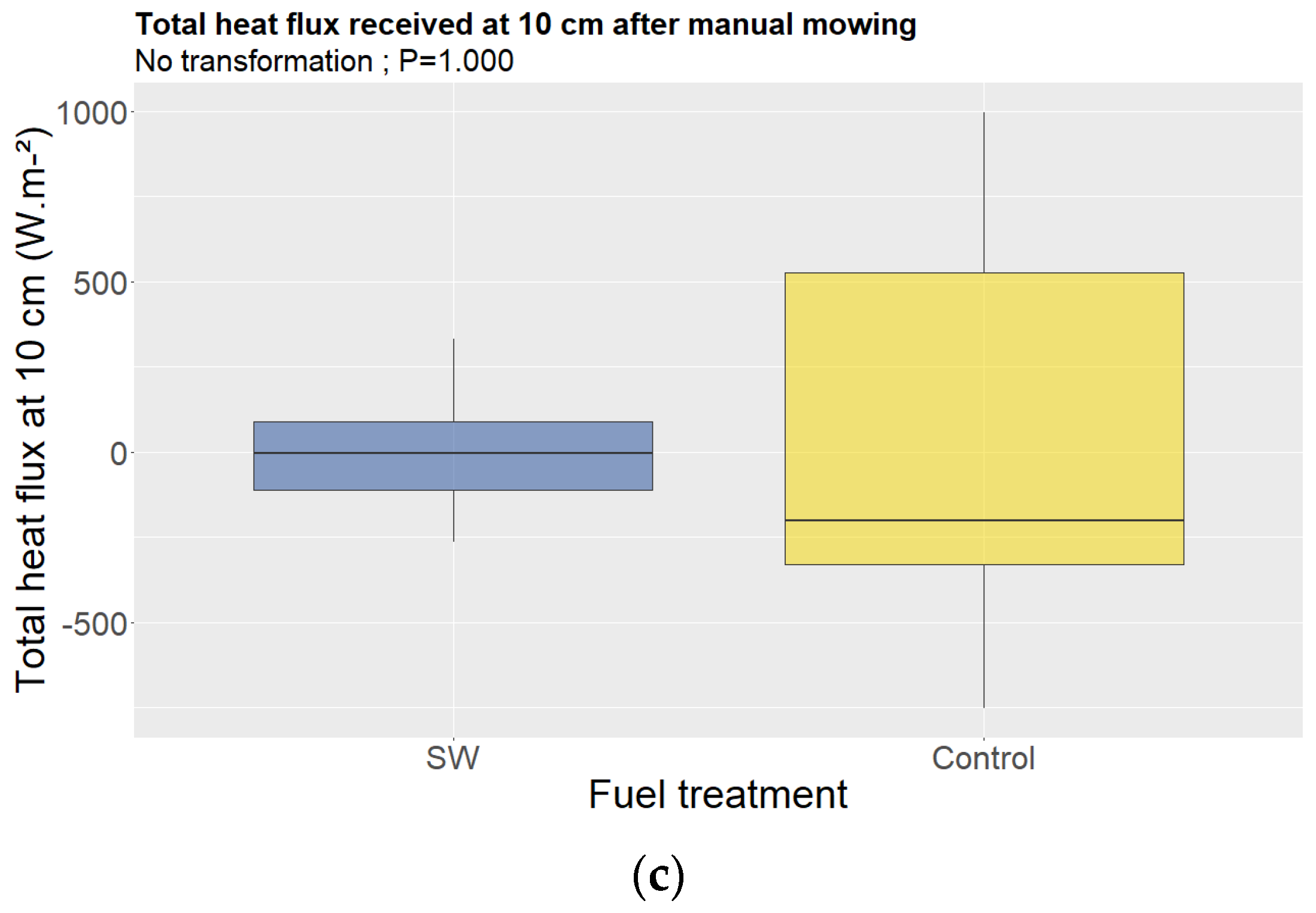
67] showed that higher bulk density can lower flame height, but increase flame duration in an open litter bed. This concentration of fuel at ground level also induced an increase in the maximum temperature recorded at 10 cm for all fuel treatments. Moreover, this allowed for an increase in total heat flux received at 10 cm for MMR and MMwR in contrast to SW, for which this variable was similar to that of the control and lower than that at 40 cm.
These different methods of grass treatment led to differences in vegetation continuity, explaining the difference of the results obtained for the rate of spread, flame front intensity, and consumed biomass (
Figure A2). The strong vegetation continuity created by the residues left in situ for MMR led to a higher flame front intensity. In the case of MMwR, vegetation continuity was also important, but the lower biomass available after this treatment led to quicker rate of spread. Curt et al. [
36], having conducted relatively similar experiments on mowed grass without residues, also observed rapid propagation. No significant changes in rate of spread, flame front intensity, and consumed biomass were observed after SW. In fact, the structure of the residues on the ground can be considered similar to that of the herbaceous grasses still standing (poor fuel continuity and contact surface area), which explains this lack of difference. This reminds us of the importance of the vegetation structure and possible airflow speed, if any. Flame front intensity depends on rate of spread and consumed biomass, both varying differently depending on the treatment applied. For MMR, there was no change in rate of spread or in consumed biomass, and higher flame front intensity was mainly due to the vegetation structure. On the other hand, MMwR samples presented faster rate of spread but lower consumed biomass. These two variables seem to compensate each other sufficiently to obtain a flame front intensity that does not differ from the control.
4.4. Comparison of Flammability Results with Those of Previous Comparable Studies
We compared our results to those obtained during burning experiments performed either on a fire bench or a wind tunnel with comparable ignition sources to be in conditions as similar as possible to those of the current study. This drastically limited the number of possible comparisons, especially regarding grass fuel. We did not take into account the studies using apparatuses such as epiradiators, cone calorimeters, and thermogravimetric analysis, mostly because the fuel sample size and load were too small compared to those in our work, which could cause too much bias. Most studies we used aimed to assess the flammability of treated vegetation in different countries, with vegetation and treatment methods possibly differing from ours. Unfortunately, only some flammability variables studied were the same as the ones we recorded in our experiments, which further limited the comparisons (
Table 5).
Regarding the woody fuel, the low ignition frequencies obtained in the current work (between 1 and 5%, depending on the method) were close to those recorded on
Ulex europaeus by [
22] one year after treatment (10%), while [
20] found 33% ignition at this time. The differences observed between these studies could be explained by the different types of vegetation studied (
Ulex europaeus vs.
Quercus coccifera in our study). However, in both studies, an increase in ignition frequency was observed when the vegetation was mature and when only the residues were tested ([
19]), with ignition frequency reaching around 55%. The study [
36], using the same protocol of ignition source and airflow, observed 40% ignition frequency in recently treated
Q. coccifera samples. This higher ignition frequency could be due to the lower height of the stems, allowing for better aeration than in our study. However, the ignition frequency of the control samples was higher in this latter study (20%) than in ours (0%); this could also be due to the height of the vegetation, which was taller in our study (92 vs. 30 cm), hindering the ignition process. In our study, the ignition delays in the samples treated by MS were similar to those recorded by [
19] (143 and 115 s, respectively), but much longer than in [
21] (12 s). This could be explained by the difference in the sample composition (only crushed residues in [
19] but regenerated vegetation and litter in [
21], as in our study). The mean value we obtained for PB was similar to that recorded in [
22] (128 s), despite the different species studied (
U. europaeus), but was much higher than those in previous works (between 10 and 17 s; [
20,
21]), which could be due to the ignition source (glowing firebrand vs. flaming firebrand and cotton strip soaked in alcohol). Indeed, the glowing firebrand took longer to provoke sample ignition because of its lower calorific value.
Regarding MS, the mean value of flame duration we recorded (162 s) was of the same order as those of [
19,
21] (162 vs. 202 and 181 s), but was much higher than those recorded by [
36] on
Q. coccifera samples (17 s) despite the same burning protocol, mainly because the flame propagation rapidly stopped. The results in [
9,
18] were also much lower (18 and 14 s), which could be due to the ignition source (flat paraffin-soaked wick) that could have provoked a quick burning compared to a glowing or flaming firebrand. The flaming duration we recorded on samples treated by PB was longer than 1 s, as in [
20,
21], but was much longer than that in [
23] (17 s), despite similar burning conditions and vegetation as those in [
20]. It is worth noting that, in this case, the value given in [
22] was the result of only one successful ignition (out of 10). The flame spread recorded in our samples treated by MS was of the same order as that in [
19] (2.4 vs. 2.1), while it was higher than that presented in [
36], working on the same species and using the same experimental protocol (2.4–2.7 vs. 1, respectively). In the latter work, the lack of biomass due to the more recent treatment could explain the poor propagation, especially as the spread obtained in the control was high in both studies (3 and 4). For MS, our values of flame height were in line with those in [
21,
31] (81 cm and 85 to 90 cm, respectively), but a bit higher than those obtained in [
9,
18] (72 cm and 55 cm, respectively). In the latter works, samples were composed only of two-year-old masticated residues, in contrast to our study, in which the samples were composed of less coarse shredded residues and mostly of shrub regrowth. For PB, the value we obtained (80.8 cm) was lower than that recorded in [
31] (120 cm), but higher than in [
21] (47.8 cm). Marino et al. [
21,
31] studied a different type of vegetation, mainly regenerated shrubs of a mixed heathland, but the difference in methodology between these studies was the sample size, which was larger in [
31], explaining the taller flames. The maximum temperatures we recorded at 10 and 40 cm in samples treated by PB (respectively, 783 °C and 512 °C) were close to those measured at 25 (800 °C) and 50 cm (approximately 550 °C) in [
31]. A different trend was obtained with the samples treated by MS, with Marino et al. [
31] having recorded 560 °C at 25 cm and 350 °C at 50 cm, while we measured 663 °C at 10 cm and 567 °C at 40 cm in our study. This difference could be due to the composition of the samples treated, resulting from different times-since-treatment. Regarding the flame rate of spread, the values were much lower (by a factor of four) in our study, regardless of the treatment method, than those measured in [
21]. The flame front intensities we recorded were lower than those reported by [
31] (PB: 87.3 vs. 206.7 kW m
−1, respectively, and MS: 112.7 vs. 153 kW m
−1, respectively). This difference could be once again due to the different vegetation type and bulk density (
Quercus coccifera vs the denser shrubs of mixed heathland), since flame front intensity varies from one vegetation type to another. However, our results were more in line with those obtained in [
18] (85.3 kW m
−1) despite the difference in the fuel sampled. Regarding the consumed biomass, the values we measured in samples treated by MS (67%) were lower than those obtained by [
9,
18] in masticated residues (96 and 89%), but higher than the results in [
19] obtained for crushed residues (43%). This could be due to the ignition source, the glowing firebrand being less calorific than the alcohol line or the paraffin-soaked wick, and therefore more able to generate a more powerful flame front.
Regarding the grass, in the same experimental conditions, Curt et al. [
36] also showed that the mowed grass
Avena fatua (without residues left) ignited more easily than the control, with 50% ignition, which is close to our ignition frequencies (65%, when the residues are left in situ). Their controls also presented very low ignition frequencies (<10%). In contrast, the moister
Carex sp. (still without residues), also studied by [
36], was difficult to ignite when mowed or not (20 and 0%, respectively). Working on untreated cured grass (FMC 7%), Ganteaume et al. [
29] observed an ignition frequency higher than 90% on average, these higher values being explained mainly by the lower moisture content of the samples. The ignition was the most delayed for the moistest grass species (95 s), and the shortest time-to-ignition was obtained for the driest species (12 s) ([
36]), while our results in the same conditions were intermediate (77.8 s), due to moisture contents ranging from 21 to 34%. Regardless of the work, ignition delays were the shortest in the controls, including in the untreated grass of [
29] (<3 s). Results concerning flame duration were comparable between our study and that of [
36] for the mowed samples. The control values were, however, lower in this latter study (15 s), with the species presenting the lowest moisture content, and the highest values were recorded in [
29] (86 s), in which the samples were larger, and in our study regarding
Oloptum samples (82 s). The results obtained in our work and in [
36] were comparable regarding flame propagation, highlighting a decrease from mowed samples to the control (except regarding
Oloptum samples, in our study). The flame height values we measured (75.7 cm for untreated
Bromus samples and 104.2 cm for untreated
Oloptum samples) were in the same range as those in [
29] (75.6 cm, on average).