


Wildland Firefighter Heat Stress Management
School of Public and Population Health, Boise State University, Boise, ID 83706, USA
Fire 2026, 9(2), 68; https://doi.org/10.3390/fire9020068
Submission received: 3 January 2026
/
Revised: 27 January 2026
/
Accepted: 28 January 2026
/
Published: 2 February 2026
(This article belongs to the Special Issue Occupational and Human Health Hazards Associated with Wildland Firefighter Careers)
Abstract
Wildland firefighting involves prolonged, high-intensity physical work performed under hot, variable, and operationally demanding conditions, placing firefighters at substantial risk of heat-related illness. This paper synthesizes current evidence on the mechanisms, contributing factors, and management of heat stress in wildland firefighting, with a specific focus on physiologically and operationally relevant considerations aligned with NIOSH, NFPA, and USFS guidelines. Heat stress is conceptualized as a cumulative process resulting from the interaction of metabolic heat production, environmental heat load, protective clothing, and individual susceptibility. Key environmental contributors include high ambient temperatures, humidity, and solar and fire-related radiant heat, while occupational demands such as sustained heavy work, extended shift durations, limited recovery, and the thermal burden of personal protective equipment further exacerbate risk. Individual factors—including fitness, hydration status, acclimatization, fatigue, and underlying health conditions—modify heat tolerance and vulnerability. This review highlights evidence-based exposure management strategies tailored to wildland fire operations, including work–rest cycles, heat acclimatization protocols, and practical cooling interventions, and addresses the operational constraints that shape their implementation. This paper further emphasizes the role of standardized training programs in prevention, early symptom recognition, and rapid response. Together, these integrated approaches provide a focused framework for reducing heat-related morbidity and enhancing wildland firefighter safety.
1. Introduction
Wildland firefighting is widely recognized as a physically demanding emergency response occupation. Firefighters routinely perform prolonged, high-intensity manual labor including fire line construction, hiking while carrying heavy loads, and hand tool operations under conditions of environmental heat, solar radiation, smoke, and rugged terrain [1,2]. These stressors result in substantial metabolic heat production while simultaneously limiting the body’s ability to dissipate heat, placing wildland firefighters at elevated risk for heat-related illnesses [3,4]. Heat stress has been identified by firefighters as a primary occupational hazard, alongside smoke exposure and fatigue [5]. Surveys and field observations indicate that firefighters often perceive heat stress as an unavoidable aspect of wildfire suppression, particularly during extended attack operations and large campaign fires [6]. Climate change has further intensified this risk by increasing wildfire frequency, severity, and duration, leading to longer fire seasons and higher ambient temperatures across many fire-prone regions [7,8]. Despite long-standing awareness of these hazards, heat-related morbidity persists in wildland firefighting. Many cases of heat exhaustion and heat stress are self-managed in the field and go unreported, resulting in limited surveillance data and an underestimation of true incidence [9]. The purpose of this review is to address current knowledge on heat stress in wildland firefighters, with emphasis on physiological mechanisms and operationally relevant management strategies consistent with NIOSH, NFPA, and USFS recommendations [10].
2. Heat Stress
Heat stress in wildland firefighting develops from complex interactions among environmental conditions, occupational demands, protective equipment, and individual physiological characteristics [11]. Unlike many industrial settings, wildland fire operations expose workers to highly variable and often extreme thermal conditions while simultaneously requiring sustained physical exertion. Heat stress is generally defined as the net heat load imposed on the human body by the combined effects of metabolic heat production and environmental heat exposure that exceeds the body’s capacity for heat dissipation. Metabolic heat is generated internally through muscular work, while environmental heat load is influenced by ambient temperature, radiant heat, humidity, air flow, and clothing insulation, as illustrated listed in Table 1 and Figure 1.
When heat gain exceeds heat loss through sweat evaporation, convection, radiation, and conduction, body heat storage increases and core temperature rises [12]. If metabolic heat production is adequately compensated through sweating and increased skin blood flow, body temperature may be maintained within a safe range. However, when thermoregulatory mechanisms are overwhelmed, heat stress progresses to heat strain, characterized by cardiovascular stress, dehydration, fatigue, and impaired mental function [13]. Continued or uncompensated heat stress may result in heat-related illnesses, including heat cramps, heat exhaustion, and exertional heat stroke [14]. In wildland firefighting, heat stress is rarely attributable to a single factor; rather, it reflects cumulative exposure over hours or days of work, often under conditions that limit recovery [15]. This cumulative nature distinguishes occupational heat stress from short-duration athletic exposures and underscores the need for continuous risk management rather than symptom-based responses.
3. Environmental Factors
Wildland firefighters are exposed to numerous combinations of environmental heat sources that elevate external heat load on the body. High ambient air temperatures are a primary contributor, particularly during summer fire seasons and heat waves. Elevated ambient temperatures reduce the thermal gradient between the skin and the environment, impairing convective and evaporative heat loss [11]. Solar IR radiation represents a major additional heat burden during daytime operations; direct sun exposure can significantly increase skin temperature and heat storage in protective clothing, particularly in open terrain with limited shade [12,16]. In addition, radiant heat from active fire fronts and smoldering fuels contributes substantially to total heat load and may remain high even when ambient air temperatures are moderate [17].
Environmental conditions that limit convective and evaporative cooling further exacerbate heat stress. Low wind speeds, dense vegetation, complex terrain, and smoke can reduce air movement around the body, impairing sweat evaporation [18]. Although less common in many fire-prone regions, elevated relative humidity can further reduce evaporative heat loss when present [3]. Collectively, these factors create dynamic and often unpredictable thermal environments that complicate real-time risk assessment and operational decision-making.
4. Occupational Factors
The occupational demands of wildland firefighting impose substantial internal metabolic heat loads due to sustained physical exertion. Fire suppression activities such as handline construction, hose deployment, mop-up, and hiking over steep terrain with heavy packs typically require moderate-to-heavy workloads. These activities are often performed continuously for shifts lasting 8–16 h or longer over multiple consecutive days, frequently with limited recovery opportunities. Prolonged metabolic heat production during such tasks is a primary driver of elevated core temperature. Personal protective equipment and clothing further contribute to heat stress by increasing thermal insulation and reducing evaporative heat loss [19]. Flame-resistant shirts and trousers, helmets, gloves, and boots are essential for burn protection but trap heat and moisture close to the skin. Backpacks and tools increase metabolic cost and cover skin surfaces critical for heat exchange [20]. Field-based physiological studies have documented substantial heat strain during routine wildfire suppression. Core body temperatures approaching or exceeding 38 °C (100 °F) have been reported during typical work tasks, with sustained elevations in heart rate indicating significant cardiovascular strain [15]. These findings demonstrate that hazardous heat exposure is inherent to everyday wildland firefighting operations and not limited to extreme fire behavior or heat waves.
5. Personal Factors
Individual susceptibility to heat stress varies widely among firefighters and is influenced by physiological, behavioral, and health-related factors. Aerobic fitness is a key determinant, as individuals with higher cardiovascular capacity generally experience lower relative strain and improved heat dissipation at a given workload [21]. Hydration status also plays a critical role; hypohydration reduces plasma volume, impairs sweating, and increases cardiovascular strain, accelerating the onset of heat strain [22]. Heat acclimatization is another major modifier of risk. Acclimatized individuals exhibit earlier onset of sweating, higher sweat rates, reduced electrolyte losses, and improved cardiovascular stability during heat exposure [23]. Figure 2 illustrates these personal factors.
Firefighters deployed early in the season, newly hired personnel, or those reassigned to hotter climates are at increased risk of heat illness due to insufficient acclimatization. Additional factors such as body composition, age, pre-existing health issues, medication use, cumulative fatigue, and sleep restriction can further impair heat tolerance and decision-making during extended incidents [24]. Recognition of these susceptibility factors is essential for tailoring prevention strategies and identifying personnel requiring closer monitoring.
6. Exposure Management
Implementing formal work–rest cycles in wildland fire operations is challenging due to dynamic fire behavior, terrain constraints, and mission-critical objectives. Nevertheless, evidence indicates that even short, scheduled rest periods can significantly reduce physiological strain when consistently applied [10]. Rest periods should include opportunities to reduce PPE burden, access shade, and rehydration. Supervisors play a critical role in enforcing such rest breaks, as firefighters may otherwise extend work bouts due to operational urgency or cultural norms emphasizing endurance [6]. Failure to implement appropriate work–rest strategies has been associated with increased heat-related symptoms, reduced productivity, and a higher risk of acute medical emergencies [3]. Effective work–rest schedules should remain flexible and responsive to changing environmental conditions, including rising temperatures and increased radiant heat exposure [11]. Integrating environmental monitoring tools and structured decision-making frameworks can enhance field-level heat risk management. Table 2 summarizes the recommended management steps to reduce the health effects of heat stress exposure.
6.1. Heat Acclimatization
Heat acclimatization is among the most effective physiological strategies for reducing heat strain during repeated heat exposure [23]. Adaptations include expanded plasma volume, improved sweating responses, reduced heart rate, and improved core temperature control [13,23]. Despite its effectiveness, structured acclimatization protocols are inconsistently implemented in wildland firefighting due to rapid deployment timelines and seasonal staffing models [3]. NIOSH recommends a gradual increase in work duration and intensity over 7–14 days, with close monitoring for signs of excessive heat strain [3]. Incorporating acclimatization principles into preseason training and early-season assignments may provide a practical approach. Organizational commitment is essential, as acclimatization benefits both individual health and operational effectiveness.
6.2. Cooling Strategies
Active cooling strategies can significantly reduce core temperature and perceived exertion during rest periods when applied effectively [10,14]. NIOSH and NFPA recommend interventions that include the removal of PPEs, assigning shaded or ventilated areas, the ingestion of cold fluids, and localized cooling of the neck, head, and forearms [10]. Controlled studies demonstrate that ice slurry ingestion and targeted cooling can rapidly reduce thermal strain and improve subsequent work tolerance [25]. In wildland fire environments, logistical constraints such as remote locations and limited water supply may restrict cooling options. Nevertheless, low-tech measures including shaded rest areas, cooled drinking water, and strategic scheduling of breaks provide meaningful benefits when systematically implemented [10]. As climate change increases the frequency of extreme heat events, expanding access to practical cooling interventions will become increasingly important.
6.3. Clinical Symptoms
Wildland firefighters must be able to recognize heat-related illness symptoms and know how to respond. Early recognition will allow firefighters and supervisors to intervene quickly, preventing mild conditions such as heat cramps or heat exhaustion from progressing to heat stroke, which can be fatal. Prompt responses will protect individual health, maintain crew safety, and preserve operational effectiveness, as an impaired firefighter can place themselves and others at risk during fire suppression activities. Table 3 lists the three most critical heat stress illnesses, the associated symptoms, and the management responses needed to protect a firefighter.
As part of training, wildland firefighters must be able to recognize their own heat-related illness symptoms and know when to alert their supervisor. Early recognition allows supervisors to intervene quickly, preventing mild conditions such as heat cramps or heat exhaustion from progressing to heat stroke, which can be fatal. It is clear that prompt, appropriate response, rest, hydration, cooling, and evacuation when necessary—will protect a firefighter’s health, maintain crew safety, and preserve operational effectiveness, as an impaired firefighter can place themselves and others at risk during fire suppression activities.
7. Training
Wildland firefighter health and safety training across agencies includes RT-130 Annual Refresher Training, the Incident Response Pocket Guide (IRPG), MTDC technical publications, and the Heat Illness Prevention (HIP) Pocket Guide [26,27,28]. Together, these resources reinforce consistent prevention and response messaging across classroom training, briefings, and field operations.
RT-130 provides mandatory annual refresher training emphasizing firefighter safety, risk management, human factors, and lessons learned from previous incidents [26]. The IRPG serves as a compact, field-carried reference for fire-line safety, medical response, aviation, and incident organization [5]. MTDC publications translate research and field testing into practical guidance on tools, PPE, and work practices [27]. The HIP Pocket Guide focuses specifically on recognizing, preventing, and responding to heat stress and heat-related illness in the field [28].
Across these resources, prevention-focused controls dominate the training framework. Hydration, electrolyte replacement, acclimatization, work–rest cycles, pacing, and fitness are emphasized, alongside recognition that hydration and fitness alone are insufficient without appropriate operational controls. Altered mental status in the presence of heat exposure is consistently treated as a medical emergency, with rapid cooling prioritized before evacuation [10,28]. Buddy system monitoring and crew culture messaging reflect recognition that heat illness is often under-reported due to social and operational pressures.
8. Conclusions
Heat stress in wildland firefighting is an inherent occupational hazard arising from the convergence of environmental conditions, sustained physical workloads, protective clothing, and individual susceptibility factors. Heat stress develops cumulatively over extended operational periods with limited recovery, and physiological evidence demonstrates that significant heat strain occurs during routine suppression activities. Risk is therefore present throughout the fire season, not only during extreme fire behavior or heat waves.
Overall, effective heat stress management requires a comprehensive, prevention-oriented approach integrating environmental awareness, occupational controls, individual preparedness, and organizational commitment. Heat acclimatization, flexible work–rest cycles, hydration and electrolyte management, and feasible cooling strategies can substantially reduce physiological strain when supported by leadership. The training framework embodied in RT-130, the IRPG, MTDC publications, and the HIP Pocket Guide reflects growing recognition that heat illness prevention depends on operational decision-making and crew culture as much as individual behavior. Continued emphasis on early recognition, buddy monitoring, and rapid cooling is essential to reduce heat-related morbidity and mortality as wildfire activity and thermal stress continue to intensify.
Funding
This research received no external funding.
Data Availability Statement
The original contributions presented in this study are included in the article. Further inquiries can be directed to the corresponding author.
Conflicts of Interest
The author declares no conflict of interest.
References
- Ruby, B.C.; Shriver, T.C.; Zderic, T.W.; Sharkey, B.J.; Burks, C.; Tysk, S. Total energy expenditure during arduous wildfire suppression. Med. Sci. Sports Exerc. 2002, 34, 1048–1054. [Google Scholar] [CrossRef] [PubMed]
- Sol, J.A.; Ruby, B.C.; Gaskill, S.E.; Dumke, C.L.; Domitrovich, J.W. Metabolic Demand of Hiking in Wildland Firefighting. Wilderness Environ. Med. 2018, 29, 304–314. [Google Scholar] [CrossRef] [PubMed]
- National Institute for Occupational Safety and Health (NIOSH). Criteria for a Recommended Standard: Occupational Exposure to Heat and Hot Environments; DHHS (NIOSH) UBLICATION NUMBER 2016-106; NIOSH: Washington, DC, USA, 2016. [Google Scholar]
- Cuddy, J.S.; Sol, J.A.; Hailes, W.S.; Ruby, B.C. Work patterns dictate energy demands and thermal strain during wildland firefighting. Wilderness Environ. Med. 2015, 26, 221–226. [Google Scholar] [CrossRef] [PubMed]
- National Wildfire Coordinating Group (NWCG). Incident Response Pocket Guide (IRPG); PMS 461; NWCG: Boise, ID, USA, 2025. [Google Scholar]
- Rodríguez-Marroyo, J.A.; Molina-Terrén, D.M. Perceptions of Heat Stress, Heat Strain and Mitigation Practices in Wildfire Suppression across Southern Europe and Latin America. Int. J. Environ. Res. Public Health 2022, 19, 12288. [Google Scholar] [CrossRef] [PubMed] [PubMed Central]
- Abatzoglou, J.T.; Williams, A.P. Impact of anthropogenic climate change on wildfire across western US forests. Proc. Natl. Acad. Sci. USA 2016, 113, 11770–11775. [Google Scholar] [CrossRef] [PubMed] [PubMed Central]
- USGCRP. Fourth National Climate Assessment; USGCRP: Washington, DC, USA, 2018; Volume II. [Google Scholar]
- Marvin, G.; Schram, B.; Orr, R.; Canetti, E.F.D. Occupation-Induced Fatigue and Impacts on Emergency First Responders: A Systematic Review. Int. J. Environ. Res. Public Health 2023, 20, 7055. [Google Scholar] [CrossRef] [PubMed] [PubMed Central]
- National Fire Protection Association (NFPA). Standard on the Rehabilitation Process for Members During Emergency Operations and Training Exercises; NFPA: Quincy, MA, USA, 2021; Available online: https://www.nfpa.org/codes-and-standards/nfpa-1584-standard-development/1584 (accessed on 27 January 2026).
- Parsons, K. Human Heat Stress, 1st ed.; CRC Press: Boca Raton, FL, USA, 2019. [Google Scholar] [CrossRef]
- OSHA Heat Stress Recognition. Available online: https://www.osha.gov/heat-exposure/hazards (accessed on 27 January 2026).
- Sawka, M.N.; Leon, L.R.; Montain, S.J.; Sonna, L.A. Integrated physiological mechanisms of heat stress. Compr. Physiol. 2011, 1, 1883–1928. [Google Scholar] [CrossRef]
- Bouchama, A.; Knochel, J.P. Heat stroke. N. Engl. J. Med. 2002, 346, 1978–1988. [Google Scholar] [CrossRef]
- Raines, J.; Snow, R.; Petersen, A.; Harvey, J.; Nichols, D.; Aisbett, B. Pre-shift fluid intake: Effect on physiology, work and drinking during emergency wildfire fighting. Appl. Ergon. 2012, 43, 532–540. [Google Scholar] [CrossRef]
- Ioannou, L.G.; Tsoutsoubi, L.; Mantzios, K.; Gkikas, G.; Piil, J.F.; Dinas, P.C.; Notley, S.R.; Kenny, G.P.; Nybo, L.; Flouris, A.D. The Impacts of Sun Exposure on Worker Physiology and Cognition: Multi-Country Evidence and Interventions. Int. J. Environ. Res. Public Health 2021, 18, 7698. [Google Scholar] [CrossRef] [PubMed] [PubMed Central]
- Navarro, K.M.; Fent, K.; Mayer, A.C.; Brueck, S.E.; Toennis, C.; Law, B.; Meadows, J.; Sammons, D.; Brown, S. Characterization of inhalation exposures at a wildfire incident during the Wildland Firefighter Exposure and Health Effects (WFFEHE) Study. Ann. Work Expo. Health 2023, 67, 1011–1017. [Google Scholar] [CrossRef] [PubMed]
- Nunneley, S.A. Heat stress in protective clothing. Interactions among physical and physiological factors. Scand. J. Work Environ. Health 1989, 15, 52–57. [Google Scholar] [PubMed]
- Lei, Z. Review of the study of relation between the thermal protection performance and the thermal comfort performance of firefighters’ clothing. J. Eng. Fibers Fabr. 2022, 17, 15589250211068032. [Google Scholar] [CrossRef]
- Looney, D.P.; Lavoie, E.M.; Notley, S.R.; Holden, L.D.; Arcidiacono, D.M.; Potter, A.W.; Silder, A.; Pasiakos, S.M.; Arellano, C.J.; Karis, A.J.; et al. Metabolic Costs of Walking with Weighted Vests. Med. Sci. Sports Exerc. 2024, 56, 1177–1185. [Google Scholar] [CrossRef] [PubMed]
- Cheung, S.S.; McLellan, T.M. Heat acclimation, aerobic fitness, and hydration effects on tolerance during uncompensable heat stress. J. Appl. Physiol. 1998, 84, 1731–1739. [Google Scholar] [CrossRef] [PubMed]
- Cheuvront, S.N.; Kenefick, R.W. Dehydration: Physiology, assessment, and performance effects. Compr. Physiol. 2014, 4, 257–285. [Google Scholar] [CrossRef] [PubMed]
- Taylor, N.A. Human heat adaptation. Compr. Physiol. 2014, 4, 325–365. [Google Scholar] [CrossRef] [PubMed]
- Caldwell, J.A.; Mallis, M.M.; Caldwell, J.L.; Paul, M.A.; Miller, J.C.; Neri, D.F.; Aerospace Medical Association Fatigue Countermeasures Subcommittee of the Aerospace Human Factors Committee. Fatigue countermeasures in aviation. Aviat. Space Environ. Med. 2009, 80, 29–59. [Google Scholar] [CrossRef] [PubMed]
- Siegel, R.; Maté, J.; Brearley, M.B.; Watson, G.; Nosaka, K.; Laursen, P.B. Ice slurry ingestion increases core temperature capacity and running time in the heat. Med. Sci. Sports Exerc. 2010, 42, 717–725. [Google Scholar] [CrossRef] [PubMed]
- RT-130, Wildland Fire Safety Training Annual Refresher (WFSTAR), National Wildfire Coordination Group. Available online: https://www.nwcg.gov/training-courses/rt-130 (accessed on 27 January 2026).
- US Department of Agriculture, US Forest Service, MTDC. Heat Illness Basics for Wildland Firefighters. Available online: https://www.fs.usda.gov/t-d/pubs/pdfpubs/pdf10512316/pdf10512316dpi72.pdf (accessed on 27 January 2026).
- National Wildfire Coordination Group. Heat Illness Prevention Pocket Guide. Available online: https://www.hprc-online.org/resources-partners/whec/educational-tools/heat-illness (accessed on 27 January 2026).
Figure 1.
Firefighter heat exchange during exposure to increased metabolic heat and solar IR radiation. Body heat dissipation occurs primarily through sweat evaporation since protective clothing limits air flow over the skin and, therefore, limits heat loss through convection.
Figure 1.
Firefighter heat exchange during exposure to increased metabolic heat and solar IR radiation. Body heat dissipation occurs primarily through sweat evaporation since protective clothing limits air flow over the skin and, therefore, limits heat loss through convection.
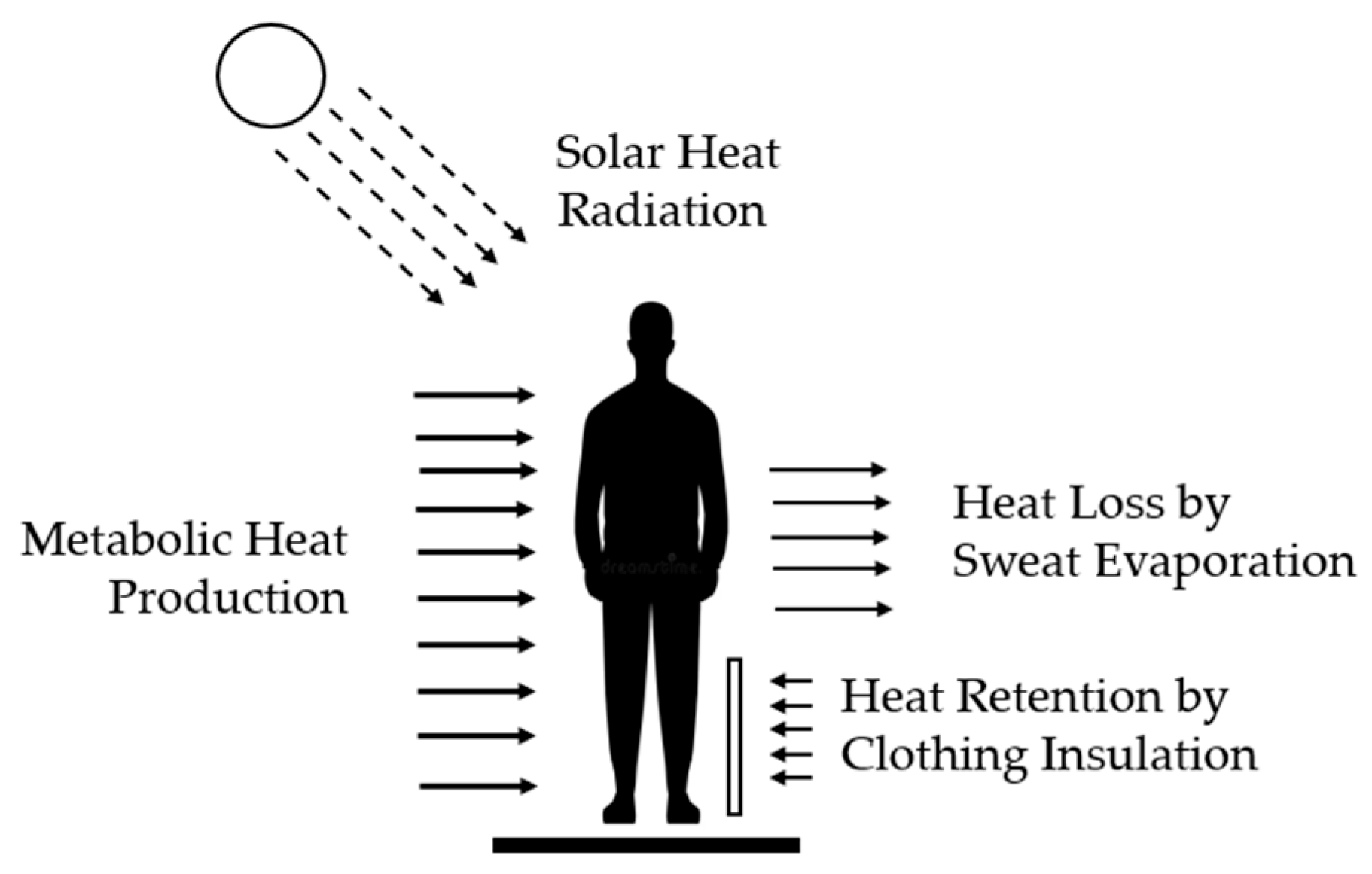
Figure 2.
Personal factors influencing a firefighter’s tolerance to heat stress.
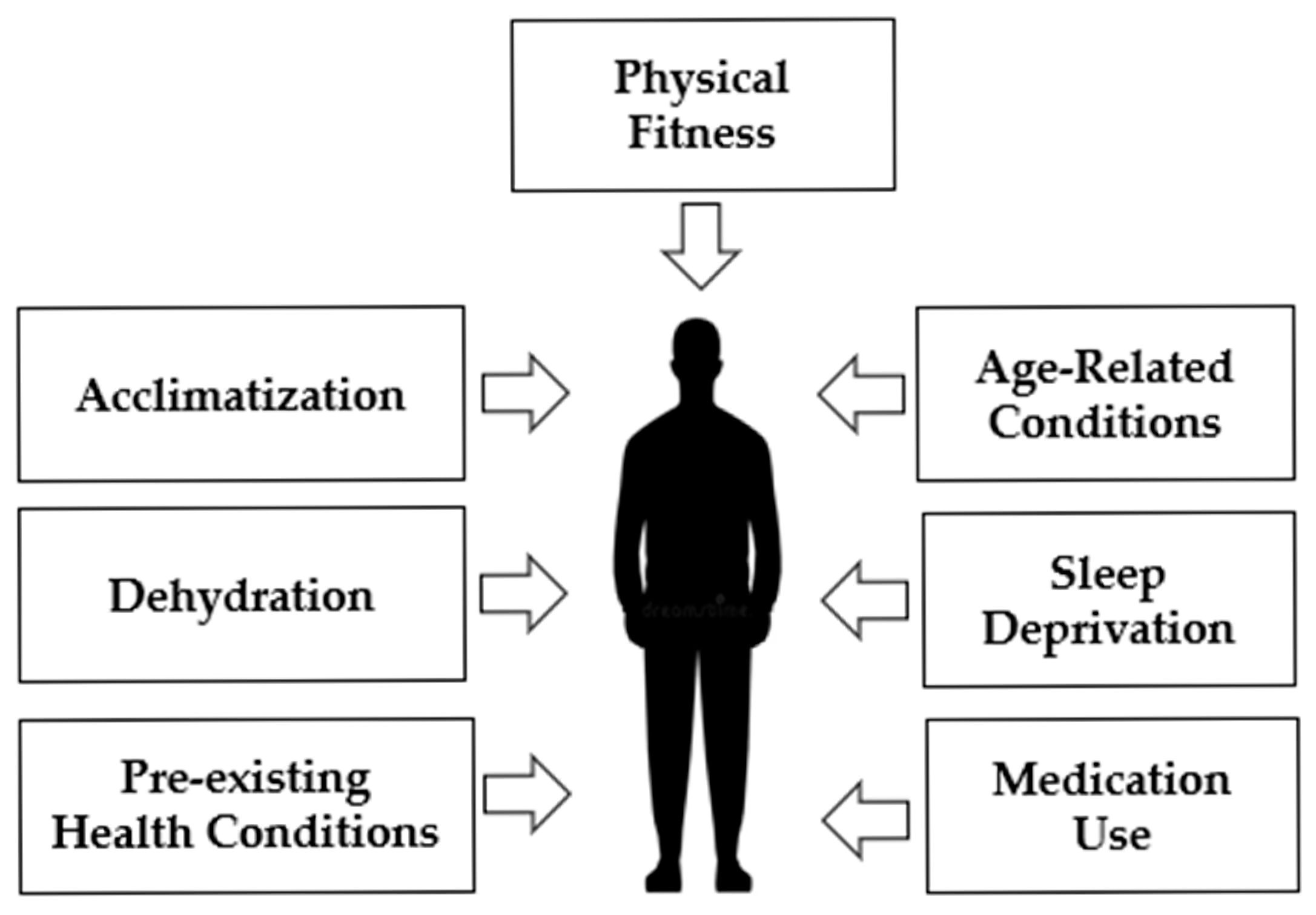

Table 1.
Work intensity and associated increase in metabolic heat production.
| Work Intensity | Activity Description | Metabolic Heat Production |
|---|---|---|
| Resting | Sitting, eating, talking | 100–110 W |
| Light | Walking and standing | 180–200 W |
| Moderate | Moving with protective gear | 300–350 W |
| Heavy | Shoveling, carrying loads | 400–600 W |
| Severe | Climbing, cutting timber | +1000 W |
Table 2.
Recommended management steps for reducing risks of heat stress illnesses.
| Intervention | Management |
|---|---|
| Work Intensity | Reducing workloads under high-temperature conditions |
| Timing | Performing work during cooler periods of the day |
| Rest Breaks | Implementing regular breaks in shaded areas |
| Clothing | Minimizing use of multiple layers to maximize ventilation |
| Hydration | Consuming small amounts of water often |
| Acclimatization | Increasing workload gradually over a two-week period |
| Buddy System | Monitoring partners for heat illness signs |
Table 3.
Key heat stress illnesses, their associated symptoms, and management responses to protect the firefighters.
Table 3.
Key heat stress illnesses, their associated symptoms, and management responses to protect the firefighters.
| Heat Illness | Symptoms | Management |
|---|---|---|
| Heat Cramp | Heavy sweating | 1. Provide rest |
| Painful muscle cramps | 2. Move to a cooler location | |
| 3. Provide water or juice | ||
| Heat Exhaustion | Heavy sweating | 1. Provide rest |
| Weakness, fatigue | 2. Loosen clothing | |
| Headache, dizziness | 3. Provide water or juice | |
| Vomiting, fainting | 4. Saturate clothing with water | |
| Heat Stroke | Lack of sweating | 1. Medical emergency |
| Headache | 2. Evacuate to clinical facility | |
| Confusion | 3. Saturate clothing with water | |
| Dizziness, vomiting | 4. Immerse body in cool water | |
| Hot and dry skin | ||
| Loss of consciousness |
Disclaimer/Publisher’s Note: The statements, opinions and data contained in all publications are solely those of the individual author(s) and contributor(s) and not of MDPI and/or the editor(s). MDPI and/or the editor(s) disclaim responsibility for any injury to people or property resulting from any ideas, methods, instructions or products referred to in the content. |
© 2026 by the author. Licensee MDPI, Basel, Switzerland. This article is an open access article distributed under the terms and conditions of the Creative Commons Attribution (CC BY) license.
Share and Cite
MDPI and ACS Style
Reischl, U. Wildland Firefighter Heat Stress Management. Fire 2026, 9, 68. https://doi.org/10.3390/fire9020068
AMA Style
Reischl U. Wildland Firefighter Heat Stress Management. Fire. 2026; 9(2):68. https://doi.org/10.3390/fire9020068
Chicago/Turabian StyleReischl, Uwe. 2026. "Wildland Firefighter Heat Stress Management" Fire 9, no. 2: 68. https://doi.org/10.3390/fire9020068
APA StyleReischl, U. (2026). Wildland Firefighter Heat Stress Management. Fire, 9(2), 68. https://doi.org/10.3390/fire9020068

