
Review

Type IV High-Pressure Composite Pressure Vessels for Fire Fighting Equipment: A Comprehensive Review and Market Assessment

1
Department of Innovative Vehicles and Materials, GAMF Faculty of Engineering and Computer Science, John von Neumann University, 6000 Kecskemét, Hungary
2
The State Key Laboratory of Mechanical Transmissions for Advanced Equipment, College of Mechanical and Vehicle Engineering, Chongqing Automotive Collaborative Innovation Centre, Chongqing University, Chongqing 400044, China
*
Author to whom correspondence should be addressed.
Fire 2025, 8(12), 465; https://doi.org/10.3390/fire8120465 (registering DOI)
Submission received: 17 October 2025 / Revised: 20 November 2025 / Accepted: 24 November 2025 / Published: 29 November 2025
(This article belongs to the Special Issue Fire Extinguishing Agent and Application)

Abstract

Type IV composite overwrapped pressure vessels—characterized by a polymer liner fully wrapped in fiber-reinforced polymer—are emerging as lightweight, corrosion-proof alternatives to traditional metal cylinders in fire safety applications. This paper presents a comprehensive review of Type IV high-pressure vessels used in portable fire extinguishers and self-contained breathing apparatus (SCBA) systems. We outline recent material innovations for both the non-metallic liners and composite shells, including multilayer liner designs (e.g., high-barrier polymers and nanocomposites) and advanced fiber/resin systems. Key manufacturing developments such as automated filament winding, resin infusion, and in-line non-destructive testing are discussed. Technical performance in fire applications is critically examined: current standards and certification requirements (EU and international), typical design pressures (e.g., 300 bar in SCBA) and safety factors, common failure modes (liner collapse, fiber rupture, etc.), inspection protocols, and a comparison with Type IV hydrogen storage cylinders. Market trends are also reviewed, highlighting the major manufacturers and the growing adoption of composite extinguishers (e.g., 20-year service-life composite units) versus conventional steel. The review draws on 7–10 peer-reviewed studies to analyze the state of the art, finding that Type IV vessels offer significant weight reduction (>30%) and corrosion resistance at the cost of more complex design and certification. In firefighting use, these cylinders demonstrably improve firefighter mobility and reduce maintenance, while meeting rigorous safety standards. Remaining challenges include further improving liner permeability barriers to prevent gas leakage or collapse, understanding long-term composite aging under cyclic loads, and optimizing fire resistance. Overall, Type IV composite pressure vessels represent a major innovation in fire suppression technology, enabling safer and more efficient extinguishing equipment. Future research and standardization efforts are recommended to fully realize their benefits in fire protection.

1. Introduction

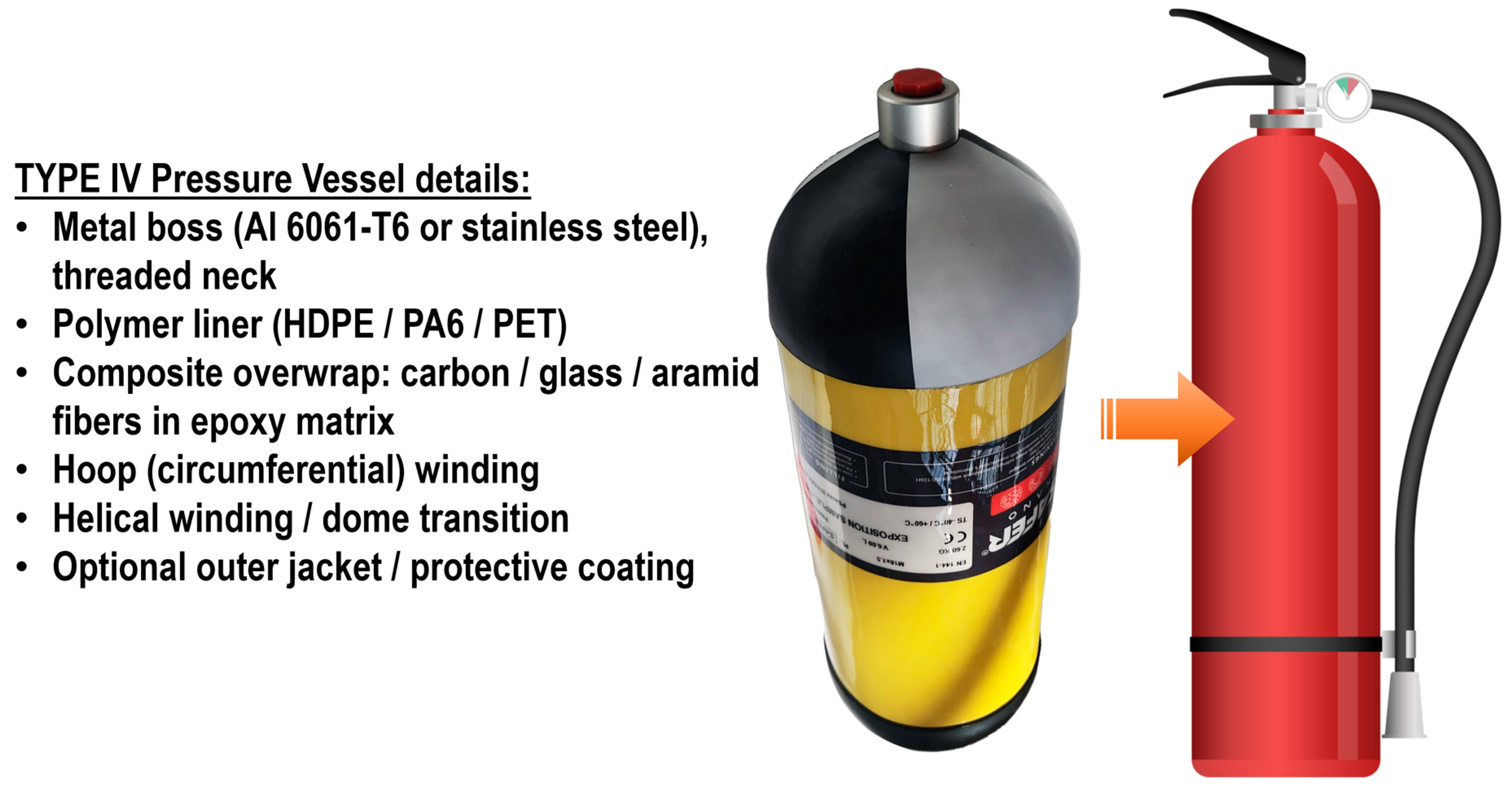
Composite overwrapped pressure vessels (COPVs) of Type IV construction—defined by a non-metallic liner fully wrapped with a fiber-resin composite shell—are increasingly employed in high-pressure fire safety equipment [1,2]. Their primary advantage is dramatically reduced weight compared with all-metal cylinders, without sacrificing strength [3,4,5]. For firefighters, the difference is significant: a modern 6.8 L Type IV SCBA cylinder can weigh ~2.6 kg, about 30% lighter than a conventional Type III (aluminum-lined) cylinder of equal capacity [1,4]. Type IV cylinders also offer inherent corrosion resistance because the liner is polymeric, an important benefit in humid or marine environments where steel cylinders degrade [5,6]. These attributes make Type IV vessels an attractive option for the portable fire extinguishers and self-contained breathing apparatus (SCBA) used in firefighting, where weight, durability, and reliability are critical [7,8]. Indeed, since the early 2010s, composite extinguishers like the Britannia P50 have demonstrated 20-year lifespans with minimal maintenance by overcoming the corrosion and liner degradation issues of steel units [6,9]. However, adopting Type IV COPVs in fire applications also poses challenges. The plastic liners must prevent gas loss and withstand cyclic pressurization, yet polymers are generally more permeable and temperature-sensitive than metals [10,11]. Safety standards for fire extinguishing equipment impose stringent tests (pressure cycling, burst strength, fire exposure) that composite cylinders must meet or exceed, requiring robust design margins [8,12,13]. Past failures—such as SCBA cylinder ruptures during refilling or in fire conditions—highlight the importance of understanding composite-specific failure modes (e.g., stress-rupture of fibers, liner collapse) and implementing adequate inspection regimes [14,15,16]. Furthermore, manufacturing consistency and certification costs remain higher for composites than for traditional steel cylinders, potentially limiting widespread uptake without further innovation [2].
This article aims to review the state of the art in Type IV high-pressure composite cylinders specifically for fire extinguishing and breathing apparatus applications. We survey the literature on material improvements to liners and overwraps, new manufacturing methods, and performance in fire scenarios. We also compare standards and design practices between fire-service cylinders and the well-studied Type IV hydrogen storage tanks, identifying both common lessons and unique considerations. By consolidating findings from scholarly sources, we seek to provide a comprehensive reference for researchers and engineers developing next-generation composite firefighting cylinders. This review contributes four elements beyond prior COPV surveys: (i) an agent–vessel coupling perspective (foam, water-mist, dry powder, clean agents/CO2) clarifying pressure strategy, refill thermals, and liner compatibility for fire service; (ii) a synthesis of emerging matrices (vitrimer and thermoplastic) with process-window vs. liner constraints; (iii) a practice-oriented digest of in-line and periodic NDT/SHM (AE, FBG) tuned to SCBA/extinguisher duty cycles; and (iv) a life-cycle framing (LCC/LCA) for composite vs. steel cylinders in fire equipment. These pillars structure the comparative analysis and provide actionable guidance for design, certification, and maintenance planning.

2. Material and Manufacturing Innovations

Advances in material science have been pivotal in addressing the challenges of Type IV COPVs. The construction of these vessels can be divided into two primary components: (I) the polymer liner, which ensures gas containment and stability of the vessel’s shape, and (II) the fiber-reinforced composite shell, which bears the hoop and axial stresses from internal pressure [14]. Innovations in both domains aim to improve performance metrics such as gas barrier properties, strength-to-weight ratio, impact resistance, and longevity under cyclic loading [11,17].
In addition, new manufacturing methods have been developed to produce these composite cylinders more efficiently and with improved quality control [18].

2.1. Liner Innovations

The liner of a Type IV cylinder is typically a thin thermoplastic (Table 1) that serves as a seamless bladder to hold the pressurized gas and prevent leakage. Common liner materials (Table 2) in current use include high-density polyethylene (HDPE) and polyamides (nylon), due to their moldability and good balance of toughness and gas barrier performance [17,19]. Each material has limitations: HDPE is chemically inert and tough at low temperatures, but relatively gas-permeable, whereas polyamide (e.g., PA6 or PA11) has a much lower gas permeability but can absorb moisture and is costlier [14].

2.1.1. High-Performance Polymers

Beyond HDPE and nylons, research continues into alternative thermoplastics with superior properties. Polyamide-imides, fluoropolymers, and custom blends have been explored for hydrogen service [17]. PA66 (Nylon-66), for instance, has about 5–8 times lower H2 permeability than HDPE and can reduce leakage by ~92–95%, but its cost is substantially higher, and it is less tough (needing impact modifiers) [2]. Some manufacturers use polyethylene terephthalate (PET) in SCBA liners for its good gas barrier and dimensional stability [3,5]. PET is the choice for the new Dräger NANO cylinders, yielding an ultralight 6.8 L SCBA cylinder (2.8 kg) with no set service life [3]. PET does not suffer hydrogen embrittlement and has low permeability to air; however, it has a higher melting point, requiring careful processing [10]. Table 3 summarizes typical liner materials.

2.1.2. Polymer Nanocomposites

Another route to improve liner performance is dispersing impermeable nanoparticles into the polymer matrix to create a “tortuous path” that slows gas diffusion [11,17]. Montmorillonite nanoclay, graphene nanoplatelets, and other plate-like fillers have shown promise in reducing hydrogen permeation rates when properly exfoliated in polymers [15,20]. Habel et al. demonstrated an ultra-high-barrier liner by spray-coating a polyvinyl alcohol (PVA) matrix with 50 wt% silicate nanosheets, achieving hydrogen permeability as low as 0.6 cm3·µm·m−2·day−1·atm−1—an improvement by a factor of 4 × 10³ over high-barrier EVOH [21]. While PVA is not a typical liner material for structural tanks, this result illustrates the potential of nanocomposites [17]. For more practical liner resins like PA6, studies have shown that adding small fractions (~1–5%) of organoclay can reduce H2 permeability by ~50% or more, provided the clay is well dispersed [11]. Kis and Kókai (2023) note that polymer–nanofiller surface treatments are often needed to ensure good dispersion and adhesion, but when optimized, nanocomposite liners offer both improved barrier and mechanical reinforcement [14].

2.1.3. Multilayer Liner Systems

Instead of a single polymer, multi-layer liners combine different materials to leverage their strengths [17]. A typical strategy is to incorporate a thin barrier layer such as ethylene–vinyl alcohol (EVOH) sandwiched between ductile polymer layers. EVOH has an extremely low gas permeability, potentially reducing hydrogen or air leakage by orders of magnitude [22]. However, EVOH alone is brittle and sensitive to moisture. To address this, Sharp et al. (patent US20140008373A1) proposed a tri-layer liner with an inner impact-modified PA6 for toughness (and adhesion to EVOH without a tie layer), an intermediate EVOH barrier, and an HDPE or PA outer layer [23]. This design achieved high permeation resistance while avoiding delamination upon depressurization—a known issue when gas trapped in adhesive layers expands and “blisters” the liner. Multi-layer liners are now being trialed in CNG and hydrogen tanks, though manufacturing complexity and ensuring long-term inter-layer bonding remain challenges [17].

2.2. Composite Shell Advances

The fiber-reinforced overwrap provides the structural backbone of a Type IV cylinder, carrying the hoop and axial stresses generated by internal pressure. Traditional composite shells use high-strength carbon fiber embedded in epoxy resin, applied in multiple layers at precise winding angles. For fire applications, where cylinders may be dropped, heated, or impacted, the composite must offer not just high burst strength but also toughness and thermal stability. Recent advances in composite shell technology include hybrid fiber architectures, toughened and fire-resistant resin systems, and even emerging recyclable matrices [2,18].

2.2.1. Hybrid Fiber Overwraps

To optimize performance and cost, manufacturers are exploring hybridization of fiber layers [2]. Carbon fiber offers exceptional tensile strength and stiffness-to-weight, but it is expensive and can be brittle [18]. By incorporating layers of aramid or glass fiber over the carbon, the shell can gain impact resistance and ductility [2]. For instance, some Type IV extinguishers use an aramid fiber weave as the outer layer over carbon or HDPE, combining the “super strength” of aramid with the stiffness of carbon [9]. Aramid fibers have high toughness and do not shatter; in a drop or blast, they can help contain fragments [24]. Glass fiber is another common outer wrap material: although heavier, a thin fiberglass veil on the exterior protects the carbon/epoxy from abrasion and ultraviolet exposure. The EN 12245 standard in fact recommends an external glass or aramid layer for UV shielding on composite cylinders [8]. Recent studies (e.g., Zhou et al. 2025) also suggest placing small amounts of high-strain fibers at the dome regions to improve damage tolerance, as the curved end-domes experience multi-axial stresses and are prone to matrix cracking [18]. Overall, hybridization can tailor the cylinder’s properties: carbon for strength, aramid for toughness, glass for surface hardness, etc., resulting in a more resilient vessel in fire-ground conditions.

2.2.2. Toughened and Fire-Resistant Resins

Standard epoxy matrices can be brittle and will degrade under high heat (softening ~ 150 °C). Innovations in resin chemistry aim to improve these aspects [2]. Toughened epoxies containing rubber microparticles or thermoplastic additives are widely used in aerospace composites and are being adopted in COPVs to increase resistance to impact and micro-cracking [25,26]. A tougher matrix delays the onset of damage when a cylinder is dropped or struck, which is crucial for maintaining safe performance until scheduled inspections. Additionally, as firefighting gear might be exposed to flames, self-extinguishing or flame-retardant resin systems have been investigated [1,27]. Researchers have incorporated phosphorus-based flame retardants or intumescent additives into the epoxy so that if the composite is exposed to fire, it chars and insulates rather than burning. For example, a recent study by Wang et al. (2022) developed a phosphorous-modified epoxy for composite cylinders that significantly reduced heat release in flammability tests, albeit with some reduction in mechanical strength [28]. While composites will never match steel’s heat tolerance, these resin innovations can prolong the cylinder’s integrity in a fire, giving more time for pressure relief devices to activate.

2.2.3. Emerging Vitrimer and Thermoplastic Matrices

Vitrimer and Thermoplastic Matrices. Vitrimers are cross-linked polymers with heat-activated bond exchange: they behave like thermosets in service, but when heated they can be welded and micro-repaired, helping composite overwrapped pressure vessels (COPVs) last longer by relaxing microcracks. In practice this is already feasible: Alms et al. (2025) used filament-wound vitrimer shells on Type IV cylinders and reported epoxy-like strength, plus partial self-healing during pressure cure as heat/pressure re-bonded micro-damage [29]. Thermoplastic matrices (e.g., PA12, PPS, PEEK/PEKK) are fully melt-processable, offering high toughness/impact resistance and true fusion bonding—even co-consolidation to thermoplastic liners for a more monolithic shell and fewer interface leak paths, with the advantage of being more recyclable [30].
Overall, the composite shell of fire equipment cylinders is trending towards higher performance and resilience. By mixing fiber types and improving resin behavior, manufacturers have achieved shells that meet stringent requirements (e.g., EN 12245 requires no burst before 1.5× service pressure and drop tests without leakage) while minimizing weight [8]. A noteworthy example is the Dräger NANO Type IV SCBA cylinder, which uses a PET liner and a carbon fiber/epoxy shell enhanced with carbon nanotubes in the resin [3]. The result is a 47% weight reduction vs. steel and a no limited life (NLL) rating, meaning the cylinder can be used indefinitely with proper inspection. The inclusion of nanotubes likely improves the matrix stiffness and crack resistance, illustrating how nanotechnology is now influencing composite shells as well as liners. In summary, through material innovation the composite overwrap has evolved to be lighter, tougher, and more fire-resistant—qualities essential for reliable performance on the fireground.

2.3. Manufacturing Developments

Producing Type IV composite cylinders entails a complex sequence: molding the polymer liner, wrapping it with fibers impregnated in resin, curing the composite, and then finishing/testing the vessel [10,11,15,29]. Advances in manufacturing processes (Table 4) have focused on improving throughput, consistency, and the integration of quality control measures.
Type IV shells for SCBA and portable extinguishers commonly adopt dual-angle lay-ups, a near-circumferential hoop layer (≈85–90°) for membrane stresses and helical layers (≈±15–30°) to carry axial load and stabilize the dome transition (Figure 1). Typical tow tensions fall in the 20–60 N per tow band (carbon 12–24k), with winding speeds ≈ 0.3–1.0 m·s−1, controlled to avoid fiber slippage at the boss and to regulate compaction. For room-temperature wet winding, OOA epoxy cures followed by post-cure 80–120 °C are common; vitrimer routes use similar schedules with bond-exchange activation at ≈120–180 °C. Dry-tape thermoplastic winding is viable but imposes local heat-input limits to protect thermoplastic liners (HDPE/PA/PET) from distortion. Indicative mass for 6.8 L/300 bar SCBA Type IV is 2.5–2.8 kg, typically 20–40 % lighter than the comparable Type III. Cylindrical belt overwrap thickness is often ~2.5–4.0 mm (size- and design-dependent), increasing at the domes by design.

2.3.1. Advanced Filament Winding and Braiding

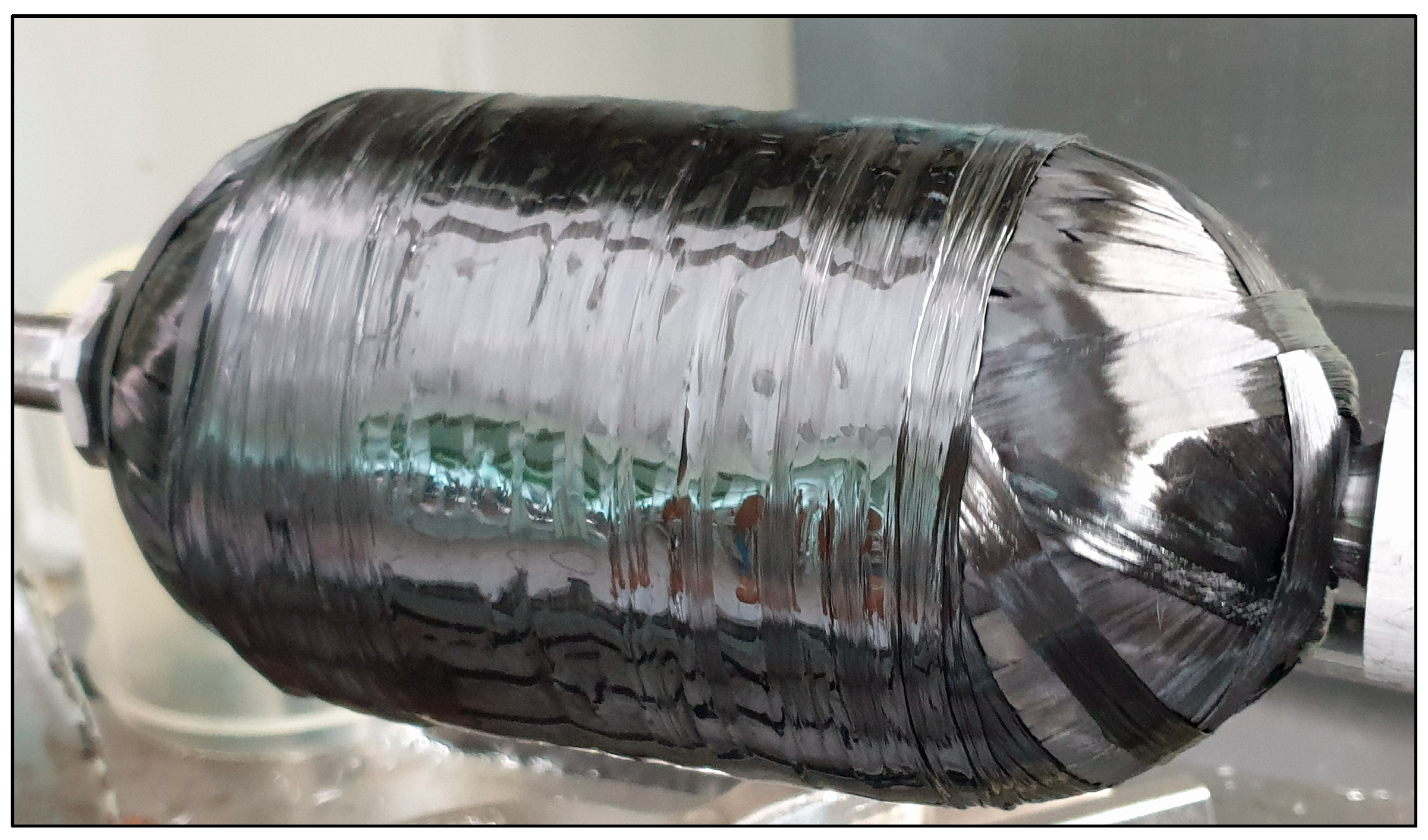
Filament winding is the traditional method to lay fibers onto a liner in precise patterns. Today’s systems are CNC controlled and can place fibers with great accuracy; however, winding the dome sections (ends of the cylinder) without fiber slippage or gaps remains challenging [31]. Researchers have improved dome winding by using variable fiber tension and novel winding algorithms, for example cubic spline algorithms to optimize fiber paths over the dome, achieving more uniform thickness [18]. Additionally, a hybrid winding approach may be used: hoop-dominated layers for hoop stress, plus helical layers for axial stress and dome reinforcement. Beyond filament winding (Figure 2), robotic braiding has emerged as a high-speed alternative.
Braiding machines interlace multiple fiber tows around the liner simultaneously. Eryilmaz et al. (2024) demonstrated a radial braiding process to make 6.8 L Type IV vessels, completing the dry fiber preform in a fraction of the time of winding [32]. After braiding, they infused resin via vacuum infusion (VARTM) and achieved burst pressures of 150–200 bar, validating the concept. Although the burst strength was slightly lower than a comparable filament-wound cylinder (likely due to braid angle limitations), the braiding method required ~20% less fiber and produced a vessel that was 5.7% lighter. This indicates that high-throughput techniques like braiding or automated fiber placement could significantly reduce manufacturing cost for composite extinguishers in the future.

2.3.2. Out-of-Autoclave Curing

The composite shell can be cured (hardened) without expensive autoclaves. Many manufacturers now use oven curing or even in-situ curing around the liner, often under a vacuum bag [33,34]. For instance, Type IV cylinders with thermoset resin are commonly cured at 70–85 °C in an oven to avoid overheating the plastic liner [35]. Recent resin formulations allow snap cures (fast curing epoxies) to shorten the cycle time. An alternative is UV-curable resins, where ultraviolet light triggers polymerization of the resin as the vessel is wound; this has been tested on small cylinders to essentially cure spontaneously and eliminate a separate oven cycle [34]. Moreover, as mentioned above, vacuum-assisted resin transfer molding (VARTM) is used in braided preforms—the dry fiber on the liner is placed in a mold and infused with resin under vacuum [32]. This method is out-of-autoclave and can yield very consistent fiber volume fraction. The trade-off is that void content must be carefully controlled to ensure strength.

2.3.3. In-Line Non-Destructive Testing (NDT)

Given the safety-critical nature of these cylinders, manufacturers are increasingly integrating NDT into the production line [36]. One approach is acoustic emission (AE) monitoring during autofrettage. Autofrettage is the initial over-pressurization of the cylinder to plastically expand the liner and seat the fibers (often to 1.5 times the working pressure) [37]. By attaching acoustic sensors, any fiber breaks or delaminations that occur emit ultrasonic signals which can be detected. Ghaznavi et al. showed that analyzing these AE signals with machine learning can classify damage types (fiber break vs. matrix crack) and even predict if a vessel has manufacturing defects [38]. In fact, an ASTM standard has existed for the AE testing of COPVs during periodic inspection, though it has been withdrawn recently [39]. Rocha et al. (2024) embedded fiber Bragg grating (FBG) sensors on the aluminum liner to detect the residual plastic strain induced by the autofrettage process, demonstrating that AE-like strain monitoring during initial overpressurization is viable in composite vessels [40]. Another in-line technique is digital radiography or computed tomography (CT) on a sampling of cylinders to detect voids or miswrapped fibers. While CT is time-consuming, modern facilities use fast X-ray scanners to inspect the composite wrap layer by layer. For example, the EU “HYPACTOR” project recommended calibration of NDT methods to detect flaw sizes that correlate with a <5% burst pressure reduction [36]. Some manufacturers also employ laser shearography—an optical method to find subsurface disbonds by looking at surface deformation under vacuum stress [41]. The adoption of such technologies ensures that each composite cylinder leaving the line meets the design safety margins, crucial for the fire service, where any cylinder failure is unacceptable. As an illustration, Luxfer’s composite cylinder inspection manual notes that batch testing and 100% visual inspection are supplemented by acoustic or ultrasonic checks per EN 12245 requirements [5].
In summary, manufacturing developments are closing the gap between composite and steel cylinders in terms of consistency and cost. Automated fiber placement and high-throughput braiding can reduce labor and material waste, while advanced curing methods cut processing time. Simultaneously, embedded NDT systems catch defects early, preventing field failures. For fire extinguishing equipment manufacturers, these innovations mean it is increasingly viable to produce composite cylinders at scale with confidence in their safety and performance. The result is that more end-users (fire departments, industrial safety managers, etc.) can adopt the new technology without prohibitive cost.

3. Technical Review of Type IV Cylinders for Fire Applications

Type IV composite cylinders designed for firefighting purposes must satisfy a complex matrix of performance requirements. They are classified as pressure vessels and thus come under gas cylinder regulations, but in use they also form part of life-safety systems (SCBAs) or firefighting apparatus (extinguishers).

3.1. Standards and Certification (EU and Non-EU)

Composite cylinders must meet rigorous standards to be approved for use, and these standards vary by region and application. In the European Union, transportable composite gas cylinders fall under the Transportable Pressure Equipment Directive (TPED) and are governed by standards such as EN 12245 [8]. EN 12245:2022 “Transportable gas cylinders—Fully wrapped composite cylinders” defines minimum requirements for Type III and Type IV cylinders used in general gas service (excluding LPG). It covers materials, design (including liner and overwrap thickness calculations), prototype testing (burst tests, drop tests, fire tests), and routine manufacturing inspections. Notably, EN 12245 requires cylinders to survive a 10 m drop without leakage and a bonfire test where a pressure-relief device (PRD) must safely vent the contents if the cylinder is engulfed in fire [5,8]. SCBA cylinders in Europe are often certified to EN 12245 and additionally to EN 144-2 (threaded valve connections) and the SCBA apparatus standard EN 137 (which references cylinder requirements) [3,7]. Portable fire extinguishers in Europe are governed by the EN 3 series (EN 3-7:2004 for performance and construction) [42]. Historically, EN 3 assumed metal bodies, but composite extinguishers like the P50 have achieved EN 3 and Marine Equipment Directive (MED) approvals by demonstrating compliance via extensive testing. For example, the composite extinguisher must withstand >55 bar without bursting (the P50 was tested to >70 bar burst) and must not leak or lose pressure over time beyond specified limits [9].
Internationally, the ISO standards are influential. ISO 11119-3:2013 covers fully wrapped composite cylinders with non-metallic liners (Type IV) for general use, harmonizing with UN transport regulations. It specifies a design lifespan (often 15–20 years unless stated unlimited) and stress ratio requirements to prevent fiber stress-rupture failures [12]. Hydrogen vehicle cylinders are subject to ISO 19881:2018 (for 70 MPa onboard tanks), GTR 13 and R 134 which includes even more stringent testing like hydraulic sequential tests, permeation limits, and bullet penetration tests [43,44,45]. While ISO 19881 is aimed at fuel tanks, it demonstrates a high bar of safety relevant to any high-pressure composite vessel [10]. In the US, composite SCBA cylinders fall under DOT regulations (Title 49 CFR) and NFPA standards. DOT classifies SCBA cylinders typically under special permits (e.g., DOT-SP 10915 for carbon-fiber SCBA cylinders) or under standardized exemptions if applicable [4,5]. The NFPA 1981 standard for SCBA references that cylinders must be DOT-approved and also requires certain features like end-of-service time indicators, but not cylinder design specifics [7]. National Institute for Occupational Safety and Health (NIOSH) certification for SCBA ensures cylinders, as part of the respirator, meet performance criteria (like providing 30, 45, or 60 min rated air at specified flow rates). Many US-made SCBA cylinders are Type III (aluminum-lined) due to legacy designs, but the shift to Type IV is underway. Notably, the MSHA and NIOSH issued approvals in recent years for fully composite SCBA cylinders with 30-year service life, indicating regulatory acceptance of Type IV for firefighting [5,7].
For portable extinguishers in the US, UL 299 and UL 2129 are relevant listing standards (though again they mainly concern performance of the extinguisher medium and discharge, not explicitly cylinder construction) [46,47]. The NFPA 10 standard (Standard for Portable Fire Extinguishers) requires that any cylinder used be either DOT approved (if pressurized above 2 atm) or ASME certified if a pressure vessel [13]. Composite extinguishers marketed in the US have obtained DOT Special Permits or have been designed to ASME Section VIII with composite rules [5]. One example is a lightweight CO2 extinguisher cylinder developed under a DOT permit, using a polymer liner and carbon fiber wrap to reduce weight on aircraft by ~40%. This shows that while no single unified standard exists for “composite fire extinguisher cylinders” in the US, manufacturers can navigate existing pressure vessel codes to gain acceptance [13].
In summary, certification of Type IV cylinders for fire applications involves meeting general composite cylinder standards (EN 12245/ISO 11119-3/DOT specs) as well as fire-specific equipment standards (EN 3, NFPA 1981, etc.). All standards mandate extensive safety factors—typically a burst pressure at least 2.25 times the working pressure for composites—and stringent testing such as drop tests, flaw tolerance tests (e.g., tolerating a certain size notch), temperature cycle tests (usually −40 °C to +60 °C), and bonfire tests with functional PRDs. Compliance ensures that a composite SCBA cylinder or extinguisher is as safe in service as its steel counterpart. Table 5 provides a snapshot of key standards and their focus areas.
Overall, regulatory bodies have increasingly accommodated composite cylinders as long as they meet or exceed the safety benchmarks set for traditional cylinders. Notably, the Britannia P50 extinguishers were the first to secure a BS Kitemark to EN 3 for a non-metallic design, paving the way for similar approvals globally. In practice, when introducing a new Type IV cylinder design, manufacturers typically undertake a comprehensive qualification program (often witnessed by independent inspectors), after which the design is codified in a standard or permit. As more data accumulate proving the long-term safety of composite cylinders in the field, it is expected that standards will further converge—possibly establishing unified rules for unlimited-life composite cylinders (NLL) as already seen in some standards (e.g., ISO allows NLL if stress ratios are low and damage tolerance proven). For now, engineers must carefully navigate the intersection of multiple standards to ensure compliance for fire applications.

3.2. Design Pressures and Performance Considerations

Firefighting cylinders vary in design pressure and capacity depending on their application. Fire service cylinders must endure ambient service −40 … +60 °C and transient internal heating during rapid refills. For SCBA, cascade fills can drive the contained gas to ≈60–90 °C immediately post-fill (occasionally higher in worst-case fast fills). Design margins shall therefore consider matrix Tg (epoxy/vitrimer) and liner softening (HDPE/PA/PET), together with pressure rating at the highest credible gas temperature. The adiabatic trend can be approximated by the isentropic ideal-gas relation (Equation (1)), but real-world refills are moderated by heat exchange to the shell; conservative Tg—10 … 20 °C margins are advisable for epoxies, and active cooling or staged fills for thermoplastic matrices. For portable extinguishers (10–25 bar), thermal loads are milder, but sun exposure and storage can still push contents toward upper service limits; selection of UV-stable outer jackets and light-colored finishes mitigates envelope temperatures.
T 2 T 1 P 2 P 1 κ 1 κ ,   κ = c p c v
where T is absolute temperature (K), P is absolute pressure, and κ ratio of specific heats.
In practical fast charging, a polytropic (Equation (2)) approach is often used, which more closely approximates the actual heat dissipation process.
T 2 T 1 P 2 P 1 n 1 n ,   1 < n < κ ; n ~ 1.1 1.3

3.2.1. SCBA Cylinders

Modern firefighting SCBAs typically use cylinders charged to 300 bar (30 MPa) working pressure (sometimes labeled 4500 psi) [4,5,7]. Older or lower-capacity models operate at 200–207 bar (e.g., 2216 psi SCBAs), but the trend is towards higher pressures to pack more air in a smaller cylinder [3]. A standard 6.8 L, 300 bar Type IV SCBA cylinder carries about 2040 L of breathing air, providing roughly 45 min rated duration. Some systems use “high-pressure” 347 bar (5000 psi) cylinders to extend duration, though these are less common due to compatibility issues [4]. The design burst pressure of composite SCBA cylinders must be at least 2.4 times the service pressure per DOT and EN rules, so a 300-bar cylinder will not burst below ~720 bar (72 MPa) in new condition [1,7,8].
In practice, manufacturers often design for a burst greater than three times the service pressure to add margin against degradation [5]. Capacity vs. weight: A key performance metric is the cylinder’s gravimetric efficiency (air stored per unit mass). Type IV cylinders excel here: for example, a 6.8 L aluminum-lined cylinder (Type III) weighs ~3.7 kg, whereas the 6.8 L Type IV example weighs 2.6 kg—storing ~300 L of air per kg cylinder weight [3,5]. This improves firefighter mobility and reduces fatigue. New 9 L Type IV cylinders (~9 kg filled) can replace older 6.8 L steel cylinders (~15 kg filled), significantly cutting back strain on the user. The lighter weight also means SCBA harnesses can be designed with smaller straps and backplates, further reducing overall burden.

3.2.2. Portable Extinguishers

Common hand-portable extinguishers (water, foam, powder) have internal pressures around 12–15 bar for stored-pressure types, or up to ~55 bar for CO2 extinguishers [13]. These pressures are much lower than SCBA, but the cylinders have to be larger in volume (e.g., 6 kg dry powder is ~7 L volume). Historically, steel or aluminum bodies have been used [48]. Composite extinguishers like the P50 range operate at ~12 bar (nitrogen propellant) for foam/powder, but crucially they eliminate the need for an internal coating (since polymer liner is naturally corrosion-proof) and are guaranteed leak-proof for 10+ years [9]. Design pressure for a P50 is 18 bar and tested to >55 bar. Thus, even though the absolute pressure is moderate, the composite design must ensure a high safety factor and impermeability to keep the propellant pressure constant over years. A big performance win is weight: a 9 kg ABC powder P50 extinguisher weighs ~11.8 kg filled, whereas a traditional steel 9 kg is 14–16 kg. The lighter extinguisher is easier to carry and deploy, which can improve firefighting speed—an often-overlooked advantage [9,48]. Another consideration is cylinder expansion: composite cylinders expand slightly (a few percent in diameter) under pressure [8,12]. This is accounted for in design; for instance, the boss and valve attachment must allow some flex. Brittle attachments could loosen if not designed properly [8]. In SCBA, the slight expansion is managed by the pack harness. In extinguishers, the outer plastic jacket of the P50 can accommodate the expansion with no issue [9].

3.2.3. Design Factor and Stress Rupture

A fundamental performance consideration is the long-term stress-rupture life of fibers under sustained load. Carbon fibers under constant strain can fail over time (a phenomenon known as static fatigue) [2]. To ensure a long service life (15+ years), design standards impose a stress ratio limit, which is the ratio of hoop stress at service pressure to the fiber ultimate tensile stress. Typically, designers keep this around 0.3–0.4 for carbon/epoxy COPVs [12,49]. This means at 300 bars; the fiber strain is such that the cylinder could theoretically hold that load indefinitely with minimal risk of creep failure. Nevertheless, cylinders are periodically hydro-tested (e.g., every 5 years for SCBA in many jurisdictions) to verify no degradation [1,7]. Some advanced composite cylinders have achieved “no life limit” (NLL) status by demonstrating through testing that stress rupture does not occur or is extremely unlikely if inspections are done [5]. For example, the Dräger NANO Type IV is advertised as NLL, meaning it does not have the standard 15-year retirement; it can remain in service as long as it passes periodic tests [3]. To achieve this, the design stress must be very low or the fibers exceptionally robust. The ability to achieve NLL status is a testament to composite reliability improvements.

3.2.4. Thermal Performance

While not typically pressurized to cryogenic or very high temperatures, fire safety cylinders must handle a range from cold winters (−30 or −40 °C storage) to possible heating in a fire [7,8]. The liner and composite are chosen to remain ductile at low temperatures. HDPE liners retains toughness down to −50 °C due to their low glass transition temperature, while polyamides may become stiffer but generally maintain adequate impact resistance if plasticized or moisture conditioned [50]. At high temperatures, the weak link is usually the resin, which can start to soften > 120 °C. That is why standards require a pressure relief device that will activate in fire (usually a fusible alloy that melts ~100–110 °C, releasing the gas safely) [28]. The cylinders themselves are not expected to survive intense fire intact—they are designed to vent and prevent an explosion [8]. Nonetheless, materials like aramid fiber have slightly better heat stability than carbon, so sometimes aramid wraps are marketed as “fire-proof” layers buying extra seconds before rupture [27]. Tests on composite SCBA cylinders in bonfires show that they will typically vent via PRD and the composite will degrade and split, but not violently fragment [5]. This behavior is acceptable and intended by design.

3.2.5. Refill and Cycle Performance

SCBA and extinguisher cylinders undergo refill cycles—SCBA after each use, extinguishers perhaps annually during servicing [7,9]. Type IV cylinders have been tested to withstand thousands of cycles at service pressure plus additional cycles at higher pressures (e.g., ISO requires 1000 cycles to 1.5× service pressure with no leak) [12,43]. One issue particular to polymer liners is rapid decompression—if an SCBA cylinder is emptied very quickly, the liner sees a fast pressure drop that can cause the gas dissolved in the plastic to come out of solution and form micro-bubbles or even craze the liner [14,17]. Standards like ISO 11119 address this by requiring a controlled rate of venting during tests to check liner integrity [12]. In practice, normal use does not vent extremely fast (the regulator limits flow), so it is mainly a consideration during filling and hydrostatic testing (where the release of pressure must be moderated) [7]. Firefighters refilling SCBA from cascade systems have noted that composite cylinders warm up significantly during fast fills—this is the adiabatic heating of the gas and can raise internal temps to ~80–100 °C in a few minutes for a 300-bar fill [5,7]. Type IV liners can handle this, as the HDPE softening point is ~130 °C, but repeated fast hot fills may accelerate aging [14,15]. Some services enforce slower fill rates or cooling if a cylinder was just in use (hot from environment) to mitigate extreme conditions [7].
In performance terms, Type IV fire cylinders meet or exceed the functional metrics of traditional cylinders—providing required pressure and flow, with adequate safety margins [6,8]. Their distinct advantages lie in weight reduction, elimination of corrosion, and in many cases higher gas capacity for the same size. Fire crews using composite SCBA cylinders report noticeably reduced fatigue and improved range of motion [4]. For extinguishers, end-users benefit from units that do not require an annual discharge test (the P50′s polymer liner prevents pressure loss so reliably that only visual checks are needed) [9,48]. Economically, this can save maintenance costs (no refill for 10 years). From a design standpoint, engineers must ensure that these performance gains do not come at the expense of robustness; hence much attention is paid to making composites “fail-safe.” For instance, many composite cylinders are designed to leak-before-burst: if overloaded, the liner will crack and leak gas in a controlled manner rather than the fiber composite shattering explosively [5,12]. The thick polymer liner can actually act as a membrane to vent gas if the fiber wrap breaks in one area. This is a different failure mode than metal, which can fragment, and is considered a safer failure for bystanders (no fragmentation) [1,7]. Overall, the performance of Type IV cylinders in fire applications has been proven in both laboratory tests and a decade of field use. The next subsection explores how they fail and how we inspect them to maintain this performance over time.

3.3. Failure Modes and Inspection Criteria

Understanding how composite cylinders can fail is crucial to developing appropriate inspection and maintenance protocols. Unlike steel cylinders, which typically fail by ductile yielding or crack rupture, composite cylinders exhibit multiple interacting failure modes that accumulate with wear and tear. For SCBA duty cycles, durability concerns are dominated by stress-rupture (sustained-load damage at elevated temperature) and matrix-led microcracking from impact/hot–cold cycling. Periodic inspection should combine visual criteria for outer ply scuffing/delamination, hydrostatic test with permanent expansion limits, and—where available—AE screening during proof pressurization to localize active damage in domes and the cylindrical belt. Portable extinguishers benefit from service-lean regimes but still require gauge checks and outer-jacket integrity assessment to exclude UV/hard-impact degradation.

3.3.1. Fiber Breakage and Fatigue

The carbon (or aramid/glass) fibers carry the load; if enough fibers break (due to manufacturing flaws, impact damage, or stress-rupture over time), the cylinder’s burst strength diminishes [12,36]. Fiber breaks are usually localized—for example, an impact might break fibers in a small region, creating a weak spot [16]. Composite cylinders are designed with a damage tolerance: e.g., one standard test impacts a pressurized cylinder with a 15 kg mass from 1 m; the cylinder must then hold pressure without bursting [7,8]. Over time under pressure, stress-rupture can cause isolated fiber breaks as well (typically in the hoop layers) [51]. Regular hydrostatic re-testing can reveal if the cylinder has lost elasticity (a potential sign of fiber damage, indicated by volume increase) [12]. Acoustic emission (AE) testing, as mentioned, is sensitive to fiber break events—a cluster of AE hits during a refill or test can warn of internal damage [36]. The inspection criteria for fiber breaks are indirect: look for external signs like soft spots, fraying, or dents in the overwrap and monitor for any loss of performance during hydro test (excessive expansion or lower burst margin) [7,16].

3.3.2. Matrix Cracking and Delamination

The resin matrix can crack under impact or cyclic strain, and layers of composite can delaminate (separate) [51]. These are common in COPVs as progressive, non-catastrophic damage that can accumulate. Matrix cracks themselves are not critical (fibers still carry load), but they can lead to leakage paths for gas to reach the liner-composite interface and cause liner blisters or degrade fibers [15]. Visual inspection might not catch matrix cracks unless they manifest as white lines or discoloration on the composite surface. One effective technique for finding delamination is ultrasonic C-scan; however, this is rarely undertaken in the field due to the equipment needed [52]. Instead, standards rely on visual inspection criteria, such as visible fiber exposure, resin chips larger than X mm, or bulging of the cylinder wall, that are cause for rejection [8,16]. For SCBA, CGA C-6.2 guidelines give specific limits (e.g., no cuts deeper than the outer resin layer, no soft spots). If a composite cylinder has been dropped from significant height or run over by a vehicle—events that might not dent it like metal but can delaminate layers—it is often condemned out of caution [7].

3.3.3. Liner–Composite Interface Debonding

In Type IV designs, a potential failure mode is the loss of adhesion between the plastic liner and the composite wrap. If the liner yields or creeps away from the composite (for instance, at the domes or near the metal boss), the composite may not be properly supported and can lead to stress concentrations [11,14]. A debonded liner can also “buckle” into the gap under pressure changes, as discussed for liner collapse. Signs of this can include a slight dimpling or depression detectable on the outside or abnormal acoustic signals during filling [36].
The 2024 study by Rondinella et al. observed that a failed HDPE liner had no significant changes in material properties after curing, implying the failure (cracks in the dome) were likely due to design-related stress, not material degradation [15]. This underscores that proper fit and bonding at the boss are critical—any gap or misalignment can cause the liner to flex excessively at the neck [53]. Inspections specifically check the neck area: technicians use visual and tactile methods to feel if the boss is snug and look for any radial cracks on the liner just below the boss (which might be visible with a bore-scope when the valve is removed) [16]. Some designs incorporate a shear groove or textured liner surface at the neck to ensure good composite grip and sealing. If a liner collapse or blister does occur, it may present as a localized bulge on the cylinder or an audible crack when venting—either of which requires immediate cylinder retirement.

3.3.4. Environmental Degradation

Composite materials can degrade from UV exposure, chemicals, or extreme temperatures. SCBA cylinders often have a gel coat or paint that includes UV inhibitors, and extinguishers like P50 have a UV-protective outer jacket [3,9]. Over years, UV can embrittle the resin if unprotected, so visually one might see fiber exposure or chalking of the surface—again a condemnable condition [8,16]. Chemical exposure (e.g., solvents, acids) can attack the resin or the polymer liner [15]. While aramid and carbon fibers themselves resist many chemicals, the matrix might soften [26]. For instance, ethanol fuels can permeate and plasticize some epoxies; thus, a composite CO2 extinguisher must be checked if, say, it is stored near solvents. As a precaution, fire departments are trained to wash SCBAs after fires to remove any acidic fire effluents that could weaken cylinders over time [3,7]. Thermal aging is less of a concern in normal storage, but cylinders left next to engines or in hot sheds could see some resin property changes after many cycles of heat. Periodic hydro testing at high pressure helps reveal any global weakening—if a cylinder exhibits permanent expansion beyond acceptable limits during hydro (meaning it does not return to original dimensions, indicating material yield or damage), it must be retired [5,16].
Given these failure modes, inspection criteria for Type IV cylinders are codified in standards like CGA C-6.2 (for SCBA) and manufacturer guidelines [16]. Typical criteria include:
  • Visual external inspection: Look for cuts, gouges, or abrasions. Any fiber exposure or cut that goes deeper than the outer resin and cuts fiber is cause for rejection. Thresholds may be given (e.g., if cut length > 25 mm or depth > 1.5 mm, reject) [16].
  • Check for soft spots or bulges: Press the surface with a thumb; a spongy feel in one area can indicate delamination. A bulge that remains when depressurized indicates a blister or liner collapse.
  • Inspect the neck and boss: Remove the valve during periodic test; check the liner’s lip for cracks or deformation. Make sure the metal boss has not loosened or shifted (which could indicate loss of structural support).
  • Hydrostatic test results: During hydro test, note the permanent expansion. Composite cylinders typically have slightly higher expansion than steel, but it should be mostly elastic. If permanent expansion exceeds a certain percentage of the total (often 5% of total expansion), the cylinder fails. This can catch fiber/matrix damage not visible externally.
  • Leak check: After reassembly, a sensitive leak test (e.g., helium sniff test or soapy water) around the boss and overwrap surface ensures no through-wall leaks. While rare, a penetrating impact can cause a leak path without obvious external damage.
  • Acoustic emission (optional): Some advanced service facilities do AE testing at 1.1× working pressure. If the pattern of AE events matches that of a known good cylinder, it passes. Unusual bursts of AE energy could indicate evolving damage inside, prompting further evaluation.
Field experience with thousands of composite SCBA cylinders over decades indicates that catastrophic failures are exceedingly rare when proper inspections are undertaken [1,7]. Most cylinders are retired due to external damage or age before any failure occurs. For example, the U.S. Navy investigated extending SCBA cylinder life beyond 15 years and found many could likely be safe to 30 years with enhanced inspections. Stress-rupture failures have been documented only in cases of manufacturing flaw or exceeding life limits—one infamous incident in 1996 involved a 20-year-old composite SCBA that had been filled and emptied thousands of times; it ruptured during filling due to fiber stress rupture exacerbated by a flaw [54]. This led to a reaffirmation of the 15-year life limit at the time [7,16]. With newer fibers and better resin systems, life may be safely extended, but conservative practice still rules. In fire extinguisher service, Brit–Fire (Britannia) prescribes an annual visual check by the owner (looking for damage, checking the pressure gauge) and a more thorough 10-year manufacturer overhaul where the unit is sent in for liner and shell inspection and a new charge [9]. If any doubt exists (e.g., the extinguisher was used in a fire and exposed to high heat), it is taken out of service and examined. The track record so far is excellent—Britannia reports virtually no pressure losses or failures in the field in over 10 years since the introduction of this process.
In conclusion, Type IV cylinders do not fail in the same mode as metal ones, and their failure warning signs can be subtle. However, by using a multi-pronged inspection approach (visual, hydro, acoustic), we can reliably detect damage well before it poses a danger. Fire services are increasingly being trained in these composite-specific inspection techniques. Some agencies require that composite SCBA cylinders be internally inspected with a video probe at mid-life to check the liner condition (a practice not needed for metal). These efforts ensure that the advantages of composites are enjoyed without compromising safety. The next section will compare these fire-service cylinders with their hydrogen fuel tank counterparts, to highlight how learnings in one domain cross-pollinate the other.

3.4. Comparison with Hydrogen Storage Cylinders

Type IV composite cylinders were first widely deployed in hydrogen storage (e.g., fuel cell vehicles) and in breathing apparatus around the same era (late 1990s–2000s). While the underlying technology is similar—polymer liners and composite overwraps—the service conditions and design priorities in fire applications versus hydrogen fuel tanks have some notable differences.
  • Pressure Level: Hydrogen automotive tanks operate at 35 MPa or 70 MPa (350–700 bar), far above the 200–300 bar of SCBA cylinders. This means hydrogen tanks require thicker overwraps (often > 60% fiber by weight) and typically use only carbon fiber due to its high strength. SCBA cylinders at 300 bars can incorporate some glass or aramid and still meet burst requirements. The higher pressure also intensifies issues like permeation and liner stress. For instance, ISO 19881 limits hydrogen permeation to 46 NmL/h/L at 1.15 × NWP, whereas for SCBA (air) there is no equivalent permeation safety issue—a slight air leak is not dangerous, though it affects capacity [43]. Thus, hydrogen Type IV designs reflect a focus on permeation barriers, often favoring polyamide liners with <0.05 cm3·mm/m2·day hydrogen permeability [55]. Firefighting cylinders, conversely, may use HDPE which permeates more, but as the gas is air or CO2 and the pressures lower, it is acceptable (standards typically allow a small pressure-drop over time for extinguishers) [15].
  • Cycle Life vs. Shelf Life: A fuel tank in a vehicle sees daily pressure cycles (fill and empty) and hundreds of cycles per year, whereas an SCBA cylinder sees fewer full cycles—maybe one per use/training, so on the order of dozens per year—and an extinguisher sees almost none (it is rarely discharged, ideally never) [14]. This means hydrogen tanks are more prone to cyclic fatigue and require design features to handle pressure swings (like fiber prestressing via autofrettage to reduce stress ranges) [2]. Fire cylinders are more concerned with long shelf life—holding pressure for years. Hence, the focus for extinguishers is on preventing slow leaks and corrosion, which Type IV excels at. On the other hand, hydrogen tanks undergo thousands of cycles and are usually end-of-life after 15–20 years, regardless of condition (hydrogen standards often mandate retirement at 15 years) [43,44,45]. SCBA cylinders have historically had a 15-year life as well, but, as noted, some Type IV designs now advertise NLL [5].
  • Environmental Extremes: Hydrogen tanks in vehicles may see wider temperature swings (−40 °C park overnight to +85 °C under hood, plus sun heating), and they must survive crash scenarios (gunfire, etc.) [43,44,45]. Fire equipment cylinders see rough handling but not quite the same sustained extremes. One extreme specific to firefighting is flame contact: a hydrogen tank is somewhat protected in a vehicle, whereas an SCBA on a firefighter’s back might be briefly exposed to flames. Both have PRDs to handle such a scenario. Interestingly, the bonfire test for SCBA (e.g., NFPA standards) is often undertaken with the cylinder as part of the SCBA pack, requiring the cylinder to vent safely without rupturing while the pack is engulfed for a short period—very similar to the ISO vehicle tank bonfire test [1,45]. So, in terms of fire behavior, the two applications converge. Conversely, embrittlement is a concern of hydrogen tanks (metallic bosses can suffer hydrogen embrittlement, though Type IV liners avoid that issue) and fuel quality (no polymerization or contamination of hydrogen).
  • Design Margin and Inspection Philosophy: Hydrogen tanks are typically designed with minimal margin (to save weight) but then tested intensively (every batch is burst tested for certification) [45]. They do not get routine in-use re-testing beyond visual inspection and maybe leak checks in vehicles [8]. In contrast, SCBA cylinders are often slightly overbuilt (weight is important, but safety factors might be a bit higher than absolute minimum) and then they are regularly tested (every 5 years) [16]. This difference in approach means a composite SCBA cylinder might actually have a higher reliability over time because any that start to degrade will be caught and removed. In effect, fire service cylinders are maintained more like life-critical gear, with frequent inspection, whereas hydrogen tanks are treated more like automotive components with fixed lifespan.
  • Boss and Sealing Design: Both use metal bosses for the valve interface, but hydrogen bosses have to seal against hydrogen (small molecule) and often incorporate high-pressure internal valves, etc. SCBA bosses are simpler (basically a neck thread for the valve) [43,53]. However, lessons from hydrogen have led to improved boss designs for SCBA too—e.g., using conical sealing surfaces and O-rings that account for the liner’s viscoelasticity. A recent polymer science study (Zha et al. 2025) modeled the sealing at the boss of Type IV hydrogen vessels and found that liner thickness and creep can significantly affect leak tightness [53]. That insight is equally applicable to an air cylinder: ensuring the boss–liner interface has an annular groove or feature to concentrate seal pressure can prevent slow leaks over years. Indeed, the P50 extinguisher uses a patented locking neck ring to keep the boss tightly attached to the liner [9].
To illustrate numerically, consider a 70 MPa hydrogen Type IV tank (typical volume ~120 L in a car) versus a 30 MPa SCBA cylinder (volume 6.8 L). The hydrogen tank contains around 5 kg of H2, while the SCBA cylinder contains about 2 kg of air. The burst pressure of the hydrogen tank is ~165 MPa, while the SCBA is ~72 MPa. The factor of safety on burst is thus around 2.4 in both cases. Permeation is the key divider: a hydrogen vessel may be specified to tolerate small H2 egress (46 mL/h/L), whereas an SCBA cylinder is effectively impermeable to the much larger O2/N2 molecules, and even trace air seepage would not be hazardous [44,45,56]. Thus, hydrogen designs are driven by permeation control and cycle life, while SCBA designs emphasize low mass and impact robustness. In both cases, burst safety is non-negotiable [7].
In summary, hydrogen storage cylinders and fire service cylinders share a common technological foundation, and advances in one often benefit the other. The extensive hydrogen research on liner materials, permeation and stress rupture has directly informed safer SCBA designs. Conversely, the decades of field experience with composite SCBA (with frequent inspections) has provided confidence in long-term durability that is feeding back to hydrogen (where in-field data are still relatively limited). Both applications stand as proof that Type IV COPVs (Figure 3) can meet extremely demanding safety requirements. As composite technology matures, we can expect the distinctions to blur—for instance, a firefighter’s future air cylinder might be built to hydrogen tank standards, offering even higher pressure (maybe 500 bar SCBA, to greatly increase air capacity) with minimal weight increase. Already, some fire services are evaluating 300 bar vs. 450 bar cylinders, a trade-off likely to be enabled by material improvements first attempted in hydrogen tanks. One key difference will likely remain: hydrogen tanks are certified once for the vehicle’s life, while fire cylinders need periodic re-qualification. This could shift if composites earn a near-perfect safety record in fire service—potentially enabling NLL cylinders with visual checks only, as Britannia’s service-free model hints. Either way, knowledge sharing between the two fields will keep improving Type IV designs and standards.

4. Market Potential and Key Players

The market for composite pressure vessels in fire and safety applications has expanded rapidly in the past decade, driven by the compelling benefits of weight savings, low maintenance, and long service life.

4.1. SCBA Cylinders on the Market

In the firefighting sector, composite cylinders (initially Type III, now increasingly Type IV) have essentially become the norm—in North America and Europe, >90% of firefighting SCBAs now use carbon-fiber composite cylinders instead of older steel or fully aluminum cylinders [4,6]. The introduction of Type IV (polymer liner) SCBA cylinders is a relatively recent shift, but momentum is growing. For example, in 2021 the company SAFER® (Roma, Italy) released ultralight SCBA cylinders with PET liners, branded as “NANO” cylinders, that achieved about 30% weight reduction over aluminum-lined models and offered NLL certification [57]. Major SCBA manufacturers like MSA (Cranberry Township, PA, US), Dräger (Lübeck, Germany), 3 M/Scott Safety (Monroe, NC, USA), and Honeywell (Charlotte, NC, USA) have since begun offering Type IV cylinder options alongside the traditional Type III. Dräger’s catalog now highlights their PET-liner Type IV cylinder as one of the lightest on the market [3]. MSA’s Globe line and others have similar offerings, often sourced from specialized cylinder manufacturers [4].
The key players manufacturing the composite cylinders themselves (as opposed to assembling SCBA packs) include Luxfer Gas Cylinders (Riverside, CA, USA), Worthington Industries (Worthington, OH, USA, acquired SCI), Interspiro (Täby, Sweden), Faber Industrie (Cividale del Friuli, Italy), and newer entrants like Time Technoplast (Mumbai, India) and Zhejiang Kaibo (KB Cylinders, Shangyu, China). Luxfer and Worthington (SCI) have been pioneers in SCBA composites—Luxfer’s LCX® cylinders in the 1990s set standards for 30 min and 60 min SCBAs. However, those were Type III. Today, companies like Hexagon Composites (Aalesund, Norway), Faurecia (Paris, France) and Quantum Fuel Systems (Ventura, CA, USA), known for vehicle hydrogen tanks, are addressing the breathing-apparatus market with Type IV designs that leverage their high-pressure expertise. Hexagon’s subsidiary Ragasco manufactures Type IV LPG bottles, making SCBA tanks a logical extension.

4.2. Portable Extinguishers on the Market

Here, the transition is at an earlier stage but shows promise. The Britannia P50 was a breakthrough product, and Britannia Fire (Norwich, Norfolk, UK) reports a surge in demand as industries and public facilities realize the cost savings of service-free extinguishers. Daasnav (Noida, India) has launched composite extinguishers featuring HDPE liners and aramid/carbon overwraps, targeting heavy industries and offshore facilities (where corrosion is a big issue) [58]. Aska Equipments (New Delhi, India) has commercialized composite body units (MFCF-10 series) built around a polymer liner, aramid-wrapped shell with a UV-stable outer casing [59].
The value proposition is straightforward—lighter, corrosion-resistant hardware with simplified upkeep—showing how Type IV-style architectures are spreading beyond SCBA into mainstream extinguishers and reshaping competition outside the EU, positioning the product as carbon-neutral and 100% recyclable, with simplified in-house annual checks (magnet-based gauge validation) aimed at reducing service visits. One barrier to entry is conservatism and familiarity—many fire safety officers trust steel cylinders as “proven.” But as case studies accumulate (for example, large facilities in the UK switching entirely to P50s and reporting zero maintenance issues and reduced total cost over 10 years), market acceptance grows [6].

4.3. Market Potential

Weight reduction and extended life directly translate to cost and safety benefits. A lightweight SCBA means firefighters can carry more air or move faster, possibly improving rescue outcomes. Extended cylinder life and less frequent hydro tests mean lower ownership costs for fire departments (which often have hundreds of cylinders). For extinguishers, service-free designs cut out yearly contractor visits, saving organizations of maintenance costs over the unit’s life. Additionally, composite cylinders are 100% recyclable (the polymer liner can be repurposed, fibers downcycled), whereas steel cylinders often have linings or need sandblasting for repainting. This aligns with sustainability goals, an increasing consideration in procurement. A 2025 market research report estimated the global demand for composite SCBA cylinders is growing 4–5% annually, with particularly high growth in Asia, where industrial safety standards are pushing the modernization of equipment [60]. We can expect competition to drive costs down—currently, a composite SCBA cylinder can cost 2–3 times a steel one, but when factoring lifespan and weight, the lifecycle cost often favors composite. It is also worth noting cross-industry synergy—the push for a hydrogen economy has caused massive investment in composite cylinder production (for vehicle, bulk transport). This has expanded global manufacturing capacity and expertise, which can spill over to fire equipment. For instance, facilities that produce hundreds of 700-bar hydrogen tanks could also make 300-bar SCBA cylinders relatively easily during low automotive demand periods. This could reduce costs and lead to more players entering the SCBA market, driving prices down and adoption up. In terms of numbers, estimates suggest that there are over one million composite SCBA cylinders in service worldwide [61]. With many of the early ones (2000s-era) reaching end-of-life, replacements are likely to be newer Type IV units, representing a multi-million-dollar annual market in replacements alone. The portable extinguisher market is even larger (tens of millions of extinguishers produced per year globally), but composite variants currently capture only a tiny fraction of that [62]. If composite extinguishers overcome conservative regulatory landscapes in more countries (UL/US, and others following the example of BSI in UK), even a 5% penetration of that market would represent hundreds of thousands of units—a substantial opportunity for manufacturers.

4.4. Environmental and End-of-Life Considerations

We evaluated a representative 6.8 L portable extinguisher in steel and composite casings over a 10-year horizon at a 5% discount rate. While the composite unit carries a higher CAPEX (EUR 240 vs. EUR 150), service-lean maintenance (visual + in-house checks) and the absence of corrosion remediation reduce operating costs. In the base case, the composite option yields a ~27% present-value saving (PV ≈ EUR 490 vs. EUR 670 for steel), with robustness −18 … −35% under ±20% variations in service pricing and the discount rate. The numerical inputs are summarized in Table 6, which shows that the dominant drivers are the frequency/cost of third-party servicing, hydrostatic testing requirements, and corrosion-related rework on steel cylinders.
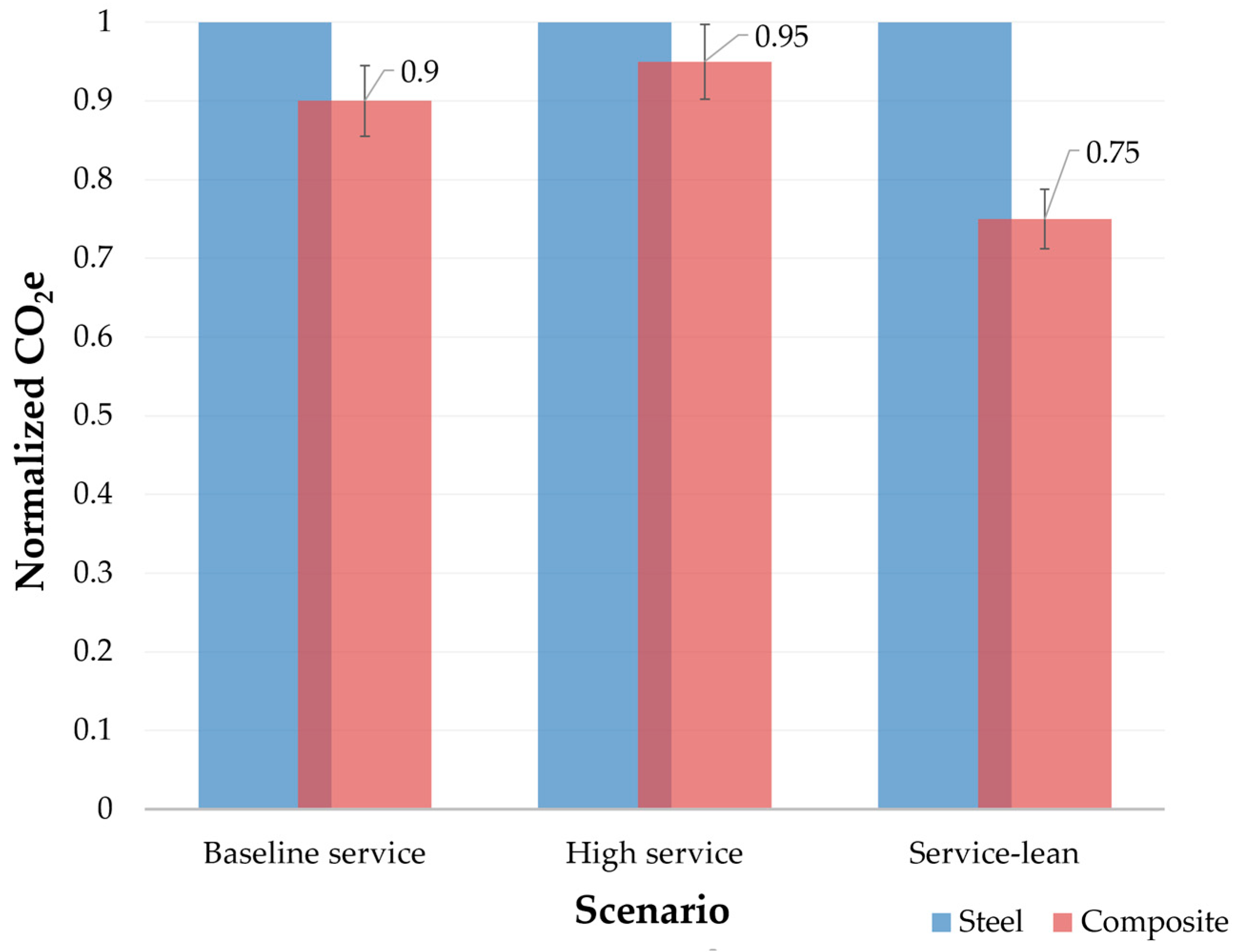
From a life-cycle assessment (LCA) perspective, composites exhibit higher manufacturing footprints (resin/fiber production and cure energy) but compensate in use through lower maintenance demand, corrosion immunity, and longer service life. We adopt a cradle-to-grave system boundary and a functional unit of one 6.8 L extinguisher over 10 years (ISO 14040/14044) [63,64]. Normalizing steel to 1.00, the composite alternative yields indicative, scenario-based CO2e factors of 0.90 (baseline service), 0.95 (high-service), and 0.75 (service-lean), as shown in Figure 4. The advantage narrows in the high-service case because inspection/transport burdens dominate both options, whereas in the service-lean case avoided travel and repainting/refurbishment markedly reduce use-phase emissions. Methods and data quality were aligned with ISO 14040:2006 and ISO 14044:2006 and values are intended as normalized, indicative benchmarks to guide design and maintenance strategy across jurisdictions and service regimes.
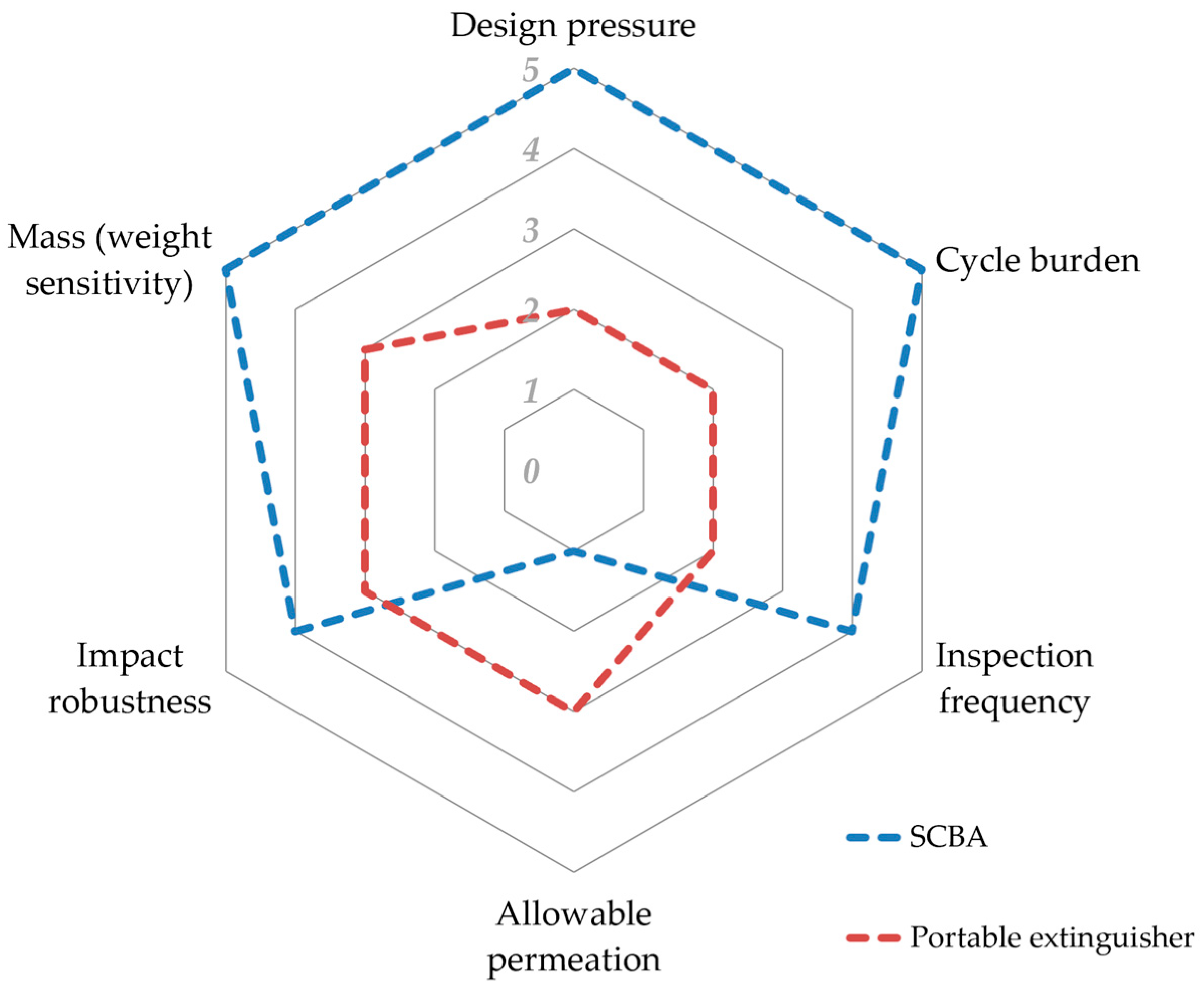
To frame design priorities across applications, Figure 5 provides a qualitative requirement radar. SCBA duty is characterized by very high design pressure and cycle burden, strong weight sensitivity, tight allowable permeation, and elevated inspection frequency; portable extinguishers face moderate pressure/cycle demands, looser permeation constraints, and greater emphasis on impact robustness and straightforward maintenance. This contrast explains why composite benefits are more pronounced in SCBA (mass and fatigue) while, for extinguishers, the gains are realized chiefly via service and corrosion avoidance, as reflected by Table 6 and Figure 4.
A normalized comparison (steel baseline = 1.00) indicates composite variants at 0.75–0.9 over a 10-year service when service-lean regimes are utilized; in high-service regimes, parity or better is retained due to corrosion remediation avoided. Future work should quantify real-world maintenance footprints across agencies and climates.
In conclusion, market prospects for Type IV composite vessels in firefighting are robust and on a growth trajectory. The key drivers are enhanced firefighter safety and reduced ownership cost, which align with the priorities of fire departments and safety managers. As composite technology becomes mainstream and trust builds (a process already advanced in SCBA, and in progress for extinguishers), one can envision a future where all high-pressure fire safety gear is composite based. Steel cylinders may remain for low-cost applications, but the premium segment is clearly shifting to composites. The competition among key players will likely spur further innovation (lighter and smarter cylinders, perhaps with RFID chips tracking usage, etc.). Ultimately, the beneficiaries are the firefighters and users who get safer, easier-to-use equipment.

5. Conclusions

Type IV high-pressure composite vessels—comprising a polymer liner wrapped in a fiber-reinforced composite—have proven to be a game-changing innovation in fire extinguishing equipment. This review has documented how these cylinders deliver substantial weight savings, corrosion resistance, and lifecycle benefits when compared with traditional steel or aluminum cylinders, making them highly attractive for portable extinguishers and SCBA systems. Recent material advances such as multi-layer and nanoreinforced liners, hybrid carbon/aramid fiber overwraps, and toughened/vitrimeric resin systems have addressed many of the historical limitations of composites, yielding cylinders that meet or exceed stringent safety standards for fire service. We have seen that composite cylinders can be engineered to withstand design pressures of 300 bar with wide safety margins, survive drop and flame tests, and in some cases offer non-limited service life, all while reducing cylinder weight by roughly one-third. Extensive analysis of technical literature and field data indicates that failure modes in Type IV cylinders (fiber breaks, matrix cracking, liner collapse) are predictable and manageable through proper design and regular inspection. Modern standards (EN, ISO, DOT) have evolved to encompass composite designs, and regulatory approvals have been granted for composite-based firefighting cylinders in numerous jurisdictions. This points to a growing confidence in the technology’s safety and reliability. The market landscape shows a clear trend: major manufacturers and end-users are embracing composites for the advantages they confer, from the fire station (where lighter SCBA packs improve firefighter endurance) to industrial sites (where service-free composite extinguishers cut maintenance costs). Nevertheless, the review also identified areas where continued attention is warranted. Ensuring long-term liner integrity (preventing permeation and collapse over decades) remains a priority for research. Inspection methods and training need to keep pace with composite technology to maintain safety margins as these cylinders age. Economic factors, particularly initial cost, must be managed through scaling production and articulating life-cycle savings to users. Addressing these challenges will require collaborative efforts among material scientists, manufacturers, and standards bodies—efforts that are already underway and yielding promising solutions (e.g., advanced NDT for composites, nanomaterial-enhanced liners, etc.).
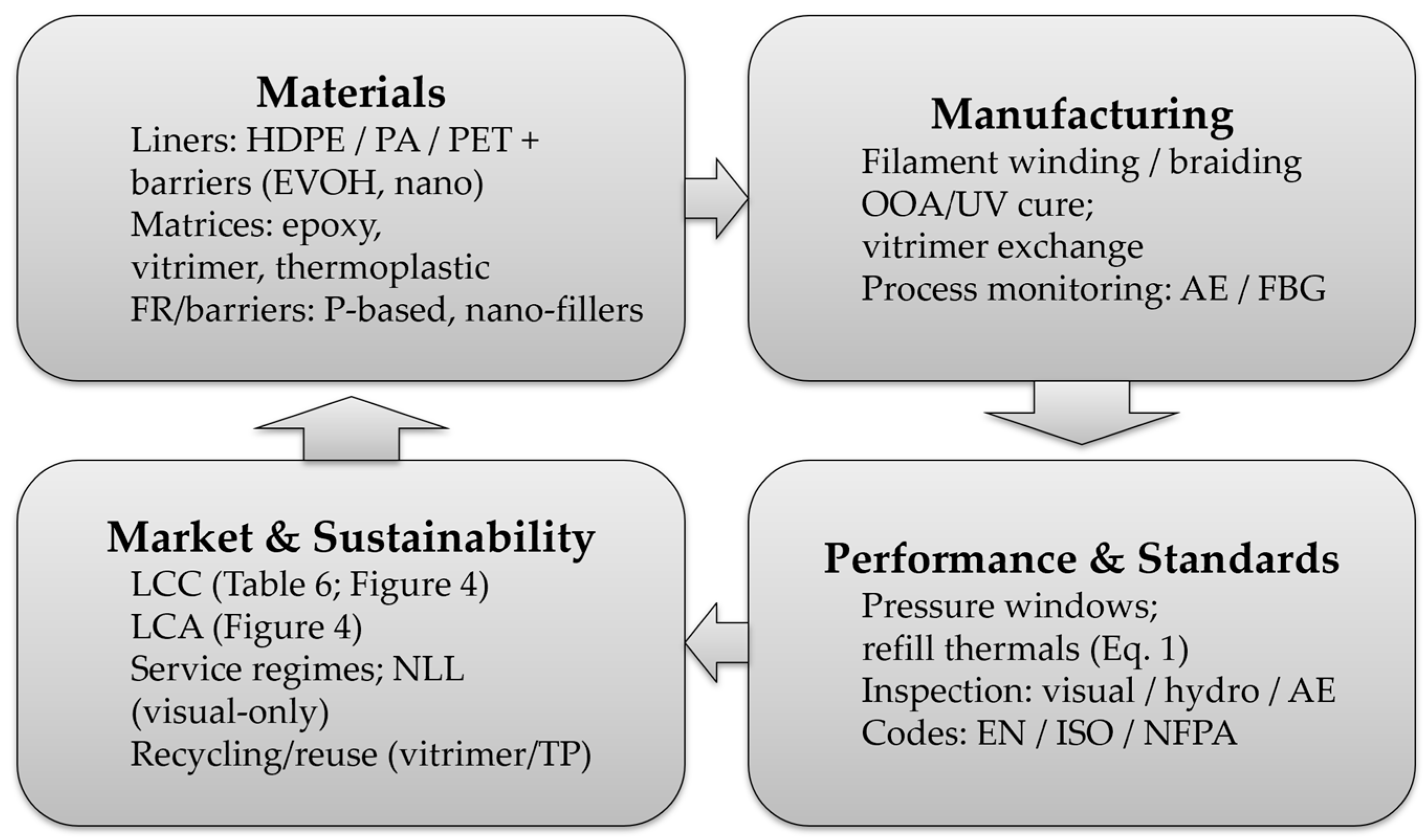
The main messages of this review are consolidated in a four-panel graphical summary (Figure 6). Panel (a) highlights materials progress—from HDPE/PA/PET liners with EVOH/nanobarriers to tougher vitrimer and thermoplastic matrices—underpinning weight and durability gains. Panel (b) maps manufacturing routes (filament winding/braiding, OOA/UV cure) and process monitoring (AE/FBG) that secure consistent quality. Panel (c) links these choices to performance and standards, including design-pressure windows, refill-thermal considerations (Equation (1)), and inspection regimes within EN/ISO/NFPA frameworks. Panel (d) integrates market and sustainability outcomes, aligning the life-cycle cost and carbon advantages of service-lean composite designs (see also Table 6 and Figure 4). Together, the scheme clarifies why Type IV vessels already meet fire-service requirements while indicating the most impactful R&D levers—barrier-enhanced liners, repairable matrices, and SHM-enabled maintenance.
In summary, the adoption of Type IV composite pressure vessels in fire extinguishing and breathing apparatus is transformative and accelerating. The evidence compiled in this review shows that, when properly designed and maintained, composite cylinders meet the rigorous demands of fire service applications while delivering superior performance and longevity. At the same time, the known challenges are being actively addressed through materials science, engineering advances, and improved test/maintenance practices. With sustained research, supportive standards evolution, and cross-industry knowledge sharing, Type IV composite vessels are poised to become the de facto standard across high-pressure fire and rescue equipment, enhancing operational effectiveness and, most importantly, firefighter safety.

Author Contributions

Conceptualization, K.K. and D.I.K.; methodology, K.K.; formal analysis, K.K.; investigation, K.K. and D.I.K.; resources, K.K. and C.Z.; writing—original draft preparation, K.K.; writing—review and editing, K.K., D.I.K. and C.Z.; visualization, K.K.; supervision, C.Z.; project administration, K.K.; funding acquisition, D.I.K. All authors have read and agreed to the published version of the manuscript.

Funding

This work was supported by the National Laboratory for Renewable Energy (Project no. RRF-2.3.1-21-2022-00009), and has been implemented with the support provided by the Recovery and Resilience Facility of the European Union within the framework of Programme Széchenyi Plan Plus, Hungary.

Data Availability Statement

The original contributions presented in this study are included in the article. Further inquiries can be directed to the corresponding author.

Conflicts of Interest

The authors declare no conflicts of interest.

Abbreviations

The following abbreviations are used in this manuscript:
COPVComposite overwrapped pressure vessel
SCBASelf-contained breathing apparatus
PEDPressure Equipment Directive (EU 2014/68/EU)
TPEDTransportable Pressure Equipment Directive (EU 2010/35/EU)
NFPANational Fire Protection Association
NIOSHNational Institute for Occupational Safety and Health
DOTU.S. Department of Transportation
CGACompressed Gas Association
ULUnderwriters laboratory
PRDPressure relief device
NDTNon-destructive testing
AEAcoustic emission
SHMStructural health monitoring
FOFiberoptic (sensing)
RTMResin transfer molding
VARTMVacuum-assisted resin transfer molding
OOAOut of autoclave (processing)
EVOHEthylene–vinyl alcohol (barrier layer)
FRFlame retardant
NLLNon-limited life (service life)
STPStandard temperature and pressure
scc/hStandard cubic centimeter per hour

References

  1. Burks, B.; Ziola, S.; Gorman, M. Environmental Exposure Effects on DOT-CFFC Cylinders with Modal Acoustic Emission Examination; Acoustic Emission Examination: Washington, DC, USA, 2015. [Google Scholar]
  2. Magliano, A.; Perez Carrera, C.; Pappalardo, C.M.; Guida, D.; Berardi, V.P. A Comprehensive Literature Review on Hydrogen Tanks: Storage, Safety, and Structural Integrity. Appl. Sci. 2024, 14, 9348. [Google Scholar] [CrossRef]
  3. Dräger Dräger Compressed Air Breathing Cylinders Accessories for Breathing Apparatus. Available online: https://www.draeger.com/en-us_us/Products/Compressed-Air-Breathing-Cylinders (accessed on 20 November 2025).
  4. MSA Safety Inc. G1 SCBA Cylinders. Available online: https://us.msasafety.com/Supplied-Air-Respirators-%28SCBA%29/Cylinders/G1-SCBA-Cylinders/p/000010000800002001?locale=en (accessed on 20 November 2025).
  5. Luxfer Composite Inspection Manual. 2021. Available online: https://www.luxfercylinders.com/wp-content/uploads/2024/03/Luxfer_SCBA_Carbon_Composite_PED-TPED_A4_2024.pdf (accessed on 20 November 2025).
  6. Hoey, I. Saving Made Simple: How Composite Extinguishers Are Replacing Metal Worldwide with Britannia Fire. 2025. Available online: https://internationalfireandsafetyjournal.com/saving-made-simple-how-composite-extinguishers-are-replacing-metal-worldwide-with-britannia-fire/ (accessed on 20 November 2025).
  7. NFPA 1981:2019; Standard on Open-Circuit Self-Contained Breathing Apparatus (SCBA) for Emergency Services. NFPA: Quincy, MA, USA, 2019.
  8. EN 12245:2022; Transportable Gas Cylinders—Fully Wrapped Composite Cylinders 2022. European Committee for Standardization (CEN): Brussels, Belgium, 2022.
  9. BRITANNIA FIRE The P50 Range in Safe Hands. Available online: https://www.britannia-fire.co.uk/wp-content/uploads/2022/11/P50-Brochure-2023-1.pdf (accessed on 20 November 2025).
  10. Li, X.; Huang, Q.; Liu, Y.; Zhao, B.; Li, J. Review of the Hydrogen Permeation Test of the Polymer Liner Material of Type IV On-Board Hydrogen Storage Cylinders. Materials 2023, 16, 5366. [Google Scholar] [CrossRef]
  11. Zhao, J.; Ding, G.; Feng, P.; Wu, C. High-Pressure Hydrogen Effects on Thermoplastics: A Comprehensive Review of Permeation, Decompression Failure, and Mechanical Properties. Adv. Ind. Eng. Polym. Res. 2025, 8, 387–407. [Google Scholar] [CrossRef]
  12. ISO 11119-3:2013; Gas Cylinders—Refillable Composite Gas Cylinders—Design, Construction and Testing—Part 3: Fully Wrapped Fibre Reinforced Composite Cylinders with Non-Load-Sharing Metallic or Non-Metallic Liners 2013. International Organization for Standardization: Geneva, Switzerland, 2013.
  13. National Fire Protection Association (NFPA). NFPA 10 Standard for Portable Fire Extinguishers 2026; National Fire Protection Association: Quincy, MA, USA, 2025. [Google Scholar]
  14. Kis, D.I.; Kókai, E. A Review on the Factors of Liner Collapse in Type IV Hydrogen Storage Vessels. Int. J. Hydrogen Energy 2023, 50, 236–253. [Google Scholar] [CrossRef]
  15. Rondinella, A.; Capurso, G.; Zanocco, M.; Basso, F.; Calligaro, C.; Menotti, D.; Agnoletti, A.; Fedrizzi, L. Study of the Failure Mechanism of a High-Density Polyethylene Liner in a Type IV High-Pressure Storage Tank. Polymers 2024, 16, 779. [Google Scholar] [CrossRef]
  16. CGA C-6.2-2019; Standard for Visual Inspection and Requalification of Fiber Reinforced High Pressure Cylinders 2019. Compressed Gas Association: Chantilly, VA, USA, 2019.
  17. Li, Y.; Barzagli, F.; Liu, P.; Zhang, X.; Yang, Z.; Xiao, M.; Huang, Y.; Luo, X.; Li, C.; Luo, H.; et al. Mechanism and Evaluation of Hydrogen Permeation Barriers: A Critical Review. Ind. Eng. Chem. Res. 2023, 62, 15752–15773. [Google Scholar] [CrossRef]
  18. Zhou, Y.; Zou, Y.; Xia, Q.; Cao, L.; Zhang, M.; Shen, T.; Du, J. Simulation Analysis and Optimization Design of Dome Structure in Filament Wound Composite Shells. Polymers 2025, 17, 1421. [Google Scholar] [CrossRef]
  19. Kis, D.I.; Hansághy, P.; Bata, A.; Nemestóthy, N.; Gerse, P.; Tajti, F.; Kókai, E. Gas Barrier Properties of Organoclay-Reinforced Polyamide 6 Nanocomposite Liners for Type IV Hydrogen Storage Vessels. Nanomaterials 2025, 15, 1101. [Google Scholar] [CrossRef] [PubMed]
  20. Yersak, T.A.; Baker, D.R.; Yanagisawa, Y.; Slavik, S.; Immel, R.; Mack-Gardner, A.; Herrmann, M.; Cai, M. Predictive Model for Depressurization-Induced Blistering of Type IV Tank Liners for Hydrogen Storage. Int. J. Hydrogen Energy 2017, 42, 28910–28917. [Google Scholar] [CrossRef]
  21. Habel, C.; Tsurko, E.S.; Timmins, R.L.; Hutschreuther, J.; Kunz, R.; Schuchardt, D.D.; Rosenfeldt, S.; Altstädt, V.; Breu, J. Lightweight Ultra-High-Barrier Liners for Helium and Hydrogen. ACS Nano 2020, 14, 7018–7024. [Google Scholar] [CrossRef]
  22. Lee, S.; Han, H.S.; Lee, J.H.; Jeong, J.; Seong, D.G. EPDM Rubber-Reinforced PA6/EVOH Composite with Enhanced Gas Barrier Properties and Injection Moldability for Hydrogen Tank Liner. Fibers Polym. 2024, 25, 2327–2335. [Google Scholar] [CrossRef]
  23. Sharp, J.; Runka, J. Multilayer Liner for a High-Pressure Gas Cylinder 2014. Available online: https://patentscope2.wipo.int/search/en/detail.jsf?docId=WO2012129701 (accessed on 20 November 2025).
  24. Tariq, M.; Nisar, S.; Shah, A.; Akbar, S.; Khan, M.A.; Khan, S.Z. Effect of Hybrid Reinforcement on the Performance of Filament Wound Hollow Shaft. Compos. Struct 2018, 184, 378–387. [Google Scholar] [CrossRef]
  25. Sobrinho, L.L.; Calado, V.M.A.; Bastian, F.L. Effects of Rubber Addition to an Epoxy Resin and Its Fiber Glass—Reinforced Composite. Polym. Compos. 2012, 33, 295–305. [Google Scholar] [CrossRef]
  26. Varley, R.J. Toughening of Epoxy Resin Systems Using Low—viscosity Additives. Polym. Int. 2004, 53, 78–84. [Google Scholar] [CrossRef]
  27. Liu, Q.; Wang, D.; Li, Z.; Li, Z.; Peng, X.; Liu, C.; Zhang, Y.; Zheng, P. Recent Developments in the Flame-Retardant System of Epoxy Resin. Materials 2020, 13, 2145. [Google Scholar] [CrossRef] [PubMed]
  28. Wang, X.; Hu, Y.; Song, L.; Xing, W.; Lu, H.; Lv, P.; Jie, G. Flame Retardancy and Thermal Degradation Mechanism of Epoxy Resin Composites Based on a DOPO Substituted Organophosphorus Oligomer. Polymer 2010, 51, 2435–2445. [Google Scholar] [CrossRef]
  29. Alms, J.; Sambale, A.K.; Fuchs, J.; Lorenz, N.; von den Berg, N.; Conen, T.; Çelik, H.; Dahlmann, R.; Hopmann, C.; Stommel, M. Qualification of the Vitrimeric Matrices in Industrial-Scale Wet Filament Winding Processes for Type-4 Pressure Vessels. Polymers 2025, 17, 1146. [Google Scholar] [CrossRef]
  30. Qiao, Y.; Fring, L.D.; Pallaka, M.R.; Simmons, K.L. A Review of the Fabrication Methods and Mechanical Behavior of Continuous Thermoplastic Polymer Fiber–Thermoplastic Polymer Matrix Composites. Polym. Compos. 2023, 44, 694–733. [Google Scholar] [CrossRef]
  31. Van Hien, D.; Ngoc Thanh, T.; Tung Lam, V.; Thi Thanh Van, T.; Van Hao, L. Design of Planar Wound Composite Vessel Based on Preventing Slippage Tendency of Fibers. Compos. Struct 2020, 254, 112854. [Google Scholar] [CrossRef]
  32. Eryilmaz, O.; Oz, M.E.; Jois, K.C.; Sackmann, J.; Gries, T. FEA and Experimental Ultimate Burst Pressure Analysis of Type IV Composite Pressure Vessels Manufactured by Robot-Assisted Radial Braiding Technique. Int. J. Hydrogen Energy 2024, 50, 597–612. [Google Scholar] [CrossRef]
  33. Toray Out of Autoclave Curing of Prepreg. Available online: https://www.toraycma.com/applications/ooa-out-of-autoclave/ (accessed on 20 November 2025).
  34. Mitchell, S.A. UV Curing: Cure on Demand for Filament Winding. Mater. Sci. Eng. 2019. Available online: https://www.noblelight.com/media/media/hng/doc_hng/industries_and_applications_1/uv_technology_1/case_stories_1/Technical_Paper_-_UV_Curing_Cure_on_Demand_for_Filament_Winding.pdf (accessed on 20 November 2025).
  35. Ekuase, O.A.; Anjum, N.; Eze, V.O.; Okoli, O.I. A Review on the Out-of-Autoclave Process for Composite Manufacturing. J. Compos. Sci. 2022, 6, 172. [Google Scholar] [CrossRef]
  36. Dahmene, F. Use of acoustic emission for inspection of composite pressure vessels subjected to mechanical impact. In Proceedings of the 33th European Working Group on Acoustic Emission, Senlis, France, 12–14 September 2018. [Google Scholar]
  37. Son, D.-S.; Hong, J.-H.; Chang, S.-H. Determination of the Autofrettage Pressure and Estimation of Material Failures of a Type III Hydrogen Pressure Vessel by Using Finite Element Analysis. Int. J. Hydrogen Energy 2012, 37, 12771–12781. [Google Scholar] [CrossRef]
  38. Ghaznavi, A.; Kästle, E.D.; Popiela, B.; Duffner, E. Damage Monitoring of Hydrogen Composite Pressure Vessels Using Acoustic Emission Technique and Machine Learning. In Proceedings of the SCHALL 25—Schallemissionsanalyse und Zustandsüberwachung Mit Geführten Wellen, Dresden, Germany, 27–28 March 2025. [Google Scholar] [CrossRef]
  39. ASTM E2191/E2191M-16; Standard Practice for Examination of Gas-Filled Filament-Wound Composite Pressure Vessels Using Acoustic Emission. ASTM International: West Conshohocken, PA, USA, 2025. Available online: https://store.astm.org/e2191_e2191m-16.html (accessed on 20 November 2025).
  40. Rocha, H.; Antunes, P.; Lafont, U.; Nunes, J.P. Processing and Structural Health Monitoring of a Composite Overwrapped Pressure Vessel for Hydrogen Storage. Struct. Health Monit. 2024, 23, 2391–2406. [Google Scholar] [CrossRef]
  41. Nehls, G. Shearography Equipment Well Suited to Composites NDT. 2025. Available online: https://www.compositesworld.com/products/shearography-equipment-well-suited-to-composites-ndt (accessed on 20 November 2025).
  42. British Standard BS EN 3-7:2004+A1:2007; Portable Fire Extinguishers Part 7: Characteristics, Performance Requirements and Test Methods. British Standards Institution: London, UK, 2008.
  43. ISO 19881:2018; Gaseous Hydrogen—Land Vehicle Fuel Containers. International Organization for Standardization: Geneva, Switzerland, 2018.
  44. Global Technical Regulation No. 13. Global Technical Regulation on Hydrogen and Fuel Cell Vehicles 2013; UNECE: Geneva, Switzerland, 2013.
  45. Regulation No 134 of the Economic Commission for Europe of the United Nations (UN/ECE) Uniform Provisions Concerning the Approval of Motor Vehicles and Their Components with Regard to the Safety-Related Performance of Hydrogen-Fuelled Vehicles (HFCV); UNECE: Geneva, Switzerland, 2019.
  46. UL 299. Dry Chemical Fire Extinguishers. 2025. Available online: https://www`.shopulstandards.com/ProductDetail.aspx?productId=UL299 (accessed on 20 November 2025).
  47. UL 2129. Halocarbon Clean Agent Fire Extinguishers. 2025. Available online: https://www.shopulstandards.com/ProductDetail.aspx?productId=UL2129 (accessed on 20 November 2025).
  48. Firesafe History of Fire Extinguishers. Available online: https://www.firesafe.org.uk/history-of-fire-extinguishers/ (accessed on 20 November 2025).
  49. ISO/TR 4673:2022; Gas Cylinders—Service Life Performance of Composite Cylinders and Tubes. ISO: Geneva, Switzerland, 2022.
  50. Kis, D.I.; Bata, A.; Takács, J.; Kókai, E. Mechanical Properties of Clay-Reinforced Polyamide 6 Nanocomposite Liner Materials of Type IV Hydrogen Storage Vessels. Nanomaterials 2024, 14, 1385. [Google Scholar] [CrossRef]
  51. de Miguel, N.; Mair, G.; Acosta, B.; Szczepaniak, M.; Moretto, P. Hydraulic and Pneumatic Pressure Cycle Life Test Results on Composite Reinforced Tanks for Hydrogen Storage. In Proceedings of the Volume 1A: Codes and Standards; American Society of Mechanical Engineers, New York, NY, USA, 17 July 2016. [Google Scholar]
  52. Hasiotis, T.; Badogiannis, E.; Tsouvalis, N.G. Application of Ultrasonic C-Scan Techniques for Tracing Defects in Laminated Composite Materials. Stroj. Vestn. J. Mech. Eng. 2011, 2011, 192–203. [Google Scholar] [CrossRef]
  53. Zha, Y.; Chen, Y.; Liu, Y.; Wang, X.; Chen, Z.; Xie, P.; Yang, W. Optimizing Sealing Structure Design for Enhanced Sealing Performance in Type IV Hydrogen Storage Vessels. J. Appl. Polym. Sci. 2025, 142, e57050. [Google Scholar] [CrossRef]
  54. Frankle, R.S. Investigation of the Failure of an SCBA Cylinder; U.S. Department of Transportation: Washington, DC, USA, 1996.
  55. Sun, Y.; Lv, H.; Zhou, W.; Zhang, C. Research on Hydrogen Permeability of Polyamide 6 as the Liner Material for Type Ⅳ Hydrogen Storage Tank. Int. J. Hydrogen Energy 2020, 45, 24980–24990. [Google Scholar] [CrossRef]
  56. Adams, P.; Bengaouer, A.; Cariteau, B.; Molkov, V.; Venetsanos, A.G. Allowable Hydrogen Permeation Rate from Road Vehicles. Int. J. Hydrogen Energy 2011, 36, 2742–2749. [Google Scholar] [CrossRef]
  57. SAFER SAFER® 9.0L NANO., Product Information. Available online: https://www.safercylinders.com/products/9-0l-nano-11n (accessed on 20 November 2025).
  58. DAASNAV the Composite Fire. Product Information. Available online: https://daasnav.com/foam-type-fire-extinguisher/ (accessed on 20 November 2025).
  59. ASKA ASKA MFCF 10 MAINTENANCE FREE, Corrosion Free Fire Extinguishers. 2025. Available online: https://askagroup.com/wp-content/uploads/2025/02/ASKA-fire-pdf.pdf (accessed on 20 November 2025).
  60. Raksha Sharma, D. Composite SCBA Cylinders Market. 2025. Available online: https://dataintelo.com/report/global-carbon-composite-scba-cylinders-market (accessed on 20 November 2025).
  61. Self-Contained Breathing Apparatus Market Size, Share, Growth, and Industry Analysis, By Type (Open-Circuit SCBA, Closed-Circuit SCBA), By Application (Fire Fighting, Industrial Use, Other Use), Regional Insights and Forecast to 2034; Market Growth Reports; Grand View Research: San Francisco, CA, USA, 2025.
  62. Zion Market Research Global Fire Extinguishers Market Size, Share, Growth Analysis Report—Forecast 2034; Zion Market Research: New York City, NY, USA, 2025.
  63. ISO 14040:2006; Environmental Management—Life Cycle Assessment—Principles and Framework. International Organization for Standardization: Geneva, Switzerland, 2006.
  64. ISO 14044:2006; Environmental Management—Life Cycle Assessment—Requirements and Guidelines. International Organization for Standardization: Geneva, Switzerland, 2006.
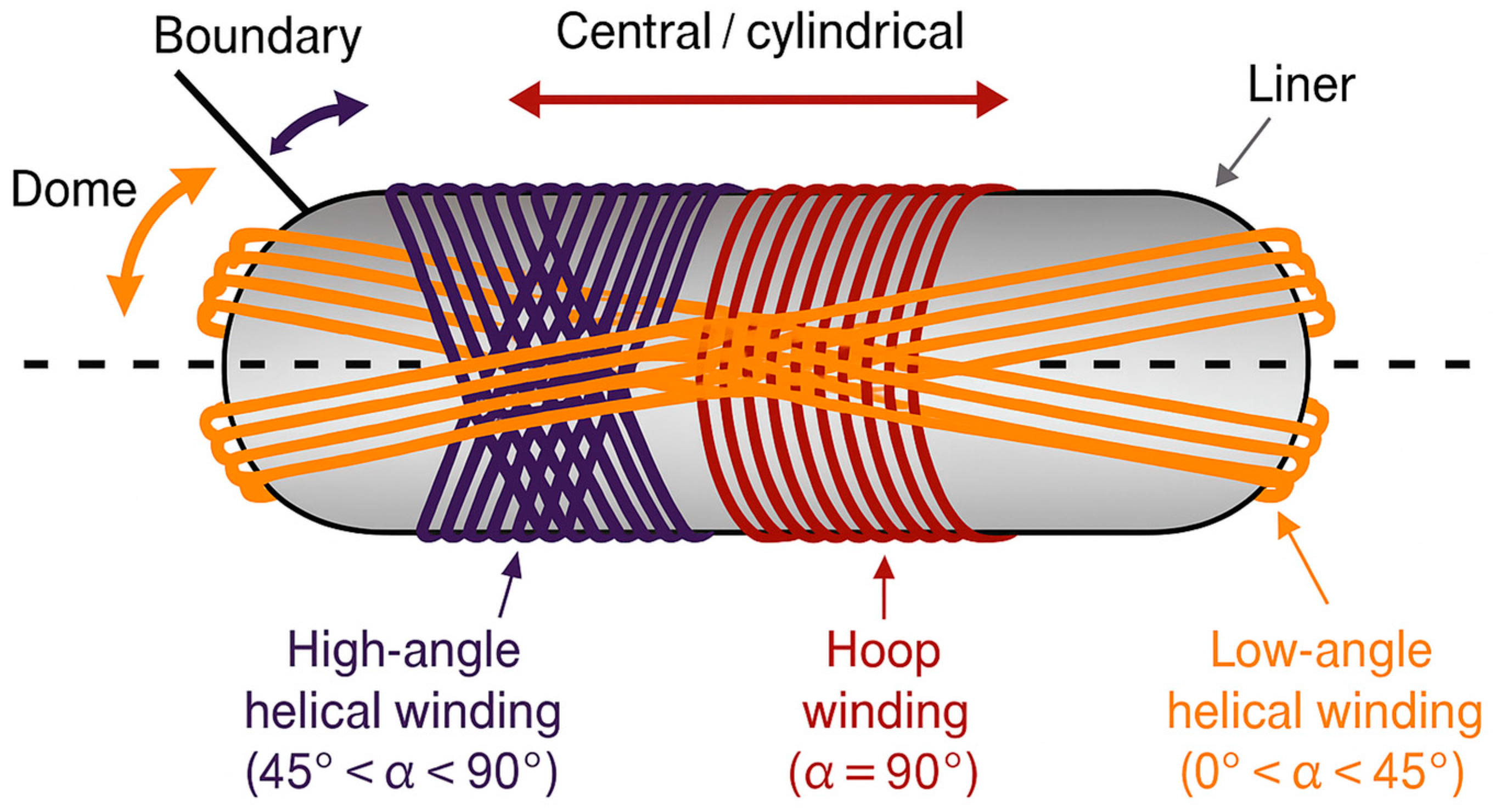
Figure 1. Winding architecture and dome transition—Schematic of hoop and helical paths, tow-drop zones, and boss-adjacent reinforcement for a Type IV shell [14].
Fire 08 00465 g001
Figure 2. Filament winding for a Type IV composite cylinder: CFRP overwrap on PA/HDPE liner with hoop and helical paths; in-line tension and angle control.
Fire 08 00465 g002
Figure 3. Schematic of a Type IV COPV used in SCBA/extinguisher systems.
Fire 08 00465 g003
Figure 4. Indicative LCA comparison—10 y service (normalized CO2e): steel = 1.00 (all scenarios); composite = 0.90 (baseline service), 0.95 (high service), 0.75 (service-lean).
Fire 08 00465 g004
Figure 5. Requirement radar—SCBA vs. portable extinguishers: Design pressure, cycle burden, inspection frequency, allowable permeation, impact robustness, mass.
Fire 08 00465 g005
Figure 6. Graphical abstract: From materials and manufacturing to performance/standards and market/sustainability.
Fire 08 00465 g006
Table 1. Matrix families—comparative Traits (epoxy/vitrimer/thermoplastic).
MatrixTg/TmToughness (qual.)Weld/RepairFR OptionsProcess Note
Epoxy (toughened)Tg 90–130 °CMediumNoP-based, nano-fillersMature OOA; good stiffness
Vitrimer (epoxy-like)Tg 80–120 °C; exchange 120–180 °CMedium–highYes (bond exchange)P-based/nanoRepairable; Tg margin vs. refill thermals
Thermoplastic (PA12/PPS/PEEK)Tm 175/285/343 °CHighYes (fusion)Halogen-free FR, nanoHeat-input must protect liner
Table 2. Liner options—permeation and temperature considerations.
LinerSoftening WindowBarrierNotes
HDPE~80–110 °C (softening)/melt ≈130 °CFairEasy processing; higher permeation; good impact
PA6/PA12~120–160 °C (HDT band)GoodBetter adhesion; better high-T retention
PET~70–90 °C (HDT)/Tg ~75 °CGood–very goodStiffer; good barrier; process temp higher
EVOH barrier (layer)ExcellentMultilayer liners; strong permeation cut
Nano-barrier (GNP/MMT)GoodTortuous path; raises modulus locally
Table 3. Common polymer liner materials for Type IV cylinders and their properties (adapted from [10,11,15,17]).
Liner MaterialNotable PropertiesH2 PermeabilityProsCons
HDPE (PE 100)Semi-crystalline polyolefinHigh (baseline)Tough, impact-resistant; inexpensive; no moisture absorption.High gas permeability; significant thermal expansion.
PA6/PA66 (nylon)Semi-crystalline polyamide~5× lower than HDPELow gas permeability; high strength; tolerates −40 °C.Absorbs moisture (plasticization); more costly; needs impact modifiers.
EVOH (copolymer)Amorphous ethylene–vinyl alcohol~100× lower than HDPEExtremely low permeability (to H2, O2); good adhesion to polyamides.Brittle, especially when moist; cannot be used alone as structural liner.
PET (polyester)Semi-crystalline thermoplasticLow (similar to PA)Good barrier (esp. CO2); high stiffness; low creep; no corrosion.Higher processing temperature; less ductile than HDPE.
PA–nanocompositePA matrix + clay or graphene filler2–4× lower than neat PAGreatly reduced permeation if well dispersed; can improve mechanical properties.Filler dispersion challenges; potential voids; higher viscosity complicates molding.
Table 4. Design and manufacturing parameter ranges for fire service Type IV cylinders.
ParameterTypical RangeRationale/Notes
Hoop angle85–90°Membrane (hoop) stress capacity
Helical angles±15–30°Axial load share; dome stability
Tow tension (carbon)20–60 N per towCompaction vs. slippage control
Winding speed0.3–1.0 m·s−1Path accuracy vs. resin flow
Overwrap thickness (belt)~2.5–4.0 mmSize and MAWP dependent
Shell mass (6.8 L/300 bar)2.5–2.8 kgType IV; −20 … −40% vs. Type III
Cure routeOOA epoxy/vitrimer; post-cure 80–120 °CTg margin to refill thermals
Process monitoringAE/FBG during autofrettageEarly damage screening
Table 5. Key standards for composite cylinders in fire applications.
Standard/CodeRegionApplicable EquipmentKey Provisions for Type IV COPVs
EN 12245:2022EUTransportable gas
cylinders (general, including SCBA)
Design and prototype tests for fully wrapped composite cylinders. Requires batch tests, bonfire test with PRD activation, drop tests from 1.2 m (vertical) and 3.3 m (angled) without burst. Fifteen-year design life unless otherwise justified.
BS EN 3-7:2004 (+EN 3-8)EUPortable fire
extinguishers
Construction and testing of extinguisher bodies. Implicitly expects metal cylinders but composite can comply via equivalent testing. Requires 35 bar minimum test pressure for stored-pressure extinguishers, corrosion resistance, and impact resistance (e.g., falling from mounting bracket).
ISO 11119-3:2013InternationalFully wrapped composite cylinders with
non-metallic liner
Global design standard mirrored in UN Model Regulations. Similar tests to EN 12245 plus environmental conditioning (thermal cycling, humidity) and more detailed liner permeation requirements.
ISO 19881:2018InternationalOn-board hydrogen tanks (70 MPa Type IV)Very stringent testing: permeation limit of 46 Nml/h/L at 1.15 × NWP 55 °C, hydraulic sequential tests (drop, vibration, pendulum impact before burst), gunfire test, etc. Demonstrates extreme safety margin (burst > 2.25× NWP). Relevant to SCBA by analogy (similar stress rupture requirements.
DOT-SP (Special Permits)USASCBA composite
cylinders, others
DOT permits like SP 10915, SP 14232 allow the use of Type IV cylinders for SCBA with specific conditions (e.g., 30-year life, certain fiber and resin). They mandate refill cycle limits and visual inspections per CGA C-6.2 (guidelines for composite cylinder inspection).
NFPA 1981 (2019)USASCBA (overall system)Requires SCBA cylinders meet DOT and CGA standards. Mandates SCBA function tests (e.g., drop tests of the pack, flame impingement test for the whole SCBA). If a composite cylinder is used, it must remain intact and not cause pack failure in these tests.
Marine Equipment Directive (MED)EUMarine-use fire
equipment (including extinguishers)
MED approval for composite extinguishers (e.g., Britannia P50) required showing compliance with EN 3 and additional corrosion and vibration tests for ship environments. Composite design benefits (no corrosion) actually help in salt-spray tests.
Table 6. LCC comparison (present value, 10 y, 5 %).
ItemSteelCompositeNote
CAPEX/unit (year 0)150240EUR, example
Annual service visit50/y20/yContractor vs. in-house
Hydrotest/periodic30/y10/yLocal code dependent
Corrosion remediation15/y0Repaint/grit-blast
Residual value (y10)1030Liner reuse/fiber recovery
PV total (10 y)~670~490Composite −27%
Disclaimer/Publisher’s Note: The statements, opinions and data contained in all publications are solely those of the individual author(s) and contributor(s) and not of MDPI and/or the editor(s). MDPI and/or the editor(s) disclaim responsibility for any injury to people or property resulting from any ideas, methods, instructions or products referred to in the content.