Article

The Effect of Ni Doping on the Mechanical and Thermal Properties of Spinel-Type LiMn2O4: A Theoretical Study


1
Hubei Key Laboratory of Drug Synthesis and Optimization, Jingchu University of Technology, Jingmen 448000, China
2
School of Chemical Engineering and Technology, Tianjin University, Tianjin 300350, China
3
Henan Key Laboratory of High Temperature Functional Ceramics, School of Material Science and Engineering, Zhengzhou University, Zhengzhou 450052, China
*
Author to whom correspondence should be addressed.
Ceramics 2026, 9(1), 5; https://doi.org/10.3390/ceramics9010005

Submission received: 3 December 2025 / Revised: 19 December 2025 / Accepted: 7 January 2026 / Published: 10 January 2026

Abstract

The development of lithium-ion batteries necessitates cathode materials that possess excellent mechanical and thermal properties in addition to electrochemical performance. As a prominent functional ceramic, the properties of spinel LiMn2O4 are governed by its atomic-level structure. This study systematically investigates the impact of Ni doping concentration on the mechanical and thermal properties of spinel LiNixMn2−xO4 via first-principles calculations combined with the bond valence model. The results suggest that when x = 0.25, the LiNixMn2−xO4 shows excellent mechanical properties, including a high bulk modulus and hardness, due to the favorable ratio of bond valence to bonds length in octahedra. Furthermore, this optimized composition shows a lower thermal expansion coefficient. Additionally, Ni doping concentration has a very minimal influence on the maximum tolerable temperature of the cathode material during rapid heating. Therefore, from the perspective of mechanical and thermal properties, this composition could be beneficial for improving the cycling life of the battery, since comparatively inferior mechanical properties and a higher thermal expansion coefficient make it prone to microcrack formation during charge–discharge cycles.

1. Introduction

Lithium-ion batteries have been widely used in fields such as smart mobile devices and new energy vehicles due to their characteristics of high energy density, long cycle life, low self-discharge rate, and environmental friendliness [1,2,3]. The current development focus of lithium-ion batteries is geared towards low cost and high energy density, while cathode materials with excellent performance are of paramount importance for the enhancement of battery performance.
In the spinel-type LiMn2O4 structure, unoccupied tetrahedra and octahedra are connected through edge- and face-sharing, forming Li+ ion diffusion channels that facilitate the reversible extraction and insertion of Li+ ions, making it suitable as a cathode material for lithium-ion batteries. Additionally, the spinel-type LiMn2O4 ceramic, characterized by its low cost, high operating voltage, and excellent thermal stability, has emerged as one of the most promising cathode materials for lithium-ion batteries. However, LiMn2O4 suffers from severe capacity fading during charge–discharge cycles, which hinders its commercial viability. On one hand, LiMn2O4 undergoes Jahn–Teller distortion, which blocks Li+ ion transport channels and consequently reduces specific capacity [4,5]. On the other hand, the disproportionation of Mn3+ results in the generation of Mn2+, which subsequently dissolves into the electrolyte [6,7]. Studies have demonstrated that doping can effectively suppress Jahn–Teller distortion and reduce manganese dissolution, thereby improving the performance of LiMn2O4. For instance, the Ni-doped LiNi0.5Mn1.5O4 cathode material has garnered significant attention due to its ability to effectively increase the operating voltage and mitigate capacity fading [1].
Currently, studies on Ni-doped LiMn2O4 primarily focus on the electrochemical performance. However, Ni doping not only affects the electrochemical properties but also influences the mechanical, thermal, and thermomechanical properties. Previous studies indicate that particle cracking is frequently observed in cathode materials, which is considered one of the primary reasons for capacity fading and the eventual failure of lithium-ion batteries under high-voltage operation [8]. Moreover, such cracking has been detected in several cathode materials after prolonged cycling, which is recognized as a major degradation mechanism leading to capacity fading [9,10,11]. Therefore, not only the traditional electrochemical performance but also the mechanical and thermal properties should be considered in the investigation on lithium-ion battery cathode materials.
First-principles calculations have become an efficient method for investigating the mechanical properties of materials, including bulk modulus, and elastic constant [12,13]. Although first-principles calculations are advantageous for evaluating the mechanical properties of materials, it is difficult to analyze the underlying mechanisms affecting mechanical properties from a deep perspective, especially for complex spinel-type compounds. Recently, we have developed a novel approach, which combines first-principles calculations with the bond valence model (denoted as FP-BVM), to investigate the mechanical, thermal, and thermomechanical properties of spinel-type compounds from the perspective of chemical bonds [14,15,16,17,18]. This method is particularly suitable for investigating the composition-dependent properties of solid solutions with complex compositions and crystal structures, as it enables the calculation of chemical bonding characteristics formed by mixed anions or cations and effectively reveals the coupling effects between different chemical bonds.
In this paper, the FP-BVM method is used to simulate the mechanical, thermal, and thermomechanical properties of LiMn2O4 ceramics with different Ni doping concentration, namely LiNixMn2−xO4 (x = 0, 0.125, 0.25, 0.375, and 0.5), aiming to reveal the relationship among doping concentration, crystal structure, and properties from the perspective of chemical bonds. x = 0 and x = 0.5 are the two most extensively studied composition points, while intermediate doping concentrations have been relatively less explored. To identify a composition within the range of x = 0~0.5 that optimizes the mechanical and thermal properties, targeting improved mechanical and thermal stability in battery applications. Additionally, x = 0.5 represents a limiting composition in which all Mn3+ ions are converted to Mn4+. If compositions with x > 0.5 were selected, maintaining the charge balance within the stoichiometric LiNixMn2−xO4 spinel structure would be challenging. Therefore, a doping range of x = 0~0.5 was selected as the subject in this work. This study can guide the design of cathode materials with superior mechanical, thermal, and thermomechanical properties, thereby addressing the issue of battery capacity fading.

2. Theory and Methods

2.1. Crystal Structure Calculations

The calculations based on density functional theory were performed using the Materials Studio CASTEP version 2020 code [19]. The exchange-correlation potential was described within the generalized gradient approximation (GGA) proposed by Perdew, Burke, and Ernzerhof [20]. The plane wave cutoff energy of 490 eV was set and the Brillouin zone (BZ) was sampled with a Monkhorst–Pack grid of 2 × 2 × 2. The geometries of configurations were optimized using the Broyden–Fletcher–Goldfarb–Shannon (BFGS) algorithm in the CASTEP package with convergence to 2 × 10⁻⁶ eV per atom. Spin polarization was included in the structural optimization of LiNixMn2−xO4. The initial spin polarization is 0.333 and 0.200 for Mn and Ni, respectively. And the initial magnetic moment is 5.000 and 2.000 uB for Mn and Ni, respectively. Specifically, the GGA + U approximation was employed to determine stable structures of LiNixMn2−xO4. The value of 4.46 eV, 5.04 eV, and 6.00 eV was used for Mn(III), Mn(IV), and Ni in LiNixMn2−xO4, respectively.

2.2. Mechanical Properties Calculations

After geometry optimization by first-principles calculations, the symmetry of LiNixMn2−xO4 supercell was reduced to P1. However, the structural parameters of the spinel-type structure with the symmetry of Fd3m, including the lattice constant and anion parameter, could be obtained. Based on the lattice constant and anion parameter, the Fd3m structure could be reconstructed [15,16].
A bond valence approach, founded on the reconstructed Fd3m structure, was employed to simulate the mechanical properties of spinel-type LiNixMn2−xO4. The bond valence (Sij) between atom i and j can be calculated as follows [21]:
S i j = exp d 0 d i j b ,
where Sij is the bond valence, dij is the bond length between atom i and j, and b = 0.37 Å is a constant. The values of d0 are 1.466, 1.732, 1.75, and 1.654 for Li–O, MnIII–O, MnIV–O, and Ni–O bond, respectively, which represent the nominal length of a bond of unit valence [22,23]. Then, the composition-weighted average bond valence (-SAVE) can be calculated as follows [24]:
S AVE = i X i j Y j S i j ,
where Xi and Yj are fraction of one type of cation and anion, respectively. For the LiNixMn2−xO4 unit cell, the weighted bond valence of bonds in its tetrahedral and octahedral sites is derived from their respective composition ratios. The bond force constant is simulated by the following [21]:
F C = β 8 S i j 3 3 2 1 b 2 d i j d i j 2 ,
where β = 23 nN Å2 electrons−2. Similarly, the composition-weighted average bond force constant for bonds in tetrahedra and octahedra is determined by weighing their values against the compositional ratio of LiNixMn2−xO4.
The bulk modulus (B) of LiNixMn2−xO4 can be simulated by bond valence models [24]:
B = B T + B M 2 ,
where BT and BM are bulk modulus of bonds in tetrahedra and octahedra, respectively, which can be expressed as follows [24]:
B T = F C T 3 g 1 d T ,
and
B M = F C M 3 g 2 d M .
Here, F C T and F C M denote the composition-weighted average bond force constants for the tetrahedral and octahedral sites, respectively, while dT and dM represent their corresponding bond lengths. The geometric factors g1 and g2 take values of 2.31 and 1, respectively [25].
According to the bond valence method, the hardness of µ-type chemical bonds (Hµ) is related to bond density (Nvµ), bond length (dij,µ), and bond valence (Sij,µ) [26,27]:
H μ = 680.3 T S i j , μ M d i j , μ 3 N ν μ ,
where T and M are the fitted constants, depending on the number of electrons in core of cation [27]. The values of T and M are provided in Table 1. LiNixMn2−xO4 contains two distinct types of chemical bonds, located in tetrahedra and octahedra. Consequently, its hardness is determined by employing a geometric average model, weighted according to the respective bond contributions, as applied to multi-bond crystals [28]. The resulting expression for hardness follows:
H = H T n T × H M n M 1 n T + n M ,
where HT and HM are the hardness of bonds in tetrahedra and octahedra, respectively. nT and nM are the number of bonds in tetrahedra and octahedra, respectively.
Furthermore, the assessment of mechanical properties was not limited to the bulk modulus and hardness. The shear modulus (G), for instance, was acquired using Tian’s model [29]:
H = 0.92 G B 1.137 G 0.708 .
Additionally, Young’s modulus (E) and Poisson ratio (ν) can be estimated as follows:
E = 9 B G 3 B + G ,
and
v = 3 B 2 G 2 3 B + G .

2.3. Thermal Properties Calculations

The thermal expansion coefficient of bonds in tetrahedra (αT) and octahedra (αM) could be calculated as follows [30]:
α T = 1.35 k F C T d T ,
α M = 1.35 k F C M d M ,
where k is the Boltzmann constant. For spinel-type compounds, the thermal expansion coefficient of crystal (α) is as follows:
α = 1 4 α T + 3 4 α M ,
The thermal conductivity of LiNixMn2−xO4 is estimated according to the Slack model [31]:
κ = A M Θ 3 δ γ 2 n 2 3 T ,
where M′ and δ3 are the average mass of atoms in the crystal and the volume per atom, respectively. γ is the Grüneisen parameter, which could be derived from Poisson’s ratio (v):
γ = 3 2 1 + ν 2 3 ν .
The Debye temperature is given by the following [32]:
Θ = h k 3 n 4 π N AV ρ M m 1 3 ν m ,
where k the Boltzmann’s constant, and NAV the Avogadro constant. n, ρ, and Mm are the number of atoms in unit cell, the density, and the molecular weight of unit cell, respectively. vm is the average sound velocity. Additionally, the parameter A is expressed as follows:
A = 2.43 × 10 8 1 0.514 γ + 0.228 γ 2 .

2.4. Thermomechanical Properties Calculations

The first thermal stress resistance factor (R) is used to describe the thermal resistance of materials for high rates of heat transfer, which can be expressed from flexural strength (σf), Poisson’s ratio (v), Young’s modulus (E), and the thermal expansion coefficient (α) [33]:
R = σ f 1 υ E α .
So, the maximum temperature difference in materials for high heat transfer rates is as follows [33]:
Δ T max = R S ,
where S is the shape factor, depending on the shape of the specimen. For infinite plates, S = 1.

3. Results

3.1. Crystal Structure of LiMn2O4 with Different Ni Doping Concentrations

The crystal structure of spinel was determined by Bragg, in which anions form a cubic close-packed sublattice (32e sites), and cations occupy one-eighth of the tetrahedral interstices (8a site) and one-half of the octahedral interstices (16d site) [34]. For spinel-type LiMn2O4, the 8a sites are occupied by Li+, the 16d sites by Mn3+ and Mn4+, and the 32e sites by O2−. When Ni2+ is doped, a Ni2+ ion replaces one Mn3+ ion at the 16d site, concurrently inducing the conversion of a neighboring Mn3+ ion to Mn4+ to maintain charge balance. An understanding of cation site preference in LiNixMn2−xO4 enables the efficient construction of a reasonable crystal structure model, which is a prerequisite for simulating material properties. Table 2 lists the total energies of LiNixMn2−xO4 with different configurations. The results indicate that in the crystal structure of LiMn2O4, the total energy of configuration I is lower than that of configuration II, suggesting that Mn3+ and Mn4+ ions prefer to distribute far away from each other within the crystal structure. Based on this finding, the supercells of LiNixMn2−xO4 with x = 0.125, 0.25, 0.375, and 0.5 were constructed with different configurations. The data in Table 2 shows that total energy of LiNixMn2−xO4 with configuration III is lower than that with configuration IV, implying that Ni2+ and Mn4+ ions are distributed close to each other, which may serve to prevent structural instability caused by localized charge inhomogeneity. Guided by the cation site preference, the crystal structure models of LiNixMn2−xO4 were constructed accordingly.
After geometric optimization, the crystal structure of LiNixMn2−xO4 undergoes a symmetry reduction from Fd3m to P1. By averaging the structure with the symmetry of P1, the structural parameters of the spinel-type structure, namely the lattice constant and anion parameter, can be obtained. The lattice constant was calculated from the volume of supercells:
a = V 1 3 ,
where a is lattice constant, and V is the volume of supercell. The anion parameter (u) was determined from the average bond length of the chemical bonds in the tetrahedra and octahedra in the spinel-type structure [34]:
u = 1 2 R 11 12 + 11 48 R 1 18 1 2 2 R 2 2
where R = dT/dM. The calculation results are summarized in Table 3. The agreement between the calculated values in this work and the experimental results [35,36] demonstrates the reliability of the crystal structure modeling and geometry optimization.
The data show that the octahedral bond length exhibits an approximately decreasing trend with increasing Ni2+ doping concentration, while the tetrahedral bond length increases. As mentioned above, when Ni2+ doping occurs, a Ni2+ ion replaces one Mn3+ at the 16d site and simultaneously converts an adjacent Mn3+ to Mn4+. The ionic radius of the Ni2+ ion is larger than that of the Mn3+ ion, which tends to expand the bonds in octahedra. On the other hand, the conversion of Mn3+ to Mn4+ in the 16d sites causes a contraction due to the smaller ionic radius of Mn4+. The combined effect of both results in an approximately decreasing trend of bond length in octahedra with increasing Ni doping concentration. In the spinel-type structure, each anion at the 32e site is coordinated with three cations at the 16d sites and one cation at the 8a site. As Ni doping increases, more Mn3+ ions at the 16d sites are converted to Mn4+. Since Mn4+ has a higher valence state than Mn3+, it exerts a stronger electrostatic attraction on the O2− ions. As a result, the O2− ions are closed to the cations at the 16d sites and far away from the Li+ ions at the 8a sites, because of the stronger electrostatic attraction. Consequently, the bond length in tetrahedra increases with higher Ni doping concentrations. According to Formula (22), the shortening of chemical bonds in octahedra and the expansion of chemical bonds in tetrahedra lead to an increasing trend in the anion parameter with rising Ni doping concentration. Through adjustments in bond lengths within the tetrahedra and octahedra, the crystal lattice constant ultimately remains nearly constant, as shown in Table 3.

3.2. Mechanical Properties of LiMn2O4 with Different Ni Doping Concentrations

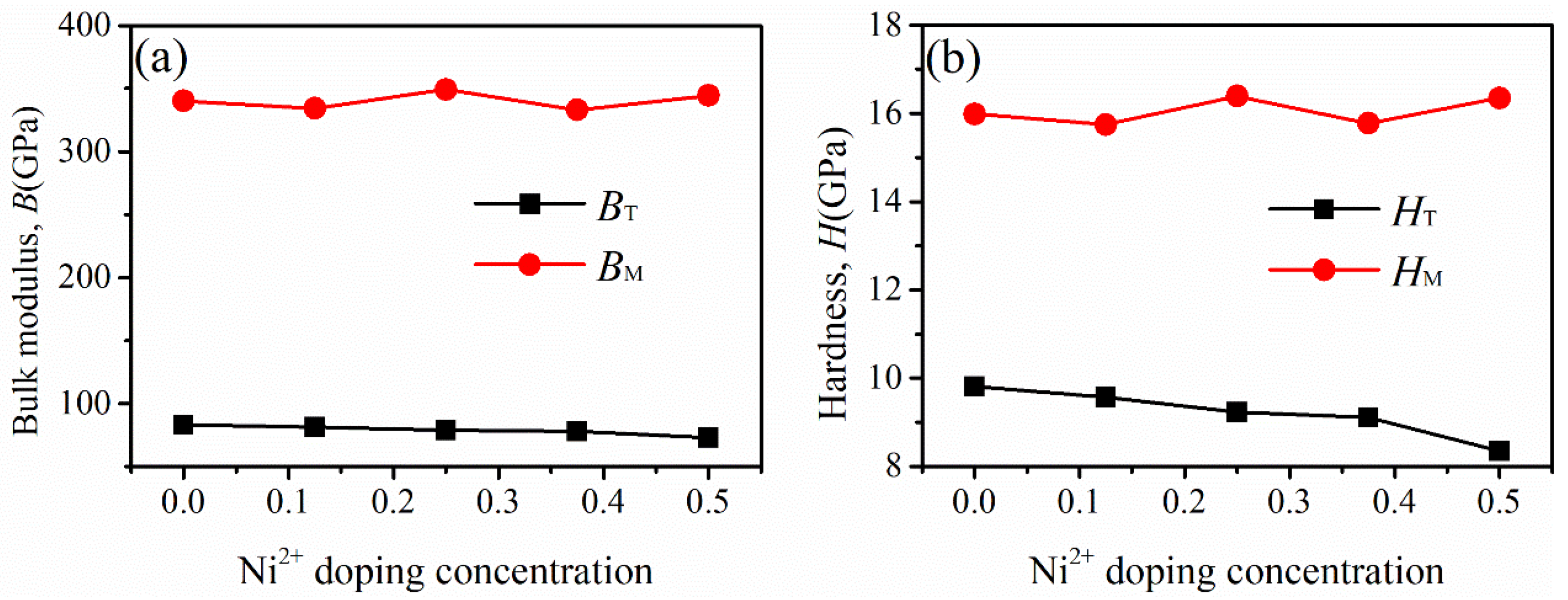
Based on the bond valence model, the bulk modulus and hardness of LiMn2O4 with different Ni doping concentrations were calculated and the data is listed in Table 4. The calculated values show good agreement with experimental data [37], confirming the reliability of the calculations. The data in Table 4 indicates that the bulk modulus and hardness of LiNixMn2−xO4 initially decrease, then increase, and subsequently decrease with the rise in Ni doping concentration. At a Ni doping concentration of x = 0.25, both the bulk modulus and hardness reach their maximum values, at 214 GPa and 13.80 GPa, respectively. Although the lattice constant of LiNixMn2−xO4 remains almost unchanged with varying Ni doping concentration, the structural units, namely the tetrahedra and octahedra, undergo significant changes, ultimately leading to variation in the properties of crystal. To investigate the influence of these structural units on the properties of crystal, the mechanical properties, including bulk modulus and hardness, of chemical bonds in both tetrahedra and octahedra were calculated based on bond valence models, as shown in Figure 1. The data reveal that the bulk modulus and hardness of chemical bonds in tetrahedra decrease with the rise in Ni doping concentration, while those of the chemical bonds in octahedra exhibit a trend of initial decrease, followed by an increase, and then a subsequent decrease.
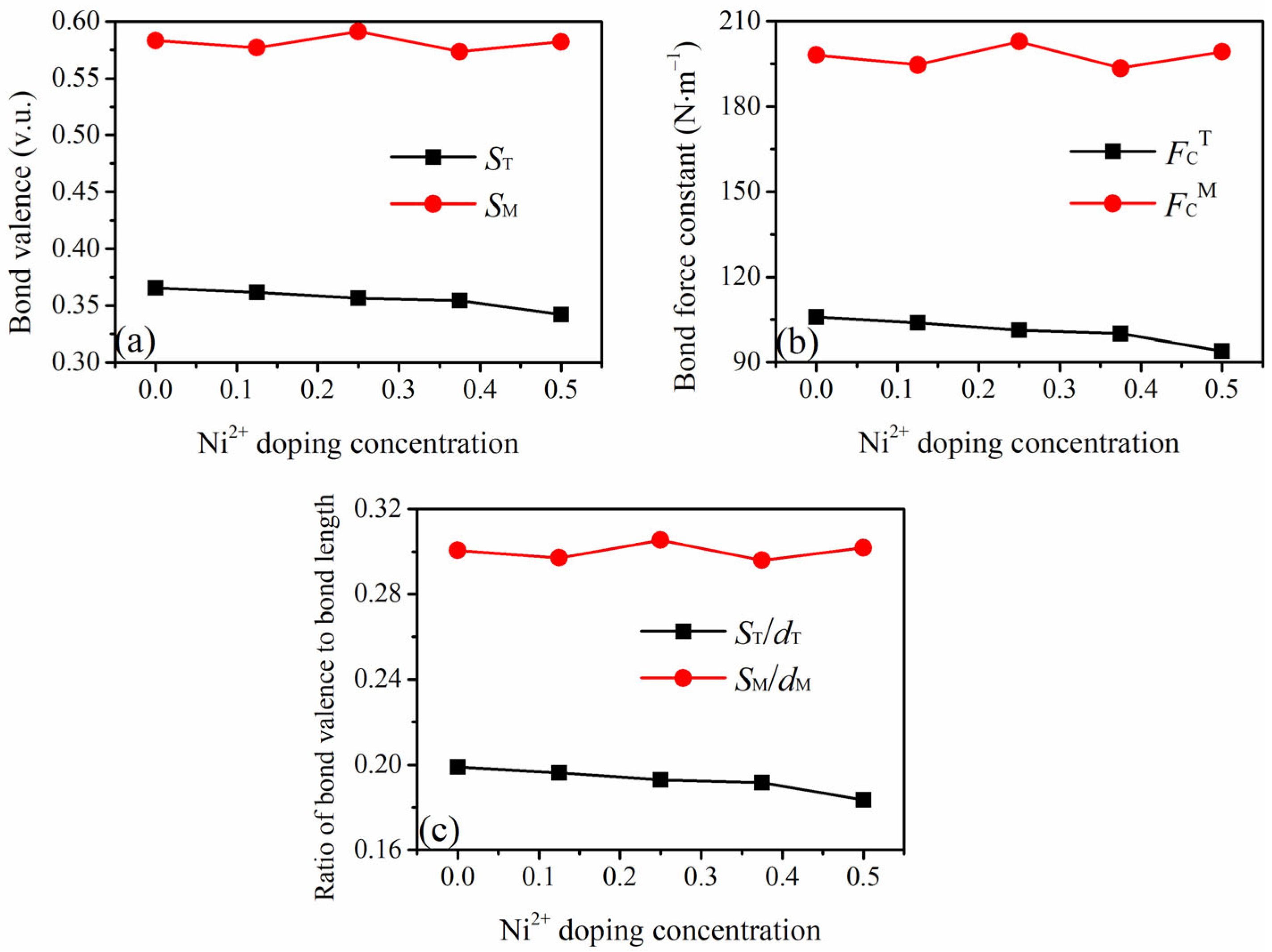
The previous research indicates that for the bonds in the same coordination environment, the excellent bulk modulus and hardness can be achieved by increasing the value of the ratio of bond valence to bond length [15]. Then, the bond valence parameters, including bond valence and bond force constant, were calculated for bonds in tetrahedra and octahedra in LiNixMn2−xO4, as shown in Figure 2. According to the bond valence method, bond valence describes the uniform distribution of valence electrons along the chemical bond [21]. Consequently, bond valence strongly depends on both the bond length and the number of valence electrons in the atoms forming the chemical bond. For the chemical bonds in octahedra, by increasing the Ni doping concentration, the bond length shortening occurs while the number of valence electrons distributed along the chemical bond decreases. These opposing effects result in an irregular trend in the bond valence of the octahedral bonds, with a maximum value of 0.59 v.u. observed at a Ni doping concentration of x = 0.25. In contrast, the bond valence of the tetrahedral bonds shows a steady decreasing trend since the bond length in tetrahedra increases with the Ni doping concentration while the number of valence electrons distributed along the bond remains unchanged. The bond force constant exhibits the same trend as the bond valence due to the quasi-linear relationship between these two parameters [24]. Combined with the bond length trends, the ratio of bond valence to bond length for chemical bonds in both tetrahedra and octahedra were obtained, as shown in Figure 2c. As the bulk modulus and hardness of chemical bonds exhibit a positive correlation with the ratio of bond valence to bond length, the trends of these mechanical properties of chemical bonds with varying Ni doping concentrations follow the same pattern as the ratio of bond valence to bond length. In spinel-type compounds, the chemical bonds in octahedra contribute significantly more to the mechanical properties of the crystal than that in tetrahedra. Consequently, the trends of the bulk modulus and hardness of crystal with varying Ni doping concentrations closely follow those of the bonds in octahedra, namely, a pattern of initial decrease, followed by an increase, and then a further decrease. However, the magnitude of variation is more pronounced than that observed in the properties of bonds in octahedra alone, due to the additional influence of the bonds in tetrahedra.
Based on the bulk modulus and hardness calculated from the bond valence model, the mechanical properties of crystal, such as shear modulus, Young’s modulus, and Poisson’s ratio, were calculated. The data in Table 4 suggests that composition with a Ni doping concentration of x = 0.25 (LiNi0.25Mn1.75O4) exhibits the best mechanical properties, followed by LiMn2O4. This is attributed to the great ratio of bond valence to bond length in octahedra. From a perspective of mechanical properties, these two compositions may enhance the cycling stability of batteries when used as cathode materials.

3.3. Thermal Properties of LiMn2O4 with Different Ni Doping Concentration

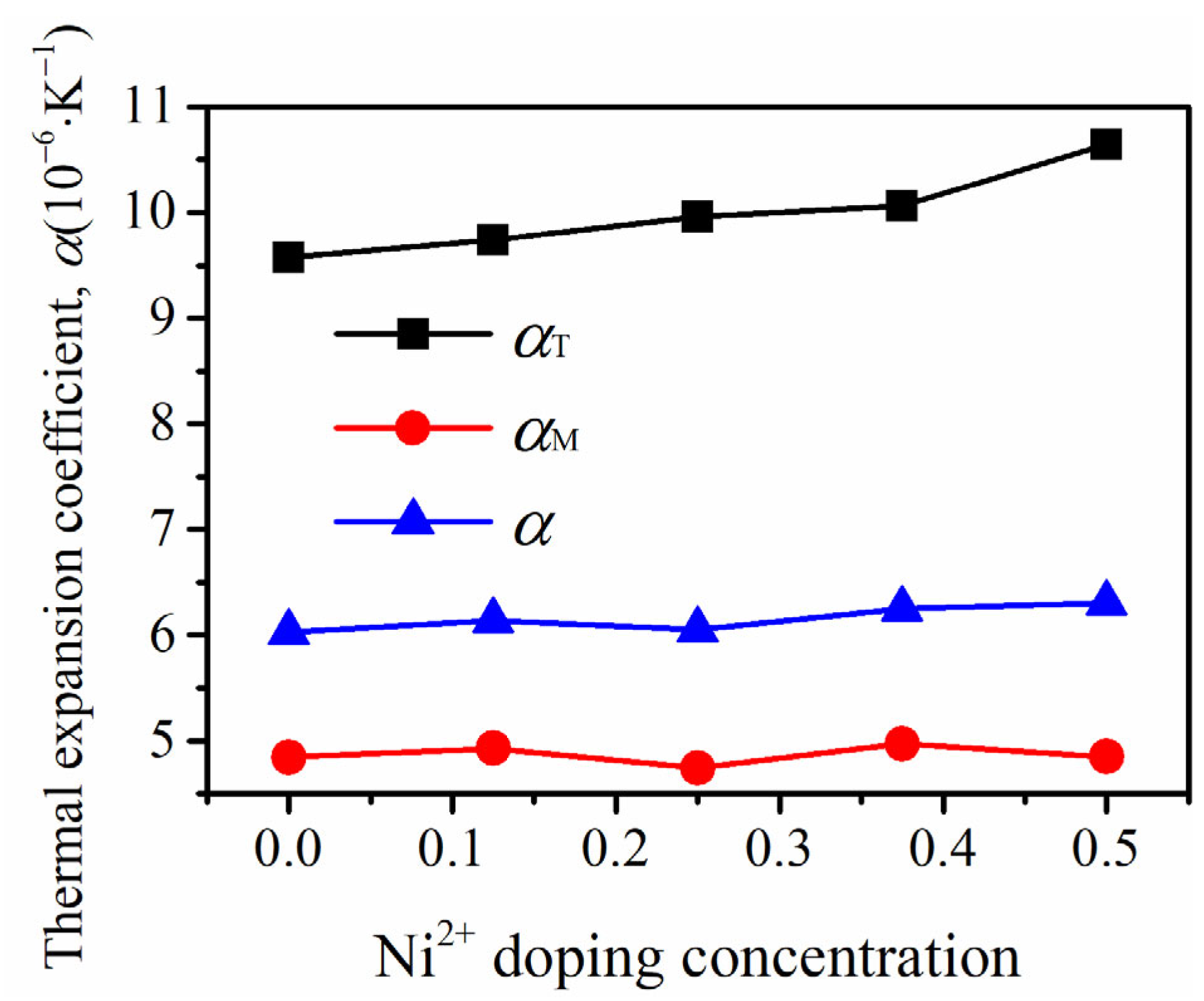
Figure 3 shows the calculated thermal expansion coefficients of LiMn2O4 with different Ni doping concentration. The data indicates that the thermal expansion coefficient of the crystal exhibits an increasing trend with rising Ni doping concentration. To further analyze the reasons for this variation, the thermal expansion coefficients of chemical bonds in tetrahedra and octahedra were calculated as displayed in Figure 3. The thermal expansion coefficient of the chemical bonds in tetrahedra shows a significant increasing trend with higher Ni doping concentrations, rising by ~11.1%. In contrast, the thermal expansion coefficient of chemical bonds in octahedra fluctuates within the range of 4.75–4.97, with lower values observed at doping concentrations of x = 0 and x = 0.25.
It is well known that the thermal expansion of crystals is caused by anharmonic vibrations of the lattice. This process leads to changes in the equilibrium distance between ions within the crystal, which should overcome the binding forces between ions. Bond valence can describe the Coulombic forces of chemical bonds since it corresponds to the electrostatic flux between bonded atoms [26], which implies that chemical bonds with higher bond valence are more difficult to expand, resulting in lower thermal expansion coefficients. Therefore, greater bond valence indicates smaller thermal expansion coefficients for chemical bonds. As mentioned previously, with increasing Ni doping concentrations, the bond valence in tetrahedra decreases, while that in octahedra initially decreases, then increases, and subsequently decreases again, reaching a maximum at x = 0.25. Consequently, for LiNixMn2−xO4, the thermal expansion coefficient of bonds in tetrahedra increases with Ni doping, while that in octahedra reaches a minimum at x = 0.25.
In the spinel structure, the majority of cations occupy 16d sites, forming a continuous three-dimensional framework through the edge-sharing of these octahedra. Therefore, the bond lengths in octahedra directly determine the framework dimensions, and the thermal expansion of spinel-type crystals primarily depends on the thermal expansion characteristics of the chemical bonds in the octahedral coordination sites. For the LiNixMn2−xO4 system, the coefficient of thermal expansion for bonds in octahedra fluctuates within a narrow range, whereas that in tetrahedra varies significantly with changes in the Ni doping concentration. Thus, chemical bonds in tetrahedra have played a non-negligible role in the variation in the thermal expansion coefficient of crystal. Ultimately, under the combined influence of bonds both in tetrahedra and octahedra, the thermal expansion coefficient of crystal exhibits a slight upward trend. A larger coefficient of thermal expansion indicates more pronounced volume expansion of the battery during heating, making it prone to microcrack formation and related detrimental effects. From the perspective of the thermal expansion coefficient, when the Ni doping concentration is less than 0.25, the relatively small thermal expansion coefficient of LiNixMn2−xO4 is beneficial for enhancing the cycling life of the battery. Other thermal properties simulated in this work, including thermal conductivity and the Debye temperature, are summarized in Table 5.

3.4. Thermomechanical Properties of LiMn2O4 with Different Ni Doping Concentrations

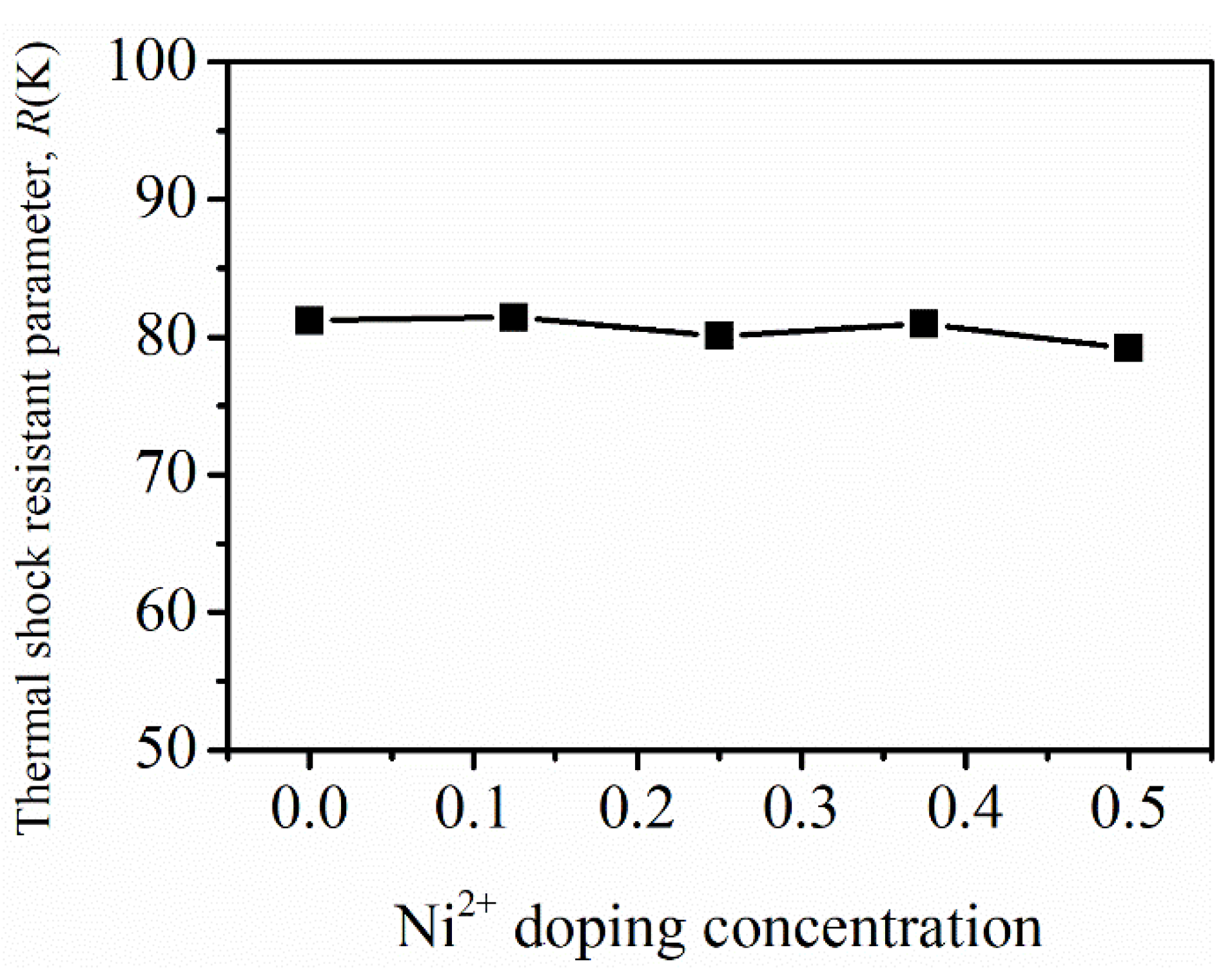
When side reactions in a battery generate substantial heat, the thermal shock resistance of the cathode material should be taken into consideration. The first thermal stress resistance factor (R) can characterize the maximum temperature change under high heat transfer rates. Based on experimental results from other spinel-type ceramics, for which the values of flexural strength are usually in the range of 70–250 [38], the strength of LiNixMn2−xO4 was assumed as 200 MPa to calculate the first thermal stress resistance factor in this work. Figure 4 shows the first thermal stress resistance factor of LiMn2O4 with different Ni doping concentrations. The results indicate that the first thermal stress resistance factor remains nearly constant, at approximately 80, and is largely independent of the Ni doping concentration. According to Equation (19), the first thermal stress resistance factor is influenced by the thermal expansion coefficient, the fracture strength, Poisson’s ratio, and Young’s modulus. The fracture strength is an assumed value and is independent of composition; Poisson’s ratio is only slightly influenced by composition (as shown in Table 4). Therefore, Young’s modulus and the thermal expansion coefficient become the primary factors affecting the thermal shock resistance factor. With increasing Ni doping content, Young’s modulus initially decreases, then increases, and subsequently decreases again, while the thermal expansion coefficient exhibits an opposite trend to that of Young’s modulus. The opposing effects of these two factors result in the thermal shock resistance factor remaining nearly constant. This implies that the Ni doping concentration has a very minimal influence on the maximum tolerable temperature of the cathode material during rapid heating.
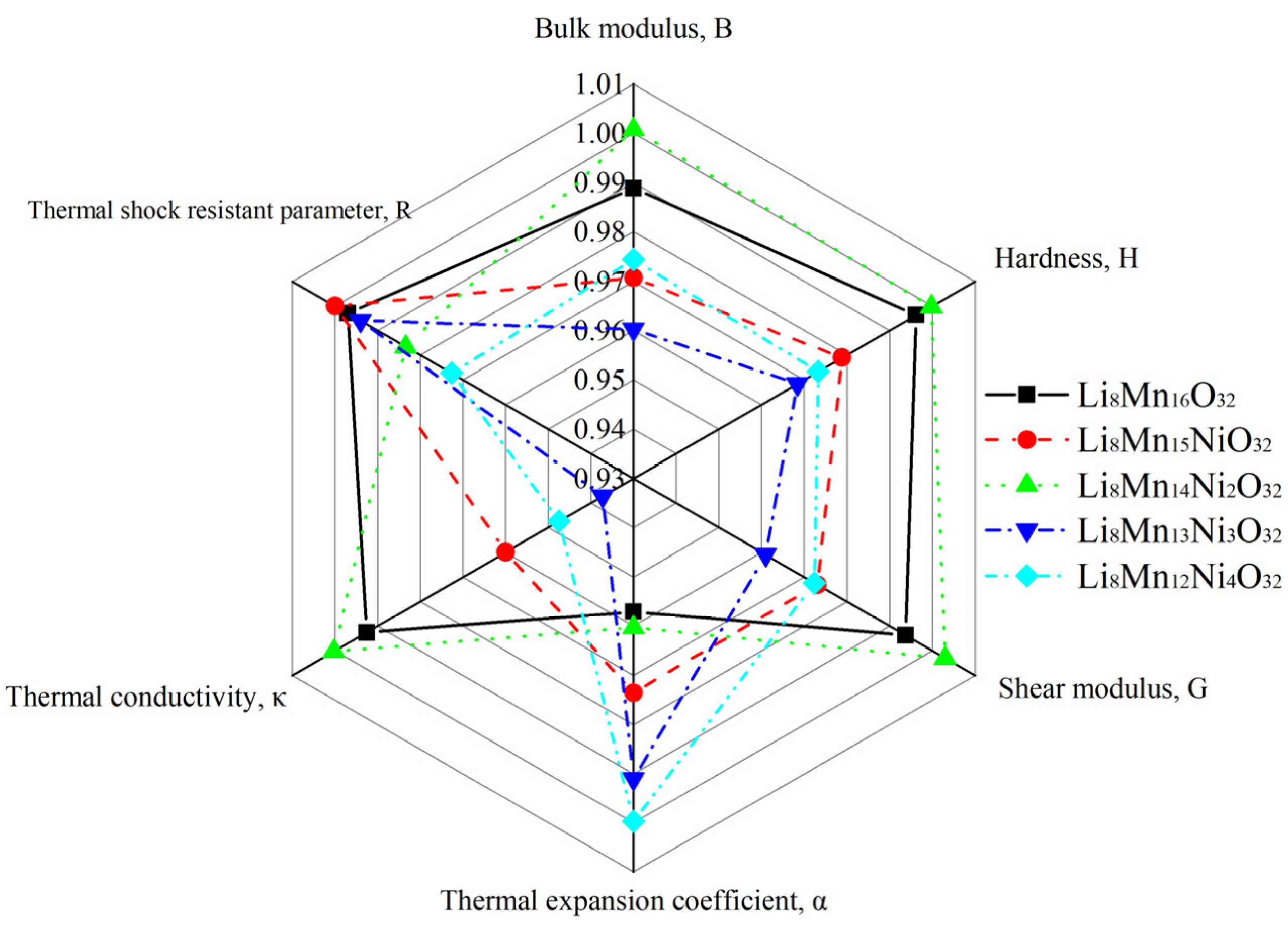
Upon investigating the effects of composition-dependent Ni doping concentration on the mechanical and thermal properties of LiNixMn2−xO4, a comprehensive understanding of the properties of LiNixMn2−xO4 can be obtained, enabling the assessment of cathode materials from the perspectives of mechanical and thermal properties. Figure 5 shows the mechanical and thermal properties of LiNixMn2−xO4 in the radar chart. The mechanical and thermal properties of LiNixMn2−xO4 were normalized against their respective maximum values. Consequently, all parameters were scaled between zero and one for comparison. The radar chart indicates that the composition with a Ni doping concentration of x = 0.25 exhibits the optimal combination of mechanical and thermal properties, which shows great mechanical properties and a low thermal expansion coefficient, followed by the composition with a Ni doping concentration of x = 0.
As electrode materials, the electrochemical performance of LiNixMn2−xO4 is undoubtedly critical. However, their mechanical and thermal properties cannot be overlooked. Poor mechanical and thermal properties can easily lead to particle cracking, generating fresh surfaces that accelerate side reactions and heat generation, thereby reducing the cycle life of battery. Especially in high-energy-density batteries, superior mechanical and thermal properties become even more critical. For the LiNixMn2−xO4 ceramic, LiNi0.5Mn1.5O4 exhibits superior electrochemical performance, since all Mn3+ ions are oxidized to Mn4+ at this Ni doping concentration, eliminating the Mn3+ disproportionation reaction and thereby improving its electrochemical behavior. Nevertheless, from a mechanical and thermal perspective, the comparatively inferior mechanical properties and higher thermal expansion coefficient make it prone to microcrack formation during charge–discharge cycles, consequently impairing the cycling life battery. Alternatively, the composition with a Ni doping concentration of x = 0.25 could be considered. On one hand, Ni doping can mitigate the Mn3+ disproportionation reaction to some extent. On the other hand, this composition offers the best mechanical properties and the lowest thermal expansion coefficient, which may help improve the cycling life of the battery.

4. Conclusions

In this work, the influence of Ni doping concentration on the mechanical and thermal properties of LiMn2O4 was revealed by first-principles calculations combined with bond valence models. The results indicated that Mn3+ and Mn4+ ions prefer to distribute far away from each other within the crystal structure of LiNixMn2−xO4, and Ni2+ and Mn4+ ions are distributed close to each other, which may serve to prevent the structural instability caused by localized charge inhomogeneity. The composition with a Ni doping concentration of x = 0.25 (LiNi0.25Mn1.75O4) exhibits the best mechanical properties, which is attributed to the great ratio of bond valence to bond length in octahedra. When the Ni doping concentration is less than 0.25, the relatively small thermal expansion coefficient of LiNixMn2−xO4 is beneficial for enhancing the cycling life of the battery. Additionally, the Ni doping concentration has a very minimal influence on the first thermal stress resistance factor. From the perspective of the mechanical and thermal properties, LiNixMn2−xO4 may enhance the cycling stability of batteries when used as cathode materials, followed by LiMn2O4. This study elucidates the influence of Ni doping concentration on the mechanical and thermal properties of LiMn2O4 electrode materials from a bonding perspective, thereby optimizing electrode performance through mechanical and thermal enhancement and providing a new strategy for electrode material design.

Author Contributions

Conceptualization, L.R., P.X. and C.L.; methodology, L.R., P.X., M.P., C.L. and X.L.; software, M.P.; data curation, X.L., J.J., M.P. and L.Z.; writing—original draft, L.R. and X.L.; writing—review and editing, L.R. and J.J.; and funding acquisition, L.R. and P.X. All authors have read and agreed to the published version of the manuscript.

Funding

This research was supported by the Research Project of Jingchu University of Technology (YY202407), the Scientific Research Project of Hubei Provincial Department of Education (Q20244302), and the Natural Science Foundation of Henan (252300423463).

Data Availability Statement

The data presented in this study are available on request from the corresponding author.

Conflicts of Interest

The authors declare no conflicts of interest.

References

  1. Li, J.; Yang, M.; Zhang, X.; Wen, J.; Wang, C.; Huang, G.; Song, W. First-principles study of the effect of Ni-doped on the spinel-type Mn-based cathode discharge. ACS Appl. Mater. Interfaces 2023, 15, 8208–8216. [Google Scholar] [CrossRef]
  2. Liu, W.; Xu, H.; Zhou, Q.; Dai, Y.; Hu, W.; Li, H. The performance of Ni-doped spinel-type LiMn2O4 for Li-ion batteries: First-principles calculation. J. Electron. Mater. 2020, 49, 5523–5527. [Google Scholar] [CrossRef]
  3. You, Y.; Celio, H.; Li, J.; Dolocan, A.; Manthiram, A. Modified high-nickel cathodes with stable surface chemistry against ambient air for lithium-ion batteries. Angew. Chem., Int. Ed. 2018, 57, 6480–6485. [Google Scholar] [CrossRef]
  4. Liu, W.; Wang, D.; Wang, Z.; Deng, J.; Lau, W.; Zhang, Y. Influence of magnetic ordering and Jahn-Teller distortion on the lithiation process of LiMn2O4. Phys. Chem. Chem. Phys. 2017, 19, 6481–6486. [Google Scholar] [CrossRef]
  5. Singh, G.; Gupta, S.L.; Prasad, R.; Auluck, S.; Gupta, R.; Sil, A. Suppression of Jahn-Teller distortion by chromium and magnesium doping in spinel LiMn2O4: A first-principles study using GGA and GGA+U. J. Phys. Chem. Solids 2009, 70, 1200–1206. [Google Scholar] [CrossRef]
  6. Tang, D.; Sun, Y.; Yang, Z.; Ben, L.; Gu, L.; Huang, X. Surface structure evolution of LiMn2O4 cathode material upon charge/discharge. Chem. Mater. 2014, 26, 3535–3543. [Google Scholar] [CrossRef]
  7. Hunter, J.C. Preparation of a new crystal form of manganese dioxide: λ-MnO2. J. Solid State Chem. 1981, 39, 142–147. [Google Scholar] [CrossRef]
  8. Hamam, I.; Omessi, R.; Rathore, D.; Geng, C.; Cooke, R.; Plucknett, K.; Bishop, D.P.; Zaker, N.; Botton, G.A.; Yang, C.; et al. Correlating the mechanical strength of positive electrode material particles to their capacity retention. Cell Rep. Phys. Sci. 2022, 3, 100714. [Google Scholar] [CrossRef]
  9. Jiang, Y.; Yan, P.; Yu, M.; Li, J.; Jiao, H.; Zhou, B.; Sui, M. Atomistic mechanism of cracking degradation at twin boundary of LiCoO2. Nano Energy 2020, 78, 105364. [Google Scholar] [CrossRef]
  10. Zhang, J.; Li, Q.; Ouyang, C.; Yu, X.; Ge, M.; Huang, X.; Hu, E.; Ma, C.; Li, S.; Xiao, R.; et al. Trace doping of multiple elements enables stable battery cycling of LiCoO2 at 4.6 V. Nat. Energy 2019, 4, 594–603. [Google Scholar] [CrossRef]
  11. Min, K.; Cho, E. Intrinsic origin of intra-granular cracking in Ni-rich layered oxide cathode materials. Phys. Chem. Chem. Phys. 2018, 20, 9045–9052. [Google Scholar] [CrossRef]
  12. He, X.; Ding, X.; Xu, R. Anisotropic mechanical properties of LiNixMnyCo1-x-yO2 cathodes for Li-ion batteries: A first-principles theoretical study. Acta Mater. 2024, 267, 119751. [Google Scholar] [CrossRef]
  13. Wu, L.; Lee, W.H.; Zhang, J. First principles study on the electrochemical, thermal and mechanical properties of LiCoO2 for thin film rechargeable battery. Mater. Today Proc. 2014, 1, 82–93. [Google Scholar] [CrossRef]
  14. Ren, L.; Wang, H.; Tu, B.; Zong, X.; Wang, W.; Fu, Z. Investigation on composition-dependent properties of Mg5xAl23−5xO27+5xN5−5x (0 ≤ x ≤ 1): Part II. mechanical properties via first-principles calculations combined with bond valence models. J. Eur. Ceram. Soc. 2021, 41, 4942–4950. [Google Scholar] [CrossRef]
  15. Ren, L.; Wang, H.; Tu, B.; Zong, X.; Wang, W.; Fu, Z. Theoretical study on composition- and pressure-dependent mechanical properties of AlON solid solution. J. Am. Ceram. Soc. 2020, 103, 4390–4401. [Google Scholar] [CrossRef]
  16. Ren, L.; Wang, H.; Tu, B.; Zong, X.; Wang, W.; Fu, Z. Predicting properties of MgO·nAl2O3 by first-principles calculation combined with bond valence models. J. Am. Ceram. Soc. 2019, 102, 6913–6924. [Google Scholar] [CrossRef]
  17. Xu, P.; Wang, H.; Ren, L.; Tu, B.; Wang, W.; Fu, Z. Theoretical study on composition-dependent properties of ZnO·nAl2O3 spinels. Part II: Mechanical and thermophysical. J. Am. Ceram. Soc. 2021, 104, 6455–6466. [Google Scholar] [CrossRef]
  18. Feng, M.; Wang, B.; Xu, P.; Tu, B.; Wang, H. Predicting thermomechanical properties of MgAl2O4 transparent ceramic based on bond valence models. J. Inorg. Mater. 2021, 36, 1067–1073. [Google Scholar] [CrossRef]
  19. Clark, S.J.; Segall, M.D.; Pickard, C.J.; Hasnip, P.J.; Probert, M.I.J.; Refson, K.; Payne, M.C. First principles methods using CASTEP. Z. Kristallogr 2005, 220, 567–570. [Google Scholar] [CrossRef]
  20. Perdew, J.P.; Burke, K.; Ernzerhof, M. Generalized gradient approximation made simple. Phys. Rev. Lett. 1996, 77, 3865–3868. [Google Scholar] [CrossRef]
  21. Brown, I.D. Recent developments in the methods and applications of the bond valence. Chem. Rev. 2009, 109, 6858–6919. [Google Scholar] [CrossRef]
  22. Brese, N.E.; O’Keeffe, M. Bond-valence parameters for solids. Acta Crystallogr. Sect. B 1991, 47, 192–197. [Google Scholar] [CrossRef]
  23. Brown, I.D.; Altermatt, D. Bond-valence parameters obtained from a systematic analysis of the inorganic crystal structure database. Acta Crystallogr. Sect. B 1985, 41, 244–247. [Google Scholar] [CrossRef]
  24. Liu, X.; Wang, H.; Lavina, B.; Tu, B.; Wang, W.; Fu, Z. Chemical composition, crystal structure, and their relationships with the intrinsic properties of spinel-type crystals based on bond valences. Inorg. Chem. 2014, 53, 5986–5992. [Google Scholar] [CrossRef]
  25. Brown, I.D.; Klages, P.; Skowron, A. Influence of pressure on the lengths of chemical bonds. Acta Crystallogr. Sect. B 2003, 59, 439–448. [Google Scholar] [CrossRef]
  26. Liu, X.; Wang, H.; Wang, W.; Fu, Z. Simple method for the hardness estimation of inorganic crystals by the bond valence model. Inorg. Chem. 2016, 55, 11089–11095. [Google Scholar] [CrossRef]
  27. Brown, I.D.; Shannon, R.D. Empirical bond-strength-bond-length curves for oxides. Acta Crystallogr. Sect. A 1973, 29, 266–282. [Google Scholar] [CrossRef]
  28. Gao, F.; He, J.; Wu, E.; Liu, S.; Yu, D.; Li, D.; Zhang, S.; Tian, Y. Hardness of covalent crystals. Phys. Rev. Lett. 2003, 91, 015502. [Google Scholar] [CrossRef] [PubMed]
  29. Tian, Y.; Xu, B.; Zhao, Z. Microscopic theory of hardness and design of novel superhard crystals. Int. J. Refract. Met. Hard Mater. 2012, 33, 93–106. [Google Scholar] [CrossRef]
  30. Zhang, S.; Li, H.; Zhou, S.; Pan, T. Estimation thermal expansion coefficient from lattice energy for inorganic crystals. Jpn. J. Appl. Phys. 2006, 45, 8801–8804. [Google Scholar] [CrossRef]
  31. Slack, G.A. Nonmetallic crystals with high thermal conductivity. J. Phys. Chem. Solids 1973, 34, 321–335. [Google Scholar] [CrossRef]
  32. Anderson, O.L. A simplified method for calculating the debye temperature from elastic constants. J. Phys. Chem. Solids 1963, 24, 909–917. [Google Scholar] [CrossRef]
  33. Kingery, W.D. Factors affecting thermal stress resistance of ceramic materials. J. Am. Ceram. Soc. 1955, 38, 3–15. [Google Scholar] [CrossRef]
  34. Sickafus, K.E.; Wills, J.M.; Grimes, N.W. Structure of spinel. J. Am. Ceram. Soc. 1999, 82, 3279–3292. [Google Scholar] [CrossRef]
  35. Yoo, K.S.; Cho, N.W.; Oh, T.-J. Structural and electrical characterization of Li(Mn1−δTiδ)2O4 electrode materials. Solid State Ion. 1998, 113, 43–49. [Google Scholar] [CrossRef]
  36. Gryffroy, D.; Vandenberghe, R.E.; Legrand, E. A neutron diffraction study of some spinel compounds containing octahedral Ni and Mn at a 1:3 ratio. Mater. Sci. Forum 1991, 79, 785–790. [Google Scholar] [CrossRef]
  37. Liu, X. Mechanical properties modeling of cathode materials for lithium-ion batteries based on bond valence model. Mater. Today Commun. 2024, 39, 108852. [Google Scholar] [CrossRef]
  38. Rubat du Merac, M.; Kleebe, H.J.; Müller, M.M.; Reimanis, I.E. Fifty years of research and development coming to fruition; unraveling the complex interactions during processing of transparent nagnesium aluminate (MgAl2O4) spinel. J. Am. Ceram. Soc. 2013, 96, 3341–3365. [Google Scholar] [CrossRef]
Figure 1. The (a) bulk modulus and (b) hardness of bonds in LiNixMn2−xO4.
Ceramics 09 00005 g001
Figure 2. The (a) bond valence, (b) bond force constant, and (c) ratio of bond valence to bond length of LiNixMn2−xO4.
Ceramics 09 00005 g002
Figure 3. The thermal expansion coefficient of LiNixMn2−xO4.
Ceramics 09 00005 g003
Figure 4. Thermal shock resistant parameter of LiNixMn2−xO4.
Ceramics 09 00005 g004
Figure 5. The mechanical and thermal properties of LiNixMn2−xO4 in the radar chart. Every attribute is normalized by the highest values among all LiNixMn2−xO4 and scaled between zero and one.
Ceramics 09 00005 g005
Table 1. The value of T and M depending on the number of electrons in core of cation.
Number of Electrons in CoreTM
00.671.8–2.0
20.601.73
100.541.64
180.491.57
280.601.50
360.491.57
460.671.43
540.491.57
Table 2. The total energy of LiNixMn2−xO4 supercells with different configurations.
CompositionConfigurationTotal Energy (eV)
x = 0I−19,640.174
II−19,639.554
x = 0.125III−23,553.408
IV−23,552.951
x = 0.25III−27,466.304
IV−27,466.086
x = 0.375III−31,379.451
IV−31,379.308
x = 0.5III−35,291.864
Configuration I denotes that Mn3+ and Mn4+ are distributed far away from each other. Configuration II denotes that Mn3+ and Mn4+ are distributed close to each other. Configuration III denotes that Ni2+ and Mn4+ are distributed close to each other. Configuration IV denotes that Ni2+ and Mn4+ are distributed far away to each other.
Table 3. The calculated lattice parameters of LiNixMn2−xO4 as well as some experimental values [35,36]. Vm, dT and dM denote the volume of crystal, the average bond length in tetrahedra, and the average bond length in octahedra, respectively.
CompositionVm (Å3)a (Å)aexp (Å)dT (Å)dM (Å)u
x = 0511.9978.00008.2381.83821.94060.3827
x = 0.125513.6438.0085 1.84231.94160.3828
x = 0.25512.0188.0001 1.84761.93560.3833
x = 0.375513.5788.0082 1.84991.93740.3834
x = 0.5512.6288.00338.2771.86311.92850.3844
Table 4. The calculated mechanical properties including bulk modulus (B), hardness (H), shear modulus (G), and Poisson’s ratio (v) of LiNixMn2−xO4.
CompositionB (GPa)H (GPa)G (GPa)E (GPa)v
x = 0212 13.77 119 301 0.263
x = 0.125208 13.53 117 295 0.263
x = 0.25214 13.80 120 304 0.263
x = 0.375205 13.38 115 291 0.264
x = 0.5209 13.44 117 295 0.264
Table 5. The calculated thermal properties, including thermal conductivity (κ) and Debye temperature (Θ), of LiNixMn2−xO4.
Compositionκ (W/m·K)Θ (K)
x = 020.4 793
x = 0.12519.7 784
x = 0.2520.5 795
x = 0.37519.2 777
x = 0.519.4 780
Disclaimer/Publisher’s Note: The statements, opinions and data contained in all publications are solely those of the individual author(s) and contributor(s) and not of MDPI and/or the editor(s). MDPI and/or the editor(s) disclaim responsibility for any injury to people or property resulting from any ideas, methods, instructions or products referred to in the content.