Article

Pipeline Curvature Detection Using a Pipeline Inspection Gauge Equipped with Multiple Odometry

by
Eloina Lugo-del-Real
1,2,*,
Jorge A. Soto-Cajiga
2,
Antonio Ramirez-Martinez
2,
Edmundo Guerra Paradas
3 and
Antoni Grau
3
1
School of Engineering and Sciences, Tecnologico de Monterrey, Monterrey 64849, Mexico
2
Electronics and Semiconductors Department, Centro de Ingeniería y Desarrollo Industrial, CIDESI, Queretaro 76125, Mexico
3
Automatic Control Department, Technical University of Catalonia, UPC, 08034 Barcelona, Spain
*
Author to whom correspondence should be addressed.
Appl. Syst. Innov. 2026, 9(2), 44; https://doi.org/10.3390/asi9020044
Submission received: 17 December 2025 / Revised: 4 February 2026 / Accepted: 11 February 2026 / Published: 19 February 2026

Abstract

Pipeline integrity is crucial for ensuring the safe and efficient transportation of hydrocarbons. One of the essential methods for maintaining pipeline integrity is periodic inspection using Pipeline Inspection Gauges (PIGs). These PIGs traverse extensive pipeline networks, collecting critical data related to inertial navigation and inspection technologies, such as geometric, ultrasonic, or magnetic flux inspection. Following an inspection, data is downloaded for post-processing to identify and accurately locate pipeline anomalies. Accurate positioning of indications is crucial for effective repair or maintenance of the identified pipeline section. Thus, ongoing efforts aim to improve the precision of indication positioning. This study introduces an innovative method and model for deriving pipeline trajectory characteristics to enhance positioning accuracy. The method is based on distance sampling of odometers, improving the PIG displacement measurement by implementing multiple odometries. Using the method described in this work can compensate for odometer slip, since the distance measurement error was reduced from 15.67% to 1.38%. The model simulates (three and four) odometer trajectories in curvature and calculates the curvature along the pipeline based on odometer data. The curvature model is evaluated with real data obtained from a test circuit, demonstrating that the proposed method and model technique can yield trajectory characteristics such as curvature detection; we can differentiate linear sections from bend sections in the test circuit. However, the curvature measurement error remains considerable due to odometer slippage. Therefore, future work proposes using additional odometers to improve measurement accuracy.

1. Introduction

1.1. Pipeline Inspection and the Need for Accurate Trajectory Information

Pipelines represent the most efficient and widely used infrastructure for transporting hydrocarbons over long distances. The global transmission pipeline network exceeds 2.5 million km, with 220,000 km of new projects projected for 2026 [1,2]. However, since approximately 40% of this infrastructure is classified as unpiggable due to physical constraints, traditional inspection methods are insufficient [3]. Consequently, ensuring pipeline integrity through advanced system innovations is paramount for global safety, environmental protection, and economic stability. As pipeline networks expand and become increasingly complex—particularly in urban and industrial areas—the risk of accidental damage and undetected defects continues to grow [4].
Pipeline integrity management relies on periodic inspection to detect defects such as corrosion, cracks, dents, and geometric deformations [5]. Intelligent Pipeline Inspection Gauges (PIGs), equipped with a variety of sensors, are widely used to collect geometric, inertial, ultrasonic, or magnetic flux leakage data during in-line inspections [6,7]. After inspection, the acquired data are post-processed to identify anomalies and determine their precise location along the pipeline. Accurate positioning of these indications is essential for effective maintenance and repair operations.
A fundamental requirement for reliable indication positioning is the accurate estimation of the pipeline trajectory, including displacement, orientation, and curvature. Errors in trajectory reconstruction directly propagate to indication localization errors, which may reach several meters over long inspection distances [8,9].

1.2. Navigation Sensors and Limitations of Odometer-Based Measurements

Modern PIG navigation systems typically integrate Inertial Navigation Systems (INS) composed of accelerometers and gyroscopes, often complemented by magnetometers, odometers, and reference stations [10,11,12,13,14]. High-performance INS solutions can achieve high accuracy over long distances, but they are costly and sensitive to sensor bias and drift. For this reason, odometers are commonly used to provide displacement information and constrain inertial drift.
Odometers are attractive due to their simplicity and high short-term accuracy; however, their reliability is limited by wheel slippage, uneven contact forces, surface roughness, and pipeline accessories [15,16,17,18,19]. Slippage introduces cumulative distance errors that can severely degrade positioning accuracy. Although Above-Ground Markers (AGMs) and reference stations can be used to correct drift, they only provide discrete corrections when the PIG passes beneath them [20].
Several studies have addressed odometer slippage using sensor fusion and data-driven approaches. Machine learning techniques have been proposed to estimate PIG velocity and compensate for odometer errors [13,21,22], while filtering and smoothing techniques have been applied to mitigate navigation noise [23]. Although these approaches improve positioning accuracy, they typically rely on additional sensors, prior training data, or complex fusion frameworks.

1.3. Curvature Estimation in Pipeline Inspection

Pipeline curvature estimation provides valuable information for trajectory reconstruction and can serve as an additional constraint for indication positioning. Various approaches have been proposed to estimate curvature using combinations of inertial sensors, caliper arms, and odometry [24,25,26,27]. These methods often rely on sensor fusion techniques or require extensive calibration and filtering.
An alternative approach for curvature estimation is based solely on odometer displacement differences. Early work demonstrated that, with multiple odometers distributed circumferentially around the PIG, curvature and curvature direction could be inferred from relative traveled distances [28]. However, this work was limited to a theoretical formulation and did not include simulation, experimental validation, or analysis of odometer slippage, a dominant error source in real inspections.
Studies that are more recent have not fully addressed the use of distance-based sampling combined with multi-odometry as a means to mitigate slippage while simultaneously enabling curvature estimation using odometer data alone. In particular, there is a lack of experimental validation demonstrating how such an approach behaves under realistic mechanical disturbances and slip conditions.

1.4. Research Gap and Motivation

From the reviewed literature, the following research gaps can be identified:
  • Existing curvature estimation methods often rely on inertial sensors or complex sensor-fusion schemes, increasing system complexity and cost.
  • Theoretical odometer-based curvature models have not been validated experimentally under realistic slippage conditions.
  • Prior work does not address how distance-based sampling, rather than time-based sampling, can reduce the impact of odometer slip on trajectory reconstruction.
  • The interaction between multi-odometry, slippage, and curvature estimation has not been systematically analyzed.
These gaps motivate the development of a method that uses odometer data as the primary source for curvature estimation, reduces slippage-induced errors through distance-based sampling, remains compatible with existing PIG architectures, and can be experimentally validated under realistic operating conditions.

1.5. Contribution and Novelty of This Work

This manuscript presents a novel trajectory curvature model and orientation logic based on multi-odometry and equal-distance sampling. While the electronic and mechanical hardware architecture of the PIG has been introduced in prior work [29], the present study makes the following new contributions:
  • A mathematical model that simulates odometer traversal through pipeline elbows and derives curvature as a function of odometer displacement.
  • An equal-distance sampling strategy that significantly reduces the impact of odometer slippage on distance estimation.
  • Experimental validation of the proposed method using real inspection data obtained from a controlled pipeline test circuit.
The results demonstrate that, although odometer slippage limits quantitative curvature accuracy, the proposed method reliably detects and localizes pipeline bends and geometric features. This makes the curvature signal suitable for qualitative analysis and provides a foundation for future classification and trajectory reconstruction techniques.

2. Materials and Methods

2.1. Curvature Model

Analyzing the behavior of the PIG’s odometers as they traverse through the pipeline trajectory, it can be inferred that all odometers should cover the same distance along straight sections. However, in curved sections, such as elbows, the odometers cover different distances, defined by the arc length each odometer traverses through the curve. The preceding means that, for any PIG equipped with at least three odometers, the curvature of the pipeline can be determined. However, as explained in the previous section, it is well-known that odometers tend to slip during their traversal. Thus, incorporating more than three odometers can improve the accuracy of curvature detection and enhance the equipment’s location within the pipeline.
This section first presents a novel model for simulating the trajectory of odometers within an elbow of known dimensions, where the displacement of each odometer along the elbow is obtained. Subsequently, the curvature model is introduced. This model, which takes the simulated displacement data of each odometer as input, plays an important role in determining the curvature of an elbow and validating the proposed model in [28].
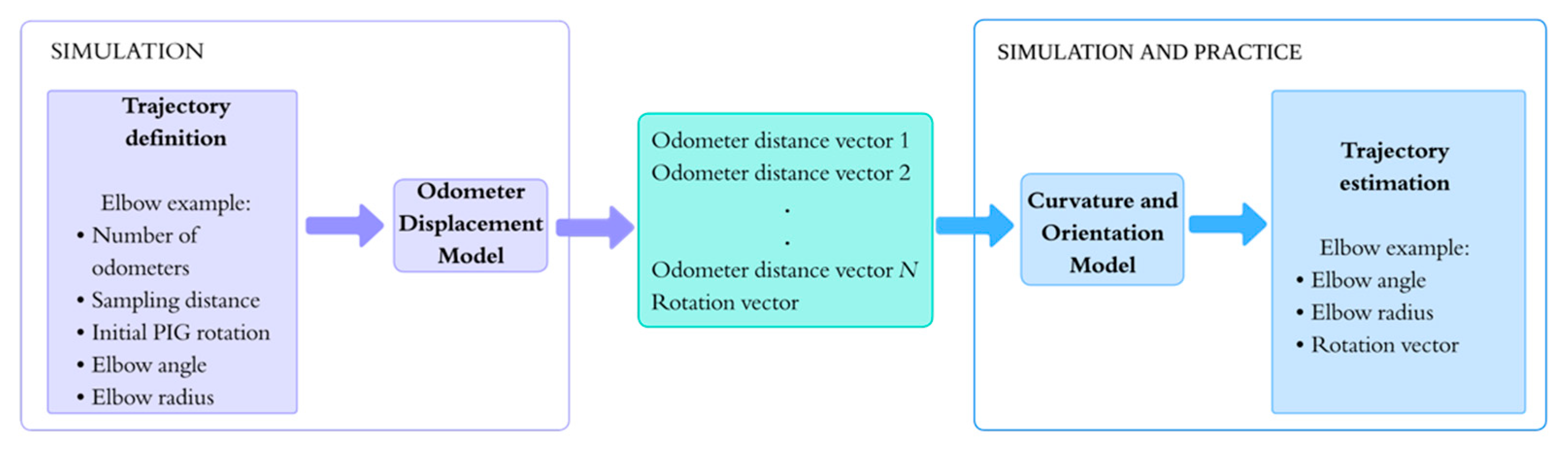
Figure 1 shows a block diagram representing a model to obtain the odometer displacement as a function of a defined curvature trajectory and a model that calculates the curvature trajectory based on the odometer displacement. Both models can be validated using simulation, and only the curvature model can be practically validated with experimental data, as demonstrated later.

Odometer Displacement Model

To simulate the displacement of odometers, the trajectory of the duct to be traversed must be defined. However, this work focuses solely on obtaining the curvature of the trajectory. Considering that the curvature of a straight section is zero, it is sufficient to simulate the displacement of the odometers for elbows, as described below.
For the simulation of an elbow, the PIG specifications are first defined, including the number of odometers, the sampling distance, and the initial orientation. Subsequently, the elbow specifications are defined; these include the arc length, the radius of curvature, and the spatial location. The definitions of the model variables are shown in Table 1.
For example, to simulate the displacement of odometers in an elbow positioned in the xy-plane, rotating about the z-axis and originating from the origin, four steps are defined.
  • Define the Central Trajectory of the Elbow.
The arc length or central trajectory Le of the elbow is obtained using (1) and the number of samples (M) is obtained by dividing the arc length by the sampling distance (2).
L e = α e R e
M = r o u n d   L e S d
Then the angle vector βe is calculated in (3), representing the M samples of the central trajectory, and finally, the coordinates (xe, ye, ze) of the central trajectory in space are determined. The following equations represent the central trajectory corresponding to the elbow’s arc.
β e ( k ) = k · α e M   ,           k = 0 ,   1 ,   2 ,   , M
x e ( β e ) = R e   1 cos β e
y e β e = R e sin β e
z e = 0
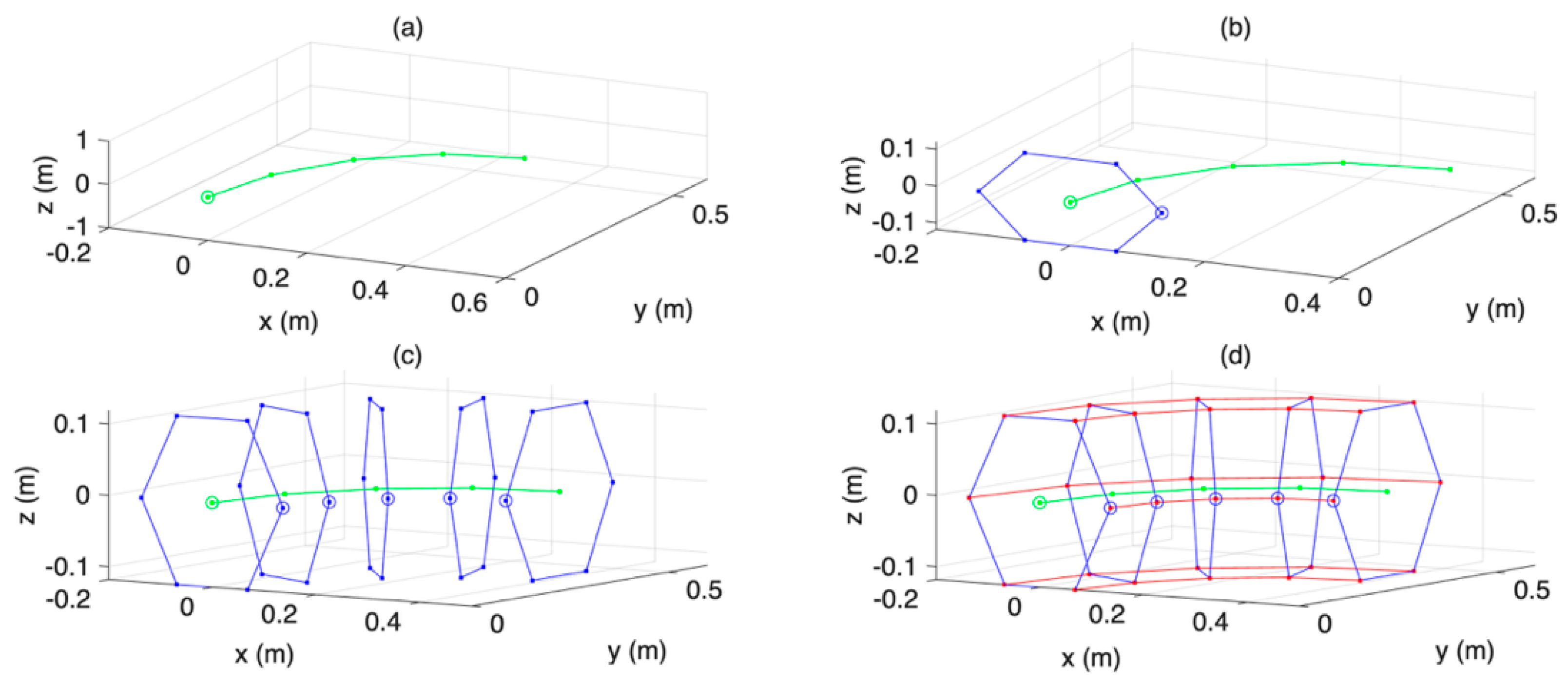
In Figure 2a, in green, the central trajectory of the elbow is shown, considering five samples (M = 5), an elbow angle of π / 2 (90°), and an elbow radius Re of 0.381 m, which means a constant curvature Ke of 2.6246 m−1.
2.
Draw an Initial Circle with Vertices.
In this case, the initial circle is positioned at the origin in the xz-plane, defined by Equations (7)–(10):
γ p ( k ) =   k · 2 π N ,           k = 0 ,   1 ,   2 ,   , N    
x p γ p = r p cos γ p
y p ( γ p ) = 0
z p γ p = r p sin γ p
Figure 2b shows the central trajectory of the elbow and the initial circumference, where each vertex of the circumference represents an odometer. This section considers six odometers for illustrative purposes (N = 6).
3.
Translate Circumference Along the Arc of the Elbow.
Translation and rotation matrices (11) and (12) are used to rotate the circumference (which includes N vertices) along the central trajectory of the elbow (which provides for M samples), as shown in the following equations, where, in (12), cos(βe) is represented by a , and sin(βe) by b .
P = T e   R z   P p
x y z 1 = 1 0 0 1 0 x e 0 y e 0 0 0 0 1 z e 0 1 a b b a 0 0 0 0 0     0 0     0 1 0 0 1 x e y e z e 1
Figure 2c shows the central trajectory of the elbow and the circumferences generated through the translation and rotation of the initial circumference.
4.
Obtain the Distance Vector for Each Odometer.
The distance between each vertex of the circumference (13) is calculated for the M samples to calculate the displacement of the odometers, where Δx = x(m,n) − x(m−1,n), Δy = y(m,n)y(m−1,n), and Δz = z(m,n)z(m−1,n).
E m , n = ( x ) 2 + ( y ) 2 + ( z ) 2
Figure 2d illustrates the connection between the circumference’s vertices, where each red line represents the distance traveled by each odometer.
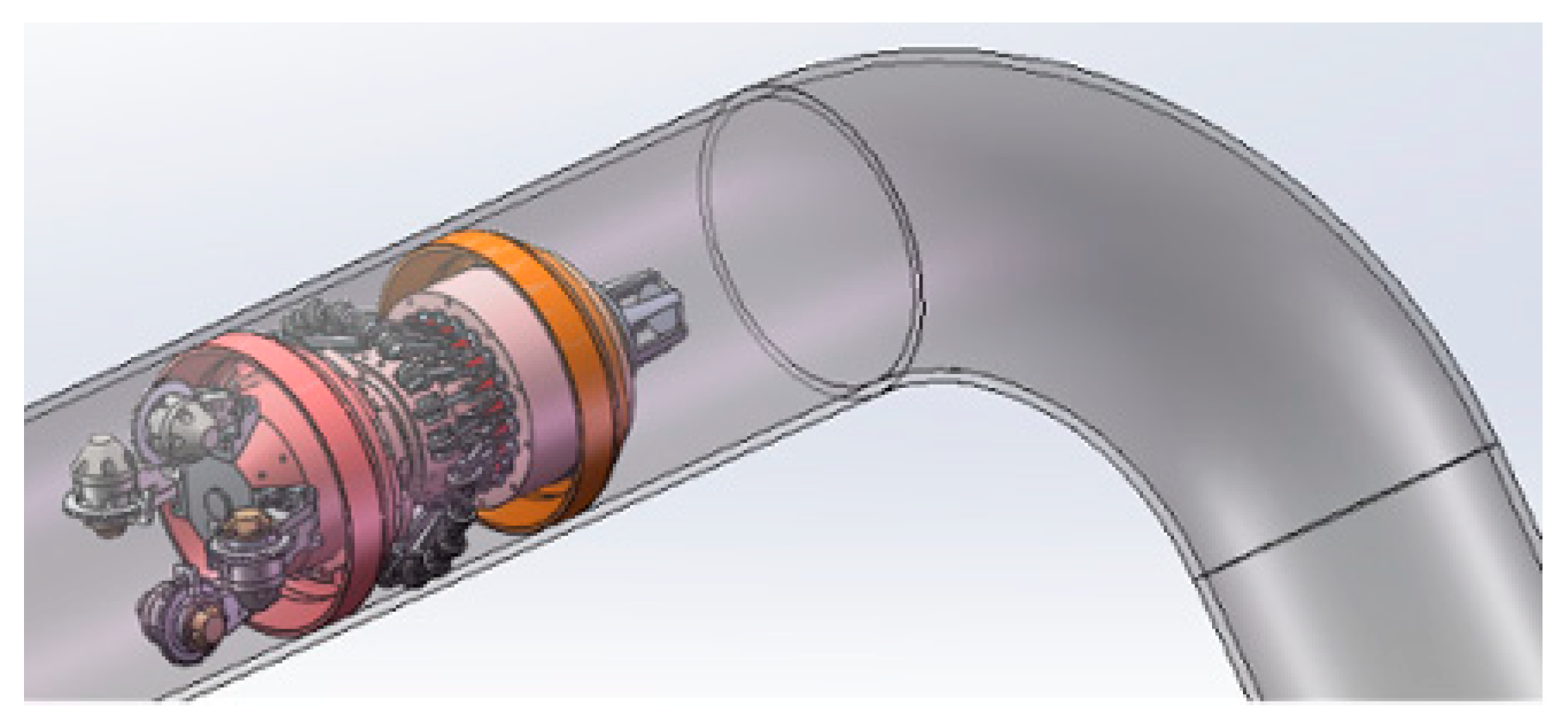
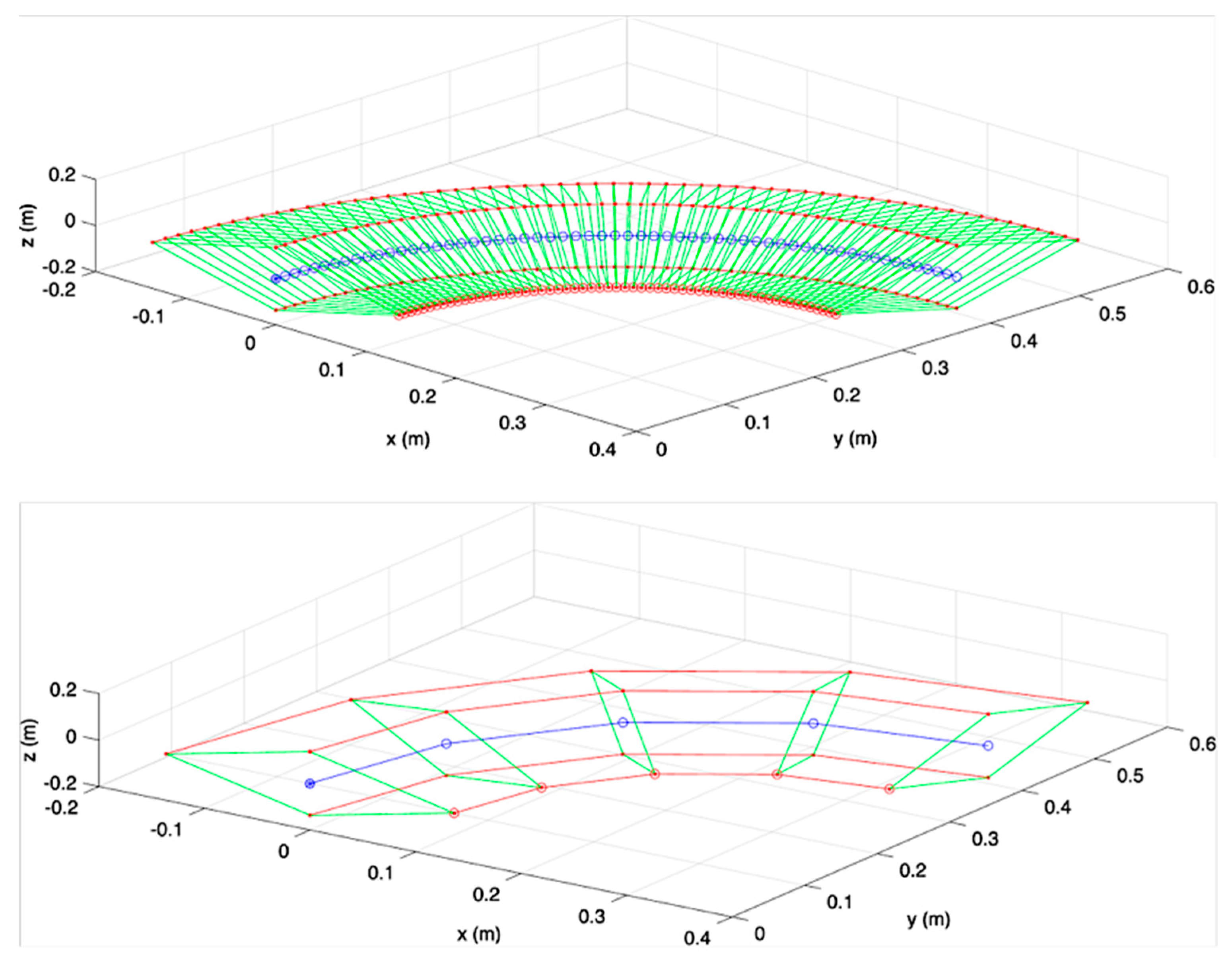
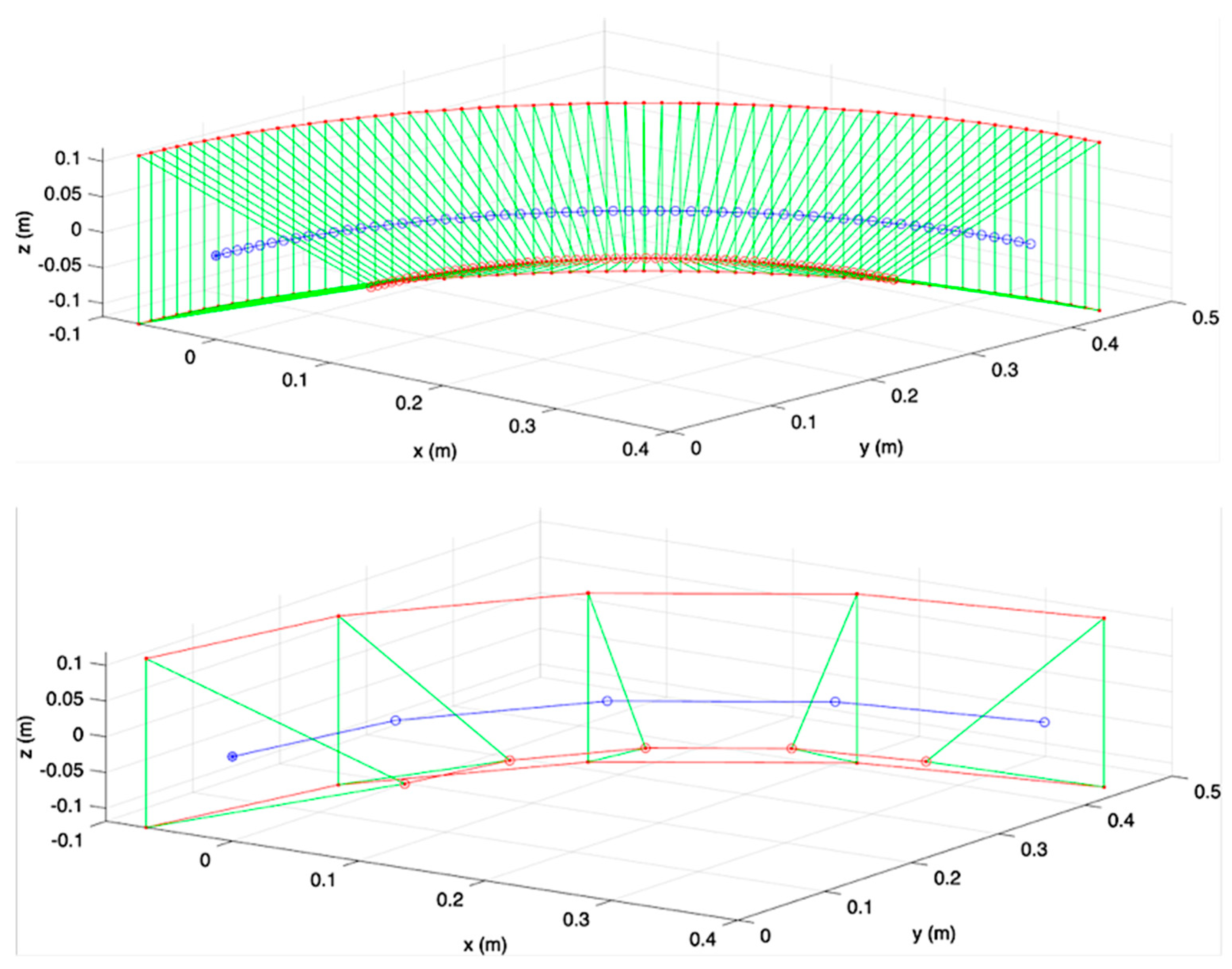
For example, to simulate and obtain the distance traveled by the odometers of a 12-inch diameter PIG equipped with four odometers, as shown in Figure 3, which traverses a 90° bend (0 to π/2) in the xy-plane, with a constant curvature of 2.6246 m−1, and without rotating during the traversal, the displacements illustrated in Figure 4 are obtained, considering two sampling distances of 10 mm and 100 mm. In this example, it can be observed that the odometer traveling along the inner part of the bend covers the shortest possible distance, and the odometer traveling along the outer part of the bend covers the longest possible distance. In contrast, the other two odometers, which travel through the center of the bend, cover the same distance, which in this case is the same distance as the central trajectory of the elbow, in blue.
In this example, there are four odometers (A, B, C, D) that traverse a known bend, allowing for the determination of the real distance (arc length) that each odometer must cover. Table 2 compares the real distance against the distance for a sampling interval of 100 mm and the distance for a sampling interval of 10 mm.
As shown in Table 2, a smaller sampling distance facilitates estimation of the actual distance. This is due to the use of Euclidean distance, as illustrated in (13).
Figure 5 illustrates a PIG with three odometers in a 90° elbow with a curvature of 2.6246 m−1, and Figure 6 shows the simulation of its trajectory, also for sampling distances of 10 mm and 100 mm. Table 3 compares the real distance against the distance for a sampling interval of 100 mm and the distance for a sampling interval of 10 mm.
Simulations with three and four odometers are considered, as they form the basis of the model for obtaining curvature as a function of odometer displacement, as shown below. The 100 mm sampling distance is considered for illustrative purposes only, while the 10 mm sampling distance is a distance that is commonly used in pipeline inspection.

2.2. Model to Obtain Curvature as a Function of Odometer Displacement

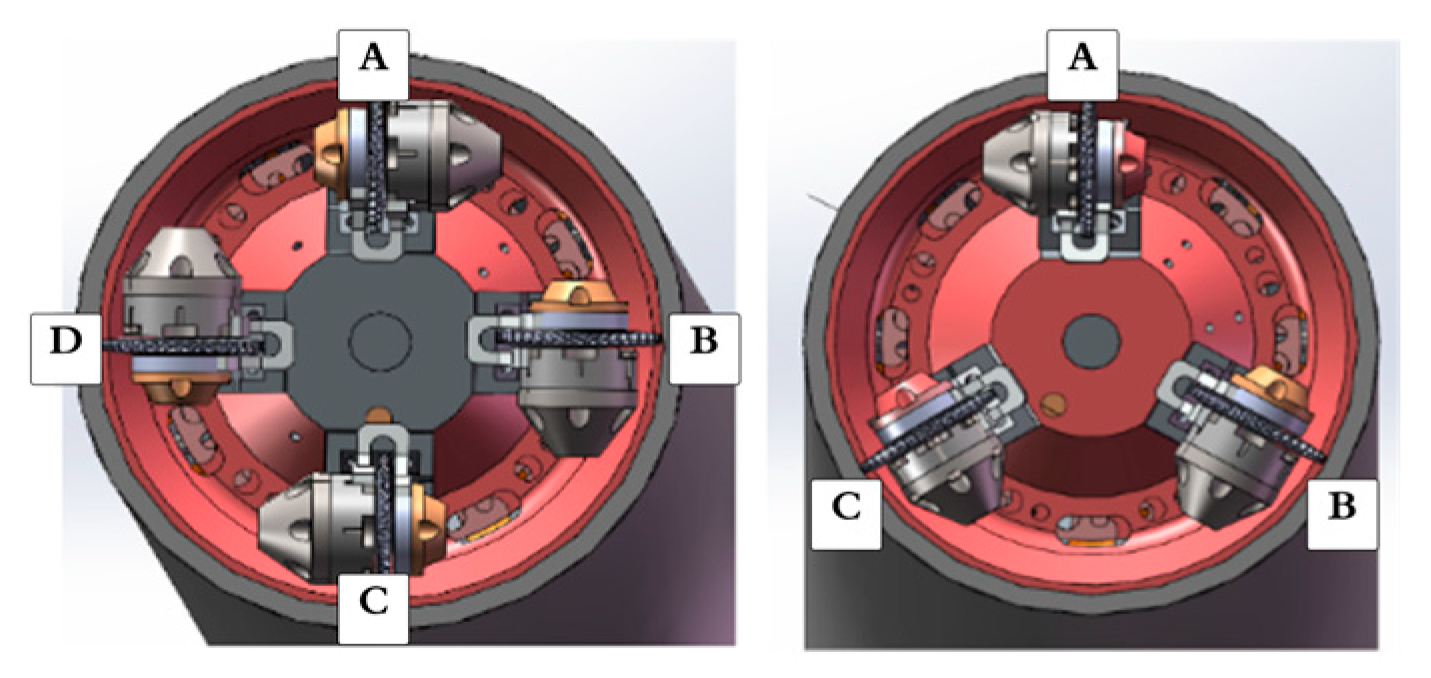
Once the displacement of each odometer is obtained, different trajectory characteristics, including the curvature, can be determined. In [28], the equations for obtaining the duct curvature using four and three odometers are presented. The most relevant equations and simulation results considering four and three odometers are shown below, and the two PIG odometers’ configurations are shown in Figure 7.
Using Equation (14), curvature KR is derived from the displacement measured by four odometers (A, B, C, and D), where r represents the pipeline’s inner radius. In contrast, Equation (15) computes the angle φ, which indicates the direction of curvature relative to the initial reference axis.
K R = 1 r   A B A + B 2 + C D C + D 2
t a n ( φ )   = K A B K C D
For the case of 3 odometers (A, B, and C), Equations (16) and (17) are applied.
K R = 2 r A + B + C   A 2 + B 2 + C 2 A B A C B C
t a n ( φ )     = K b + 0.5   K a 0.866   K a
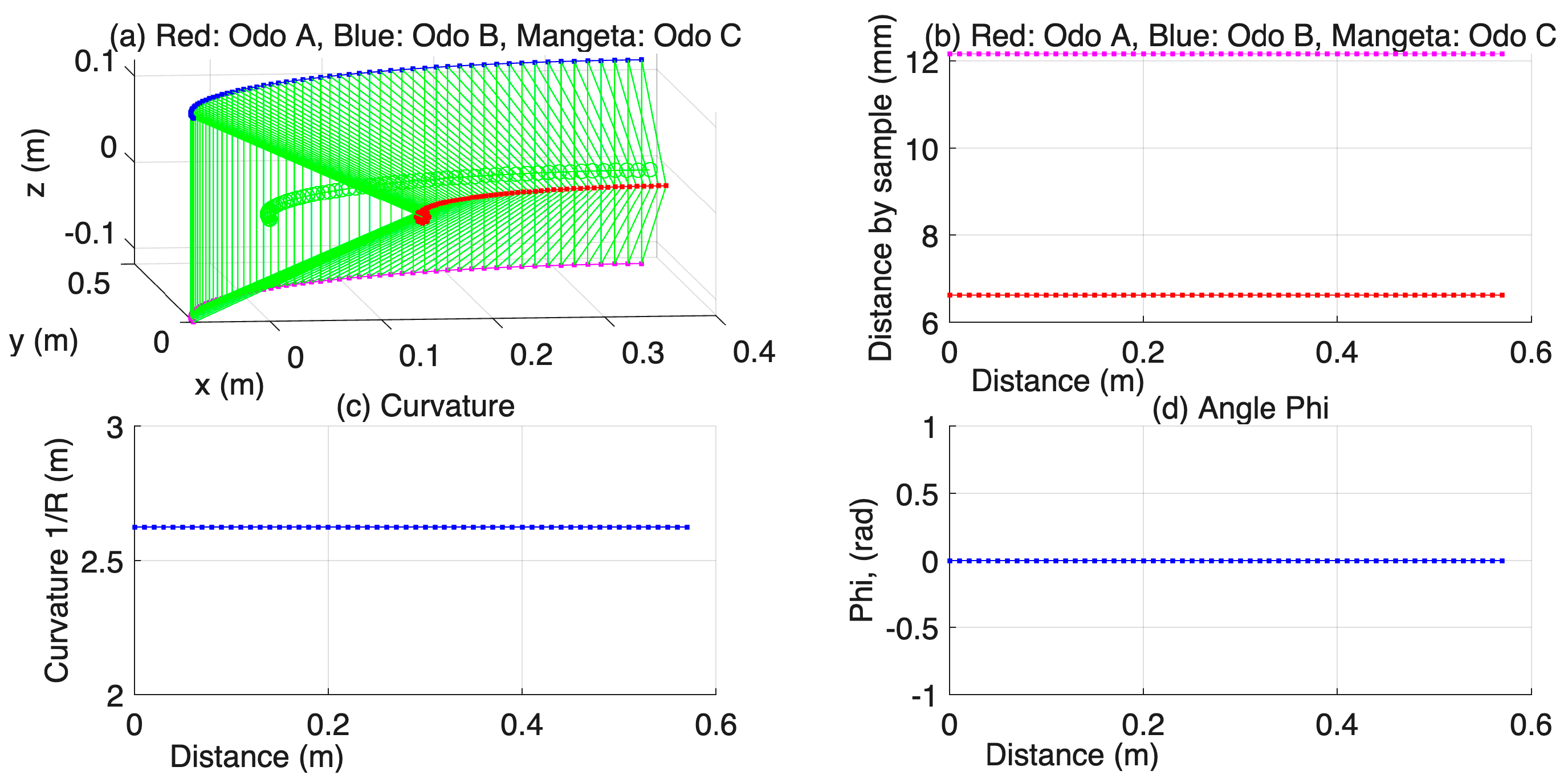
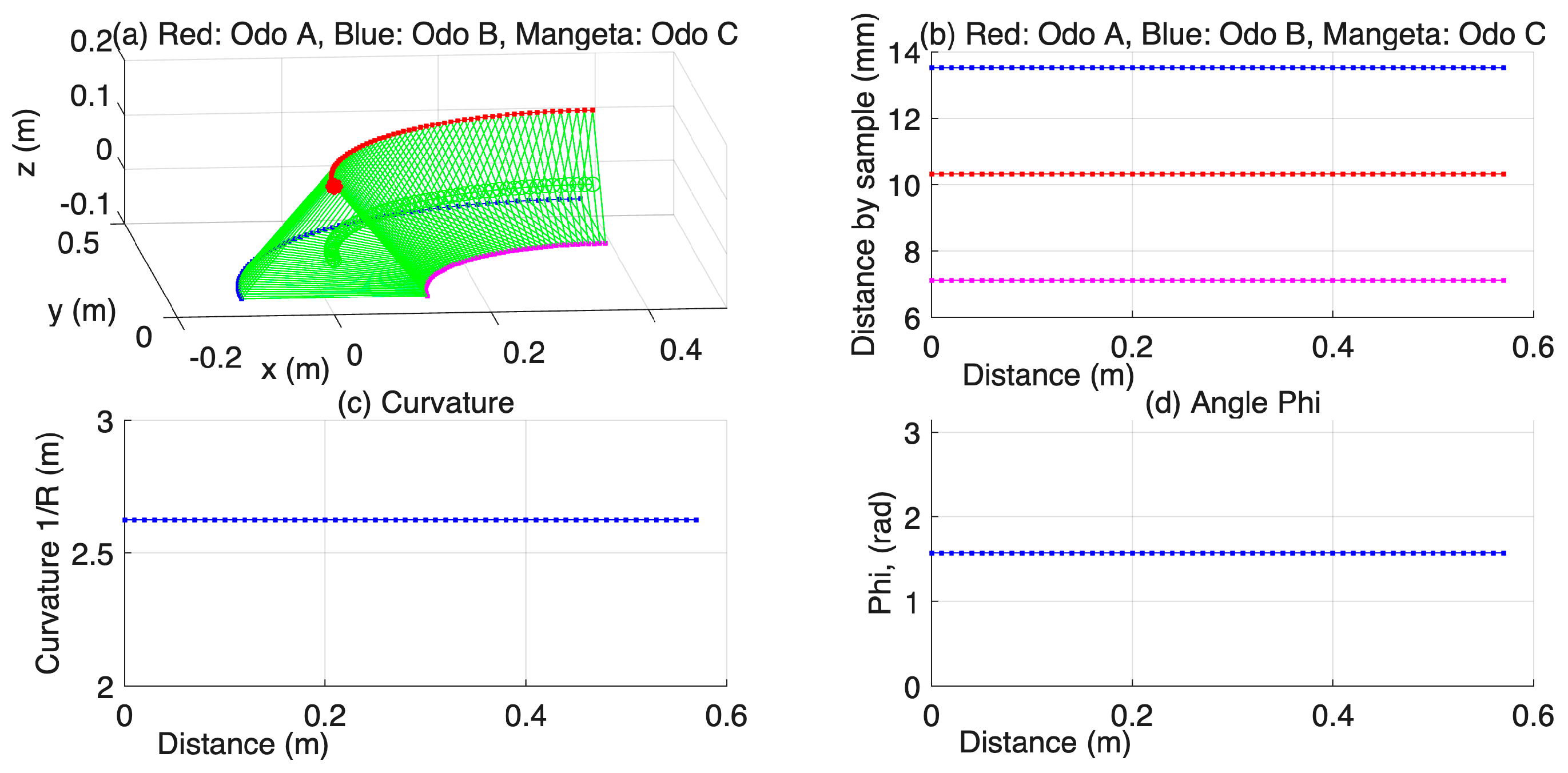
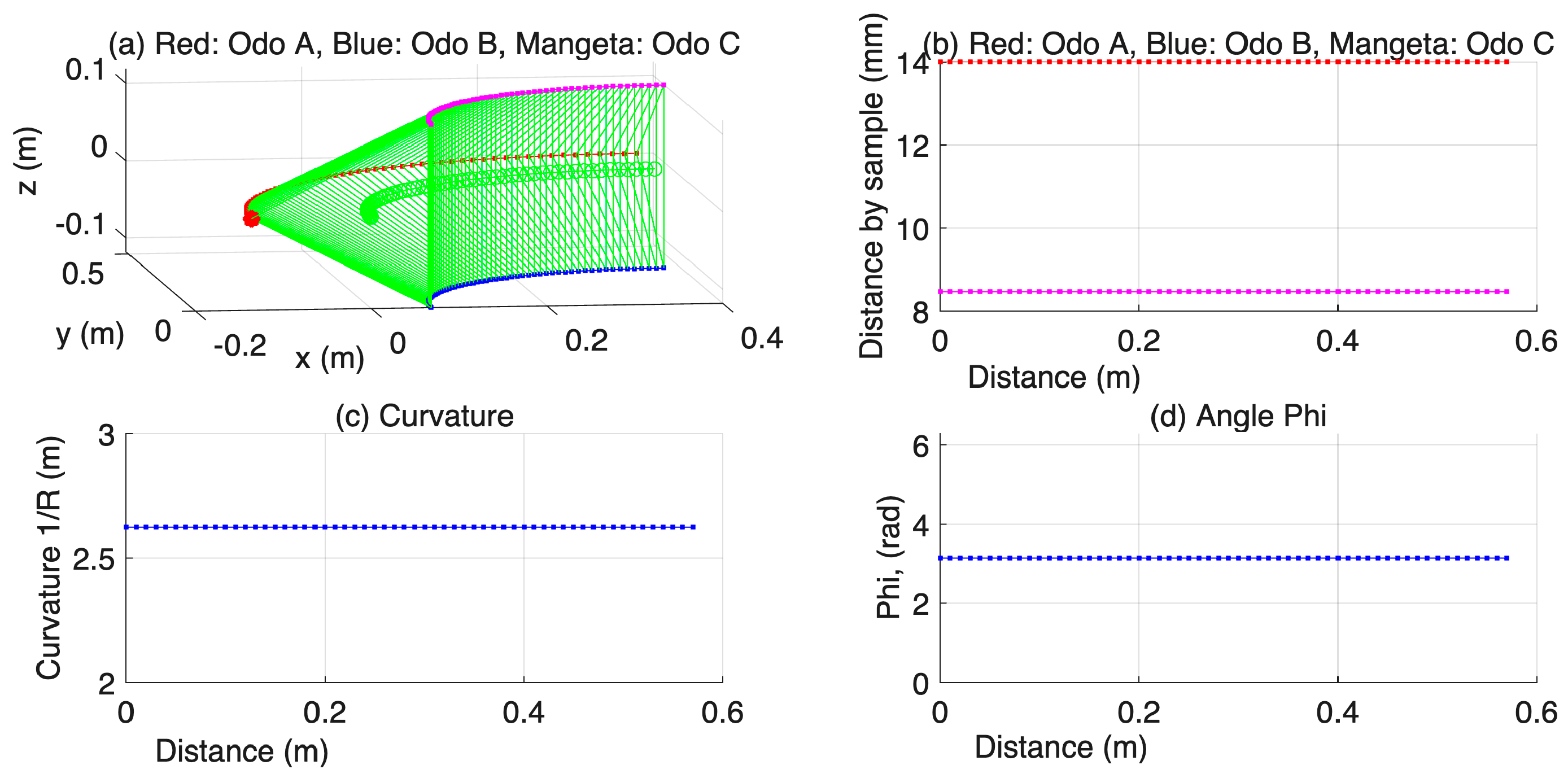
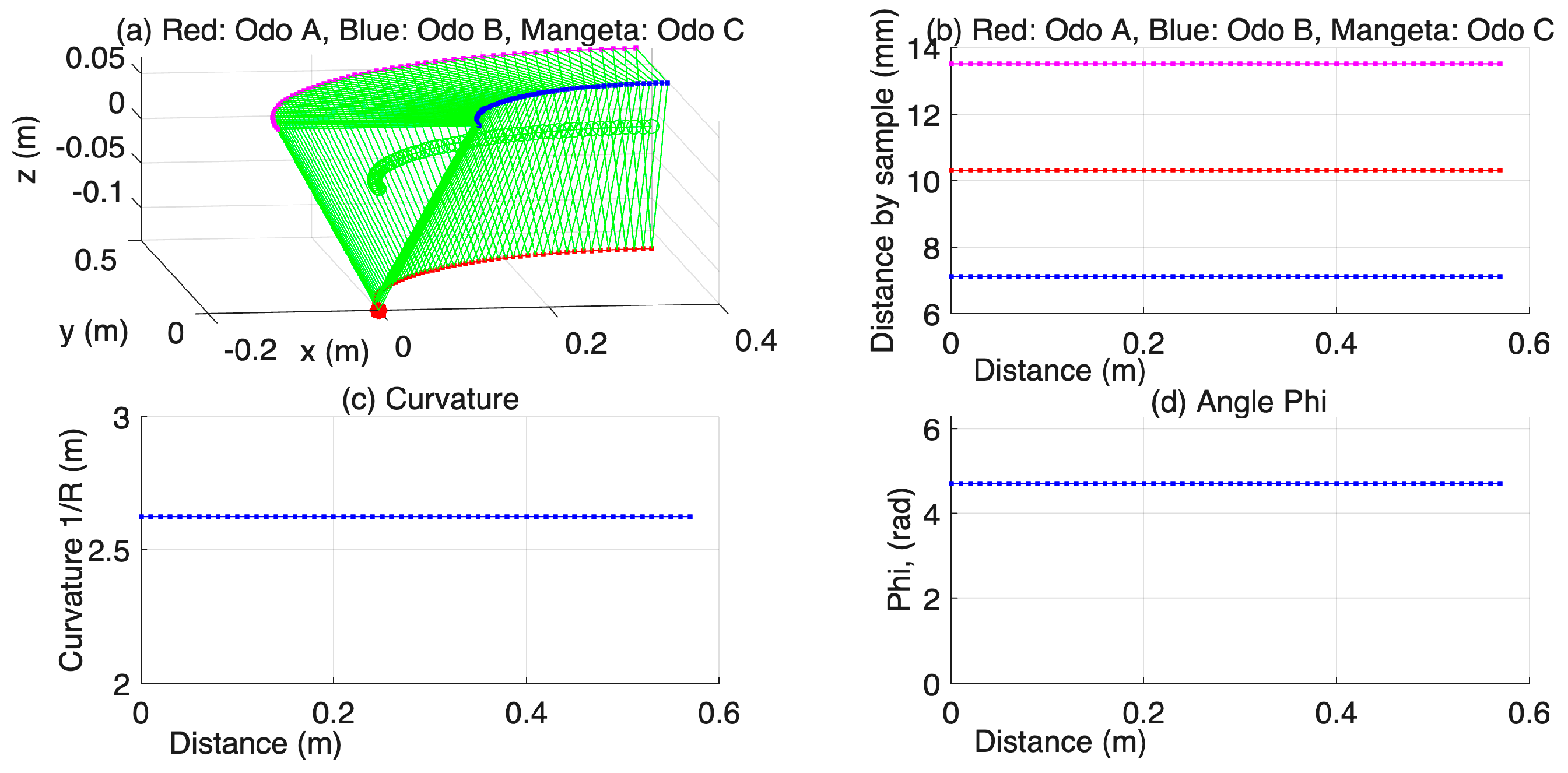
Figure 8, Figure 9, Figure 10 and Figure 11 show four illustrations of the curvature determination of the bend considering three odometers, where the φ angle remains constant along the trajectory, and four initial φ angle conditions are considered: 0, 90, 180, and 270 degrees (0, π/2, π, 3π/2 rad).
Across the four case studies, the calculated curvature value is 2.6246 m−1, which matches the actual curvature of 2.6246 m−1 (1/0.381 m). It is later shown that the curvature estimation error is insignificant, as the actual error due to slip is considerably greater.
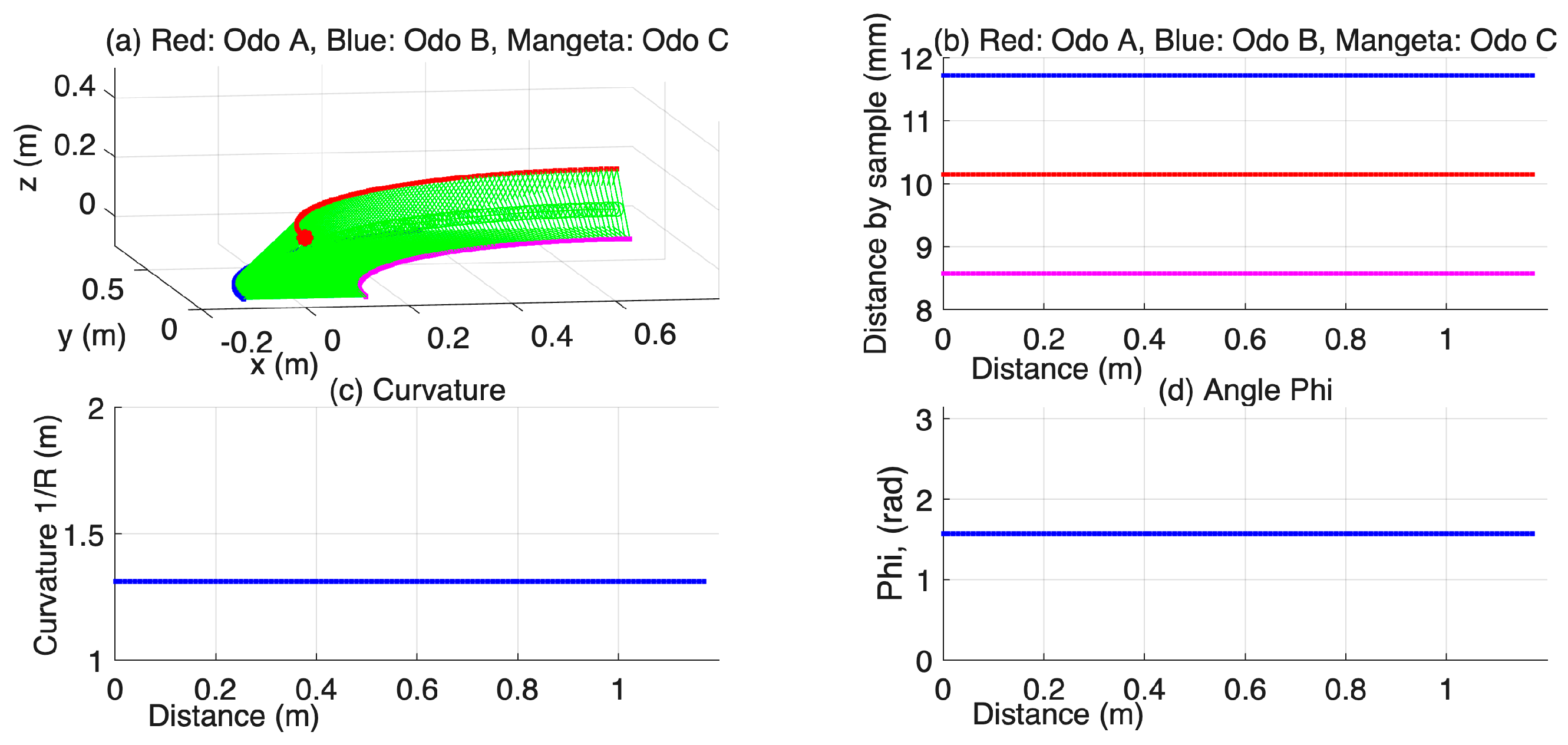
To simulate a different curvature, one only needs to modify the constant Re in Equations (1)–(13) to a different value, for example, 0.762 m (Ke = 1.3123 m−1), which represents a larger radius, resulting in a longer arc length. The results of this simulation are shown in Figure 12, where the initial PIG position is set to 90°, and the sampling distance is 10 mm.
The rotation of the PIG was not considered in the simulations; however, the real curvature direction during inspection can be determined using both the φ and Roll angles. The Roll rotation is considered negligible in calculating the curvature since the odometer wheels are aligned with the PIG’s Roll axis, meaning the odometers only rotate when the PIG translates, not when it rotates.
Up to this point, simulation has demonstrated the capability to determine curvature and its orientation based on odometer displacement. However, validation of this model with experimental data is necessary, as discussed in the following sections.

2.3. Experimental Setup

This section presents the electronic architecture and mechanical construction of a PIG with three odometers. This device validates curvature models and distance measurements using a 22-m-long test circuit constructed with 10-inch-diameter piping.

2.3.1. Electronic Architecture

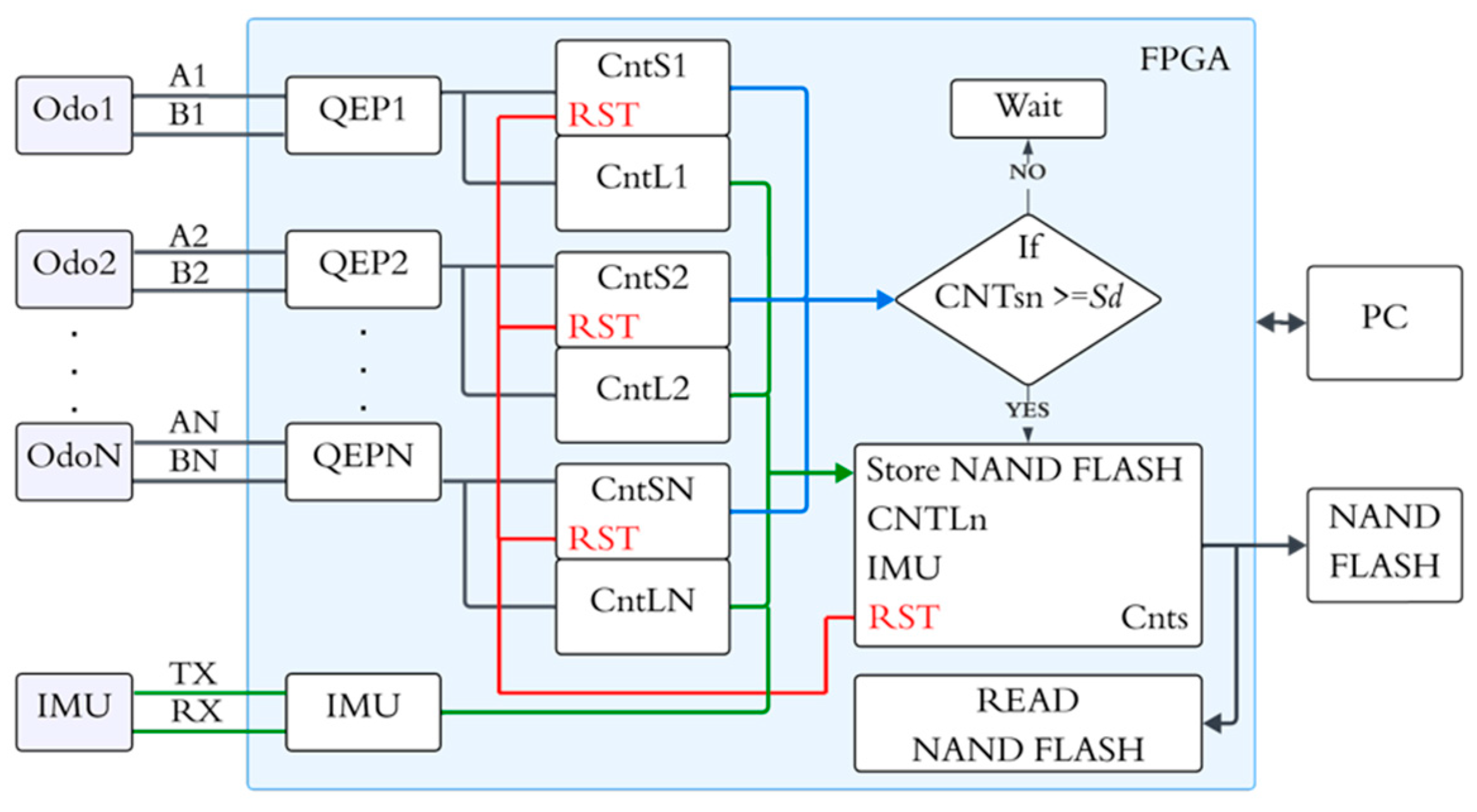
For experimentation, it is necessary to fabricate an electronic system to acquire and store signals from the odometers and the IMU. The electronic system is designed to acquire pulses from the N odometers through quadrature encoder pulse modules (QEP). Each one is then directed to two counters: a long counter (CntL) and a short counter (CntS). The long counter accumulates and records the total distance traveled by each odometer, while the short counter captures the sampling distance of each odometer. Whenever any of the N odometers covers the defined sampling distance, all short counters are reset, and simultaneously, all data is stored in NAND flash memory. The data to be stored includes the N long counters and the IMU data. The block diagram in Figure 13 illustrates the electronic system implemented on an FPGA.
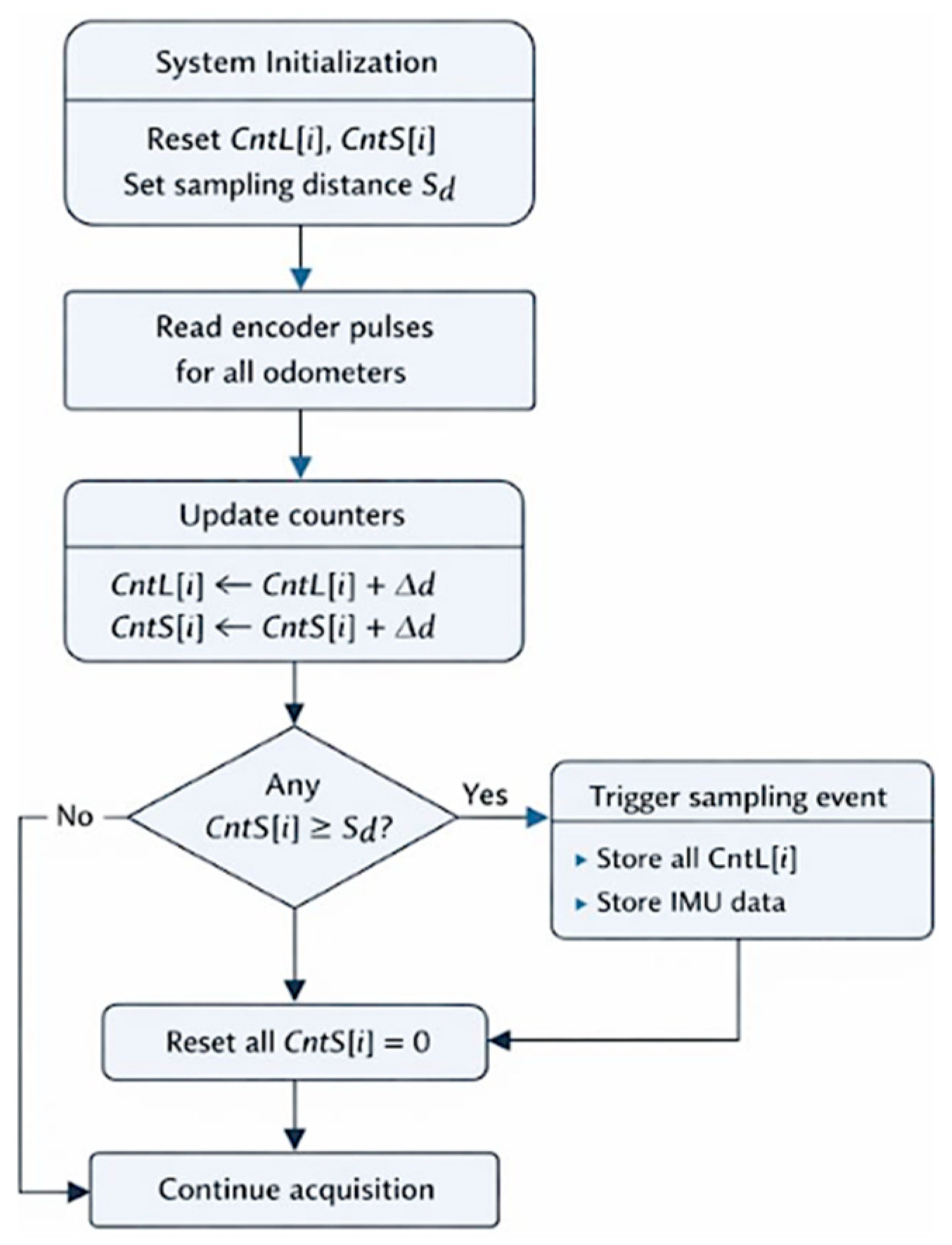
To reduce the cumulative distance errors caused by odometer slippage, an equal-distance sampling strategy was implemented in the data acquisition system. Unlike conventional time-based sampling, the proposed method triggers data acquisition events based on a predefined traveled distance, ensuring spatially uniform sampling along the pipeline trajectory.
A sampling event is triggered when the short counter of any odometer reaches or exceeds the predefined sampling distance Sd. When this condition is satisfied, the following actions are executed simultaneously:
  • The long counter values of all odometers are stored.
  • Inertial Measurement Unit (IMU) data are stored synchronously.
  • All short counters are reset to zero.
This mechanism ensures that all sensors are sampled at consistent spatial intervals, regardless of instantaneous velocity variations or localized odometer slip. The triggering condition is independent of which odometer reaches Sd, providing robustness against temporary loss of contact or uneven wheel loading. Due to the discrete nature of encoder pulses, the short counter may exceed Sd by a small amount before triggering. This overshoot is discarded during the reset operation. If multiple odometers reach the sampling distance within the same processing cycle, only one sampling event is generated, and all short counters are reset simultaneously. This prevents duplicated samples and ensures deterministic behavior. The procedure is repeated continuously throughout the inspection, producing a spatially uniform dataset suitable for curvature estimation and trajectory analysis. A flowchart of the equal-distance sampling triggering logic is shown in Figure 14.
In this experimental setup, we consider only 3 odometers of the architecture. Each odometer features a wheel with a circumference of 51.2 mm and an encoder with 1024 pulses per revolution, resulting in a resolution of 0.50 mm per pulse.
The IMU utilized is an MTI-30 [30], which provides Roll, Pitch, and Yaw angles at a sampling frequency of 400 Hz, with respective errors of 0.2°, 0.5°, and 1.0°. Additionally, the electronic system includes a serial communication port for device configuration and data transfer to a computer. This information is post-processed to determine displacement, curvature, and orientation.

2.3.2. Mechanical Architecture

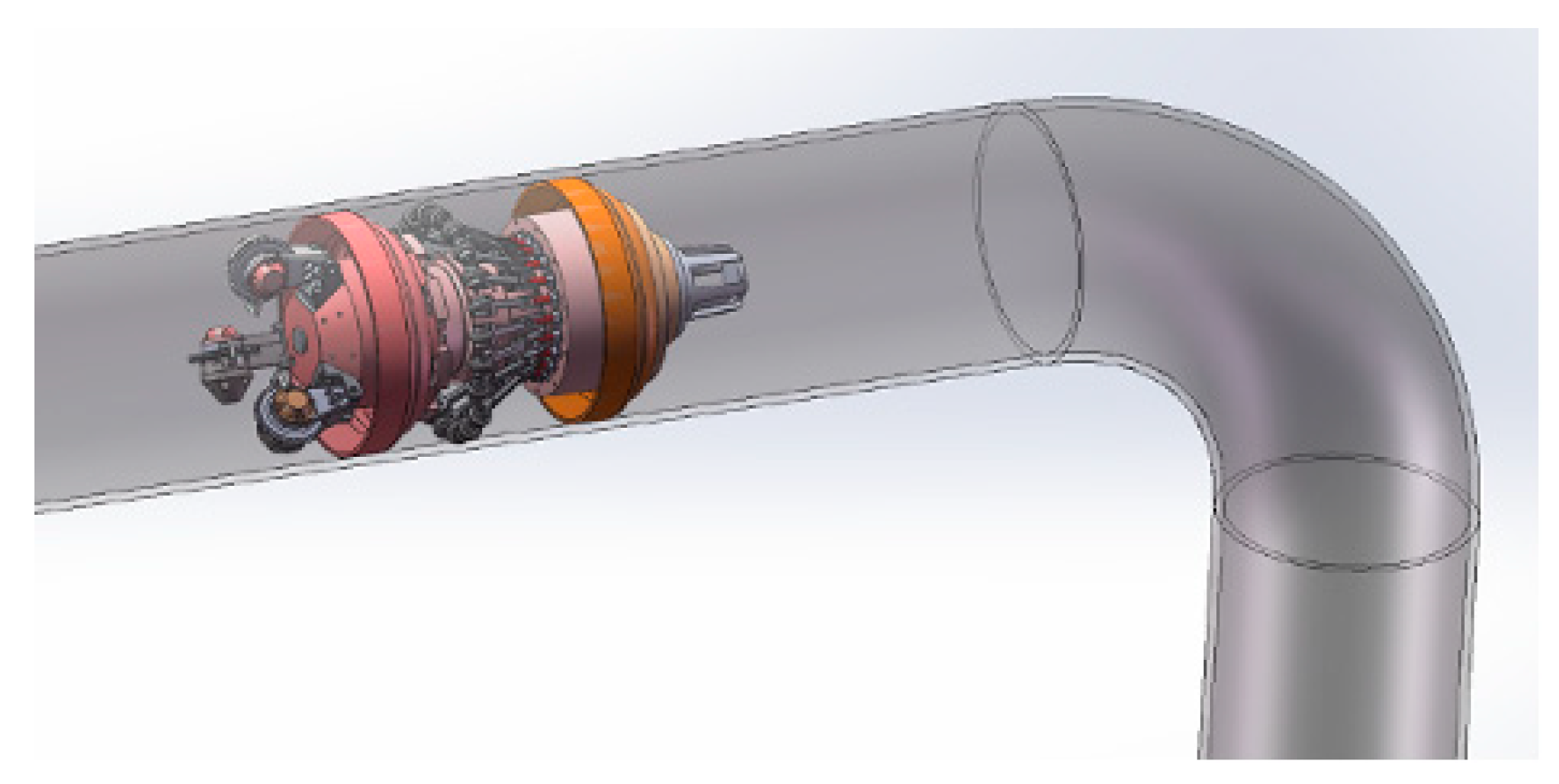
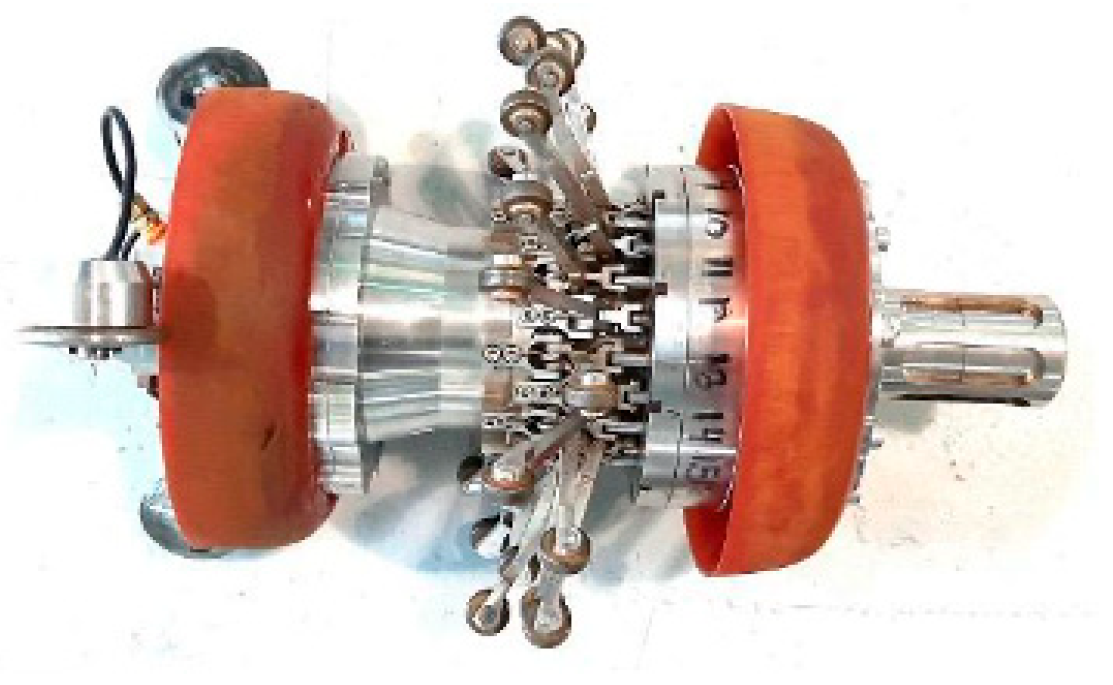
The device employed is a geometry instrument equipped with three odometers at the rear, as depicted in the photograph in Figure 15. The odometers are positioned equidistantly along the axis of the device, separated by 120° intervals.

2.3.3. Pipeline Test Circuit

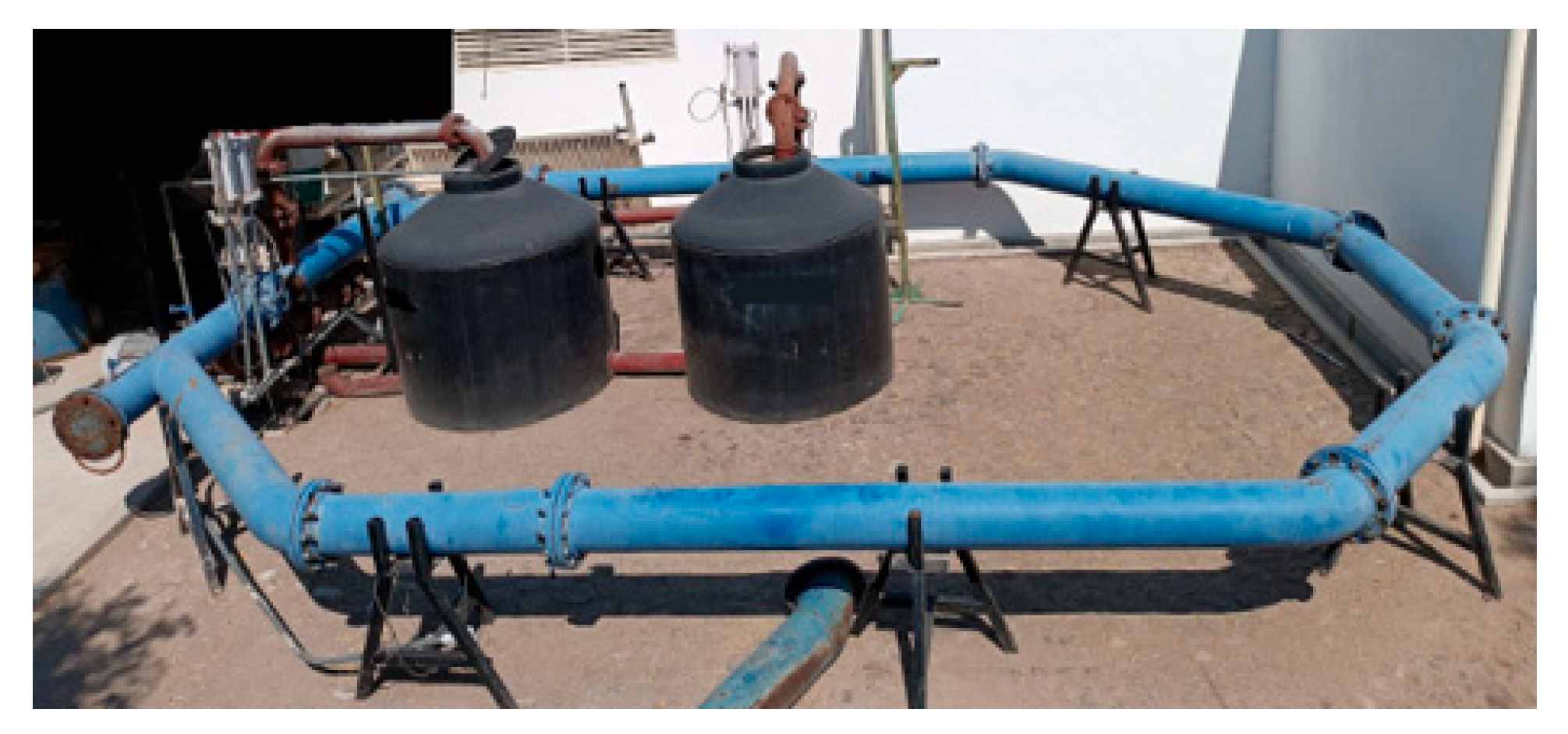
A 10-inch diameter pipe circuit was fabricated to conduct tests on the device. The flow within the circuit is controlled by a pump, two 10-inch gate valves, and five 6-inch directional valves, enabling the device to make the programmed number of turns continuously. Additionally, the system includes four 6-inch bypasses to recirculate the flow. The average speed achieved by the PIG on the test circuit is 0.5 m/s. Figure 16 illustrates a photograph of the test circuit.
The main characteristics of the 10-inch pipe sections:
  • Nominal Diameter: 10 inches/254 mm
  • Outside Diameter: 10.750 inches/273.05 mm
  • Schedule: 40 (wall thickness of 0.365 inches/9.27 mm)
  • Materials: Carbon steel (ASTM A106).
  • Long Radius Elbows: The bending radius R is equal to 1.5 times the nominal diameter.
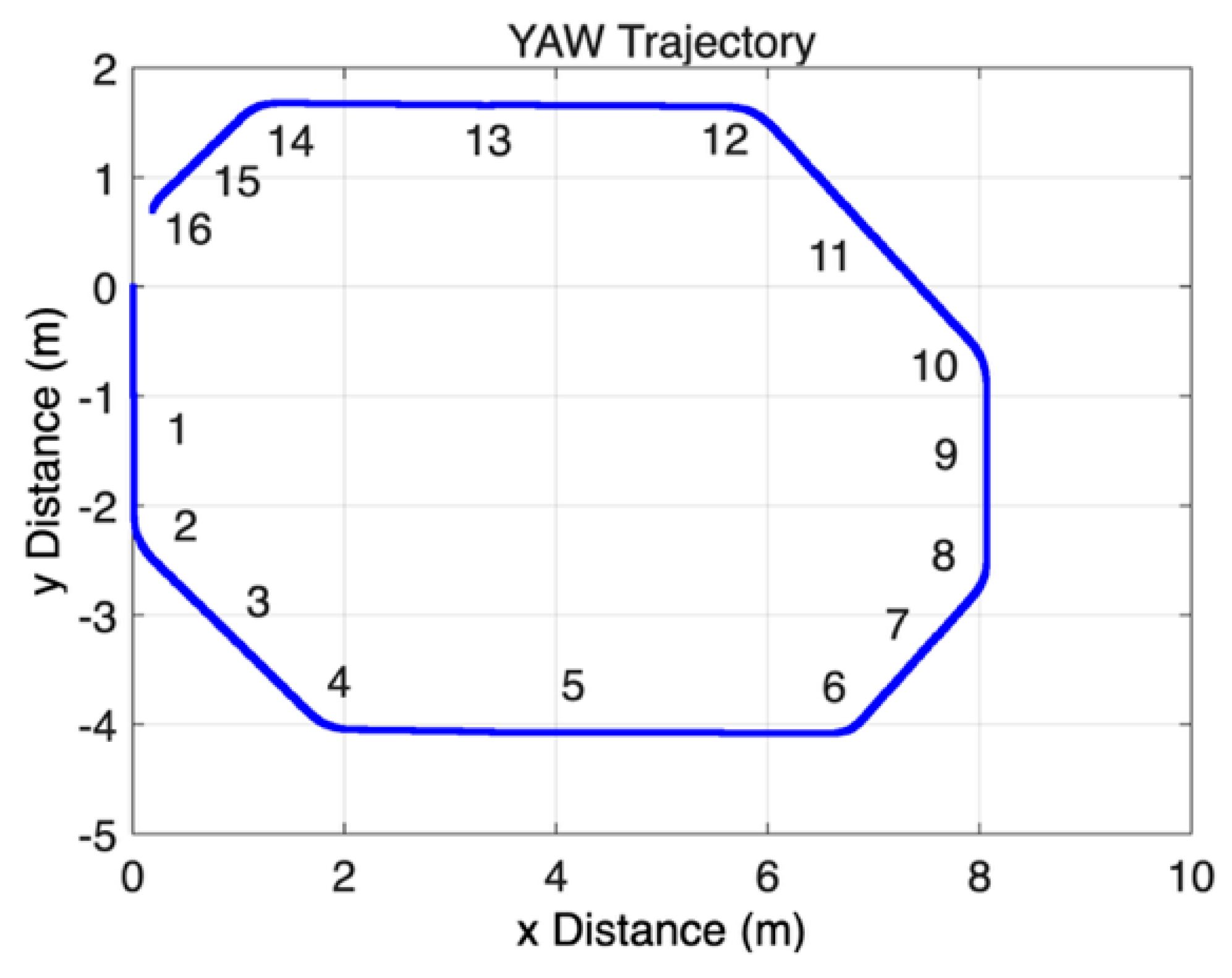
The test circuit can be divided into 16 sections, which include eight 45° elbows and eight straight sections, illustrated in Figure 17.
Referring to Figure 17, the equipment is introduced at position 0,0 and moves counterclockwise. In addition to representing the circuit in the xy-plane, it is essential to consider that the odometers can travel along any part of the duct wall. For instance, if traveling along the inner part of the circuit, the odometers would measure the minimum displacement distance; if traveling along the outer part, they would measure the maximum displacement distance; and if traveling along the centerline, aligned with the pipeline axis, they would measure the average displacement distance. Table 4 presents the distances for the different pipeline sections on the test circuit, as illustrated in Figure 17.
From Table 4, it can be deduced that if an odometer travels exclusively along the inner part of the circuit, the recorded distance should be 21.6 m. If it travels along the outer part, the distance would be 23.31 m, while traveling along the centerline yields a mean distance of 22.46 m. Since the PIG rotates while traversing the circuit, each encoder is expected to record an average distance of 22.46 m. In summary, when the PIG travels through the test circuit, the odometers should record a mean lap distance of 22.46 m.

3. Results and Discussion

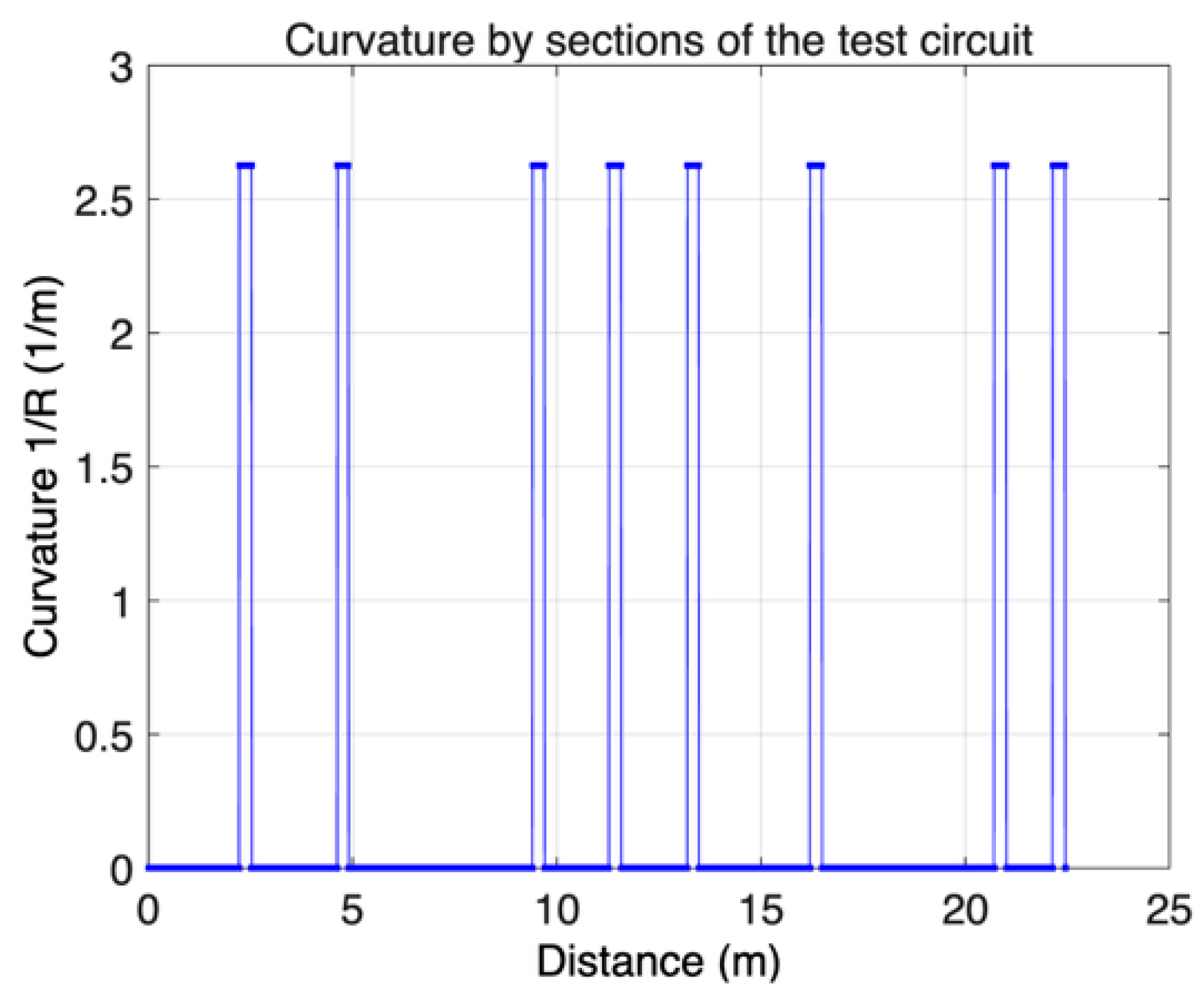
Considering the test circuit sections, the expected curvature result for one complete lap is illustrated in Figure 18.
Figure 18 depicts the ideal curvature behavior for one complete lap of the test circuit, representing the eight straight segments and the eight bends in the circuit. For the straight segments, the curvature is zero, while for the bends, it is 2.6246 m−1.
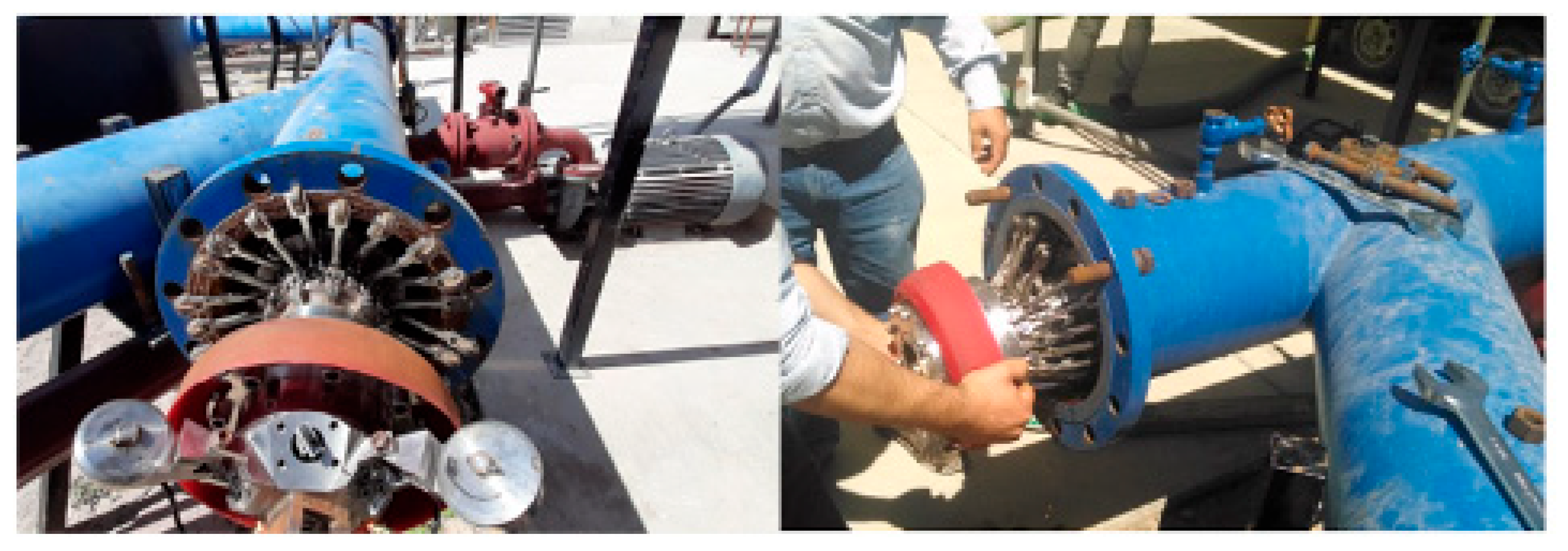
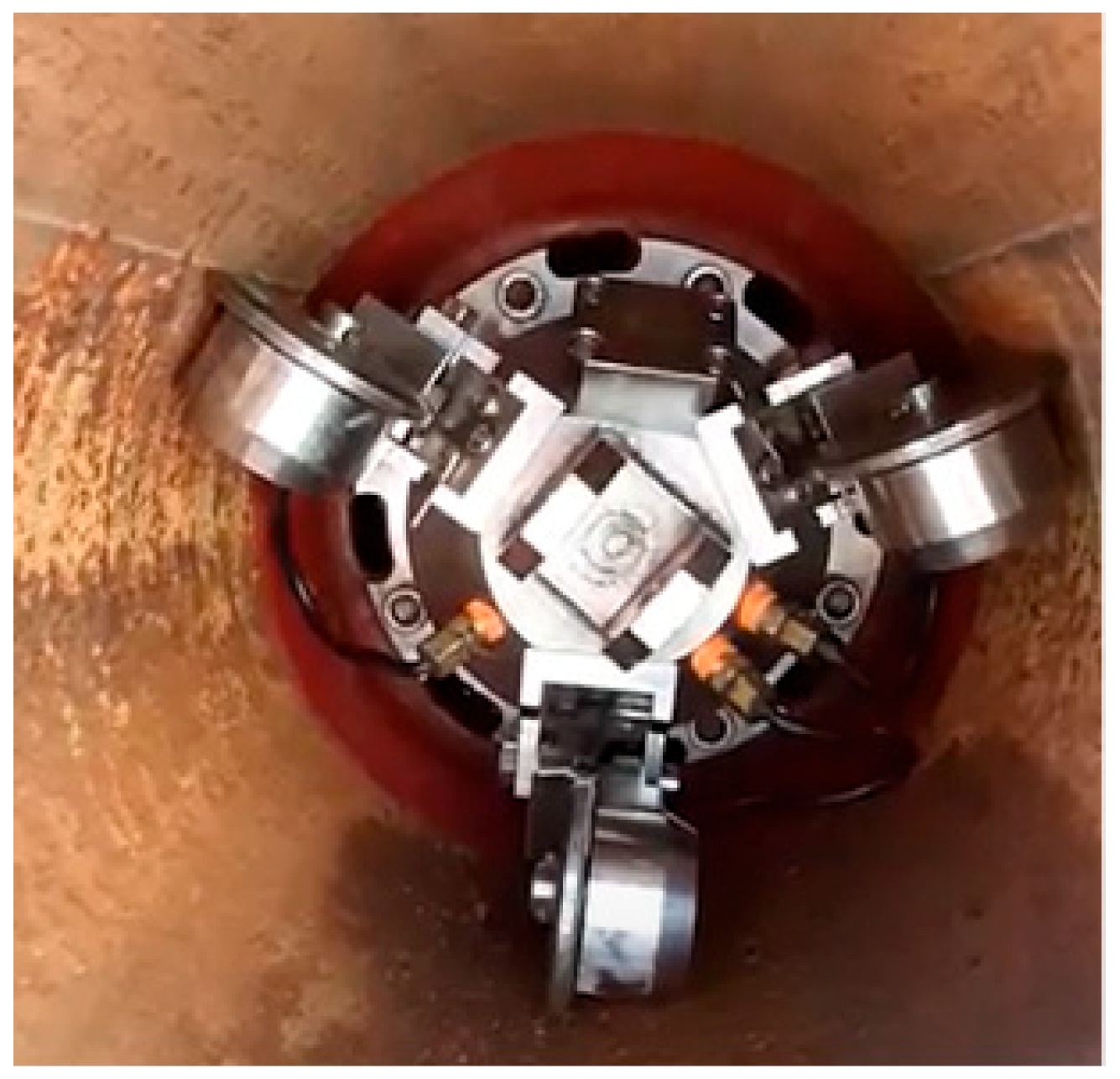
To evaluate the performance of the curvature detection algorithm, the equipment was run on the test circuit, recording data over 10 laps, corresponding to approximately 225 m of travel. Figure 19 shows inserting and removing the equipment from the pipeline, and Figure 20 illustrates the equipment within the pipeline, where the three odometers in contact with the internal wall of the pipeline are visible.
The sampling distance used is 10 mm, as PEMEX in Mexico requires this for geometric tools. International standards do not define this distance; it is left to the manufacturer’s specification. Technical reports [31] mention that commercial tools can achieve resolutions as low as 3 mm. In conclusion, 10 mm is an adequate value to obtain a good representation of geometric deformations, which is the ultimate goal of the equipment.
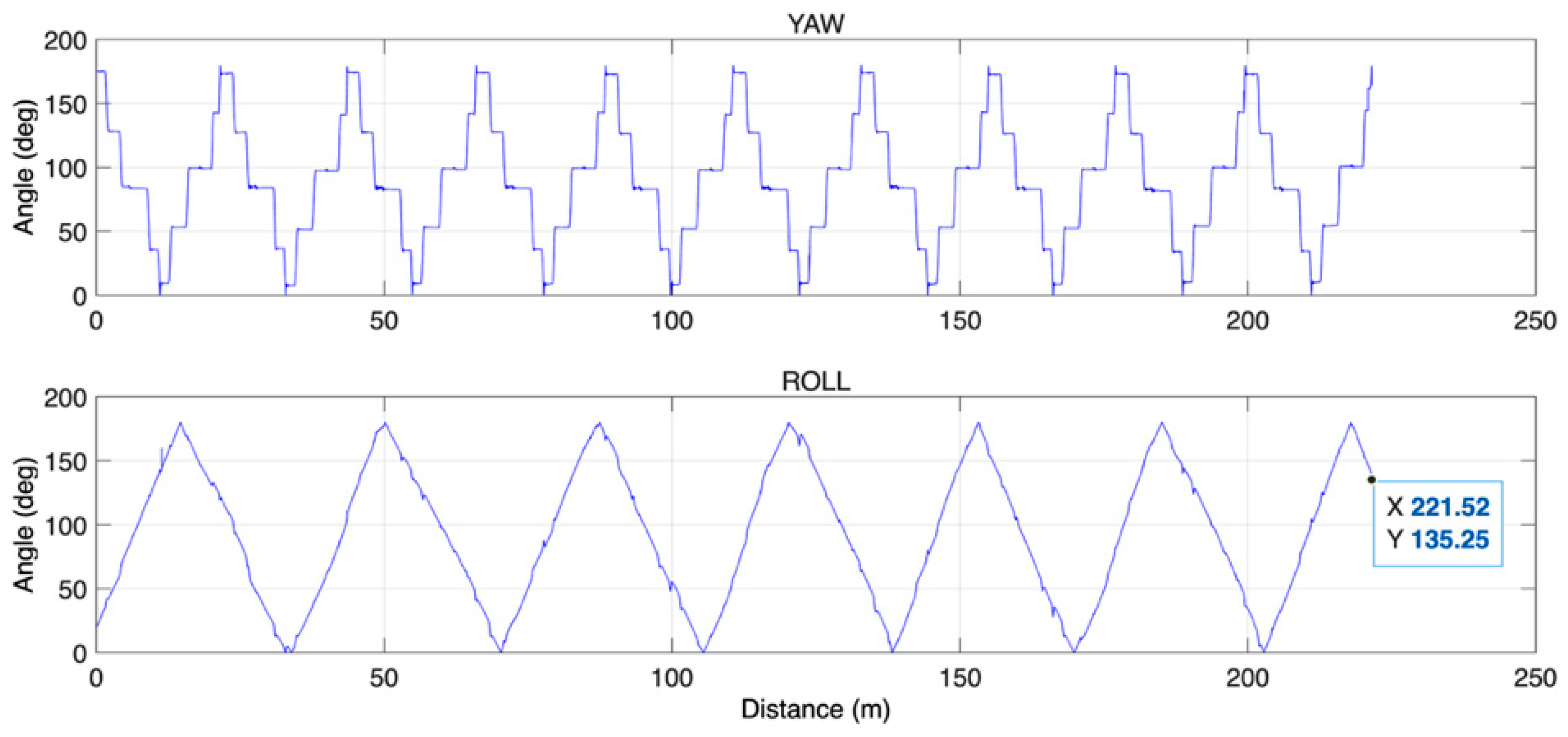
After extracting the equipment from the pipeline, the data is downloaded from the memory and post-processed. Figure 21 displays the obtained data for Yaw and Roll; Pitch is omitted as it is essentially zero due to the test circuit’s trajectory not involving any ascents or descents.
Analyzing the Yaw angle behavior reveals that the equipment completed 10 laps around the circuit. The Roll graph indicates that the equipment underwent approximately 6.5 rotations throughout the trajectory. The Yaw and Roll data are not required for curvature measurement. They are presented solely for reference to identify the number of laps and rotations of the equipment during the experiment.
The Roll rotation is considered negligible for two reasons. First, the wheels are aligned longitudinally; therefore, if the equipment rotates only, the odometers do not move. Second, in practice, the rotation is negligible compared to the sampling distance (linear displacement); for example, in data obtained from 10 laps, there were 6.5 rotations (13π rad). Considering that 10 laps correspond to 221.5 m and the sampling distance is 10 mm, there are 22,150 samples. Dividing 13π radians by the number of samples yields a rotation of 0.00184 rad per sample. If the duct radius is 127 mm, the equipment has a rotational displacement of 0.234 mm per sample. Therefore, the resultant of the linear and rotational displacements is 10.0027 mm. Finally, the odometer records only the linear component, which is the one that truly matters for locating the longitudinal position of any indication. The Roll angle only determines the circumferential position of the indication.
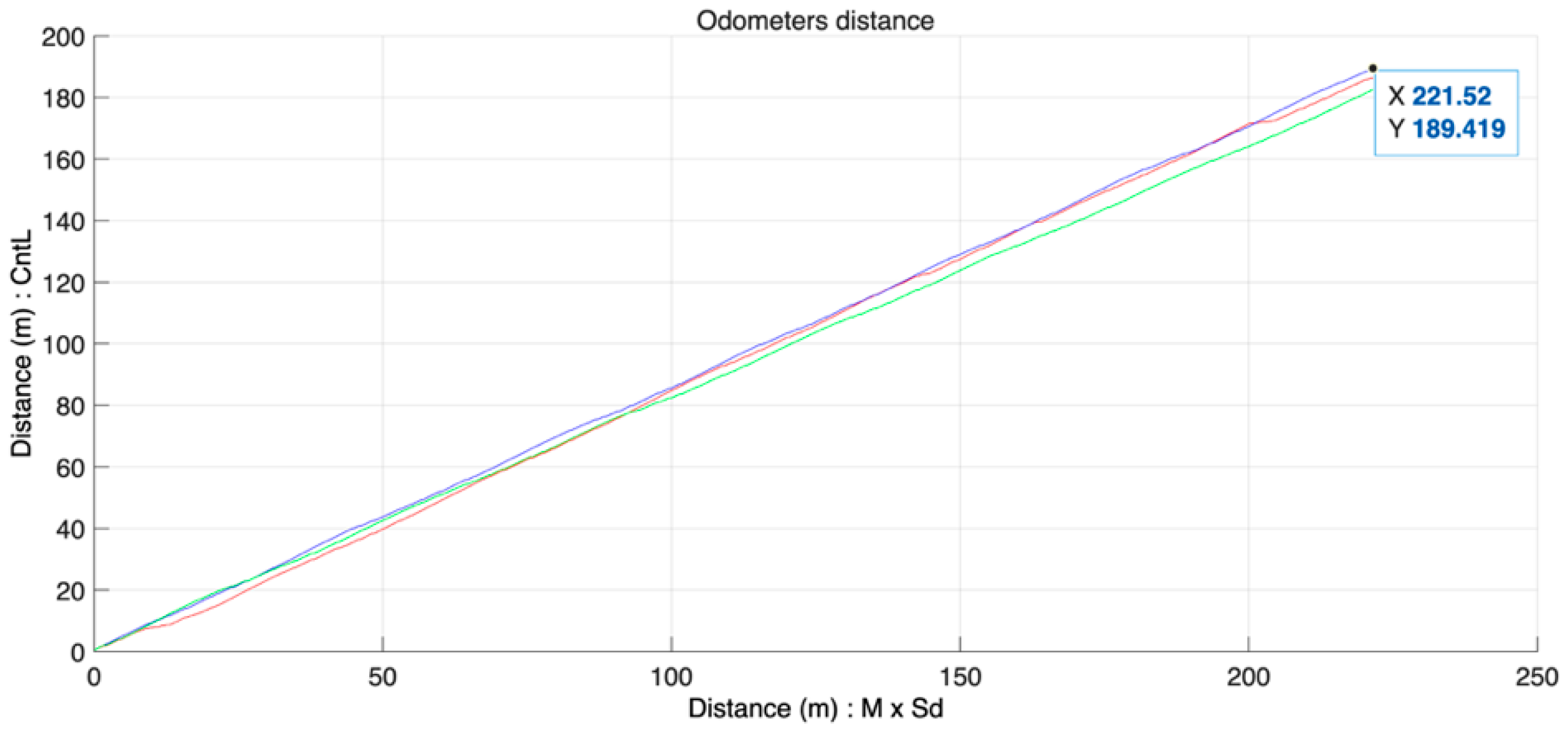
Figure 22 displays the odometer data, with the y-axis representing the long counters of each odometer (CntLA, CntLB, and CntLC) and the x-axis showing the total number of acquired samples (M) multiplied by the sampling distance (Sd). Here, the number of samples is defined by the short counters.
Figure 22 illustrates that the long counter (CntL) of the odometers, which recorded the most significant distance, only measured 189.4 m of travel on the y-axis. In contrast, the short counters (CntS) recorded 221.5 m on the x-axis. As the Electronic Architecture section explains, the x-axis value is derived from the number of samples obtained using distance sampling. In total, 22,150 samples were collected, multiplied by the sampling distance of 0.01 m (10 mm).
According to the characterization of the test circuit, as shown in Table 4, the average traveled distance should be approximately 224.6 m, considering 10 test laps. These results indicate that the odometers slip and have a significant error. By employing the CntL, the relative error is around 15.67%, or 0.1565 m lost per meter traveled. And by employing the proposed method, the redundant distance sampling technique CntS, the relative error is 1.38%, or 0.0138 m lost per meter traveled.
The test circuit includes four-inch branches for the pumping system, which causes the odometers to record inaccurately when encountering these branches. It is also considered that there might be a loss of odometer contact when passing through the circuit’s bends, flanges, and gates. These slipping considerations highlight that curvature measurement can have considerable error, as the PIG has only three odometers. If one fails to record accurately, the (16) and (17) equations for curvature calculation could be compromised.
In the worst-case scenario for curvature measurement, only one odometer accurately records displacement while the other two slip. For instance, A = 0.01 m (Sd), B = 0, and C = 0, resulting in a curvature of 14.65 m−1.
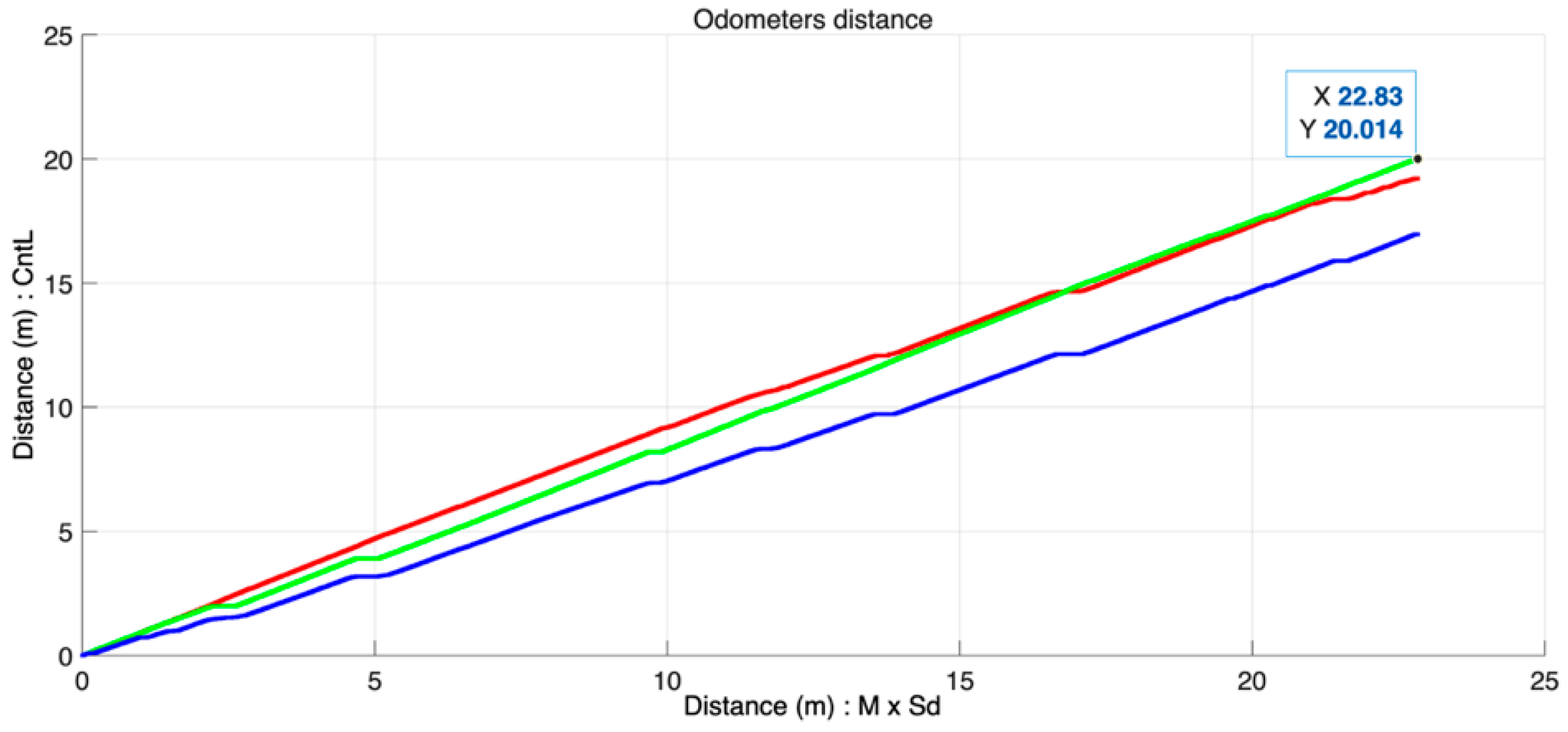
One of the ten laps is used as a reference to exemplify the results of slipping. Figure 23 shows the three odometer readings for this case. The odometer recorded the most significant distance reached, 20.1 m, shown in green. The distance obtained from the short counters was 22.83 m, closer to the test circuit’s average lap distance of 22.46 m.
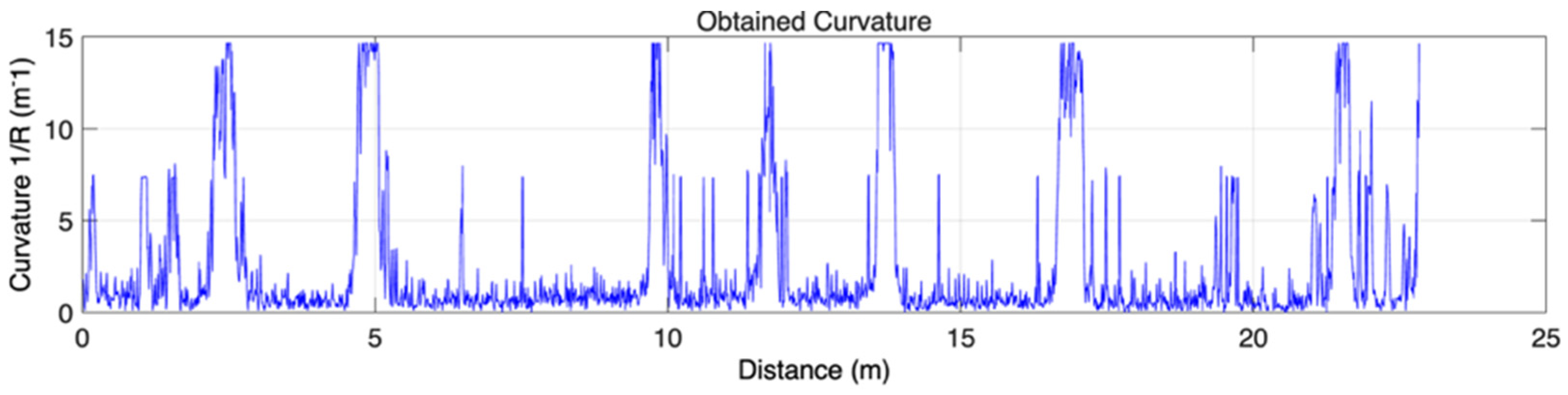
Figure 24 illustrates the curvature calculation for a one-lap traversal, demonstrating that slipping in the odometers is common: in all elbows, at least one sample reaches the maximum curvature of 14.65 m−1. However, Figure 24 also provides intriguing results, as it reveals the presence of eight elbows in the test bench, considering curvature values exceeding 10 m−1.
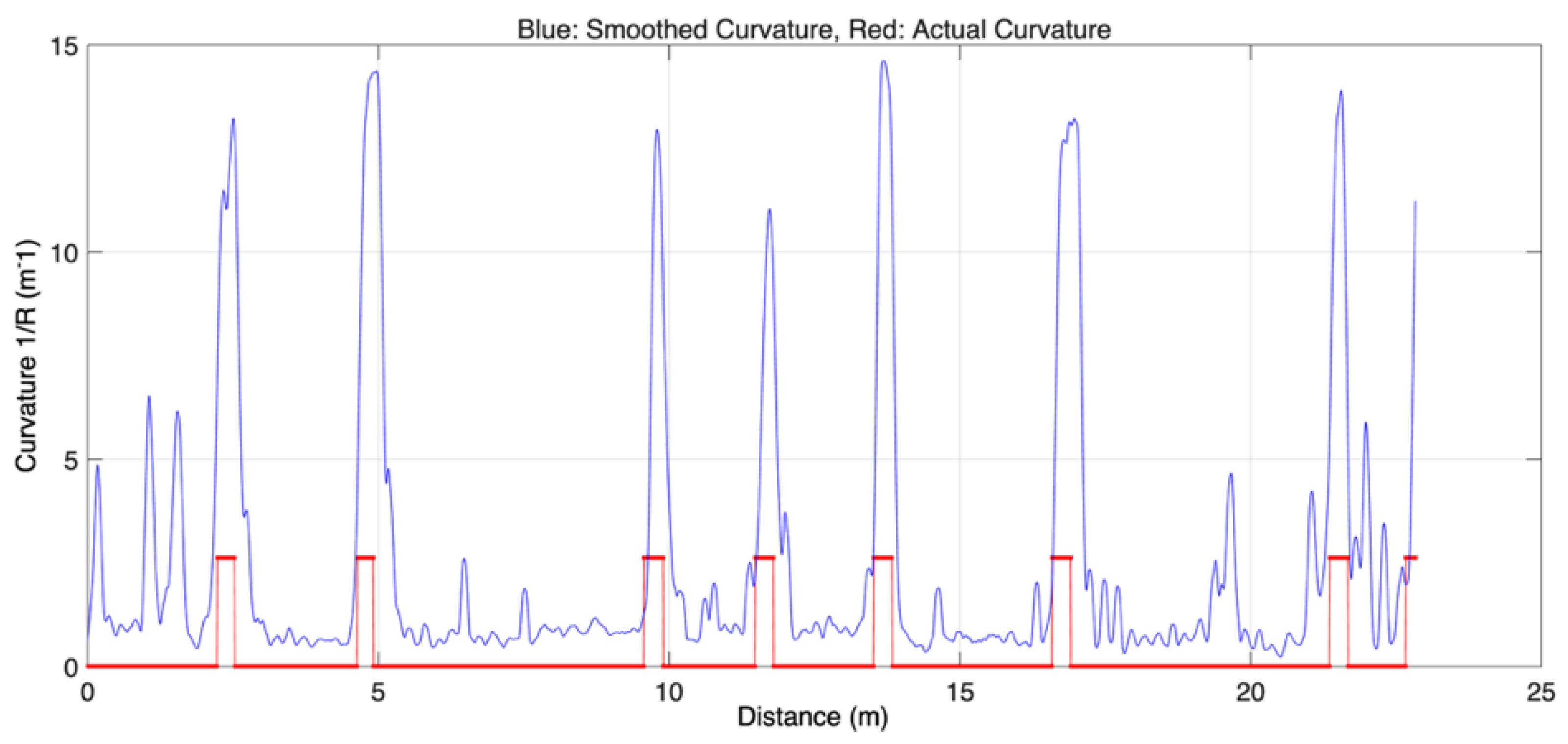
Figure 25 shows, in red, the real curvature and, in blue, the smoothed curvature using a 20-data-point moving average filter; the filtering is implemented not with the aim of improving the measurement, but with the aim of eliminating noise and being able to have a better qualitative appreciation. The locations of the curvatures on the bench are consistent with the expected values, given that an elbow corresponds to a curvature magnitude exceeding 10 m−1 and has an approximate length of 0.3 m. These data are valuable because, in practice, all elbows installed in ducts have known curvature and length. Consequently, locating them in the trajectory to represent them in a 3D reconstruction, for instance, is sufficient. The curvature detection algorithm presented here facilitates the localization of these curvatures.
Additionally, Figure 25 shows curvature peaks around 5 m−1, corresponding to some of the 6-inch branches present on the test bench. The remaining peaks in the figure correspond to some of the pipe flanges. Therefore, bend detection can be considered satisfactory not only for detecting pipeline bends but also for other pipeline features.

3.1. Qualitative Analysis of the Results

The curvature results presented in Figure 24 and Figure 25 exhibit, in blue, sporadic peaks with magnitudes significantly higher than the nominal curvature of the pipeline elbows. These high-magnitude peaks do not correspond to physically realizable curvature values of the test circuit and therefore require qualitative interpretation. The primary origin of these peaks is attributed to mechanical artifacts rather than limitations of the curvature model itself. During traversal of the test circuit, the PIG encounters several mechanical discontinuities, including elbows, flanges, gate valves, and branch connections. These features can temporarily alter the contact conditions between the odometer wheels and the pipe wall, resulting in partial or complete wheel slippage or a transient loss of contact. When such events occur, one or more odometers may under-report displacement while others continue to accumulate distance normally.
Given that curvature computation relies on relative differences between odometer displacements, transient under-reporting by one or more odometers can cause the curvature equations to produce artificially large values. This effect is particularly pronounced in the three-odometer configuration, where the loss or degradation of a single measurement channel significantly impacts the curvature estimation.
From a signal-processing perspective, these peaks are not caused by numerical instability, filtering artifacts, or discretization effects. The sampling distance, encoder resolution, and curvature equations are well-conditioned under nominal operating conditions, as demonstrated in the simulation results. The observed peaks arise from physically inconsistent input data rather than from the mathematical formulation or the equal-distance sampling strategy. Nevertheless, signal-processing choices affect the visibility of these peaks. The absence of aggressive filtering preserves high-frequency content in the curvature signal, allowing transient events to appear as sharp peaks. While smoothing filters (e.g., moving average or low-pass filters) can reduce peak amplitude, they also reduce spatial resolution and may smear the precise location of pipeline features. For this reason, only mild smoothing was applied in this study, prioritizing spatial localization over peak suppression. Importantly, although the magnitude of the curvature peaks does not reflect the true physical curvature, their spatial occurrence remains consistent with known pipeline features. All eight elbows of the test circuit are clearly identifiable as clusters of high curvature values, and additional peaks align with branches and flanges. This indicates that the method is robust for qualitative detection and localization of pipeline features, even in the presence of significant odometer slippage.
In summary, the high-magnitude curvature peaks are predominantly the result of mechanical interaction effects between the PIG and the pipeline rather than inherent limitations of the proposed sampling or curvature estimation method. These results support the use of the curvature signal as a qualitative indicator of pipeline geometry and accessories, while highlighting the need for increased odometer redundancy to achieve accurate quantitative curvature estimation.

3.2. Limitations

Despite demonstrating the feasibility of curvature detection using multi-odometry and equal-distance sampling, the proposed method and experimental setup present several limitations that must be acknowledged.
The most significant limitation arises from the mechanical interaction between the PIG and the pipeline. Odometer wheels are subject to variable contact forces, surface roughness, fluid-induced vibrations, and geometric discontinuities such as elbows, flanges, valves, and branch connections. These factors can lead to partial or complete odometer slippage and, in some cases, temporary loss of contact with the pipe wall. Since the curvature estimation relies on relative displacement measurements, even short-duration mechanical disturbances can produce large instantaneous errors in the computed curvature. This limitation is particularly critical in configurations with a limited number of odometers. In the three-odometer setup used for experimental validation, a single odometer measurement error can significantly distort the curvature estimate. As shown in the results, extreme curvature values can occur even when the physical pipeline curvature remains constant.
Although the proposed equal-distance sampling strategy significantly improves global distance estimation accuracy, it does not fully eliminate local displacement errors caused by transient slippage events. The redundancy provided by three odometers is sufficient for detecting the presence and approximate location of curvature changes, but insufficient for robust quantitative curvature estimation under severe slip conditions. Increasing the number of odometers would introduce additional redundancy, enabling outlier rejection and consistency checks across multiple displacement measurements.
Due to combined mechanical and measurement limitations, the curvature values obtained experimentally should be interpreted primarily qualitatively. While the method reliably detects the presence and spatial location of bends and pipeline features, the absolute curvature magnitude may deviate significantly from the true physical curvature under adverse contact conditions. This limitation motivates the increased sensor redundancy for applications requiring precise quantitative curvature estimation.

4. Conclusions

This article presented a novel model to simulate the odometer traversal of a PIG through the interior of an elbow. Subsequently, data from this simulation were used to detect elbow curvature, demonstrating that, in simulation, using at least three odometers for curvature detection is sufficient.
The architecture of a data acquisition system for a PIG was also presented, considering two types of odometer counters: long and short. It was shown that a more accurate traversal distance can be obtained by employing distance-based sampling and redundantly using short counters, thereby compensating for potential slip of the odometers used in the long counters. By using this redundant sampling distance technique, the distance measurement error was reduced from 15.67% to 1.38%, or from 156.7 mm per meter to 13.8 mm per meter.
A PIG with three odometers was used to demonstrate the practical detection of curvature. The results indicate that this method provides information about the location of elbows within the pipeline and allows for the inference of information regarding some attachments or sections of the pipeline. However, the measured curvature was considerably different from the expected value. Even though the measured values do not match the expected curvature data due to odometer slip, the resulting curvature signals can still be analyzed qualitatively, and the difference between negotiating a bend and traveling along a straight segment can be clearly identified. These practical results suggest the potential use of curvature signals and Artificial Intelligence to classify pipeline sections and attachments, which is the next step in this project. Additional data acquisition, section labeling, and EDA (Exploratory Data Analysis) are necessary, along with determining the appropriate type of network and training it.
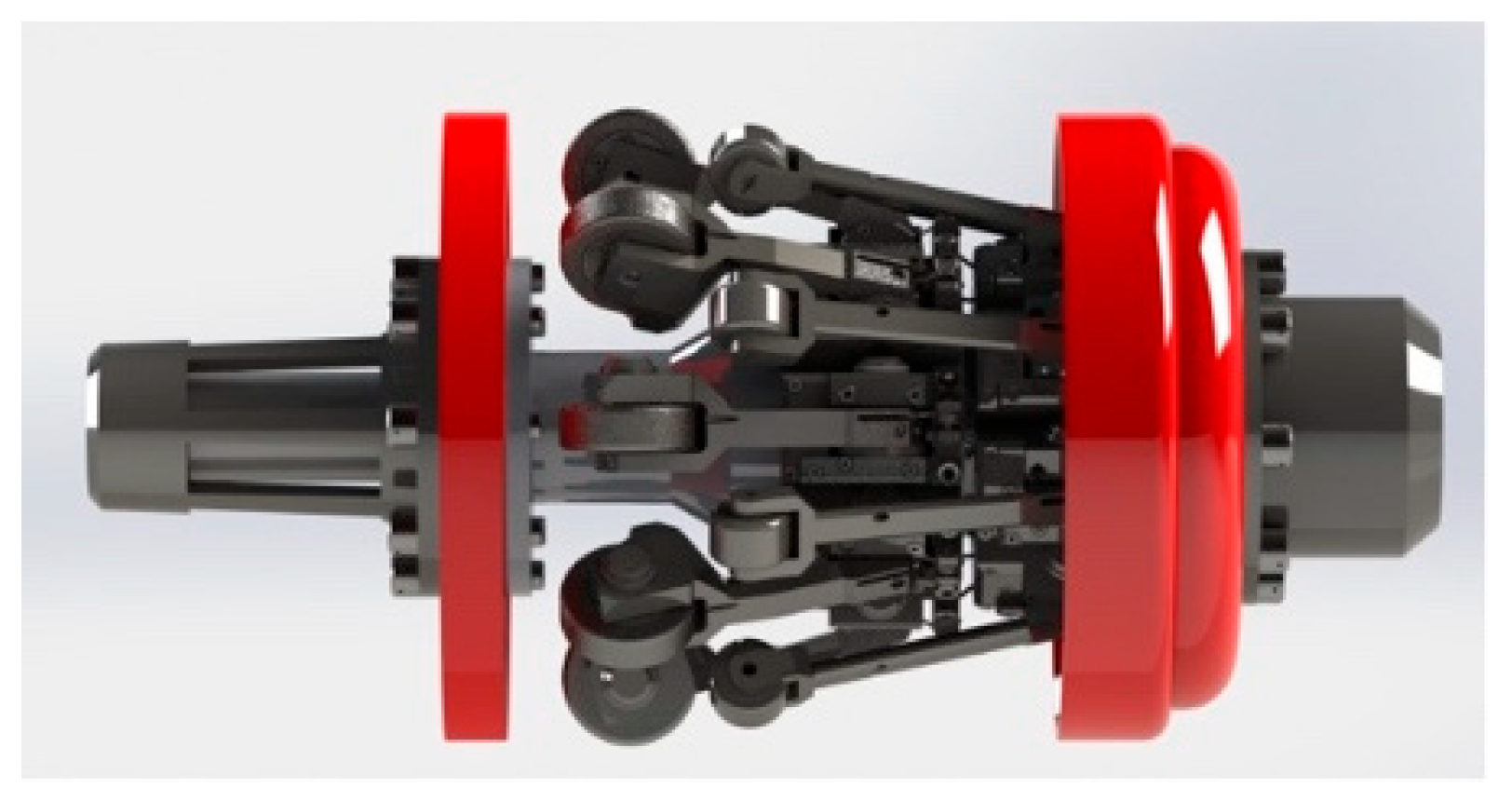
An increased number of odometers can be incorporated into the PIG to compensate for odometer slip. This would provide redundant curvature information and enable better measurement. For example, in a geometric inspection system, installing an odometer on each deformation arm—resulting in as many odometers as arms—would significantly enhance the resolution of distance measurements and curvature detection. In Figure 26, a new device architecture is proposed, which includes 8 odometers, one on each arm of the rear calipers. This device is already in production, and the results will be presented in the future.

Author Contributions

Conceptualization, J.A.S.-C.; Methodology, A.R.-M.; Software, E.L.-d.-R. and J.A.S.-C.; Validation, J.A.S.-C.; Investigation, E.L.-d.-R.; Writing—original draft, E.L.-d.-R.; Writing—review & editing, J.A.S.-C.; Supervision, E.G.P. and A.G.; Project administration, J.A.S.-C. All authors have read and agreed to the published version of the manuscript.

Funding

This work was supported by the “Secretaría de Ciencias Humanidades Tecnología e Innovación (Secihti)”, through the Budgetary Program F003 ‘Strategic National Programs for Science, Technology, and Linkage with the Social, Public, and Private Sectors’, under project number MADTEC-2025-M-125.

Data Availability Statement

The data presented in this study are currently being processed for a future publication.

Conflicts of Interest

The authors declare no conflict of interest.

References

  1. Global Energy Monitor. Global Gas Infrastructure Tracker; GEM Report; Global Energy Monitor: San Francisco, CA, USA, 2025; Available online: https://globalenergymonitor.org/projects/global-gas-infrastructure-tracker/ (accessed on 2 February 2026).
  2. International Energy Agency. World Energy Outlook 2025; IEA Publications: Paris, France, 2025; Available online: https://www.iea.org/reports/world-energy-outlook-2025 (accessed on 2 February 2026).
  3. Liu, Z.; Huang, Y.; Wang, X.; Li, J. A Review on Pipeline In-Line Inspection Technologies. Sensors 2025, 25, 4873. [Google Scholar] [CrossRef] [PubMed]
  4. Mishra, D.; Agrawal, K.K.; Abbas, A.; Srivastava, R.; Yadav, R.S. Pig [pipe inspection gauge]: An artificial dustman for cross country pipelines. Procedia Comput. Sci. 2019, 147, 333–340. [Google Scholar] [CrossRef]
  5. Yang, Y.; Zhang, Q.; Zhang, X.; Xie, S.; Wu, G.; Li, L. Intelligent Methods for Pipeline Operation and Integrity. J. Pipeline Syst. Eng. Pract. 2024, 15, 04023056. [Google Scholar] [CrossRef]
  6. Yu, J.; Lee, J.G.; Park, C.G.; Han, H.S. An off-line navigation of a geometry PIG using a modified nonlinear fixed-interval smoothing filter. Control Eng. Pract. 2005, 13, 1403–1411. [Google Scholar] [CrossRef]
  7. Chen, Q.; Niu, X.; Kuang, J.; Liu, J. IMU Mounting Angle Calibration for Pipeline Surveying Apparatus. IEEE Trans. Instrum. Meas. 2020, 69, 1765–1774. [Google Scholar] [CrossRef]
  8. Chen, Q.; Zhang, Q.; Niu, X.; Wang, Y. Positioning Accuracy of a Pipeline Surveying System Based on MEMS IMU and Odometer: Case Study. IEEE Access 2019, 7, 104453–104461. [Google Scholar] [CrossRef]
  9. Chowdhury, M.S.; Abdel-Hafez, M.F. Pipeline inspection gauge position estimation using inertial measurement unit, odometer, and a set of reference stations. ASCE-ASME J. Risk Uncertain. Eng. Syst. Part B Mech. Eng. 2016, 2, 021004. [Google Scholar] [CrossRef]
  10. Kennedy, M.; Toffin, E.; Down, A. Pipeline Mapping with Next Generation Spherical In-Line Inspection Tools. In Proceedings of the Pipelines 2024, Reston, VA, USA, 27–31 July 2024; American Society of Civil Engineers: Reston, VA, USA, 2024; pp. 222–231. [Google Scholar]
  11. Li, R.; Wang, Z.; Chen, P. Development the method of pipeline bending strain measurement based on microelectromechanical systems inertial measurement unit. Sci. Prog. 2020, 103, 003685042091433. [Google Scholar] [CrossRef] [PubMed]
  12. Kazeminasab, S.; Sadeghi, N.; Janfaza, V.; Razavi, M.; Ziyadidegan, S.; Banks, M.K. Localization, Mapping, Navigation, and Inspection Methods in In-Pipe Robots: A Review. IEEE Access 2021, 9, 162035–162058. [Google Scholar] [CrossRef]
  13. Freitas, V.C.G.; Araujo, V.G.; Crisóstomo, D.C.; Lima, G.F.; Neto, A.D.D.; Salazar, A.O. Velocity Prediction of a Pipeline Inspection Gauge (PIG) with Machine Learning. Sensors 2022, 22, 9162. [Google Scholar] [CrossRef]
  14. Al-Masri, W.M.F.; Abdel-Hafez, M.F.; Jaradat, M.A. Inertial Navigation System of Pipeline Inspection Gauge. IEEE Trans. Control Syst. Technol. 2020, 28, 609–616. [Google Scholar] [CrossRef]
  15. Zhu, X.; Zhao, C.; Li, X.; Zhang, S.; Liu, S. Direct Observation of Odometer Trajectory When Passing over Weld in Oil and Gas Pipeline. J. Pipeline Syst. Eng. Pract. 2019, 10, 04018027. [Google Scholar] [CrossRef]
  16. Ojeda, L.; Cruz, D.; Reina, G.; Borenstein, J. Current-based slippage detection and odometry correction for mobile robots and planetary rovers. IEEE Trans. Robot. 2006, 22, 366–378. [Google Scholar] [CrossRef]
  17. Huang, C.; Peng, F.; Liu, K. Pipeline inspection gauge positioning system based on optical fiber distributed acoustic sensing. IEEE Sens. J. 2021, 21, 25716–25722. [Google Scholar] [CrossRef]
  18. Shi, Y.; Zhang, C.; Li, R.; Cai, M.; Jia, G. Theory and application of magnetic flux leakage pipeline detection. Sensors 2015, 15, 31036–31055. [Google Scholar] [CrossRef]
  19. Guan, L.; Cong, X.; Zhang, Q.; Liu, F.; Gao, Y.; An, W.; Noureldin, A. A comprehensive review of micro-inertial measurement unit based intelligent PIG multi-sensor fusion technologies for small-diameter pipeline surveying. Micromachines 2020, 11, 840. [Google Scholar] [CrossRef]
  20. Wang, Q.; Cai, M.; Guo, Z. An enhanced positioning technique for underground pipeline robot based on inertial Sensor/Wheel odometer. Measurement 2023, 206, 112260. [Google Scholar] [CrossRef]
  21. Liu, S.; Zheng, D.; Li, R. Compensation method for pipeline centerline measurement of in-line inspection during odometer slips based on multi-sensor fusion and LSTM network. Sensors 2019, 19, 3740. [Google Scholar] [CrossRef]
  22. Freitas, V.C.G. Speed Prediction of a Pipeline Inspection Gauge (PIG) Based on Differential Pressure and Acceleration with Artificial Neural Networks. Master’s Thesis, Universidade Federal do Rio Grande do Norte, Natal, Brazil, 2022. Available online: https://repositorio.ufrn.br/handle/123456789/49553 (accessed on 2 February 2026).
  23. Lin, G.; Zhou, Z.; Hu, X.; Li, M.; Feng, H.; Liu, J.; Rui, X. Low-Cost and High-Efficiency Method for Detecting Vertical Bends of Subsea Pipelines. IEEE Access 2020, 8, 33926–33933. [Google Scholar] [CrossRef]
  24. Lin, G.; Zhou, Z.; Hu, X.; Li, M.; Feng, H.; Liu, J.; Rui, X. Performance enhancements of the spherical detector for pipeline spanning inspection through posture stabilization. Measurement 2020, 165, 108155. [Google Scholar] [CrossRef]
  25. Kahnamouei, J.T.; Moallem, M. A comprehensive review of in-pipe robots. Ocean. Eng. 2023, 277, 114256. [Google Scholar] [CrossRef]
  26. Worley, R.; Ma, K.; Sailor, G.; Schirru, M.M.; Dwyer-Joyce, R.; Boxall, J.; Dodd, T.; Collins, R.; Anderson, S. Robot localization in water pipes using acoustic signals and pose graph optimization. Sensors 2020, 20, 5584. [Google Scholar] [CrossRef] [PubMed]
  27. Lin, P.; Sun, J.; Xu, Y.; Wu, X.; Zhu, Y.; Zhang, X. Underground-pipeline mapping system based on inertial measurement unit: Research and application. Measurement 2023, 222, 113589. [Google Scholar] [CrossRef]
  28. Kaenel, R.A.; Crouch, A.E. Method and Apparatus for Measuring Curvature and Curvature Variations in Pipelines and the Like. U.S. Patent 3,882,606, 13 May 1975. [Google Scholar]
  29. Lugo-del-Real, E.; Soto-Cajiga, J.A.; Guerra Paradas, E.; Grau, A. Data Acquisition Architecture for a Navigation System of a PIG Based on Distance Sampling. In Proceedings of the 2024 IEEE 29th International Conference on Emerging Technologies and Factory Automation (ETFA), Padova, Italy, 10–13 September 2024; IEEE: New York, NY, USA, 2024; pp. 1–4. [Google Scholar] [CrossRef]
  30. Xsens. MTi User Manual; Xsens Technologies B.V.: Enschede, The Netherlands, 2005; Available online: https://www.xsens.com/hubfs/Downloads/usermanual/MTi_usermanual.pdf (accessed on 2 February 2026).
  31. Michael Baker Jr., Inc. Inspection Guidelines for Timely Response to Geometry Defects: Final Report; Delivery Order DTRS56-02-D-70036, TTO No. 7; Office of Pipeline Safety, Research and Special Programs Administration, Department of Transportation: Washington, DC, USA, 2004. [Google Scholar]
Figure 1. Block diagram of the proposed mathematical models.
Asi 09 00044 g001
Figure 2. Illustration of the model that obtains the distance of a π / 2 (90°) elbow, considering six odometers (N = 6) and five arc samples (M = 5).
Asi 09 00044 g002
Figure 3. Representation of PIG with four odometers passing through a 90° elbow with a curvature of 2.6246 m−1.
Asi 09 00044 g003
Figure 4. Representation of the displacement of four odometers inside the elbow. The top shows results for a sampling distance of 10 mm, and the bottom shows results for a sampling distance of 100 mm.
Asi 09 00044 g004
Figure 5. Representation of PIG with three odometers passing through a 90° elbow.
Asi 09 00044 g005
Figure 6. Displacement representation of three odometers inside the elbow. The top shows results for a sampling distance of 10 mm, and the bottom shows results for a sampling distance of 100 mm.
Asi 09 00044 g006
Figure 7. Representation of PIG odometers’ configuration, on the left with four (A, B, C, D) and on the right three odometers (A, B, C).
Asi 09 00044 g007
Figure 8. (a) 3D representation of odometer displacement, (b) odometer travel distance per sample, (c) curvature, and (d) angle φ, considering an initial PIG rotation of 0 degrees.
Asi 09 00044 g008
Figure 9. (a) 3D representation of odometer displacement, (b) odometer travel distance per sample, (c) curvature, and (d) angle φ, considering an initial PIG rotation of 90 degrees.
Asi 09 00044 g009
Figure 10. (a) 3D representation of odometer displacement, (b) odometer travel distance per sample, (c) curvature, and (d) angle φ, considering an initial PIG rotation of 180 degrees.
Asi 09 00044 g010
Figure 11. (a) 3D representation of odometer displacement, (b) odometer travel distance per sample, (c) curvature, and (d) angle φ, considering an initial PIG rotation of 270 degrees.
Asi 09 00044 g011
Figure 12. (a) 3D representation of odometer displacement, (b) odometer travel distance per sample, (c) curvature, and (d) angle φ, considering a radius of curvature of 0.762 m (curvature of 1.3123 m−1).
Asi 09 00044 g012
Figure 13. Data acquisition system Electronic Architecture block diagram.
Asi 09 00044 g013
Figure 14. Flowchart of the equal-distance sampling triggering logic.
Asi 09 00044 g014
Figure 15. The equipment used is a geometry PIG with three odometers mounted at the rear.
Asi 09 00044 g015
Figure 16. Photograph of the pipeline test circuit.
Asi 09 00044 g016
Figure 17. Representation of curved and straight sections of the pipeline circuit.
Asi 09 00044 g017
Figure 18. Ideal curvature of the test circuit by sections, considering one lap.
Asi 09 00044 g018
Figure 19. On the left, a photograph of equipment inserted into the pipeline, and on the right, a photograph of equipment removed from the pipeline.
Asi 09 00044 g019
Figure 20. Photograph of the equipment inside the pipeline.
Asi 09 00044 g020
Figure 21. Test data acquired for Yaw and Roll.
Asi 09 00044 g021
Figure 22. Graph representing data obtained for 10 test laps from the three odometers’ configuration.
Asi 09 00044 g022
Figure 23. Graph representing data obtained from the geometry PIG with three odometers configuration for one test lap.
Asi 09 00044 g023
Figure 24. A graph showing curvature calculated from the odometers for one lap.
Asi 09 00044 g024
Figure 25. Calculated curvature compared with the real data curvature.
Asi 09 00044 g025
Figure 26. Proposed new eight-odometer architecture.
Asi 09 00044 g026
Table 1. Model Variables Definition.
SymbolDefinitionUnits
NNumber of odometers-
SdSampling distancem
RiInitial PIG rotationrad
αeElbow anglerad
ReElbow Radiusm
Ke (1/Re)Elbow Curvaturem−1
Table 2. Distance Traveled Comparison Using Four Odometers (millimeters).
OdometerReal DistanceDistance for 100 mm SamplingDistance for 10 mm SamplingDistance Error for 100 mm SamplingDistance Error for 10 mm Sampling
A384.05381.59384.042.4630.011
B598.47594.63598.453.8380.018
C812.88807.67812.865.2130.024
D598.47594.63598.453.8380.018
Table 3. Distance Traveled Comparison Using Three Odometers (millimeters).
OdometerReal DistanceDistance for 100 mm SamplingDistance for 10 mm SamplingDistance Error for 100 mm SamplingDistance Error for 10 mm Sampling
A384.05381.59384.042.4630.011
B705.68701.15705.654.5250.021
C705.68701.15705.654.5250.021
Table 4. Pipeline Sections Distances.
SectionInternal Distance (m)External Distance (m)Mean Distance (m)
12.242.242.24
20.190.410.3
32.102.102.10
40.170.370.27
54.514.514.51
60.180.400.29
71.581.581.58
80.190.410.30
91.621.621.62
100.180.390.29
112.722.722.72
120.190.410.30
134.214.214.21
140.190.400.295
151.131.131.13
160.200.410.305
Total21.6023.3122.46
Disclaimer/Publisher’s Note: The statements, opinions and data contained in all publications are solely those of the individual author(s) and contributor(s) and not of MDPI and/or the editor(s). MDPI and/or the editor(s) disclaim responsibility for any injury to people or property resulting from any ideas, methods, instructions or products referred to in the content.