Article

Event-Triggered Fuzzy-Networked Control System for a 3-DOF Quadcopter with Limited-Bandwidth Communication


Department of Computer Information and Network Engineering, Lunghwa University of Science and Technology, Taoyuan City 333326, Taiwan
Appl. Syst. Innov. 2026, 9(1), 4; https://doi.org/10.3390/asi9010004
Submission received: 30 June 2025 / Revised: 20 November 2025 / Accepted: 18 December 2025 / Published: 22 December 2025

Abstract

Quadcopters are attracting widespread attention due to their growing demand for use in various applications. Since wired communication would severely restrict a quadcopter’s range, maneuverability, and applications, quadcopters usually communicate via wireless networks. Although wireless communication allows the freedom of movement necessary for a wide array of quadcopter applications, it is subject to bandwidth constraints. When multiple quadcopters operate simultaneously, the bandwidth of a wireless network will not meet the requirements. To address this issue, we propose an event-triggered fuzzy-networked control system for 3-DOF quadcopters that reduces the bandwidth requirement. We utilized a fuzzy-networked controller to control a 3-DOF quadcopter. After that, we adopted an event-triggered control approach to reduce the bandwidth requirement. Using the proposed method, one only needs to translate the signals while the event-triggering condition is satisfied, thus reducing the amount of data transmitted over the network. Also, to analyze the stability of the overall system, the Lyapunov stability theorem was adopted. Finally, the proposed method was validated through a 3-DOF quadcopter simulation model. The computer simulations are presented to demonstrate that the proposed control strategy enables a 75.2% (without external disturbance) reduction in bandwidth, which is sufficient to achieve the control objective. This reflects the fact that the proposed control scheme can achieve good control performance with relatively little bandwidth resources and indicates its potential to allow scalable deployment of UAVs.

1. Introduction

Over the last few decades, the development of quadcopters [1,2,3,4,5,6,7,8,9] has been rapid, and their applications have expanded to various fields, including military, environmental data collection, and agriculture, among others. Quadcopters have lots of advantages, including mitigating personnel exposure to hazardous environments, offering autonomous navigation to allow selection of optimal routes, and integrating multi-sensor payloads for comprehensive environmental monitoring. Many researchers have studied quadcopter design. Ref. [1] presented a modeling and control strategy for a large-scale quadrotor robot that enables a quadcopter to hover and follow the desired trajectory under realistic conditions. Ref. [2] proposed a control approach to extending the flight range of quadcopters by introducing a quadcopter transport system combined with an autonomous ramp flight algorithm. The proposed control approach is useful for applications like long-range delivery, surveillance, and disaster response, where extended range is critical. Ref. [4] presented an integral adaptive sliding mode control strategy for quadcopters to enhance robustness and stability under variable payloads and external disturbances. Ref. [6] proposed an improved fixed-time orientation-tracking control method for quadcopters, aiming to achieve precise and fast orientation tracking within a fixed settling time, regardless of initial conditions. Ref. [7] proposed a robust cooperative control framework allowing multiple-quadrotor UAVs to transport cable-suspended payloads. It effectively solved the challenges of payload swing, formation maintenance, and control performance under disturbances in the cooperative operation of multiple UAVs.
Quadcopters typically rely on wireless networks for communication. However, due to limited bandwidth capacity, simultaneous operation of multiple units can exceed the network’s throughput, resulting in communication bottlenecks. Thus, operation of quadcopters with limited-bandwidth communication is one of the critical subjects in this field.
A fuzzy-networked control algorithm [10,11,12,13,14] applies fuzzy control within the structure of a networked control system (NCS) to address dynamic systems where controllers, sensors, and actuators communicate over a common shared communication network. The fuzzy-networked control algorithm method can guarantee the stability of the overall system under the influence of uncertainty, nonlinear dynamics, and communication limitations, including network delays, packet losses, or restricted bandwidth. Ref. [10] presented an event-triggered fuzzy control strategy for nonlinear NCSs to reduce communication load while ensuring system stability and performance. Ref. [11] proposed an event-triggered-approach-based fuzzy sliding mode control for NCSs that experience semi-Markovian switching. This method can ensure stability of the overall system while reducing communication load. Ref. [12] proposed a robust H PID control strategy for discrete-time fuzzy systems that feature infinite-distributed delays, operating under a round-robin communication protocol. Ref. [13] presented a fixed-time backstepping control approach for uncertain Euler–Lagrange systems, using an adaptive-interval type-2 fuzzy neural network to handle system uncertainties and external disturbances and guarantee the stability of the overall system.
Event-triggered control (ETC [9,10,15,16,17,18,19,20]) is a control strategy that updates control signals only when specific conditions, called the event-triggering conditions, are met rather than at fixed time intervals. So, ETC can reduce communication and computation resources in networked control systems. Ref. [16] provides a foundational overview of both event-triggered and self-triggered control mechanisms, highlighting their potential to enhance system efficiency. Ref. [17] explored dynamic triggering mechanisms, enabling adaptive control updates based on system states. Ref. [18] proposed a data-driven dual-channel dynamic ETC framework for discrete-time nonlinear systems. Ref. [19] developed an event-based fuzzy tracking control approach that addresses dynamic quantization in networked environments. In multi-agent systems, Ref. [15] introduced a distributed fuzzy formation control method under communication delays and switching topologies, demonstrating the robustness of ETC in complex coordination tasks. Ref. [21] designed an event-triggered parallel-distributed compensator for nonlinear systems with mixed delays using a T-S fuzzy approach, further showcasing the versatility of ETC in modern control applications.
Event-triggered control has become a promising approach for nonlinear networked systems, reducing communication load while enhancing robustness, and fuzzy control [22,23,24,25,26] provides flexibility in handling nonlinearities. Recently, lots of studies have applied these two methods to design control for unmanned aerial vehicles (UAVs) [9,27,28,29,30,31]. Ref. [28] proposed a decentralized adaptive event-triggered fault-tolerant synchronization-tracking method for multiple UAVs and UGVs, achieving desired performance in collaborative tasks. Ref. [29] developed an observer-based fuzzy tracking controller for UAVs under communication constraints, enhancing tracking accuracy. Ref. [9] designed a robust fuzzy event-triggered controller for quadcopters under limited network bandwidth. Ref. [30] combined command-filtered backstepping with finite-time adaptive fuzzy event-triggered control to enable rapid UAV tracking under full-state constraints. Ref. [31] integrated event-triggered and neuroadaptive control for bipartite containment tracking of networked UAVs. These studies demonstrate that event-triggered control, combined with fuzzy, adaptive approaches, provides efficient and reliable solutions for designing UAV controllers.
This paper addresses a three-degree-of-freedom (3-DOF) quadcopter model, emphasizing attitude control under constrained communication conditions. Unlike previous work that addressed full six-degree-of-freedom models or general nonlinear systems, our approach targets a simplified yet practical configuration suitable for real-time implementation. Building upon earlier research, we propose a refined event-triggered fuzzy-networked control framework that combines a Takagi–Sugeno (T–S) fuzzy model with a dynamic triggering mechanism.
In this paper, we address a three-degree-of-freedom (3-DOF) quadcopter model and propose a design of an attitude controller. In contrast to studies focusing on complete six-degree-of-freedom models of quadcopters, the proposed approach uses simplified but effective configuration that balances computational simplicity with practical applicability for real-time execution. The proposed approach integrates a fuzzy model with an event-triggering mechanism, yielding an event-triggered fuzzy-networked controller. Firstly, a fuzzy-networked control algorithm [9,10,11,12,13,14] is employed to regulate the dynamics of the 3-DOF quadcopter. Then, event-triggered control (ETC [9,10,15,16,17,18,19,20]) is adopted to manage the constraints associated with network bandwidth.
The main contributions of this paper are as follows:
  • We developed a T–S fuzzy model to represent the nonlinear dynamics of a 3-DOF quadcopter.
  • We designed an event-triggered control strategy that minimizes communication frequency without compromising control accuracy.
  • We achieved validation through simulation, demonstrating a 75.2% reduction in control transmissions compared to periodic sampling while maintaining precise orientation tracking.
  • We place emphasis on our approach’s practical applicability in bandwidth-constrained UAV networks.
This paper is organized as follows: Section 2 presents the problem formulation. Section 3 outlines the proposed event-triggered robust fuzzy control scheme for a 3-DOF quadcopter with limited-bandwidth communication. Section 4 presents a computer simulation through a 3-DOF quadcopter simulation model. The simulation results demonstrate the controller’s performance. Finally, Section 5 concludes the paper.

2. Problem Formulation

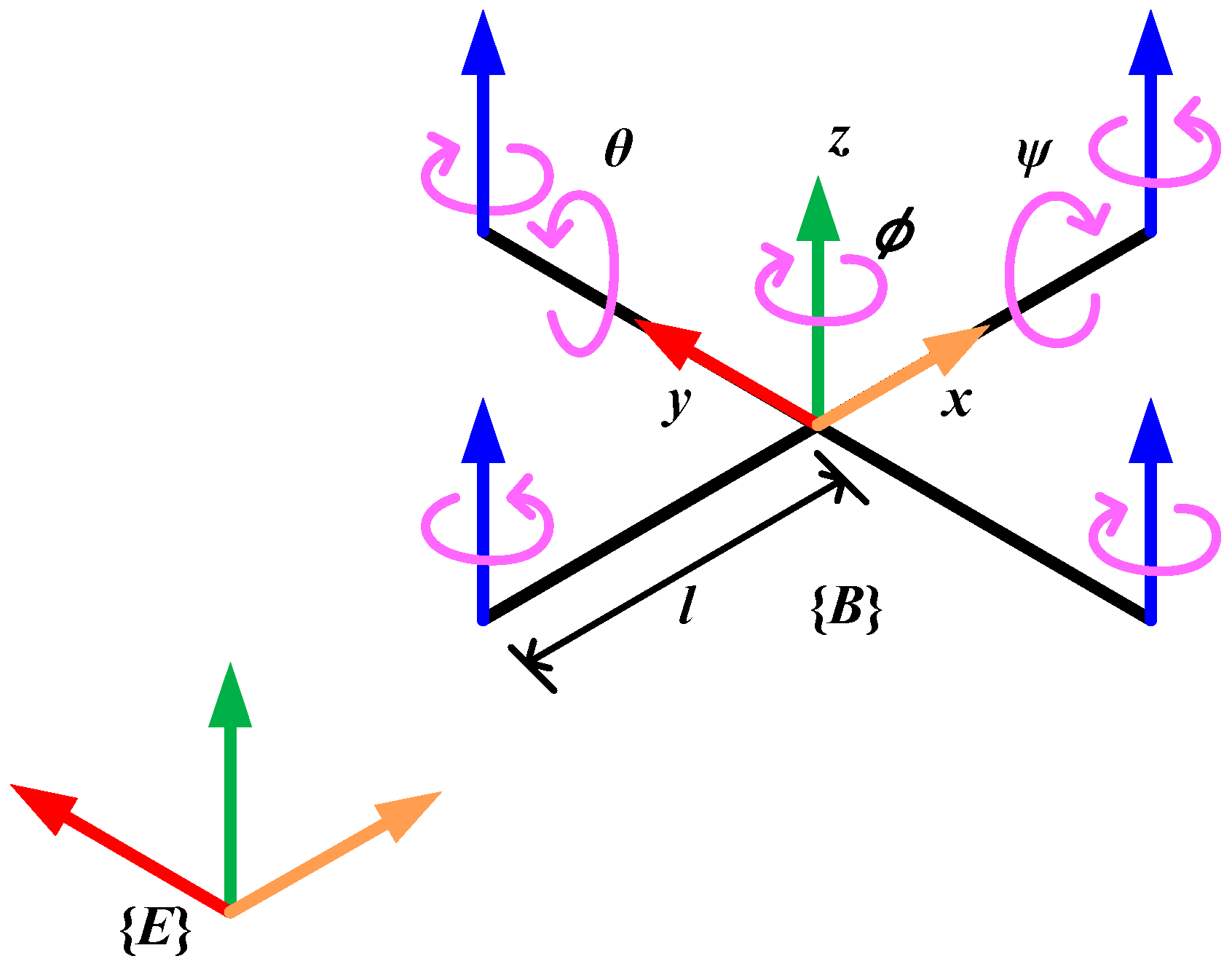
A quadrotor is a multirotor aerial platform featuring four fixed-pitch rotors symmetrically arranged at the vertices of a square frame, enabling vertical takeoff, hovering, and multidirectional flight through differential thrust control. The configuration of a quadcopter is shown in Figure 1 [6]. In order to characterize the kinematics and dynamics equations of quadcopters, we introduce the two-coordinate system. The earth-fixed coordinate system ({E}) is fixed to the ground, with its z-axis oriented in the opposite direction of gravity. The body-fixed coordinate system ({B}) is attached to the quadcopter; it aligns with the vehicle’s orientation and is centered at its center of mass, with the rotor axes determining its local coordinate system.
According to the two-coordinate system, a quadcopter is inherently a six-degree-of-freedom (6-DOF) system consisting of translational dynamics ( x ,   y ,   z ) and rotational dynamics ( ϕ , θ , ψ ) . The full dynamics can be expressed as x ,   y ,   z , ϕ , θ , ψ T . But in many practical scenarios, such as attitude stabilization, position control is managed separately or assumed to be constant. Therefore, this study focuses on a reduced three-degree-of-freedom (3-DOF) model that considers only rotational dynamics and the orientation of the quadcopter, with Θ = ϕ , θ , ψ T S O ( 3 ) , representing the roll ( ϕ ), pitch ( θ ), and yaw ( ψ ) angles in the earth-fixed coordinate frame. The angular velocity in the body-fixed frame is defined as follows: ω b = p , q , r T R 3 .
The rotational dynamics are given below [6]:
ω b = R ( Θ ) Θ ˙
J b ω ˙ b = ω b × J b ω b + τ + τ d
where τ represents the control torque vector; τ d represents the lumped disturbance, including parameterized uncertainties and external disturbances, acting on the quadcopter; and R ( Θ ) R 3 × 3 represents the rotation matrix from B to E, defined as follows:
R Θ = 1 0 s i n θ 0 c o s ϕ s i n ϕ c o s θ 0 s i n ϕ c o s ϕ c o s θ
The quadcopter has four forms of rotor thrust ( F 1 ,   F 2 ,   F 3 ,   a n d   F 4 ) , which are dependent because they jointly determine the total lift and torque. For attitude control, these four forms of rotor thrust are mapped onto three independent control torques ( τ 1 ,   τ 2 ,   and   τ 3 ) corresponding to roll, pitch, and yaw. The mapping scheme is defined below:
τ 1 = l F 2 F 4
τ 2 = l F 3 F 1
τ 3 = c f F 1 + F 2 F 3 + F 4
in which l is the arm length and c f is the force-to-torque coefficient. This formulation ensures that the controller operates on three independent torque inputs derived from the four rotor forces.
In addition, the total thrust generated by the four rotors is treated as a virtual thrust input for altitude control, while the virtual torque vector τ = [ τ 1 ,   τ 2 ,   τ 3 ] represents the roll, pitch, and yaw torque for attitude control. These quantities are combined and then mapped to actuator-level commands for motor acceleration.
By differentiating Equation (1), we obtain
ω ˙ b = R Θ Θ ¨ + R ˙ ( Θ ) Θ ˙
Substituting Equation (5) into (2) results in the following formulation of quadcopter dynamics:
M Θ Θ ¨ + C ( Θ , Θ ˙ ) Θ ˙ + G ( Θ , Θ ˙ ) + τ d = τ
in which M Θ = J b R Θ and C ( Θ , Θ ˙ ) = J b R ˙ Θ + R ˙ ( Θ ) Θ ˙ × J b R Θ .
The objective of this paper is to develop a control strategy that guarantees the stability of the quadcopter, that is, to force the attitude of the quadcopter to converge to zero.

3. The Design of an Event-Triggered Fuzzy-Networked Controller

In order to achieve the control objective, we apply the Takagi–Sugeno fuzzy model (T–S fuzzy model [14,21,22,23,24,25]) to approximate the input–output behavior of the 3-DOF quadcopter. The ith fuzzy rule of the T–S fuzzy model can be represented as follows:
IF   q 1 is   F ~ q 1 i and     and   q k is   F ~ q k i   THEN   Θ ˙ t = A i Θ t + B i τ t
where i = 1,2 , L ; q i   ( i = 1,2 , , k ) denotes the premise variables, F ~ q h i denotes the fuzzy set of the premise variables, and A i R n × n and B i R n × m denote the system parameter matrices.
By using the singleton fuzzifier, the product inference engine, and the center-average defuzzifier [21], we can express the output of the T-S fuzzy model (7) as
Θ ˙ t = i = 1 L ξ i A i Θ t + B i τ t
where
ξ i = h = 1 k F ~ q h i i = 1 L   h = 1 k F ~ q h i
Based on (8), we can construct the fuzzy controller with the following fuzzy rules:
IF   q 1 is   F ~ q 1 i and     and   q k is   F ~ q k i THEN   τ t = K i Θ t
where i = 1,2 , L , and K i R m × n is the control gain matrix. Using the singleton fuzzifier, the product inference engine, and the center-average defuzzifier [21], the output of the fuzzy controller (9) can be expressed as
u k = i = 1 L ξ i K i Θ t
Substituting (10) into (8) yields the following equation:
Θ ˙ t = i = 1 L ξ i j = 1 L ξ i ( A i + B i K j ) Θ t
Since quadcopters primarily operate over wireless communication networks, transmission delays constitute an inherent functionality aspect. If not adequately accounted for, such delays can significantly degrade control performance and may even compromise system stability. Therefore, in the context of networked control systems (NCSs [12,14,19]), it is imperative to incorporate the effects of communication latency into controller design to ensure robust stability and satisfactory tracking performance.
Considering the effect of transmission delays, we denote transmission delay as τ and rewrite (10) as the following equation:
u t = i = 1 L ξ i K i Θ t τ
By substituting (12) into (8), we can change (11) into the following equation:
Θ ˙ t = i = 1 L j = 1 L ξ i ξ i A i Θ k + B j K j Θ t τ
Therefore, the control objective is reformulated as the selection of appropriate control gain matrices K i that ensure the stability of the system (11).
To address the limited bandwidth of wireless communication networks, an event-triggered control mechanism is adopted, enabling efficient utilization of communication resources without compromising control effectiveness. So, for the event generator, we use t i ( i = 0 , 1 , 2 , ) to denote the instant when the event generator is triggered, t 0 to denote the first event-triggering instant, and t s to denote the last event-triggering instant. Next, the event-triggering mechanism is defined via the following condition:
t s + 1 = m i n { t > t s | ( Θ ( t ) Θ ( t s ) ) T   Ξ Θ t Θ t s > δ ( Θ ( t s ) ) T   Ξ Θ t s }
where Ξ is a symmetric positive definite weighting matrix, and δ [ 0 , 1 ) is the design parameter that governs the triggering threshold. This condition ensures that a new control update is transmitted only when the deviation between the current state Θ k and the last transmitted state Θ t s exceeds a state-dependent threshold, thereby reducing communication frequency while preserving system stability.
Thus, (13) can be rewritten as
Θ ˙ t = i = 1 L j = 1 L ξ i ξ i A i Θ t + B j K j Θ t τ Θ t       t = t s + 1 t ( t s , t s + 1 )
Using (15), the control signal update can be omitted when the feedback input remains unchanged, and the output variation thus stays within a predefined threshold. Consequently, it is unnecessary to transmit system states and control signals at each instant. This event-triggered strategy significantly reduces communication load, and despite the constraints imposed by limited network bandwidth, it maintains satisfactory control performance.
In order to analyze the stability of the overall system, the following Lyapunov–Krasovskii function was chosen:
V ( t ) = V 1 ( t ) + V 2 ( t ) + V 3 ( t )
where
V 1 t = Θ T t P Θ t V 2 t = t β t Θ T s Q Θ s d s V 3 t = β 0   t + ρ t Θ ˙ T s R Θ ˙   d s d ρ
in which P ,   Q , and R are the symmetric positive definite matrices for solving the following quadratic matrix inequalities:
Ω 1 < 0
Ω 2 < 0
where
Ω 1 = A l T P + P A l + P P + Q + β A l T ( R + R R ) A i
Ω 2 = K l T B l T B l K l Q + β K l T B l T ( I + R ) B j K j
Then, for t s     t     t s + 1 , the time derivative of V 1 t can be expressed as
V ˙ 1 t = Θ ˙ T t P Θ t + Θ T t P Θ ˙ t
= i = 1 L j = 1 L ξ i ξ i ( Θ T t ( A l T P + P A l ) Θ t                  + Θ T t τ K l T B l T P Θ t + Θ T t P B l K l Θ t τ )
i = 1 L j = 1 L ξ i ξ i ( Θ T t ( A l T P + P A l + P P ) Θ t + Θ T t τ K l T B l T B l K l Θ t τ )
By using the Newton–Leibniz formula, we obtain
V ˙ 2 t = Θ T t Q Θ t Θ T t τ Q Θ t τ
for t s     t     t s + 1 . Moreover, for t s     t     t s + 1 , the time derivative of V 3 t can be obtained as follows:
V ˙ 3 t = β Θ ˙ T t R Θ ˙ t t + ρ t Θ ˙ T s R Θ ˙   d s
β Θ ˙ T t R Θ ˙ t
= β i = 1 L j = 1 L ξ i ξ i ( Θ T t A l T + Θ T t τ K l T B l T ) + R ( A i Θ t + B j K j Θ t τ )    
β i = 1 L j = 1 L ξ i ξ i ( Θ T t A l T ( R + R R ) A i Θ t     + Θ T t τ K l T B l T ( I + R ) B j K j Θ t τ )
Therefore, through (21), (22) and (23), it can be found that
V ˙ t i = 1 L j = 1 L ξ i ξ i Θ T t Ω 1 Θ t + Θ T t τ Ω 2 Θ t τ     0
Thus, via the Lyapunov stability theorem, the stability of the overall system can be guaranteed. Based on the discussion above, the design procedure for the proposed control strategy can be presented as follows:
Step 1:
For a quadrotor, design the T-S fuzzy model according to (7).
Step 2:
Based on the T-S fuzzy model, design the fuzzy controller according to (9), and specify the controller gain matrices K i ( i = 1,2 , L ).
Step 3:
Solve the quadratic matrix inequalities as (17) and (18) to obtain the symmetric positive definite matrices P , Q , and R .

4. Simulation Results

In this section, the proposed control strategy is validated through a 3-DOF quadcopter simulation model. The parameters of the simulation model are given: a concentrated mass of 0.05 kg, representing each motor–propeller unit; a spherical body mass of 1.2 kg; a quadcopter arm length of 0.25 m; and a sampling interval of 0.01 s. Here, we simulate the two cases as follows:
Case 1:
Set the initial state to Θ 0 = ϕ 0 ,   θ 0 , ψ 0 T = [ 0.5 , 0.3 , 0.5 ] . This case is used to demonstrate the system’s stability.
Case 2:
Set the initial state to Θ 0 = ϕ 0 ,   θ 0 , ψ 0 T = 1 , 0.5 , 0.8 . And the external disturbances are introduced at different times: roll 0.1 rad +0.1 rad at 1 s, pitch −0.1 rad at 2 s, and yaw −0.05 rad at 3 s. This case is used to demonstrate the system’s robustness.
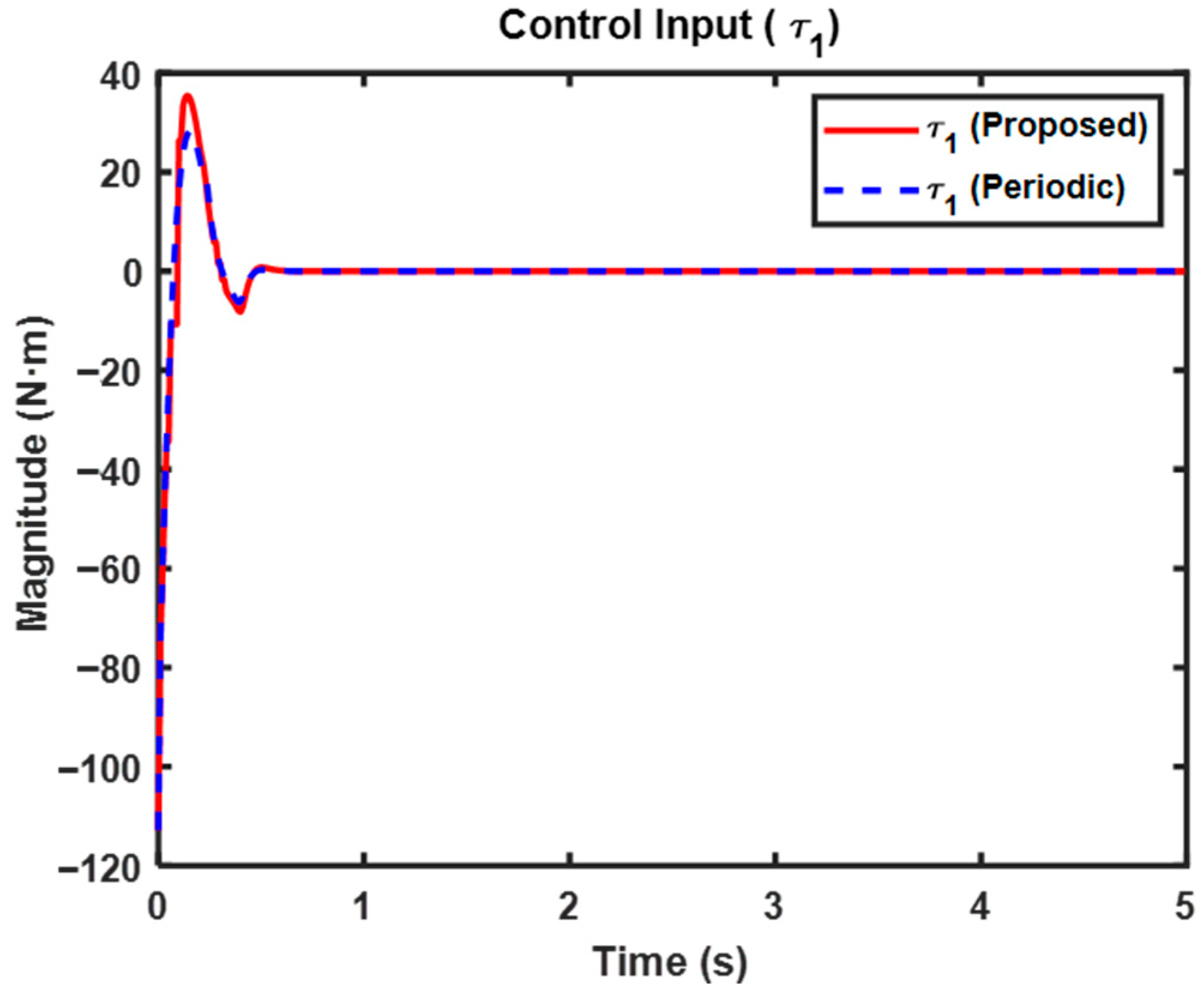
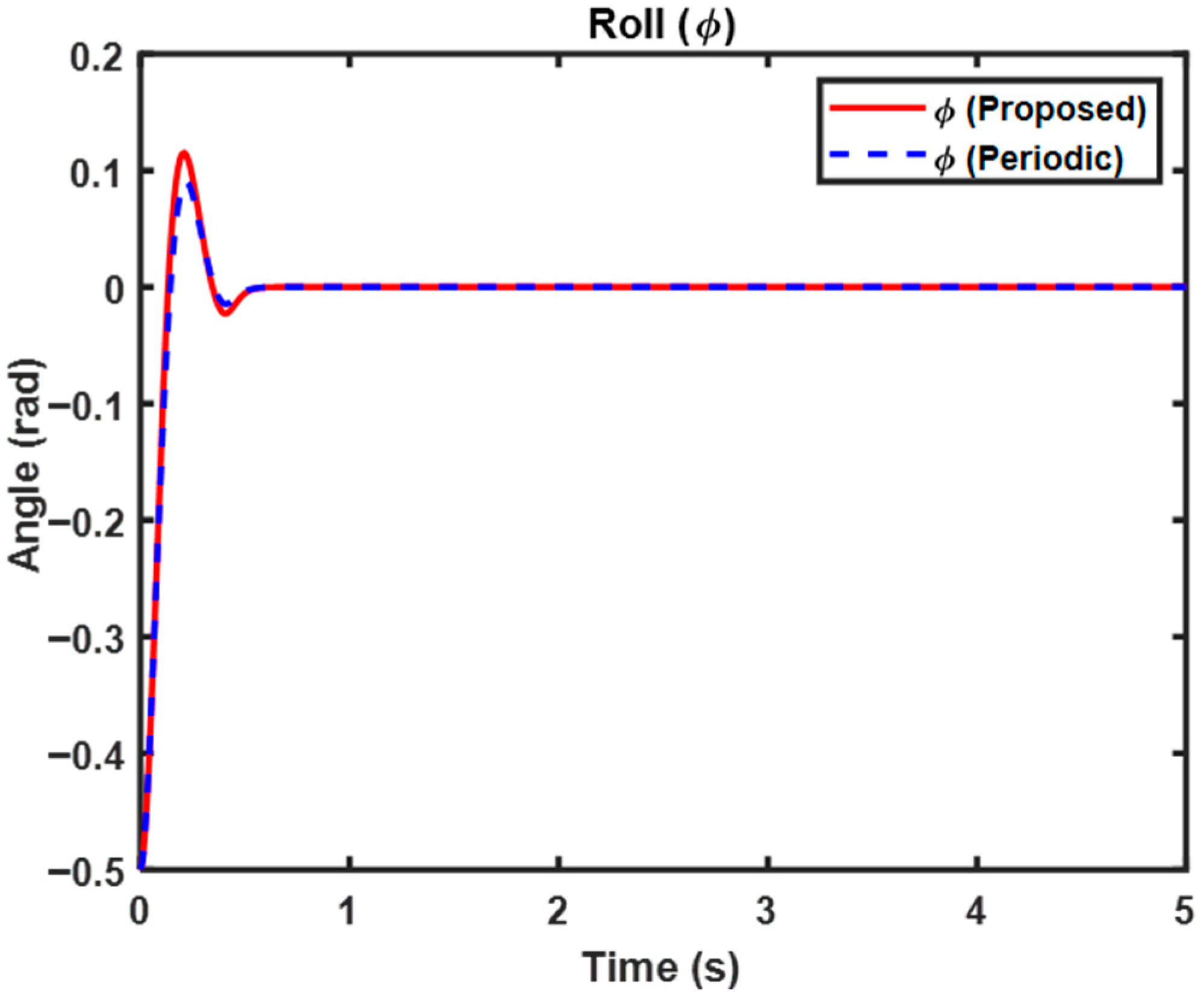
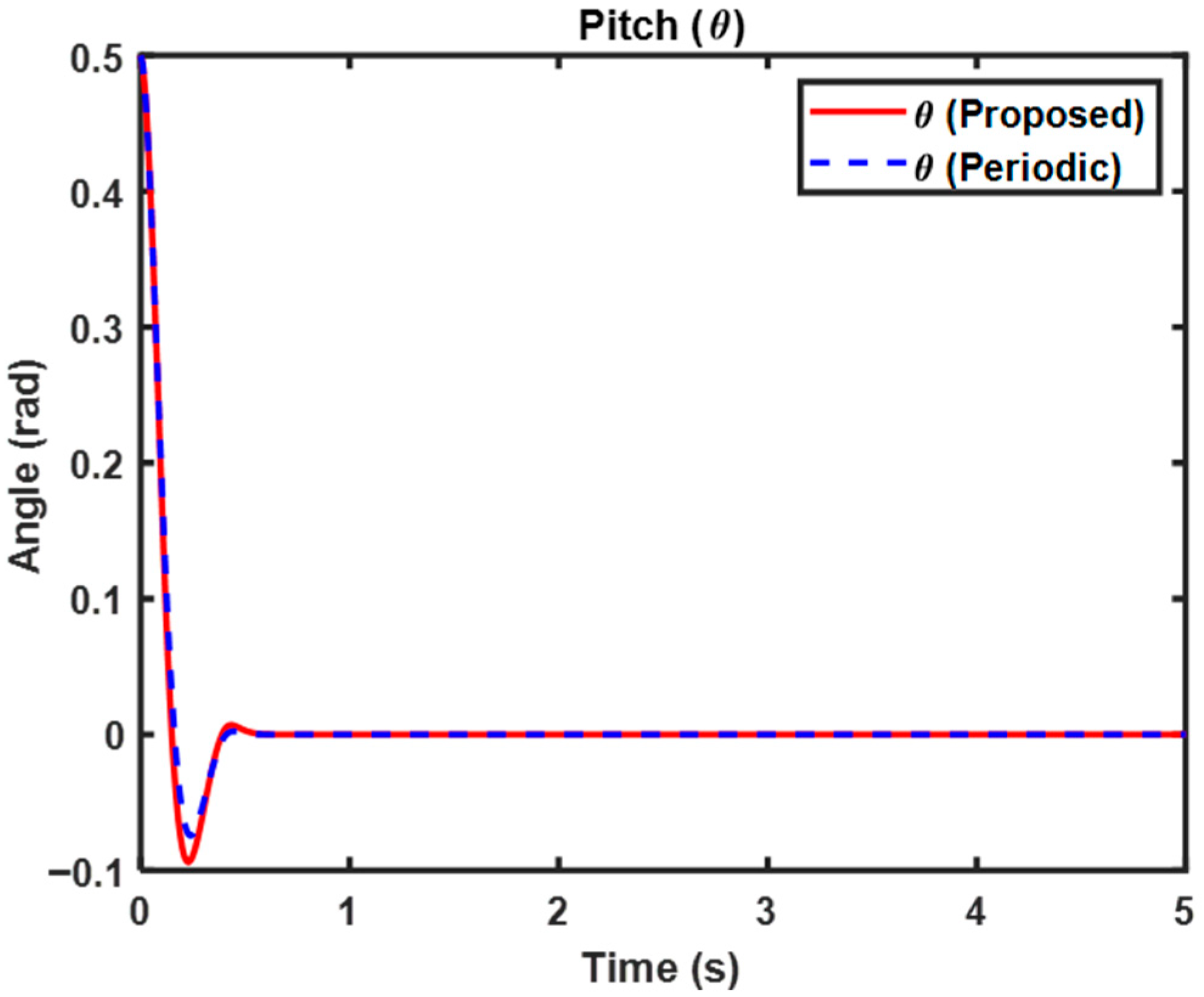
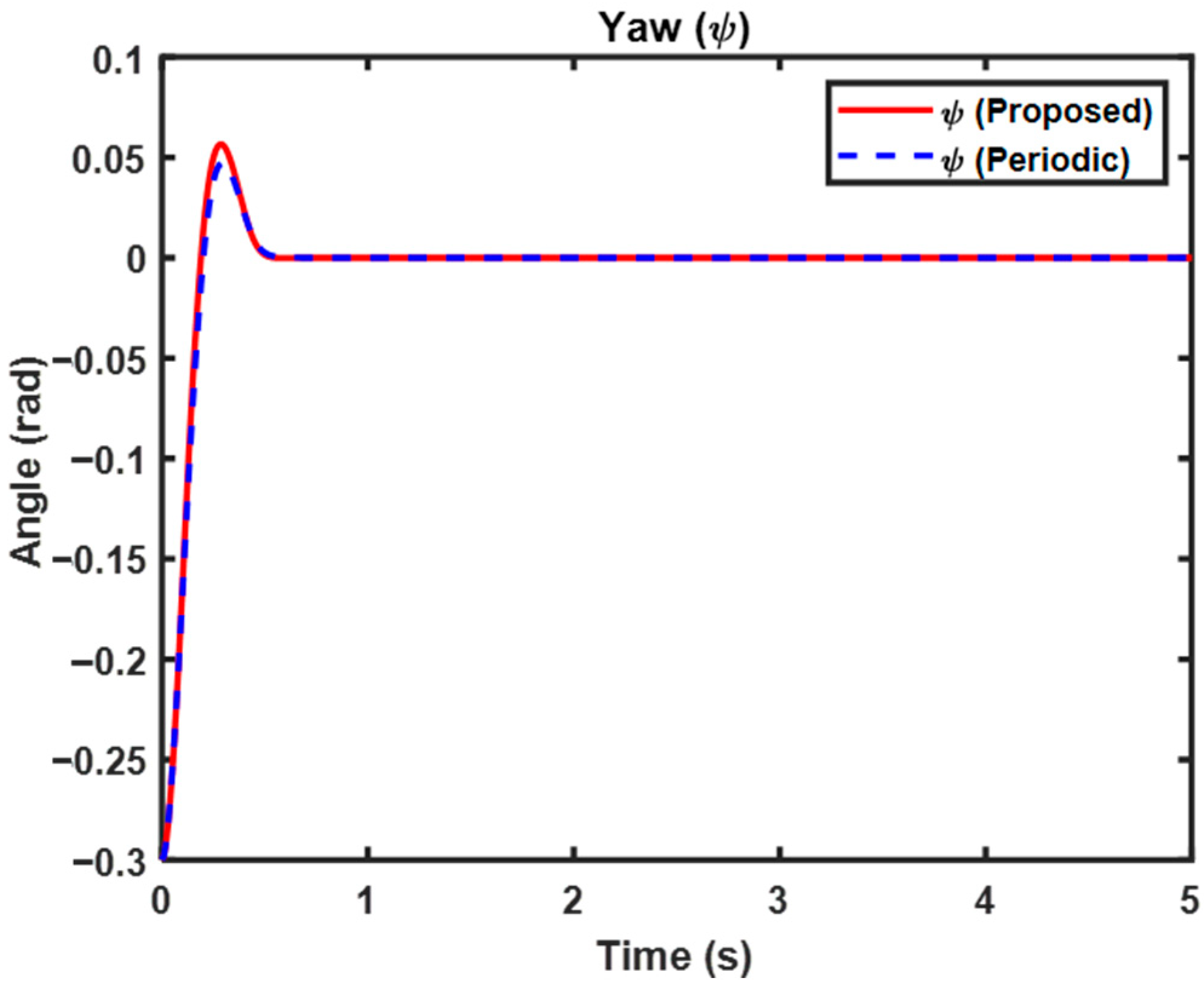
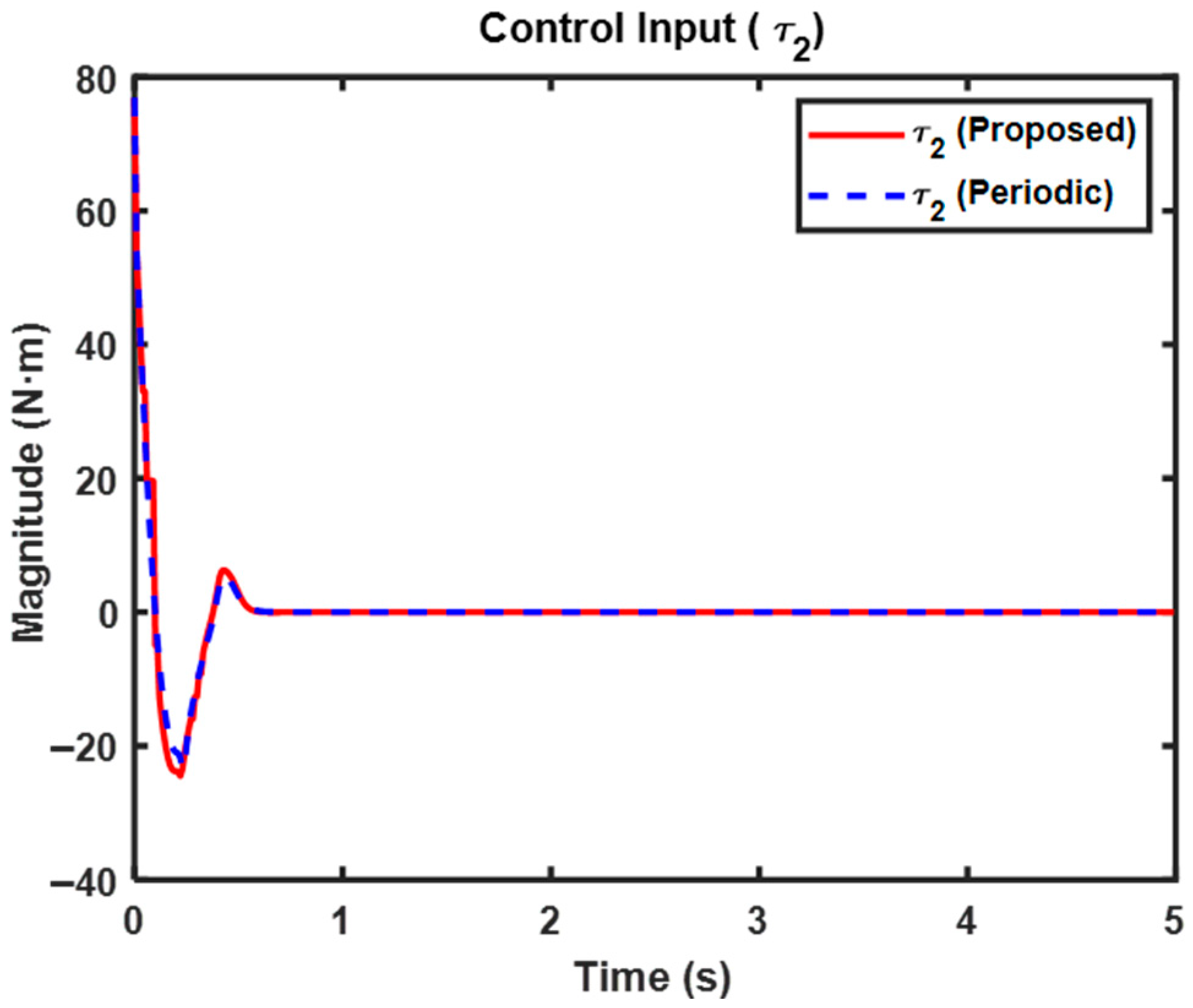
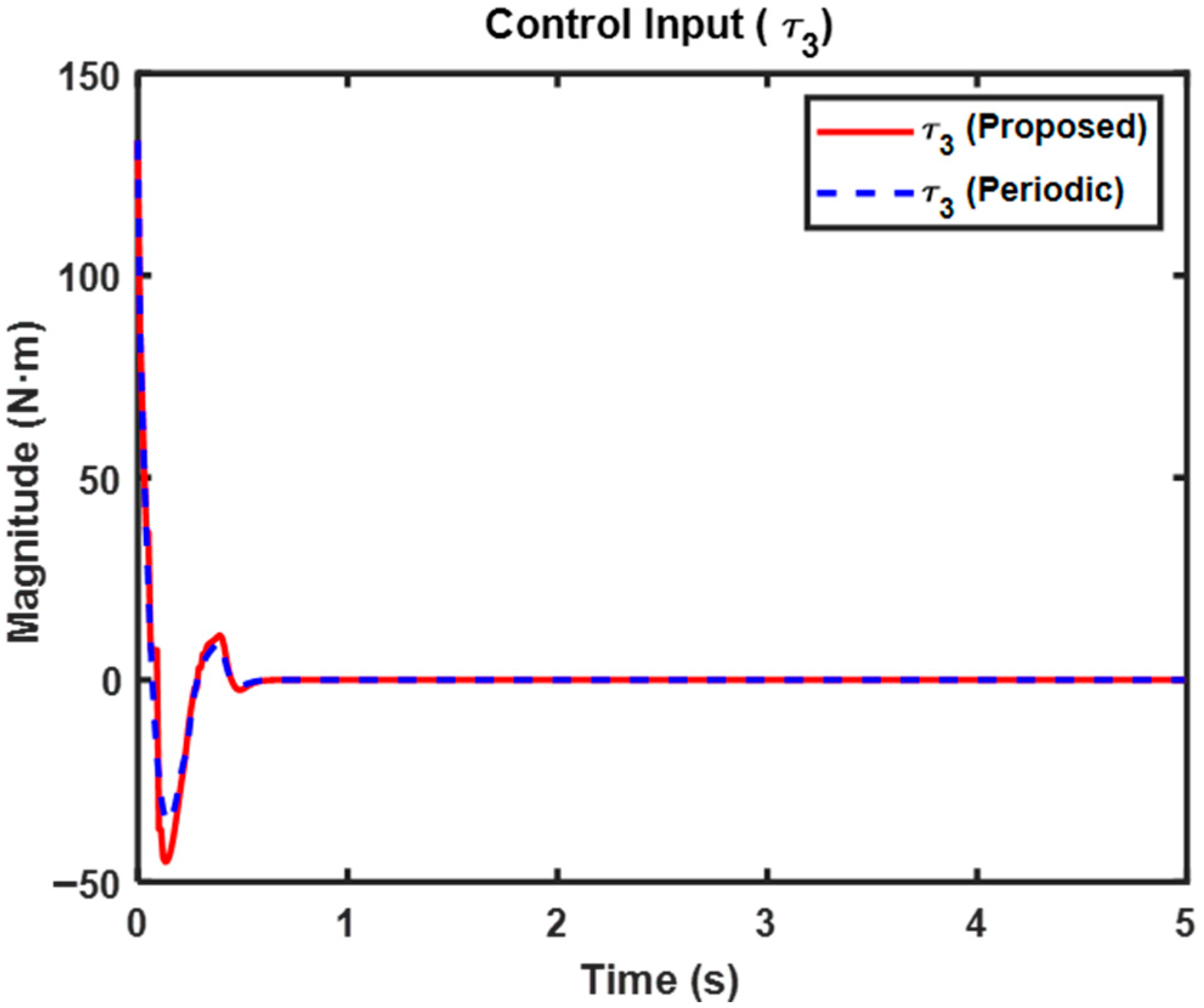
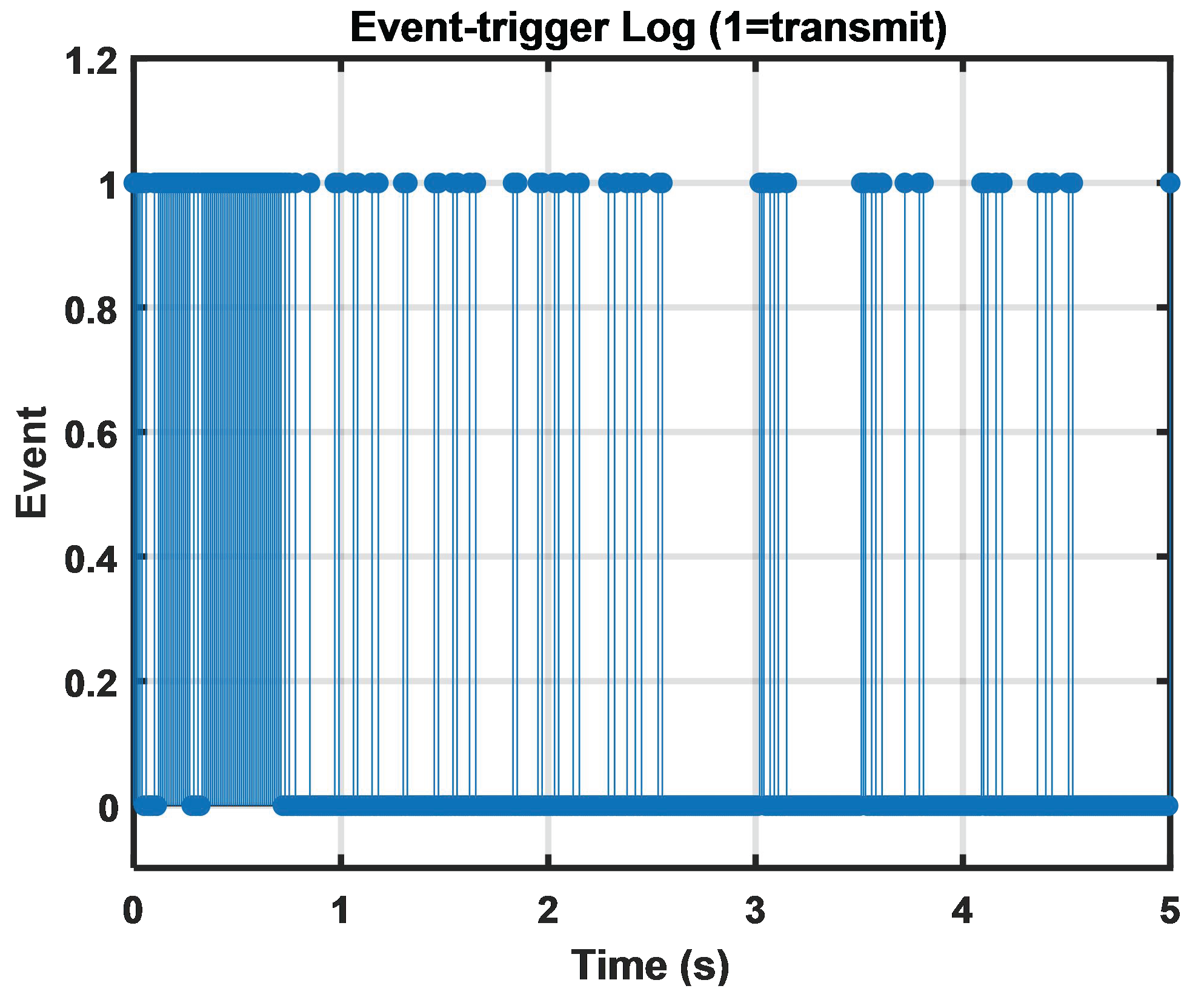
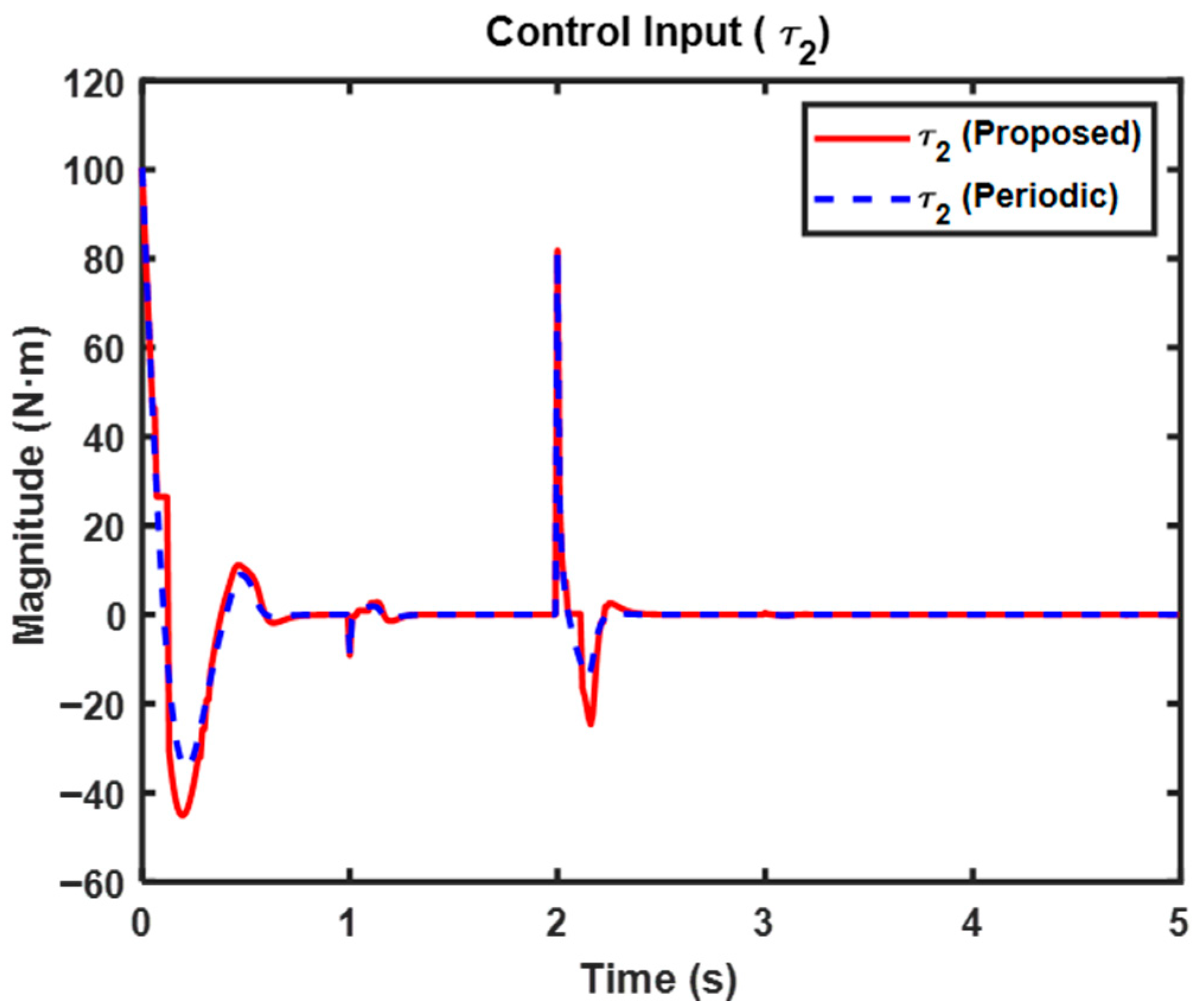
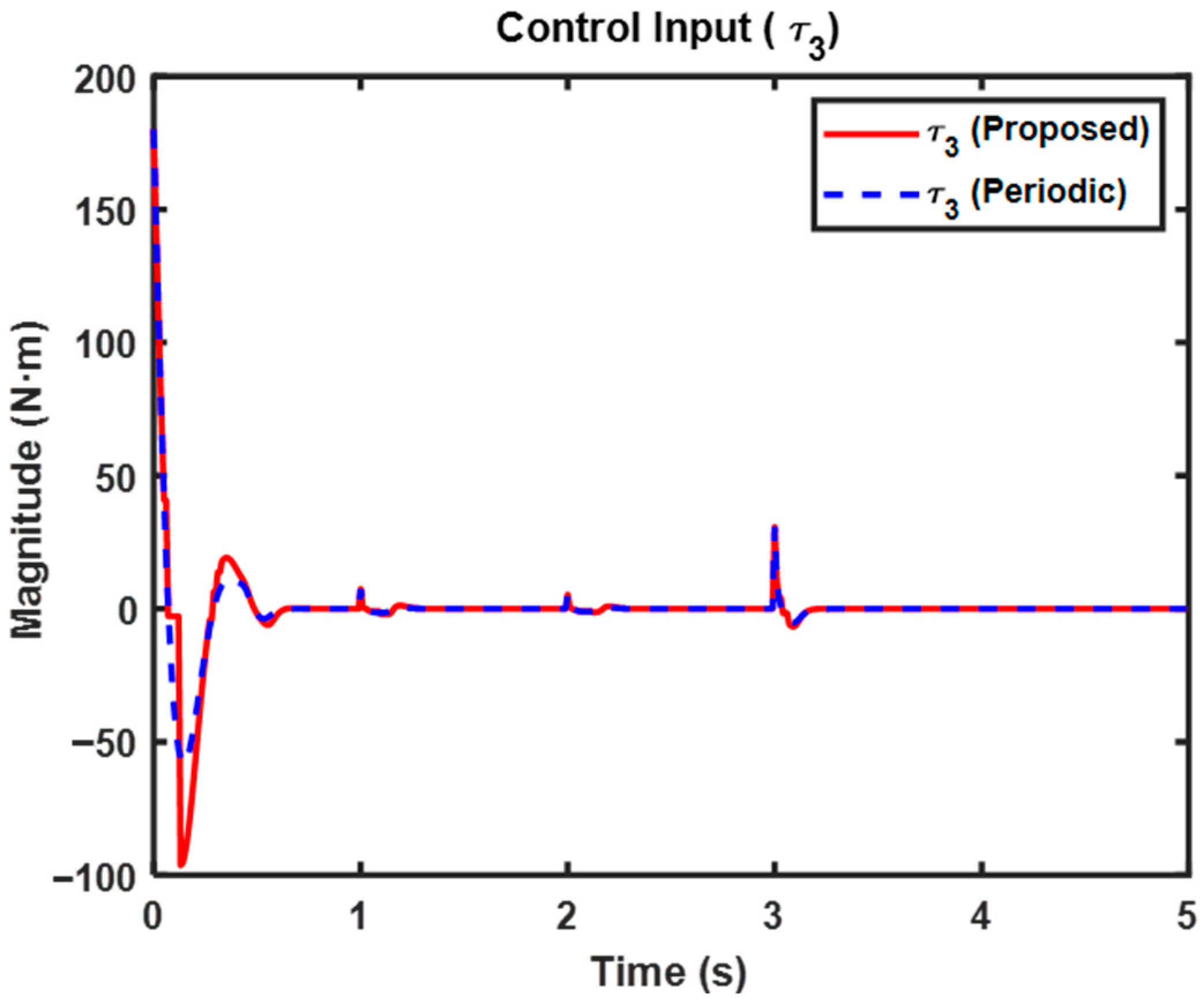
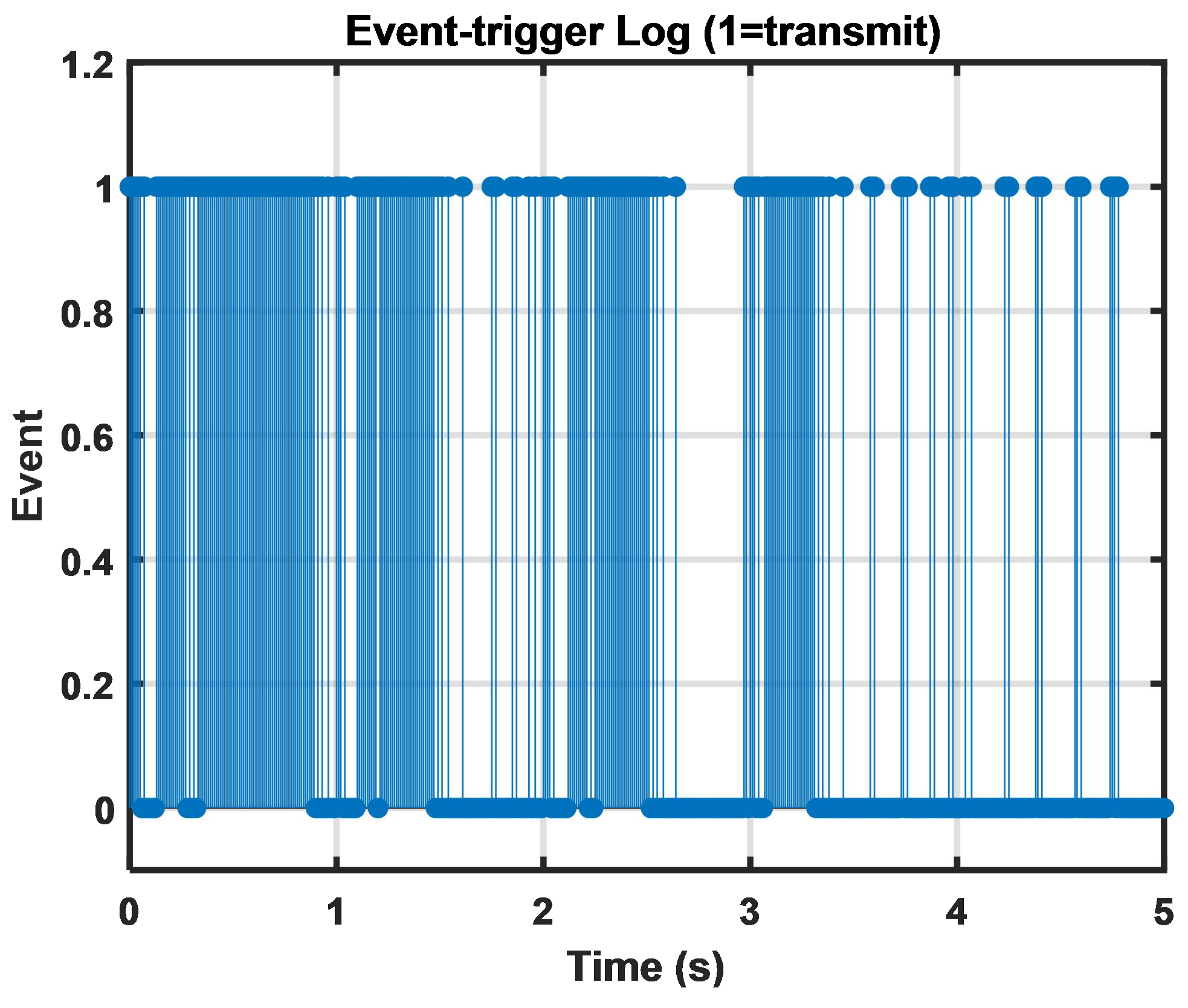
In order to compare control performance, we adopt the periodic sampling control strategy [32]. The simulation results for Case 1 are shown in Figure 2, Figure 3, Figure 4, Figure 5, Figure 6, Figure 7 and Figure 8. Figure 2, Figure 3 and Figure 4 show the state trajectories of the quadcopter and prove that the proposed control strategy can force the quadcopter to precisely and quickly converge to the desired attitude. Figure 5, Figure 6 and Figure 7 show the control signals, τ 1 ,   τ 2 ,   a n d   τ 3 . And Figure 8 shows the triggering times. In the periodic sampling control strategy, the control signal would be transmitted in each period (500 times). But the proposed method only transmits the control signal while the predefined triggering condition is satisfied. In this simulation, in the proposed method, the control signal is transmitted only 124 times. The proposed method reduces control transmission by 75.2% with respect to the network bandwidth compared to the periodic sampling control strategy. This is a significant reduction in the efficiency of the proposed event-triggered control strategy under a limited-bandwidth communication network.
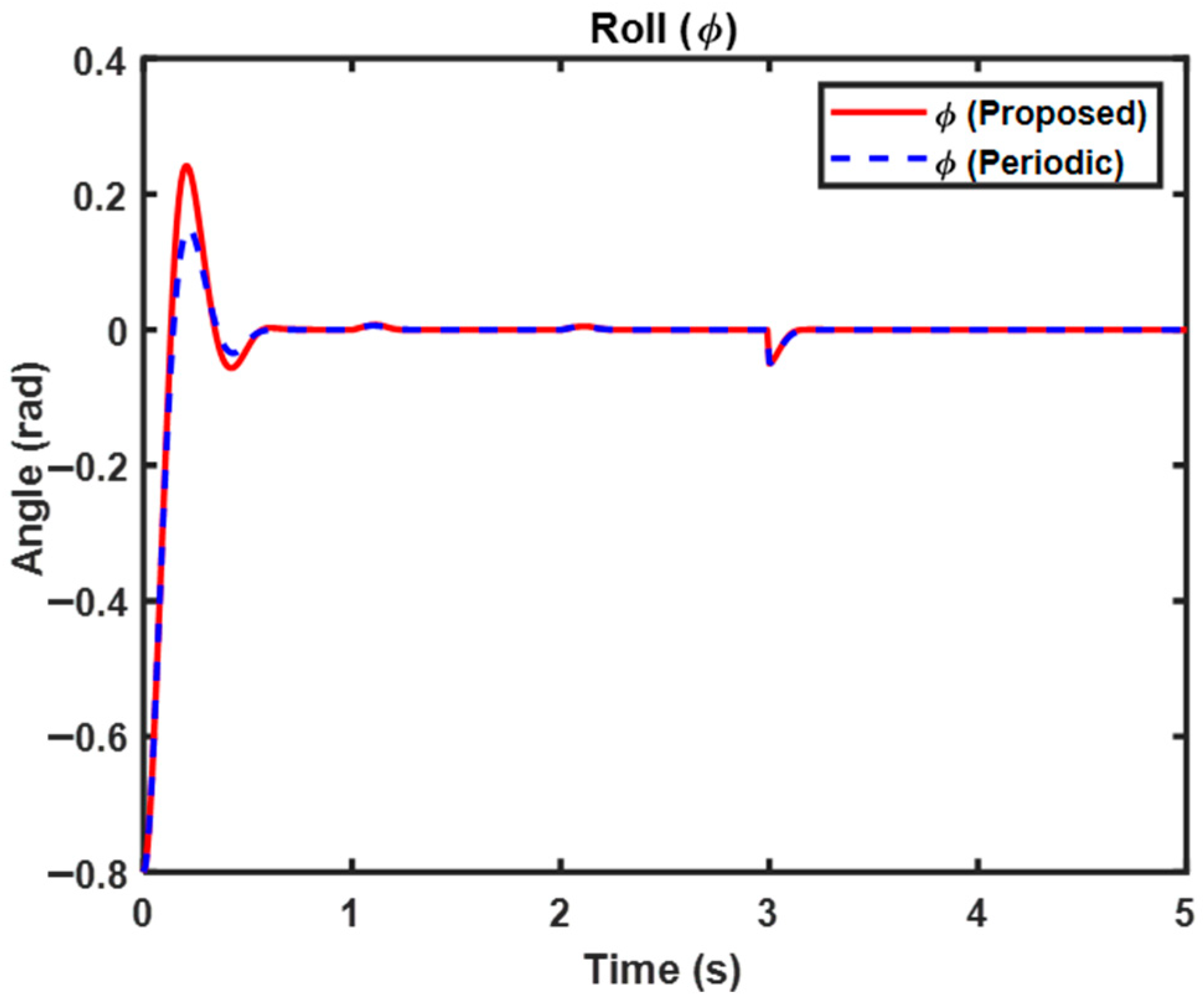
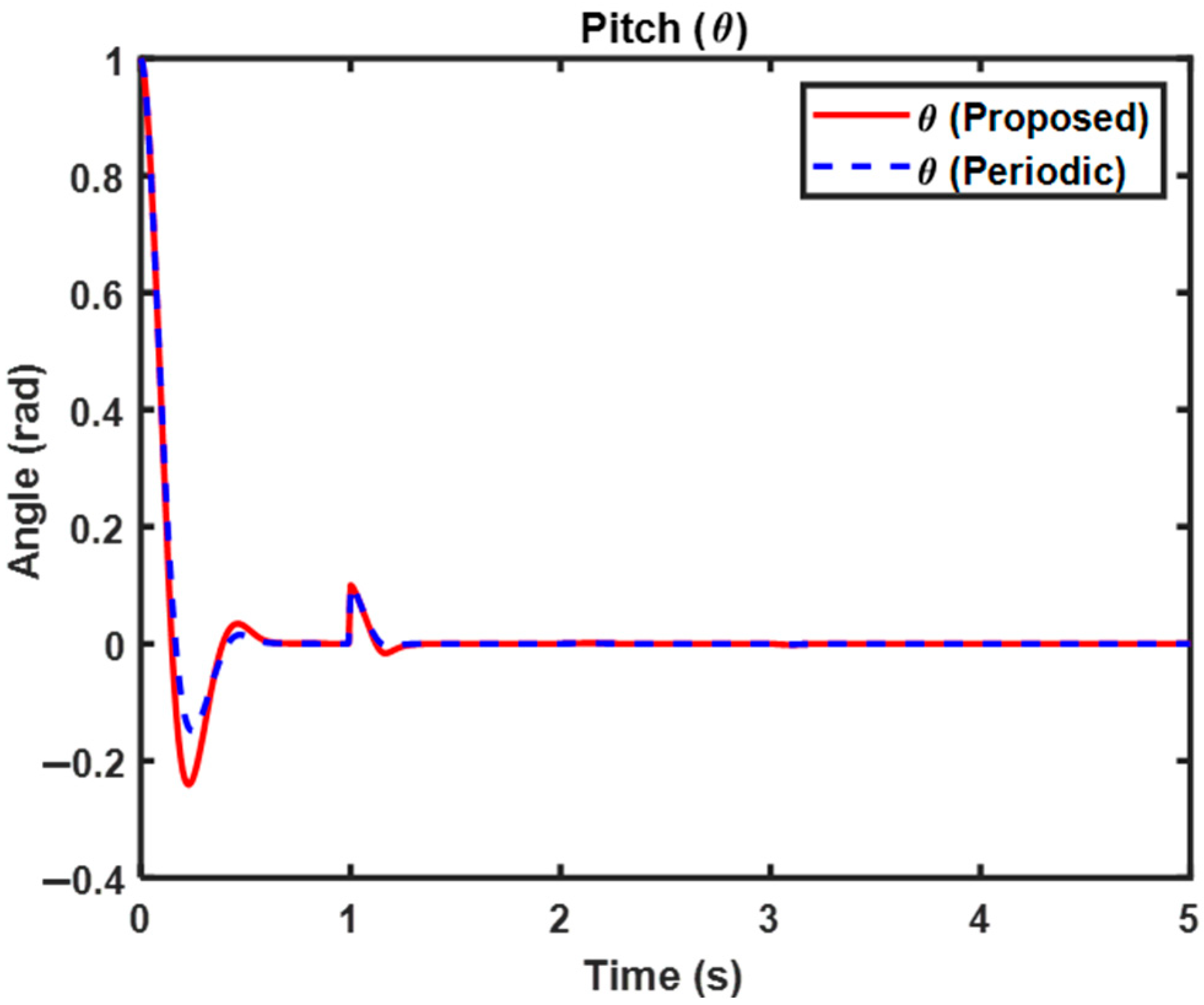
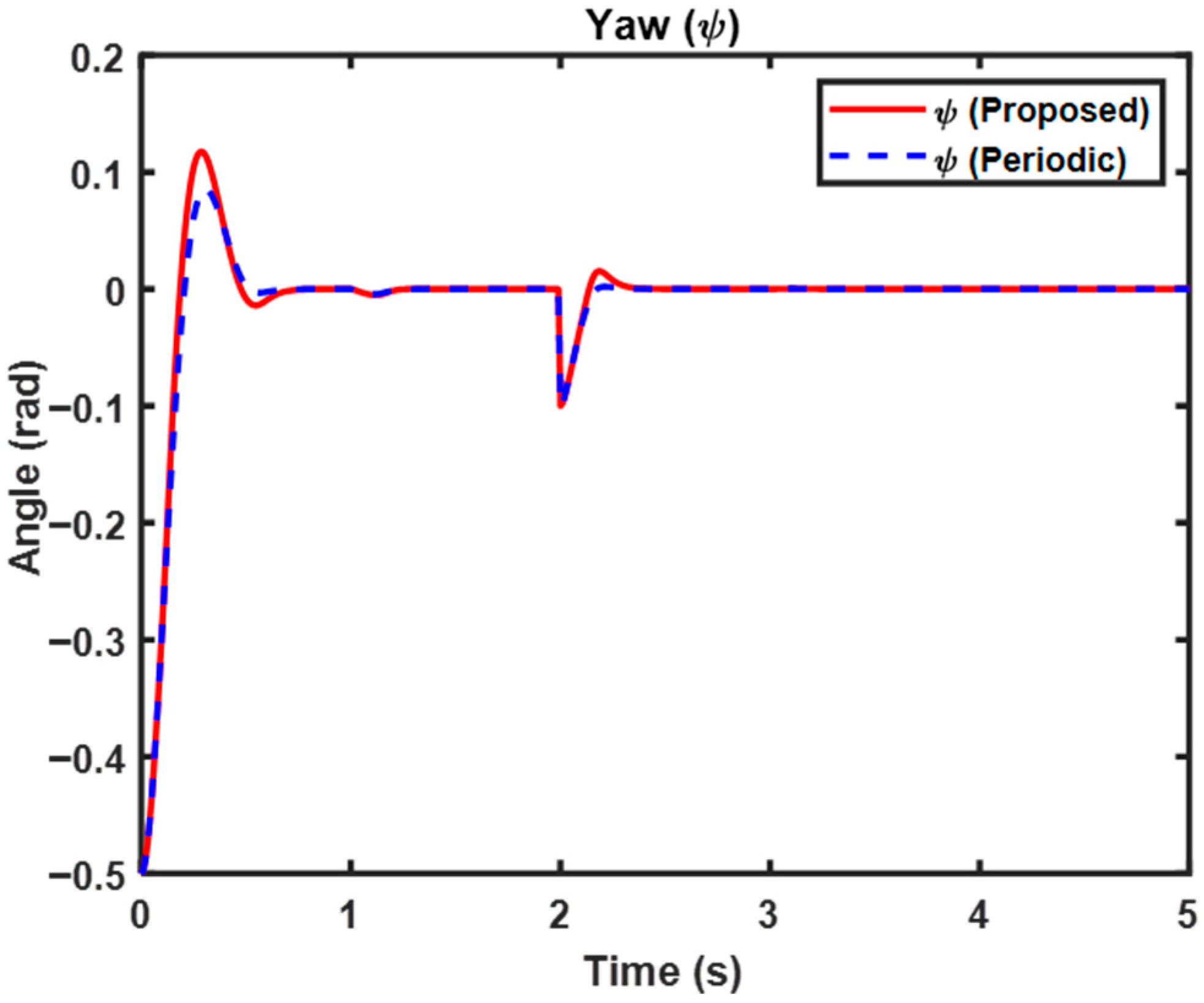
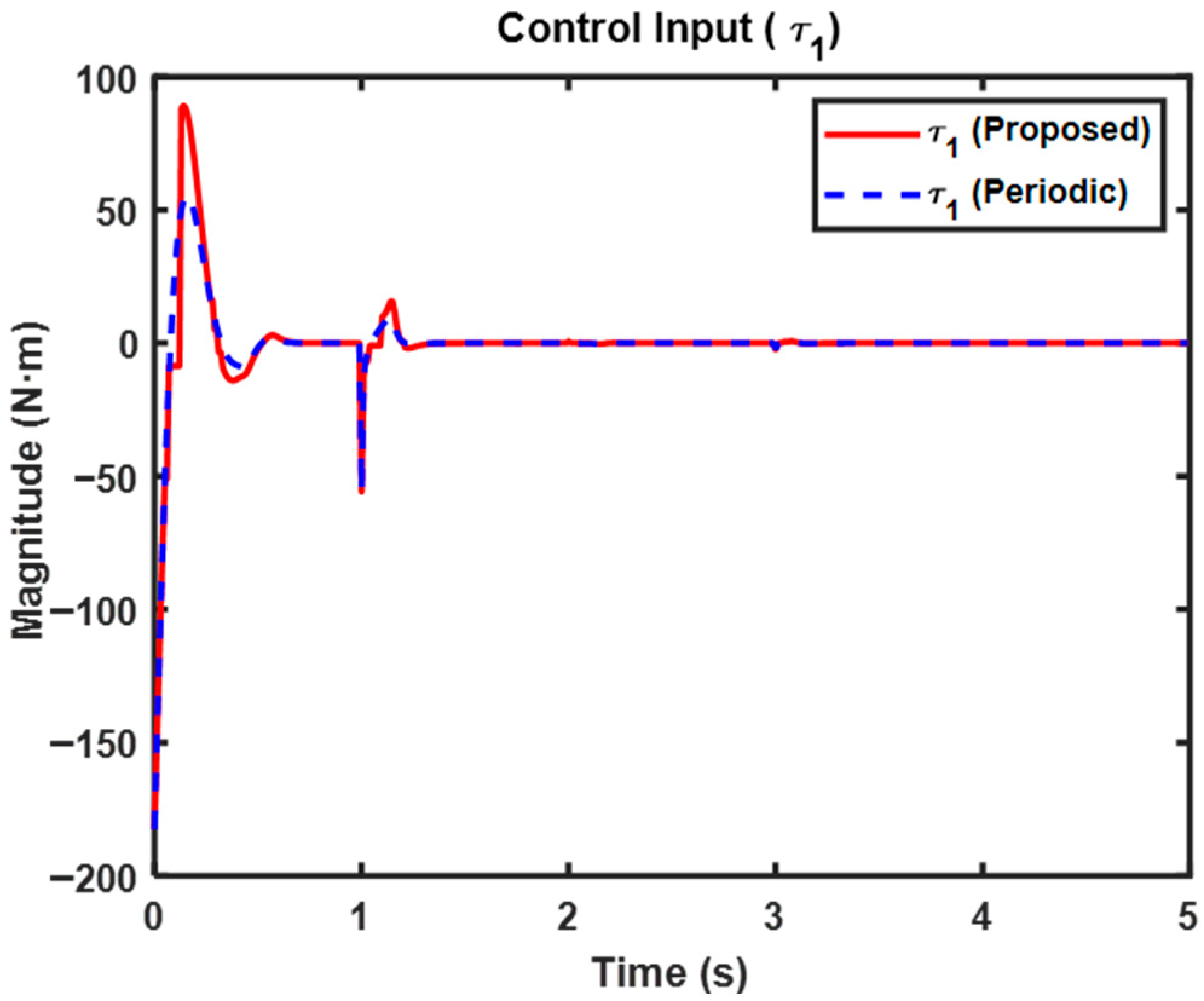
For Case 2, Figure 9, Figure 10, Figure 11, Figure 12, Figure 13, Figure 14 and Figure 15 show the simulation results. Figure 9, Figure 10 and Figure 11 show the state trajectories of the quadcopter. These figures demonstrate that the proposed control strategy can cause the system state of the quadcopter to converge to zero and successfully counteract external disturbances. Figure 12, Figure 13 and Figure 14 show the control signals τ 1 ,   τ 2 ,   a n d   τ 3 , and Figure 15 shows the triggering times. In this case, the proposed method transmits the control signal only 240 times and reduces control transmission by 52% with respect to the network bandwidth compared to the periodic sampling control strategy. This case demonstrates that the proposed method has good robustness against external disturbances and requires only small-bandwidth resources.
Table 1 shows the number of updates for control under event-triggered control and periodically triggered control for two cases. This reflects the fact that the proposed control scheme can achieve good control performance with relatively few bandwidth resources and indicates its potential to allow scalable deployment of UAVs.

5. Conclusions

In this paper, we present an event-triggered fuzzy-networked control scheme for 3-DOF quadcopters with limited-bandwidth communication. First, we designed a Takagi–Sugeno (T–S) fuzzy model to approximate the nonlinear input–output dynamics of the quadcopter. Then, a fuzzy-networked controller was constructed based on the fuzzy model. After that, the event-triggering mechanism was integrated into the control architecture to address the challenges of limited bandwidth and communication resources. Unlike conventional approaches that rely on periodic sampling, by using the event-triggering mechanism, the proposed method can reduce the bandwidth requirement while preserving stability and control accuracy. The Lyapunov stability analysis ensured control performance. Computer simulations were applied to evaluate control performance and show that the proposed control strategy can achieve a 75.2% (without external disturbances) reduction in control transmissions compared to periodic sampling. The advantage of this approach lies in its effectiveness in addressing bandwidth limitations in real time during UAV operation, providing a solid basis for advancing resource-efficient and intelligent control strategies in future research.

Funding

This research received no external funding.

Data Availability Statement

The original contributions presented in this study are included in the article. Further inquiries can be directed to the corresponding author.

Conflicts of Interest

The author declares no conflicts of interest.

References

  1. Pounds, P.; Mahony, R.; Corke, P. Modelling and control of a large quadrotor robot. Control Eng. Pract. 2010, 18, 691–699. [Google Scholar] [CrossRef]
  2. Lee, C.; Lee, S.; Chu, B. Extension of quadcopter flight range based on quadcopter transport system and autonomous ramp flight algorithm. IEEE Access 2020, 8, 156422–156432. [Google Scholar] [CrossRef]
  3. Trung, H.D. Performance of UAV-to-ground FSO communications with APD and pointing errors. Appl. Syst. Innov. 2021, 4, 65. [Google Scholar] [CrossRef]
  4. Eltayeb, A.; Rahmat, M.F.; Basri, M.A.M.; Eltoum, M.A.M.; Mahmoud, M.S. Integral adaptive sliding mode control for quadcopter UAV under variable payload and disturbance. IEEE Access. 2022, 10, 94754–94764. [Google Scholar] [CrossRef]
  5. Wang, Z.; Zou, Y.; Liu, Y.; Meng, Z. Distributed control algorithm for leader–follower formation tracking of multiple quadrotors: Theory and experiment. IEEE/ASME Trans. Mechatron. 2021, 26, 1095–1105. [Google Scholar] [CrossRef]
  6. Nguyen, X.; Won, S.M.; Do, T.D.; Hong, S.K. Improved fixed-time attitude tracking control for quadcopter unmanned aerial vehicles. IEEE Access 2024, 12, 191612–191622. [Google Scholar] [CrossRef]
  7. Wang, Y.; Yu, G.; Xie, W.; Zhang, W.; Silvestre, C. Robust cooperative transportation of a cable-suspended payload by multiple quadrotors featuring cable-reconfiguration capabilities. IEEE Trans. Intell. Transp. Syst. 2024, 25, 11833–11843. [Google Scholar] [CrossRef]
  8. Zhang, D.; Loquercio, A.; Tang, J.; Wang, T.-H.; Malik, J.; Mueller, M.W. A learning-based quadcopter controller with extreme adaptation. IEEE Trans. Robot. 2025, 41, 3948–3964. [Google Scholar] [CrossRef]
  9. Chen, T.-H. Event-Triggered robust fuzzy controller design for quadcopter under network bandwidth constraints. Eng. Proc. 2025, 108, 34. [Google Scholar] [CrossRef]
  10. Pan, Y.; Yang, G.-H. Event-triggered fuzzy control for nonlinear networked control systems. Fuzzy Sets Syst. 2017, 329, 91–107. [Google Scholar] [CrossRef]
  11. Jiang, B.; Zhang, Y.; Shi, P.; Nguang, S.K. Takagi–Sugeno model-based event-triggered fuzzy sliding-mode control of networked control systems with semi-markovian switchings. IEEE Trans. Fuzzy Syst. 2019, 28, 673–683. [Google Scholar] [CrossRef]
  12. Wang, Y.; Wang, Z.; Zou, L.; Dong, H. H PID control for discrete-time fuzzy systems with infinite-distributed delays under round-robin communication protocol. IEEE Trans. Fuzzy Syst. 2022, 30, 1875–1888. [Google Scholar] [CrossRef]
  13. Liu, J.; Zhang, N.; Li, Y.; Xie, X.; Tian, E.; Cao, J. Learning-based event-triggered tracking control for nonlinear networked control systems with unmatched disturbance. IEEE Trans. Syst. Man Cybern. Syst. 2023, 53, 3230–3240. [Google Scholar] [CrossRef]
  14. Liu, Z.; Wu, C.; Shen, X.; Yao, W.; Liu, J.; Wu, L. Adaptive interval type-2 fuzzy neural network-based novel fixed-time backstepping control for uncertain Euler–Lagrange systems. IEEE Trans. Fuzzy Syst. 2024, 32, 2966–2975. [Google Scholar] [CrossRef]
  15. Zhou, H.; Zuo, Y.; Tong, S. Distributed fuzzy formation control for nonlinear multiagent systems under communication delays and switching topology. IEEE Trans. Fuzzy Syst. 2025, 33, 779–788. [Google Scholar] [CrossRef]
  16. Heemels, W.P.M.H.; Johansson, K.H.; Tabuada, P. An introduction to event-triggered and self-triggered control. In Proceedings of the 2012 IEEE 51st Conference on Decision and Control (CDC), Maui, HI, USA, 10–13 December 2012; pp. 3270–3285. [Google Scholar] [CrossRef]
  17. Girard, A. Dynamic triggering mechanisms for event-triggered control. IEEE Trans. Autom. Control. 2015, 60, 1992–1997. [Google Scholar] [CrossRef]
  18. Chen, G.; Dong, J. Data-driven control for discrete-time nonlinear systems with dual-channel dynamic event-triggered mechanism. IEEE Trans. Circuits Syst. II 2023, 70, 4439–4443. [Google Scholar] [CrossRef]
  19. Li, Z.-M.; Chang, X.-H.; Xiong, J. Event-based fuzzy tracking control for nonlinear networked systems subject to dynamic quantization. IEEE Trans. Fuzzy Syst. 2023, 31, 941–954. [Google Scholar] [CrossRef]
  20. Wang, Y.; Zhu, F. Distributed Dynamic event-triggered control for multi-agent systems with quantization communication. IEEE Trans. Circuits Syst. II 2024, 71, 2054–2058. [Google Scholar] [CrossRef]
  21. Lien, C.-H.; Chang, H.-C.; Yu, K.-W.; Li, H.-C.; Yu, C.-R.; Vaidyanathan, S. Event-triggered parallel distributed compensator design for nonlinear system with mixed delays and sampling input by T-S fuzzy approach. IEEE Access 2025, 13, 46941–46955. [Google Scholar] [CrossRef]
  22. Wang, L.X. A Course in Fuzzy Systems and Control; Prentice Hall: Hoboken, NJ, USA, 1997. [Google Scholar] [CrossRef]
  23. Kung, C.C.; Chen, T.H. H∞ tracking based-adaptive fuzzy sliding mode controller design for nonlinear systems. IET Control Theory Appl. 2007, 1, 82–89. [Google Scholar] [CrossRef]
  24. Qiu, J.; Wang, T.; Sun, K.; Rudas, I.J.; Gao, H. Disturbance observer-based adaptive fuzzy control for strict-feedback nonlinear systems with finite-time prescribed performance. IEEE Trans. Fuzzy Syst. 2022, 30, 1175–1184. [Google Scholar] [CrossRef]
  25. He, Y.; Xiao, L.; Wang, Z.; Zuo, Q.; Li, L. A fuzzy neural network approach to adaptive robust nonsingular sliding mode control for predefined-time tracking of a quadrotor. IEEE Trans. Fuzzy Syst. 2024, 32, 6775–6788. [Google Scholar] [CrossRef]
  26. Zhang, F.; Dai, P.; Na, J.; Gao, G.; Shi, Y.; Liu, F. Adaptive fuzzy tracking control for a class of uncertain nonlinear systems with improved prescribed performance. IEEE Trans. Fuzzy Syst. 2025, 33, 1133–1145. [Google Scholar] [CrossRef]
  27. Yu, Z.; Li, Y.; Lv, M.; Pei, B.; Fu, A. event-triggered adaptive fuzzy fault-tolerant attitude control for tailless flying-wing UAV with fixed-time convergence. IEEE Trans. Veh. Technol. 2023, 73, 4858–4869. [Google Scholar] [CrossRef]
  28. Liu, S.; Jiang, B.; Mao, Z.; Zhang, Y. Decentralized adaptive event-triggered fault-tolerant synchronization tracking control of multiple UAVs and UGVs with prescribed performance. IEEE Trans. Veh. Technol. 2024, 73, 9656–9665. [Google Scholar] [CrossRef]
  29. Kong, L.; Liu, Z.; Zhao, Z.; Lam, H.-K. Observer-based fuzzy tracking control for an unmanned aerial vehicle with communication constraints. IEEE Trans. Fuzzy Syst. 2024, 32, 3368–3380. [Google Scholar] [CrossRef]
  30. Zhang, W.; Zhao, L. Command-filtered backstepping based finite-time adaptive fuzzy event-triggered control for unmanned aerial vehicle with full-state constraints. IEEE Trans. Veh. Technol. 2025, 74, 10162–10174. [Google Scholar] [CrossRef]
  31. Chen, B.; Lin, B.; Li, M.; Li, Z.; Zhang, X.; Shi, M.; Qin, K. Event-triggered-based neuroadaptive bipartite containment tracking for networked unmanned aerial vehicles. Drones 2025, 9, 317. [Google Scholar] [CrossRef]
  32. Hespanha, J.P.; Naghshtabrizi, P.; Xu, Y. A Survey of Recent Results in Networked Control Systems. Proc. IEEE 2007, 95, 138–162. [Google Scholar] [CrossRef]
Figure 1. Quadcopter configuration [6].
Asi 09 00004 g001
Figure 2. The trajectory of roll (ϕ) for Case 1.
Asi 09 00004 g002
Figure 3. The trajectory of pitch (θ) for Case 1.
Asi 09 00004 g003
Figure 4. The trajectory of yaw (ψ) for Case 1.
Asi 09 00004 g004
Figure 5. The control signal τ 1 for Case 1.
Asi 09 00004 g005
Figure 6. The control signal τ 2 for Case 1.
Asi 09 00004 g006
Figure 7. The control signal τ 3 for Case 1.
Asi 09 00004 g007
Figure 8. The triggering times for Case 1.
Asi 09 00004 g008
Figure 9. The trajectory of roll (ϕ) for Case 2.
Asi 09 00004 g009
Figure 10. The trajectory of pitch (θ) for Case 2.
Asi 09 00004 g010
Figure 11. The trajectory of yaw (ψ) for Case 2.
Asi 09 00004 g011
Figure 12. The control signal τ 1 for Case 2.
Asi 09 00004 g012
Figure 13. The control signal τ 2 for Case 2.
Asi 09 00004 g013
Figure 14. The control signal τ 3 for Case 2.
Asi 09 00004 g014
Figure 15. The triggering times for Case 2.
Asi 09 00004 g015
Table 1. The number of updates for controls under the proposed control approach and the periodically triggered controller.
The Proposed ControllerThe Periodic ControllerReducing Rate
Case 112450075.2%
Case 224050052%
Disclaimer/Publisher’s Note: The statements, opinions and data contained in all publications are solely those of the individual author(s) and contributor(s) and not of MDPI and/or the editor(s). MDPI and/or the editor(s) disclaim responsibility for any injury to people or property resulting from any ideas, methods, instructions or products referred to in the content.