
Optimization of Crowbar Resistance for Enhanced LVRT Capability in Wind Turbine Doubly Fed Induction Generator


Abstract
1. Introduction
2. Materials and Methods
2.1. DFIG Modeling with Crowbar Protection
2.1.1. Wind Turbine Model
2.1.2. Dynamic Modeling of DFIG
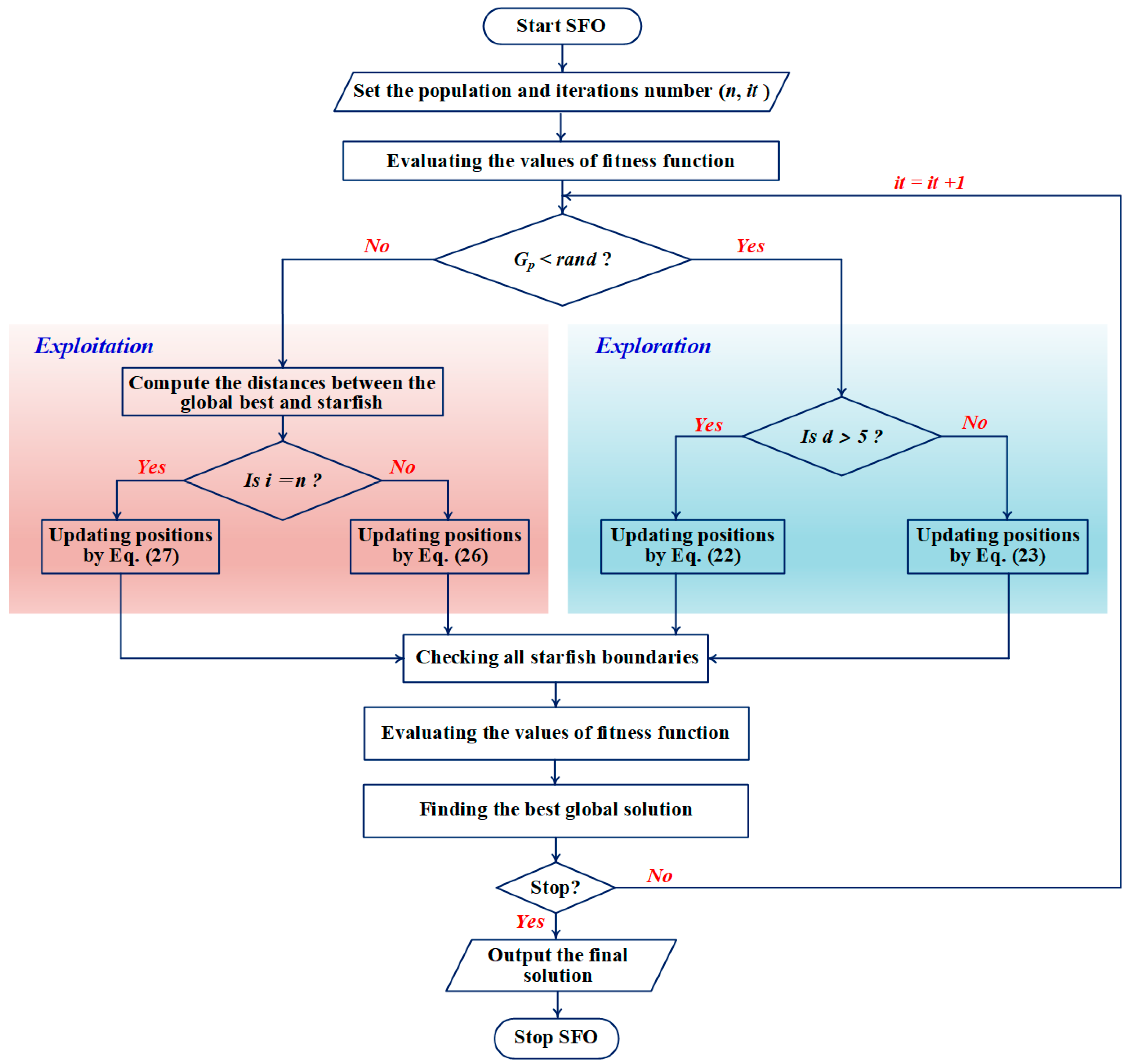
2.2. Starfish Optimization Algorithm
2.3. Crowbar Resistance Optimization
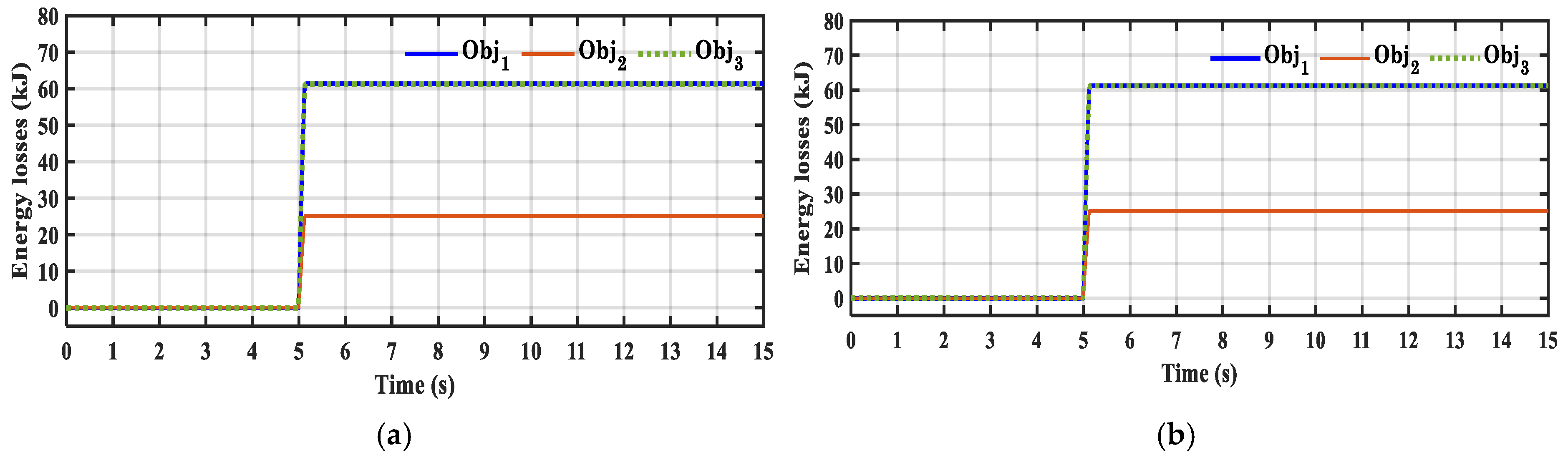
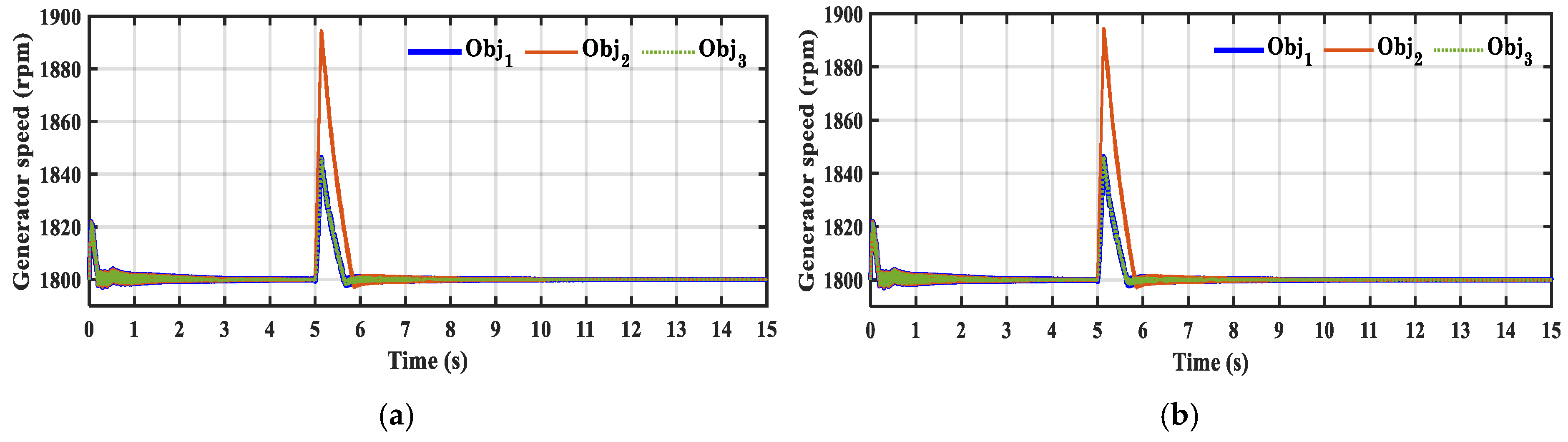
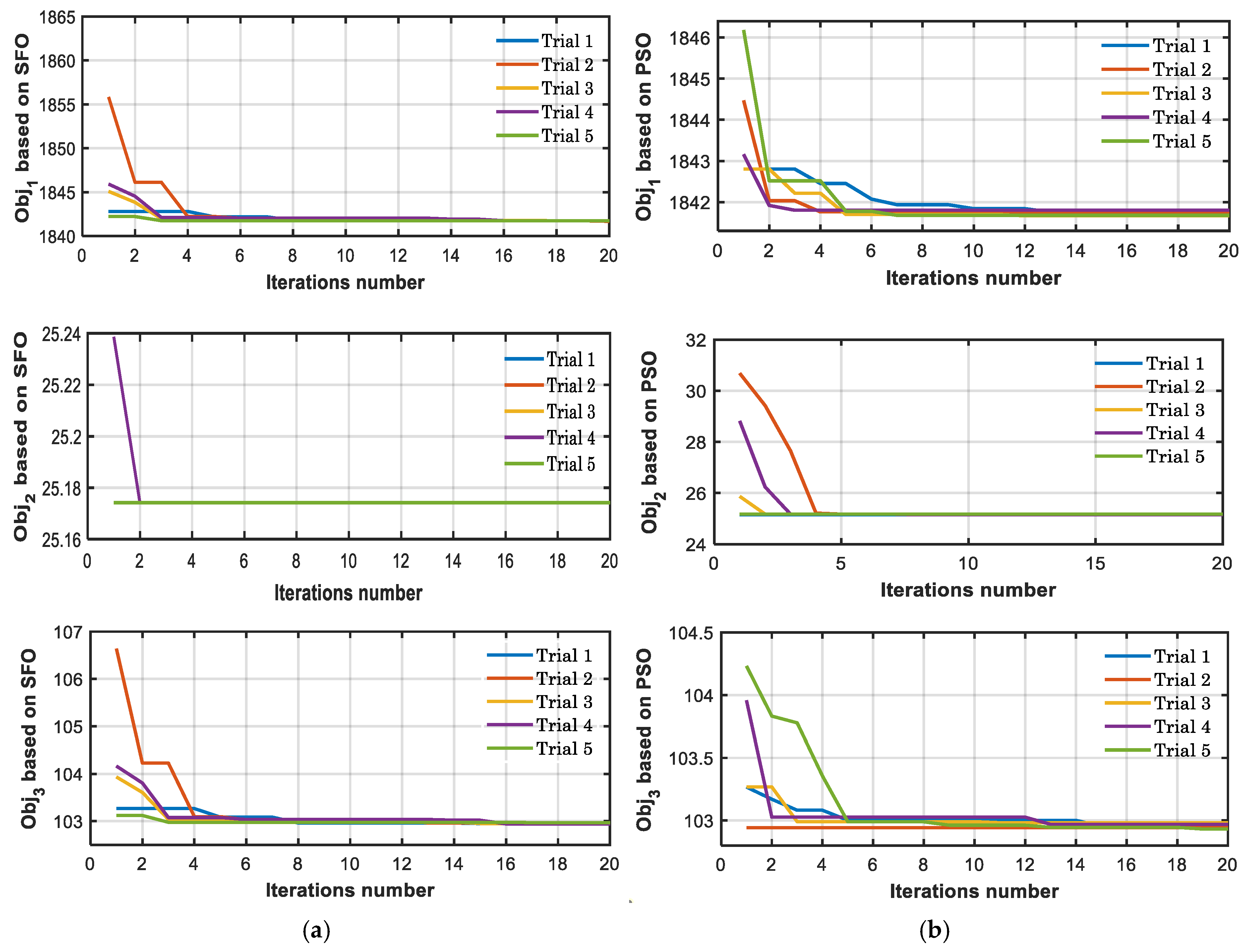
3. Results
4. Discussion
5. Conclusions
- i
- Obtaining the optimal crowbar resistance at a broader range of wind speeds and grid voltage dips.
- ii
- Studying the system under other fault types.
- iii
- The integration of optimized crowbar resistance with other advanced control strategies, such as adaptive predictive control, may further enhance LVRT performance.
Author Contributions
Funding
Data Availability Statement
Conflicts of Interest
References
- Desalegn, B.; Gebeyehu, D.; Tamrat, B. Wind energy conversion technologies and engineering approaches to enhancing wind power generation: A review. Heliyon 2022, 8, e11263. [Google Scholar] [CrossRef]
- Abdelateef Mostafa, M.; El-Hay, E.A.; Elkholy, M.M. Recent Trends in Wind Energy Conversion System with Grid Integration Based on Soft Computing Methods: Comprehensive Review, Comparisons and Insights. Arch. Comput. Methods Eng. 2023, 30, 1439–1478. [Google Scholar] [CrossRef]
- Mebkhouta, T.; Golea, A.; Boumaraf, R.; Benchouia, T.M.; Karboua, D.; Bajaj, M.; Chebaani, M.; Blazek, V. Sensorless finite set predictive current control with MRAS estimation for optimized performance of standalone DFIG in wind energy systems. Results Eng. 2024, 24, 103622. [Google Scholar] [CrossRef]
- Mostafa, M.A.; El-Hay, E.A.; ELkholy, M.M. Optimal maximum power point tracking of wind turbine doubly fed induction generator based on driving training algorithm. Wind Eng. 2023, 47, 671–687. [Google Scholar] [CrossRef]
- Hamid, B.; Hussain, I.; Iqbal, S.J.; Singh, B.; Das, S.; Kumar, N. Optimal MPPT and BES Control for Grid-Tied DFIG-Based Wind Energy Conversion System. IEEE Trans. Ind. Appl. 2022, 58, 7966–7977. [Google Scholar] [CrossRef]
- Jabal Laafou, A.; Ait Madi, A.; Addaim, A.; Intidam, A. Dynamic Modeling and Improved Control of a Grid-Connected DFIG Used in Wind Energy Conversion Systems. Math. Probl. Eng. 2020, 2020, 1651648. [Google Scholar] [CrossRef]
- Alaboudy, A.H.K.; Mahmoud, H.A.; Elbaset, A.A.; Abdelsattar, M. Technical Assessment of the Key LVRT Techniques for Grid-Connected DFIG Wind Turbines. Arab. J. Sci. Eng. 2023, 48, 15223–15239. [Google Scholar] [CrossRef]
- Mostafa, M.A.; El-Hay, E.A.; Elkholy, M.M. An overview and case study of recent low voltage ride through methods for wind energy conversion system. Renew. Sustain. Energy Rev. 2023, 183, 113521. [Google Scholar] [CrossRef]
- Yadav, M.; Pal, N.; Saini, D.K. Low voltage ride through capability for resilient electrical distribution system integrated with renewable energy resources. Energy Rep. 2023, 9, 833–858. [Google Scholar] [CrossRef]
- Döşoğlu, M.K. Enhancement of LVRT Capability in DFIG-Based Wind Turbines with STATCOM and Supercapacitor. Sustainability 2023, 15, 2529. [Google Scholar] [CrossRef]
- Khosravi, N.; Dowlatabadi, M.; Oubelaid, A.; Belkhier, Y. Optimizing reliability and safety of wind turbine systems through a hybrid control technique for low-voltage ride-through capability. Comput. Electr. Eng. 2025, 123, 110205. [Google Scholar] [CrossRef]
- de Oliveira, I.R.; Tofoli, F.L.; Mendes, V.F. Influence of low-voltage ride-through control techniques on the thermal behavior of power converters applied to wind energy conversion systems based on the doubly-fed induction generator. Electr. Power Syst. Res. 2025, 239, 111272. [Google Scholar] [CrossRef]
- Justo, J.J.; Mwasilu, F.A.; Bansal, R.C. Chapter Twelve—Fault ride through techniques based on hardware circuits for DFIG based wind turbines. In Modeling and Control Dynamics in Microgrid Systems with Renewable Energy Resources; Bansal, R.C., Justo, J.J., Mwasilu, F.A., Eds.; Academic Press: Cambridge, MA, USA, 2024; pp. 313–344. [Google Scholar]
- Kashiv, A.; Verma, H.K. Techniques used for the LVRT ability enhancement for DFIG connected system. In Proceedings of the 2020 First International Conference on Power, Control and Computing Technologies (ICPC2T), Raipur, India, 3–5 January 2020; pp. 68–72. [Google Scholar]
- Reddy, K.; Saha, A.K. A Heuristic Approach to Optimal Crowbar Setting and Low Voltage Ride through of a Doubly Fed Induction Generator. Energies 2022, 15, 9307. [Google Scholar] [CrossRef]
- Kalantarian, S.R.; Heydari, H. An analytical method for selecting optimized crowbar for DFIG with AHP algorithm. In Proceedings of the 2011 2nd Power Electronics, Drive Systems and Technologies Conference, Raipur, India, 16–17 February 2011; pp. 1–4. [Google Scholar]
- Liu, B.; Xu, C.; Gui, J.; Lin, C.; Shao, M. Research on the value of crowbar resistance to low voltage ride through of DFIG. In Proceedings of the 2015 International Conference on Computer and Computational Sciences (ICCCS), Greater Noida, India, 27–29 January 2015; pp. 44–48. [Google Scholar]
- Hu, S.; Zou, X.; Kang, Y. A novel optimal design of DFIG crowbar resistor during grid faults. In Proceedings of the 2014 International Power Electronics Conference (IPEC-Hiroshima 2014—ECCE ASIA), Hiroshima, Japan, 18–21 May 2014; pp. 555–559. [Google Scholar]
- Morsali, P.; Morsali, P.; Ghadikola, E.G. Analysis and Simulation of Optimal Crowbar Value Selection on Low Voltage Ride-Through Behavior of a DFIG-Based Wind Turbine. Proceedings 2020, 58, 18. [Google Scholar]
- Zhu, D.; Wang, Z.; Ma, Y.; Hu, J.; Zou, X.; Kang, Y. Hybrid LVRT Control of Doubly-Fed Variable Speed Pumped Storage to Shorten Crowbar Operational Duration. IEEE Trans. Power Electron. 2024, 39, 14192–14203. [Google Scholar] [CrossRef]
- Mahmoud, M.M.; Benlaloui, I.; Benbouya, B.; Ibrahim, N.F. Investigations on Grid-Connected DFIWGs Development and Performance Analysis with the Support of Crowbar and STATCOM. Control Syst. Optim. Lett. 2024, 2, 191–197. [Google Scholar] [CrossRef]
- Ali, M.A.S. Improved Transient Performance of a DFIG-Based Wind-Power System Using the Combined Control of Active Crowbars. Electricity 2023, 4, 320–335. [Google Scholar] [CrossRef]
- Gebru, F.M.; Khan, B.; Alhelou, H.H. Analyzing low voltage ride through capability of doubly fed induction generator based wind turbine. Comput. Electr. Eng. 2020, 86, 106727. [Google Scholar] [CrossRef]
- Paliwal, P. A State-of-the-Art Review on LVRT Enhancement Techniques for DFIG-Based Wind Turbines. In Advances in Energy Technology, Proceedings of the 1st International Conference on Energy, Materials Sciences, and Mechanical Engineering (EMSME 2020), Delhi, India, 31 October–1 November 2020; Springer: Singapore, 2022; pp. 131–141. [Google Scholar]
- Khajeh, A.; Ghazi, R.; Abardeh, M.H.; Sadegh, M.O. An efficient crowbar to improve the low voltage ride-through capability of wind turbines based on DFIG excited by an indirect matrix converter. Int. J. Power Electron. 2020, 11, 236–255. [Google Scholar] [CrossRef]
- Ahyaten, S.; Bahaoui, J.E. Modeling of Wind Turbines Based on DFIG Generator. Proceedings 2020, 63, 16. [Google Scholar] [CrossRef]
- Mehroliya, S.; Arya, A.; Mitra, U.; Paliwal, P.; Mundra, P. Comparative Analysis of Conventional Technologies and Emerging Trends in Wind Turbine Generator. In Proceedings of the 2021 IEEE 2nd International Conference on Electrical Power and Energy Systems (ICEPES), Bhopal, India, 10–11 December 2021; pp. 1–6. [Google Scholar]
- Mostafa, M.A.; El-Hay, E.A.; Elkholy, M.M. Torque ripple minimization and maximum power point tracking of wind turbine doubly fed induction generator based on bonobo optimization algorithm. Neural Comput. Appl. 2025, 37, 19371–19392. [Google Scholar] [CrossRef]
- Tian, J.; Su, C.; Chen, Z. Reactive power capability of the wind turbine with Doubly Fed Induction Generator. In Proceedings of the IECON 2013—39th Annual Conference of the IEEE Industrial Electronics Society, Vienna, Austria, 10–13 November 2013; pp. 5312–5317. [Google Scholar]
- Al-Quraan, A.; Al-Masri, H.; Al-Mahmodi, M.; Radaideh, A. Power curve modelling of wind turbines—A comparison study. IET Renew. Power Gener. 2022, 16, 362–374. [Google Scholar] [CrossRef]
- Wang, J.; Bo, D.; Miao, Q.; Li, Z.; Wu, X.; Lv, D. Maximum power point tracking control for a doubly fed induction generator wind energy conversion system based on multivariable adaptive super-twisting approach. Int. J. Electr. Power Energy Syst. 2021, 124, 106347. [Google Scholar] [CrossRef]
- Chen, P.; Han, D.; Li, K.C. Robust Adaptive Control of Maximum Power Point Tracking for Wind Power System. IEEE Access 2020, 8, 214538–214550. [Google Scholar] [CrossRef]
- Youssef, A.-R.; Mousa, H.H.H.; Mohamed, E.E.M. Development of self-adaptive P&O MPPT algorithm for wind generation systems with concentrated search area. Renew. Energy 2020, 154, 875–893. [Google Scholar] [CrossRef]
- González-Hernández, J.G.; Salas-Cabrera, R.; Vázquez-Bautista, R.; Ong-de-la-Cruz, L.M.; Rodríguez-Guillén, J. A novel MPPT PI discrete reverse-acting controller for a wind energy conversion system. Renew. Energy 2021, 178, 904–915. [Google Scholar] [CrossRef]
- Liu, M.; Pan, W.; Zhang, Y.; Zhao, K.; Zhang, S.; Liu, T. A Dynamic Equivalent Model for DFIG-Based Wind Farms. IEEE Access 2019, 7, 74931–74940. [Google Scholar] [CrossRef]
- Soomro, M.A.; Memon, Z.A.; Kumar, M.; Baloch, M.H. Wind energy integration: Dynamic modeling and control of DFIG based on super twisting fractional order terminal sliding mode controller. Energy Rep. 2021, 7, 6031–6043. [Google Scholar] [CrossRef]
- El Amine, B.B.M.; Ahmed, A.; Houari, M.B.; Mouloud, D. Modeling, Simulation and Control of a Doubly-Fed Induction Generator for Wind Energy, Conversion Systems. Int. J. Power Electron. Drive Syst. (IJPEDS) 2020, 11, 1197–1210. [Google Scholar] [CrossRef]
- Bossoufi, B.; Karim, M.; Taoussi, M.; Aroussi, H.A.; Bouderbala, M.; Deblecker, O.; Motahhir, S.; Nayyar, A.; Alzain, M.A. Rooted Tree Optimization for the Backstepping Power Control of a Doubly Fed Induction Generator Wind Turbine: dSPACE Implementation. IEEE Access 2021, 9, 26512–26522. [Google Scholar] [CrossRef]
- Dal, M.; Kennel, R.M. A Dynamic Modeling Approach: Simplifying DFIG Theory, Simulation, and Analysis. Energies 2025, 18, 282. [Google Scholar] [CrossRef]
- Elkholy, M.M.; Mostafa, M.A.; El-Hay, E.A. Enhancing steady-state and dynamic performance of wind turbine doubly fed induction generator using AI optimization approaches with adaptive PI controllers. Results Eng. 2025, 26, 104631. [Google Scholar] [CrossRef]
- Zhong, C.; Li, G.; Meng, Z.; Li, H.; Yildiz, A.R.; Mirjalili, S. Starfish optimization algorithm (SFOA): A bio-inspired metaheuristic algorithm for global optimization compared with 100 optimizers. Neural Comput. Appl. 2025, 37, 3641–3683. [Google Scholar] [CrossRef]
- Izci, D.; Ekinci, S.; Jabari, M.; Bajaj, M.; Blazek, V.; Prokop, L.; Yildiz, A.R.; Mirjalili, S. A new intelligent control strategy for CSTH temperature regulation based on the starfish optimization algorithm. Sci. Rep. 2025, 15, 12327. [Google Scholar] [CrossRef]
- Aktaş, M.; Kiliç, F. Discrete Starfish Optimization Algorithm for Symmetric Travelling Salesman Problem. IEEE Access 2025, 13, 102675–102687. [Google Scholar] [CrossRef]





| Grid Data | |
| Grid line voltage | 690 V (rms) |
| Grid frequency | 60 Hz |
| DFIG and wind turbine inertia | 127 kg.m2 |
| Friction factor | 0.001 N.m.s |
| Wind turbine | |
| Rated mechanical power | 2.4 MW |
| Rotor diameter | 42 m |
| Wind speed range | 4–25 m/s |
| Rated wind speed | 12.1 m/s |
| Gearbox ratio | 100 |
| Nominal rotor speed range | 9–19 rpm |
| DFIG | |
| Rated stator power | 2 MW |
| Rated stator line voltage | 690 V (rms) |
| Rated stator current | 1760 A (rms) |
| Rated rotor current | 1823 A (rms) |
| Rated rotor line voltage | 845 V (rms) |
| Rated torque | 12.732 kN.m |
| Rated rotor speed | 1800 rpm |
| Rotor speed range | 900–1900 rpm |
| Pole number | 4 |
| RS, RR | 2.6, 2.9 m |
| LS, LR | 87, 87 μH |
| LM | 2.5 mH |
| Rotor L-C filter | |
| CF, RF, LF | 1493.1 μF, 1.09 , 3.57 mH |
| Grid L filter | |
| Lg, Rg | 0.2400 mH, 0.000115 |
| DC-bus voltage and capacitance | |
| CDC-bus | 395.0622 mF |
| VDC-bus | 1306.11 V |
| PI controller gains for RSC Controller | |
| The tracking of DFIG speed | 6893.13, = 47,955.20 |
| The tracking of D components of rotor currents | 5.44, = 674.94 |
| The tracking of Q components of rotor currents | 6.18, = 647.87 |
| PI controller gains for RSC Controller | |
| The tracking of DC-bus voltage | −3054.95, = −790,888.91 |
| The tracking of D components of grid currents | 1.41, = 404.47 |
| The tracking of Q components of grid currents | 60.05, = 1343.17 |
| PSO | SFO | |||||||||
|---|---|---|---|---|---|---|---|---|---|---|
| Elapsed Time (sec) | RCrowbar ) | Obj | ECrowbar ) | NMax_DFIG (rpm) | Elapsed Time (sec) | RCrowbar ) | Obj | ECrowbar ) | NMax_DFIG (rpm) | |
| Obj1 | 68,895.9 | 0.15756 | 1841.67 | 61.248 | 1841.67 | 69,619.4 | 0.15797 | 1841.68 | 61.2631 | 1841.68 |
| Obj2 | 70,227.5 | 0.57990 | 25.14 | 25.145 | 1887.70 | 74,866.6 | 0.58000 | 25.17 | 25.174 | 1887.70 |
| Obj3 | 65,981.1 | 0.15767 | 102.93 | 61.217 | 1841.70 | 68,113.6 | 0.15779 | 102.94 | 61.217 | 1841.70 |
| PSO | SFO | |||||||||
|---|---|---|---|---|---|---|---|---|---|---|
| Elapsed Time (sec) | RCrowbar ) | Obj | ECrowbar ) | NMax_DFIG (rpm) | Elapsed Time (sec) | RCrowbar ) | Obj | ECrowbar ) | NMax_DFIG (rpm) | |
| Obj1 | 78,299.0 | 0.12127 | 1865.32 | 37.22 | 1865.32 | 85,616.5 | 0.12109 | 1865.31 | 37.226 | 1865.31 |
| Obj2 | 72,308.5 | 0.57990 | 14.45 | 14.449 | 1898.90 | 84,171.1 | 0.58000 | 14.48 | 14.477 | 1898.90 |
| Obj3 | 69,064.3 | 0.12094 | 102.53 | 37.198 | 1865.30 | 74,596.7 | 0.12098 | 102.55 | 37.196 | 1865.30 |
Disclaimer/Publisher’s Note: The statements, opinions and data contained in all publications are solely those of the individual author(s) and contributor(s) and not of MDPI and/or the editor(s). MDPI and/or the editor(s) disclaim responsibility for any injury to people or property resulting from any ideas, methods, instructions or products referred to in the content. |
© 2025 by the authors. Published by MDPI on behalf of the International Institute of Knowledge Innovation and Invention. Licensee MDPI, Basel, Switzerland. This article is an open access article distributed under the terms and conditions of the Creative Commons Attribution (CC BY) license (https://creativecommons.org/licenses/by/4.0/).
Share and Cite
Elkholy, M.M.; Mostafa, M.A. Optimization of Crowbar Resistance for Enhanced LVRT Capability in Wind Turbine Doubly Fed Induction Generator. Appl. Syst. Innov. 2025, 8, 191. https://doi.org/10.3390/asi8060191
Elkholy MM, Mostafa MA. Optimization of Crowbar Resistance for Enhanced LVRT Capability in Wind Turbine Doubly Fed Induction Generator. Applied System Innovation. 2025; 8(6):191. https://doi.org/10.3390/asi8060191
Chicago/Turabian StyleElkholy, Mahmoud M., and M. Abdelateef Mostafa. 2025. "Optimization of Crowbar Resistance for Enhanced LVRT Capability in Wind Turbine Doubly Fed Induction Generator" Applied System Innovation 8, no. 6: 191. https://doi.org/10.3390/asi8060191
APA StyleElkholy, M. M., & Mostafa, M. A. (2025). Optimization of Crowbar Resistance for Enhanced LVRT Capability in Wind Turbine Doubly Fed Induction Generator. Applied System Innovation, 8(6), 191. https://doi.org/10.3390/asi8060191