


Abstract
A first attempt has been made to systematically present the achievements of several archaeozoological fields in Bulgaria: archaeomalacology, archaeoichthyology, archaeoherpetology, archaeornithology, and archaeomammalogy. The main results and some of the more significant studies in each of these fields are presented. In summary, archaeozoological studies began in the first decade of the 20th century. A list of established authors of archaeozoological publications in Bulgaria has been compiled. Of the identified species, four species of birds and six species of mammals have disappeared from the modern fauna of the country. Two species have completely disappeared globally.
Keywords:
archaeology; human–animal interactions; fishing; hunting; gathering; game; domestic animals 1. Introduction
Archaeozoology is a relatively new field in zoological and archaeological research. It can be stated that, in Bulgaria, the first archaeozoological studies were carried out in prehistoric sites (mainly in caves). We must undoubtedly accept the prehistoricist Prof. Rafail Popov (1876–1940) as the founder of Bulgarian archaeozoology. Already in the first decade of the 20th century, he had begun to publish, one after another, his archaeozoological studies of prehistoric settlements in Bulgaria. Among the first is that on caves near Veliko Tarnovo [1]. In this, as in almost all his works, Popov provides lists of the established animal species (mainly large mammals), and often short descriptions of some of the more diagnostic species found. Bony fish, amphibians, reptiles and birds are almost completely absent from these lists.
The first studies of animal bone remains in the historic (early antiquity to sub-recent) archaeological sites in Bulgaria appeared in the 1950s [2,3,4]. With few exceptions, in the 1960s and 1970s, archaeozoological research in Bulgaria was not published.
Over the past decade or so (after 2010), the number of archaeozoological studies has increased sharply. With a few exceptions [5,6], no generalizing studies on the development of this type of research in the country have been published so far. The three publications are thematically restricted: the first two concern only data on bird bone remains, and the second concerns only medieval monuments in Bulgaria. It is estimated that there are about 400,000 archaeological sites (settlements, fortresses, military camps, monasteries, churches, etc.) within the modern borders of Bulgaria. After Greece and Italy, Bulgaria is the country in Europe with the richest cultural heritage [7]. This clearly shows the scope that a summary with a title like the present one should have.
For a more concise presentation of the abundant information on this topic, grouping the data according to the objects of study seems most appropriate.
2. Main Directions in Archaeozoology Developed in Bulgaria
2.1. Archaeomalacology
The remains of not all mollusks are well preserved in sediments. Shellfish are especially fortunate in this regard. In this respect, shelled mollusks (mostly Gastropoda and Bivalvia) are relatively common among the discovered animal remains in ancient human settlements. The geographical location of the territory of modern Bulgaria allows, based on these mollusks, to establish, respectively, Mediterranean or Black Sea contacts according to the peculiarities of the distribution of individual species.
It is difficult to accept that archaeomalacology is a developed scientific discipline in Bulgaria. However, it should be noted that there are published studies in the country on subfossil conchiological finds from Mollusca—both on marine and terrestrial representatives of Gastropoda, as well as those of Bivalvia.
Popov [1] lists 4 taxa: Margaritifera margaritifera, Helix pomatia, Helix sp., and Denlalium sp., from the Paleolithic layers of Golyamata Peshtera Cave (near Veliko Tarnovo). In another paper [8], he reports Helix pomatia, Margaritifera margaritifera, Mytilus edulis, and Cardium sp. from the Neolithic settlement mound Bakadzhi near Salmanovo village. Four taxa, i.e., Helix sp., Helix pomatia, Unio sp., and Cardium sp., were established in the Kodzhadermen Neolithic settlement mound by Popov [9].
Ribarov [10] reported 11 taxa—Anodonta cygnaea, Planorbarius corneus, Helix pomatia, Mytilus edulis, Cerastoderma glaucum, Ostrea sp., Cardium sp., Tritia reticulata, Nana donovania, Volitilithes sp., and Surrea sp., from the ancient city of Kabyle. In another publication [11], he reported on Surrea sp. from the Hallstatt period in Yambol and from a Neolithic settlement near the village of Blatets (Sliven Region), sea snails of the genus Murex from the ancient town of Kabile, in the medieval fortress near the village of Karavelovo (Yambol Region) and in the medieval settlement near the village of Dyadovo (Sliven Region), snails of the genus Volitilithes from ancient Kabile, and Mytilus sp., Helix pomatia, Planorbis sp., Unio sp. and Anodonta sp. from medieval Yambol. The same author reported 884 mollusk finds of 19 species from 10 archaeological sites of SE Bulgaria: Unio pictorum from Kabile, Yasatepe, Yambol, Karavelovo, Sliven, and Dyadovo; Anodonta cygnaea from Yasatepe and Hisarlaka; Mytilus galloprovincialis from Kabile, Yasatepe, Urdoviza, Yambol, and Hisarlaka; Ostrea edulis from Kabile, Urdoviza, Yambol, and Hisarlaka; Cardium edule from Kabile and Yambol; Pecten ponticus from Yambol; Sphaerium corneum from Kabile, Urdoviza, Yambol; Bolinus brandaris from Kabile, Karavelovo, and Dyadovo; Glycymeris glycymeris from Yasatepe; Glycymeris albolineata from Hisarlaka; Spondylus gaederopus from Yasatepe; Helix pomatia from Kabile, Urdoviza, Yambol, and Hisarlaka; Cypraea tigris from Kabile and Yasatepe; Caucasocressa vindobonensis, Planorbis planorbis, Tritia pellucida, Tritia reticulata, Charonia tritonis, Columbella rustica from Kabile [12]. We might consider this research to fall entirely within the field of archaeomalacology.
Incidentally, data on found mollusk shells are also contained in a number of archaeozoological studies. Here we mention only those with more species or specimens. Stoianov [13] reports on Paleolithic finds of Unio sp., Helix pomatia and Dentalium sp. from Toplya cave near Golyama Zhelezna village (Lovech Region). According to [14], this is the first comprehensive study of a cave in Bulgaria.
Vasilev [15] found Mytilus edulis and Unio crassus in the middle Chalcolithic settlement mound near Ovcharovo village (Targovishte Region). Ribarov [16] reported five species of Mollusca in ancient Kabile: Cardium sp., Murex sp., Unio pictorom, Planorbarius comeus, and Helix pomatia. Boev et al. [17] reported five snail taxa with 185 specimens: Caucasocressa vindobonensis, Euomphalia strigella strigella, Fruticicola fruticum, Helix pomatia, and Oxychilidae gen. indet. from the late antique settlement near the town of Dimovo. Unio crassus and Ostrea edulis were established in Sofia from the 3rd to the 5th c. AD by [18]. Helix lucorum was found in the medieval monastery near Veliki Preslav [19] and Unio sp. in the Neolithic settlement of Slatina [20] and in the Early Neolithic settlement near Kapitan-Dimitrievo village (Pazardzhik Region) [21]. Unio pictorum was established in the Byzantine settlement Bela Voda (Pernik Region) [22], Anodonta cygnaea was found in Kabile [10], and Unio sp. in the Roman town of Ratiaria [23]. In the late Neolithic ritual complex near Sarnevo village (Stara Zagora Region) [24], Mytilus galloprovincialis, Unio pictorum, and Helix pomatia are listed. Vasilev [25] reports on the medieval settlement near the village of Durankulak (Dobrich Region) Mytilus galloprovincialis, Ostrea edulis and “snails”. In the Late Chalcolithic mound near the village of Bazovets (Montana Region [26], shells of Unio crassus, Unio sp. and Helix pomatia were also found. Unio sp. is reported from the Early Neolithic settlement near Kapitan-Dimitrievo village (Pazardzhik Region). Spondylus finds were found in the Chalcolithic mound near Ivanovo village (Shumen Region) [27].
Although extremely rare, archaeomalacological studies in Bulgaria have also been conducted by foreign archaeozoologists. The mollusks at Nicopolis ad Istrum have been studied in detail by [28].
In some archaeozoological studies, mollusk remains have been neglected and left unidentified. For example, in the Late Chalcolithic settlement near the village of Hotnitsa (Veliko Tarnovo Region), 411 mussels were identified as “River clam”.
In almost all of these publications, the findings of mollusk shells are mentioned as accompanying the other numerous bone and dental remains, mainly of large domestic mammals. In most cases, the remains of mollusks are single or few in number. In rare cases, their number reaches 100 or more. In all the archaeological monuments mentioned so far, the remains of mollusks have not been identified by specialist malacologists. The only exception is the study by [17]. Therefore, it can be summarized that, despite the available data, archaeomalacology in Bulgaria is an emerging branch in archaeozoological research.
2.2. Archaeoichthyology
The modern Bulgarian ichthyofauna numbers 207 species of freshwater and marine fish [29]. Most species of bony fish in Bulgaria are relatively small in size. In Bulgaria, in almost all archaeological sites, the excavated soil is not sieved and washed. Therefore, usually, the bony remains of fish rarely fall into the hands of archaeozoologists. We can assume that fish remains are underrepresented everywhere in archaeozoological materials.
Twenty-one freshwater and marine species of fish from the ancient town of Nicopolis-ad-Istrum (CN Bulgaria) have been found by [30,31,32]: Acipenser ruthenus, Esox lucius, Salmo trutta, Cyprinus carpio, Carassius carassius, Tinca tinca, Abramis brama, Alburnus alburnus, Aspius aspius, Barbus barbus, Chondrostoma nasus, Leuciscus idus, Leuciscus cephalus, Phoxinus phfxinus, Rutilus rutilus mariza, Siluris glanis, Perea fluviatalis, Sander lucioperca, Anguilla anguilla, Platichthys flesus, and Scomber scombrus. Without exaggeration, we can consider that study [32], although by foreign researchers, is the first archaeoichthylogical study in Bulgaria.
Seven species of fish (Acipenser stellatus, Acipenser gueldenstaedti, Sarda sarda, Carassius carassius, Cyprinus carpio, Silurus glanis, and Sander lucioperca) from the medieval fortress of Rusokastro (SE Bulgaria) are reported in data from [33,34]. Cyprinus carpio is reported by [35] from the Iron Age deposits of Yasatepe. Thunnus thynnus is reported by [36] from the Eneolithic settlement near Sozopol. Silurus glanis has been found in several locations in ancient and medieval Serdica [37,38,39,40]. Silurus glanis and Cyprinus carpio were established in the Byzantine settlement Bela Voda (Pernik Region) [22], the Roman town of Ratiaria [23] and the Late Chalcolithic settlement near the village of Hotnitsa [41]. Cyprinus carpio, Lucioperca lucioperca, Silurus glanis, and Esox lucius were reported by [16], and Esox lucius was recorded in ancient Kabile [42]. Abramis brama was identified among the faunal remains in Serdica from the 16th t the 18th c. AD [37]. Usually, single vertebrae are found in excavated soil and, even more rarely, gill covers (operculums) and pharyngeal teeth. Most often, these remain undetermined.
2.3. Archaeoherpetology
We should clarify that this traditionally includes information about finds of two classes of vertebrates—amphibians (Amphibia) and reptiles (Reptilia). The term archaeobatrachology for amphibians is practically unused.
The modern herpetofauna (amphibians and reptiles) of Bulgaria is one of the richest in Europe, but so far, archaeological sites in the country have mainly found and reported finds of the two species of land tortoises of the genus Testudo. Due to their anatomical features (compact and thick flat bones of the carapace and plastron), tortoises are often present in archaeozoological materials, almost throughout the country.
Popov [1] reports carapax fragments of Testudo graeca from Golyamata Peshtera Cave near Veliko Tarnovo. Two species of land tortoises (Testudo graeca and Testudo hermanni) are reported by [34] for the medieval fortress Rusokastro. Emys orbicularis and Testudo graeca are reported by [36] from Eneolithic settlement near Sozopol. Testudo sp. in the Early Neolithic settlement near Malak Preslavets village (Silistra Region) was mentioned by [38]. Emys orbicularis was found in the Roman town of Ratiaria [23]. Although it is assumed that sea turtles (Caretta caretta until the 16th century and Chelonya mydas until the 19th century) were found on the Bulgarian Black Sea coast, their bone remains have not been found in the coastal ancient settlements of the country [43].
Boev [44] numbered 93 bone finds of Testudo graeca and Testudo graeca/hermanni from the Late Antique fortified site near Shipot village (Vidin Region). From the same site [17] 109 finds of Emys orbicularis and Testudo graeca/hermanni were published. Ribarov [10] reported Lacerta sp. from Kabile. Bone of Testudo graeca/hermanni was found in the medieval settlement near Petarch village (Sofia Region) [45]. Testudo hermanni was found in the late Antiquity town of Serdica [40]. In the medieval settlement (9th–10th century) near Nedan village (Veliko Tarnovo Region) [46], remains of five taxa of reptiles were found: Lacertidae gen. indet., Natrix natrix/Natrix tessellata, Dolichophis caspius, Colubridae gen. indet., Vipera sp. (cf. ammodytes), and Serpentes fam. indet. Remains of Rana/Pelophylax were found by [40]. All the finds of reptiles and the even rarer ones of amphibians are accidental in nature and they are definitely underrepresented among the materials from archaeozoological studies in the country.
2.4. Archaeornithology
The modern avifauna of Bulgaria is among the richest in Europe. A total of 417 species of natural distribution have been identified in the country [47]. Birds from prehistoric and historical settlements in Bulgaria have been relatively well studied. Over the years, several summaries of their species composition have been made [5,48,49].
There are also published summaries for individual groups of birds in the country—waterfowl [50], synanthropic birds [51], game birds [52], birds from medieval settlements [49,53], diurnal and nocturnal birds of prey [54], birds from Pleistocene deposits [55], grouse birds [56], bustards [57], birds from Roman settlements [58], shrikes [59], owls [60], eagles [61], and vultures [62]. Detailed summaries of individual species have also been published—Lyrurus tetrix [63], Tetrao urogallus [64], Grus grus [65], and Haliaaetus albicilla [66].
In very rare isolated cases, bird remains have been examined by foreign specialists: Bacho Kiro Cave [67], and Novae [68,69,70,71,72].
Through archaeornithological studies, it has been established for the first time that some birds that are now extinct in the country—the Pleistocene grey partridge (Perdix palaeoperdix) [73], the black grouse (Lyrurus tetrix) [74], the snowy owl (Bubo scandiacus) [75] and the great grey owl (Strix nebulosa) [76]—were also distributed in Bulgaria in the past.
In Bulgaria, numerous remains of all domestic birds traditionally bred in Europe have been found—chicken, duck, goose, pigeon, turkey and peacock. No remains of guinea fowl and musk duck have been found. The remains of (domestic) turkey are particularly interesting because they are dated to the 17th century—just one century after the last (fourth) expedition of Christopher Columbus (1502–1504) [53]. The domestic chicken is the most widespread domestic bird globally. It is represented by the largest number of bone finds and in most of the studied settlements. Unfortunately, however, it is the case that some of the materials were not correctly dated by archaeologists. This was shown by the data from the study by [77]. The oldest chickens in Bulgaria were radiocarbon dated as 215–338 AD, while their estimated age according to archaeologists was 3550 BC.
It is worth noting that, in publications about a significant proportion of archaeological sites, when the material is not directed to competent archaeozoologists, the bird remains are only stated as “There are single bird bones” without them being identified, as is the case with [26], for example.
The abundant archaeornithological information already published on a significant number of bird species and groups is unnecessary to present again in this review. The archaeornithological branch of Bulgarian archaeozoology is definitely the best represented, both in terms of species composition and the number of archaeological monuments studied. In Bulgaria, this was established in the 1980s–1990s. In fact, the only center in which it was developed is NMNHS-BAS, where the largest comparative osteological collection of birds is also kept. Today it is the richest collection of this kind on the Balkan Peninsula and in Southeast Europe. Along with the osteological collection, this museum also houses the richest collection of subfossil birds in Southeast Europe—bone remains of birds from Holocene deposits (prehistoric and historical times).
Bulgarian specialists have also studied bird remains in archaeornithological sites in some neighboring countries: Greece [78] and Serbia [79,80].
2.5. Archaeomammalogy
The terms archaeotheriology and archaeomammology, although quite clear, are almost never used. Their use here is only by analogy with other archaeological fields in order to clarify that we are talking about the study of mammalian remains in archaeological monuments in Bulgaria. Due to the size of domestic mammals, as well as most game species of mammals, the presence of their bone and tooth remains is incomparably more strongly represented than that of all other groups of vertebrates. Until the beginning of the 21st century, animal bones from archaeological sites in Bulgaria were very rarely studied. Only in the last 20 years or so archaeozoological studies become an obligatory part of the complex study of archaeological monuments. Therefore, our information about stock-breeding and hunting (mainly of large mammals) of the inhabitants of the ancient and medieval settlements in Bulgaria has also grown rapidly.
Some archaeozoological studies in Bulgaria have been carried out by foreign scientists. Such are the cases of the Paleolithic caves Temnata Dupka [81], Suhi Pech (Kozarnika) Cave [82], the ancient cities of Nove [83,84], Koprivec and Durankulak [85], and Nicopolis ad Istrum [86,87,88]. In these studies, the main part of the analyzed finds concern large mammals (mainly herbivores and carnivores).
Paleolithic and later finds of large mammals from the Suhata caves near the r/w station Lakatnik, Temnata Dupka near Karlukovo village, Magurata near Rabisha village, Suhi Pech (Kozarnika) near Dolni Lom village and Emenscka near Emen village were studied by [89]. The remains of an entire ancient city (Seutopolis) have been extensively studied by [90].
Archaeozoological data on marine mammals in Bulgaria are extremely scarce. The study [36] reported Eneolithic remains of Common Dolphin (Delphinus delphis) and Common Bottlenose Dolphin (Tursiops truncatus) from a sunken settlement in the Sozopol Bay of the Black Sea [91]. A lower jaw and teeth of a Mediterranean Monk Seal (Monachus monachus) were found in the sunken Chalcolithic settlement of Urdoviza in the Kiten Bay, and forelimb bones of the Monk Seal were also found at the Bronze Age site of Cape Shabla (Dobrich Region) [92].
For some mammal species, generalizing studies on their past distribution based on archaeological studies in ancient settlements have already been published. Such are the publications of for cave bear (Ursus spelaeus) [93], aurochs (Bos primigenius) [94], camels (Camelus dromedarius and C. bactrianus) [95], beaver (Castor fiber) [96], Western cave hyaena (Crocuta crocuta (spelaea)) [97], fallow deer (Dama dama) [98], wisent (Bos bonasus) [99], red deer (Cervus elaphus), [100], European badger (Meles meles) [101], etc.
As mentioned above, the published data in the Bulgarian archaeozoological literature almost exclusively concern large mammals. Very rarely have small mammals been the subject of special studies. One such exception is the study on black rat (Rattus rattus) in [102]. Bones and skulls of the Lesser Blind Mole-rat (Nannospalax leucodon) are also relatively common in these materials, but they have so far remained unexplored. It is possible that some do not belong to the relevant archaeological contexts.
Of interest is the discovery of remains of some species of large mammals that have already disappeared in the country and on the Balkan Peninsula, or in the world in general, such as the European leopard (Panthera pardus spelaea) [103], the European lion (Panthera leo europaea) [104], the saiga antelope (Saiga tatarica) [105], the wild European donkey (Equus hemionis hydruntinus) [106], the beaver [96], aurochs [94,107], etc.
3. Conclusions
Archaeozoology is a relatively young interdisciplinary field of scientific research in Bulgaria. The first studies in this field appeared in the first decade of the 20th century. The Bulgarian archaeologist Prof. Rafail Popov can be considered its founder. After him, similar studies were published by Prof. Stefan Ivanov. In the 1970s, foreign specialists (mainly from Poland) were also involved, in the 1980s from Great Britain and Germany, and in the 1990s from France. Until 2000, animal bones were rarely studied in most archaeological studies. Over the past two decades, their study has become a widespread practice and archaeozoological information in the country has grown sharply. Of all the fields, archaeornithology is the most highly developed. So far, the composition of bird remains has been studied in over 120 prehistoric and later archaeological sites, and over 300 species of birds (ca. 72% of the contemporary avian fauna of the country) have been identified in them. Data on amphibians and reptiles (except for land tortoises) are still very scarce. Of the bony fish, the most frequently reported are wels catfish and European carp. Ten species of birds and mammals have disappeared from the modern fauna of Bulgaria. Of these, two species are now completely extinct worldwide. Due to its southern and crossroads geographical location (between Europe, Asia and Africa), the diverse relief, numerous caves (over 5500) and the proximity to two seas (the Black Sea and the Aegean Sea), the territory of Bulgaria is extremely interesting for archaeozoological research. Undoubtedly, many more new discoveries are yet to be made here.
List of Authors of Archaeozoological Publications About Localities in Bulgaria
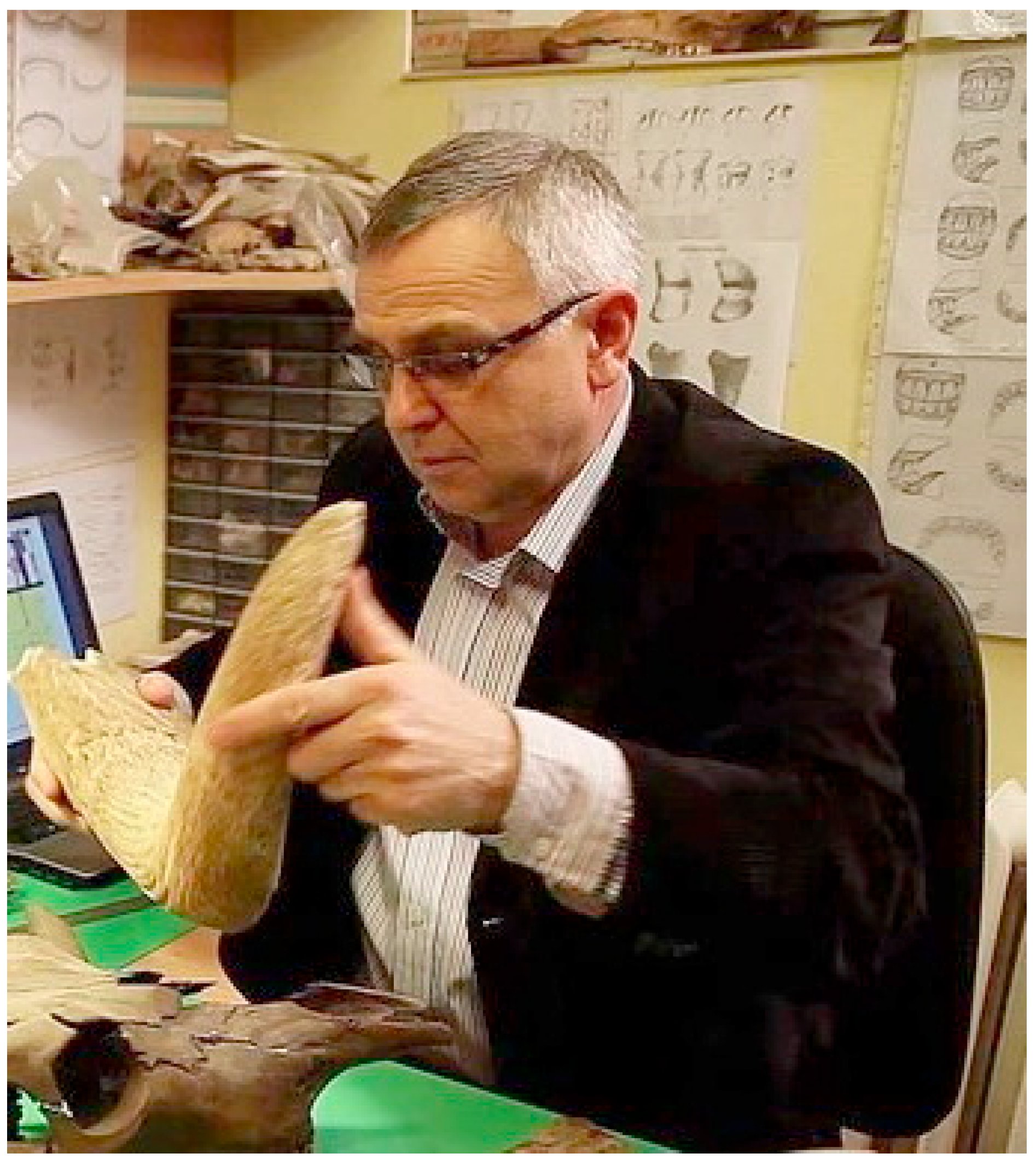
- Daniel Makowiecki (Figure 1).
Figure 1.
Daniel Makowiecki (large mammals and fish). Photo: https://www.wprost.pl/nauka-sladami-kopernika/11830473/prof-daniel-makowiecki-jedyny-taki-naukowiec-w-polsce-wypelnil-nietypowa-nisze.htm (accessed on 4 December 2025).
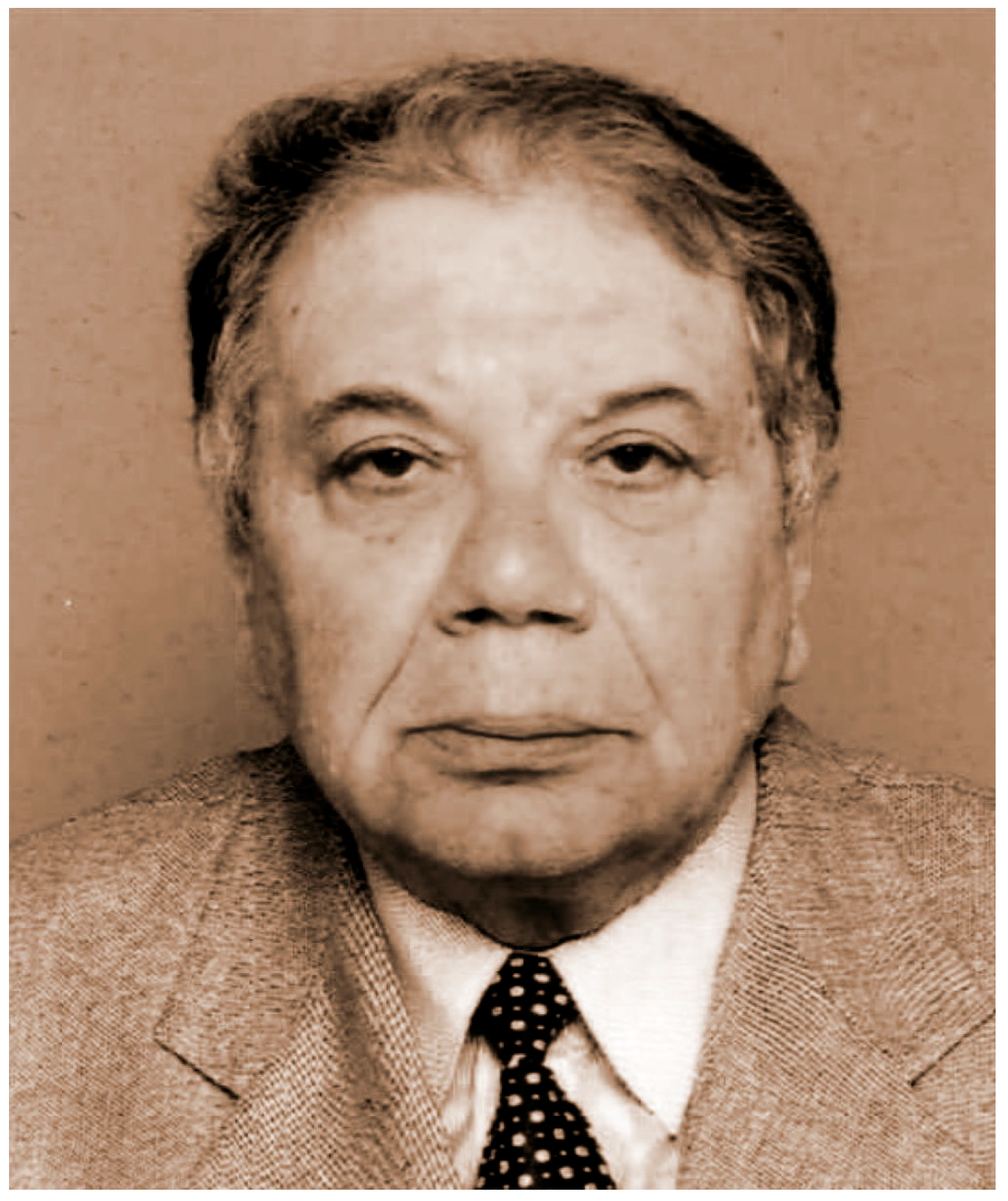
- Georgi Kovachev (1936–2020) (Figure 2).
Figure 2.
Georgi Kovachev (domestic mammals). Photo: https://www.facebook.com/100034441783812/posts/in-memoriam%D0%BF%D0%BE%D1%87%D0%B8%D0%BD%D0%B0-%D0%BF%D1%80%D0%BE%D1%84-%D0%B4-%D1%80-%D0%B3%D0%B5%D0%BE%D1%80%D0%B3%D0%B8-%D0%BA%D0%BE%D0%B2%D0%B0%D1%87%D0%B5%D0%B2%D1%81%D0%BB%D0%B5%D0%B4-%D0%BA%D1%80%D0%B0%D1%82%D0%BA%D0%BE-%D0%B1%D0%BE%D0%BB%D0%B5%D0%B4%D1%83%D0%B2%D0%B0%D0%BD%D0%B5-%D0%BD%D0%B0-84-%D0%B3%D0%BE%D0%B4%D0%B8%D1%88%D0%BD%D0%B0-%D0%B2%D1%8A/1793445757446680/ (accessed on 4 December 2025).
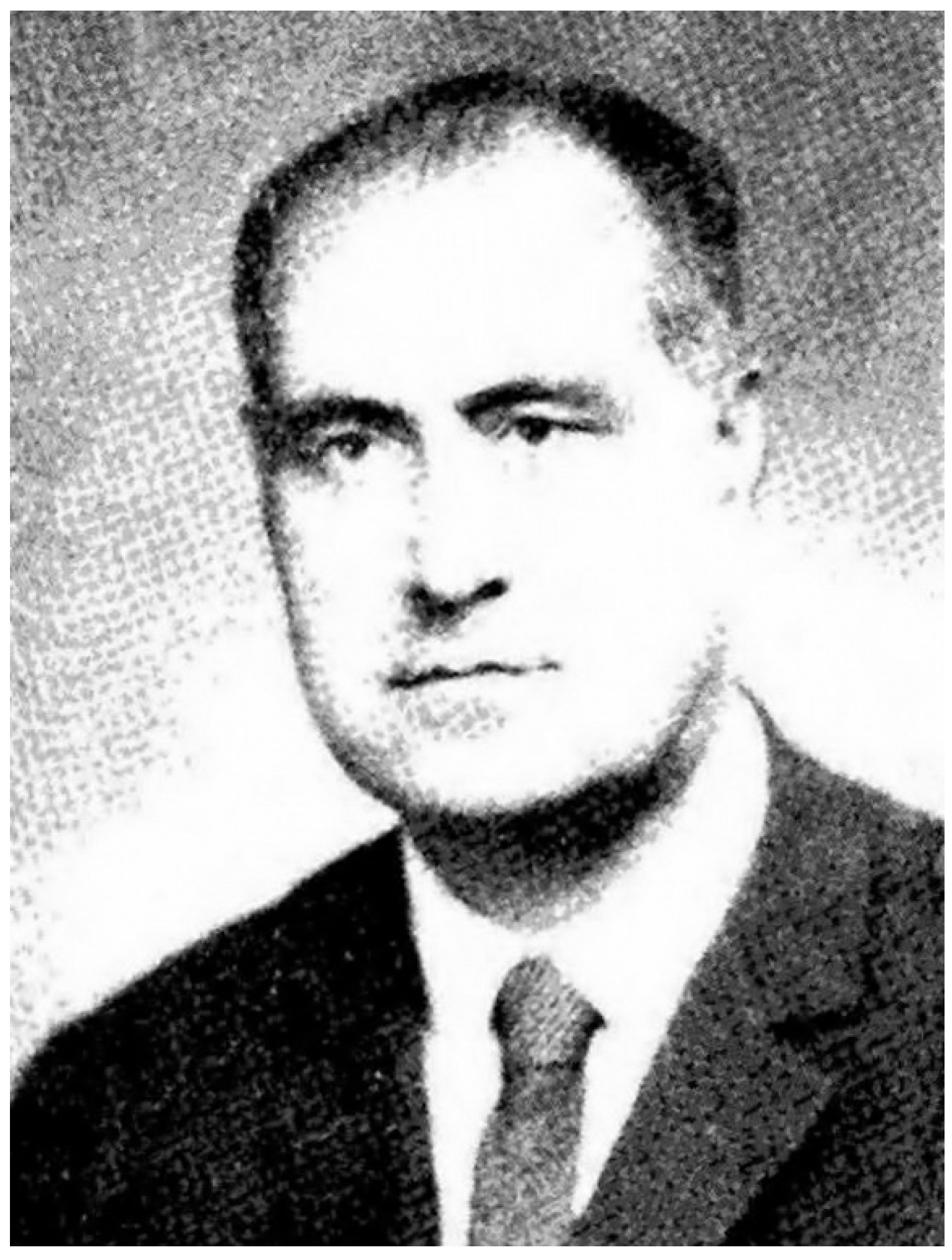
- Georgi Markov (1912–1988) (Figure 3).
Figure 3.
Georgi Markov. Ca. 1968 (large mammals).
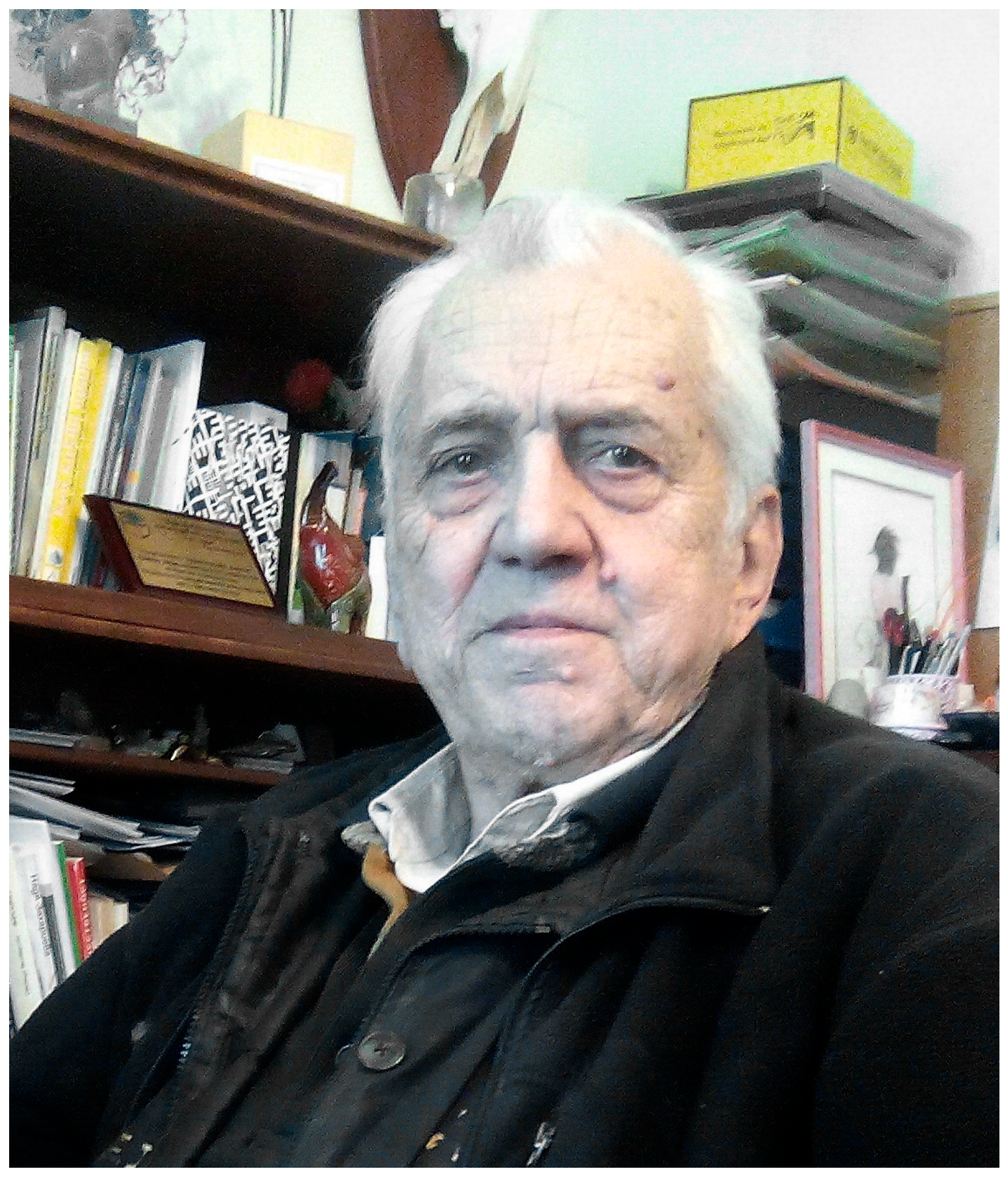
- Georgi Ribarov (Figure 4).
Figure 4.
Georgi Ribarov. Ca. 2015 (large mammals, shellfish).

- Iliya Stoyanov (1875–1920).
- Lazar Ninov.
- Mark Beech (Figure 5).
Figure 5.
Mark Beech. Personal photo archive (large mammals, fish). Photo: Personal photo archive.

- Nadezhda Karastoyanova (Figure 6).
Figure 6.
Nadezhda Karastoyanova. Ca. 2023 (large mammals).

- Nikolay Iliev (1929–2024) (Figure 7).
Figure 7.
Nikolay Iliev. 8 April 2017 (domestic mammals). Photo: Z. Boev.
- Nikolay Spassov (Figure 8).
Figure 8.
Nikolay Spassov. 20 December 2009 (large mammals). Photo: Z. Boev.
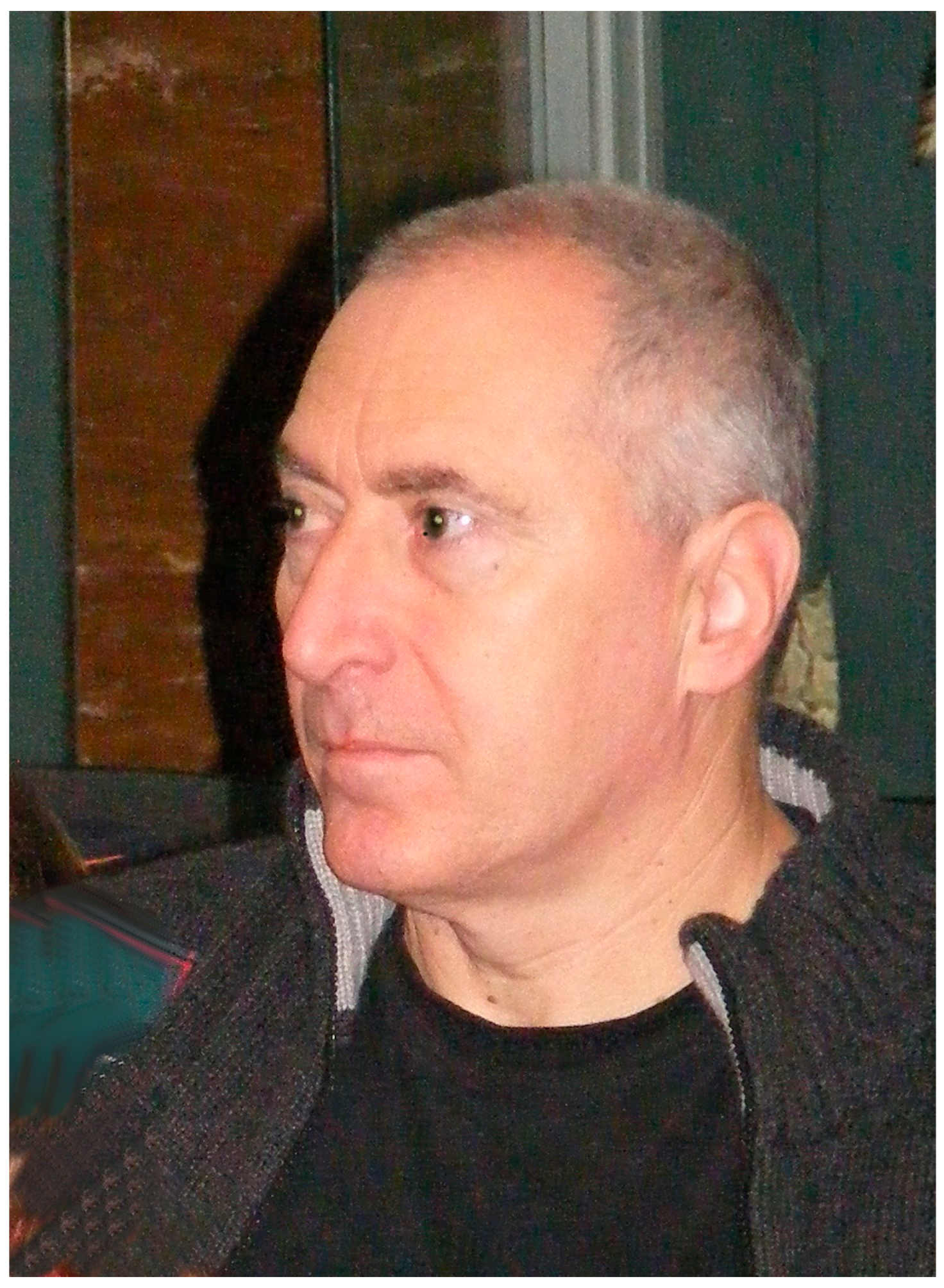
- Rafail Popov (1876–1940) (Figure 9).
Figure 9.
Rafail Popov (large mammals). Photo: https://betatest.bgdnes.bg/neveroyatni-istorii/article/15157356 (accessed on 4 December 2025).
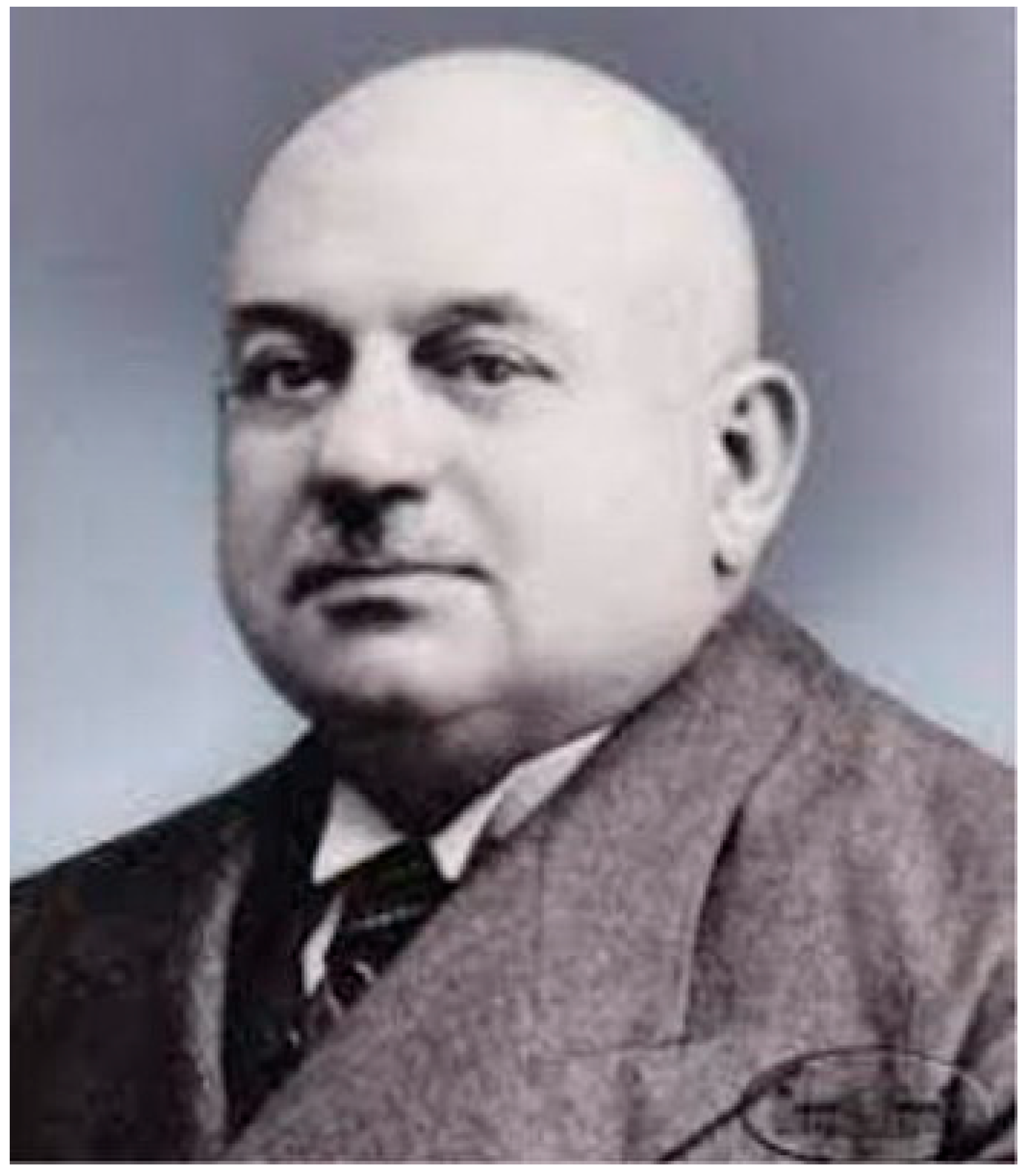
- Stefan Ivanov (1908–1983).
- Stella Nikolova (Figure 10).
Figure 10.
Stella Nikolova. Ca. 2022 (large mammals).

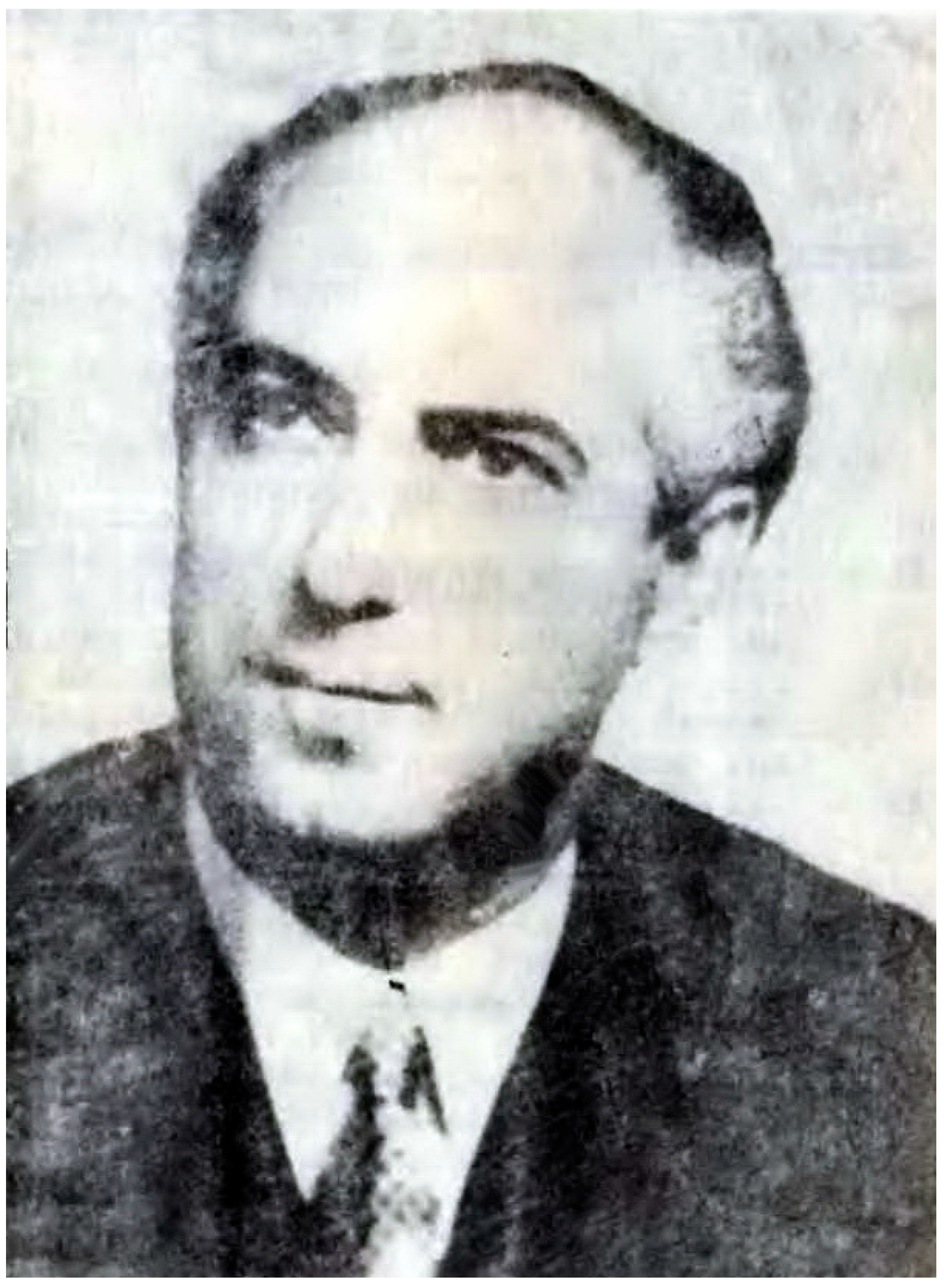
- Vasil Vasilev (1929–1982) (Figure 11).
Figure 11.
Vasil Vasilev. Ca. 1985 (domestic mammals). Photo: After [15].
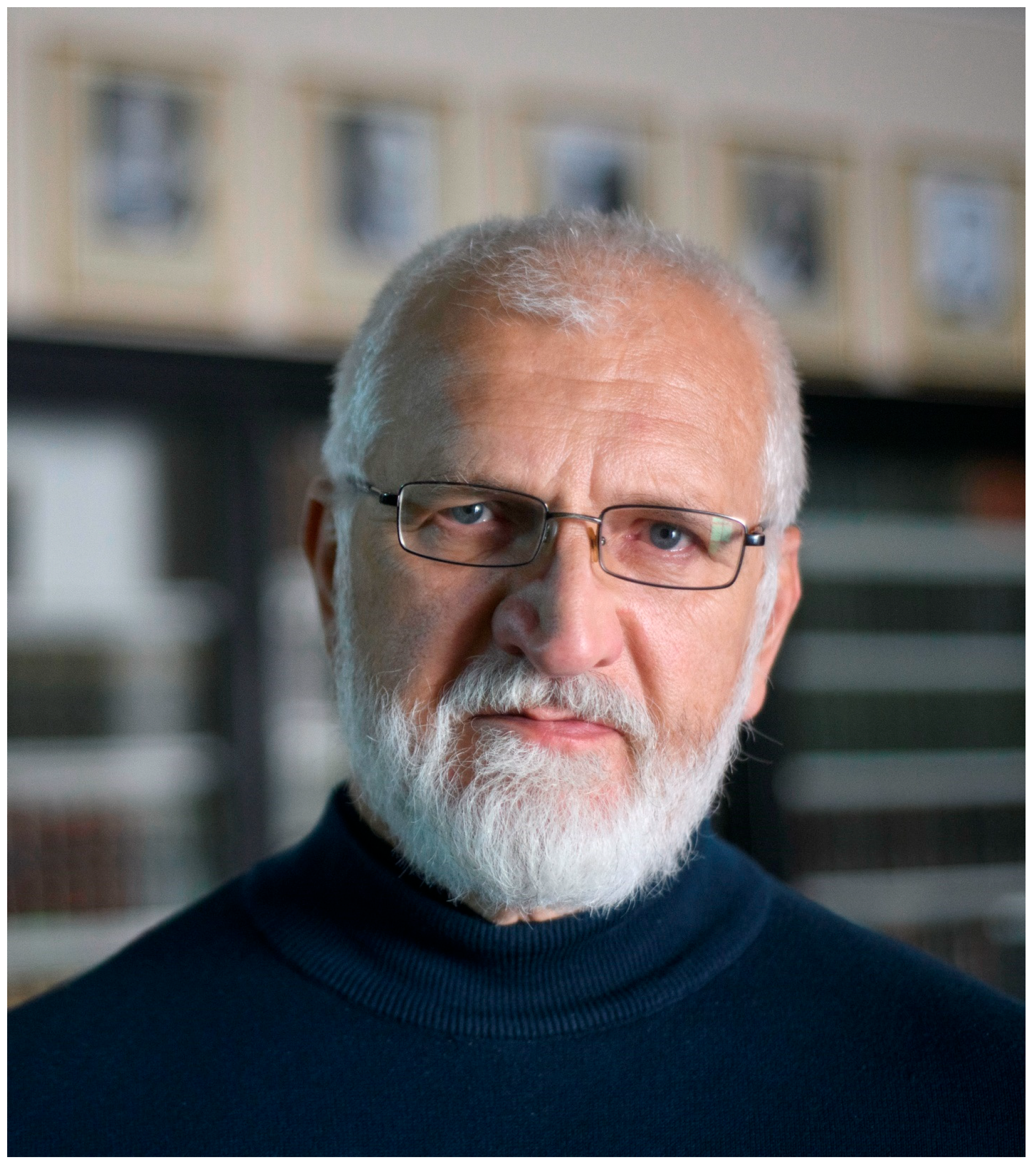
- Zlatozar Boev (Figure 12).
Figure 12.
Zlatozar Boev. 22 October 2021 (birds, mammals). Photo: D. Kashavelov.
Funding
This research received no external funding and the APC was funded by MDPI.
Acknowledgments
The author thanks the three anonymous reviewers for their helpful corrections and recommendations to the previous version of the manuscript.
Conflicts of Interest
The authors declare no conflict of interest.
References
- Popov, R. Contribution to the prehistory of Bulgaria. The caves in the Tarnovo Dervent, the village near Madara and the caves above Shumen. Sb. Za Nar. Umotv. 1904, 20, 1–27. (In Bulgarian) [Google Scholar]
- Ivanov, S. Les animaux domestiques et les animaux sauvages de la citadelle du village de Popina, région de Silistra. In The Slavic-Bulgarian Settlement Near the Village of Popina, Silistra Region; Vazharova, Z., Ed.; Bulgarian Academy of Sciences: Sofia, Bulgaria, 1956; pp. 69–95, (In Bulgarian, French summary). [Google Scholar]
- Stanchev, S.; Ivanov, S. The Necropolis Near Novi Pazar; Bulgarian Academy of Sciences: Sofia, Bulgaria, 1958; 232p. (In Bulgarian) [Google Scholar]
- Ivanov, S. Die Fleischnahrung der Bewohner am sudlisher Stadttor von Preslav. Bull. 1′Inst. Archeol. 1959, 22, 209–221. [Google Scholar]
- Boev, Z. Ornithoarchaeology in Bulgaria: Development and results. Archaeol. Bulg. 1997, I, 71–80. [Google Scholar]
- Nikolova, S. The archaeozoological research of medieval complexes in Bulgaria—State of studies and trends. Bulg. E-J. Arch. Suppl. 2024, 11, 139–157, (In Bulgarian, English summary). [Google Scholar]
- Papalezov, A. Bulgaria Has 400,000 Archaeological Sites, Encroachments on Cultural Heritage Are Decreasing. Available online: https://www.actualno.com/society/bylgarija-ima-400-000-arheologicheski-obekta-posegatelstvata-vyrhu-kulturnotonasledstvo-namaljavat-news_628697.html (accessed on 3 October 2025). (In Bulgarian)
- Popov, R. Contribution to the prehistory of Bulgaria. The Bakadzhi mound near the village of Salmanovo (Shumen region). Period. Spis. 1908, 69, 641–669. (In Bulgarian) [Google Scholar]
- Popov, R. Kodzha-Dermenskita Mound. Contribution to the Prehistory of Bulgaria. Materials from the Excavations in 1907. Period. Spis. 1909, 21, 503–562 +26 plts. [Google Scholar]
- Ribarov, G. Donnèes nouvelles pour la faune de la ville antique Kabile. Bull. Mus. Bulg. Sud-Est. 1982, 6, 31–41, (In Bulgarian, French summary). [Google Scholar]
- Ribarov, G. Snails and mussels in the life of ancient people. Prir. I Znanie 1986, 10, 10–11. (In Bulgarian) [Google Scholar]
- Ribarov, G. Investigation of the Mollusca remains from archaeological sites in South-Eastern Bulgaria. Interdiscipl. Izsledv. 1990, 12, 66–82, (In Bulgarian, English summary). [Google Scholar]
- Stoïanov, I. La grotte „Toplia” près du la village de Goliama-Jéliazna. Trav. Soc. Bulg. Sci. Natur. 1904, 2, 103–172, (In Bulgarian, French summary). [Google Scholar]
- Zhalov, A. Almanac of Bulgarian Speleology; Bulgarian Federation of Speleology: Sofia, Bulgaria, 2009; 141p, ISBN 978-954-8827-06-5. [Google Scholar]
- Vasilev, V. Investigation of the fauna from the settlement hill Ovcharovo. Interdiscip. Izsledv. 1985, 13, 200. [Google Scholar]
- Ribarov, G. La faune de Cabyle (I-er millénaire av. n. ère—VI s. de n. ère) d’apres les restes d’animaux sauvages et domestiques. In Kabile, 2; Velkov, V., Ed.; Bulgarian Academy of Sciences: Sofia, Bulgaria, 1991; pp. 156–167. [Google Scholar]
- Boev, Z.; Manev, A.; Harizanov, A.; Dedov, I. Archaeozoological material from the Late Antique fortified settlement near the modern-day town of Dimovo, northwestern Bulgaria. Bulg. E-J. Arch. 2024, 14, 217–233. [Google Scholar]
- Boev, Z. Late Antiquity (3-5 century A.D.) Fauna from Building Excavations on Exarch Joseph Street (Sofia City, Bulgaria. Bull. Nat. Hist. Mus.–Plovdiv. 2019, 4, 1–8. [Google Scholar]
- Boev, Z. Animal remains from the Monastery of Chargubilya Mostich in Veliki Preslav (10-12th c. AD)—NE Bulgaria. ZooNotes 2025, 255, 1–4. [Google Scholar]
- Ivkovska, A. Analysis of the Bone Remains of Wild and Domesctic Animals from the Dwellings (Horizons I-IV) in the Early Neolithic Settlement Slatina—Sofia. Master Thesis, Sofia University “St. Kliment Ohridski”, Sofia, Bulgaria, 2008; pp. 1–72+48. (In Bulgarian) [Google Scholar]
- Spassov, N.; Iliev, N. Animal remains from the Early Neolithic settlement near Kapitan-Dimitrievo village (Pazardzhik Region). Unpublished work, National Museum of Natural Histort, BAS. 2015.
- Iliev, N.; Boev, Z.; Spassov, N. Restes osseux d’annimaux de la villa de l’epoque antique basse et de la localité de l’epoque haute byzantine dans le quartier Bela Voda, district de Pernik. Arheologiya 1992, 1, 44–53, (In Bulgarian, French summary). [Google Scholar]
- Iliev, N.; Boev, Z.; Spassov, N. Ossements d’animaux de la ville romaine de Ratiaria (IIe- IVe s.) près d’Arcar, village de la region de Montana. Arheologiya 1993, 4, 52–59, (In Bulgarian, French summary). [Google Scholar]
- Karastoyanova, N. Animals in Ritual Context. Archaeozoological Study of Excavated Structure from the Late Neolithic Ritual Complex Near Sarnevo, Stara Zagora. Master’s Thesis, New Bulgarian University, Sofia, Bulgaria, 2011; 151p. [Google Scholar]
- Vasilev, V. Animal husbandry and hunting in the life of the population from the medieval settlement near Durankulak. In Durankulak; Todorova, H., Ed.; Sofia. Publ. House of BAS: Sofia, Bulgaria, 1989; pp. 223–242. (In Bulgarian) [Google Scholar]
- Ninov, L. Archaeozoological studies of ancient sites. In Archeologicheski Otkritiya i Razkopki Prez 2012; Gurova, M., Ed.; BAS, National Archaeological Institute with Museum; Kolbis AD Publishing House: Sofia, Bulgaria, 2013; pp. 345–346. (In Bulgarian) [Google Scholar]
- Venelinova, S.; Gurova, M.; Karastoyanova, N. Archaeological excavations of the Chalcolithic settlement mound near the Ivanovo village, Shumen Region. In Archeologicheski Otkritiya i Razkopki Prez 2012; Gurova, M., Ed.; National Archaeological Institute with Museum. BAS. Kolbis AD Publishing House: Sofia, Bulgaria, 2013; pp. 69–71. (In Bulgarian) [Google Scholar]
- Beech, M. The Mollusca. In Nicopolis ad Istrum. A Late Roman and Early Byzantine City. The Finds and the Biological Remains; Poulter, A.G., Ed.; Oxbow Books; The Society of Antiquaries of London: London, UK, 2007; pp. 293–297+307–318. ISBN 978-184217-182-0 1-84217-182-8. ISSN 0953-7163. [Google Scholar]
- Karapetkova, M.; Zhivkov, M.L. Fish in Bulgaria; Gea Libris: Sofia, Bulgaria, 1995; 248p, ISBN 954-8232-21-9. (In Bulgarian) [Google Scholar]
- Irving, B. The Pectoral Fin Spines of European Catfish Siluris glanis; Cultural Artifacts or Food Remains? Intern. J. Osteoarch. 1992, 2, 189–197. [Google Scholar] [CrossRef] [Scilit]
- Irving, B. Problems in the identification of fish domestication: Evidence from the site of Nicopolis, Bulgaria. In Fish and the Archaeology: Papers from the 7th Ichthyoarchaeology Conference, Schlezwig, Gemany 1991; Heincich, D., Ed.; Offa: Neumünster, Germany, 1993; Volume 51, pp. 374–378. [Google Scholar]
- Beech, M.J.; Irving, B. The fish remains. In Nicopolis ad Istrum. A Late Roman and Early Byzantine City. The Finds and the Biological Remains; Poulter, A.G., Ed.; Oxbow Books; The Society of Antiquaries of London: London, UK, 2007; pp. 224–241+307–318. [Google Scholar]
- Atanasova, T. Bones of Aurochs, Camels and Turuks Were Found During the Excavations at Rusokastro. Available online: https://kameno.bg/bg/article/kosti-ot-zubur-kamila-turuk-sa-otkriti-pri-razkopkite-rusokastro-1973 (accessed on 3 October 2025). (In Bulgarian)
- Ribarov, G. Domestic and wild animals of the medieval fortress Rusokastro, Burgas Region. Bull. Burgas Mus. 2021, 7, 290–311, (In Bulgarian, English summary). [Google Scholar]
- Ribarov, G.; Boev, Z. Investigation of the animal remains from the late Iron age Yassa-tepe near Yambol. Interdiscip. Izsledv. 1990, 17, 83–90, (In Bulgarian, English summary). [Google Scholar]
- Spassov, N.; Iliev, N. Animal remains from the submerged late Eneolithic—Early Bronze Age settlements in Sozopol (South Bulgarian Black Sea Coast). In Proceedings of the International Symposium Thracia Pontica VI, Sozopol, Bulgaria, 18–24 September 1994; pp. 287–314. [Google Scholar]
- Boev, Z. Subfossil Vertebrate Fauna from Forum Serdica (Sofia, Bulgaria), 16–18th Century. Acta Zool. Bulg. 2016, 68, 415–424. [Google Scholar]
- Ribarov, G. Study of the Neolithic animal remains from the settlement near the village Maluk Preslavets, District of Silistra. Dobrudzha 1992, 9, 85–90, (In Bulgarian, French summary). [Google Scholar]
- Boev, Z. New data on the subfossil fauna from “Forum Serdica” (Sofia City, Bulgaria; 3-19th century A. D.). Hist. Nat. Bulg. 2017, 24, 179–186. [Google Scholar]
- Boev, Z. New Data on the Fauna of the Late Antiquity Northern Fortification Walls of Serdica (3rd–6th century A.D.) from Building Excavations on Exarch Joseph Street (Sofia, Bulgaria). Bull. Nat. Hist. Mus.–Plovdiv. 2020, 5, 15–23. [Google Scholar]
- Spassov, N.; N Karastoyanova, S. Chohadzhiev The remains of wild and domestic animals from the Late Chalcolithic tell settlement of Hotnitsa (Northern Bulgaria). Archaeol. Bulg. 2015, 19, 1–21. [Google Scholar]
- Ribarov, G. Fishing traditions of inhabitants of ancient Cabyle and its hinterland. In Studies on Settlement Life in Ancient Thrace, Proceedings of the 3rd International Symposium “Cabyle”, Jambol, Bulgaria, 17–21 May 1993; Draganov, D., Ed.; Historical Museum: Jambol, Bulgaria, 1994; pp. 421–425. [Google Scholar]
- Boev, Z. Fossil and subfossil record of vertebrate animals (Vertebrata, J.-B. Lamarck, 1801) along the Western Black Sea Coast (Bulgaria). Acta Zool. Bulg. 2018, (Suppl. S11), 105–110. [Google Scholar]
- Boev, Z. Animal remains of the Late Antique fortified site (4th-6th century AD) near Shipot village (Vidin Region, NW Bulgaria. Bull. Nat. Hist. Mus.–Plovdiv. 2022, 7, 5–11. [Google Scholar]
- Boev, Z. Animal remains of the medieval settlement near Petarch village (Sofia Province, CW Bulgaria). ZooNotes 2021, 184, 1–4. [Google Scholar]
- Boev, Z.; Popgeorgiev, G. Animal remains of the medieval settlement (9th–10th century A. D.) near Nedan village (Veliko Tarnovo Region, CN Bulgaria). ZooNotes 2021, 170, 1–4. [Google Scholar]
- Ivanov, B.; Iankov, P.; Boev, Z.; Georgiev, D.; Profirov, L.; Dimitrov, M. List of the Birds Recorded in Bulgaria Towards 31 December 2014 (Bulgarian List) (1–23). Available online: https://bunarco.org/bg/information.html (accessed on 3 October 2025). (In Bulgarian)
- Boev, Z. Neogene and Quaternary Birds (Aves) from Bulgaria. Ph.D. Thesis, Bulgarian Academy of Sciences, National Museum of Natural History, Sofia, Bulgaria, 1999. Available online: https://www.researchgate.net/publication/285176205_Neogene_and_Quaternary_birds_Aves_from_Bulgaria (accessed on 3 October 2025). (In Bulgarian)
- Boev, Z. Birds and People in Medieval Bulgaria—A Review of the Subfossil Record of Birds During the First and Second Bulgarian Empires. Quaternary 2025, 8, 36. [Google Scholar] [CrossRef] [Scilit]
- Boev, Z. Waterfowl in Ancient Bulgaria. In Paleoecologia e Arqueologia II; Queiroga, F., Dinis, A.P., Eds.; Universidade do Minho: Vila Nova de Famalicao, Portugal, 1991; pp. 111–120. [Google Scholar]
- Boev, Z. Archaeo-ornithology and the synanthropisation of birds: A case study for Bulgaria. In: Archaeornithology: Birds and the Archaeological Record. Proceedings of the First Meeting of the ICAZ Bird Working Group. Madrid. October 1992. Archaeofauna 1993, 2, 145–153. [Google Scholar] [CrossRef] [Scilit]
- Boev, Z. The Gamefowl in Bulgaria in the Last 8000 Years. In Proceedings of the Abstracts Intern. Union of Game Biologists, XXII Congress “The Game and the Man”, Sofia, Bulgaria, 4–8 September 1995; p. 54. [Google Scholar]
- Boev, Z. Birds from some medieval settlements in Bulgaria. Hist. Nat. Bulg. 1995, 5, 61–67, (In Bulgarian, English summary). [Google Scholar]
- Boev, Z. Raptors and Owls (Aves: Falconiformes et Strigiformes) in the Archaeological Record of Bulgaria. Hist. Nat. Bulg. 1996, 6, 83–92. [Google Scholar]
- Boev, Z. Birds over the mammoth’s head in Bulgaria. In Proceedings of the World of Elephants, Proceedings of the 1st International Congress, Rome, Italy, 16–20 October 2001; Cavaretta, G., Gioia, P., Mussi, M., Palombo, R., Eds.; Consiglio Nazionale delle Ricerche: Rome, Italy, 2001; pp. 180–186. [Google Scholar]
- Boev, Z. Tetraonidae Vigors, 1825 (Galliformes—Aves) in the Neogene-Quaternary record of Bulgaria and the origin and evolution of the family. In: Proceedings of the 4th Meeting of the ICAZ Bird Working Group, Krakow, Poland, 11–15 September 2001. Acta Zool. Cracov. 2002, 45, 263–282. [Google Scholar]
- Boev, Z. Distribution of the Little Bustard (Tetrax tetrax /Linnaeus, 1758/) and the Great Bustard (Otis tarda Linnaeus, 1758) (Aves: Otididae Gray, 1845) in Bulgaria during the Late Pleistocene and the Holocene. Annu. Sofia Univ. “St. Kliment Ochridski” Fac. Biol. Book 1 Zool. 2003, 93–94, 41–47. [Google Scholar]
- Boev, Z. Late Holocene avian remains from the localities of the Roman period in Bulgaria. Hist. Nat. Bulg. 2006, 17, 109–123. [Google Scholar]
- Boev, Z. Fossil and subfossil records of Shrikes (Laniidae Swainson, 1824—Passeriformes Linnaeus, 1758) in Bulgaria. Hist. Nat. Bulg. 2020, 41, 77–81. [Google Scholar] [CrossRef] [Scilit]
- Boev, Z. Owls (Strigiformes Wagler, 1830) in Bulgaria: Past and Present (A Review of the Fossil Record and Present Status of Recorded Species). In Owls-Clever Survivors; Mikkola, H.J., Ed.; IntechOpen: London, UK, 2022; pp. 1–13. Available online: https://www.intechopen.com/online-first/83799 (accessed on 27 September 2022).
- Boev, Z. Quaternary record of Eagles (Aquilinae Gadow, 1893–Accipitriformes Vieillot, 1816) and Falcons (Falconidae Leach, 1819–Falconiformes Sharpe, 1874) in Bulgaria. Acta Zool. Bulg. 2024, 76, 561–569. [Google Scholar]
- Boev, Z. Quaternary history of vultures (Accipitridae Vieiilot, 1916) in Bulgaria—fossil and subfossil records. Larus 2024, 59, 105–116. [Google Scholar] [CrossRef] [Scilit]
- Boev, Z. The Black Grouse, Tetrao tetrix (L., 1758) (Tetraonidae, Aves), a disappeared species in Bulgaria (Paleolithic and Neolithic records). Anthropozoologica 1997, 25–26, 643–646. [Google Scholar]
- Plachiyski, D.; Popgeorgiev, G.; Avramov, S.; Boev, Z. The Balkan Capercaillie Tetrao urogallus rudolfi Dombrowski, 1912 (Galliformes: Phasianidae): Distribution History and Current Status in Bulgaria. Acta Zool. Bulg. 2018, 70, 101–111. [Google Scholar]
- Boev, Z. Holocene distribution of Common Crane (Grus grus (Linnaeus, 1758)) (Gruidae Vigors, 1825) in Bulgaria. Acta Zool. Bulg. 2023, 75, 439–443. [Google Scholar]
- Boev, Z. Past distribution of the White-tailed eagle (Haliaeetus albicilla (Linnaeus, 1758)) in Bulgaria—subfossil record. Comptes Rendus L’Acad. Bulg. Sci. 2024, 77, 669–674. [Google Scholar]
- Bochenski, Z. Excavations in the Bacho Kiro Cave (Bulgaria). Final Report; Kozlowski, J., Ed.; PWN Polish Scientific Publishers: Warsaw, Poland, 1982; pp. 31–38. ISBN 83-01-01572-1. [Google Scholar]
- Chrzanowska, W.; Molenda, O. Szcatki Kostne ssakow ze stanowiska Novae (Bulgaria). Roczniki Akademii Rolniczej w Poznaniu, CXLV. Archaeozoologia 1983, 8, 3–19. [Google Scholar]
- Waluszewska-Bubien, A.; Krupska, A. Szcatki kostne ptakow ze Stanowiska Novae (Bulgaria). Roczn. Akad. Pozn. 1983, 145, 145–154. [Google Scholar]
- Schramm, Z. Zwierzece szczatki kostne. In Novae—Sektor Zachodni 1972; UAM–Poznan: Poznan, Poland, 1975; pp. 215–241. [Google Scholar]
- Schramm, Z. Zwierzece szczatki kostne. In Novae—Sektor Zachodni 1972; UAM–Poznan: Poznan, Poland, 1979; pp. 97–130. [Google Scholar]
- Parnicki-Pudelko St, A.B.; Biernacki, Z. Schramm. Novae-Sektor Zachodni 1984. Sprawozdanie tymczasowe z wykopalisk ekspedicji archeologicznej universitetu im. Adama Mickiewicza z Poznaniu. Archeologia 1987, 37, 131–158. [Google Scholar]
- Boev, Z. Late Pleistocene birds from the Kozarnika Cave (Montana District; NW Bulgaria). In Karst. Vol. I, Proceedings of the First National Conference on Environment and Cultural Heritage in Karst. Sofia, Bulgaria, 10–11 November 2000; Delchev, P., Shanov, S., Benderev, A., Eds.; Earth and Man National Museum. Association of Environment and Cultural Heritage in Karst: Sofia, Bulgaria, 2001; pp. 113–128. [Google Scholar]
- Boev, Z. First proofs of the existence of the black grouse (Tetrao tetrix /L./) (Aves, Tetraonidae) in Bulgaria. Acta Zool. Bulg. 1988, 36, 72–77, (In Bulgarian, English summary). [Google Scholar]
- Boev, Z. First fossil record of the Snowy Owl Nyctea scandiaca (Linnaeus, 1758) (Aves: Strigidae) from Bulgaria. Hist. Nat. Bulg. 1998, 9, 79–86. [Google Scholar]
- Boev, Z.; Mikkola, H. First Pleistocene record of Great Grey Owl (Strix nebulosa Forster, 1772) in Bulgaria. Compt. l’Rend. Acad. Bulg. Sci. 2022, 75, 680–685. [Google Scholar] [CrossRef] [Scilit]
- Best, J.; Doherty, S.; Armit, I.; Boev, Z.; Büster, L.; Cunliffe, B.; Foster, A.; Frimet, B.; Hamilton-Dyer, S.; Higham, T.; et al. Redefining the timing and circumstances of the chicken’s introduction to Europe and north-west Africa. Antiquity 2022, 96, 868–882. [Google Scholar] [CrossRef] [Scilit]
- Boev, Z.; Tsoukala, E. Late Pleistocene and Earliest Holocene avifauna from the Loutra Almopias Cave (Macedonia, Greece). Hist. Nat. Bulg. 2019, 40, 1–31. [Google Scholar] [CrossRef] [Scilit]
- Boev, Z.; Milošević, S. Late Pleistocene avifauna of the Pešturina Cave (Nišava District, SE Serbia) and its implications for Late Pleistocene refugia on the Central Balkans. Bull. Nat. Hist. Mus.-Plovdiv. 2020, 5, 1–14. [Google Scholar]
- Milošević; St Boev, Z.; Dimitrijevic, V.; Mihailovic, D. Early fowlers of Europe: Evidence for bird exploitation during MIS 8/7 from Velika Balanica cave (Serbia). Quat. Internat. 2025, 738, 109868. [Google Scholar] [CrossRef] [Scilit]
- Delpech, F.; Guadelli, J.-L. Quelques aspects de l’archeozoologie d’apres les faunes de la grotte de Temnata a Karloukovo (Bulgarie du Nord). Hist. Nat. Bulg. 1991, 3, 103–110. [Google Scholar]
- Guadelli, J.-L.; Delpech, F.; Guadelli, A.; Miteva, V. Étude de la faune des niveaux gravettiens de la grotte (Bulgarie du Nord): Résultats préliminaires. Archeol. Bulg. 1999, III/2, 1–14. [Google Scholar]
- Makowiecki, D. Animal economy in the microregion of Novae in the light of its archaeozoological data. In Der Limes an der Unteren Donau von Diokletian bis Heraklios. Vortrage der Intemationalen Konferenz. Svistov, Bulgarien (15 September 1998); Von Btilow, G., Milceva, A., Eds.; Nous Publishers Ltd.: Sofia, Bulgaria, 1999; pp. 131–139. [Google Scholar]
- Makowiecki, D.; Schramm, Z. Preliminary results of studies on archaeozoological material from excavations in Novae (season 1992). In Novae. Studies and Materials; Bicrnacki, A.B., Ed.; Archeo Books: Kraków, Poland, 1995; Volume 1, pp. 71–81. [Google Scholar]
- Manhart, H. Die vorgeschichtliche Tierwelt von Koprivec und Durankulak und anderen prahistorischen Fundplatzen in Bulgaien aufgrund von Knochenfunden aus archaologischen Ausgrabungen. Dissertation der Fakultät für Biologie der Ludwig-Maximilians-Universität München. Doc. Naturae 1998, 116, 1–353. [Google Scholar]
- Beech, M. The economy and environment of a Roman, Late-Roman and Early Byzantine town in North-Central Bulgaria: The mammalian fauna from Nicopolis-ad-Istrum. Anthropozoologica 1997, 25–26, 619–630. [Google Scholar]
- Beech, M. The Environmental Archaeology Research Programme at Nicopolis: Methodology and results. Proc. Br. Acad. 2007, 141, 219–248. [Google Scholar]
- Beech, M. The large mammal and reptile bones. In Nicopolis ad Istrum. A Late Roman and Early Byzantine City. The Finds and the Biological Remains; Poulter, A.G., Ed.; Oxbow Books; The Society of Antiquaries of London: London, UK, 2007; pp. 154–197+307–318. [Google Scholar]
- Markov, G. Les mamifères quaternaires en Bulgarie. Bull. L’inst. Zool. L’acad. Bulg. Sci. 1951, 1, 99–199, (In Bulgarian, French summary). [Google Scholar]
- Markov, G. Beitrag zur geschichte der säugetiere in Bulgarien (Material aus Seuthopolis). Bull. L’inst. Zool. L’acad. Bulg. Sci. 1958, 7, 133–161, (In Bulgarian, German summary). [Google Scholar]
- Ribarov, G. Archeozoological material from the Eneolithic and Early Bronze settlement at Sozopol. In Actes du Symposium International Thracia Pontica-5. 7–12 October 1991. Sozopol, Resumes; Historical Museum: Sozopol, Bulgaria, 1994; pp. 51–56. [Google Scholar]
- Boev, Z. Past distribution of Monachus monachus in Bulgaria—subfossil and historical records (Carnivora: Phocidae). Lynx N. S. 2018, 49, 163–176. [Google Scholar] [CrossRef] [Scilit]
- Markov, G. Beitrage zur untersuchung des hohlenbaren (Ursus spelaeus Blumenb.) in Bulgarien. Bull. L’inst. Zool. L’acad. Bulg. Sci. 1963, 14, 5–26. [Google Scholar]
- Boev, N.; Boev, Z. Aurochs (Bos Primigenius Bojanos, 1827) (Artiodactyla-Mammalia) in the Nature and Culture of Bulgaria. In ZooNotes; Supplement 5; Plovdiv University Press “Paisii Hilendarski”: Plovdivv, Bulgaria, 2018; 120p, ISSN 1313-9916. [Google Scholar]
- Boev, Z. Past distribution of Camelus bactrianus and Camelus dromedarius in Bulgaria: Subfossil record (Artiodactyla: Camelidae). Lynx N.S. 2019, 50, 29–36. [Google Scholar]
- Boev, Z.; Spassov, N. Past distribution of Castor fiber in Bulgaria: Fossil, subfossil and historical records (Rodentia: Castoridae). Lynx N. S. 2019, 50, 37–49. [Google Scholar]
- Boev, Z. Late Pleistocene Crocuta crocuta spelaea in Bulgaria: Distribution and history of research (Carnivora: Hyaenidae). Lynx N. S. 2020, 51, 19–29. [Google Scholar] [CrossRef] [Scilit]
- Karastoyanova, N.; Gorczyk, J.; Spassov, N. 2020. The natural history of the fallow deer, Dama dama (Linnaeus, 1758) in Bulgaria in prehistory and new evidence for the existence of an autochthonous Holocene population in the Balkans. Intern. J. Osteoarch. 2020, 30, 616–628. [Google Scholar] [CrossRef] [Scilit]
- Boev, Z. European bison (Bison bonasus Linnaeus, 1758) in Bulgaria: Fossil and historical records, distribution, and disappearance. J. Wildl. Biodiv. 2022, 6, 92–99. [Google Scholar] [CrossRef]
- Boev, Z. Past Distribution of the Red Deer (Cervus elaphus Linnaeus, 1758) (Cervidae, Mammalia) in Bulgaria. Bull. Nat. Hist. Mus.–Plovdiv 2022, 7, 27–48. [Google Scholar]
- Boev, Z. Quaternary history of the European Badger Meles meles (Linnaeus, 1758) in Bulgaria. Lynx N. S. 2024, 55, 133–142. [Google Scholar] [CrossRef] [Scilit]
- Nedyalkov, N.; Karastoyanova, N.; Raykov, I.; Manolova, M. Historical distribution of the Black rat (Rattus rattus) in Bulgaria. In Proceedings of the 2nd ICAZ Medieval Period Working Group Meeting, Sofia, Bulgaria, 2–6 October 2024; p. 56. [Google Scholar]
- Spassov, N.; Raychev, D. Late Wurm Panthera pardus Remains from Bulgaria: The European fossil Leopards and the Question of the Probable Species Survival until the Holocene on the Balkans. Hist. Nat. Bulg. 1997, 7, 71–96. [Google Scholar]
- Ninov, L. Remains of a lion in the Bulgarian lands. Arheologiya BAS 1989, 2, 55–60. (In Bulgarian) [Google Scholar]
- Spassov, N. The southwesternmost distribution of the saiga in the Holocene of Europe: A Saiga tatarica find from an archaeological site in Bulgaria. In Saxa Loquuntur. Volume in Honour of the 65th Anniversary of Nikolai Sirakov; Gatsov, I., Guadelli, J.-L., Eds.; Avalon Publisher: Sofia, Bulgaria, 2010; pp. 317–322. [Google Scholar]
- Spassov, N.; Iliev, N. The animal bones from the prehistoric necropolis near Durankulak (NE Bulgaria) and the latest record of Equus hydruntinus Regalia. In Durankulak, Band II Die Prahistorischen Graberfelder. Teil 1; Todorova, H., Ed.; Deutsches Archaologisches Institut in Berlin: Sofia, Bulgaria, 2002; pp. 313–324. [Google Scholar]
- Boev, Z. The last Bos primigenius survived in Bulgaria (Cetartiodactyla: Bovidae). Lynx N. S. 2021, 52, 139–142. [Google Scholar] [CrossRef] [Scilit]
Disclaimer/Publisher’s Note: The statements, opinions and data contained in all publications are solely those of the individual author(s) and contributor(s) and not of MDPI and/or the editor(s). MDPI and/or the editor(s) disclaim responsibility for any injury to people or property resulting from any ideas, methods, instructions or products referred to in the content. |
© 2025 by the author. Licensee MDPI, Basel, Switzerland. This article is an open access article distributed under the terms and conditions of the Creative Commons Attribution (CC BY) license (https://creativecommons.org/licenses/by/4.0/).