
Speleothems from the Middle East: An Example of Water Limited Environments in the SISAL Database

 , , , and
Abstract
:1. Introduction
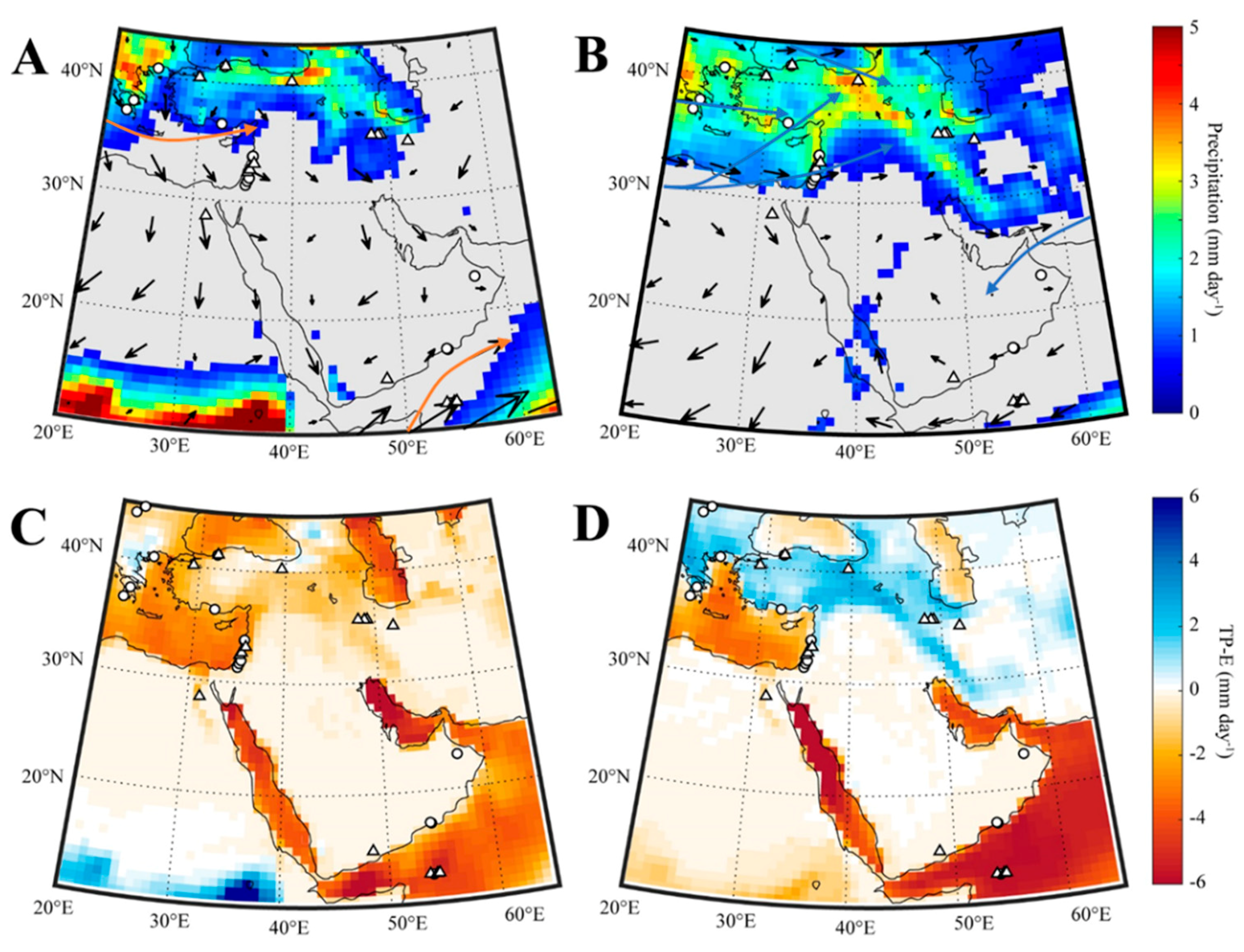
2. Climate of the Middle East
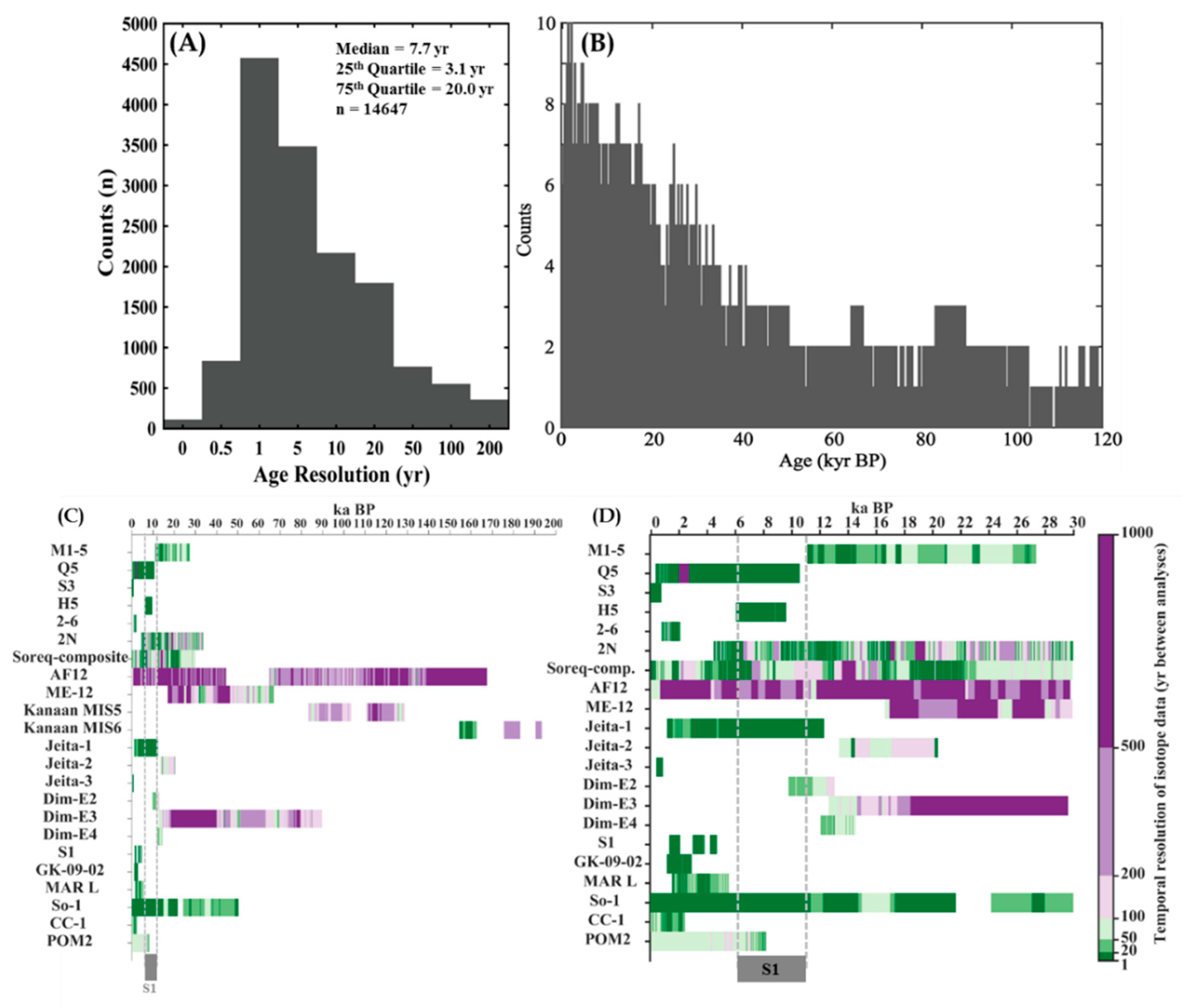
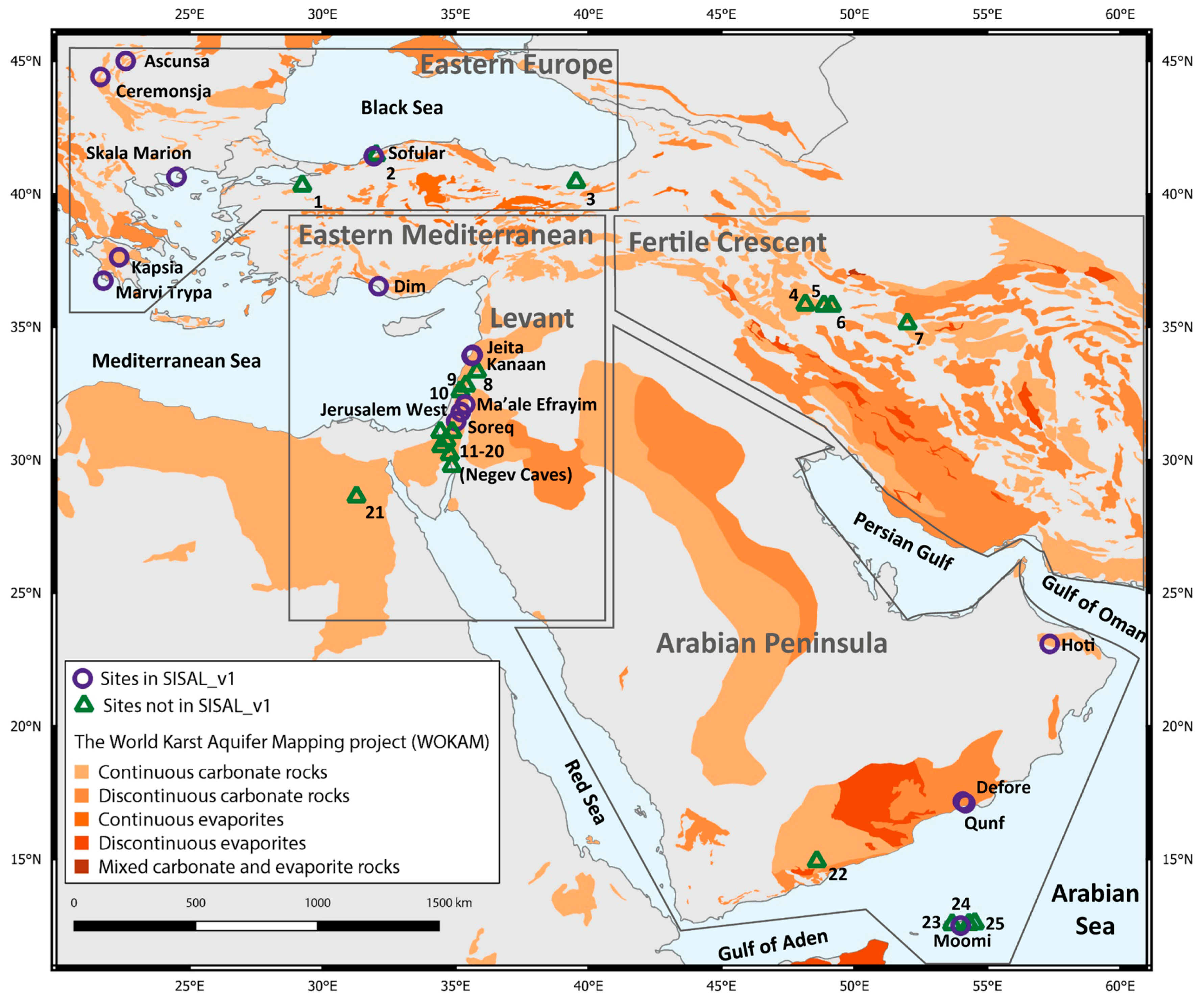
3. Spatial/Temporal Setting of Middle East Speleothems
4. SISAL_v1 Entities: Site-Specific Trends and Regional Interpretations
4.1. Controls on Speleothem δ18O
4.2. The Last Glacial Maximum, Deglaciation and the Transition into the Holocene (30 kyr BP to 12 kyr)
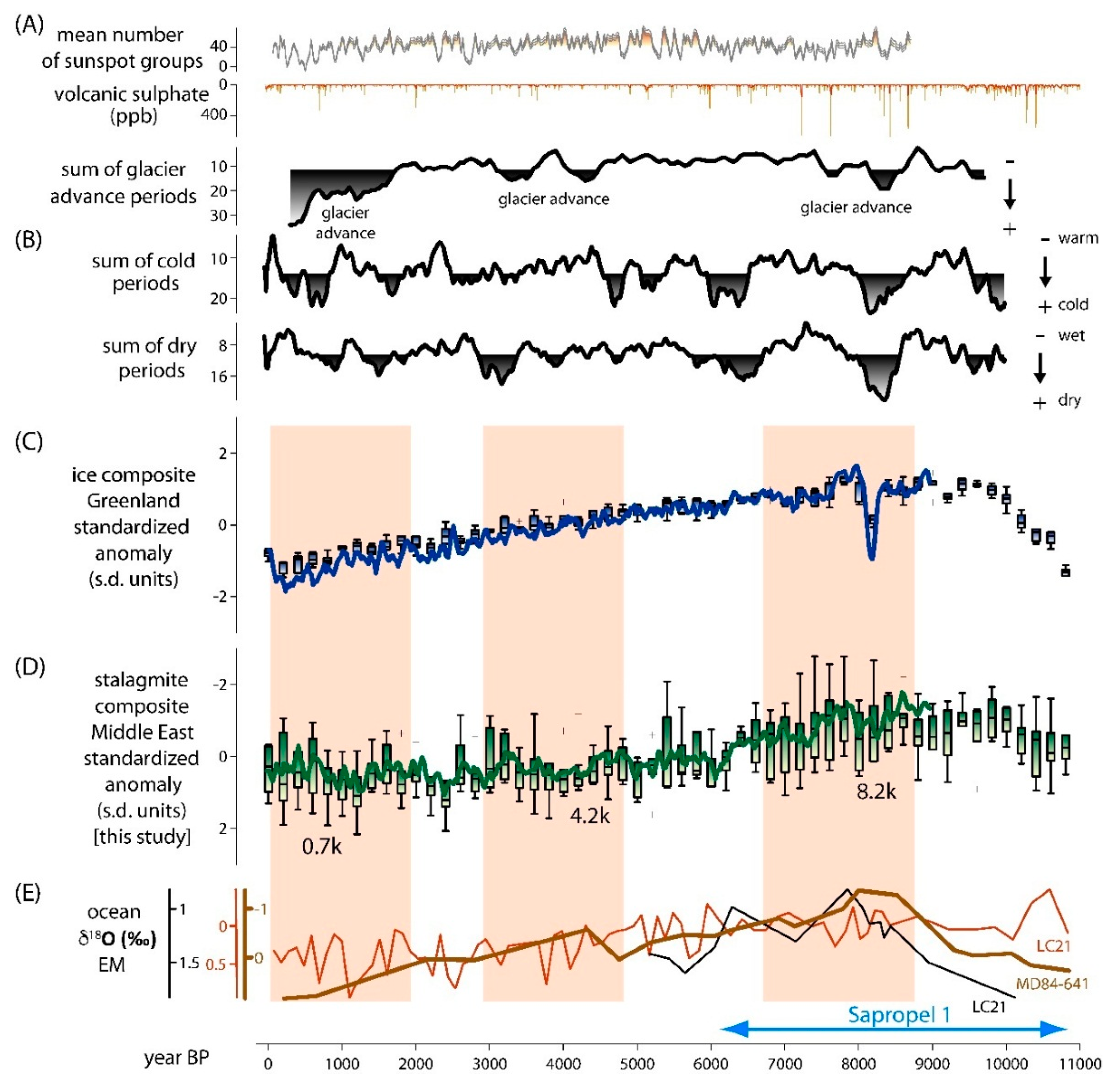
4.3. Holocene Climatic Events and Spatial Heterogeneity across the Middle East
5. Conclusions and Future of SISAL Project in the Middle East
5.1. Emphasis for Future Speleothem Research in the Middle East
5.2. The Importance of Fertile Crescent Speleothem Data
5.3. SISAL Outlook for the Middle East
Author Contributions
Funding
Acknowledgments
Conflicts of Interest
References
- Katrantsiotis, C.; Kylander, M.E.; Smittenberg, R.; Yamoah, K.K.A.; Hättestrand, M.; Avramidis, P.; Strandberg, N.A.; Norström, E. Eastern Mediterranean hydroclimate reconstruction over the last 3600 years based on sedimentary n-alkanes, their carbon and hydrogen isotope composition and XRF data from the Gialova Lagoon, SW Greece. Quat. Sci. Rev. 2018, 194, 77–93. [Google Scholar] [CrossRef]
- Lionello, P.; Abrantes, F.; Congedi, L.; Dulac, F.; Gacic, M.; Gomis, D.; Goodess, C.; Hoff, H.; Kutiel, H.; Luterbacher, J.; et al. Introduction: Mediterranean Climate – Background Information. In The Climate of the Mediterranean Region: From The Past to the Future; Lionello, P., Ed.; Elsevier: London, UK, 2012. [Google Scholar]
- Giorgi, F. Climate change hot-spots. Geophys. Res. Lett. 2006, 33, 1–4. [Google Scholar] [CrossRef]
- Giorgi, F.; Lionello, P. Climate change projections for the Mediterranean region. Glob. Planet. Chang. 2008, 63, 90–104. [Google Scholar] [CrossRef]
- Lionello, P.; Scarascia, L. The relation between climate change in the Mediterranean region and global warming. Reg. Environ. Chang. 2018, 18, 1481–1493. [Google Scholar] [CrossRef]
- Vaks, A.; Bar-Matthews, M.; Ayalon, A.; Matthews, A.; Halicz, L.; Frumkin, A. Desert speleothems reveal climatic window for African exodus of early modern humans. Geology 2007, 35, 831. [Google Scholar] [CrossRef]
- Rosen, A.M. Civilizing Climate: Social Responses to Climate Change in the Ancient Near East; Altamira Press: Plymouth, UK, 2007; ISBN 978-07591-0494-5. [Google Scholar]
- Berger, J.F.; Lespez, L.; Kuzucuoğlu, C.; Glais, A.; Hourani, F.; Barra, A.; Guilaine, J. Interactions between climate change and human activities during the Early to Mid Holocene in the East Mediterranean basins. Clim. Past 2016, 12, 1847–1877. [Google Scholar]
- Schilman, B.; Bar-Matthews, M.; Almogi-Labin, A.; Luz, B. Global climate instability reflected by Eastern Mediterranean marine records during the late Holocene. Palaeogeogr. Palaeoclimatol. Palaeoecol. 2001, 176, 157–176. [Google Scholar] [CrossRef]
- Langgut, D.; Almogi-Labin, A.; Bar-Matthews, M.; Pickarski, N.; Weinstein-Evron, M. Evidence for a humid interval at ∼56–44 ka in the Levant and its potential link to modern humans dispersal out of Africa. J. Hum. Evol. 2018, 124, 75–90. [Google Scholar] [CrossRef]
- Brierley, C.M.; Manning, K.; Maslin, M. Pastoralism may have delayed the end of the green Sahara. Nat. Commun. 2018, 9, 4018. [Google Scholar] [CrossRef] [PubMed]
- Weiss, H.; Bradley, R.S. What drives societal collapse? Science 2001, 291, 609–610. [Google Scholar] [CrossRef]
- Bar-Matthews, M.; Ayalon, A. Climatic Conditions in the Eastern Mediterranean During the Last Glacial (60–10 ky) and Their Relations to the Upper Palaeolithic in the Levant as inferred from Oxygen and Carbon Isotope Systematics of Cave Deposits. In More Than Meets the Eye: Studies on Upper Palaeolithic Diversity in the Near East; Goring-Morris, N.A., Belfer-Cohen, A., Eds.; Oxbow: Oxford, UK, 2003; pp. 13–18. [Google Scholar]
- Orland, I.J.; Bar-Matthews, M.; Kita, N.T.; Ayalon, A.; Matthews, A.; Valley, J.W. Climate deterioration in the Eastern Mediterranean as revealed by ion microprobe analysis of a speleothem that grew from 2.2 to 0.9 ka in Soreq Cave, Israel. Quat. Res. 2009, 71, 27–35. [Google Scholar] [CrossRef]
- Rosenberg, T.M.; Preusser, F.; Fleitmann, D.; Schwalb, A.; Penkman, K.E.H.; Schmid, T.W.; Al-Shanti, M.A.; Kadi, K.; Matter, A. Humid periods in southern Arabia: Windows of opportunity for modern human dispersal. Geology 2011, 39, 1115–1118. [Google Scholar] [CrossRef]
- Fleitmann, D.; Burns, S.J.; Pekala, M.; Mangini, A.; Al-Subbary, A.A.; Al-Aowah, M.; Kramers, J.; Matter, A. Holocene and Pleistocene pluvial periods in Yemen, southern Arabia. Quat. Sci. Rev. 2011, 30, 783–787. [Google Scholar] [CrossRef]
- Vaks, A.; Woodhead, J.D.; Bar-Matthews, M.; Ayalon, A.; Cliff, R.A.; Zilberman, T.; Matthews, A.; Frumkin, A. Pliocene–Pleistocene climate of the northern margin of Saharan–Arabian Desert recorded in speleothems from the Negev Desert, Israel. Earth Planet. Sci. Lett. 2013, 368, 88–100. [Google Scholar] [CrossRef]
- Vaks, A.; Bar-Matthews, M.; Ayalon, A.; Schilman, B.; Gilmour, M.A.; Hawkesworth, C.J.; Frumkin, A.; Kaufman, A.; Matthews, A. Paleoclimate reconstruction based on the timing of speleothem growth and oxygen and carbon isotope composition in a cave located in the rain shadow in Israel. Quat. Res. 2003, 59, 182–193. [Google Scholar] [CrossRef]
- Rosenberg, T.M.; Preusser, F.; Risberg, J.; Plikk, A.; Kadi, K.A.; Matter, A.; Fleitmann, D. Middle and Late Pleistocene humid periods recorded in palaeolake deposits of the Nafud desert, Saudi Arabia. Quat. Sci. Rev. 2013, 70, 109–123. [Google Scholar] [CrossRef]
- Drake, N.A.; Breeze, P.; Parker, A. Palaeoclimate in the Saharan and Arabian Deserts during the Middle Palaeolithic and the potential for hominin dispersals. Quat. Int. 2013, 300, 48–61. [Google Scholar] [CrossRef]
- Weisdorf, J.L. From Foraging To Farming: Explaining The Neolithic Revolution. J. Econ. Surv. 2005, 19, 561–586. [Google Scholar] [CrossRef]
- Lev-Yadun, S.; Gopher, A.; Abbo, S. The Cradle of Agriculture. Science 2000, 288, 1602 LP-1603. [Google Scholar] [CrossRef] [PubMed]
- Kislev, M.E.; Hartmann, A.; Bar-Yosef, O. Early domesticated fig in the Jordan Valley. Science 2006, 312, 1372–1374. [Google Scholar] [CrossRef] [PubMed]
- Tanno, K.I.; Willcox, G. How fast was wild wheat domesticated? Science 2006, 311, 1886. [Google Scholar] [CrossRef] [PubMed]
- Zohary, D.; Hopf, M. Domestication of Pulses in the Old World: Legumes were companions of wheat and barley when agriculture began in the Near East. Science 1973, 182, 887–894. [Google Scholar] [CrossRef] [PubMed]
- Liverani, M. The Ancient Near East: History, Society and Economy; Routledge: New York, NY, USA, 2014. [Google Scholar]
- Mellaart, J. The Neolithic of the Near East; Scribner’s: New York, NY, USA, 1975; ISBN 0-684-14484-0. [Google Scholar]
- Bar-Matthews, M.; Ayalon, A. Mid-Holocene climate variations revealed by high-resolution speleothem records from Soreq Cave, Israel and their correlation with cultural changes. Holocene 2011, 21, 163–171. [Google Scholar] [CrossRef]
- Flohr, P.; Fleitmann, D.; Zorita, E.; Sadekov, A.; Cheng, H.; Bosomworth, M.; Edwards, R.L.; Matthews, W.; Matthews, R. Late Holocene droughts in the Fertile Crescent recorded in a speleothem from northern Iraq. Geophys. Res. Lett. 2017, 44, 1528–1536. [Google Scholar] [CrossRef]
- Mayewski, P.A.; Rohling, E.J.; Curt Stager, J.; Karlén, W.; Maasch, K.A.; David Meeker, L.; Meyerson, E.A.; Gasse, F.; Van Kreveld, S.; Holmgren, K.; et al. Holocene climate variability. Quat. Res. 2004, 62, 243–255. [Google Scholar] [CrossRef]
- Orland, I.J.; Bar-Matthews, M.; Ayalon, A.; Matthews, A.; Kozdon, R.; Ushikubo, T.; Valley, J.W. Seasonal resolution of Eastern Mediterranean climate change since 34ka from a Soreq Cave speleothem. Geochim. Cosmochim. Acta 2012, 89, 240–255. [Google Scholar] [CrossRef]
- Wanner, H.; Solomina, O.; Grosjean, M.; Ritz, S.P.; Jetel, M. Structure and origin of Holocene cold events. Quat. Sci. Rev. 2011, 30, 3109–3123. [Google Scholar] [CrossRef]
- Kelley, C.P.; Mohtadi, S.; Cane, M.A.; Seager, R.; Kushnir, Y. Climate change in the Fertile Crescent and implications of the recent Syrian drought. Proc. Natl. Acad. Sci. USA 2015, 112, 3241–3246. [Google Scholar] [CrossRef]
- Trigo, R.M.; Gouveia, C.M.; Barriopedro, D. The intense 2007-2009 drought in the Fertile Crescent: Impacts and associated atmospheric circulation. Agric. For. Meteorol. 2010, 150, 1245–1257. [Google Scholar] [CrossRef]
- Deininger, M.; McDermott, F.; Mudelsee, M.; Werner, M.; Frank, N.; Mangini, A. Coherency of late Holocene European speleothem δ18O records linked to North Atlantic Ocean circulation. Clim. Dyn. 2017, 49, 595–618. [Google Scholar] [CrossRef]
- Atsawawaranunt, K.; Comas-Bru, L.; Amirnezhad Mozhdehi, S.; Deininger, M.; Harrison, S.P.; Baker, A.; Boyd, M.; Kaushal, N.; Masood Ahmad, S.; Ait Brahim, Y.; et al. The SISAL database: A global resource to document oxygen and carbon isotope records from speleothems. Earth Syst. Sci. Data 2018, 10, 1687–1713. [Google Scholar] [CrossRef]
- Comas-Bru, L.; Harrison, S.P. SISAL: Bringing Added Value to Speleothem Research. Quaternary 2019, 2, 7. [Google Scholar] [CrossRef]
- Baker, A.; Smith, C.L.; Jex, C.N.; Fairchild, I.J.; Genty, D.; Fuller, L. Annually Laminated Speleothems: A Review. Int. J. Speleol. 2008, 37, 193–206. [Google Scholar] [CrossRef]
- Fairchild, I.J.; Baker, A. Speleothem Science: From Process to Past Environments; John Wiley & Sons: New York, NY, USA, 2012; Volume 3, ISBN 9781444361094. [Google Scholar]
- Orland, I.J.; Burstyn, Y.; Bar-Matthews, M.; Kozdon, R.; Ayalon, A.; Matthews, A.; Valley, J.W. Seasonal climate signals (1990–2008) in a modern Soreq Cave stalagmite as revealed by high-resolution geochemical analysis. Chem. Geol. 2014, 363, 322–333. [Google Scholar] [CrossRef]
- Burstyn, Y. Multi-decade to Seasonal Climate Change Recorded by Stable Isotope and Trace Element Variability in Modern Cave-waters and Calcite of Soreq Cave, Israel; Geological Survey of Israel: Jerusalem, Israel, 2013. [Google Scholar]
- Chen, Z.; Auler, A.S.; Bakalowicz, M.; Drew, D.; Griger, F.; Hartmann, J.; Jiang, G.; Moosdorf, N.; Richts, A.; Stevanovic, Z.; et al. The World Karst Aquifer Mapping project: concept, mapping procedure and map of Europe. Hydrogeol. J. 2017, 25, 771–785. [Google Scholar] [CrossRef]
- Braun, K.; Nehme, C.; Pickering, R.; Rogerson, M.; Scroxton, N. A Window into Africa’s Past Hydroclimates: The SISAL_v1 Database Contribution. Quaternary 2019, 2, 4. [Google Scholar] [CrossRef]
- Kern, Z.; Demény, A.; Hatvani, I.G. Speleothem stable isotope records from Eastern Europe & Turkey. Preprints 2018, 2018120038. [Google Scholar] [CrossRef]
- Emile-Geay, J.; McKay, N.P.; Kaufman, D.S.; von Gunten, L.; Wang, J.; Anchukaitis, K.J.; Abram, N.J.; Addison, J.A.; Curran, M.A.J.; Evans, M.N.; et al. A global multiproxy database for temperature reconstructions of the Common Era. Sci. Data 2017, 4, 170088. [Google Scholar] [CrossRef]
- Drǎguşin, V.; Staubwasser, M.; Hoffmann, D.L.; Ersek, V.; Onac, B.P.; Veres, D. Constraining Holocene hydrological changes in the Carpathian-Balkan region using speleothem δ18O and pollen-based temperature reconstructions. Clim. Past 2014, 10, 1363–1380. [Google Scholar] [CrossRef]
- Kacanski, A.; Carmi, I.; Shemesh, A.; Kronfeld, J.; Yam, R.; Flexer, A. Late Holocene Climatic Change in the Balkans: Speleothem Isotopic Data from Serbia. Radiocarbon 2001, 43, 647–658. [Google Scholar] [CrossRef]
- Burns, S.J.; Fleitmann, D.; Mudelsee, M.; Neff, U.; Matter, A.; Mangini, A. A 780-year annually resolved record of Indian Ocean monsoon precipitation from a speleothem from south Oman. J. Geophys. Res. 2002, 107, ACL-9. [Google Scholar] [CrossRef]
- Fleitmann, D.; Burns, S.J.; Mangini, A.; Mudelsee, M.; Kramers, J.; Villa, I.; Neff, U.; Al-Subbary, A.A.; Buettner, A.; Hippler, D.; et al. Holocene ITCZ and Indian monsoon dynamics recorded in stalagmites from Oman and Yemen (Socotra). Quat. Sci. Rev. 2007, 26, 170–188. [Google Scholar] [CrossRef]
- Ünal-Imer, E.; Shulmeister, J.; Zhao, J.X.; Tonguç Uysal, I.; Feng, Y.-X.; Duc Nguyen, A.; Yüce, G. An 80 kyr-long continuous speleothem record from Dim Cave, SW Turkey with paleoclimatic implications for the Eastern Mediterranean. Sci. Rep. 2015, 5, 1–9. [Google Scholar]
- Neff, U.; Burns, S.J.; Mangini, A.; Mudelsee, M.; Fleitmann, D.; Matter, A. Strong coherence between solar variability and the monsoon in Oman between 9 and 6 kyr ago. Nature 2001, 411, 290–293. [Google Scholar] [CrossRef]
- Burns, S.J.; Fleitmann, D.; Matter, A.; Neff, U.; Mangini, A. Speleothem evidence from Oman for continental pluvial events during interglacial periods. Geology 2001, 29, 623–626. [Google Scholar] [CrossRef]
- Cheng, H.; Sinha, A.; Verheyden, S.; Nader, F.H.; Li, X.L.; Zhang, P.-Z.; Yin, J.J.; Yi, L.; Peng, Y.B.; Rao, Z.G.; et al. The climate variability in northern Levant over the past 20,000 years. Geophys. Res. Lett. 2015, 42, 8641–8650. [Google Scholar] [CrossRef]
- Verheyden, S.; Nader, F.H.; Cheng, H.; Edwards, R.L.; Swennen, R. Paleoclimate reconstruction in the Levant region from the geochemistry of a Holocene stalagmite from the Jeita cave, Lebanon. Quat. Res. 2008, 70, 368–381. [Google Scholar] [CrossRef]
- Frumkin, A.; Ford, D.C.; Schwarcz, H.P. Continental Oxygen Isotopic Record of the Last 170,000 Years in Jerusalem. Quat. Res. 1999, 51, 317–327. [Google Scholar] [CrossRef]
- Nehme, C.; Verheyden, S.; Noble, S.R.; Farrant, A.R.; Sahy, D.; Hellstrom, J.C.; Delannoy, J.J.; Claeys, P. Reconstruction of MIS 5 climate in the central Levant using a stalagmite from Kanaan Cave, Lebanon. Clim. Past 2015, 11, 1785–1799. [Google Scholar] [CrossRef]
- Finné, M.; Bar-Matthews, M.; Holmgren, K.; Sundqvist, H.S.; Liakopoulos, I.; Zhang, Q. Speleothem evidence for late Holocene climate variability and floods in Southern Greece. Quat. Res. 2014, 81, 213–227. [Google Scholar] [CrossRef]
- Finné, M.; Holmgren, K.; Shen, C.C.; Hu, H.M.; Boyd, M.; Stocker, S. Late bronze age climate change and the destruction of the mycenaean palace of nestor at pylos. PLoS ONE 2017, 12, 1–18. [Google Scholar]
- Shakun, J.D.; Burns, S.J.; Fleitmann, D.; Kramers, J.; Matter, A.; Al-Subary, A.A. A high-resolution, absolute-dated deglacial speleothem record of Indian Ocean climate from Socotra Island, Yemen. Earth Planet. Sci. Lett. 2007, 259, 442–456. [Google Scholar] [CrossRef]
- Psomiadis, D.; Dotsika, E.; Albanakis, K.; Ghaleb, B.; Hillaire-Marcel, C. Speleothem record of climatic changes in the northern Aegean region (Greece) from the Bronze Age to the collapse of the Roman Empire. Palaeogeogr. Palaeoclimatol. Palaeoecol. 2018, 489, 272–283. [Google Scholar] [CrossRef]
- Fleitmann, D.; Cheng, H.; Badertscher, S.; Edwards, R.L.; Mudelsee, M.; Göktürk, O.M.; Fankhauser, A.; Pickering, R.; Raible, C.C.; Matter, A.; et al. Timing and climatic impact of Greenland interstadials recorded in stalagmites from northern Turkey. Geophys. Res. Lett. 2009, 36, 1–5. [Google Scholar] [CrossRef]
- Göktürk, O.M.; Fleitmann, D.; Badertscher, S.; Cheng, H.; Edwards, R.L.; Leuenberger, M.; Fankhauser, A.; Tüysüz, O.; Kramers, J. Climate on the southern Black Sea coast during the Holocene: Implications from the Sofular Cave record. Quat. Sci. Rev. 2011, 30, 2433–2445. [Google Scholar] [CrossRef]
- Badertscher, S.; Fleitmann, D.; Cheng, H.; Edwards, R.L.; Göktürk, O.M.; Zumbühl, A.; Leuenberger, M.; Tüysüz, O. Pleistocene water intrusions from the Mediterranean and Caspian seas into the Black Sea. Nat. Geosci. 2011, 4, 236–239. [Google Scholar] [CrossRef]
- Grant, K.M.; Rohling, E.J.; Bar-Matthews, M.; Ayalon, A.; Medina-Elizalde, M.; Ramsey, C.B.; Satow, C.; Roberts, A.P. Rapid coupling between ice volume and polar temperature over the past 50,000 years. Nature 2012, 491, 744–747. [Google Scholar] [CrossRef]
- Bar-Matthews, M.; Ayalon, A.; Kaufman, A. Late Quaternary Paleoclimate in the Eastern Mediterranean Region from Stable Isotope Analysis of Speleothems at Soreq Cave, Israel. Quat. Res. 1997, 47, 155–168. [Google Scholar] [CrossRef]
- Bar-Matthews, M.; Ayalon, A.; Kaufman, A. Middle to Late Holocene (6500 Years Period) Paleoclimate in The Eastern Mediterranean Region From Stable Isotopic Composition Of Speleothems From Soreq Cave, Israel. Isot. Tech. Study Environ. Chang. 1998, 673–682. [Google Scholar]
- Bar-Matthews, M.; Ayalon, A.; Kaufman, A.; Wasserburg, G.J. The Eastern Mediterranean paleoclimate as a reflection of regional events: Soreq cave, Israel. Earth Planet. Sci. Lett. 1999, 166, 85–95. [Google Scholar] [CrossRef]
- Bar-Matthews, M.; Ayalon, A.; Kaufman, A. Timing and hydrological conditions of Sapropel events in the Eastern Mediterranean, as evident from speleothems, Soreq cave, Israel. Chem. Geol. 2000, 169, 145–156. [Google Scholar] [CrossRef]
- Ayalon, A.; Bar-Matthews, M.; Kaufman, A. Climatic conditions during marine oxygen isotope stage 6 in the eastern Mediterranean region from the isotopic composition of speleothems of Soreq Cave, Israel. Geology 2002, 30, 303–306. [Google Scholar] [CrossRef]
- Schilman, B.; Ayalon, A.; Bar-Matthews, M.; Kagan, E.J.; Almogi-Labin, A. Sea-land paleoclimate correlation in the Eastern Mediterranean region during the late Holocene. Israel J. Earth Sci. 2002, 51, 181–190. [Google Scholar] [CrossRef]
- Kolodny, Y.; Bar-Matthews, M.; Ayalon, A.; McKeegan, K.D. A high spatial resolution d18O profile of a speleothem using an ion-microprobe. Chem. Geol. 2003, 197, 21–28. [Google Scholar] [CrossRef]
- Bar-Matthews, M.; Ayalon, A.; Gilmour, M.A.; Matthews, A.; Hawkesworth, C.J. Sea–land oxygen isotopic relationships from planktonic foraminifera and speleothems in the Eastern Mediterranean region and their implication for paleorainfall during interglacial intervals. Geochim. Cosmochim. Acta 2003, 67, 3181–3199. [Google Scholar] [CrossRef]
- Vaks, A.; Bar-Matthews, M.; Matthews, A.; Ayalon, A.; Frumkin, A. Middle-Late Quaternary paleoclimate of northern margins of the Saharan-Arabian Desert: reconstruction from speleothems of Negev Desert, Israel. Quat. Sci. Rev. 2010, 29, 2647–2662. [Google Scholar] [CrossRef]
- Jex, C.N.; Baker, A.; Fairchild, I.J.; Eastwood, W.J.; Leng, M.J.; Sloane, H.J.; Thomas, L.; Bekaroğlu, E. Calibration of speleothem δ18O with instrumental climate records from Turkey. Glob. Planet. Chang. 2010, 71, 207–217. [Google Scholar] [CrossRef]
- Van Rampelbergh, M.; Fleitmann, D.; Verheyden, S.; Cheng, H.; Edwards, R.L.; De Geest, P.; De Vleeschouwer, D.; Burns, S.J.; Matter, A.; Claeys, P.; et al. Mid- to late Holocene Indian Ocean Monsoon variability recorded in four speleothems from Socotra Island, Yemen. Quat. Sci. Rev. 2013, 65, 129–142. [Google Scholar] [CrossRef]
- Carolin, S.A.; Walker, R.T.; Henderson, G.M.; Maxfield, L.; Ersek, V.; Sloan, A.; Talebian, M.; Fattahi, M.; Nezamdoust, J. Decadal-scale Climate Variability on the Central Iranian Plateau Spanning the So-called 4.2 ka BP Drought Event. In Proceedings of the 2015 AGU Fall Meeting, San Francisco, CA, USA, 14–18 December 2015; American Geophysical Union: Washington, DC, USA, 2015. [Google Scholar]
- Rowe, P.J.; Mason, J.E.; Andrews, J.E.; Marca, A.D.; Thomas, L.; Van Calsteren, P.; Jex, C.N.; Vonhof, H.B.; Al-Omari, S. Speleothem isotopic evidence of winter rainfall variability in northeast Turkey between 77 and 6 ka. Quat. Sci. Rev. 2012, 45, 60–72. [Google Scholar] [CrossRef]
- Mehterian, S.; Pourmand, A.; Sharifi, A.; Lahijani, H.A.K.; Naderi, M.; Swart, P.K. Reconstruction of Pleistocene Paleo-Hydrology and Climate Variations in Western Asia as Recorded in Speleothems from West-Central Iran. In Proceedings of the 2014 AGU Fall Meeting Abstracts Fall Meeting, San Francisco, CA, USA, 15–19 December 2014; American Geophysical Union: Washington, DC, USA, 2014. [Google Scholar]
- Vaks, A.; Bar-Matthews, M.; Ayalon, A.; Matthews, A.; Frumkin, A.; Dayan, U.; Halicz, L.; Almogi-Labin, A.; Schilman, B. Paleoclimate and location of the border between Mediterranean climate region and the Saharo–Arabian Desert as revealed by speleothems from the northern Negev Desert, Israel. Earth Planet. Sci. Lett. 2006, 249, 384–399. [Google Scholar] [CrossRef]
- Ayalon, A.; Bar-Matthews, M.; Frumkin, A.; Matthews, A. Last Glacial warm events on Mount Hermon: the southern extension of the Alpine karst range of the east Mediterranean. Quat. Sci. Rev. 2013, 59, 43–56. [Google Scholar] [CrossRef]
- Mehterian, S.; Pourmand, A.; Sharifi, A.; Lahijani, H.A.K.; Naderi, M.; Swart, P.K. Speleothem records of glacial/interglacial climate from Iran forewarn of future Water Availability in the interior of the Middle East. Quat. Sci. Rev. 2017, 164, 187–198. [Google Scholar] [CrossRef]
- Rifai, R.I. Reconstruction of the Middle Pleistocene climate of south Mediterranean using the Wadi Sannur speleothem, eastern Desert, Egypt. Carbonates Evaporites 2007, 22, 73–85. [Google Scholar] [CrossRef]
- Keinan, J. Paleo-Environment of the Northern Jordan Rift Region Based on Speleothems from Zalmon Cave. Master’s Thesis, Hebrew University of Jerusalem, Jerusalem, Israel, 2016. [Google Scholar]
- Trigo, I.F.; Bigg, G.R.; Davies, T.D. Climatology of Cyclogenesis Mechanisms in the Mediterranean. Mon. Weather Rev. 2002, 130, 549–569. [Google Scholar] [CrossRef]
- Brayshaw, D.J.; Hoskins, B.; Black, E. Some physical drivers of changes in the winter storm tracks over the North Atlantic and Mediterranean during the Holocene. Philos. Trans. R. Soc. A Math. Phys. Eng. Sci. 2010, 368, 5185–5223. [Google Scholar] [CrossRef]
- Ayalon, A.; Bar-Matthews, M.; Sass, E. Rainfall-recharge relationships within a karstic terrain in the Eastern Mediterranean semi-arid region, Israel: δ180 and δD characteristics. J. Hydrol. 1998, 207, 18–31. [Google Scholar] [CrossRef]
- Gat, J.R.; Klein, B.; Kushnir, Y.; Roether, W.; Wernli, H.; Yam, R.; Shemesh, A. Isotope composition of air moisture over the Mediterranean Sea: An index of the air-sea interaction pattern. Tellus, Ser. B Chem. Phys. Meteorol. 2003, 55, 953–965. [Google Scholar] [CrossRef]
- Alpert, P.; Neeman, B.U.; Shay-El, Y. Climatological analysis of Mediterranean cyclones using ECMWF data. Tellus A Dyn. Meteorol. Oceanogr. 1990, 42, 65–77. [Google Scholar] [CrossRef]
- Lionello, P.; Trigo, I.F.; Gil, V.; Liberato, M.L.R.; Nissen, K.M.; Pinto, J.G.; Raible, C.C.; Reale, M.; Tanzarella, A.; Trigo, R.M.; et al. Objective climatology of cyclones in the Mediterranean region: A consensus view among methods with different system identification and tracking criteria. Tellus Ser. A Dyn. Meteorol. Oceanogr. 2016, 68, 29391. [Google Scholar] [CrossRef]
- Karaca, M.; Deniz, A.; Tayanç, M. Cyclone track variability over Turkey in association with regional climate. Int. J. Climatol. 2000, 20, 1225–1236. [Google Scholar] [CrossRef]
- Ulbrich, U.; Lionello, P.; Beluŝić, D.; Jacobeit, J.; Knippertz, P.; Kuglitsch, F.G.; Leckebusch, G.C.; Luterbacher, J.; Maugeri, M.; Maheras, P.; et al. Climate of the Mediterranean: Synoptic Patterns, Temperature, Precipitation, Winds, and Their Extremes. In The Climate of the Mediterranean Region: From The Past to the Future; Lionello, P., Ed.; Elsevier: Amsterdam, The Netherlands, 2012; pp. 301–346. [Google Scholar]
- Weyhenmeyer, C.E.; Burns, S.J.; Waber, H.N.; Aeschbach-Hertig, W.; Kipfer, R.; Loosli, H.H.; Matter, A. Cool glacial temperatures and changes in moisture source recorded in Oman groundwaters. Science 2000, 287, 842–845. [Google Scholar] [CrossRef] [PubMed]
- Findlater, J. Interhemispheric transport of air in the lower troposphere over the western Indian Ocean. J. R. Met. Soc 1969, 95, 400–403. [Google Scholar] [CrossRef]
- Almazroui, M.; Nazrul Islam, M.; Athar, H.; Jones, P.D.; Rahman, M.A. Recent climate change in the Arabian Peninsula: Annual rainfall and temperature analysis of Saudi Arabia for 1978–2009. Int. J. Climatol. 2012, 32, 953–966. [Google Scholar] [CrossRef]
- Almazroui, M. The Relationship between Atmospheric Circulation Patterns and Surface Climatic Elements in Saudi Arabia. Ph.D. Thesis, University of East Anglia, Norwich, UK, 2006. [Google Scholar]
- Berrisford, P.; Dee, D.; Poli, P.; Brudgge, R.; Fielding, K.; Fuentes, M.; Kallberg, P.; Kobayashi, S.; Uppala, S.; Simmons, A. The ERA-Interim archive Version 2.0; ECMWF: Reading, UK, 2011; p. 23. [Google Scholar]
- Gat, J.R.; Carmi, I. Effect of Climate Changes on the Precipitation Patterns and Isotopic Composition of Water in a Climate Transition Zone: Case of the Eastern Mediterranean Sea Area; IAHSPubl. no. 168; IAHS: Vancouver, BC, Canada, 1987; pp. 513–524. [Google Scholar]
- Goldsmith, Y.; Polissar, P.J.; Ayalon, A.; Bar-Matthews, M.; de Menocal, P.B.; Broecker, W.S. The modern and Last Glacial Maximum hydrological cycles of the Eastern Mediterranean and the Levant from a water isotope perspective. Earth Planet. Sci. Lett. 2017, 457, 302–312. [Google Scholar] [CrossRef]
- Gat, J.R.; Dansgaard, W. Stable isotope survey of the fresh water occurrences in Israel and the Northern Jordan Rift Valley. J. Hydrol. 1972, 16, 177–211. [Google Scholar] [CrossRef]
- Armon, M.; Dente, E.; Smith, J.A.; Enzel, Y.; Morin, E. Synoptic-Scale Control over Modern Rainfall and Flood Patterns in the Levant Drylands with Implications for Past Climates. J. Hydrometeorol. 2018, 19, 1077–1096. [Google Scholar] [CrossRef]
- Haliva-Cohen, A.; Stein, M.; Goldstein, S.L.; Sandler, A.; Starinsky, A. Sources and transport routes of fine detritus material to the Late Quaternary Dead Sea basin. Quat. Sci. Rev. 2012, 50, 55–70. [Google Scholar] [CrossRef]
- Ben-Israel, M.; Enzel, Y.; Amit, R.; Erel, Y. Provenance of the Various Grain-Size Fractions in the Negev Loess and Potential changes in Major dust Sources to the Eastern Mediterranean. Quat. Res. 2015, 83, 105–115. [Google Scholar] [CrossRef]
- Ayalon, A.; Bar-Matthews, M.; Kaufman, A. Petrography, strontium, barium and uranium concentrations, and strontium and uranium isotope ratios in speleothems as palaeoclimatic proxies: Soreq Cave, Israel. Holocene 1999, 9, 715–722. [Google Scholar] [CrossRef]
- Craig, H. Isotopic Variations in Meteoric Waters. Science 1961, 133, 1702–1703. [Google Scholar] [CrossRef]
- Bar-Matthews, M.; Ayalon, A.; Vaks, A.; Frumkin, A. Climate and Environment Reconstruction Based on Speleothems from the Levant. In Quaternary of the Levant, Environments, Climate Change, and Humans; Bar-Yosef, O., Enzel, Y., Eds.; Cambridge University Press: Cambridge, UK, 2017; pp. 151–164. ISBN 9781316106754. [Google Scholar]
- Bar-Yosef, O. On the Nature of Transitions: the Middle to Upper Palaeolithic and the Neolithic Revolution. Camb. Archaeol. J. 1998, 8, 63–141. [Google Scholar] [CrossRef]
- Scroxton, N.; Gagan, M.K.; Dunbar, G.B.; Ayliffe, L.K.; Hantoro, W.S.; Shen, C.-C.; Hellstrom, J.C.; Zhao, J.; Cheng, H.; Edwards, R.L.; et al. Natural attrition and growth frequency variations of stalagmites in southwest Sulawesi over the past 530,000 years. Palaeogeogr. Palaeoclimatol. Palaeoecol. 2016, 441, 823–833. [Google Scholar] [CrossRef]
- Deininger, M.; Ward, B.M.; Novello, V.F.; Cruz, F.W. Late Quaternary Variations in the South American Monsoon System as Inferred by Speleothems—New Perspectives using the SISAL Database. Quaternary 2019, 2, 6. [Google Scholar] [CrossRef]
- Rohling, E.J.; Marino, G.; Grant, K.M. Mediterranean climate and oceanography, and the periodic development of anoxic events (sapropels). Earth-Sci. Rev. 2015, 143, 62–97. [Google Scholar] [CrossRef]
- Breitenbach, S.F.M.; Lechleitner, F.A.; Sinha, A.; Hills, D.; Ahmad, S.M. The Indian Summer Monsoon from a Speleothem d18O Perspective—A Review. Quaternary 2018, 1, 29. [Google Scholar]
- Kolodny, Y.; Stein, M.; Machlus, M. Sea-rain-lake relation in the Last Glacial East Mediterranean revealed by δ18O-δ13C in Lake Lisan aragonites. Geochim. Cosmochim. Acta 2005, 69, 4045–4060. [Google Scholar] [CrossRef]
- Almogi-Labin, A.; Bar-Matthews, M.; Shriki, D.; Kolosovsky, E.; Paterne, M.; Schilman, B.; Ayalon, A.; Aizenshtat, Z.; Matthews, A. Climatic variability during the last ~90 ka of the southern and northern Levantine Basin as evident from marine records and speleothems. Quat. Sci. Rev. 2009, 28, 2882–2896. [Google Scholar] [CrossRef]
- Wang, P.; Tian, J.; Lourens, L.J. Obscuring of long eccentricity cyclicity in Pleistocene oceanic carbon isotope records. Earth Planet. Sci. Lett. 2010, 290, 319–330. [Google Scholar] [CrossRef]
- Ayalon, A.; Bar-Matthews, M.; Schilman, B. Rainfall Isotopic Characteristics At Various Sites In Israel And The Relationships With Unsaturated Zone Water; 04; The Geological Survey of Israel: Jerusalem, Israel, 2004; Volume GSI/16/04. [Google Scholar]
- Kaufman, A.; Bar-Matthews, M.; Ayalon, A.; Carmi, I. The vadose flow above Soreq Cave, Israel: A tritium study of the cave waters. J. Hydrol. 2003, 273, 155–163. [Google Scholar] [CrossRef]
- Bar-Matthews, M.; Ayalon, A.; Matthews, A.; Sass, E.; Halicz, L. Carbon and oxygen isotope study of the active water-carbonate system in a karstic Mediterranean cave: Implications for paleoclimate research in semiarid regions. Geochim. Cosmochim. Acta 1996, 60, 337–347. [Google Scholar] [CrossRef]
- Affek, H.P.; Matthews, A.; Ayalon, A.; Bar-Matthews, M.; Burstyn, Y.; Zaarur, S.; Zilberman, T. Accounting for kinetic isotope effects in Soreq Cave (Israel) speleothems. Geochim. Cosmochim. Acta 2014, 143, 303–318. [Google Scholar] [CrossRef]
- Regattieri, E.; Zanchetta, G.; Drysdale, R.N.; Isola, I.; Hellstrom, J.C.; Roncioni, A. A continuous stable isotope record from the penultimate glacial maximum to the Last Interglacial (159-121ka) from Tana Che Urla Cave (Apuan Alps, central Italy). Quat. Res. 2014, 82, 450–461. [Google Scholar] [CrossRef]
- Drysdale, R.N.; Hellstrom, J.C.; Zanchetta, G.; Fallick, A.E.; Sánchez Goñi, M.F.; Couchoud, I.; McDonald, J.; Maas, R.; Lohmann, G.; Isola, I. Evidence for obliquity forcing of glacial Termination II. Science 2009, 325, 1527–1531. [Google Scholar] [CrossRef] [PubMed]
- Zanchetta, G.; Drysdale, R.N.; Hellstrom, J.C.; Fallick, A.E.; Isola, I.; Gagan, M.K.; Pareschi, M.T. Enhanced rainfall in the Western Mediterranean during deposition of sapropel S1: stalagmite evidence from Corchia cave (Central Italy). Quat. Sci. Rev. 2007, 26, 279–286. [Google Scholar] [CrossRef]
- Columbu, A.; Sauro, F.; Lundberg, J.; Drysdale, R.N.; De Waele, J. Palaeoenvironmental changes recorded by speleothems of the southern Alps (Piani Eterni, Belluno, Italy) during four interglacial to glacial climate transitions. Quat. Sci. Rev. 2018, 197, 319–335. [Google Scholar] [CrossRef]
- Braun, K.; Bar-Matthews, M.; Ayalon, A.; Zilberman, T.; Matthews, A. Rainfall isotopic variability at the intersection between winter and summer rainfall regimes in coastal South Africa (Mossel Bay, Western Cape Province). S. Afr. J. Geol. 2017, 120, 323–340. [Google Scholar] [CrossRef]
- Braun, K.; Bar-Matthews, M.; Matthews, A.; Ayalon, A.; Cowling, R.M.; Karkanas, P.; Fisher, E.C.; Dyez, K.; Zilberman, T.; Marean, C.W. Late Pleistocene records of speleothem stable isotopic compositions from Pinnacle Point on the South African south coast. Quat. Res. 2019, 91, 265–288. [Google Scholar] [CrossRef]
- Enzel, Y.; Amit, R.; Dayan, U.; Crouvi, O.; Kahana, R.; Ziv, B.; Sharon, D. The climatic and physiographic controls of the eastern Mediterranean over the late Pleistocene climates in the southern Levant and its neighboring deserts. Glob. Planet. Chang. 2008, 60, 165–192. [Google Scholar] [CrossRef]
- Orland, I.J.; He, F.; Bar-Matthews, M.; Chen, F.; Ayalon, A. Valley Resolving paleorainfall proxies in the Eastern Mediterranean with seasonal-resolution model and proxy analyses. In Proceedings of the AGU Fall Meeting 2018, Washington, DC, USA, 10–14 December 2018; p. PP12B-04. [Google Scholar]
- Torfstein, A.; Goldstein, S.L.; Kushnir, Y.; Enzel, Y.; Haug, G.; Stein, M. Dead Sea drawdown and monsoonal impacts in the Levant during the last interglacial. Earth Planet. Sci. Lett. 2015, 412, 235–244. [Google Scholar] [CrossRef]
- Wickens, L.B. Geochemistry and Petrography of Speleothems From Turkey and Iran: Palaeoclimate and Diagenesis. Ph.D. Thesis, University of East Anglia, Norwich, UK, 2013. [Google Scholar]
- Cheng, H.; Sinha, A.; Wang, X.; Cruz, F.W.; Edwards, R.L. The Global Paleomonsoon as seen through speleothem records from Asia and the Americas. Clim. Dyn. 2012, 39, 1045–1062. [Google Scholar] [CrossRef]
- Ziegler, M.; Tuenter, E.; Lourens, L.J. The precession phase of the boreal summer monsoon as viewed from the eastern Mediterranean (ODP Site 968). Quat. Sci. Rev. 2010, 29, 1481–1490. [Google Scholar] [CrossRef]
- Broecker, W.S.; Denton, G.H.; Edwards, R.L.; Cheng, H.; Alley, R.B.; Putnam, A.E. Putting the Younger Dryas cold event into context. Quat. Sci. Rev. 2010, 29, 1078–1081. [Google Scholar] [CrossRef]
- Büntgen, U.; Myglan, V.S.; Ljungqvist, F.C.; McCormick, M.; Di Cosmo, N.; Sigl, M.; Jungclaus, J.; Wagner, S.; Krusic, P.J.; Esper, J.; et al. Cooling and societal change during the Late Antique Little Ice Age from 536 to around 660 AD. Nat. Geosci. 2016, 9, 231–236. [Google Scholar] [CrossRef]
- Wanner, H.; Beer, J.; Bütikofer, J.; Crowley, T.J.; Cubasch, U.; Flückiger, J.; Goosse, H.; Grosjean, M.; Joos, F.; Kaplan, J.O.; et al. Mid- to Late Holocene climate change: an overview. Quat. Sci. Rev. 2008, 27, 1791–1828. [Google Scholar] [CrossRef]
- Box, M.R.; Krom, M.D.; Cliff, R.A.; Bar-Matthews, M.; Almogi-Labin, A.; Ayalon, A.; Paterne, M. Response of the Nile and its catchment to millennial-scale climatic change since the LGM from Sr isotopes and major elements of East Mediterranean sediments. Quat. Sci. Rev. 2011, 30, 431–442. [Google Scholar] [CrossRef]
- Siani, G.; Magny, M.; Paterne, M.; Debret, M.; Fontugne, M.R. Paleohydrology reconstruction and Holocene climate variability in the South Adriatic Sea. Clim. Past 2013, 9, 499–515. [Google Scholar] [CrossRef]
- Lechleitner, F.A.; Amirnezhad-Mozhdehi, S.; Columbu, A.; Comas-Bru, L.; Labuhn, I.; Pérez-Mejías, C.; Rehfeld, K.; Lechleitner, F.A.; Amirnezhad-Mozhdehi, S.; Columbu, A.; et al. The Potential of Speleothems from Western Europe as Recorders of Regional Climate: A Critical Assessment of the SISAL Database. Quaternary 2018, 1, 30. [Google Scholar] [CrossRef]
- Nicholson, S.E.; Nash, D.J.; Chase, B.M.; Grab, S.W.; Shanahan, T.M.; Verschuren, D.; Asrat, A.; Lézine, A.M.; Umer, M. Temperature variability over Africa during the last 2000 years. Holocene 2013, 23, 1085–1094. [Google Scholar] [CrossRef]
- McGregor, H.V.; Evans, M.N.; Goosse, H.; Leduc, G.; Martrat, B.; Addison, J.A.; Mortyn, P.G.; Oppo, D.W.; Seidenkrantz, M.S.; Sicre, M.A.; et al. Robust global ocean cooling trend for the pre-industrial Common Era. Nat. Geosci. 2015, 8, 671–677. [Google Scholar] [CrossRef]
- Abram, N.J.; McGregor, H.V.; Tierney, J.E.; Evans, M.N.; McKay, N.P.; Kaufman, D.S.; the PAGES 2k Consortium; Thirumalai, K.; Martrat, B.; Goosse, H.; et al. Early onset of industrial-era warming across the oceans and continents. Nature 2016, 536, 411–418. [Google Scholar] [CrossRef] [PubMed]
- Zielinski, G.A.; Mayewski, P.A.; Meeker, L.D.; Grönvold, K.; Germani, M.S.; Whitlow, S.; Twickler, M.S.; Taylor, K. Volcanic aerosol records and tephrochronology of the Summit, Greenland, ice cores. J. Geophys. Res. Ocean. 1997, 102, 26625–26640. [Google Scholar] [CrossRef]
- Fontugne, M.R.; Calvert, S.E. Late Pleistocene Variability of the Carbon Isotopic Composition of Organic Matter in the Eastern Mediterranean: Monitor of Changes in Carbon Sources and Atmospheric CO2 Concentrations. Paleoceanography 1992, 7, 1–20. [Google Scholar] [CrossRef]
- Bond, G.; Kromer, B.; Beer, J.; Muscheler, R.; Evans, M.N.; Showers, W.; Hoffmann, S.; Lotti-Bond, R.; Hajdas, I.; Bonani, G. Persistent solar influence on North Atlantic climate during the Holocene. Science 2001, 294, 2130–2136. [Google Scholar] [CrossRef]
- Rohling, E.J.; Marino, G.; Grant, K.M.; Mayewski, P.A.; Weninger, B. A model for archaeologically relevant Holocene climate impacts in the Aegean-Levantine region (easternmost Mediterranean). Quat. Sci. Rev. 2019, 208, 38–53. [Google Scholar] [CrossRef]
- Walker, M.J.C.; Johnsen, S.; Rasmussen, S.O.; Popp, T.; Steffensen, J.P.; Gibbard, P.; Hoek, W.; Lowe, J.; Andrews, J.; Björck, S.; et al. Formal definition and dating of the GSSP (Global Stratotype Section and Point) for the base of the Holocene using the Greenland NGRIP ice core, and selected auxiliary records. J. Quat. Sci. 2009, 24, 3–17. [Google Scholar] [CrossRef]
- Head, M.J.; Gibbard, P.L. Formal subdivision of the Quaternary System/Period: Past, present, and future. Quat. Int. 2015, 383, 4–35. [Google Scholar] [CrossRef]
- Kleiven, H.K.F.; Kissel, C.; Laj, C.; Ninnemann, U.S.; Richter, T.O.; Cortijo, E. Reduced North Atlantic deep water coeval with the glacial Lake Agassiz freshwater outburst. Science 2008, 319, 60–64. [Google Scholar] [CrossRef]
- Grant, K.M.; Grimm, R.; Mikolajewicz, U.; Marino, G.; Ziegler, M.; Rohling, E.J. The timing of Mediterranean sapropel deposition relative to insolation, sea-level and African monsoon changes. Quat. Sci. Rev. 2016, 140, 125–141. [Google Scholar] [CrossRef]
- Rohling, E.J. Review and new aspects concerning the formation of eastern Mediterranean sapropels. Mar. Geol. 1994, 122, 1–28. [Google Scholar] [CrossRef]
- de Lange, G.J.; Thomson, J.; Reitz, A.; Slomp, C.P.; Speranza Principato, M.; Erba, E.; Corselli, C. Synchronous basin-wide formation and redox-controlled preservation of a Mediterranean sapropel. Nat. Geosci. 2008, 1, 606–610. [Google Scholar] [CrossRef]
- Martrat, B.; Jimenez-Amat, P.; Zahn, R.; Grimalt, J.O. Similarities and dissimilarities between the last two deglaciations and interglaciations in the North Atlantic region. Quat. Sci. Rev. 2014, 99, 122–134. [Google Scholar] [CrossRef]
- Jalali, B.; Sicre, M.-A.; Bassetti, M.-A.; Kallel, N. Holocene climate variability in the North-Western Mediterranean Sea (Gulf of Lions). Clim. Past 2016, 12, 91–101. [Google Scholar] [CrossRef]
- Thomas, E.R.; Wolff, E.W.; Mulvaney, R.; Steffensen, J.P.; Johnsen, S.J.; Arrowsmith, C.; White, J.W.C.; Vaughn, B.; Popp, T. The 8.2 ka event from Greenland ice cores. Quat. Sci. Rev. 2007, 26, 70–81. [Google Scholar] [CrossRef]
- Wu, C.J.; Usoskin, I.G.; Krivova, N.; Kovaltsov, G.A.; Baroni, M.; Bard, E.; Solanki, S.K. Solar activity over nine millennia: A consistent multi-proxy reconstruction. Astron. Astrophys. 2018, 615, A93. [Google Scholar] [CrossRef]
- Torfstein, A.; Goldstein, S.L.; Stein, M.; Enzel, Y. Impacts of abrupt climate changes in the Levant from Last Glacial Dead Sea levels. Quat. Sci. Rev. 2013, 69, 1–7. [Google Scholar] [CrossRef]
- de Menocal, P.B.; Ortiz, J.; Guilderson, T.; Adkins, J.; Sarnthein, M.; Baker, L.; Yarusinsky, M. Abrupt onset and termination of the African Humid Period: rapid climate responses to gradual insolation forcing. Quat. Sci. Rev. 2002, 19, 347–361. [Google Scholar] [CrossRef]
- de Menocal, P.B. Palaeoclimate: End of the African Humid Period. Nat. Geosci. 2015, 8, 86–87. [Google Scholar] [CrossRef]
- Quade, J.; Dente, E.; Armon, M.; Ben Dor, Y.; Morin, E.; Adam, O.; Enzel, Y. Megalakes in the Sahara? A Review. Quat. Res. 2018, 90, 253–275. [Google Scholar] [CrossRef]
- Kuper, R.; Kröpalin, S. Climate-controlled holocene occupation in the Sahara: Motor of Africa’s evolution. Science 2006, 313, 803–807. [Google Scholar] [CrossRef]
- Bini, M.; Zanchetta, G.; Persoiu, A.; Cartier, R.; Català, A.; Cacho, I.; Dean, J.R.; Di Rita, F.; Drysdale, R.N.; Finnè, M.; et al. The 4.2 ka BP Event in the Mediterranean Region: an overview. Clim. Past Discuss. 2018, 15, 555–577. [Google Scholar] [CrossRef]
- Zanchetta, G.; Regattieri, E.; Isola, I.; Drysdale, R.N.; Bini, M.; Baneschi, I.; Hellstrom, J.C. The so-called “4.2 event” in the central mediterranean and its climatic teleconnections. Alp. Mediterr. Quat. 2016, 29, 5–17. [Google Scholar]
- Carolin, S.A.; Walker, R.T.; Day, C.C.; Ersek, V.; Sloan, R.A.; Dee, M.W.; Talebian, M.; Henderson, G.M. Precise timing of abrupt increase in dust activity in the Middle East coincident with 4.2 ka social change. Proc. Natl. Acad. Sci. USA 2019, 116, 67–72. [Google Scholar] [CrossRef]
- Issar, A.S.; Zohar, M. Climate Change—Environment and History of the Near East; Springer: Berlin/Heidelberg, Germany, 2007; ISBN 9783540698517. [Google Scholar]
- Renssen, H.; Brovkin, V.; Fichefet, T.; Goosse, H. Simulation of the Holocene climate evolution in Northern Africa: The termination of the African Humid Period. Quat. Int. 2006, 150, 95–102. [Google Scholar] [CrossRef]
- Shanahan, T.M.; McKay, N.P.; Hughen, K.A.; Overpeck, J.T.; Otto-Bliesner, B.; Heil, C.W.; King, J.; Scholz, C.A.; Peck, J. The time-transgressive termination of the African Humid Period. Nat. Geosci. 2015, 8, 140–144. [Google Scholar] [CrossRef]
- Magny, M.; Vannière, B.; Zanchetta, G.; Fouache, E.; Touchais, G.; Petrika, L.; Coussot, C.; Walter-Simonnet, A.V.; Arnaud, F. Possible complexity of the climatic event around 4300-3800 cal. BP in the central and western Mediterranean. Holocene 2009, 19, 823–833. [Google Scholar] [CrossRef]
- Kaniewski, D.; Marriner, N.; Cheddadi, R.; Guiot, J.; Van Campo, E. The 4.2 ka BP event in the Levant. Clim. Past 2018, 14, 1529–1542. [Google Scholar] [CrossRef]
- Hughes, P. 1816 the Year without a Summer. Weatherwise 2010, 32, 108–111. [Google Scholar] [CrossRef]
- Zhang, D.D.; Lee, H.F.; Wang, C.; Li, B.; Pei, Q.; Zhang, J.; An, Y. The causality analysis of climate change and large-scale human crisis. Proc. Natl. Acad. Sci. USA 2011, 108, 17296–17301. [Google Scholar] [CrossRef]
- Alonso-Garcia, M.; Kleiven, H.K.F.; McManus, J.F.; Moffa-Sanchez, P.; Broecker, W.S.; Flower, B.P. Freshening of the Labrador Sea as a trigger for Little Ice Age development. Clim. Past 2017, 13, 317–331. [Google Scholar] [CrossRef]
- Moreno-Chamarro, E.; Zanchettin, D.; Lohmann, K.; Luterbacher, J.; Jungclaus, J.H. Winter amplification of the European Little Ice Age cooling by the subpolar gyre. Sci. Rep. 2017, 7, 9981. [Google Scholar] [CrossRef]
- Dezileau, L.; Sabatier, P.; Blanchemanche, P.; Joly, B.; Swingedouw, D.; Cassou, C.; Castaings, J.; Martinez, P.; Von Grafenstein, U. Intense storm activity during the Little Ice Age on the French Mediterranean coast. Palaeogeogr. Palaeoclimatol. Palaeoecol. 2011, 299, 289–297. [Google Scholar] [CrossRef]
- Gao, C.; Robock, A.; Ammann, C. Volcanic forcing of climate over the past 1500 years: An improved ice core-based index for climate models. J. Geophys. Res. 2008, 113, D23111. [Google Scholar] [CrossRef]
- Steffensen, J.P.; Dahl-Jensen, D.; Vinther, B.M.; Svensson, A.M.; Clausen, H.B.; Buchardt, S.L.; Rasmussen, S.O.; Andersen, K.K.; Lipenkov, V.; Blunier, T.; et al. Holocene thinning of the Greenland ice sheet. Nature 2009, 461, 385–388. [Google Scholar]
- Enzel, Y.; Kushnir, Y.; Quade, J. The middle Holocene climatic records from Arabia: Reassessing lacustrine environments, shift of ITCZ in Arabian Sea, and impacts of the southwest Indian and African monsoons. Glob. Planet. Chang. 2015, 129, 69–91. [Google Scholar] [CrossRef]
- Levine, X.J.; Schneider, T.; Levine, X.J.; Schneider, T. Baroclinic Eddies and the Extent of the Hadley Circulation: An Idealized GCM Study. J. Atmos. Sci. 2015, 72, 2744–2761. [Google Scholar] [CrossRef]
- Marsh, A.; Fleitmann, D.; Al-Manmi, D.A.M.; Altaweel, M.; Wengrow, D.; Carter, R. Mid- to late-Holocene archaeology, environment and climate in the northeast Kurdistan region of Iraq. Holocene 2018, 28, 955–967. [Google Scholar] [CrossRef]
- Wassenburg, J.A.; Dietrich, S.; Fietzke, J.; Fohlmeister, J.; Jochum, K.P.; Scholz, D.; Richter, D.K.; Sabaoui, A.; Spötl, C.; Lohmann, G.; et al. Reorganization of the North Atlantic Oscillation during early Holocene deglaciation. Nat. Geosci. 2016, 9, 602–605. [Google Scholar] [CrossRef]
- Deininger, M.; Werner, M.; McDermott, F. North Atlantic Oscillation controls on oxygen and hydrogen isotope gradients in winter precipitation across Europe; Implications for palaeoclimate studies. Clim. Past 2016, 12, 2127–2143. [Google Scholar] [CrossRef]
- Hurrell, J.W. Decadal Trends in the North Atlantic Oscillation: Regional Temperatures and Precipitation. Science 1995, 269, 676–679. [Google Scholar] [CrossRef] [PubMed]


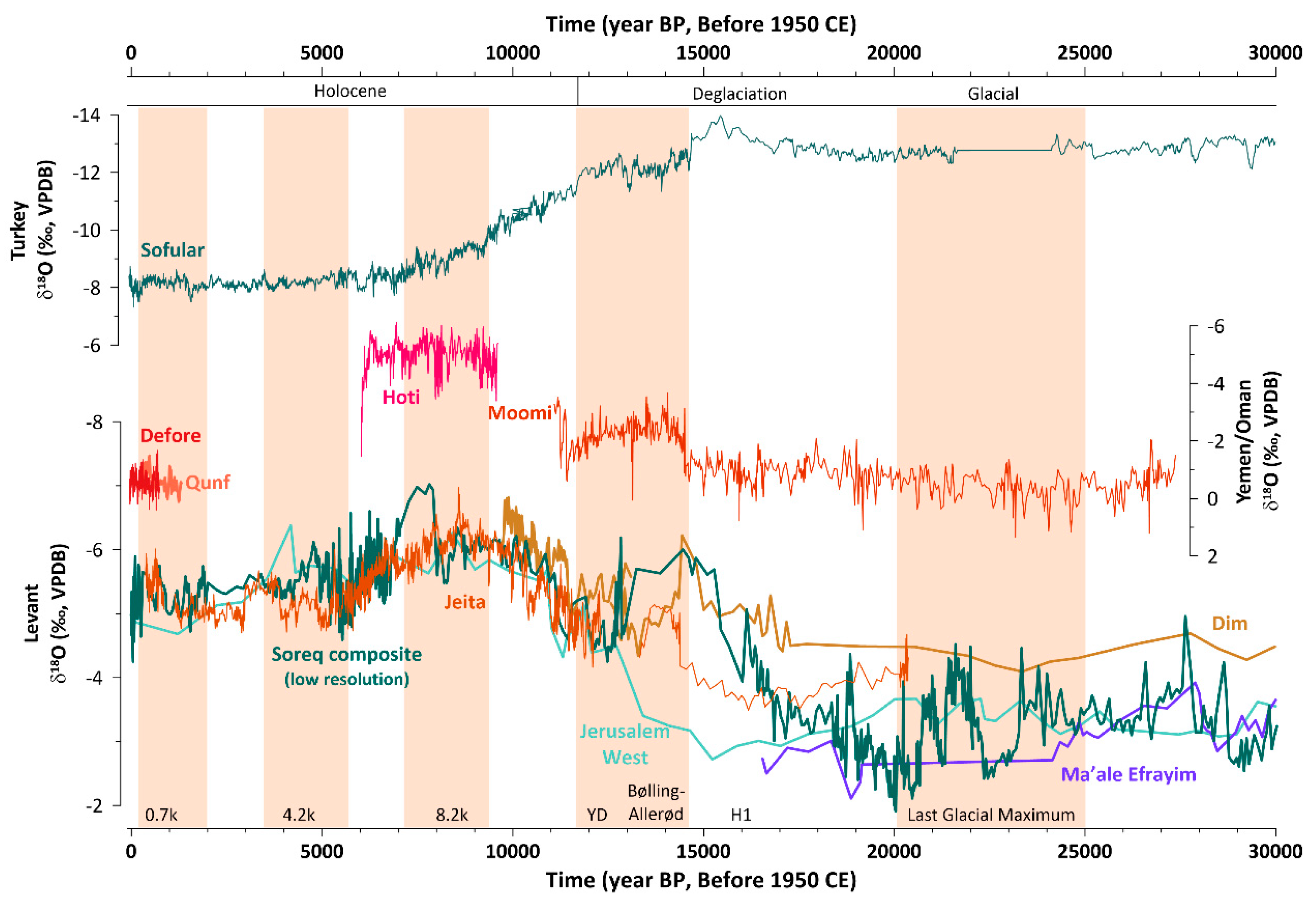
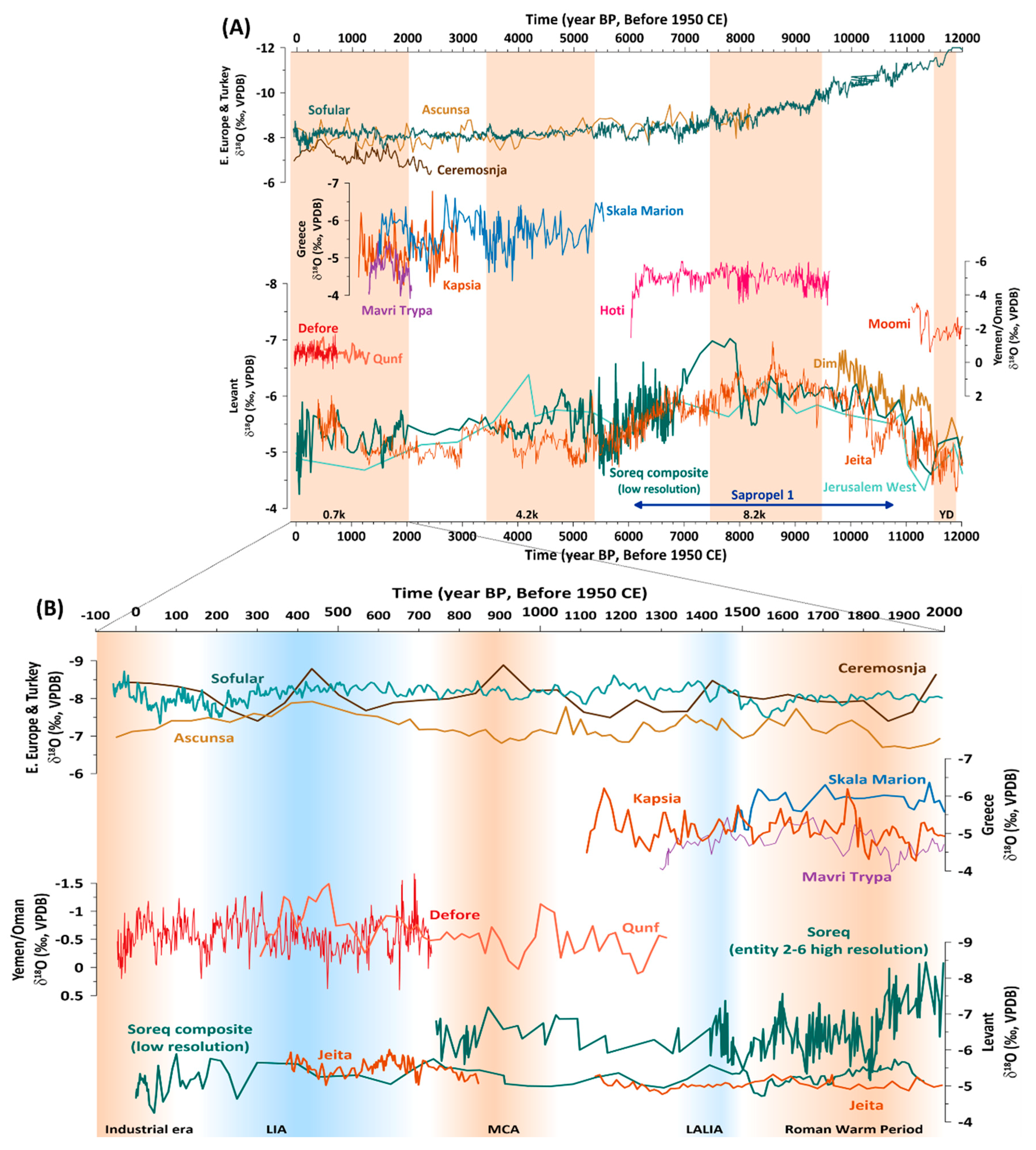


| Site_name | Site _id | Location | Latitude ºN | Longitude ºE | Elevation (m AMSL) | Entity _name | Entity _id | Min. Age (yrs BP) | Max. Age (yrs BP) | Ref. |
| Ascunsa | 72 | Romania | 45.00 | 22.60 | 1050 | POM-2 | 161 | −32 | 8169 | [46] |
| Ceremosjna | 76 | Serbia | 44.40 | 21.65 | 530 | CC-1 | 165 | −48 | 2426 | [47] |
| Defore | 170 | Oman | 17.17 | 54.08 | 150 | S3 | 366 | −46 | 731 | [48] |
| S4 | 9095 | 10,693 | [49] | |||||||
| Dim | 79 | Turkey | 36.53 | 32.11 | 232 | Dim-E2 | 168 | 9738 | 13,094 | [50] |
| Dim-E3 | 169 | 12,575 | 89,714 | |||||||
| Dim-E4 | 170 | 12,020 | 14,555 | |||||||
| Hoti | 152 | Oman | 23.08 | 57.35 | 800 | H5 | 327 | 6026 | 9607 | [49,51] |
| H1 H2 H3 H4 H10 H11 H12 H13 H14 flowstone | 78,000 ~present ~present 117,000 6200 6200 164 117,000 180,000 300,000 6200 117,000 | 82,000 5000 5000 130,000 10,500 10,500 6277 130,000 210,000 325,000 10,500 130,000 | [49,52] | |||||||
| Jeita | 11 | Lebanon | 33.95 | 35.65 | 100 | Jeita-1 | 58 | 1137 | 12,288 | [53,54] |
| Jeita-2 | 59 | 13,330 | 20,367 | |||||||
| Jeita-3 | 60 | 372 | 847 | |||||||
| JeG- Stm-1 | 1100 | 11,900 | [54] | |||||||
| Jerusalem West | 68 | Israel | 31.80 | 35.20 | 700 | AF-12 | 152 | −16 | 168,714 | [55] |
| Kanaan | 19 | Lebanon | 33.91 | 35.61 | 98 | Kanaan_ MIS5 | 81 | 83,125 | 128,847 | [56] |
| Kanaan_ MIS6 | 82 | 154,455 | 193,498 | |||||||
| Kapsia | 44 | Greece | 37.62 | 22.35 | 700 | GK-09-02 | 120 | 1115 | 2904 | [57] |
| Ma’ale Efrayim | 110 | West Bank | 32.08 | 35.37 | 250 | ME-12 | 218 | 16,548 | 66,948 | [18] |
| 36 samples | ||||||||||
| Mavri Trypa | 156 | Greece | 36.74 | 21.76 | 70 | S1 | 347 | 1296 | 4687 | [58] |
| Moomi | 138 | Yemen | 12.50 | 54.00 | 400 | M1-5 | 293 | 11,086 | 27,370 | [59] |
| M1-2 | 40,000 | 53,000 | [59] | |||||||
| Qunf | 159 | Oman | 17.10 | 54.18 | 650 | Q5 | 351 | 308 | 10,558 | [49] |
| Skala Marion | 56 | Greece | 40.64 | 24.51 | 41 | MAR_L | 136 | 1481 | 5534 | [60] |
| Sofular | 141 | Turkey | 41.42 | 31.93 | 700 | SO-1 | 305 | −56 | 50,275 | [61] |
| SO-2 SO-4 SO-6SO-10 SO-14BSO-17A | −60 1080 93,572 ~present 475,910 86,190 | 59,510 307,030 133,200 2200 670,000 122,930 | [62,63] | |||||||
| Soreq | 160 | Israel | 31.45 | 35.03 | 400 | Soreq composite | 354 | ~present | 30,031 | [64] |
| 2N | 353 | 4440 | 33,804 | [31] | ||||||
| 2–6 | 352 | 743 | 2086 | [14] | ||||||
| Numerous samples | ~present | 250,000 | [13,28,65,66,67,68,69,70,71,72] | |||||||
| Sites identified but currently not in SISAL_v1 (see Figure 1) | ||||||||||
| Cave Name | Figure 1 id | Country | Latitude (N) | Longitude (E) | Elevation (masl) | Identified speleothems | Min. Age | Max. Age | Ref. | |
| Ashalim | 11 | Israel | 30.94 | 34.74 | 400 | 116,700 | >U/Th | [73] | ||
| Akcakale | 3 | Turkey | 40.45 | 39.54 | 2p | −55 | 189 | [74] | ||
| Casecas | 24 | Yemen | 12.56 | 54.31 | STM5 | 12 | 856 | [75] | ||
| Dimarshim | 23 | Yemen | 12.55 | 53.68 | D1 | ~present | 4530 | [49] | ||
| Even Sid | 12 | Israel | 30.64 | 34.81 | 800 | 87,700 | >U/Th | [73] | ||
| Gejkar | 6 | Iraq | 35.80 | 49.16 | Gej-1 | −63 | 2380 | [29] | ||
| Gol-e Zard | 7 | Iran | 35.13 | 52.00 | 2530 | - | 3700 | 5100 | [76] | |
| Hol-Zakh | 13 | Israel | 31.16 | 35.20 | 150 | 111,700 | 349,100 | [73] | ||
| Hoq | 25 | Yemen | 12.59 | 54.53 | Hq1 STM1 STM6 | −50 −53 −56 | 6900 5600 4500 | [75] | ||
| Izzim | 14 | Israel | 31.14 | 35.06 | 500 | 372,600 | 500,100 | [73] | ||
| Karaca | 1 | Turkey | 40.32 | 29.24 | K1 | 6000 | 77,300 | [77] | ||
| Kataleh Khor | 4 | Iran | 35.84 | 48.16 | (2 samples) | 214,000 | 500,000 | [78] | ||
| Ma’ale ha-Meyshar | 15 | Israel | 30.49 | 34.93 | 450 | 110,600 | >U/Th | [73] | ||
| Ma’ale Dragot | 16 | Israel | 31.4 | 35.00 | 300 | MD (6 samples) | <500 | 426,440 | [79] | |
| Makhtesh ha-Qatan | 17 | Israel | 30.95 | 35.22 | −20 | 140,000 | >U/Th | [73] | ||
| Mitzpe Shlagim | 8 | Israel/Syria | 33.32 | 35.81 | 2224 | MS-1 MS-2 MS-3 | 4300 8800 8500 | 88,000 89,000 49,100 | [80] | |
| Mukalla Cave | 22 | Yemen | 14.92 | 48.59 | 1500 | Y99 Y97-4 Y97-5 | 119,141 5630 8790 | 358,887 185,600 233,300 | [16] | |
| Ovacik | 2 | Turkey | 41.46 | 32.02 | O-1 | 4472 | 9796 | [61] | ||
| Peqiin | 9 | Israel | 32.58 | 35.19 | 650 | PEK-5 PEK-6 PEK-9 PEK-10 | 5620 24,710 47,810 55,630 | 6780 223,700 283,650 288,160 | [72] | |
| Qal’e Kord | 5 | Iran | 35.80 | 48.86 | QK 8 QK 14 | 78,104 6581 | 99,182 127,012 | [78,81] | ||
| Shizafon mini-caves | 18 | Israel | 30.04 | 35.00 | 400 | 333,400 | >U/Th | [73] | ||
| Tzavoa | 19 | Israel | 31.20 | 35.20 | 550 | TZ (15 samples) | 14,400 | 204,760 | [79] | |
| Wadi Lotz | 20 | Israel | 30.47 | 34.58 | 900 | LOTS-3 | - | >U/Th | [73] | |
| Wadi Sannur | 21 | Egypt | 28.62 | 31.28 | WSS 1 to 6 | 136,460 | 188,120 | [82] | ||
| Zalmon | 10 | Israel | 32.80 | 35.40 | ZAL-1 to ZAL-7 and ZAL-11 | 5100 | 165,000 | [83] | ||
© 2019 by the authors. Licensee MDPI, Basel, Switzerland. This article is an open access article distributed under the terms and conditions of the Creative Commons Attribution (CC BY) license (http://creativecommons.org/licenses/by/4.0/).
Share and Cite
Burstyn, Y.; Martrat, B.; Lopez, J.F.; Iriarte, E.; Jacobson, M.J.; Lone, M.A.; Deininger, M. Speleothems from the Middle East: An Example of Water Limited Environments in the SISAL Database. Quaternary 2019, 2, 16. https://doi.org/10.3390/quat2020016
Burstyn Y, Martrat B, Lopez JF, Iriarte E, Jacobson MJ, Lone MA, Deininger M. Speleothems from the Middle East: An Example of Water Limited Environments in the SISAL Database. Quaternary. 2019; 2(2):16. https://doi.org/10.3390/quat2020016
Chicago/Turabian StyleBurstyn, Yuval, Belen Martrat, Jordi F. Lopez, Eneko Iriarte, Matthew J. Jacobson, Mahjoor Ahmad Lone, and Michael Deininger. 2019. "Speleothems from the Middle East: An Example of Water Limited Environments in the SISAL Database" Quaternary 2, no. 2: 16. https://doi.org/10.3390/quat2020016
APA StyleBurstyn, Y., Martrat, B., Lopez, J. F., Iriarte, E., Jacobson, M. J., Lone, M. A., & Deininger, M. (2019). Speleothems from the Middle East: An Example of Water Limited Environments in the SISAL Database. Quaternary, 2(2), 16. https://doi.org/10.3390/quat2020016