Next Article in Journal
Handling Complexity in Animal and Plant Science Research—From Single to Functional Traits: Are We There Yet?
Previous Article in Journal
Computational Convolution of SELDI Data for the Diagnosis of Alzheimer’s Disease
 
 
High-Throughput concluded publication with Volume 9, Issue 3. It has been succeeded by BioTech, which has a revised scope and a new editorial direction and is now published here. To preserve historical data integrity, the information on this webpage is retained but will no longer be updated.
Review

Functional Genomics Approaches to Studying Symbioses between Legumes and Nitrogen-Fixing Rhizobia

Department of Plant and Microbial Biology, University of Zurich, CH-8057 Zurich, Switzerland
*
Author to whom correspondence should be addressed.
High-Throughput 2018, 7(2), 15; https://doi.org/10.3390/ht7020015
Submission received: 9 April 2018 / Revised: 13 May 2018 / Accepted: 16 May 2018 / Published: 18 May 2018

Abstract

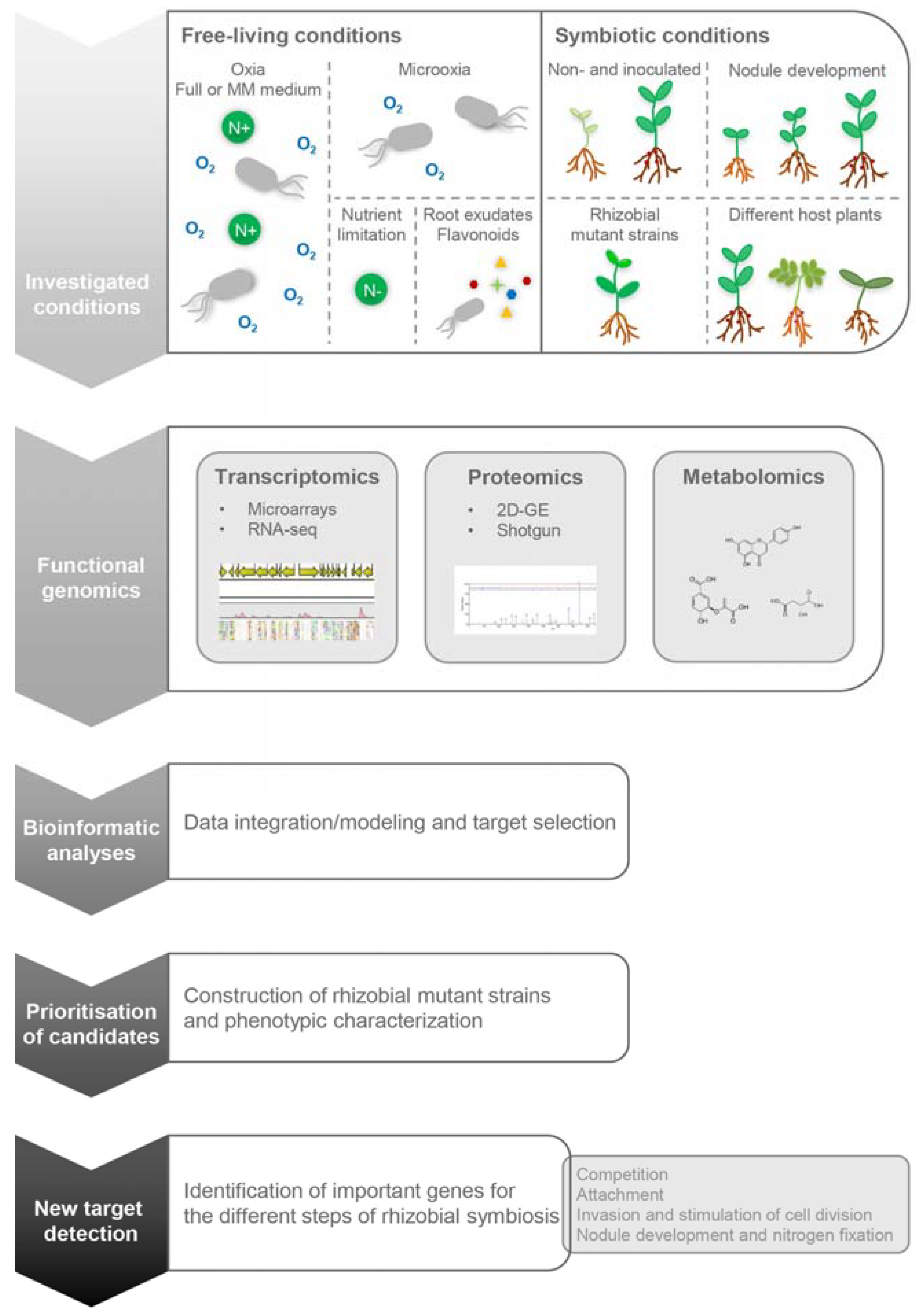
Biological nitrogen fixation gives legumes a pronounced growth advantage in nitrogen-deprived soils and is of considerable ecological and economic interest. In exchange for reduced atmospheric nitrogen, typically given to the plant in the form of amides or ureides, the legume provides nitrogen-fixing rhizobia with nutrients and highly specialised root structures called nodules. To elucidate the molecular basis underlying physiological adaptations on a genome-wide scale, functional genomics approaches, such as transcriptomics, proteomics, and metabolomics, have been used. This review presents an overview of the different functional genomics approaches that have been performed on rhizobial symbiosis, with a focus on studies investigating the molecular mechanisms used by the bacterial partner to interact with the legume. While rhizobia belonging to the alpha-proteobacterial group (alpha-rhizobia) have been well studied, few studies to date have investigated this process in beta-proteobacteria (beta-rhizobia).
Keywords: alpha-rhizobia; beta-rhizobia; symbiosis; transcriptomics; proteomics; metabolomics; flavonoids; root exudates; root nodule alpha-rhizobia; beta-rhizobia; symbiosis; transcriptomics; proteomics; metabolomics; flavonoids; root exudates; root nodule