


Abstract
Introduction: Social media has become a prevalent platform for survey dissemination, despite the paucity of literature on this topic. The purpose of this paper is to outline the benefits and drawbacks of and best practices for social media-based surveys. Methods: We performed a scoping review of this topic and explored different strategies commonly employed for conducting efficient health care surveys via social media platforms. Results: The main advantages of social media-based surveys are the convenience and flexibility of survey design, their relatively low cost, the anonymity of responders, and the ability to reach a broader population of responders across geographical boundaries. Several measures can be adopted to avoid issues inherent in this approach, such as data disruption and response duplication, as well as to enhance ethical behaviors and consent compliance. We discuss limitations associated with unclear distribution of survey respondents and outline survey fraud as a major impediment to the online propagation of surveys on various social media platforms. Discussion: The use of social media to disseminate surveys on various medical specialty topics has garnered global participation, particularly during the COVID-19 pandemic. Ethical codes of conduct emphasize the need for professionalism and truthfulness, and disclosure of potential conflicts of interest on the part of respondents, and high-quality survey research on the part of researchers. Conclusion: We advocate for the novel use of social media to promote large and diverse health care surveys. Additional studies should further explore the use of emerging social media platforms for survey dissemination and their impact on health care research.
Introduction
Surveys represent a study design commonly used in health care research. They are simple to perform and aim to collect impartial information from a population of interest. Traditional survey recruitment strategies, such as in-person interviews, postal mail, and telephone calls, are indeed time-consuming and labor intensive[1,2]. During the COVID-19 pandemic, the world witnessed a dramatic surge in daily use of social media for communicating electronically[3]. The World Health Organization (WHO) implementation of social distancing policies and public health measures made onsite, in-person health care research a challenging endeavor[4].
Social media acts as an electronic communication online platform that enables its users to instantly share thoughts, information, and personal content. According to Datareportal 2022, there are already 4.62 billion people around the world using social media, with individuals spending on average approximately 2 hours and 27 minutes each day communicating on social media platforms[5]. Health care professionals are increasingly using social media channels, such as Facebook, YouTube, Twitter, Instagram, TikTok, and LinkedIn, as well as streaming audio applications, such as Spotify and Podcast, to reach a vast audience[6]. Emerging as one of the rapidly expanding online tools, social media has been adopted by many health care specialties, including medicine and urology[7]. We have observed an exponential rise in the number of publications on urological subjects through analysis of social media over the past decade. With impactful knowledge exchange and educational information provision, social media offers an opportunity for clinicians worldwide to connect with their peers and exchange knowledge and best practices in real time or near real time. For example, Twitter allows its users to compose brief 140-character messages and share them almost instantly with only a few clicks[8]. This not only reduces the amount of time spent waiting for a small group of in-person discussions but also allows medical professionals to reach more people across more geographical areas. Instagram, for example, is one of the tools used most frequently by the WHO to aid in disseminating health information and educational messages[9]. Jason Frank, MD, from the Royal College of Physicians and Surgeons of Canada has stated, “Within the next decade, you won’t be able to be a successful scholar without having some activities on social media,” emphasizing the implications of social media within our modern technological era[8]. As a result, the use of social media as a recruitment technique for surveys has become prevalent and has garnered tremendous popularity in recent years. In the present study, we explore and evaluate best practices and pitfalls of survey distribution via social media platforms.
Methods
Literature review
With the potential to effectively solicit the distinctive experience of health professionals, surveys distributed on social media have salient implications for researchers. The benefits of social media-based surveys include enhanced recruitment and increased anonymity, which may be advantageous when conducting research. At present, there are no clear recommendations for using social media to circulate health care surveys. We performed a scoping review on this topic and searched for key words and MeSH terms, including (urology) and (survey) and (social media). We determined that most data are qualitative in nature, therefore, we presented the results in narrative format.
Conflicts of online methodologies
Email-based surveys containing the survey within the body of the email or as an attachment are sent by email directly to target participants, who are invited to complete the questionnaire and email it back to the researchers. While email-based survey responses may be slightly better distributed among the population of interest, the response rate of this traditional survey distribution is sometimes very low. In a project approved by the University of Miami and conducted by Dubin et al. in 2020, a total of 4519 surveys were emailed to urologists worldwide but only 537 (11.9%) responses from 29 countries were received[10]. This low response rate raises doubt on whether email invitation is the preferred method of survey dissemination.
In contrast to traditional surveying methods, social media-based surveys entail the use of a well-designed online software system for posting the survey on the selected social media platform, through which participants can submit their responses. The data are captured immediately by the online software[6,11]—a feature that may allow for more accurate measurement of attrition, which is nearly impossible with email-based surveys. Furthermore, networking on social media, largely driven by capital, fosters more social connections than email invitations. Instead of relying on passive delayed interaction via email, social media platforms offer instantaneous and active engagement with the targeted audience. Platforms such as Twitter, Facebook, and Instagram provide their users with insights on content engagement, and as such, survey analytics metrics can be used to recognize patterns of engagement and improve outcomes[12]. Social media-based surveys, by offering versatility and affording great utility, have opened a new approach for conducting surveys—what may be coined by some as a social network survey strategy.
Discussion
Future directions
Social media has been adopted by many medical specialties, facilitating health care survey distribution. Use of social media-based surveys has increased due to social distancing measures brought on by the COVID-19 pandemic, and as a result, has provided great opportunities for global participation. Commercial software products are user friendly and designed to create questions and their answer options seamlessly. Social media platforms should exercise caution to identify prospects with a strong interest in the survey topic. Multiple social media platforms can be used to establish a more diversified sample to reduce sample composition bias. To define the target populations, an operational definition of the intended population should be developed to encourage the effective recruitment of respondents. Demographic variables including age, gender, geographic location, and specialty field of interest should be explicated.
Additionally, the intended sample population should be taken into consideration when structuring the survey questions. Questions should be written in an appropriate tone, use standard terminologies, and be clear and concise. Excessively long surveys with complex and multistep questions should be avoided, as they promote attrition and poor survey completion compliance. Contributing to participation dropout are factors such as an excessive number of qualitative questions, surveys with multistep questions, questions without the option to opt out or to decline answering, and an inaccessible survey interface[33,34]. It is incumbent upon survey researchers to identify the best data model in order to determine the variables needed to prevent survey response inconsistency and redundancy. Conceptual modeling would enable obtaining data directly, without the need for any manipulation. “Third-party guarantee of the survey” can be provided to increase credibility and perceived legitimacy[35].
To allay fears and concerns regarding the use of social media platforms, the European Association of Urology (EAU), the American Urologic Association (AUA), and other organizations have established recommendations and guidelines for the appropriate use of social media for communication among the urologic community[36]. Ethical codes of conduct impart the need for professionalism and veracity, disclosure of any conflict of interest, good quality of survey research, and protection of confidentiality. The formation of a social media committee and stakeholders ensures the delivery of guidelines in urology to foster good social media practices[37]. Professional standards for online conduct should be incorporated into social media education as the use of social media continues to proliferate in urological settings and beyond.
Conclusion
Our paper examined the efficacy and feasibility of social media as a survey dissemination tool among health care professionals. Researchers may find it useful to create study-specific social media accounts to interact with their study population through various accessible online social media platforms. While recognizing the limitations of social media-based surveys, we must move forward and overcome obstacles inherent with this approach. As the saying goes, “A court ought not to be affected by the weather of the day, but will be by the climate of the era.” Given that the widespread use of technology and social media has grown in popularity over the past few years, we advocate the novel use of social media platforms for promoting large and diverse survey participation. We also encourage additional studies to further explore the use of emerging social media platforms for promotion and distribution of health care surveys.

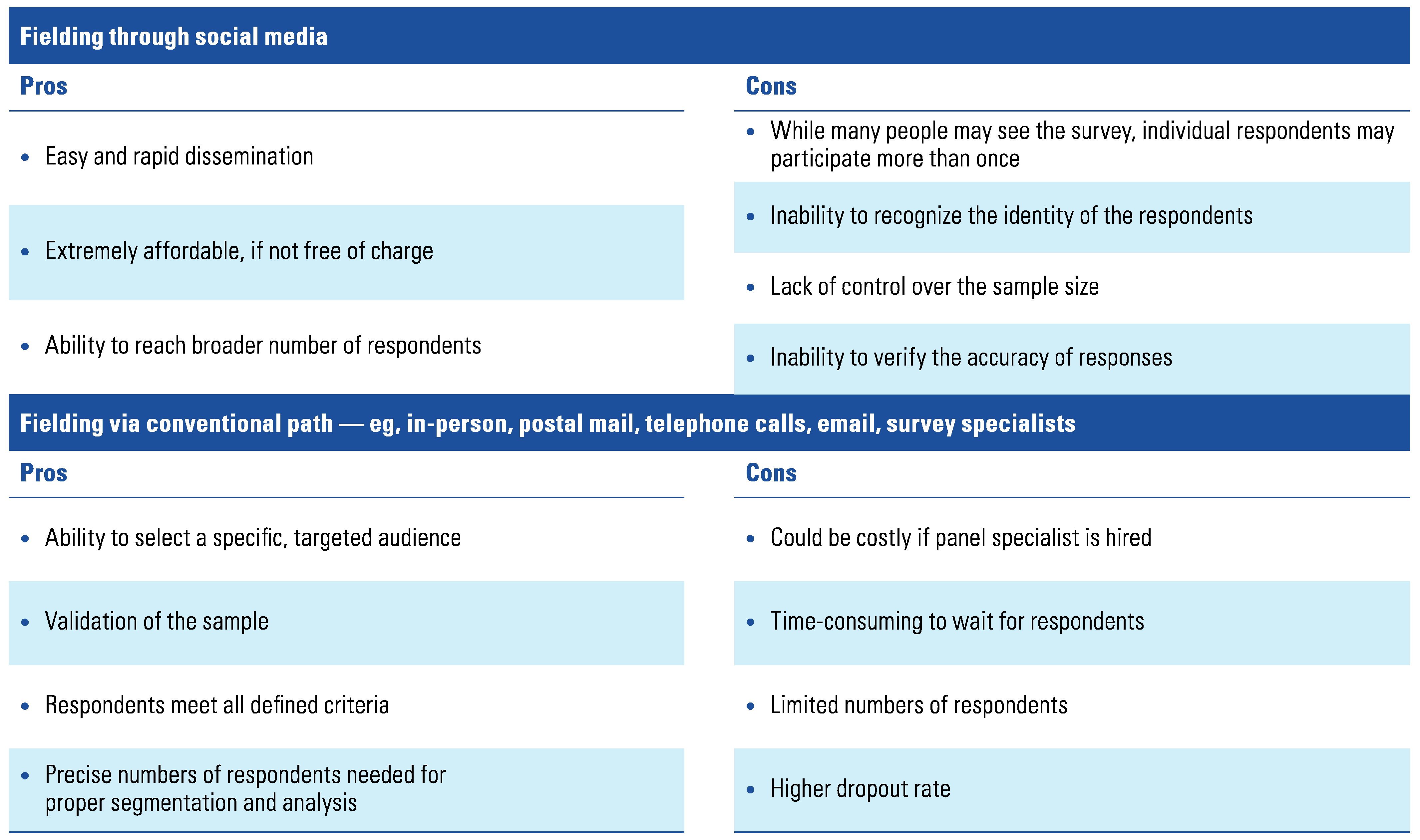
Table 1.
Comparison between social media-based survey and conventional-based approach.
Table 1.
Comparison between social media-based survey and conventional-based approach.
 |
Conflicts of Interest
None declared.
References
- Blumenberg, C.; Barros, A.J.D. Response rate differences between web and alternative data collection methods for public health research: A systematic review of the literature. Int J Public Health. 2018, 63, 765–773. [Google Scholar] [CrossRef] [PubMed]
- Dillman, D.A.; Phelps, G.; Tortora, R.; Swift, K.; Kohrell, J.; Berck, J.; et al. Response rate and measurement differences in mixed-mode surveys using mail, telephone, interactive voice response (IVR) and the Internet. Soc Sci Res. 2009, 38, 1–18. [Google Scholar] [CrossRef]
- Pandya, A.; Lodha, P. Social connectedness, excessive screen time during COVID-19 and mental health: A review of current evidence. Front Hum Dyn. 2021, 3, 684137. [Google Scholar] [CrossRef]
- Qian, M.; Jiang, J. COVID-19 and social distancing. Z Gesundh Wiss. 2022, 30, 259–261. [Google Scholar] [CrossRef] [PubMed] [PubMed Central]
- Kemp, S. Datareportal. Digital 2022: Global Overview Report. Published January 26, 2022. Available online: https://datareportal.com/reports/digital-2022-global-overview-report (accessed on 8 February 2023).
- Hamm, M.P.; Chisholm, A.; Shulhan, J.; Milne, A.; Scott, S.D.; Klassen, T.P.; et al. Social media use by health care professionals and trainees: A scoping review. Acad Med. 2013, 88, 1376–1383. [Google Scholar] [CrossRef] [PubMed]
- Dubin, J.M.; Greer, A.B.; Patel, P.; Carrion, D.M.; Paesano, N.; Kettache, R.H.; et al. Global survey of the roles and attitudes toward social media platforms amongst urology trainees. Urology 2021, 147, 64–67. [Google Scholar] [CrossRef] [PubMed]
- Gallo, T. Association of American Medical Colleges. Twitter is trending in academic medicine Published February 20, 2017. Available online: https://www.aamc.org/news-insights/twitter-trending-academic-medicine (accessed on 8 February 2023).
- Kamel Boulos, M.N.; Giustini, D.M.; Wheeler, S. Instagram and WhatsApp in health and healthcare: An overview. Future Internet 2016, 8, 37. [Google Scholar] [CrossRef]
- Dubin, J.M.; Greer, A.B.; Patel, P.; Carrion, D.M.; Paesano, N.; Kettache, R.H.; et al. Global survey evaluating drawbacks of social media usage for practising urologists. BJU Int. 2020, 126, 7–8. [Google Scholar] [CrossRef] [PubMed]
- Ali, S.H.; Foreman, J.; Capasso, A.; Jones, A.M.; Tozan, Y.; DiClemente, R.J. Social media as a recruitment platform for a nationwide online survey of COVID-19 knowledge, beliefs, and practices in the United States: Methodology and feasibility analysis. BMC Med Res Methodol. 2020, 20, 116. [Google Scholar] [CrossRef] [PubMed] [PubMed Central]
- Drivas, I.C.; Kouis, D.; Kyriaki-Manessi, D.; Giannakopoulou, F. Social media analytics and metrics for improving users engagement. Knowledge 2022, 2, 225–242. [Google Scholar] [CrossRef]
- Couper, M.P.; Antoun, C.; Mavletova, A. Mobile web surveys: A total survey error perspective. In Total Survey Error in Practice; Biemer, P.P., de Leeuw, E., Eckman, S., Edwards, B., Kreuter, F., Lyberg, L.E., et al., Eds.; John Wiley & Sons, Inc., 2017; Available online: https://onlinelibrary.wiley.com/doi/10.1002/9781119041702.ch7 (accessed on 30 September 2022).
- Kühne, S.; Zindel, Z. (2020) Using Facebook and Instagram to Recruit Web Survey Participants: A Step-by-Step Guide and Application in Survey Methods: Insights from the Field, Special issue: ‘Advancements in Online and Mobile Survey Methods’. Available online: https://surveyinsights.org/?p=13558 (accessed on 30 September 2022).
- McInroy, L.B. Pitfalls, potentials, and ethics of online survey research: LGBTQ and other marginalized and hard-to-access youths. Soc Work Res. 2016, 40, 83–94. [Google Scholar] [CrossRef] [PubMed] [PubMed Central]
- McDermott, E.; Roen, K. Youth on the virtual edge: Researching marginalized sexualities and genders online. Qual Health Res. 2012, 22, 560–570. [Google Scholar] [CrossRef] [PubMed]
- Brickman Bhutta, C. Not by the book: Facebook as a sampling frame. Sociol Methods Res. 2012, 41, 57–88. [Google Scholar] [CrossRef]
- Baltar, F.; Brunet, I. Social research 2.0: Virtual snowball sampling method using Facebook. Internet Res. 2012, 22, 57–74. [Google Scholar] [CrossRef]
- Fong, K.Y.; Lim, E.J.; Gauhar, V.; Castellani, D.; Teoh, J.Y.C.; Merseburger, A.S.; et al. The utility of infographics and videographics in the modern era: Maximising social media impact for research dissemination. World J Urol. 2022, 40, 1285–1286. [Google Scholar] [CrossRef] [PubMed]
- Gudaru, K.; Blanco, L.T.; Castellani, D.; Santamaria, H.T.; Pelayo-Nieto, M.; Linden-Castro, E.; #UroSoMe Working Group; et al. Connecting the urological community: The #UroSoMe experience. J Endolum Endourol. 2019, 2, e20–e29. [Google Scholar] [CrossRef]
- Teoh, J.Y.C.; Ong, W.L.K.; Gonzalez-Padilla, D.; Castellani, D.; Dubin, J.M.; Esperto, F.; UroSoMe Working Group; et al. A global survey on the impact of COVID-19 on urological services. Eur Urol. 2020, 78, 265–275. [Google Scholar] [CrossRef] [PubMed] [PubMed Central]
- Castellani, D.; da Silva, R.D.; Pelayo-Nieto, M.; Linden-Castro, E.; Ong, W.L.K.; the #UroSoMe Working Group; et al. The past, the present and the future of #UroSoMe: A narrative review. AME Med J. 2021, 6, 43. [Google Scholar] [CrossRef]
- David, M.C.; Ware, R.S. Meta-analysis of randomized controlled trials supports the use of incentives for inducing response to electronic health surveys. J Clin Epidemiol. 2014, 67, 1210–1221. [Google Scholar] [CrossRef] [PubMed]
- Pit, S.W.; Vo, T.; Pyakurel, S. The effectiveness of recruitment strategies on general practitioner’s survey response rates—A systematic review. BMC Med Res Methodol. 2014, 14, 76. [Google Scholar] [CrossRef] [PubMed] [PubMed Central]
- Tan, Y.Q.; Wang, Z.; Yap, Q.V.; Chan, Y.H.; Ho, R.C.; Hamid, A.R.A.H.; et al. Psychological health of surgeons in a time of COVID-19: A global survey. Ann Surg. 2021, 277, 50–56. [Google Scholar] [CrossRef] [PubMed] [PubMed Central]
- Eysenbach, G. Improving the quality of web surveys: The Checklist for Reporting Results of Internet E-Surveys (CHERRIES). J Med Internet Res. 2004, 6, e34. [Google Scholar] [CrossRef] [PubMed] [PubMed Central]
- Gudaru, K.; Gonzalez Padilla, D.A.; Castellani, D.; Tortolero Blanco, L.; Tanidir, Y.; Ka Lun, L.; et al. A global knowledge, attitudes and practices survey on anatomical endoscopic enucleation of prostate for benign prostatic hyperplasia among urologists. Andrologia. 2020, 52, e13717. [Google Scholar] [CrossRef] [PubMed]
- Whitehead, L.C. Methodological and ethical issues in internet-mediated research in the field of health: An integrated review of the literature. Soc Sci Med. 2007, 65, 782–791. [Google Scholar] [CrossRef] [PubMed]
- Gelinas, L.; Pierce, R.; Winkler, S.; Cohen, I.G.; Lynch, H.F.; Bierer, B.E. Using social media as a research recruitment tool: Ethical issues and recommendations. Am J Bioeth. 2017, 17, 3–14. [Google Scholar] [CrossRef] [PubMed] [PubMed Central]
- Mansfield, S.J.; Morrison, S.G.; Stephens, H.O.; Bonning, M.A.; Wang, S.H.; Withers, A.H.J.; et al. Social media and the medical profession. Med J Aust. 2011, 194, 642–644. [Google Scholar] [CrossRef] [PubMed]
- de Koning, R.; Egiz, A.; Kotecha, J.; Ciuculete, A.C.; Ooi, S.Z.Y.; Bankole, N.D.A.; et al. Survey fatigue during the COVID-19 pandemic: An analysis of neurosurgery survey response rates. Front Surg. 2021, 8, 690680. [Google Scholar] [CrossRef] [PubMed] [PubMed Central]
- Mustanski, B.S. Getting wired: Exploiting the internet for the collection of valid sexuality data. J Sex Res. 2001, 38, 292–301. [Google Scholar] [CrossRef]
- Andrews, D.; Nonnecke, B.; Preece, J. Electronic survey methodology: A case study in reaching hard-to-involve internet users. Int J Hum Comput Interact. 2003, 16, 185–210. [Google Scholar] [CrossRef]
- Hoonakker, P.; Carayon, P. Questionnaire survey nonresponse: A comparison of postal mail and internet surveys. Int J Hum Comput Interact. 2009, 25, 348–373. [Google Scholar] [CrossRef]
- Alessi, E.J.; Martin, J.I. Conducting an internet-based Survey: Benefits, pitfalls, and lessons learned. Soc Work Res. 2010, 34, 122–128. [Google Scholar] [CrossRef]
- Borgmann, H.; Cooperberg, M.; Murphy, D.; Loeb, S.; N’Dow, J.; Ribal, M.J.; et al. Online Professionalism—2018 Update of European Association of Urology (@Uroweb) Recommendations on the Appropriate Use of Social Media. Eur Urol. 2018, 74, 644–650. [Google Scholar] [CrossRef] [PubMed]
- Taylor, J.; Loeb, S. Guideline of guidelines: Social media in urology: Social media guidelines in urology. BJU Int. 2020, 125, 379–382. [Google Scholar] [CrossRef] [PubMed]
This is an open access article under the terms of a license that permits non-commercial use, provided the original work is properly cited. © 2023 The Authors. Société Internationale d'Urologie Journal, published by the Société Internationale d'Urologie, Canada.