
Review

Biomarkers for Post-Traumatic Epilepsy: Advances in Imaging, Molecular Signatures, and AI-Assisted Prediction

1
Department of Neurology, The University of Tennessee Health Science Center, Memphis, TN 38163, USA
2
Department of Pharmaceutical Sciences, College of Pharmacy, The University of Tennessee Health Science Center, Memphis, TN 38103, USA
*
Authors to whom correspondence should be addressed.
Clin. Transl. Neurosci. 2026, 10(2), 17; https://doi.org/10.3390/ctn10020017
Submission received: 12 March 2026 / Revised: 20 May 2026 / Accepted: 9 June 2026 / Published: 11 June 2026

Abstract

Early diagnosis of post-traumatic epilepsy (PTE) is crucial for timely intervention. However, it is hampered by the lack of reliable biomarkers. In this review, we provide a comprehensive summary of current advances in PTE biomarker research, drawing primarily on evidence from human cohort studies, with selective support from experimental animal models where mechanistic insights are required. We cover (i) neuroimaging, including CT, MRI, and EEG/qEEG, which reveal structural and functional alterations associated with epileptogenesis; (ii) molecular biomarkers, including RNAs, proteins, metabolites, and extracellular vesicle (EV)-derived molecules that reflect neuroinflammation, blood–brain barrier (BBB) dysfunction, neuronal injury, and synaptic remodeling; and (iii) artificial intelligence (AI)-assisted approaches, which integrate multimodal datasets to identify complex predictive patterns. While individual modalities offer valuable but incomplete prognostic information, AI-driven analytics hold the greatest promise for early predictive power by combining multimodal data. Future progress will depend on the integration of high-resolution imaging, multi-omics profiling, and rigorous validation to deliver clinically actionable biomarker panels and ultimately reduce the burden of PTE.

1. Introduction

Post-traumatic epilepsy (PTE) is a major long-term complication of traumatic brain injury (TBI) and represents an important neurological and public health burden. Epilepsy is a common neurological disorder characterized by recurrent, unprovoked seizures. It affects 65–70 million people worldwide, imposing substantial social and economic burdens [1,2,3]. Traumatic brain injury itself is highly prevalent, affecting an estimated 2.5 million individuals annually in both Europe and the United States, and the risk of epilepsy increases in parallel with injury severity, rising from about 2 to 4-fold after mild TBI to as high as 16-fold after severe TBI [4,5]. In penetrating TBI, the incidence is even greater, with epilepsy developing in up to 53% of patients [6,7]. Approximately 50% of epilepsy cases are linked to structural brain abnormalities, with TBI representing one of the major acquired causes [8]. Overall, PTE is estimated to account for approximately 5% of all epilepsies and up to 20% of structural or symptomatic epilepsies [1,3]. Among seizures occurring within the first 4 weeks after TBI, nearly 90% arise during the first week, underscoring the importance of early post-injury monitoring [9]. Given its association with chronic neurological disability and reduced quality of life, early identification of patients at greatest risk remains a critical clinical objective.
Early prediction of PTE remains difficult because epileptogenesis after TBI is biologically complex and clinically heterogeneous. A defining challenge is the latent interval between the initial traumatic insult and the later emergence of unprovoked seizures, during which progressive molecular, cellular, and network-level alterations evolve but often remain clinically silent [10]. Importantly, not all individuals with apparently similar injuries develop epilepsy, indicating that risk is shaped by multiple interacting factors rather than by injury severity alone. Clinical studies have shown that seizure risk is influenced by trauma type, lesion burden, injury location, severity, and the occurrence of early post-traumatic seizures [6,7]. At the mechanistic level, post-traumatic epileptogenesis is driven by interconnected processes that include neuroinflammation, blood–brain barrier (BBB) dysfunction, astrocytic and glial dysregulation, synaptic remodeling, and reorganization of neuronal networks [10,11]. Together, these features explain why conventional clinical variables alone are insufficient for precise individualized prediction of PTE.
Biomarker research has therefore emerged as a key strategy to improve risk stratification and to capture structural, functional, and molecular signatures of post-traumatic epileptogenesis. In principle, biomarkers can indicate pathogenic processes, disease susceptibility, progression, or response to intervention and may include molecular, radiologic, and physiologic measures [2,12]. In PTE, neuroimaging modalities such as computed tomography and magnetic resonance imaging can reveal lesion burden, hemorrhagic injury, microstructural damage, and other structural abnormalities associated with epileptogenic risk [4,13,14]. Electrophysiologic approaches, particularly EEG and quantitative EEG, may detect early disturbances in cortical excitability and abnormal network activity before overt epilepsy becomes established [15,16]. Molecular biomarkers measured in blood, cerebrospinal fluid, or extracellular vesicles may further reflect neuroinflammation, neuronal injury, BBB disruption, and maladaptive tissue remodeling [17,18]. However, each modality captures only part of the epileptogenic process, highlighting the need for integrative analytical approaches that combine complementary data sources rather than relying on any single marker class.
Artificial intelligence (AI) and machine learning are increasingly important in this context because they provide tools for integrating complex, high-dimensional, and multimodal datasets into clinically informative prediction models. Unlike conventional single-variable analyses, AI-based approaches can identify nonlinear relationships and combinatorial patterns across imaging, electrophysiologic, and molecular features that may not be apparent through standard statistical methods [19,20]. Although applications in PTE remain limited, early studies using machine learning on neuroimaging data have already demonstrated the feasibility of distinguishing patients with post-traumatic seizures from those without epilepsy and of identifying candidate network-level imaging features associated with risk [19]. These advances suggest that AI may help move the field from descriptive biomarker discovery toward individualized prediction and clinically actionable models.
In this review, we provide a comprehensive overview of current progress in PTE biomarker studies, focusing on: (1) neuroimaging biomarkers such as magnetic resonance imaging (MRI) and computed tomography (CT), which aim to identify structural brain alterations linked to epileptogenesis; (2) molecular biomarkers, including RNA and protein signatures that elucidate underlying mechanisms and identify therapeutic targets; and (3) AI-assisted models, which leverage neuroimaging and molecular data to improve predictive accuracy. We also discuss future directions of PTE biomarker research.

2. Literature Search Strategy

This review focuses on studies investigating biomarkers for post-traumatic epilepsy (PTE), including both human and animal cohorts. We included studies that explored neuroimaging biomarkers (CT, MRI, EEG/qEEG), molecular biomarkers (proteins, RNAs, metabolites), and artificial intelligence (AI)-assisted prediction models. The inclusion criteria encompassed studies that specifically assessed biomarkers related to post-traumatic epileptogenesis, excluding those focused solely on acute traumatic brain injury or unrelated neurological conditions. Data collection processes involved reviewing published literature from various databases (PubMed, Scopus, Web of Science), with a focus on peer-reviewed articles. For neuroimaging, studies using CT and MRI were considered, with particular attention to lesion volume, structural damage, and brain network disruptions. EEG/qEEG studies were included based on their investigation of early epileptiform activity and network disturbances post-TBI. Molecular biomarkers were measured from blood, plasma, cerebrospinal fluid (CSF), or extracellular vesicles, with standardized protocols for protein quantification (e.g., ELISA) and RNA measurement (e.g., qPCR). AI-based studies were reviewed for their application of machine learning techniques to predict PTE using multimodal data. For consistency and clarity, evidence was prioritized from human cohort studies, while findings from experimental animal models were selectively incorporated to support mechanistic interpretation and biological plausibility.

3. Neuroimaging and Electrophysiological Biomarkers of PTE

Neuroimaging and electrophysiological modalities provide complementary, non-invasive approaches for identifying biomarkers of post-traumatic epileptogenesis. Structural imaging techniques such as CT and MRI enable the characterization of acute hemorrhagic lesions, contusions, and microstructural brain alterations associated with epileptogenic processes [21,22,23]. In parallel, electroencephalography (EEG) captures functional network abnormalities, including epileptiform activity and background disturbances, which are linked to increased seizure susceptibility following traumatic brain injury [24]. These modalities differ in their sensitivity to structural versus functional changes, temporal applicability in the acute versus subacute phases, and overall predictive performance, with improved accuracy achieved when they are integrated into multimodal frameworks (Table 1).
Taken together, the available evidence suggests that CT, MRI, and EEG capture different but complementary stages of post-traumatic epileptogenesis [21,22,23,24]. CT-based markers appear most clinically translatable because they are available in the acute setting and have been validated in relatively large human cohorts, but their biological resolution is limited mainly to macroscopic structural injury. MRI provides greater sensitivity to microstructural and network-level abnormalities, particularly white matter disruption and altered functional connectivity, yet its predictive performance is derived largely from smaller research cohorts and is constrained by cost, timing, and processing variability. EEG and qEEG, in contrast, directly reflect functional network instability and may be more closely linked to imminent epileptogenic activity, but their interpretation remains limited by inconsistent acquisition protocols and restricted monitoring duration. Thus, current evidence does not support a single superior modality but rather indicates that structural burden, network dysfunction, and electrophysiologic instability represent distinct but interacting dimensions of PTE risk.

3.1. Computed Tomography (CT)

CT is the first-line neuroimaging modality for the evaluation of acute traumatic brain injury due to its rapid acquisition, wide availability, and high sensitivity for detecting hemorrhage, contusions, and mass effect [25]. Early CT findings provide important prognostic information, as focal cortical injuries, particularly in the temporal and frontal lobes, are consistently associated with an increased risk of post-traumatic epilepsy [26]. Higher injury severity, reflected by CT-based classifications such as the Marshall score, further correlates with elevated PTE risk, especially in pediatric populations [27]. Additional CT features, including subdural hematoma, subarachnoid hemorrhage, epidural hemorrhage, and skull fractures, have also been linked to increased epileptogenic potential [28].
Recent large-scale and prospective studies consistently demonstrate that CT-derived structural features are associated with the development of PTE across diverse populations [29,30,31,32,33,34,35]. Both quantitative and qualitative analyses highlight the importance of hemorrhagic injury burden, lesion distribution, and cortical involvement. Ayvaz et al. [29] demonstrated that increasing total contusion volume on early CT independently predicted PTE risk, with an adjusted hazard ratio of 1.17 per 5 cc increase (95% CI 1.12–1.23), with additional contribution from lesion topology, particularly in frontal and temporal regions (Table 2). Similarly, Lin et al. [32] found that contusion volume >13.5 mL, subdural hematoma, severe GCS score, and non-late post-traumatic seizures were independently associated with PTE in multivariable logistic regression, although the estimates for subdural hematoma and non-late post-traumatic seizures had wide confidence intervals. Gómez-Rosiles et al. [30] further identified subdural lesions as a major risk factor in pediatric populations, with an adjusted odds ratio of aOR 5.6 (95% CI 2.1–14.8). In large cohort analyses, Awan et al. [31] and Wang et al. [33] confirmed that subdural hemorrhage (HR 2.20) and frontotemporal contusions (HR 2.46) significantly increase PTE risk, with predictive models achieving AUROC values of 0.70–0.84 and external validation C-index up to 0.895. Prospective studies by Ritter et al. [34] and Englander et al. [35] further demonstrated that subarachnoid hemorrhage (RR 2.06), higher contusion load (RR 2.17), and surgical evacuation (RR up to 3.05) are associated with increased late seizure incidence, while CT-defined features such as midline shift and multifocal cortical injury correspond to particularly high cumulative seizure risk. Taken together, these findings demonstrate that CT-derived structural parameters, particularly contusion volume, lesion location, and hemorrhagic burden, consistently provide clinically relevant indicators of epileptogenic risk following TBI.
Early prospective studies primarily relied on categorical variables, including lesion type and neurosurgical intervention, to define high-risk groups [34,35]. In contrast, more recent investigations incorporate quantitative imaging features such as contusion volume, contusion load, and lesion location, together with clinical variables including early seizures and injury severity [29,31,32,33]. Across these approaches, seizure risk is more strongly associated with the cumulative extent and complexity of injury rather than any single lesion type. In particular, cortical involvement, lesion multiplicity, and mass effect are repeatedly linked to increased epileptogenic potential. Frontal and temporal regions appear especially relevant, likely reflecting their role in large-scale neuronal networks and increased susceptibility to excitotoxic and inflammatory processes. However, variability in study design, outcome definitions, and follow-up duration contributes to differences in reported effect sizes, emphasizing the need for standardized CT-based metrics and harmonized outcome definitions in future studies [29,30,31,32,33,34,35].
CT provides a practical and immediately available framework for early structural risk assessment following traumatic brain injury. It enables direct evaluation of key features, including hemorrhagic burden, contusion volume, lesion distribution, and mass effect, all of which have been associated with subsequent seizure risk. Importantly, CT-derived parameters such as subdural hematoma, subarachnoid hemorrhage, contusion load, frontotemporal involvement, and midline shift capture both the severity and spatial organization of injury, which are central determinants of epileptogenic potential. Because CT is routinely performed in the acute setting, these features can be incorporated into predictive models without additional imaging burden. Recent studies demonstrate that CT-based variables can support individualized risk estimation with moderate-to-high discrimination when combined with clinical factors [29,31,32,33]. Overall, CT serves as a core modality for early identification of patients at increased risk of PTE and provides a structural foundation for developing clinically applicable prediction strategies.
A critical distinction across CT studies is that predictive performance improves when structural features are quantified rather than categorized. Earlier studies mainly identified broad lesion classes or surgical variables as risk markers, whereas more recent models show that contusion volume, lesion topology, and frontotemporal localization provide greater discriminatory value. However, the apparent strength of some newer models should be interpreted cautiously, because performance estimates vary according to cohort composition, seizure definition, and follow-up duration. In this context, CT is best viewed as a robust first-line stratification tool rather than a standalone predictor of epileptogenesis, with greatest value when integrated with clinical and electrophysiological variables.

3.2. Magnetic Resonance Imaging (MRI)

MRI offers critical insights into the structural and functional alterations of the brain associated with post-traumatic epileptogenesis (Table 3). Diffusion-based MRI techniques, including diffusion tensor imaging (DTI) and diffusion-weighted imaging (dMRI), are especially valuable for detecting microstructural white matter changes that extend beyond visible lesions, which are linked to increased seizure susceptibility in TBI [13,36]. Functional MRI (fMRI) adds an additional layer of analysis, allowing the investigation of brain network disruptions, such as abnormal hyperconnectivity and functional integration, which are often seen in patients who develop PTE [37].
Recent studies have confirmed that MRI-derived biomarkers, such as lesion volume, location, and white matter abnormalities, are strong predictors of PTE [32,38,39,40]. Diffusion MRI alterations, such as reduced fractional anisotropy (FA) and increased mean diffusivity (MD), indicate microstructural damage that correlates with epileptogenesis, even in the absence of visible lesions [41,42,43]. In addition to structural MRI, fMRI studies demonstrate that patients with PTE exhibit abnormal network organization, including disrupted thalamocortical connectivity and altered functional network topology, which contribute to increased seizure risk [37,44]. Integration of structural and functional MRI features enhances predictive accuracy, and machine learning models incorporating lesion characteristics and functional connectivity metrics have achieved AUC values up to approximately 0.79 [45].
Compared with CT, MRI offers stronger mechanistic insight into post-traumatic epileptogenesis because it detects abnormalities beyond visible lesion boundaries, including diffuse white matter injury, iron-related tissue changes, and altered network organization. However, MRI studies remain less standardized and are often based on smaller cohorts with heterogeneous imaging timing, which makes direct comparison across studies difficult. Importantly, not all MRI-derived abnormalities appear equally informative: some markers, such as lesion volume, show inconsistent associations, whereas microstructural and connectivity-based features appear more closely linked to seizure development. This suggests that the predictive value of MRI may depend less on conventional lesion burden alone and more on its ability to capture distributed network vulnerability.

3.3. Electrophysiology

Electroencephalography (EEG) is a widely used clinical tool for diagnosing and predicting PTE in TBI populations. Although earlier studies in the 1970s did not establish EEG as a reliable predictor of PTE [46], more recent research has shown its predictive value (Table 4). Epileptiform abnormalities observed within the first five days after TBI can independently predict the development of PTE within one year, with an odds ratio (OR) of 3.16 [47]. Additionally, focal EEG abnormalities, particularly those present more than a month after TBI, are associated with a three-fold increase in the risk of PTE one year after injury [48]. Key EEG biomarkers for predicting PTE include non-seizure epileptiform activities such as interictal discharges, generalized and lateralized periodic discharges, and lateralized rhythmic delta activity [49]. Furthermore, quantitative EEG (qEEG) has demonstrated that altered background activity, in addition to epileptiform discharges, can provide significant prognostic value. Increased abnormalities in EEG-derived measures, including epileptiform activity, suppression patterns, and beta-band fluctuations, were associated with elevated risk of developing PTE during the first year following TBI [50]. Recent studies examining lateralization of post-traumatic lesions and breach artifacts on qEEG have found that pronounced and variable delta activity is predictive of PTE [51]. However, despite the advancements in EEG analysis, challenges remain, such as limited monitoring periods, a primary focus on early post-injury monitoring, and a lack of data on sleep abnormalities, which could further enhance understanding of epileptogenesis and improve predictive accuracy for PTE [52].
In contrast to CT and MRI, which primarily characterize structural substrates of risk, EEG provides a more direct readout of functional cortical instability. This may explain why epileptiform abnormalities, suppression burden, and quantitative background features often show relatively strong short-term predictive value. At the same time, EEG-based studies are methodologically more heterogeneous, particularly with respect to recording duration, timing after injury, and feature definition, which limits reproducibility. Therefore, EEG may be especially valuable for identifying active epileptogenic states, whereas imaging contributes more to defining structural susceptibility; their combined use is likely to be more informative than either modality alone.

4. Molecular Biomarkers

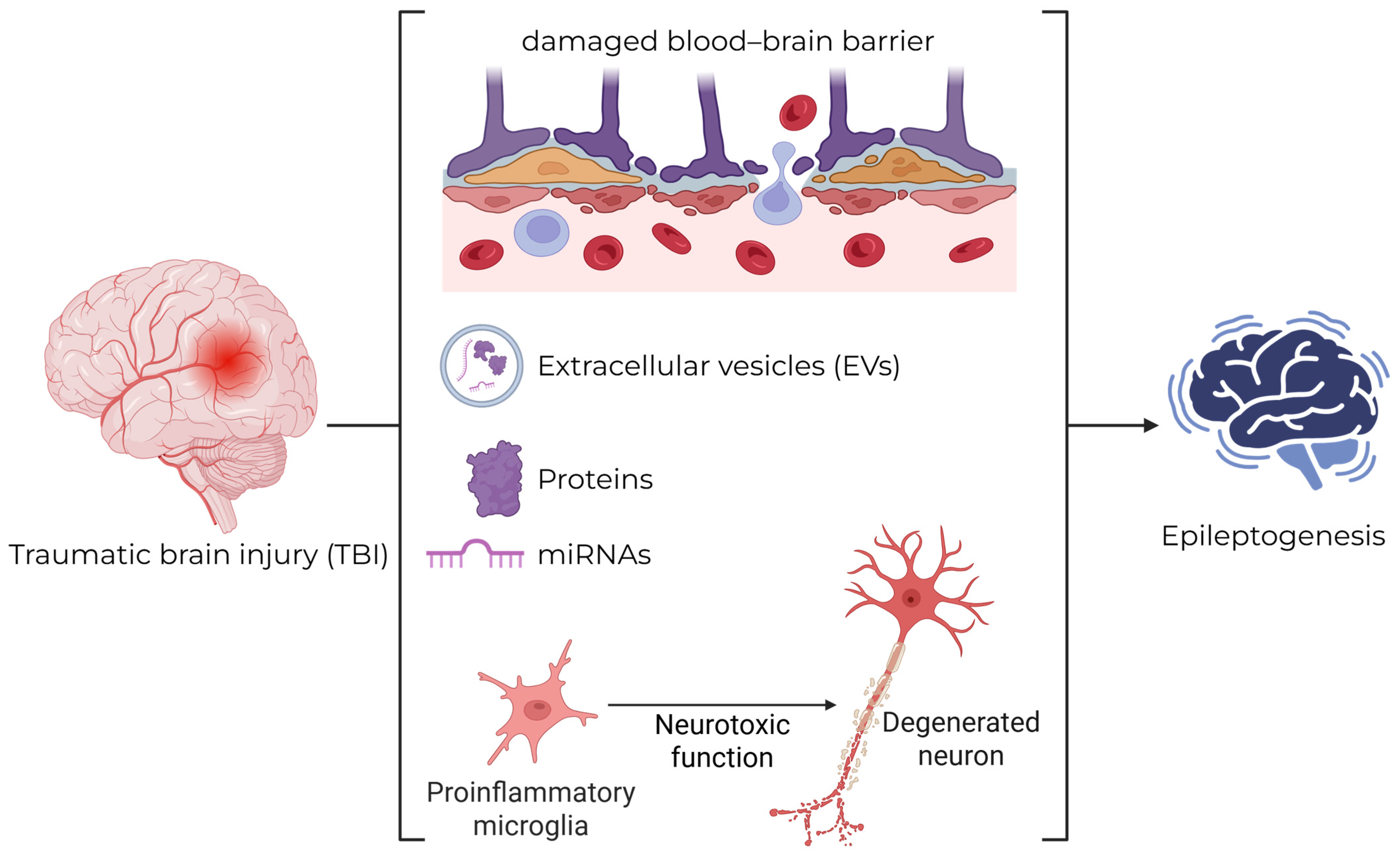
Molecular biomarkers play a crucial role in PTE by reflecting key pathophysiological processes such as neuroinflammation, BBB dysfunction, astrocyte dysregulation, and neuronal injury. These biomarkers include RNA-based markers like microRNAs (miRNAs), extracellular vesicle (EV)-derived molecules, proteins, and metabolites. miRNAs regulate inflammatory pathways and glial activation, while EVs carry a wide range of biomolecules that can provide a comprehensive snapshot of cellular changes (Figure 1).

4.1. RNA Biomarkers

MicroRNAs (miRNAs) have gained significant attention as potential biomarkers for PTE due to their crucial roles in various pathophysiological processes, including neuroinflammation, BBB dysfunction, and astrocyte dysregulation (Table 5). These miRNAs regulate inflammatory signaling pathways, cellular integrity, and glial activation, which are central to the development of epilepsy following TBI [57,58,59]. The neuroinflammatory response in TBI involves the activation of microglia and astrocytes, the release of pro-inflammatory cytokines, and the recruitment of immune cells, all of which contribute to epileptogenesis. Simultaneously, the breakdown of the BBB exacerbates the inflammatory process by allowing blood-derived molecules to infiltrate the brain parenchyma [60]. Several miRNAs, such as miR-21, miR-155, miR-142, and miR-146a, have been identified as key regulators in these processes, with both protective and pathogenic roles depending on the timing and context of their expression [57,58,59]. Additionally, miR-9-5p and miR-124-3p have been shown to play protective roles in maintaining BBB integrity and regulating neuroinflammation, underscoring their potential as therapeutic targets [61,62].

4.1.1. miRNAs Associated with Neuroinflammation, Blood–Brain Barrier (BBB) Dysfunction, and Astrocyte Dysregulation

A growing body of evidence has identified specific microRNAs (miRNAs) that modulate these processes, thereby influencing epileptogenesis. Experimental studies suggest that miR-9-5p may attenuate BBB disruption and inflammatory responses after TBI through modulation of Hedgehog-related signaling and suppression of NF-κB/MMP-9–associated pathways [57]. Similarly, miR-29a-5p has been implicated in regulating BBB permeability in endothelial cells, providing protective effects against TBI-induced dysfunction [58]. However, while these miRNAs offer significant therapeutic promise, the acute inflammatory responses they regulate are not always straightforward. miR-155 and miR-142, for example, have been linked to promoting neuroinflammation and astrogliosis following TBI, raising concerns about their dual roles in both promoting injury repair and exacerbating epileptogenesis [60]. In the case of miR-21, it is involved in both inflammation and BBB permeability regulation, but its role is context-dependent, with different isoforms exhibiting varying effects depending on the cellular compartment and stage of injury [59,71]. These findings emphasize the complex, bidirectional relationship between miRNAs and neuroinflammation in PTE, highlighting the importance of time-sensitive interventions targeting specific miRNA pathways.
Furthermore, astrocyte-specific mechanisms represent an additional layer of post-traumatic epileptogenesis, with several miRNAs contributing to this process. miR-124-3p, delivered via microglial exosomes, has shown protective effects on neuronal repair and glial modulation, suggesting its potential as a therapeutic agent in mitigating the long-term consequences of TBI [62]. In contrast, miR-155 and miR-142 have been associated with the activation of astrocytes and the promotion of inflammation, which can contribute to secondary brain injury and subsequent epileptogenesis [60]. Notably, tRNA-derived fragments, such as miR-146a-5p, have been identified as key regulators in chronic neuroinflammation following TBI, further illustrating the multifaceted roles that different RNA species play in regulating neuroinflammatory responses [70]. These findings indicate that astrocyte-related RNA pathways are particularly relevant for sustaining long-term neuroinflammatory states and network remodeling. Despite their potential as biomarkers, the clinical application of these miRNAs remains challenging due to their pleiotropic effects and the need for precise timing in their modulation. Future research should aim to clarify the temporal dynamics of miRNA expression and develop targeted interventions that can modulate their activity to prevent the onset of PTE.

4.1.2. miRNAs Associated with Cell Signaling

Cell signaling pathways, particularly those involving ion channels, neurotransmitter receptors, and calcium homeostasis, are essential for neuronal excitability and seizure susceptibility in PTE. Several miRNAs have been identified as regulators of these pathways, highlighting their potential as biomarkers for epileptogenesis. miR-98-5p, for example, plays a pivotal role in regulating the glutamatergic system by targeting glutamate transporters such as Slc17a6, as well as potassium channels like KCNH2. These interactions suggest that miR-98-5p may act as a hub regulator of neuronal excitability, influencing the transition from normal activity to hyperexcitability and seizure generation [67,72]. Additionally, miR-21-5p has been shown to regulate neuronal calcium signaling pathways, a critical component in the development of epilepsy. The identification of these miRNA-mRNA interaction pairs underscores the importance of miRNAs in the regulation of ion channels and neurotransmitter systems, which are central to the pathological changes observed in PTE. However, while these findings provide mechanistic insights, the complex interplay of multiple miRNAs in signaling pathways suggests that future studies should focus on validating the functional relevance of these interactions in vivo and their potential as diagnostic biomarkers for PTE.
Moreover, the complexity of miRNA-mediated regulation in cell signaling is further highlighted by studies identifying a wide array of differentially expressed miRNAs associated with calcium signaling pathways in PTE models. In particular, Jia et al. identified seven miRNAs that form negatively correlated miRNA-mRNA pairs, influencing calcium channels and providing insights into the molecular mechanisms driving epileptogenesis [69]. The large number of differentially expressed miRNAs, including rno-miR-21-5p, indicates the highly dynamic nature of miRNA regulation in epileptic conditions [68]. These miRNAs affect multiple signaling pathways, which suggests that a multi-target approach may be necessary for effective PTE prediction and therapeutic intervention [70]. However, despite their potential, the specificity of these miRNAs to PTE remains uncertain, as similar miRNAs are often dysregulated in various neurological conditions. Thus, the challenge remains to define specific miRNA panels that can accurately predict the risk of PTE while distinguishing it from other brain pathologies. Further studies should aim to address these concerns by incorporating longitudinal data and functional validation of miRNA-mRNA interactions across different stages of epileptogenesis.

4.1.3. miRNAs Associated with Epigenetic Dysregulation

Epigenetic mechanisms play a critical role in the transition from transient injury-induced changes to persistent alterations in gene expression that promote epileptogenesis. miRNAs, which are both regulators and targets of epigenetic modifications, are central to these processes. Following TBI, miRNA expression profiles undergo sustained changes, some of which correlate with the development of PTE [73,74]. Specifically, miR-146a has been identified as an important epigenetic regulator involved in controlling the IL-1R1/TLR4 inflammatory axis, suggesting a direct link between inflammation and long-term gene expression changes associated with epileptogenesis [66]. Large-scale profiling studies have shown that several miRNAs are dysregulated in both TBI and epilepsy, including miR-21, miR-181a, and miR-155, which are involved in inflammation and cell cycle regulation [64,65]. These findings point to a shared epigenetic mechanism between TBI and epilepsy, but it remains unclear whether these miRNAs are biomarkers of injury severity or of the transition to epileptogenesis itself. The identification of these dysregulated miRNAs opens up potential therapeutic avenues, but their ability to predict the development of epilepsy from TBI remains inconsistent and requires further investigation.
The temporal dynamics of miRNA expression are essential for understanding the role of epigenetic dysregulation in PTE. Different miRNA signatures have been identified at various post-injury time points, reflecting evolving molecular processes associated with epileptogenesis [75,76]. Chronic downregulation of miR-124-3p in the perilesional cortex after TBI further suggests persistent alterations in neuronal gene regulation that may contribute to seizure susceptibility and long-term network remodeling [77]. Collectively, these findings highlight the importance of temporal and context-dependent epigenetic regulation in PTE and suggest that miRNA profiles should be interpreted within dynamic post-injury frameworks rather than as static biomarkers.

4.2. Protein Biomarkers

Most of the studies on protein biomarkers associated with PTE have identified two main categories: proteins involved in astrocyte dysregulation and neuroinflammation, and proteins indicative of neuronal damage, synaptic function, and neurovascular compromise. Astrocytic proteins, such as GFAP, S100B, and IL-1β, are consistently found to play significant roles in the neuroinflammatory response following TBI. These proteins are involved in astrocyte activation and the inflammatory processes that contribute to epileptogenesis [78,79,80,81,82]. In addition to classical inflammatory mediators, emerging evidence highlights the role of complement-mediated synaptic remodeling in post-traumatic epileptogenesis, where activation of complement components such as C1q and C3 contributes to aberrant synaptic pruning and network hyperexcitability. Furthermore, inflammasome signaling pathways, particularly NLRP3 inflammasome activation, have been implicated in the maturation of pro-inflammatory cytokines such as IL-1β and IL-18, amplifying neuroinflammation and promoting epileptogenic processes. In contrast, proteins like NfL, Tau, and Beta-synuclein are implicated in neuronal injury, axonal damage, and long-term neurodegeneration, reflecting the neuronal damage and synaptic dysfunction underlying PTE [83,84,85,86,87,88]. These biomarkers not only provide insight into the biological mechanisms of epilepsy development but also hold promise for early detection, prognosis, and targeted therapeutic interventions for TBI patients at risk of developing PTE.

4.2.1. Proteins Associated with Astrocyte Dysregulation and Neuroinflammation

Astrocytic biomarkers, particularly GFAP and S100B, have been extensively studied in the context of TBI and epilepsy (Table 6). GFAP holds promise as both a diagnostic and prognostic marker, with recent studies indicating that GFAP breakdown products and aggregation patterns in specific brain regions, notably the thalamus, are linked to epileptogenesis [78,79]. The temporal dynamics of GFAP expression are crucial, as persistent elevations and specific fragment profiles correlate with poor clinical outcomes [79]. S100B has shown strong diagnostic utility in mild TBI, with associations to neuroinflammation and seizure activity [80,81,82,83,84,85,86,87,88,89,90]. Moreover, S100B may act not only as a passive biomarker but also as an active pathogenic factor, with overexpression contributing to worse clinical outcomes [85]. The combined analysis of GFAP and S100B provides complementary insights, with S100B often being more effective for early severity assessment, while GFAP is more valuable for prognostic purposes [90]. Among inflammatory cytokines, IL-1β has been found to have the strongest correlation with PTE development in pediatric populations [91]. However, the role of specific inflammatory mediators, such as TNF-α, CD40, and TNFSF-14, in predicting PTE remains underexplored. These astrocytic and neuroinflammatory biomarkers collectively highlight the reactive gliosis and inflammatory cascades central to epileptogenesis following brain injury.

4.2.2. Proteins Associated with Neuronal Damage and Neurovascular Function

Over the last two decades, numerous experimental and clinical studies have investigated protein biomarkers associated with neuronal damage and neurovascular dysfunction following traumatic brain injury, with particular attention to neurofilament light chain (NfL), glial fibrillary acidic protein (GFAP), tau protein (Tau), neuron-specific enolase (NSE), S100 calcium-binding protein B (S100B), and beta-synuclein as potential indicators of injury severity, prognosis, and post-traumatic outcomes (Table 7) [92,93,94,95,96,97,98,99,100,101,102,103,104,105]. NfL is emerging as a highly promising biomarker for neuronal and axonal injury following TBI, with consistent elevation across multiple studies in both experimental models and clinical populations, either alone or as part of multimarker biomarker panels [92,93,94,95,96,97]. NfL demonstrates strong diagnostic accuracy for TBI severity, correlates with functional outcomes and brain atrophy, and shows utility across the spectrum from mild to severe injury [97,100]. Importantly, while NfL is an excellent marker of cortical damage evolution and somatomotor impairment, multiple studies indicate it does not directly predict epileptogenesis or cognitive impairment [92,93], suggesting that axonal injury alone may not be sufficient for PTE development. Tau protein, particularly in its phosphorylated forms, shows strong associations with TBI severity, elevated intracranial pressure, and long-term disability [98,104]. The P-tau:T-tau ratio appears particularly informative for prognostic assessment, with higher chronic ratios predicting worse outcomes at 12 months post-injury [97]. Beta-synuclein, though less extensively studied, demonstrates value when combined with other biomarkers (GFAP and NfL) for discriminating TBI patients and predicting fatal outcomes [98]. Neuron-specific enolase (NSE) has been evaluated as part of multi-marker panels but shows variable performance, with some studies suggesting it is outperformed by NfL for concussion assessment [102,103]. The temporal trajectories of these biomarkers are critical, with serial sampling revealing that persistent elevation or secondary peaks correlate with unfavorable outcomes and secondary injury events [98,105]. Multi-biomarker approaches using trajectory clustering show promise for predicting functional outcomes and quality of life [105]. Notably, the evidence base for VEGFα in PTE prediction is limited in the current literature, representing a gap in understanding neurovascular contributions to epileptogenesis.

4.3. Metabolite Biomarkers

Metabolite biomarkers play a significant role in understanding the pathophysiology of PTE and TBI, as they reflect both systemic and cerebral alterations that occur during and after injury. One critical metabolite is glucose, which is a key player in glycolysis. Acute dysregulation in glucose metabolism indicates a systemic and cerebral energy crisis, which is often correlated with injury severity and long-term outcomes in TBI patients. Dysregulated glucose utilization has also been implicated in epileptogenesis, with glycolysis emerging as a targetable node for future therapeutic interventions aimed at preventing PTE. Commonly used sample types for glucose metabolism include serum, plasma, and brain microdialysates, and platforms such as LC/GC-MS and microdialysis are utilized to measure glucose levels. The most informative time window for glucose-based biomarkers is typically within hours to days post-injury [106,107].
Another important metabolite in the context of PTE is β-hydroxybutyrate (BHB), a ketone body that serves as an alternative fuel source. After injury, there is a shift toward ketone metabolism, reflecting altered substrate utilization in the brain. BHB has emerged as a central mediator of the ketogenic effects that contribute to seizure control, making it relevant in the context of post-traumatic epileptogenesis prevention. Research on BHB in PTE is gaining traction, with BHB serving as both a biomarker and a potential therapeutic target for modulating neuroexcitability. Sample types commonly used for BHB analysis include serum, plasma, and brain tissue, and key platforms for detection are LC/GC-MS, targeted ketone assays, and tracer studies. BHB levels are particularly informative in acute injury phases as well as during chronic ketogenic therapy [108,109].
Lactate and pyruvate, both key metabolites in glycolysis and redox reactions, are frequently perturbed in conditions such as hypoxia, mitochondrial dysfunction, and metabolic stress. Elevated lactate levels often signal hypometabolism or ischemia, and their dysregulation is closely linked to excitotoxicity, contributing to the pathogenesis of both TBI and PTE. The lactate-to-pyruvate ratio (LPR) serves as an important redox index, stratifying metabolic crisis following TBI and integrating ischemic and mitochondrial dysfunction signals. Glutamate and glutamine, involved in the excitatory neurotransmission and the glutamate-glutamine cycle, are also critical biomarkers for PTE. Dysregulated glutamate signaling is a key driver of excitotoxic injury, which is central to the development of hyperexcitability and epileptogenesis. In PTE, elevated glutamate levels contribute to excitotoxic injury cascades, while altered glutamine metabolism reflects astrocyte dysfunction and excitotoxic stress. These metabolites are typically measured in brain microdialysates, CSF, serum, and plasma, with NMR and LC/GC-MS providing the necessary platforms for analysis. The temporal window for these biomarkers spans from acute to subacute and chronic stages following TBI [107,110,111].

4.4. Extracellular Vesicle (EV)-Derived Biomarkers

Extracellular vesicle (EV)-derived molecules, including proteins, RNAs, and metabolites, are promising candidates as biomarkers for PTE due to their ability to cross the BBB into accessible biofluids (e.g., CSF and blood). EVs are nano- to microscale, membrane-bound particles secreted by virtually all cell types, including neurons and glial cells. They include different subtypes, including exosomes (30–150 nm) and microvesicles (100–1000 nm). Compared with other molecules directly derived from biofluids, EVs offer the unique advantage of protecting their cargo from degradation, making them particularly suited for early, minimally invasive detection of PTE-related molecular changes [52]. Although no EV-derived biomarkers have yet been identified specifically in PTE patients, multiple studies have investigated EV cargo in TBI [53,54]. A recent study analyzed data from 18 animal and 19 human studies and found that miRNAs were the most frequently reported EV components [53]. Among these, miR-124-3p was the most consistently upregulated and was associated with neuroprotective effects, particularly through the modulation of neuroinflammation via neuronal and microglial EVs. miR-21 was also commonly elevated. Frequently identified EV proteins included GFAP, UCH-L1, and tau, as described above.
Beyond their role as candidate biomarkers, EV cargo composition enables the characterization of key pathological processes such as neuroinflammation, neuronal injury, and epileptogenesis [101,102]. EV-mediated intercellular communication further suggests a functional role in disease propagation and modulation rather than passive biomarker release [107]. However, the clinical translation of EV-based biomarkers remains limited by the lack of standardized isolation protocols, variability in EV yield and purity, and heterogeneity of cargo depending on the cell of origin and sampling time. In addition, substantial variability across studies in EV isolation methods, analytical platforms, and cohort characteristics complicates direct comparison of findings and limits reproducibility. Furthermore, most current evidence is derived from TBI studies rather than PTE-specific cohorts, which restricts their specificity for epileptogenesis. Importantly, it remains unclear whether EV-derived signatures reflect causal mechanisms of epileptogenesis or represent secondary byproducts of injury-related processes, which challenges their interpretability as predictive biomarkers. These features highlight the utility of EVs not only for biomarker discovery but also for advancing mechanistic understanding and identifying novel therapeutic targets in PTE.
Across molecular biomarker studies, the main challenge is that mechanistic relevance does not necessarily translate into predictive specificity. Many candidate miRNAs, proteins, metabolites, and EV-derived signals are clearly linked to neuroinflammation, neuronal injury, and BBB dysfunction, but these same pathways are also common to TBI more broadly and are not unique to PTE. As a result, the strongest molecular candidates are often biologically plausible but clinically nonspecific. This distinction is important: biomarkers with high mechanistic value may still have limited standalone predictive utility unless they are validated longitudinally and interpreted in combination with imaging or electrophysiologic data.

5. AI-Assisted Predictive Biomarker Discovery for PTE

Artificial intelligence (AI) approaches are increasingly being explored for PTE prediction, particularly for integrating heterogeneous biomarker data and identifying complex patterns associated with epileptogenesis. Machine learning models have been applied to neuroimaging modalities, including structural MRI, CT, and EEG, to improve risk stratification after TBI. Using MRI-based lesion mapping and statistical modeling, Akrami et al. identified several brain regions, including the temporal lobe, cerebellum, and occipital cortex, that were associated with increased seizure susceptibility following TBI [23]. In a separate pediatric study, Jin et al. applied random forest modeling to clinical and limited imaging variables to predict post-traumatic seizures after repetitive mild TBI, highlighting the contribution of combined clinical-imaging approaches for seizure risk estimation [112]. Despite these advances, current AI-based studies remain constrained by limited external validation, heterogeneous datasets, and insufficient integration of multimodal biomarkers, which restricts their broader clinical applicability.
Moreover, AI techniques have been applied to electronic health records (EHR) and multimodal imaging data to improve PTE prediction accuracy. Rama-murthy et al. applied a graph-based attention network to longitudinal EHR data, revealing the potential of using graph embeddings to predict PTE risk more effectively than conventional ML models. While this approach outperformed traditional methods, it lacked imaging or EEG biomarkers, and external validation was not conducted [113]. Additionally, Wang et al. developed a prognostic model using Cox regression to predict PTE risk based on clinical and CT data, achieving an impressive C-index of 0.89. While this tool is interpretable and practical for clinical use, it did not incorporate advanced ML techniques or imaging beyond CT, limiting its potential for a more nuanced understanding of PTE [33].
AI-assisted approaches that combine multiple biomarker modalities, including neuroimaging and clinical data, show promise for improving PTE prediction [33]. The prospective EpiBioS4Rx study demonstrated that structural MRI features, including cortical thinning and regional volume deficits, were associated with seizure development after TBI, with combined imaging and clinical variables achieving up to 89% classification accuracy [22]. However, the study primarily evaluated early and late post-traumatic seizures rather than long-term PTE, limiting its direct applicability to epileptogenesis prediction. Similarly, La Rocca et al. used structural MRI network-scale features to predict post-traumatic seizures with a random forest algorithm, achieving 70% accuracy. While this approach offers insight into seizure prediction, its reliance on MRI data limits its generalizability to broader clinical populations [40]. These studies demonstrate that while AI holds significant promise in advancing PTE prediction, further refinement of algorithms, inclusion of additional data types, and external validation are needed to enhance predictive accuracy and clinical applicability.
Recent studies have expanded AI-assisted prediction by incorporating multimodal fusion frameworks that integrate structural MRI, diffusion MRI, functional MRI, EEG, and biofluid biomarkers within unified analytical pipelines. These approaches aim to capture complementary structural, functional, and molecular features associated with epileptogenesis. Fusion strategies based on information decomposition and feature selection methods, including IDSF, have shown improved classification performance compared with single-modality models in small cross-validation cohorts [46]. Nevertheless, the absence of large independent validation datasets continues to limit confidence in model generalizability and reproducibility.
Among available modalities, EEG-derived data remain particularly promising for AI-assisted biomarker discovery because they directly reflect network instability and epileptiform activity. Quantitative EEG features, including epileptiform abnormalities, multifractal signal properties, and paroxysmal slow-wave events, have demonstrated high predictive performance in experimental studies, with reported accuracies approaching 95% and AUC values near 0.98 [23,114]. Deep learning methods, including recurrent neural networks, have also been applied for automated detection of epileptiform discharges, enabling scalable analysis of large electrophysiological datasets [115]. However, differences in acquisition protocols, recording duration, and feature extraction methods continue to hinder standardization across studies.
AI-assisted biomarker discovery has also expanded into molecular domains, where circulating microRNAs and inflammatory mediators have emerged as potential predictors of epileptogenesis. Analyses from the EpiBioS4Rx project identified dynamically regulated plasma miRNAs associated with post-traumatic epileptogenic processes, while elevated IL-6 levels have been linked to increased seizure risk in prospective cohorts [63,116]. At present, however, these molecular candidates remain exploratory because of limited longitudinal validation and variability in sampling methodologies.
Another important development is the use of explainability approaches, including Shapley-value analysis and region-wise importance mapping, which improve biological interpretability of AI-generated predictions. These methods have identified temporal lobe structures, cerebellar regions, and white matter pathways as potential contributors to PTE risk [46].
Importantly, the apparent performance of many AI-assisted prediction models should be interpreted cautiously. Studies reporting very high accuracies or AUC values are frequently based on small experimental cohorts, cross-validation frameworks, or highly selected datasets, which increases the risk of overfitting and limits generalizability. At present, clinically translatable prediction remains largely dependent on routinely available variables, particularly CT-derived structural features, basic EEG findings, and established clinical parameters. In contrast, multimodal fusion models, advanced qEEG metrics, circulating molecular biomarkers, and deep learning approaches remain predominantly exploratory despite their mechanistic and computational promise. Thus, the primary challenge in the field is no longer identification of candidate biomarkers, but rather large-scale validation, harmonization, and demonstration of reproducible clinical utility across independent cohorts.
Despite substantial progress, current AI-based studies remain dominated by relatively small single-center cohorts and heterogeneous analytical frameworks. Future advances will therefore depend on standardized multimodal datasets, external validation, and prospective multicenter studies capable of supporting clinically reliable prediction models.

6. Conclusions

Early diagnosis of PTE remains a significant clinical challenge. While advances in neuroimaging, molecular biomarker discovery, and computational approaches have deepened our understanding of epileptogenesis, no single modality provides sufficient predictive power across heterogeneous patient populations. Neuroimaging techniques (CT, MRI, EEG) capture structural and functional alterations, whereas molecular biomarkers reflect dynamic biological processes. Rather than reiterating modality-specific advantages, current evidence indicates that clinically meaningful prediction will depend on the integration of complementary data types within standardized multimodal frameworks. AI-based approaches further support this direction by enabling the analysis of complex, high-dimensional datasets and identifying nonlinear relationships across biomarker domains. Thus, the primary focus of the field is shifting from individual biomarker discovery toward integrated, data-driven risk stratification models.
Despite substantial progress, no biomarker has yet achieved routine clinical implementation for PTE prediction. Among available approaches, CT-based features combined with clinical variables remain the most immediately translatable due to their accessibility and validation in large human cohorts. In contrast, EEG/qEEG and MRI provide higher-resolution functional and network-level insights but are limited by variability in acquisition protocols, cost, and standardization challenges. These modalities are therefore best viewed as complementary components within multimodal prediction strategies rather than standalone solutions.
Molecular biomarkers, including miRNAs, proteins, metabolites, and EV-derived molecules, remain largely exploratory. Although they offer important mechanistic insights into neuroinflammation, neuronal injury, and BBB dysfunction, their predictive performance is inconsistent and often lacks specificity for PTE compared with general brain injury. Additionally, their translational potential is constrained by small cohort sizes, methodological heterogeneity, and limited validation in longitudinal human studies.
Collectively, the key barriers to clinical translation include biological heterogeneity of TBI, lack of standardized measurement protocols, variability in study design and outcome definitions, and insufficient external and longitudinal validation. Addressing these limitations will require large-scale, prospective, and multimodal studies with harmonized methodologies. Future progress should prioritize reproducibility, cross-cohort validation, and integration of imaging, molecular, and computational data to enable robust and clinically actionable prediction of PTE.

Author Contributions

Conceptualization, X.W., H.S. and A.D.; methodology, Z.S., W.L. and A.Z.; writing—original draft preparation, A.D. and H.S.; writing—review and editing, X.W., W.L., A.Z. and Z.S.; supervision, X.W. and H.S. All authors have read and agreed to the published version of the manuscript.

Funding

This research received no external funding.

Institutional Review Board Statement

Not applicable.

Informed Consent Statement

Not applicable.

Data Availability Statement

No new data were created or analyzed in this study. Data sharing is not applicable to this article.

Acknowledgments

The authors thank Blake Glidden for editorial assistance. ChatGPT (OpenAI, GPT-5.5) was used exclusively for language editing, sentence restructuring, and readability improvement during manuscript preparation. All scientific interpretation, literature evaluation, data synthesis, reference verification, and final manuscript review were performed by the authors, who take full responsibility for the content of the article.

Conflicts of Interest

The authors declare no conflicts of interest.

Abbreviations

The following abbreviations are used in this manuscript:
ALICAnterior Limb of the Internal Capsule
AUCArea Under the Curve
BBBBlood–Brain Barrier
BHBβ-Hydroxybutyrate
CTComputed Tomography
dMRIDiffusion-Weighted Magnetic Resonance Imaging
DTIDiffusion Tensor Imaging
EHRElectronic health records
EEGElectroencephalography
ECoGElectrocorticography
EVExtracellular Vesicle
FAFractional Anisotropy
fMRIFunctional Magnetic Resonance Imaging
IL-1βInterleukin-1 Beta
MDMean Diffusivity
MRIMagnetic Resonance Imaging
NSENeuron-Specific Enolase
PTEPost-Traumatic Epilepsy
qEEGQuantitative Electroencephalography
PSWEsParoxysmal Slow-Wave Events
SDHSubdural Hematoma
SAHSubarachnoid Hemorrhage
TBITraumatic Brain Injury
TauTau Protein
TLR4Toll-Like Receptor 4
VEGFαVascular Endothelial Growth Factor Alpha
WMWhite Matter

References

  1. Hauser, W.A.; Annegers, J.F.; Kurland, L.T. Incidence of epilepsy and unprovoked seizures in Rochester, Minnesota: 1935–1984. Epilepsia 1993, 34, 453–458. [Google Scholar] [CrossRef] [PubMed]
  2. Pitkänen, A.; Paananen, T.; Kyyriäinen, J.; Das Gupta, S.; Heiskanen, M.; Vuokila, N.; Bañuelos-Cabrera, I.; Lapinlampi, N.; Kajevu, N.; Andrade, P.; et al. Biomarkers for posttraumatic epilepsy. Epilepsy Behav. 2021, 121, 107080. [Google Scholar] [CrossRef]
  3. Scheffer, I.E.; Berkovic, S.; Capovilla, G.; Connolly, M.B.; French, J.; Guilhoto, L.; Hirsch, E.; Jain, S.; Mathern, G.W.; Moshé, S.L.; et al. ILAE classification of the epilepsies: Position paper of the ILAE Commission for Classification and Terminology. Epilepsia 2017, 58, 512–521. [Google Scholar] [CrossRef]
  4. Annegers, J.F.; Hauser, W.A.; Coan, S.P.; Rocca, W.A. A population-based study of seizures after traumatic brain injuries. N. Engl. J. Med. 1998, 338, 20–24. [Google Scholar] [CrossRef] [PubMed]
  5. Pitkänen, A.; Bolkvadze, T.; Immonen, R. Anti-epileptogenesis in rodent post-traumatic epilepsy models. Neurosci. Lett. 2011, 497, 163–171. [Google Scholar] [CrossRef]
  6. Frey, L.C. Epidemiology of posttraumatic epilepsy: A critical review. Epilepsia 2003, 44, 11–17. [Google Scholar] [CrossRef]
  7. Salazar, A.M.; Grafman, J. Post-traumatic epilepsy: Clinical clues to pathogenesis and paths to prevention. Handb. Clin. Neurol. 2015, 128, 525–538. [Google Scholar] [CrossRef]
  8. Verellen, R.M.; Cavazos, J.E. Post-traumatic epilepsy: An overview. Therapy 2010, 7, 527–531. [Google Scholar] [CrossRef]
  9. De Santis, A.; Cappricci, E.; Granata, G. Early post-traumatic seizures in adults: Study of 84 cases. J. Neurosurg. Sci. 1979, 23, 207–210. [Google Scholar] [PubMed]
  10. Pitkänen, A.; Engel, J. Past and present definitions of epileptogenesis and its biomarkers. Neurotherapeutics 2014, 11, 231–241. [Google Scholar] [CrossRef]
  11. Engel, J.; Pitkänen, A. Biomarkers for epileptogenesis and its treatment. Neuropharmacology 2019, 167, 107735. [Google Scholar] [CrossRef]
  12. Ahmad, A.; Imran, M.; Ahsan, H. Biomarkers as biomedical bioindicators: Approaches and techniques for the detection, analysis, and validation of novel biomarkers of diseases. Pharmaceutics 2023, 15, 1630. [Google Scholar] [CrossRef]
  13. Pitkänen, A.; Immonen, R. Epilepsy related to traumatic brain injury. Neurotherapeutics 2014, 11, 286–296. [Google Scholar] [CrossRef]
  14. Huttunen, J.K.; Airaksinen, A.M.; Barba, C.; Colicchio, G.; Niskanen, J.P.; Shatillo, A.; Sierra Lopez, A.; Ndode-Ekane, X.E.; Pitkänen, A.; Gröhn, O.H. Detection of hyperexcitability by functional magnetic resonance imaging after experimental traumatic brain injury. J. Neurotrauma 2018, 35, 2708–2717. [Google Scholar] [CrossRef]
  15. Bragin, A.; Li, L.; Almajano, J.; Alvarado-Rojas, C.; Reid, A.Y.; Staba, R.J.; Engel, J., Jr. Pathologic electrographic changes after experimental traumatic brain injury. Epilepsia 2016, 57, 735–745. [Google Scholar] [CrossRef]
  16. Andrade, P.; Nissinen, J.; Pitkänen, A. Generalized seizures after experimental traumatic brain injury occur at the transition from slow-wave to rapid eye movement sleep. J. Neurotrauma 2017, 34, 1482–1487. [Google Scholar] [CrossRef] [PubMed]
  17. Manek, R.; Moghieb, A.; Yang, Z.; Kumar, D.; Kobessiy, F.; Sarkis, G.A.; Raghavan, V.; Wang, K.K.W. Protein biomarkers and neuroproteomics characterization of microvesicles/exosomes from human cerebrospinal fluid following traumatic brain injury. Mol. Neurobiol. 2018, 55, 6112–6128. [Google Scholar] [CrossRef]
  18. Stern, R.A.; Tripodis, Y.; Baugh, C.M.; Fritts, N.G.; Martin, B.M.; Chaisson, C.; Cantu, R.C.; Joyce, J.A.; Shah, S.; Ikezu, T.; et al. Preliminary study of plasma exosomal tau as a potential biomarker for chronic traumatic encephalopathy. J. Alzheimers Dis. 2016, 51, 1099–1109. [Google Scholar] [CrossRef] [PubMed]
  19. Vamathevan, J.; Clark, D.; Czodrowski, P.; Dunham, I.; Ferran, E.; Lee, G.; Li, B.; Madabhushi, A.; Shah, P.; Spitzer, M.; et al. Applications of machine learning in drug discovery and development. Nat. Rev. Drug Discov. 2019, 18, 463–477. [Google Scholar] [CrossRef] [PubMed]
  20. Malhotra, A.K.; Shakil, H.; Smith, C.W.; Huang, Y.Q.; Kwong, J.C.C.; Thorpe, K.E.; Witiw, C.D.; Kulkarni, A.V.; Wilson, J.R.; Nathens, A.B. Predicting outcomes after moderate and severe traumatic brain injury using artificial intelligence: A systematic review. npj Digit. Med. 2025, 8, 373. [Google Scholar] [CrossRef]
  21. Karlander, M.; Ljungqvist, J.; Zelano, J. Post-traumatic epilepsy in adults: A nationwide register-based study. J. Neurol. Neurosurg. Psychiatry 2021, 92, 879–882. [Google Scholar] [CrossRef]
  22. Lutkenhoff, E.S.; Shrestha, V.; Ruiz Tejeda, J.; Real, C.; McArthur, D.L.; Duncan, D.; La Rocca, M.; Garner, R.; Toga, A.W.; Vespa, P.M.; et al. Early brain biomarkers of post-traumatic seizures: Initial report of the multicentre epilepsy bioinformatics study for antiepileptogenic therapy (EpiBioS4Rx) prospective study. J. Neurol. Neurosurg. Psychiatry 2020, 91, 1154–1157. [Google Scholar] [CrossRef]
  23. Akrami, H.; Leahy, R.M.; Irimia, A.; Kim, P.E.; Heck, C.N.; Joshi, A.A. Neuroanatomic markers of post-traumatic epilepsy based on MR imaging and machine learning. AJNR Am. J. Neuroradiol. 2022, 43, 347–353. [Google Scholar] [CrossRef]
  24. Faghihpirayesh, R.; Ruf, S.; Rocca, M.; Garner, R.; Vespa, P.; Erdogmus, D.; Duncan, D. Automatic detection of EEG epileptiform abnormalities in traumatic brain injury using deep learning. In Proceedings of the 2021 43rd Annual International Conference of the IEEE Engineering in Medicine & Biology Society (EMBC), Mexico City, Mexico, 1–5 November 2021; pp. 302–305. [Google Scholar] [CrossRef]
  25. Schweitzer, A.D.; Niogi, S.N.; Whitlow, C.T.; Tsiouris, A.J. Traumatic brain injury: Imaging patterns and complications. Radiographics 2019, 39, 1571–1595. [Google Scholar] [CrossRef]
  26. Tubi, M.A.; Lutkenhoff, E.; Buitrago Blanco, M.; McArthur, D.; Villablanca, P.; Ellingson, B.; Diaz-Arrastia, R.; Van Ness, P.; Real, C.; Shrestha, V.; et al. Early seizures and temporal lobe trauma predict post-traumatic epilepsy: A longitudinal study. Neurobiol. Dis. 2019, 123, 115–121. [Google Scholar] [CrossRef] [PubMed]
  27. Appavu, B.L.; Temkit, M.; Kensicki, J.F.; Kuwabara, M.; Burrows, B.T.; Adelson, P.D. Acute physiologic prediction of pediatric post-traumatic epilepsy. Epilepsy Res. 2022, 183, 106935. [Google Scholar] [CrossRef]
  28. Khalili, H.; Rahimi Kashkooli, N.; Niakan, A.; Asadi-Pooya, A.A. Risk factors for post-traumatic epilepsy. Seizure 2021, 89, 81–84. [Google Scholar] [CrossRef]
  29. Ayvaz, B.B.; Wheelock, J.R.; Jin, D.S.; Appleton, J.; Snider, S.B.; Torres-Lopez, V.; Shrishail, N.; Sanders, W.; Doherty, D.; Chow, K.T.; et al. Predicting post-traumatic epilepsy with automated contusion measurements using acute CT images: A competing risk approach. medRxiv 2025. [Google Scholar] [CrossRef] [PubMed]
  30. Gómez-Rosiles, R.; Chavelas-Ochoa, F.; Hernández-Muñoz, A.E.; Romo-Andrade, O.A.; Jayme-Muñoz-Ledo, S.; López-Zapata, V.E. Subdural injuries as risk factors for post-traumatic epilepsy in pediatric patients. Arch. Neurocienc. (Mex.) 2025, 30, 131–137. [Google Scholar] [CrossRef]
  31. Awan, N.; Kumar, R.G.; Juengst, S.B.; DiSanto, D.; Harrison-Felix, C.; Dams-O’Connor, K.; Pugh, M.J.; Zafonte, R.D.; Walker, W.C.; Szaflarski, J.P.; et al. Development of individualized risk assessment models for predicting post-traumatic epilepsy 1 and 2 years after moderate-to-severe traumatic brain injury: A traumatic brain injury model system study. Epilepsia 2024, 66, 482–498. [Google Scholar] [CrossRef]
  32. Lin, S.; Wang, Q.; Zhu, Y.; Jin, X.; Han, P.; Lu, Z. Establishment and validation of a post-traumatic epilepsy prediction model in patients with cerebral contusion. Sci. Rep. 2022, 12, 20574. [Google Scholar] [CrossRef]
  33. Wang, X.-P.; Zhong, J.; Lei, T.; Wang, H.-J.; Zhu, L.-N.; Chu, S.; Chen, D.; Liu, L. Development and external validation of a predictive nomogram model of post-traumatic epilepsy: A retrospective analysis. Seizure 2021, 88, 36–44. [Google Scholar] [CrossRef]
  34. Ritter, A.C.; Wagner, A.K.; Fabio, A.; Pugh, M.J.; Walker, W.C.; Szaflarski, J.P.; Zafonte, R.D.; Brown, A.W.; Hammond, F.M.; Bushnik, T.; et al. Incidence and risk factors of posttraumatic seizures following traumatic brain injury: A traumatic brain injury model systems study. Epilepsia 2016, 57, 1968–1977. [Google Scholar] [CrossRef] [PubMed]
  35. Englander, J.; Bushnik, T.; Duong, T.T.; Cifu, D.X.; Zafonte, R.; Wright, J.; Hughes, R.; Bergman, W. Analyzing risk factors for late posttraumatic seizures: A prospective, multicenter investigation. Arch. Phys. Med. Rehabil. 2003, 84, 365–373. [Google Scholar] [CrossRef]
  36. Akbar, M.N.; Ruf, S.; La Rocca, M.; Garner, R.; Barisano, G.; Cua, R.; Vespa, P.; Erdoğmuş, D.; Duncan, D. Lesion normalization and supervised learning in post-traumatic seizure classification with diffusion MRI. Comput. Diffus. MRI 2021, 13006, 133–143. [Google Scholar] [CrossRef]
  37. La Rocca, M.; Barisano, G.; Garner, R.; Ruf, S.F.; Amoroso, N.; Monti, M.; Vespa, P.; Bellotti, R.; Erdoğmuş, D.; Toga, A.W.; et al. Functional connectivity alterations in traumatic brain injury patients with late seizures. Neurobiol. Dis. 2023, 179, 106053. [Google Scholar] [CrossRef]
  38. Messori, A.; Polonara, G.; Carle, F.; Gesuita, R.; Salvolini, U. Predicting posttraumatic epilepsy with MRI: Prospective longitudinal morphologic study in adults. Epilepsia 2005, 46, 1472–1481. [Google Scholar] [CrossRef]
  39. Smitherman, E.; Hernandez, A.; Stavinoha, P.L.; Huang, R.; Kernie, S.G.; Diaz-Arrastia, R.; Miles, D.K. Predicting outcome after pediatric traumatic brain injury by early magnetic resonance imaging lesion location and volume. J. Neurotrauma 2016, 33, 35–48. [Google Scholar] [CrossRef] [PubMed]
  40. La Rocca, M.; Garner, R.; Amoroso, N.; Lutkenhoff, E.S.; Monti, M.M.; Vespa, P.; Toga, A.W.; Duncan, D. Multiplex networks to characterize seizure development in traumatic brain injury patients. Front. Neurosci. 2020, 14, 591662. [Google Scholar] [CrossRef] [PubMed]
  41. Gupta, R.K.; Saksena, S.; Agarwal, A.; Hasan, K.M.; Husain, M.; Gupta, V.; Narayana, P.A. Diffusion tensor imaging in late posttraumatic epilepsy. Epilepsia 2005, 46, 1465–1471. [Google Scholar] [CrossRef] [PubMed]
  42. Li, W.; Wang, X.; Wei, X.; Wang, M. Susceptibility-weighted and diffusion kurtosis imaging to evaluate encephalomalacia with epilepsy after traumatic brain injury. Ann. Clin. Transl. Neurol. 2018, 5, 552–558. [Google Scholar] [CrossRef]
  43. Akbar, M.N.; La Rocca, M.; Garner, R.; Duncan, D.; Erdoğmuş, D. Prediction of Epilepsy Development in Traumatic Brain Injury Patients from Diffusion Weighted MRI. In Proceedings of the 13th International Conference on PErvasive Technologies Related to Assistive Environments (PETRA 2020), Corfu, Greece, 30 June–3 July 2020; ACM: New York, NY, USA, 2020; pp. 1–2. [Google Scholar]
  44. Weiler, M.; Lutkenhoff, E.S.; de Campos, B.M.; Casseb, R.F.; Vespa, P.M.; Monti, M.M. Early alterations of thalami- and hippocampi-cortical functional connectivity as biomarkers of seizures after traumatic brain injury. NeuroImage Rep. 2024, 4, 100217. [Google Scholar] [CrossRef]
  45. Akbar, M.N.; Ruf, S.F.; Singh, A.; Faghihpirayesh, R.; Garner, R.; Bennett, A.; Alba, C.; La Rocca, M.; Imbiriba, T.; Erdoğmuş, D.; et al. Advancing post-traumatic seizure classification and biomarker identification: Information decomposition based multimodal fusion and explainable machine learning with missing neuroimaging data. Comput. Med. Imaging Graph. 2024, 115, 102386. [Google Scholar] [CrossRef]
  46. Jennett, B.; van de Sande, J. EEG prediction of post-traumatic epilepsy. Epilepsia 1975, 16, 251–256. [Google Scholar] [CrossRef] [PubMed]
  47. Kim, J.A.; Boyle, E.J.; Wu, A.C.; Cole, A.J.; Staley, K.J.; Zafar, S.; Cash, S.S.; Westover, M.B. Epileptiform activity in traumatic brain injury predicts post-traumatic epilepsy. Ann. Neurol. 2018, 83, 858–862. [Google Scholar] [CrossRef]
  48. Angeleri, F.; Majkowski, J.; Cacchiò, G.; Sobieszek, A.; D’Acunto, S.; Gesuita, R.; Bachleda, A.; Polonara, G.; Królicki, L.; Signorino, M.; et al. Post-traumatic epilepsy risk factors: One-year prospective study after head injury. Epilepsia 1999, 40, 1222–1230. [Google Scholar] [CrossRef]
  49. Chen, D.F.; Kumari, P.; Haider, H.A.; Rodriguez Ruiz, A.; Lega, J.; Dhakar, M.B. Association of epileptiform abnormality on electroencephalography with development of epilepsy after acute brain injury. Neurocrit. Care 2021, 35, 428–433. [Google Scholar] [CrossRef] [PubMed]
  50. Chen, Y.; Li, S.; Ge, W.; Jing, J.; Chen, H.Y.; Doherty, D.; Herman, A.; Kaleem, S.; Ding, K.; Osman, G.; et al. Quantitative epileptiform burden and EEG background features predict post-traumatic epilepsy. J. Neurol. Neurosurg. Psychiatry 2023, 94, 245–249. [Google Scholar] [CrossRef] [PubMed]
  51. Pease, M.; Elmer, J.; Zare Shahabadi, A.; Mallela, A.N.; Ruiz-Rodriguez, J.F.; Sexton, D.; Barot, N.; Gonzalez-Martinez, J.A.; Shutter, L.; Okonkwo, D.O.; et al. Predicting posttraumatic epilepsy using admission electroencephalography after severe traumatic brain injury. Epilepsia 2023, 64, 1842–1852. [Google Scholar] [CrossRef] [PubMed]
  52. Pyrzowski, J.; Kałas, M.; Mazurkiewicz-Bełdzińska, M.; Siemiński, M. EEG biomarkers for the prediction of post-traumatic epilepsy: A systematic review of an emerging field. Seizure 2024, 119, 71–77. [Google Scholar] [CrossRef]
  53. de Oliveira, J.P.S.; Sanabria, V.; Baise, C.; Valeriano, R.P.S.; dos Santos, G.M.; Longo, N.M.; Andrade, J.C.Q.F.; Ferreira Junior, G.P.; Oshiro, C.A.; Leite, C.C.; et al. Two-year longitudinal and prospective electroencephalographic follow-up in patients with TBI: Can early EEG and CT findings predict post-traumatic epilepsy? Front. Neurol. 2025, 16, 1609733. [Google Scholar] [CrossRef]
  54. Serlin, Y.; Imtiaz, H.; Maclean, M.A.; Pease, M.W.; Okonkwo, D.O.; Puccio, A.M.; Eagle, S.; Castellano, J.F.; Inati, S.K.; Friedman, A. Paroxysmal cortical slowing predicts posttraumatic epilepsy after severe traumatic brain injury. Neurocrit. Care 2026, 44, 50–55. [Google Scholar] [CrossRef]
  55. Rubinos, C.; Waters, B.; Hirsch, L.J. Predicting and treating post-traumatic epilepsy. Curr. Treat. Options Neurol. 2022, 24, 365–381. [Google Scholar] [CrossRef]
  56. van Hameren, G.; Moradi, P.; Imtiaz, H.; Parker, E.; Mansoor, S.; Al Hadeed, L.; Albitar, M.; Alhosainy, Z.; Friedman, A. Paroxysmal slow wave events as a diagnostic and predictive biomarker for post-traumatic epilepsy. bioRxiv 2024. [Google Scholar] [CrossRef]
  57. Wu, J.; He, J.; Tian, X.; Luo, Y.; Zhong, J.; Zhang, H.; Li, H.; Cen, B.; Jiang, T.; Sun, X. MicroRNA-9-5p alleviates blood-brain barrier damage and neuroinflammation after traumatic brain injury. J. Neurochem. 2020, 153, 710–726. [Google Scholar] [CrossRef]
  58. Zhang, L.; Lu, Y.; Yuan, L.; Zhang, P.; Zou, D.; Wei, F.; Chen, X. miR-29a-5p Alleviates Traumatic Brain Injury (TBI)-Induced Permeability Disruption via Regulating NLRP3 Pathway. Dis. Markers 2021, 2021, 9556513. [Google Scholar] [CrossRef] [PubMed]
  59. Ge, X.; Li, W.; Huang, S.; Yin, Z.; Yang, M.; Han, Z.; Han, Z.; Chen, F.; Wang, H.; Lei, P.; et al. Increased miR-21-3p in injured brain microvascular endothelial cells after traumatic brain injury aggravates blood-brain barrier damage by promoting cellular apoptosis and inflammation through targeting MAT2B. J. Neurotrauma 2019, 36, 1291–1305. [Google Scholar] [CrossRef]
  60. Korotkov, A.; Puhakka, N.; Das Gupta, S.; Vuokila, N.; Broekaart, D.W.M.; Anink, J.J.; Heiskanen, M.; Karttunen, J.; van Scheppingen, J.; Huitinga, I.; et al. Increased expression of miR-142 and miR-155 in glial and immune cells after traumatic brain injury may contribute to neuroinflammation via astrocyte activation. Brain Pathol. 2020, 30, 897–912. [Google Scholar] [CrossRef] [PubMed]
  61. Harrison, E.B.; Emanuel, K.; Lamberty, B.G.; Morsey, B.M.; Li, M.; Kelso, M.L.; Yelamanchili, S.V.; Fox, H.S. Induction of miR-155 after brain injury promotes type 1 interferon and has a neuroprotective effect. Front. Mol. Neurosci. 2017, 10, 228. [Google Scholar] [CrossRef] [PubMed]
  62. Mavroudis, I.; Balmus, I.-M.; Ciobica, A.; Nicoara, M.N.; Luca, A.C.; Palade, D.O. The Role of Microglial Exosomes and miR-124-3p in Neuroinflammation and Neuronal Repair after Traumatic Brain Injury. Life 2023, 13, 1924. [Google Scholar] [CrossRef]
  63. Heiskanen, M.; Ndode-Ekane, X.E.; Ali, I.; Santana-Gomez, C.; Puhakka, N.; Das Gupta, S.; Andrade, P.; Immonen, R.; Casillas-Espinosa, P.; Manninen, E.; et al. Plasma microRNAs as prognostic biomarkers for the development of severe epilepsy after experimental traumatic brain injury—EpiBioS4Rx Project 1 study. Epilepsia 2025, 66, 870–885. [Google Scholar] [CrossRef]
  64. Kumar, P. miRNA Dysregulation in Traumatic Brain Injury and Epilepsy: A Systematic Review to Identify Putative Biomarkers for Post-Traumatic Epilepsy. Res. Sq. 2022. [Google Scholar] [CrossRef]
  65. Meng, J.; Luo, W.; Zhang, N.; Yu, M.; He, Y.; Chen, C.; Shu, H.; Yu, L. Silencing epileptic storms: Targeting miRNA-lncRNA crosstalk in astrocytes and microglia to disarm neuroinflammatory triggers. Front. Mol. Neurosci. 2025, 18, 1616804. [Google Scholar] [CrossRef]
  66. Iori, V.; Aronica, E.; Vezzani, A. Epigenetic control of epileptogenesis by miR-146a. Oncotarget 2017, 8, 45040–45041. [Google Scholar] [CrossRef]
  67. Zhang, X.; Ma, Y.; Zhou, F.; Zhang, M.; Zhao, D.; Wang, X.; Yang, T.; Ma, J. Identification of miRNA–mRNA regulatory network associated with the glutamatergic system in post-traumatic epilepsy rats. Front. Neurol. 2022, 13, 1102672. [Google Scholar] [CrossRef] [PubMed]
  68. Meng, F.; You, Y.; Liu, Z.; Liu, J.; Ding, H.; Xu, R. Neuronal calcium signaling pathways are associated with the development of epilepsy. Mol. Med. Rep. 2015, 11, 196–202. [Google Scholar] [CrossRef] [PubMed][Green Version]
  69. Jia, X.; Ma, Y.; Zhang, X.; Shen, Z.; Wang, M.; Jiang, L.; Wei, X.; Li, C.; Zhang, M.; Yang, T. A preliminary study of calcium channel-associated mRNA and miRNA networks in post-traumatic epileptic rats. Sci. Rep. 2023, 13, 13103. [Google Scholar] [CrossRef] [PubMed]
  70. Puhakka, N.; Das Gupta, S.; Vuokila, N.; Pitkänen, A. Transfer RNA-Derived Fragments and IsomiRs Are Novel Components of Chronic TBI-Induced Neuropathology. Biomedicines 2022, 10, 136. [Google Scholar] [CrossRef]
  71. Zhai, K.; Duan, H.; Wang, W.; Zhao, S.; Khan, G.J.; Wang, M.; Zhang, Y.; Thakur, K.; Fang, X.; Wu, C.; et al. Ginsenoside Rg1 ameliorates blood-brain barrier disruption and traumatic brain injury via attenuating macrophages derived exosomes miR-21 release. Acta Pharm. Sin. B 2021, 11, 3493–3507. [Google Scholar] [CrossRef]
  72. Li, Z.; Ma, Y.; Zhou, F.; Jia, X.; Zhan, J.; Tan, H.; Wang, X.; Yang, T.; Liu, Q. Identification of MicroRNA-Potassium Channel Messenger RNA Interactions in the Brain of Rats With Post-traumatic Epilepsy. Front. Mol. Neurosci. 2021, 13, 610090. [Google Scholar] [CrossRef] [PubMed]
  73. Iyengar, S.S.; Lubbers, L.S.; Harte-Hargrove, L. A team science approach for the preclinical and clinical characterization and biomarker development for post-traumatic epilepsy (PTE). Epilepsia Open 2023, 8, 820–833. [Google Scholar] [CrossRef]
  74. Zhao, A.R.; Yuan, R.; Kouznetsova, V.L.; Tsigelny, I.F. Application of machine learning technology and miRNA biomarkers: A novel approach for epilepsy diagnosis. Adv. Technol. Neurosci. 2025, 2, 145–151. [Google Scholar] [CrossRef]
  75. Hu, Z.; Yu, D.; Almeida-Suhett, C.; Tu, K.; Marini, A.M.; Eiden, L.; Braga, M.F.; Zhu, J.; Li, Z. Expression of miRNAs and Their Cooperative Regulation of the Pathophysiology in Traumatic Brain Injury. PLoS ONE 2012, 7, e39357. [Google Scholar] [CrossRef]
  76. Liu, L.; Sun, T.; Liu, Z.; Chen, X.; Zhao, L.; Qu, G.; Li, Q. Traumatic brain injury dysregulates microRNAs to modulate cell signaling in rat hippocampus. PLoS ONE 2014, 9, e103948. [Google Scholar] [CrossRef]
  77. Vuokila, N.; Puhakka, N.; Pitkänen, A.; Aronica, E.; Korotkov, A.; van Vliet, E.A.; Nuzhat, S. Chronic Regulation of miR-124-3p in the Perilesional Cortex after Experimental and Human TBI. Int. J. Mol. Sci. 2020, 21, 2418. [Google Scholar] [CrossRef] [PubMed]
  78. Lisi, I. Early and Persistent Thalamic Astrocytic Reactivity Is a Hallmark of Post-Traumatic Epilepsy in Mice. Ph.D. Thesis, The Open University, Milton Keynes, UK, 2025. [Google Scholar]
  79. Wanner, I.-B.; Halford, J.; Lopez, J.; Shen, S.; Chen, Y.; Zhao, H.; Salas, C.; Ogorzalek Loo, R.R.; Robicsek, S.; Ellingson, B.M.; et al. GFAP degradation in TBI: Linking novel modified products to astrocyte pathology and patient outcomes. bioRxiv 2025. [Google Scholar] [CrossRef] [PubMed]
  80. Hsu, T.-R.; Chen, P.-H.; Lin, W.-S. Astrocytic biomarkers in epilepsy: A critical review on clinical utility and mechanistic implications. Front. Biosci. 2025, 30, 39022. [Google Scholar] [CrossRef] [PubMed]
  81. Gibbons, M.B.; Smeal, R.M.; Takahashi, D.K.; Vargas, J.R.; Wilcox, K.S. Contributions of astrocytes to epileptogenesis following status epilepticus: Opportunities for preventive therapy? Neurochem. Int. 2013, 63, 660–669. [Google Scholar] [CrossRef]
  82. Vezzani, A.; Ravizza, T.; Bedner, P.; Aronica, E.; Steinhäuser, C.; Boison, D. Astrocytes in the initiation and progression of epilepsy. Nat. Rev. Neurol. 2022, 18, 707–722. [Google Scholar] [CrossRef]
  83. Mochol, M.; Taubøll, E.; Aukrust, P.; Ueland, T.; Andreassen, O.A.; Svalheim, S. Serum markers of neuronal damage and astrocyte activity in patients with chronic epilepsy: Elevated levels of glial fibrillary acidic protein. Acta Neurol. Scand. 2023, 2023, 7246373. [Google Scholar] [CrossRef]
  84. Hanin, A.; Lambrecq, V.; Denis, J.A.; Imbert-Bismut, F.; Rucheton, B.; Lamari, F.; Bonnefont-Rousselot, D.; Demeret, S.; Navarro, V. Cerebrospinal fluid and blood biomarkers of status epilepticus. Epilepsia 2020, 61, 6–18. [Google Scholar] [CrossRef]
  85. Tracy, T.E.; Gan, L. Tau-mediated synaptic and neuronal dysfunction in neurodegenerative disease. Curr. Opin. Neurobiol. 2018, 51, 134–138. [Google Scholar] [CrossRef]
  86. Uryu, K.; Chen, X.H.; Martinez, D.; Browne, K.D.; Johnson, V.E.; Graham, D.I.; Lee, V.M.; Trojanowski, J.Q.; Smith, D.H. Multiple proteins implicated in neurodegenerative diseases accumulate in axons after brain trauma in humans. Exp. Neurol. 2007, 208, 185–192. [Google Scholar] [CrossRef]
  87. Langeh, U.; Singh, S. Targeting S100B protein as a surrogate biomarker and its role in various neurological disorders. Curr. Neuropharmacol. 2020, 19, 265–277. [Google Scholar] [CrossRef]
  88. Yates, D. Traumatic brain injury: Serum levels of GFAP and S100B predict outcomes in TBI. Nat. Rev. Neurol. 2011, 7, 63. [Google Scholar] [CrossRef]
  89. Pelinka, L.E.; Kroepfl, A.; Leixnering, M.; Buchinger, W.; Raabe, A.; Redl, H. GFAP versus S100B in serum after traumatic brain injury: Relationship to brain damage and outcome. J. Neurotrauma 2004, 21, 1553–1561. [Google Scholar] [CrossRef] [PubMed]
  90. Singh, A.; Ramesh, A.S.; Adole, P.S.; Verma, P. Serum glial fibrillary acidic protein and S100B profiles in severity and outcome assessment of moderate and severe head injury patients in India. Curr. Med. Issues 2024, 22, 187–194. [Google Scholar] [CrossRef]
  91. Komiotis, C.; Mavridis, I.; Pyrgelis, E.S.; Agapiou, E.; Meliou, M.; Birbilis, T. The role of interleukins in pediatric traumatic brain injury: A narrative synthesis. J. Clin. Med. 2025, 15, 186. [Google Scholar] [CrossRef] [PubMed]
  92. Heiskanen, M.; Jääskeläinen, O.; Manninen, E.; Das Gupta, S.; Andrade, P.; Ciszek, R.; Gröhn, O.; Herukka, S.-K.; Puhakka, N.; Pitkänen, A. Plasma neurofilament light chain (NF-L) is a prognostic biomarker for cortical damage evolution but not for cognitive impairment or epileptogenesis following experimental TBI. Int. J. Mol. Sci. 2022, 23, 15208. [Google Scholar] [CrossRef] [PubMed]
  93. Khalil, M.; Teunissen, C.E.; Otto, M.; Piehl, F.; Sormani, M.P.; Gattringer, T.; Barro, C.; Kappos, L.; Comabella, M.; Fazekas, F.; et al. Neurofilaments as biomarkers in neurological disorders. Nat. Rev. Neurol. 2018, 14, 577–589. [Google Scholar] [CrossRef]
  94. Mondello, S.; Guedes, V.A.; Lai, C.; Czeiter, E.; Amrein, K.; Kobeissy, F.; Mechref, Y.; Jeromin, A.; Mithani, S.; Martin, C.; et al. Circulating brain injury exosomal proteins following moderate-to-severe traumatic brain injury: Temporal profile, outcome prediction and therapy implications. Cells 2020, 9, 977. [Google Scholar] [CrossRef] [PubMed]
  95. Thelin, E.P.; Zeiler, F.A.; Ercole, A.; Mondello, S.; Büki, A.; Bellander, B.-M.; Helmy, A.; Menon, D.K.; Nelson, D.W. Serial sampling of serum protein biomarkers for monitoring human traumatic brain injury dynamics: A systematic review. Front. Neurol. 2017, 8, 300. [Google Scholar] [CrossRef] [PubMed]
  96. Sanabria, V.; Braga, M.B.; Romariz, S.; Gimenes, C.; Calió, M.L.; Foresti, M.L.; Mello, L.E.; Longo, B.M. Chronic effects of traumatic brain injury and the impact of biperiden treatment in a male rat model. Exp. Neurol. 2026, 398, 115626. [Google Scholar] [CrossRef]
  97. Gan, Z.S.; Stein, S.C.; Swanson, R.; Guan, S.; Garcia, L.; Mehta, D.; Smith, D.H. Blood biomarkers for traumatic brain injury: A quantitative assessment of diagnostic and prognostic accuracy. Front. Neurol. 2019, 10, 446. [Google Scholar] [CrossRef]
  98. Rubenstein, R.; McQuillan, L.; Wang, K.K.W.; Robertson, C.S.; Chang, B.; Yang, Z.; Xu, H.; Williamson, J.B.; Wagner, A.K. Temporal profiles of P-tau, T-tau, and P-tau:T-tau ratios in cerebrospinal fluid and blood from moderate-severe traumatic brain injury patients and relationship to 6–12 month global outcomes. J. Neurotrauma 2024, 41, 369–392. [Google Scholar] [CrossRef]
  99. Halbgebauer, R.; Halbgebauer, S.; Oeckl, P.; Steinacker, P.; Weihe, E.; Schafer, M.K.-H.; Roselli, F.; Gebhard, F.; Huber-Lang, M.; Otto, M. Neurochemical monitoring of traumatic brain injury by the combined analysis of plasma beta-synuclein, NfL, and GFAP in polytraumatized patients. Int. J. Mol. Sci. 2022, 23, 9639. [Google Scholar] [CrossRef] [PubMed]
  100. Shahim, P.; Politis, A.; van der Merwe, A.; Moore, B.; Chou, Y.-Y.; Pham, D.L.; Butman, J.A.; Diaz-Arrastia, R.; Gill, J.M.; Brody, D.L.; et al. Neurofilament light as a biomarker in traumatic brain injury. Neurology 2020, 95, e610–e622. [Google Scholar] [CrossRef]
  101. Whitehouse, D.P.; Monteiro, M.; Czeiter, E.; Vande Vyvere, T.; Valerio, F.; Ye, Z.; Amrein, K.; Kamnitsas, K.; Xu, H.; Yang, Z.; et al. Relationship of admission blood proteomic biomarker levels to lesion type and lesion burden in traumatic brain injury: A CENTER-TBI study. eBioMedicine 2022, 75, 103777. [Google Scholar] [CrossRef]
  102. Shahim, P.; Tegner, Y.; Marklund, N.; Blennow, K.; Zetterberg, H. Neurofilament light and tau as blood biomarkers for sports-related concussion. Neurology 2018, 90, e1780–e1788. [Google Scholar] [CrossRef]
  103. Siman, R.; Toraskar, N.; Dang, A.; McNeil, E.; McGarvey, M.; Plaum, J.; Maloney, E.; Grady, M.S. A panel of neuron-enriched proteins as markers for traumatic brain injury in humans. J. Neurotrauma 2009, 26, 1867–1877. [Google Scholar] [CrossRef]
  104. Zemlan, F.P.; Jauch, E.C.; Mulchahey, J.J.; Gabbita, S.P.; Rosenberg, W.S.; Speciale, S.G.; Zuccarello, M. C-tau biomarker of neuronal damage in severe brain injured patients: Association with elevated intracranial pressure and clinical outcome. Brain Res. 2002, 927, 131–139. [Google Scholar] [CrossRef]
  105. Do, T.S.; Carnes, C.; Yang, Z.; Kobeissy, F.; Yadikar, H.; Olbricht, G.; Tenovuo, O.; Posti, J.P.; Steyerberg, E.W.; Wilson, L.; et al. Serum biomarker trajectory clusters predict functional outcome and quality of life for traumatic brain injury. Brain Commun. 2026, 8, fcag055. [Google Scholar] [CrossRef]
  106. Thomas, I.; Dickens, A.M.; Posti, J.P.; Czeiter, E.; Duberg, D.; Sinioja, T.; Kråkström, M.; Retel Helmrich, I.R.A.; Wang, K.K.W.; Maas, A.I.R.; et al. Serum metabolome associated with severity of acute traumatic brain injury. Nat. Commun. 2022, 13, 2545. [Google Scholar] [CrossRef]
  107. Koenig, J.B.; Dulla, C.G. Dysregulated glucose metabolism as a therapeutic target to reduce post-traumatic epilepsy. Front. Cell. Neurosci. 2018, 12, 350. [Google Scholar] [CrossRef]
  108. Arora, N.; Shastri, D.H.; Patel, U.P.; Bhatia, K. Modulation of beta-hydroxybutyrate in traumatic brain injury. Curr. Opin. Clin. Nutr. Metab. Care 2024, 27, 168–177. [Google Scholar] [CrossRef]
  109. Koenig, J.B.; Cantu, D.; Low, C.; Sommer, M.; Noubary, F.; Croker, D.; Whalen, M.; Kong, D.; Dulla, C.G. Glycolytic inhibitor 2-deoxyglucose prevents cortical hyperexcitability after traumatic brain injury. JCI Insight 2019, 4, e126506. [Google Scholar] [CrossRef]
  110. Timofeev, I.; Carpenter, K.L.; Nortje, J.; Al-Rawi, P.G.; O’Connell, M.T.; Czosnyka, M.; Smielewski, P.; Pickard, J.D.; Menon, D.K.; Kirkpatrick, P.J.; et al. Cerebral extracellular chemistry and outcome following traumatic brain injury: A microdialysis study of 223 patients. Brain 2011, 134, 484–494. [Google Scholar] [CrossRef]
  111. Sahuquillo, J.; Merino, M.A.; Sánchez-Guerrero, A.; Arikan, F.; Vidal-Jorge, M.; Martínez-Valverde, T.; Rey, A.; Riveiro, M.; Poca, M.A. Lactate and the lactate-to-pyruvate molar ratio cannot be used as independent biomarkers for monitoring brain energetic metabolism: A microdialysis study in patients with traumatic brain injuries. PLoS ONE 2014, 9, e102540. [Google Scholar] [CrossRef] [PubMed]
  112. Jin, M.C.; Ravi, K.; Wu, A.; Garcia, C.A.; Rodrigues, A.J.; Savchuk, S.; Ruiz Colón, G.D.; Kakusa, B.W.; Parker, J.J.; Grant, G.A.; et al. Prediction of seizure risk after repetitive mild traumatic brain injury in childhood. J. Neurosurg. Pediatr. 2025, 36, 45–54. [Google Scholar] [CrossRef] [PubMed]
  113. Ramamurthy, P.; Han, Z.; Delen, D.; Miao, Z.; Gin, A.; Luo, X.; Paiva, W. Graph attention network with comorbidity connectivity embedding for post-traumatic epilepsy risk prediction using sparse time-series electronic health records. Int. J. Med. Inform. 2026, 208, 106239. [Google Scholar] [CrossRef] [PubMed]
  114. Riabukhina, D.; Kriukova, K.; Vespa, P.M.; Blanco, M.B.; Bogdan, P.; Duncan, D.; Pereira, E.A. A multifractal-guided machine learning framework for late post-traumatic seizure prediction following hemorrhagic traumatic brain injury. Res. Sq. 2026. [Google Scholar] [CrossRef]
  115. Duncan, D.; Barisano, G.; Cabeen, R.; Sepehrband, F.; Garner, R.; Braimah, A.; Vespa, P.; Pitkänen, A.; Law, M.; Toga, A.W. Analytic tools for post-traumatic epileptogenesis biomarker search in multimodal dataset of an animal model and human patients. Front. Neuroinform. 2018, 12, 86. [Google Scholar] [CrossRef] [PubMed]
  116. Choudhary, A.; Varshney, R.; Kumar, A.; Kaushik, K. A prospective study of novel therapeutic targets interleukin-6, tumor necrosis factor α, and interferon γ as predictive biomarkers for the development of posttraumatic epilepsy. World Neurosurg. X 2021, 12, 100107. [Google Scholar] [CrossRef] [PubMed]
Figure 1. Schematic representation of molecular mechanisms underlying PTE and associated biomarker candidates: Traumatic brain injury (TBI) induces blood–brain barrier (BBB) disruption, allowing circulating molecules and immune cells to enter the brain parenchyma. This process is accompanied by activation of microglia and astrocytes, leading to the release of pro-inflammatory mediators and the development of neuroinflammation. These inflammatory responses contribute to neurotoxic effects, neuronal dysfunction, and progressive neuronal degeneration. As a result, network instability and increased neuronal excitability emerge, promoting seizure susceptibility and the development of post-traumatic epilepsy (PTE). Molecular biomarkers, including microRNAs (miRNAs), extracellular vesicle (EV)-derived cargo, proteins, and metabolites, reflect these pathological processes and can be detected in biofluids, supporting early risk assessment and disease monitoring.
Ctn 10 00017 g001
Table 1. Comparative overview of neuroimaging and electrophysiological modalities for PTE prediction.
ModalityStrengthsLimitationsPredictive UtilityRepresentative Biomarkers
CTRapid, widely available; detects acute hemorrhage, contusions, and mass effectLimited sensitivity for diffuse and microstructural injuryModerate (AUC ~0.60–0.75); improves when combined with clinical/EEG dataContusion volume, SDH, SAH, midline shift, frontotemporal lesions [21]
MRIHigh spatial resolution; detects microstructural damage, network disruption, and gliosisLimited availability in acute phase; higher cost; processing challengesModerate to high (AUC ~0.75–0.89 in multimodal models)FA/MD alterations, lesion volume, iron deposition, functional connectivity [22,23]
EEG/qEEGReal-time functional assessment; detects epileptiform activity and network dysfunctionLimited monitoring duration; variability in acquisition and analysisModerate to high (AUC up to ~0.85); enhanced with quantitative metricsEpileptiform discharges, suppression burden, delta variability, PSWEs [24]
CT, computed tomography; MRI, magnetic resonance imaging; EEG, electroencephalography; qEEG, quantitative electroencephalography; PTE, post-traumatic epilepsy; SDH, subdural hematoma; SAH, subarachnoid hemorrhage; FA, fractional anisotropy; MD, mean diffusivity; PSWEs, paroxysmal slow-wave events; AUC, area under the receiver operating characteristic curve.
Table 2. CT-based prediction models for PTE.
StudyYearPopulationCohort/Data SourceN (Total/PTE)Model TypeCT PredictorsOutcomePerformance
Ayvaz et al. [29]2025AdultsRetrospective cohort; single-center TBI registry1017/61Competing risk regressionContusion volumeLate PTE (>7 days)HR 1.17 per 5 cc increase (95% CI 1.12–1.23)
Gómez-Rosiles et al. [30]2025ChildrenCross-sectional cohort; single-center hospital101/43Multivariable logistic regressionSubdural hematoma, subdural hygromaPTE (>7 days)OR 5.6 (95% CI 2.1–14.8); R2 = 0.30
Awan et al. Model 1 [31]2024AdultsRetrospective cohort; TBI Model Systems National Database4126/916Logistic regressionIntracranial fragments, traumatic hemorrhagePTE within 2 yearsAUROC 0.73; sensitivity 76%
Awan et al. Model 2 [31]2024AdultsRetrospective cohort; TBI Model Systems National Database4126/0Logistic regressionIntracranial fragments, traumatic hemorrhagePTE within 2 yearsAUROC 0.70; sensitivity 72%
Awan et al. Model 3 [31]2024AdultsRetrospective cohort; TBI Model Systems National Database3788/501Logistic regressionIntracranial fragments, traumatic hemorrhageSeizures during year 2AUROC 0.84; sensitivity 86%
Awan et al. Model 4 [31]2024AdultsRetrospective cohort; TBI Model Systems National Database3333/~200Logistic regressionIntracranial fragments, traumatic hemorrhageSeizures during year 2AUROC 0.67; sensitivity 73%
Lin et al. [32]2022AdultsRetrospective cohort; single-center hospital457/71Logistic regressionContusion site, volume, skull fracture, subdural hematomaPTE (>7 days)OR 6.57 for contusion volume >13.5 mL; OR 14.31 for SDH, 95% CI 2.85–71.87; OR 78.88 for non-LPTS, 95% CI 13.73–453.28
Wang et al. [33]2021AdultsRetrospective cohort with external validation; multicenter hospital cohorts1301/166Cox proportional hazards modelSubdural hematoma, contusion locationPTE during follow-upC-index 0.846 (training), 0.895 (validation)
Ritter et al. Acute model [34]2016AdultsProspective cohort; TBI Model Systems National Database796/98Logistic regressionContusion loadAcute post-traumatic seizuresC-statistic 0.599
Ritter et al. Year-1 model [34]2016AdultsProspective cohort; TBI Model Systems National Database796/95Logistic regressionContusion load, subdural hematomaSeizures within 1 yearC-statistic 0.747
Ritter et al. Year-2 model [34]2016AdultsProspective cohort; TBI Model Systems National Database796/134Logistic regressionContusion load, subdural hematomaSeizures within 2 yearsC-statistic 0.716
Englander et al. [35]2003AdultsProspective multicenter cohort (4 trauma centers)647/66Survival analysisMidline shift, contusions, SDH, EDH, SAH, IVH, fragmentsLate seizures (8 days–24 months)24-month cumulative risk 13.8%
PTE, post-traumatic epilepsy; TBI, traumatic brain injury; HR, hazard ratio; OR, odds ratio; CI, confidence interval; AUROC, area under the receiver operating characteristic curve; SDH, subdural hematoma; EDH, epidural hematoma; SAH, subarachnoid hemorrhage; IVH, intraventricular hemorrhage.
Table 3. MRI-based biomarkers associated with PTE.
StudyYearPopulationN (Total/PTE)MRI
Modality
MRI
Biomarker(s)
Imaging
Timing
Outcome DefinitionMain FindingsEffect Size/Performance
Messori et al. [38]2005Adults135/20T1/T2/GE T2*/FLAIR MRIsSDH-C; IW/I-CW vs. CW gliosis–hemosiderin patternsSerial MRI ≤ 2 years; follow-up 5–10 yearsPTE, ≥2 late seizures > 4 weeksIncomplete/evolving gliosis–hemosiderin patterns and surgically treated focal lesions were associated with higher PTE risk; CW lesions were lower risksSDH-C: HR 4.38; IW/I-CW vs. CW: HR 6.61
Smitherman et al. [39]2015Children63/NRFLAIR MRILesion volume (HLVI); lesion location (zones A–C)MRI ~6 days post-TBI; follow-up ~13 monthsFunctional outcome (GOS-E Peds)Higher lesion volume and brainstem involvement (zone C) were associated with worse outcomes; lesions across all zones increased risk of unfavorable outcomeHLVI-total: r = 0.39; zone C: r = 0.37; A + B + C: OR 4.38
La Rocca et al. [40]2020Adults53/NRT1-weighted MRIStructural network features (multiplex connectivity)MRI ≤ 32 days post-TBISeizure occurrence (≥1 seizure)MRI-derived network features differentiated seizure vs. non-seizure patientsAccuracy ~70%; AUC ~0.75
Lin et al. [32]2022Adults457/NRStructural MRIContusion site, volume, SDHAcutePTE (>7 days)Combined structural predictors strongly associated with PTEC-index 0.98
Gupta et al. [41]2005Adults23/14DTI + T2/FLAIR MRIFA ↓; MD ↑; volume of microstructural damageMRI 1–3 years post-TBIPTE
(clinical diagnosis)
Reduced FA and increased MD beyond visible lesions were associated with PTE; greater microstructural damage in PTE vs. non-PTEFA: 0.57 vs. 0.68 (p < 0.05); MD ↑ (NS)
Li et al. [42]2018Adults151/60SWI + DKI MRIIron deposition around encephalomalacia; MK; MD; lesion volumeMRI at 1 year after dischargePTE at 1-year follow-upHigher perilesional iron deposition and altered MK were associated with epilepsy, whereas lesion volume and MD were not significantly differentMK: p = 0.035; SWI iron deposition: p = 0.002; lesion volume: p = 0.245; MD: p = 0.291
Akbar et al. [43]2021Adults22/13dMRI (DTI) + MLFA in WM tracts (TBSS features); lesion-normalized FA featuresMRI ~15 days post-TBILate seizures (>7 days post-TBI)Lesion-normalized FA features improved seizure prediction; FA alterations (e.g., ALIC-R) identified as potential biomarkersAccuracy: 0.819; AUC: 0.785
Weiler et al. [44]2024Adults37/NRfMRIThalamic and hippocampal functional connectivityMRI ≤ 14 days post-TBI; follow-up up to 2 yearsEarly and late seizures (>7 days)Altered thalamo-hippocampal connectivity differentiated early vs. late seizure phenotypes and predicted late seizuresAUC: 0.877; accuracy ~0.88; sensitivity 84.6%; specificity 86.7%
La Rocca et al. [37]2023Adults75/28rs-fMRIFunctional connectivity (graph metrics: integration, segregation, network topology)MRI within ≤36 days post-TBI; follow-up up to 2 yearsLate seizures (>7 days post-TBI)Seizure group showed hyperconnectivity, hyperintegration, and hyposegregation with disrupted network topologySignificant group differences (p < 0.05 across network metrics); no AUC reported
Akbar et al. [45]2024Adults48/17Multimodal MRI (dMRI, fMRI ± FLAIR)dMRI (ALIC-L FA), fMRI (right middle temporal gyrus), multimodal features~14 days post-TBI; follow-up 2 yearsLate post-traumatic seizuresIdentified modality-specific biomarkers; multimodal fusion improves predictionBest model AUC ≈ 0.79
TBI, traumatic brain injury; PTE, post-traumatic epilepsy; MRI, magnetic resonance imaging; DTI, diffusion tensor imaging; dMRI, diffusion-weighted MRI; SWI, susceptibility-weighted imaging; DKI, diffusion kurtosis imaging; rs-fMRI, resting-state functional MRI; FLAIR, fluid-attenuated inversion recovery; GE T2*, gradient-echo T2*; FA, fractional anisotropy; MD, mean diffusivity; MK, mean kurtosis; TBSS, tract-based spatial statistics; ALIC, anterior limb of the internal capsule; SDH, subdural hematoma; sSDH-C, surgically treated subdural hematoma with contusion; HLVI, hemorrhagic lesion volume index; GOS-E Peds, Glasgow Outcome Scale–Extended Pediatric; HR, hazard ratio; OR, odds ratio; AUC, area under the curve; C-index, concordance index; NS, not significant; CW, complete wall; IW, incomplete wall; I-CW, intermediate-to-complete wall; ↑, increase; ↓, decrease.
Table 4. EEG-based biomarkers associated with PTE.
StudyYearPopulationN MethodEEG Biomarker(s)Main Findings
Kim et al. [47]2018Adults50EEGEAsAcute EAs independently predict first-year PTE
Oliveira et al. [53]2025Adults73EEGDiffuse theta waves; abnormal bilateral sleep elementsEEG abnormalities and temporal lesions predict higher PTE risk
Serlin et al. [54]2026Adults45EEGPSWEsPSWEs predict PTE and disability
Rubinos et al. [55]2022AdultsNREEGSlowing; epileptiform activityEEG abnormalities at 1 month associated with PTE
Pease et al. [51]2023AdultsNRqEEGDelta/theta power; rhythmic spectrumAcute qEEG predicts PTE (AUC 0.85)
Chen et al. [50]2023Adults126qEEGEpileptiform burden; suppression; beta variabilityIncreased epileptiform burden associated with ~4.6× higher PTE risk
Hameren et al. [56]2024AdultsNREEG/ECoGPSWEsPSWEs validated as biomarker in humans
EEG, electroencephalography; qEEG, quantitative electroencephalography; EAs, epileptiform abnormalities; PSWEs, paroxysmal slow-wave events; AUC, area under the curve.
Table 5. miRNAs associated with PTE categorized by their roles in neuroinflammation, cell signaling, and epigenetic dysregulation.
StudyYearPopulationmiRNA TypeSpecific miRNA(s)CategoryKey Biomarker RoleKey Finding
Heiskanen et al. [63]2025Human (TBI, epilepsy)microRNAmiR-434-3p, miR-9a-3pEpigenetic dysregulationNeuronally enriched miRNAs reflect injury severity but do not predict PTENeuronally enriched miRNAs indicate injury severity but not PTE prediction
Cinar [64]2022Human (TBI, epilepsy)microRNA10 commonly dysregulated miRNAsEpigenetic dysregulationDysregulated miRNAs involved in apoptosis, inflammation, and cell cycle regulation10 miRNAs linked to apoptosis, inflammation, and cell cycle
Meng et al. [65]2025Human (Astrocytes and microglia)microRNA, lncRNANot specifiedEpigenetic dysregulationmiRNA-lncRNA crosstalk in astrocytes and microglia triggers neuroinflammation in epilepsymiRNA-lncRNA interactions drive neuroinflammation
Iori et al. [66]2017Animal, Human (Epilepsy models)microRNAmiR-146aEpigenetic dysregulationImplicated in the regulation of the IL-1R1/TLR4 inflammatory axismiR-146a controls IL-1R1/TLR4 axis in epileptogenesis
Zhang et al. [67]2022Rat (PTE model)microRNA, mRNAmiR-98-5p, miR-1224Cell SignalingmiR-98-5p–Slc17a6 and miR-1224–Slc25a22 interaction pairs in PTEmiRNA-mRNA interaction pairs in PTE development
Meng et al. [68]2015Rat (Epilepsy model)microRNArno-miR-21-5pCell SignalingmiR-21-5p regulates neuronal calcium signaling pathwaysmiR-21-5p affects neuronal calcium signaling
Jia et al. [69]2023Rat (PTE model)microRNA, mRNA7 miRNAs (unspecified)Cell SignalingmiRNAs associated with calcium channels form miRNA-mRNA pairsCalcium channel miRNA-mRNA pairs in PTE
Puhakka et al. [70]2022Rat (Chronic TBI)microRNA, tRNA-derived fragmentsmiR-146a-5p, miR-155-5p, miR-375-3pNeuroinflammationUpregulated miRNAs and tRNA fragments linked to neuroinflammation and behavioral outcomesChronic TBI-associated miRNAs and tRNA fragments in neuroinflammation
TBI, traumatic brain injury; PTE, post-traumatic epilepsy; miRNA, microRNA; lncRNA, long non-coding RNA; Slc, solute carrier; IL-1R1, interleukin-1 receptor type 1; TLR4, toll-like receptor 4; mRNA, messenger RNA.
Table 6. Proteins associated with astrocyte dysregulation and neuroinflammation in PTE.
StudyYearSpecific Protein BiomarkerBiomarker SourceStudy PopulationKey Finding
Ilaria [78]2025GFAPThalamic astrocytic alterations, contralateral spiking activityMurine TBI model with 50% PTE incidence by 5 monthsIncreased GFAP aggregation and astrocytic morphological alterations in the ipsilateral thalamus of high-risk mice contribute to epileptogenesis. Targeting GFAP improved TBI outcomes, suggesting its relevance to PTE.
Wanner et al. [79]2025GFAPCSF, serum, and patient biofluidsTBI patients and a human trauma culture modelDistinct CSF patterns of GFAP-derived fragments were observed between favorable and unfavorable TBI outcomes, with persistent elevation of specific calpain-associated BDP isoforms during injury progression.
Hsu et al. [80]2025GFAP, S100BFluid biomarkers derived from astrocytesEpilepsy in children and adults; clinical and experimental findingsThe review focuses on astrocytic biomarkers like GFAP and S100B, examining their roles in assessing seizure burden, temporal dynamics, and potential in distinguishing seizure types. It discusses their therapeutic, prognostic, and mechanistic implications in epileptic disorders.
Sitovskaya [81]2024GFAP, S100BTemporal lobe tissuePediatric patients with drug-resistant epilepsyChanges in GFAP and S100 immunoreactivity were observed in the temporal lobe of pediatric patients with drug-resistant epilepsy.
Oris et al. [82]2023S100BBloodChildren, adults, and athletes with mTBIS100B protein is the most widely studied and used diagnostic biomarker for clinical decision-making in mTBI patients, also playing an active role in acute brain injury processes and serving as a potential therapeutic target.
Mochol et al. [83]2023GFAP, S100B, NSESerum119 epilepsy patients and 80 healthy controlsElevated serum levels of GFAP were found in epilepsy patients. However, none of the markers, including GFAP, were significantly associated with epilepsy duration, seizure type or severity, or recent seizures.
Hanin et al. [84]2020S100B, NSECerebrospinal fluid and bloodPatients and animal models of status epilepticusNew biomarkers aim to prospectively identify the severity and development of disability and subsequent epilepsy of patients with status epilepticus. These include increased S100B and High Mobility Group Box 1 for gliosis/inflammation.
Michetti et al. [85]2023S100BBiological fluids, nervous tissuePatients and/or experimental models of different neural disordersS100B levels are recognized as a reliable biomarker of active neural distress and correlate with clinical/toxic parameters in epilepsy and traumatic neural injury. Overexpression of S100B worsens clinical presentation, suggesting it is a pathogenic factor.
Bulduk et al. [86]2018S100B, GFAPSerum and cardiac bloodLithium–pilocarpine induced status epilepticus in rat modelSerum S100B is a candidate biomarker for monitoring neuroinflammation, with highly positive correlations found between S100B levels and microglial activation in CA1. It may also help predict diagnosis and prognosis.
Langeh et al. [87]2020S100B, TNF-αNot specifiedVarious neurological disorders, including Alzheimer’s, Parkinson’s, multiple sclerosis, schizophrenia, and epilepsyIncreased S100B expression is associated with epilepsy and plays a crucial role in various neurological disorders through neuroinflammation. Elevated S100B levels are useful for assessing inflammatory markers and excitotoxicity-dependent neuronal loss.
Yates [88]2011GFAP, S100BSerumPatients with TBISerum levels of GFAP and S100B predict outcomes in TBI. These biochemical markers are adjuncts to assessing brain damage and enhance prognoses for TBI patients.
Pelinka et al. [89]2004GFAP, S100BSerum92 patients admitted after traumatic brain injuryBoth GFAP and S100B measurements are useful non-invasive means for identifying brain damage after TBI, with differences based on TBI pattern and accompanying trauma/shock. They also have predictive value for mortality after TBI.
Singh et al. [90]2024GFAP, S100BSerum212 moderate and severe TBI patients in IndiaS100B is a better marker for TBI severity and outcome assessment than GFAP. S100B showed 66% sensitivity and specificity for disease severity, and performed better for early mortality prediction.
Komiotis et al. [91]2024IL-1β, NSENot specifiedPediatric traumatic brain injury patientsIL-1β appears to have the strongest correlation with PTE among inflammatory cytokines examined.
TBI, traumatic brain injury; mTBI, mild traumatic brain injury; PTE, post-traumatic epilepsy; GFAP, glial fibrillary acidic protein; S100B, S100 calcium-binding protein B; IL-1β, interleukin 1 beta; NSE, neuron-specific enolase; TNF-α, tumor necrosis factor-alpha.
Table 7. Biomarkers of neuronal damage and neurovascular function.
StudyYearSpecific Protein BiomarkerBiomarker SourceStudy PopulationKey Finding
Heiskanen et al. [92]2022NfLPlasmaRat TBI model with lateral fluid percussion injuryPlasma NF-L levels were significantly elevated after TBI, prognostic for cortical damage but not cognitive impairment or epileptogenesis.
Mondello et al. [94]2020GFAP, Tau, NfLSerum, blood21 patients with moderate-to-severe TBIExosomal UCH-L1 profile with acutely elevated values and secondary steep rise associated with early mortality. Diffuse injury patients showed higher acute exosomal NFL and GFAP.
Thelin et al. [95]2017GFAP, S100B, NfL, NSESerumHuman traumatic brain injury (TBI) patientsSerial sampling reveals different temporal trajectories with persisting high serum levels or secondary peaks associated with unfavorable outcomes or secondary events.
Sanabria et al. [96]2026Tau, NfLPlasmaAdult male Wistar rats in a lateral fluid percussion injury (LFPI) modelTBI significantly increased plasma NfL levels, indicating neuronal damage. Both TBI groups showed higher seizure susceptibility, with biperiden slightly reducing seizure intensity.
Shahim [97]2015NfLBlood, serum, cerebrospinal fluidIce hockey players and patients with mild to severe TBImTBI associated with altered serum levels of biomarkers related to neuronal injury, which correlated with return-to-play time. In sTBI, NFL levels showed high diagnostic accuracy.
Rubenstein et al. [98]2023TauCSF, serum (blood)Moderate-to-severe TBI patients and healthy controlsHigher chronic (1–6 months) P-tau levels and P-tau:T-tau ratio associated with greater disability and worse global outcomes 12 months post-TBI.
Halbgebauer et al. [99]2022GFAP, Beta-synuclein, NfLPlasma, bloodPolytraumatized patients with and without TBI, and healthy volunteersPlasma NfL, beta-synuclein, and GFAP were significantly increased after polytrauma, predicting fatal outcome. A combined analysis discriminated TBI patients.
Shahim et al. [100]2020NfLSerum, CSFHockey players, clinic-based TBI patients, and controlsIncreased serum NfL concentrations distinguish TBI from controls, showing promise as a biomarker for acute, repetitive, subacute, and chronic TBI.
Whitehouse et al. [101]2022GFAP, Tau, NfL, NSEBloodTraumatic brain injury patients (human)Blood proteomic biomarker levels related to lesion type and lesion burden in TBI patients.
Shahim et al. [102]2018NfL, Tau, S100B, NSEBloodAcute sports-related concussion (SRC) patientsSerum NfL outperformed tau, S100B, and NSE as a biomarker for SRC, identifying individuals at risk of prolonged PCS.
Siman et al. [103]2009NSECSF, serumSevere TBI in humansIdentified neuron-enriched proteins as potential markers for severe TBI detection, management, and evaluation.
Zemlan et al. [104]2002TauCSFSevere brain-injured patientsC-tau is a biomarker of neuronal damage in severe brain-injured patients, associated with elevated intracranial pressure and clinical outcome.
Do et al. [105]2026GFAP, S100B, Tau, NfL, NSESerum373 CT-positive ICU traumatic brain injury patients (256 GCS 3-12)Serum biomarker trajectory clusters predict functional outcome and quality of life for TBI patients.
TBI, traumatic brain injury; NfL, neurofilament light chain; GFAP, glial fibrillary acidic protein; Tau, tau protein; NSE, neuron-specific enolase; P-tau, phosphorylated tau; CSF, cerebrospinal fluid.
Disclaimer/Publisher’s Note: The statements, opinions and data contained in all publications are solely those of the individual author(s) and contributor(s) and not of MDPI and/or the editor(s). MDPI and/or the editor(s) disclaim responsibility for any injury to people or property resulting from any ideas, methods, instructions or products referred to in the content.