


Abstract
To study the influence of curing agent structure on the properties of epoxy resin, four types of aromatic diamines with the structure of diphenyl methane (4,4′-methylenedianiline (MDA), 4,4′-methylenebis(2-ethylaniline) (MOEA), 4,4′-methylenebis(2-chloroaniline) (MOCA), and 4,4′-methylenebis(3-chloro-2,6-diethylaniline) (MCDEA)) and a high-performance epoxy resin, 3-(oxiran-2-ylmethoxy)-N,N-bis(oxiran-2-ylmethyl)aniline (AFG-90MH), were used in this study. The resulting resin systems were designated as AFG-90MH-MDA, AFG-90MH-MOEA, AFG-90MH-MOCA, and AFG-90MH-MCDEA. After curing, these systems were named AFG-90MH-MDA-C, AFG-90MH-MOEA-C, AFG-90MH-MOCA-C, and AFG-90MH-MCDEA-C. The influence of the structure of the diamines on the processability, curing reaction activity, and thermal and mechanical properties (including flexural and tensile properties) of the epoxy resins were investigated. These systems demonstrate excellent processability with wide processing windows ranging from 30 °C to 110–160 °C while maintaining low viscosity. Consistent apparent activation energy (Ea) trends via both Kissinger and Flynn-Wall-Ozawa methods were observed. The epoxy systems exhibit the following increasing Ea sequence: AFG-90MH-MDA < AFG-90MH-MOEA < AFG-90MH-MOCA < AFG-90MH-MCDEA. The processability and curing reaction kinetic results indicate that the reactivities of the diamines decrease in the order: MDA > MOEA > MOCA > MCDEA. Polar chlorine substituents in diamines strengthen intermolecular interactions, thereby enhancing mechanical performance. The flexural strength of cured epoxy systems decreases as follows with corresponding values: AFG-90MH-MOCA-C (165 MPa) > AFG-90MH-MDA-C (158 MPa) > AFG-90MH-MCDEA-C (148 MPa) > AFG-90MH-MOEA-C (136 MPa). Diamines with substituents like chlorine or ethyl groups reduce the glass transition temperatures (Tg) of the cured resin systems. However, the cured resin systems with the diamines containing chlorine demonstrate superior thermal performance compared to those with ethyl groups. The cured epoxy systems exhibit the following descending glass transition temperature order with corresponding values: AFG-90MH-MDA-C (213 °C) > AFG-90MH-MOCA-C (190 °C) > AFG-90MH-MCDEA-C (183 °C) > AFG-90MH-MOEA-C (172 °C).
1. Introduction
Advanced fiber-reinforced composites are widely employed in structural applications across the automotive and aerospace industries. Resin transfer molding (RTM), a liquid composite molding (LCM) technique, offers a route to manufacturing such high-performance resin composites. RTM enables the efficient fabrication of large, complex composite parts compared with the traditional prepreg layup–autoclave cure process [1,2]. This process involves injecting a viscosity-reactive resin into a closed mold containing preplaced fabric preforms under controlled pressure, followed by in situ curing. However, manufacturing high-performance composites necessitates high fiber volume fractions and extensive flow paths within the mold, resulting in significant flow resistance and prolonged mold-filling times. Consequently, resins employed in RTM must exhibit low viscosity and slow reactivity at the processing temperature to ensure complete mold filling [2,3].
Epoxy resins are a kind of widely used thermosetting resin with excellent electrical insulation, high mechanical strength, and superior chemical resistance [4,5,6,7,8] for applications in coatings, adhesives, high-performance composites, laminates, electronic encapsulation, potting, and other fields [9,10,11]. Typically, epoxy resins exist as a viscous fluid, making them suitable as a matrix resin for advanced composite materials. These composites are employed in high-tech fields such as aerospace, satellites, renewable energy, the automotive industry, etc. [12]. Conventional epoxy resins exhibit relatively low glass transition temperatures (Tg), limiting their applicability in demanding structural applications such as aircraft wings. However, the multifunctional epoxy resins usually display high viscosity, short pot time, high curing rate, and even a bit of low rigidity. Such limitations frequently constrain the application of multifunctional epoxy resins in large-scale structural components manufactured via RTM. Special epoxy resins such as 3-(oxiran-2-ylmethoxy)-N,N-bis(oxiran-2-ylmethyl)aniline (AFG-90MH) feature multiple epoxy groups per molecule and exhibit low viscosity at relevant processing temperatures. These characteristics render AFG-90MH particularly suitable for RTM, yielding cured resin with high mechanical strength and Tg, thereby positioning it as an excellent matrix material for high-performance composites.
As is well known, the structure of epoxy resins and the curing agents significantly influence the properties of the cured epoxy system [13]. The presence of multiple reactive groups on both epoxy resins and curing agents enables multiple addition reactions during polymerization, resulting in complicated crosslinked networks upon curing. The chemical structures of the epoxy resins and curing agents critically determine the network structure and final properties [14,15]. The curing agents for epoxy resins are typically acid anhydrides [16], amines [17,18,19,20], Lewis acid, and so on. Although epoxy resins are curable by diverse curing agents, aromatic amines retain a prominent position in high-performance applications [21]. Epoxy–aromatic amine systems have appropriate viscosity and reactivity at processing temperatures, available for RTM [1,2]. Cured epoxy–aromatic amine systems generally provide enhanced environmental stability, outstanding heat-resistant and mechanical properties, required by high-performance composites [21,22]. Extensive studies focus on the curing behavior, the properties of the cured multifunctional epoxy resins, and composites in the advanced composite field [23,24,25,26]. However, a systematic investigation on the influence of diamines based on a diphenylmethane backbone on the properties of multifunctional epoxy resins remains lacking.
In this work, aromatic diamines derived from a diphenylmethane backbone functionalized with different substituent groups (4,4′-methylenedianiline (MDA), 4,4′-methylenebis(2-ethylaniline) (MOEA), 4,4′-methylenebis(2-chloroaniline) (MOCA), and 4,4′-methylenebis(3-chloro-2,6-diethylaniline) (MCDEA)) were used to cure the epoxy resin AFG-90MH. The influence of the diamine structure on the curing reactions and the properties of AFG-90MH resin was systematically evaluated.
2. Experiment
2.1. Materials
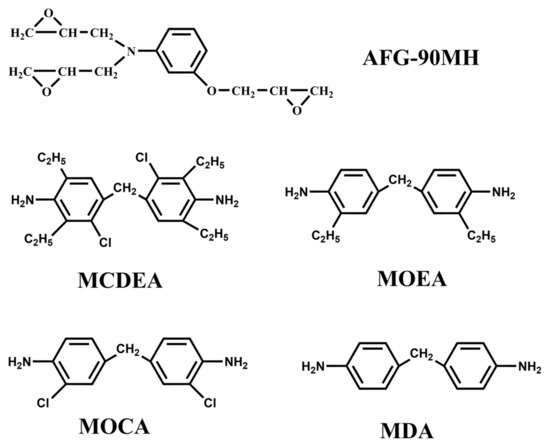
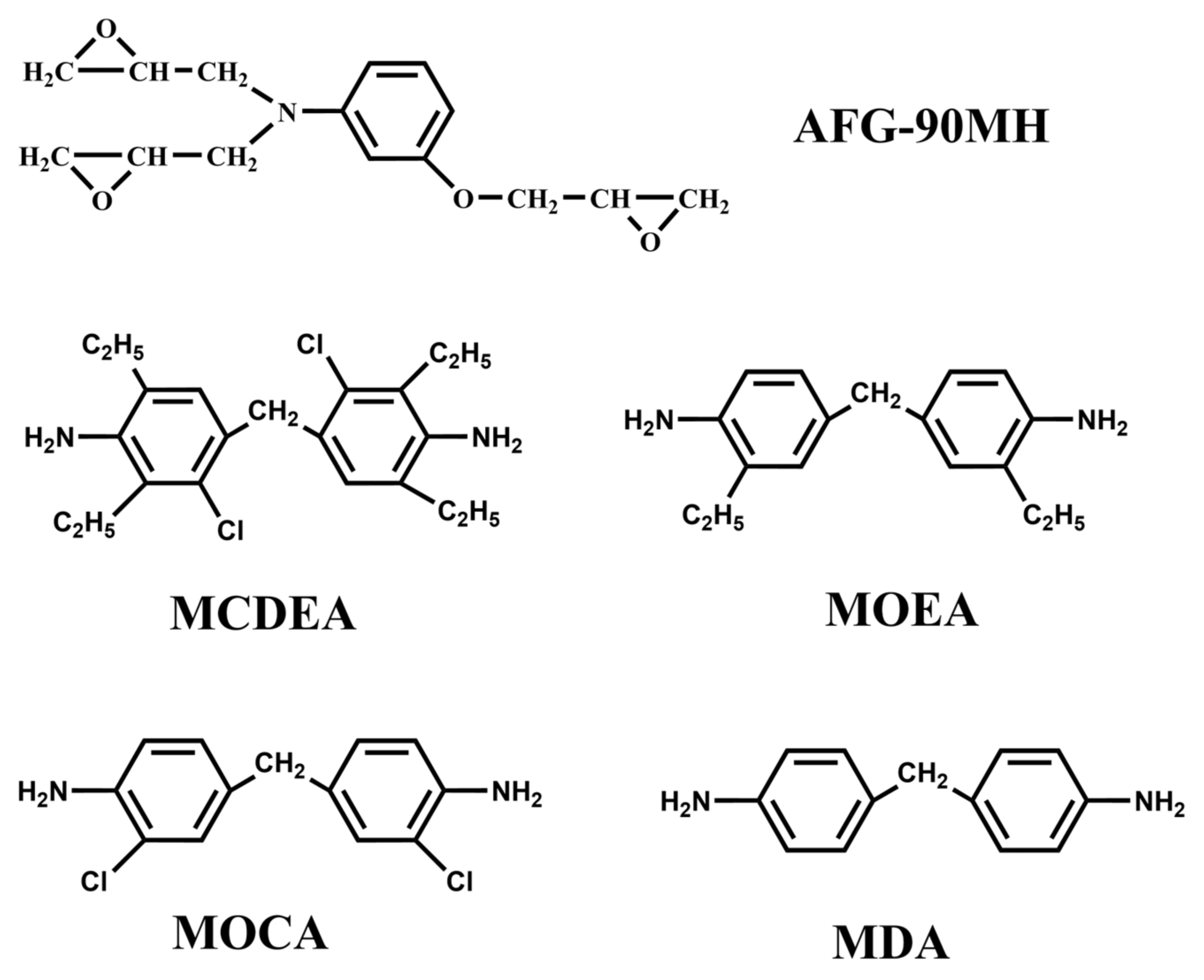
AFG-90MH (Industrial grade) was purchased from Shanghai Huayi Resin Co., Ltd., Shanghai, China. MOEA (98%) was purchased from Shanghai Bide Pharmaceutical Technology Co., Ltd., Shanghai, China. MOCA (98%) was purchased from Aladdin Biochemical Technology Co., Ltd., Shanghai, China. MCDEA (98%) was purchased from Shanghai Bide Pharmaceutical Technology Co., Ltd., Shanghai, China. MDA (98%) was purchased from Shanghai Adamas Reagent Co., Ltd., Shanghai, China. Dichloromethane was purchased from Shanghai Titan Technology Co., Ltd., Shanghai, China. Release agent (909A 45) was purchased from Dongguan Jiadan lubricating oil Co., Ltd., Dongguan, China. The chemical structures and abbreviations of AFG-90MH and aromatic diamines are shown in Figure 1.
Figure 1.
The chemical structures and abbreviations of AFG-90MH and aromatic diamines.
2.2. Preparation of Cured Resin Systems
Aromatic diamine curing agents and the epoxy resin (AFG-90MH) were mixed in a 3:4 molar ratio (active hydrogen to epoxy groups). Solid curing agents (MDA, MOCA, MCDEA) were separately dissolved in dichloromethane and mixed with AFG-90MH. AFG-90MH-MDA, AFG-90MH-MOCA, and AFG-90MH-MCDEA systems were prepared after removing the solvent via rotary evaporation, respectively. MOEA, a low-viscosity liquid at 50 °C, was directly mixed with AFG-90MH. Thus, the AFG-90MH-MOEA system was prepared.
The AFG-90MH-MDA system was loaded into a preheated metal mold and subjected to vacuum degassing at 70 °C for 30 min, and then cured by using the following procedure: 100 °C/1 h + 160 °C/2 h + 180 °C/2 h. The AFG-90MH-MOEA system was loaded into a preheated metal mold and subjected to vacuum degassing at 90 °C for 30 min and then cured by using the following procedure: 110 °C/2 h + 150 °C/2 h. The AFG-90MH-MOCA and AFG-90MH-MCDEA systems were loaded into a preheated metal mold and subjected to vacuum degassing at 100 °C for 30 min and then respectively cured by using the following procedure: 140 °C/2 h + 180 °C/2 h or 160 °C/2 h + 180 °C/2 h. After natural cooling to room temperature, brownish-yellow cured resin systems named AFG-90MH-MDA-C, AFG-90MH-MOCA-C, AFG-90MH-MOEA-C, and AFG-90MH-MCDEA-C were obtained.
2.3. Characterization and Measurements
Rheological behavior was determined on a Thermo Haake RS600 Rheometer system (Thermo Electron Corporation, Karlsruhe, Germany) in the range of 25–200 °C, and the shear rate and heating rate for the viscosity measurements were 0.01 s−1 and 2 °C/min, respectively. Differential scanning calorimetric (DSC) analyses were run on a DSC214 (NETZSCH, Selb, Germany) instrument at varying heating rates (5, 10, 15, 20, and 25 °C/min) from 40 °C to 300 °C under nitrogen flow. Dynamic thermomechanical analysis (DMA) tests were performed on a DMA 1 mechanical analyzer (Mettler Toledo, Greifensee, Switzerland) by using the three-point bending mode at a heating rate of 5 °C/min with the frequency at 1 Hz under nitrogen flow. Thermogravimetric analysis (TGA) tests were performed using a TGA/DSC 1 analyzer (Mettler Toledo, Greifensee, Switzerland) from 40 °C to 600 °C at a heating rate of 10 °C/min under a nitrogen flow of 60 mL/min. Flexural properties of the cured resin systems were evaluated via three-point bending tests using a SANS CMT 4204 universal testing machine (Sansi Material Testing Co., Ltd., Shenzhen, China). Measurements were conducted at 2 mm/min crosshead speed under ambient conditions following GB/T 2567-2008 [27]. Tensile properties of the cured resin systems were characterized using an Instron 3365 universal testing system (Instron, Norwood, MA, USA) in accordance with GB/T 1040.2-2006 [28]. Measurements were performed at 2 mm/min crosshead speed under ambient conditions.
3. Results and Discussion
3.1. Processability of AFG-90MH-Diamine Systems
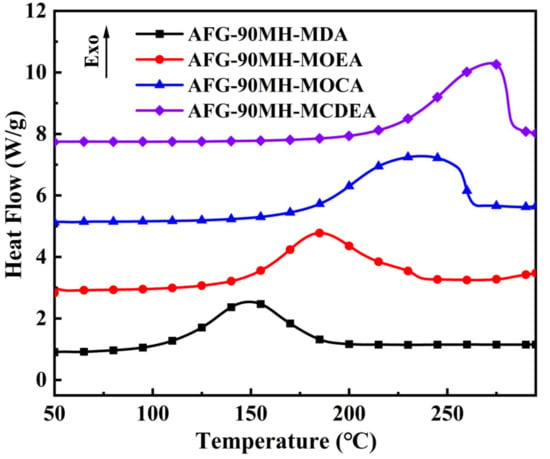
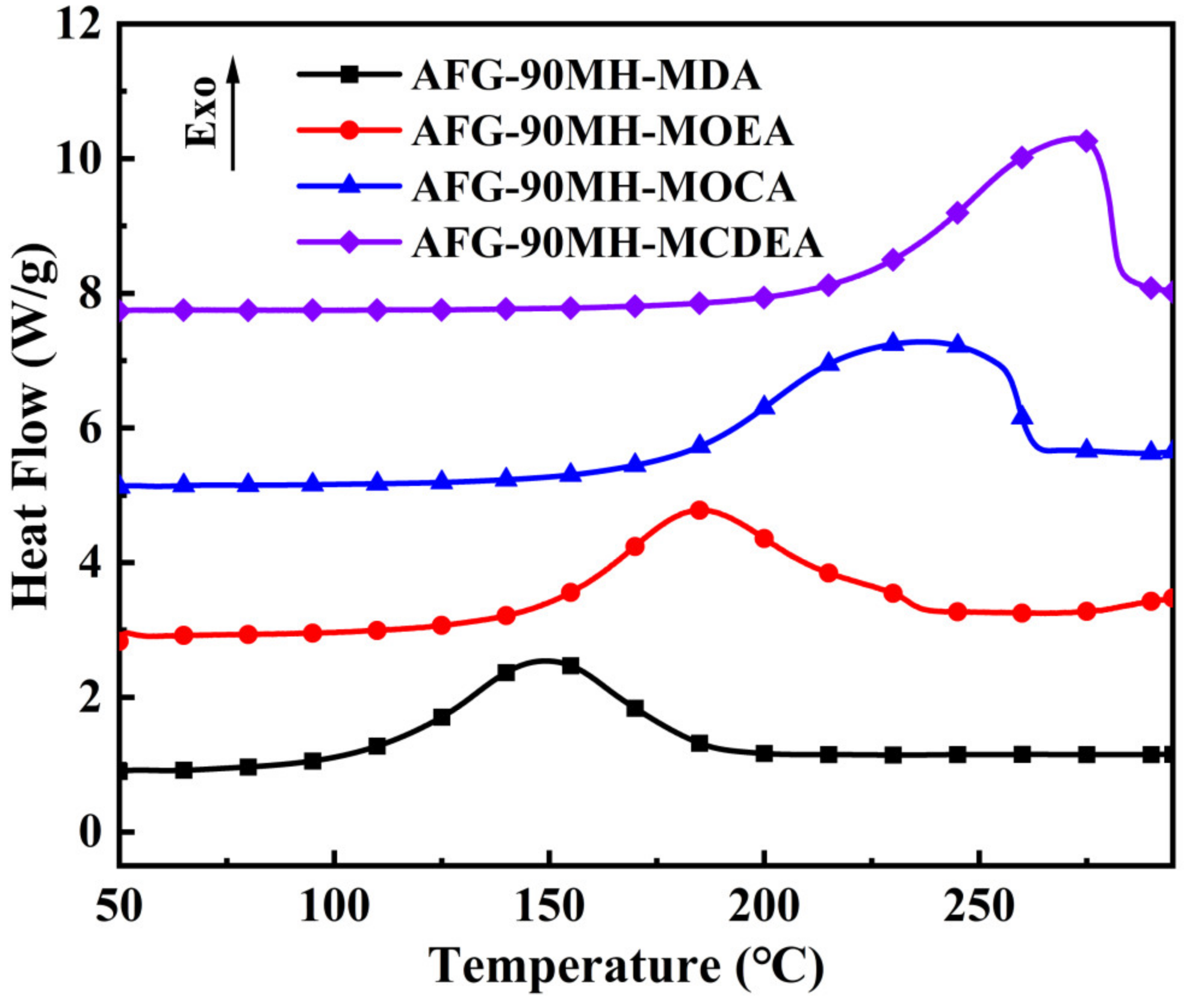
DSC was employed to analyze the curing behavior of AFG-90MH-diamine systems. The crosslinking reactions between epoxy and amino groups require thermal initiation. DSC curves and analysis data are summarized in Figure 2 and Table 1. As shown in the curve, a curing exothermic peak occurs between 50 °C and 300 °C for the AFG-90MH-MDA, AFG-90MH-MOEA, AFG-90MH-MOCA, and AFG-90MH-MCDEA systems. And the initial (Ti), peak (Tp), and final (Tf) curing temperatures of these systems increase progressively. Therefore, a comparison of the curing temperatures among the four systems reveals that the AFG-90MH-MDA system exhibits the lowest curing temperature, followed by AFG-90MH-MOEA, AFG-90MH-MOCA, and finally AFG-90MH-MCDEA. The curing agent MDA, which has no substituents at the ortho positions of the amino groups, exhibits the lowest curing temperature when curing with AFG-90MH resin. AFG-90MH resin with MOEA (containing ethyl groups at the ortho position of the amino groups) exhibits a lower curing temperature than that with MOCA (with chlorine substituents at the ortho position of the amino groups). However, both MOEA and MOCA with ethyl groups yield higher curing temperatures than MDA. The chlorine atom adjacent to the amino group in MOCA enhances the electrophilicity of the amino group, increasing the activation energy of the reaction amino groups with the epoxy groups and thereby elevating the curing temperature of the epoxy resin [29]. In contrast, MOEA features an ethyl group on the benzene ring, which exerts an electron-donating effect, rendering the amino groups more nucleophilic than those of MDA. The increment in nucleophilicity reduces the curing temperature of AFG-90MH-MOEA resins. However, steric hindrance caused by the ethyl group adjacent to the amino group may counteract the nucleophilic effect, leading to a higher curing temperature [15]. When MCDEA is used as a curing agent, there are both chlorine and ethyl groups on the benzene rings, resulting in the highest curing temperature. This observation highlights the synergistic effect of chlorine and ethyl groups in raising the curing temperature of diphenylmethylene diamine-based curing agents. According to the discussion, the reactivity of the curing agents follows the order: MDA > MOEA > MOCA > MCDEA.
Figure 2.
The DSC curves of the AFG-90MH-diamine systems (10 °C/min).
Table 1.
The DSC data of the AFG-90MH-diamine systems (10 °C/min).
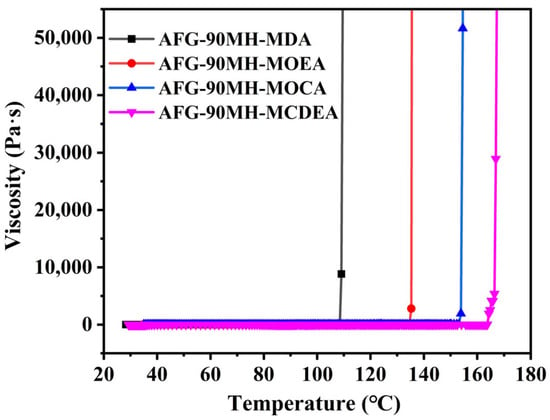
The temperature-dependent viscosity curves of the AFG-90MH-MDA, AFG-90MH-MOEA, AFG-90MH-MOCA, and AFG-90MH-MCDEA systems are presented in Figure 3. Initially, the systems exhibit viscous liquid behavior at room temperature. As the temperature increases, the viscosity of the systems decreases slightly due to enhanced polymer chain mobility at elevated temperatures. Subsequently, the viscosity stays at a stable value. Finally, the viscosity rises sharply as the epoxy and amino groups undergo a thermal addition reaction, starting to form a gel state. This transition into the gel state significantly restricts polymer chain movement [30,31,32]. The processing windows of the AFG-90MH-MDA, AFG-90MH-MOEA, AFG-90MH-MOCA, and AFG-90MH-MCDEA systems are approximately in the range of 30–110 °C, 30–135 °C, 30–145 °C, and 30–160 °C, respectively. These results directly correspond to the curing temperature obtained from DSC, indicating that the reactivity of the curing agents follows the order: MDA > MOEA > MOCA > MCDEA. Based on the chemical structures of the four curing agents, it can be tentatively inferred that the substituents attached to diamines influence the gel temperature of the systems. Specifically, an increase in the number of substituents results in lower reactivity of the curing agent and higher gel temperature of the systems. As mentioned above, the electron-withdrawing chlorine substituent will reduce the reactivity of the amino group with the epoxy group. Therefore, the gel temperatures of the systems increase. In addition, all systems exhibit low initial viscosity and broad processing windows, which are essential for RTM.
Figure 3.
The temperature-dependent viscosity curves of the AFG-90MH-diamine systems.
3.2. Curing Reaction Kinetics of AFG-90MH-Diamine Systems
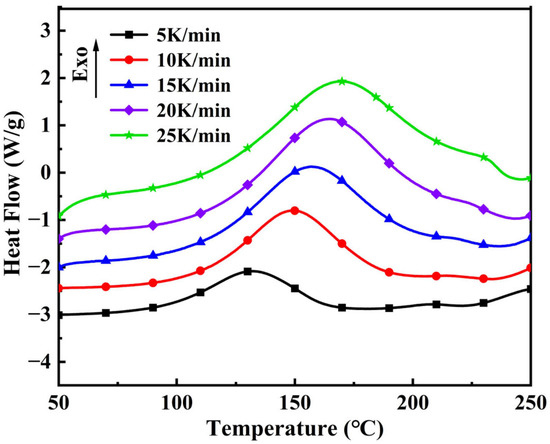
Non-isothermal DSC is widely employed to investigate the curing kinetics of epoxy resins and so on [33]. Figure 4 presents the DSC thermograms of the AFG-90MH-MDA system at different heating rates, and the curves of the other AFG-90MH-diamine systems are shown in the Supplementary Information. As shown in Figure 4, the initial, peak, and final curing temperatures shift to a higher temperature region with increasing heating rates, confirming the dynamic nature of the curing process. This behavior can be attributed to thermal kinetics. At reduced heating rates, prolonged reaction durations depress the initial curing temperature. Conversely, higher heating rates intensify kinetic acceleration and exothermic contributions under thermal lag, collectively elevating characteristic temperatures (Ti, Tp, and Tf) [34].
Figure 4.
The DSC curves of the AFG-90MH-MDA system at different heating rates.
The curing reaction kinetics of AFG-90MH-diamine systems were investigated using the Kissinger [35,36] (1) and Flynn–Wall–Ozawa (FWO) [37] (2) methods; the equations are as follows:
where β (K/min) is the heating rate; R (8.314 J/(mol·K)) is the universal gas constant; A is the pre-exponential factor; Ea (kJ/mol) is the apparent activation energy; Tp (K) is the exothermic peak temperature of the curing reaction; α is the conversion rate of the curing reaction (dimensionless); G(α) is the kinetic model function (dependent on conversion rate α); and T (K) is the temperature at a specific conversion rate.
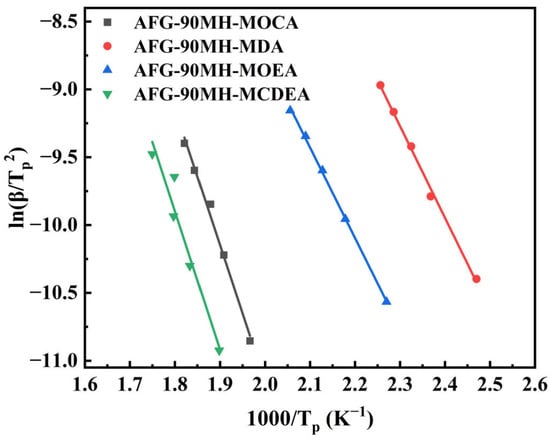
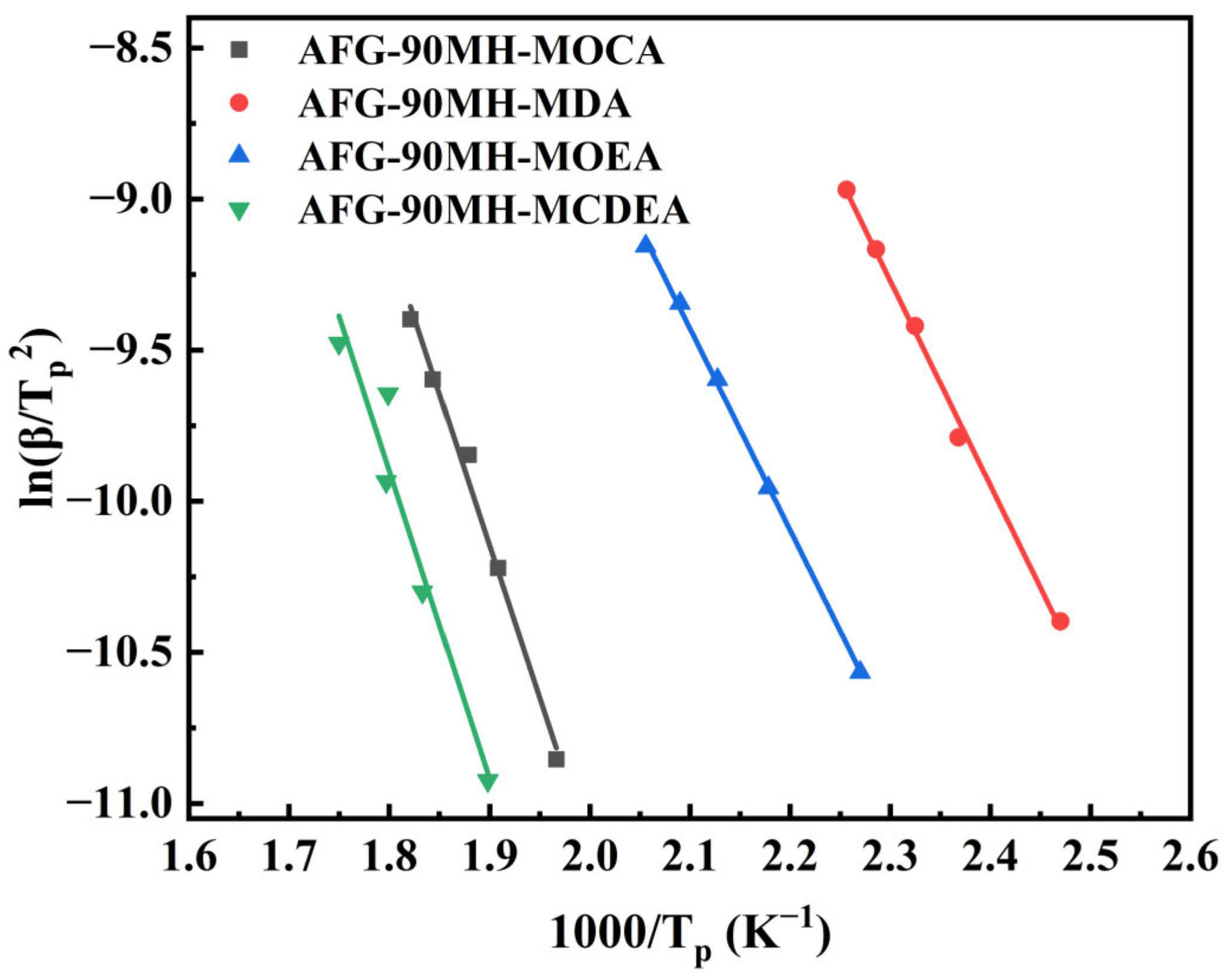
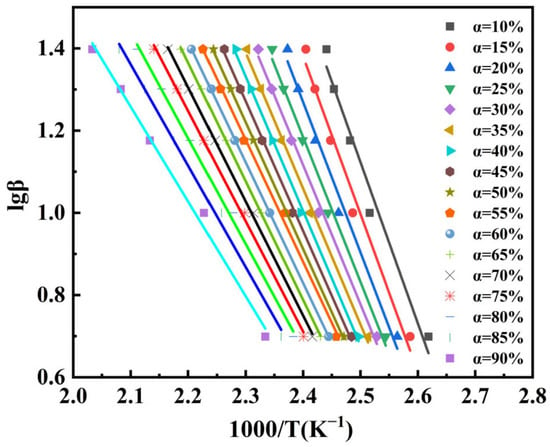
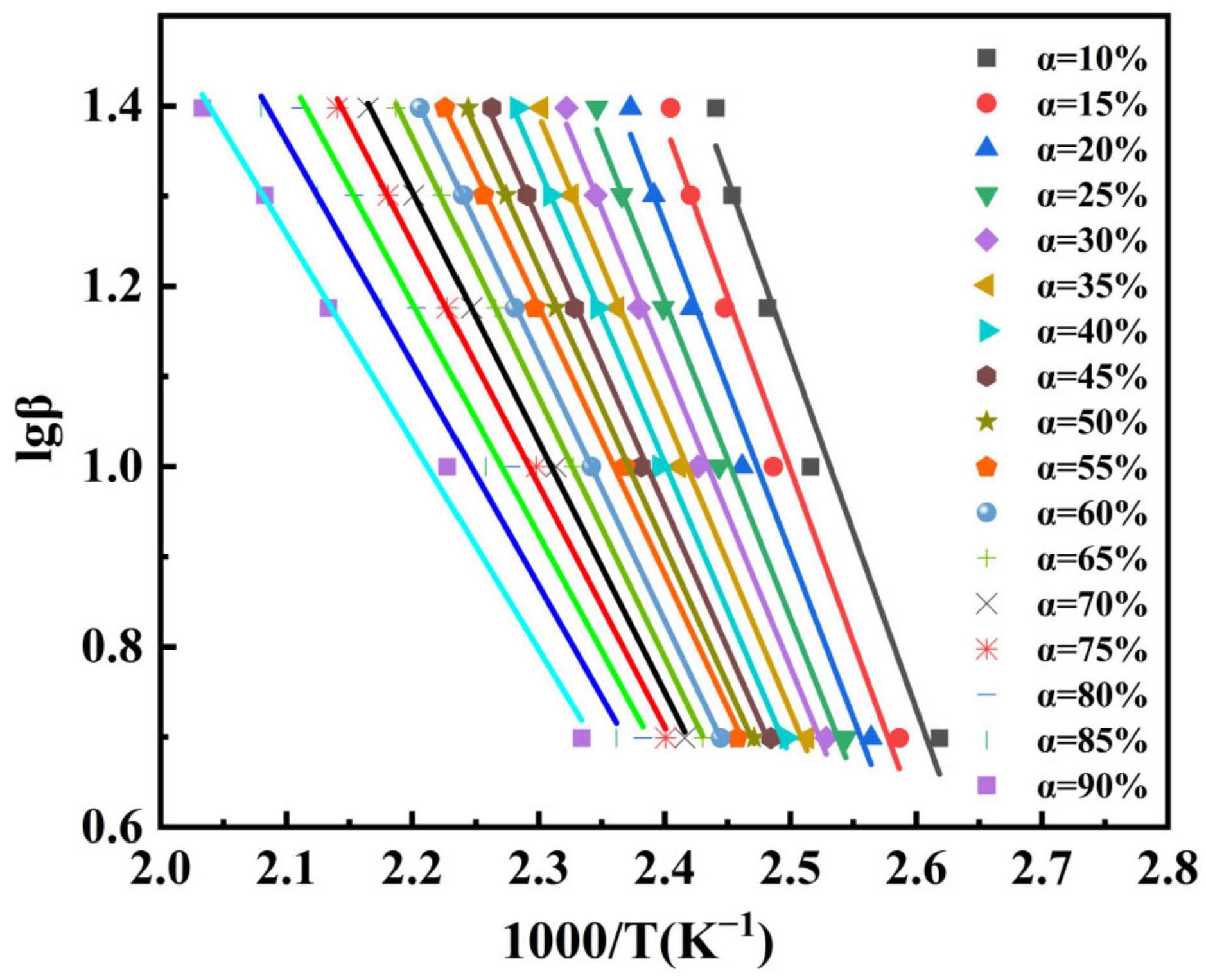
Linear fittings using the Kissinger method for AFG-90MH-diamine systems are shown in Figure 5. Linear fittings using the FWO method for the AFG-90MH-MDA system are shown in Figure 6. Linear fittings using the FWO method for the other AFG-90MH-diamine systems are shown in the Supplementary Information. Apparent activation energies (Ea) for AFG-90MH-diamine systems, determined via both Kissinger and FWO methods, are tabulated in Table 2. Consistent Ea trends via both Kissinger and FWO methods were noted. The epoxy systems exhibit the following increasing Ea sequence: AFG-90MH-MDA < AFG-90MH-MOEA < AFG-90MH-MOCA < AFG-90MH-MCDEA. The observed differences in Ea determined via both Kissinger and FWO methods arise from fundamental methodological distinctions [33]. The apparent activation energies of the epoxy systems provide a direct measure of the relative difficulty of the curing reaction. Higher apparent activation energies indicate more thermodynamically challenging curing processes, consequently requiring elevated curing temperatures for the epoxy systems. This increasing trend aligns with the sequential order of the curing temperature of the epoxy systems measured in Table 1. Notably, all systems show relatively low apparent activation energies (<100 kJ/mol), indicating favorable conditions for thermal crosslinking reactions [38]. The observed variations in apparent activation energies primarily originate from the electron-withdrawing effect of the chlorine substituents [29] and the steric hindrance of the ethyl groups [15]. The chlorine substituents in MOCA attenuate the nucleophilicity of the amino groups, reducing the curing reactivity and increasing the apparent activation energy. Although the ethyl groups on MOEA enhance the nucleophilicity of the amino group through electron donation, they increase steric hindrance, ultimately diminishing the curing reactivity. MCDEA incorporates both chlorine and ethyl groups, which synergistically reduces the reactivity of the system. Therefore, the electron-withdrawing effect of chlorine combines with the steric hindrance from the ethyl groups, resulting in the lowest overall reactivity and highest apparent activation energy among the studied epoxy systems. Integrated processability analysis reveals the following descending reactivity hierarchy of curing agents: MDA > MOEA > MOCA > MCDEA.
Figure 5.
Linear fittings using the Kissinger method for the AFG-90MH-diamine systems.
Figure 6.
Linear fittings using the FWO method for the AFG-90MH-MDA system.
Table 2.
The apparent activation energies (Eₐ) of the AFG-90MH-diamine systems.
3.3. Mechanical Properties of the Cured AFG-90MH-Diamine Systems
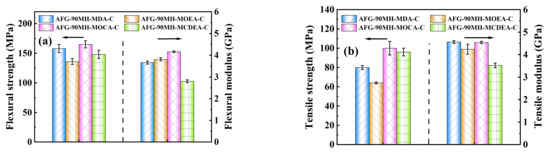
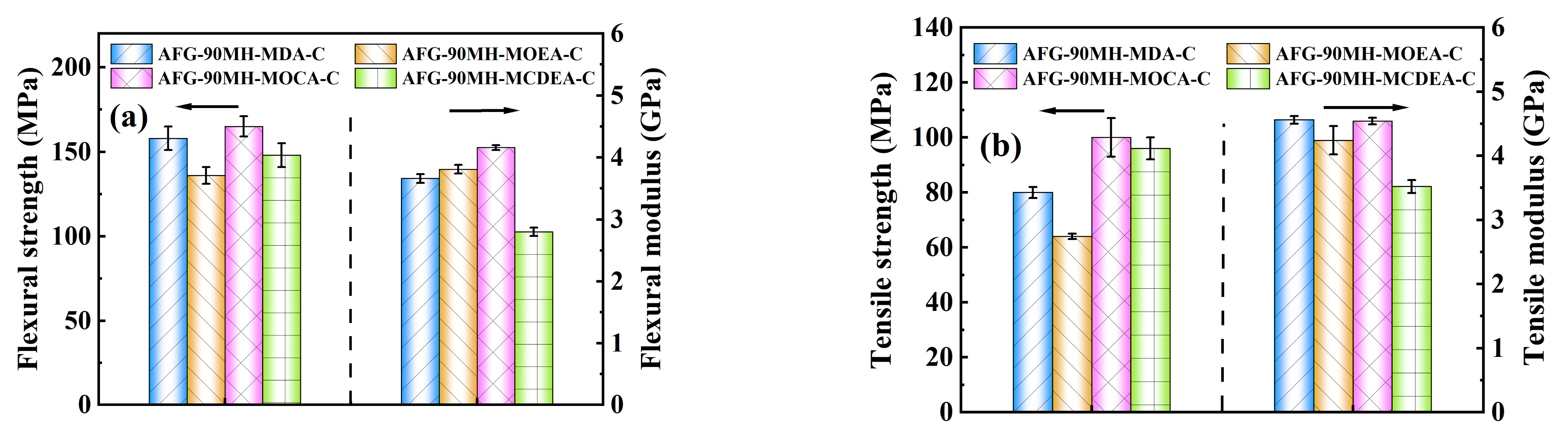
The mechanical properties of the cured AFG-90MH-diamine systems are shown in Figure 7; the data are listed in the Supplementary Information. The flexural strength of the cured resin systems decreases in the following order: AFG-90MH-MOCA-C > AFG-90MH-MDA-C > AFG-90MH-MCDEA-C > AFG-90MH-MOEA-C. The tensile strength of the cured resin systems decreases in the following order: AFG-90MH-MOCA-C > AFG-90MH-MCDEA-C > AFG-90MH-MDA-C > AFG-90MH-MOEA-C. The AFG-90MH-MOCA-C system exhibits the highest flexural and tensile properties. The flexural and tensile strength of the AFG-90MH-MOCA-C system reach 165 MPa and 100 MPa, respectively. The AFG-90MH-MOCA-C system exhibits the highest mechanical properties, attributable to enhanced interchain interactions induced by the polar chlorine substituents [39]. Although the AFG-90MH-MCDEA-C system exhibits high flexural and tensile strength, it demonstrates the lowest flexural and tensile moduli among the cured resins. This anomalous response is attributed to excessive side groups of MCDEA, which simultaneously increase free volume through steric effects, expanding intermolecular distances. These combined factors detrimentally affect stiffness as evidenced by the suppressed moduli [40,41]. The AFG-90MH-MDA-C system forms densely packed networks with minimal free volume. This restricted chain mobility yields superior rigidity characteristics, manifesting in significantly enhanced flexural and tensile strength and modulus of the cured resin compared with those of the AFG-90MH-MOEA-C system.
Figure 7.
Mechanical properties of the cured AFG-90MH-diamine systems at room temperature: (a) flexural properties and (b) tensile properties.
3.4. Thermal Properties of the Cured AFG-90MH-Diamine Systems
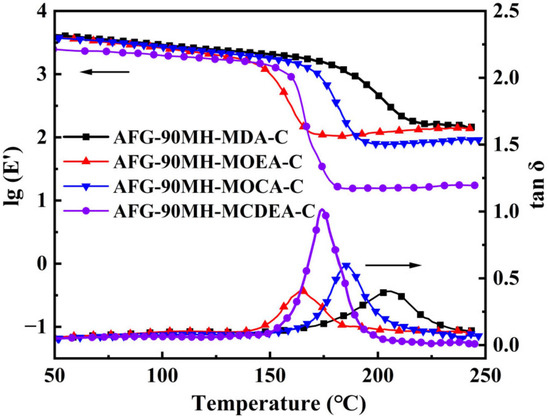
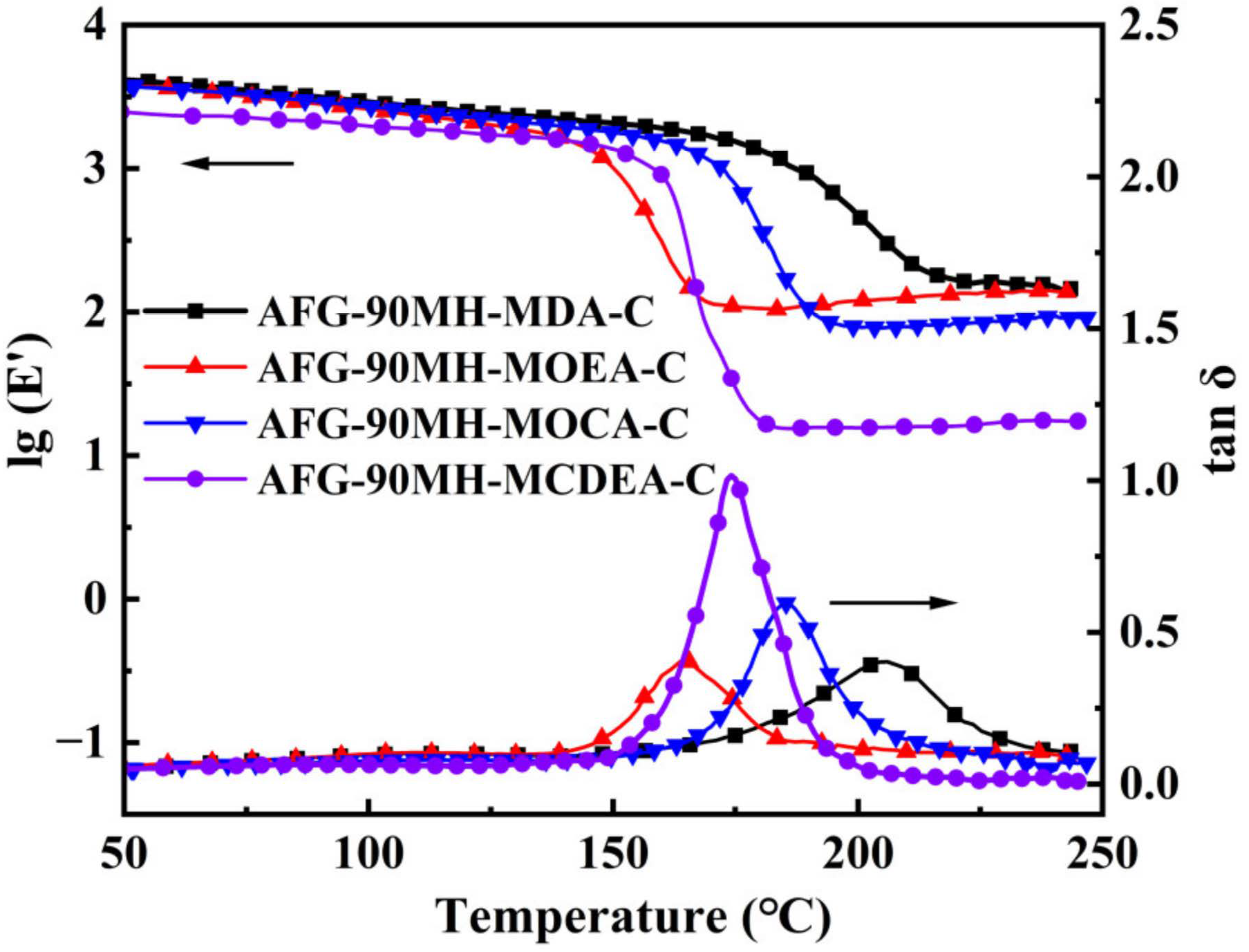
DMA was employed to characterize the thermomechanical properties of AFG-90MH-diamine systems, with the results presented in Figure 8. The four cured AFG-90MH-diamine systems exhibited comparable initial storage moduli (E′). As the temperature increased, all cured epoxy systems exhibited a reduction in storage modulus, with the AFG-90MH-MCDEA-C system displaying the most pronounced decline. This behavior originates from MCDEA’s steric hindrance—imparted by the highest number of substituents among the amines—which generates substantial structural free volume within the cured network, manifesting as reduced crosslink density and elevated chain mobility at high temperatures. Furthermore, the AFG-90MH-MCDEA-C system exhibits the highest tan δ peak intensity, attributed to the highest number of substituents in MCDEA. These substituents demonstrate enhanced molecular chain mobility. The elevated tan δ value reflects increased energy dissipation during deformation, corresponding to enhanced molecular chain mobility [42].
Figure 8.
DMA curves of the cured AFG-90MH-diamine systems.
Glass transition temperatures (Tg) determined from DMA are compiled in Table 3. The cured epoxy systems exhibit the following descending glass transition temperature order with corresponding values: AFG-90MH-MDA-C (213 °C) > AFG-90MH-MOCA-C (190 °C) > AFG-90MH-MCDEA-C (183 °C) > AFG-90MH-MOEA-C (172 °C). These Tg variations of the cured resin systems correlate with differences in free volume and intermolecular interaction force within the crosslinked networks [40,43,44,45,46]. The AFG-90MH-MDA-C system exhibits the highest Tg due to minimal free volume in its crosslinked network. Compared with the AFG-90MH-MCDEA-C system, the AFG-90MH-MOCA-C system contains fewer substituents and exhibits reduced free volume in the crosslinked network, resulting in a higher Tg. Furthermore, the AFG-90MH-MOCA-C system exhibits a higher Tg than the AFG-90MH-MOEA-C system because the chlorine substituent in the AFG-90MH-MOCA-C system has high polarity and strong intermolecular interactions between the chain segments. Although the network of the AFG-90MH-MCDEA-C system exhibits a higher free volume than that of the AFG-90MH-MOEA-C system, the chlorine substituents in MCDEA generate significantly stronger intermolecular interactions. The polarity-driven interactions exert a greater influence on Tg than the free volume effect, ultimately resulting in a higher Tg for the AFG-90MH-MCDEA-C system as compared with that for the AFG-90MH-MOEA-C system.
Table 3.
Thermal properties of the cured AFG-90MH-diamine systems.
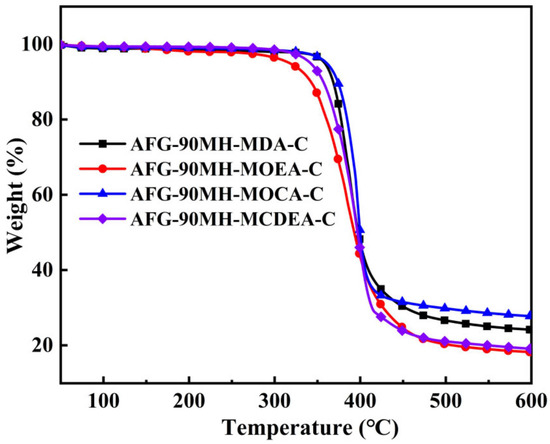
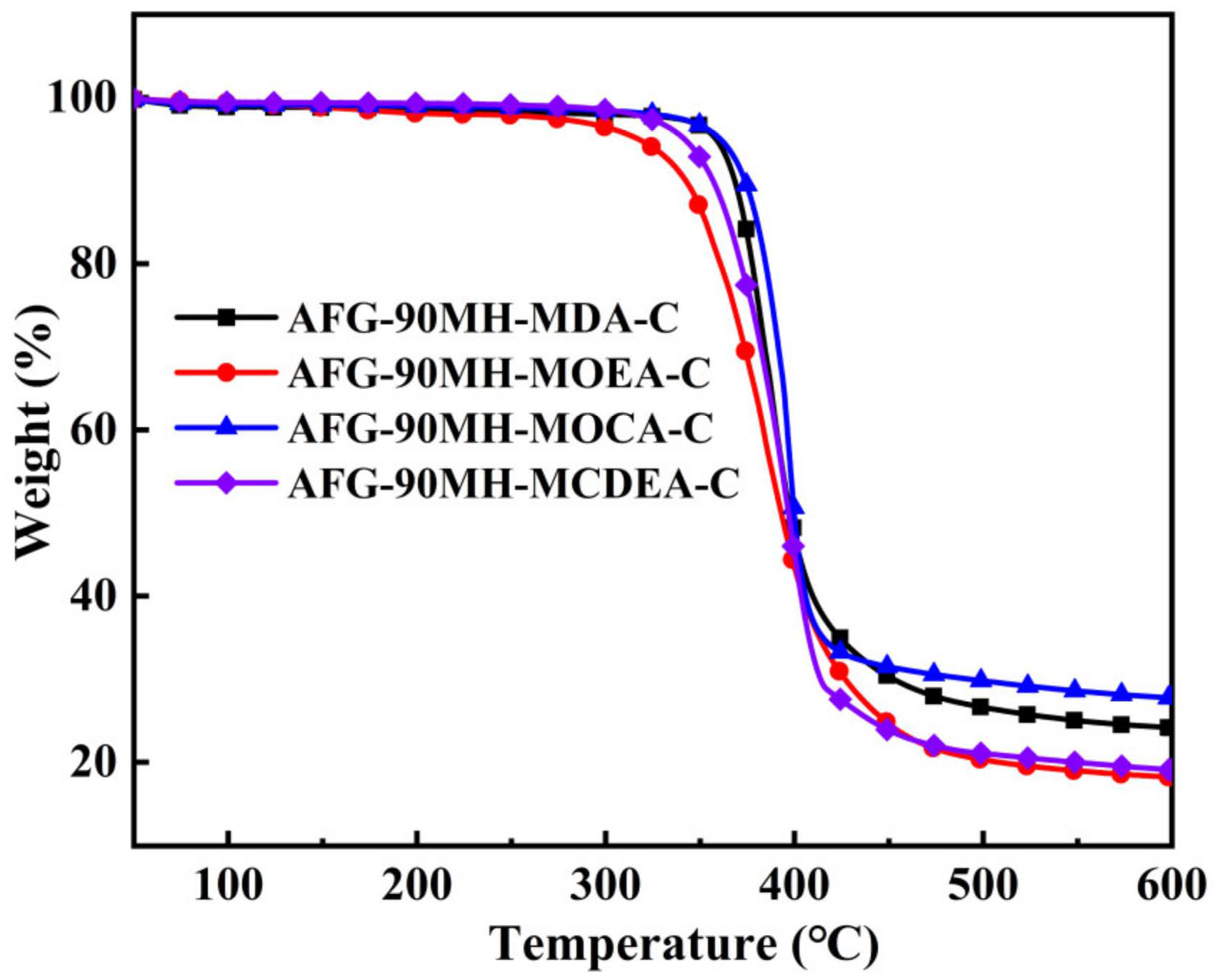
The thermal degradation behavior was characterized via TGA, and the results are presented in Figure 9 and Table 3. As shown in the table, the 5% decomposition temperatures (Td5) of the AFG-90MH-MDA-C, AFG-90MH-MOCA-C, AFG-90MH-MCDEA-C, and AFG-90MH-MOEA-C systems are 358 °C, 361 °C, 341 °C, and 317 °C. Analysis reveals that AFG-90MH-MOEA-C and AFG-90MH-MCDEA-C exhibit lower 5% decomposition temperatures (Td5), possibly attributed to the cleavage of ethyl groups. In contrast, the AFG-90MH-MOCA-C system featuring chlorine substituents alone demonstrates superior thermal stability. The chlorine atoms in MOCA reinforce interactions between chain segments in the crosslinked epoxy resin networks, resulting in a more stable molecular architecture.
Figure 9.
TGA curves of the cured AFG-90MH-diamine systems.
4. Conclusions
In summary, AFG-90MH-MDA, AFG-90MH-MOEA, AFG-90MH-MOCA, and AFG-90MH-MCDEA systems were prepared to evaluate the influence of curing agent structure on the properties of epoxy resin. AFG-90MH-MDA, AFG-90MH-MOEA, AFG-90MH-MOCA, and AFG-90MH-MCDEA systems exhibit wide processing windows ranging from 30 °C to 110–160 °C. These systems demonstrate excellent processability while maintaining low viscosity. Electron-withdrawing substituents increase the electrophilicity of the amino groups, reducing curing reactivity. The bulky electron-donating substituents of ethyl diminish reactivity primarily through steric hindrance. The processability and curing reaction kinetic results indicate that the reactivities of the aromatic diamines decrease in the order: MDA > MOEA > MOCA > MCDEA. The cured AFG-90MH-diamine systems display good mechanical properties. The chlorine substituents on the diamine enhance mechanical properties, whereas the ethyl groups diminish mechanical performance. The overall mechanical performance hierarchy follows: AFG-90MH-MOCA-C > AFG-90MH-MDA-C > AFG-90MH-MCDEA-C > AFG-90MH-MOEA-C. AFG-90MH-MOCA-C exhibits the highest flexural and tensile properties, with flexural and tensile strengths reaching 165 MPa and 100 MPa, respectively. The cured epoxy systems exhibit the following descending glass transition temperature order with corresponding values: AFG-90MH-MDA-C (213 °C) > AFG-90MH-MOCA-C (190 °C) > AFG-90MH-MCDEA-C (183 °C) > AFG-90MH-MOEA-C (172 °C). The AFG-90MH-MOCA system exhibits wide processing windows and moderated reactivity, while its cured resin demonstrates balanced mechanical and thermal properties.
Supplementary Materials
The following supporting information can be downloaded at https://www.mdpi.com/article/10.3390/jcs9080416/s1. Figure S1: The DSC curves of the AFG-90MH-MOEA system at different heating rates; Figure S2: The DSC curves of the AFG-90MH-MOCA system at different heating rates; Figure S3: The DSC curves of the AFG-90MH-MCDEA system at different heating rates; Figure S4: Linear fitting via the FWO method with the AFG-90MH-MOEA system; Figure S5: Linear fitting via the FWO method with the AFG-90MH-MOCA system; Figure S6: Linear fitting via the FWO method with the AFG-90MH-MCDEA system; Table S1: The mechanical properties data of the cured AFG-90MH-diamine systems.
Author Contributions
Conceptualization, F.H.; methodology, Y.Z. and W.L.; validation, Y.F. and P.S.; formal analysis, L.W. and X.H.; investigation, J.Q. and Z.L.; writing—original draft preparation, Y.Z. and W.L.; writing—review and editing, F.H. and Y.Z.; supervision, Z.L.; project administration, J.Q. All authors have read and agreed to the published version of the manuscript.
Funding
This research was funded by the National Key R&D Program of China (No. 2022YFB3709201), the Fundamental Research Funds for the Central Universities (No. JKD01251701), and Shanghai Special Funds for Collaborative Innovation (No. HCXBCY-2024-017).
Data Availability Statement
Data are contained within the article.
Conflicts of Interest
Authors Zuozhen Liu and Jianhua Qian were employed by the company Sino Polymer Co., Ltd. Author Xufeng Hao was employed by the company Shanghai Composite Technology Co., Ltd. The remaining authors declare that the research was conducted in the absence of any commercial or financial relationships that could be construed as a potential conflict of interest.
References
- Naffakh, M.; Dumon, M.; Gérard, J.F. Study of a reactive epoxy-amine resin enabling in situ dissolution of thermoplastic films during resin transfer moulding for toughening composites. Compos. Sci. Technol. 2006, 66, 1376–1384. [Google Scholar] [CrossRef] [Scilit]
- Naffakh, M.; Dumon, M.; Gérard, J.F. Modeling the chemorheological behavior of epoxy/liquid aromatic diamine for resin transfer molding applications. J. Appl. Polym. Sci. 2006, 102, 4228–4237. [Google Scholar] [CrossRef] [Scilit]
- Lee, C.L.; Wei, K.H. Curing kinetics and viscosity change of a two-part epoxy resin during mold filling in resin-transfer molding process. J. Appl. Polym. Sci. 2000, 77, 2139–2148. [Google Scholar] [CrossRef]
- Zhao, Y.; He, Y.; Yang, K.; Wang, X.; Bai, J.; Du, B. Improving the surface insulating performance of epoxy resin/Al2O3 composite materials by extending chain of liquid epoxy resin with Me-THPA. High Volt. 2020, 5, 472–481. [Google Scholar] [CrossRef] [Scilit]
- Zhang, T.; Chao, X.; Liang, J.; Wang, B.; Sun, M. Enhanced mechanical properties of epoxy composites reinforced with silane-modified Al2O3 nanoparticles: An experimental study. J. Compos. Sci. 2025, 9, 252. [Google Scholar] [CrossRef] [Scilit]
- Zhang, X.; Liu, M.; Chen, Y.; He, J.; Wang, X.; Xie, J.; Li, Z.; Chen, Z.; Fu, Y.; Xiong, C.; et al. Epoxy resin/hollow glass microspheres composite materials with low dielectric constant and excellent mechanical performance. J. Appl. Polym. Sci. 2022, 139, e52787. [Google Scholar] [CrossRef] [Scilit]
- Bekeshev, A.; Mostovoy, A.; Shcherbakov, A.; Tastanova, L.; Akhmetova, M.; Apendina, A.; Orynbassar, R.; Lopukhova, M. The influence of pristine and aminoacetic acid-treated aluminum nitride on the structure, curing processes, and properties of epoxy nanocomposites. J. Compos. Sci. 2023, 7, 482. [Google Scholar] [CrossRef] [Scilit]
- Liu, W.; Wang, C.; Feng, Y.; Chen, Y.; Wan, L.; Huang, F.; Liu, Z.; Qian, J.; Liu, W. Novel reactive polyhedral oligomeric silsesquioxane-reinforced and toughened epoxy resins for advanced composites. Polymers 2024, 16, 1877. [Google Scholar] [CrossRef] [Scilit]
- Capricho, J.C.; Fox, B.; Hameed, N. Multifunctionality in epoxy resins. Polym. Rev. 2020, 60, 1–41. [Google Scholar] [CrossRef] [Scilit]
- Jin, F.L.; Li, X.; Park, S.J. Synthesis and application of epoxy resins: A review. J. Ind. Eng. Chem. 2015, 29, 1–11. [Google Scholar] [CrossRef] [Scilit]
- Zhao, Y.; Xu, R.; Xiao, Y.; Wang, H.; Zhang, W.; Zhang, G. Mechanical performances of phenolic modified epoxy resins at room and high temperatures. Coatings 2022, 12, 643. [Google Scholar] [CrossRef] [Scilit]
- Zhang, Z.; Dai, X.; Li, L.; Zhou, S.; Xue, W.; Liu, Y.; Liu, H. Current status of research on the modification of thermal properties of epoxy resin-based syntactic roam insulation materials. Polymers 2021, 13, 3185. [Google Scholar] [CrossRef] [Scilit]
- Sukanto, H.; Raharjo, W.W.; Ariawan, D.; Triyono, J.; Kaavesina, M. Epoxy resins thermosetting for mechanical engineering. Open Eng. 2021, 11, 797–814. [Google Scholar] [CrossRef] [Scilit]
- Islam, A.M.; Lim, H.; You, N.H.; Ahn, S.; Goh, M.; Hahn, J.R.; Yeo, H.; Jang, S.G. Enhanced thermal conductivity of liquid crystalline epoxy resin using controlled linear polymerization. Acs Macro. Lett. 2018, 7, 1180–1185. [Google Scholar] [CrossRef] [Scilit] [PubMed]
- Olamilekan, A.I.; Yeo, H. Curing behavior of 4,4′-diglycidyloxybiphenyl with p-phenylene diamine derivatives. Macromol. Res. 2020, 28, 960–967. [Google Scholar] [CrossRef] [Scilit]
- Lu, M.; Liu, Y.; Du, X.; Zhang, S.; Chen, G.; Zhang, Q.; Yao, S.; Liang, L.; Lu, M. Cure kinetics and properties of high performance cycloaliphatic epoxy resins cured with anhydride. Ind. Eng. Chem. Res. 2019, 58, 6907–6918. [Google Scholar] [CrossRef] [Scilit]
- Huang, J.; Guo, W.; Wang, X.; Song, L.; Hu, Y. Intrinsically flame retardant cardanol-based epoxy monomer for high-performance thermosets. Polym. Degrad. Stabil. 2021, 186, 109519. [Google Scholar] [CrossRef] [Scilit]
- Liu, W.B.; Qiu, Q.H.; Wang, J.; Huo, Z.C.; Sun, H. Curing kinetics and properties of epoxy resin-fluorenyl diamine systems. Polymer 2008, 49, 4399–4405. [Google Scholar] [CrossRef] [Scilit]
- Ferdosian, F.; Yuan, Z.S.; Anderson, M.; Xu, C.B. Sustainable lignin-based epoxy resins cured with aromatic and aliphatic amine curing agents: Curing kinetics and thermal properties. Thermochim. Acta. 2015, 618, 48–55. [Google Scholar] [CrossRef] [Scilit]
- Yu, S.Y.; Kim, H.J.; Jeon, S.Y.; Lim, C.S.; Seo, B.K. Synthesis of polyfunctional amines as curing agents and its effect on mechanical property of epoxy polymers. J. Appl. Polym. Sci. 2023, 140, e53806. [Google Scholar] [CrossRef] [Scilit]
- Xiong, X.H.; Ren, R.; Liu, S.Y.; Lu, S.W.; Chen, P. The curing kinetics and thermal properties of epoxy resins cured by aromatic diamine with hetero-cyclic side chain structure. Thermochim. Acta. 2014, 595, 22–27. [Google Scholar] [CrossRef] [Scilit]
- Ghaemy, M.; Barghamadi, M.; Behmadi, H. Cure kinetics of epoxy resin and aromatic diamines. J. Appl. Polym. Sci. 2004, 94, 1049–1056. [Google Scholar] [CrossRef] [Scilit]
- Okabe, T.; Oya, Y.; Tanabe, K.; Kikugawa, G.; Yoshioka, K. Molecular dynamics simulation of crosslinked epoxy resins: Curing and mechanical properties. Eur. Polym. J. 2016, 80, 78–88. [Google Scholar] [CrossRef] [Scilit]
- Luo, X.; Yu, X.; Ma, Y.; Naito, K.; Zhang, Q. Preparation and cure kinetics of epoxy with nanodiamond modified with liquid crystalline epoxy. Thermochim. Acta. 2018, 663, 1–8. [Google Scholar] [CrossRef] [Scilit]
- Ma, S.; Chen, P.; Xu, J.; Xiong, X. Molecular dynamics simulations of key physical properties and microstructure of epoxy resin cured with different curing agents. J. Mater. Sci. 2022, 57, 1123–1133. [Google Scholar] [CrossRef] [Scilit]
- Voto, G.; Sequeira, L.; Skordos, A.A. Formulation based predictive cure kinetics modelling of epoxy resins. Polymer 2021, 236, 124304. [Google Scholar] [CrossRef] [Scilit]
- GB/T 2567-2008; Test Methods for Properties of Resin Casting Boby. Standardization Administration of China: Beijing, China, 2008.
- GB/T 1040.2-2006; Plastics—Determination of tensile properties—Part 2: Test conditions for moulding and extrusion plastics. Standardization Administration of China: Beijing, China, 2006.
- Zhang, Y.; Vyazovkin, S. Effect of substituents in aromatic amines on the activation energy of epoxy-amine reaction. J. Phys. Chem. B. 2007, 111, 7098–7104. [Google Scholar] [CrossRef] [Scilit]
- Zong, L.; Liu, C.; Guo, Y.; Wang, J.; Jian, X. Thermally stable phthalonitrile resins based on multiple oligo (aryl ether)s with phenyl-s-triazine moieties in backbones. Rsc Adv. 2015, 5, 77027–77036. [Google Scholar] [CrossRef] [Scilit]
- Chen, H.; Xin, H.; Lu, J.; Tang, J.; Yuan, Q.; Huang, F. Synthesis and properties of poly(dimethylsilylene-ethynylene-phenoxyphenoxyphenylene-ethynylene). High Perform. Polym. 2017, 29, 595–601. [Google Scholar] [CrossRef] [Scilit]
- Li, C.; Luo, J.; Ma, M.; Tang, J.; Yuan, Q.; Huang, F. Synthesis and properties of sulfur-contained poly(silylene arylacetylene)s. J. Polym. Sci. Pol. Chem. 2019, 57, 2324–2332. [Google Scholar] [CrossRef] [Scilit]
- Cai, R.; Zhao, J.; Lv, N.; Fu, A.; Yin, C.; Song, C.; Chao, M. Curing and molecular dynamics simulation of MXene/phenolic epoxy composites with different amine curing agent systems. Nanomaterials 2022, 12, 2249. [Google Scholar] [CrossRef] [Scilit] [PubMed]
- Sheng, Q.; Chen, Q.; Gu, W.; Wang, R.; Gu, X.; Liu, J.; Sun, T.; Chen, Y.; Sun, J.; Zhang, S. The study of curing behavior and thermo-mechanical properties of epoxy adhesives with different anhydrides. Polymer 2024, 307, 127342. [Google Scholar] [CrossRef] [Scilit]
- Li, J.; Gong, C.; Tang, J.; Yuan, Q.; Liu, Z.; Huang, F. Effect of substituted positions of acetylene groups on the benzene ring on properties of poly(silane arylether arylacetylene)s. Polym. J. 2023, 55, 1307–1315. [Google Scholar] [CrossRef] [Scilit]
- Li, J.; Gong, C.; Lv, S.; Huang, F. Effects of side alkoxy groups on the arylacetylene unit on properties of poly (silylene arylacetylene)s. Eur. Polym. J. 2021, 160, 110774. [Google Scholar] [CrossRef] [Scilit]
- Bu, X.; Zhou, Y.; Li, C.; Huang, F. Octakis(ethynyldimethylsiloxy) silsesquioxane: Synthesis and application in poly(silicane arylacetylene) resin. J. Appl. Polym. Sci. 2016, 133, 44158. [Google Scholar] [CrossRef] [Scilit]
- Yu, S.; Li, X.; Zou, M.; Guo, X.; Ma, H.; Wang, S. Effect of the aromatic amine curing agent structure on properties of epoxy resin-based syntactic foams. ACS Omega 2020, 5, 23268–23275. [Google Scholar] [CrossRef] [Scilit]
- San-José, N.; Gómez-Valdemoro, A.; García, F.C.; Serna, F.; García, J.M. Aromatic polyamides with pendant urea moieties. J. Polym. Sci. Pol. Chem. 2007, 45, 4026–4036. [Google Scholar] [CrossRef] [Scilit]
- Ma, Y.; Liu, Y.; Yu, T.; Lai, W.; Ge, Z.; Jiang, Z. Pendant chains are not just decorations: Investigation of structure-property relationships of azido oxetane polymers. Propell. Explos. Pyrot. 2018, 43, 170–176. [Google Scholar] [CrossRef] [Scilit]
- Ma, Y.; Liu, Y.; Yu, T.; Lai, W.; Ge, Z.; Jiang, Z. Structure-property relationship of nitramino oxetane polymers: A computational study on the effect of pendant chains. Rsc Adv. 2019, 9, 3120–3127. [Google Scholar] [CrossRef] [Scilit]
- Cristea, M.; Ibanescu, S.; Cascaval, C.N.; Rosu, D. Dynamic mechanical analysis of polyurethane-epoxy interpenetrating polymer networks. High Perform. Polym. 2009, 21, 608–623. [Google Scholar] [CrossRef] [Scilit]
- Saiev, S.; Bonnaud, L.; Zúñiga, C.; Dubois, P.; Beljonne, D.; Ronda, J.C.; Cadiz, V.; Lazzaroni, R. Positive effect of functional side groups on the structure and properties of benzoxazine networks and nanocomposites. Polym. Chem. 2019, 10, 5251–5264. [Google Scholar] [CrossRef] [Scilit]
- Mehta, N.; Kumar, A. Critical analysis of endo-thermal effect in the glass transition process in chalcogenide glasses. J. Non-Cryst. Solids. 2012, 358, 2783–2787. [Google Scholar] [CrossRef] [Scilit]
- Xia, W.; Keten, S. Coupled effects of substrate adhesion and intermolecular forces on polymer thin film glass-transition behavior. Langmuir 2013, 29, 12730–12736. [Google Scholar] [CrossRef] [Scilit]
- Yin, Y.; Song, J.; Zhao, G.; Ding, Q. Improving the high temperature tribology of polyimide by molecular structure design and grafting POSS. Polym. Advan. Technol. 2022, 33, 886–896. [Google Scholar] [CrossRef] [Scilit]

Disclaimer/Publisher’s Note: The statements, opinions and data contained in all publications are solely those of the individual author(s) and contributor(s) and not of MDPI and/or the editor(s). MDPI and/or the editor(s) disclaim responsibility for any injury to people or property resulting from any ideas, methods, instructions or products referred to in the content. |
© 2025 by the authors. Licensee MDPI, Basel, Switzerland. This article is an open access article distributed under the terms and conditions of the Creative Commons Attribution (CC BY) license (https://creativecommons.org/licenses/by/4.0/).