Article

Performance of Rubber Seals for Cable-Based Tsunameter with Varying Ethylene Propylene Diene Monomer and Filler Content


by
Riastuti Fidyaningsih
*,
Dewi Kusuma Arti
,
Herri Susanto
,
Ade Sholeh Hidayat
,
Mahendra Anggaravidya
,
Akhmad Amry
,
Tika Mustika
,
Muslim Efendi Harahap
,
Vian Marantha Haryanto
and
Mochammad Dachyar Effendi
Research Center for Composites and Biomaterials, National Research and Innovation Agency, South Tangerang, Banten 15314, Indonesia
*
Author to whom correspondence should be addressed.
J. Compos. Sci. 2025, 9(12), 705; https://doi.org/10.3390/jcs9120705
Submission received: 2 November 2025 / Revised: 11 December 2025 / Accepted: 13 December 2025 / Published: 17 December 2025
(This article belongs to the Section Composites Applications)

Abstract

This study evaluates the performance of ethylene propylene diene monomer (EPDM) composites for rubber sealing applications in a cable-based tsunami system. Rubber composites were prepared using EPDM rubber with varying monomer and filler content to determine the most suitable composite. Mechanical characterization reveals that the composition of EPDM and the amount of filler loading influence the mechanical properties. Dynamic mechanical analysis shows that ethylene and 5-ethylene-2-norbornene (ENB) content influence the glass transition and viscoelastic behavior of the composite. Thermal analysis of rubber composites using EPDM containing 70% ethylene and 5% ENB indicates no change in thermal stability due to prolonged immersion in seawater. Visual inspection using a microscope reveals no cracks on the surface of the rubber seal after the pressure chamber test for rubber composites utilizing EPDM with 70% ethylene and 5% ENB. It was shown that EPDM containing 70% ethylene and 5% ENB, with optimal reinforcement with 80 phr carbon black, exhibits the best performance for rubber sealing applications in subsea environments.

1. Introduction

Elastomeric components are frequently used for various applications in aqueous environments. Typical rubber applications in water include hoses, seals, protective coatings, isolators, and underwater operation vehicles [1,2,3]. Rubber is also used as a seal for tsunameters, devices that measure the changes in water pressure on the sea floor.
A cable-based tsunameter (CBT) is a tsunami detection system that consists of an ocean bottom unit (OBU), which is directly connected to the landing station through a fiber optic cable [4]. The ocean bottom unit contains several sensors placed inside a metal canister. The function of the canister is to protect the electronic components inside. Thus, its structure must be able to withstand seawater leakage and corrosion. The canister is made up of a cylinder, a flange, a cone connector, and a fiber optic cable. The cone connector is used to tether the wire and retain the seawater pressure from the cable line [5].
The operating conditions of a CBT in a deep-sea environment are different from those in a shallow environment. The deep sea is an extreme environment with high pressure and temperatures between 2 °C and 4 °C [6]. The cone connector or seal used in this environment must have good compressive resilience, resistance to saltwater, and flexibility at low temperatures. Proper selection of seal materials is essential. Among various materials, elastomers are a versatile material with good elasticity and strength. One type of synthetic rubber is ethylene propylene diene monomer (EPDM) rubber, which is known to have good resistance to polar solvents, for example, acids, alkalis, alcohols, ketones, and salts [7].
EPDM is a terpolymer consisting of ethylene, propylene, and non-conjugated termonomer such as 5-ethylene-2-norbornene (ENB), diclopentadiene (DCPD), and 5-vinyl-2-norbornene (VNB) [8,9]. The composition of ethylene and propylene, as well as the type and amount of diene in EPDM, can vary depending on the production. Commercial EPDMs have an ethylene content of around 45% to 75% [10]. The presence of ethylene in EPDMs influences the crystallinity of the rubber; when the ethylene content exceeds 64–65%, it is regarded as a semicrystalline material at room temperature [11]. The non-conjugated diene content, though present in a smaller percentage, is vital for crosslinking during vulcanization [12]. ENB is the most common termonomer that has the highest efficacy for sulfur crosslinking [9]. Vulcanization is expected to improve the properties of the rubber and the shelf life of the rubber seal.
Several researchers have investigated the effect of EPDM content on composite properties. Song et al. proved that the Mooney viscosity of EPDM influences the dynamic mechanical properties of thermoplastic vulcanizate blends [13]. EPDM’s curing characteristics and mechanical properties with various ENB contents have been investigated in a previous study. The results showed that crosslink density increased when ENB content was enhanced, and the mechanical properties were affected by varying ENB content in the EPDM compounds [14]. In addition, EPDM has been utilized as a sealant in undersea shield tunnels, and analysis of its degradation in artificial seawater indicated a service life of around 23 years in a marine environment [15]. Despite extensive research on the utilization of EPDM rubber, there is a lack of research on using EPDM as a seal for CBTs in subsea environments.
In this study, we report for the first time the performance of rubber seals made of different types of EPDM for subsea applications. Furthermore, the effect of carbon black loading on the performance of EPDM composites in seawater is also investigated. Understanding the mechanical performance of rubber composites with varying EPDM content is essential for achieving effective rubber seals in subsea applications, particularly for cable-based tsunameters.

2. Materials and Methods

2.1. Materials

The EPDM rubbers studied, Keltan 4869, 5467, and 8570, were supplied by Arlanxeo (Nantong, China) and are characterized by controlled long-chain branching (CLCB) and molecular weight distribution (MWD). The specifications of the rubber are presented in Table 1. Carbon black N220 (Cabot, Tianjin, China), used as a filler, was purchased from Cabot. Additives such as polyoctenamer (Evonik, Essen, Germany), zinc oxide (Pasuruan, Indonesia), stearic acid (Gresik, Indonesia), N-(1,3-dimethylbutyl)-N’-phenyl-p-phenylenediamine (6PPD) (Unilong, Jinan, China), and paraffinic oil (Patra Trading, Jakarta, Indonesia), used as the processing oil, were obtained from a local supplier. N-cyclohexyl-2-benzothiazole sulfonamide (CBS) (Duter Ltd., Zhengzhou, China) and sulfur (PT Indosulfur Mitrakimia, Cilacap, Indonesia) were used as vulcanization agents. Seawater (Jakarta, Indonesia) was purchased from a local supplier. All materials were used as received without further modification.

2.2. Compounding

Rubber composites were prepared using an internal mixer and a roll mill according to the formulations in Table 2. Unlike the oil-extended EPDM 4869 and EPDM 5467, EPDM 8570 is a non-oil-extended grade and therefore requires the addition of a higher amount of processing oil to achieve good processability. First, rubber and polyoctenamer were masticated in an internal mixer (Moriyama DS3-10MWB-E, Hyogo, Japan) for 2 min at a rotor speed of 32 rpm. Then, filler and additives were mixed for 4 min. Afterwards, vulcanizing agents were added, and the mixture was stirred for 4 min. The resulting compound was shaped into a sheet using a two-roll mill (LMS 09T, Qingdao, China) and cooled for 24 h at room temperature before using it to make the standard sample for testing.

2.3. Sample Preparation

EPDM composite samples were prepared using a hot press machine at 180 °C, following standard sample requirements for each mechanical test. When curing the samples, the optimum curing time (T90), determined from the rheometer measurements, was used. Before characterization, samples were subjected to aging and seawater treatments to simulate various conditions. Thermal aging was performed in a heat aging oven for 72 h at 70 °C; these samples are called “Aging”. The seawater treatment involves the immersion of samples in seawater. The sample was stored in a cooler at a temperature below 5 °C at different times to simulate the temperature in the deep sea; these samples are referred to as “SW”. Untreated samples are referred to as “Original”.

2.4. Testing Methods

2.4.1. Curing Properties

The specimen’s curing characteristics were determined using a Moving Die Rheometer (MDR Professional MonTech, Buchen, Germany) at a temperature of 180 °C. The cure rate index (CRI) is calculated according to the following equation:
CRI = 100 T 90 T S 2
where T90 is the optimum curing time at which the torque reaches 90% of the maximum torque. This value is obtained directly from the rheometer based on the torque–time curve. TS2 is the scorch time, defined as the time during which a rubber compound can be processed before vulcanization begins. It is an important parameter in rubber compounding to ensure that the compound does not cure before the intended curing stage. In this research, scorch time is defined as TS2, which is the time at which the torque increases by 2 units above the minimum torque value. Scorch time is measured directly using a rheometer, based on the torque–time curve at a specific test temperature.

2.4.2. Mechanical Properties

The hardness of the sample was determined using a Hardness Shore A tester (Mitutoyo, Qingdao, China), following the standard ASTM D2240 [16]. The measurement of tensile strength, elongation at break, and tear strength was performed using a Universal Testing Machine (Go Tech AI-700S, Taichung, Taiwan) according to ASTM D412 and ASTM D624 [17,18]. Five specimens were tested for each measurement, and the average values were calculated. The rebound resilience of the specimens was measured using the Rebound Check Resilience Tester (Gibitre Instruments, Bergamo, Italy). A compression set device was used to determine the compression set of the samples. The compression set test was conducted according to ASTM D395 [19]. The testing procedure for “cold” was performed by conducting compression set measurement at a temperature below 0 °C. The test duration was similar to the regular compression set test. The original, aging, and SW samples at 7, 14, and 21 days were analyzed to determine their mechanical strength.

2.4.3. Swelling Testing

The seawater intake measurement was performed for EPDM compounds containing different amounts of monomer. The weight of the dried sample was measured before being soaked in seawater. The sample was then stored inside a cooler to maintain a temperature below 5 °C across five different periods (5, 10, 15, 20, and 25 days). At the end of the immersion time, the swollen samples were dried using filter paper and then carefully weighed to calculate the swelling percentage.

2.4.4. Dynamic Mechanical -Analysis

The dynamic mechanical properties of the composite specimen were assessed using a Dynamic Mechanical Analyzer (DMA7100 Hitachi High-Tech, Tokyo, Japan) at a frequency of 1 Hz and an amplitude of 2 µm, with 0.1% fixed strain and a temperature range from −100 to 70 °C.

2.4.5. Thermal Analysis

Thermal analysis was conducted on the chosen sample after undergoing seawater submersion for 0, 90, 180, and 270 days. Measurement was performed using a TGA (Setaram Labsys Evo, Lyon, France) according to ASTM D6370 with a temperature range from 25 to 800 °C, using a heating rate of 10 °C/min under inert and oxygen conditions [20].

2.4.6. Dispersion, Morphology, and Fracture Surface Assessment

Carbon black dispersion in rubber composites was characterized using a Carbon Dispersion Tester (MonTech, Buchen, Germany). Evaluation of sample morphology was performed using a Scanning Electron Microscope (JEOL JSM-6510LA, Tokyo, Japan) at 20 kV with magnification of 500×. Samples were coated with a gold layer before measurement.
After determining the most suitable formulation, a rubber seal prototype was fabricated using the compression molding technique with a custom-designed mold. The rubber seal prototype was subsequently installed inside the metal canister of the tsunameter. The canister was then placed in a pressure chamber filled with water and subjected to a pressure of 300 bar for 48 h. Detailed procedures for this test are described in the previous study [5]. After the test, the rubber seal was examined for possible fractures using a 3D Surface Profiler VK-X3000 Microscope (Keyence, Osaka, Japan).

3. Results and Discussion

3.1. Curing Characteristics

The curing characteristics of the EPDM composites are presented in Table 3. The optimum curing time (T90) and scorch time (TS2) of ER 1 are lower than those of ER 2 and ER 38. ER 1 contains the highest ENB content, providing reactive diene sites, which are important for sulfur crosslinking. Consequently, the curing time is shorter, and the vulcanization rate is the highest. Although ER 2 has a lower ENB content than ER 38, its T90 is much lower, indicating a faster cure rate. A plausible explanation is that ER 38 contains a higher amount of processing oil, which may dilute the curing additives, reducing their effectiveness in vulcanization. This effect slows down the curing reaction, as evidenced by the lower CRI value, and prolongs the curing time. Similar findings regarding the influence of plasticizer on curing time were reported in a previous study using the same curing system [21]. The T90 and ts2 values increased with the addition of carbon black and reached a maximum at 80 phr, whereas further additions beyond this level did not significantly affect these values or the curing rate, which may be attributed to uneven carbon black distribution and particle aggregation.
S′min is the minimum torque observed at the beginning of the torque vs. time curve, before the onset of vulcanization. The lowest stable torque value in this initial region is reported as the minimum torque. S′max is the maximum torque, defined as the highest stable torque value on the curve. Both S′min and S′max are determined automatically by the rheometer software. The minimum (S′min) and maximum torque (S′max) are associated with the viscosity and stiffness of the rubber compound. The difference between S′max and S′min (ΔTorque) can be used to predict the crosslink density. ER 1 exhibits a lower ΔTorque than ER 2, indicating that ER 1 has a lower crosslink density, which can be attributed to higher extended oil content. ER 38 shows lower S′max and S′min values, suggesting reduced stiffness and viscosity. The reduction in torque values can be attributed to the effect of paraffinic oil, which softens the rubber compound and reduces the viscosity. A previous study has also demonstrated similar findings, where higher processing oil loading reduces the maximum torque due to the plasticizing effect [22]. Consequently, the lower ΔTorque of ER 38 reflects a reduced chemical crosslink density compared to ER 1 and ER 2. Increasing filler content in ER 38, ER 39, and ER 310 leads to higher S′max, S′min, and ΔTorque. This behavior is attributed to the growing complexity of the compounds’ processability, as the addition of filler increases their viscosity and stiffness.

3.2. Mechanical Properties

Figure 1 depicts the mechanical properties of the composites. A specimen without treatment is referred to as Original, a specimen after aging treatment at 70 °C for 72 h is referred to as Aging, and a specimen after seawater immersion is referred to as SW, with the number indicating the duration of immersion.
According to the results shown in Figure 1a, comparison of the hardness values of the samples with different types of EPDM shows that ER 38 has a smaller hardness value than ER 1 and ER 2. Considering that ER 38 has the highest ethylene content, which contributes to the stiffness of the rubber, it is expected that ER 38 also has the highest hardness value. However, the addition of a greater amount of processing oil in the ER 38 formulation reduces its hardness. Although ER 1 and ER 2 were prepared using oil-extended EPDM, which would typically result in lower hardness values, ER 38 shows even lower hardness due to the higher proportion of processing oil incorporated into its formulation, where the plasticizing effect is more pronounced. As expected, the addition of carbon black resulted in a higher hardness value, with higher filler loading producing greater reinforcement.
Aging and seawater immersion treatment at various times do not have a significant effect on the hardness value of the sample. This finding is consistent with previous studies, which reported that thermo-oxidation of EPDM occurs only at temperatures above 125 °C, leading to chain scission and subsequent reduction in the rubber’s mechanical properties [23,24]. However, below 125 °C, the hardness of rubber remains unchanged. Since the aging in this study was conducted at 70 °C, it is reasonable that no significant change in hardness was observed. Furthermore, the addition of 6PPD, an antioxidant that acts as an inhibitor of oxidation and heat, maintained the rubber properties. Seawater immersion at low temperatures does not alter the hardness, as the crosslinked EPDM network minimizes voids between polymer chains, thereby reducing the potential for water swelling, which could affect hardness. This result is also supported by our previous study [25].
The compression set measures the ability of the sample to recover after being compressed for a certain period. For rubber sealing applications, good elastic recovery can accommodate any movement of the sealed parts [26]. The compression set result of three different EPDM samples with the same filler content (ER 1, ER 2, and ER 38) is shown in Figure 1b, which reveals that ER 38 has the lowest compression set, indicating that it has better shape recovery. Meanwhile, the addition of carbon black results in a rise in the compression set value due to the increase in the stiffness of the compound. The test at low temperatures demonstrates increased compression set values for ER 2, suggesting poor shape recovery. At low temperatures, the mobility of the polymer chain segments becomes more constrained, increasing the stiffness of the rubber. A similar compression set result at low temperatures has been reported for another elastomer [26].
Conditioning of the samples prior to the testing causes a change in the compression set value. For instance, aging causes a reduction. Thermal aging leads to an increase in the rubber’s crosslink density, which makes recovery elasticity more noticeable. On the other hand, seawater exposure causes the opposite result, as prolonged seawater immersion leads to a higher compression set value. It is suggested that exposure to seawater results in the sample losing its flexibility, except for ER 1, which has the lowest compression set after seawater immersion. According to a previous study, there is evidence that particles can migrate, creating a void in the sample [15]. When subjected to deformation, the rubber loses its flexibility and cannot return to its original height; hence, the compression set value increases. The compression set value is affected by the viscoelastic properties and crosslinking of the rubber [27].
As presented in Figure 1c, the highest tensile strength and elongation at break are observed in ER 3 among the samples with different types of EPDM. This result correlates with the hardness result, where lower hardness is associated with higher tensile strength. EPDM containing a higher ethylene content, which exhibits the highest tensile strength, is also consistent with the previous result [28]. The addition of carbon black increases tensile strength up to 80 phr; above that, the tensile strength starts to decrease. The physical crosslinking points often formed between the filler and elastomer contribute to increased tensile strength [29]. However, at higher filler loading, the agglomeration effect of the filler may cause a reduction in tensile strength. Overall, tensile strength is slightly affected by aging and seawater immersion treatment.
Figure 1d shows the elongation at break of the samples. Like the tensile strength result, ER 3 shows the highest elongation at break for the sample with variation in EPDM. Excessive carbon black loading limits the flexibility of the sample, thus reducing the elongation at break. Thermal aging slightly increases the elongation at break of the EPDM containing 70% ethylene, which can be attributed to additional post-curing during the aging process. Prolonged saline immersion causes a decrease in the elongation at break of the sample. The decrease in elongation at break is more prominent after 21 days of seawater treatment.
Tear strength is related to the rubber’s resistance to crack growth under shear loading. The tear strength before and after aging is shown in Figure 1e. Among the samples, sample ER 1, which contains 8.7% ENB, has the lowest tear strength compared to ER 2 and ER 3. The result of this study aligns with the previous finding, where the tear strength decreases with an increase in the compound’s ENB content [14]. Meanwhile, an increase in carbon black content also contributes to a change in tear strength. As with tensile strength, which reaches an optimum level at a certain carbon black loading, further increases in filler content do not contribute to improved tear strength. Aggregation of carbon black can create a weak spot within the material, leading to a decrease in tear strength. In general, thermal aging results in a slight increase in the sample’s tear strength, except for ER 2.
Resilience indicates the ratio of energy returned to the energy used. Rebound resilience is used to evaluate the elasticity of the rubber composites. According to Figure 1f, ER 3 shows the highest percentage of rebound resilience. This is in accordance with the hardness results, where a lower hardness value results in higher resilience. Higher resilience means the rubber composite has better elasticity. The addition of more filler into the compound reduces the resilience value.
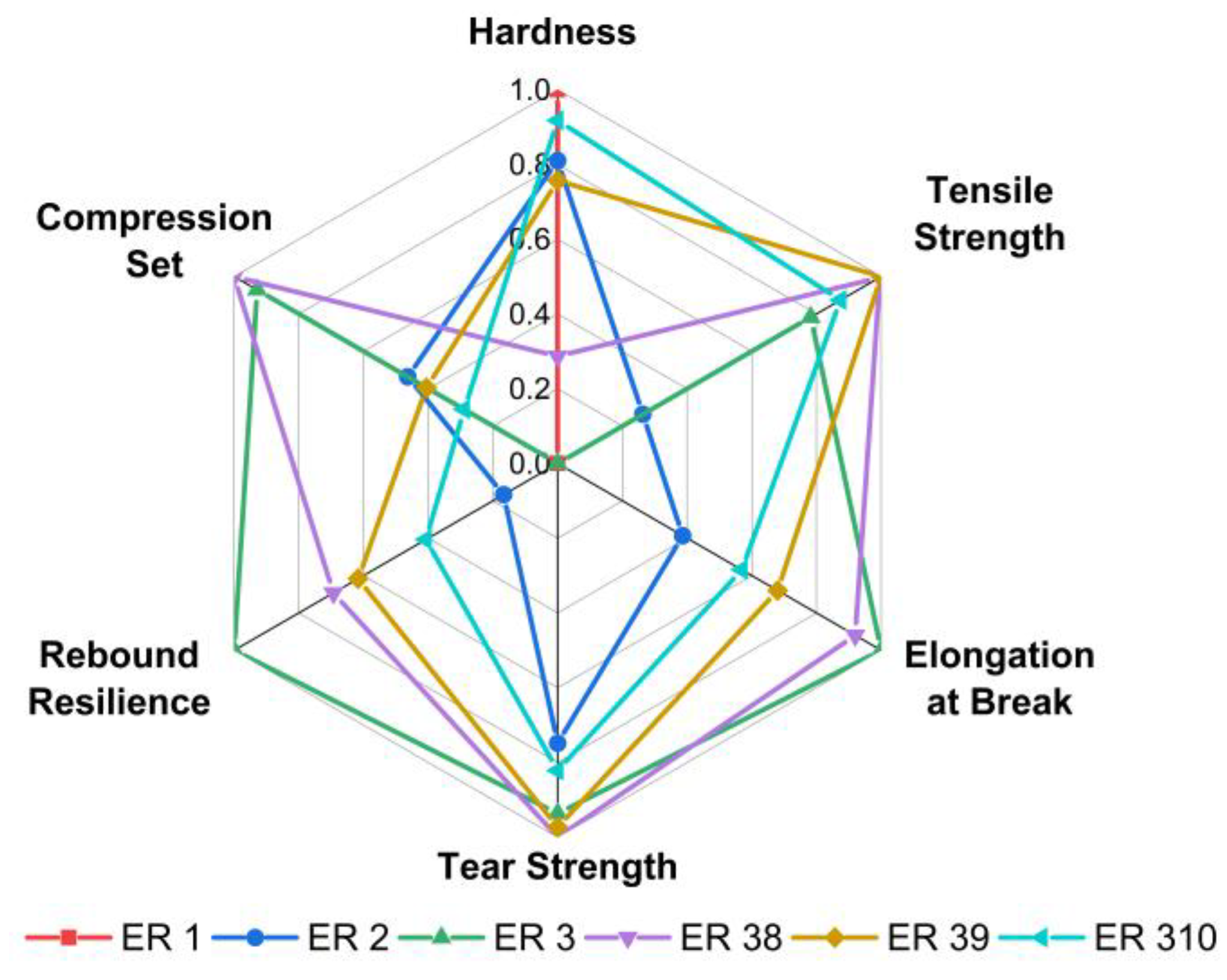
The comparison of the mechanical properties of EPDM composites for rubber seal application with normalized variables is summarized in Figure 2. The data were subjected to min-max normalization, where the smallest original value becomes 0 and the highest original value becomes 1. Consequently, ER 3, with the lowest hardness, exhibits a normalized value of 0, while ER 1 shows normalized values of 0 for tensile strength, elongation at break, tear strength, and rebound resilience. Among the samples with variation in EPDM types, ER 3 (70% ethylene, 5% ENB) shows the best mechanical properties. However, when the variation in filler loading is included, ER 38 exhibits better performance under most conditions for sealing application, with high compression set, elongation at break, tensile and tear strength, and moderate values for rebound resilience and hardness.

3.3. Swelling Behavior

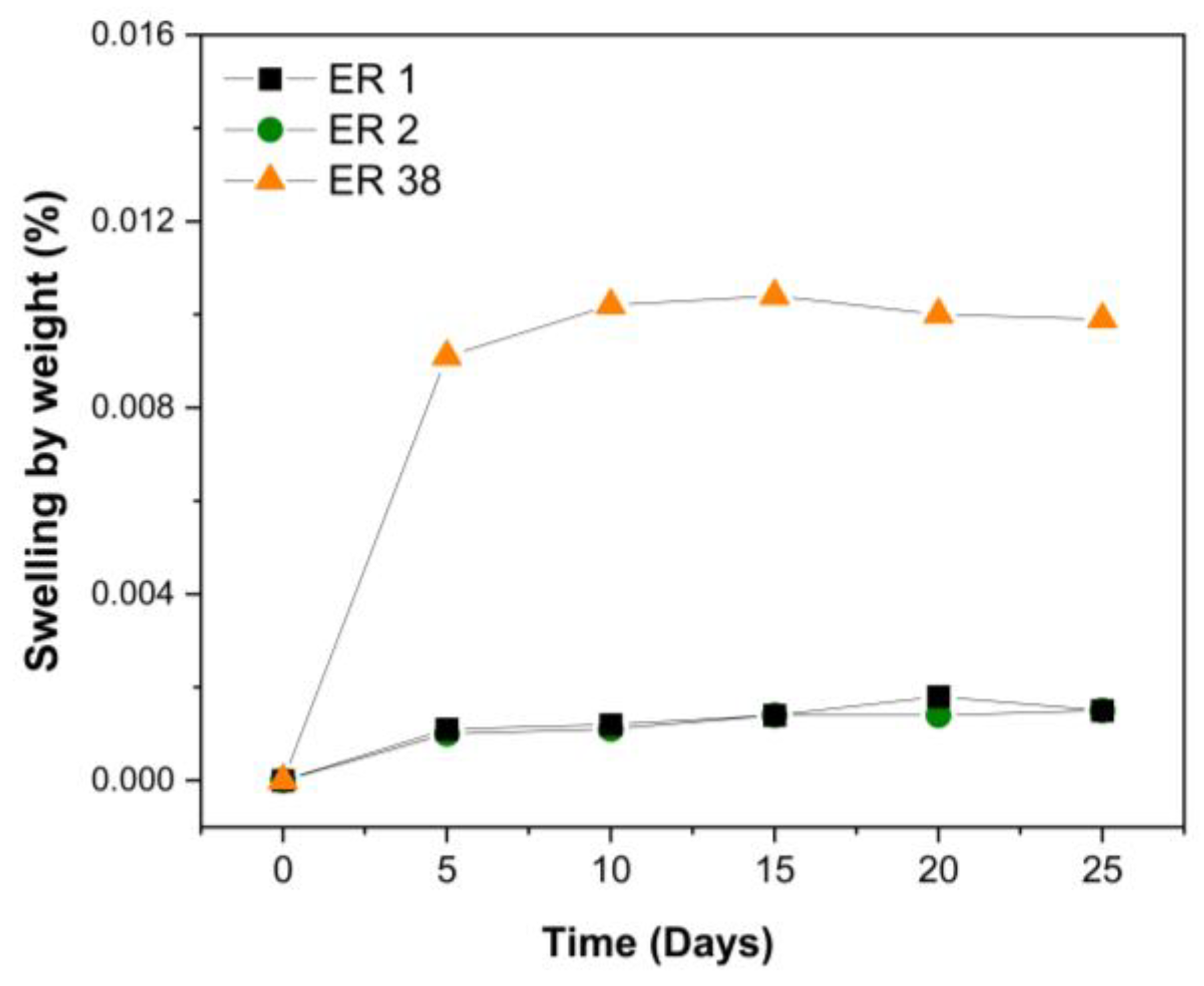
The rubber composite swelling experiment provides information about the relationship between rubber materials and solvents, in this case, seawater. The absorption of water can be assessed via the weight gain of the polymer. The swelling test was conducted for samples ER 1, 2, and 38, which were composed of EPDM with different contents of monomer. According to the swelling measurement test shown in Figure 3, ER 38 exhibited a higher swelling percentage which reached about 0.01%, while ER 1 and ER 2 did not exhibit any notable changes in the swelling ratio with time, and there was no significant change in the absorption of seawater. The mechanism of saline water absorption into rubber is through osmosis [30], in which temperature is an essential aspect. It affects density, viscosity, and diffusivity, all of which are important variables in momentum and energy transfer phenomena [31]. Due to seawater immersion at low temperatures, the molecular chain motion might be more restricted than at higher temperatures. When the rubber composite is subjected to a saline solution, water molecules penetrate the void between polymer chains, filling the micro-gaps. This is followed by the penetration of ions surrounded by water molecules, although at a slower rate due to a stronger attraction [32]. However, EPDM rubber is known to have good compatibility with saline solution because its main polymer backbone consists of ethylene and propylene monomers, which are saturated and chemically stable [33]. Consequently, the non-polar nature of EPDM results in a low affinity for polar solvents such as salt water, thereby limiting seawater absorption.
The crosslink density of the polymer also influences the swelling ratio of the rubber [34]. A higher crosslink density restricts chain mobility, minimizes the void between chains, and limits water uptake. In contrast, a lower chain network density increases the ability of the polymer to incorporate more solvent molecules. With the addition of processing oil in ER 38, which reduces the viscosity and crosslink density, as reflected in S′min and S′max values in the curing characteristic, it is reasonable that ER 38 exhibits the highest water uptake

3.4. Dynamic Mechanical Properties

Dynamic mechanical analysis was used to study the relationship between the temperature of materials and their dynamic mechanical properties. In this study, dynamic mechanical analysis was conducted on specimens with different types of EPDM but the same filler loading. DMA determines the storage modulus (E′) or elastic modulus, which correlates to the capability of the material to store or return energy applied; loss modulus (E″), which is associated with the ability of the material to dissipate energy; and damping or loss factor (tan δ), which is the ratio between E′ and E″ [35,36].
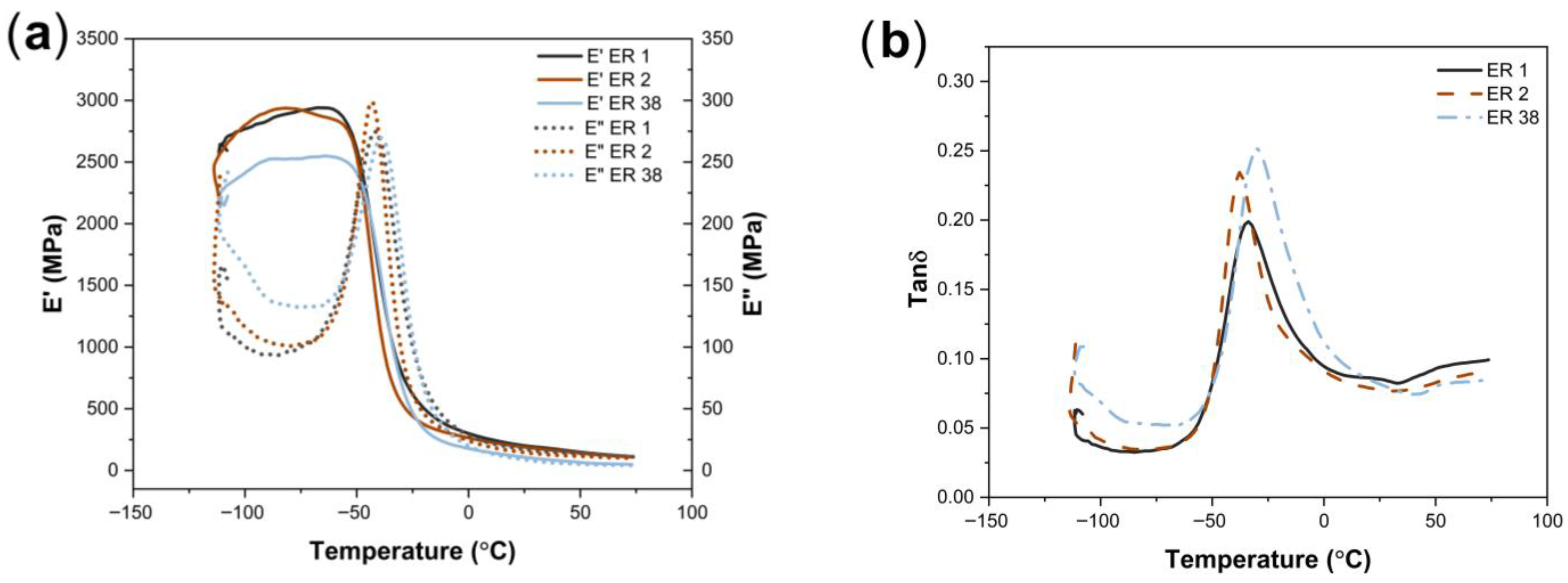
Figure 4 shows the storage modulus, loss modulus, and tan δ of the samples. Glass transition (Tg) is the temperature at which rearrangement occurs in the elastomer, from a hard and glassy state to a rubbery state, and vice versa. The glass transition temperature can be estimated from the maximum peak of tan δ. The glass transition temperatures of ER1, 2, and 38 are −33.82 °C, −37.85 °C, −29.86 °C, respectively. One of the factors influencing the glass transition temperature (Tg) is crosslink density. A higher crosslink density, as observed in ER 1 based on the S′max value compared with ER 2, corresponds to a higher Tg for ER 1. This is due to the restriction of chain mobility during the glass transition process, which significantly increases the Tg [37]. However, an exception is observed in ER 38, which has the lowest crosslink density but the highest Tg among the samples. This anomaly can be attributed to the structure of the base monomer. ER 38 contains 70% ethylene, which is considered high. The presence of a high proportion of ethylene in the base polymer increases crystallinity and stiffness, which can raise the Tg despite the lower crosslink density [12]. This is also in line with the ethylene content of ER 1, which is higher than ER 2 and results in a higher Tg temperature.
The storage modulus gives information about the elastic behavior of the materials, which reflects the stiffness and crosslink density of the material. Generally, a higher storage modulus indicates a higher crosslink density. The storage modulus changes with increasing temperature, where a significant decline occurs between −50 and −25 °C, which corresponds to the glass transition temperature. Above the glass transition temperature, the storage modulus of ER 1 and ER 2 is higher than that of ER 38.
The observation on loss modulus shows that the ER 2 peak is equal to 299.44 MPa at −42.8 °C. A slight shifting of the maximum loss modulus value for ER 1 is 274.91 MPa at −42.3 °C and 266.70 MPa at −37.3 °C for ER 38. ER 2 exhibits a higher loss modulus than ER 1 because the oil content in the base rubber of ER 2 is lower than that of ER 1, whereas the additional oil in ER 38 reduces its loss modulus to the lowest value among the samples. The loss modulus reflects the amount of energy dissipated in the sample. The addition of processing oil may increase the proportion of mobilized rubber, resulting in lower molecular friction and reduced energy dissipation [38]. In the glassy region, the storage modulus of ER 38 is much lower than that of ER 1 and ER 2, but the loss modulus of ER 38 is higher than that of ER 1 and ER 2. The incorporation of processing oil in ER 38 induces a plasticizing effect that decreases the stiffness of the rubber matrix and enhances molecular mobility, resulting in increased energy dissipation and a higher loss modulus. Although ER 1 and ER 2 both used highly oil-extended EPDM rubber, they did not exhibit the same results, indicating that the addition of processing oil has a more pronounced effect on the properties of the composites.

3.5. Thermal Properties

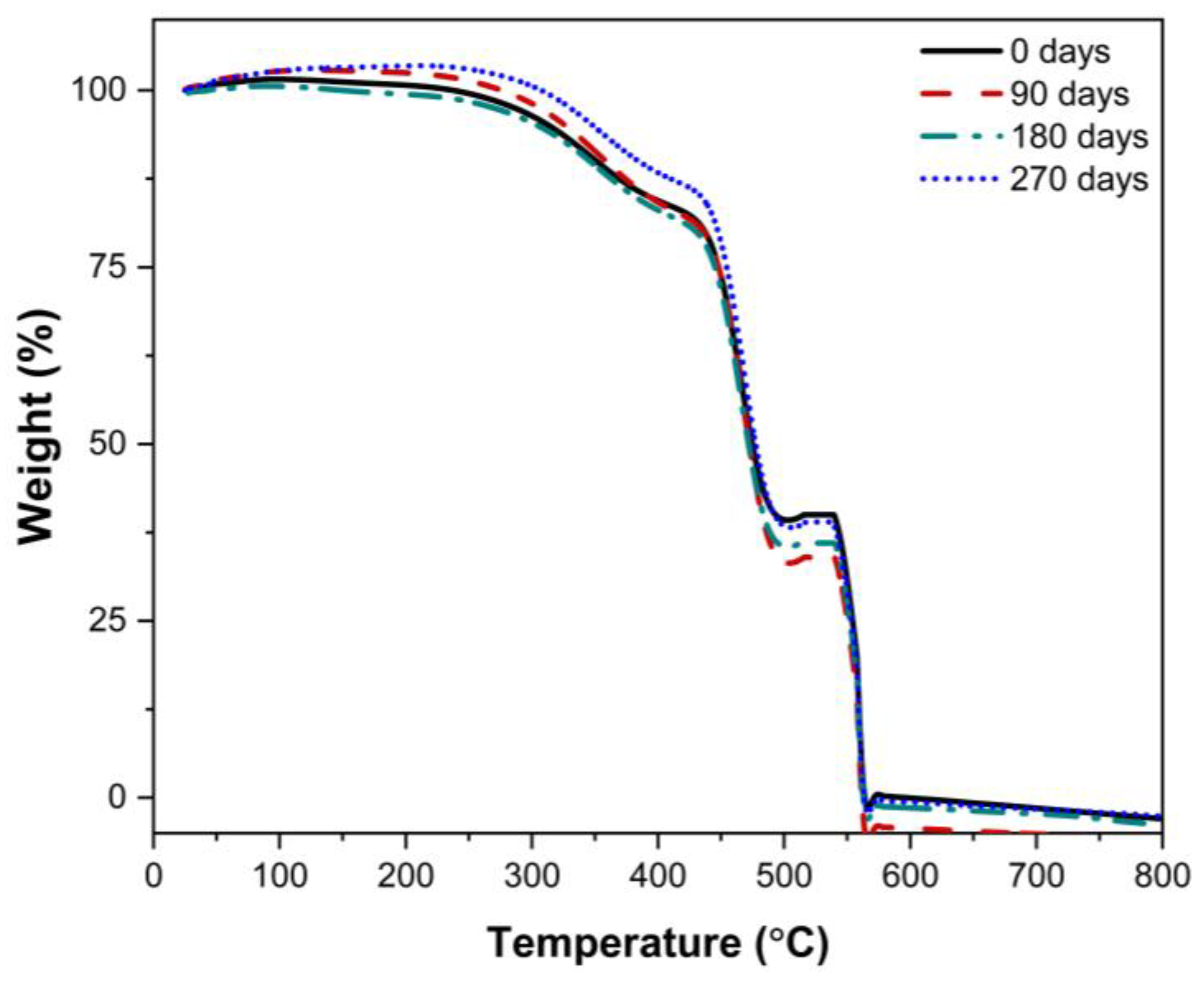
Thermogravimetry analysis was conducted to estimate the thermal stability of EPDM samples after seawater immersion at varied times. Thermal analysis was conducted for ER 38, which shows the best performance for rubber sealing. Figure 5 presents the TGA curves of ER 38 aged in seawater at varied times.
The thermogravimetric curve shows three major degradations of the EPDM composites. The initial weight loss that occurs between 200 and 400 °C is attributed to the evaporation of volatile components, such as oil and processing additives. Subsequently, the second stage of degradation, at a temperature of 400–500 °C, corresponds to the decomposition of the main polymer backbone. The third instance of weight loss, occurring between 500 °C and 600 °C, is associated with the degradation of combustible carbon black. After an extended seawater immersion period, a slight shift occurs in the onset of the degradation temperature. However, as the shifts in temperature are very small, it can be concluded that the samples remain stable after prolonged immersion. An unusual transient increase observed between 500 °C and 600 °C may be caused by instrumental baseline effects that occur when the purge gas is switched from an inert atmosphere to oxygen during the carbon black combustion step.

3.6. Dispersion, Morphology, and Fracture Surface Assessment

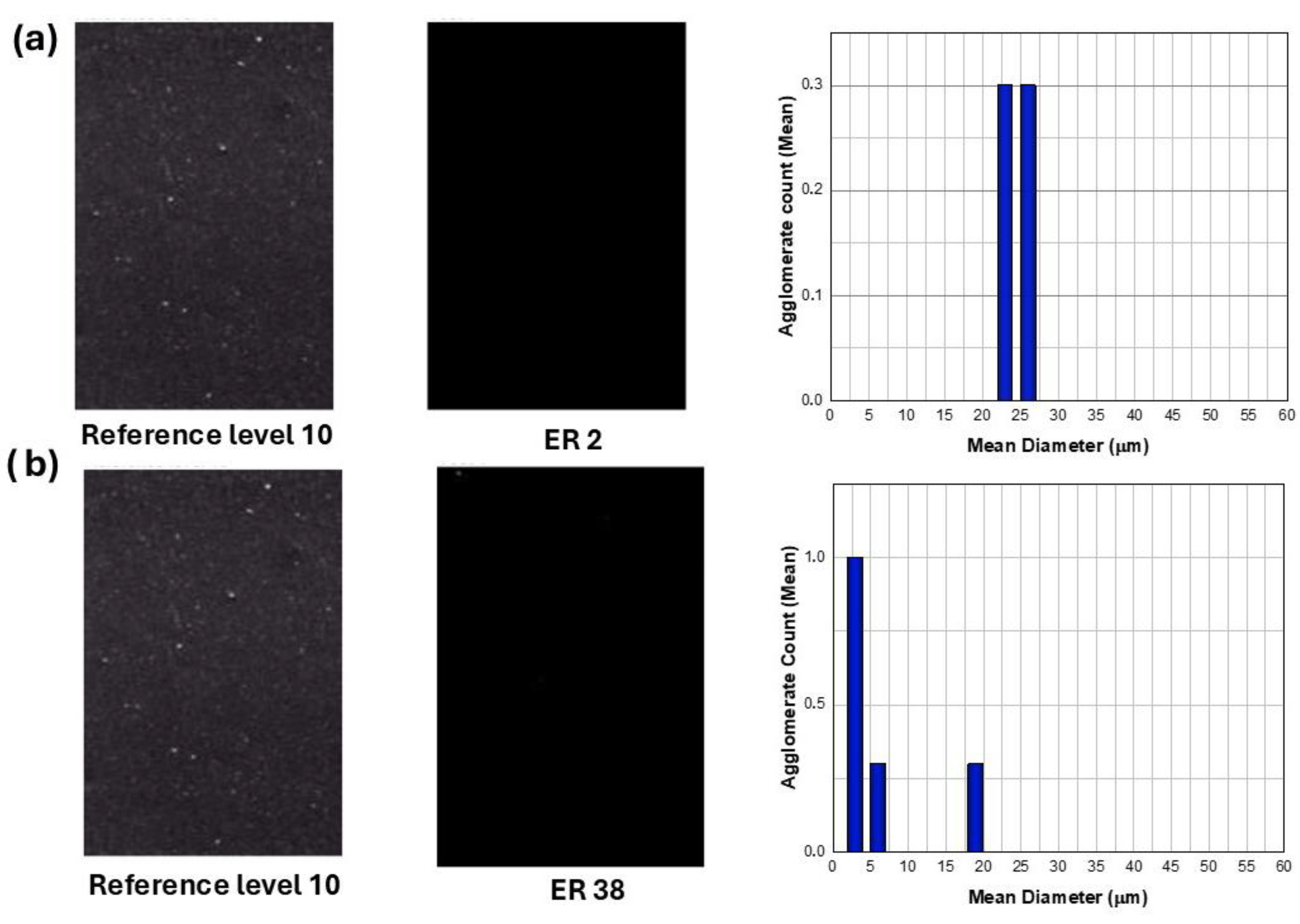
A carbon dispersion tester was used to determine the quality of carbon black dispersion. Figure 6 presents the image comparison between the reference and sample, and the relation between agglomerate count and mean diameter of carbon black in the rubber matrix. It is obtained that the dispersion of carbon black in ER 2 and ER 38 shows good dispersion at level 10, the highest level according to the reference of the dispersion tester, with dispersion percentages of 99.95 and 99.98 for ER 2 and ER 38, respectively. The dispersion of fillers, such as carbon black and silica, within the rubber matrix minimizes the size of the filler in the form of aggregates [39]. The average aggregate size of ER 2 and ER 38 is 11.86 and 5.01, respectively. The dispersion of carbon black is also related to the surface chemistry of the filler, interfacial interaction with the rubber, and compatibility between the polymer and filler [40].
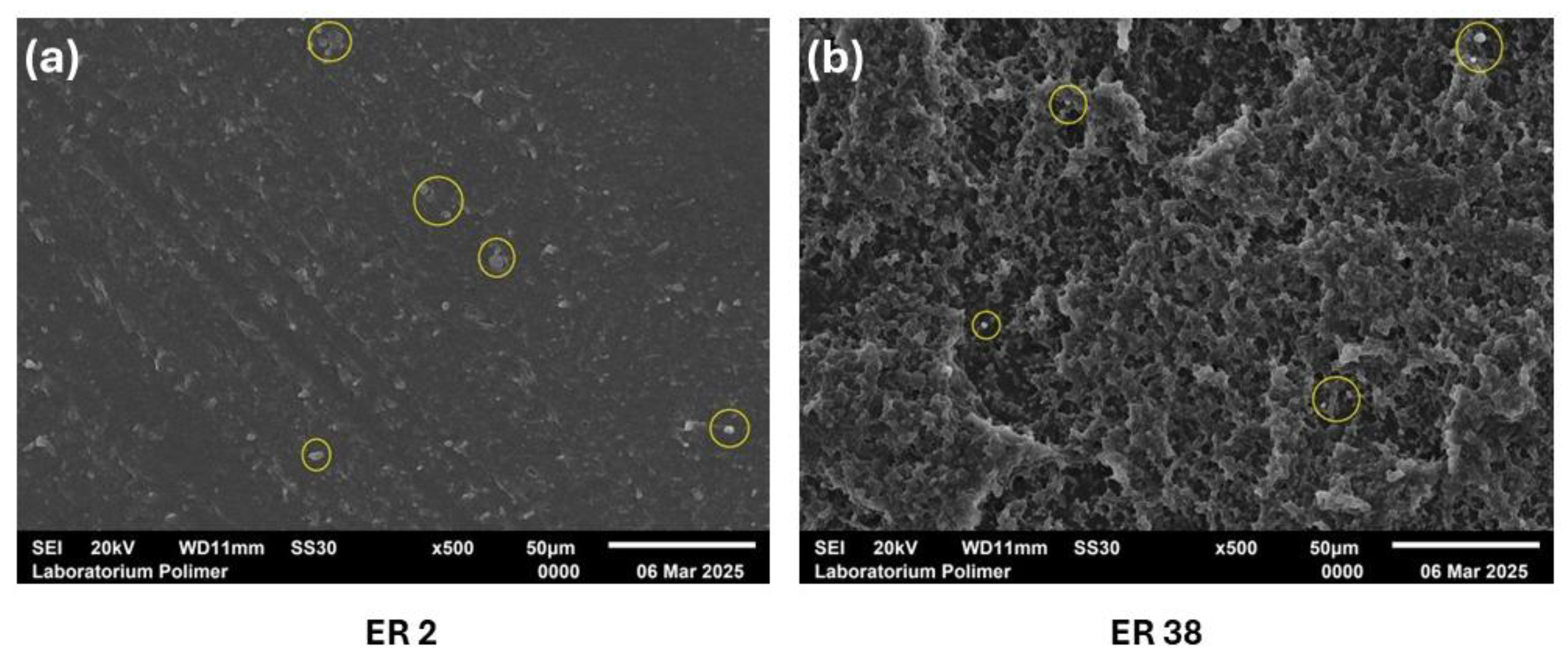
The cross-sectional morphology of the EPDM composites containing 58% and 70% ethylene at the same filler loading was evaluated via scanning electron microscopy. As shown in Figure 7, it is evident that different types of EPDM rubber show dissimilar morphology. ER 2, containing 58% ethylene, shows a smoother surface, while ER 38 has a rougher surface. Some of the carbon black aggregates can be observed from the sample’s morphology. However, most of the carbon black particles cannot be seen from the SEM images, probably due to the coating from the rubber.
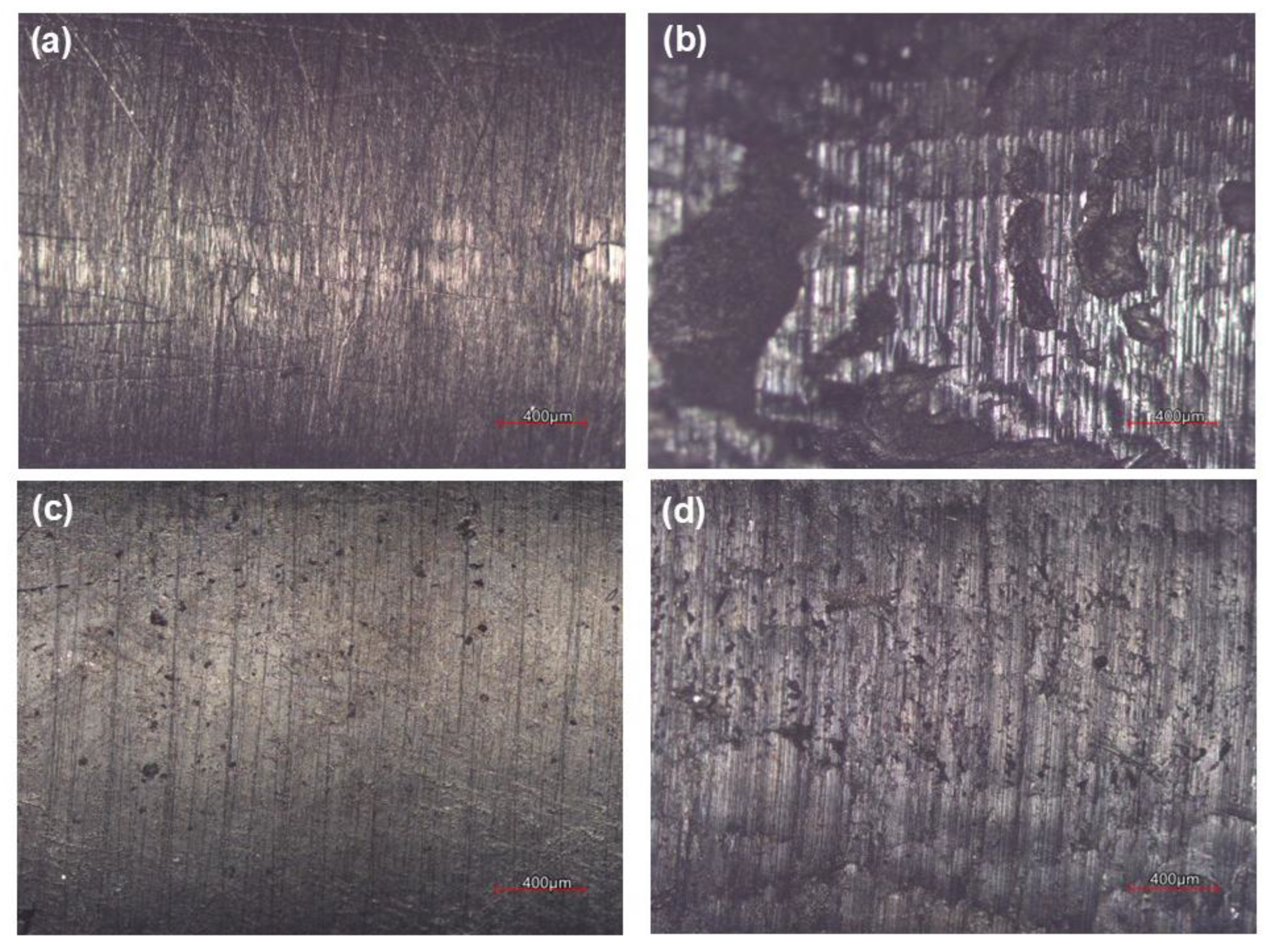
Crack analysis was performed to observe potential surface damage that appeared on the surface of the rubber seal because of the pressure chamber test. The rubber seal ER 38 was cut into two parts, and the surfaces of both the inner and outer sides of the rubber cone were examined using a microscope. Figure 8 demonstrates the result of surface observation. According to the visual analysis, no cracks were found on the inner surface either before or after the pressure chamber test. Similarly, the outer surface of the rubber cone also exhibited no visible rupture. This result proved that the EPDM composite ER 38 can be applied as a rubber seal for a cable-based tsunameter.

4. Conclusions

In this study, the influence of EPDM content and carbon black content on the performance of a rubber seal compound was investigated. The curing characteristics showed that ENB content plays a key role in accelerating vulcanization. The mechanical properties, such as hardness, compression set, tensile strength, elongation at break, tear strength, and rebound resilience, indicated that the amount of EPDM influences the mechanical properties. Overall, a higher ethylene content on EPDM resulted in better mechanical properties of the composites. Additionally, increasing the carbon black loading increased hardness, compression set, tensile strength, and tear strength up to 80 phr, while elongation at break decreased. Based on the findings of this study, the addition of carbon black provided optimal reinforcement at 80 phr. The swelling test indicates only a slight change in sample weight after 25 days of seawater immersion, confirming that EPDM rubber exhibits good resistance to seawater absorption due to its non-polar, saturated backbone structure. The oil content, however, influences seawater absorption behavior in the ER 38 EPDM composite. Dynamic mechanical analysis confirmed that a higher ENB content in the rubber correlates with the glass transition temperature and viscoelastic behavior of EPDM composites, as shown by ER 38, which exhibited the highest Tg despite lower crosslink density. TGA analysis revealed that seawater immersion of the ER 38 sample for up to 270 days did not cause a significant change in thermal stability. The morphology of the samples varied depending on the type of EPDM. The carbon black dispersion exhibits a good dispersion within the composite. No visible cracks were observed after the rubber seal prototype was tested in the pressure chamber. These results indicate that the ER 38 rubber seal formulation, utilizing EPDM with 70% ethylene content and 80 phr carbon black, is suitable for cable-based tsunameter sealing applications at depths up to 3000 m.

5. Patents

Indonesian Patent Application No. P00202309794.

Author Contributions

Conceptualization, A.S.H. and M.A.; methodology, R.F. and M.E.H.; validation, T.M. and M.D.E.; formal analysis, H.S., M.E.H. and V.M.H.; investigation, R.F., D.K.A., and A.A.; resources, A.S.H. and M.D.E.; data curation, A.A. and T.M.; writing—original draft preparation, R.F.; writing—review and editing, D.K.A. and M.A.; visualization, H.S. and V.M.H.; supervision, A.S.H.; project administration, H.S.; funding acquisition, H.S. All authors have read and agreed to the published version of the manuscript.

Funding

This research received no external funding.

Data Availability Statement

The data presented in this study are available on request from the corresponding author.

Acknowledgments

The authors would like to thank the financial support from the Agency for Assessment and Application of Technology (BPPT), under the DIPA Program entitled INA-TEWS Technology System Innovation: BUOY and OBU Platform Material Design.

Conflicts of Interest

The authors declare no conflicts of interest.

Abbreviations

The following abbreviations are used in this manuscript:
EPDMEthylene Propylene Diene Monomer
ENB5-ethylene-2-norbornene
CBTCable-Based Tsunameter
OBUOcean Bottom Unit

References

  1. Gao, Q.; Zhang, P.; Duan, M.; Yang, X.; Shi, W.; An, C.; Li, Z. Investigation on structural behavior of ring-stiffened composite offshore rubber hose under internal pressure. Appl. Ocean Res. 2018, 79, 7–19. [Google Scholar] [CrossRef]
  2. Tchalla, S.T.; Gac, P.Y.L.; Maurin, R.; Créac’hcadec, R. Polychloroprene behaviour in a marine environment: Role of silica fillers. Polym. Degrad. Stab. 2017, 139, 28–37. [Google Scholar] [CrossRef]
  3. Yang, D.; Xue, L.; An, Y.; Liu, J. Vibration isolation characteristics of a rubber isolator in the deep water condition. J. Phys. Conf. Ser. 2024, 2707, 012114. [Google Scholar] [CrossRef]
  4. Soehadi, G.; Setianingrum, L.; Rahardjo, S.; Yogantara, I.W.W.; Purnomo, E.; Purwoadi, M.A.; Santoso, I. Technology content assessment for Indonesia-cable based tsunameter development strategy using technometrics model. J. Sist. Manaj. Ind. 2023, 7, 15–29. [Google Scholar] [CrossRef]
  5. Haryanto, B.; Ivano, O.; Setyawan, A.; Perkasa, M. Rancang Bangun Dummy Canister Sistem Pendeteksi Tsunami Tipe CBT (Cable-Based Tsunameter) untuk Kedalaman Laut 3000 M. J. Tek. Mesin Cakram 2022, 5, 12–21. [Google Scholar]
  6. Wu, S.-J.; Wang, X.; Wang, S.; Zhang, B.; Yang, C.-J.; Zhi, H. Active temperature-preserving deep-sea water sampler configured with a pressure-adaptive thermoelectric cooler module. Deep Sea Res. I Oceanogr. Res. Pap. 2022, 181, 103701. [Google Scholar] [CrossRef]
  7. Chandrasekaran, C. Rubbers Mostly Used in Process Equipment Lining. In Anticorrosive Rubber Lining; William Andrew Publishing: Norwich, NY, USA, 2017; pp. 87–101. [Google Scholar]
  8. Wang, Y.; Liu, H.; Li, P.; Wang, L. The Effect of Cross-Linking Type on EPDM Elastomer Dynamics and Mechanical Properties: A Molecular Dynamics Simulation Study. Polymers 2022, 14, 1308. [Google Scholar] [CrossRef]
  9. Deshmukh, S.; Brull, R.; MAcko, T.; Arndt, J.-H.; Bernardo, R.; Niessen, S. Characterization of ethylene-propylene-diene terpolymers using high-temperature size exclusion chromatography coupled with an ultraviolet detector. Polymer 2022, 242, 124585. [Google Scholar] [CrossRef]
  10. Wypych, G. Data on specific polymers. In Handbook of Material Weathering, 6th ed.; Chemtec Publishing: Toronto, ON, Canada, 2018; pp. 369–590. [Google Scholar]
  11. Wang, Y.X.; Wang, C.-C.; Shi, Y.; Liu, L.-Z.; BAi, N.; Song, L.-F. Effects of Dynamic Crosslinking on Crystallization, Structure and Mechanical Property of Ethylene-Octene Elastomer/EPDM Blends. Polymers 2021, 14, 139. [Google Scholar] [CrossRef]
  12. Perejón, A.; Jimenez, P.E.S.; Gonzales, E.G.; Maqueda, L.A.P.; Criado, J.M. Pyrolysis kinetics of ethylene–propylene (EPM) and ethylene–propylene–diene (EPDM). Polym. Degrad. Stabil. 2013, 98, 1571–1577. [Google Scholar] [CrossRef]
  13. Song, L.F.; Bai, N.; Shi, Y.; WAng, Y.-X.; Song, L.-X.; Liu, L.-Z. Effects of Ethylene-Propylene-Diene Monomers (EPDMs) with Different Moony Viscosity on Crystallization Behavior, Structure, and Mechanical Properties of Thermoplastic Vulcanizates (TPVs). Polymers 2023, 15, 642. [Google Scholar] [CrossRef] [PubMed]
  14. Sartori, C.M.L.; Hiranobe, C.T.; Santos, R.J.; Cabrera, F.C.; Job, A.A. Effect of sulfur donor and co-agent as scorch delay system over third monomer EPDM-ENB content. J. Rubber Res. 2021, 24, 339–346. [Google Scholar] [CrossRef]
  15. Wang, Z.-N.; Shen, S.-L.; Zhou, A.-N.; Xu, Y.-S. Experimental Evaluation of Aging Characteristics of EPDM as a Sealant for Undersea Shield Tunnels. J. Mater. Civ. Eng. 2020, 32, 04020182. [Google Scholar] [CrossRef]
  16. ASTM D 2240-15; Standard Test Method for Rubber Property—Durometer Hardness. ASTM International: West Conshohocken, PA, USA, 2015.
  17. ASTM D 412a-16; Standard Test Methods for Vulcanized Rubber and Thermoplastic Elastomers—Tension. ASTM International: West Conshohocken, PA, USA, 2016.
  18. ASTM D 624-00; Standard Test Method for Tear Strength of Conventional Vulcanized Rubber and Thermoplastic Elastomers. ASTM International: West Conshohocken, PA, USA, 2020.
  19. ASTM D 395-16; Standard Test Methods for Rubber Property—Compression Set, ASTM International. ASTM International: West Conshohocken, PA, USA, 2016.
  20. ASTM D 6370-99; Standard Test Method for Rubber—Compositional Analysis by Thermogravimetry (TGA). ASTM International: West Conshohocken, PA, USA, 2019.
  21. Kruzelak, J.; Dzuganova, M.; Kvasnicakova, A.; Preto, J.; Hronkovic, J.; Hudec, I. Influence of Plasticizers on Cross-Linking Process, Morphology, and Properties of Lignosulfonate-Filled Rubber Compounds. Polymers 2025, 17, 393. [Google Scholar] [CrossRef]
  22. Pechurai, W.; Chiangta, W.; Tharuen, P. Effect of Vegetable Oils as Processing Aids in SBR Compounds. Macromol. Symp. 2015, 354, 191–196. [Google Scholar] [CrossRef]
  23. Bouguedad, D.; Mekhaldo, A.; Jbara, O.; Hadjadj, A.; Douglade, J.; Dony, P. Physico-chemical study of thermally aged EPDM used in power cables insulation. IEEE Trans. Dielectr. Electr. Insul. 2015, 22, 3207–3215. [Google Scholar] [CrossRef]
  24. Kömmling, A.; Jaunich, M.; Wolff, D. Revealing effects of chain scission during ageing of EPDM rubber using relaxation and recovery experiment. Polym. Test. 2016, 56, 261–268. [Google Scholar] [CrossRef]
  25. Wisojodharmo, L.A.; Amry, A.; Taqwatomo, G.; Fidyaningsih, R.; Arti, D.K.; Utami, W.T.; Saputra, D.A.; Gumelar, M.D.; Husin, S.; Susanto, H.; et al. Influence of NR/EPDM Ratios on the Performance of Pneumatic Fenders in Seawater. E3S Web Conf. 2024, 503, 06001. [Google Scholar] [CrossRef]
  26. Akulichev, A.G.; Alcock, B.; Echtermeyer, A.T. Elastic recovery after compression in HNBR at low and moderate temperatures: Experiment and modelling. Polym. Test. 2017, 61, 46–56. [Google Scholar] [CrossRef]
  27. Zaghdoudi, M.; Kömmling, A.; Jaunich, M.; Wolff, D. Understanding the recovery behaviour and the degradative processes of EPDM during ageing. Polym. Test. 2023, 121, 107987. [Google Scholar] [CrossRef]
  28. Avalos, B.F.; Mendoza, P.C.; Ortiz, C.J.C.; Ramos, V.L.F. Effect of the ethylene content on the properties m-propylene/EPDM blends. Polym. Sci. 2017, 1, 5–9. [Google Scholar]
  29. De Carvalho, A.P.; Santos, H.F.D.; Ribeiro, G.D.; Hiranobe, G.T.; Goveia, D.; Gennaro, E.M.; Paim, L.L.; Santos, R.J.D. Sustainable Composites: Analysis of Filler-Rubber Interaction in Natural Rubber-Styrene-Butadiene Rubber/Polyurethane Composites Using the Lorenz-Park Method and Scanning Electron Microscopy. Polymers 2024, 16, 471. [Google Scholar] [CrossRef]
  30. Zielińska, M.; Seyger, R.; Dierkes, W.K.; Bielinski, D.; Noordermeer, J.W.M. Swelling of EPDM rubbers for oil-well applications as influenced by medium composition and temperature Part I. Literature and theoretical background. Elastomery 2016, 20, 6–17. [Google Scholar]
  31. Shin, S.; Kim, A.S. Temperature Effect on Forward Osmosis; InTech: London, UK, 2018; Volume 28. [Google Scholar]
  32. Akhtar, M.; Qamar, S.Z.; Mehdi, S.M.; Hussain, A. Diffusion-based swelling in elastomers under low- and high-salinity brine. J. Elastomers Plast. 2018, 51, 75–84. [Google Scholar] [CrossRef]
  33. Srisang, W.; Supap, T.; Idem, R.; Tontiwachwuthikul, P. Study of Physical and Chemical Resistance of Elastomers in Aqueous MEA and MEA+CO2 Solutions during the Carbon Dioxide Absorption Process. Energy Procedia 2014, 63, 1415–1423. [Google Scholar] [CrossRef]
  34. Darko, C. The link between swelling ratios and physical properties of EPDM rubber compound having different oil amounts. J. Polym. Res. 2022, 29, 325. [Google Scholar] [CrossRef]
  35. Henriques, I.R.; Borges, L.A.; Costa, M.F.; Soares, B.G.; Castello, D.A. Comparisons of complex modulus provided by different DMA. Polym. Test. 2018, 72, 394–406. [Google Scholar] [CrossRef]
  36. Bashir, M.A. Use of Dynamic Mechanical Analysis (DMA) for Characterizing Interfacial Interactions in Filled Polymers. Solids 2021, 2, 108–120. [Google Scholar] [CrossRef]
  37. Bandzierz, K.; Reuvekamp, L.; Dryzek, J.; Dierkes, W.; Blume, A.; Bielinski, D. Influence of Network Structure on Glass Transition Temperature of Elastomers. Materials 2016, 9, 607. [Google Scholar] [CrossRef]
  38. Sokmen, S.; Osswald, K.; Reincke, K.; Ilisch, S. Influence of Treated Distillate Aromatic Extract (TDAE) Content and Addition Time on Rubber-Filler Interactions in Silica Filled SBR/BR Blends. Polymers 2021, 13, 698. [Google Scholar] [CrossRef] [PubMed]
  39. Yazici, N.; Kodal, M.; Ozkoc, G. Lab-Scale Twin-Screw Micro-Compounders as a New Rubber-Mixing Tool: ‘A Comparison on EPDM/Carbon Black and EPDM/Silica Composites’. Polymers 2021, 13, 4391. [Google Scholar] [CrossRef] [PubMed]
  40. Costa, N.L.; Hiranobe, C.T.; Cardim, H.P.; Dognani, G.; Sanchez, J.C.; Carvalho, J.A.J.; Torres, G.B.; Paim, L.L.; Pinto, L.F.; Cardim, G.P.; et al. A Review of EPDM (Ethylene Propylene Diene Monomer) Rubber-Based Nanocomposites: Properties and Progress. Polymers 2024, 16, 1720. [Google Scholar] [CrossRef] [PubMed]
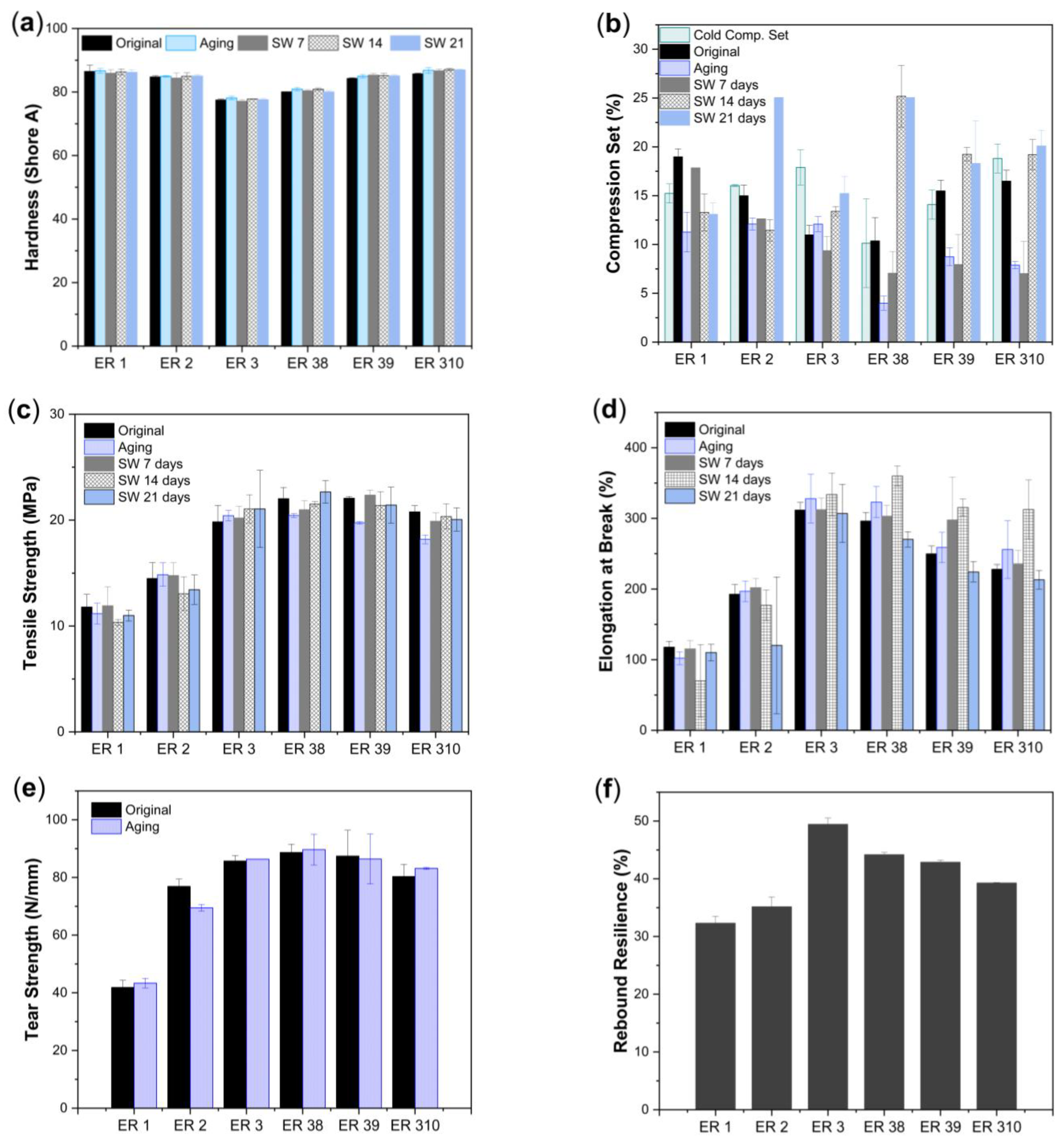
Figure 1. Mechanical properties of rubber composites with varying EPDM and filler content: hardness (a), compression set (b), tensile strength (c), elongation at break (d), tear strength (e), and rebound resilience (f) under various conditions (original, after aging, and seawater immersion).
Jcs 09 00705 g001
Figure 2. Normalized radar graph on the mechanical properties of EPDM composites.
Jcs 09 00705 g002
Figure 3. Water swelling by weight of the EPDM composites when immersed in seawater at various times.
Jcs 09 00705 g003
Figure 4. (a) Storage modulus and loss modulus, and (b) tan δ of ER 1, ER 2 and ER 38 EPDM composites.
Jcs 09 00705 g004
Figure 5. TGA curves of ER 38 after seawater immersion at various times.
Jcs 09 00705 g005
Figure 6. Carbon black dispersion and mean agglomerate count in (a) ER 2 and (b) ER 38 EPDM composites.
Jcs 09 00705 g006
Figure 7. SEM surface morphology of (a) ER 2 and (b) ER 38 EPDM composites at ×500 magnification. The yellow circles indicate the presence of aggregates within the composites.
Jcs 09 00705 g007
Figure 8. Microscope image of (a) inside before, (b) inside after, (c) outside before, and (d) outside after the pressure chamber test of rubber seal ER 38.
Jcs 09 00705 g008
Table 1. Specification of EPDM.
TypeEthylene Content (wt%)ENB Content (wt%)Oil Content (phr)Mooney Viscosity ML (1 + 4) 125C (MU)MWD
EPDM 4869648.710052CLCB
EPDM 5467584.57548CLCB
EPDM 8570705.0 80CLCB
Table 2. Compound formulations of EPDM composites for rubber seal CBT application.
ComponentAmount (phr)
ER 1ER 2ER 3ER 38ER 39ER 310
EPDM 486910000000
EPDM 546701000000
EPDM 857000100100100100
Polyoctenamer333333
Zinc oxide555555
Stearic acid222222
Carbon black8080708090100
6PPD111111
Processing oil2230303030
Sulfur222222
CBS1.51.51.51.51.51.5
Table 3. Curing characteristics of EPDM composites.
CompoundS′max [dNm]S′min [dNm]ΔTorque (S′max − S′min) [dNm]T90 [min]TS2 [min]Cure Rate Index (CRI)
ER 144.3739.464.918.050.812.55
ER 240.634.755.8515.041.126.89
ER 329.9526.982.9725.411.174.09
ER 3832.9729.633.3430.591.243.34
ER 3936.5732.254.3229.461.043.46
ER 31039.5733.835.8430.541.063.34
Disclaimer/Publisher’s Note: The statements, opinions and data contained in all publications are solely those of the individual author(s) and contributor(s) and not of MDPI and/or the editor(s). MDPI and/or the editor(s) disclaim responsibility for any injury to people or property resulting from any ideas, methods, instructions or products referred to in the content.