Review

Natural vs Synthetic Polymers: How Do They Communicate with Cells for Skin Regeneration—A Review


by
Jeevithan Elango
1,2,3,*,
Camilo Zamora-Ledezma
4,* and
José Eduardo Maté-Sánchez de Val
1
1
Department of Biomaterials Engineering, Faculty of Health Sciences, UCAM-Universidad Católica San Antonio de Murcia, Guadalupe, 30107 Murcia, Spain
2
Center of Molecular Medicine and Diagnostics (COMManD), Department of Biochemistry, Saveetha Dental College and Hospitals, Saveetha Institute of Medical and Technical Sciences, Saveetha University, Chennai 600 077, India
3
Department of Marine Biopharmacology, College of Food Science and Technology, Shanghai Ocean University, Shanghai 201306, China
4
Green and Innovative Technologies for Food, Environment and Bioengineering Research Group, Faculty of Pharmacy and Nutrition, UCAM-Universidad Católica San Antonio de Murcia, 30107 Murcia, Spain
*
Authors to whom correspondence should be addressed.
J. Compos. Sci. 2023, 7(9), 385; https://doi.org/10.3390/jcs7090385
Submission received: 4 July 2023 / Revised: 27 August 2023 / Accepted: 11 September 2023 / Published: 13 September 2023
(This article belongs to the Section Composites Manufacturing and Processing)

Abstract

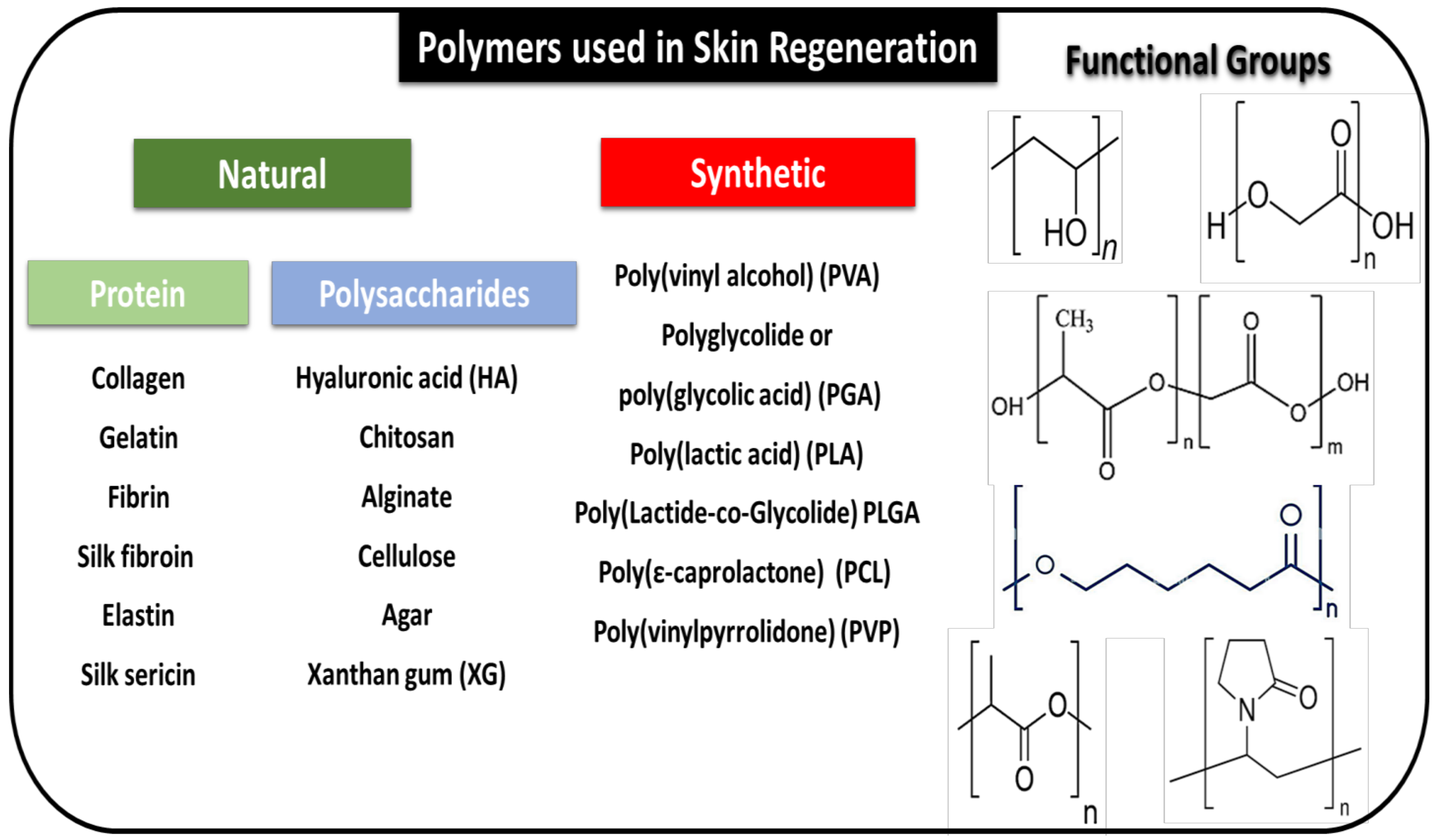
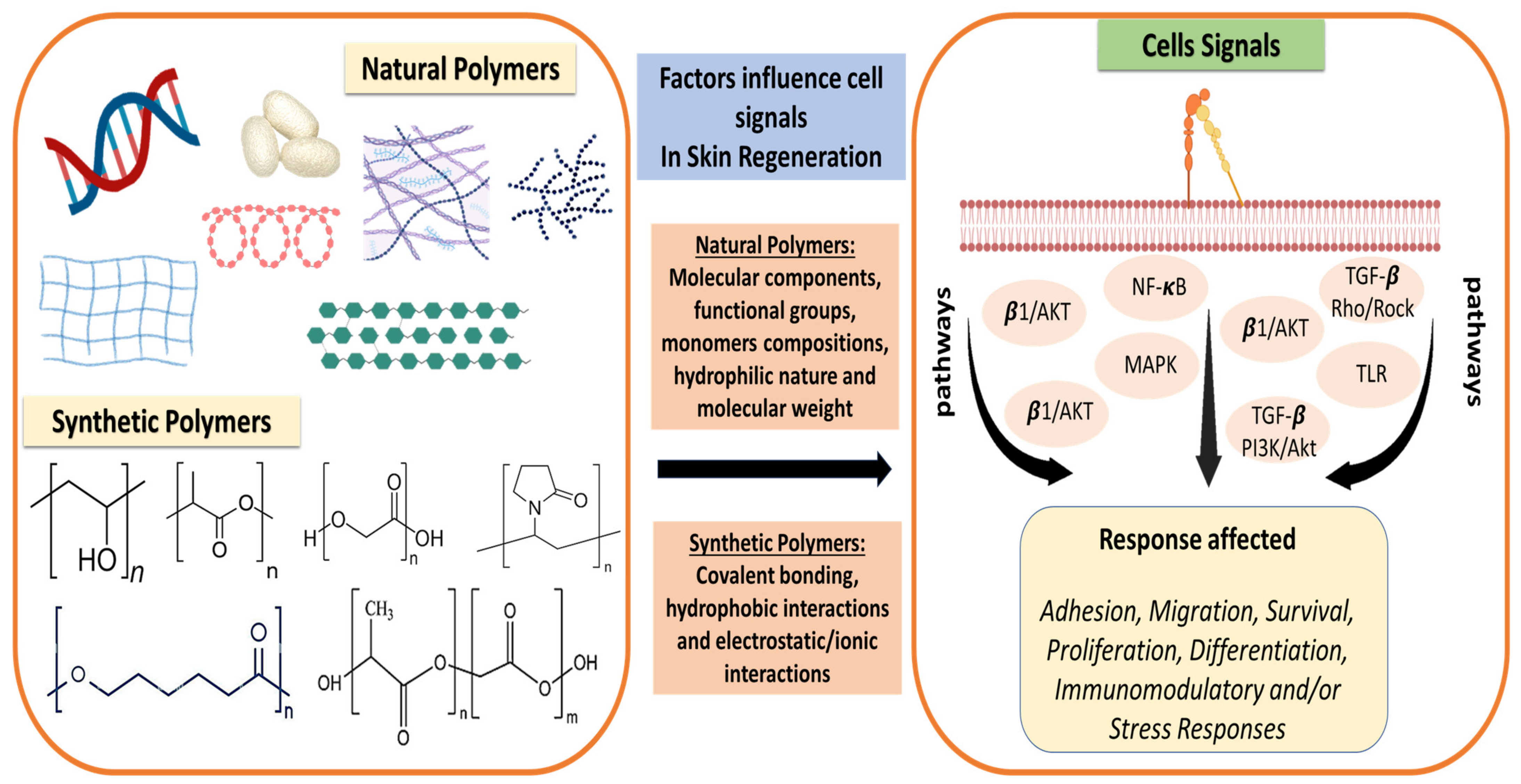
Modern research has evolved several approaches toward skin regeneration and one of the novel concerns is the use of polymer-based systems due to their excellent beneficial properties to the skin. Several polymers, such as cellulose, hyaluronan, alginate, chitosan, collagen, fibrin and fibroin, have been tested and have proven the benefits for skin regeneration, and most of them are derived from either polysaccharide- or protein-based materials. In order to understand the mode of action, several researchers investigated the cell–matrix interaction and possible signaling mechanism in skin regeneration. Not only the signaling mechanism but also the mode of cell communication determines the application of polysaccharide- and protein-based polymers in practice. Based on the above significance, this review disclosed the recent findings to compile a possible method of communication between cells and polymers derived from polysaccharide-based (such as cellulose, hyaluronan, chitosan, alginate, agar, and xanthan gum) and protein-based (such as collagen, gelatin, fibrin, and silk fibroin) materials along with other polymers, such as poly(vinyl alcohol), polyglycolide or poly(glycolic acid), or poly(lactic acid) in skin regeneration. Accordingly, this review addresses the fundamental concept of cell–matrix communication, which helps us to understand the basis of the polymer’s functions in the biomedical field.
Keywords: natural polymers; synthetic polymers; skin regeneration; fibroblasts; cell–matrix communication natural polymers; synthetic polymers; skin regeneration; fibroblasts; cell–matrix communication