


Abstract
Accurate prediction of the stress–strain fields in fiber-reinforced composites is crucial for performance analysis and structural design. However, due to their complex microstructures, traditional finite element analysis (FEA) entails a very high computational cost. Therefore, this study proposes a conditional generative adversarial network (cGAN) framework, named FiberGAN, to enable rapid prediction of the microscopic stress–strain fields in fiber-reinforced composites. The method employs an adaptive representative volume element (RVE) generation algorithm to construct random fiber arrangements with fiber volume fractions ranging from 30% to 50% and uses FEA to obtain the corresponding stress and strain fields as training data. A U-Net generator, combined with a PatchGAN discriminator, captures both global distribution patterns and fine local details. Under tensile and shear loading conditions, the R2 values of FiberGAN predictions range from 0.96 to 0.99, while the structural similarity index (SSIM) values range from 0.95 to 0.99. The error maps show that prediction residuals are mainly concentrated in high-gradient regions with small magnitudes. These results demonstrate that the proposed deep learning model can successfully predict stress–strain field distributions for different fiber volume fractions under various loading conditions.
1. Introduction
Composites have gained widespread attention in recent years due to their exceptional properties, such as high strength, stiffness, corrosion resistance, and low density [1,2,3,4]. These advantages have enabled their extensive application in aerospace, automotive, marine, and high-performance structural systems [5,6,7]. As engineering applications become increasingly demanding, accurately characterizing the mechanical behavior of composites under complex service conditions has become essential for ensuring safety and reliability. In particular, the stress and strain field distributions within composites are highly non-uniform due to their inherent heterogeneity and complex fiber–matrix interfacial interactions, which can induce locally anisotropic field responses even when constituent materials are isotropic. Consequently, traditional macroscopic mechanical analysis often fails to capture these microscale effects accurately [8,9]. Therefore, developing efficient and reliable predictive methods for microscale stress–strain fields has emerged as a critical challenge in modern materials design and structural analysis.
The FEA method remains the most widely used approach for predicting the mechanical response of composite materials [10,11]. By discretizing complex geometries and solving the governing equations of solid mechanics, FEA provides detailed insights into stress and strain evolutions under diverse loading conditions. However, the computational burden of FEA increases drastically with microstructural complexity, particularly when modeling high-resolution representative volume elements that capture realistic fiber distributions. Achieving convergence and accuracy typically requires fine meshing and nonlinear constitutive modeling, resulting in significant time and computational costs. Furthermore, FEA simulations are problem-specific and must be recalculated for each change in geometry, boundary condition, or material property, limiting their feasibility in rapid design iterations or large-scale screening tasks [12,13,14]. In response to these challenges, deep learning (DL) methods have emerged as promising alternatives for mechanical field prediction [15,16,17]. Once trained, deep learning models can provide near-instantaneous field estimations at minimal computational cost [18,19] and can inherently capture complex nonlinear mappings between microstructures and mechanical responses that are difficult to formulate explicitly using physics-based models [20]. As a result, deep learning frameworks have been increasingly adopted in materials science to accelerate microstructure characterization, property prediction, and virtual testing [21,22]. Representative approaches include convolutional neural networks (CNNs) and generative models for inferring effective material properties, reconstructing microstructures, and learning structure–property correlations [23,24,25]. Graph neural networks (GNNs) have been applied to grid-based physical field simulations, modeling of complex physical processes, and prediction of crack coalescence and propagation in brittle materials [26,27,28]. Artificial neural networks (ANNs) have been applied to predict G12 and Xt parameters based on matrix and fiber properties, as well as to estimate the mechanical properties of multilayer laminated composites [29,30]. Despite these promising developments, conventional deep learning models in the context of composite materials still face significant limitations. Most existing approaches are highly data-dependent, requiring large volumes of labeled training data that are often expensive to generate via experiments or high-fidelity simulations. Moreover, these models frequently suffer from poor generalization when exposed to unseen microstructures or loading conditions, as well as limited robustness in the presence of noise, geometric irregularities, or material heterogeneity [31,32].
To overcome these obstacles, several studies have attempted to use deep neural networks to predict stress or strain fields from microstructural representations. For example, Jiang et al. proposed a conditional generative adversarial network to predict 2D von Mises stress distributions in solid structures, achieving superior accuracy over conventional CNNs under varying geometries, loads, and boundary conditions [33]. Yacouti et al. developed CompINet, a graph-based deep learning framework that combines graph neural networks with convolutional architectures to accurately predict mechanical fields in composite microstructures, achieving high accuracy with significantly reduced data requirements [34]. Sepasdar et al. proposed a two-stage deep learning framework to predict post-failure stress fields and crack patterns in composite microstructures with ~90% accuracy [35]. Yang et al. proposed a transferable deep learning approach for recovering missing physical field information and developed an end-to-end deep learning method to predict the complete strain and stress tensors of complex layered composite microstructures [36,37]. Maurizi et al. proposed a game-theory-based conditional GNN to directly predict stress and strain fields from material microstructures, enabling accurate and generalizable property predictions across complex geometries and boundary conditions [38]. Jin et al. proposed an RNN-based forward model coupled with evolutionary inverse optimization to design strain fields in hierarchical architectures, achieving high accuracy and efficient microstructure optimization [39]. Although these works significantly advance the field, most models remain limited to specific composite systems or narrow fiber volume fractions, and few ensure structural consistency and physical realism in the generated mechanical fields. In addition, many approaches are still constrained by costly data generation and lack the flexibility to predict multiple coupled field variables (e.g., both stress and strain) within a unified architecture.
To address these gaps, this study proposes FiberGAN, a deep generative framework based on the conditional generative adversarial network (cGAN) [40]. The proposed FiberGAN incorporates several critical improvements to achieve stable and high-precision prediction under small-sample conditions. First, the data pre-processing and augmentation pipeline was redesigned to maintain strict spatial correspondence between the microstructural image and its target mechanical response. Unlike conventional implementations that perform independent random cropping and flipping on separate input–target pairs, which can potentially cause spatial misalignment and label drift, FiberGAN adopts a paired augmentation strategy in which both images are concatenated and transformed jointly. This guarantees pixel-level consistency throughout training, ensuring that each geometric location in the input corresponds to an identical position in the output field. Second, deterministic inference is enforced by explicitly switching the model to evaluation mode and disabling stochastic layers such as Batch Normalization and Dropout during prediction. This ensures that a given microstructural configuration always produces a unique and reproducible mechanical field output, eliminating randomness in inference and improving prediction stability. Third, a real-time validation and visualization mechanism is integrated into the training loop, periodically generating side-by-side comparisons of input, ground truth, and predicted results. This enables dynamic monitoring of adversarial convergence and allows early stopping at the optimal equilibrium point before the discriminator overwhelms the generator. Through these targeted modifications, FiberGAN maintains reliable and physically consistent field reconstruction even with limited training data. Its performance improvement does not arise from a larger network or more complex loss functions but from enhanced data fidelity, deterministic inference, and transparent training supervision—three factors that are often overlooked yet crucial for achieving robust predictions in small-sample deep generative modeling. In summary, this study establishes a new paradigm for microstructure-driven mechanical field prediction and delivers an efficient computational framework for the design optimization and performance assessment of composite materials in complex engineering applications.
2. Model Architecture
The model is developed within the framework of a conditional Generative Adversarial Network (cGAN) and is designed to predict full-field stress and strain distributions from microstructural images of composite materials. The architecture consists of two primary components: a Generator and a Discriminator, each playing a distinct yet complementary role during training and inference.
2.1. Generator Network Architecture
The Generator adopts a U-Net-based encoder–decoder structure composed of 8 downsampling and 7 upsampling blocks. The downsampling path progressively compresses the spatial dimensions of the input image while extracting hierarchical feature representations through convolutional layers. Each downsampling block comprises a convolutional layer followed by batch normalization and a LeakyReLU activation function, which collectively enhance training stability and nonlinear feature learning. The upsampling path restores the spatial resolution using transposed convolutional layers. Each block in this path also incorporates batch normalization and a ReLU activation function, with Dropout layers included in selected positions to improve generalization. Skip connections are employed between corresponding encoder and decoder layers to preserve high-frequency spatial details, which are essential for generating accurate field maps. The model takes as input a 256 × 256 grayscale image of the composite microstructure, which is normalized to the range [−1, 1] via min–max rescaling and centered scaling. The generator outputs a single-channel prediction of the same spatial size, corresponding to either a stress or strain field component. A tanh activation function is applied in the final layer to ensure the output values also lie within the range [−1, 1]. Four separate models were trained independently, each specializing in the prediction of one specific field: tensile stress (σ11), tensile strain (E11), shear stress (σ12), and shear strain (E12).
2.2. Discriminator Network Architecture
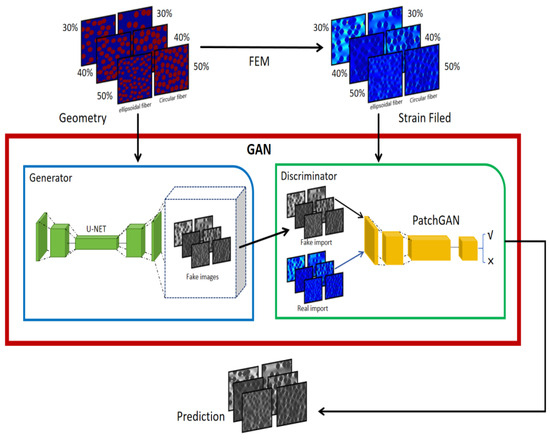
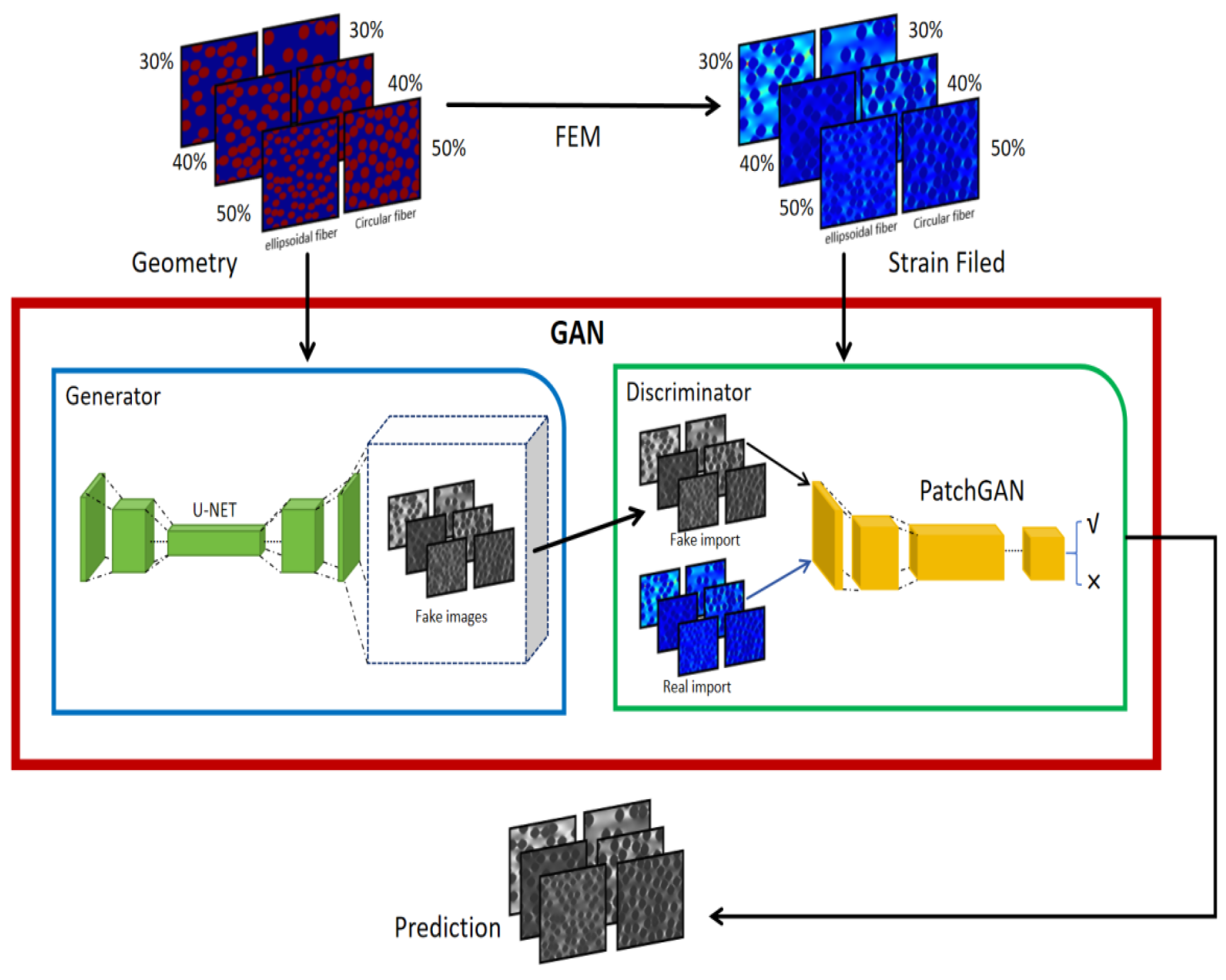
The Discriminator follows a PatchGAN architecture, which classifies local image patches instead of the entire image as real or fake. By focusing on smaller receptive fields (e.g., 70 × 70 patches), PatchGAN emphasizes the realism of fine-grained local structures rather than just the global coherence of the generated field maps. It receives as input the concatenation of the input microstructure and either the real or generated physical field and outputs a two-dimensional map where each value represents the probability that the corresponding patch is real, as illustrated in Figure 1. This patch-level discrimination mechanism encourages the Generator to produce highly detailed and spatially consistent outputs.
Figure 1.
Workflow of the proposed FiberGAN framework for stress–strain field prediction in fiber-reinforced composites.
By combining the generative capability of the U-Net and the localized discrimination strategy of PatchGAN, the model effectively captures both the global distribution and local variations in mechanical responses. This enables accurate prediction of complex physical phenomena such as stress concentrations, boundary effects, and microstructural anisotropies, even in highly heterogeneous composite materials.
First, representative microstructures with varying fiber volume fractions (30–50%) and fiber shapes (circular and elliptical) are generated using a random fiber generation algorithm. Second, finite element method (FEM) simulations are performed on these microstructures to obtain the corresponding full-field stress/strain distributions, which serve as reference data. Third, the conditional GAN framework is trained, where the U-Net-based generator produces predicted fields from input geometries and the PatchGAN discriminator distinguishes real FEM-derived fields from generated outputs. Finally, after adversarial training, the model produces high-fidelity predictions of full-field stress and strain distributions across different fiber volume fractions and loading conditions.
3. Dataset Generation
To ensure that the proposed FiberGAN framework can accurately learn the mapping between microstructural geometries and corresponding mechanical responses, this section focuses on constructing a physically consistent and diverse dataset. Building upon the model architecture introduced in the previous section, the following procedures describe the generation of representative microstructures and their associated stress–strain fields, which together form the foundation for supervised deep learning.
3.1. SEM-Based Microstructural Characterization and Statistical Analysis
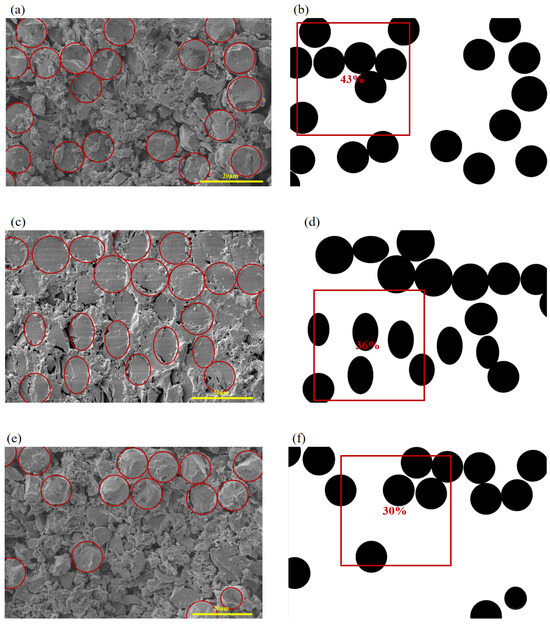
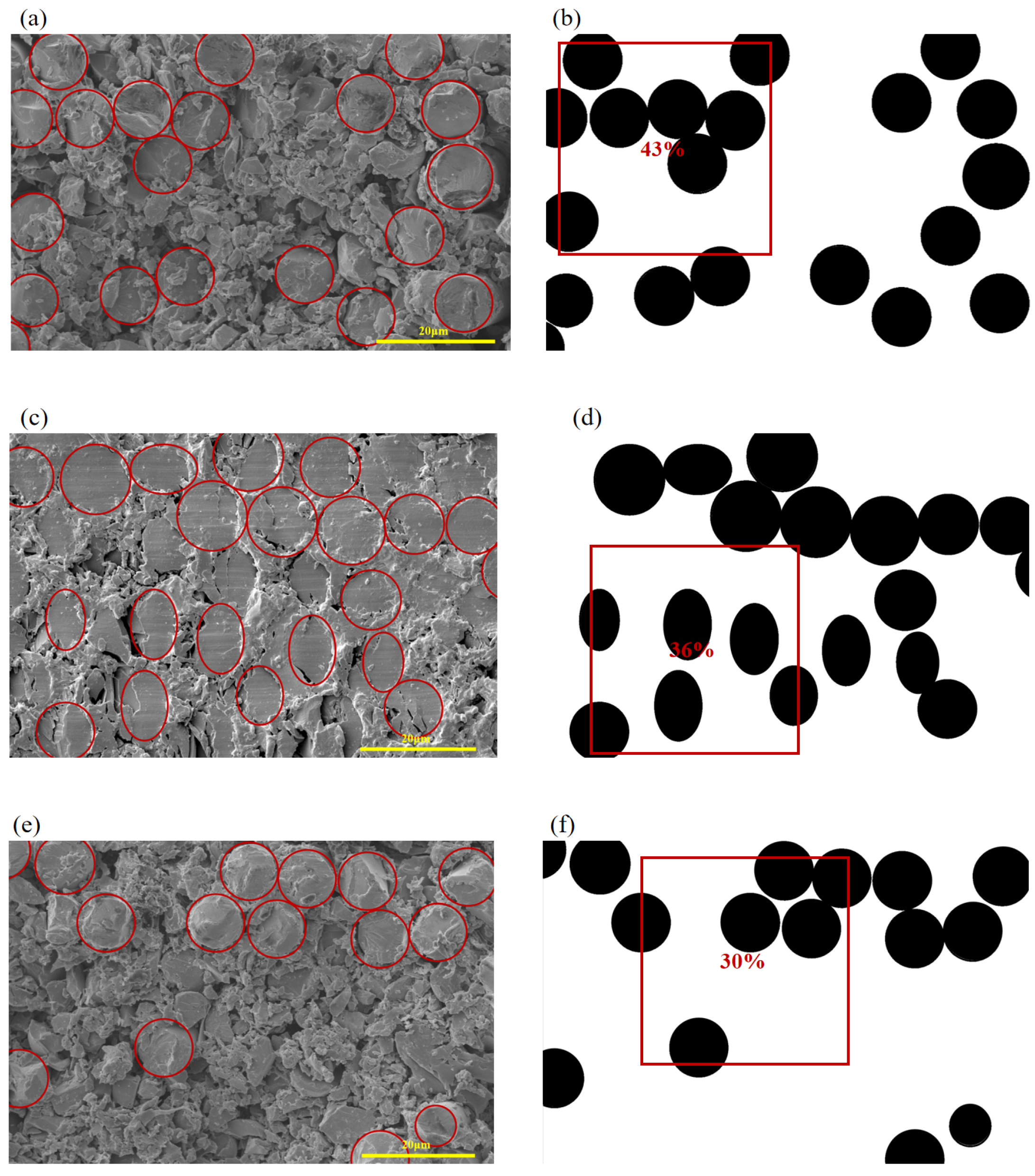
To achieve realistic modeling and data-driven prediction of the microstructure of composite materials, this study first observed the cross-sectional microstructure of the fiber bundles in the glass-fiber-reinforced composite using a Scanning Electron Microscope (SEM, Thermo Fisher Scientific Inc., Axia ChemiSEM, Waltham, MA, USA). The experimental samples, made of LY556 epoxy resin and E-glass fibers (Chongqing Sanlei Glass Fiber Co., Ltd., Chongqing, China), were taken from a cured flat specimen, cut perpendicular to the fiber orientation for surface observation. SEM imaging was performed using the Thermo Fisher Axia ChemiSEM scanning electron microscope, resulting in 20 original images. The resolution of each image was 3072 × 2188 pixels, with a field of view of 82.9 µm. Each image captured different local regions to ensure statistical representativeness of the fiber arrangement. The material’s mechanical properties are provided in Section 3.2. The scanning results are shown in Figure 2a,c,e. Through image processing algorithms, the equivalent geometric models of the composite material were obtained, as shown in Figure 2b,d,f [41].
Figure 2.
Microstructural features of the material: (a) cross-section of glass-fiber-reinforced composite, (b) equivalent geometric model obtained through image processing, (c) cross-section of glass-fiber-reinforced composite, (d) equivalent geometric model obtained through image processing, (e) cross-section of glass-fiber-reinforced composite, (f) equivalent geometric model obtained through image processing.
To generate the composite microstructural images, statistical features were extracted from a total of 20 SEM images acquired from different regions of the material, combined with image processing techniques. The complete set of SEM images was analyzed to characterize the fiber distribution and volume fraction statistics, ensuring a statistically representative description of the material microstructure. Based on this comprehensive analysis, three SEM images were selected as representative examples for detailed illustration and discussion. These images correspond to different fiber volume fraction levels and are presented in Figure 2.
Table 1 summarizes the fiber volume fraction statistics for these three representative images, showing the distribution of fiber volume fractions within the ranges of 10–20%, 20–30%, 30–40%, 40–50%, and 50–60%. The values reported in Table 1 indicate the number of occurrences of fiber volume fractions within each range for Figure 2. The statistical trends observed in the representative images are consistent with those obtained from the full set of SEM images and provide the basis for subsequent microstructure generation and mechanical property prediction.
Table 1.
Fiber volume fraction statistics in Figure 2 (%).
Through this analysis, it was observed that the composite material’s microstructure exhibits notable variability. Specifically, the fibers do not overlap, and there are differences in the fiber volume fraction, diameter, and shape across different regions of the fiber bundles. The fibers primarily fall into two categories: circular fibers and elliptical fibers. Additionally, the fiber volume fraction follows a normal distribution, with values ranging from 10% to 60%. The most significant variations were observed in the 30–50% fiber volume fraction range, where the fiber concentration was highest.
3.2. Stochastic Fiber Distribution Algorithm and RVE Construction
Based on the data from the statistical analysis, a microstructural dataset of fiber-reinforced composites was generated using a stochastic fiber placement algorithm designed to produce physically realistic arrangements of both circular and elliptical fibers. Fiber volume fractions were controlled between 30% and 50%, encompassing a broad range of fiber diameters and shapes to enhance dataset diversity. It is worth noting that the fiber placement algorithm used in this work follows the general principles of Random Sequential Adsorption (RSA), where inclusions are inserted sequentially subject to non-overlap constraints. Although the present implementation incorporates periodic boundary handling and accommodates both circular and elliptical fibers, it should be regarded as an RSA-based protocol rather than a novel algorithm [42].
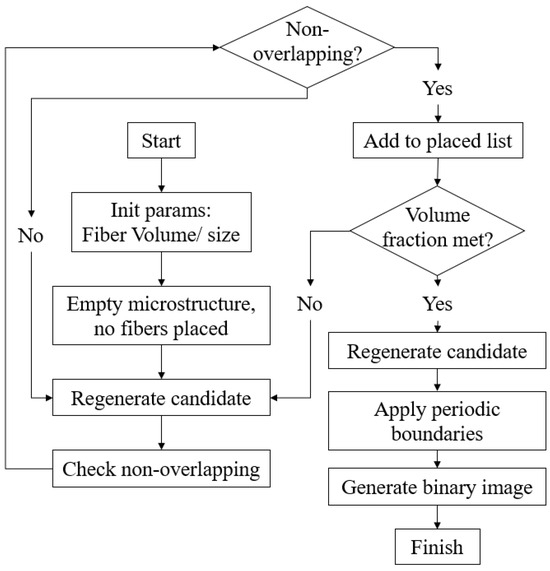
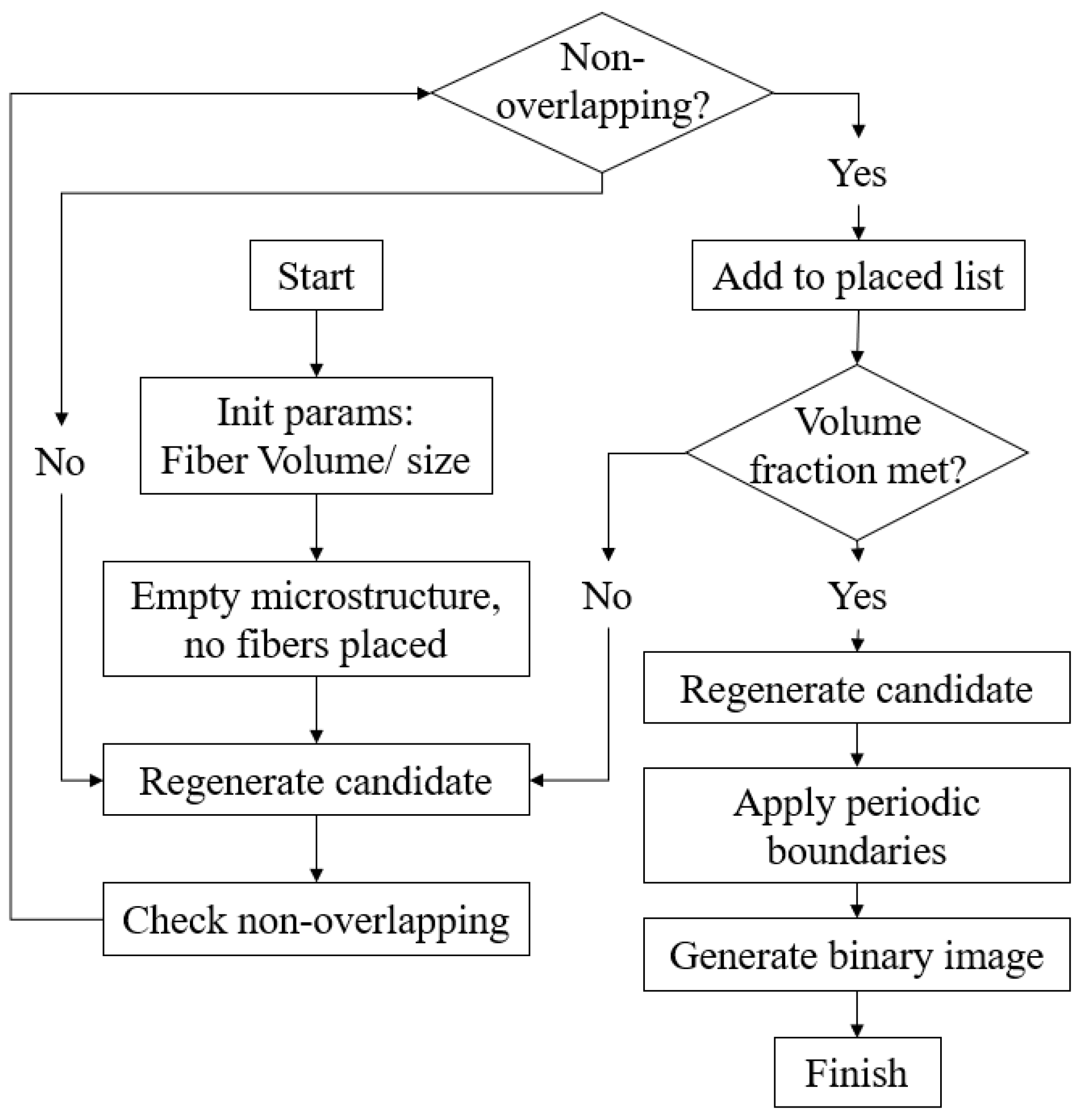
The algorithm sequentially inserts fibers into a predefined rectangular domain by randomly sampling fiber center coordinates, radii for circular fibers, and semi-axis lengths and orientations for elliptical fibers. Each candidate fiber undergoes a geometric feasibility check to enforce a non-overlapping constraint, ensuring that the minimum distance between any two fibers exceeds a threshold accounting for their sizes and shapes. Fibers violating this condition are discarded and resampled until the target volume fraction is reached or further placement becomes infeasible. The workflow of the algorithm is illustrated in Figure 3.
Figure 3.
Random fiber generation algorithm.
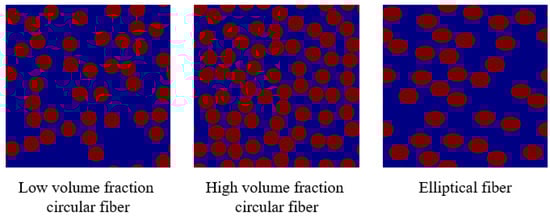
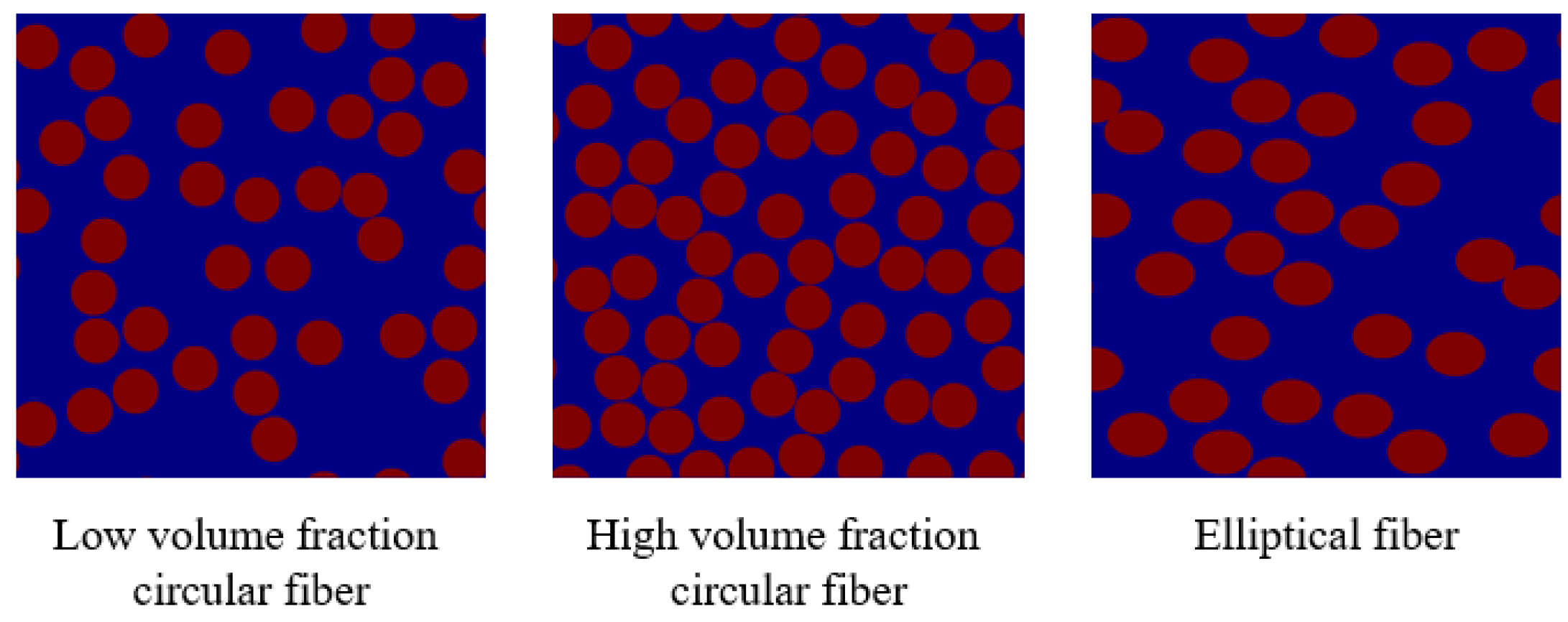
To maintain microstructural continuity compatible with subsequent simulations, periodic boundary conditions are incorporated by mirroring fibers crossing the domain edges, with overlap checks extended to these periodic images. The final microstructures are converted into high-resolution binary images, where fiber and matrix phases are represented by distinct pixel intensities. Representative examples of the generated microstructures are presented in Figure 4. Specifically, Figure 4 presents composite microstructures with different fiber shapes and volume fractions: (a) circular fibers with a low volume fraction (30%), (b) circular fibers with a high volume fraction (50%), (c) elliptical fibers with random orientations, and (d) mixed distributions of circular and elliptical fibers. These examples illustrate the diversity of the constructed dataset in terms of fiber geometry, orientation, and spatial distribution, which collectively reflect the heterogeneity of real composite materials. This dataset serves as the geometric input for finite element analyses, enabling comprehensive mechanical response simulations and providing paired input–output data for machine learning model training and validation. The dataset comprises 252 samples of materials with distinct microstructures. The parameter ranges adopted in the microstructure generation algorithm are summarized in Table 2.
Figure 4.
Geometric models of composites with different microstructures(red: fibers; blue: matrix).
Table 2.
Geometric parameter ranges of the generated composite microstructures.
However, it should be noted that the fibers observed in the original SEM images exhibit pronounced geometric discreteness, with both circular and elliptical shapes of non-uniform sizes coexisting within the same region, reflecting the inherent complexity of real composite microstructures. In contrast, the microstructures generated in this study are constructed under periodic boundary conditions, with controlled fiber size and shape distributions, where fibers are limited to circular or elliptical forms within prescribed parameter ranges. This modeling strategy is introduced to facilitate data-driven learning and ensure numerical consistency during large-scale simulation and model training. By constraining the fiber geometry while preserving the key statistical characteristics of fiber arrangement and volume fraction, the generated microstructures remain representative of the essential mechanical behavior within the considered fiber volume fraction ranges.
Although the periodic boundaries of the generated models differ from the random boundaries present in real SEM images, the influence of boundary conditions on the mechanical response is confined to a narrow region near the boundaries according to Saint Venant’s principle [43]. Therefore, in the post-processing stage of the predicted response fields, several layers of pixels adjacent to the boundaries are removed to eliminate boundary-induced effects. This treatment enables the response fields learned from a large database of periodic models to be directly transferred to real scanned microstructures. While certain geometric details inherent to actual materials are not explicitly represented, the proposed modeling strategy provides sufficient accuracy for model training and optimization. Moreover, it enhances the stability and robustness of the generation and prediction process when dealing with diverse microstructural configurations and loading conditions, offering a reliable and efficient framework for rapid mechanical response prediction and material performance optimization.
This approach allows for the transformation of complex, real microstructures into more manageable geometric models, forming the basis for further mechanical performance analysis and data-driven predictions.
It should be noted that randomness in composite microstructures cannot be reduced to a single generative protocol. As demonstrated by Czapla et al., even minor variations in RSA rules can lead to systematically different microstructural statistics and thus different effective properties [44]. Therefore, the present RSA-based implementation should be viewed as one possible realization of random fiber distributions rather than a universal stochastic model.
3.3. Finite Element Simulation and Material Parameter Setup
The stress and strain fields corresponding to each generated microstructure were obtained through finite element simulations conducted in Abaqus. The microstructural images were first transformed into geometric models, with glass-fiber-reinforced epoxy resin assigned as the material [45]. The mechanical properties of E-glass fibers and LY556 epoxy resin are summarized in Table 3 and Table 4, respectively. Since both E-glass fibers and LY556 epoxy resin are isotropic materials, only the properties in a single direction are listed.
Table 3.
Mechanical properties of LY556 epoxy matrix material.
Table 4.
Mechanical properties of E-glass fiber material.
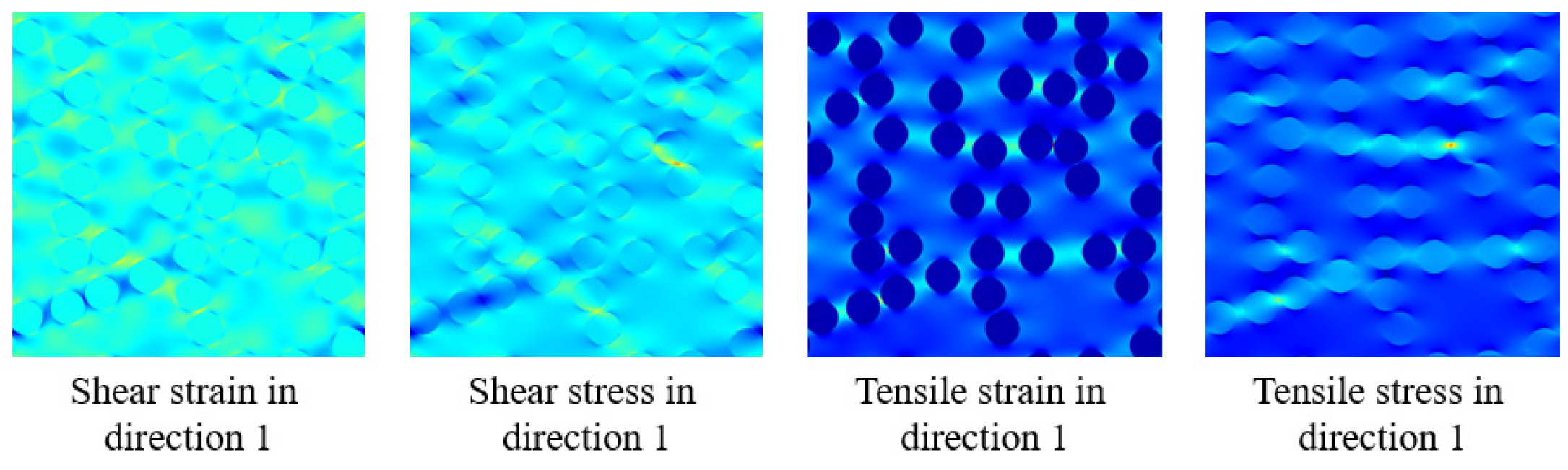
To ensure a realistic representation of the mechanical behavior, uniaxial tensile and shear loads were applied to the model. The simulations were performed under quasi-static assumptions, with material behaviors modeled accordingly. Full-field stress and strain tensors were extracted at the element level from Abaqus results, providing spatially resolved mechanical response data. Based on 252 distinct microstructure images of composite materials, a comprehensive dataset was constructed by simulating the corresponding full-field stress and strain responses under two types of loading conditions: uniaxial tension and in-plane shear. For each microstructure, four target fields were generated, including tensile stress, tensile strain, shear stress, and shear strain, resulting in a total of 1008 paired input–output samples. Representative stress and strain distributions under different loading conditions are illustrated in Figure 5. These data pairs serve as ground truth for training and validation of the machine learning framework.
Figure 5.
Representative stress and strain distributions under different loading conditions.
Figure 5 presents representative full-field stress and strain distributions of fiber-reinforced composites under loading in direction 1. The first two subfigures show the shear strain and shear stress distributions in direction 1, while the last two correspond to the tensile strain and tensile stress distributions in the same direction.
4. The Training Process of FiberGAN
4.1. Dataset Preparation and U-Net-Based Generator Architecture
The FiberGAN was trained using a supervised learning strategy implemented in Python 3.8.20 with the PyTorch 2.0.0+cu118 framework. The training dataset consisted of paired grayscale images: the input images representing the microstructure geometry of composites and the corresponding output images representing the target full-field stress or strain distributions under prescribed boundary conditions. The input and target images were preprocessed and stored separately as 256 × 256 grayscale images. A custom Dataset class was implemented in Python using the PyTorch framework, which loads, converts, and normalizes paired input–output images to the range [−1, 1] to match the tanh output activation of the model. The dataset was then passed to a DataLoader(PyTorch 2.0.0) with a defined batch size to facilitate efficient mini-batch training and shuffling. The FiberGAN architecture adopted for this task is a modified U-Net-based generator network, which consists of an encoder–decoder structure with skip connections. The encoder compresses the spatial information through a series of convolutional layers with downsampling, while the decoder progressively reconstructs the spatial resolution via transposed convolutions. The skip connections allow fine-grained features from early encoder layers to be directly concatenated with corresponding decoder layers, enabling better preservation of structural details in the output stress/strain field.
4.2. Composite Loss Function for Adversarial Training
The FiberGAN was trained using a composite loss function that integrates adversarial loss with a pixel-wise reconstruction loss to effectively capture both the global realism and local accuracy of the predicted mechanical fields. Specifically, a discriminator network D was trained to distinguish between the ground-truth images y and the generator’s outputs G(x), where x denotes the input microstructure image. The discriminator loss is defined as:
where l is the binary cross-entropy loss function, assigning label 1 to real samples and 0 to generated samples. This loss guides the discriminator to correctly classify real and fake images, thereby improving its discriminative capability during training.
Concurrently, the generator G is optimized to both deceive the discriminator and reconstruct outputs close to the ground truth. Its loss function is composed of two terms: the adversarial loss:
which encourages G to generate outputs that the discriminator classifies as real, and the pixel-wise L1 loss:
which promotes accurate reconstruction by minimizing the mean absolute difference between the predicted and true images. The total generator loss is a weighted sum of these two components:
where λ is a hyperparameter controlling the trade-off between adversarial realism and pixel-level fidelity.
By jointly minimizing these losses in an alternating optimization scheme, the FiberGAN learns to produce stress or strain field predictions that are both visually realistic and quantitatively accurate, thereby enhancing the predictive performance and robustness of the image-driven mechanical analysis.
4.3. Hyperparameter Settings
The optimization was performed using the Adam optimizer with default hyperparameters (β1 = 0.5, β2 = 0.999), which are widely adopted for stable cGAN training. The learning rate was either kept constant or gradually decayed, depending on the observed convergence behavior. The training was conducted for multiple epochs until the loss values stabilized and the visual quality of the predictions met the expected accuracy. Model checkpoints were saved periodically, and training logs were used to monitor convergence.
To ensure the robustness and generalization capability of the FiberGAN, the dataset was randomly partitioned into training, validation, and test sets with a ratio of 60%:20%:20%. The training set was used to optimize the model parameters, and the validation set was used to monitor generalization performance and prevent overfitting, while the test set was reserved exclusively for final performance evaluation on unseen data.
4.4. Dataset Augmentation Process
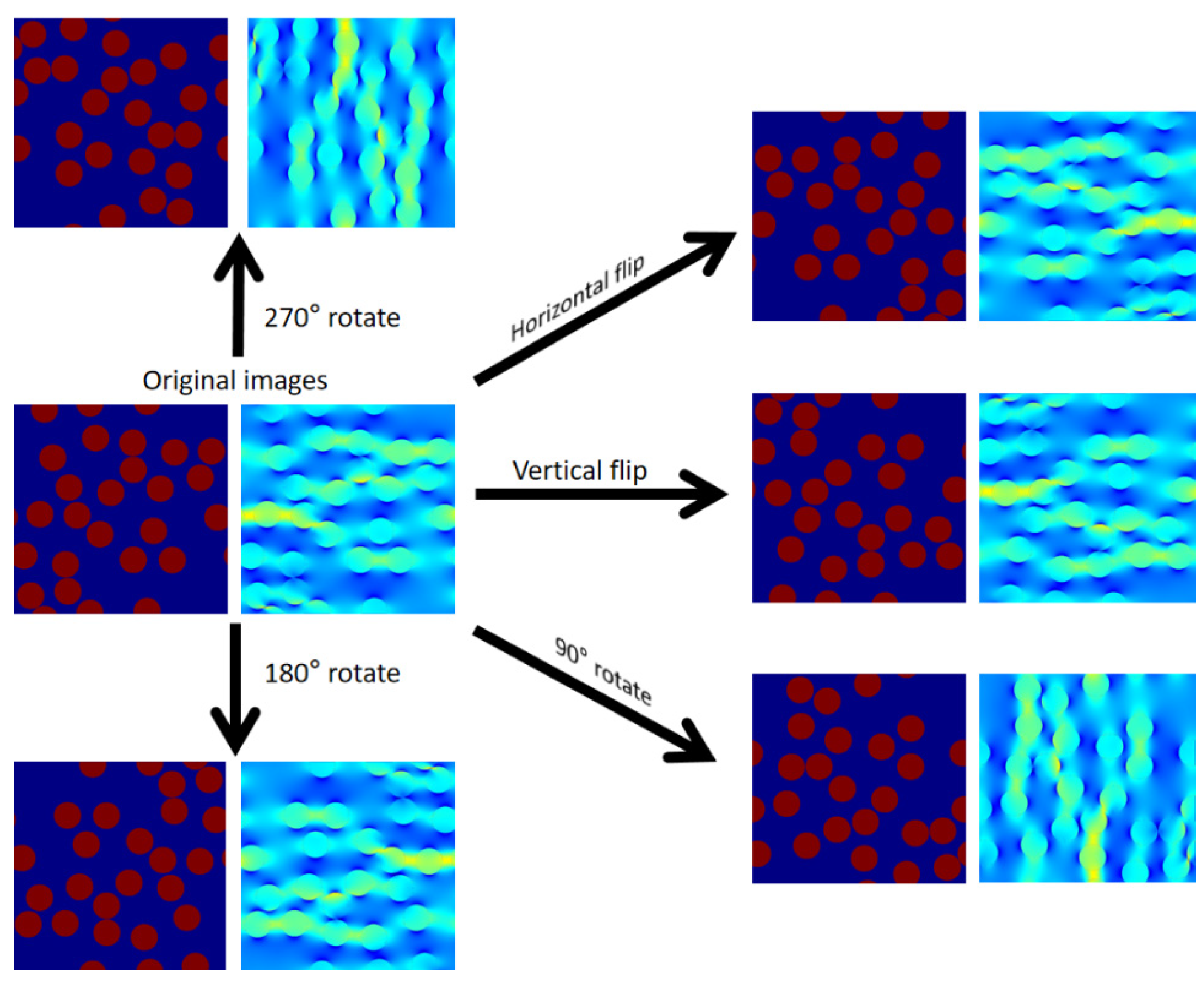
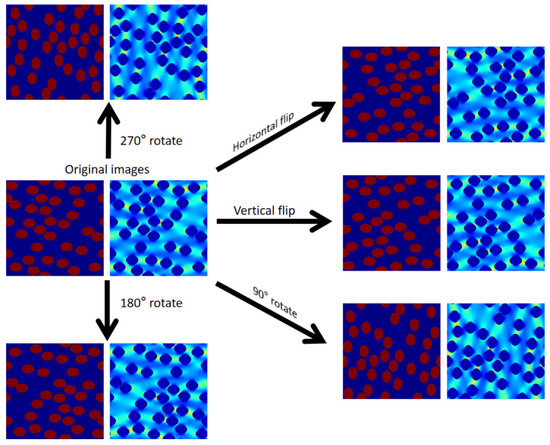
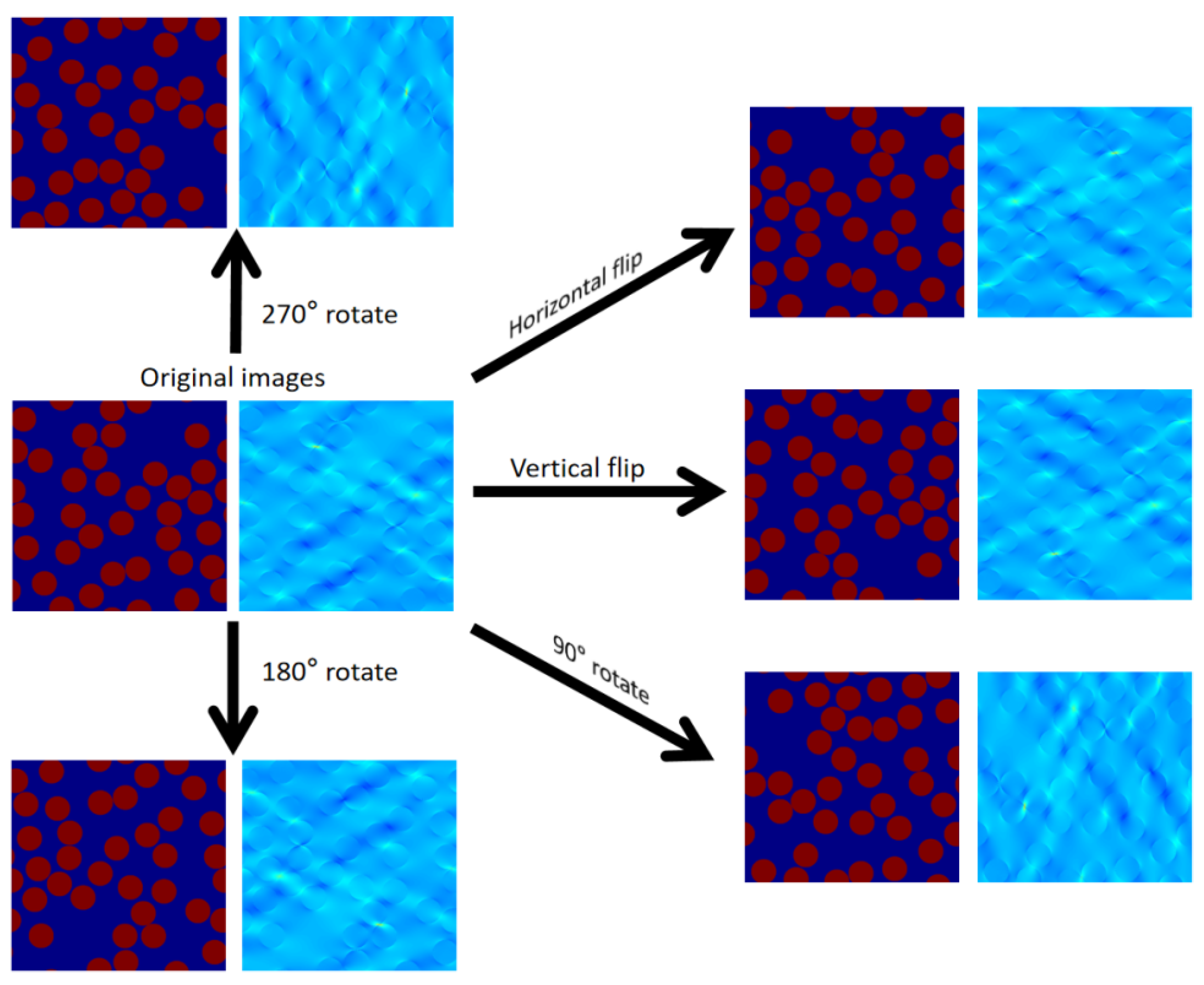
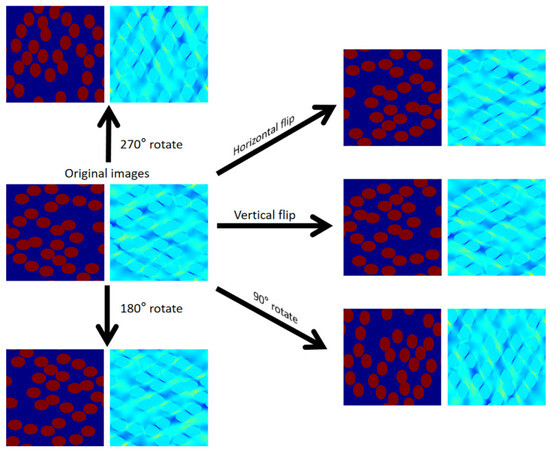
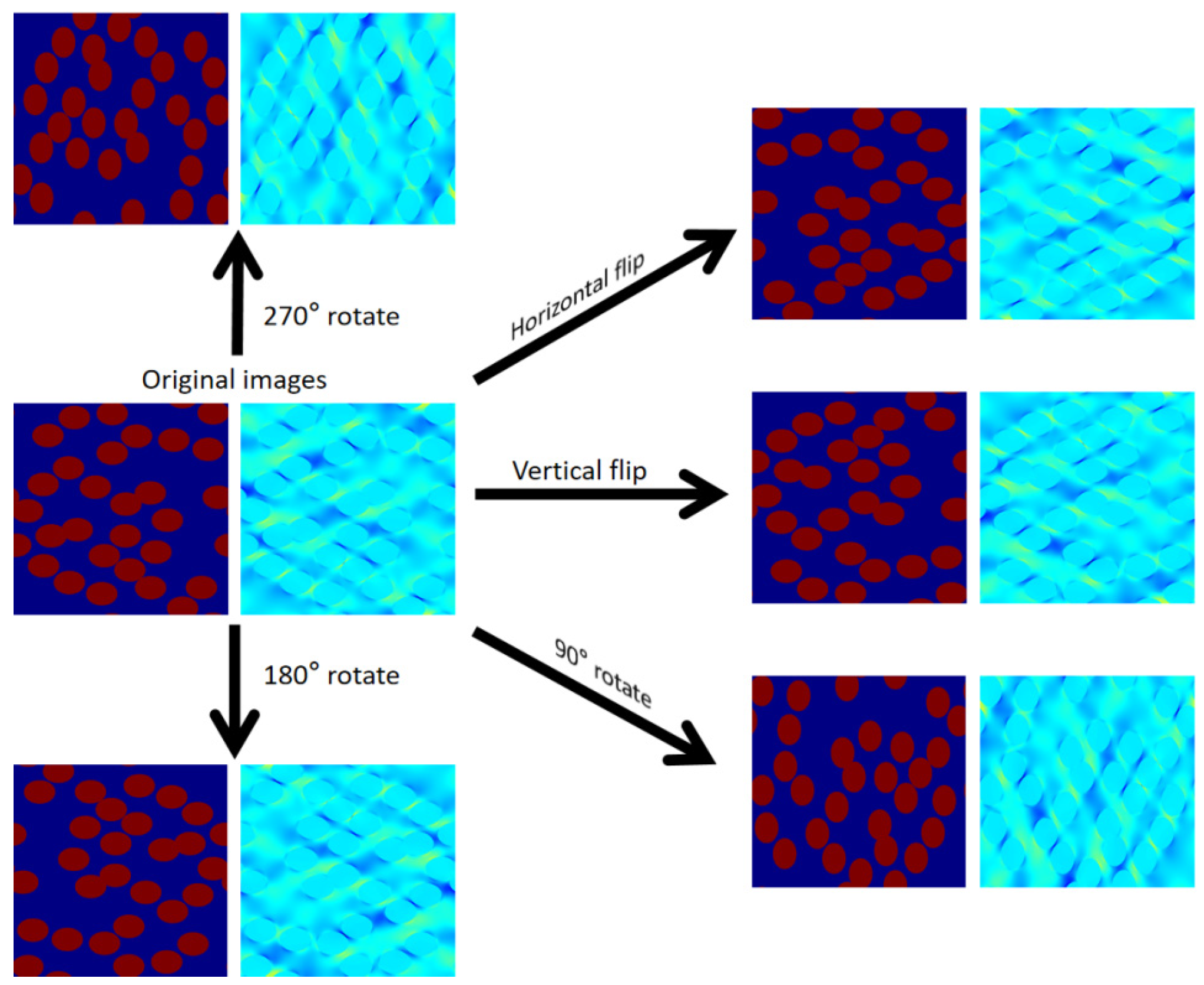
To further increase the diversity of training samples and improve FiberGAN’s robustness against geometric variability, data augmentation was applied by performing random rotations of the input–target image pairs. Specifically, each sample was augmented with multiple rotated versions (e.g., 90°, 180°, and 270°), ensuring that the physical consistency between input microstructures and their corresponding stress/strain responses was preserved. This augmentation strategy allows the FiberGAN to better generalize to microstructures with varying orientations, which is critical in applications involving randomly oriented fiber inclusions.
Figure 6, Figure 7, Figure 8 and Figure 9 illustrate the data augmentation process applied to the four target fields of the FiberGAN dataset, including tensile stress, tensile strain, shear stress, and shear strain. For each microstructure–response pair, the original image and its corresponding mechanical field were simultaneously transformed through a series of geometric operations such as rotations of 90°, 180°, and 270°, as well as horizontal and vertical flips, to expand the diversity of training samples. This paired augmentation strategy ensures that the spatial correspondence between the microstructural geometry and the target mechanical field is strictly preserved during all transformations. As shown in the figures, the augmented samples maintain consistent fiber orientations, spatial periodicity, and field distribution patterns, which effectively enhance the FiberGAN’s robustness and generalization when predicting unseen microstructures with varying orientations.
Figure 6.
Tensile stress datasets augmentation process.
Figure 7.
Tensile strain datasets augmentation process.
Figure 8.
Shear stress datasets augmentation process.
Figure 9.
Shear strain datasets augmentation process.
4.5. Computational Configuration of FiberGAN
To accurately predict the mechanical response of composite microstructures under different loading conditions, four separate deep learning models were trained. Each model corresponded to one of the following target fields: tensile stress, tensile strain, shear stress, and shear strain. These four output fields arise from two distinct boundary conditions—uniaxial tensile loading and in-plane shear loading—and the decision to train separate models was made to ensure that each network could specialize in learning the mapping for a specific mechanical response. Each model was trained independently using the same dataset split and network architecture. The training time for each model was approximately 21,000 s. All experiments were conducted on a workstation equipped with an Intel Core i5-14600KF processor (Intel Corporation, Santa Clara, CA, USA, 14 cores: 6 performance cores and 8 efficiency cores, 20 threads, manufactured using the Intel 7 process) and an NVIDIA GeForce RTX 4070 SUPER graphics card(NVIDIA Corporation, Santa Clara, CA, USA), which features 7168 CUDA cores and 12 GB of GDDR6X (Micron) video memory. The model implementation and training were carried out using the PyTorch(2.0.0) deep learning framework, leveraging GPU acceleration for both forward and backward passes. The combination of multi-core CPU processing and high-throughput GPU computation ensured efficient training and fast data loading during mini-batch processing. This computational setup enabled the training of all four models within a practical time frame, while maintaining stable convergence and sufficient resource utilization.
4.6. Training Performance Under Shear Loading
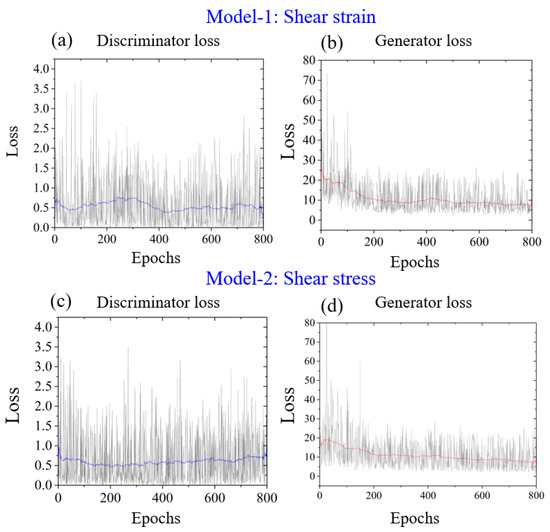
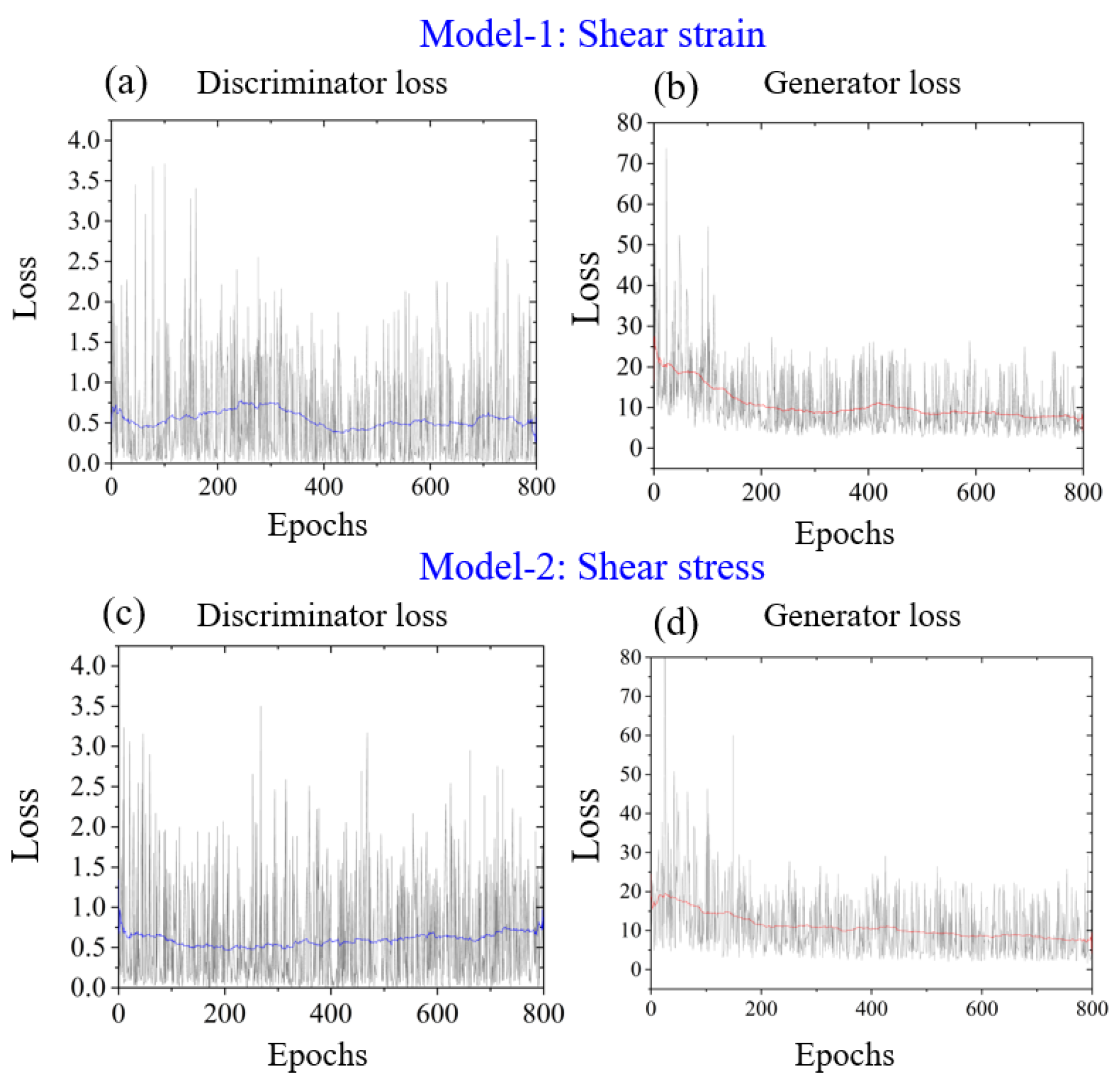
The training performance of the FiberGAN framework under shear loading conditions is illustrated in Figure 10, showing the evolution of discriminator and generator losses over 800 epochs for both models. Model-1 was designed to predict the shear strain field, while Model-2 was trained to predict the shear stress field of the fiber-reinforced composite microstructures. For both models, the discriminator loss exhibited considerable fluctuations, which is characteristic of generative adversarial networks (GANs) due to the inherently adversarial dynamics between the generator and discriminator. Despite these oscillations, the discriminator loss remained within a bounded range (0–4) and showed signs of gradual stabilization as training progressed, indicating an effective balance between the generator and discriminator. In contrast, the generator loss displayed a clear decreasing trend across both tasks, reflecting the generator’s progressive improvement in producing high-fidelity predictions. For Model-1 (shear strain prediction), the generator loss reduced from an initial value of approximately 30 to below 10 by the final epochs. Similarly, Model-2 (shear stress prediction) exhibited a decrease from around 35 to under 15. This consistent reduction highlights the effectiveness of the architecture in learning the complex mapping from microstructural images to corresponding mechanical field distributions. Overall, the training results under shear loading demonstrate the stability, convergence, and predictive capability of the developed FiberGAN-based models, providing a solid foundation for subsequent evaluation under other loading conditions.
Figure 10.
Training loss curves of the FiberGAN models under shear loading. (a) Discriminator loss and (b) generator loss for Model-1 (shear strain prediction); (c) discriminator loss and (d) generator loss for Model-2 (shear stress prediction).
4.7. Training Performance Under Tensile Loading
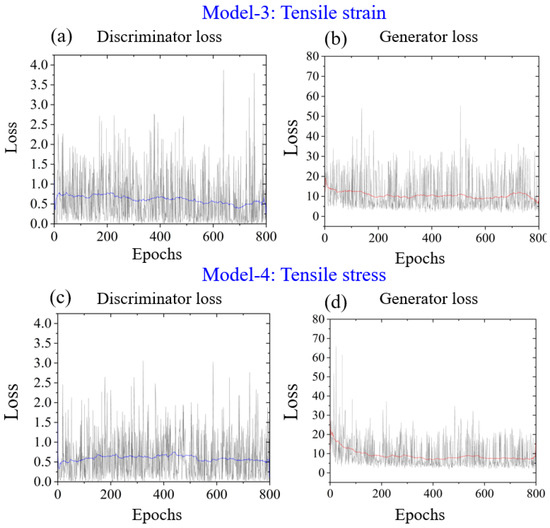
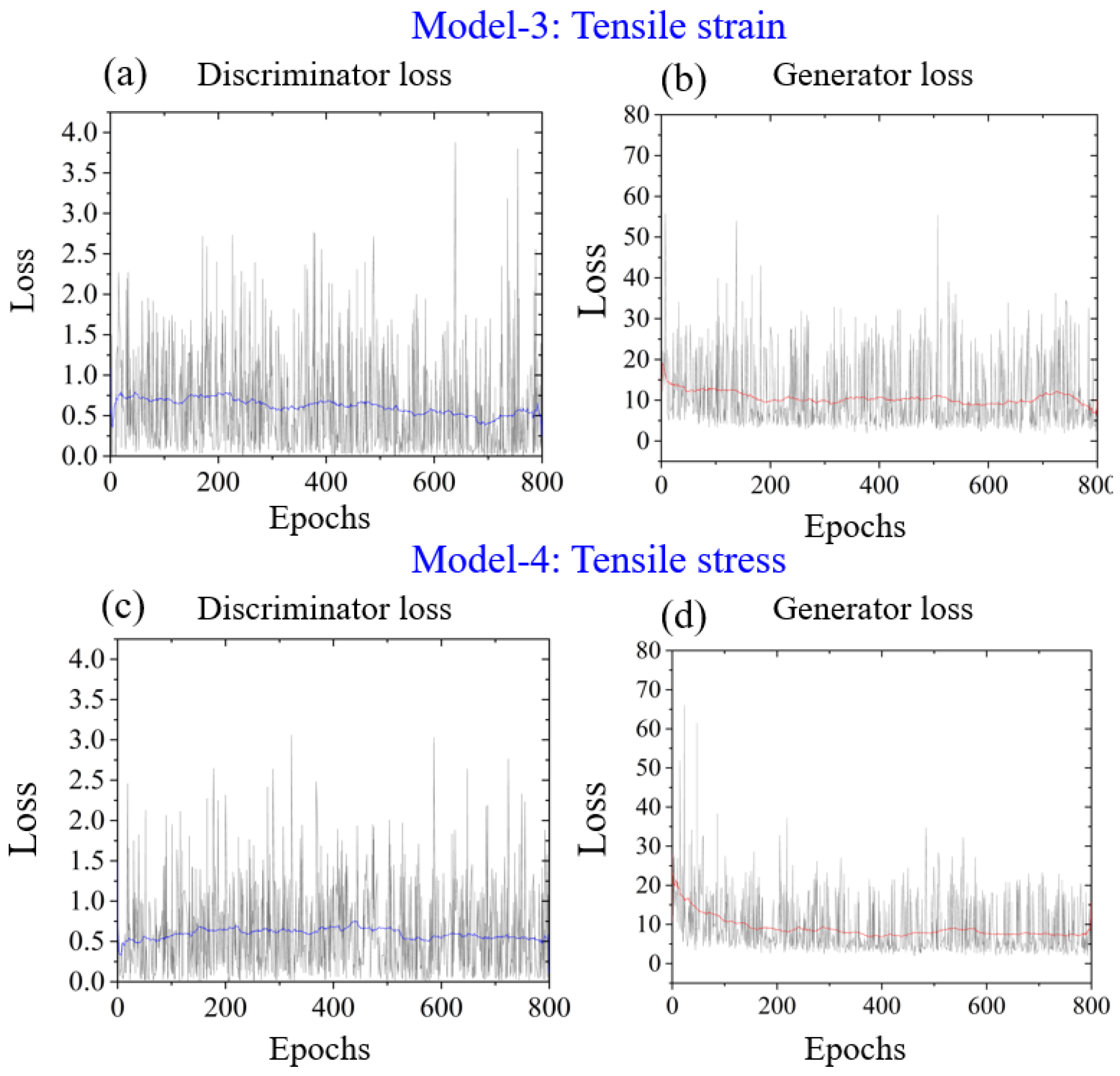
The training curves of Model-3 (tensile strain prediction) and Model-4 (tensile stress prediction) under tensile loading conditions are shown in Figure 11. Similar to the shear loading case, both models exhibited fluctuating discriminator losses within a reasonable range (0–4), indicative of the adversarial nature of GAN training. Notably, the generator losses of both models showed a consistent decreasing trend, confirming the progressive enhancement of the generator’s predictive capability. Model-3 exhibited a reduction in generator loss from approximately 20 to below 10, while Model-4 demonstrated a more pronounced decline from about 25 to under 10 after 800 training epochs. The results further validate the robustness and generalization ability of the proposed FiberGAN framework for accurately capturing the mechanical response of fiber-reinforced composite microstructures under varying loading conditions.
Figure 11.
Training loss curves of the FiberGAN models under tensile loading. (a) Discriminator loss and (b) generator loss for Model-3 (tensile strain prediction); (c) discriminator loss and (d) generator loss for Model-4 (tensile stress prediction).
5. Accuracy Verification of FiberGAN
To verify the feasibility of the FiberGAN, three evaluation metrics—coefficient of determination (R2), structural similarity index (SSIM), and error maps—were employed to assess prediction accuracy. These metrics jointly provided quantitative and visual evaluations of the FiberGAN’s accuracy and generalization capability. Specifically, R2 and SSIM were first used for quantitative assessment, followed by the use of error maps to visually compare the predicted stress field distributions with the ground truth.
5.1. Quantitative Evaluation Metrics
The R2 is used to quantify the proportion of variance in the reference field explained by the FiberGAN predictions, thereby providing a statistical measure of predictive accuracy. It is defined as:
in this equation, yi represents the reference value of the i-th sample, ŷi denotes the corresponding predicted value, and ȳ is the mean of all reference values calculated as . The term n refers to the total number of samples, the numerator corresponds to the residual sum of squares, and the denominator represents the total sum of squares. An R2 value equal to 1 indicates perfect prediction, while values closer to 1 signify stronger agreement between predicted and reference fields.
The SSIM is used to assess the perceptual similarity between the predicted and reference fields by considering luminance, contrast, and structural information simultaneously. The SSIM is expressed as:
in this formula, x and y represent the reference and predicted images, respectively. The terms μx and μy denote the mean intensities of x and y, σx2 and σy2 indicate their variances, and σxy represents the covariance between the two images. The constants C1 and C2 are small positive values introduced to ensure numerical stability when the denominator approaches zero. The SSIM value ranges between 0 and 1, with a value of 1 indicating perfect structural similarity between the predicted and reference fields, and higher values implying better preservation of spatial and textural details.
Table 5 and Table 6 present the performance metrics of the proposed FiberGAN for predicting stress and strain fields, respectively, under tensile loading with different fiber volume fractions (Vf). Table 5 shows the stress prediction results, where the R2 exceeds 0.98 for Vf = 30%, 40%, and 50%, and the SSIM remains in the range of 0.96–0.98. Table 6 shows the strain prediction results, with R2 consistently above 0.96 and SSIM ranging from 0.96 to 0.99 across all three fiber volume fractions, indicating that the FiberGAN can stably and accurately capture the mechanical response characteristics of materials under tensile conditions.
Table 5.
R2 and SSIM values for stress prediction under tensile loading with different fiber volume fractions.
Table 6.
R2 and SSIM values for strain prediction under tensile loading with different fiber volume fractions.
Table 7 and Table 8 present the performance metrics of the FiberGAN for predicting stress and strain fields, respectively, under shear loading with different fiber volume fractions. Table 7 reports the stress prediction results, where R2 is no less than 0.96 in all tested conditions and SSIM ranges from 0.96 to 0.97. Table 8 shows the strain prediction results, where R2 remains 0.98 across all fiber volume fractions, and SSIM varies between 0.95 and 0.97, further confirming the high accuracy and robustness of the model under shear loading conditions.
Table 7.
R2 and SSIM values for stress prediction under shear loading with different fiber volume fractions.
Table 8.
R2 and SSIM values for strain prediction under shear loading with different fiber volume fractions.
5.2. FiberGAN Performance at Random Fiber Volume Fractions
To further validate the adaptability and predictive robustness of the proposed FiberGAN model under non-fixed fiber volume fraction combinations, eight representative RVE microstructural samples were randomly selected from the fiber volume fraction range of 30% to 50%. These samples encompass various geometric configurations and typical mechanical loading conditions. Each sample corresponds to four target prediction fields: tensile stress, tensile strain, shear stress, and shear strain. The R2 and SSIM metrics were employed to assess the generalization capability of the model at non-specific fiber volume fractions.
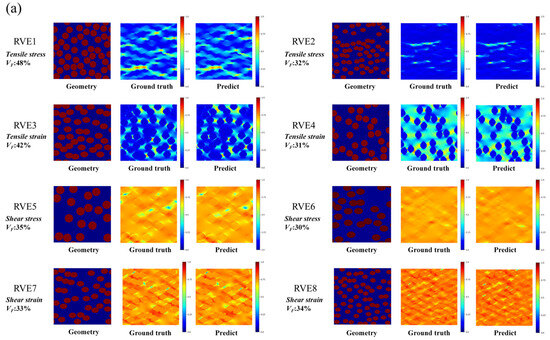
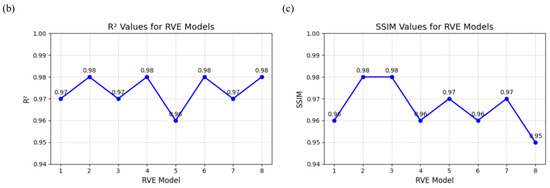
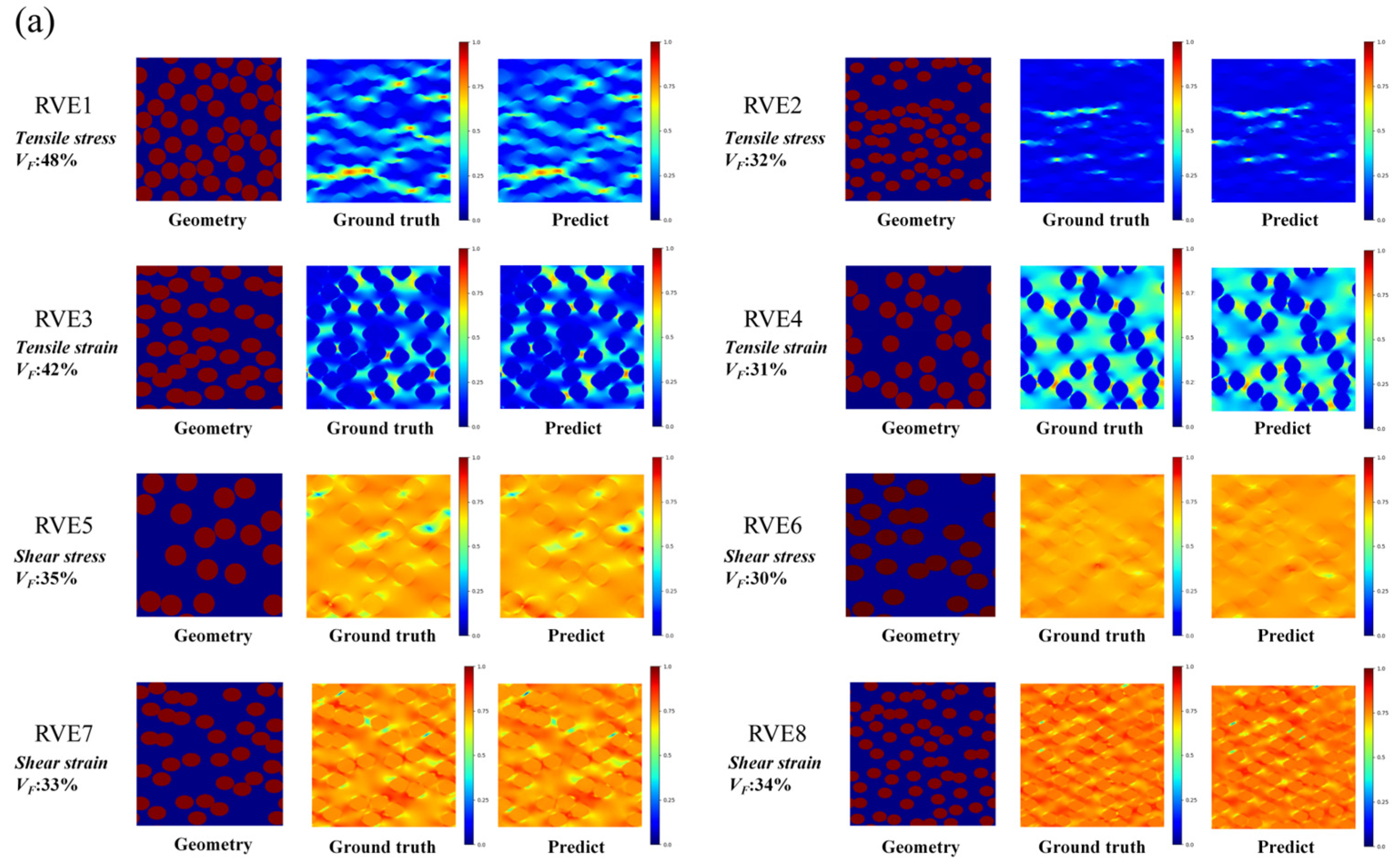
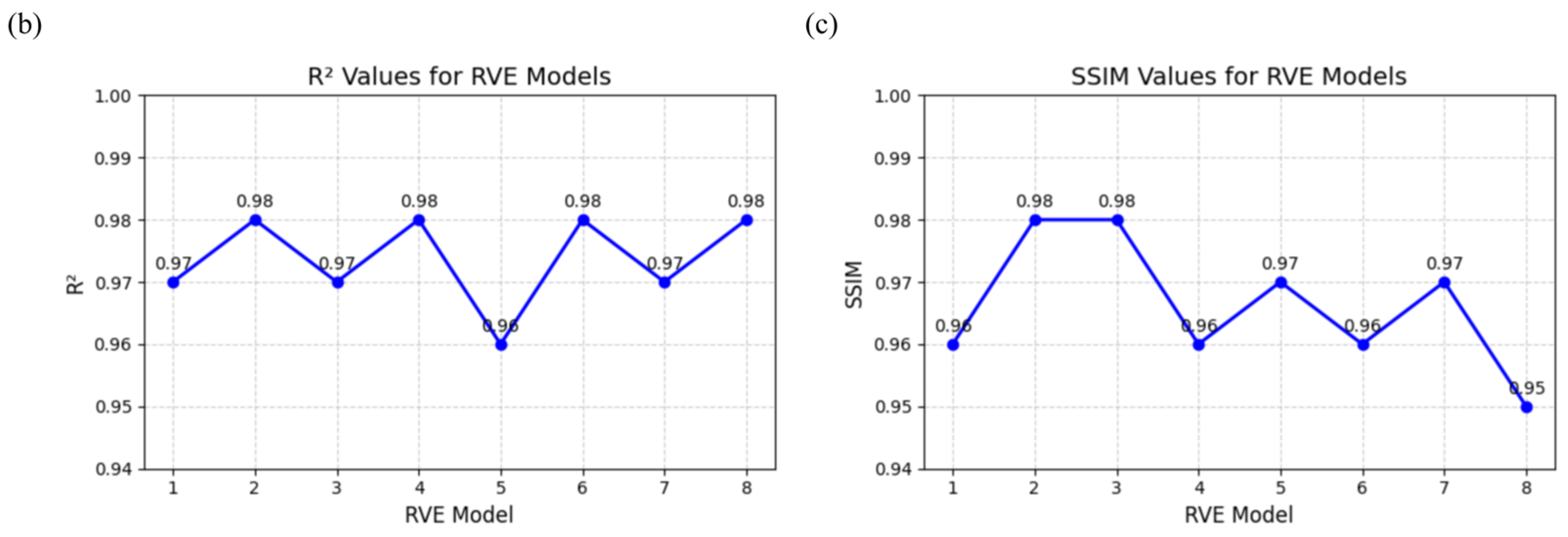
Figure 12a–c show the prediction performance of the proposed FiberGAN model across eight RVE configurations under various loading conditions and fiber volume fractions (Vf). In Figure 12a, each row displays the microstructural geometry, FE-computed ground truth, and the corresponding predicted field for four representative cases: tensile stress (Vf = 48%, 32%), tensile strain (Vf = 42%, 31%), shear stress (Vf = 35%, 30%), and shear strain (Vf = 33%, 34%). The predicted results show excellent agreement with the finite element results, successfully reproducing both global field distributions and localized high-gradient regions. Figure 12b presents the R2 values ranging from 0.96 to 0.98, confirming the model’s strong quantitative accuracy and ability to capture linear correlations between predictions and reference fields. Furthermore, Figure 12c displays the SSIM values between 0.95 and 0.98, indicating that FiberGAN achieves high-fidelity reconstruction of both intensity and structural features across different loading conditions and fiber volume fractions.
Figure 12.
Visualization of Prediction Results under Different Fiber Volume Fractions and Mechanical Be-haviors: (a) visual comparison for RVE1–RVE8, where each case shows the microstructural geometry (left), FE ground truth (middle), and FiberGAN prediction (right); (b) R2 values for the eight RVEs; (c) SSIM values for the eight RVEs.
5.3. Computational Efficiency of FiberGAN
To provide a quantitative and transparent comparison of computational efficiency, the prediction time of the proposed FiberGAN framework is systematically compared with that of conventional FEA. All tests were conducted on the same workstation to ensure fairness of comparison. The evaluation includes two typical scenarios: (i) full-field stress–strain prediction for a single RVE and (ii) batch prediction for multiple RVEs.
For FEM simulations, Abaqus was employed, including the complete workflow of geometry construction, mesh generation, boundary condition assignment, numerical solution, and post-processing. For FiberGAN, the reported time corresponds exclusively to the inference stage using a fully trained model; the one-time training cost is not included, as it is amortized over repeated predictions.
It should be emphasized that the efficiency comparison presented here is restricted to numerical approaches. Analytical micromechanics methods, when applicable, provide results with negligible computational cost and therefore represent the most efficient option within their domain of validity. The FiberGAN framework is not intended to replace analytical theory but rather to serve as a practical surrogate in situations where analytical solutions are not available or are difficult to derive for complex microstructures, or where classical bounds such as the Hashin–Shtrikman limits are not sufficiently tight to characterize local field distributions.
As shown in Table 9, a single FEM simulation requires approximately 1.2 h (4320 s) to complete, with comparable contributions from pre-processing, numerical solution, and post-processing stages. In contrast, FiberGAN generates the corresponding full-field stress–strain prediction in approximately 0.45 s. This corresponds to a computational speedup of approximately 9.6 × 10³ times relative to FEM.
Table 9.
Comparison of computation time for a single RVE model.
It is worth noting that the computational cost of FEM is strongly influenced by geometric complexity, mesh density, and convergence criteria. As the complexity of fiber distributions or the fiber volume fraction increases, the required computation time consistently increases. In contrast, the inference time of FiberGAN remains nearly constant and is largely insensitive to the complexity of the input microstructure image.
In practical engineering applications, performance evaluation often involves multiple RVEs with different microstructural configurations. Table 10 presents the computational cost comparison for batch prediction tasks.
Table 10.
Comparison of computation time for multiple RVE models.
For a batch of 30 RVEs, FEM requires approximately 37 h, whereas FiberGAN completes the prediction in 13.8 s, corresponding to an efficiency improvement of approximately 9.6 × 10³ times. When the number of RVEs increases to 50, the FEM computation time rises to approximately 61 h, while FiberGAN requires only 22.8 s, yielding a similar speedup factor. These results indicate that FEM exhibits an approximately linear increase in computation time with respect to the number of RVEs, whereas FiberGAN benefits from efficient parallel execution on GPU hardware.
Beyond computation time, the two approaches also differ significantly in resource utilization. During FEM simulations, memory consumption increases rapidly with mesh refinement, and a single RVE typically requires approximately 4–6 GB of system memory, with sustained high CPU utilization. In contrast, FiberGAN inference requires approximately 2.3 GB of memory and primarily relies on GPU resources, thereby reducing CPU load and enabling concurrent execution of other computational tasks.
Overall, the proposed FiberGAN framework enables microscale stress–strain field prediction at sub-second timescales for individual RVEs, compared with the order-of-hours computational cost typically associated with FEM simulations. The resulting acceleration, approaching three orders of magnitude, is especially beneficial for studies involving repeated evaluation of multiple microstructural configurations.
5.4. Visual Analysis via Error Maps
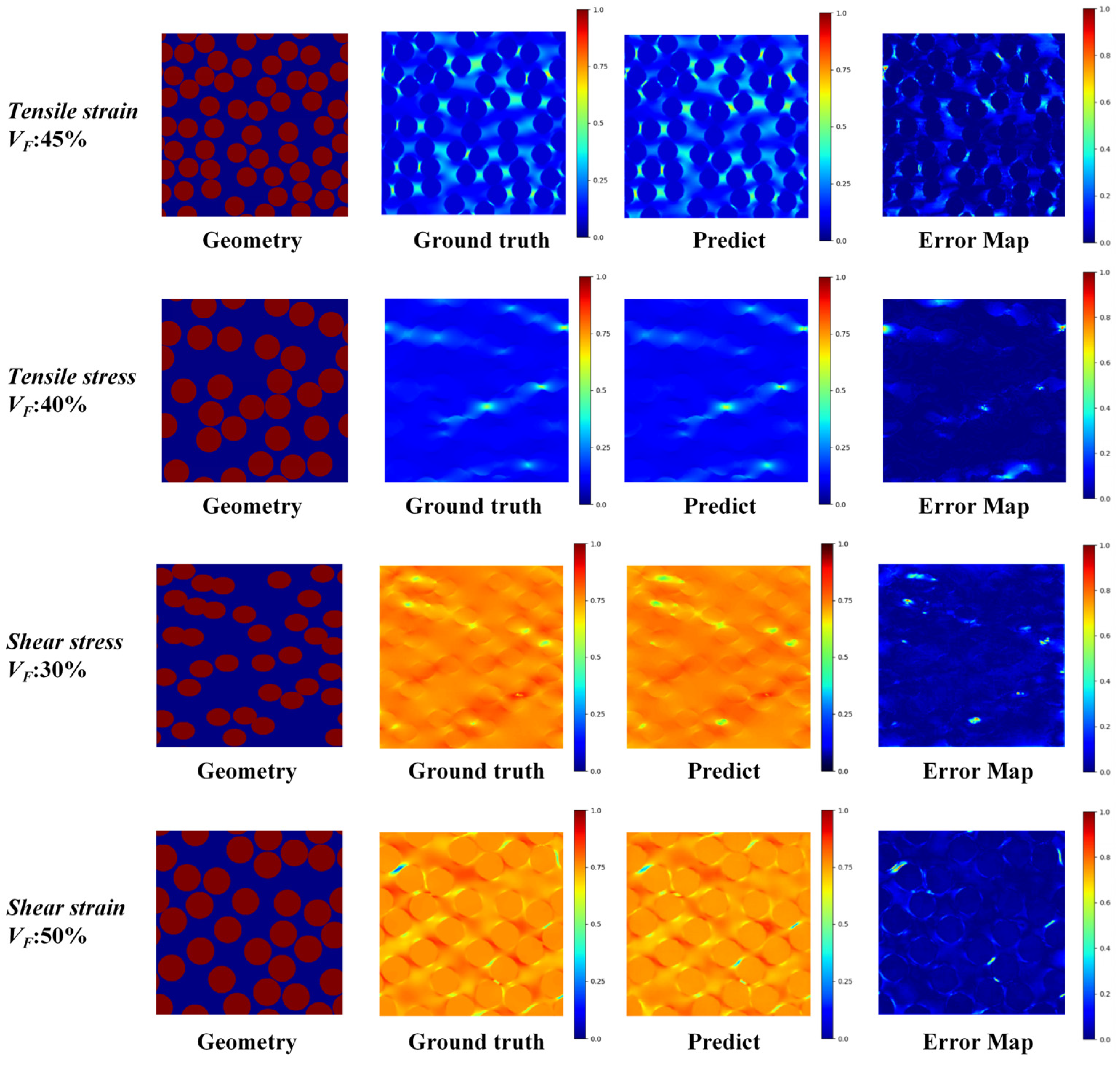
To provide a more intuitive evaluation of the predictive performance of the FiberGAN, error maps were introduced in this study as a visualization tool to present the local error distribution between the generated images and the reference images. The error maps were obtained by calculating the pixel-level absolute differences between the predicted images and the finite element simulation results, with the color mapping range uniformly normalized to [0, 1], thereby highlighting the prediction deviations of the model in different regions.
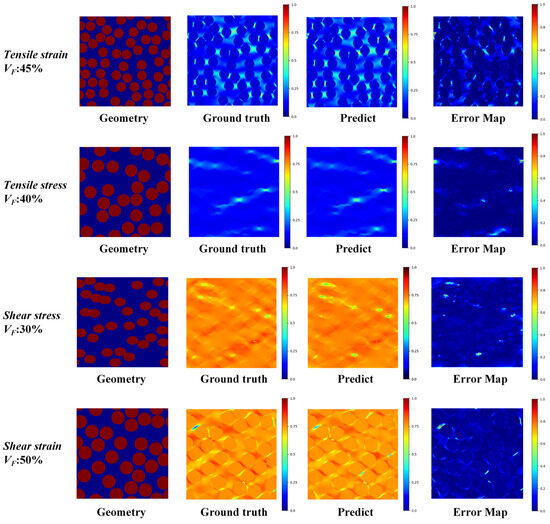
Figure 13 illustrates the predictive performance of the FiberGAN for the stress–strain fields of composite materials under different fiber volume fractions (Vf) and various mechanical loading conditions. Each row corresponds to a specific combination of loading type and fiber volume fraction, including tensile strain (Vf = 45%), tensile stress (Vf = 40%), shear stress (Vf = 30%), and shear strain (Vf = 50%). Each case consists of four columns of images: the first column shows the material geometry (Geometry), depicting the spatial distribution of fibers and matrix; the second column presents the reference field (Ground truth) obtained via FEA; the third column displays the prediction results (Predict) generated by the proposed FiberGAN; and the fourth column shows the error map (Error Map), which provides a visual quantification of the differences between the predicted and reference fields. The color scale is uniformly normalized to the range [0, 1], enabling consistent comparison of prediction accuracy across different loading and fiber content conditions. Observation of the error maps reveals that the FiberGAN accurately captures the stress–strain distribution features under various loading conditions, with the maps predominantly exhibiting low values and only minor deviations in localized high-gradient regions, indicating that the FiberGAN possesses high prediction accuracy and robustness.
Figure 13.
Error maps of prediction results under different fiber volume fractions and mechanical behaviors.
6. Conclusions
This work proposes FiberGAN, a deep learning framework based on a conditional GAN architecture for predicting full-field stress and strain distributions in fiber-reinforced composites. By combining a U-Net-based generator with a PatchGAN discriminator, the framework captures both global mechanical patterns and local field variations. Trained on finite element simulation data, FiberGAN demonstrates reliable predictive performance across different fiber volume fractions and loading conditions.
The results show that FiberGAN achieves excellent agreement with finite element predictions under various loading cases, with R2 values generally exceeding 0.96 and SSIM values in the range of 0.95–0.99. Compared with conventional FEA, FiberGAN reduces the computational time from hours to sub-second levels per sample, corresponding to a speedup of nearly three orders of magnitude. Importantly, this high level of accuracy is maintained under small-sample training conditions, highlighting the strong data efficiency of the proposed framework. These advantages make FiberGAN particularly suitable for rapid evaluation of multiple microstructural configurations.
The current study primarily considers uniaxial tension and in-plane shear loading conditions. More complex loading scenarios, as well as microstructural configurations approaching percolation thresholds or extremely dense packing regimes, are not included in the present research; however, these limitations are addressable and will be resolved in future work.
Overall, FiberGAN provides an efficient and accurate alternative to traditional numerical methods for full-field prediction in fiber-reinforced composites and offers significant potential for accelerating microstructure-informed material design and optimization.
Author Contributions
Conceptualization, L.W. and H.F.; methodology, L.W., H.F. and X.C.; software, L.W.; validation, L.W., H.F. and X.C.; formal analysis, L.W. and H.F.; investigation, L.W.; resources, F.G.; data curation, L.W.; writing—original draft preparation, L.W.; writing—review and editing, F.G. and X.C.; visualization, L.W. and X.C.; supervision, F.G.; project administration, F.G.; funding acquisition, F.G. All authors have read and agreed to the published version of the manuscript.
Funding
This research received no external funding.
Data Availability Statement
The original contributions presented in this study are included in the article. Further inquiries can be directed to the corresponding author.
Acknowledgments
The authors would like to thank the Shanghai Dianji University Materials Research Laboratory for providing computational resources and technical support during the research. Special thanks are also given to Shanghai Jiao Tong University for their valuable academic support and resources that contributed to the successful completion of this work.
Conflicts of Interest
The authors declare no conflicts of interest.
Abbreviations
The following abbreviations are used in this manuscript:
| RVE | Representative Volume Element |
| FEA | Finite Element Analysis |
| DL | Deep Learning |
| cGAN | Conditional Generative Adversarial Network |
| PatchGAN | Patch Generative Adversarial Network |
| SSIM | Structural Similarity Index |
| R2 | Coefficient of Determination |
| GAN | Generative Adversarial Network |
| Vf | Fiber Volume Fraction |
| FEM | Finite Element Method |
| ANN | Artificial Neural Network |
| CNN | Convolutional Neural Network |
| GNN | Graph Neural Network |
| RNN | Recurrent Neural Network |
References
- Jain, A. Micro and mesomechanics of fibre reinforced composites using mean field homogenization formulations: A review. Mater. Today Commun. 2019, 21, 100552. [Google Scholar] [CrossRef] [Scilit]
- Peterson, G.W.; Lee, D.T.; Barton, H.F.; Epps, T.H.; Parsons, G.N. Fibre-based composites from the integration of metal–organic frameworks and polymers. Nat. Rev. Mater. 2021, 6, 605–621. [Google Scholar] [CrossRef] [Scilit]
- Sharma, H.; Kumar, A.; Rana, S.; Sahoo, N.G.; Jamil, M.; Kumar, R.; Sharma, S.; Li, C.; Kumar, A.; Eldin, S.M.; et al. Critical review on advancements on the fiber-reinforced composites: Role of fiber/matrix modification on the performance of the fibrous composites. J. Mater. Res. Technol. 2023, 26, 2975–3002. [Google Scholar] [CrossRef] [Scilit]
- Mohanraj, C.M.; Rameshkumar, R.; Mariappan, M.; Mohankumar, A.; Rajendran, B.; Senthamaraikannan, P.; Suyambulingam, I.; Kumar, R. Recent Progress in Fiber Reinforced Polymer Hybrid Composites and Its Challenges-A Comprehensive Review. J. Nat. Fibers 2025, 22, 2495911. [Google Scholar] [CrossRef] [Scilit]
- Marsh, G. Aero engines lose weight thanks to composites. Reinf. Plast. 2012, 56, 32–35. [Google Scholar] [CrossRef] [Scilit]
- Rubino, F.; Nisticò, A.; Tucci, F.; Carlone, P. Marine Application of Fiber Reinforced Composites: A Review. J. Mar. Sci. Eng. 2020, 8, 26. [Google Scholar] [CrossRef] [Scilit]
- Chen, Y.; Ma, Y.; Yin, Q.; Pan, F.; Cui, C.; Zhang, Z.; Liu, B. Advances in mechanics of hierarchical composite materials. Compos. Sci. Technol. 2021, 214, 108970. [Google Scholar] [CrossRef] [Scilit]
- Lomov, S.V.; Ivanov, D.S.; Verpoest, I.; Zako, M.; Kurashiki, T.; Nakai, H.; Hirosawa, S. Meso-FE modelling of textile composites: Road map, data flow and algorithms. Compos. Sci. Technol. 2007, 67, 1870–1891. [Google Scholar] [CrossRef] [Scilit]
- Kalamkarov, A.L.; Andrianov, I.V.; Danishevs’kyy, V.V. Asymptotic homogenization of composite materials and structures. Appl. Mech. Rev. 2009, 62, 030802. [Google Scholar] [CrossRef] [Scilit]
- Nikishkov, G.P. Introduction to the Finite Element Method; University of Aizu: Aizuwakamatsu, Japan, 2004; pp. 1–70. [Google Scholar]
- Srirekha, A.; Bashetty, K. Infinite to finite: An overview of finite element analysis. Indian J. Dent. Res. 2010, 21, 425–432. [Google Scholar] [CrossRef] [Scilit]
- Mao, J.Z.; Sun, X.S.; Ridha, M.; Tan, V.B.C.; Tay, T.E. A Modeling Approach Across Length Scales for Progressive Failure Analysis of Woven Composites. Appl. Compos. Mater. 2013, 20, 213–231. [Google Scholar] [CrossRef] [Scilit]
- Stier, B.; Simon, J.-W.; Reese, S. Numerical and experimental investigation of the structural behavior of a carbon fiber reinforced ankle-foot orthosis. Med. Eng. Phys. 2015, 37, 505–511. [Google Scholar] [CrossRef] [Scilit]
- Tan, W.; Naya, F.; Yang, L.; Chang, T.; Falzon, B.G.; Zhan, L.; Molina-Aldareguía, J.M.; González, C.; Llorca, J. The role of interfacial properties on the intralaminar and interlaminar damage behaviour of unidirectional composite laminates: Experimental characterization and multiscale modelling. Compos. Part B Eng. 2018, 138, 206–221. [Google Scholar] [CrossRef] [Scilit]
- LeCun, Y.; Bengio, Y.; Hinton, G. Deep learning. Nature 2015, 521, 436–444. [Google Scholar] [CrossRef] [Scilit]
- Lee, D.; Chen, W.; Wang, L.; Chan, Y.C.; Chen, W. Data-driven design for metamaterials and multiscale systems: A review. Adv. Mater. 2024, 36, 2305254. [Google Scholar] [CrossRef] [Scilit] [PubMed]
- Zheng, X.; Zhang, X.; Chen, T.T.; Watanabe, I. Deep learning in mechanical metamaterials: From prediction and generation to inverse design. Adv. Mater. 2023, 35, 23025308. [Google Scholar] [CrossRef] [Scilit]
- Qiu, C.; Han, Y.; Shanmugam, L.; Zhao, Y.; Dong, S.; Du, S.; Yang, J. A deep learning-based composite design strategy for efficient selection of material and layup sequences from a given database. Compos. Sci. Technol. 2022, 230, 109154. [Google Scholar] [CrossRef] [Scilit]
- Zhang, Y.; Tao, Q.; Liu, Y.; Wang, C. Mesh/membrane composite with superior mechanical performance: A deep learning-based design. Compos. Sci. Technol. 2022, 230, 109735. [Google Scholar] [CrossRef] [Scilit]
- Song, L.; Wang, D.; Liu, X.; Yin, A.; Long, Z. Prediction of mechanical properties of composite materials using multimodal fusion learning. Sens. Actuators A Phys. 2023, 358, 114433. [Google Scholar] [CrossRef] [Scilit]
- Choudhary, K.; DeCost, B.; Chen, C.; Jain, A.; Tavazza, F.; Cohn, R.; Park, C.W.; Choudhary, A.; Agrawal, A.; Billinge, S.J. Recent advances and applications of deep learning methods in materials science. npj Comput. Mater. 2022, 8, 59. [Google Scholar] [CrossRef] [Scilit]
- Chen, C.T.; Gu, G.X. Effect of constituent materials on composite performance: Exploring design strategies via machine learning. Adv. Theory Simul. 2019, 2, 1900056. [Google Scholar] [CrossRef] [Scilit]
- Feng, H.; Prabhakar, P. Difference-based deep learning framework for stress predictions in heterogeneous media. Compos. Struct. 2021, 269, 113957. [Google Scholar] [CrossRef] [Scilit]
- Xu, Y.; You, T.; Du, C. An integrated micromechanical model and BP neural network for predicting elastic modulus of 3-D multi-phase and multi-layer braided composite. Compos. Struct. 2015, 122, 308–315. [Google Scholar] [CrossRef] [Scilit]
- Sun, J.; Xu, Y.; Wang, L. Evaluation of the elastic modulus and plateau stress of a 2D porous aluminum alloy based on a convolutional neural network. Metals 2023, 13, 284. [Google Scholar] [CrossRef] [Scilit]
- Perera, R.; Guzzetti, D.; Agrawal, V. Graph neural networks for simulating crack coalescence and propagation in brittle materials. Comput. Methods Appl. Mech. Eng. 2022, 395, 115021. [Google Scholar] [CrossRef] [Scilit]
- Pfaff, T.; Fortunato, M.; Sanchez-Gonzalez, A.; Battaglia, P. Learning mesh-based simulation with graph networks. In Proceedings of the International Conference on Learning Representations, Virtual, 26 April–1 May 2020. [Google Scholar]
- Sanchez-Gonzalez, A.; Godwin, J.; Pfaff, T.; Ying, R.; Leskovec, J.; Battaglia, P. Learning to simulate complex physics with graph networks. In Proceedings of the International Conference on Machine Learning, Virtual, 26 April–1 May 2020; pp. 8459–8468. [Google Scholar]
- Barbosa, A.; Upadhyaya, P.; Iype, E. Neural network for mechanical property estimation of multilayered laminate composite. Mater. Today: Proc. 2020, 28, 982–9858. [Google Scholar] [CrossRef] [Scilit]
- Oliveira, G.A.B.; Câmara, E.C.B.; Júnior, R.C.S.F. Obtaining G12 and Xt using mixed ANNs based on matrix and fiber properties. Compos. Part B Eng. 2019, 175, 107171. [Google Scholar] [CrossRef] [Scilit]
- Mozaffar, M.; Bostanabad, R.; Chen, W.; Ehmann, K.; Cao, J.; Bessa, M.A. Deep learning predicts path-dependent plasticity. Proc. Natl. Acad. Sci. USA 2019, 116, 26414–26420. [Google Scholar] [CrossRef] [Scilit]
- Yang, K.; Cao, Y.; Zhang, Y.; Fan, S.; Tang, M.; Aberg, D.; Sadigh, B.; Zhou, F. Self-supervised learning and prediction of microstructure evolution with convolutional recurrent neural networks. Patterns 2021, 2, 100243. [Google Scholar] [CrossRef] [Scilit] [PubMed]
- Jiang, H.; Nie, Z.; Yeo, R.; Farimani, A.B.; Kara, L.B. StressGAN: A Generative Deep Learning Model for Two-Dimensional Stress Distribution Prediction. J. Appl. Mech. 2021, 88, 051005. [Google Scholar] [CrossRef] [Scilit]
- Yacouti, M.; Shakiba, M. Integrated convolutional and graph neural networks for predicting mechanical fields in composite microstructures. Compos. Part A Appl. Sci. Manuf. 2025, 190, 108618. [Google Scholar] [CrossRef] [Scilit]
- Sepasdar, R.; Karpatne, A.; Shakiba, M. A data-driven approach to full-field nonlinear stress distribution and failure pattern prediction in composites using deep learning. Comput. Methods Appl. Mech. Eng. 2022, 397, 115126. [Google Scholar] [CrossRef] [Scilit]
- Yang, Z.; Buehler, M.J. Fill in the blank: Transferrable deep learning approaches to recover missing physical field information. Adv. Mater. 2023, 35, 2301449. [Google Scholar] [CrossRef] [Scilit] [PubMed]
- Yang, Z.; Yu, C.-H.; Guo, K.; Buehler, M.J. End-to-end deep learning method to predict complete strain and stress tensors for complex hierarchical composite microstructures. J. Mech. Phys. Solids 2021, 154, 104506. [Google Scholar] [CrossRef] [Scilit]
- Maurizi, M.; Gao, C.; Berto, F. Predicting stress, strain and deformation fields in materials and structures with graph neural networks. Sci. Rep. 2022, 12, 21834. [Google Scholar] [CrossRef] [Scilit]
- Jin, L.; Yu, S.; Cheng, J.; Liu, Z.; Zhang, K.; Zhou, S.; He, X.; Xie, G.; Bodaghi, M.; Ge, Q.; et al. Machine learning powered inverse design for strain fields of hierarchical architectures. Compos. Part B Eng. 2025, 299, 112372. [Google Scholar] [CrossRef] [Scilit]
- Yang, Z.; Yu, C.-H.; Buehler, M.J. Deep learning model to predict complex stress and strain fields in hierarchical composites. Sci. Adv. 2021, 7, eabd7416. [Google Scholar] [CrossRef] [Scilit] [PubMed]
- Wang, B.; Wang, Z.; Fang, G.; Li, M.; Zhu, J.; Zhao, Y.; Meng, S. Inverse determine the interfacial strength and surface geometry effects concerning carbon fiber reinforced epoxy composites by experiment aided FFT-based spectral analysis. Polym. Compos. 2022, 43, 9205–9217. [Google Scholar] [CrossRef] [Scilit]
- Fender, J. Random sequential adsorption. J. Theor. Biol. 1980, 87, 237–254. [Google Scholar] [CrossRef] [Scilit]
- Horgan, C.O.; Simmonds, J.G. Saint-Venant end effects in composite structures. Compos. Eng. 1994, 4, 279–286. [Google Scholar] [CrossRef] [Scilit]
- Czapla, R.; Drygaś, P.; Gluzman, S.; Ligocki, T.; Mityushev, V. Computational Strategy for Analyzing Effective Properties of Random Composites—Part II: Elasticity. Materials 2025, 18, 5041. [Google Scholar] [CrossRef] [Scilit] [PubMed]
- Huang, Z.-M. Constitutive relation, deformation, failure and strength of composites reinforced with continuous/short fibers or particles. Compos. Struct. 2021, 262, 113279. [Google Scholar] [CrossRef] [Scilit]

Disclaimer/Publisher’s Note: The statements, opinions and data contained in all publications are solely those of the individual author(s) and contributor(s) and not of MDPI and/or the editor(s). MDPI and/or the editor(s) disclaim responsibility for any injury to people or property resulting from any ideas, methods, instructions or products referred to in the content. |
© 2025 by the authors. Licensee MDPI, Basel, Switzerland. This article is an open access article distributed under the terms and conditions of the Creative Commons Attribution (CC BY) license.