Article

A Temperature-Dependent Visco-Hyperelastic Constitutive Model for Carbon Fiber/Polypropylene Prepreg

School of Aeronautics and Astronautics, Shenyang Aerospace University, Shenyang 110136, China
*
Author to whom correspondence should be addressed.
J. Compos. Sci. 2026, 10(1), 12; https://doi.org/10.3390/jcs10010012 (registering DOI)
Submission received: 22 November 2025 / Revised: 13 December 2025 / Accepted: 16 December 2025 / Published: 1 January 2026

Abstract

This study first heat-treats the surface of plain-woven carbon fibers to remove the surface sizing. The treated carbon fibers were then hot-pressed with polypropylene films to produce a carbon fiber/polypropylene prepreg. The resulting prepreg was subjected to uniaxial and off-axis tensile tests, providing fundamental data for constructing a constitute model for the carbon fiber/polypropylene prepreg. The relative error between the model predictions and experimental data is maintained within ±10%. Based on the experimental results, a temperature-dependent viscoelastic–hyperelastic constitutive model for carbon fiber/polypropylene is proposed. This model decomposes the unit volume strain energy function into four components: matrix isochoric deformation energy, fiber tensile strain energy, fiber–fiber shear strain energy, and fiber-matrix shear strain energy. The matrix energy is strain rate-dependent, exhibiting viscoelastic mechanical behavior. The material parameters of the constitutive model were identified by fitting the experimental data. The model was implemented in MATLABR2024a, and off-axis tensile tests were performed at temperatures ranging from 423 K to 453 K. Numerical simulations were compared with experimental results to validate the model. This work provides guidance for the development and validation of constitutive models for thermoplastic polypropylene prepregs.

1. Introduction

Since the 1980s, carbon fiber-reinforced thermoplastic composites have been widely used in aerospace, automotive, wind energy, and other industries because of their low density, high strength, corrosion resistance, and recyclability [1]. In addition, their ability to be repeatedly processed and recycled makes them an environmentally friendly class of advanced lightweight materials [2]. Continuous carbon fiber-reinforced thermoplastic composites also perform well in bearing and transmitting loads [3]. Moreover, their compatibility with metal joining technologies enables an overall weight reduction of 30–40%, making them a strategically important material [4].
Visco-hyperelastic constitutive model describes the mechanical behavior of materials under large deformation and time dependence. It can be used to describe the mechanical behavior and damage evolution of materials at different strain rates, and can also be used to observe the influence of humidity on their mechanical properties [5,6]. Although it is difficult to form complex shapes with continuous fiber reinforced braids, their high mechanical strength makes them suitable for manufacturing components that require good mechanical properties. To achieve a wider range of material geometries, composite materials with improved fiber wettability, anisotropy, and design flexibility are used, enabling lighter structural designs [7]. Thermoplastic composites are widely used in industry to meet these requirements. Although thermoplastic materials exhibit greater damage resistance than thermosetting counterparts [8], their high melt viscosity—unlike the low viscosity of thermosetting resins used in resin transfer molding—results in strong temperature and strain-rate dependence. Consequently, the mechanical response of thermoplastic prepregs is more complex and more difficult to characterize. Therefore, establishing a constitutive model that can accurately characterize its nonlinear, anisotropic and temperature-dependent properties at different strain rates is of great significance both in theory and engineering applications.
Since the constitutive model can intuitively express the mechanical behavior of materials through mathematical equations, the visco-hyperelastic constitutive model is used to reveal the mechanical properties of carbon fiber composites. Many researchers have done a lot of work in this regard. The continuum mechanics-based model proposed by Peng Xiong qi considers fiber tensile energy and inter-fiber shear strain energy but neglects the correlation between matrix deformation energy and tensile strain rate [9]. Meng Lingkai proposed a new type of hyperelastic-cyclic plastic constitutive model, which makes it suitable for multi-configuration analysis in hyperelastic constitutive theory, but makes the model more complicated [10]. Ahmed et al. investigated the differences in mechanical properties among prepregs with various ply configurations, but their study did not consider the effects of temperature or pressure [11]. Suryasentana et al. proposed a thermodynamically consistent constitutive model, which proved the properties of the relevant yield function through the constitutive model framework, but there are certain application limitations [12]. Wei Wu et al. developed a hypoplastic constitutive model capable of accurately predicting stress–strain behavior and volumetric strain under various stress paths, although its predictive accuracy still requires further improvement [13]. Bowman et al. examined the influence of sizing agents on the performance of carbon-fiber thermoplastic towpregs and their composites, and reported improved mechanical properties; however, the underlying mechanisms were not investigated in depth [14]. Bai Jiantao et al. derived the fitting method of eight commonly used macroscopic hyperelastic constitutive models of hyperelastic materials under uniaxial tension, biaxial tension and other test conditions, and achieved high-precision fitting [15], which provided a fitting method for this experiment. Xiu Liu et al. identified the Mullins effect and viscoelastic behavior of the material through uniaxial and biaxial tension tests and subsequently proposed a corresponding constitutive model [16]. Pogrebnjak et al. reported a more than fivefold increase in the impact strength of polycarbonate-based composites modified with SWCNTs at only 0.01 wt.% nanotube content, which shows that introducing ultralow contents of carbon nanotubes can significantly enhance the mechanical performance of thermoplastic composites [17]. However, because the above models cannot capture the temperature-dependent mechanical behavior of thermoplastic fiber-reinforced composites and polypropylene prepregs, this study aims to establish a new constitutive model capable of describing the temperature-dependent response of carbon-fiber/polypropylene prepregs.
Based on continuum mechanics and the energy decomposition method, combined with the mechanical theories of matrix viscoelasticity and fiber-reinforced hyperelasticity, this paper proposes a constitutive model for carbon fiber-reinforced thermoplastic composites that reflects the relationship between different strain rates and temperatures. The model parameters are identified using MATLAB, and its validity and accuracy are evaluated through off-axis tensile tests conducted at various temperatures and fiber orientations. The proposed model provides guidance for composite molding-process design by revealing temperature- and strain-rate-dependent behavior that is critical for optimizing thermoforming conditions. This study achieves accurate characterization of the visco-hyperelastic behavior of prepregs at different temperatures through the four-component energy decomposition of ‘matrix isochoric deformation energy—fiber tensile energy—inter-fiber shear energy—fiber-matrix shear energy’ and the introduction of a temperature scalar function.


2. Materials and Methods

2.1. Preparation and Mechanical Testing of Prepreg

2.1.1. Preparation of Prepreg

To enhance the interfacial properties between carbon fiber(Carbon Fiber FabricManufacturer: DuanJun Flagship Store City: Shanghai, China Year: 2025) and polypropylene in the prepreg, the carbon fiber was heated at 450 °C for 4 h to remove surface sizing (including epoxy resin components). The parameters of the carbon fiber and polypropylene film are shown in Table 1 and Table 2, respectively.
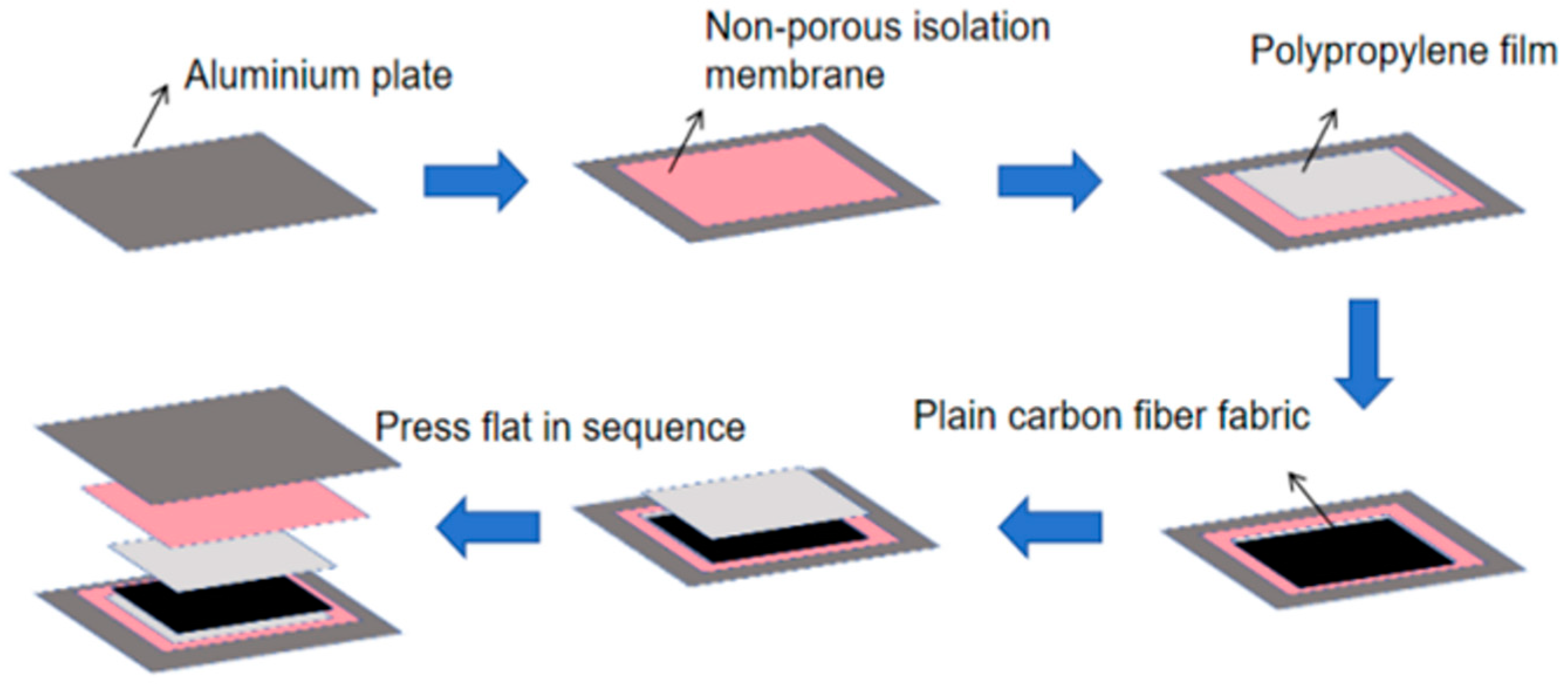
Before hot pressing, the surface-treated carbon fiber fabric and polypropylene films were dried in an oven at 100 °C for 6 h to remove residual moisture. A 250 mm × 250 mm sheet of treated carbon fiber cloth, eight layers of polypropylene film, and six layers of release cloth were then stacked between two 300 mm × 300 mm aluminum plates, as shown in Figure 1. The stack was consolidated using a flatbed hot press at 0.8 MPa. Once the press reached 220 °C, this temperature and pressure were maintained for 25 min. The plates were then cooled to room temperature under the same pressure, after which the consolidated prepreg sheet was removed. The resulting material properties are listed in Table 3.

2.1.2. Carbon Fiber Mechanical Testing Experiment

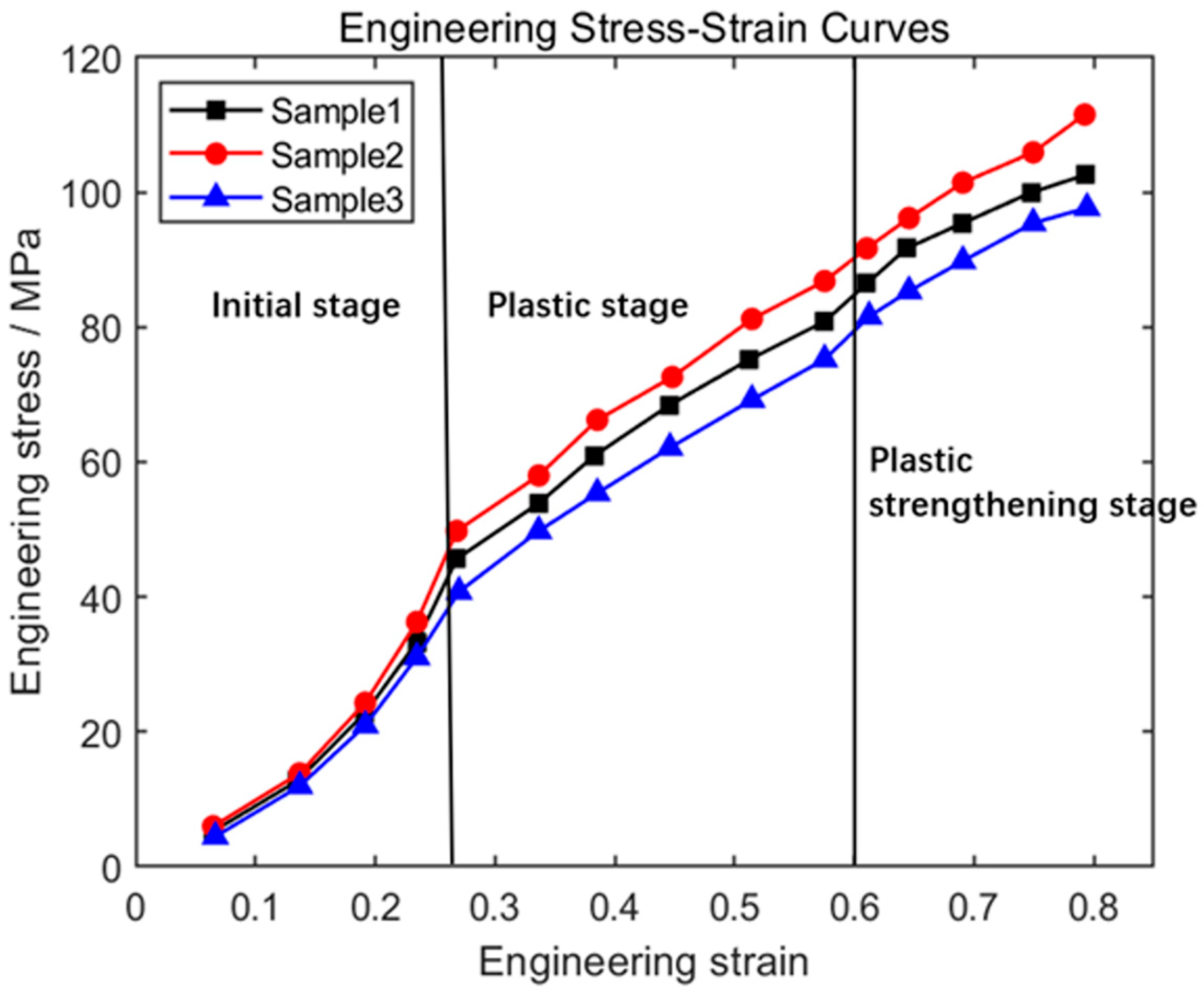
According to ASTM D3039 and ASTM D5379/D5379M-17 [18,19], stress–strain curves of carbon fiber cloth were obtained through uniaxial and off-axis tensile tests. For the uniaxial tensile test, the carbon fiber cloth was cut into 50 mm × 200 mm specimens along the [0°/90°] direction. The specimens were mounted on an electronic universal testing machine with a grip length of 100 mm. Figure 2 shows the stress–strain curves obtained from the uniaxial tensile test data for five specimens at a tensile rate of 0.025 s−1. The highest and lowest values were discarded, and three stress–strain curves were selected. The uniaxial tensile test curves for carbon fiber exhibited some deviation due to the varying number of fibers within each fiber bundle and the varying buckling states of the fibers. Furthermore, the specimens were manually cut, which caused some damage to the carbon fiber edges during cutting. These factors resulted in incomplete overlap of the uniaxial tensile curves. To reduce experimental errors caused by these factors, the three sets of experimental data with the highest overlap were selected and averaged. The subsequent material parameter determination process also used the averaged values for fitting to improve the accuracy of the model predictions, and this method was consistently used in subsequent experiments.
The data of Table A1 is shown in Figure 2, all three curves show a gradual increase in stress with increasing engineering strain, conforming to the typical tensile stress–strain curve morphology, indicating that the material gradually experiences greater stress during the tensile process. The entire process is divided into three stages, including an initial linear segment (elastic deformation, modulus approximately 250 GPa) ranging from a strain of 0–0.25, followed by a clear yield plateau at a strain of 0.25–0.6, marking the beginning of the plastic strengthening phase. The high degree of overlap between the three sample curves indicates good data reproducibility. The final fracture strain value is approximately 0.8, indicating significant ductility.
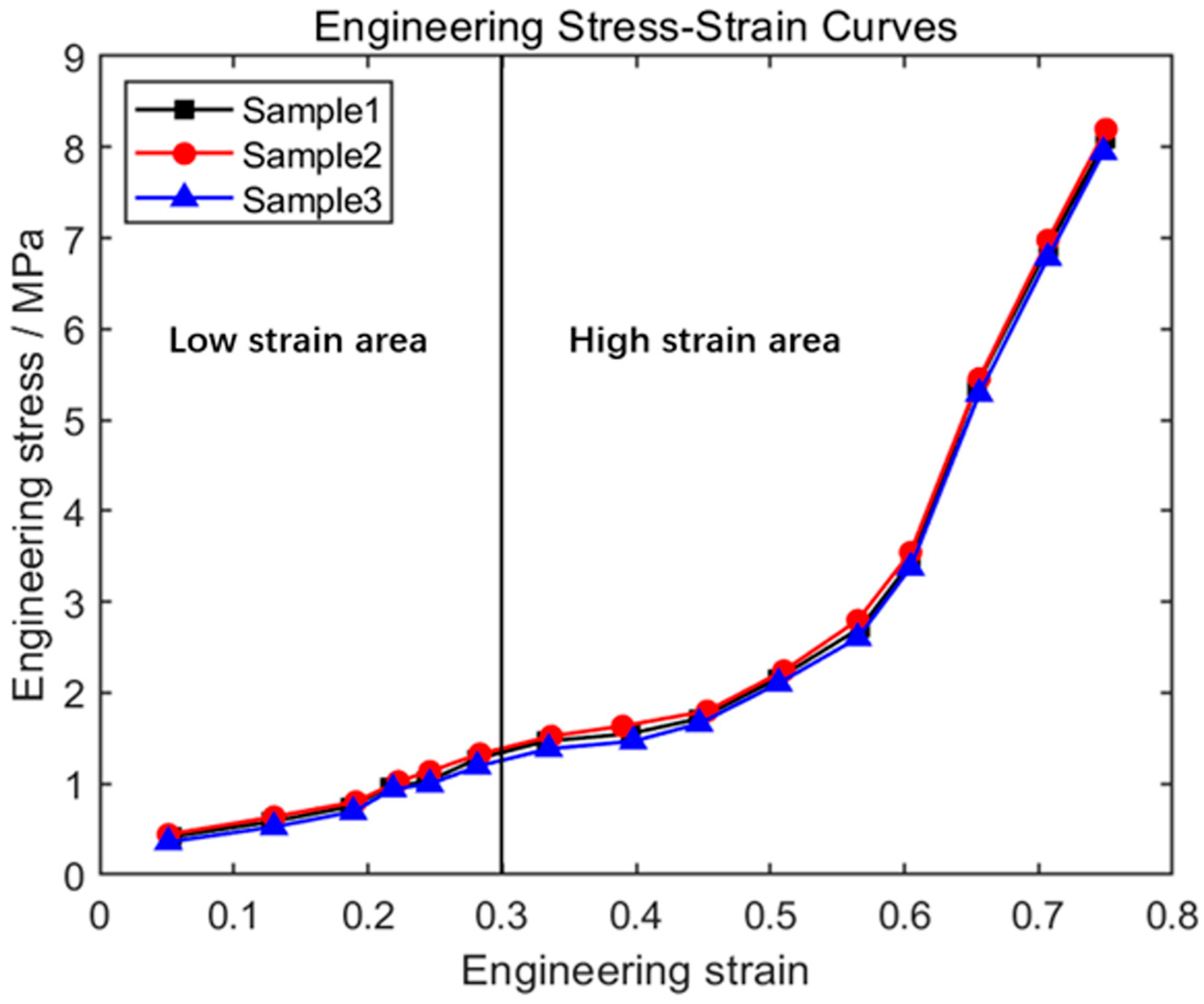
For the off-axis tensile tests, specimens measuring 50 mm × 250 mm were cut along the [−45°/45°] direction, and the corresponding stress–strain curves are shown in Figure 3. The three curves nearly overlap, indicating excellent repeatability. At small strains (0–0.3), the stress increases slowly, followed by a sharp rise beyond a strain of approximately 0.5, demonstrating significant strain hardening.
The data of Table A2 is shown in Figure 3.The stress of the three groups of samples rises relatively slowly at small strains (0–0.3). After the strain value exceeds about 0.5, the stress rises sharply, especially when it approaches 0.8, showing a significant nonlinear surge.
As can be seen from the figure, the curves for the three groups of samples differ very little, almost overlapping. The initial slope is low, indicating low material stiffness (initial elastic modulus). A significant upward trend appears in the middle and later stages, demonstrating a strong strain-hardening effect. The mechanical responses of the three samples are very similar, indicating good material consistency.

2.1.3. Prepreg Mechanical Testing Experiment

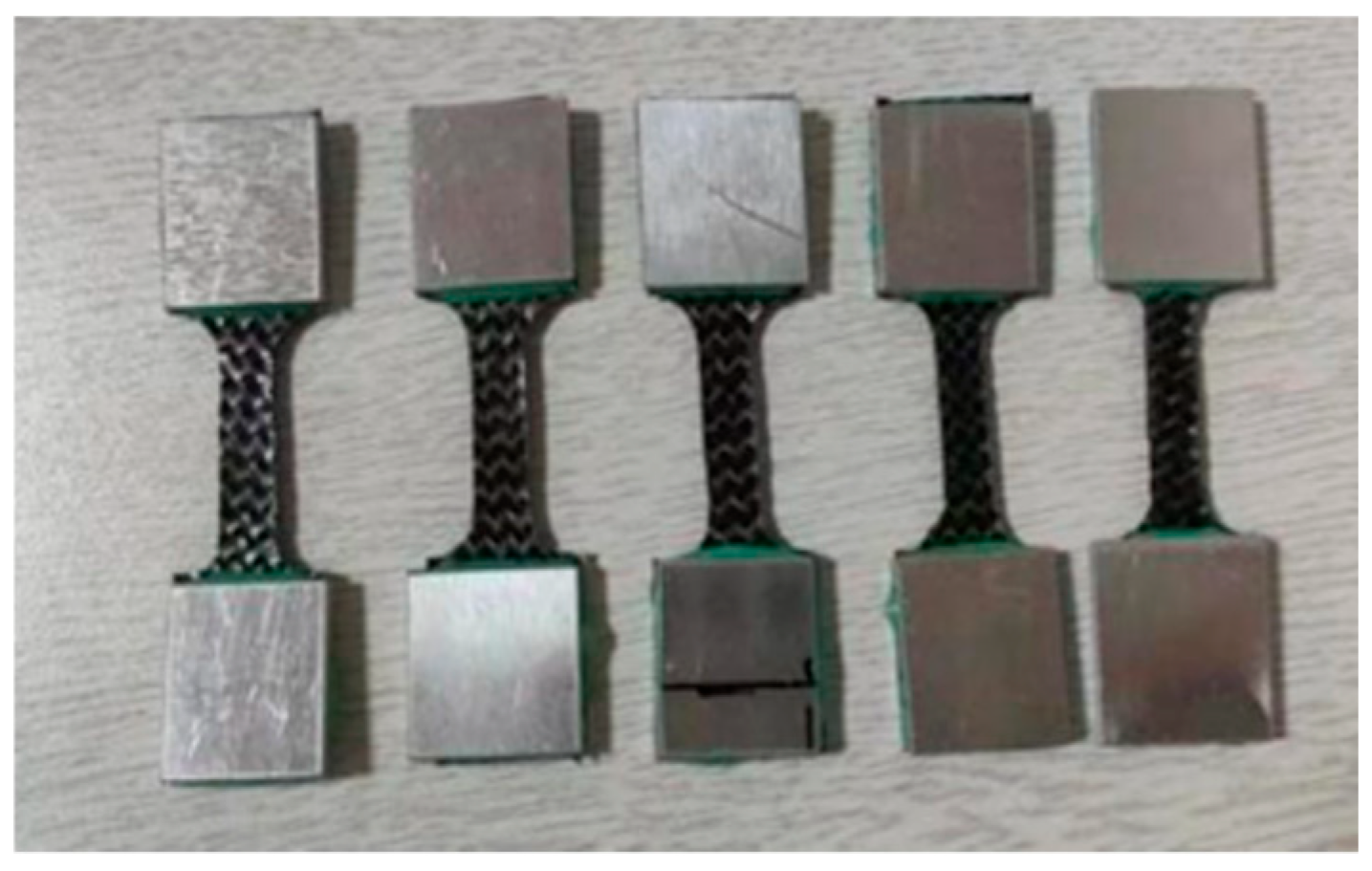
The prepreg sheets were cut into the required geometry, and aluminum shims were bonded to both ends to increase the gripping thickness and ensure stable clamping during tensile loading. The aluminum shims were attached using a heated curing process: the clamped specimens were placed in an oven at 120 °C for 2 h to fully cure the adhesive film. This procedure enhanced the bonding strength between the shims and the prepreg, preventing slippage or grip-induced damage and ensuring accurate strain measurements. After curing, the specimens were removed from the oven, the clamps were detached, and the samples were prepared for subsequent testing, as shown in Figure 4. The off-axis tensile test of pure carbon fiber/PP prepreg requires stretching at a high temperature of 160 °C along the [−45°/45°] fiber orientation. After clamping the sample to a metal guide rail, the machine was heated to 160 °C and held at this temperature for 1 min, and then stretched at a strain rate of 6 s−1.
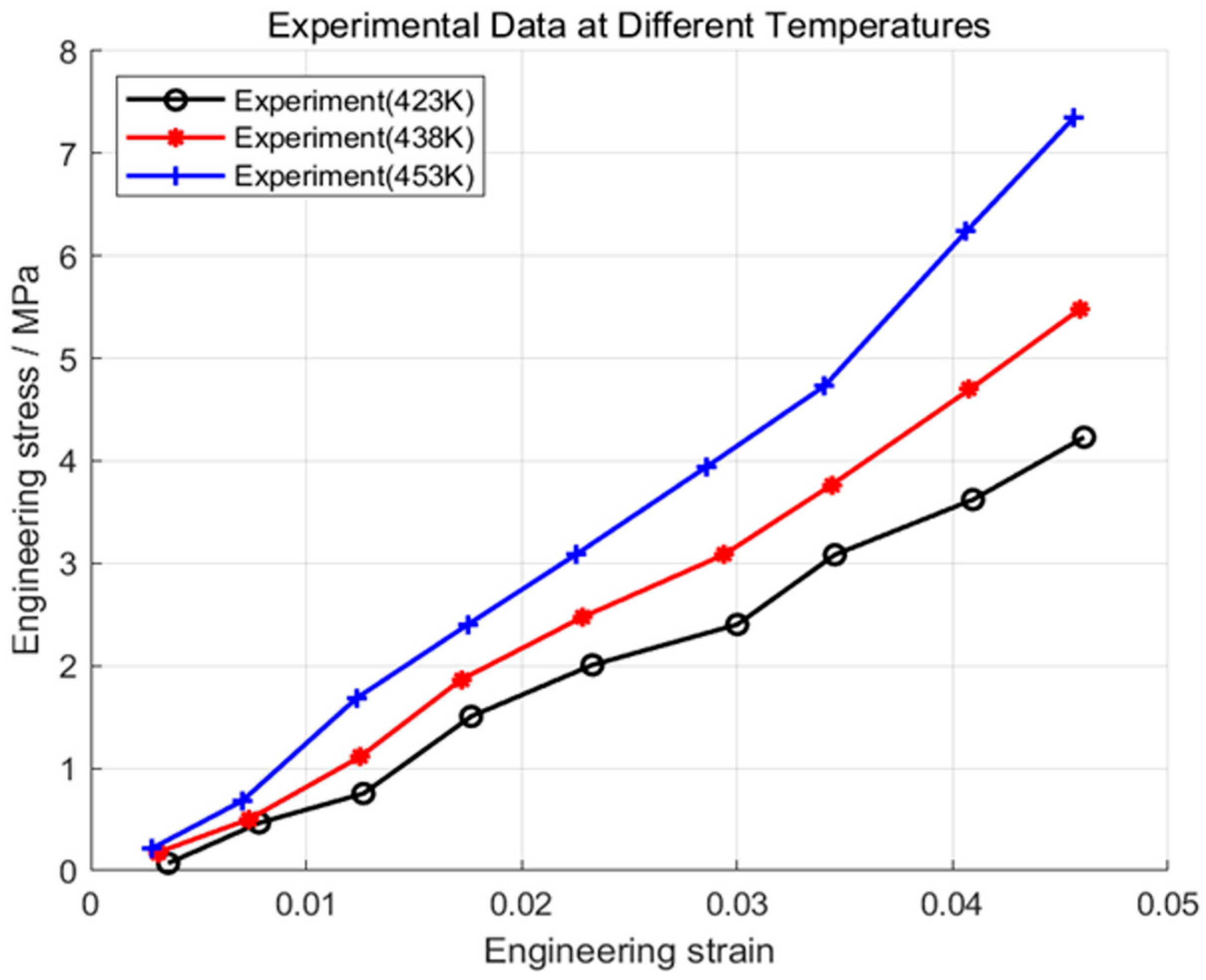
As shown in Figure 5, the stress increases with strain at all temperatures, following the typical trend of tensile deformation. In general, the material exhibits higher modulus and strength at elevated temperatures. As the temperature rises, the initial stiffness increases, strain hardening becomes more pronounced, and the peak stress also increases, indicating an enhancement in load-bearing capacity. Thus, the mechanical behavior of the prepreg shows a positive correlation with temperature within the tested range.

2.2. Temperature-Dependent Visco-Hyperelastic Constitutive Model

Previous studies have proposed constitutive frameworks that decompose strain energy into matrix and fiber-related components, and developed a constitutive model for thermoplastic braided prepregs that considers the interaction between molten resin and fiber bundles, which has been successfully applied to thermoforming simulations [20].
In this study, strain energy function of thermoplastic carbon fiber woven fabric W contains two parts: matrix energy and fiber energy. C denotes the right Cauchy-Green strain tensor, C is the right Cauchy–Green strain rate tensor, a 0 is the initial weft unit direction, b 0 is initial warp unit direction, W m represents matrix energy, W f represents fiber energy, and T represents temperature.
W C , C , T , a 0 , b 0 = W m C , C , T , a 0 , b 0 + W f C , T , a 0 , b 0
The energy function of the matrix consists of a hyperelastic model and a rate-dependent viscoelastic model. To accurately characterize the mechanical properties of the matrix at high temperatures, a scalar function related to temperature T is introduced in this paper, where I represents the strain invariant of the hyperelastic part and J represents the strain rate invariant of the viscoelastic part.
W m C , C , T = W m e I 1 , I 2 , T + W m v I 1 , J 1 , T
The energy function of woven fabrics is composed of fiber tensile energy, fiber–fiber shear energy and fiber-matrix shear energy,
W f C , T , a 0 , b 0 = W f a I 4 + W f b I 6 + W f f I 4 , I 6 , I 8 , a 0 , b 0 + W f m I 4 , I 6 , I 8 , T
The right Cauchy-Green strain tensor is given by A 0 = a 0 a 0 , B 0 = b 0 b 0 is the structure tensor, and λ a and λ b represent the stretching ratio of the fiber along the weft and radial directions, respectively. t r ( C ) Indicates the overall degree of stretch.
I 1 = I : C = tr C ,     I 2 = 1 2 tr C 2 tr C 2 ,     I 3 = det C I 4 = A 0 : C = a 0 C a 0 = λ a 2 ,     I 5 = A 0 : C 2 = a 0 C 2 a 0 I 6 = B 0 : C = b 0 C b 0 = λ b 2 ,     I 7 = B 0 : C 2 = b 0 C 2 b 0 I 8 = a 0 C b 0
The right Cauchy-Green strain rate tensor is given by
J 1 = I : C = tr C ,     J 2 = 1 2 tr C 2 tr C 2 ,     J 3 = det C J 4 = A 0 : C = a 0 C a 0 ,     J 5 = A 0 : C 2 = a 0 C 2 a 0
where the fiber’s latitudinal and radial unit direction vectors are a 0 and b 0 , Deformation Gradient Tensor F , Green’s strain tensor C , and strain rate tensor C . As shown below,
a 0 = cos α         sin α         0 ,     b 0 = sin α         cos α         0 F = dig λ 1 λ 2 λ 3 ,     C = F T F = dig λ 1 2 λ 2 2 λ 3 2 C = F F T + F T F = dig 2 λ 1 λ 1 2 λ 2 λ 2 2 λ 3 λ 3
in λ i represents the stretch ratio in the i-th principal direction.

2.2.1. Energy Function of the Matrix

First, the thermoplastic matrix of the fabric is considered as an incompressible material, and then the temperature scalar function is introduced based on the Mooney-Rivlin model [21] f m T . The matrix viscosity has a significant effect on mechanical deformation at high temperatures. This paper cites Gong Youkun’s rubber matrix rate-dependent viscosity model [22]. Therefore, the temperature-dependent isovolumetric deformation energy function of pure polypropylene matrix is
W m = W m e + W m v = i = 1 2 C i 0 I 1 3 i + j = 1 2 D j 0 I 2 3 j + g J 1 i = 0 2 η i I 1 3 i f m T
g J 1 = ln ω J 1 + 1
where C i 0 and D j 0 is the matrix material parameter, η 0 and η 1 is the viscosity coefficient, and in MPa, the unit of material parameters ω is S.

2.2.2. Fiber Stretching Energy Function

Since the temperature effect mainly comes from the PBS solution and the mechanical properties of carbon fiber fabrics are not sensitive to temperature, the effect of temperature and compressive strain energy are ignored when considering fiber tensile energy. The fiber weft and radial tensile energy functions are shown as follows:
W f a = i = 2 4 k i 1 I 4 1 i , I 4 > 1 0 , I 4 > 1 W f b = i = 2 4 k i 1 I 6 1 i , I 6 > 1 0 , I 6 > 1

2.2.3. Fiber Shear Energy Function

By defining a principle invariant I 10 , the shear energy of the fiber during shear deformation is characterized by the change in the shear angle between the winding fiber and the weft fiber.
I 10 = arccos ( a 0 b 0 ) arccos I 8 I 4 I 6
W f f can be expressed. In the formula, k 4 , k 5 , k 6 is the material parameter, and the unit is MPa.
W f f = k 4 I 10 4 + k 5 I 10 3 + k 6 I 10 2

2.2.4. Fiber-Matrix Shear Energy Function

PBS solution has different viscosities at different temperatures, which will affect the friction between fiber bundles and further affect the shear resistance behavior of PP prepreg. Therefore, shear deformation is related to temperature.
W f m = W f m a + W f m b = [ f ( I 4 ) ( I 5 I 4 2 ) 2 + f ( I 6 ) ( I 7 I 6 2 ) 2 ] f s ( T )
f ( I 4 ) and f ( I 6 ) are functions related to fiber stretching, β and λ f is a dimensionless parameter, and γ unit is MPa.
f ( I 4 ) = f ( I 6 ) = γ 1 + exp [ β ( λ f λ f ) ]
After determining the functional forms of matrix isochoric deformation energy, fiber tensile deformation energy, fiber–fiber shear strain energy, fiber-matrix shear strain energy and viscous strain energy, substitute Equation (13) into S = 2 W C . We can obtain the second Piola-Kirchhoff stress tensor S. From σ = J 1 F S F T , we obtain the Cauchy stress tensor σ , while the distinctions between these two stress measures in nonlinear deformation are discussed [23].
σ = σ e + σ v W 1 e B + I 1 W 2 e B W 2 e B 2 + I 4 W 4 e a 0 a 0 + I 6 W 6 e b 0 b 0 + I 5 W 5 e a 0 B a 0 + a 0 B a 0 + I 7 W 7 e b 0 B b 0 + b 0 B b 0 + 1 2 I 8 W 8 e a 0 b 0 + b 0 a 0 + ω ln ω J 1 + 1 i = 0 2 η i I 1 3 i B = 2 J
J = I 3 1 / 2 represents the total volume change, and B is the left Cauchy-Green tensor, which is the deformed gradient tensor B = F F T represent.

2.3. Determine Model Parameters

This paper uses MATLAB to fit each set of strain–stress data by least squares method and cubic polynomial fitting, and draws fitting curves and calculates R2 to evaluate the fitting effect. The uniaxial tensile test and off-axis tensile test data are fitted to determine the material model parameters.

2.3.1. Matrix Energy Function

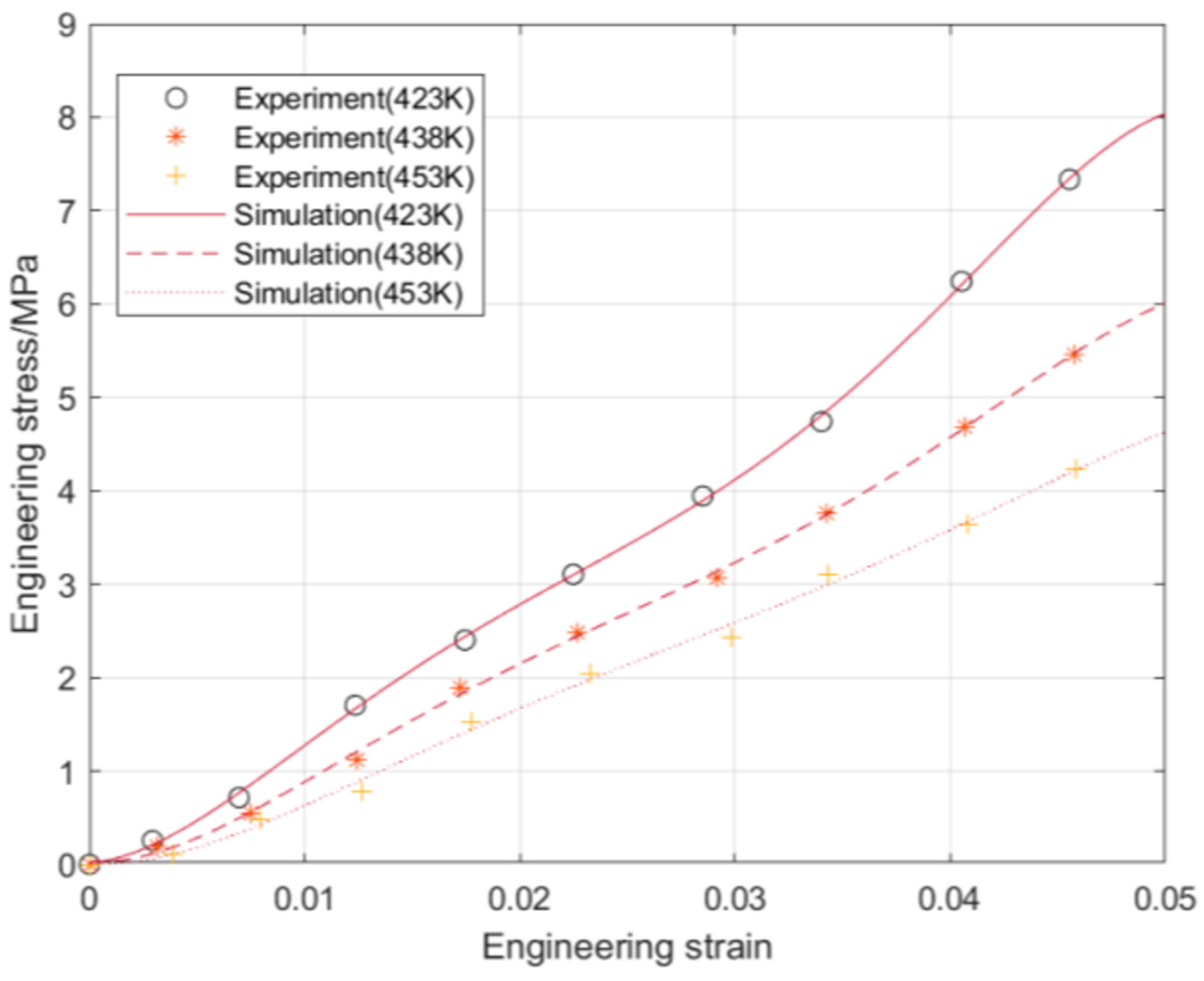
A carbon fiber polypropylene prepreg was subjected to partial tensile tests at different temperatures (423 K, 438 K, and 453 K) at a strain rate of 6 s−1. The curves were averaged five times. The initial segment of the curve was used to fit the matrix material parameters, as shown in the Figure 6 The matrix material parameters obtained at different temperatures are listed in the Table 4.
The temperature function is used to unify the parameters at different temperatures in Table 4. Exponential functions are commonly used to quantify temperature effects. Specifically, 423 K is used as the reference temperature, and the matrix parameters at this reference temperature are the matrix reference parameters. Based on this, the temperature function can be expressed as follows:
f m T = e A ( T T 0 ) / T
where A is the temperature coefficient, T is the current absolute temperature, and T 0 = 423 K is the reference absolute temperature. Therefore, the material parameters in Formula (7) are
C 10 = 20.0428 ,   C 20 = 3.4255 ,   D 10 = 9.9934 ,   D 20 = 1.5753 .
The data presented in Figure 6 shows a trend of increasing stress with increasing strain. The distribution of experimental and simulation data points at different temperatures is relatively regular, and the simulated and experimental data trends closely match. However, at the same strain, the stress value at 423 K is the highest, and the stress value at 453 K is the lowest. While there is a numerical difference of approximately 5% between the simulated and experimental data, the overall trend is consistent.

2.3.2. Stretching Energy Function

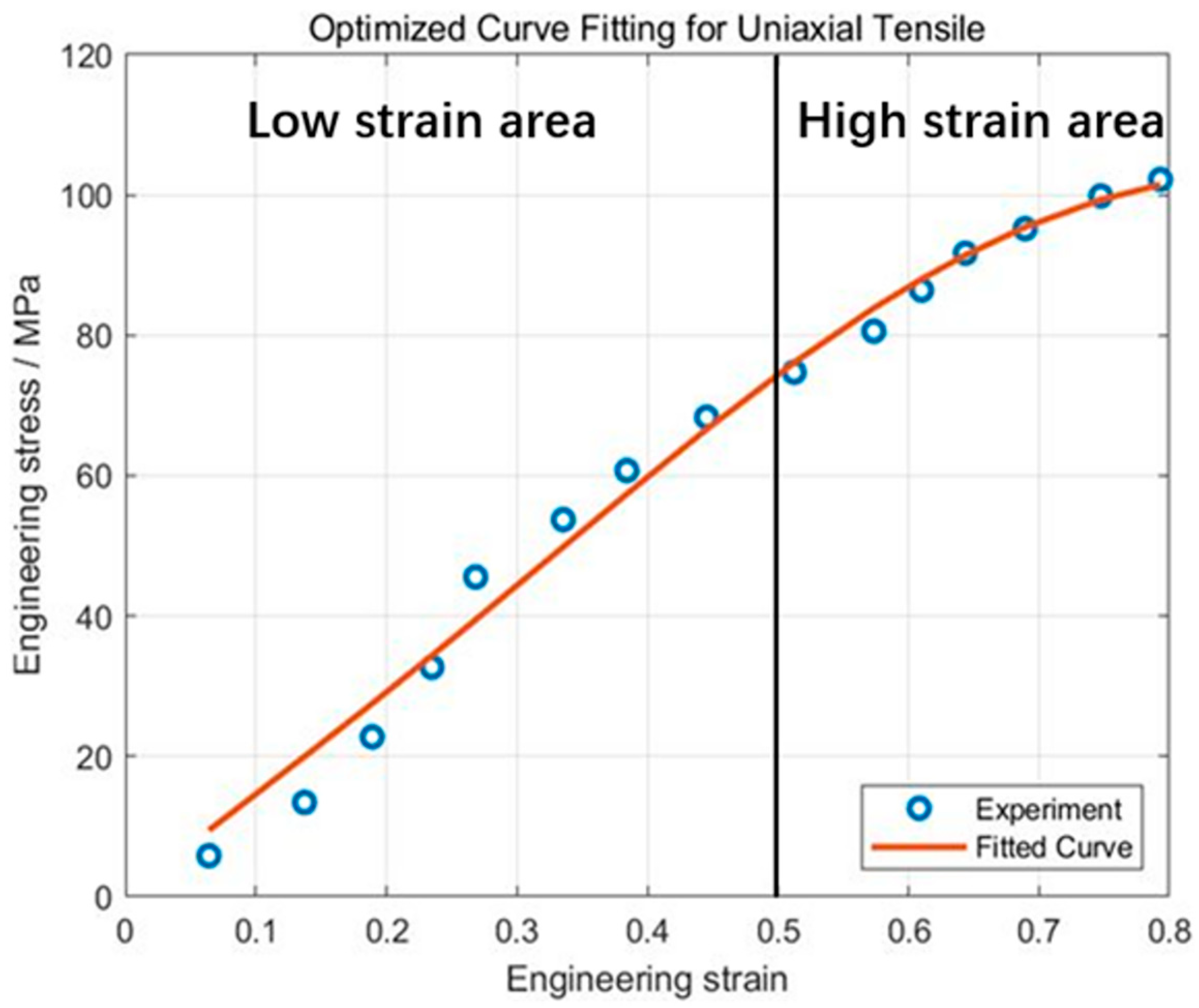
Fitting the uniaxial tensile test data of plain carbon fiber fabric, as shown in Figure 7, the material parameters of fiber tensile energy are obtained.
k 1 = 17.1352 ,   k 2 = 0.2414 ,   k 3 = 0.392 .
The experimental data from this image roughly follows the fitted curve, indicating a good fit and that stress increases with strain. In the low-strain region, the experimental data points deviate significantly from the fitted curve, with the error exceeding 3%. In the high-strain region, the deviation is smaller, with an error of approximately 0.5%.

2.3.3. Fiber Shear Energy Function

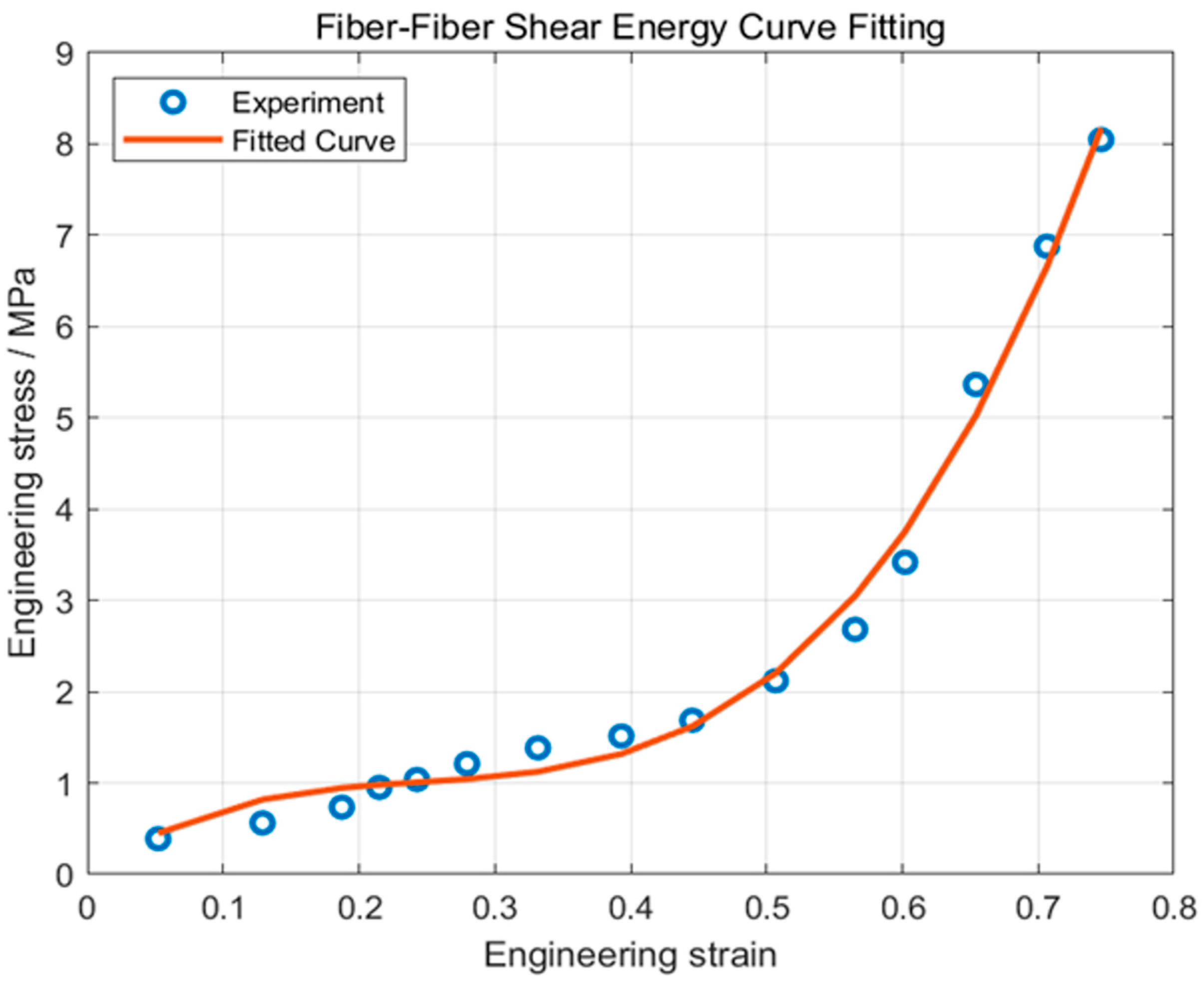
Fitting the off-axis tensile test data of plain carbon fiber fabric, as shown in Figure 8, obtains the fiber–fiber interaction parameters:
k 4 =   0.2423 ,   k 5 =   0.3185 ,   k 6 =   0.1732 .
In the low-strain region of 0–0.3, the stress changes gently between the experimental data points and the fitting curve. As the strain increases, the stress also increases. Above 0.5, in the high-strain region, the stress increases dramatically. In this high-strain region, the deviation between the experimental data points and the fitting curve increases, but the overall fitting effect is good.

2.3.4. Matrix-Fiber Shear Energy Function

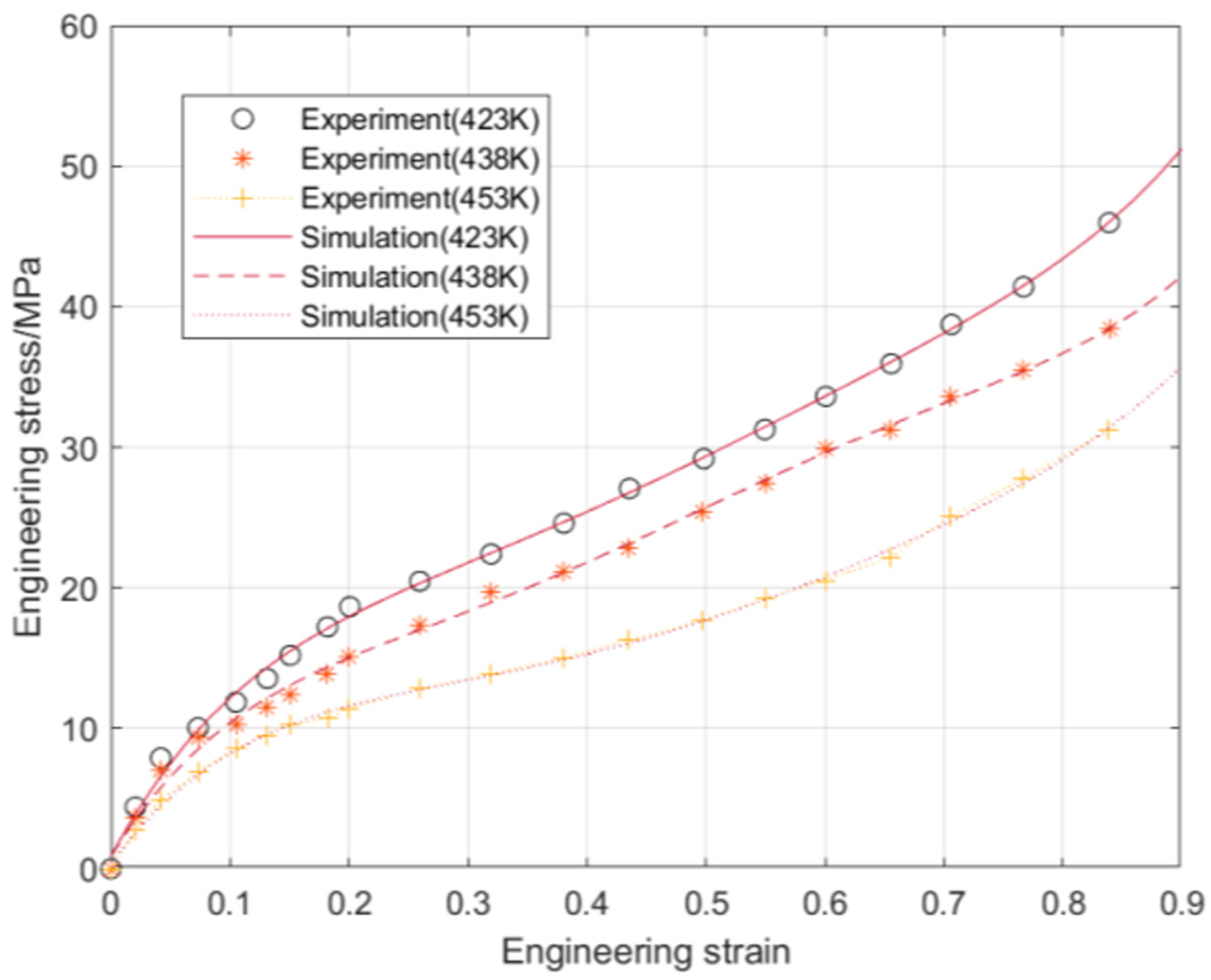
Carbon fiber-reinforced polypropylene prepregs were subjected to off-axis tensile tests at different temperatures (423 K, 438 K, and 453 K) at a strain rate of 6 s−1. The curves were averaged five times. The lubricating effect of the thermoplastic matrix affects the in-plane shear stiffness by altering the friction between the fiber bundles. Because the properties of the polypropylene matrix are temperature-dependent, the shear properties of the braided fiber-reinforced composite prepregs vary with temperature.
First, let f s ( T ) = 1. By fitting the curves at 423 K, 438 K, and 453 K, the shear properties at different temperatures can be obtained and are listed in Table 5.
Selecting 423 K as the reference temperature, the temperature function overfitting can be expressed as
f s ( T ) = [ B ( T T 0 ) + T ] / T
where B is the shear temperature coefficient, B = 21.6.
In Figure 9,stress increases with strain, and the distribution of experimental and simulation data points at different temperatures follows a relatively consistent pattern. The highest stress value is observed at 423K, while the lowest occurs at 453K. Although there are some numerical discrepancies between the simulation and experimental data, the overall trends remain consistent.

3. Model Validation and Results Discussion

3.1. Model Building

To evaluate the accuracy and applicability of the proposed temperature-dependent visco-hyperelastic constitutive model, off-axis tensile tests were performed at various temperatures and fiber orientations. A numerical implementation of the model was developed in MATLAB, into which the identified material parameters were incorporated to compute stress–strain responses under different loading conditions. The model accounts for the viscoelastic behavior of the matrix, the tensile and shear contributions of the fibers, and the temperature dependence of the material properties. The proposed constitutive model is primarily applicable to woven thermoplastic prepregs reinforced with continuous fibers, particularly within the temperature range of 423–453 K. The model accurately predicts the in-plane tensile and shear responses of the material, as well as the evolution of fiber–matrix interactions with temperature.

3.2. Model Verification and Error Discussion

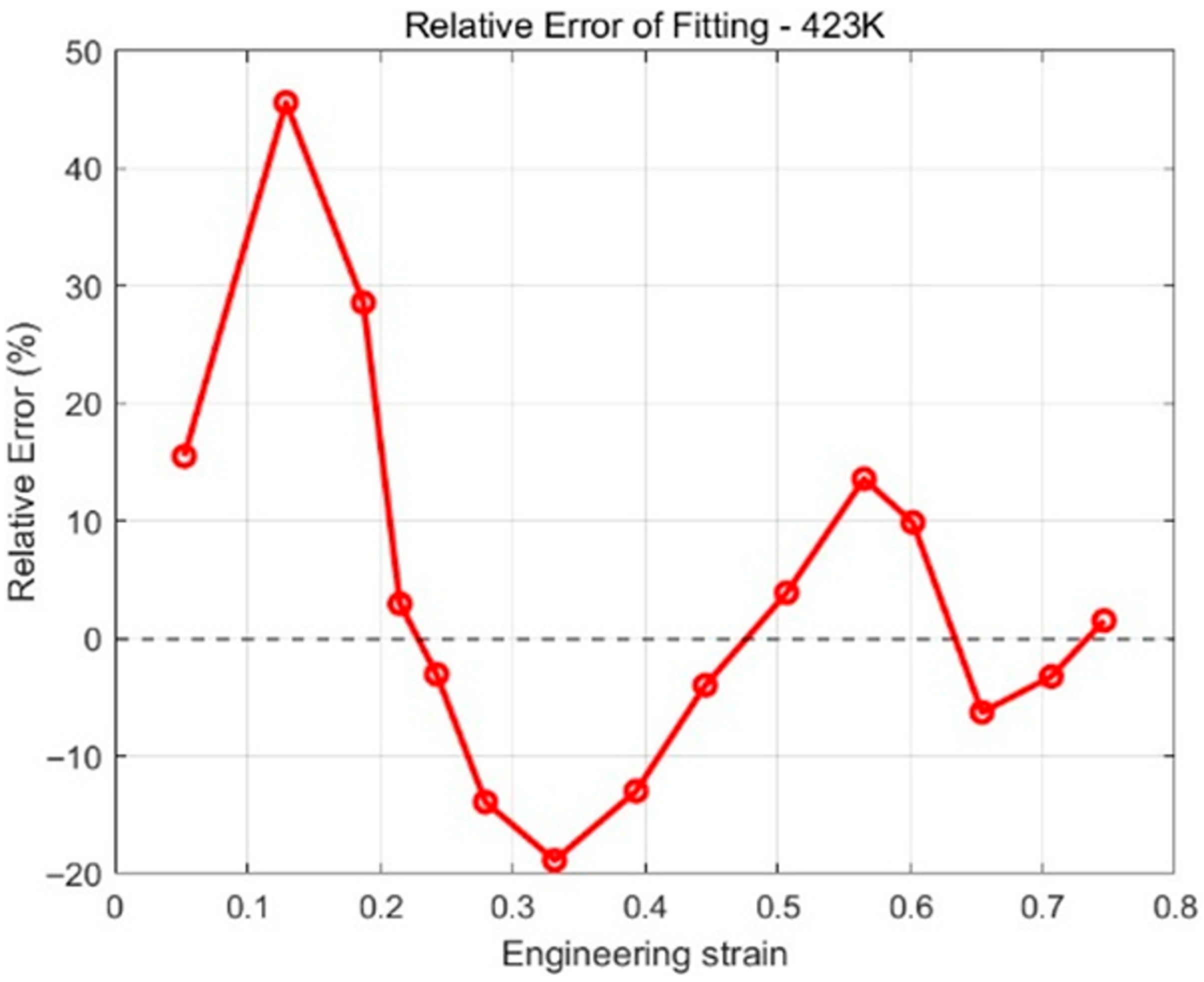
Comparison of experimental and simulation results shows that the model’s predictions agree well with the experimental data in terms of overall trends. The stress–strain curves for 15° and 30° off-axis tensile at temperatures of 423 K and 438 K demonstrate that the model can well reflect the mechanical behavior of the material at different strain stages, particularly in the elastic stage with low strain and the nonlinear stage with high strain. The maximum relative error in the low-strain region (ε < 0.2) is approximately 15%, and the relative error in the medium–high-strain region (0.2 ≤ ε ≤ 0.6) is ≤5%.The error in the low-strain region originates from initial fiber buckling (different bending degrees of individual fibers) and interfacial microdefects (incomplete wetting at the carbon fiber–polypropylene interface), which can be improved by calibrating fiber flatness before prepreg preparation.
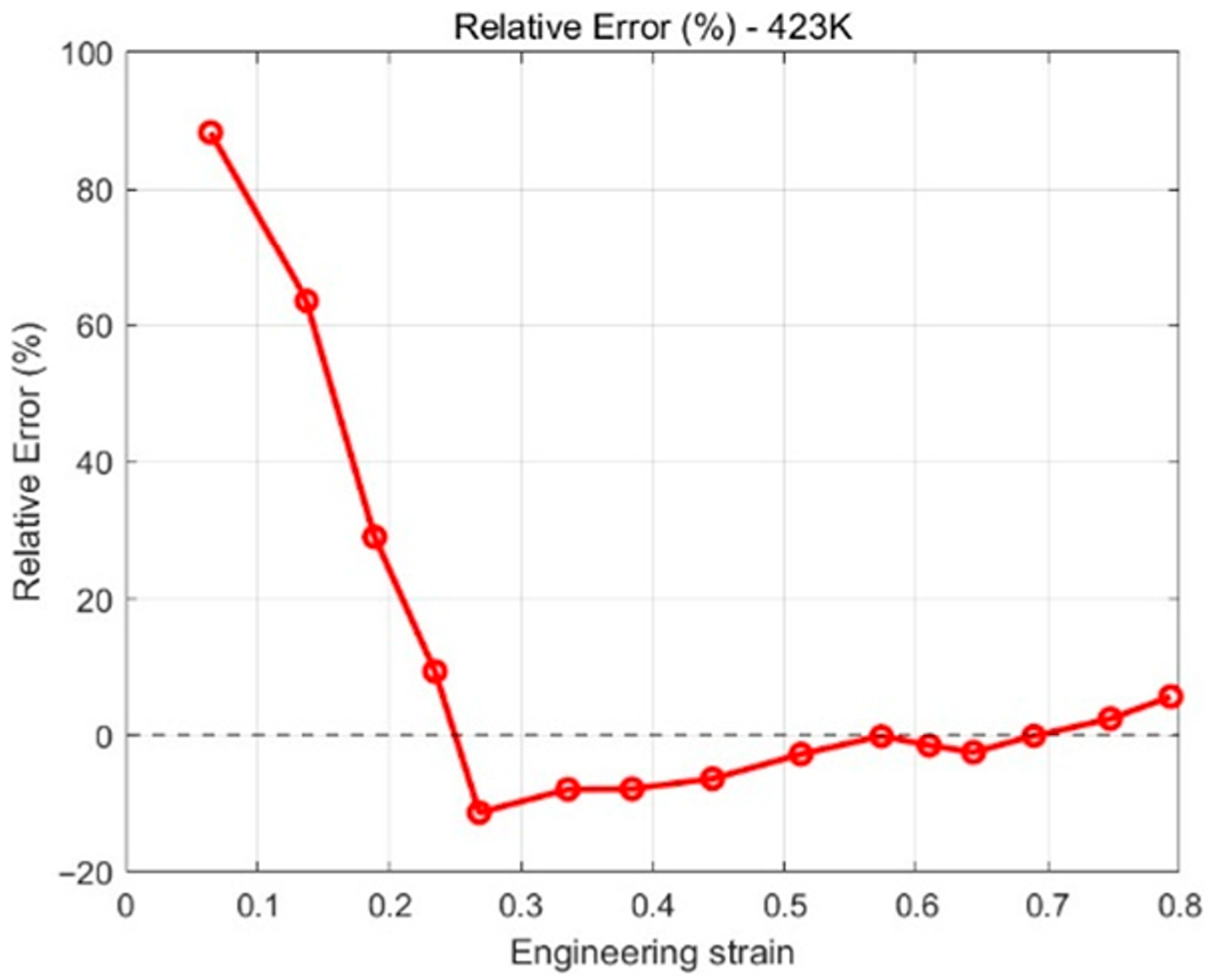
Since the experimental fitting curves exhibit good consistency across different temperatures, a detailed error analysis at 423 K was performed to further quantify the accuracy of the proposed model. The results indicate that significant deviations occur primarily in the low-strain region (ε < 0.2), where the mechanical response is highly sensitive to the initial state of the material. Across most of the strain range, however, the relative error remains within ±10%, with particularly small deviations observed between strains of 0.2 and 0.6, confirming the high fitting accuracy and robustness of the model.
The sources of error are largely material-specific. In the low-strain region, variations in initial fiber distribution, fiber waviness or buckling, and interfacial defects within the prepreg introduce noticeable discrepancies between model predictions and experimental measurements. Additional experimental factors—including boundary effects, local temperature fluctuations, and limitations in strain measurement accuracy—further contribute to the observed scatter. The error distribution also shows deviations at both the smallest and largest strain levels, which can be attributed to material heterogeneity, temperature gradients during testing, simplified assumptions regarding fiber–matrix interfacial behavior, and the inherent limitations of viscoelastic constitutive formulations under multiaxial loading conditions.
According to Figure 10 and Figure 11,in the small-strain range (ε < 0.2), the absolute stress is low, resulting in high relative errors despite small numerical differences. As strain increases, the stress grows rapidly, and although the absolute deviation also increases, the relative error becomes significantly smaller because the stress magnitude dominates the ratio. This explains why minor deviations in the low-strain region translate into large relative errors, whereas larger absolute deviations at high strains remain within acceptable accuracy.

4. Conclusions

Despite these deviations, the temperature-dependent viscoelastic–hyperelastic constitutive model established in this paper still has significant advantages. By decomposing strain energy into four components: matrix, fiber stretching, interfiber shear, and fiber-matrix shear, the model clearly reflects the contribution of each component to the overall mechanical behavior. The introduction of a temperature function more intuitively reflects the influence of temperature on matrix viscosity and fiber–matrix interfacial behavior. It demonstrates good predictive power at multiple temperatures and off-axis angles, making it suitable for simulating the mechanical behavior of thermoplastic prepregs during hot forming. The proposed model is intended to support numerical simulations of carbon fiber/polypropylene prepreg hot-pressing, where temperature and strain rate vary dynamically, helping to optimize process parameters (such as temperature, pressure, and rate) and improve the quality and performance of molded parts.

Author Contributions

Conceptualization, M.L.; methodology, M.L. and H.Z.; software, H.Z.; validation, H.Z.; formal analysis, H.Z.; investigation, H.Z.; resources, M.L.; data curation, H.Z.; writing—original draft preparation, H.Z.; writing—review and editing, M.L.; visualization, H.Z.; supervision, M.L.; project administration, M.L.; funding acquisition, M.L. All authors have read and agreed to the published version of the manuscript.

Funding

This research received no external funding.

Data Availability Statement

The raw data supporting the conclusions of this article will be made available by the authors on request.

Conflicts of Interest

The authors declare no conflict of interest.

Abbreviations

PBSPhosphate-buffered saline
ASTMAmerican Society for Testing and Materials

Appendix A

Table A1. Carbon fiber uniaxial tensile test data.
Sample 1Sample 2Sample 3
Engineering StrainEngineering StressEngineering StrainEngineering StressEngineering StrainEngineering Stress
0.064.870.065.990.064.49
0.1412.720.1413.850.1411.98
0.1922.080.1924.330.1920.58
0.2332.930.2336.300.2331.06
0.2745.280.2749.780.2740.42
0.3453.890.3458.380.3449.40
0.3961.000.3966.240.3955.39
0.4568.110.4572.980.4562.13
0.5175.220.5181.210.5169.24
0.5880.840.5886.450.5875.22
0.6186.450.6191.690.6181.59
0.6591.690.6496.180.6585.33
0.6995.430.69101.800.6989.82
0.7599.930.75105.910.7595.81
0.79102.920.79111.150.7997.68
Table A2. Off-axis tensile test data of carbon fiber.
Sample 1Sample 2Sample 3
Engineering StrainEngineering StressEngineering StrainEngineering StressEngineering StrainEngineering Stress
0.050.440.050.390.050.33
0.130.610.130.580.130.53
0.190.800.190.720.190.69
0.231.020.220.970.220.94
0.251.140.241.050.251.00
0.291.330.281.250.281.19
0.341.550.331.440.331.38
0.391.630.401.550.401.47
0.451.800.451.720.451.66
0.512.270.512.160.512.10
0.572.800.572.690.572.60
0.613.540.603.430.603.38
0.665.460.665.370.665.29
0.716.980.716.870.716.81
0.758.200.758.060.757.98

References

  1. Jing, P. Preparation and Study of Carbon Fiber Fabric Reinforced Thermoplastic Composites. Master’s Thesis, Donghua University, Shanghai, China, 2015. [Google Scholar]
  2. Wang, Z.; Ren, H.; Cao, X.; Mei, X.; Zhu, G.; Chen, Y.; Guo, Y. A coupled numerical model of “forming–bending” for carbon fiber reinforced polypropylene pipe fittings. Acta Mater. Compos. Sin. 2024, 41, 2947–2958. [Google Scholar]
  3. Chang, B. Constitutive Model and Additive Manufacturing Process of High-Performance Carbon Fiber Reinforced Thermoplastic Composites. Doctoral Dissertation, Dalian University of Technology, Dalian, China, 2020. [Google Scholar]
  4. Tan, C.; Liu, H.; Su, J.; Zhang, X.; Chen, B.; Song, X. Research progress on the joining of metals and carbon fiber reinforced thermoplastic composites. Aeronaut. Manuf. Technol. 2024, 68, 86–104. [Google Scholar]
  5. Huang, Y.; Oterkus, S.; Hou, H.; Oterkus, E.; Wei, Z.; Zhang, S. Peridynamic model for visco-hyperelastic material deformation in different strain rates. Contin. Mech. Thermodyn. 2022, 34, 977–1011. [Google Scholar] [CrossRef]
  6. Christ, N.; Scheuring, B.M.; Schelleis, C.; Liebig, W.V.; Montesano, J.; Weidenmann, K.A.; Hohe, J. Characterization and simulation of the interface between a continuous and discontinuous carbon fiber reinforced thermoplastic by using the climbing drum peel test considering humidity. Polymers 2024, 16, 976. [Google Scholar] [CrossRef] [PubMed]
  7. Yao, Y. Research on Constitutive Model of Plain Woven Fabrics Considering Coupling Effect. Master’s Thesis, Shanghai Jiao Tong University, Shanghai, China, 2018. [Google Scholar]
  8. Han, L.; Song, Y.; Qi, H.; Yang, J.S.; Li, S.; Liu, P.A. A comparative study on the mechanical properties of open-hole carbon fiber-reinforced thermoplastic and thermosetting composite materials. Polymers 2023, 15, 4468. [Google Scholar] [CrossRef] [PubMed]
  9. Guo, G.; Peng, X.; Zhao, N. An anisotropic hyperelastic constitutive model considering shear effect. Acta Mech. Sin. 2013, 45, 451–455. [Google Scholar]
  10. Meng, L.; Zhou, C.; Guo, K.; Zhang, X. A new hyperelastic–cyclic plastic constitutive model. Acta Mech. Sin. 2016, 48, 660–674. [Google Scholar]
  11. Abd El-Mageed, A.I.; Desouky, M.M.; El-Sayed, M.; Salem, T.; Radwan, A.B.; Hassan, M.K.; Al-Oufy, A.K.; El-Dessouky, H.M. Carbon Fiber-Reinforced Thermoplastic Composite Coatings for Steel Pipelines. Polymers 2024, 16, 3417. [Google Scholar] [CrossRef] [PubMed]
  12. Suryasentana, S.K.; Houlsby, G.T. A convex modular modelling (CMM) framework for developing thermodynamically consistent constitutive models. Comput. Geotech. 2022, 142, 104506. [Google Scholar] [CrossRef]
  13. Wu, W.; Lin, J.; Wang, X. A basic hypoplastic constitutive model for sand. Acta Geotech. 2017, 12, 1373–1382. [Google Scholar] [CrossRef]
  14. Bowman, S.; Jiang, Q.; Memon, H.; Qiu, Y.; Liu, W.; Wei, Y. Effects of styrene-acrylic sizing on the mechanical properties of carbon fiber thermoplastic towpregs and their composites. Molecules 2018, 23, 547. [Google Scholar] [CrossRef] [PubMed]
  15. Bai, J.; Wang, Y.; Lang, Z.; Zuo, W. Macroscopic constitutive models of hyperelastic materials and their fitting. Chin. J. Appl. Mech. 2023, 42, 483–493. [Google Scholar]
  16. Liu, X.; Liu, C.; Zhu, D.; Lin, J. A visco-hyperelastic constitutive model to characterize the stress-softening behavior of ethylene propylene diene monomer rubber. Polymers 2023, 15, 3388. [Google Scholar] [CrossRef] [PubMed]
  17. Pogrebnjak, A.D.; Postolnyi, B.; Marchenko, T.; Rudenko, P.; Marchenko, S. Enhancement of Mechanical, Electrical, and Chemical Properties of Polycarbonate-based Core-shell Composites by Modification with Single-walled Carbon Nanotubes. High Temp. Mater. Process. Int. Q. High-Technol. Plasma Process 2021, 25, 53–64. [Google Scholar] [CrossRef]
  18. ASTM D3039; Standard Test Method for Tensile Properties of Polymer Matrix Composite Materials. ASTM International: West Conshohocken, PA, USA, 2025.
  19. ASTM D5379/D5379M-17; Standard Test Method for Shear Properties of Composite Materials by the V-Notched Beam Method. ASTM International: West Conshohocken, PA, USA, 2017.
  20. Gong, Y. Research on the Constitutive Model of Thermoplastic Woven Prepregs and Its Application in Thermoforming Simulation. Doctoral Dissertation, Shanghai Jiao Tong University, Shanghai, China, 2018. [Google Scholar]
  21. Fodor, B.; Kossa, A. Stability study of the compressible Mooney-Rivlin hyperelastic model. J. Strain Anal. Eng. Des. 2024, 59, 258–268. [Google Scholar] [CrossRef]
  22. Yao, Y.; Huang, X.; Peng, X.; Liu, P.; Youkun, G. An anisotropic hyperelastic constitutive model for plain weave fabric considering biaxial tension coupling. Text. Res. J. 2019, 89, 434–444. [Google Scholar] [CrossRef]
  23. Kulikov, G.M.; Plotnikova, S.V.; Mamontov, A.A. Assessment of second Piola–Kirchhoff and Cauchy stress tensors in finite rotation sandwich and laminated shells under non-conservative pressure loads. Acta Mech. 2024, 235, 4489–4513. [Google Scholar] [CrossRef]
Figure 1. Flow chart of prepreg preparation.
Jcs 10 00012 g001
Figure 2. Carbon fiber uniaxial tensile test data.
Jcs 10 00012 g002
Figure 3. Carbon fiber off-axis tensile test data.
Jcs 10 00012 g003
Figure 4. Prepreg standard parts.
Jcs 10 00012 g004
Figure 5. Off-axis tensile test data of prepreg.
Jcs 10 00012 g005
Figure 6. Fitted data from off-axis tensile tests of prepreg at different temperatures.
Jcs 10 00012 g006
Figure 7. Fitted data from uniaxial tensile tests of carbon fiber.
Jcs 10 00012 g007
Figure 8. Fitted data from off-axis tensile test of carbon fiber.
Jcs 10 00012 g008
Figure 9. Fitted data for prepreg off-axis tensile tests at different temperatures.
Jcs 10 00012 g009
Figure 10. Relative error (%) of uniaxial tensile at 423 K temperature.
Jcs 10 00012 g010
Figure 11. Relative error (%) of off-axis tensile at 423 K temperature.
Jcs 10 00012 g011
Table 1. Plain carbon fiber material parameters.
Fiber Gap (mm)Fiber Thickness (mm)Fiber Width (mm)Density (g/cm3)Cell Size (mm × mm)
1.920.281.781.7592 × 2
Table 2. Polypropylene film material parameters.
Film Thickness (mm)Melting Point (℃)Density (g/cm3)
0.151500.89
Table 3. Material parameters of prepreg.
Carbon fiber mass fraction63%
Polypropylene mass fraction37%
Thickness (mm)0.32
Fabric typeplain weave 2 × 2
Fiber volume fraction48%
Colorblack
Table 4. Material parameters of the matrix at various temperatures.
Temperature C 10 D 10 C 20 D 20 η 0 /MPa η 1 /MPa ω /s
423 K18.0249.7622.4251.3740.01450.02315.719
438 K19.2358.5462.2931.2390.01890.02735.563
453 K20.3147.6431.9421.0230.02010.03045.423
Table 5. Shear properties at different temperatures.
Temperature β γ λ f *
423 K1.710.231
438 K1.670.211
453 K1.620.191
Disclaimer/Publisher’s Note: The statements, opinions and data contained in all publications are solely those of the individual author(s) and contributor(s) and not of MDPI and/or the editor(s). MDPI and/or the editor(s) disclaim responsibility for any injury to people or property resulting from any ideas, methods, instructions or products referred to in the content.