
This is an early access version, the complete PDF, HTML, and XML versions will be available soon.
Article

Effect of MEX Process Parameters on the Mechanical Response of PLA Structures for Orthopedic Applications

1
Department of Mechanical Engineering, Frederick University, 1036 Nicosia, Cyprus
2
Simlead Ltd., 2043 Nicosia, Cyprus
*
Author to whom correspondence should be addressed.
J. Manuf. Mater. Process. 2025, 9(12), 414; https://doi.org/10.3390/jmmp9120414
Submission received: 5 November 2025 / Revised: 14 December 2025 / Accepted: 15 December 2025 / Published: 17 December 2025

Abstract

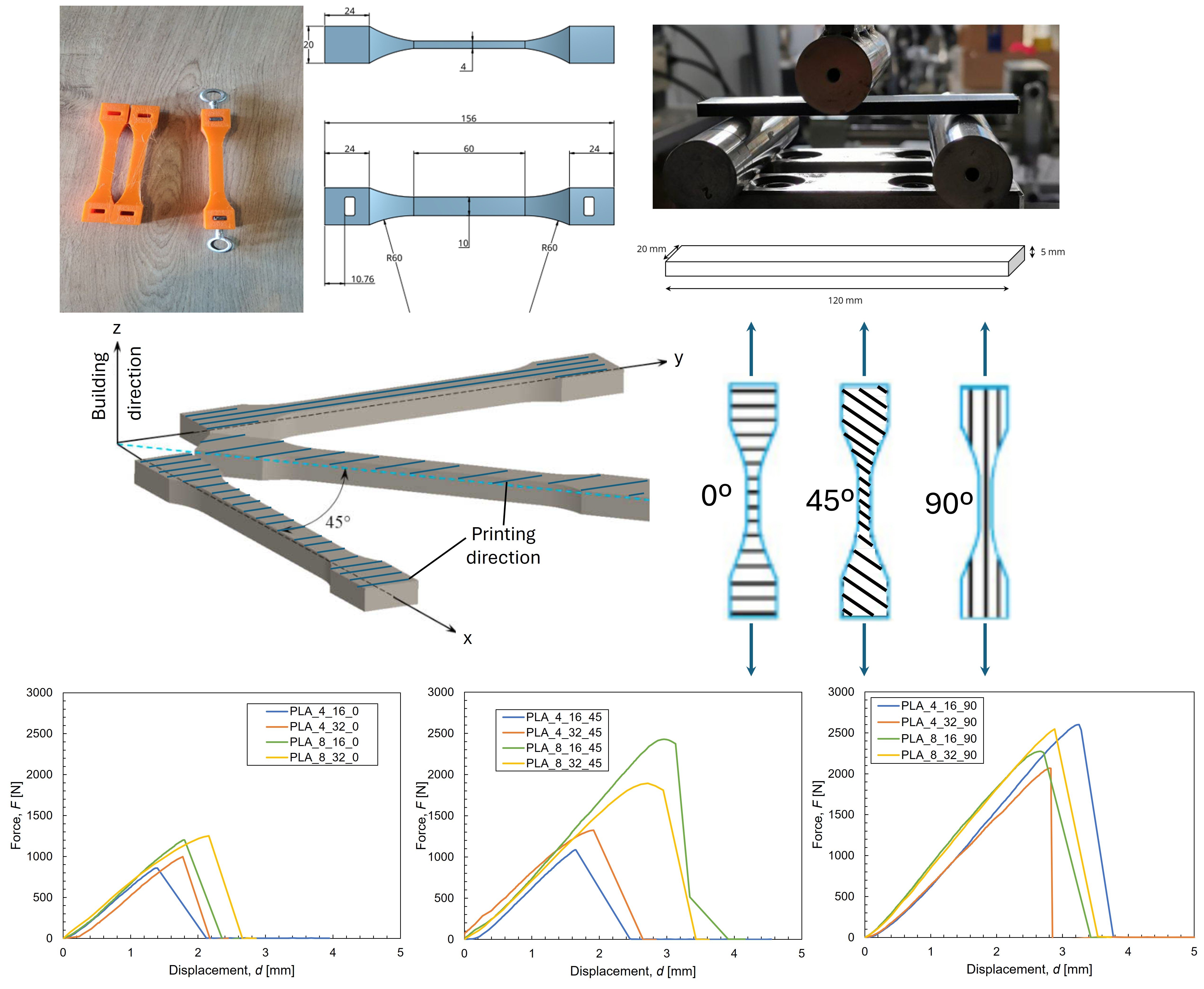
The advancement of polymeric materials for orthopedic applications has enabled the development of lightweight, adaptable structures that support patient-specific solutions. This study focuses on the design, fabrication, and mechanical characterization of additively manufactured (AM) polymeric polylactic acid (PLA) components produced via Material Extrusion (MEX), commonly known as Fused Filament Fabrication (FFF). By optimizing geometric configurations and process parameters, these structures demonstrate enhanced flexibility, energy absorption, and load distribution, making them well-suited for orthopedic products and assistive devices. A comprehensive mechanical testing campaign was conducted to evaluate the elasticity, ductility, and strength of FFF-fabricated samples under tensile and three-point bending loads. Key process parameters, including nozzle diameter, layer thickness, and printing orientation, were systematically varied, and their influence on mechanical performance was recorded. The results reveal that these parameters affect mechanical properties in a complex, interdependent manner. To better understand these relationships, an automated routine was developed to calculate the experimental mechanical response, specifically, stiffness and strength. This methodology enables an automated evaluation of the output, considering parameter ranges for future applications. The outcome of the analysis of variance (ANOVA ) of the experimental investigation reveals that the printing orientation has a strong impact on the mechanical anisotropy in FFF, while layer thickness and nozzle diameter demonstrate moderate-to-weak importance. Thereafter, the experimental findings were applied on an innovative orthopedic wrist splint design to be fabricated by means of FFF. The most suitable mechanical properties were selected to test the mechanical response of the designed components under operational bending loading by means of linear elastic finite element (FE) analysis. The computational results indicated the importance of employing the actual mechanical properties derived from the applied printing process parameters compared to data sheet values. Hereby, an additional parameter to adjust the mechanical response is the product’s design topology. Finally, this framework lays the foundation for future training of neural networks to optimize specific mechanical responses, reducing reliance on conventional trial-and-error processes and improving the balance between orthopedic product quality and manufacturing efficiency.
Keywords: Material Extrusion (MEX) of PLA; Fused Filament Fabrication (FFF); process parameter study; deposition strategy; mechanical behavior; polymeric orthopedic devices Material Extrusion (MEX) of PLA; Fused Filament Fabrication (FFF); process parameter study; deposition strategy; mechanical behavior; polymeric orthopedic devices
Graphical Abstract