Article

A Tiered Occupational Risk Assessment for Ceramic LDM: On-Site Exposure, Particle Morphology and Toxicity of Kaolin and Zeolite Feedstocks


1
Innovation in Research and Engineering Solutions SNC (IRES), 1000 Brussels, Belgium
2
BioG3D, P.C., Agios Ioannis Rentis, 182 33 Athens, Greece
*
Author to whom correspondence should be addressed.
J. Manuf. Mater. Process. 2025, 9(11), 367; https://doi.org/10.3390/jmmp9110367
Submission received: 2 September 2025 / Revised: 24 October 2025 / Accepted: 5 November 2025 / Published: 7 November 2025

Abstract

A tiered approach is presented for evaluating occupational risks during liquid deposition modelling (LDM) using ceramic materials for manufacturing complex geometries in construction. The ceramic paste is comprised of kaolin/zeolite powders mixed with deionised water at a specific ratio. The tiered occupational risk analysis covered (i) the material evaluation and information gathering, (ii) on-site exposure measurements to ultrafine and micro-size particles, and (iii) morphological and toxicological analyses of raw and collected air samples. Results indicated an increase in PM4 (particle diameter < 4 μm) concentrations during powder preparation, reaching up to 1 mg/m3 during powder preparation, although below the corresponding substance-specific and general dust occupational exposure limit and with no increased exposure to ultrafine particles, as supported by morphological analysis. In toxicity assessment, reactive oxygen species production (ROS) reached approximately 300% for 50 μg/mL raw kaolin powder, while inducing high upregulation of TNF-α and IL-6 mRNA expression genes, indicating activation of pro-inflammatory pathways. Airborne samples resulted in cell viability reduction by ~50% at 40 μg/mL, showing significance (p-value < 0.001). Translating these findings to human risk remains difficult, yet the findings highlight an urgent requirement for continuous exposure surveillance, tailored toxicity evaluations, and robust protective strategies throughout ceramic manufacturing.

1. Introduction

Additive manufacturing (AM) hazards have been studied in recent research with the aim of facilitating the widespread adoption of such technologies within industrial settings. From the earliest research work performed for AM, emission studies have revealed its potential to emit ultrafine particles (UFPs—particles with aerodynamic diameter ≤ 100 nm) and various species of volatile organic compounds (VOCs) [1]. Ultrafine particles may present an important occupational hazard, due to their increased deposition in sensitive areas of the respiratory tract [2], as well as leading to cardiovascular and neurological health effects [3,4]. It has been shown that the extent and type of emissions are strongly dependent on the material used as feedstock, as well as impurities and product-specific additives [5].
Liquid deposition modelling (LDM) is an additive manufacturing technique using extruded paste or liquid-based materials through a nozzle or tube. LDM has been studied due to the functional properties of 3D-printed materials for indoor environmental quality (IEQ) applications, such as natural cooling using terracotta clay triply periodic minimal surface (TPMS) geometries [6], passive indoor moisture buffering with 3D-printed clay components [7], and CO2 removal using 3D-printed zeolite monoliths [8]. However, despite its growing significance in sustainable architectural applications, there is little research on the potential occupational hazards associated with powder manipulation in the fabrication of such custom materials, mainly in the field of the traditional ceramic industry [9,10]. Therefore, in our work, a distinct tiered occupational health and safety examination protocol was designed and conducted, comprising on-site measurements, morphological analysis of emitted particles and comparative toxicological analysis between raw materials and airborne collected samples, allowing the evaluation of occupational risks and the potential health effects. Occupational risk studies for AM using polymer [11,12,13] and metal [14,15,16] feedstock may be found across the literature [17] and have helped guide safety protocols.
Assessing the toxicity of materials at the nano and micro scales is a complex and crucial aspect of material science. At these scales, materials exhibit unique properties that can result in different biological interactions compared to larger-scale materials [18]. Factors such as particle size, shape and surface area significantly influence the toxicity of these materials. Most particles smaller than 10 μm (PM10) enter the respiratory system, with sizes under 4 μm (PM4, respirable) passing through the head airways and reaching the tracheobronchial and alveolar regions [19]. Particles between 100 nm and 1 μm are mostly removed through exhalation, but the ones between 10 nm and 100 nm are deposited mainly in the alveoli, causing local or systemic effects. The possibility of skin penetration, depending on particle size, has been defined, showing particles larger than 45 nm are unlikely to pass through the skin [20]. Nano-sized particles have larger surface areas, which facilitates greater interaction with cell components, such as carbohydrates, fatty acids, proteins, and nucleic acids. This increased surface area also enhances the likelihood of cellular uptake, leading to potential damage to cellular structures. Micro-sized materials can include various structures and particles, such as microspheres, microcapsules, microparticles, and microfibers. Therefore, their properties and applications differ significantly from both nanomaterials and larger-scale materials due to the unique physical and chemical characteristics at the micro scale [21]. Both nano- and micro-sized particles are increasingly encountered in industrial settings and environmental exposures that are produced both through natural processes and human activities. As a consequence, living organisms are continuously exposed to these materials, which access the human body through different routes [22].
Oxidative stress is among the commonly reported stresses that nano- and/or micro- particles induce following exposure on a cellular level. Oxidative stress can be broadly defined as a lack of balance between antioxidant activities and the production of oxidants. A state of oxidative stress arises via an increase in reactive oxygen species (ROS) production, favoured over antioxidants [23]. The ROS attack nucleic acids, proteins, lipids, and most vital biomolecules, which can lead to a nicotinamide adenine dinucleotide phosphate (NADPH)-like system activation, electron transport chain impairment, mitochondrial membrane depolarisation, and damage to the mitochondrial structure [24]. Particle shape plays a direct role in cytotoxicity, with rod-shaped particles inducing higher levels of necrosis, ROS production, inflammatory response, and leakage of lactate dehydrogenase (LDH). In contrast, cubic or octahedral particles showed no significant cytotoxic effect. Surface charge also influences cellular uptake and the interaction of nanoparticles with biomolecules and organelles, further contributing to their toxic effect on cells [25]. PM is a high-risk factor for various respiratory diseases and triggers an inflammatory response in lung tissues. Chronic exposure and accumulation of persistent nanomaterials have led to safety concerns about the potential long-term effects induced by nanoparticles, including chronic inflammation and fibrosis. In this study, we examine whether particle morphology and surface composition of kaolin and zeolite are linked to oxidative stress and inflammatory responses in lung cells, relating SEM/EDS characterisation to ROS production and cytokine expression.

2. Materials and Methods

2.1. Printer, Material Mixture

The manufacturing process employed LDM, a non-thermal, extrusion-based AM technology that utilises paste-form feedstock materials. Feedstock development involved the manual mixing of dry, powder-based materials with a liquid medium—specifically, deionised water—until a homogeneous and fluid-consistent paste was achieved. For this study, a WASP 40,100 LDM ceramic 3D printer (WASP S.r.l., Massa Lombarda, RA, Italy) was used, featuring a build volume of Ø400 mm × H1000 mm and a selected nozzle diameter of Ø3 mm. The materials used for paste formulation included OLYMPUS Zeolite (median particle size (d50) = 4.19 µm; median circularity = 82.5%, primarily clinoptilolite (≈85 wt%, (Na,K,Ca)(Si,Al)36O72•20H2O), with minor impurities including alkali feldspar (≈9 wt%, KAlSi3O8) and trace amounts (<3 wt%) of plagioclase ((Na,Ca)Al(Si,Al)3O8), quartz (SiO2), and mica/illite ((K,Na,Ca)(Al,Mg,Fe)2(Si,Al)4O10(OH,F)2)) (Olympus Minerals S.A., Assiros, Thessaloniki, Greece) [26], PROLAT Kaolin (d50 = 6.81 µm; median circularity = 74.6%, kaolinite as the main crystalline phase with ~25% free quartz, in agreement with the chemical composition SiO2 62.9%, Al2O3 23.2%) (Prolat S.A., Athens, Attica, Greece) [27], and deionised water. Zeolite, kaolin, and water were mixed manually for 25 min to ensure uniform mixing prior to loading in the LDM device. The mixture consisted of approximately 60 wt% Zeolite, 6.7 wt% Kaolin, and 33.3 wt% Water (Zeolite/Kaolin/Water ratio of 9:1:5). The same proportions were used in both repetitions of the process.

2.2. Risk Assessment Methodology

The current study has been designed based on the principles of Organisation for Economic Co-operation and Development (OECD) tiered approach ENV/JM/MONO(2015)19 [28]. This methodology is developed for the risk assessment of engineered nanomaterials; however, the structure of the resulting framework allows it to be applied for a variety of novel materials and processes. Briefly, this methodology consists of three tiers of increasing detail: Tier 1—information gathering; Tier 2—basic exposure assessment; Tier 3—expert exposure assessment. Higher tiers of assessment are applied when the information from lower tiers cannot provide output of sufficient certainty.

2.2.1. Tier 1—Information Gathering

At this tier, the goal was to gather as much information as possible regarding the workplace, workplace activities, and materials handled. Workplace information included the volume of materials used and a description of manufacturing processes, as well as any risk mitigation practices and/or controls in place. Detailed information on materials was also collected regarding composition, structure and known hazards. Separate process steps and secondary activities were documented, with specific ventilation capabilities being identified.
The information collected enabled the preliminary risk assessment. The hazard banding approach described in ISO/TS 12901-2 [29] has been applied to enable their risk categorisation. The objective of this procedure was to provide a comparative risk ranking of materials. It is important to note that although the standard was developed for nanosafety aspects, the principles outlined for the allocation of the hazard bands (HBs) are applicable for non-nanoform materials, since banding is based on hazard statements and occupational exposure limits (OELs), which are applicable for nano and bulk materials alike. A Health and Safety Executive (HSE) developed tool (namely, Control of Substances Hazardous to Health (COSHH) e-tool [30]) (Health and Safety Executive, n.d., Metropolitan Borough of Sefton, UK)—which follows a similar approach to the ISO Standard—has been used for the cross-evaluation of the banding results. The use of two methodologies (ISO/TS 12901-2 and COSHH e-tool) enables us to follow the principles of the precautionary approach. In this case, if the output of the two methods does not align, controls are based on the highest band. Hazard bands range from A (no significant risk) to E (severe hazard).

2.2.2. Tier 2—On-Site Exposure Measurements

Following the results and conclusions of the preliminary assessment, a series of on-site exposure measurements was performed during the Tier 2 assessment [28]. Measurements of airborne particles (nano- and micro-sized particles) emitted during the processes were performed using an instrument inventory from TSI Inc. (Shoreview, MN, USA) that provided readings of particle number concentration in the size range of 10 nm to 25 μm and particle mass concentration under 15 μm. The instruments used are presented in Table 1. The size channels for Aerotrak 9306-V2 (TSI Inc., Shoreview, MN, USA) are adjustable, and cutoffs were selected as shown in the table. All instruments were calibrated prior to the measurements according to the manufacturer’s instructions. A background measurement of 45 min was performed before the process started. The figures related to the measurement setup are included in the Supplementary Information (Figures S1 and S2).
Results of the monitoring instruments were compared to relevant occupational exposure limits (OELs) [31] and nano-reference values (NRVs) [32] for 8 h Time-Weighted Average (TWA) and 15 min Short-Term Exposure (STE). Table 2 includes the OELs of the studied substances established in countries of the European Union, and these values can be compared with the results recorded by the particle mass concentration instrument DustTrak DRX 8534 (TSI Inc., Shoreview, MN, USA). Comparing and contrasting the readings from the CPC 3007 (TSI Inc., Shoreview, MN, USA) and Aerotrak 9306-V2 allows us to evaluate the number concentration of particles < 300 nm. As a result, during the campaigns reported in the current document, the particles observed by CPC 3007 were almost entirely in the 10–300 nm range. Considering the nature and characteristics of the emitted materials studied within this work, the applicable NRVs of the particle number concentrations are 40,000 #/cm3 TWA and 80,000 #/cm3 STEL. Additionally, when no health-based limits are available, evaluation and recommendations follow the As-Low-As-Reasonably-Practicable (ALARP) principle, which states that when release cannot be eliminated, controls should be implemented to decrease exposure to the degree that no excessive costs are required and the process is not hindered [33].
Two rounds of on-site measurements were performed in order to evaluate the repeatability of results. Three instruments were placed on a bench between the position of powder preparation and the LDM machine (one CPC 3007, one Aerotrak 9306-V2, and one DustTrak DRX 8534). A second set of instruments was placed in the adjacent corridor.

2.2.3. Tier 3—Toxicological, Morphological, and Elemental Assessment

The following methodologies were employed to assess the toxicity mechanisms of the materials.
Cell Lines and Cell Cultures
To assess the effects of the materials on the respiratory system, human alveolar epithelial cells, A549 (ATCC CCL-185), were used [34]. These cells were obtained from American Type Culture Collection (ATCC, Manassas, VA, USA) and handled in accordance with the manufacturer’s instructions. Upon arrival, frozen vials were stored at a temperature below −130 °C, preferably in the vapour phase of liquid nitrogen, until use. For thawing, vials were gently agitated in a 37 °C water bath until thawed (approximately 2 min), then sprayed with 70% v/v ethanol before being opened under aseptic conditions. The base complete culture medium for this cell line is Dulbecco’s Modified Eagle Medium high glucose (DMEM, Pan-Biotech, Aidenbach, Germany) containing 2 mM Glutamine and supplemented with 10% v/v Fetal Bovine Serum (FBS Professional, Pan-Biotech, Aidenbach, Germany).
The cells were centrifuged at approximately 125× g for 5 min in 9 mL of pre-warmed complete culture DMEM, and the resulting cell pellet was resuspended in the recommended complete medium. The culture medium and flasks were pre-equilibrated in the incubator at 37 °C, 5% CO2 (Forma Steri-Cycle i160 CO2 incubator, Thermo Fischer Scientific, Waltham, MA, USA) for at least 15 min before use to stabilise pH (7.0 to 7.6).
Cells were maintained in a humidified incubator at 37 °C and 5% CO2. When culture reached approximately 90% confluency, subculturing was performed. Culture medium was discarded, and the cell layer was rinsed with Phosphate Buffered Saline, PBS 1 × solution to eliminate serum residues that could inhibit trypsin. Then, 2–3 mL of Trypsin-EDTA (Trypsin-EDTA 1× in PBS w/o Calcium w/o Magnesium w/o Phenol Red, Biosera, Cholet, France) solution was added, and cells were observed under an inverted microscope until the cell layer was dispersed (usually within 5 to 15 min). Following detachment, 6–8 mL of DMEM was added to deactivate trypsin, and cells were aspirated by gently pipetting. Subsequently, the cells were counted using a hemocytometer to be plated at the appropriate density. Appropriate aliquots of the cell suspension were added to a new culture flask (flask-cell culture plug sealcap 75 cm2) and incubated at 37 °C.
Cell Viability—MTT
The MTT assay (3-(4,5-dimethylthiazolyl-2)-2,5-diphenyltetrazolium bromide, Sigma-Aldrich, St. Louis, MO, USA) is used to measure cellular metabolic activity as an indicator of cell viability, proliferation and cytotoxicity. This colourimetric assay is based on the reduction of a yellow tetrazolium salt (MTT) to purple formazan crystals by metabolically active cells. The viable cells contain NAD(P)H-dependent oxidoreductase enzymes, which reduce the MTT to formazan. The insoluble formazan crystals are dissolved using a solubilization solution, and the resulting-coloured solution is quantified by measuring absorbance at 590 nm using a multi-well spectrophotometer (BMG Labtech, Flustra Omega Filter-Based Multi-Mode Microplate Reader, Ortenberg, Germany). The darker the solution, the greater the number of viable, metabolically active cells.
Briefly, 8 × 10³ cells were seeded in a 96-well plate and incubated at 37 °C to grow overnight. After 24 h, the culture medium was removed and replaced with culture medium containing different concentrations of each tested material. After 48 h incubation, the media is discarded and 100 μL of MTT solution (5 mg/mL in PBS) is added into each well and incubated at 37 °C for 2–3 h, where dark purple formazan crystals precipitate as evidence of live cell presence. These dark purple formazan crystals formed were diluted in 100 μL of 2-propanol. The plate was incubated in the dark on an orbital shaker for 15 min. The absorbance was measured at OD = 590 nm, within 1 hour, using the multi-well spectrophotometer.
Reactive Oxygen Species Production
To measure the reactive oxygen species production, a commercial ROS Detection Kit (DCFDA, Item No. 601520, Cayman Chemical, Ann Arbor, MI, USA) was used for the detection of hydroxyl, peroxyl, or other reactive oxygen species in live cells. 2′,7′-dichlorodihydrofluorescein diacetate (H2DCFDA) is utilised, a unique cell-permeable fluorogenic probe, compatible with phenol red, FBS and BSA to detect reactive oxygen species in live cells. Upon cell entry, H2DCFDA is modified by cellular esterases to form a non-fluorescent H2DCF. Oxidation of H2DCF by intracellular ROS yields a highly fluorescent product that can be detected using a fluorescence plate reader at Ex/Em 495/529 nm (FLUOstar® Omega plate reader, BMG Labtech, Ortenberg, Germany).
8 × 10³ cells are seeded per well in a 96-well plate to obtain ~70% confluency on the day of the experiment, for each different endpoint to be tested and incubated at 37 °C to grow overnight. Triplicates of control samples are also prepared. After 24 h, the cells were treated for 48 h with materials at different concentrations. After 48 h of exposure, the procedure was carried out according to the kit protocol. Fluorescence intensity correlates with the intracellular ROS levels, with higher fluorescence indicating increased ROS production within the cells. To quantify ROS generation, fluorescence values were normalised to untreated control cells (set as 100%). A positive control (tert-butyl hydroperoxide, TBHP, 50 μM) was included to validate the assay performance.
Inflammatory Gene Expression Levels—RT-PCR
Approximately 8 × 10³ cells were seeded into each well of a 96-well plate to reach roughly 90% confluency on the day of the experiment. This was done for each endpoint to be assessed, and the cells were incubated overnight at 37 °C. Triplicate wells were prepared for the control samples. After 24 h, the cells were exposed to the test materials at varying concentrations for a duration of 48 h. For the measurement of the expression levels of genes related to oxidative stress and apoptosis, quantitative real-time polymerase chain reaction (RT-PCR) analysis was also performed. Total ribonucleic acid (RNA) was isolated using the Macherey-Nagel™ RNA isolation kit. Samples were lysed in proprietary lysis buffer, and RNA was purified via silica membrane-based spin columns, including DNase-free steps (hence free from deoxyribonucleases (DNases)) to eliminate genomic DNA contamination. RNA concentration and purity were assessed using spectrophotometric analysis. Subsequently, 100 ng of RNA was reverse transcribed into complementary DNA (cDNA) using a commercial Prime Script™ RT Reagent kit (Takara Biotechnology Co., Ltd., Cat# 6110A, San Jose, CA, USA), according to the supplied protocol, which includes a genomic DNA (gDNA) erasure step and reverse transcription using random hexamers and oligo(dT) primers. For gene expression analysis, quantitative real-time PCR (qPCR) was subsequently performed using a SYBR Green Real-Time PCR Master mix (KAPA SYBR Fast Master Mix (2× Universal, KR0389_S, KAPA Biosystems, Cape Town, South Africa) according to the manufacturer’s protocol, on a Q2000b Real-Time PCR system (LongGene Europe Ltd., Ankara, Turkey). Primer pairs were synthesised by Eurofins Genomics (Ebersberg, Germany) and their sequences are provided in Table 3. The qPCR amplification was performed using the following thermocycling protocol: an initial denaturation step at 95 °C for 5 min to activate the DNA polymerase and ensure complete template denaturation, followed by 40 amplification cycles consisting of denaturation at 95 °C for 30 s, primer annealing at 55.5 °C for 30 s to allow specific binding of primers, and extension at 72 °C for 40 s for DNA synthesis. A final extension step was carried out at 74 °C for 5 min to ensure complete amplification of all target amplicons. Reactions were followed by melting curve analysis to verify amplification specificity and absence of primer–dimer formation.
Data are expressed as mean  ±  sample standard deviation (SD) from at least three independent assays performed in duplicates or triplicates. Student’s unpaired t-test and one-way Analysis of Variance (ANOVA) were performed to compare values between two or more than two groups. In all cases, the untreated group (cells upon exposure to 0 μg/mL of the tested materials) was used as the control group.
Test Materials and Preparation for In Vitro Toxicological Assessments
The relevant raw materials (LDM powders) were evaluated for their in vitro toxicity using a range of concentrations (0, 10, 50, and 100 μg/mL) corresponding to approximately 3.125, 15.625, and 31.25 μg/cm2, respectively, based on the 0.32 cm2 surface area of each well in the 96-well plate (100 μL exposure volume). During the on-site measurement, airborne particle samples were collected on polyvinyl chloride (PVC) filters using the Apex2 air sampling pump (Casella UK, Bedford, UK) set at 2 mL/min air flow. Particles were extracted from the PVC microfilter following the methodology of Qian Zhang et al., 2019 [35]. The airborne samples were also treated at various concentrations (0, 5, 10, 20, 40, and 60 μg/mL), corresponding to surface doses of 0, 1.56, 3.125, 6.25, 12.5, and 18.75 μg/cm2, respectively, assuming a surface area of 0.32 cm2 per well (standard 96-well plate). In all in vitro protocols, the exposure of the test materials to the cells was performed for 48 h.
All materials were dispersed in cell culture medium and then subjected to vortexing before exposure to the cells. Prior to testing, the samples were sterilised using a UV lamp (254 nm wavelength) commonly used in biosafety cabinets. Each sample was exposed to UV light for 30 min under sterile conditions.
Statistical Analyses
Toxicological assessment results are presented as mean values with positive error bars equal to one standard deviation. One-way ANOVA analysis and t-test were performed to compare values between two or more than two groups. Three levels of statistical significance are considered: p-value < 0.05 (*), <0.01 (**), or <0.001 (***). The number of distinct measurements (n) is provided in the caption of each graph. In all cases, the untreated group (cells upon exposure to 0 μg/mL of the tested materials) was used as the control group.
Morphological and Elemental Characterisation
The morphology of raw materials and airborne particulate matter collected on filters during exposure campaigns was examined using Scanning Electron Microscopy (SEM, Phenom ProX, Thermo Fisher Scientific Inc., Waltham, MA, USA), operated at an accelerating voltage of 5 kV. Elemental composition was determined using the integrated Energy Dispersive X-ray Spectrometer (EDS). The reported elemental percentages were obtained directly from the instrument’s output, without further post-processing. Prior to SEM imaging, all samples were sputter-coated with a gold-palladium (Au/Pd) alloy for 90 s under vacuum (SC7620 Mini Sputter Coater Quorum technologies Ltd., Kent, UK) at 20 mA to ensure conductivity, minimise surface charging, and improve signal resolution.
Particle size measurements were performed on SEM micrographs using ImageJ software, version 1.53t [36]. The diameter of individual particles was measured, and the size distribution was fitted to a lognormal function using OriginPro 2023b (OriginLab Corporation, Northampton, MA, USA).

3. Results and Discussion

3.1. Preliminary Assessment

The kaolin and zeolite powders studied had no hazard statement classification according to their respective safety datasheet (SDS) and therefore could not be classified through the COSHH e-tool. ISO/TS 12901-2 classification was performed based on the available OELs (Table 3), and both materials were classified as HB-A (Table 4). Kaolin powder may contain under 0.1% crystalline silica, which is classified as HB-E, as it may cause cancer [37].
The process was divided into three steps: powder preparation, LDM machine preparation, and printing. The duration of each step was 1 h, 1.5 h, and 50 min, respectively. The powder preparation and machine preparation steps were defined by the operators as medium energy. The printing was considered high energy due to the high speed. The entire process operates without enclosure and with a sufficient ventilation rate of 8 air changes per hour (ACH) [38].

3.2. On-Site Measurements

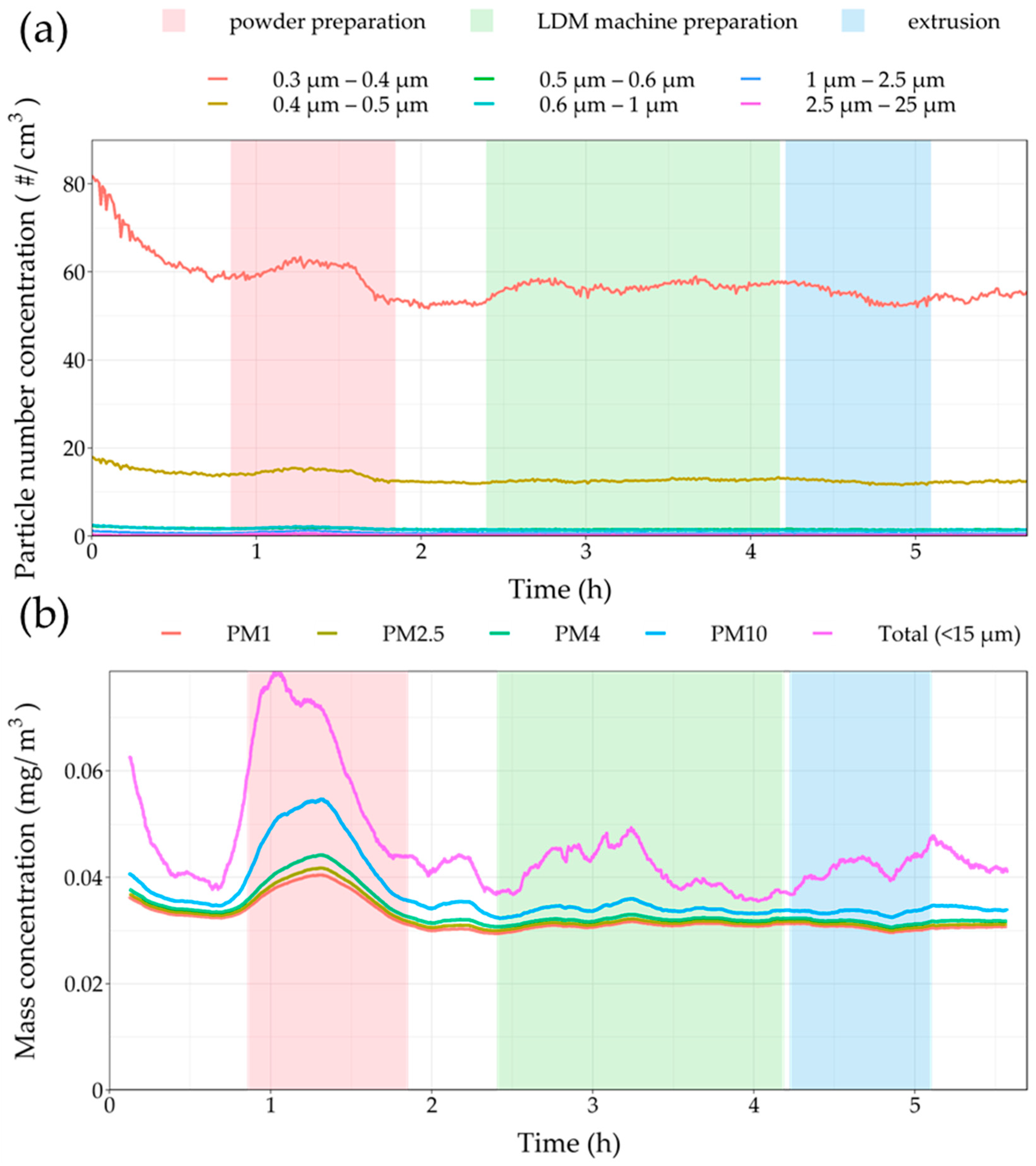
Release of particles of sizes 400 nm–25 μm was recorded during powder preparation (Figure 1). This release led to an increase in the airborne particle mass concentration (about 1 mg/m3 for PM4), which, however, remained under occupational exposure limits for kaolin, zeolite, and respirable dust (Table 2). On the other hand, there was an agreement between the optical and mass-based particle monitoring for the smaller particles in the LDM room (PM1, aerodynamic diameter < 1 μm, and PM2.5, aerodynamic diameter < 2.5 μm), where recorder concentrations were similar below 1 mg/m3.
The subsequent process steps had no detectable impact on particle number and mass concentrations. Minimal amount of released particles appeared to reach the adjacent corridor during powder preparation; however, values remained multiple orders of magnitude lower than those in the workroom and the applicable OEL (Figure 2). Smaller increases were also recorded in the corridor during LDM machine preparation and operation, but only for particles larger than 10 μm. One additional round of measurements was performed and is included in the Supplementary Information. The second round led to similar outcomes, emphasising the repeatability of the findings.
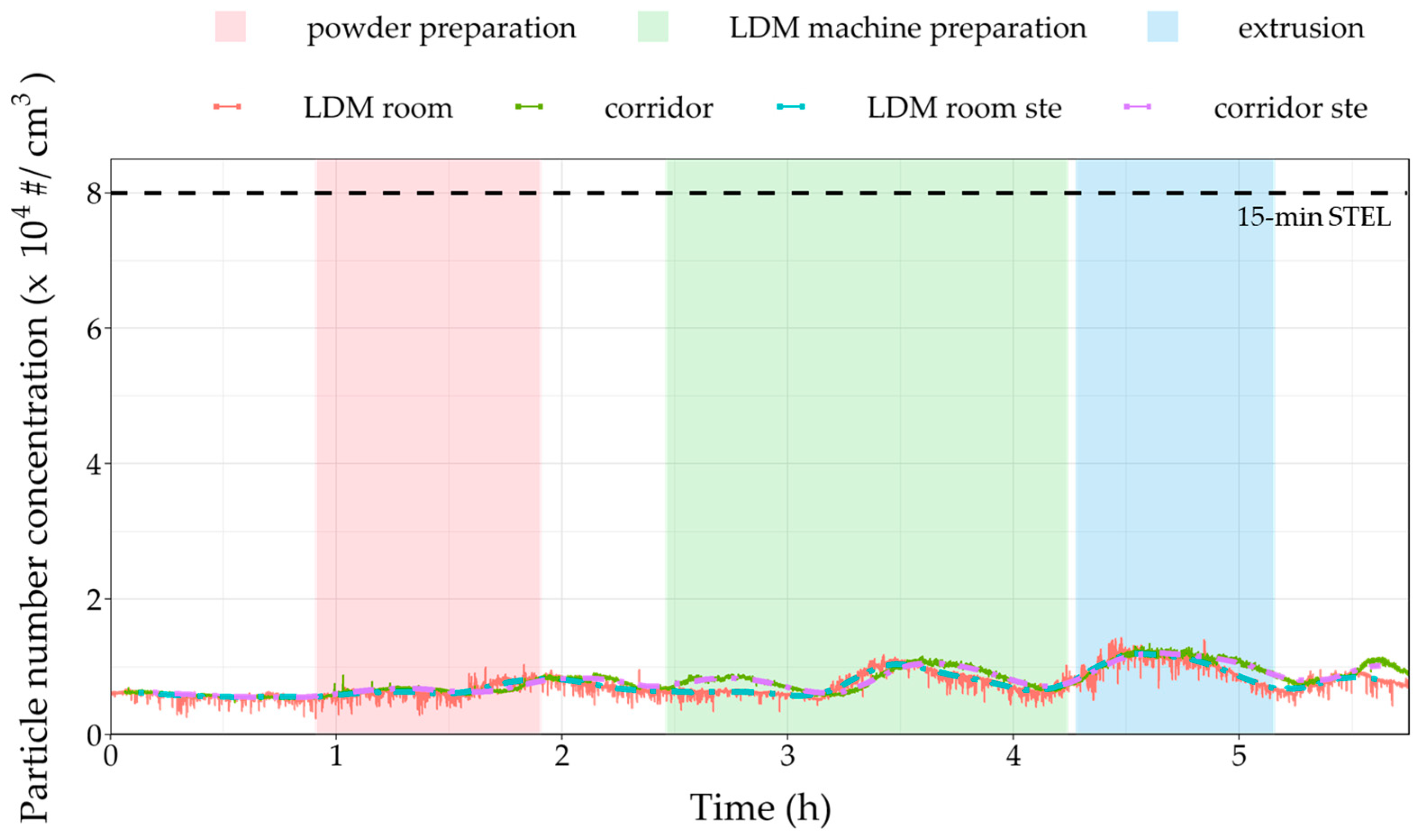
No release of particles smaller than 300 nm (Figure 3) was observed at any point of the process. Values remained close to 10,000 #/cm3 throughout the day for both areas and below the reference values (40,000 #/cm3 TWA, 80,000 #/cm3 STEL). Recorded concentrations do not present observable differences between the LDM workroom and the adjacent corridor.
Exposure of workers to airborne particles has been previously studied during the handling of multiple ceramic powders [39]. The results of this study showcased the potential release of micro-sized particles. Releases depended on the powder materials, with kaolin showing an increase in airborne particle matter (PM) and were affected by dustiness. A comprehensive study on particulate exposure during construction activities was published by the Deutsche Gesetzliche Unfallversicherung (DGUV) in 2020 [40]. The capacity of powder mixing to lead to the release of PM has been confirmed in multiple cases, coinciding with our findings, with values exceeding OELs in industrial settings [41]. Unlike more common AM technologies like Fused Filament Fabrication (FFF) [11,12] and metal laser-based AM [15,42], LDM does not appear to lead to the release of UFP as is expected due to the lack of high temperatures. Instead, potential exposure to only larger particles is observed. Hence, it can be concluded that the current engineering controls (e.g., ventilation system) provide adequate safety protection against particulate exposure, while further use of personal protective equipment would ensure an additional level of protection following the scheme of hierarchy of controls (ISO 45001:2018 [43]). Similar to metal AM, exposure can primarily occur during the preparatory steps.

3.3. Morphological and Chemical Analysis

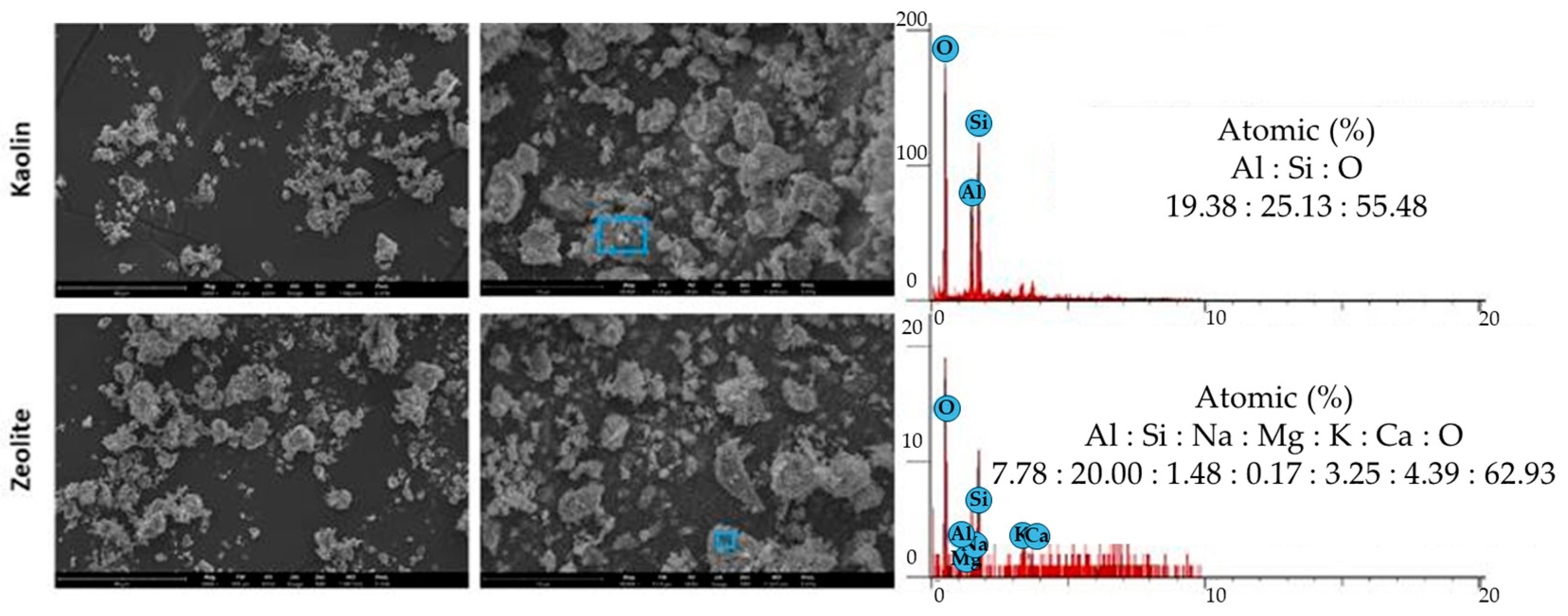
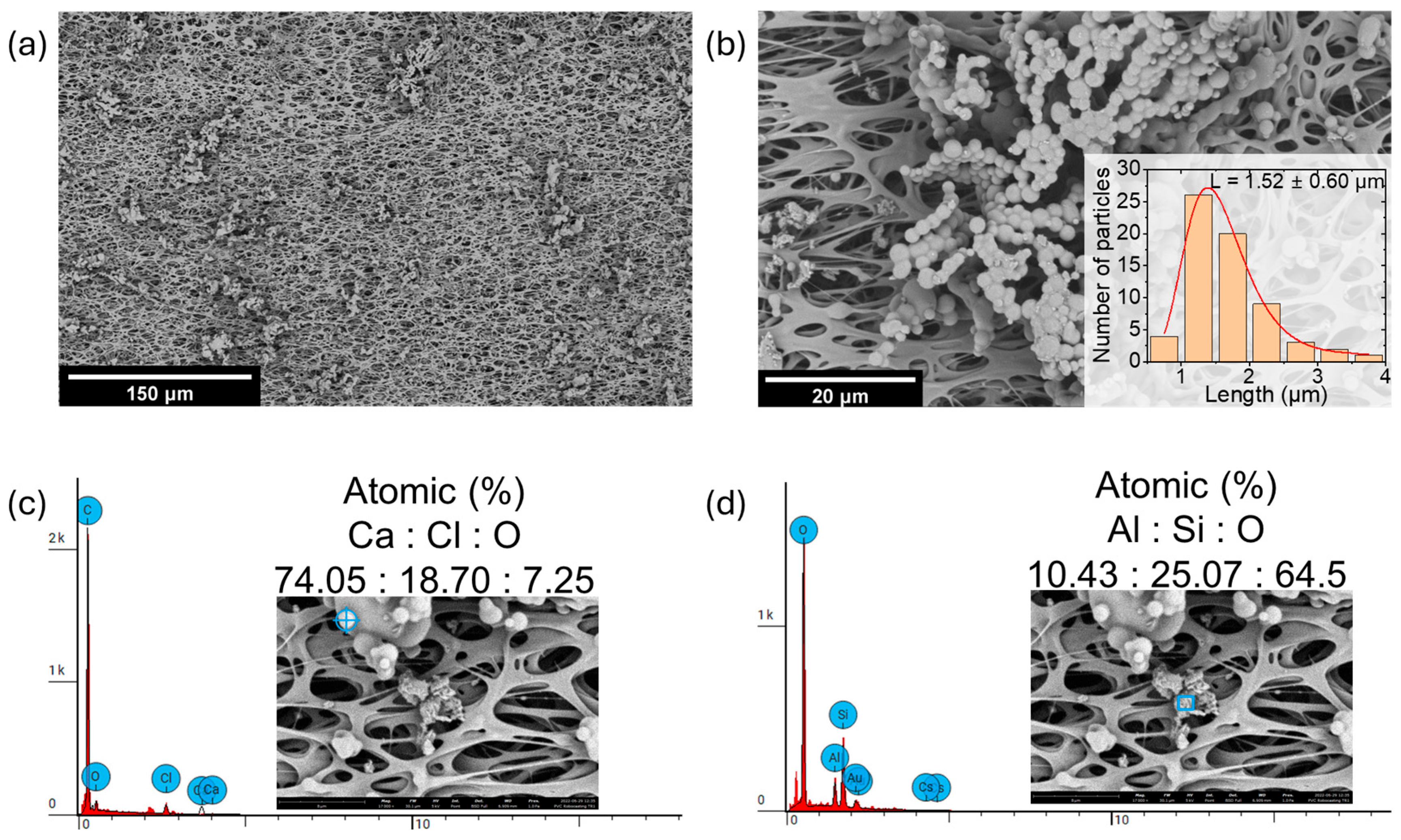
Morphological and compositional analysis of both raw ceramic powders and airborne particulate matter collected on filters was performed using SEM and EDS, respectively. SEM imaging revealed notable differences between the raw powders and the airborne particles generated during processing. While the raw kaolin and zeolite powders appear as non-uniform agglomerates with irregular morphology (Figure 4), the airborne particles collected on PVC filters during the exposure campaign predominantly exhibited spherical agglomerates with a size of 1.52 ± 0.60 μm (Figure 5). These morphological variations likely result from physical and chemical transformations occurring during aerosolisation and processing conditions [44]. Zeolite particles, typically forming spherical agglomerates, constituted the majority of the airborne particles, whereas kaolin is less abundant, and particles retained their irregular shapes. Elemental analysis corroborated the morphological findings, identifying the spherical particles as zeolite based on the presence of calcium, potassium, and magnesium [45], while irregular particles corresponded to kaolin, characterised by strong silicon and aluminium signals (Figure 5). The observed variation in particle shape and size distribution underscores the influence of processing on airborne particulate characteristics and highlights the necessity of incorporating these factors into occupational exposure assessments.

3.4. Toxicological Assessment

3.4.1. Toxicological Assessment of Raw Materials

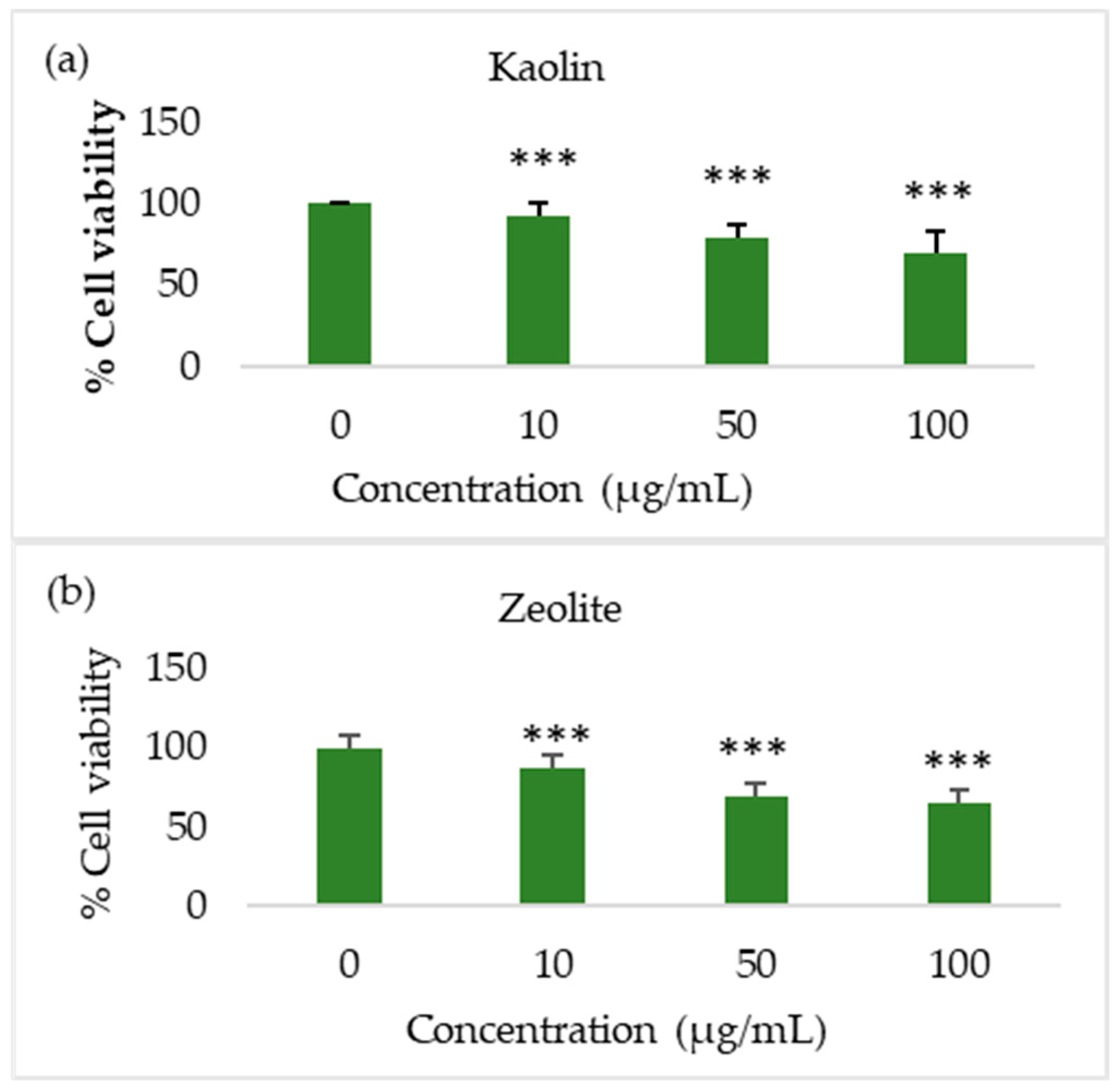
Human lung cells (A549) were cultured and treated in various concentrations (0, 10, 50 and 100 μg/mL) with the raw materials (LDM powders). After 48 h of exposure, cell viability was measured using MTT as already described in the methods section. As shown in the graphs below (Figure 6), cell viability appears to be affected upon exposure to >50 μg/mL of both kaolin and zeolite compared to the untreated cells. With this assay, the results demonstrate a clear decrease in cell viability as the concentration of both kaolin and zeolite increases. The MTT assay revealed a dose-dependent reduction in cell viability, probably due to mitochondrial dysfunction, increased oxidative stress, and activation of apoptotic pathways at higher concentrations of the compound [46]. These effects impair cellular metabolic activity, reducing MTT reduction and indicating cytotoxicity. Results demonstrate a dose-dependent reduction in cell viability after zeolite exposure, which aligns with previous studies reporting growth inhibition of lung fibroblasts [47]. Moreover, these results align with previous studies showing that zeolite reduces peripheral blood mononuclear cells (PBMCs) viability only at high concentrations, while lower doses have minimal effects. Together, these findings suggest that zeolite cytotoxicity is influenced by particle composition, size, and cellular uptake, supporting its potential to impair metabolic activity through stress-related mechanisms [48]. In agreement with these findings, recent studies have demonstrated that particle size and morphology strongly influence cytotoxic outcomes. Nano-sized kaolin particles were reported to induce stronger genotoxic responses than their micro-sized counterparts, through DNA damage, micronucleus formation, and ROS generation in human keratinocytes and fibroblasts [49]. Similarly, investigations into aluminosilicates revealed that spherical and sponge morphologies tend to exhibit low cytotoxicity compared to plates or nanotubular forms, underscoring the role of morphology in modulating cellular interactions [50]. These observations support our results, suggesting that the distinct particle sizes and shapes encountered in airborne exposures may enhance their biological activity compared to raw powders. The related dose–response curves are provided in the Supplementary Information (Figure S8).
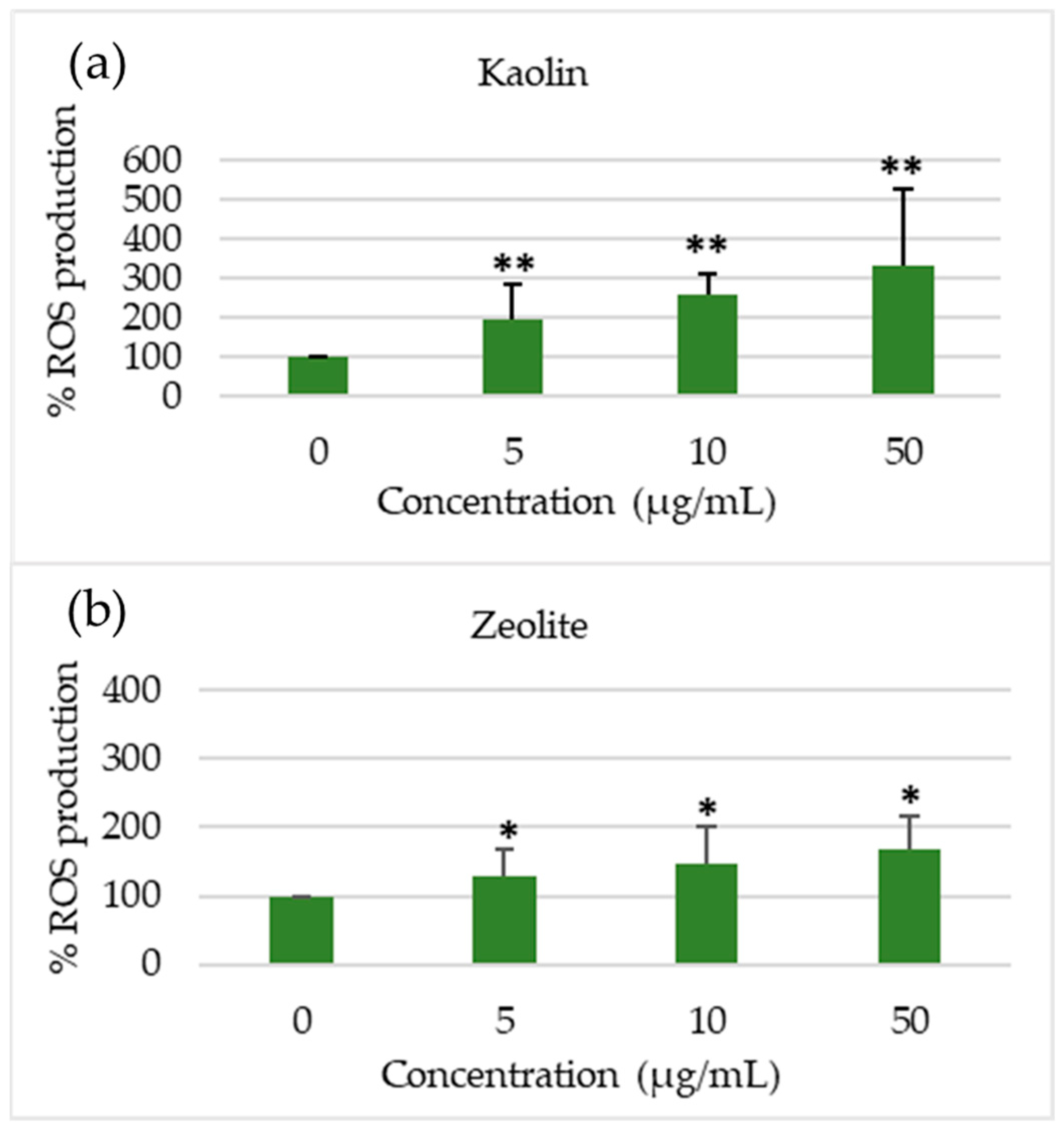
A549 cells were cultured and treated in various concentrations (0, 5, 10 and 50 μg/mL) with the raw materials. After 48 h of exposure, oxidative stress was measured by measuring the production of reactive oxygen species, as already described in the methods section. As illustrated in the graphs below, exposure to all tested concentrations of kaolin and zeolite results in a significant increase in the ROS levels relative to untreated controls, indicative of elevated oxidative stress. The elevation of the ROS production suggests that kaolin and zeolite induce oxidative stress through mechanisms involving mitochondrial dysfunction, disruption of the electron transport chain, and membrane destabilisation. Such effects induce redox homeostasis, leading to excessive ROS accumulation, which can potentially damage cellular macromolecules and impair cellular function (Figure 7). Increased ROS production was observed at concentrations as low as 10 μg/m, indicating that oxidative stress may lead to decreased cell viability [51].
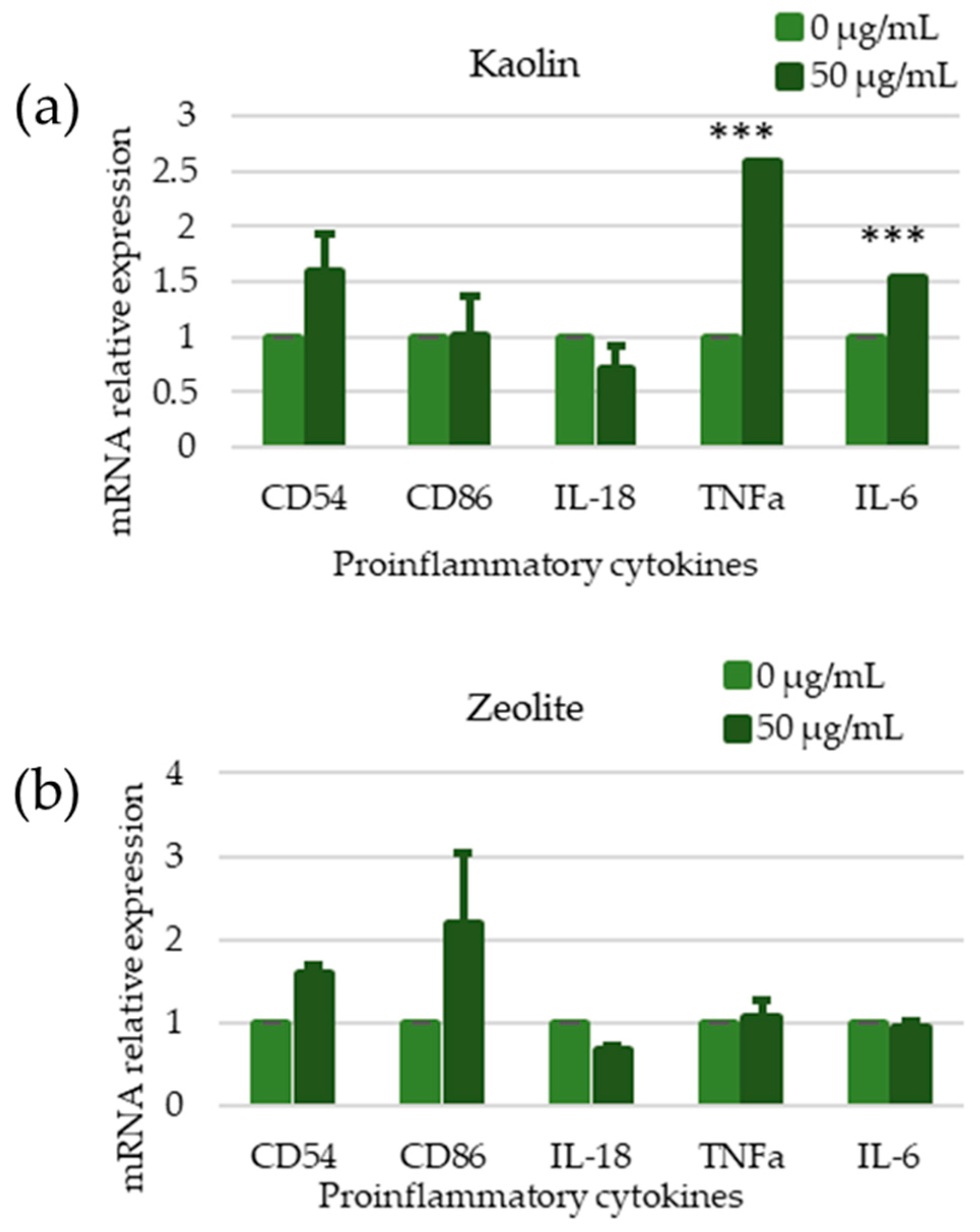
Human lung cells (A549) were treated for 48 h with the concentration (50 μg/mL) of kaolin and/or zeolite that previously showed a significant indication of toxicity. The mRNA expression levels of the pro-inflammatory cytokines CD54, CD86, IL-18, TNFα, and IL-6, all of which are involved in immune responses, were quantified through quantitative real-time PCR (qPCR), and normalised to the endogenous control, GAPDH, set as 1. Student’s unpaired t-test was performed for all genes and through different raw material exposure (kaolin and zeolite), kaolin seems to induce the messenger RNA (mRNA) relative expression of the cytokines IL-6 (p-value = 0.0000316) and TNF-α (p-value = 0.000159), while zeolite the relative mRNA expression levels does not give any statistically significant result (Figure 8). During the addition of kaolin 50 μg/mL to the cells, there seems to be an increase in early innate immune response signals like IL-6 and TNF-α cytokines. These molecules occur from monocytes and macrophages [52,53,54], which lead to activation of inflammatory signalling cascades, like NF-κB, MAPKs, and/or JAK/STAT pathways. Their upregulation indicates that cells are sensing a harmful stimulus and responding to contain or eliminate it. On the other hand, zeolite does not seem to affect the immune response of the cells during the addition of 50 μg/mL and does not induce any significant pro-inflammatory signal [55].
Beyond cytotoxicity, particle morphology and surface chemistry also appear to influence pro-inflammatory responses. SEM and EDS analyses showed that airborne zeolite particles were predominantly spherical and enriched in calcium, whereas kaolin particles retained irregular shapes and were dominated by silicon and aluminium (Figure 4 and Figure 5). These differences may affect cellular recognition and uptake, modulating inflammatory signalling [56]. In our experiments, exposure to kaolin increased IL-6 and TNF-α expression (Figure 8), suggesting that irregular shape combined with specific surface chemistry can trigger innate immune responses, whereas zeolite induced minimal cytokine expression under similar conditions.

3.4.2. Toxicological Assessment of Airborne Samples Collected During the Exposure Campaign

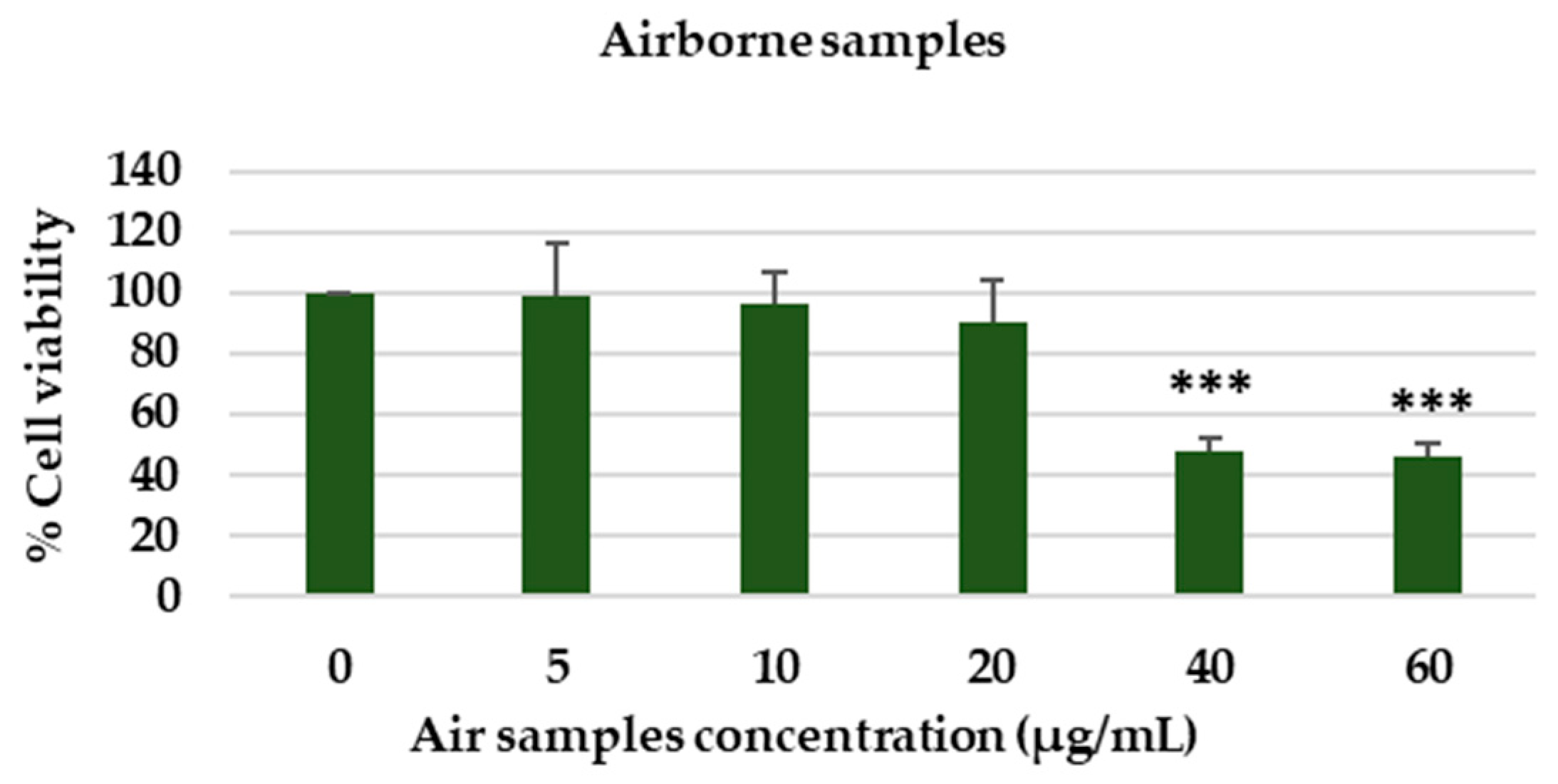
A549 cells were cultured and treated in various concentrations (0, 5, 10, 20, 40 and 60 μg/mL) with the airborne samples collected during the exposure campaign. After 48 h of exposure, cell viability was measured using MTT as already described in the methods section. As shown in the graph below (Figure 9), cell viability appears to be significantly affected upon exposure to <40 μg/mL of airborne samples, in contrast to lower concentrations, which do not show as noticeable a difference compared to the untreated cells. The observed decrease in cell viability reflects impaired mitochondrial enzymatic activity, specifically the diminished function of succinate dehydrogenase within the electron transport chain. Airborne particulates likely induce mitochondrial oxidative damage and disrupt electron transport, leading to reduced reduction of MTT to formazan. This mitochondrial dysfunction, coupled with elevated reactive oxygen species production, compromises cellular metabolic capacity and viability. The reduction in cell viability observed at higher concentrations of airborne particulate samples (>40 μg/mL) is likely attributable to multiple factors. Although airborne particulates comprise a complex mixture, the presence of kaolin and zeolite appears to contribute substantially to the cytotoxic response [57,58]. At elevated concentrations, these particles can induce mitochondrial dysfunction, oxidative stress, and activation of apoptotic pathways, consistent with the effects observed in exposures to the individual minerals. Furthermore, the physicochemical characteristics of airborne particles, including size, shape, aggregation state, and surface properties, may facilitate cellular internalization and amplify cellular stress responses. Collectively, these factors contribute to the dose-dependent reduction in cell viability, indicating that both particle composition and concentration are critical determinants of cytotoxicity in airborne exposures [59,60]. The related dose–response curve is provided in the Supplementary Information (Figure S9).
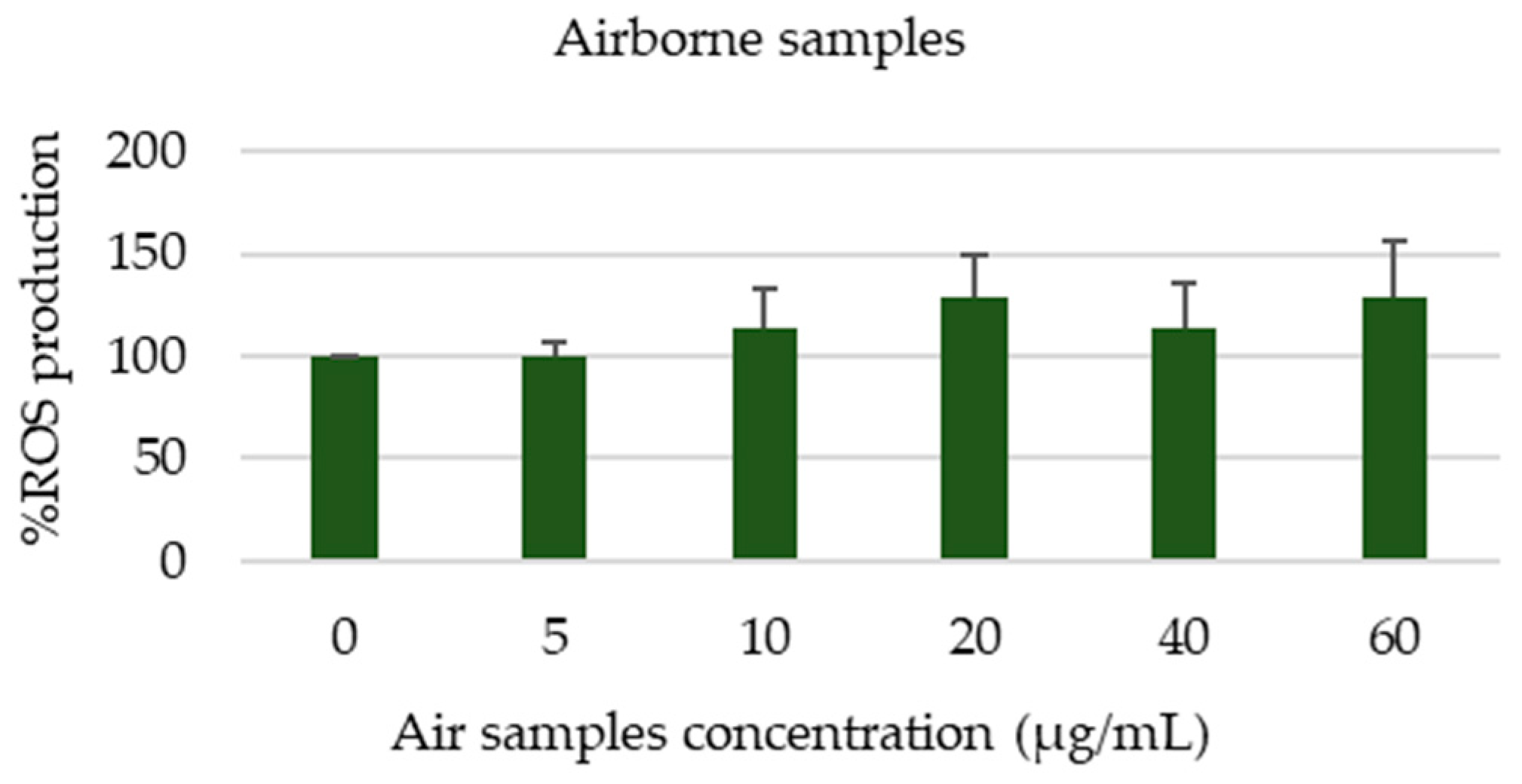
Following the assessment of cell viability through the MTT assay, where a dose-dependent cytotoxic effect was observed, we further investigated the underlying mechanism of cellular stress by measuring intracellular reactive oxygen species (ROS) levels. Since oxidative stress often precedes and contributes to cytotoxic outcomes, diluted concentrations of the airborne samples were used to detect early cellular responses. As shown in the graph (Figure 10), oxidative stress does not seem to be affected in the cell population upon exposure to different concentrations of airborne samples in comparison to untreated cells. The decrease in cell viability detected by the MTT assay, despite no increase in ROS production, indicates mitochondrial dysfunction that does not involve oxidative stress. This suggests that the airborne samples collected during the exposure campaign may impair mitochondrial enzyme activity directly or disrupt ATP synthesis without elevating ROS. Additionally, cellular antioxidant systems might effectively neutralise ROS, preventing detectable increases while metabolic capacity and viability decline.
Raw materials of zeolite and kaolin showed no significant toxicity effect at the tested concentrations (Figure 6), whereas airborne samples inhibited cell proliferation at a concentration of 40 μg/mL (Figure 9). It should be noted that airborne particulates represent a heterogeneous mixture rather than single-material exposures. The combined presence of both kaolin and zeolite may lead to interactive effects that amplify cellular responses. Likewise, mixtures of airborne heavy metals demonstrated enhanced toxicity in A549 cells compared with single-metal exposures [60]. Such evidence suggests that the co-presence of kaolin and zeolite in airborne samples may intensify cytotoxic outcomes beyond what is observed with individual raw materials [56]. This increase may also be attributed to the airborne micro-spherical morphology, which provides a larger specific surface area for cellular interaction [61]. This enhanced surface-to-volume ratio can promote greater protein adsorption, ROS generation, and cellular uptake, making the airborne particles more biologically active than the powdered forms of zeolite and kaolin [62].
The fluorescence intensity is proportional to the ROS levels, revealing responses between raw materials and airborne samples. As shown in the graphs (Figure 10), oxidative stress seems to be significantly altered in concentrations greater than 20 μg/mL in airborne samples, and for the raw materials, the ROS levels increase from 10 μg/mL, resulting in a greater total production of ROS in the case of raw materials. Interestingly, airborne samples decrease cell viability without a corresponding increase in ROS, suggesting alternative cytotoxic mechanisms.
In addition, the mineralogical composition of airborne samples should be considered. Systematic comparisons of mineral dusts have shown that even minor variations in composition can strongly influence cytotoxic and pro-inflammatory responses [63]. Findings indicate that the mixed composition of airborne particles may contribute to the higher toxicity observed compared with pure raw materials [64].

3.5. Limitations and Future Directions

Even though that study provides important information, it also has several limitations. First, although the in vitro models used in the experiments are valuable, they may not be fully representative of in vivo responses, and such analyses can currently be based on in vitro extrapolations for the kaolin–zeolite powders, especially in a chronic exposure context. At the same time, in terms of in vitro analysis, only a limited number of specific cell types were tested; therefore, tissue-specific and immunological effects relevant to occupational inhalation cannot be fully assessed. Past studies have shown that prolonged and chronic exposure to micro-sized and ultrafine particles may result in permanent high blood pressure and cardiovascular diseases [65,66,67], while in short-term exposure analyses, health effects seem to be mitigated upon lowering or eliminating the particle emissions [68]. Information on chronic studies and dose-dependent effects, biomarker monitoring, identification of no-observed-adverse-effect levels (NOAELs), and extensive physiological and haematological examinations would be necessary to proceed with detailed occupational risk assessment and design of appropriate control mitigation actions.
Particle deposition in workers’ respiratory tract would require estimation based on particle dosimetry models—such as models from the International Commission on Radiological Protection (ICRP) and Multiple-Path Particle Dosimetry Model (MPPD)—taking into account multiple parameters such as particle size, sphericity, density, etc. Similar estimations show that the dominant recorded particle sizes of PM10 based on the mass-based dosimeters have negligible deposition potential in the alveolar region, and they tend to deposit in the nasopharyngeal region; hence, they can be removed through exhalation [69].
Another study limitation concerns the characterisation of emitted particles and volatile organic compounds during the LDM operation. In the current setup, analysis was based on a specific powder mixture of kaolin and zeolite. However, the use of different mixtures and ratios of ceramic materials could provide a valuable insight into the safety aspects and exposure to hazardous substances during LDM. The airborne particulates that were generated in this study were not exhaustively characterised, whilst the focus was based on their morphological profile and elemental analysis based on SEM and EDS. However, further elemental analysis of the collected airborne samples based on atomic emission spectroscopy techniques and mass spectrometers would provide an in-depth assessment of dominant and trace elements, allowing the visualisation of the emission spectrum of the hazardous elements and particulate matter, and subsequently the detailed information about the nature of the workplace pollution and the human health effects. Therefore, it is difficult to correlate material property characteristics with biological outcomes.
While SEM and EDS provided valuable information on particle morphology and elemental composition, other critical physico-chemical parameters, such as surface area-to-volume ratio [70], zeta potential [62], and modified density [71], were not measured in this study. These parameters may influence particle–cell interactions, uptake, and cytotoxicity, and their absence limits the ability to fully correlate particle characteristics with biological outcomes [19,72,73]. Future work should incorporate these measurements alongside quantitative analyses linking particle morphology and surface chemistry to ROS production and inflammatory responses. Additionally, VOC monitoring was excluded from this study despite its importance for occupational safety and the health risks of VOCs. LDM used only ceramic materials; however, further steps should include sampling and analysis based on chromatographic techniques (e.g., gas chromatography) to evaluate the potential presence of VOC compounds in the process, emitted from unintentionally present contaminants or from the equipment operation [74].
Considering the real-life workplace, exposure involves complex co-exposure scenarios that cannot be replicated in a controlled small-scale laboratory setting. In a manufacturing environment—including the use of AM or other advanced and innovative industrial processes—there is a cumulative and aggregated exposure due to the simultaneous operation of different sets of equipment, operators and logistics [75]. Future studies on AM should include routine-based scenarios of multiple equipment operating in parallel and at different times, to allow realistic evaluation of emissions and air quality. Additionally, future directions could include performing similar exposure analyses in larger facilities, inducing different ventilation systems and engineering controls, thus providing an in-depth understanding of the potential exposure during LDM at larger scales. In the current study, measurements were performed in the near field of the main source (<1 m); however, the use of equipment suitable for measurements in the operator’s breathing zone could provide a more direct evaluation of potential exposure. At the same time, the use of Industry 4.0 technologies, such as Digital Twins and Artificial Intelligence algorithms, would provide the necessary feedback from simulations on dispersion of airborne hazards and real-time monitoring to design the appropriate engineering control options and personal protective equipment [76].

4. Conclusions

This study presents a detailed and comprehensive analysis of the material assessment and occupational safety during LDM. Following a tiered approach based on the OECD guidelines, the engineering control, such as the ventilation system, and on-site measurements for UFP and micro-size particles, provided the necessary input for the estimation of risks. Additionally, collection of air samples for morphological characterisation and toxicological analysis of emitted particles and toxicity performance of the raw ceramic material were performed, allowing an in-depth evaluation of their cytotoxic effects. The current ventilation system appeared to be at a sufficient level since concentrations of airborne substances promptly returned to background levels almost immediately after the completion of the emitting events. For LDM, since powder mixing is a manual process and based on both exposure and toxicity results, the PPE already available for the process (respirators, gloves, protective glasses) should be used consistently.
The raw materials in the manufacturing process—kaolin and zeolite—caused a decrease in cell viability, while an increase in ROS production suggested that there was a cytotoxicity mechanism mediated by oxidative stress. Furthermore, kaolin significantly induced high upregulation of TNF-α and IL-6 mRNA expression (qPCR), indicating the activation of pro-inflammatory pathways. Lastly, airborne samples collected in the on-site campaign decreased cell viability without affecting the ROS level, implying a ROS-independent mechanism of cytotoxicity, perhaps by direct metabolic inhibition. These outcomes highlight the need for toxicological evaluation for occupational risk assessment in liquid deposition modelling as it pertains to ceramic feedstock preparation and additive manufacturing of construction materials.

Ethics Statement

Based on Directive 2004/23/EC and the ICH Q5D guideline (CPMP/ICH/294/95), our study adheres to established ethical and regulatory standards for the use of human cell lines. The Directive ensures that tissues and cells are sourced with proper informed consent, maintained with traceability, and handled according to strict quality and safety standards, including protection against contamination and disease transmission. Complementing this, the ICH Q5D guideline emphasises cell line authentication, microbial contamination control, genetic and phenotypic stability, and thorough characterisation of cell substrates. Together, these frameworks ensure that our research practices are ethically responsible, legally compliant, and scientifically reliable. The EU guidelines (https://doi.org/10.1038/bjc.2014.166, accessed on 26 September 2025) explicitly address bioethical considerations by providing advice on complying with current legal and ethical requirements when deriving cell lines from human and animal tissues. This includes ensuring proper informed consent, ethical sourcing, and adherence to regulatory standards. Additionally, the guidelines cover best practices for cell line development, acquisition, authentication, cryopreservation, laboratory transfer, contamination control, and handling of genetic or phenotypic instability, thereby promoting responsible and ethically sound use of cell lines in research.

Supplementary Materials

The following supporting information can be downloaded at: https://www.mdpi.com/article/10.3390/jmmp9110367/s1, Figure S1: Workroom layout during exposure measurement; Figure S2: Representation of LDM workroom and measuring equipment placement; Figure S3: First repeat of the exposure assessment campaign at the LDM room. Particle number concentration as recorded by Aerotrak 9306-V2; Figure S4: First repeat of the exposure assessment campaign at the LDM room. Particle number concentration as recorded by CPC 3007; Figure S5: First repeat of the exposure assessment campaign at the LDM room. 15 min moving average of particle mass concentration as recorded by DustTrak DRX 8534; Figure S6: First repeat of the exposure assessment campaign at the adjacent corridor of the LDM room. 15 min moving average of particle mass concentration as recorded by DustTrak DRX 8534; Figure S7: Uv-Vis reference concentration/absorption data and standard curve; Figure S8: Dose-response curves for raw materials; Figure S9: Dose-response curves for collected air samples.

Author Contributions

Conceptualization, S.S. and E.P.K.; methodology, S.S., V.G., D.E.P. and V.T.; investigation, S.S., A.A., S.D. and D.E.P.; resources, E.P.K.; writing—original draft preparation, S.S., V.G., D.E.P., V.T., A.A. and S.D.; writing—review and editing, S.S., S.D. and E.P.K.; visualization, S.S., D.E.P. and A.A.; supervision, A.K. and E.P.K.; project administration, E.P.K.; funding acquisition, A.K. and E.P.K. All authors have read and agreed to the published version of the manuscript.

Funding

This research was funded by the European Union’s Horizon 2020 Research and Innovation Program iClimaBuilt (Grant Agreement number 952886).

Institutional Review Board Statement

Not applicable.

Informed Consent Statement

Not applicable.

Data Availability Statement

Data are contained within the article and Supplementary Materials.

Conflicts of Interest

The authors declare no conflicts of interest.

Ethics Statement

Based on Directive 2004/23/EC and the ICH Q5D guideline (CPMP/ICH/294/95), our study adheres to established ethical and regulatory standards for the use of human cell lines. The Directive ensures that tissues and cells are sourced with proper informed consent, maintained with traceability, and handled according to strict quality and safety standards, including protection against contamina-tion and disease transmission. Complementing this, the ICH Q5D guideline emphasises cell line authentication, microbial contamination control, genetic and phenotypic stability, and thorough characterisation of cell substrates. Together, these frameworks ensure that our research practices are ethically responsible, legally compliant, and scientifically reliable. The EU guidelines (https://doi.org/10.1038/bjc.2014.166, accessed on 26 September 2025) explicitly address bioethical considerations by providing advice on complying with current legal and ethical requirements when deriving cell lines from human and animal tissues. This includes ensuring proper informed consent, ethical sourcing, and adherence to regulatory standards. Additionally, the guidelines cover best practices for cell line development, acquisition, authentication, cryopreservation, laboratory transfer, contamination control, and handling of genetic or phenotypic instability, thereby pro-moting responsible and ethically sound use of cell lines in research.

References

  1. Antić, J.; Mišković, Ž.; Mitrović, R.; Stamenić, Z.; Antelj, J. The Risk Assessment of 3D Printing FDM Technology. Procedia Struct. Integr. 2023, 48, 274–279. [Google Scholar] [CrossRef]
  2. Kwon, S.-J.; Choi, S.-W.; Lee, E.-B. Hazard Identification and Risk Assessment During Simultaneous Operations in Industrial Plant Maintenance Based on Job Safety Analysis. Sustainability 2024, 16, 9277. [Google Scholar] [CrossRef]
  3. Daiber, A.; Kuntic, M.; Hahad, O.; Delogu, L.G.; Rohrbach, S.; Di Lisa, F.; Schulz, R.; Münzel, T. Effects of Air Pollution Particles (Ultrafine and Fine Particulate Matter) on Mitochondrial Function and Oxidative Stress—Implications for Cardiovascular and Neurodegenerative Diseases. Arch. Biochem. Biophys. 2020, 696, 108662. [Google Scholar] [CrossRef]
  4. Flood-Garibay, J.A.; Angulo-Molina, A.; Méndez-Rojas, M.Á. Particulate Matter and Ultrafine Particles in Urban Air Pollution and Their Effect on the Nervous System. Environ. Sci. Process. Impacts 2023, 25, 704–726. [Google Scholar] [CrossRef]
  5. Tang, C.-L.; Seeger, S. Systematic Ranking of Filaments Regarding Their Particulate Emissions during Fused Filament Fabrication 3D Printing by Means of a Proposed Standard Test Method. Indoor Air 2022, 32, e13010. [Google Scholar] [CrossRef]
  6. Jonnalagedda, R. TerraMound—Exploration with TPMS Geometries. Available online: https://fifteen2023.bartlettarchucl.com/dfm-2023/terramound (accessed on 26 February 2025).
  7. Gentile, V.; Vargas Velasquez, J.D.; Fantucci, S.; Autretto, G.; Gabrieli, R.; Gianchandani, P.K.; Armandi, M.; Baino, F. 3D-Printed Clay Components with High Surface Area for Passive Indoor Moisture Buffering. J. Build. Eng. 2024, 91, 109631. [Google Scholar] [CrossRef]
  8. Thakkar, H.; Eastman, S.; Hajari, A.; Rownaghi, A.A.; Knox, J.C.; Rezaei, F. 3D-Printed Zeolite Monoliths for CO2 Removal from Enclosed Environments. ACS Appl. Mater. Interfaces 2016, 8, 27753–27761. [Google Scholar] [CrossRef] [PubMed]
  9. Longen, W.C.; Barcelos, L.P.; Karkle, K.K.; Schutz, F.d.S.; Valvassori, S.d.S.; Victor, E.G.; Rohr, P.; Madeira, K. Avaliação da incapacidade e qualidade de vida de trabalhadores da produção de indústrias cerâmicas. Rev. Bras. De Med. Do Trab. 2018, 16, 10–18. [Google Scholar] [CrossRef]
  10. Fathy Mahmoed, A.; Sobhy Abd El-Aziz, M.; Hamido Abo Sree, T. Occupational Health Hazards among Workers in Ceramic Factories. J. Nurs. Sci. Benha Univ. 2021, 2, 54–68. [Google Scholar] [CrossRef]
  11. Karayannis, P.; Petrakli, F.; Gkika, A.; Koumoulos, E.P. 3D-Printed Lab-on-a-Chip Diagnostic Systems-Developing a Safe-by-Design Manufacturing Approach. Micromachines 2019, 10, 825. [Google Scholar] [CrossRef]
  12. Bernatikova, S.; Dudacek, A.; Prichystalova, R.; Klecka, V.; Kocurkova, L. Characterization of Ultrafine Particles and VOCs Emitted from a 3D Printer. Int. J. Environ. Res. Public Health 2021, 18, 929. [Google Scholar] [CrossRef]
  13. Dobrzyńska, E.; Kondej, D.; Kowalska, J.; Szewczyńska, M. State of the Art in Additive Manufacturing and Its Possible Chemical and Particle Hazards—Review. Indoor Air 2021, 31, 1733–1758. [Google Scholar] [CrossRef]
  14. Sargioti, N.; Karavias, L.; Gargalis, L.; Karatza, A.; Koumoulos, E.P.; Karaxi, E.K. Physicochemical and Toxicological Properties of Particles Emitted from Scalmalloy During the LPBF Process. Toxics 2025, 13, 398. [Google Scholar] [CrossRef]
  15. Jensen, A.C.Ø.; Harboe, H.; Brostrøm, A.; Jensen, K.A.; Fonseca, A.S. Nanoparticle Exposure and Workplace Measurements During Processes Related to 3D Printing of a Metal Object. Front. Public Health 2020, 8, 608718. [Google Scholar] [CrossRef]
  16. Noskov, A.; Ervik, T.K.; Tsivilskiy, I.; Gilmutdinov, A.; Thomassen, Y. Characterization of Ultrafine Particles Emitted during Laser-Based Additive Manufacturing of Metal Parts. Sci. Rep. 2020, 10, 20989. [Google Scholar] [CrossRef]
  17. Alijagic, A.; Engwall, M.; Särndahl, E.; Karlsson, H.; Hedbrant, A.; Andersson, L.; Karlsson, P.; Dalemo, M.; Scherbak, N.; Färnlund, K.; et al. Particle Safety Assessment in Additive Manufacturing: From Exposure Risks to Advanced Toxicology Testing. Front. Toxicol. 2022, 4, 836447. [Google Scholar] [CrossRef]
  18. Abbasi, R.; Shineh, G.; Mobaraki, M.; Doughty, S.; Tayebi, L. Structural Parameters of Nanoparticles Affecting Their Toxicity for Biomedical Applications: A Review. J. Nanopart Res. 2023, 25, 43. [Google Scholar] [CrossRef]
  19. Oberdörster, G.; Oberdörster, E.; Oberdörster, J. Nanotoxicology: An Emerging Discipline Evolving from Studies of Ultrafine Particles. Environ. Health Perspect. 2005, 113, 823–839. [Google Scholar] [CrossRef]
  20. Larese Filon, F.; Mauro, M.; Adami, G.; Bovenzi, M.; Crosera, M. Nanoparticles Skin Absorption: New Aspects for a Safety Profile Evaluation. Regul. Toxicol. Pharmacol. 2015, 72, 310–322. [Google Scholar] [CrossRef]
  21. Joudeh, N.; Linke, D. Nanoparticle Classification, Physicochemical Properties, Characterization, and Applications: A Comprehensive Review for Biologists. J. Nanobiotechnology 2022, 20, 262. [Google Scholar] [CrossRef]
  22. Buzea, C.; Pacheco, I.I.; Robbie, K. Nanomaterials and Nanoparticles: Sources and Toxicity. Biointerphases 2007, 2, MR17–MR71. [Google Scholar] [CrossRef]
  23. Ifemeje, J.C.; Udedi, S.C.; Okechukwu, A.U.; Nwaka, A.C.; Lukong, C.B.; Anene, I.N.; Egbuna, C.; Ezeude, I.C. Determination of Total Protein, Superoxide Dismutase, Catalase Activity and Lipid Peroxidation in Soil Macro-Fauna (Earthworm) from Onitsha Municipal Open Waste Dump. J. Sci. Res. Rep. 2015, 6, 394–403. [Google Scholar] [CrossRef]
  24. Abdal Dayem, A.; Hossain, M.; Lee, S.; Kim, K.; Saha, S.; Yang, G.-M.; Choi, H.; Cho, S.-G. The Role of Reactive Oxygen Species (ROS) in the Biological Activities of Metallic Nanoparticles. Int. J. Mol. Sci. 2017, 18, 120. [Google Scholar] [CrossRef]
  25. Manke, A.; Wang, L.; Rojanasakul, Y. Mechanisms of Nanoparticle-Induced Oxidative Stress and Toxicity. Biomed. Res. Int. 2013, 2013, 942916. [Google Scholar] [CrossRef]
  26. Olympus Minerals Olympus Minerals. XRD Analysis of Greek Zeolite Performed by The Mineral Lab, Inc. 2017. Available online: https://olympus-minerals.com/wp-content/uploads/2019/07/XRD-ANALYSIS-OF-GREEK-ZEOLITE-PERFORMED-BY-THE-MINERAL-LAB-INC.pdf (accessed on 26 September 2025).
  27. Prolat. Kaolin Technical Data Sheet. Available online: https://www.prolat.gr/wp-content/uploads/2016/05/Kaolin-Prolat_tds_en_v3_2021.pdf (accessed on 26 September 2025).
  28. Organisation for Economic Co-Operation and Development. Harmonized Tiered Approach to Measure and Assess the Potential Exposure to Airborne Emissions of Engineered Nano-Objects and Their Agglomerates and Aggregates at Workplaces; ENV/JM/MONO(2015)19; Organisation for Economic Co-Operation and Development: Paris, France, 2015. [Google Scholar]
  29. ISO/TS 12901-2:2014; Nanotechnologies—Occupational Risk Management Applied to Engineered Nanomaterials—Part 2: Use of the Control Banding Approach. International Organization for Standardization: Geneva, Switzerland, 2014.
  30. Great Britain; Health and Safety Executive (HSE). COSHH Essentials, Easy Steps to Control Health Risks from Chemicals. Available online: https://web.archive.org/web/20250122040128/http://coshh-tool.hse.gov.uk/ (accessed on 7 March 2024).
  31. GESTIS International Limit Values. Available online: https://limitvalue.ifa.dguv.de/ (accessed on 29 January 2024).
  32. van Broekhuizen, P.; van Veelen, W.; Streekstra, W.-H.; Schulte, P.; Reijnders, L. Exposure Limits for Nanoparticles: Report of an International Workshop on Nano Reference Values. Ann. Occup. Hyg. 2012, 56, 515–524. [Google Scholar] [CrossRef]
  33. Baybutt, P. The ALARP Principle in Process Safety. Process Saf. Prog. 2014, 33, 36–40. [Google Scholar] [CrossRef]
  34. Geraghty, R.J.; Capes-Davis, A.; Davis, J.M.; Downward, J.; Freshney, R.I.; Knezevic, I.; Lovell-Badge, R.; Masters, J.R.W.; Meredith, J.; Stacey, G.N.; et al. Guidelines for the Use of Cell Lines in Biomedical Research. Br. J. Cancer 2014, 111, 1021–1046. [Google Scholar] [CrossRef]
  35. Zhang, Q.; Pardo, M.; Rudich, Y.; Kaplan-Ashiri, I.; Wong, J.P.S.; Davis, A.Y.; Black, M.S.; Weber, R.J. Chemical Composition and Toxicity of Particles Emitted from a Consumer-Level 3D Printer Using Various Materials. Environ. Sci. Technol. 2019, 53, 12054–12061. [Google Scholar] [CrossRef]
  36. Schneider, C.A.; Rasband, W.S.; Eliceiri, K.W. NIH Image to ImageJ: 25 Years of Image Analysis. Nat. Methods 2012, 9, 671–675. [Google Scholar] [CrossRef]
  37. C&L Inventory—ECHA—Quartz. Available online: https://echa.europa.eu/en/information-on-chemicals/cl-inventory-database/-/discli/details/54394 (accessed on 28 August 2025).
  38. ASHRAE Technical Committee 9.10, Laboratory Systems (Ed.). Classification of Laboratory Ventilation Design Levels; ASHRAE: Atlanta, GA, USA, 2018. [Google Scholar]
  39. Ribalta, C.; López-Lilao, A.; Estupiñá, S.; Fonseca, A.S.; Tobías, A.; García-Cobos, A.; Minguillón, M.C.; Monfort, E.; Viana, M. Health Risk Assessment from Exposure to Particles during Packing in Working Environments. Sci. Total Environ. 2019, 671, 474–487. [Google Scholar] [CrossRef]
  40. Mattenklott, M.; Pflaumbaum, W.; Smola, T.; Stamm, R.; Steinhausen, M.; Binde, G. IFA Report 6/2020e: Occupational Exposure to Inhalable and Respirable Dust Fractions; Deutsche Gesetzliche Unfallversicherung e.V. (DGUV): Berlin, Germany, 2021. [Google Scholar]
  41. Azarmi, F.; Kumar, P.; Mulheron, M. The Exposure to Coarse, Fine and Ultrafine Particle Emissions from Concrete Mixing, Drilling and Cutting Activities. J. Hazard. Mater. 2014, 279, 268–279. [Google Scholar] [CrossRef]
  42. Gomes, J.F.; Miranda, R.M.; Oliveira, J.P.; Esteves, H.M.; Albuquerque, P.C. Evaluation of the Amount of Nanoparticles Emitted in LASER Additive Manufacture/Welding. Inhal. Toxicol. 2019, 31, 125–130. [Google Scholar] [CrossRef]
  43. ISO 45001:2018; Occupational Health and Safety Management Systems—Requirements with Guidance for Use. International Organization for Standardization: Geneva, Switzerland, 2018.
  44. Wu, J.; Faccinetto, A.; Grimonprez, S.; Batut, S.; Yon, J.; Desgroux, P.; Petitprez, D. Influence of the Dry Aerosol Particle Size Distribution and Morphology on the Cloud Condensation Nuclei Activation. An Experimental and Theoretical Investigation. Atmos. Chem. Phys. 2020, 20, 4209–4225. [Google Scholar] [CrossRef]
  45. Ferreira, D.R.; Schulthess, C.P. The Nanopore Inner Sphere Enhancement Effect on Cation Adsorption: Sodium, Potassium, and Calcium. Soil Sci. Soc. Am. J. 2011, 75, 389–396. [Google Scholar] [CrossRef]
  46. Ott, M.; Gogvadze, V.; Orrenius, S.; Zhivotovsky, B. Mitochondria, Oxidative Stress and Cell Death. Apoptosis 2007, 12, 913–922. [Google Scholar] [CrossRef]
  47. Yu, S.-H.; Kumar, M.; Kim, I.W.; Rimer, J.D.; Kim, T.-J. A Comparative Analysis of In Vitro Toxicity of Synthetic Zeolites on IMR-90 Human Lung Fibroblast Cells. Molecules 2021, 26, 3194. [Google Scholar] [CrossRef]
  48. Shamsabad, F.N.; Salehi, M.H.; Shams, J.; Ghazanfari, T. Cytotoxicity of Bentonite, Zeolite, and Sepiolite Clay Minerals on Peripheral Blood Mononuclear Cells. Immunoregulation 2023, 5, 121–130. [Google Scholar] [CrossRef]
  49. Kawanishi, M.; Yoneda, R.; Totsuka, Y.; Yagi, T. Genotoxicity of Micro- and Nano-Particles of Kaolin in Human Primary Dermal Keratinocytes and Fibroblasts. Genes Environ. 2020, 42, 16. [Google Scholar] [CrossRef]
  50. Golubeva, O.Y.; Alikina, Y.A.; Brazovskaya, E.Y. Particles Morphology Impact on Cytotoxicity, Hemolytic Activity and Sorption Properties of Porous Aluminosilicates of Kaolinite Group. Nanomaterials 2022, 12, 2559. [Google Scholar] [CrossRef]
  51. Mitochondria in Oxidative Stress, Inflammation and Aging: From Mechanisms to Therapeutic Advances|Signal Transduction and Targeted Therapy. Available online: https://www.nature.com/articles/s41392-025-02253-4 (accessed on 28 August 2025).
  52. Chen, L.; Deng, H.; Cui, H.; Fang, J.; Zuo, Z.; Deng, J.; Li, Y.; Wang, X.; Zhao, L. Inflammatory Responses and Inflammation-Associated Diseases in Organs. Oncotarget 2018, 9, 7204–7218. [Google Scholar] [CrossRef]
  53. Chen, S.; Saeed, A.F.U.H.; Liu, Q.; Jiang, Q.; Xu, H.; Xiao, G.G.; Rao, L.; Duo, Y. Macrophages in Immunoregulation and Therapeutics. Signal Transduct. Target. Ther. 2023, 8, 207. [Google Scholar] [CrossRef]
  54. Li, H.; Wang, A.; Zhang, Y.; Wei, F. Diverse Roles of Lung Macrophages in the Immune Response to Influenza A Virus. Front. Microbiol. 2023, 14, 1260543. [Google Scholar] [CrossRef]
  55. Mussbacher, M.; Derler, M.; Basílio, J.; Schmid, J.A. NF-κB in Monocytes and Macrophages—An Inflammatory Master Regulator in Multitalented Immune Cells. Front. Immunol. 2023, 14, 1134661. [Google Scholar] [CrossRef]
  56. Albanese, A.; Tang, P.S.; Chan, W.C.W. The Effect of Nanoparticle Size, Shape, and Surface Chemistry on Biological Systems. Annu. Rev. Biomed. Eng. 2012, 14, 1–16. [Google Scholar] [CrossRef]
  57. Abdelhalim, A.; Melegy, A.; Othman, D. Assessment of Synthetic Zeolites from Kaolin and Bentonite Clays for Wastewater and Fuel Gases Treatment. J. Afr. Earth Sci. 2025, 227, 105621. [Google Scholar] [CrossRef]
  58. Davies, R. Factors Involved in the Cytotoxicity of Kaolinite towards Macrophages in Vitro. Environ. Health Perspect. 1983, 51, 249–252. [Google Scholar] [CrossRef][Green Version]
  59. Guo, B.; Zebda, R.; Drake, S.J.; Sayes, C.M. Synergistic Effect of Co-Exposure to Carbon Black and Fe2O3 Nanoparticles on Oxidative Stress in Cultured Lung Epithelial Cells. Part. Fibre Toxicol. 2009, 6, 4. [Google Scholar] [CrossRef]
  60. Choi, Y.; Park, K.; Kim, I.; Kim, S.D. Combined Toxic Effect of Airborne Heavy Metals on Human Lung Cell Line A549. Environ. Geochem. Health 2018, 40, 271–282. [Google Scholar] [CrossRef]
  61. Kato, T.; Toyooka, T.; Ibuki, Y.; Masuda, S.; Watanabe, M.; Totsuka, Y. Effect of Physicochemical Character Differences on the Genotoxic Potency of Kaolin. Genes Environ. 2017, 39, 12. [Google Scholar] [CrossRef]
  62. Awashra, M.; Młynarz, P. The Toxicity of Nanoparticles and Their Interaction with Cells: An in Vitro Metabolomic Perspective. Nanoscale Adv. 2023, 5, 2674–2723. [Google Scholar] [CrossRef]
  63. Grytting, V.S.; Refsnes, M.; Låg, M.; Erichsen, E.; Røhr, T.S.; Snilsberg, B.; White, R.A.; Øvrevik, J. The Importance of Mineralogical Composition for the Cytotoxic and Pro-Inflammatory Effects of Mineral Dust. Part. Fibre Toxicol. 2022, 19, 46. [Google Scholar] [CrossRef]
  64. Wiemann, M.; Vennemann, A.; Wohlleben, W. Lung Toxicity Analysis of Nano-Sized Kaolin and Bentonite: Missing Indications for a Common Grouping. Nanomaterials 2020, 10, 204. [Google Scholar] [CrossRef]
  65. Seihei, N.; Farhadi, M.; Takdastan, A.; Asban, P.; Kiani, F.; Mohammadi, M.J. Short-Term and Long-Term Effects of Exposure to PM10. Clin. Epidemiol. Glob. Health 2024, 27, 101611. [Google Scholar] [CrossRef]
  66. Bouma, F.; Janssen, N.A.; Wesseling, J.; van Ratingen, S.; Strak, M.; Kerckhoffs, J.; Gehring, U.; Hendricx, W.; de Hoogh, K.; Vermeulen, R.; et al. Long-Term Exposure to Ultrafine Particles and Natural and Cause-Specific Mortality. Environ. Int. 2023, 175, 107960. [Google Scholar] [CrossRef]
  67. Lachowicz, J.I.; Gać, P. Short-Term and Long-Term Effects of Inhaled Ultrafine Particles on Blood Markers of Cardiovascular Diseases: A Systematic Review and Meta-Analysis. J. Clin. Med. 2025, 14, 2846. [Google Scholar] [CrossRef]
  68. Lachowicz, J.I.; Gać, P. Short- and Long-Term Effects of Inhaled Ultrafine Particles on Blood Pressure: A Systematic Review and Meta-Analysis. J. Clin. Med. 2024, 13, 6802. [Google Scholar] [CrossRef]
  69. Hoover, M.D.; Stefaniak, A.B.; Day, G.A.; Geraci, C.L. Exposure Assessment Considerations for Nanoparticles in the Workplace. In Nanotoxicology: Characterization, Dosing, and Health Effects; Informa healthcare: New York, NY, USA, 2007; pp. 71–83. [Google Scholar]
  70. Ahire, S.A.; Bachhav, A.A.; Pawar, T.B.; Jagdale, B.S.; Patil, A.V.; Koli, P.B. The Augmentation of Nanotechnology Era: A Concise Review on Fundamental Concepts of Nanotechnology and Applications in Material Science and Technology. Results Chem. 2022, 4, 100633. [Google Scholar] [CrossRef]
  71. Weiss, M.; Fan, J.; Claudel, M.; Sonntag, T.; Didier, P.; Ronzani, C.; Lebeau, L.; Pons, F. Density of Surface Charge Is a More Predictive Factor of the Toxicity of Cationic Carbon Nanoparticles than Zeta Potential. J. Nanobiotechnol. 2021, 19, 5. [Google Scholar] [CrossRef]
  72. Honary, S.; Zahir, F. Effect of Zeta Potential on the Properties of Nano-Drug Delivery Systems—A Review (Part 1). Trop. J. Pharm. Res. 2013, 12, 255–264. [Google Scholar] [CrossRef]
  73. DeLoid, G.M.; Cohen, J.M.; Pyrgiotakis, G.; Pirela, S.V.; Pal, A.; Liu, J.; Srebric, J.; Demokritou, P. Advanced Computational Modeling for in Vitro Nanomaterial Dosimetry. Part. Fibre Toxicol. 2015, 12, 32. [Google Scholar] [CrossRef]
  74. Takeuchi, F.; Ozaki, M. Evaluation of VOC Emissions from Electrical Components. FUJITSU Sci. Tech. J. 2025, 45, 115–122. [Google Scholar]
  75. Kienzler, A.; Bopp, S.K.; van der Linden, S.; Berggren, E.; Worth, A. Regulatory Assessment of Chemical Mixtures: Requirements, Current Approaches and Future Perspectives. Regul. Toxicol. Pharmacol. 2016, 80, 321–334. [Google Scholar] [CrossRef] [PubMed]
  76. Damilos, S.; Saliakas, S.; Karasavvas, D.; Koumoulos, E.P. An Overview of Tools and Challenges for Safety Evaluation and Exposure Assessment in Industry 4.0. Appl. Sci. 2024, 14, 4207. [Google Scholar] [CrossRef]
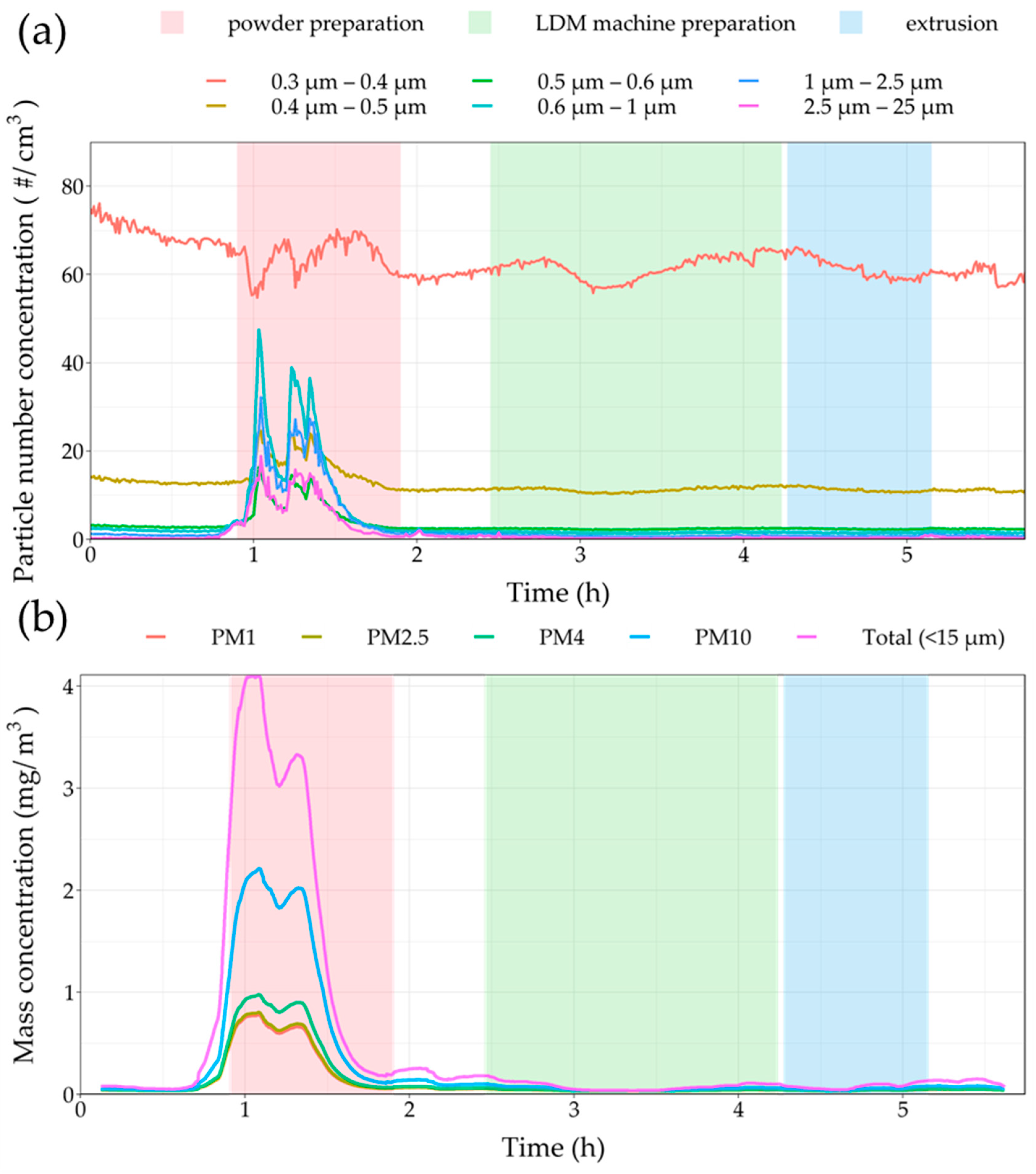
Figure 1. Measurement results for the LDM room. (a) Particle number concentration as recorded by Aerotrak 9306-V2 and (b) 15 min moving average of particle mass concentration as recorded by DustTrak DRX 8534.
Jmmp 09 00367 g001
Figure 2. Measurement results for the corridor adjacent to the LDM room. (a) Particle number concentration as recorded by Aerotrak 9306-V2, (b) 15 min moving average of particle mass concentration as recorded by DustTrak DRX 8534.
Jmmp 09 00367 g002
Figure 3. Measurement results of submicron particle number concentration as recorded by CPC 3007 in the LDM room and the adjacent corridor. The STE lines represent the 15 min average values. The dashed line represents the 15 min short-term exposure limit (STEL) at 80,000 particles/cm3.
Jmmp 09 00367 g003
Figure 4. SEM images of kaolin (Top) and zeolite (Bottom) raw powders, along with their corresponding EDS spectra acquired from the regions highlighted by blue rectangles in the SEM images.
Jmmp 09 00367 g004
Figure 5. (a,b) SEM images of PVC filters with attached airborne particles. The insets show the corresponding particle size distribution. EDS spectrum of (c) a spherical particle and (d) an irregular particle. The insets display the SEM images with the marked regions where the EDS analyses were performed.
Jmmp 09 00367 g005
Figure 6. Cell viability assessment of the raw materials (a) kaolin and (b) zeolite (n = 9), compared with the untreated group. Statistical analysis was performed using the one-way ANOVA test. Positive error bars are equal to one standard deviation. Three levels of statistical significance are considered: p-value < 0.001 (***).
Jmmp 09 00367 g006
Figure 7. Oxidative stress assessment of the raw materials (a) kaolin and (b) zeolite (n = 7), compared with the untreated control cells, which were set at 100%. Statistical analysis was performed using the one-way ANOVA test. Positive error bars are equal to one standard deviation. Three levels of statistical significance are considered: p-value < 0.05 (*) and <0.01 (**).
Jmmp 09 00367 g007
Figure 8. Inflammatory gene expression upon exposure to the raw materials (kaolin (a) and zeolite (b)). RNA was isolated from the A549 cells upon treatment, and mRNA levels were determined by qRT-PCR and calculated by the 2ΔCT method with the expression levels of each mRNA normalised to the endogenous GAPDH mRNA (n = 2). Statistical analysis was performed by Student’s unpaired t-test. Positive error bars are equal to one standard deviation. Three levels of statistical significance are considered: p-value < 0.001 (***).
Jmmp 09 00367 g008
Figure 9. Cell viability assessment of the airborne samples (n = 4), compared with the untreated group. Statistical analysis was performed using the one-way ANOVA test. Positive error bars are equal to one standard deviation. Three levels of statistical significance are considered: p-value < 0.001 (***).
Jmmp 09 00367 g009
Figure 10. Oxidative stress upon exposure to the airborne samples (n = 4), compared with the untreated control cells, which were set at 100%. Statistical analysis was performed using the one-way ANOVA test. Positive error bars are equal to one standard deviation.
Jmmp 09 00367 g010
Table 1. Instruments used during on-site exposure assessment.
InstrumentMeasurement TypeSize RangeCutoffsFlow RateSampling RateLog
Interval
Uncertainty Range
CPC 3007, TSIParticle number
concentration
10 nm–1 μm-0.7 L/min1 s1 s20%
Aerotrak 9306-V2, TSIParticle number
concentration
300 nm–25 μm(0.4, 0.5, 0.6, 1, 2.5) μm2.83 L/min1 s (for 40 s followed by 20 s reset)1 min10%
DustTrak DRX 8534, TSIParticle mass concentration100 nm–15 μm(1, 2.5, 4, 10) μm3 L/min1 s1 min10%
Table 2. Available OELs of substances evaluated [31].
SubstanceLimit (mg/m3)Authority
respirable dustTWA: 5
STE: 10
Austria
TWA: 3Belgium, Spain, Switzerland
TWA: 1.25Germany
TWA: 6Hungary
TWA: 4Ireland
TWA: 0.9France
TWA: 5USA
kaolin (respirable)TWA: 2Belgium, Denmark, Finland, Ireland, Spain
TWA: 10France, Poland
zeoliteTWA: 2Latvia
Table 3. Oligonucleotides PCR primers (by Eurofins Genomics).
GeneForward SequenceReverse Sequence
Pro-inflammatory
cytokines
CD54AGCGGCTGACGTGTGCAGTAATTCTGAGACCTCTGGCTTCGTCA
CD86CCATCAGCTTGTCTGTTTCATTCCGCTGTAATCCAAGGAATGTGGTC
IL-18GATAGCCAGCCTAGAGGTATGGCCTTGATGTTATCAGGAGGATTCA
TNFaCTCTTCTGCCTGCTGCACTTTGATGGGCTACAGGCTTGTCACTC
IL-6AGACAGCCACTCACCTCTTCAGTTCTGCCAGTGCCTCTTTGCTG
Endogenous
control
PMAIP1CTGGAAGTCGAGTGTGCTACTCTGAAGGAGTCCCCTCATGCAAG
GAPDHGTCTCCTCTGACTTCAACAGCGACCACCCTGTTGCTGTAGCCAA
Table 4. Material hazard classification.
MaterialHazard Band
ISO/TS 12901-2COSHH E-Tool
KaolinANot classified
ZeoliteANot classified
Disclaimer/Publisher’s Note: The statements, opinions and data contained in all publications are solely those of the individual author(s) and contributor(s) and not of MDPI and/or the editor(s). MDPI and/or the editor(s) disclaim responsibility for any injury to people or property resulting from any ideas, methods, instructions or products referred to in the content.