
Review

Challenges and Opportunities in Friction-Based Additive Manufacturing of Heat-Treatable Aluminum Alloys

by
Adeel Hassan
1,*,
Mokhtar Che Ismail
1,
Srinivasa Rao Pedapati
2,*,
Roshan Vijay Marode
3,
Khurram Altaf
1 and
Santoshi Pedapati
2
1
Department of Mechanical Engineering, Universiti Teknologi PETRONAS, Seri Iskandar 32610, Perak Darul Ridzuan, Malaysia
2
College of Engineering & Sciences, The University of Texas Permian Basin, 11105 West Highway 191, Midland, TX 79707, USA
3
Department of Mechanical Engineering, Bajaj Institute of Technology, Wardha 442001, India
*
Authors to whom correspondence should be addressed.
J. Manuf. Mater. Process. 2026, 10(6), 214; https://doi.org/10.3390/jmmp10060214
Submission received: 24 May 2026 / Revised: 12 June 2026 / Accepted: 15 June 2026 / Published: 21 June 2026
(This article belongs to the Special Issue Advanced Additive Manufacturing of Functional and Structural Alloys)

Abstract

Heat-treatable aluminum alloys are widely used in aerospace and automotive industries for high-performance structural applications. However, their processing through conventional fusion-based additive manufacturing is limited by solidification-related defects, such as hot cracking, porosity, and elemental segregation. To overcome these limitations, friction-based additive manufacturing (FBAM) has emerged as a promising solid-state alternative. FBAM primarily includes friction stir additive manufacturing (FSAM), additive friction stir deposition (AFSD), friction screw extrusion additive manufacturing (FSEAM), and friction rolling additive manufacturing (FRAM), which differ in feedstock form and process configuration. In these processes, feed material is consolidated through frictional heat generated below the melting temperature, enabling the formation of refined equiaxed microstructures while minimizing solidification defects. Despite these advantages, significant challenges persist in processing heat-treatable aluminum alloys, particularly the 2xxx, 6xxx, and 7xxx series. These include non-uniform microstructure and mechanical properties along the build direction; precipitation instability; process-induced defects, such as tunnel formation; and mechanical properties that are often inferior to those of the corresponding base materials (BMs). Reported FBAM builds generally exhibit equiaxed ultrafine grains below 1 μm; however, the strength and microhardness of heat-treated alloy builds commonly remain around 70–75% of the corresponding BM. Following post-heat treatment, microhardness can be nearly fully recovered, whereas UTS typically reaches about 80–85% of BMs, often with an associated ductility reduction of nearly 50%. This review critically analyzes research reported over the past decade on FBAM processing of heat-treatable aluminum alloys, covering FSAM, AFSD, FSEAM, and FRAM. The key challenges related to microstructural evolution and mechanical performance are systematically discussed for each alloy series. Furthermore, mitigation strategies proposed in the literature, including process parameter optimization, in-process cooling, post-heat treatment, and nanoparticle reinforcement (e.g., SiC, TiC, Ni and ZrO2), are evaluated. Finally, existing research gaps are identified, and future directions are proposed to support the development of robust, scalable, and high-performance FBAM processes for heat-treatable aluminum alloys.

1. Introduction

Heat-treatable aluminum alloys, particularly those belonging to the 2xxx, 6xxx, and 7xxx series, have long been widely used in the aerospace and automotive industries due to their exceptional combination of mechanical and physical properties. These alloy series differ in their alloying systems, precipitation-hardening mechanisms, and strength levels. The 2xxx series alloys are mainly Al-Cu based and are known for high strength and fatigue resistance. The 6xxx series alloys are Al-Mg-Si based and offer moderate strength, good corrosion resistance, and weldability, whereas the 7xxx series alloys are mainly Al-Zn-Mg-Cu based and provide very high strength but are more sensitive to thermal processing conditions. These alloys derive their strength primarily from precipitation hardening mechanisms, which provide high strength, excellent toughness, and superior fatigue performance [1,2,3]. Due to these advantageous characteristics, heat-treatable aluminum alloys are widely employed in the manufacturing of lightweight structural components where high strength-to-weight ratios are required. Despite these advantageous characteristics, manufacturing large, complex, and irregularly shaped components with high structural efficiency from these alloys remains challenging. Conventional machining processes often result in significant material waste, typically represented by the material buy-to-fly ratio, which ranges from 12:1 to 25:1 in aerospace components. Such high ratios lead to increased manufacturing costs and inefficient material utilization. Furthermore, components produced through conventional subtractive manufacturing may exhibit reduced structural efficiency, which can shorten service lives and increase the need for repair or replacement of parts [4,5,6,7].
To address these limitations, the aerospace industry has increasingly adopted additive manufacturing (AM) technologies, in which three-dimensional components are fabricated through a layer-by-layer material deposition approach. This manufacturing strategy allows for improved material utilization and significantly reduces the buy-to-fly ratio. As a result, major aerospace organizations, such as Boeing, Airbus, NASA, and Lockheed Martin, have invested considerable effort into advancing and implementing AM technologies for structural components [8,9,10]. However, most currently established AM technologies are fusion-based processes, which rely on high-energy heat sources such as lasers or electron beams to melt the feedstock material. These processes typically require a controlled atmospheric chamber, which restricts the fabrication of large and complex components. In addition, the use of high-energy beams results in substantial electricity consumption and can introduce several solidification-related defects, including porosity, hot cracking, and segregation [11,12,13,14]. Furthermore, the high energy demand and requirement for controlled processing environments increase the overall manufacturing cost. In contrast, FBAM processes operate below the melting temperature and generally require significantly lower energy input, with reported energy consumption as low as approximately 2.5% of comparable fusion-based processes [15].
These defects can significantly affect the mechanical performance and reliability of the manufactured components. It is also important to note that 2xxx, 6xxx, and 7xxx aluminum alloys are generally considered difficult to weld using fusion-based processes, primarily due to their susceptibility to hot cracking and other metallurgical issues [16,17,18,19,20].
To overcome these limitations while maintaining structural integrity, solid-state AM techniques have emerged as promising alternatives. Unlike fusion-based processes, solid-state AM methods fabricate components without melting the feedstock material, thereby minimizing solidification-related defects. Solid-state AM processes can generally be classified into three major categories: ultrasonic additive manufacturing (UAM), cold spray additive manufacturing (CSAM), and friction-based additive manufacturing (FBAM) [21]. Each of these techniques offers unique advantages while also presenting certain limitations. For example, CSAM may face challenges in achieving fully dense components, which can affect mechanical performance [22]. Similarly, ultrasonic AM may introduce residual stresses and strains during the bonding process, potentially limiting structural reliability [23]. Among these approaches, friction-based additive manufacturing (FBAM) has gained increasing attention due to its ability to deposit or join materials below their melting temperature through friction-induced heating and severe plastic deformation. The concept of AM through friction was first proposed by White, who filed a patent for this technology in 2002 [24]. In FBAM process, the feedstock material undergoes plasticization as a result of frictional heat and is subsequently consolidated to form dense near-net-shape components. This solid-state processing characteristic is particularly attractive for heat-treatable aluminum alloys because it minimizes fusion-related defects while reducing the complete dissolution of strengthening precipitates compared with fusion-based AM. However, since the mechanical response of 2xxx, 6xxx, and 7xxx alloys is strongly governed by precipitation hardening, the thermal cycles and severe plastic deformation involved in FBAM can still significantly influence precipitate evolution, microstructural development, and build-direction property uniformity. Based on feedstock form, tool design, and material consolidation mechanism, FBAM processes can be broadly categorized into four main techniques: friction stir additive manufacturing (FSAM), additive friction stir deposition (AFSD), friction screw extrusion additive manufacturing (FSEAM), and friction rolling additive manufacturing (FRAM), as illustrated in Figure 1.
In FSAM, feed plates of the desired thickness are joined layer by layer using a non-consumable rotating tool consisting of a shoulder and pin, enabling the fabrication of near-net-shape components below the melting temperature [25,26]. The process is derived from friction stir welding (FSW) and resembles friction stir lap welding. It was first practically implemented by Airbus and Boeing in 2012 for manufacturing Al-Li 2025 wing ribs [15], and gained significant research interest following the work of Palanivel et al. [19,27] in 2015. Most researchers have reported that taper-threaded tool pins, both with and without flats, result in better material mixing and heat generation [28,29,30,31,32]. In AFSD, a rotating tool without a pin deposits feed material onto a stationary substrate through frictional heating [33,34,35,36,37]. The temperature in FSAM and AFSD is forecasted to reach up to ~75% of the feed material’s melting temperature [38,39]. For aluminum and copper alloys, it is roughly estimated by the relation Tpeak/Tmelting ≈ rotation speed/transverse speed [40]. The feedstock can be supplied either as a solid rod or powder, depending on the process configuration. Several studies have employed a teardrop-shaped, non-consumable tool for handling solid bar feed materials [36,41]. Some researchers have also employed direct consumable rods of the desired diameter without using an FSD tool to build laminates of the required height [42,43,44]. Direct rod deposition leads to excessive collar type flash generation, which can negatively affect the surface quality of the fabricated part and hinder the continuous deposition [45,46]. The first experimental demonstration of AFSD was reported by Dilip et al. [47]. In powder-based deposition, the material can be fed through a hollow tool or supplied beneath the tool shoulder. In FSEAM, feed material in the form of wires or small chips is plasticized and extruded through a rotating screw-based tool to produce layered deposits. The process utilizes frictional heat generated by the rotating screw and barrel to soften the material, allowing it to be extruded and consolidated onto the substrate below its melting temperature. The screw mechanism facilitates continuous feeding and mixing of the material, enabling the fabrication of components [48,49,50,51,52]. In FRAM, material is deposited through frictional heating generated by a rotating threaded roller that plasticizes the feedstock during deposition. The feed material, typically supplied in the form of wire, or strip, is pressed against the substrate while the rotating tool generates heat and severe plastic deformation. The plasticized material is then consolidated onto the substrate to form a dense layer below the melting temperature [53,54,55]. FBAM is a relatively new and promising approach for fabricating three-dimensional components from non-fusion-weldable aluminum alloys, while mitigating the solidification defects associated with conventional fusion-based AM processes. Dense structures with fine equiaxed grain microstructures and promising mechanical properties can be achieved through FBAM. However, each FBAM technique has certain process-related limitations, such as the need for post-machining to achieve the desired surface finish and dimensional accuracy, clamping challenges, flash formation, and issues related to the continuous feeding of rods or powders. These limitations are primarily associated with process development and equipment design, and many of these are expected to be gradually addressed as technology matures.
When heat-treatable aluminum alloys are processed using FBAM, additional material-specific challenges arise. These include microstructural heterogeneity and non-uniform mechanical properties within the deposited structure, reduced mechanical properties compared with the base material, and defects, such as volumetric voids and incomplete material mixing. These issues are particularly critical for heat-treatable aluminum alloys because their strengthening behavior strongly depends on precipitation evolution and thermal history during processing. Although several review articles have examined FBAM for aluminum, magnesium, and copper alloys, most studies focus on individual processes, such as FSAM or AFSD, primarily discussing process feasibility, microstructure, and mechanical properties. However, a comprehensive analysis addressing the challenges associated with heat-treatable aluminum alloys in FBAM, encompassing all four FBAM processes, remains limited in the current literature.
Therefore, this review critically analyzes the research reported over the past decade on the processing of heat-treatable aluminum alloys using various FBAM techniques (FSAM, AFSD, FSEAM, and FRAM), with particular emphasis on the microstructural and mechanical properties challenges associated with these alloy series. Furthermore, the strategies proposed by different research groups to mitigate these issues, including parametric optimization, post-process heat treatment, in-process cooling strategies, and the incorporation of nanoscale reinforcements, are systematically reviewed. Finally, the article highlights future research directions and provides recommendations for improving process reliability and material performance, thereby offering a comprehensive perspective on the advancement of FBAM for heat-treatable aluminum alloys.

2. Challenges and Opportunities in FBAM of Heat-Treatable Aluminum Alloys

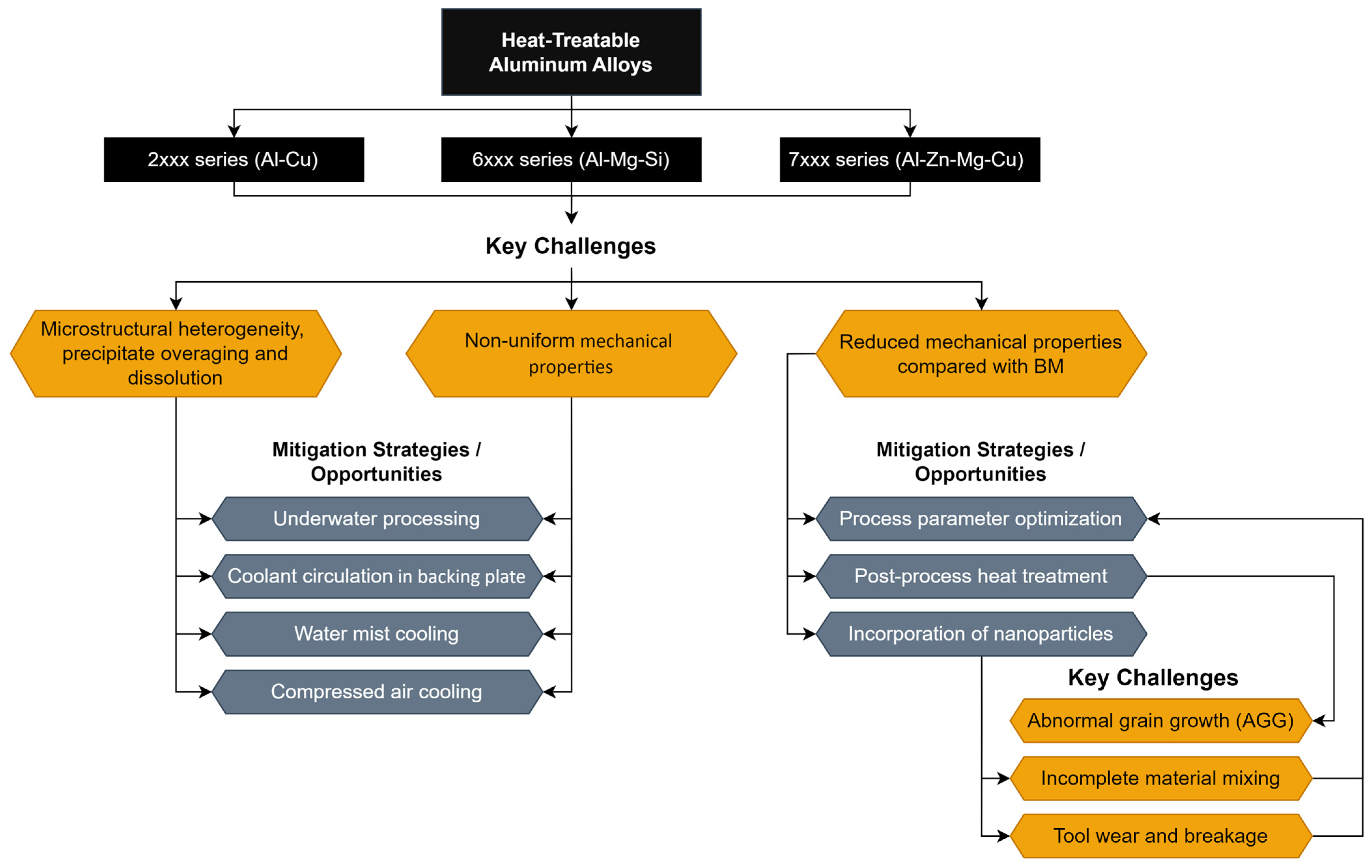
Major challenges associated with the processing of heat-treatable aluminum alloys using FBAM, along with the corresponding opportunities to address these issues, are summarized in Figure 2. These challenges mainly include microstructural heterogeneity, non-uniform mechanical properties, and reduced mechanical performance compared with the base material. To mitigate these limitations, several approaches have been reported in the literature, including process parameter optimization, in-process cooling strategies to control the thermal gradient, post-process heat treatment (PHT), and nanoparticle reinforcement. These strategies aim to improve the microstructural stability and mechanical performance of FBAM-processed heat-treatable aluminum alloys. Moreover, the incorporation of nanoparticles, which are often employed to enhance mechanical properties, may introduce additional challenges related to uniform dispersion, incomplete material mixing, and tool wear during processing. The challenges and corresponding mitigation strategies reported for different heat-treatable aluminum alloy series across various FBAM processes are critically discussed in the following sections.

2.1. Aluminum 2xxx Series

Regarding 2xxx series aluminum alloys, these alloys are heat treatable and primarily strengthened through Al-Cu precipitation hardening, and are widely used in aerospace applications due to their high strength-to-weight ratio and good fatigue resistance [56,57,58]. However, when processed using FBAM techniques, these alloys are susceptible to microstructural heterogeneity, precipitate instability, and variations in mechanical properties resulting from the complex thermo-mechanical conditions during deposition. These conditions may lead to over-aging, dissolution of strengthening precipitates, and localized softening within the deposited layers. The challenges associated with processing 2xxx series alloys using different FBAM techniques (FSAM, AFSD, FSEAM, and FRAM) and the strategies adopted to address them are discussed below.
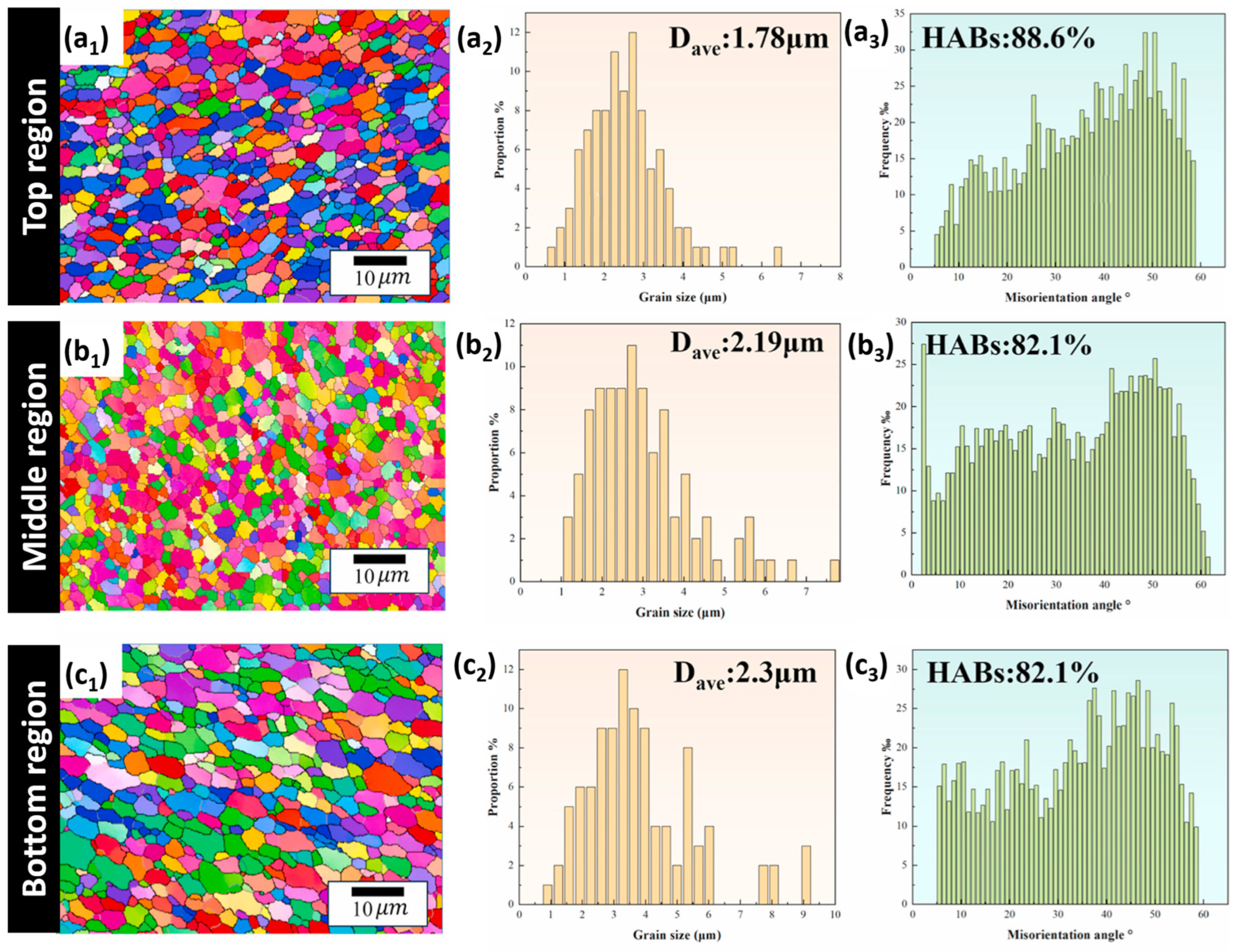
A multi-layer, multi-track laminate of Al-2195-T8 was fabricated using FSAM, with four passes per layer and a tapered tool pin, maintaining a 1 mm offset between successive passes to enlarge the deposition area [59]. Microstructural analysis revealed fine equiaxed grains in the nugget zone (NZ), resulting in higher hardness and strength compared with the thermo-mechanically affected zone (TMAZ) and heat-affected zone (HAZ). However, significant microstructural heterogeneity along the build direction was observed, with grain size decreasing from the top to the bottom of NZ due to repeated stirring and thermal cycling. EBSD analysis confirmed variations in grain structure along the NZ, indicating the presence of deformed, sub-structured, and recrystallized grains. The majority of grains in the NZ top were sub-structured (38.491%) and deformed (37.413%), hindering the development of recrystallized grains due to the dislocation pinning effect. Conversely, in the middle and bottom regions of NZ, both recrystallized and sub-structured grains were present in excessive amounts (48.275% and 43.983% in the middle and 24.846% and 19.146% in the bottom zone, respectively), due to repeated thermal cycling and stirring. This heterogeneity resulted in a non-uniform hardness distribution within the laminate. Mechanical testing also revealed anisotropic behavior, with higher ultimate tensile strength in the longitudinal direction (~399 MPa) compared with the transverse direction (~300 MPa). Nevertheless, the overall hardness and strength remained lower than those of the BM, mainly due to the dissolution of strengthening precipitates during processing. Similarly, L. Chen et al. [60] developed Al-2195-T8 FSAM laminates using different deposition paths. The study reported non-homogeneous microstructure, with grain sizes ranging from 1 to 5 µm, and corresponding microhardness values between 83 and 132 HV along the build direction. The maximum UTS achieved was only 52.56 MPa, which is significantly lower than that of the BM. This deterioration in mechanical performance was primarily attributed to the re-dissolution and re-precipitation of strengthening precipitates during repeated thermal cycles. Similarly, X. Zhou et al. [61] reported microstructural and mechanical heterogeneity in AFSD-processed Al-2024 builds. As shown in Figure 3(a1–c1), the grain size varied along the build direction, increasing from 1.78 to 2.30 µm from the top to the bottom region. This variation was attributed to differences in thermal history and severe plastic deformation during deposition. A corresponding hardness gradient was also observed. Mechanical testing showed a maximum tensile strength of 425 MPa in the longitudinal direction and elongation exceeding 18% in the transverse direction, whereas the build-direction properties were significantly lower than BM, indicating pronounced anisotropy despite grain refinement.
FSAM laminates of cast Al-2050 and Al-2050 in the T3 condition were fabricated by A. Reynolds [62]. A thermal management system consisting of a steel backing plate and trailing water spray was employed to control the re-dissolution and re-precipitation of strengthening precipitates and to achieve improved microstructural and mechanical homogeneity. Despite this cooling strategy, non-uniform microhardness distributions were observed in both laminates. Moreover, PHT was applied to further enhance the mechanical properties of the fabricated laminates. The results showed that the overall hardness of the cast Al-2050 laminate was higher than that of the BM, whereas the T3 laminate exhibited lower hardness even after PWHT. The presence of this non-uniform microhardness distribution resulted in complex fracture behavior during mechanical testing. Similar observations were reported by H. Ghadimi et al. [63] during the AFSD processing of Al-2050-T84, highlighting the influence of thermal history on the mechanical response of 2xxx series alloys processed through FBAM.
Y. Xiao et al. [64] fabricated a multi-layered Al-2024-T4 structure using FSAM and applied a process parameter optimization approach, particularly focusing on tool rotational and transverse speeds. These parameters primarily govern the frictional heat generation during processing, which can lead to over-aging or dissolution of strengthening precipitates, thereby significantly influencing the microstructure and mechanical properties of the fabricated laminate. The results showed that tensile strength increased linearly with increasing transverse speed, which was attributed to the reduction in thermal cycling duration during processing. The highest tensile strength of 488.8 MPa was achieved at 800 rpm and a transverse speed of 90 mm/min, exceeding the BM strength of 475 MPa. Notably, this higher tensile strength was observed in the longitudinal direction at the upper layers rather than along the build direction. Thermal analysis further revealed that the bottom layers experienced the highest temperatures (exceeding 475 °C) due to repeated heat exposure during layer deposition, whereas the top layer maintained relatively lower temperatures throughout the process. Consistent with these observations, P. Teja et al. [65] reported non-homogeneous microstructure and microhardness along the build direction in FSAM-processed Al-2024, primarily due to repeated thermal cycles during deposition. The grain size varied along the build height, measuring 5.14 µm, 6.32 µm, and 7.52 µm from the top to the bottom layers, while the corresponding microhardness varied along the build direction. To achieve improved mechanical performance, the authors applied a process parameter optimization approach, focusing particularly on tool pin geometry along with variations in rotational and traverse speeds. Among the tested geometries, the square pin profile provided improved interfacial bonding due to better material mixing, resulting in a tensile strength of 358 MPa at 1200 rpm in the build direction. In contrast, the threaded conical pin produced thick, continuous Al-clad fragments, leading to weak interfacial bonding. Although the optimized parameters improved the mechanical performance, the tensile strength reached only about 75% of the BM strength.
In the context of AFSD, an Al-2011-T6 consumable rod (20 mm diameter) was deposited at varying tool rotation speeds (600–800 rpm) and feed rates (1–5 mm/min) to identify the optimal parameters for achieving the highest possible mechanical properties [66]. The optimized condition of 800 rpm and 5 mm/min produced the highest microhardness of 91 HV and compressive strength of 543 MPa, although these values remained lower than those of the BM, reaching approximately 93% and 85%. Increasing rotation speed and feed rate also promoted grain refinement, with the finest grain size of approximately 2.6 µm obtained under the optimized parameters. The study further reported that compressive strength and hardness increased linearly with increasing rotation speed and feed rate. However, this trend is not always valid for heat-treatable aluminum alloys. In such alloys, mechanical properties typically increase with increasing rotation and transverse speed only up to a critical limit, beyond which they decrease due to excessive heat input that leads to the dissolution and over-aging of strengthening precipitates [64,67,68]. In this regard, M. Ahmed et al. [69] deposited the same alloy in two temper conditions, namely O and T6, at a higher rotation speed of 1200 rpm while varying the feed rate from 3 to 9 mm/min. Since the rotation speed had already exceeded the optimal limit, the results revealed an inverse relationship between microhardness and the feed rate. The maximum hardness obtained for the T6 deposition was 76 HV (61% of the BM) at a feed rate of 3 mm/min, whereas the O condition feed material exhibited a hardness of 86 HV, corresponding to a 163% increase compared with the initial hardness of the O condition material. Overall, a 98% reduction in grains was noticed in laminates developed with annealed “O” condition feed rods, whereas a 93.5% reduction was observed in the T6 condition. Regarding the microstructure, the two main intermetallics, Al2Cu and Al7Cu2Fe, were found to experience pullout failures due to the weak interface bonding between the aluminum matrix, as seen in the study in [66].
In a related study, K. Anderson et al. [70] fabricated Al-2219-T87 builds using AFSD by depositing a consumable rod with a teardrop-shaped non-consumable tool, unlike the direct rod deposition approach used in earlier studies [66]. A process parameter optimization approach was adopted by varying tool rotational speeds (150–300 rpm) and transverse speeds (89–140 mm/min) to achieve optimal mechanical properties by controlling precipitate dissolution and over-aging. A defect-free build consisting of 65 layers was obtained at 200 rpm and 101.6 mm/min rotational and transverse speeds, respectively. Mechanical testing showed slightly higher tensile strength in the longitudinal direction, corresponding to an average grain size of ~9 µm, which is consistent with observations reported in other studies [59,71,72,73]. Despite achieving a defect-free build, the mechanical properties were significantly lower than those of the BM, with approximately 50% reduction in UTS, 75% reduction in yield strength, and 60% reduction in hardness, resulting in a reduced fatigue life. These values were considerably lower than those reported in studies using direct rod deposition [66]. Although the relatively high transverse speed should reduce frictional heat, the use of a non-consumable teardrop-shaped tool generated excessive frictional heat compared with direct rod deposition. In contrast, direct rod deposition leads to excessive collar type flash generation, which can negatively affect the surface quality of the fabricated part and hinder the continuous deposition [45]. To understand the origin of this mechanical degradation, TEM analysis revealed that the processing temperature during AFSD was sufficiently high to dissolve most of the θ and θ′ strengthening precipitates present in the BM. Consequently, the larger θ phases coarsened, while the finer θ′ precipitates either shrank or disappeared entirely. Similar observations regarding the absence of θ′ phases were reported in another study during FSW of Al-2219-T8 [74], despite expectations based on spatial temperature distribution. Interestingly, the ductility increased significantly by approximately 175%, which agrees with the findings reported by R. Haridas et al. [73]. A comparable decline in mechanical properties during AFSD processing was also reported by O. Rivera et al. [75] for Al-2219-T851 and J. Dilip [76] for Al-2014-T6 alloys.
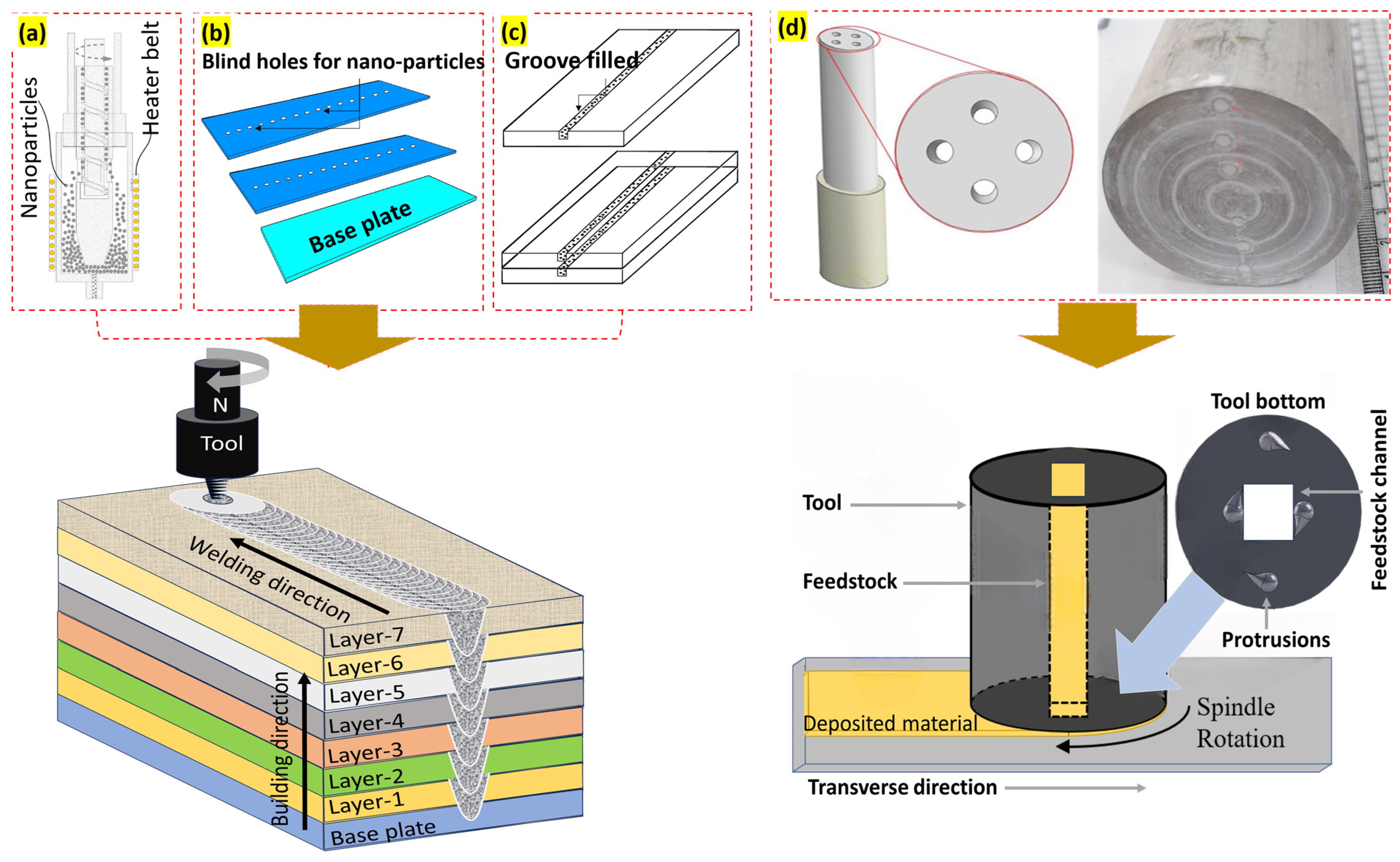
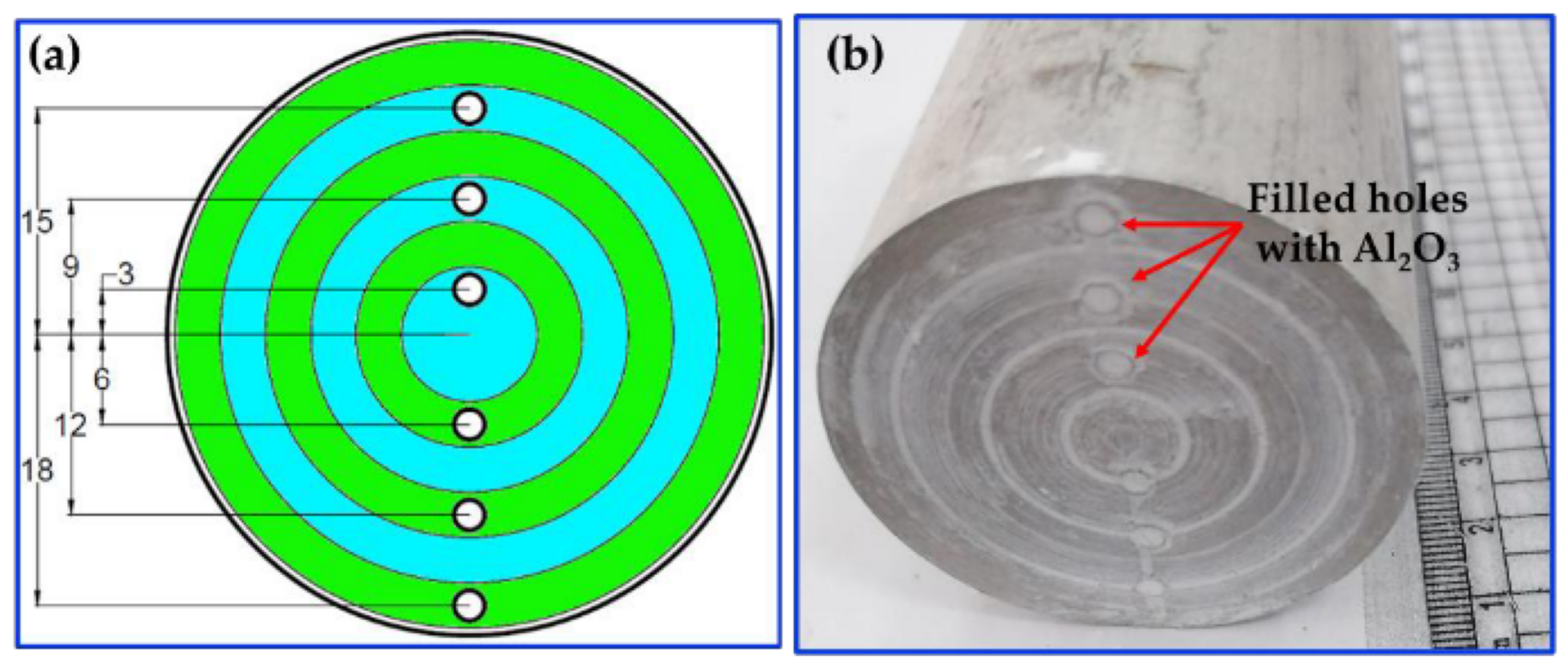
In contrast to the previously discussed AFSD studies focusing on process parameter optimization, M. Sayed et al. [42] incorporated nanoparticle reinforcement to enhance the performance of Al-2011 builds in both T6 and annealed “O” conditions. In this study, direct deposition of consumable cylindrical rods was carried out without using a teardrop-shaped non-consumable tool. The rods were pre-filled with Al2O3 nanoparticles, as shown in Figure 4. The reinforced laminates exhibited improved hardness, compressive strength, and wear resistance compared with plain Al-2011 builds, with the Al-2011-T6/Al2O3 composite showing the highest wear resistance. Microstructural analysis revealed that the laminate produced from the O condition feed rod exhibited finer grains (~2.41 µm) compared with the T6 condition rod (~2.57 µm). The addition of nanoparticles further enhanced grain refinement, resulting in average grain sizes of 2.07 µm (T6/Al2O3) and 1.75 µm (O/Al2O3). However, the mechanical properties of the T6-based laminate did not fully recover to those of the BM. Similarly, M. Nahr et al. [77] combined a process parameter optimization approach with Al2O3 nanoparticle reinforcement (10 vol.%) to improve the performance of AFSD-processed Al-2024. The deposition was carried out using direct rod feeding, with rotation speeds of 600–1200 rpm and traverse speeds of 70–85 mm/min, influencing the heat input during processing. The fabricated nanocomposite builds exhibited well-bonded layers, uniform distribution of Al2O3 particles and precipitates, fragmented intermetallic compounds, and a refined grain structure (3–10 µm). However, grain size and microhardness remained non-uniform along the build direction. The optimal condition (1000 rpm and 80 mm/min) resulted in a grain size of 3.74 ± 1.01 µm, microhardness of 123.75 HV, and a wear rate of 6.6 × 10⁻⁴ mg/Nm. Although the composites showed improved hardness and wear resistance compared with non-reinforced builds, the properties remained lower than those of the BM, with grain refinement attributed to particle-stimulated dynamic recrystallization and grain boundary pinning by Al2O3 nanoparticles, along with the influence of intermetallic phases such as Al2Cu, Al7Cu2Fe, and Al2CuMg. Despite the incorporation of Al2O3 nanoparticles, both studies demonstrate that while grain refinement and mechanical performance were improved, the properties of the deposited structures did not fully reach those of the BM. This suggests that although nanoparticle reinforcement enhances grain boundary stabilization, it cannot completely mitigate the effects of precipitate dissolution and thermal history during AFSD processing. Furthermore, the persistence of microstructural and hardness non-uniformity along the build direction indicates that thermal gradients remain a critical challenge, even with reinforcement strategies.
J. Dilip et al. [76] applied PHT to recover the microstructure and mechanical properties of AFSD-processed Al-2014-T4. Two PHT routes were investigated: direct aging and solution treatment followed by aging. In the as-deposited condition, the material exhibited significantly lower hardness (75 ± 6 HV). Direct aging resulted in only a marginal improvement (88 ± 5 HV) due to the limited presence of θ′ and λ′ strengthening precipitates. In contrast, solution treatment followed by aging restored proper precipitation, leading to a hardness of 130 ± 5 HV comparable to that of the BM. However, the high-temperature solution treatment induced abnormal grain growth (AGG), indicating a trade-off between precipitate recovery and microstructural stability. Similarly, B. Pollard et al. [78] investigated PHT for AFSD-processed cast Al-Cu alloy (A206). While solution heat treatment led to extensive cracking (up to 6 mm), the introduction of a stress-relief annealing step prior to solution treatment significantly reduced cracking, emphasizing the need for controlled thermal treatment sequences. These studies indicate that while PHT is effective in restoring strengthening precipitates and improving mechanical properties, it can also introduce secondary challenges, such as grain coarsening and cracking, if not carefully controlled.
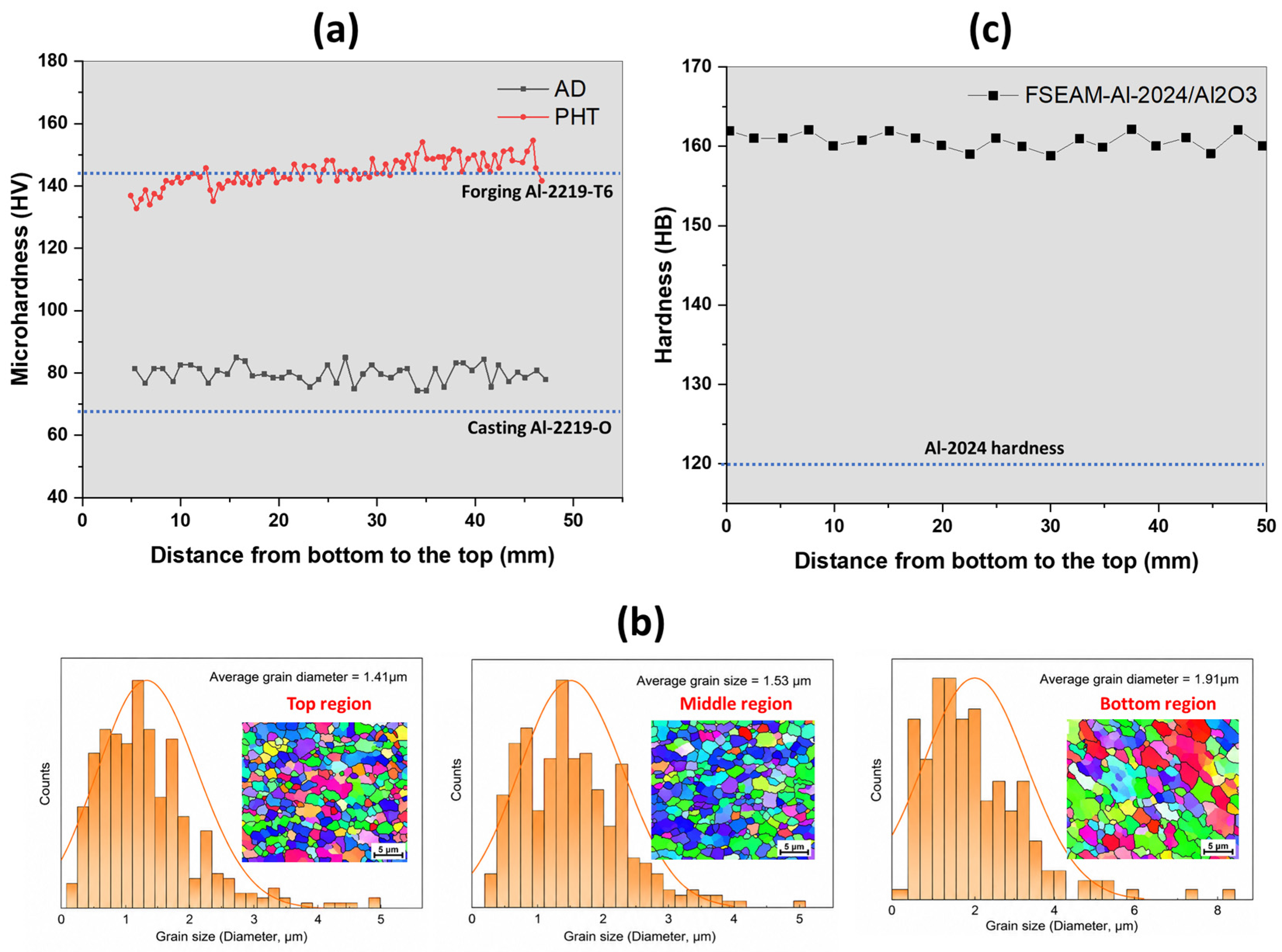
In the context of FSEAM, H. Chen et al. [79] successfully fabricated a large load-bearing Al-Cu alloy (Al-2319) component (approximately 1 m in size), overcoming the limitation of continuous feed material supply. The feed wires were used in the annealed condition; therefore, the as-deposited (AD) structure exhibited higher microhardness and tensile strength compared with BM. Moreover, after PHT, both microhardness and tensile strength further improved and surpassed those of the T6 BM. Interestingly, a homogeneous microstructure and microhardness distribution along the build direction were observed, as shown in Figure 5a,b. This behavior is attributed to the FSEAM process, where previously deposited layers are not subjected to repeated high-temperature exposure, unlike in FSAM and AFSD. As a result, precipitate stability is better preserved, leading to improved mechanical performance. Strengthening mechanisms including solid solution strengthening, precipitation strengthening, and dislocation strengthening contributed to the enhanced properties. Notably, the formation of abundant θ′ precipitates after heat treatment significantly improved strength, with precipitation strengthening accounting for ~70.4% of the total strengthening contribution, indicating it as the dominant mechanism.
Similarly, a tubular structure of Al-2024 reinforced with Al2O3 nanoparticles was fabricated through FSEAM [80]. The feedstock was prepared by first producing an Al-2024/Al2O3 composite via friction stir processing (FSP), which was subsequently machined into chips to serve as the feed material for FSEAM. The deposition was carried out using a forging tool with an integrated extrusion system to consolidate the material. The fabricated structure exhibited an exceptionally high ultimate tensile strength of ~900 MPa, along with a uniform microhardness of ~160 HV along the build direction, indicating effective interlayer metallurgical bonding. A homogeneous microstructure and microhardness distribution were achieved, which was attributed to the use of external heating (~350 °C) to ensure controlled plasticization of the feed material. The process resulted in ultrafine grains (<1 µm), facilitated by severe plastic deformation during FSP and subsequent FSEAM processing, along with particle-stimulated grain boundary pinning by Al2O3 nanoparticles. The corresponding microhardness distribution along the building direction is shown in Figure 5c. Fracture analysis indicated a mixed ductile–brittle behavior.
Overall, research on FSEAM processing of Al-2xxx series alloys remains limited, whereas FSAM and AFSD have been extensively explored. Moreover, to the best of the authors’ knowledge, no studies have reported the processing of Al-2xxx alloys using RFSAM, although FRAM has been applied to Al-6xxx alloys, which is discussed in the subsequent section. A summary of the processing of Al-2xxx heat-treatable alloys through different FBAM techniques is presented in Table 1, along with key observations. Most of the reported studies were unable to achieve mechanical properties matching or exceeding those of the BM, even after incorporating nanoparticles or applying process parameter optimization approach, primarily due to precipitate evolution (dissolution, over-aging, and re-precipitation) during processing. In addition, limited attention has been given to PHT for Al-2xxx alloys, which could help further improve the mechanical properties. Furthermore, insufficient focus has been placed on controlling the effects of repeated thermal cycling and process-induced variations along the build direction. As a result, microstructural heterogeneity and non-uniform mechanical properties persist, representing a key research gap for advancing FBAM of Al-2xxx alloys.

2.2. Aluminum 6xxx Series

The 6xxx series aluminum alloys are heat-treatable and primarily strengthened through Mg-Si precipitation hardening. They are widely used in automotive, marine, and structural applications due to their good formability, corrosion resistance, and moderate strength [84,85,86]. The aluminum 6xxx series has been extensively explored in both FBAM compared to the Al 2xxx series. The challenges associated with processing 6xxx series alloys using different FBAM techniques and the strategies adopted to address them are discussed in the following sections.
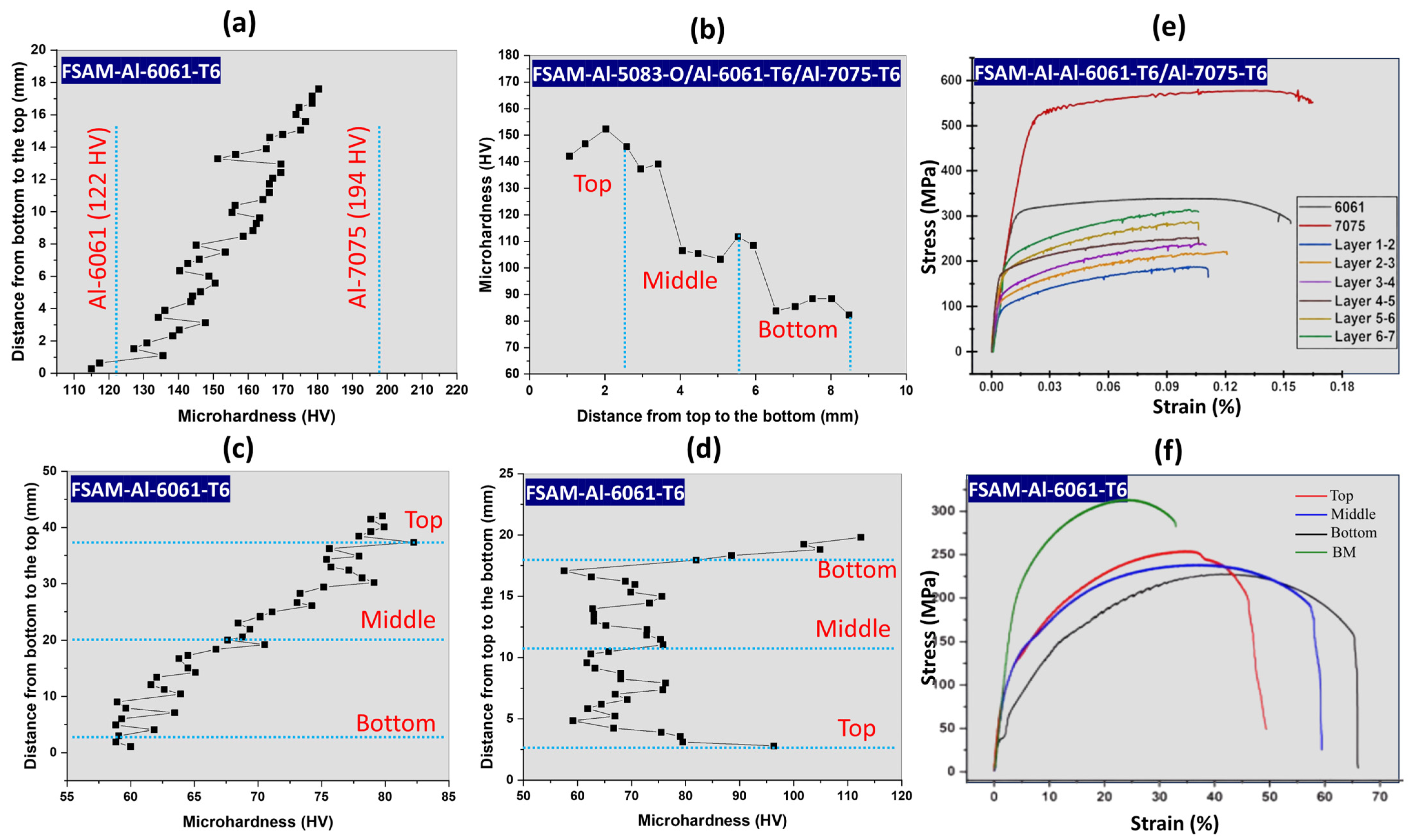
In the context of FSAM of Al-6xxx series alloys, most studies have reported non-homogeneous microstructures, resulting in non-uniform mechanical properties along the build direction due to repeated thermal cycling [87,88,89,90,91,92,93,94]. An overview of the non-uniform mechanical property trends reported in different studies is illustrated in Figure 6. It can be observed that both microhardness and UTS generally increases from the bottom layers to the topmost layers. This trend is primarily attributed to repeated thermal cycling, which induces static annealing in the previously deposited layers, leading to grain coarsening and over-aging of second-phase strengthening precipitates in the lower layers, and consequently lower hardness and strength. For Al-6xxx alloys processed via FSAM, limited studies have focused on addressing the issue of microstructural non-uniformity.
A significant reduction in mechanical performance compared with the BM has also been reported for Al-6xxx alloys, primarily attributed to the dissolution and over-aging of second phase strengthening precipitates during FSAM processing. However, several studies have attempted to recover the mechanical properties through process modification and nanoparticle reinforcement.
R. Rapaka et al. [88] attempted to achieve the highest possible mechanical properties of Al-6061 FSAM laminates through process parameter optimization by varying rotational and transverse speeds. However, even at the optimized condition, the UTS reached only ~60% of the BM, indicating limited effectiveness of parameter optimization in fully recovering mechanical performance. Similarly, S. Kumaran et al. [96] optimized process parameters using a Taguchi L9 design to fabricate gradient laminates of alternating Al-6061 and Al-7075 layers. Despite the use of a robust design approach, the tensile strength of the fabricated laminates remained lower than that of both Al-6061 and Al-7075 BM. A multi-layered Al-6061-T6 laminate was fabricated at 1200 rpm and 100 mm/min to investigate the effect of layer thickness on mechanical properties [97]. The results showed that increasing layer thickness reduced the heat input, thereby limiting precipitate dissolution and resulting in improved hardness, with a maximum value of 104.3 HV, which is close to that of the BM. This highlights the importance of controlling thermal exposure to mitigate strength degradation. Subsequent studies by the same group [94,98] explored compositional variations and nanoparticle incorporation. The results showed that both hardness and yield strength increased with the weight percentage of magnesium and silicon. However, the average hardness decreased with increasing volume fraction of magnesium and silicon [94]. Al2O3 nanoparticles were introduced through pre-grooved FSAM feed plates [98]. Smaller nanoparticles (8–10 nm) produced higher hardness than larger particles (30–50 nm) due to enhanced grain boundary pinning and microstructural refinement. Overall, hardness increased with nanoparticle volume fraction and decreased with increasing grain size. The volume fraction was controlled by varying the width of the pre-grooved slots, with the maximum hardness achieved using 3 mm wide grooves combined with ~10 nm particles. Despite these localized improvements, the overall microhardness remained lower than that of the BM, and a non-uniform hardness distribution persisted along the build direction.
Similarly, S. Choudhury et al. [87] incorporated 20 vol.% SiC to fabricate a 15-layer Al-6061-T6/SiC laminate using FSAM. The results revealed non-uniform microstructure and mechanical properties along the build direction, with grain size increasing from top to bottom (5.93–6.84 µm) and corresponding variations in hardness and tensile strength consistent with others finding [94,98]. Fracture analysis further confirmed variation in deformation behavior, with finer and shallower dimples at the top layers and coarser dimples at the bottom layers. Despite the addition of SiC reinforcement, the overall strength and hardness remained lower than those of the BM. In contrast, the same alloy without reinforcement exhibited hardness values close to the BM in previous work [97]. This reduction in performance is primarily attributed to excessive frictional heat generation due to the abrasive nature and high-volume fraction (20%vol.) of SiC particles, which promotes coarsening and dissolution of strengthening precipitates in the NZ. As a result, precipitate evolution dominates over reinforcement effects in determining the mechanical response. Although ductility and toughness were improved, the incorporation of SiC also introduced additional challenges, particularly increased tool wear during processing. Maurya et al. [99] incorporated 4 wt.% TiC and 6 wt.% grinding slush (GS) into Al-6061-T6 and reported a 37.2% enhancement of microhardness and a 25.8% improvement in tensile strength compared to the BM. However, it is important to note that the fabricated laminate consisted of only three stacked layers, with the bottom layer remaining unreinforced. Moreover, tensile testing was conducted in the longitudinal direction rather than along the build direction, where properties are typically lower. Therefore, the reported improvement in tensile strength may not accurately reflect the mechanical performance along the build direction, which remains a critical concern in FBAM of heat-treatable alloys.
In the context of AFSD of Al-6xxx alloys, both powder and rod-based approaches have been explored. In powder-based AFSD, pre-distributed Al-6061 powder (50 µm) was deposited using a non-consumable flat tool without a pin [100]. The maximum tensile strength of 133.35 MPa and hardness of 70.25 HV were reported, which were higher than those of the BM; however, the BM was in the annealed (Al-6061-O) condition. Powder-based AFSD also faces practical challenges such as tool clogging, which limits process stability and continuous deposition. Similarly, A. Sharifi et al. [101] deposited Al-6061-T6 rods and reported non-uniform microstructure and mechanical properties along the build direction. Grain size varied significantly along the build height, leading to corresponding variations in hardness (49–114 HV) and tensile strength (161–333 MPa). The mechanical properties were considerably lower than those of BM, with reductions of approximately 58% in yield strength and 42% in UTS, primarily due to precipitate dissolution and over-aging. These findings are consistent with other studies on AFSD of heat-treatable aluminum alloys, where a significant decline in hardness and strength compared with the BM has been reported [45,73,101,102,103,104,105,106,107]. To address these limitations, several strategies have been explored, including nanoparticle reinforcement (e.g., FeCoNi, Ni [108], ZrO2 [109], B4C [110], TiC [111,112], basalt fiber [113] and GNPs [114]) and PHT [110,115,116,117,118,119].
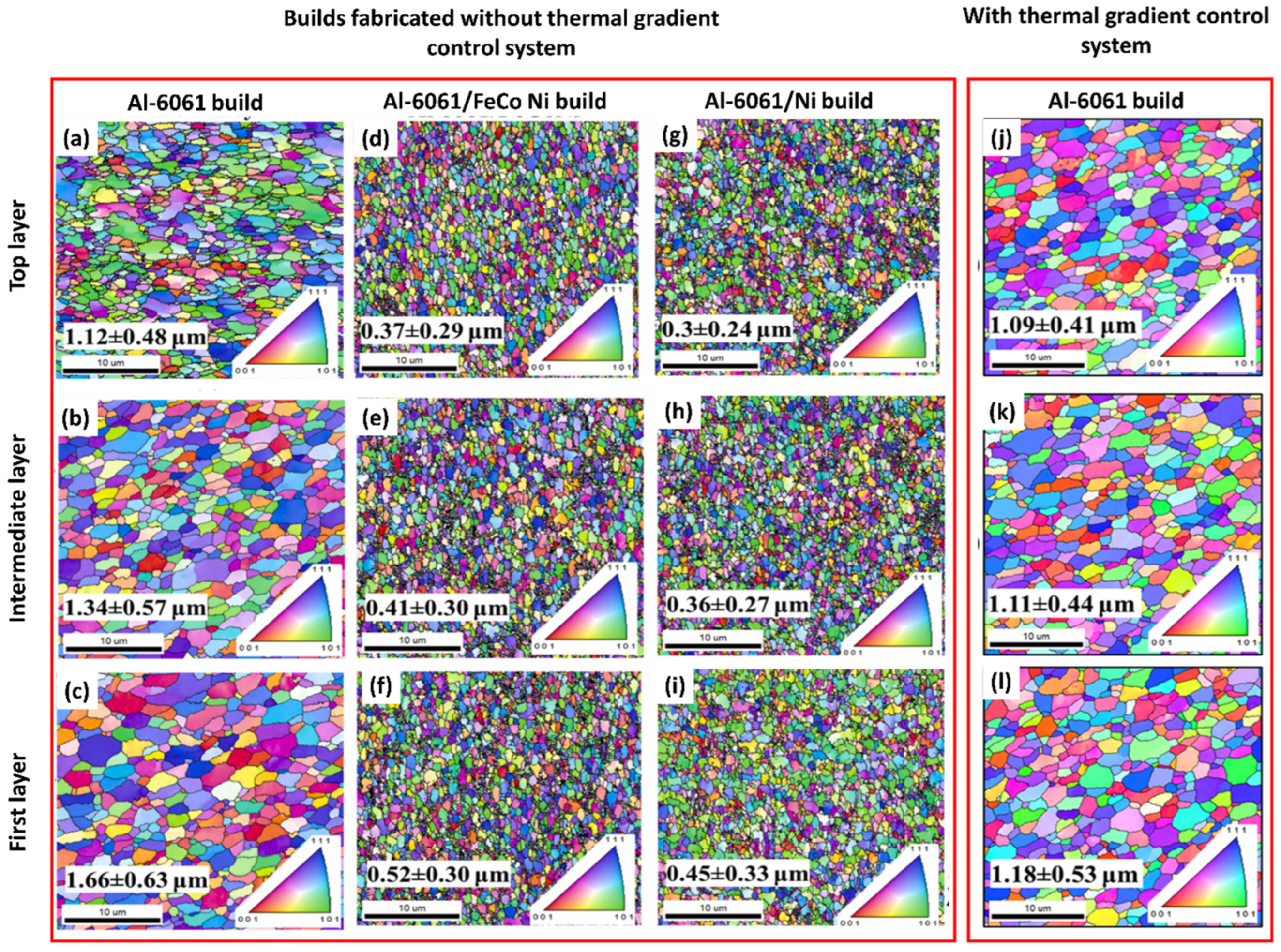
B. Chaudhary et al. [108] blended FeCoNi, and Ni nanoparticles in Al-6061 powder the feed material was in powder form to develop AFSD. While surface hardness and strength were enhanced, elongation declined in both composites (6061/FeCoNi and Al 6061/Ni) compared to the base alloy. The increase in hardness was attributed to a uniform distribution of nanoparticles and the hardening effect of the Mg2Si phase, resulting in an 11.3% and 22.3% increase, respectively. Furthermore, UTS increased by 85.4% and 30.5%, while elongation decreased by 19.4% and 47.8%, respectively. Overall, anisotropy in mechanical properties was observed due to the varying microstructure from the bottom to the top deposited layer. Grain refinement was assessed through EBSD analysis at the bottom, middle, and top regions of each laminate (Al-6061, Al-6061/FeCoNi, and Al-6061/Ni), as shown in Figure 7a–i. Overall, grains were refined and equiaxed in each build due to dynamic recrystallization. However, grains were more refined in the Al-6061/FeCoNi and Al-6061/Ni builds compared to the Al-6061 build. The primary reason for this was the pinning effect of reinforced particles (FeCoNi and Ni), which hindered grain growth. The same research group also enhanced mechanical properties in another study [120] by employing a reduced thermal gradient approach. In this study, Al-6061 powder was deposited to create a multilayered build, and before commencing, the temperature of the substrate was raised to the artificial aging temperature (approximately 170 °C) using an external heating source. By employing this approach, refined grains were achieved, as evident from Figure 7j–l. For comparison, in Figure 7a–c,j–l, it can be observed that the grains are smaller (1.09 μm) in the build fabricated using this approach compared to the build fabricated without using the thermal gradient approach [108] at the top layer shown in Figure 7a (1.12 μm). The rest of the phenomena regarding anisotropy in microstructure and mechanical properties remained consistent with the previous study [108].
Similarly, M. Patel et al. [109] incorporated ZrO2 nanoparticles into Al-6063-T4 feed rods. The build containing 12% reinforcement exhibited the highest microhardness and UTS, with a 63.8% increase in UTS compared to the BM. The improved performance was attributed to the strong particle pinning effect, which resulted in an average grain size of ~9.1 µm (approximately 94% reduction compared with the BM). These findings are consistent with other reported studies [100]. However, despite these enhancements, the influence of thermal cycling and process-induced heterogeneity remained evident. In contrast, J. Lopez et al. [114] attempted to incorporate GNPs (2.5 wt.%) into Al-6061-T6; however, the expected improvement in mechanical properties was not achieved due to insufficient dispersion of graphene, highlighting the challenges associated with nanoparticle incorporation. Furthermore, Y. Jin et al. [121] investigated the origin of non-uniform mechanical behavior through thermo-mechanical simulations of AFSD. The study revealed that mechanical residual stresses, rather than thermal residual stresses, are the primary contributors to property non-uniformity. It was also observed that changes in deposition path can alter stress distribution, leading to spatial variations in mechanical properties across the build.
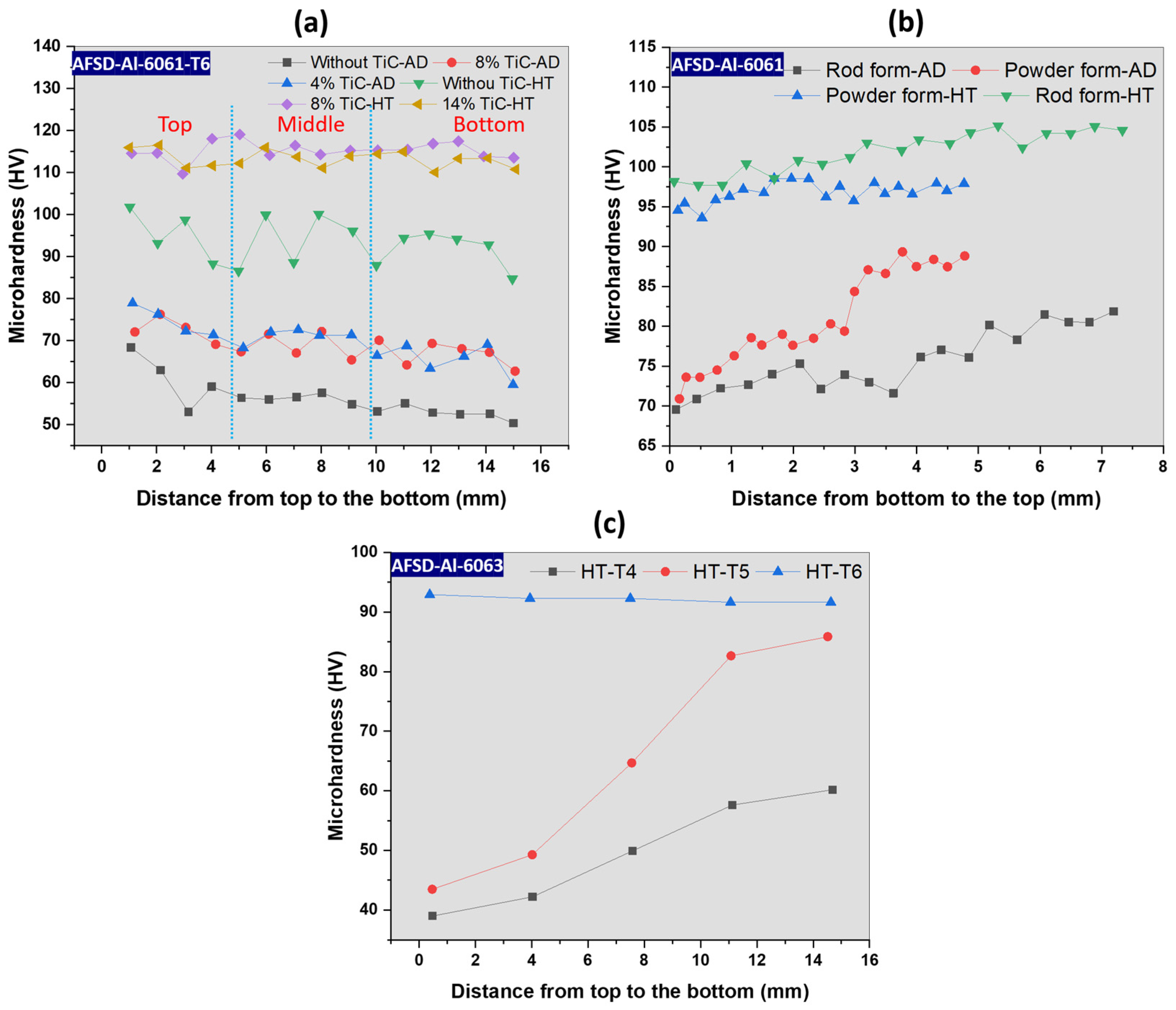
To recover mechanical properties, S. Patil et al. [110] investigated a combined approach involving process parameter optimization, B4C nanoparticle incorporation, and PHT (solutionizing at 530 °C for 90 min followed by aging at 160 °C for 18 h) for AFSD Al-6061-T6 builds. The results showed that, even after nanoparticle addition and parameter optimization, both microhardness and UTS (77 HV and 210 MPa) remained significantly lower than those of the BM. However, after PHT, the properties improved to 118 HV and 350 MPa, surpassing BM. It is worth noting that these mechanical properties were not evaluated along the building direction due to the limited build height. Similarly, Q. Dong et al. [112] investigated a combined approach involving TiC nanoparticle incorporation (14.7 vol.%) and PHT for AFSD Al-6061-T6. After nanoparticle addition, both microhardness and UTS remained lower than those of the BM, although improvements were observed compared with the unreinforced build. However, following PHT, both microhardness and UTS improved and exceeded the BM, accompanied by a more homogeneous microstructure and mechanical response (Figure 8a). Similarly, C. Zeng [117] deposited 40 layers of Al-6061. The as-deposited (AD) build exhibited lower hardness than the feedstock material, which was subsequently improved through PHT, similar to F. Liu et al. [122]. They further noted that microhardness distribution around the centerline and along the building direction remained relatively stable, and these findings aligned with the research conducted by G. Chen et al. [123]. Overall, equiaxed grains of 8.5 µm were observed in the NZ of the AD build. However, the grains slightly coarsened to a size of 12.5 µm after the application of combined solution and artificial aging (two-step HT). Hardness exhibited an increasing trend with an increase in the rotational speed to transverse speed ratio; a similar finding was also reported in W. Hartley et al.’s [124] study involving Al-6061-T6 rod deposition on a thin substrate. S. Beck et al. [115] investigated the effect of solutionizing–quenching (SQ) and solutionizing–quenching–artificial aging (SQA) on Al-6061-T651 AFSD builds. The UTS of the AD build was reduced by 47%, which partially recovered to 58% after solutionizing (565 °C for 50 min). Further improvement was achieved through combined solutionizing and artificial aging (177 °C for 8 h), resulting in a maximum UTS of 371 MPa and hardness of 67 HV, which exceeded the BM and was consistent with the findings of G. Chen et al. [123]. The AD build exhibited significant grain refinement, with grain size reduced from 100 µm to 20 µm due to dynamic recrystallization. However, AGG was observed after SQ, which had a deleterious effect on strength and ductility. The SQA condition resulted in a mixed microstructure, consisting of both refined and coarsened grains. Similar AGG behavior after solution and aging treatment was also reported by J. Dilip et al. [76].
B. Chaudhary et al. [119] investigated the effect of feed material form (powder vs. rod) and PHT on Al-6061 AFSD builds. In the AD condition, microhardness increased from bottom to top layers, whereas PHT reduced this variation, resulting in more uniform properties as shown in Figure 8b. The uniformity in microhardness was also reported by S. Babaniaris et al. [116] for Al-6063 builds subjected to T6 PHT. For powder-based builds, hardness and UTS increased from 81.4 HV and 194.3 MPa to 97.3 HV and 289.9 MPa, respectively. Similarly, rod-based builds showed improvements from 75.7 HV and 164.2 MPa to 102.6 HV and 331.2 MPa after PHT. Microstructural analysis revealed that PHT led to grain coarsening, consistent with other studies [117,118,119], while still improving mechanical properties due to the enhanced formation of strengthening phases, such as Mg2Si. This indicates that strength recovery is governed more by precipitate evolution than grain refinement. However, fracture behavior changed significantly, with AD builds showing ductile fracture, while heat-treated builds exhibited ductile–brittle fracture, indicating reduced energy absorption capacity. Further, the feed form influenced microstructure evolution. Powder-based builds resulted in more dense and homogeneous structures, whereas rod-based builds showed higher deposition rates but comparatively less uniformity.
In another study [116], a 15-layer AFSD Al-6063 build used compacted chip-based feed rods. The ultimate goal of the study was to address the prevalent issues of lower and non-homogeneous mechanical properties in the building direction of fabricated structures. Three distinct tempering processes were employed: T4—natural aging at room temperature for 110 days, T5—natural aging followed by artificial aging at 175 °C for 12 h, and T6—solution treatment at 540 °C for one hour followed by natural aging. Despite the application of T4 and T5 heat treatment, the mechanical properties remained non-homogenous, exhibiting an increasing trend from the bottom to the top layer of the build. However, a more favorable outcome was observed when the laminate underwent T6 heat treatment. In this case, the mechanical properties were not only elevated but also exhibited a uniform distribution across the layers (Figure 8c), alongside the refinement of equiaxed grains within the structure. In the BM, MgSi and AlFeSi intermetallics, with a size of 3.47 µm, were found, which reduced to 1.08 µm after AFSD. SEM analysis suggested that the T4 top and bottom regions, as well as the T5 bottom region, exhibited fewer θ″ precipitates. In contrast, the T5 top and T6 top and bottom regions showed a significant dispersion of needle-like θ″ precipitates, which is common in age-hardened aluminum alloys [125].
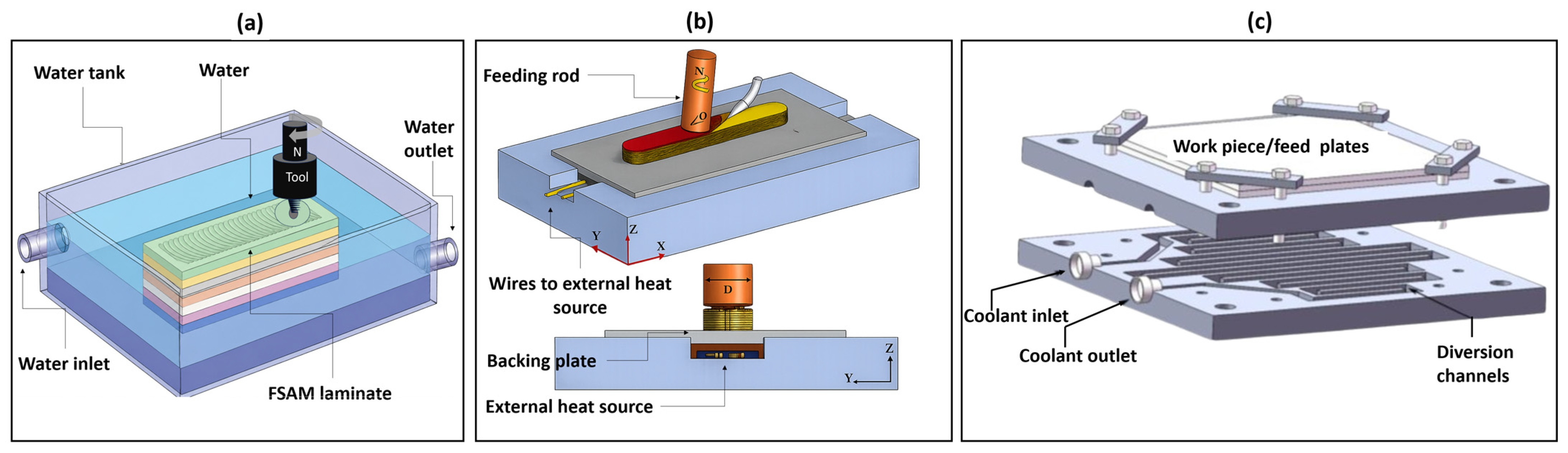
R. Kinser et al. [126] applied, for the first time, an underwater AFSD approach to fabricate Al-6061-T651 builds with the aim of controlling the thermal gradient and suppressing precipitate dissolution. Although underwater processing has been extensively explored for 7xxx series alloys in FSAM, its application in AFSD remains limited and is discussed here for 6xxx alloys. The submerged AFSD process resulted in significant grain refinement, with an average grain size of ~7 µm, compared with ~22 µm under ambient conditions. This refinement is attributed to enhanced cooling, which suppresses grain growth during deposition. However, despite the refined microstructure, both hardness and tensile strength remained lower than those of the BM, even when compared with ambient AFSD conditions. The results indicate that, although submerged cooling effectively reduces grain size, it does not fully prevent precipitate dissolution and over-aging, which continue to govern the mechanical performance of heat-treatable alloys. In addition, submerged AFSD required approximately 50% higher power consumption and resulted in rougher surface quality compared with ambient processing. A modified approach, in which the processing zone remains above the fluid while cooling is applied through controlled circulation (e.g., backing plate cooling followed by external quenching), may offer a more effective balance between thermal control and process stability, warranting further investigation.
G. Chen et al. [127] employed a parametric optimization approach to achieve the maximum possible mechanical performance in AFSD-fabricated Al-6061-T6 by varying the rotational speed (600–900 rpm), traverse speed (100–200 mm/min), and feed rate (50–100 mm/min). The results showed that both UTS and grain size increased with higher rotational speeds and feed rates, whereas elongation decreased, indicating a strength–ductility trade-off. Microhardness remained relatively insensitive within the studied range, consistent with earlier findings by B. Phillips et al. [36]. In addition, numerical mesh-free simulations by G. Stubblefield et al. [128] demonstrated that the deposition rate plays a critical role in material mixing, where lower rates resulted in heterogeneous mixing, while higher rates improved homogeneity. An optimal deposition rate of approximately 127 mm/min was identified, beyond which excessive flash formation led to material loss. Experimental work by Y. Ji et al. [55] further showed that forced cooling enhances strength in AFSD-fabricated Al-6061, while similar improvements due to repeated stirring and thermal cycling have been reported in related friction-based processes [129]. Furthermore, B. Chaudhary [130] applied a parametric optimization approach using gray relational analysis (GRA) to determine optimal conditions for AFSD of Al-6061. Rotational speed and tool bottom geometry were identified as dominant factors affecting surface integrity. Although the use of radial and circumferential grooves improved surface quality, it adversely affected microhardness, highlighting the inherent trade-off between surface characteristics and mechanical performance.
In the context of FSEAM [48,131,132,133,134] and FRAM [53,55,135,136,137,138], Al-6xxx alloys have also been explored to mitigate limitations such as continuous material feeding and process stability. For instance, the study in [48] reported a high deposition rate (~400 cm3/h) for Al-6060-T6 at a feed ratio of 1.3, achieving defect-free builds with a deposition velocity of up to 490 mm/min, demonstrating the potential of FSEAM for large-scale manufacturing. Similarly, S. Rezaeinejad et al. [131,132] investigated the effect of process parameter optimization and PHT on Al-6060-T6 FSEAM builds. At higher printing speeds (up to 250 mm/min), improved interlayer bonding and fine equiaxed grains (2–4 µm) were observed. However, a significant reduction in hardness from 80 HV to 40 HV was reported, and, even after PHT, both hardness and tensile strength remained lower than those of the BM. A similar reduction in mechanical performance was also reported by S. Donaubauer et al. [134], where tensile strength reached only ~147 MPa (~77% of filler wire strength).
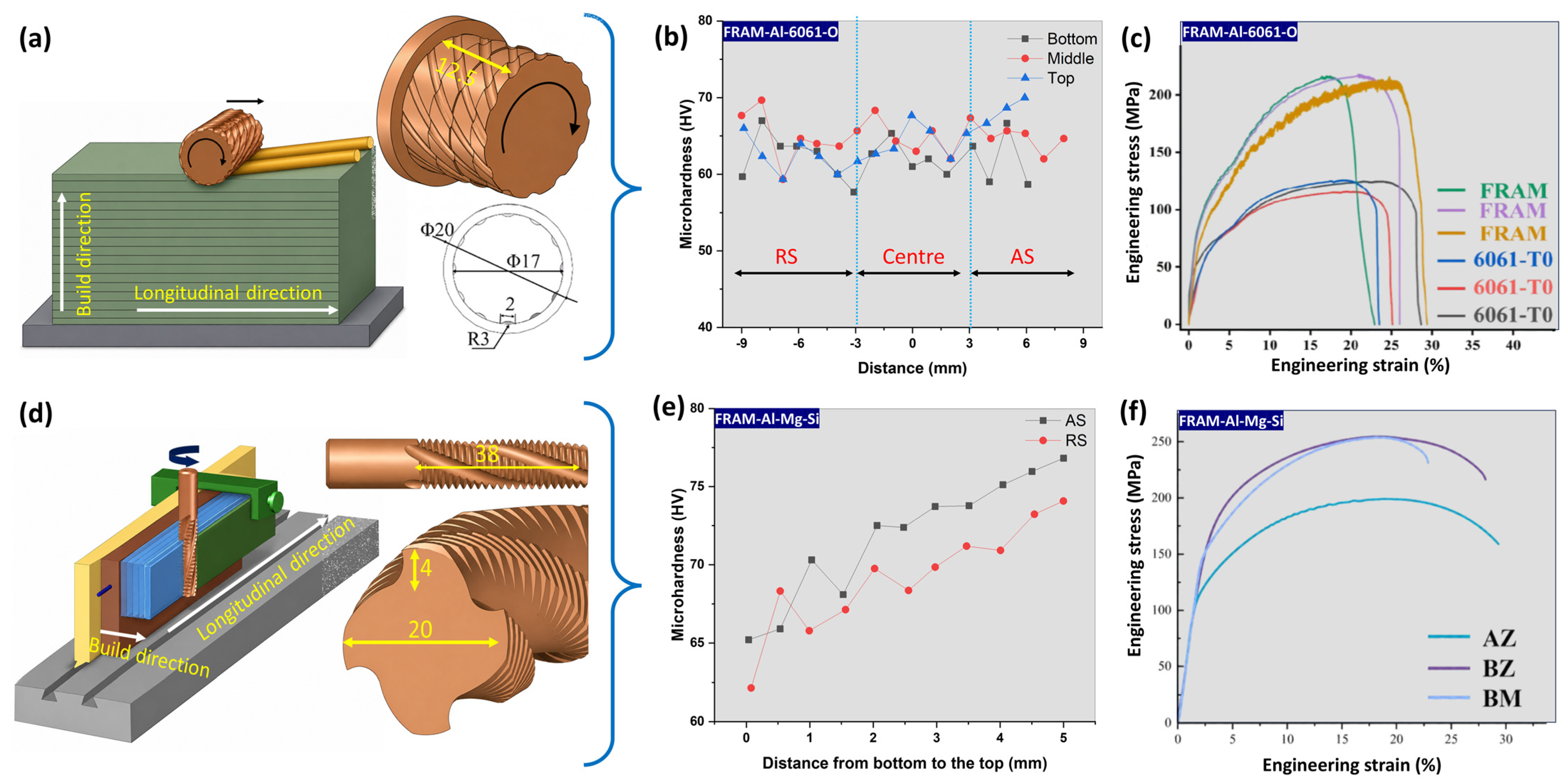
In the context of FRAM, R. Xie et al. [53] investigated Al-6061-T6 using both wire and strip feedstocks. Both approaches produced dense and defect-free layers; however, strip feed resulted in more uniform plastic deformation and smoother surface morphology, whereas wire feed exhibited higher grain refinement (~95% vs. ~81%). Despite these differences, tensile properties were comparable (~144 MPa). In a subsequent study [135], the same group reported homogeneous microstructure and mechanical properties along both build and transverse. Similarly, Y. Ji et al. [55] performed FRAM using annealed feed wires (Al6061-O) and reported uniform microhardness and tensile strength along the build direction, with a UTS of ~208 MPa and microhardness of ~65 HV, which were higher than those of the BM, as shown in Figure 9b,c. These findings suggest that using annealed feedstock followed by PHT may provide a more effective and cost-efficient processing route, enabling improved and uniform mechanical properties compared with directly processing heat-treated materials. Furthermore, homogeneity was attributed to the FRAM process, where previously deposited layers are not subjected to repeated high-temperature exposure, unlike in FSAM and AFSD.
In contrast, H. Liu et al. [136] performed FRAM in a lateral deposition configuration rather than the conventional horizontal direction. Although higher mechanical performance was reported, non-uniform microhardness and tensile strength along the build direction were observed (Figure 9d–f). This non-uniform behavior may be attributed to excessive frictional heat generation in the lateral configuration. In addition, the use of a modified tool geometry, featuring transverse groove spacing of 1 mm and a longitudinal groove depth of 4 mm, as shown in Figure 9d, instead of a conventional cylindrical tool with a cross-threaded pattern (Figure 9a), likely increased frictional heat input, leading to repeated thermal cycling and consequently promoting microstructural heterogeneity.
Compared with other solid-state AM methods, such as UAM and CSAM, FBAM generally provides superior material consolidation and interlayer bonding for Al-6xxx alloys. Sridharan et al. [139,140] reported that Al-6061 components fabricated by UAM exhibited poor tensile properties in the build direction due to insufficient interfacial bonding and the presence of oxide-rich interfaces. Similarly, Sample et al. [141] and Nourian et al. [142] reported that CSAM-processed Al-6061 deposits exhibited tensile strengths approximately 8.5% lower than wrought Al-6061-T6, with defects primarily associated with poor particle adhesion, porosity, and weak interparticle bonding. Although post-deposition treatments significantly improved the mechanical properties, these studies highlight the challenges associated with achieving fully dense structures and strong metallurgical bonding in UAM and CSAM. In contrast, FBAM promotes extensive plastic deformation and dynamic recrystallization, enabling improved interlayer bonding and dense microstructures in Al-6xxx alloys.
A comprehensive overview of Al-6xxx series alloys processed through FBAM techniques is summarized in Table 2, along with key highlights and strategies adopted to address the associated challenges. FSAM and AFSD commonly exhibit microstructural heterogeneity and non-uniform mechanical properties along the build direction, primarily due to repeated thermal cycling and the associated dissolution and over-aging of Mg2Si strengthening precipitates. Although strategies such as process parameter optimization, nanoparticle reinforcement, thermal gradient control, and PHT have been explored, PHT has emerged as the most effective approach for recovering mechanical properties and improving homogeneity. However, it is often accompanied by trade-offs, such as grain coarsening and reduced ductility. In contrast, FSEAM and FRAM demonstrate improved thermal control and reduced cyclic reheating, leading to comparatively more uniform microstructures and mechanical responses; however, achieving properties equivalent to or exceeding those of the BM remains challenging and strongly depends on the initial material condition and post-processing strategies. These findings suggest that combining annealed feedstock with appropriate PHT may provide a more effective and cost-efficient processing route, enabling improved and uniform mechanical performance in Al-6xxx alloys processed via FBAM.

2.3. Aluminum 7xxx Series

The Al-7xxx series alloys are primarily strengthened through Zn-based precipitation hardening and are widely used in aerospace applications due to their high strength. However, during fusion-based AM, these alloys are prone to challenges, such as elemental vaporization and hot cracking. FBAM has therefore been explored as a promising alternative for processing Al-7xxx alloys.
Despite this advantage, microstructural heterogeneity and non-uniform mechanical properties still persist, as the underlying process physics remain similar to those observed in Al-2xxx and Al-6xxx alloys. Although the fundamental challenges are comparable, the response of Al-7xxx alloys differs due to their distinct composition and precipitation behavior, and thus the effectiveness of mitigation strategies cannot be directly generalized. Accordingly, the studies conducted on Al-7xxx series alloys in the context of FBAM are critically reviewed in the following sections.
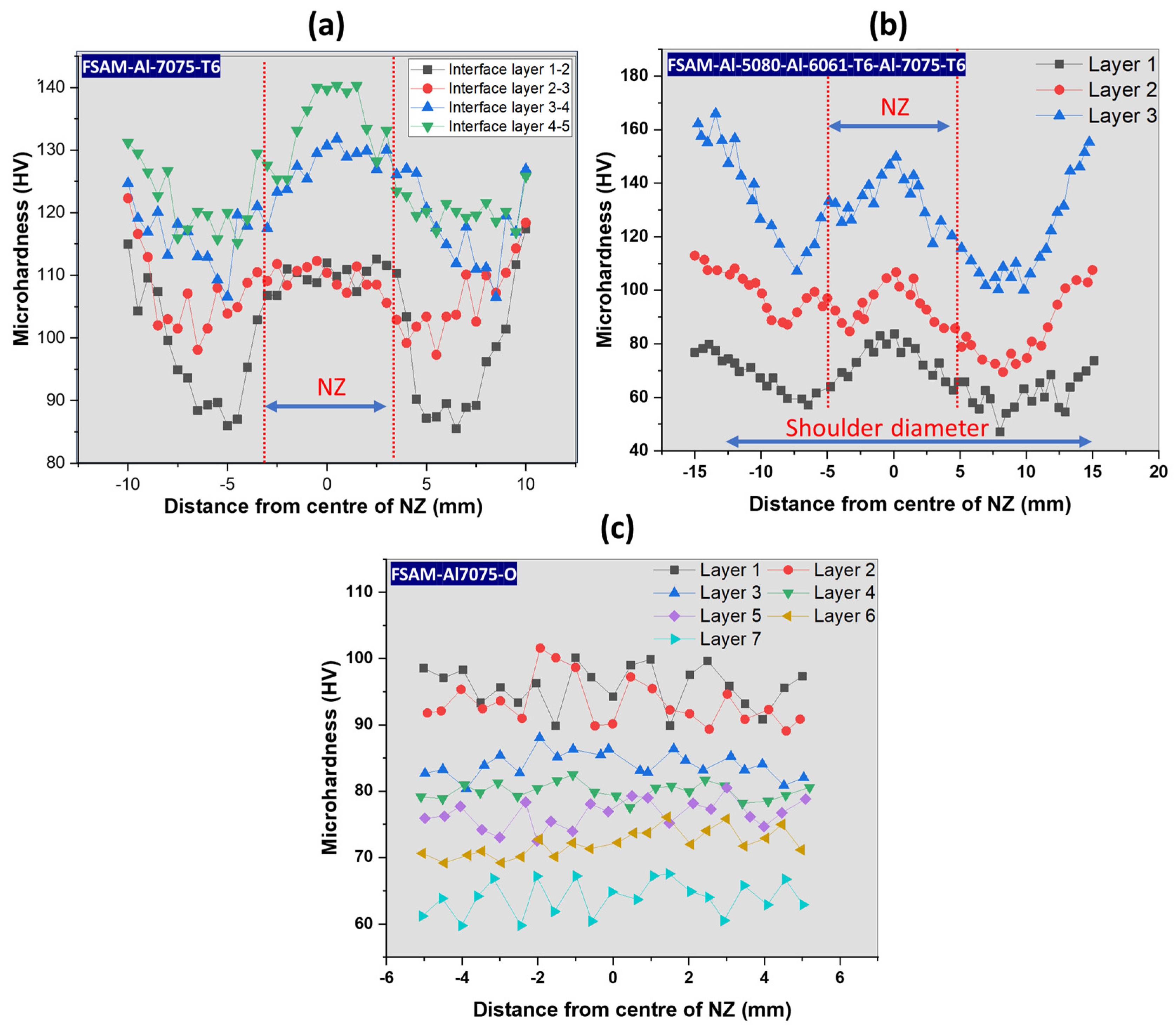
A. Hassan et al. [146] conducted FSAM to fabricate a multi-layered Al-7075-T651 laminate to investigate microstructure and microhardness evolution, both around the NZ and along the build direction. The results showed non-uniform microhardness along the build direction, consistent with previous studies [28], which was attributed to the inherent nature of the FSAM process, where repeated thermal cycling induces static annealing effects. In addition, a characteristic W-shaped microhardness profile was observed around the NZ, indicating non-uniformity. Similar behavior has also been reported in other studies [90,92,147], as shown in Figure 10. This non-uniformity around NZ may be attributed to tool pin geometry, which influences material flow, shear distribution, and stirring intensity. In these studies [90,92,146,147], a tapered threaded tool pin was employed, leading to variations in local deformation and heat generation. In contrast, M. Yuqing et al. [148] reported a more uniform microhardness distribution around the NZ when using a straight, cylindrically threaded tool pin, highlighting the critical role of tool design in controlling microstructural uniformity.
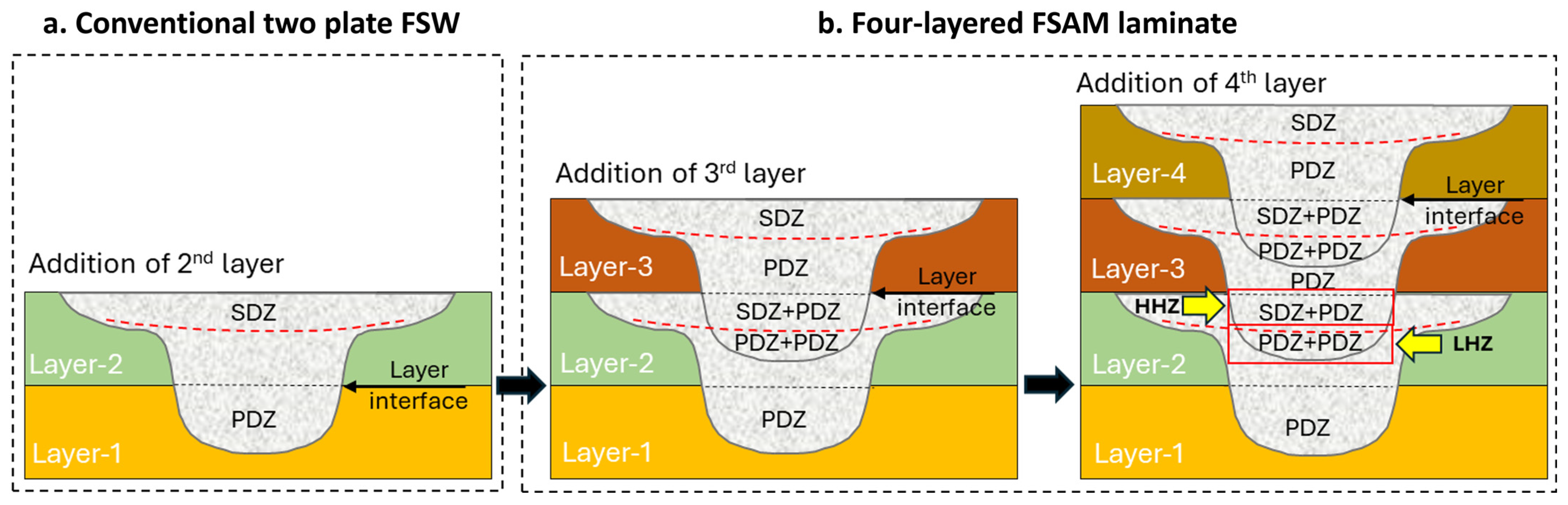
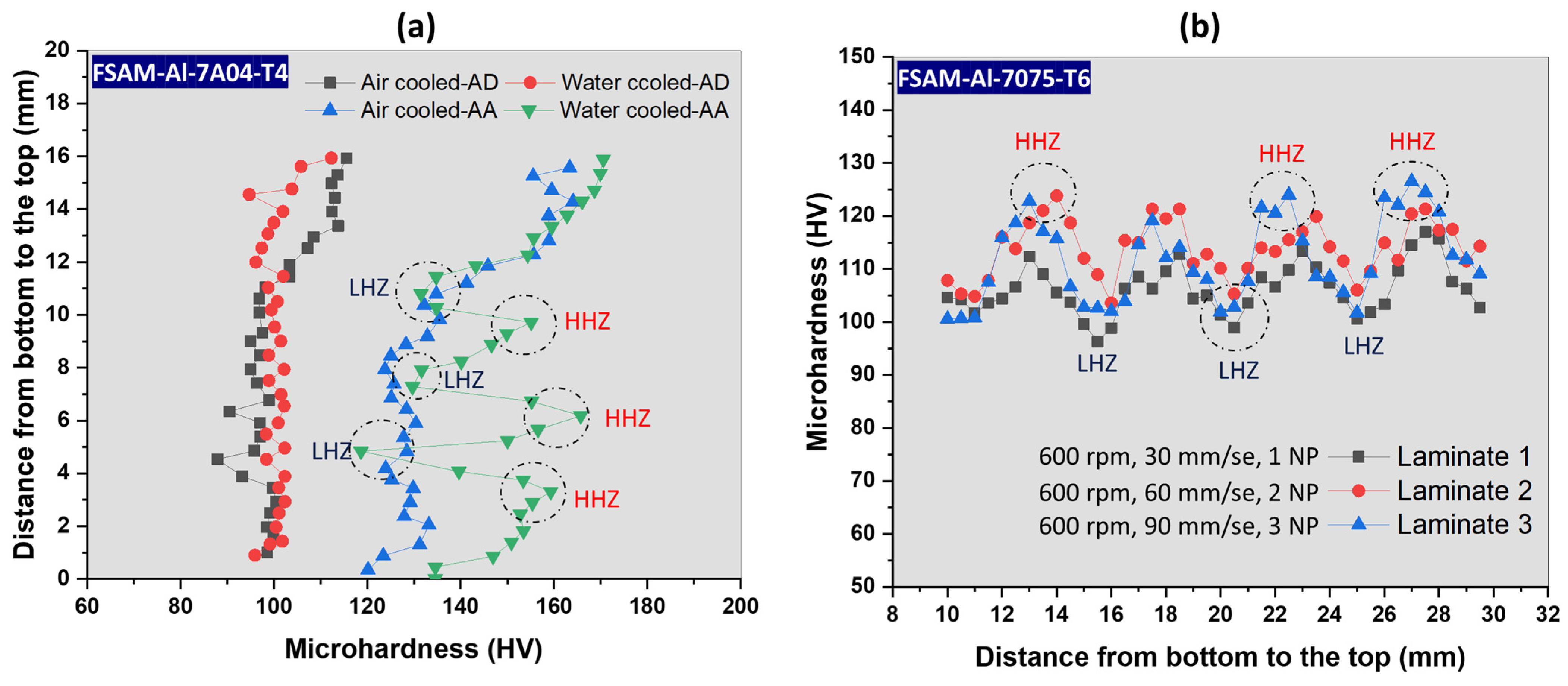
Despite the observed non-uniformity, an important aspect that requires further clarification is the presence of periodic high- and low-hardness regions (HHZ and LHZ) along the build direction. The overall non-uniform microhardness is attributed to the inherent nature of the FSAM process, where repeated thermal cycling induces static annealing effects (macroscale softening). In addition, localized variations in hardness, referred to as local softening, result in alternating HHZ and LHZ regions. The key difference between conventional FSLW and FSAM, as illustrated in Figure 11, lies in the transformation of the NZ from a pin-driven zone (PDZ) into combined regions, such as PDZ + PDZ and SDZ + PDZ, due to repeated stirring and re-stirring during successive layer deposition. This repeated thermo-mechanical interaction is responsible for the formation of localized hardness variations (HHZ and LHZ) [38].
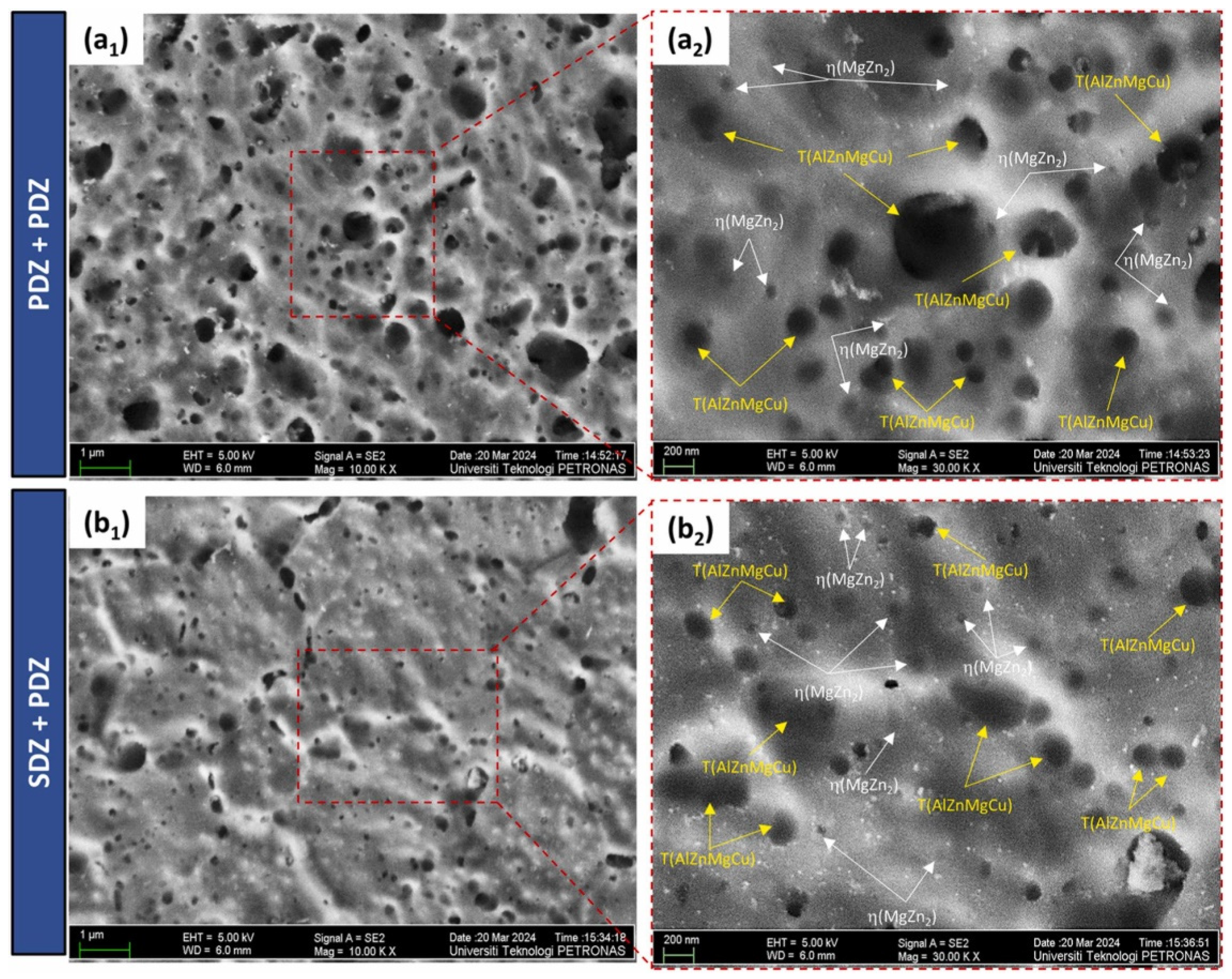
In the context of FSAM, this phenomenon has not been extensively elaborated for Al-2xxx and Al-6xxx alloys; however, it has been investigated in greater detail for Al-7xxx alloys. Y. Li et al. [38] and Hassan et al. [149,150] reported that the LHZ is located beneath the PDZ + PDZ region, while the HHZ corresponds to the SDZ + PDZ region, as shown in Figure 12a,b. In contrast, C. He et al. [151] reported the reverse trend, where HHZ was observed beneath the PDZ + PDZ region. This discrepancy is primarily attributed to the quench sensitivity of the alloy, which depends strongly on the cooling rate during processing. As the cooling rate decreases from the tool shoulder to the pin tip, alloys with higher quench sensitivity are more susceptible to the formation of coarse precipitates along grain boundaries or dispersoids. This process consumes solute atoms and vacancies, thereby reducing the age-hardening capability and leading to localized softening [152,153,154]. The quench sensitivity of Al-7xxx alloys (Al-Zn-Mg-Cu) increases with higher contents of Zn, Mg, and particularly Cu [155,156,157]. Additionally, reducing Cu content and increasing the Zn/Mg ratio can significantly decrease quench sensitivity [158,159]. Accordingly, alloys produced by Y. Li et al. [38] (7A04-T4: Al-6Zn-2.6Mg-1.5Cu) and A. Hassan et al. [149,150] (Al-7075-T6: Al-5.45Zn-1.4Cu-2.5Mg), both containing relatively high Cu content and low Zn/Mg ratios, exhibited higher quench sensitivity and corresponding HHZ-LHZ variations. Comparing the PDZ + PDZ and SDZ + PDZ regions, the T (Al-Zn-Mg-Cu) phases exhibit larger sizes and higher particle densities in the PDZ + PDZ region, as Figure 13. Similarly, spherical η phases (MgZn2) are more abundant within sub-grains and along sub-grain boundaries in the PDZ + PDZ region. The presence of these coarser and more densely distributed precipitates reduces the effectiveness of precipitation strengthening, resulting in lower microhardness in the PDZ + PDZ region compared to the SDZ + PDZ region [38,149,150]. In contrast, C. He et al. [151] used Al-7N01-T4 (Al-4.7Zn-1.1Mg), which contains no Cu and has a higher Zn/Mg ratio, indicating lower quench sensitivity, thereby explaining the different hardness distribution trend. Although M. Yuqing et al. [148] and H. Vinket et al. [93] also reported periodic HHZ and LHZ in Al-7075-based FSAM, the underlying role of quench sensitivity was not explicitly discussed in their studies. These findings demonstrate that local softening behavior (HHZ-LHZ) in FSAM of Al-7xxx alloys is governed not only by process-induced thermal cycling but also by alloy-specific quench sensitivity, highlighting that composition-dependent precipitation kinetics play a critical role in determining microhardness distribution and overall mechanical performance.
Hassan et al. [149] optimized the process parameters of Al-7075-T6 FSAM laminates using the Taguchi gray relational analysis (GRA) approach to achieve the highest possible mechanical performance. The optimized condition resulted in a maximum UTS of 415 MPa and a microhardness of 124 HV, corresponding to 74.3% and 70% of the BM, respectively. The reduction in strength was mainly attributed to the dissolution of strengthening precipitates. Despite this limitation, both the microstructure and microhardness along the building direction were relatively uniform due to the application of compressed cold air at six bars, which effectively mitigated the static annealing effect.
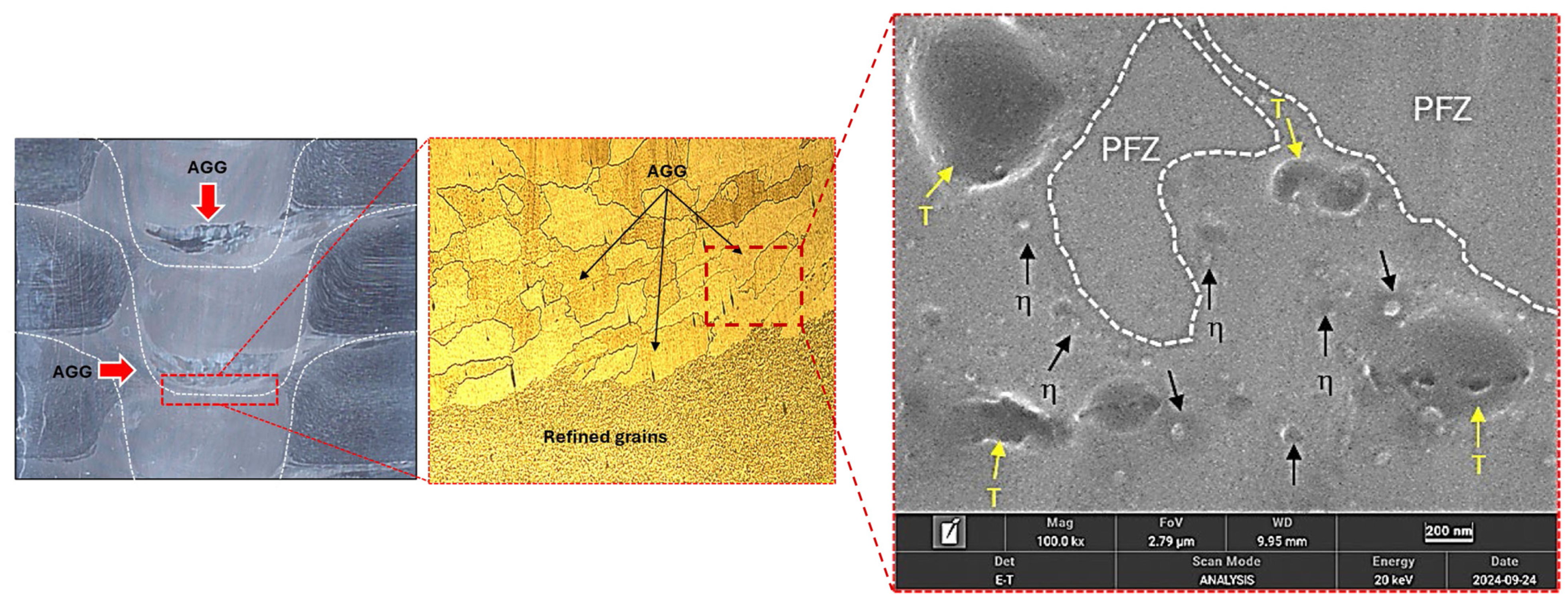
Building on this approach, a subsequent study [150] combined in-process air cooling with PHT to enhance property recovery. Cyclic solution treatment (400–480 °C), followed by aging at 120 °C for 24 h, enabled full recovery of microhardness to BM levels; however, the maximum UTS reached only 84.4% of BM. This limitation was associated with AGG and the formation of a precipitate-free zone (PFZ), as shown in Figure 14, at the bottom of the PDZ, highlighting the trade-off between strength recovery and microstructural stability. Ji Liu et al. [160] further investigated the influence of different PHT, including T6, T73, and retrogression and re-aging (RRA), on Al-7075-T6 FSAM samples. Tensile properties were evaluated in the transverse direction, while microhardness was not reported. In the as-fabricated condition, the UTS and elongation were 463.4 MPa and 23.34%, respectively. The T73 treatment resulted in a limited increase in strength but improved ductility, whereas both T6 and RRA treatments significantly enhanced UTS to values comparable with BM. However, this improvement in strength was accompanied by a marked reduction in ductility, indicating increased brittleness. In contrast, Hassan et al. [150] reported that cyclic solution treatment maintained ductility, although the recovered UTS remained lower than that of the BM.
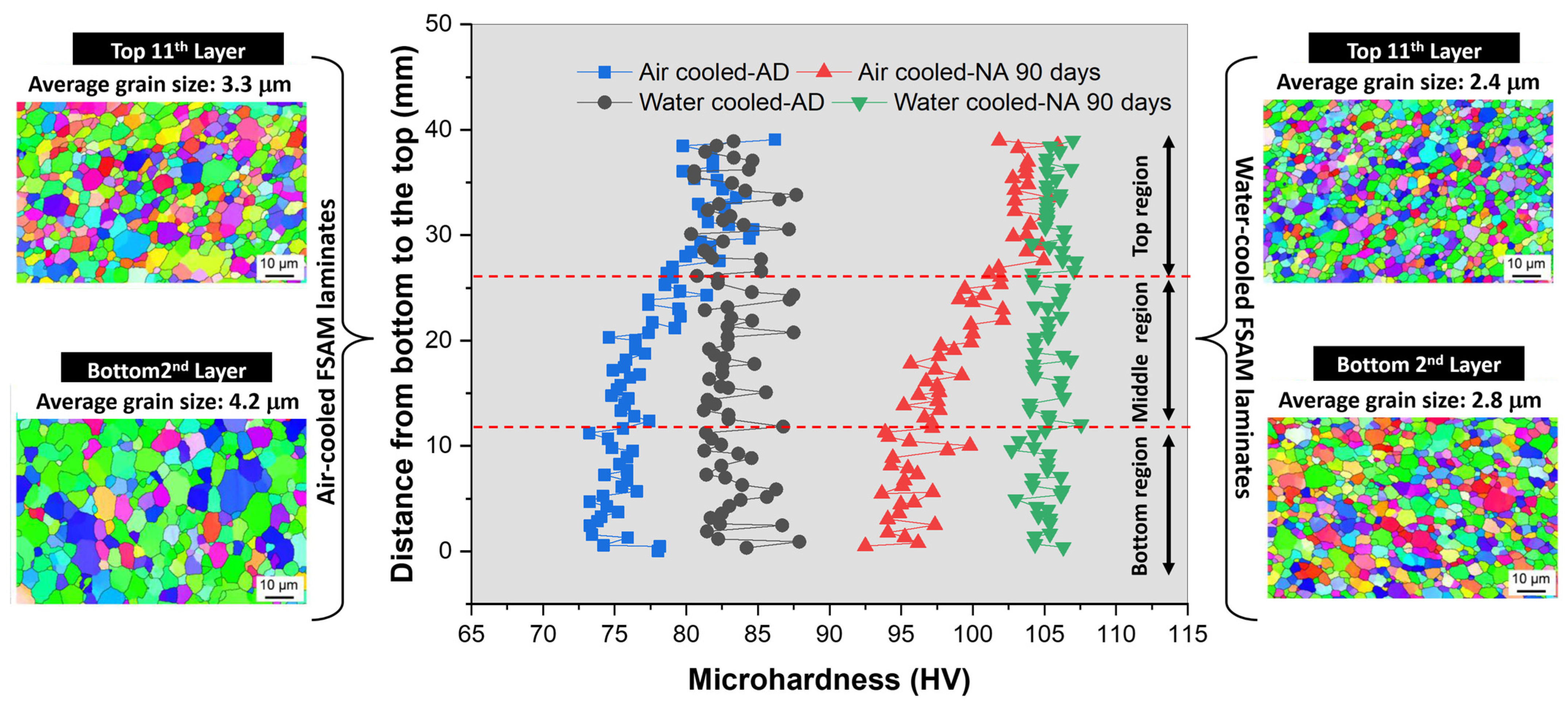
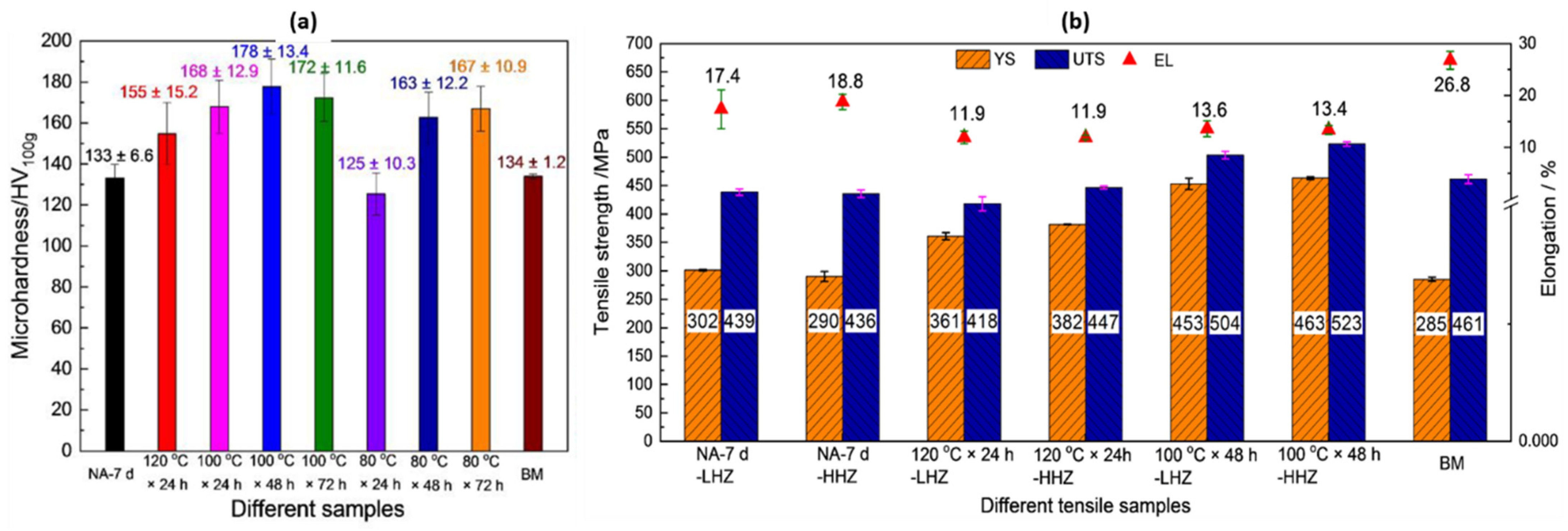
Similarly, C. He and Y. Li [161] investigated the effect of natural aging (NA) and artificial aging (AA) on Al-7N01-T4 FSAM laminates. Despite extended NA durations of up to 180 days, complete strength recovery was not achieved, with a maximum UTS of 483.1 MPa (73% of BM), indicating the limited effectiveness of passive aging in restoring precipitation strengthening. To address the persistent issue of property variation along the build direction and lower performance compared to the BM, the same group [151] introduced a combined approach of underwater FSAM and PHT. Underwater processing effectively suppressed microstructure gradient typically observed from bottom to top, leading to improved uniformity resulting in uniform microhardness as shown in Figure 15. The laminates exhibited comparable UTS values of 400 MPa in both the building and traversal directions after 90 days of aging, slightly exceeding the BM strength (392 MPa). The effect of cooling medium and natural aging on microhardness and UTS. The grains in the top region of the air-cooled and water-cooled laminates measured 3.3 µm and 2.4 µm, respectively, while at the bottom, these were 4.2 µm and 2.8 µm, as shown in Figure 15. Although NA takes significantly more time, this can be lessened by employing AA. Another study [162] investigated the effect of varying AA time and temperature on microhardness and strength. AA was conducted at 80 °C (24, 48, 72 h), 100 °C (24, 48, 72 h), and 120 °C (24 h). Over-aging occurred at high aging temperatures (120–24 h), resulting in a reduction in both microhardness and strength due to dislocation, high grain boundary density, and sub-grain boundary creation. This over-aging effect was further eliminated by reducing the aging temperature, leading to an enhancement in mechanical properties. Following artificial aging at 100 °C for 48 h, the average hardness increased to 178 HV, while the UTS of the LHZ and HHZ rose to 504 MPa and 523 MPa, respectively. A comprehensive graphical representation of the improved mechanical properties following varying temperature AA is depicted in Figure 16. Overall, AA emerges as a more effective strategy than NA for restoring and enhancing the mechanical properties of FSAM-fabricated heat-treatable aluminum alloys.
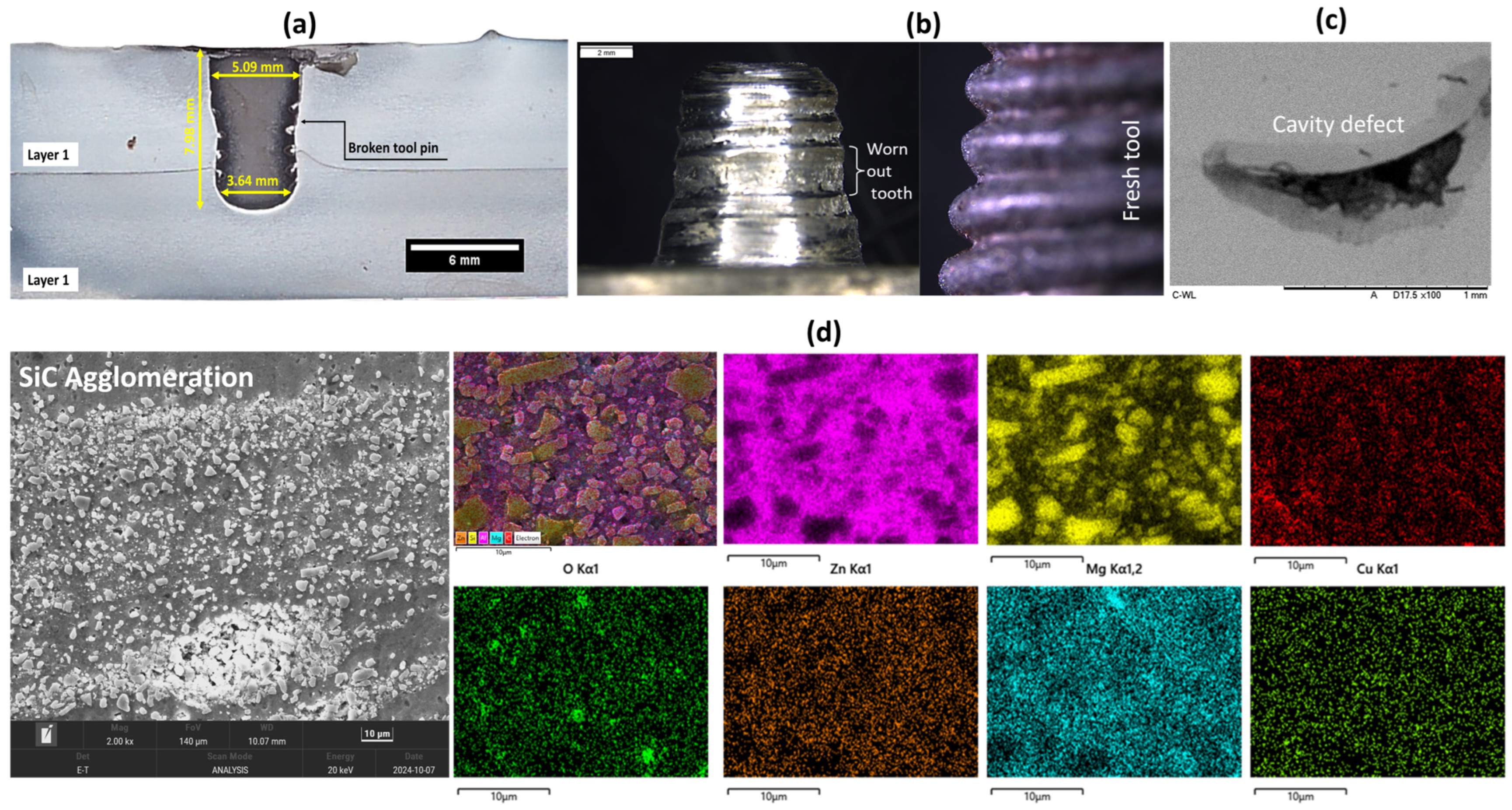
To improve mechanical properties, a combined strategy involving nanoparticle reinforcement (SiC, TiC), in-process cooling, and PHT has been explored for Al-7075-T6 FSAM laminates [163,164]. Although in-process cooling promotes a more uniform microstructure and microhardness along the building direction, the incorporation of nanoparticles introduces several additional processing challenges. Severe tool pin wear and breakage arise due to the abrasive nature of ceramic particles. In addition, tool wear can introduce tool-derived debris into the deposited material, causing material contamination and further deteriorating interfacial bonding and mechanical reliability [87,163,164]. Achieving homogeneous dispersion also remains difficult because of particle agglomeration and poor interfacial bonding. These issues often lead to particle clustering, localized stress concentrations, and premature failure, ultimately limiting the expected strengthening effect. The main challenges associated with reinforcement incorporation into Al 7075-T6 FSAM laminates, which result in premature structural failure and inferior mechanical performance compared with BM, are summarized in Figure 17 [163,164]. Furthermore, the presence of nanoparticles can alter material flow behavior during stirring, reducing process stability and consistency. As a result, with 5% vol. TiC nanoparticle addition followed by PHT, the maximum UTS reached only 54% of BM. Similarly, A. Kumar et al. [165,166] incorporated ZrO2 and graphene (G) into Al-7075 laminates; however, the achieved properties remained significantly lower than those of the BM in the T6 condition. The maximum UTS and microhardness were reported as 288.73 MPa and 88 HV, respectively. These findings further indicate that, despite their potential, nanoparticle additions in FSAM are constrained by dispersion-related issues, tool degradation, and process-induced defects, which collectively hinder their effectiveness in improving mechanical performance.
In the context of AFSD, Avery et al. [167] deposited Al-7075-T651 using a rod feed with a layer thickness of 1 mm up to 65 layers, and evaluated microhardness, tensile strength, and fatigue behavior along the building direction in as-deposited and PHT samples. Microhardness exhibited a gradual increase with the number of deposited layers, consistent with previous observations [148]. Similarly, improvements in hardness and strength with increasing NA time were reported, in line with findings by C. He and Y. Li [151]. However, the overall mechanical properties remained lower than those of BM. After 840 h (35 days) of NA, the maximum UTS and hardness reached 315 MPa and 135 HV, respectively. Property recovery of the same AFSD alloy close to BM levels was later achieved by J. Yoder [168] through solution treatment (470 °C for 2 h), followed by quenching and aging. Despite these improvements, the as-deposited samples exhibited reduced fatigue life compared to the BM, primarily due to discontinuous precipitate evolution. A decrease in cycles to failure was observed within a strain amplitude range of 0.2–0.5%. However, in the low-cycle regime, similar strain amplitudes (0.006–0.007) were reported, suggesting comparable crack initiation and propagation mechanisms. Crack damage in the as-deposited samples typically originated from the bonding interfaces and exhibited non-uniform propagation behavior. M Jadot et al. [169] applied T6 PHT to Al-7075-T6 AFSD builds, resulting in recovery of mechanical properties close to the BM, along with improved uniformity across the build.
C. Mason et al. [170] further extended AFSD to complex geometries by fabricating a cross-shaped Al-7050-T651 structure. Mechanical properties were evaluated in both transverse and building directions across three regions: starting (dwelling), middle, and crossover zones. Similar to earlier studies [148,167], microstructure and mechanical properties were non-uniform along the building direction. The starting zone exhibited the highest hardness and UTS, while the transition zone showed the lowest values. In addition, transverse properties were higher than those along the building direction. Nevertheless, the overall mechanical performance remained inferior to the wrought BM similar to M. Willimas et al.’s work [171]. EBSD analysis revealed equiaxed grains throughout the build, with significant variation in grain size depending on location. Larger grains were observed in the crossover region due to increased thermal exposure, while grain refinement and subsequent coarsening occurred along the build height. In contrast, the dwelling zone showed grain growth from bottom to top, attributed to high compressive forces and heat input during layer initiation. In AFSD, graphite is often used as a lubricant to facilitate smooth feeding of the consumable rod through the teardrop-shaped tool. However, graphite residues may be entrapped at interlayer interfaces during deposition, leading to weak bonding, internal defects, and deterioration of mechanical properties. To avoid this contamination issue, Peterson et al. [172] deposited Al-7075-T6 without graphite lubrication and achieved a dense, crack-free build. Although the as-deposited properties were lower than those of the BM, they improved significantly after T6 PHT. AFSD has also been explored for repair applications in high-strength Al-7xxx alloys [173]. R. Joey Griffiths et al. [174] investigated repair strategies for Al-7075 using different powder-filling approaches, including single-hole, double-hole, and groove configurations. The repair quality was generally lower at the bottom compared to the upper regions, indicating non-uniform bonding. Similarly, G. Stubblefield et al. [175] applied AFSD for ballistic repair of Al-7075-T651 sheets, where the repaired samples showed an 8.6% reduction in hardness relative to the BM. Surface damage analysis revealed petaling at the front and spalling at the rear, attributed to non-uniform thermal cycling during deposition. A related study by Avery et al. [176] reported that, although PHT improved hardness and tensile strength of repaired components, the fatigue performance remained inferior to that of BM.
Additionally, alternative gradient structures of Al-7xxx alloys combined with Al-6xxx or Al-5xxx alloys have shown advantages in FSAM over AFSD and have been widely reported in the literature [92,96,147,177]. In contrast, such gradient architecture remains largely unexplored in AFSD. To the best of the authors’ knowledge, M. Dong et al. [178] first developed an AFSD-based gradient structure of Al-7075 and Al-2024. In the as-deposited condition, reduced microhardness was observed; however, significant improvement was achieved through PHT involving solution treatment at 460 °C, followed by quenching and AA. Further enhancement was obtained using double AA at 120 °C and 170 °C for 24 h and 12 h, respectively, resulting in properties comparable to the BM. In addition, PHT improved property uniformity along the build direction, consistent with previous studies [112,116]. However, AGG was also observed after PHT, leading to only partial recovery of UTS, similar to the findings reported by Hassan et al. [150].
Similar to Al-6xxx alloys, the Al-7xxx series has also been explored in the context of FSEAM and FRAM. However, compared to Al-6xxx alloys, research on Al-7xxx within these processes remains relatively limited. This is mainly due to the higher strength and lower processability of Al-7xxx alloys, which introduce challenges in material flow and thermal control. Nevertheless, recent studies have attempted to utilize FSEAM and FRAM to address limitations such as continuous material feeding and process stability.
S. Sun et al. [179] employed FSEAM to fabricate Al-7075/TiB2 multilayered composites using annealed composite wires. Compared to AFSD, FSEAM produced a smoother surface finish and exhibited a relatively uniform microstructure along the building direction, resulting in homogeneous mechanical properties. The maximum UTS and microhardness reached approximately 400 MPa and 130 HV, respectively, which were higher than BM in the annealed condition. Similar trends were reported by Z. Zhang et al. [180] using TiC-reinforced composite wires. In both studies [179,180], reinforcement was introduced through prefabricated composite wires rather than direct nanoparticle feeding during deposition. However, the preparation of such composite feedstock remains complex and cost-intensive, posing a limitation for wider application of FSEAM in Al-7xxx alloys.
H. Liu et al. [181] applied an in-process cooling approach in the FRAM of Al-7075-T6 using strip feed material, where cooling was implemented through high-pressure compressed air and water spray to reduce thermal exposure. The introduction of cooling effectively promoted grain refinement and suppressed excessive dynamic recrystallization during deposition. The average grain size was reduced to 1.60 µm (water cooling), 2.05 µm (air cooling), and 2.30 µm (natural cooling). Among these conditions, moderate cooling through compressed air resulted in the best mechanical performance, achieving a maximum UTS of 504.5 MPa, although still lower than BM, while ductility remained nearly unchanged. In a subsequent study [182], a combined approach involving TiC nanoparticle incorporation and T6 PHT was employed in FRAM of Al-7075-T6 using composite wire feedstock (Al-7075/TiC). The addition of TiC nanoparticles enhanced grain boundary pinning, leading to significant grain refinement and controlled recrystallization. During PHT, the nanoparticles effectively restricted grain growth, reducing the grain size from 6.05 µm to 3.53 µm. As a result, the mechanical properties were substantially improved, achieving a UTS of 626 ± 15 MPa, YS of 546 ± 5 MPa, and elongation of 15.5 ± 0.5%. The enhanced performance was primarily attributed to the combined effects of grain refinement and precipitation strengthening induced by PHT.
Compared with other solid-state AM methods, such as CSAM, FBAM shows better potential for fabricating fully dense multilayer structures from high-strength Al-7xxx alloys. CSAM is more suitable for repair and coating applications [183] because deposition occurs through high-velocity powder impact rather than severe plastic deformation and stirring. For instance, Prasad et al. [184] reported 0% deposition efficiency for as-received Al-7075 powder, which increased to only 59% after powder annealing. Similarly, Wang et al. [185] reported pore and cavity-type defects in laser-assisted CSAM of Al-7075. These findings indicate that FBAM offers advantages for heat-treatable aluminum alloys by promoting stronger material consolidation, plastic deformation, and metallurgical bonding. These limitations in CSAM further justify the growing focus on FBAM for high-strength heat-treatable aluminum alloys.
Overall, Al-7xxx alloys have been extensively studied in the context of FSAM and AFSD, where process understanding and optimization are relatively mature. In contrast, FSEAM and FRAM have received comparatively less attention due to their recent development and associated processing complexities. Despite various strategies, including in-process cooling, nanoparticle incorporation, and PHT, achieving uniform microstructure and mechanical properties comparable to BM in T6, T4 condition remains a key challenge in FSAM and AFSD builds. A comprehensive summary of Al-7xxx alloys processed through FBAM techniques is presented in Table 3, highlighting the key findings and strategies adopted to address these limitations.

2.4. Process-Induced Defects in FBAM

Each FBAM process is associated with specific process-induced defects that may influence the quality and performance of the fabricated structure. These defects are primarily process dependent and are governed by material flow behavior, heat generation, and consolidation conditions. Although their occurrence is largely independent of the alloy series being processed, alloy-specific properties, such as thermal conductivity, flow stress, and softening behavior, may influence their severity and formation tendency. In most cases, these defects can be minimized or eliminated through appropriate process parameter optimization, tool design, and process control. However, the optimized processing window may vary depending on alloy grade, feedstock geometry, and build configuration.
In FSAM, the commonly reported defects include kissing bonds, hooking, cold laps, voids, tiny pinholes, and tunnel defects, mainly caused by insufficient heat generation or inadequate material flow [28,32,82,87,148,149,161,164,187]. AFSD structures may exhibit lack of fill, holes, kissing bonds, excessive flash formation, surface irregularities, layer discontinuity, edge unbonding, and material accumulation due to improper deposition conditions [42,103,104,106,107,188]. In FSEAM, defects such as incomplete extrusion, void formation, surface roughness, surface discontinuities, surface scratches, edge cracking, edge unbonding, and non-uniform layer consolidation have been reported [48,80,131]. Similarly, FRAM may experience insufficient bonding, surface waviness [55], trench-like features [136], voids, tunnel defects, weak bonding, material spills, unbonded layers [138], and localized lack of consolidation. These defects are typically associated with inappropriate processing conditions and can generally be mitigated through process optimization. Process-induced defects reported in heat-treatable aluminum alloy FBAM studies are summarized in Table 4. Such defects can act as stress concentration sites and adversely affect tensile properties, fatigue performance, and structural reliability.

3. Practical Implementation of Strategies to Address Challenges

The practical implementation of the above-discussed approaches for addressing challenges in FBAM of heat-treatable aluminum alloys detailed below, supported by representative setups.

3.1. Controlling Thermal Gradient

Temperature plays a critical role in governing microstructure evolution and the resulting mechanical properties in FBAM of heat-treatable aluminum alloys. A common limitation observed across FBAM build is the presence of non-uniform properties along the building direction, typically characterized by an increase in strength and hardness from the bottom to the top layers due to repeated thermal exposure during successive depositions. Addressing this thermal gradient is therefore essential but remains challenging in practice. C. He and Y. Li [151] and R. Kinser et al. [126] effectively mitigated this issue in FSAM/AFSD through an underwater processing approach, where the laminate is partially submerged in a controlled water environment as shown in Figure 18a, enabling rapid heat dissipation and stabilization of the thermal field without altering the core process configuration. Although this method significantly improves property uniformity, its practical implementation at industrial scale is constrained by handling complexity and process integration challenges. As an alternative, B. Chaudhary et al. [108] introduced a controlled heating approach by incorporating a flat heating plate beneath the backing plate as shown in Figure 18b, establishing a closed-loop thermal system that maintains a minimum deposition temperature and limits excessive cooling, thereby reducing the dissolution of strengthening precipitates. In contrast to these approaches, in-process cooling techniques, such as compressed air [149,150,163] and water mist [181], offer a more practical and scalable solution by enabling localized thermal control without major modifications to the system. Further enhancement in thermal management can be achieved by modifying the backing plate with internal cooling channels for circulating coolant as shown in Figure 18c, a concept successfully demonstrated in conventional FSW of Al-2024 [189]. Overall, while multiple strategies have been proposed, achieving an optimal balance between thermal control, process stability, and scalability remains a key challenge for industrial implementation.

3.2. Inclusions of Nanoparticles

In heat-treatable aluminum alloys, FBAM-fabricated components often exhibit mechanical properties inferior to BM, primarily due to precipitate dissolution, over-aging, and microstructural heterogeneity. To overcome these limitations, various nanoparticles, including Al2O3, Ni, ZrO2, FeCoNi, Ti, TiC, and SiC, have been incorporated to enhance strength through grain refinement and particle strengthening mechanisms. While their effects on microstructure and mechanical performance have been discussed earlier, the practical implementation of nanoparticle incorporation during FBAM remains challenging. As illustrated in Figure 19, several strategies [42,64,190,191] have been developed without significantly modifying the core FSAM, AFSD, or FRAM processes. In FSAM, nanoparticles can be introduced either through a specially designed tool enabling direct injection into the plasticized material or through prefabricated feed plates containing blind holes or grooves filled with powder. Among these, tool-based feeding is more effective, as it allows continuous particle addition and avoids additional processing steps. In contrast, the blind hole and groove methods involve multi-step operations, including capping, as well as capping tool and flash removal, which increase process complexity, time, and cost. In AFSD, nanoparticle incorporation is further limited by the use of consumable rod feedstock. Although drilling and filling powder within the rod is possible, it is difficult to control and impractical for continuous long-length feeding. A more feasible approach involves introducing particles beneath the tilted consumable rod or tool shoulder through an external feeding system, enabling controlled and continuous particle addition during deposition. In FSEAM and FRAM, the use of composite feedstock (wires or strips) containing nanoparticles presents additional challenges, as their fabrication is both complex and costly. Despite these developments, achieving uniform particle dispersion, minimizing agglomeration, and maintaining process stability remain critical challenges, limiting the effective application of nanoparticle reinforcement in FBAM of heat-treatable aluminum alloys.

3.3. Post-Heat Treatment

PHT remains one of the most effective approaches for restoring mechanical properties in FBAM-fabricated heat-treatable aluminum alloys. Typically, near-net-shaped laminates produced through FSAM, AFSD, FSEAM or FRAM, are subjected to solution treatment followed by AA in a furnace, enabling precipitation strengthening and significant recovery of mechanical properties. Several studies have reported property enhancement comparable to BM. However, in many cases [30,62,76,167], although PHT improves properties relative to the as-fabricated condition, the recovered strength remains lower than that of the BM. This limitation is primarily attributed to microstructural instabilities such as AGG, precipitate coarsening, and the formation of PFZ during thermal exposure.
It is worth noting that the studies analyzed in the present review were mainly conducted on laboratory-scale small builds, where PHT was applied to small test samples rather than to the complete fabricated structures or builds. These smaller samples could be easily accommodated in laboratory electric furnaces. However, from a practical perspective, applying PHT at a larger scale remains challenging for large and irregularly shaped automotive and aerospace components. Although furnace-based heat treatment is feasible, its implementation becomes difficult due to furnace size limitations, non-uniform heating, and increased processing cost.

4. Conclusions and Future Prospectives

The present review provides a comprehensive assessment of the challenges and opportunities associated with emerging FBAM techniques for heat-treatable aluminum alloys. The major conclusions and future research directions are summarized as follows:
  • FBAM has demonstrated strong potential for processing heat-treatable aluminum alloys, particularly the 2xxx, 6xxx, and 7xxx series. Unlike fusion-based AM processes, FBAM produces fully dense structures without solidification-related defects, such as porosity, hot cracking, and columnar grain growth. In addition, the severe plastic deformation and dynamic recrystallization involved in FBAM promote the formation of equiaxed ultrafine grains, often below 1 μm, resulting in refined microstructures and improved metallurgical bonding.
  • A major challenge in FBAM of heat-treatable alloys is the development of heterogeneous microstructure and mechanical properties along the build direction due to repeated thermal cycling and static annealing effects. These thermal effects promote precipitate dissolution, coarsening, and over-aging, leading to property degradation and build-direction anisotropy. Various thermal management strategies, including underwater processing and in-process cooling using compressed air or water mist, have been successfully employed to suppress excessive heat accumulation and improve structural homogeneity throughout the deposited builds.
  • Among the available thermal management approaches, underwater FBAM has proven highly effective in stabilizing the thermal field and minimizing thermal gradients. However, this approach is associated with higher energy consumption, increased hydraulic forces, and greater operational complexity. In contrast, cooling approaches using compressed air or water mist appear more practical and industrially scalable, as they provide effective thermal control without requiring major modification of the processing setup.
  • Despite extensive research, most FBAM-fabricated structures still exhibit lower mechanical properties than the corresponding BM, particularly when heat-treated feedstock conditions such as T4, T6, and T651 are used. In most studies, the achieved strength and microhardness remain within 70–75% of the BM, even after process optimization or nanoparticle reinforcement. In contrast, the use of feed material in the annealed (O) condition often results in superior performance relative to the annealed BM due to substantial grain refinement induced by severe plastic deformation. The use of annealed feed material has been reported to improve mechanical properties by approximately 30–60% compared with the annealed BM. These observations suggest that the use of annealed feedstock followed by PHT may provide a more effective and economical processing route than the use of pre-strengthened feedstock. However, no systematic comparative investigation has yet demonstrated whether FBAM structures fabricated from annealed feedstock followed by PHT can outperform structures produced directly from heat-treated feedstock followed by re-heat treatment. This remains a significant research gap.
  • PHT has been widely employed to restore mechanical properties and improve build-direction consistency; however, complete recovery to BM properties is still rarely achieved. In some studies, microhardness was almost fully recovered, whereas UTS generally reached only about 80–85% of the BM after PHT. Although PHT improves UTS compared with the as-deposited condition, ductility often decreases by nearly 50%, resulting in relatively brittle structures. Furthermore, AGG, precipitate coarsening, and microstructural instability during thermal exposure continue to limit the effectiveness of conventional heat treatment approaches. Therefore, future research should focus on designing optimized and alloy-specific PHT cycles capable of achieving a better balance between strength, ductility, and microstructural stability.
  • Nanoparticle incorporation has also been explored to improve strengthening behavior in FBAM structures. However, despite promising strengthening potential, reinforcement-based strategies remain difficult to implement reliably due to severe tool wear, tool pin fracture, particle agglomeration, poor interfacial bonding, and unstable material flow. These issues often result in localized stress concentration and premature failure, thereby limiting the expected strengthening effect.
  • Most existing studies have mainly focused on SiC, TiC, and Al2O3 nanoparticles as single reinforcements. Future studies should explore graphene nanoplatelets (GNPs) and carbon nanotubes (CNTs), both as individual and hybrid reinforcements, which remain largely unexplored for improving microstructural stability and mechanical performance in FBAM structures. Furthermore, the preparation of reinforced feedstock in the form of prefilled plates, rods, or wires is often expensive and difficult. Therefore, reinforcement incorporation through external feeding using modified non-consumable tools may provide a more economical and scalable alternative and remains largely unexplored in the current literature.
  • Among the available FBAM techniques, FSAM and AFSD have been extensively investigated and exhibit relatively mature process understanding. In contrast, FSEAM and FRAM remain comparatively underexplored and are still in the early stages of development, highlighting clear research gaps in the existing literature. Future research should focus on expanding the application of FSEAM and FRAM for heat-treatable alloys, particularly Al-2xxx and Al-7xxx systems, while also exploring alternative gradient structures and multi-material deposition strategies in AFSD.
  • FBAM still remains largely limited to laboratory-scale studies. Its industrial adoption is constrained by thermal management challenges and limited process-structure-property understanding. Direct fabrication of large and geometrically complex components from CAD models also remains limited, requiring advanced robotic systems, intelligent process control, and numerical control strategies. In addition, advanced approaches such as machine learning, data-driven optimization, digital twins, and in situ monitoring techniques should be employed to better understand and control process-structure-property relationships, thermal history, and defect evolution during FBAM processing.
  • Although this review highlights the strong potential of FBAM, several limitations in the existing literature should be acknowledged. Most reported studies are based on small laboratory-scale builds and simplified geometries, limiting their direct translation to industrial-scale components. In addition, direct cross-process comparison between FSAM, AFSD, FSEAM, and FRAM remains difficult due to differences in alloy conditions, feedstock forms, tool designs, processing parameters, and testing methods. Therefore, future studies should adopt standardized experimental protocols and quantitative meta-analyses to enable more reliable comparison of process performance and property uniformity across different FBAM techniques.
  • Most existing FBAM studies mainly focus on tensile strength and microhardness. Beyond these properties, further investigation into fatigue, creep, fracture toughness, corrosion, and wear behavior is essential for real-world structural applications, particularly in aerospace, automotive, and defense sectors. Ultimately, the successful industrial adoption of FBAM will depend on the development of scalable, cost-effective, energy-efficient, and robust processing strategies capable of producing uniform, defect-free, and high-performance components. With continued advancements in thermal management, reinforcement strategies, and process control, FBAM has strong potential for high-performance structural applications.

Author Contributions

Conceptualization, A.H., S.R.P. and K.A.; data collection, A.H., R.V.M. and K.A.; software, A.H. and S.P.; methodology, A.H., M.C.I. and K.A.; writing—original draft preparation, A.H.; writing—review and editing, A.H., S.R.P., S.P. and M.C.I.; visualization, M.C.I. and R.V.M.; project administration, M.C.I. and S.R.P.; resources, M.C.I. and S.P.; supervision, M.C.I. and S.R.P.; funding acquisition, S.R.P. and M.C.I. All authors have read and agreed to the published version of the manuscript.

Funding

This research received no external funding.

Data Availability Statement

No new data were created or analyzed in this study. Data sharing is not applicable to this article.

Conflicts of Interest

The authors declare no conflicts of interest.

References

  1. Rajan, R.; Kah, P.; Mvola, B.; Martikainen, J. Trends in Aluminium Alloy Development and Their Joining Methods. Rev. Adv. Mater. Sci. 2016, 44, 383–397. [Google Scholar]
  2. Singh, A.; Ramakrishnan, A.; Baker, D.; Biswas, A.; Dinda, G.P. Laser Metal Deposition of Nickel Coated Al 7050 Alloy. J. Alloys Compd. 2017, 719, 151–158. [Google Scholar] [CrossRef]
  3. Jawalkar, C.S.; Kant, S. A Review on Use of Aluminium Alloys in Aircraft Components. i-Manager’s J. Mater. Sci. 2015, 3, 33. [Google Scholar] [CrossRef]
  4. Qiu, X. Effect of Rolling on Fatigue Crack Growth Rate of Wire and Arc Additive Manufacture (WAAM) Processed Titanium. Ph.D. Thesis, Cranfield University, Cranfield, UK, 2013. [Google Scholar]
  5. Barnes, J.E.; Peter, W.; Blue, C.A. Evaluation of Low Cost Titanium Alloy Products. In Proceedings of the Materials Science Forum; Trans Tech Publications: Bäch, Switzerland, 2009; Volume 618, pp. 165–168. [Google Scholar]
  6. Timmis, A.J.; Hodzic, A.; Koh, L.; Bonner, M.; Soutis, C.; Schäfer, A.W.; Dray, L. Environmental Impact Assessment of Aviation Emission Reduction through the Implementation of Composite Materials. Int. J. Life Cycle Assess. 2015, 20, 233–243. [Google Scholar]
  7. Huang, R.; Riddle, M.; Graziano, D.; Warren, J.; Das, S.; Nimbalkar, S.; Cresko, J.; Masanet, E. Energy and Emissions Saving Potential of Additive Manufacturing: The Case of Lightweight Aircraft Components. J. Clean. Prod. 2016, 135, 1559–1570. [Google Scholar] [CrossRef]
  8. Uriondo, A.; Esperon-Miguez, M.; Perinpanayagam, S. The Present and Future of Additive Manufacturing in the Aerospace Sector: A Review of Important Aspects. Proc. Inst. Mech. Eng. Part G J. Aerosp. Eng. 2015, 229, 2132–2147. [Google Scholar] [CrossRef]
  9. Schiller, G.J. Additive Manufacturing for Aerospace. In Proceedings of the 2015 IEEE Aerospace Conference; IEEE: New York, NY, USA, 2015; pp. 1–8. [Google Scholar]
  10. Liu, R.; Wang, Z.; Sparks, T.; Liou, F.; Newkirk, J. Aerospace Applications of Laser Additive Manufacturing. In Laser Additive Manufacturing; Elsevier: Amsterdam, The Netherlands, 2017; pp. 351–371. [Google Scholar]
  11. du Plessis, A.; le Roux, S.G.; Booysen, G.; Els, J. Directionality of Cavities and Porosity Formation in Powder-Bed Laser Additive Manufacturing of Metal Components Investigated Using X-Ray Tomography. 3D Print. Addit. Manuf. 2016, 3, 48–55. [Google Scholar] [CrossRef]
  12. Spoerk, M.; Sapkota, J.; Weingrill, G.; Fischinger, T.; Arbeiter, F.; Holzer, C. Shrinkage and Warpage Optimization of Expanded-perlite-filled Polypropylene Composites in Extrusion-based Additive Manufacturing. Macromol. Mater. Eng. 2017, 302, 1700143. [Google Scholar] [CrossRef]
  13. Frazier, W.E. Metal Additive Manufacturing: A Review. J. Mater. Eng. Perform. 2014, 23, 1917–1928. [Google Scholar] [CrossRef]
  14. Sames, W.J.; List, F.A.; Pannala, S.; Dehoff, R.R.; Babu, S.S. The Metallurgy and Processing Science of Metal Additive Manufacturing. Int. Mater. Rev. 2016, 61, 315–360. [Google Scholar] [CrossRef]
  15. Baumann, J.A. Production of Energy Efficient Preform Structures (PEEPS); The Boeing Company: Washington, DC, USA, 2012. [Google Scholar]
  16. Linton, V.M.; Ripley, M.I. Influence of Time on Residual Stresses in Friction Stir Welds in Agehardenable 7xxx Aluminium Alloys. Acta Mater. 2008, 56, 4319–4327. [Google Scholar] [CrossRef]
  17. Lotfi, A.H.; Nourouzi, S. Predictions of the Optimized Friction Stir Welding Process Parameters for Joining AA7075-T6 Aluminum Alloy Using Preheating System. Int. J. Adv. Manuf. Technol. 2014, 73, 1717–1737. [Google Scholar] [CrossRef]
  18. Palanivel, S.; Mishra, R.S. Building without Melting: A Short Review of Friction-Based Additive Manufacturing Techniques. Int. J. Addit. Subtractive Mater. Manuf. 2017, 1, 82–103. [Google Scholar] [CrossRef]
  19. Palanivel, S.; Nelaturu, P.; Glass, B.; Mishra, R.S. Friction Stir Additive Manufacturing for High Structural Performance through Microstructural Control in an Mg Based WE43 Alloy. Mater. Des. 2015, 65, 934–952. [Google Scholar] [CrossRef]
  20. Gao, H.; Li, H. Friction Additive Manufacturing Technology: A State-of-the-Art Survey. Adv. Mech. Eng. 2021, 13, 16878140211034431. [Google Scholar] [CrossRef]
  21. Hassan, A.; Pedapati, S.R.; Awang, M.; Soomro, I.A. A Comprehensive Review of Friction Stir Additive Manufacturing (FSAM) of Non-Ferrous Alloys. Materials 2023, 16, 2723. [Google Scholar] [CrossRef] [PubMed]
  22. Ziaee, M.; Crane, N.B. Binder Jetting: A Review of Process, Materials, and Methods. Addit. Manuf. 2019, 28, 781–801. [Google Scholar] [CrossRef]
  23. Hehr, A.; Norfolk, M. A Comprehensive Review of Ultrasonic Additive Manufacturing. Rapid Prototyp. J. 2019, 26, 445–458. [Google Scholar] [CrossRef]
  24. White, D. Object Consolidation Employing Friction Joining 2002. U.S. Patent 6,457,629, 1 October 2002. [Google Scholar]
  25. Cam, G.; Mistikoglu, S. Recent Developments in Friction Stir Welding of Al-Alloys. J. Mater. Eng. Perform. 2014, 23, 1936–1953. [Google Scholar] [CrossRef]
  26. Hassan, A.; Pedapati, S.R. Exploration of Possible Defects Originating in Al-5083 Laminates Synthesized Through Friction Stir Additive Manufacturing Technique; Springer Nature: Singapore, 2024. [Google Scholar]
  27. Palanivel, S.; Sidhar, H.; Mishra, R.S. Friction Stir Additive Manufacturing: Route to High Structural Performance. JOM 2015, 67, 616–621. [Google Scholar] [CrossRef]
  28. Hassan, A.; Awang, M.; Pedapati, S.R.; Altaf, K.; Marode, R.V.; Ahmed, S.W. Experimental Investigation on Tool Pin Profile for Defect-Free Multi-Layered Laminates Using Friction Stir Additive Manufacturing. Results Eng. 2023, 20, 101516. [Google Scholar] [CrossRef]
  29. Srivastava, M.; Rathee, S. Microstructural and Microhardness Study on Fabrication of Al 5059/SiC Composite Component via a Novel Route of Friction Stir Additive Manufacturing. Mater. Today Proc. 2020, 39, 1775–1780. [Google Scholar] [CrossRef]
  30. Stir, R.; Manufacturing, A.; Alloy, L.I. Friction Stir Additive Manufacturing (FSAM) of 2050 Al-Cu-Li Alloy. Master’s Thesis, University of South Carolina, Columbia, SC, USA, 2019. [Google Scholar]
  31. Liu, M.; Wang, B.B.; An, X.H.; Xue, P.; Liu, F.C.; Wu, L.H.; Ni, D.R.; Xiao, B.L.; Ma, Z.Y. Friction Stir Additive Manufacturing Enabling Scale-up of Ultrafine-Grained Pure Copper with Superior Mechanical Properties. Mater. Sci. Eng. A 2022, 857, 144088. [Google Scholar] [CrossRef]
  32. Sigl, M.E.; Danninger, P.; Bernauer, C.; Hartl, R.; Zaeh, M.F. Efficient Build-Up of High-Strength Aluminum Structures Using Friction Stir Additive Manufacturing. Key Eng. Mater. 2022, 926, 176–186. [Google Scholar] [CrossRef]
  33. Srivastava, A.K.; Kumar, N.; Dixit, A.R. Friction Stir Additive Manufacturing–An Innovative Tool to Enhance Mechanical and Microstructural Properties. Mater. Sci. Eng. B 2021, 263, 114832. [Google Scholar] [CrossRef]
  34. Perry, M.E.J.; Rauch, H.A.; Griffiths, R.J.; Garcia, D.; Sietins, J.M.; Zhu, Y.; Zhu, Y.; Yu, H.Z. Tracing Plastic Deformation Path and Concurrent Grain Refinement during Additive Friction Stir Deposition. Materialia 2021, 18, 101159. [Google Scholar] [CrossRef]
  35. Stubblefield, G.G.; Fraser, K.A.; Van Iderstine, D.; Mujahid, S.; Rhee, H.; Jordon, J.B.; Allison, P.G. Elucidating the Influence of Temperature and Strain Rate on the Mechanics of AFS-D through a Combined Experimental and Computational Approach. J. Mater. Process. Technol. 2022, 305, 117593. [Google Scholar] [CrossRef]
  36. Phillips, B.J.; Avery, D.Z.; Liu, T.; Rodriguez, O.L.; Mason, C.J.T.; Jordon, J.B.; Brewer, L.N.; Allison, P.G. Microstructure-Deformation Relationship of Additive Friction Stir-Deposition Al–Mg–Si. Materialia 2019, 7, 100387. [Google Scholar] [CrossRef]
  37. Tang, W.; Yang, X.; Tian, C.; Gu, C. A Effect of Rotation Speed on Microstructure and Mechanical Anisotropy of Al-5083 Alloy Builds Fabricated by Friction Extrusion Additive Manufacturing. Mater. Sci. Eng. A 2022, 860, 144237. [Google Scholar] [CrossRef]
  38. Li, Y.; He, C.; Wei, J.; Zhang, Z.; Qin, G.; Zhao, X. Correlation of Local Microstructures and Mechanical Properties of Al–Zn–Mg–Cu Alloy Build Fabricated via Underwater Friction Stir Additive Manufacturing. Mater. Sci. Eng. A 2021, 805, 140590. [Google Scholar] [CrossRef]
  39. Gotawala, N.; Yu, H.Z. Material Flow Path and Extreme Thermomechanical Processing History during Additive Friction Stir Deposition. J. Manuf. Process. 2023, 101, 114–127. [Google Scholar] [CrossRef]
  40. Garcia, D.; Hartley, W.D.; Rauch, H.A.; Griffiths, R.J.; Wang, R.; Kong, Z.J.; Zhu, Y.; Yu, H.Z. In Situ Investigation into Temperature Evolution and Heat Generation during Additive Friction Stir Deposition: A Comparative Study of Cu and Al-Mg-Si. Addit. Manuf. 2020, 34, 101386. [Google Scholar] [CrossRef]
  41. Merritt, G.R.; Williams, M.B.; Allison, P.G.; Jordon, J.B.; Rushing, T.W.; Cousin, C.A. Closed-Loop Temperature and Force Control of Additive Friction Stir Deposition. J. Manuf. Mater. Process. 2022, 6, 92. [Google Scholar] [CrossRef]
  42. El-Sayed Seleman, M.M.; Ataya, S.; Ahmed, M.M.Z.; Hassan, A.M.M.; Latief, F.H.; Hajlaoui, K.; El-Nikhaily, A.E.; Habba, M.I.A. The Additive Manufacturing of Aluminum Matrix Nano Al2O3 Composites Produced via Friction Stir Deposition Using Different Initial Material Conditions. Materials 2022, 15, 2926. [Google Scholar] [CrossRef] [PubMed]
  43. Elfishawy, E.; Ahmed, M.M.Z.; El-Sayed Seleman, M.M. Additive Manufacturing of Aluminum Using Friction Stir Deposition; Springer International Publishing: Berlin/Heidelberg, Germany, 2020. [Google Scholar]
  44. Gandra, J.; Krohn, H.; Miranda, R.M.; Vilac, P.; Quintino, L.; Santos, J.F. Friction Surfacing—A Review. J. Mater. Process. Technol. 2014, 214, 1062–1093. [Google Scholar] [CrossRef]
  45. Karmakar, S.; Swarnkar, R.; Pal, S.K. Effect of Multi-Layer Deposition in Solid-State Friction Stir Surfacing-Based Additive Manufacturing for Fabrication of Large-Scale Metal Product. J. Mater. Process. Technol. 2023, 320, 118107. [Google Scholar] [CrossRef]
  46. Elshaghoul, Y.G.Y.; El-Sayed Seleman, M.M.; Bakkar, A.; Elnekhaily, S.A.; Albaijan, I.; Ahmed, M.M.Z.; Abdel-Samad, A.; Reda, R. Additive Friction Stir Deposition of AA7075-T6 Alloy: Impact of Process Parameters on the Microstructures and Properties of the Continuously Deposited Multilayered Parts. Appl. Sci. 2023, 13, 10255. [Google Scholar] [CrossRef]
  47. Dilip, J.J.S.; Janaki Ram, G.D.; Stucker, B.E. Additive Manufacturing with Friction Welding and Friction Deposition Processes. Int. J. Rapid Manuf. 2012, 3, 56–69. [Google Scholar] [CrossRef]
  48. Bor, T.; De Leede, M.; Deunk, F.; Lind, J.; Lievestro, W.; Smit, H.; Ari, R.; Dolas, V.; Helthuis, N.; Luckabauer, M.; et al. Friction Screw Extrusion Additive Manufacturing of an Al-Mg-Si Alloy. Addit. Manuf. 2023, 72, 103621. [Google Scholar] [CrossRef]
  49. Chen, H.; Meng, X.; Chen, J.; Xie, Y.; Wang, J.; Sun, S.; Zhao, Y.; Li, J.; Wan, L.; Huang, Y. Wire-Based Friction Stir Additive Manufacturing. Addit. Manuf. 2023, 70, 103557. [Google Scholar] [CrossRef]
  50. Zhang, Z.; Wan, L.; Meng, X.; Xie, Y.; Tian, H.; Mao, D. Robotic Wire-Based Friction Stir Additive Manufacturing. Addit. Manuf. 2024, 88, 104261. [Google Scholar] [CrossRef]
  51. Zhang, Z.; Wan, L.; Xie, Y.; Wen, Q.; Mao, D.; Dong, W.; Sun, X.; Tian, H.; Meng, X.; Huang, Y. Achieving High-Plasticity Pure Aluminium from Wire-Based Friction Stir Additive Manufacturing. Mater. Res. Lett. 2025, 13, 256–263. [Google Scholar]
  52. Zhang, Z.; Wan, L.; Xie, Y.; Wen, Q.; Chen, S.; Huang, Y. Steel Grid-Reinforced Aluminum Matrix Composite Prepared via Wire-Based Friction Stir Additive Manufacturing. Virtual Phys. Prototyp. 2025, 20, e2451114. [Google Scholar] [CrossRef]
  53. Xie, R.; Chen, P.; Shi, Y.; Chen, Y.; Liu, H.; Chen, S. Effect of Feeding Material Shape on Microstructures and Mechanical Properties in Friction Rolling Additive Manufacturing. Mater. Des. 2024, 241, 112952. [Google Scholar] [CrossRef]
  54. Xie, R.; Liang, T.; Shi, Y.; Liu, H. Revealing the Bonding Mechanisms between Deposit and Substrate of the Friction Rolling Additive Manufactured Hybrid Aluminum Alloys. Addit. Manuf. 2022, 56, 102942. [Google Scholar] [CrossRef]
  55. Ji, Y.; Zhang, L.; Dong, Q.; Song, X.; Yang, B. Microstructure and Tensile Properties of 6061 Aluminum Alloy Prepared by Friction Rolling Additive Manufacturing. J. Mater. Res. Technol. 2025, 35, 5464–5474. [Google Scholar] [CrossRef]
  56. Kenevisi, M.S.; Yu, Y.; Lin, F. A Review on Additive Manufacturing of Al–Cu (2xxx) Aluminium Alloys, Processes and Defects. Mater. Sci. Technol. 2021, 37, 805–829. [Google Scholar] [CrossRef]
  57. Kordijazi, A.; Weiss, D.; Das, S.; Behera, S.; Roshan, H.M.; Rohatgi, P. Effect of Solidification Time on Microstructure, Wettability, and Corrosion Properties of A205-T7 Aluminum Alloys. Int. J. Met. 2021, 15, 2–12. [Google Scholar]
  58. Gao, L.; Ou, X.; Ni, S.; Li, K.; Du, Y.; Song, M. Effects of Θ′ Precipitates on the Mechanical Performance and Fracture Behavior of an Al–Cu Alloy Subjected to Overaged Condition. Mater. Sci. Eng. A 2019, 762, 138091. [Google Scholar] [CrossRef]
  59. Shen, Z.; Chen, S.; Cui, L.; Li, D.; Liu, X.; Hou, W.; Chen, H.; Sun, Z.; Li, W.Y. Local Microstructure Evolution and Mechanical Performance of Friction Stir Additive Manufactured 2195 Al-Li Alloy. Mater. Charact. 2022, 186, 111818. [Google Scholar] [CrossRef]
  60. Chen, L.; Jiang, T.; Li, J.; Guo, Y.; Dai, G.; Sun, Z. Microstructure and Mechanical Properties of 2195 Al-Li Alloy via Friction Stir Additive Manufacturing with Different Stirring Paths. J. Alloys Compd. 2024, 1008, 176666. [Google Scholar] [CrossRef]
  61. Zhou, X.; Zhang, K.; Sun, Z.; Xing, F.; Liu, W. Superior Mechanical Performance of 2024 Al Alloy Fabricated by Additive Friction Stir Deposition. J. Mater. Res. Technol. 2026, 41, 5935–5944. [Google Scholar] [CrossRef]
  62. Lu, I.K.; Reynolds, A.P. Innovative Friction Stir Additive Manufacturing of Cast 2050 Al–Cu–Li Aluminum Alloy. Prog. Addit. Manuf. 2021, 6, 471–477. [Google Scholar] [CrossRef]
  63. Ghadimi, H.; Ding, H.; Emanet, S.; Talachian, M.; Cox, C.; Eller, M.; Guo, S. Hardness Distribution of Al2050 Parts Fabricated Using Additive Friction Stir Deposition. Materials 2023, 16, 1278. [Google Scholar] [CrossRef] [PubMed]
  64. Xiao, Y.; Li, Y.; Shi, L.; Wu, C.; Liu, H.; Sun, Z. Experimental and Numerical Analysis of Friction Stir Additive Manufacturing of 2024 Aluminium Alloy. Mater. Today Commun. 2023, 35, 105639. [Google Scholar] [CrossRef]
  65. Teja, P.J.; Jain, R. Investigating the Friction Stir Additively Manufactured AA2024 Build and the Influence of Material Flow in Enhancing the Inter-Surface Bonding. J. Mater. Process. Tech. 2024, 333, 118611. [Google Scholar] [CrossRef]
  66. Alsaleh, N.A.; El-Sayed Seleman, M.M.; Hassan, A.M.M.; Ahmed, M.M.Z.; Ataya, S.; Latief, F.H.; Abdul-Latif, A.; Habba, M.I.A. Additively Manufactured Parts from AA2011-T6 Large-Diameter Feedstocks Using Friction Stir Deposition. Materials 2023, 16, 4904. [Google Scholar] [CrossRef] [PubMed]
  67. Seshu Kumar, G.S.V.; Kumar, A.; Rajesh, S.; Chekuri, R.B.R.; Ramakotaiah, K. An Experimental Study and Parameter Optimization of FSW for Welding Dissimilar 6061 and 7075 Al Alloys. Int. J. Interact. Des. Manuf. 2023, 17, 215–223. [Google Scholar] [CrossRef]
  68. Farzadi, A.; Bahmani, M.; Haghshenas, D.F. Optimization of Operational Parameters in Friction Stir Welding of AA7075-T6 Aluminum Alloy Using Response Surface Method. Arab. J. Sci. Eng. 2017, 42, 4905–4916. [Google Scholar] [CrossRef]
  69. Ahmed, M.M.Z.; El-Sayed Seleman, M.M.; Elfishawy, E.; Alzahrani, B.; Touileb, K.; Habba, M.I.A. The Effect of Temper Condition and Feeding Speed on the Additive Manufacturing of AA2011 Parts Using Friction Stir Deposition. Materials 2021, 14, 6396. [Google Scholar] [CrossRef] [PubMed]
  70. Anderson-Wedge, K.; Avery, D.Z.; Daniewicz, S.R.; Sowards, J.W.; Allison, P.G.; Jordon, J.B.; Amaro, R.L. Characterization of the Fatigue Behavior of Additive Friction Stir-Deposition AA2219. Int. J. Fatigue 2021, 142, 105951. [Google Scholar] [CrossRef]
  71. Wen, Q.; Wan, L.; Zhang, Z. Fabrication of Al-Cu Alloy via Additive Friction Stir Deposition. J. Manuf. Mater. Process. 2025, 9, 387. [Google Scholar] [CrossRef]
  72. Rutherford, B.A.; Avery, D.Z.; Phillips, B.J.; Rao, H.M.; Doherty, K.J.; Allison, P.G.; Brewer, L.N.; Brian Jordon, J. Effect of Thermomechanical Processing on Fatigue Behavior in Solid-State Additive Manufacturing of Al-Mg-Si Alloy. Metals 2020, 10, 947. [Google Scholar] [CrossRef]
  73. Haridas, R.S.; Gumaste, A.; Varshney, P.; Manu, B.R.; Kandasamy, K.; Kumar, N.; Mishra, R.S. SolidStir Additive Manufacturing: A Novel Deformation-Based Additive Manufacturing Using Friction Stir Technology. JOM 2023, 75, 4231–4241. [Google Scholar] [CrossRef]
  74. Kang, J.; Feng, Z.-C.; Frankel, G.S.; Huang, I.W.; Wang, G.-Q.; Wu, A.-P. Friction Stir Welding of Al Alloy 2219-T8: Part I-Evolution of Precipitates and Formation of Abnormal Al 2 Cu Agglomerates. Metall. Mater. Trans. A 2016, 47, 4553–4565. [Google Scholar] [CrossRef]
  75. Rivera, O.G.; Allison, P.G.; Brewer, L.N.; Rodriguez, O.L.; Jordon, J.B.; Liu, T.; Whittington, W.R.; Martens, R.L.; McClelland, Z.; Mason, C.J.T.; et al. Influence of Texture and Grain Refinement on the Mechanical Behavior of AA2219 Fabricated by High Shear Solid State Material Deposition. Mater. Sci. Eng. A 2018, 724, 547–558. [Google Scholar] [CrossRef]
  76. Dilip, J.J.S.; Janaki Ram, G.D. Microstructure Evolution in Aluminum Alloy AA 2014 during Multi-Layer Friction Deposition. Mater. Charact. 2013, 86, 146–151. [Google Scholar] [CrossRef]
  77. Nahr, M.A.; Mirsalehi, S.E.; Papi, A. Additive Manufacturing of AA2024/Al2O3 Nanocomposites via Friction Surfacing: Investigating Metallurgical, Mechanical, and Tribological Properties. J. Mater. Res. Technol. 2025, 36, 8609–8631. [Google Scholar] [CrossRef]
  78. Pollard, B.W.; Wing, B.J.; Boyd, A.; Lass, E.A. Evaluation of the Heat Treatment Response of Additive Friction Stir-Deposited Aluminum A206. Metall. Mater. Trans. A 2026, 57, 504–510. [Google Scholar]
  79. Chen, H.; Zou, N.; Xie, Y.; Meng, X.; Ma, X.; Wang, N.; Huang, Y. Wire-Based Friction Stir Additive Manufacturing of Al-Cu Alloy with Forging Mechanical Properties. J. Manuf. Process. 2025, 133, 354–366. [Google Scholar] [CrossRef]
  80. Derazkola, H.A.; Khodabakhshi, F.; Gerlich, A.P. Friction-Forging Tubular Additive Manufacturing (FFTAM): A New Route of Solid-State Layer-upon-Layer Metal Deposition. J. Mater. Res. Technol. 2020, 9, 15273–15285. [Google Scholar] [CrossRef]
  81. Jiang, T.; Jiao, T.; Dai, G.; Shen, Z.; Guo, Y.; Sun, Z.; Li, W. Microstructure Evolution and Mechanical Properties of 2060 Al-Li Alloy via Friction Stir Additive Manufacturing. J. Alloys Compd. 2023, 935, 168019. [Google Scholar] [CrossRef]
  82. Zhao, Z.; Yang, X.; Li, S.; Li, D. Interfacial Bonding Features of Friction Stir Additive Manufactured Build for 2195-T8 Aluminum-Lithium Alloy. J. Manuf. Process. 2019, 38, 396–410. [Google Scholar] [CrossRef]
  83. Perry, M.E.J.; Griffiths, R.J.; Garcia, D.; Sietins, J.M.; Zhu, Y.; Yu, H.Z. Morphological and Microstructural Investigation of the Non-Planar Interface Formed in Solid-State Metal Additive Manufacturing by Additive Friction Stir Deposition. Addit. Manuf. 2020, 35, 101293. [Google Scholar] [CrossRef]
  84. Bhat, K.U.; Panemangalore, D.B.; Kuruveri, S.B.; John, M.; Menezes, P.L. Surface Modification of 6xxx Series Aluminum Alloys. Coatings 2022, 12, 180. [Google Scholar] [CrossRef]
  85. Mimica, R.; Radošević, J.; Slavica-Matešić, S. Electrochemical Properties of Aluminium Alloy EN AW 6060. Stroj. Časopis za Teor. i Praksu u Stroj. 2011, 53, 271–275. [Google Scholar]
  86. Dragatogiannis, D.A.; Kollaros, D.; Karakizis, P.; Pantelis, D.; Lin, J.; Charitidis, C. Friction Stir Welding between 6082 and 7075 Aluminum Alloys Thermal Treated for Automotive Applications. Mater. Perform. Charact. 2019, 8, 571–589. [Google Scholar] [CrossRef]
  87. Choudhury, S.; Das, R.; Sethi, D.; Roy, J.; Roy, B.S. Critical Assessment 43: Microstructural and Mechanical Properties of Friction Stir Additively Fabricated SiC-Reinforced AA6061 Build. Mater. Sci. Technol. 2023, 39, 3090–3110. [Google Scholar] [CrossRef]
  88. Rapaka, R.; Ladi, H.; Raja, D.; Muvvala, G.; Mukherjee, T.; Vicharapu, B. Understanding In-Process Responses in Multi-Layer Friction Stir Additive Manufacturing: Temperature, Viscosity, Tool Torque, and Mechanical Properties. J. Mater. Process. Technol. 2024, 330, 118491. [Google Scholar] [CrossRef]
  89. Choudhury, S.; Acharya, U.; Sethi, D.; Roy, J.; Roy, B.S. Synergic Enhancement of Ductility and Toughness in Friction Stir Additively Fabricated AA6061-T6 Build. J. Adhes. Sci. Technol. 2024, 38, 3092–3118. [Google Scholar] [CrossRef]
  90. Zhang, Y.; Guan, X.; Wang, L.; Wang, X.; Zhan, X. The Microstructure Diversity in Different Areas of the Ring-Route Al 6061-T6 Additive Zone by Friction Stir Additive Manufacturing. Int. J. Adv. Manuf. Technol. 2023, 128, 4857–4871. [Google Scholar] [CrossRef]
  91. Kundurti, S.C.; Sharma, A. Evaluation of Microstructural, Mechanical and Corrosion Behaviours of Laminated AA6061/AA7075 Metal Matrix Composites Build by Friction Stir Additive Manufacturing for Structural Applications. Mater. Res. 2023, 26, e20230176. [Google Scholar] [CrossRef]
  92. Kumar Jha, K.; Kesharwani, R.; Imam, M. Microstructural and Micro-Hardness Study on the Fabricated Al 5083-O/6061-T6/7075-T6 Gradient Composite Component via a Novel Route of Friction Stir Additive Manufacturing. Mater. Today Proc. 2022, 56, 819–825. [Google Scholar] [CrossRef]
  93. Venkit, H.; Selvaraj, S.K. Novel Technique for Design and Manufacture of Alternating Gradient Composite Structure of Aluminum Alloys Using Solid. Materials 2022, 15, 7369. [Google Scholar] [CrossRef] [PubMed]
  94. Li, J.Y.; Kong, S.N.; Liu, C.K.; Wang, B.B.; Zhang, Z. Chemical Composition Effect on Microstructures and Mechanical Properties in Friction Stir Additive Manufacturing. Acta Metall. Sin. Engl. Lett. 2022, 35, 1494–1508. [Google Scholar] [CrossRef]
  95. Venkit, H.; Selvaraj, S.K. Novel Approach in Manufacturing Aluminum-Based Alternate Layered Composite Material via Friction Stir Additive Manufacturing Route. Mater. Today Commun. 2024, 38, 107839. [Google Scholar] [CrossRef]
  96. Kumaran Selvaraj, S.; Manoj, A.L.; Mathew, A.B.; Govind, A.V.; Sundaramali, G.; Chadha, U.; Vajipeyajula, B.; Patterson, A.E. Parameter Optimization for Dissimilar Aluminum Alloys Joined Using Friction Stir Additive Manufacturing: A Screening Study. Eng. Rep. 2025, 7, e13039. [Google Scholar] [CrossRef]
  97. Zhang, Z.; Tan, Z.J.; Li, J.Y.; Zu, Y.F.; Sha, J.J. Integrated Modeling of Process–Microstructure–Property Relations in Friction Stir Additive Manufacturing. Acta Metall. Sin. Lett. 2020, 33, 75–87. [Google Scholar] [CrossRef]
  98. Tan, Z.; Li, J.; Zhang, Z. Experimental and Numerical Studies on Fabrication of Nanoparticle Reinforced Aluminum Matrix Composites by Friction Stir Additive Manufacturing. J. Mater. Res. Technol. 2021, 12, 1898–1912. [Google Scholar] [CrossRef]
  99. Maurya, M.; Kumar, S.; Maurya, A. Friction Stir Additive Manufactured AA 6061/TiC/GS Composite: Assessment of Microstructural and Mechanical Properties. Phys. Scr. 2024, 99, 075939. [Google Scholar] [CrossRef]
  100. Mukhopadhyay, A.; Saha, P. Mechanical Characterization of Aluminium Alloy 6061 Powder Deposit Made by Friction Stir Based Additive Manufacturing. Key Eng. Mater. 2020, 846, 110–116. [Google Scholar] [CrossRef]
  101. Sharifi, A.; Khodabakhshi, F.; Kashani-bozorg, S.F.; Gerlich, A.P. Microstructure and Mechanical Properties in Additive Manufacturing by Friction Surfacing of AA6061 Alloy. Mater. Sci. Eng. A 2023, 884, 145520. [Google Scholar] [CrossRef]
  102. Ding, S.; Fan, Q.; Zhu, X.; Jiang, T.; Dai, G.; Sun, Z. Microstructural Evolution and Mechanical Properties of Deposit AA6061 Aluminum Alloy Processed by Additive Friction Stir Deposition. Mater. Charact. 2026, 233, 116090. [Google Scholar] [CrossRef]
  103. Tang, W.; Yang, X.; Tian, C.; Xu, Y. Microstructural Heterogeneity and Bonding Strength of Planar Interface Formed in Additive Manufacturing of Al−Mg−Si Alloy Based on Friction and Extrusion. Int. J. Miner. Metall. Mater. 2022, 29, 1755–1769. [Google Scholar] [CrossRef]
  104. Phillips, B.J.; Mason, C.J.T.; Beck, S.C.; Avery, D.Z.; Doherty, K.J.; Allison, P.G.; Jordon, J.B. Effect of Parallel Deposition Path and Interface Material Flow on Resulting Microstructure and Tensile Behavior of Al-Mg-Si Alloy Fabricated by Additive Friction Stir Deposition. J. Mater. Process. Technol. 2021, 295, 117169. [Google Scholar] [CrossRef]
  105. Griffiths, R.J.; Garcia, D.; Song, J.; Vasudevan, V.K.; Steiner, M.A.; Cai, W.; Yu, H.Z. Solid-State Additive Manufacturing of Aluminum and Copper Using Additive Friction Stir Deposition: Process-Microstructure Linkages. Materialia 2021, 15, 100967. [Google Scholar] [CrossRef]
  106. Tang, W.; Yang, X.; Tian, C.; Xu, Y. Interfacial Grain Structure, Texture and Tensile Behavior of Multilayer Deformation-Based Additively Manufactured Al 6061 Alloy. Mater. Charact. 2023, 196, 112646. [Google Scholar] [CrossRef]
  107. Tang, W.; Yang, X.; Tian, C. Influence of Rotation Speed on Interfacial Bonding Mechanism and Mechanical Performance of Aluminum 6061 Fabricated by Multilayer Friction-Based Additive Manufacturing. Int. J. Adv. Manuf. Technol. 2023, 126, 4119–4133. [Google Scholar] [CrossRef]
  108. Chaudhary, B.; Patel, M.; Jain, N.K.; Murugesan, J.; Patel, V. Friction Stir Powder Additive Manufacturing of Al 6061/FeCoNi and Al 6061/Ni Metal Matrix Composites: Reinforcement Distribution, Microstructure, Residual Stresses, and Mechanical Properties. J. Mater. Process. Technol. 2023, 319, 118061. [Google Scholar] [CrossRef]
  109. Patel, M.; Chaudhary, B.; Murugesan, J.; Jain, N.K. Additive Manufacturing of AA6063-ZrO2 Composite Using Friction Stir Surface Additive Manufacturing. Trans. Indian Inst. Met. 2023, 76, 581–588. [Google Scholar] [CrossRef]
  110. Krishna K, V.M.; Patil, S.M.; Sharma, S.; Joshi, S.S.; Jin, Y.; Radhakrishnan, M.; Dahotre, N.B. Additive Friction Stir Deposition of Al 6061-B4C Composites: Process Parameters, Microstructure and Property Correlation. Mater. Sci. Eng. A 2024, 910, 146840. [Google Scholar] [CrossRef]
  111. Sahraei, A.; Mirsalehi, S.E. An Investigation on Application of Friction Stir Additive Manufacturing (FSAM) for the Production of AA6061/TiC-Graphene Hybrid Nanocomposite in the Shape of Multi-Layer Cylindrical Part. J. Mater. Res. Technol. 2024, 30, 6737–6752. [Google Scholar] [CrossRef]
  112. Dong, Q.; Liu, X.; Yan, S.; Ren, X.; Li, Y. Microstructures and Properties of TiC-Reinforced AA6061 Aluminum Matrix Composites Fabricated by Friction Extrusion Additive Manufacturing. Mater. Today Commun. 2025, 48, 113456. [Google Scholar] [CrossRef]
  113. Wei, G.; Yang, Q.; Shen, Y.; Jia, Z.; Jiang, J.; Zhao, C.; Lyu, W.; Guo, X. Dual-Scale Basalt Fiber-Reinforced AA6061 Composites Fabricated by Additive Friction Stir Deposition. Compos. Part B Eng. 2026, 313, 113377. [Google Scholar] [CrossRef]
  114. Lopez, J.J.; Williams, M.B.; Rushing, T.W.; Confer, M.P.; Ghosh, A.; Griggs, C.S.; Jordon, J.B.; Thompson, G.B.; Allison, P.G. A Solid-State Additive Manufacturing Method for Aluminum-Graphene Nanoplatelet Composites. Materialia 2022, 23, 101440. [Google Scholar] [CrossRef]
  115. Beck, S.C.; Rutherford, B.A.; Avery, D.Z.; Phillips, B.J.; Rao, H.; Rekha, M.Y.; Brewer, L.N.; Allison, P.G.; Jordon, J.B. The Effect of Solutionizing and Artificial Aging on the Microstructure and Mechanical Properties in Solid-State Additive Manufacturing of Precipitation Hardened Al–Mg–Si Alloy. Mater. Sci. Eng. A 2021, 819, 141351. [Google Scholar] [CrossRef]
  116. Babaniaris, S.; Jiang, L.; Varma, R.K.; Farabi, E.; Dorin, T.; Barnett, M.; Fabijanic, D. Precipitation in AA6063 Produced from Swarf Using Additive Friction Stir Deposition. Addit. Manuf. Lett. 2022, 3, 100096. [Google Scholar] [CrossRef]
  117. Zeng, C.; Ghadimi, H.; Ding, H.; Nemati, S.; Garbie, A.; Raush, J.; Guo, S. Microstructure Evolution of Al6061 Alloy Made by Additive Friction Stir Deposition. Materials 2022, 15, 3676. [Google Scholar] [CrossRef] [PubMed]
  118. Sabard, A.; Hussain, T. Inter-Particle Bonding in Cold Spray Deposition of a Gas-Atomised and a Solution Heat-Treated Al 6061 Powder. J. Mater. Sci. 2019, 54, 12061–12078. [Google Scholar] [CrossRef]
  119. Chaudhary, B.; Jain, N.K.; Murugesan, J.; Sathiaraj, D. Study of Microstructure Evolution and Mechanical Properties in Friction Stir Based Additive Multi-Layer Manufacturing of Al 6061 Alloy: Effect of Feedstock Material Form and Heat Treatment. Mater. Today Commun. 2023, 34, 105156. [Google Scholar] [CrossRef]
  120. Chaudhary, B.; Kumar, N.; Murugesan, J. Friction Stir Powder Additive Manufacturing of Al 6061 Alloy: Enhancing Microstructure and Mechanical Properties by Reducing Thermal Gradient. J. Mater. Res. Technol. 2023, 26, 1168–1184. [Google Scholar] [CrossRef]
  121. Jin, Y.; Yang, T.; Wang, T.; Dowden, S.; Neogi, A.; Dahotre, N.B. Behavioral Simulations and Experimental Evaluations of Stress Induced Spatial Nonuniformity of Dynamic Bulk Modulus in Additive Friction Stir Deposited AA 6061. J. Manuf. Process. 2023, 94, 454–465. [Google Scholar] [CrossRef]
  122. Liu, F.; Dong, P.; Khan, A.S.; Zhang, Y.; Cheng, R.; Taub, A.; Ma, Z. 3D Printing of Fine-Grained Aluminum Alloys through Extrusion-Based Additive Manufacturing: Microstructure and Property Characterization. J. Mater. Sci. Technol. 2023, 139, 126–136. [Google Scholar] [CrossRef]
  123. Chen, G.; Wu, K.; Wang, Y.; Sun, Y.; Wang, X.; Zhu, Z.; Hu, F. Quantitative Study on the Correlation between Microstructure and Mechanical Properties of Additive Friction Stir Deposited 6061-T6 Al-Mg-Si Alloy. J. Mater. Res. Technol. 2023, 25, 6725–6736. [Google Scholar] [CrossRef]
  124. Hartley, W.D.; Garcia, D.; Yoder, J.K.; Poczatek, E.; Forsmark, J.H.; Luckey, S.G.; Dillard, D.A.; Yu, H.Z. Solid-State Cladding on Thin Automotive Sheet Metals Enabled by Additive Friction Stir Deposition. J. Mater. Process. Technol. 2021, 291, 117045. [Google Scholar] [CrossRef]
  125. Yang, M.; Chen, H.; Orekhov, A.; Lu, Q.; Lan, X.; Li, K.; Zhang, S.; Song, M.; Kong, Y.; Schryvers, D.; et al. Quantified Contribution of Β″ and Β′ Precipitates to the Strengthening of an Aged Al–Mg–Si Alloy. Mater. Sci. Eng. A 2020, 774, 138776. [Google Scholar] [CrossRef]
  126. Kinser, R.P.; Zhu, N.; Williams, M.B.; Rushing, T.W.; Doherty, K.J.; Allison, P.G.; Jordon, J.B. Effects on Microstructure and Mechanical Properties of Aluminum Alloy 6061 Processed via Underwater Additive Friction Stir Deposition. J. Manuf. Process. 2025, 134, 932–942. [Google Scholar] [CrossRef]
  127. Chen, G.; Wu, K.; Wang, Y.; Zhu, Z.; Nie, P.; Hu, F. Effect of Rotational Speed and Feed Rate on Microstructure and Mechanical Properties of 6061 Aluminum Alloy Manufactured by Additive Friction Stir Deposition. Int. J. Adv. Manuf. Technol. 2023, 127, 1165–1176. [Google Scholar] [CrossRef]
  128. Stubblefield, G.G.; Fraser, K.; Phillips, B.J.; Jordon, J.B.; Allison, P.G. A Meshfree Computational Framework for the Numerical Simulation of the Solid-State Additive Manufacturing Process, Additive Friction Stir-Deposition (AFS-D). Mater. Des. 2021, 202, 109514. [Google Scholar] [CrossRef]
  129. Zhang, Z.; Tan, Z.J.; Li, J.Y.; Zu, Y.F.; Liu, W.W.; Sha, J.J. Experimental and Numerical Studies of Re-Stirring and Re-Heating Effects on Mechanical Properties in Friction Stir Additive Manufacturing. Int. J. Adv. Manuf. Technol. 2019, 104, 767–784. [Google Scholar] [CrossRef]
  130. Chaudhary, B.; Jain, N.K.; Murugesan, J. Experimental Investigation and Parametric Optimization of Friction Stir Powder Additive Manufacturing Process for Aerospace-Grade Al Alloy. Int. J. Adv. Manuf. Technol. 2022, 123, 603–625. [Google Scholar] [CrossRef]
  131. Rezaeinejad, S.S.; Strik, D.H.; Visser, R.M.; Bor, T.C.; Luckabauer, M.; Akkerman, R. Solid-State Additive Manufacturing of AA6060 Employing Friction Screw Extrusion Additive Manufacturing. JOM 2023, 75, 4199–4211. [Google Scholar] [CrossRef]
  132. Bor, T.C.; Strik, D.H.; Sayyad Rezaeinejad, S.; Helthuis, N.G.J.; Vos, G.S.; Luckabauer, M.; Akkerman, R. A Feasibility Study on Friction Screw Extrusion Additive Manufacturing of AA6060. In Proceedings of the TMS Annual Meeting & Exhibition; Springer: Berlin/Heidelberg, Germany, 2023; pp. 27–38. [Google Scholar]
  133. Zhang, S.; Soltani, H.; Ajjarapu, K.P.K.; Ghasemimotlagh, S.; Irrinki, H.; Atre, S.; Kate, K. Additive Manufacturing of 6061 Aluminum by Filament Based Material Extrusion (MEX): Process Development and Mechanical Characterization. J. Manuf. Mater. Process. 2025, 9, 396. [Google Scholar] [CrossRef]
  134. Donaubauer, S.; Weihe, S.; Werz, M. Influence of Stirring Pin Geometry on Weld Appearance and Microstructure in Wire-Based Friction-Stir Additive Manufacturing of EN AW-6063 Aluminium. J. Manuf. Mater. Process. 2025, 9, 306. [Google Scholar] [CrossRef]
  135. Xie, R.; Shi, Y.; Liu, H.; Chen, S. A Novel Friction and Rolling Based Solid-State Additive Manufacturing Method: Microstructure and Mechanical Properties Evaluation. Mater. Today Commun. 2021, 29, 103005. [Google Scholar] [CrossRef]
  136. Liu, H.; Deng, T.; Yang, Z.; Liu, Z.; Yuan, Y.; Chen, W.; He, W. A Study on the Lateral Rolling Friction Additive Manufacturing on Microstructure and Mechanical Properties. Mater. Charact. 2025, 229, 115618. [Google Scholar] [CrossRef]
  137. Xie, R.; Liang, T.; Chen, S.; Liu, H. In-Depth Understanding of Rotating Toolhead-Induced Heat Generation and Material Flow Behavior in Friction-Rolling Additive Manufacturing. Addit. Manuf. 2023, 67, 103496. [Google Scholar] [CrossRef]
  138. Liu, H.; Liu, Y.; Liang, T.; Xie, R.; Liu, B.; Wang, Z.; Han, Y.; Chen, S. Effect of Press Depth on Defect Formation in Friction-Rolling Additive Manufacturing. J. Manuf. Process. 2024, 119, 305–320. [Google Scholar] [CrossRef]
  139. Sridharan, N.; Gussev, M.; Seibert, R.; Parish, C.; Norfolk, M.; Terrani, K.; Babu, S.S. Rationalization of Anisotropic Mechanical Properties of Al-6061 Fabricated Using Ultrasonic Additive Manufacturing. Acta Mater. 2016, 117, 228–237. [Google Scholar] [CrossRef]
  140. Sridharan, N.; Gussev, M.N.; Parish, C.M.; Isheim, D.; Seidman, D.N.; Terrani, K.A.; Babu, S.S. Evaluation of Microstructure Stability at the Interfaces of Al-6061 Welds Fabricated Using Ultrasonic Additive Manufacturing. Mater. Charact. 2018, 139, 249–258. [Google Scholar] [CrossRef]
  141. Sample, C.M.; Spangenberger, A.G.; Champagne, V.K.; Lados, D.A. Mechanical Properties and Growth Mechanisms of Long and Small Fatigue Cracks in As-Deposited Bulk Cold Spray Al-6061. Int. J. Fatigue 2024, 181, 108152. [Google Scholar] [CrossRef]
  142. Nourian, A.; Beamer, C.; Muftu, S. Effects of Post-Deposition Processing on Static and Cyclic Performance of Cold Sprayed 6061 Aluminum Alloy. Addit. Manuf. 2024, 88, 104246. [Google Scholar] [CrossRef]
  143. Yan, S.; Chen, L.; Yob, A.; Renshaw, D.; Yang, K.; Givord, M.; Liang, D. Multifunctional Metal Matrix Composites by Friction Stir Additive Manufacturing. J. Mater. Eng. Perform. 2022, 31, 6183–6195. [Google Scholar] [CrossRef]
  144. Saber, N.; Leslie, G.B.; Kyungmin, H.; Gerald, L.K.; Congyuan, Z.; Selami, E.; Hamed, G.; Shengmin, G.; Yuxuan, Z.; Hassina, B. Neutron Imaging of Al6061 Prepared by Solid-State Friction Stir Additive Manufacturing. Metals 2022, 13, 188. [Google Scholar]
  145. Galvis, J.C.; Oliveira, P.H.F.; De Paula Martins, J.; De Carvalho, A.L.M. Assessment of Process Parameters by Friction Surfacing on the Double Layer Deposition. Mater. Res. 2018, 21, e20180051. [Google Scholar] [CrossRef]
  146. Hassan, A.; Awang, M.; Rao Pedapati, S.; Altaf, K.; Ahmed, N.; Marode, R.V.; Ahmed, S.W.; Soomro, I.A. Investigation on Surface Hardness and Microstructure Evolution in AA 7075-T651 Multi-Layered Laminate Fabricated Through Friction Stir Additive Manufacturing. Iran. J. Mater. Sci. Eng. 2023, 20, 1–12. [Google Scholar] [CrossRef]
  147. Jha, K.K.; Kesharwani, R.; Imam, M. Properties Correlation of FSAM EMicrostructure and Mechanical Mployed AA5083/AA7075 Joints. Trans. Indian Inst. Met. 2022, 76, 323–333. [Google Scholar] [CrossRef]
  148. Yuqing, M.; Liming, K.; Chunping, H.; Fencheng, L.; Qiang, L. Formation Characteristic, Microstructure, and Mechanical Performances of Aluminum-Based Components by Friction Stir Additive Manufacturing. Int. J. Adv. Manuf. Technol. 2016, 83, 1637–1647. [Google Scholar] [CrossRef]
  149. Hassan, A.; Altaf, K.; Awang, M.; Pedapati, S.R.; Ahmed, N.; Marode, R.V. Multi-Objective Optimization of Friction Stir Additively Manufactured Al-7075 Multi-Layered Laminates. J. Alloys Compd. 2024, 993, 174659. [Google Scholar] [CrossRef]
  150. Hassan, A.; Altaf, K.; Ahmed, N.; Pedapati, S.R.; Marode, R.V. Enhancing Microhardness and Tensile Strength of In-Process Cooled Al-7075-T651 FSAM Laminates without Compromising Ductility through PWHT. J. Adv. Join. Process. 2025, 11, 100304. [Google Scholar] [CrossRef]
  151. He, C.; Li, Y.; Wei, J.; Zhang, Z.; Tian, N.; Qin, G.; Zhao, X. Enhancing the Mechanical Performance of Al–Zn–Mg Alloy Builds Fabricated via Underwater Friction Stir Additive Manufacturing and Post-Processing Aging. J. Mater. Sci. Technol. 2022, 108, 26–36. [Google Scholar] [CrossRef]
  152. Zhang, M.; Li, C.; Zhang, Y.; Liu, S.; Jiang, J.; Tang, J.; Ye, L.; Zhang, X. Effect of Hot Deformation on Microstructure and Quenching-Induced Precipitation Behavior of Al-Zn-Mg-Cu Alloy. Mater. Charact. 2021, 172, 110861. [Google Scholar] [CrossRef]
  153. Garner, A.; Euesden, R.; Yao, Y.; Aboura, Y.; Zhao, H.; Donoghue, J.; Curioni, M.; Gault, B.; Shanthraj, P.; Barrett, Z. Multiscale Analysis of Grain Boundary Microstructure in High Strength 7xxx Al Alloys. Acta Mater. 2021, 202, 190–210. [Google Scholar] [CrossRef]
  154. Liu, S.; Liu, W.; Zhang, Y.; Zhang, X.; Deng, Y. Effect of Microstructure on the Quench Sensitivity of AlZnMgCu Alloys. J. Alloys Compd. 2010, 507, 53–61. [Google Scholar] [CrossRef]
  155. Zhang, X. Grain Structure Effect on Quench Sensitivity of Al—Zn—Mg—Cu—Cr Alloy. Trans. Nonferrous Met. Soc. China 2016, 26, 2276–2282. [Google Scholar] [CrossRef]
  156. Marlaud, T.; Deschamps, A.; Bley, F.; Lefebvre, W.; Baroux, B. Influence of Alloy Composition and Heat Treatment on Precipitate Composition in Al–Zn–Mg–Cu Alloys. Acta Mater. 2010, 58, 248–260. [Google Scholar] [CrossRef]
  157. Deng, Y.; Wan, L.; Zhang, Y.; Zhang, X. Influence of Mg Content on Quench Sensitivity of Al–Zn–Mg–Cu Aluminum Alloys. J. Alloys Compd. 2011, 509, 4636–4642. [Google Scholar] [CrossRef]
  158. Peng, Y.H.; Liu, C.Y.; Wei, L.L.; Jiang, H.; Ge, Z.J. Quench Sensitivity and Microstructures of High-Zn-Content Al−Zn−Mg−Cu Alloys with Different Cu Contents and Sc Addition. Trans. Nonferrous Met. Soc. China 2021, 31, 24. [Google Scholar] [CrossRef]
  159. Nie, B.; Liu, P.; Zhou, T. Effect of Compositions on the Quenching Sensitivity of 7050 and 7085 Alloys. Mater. Sci. Eng. A 2016, 667, 106–114. [Google Scholar] [CrossRef]
  160. Liu, J.; Miao, Y.; Wu, R.; Wei, C.; Zhao, Y.; Wu, Y.; Deng, Q. Effect of Heat Treatment on Microstructure, Mechanical Properties and Corrosion Resistance of 7075 Aluminum Alloys Fabricated by Improved Friction Stir Additive Manufacturing. J. Alloys Compd. 2024, 1007, 176512. [Google Scholar] [CrossRef]
  161. He, C.; Li, Y.; Zhang, Z.; Wei, J.; Zhao, X. Investigation on Microstructural Evolution and Property Variation along Building Direction in Friction Stir Additive Manufactured Al–Zn–Mg Alloy. Mater. Sci. Eng. A 2020, 777, 139035. [Google Scholar] [CrossRef]
  162. Li, Y.; He, C.; Wei, J.; Zhang, Z.; Tian, N.; Qin, G.; Zhao, X. Effect of Post-Fabricated Aging on Microstructure and Mechanical Properties in Underwater Friction Stir Additive Manufacturing of Al–Zn–Mg–Cu Alloy. Materials 2022, 15, 3368. [Google Scholar] [CrossRef] [PubMed]
  163. Hassan, A.; Altaf, K.; Ismail, M.C.; Pedapati, S.R.; Marode, R.V.; Soomro, I.A.; Ahmed, N. Development of Carbide-Reinforced Al-7075 Multi-Layered Composites via Friction Stir Additive Manufacturing. J. Compos. Sci. 2025, 9, 568. [Google Scholar] [CrossRef]
  164. Hassan, A.; Altaf, K.; Che, M.; Vijay, R.; Ali, I.; Ahmed, N.; Awang, M. Fabrication Challenges and Mechanical Properties of SiC-Reinforced Al-7075 Laminates Synthesized via Friction Stir Additive Manufacturing: A Preliminary Study. Prog. Eng. Sci. 2026, 3, 100243. [Google Scholar] [CrossRef]
  165. Kumar, A.; Kumar, Y.; Maji, K.; Kumar, S. Investigation on Fractographic and Microstructure Evolution in AA7075/ZrO2/G Multilayer Laminated Composite Fabricated Using Friction Stir Additive Manufacturing Process. J. Mater. Eng. Perform. 2024, 34, 17542–17550. [Google Scholar] [CrossRef]
  166. Kumar, A.; Kumar, Y.; Maji, K. Advancement and Mechanical Performance of Friction Stir Additive Manufactured Al7075/ZrO2/Gr Composite. Rapid Prototyp. J. 2025, 31, 1461–1472. [Google Scholar] [CrossRef]
  167. Avery, D.Z.; Phillips, B.J.; Mason, C.J.T.; Palermo, M.; Williams, M.B.; Cleek, C.; Rodriguez, O.L.; Allison, P.G.; Jordon, J.B. Influence of Grain Refinement and Microstructure on Fatigue Behavior for Solid-State Additively Manufactured Al-Zn-Mg-Cu Alloy. Metall. Mater. Trans. A Phys. Metall. Mater. Sci. 2020, 51, 2778–2795. [Google Scholar] [CrossRef]
  168. Yoder, J.K.; Griffiths, R.J.; Yu, H.Z. Deformation-Based Additive Manufacturing of 7075 Aluminum with Wrought-like Mechanical Properties. Mater. Des. 2021, 198, 2020–2022. [Google Scholar] [CrossRef]
  169. Jadot, M.; Li, J.; Gautier, R.; Xie, J.; Lezaack, M.B.; Sapanathan, T.; Rachik, M.; Simar, A. Analysis of Grain Structure, Precipitation and Hardness Heterogeneities, Supported by a Thermal Model, for an Aluminium Alloy 7075 Deposited by Solid-State Multi-Layer Friction Surfacing. J. Mater. Process. Technol. 2025, 335, 118661. [Google Scholar] [CrossRef]
  170. Mason, C.J.T.; Rodriguez, R.I.; Avery, D.Z.; Phillips, B.J.; Bernarding, B.P.; Williams, M.B.; Cobbs, S.D.; Jordon, J.B.; Allison, P.G. Process-Structure-Property Relations for as-Deposited Solid-State Additively Manufactured High-Strength Aluminum Alloy. Addit. Manuf. 2021, 40, 101879. [Google Scholar] [CrossRef]
  171. Williams, M.B.; Zhu, N.; Palya, N.I.; Hoarston, J.B.; McDonnell, M.M.; Kelly, M.R.; Lalonde, A.D.; Brewer, L.N.; Jordon, J.B.; Allison, P.G. Towards Understanding the Relationships between Processing Conditions and Mechanical Performance of the Additive Friction Stir Deposition Process. Metals 2023, 13, 1663. [Google Scholar] [CrossRef]
  172. Peterson, J.; Truong, D.T.; You, H.; Testa, M.; Eckhart, M.; Peterson, E.; Taheri Andani, M. Graphite-Free Fabrication of Fully Dense Crack-Free AA7075 Aluminum Alloy Using Additive Friction Stir Deposition. Prog. Addit. Manuf. 2026, 11, 3553–3569. [Google Scholar] [CrossRef]
  173. Wang, H.; Li, D.; Lai, R.; Li, Y.; Wang, Z.; Li, Y. Effect of Different Cooling Conditions on Microstructure and Mechanical Properties of Al-Zn-Mg-Cu Alloys Repaired by Additive Friction Stir Deposition. Mater. Charact. 2025, 219, 114636. [Google Scholar] [CrossRef]
  174. Joey Griffiths, R.; Petersen, D.T.; Garcia, D.; Yu, H.Z. Additive Friction Stir-Enabled Solid-State Additive Manufacturing for the Repair of 7075 Aluminum Alloy. Appl. Sci. 2019, 9, 3486. [Google Scholar] [CrossRef]
  175. Stubblefield, G.G.; Williams, M.B.; Munther, M.; Tew, J.Z.; Rowe, R.A.; Barkey, M.E.; Jordon, J.B.; Allison, P.G. Ballistic Evaluation of Aluminum Alloy (AA) 7075 Plate Repaired by Additive Friction Stir Deposition Using AA7075 Feedstock. J. Dyn. Behav. Mater. 2023, 9, 79–89. [Google Scholar] [CrossRef]
  176. Avery, D.Z.; Cleek, C.E.; Phillips, B.J.; Rekha, M.Y.; Kinser, R.P.; Rao, H.M.; Brewer, L.N.; Allison, P.G. Evaluation of Microstructure and Mechanical Properties of Al-Zn-Mg-Cu Alloy Repaired via Additive Friction Stir Deposition. J. Eng. Mater. Technol. 2022, 144, 031003. [Google Scholar] [CrossRef]
  177. Jha, K.K.; Imam, M. Microstructure Evolution and Local Mechanical Properties of Friction Stir Additively Manufactured (FSAM) AA5083/AA6061/AA7075 Gradient Composite. Mater. Sci. Eng. A 2024, 903, 146668. [Google Scholar] [CrossRef]
  178. Dong, M.; Chen, L.; Tao, X.; Zhu, D.; Zhang, X.; Ren, X. Effect of Heat Treatment on the Microstructure and Mechanical Properties of Dissimilar High-Strength 7075–2024 Aluminum Alloys Fabricated by Additive Friction Stir Deposition. Mater. Charact. 2026, 232, 116008. [Google Scholar] [CrossRef]
  179. Sun, S.; Meng, X.; Xie, Y.; Wang, J.; Ma, X.; Wang, N.; Li, X.; Huang, Y. Wire-Based Friction Stir Additive Manufacturing Enables Enhanced Interlayer Bonding in Aluminum-Matrix Composites. J. Manuf. Process. 2025, 153, 1–15. [Google Scholar] [CrossRef]
  180. Zhang, Z.; Wan, L.; Wen, Q.; Shi, Y.; Feng, Z. Wire-Based Friction Stir Additive Manufacturing of TiC Reinforced Al-Cu-Mg Composite: Particle Refinement and Dispersion. Compos. Part A Appl. Sci. Manuf. 2025, 196, 109009. [Google Scholar] [CrossRef]
  181. Liu, H.; Yang, C.; Xie, R.; Zhang, Y.; Li, R.; Chen, Y.; Chen, S. High-Pressure Air Cooling-Assisted Friction Rolling Additive Manufacturing: An Effective Approach for Optimizing Microstructure and Mechanical Properties of Al-Zn-Mg-Cu Alloy. Mater. Sci. Eng. A 2025, 942, 148701. [Google Scholar] [CrossRef]
  182. Liu, H.; Yang, C.; Xie, R.; Chen, Y.; Chen, S. Enhancing Ultrahigh-Strength Aluminum Alloys via TiC Nanoparticle-Pinning Effect in Friction Rolling Additive Manufacturing. J. Manuf. Process. 2025, 141, 263–281. [Google Scholar] [CrossRef]
  183. Bi, J.K.; Loke, Z.C.K.; Lim, C.K.R.; Teng, K.H.T.; Koh, P.K. Mechanical Properties of Cold Sprayed Aluminium 2024 and 7075 Coatings for Repairs. Aerospace 2022, 9, 65. [Google Scholar] [CrossRef]
  184. Prasad, K.; Khalik, M.A.; Hutasoit, N.; Rahman Rashid, R.A.; Rashid, R.; Duguid, A.; Palanisamy, S. Printability of Low-Cost Pre-Heat-Treated Ball Milled Al7075 Powders Using Compressed Air Assisted Cold Spray Additive Manufacturing. Addit. Manuf. Lett. 2022, 3, 100046. [Google Scholar] [CrossRef]
  185. Wang, K.; Zhao, L.; Mao, T.; Cui, X.; Wang, J.; Xiong, T. Effect of Laser Power on the Microstructure and Mechanical Properties of Laser-Assisted Cold Sprayed 7075 Aluminum Alloy Deposits. Mater. Sci. Eng. A 2023, 879, 145224. [Google Scholar] [CrossRef]
  186. Li, Y.; He, C.; Wei, J.; Zhang, Z.; Tian, N.; Qin, G.; Zhao, X. Restirring and Reheating Effects on Microstructural Evolution of Al–Zn–Mg–Cu Alloy during Underwater Friction Stir Additive Manufacturing. Materials 2022, 15, 3804. [Google Scholar] [CrossRef] [PubMed]
  187. Roodgari, M.R.; Jamaati, R.; Aval, H.J. Fabrication of a 2-Layer Laminated Steel Composite by Friction Stir Additive Manufacturing. J. Manuf. Process. 2020, 51, 110–121. [Google Scholar] [CrossRef]
  188. Sun, X.; Xie, Y.; Meng, X.; Zhang, Z.; Tian, H.; Dong, W.; Dong, J.; Ma, X.; Wang, N.; Huang, Y. Wire-Based Friction Stir Additive Manufacturing of AZ31B Magnesium Alloy: Precipitate Behavior and Mechanical Properties. J. Magnes. Alloys 2025, 15, 101759. [Google Scholar] [CrossRef]
  189. Zou, S.; Ma, S.; Liu, C.; Chen, C.; Ma, L.; Lu, J.; Guo, J. Multi-Track Friction Stir Lap Welding of 2024 Aluminum Alloy: Processing, Microstructure and Mechanical Properties. Metals 2017, 7, 1. [Google Scholar] [CrossRef]
  190. Derazkola, H.A.; Khodabakhshi, F.; Gerlich, A.P. Fabrication of a Nanostructured High Strength Steel Tube by Friction-Forging Tubular Additive Manufacturing (FFTAM) Technology. J. Manuf. Process. 2020, 58, 724–735. [Google Scholar] [CrossRef]
  191. Ardalanniya, A.; Nourouzi, S.; Jamshidi Aval, H. Fabrication of the Laminated Al-Zn-Cup/Al-Zn Composite Using Friction Stir Additive Manufacturing. Mater. Today Commun. 2021, 27, 102268. [Google Scholar] [CrossRef]
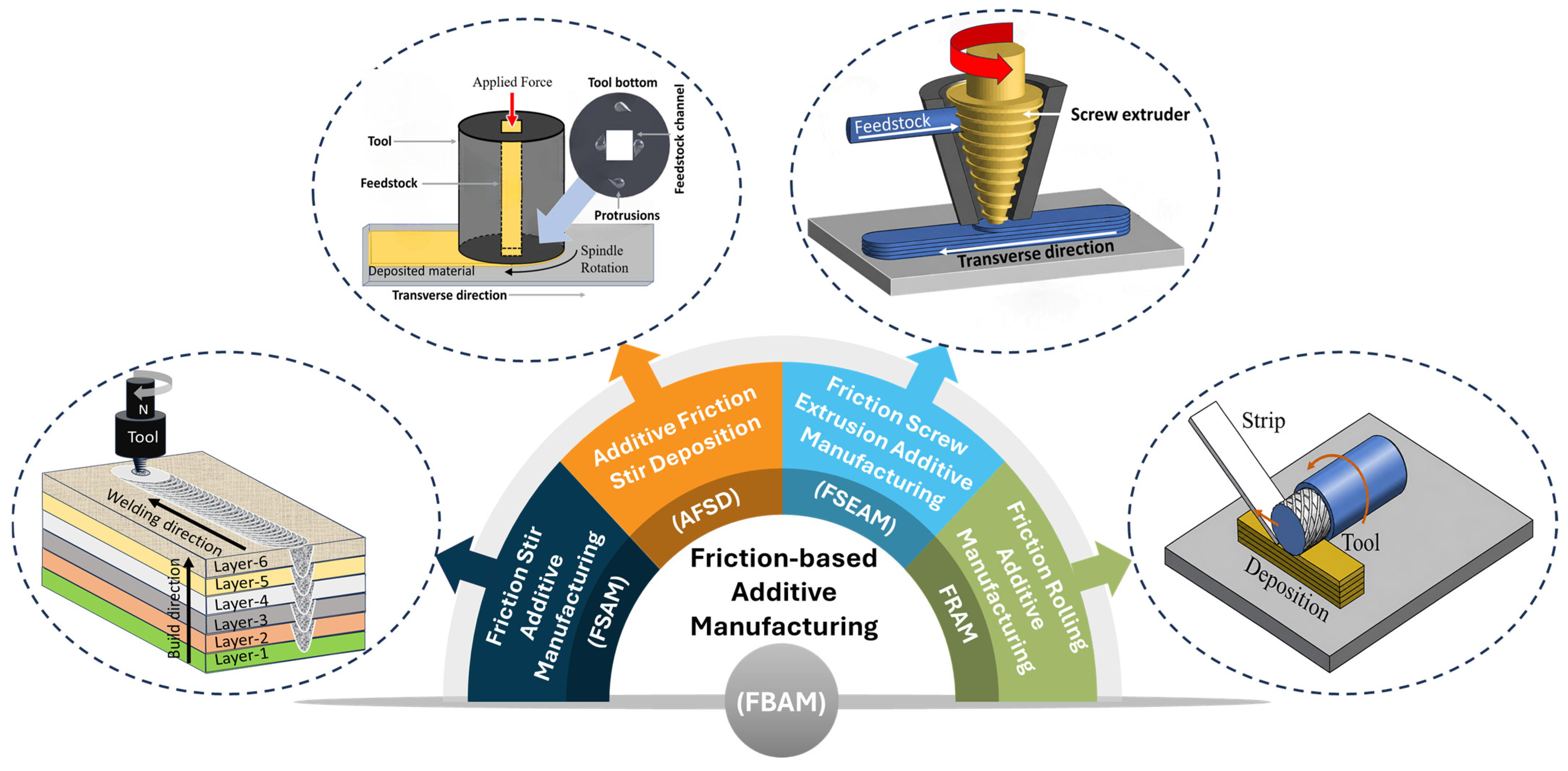
Figure 1. Classification and process illustrations of FBAM processes.
Jmmp 10 00214 g001
Figure 2. Overview of the major challenges and mitigation strategies in FBAM of heat-treatable aluminum alloys.
Jmmp 10 00214 g002
Figure 3. EBSD analysis showing non-homogeneous grain evolution along the build direction of the Al-2024 AFSD build: (a1a3) IPF map, grain size distribution, and misorientation distribution of the top region; (b1b3) middle region; and (c1c3) bottom region. Reprinted from Ref. [61], published under the Creative Commons CC BY-NC-ND license, which permits non-commercial use of the work.
Jmmp 10 00214 g003
Figure 4. (a) Schematics of hole drilling to incorporate Al2O3 nanoparticles for the Al-2011 AFSD build; (b) actual depositing rod filled with Al2O3 nanoparticles. Reprinted from Ref. [42], published by MDPI under the Creative Commons CC BY license; permission is not required.
Jmmp 10 00214 g004
Figure 5. (a,b) Homogeneous microhardness distribution and microstructure of the FSEAM-developed Al 2319 structure [79]; and (c) homogeneous and improved microhardness distribution of the FSEAM Al 2024/Al2O3 structure [80]. The figure was newly produced by plotting the results reported in the corresponding studies.
Jmmp 10 00214 g005
Figure 6. (ad) Non-uniform microhardness trends; (e,f) non-uniform tensile strength trends along the build direction in Al-6xxx alloys processed through FSAM, as reported in the literature [89,90,92,95]. The figure was newly produced by plotting the results reported in the corresponding studies.
Jmmp 10 00214 g006
Figure 7. EBDS analysis showing the microstructure at the bottom, middle, and top layers of the Al-6061 AFSD builds: (ac) Al-6061 build fabricated without thermal gradient control system; (df) Al-6061/FeCoNi build fabricated without thermal gradient control system; (gi) Al-6061/Ni build fabricated without thermal gradient control system; (jl) Al-6061 build fabricated with thermal gradient control system [108]. Reprinted from Ref. [120], published under the Creative Commons CC-BY license, which permits non-commercial use of the work.
Jmmp 10 00214 g007
Figure 8. Effect of PHT on the homogeneity of mechanical properties in Al-6xxx alloys processed via AFSD: (a) Al-6061-T6/TiC [112]; (b) Al-6061 (powder and rod-based deposition) [119]; (c) Al-6063 [116]. The figure was newly produced by plotting the results reported in the corresponding studies.
Jmmp 10 00214 g008
Figure 9. Effect of conventional horizontal FRAM and lateral FRAM on the homogeneity of mechanical properties: (a) illustration of conventional horizontal FRAM and non-consumable tool; (b,c) corresponding homogeneous microhardness and tensile properties of FRAM Al-6061-O builds [55]; (df) lateral FRAM configuration and modified non-consumable tool, showing non-uniform microhardness and tensile properties in FRAM Al-Mg-Si-Sc alloy [136]. The figure was newly produced by plotting the results reported in the corresponding studies.
Jmmp 10 00214 g009
Figure 10. Microhardness distribution around the NZ at each layer interface in FSAM Al-7xxx builds: (a,b) non-uniform, typically W-shaped profiles resulting from the use of a tapered threaded tool pin geometry [92,146]; (c) more uniform distribution around the NZ achieved using a straight cylindrically threaded tool pin [148]. The figure was newly produced by plotting the results reported in the corresponding studies.
Jmmp 10 00214 g010
Figure 11. Key difference between conventional FSLW and FSAM leading to the periodic HHZ and LHZ: (a) conventional two plate FSLW; (b) transformation of stir zones in four-layered FSAM laminate.
Jmmp 10 00214 g011
Figure 12. Periodic HHZ and LHZ in FSAM of quench-sensitive Al-7xxx alloys, resulting from repeated stirring and re-stirring during layer deposition and the evolution of NZ [38,149]. (a) Al-7A04-T4; (b) Al-7075-T6. The figure was newly produced by plotting the results reported in the corresponding studies.
Jmmp 10 00214 g012
Figure 13. Microstructural evolution of second phase strengthening precipitates in different regions of the NZ: (a1,a2) PDZ + PDZ; (b1,b2) SDZ + PDZ. Reprinted from Ref. [149], with permission from Elsevier.
Jmmp 10 00214 g013
Figure 14. AGG at the bottom of the PDZ in Al-7075-T651 FSAM laminates after cyclic solution T6 PHT, leading to the formation of PFZ and resulting in partial recovery of strength. Reprinted from Ref. [150], published under the Creative Commons CC-BY license, which permits non-commercial use of the work.
Jmmp 10 00214 g014
Figure 15. Effect of air cooling, water cooling, and NA on microstructure and microhardness of Al-7N01-T4 FSAM laminates; water cooling results in more uniform microstructure and improved microhardness compared to AC [151]. The figure was newly produced by plotting the results reported in the corresponding studies.
Jmmp 10 00214 g015
Figure 16. Effect of varying AA cycles on (a) microhardness and (b) tensile properties of WC Al-7N01-T4 FSAM laminates. Reprinted from Ref. [162], published by MDPI under the Creative Commons CC BY license; permission is not required.
Jmmp 10 00214 g016
Figure 17. Challenges associated with reinforcement incorporation into Al 7075-T6 FSAM laminates, leading to premature failure of the structure and inferior mechanical performance compared with BM reported in the literature [163,164]: (a) tool pin breakage at higher reinforcement volume fractions; (b) severe tool wear, even at 5 vol.% SiC reinforcement; (c) incomplete reinforcement incorporation resulting in cavity defects; and (d) reinforcement agglomeration in the NZ near the bottom of the tool pin tip. (a,c) were reprinted from Ref. [163], with permission from Elsevier, whereas (b,d) were reprinted from Ref. [164], published by MDPI under the Creative Commons CC BY license; permission is not required.
Jmmp 10 00214 g017
Figure 18. Graphical illustrations of approaches to control thermal gradients in FSAM/AFSD, as reported in the literature: (a) underwater processing; (b) closed-loop temperature control system in AFSD; (c) specially designed fixture with integrated coolant channels for efficient cooling. (a,b) were newly reproduced, while (c) was reprinted from Ref. [189], published by MDPI under the Creative Commons CC BY license; permission is not required.
Jmmp 10 00214 g018
Figure 19. Incorporation of nanoparticles in FSAM/AFSD/FRAM: (a) direct incorporation using an FSAM extruder tool; (b) incorporation through blind holes; (c) incorporation through grooves. (ac) were newly reproduced, whereas (d) was reprinted from Ref. [41], published by MDPI under the Creative Commons CC BY license; permission is not required.
Jmmp 10 00214 g019
Table 1. Summary of the processing of Al-2xxx heat-treatable alloys through different FBAM techniques.
Sr. NoFeed MaterialFBAM ProcessNanoparticlesMechanical Properties (Maximum)Minimum Grain Size Achieved (μm)ApproachCore HighlightsRef.
1Al-2050-T3FSAM-HV: 200-PHTNon-uniform hardness distribution led to complex fracture behavior, with hardness remaining lower than BM, even after PHT.[30]
2Al-2195-T8FSAM-HV: 190; UTS: 399; El: 8.42/non-homogenous fine equiaxed-Mechanical properties were non-uniform and lower than BM, with higher strength in the longitudinal direction compared to the transverse direction.[59]
3Al-2024-T4FSAM-UTS: 488.8; El: 19-Parameter optimizationTensile strength increased linearly with higher traverse speeds due to reduced thermal cycling, resulting in strength exceeding that of BM.[64]
4Al-2060FSAM-HV: 1352–5/fine equiaxedParameter optimizationDefect-free Al-2060 parts achieved at optimal parameters (1600 rpm/300 mm.min−1), though hardness remained lower than BM.[81]
5Al-2195-T8FSAM-HV: 116.8; UTS: 348; El: 9.6-Parameter optimizationOptimal parameters were 800 rpm/100 mm.min−1, and mechanical properties were non-homogenous and lower than BM; tensile strength reached 56% of BM.[82]
6Al-2011-O
Al-2011-T6
AFSDAl2O3HV: 118; CS: 558; WR: 7801.45/homogenous fine equiaxedNanoparticle additionEnhanced mechanical properties were achieved using pre-filled Al2O3 particle rods, with Al-2011-T6/Al2O3 composites exhibiting superior wear resistance compared to annealed feed material.[42]
7Al-2050-T84AFSD-HV: 118--Non-uniform hardness, increasing from bottom to top, was observed and remained lower than BM.[63]
8Al-2011-T6AFSD-HV: 91; CS: 5433.45/uniform refinedParameter optimizationCompressive strength and hardness increased with higher rotation speed and feed rate, reaching 85% and 93% of BM.[66]
9Al-2011-OAFSD-HV: 860.06/homogenous fine equiaxedParameter optimizationHardness decreased with increasing feed rate; however, an overall 63% improvement was achieved compared to BM in the annealed condition.[69]
10Al-2011-T6AFSD-HV: 762.9/refinedParameter optimizationHardness decreased with increasing feed rate, with an overall 39% reduction compared to T6 BM.[69]
11Al-2219-T87AFSD-UTS: 206; HV: 63; El: 389/homogenous equiaxed-Non-uniform mechanical properties were observed, with higher strength in the longitudinal direction than the transverse, with overall properties lower than BM.[70]
12Al-2219-T851AFSD-HV: 80; YS: 159; UTS: 363; El: 252.5/homogenous fine equiaxed-Non-uniform strength with relatively uniform hardness was observed, with overall properties lower than BM.[75]
13Al-2014-T6AFSD-HV: 1303/fine equiaxedPHTHardness was restored to near-BM levels after solution and aging treatment, although AGG was observed.[76]
14Al-2024AFSD--4.5/fully recrystallized-Fins and serrations formed on the advancing side, creating structural interlocking on the retreating side, while a homogeneous fully recrystallized grain structure was achieved.[83]
15Al-2024FSEAMAl2O3HV: 160; UTS: 900<1/homogenous recrystallizedNanoparticle additionThe fabricated tubular structure exhibited high and uniform mechanical properties, exceeding those of BM.[80]
16Al-2319FESEM-HV: 145; UTS: 413.71.62/ultrafine-Uniform microstructure and mechanical properties were achieved; after PHT, microhardness and tensile strength further improved and exceeded T6 BM.[79]
Legend: Microhardness (HV); yield strength (YS, MPa); ultimate tensile strength (UTS, MPa); compressive strength (CS, MPa); wear resistance (WR, m/mm3); elongation (El,%).
Table 2. Summary of the processing of Al-6xxx heat-treatable alloys through different FBAM techniques.
Sr. NoFeed MaterialFBAM ProcessNanoparticlesMechanical Properties
(Maximum)
Minimum Grain Size Achieved (μm)ApproachCore HighlightsRef.
1Al-6061-T6FSAM-HV: 73.09; UTS: 173.611.86/refined recrystallizedChemical composition alteringMechanical properties can be enhanced by increasing silicon (magnesium) content in solid solution.[94]
2Al-6061-T6FSAMSiCHV: 104.2; UTS: 268.8; El: 384.55/non-homogenous refined recrystallizedNanoparticle additionNon-uniform mechanical properties were observed, consistently lower than BM, with ductility decreasing linearly with build height.[87]
3Al-6061-T6FSAMAl2O3HV: 101.5411.53/refined recrystallizedNanoparticle additionMechanical properties were enhanced compared to BM after adding Al2O3-reinforced particles; hardness increases with the increase in the volume fraction of Al2O3.[98]
4Al-6061-T6FSAM-HV: 69.79.65/fully refined-Re-stirring and re-heating increased hardness and strength; beyond the third layer, further deposition had negligible effects on mechanical properties.[129]
5Al-6XXX/A357FSAMSiCHV: 180-Nanoparticle additionMechanical properties were enhanced through the addition of SiC and A357 alloy powders.[143]
6Al-6061-T651AFSD-UTS: 137; YS: 63.3915/refined equiaxed-Fatigue life was more uniform and higher in the longitudinal direction than in the build direction, while overall mechanical properties remained lower than BM.[72]
7Al-6061-T6AFSD-HV: 65; UTS: 214; YS: 122; El: 32.811/refined-In the as-deposited state, hardness and tensile strength were lower than BM, while ductility and corrosion resistance were significantly improved.[73]
8Al6061-OAFSD-HV: 70.25; UTS: 133.35; YS: 108--UTS was similar in longitudinal and transverse directions, while transverse hardness was higher; overall mechanical properties exceeded BM.[100]
9Al-6061AFSD-HV: 67.3fully recrystallizedParameter optimizationHigh hardness was achieved at 600 rpm/76.2 mm.min−1, with uniform hardness along the build direction but lower than BM.[105]
10Al-6061-T651AFSD-HV: 115.8; UTS: 290.22.7/non-homogeneous finer equiaxedPHTAfter T6 PHT, hardness exceeded BM, while UTS reached 82.9% of BM with uniform mechanical properties.[103]
11Al-6061-T651AFSD-UTS: 171.4; El: 5.53.2/recrystallized-Approximately 50% reduction in strength was observed compared to BM.[106]
12Al-6061-T651AFSD-HV: 649.1/refined equiaxedCompressed air coolingMechanical properties were lower than BM, with higher properties observed near the forced cooling air gun compared to distant regions.[104]
13Al-6061-T651AFSD-HV: 55; UTS: 150; El: 20-Parameter optimizationLower rotation speed improved bonding strength, with hardness and tensile strength reaching 47.4% and 49% of BM, respectively.[107]
14Al 6061AFSDFeCoNi, NiHV: 107.5; UTS: 259.60.3/non-homogenous fine equiaxedNanoparticle additionAl-6061/Ni laminates exhibited higher mechanical properties compared to Al-6061/FeCoNi laminates and BM.[108]
15Al-6061-T6AFSDTiCHV: 114.6; UTS: 3133.4/uniform equiaxedNanoparticle addition + PHTPHT produced relatively uniform microhardness; combined nanoparticle addition and PHT significantly enhanced properties compared to BM.[112]
16Al-6061AFSD-HV: 102.6; YS: 256.6; UTS: 289.9; El: 5.318.5/refined equiaxed PHTRod feedstock exhibited superior mechanical properties compared to powder, further improved by PHT; however, properties remained non-uniform despite relatively uniform microhardness.[119]
17Al-6061AFSD-HV: 94.48.3/homogenous refinedPHTNearly uniform hardness exceeding BM was achieved through combined solution and artificial aging treatment.[117]
18Al-6061-T651AFSD-HV: 67; UTS: 371; El: 3120/homogenous fully recrystallizedPHTMechanical properties were significantly improved compared to BM after combined solutionizing and artificial aging, although AGG was observed.[115]
19Al-6063AFSD-HV: 921.08/fine equiaxedPHTT6 treatment produced uniform microhardness; however, overall mechanical properties remained significantly lower than BM.[116]
20Al-6061AFSD-HV: 87.7; YS: 106.2; UTS: 190.7; El: 16.71.12/homogeneous equiaxedThermal gradient controlHomogeneous and improved mechanical properties were achieved through thermal gradient control.[120]
21Al-6061-T6AFSD-UTS: 300-PHTMechanical properties were recovered to BM levels after solution and aging treatment.[122]
22Al-6061-T6AFSD-HV: 116; YS: 313; UTS: 3233.79/refined equiaxed PHTHardness and tensile strength were more uniform and exceeded BM after combined solution and artificial aging treatment.[123]
23Al-6061-T6AFSD-HV: 70; UTS: 2520/homogenous refined equiaxedTool geometry optimizationFlat tool shoulder enabled defect-free deposition in thin substrates, though mechanical properties remained lower than BM.[124]
24Al-6061-T6AFSD-UTS: 244, El: 2823/refined equiaxedDryUnderwater AFSD resulted in rougher surfaces, higher energy consumption, and lower tensile strength compared to ambient conditions and BM.[126]
UTS: 187; El: 26 6.4/refined equiaxedUnderwater
25Al-6061AFSD-UTS: 135--Hydrocarbon-based lubrication introduced hydrogen contamination, leading to deterioration of mechanical properties of final build.[144]
26Al-6063-T4AFSDZrO2HV: 89.3; UTS: 313; El: 9.69.1/homogenous refinedNanoparticle additionIncreasing ZrO2 content improved UTS and wear resistance, with a 63.8% enhancement at 12 vol.% compared to BM.[109]
27Al-6351-T6AFSD-HV: 63.5--An overall 25.4% reduction in hardness was observed compared to BM.[145]
28Al-6060-T6FSEAM-HV: 40; UTS: 100; El: 12.53–4/fine equiaxedParameter optimizationMechanical properties remained lower than BM at optimized conditions, although FSEAM achieved a high build rate (~400 cm3/h).[48]
29Al-6060-T6FSEAM-UTS: 14410/fineParameter optimizationOptimization led to reduced transverse strength compared to BM, with noticeable parameter sensitivity effects.[132]
30Al-6063FSEAM-UTS: 147; El:104.62/fine equiaxedParameter optimizationNon-uniform mechanical properties were observed; optimized parameters yielded a maximum UTS of 147 MPa (77% of BM).[134]
31Al-6061-OFRAM-HV: 65; UTS: 208; El: 255.2/uniform-Uniform microstructure and microhardness were achieved, with mechanical properties exceeding BM in the annealed condition.[55]
32Al-6061-T6FRAM-UTS: 1443.9Parameter optimizationStrip feedstock enabled more uniform deformation and smoother surface; UTS remained similar across feed forms but lower than BM.[53]
33Al-6061FRAM-UTS: 140; El: 306-UTS was uniform along the build; strength exceeded 6061-O but remained lower than 6061-T6, with significantly higher elongation due to grain refinement.[135]
34Al-Mg-Si-Sc-T6FRAM-HV: 76; UTS: 2505.2/non-uniform-Non-uniform mechanical properties lower than BM were observed, attributed to increased heat input and thermal cycling from modified tool geometry.[136]
35Al-6061-T6FRAM---Parameter optimizationIncreased press depth and tool contact raised heat generation, while higher travel speed reduced interface temperature; defect formation depended strongly on toolhead morphology.[138]
Legend: Microhardness (HV); yield strength (YS, MPa); ultimate tensile strength (UTS, MPa); compressive strength (CS, MPa); wear resistance (WR, m/mm3); elongation (El, %).
Table 3. Summary of the processing of Al-7xxx heat-treatable alloys through different FBAM techniques.
Sr. NoFeed MaterialFBAM ProcessNanoparticlesMechanical Properties
(Maximum)
Minimum Grain Size Achieved (μm)ApproachCore HighlightsRef.
1Al-7075-T651FSAM-HV: 1260.96/non-homogenous equiaxedParameter optimizationNon-uniform mechanical properties were observed, remaining lower than BM.[28]
2Al-7075-T651FSAM-HV: 143--Non-uniform properties increased from bottom to top, but overall remained lower than BM.[146]
3Al-7075-OFSAM-HV: 102; UTS: 279; El: 10.4Non-homogenous fine equiaxed-Non-uniform properties increased from bottom to top, with overall values exceeding BM.[148]
4Al-7075-T651FSAM-HV: 126; UTS: 415; El: 152.49/homogenous equiaxedAir cooling + parameter optimizationUniform microstructure and microhardness were achieved through cooling; UTS and hardness reached 74.3% and 70.2% of BM, respectively.[149]
5Al-7075-T651FSAM-HV: 175; UTS: 472; El: 18.62.9/homogenous equiaxedAir cooling + PHTUniform microstructure and microhardness were achieved; after PHT, hardness recovered to BM, while UTS reached 84% of BM due to AGG.[150]
6Al-7N01-T4FSAM-HV: 106; UTS: 400; El: 35.12.4/homogenous equiaxedPHTUniform and higher mechanical properties were achieved compared to BM using combined approach of underwater FSAM and 90-day natural aging process.[151]
7Al-7N01-T4FSAM-HV: 106.2; UTS: 352.7; El: 22.32.86/non-homogenous equiaxedPHTNon-uniform properties (increasing from bottom to top) improved with natural aging but remained lower than BM even after 180 days.[161]
8Al-Zn-Mg-CuFSAM-HV: 178; UTS: 523; El: 13.6-Underwater + PHTCombined underwater FSAM and low-temperature artificial aging yielded uniform mechanical properties exceeding BM.[162]
9Al-7075-T651FSAMSiC, TiCHV: 155; UTS: 286.5; El: 6.122.13/homogenous equiaxedAir cooling + SiC + PHTHomogeneous microstructure was achieved; however, mechanical properties remained lower than BM due to nanoparticle agglomeration, tool wear, and AGG after PHT.[163]
HV: 159; UTS: 313.4; El: 101.3/homogenous equiaxedAir cooling + SiC + PHT
10Al-7075-T651FSAMSiCHV: 136; UTS:257; El: 121.38/non-uniform equiaxedNanoparticle additionNon-uniform microhardness and mechanical properties were significantly lower than BM, with tool breakage and severe particle agglomeration leading to premature failure.[164]
11Al-7A04-T6FSAM-HV: 145; UTS: 525; El: 270.80/non-homogenous equiaxedPHTTensile properties at the bottom of PDZ + PDZ were inferior to SDZ + PDZ. Natural aging for 10 days showed better mechanical properties than artificial aging for 120 °C for 24 h.[186]
12Al-7075-T651AFSD-HV: 105; UTS: 140; El: 164.33/non-homogenous equiaxedPHTMechanical properties increase with the increase in natural aging time. However, the overall properties remain notably lower than BM, even after undergoing 35 days of natural aging.[167]
13Al-7075-T6AFSD-HV: 180; UTS: 541; YS: 477; El: 8.23.5/refined equiaxedPHTAs-deposited builds showed lower properties, which recovered close to BM after combined solution and aging treatment.[168]
14Al-7050-T7451AFSD-HV: 155; UTS: 2250.02/non-homogenous equiaxed-Dwelling zone and transverse direction exhibited higher hardness and UTS than the build direction; overall properties remained lower than BM.[170]
15Al-7075/ Al2024AFSD-HV: 175; UTS: 376; El: 151.3/fine equiaxedPHTAFSD gradient structure achieved BM-comparable properties after solution and double aging; properties became uniform, though AGG led to partial UTS recovery.[178]
16Al-7075FSEAMTiB2HV: 135; UTS: 408.80.88/fine equiaxedNanoparticle additionMicrohardness was uniform along the build; UTS was lower in the build direction than transverse, with properties higher than annealed BM but lower than T6.[179]
16Al-Cu-MgFSEAMTiCHV: 92; UTS: 291; El: 130.75/homogeneous equiaxedNanoparticle additionUniform microhardness and UTS were achieved; properties remained lower than T6 BM but higher than annealed condition.[180]
18Al-7075-T6FRAM-HV:140; UTS:450; El:252.30/fine equiaxedDryCompressed air cooling provided optimal performance, achieving UTS of 504.5 MPa with minimal ductility change, though still lower than BM.[181]
HV: 142; UTS: 504.5; El: 15.52.05/fine equiaxedAir cooling
HV: 160; UTS: 470; El: 13.51.6/fine equiaxedWater mist
19Al-7075FRAMTiCUTS: 425; El: 222.6/fine equiaxedNanoparticle additionTiC nanoparticle addition enhanced grain boundary pinning and refinement; combined nanoparticle incorporation and PHT significantly improved properties beyond BM.[182]
UTS: 626; El: 15.53.53/fine equiaxedNanoparticle addition + PHT
Legend: Microhardness (HV); yield strength (YS, MPa); ultimate tensile strength (UTS, MPa); compressive strength (CS, MPa); wear resistance (WR, m/mm3); elongation (El, %).
Table 4. Process-induced defects reported in FBAM of heat-treatable aluminum alloys.
FBAM ProcessFeed MaterialTypical DefectsDefect Origin and Mitigation
FSAMAl-7075-O [148]Hooking, kissing bonds
  • Hooking refers to upward bending of the material interface caused by threaded tool-induced material flow and residual interfacial oxides.
  • Kissing bonds refers to a weakly bonded interface caused by insufficient stirring, poor material mixing, and incomplete oxide breakup.
  • Tunnel, cavity, and small hole defects are unfilled regions formed due to inadequate plasticized material flow. These defects are mainly caused by insufficient heat input, poor material flow, unsuitable tool geometry, or inadequate forging/compaction force.
  • Conical and cylindrical pins may result in poor mixing across the bonding interface.
  • Defects can be reduced by optimizing tool geometry, rotation speed, welding speed, forging force, and applying double-pass strategies.
  • In reinforced laminates, abrasive ceramic particles accelerate tool wear and disturb material flow, increasing defect formation.
Al-7N01-T4 [161]Hooking, kissing bonds
Al-6061-T6 [87]Hooking, kissing bonds
Al-2195-T8 [82]Hooking, kissing bonds, cavities
Al-7075-T6 [28]Hooking, kissing bonds, cavities, tunnels
Al-7075-T6 [149]Small holes
Al-7075-T6/SiC [164]Cavities, tunnels
AFSDAl-6061-T6 [107]Kissing bonds, holes
  • Weak bonding and kissing bonds were mainly associated with insufficient interfacial mixing, incomplete recrystallization, and inadequate disruption of the original layer interface.
  • Holes and voids were commonly formed due to insufficient material flow, low peak temperature, or weak forging action.
  • Low feed rates combined with high traverse speeds promoted galling, voids, lack of fill, and poor consolidation, especially on the advancing side of the tool path.
  • Serrations and fins were caused by direct interaction between deposited material and tool protrusions during material displacement and trench refilling.
  • Excessive collar flash during direct rod deposition was caused layer discontinuity and unbonded regions near the build edges.
  • Teardrop-featured non-consumable tools reduced collar flash and improved edge bonding and layer continuity.
  • Defects can be mitigated by optimizing axial force, rotation speed, traverse speed, feed rate, preset layer thickness, and tool shoulder design.
  • In reinforced AFSD composites, limited peak temperature and poor flowability can promote weak bonding, holes, and interfacial defects.
Al-6061-T651 [188]Voids, galling
Al-2024 [83]Fins, serrations
Al-6063-ZrO3 [109]Excessive collar flashes, edge unbonding
Al-2011-Al2O3 [42]Excessive collar flashes, edge unbonding
Al-2050 [63]Unbonded regions at build edges
Al-2011-T6 [66]Excessive collar flashes, layer discontinuities
Al-2014 [76]Excessive collar flashes
Al-6061-T651 [103]Holes, weak bonding
Al-6061-T651 [106]Kissing bonds, holes
Al-6061-T651 [104]Kissing bonds, holes
Al-6061-TiC [112]Weak bonds, holes
Al-6061 [119]Interfacial cracks, holes
FSEAMAl-2024-Al2O3 [80]Surface roughness and discontinuities, surface scratches, edge cracking
  • Voids, insufficient bonding, and unbonded regions mainly resulted from low feed ratios, inadequate temperature, low consolidation pressure, and poor material intermixing.
  • Crack-like defects, surface cracks, and scratches were associated with unstable extrusion conditions and insufficient layer bonding.
  • Build quality was strongly governed by feed ratio, screw rotation speed, deposition velocity, tool gap, and tool-bottom design.
Al-6060-T6 [48]Voids, cracks, edge unbonding
Al-6060-T6 [131]Interlayer cracks, edge unbonding
Al-Mg-Si [48]Voids, cracks
FRAMAl-6061-T6-TO [57,139]Surface waviness
  • Surface waviness, trench-like features, and spills were primarily associated with tool-head geometry and non-uniform material flow during deposition.
  • Voids, tunnel defects, weak bonding, and unbonded layers resulted from insufficient plastic deformation, low interfacial temperature, and inadequate material consolidation.
  • Increasing press depth enhanced material flow, interfacial temperature, and plastic deformation, significantly reducing defect formation.
Al-Mg-Si-Sc [136]Trench-like features
Al-6061-T6 [138]Voids, tunnels, weak bonding, material spills, unbonded layers
Disclaimer/Publisher’s Note: The statements, opinions and data contained in all publications are solely those of the individual author(s) and contributor(s) and not of MDPI and/or the editor(s). MDPI and/or the editor(s) disclaim responsibility for any injury to people or property resulting from any ideas, methods, instructions or products referred to in the content.