
Article

Manufacturing of 3D Auxetic Structures Through Perforations of Corrugated Systems
1
Metamaterials Unit, Faculty of Science, University of Malta, MSD2080 Msida, Malta
2
Department of Chemical and Materials Engineering and Industrial Production, University of Naples Federico II, 80125 Naples, Italy
3
Department of Civil Engineering and Architecture, University of Catania, 95125 Catania, Italy
4
Institute of Polymers, Composites and Biomaterials, National Research Council, 80078 Pozzuoli, Italy
5
Chemistry Department, Faculty of Science, University of Malta, MSD2080 Msida, Malta
*
Author to whom correspondence should be addressed.
J. Manuf. Mater. Process. 2026, 10(6), 198; https://doi.org/10.3390/jmmp10060198
Submission received: 24 April 2026 / Revised: 27 May 2026 / Accepted: 29 May 2026 / Published: 4 June 2026

Abstract

Fabrication of auxetic structures has always been a limiting factor in their availability. Their complex shape, a requirement originating from the deformation mechanism that leads to a negative Poisson’s ratio, has also limited their manufacturability. In the case of auxetic systems that deform through the rotating semi-rigid mechanism—which allows for the concurrent deformation and rotation of their constituent element—the situation is even more complicated. Relatively few examples of these types of structures are known, with most work on them being largely theoretical. This includes their use in explaining the auxetic mechanism in certain molecules. Nevertheless, these systems can, in principle, offer added functionalities, as they undergo a shape change while still exhibiting a negative Poisson’s ratio. To this end, this work presents a practical scheme for the manufacturing of 3D rotating semi-rigid units, whereby these are produced through perforations of corrugated sheets. For the purpose of this investigation, diamond-shaped perforations were chosen, and the side profile of the corrugated sheet consisted of successive semicircles that alternate in orientation. Analysis of the system indicated that a 3D negative Poisson’s ratio can be obtained while allowing the distance between the hinges to change during deformation.

Graphical Abstract

1. Introduction

Most commonly found materials contract laterally when uniaxially loaded in tension. However, it is also possible to find materials that expand laterally when pulled. These are characterized by a negative Poisson’s ratio and are commonly referred to as auxetics [1]. Their behavior is generally related to the geometry and the way they deform during loading. Various mechanisms have been identified leading to such behaviors. These include, amongst others, the rotating rigid units [2,3,4,5,6,7,8,9,10], chiral structures [11,12,13,14,15,16,17,18,19,20,21], re-entrant cells [22,23,24,25,26,27,28,29], the collective behavior of interacting particles [11,16,30,31,32,33,34,35], and triply periodic minimal surface lattice systems [36,37,38].
Interest in these materials has surged since the end of the 1980s, following the pioneering work of the likes of Lakes [39], Wojciechowski [11,16] and Evans [40]. It was spurred, at least in part, by the advantages auxetics have over conventional materials. These include improved shear stiffness [39,41], indentation resistance [39,42,43], fracture toughness [39,44], and energy absorption [45] properties. For this reason, auxetics have been proposed for a number of applications for which their behavior can result in improved functionalities. Amongst the suggested potential uses, there are dilators for medical applications [46], fastening devices [47,48], impact loading devices [49,50,51,52,53,54], smart particle filters [41,55], and textiles [56,57,58,59,60,61].
One of the earliest and most well-known auxetic mechanisms is that of the “rotating rigid units”. It is based on rigid elements that are joined at their corners or edges. The connection points serve as pivots (hinges) that allow the elements to rotate relative to one another without changing shape themselves. The initial geometries considered were rotating squares [2,4,5] and equilateral triangles [62], these being the only regular polygons that can be hinged at their edges so as to act as rotating units and, at the same time, still be space-filling [63]. While these naturally acted as an initial starting point, irregular polygons such as rectangles [63,64], parallelograms [3], and scalene triangles [65] soon followed. More recently fragmentation-reconstitution [8,9,10] was introduced, extending how rotating rigid units can operate. Further relaxation on the shape of polygons considered allowed the design of systems where the elements can have different shapes [66,67,68,69].
The concept of rotating rigid units was also extended to 3D. For this purpose, polyhedra were mostly considered. One of the earliest examples is the one presented by Alderson and Evans [70] who considered connected tetrahedra. Other geometries quickly ensued, including cuboids [6] and connected prisms [71,72,73,74,75,76], as well as more general polyhedra [7].
Relaxing the rigidity requirement slightly leads to a class of structures, known as rotating semi-rigid units, that can also exhibit auxetic behavior. This concept was developed for systems including the rotating square [77], triangles [78], and tetrahedra [70] ones. While this mechanism was fruitfully used to explain the auxetic behavior of interacting atoms, practical implementations appear to have been very limited. One of the few examples can be considered to be the “cross” system [79,80], where regions of the parameter space exist allowing for the rotating rigid units and flexing of the ligaments to be equally important as a deformation mechanism. Another is represented by the work of Mrozek and Strek [81], who studied the behavior under both static and dynamic loading of what can be considered to be connected square frames. Their findings highlighted clear differences between conventional and auxetic configurations in terms of both stiffness-related behavior and vibration response. The investigation also identified the frequency intervals for which the mechanical impedance and transmissibility are appropriate.
Another system that has received some attention in the context of auxetics is corrugated sheets. These typically consist of an undulating pattern of crests and troughs. For example, Zhang et al. [82] and Li et al. [83] combined corrugated sheets with tubes to obtain a system exhibiting a negative Poisson’s ratio, while Grima et al. [84] modified graphene by introducing patterned “defects”, with the resultant attaining a wave-like shape and exhibiting auxeticity. It is also possible to use corrugated sheets to design structures mimicking known mechanisms, such as in the work of Li et al. [85], who used them to create a system based on the double arrow pattern. An important consideration when studying these systems is that the shear correction factor is not constant, but strongly depends on the structural configuration of the corrugated panels, especially the fluting geometry [86].
In view of these considerations, this work presents a simple and effective manufacturing methodology that can be used to potentially produce an infinite variety of structures that deform through the semi-rigid rotating unit mechanism. It consists primarily of making perforations in corrugated plates. The concept can, to some extent, be considered as a practical implementation at the macro scale of the modified graphene discussed by Grima et al. [84]. However, in the case considered here, the corrugations are not being induced by the holes, as occurs for the modified graphene, but can be chosen arbitrarily. The same applies to the shape of the holes.
For the purpose of the investigation, a corrugated sheet with a side profile consisting of semicircles alternating in orientation was selected, and diamond-shaped perforations were adopted. The system was studied using numerical and experimental techniques. Analysis of the results indicates that such structures can indeed deform through a semi-rigid units type of mechanism exhibiting both a negative Poisson’s ratio along multiple planes and a change in shape. Considering the already widely available off-the-shelf variety of corrugated plates, the methodology could easily allow for extended industrial adoption and use.

2. Materials and Methods

2.1. Design of the Structure

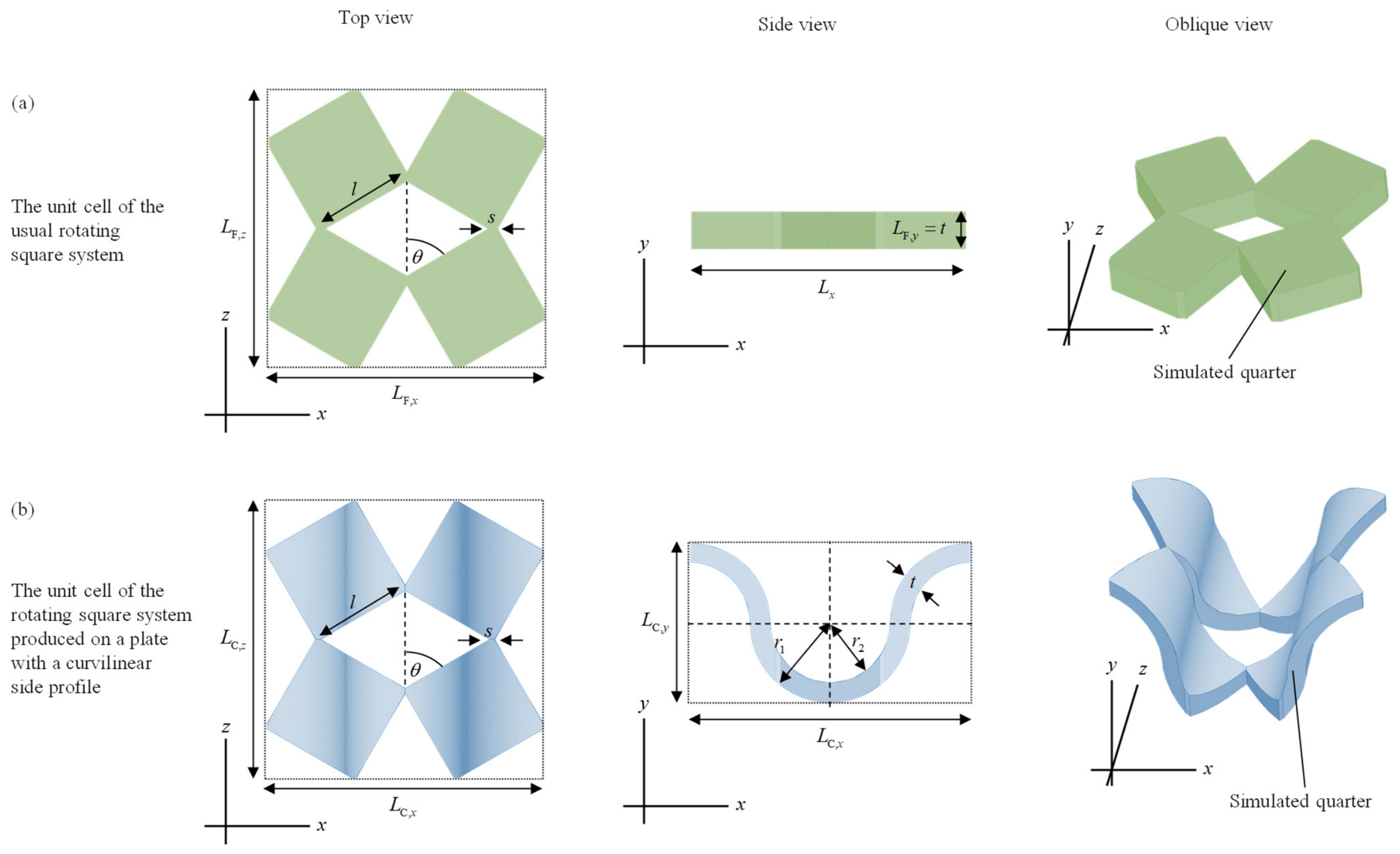
The usual rotating square system can be obtained through diamond-shaped perforations of a planar plate. Adjacent perforations are spaced by a distance s between the tips of the diamonds. Furthermore, successive diamond shapes are rotated by 90° with respect to each other. The end result is illustrated in Figure 1a. Apart from the distance between the corners of the perforations s and the thickness t in the out-of-plane direction, the system is characterized by the side length of the diamonds l and an internal angle, which can be taken as that between a side and the minor diagonal, namely θ, as shown in the figure. Based on these parameters, the unit cell of the flat rotating squares system has dimensions along the x, y, and z directions given, respectively, by
L F , x = 2 l cos θ + l sin θ + s ;
L F , y = t ;
L F , z = 2 l cos θ + l sin θ + s .
This work extends the concept of the rotating square system to corrugated plates. For the purpose of the investigation, the profile along one of the sides of the plate was chosen to consist of consecutive semi-circular arcs having equal dimensions but rotated by 180° with respect to the adjacent ones. As illustrated in Figure 1b, these have external and internal radii denoted by r1 and r2, respectively. The thickness of the plate is thus given by t = r1r2.
Even though the resultant plate does not have a flat side profile, diamond-shaped perforations can still be performed on it in the same fashion as those of the usual rotating square system. As viewed from above, the system looks like the rotating square one. It is only the lateral view that is different, as illustrated in Figure 1b.
Before proceeding, it is important to note that this work will only consider cases where the four squares shown in Figure 1a can be fitted exactly on two semi-circular arcs. With this restriction, l, s, t, and θ are not independent of r1 and r2 (and vice versa). In fact, due to geometric constraints, these variables are related through the equation:
r = l cos θ + sin θ + s ,
where r is the radius of curvature associated with this system, defined as the average of r1 and r2 (i.e., the radius of the surface corresponding to half the thickness t). This may also be written in terms of r1 and r2 as follows:
r 1 = l cos θ + sin θ + s + t 2 ,
r 2 = l cos θ + sin θ + s t 2 .
Furthermore, since it is understood that r2 > 0, it then also follows that
l > t s cos θ + sin θ .
Based on these quantities, the dimensions of the unit cell in the x, y, and z directions can be derived, respectively, as
L C , x = 2 l cos θ + l sin θ + s = 2 r ;
L C , y = 4 r 1 ;
L C , z = 2 l cos θ + l sin θ + s = 2 r .
Before proceeding, it is important to highlight that the chosen side profile represents only one of the infinite possible designs that can be used. In fact, both sides can have a nonlinear shape, and the two side profiles can be different. Notwithstanding this, after the perforations are performed, as viewed from above, the result will always look like the rotating square system. Different side profiles have the possibility of conferring distinct mechanical properties. However, investigating the effect of different side profiles was considered beyond the scope of the present study and will be explored in future work.

2.2. Finite Element Simulations

The mechanical behavior of the corrugated perforated system described in the previous section was investigated using finite element analysis (FEA) with the commercial software ANSYS® Academic Research Mechanical APDL Release 13. In order to simulate the structure shown in Figure 1b in a time-efficient way, use was made of the symmetry within the unit cell. This allowed the simulation of just one fourth of the unit cell as representative of the bulk material (see Figure 1b).
For geometry creation, the bulk of the structure was designed using the area primitive functions natively available within the software. Two quarter-ring areas were first created and joined together to form the side profile, which was subsequently extruded along the z direction to generate the three-dimensional volume, hereafter referred to as the main volume. The diamond-shaped perforations were then created in the xz plane by first defining key points, which were used to generate the corresponding areas. Similar area configurations were subsequently produced using the copy and translation functions available within the software. Once completed, these areas were extruded in the y direction to form volumes that passed through the main volume. The newly formed volumes were then grouped together and subtracted from the main volume using Boolean operations. The process was automated using the inbuilt scripting language of ANSYS® Mechanical APDL.
Once the geometry was prepared, Element SOLID187 under plane-stress conditions was used to mesh the structures [87]. This is a higher-order 3D, 10-node element having a quadratic displacement behavior and three degrees of freedom at each node (translations in the nodal x, y, and z directions). It is also well-suited to model irregular meshes.
Symmetry boundary conditions could then be applied in the x and z directions. On the other hand, in principle, the structure should have been allowed to move freely in the y direction. However, some constraints needed to be applied in order to prevent the system from distorting in the out-of-plane direction. This was attained by applying symmetry boundary conditions along the y direction as well. Justification for this follows from the fact that it is expected that the top part of the corrugation remains in the same plane throughout the loading, at least to a first approximation. A summary of the imposed boundary conditions for tension in the x direction is given below:
  • Nodes with the smallest x coordinate were constrained against displacement in the x direction, while remaining free to move in the other two directions.
  • Nodes with the largest x coordinate were subjected to a prescribed displacement corresponding to the applied strain, while remaining free to move in the other two directions.
  • Nodes with the smallest y (z) coordinate were constrained against displacement in the y (z) direction, while remaining free to move in the other two directions.
  • Nodes with the largest y (z) coordinate were prescribed to undergo identical displacements in the y (z) direction, while remaining free to move in the other two directions.
  • Analogous boundary conditions were applied for loading along the other directions.
For the simulations, the material properties assigned to the structure were based on those reported for 3D-printed PLA in previous studies [88,89], with a Poisson’s ratio of 0.45 and a Young’s modulus of 1600 MPa. A mesh convergence analysis was then carried out in order to determine the settings that gave results that were within 1% of those obtained with a finer mesh. The minimum mesh density satisfying this requirement was attained by first applying the automated meshing function available within the software using the finest mesh setting. Subsequently, the elements located near the boundary nodes were refined to at least a level of 3 with a refinement depth of 6. This meshing strategy provided an optimal balance between mesh density and computational cost by increasing the mesh resolution only in regions where the majority of the deformation occurred. For example, when l = 20 mm, s = 0.5 mm, t = 5 mm, and θ = 20°, the resulting mesh consisted of 298,218 elements.
With these settings, a parametric analysis was carried out to determine the dependence of the Poisson’s ratios and Young’s moduli of the system on the geometric dimensions. For this purpose, the values of the parameters listed in Table 1 were adopted. Linear simulations with plane-stress conditions were then carried out to study the behavior of the system under tensile loading.
Using the simulation results, the values of Poisson’s ratios and Young’s modulus were determined by first calculating the original lengths Xi, where i = 1, 2, 3, of the unit cell using the positions of the outermost nodes along each direction. The positions of the same nodes after deformation were then used to calculate the corresponding displacements, δi. The applied load was obtained from the reaction force, Fi, acting on the nodes in the loading direction using the inbuilt functions available within the software. Using these quantities, the engineering strains were computed as
ε i = δ i X i ,
allowing the Poisson’s ratios to be determined from
ν i j = ε j ε i ,
where j = 1, 2, 3 and ij. The Young’s modulus was then calculated using
E i = 1 ε i F i X j X k ,
where k = 1, 2, 3 and kj, i.
For comparison purposes, the flat, rigid, rotating square systems were also simulated using the same parameter space. In this case, the bulk geometry was created using a rectangular area primitive. Once the areas corresponding to the diamond-shaped perforations had been generated as described above, these were subtracted from the bulk area using Boolean operations. The resulting area was then extruded in the y direction. After the geometry was completed, the same element type, boundary conditions, material properties, and dimensions used for the corrugated structures were applied.
Subsequently, nonlinear simulations were carried out on a system having l = 20 mm, s = 0.7 mm, t = 5 mm, and θ = 20°. These dimensions were chosen after taking into consideration the analysis of the results obtained from the linear simulations, as well as the dimensions of the 3D printer that was meant to be used to produce a prototype for mechanical testing. For this purpose, a static simulation that considers the large-deflection effect was chosen. In order to simplify the simulations, it was also assumed that the material deformed in its linear region. This assumption was justified on the basis that a relatively small strain of 7.5% was applied.
In terms of the simulation settings, the line search option was activated, as this facilitates the convergence of the Newton–Raphson solver. Automatic time stepping was employed, with both the initial and minimum number of substeps for the load step set to 100, while the maximum number of substeps was set to 200. All other settings, including those related to mesh generation, were retained from the linear simulations.

2.3. Production of the Prototype and Its Mechanical Testing

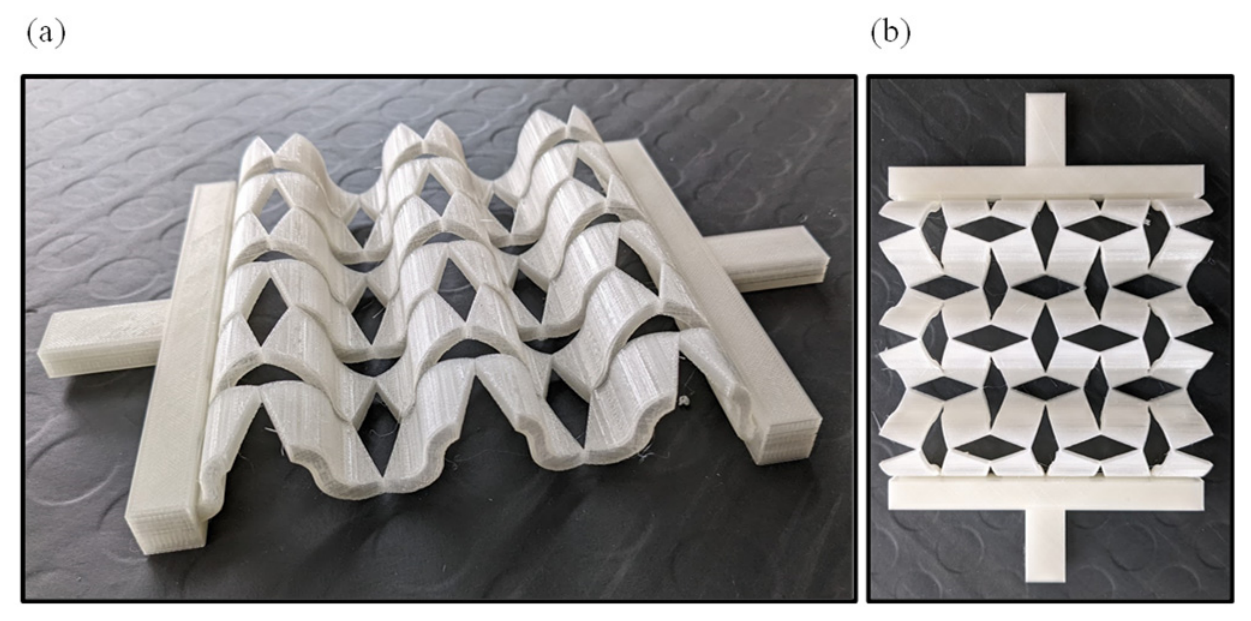
In order to further investigate the properties of the curved system, a prototype was produced using additive manufacturing. It consisted of 3 × 3 unit cells having l = 20 mm, s = 0.7 mm, t = 5 mm, and θ = 20°. To facilitate mechanical characterization, rigid T-shaped end sections were incorporated along both sides of the prototype to ensure uniform axial load transfer and secure clamping within the testing machine. Each end section had a bar-like element with dimensions of 13.5 cm (length) × 1.2 cm (height) × 1.3 cm (depth), as shown in Figure 2.
Manufacturing of the structure was undertaken using an Ultimaker S5 3D printer (Ultimaker BV, Utrecht, The Netherlands) loaded with UltiMaker PLA White filament (Ultimaker BV, Utrecht, The Netherlands). The nozzle had a diameter of 0.25 mm, the filament was heated to 200 °C, while the printing bed had a temperature of 60 °C. A printing speed of 70 mm s−1 was selected, the raster angles were set to 60°, and the fan speed to 100%. For the print, a wall thickness of 0.8 mm was chosen, the wall line count was 2, and the layer thickness was 1 mm. The infill was set to 100%. Additionally, supporting material had to be used to ensure that overhanging parts were printed adequately. This was then removed completely once the print was ready. Three specimens were produced to allow repeated readings.
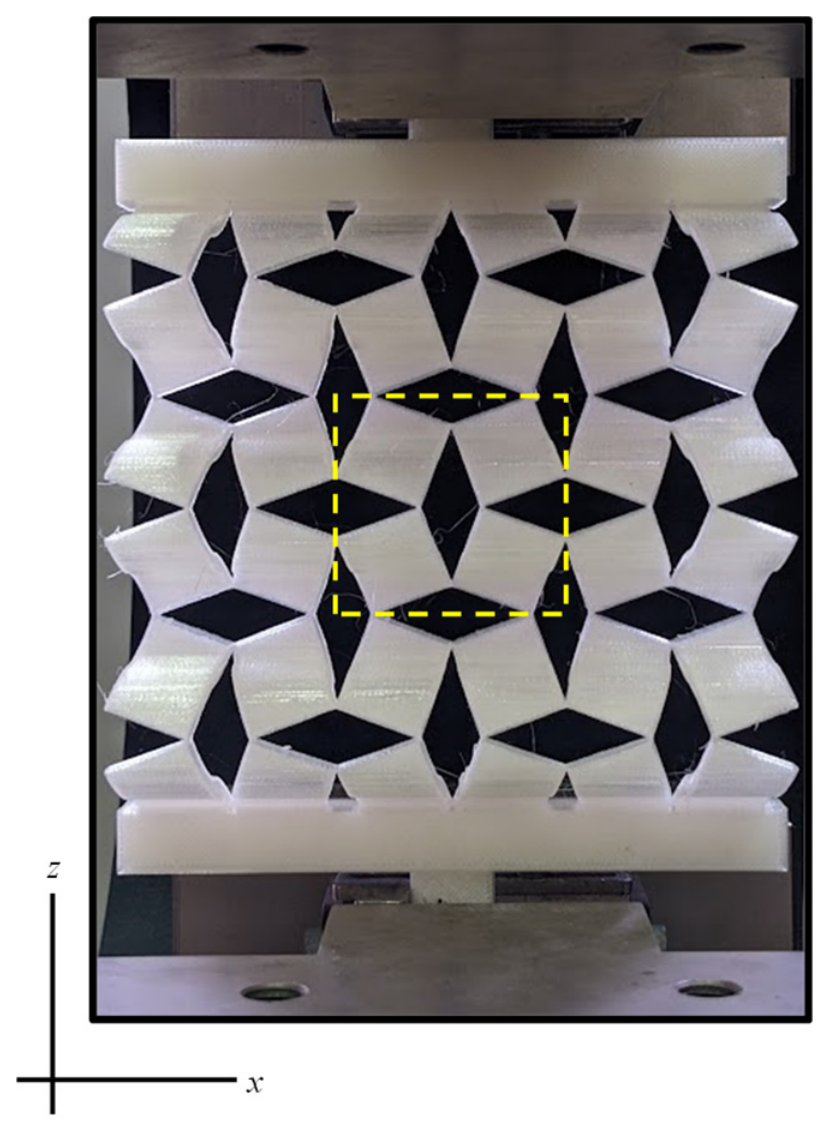
The specimens were then tested using an Instron 5985 universal testing machine (Instron, Milan, Italy) equipped with a 10 kN load cell, in strain control mode at a speed of 1 mm min−1. The experimental setup is illustrated in Figure 3. Three sets of measurements were obtained: one from each specimen. The average longitudinal strain at fixed axial strains was then calculated together with the standard deviation. In order to do this, the axial (x-axis) and transverse (z-axis) strains were determined from the dimensions of a central 1 × 1 unit cell (cf. Figure 1b) in line with the best practice given by Yolcu and Baba [90]. The unit cell, which is shown enclosed by a dashed line in Figure 3, had dimensions LC,x = LC,z = 33.5 mm and LC,y = 46.9 mm. A set of black markers was drawn to delineate it, and their position during the deformation was recorded with the digital camera on the Google Pixel 6a phone (Menlo Park, CA, USA) having a 12.2 MP main sensor (f/1.7) with optical image stabilization and Dual Pixel PDAF technology (Sony Exmor IMX363; Tokyo, Japan), alongside a 12 MP ultra-wide lens (f/2.2) featuring a 114° field of view (Sony Exmor IMX386; Tokyo, Japan). Subsequently, the images were analyzed using the image-processing software ImageJ version 1.54k (National Institutes of Health, Bethesda, MD, USA) to determine the distance between the markers. The values were then used to calculate the engineering strains and Poisson’s ratios according to Equations (11) and (12).

3. Results and Discussion

3.1. Analysis of the Results Obtained from the Linear Simulations

A look through the results obtained from the linear simulations revealed that, in the main, these are very similar for all values of s and t taken. The major difference resides in the range of values attained, with the values of the Young’s moduli increasing with increasing s and/or t while those of the Poisson’s ratios show a more complex relation. For this reason, only the results for s = 0.5 mm and t = 5.0 mm will be discussed in detail, with additional information given in the Supplementary Material. This also includes an investigation of the mass fraction of the structures.
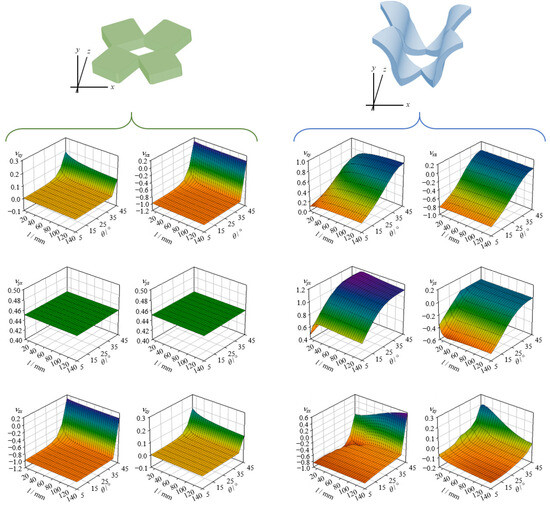
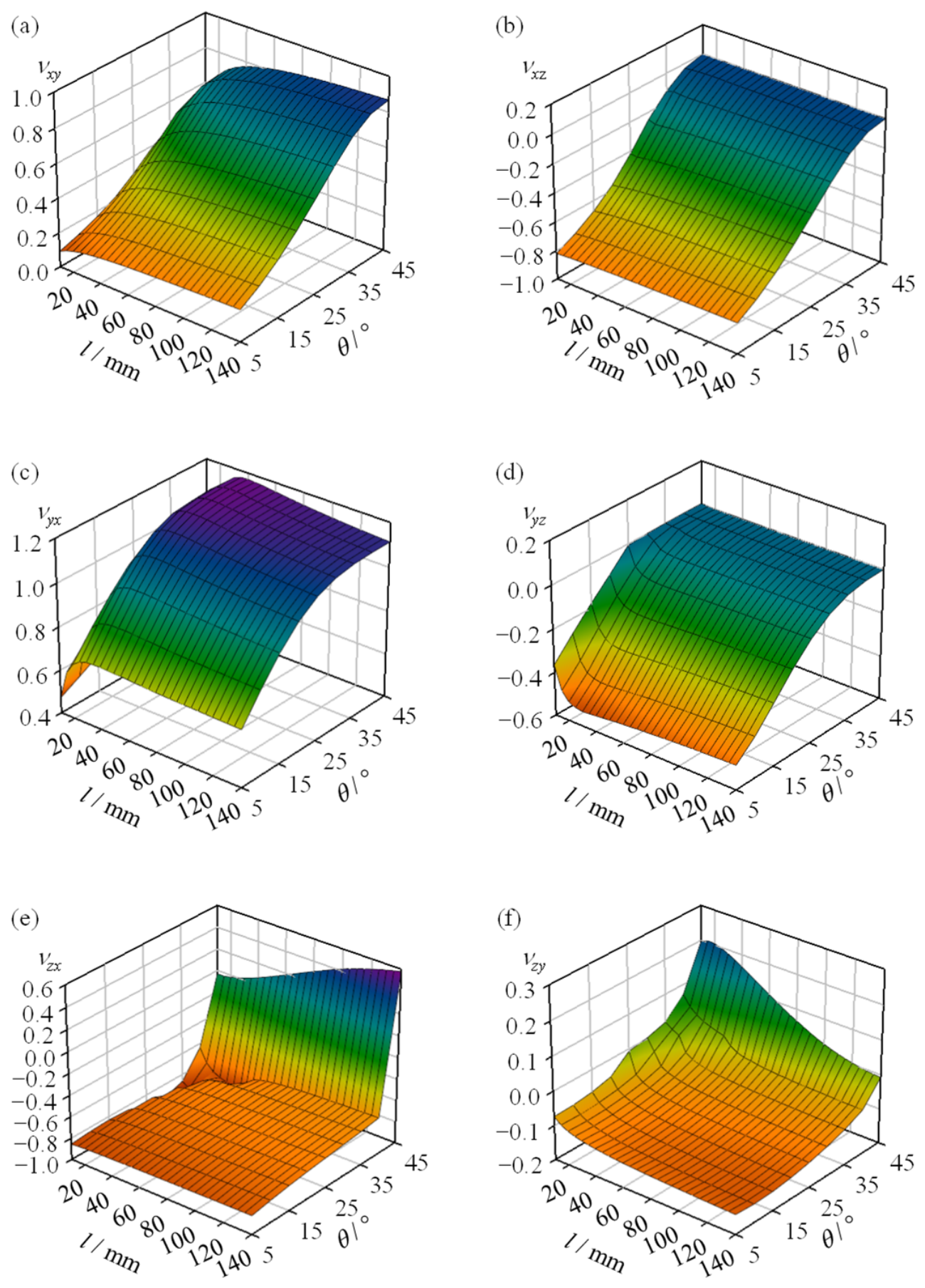
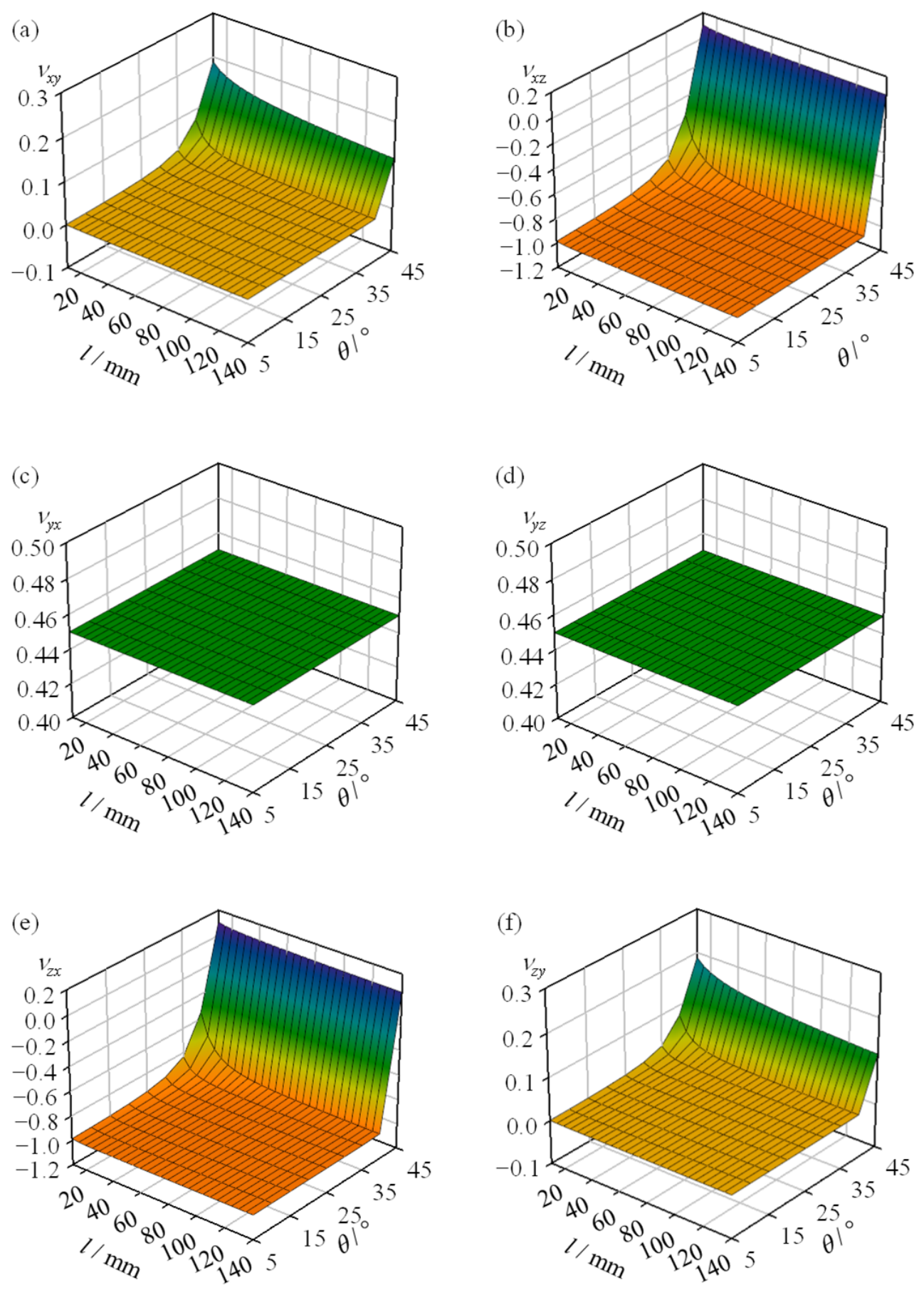
As can be noted from Figure 4, the perforated corrugated system is able to show a negative Poisson’s ratio in both the yz and zx planes, while it is completely non-auxetic in the xy plane, at least for the values of the parameters considered. As a general trend, the Poisson’s ratio of the perforated corrugated structure tends to attain lower values for smaller angles than for angles close to 45°. The trend could be expected since 45° represents the closed position for the rotating square system. On the other hand, the behavior of the system seems to be rather insensitive to the value of l. There are very few exceptions to this behavior, these occurring for small θ and l when loading is in the y direction and for larger θ when loading is in the z direction. The lowest negative Poisson’s ratios occur in the zx plane. This is especially the case when loading in the z direction. The zx plane is the one where the diamond perforations were undertaken. Thus, this behavior can be attributed to a rotating rigid units mechanism. However, the fact that Poisson’s ratio is not constant and close to −1, as is predicted from the rotating squares system, indicates that another mechanism is acting, as will be considered in detail in the analysis of the nonlinear results.
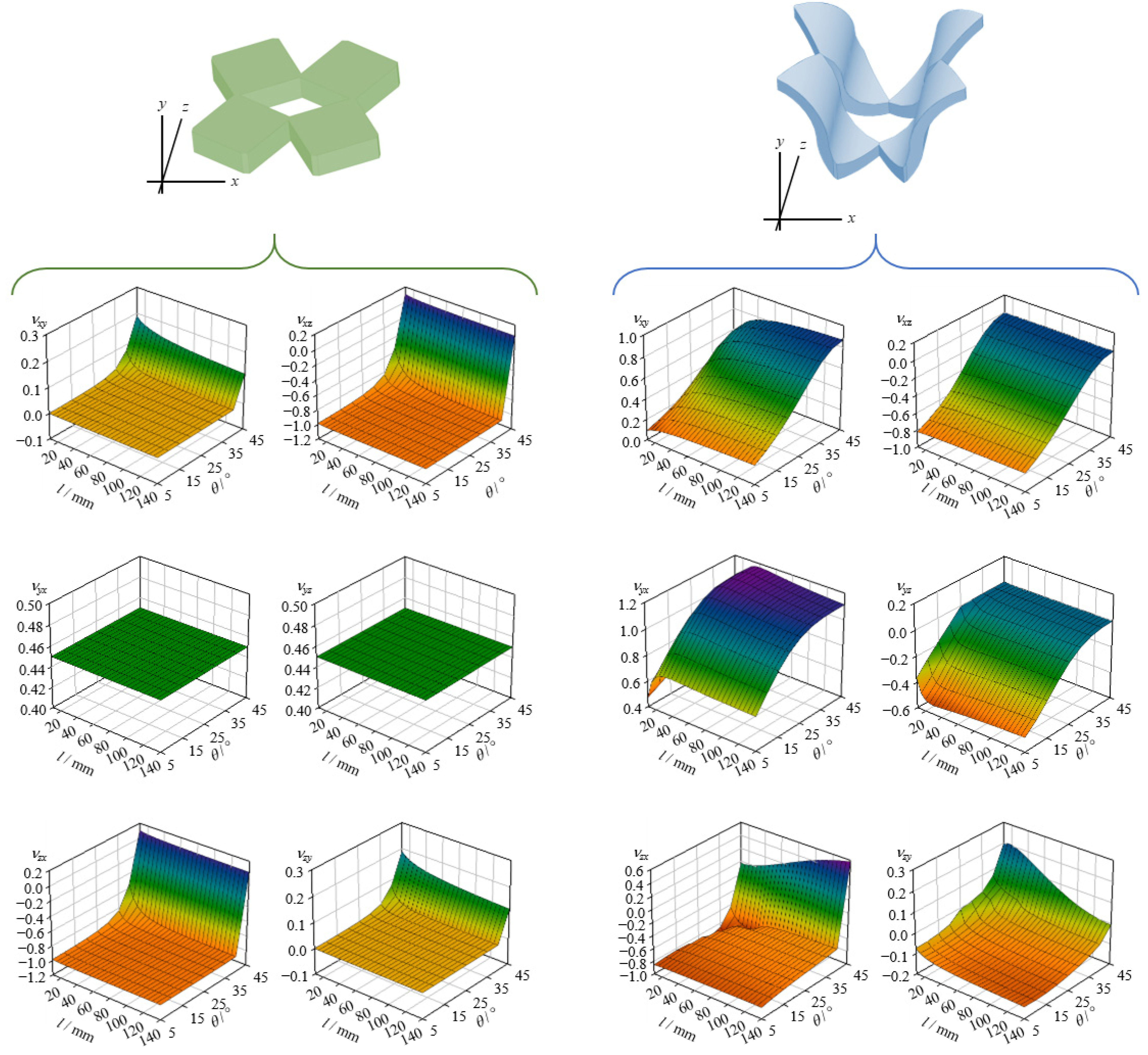
Thus, it can be observed that the behavior of the perforated corrugated system differs in many aspects from that of the regular rotating squares. Comparing the results shown in Figure 4 with those obtained for the corresponding rotating squares system (Figure 5), it can be noted that in the latter case, auxeticity is confined to the zx plane. In the out-of-plane direction, Poisson’s ratio takes values close to zero when loading in the x or z direction and close to 0.45 (the value of the constituent material Poisson’s ratio) when loaded in the out-of-plane direction. At the same time, in the xz plane, Poisson’s ratio takes a value close to −1 for most values of θ and l. The major exceptions to this general behavior occur when loading close to the locked position, i.e., when θ is close or equal to 45°. In this configuration it is hard for the rigid units to rotate relative to one another so that the rotating square model is no longer applicable. It should be noted that the usual rotating square system attains lower and more constant values of the Poisson’s ratio compared to the proposed system. At the same time, the proposed system is able to demonstrate auxeticity in 3D. Thus, the perforated corrugated system allows for the tailoring of a wider range of Poisson’s ratio, extending from negative (close to −1) to positive ones (close to +1).
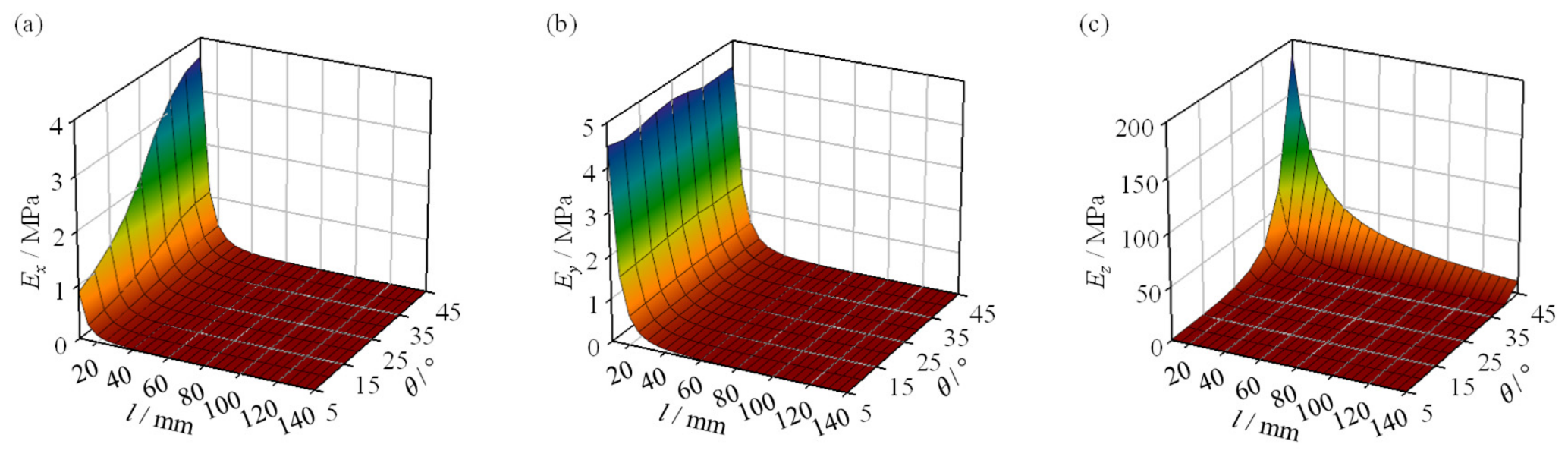
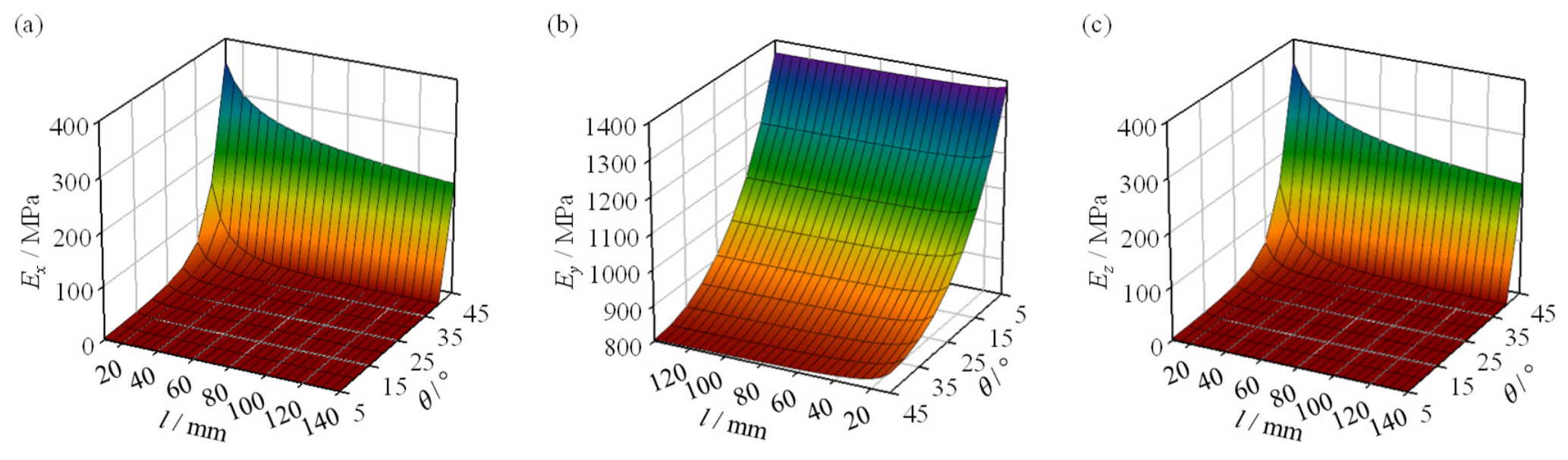
Further differences between the behavior of the perforated corrugated plate and the planar one can also be observed from the plots of the Young’s moduli. In the case of the corrugated plate, the maximum values of the Young’s moduli occur prevalently at small values of l, as can be noted from Figure 6. This can be attributed, at least in part, to a leverage effect on the joints, with the induced moment increasing for increasing l. Additionally, the density of the structure increases for a smaller diamond side length. On the other hand, the locking angle, namely 45°, seems to have relatively little effect on the behavior of the Young’s moduli. Its influence appears to be pronounced only when loading in the z direction (Figure 6c). This is also the direction where the highest values of the Young’s moduli are attained, with the maximal values being more than 30 times that attained for loading in the xy plane. The reason why θ = 45° does not lead to a very high Young’s modulus in the perforated corrugated plate is that, for the structure under consideration, this configuration does not really represent a locked position. In fact, the structure is still able to deform with relative ease in the out-of-plane direction.
For the flat rotating square system, as can be observed in Figure 7, the locked position does indeed lead to relatively high Young’s moduli for loading in the xz plane. Yet the highest values of Young’s moduli occur when loading in the out-of-plane (or y) direction when the θ is relatively small. The reason for this is that at this angle, the density of the material is relatively high due to the fact that the cross-sectional area of the perforations is comparatively small. Hence, the stress is being applied on a compact material, leading to a Young’s modulus close to that of the constituent material. At the same time, increasing l results in a decrease in the Young’s modulus when the force is applied in the xz plane. This can be attributed once again to a leverage effect. It is also interesting to note that the minimum value of Ey (the Young’s modulus in the y direction) is more than twice the maximum of Ex and Ez (the Young’s modulus in the x direction and z direction, respectively). Furthermore, the maximal values of the Young’s moduli for the flat system are much more than those obtained for the one with the perforated corrugated plate.

3.2. Analysis of the Results Obtained from the Experimental Testing and Nonlinear Simulations

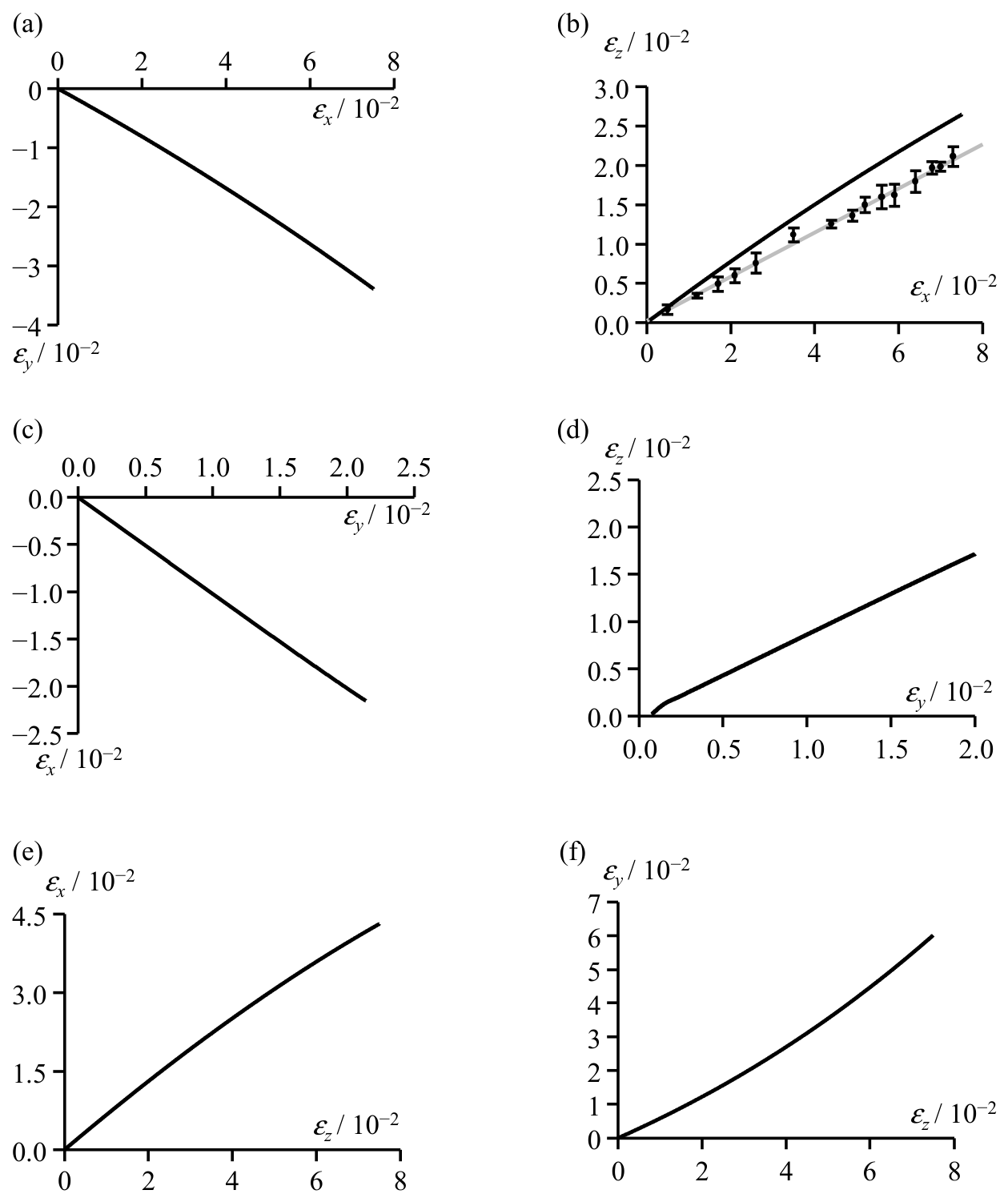
The results for Poisson’s ratio obtained from the nonlinear simulations are shown in Figure 8. In all cases, the maximum strain in the loading direction was 7.5%. However, the simulation for loading in the y direction failed after εy was around 2.85% so that only the results up till this point are shown.
It can be noted that, for all Poisson’s ratios, the observed behavior with increasing axial strain is rather linear. This can also be verified from the values of Pearson’s correlation coefficient rP that are given in Table 2. Such a behavior is not common amongst auxetic structures, whereby in many cases the Poisson’s ratio ν tends to increase with axial strain [89]. At the same time, a constant negative Poisson’s ratio can be a desirable feature, for example, in the case of impact loading, as the superior energy absorption abilities conferred by virtue of its auxeticity can be retained throughout the deformation. Hence, this structure can be added to the pool of the few auxetic systems that are able to retain a constant ν.
Of additional interest is the fact that the values of Poisson’s ratios obtained from linear regression are also close to those obtained from a linear simulation (Table 2). This could have been expected given the rather linear variation observed in the behavior. Thus, it is possible to get a good initial idea of the nonlinear value of the Poisson’s ratio from the linear results, potentially reducing the computational time and resources required to investigate and optimize the system for specific applications.
Figure 8b also shows the measurements made on the prototypes. As can be noted, the variation in the experimental and numerical results is similar but not exactly equal. In fact, the value of the Poisson’s ratio obtained from linear regression carried out on the experimental measurements was −0.281 ± 0.005 (and rP = 0.9990), which is more positive than that obtained from the simulations (Table 2). The differences can, to some extent, be explained through imperfections of the physical prototype. For example, if the distance between perforations s was not printed with absolute precision—something that could easily happen—it could easily alter the value of Poisson’s ratio. In this case, the filament nature of the printing meant that the joints cannot be perfectly continuous. Furthermore, the curvilinear profile necessitated the use of supports, thus limiting the precision with which these parts could be printed. Hence, even if there is a difference between the experimental and numerical results, given the limitations of the 3D printing procedure, the agreement can be considered reasonable. At the same time, the discrepancy suggests that deviations can be expected between the Poisson’s ratio values predicted by simulations and those obtained experimentally.
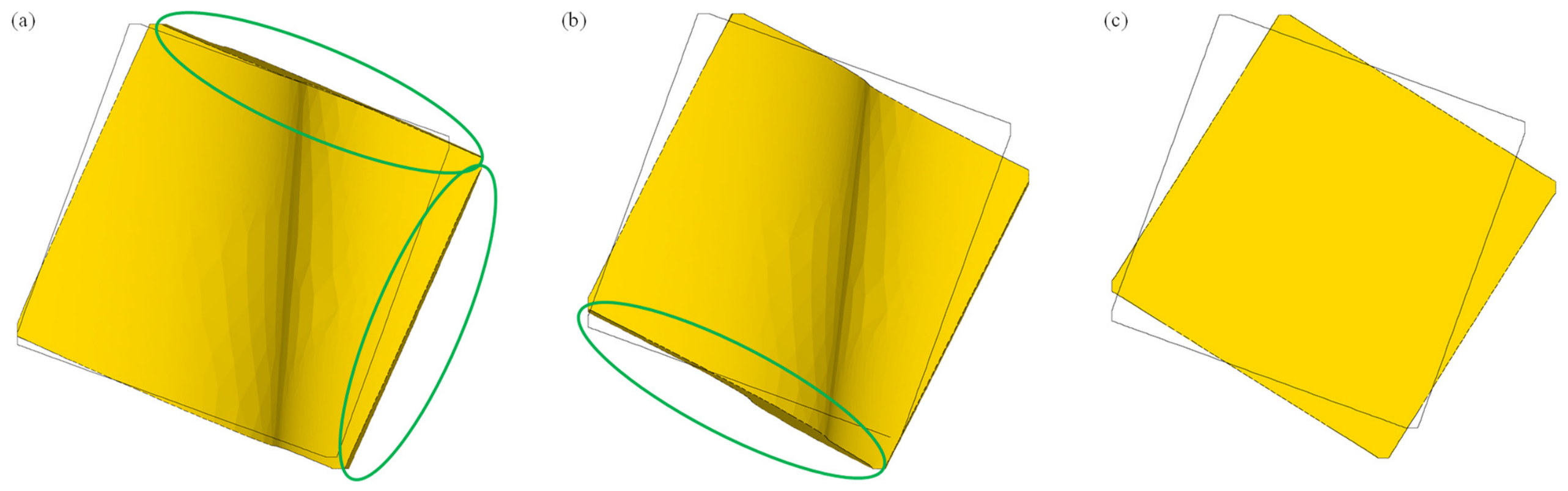
A glimpse into the deformation mechanism acting in this nonlinear deformation can be obtained from Figure 9. As can be noted from the first two panels, the structure with a corrugated side profile becomes distorted so that the side profile starts to be observable when viewing the system from above (see ovals drawn in green). This is unlike the flat system, where only the top part is visible even at the maximum strain applied. Additionally, elongation of the structure with the curvilinear side profile can also be observed, particularly in Figure 9a. The distortion of the structure explains why the value of Poisson’s ratio is not close to −1, as predicted for the ideal flat rotating square system. At the same time, it is possible to envision that the change in shape of the system with a curvilinear side profile could potentially be put to good use if it is possible to control the final form attained. For example, this could be used to create a smart filter where not only the size of the pores can be made to increase when a tensile load is applied but also their shape can be made to attain a desired design.
Thus, the results obtained all indicate that it is possible to extend the rotating square structure to a 3D auxetic system simply by applying perforations on corrugated plates. While the study focused on diamond-shaped perforations, it is to be expected that other systems can be similarly obtained by drilling holes of different shapes. Hence, further investigations are likely to follow on this innovative method.
It should also be mentioned that, while in this study the structure was fabricated using an additive manufacturing technique, it is also possible to produce it using subtractive techniques. This could be particularly advantageous if the perforations are carried out on a flat sheet, before it is corrugated. Furthermore, the use of auxetic corrugated sheets within sandwich panels can provide a lightweight material with enhanced energy absorption capability. The perforation of the sheets can be carried out using already available techniques, providing for a convenient, ready-to-go fabrication methodology.
There are also other important aspects to consider. The first is that corrugation need not be along one single direction. In fact, it is possible to have them along the y and z directions concurrently. Furthermore, these structures can be manufactured using casting. This allows the use of not only traditional materials but also biomaterials, such as mycelia-based composites [91,92]. This method could also have the advantage of combining the impact absorption potential of auxetic systems with the properties of bio-composites made from fungi in order to attain an innovative and sustainable packaging product [93].

4. Conclusions

A practical fabrication methodology for the manufacturing of 3D auxetic structures has been presented in this work. The production process involves the use of perforations on corrugated plates. For the purpose of an in-depth investigation, the structure obtained when diamond perforations are performed on a corrugated plate with a side profile consisting of an alternating pattern of semicircles was considered. As viewed from above, the structure obtained resembles the rotating square system. However, it can differ significantly laterally.
Results show that the structure can exhibit 3D auxeticity. However, its Poisson’s ratio does not attain a constant value of −1 in the plane where the rotating square system can be observed. This was related to the fact that the deformation mechanism does not involve the simple rotation of rigid units. Instead, there is a concurrent deformation of the shape of the structure, leading to a decrease in its auxeticity as compared to a rotating square system. The observed behavior could be used to simultaneously tailor Poisson’s ratio and the final shape attained for specific applications, such as to manufacture smart filters with both pore size and shape changing during loading.
Thus, given the observed mode of behavior, the structure can be considered to deform through a semi-rigid rotating units mechanism, making it one of the first macro-scale systems showing these characteristics. Another innovation from this research is the fact that it is possible to extend 2D auxetic systems obtained through perforations to 3D simply by using a corrugated plate. While in this work, corrugations were only along one side, in practice, both lateral sides can be patterned. This leads to a plethora of possible auxetic structures that can be created, something that can lend itself to an extensive amount of research.

Supplementary Materials

The following supporting information can be downloaded at: https://www.mdpi.com/article/10.3390/jmmp10060198/s1, Document: Section S1: Additional Plots showing the results of the Poisson’s ratios and Young’s moduli obtained for the perforated corrugated structures using different geometric parameters; Figure S1: Three dimensional plots of the Poisson’s ratio νxy with l and θ for the perforated corrugated system where in (a) s = 0.5 mm and t = 2.5 mm, (b) s = 0.5 mm and t = 5.0 mm, (c) s = 0.5 mm and t = 10.0 mm, (d) s = 1.0 mm and t = 2.5 mm, (e) s = 1.0 mm and t = 5.0 mm, and (f) s = 1.0 mm and t = 10.0 mm. Note that computed values are at the intersection of lines. The lines themselves are a guide for the eye; Figure S2: Three dimensional plots of the Poisson’s ratio νxz with l and θ for the perforated corrugated system where in (a) s = 0.5 mm and t = 2.5 mm, (b) s = 0.5 mm and t = 5.0 mm, (c) s = 0.5 mm and t = 10.0 mm, (d) s = 1.0 mm and t = 2.5 mm, (e) s = 1.0 mm and t = 5.0 mm, and (f) s = 1.0 mm and t = 10.0 mm. Note that computed values are at the intersection of lines. The lines themselves are a guide for the eye; Figure S3: Three dimensional plots of the Poisson’s ratio νyz with l and θ for the perforated corrugated system where in (a) s = 0.5 mm and t = 2.5 mm, (b) s = 0.5 mm and t = 5.0 mm, (c) s = 0.5 mm and t = 10.0 mm, (d) s = 1.0 mm and t = 2.5 mm, (e) s = 1.0 mm and t = 5.0 mm, and (f) s = 1.0 mm and t = 10.0 mm. Note that computed values are at the intersection of lines. The lines themselves are a guide for the eye; Figure S4: Three dimensional plots of the Poisson’s ratio νyz with l and θ for the perforated corrugated system where in (a) s = 0.5 mm and t = 2.5 mm, (b) s = 0.5 mm and t = 5.0 mm, (c) s = 0.5 mm and t = 10.0 mm, (d) s = 1.0 mm and t = 2.5 mm, (e) s = 1.0 mm and t = 5.0 mm, and (f) s = 1.0 mm and t = 10.0 mm. Note that computed values are at the intersection of lines. The lines themselves are a guide for the eye; Figure S5: Three dimensional plots of the Poisson’s ratio νzx with l and θ for the perforated corrugated system where in (a) s = 0.5 mm and t = 2.5 mm, (b) s = 0.5 mm and t = 5.0 mm, (c) s = 0.5 mm and t = 10.0 mm, (d) s = 1.0 mm and t = 2.5 mm, (e) s = 1.0 mm and t = 5.0 mm, and (f) s = 1.0 mm and t = 10.0 mm. Note that computed values are at the intersection of lines. The lines themselves are a guide for the eye. Figure S6: Three dimensional plots of the Poisson’s ratio νzy with l and θ for the perforated corrugated system where in (a) s = 0.5 mm and t = 2.5 mm, (b) s = 0.5 mm and t = 5.0 mm, (c) s = 0.5 mm and t = 10.0 mm, (d) s = 1.0 mm and t = 2.5 mm, (e) s = 1.0 mm and t = 5.0 mm, and (f) s = 1.0 mm and t = 10.0 mm. Note that computed values are at the intersection of lines. The lines themselves are a guide for the eye; Figure S7: Three dimensional plots of the Young’s modulus Ex with l and θ for the perforated corrugated system where in (a) s = 0.5 mm and t = 2.5 mm, (b) s = 0.5 mm and t = 5.0 mm, (c) s = 0.5 mm and t = 10.0 mm, (d) s = 1.0 mm and t = 2.5 mm, (e) s = 1.0 mm and t = 5.0 mm, and (f) s = 1.0 mm and t = 10.0 mm. Note that computed values are at the intersection of lines. The lines themselves are a guide for the eye; Figure S8: Three dimensional plots of the Young’s modulus Ey with l and θ for the perforated corrugated system in (a) s = 0.5 mm and t = 2.5 mm, (b) s = 0.5 mm and t = 5.0 mm, (c) s = 0.5 mm and t = 10.0 mm, (d) s = 1.0 mm and t = 2.5 mm, (e) s = 1.0 mm and t = 5.0 mm, and (f) s = 1.0 mm and t = 10.0 mm. Note that computed values are at the intersection of lines. The lines themselves are a guide for the eye; Figure S9: Three dimensional plots of the Young’s modulus Ez with l and θ for the perforated corrugated system where in (a) s = 0.5 mm and t = 2.5 mm, (b) s = 0.5 mm and t = 5.0 mm, (c) s = 0.5 mm and t = 10.0 mm, (d) s = 1.0 mm and t = 2.5 mm, (e) s = 1.0 mm and t = 5.0 mm, and (f) s = 1.0 mm and t = 10.0 mm. Note that computed values are at the intersection of lines. The lines themselves are a guide for the eye; Section S2: An investigation of the mass fraction of the structures; Section S2.1: The determination of the mass fraction; Section S2.2: Analysis of the results of the mass fraction; Figure S10: Three dimensional plots of mass fraction with l and θ for the perforated corrugated system where in (a) s = 0.5 mm and t = 2.5 mm, (b) s = 0.5 mm and t = 5.0 mm, (c) s = 0.5 mm and t = 10.0 mm, (d) s = 1.0 mm and t = 2.5 mm, (e) s = 1.0 mm and t = 5.0 mm, and (f) s = 1.0 mm and t = 10.0 mm. Note that computed values are at the intersection of lines. The lines themselves are a guide for the eye; Figure S11: Three dimensional plots of mass fraction with l and θ for the flat system where in (a) s = 0.5 mm and (b) s = 1.0 mm. Note that computed values are at the intersection of lines. The lines themselves are a guide for the eye.

Author Contributions

Conceptualization, R.G. and P.-S.F.; methodology, R.G. and P.-S.F.; software, L.V., R.G. and P.-S.F.; validation, L.V., G.C., G.F. and P.R.; formal analysis, L.V., P.-S.F., R.G. and J.N.G.; investigation, L.V., P.-S.F. and R.G.; resources, L.V., G.C., G.F., P.R. and P.-S.F.; data curation, L.V. and P.-S.F.; writing—original draft preparation, L.V. and P.-S.F.; writing—review and editing, L.V., G.C., G.F., P.R., R.G., J.N.G. and P.-S.F.; visualization, L.V. and P.-S.F.; supervision, G.C., G.F., P.R., R.G. and P.-S.F.; project administration, R.G.; funding acquisition, P.-S.F. All authors have read and agreed to the published version of the manuscript.

Funding

Project financed by Xjenza Malta through the FUSION: R&I Research Excellence Programme, grant agreement number: REP-2023-029. The project also made use of the University of Malta Research grants entitled ‘Designing of a re-entrant 3D auxetic structure for easy 3D printing’ (grant number: MTMRP03-23) and ‘Design of a real auxetic system exhibiting the semi-rigid mechanism’ (grant number: MTMRP03-24).

Data Availability Statement

All the information required to replicate the results is provided in the main text.

Acknowledgments

This research was carried out using computational facilities procured through the European Regional Development Fund, Project ERDF-080 ‘A supercomputing laboratory for the University of Malta’. Equipment and resources were provided by the University of Malta Academic Work Resources Fund. The images are courtesy of ANSYS, Inc.

Conflicts of Interest

The authors declare no conflicts of interest. The funders had no role in the design of the study; in the collection, analyses, or interpretation of data; in the writing of the manuscript; or in the decision to publish the results.

References

  1. Evans, K.E. Auxetic Polymers: A New Range of Materials. Endeavour 1991, 15, 170–174. [Google Scholar] [CrossRef]
  2. Grima, J.N.; Evans, K.E. Auxetic Behavior from Rotating Squares. J. Mater. Sci. Lett. 2000, 19, 1563–1565. [Google Scholar] [CrossRef]
  3. Grima, J.N.; Farrugia, P.S.; Gatt, R.; Attard, D. On the Auxetic Properties of Rotating Rhombi and Parallelograms: A Preliminary Investigation. Phys. Status Solidi B 2008, 245, 521–529. [Google Scholar] [CrossRef]
  4. Sigmund, O. Tailoring Materials with Prescribed Elastic Properties. Mech. Mater. 1995, 20, 351–368. [Google Scholar] [CrossRef]
  5. Ishibashi, Y.; Iwata, M. A Microscopic Model of a Negative Poisson’s Ratio in Some Crystals. J. Phys. Soc. Jpn. 2000, 69, 2702–2703. [Google Scholar] [CrossRef]
  6. Attard, D.; Grima, J.N. A Three-Dimensional Rotating Rigid Units Network Exhibiting Negative Poisson’s Ratios. Phys. Status Solidi B 2012, 249, 1330–1338. [Google Scholar] [CrossRef]
  7. Galea, R.; Farrugia, P.-S.; Dudek, K.K.; Attard, D.; Grima, J.N.; Gatt, R. A Novel Design Method to Produce 3D Auxetic Metamaterials with Continuous Pores Exemplified Through 3D Rotating Auxetic Systems. Mater. Des. 2023, 226, 111596. [Google Scholar] [CrossRef]
  8. Lim, T.-C. An Auxetic Fragmentation-Reconstitution Metamaterial. Prog. Eng. Sci. 2025, 2, 100079. [Google Scholar] [CrossRef]
  9. Lim, T.-C. Metamaterials with Poisson’s Ratio Discontinuity by Means of Fragmentation–Reconstitution Rotating Units. Proc. R. Soc. A Math. Phys. Eng. Sci. 2023, 479, 20230442. [Google Scholar] [CrossRef]
  10. Lim, T.-C. Transitory Metamaterials Based on Symmetrical Splitting of Rotating Squares. Phys. Scr. 2025, 100, 025912. [Google Scholar] [CrossRef]
  11. Wojciechowski, K.W. Constant Thermodynamic Tension Monte Carlo Studies of Elastic Properties of a Two-Dimensional System of Hard Cyclic Hexamers. Mol. Phys. 1987, 61, 1247–1258. [Google Scholar] [CrossRef]
  12. Lakes, R. Deformation Mechanisms in Negative Poisson’s Ratio Materials: Structural Aspects. J. Mater. Sci. 1991, 26, 2287–2292. [Google Scholar] [CrossRef]
  13. Gatt, R.; Attard, D.; Farrugia, P.-S.; Azzopardi, K.M.; Mizzi, L.; Brincat, J.-P.; Grima, J.N. A Realistic Generic Model for Anti-tetrachiral Systems. Phys. Status Solidi B 2013, 250, 2012–2019. [Google Scholar] [CrossRef]
  14. Alderson, A.; Alderson, K.L.; Attard, D.; Evans, K.E.; Gatt, R.; Grima, J.N.; Miller, W.; Ravirala, N.; Smith, C.W.; Zied, K. Elastic Constants of 3-, 4- and 6-Connected Chiral and Anti-Chiral Honeycombs Subject to Uniaxial In-Plane Loading. Compos. Sci. Technol. 2010, 70, 1042–1048. [Google Scholar] [CrossRef]
  15. Sigmund, O.; Torquato, S.; Aksay, I.A. On the Design of 1–3 Piezocomposites Using Topology Optimization. J. Mater. Res. 1998, 13, 1038–1048. [Google Scholar] [CrossRef]
  16. Wojciechowski, K.W. Two-Dimensional Isotropic System with a Negative Poisson Ratio. Phys. Lett. A 1989, 137, 60–64. [Google Scholar] [CrossRef]
  17. Ha, C.S.; Plesha, M.E.; Lakes, R.S. CHIRAL three-Dimensional Lattices with Tunable Poisson’s Ratio. Smart Mater. Struct. 2016, 25, 054005. [Google Scholar] [CrossRef]
  18. Huang, H.-H.; Wong, B.-L.; Chou, Y.-C. Design and Properties of 3D-Printed Chiral Auxetic Metamaterials by Reconfigurable Connections. Phys. Status Solidi B 2016, 253, 1557–1564. [Google Scholar] [CrossRef]
  19. Wu, W.; Qi, D.; Liao, H.; Qian, G.; Geng, L.; Niu, Y.; Liang, J. Deformation Mechanism of Innovative 3D Chiral Metamaterials. Sci. Rep. 2018, 8, 12575. [Google Scholar] [CrossRef]
  20. Fu, M.-H.; Zheng, B.-B.; Li, W.-H. A Novel Chiral Three-Dimensional Material with Negative Poisson’s Ratio and the Equivalent Elastic Parameters. Compos. Struct. 2017, 176, 442–448. [Google Scholar] [CrossRef]
  21. Farrugia, P.-S.; Gatt, R.; Grima, J.N. A Novel Three-Dimensional Anti-Tetrachiral Honeycomb. Phys. Status Solidi B 2019, 256, 1800473. [Google Scholar] [CrossRef]
  22. Masters, I.G.; Evans, K.E. Models for the Elastic Deformation of Honeycombs. Compos. Struct. 1996, 35, 403–422. [Google Scholar] [CrossRef]
  23. Evans, K.E.; Alderson, A.; Christian, F.R. Auxetic Two-Dimensional Polymer Networks. An Example of Tailoring Geometry for Specific Mechanical Properties. J. Chem. Soc. Faraday Trans. 1995, 91, 2671–2680. [Google Scholar] [CrossRef]
  24. Gibson, L.J.; Ashby, M.F. Cellular Solids: Structure and Properties; Cambridge University Press: Cambridge, UK, 1999. [Google Scholar]
  25. Larsen, U.D.; Signund, O.; Bouwsta, S. Design and Fabrication of Compliant Micromechanisms and Structures with Negative Poisson’s ratio. J. Microelectromech. Syst. 1997, 6, 99–106. [Google Scholar] [CrossRef]
  26. Farrugia, P.-S.; Gatt, R.; De Vrieze, S.; Mellos, C.; Grima, J.N. Edge Effects of a Hexagonal Honeycomb on the Poisson’s Ratio and Young’s Modulus. Phys. Status Solidi B 2020, 257, 1900511. [Google Scholar] [CrossRef]
  27. Ma, Z.-D. Three-Dimensional Auxetic Structures and Applications Thereof 2011. U.S. Patent US7910193B2, 22 March 2011. [Google Scholar]
  28. Shokri Rad, M.; Ahmad, Z.; Alias, A. Computational Approach in Formulating Mechanical Characteristics of 3D Star Honeycomb Auxetic Structure. Adv. Mater. Sci. Eng. 2015, 2015, 11. [Google Scholar] [CrossRef]
  29. Evans, K.E.; Nkansah, M.A.; Hutchinson, I.J. Auxetic foams: Modelling Negative Poisson’s Ratios. Acta Metall. Mater. 1994, 42, 1289–1294. [Google Scholar] [CrossRef]
  30. Wojciechowski, K.W. Non-Chiral, Molecular Model of Negative Poisson Ratio in Two Dimensions. J. Phys. A Math. Gen. 2003, 36, 11765. [Google Scholar] [CrossRef]
  31. Tretiakov, K.V. Negative Poisson’s Ratio of Two-Dimensional Hard Cyclic Tetramers. J. Non-Cryst. Solids 2009, 355, 1435–1438. [Google Scholar] [CrossRef]
  32. Tretiakov, K.V.; Wojciechowski, K.W. Auxetic, Partially Auxetic, and Nonauxetic Behaviour in 2D Crystals of Hard Cyclic Tetramers. Phys. Status Solidi (RRL)—Rapid Res. Lett. 2020, 14, 2000198. [Google Scholar] [CrossRef]
  33. Tretiakov, K.V.; Piglowski, P.M.; Hyzorek, K.; Wojciechowski, K.W. Enhanced Auxeticity in Yukawa Systems due to Introduction of Nanochannels in [001]-Direction. Smart Mater. Struct. 2016, 25, 054007. [Google Scholar] [CrossRef]
  34. Tretiakov, K.V.; Piglowski, P.M.; Narojczyk, J.W.; Wojciechowski, K.W. Selective Enhancement of Auxeticity Through Changing a Diameter of Nanochannels in Yukawa Systems. Smart Mater. Struct. 2018, 27, 115021. [Google Scholar] [CrossRef]
  35. Narojczyk, J.W.; Wojciechowski, K.W.; Tretiakov, K.V.; Smardzewski, J.; Scarpa, F.; Piglowski, P.M.; Kowalik, M.; Imre, A.R.; Bilski, M. Auxetic Properties of a f.c.c. Crystal of Hard Spheres with an Array of [001]-Nanochannels Filled by Hard Spheres of Another Diameter. Phys. Status Solidi B 2019, 256, 1800611. [Google Scholar] [CrossRef]
  36. Arsentev, M.; Topalov, E.; Balabanov, S.; Sysoev, E.; Shulga, I.; Akhmatnabiev, M.; Sychov, M.; Skorb, E.; Nosonovsky, M. Crystal-Inspired Cellular Metamaterials and Triply Periodic Minimal Surfaces. Biomimetics 2024, 9, 285. [Google Scholar] [CrossRef] [PubMed]
  37. Tuninetti, V.; Narayan, S.; Ríos, I.; Menacer, B.; Valle, R.; Al-lehaibi, M.; Kaisan, M.U.; Samuel, J.; Oñate, A.; Pincheira, G.; et al. Biomimetic Lattice Structures Design and Manufacturing for High Stress, Deformation, and Energy Absorption Performance. Biomimetics 2025, 10, 458. [Google Scholar] [CrossRef]
  38. Iticha, W.; Stręk, T. Computational Analysis of Thermal Performance of Heat Sinks with Foam Structures. Materials 2025, 18, 5280. [Google Scholar] [CrossRef]
  39. Lakes, R. Foam Structures with a Negative Poisson’s Ratio. Science 1987, 235, 1038–1040. [Google Scholar] [CrossRef]
  40. Evans, K.E.; Nkansah, M.A.; Hutchinson, I.J.; Rogers, S.C. Molecular Network Design. Nature 1991, 353, 124. [Google Scholar] [CrossRef]
  41. Alderson, A.; Alderson, K.L. Auxetic Materials. Proc. Inst. Mech. Eng. Part G J. Aerosp. Eng. 2007, 221, 565–575. [Google Scholar] [CrossRef]
  42. Alderson, A. A triumph of Lateral Thought. Chem. Ind. 1999, 17, 384–391. [Google Scholar]
  43. Evans, K.E.; Alderson, K.L. Auxetic Materials: The Positive Side of Being Negative. Eng. Sci. Educ. J. 2000, 9, 148–154. [Google Scholar] [CrossRef]
  44. Choi, J.B.; Lakes, R.S. Fracture Toughness of Re-Entrant Foam Materials with a Negative Poisson’s Ratio: Experiment and Analysis. Int. J. Fract. 1996, 80, 73–83. [Google Scholar] [CrossRef]
  45. Lakes, R.S.; Elms, K. Indentability of Conventional and Negative Poisson’s Ratio Foams. J. Compos. Mater. 1993, 27, 1193–1202. [Google Scholar] [CrossRef]
  46. Moyers, R.E. Dilator for Opening the Lumen of a Tubular Organ 1992. U.S. Patent US5108413A, 28 April 1992. [Google Scholar]
  47. Choi, J.B.; Lakes, R.S. Design of a Fastener Based on Negative Poisson’s Ratio Foam. Cell. Polym. 1991, 10, 205–212. [Google Scholar] [CrossRef]
  48. Ren, X.; Shen, J.; Tran, P.; Ngo, T.D.; Xie, Y.M. Auxetic Nail: Design and Experimental Study. Compos. Struct. 2018, 184, 288–298. [Google Scholar] [CrossRef]
  49. Qi, C.; Remennikov, A.; Pei, L.-Z.; Yang, S.; Yu, Z.-H.; Ngo, T.D. Impact and Close-In Blast Response of Auxetic Honeycomb-Cored Sandwich Panels: Experimental Tests and Numerical Simulations. Compos. Struct. 2017, 180, 161–178. [Google Scholar] [CrossRef]
  50. Schenk, M.; Guest, S.D.; McShane, G.J. Novel Stacked Folded Cores for Blast-Resistant Sandwich Beams. Int. J. Solids Struct. 2014, 51, 4196–4214. [Google Scholar] [CrossRef]
  51. Ma, Z.-D.; Bian, H.; Sun, C.; Hulbert, G.M.; Bishnoi, K.; Rostam-Abadi, F. Functionally-Graded NPR (Negative Poisson’s Ratio) Material for a Blast-Protective Deflector; Michigan University Ann Arbor: Dearborn, MI, USA, 2010. [Google Scholar]
  52. Imbalzano, G.; Tran, P.; Ngo, T.D.; Lee, P.V.S. A Numerical Study of Auxetic Composite Panels Under Blast Loadings. Compos. Struct. 2016, 135, 339–352. [Google Scholar] [CrossRef]
  53. Novak, N.; Starčevič, L.; Vesenjak, M.; Ren, Z. Blast Response Study of the Sandwich Composite Panels with 3D Chiral Auxetic Core. Compos. Struct. 2019, 210, 167–178. [Google Scholar] [CrossRef]
  54. Wang, H.; Lu, Z.; Yang, Z.; Li, X. A Novel Re-Entrant Auxetic Honeycomb with Enhanced In-Plane Impact Resistance. Compos. Struct. 2019, 208, 758–770. [Google Scholar] [CrossRef]
  55. Alderson, A.; Rasburn, J.; Evans, K.E.; Grima, J.N. Auxetic Polymeric Filters Display Enhanced De-Fouling and Pressure Compensation Properties. Membr. Technol. 2001, 2001, 6–8. [Google Scholar] [CrossRef]
  56. Wang, Z.; Hu, H. Auxetic Materials and Their Potential Applications in Textiles. Text. Res. J. 2014, 84, 1600–1611. [Google Scholar] [CrossRef]
  57. Hu, H.; Zulifqar, A. Auxetic Textile Materials—A Review. J. Text. Eng. Fash. Technol. 2016, 1, 00002. [Google Scholar] [CrossRef]
  58. Alderson, A.; Alderson, K. Expanding Materials and Applications: Exploiting Auxetic Textiles. Tech. Text. Int. 2005, 14, 29–34. [Google Scholar] [CrossRef]
  59. Subramani, P.; Rana, S.; Oliveira, D.V.; Fangueiro, R.; Xavier, J. Development of Novel Auxetic Structures Based on Braided Composites. Mater. Des. 2014, 61, 286–295. [Google Scholar] [CrossRef]
  60. Steffens, F.; Rana, S.; Fangueiro, R. Development of Novel Auxetic Textile Structures Using High Performance Fibres. Mater. Des. 2016, 106, 81–89. [Google Scholar] [CrossRef]
  61. Ugbolue, S.C.; Kim, Y.K.; Warner, S.B.; Fan, Q.; Yang, C.-L.; Kyzymchuk, O.; Feng, Y. The Formation and Performance of Auxetic Textiles. Part I: Theoretical and Technical Considerations. J. Text. Inst. 2010, 101, 660–667. [Google Scholar] [CrossRef]
  62. Grima, J.N.; Evans, K.E. Auxetic Behavior from Rotating Triangles. J. Mater. Sci. 2006, 41, 3193–3196. [Google Scholar] [CrossRef]
  63. Grima, J.N.; Alderson, A.; Evans, K.E. Auxetic Behaviour from Rotating Rigid Units. Phys. Status Solidi B 2005, 242, 561–575. [Google Scholar] [CrossRef]
  64. Grima, J.N.; Gatt, R.; Alderson, A.; Evans, K.E. On the Auxetic Properties of ‘Rotating Rectangles’ with Different Connectivity. J. Phys. Soc. Jpn. 2005, 74, 2866–2867. [Google Scholar] [CrossRef]
  65. Grima, J.N.; Chetcuti, E.; Manicaro, E.; Attard, D.; Camilleri, M.; Gatt, R.; Evans, K.E. On the Auxetic Properties of Generic Rotating Rigid Triangles. Proc. R. Soc. A Math. Phys. Eng. Sci. 2012, 468, 810–830. [Google Scholar] [CrossRef]
  66. Grima, J.N.; Manicaro, E.; Attard, D. Auxetic Behaviour from Connected Different-Sized Squares and Rectangles. Proc. R. Soc. A Math. Phys. Eng. Sci. 2011, 467, 439–458. [Google Scholar] [CrossRef]
  67. Milton, G.W. Complete Characterization of the Macroscopic Deformations of Periodic Unimode Metamaterials of rigid Bars and Pivots. J. Mech. Phys. Solids 2013, 61, 1543–1560. [Google Scholar] [CrossRef]
  68. Milton, G.W. New examples of three-dimensional dilational materials. Phys. Status Solidi B 2015, 252, 1426–1430. [Google Scholar] [CrossRef]
  69. Lim, T.-C. Auxetic System Based on Rotating Hexagons and Triangles. Phys. Status Solidi B 2024, 261, 2300586. [Google Scholar] [CrossRef]
  70. Alderson, A.; Evans, K.E. Rotation and Dilation Deformation Mechanisms for Auxetic Behaviour in the α-Cristobalite Tetrahedral Framework Structure. Phys. Chem. Miner. 2001, 28, 711–718. [Google Scholar] [CrossRef]
  71. Kim, J.; Shin, D.; Yoo, D.-S.; Kim, K. Regularly Configured Structures with Polygonal Prisms for Three-Dimensional Auxetic Behaviour. Proc. R. Soc. Lond. A Math. Phys. Eng. Sci. 2017, 473, 20160926. [Google Scholar] [CrossRef]
  72. Andrade, C.; Ha, C.S.; Lakes, R. Extreme Cosserat Elastic Cube Structure with Large Magnitude of Negative Poisson’s Ratio. J. Mech. Mater. Struct. 2018, 13, 93–101. [Google Scholar] [CrossRef]
  73. Baldi, A.; Brun, M.; Carta, G. Three-Dimensional Auxetic Porous Medium. Mech. Mater. 2022, 164, 104114. [Google Scholar] [CrossRef]
  74. Dudek, K.K.; Martínez, J.A.I.; Ulliac, G.; Kadic, M. Micro-Scale Auxetic Hierarchical Mechanical Metamaterials for Shape Morphing. Adv. Mater. 2022, 34, 2110115. [Google Scholar] [CrossRef]
  75. Ma, J.; Jiang, X.; Chen, Y. A 3D modular Meta-Structure With Continuous Mechanism Motion and Bistability. Extrem. Mech. Lett. 2022, 51, 101584. [Google Scholar] [CrossRef]
  76. Yang, Y.; Zhang, X.; Maiolino, P.; Chen, Y.; You, Z. Linkage-Based Three-Dimensional Kinematic Metamaterials with Programmable Constant Poisson’s Ratio. Mater. Des. 2023, 233, 112249. [Google Scholar] [CrossRef]
  77. Grima, J.N.; Zammit, V.; Gatt, R.; Alderson, A.; Evans, K.E. Auxetic Behaviour From Rotating Semi-Rigid Units. Phys. Status Solidi B 2007, 244, 866–882. [Google Scholar] [CrossRef]
  78. Chetcuti, E.; Ellul, B.; Manicaro, E.; Brincat, J.-P.; Attard, D.; Gatt, R.; Grima, J.N. Modeling auxetic Foams Through Semi-Rigid Rotating Triangles. Phys. Status Solidi B 2014, 251, 297–306. [Google Scholar] [CrossRef]
  79. Lu, Z.; Wang, Q.; Li, X.; Yang, Z. Elastic Properties of Two Novel Auxetic 3D Cellular Structures. Int. J. Solids Struct. 2017, 124, 46–56. [Google Scholar] [CrossRef]
  80. Bajada, E.; Farrugia, P.-S.; Muscat, G.A.; Grima-Cornish, J.N.; Cassar, G.; Grima, J.N.; Gatt, R. On the Effect of Pore Shape and Size on the Auxetic Properties of Perforated Sheets Based on the ‘Rotating Squares’ Model. Phys. Status Solidi B 2026, 263, e202500642. [Google Scholar] [CrossRef]
  81. Mrozek, A.; Strek, T. Numerical Analysis of Dynamic Properties of an Auxetic Structure with Rotating Squares with Holes. Materials 2022, 15, 8712. [Google Scholar] [CrossRef]
  82. Zhang, Z.; Hu, H.; Liu, S.; Xu, B. Study of an Auxetic Structure Made of Tubes and Corrugated Sheets. Phys. Status Solidi B 2013, 250, 1996–2001. [Google Scholar] [CrossRef]
  83. Li, Z.-Y.; Wang, X.-T.; Ma, L.; Wu, L.-Z. Study on the Mechanical Properties of CFRP Composite Auxetic Structures Consist of Corrugated Sheets and Tubes. Compos. Struct. 2022, 292, 115655. [Google Scholar] [CrossRef]
  84. Grima, J.N.; Grech, M.C.; Grima-Cornish, J.N.; Gatt, R.; Attard, D. Giant Auxetic Behaviour in Engineered Graphene. Ann. Der Phys. 2018, 530, 1700330. [Google Scholar] [CrossRef]
  85. Li, Z.-Y.; Wang, X.-T.; Yang, J.-S.; Li, S.; Schröder, K.-U. Mechanical Response And Auxetic Properties of composite Double-Arrow Corrugated Sandwich Panels with Defects. Mech. Adv. Mater. Struct. 2022, 29, 6517–6529. [Google Scholar] [CrossRef]
  86. Graczyk, J.; Tworzydło, J.; Garbowski, T. Parametric Sensitivity of Shear Correction Factors for Multiwall Corrugated Structures. Materials 2026, 19, 863. [Google Scholar] [CrossRef]
  87. ANSYS, Inc. ANSYS Mechanical APDL Element Reference, Release 13; ANSYS, Inc.: Canonsburg, PA, USA, 2010. [Google Scholar]
  88. Farrugia, P.-S.; Gatt, R.; Attard, D.; Attenborough, F.R.; Evans, K.E.; Grima, J.N. The Auxetic Behavior of a General Star-4 Structure. Phys. Status Solidi B 2021, 258, 2100158. [Google Scholar] [CrossRef]
  89. Farrugia, P.-S.; Gatt, R.; Mizzi, L.; Grima, J.N. Auxetic Behavior Obtained Through the Large Deformations of Variants of the Rectangular Grid. Mech. Adv. Mater. Struct. 2023, 30, 262–271. [Google Scholar] [CrossRef]
  90. Yolcu, D.A.; Baba, B.O. Measurement of Poisson’s ratio of the auxetic structure. Measurement 2022, 204, 112040. [Google Scholar] [CrossRef]
  91. Alemu, D.; Tafesse, M.; Mondal, A.K. Mycelium-Based Composite: The Future Sustainable Biomaterial. Int. J. Biomater. 2022, 2022, 8401528. [Google Scholar] [CrossRef]
  92. Cadinu, C.; Gatt, R.; Blundell, R.; Grima, J.N.; Farrugia, P.-S. Auxetic Systems Fabricated Using Mycelia-Based Composites. J. Manuf. Mater. Process. 2025, 9, 353. [Google Scholar] [CrossRef]
  93. Abhijith, R.; Ashok, A.; Rejeesh, C.R. Sustainable Packaging Applications from Mycelium to Substitute Polystyrene: A Review. Mater. Today Proc. 2018, 5, 2139–2145. [Google Scholar] [CrossRef]
Figure 1. Top, side, and oblique views of a unit cell representing (a) the usual rotating square system and (b) the rotating square system obtained on the corrugated plate considered in this work.
Jmmp 10 00198 g001
Figure 2. The prototype of the auxetic structure used for mechanical testing, with (a) giving a 3D perspective and (b) the top view.
Jmmp 10 00198 g002
Figure 3. The experimental setup utilized to test the prototype. The central unit cell used to take the measurement is shown within the dashed box.
Jmmp 10 00198 g003
Figure 4. The variation in the Poisson’s ratios with l and θ for the perforated corrugated plate, where (a) shows νxy, (b) νxz, (c) νyx, (d) νyz, (e) νzx, and (f) νzy. Here, s = 0.5 mm and t = 5 mm. Note that computed values are at the intersection of lines. The lines themselves are a guide for the eye.
Jmmp 10 00198 g004
Figure 5. The variation in the Poisson’s ratios ν with l and θ for the flat rotating squares system, where (a) shows νxy, (b) νxz, (c) νyx, (d) νyz, (e) νzx, and (f) νzy. Here, s = 0.5 mm and t = 5 mm. Note that computed values are at the intersection of lines. The lines themselves are a guide for the eye.
Jmmp 10 00198 g005
Figure 6. The variation in the Young’s moduli E with l and θ for the corrugated plate, where (a) shows Ex, (b) Ey, and (c) Ez. Here, s = 0.5 mm and t = 5 mm. Note that computed values are at the intersection of lines. The lines themselves are a guide for the eye.
Jmmp 10 00198 g006
Figure 7. The variation in the Young’s modulus E with l and θ for the flat system, where (a) shows Ex, (b) Ey, and (c) Ez. Here, s = 0.5 mm and t = 5 mm. Note that computed values are at the intersection of lines. The lines themselves are a guide for the eye.
Jmmp 10 00198 g007
Figure 8. The solid black line shows the variation in the transverse strains with axial strain obtained from the nonlinear simulations with (a) giving that of εy vs. εx, (b) εz vs. εx, (c) εx vs. εy, (d) εz vs. εy, (e) εx vs. εz, and (f) εy vs. εz. Here, loading was in the x direction in (a,b), the y direction in (c,d), and the z direction in (e,f). The average of the measurements made when the prototypes were mechanically tested are shown in (b) as dots, with the bars indicating the standard deviation. The line of best fit for the data points is plotted in gray.
Jmmp 10 00198 g008
Figure 9. Top view of the deformed and undeformed structures at the maximum applied strain, with (a,b) showing the results when the system with a curvilinear profile is loaded along the x and z direction, respectively, while (c) shows those of the flat system when loaded in the x direction. In (a,b), an oval has been drawn in green to highlight the observable distortion of the structure.
Jmmp 10 00198 g009
Table 1. The values of the geometric parameters used for the linear simulations.
ParametersValues
l/mm10 to 140 in increments of 5
t/mm2.5, 5, and 10
s/mm0.5 and 1
θ5° to 45° in increments of 5°
Table 2. The Poisson’s ratios obtained from the linear analysis are given together with the values obtained through linear regression performed on the results of the nonlinear simulations, including the regression uncertainty and Pearson’s correlation coefficient rP.
Nonlinear Regression Analysis
Linear ValueNonlinear ValueUncertaintyrP
νxy0.3900.4520.0020.9990
νxz−0.401−0.3510.0010.9997
νyx1.0191.0100.0021.0000
νyz−0.218−0.2060.0011.0000
νzx−0.676−0.5740.0030.9994
νzy−0.140−0.1370.00021.0000
Disclaimer/Publisher’s Note: The statements, opinions and data contained in all publications are solely those of the individual author(s) and contributor(s) and not of MDPI and/or the editor(s). MDPI and/or the editor(s) disclaim responsibility for any injury to people or property resulting from any ideas, methods, instructions or products referred to in the content.