Article

Thermal and Athermal Effects of High-Density Pulsed Electric Current on Strain-Hardening Relief in Cold-Rolled A6061 Under Liquid Nitrogen


1
Department of Micro-Nano Mechanical Science and Engineering, Graduate School of Engineering, Nagoya University, Nagoya 464-8601, Japan
2
Magnesium Research Center, Kumamoto University, Kumamoto 860-8555, Japan
3
Faculty of Advanced Science and Technology, Kumamoto University, Kumamoto 860-8555, Japan
4
Daian Works, Kobe Steel Ltd., 1100 Daiancho Umedo, Inabe 511-0284, Japan
5
College of Mechanical Engineering, Chongqing University of Technology, Chongqing 400054, China
6
Department of Mechanical Engineering, Changwon National University, Changwon 51140, Republic of Korea
7
Department of Mechanical Engineering, Faculty of Engineering, Kyushu University, Fukuoka 819-0395, Japan
8
State Key Laboratory of Fluid Power and Mechatronic Systems, School of Mechanical Engineering, Zhejiang University, Hangzhou 310030, China
*
Authors to whom correspondence should be addressed.
J. Manuf. Mater. Process. 2026, 10(6), 189; https://doi.org/10.3390/jmmp10060189
Submission received: 29 April 2026 / Revised: 28 May 2026 / Accepted: 28 May 2026 / Published: 29 May 2026
(This article belongs to the Special Issue Integrated Forming, Treatment and Modelling of Lightweight Alloys)

Abstract

Understanding the respective roles of thermal and athermal effects during electric current treatment is critical for advancing current-assisted processing of metallic materials. In this study, strain hardening in cold-rolled A6061 was effectively relieved using high-density pulsed electric current. By conducting comparative experiments under room-temperature and liquid-nitrogen conditions, the thermal and athermal contributions were quantitatively evaluated. The results indicate that thermal effects dominate over athermal effects in dislocation density reduction and strain-hardening relief. Nevertheless, the athermal effect, driven by electron wind force, is capable of promoting dislocation motion and annihilation. This work provides a practical framework for evaluating thermal and athermal contributions and offers new insights into microstructure control via electric current, with implications for the design of advanced structural materials.

1. Introduction

Understanding and decoupling the athermal effect induced by electric current in metallic materials is of fundamental importance for both semiconductor reliability and advanced metal processing technologies [1,2]. When an electric current passes through conductive materials, the directional motion of electrons can transfer momentum to atoms, leading to atomic and vacancy migration known as electromigration. In semiconductor devices, electromigration can cause mass transport in interconnect lines, resulting in void formation or short circuits that compromise device stability and reliability [1]. In metallic materials, the interaction between moving electrons and lattice defects generates an electron wind force that promotes dislocation motion. This interaction can reduce flow stress and enhance the plastic deformability of metals, a phenomenon commonly referred to as the electroplastic effect. Based on this mechanism, electric current–assisted forming has attracted considerable attention as a promising energy-efficient and environmentally friendly processing technology [2].
Beyond electromigration and electroplasticity, increasing evidence shows that electric current treatments can significantly modify the microstructure and properties of metallic materials. Reported effects include accelerated atomic rearrangement and improved electrical performance of thin films [3,4], reduction in dislocation density and residual stress [5,6], rapid recrystallization and enhanced formability [7,8,9,10,11,12,13,14,15,16], electric-current-induced phase transformations accompanied by improved mechanical properties [17,18,19,20], as well as crack healing and extended fatigue life [21,22,23,24,25,26]. These findings highlight the significant potential of electric current treatment as a powerful tool for microstructure engineering and performance optimization in metallic materials.
Despite these advances, the fundamental contribution of the athermal effect to the microstructural evolution during electric current treatment remains unclear and has become an important research topic [27,28,29,30,31,32,33,34]. Clarifying and quantifying the role of the athermal effect is crucial for understanding the underlying mechanisms and for enabling the future design and control of materials using electric current. Over the past decade, various approaches have been proposed to separate thermal and athermal contributions. One commonly adopted strategy is to simulate the thermal history of electric current treatment using rapid thermal annealing. By reproducing the temperature profile without electric current, the athermal contribution is inferred by comparison [28,30,32,35,36,37,38,39,40,41]. However, it is difficult to accurately replicate the thermal process generated by electric current, because the heating rate during current application can reach ~106 °C/s [42,43], which is far beyond that achieved by conventional heat treatment. Another approach involves the use of micromachined structures to spatially separate thermal and athermal effects [20,44]. In such systems, the high thermal conductivity of the structures allows certain regions to experience nearly identical thermal histories as the surrounding bulk while suppressing current flow locally. This enables effective separation of thermal and athermal effects and provides valuable insights into the influence of athermal effects on microstructural evolution. However, this method is inherently limited to extremely small regions, typically on the order of several tens of micrometers, making it difficult to investigate large-scale material responses or evaluate the macroscopic impact of athermal effects. Alternatively, large-scale separation strategies have been proposed by suppressing Joule heating through intensive cooling conditions, such as liquid nitrogen environments [45,46,47] or enhanced heat dissipation systems [48]. In principle, these approaches can reduce the temperature rise during current treatment, allowing the athermal effect to dominate. So far, most previous studies have focused on high-melting-point alloys, where Joule heating generated under effective current densities cannot be completely suppressed even in liquid nitrogen environments. As a result, the thermal contribution cannot be fully eliminated, meaning that the observed phenomena still contain a mixture of thermal and athermal effects. Therefore, a more effective experimental design is required to achieve a clearer decoupling and understanding of the athermal effect.
In the present study, a low-temperature environment using liquid nitrogen is employed to suppress Joule heating during high-density pulsed electric current (HDPEC) treatment. Instead of using high-melting-point alloys, a relatively low-melting-point aluminum alloy, A6061, is selected as the target material. Cold rolling is introduced prior to the HDPEC treatment to generate a significant level of work hardening, which serves as an indicator for evaluating the contributions of thermal and athermal effects. Under room-temperature conditions, the optimal current parameters for removing the work hardening in cold-rolled A6061 inevitably produce substantial Joule heating. In contrast, under the liquid nitrogen environment, the Joule heating generated under the same current conditions can be effectively suppressed. Consequently, the thermal effect is largely eliminated, allowing the remaining microstructural evolution to be attributed primarily to the athermal effect. Based on this experimental design, the microstructural changes induced by different current conditions are systematically investigated under both room-temperature and liquid nitrogen environments. By comparing these results, the contributions of thermal and athermal effects to the removal of work hardening in cold-rolled A6061 are quantitatively evaluated.

2. Materials and Methods

In this work, the experimental material was an A6061 aluminum alloy sheet subjected to cold rolling with a thickness reduction of 50%, from 3.0 mm to 1.5 mm. The sheets were supplied in the cold-rolled condition without artificial aging. The chemical composition of the A6061 alloy is summarized in Table 1.
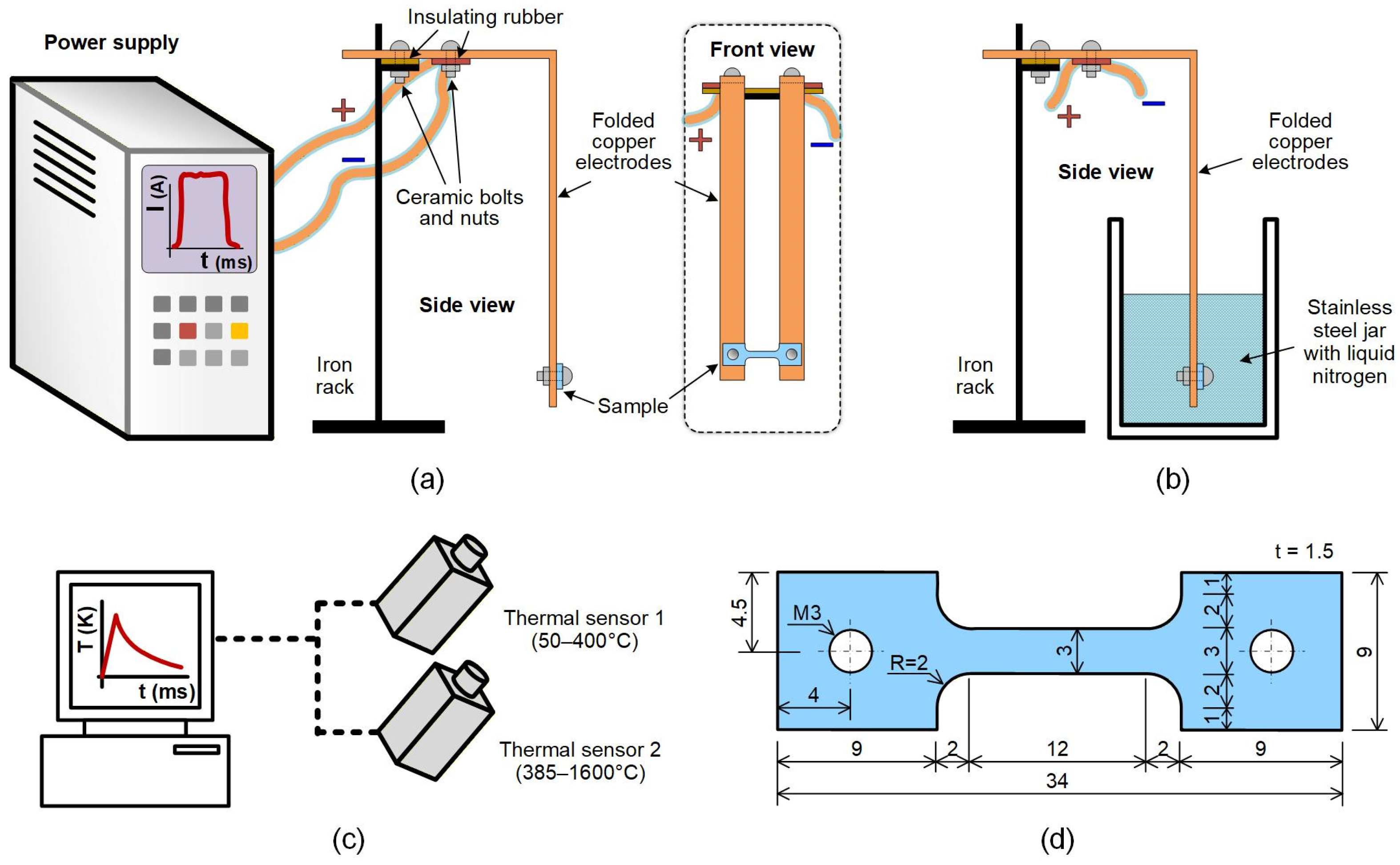
HDPEC treatment was performed using a custom-built pulsed power supply. To promote rapid removal of strain hardening, a rectangular current pulse was applied at a high current density of 667 A/mm2 for an extremely short duration (less than 100 ms). The current treatment was carried out not only at room temperature (25 °C) but also under cryogenic conditions in liquid nitrogen (−196 °C). For this purpose, a dedicated device enabling electric current application in a liquid nitrogen environment was designed, as illustrated in Figure 1a,b. Electrical insulation between the current path and the supporting structure was achieved using rubber layers, ceramic bolts and nuts.
The experimental conditions are summarized in Table 2. Sample E0 represents the as-received cold-rolled condition without any thermal or electrical treatment. Sample EN0 was immersed in liquid nitrogen for the same duration as the other liquid-nitrogen treatment conditions but did not undergo HDPEC treatment. Under room-temperature conditions, three pulsed durations ranging from 40 to 60 ms were applied (samples E40–E60). In the liquid nitrogen environment, pulsed durations of 60, 90, and 100 ms were employed (samples EN60, EN90, and EN100). For all experiments conducted under liquid-nitrogen conditions, the apparatus was pre-immersed in liquid nitrogen for a sufficient duration to ensure that the samples reached −196 °C.
The temperature evolution during HDPEC processing at room temperature was monitored using two infrared thermal sensors with different measurement ranges (GTL3ML-CF4 and GTL 2MH-FF, OPTEX, Otsu, Japan), as shown in Figure 1c. In addition, finite element (FE) simulations were conducted to evaluate the temperature evolution of samples under both room-temperature and liquid-nitrogen conditions during HDPEC treatment. Temperature-dependent material properties were employed in the simulations [49,50,51,52,53,54,55]. The numerical calculations were performed using a self-developed program developed in MATLAB R2022b (MathWorks, Natick, MA, USA) [17,21,22,44]. The geometry of the tensile samples is illustrated in Figure 1d, with the tensile direction aligned parallel to the rolling direction. Tensile tests were subsequently carried out at room temperature using an electromechanical-driven testing system (Autograph AGS-X Series, SHIMADZU, Kyoto, Japan) with a loading speed of 0.5 mm/min.
The effectiveness of strain-hardening removal in A6061 was evaluated using X-ray diffraction (XRD) and electron backscatter diffraction (EBSD, Oxford Instruments, High Wycombe, UK). XRD measurements were conducted on a SmartLab diffractometer (RIGAKU, Tokyo, Japan) operating at 45 kV and 200 mA. Diffraction patterns were recorded over a 2θ range of 30–90° with a step size of 0.02°. The dislocation density was estimated using the modified Williamson–Hall method and modified Warren–Averbach method [56,57,58,59,60]. Four diffraction peaks, (111), (200), (220), and (311), were selected for the evaluation of dislocation density. The instrumental peak broadening of the XRD system was calibrated using a fully annealed sample. After correction for instrumental broadening, the XRD peak profiles were analyzed to separate the contributions from crystallite size and lattice microstrain. The obtained broadening parameters were then used to calculate the dislocation density following the modified Williamson–Hall and Warren–Averbach procedures. EBSD characterization was carried out using a scanning electron microscope (JSM-7200F, JEOL, Tokyo, Japan) equipped with an EBSD detector (Oxford Instruments, High Wycombe, UK). Prior to XRD and EBSD analysis, the sample surfaces were carefully prepared through mechanical grinding and polishing. Grinding was first performed using SiC papers with grit sizes ranging from 500 to 4000. This was followed by mechanical polishing with a 0.25 µm OP-S suspension on a LaboPol-20 polishing system (STRUERS, Copenhagen, Denmark) for 20 min. Finally, a low-angle ion milling system (IM3000, HITACHI, Tokyo, Japan) was employed for final surface finishing to remove residual surface damage.

3. Results

3.1. Temperature Measurement and Finite Element Simulation

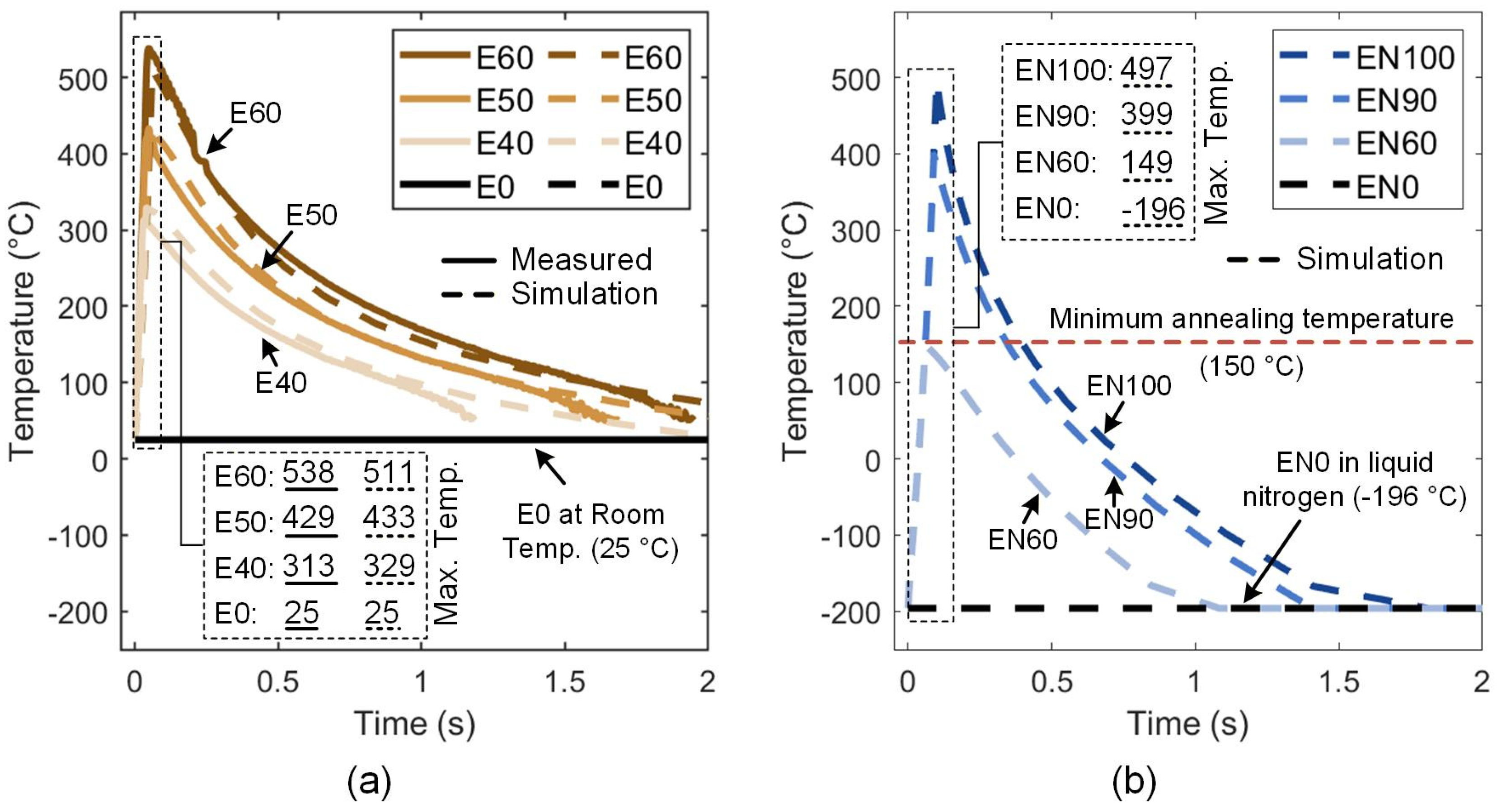
The temperature evolution of the central region of the samples during HDPEC treatment at room temperature was monitored using infrared thermal sensors. In addition, FE simulations were performed to validate the measured temperature data and to estimate the temperature evolution under liquid nitrogen conditions, where direct temperature measurement using infrared sensors is not feasible. The measured and simulated temperature profiles under room-temperature conditions are presented in Figure 2a, while the simulated temperature evolution under liquid nitrogen conditions is shown in Figure 2b. As shown in Figure 2a, the experimentally measured and simulated temperature curves exhibit similar trends at room temperature. For samples E40–E60, the peak temperatures obtained from the measurements and simulations reached 313 and 329 °C, 429 and 433 °C, and 538 and 511 °C, respectively.
Under liquid nitrogen conditions, the simulation result for condition EN60, which corresponds to the same current parameters as E60, indicates that the peak temperature only reaches 149 °C. This temperature is below the commonly reported minimum tempering temperature for A6061 (~150 °C) and is sustained only for an extremely short duration before rapidly decreasing. Therefore, the thermal effect under the EN60 condition can be considered effectively suppressed, indicating that the microstructural evolution is dominated by the athermal effect rather than the thermal effect. For conditions EN90 and EN100, where the current duration was extended, the simulation results show that the peak temperatures increase to 399 and 497 °C, respectively. These temperatures indicate that Joule heating can no longer be effectively suppressed under these conditions. Consequently, both thermal and athermal effects are expected to contribute to the microstructural evolution in these cases.
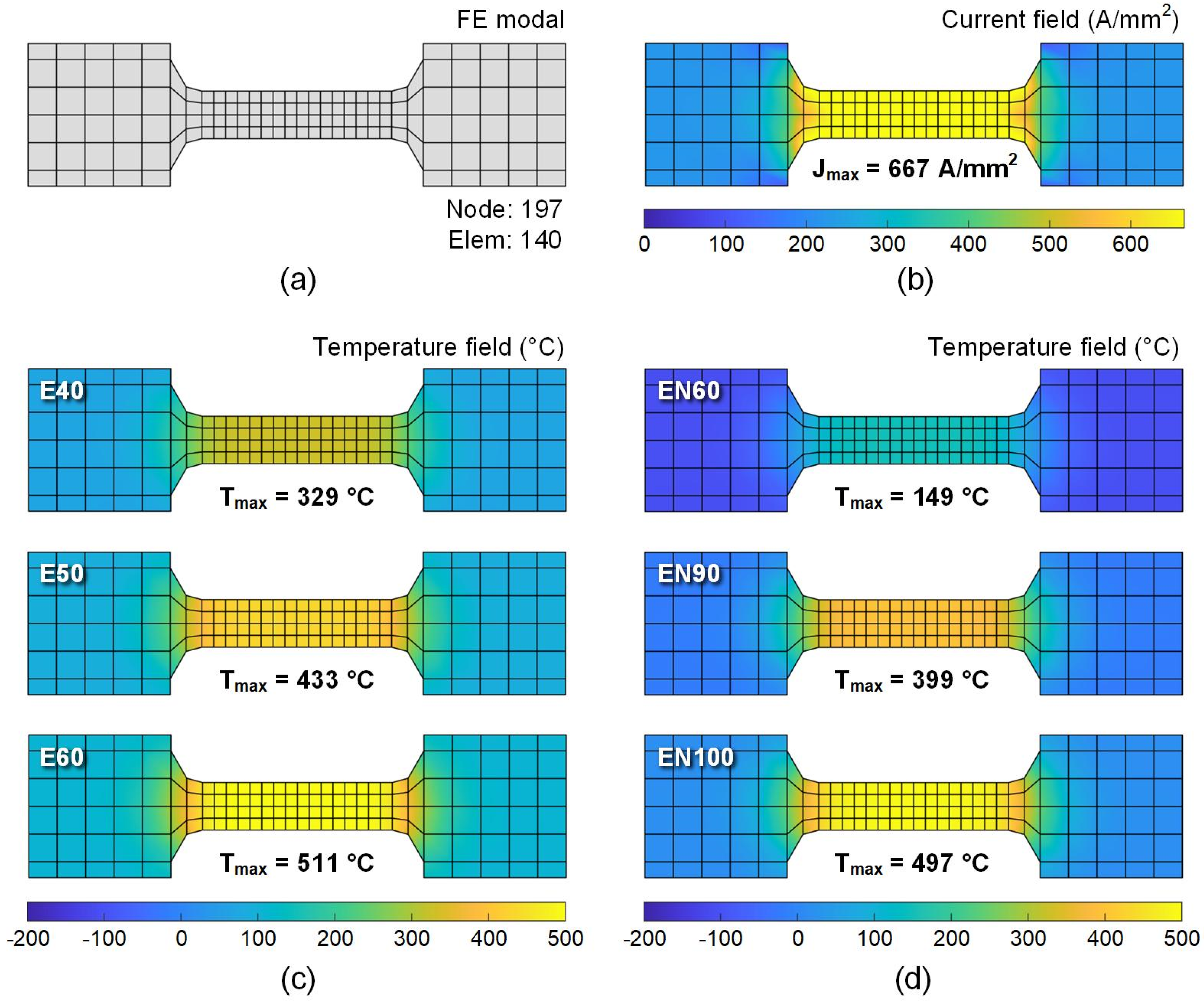
Figure 3 presents the FE model and the corresponding simulation results. The model was discretized using quadrilateral elements and consists of 197 nodes and 140 elements, as shown in Figure 3a. The simulated current density distribution is illustrated in Figure 3b, where the maximum current density reaches 667 A/mm2. Figure 3c,d show the temperature distributions at the peak-temperature moment for the different HDPEC treatment conditions under room-temperature and liquid-nitrogen environments, respectively. The results show that E60 and EN60 exhibit completely different thermal distributions, indicating that the thermal effect in EN60 is effectively suppressed. It should be noted that a temperature gradient may exist along the thickness direction due to heat dissipation from the surface. However, the resulting difference in microstructural evolution or mechanical properties is expected to be negligible because of the small sample thickness and the rapid electro-thermal process. In addition, our previous study confirmed that no significant through-thickness difference in microstructural evolution was observed [20].

3.2. Mechanical Property Changes Induced by HDPEC

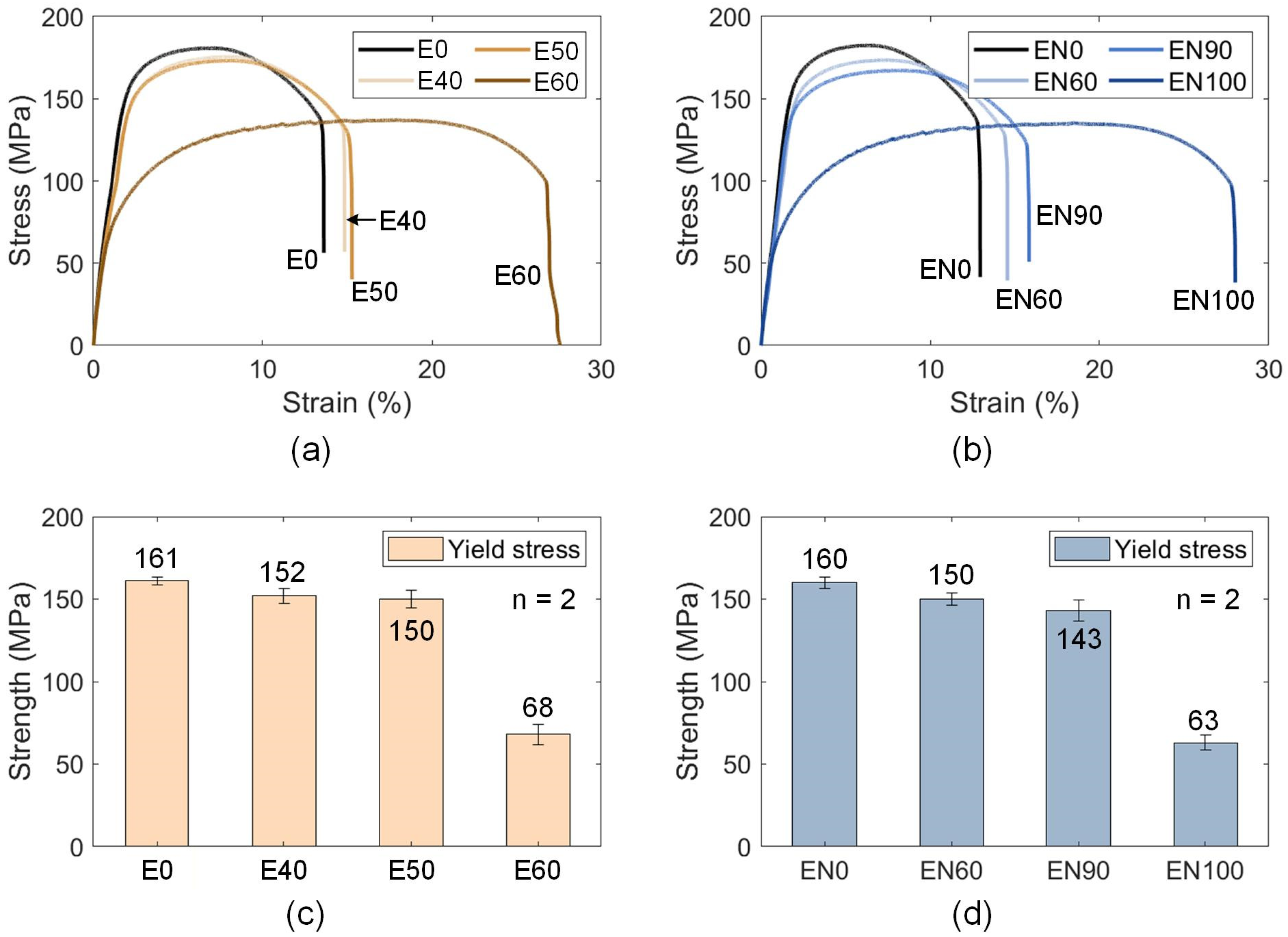
The mechanical properties of all samples subjected to HDPEC treatment under both room-temperature and liquid-nitrogen conditions were evaluated by tensile testing at room temperature, and the results are summarized in Figure 4.
As a baseline, the as-received sample (E0) and the sample immersed in liquid nitrogen without current treatment (EN0) exhibit nearly identical mechanical behavior, both maintaining a high level of strain hardening (Figure 4a,b). The corresponding yield strengths are 161 MPa and 160 MPa (Figure 4c,d), respectively, indicating that liquid-nitrogen immersion alone does not affect the work-hardened state. Under room-temperature conditions, HDPEC treatment (E40–E60) leads to a gradual softening of the material. In particular, for the E60 condition, the yield strength decreases significantly to 68 MPa (Figure 4c), suggesting that strain hardening is largely relieved. In contrast, under liquid-nitrogen conditions, the sample subjected to the same current parameters (EN60) exhibits only a slight reduction in yield strength to 150 MPa (Figure 4d), indicating limited softening. With increasing pulse duration to 100 ms (EN100), a pronounced softening is observed, and the yield strength decreases to 63 MPa.

3.3. Microstructure Evolution

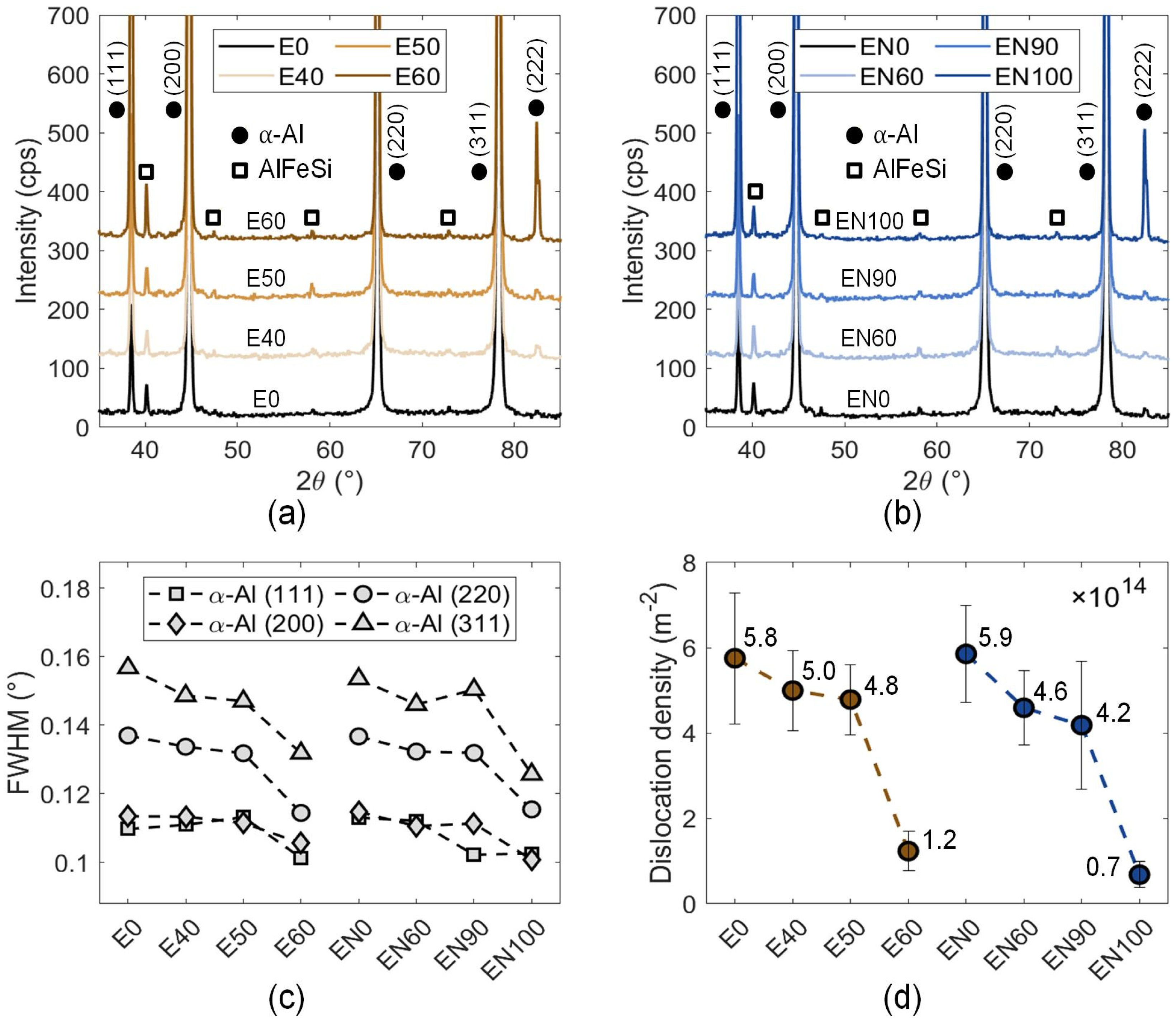
The XRD analysis results under different treatment conditions are presented in Figure 5. The XRD profiles of samples subjected to HDPEC treatment at room temperature and under liquid-nitrogen conditions are shown in Figure 5a and Figure 5b, respectively. As shown in the figure, the characteristic diffraction peaks of α-Al, namely (111), (200), (220), and (311), are clearly observed. In addition, the (222) peak becomes discernible only under the E60 and EN100 conditions. Diffraction peaks corresponding to intermetallic AlFeSi phases are also detected, with no significant changes observed after HDPEC treatment.
To quantitatively evaluate the extent of strain-hardening relief, the dislocation density was estimated using both the modified Williamson–Hall method and the modified Warren–Averbach method [56,57,58,59,60]. Four diffraction peaks, (111), (200), (220), and (311), were selected for the analysis. The variations in the full width at half maximum (FWHM) of these peaks under different HDPEC conditions are shown in Figure 5c. The results indicate a general decreasing trend in FWHM with increasing current duration. The corresponding evolution of dislocation density is presented in Figure 5d. Consistent with the FWHM results, the dislocation density gradually decreases with increasing treatment duration, indicating progressive removal of strain hardening. It is worth noting that immersion in liquid nitrogen alone (EN0, 5.9 × 10¹⁴ m−2) does not alter the dislocation density compared to the as-received sample (E0, 5.8 × 10¹⁴ m−2). In contrast, under the E60 and EN100 conditions, the dislocation density is significantly reduced to 1.2 × 10¹⁴ and 0.7 × 10¹⁴ m−2, respectively, demonstrating substantial recovery of the work-hardened microstructure.
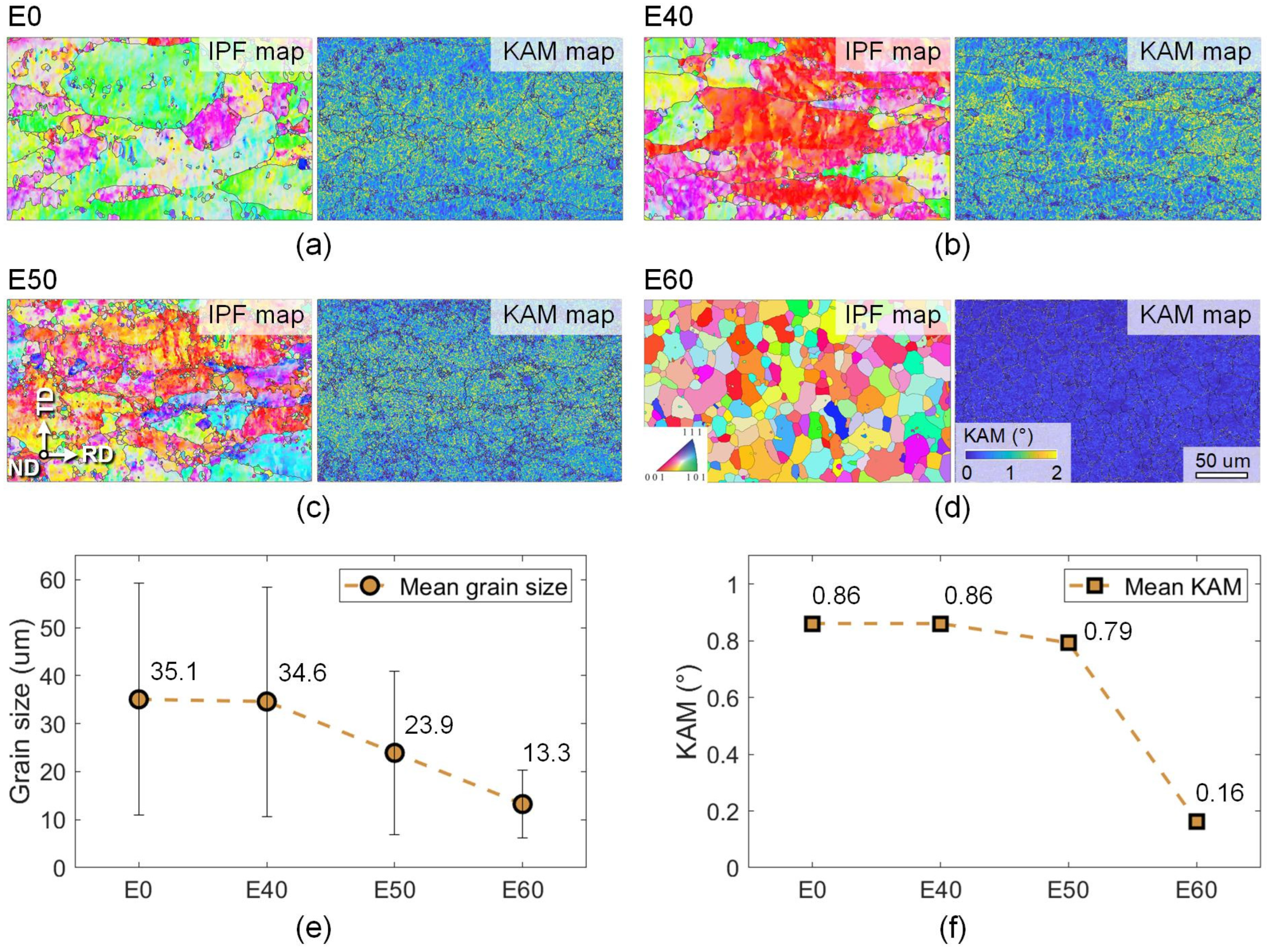
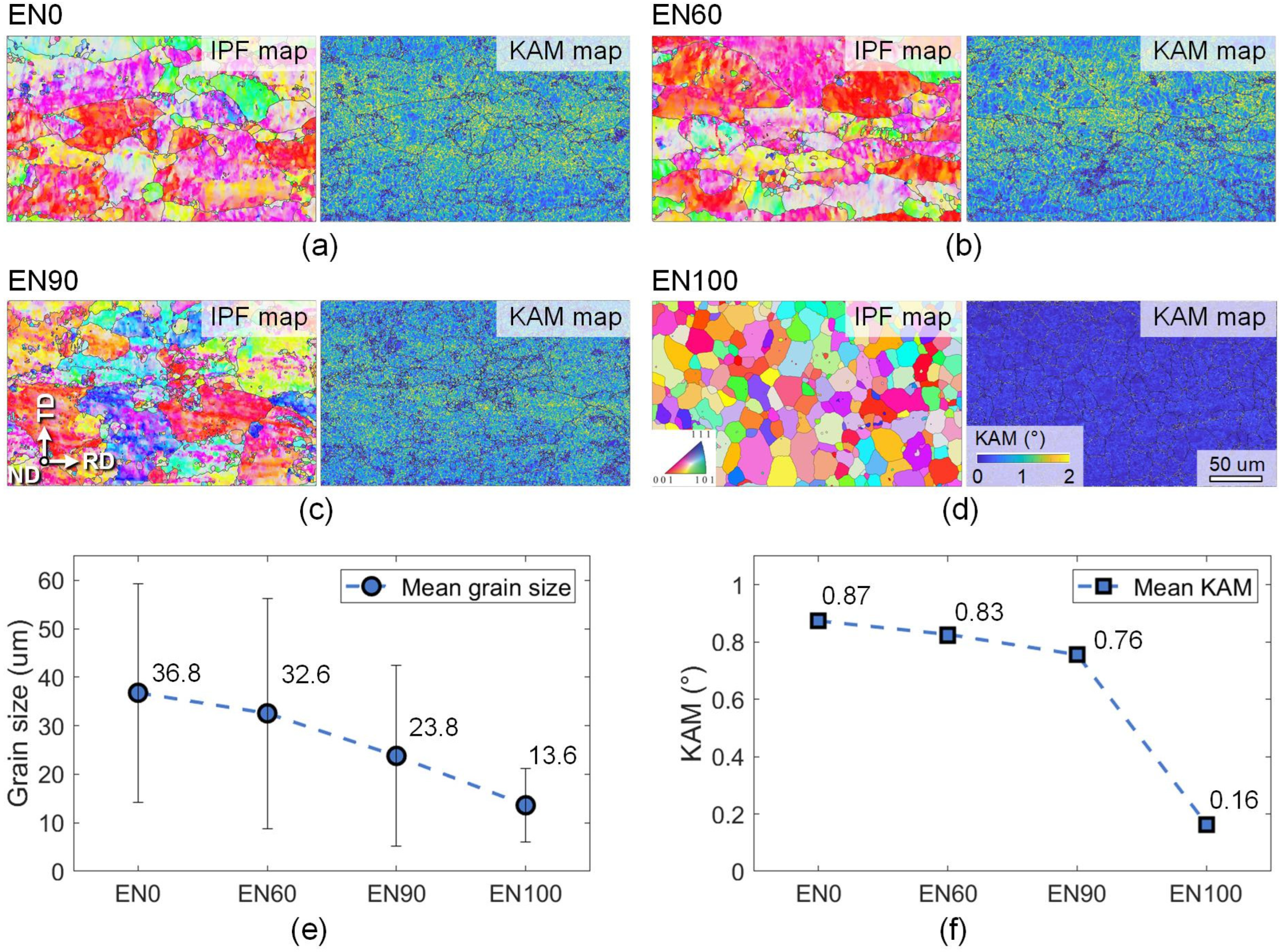
To further elucidate the microstructural evolution induced by HDPEC, EBSD analysis was performed. The EBSD results obtained under room-temperature and liquid-nitrogen conditions are presented in Figure 6 and Figure 7, respectively. Figure 6a–d show the inverse pole figure (IPF) maps and corresponding kernel average misorientation (KAM) maps for the as-received sample (E0) and the samples treated under room-temperature conditions (E40–E60). The results indicate that both the grain morphology and the internal deformation state are significantly affected by the electric current. In particular, under the E60 condition, the average grain size is reduced from 35.1 μm to 13.3 μm (Figure 6e), while the average KAM value decreases sharply from 0.86° to 0.16° (Figure 6f), indicating substantial recovery of the deformation structure.
Under liquid-nitrogen conditions, the sample immersed without current treatment (EN0) exhibits no noticeable change in either microstructure or KAM compared to E0. This observation is consistent with the XRD results, confirming that immersion in liquid nitrogen alone does not alter the microstructure or mechanical properties of the material (Figure 4). For the EN60 condition, which corresponds to the same current parameters as E60, only slight microstructural changes are observed. The average grain size decreases from 36.8 μm to 32.6 μm, and the KAM value is reduced marginally from 0.87° to 0.83°. In contrast, when the pulse duration is increased to 100 ms (EN100), significant microstructural evolution occurs. The grain size is refined to 13.6 μm, and the KAM value decreases to 0.16°, indicating pronounced recovery and strain-hardening removal.

4. Discussion

4.1. Strain-Hardening Relief by HDPEC Treatment

The mechanical property analysis (Figure 4) and microstructural characterization (Figure 5, Figure 6 and Figure 7) clearly demonstrate that HDPEC treatment induces significant changes in both microstructure and mechanical behavior. In particular, under the E60 and EN100 conditions, pronounced microstructural recovery and substantial strain-hardening relief are observed.
To quantitatively elucidate the underlying mechanisms governing strain-hardening relief, the contribution of microstructural evolution is analyzed. Dislocation density is considered the primary factor, as both XRD and EBSD results reveal a significant reduction in dislocation density after HDPEC treatment. The contribution of dislocation density to the reduction in yield strength, denoted as σ D D , can be estimated using the Taylor hardening law [61]
σ D D = α M G b ρ 2 ρ 1
where α is taken as 0.24 [62], M is the Taylor factor (3.1 for FCC metals), G is the shear modulus (26 GPa), and b is the Burgers vector (0.284 nm). Here, ρ 1 and ρ 2 represent the dislocation densities before and after HDPEC treatment, respectively (Figure 5d).
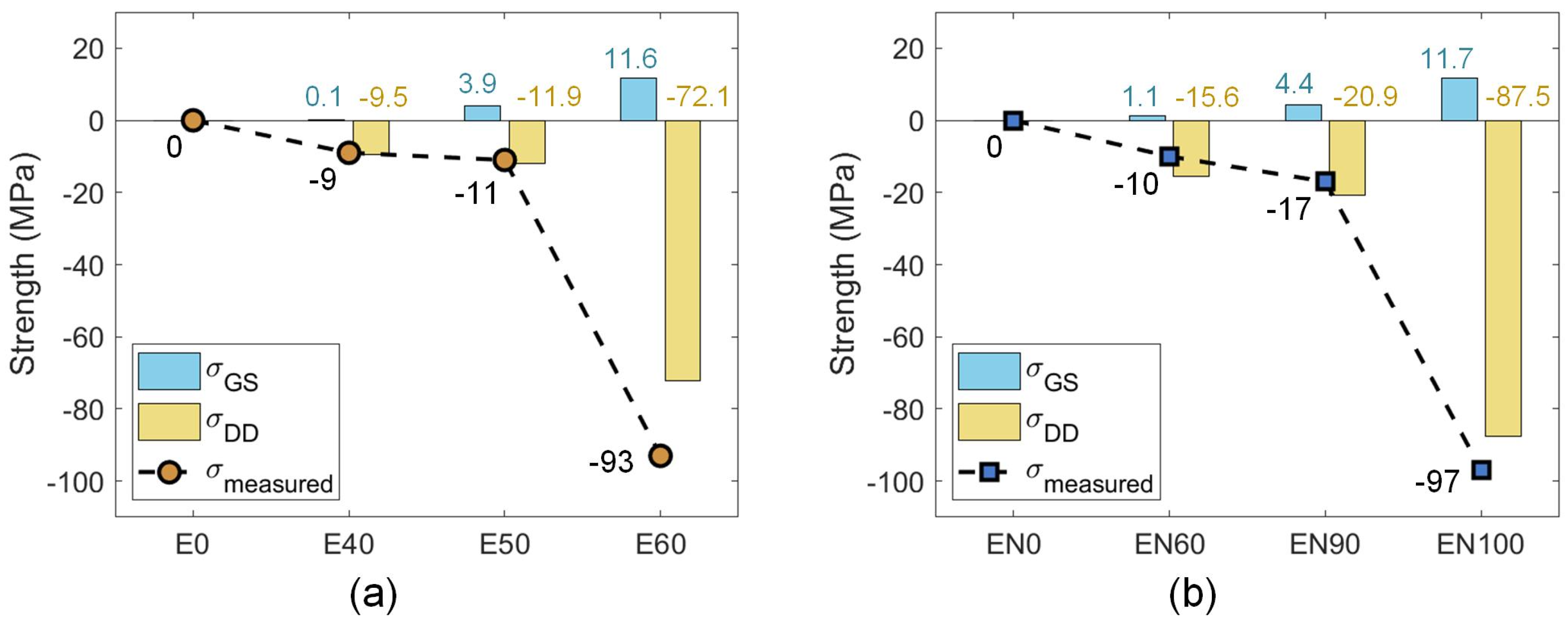
Based on this analysis, the contribution of dislocation density reduction to strain-hardening relief (i.e., yield strength reduction) is summarized in Figure 8. For the room-temperature conditions (E40–E60), the decrease in yield strength attributed to dislocation annihilation is 9.5 MPa, 11.9 MPa, and 72.1 MPa, respectively, compared with the untreated sample (E0). Under liquid-nitrogen conditions, the corresponding reductions for EN60, EN90, and EN100 are 15.6 MPa, 20.9 MPa, and 87.5 MPa, respectively.
In addition to dislocation density, grain refinement represents another important factor influencing the strength evolution. According to the Hall–Petch relationship [63], the change in yield strength associated with grain size can be expressed as
σ G S = k y 1 d 2 1 d 1
where k y is the Hall–Petch coefficient, taken as 0.11 MPa·m1/2 [62]. Here, d 1 and d 2 denote the average grain sizes before and after HDPEC treatment, respectively, as shown in Figure 6e and Figure 7e.
The analysis indicates that grain refinement leads to an increase in yield strength, in contrast to the softening effect caused by dislocation annihilation, as shown in Figure 8. For the room-temperature conditions (E40–E60), the strengthening contributions due to grain refinement are 0.1 MPa, 3.9 MPa, and 11.6 MPa, respectively, compared with the untreated sample (E0). Similarly, under liquid-nitrogen conditions, the corresponding increases for EN60, EN90, and EN100 are 1.1 MPa, 4.4 MPa, and 11.7 MPa, respectively.
In addition to dislocation density and grain size, other factors may also contribute to strain-hardening relief, such as solute atoms and precipitates/strengthening phases [64,65,66,67]. However, in the present study, the material is in the cold-worked condition without any aging treatment; therefore, precipitation strengthening is not involved. Moreover, the solute atoms are assumed to remain uniformly distributed before and after HDPEC treatment, indicating that solid-solution strengthening does not play a significant role in the observed strength changes. Moreover, XRD analysis shows no noticeable change in the diffraction peaks associated with the intermetallic AlFeSi phase, suggesting that the second-phase particles remain essentially unchanged during HDPEC treatment and do not contribute to the variation in mechanical properties.
Another factor that may influence the mechanical behavior is the crystallographic texture [64,65,66]. Prior to HDPEC treatment, a typical deformation texture is observed, as evidenced by EBSD results (Figure 6 and Figure 7). After HDPEC treatment, particularly under the E60 and EN100 conditions, the texture is significantly weakened, and a more randomly oriented grain structure is formed. This texture evolution is further supported by XRD results, where the appearance of the (222) peak indicates a more randomized grain orientation after current treatment. Although the texture change is clearly observed, its quantitative contribution to the mechanical response is difficult to evaluate. Therefore, its effect is discussed qualitatively in this study, and it is considered to play a secondary role in strain-hardening relief.
As shown in Figure 8, the dashed line represents the experimentally measured reduction in yield strength from tensile tests. A discrepancy is observed between the calculated strength changes based on dislocation density and grain size and the experimentally measured values. This difference is likely associated with the reduction in texture intensity. Overall, the reduction in dislocation density is identified as the dominant factor governing strain-hardening relief, while grain size evolution and texture weakening play secondary roles.

4.2. Thermal and Athermal Effects

Since dislocation density is identified as the dominant factor governing strain-hardening relief in this study, it is used as a key indicator to evaluate the contributions of thermal and athermal effects induced by HDPEC treatment.
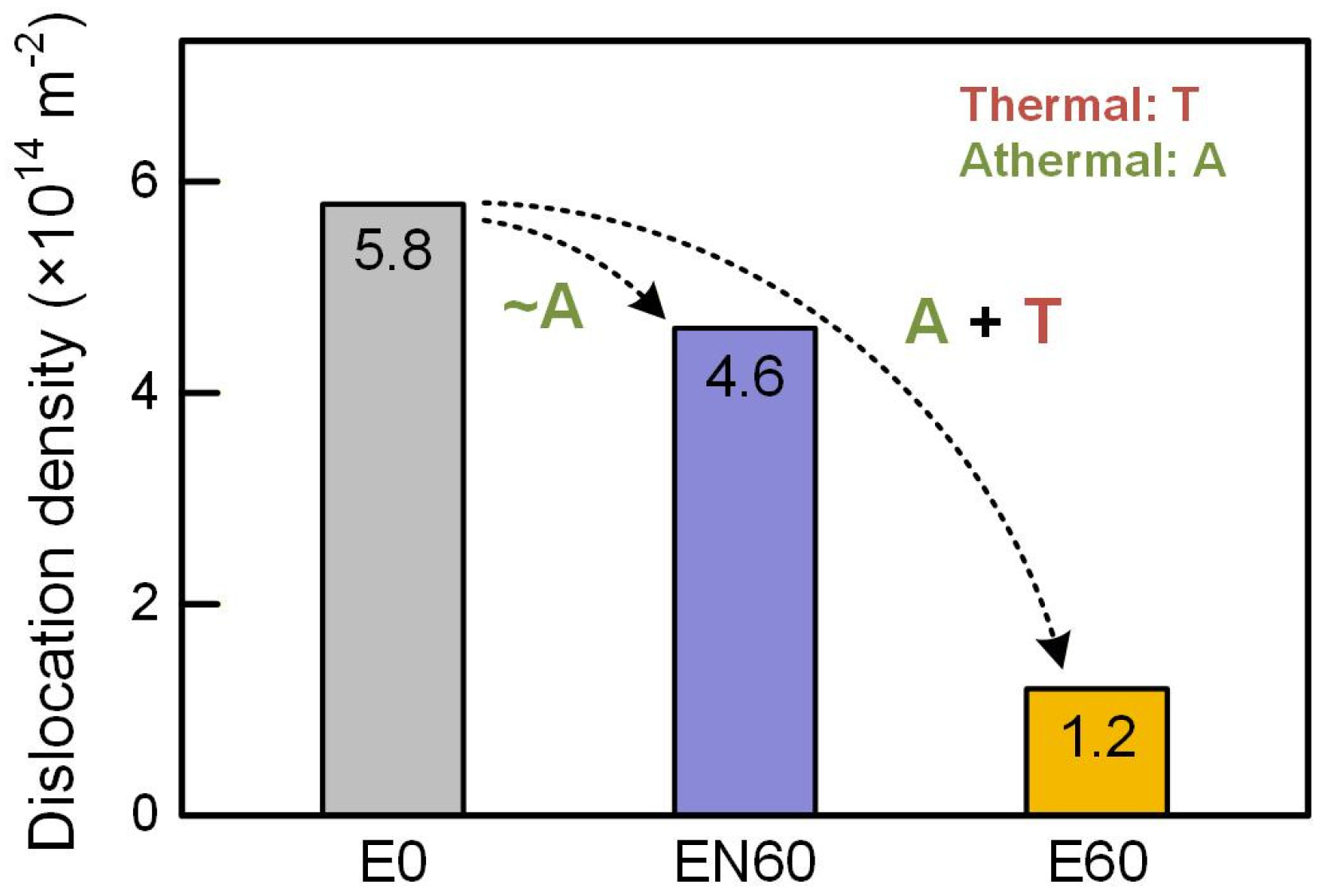
For the EN60 condition, the maximum temperature rise remains below 150 °C (Figure 2b), and this temperature is reached only momentarily before cooling down within approximately 1 s. Considering this extremely short thermal exposure and the fact that significant recovery or recrystallization in aluminum alloys generally requires higher temperatures, typically above approximately one-third of the melting temperature, the thermal contribution under EN60 is expected to be limited. Therefore, the microstructural evolution under EN60 is considered to be dominated by athermal effects, while the thermal contribution is expected to be limited. As shown in Figure 9, the dislocation density decreases from 5.8 × 10¹⁴ m−2 to 4.6 × 10¹⁴ m−2 compared with the untreated condition (E0), suggesting a dominant contribution from athermal effects. In contrast, the E60 condition involves both thermal and athermal effects. Assuming that the athermal contribution under E60 is equivalent to that under EN60, the total reduction in dislocation density for E60 can be decomposed into two components: the athermal contribution and the additional thermal contribution. Hence, the reduction in dislocation density due to the athermal effect is 1.2 × 10¹⁴ m−2, while the remaining reduction of 3.4 × 10¹⁴ m−2 is attributed to the thermal effect. These results indicate that, for strain-hardening relief in cold-rolled A6061, the thermal effect plays a more dominant role than the athermal effect.
The reduction in dislocation density associated with thermal effects is generally attributed to thermally activated processes such as dislocation climb, annihilation at grain boundaries, and recrystallization [64,65,66]. In contrast, the athermal contribution is likely associated with non-thermal driving forces, including electron wind force (EWF), phonon drag, and stress-assisted effects [28,44]. In this study, a simplified analysis is conducted from the perspective of EWF.
The EWF acting on dislocations can be estimated as [68,69,70]
f E W = ρ d N d e n e J / b
where ρ d / N d represents the specific dislocation resistivity of aluminum (~1.8 × 10⁻²⁵ Ω·m3 [71]), e is the electron charge (1.6 × 10⁻¹⁹ C), n e is the electron density (1.8 × 1029 m−3), J is the current density used in this study (667 A/mm2), and b is the Burgers vector (0.284 nm). Based on these parameters, the f E W is estimated to be approximately 0.12 MPa.
The resistance to dislocation motion can be evaluated using the Peierls–Nabarro (PN) stress [72,73], f P N , which represents the critical stress required for dislocation glide. For face-centered cubic metals, the f P N is typically on the order of 10−6~10−5  G ( T ) [74,75], where G ( T ) is the temperature-dependent shear modulus. In the present study, the shear modulus is approximately 26 GPa at low temperature (EN60 condition: ~150 °C) and ~5 GPa at elevated temperature (E60 condition: ~530 °C). Accordingly, the estimated f P N ranges from ~0.026–0.26 MPa at low temperature and ~0.005–0.05 MPa at high temperature. These results indicate that, under both low- and high-temperature conditions, the EWF is sufficient to overcome the resistance to dislocation motion ( f E W > f P N ). Moreover, increasing temperature reduces the resistance to dislocation motion, thereby facilitating the effectiveness of EWF in driving dislocation movement. Consequently, dislocation glide, annihilation, and rearrangement can be effectively promoted even in the absence of significant thermal activation, leading to athermal dislocation reduction.

5. Conclusions

In this study, strain hardening in cold-rolled A6061 was effectively relieved using HDPEC. By comparing current treatments under room-temperature and liquid-nitrogen conditions, the contributions of thermal and athermal effects were systematically evaluated. The main findings are summarized as follows:
  • Under both room-temperature and liquid-nitrogen conditions, HDPEC treatment leads to significant dislocation reduction and grain refinement.
  • The relief of strain hardening is primarily governed by the reduction in dislocation density, while the contributions of grain size and crystallographic texture are secondary.
  • The separation analysis reveals that the thermal-related effects play a more significant role than athermal effects in strain-hardening relief of cold-rolled A6061.
  • The athermal effect, particularly the EWF, provides sufficient driving force to promote dislocation motion, thereby facilitating dislocation annihilation and rearrangement.
The present work demonstrates an effective experimental strategy for thermal and athermal effects separation during electric current treatment. This approach provides a useful framework for quantitatively evaluating athermal effects in metallic materials and offers new insights into current-assisted microstructure control. The findings are expected to facilitate a deeper understanding of athermal mechanisms and support the future design of advanced structural materials.

Author Contributions

Conceptualization, S.G. and X.Y.; methodology, S.G. and X.Y.; investigation, S.G., X.Y., Y.P., L.W., S.Y., Y.C., Y.K. and Y.M.; data curation, S.G. and X.Y.; writing—original draft, S.G.; writing—reviewing and editing, Y.J., Y.T., Y.M. and Y.K.; supervision, Y.J. and Y.T.; project administration, S.G., Y.J. and Y.T. All authors have read and agreed to the published version of the manuscript.

Funding

This work was supported by the Japan Science and Technology Agency under the FOREST Program (grant number JPMJFR202B); the Japan Society for the Promotion of Science under Grant-in-Aid for Scientific Research (S) (grant number 17H06146), Early-Career Scientists (grant number 23K13219), and Research Activity Start-up (grant number 22K20408).

Data Availability Statement

The data that support the findings of this study are available from the corresponding author upon reasonable request.

Conflicts of Interest

The authors declare no conflicts of interest.

Abbreviations

The following abbreviations are used in this manuscript:
HDPECHigh-density pulsed electric current
FEFinite element
XRDX-ray diffraction
EBSDElectron backscatter diffraction
FWHMFull width at half maximum
IPFInverse pole figure
KAMKernel average misorientation
EWFElectron wind force
PNPeierls–Nabarro

References

  1. Lienig, J.; Thiele, M. Fundamentals of Electromigration-Aware Integrated Circuit Design; Springer International Publishing: Cham, Switzerland, 2018; ISBN 978-3-319-73557-3. [Google Scholar]
  2. Salandro, W.A.; Jones, J.J.; Bunget, C.; Mears, L.; Roth, J.T. Electrically Assisted Forming; Springer Series in Advanced Manufacturing; Springer International Publishing: Cham, Switzerland, 2015; ISBN 978-3-319-08878-5. [Google Scholar]
  3. Zhang, Y.; Gu, S.; Kimura, Y.; Ju, Y.; Toku, Y. Improving the Quality of the Crystallinity of Cu Films by Non-Thermal High-Frequency Electric Current Treatment. J. Phys. D Appl. Phys. 2025, 58, 395302. [Google Scholar] [CrossRef]
  4. Gu, S.; Zhang, B.; Kimura, Y.; Ju, Y.; Toku, Y. Microstructural Modification of Metallic Thin Films via High-Frequency Alternating Current Treatment at Room Temperature. J. Phys. D Appl. Phys. 2024, 57, 115302. [Google Scholar] [CrossRef]
  5. Xiang, S.; Zhang, X. Residual Stress Removal under Pulsed Electric Current. Acta Metall. Sin. (Engl. Lett.) 2020, 33, 281–289. [Google Scholar] [CrossRef]
  6. Pan, L.; Wang, B.; Xu, Z. Effects of Electropulsing Treatment on Residual Stresses of High Elastic Cobalt-Base Alloy ISO 5832-7. J. Alloys Compd. 2019, 792, 994–999. [Google Scholar] [CrossRef]
  7. Park, J.-W.; Jeong, H.-J.; Jin, S.-W.; Kim, M.-J.; Lee, K.; Kim, J.J.; Hong, S.-T.; Han, H.N. Effect of Electric Current on Recrystallization Kinetics in Interstitial Free Steel and AZ31 Magnesium Alloy. Mater. Charact. 2017, 133, 70–76. [Google Scholar] [CrossRef]
  8. Jung, J.; Gu, S.; Yoon, S.; Kimura, Y.; Toku, Y.; Ju, Y. Effect of High-Density Pulsed Electric Current on the Formability of Aluminum Alloy. Int. J. Adv. Manuf. Technol. 2023, 128, 1505–1515. [Google Scholar] [CrossRef]
  9. Liu, C.; Gu, S.; Yan, X.; Yoon, S.; Kimura, Y.; Toku, Y.; Ju, Y. Rapid Microstructure Modification of Laser Powder-Bed Fused Superalloy IN718 Using High-Density Pulsed Electric Current. Mater. Today Commun. 2023, 36, 106892. [Google Scholar] [CrossRef]
  10. Rahman, M.H.; Todaro, S.; Waryoba, D.; Haque, A. Synergistic Thermal and Electron Wind Force-Assisted Annealing for Extremely High-Density Defect Mitigation. Materials 2024, 17, 3188. [Google Scholar] [CrossRef] [PubMed]
  11. Wang, S.; Cui, X.; Xiao, A.; Yu, Z.; Du, Z. Mechanical Properties and Microstructural Evolution of 5052 Aluminumalloys by Multi-Pass Stretching and Induced Electro-Pulsing Treatment. Trans. Nonferr. Met. Soc. China 2024, 34, 65–79. [Google Scholar] [CrossRef]
  12. Fan, W.; Wang, T.; Hou, J.; Ren, Z.; Huang, Q.; Wu, G. Pulsed Current-Assisted Twelve-Roll Precision Rolling Deformation of SUS304 Ultra-Thin Strips with Exceptional Mechanical Properties. Int. J. Extrem. Manuf. 2024, 6, 045101. [Google Scholar] [CrossRef]
  13. Nie, H.; Xu, X.; Liu, Q.; Chen, H.; Zheng, L.; Kong, Q.; Liang, W. Elimination of In-Plane Mechanical Anisotropy and Enhancement of Strength-Ductility of Rolled Mg Sheets via Electric-Associated Twinning and Recrystallization. Mater. Sci. Eng. A 2023, 871, 144873. [Google Scholar] [CrossRef]
  14. Wang, S.; Sun, W.; Sun, X.; Ji, Y.; Yang, H.; Cui, X. Influence of Non-Thermal Effect Caused by Pulse Current on AZ31B Magnesium Alloy Deformation. Mater. Sci. Eng. A 2023, 871, 144899. [Google Scholar] [CrossRef]
  15. Zhang, X.; Yan, S.; Meng, M.; Fang, X.; Li, P. Macro-Micro Behaviors of Ti–22Al–26Nb Alloy under near Isothermal Electrically-Assisted Tension. Mater. Sci. Eng. A 2023, 864, 144573. [Google Scholar] [CrossRef]
  16. Lin, S.; Chu, X.; Feng, D.; Zhao, Z.; Gao, J. Electric Pulse-Induced Suppression of the Portevin—Le Chatelier Behavior of 5086 Aluminum Alloy under Uniaxial Tension. Mater. Sci. Eng. A 2024, 911, 146915. [Google Scholar] [CrossRef]
  17. Gu, S.; Liu, C.; Kimura, Y.; Yoon, S.; Cui, Y.; Yan, X.; Ju, Y.; Toku, Y. Realizing Strength–Ductility Synergy in a Lean Duplex Stainless Steel through Enhanced TRIP Effect via Pulsed Electric Current Treatment. Mater. Sci. Eng. A 2023, 883, 145534. [Google Scholar] [CrossRef]
  18. Yan, X.; Xu, X.; Zhou, Y.; Wu, Z.; Wei, L.; Zhang, D. Constructing a Novel Bi-Lamellar Microstructure in Selective Laser Melted Ti-6Al-4V Alloy via Electropulsing for Improvement of Strength and Corrosion Resistance. J. Mater. Sci. Technol. 2024, 193, 37–50. [Google Scholar] [CrossRef]
  19. Zhou, Y.; Xu, X.; Zhao, Y.; Yan, X.; Wei, L.; Wu, Z.; Wu, C. Introducing ω and O′ Nanodomains in Ti-6Al-4V: The Mechanism of Accelerating α → β Transformation Kinetics via Electropulsing. J. Mater. Sci. Technol. 2023, 162, 109–117. [Google Scholar] [CrossRef]
  20. Gu, S.; Kimura, Y.; Cui, Y.; Morita, Y.; Isoi, S.; Liu, C.; Yan, X.; Ju, B.; Yang, H.; Toku, Y.; et al. Electric Current-Driven Heterogeneous Microstructures in Dual-Phase Titanium Alloys. Nat. Commun. 2026, 17, 3470. [Google Scholar] [CrossRef]
  21. Gu, S.; Yoon, S.; Liu, C.; Peng, Y.; Cui, Y.; Kimura, Y.; Toku, Y.; Morita, Y.; Ju, Y. Electric Current-Driven Microstructural Recovery and Crack Resistance Enhancement in Ni-Based Superalloy Inconel 718. Mater. Sci. Eng. A 2026, 953, 149781. [Google Scholar] [CrossRef]
  22. Gu, S.; Kobayashi, D.; Yoon, S.; Liu, C.; Peng, Y.; Cui, Y.; Kimura, Y.; Toku, Y.; Morita, Y.; Ju, Y. Electric Current-Induced Crack Healing: Mechanisms and Scale-Specific Insights. Int. J. Fatigue 2025, 201, 109171. [Google Scholar] [CrossRef]
  23. Yan, X.; Yoon, S.; Gu, S.; Kimura, Y.; Kobayashi, D.; Ju, Y.; Toku, Y. Elevating Fatigue Life in Nickel-Based Superalloys through Suppression of Persistent Slip Bands/Markings via High-Density Pulsed Electric Current Treatment. Mech. Eng. J. 2024, 11, 24–00178-24–00178. [Google Scholar] [CrossRef]
  24. Jung, J.; Yoon, S.; Gu, S.; Kimura, Y.; Toku, Y.; Ju, Y. Influence of a High-Density Pulsed Electric Current on the Fatigue Behaviour of Prestrained Aluminium Alloys. Eng. Fail. Anal. 2023, 150, 107230. [Google Scholar] [CrossRef]
  25. Song, X.; Li, X.; Wang, W.; Zhao, Z. Effect of Electrically Assisted Heat Treatment on Crack Arrest and Healing in Laser-Cladded Ni–Based Coatings. J. Manuf. Mater. Process. 2025, 9, 348. [Google Scholar] [CrossRef]
  26. Nariman, N.A. Crack Propagation Control for a Pre-Stressed Concrete Beam Utilising Coupled Sensitivity Indices-Pareto Optimisation Method. Int. J. Hydromechatron. 2024, 7, 328–346. [Google Scholar] [CrossRef]
  27. Mecklenburg, M.; Zutter, B.T.; Ling, X.Y.; Hubbard, W.A.; Regan, B.C. Visualizing the Electron Wind Force in the Elastic Regime. Nano Lett. 2021, 21, 10172–10177. [Google Scholar] [CrossRef]
  28. Rudolf, C.; Goswami, R.; Kang, W.; Thomas, J. Effects of Electric Current on the Plastic Deformation Behavior of Pure Copper, Iron, and Titanium. Acta Mater. 2021, 209, 116776. [Google Scholar] [CrossRef]
  29. Niu, H.T.; Gao, P.F.; Li, H.W.; Zhan, M. Mechanism and Modelling of the Electroplastic Effect in Titanium Alloy: From the Perspective of Dislocation Slip. Int. J. Plast. 2025, 192, 104405. [Google Scholar] [CrossRef]
  30. Jeong, K.; Jin, S.-W.; Kang, S.-G.; Park, J.-W.; Jeong, H.-J.; Hong, S.-T.; Cho, S.H.; Kim, M.-J.; Han, H.N. Athermally Enhanced Recrystallization Kinetics of Ultra-Low Carbon Steel via Electric Current Treatment. Acta Mater. 2022, 232, 117925. [Google Scholar] [CrossRef]
  31. Kim, M.-J.; Yoon, S.; Park, S.; Jeong, H.-J.; Park, J.-W.; Kim, K.; Jo, J.; Heo, T.; Hong, S.-T.; Cho, S.H.; et al. Elucidating the Origin of Electroplasticity in Metallic Materials. Appl. Mater. Today 2020, 21, 100874. [Google Scholar] [CrossRef]
  32. Jeong, H.-J.; Kim, M.-J.; Choi, S.-J.; Park, J.-W.; Choi, H.; Luu, V.T.; Hong, S.-T.; Han, H.N. Microstructure Reset-Based Self-Healing Method Using Sub-Second Electric Pulsing for Metallic Materials. Appl. Mater. Today 2020, 20, 100755. [Google Scholar] [CrossRef]
  33. Choi, H.; Chae, J.; Lee, S.; Kim, Y.; Kim, T.; Jung, I.-H.; Yoo, S.; Kwon, Y.-K.; Chae, H.; Baik, Y.; et al. Phase Stability in Metals under Electric Current: The Role of Defect-Induced Charge Imbalance. Acta Mater. 2026, 311, 122167. [Google Scholar] [CrossRef]
  34. Kim, M.-J.; Bui-Thi, T.-A.; Kang, S.-G.; Hong, S.-T.; Nam Han, H. Electric Current-Induced Phenomena in Metallic Materials. Curr. Opin. Solid State Mater. Sci. 2024, 32, 101190. [Google Scholar] [CrossRef]
  35. Zhou, C.; Zhan, L.; Liu, C.; Huang, M. Insights into Electron Wind Force by a Helical Dislocation Reconfiguration. iScience 2023, 26, 106870. [Google Scholar] [CrossRef]
  36. Zhou, C.; Zhan, L.; Li, H.; Liu, C.; Xu, Y.; Ma, B.; Yang, Y.; Huang, M. Dislocation Reconfiguration during Creep Deformation of an Al-Cu-Li Alloy via Electropulsing. J. Mater. Sci. Technol. 2022, 130, 27–34. [Google Scholar] [CrossRef]
  37. Li, X.; Xu, Z.; Guo, P.; Peng, L.; Lai, X. Electroplasticity Mechanism Study Based on Dislocation Behavior of Al6061 in Tensile Process. J. Alloys Compd. 2022, 910, 164890. [Google Scholar] [CrossRef]
  38. Chen, K.; Zhan, L.; Yu, W. Rapidly Modifying Microstructure and Mechanical Properties of AA7150 Al Alloy Processed with Electropulsing Treatment. J. Mater. Sci. Technol. 2021, 95, 172–179. [Google Scholar] [CrossRef]
  39. Kim, M.-J.; Lee, M.-G.; Hariharan, K.; Hong, S.-T.; Choi, I.-S.; Kim, D.; Oh, K.H.; Han, H.N. Electric Current–Assisted Deformation Behavior of Al-Mg-Si Alloy under Uniaxial Tension. Int. J. Plast. 2017, 94, 148–170. [Google Scholar] [CrossRef]
  40. Kim, M.-J.; Lee, K.; Oh, K.H.; Choi, I.-S.; Yu, H.-H.; Hong, S.-T.; Han, H.N. Electric Current-Induced Annealing during Uniaxial Tension of Aluminum Alloy. Scr. Mater. 2014, 75, 58–61. [Google Scholar] [CrossRef]
  41. Jiang, Y.; Tang, G.; Shek, C.; Liu, W. Microstructure and Texture Evolution of the Cold-Rolled AZ91 Magnesium Alloy Strip under Electropulsing Treatment. J. Alloys Compd. 2011, 509, 4308–4313. [Google Scholar] [CrossRef]
  42. Zhou, Y.; Xiao, S.; Guo, J. Recrystallized Microstructure in Cold Worked Brass Produced by Electropulsing Treatment. Mater. Lett. 2004, 58, 1948–1951. [Google Scholar] [CrossRef]
  43. Zhou, Y.; Zhang, W.; Wang, B.; Guo, J. Ultrafine-Grained Microstructure in a Cu–Zn Alloy Produced by Electropulsing Treatment. J. Mater. Res. 2003, 18, 1991–1997. [Google Scholar] [CrossRef]
  44. Gu, S.; Kimura, Y.; Yan, X.; Liu, C.; Cui, Y.; Ju, Y.; Toku, Y. Micromachined Structures Decoupling Joule Heating and Electron Wind Force. Nat. Commun. 2024, 15, 6044. [Google Scholar] [CrossRef]
  45. Troitskii, O.A. Electroplastic Deformation of Metal. Strength Mater. 1976, 8, 1466–1471. [Google Scholar] [CrossRef]
  46. Zhao, S.; Zhang, R.; Chong, Y.; Li, X.; Abu-Odeh, A.; Rothchild, E.; Chrzan, D.C.; Asta, M.; Morris, J.W.; Minor, A.M. Defect Reconfiguration in a Ti–Al Alloy via Electroplasticity. Nat. Mater. 2021, 20, 468–472. [Google Scholar] [CrossRef]
  47. Kopanev, A.A. The Nature of the Electroplastic Effect in Metals. Strength Mater. 1991, 23, 55–59. [Google Scholar] [CrossRef]
  48. Waryoba, D.; Islam, Z.; Reutzel, T.; Haque, A. Electro-Strengthening of the Additively Manufactured Ti–6Al–4V Alloy. Mater. Sci. Eng. A 2020, 798, 140062. [Google Scholar] [CrossRef]
  49. Qassem, M.; Javidani, M.; Larouche, D.; Colbert, J.; Chen, X.-G. Temperature Dependence of Elastic Properties of Al-Mg-Si Direct-Chill-Cast AA6111 Alloy at Near-Solidus Temperatures. J. Mater. Eng. Perform. 2024, 33, 987–998. [Google Scholar] [CrossRef]
  50. Yan, X.; Dai, S.; Ma, T. Electromagnetic and Thermal Analysis of Cylindrical Aluminum Billet Heated by 1MW HTS DC Induction Heater. IEEE Access 2020, 8, 144112–144121. [Google Scholar] [CrossRef]
  51. Calatroni, S. Materials & Properties: Thermal & Electrical Characteristics. arXiv 2020, arXiv:2006.02842. [Google Scholar] [CrossRef]
  52. Meyghani, B.; Awang, M.B.; Momeni, M.; Rynkovskaya, M. Development of a Finite Element Model for Thermal Analysis of Friction Stir Welding (FSW). IOP Conf. Ser. Mater. Sci. Eng. 2019, 495, 012101. [Google Scholar] [CrossRef]
  53. Summers, P.T.; Chen, Y.; Rippe, C.M.; Allen, B.; Mouritz, A.P.; Case, S.W.; Lattimer, B.Y. Overview of Aluminum Alloy Mechanical Properties during and after Fires. Fire Sci. Rev. 2015, 4, 3. [Google Scholar] [CrossRef]
  54. Duthil, P. Material Properties at Low Temperature. arXiv 2014, arXiv:1501.07100. [Google Scholar]
  55. Neely, A.J.; Currao, G.M.D.; McQuellin, L.P. Using Radiative Heating to Perform Fluid-Thermal-Structural Interaction Experiments in a Short-Duration Hypersonic Wind Tunnel. In 21st Australasian Fluid Mechanics Conference; Australasian Fluid Mechanics Society: Perth, Australia, 2018. [Google Scholar]
  56. Borbély, A. The Modified Williamson-Hall Plot and Dislocation Density Evaluation from Diffraction Peaks. Scr. Mater. 2022, 217, 114768. [Google Scholar] [CrossRef]
  57. Umezaki, S.; Murata, Y.; Nomura, K.; Kubushiro, K. Quantitative Analysis of Dislocation Density in an Austenitic Steel after Plastic Deformation. J. Jpn. Inst. Met. 2014, 78, 218–224. [Google Scholar] [CrossRef]
  58. Jamal, M.; Jalali Asadabadi, S.; Ahmad, I.; Rahnamaye Aliabad, H.A. Elastic Constants of Cubic Crystals. Comput. Mater. Sci. 2014, 95, 592–599. [Google Scholar] [CrossRef]
  59. Shintani, T.; Murata, Y. Evaluation of the Dislocation Density and Dislocation Character in Cold Rolled Type 304 Steel Determined by Profile Analysis of X-Ray Diffraction. Acta Mater. 2011, 59, 4314–4322. [Google Scholar] [CrossRef]
  60. Ungár, T.; Dragomir, I.; Révész, Á.; Borbély, A. The Contrast Factors of Dislocations in Cubic Crystals: The Dislocation Model of Strain Anisotropy in Practice. J. Appl. Crystallogr. 1999, 32, 992–1002. [Google Scholar] [CrossRef]
  61. Rodriguez, P. Sixty Years of Dislocations. Bull. Mater. Sci. 1996, 19, 857–872. [Google Scholar] [CrossRef]
  62. Malopheyev, S.; Kulitskiy, V.; Kaibyshev, R. Deformation Structures and Strengthening Mechanisms in an AlMgScZr Alloy. J. Alloys Compd. 2017, 698, 957–966. [Google Scholar] [CrossRef]
  63. Armstrong, R.W. 60 Years of Hall-Petch: Past to Present Nano-Scale Connections. Mater. Trans. 2014, 55, 2–12. [Google Scholar] [CrossRef]
  64. Askeland, D.R.; Fulay, P.P. Essentials of Materials Science and Engineering, 2nd ed.; Cengage Learning: Melbourne, Australia, 2009; ISBN 978-0-495-24446-2. [Google Scholar]
  65. Callister, W.D.; Callister, W.D. Fundamentals of Materials Science and Engineering: An Interactive Etext; Wiley: New York, NY, USA, 2001; ISBN 978-0-471-39551-5. [Google Scholar]
  66. Callister, W.D.; Rethwisch, D.G. Materials Science and Engineering: An Introduction, 9th ed.; John Wiley and Sons: Hoboken, NJ, USA, 2013; ISBN 978-1-118-47654-3. [Google Scholar]
  67. Yang, J.; Heogh, W.; Ju, H.; Kang, S.; Jang, T.-S.; Jung, H.-D.; Jahazi, M.; Han, S.C.; Park, S.J.; Kim, H.S.; et al. Functionally Graded Structure of a Nitride-Strengthened Mg2Si-Based Hybrid Composite. J. Magnes. Alloys 2024, 12, 1239–1256. [Google Scholar] [CrossRef]
  68. Conrad, H.; Sprecher, A.F. The Electroplastic Effect in Metals. In Dislocations in Solids; Elsevier: Amsterdam, The Netherlands, 1989; Volume 8, pp. 497–541. [Google Scholar]
  69. Nabarro, F.R.N. Theory of Crystal Dislocations; Clarendon Press: Oxford, UK, 1967. [Google Scholar]
  70. Conrad, H. Electroplasticity in Metals and Ceramics. Mater. Sci. Eng. A 2000, 287, 276–287. [Google Scholar] [CrossRef]
  71. Brown, R.A. Electrical Resistivity of Dislocations in Metals. J. Phys. F Met. Phys. 1977, 7, 1283–1295. [Google Scholar] [CrossRef]
  72. Peierls, R. The Size of a Dislocation. Proc. Phys. Soc. 1940, 52, 34. [Google Scholar] [CrossRef]
  73. Nabarro, F.R.N. Dislocations in a Simple Cubic Lattice. Proc. Phys. Soc. 1947, 59, 256. [Google Scholar] [CrossRef]
  74. Suzuki, T.; Takeuchi, S. Correlation of Peierls-Nabarro Stress with Crystal Structure. Rev. Phys. Appl. 1988, 23, 685. [Google Scholar] [CrossRef]
  75. Kamimura, Y.; Edagawa, K.; Takeuchi, S. Experimental Evaluation of the Peierls Stresses in a Variety of Crystals and Their Relation to the Crystal Structure. Acta Mater. 2013, 61, 294–309. [Google Scholar] [CrossRef]
Figure 1. Schematic illustrations of the experimental setup and procedures. (a) HDPEC treatment at room temperature. (b) HDPEC treatment under liquid nitrogen conditions. (c) Configuration of temperature measurement during HDPEC treatment. (d) Geometry of the tensile sample.
Jmmp 10 00189 g001
Figure 2. Temperature evolution during HDPEC treatment. (a) Room-temperature condition. (b) Liquid-nitrogen condition.
Jmmp 10 00189 g002
Figure 3. FE simulation results. (a) Finite element model. (b) Current density distribution for different cases. (c) Temperature field under room-temperature conditions. (d) Temperature field under liquid-nitrogen conditions.
Jmmp 10 00189 g003
Figure 4. Mechanical properties of HDPEC-treated samples under different treatment conditions. Stress–strain curves of HDPEC-treated samples under (a) room-temperature conditions and (b) liquid-nitrogen conditions. (c,d) Variations in yield stress.
Jmmp 10 00189 g004
Figure 5. XRD analysis results. XRD profiles of HDPEC-treated samples under (a) room-temperature conditions and (b) liquid-nitrogen conditions. (c) Variations in FWHM and (d) dislocation density under different treatment conditions.
Jmmp 10 00189 g005
Figure 6. EBSD results of HDPEC-treated samples under room-temperature conditions. (ad) IPF and KAM maps of samples E0 and E40–E60, where ND, TD, and RD represent the normal direction, transverse direction, and rolling direction, respectively. (e) Grain size, where the error bars represent the standard deviation. (f) KAM variations for each sample.
Jmmp 10 00189 g006
Figure 7. EBSD results of HDPEC-treated samples under liquid nitrogen. (ad) IPF and KAM maps of samples EN0, EN60, EN90, and EN100. (e) Grain size and (f) KAM variations for each sample.
Jmmp 10 00189 g007
Figure 8. Strain-hardening relief of HDPEC-treated samples under (a) room-temperature conditions and (b) liquid-nitrogen conditions.
Jmmp 10 00189 g008
Figure 9. Variation in dislocation density for samples E0, EN60, and E60.
Jmmp 10 00189 g009
Table 1. Chemical composition of the as-received A6061 (wt.%).
ElementsSiFeCuMnMgCrAl
Wt.%0.660.160.340.061.020.14Bal.
Table 2. Experimental conditions for HDPEC treatment of cold-rolled A6061.
ItemsHDPEC Application (J0 = 667 A/mm2)
0 ms40 ms50 ms60 ms90 ms100 ms
HDPEC at room temp. (25 °C)E0E40E50E60----
HDPEC in liquid N2 (−196 °C)EN0----EN60--EN90EN100
Disclaimer/Publisher’s Note: The statements, opinions and data contained in all publications are solely those of the individual author(s) and contributor(s) and not of MDPI and/or the editor(s). MDPI and/or the editor(s) disclaim responsibility for any injury to people or property resulting from any ideas, methods, instructions or products referred to in the content.