1. Introduction
Ergonomic cushioning and human–device interfaces require not only softness but controlled deformation, spatially tailored stiffness, and long-term stability [
1,
2]. Homogeneous PU foams show a direct trade-off between firmness, support, and pressure relief: softer foams lower peak interface pressures but sacrifice postural stability, whereas firmer foams support posture but raise local contact pressures [
3,
4,
5]. Because ordinary PU foams lack stimulus-responsive stiffness changes, their firmness is fixed and cannot adapt to changing load or posture, making them completely unsuited to dynamic pressure relief applications [
3]. Furthermore, conventional foams are prone to long-term permanent deformation and time-dependent creep under cyclic loading, progressively degrading their cushioning capabilities [
6,
7]. As essentially passive, continuum materials, homogeneous foams cannot independently tune stiffness by region; pressure redistributes only through bulk compression of an almost uniform cellular network, which tends to concentrate stress where tissue is already least compliant [
6,
8].
Elastomeric metamaterials solve this limitation by using unit-cell geometry (e.g., gyroid, Kelvin, honeycomb) and porosity to tune the effective modulus over orders of magnitude while utilizing the same base elastomer [
2,
9,
10]. This allows matching stiffness to local tissue tolerance and load, a prerequisite for uniform contact pressure [
6,
7,
8,
9]. Because 3D printing can assign distinct lattices to different regions, interfaces can be built with highly compliant cells under high-risk tissue areas and stiffer cells under tolerant regions [
10,
11]. These lattices can be designed to stay stiff at low contact pressures and then enter a softer deformation plateau regime at higher pressures [
12]. Consequently, under high local loads, the engineered structure deforms more, spreading force over a larger area and preferentially offloading hotspots while maintaining global stability [
6]. In polymer lattices, cell size and ligament thickness together establish relative density, which largely controls this macroscopic elastic modulus and plateau stress [
13,
14,
15,
16].
However, the structural integrity and localized stress distribution of 3D-printed periodic lattices are critically influenced by the presence of incomplete unit cells and open surface boundaries [
17,
18,
19]. In the context of ergonomic design, these are defined as the truncated geometric remnants, specifically free or poorly supported struts, that occur when a rigid periodic grid (e.g., Kelvin or Gyroid) is mathematically trimmed to fit a complexly curved volume. These features, inherent to the additive manufacturing process when filling complex, double-curved volumes, leave sharp, partial ligaments exposed. Such aberrations at the boundary introduce severe mechanical stress concentrations that reduce effective load-bearing area and alter predictable deformation mechanisms, often leading to premature failure or reduced energy absorption compared to the lattice interior. Furthermore, these open boundaries render the surface unsuitable for direct human skin contact due to tactile roughness and potential irritation, necessitating additional thick encapsulation layers that can impede post-print cleaning and resin removal [
17,
20].
Relaxed Voronoi volume lattices and stochastic, foam-like cellular architectures inspired by natural structures overcome these geometric limitations [
21,
22]. Unlike periodic grids, Voronoi lattices can be tailored to fit arbitrary geometries, enabling seamless integration with curved or irregular boundaries without leaving open, incomplete surface cells [
21,
23,
24]. Their stochastic architecture leads to isotropic or near-isotropic mechanical properties, making them highly desirable for applications where uniform multiaxial response is critical [
21]. On the manufacturing side, relaxed Voronoi lattices are exceptionally suited to additive manufacturing (AM) processes due to their inherent adaptability to design constraints, efficient material usage, and self-supporting internal geometries that eliminate the need for sacrificial support structures [
25,
26]. Furthermore, Voronoi tessellation enables the continuous spatial grading of density or mechanical properties within a single part by varying seed point distributions or strut parameters, providing an invaluable mechanism for tailoring local stiffness to functional biomechanical requirements [
24,
27].
A highly demanding application for such boundary-conforming, graded structures is the ergonomic computer armrest. Mouse tasks involve a constrained combination of wrist and forearm postures, where low-level muscular effort is constantly required to hold the unsupported arm against gravity, promoting microtrauma and fatigue [
28,
29]. Standard mice keep the forearm in sustained pronation, increasing compressive loads on forearm nerves and contributing to compressive neuropathies [
30]. Without a stable forearm platform, users adopt greater wrist extension and deviation, non-neutral postures strongly linked to elevated carpal tunnel pressure [
31]. Furthermore, direct contact pressure is a critical predictor of overall ergonomic comfort, often outweighing joint posture [
32]. To optimize human–device interfaces, researchers have quantified pressure discomfort (PDT) and pressure pain thresholds (PPT), revealing significant individual variability [
33,
34,
35]. For instance, average PDTs range from 100 kPa in the thenar region to 200 kPa in the palm, while PPTs span from 447 kPa to 496 kPa [
36]. Although these specific values were established by measuring key contact areas on cylindrical handles, the underlying principle remains universal: mitigating peak localized pressures is essential. While custom Voronoi metamaterials could theoretically alleviate these tissue stresses by perfectly conforming to the user’s anatomy, translating them into skin-contacting products is challenging due to the higher intrinsic stiffness of certified biocompatible SLA resins [
37]. Achieving the necessary macroscopic compliance requires enlarging the cell size; however, this concentrates reaction forces over fewer, thicker ligaments and generates localized, uncomfortable high-pressure points against the skin.
To bridge the gap between material stiffness limitations and micro-level user comfort, this study establishes a predictive manufacturing framework for direct product optimization. The novelty of this approach lies in the integration of three distinct pillars: (i) the use of Centroidal Voronoi relaxation to eliminate sharp surface ligaments on complex ergonomic boundaries; (ii) a radial functional grading strategy that decouples comfort from postural stability; and (iii) a homogenized numerical workflow that translates empirical material data into predictive biomechanical performance. By utilizing these integrated stages, the framework serves as a digital optimization loop, allowing for the rapid iteration of compliable biomechanical interfaces that are tailored to the user’s anatomy and loading requirements before physical fabrication. Through FE simulations of tissue contact under vertical loads representative of a resting arm during computer mouse use, we demonstrate how this graded design creates a soft center for comfort and firm edges for stability, all while perfectly conforming to the armrest’s complex, double-curved boundaries. Ultimately, this framework provides a scalable, computationally efficient pathway for the 3D printing of programmable, high-performance ergonomic equipment and products using elastomeric metamaterials.
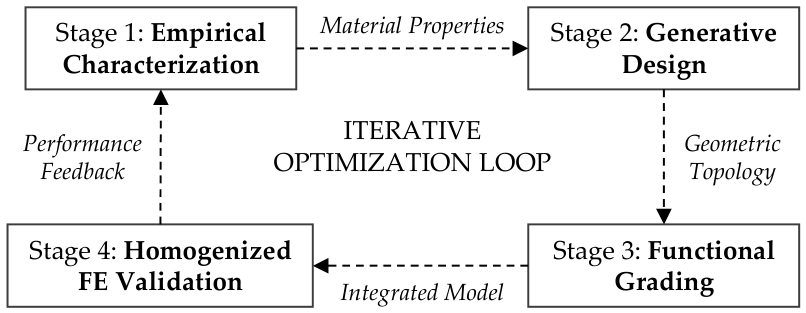
The overall predictive manufacturing framework is illustrated in
Figure 1, where the relationships between empirical material characterization, generative lattice design, functional grading, and homogenized numerical validation are presented as an integrated workflow for the biomechanical customization of the proposed metamaterial interface.
The workflow integrates empirical material characterization, generative lattice design, functional grading, and homogenized FE validation within an iterative optimization loop for biomechanically tailored metamaterial interface design.
2. Materials and Methods
2.1. Ergonomic Armrest Design
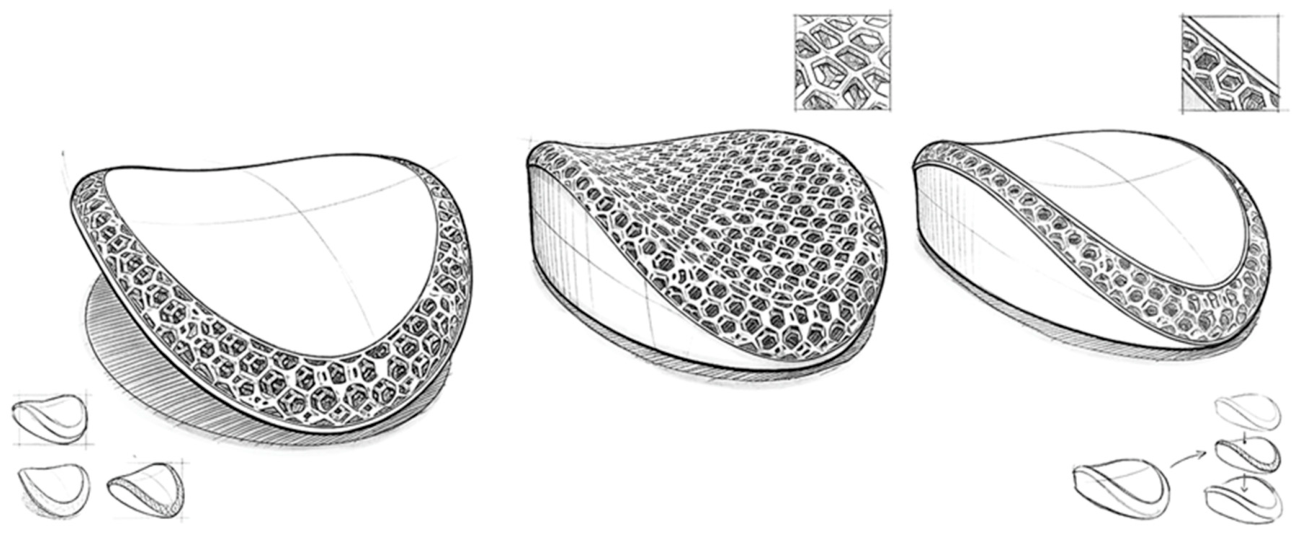
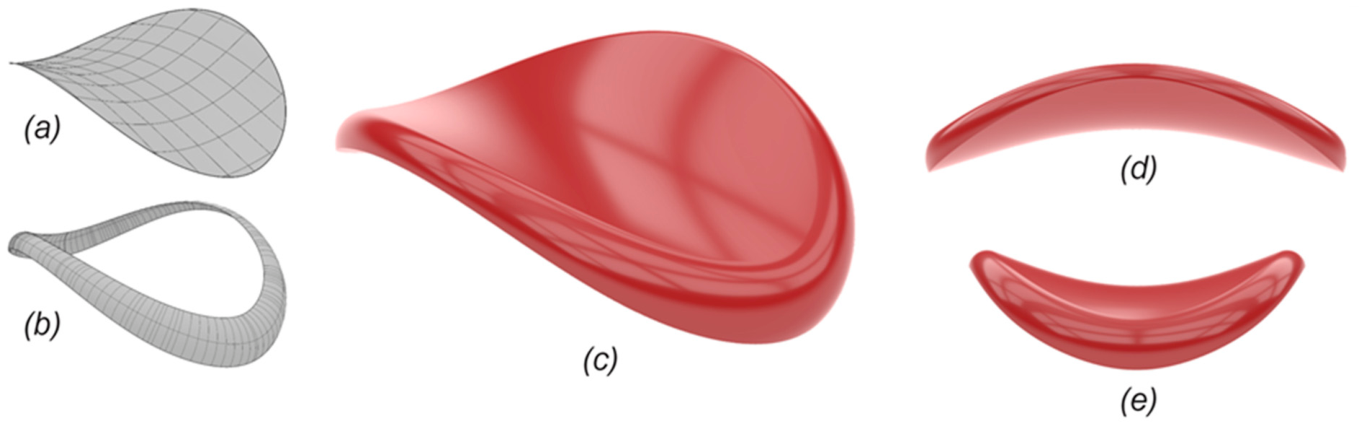
The design of an ergonomic computer armrest must address the constrained wrist and forearm postures that contribute to fatigue and compressive neuropathies during prolonged use. To counter these issues, the creative process began with evaluating existing sliding pads and establishing functional, ergonomic, and aesthetic baseline requirements. The initial conceptualization aimed to replace conventional polyurethane foams, which fail to adapt to dynamic loads and lack region specific stiffness control with structurally engineered geometry. This early phase focused on developing a dimensionally aligned baseline model, initially set at 125 × 90 × 35 mm with a uniform contact radius, intended specifically for advanced additive manufacturing. Product design visualization, created using Sketchbook (Sketchbook, Inc., Bend, OR, USA) and CorelDRAW 2024 (Corel Corporation, Ottawa, ON, Canada) can be seen in
Figure 2.
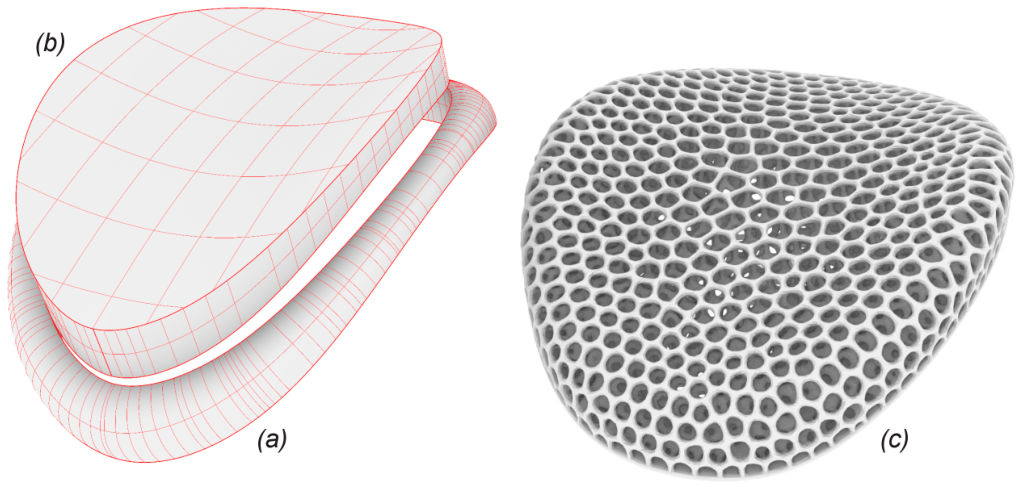
Following the baseline establishment, the design transitioned into iterative form development, focusing heavily on a variable-radius top surface to create a characteristic ergonomic profile. A critical design feature introduced was the double-curved cushion, ensuring an optimal, symmetrical fit to the user’s arm in both longitudinal and transverse directions (
Figure 3). However, physical testing of the initial prototypes revealed that the longitudinal curvature was excessively steep, and the transverse width was insufficient. Consequently, a dimensional correction was executed, refining the footprint to 125 × 94 mm and adjusting the height to 24 mm to flatten the longitudinal arch and widen the support area.
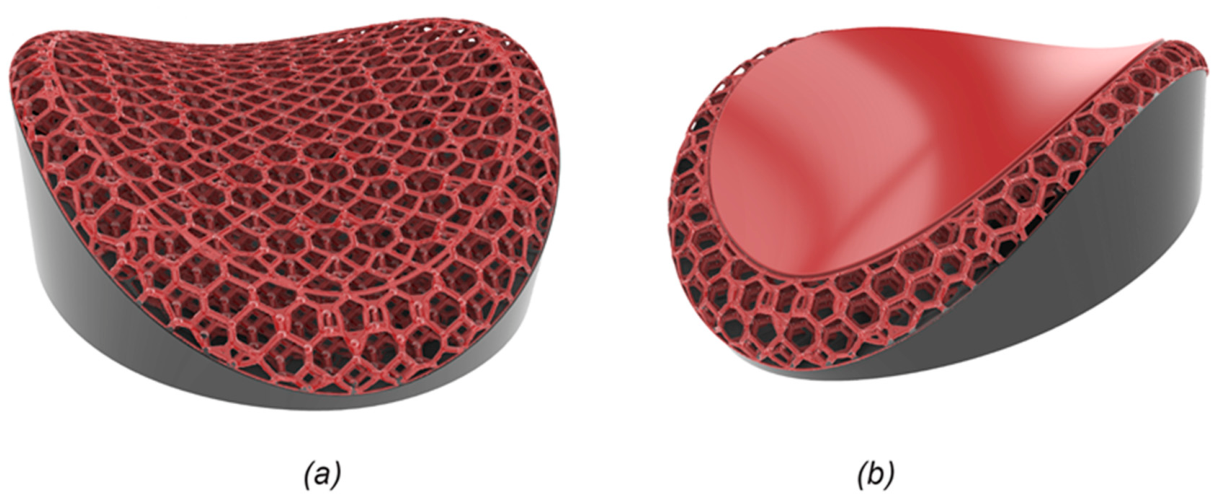
With the macroscopic double-curved boundary defined, the methodology shifted to establishing the internal architecture utilizing elastomeric metamaterials. Because standard biocompatible SLA resins are intrinsically stiff, a simple uniform cellular network was avoided to prevent generating localized, uncomfortable high-pressure points against the skin. Instead, a stochastic Voronoi volume lattice was employed, engineered to seamlessly map and close the complex double-curved external geometry without leaving sharp, incomplete surface ligaments. Beyond its biomechanical function, this stochastic Voronoi-based strut lattice structure was deliberately utilized to define the primary aesthetic value of the armrest (
Figure 4). By exposing the intricate cellular padding, which was configured to integrate directly over a distinct, optimized sliding base the internal structure serves a dual purpose as both a pressure-distributing interface and a visually defining product feature.
2.2. Parametric Design and Voronoi Lattice Generation
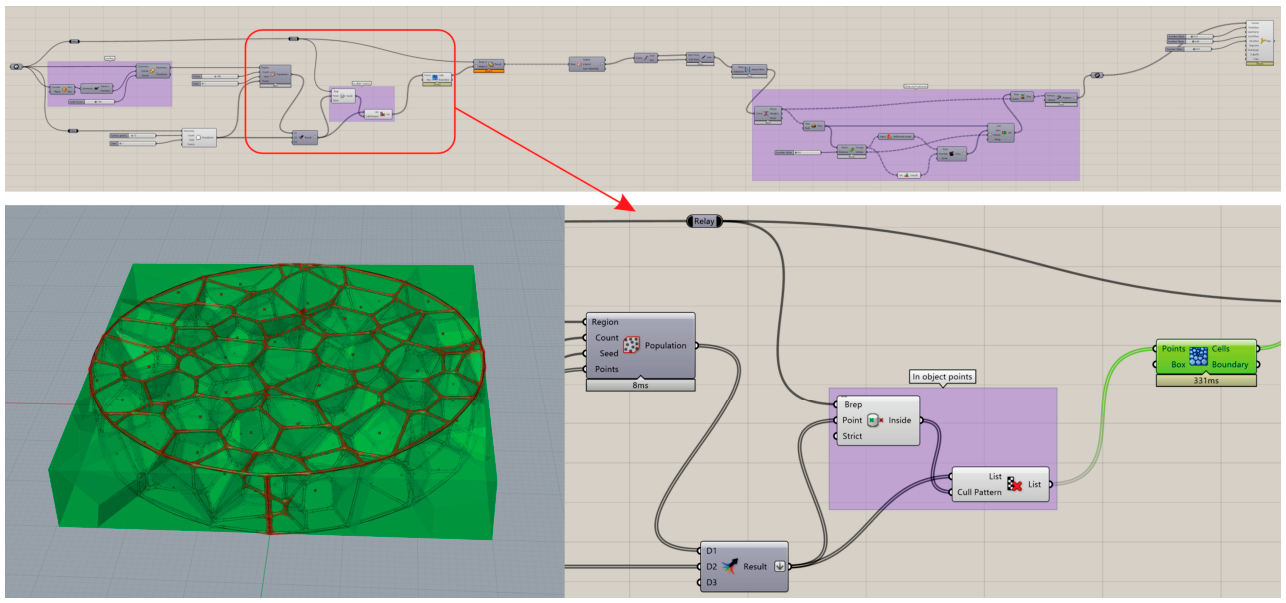
To materialize the ergonomic concept into a physically printable metamaterial, the cellular structure was generated using Rhinoceros 8 and the Grasshopper visual programming environment (Robert McNeel & Associates, Seattle, WA, USA). The custom generative algorithm developed for this study is highly versatile, enabling the tessellation of standard volumetric domains, such as cubes, boxes, and cylinders, as well as complex, custom-defined boundary representations (B-Reps) (
Figure 5). For this application, the generation process commenced by defining the custom solid volumetric domain of the optimized, double-curved armrest cushion. A stochastic Voronoi volume lattice was then seeded within this exact, closed boundary.
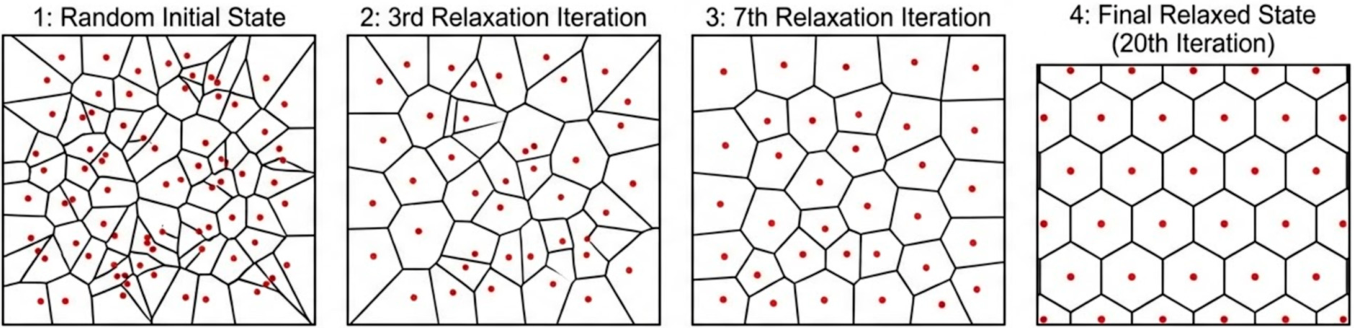
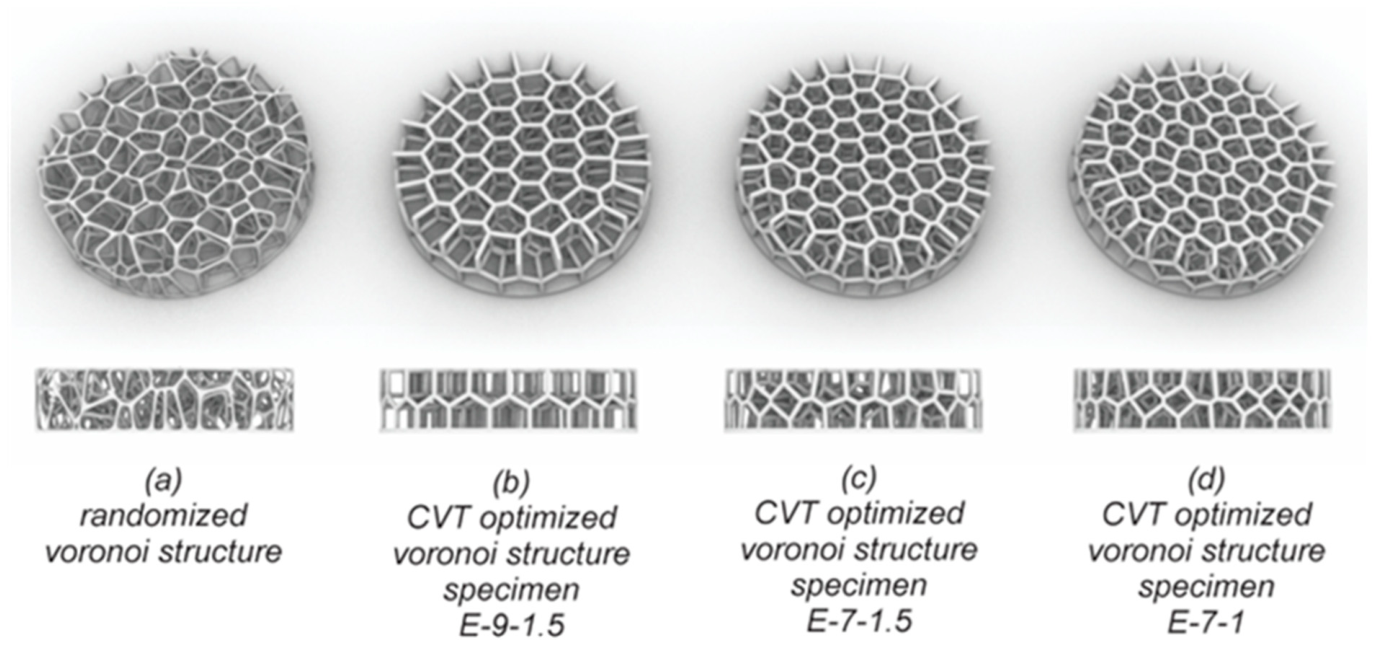
To manage structural stiffness and achieve the high uniformity required for both a predictable mechanical deformation plateau and a visually stable appearance, the initial seed points were subjected to a Centroidal Voronoi Tessellation (CVT) procedure (
Figure 6) [
38,
39]. This was executed using an equal-length cell edge routine within the Kangaroo physics tool palette for Grasshopper. This physics-based computational relaxation iteratively homogenized the cell volumes and regularized the strut lengths. Crucially, it dynamically forced the outermost cells to perfectly map and close the double-curved external geometry without leaving sharp, open ligaments, satisfying both the biomechanical constraints and the Gestalt principles of continuity.
To empirically characterize the mechanical behavior of the elastomeric metamaterial and establish a predictive foundation for this functional grading, the developed algorithm was additionally utilized to generate a series of standardized cylindrical test specimens. Exploiting the algorithm’s capability to seamlessly tessellate standard volumetric domains, these cylinders were populated with uniform, relaxed Voronoi lattices. The parametric nature of the algorithm enabled precise, systematic variations across the specimen set; specifically, by altering the target cell size (which dictates the average strut lengths via the equal-length relaxation routine) and the strut diameters. This highly controlled parametric variation generated a spectrum of relative densities and microstructural configurations, providing the essential experimental specimens required to correlate geometric parameters with macroscopic stiffness and deformation plateaus (
Figure 7).
2.3. Fabrication and Experimental Characterization of 3D Printed Cellular Structure Specimens
The 3D models of the cylindrical lattice structures intended for compression testing, together with the armrest prototypes, were exported as STL files and imported into PreForm version 3.57.2.624 software (Formlabs, Somerville, MA, USA) for build preparation, including part orientation, support generation, and slicing. All specimens were fabricated using a constant layer thickness of 100 μm and were fabricated on a Form 4L stereolithography printer (Formlabs, Somerville, MA, USA) operated in Open Material Mode, which allows the processing of a broad range of 405 nm photopolymer resins. BioMed Elastic 50A Resin (Formlabs, Somerville, MA, USA), a soft, transparent, biocompatible medical grade photopolymer, was selected as the printing material. According to the manufacturer’s technical datasheet, the post-cured material exhibits an ultimate tensile strength of 2.3 MPa, stresses of 1.0 and 1.3 MPa at 50% and 100% elongation, respectively, an elongation at break of 150%, a Shore A hardness of 50, and a glass transition temperature (Tg) of −36 °C. These values should, however, be regarded as manufacturer reported reference properties, since the mechanical response of the material may vary depending on part geometry, print orientation, print settings, and temperature. After printing, the parts were washed in 99% isopropyl alcohol for 20 min using a Form Wash L 2nd Generation unit (Formlabs, Somerville, MA, USA) and were subsequently air dried at room temperature for at least 30 min, until no residual solvent, excess liquid resin, or residue particles remained on the surface. Post curing was then carried out in a Form Cure L unit (Formlabs, Somerville, MA, USA) for 30 min at 70 °C, with the parts immersed in a transparent water filled container, in accordance with the resin manufacturer’s recommended procedure to achieve optimal mechanical properties. The support structures were removed only after post-curing using cutting pliers and appropriate finishing tools.
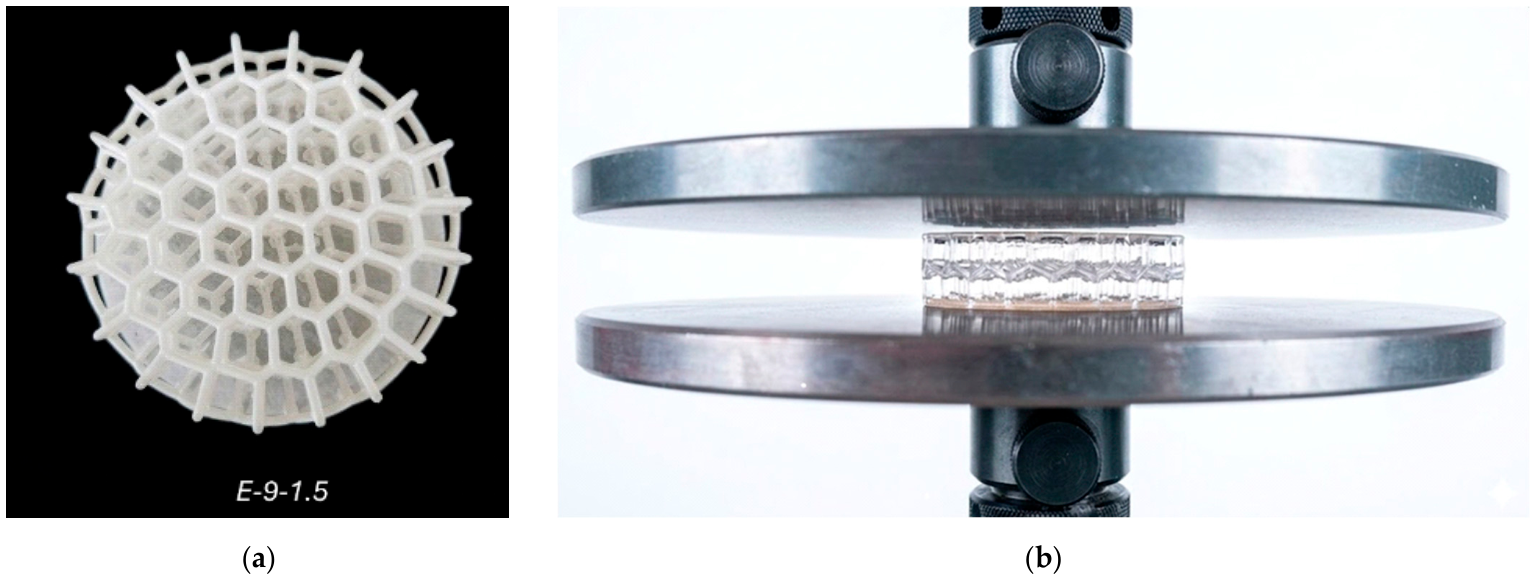
The compressive mechanical response of the elastomeric lattice specimens was evaluated by uniaxial compression testing using a Tinius Olsen H10KT universal testing machine (Tinius Olsen Testing Machine Company, Horsham, PA, USA) equipped with a 5 kN load cell (
Figure 8b). The cylindrical test specimens had a nominal diameter of 50 mm and a thickness of 15 mm. The compressive load was applied parallel to the layer-by-layer build direction (Z axis). Regarding the surface quality of the sample ends, the top surface of the specimens was completely open, exposing the internal cellular structure, whereas the bottom surface was partially closed. Following the printing process, necessary support structures were manually removed using pliers, and any remaining support residues on the contact surfaces were carefully sanded with sandpaper to ensure parallelity and proper flatness. The compression tests were conducted under room temperature conditions. The specimens were placed directly between unlubricated, flat steel plates, establishing a high friction support boundary condition at the contact interface. Since the investigated specimens exhibited an apparent density below 250 kg/m
3, the testing procedure and preloading conditions were adapted from the ISO 3386-1:2025 standard [
40], which outlines the determination of compression stress and strain characteristics for low density flexible cellular materials. In accordance with the standard, an appropriate compressive preload was applied to ensure uniform interfacial contact between the platens and the sample prior to the main testing phase, thereby eliminating any initial slack. A constant crosshead speed of 100 mm/min was applied, and each specimen was compressed to a maximum nominal strain of 70%. Furthermore, all reported stress and strain data were calculated as engineering stress and engineering strain, based entirely on the initial undeformed cross-section area and the original thickness of the specimens. Two specimens were fabricated and tested for each configuration to assess repeatability and to enable comparison between the investigated configurations.
While the sample size is limited for exhaustive statistical material characterization, it proved sufficient for calibrating the homogenized numerical models in this framework; the observed intra-configuration repeatability was high, and the shifts in mechanical response driven by cell size and ligament thickness were significantly larger than manufacturing-related variations. As the examined samples represented additively manufactured lattice structures rather than conventional flexible cellular materials, ISO 3386-1:2025 was considered the closest available methodological reference and was therefore used as the basis for the adopted testing protocol. All tests were performed under ambient laboratory conditions, and the force displacement response was recorded for subsequent evaluation of the compressive behavior.
2.4. Numerical Modeling
An FE model was developed using ANSYS Workbench 2021 R2 (ANSYS, Inc., Canonsburg, PA 15317, USA) to predict the biomechanical interaction between the user’s forearm and the 3D-printed cellular cushion, enabling evaluation of contact pressure distribution and structural response under representative loading conditions. The modeling approach follows the established methodology, where experimental material characterization is directly integrated into a homogenized numerical framework.
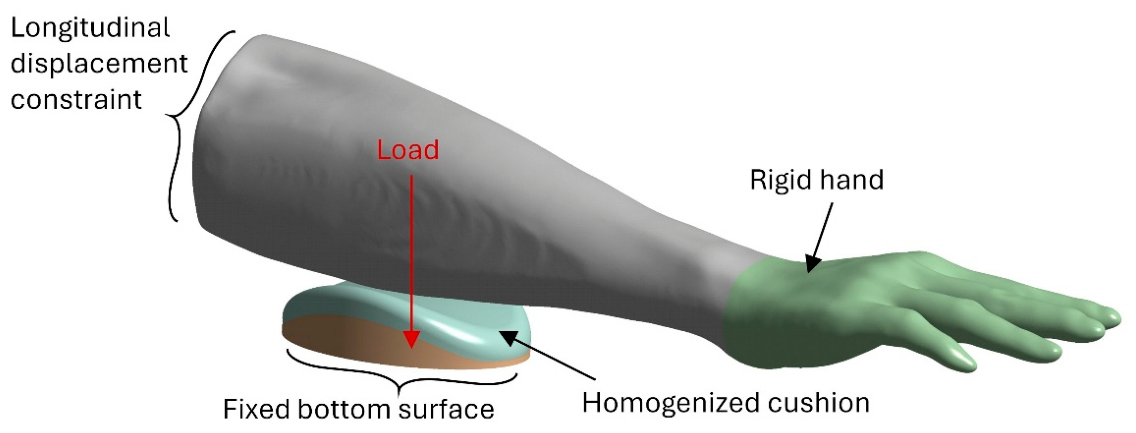
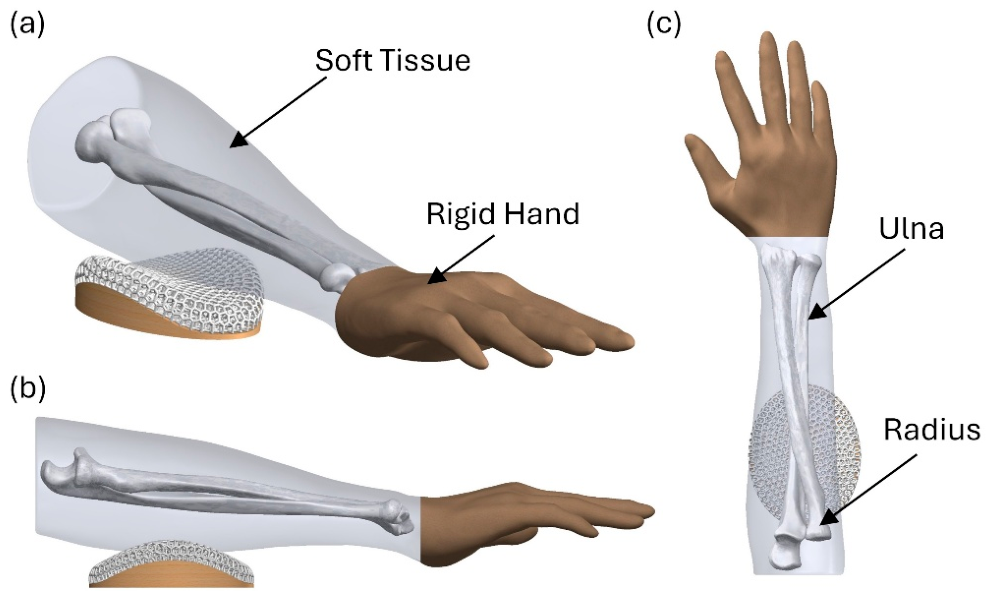
The geometry of the human forearm was reconstructed from medical computed tomography (CT) data, incorporating both soft tissues and skeletal structures (radius and ulna) (
Figure 9). To ensure computational efficiency while maintaining biomechanical relevance, the bones were modeled as rigid bodies due to their significantly higher stiffness compared to surrounding tissues, whereas the soft tissue domain was represented as a homogeneous hyperelastic continuum. The hand was excluded from deformable modeling and defined as a rigid body, as it does not contribute to load transfer in the armrest contact region. This simplification reduces the total computational time without affecting the accuracy of contact pressure predictions.
Direct numerical simulation of the detailed lattice geometry would require resolving complex contact interactions between individual struts during large deformations, which is computationally inefficient and may lead to numerical instabilities. Therefore, the cellular metamaterial cushion was modeled using a homogenized material representation. The constitutive behavior of this equivalent material was derived from experimentally obtained uniaxial compression data of representative specimens (
Section 2.2). A multilinear material model was adopted to capture the characteristic mechanical response of cellular structures, including the initial elastic regime, the deformation plateau, and the densification phase. This approach enables accurate reproduction of macroscopic mechanical behavior while significantly reducing computational complexity.
Contact interaction between the forearm and the cushion was defined using a rough contact formulation, which restricts tangential slip while allowing separation in the normal direction. This assumption reflects the high friction conditions typically observed at the interface between human skin and elastomeric polymer surfaces. The lower surface of the cushion was fully constrained, representing a rigid attachment to the supporting base.
Loading conditions were applied as vertical forces acting on the forearm, corresponding to typical anthropometric loading scenarios during computer mouse use (
Figure 10). Three discrete load levels were considered: 15 N, 30 N, and 45 N, representing low, medium and high loading conditions, respectively. The initial position of the arm was defined such that contact with the cushion is established at the beginning of the simulation, ensuring stable numerical convergence and realistic load transfer.
The FE mesh was generated using second-order (10-node) tetrahedral elements. A refined mesh was applied in the cushion and contact regions to accurately capture stress gradients and contact pressure distribution, while a coarser mesh was used for the forearm to improve computational efficiency. The complete model consisted of 32,771 elements and 53,308 nodes. Mesh convergence was verified to ensure that further refinement did not affect the simulation results.
This numerical framework enables efficient evaluation of different metamaterial configurations and provides a direct link between experimentally characterized material behavior and biomechanical performance, forming a key component of the proposed predictive manufacturing approach
3. Results
3.1. Experimental Results
This section presents the compressive mechanical response of the investigated elastomeric lattice configurations and compares their behavior under uniaxial loading. The aim of this analysis was to evaluate the influence of the selected geometric design parameters, namely cell size and ligament thickness, on the stress strain response of the structures and to identify the most suitable configuration for use as an armrest padding component. For this purpose, the experimentally obtained compressive stress strain curves were analyzed and compared across all tested configurations.
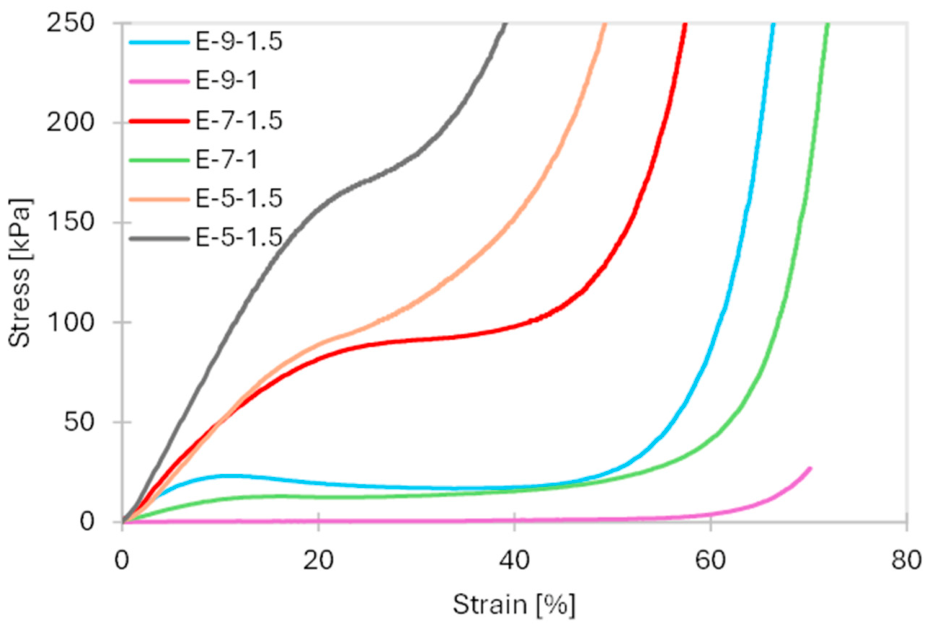
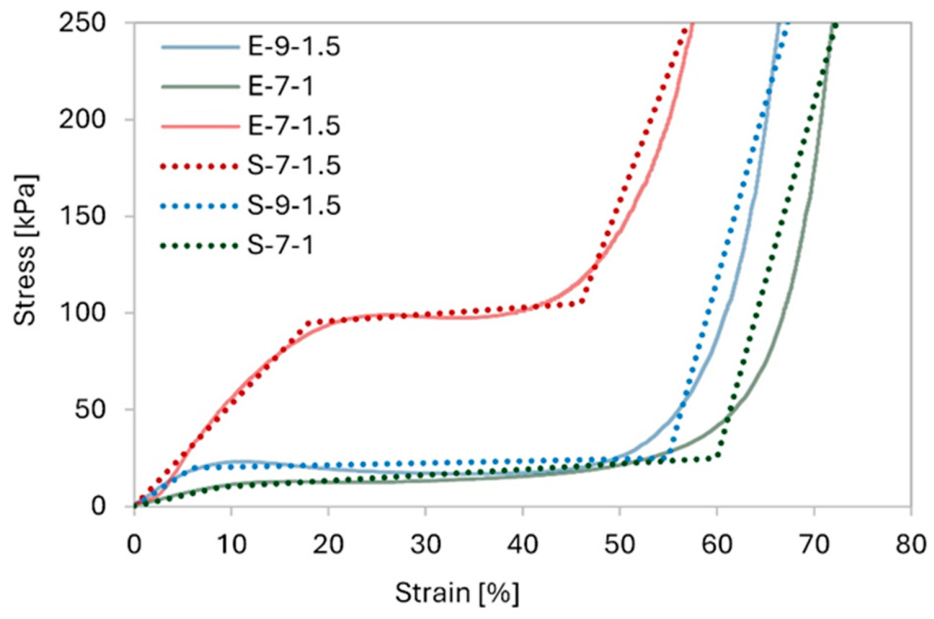
Figure 11 shows the representative compressive stress–strain curves of the investigated elastomeric lattice structures. In general, all specimens exhibited the typical response of deformable cellular architectures, characterized by an initial low stiffness region at low strains, followed by a progressive increase in stress and a pronounced stress rise at higher deformation levels associated with lattice densification. Despite this common overall trend, clear differences were observed between the investigated configurations. The E-9-1 configuration exhibited the softest compressive response, maintaining very low stress levels over most of the deformation range and showing a noticeable increase only at high strains. In contrast, the E-5-1.5 and E-7-1.5 configurations showed the highest stress levels, with a steep increase in stress already at low to intermediate strains, indicating a substantially stiffer response and higher load-bearing capability under compression. The remaining configurations, namely E-9-1.5, E-7-1, and E-5-1, exhibited an intermediate mechanical response, characterized by a more gradual stress increase followed by marked hardening at larger strains. A clear geometry dependent trend was observed throughout the tested set of specimens. For a constant ligament thickness, reducing the cell size resulted in an increase in compressive stress and promoted an earlier transition toward strain hardening and densification. Similarly, increasing the ligament thickness shifted the stress strain response toward higher stress levels for comparable cell sizes. Overall, the results confirm that both cell size and ligament thickness strongly govern the compressive behavior of the proposed elastomeric lattice structures and therefore represent key design parameters in the development of armrest padding systems.
3.2. Homogenization
The experimentally obtained stress–strain responses were used to define equivalent material models for the investigated lattice configurations. A comparison between experimental results and the corresponding multilinear material models is presented in
Figure 12. In the figure, E denotes experimental data, while S represents the corresponding homogenized (simulation) response. The first number indicates the cell size (mm), and the second number denotes the ligament thickness (mm).
Based on the comparative analysis of the mechanical responses, three representative configurations were selected for further numerical simulations: (i) 9 mm cell size with 1.5 mm ligament thickness, (ii) 7 mm cell size with 1.5 mm ligament thickness, and (iii) 7 mm cell size with 1 mm ligament thickness.
These configurations were identified as the most relevant in terms of their mechanical performance and applicability for ergonomic cushioning. Specifically, they span a suitable range of stiffness levels required to control contact pressure within acceptable limits. The selected set covers the transition from more compliant to stiffer responses, enabling evaluation of their influence on pressure distribution at the human–cushion interface.
The homogenized curves derived for these configurations show good agreement with the experimental results, capturing the differences in stiffness and deformation behavior. The 9-1.5 configuration exhibits the most compliant response, while the 7-1.5 configuration shows the highest stiffness. The 7-1 configuration provides an intermediate response between these two extremes.
This selection ensures that the numerical simulations capture the relevant mechanical spectrum for ergonomic cushioning applications, particularly with respect to maintaining contact pressures below the discomfort threshold of approximately 100 kPa. While it is recognized that PDT and PPT values exhibit high subject-specific and regional variability, this number is adopted here as a conservative design benchmark. The primary aim of this research is not the absolute optimization of armrest ergonomics, but rather to demonstrate the capability of the proposed predictive framework to tailor mechanical responses to a specified performance threshold. By maintaining interface pressures below this conservative limit, the design ensures the metamaterial operates within its compliant plateau regime, avoiding the non-linear pressure spikes inherent to lattice densification. The homogenized material models of these three configurations were therefore used as input for subsequent finite element analysis.
3.3. Numerical Results
Numerical simulations were used to evaluate the biomechanical response of the armrest and to compare the performance of the selected lattice configurations. Using the homogenized material models derived from experimental data, analyses of contact pressure and vertical displacements were performed for three configurations: 7-1, 7-1.5, and 9-1.5.
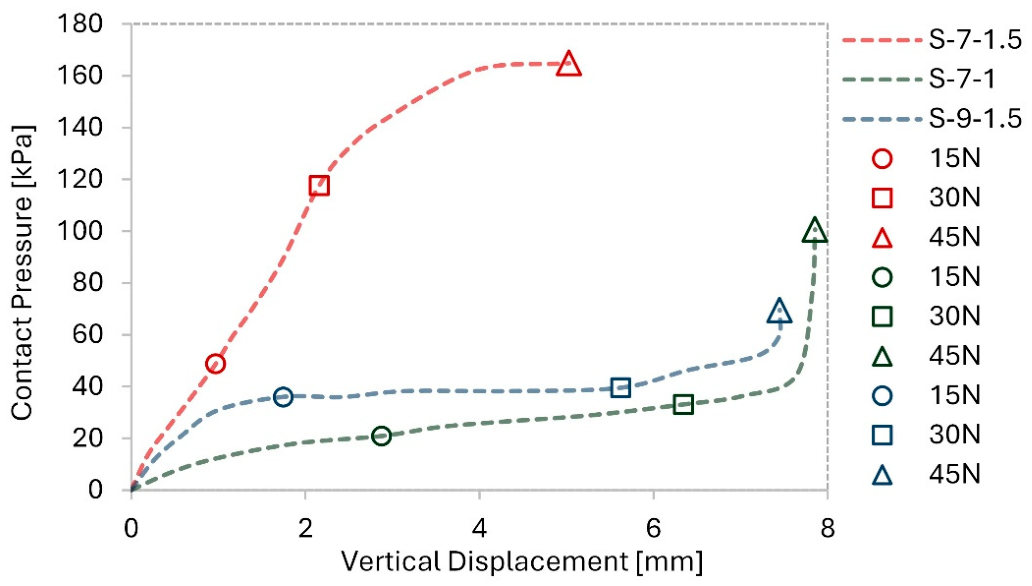
The results of the simulations are presented in
Figure 13, which shows the relationship between contact pressure and vertical displacement for all three configurations. Distinct differences in response can be observed depending on the geometric parameters of the structures. The 7-1.5 configuration exhibited the highest contact pressure values, exceeding 160 kPa at a load of 45 N. At relatively small displacement, this configuration showed a high stiffness response.
The 7-1 configuration enabled larger vertical displacement; however, at higher loads, it transitioned into densification, resulting in a rapid increase in contact pressure above 100 kPa. This behavior is reflected in the steep rise in the curve at larger displacements.
The most balanced response was observed for the 9-1.5 configuration. Across all three loading levels (15 N, 30 N, and 45 N), the contact pressure remained below approximately 70 kPa, while allowing larger displacement without a pronounced increase in stiffness. The markers in
Figure 13 indicate the discrete loading levels, where a circle denotes 15 N, a square 30 N, and a triangle 45 N.
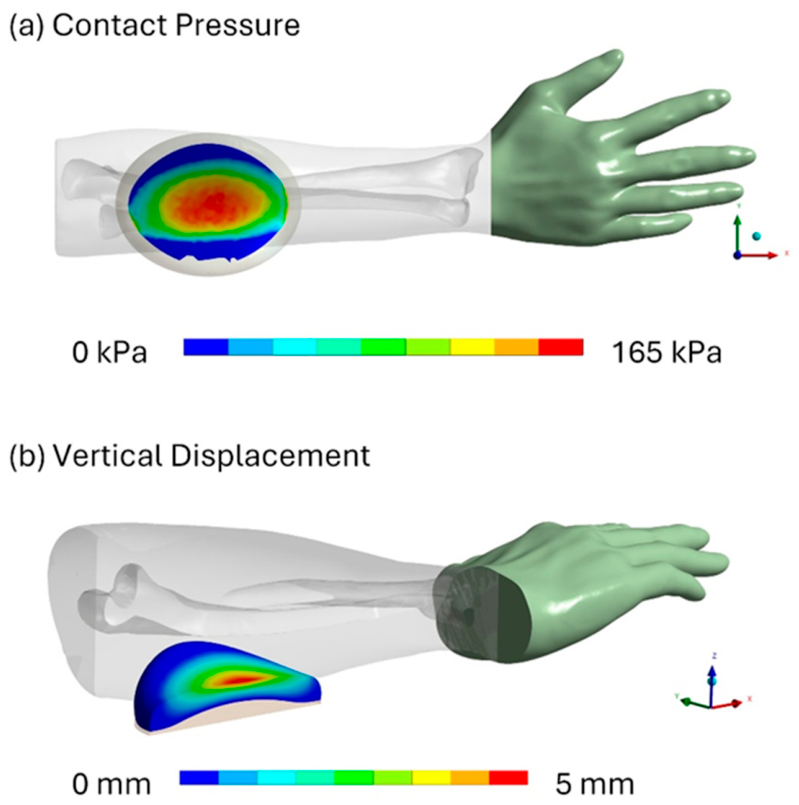
The spatial distribution of contact pressure and vertical displacement is shown in
Figure 14.
Figure 14a presents the contact pressure distribution at the forearm–cushion interface, while
Figure 14b shows the corresponding vertical displacement of the cushion. The results illustrate the contact area and deformation pattern under loading, providing a direct representation of the interaction between the forearm and the metamaterial structure.
The numerical values of the maximum contact pressure and maximum vertical displacement obtained from the simulations are summarized in
Table 1. Maximum contact pressure and vertical displacement for selected lattice configurations. These values provide a quantitative comparison of the mechanical response of the lattice configurations analyzed under different loading levels.
3.4. Final Armrest Design
The final design of the armrest support cushion was driven by a biomechanical need to optimize load distribution and enhance user comfort. To achieve this, the cushion’s volumetric domain was strategically divided into two distinct structural zones based on preliminary numerical simulations of user contact pressure (
Figure 14). In areas subjected to low contact pressure, a stiffer lattice structure was generated to provide essential foundational support and maintain the overall geometric integrity of the armrest. Conversely, in regions experiencing high contact pressure, a softer, more compliant Voronoi structure was applied to maximize comfort and manage localized stress (
Figure 15).
To actualize this functionally graded metamaterial, the initial Grasshopper algorithm was substantially modified. Building upon the semi-controlled Voronoi tessellation approach, the parametric workflow was adapted to generate specifically tailored tessellations localized within the predefined high- and low-pressure volumes. This allowed for precise, localized control over the mechanical responses, which are primarily dictated by the topological arrangement and relative density of the generated cells. By applying specific geometric routines to targeted volumes, the algorithm ensured a tailored mechanical response while maintaining structural continuity between the stiff and soft zones.
Following the initial population of these designated volumes, a Centroidal Voronoi Tessellation (CVT) optimization process was applied across all structural segments. This computational relaxation iteratively repositioned the seed points to their respective cell centroids, yielding a highly uniform and homogenized internal structure that is crucial for a predictable mechanical deformation plateau.
Finally, the optimized 3D wireframe network was uniformly thickened to generate a continuous, closed-mesh structure. This final step translated the mathematical Voronoi boundaries into robust, solid volumes, ensuring the complex functionally graded model was fully prepared for additive manufacturing.
4. Discussion
The primary objective of this study was to establish a predictive manufacturing framework that integrates empirical stereolithography (SLA) material characterization, parametric Voronoi lattice generation, and homogenized finite element (FE) biomechanical modeling to optimize human–device interfaces. Ergonomic cushioning requires a precise combination of softness, controlled deformation, spatially tailored stiffness, and long-term stability. Historically, the design of interface padding has relied on homogeneous polyurethane (PU) foams, which present a fundamental trade-off: softer foams reduce peak interface pressures but sacrifice necessary postural stability, whereas firmer foams provide support but elevate local contact pressures. Because conventional foams are passive continuum materials, their firmness is fixed; they lack the stimulus-responsive capacity to adapt to dynamic loads and cannot independently tune stiffness by region. Consequently, applied pressure redistributes only through the bulk compression of a uniform cellular network, which problematically concentrates stress in areas where the user’s tissue is already least compliant.
While previous research has demonstrated that elastomeric metamaterials can tune effective modulus across orders of magnitude using unit-cell geometry, translating these theoretical structures into functional, skin-contacting products has remained challenging. This study successfully shows that the macroscopic mechanical response of an additively manufactured elastomeric metamaterial can be precisely uncoupled and spatially modulated, providing both localized pressure relief and macro-level structural support.
4.1. Morphological Characteristics and Additive Manufacturing Viability
A critical limitation in existing metamaterial research is the reliance on standard periodic unit cells (such as cubic or gyroid architectures), which exhibit severe topological deficiencies when trimmed to complex boundaries. Unlike these conventional studies, our methodology utilizes the precise bounding geometry (in our example, an armrest cushion) as an inherent constraint, enabling seamless integration with curved boundaries without generating open surface cells. This morphological shift ensures a skin-safe interface and provides a predictable mechanical response essential for structural calibration, a significant advancement over the simple geometric trimming seen in the previous literature. While numerically efficient, periodic grids exhibit severe topological deficiencies when trimmed to fit complex, double-curved boundaries inherent in ergonomic design. This geometric trimming inherently leaves incomplete, open surface cells and sharp, partial ligaments exposed at the boundary interface. These exposed features not only introduce significant mechanical stress concentrations that alter predictable deformation mechanisms, but they also render the external surface completely unsuitable for direct human skin contact without the addition of thick encapsulation layers.
The methodology developed in this study addressed these limitations by transitioning to relaxed Voronoi volume lattices. Unlike periodic structures, the Voronoi generation algorithm utilized the precise bounding geometry of the armrest cushion as an inherent constraint during the tessellation process, enabling seamless integration with the curved boundaries without generating open surface cells. By applying an iterative physics-based computational relaxation procedure, the algorithm regularized cell volumes and strut lengths. This process not only provided a uniform, stable appearance conforming to Gestalt principles but also ensured a predictable mechanical response essential for structural calibration.
Furthermore, this morphological shift proved highly advantageous for the additive manufacturing process. The stochastic, truss-like orientation of the Voronoi ligaments effectively minimized horizontal spans. This produced a self-supporting internal geometry that eliminated the needed internal support structures during the SLA printing process. Consequently, this approach minimized the risk of internal manufacturing defects and ensured the internal voids remained free of partially cured residual resin.
4.2. Functional Grading to Resolve the Material-Comfort Dichotomy
Translating metamaterials into certified skin-contacting products is further complicated by the high intrinsic stiffness of biocompatible SLA resins. To achieve the macroscopic compliance required for soft tissue contact, the standard approach is to enlarge the unit cell size. However, this modification concentrates reaction forces over fewer, thicker ligaments, generating localized, uncomfortable high-pressure points against the skin.
The implementation of continuous radial functional grading resolved this material-comfort dichotomy. By parametrically varying the target cell size from 11 mm at the geometric center of the armrest down to 7 mm at the peripheral boundaries, while maintaining a constant nominal ligament thickness of 1 mm, the structure effectively created a continuous spatial gradient of relative density. This grading decouples compliance from support, solving the fundamental limitation of homogeneous PU foams.
The central region, possessing a structurally lower relative density due to the larger cells, exhibits a lower initial stiffness and a lower yield stress. Consequently, it enters the softer deformation plateau earlier under applied load. As demonstrated by the FE simulations, this allows the central region to yield preferentially when subjected to vertical loads, enabling the forearm to sink into the cushion and significantly increasing the total contact surface area. Distributing the force over a larger geometric area drastically reduces peak contact pressures, keeping them below the critical discomfort threshold of 100 kPa.
Simultaneously, the smaller peripheral cells possess a higher relative density, dictating a stiffer mechanical response with a higher yield stress. As the arm displaces the central cells, these firmer edges resist immediate yielding, forming a supportive biomechanical cradle. This cradle prevents lateral rolling during transverse mouse movements, providing essential postural stability that cannot be achieved with a uniform foam pad. The inclusion of automated internal node filleting was also critical to this graded architecture, as it redistributed localized stresses at ligament intersections and prevented premature material failure.
4.3. Validation of Predictive Modeling and Design Levers
The final component of the proposed framework was the integration of a homogenized finite element model to predict the biomechanical interaction. Direct numerical simulation of detailed lattice geometry under large deformation involves complex contact interactions between individual struts, leading to computational inefficiency and numerical instability. Utilizing a multilinear homogenized material model derived from the empirical uniaxial compression data proved to be a highly effective alternative, capturing the initial elastic regime, the deformation plateau, and the densification phase accurately.
The FE results confirmed that macroscopic mechanical properties can be reliably modulated through design levers such as cell size and ligament thickness. The analysis indicated that the E-9-1.5 configuration provided the most balanced response among the uniform baseline configurations, maintaining contact pressures below approximately 70 kPa under loads up to 45 N. In contrast, the stiffer E-7-1.5 configuration generated peak pressures exceeding 160 kPa. The E-7-1 configuration allowed larger initial displacement but transitioned prematurely into densification, causing a rapid increase in contact pressure above 100 kPa. These findings validate that for a human–device interface to remain effective under load, the metamaterial structure must be explicitly engineered to remain within its plateau phase; transitioning into the densification phase results in non-linear pressure spikes that cause tissue discomfort.
4.4. Limitations and Future Outlook
While this study successfully validates the predictive manufacturing framework, certain methodological limitations remain. The numerical model assumed static vertical loading corresponding to a resting arm. However, continuous computer mouse operation involves dynamic, multi-axial shear forces that were not evaluated in this study. Furthermore, the modeling of the soft tissue domain as a homogeneous hyperelastic continuum, while computationally efficient for evaluating comparative surface contact pressure, is a simplification of the multi-layered human musculoskeletal system. This simplification may underestimate localized internal stresses at the tissue-bone interface compared to a heterogeneous model, though it remains a robust predictor for macroscopic interface comfort. Additionally, while the limited sample size per configuration was sufficient to capture the dominant geometry-dependent trends for framework calibration, future studies focusing on production-scale reliability should incorporate larger cohorts to statistically quantify the impact of AM process variability. It needs also to be noted that while the framework is validated through material calibration of standardized specimens, direct pressure mapping of the final armrest prototype was not conducted. Technical difficulties in measuring pressure on open-cell lattices, such as sensor-bridging over structural voids, currently limit direct physical validation.
Also, the present study demonstrates the proposed framework using a single CT-derived forearm model; therefore, future research should evaluate multiple subject-specific anatomies to quantify the influence of inter-individual differences in forearm volume, soft tissue thickness, and bony prominences on the predicted biomechanical response.
Future research must prioritize long-term cyclic fatigue testing of SLA-printed Voronoi ligaments to characterize time-dependent creep and evaluate how the cushioning capabilities may degrade under repeated loading. Additionally, in vivo pressure mapping and longitudinal subject testing are necessary to correlate these numerical simulation findings with actual user comfort and the clinical mitigation of compressive neuropathies.