Digital Enablers of the Circular Economy: A Systematic Review of Applications, Barriers, and Future Directions


 ,
, 
Abstract
1. Introduction
1.1. Background and Urgency of Circular Economy Transition

1.2. Role of Digital Technologies in CE and Industry 4.0/5.0 Convergence
1.3. Recent Drivers: Policy, Regulation, and Post-Pandemic Digitalisation
1.4. Research Gap and Objectives
1.5. Structure of the Paper
2. Methodology
2.1. Literature Search
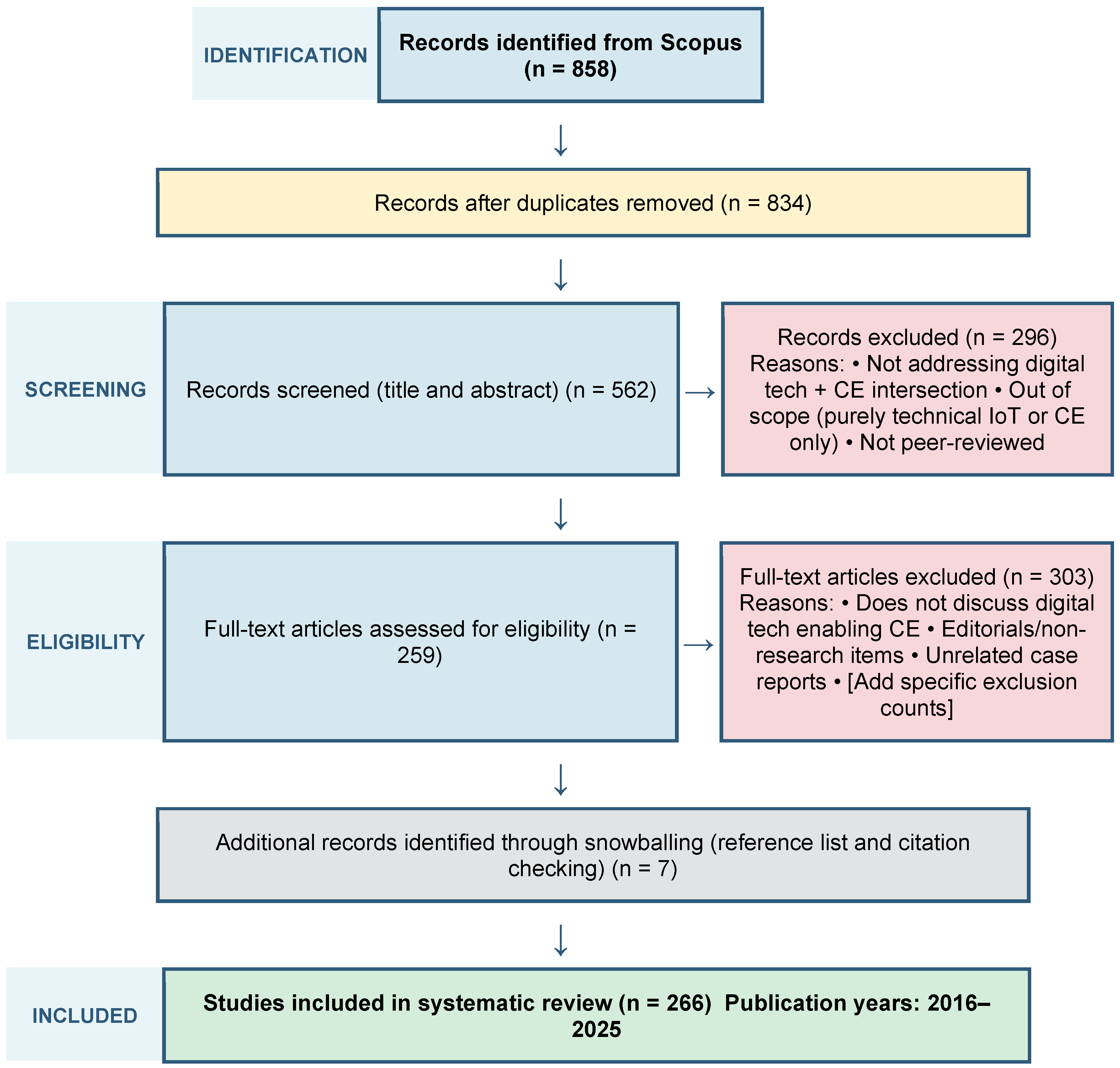
2.2. Screening and Selection
2.3. Data Extraction and Analysis
- Bibliographic information—author(s), year, publication outlet, and document type (to characterise the source of the research).
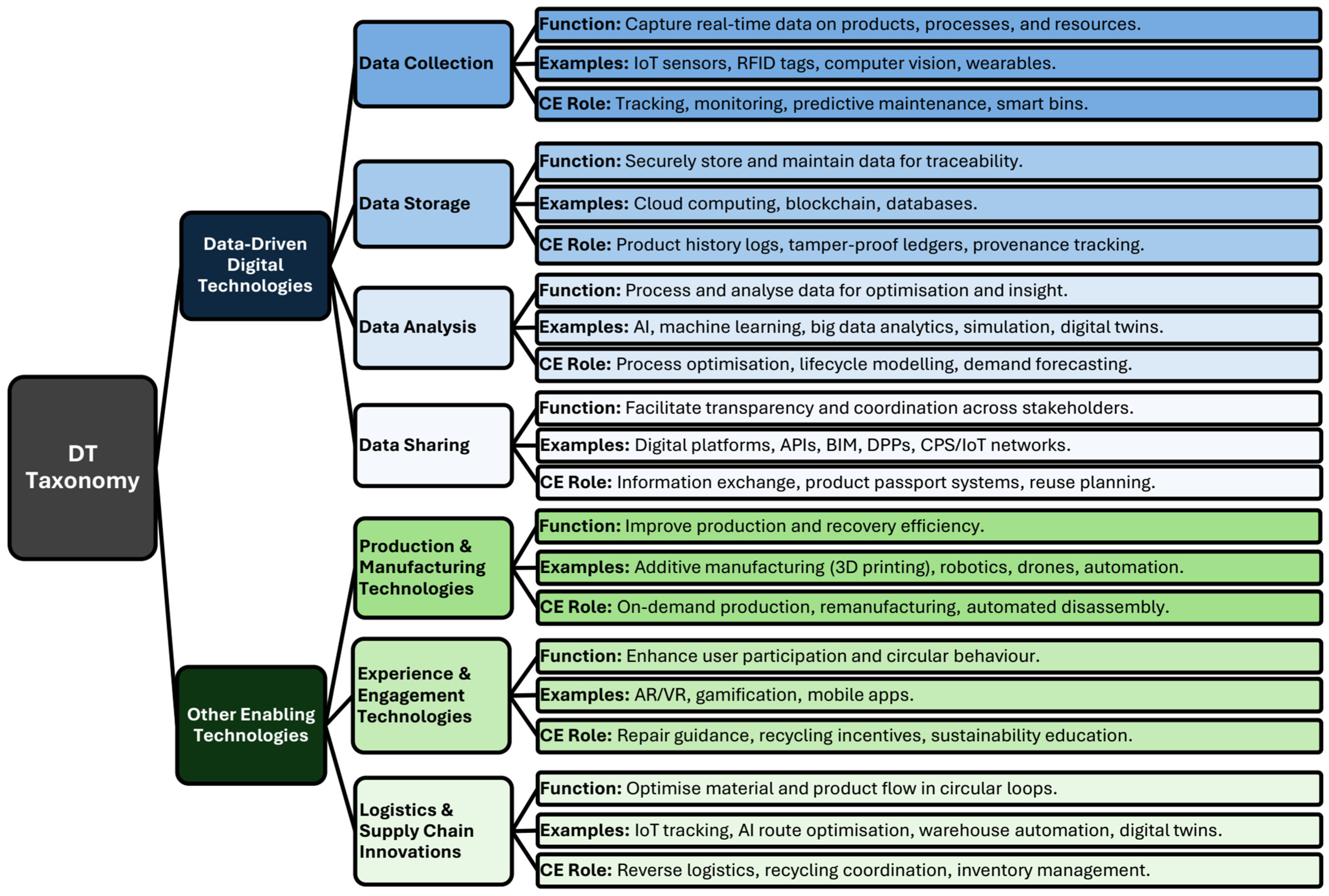
- Digital technologies addressed—we noted which digital or Industry 4.0 technologies were involved (for example, Internet of Things (IoT) for data collection, AI or BDA for data analysis, Cloud computing or blockchain for data storage/sharing, and other relevant technologies like robotics, automation, digital platforms, digital twins, etc.). To handle the diversity of technologies, we grouped them into broad functional categories (such as data collection, data storage, data analysis, data sharing, and advanced manufacturing technologies) based on each technology’s primary role [18]. This functional classification helped compare studies focusing on similar types of digital enablers.
- Circular economy focus—we recorded which aspect of the circular economy each study targeted, such as which stage of the product lifecycle or supply chain (design, sourcing/procurement, production, consumption or waste management) or which circular strategy/principle (e.g., recycle, reuse, remanufacture, product-service systems, etc.) was being enabled or examined. This allowed us to identify where digital interventions were applied within the circular economy framework.
- Research context and method—we captured the study’s context (the industry sector or application domain, geographic focus, and scale of application, such as whether it involved small firms or large enterprises) [35]. We also noted the research approach (e.g., empirical case study, survey, experiment, interview-based qualitative study, theoretical framework, or literature review) to understand the nature of the available evidence.
- Key findings and themes—we extracted qualitative insights from each paper regarding how digital technologies enable circular economy outcomes. In particular, we summarised the reported benefits/impacts of adopting digital solutions for circularity (e.g., improvements in resource efficiency, waste reduction, new circular business models), noted any identified challenges or barriers (e.g., implementation difficulties, skills or infrastructure gaps, economic or regulatory hurdles), and recorded emerging trends or patterns the authors highlighted (such as increasing integration of certain technologies or cross-industry collaborations). We also captured any proposed future research directions or open questions, as these indicate knowledge gaps. These summaries were used to synthesise overarching themes across studies.
2.4. Analysis Framework
2.4.1. Taxonomy of Digital Technology Applications in CE
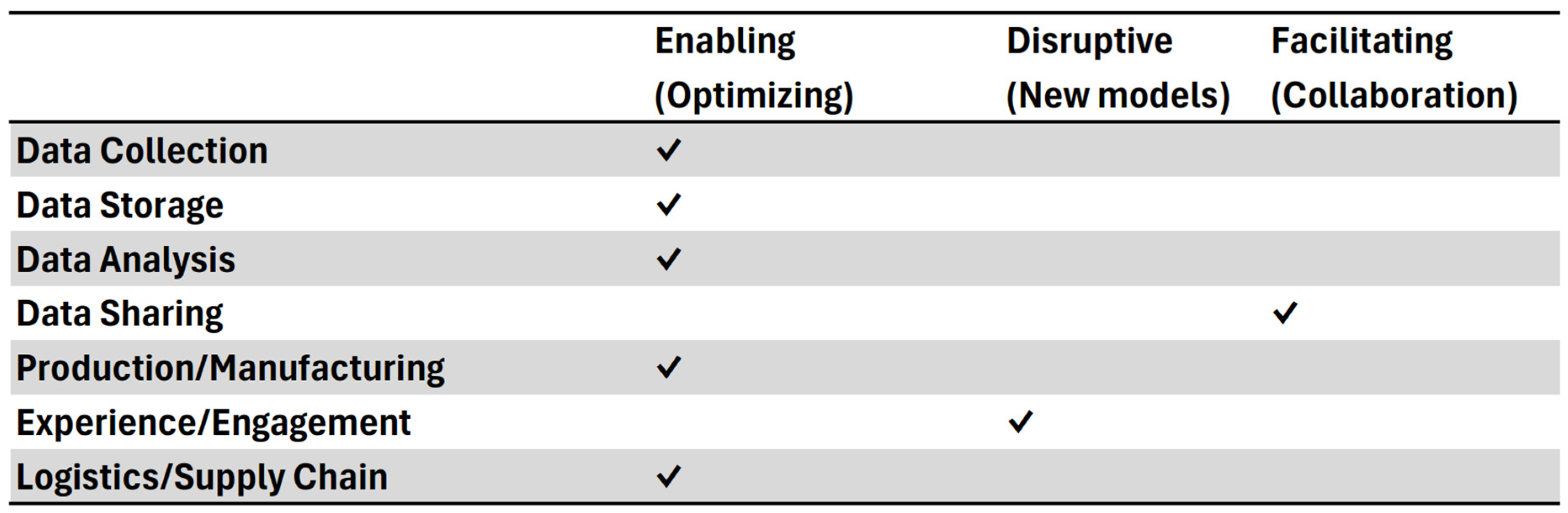
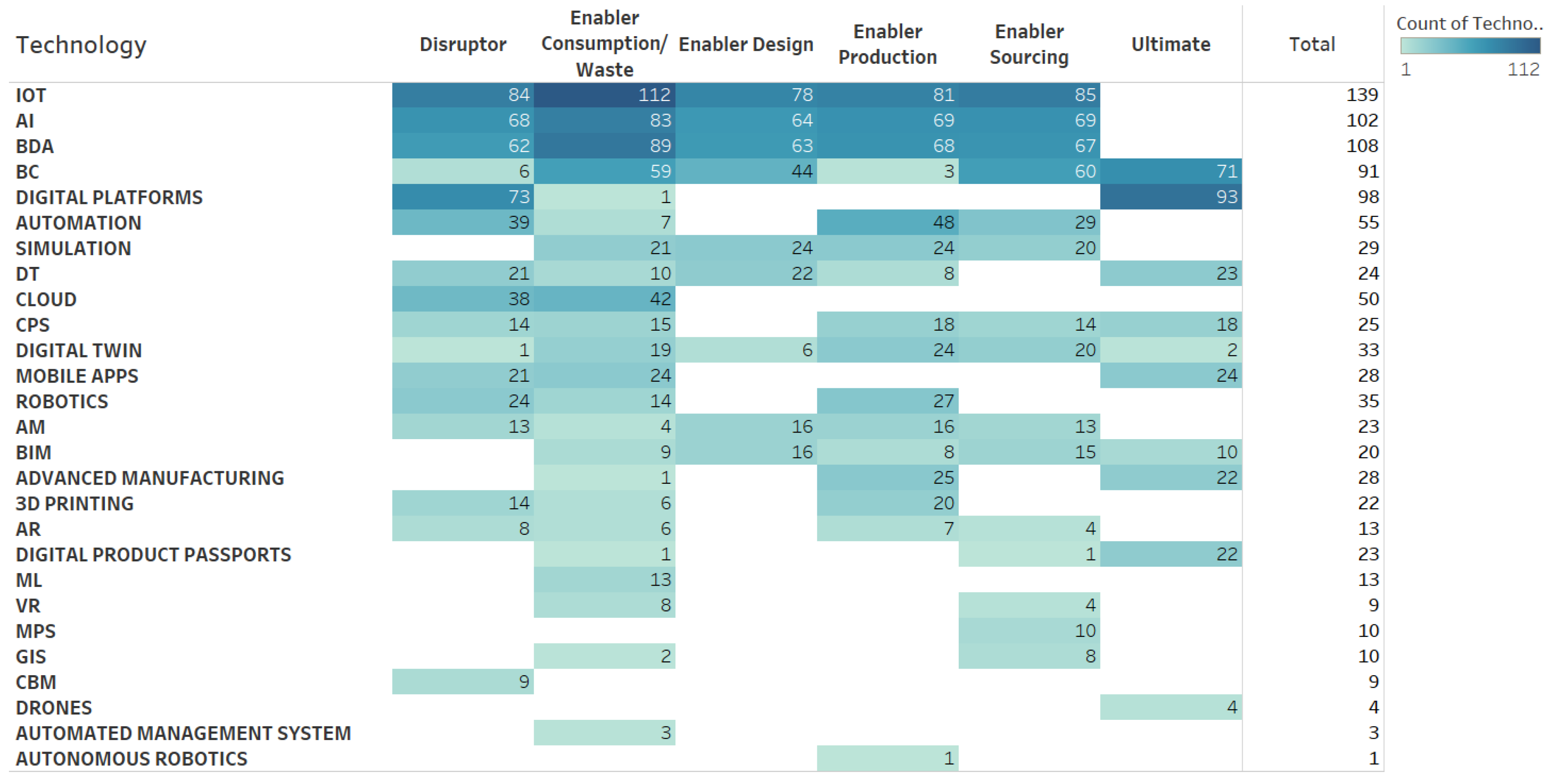
2.4.2. Impact Typology of DTs on Circular Economy
- Enabling (Process Optimisation): Digital technologies improve efficiency and resource use without changing the core business model. Examples include IoT and AI for predictive maintenance, waste reduction, and real-time monitoring, helping firms extend product lifetimes and cut costs while maintaining existing operations.
- Disruptive (Business Model Innovation): Technologies drive new circular value streams and shift from product sales to service-based or platform models (e.g., product-as-a-service, sharing systems). Blockchain, digital twins, and AR/VR enable new inter-firm collaborations and the delivery of non-material value, transforming traditional linear business structures.
- Facilitating (Ecosystem Collaboration): Technologies create shared platforms and networks for cross-stakeholder cooperation, transparency, and data exchange. Examples include digital product passports, industrial symbiosis platforms, and data hubs connecting manufacturers, recyclers, and consumers. These tools form the infrastructure for scaling circular ecosystems.
3. Descriptive Analysis
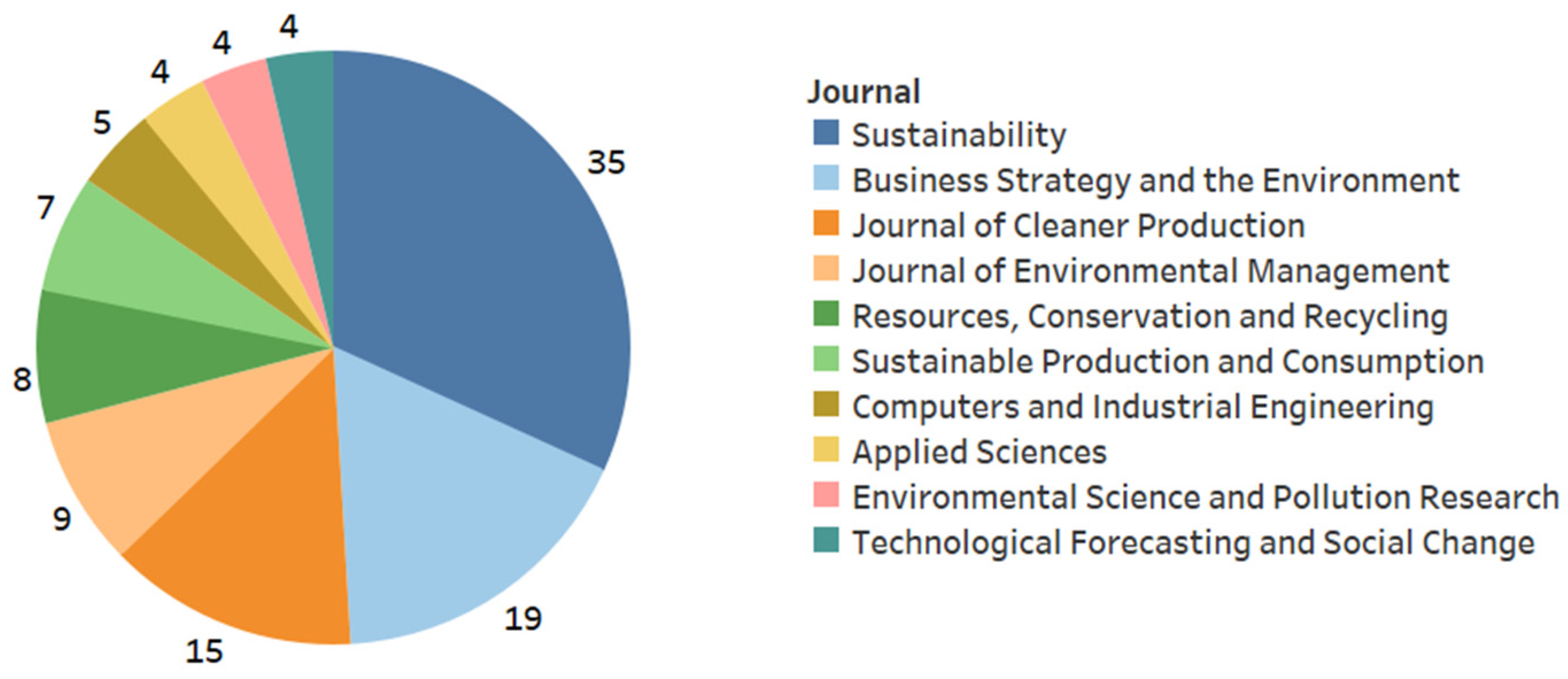
3.1. Distribution by Year, Journal, and Citations
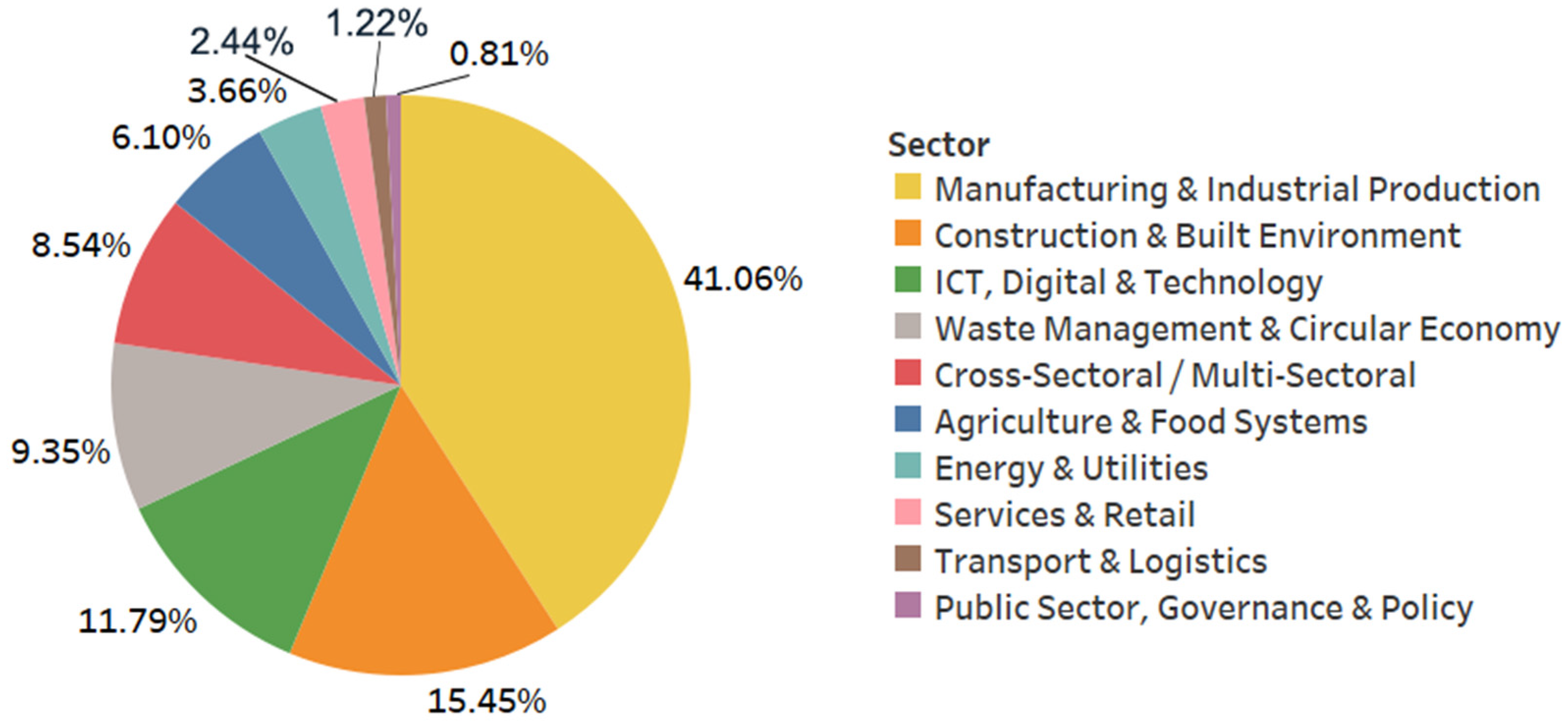
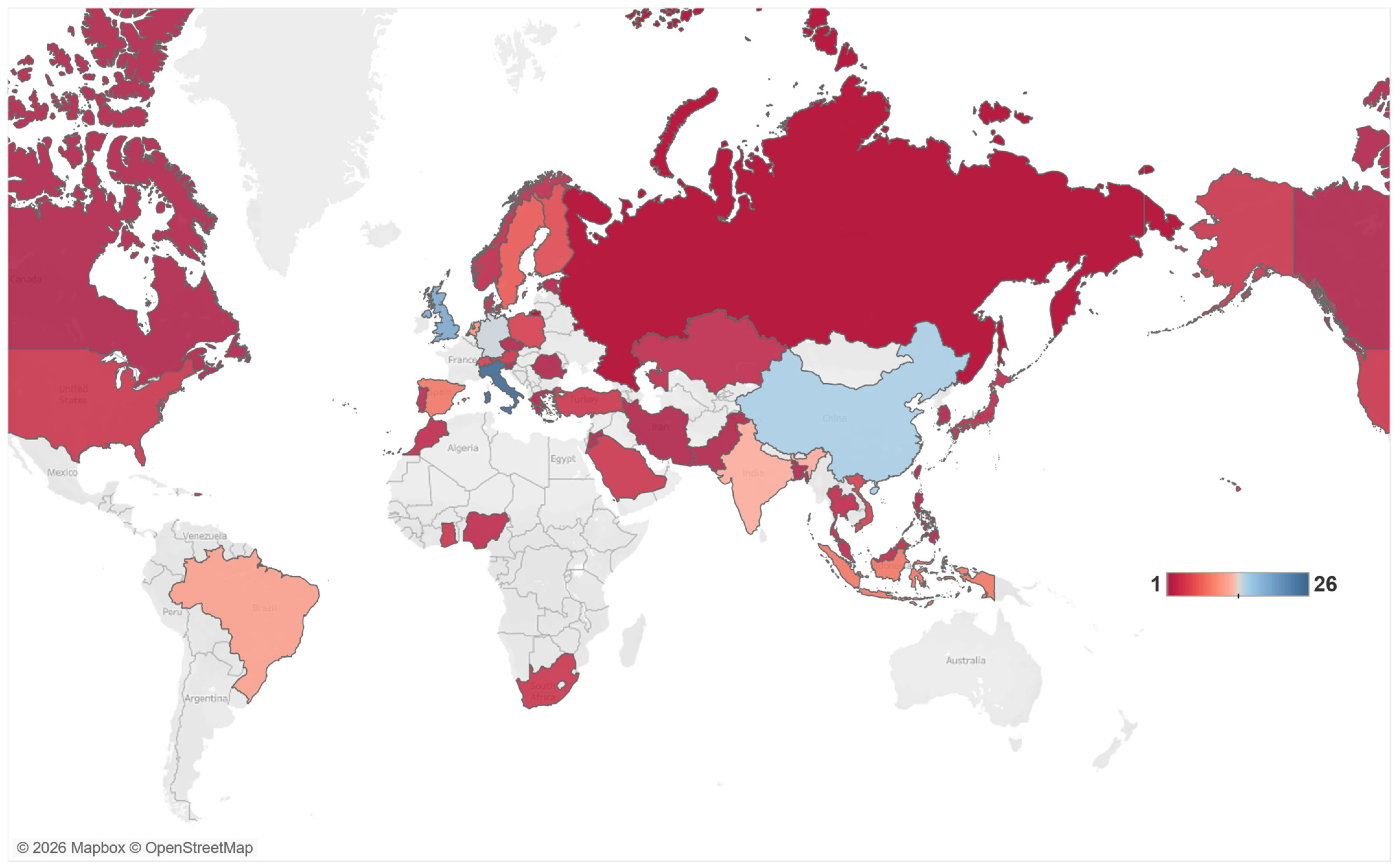
3.2. Sectoral Distribution and Regional Focus
3.3. Research Designs and Methods Used
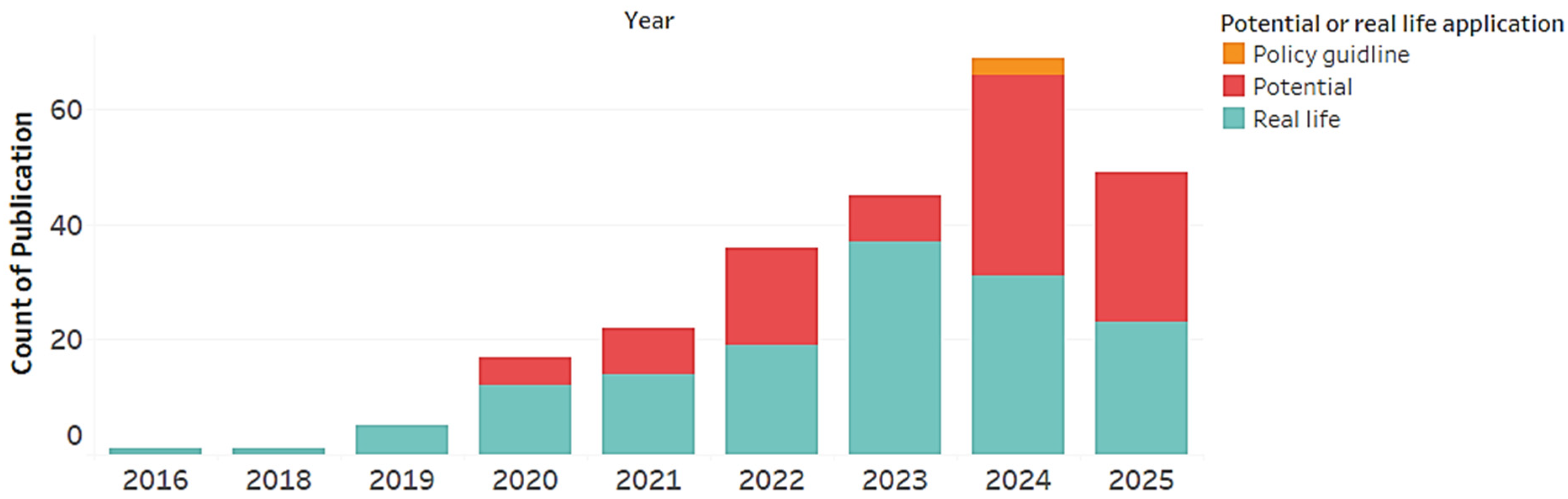
3.4. Real-Life vs. Potential Applications
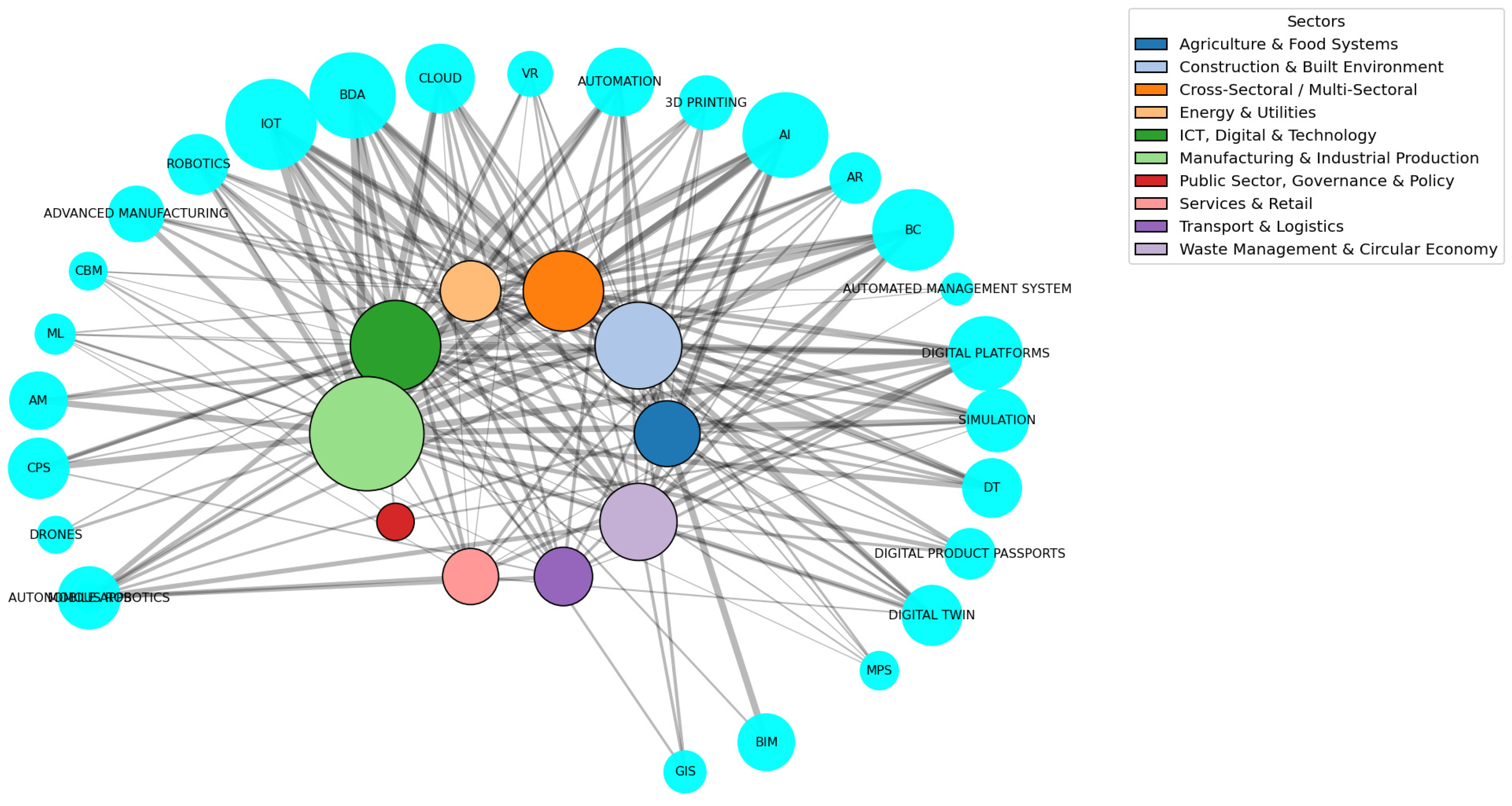
3.5. Technology–Sector Network Mapping
- Internet of Things (IoT): IoT appears as a central hub technology, with strong links to multiple sectors such as manufacturing, waste management, and agriculture. For example, IoT-based sensor networks are widely used in manufacturing processes for real-time monitoring and in smart waste collection systems to optimise recycling and disposal routes. This prevalence (also reflected by IoT being identified in a large number of studies) underscores IoT’s role in data collection and tracking across the CE spectrum.
- Mobile applications: Mobile apps show prominent connections with consumer-facing sectors, including retail and mobility (transportation), as well as urban development (smart city initiatives). This indicates their versatile application in engaging end-users for circular practices—for instance, apps for product sharing or return schemes in retail, ride-sharing and mobility services, and platforms that involve citizens in urban recycling programs.
- Advanced manufacturing and 3D printing: These production technologies are closely associated with the manufacturing sector, but the network also shows links to specific industries such as textiles and chemicals. This reflects how additive manufacturing (3D printing) and other advanced production techniques are being used to enable on-demand production, customisation, and materials efficiency in textiles and chemical manufacturing (e.g., producing components with less waste or using recycled feedstock). Such technologies thus drive circular outcomes by optimising production and enabling remanufacturing of parts across these sectors.
- Artificial intelligence and robotics: AI, often alongside technologies like machine learning and computer vision, as well as robotics, are strongly connected to construction and general manufacturing in the network. These technologies facilitate automation, precision, and intelligent decision-making—for example, AI-driven algorithms and robotic systems are used in construction for efficient building demolition and material sorting, and in factories for predictive maintenance and automated disassembly of products. Their central position in the network diagram highlights their importance in improving process efficiency and reducing waste in core industrial sectors. Additionally, technologies such as AR and VR cluster around design-intensive and training applications in construction and manufacturing, indicating use in prototyping, worker training, and maintenance visualisation to support circular practices.
- Digital platforms and blockchain: Digital platform technologies (including online marketplaces, IoT platforms, and other collaboration portals) form a nexus connecting multiple sectors (often represented in the network as links to a “cross-sectoral” node). These platforms enable circular business models, such as product-service systems and sharing economies, by linking producers, consumers, and recyclers. For instance, several studies highlight platforms for industrial symbiosis or material exchange that span across industries. Likewise, blockchain technology connects to supply chain-intensive sectors (e.g., food and agriculture, electronics) through its role in improving traceability and trust in circular supply chains (e.g., tracking recycled material content or product histories).
- Waste management and resource recovery: In the network, the waste management sector is connected with numerous digital technologies, including IoT, automation systems, drones, and AI-based analytics. This reflects that managing waste and recycling is a key area where multiple digital solutions converge—sensors and IoT enable smart bins and real-time waste tracking, drones can monitor landfill or hazardous waste sites, and AI can improve sorting of recyclables. The strong interconnectedness around waste management emphasises its critical role in the CE and how technology is enhancing efficiency at this end-of-life stage across various material streams. Notably, remanufacturing activities (closely related to waste management in extending product lifecycles) are linked in the diagram to robotics and service-oriented technologies. This highlights, for example, the use of robotic automation in disassembly for remanufacturing, and digital service platforms that facilitate maintenance or take-back programs—underscoring the synergy between technology and circular strategies aimed at keeping products in use longer.
4. Digital Technologies as Enablers in the Circular Economy
4.1. Data-Driven Digital Technologies in CE
4.1.1. Data Collection
4.1.2. Data Storage
4.1.3. Data Analysis (Including Digital Twins)
- AI-driven optimisation of processes: A growing number of case studies demonstrate that AI can analyse large, complex datasets from production and product use to identify inefficiencies and recommend improvements. For instance, machine learning models can tune manufacturing parameters to minimise waste and energy consumption while maintaining product quality [53,54]. In one example, AI algorithms applied in a factory setting helped reduce scrap rates and cut energy usage, directly improving circular outcomes by conserving materials [55]. AI is also used to optimise supply chain logistics—e.g., routing vehicles to reduce transport emissions or suggesting the best times to remanufacture vs. recycle an item—thereby increasing overall resource efficiency.
- Predictive maintenance and product life extension: AI (particularly predictive analytics) is often cited as a tool for extending the useful life of products and assets. By analysing sensor data on equipment or products in use, AI models can predict failures or maintenance needs before they occur [56,57]. This capability allows companies to service products proactively, preventing costly breakdowns and keeping items in circulation longer. For example, an AI-based predictive maintenance system in a manufacturing plant might forecast when a machine part will wear out and schedule its refurbishment, avoiding an unplanned outage and prolonging the machine’s life [58]. Similarly, for consumer products such as appliances or vehicles, connected data analysed by AI can alert users or service centres to perform repairs, thereby avoiding premature disposal. Such AI-driven maintenance not only reduces waste but also saves costs, creating a win–win incentive for circular business models.
- Material flow and recycling optimisation: Data analytics and AI also assist in managing material streams in a circular economy. Several studies describe using AI to sort waste, identify recyclable materials, or even dynamically set up closed-loop supply chains by matching waste outputs from one process as inputs to another [59,60]. For instance, computer vision (an AI technique) can automate the identification and separation of different types of recyclable plastics on a conveyor belt, improving recycling purity and efficiency. In broader supply chain planning, AI and big data tools help companies forecast the availability of secondary materials, optimise the inventory of refurbished parts, or simulate the impact of different circular strategies on resource flows [61]. These insights help decision-makers choose circular interventions that maximise reuse and minimise waste across the entire network.
4.1.4. Data Sharing (and Digital Product Passports)
- Blockchain networks for trust: As mentioned earlier, blockchain not only stores data but also enables peer-to-peer sharing of verified information in a network. By using blockchain, organisations can exchange data (such as certificates of recycling or origin of materials) with built-in trust and security, since each update is validated and immutable. This is particularly valuable when many partners are involved, and no single entity governs the data. For example, a blockchain-based material registry can allow brands, consumers, and recyclers to access a product’s history (origin of raw materials, repair records, etc.) with confidence in its accuracy [40]. Blockchain thus lays a foundation of trust among stakeholders, reducing hesitancy in sharing data that might otherwise be considered sensitive [75]. It also supports smart contracts to automate collaborative processes—e.g., automatically transferring ownership or issuing recycling incentives when conditions are met—streamlining multi-party workflows in the circular value chain.
- Cloud-based platforms for real-time access: Cloud services are not just for storage; they also act as shared platforms where stakeholders can retrieve or input data concurrently. Many papers mention cloud-based dashboards or IoT platforms that provide real-time data access across geographies [76,77]. For instance, a global firm with multiple production sites can use a cloud platform to share live data on resource consumption and waste generation with headquarters or supply chain partners. This ensures that everyone sees a “single source of truth” and can respond quickly to changes (like a sudden shortage of a recycled material). Real-time sharing through cloud APIs is essential for dynamic circular activities—imagine a network of factories adjusting their schedules based on live feeds of available recyclable feedstock. In such scenarios, cloud infrastructure enables the speed and scalability required for data-intensive coordination.
- Digital platforms and APIs: Beyond generic cloud storage, digital platforms tailored for circular ecosystems are highlighted as key enablers. These platforms often include APIs that allow different software systems to communicate and exchange data automatically [78]. By standardising data exchange (using APIs or common data formats), they break down silos between organisations’ IT systems. For example, a circular marketplace platform might connect a manufacturer’s inventory database with a recycler’s demand system via APIs, so that excess materials are instantly listed for recycling companies to procure. Such interoperability is crucial for efficient resource loops. Researchers note that digital platforms can host marketplaces for secondary materials, facilitate industrial symbiosis by matching waste-to-input uses, and support joint tracking of products through take-back programs [79,80]. In essence, these platforms act as hubs for collaboration, where multiple stakeholders converge to share data (and often transact) in support of circular outcomes.
- Building Information Modelling (BIM): In the construction sector—a sector strongly represented in CE research—BIM is frequently cited as a tool for sharing rich data among stakeholders over a building’s lifecycle. BIM software creates a digital model of a building that includes detailed information on every component (materials, dimensions, suppliers, etc.). This digital model can be continuously updated and accessed by architects, engineers, contractors, and facilities managers. In a circular economy context, BIM enables stakeholders to plan for material reuse or recycling from the design phase and to track those materials during construction, use, and demolition [81]. For instance, if a building is deconstructed, the BIM data can inform what materials (steel beams, fixtures, etc.) are available for reuse and their exact specifications. Studies show that using BIM greatly improves cross-disciplinary collaboration and transparency in projects, ensuring that sustainability and circularity goals (like reusing 30% of materials from an old building in a new one) are achieved through shared information [82]. Thus, BIM exemplifies how structured data sharing within an ecosystem (here, the construction project ecosystem) can unlock circular opportunities.
- Digital Twins: While we discussed digital twins as an analysis tool, they also play a role in data sharing. A digital twin, by its nature, serves as a shared, real-time data representation of a physical asset or system. Different stakeholders can subscribe to or query the twin to get up-to-the-minute information and insights. For example, consider a digital twin of a wind turbine: the manufacturer, operator, and maintenance service provider could all access the twin to monitor performance and schedule repairs or upgrades that extend the turbine’s life. In a CE setting, such an arrangement means that knowledge about the asset’s condition and remaining life is not siloed—it is collaboratively used to maximise the asset’s productive lifespan [71]. In our literature sample, digital twins are often discussed in industrial symbiosis or smart city contexts, where a digital twin of a system (e.g., a factory, city district) enables multiple parties to coordinate in managing resources [73]. By sharing the twins’ data, participants can align their decisions (for example, adjusting production schedules based on energy availability or waste heat utilisation, as shown by a city’s energy twin). In summary, digital twins enhance data sharing by creating a common lens through which all stakeholders can observe and influence a circular system simultaneously.
- Cyber-Physical Systems (CPS): CPS refer to integrations of physical processes with computational control and networking. In practice, a CPS might be a smart factory where sensors, machines, and software are tightly integrated to autonomously adjust operations. CPS contribute to data sharing by enabling machine-to-machine communication and decentralised decision-making. For instance, in a CPS recycling facility, sorting machines equipped with sensors could automatically redirect materials and inform upstream systems of the quality of recyclables, without human intervention [83]. Such systems generate and exchange data on the fly, allowing different components of a circular process to self-optimise. The literature indicates that CPS can make circular operations more agile and responsive, as data is not only collected but also immediately acted upon by interconnected devices [84]. Essentially, CPS blur the line between data sharing and action—the data is shared across the cyber-physical network to trigger real-time adjustments that enhance efficiency and reduce waste.
- Digital Product Passports (DPPs): A notable emerging concept in recent papers (especially in 2024–2025 studies) is the DPP, which is a standardised digital record for individual products. A DPP contains all relevant information about a product’s components, materials, repair history, and end-of-life instructions. The idea is that whenever the product changes hands or reaches a new stage (sale, repair, disposal), its passport is updated and travels with it [85]. This ensures that each stakeholder—whether a reseller, a recycler, or even a consumer—can easily access the data needed to make sustainable decisions. For example, a DPP for an electronic device would tell a recycler what valuable materials it contains and how to extract them, improving recycling outcomes safely. The European Union is actively pushing for DPPs for batteries and electronics, seeing it as key to enabling circular flows of products through transparency. In our literature set, DPPs are highlighted as a way to operationalise data sharing at the product level: instead of broad databases, the information travels with the product in a secure digital format [19]. It’s effectively a shared digital identity for products that links all lifecycle stages. Several papers suggest implementing DPPs using technologies like blockchain (for security) or QR codes/IoT tags that link to cloud records. As DPPs become more common, they could greatly reduce the information barriers that currently hinder circular business models—every product will come with the data needed for repairing, reusing, or recycling it, accessible to all authorised parties. This dedicated section on data sharing underscores a trend toward product-specific data transparency as a driver of circularity.
4.2. Other Enabling Technologies
4.2.1. Production & Manufacturing
4.2.2. Experience & Engagement
4.2.3. Logistics & Supply Chain
5. Impact of Digital Technologies on CE Transition
5.1. Enabling Technologies
5.1.1. Circular Design
5.1.2. Circular Sourcing
5.1.3. Circular Production
5.1.4. Circular Consumption and Waste Management
5.2. Disruptive Technologies
5.2.1. Servitisation Models (Product-as-a-Service, Leasing, Predictive Maintenance)
5.2.2. Virtualisation Models (Digital Twins, AR/VR, Virtual Inventory)
5.3. Facilitating Technologies
5.3.1. Ecosystem Platforms and Marketplaces
5.3.2. Regulatory and Compliance Tools (Digital Passports, Blockchain)
5.3.3. Cross-Sectoral Collaboration Enablers
6. Emerging Trends and Future Directions in Digital Technologies for CE
6.1. Convergence of Multiple Digital Technologies
6.2. Data-Driven and AI-Powered Circular Strategies
6.3. Collaborative Platforms and Ecosystem Integration
6.4. Digital-Enabled Servitisation and New Circular Business Models
6.5. Human-Centric Design and the Rise of Industry 5.0
6.6. Policy Drivers and the Advent of Digital Product Passports
7. Challenges, Barriers, and Gaps
7.1. Technical Challenges: Interoperability, Scalability, and Data Quality
7.2. Organisational Barriers: Skills Gaps and Resistance to Change
7.3. Financial and Resource Constraints (Especially SMEs)
7.4. Regulatory and Legal Issues (Data Ownership, IP Rights)
7.5. Interdependencies Among Barriers
7.6. Under-Researched Areas and Methodological Gaps
7.7. Future Research Directions
7.8. Policy Implications
8. Summary
- Data-driven dominance: 89% of studies involve data collection, storage, analysis, or sharing functions
- Technology roles: IoT provides foundational real-time tracking and monitoring; AI and big data analytics optimise circular processes and enable predictive maintenance; blockchain ensures traceability and supply chain trust; cloud computing offers scalable collaborative infrastructure
- Sectoral focus: Manufacturing (41%) and construction (15.5%) are the most studied, with strong European research leadership driven by policies like Digital Product Passports
- Three impact types identified: Enabling (process optimisation), disruptive (business model innovation), and facilitating (ecosystem collaboration)
- Major barriers: Technical complexity, organisational resistance, high implementation costs, and regulatory gaps
Supplementary Materials
Author Contributions
Funding
Data Availability Statement
Conflicts of Interest
Abbreviations
| AI | Artificial Intelligence |
| AM | Additive Manufacturing |
| API | Application Programming Interface |
| AR | Augmented Reality |
| BC | Blockchain |
| BDA | Big Data Analytics |
| BIM | Building Information Modelling |
| CE | Circular Economy |
| CPS | Cyber-Physical Systems |
| CV | Computer Vision |
| DPP | Digital Product Passport |
| DT | Digital Twin(s) |
| DTs | Digital Technologies |
| ESG | Environmental, Social, and Governance |
| EV | Electric Vehicle |
| IoT | Internet of Things |
| LCA | Life Cycle Assessment |
| ML | Machine Learning |
| PaaS | Product-as-a-Service |
| VR | Virtual Reality |
References
- Armstrong McKay, D.I.; Staal, A.; Abrams, J.F.; Winkelmann, R.; Sakschewski, B.; Loriani, S.; Fetzer, I.; Cornell, S.E.; Rockström, J.; Lenton, T.M. Exceeding 1.5 °C Global Warming Could Trigger Multiple Climate Tipping Points. Science 2022, 377, 605–608. [Google Scholar] [CrossRef] [Scilit]
- Merli, R.; Preziosi, M.; Acampora, A. How Do Scholars Approach the Circular Economy? A Systematic Literature Review. J. Clean. Prod. 2018, 178, 703–722. [Google Scholar] [CrossRef] [Scilit]
- Fraser, M.; Haigh, L.; Soria, A.C. The Circularity Gap Report 2023; Circle Economy Foundation: Amsterdam, The Netherlands, 2023. [Google Scholar]
- Rejeb, A.; Rejeb, K.; Keogh, J.G.; Süle, E. When Industry 5.0 Meets the Circular Economy: A Systematic Literature Review. Circ. Econ. Sustain. 2025, 5, 2621–2652. [Google Scholar] [CrossRef] [Scilit]
- Kirchherr, J.; Yang, N.-H.N.; Schulze-Spüntrup, F.; Heerink, M.J.; Hartley, K. Conceptualizing the Circular Economy (Revisited): An Analysis of 221 Definitions. Resour. Conserv. Recycl. 2023, 194, 107001. [Google Scholar] [CrossRef] [Scilit]
- Nobre, G.C.; Tavares, E. Scientific Literature Analysis on Big Data and Internet of Things Applications on Circular Economy: A Bibliometric Study. Scientometrics 2017, 111, 463–492. [Google Scholar] [CrossRef] [Scilit]
- Potting, J.; Hekkert, M.P.; Worrell, E.; Hanemaaijer, A. Circular Economy: Measuring Innovation in the Product Chain; PBL Publishers: The Hague, The Netherlands, 2017. [Google Scholar]
- Kirchherr, J.; Reike, D.; Hekkert, M. Conceptualizing the Circular Economy: An Analysis of 114 Definitions. Resour. Conserv. Recycl. 2017, 127, 221–232. [Google Scholar] [CrossRef] [Scilit]
- Kara, S.; Hauschild, M.; Sutherland, J.; McAloone, T. Closed-Loop Systems to Circular Economy: A Pathway to Environmental Sustainability? CIRP Ann. 2022, 71, 505–528. [Google Scholar] [CrossRef] [Scilit]
- Arabi, B.; Toloo, M.; Farnoudkia, H.; Xu, B. Introducing Stochastic Data Envelopment Analysis Models for Evaluating Circular Economy Performance in European Countries: Pathways towards Sustainability. OR Spectrum, 2025; in press.
- Rosário, A.T.; Lopes, P.; Rosário, F.S. Sustainability and the Circular Economy Business Development. Sustainability 2024, 16, 6092. [Google Scholar] [CrossRef] [Scilit]
- Arabi, B.; Choudhary, S. Undesirable Factors in Sustainability Improvement Using DEA: Potential of Business Partnerships. In Decision Making Optimization Models for Business Partnerships; Chapman and Hall/CRC: Boca Raton, FL, USA, 2025; pp. 187–213. ISBN 1003345204. [Google Scholar]
- Dennison, M.S.; Kumar, M.B.; Jebabalan, S.K. Realization of Circular Economy Principles in Manufacturing: Obstacles, Advancements, and Routes to Achieve a Sustainable Industry Transformation. Discov. Sustain. 2024, 5, 438. [Google Scholar] [CrossRef] [Scilit]
- Hassan, S.M. Circular Economy and ESG: Building Sustainable Business Models in the Manufacturing Sector. J. Bus. Econom. Stud. 2025, 2, 1–12. [Google Scholar] [CrossRef] [Scilit]
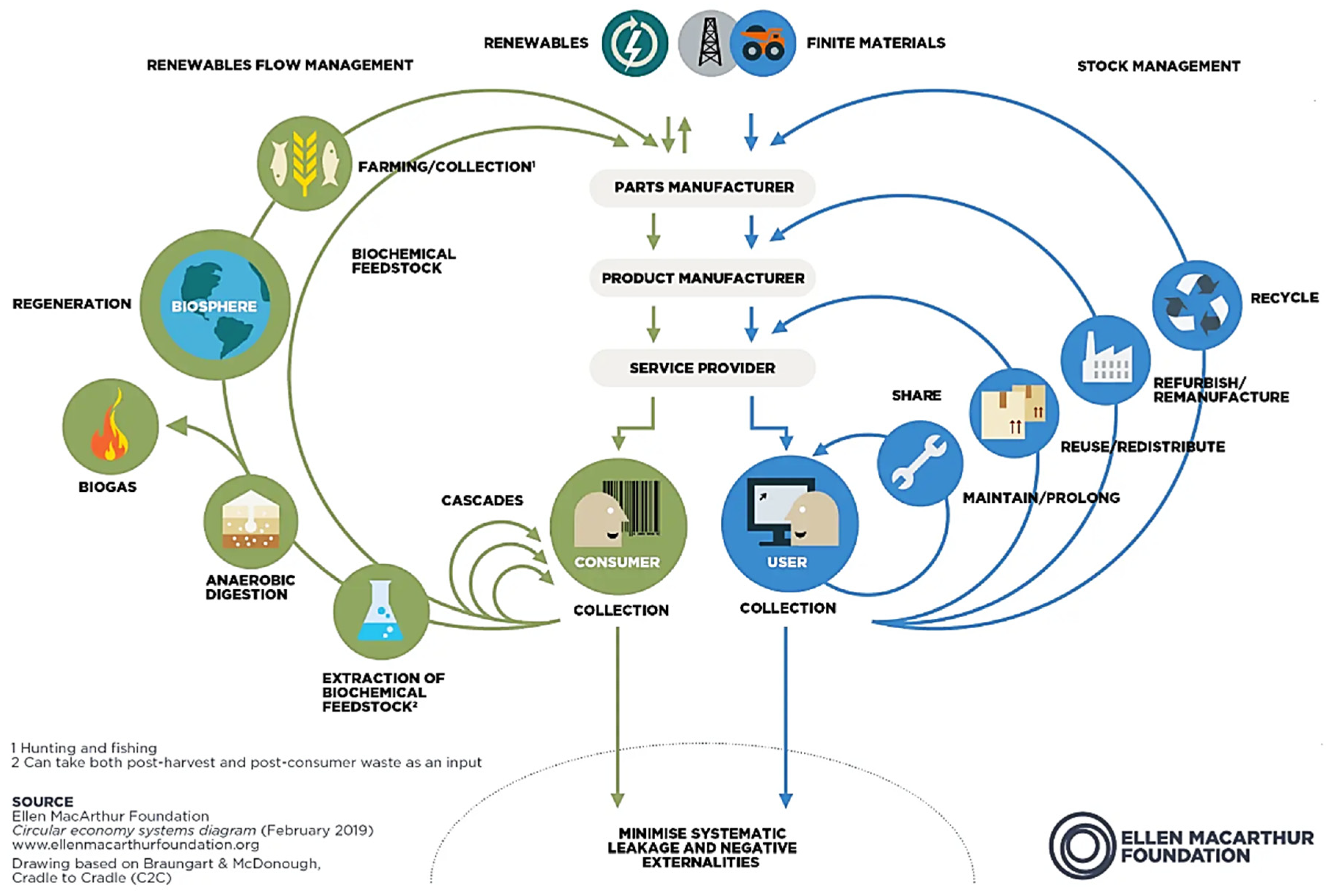
- The Ellen MacArthur Foundation. The Butterfly Diagram: Visualising the Circular Economy. Available online: https://www.ellenmacarthurfoundation.org/circular-economy-diagram?gad_source=1&gad_campaignid=18406820618&gbraid=0AAAAACb4JAfblnHdqkXwprajOEhXG33EK&gclid=CjwKCAjwhuHEBhBHEiwAZrvdcrJpkT9HCYObrKylQxJo10X8sMH0GS5IqSa4FZe0ZJjuspQU5_C3qxoCYW8QAvD_BwE (accessed on 10 August 2025).
- Han, Y.; Shevchenko, T.; Yannou, B.; Ranjbari, M.; Shams Esfandabadi, Z.; Saidani, M.; Bouillass, G.; Bliumska-Danko, K.; Li, G. Exploring How Digital Technologies Enable a Circular Economy of Products. Sustainability 2023, 15, 2067. [Google Scholar] [CrossRef] [Scilit]
- Wu, H.; Li, S.; Hou, W.; Zhang, X. Leveraging Digital Platforms for Circular Economy: A Value Creation View. Sustainability 2024, 16, 11180. [Google Scholar] [CrossRef] [Scilit]
- Cagno, E.; Neri, A.; Negri, M.; Bassani, C.A.; Lampertico, T. The Role of Digital Technologies in Operationalizing the Circular Economy Transition: A Systematic Literature Review. Appl. Sci. 2021, 11, 3328. [Google Scholar] [CrossRef] [Scilit]
- Jensen, S.F.; Kristensen, J.H.; Adamsen, S.; Christensen, A.; Waehrens, B.V. Digital Product Passports for a Circular Economy: Data Needs for Product Life Cycle Decision-Making. Sustain. Prod. Consum. 2023, 37, 242–255. [Google Scholar] [CrossRef] [Scilit]
- Kovacic, Z.; García Casañas, C.; Argüelles, L.; Yáñez Serrano, P.; Ribera-Fumaz, R.; Prause, L.; March, H. The Twin Green and Digital Transition: High-Level Policy or Science Fiction? Environ. Plan. E Nat. Space 2024, 7, 2251–2278. [Google Scholar] [CrossRef] [Scilit]
- Davim, J.P. Perceptions of Industry 5.0: Sustainability Perspective. Bioresources 2024, 20, 15–16. [Google Scholar] [CrossRef] [Scilit]
- Turskis, Z.; Šniokienė, V. IoT-Driven Transformation of Circular Economy Efficiency: An Overview. Math. Comput. Appl. 2024, 29, 49. [Google Scholar] [CrossRef] [Scilit]
- Turner, C.J.; Oyekan, J.O. Personalised Production in the Age of Circular Additive Manufacturing. Appl. Sci. 2023, 13, 4912. [Google Scholar] [CrossRef] [Scilit]
- Zhang, Q.; Ullah, A.; Ashraf, S.; Abdullah, M. Synergistic Impact of Internet of Things and Big-Data-Driven Supply Chain on Sustainable Firm Performance. Sustainability 2024, 16, 5717. [Google Scholar] [CrossRef] [Scilit]
- de Melo, T.A.C.; de Oliveira, M.A.; de Sousa, S.R.G.; Vieira, R.K.; Amaral, T.S. Circular Economy Public Policies: A Systematic Literature Review. Procedia Comput. Sci. 2022, 204, 652–662. [Google Scholar] [CrossRef] [Scilit]
- Afolabi, J.A. Advancing the Circular Economy in Europe: The Role of Eco-Innovation, Economic Complexity, and Digitalization. Technol. Soc. 2025, 83, 103027. [Google Scholar] [CrossRef] [Scilit]
- Sołtysiński, T.; Niederhausen, J.; Eichstädt, S. Digital Calibration Certificate in a Trusted Quality Infrastructure Federated Data Space: A Proof of Concept. Meas. Sens. 2025, 38, 101484. [Google Scholar] [CrossRef] [Scilit]
- Jansen, M.; Meisen, T.; Plociennik, C.; Berg, H.; Pomp, A.; Windholz, W. Stop Guessing in the Dark: Identified Requirements for Digital Product Passport Systems. Systems 2023, 11, 123. [Google Scholar] [CrossRef] [Scilit]
- Song, J.; Liu, Z.; He, Z. How Does Industrial Internet Platform Impact Enterprise Digital Transformation? A Quasi-Natural Experiment Based on China’s Industrial Internet Pilot Demonstration Projects. Technol. Anal. Strateg. Manag. 2025, 1–18. [Google Scholar] [CrossRef] [Scilit]
- Bachmann, N.; Tripathi, S.; Brunner, M.; Jodlbauer, H. The Contribution of Data-Driven Technologies in Achieving the Sustainable Development Goals. Sustainability 2022, 14, 2497. [Google Scholar] [CrossRef] [Scilit]
- Farfán Chilicaus, G.C.; Licapa-Redolfo, G.S.; Arbulú Ballesteros, M.A.; Corrales Otazú, C.D.; Apaza Miranda, S.J.; Flores Castillo, M.M.; Castro Ijiri, G.L.; Guzmán Valle, M.D.l.Á.; Arbulú Castillo, J.C. Digital Transformation and Sustainability in Post-Pandemic Supply Chains: A Global Bibliometric Analysis of Technological Evolution and Research Patterns (2020–2024). Sustainability 2025, 17, 3009. [Google Scholar] [CrossRef] [Scilit]
- Shahrjerdi, R.; Bazoubandi, R. Circular Economy and Sustainability: A Comprehensive Analysis. Adv. Ind. Eng. 2024, 58, 251–276. [Google Scholar] [CrossRef]
- Neri, A.; Cagno, E.; Susur, E.; Urueña, A.; Nuur, C.; Kumar, V.; Franchi, S.; Sorrentino, C. The Relationship between Digital Technologies and the Circular Economy: A Systematic Literature Review and a Research Agenda. RD Manag. 2025, 55, 617–713. [Google Scholar] [CrossRef] [Scilit]
- Bressanelli, G.; Adrodegari, F.; Pigosso, D.C.A.; Parida, V. Towards the Smart Circular Economy Paradigm: A Definition, Conceptualization, and Research Agenda. Sustainability 2022, 14, 4960. [Google Scholar] [CrossRef] [Scilit]
- Aromataris, E.; Pearson, A. The Systematic Review. AJN Am. J. Nurs. 2014, 114, 53–58. [Google Scholar] [CrossRef] [Scilit] [PubMed]
- Wynn, M.; Jones, P. Digital Technology Deployment and the Circular Economy. Sustainability 2022, 14, 9077. [Google Scholar] [CrossRef] [Scilit]
- Lamptey, T.; Owusu-Manu, D.-G.; Acheampong, A.; Adesi, M.; Ghansah, F.A. A Framework for the Adoption of Green Business Models in the Ghanaian Construction Industry. Smart Sustain. Built Environ. 2021, 10, 536–553. [Google Scholar] [CrossRef] [Scilit]
- Khan, S.A.R.; Umar, M.; Zhang, Y.; Tanveer, M. A Recent Digitalization in Recycling Industry Attaining Ecological Sustainability: A Comprehensive Outlook and Future Trend. Environ. Sci. Pollut. Res. 2023, 30, 103760–103775. [Google Scholar] [CrossRef] [Scilit] [PubMed]
- Rejeb, A.; Suhaiza, Z.; Rejeb, K.; Seuring, S.; Treiblmaier, H. The Internet of Things and the Circular Economy: A Systematic Literature Review and Research Agenda. J. Clean. Prod. 2022, 350, 131439. [Google Scholar] [CrossRef] [Scilit]
- Basile, D.; D’Adamo, I.; Goretti, V.; Rosa, P. Digitalizing Circular Economy through Blockchains: The Blockchain Circular Economy Index. J. Ind. Prod. Eng. 2023, 40, 233–245. [Google Scholar] [CrossRef] [Scilit]
- Wiegand, T.; Wynn, M.G. Sustainability, the Circular Economy and Digitalisation in the German Textile and Clothing Industry. Sustainability 2023, 15, 9111. [Google Scholar] [CrossRef] [Scilit]
- Franzè, C.; Pesce, D.; Kalverkamp, M.; Pehlken, A. “Scale without Mass”: A Decision-Making Tool for Scaling Remanufacturing Practices in the White Goods Industry. J. Clean. Prod. 2023, 417, 138078. [Google Scholar] [CrossRef] [Scilit]
- Akarsu, T.N. Digital Transformation towards a Sustainable Circular Economy: Can It Be the Way Forward? J. Inf. Technol. Teach. Cases 2024, 14, 186–191. [Google Scholar] [CrossRef] [Scilit]
- Litleskare, S.; Wuyts, W. Planning Reclamation, Diagnosis and Reuse in Norwegian Timber Construction with Circular Economy Investment and Operating Costs for Information. Sustainability 2023, 15, 10225. [Google Scholar] [CrossRef] [Scilit]
- Neri, A.; Negri, M.; Cagno, E.; Kumar, V.; Garza-Reyes, J.A. What Digital-Enabled Dynamic Capabilities Support the Circular Economy? A Multiple Case Study Approach. Bus. Strategy Environ. 2023, 32, 5083–5101. [Google Scholar] [CrossRef] [Scilit]
- Sharma, M.; Joshi, S.; Govindan, K. Overcoming Barriers to Implement Digital Technologies to Achieve Sustainable Production and Consumption in the Food Sector: A Circular Economy Perspective. Sustain. Prod. Consum. 2023, 39, 203–215. [Google Scholar] [CrossRef] [Scilit]
- Kolade, O.; Odumuyiwa, V.; Abolfathi, S.; Schröder, P.; Wakunuma, K.; Akanmu, I.; Whitehead, T.; Tijani, B.; Oyinlola, M. Technology Acceptance and Readiness of Stakeholders for Transitioning to a Circular Plastic Economy in Africa. Technol. Forecast. Soc. Change 2022, 183, 121954. [Google Scholar] [CrossRef] [Scilit]
- Akram, S.V.; Malik, P.K.; Singh, R.; Gehlot, A.N.; Juyal, A.; Ghafoor, K.Z.; Shrestha, S. Implementation of Digitalized Technologies for Fashion Industry 4.0: Opportunities and Challenges. Sci. Program. 2022, 2022, 1–17. [Google Scholar] [CrossRef] [Scilit]
- Upadhyay, A.; Laing, T.; Kumar, V.; Dora, M. Exploring Barriers and Drivers to the Implementation of Circular Economy Practices in the Mining Industry. Resour. Policy 2021, 72, 102037. [Google Scholar] [CrossRef] [Scilit]
- Jiang, F.; Kok Wei, K.; Ng, S.-P.; Amin, M.; Herjanto, H.; Liu, J. How Blockchain Technology Hyperautomatically Affects Corporate Performance by Green Supply Chain? Enterp. Inf. Syst. 2023, 17, 2204305. [Google Scholar] [CrossRef] [Scilit]
- Juszczyk, O.; Shahzad, K. Blockchain Technology for Renewable Energy: Principles, Applications and Prospects. Energies 2022, 15, 4603. [Google Scholar] [CrossRef] [Scilit]
- Ortega-Gras, J.J.; Gómez-Gómez, M.V.; Bueno-Delgado, V.V.; Garrido-Lova, J.; Cañavate-Cruzado, G. Designing a Technological Pathway to Empower Vocational Education and Training in the Circular Wood and Furniture Sector through Extended Reality. Electronics 2023, 12, 2328. [Google Scholar] [CrossRef] [Scilit]
- Neri, A.; Negri, M.; Cagno, E.; Franzò, S.; Kumar, V.; Lampertico, T.; Bassani, C.A. The Role of Digital Technologies in Supporting the Implementation of Circular Economy Practices by Industrial Small and Medium Enterprises. Bus. Strategy Environ. 2023, 32, 4693–4718. [Google Scholar] [CrossRef] [Scilit]
- Santolin, R.B.; Hameed, H.B.; Urbinati, A.; Lazzarotti, V. Exploiting Circular Economy Enablers for SMEs to Advance towards a More Sustainable Development: An Empirical Study in the Post COVID-19 Era. Resour. Conserv. Recycl. Adv. 2023, 19, 200164. [Google Scholar] [CrossRef] [Scilit]
- Sjödin, D.; Parida, V.; Kohtamäki, M. Artificial Intelligence Enabling Circular Business Model Innovation in Digital Servitization: Conceptualizing Dynamic Capabilities, AI Capacities, Business Models and Effects. Technol. Forecast. Soc. Change 2023, 197, 122903. [Google Scholar] [CrossRef] [Scilit]
- Cetin, S.; Gruis, V.H.; Straub, A.D. Digitalization for a Circular Economy in the Building Industry: Multiple-Case Study of Dutch Social Housing Organizations. Resour. Conserv. Recycl. Adv. 2022, 15, 200110. [Google Scholar] [CrossRef] [Scilit]
- Mondal, S.; Singh, S.; Gupta, H. Green Entrepreneurship and Digitalization Enabling the Circular Economy through Sustainable Waste Management-An Exploratory Study of Emerging Economy. J. Clean. Prod. 2023, 422, 138433. [Google Scholar] [CrossRef] [Scilit]
- Anass, C.; Chiarini, A.; Belhadi, A.; El Baz, J.; Benabdellah, A.C. Digital Technologies and Circular Economy Practices: Vital Enablers to Support Sustainable and Resilient Supply Chain Management in the Post-COVID-19 Era. TQM J. 2022, 34, 179–202. [Google Scholar] [CrossRef] [Scilit]
- Hoosain, M.S.; Paul, B.S.; Ramakrishna, S.A. The Impact of 4ir Digital Technologies and Circular Thinking on the United Nations Sustainable Development Goals. Sustainability 2020, 12, 10143. [Google Scholar] [CrossRef] [Scilit]
- Rodrigues Dias, V.M.; Jugend, D.; de Camargo Fiorini, P.; Razzino, C.d.A.; Paula Pinheiro, M.A. Possibilities for Applying the Circular Economy in the Aerospace Industry: Practices, Opportunities and Challenges. J. Air Transp. Manag. 2022, 102, 102227. [Google Scholar] [CrossRef] [Scilit]
- Choudhuri, B.; Srivastava, P.R.; Mangla, S.K.; Kazancoglu, Y. Enterprise Architecture as a Responsible Data Driven Urban Digitization Framework: Enabling Circular Cities in India. Ann. Oper. Res. 2025, 354, 193–221. [Google Scholar] [CrossRef] [Scilit]
- Jebbor, I.; Benmamoun, Z.; Hachimi, H. Leveraging Digital Twins and Metaverse Technologies for Sustainable Circular Operations: A Comprehensive Literature Review. Circ. Econ. Sustain. 2025, 5, 5795–5848. [Google Scholar] [CrossRef] [Scilit]
- Kalogiannidis, S.; Kalfas, D.; Chatzitheodoridis, F.; Kontsas, S. The Impact of Digitalization in Supporting the Performance of Circular Economy: A Case Study of Greece. J. Risk Financ. Manag. 2022, 15, 349. [Google Scholar] [CrossRef] [Scilit]
- Sangpetch, P.; Ueasangkomsate, P. The Influence of the Big Data Analytics and Circular Economy on the Sustainable Performance of SMEs. Thammasat Rev. 2023, 26, 114–139. [Google Scholar] [CrossRef]
- Attaianese, E.; Illario, M.; Rigillo, M. Emergent Dwelling. Requests for Designing a Human-Scale and Climate-Proof Lifetime House. TECHNE-J. Technol. Archit. Environ. 2022, 24, 254–263. [Google Scholar] [CrossRef] [Scilit]
- Prashar, A.; Chaudhuri, A. Digitalization for Circular Economy and Operational Excellence Practices: A Paradox Theory Perspective on Performance Improvement in Manufacturing Firms. Bus. Strategy Environ. 2025, 34, 1154–1170. [Google Scholar] [CrossRef] [Scilit]
- Aiello, F.; Cozzucoli, P.C.; Mannarino, L.; Pupo, V. Bayesian Insights on Digitalization and Environmental Sustainability Practices. Towards the Twin Transition in the EU. Bus. Strategy Environ. 2025, 34, 417–432. [Google Scholar] [CrossRef] [Scilit]
- Evangelista, S.S.; Aro, J.L.; Selerio, E.F.; Maturan, F.; Atibing, N.M.; Ocampo, L.A.; Pamucar, D.S.S. An Integrated Fermatean Fuzzy Multi-Attribute Evaluation of Digital Technologies for Circular Public Sector Supply Chains. Int. J. Comput. Intell. Syst. 2023, 16, 122. [Google Scholar] [CrossRef] [Scilit]
- Howard, M.; Yan, X.; Mustafee, N.; Charnley, F.; Böhm, S.G.; Pascucci, S. Going beyond Waste Reduction: Exploring Tools and Methods for Circular Economy Adoption in Small-Medium Enterprises. Resour. Conserv. Recycl. 2022, 182, 106345. [Google Scholar] [CrossRef] [Scilit]
- Arciniegas, G.A.; Sileryte, R.; Dabrowski, M.; Wandl, A.; Dukai, B.; Bohnet, M.; Gutsche, J.M. A Geodesign Decision Support Environment for Integrating Management of Resource Flows in Spatial Planning. Urban Plan. 2019, 4, 32–51. [Google Scholar] [CrossRef] [Scilit]
- Carlsson, R.; Nevzorova, T.A.; Vikingsson, K. Long-Lived Sustainable Products through Digital Innovation. Sustainability 2022, 14, 14364. [Google Scholar] [CrossRef] [Scilit]
- Hojnik, J.; Ruzzier, M.; Konečnik Ruzzier, M.; Sučić, B.; Soltwisch, B.W. Challenges of Demographic Changes and Digitalization on Eco-Innovation and the Circular Economy: Qualitative Insights from Companies. J. Clean. Prod. 2023, 396, 136439. [Google Scholar] [CrossRef] [Scilit]
- Moscati, A.; Johansson, P.; Kebede, R.; Pula, A.; Törngren, A. Information Exchange between Construction and Manufacturing Industries to Achieve Circular Economy: A Literature Review and Interviews with Swedish Experts. Buildings 2023, 13, 633. [Google Scholar] [CrossRef] [Scilit]
- Meng, X.; Das, S.; Meng, J. Integration of Digital Twin and Circular Economy in the Construction Industry. Sustainability 2023, 15, 13186. [Google Scholar] [CrossRef] [Scilit]
- Jiang, P.; Zhang, L.; You, S.; Fan, Y.V.; Tan, R.R.; Klemeš, J.J.; You, F. Blockchain Technology Applications in Waste Management: Overview, Challenges and Opportunities. J. Clean. Prod. 2023, 421, 138466. [Google Scholar] [CrossRef] [Scilit]
- Yang, C.; Xu, Y.; Shi, J.; Dai, B.; Zhou, B. Temporal Pyramid Network for Action Recognition. In Proceedings of the IEEE Computer Society Conference on Computer Vision and Pattern Recognition; IEEE: New York, NY, USA, 2020; pp. 588–597. [Google Scholar]
- Saeedi, K.A.; Visvizi, A.; Alahmadi, D.H.; Babour, A.J. Smart Cities and Households’ Recyclable Waste Management: The Case of Jeddah. Sustainability 2023, 15, 6776. [Google Scholar] [CrossRef] [Scilit]
- Liang, X.; Goh, H.H.; KURNIAWAN, T.A.; Zhang, D.; Dai, W.; Liu, H.; Liu, J.; Goh, K.C. Utilizing Landfill Gas (LFG) to Electrify Digital Data Centers in China for Accelerating Energy Transition in Industry 4.0 Era. J. Clean. Prod. 2022, 369, 133297. [Google Scholar] [CrossRef] [Scilit]
- Lavagna, M.; Giorgi, S.; Pimponi, D.; Porcari, A. Enabling Technologies for Circular Economy in the Construction Sector; Tecnologie Abilitanti per l’economia Circolare Nel Settore Edilizio. Techne 2023, 25, 214–224. [Google Scholar] [CrossRef] [Scilit]
- Voukkali, I.; Papamichael, I.; Economou, F.; Loizia, P.; Klontza, E.E.; Lekkas, D.F.; Naddeo, V.; Zorpas, A.A. Factors Affecting Social Attitude and Behavior for the Transition towards a Circular Economy. Sustain. Chem. Pharm. 2023, 36, 101276. [Google Scholar] [CrossRef] [Scilit]
- Rahla, K.M.; Mateus, R.; Bragança, L.M. Implementing Circular Economy Strategies in Buildings—From Theory to Practice. Appl. Syst. Innov. 2021, 4, 26. [Google Scholar] [CrossRef] [Scilit]
- Cinquepalmi, F.; Paris, S.; Pennacchia, E.; Tiburcio, V.A. Efficiency and Sustainability: The Role of Digitization in Re-Inhabiting the Existing Building Stock. Energies 2023, 16, 3613. [Google Scholar] [CrossRef] [Scilit]
- Kazancoglu, Y.; Ozbiltekin-Pala, M.; Sezer, M.D.; Kumar, A.; Luthra, S. Circular Dairy Supply Chain Management through Internet of Things-Enabled Technologies. Environ. Sci. Pollut. Res. 2022, 29, 1–13. [Google Scholar] [CrossRef] [Scilit]
- Ahmed, A.A.; Nazzal, M.A.; Darras, B.M. Cyber-Physical Systems as an Enabler of Circular Economy to Achieve Sustainable Development Goals: A Comprehensive Review. Int. J. Precis. Eng. Manuf.-Green Technol. 2022, 9, 955–975. [Google Scholar] [CrossRef] [Scilit]
- Antončič, J.A.; Hojnik, J.; Ruzzier, M.; Ruzzier, M.K.; Soltwisch, B. The Role of Demographic Changes and Digitalization in Eco-Innovations and Their Effects on the Growth of Companies. Sustainability 2024, 16, 6203. [Google Scholar] [CrossRef] [Scilit]
- Thakuri, P.K.; Alkki, L.; Aarikka-Stenroos, L. Digital Technologies Enabling Component Reuse in Circular Value Chains: Using Digital Twin, Internet of Things and Robots in Construction and Manufacturing Sectors. R D Manag. 2025, 55, 1161–1216. [Google Scholar] [CrossRef] [Scilit]
- Daneshmand, M.; Noroozi, F.; Corneanu, C.; Mafakheri, F.; Fiorini, P. Industry 4.0 and Prospects of Circular Economy: A Survey of Robotic Assembly and Disassembly. Int. J. Adv. Manuf. Technol. 2023, 124, 2973–3000. [Google Scholar] [CrossRef] [Scilit]
- Hsu, C.-H.; Li, Z.-H.; Zhuo, H.-J.; Zhang, T.-Y. Enabling Industry 5.0-Driven Circular Economy Transformation: A Strategic Roadmap. Sustainability 2024, 16, 9954. [Google Scholar] [CrossRef] [Scilit]
- Katika, T.; Karaseitanidis, I.; Tsiakou, D.; Makropoulos, C.K.; Amditis, A.J. Augmented Reality (AR) Supporting Citizen Engagement in Circular Economy. Circ. Econ. Sustain. 2022, 2, 1077–1104. [Google Scholar] [CrossRef] [Scilit] [PubMed]
- Rocca, R.; Rosa, P.; Sassanelli, C.; Fumagalli, L.; Terzi, S. Integrating Virtual Reality and Digital Twin in Circular Economy Practices: A Laboratory Application Case. Sustainability 2020, 12, 2286. [Google Scholar] [CrossRef] [Scilit]
- Soman, R.K.; Nikolić, D.; Sanchez, B. Extended Reality as a Catalyst for Circular Economy Transition in the Built Environment. In A Circular Built Environment in the Digital Age; Springer: Cham, Switzerland, 2024; pp. 171–193. ISBN 978-3-031-39675-5. [Google Scholar]
- Rosenlund, J.; Helmefalk, M.; Stenfelt, S.; Palmquist, A. Levelling up the Recycling Experience: Gamification of Recycling through an Innovative Recycling Station. Circ. Econ. Sustain. 2025, 5, 1983–2007. [Google Scholar] [CrossRef] [Scilit]
- Talukder, M.S.; Biswas, M.I.; Azad, N. The Role of Online Information Sources in Enhancing Circular Consumption Behaviour: Fostering Sustainable Consumption Patterns in the Digital Age. Bus. Strategy Environ. 2025, 34, 1419–1439. [Google Scholar] [CrossRef] [Scilit]
- Merlino, S.; Locritani, M.; Guarnieri, A.; Delrosso, D.; Bianucci, M.; Paterni, M. Marine Litter Tracking System: A Case Study with Open-Source Technology and a Citizen Science-Based Approach. Sensors 2023, 23, 935. [Google Scholar] [CrossRef] [Scilit]
- Mager, A.; Blass, V. From Illegal Waste Dumps to Beneficial Resources Using Drone Technology and Advanced Data Analysis Tools: A Feasibility Study. Remote Sens. 2022, 14, 3923. [Google Scholar] [CrossRef] [Scilit]
- Telefónica Tech Telefónica Tech and the Real Club Náutico de Palma Will Use a Water Drone to Treat Marine Waste During the Copa Del Rey Regatta. Available online: https://www.telefonica.com/en/communication-room/press-room/telefonica-tech-real-club-nautico-de-palma-water-drone-treat-marine-waste-copa-del-rey-regatta/ (accessed on 2 September 2025).
- Fricke, A. Robots to the Rescue: Automated Disassembly for e-Waste Recycling. Available online: https://techxplore.com/news/2025-02-robots-automated-disassembly-recycling.html#:~:text=In%20the%20iDEAR%20project%2C%20short,loop%20waste%20management%20system (accessed on 2 September 2025).
- Heikkilä, S.; Malahat, G.; Deviatkin, I. From Waste to Value: Enhancing Circular Value Creation in Municipal Solid Waste Management Ecosystem through Artificial Intelligence-Powered Robots. In Sustainable and Circular Management of Resources and Waste Towards a Green Deal; Elsevier: Amsterdam, The Netherlands, 2023; pp. 415–428. ISBN 978-0-323-95278-1. [Google Scholar]
- Ada, E.; Sezer, M.D.; Kazancoglu, Y.; Khaleel, R. Towards the Smart Sustainable and Circular Food Supply Chains through Digital Technologies. Int. J. Math. Eng. Manag. Sci. 2023, 8, 374–402. [Google Scholar] [CrossRef] [Scilit]
- Jabbour, C.J.C.; Jabbour, A.B.L.d.S.; Sarkis, J.; Filho, M.G. Unlocking the Circular Economy through New Business Models Based on Large-Scale Data: An Integrative Framework and Research Agenda. Technol. Forecast. Soc. Change 2019, 144, 546–552. [Google Scholar] [CrossRef] [Scilit]
- Jašek, M.; Kubečková, D. The Digital Twin on a Residential Housing in the Czech Republic on the BIM Platform and Its Importance for the Circular Economy. Structures 2025, 78, 109180. [Google Scholar] [CrossRef] [Scilit]
- Talla, A.; McIlwaine, S.J. Industry 4.0 and the Circular Economy: Using Design-Stage Digital Technology to Reduce Construction Waste. Smart Sustain. Built Environ. 2024, 13, 179–198. [Google Scholar] [CrossRef] [Scilit]
- Akbari, M.; Hopkins, J.L. Digital Technologies as Enablers of Supply Chain Sustainability in an Emerging Economy. Oper. Manag. Res. 2022, 15, 689–710. [Google Scholar] [CrossRef] [Scilit]
- De Felice, F.; Rehman, M.; Petrillo, A.; Ortiz Barrios, M.A.; Baffo, I. Integrating IoT and Circular Economy in Textile Supply Chains: A Closed-Loop Model for Sustainable Production Using Recycled PET and Spent Coffee Grounds. J. Clean. Prod. 2025, 501, 145277. [Google Scholar] [CrossRef] [Scilit]
- Rossi, J.; Bianchini, A.; Guarnieri, P. Circular Economy Model Enhanced by Intelligent Assets from Industry 4.0: The Proposition of an Innovative Tool to Analyze Case Studies. Sustainability 2020, 12, 7147. [Google Scholar] [CrossRef] [Scilit]
- Ali, M.U.; Khan, I.; Khan, H. Leveraging Industry 4.0 Technologies and Industrial Symbiosis: Advancing Circular Economy Practices in BRICS Economies. J. Environ. Manage. 2025, 383, 125471. [Google Scholar] [CrossRef] [Scilit]
- Shah, S.K.; Yuan, J.; Tajeddini, K.; Chathurika Gamage, T.C.; Liu, M. Exploring the Nexus of Institutional Factors and Regulatory Focus in Driving Platform-Based Servitization and Circular Economy Adoption. Technol. Soc. 2025, 81, 102854. [Google Scholar] [CrossRef] [Scilit]
- Abbate, S.; Centobelli, P.; Cerchione, R. From Fast to Slow: An Exploratory Analysis of Circular Business Models in the Italian Apparel Industry. Int. J. Prod. Econ. 2023, 260, 108824. [Google Scholar] [CrossRef] [Scilit]
- Escrig, J.; Fischer, O.J.; Gomes, R.L.; Watson, N. Intelligent Resource Use to Deliver Waste Valorisation and Process Resilience in Manufacturing Environments. Johns. Matthey Technol. Rev. 2020, 64, 93–99. [Google Scholar] [CrossRef] [Scilit]
- Kurniawan, T.A.; Othman, M.H.D.; Hwang, G.H.; Gikas, P. Unlocking Digital Technologies for Waste Recycling in Industry 4.0 Era: A Transformation towards a Digitalization-Based Circular Economy in Indonesia. J. Clean. Prod. 2022, 357, 131911. [Google Scholar] [CrossRef] [Scilit]
- Bhubalan, K.; Tamothran, A.M.; Kee, S.H.; Foong, S.Y.; Lam, S.S.; Ganeson, K.; Vigneswari, S.; Abdullah, A.A.A.; Ramakrishna, S.A. Leveraging Blockchain Concepts as Watermarkers of Plastics for Sustainable Waste Management in Progressing Circular Economy. Environ. Res. 2022, 213, 113631. [Google Scholar] [CrossRef] [Scilit]
- Khatami, F.; Vilamová, Š.; Cagno, E.; de Bernardi, P.; Neri, A.; Cantino, V. Efficiency of Consumer Behaviour and Digital Ecosystem in the Generation of the Plastic Waste toward the Circular Economy. J. Environ. Manag. 2023, 325, 116555. [Google Scholar] [CrossRef] [Scilit]
- Adisorn, T.; Tholen, L.; Götz, T. Towards a Digital Product Passport Fit for Contributing to a Circular Economy. Energies 2021, 14, 2289. [Google Scholar] [CrossRef] [Scilit]
- Bressanelli, G.; Adrodegari, F.; Perona, M.; Saccani, N. Exploring How Usage-Focused Business Models Enable Circular Economy through Digital Technologies. Sustainability 2018, 10, 639. [Google Scholar] [CrossRef] [Scilit]
- Kim, M.; Lim, C.; Hsuan, J. From Technology Enablers to Circular Economy: Data-Driven Understanding of the Overview of Servitization and Product–Service Systems in Industry 4.0. Comput. Ind. 2023, 148, 103908. [Google Scholar] [CrossRef] [Scilit]
- Gao, K.; Liu, T.; Rong, Y.; Simic, V.M.; Garg, H.; Senapati, T. A Novel BWM-Entropy-COPRAS Group Decision Framework with Spherical Fuzzy Information for Digital Supply Chain Partner Selection. Complex Intell. Syst. 2024, 10, 6983–7008. [Google Scholar] [CrossRef] [Scilit]
- Tugra, A.; Mohamed, M. FROM PREFERENCE TO PRACTICE: HOW POLICY FRAMING SHAPES SUSTAINABLE CHOICES IN THE SHARING ECONOMY. Glob. Fash. Manag. Conf. 2025, 2025, 461. [Google Scholar] [CrossRef] [Scilit]
- Rezania, S.; Oryani, B.; Nasrollahi, V.R.; Darajeh, N.; Lotfi Ghahroud, M.; Mehranzamir, K. Review on Waste-to-Energy Approaches toward a Circular Economy in Developed and Developing Countries. Processes 2023, 11, 2566. [Google Scholar] [CrossRef] [Scilit]
- Turner, C.J.; Okorie, O.S.; Emmanouilidis, C.; Oyekan, J.O. Circular Production and Maintenance of Automotive Parts: An Internet of Things (IoT) Data Framework and Practice Review. Comput. Ind. 2022, 136, 103593. [Google Scholar] [CrossRef] [Scilit]
- Oyinlola, M.A.; Schroeder, P.M.; Whitehead, T.; Kolade, O.; Wakunuma-Zojer, K.J.; Sharifi, S.; Rawn, B.G.; Odumuyiwa, V.T.; Lendelvo, S.; Brighty, G. Digital Innovations for Transitioning to Circular Plastic Value Chains in Africa. Afr. J. Manag. 2022, 8, 83–108. [Google Scholar] [CrossRef] [Scilit]
- Askar, R.; Karaca, F.; Salles, A.; Lukyanenko, A.; Cervantes Puma, G.C.; Tavares, V.; Khaidarova, A.; Nadaždi, A.; Pineda-Martos, R.; Díaz-Cabrera, J.M.; et al. Driving the Built Environment Twin Transition: Synergising Circular Economy and Digital Tools. In Circular Economy Design and Management in the Built Environment; Springer: Cham, Switzerland, 2025; pp. 459–505. [Google Scholar]
- Voulgaridis, K.; Lagkas, T.; Angelopoulos, C.M.; Boulogeorgos, A.-A.A.; Argyriou, V.; Sarigiannidis, P. Digital Product Passports as Enablers of Digital Circular Economy: A Framework Based on Technological Perspective. Telecommun. Syst. 2024, 85, 699–715. [Google Scholar] [CrossRef] [Scilit]
- Chi, Z.; Liu, Z.; Wang, F.; Osmani, M. Driving Circular Economy through Digital Technologies: Current Research Status and Future Directions. Sustainability 2023, 15, 16608. [Google Scholar] [CrossRef] [Scilit]
- Okorie, O.S.; Russell, J.D.; Jin, Y.; Turner, C.J.; Wang, Y.; Charnley, F. Removing Barriers to Blockchain Use in Circular Food Supply Chains: Practitioner Views on Achieving Operational Effectiveness. Clean. Logist. Supply Chain 2022, 5, 100087. [Google Scholar] [CrossRef] [Scilit]
- Grover, V.; Balusamy, B.; Milanova, M.G.; Felix, A.Y. Blockchain, IoT, and AI Technologies for Supply Chain Management: Apply Emerging Technologies to Address and Improve Supply Chain Management; Apress: Berkeley, CA, USA, 2024; ISBN 9798868803154. [Google Scholar]
- Varbanova, M.; de Barcellosa, M.D.; Kirova, M.; De Steur, H.; Gellynck, X. Industry 4.0 Implementation Factors for Agri-Food and Manufacturing SMEs in Central and Eastern Europe. Serbian J. Manag. 2023, 18, 167–179. [Google Scholar] [CrossRef] [Scilit]
- Bressanelli, G.; Saccani, N.; Perona, M. Are Digital Servitization-Based Circular Economy Business Models Sustainable? A Systemic What-If Simulation Model. J. Clean. Prod. 2024, 458, 142512. [Google Scholar] [CrossRef] [Scilit]
- Galatola, M. 2 Circular Economy and Product Sustainability in Europe. In Cyclic Economy; De Gruyter: Berlin, Germany, 2024; pp. 21–36. [Google Scholar]
- Kofos, A.; Ubacht, J.; Rukanova, B.D.; Korevaar, G.; Kouwenhoven, N.; Tan, Y. Circular Economy Visibility Evaluation Framework. J. Responsible Technol. 2022, 10, 100026. [Google Scholar] [CrossRef] [Scilit]
- Huynh, P.H. Enabling Circular Business Models in the Fashion Industry: The Role of Digital Innovation. Int. J. Product. Perform. Manag. 2021, 71, 870–895. [Google Scholar] [CrossRef] [Scilit]
- Piscicelli, L. The Sustainability Impact of a Digital Circular Economy. Curr. Opin. Environ. Sustain. 2023, 61, 101251. [Google Scholar] [CrossRef] [Scilit]
- Al-Omoush, K.S. The Determinants of Digital Circular Economy Innovation and the Ripple Effect on Competitiveness and Social Welfare. Corp. Gov. Int. J. Bus. Soc. 2025, 1–20. [Google Scholar] [CrossRef] [Scilit]
- Abdel-Aty, T.A.; McFarlane, D.; Brooks, S.; Salter, L.; Abubakar, A.S.; Evans, S.; Hawkridge, G.; Price Thomas, K.; Negri, E.; Mukherjee, A.; et al. The Role of Low-Cost Digital Solutions in Supporting Industrial Sustainability. Sustainability 2024, 16, 1301. [Google Scholar] [CrossRef] [Scilit]
- Rosa, P.; Sassanelli, C.; Urbinati, A.; Chiaroni, D.; Terzi, S. Assessing Relations between Circular Economy and Industry 4.0: A Systematic Literature Review. Int. J. Prod. Res. 2020, 58, 1662–1687. [Google Scholar] [CrossRef] [Scilit]
- Khan, A.N.; Soomro, M.A. Empowering Change: Leadership, Flexibility, and the Path to Circular Economy Success. J. Organ. Change Manag. 2025, 38, 935–950. [Google Scholar] [CrossRef] [Scilit]
- Reim, W.; Sas, D.; Parida, V. Circularity and Business Ecosystems: Ecosystem Analysis for Circular Business Models. Manag. Innov. Technol. 2020, 2020, 3. [Google Scholar]
- Benmamoun, Z.; Khlie, K.; Agarwal, V.; Jebbor, I.; Jha, C.K.; El Kadi, H. A Multicriteria Risk Management Model for Agri-Food Industrial Companies. Environ. Dev. Sustain, 2025; in press. [CrossRef] [Scilit]
- Bonilla, S.H.; Silva, H.R.O.; Terra da Silva, M.; Franco Gonçalves, R.; Sacomano, J.B. Industry 4.0 and Sustainability Implications: A Scenario-Based Analysis of the Impacts and Challenges. Sustainability 2018, 10, 3740. [Google Scholar] [CrossRef] [Scilit]
- Sharma, M.; Raut, R.D.; Sehrawat, R.; Ishizaka, A. Digitalisation of Manufacturing Operations: The Influential Role of Organisational, Social, Environmental, and Technological Impediments. Expert Syst. Appl. 2023, 211, 118501. [Google Scholar] [CrossRef] [Scilit]
- Reim, W.; Yli-Viitala, P.; Arrasvuori, J.; Parida, V. Tackling Business Model Challenges in SME Internationalization through Digitalization. J. Innov. Knowl. 2022, 7, 100199. [Google Scholar] [CrossRef] [Scilit]
- Li, Y.; Cao, D.; Hewitt, M.; Shan, S. Using Large-Language Models to Analyse Social Media Engagement with the Public Sector Communication on Circular Economy: Evidence from X. Technol. Forecast. Soc. Change 2026, 222, 124400. [Google Scholar] [CrossRef] [Scilit]
- Brohi, S.; Mastoi, Q.; Jhanjhi, N.Z.; Pillai, T.R. A Research Landscape of Agentic AI and Large Language Models: Applications, Challenges and Future Directions. Algorithms 2025, 18, 499. [Google Scholar] [CrossRef] [Scilit]
- Page, M.J.; McKenzie, J.E.; Bossuyt, P.M.; Boutron, I.; Hoffmann, T.C.; Mulrow, C.D.; Shamseer, L.; Tetzlaff, J.M.; Akl, E.A.; Brennan, S.E.; et al. The PRISMA 2020 statement: An updated guideline for reporting systematic reviews. BMJ 2021, 372, n71. [Google Scholar] [CrossRef] [Scilit]





Disclaimer/Publisher’s Note: The statements, opinions and data contained in all publications are solely those of the individual author(s) and contributor(s) and not of MDPI and/or the editor(s). MDPI and/or the editor(s) disclaim responsibility for any injury to people or property resulting from any ideas, methods, instructions or products referred to in the content. |
© 2026 by the authors. Licensee MDPI, Basel, Switzerland. This article is an open access article distributed under the terms and conditions of the Creative Commons Attribution (CC BY) license.
Share and Cite
Pourrahimian, P.; Seyedzadeh, S.; Arabi, B.; Kahani, D.; Lotfian, S. Digital Enablers of the Circular Economy: A Systematic Review of Applications, Barriers, and Future Directions. J. Manuf. Mater. Process. 2026, 10, 112. https://doi.org/10.3390/jmmp10040112
Pourrahimian P, Seyedzadeh S, Arabi B, Kahani D, Lotfian S. Digital Enablers of the Circular Economy: A Systematic Review of Applications, Barriers, and Future Directions. Journal of Manufacturing and Materials Processing. 2026; 10(4):112. https://doi.org/10.3390/jmmp10040112
Chicago/Turabian StylePourrahimian, Parinaz, Saleh Seyedzadeh, Behrouz Arabi, Daniel Kahani, and Saeid Lotfian. 2026. "Digital Enablers of the Circular Economy: A Systematic Review of Applications, Barriers, and Future Directions" Journal of Manufacturing and Materials Processing 10, no. 4: 112. https://doi.org/10.3390/jmmp10040112
APA StylePourrahimian, P., Seyedzadeh, S., Arabi, B., Kahani, D., & Lotfian, S. (2026). Digital Enablers of the Circular Economy: A Systematic Review of Applications, Barriers, and Future Directions. Journal of Manufacturing and Materials Processing, 10(4), 112. https://doi.org/10.3390/jmmp10040112