1. Introduction
Robotic welding has become a key enabling technology in automotive manufacturing due to its high repeatability, productivity, and process controllability [
1]. However, the interaction among process parameters, material properties, geometric constraints, and the mechanical condition of the system gives rise to complex and nonlinear behavior that limits process stability and weld bead quality [
1,
2].
From a physical standpoint, the welding system must be understood as a coupled thermomechanical process in which process parameters and mechanical boundary conditions act simultaneously on arc behavior and molten pool dynamics [
2]. Variations in geometric constraints, fixture compliance, or clamping conditions may effectively modify local welding conditions such as arc length and electrode stick out even when nominal process parameters remain unchanged [
2]. This coupling introduces additional sources of variability that are not captured by conventional process-only models.
In industrial practice, quality issues are often addressed through empirical parameter adjustments, leading to high costs associated with material waste, machine downtime, and rework [
3]. In this context, design of experiments (DOE) emerges as a fundamental statistical tool to identify significant factors and model the relationship between process variables and quality responses [
4,
5]. Nevertheless, DOE-based approaches implicitly assume stable boundary conditions, which may not hold in the presence of uncontrolled mechanical variability. Recently, data-driven and machine learning strategies have been introduced to enhance welding process optimization beyond traditional statistical frameworks [
6]. However, in practical welding systems, fixture rigidity directly influences the mechanical stability of the work piece during welding [
2]. A reduction in fixture stiffness can lead to micro-displacements under clamping and process forces, altering the effective electrode stick-out and arc length [
2]. Since stick-out directly affects current density, heat input, and metal transfer stability [
7], variations induced by insufficient rigidity may introduce uncontrolled variability that is not captured in conventional DOE-based models [
4].
In classical DOE-based welding studies [
4,
5], experimental error is assumed to arise from stochastic variability under controlled boundary conditions. Similarly, process-parameter analyses in robotic welding [
8,
9] consider fixture configuration as mechanically stable. However, fixture-induced geometric deviations are typically treated as constant constraints rather than interacting variables. This limitation motivates the present coupled thermo-mechanical framework.
Numerous studies have analyzed the influence of parameters such as wire feed speed, arc length, shielding gas flow rate, and electrode stick-out on weld bead quality and the formation of defects such as porosity and spatter [
7,
8,
10]. In addition, Cold Metal Transfer (CMT) technology has demonstrated advantages in terms of arc stability and thermal control, making it a suitable alternative for high-precision applications [
11,
12,
13]. These advantages are mainly attributed to its controlled metal transfer mechanism, which enables lower heat input, synchronized wire retraction during droplet detachment, reduced spatter generation, and improved arc stability. The reduction in heat input minimizes thermal distortion and residual stresses, while the controlled short-circuiting cycle enhances process repeatability and weld bead consistency.
Despite these advances, most existing studies focus primarily on process parameters, while the influence of the mechanical state of the system—particularly fixturing systems—remains largely underexplored. Recent investigations indicate that fixture stiffness, geometric tolerances, and deformation induced by clamping forces significantly affect the stability and repeatability of automated welding processes [
2]. The present work addresses this gap by proposing an integrated framework that combines statistical analysis with physical and mechanical modeling, enabling a more comprehensive understanding and optimization of robotic welding processes under realistic industrial conditions.
4. Mathematical Modeling of the Robotic CMT Welding Process
4.1. Process Energy Model
The linear energy input to the material in GMAW/CMT processes is expressed as [
14]:
where
is the linear energy (J/mm),
η is the thermal efficiency,
V is the arc voltage (V),
I the welding current (A) and
the travel speed (mm/s). This formulation is widely used in welding metallurgy to estimate the effective energy transferred to the workpiece during arc welding operations [
14].
In Cold Metal Transfer (CMT) technology, the electrical signals exhibit periodic dynamic behavior due to the controlled short-circuit metal transfer mechanism [
11]. The instantaneous current and voltage can be expressed as:
where
and
represent the base values of current and voltage, respectively, while
and
correspond to the variation amplitudes associated with the CMT cycle.
The functions and describe the periodic behavior of the process during controlled metal transfer.
The effective average linear energy is obtained from: [
15]:
where
is the effective average linear energy,
is the period of a complete metal transfer cycle, and
and
are the instantaneous voltage and current signals, respectively. This formulation accounts for the dynamic characteristics of the process and provides a more accurate representation of energy input under periodic transfer conditions [
15].
4.2. Mechanical Model of the Fixture System
The total deviation of the component from its ideal position is defined as [
16]:
where
represents geometric deviations and
corresponds to elastic deformations induced by clamping forces.
Geometric deviation is modeled as the quadratic combination of dimensional errors [
17]:
where
corresponds to the dimensional error of the
i-th element contributing to the total geometric deviation. Elastic deformation is expressed as [
16,
18]:
where
is the applied clamping force and
is the equivalent stiffness of the fixture–component system. The equivalent stiffness of the fixture–component system is defined as [
18]:
The effective stick-out is defined as:
The fixture influence factor is defined as:
This parameter quantifies the relative mechanical contribution of fixture-induced variability.
Although direct measurements of fixture stiffness k were not performed, the total deviation captures the combined effect of geometric deviations and fixture compliance. Industrial validation confirms that and the derived reliably reflect mechanical influences on porosity formation.
4.3. Probabilistic Coupled Thermo-Mechanical Model for Porosity Prediction
The probability of porosity formation
is defined as: [
19]:
With:
where
is the travel speed,
the wire feed rate,
the effective stick-out,
the shielding gas flow rate, and
the fixture influence factor. The logistic formulation enables probabilistic modeling of defect occurrence under multiple interacting process variables [
19,
20].
The thermo-mechanical coupling inherent to welding processes arises from the interaction between thermal energy input and mechanical constraint conditions, which influence defect formation mechanisms [
14].
Based on industrial production data collected during three consecutive months (August–October), quantitative stability thresholds for the fixture influence factor were established.
The observed operational regimes are summarized in
Table 4.
From a physical standpoint, the model can be conceptually condensed as:
Although the statistical formulation incorporates individual process parameters, these variables primarily govern the effective thermal input Therefore, the probabilistic model can be interpreted as a coupled thermo–mechanical interaction between the aggregated thermal contribution and the fixture-induced mechanical variability represented by .
In this framework, represents the thermal contribution, whereas captures the mechanical constraint effects.
5. Results and Discussion
5.1. Statistical Analysis of the Initial DOE
The analysis of variance (ANOVA) results is presented in
Table 5. The F-value and
p-value are absent because they could not be calculated. This is due to the Degrees of Freedom (DF) for the Error term being 0. This occurs in a saturated model, where all available data is used to estimate the effects of the factors, leaving no residual data to estimate the natural error variance of the process.
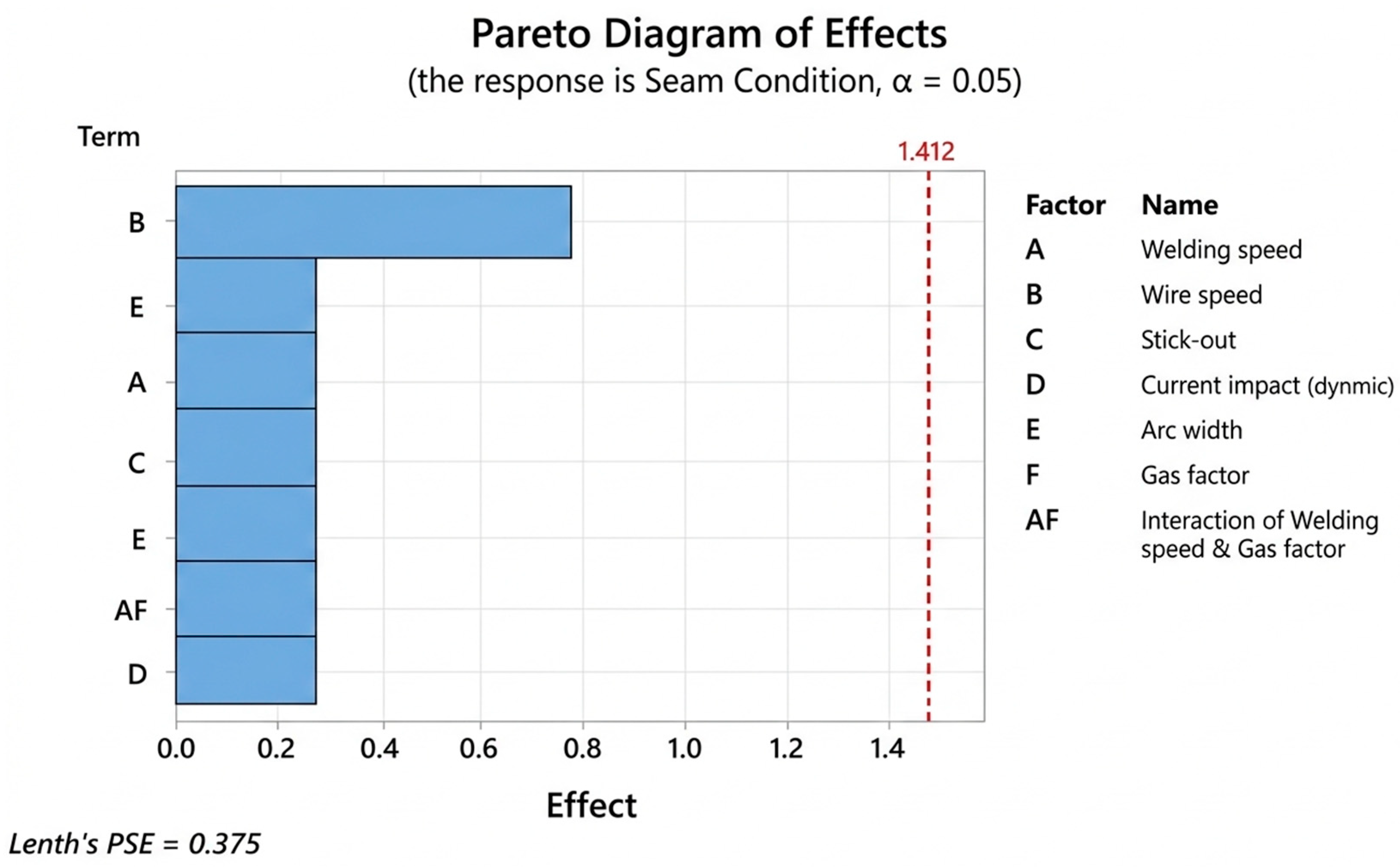
The Pareto chart, presented in
Figure 5, illustrates the relative contribution of each process factor and their interactions to the observed variability. This visualization allows for a quick identification of the most influential factors on the process, highlighting which variables may warrant further investigation or optimization.
At a significance level of α = 0.05, none of the evaluated process parameters reached statistical significance. From a conventional DOE perspective, this outcome would suggest limited sensitivity of porosity formation to the selected process variables within the tested range [
4].
However, when interpreted in light of the coupled thermo-mechanical model developed in
Section 4, this result becomes physically consistent. According to the energy model (Equations (1)–(4)), variations in travel speed and wire feed rate produce only moderate changes in effective linear energy within the experimental window. These changes were insufficient to significantly alter the metal transfer regime characteristic of the CMT process [
11].
Conversely, the mechanical model Equations (5)–(10) indicate that variations in geometric positioning and fixture compliance directly modify the effective stick-out
, which explicitly appears in the coupled process–fixture model (
Section 4.3). These variations introduce uncontrolled variability not included in the original DOE, generating an omitted-variable effect that can mask the statistical influence of process parameters in logistic regression models [
19].
This interpretation is consistent with previous studies highlighting the dominant role of fixture geometry and clamping conditions in welding distortion and quality variability [
21,
22].
5.2. DOE with Reduced Factors
A second DOE was conducted considering only travel speed, wire feed rate, and nominal stick-out (
Table 6,
Section 2).
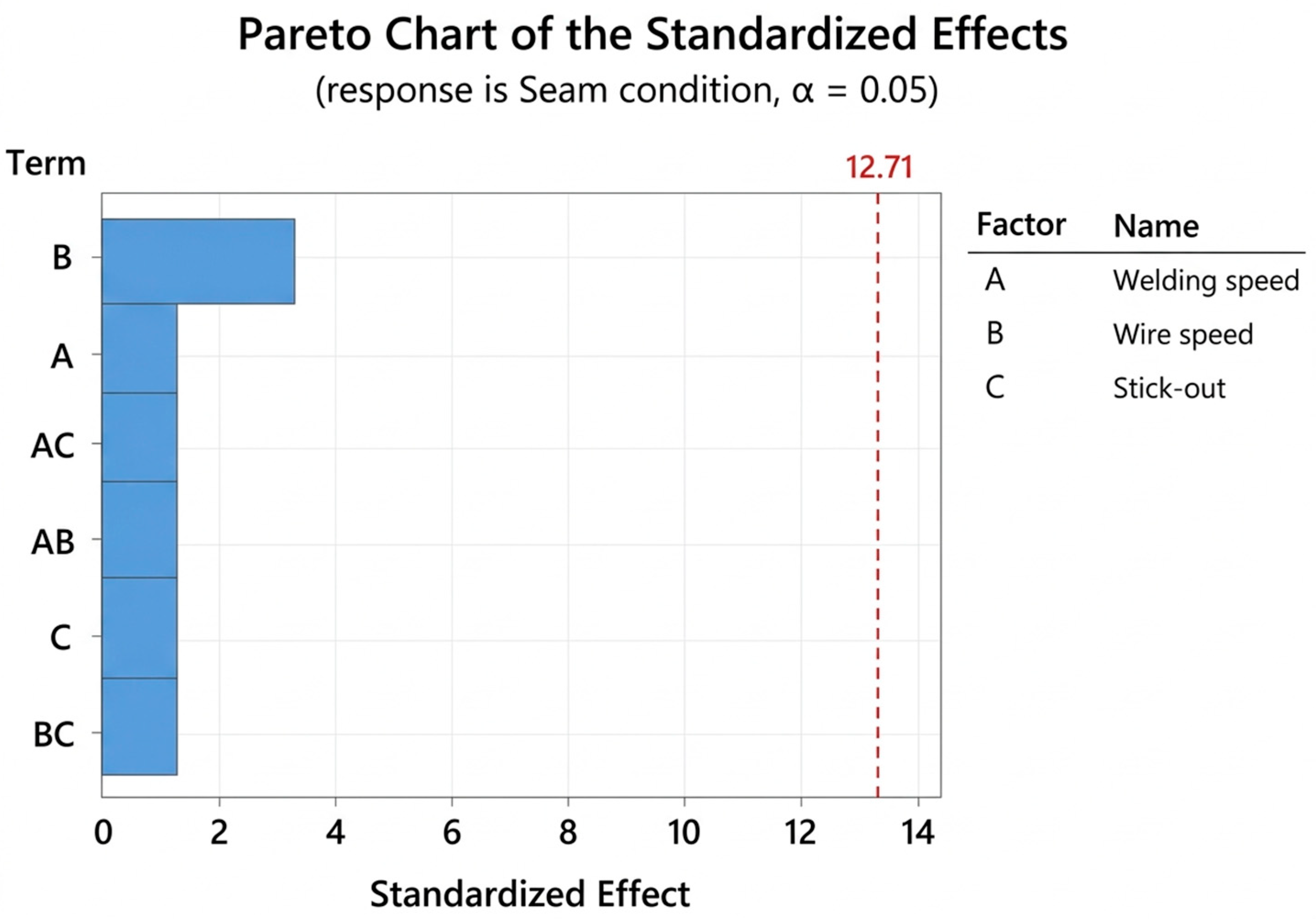
The ANOVA results are presented in
Table 7, and the corresponding Pareto chart is shown in
Figure 6.
The regression model explained only 53.3% of the observed variability, confirming that significant residual variability remained unaccounted for.
According to the probabilistic coupled model (Equations (11)–(13)), porosity probability depends not only on nominal stick-out but on the effective stick-out:
Since was not controlled during the DOE, the regression coefficients associated with the process variables were attenuated.
This confirms that fixture-induced mechanical deviations dominate the system response within the tested operating range.
5.3. Mechanical and Dimensional Analysis of the System
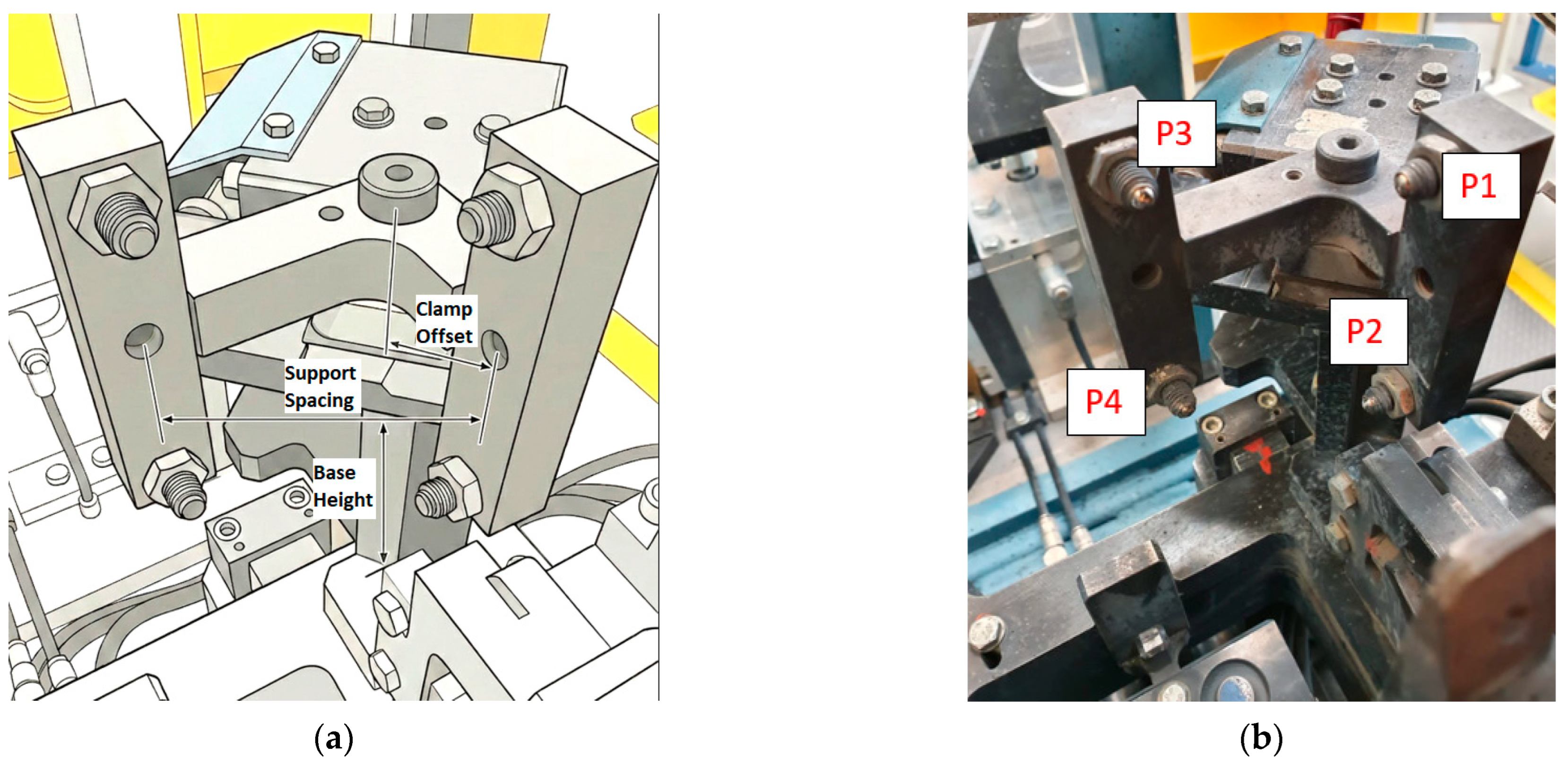
The mechanical analysis consisted of evaluating dimensional deviations and the positioning of contact points within the primary load-transmission zones of the fixture, as these factors directly contribute to the geometric deviation term defined in Equation (6). The assessment focused on identifying how variations in fixture rigidity, clamping configuration, and geometric tolerances influence the mechanical boundary conditions of the welding process.
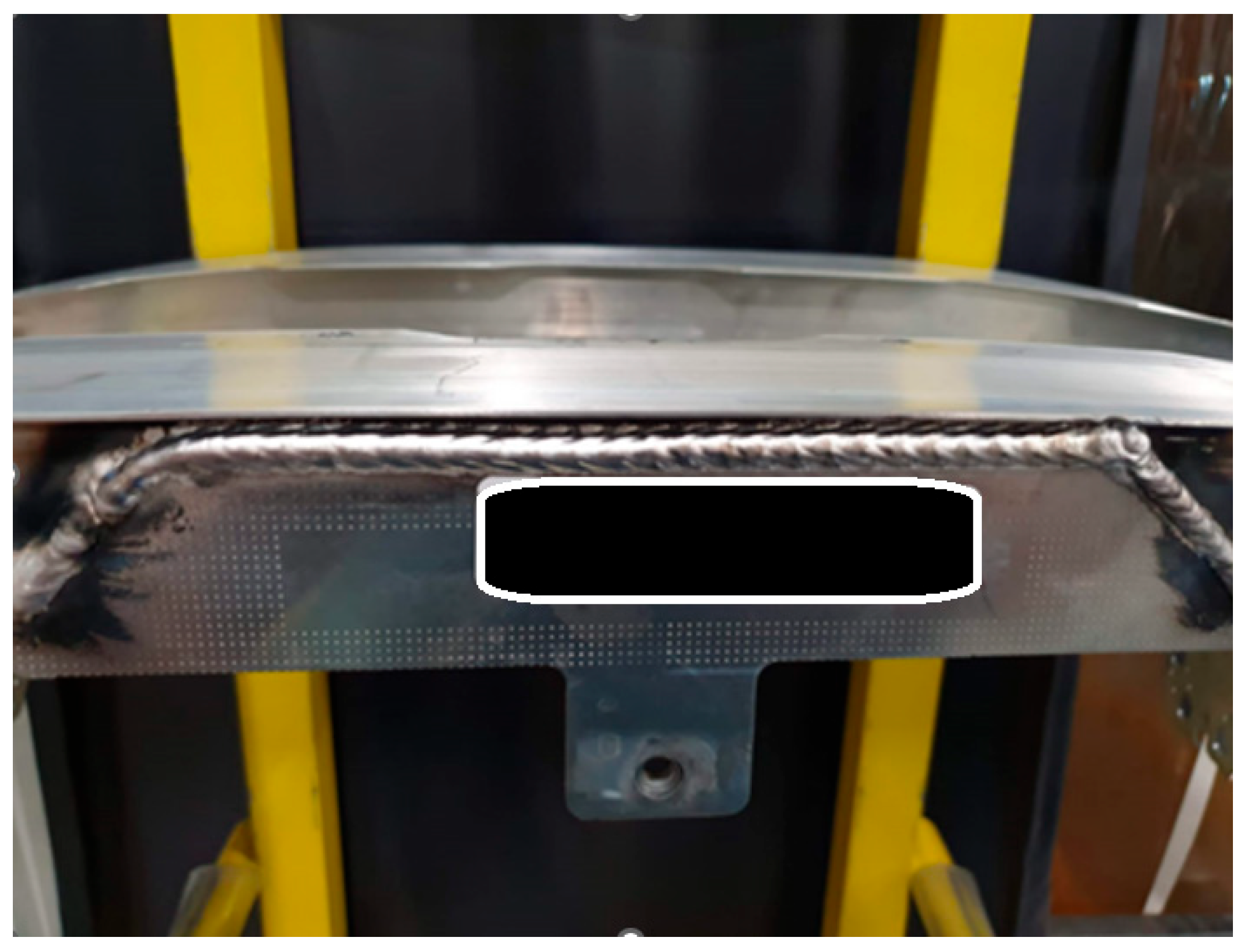
Particular attention was given to the primary load-transmission and geometric constraint regions identified in
Figure 7a, where clamping forces are transferred from the fixture to the workpiece through the defined contact points (P1–P4).
These zones govern load distribution and constrain the degrees of freedom of the assembly [
22]. Any deviation in contact positioning or pressure distribution may induce localized deformation, thereby modifying the effective joint alignment and contributing to the geometric deviation term
Reduced fixture stiffness can lead to micro-displacements under clamping and thermal loading. Such displacements alter the effective electrode stick-out and arc length during welding. Since stick-out directly influences current density, metal transfer stability, and heat input [
14], these mechanically induced variations introduce process fluctuations that are not explicitly accounted for in conventional DOE-based models.
Furthermore, geometric tolerances in the fixture–workpiece interface may generate misalignment between the torch trajectory and the weld joint. Even small deviations in joint gap or vertical positioning can modify arc geometry, shielding gas coverage, and droplet detachment dynamics, affecting bead morphology and defect probability [
23].
Finally, deformation at the contact points modifies local heat dissipation paths between the workpiece and the fixture. Variations in contact pressure influence cooling rates and thermal gradients, which may affect microstructural evolution and residual stress development [
21]. These interactions justify incorporating mechanical–process coupling effects into the proposed Influence Factor framework. The dimensional measurements of the RH and LH fixture bases are presented in
Table 8.
The calculated fixture influence factor:
was consistently higher for the RH configuration, explaining the higher rework rates observed in August (
Table 8).
These results are consistent with fixture mechanics theory [
22,
24,
25] and experimental welding distortion studies [
21,
25].
Dimensional differences between RH and LH fixtures directly contributed to geometric deviation . Correlation analysis between and defect rates confirms that higher in RH fixtures corresponds to increased porosity (r = 0.87).
5.4. Probabilistic Model Estimation and Interpretation
The results confirm that the fixture influence factor
exhibits the highest standardized effect. A unit increase in
multiplies porosity probability by 3.74, while a 1 mm increase in
doubles porosity probability (OR = 2.10), consistent with the interpretation of odds ratios in logistic regression models [
19]. Thermal variables show secondary influence within the tested range.
These findings quantitatively validate the dominance of mechanical coupling over purely energetic parameters, in agreement with thermal–mechanical interaction principles in welding processes [
14].
5.5. Progressive Monthly Model Discrimination and Statistical Validation
To evaluate the temporal evolution of predictive performance, ROC analysis was conducted independently for each production month (August–October) [
26]. Because the industrial process exhibited progressive geometric stabilization, monthly recalibration of the probabilistic model (
Section 4.3) was implemented to avoid bias under non-stationary operating conditions.
Table 10 summarizes the monthly discrimination metrics.
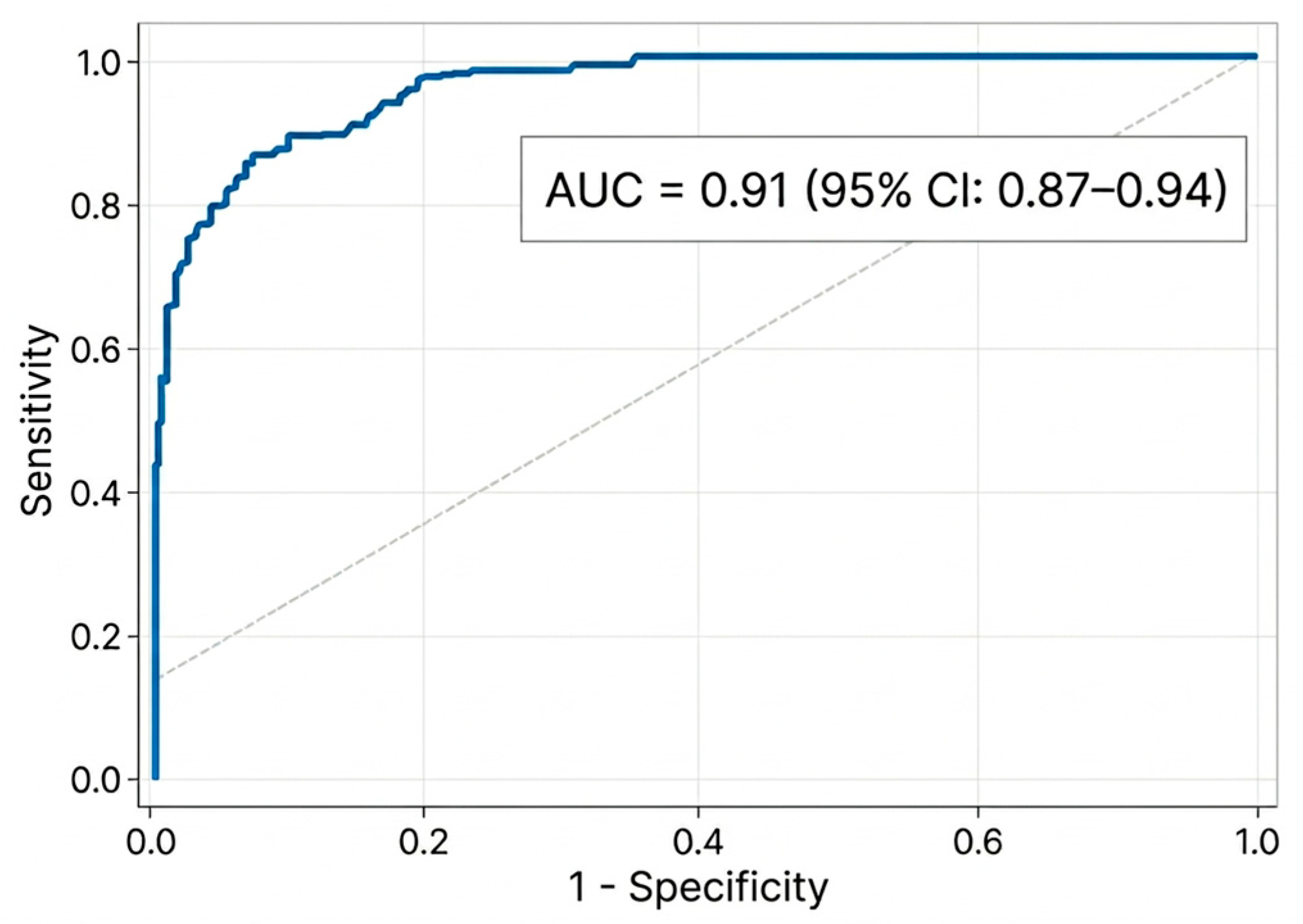
A clear progressive increase in AUC is observed, from 0.84 to 0.91. According to standard interpretation criteria, AUC values above 0.90 indicate strong classification capability [
19]. The October model therefore achieves strong predictive discrimination.
To determine whether the observed improvement was statistically significant, pairwise comparisons were conducted using the DeLong non-parametric test for correlated ROC curves [
27].
August vs. September: ΔAUC = 0.04, p = 0.018
September vs. October: ΔAUC = 0.03, p = 0.041
August vs. October: ΔAUC = 0.07, p < 0.001
All comparisons show statistical significance (p < 0.05), confirming that the improvement in discrimination capability is not attributable to sampling variability.
The final ROC curve corresponding to the stabilized October process is presented in
Figure 8.
5.6. Industrial Validation Through Production Metrics
Production data are summarized in
Table 11,
Table 12 and
Table 13, while the associated economic impact is shown in
Table 14. CW31–CW43 correspond to calendar production weeks (Week 31 to Week 43).
The indicators corresponding to the month of September are presented in
Table 12. During this stage, partial improvements were implemented in the geometry of the clamping system, slightly reducing the mechanical variability of the assembly.
Table 12 shows a moderate decrease in rework and downtime compared to the previous month, along with an increase in the OEE of the cell. These results reflect an initial reduction in
and, consequently, in the effective stick-out. From the perspective of the coupled process–fixture model (
Section 4.3). This trend is in agreement with previous studies on automated welding, which report that improved process stability—including arc stability through enhanced geometric control leads to reduced welding defects and improved quality [
21,
23].
The final results, corresponding to the month of October, are presented in
Table 13. This period reflects the full implementation of geometric standardization of the fixture and the elimination of the main sources of mechanical variability. As shown in
Table 13, the rework percentage decreases to 4.76%, and the OEE reaches 87%, demonstrating a substantial and sustained improvement in productive performance.
From a mathematical perspective, these results correspond to minimal values of
and, therefore, to a reduced fixture influence factor
From an industrial and geometric precision standpoint, reduced geometric variability and improved fixturing consistency have been shown to significantly decrease displacement and geometric errors in welded assemblies, leading to improved quality and reduced defects in automated welding systems [
28]. Indicating that the mechanical contribution of the fixturing system to process variability has been significantly mitigated. Similar improvements in repeatability, defect reduction, and productive performance following geometric standardization and enhanced process stability in welding systems have been reported in the literature, confirming that stabilization of the mechanical state of the system leads to sustained gains in welding quality and efficiency [
28,
29]. These results confirm the validity of the coupled process–fixture model proposed in
Section 4.
Geometric standardization measures included dimensional tolerance control of fixture bases and reinforcement of contact points. These modifications reduced
resulting in decreased porosity and increased OEE, as evidenced in
Table 13. Improved arc stability and controlled geometric consistency have been directly correlated with enhanced weld quality and reduced defect formation in automated GMAW systems [
29].
The overall economic impact of these improvements is summarized in
Table 14, integrating the cumulative effects observed during the three-month evaluation period.
The sustained reduction in rework and cost validates Equation (13):
As
decreases due to geometric standardization, process stability improves and the probability of porosity formation
is significantly reduced, even under constant nominal welding parameters. These results demonstrate that mechanical fixture control acts as a governing variable within the coupled process–fixture model and has a measurable impact not only on metallurgical quality but also on economic performance. Similar positive correlations between improved fixturing, reduced angular distortion, and lower production cost have been reported in recent welding studies, where optimized welding configurations led to significant reductions in both geometric distortion and welding cost/time compared to conventional methods [
30].
6. Conclusions
A coupled thermo-mechanical probabilistic framework for porosity prediction in robotic CMT welding has been developed and validated under industrial operating conditions. The formulation departs from conventional energy-based approaches by explicitly incorporating fixture-induced geometric variability into the effective electrode stick-out and by defining a dimensionless fixture influence factor Statistical analysis demonstrated the dominant role of mechanical coupling within the evaluated operating window. The fixture influence factor exhibited the highest standardized effect (OR = 3.74), while a 1 mm increase in effective stick-out doubled porosity probability (OR = 2.10). The final calibrated model achieved strong predictive discrimination (AUC = 0.91; 95% CI: 0.87–0.94).
Industrial implementation confirmed model relevance: geometric stabilization reduced rework from 11.58% to 4.76% and increased OEE from 79.58% to 87%, accompanied by a 71% reduction in rework cost.
These results establish fixture mechanics as a primary control variable in robotic CMT welding and validate the proposed coupled process–fixture framework as a predictive tool for quality optimization under real production conditions.




 ,
,