1. Introduction
Currently, the aviation industry is in an historic upswing. In 2025, a new record of about 1800 aircraft deliveries is expected, higher than ever before within one calendar year [
1]. Airbus and Boeing have published forecasts, predicting average annual traffic growth of about 3.5% to 3.6% between the years 2024 and 2044, respectively, and estimate that demand for and delivery of about 43,000 new aircraft are expected within this time. This would increase the global fleet by around 50% and contribute to the continued growth of the aviation industry [
2,
3].
At the same time, the issue of sustainability is becoming more urgent by the day. Raw material extraction has more than tripled in recent decades and currently stands at over 100 billion tons in 2020. If no action is taken, global raw material extraction will increase by 60% by 2060 compared to 2020 levels, jeopardizing the supply of critical raw materials [
4]. Earth Overshoot Day is moving ever closer, from December in the early 1970s to 25 July 2024. This highlights that human activity is exceeding the Earth’s regenerative capacities at an increasingly early point in the year [
5].
Due to the ever-increasing scarcity of resources andthe constantly rising demands on resources, the optimal use of materials and energy along the entire value chain is becoming increasingly important. Detailed documentation of consumption is necessary in order to reconcile economic development and sustainable action. Life cycle assessment (LCA) is a standardized methodology that provides a systematic framework for quantifying and assessing the environmental impacts of products and services across their entire lifecycle. This methodology has a broad application across multiple sectors, ranging from agriculture and food to energy, transport, and building [
6,
7].
Life cycle analysis and sustainability measures are becoming increasingly important. A life cycle analysis conducted by Dolganova et al. [
8] estimates the CO
2 equivalent emissions within the production process of an Airbus A330-200 at approximately 2.1 million tons. The turbine is of particular interest, as this component is both one of the largest sources of emissions and one of the largest consumers of scarce raw materials.
Conducting such a life cycle assessment involves considerable effort: approximately 70–80% of the total effort is spent on data collection, which is mainly due to the high complexity of the product and the upstream and downstream supply chain structures [
9]. The challenges involved in data acquisition are also highlighted in a literature review by Olanrewaju et al. [
10]. The largest obstacle pointed out there is that data is not widely available and that its quality is inadequate. In connection with this issue, a representative survey by the German Economic Institute has revealed that “lack of standards” is the most often-cited barrier to data exchange related to technology; many enterprises claim that the absence of standards has a significant inhibiting effect on the automated transfer and use of data [
11].
The Asset Administration Shell (AAS) provides a basis for standardized data exchange. It effectively transforms an asset into an Industry 4.0 (I4.0) component by providing its digital representation within an I4.0 system. The Asset Administration Shell consists of a head and a body: While the head of the asset represents identification and administrative information of the asset in the I4.0 system, the body, being the central information carrier, holds the asset information. Moreover, the body is split up into submodels, representing specific characteristics or functions of the asset. These submodels are made up of hierarchically structured submodel elements (SME) [
12,
13]. In addition, the Industrial Digital Twin Association (IDTA) is in charge of standardizing and advancing the Asset Administration Shell. It specifies “the structure, interfaces, and submodels to enable and ensure interoperable data exchange according to Industry 4.0.” So far, the IDTA has created 100 standardized submodels, among them the Product Carbon Footprint (PCF) Submodel that enables the standardized acquisition and exchange of CO2 emission data throughout the whole life cycle of products” [
14,
15].
Taking into consideration the aforementioned problem, this paper suggests a method to perform an LCA on machining processes using a digital twin of a turbine disk. This study offers a process-level life cycle assessment of preturning and roughing in the context of turbine disk machining, closing a gap in high-resolution primary data of machining processes. Second, the outcome of this research allows quantifying hotspots in machining regarding the environment and contributes to an analysis of machining options in a sustainable way. Finally, the results are exported in a standardized format to enable easy sharing and reuse by other companies and customers.
2. Materials and Methods
This chapter presents in detail the life cycle assessment (LCA) methodology for the preturning and roughing stages of a turbine disk. LCA adheres to the systematic procedure provided by the DIN EN ISO 14040 [
16] and ISO 14044 standards [
17] and consists of four phases: goal definition and scope, life cycle inventory (LCI), life cycle impact assessment (LCIA), and interpretation [
16,
17]. Finally, results are transferred to the IDTA Product Carbon Footprint Submodel.
2.1. Goal and Scope Definition
The objective of the goal definition and scope phase is the description of the scope of the study, determination of the functional unit, definition of the system boundaries, and description of the assumptions required so that the LCA results are appropriate for supporting the decision-making process [
16].
This study exclusively targets the two machining steps preturning and roughing of a turbine disk. The functional unit is therefore defined as “a pre-finished turbine disc,” while the system boundaries are exclusively set to the preturning and roughing of the disk. Inside this system boundary, all the measurable input and output processes of the machines are considered This includes the energy consumption, coolant use, and compressed air use in the machining steps under examination. Also included are waste amounts. The raw material data are modeled with literature values (secondary data) separately from the process data. The production and use of the tools involved are not included in the assessment because it is challenging to allocate these environmental impacts to the two process steps on a cause-related basis due to the lack of suitable allocation rules and primary data. Consequently, the results reflect the direct environmental contributions of the machining steps under consideration and not the complete cradle-to-gate emissions of the entire disc production process. This limitation, the assumptions made regarding the exclusion of upstream manufacturing processes, and the expected impact on the comparability of the results are documented transparently.
2.2. Life Cycle Inventory
The second phase of a life cycle assessment, the life cycle inventory (LCI), involves recording and calculating all relevant inputs and outputs within the system boundaries, such as energy and material flows and emissions. The collected data is validated and assigned to the appropriate processes and functional units to ensure consistency and traceability of results [
16].
Given that the process chain under analysis consists of numerous individual processes and tool path operations, an analysis at the level of each individual operation is neither practical nor expedient, since some operations require only a few minutes. To that end, the numerous individual operations were grouped into four higher-level process segments: The first process is Preturn Side 1, the second process is to Preturn Side 2, the third process is to Roughing Side 1, the fourth process is to Roughing Side 2. This aggregation reflects the functional structure of real manufacturing and, at the same time, enables consistent and robust allocation of energy and media consumption within the framework of the life cycle inventory.
During the preturning processes, both sides of the blank are prepared in a systematic way so that a reproducible initial geometry is achieved: first on side 1 and then on side 2. This includes the removal of the initial material sections to produce flat reference surfaces with reference points, which are indispensable for further precision machining. The goal of these steps is to create stable, definable reference structures for all further machining steps.
The roughing operations encompass the removal of large amounts of material in side-by-side fashion. The process begins by working on side 1, then side 2 to establish the rough outline of the turbine disk. The outlines are meticulously created using high rates of material removal and high values for depth of cut. The operations contribute to the establishment of the rough shape of the turbine disk, preparing the foundation for potential finishing operations without requiring final surface finishes or tolerances.
For acquiring data on consumption and activities related to the various processes involved in the production of the turbine disk, additional sensors were installed on the machine tool that produced the turbine disk. For this purpose, the following devices were acquired and installed: a network analyzer, a cooling lubricant manager, and a compressed air measuring device. The data measured during the process was shared through communication interfaces such as OPC UA and IO-Link.
This data basis is made usable through the implementation of the digital twin framework known as dPart. dPart is a domain-specific Internet of Things (IoT) framework designed specifically for machining operations. It processes incoming sensor data in a lambda architecture, encompassing both stream and batch processing. It also models this data semantically and makes it accessible to the analysis and application layers via a serving layer. This makes it easier to perform real-time analyses, such as anomaly detection and condition monitoring, as well as aggregated analyses for machine learning processes, process optimization, and the assignment of consumption flows to process units. This persistently identified and validated data provides a basis for all comparisons, calibrations, and additional analyses [
18].
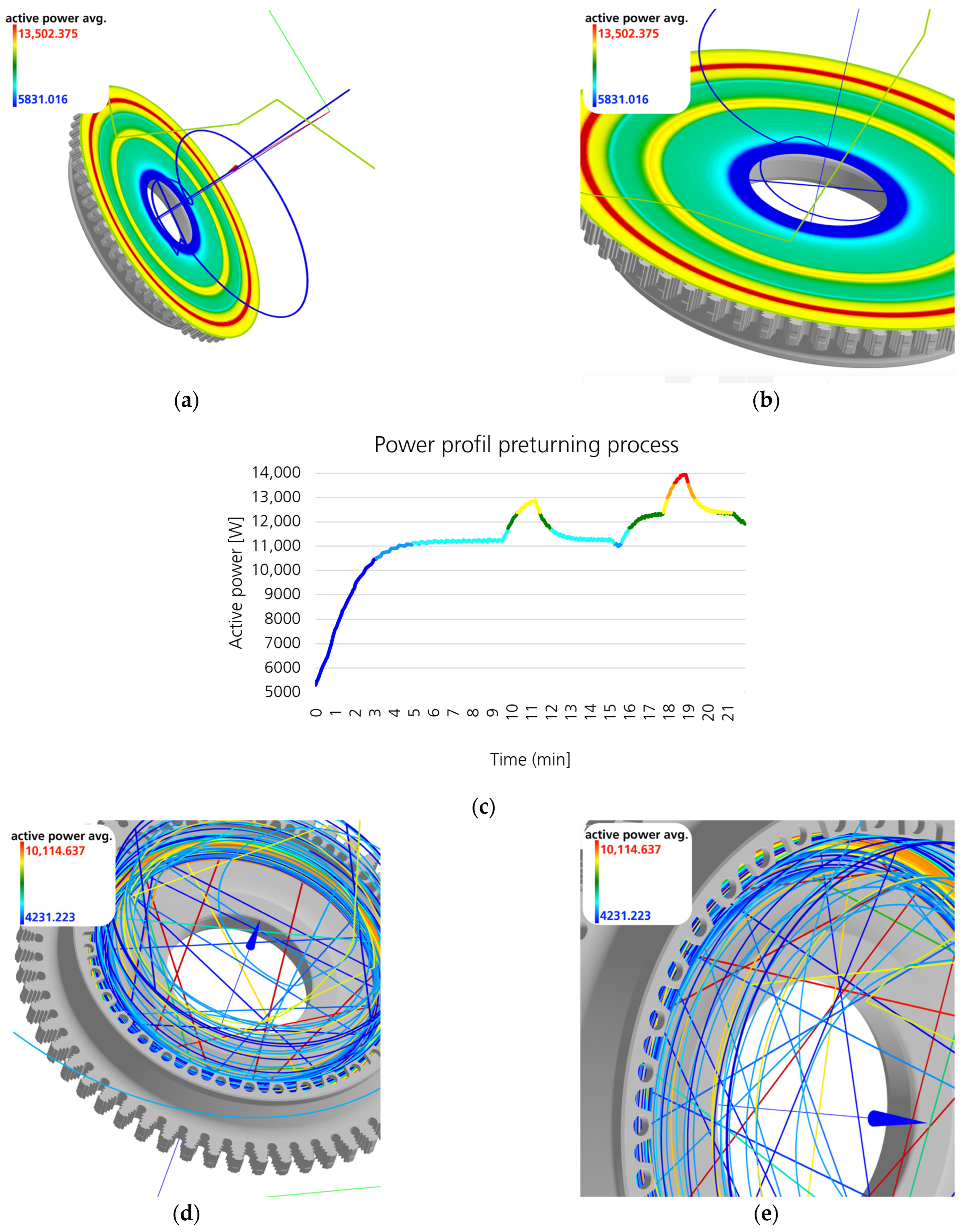
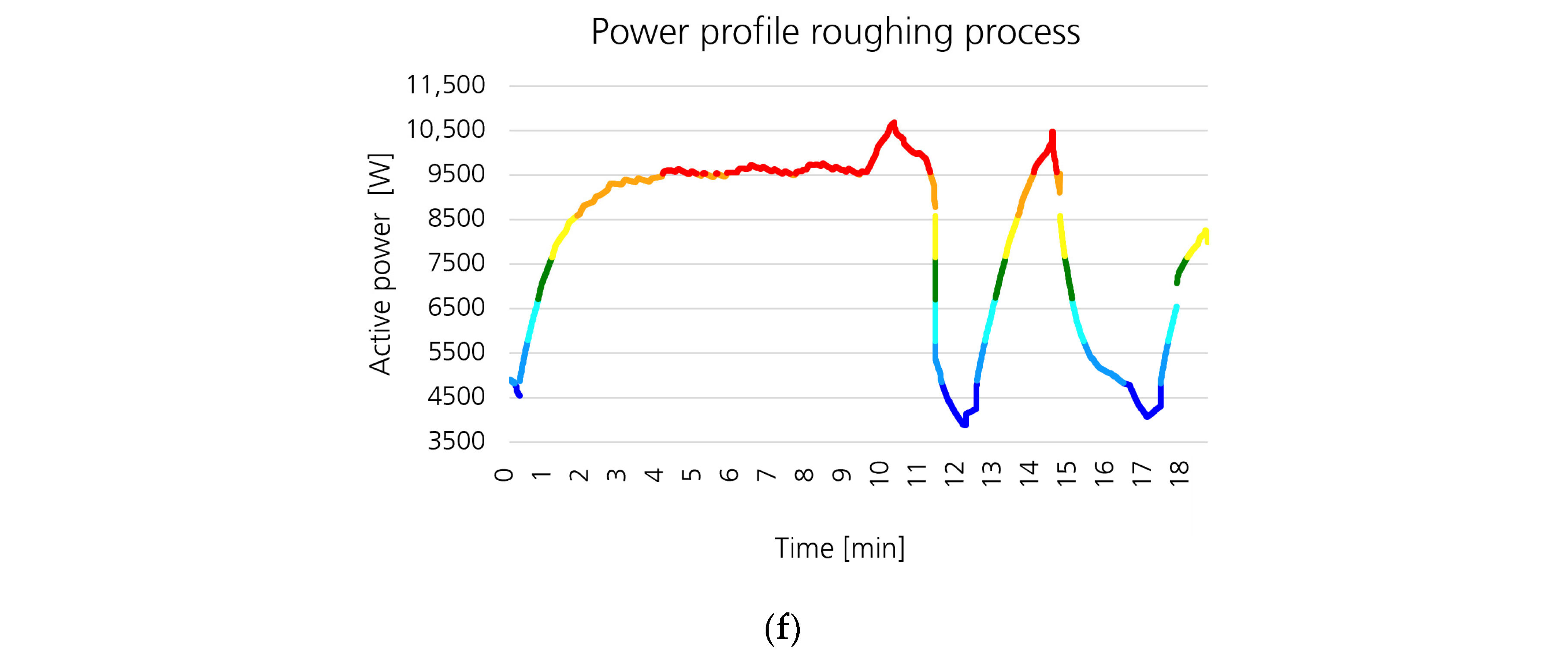
Furthermore, a dashboard was implemented on the basis of the data stored in the digital shadow. This made it possible to use the data in a user-friendly manner to illustrate the process parameters and consumption information along the tool path. It is possible to display the position-dependent history of each measured value such as energy consumption, demand for compressed air, or cooling lubricant flow rate. Color marking of the curves of the value clearly indicates peaks of loading as well as consumption. This assists in the detection of areas of high material consumption or poor process management.
Figure 1 illustrates the power consumption profile of two tool paths during preturning and roughing of the turbine disk. This is displayed in both the dashboard and the corresponding diagram.
In addition to the visualization, the machine data was stored in the Digital Twin Dashboard as .json files and served as the basis for the subsequent quantitative analysis.
Using the data sets exported from the dashboard, further data processing and KPI generation were carried out in a Python environment (version 3.12.0) in preparation for the life cycle assessment. In this processing step, the relevant data fields were automatically identified from the .json files headers and the measured time series were integrated (trapezoidal rule) to determine the electricity, compressed air, and coolant consumption per sub-process; for the coolant, the emulsion composition was considered to separate the oil and water components. The volume of material removed was not derived from the time series data but was calculated independently in the computer-aided manufacturing (CAM) software Siemens NX (version 2412) by comparing the workpiece volumes before and after each machining step.
The dashboard displays data from a subprocess over time in a diagram. This makes it possible to perform a plausibility check and review all consumption values for inconsistencies. Additionally, high consumption spikes on selected subprocesses were identified using color coding and verified for accuracy. All derived consumption and KPI values were thus checked for plausibility and validated manually if necessary. They were then exported to a compact, well-structured Excel spreadsheet for documentation and use in subsequent inventory modeling.
The necessary input data for the raw part was obtained from two sources. The supplier provided the material composition of the Inconel 718 blank. The energy required to produce the Inconel 718 raw material was derived from a targeted literature search. Regarding the gray energy value employed in the model, it was derived from the estimates provided by Fredriksson [
19] and Sykora and Kroft [
20].
2.3. Life Cycle Impact Assessment
In the third phase, known as life cycle impact assessment (LCIA), potential environmental impacts are evaluated based on the data set acquired in the life cycle inventory. Material and energy flows can be categorized according to their potential to influence factors such as climate change, water use, and resource scarcity, and presented using key indicators. All steps must be transparent so that the results are traceable and comparable with other results [
16].
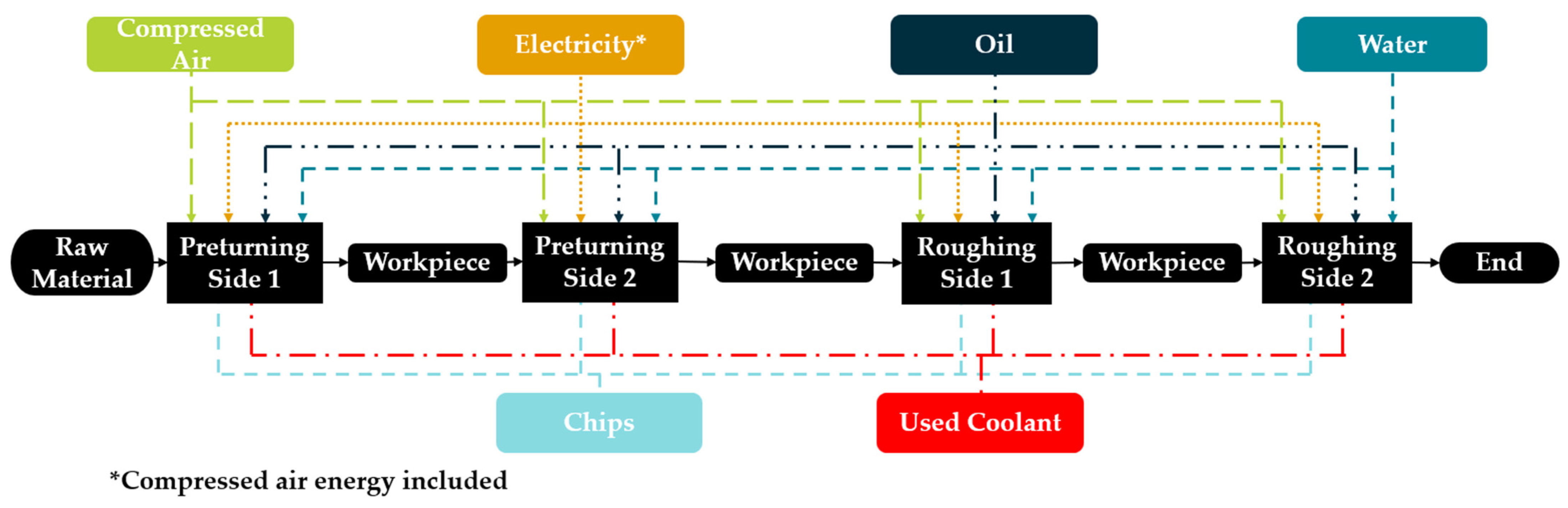
The environmental impact associated with the two primary machining processes, including both sides, was calculated using the LCA for Experts software (Version 10.9.0.20) developed by Sphera (U.S., IL). The software contains an industry-specific database with extensive data that facilitates the representation of complex processes. Individual process modules were developed for the two main processes and their sides. The modules contain the corresponding input flows for electrical energy, cooling lubricants (oil and water), and compressed air. Since no information about the exact composition of the cooling lubricant was available, oil and water were used as inputs for modeling the cooling lubricant. The concentration of the cooling lubricant corresponded to the amount of oil, and the rest was modeled as water. In addition the model considered the corresponding output flows for material waste in the form of chips, water vapor, and hazardous waste in the form of used cooling lubricants. The raw part was also specified as an input flow for Preturning side 1 and represented as an output labeled “machined part”, which in turn represent an input flow for Preturning side 2. This process continues along the entire process chain. The supply of compressed air was also specified in the representation in order to take into account the corresponding power consumption and thus obtain an ideal representation of the actual energy consumption.
Since the primary data on the composition and production of the cooling lubricant was not available, the database objects “oil” and “water” from the LCA for Experts database were used to represent the cooling lubricant. Sphera’s integrated database allows the environmental impacts of both the provision of input factors and the disposal of output factors to be modeled in detail and in a process-specific manner. This enables a precise and comprehensive representation of the examined processes from an environmental perspective.
Figure 2 illustrates a schematic representation of the modeled process chain with its inputs and outputs.
The environmental impact categories were determined after the definition and balancing of all input and output flows. This study used the impact categories specified by Environmental Footprint 3.1, as these provide a comprehensive and standardized basis for assessing the potential environmental impacts of industrial manufacturing processes. This ensures consistent and comparable results with regard to the environmental impact of both processes under consideration.
In addition to the individual impact categories, the PEF is also calculated as an aggregate indicator that combines all relevant mean value categories into a single key figure, thus enabling an overall assessment of the environmental performance of the process chain.
2.4. Interpretation
The fourth phase of life cycle analysis is the evaluation phase, which involves merging and assessing the outcome of the life cycle inventory and impact assessment. The aim is to draw conclusions, outline uncertainties and limitations, and draw suitably based recommendations from the set objective and scope of the study. It should be noted that the results obtained are relative and cannot be used to estimate absolute environmental impacts. The evaluation provides an open, consistent and comprehensible overview of the LCA outcome. This is a basis for communication and decision-making assistance in science, industry and politics [
16].
To evaluate the environmental effects, it is necessary to consider both the entire process chain as depicted in
Figure 2 and the individual sub-processes. This allows to identify cumulative impacts on the processing steps and process-specific variations between environmental effects. The most significant impact category of this study is climate change, specifically the potential for global warming. In accordance with Dolganova et al.’s [
8] framework, the following impact categories were also considered: acidification, resource use (fossil), resource use (mineral and metals), and particulate matter. The inclusion of these additional impact categories facilitates a more precise evaluation of the potential environmental implications and establishes a solid foundation for identifying areas of enhancement in the relevant manufacturing processes.
2.5. Data Transfer
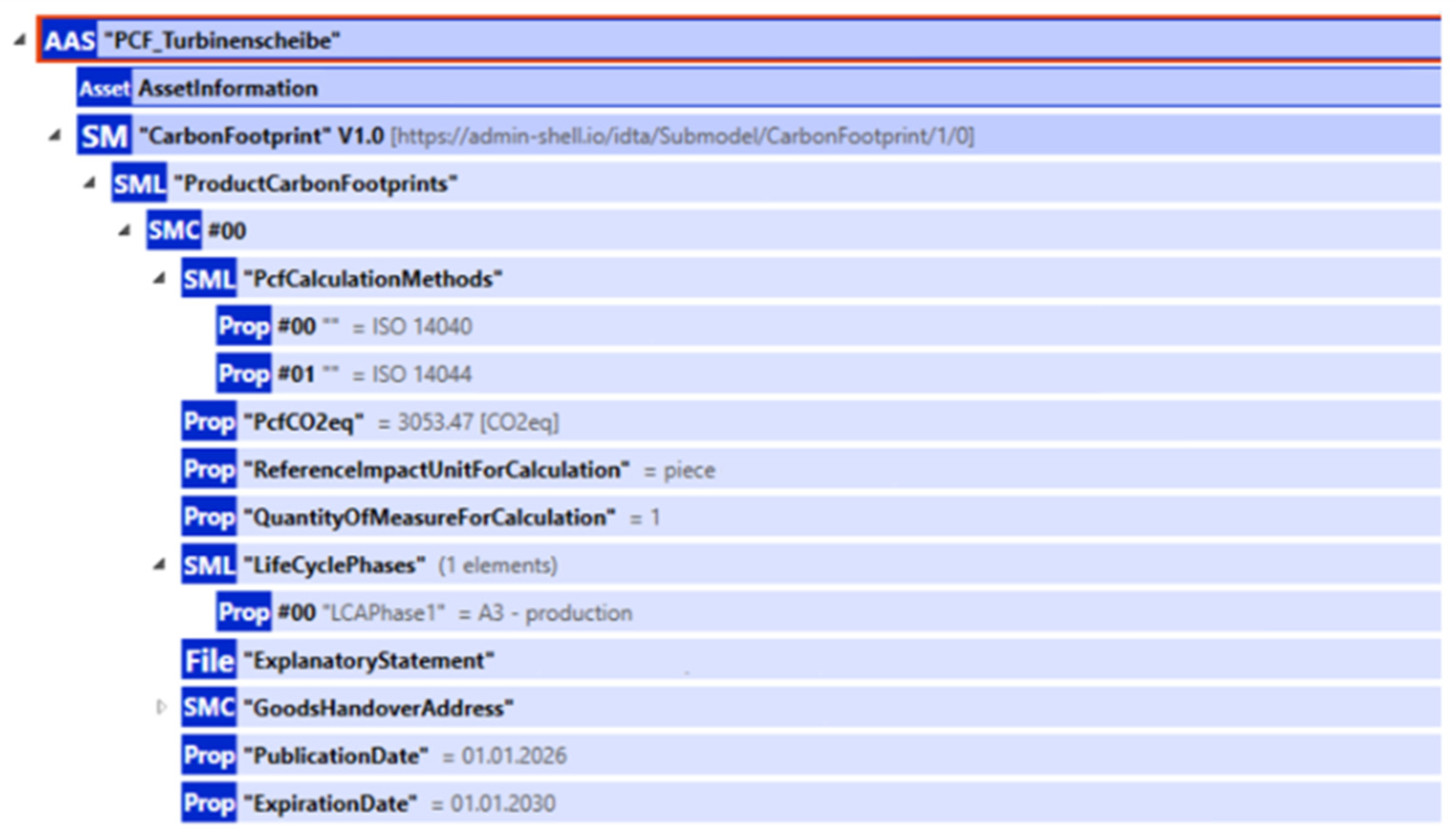
As outlined in the introduction, standardized data exchange between companies along the value chain remains a major challenge, in addition to the high cost and effort of data collection and the limited availability of information. The Asset Administration Shell (AAS) offers a standardized approach to this exchange through its submodels. One of the submodels published by the Industrial Digital Twin Association (IDTA) is the Product Carbon Footprint (PCF) Submodel, which enables the structured exchange of CO2-relevant data along the product life cycle. All relevant information on the calculated emissions of a product or process can be stored in a standardized form. As the name implies this is only covering the aspect of carbon footprint. Further LCA aspects such as acidification, water use, resource use, etc., require either an extension of the PCF submodel or further submodels describing those aspects. The PCF Submodel consists of a series of defined data points that are necessary to accurately describe the carbon footprint. These include:
The calculation method used (e.g., ISO 14067 [
21], ISO 14044 [
17], or GHG Protocol)
The determined CO2 equivalence value (PCF CO2 eq),
The functional unit and quantity (e.g., kg, piece, liter),
The life cycle phases considered (e.g., raw material procurement, production, use, disposal),
The date of publication and validity,
An optional explanation or documentation for the traceability of the calculation [
22]
This standardized structure enables interoperable and transparent communication of sustainability data along the entire supply chain, thus forming an important basis for promoting the efficient and trustworthy exchange of data between companies.
3. Results
This Chapter presents the results of the study, which first includes the life cycle inventory (LCI) with the measured activity data, followed by the life cycle impact assessment (LCIA)with a focus on climate change and supplementary impact categories. Lastly, it shows how the results are integrated into the PCF submodel.
3.1. Life Cycle Inventory
The data collected in the machining operations are the basis of the life cycle inventory in this research. The total consumption amounts obtained by summing all four researched process steps are: 221.93 L of cooling lubricant (22.24 L of oil and 199.69 L of water), 124.5 kWh of electricity, 259.71 Nm3 of compressed air, and 48.9 kg of chips removed in a total process time of 14 h, 2 min, and 36 s.
These values are the basis for the subsequent impact assessment and allow quantitative description of resource and energy process intensity.
Table 1 presents a detailed division of each stage’s consumption values and illustrates differences in media and energy consumption by stage.
Having established the process inventory, the analysis now turns to the raw material. The chemical composition of the Inconel 718 blank used was provided by the supplier and is listed in
Table 2. The energy consumption for the production of the blank was derived from the technical literature, in particular from the values given by Fredriksson [
19] and Sykora and Kroft [
20], who specify an energy requirement of approximately 321 MJ/kg for the production of Inconel 718. To ensure a clear separation of contributions, the environmental impact of the blank (embodied energy/raw material contribution) and the environmental impact of the measured machining processes are reported and evaluated separately. The combined impact of the entire process chain is also analyzed to provide a comprehensive assessment of the overall environmental performance.
3.2. Life Cycle Impact Assessment
Once all the necessary activity data has been recorded and the process chain has been modeled in LCA for Experts, the environmental impacts can be calculated. As explained in
Section 2.3, this study uses the Environmental Footprint 3.1 categories in the life cycle impact analysis. The primary focus is on the impact category Climate Change, which indicates the environmental impacts in kg CO
2 equivalents. Furthermore, the impact categories of Acidification, Particulate Matter, Resource Use Fossil, and Resource Use Mineral and Metals are also taken into consideration.
The results of the LCIA are outlined in
Table 3, which presents the outcomes for each selected impact category. The table is organized into columns as follows: The first column shows the impact category, the second column addresses the total impact of the entire process chain (all four processes and the raw material), the third column focuses on the impact of the Inconel-718 blank (raw material), and the fourth to seventh columns detail the individual impacts of Preturning Side 1, Preturning Side 2, Roughing Side 1, and Roughing Side 2, respectively. The table provides both an absolute and a process-level breakdown, facilitating straightforward hotspot identification and comparison across the process chain.
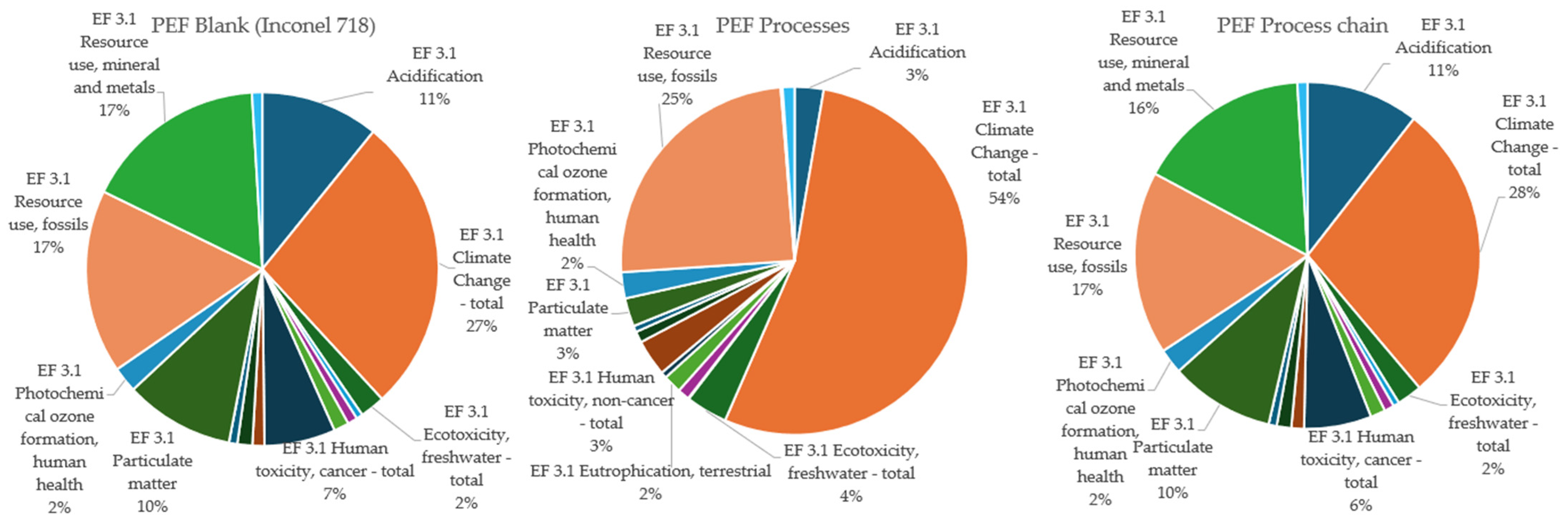
Besides the single impact categories, the Product Environmental Footprint (PEF) was calculated in order to derive an aggregate measure of the overall environmental impact. It integrates the impact categories from the Environmental Footprint 3.1 into one normalized and weighted indicator that enables a more holistic comparison between the various contributions within the process chain.
In the given study, the PEF is separately calculated for the entire process chain, for the Inconel 718 blank, and for the four machining processes. The given differentiation enables critical analysis of material-related and process-related environmental impacts. The calculated PEF values are presented in
Figure 3 will and serve as the foundation for the subsequent interpretation. For the sake of clarity, the impact categories with 0 or 1% have been removed from the figure.
3.3. Interpretation
The interpretation begins at the level of the entire process chain. The Product Environmental Footprint (PEF) for the pre-finished turbine disk is calculated to be 0.301, with 96% of the impact attributed to the raw material and 4% to the production. A breakdown of production reveals that 73% is due to roughing and 27% is due to preturning. The analysis indicates that a significant portion of the environmental impact can be attributed to the raw material (Inconel-718). This is primarily due to the complex extraction process of the alloy elements and the energy-intensive production of the semi-finished product.
When the individual impact categories are considered in conjunction with the aggregated PEF, it becomes evident that the categories of Climate Change, Acidification, Resource Use (Fossil), Resource Use (Mineral and Metals), and Particulate Matter collectively represent the largest share of the PEF. With the exception of climate change, it is evident that the majority of the impacts in these categories can be attributed to the raw material, underscoring the predominant influence of material provision on the overall environmental balance.
However, if the scope of consideration is limited to the measured machining processes, the picture changes: roughing accounts for more than 70% of the total CO2 equivalent (impact category Climate Change) of all processes. The primary drivers for this are (i) the disposal of used cooling lubricant, (ii) the electrical energy consumption of the machine during roughing, and (iii) the disposal of the chips produced. The same factors are also decisive for preturning. In the case of Preturning side 1, the high amount of chips is an additional dominant factor, with chip disposal accounting for over 50% of the CO2 contribution of this sub-phase.
For the remaining impact categories evaluated (acidification, resource use, among others), it is evident that roughing accounts for a minimum of 70% of the process contributions. This suggests that the roughing step offers the greatest potential for optimization, including aspects such as cooling strategy, energy efficiency, and chip management.
A detailed analysis of the raw material (Inconel 718) shows that energy consumption is significant for several impact categories. This is particularly evident in the impact categories “resource use (fossil)” and “climate change”. The energy-intensive production and processing of the alloy significantly increase the impact on climate change and fossil resource consumption. The nickel content in the alloy is also of great importance, especially in the categories of acidification and particulate matter formation. The extraction and refining of nickel are associated with high emissions of sulfur and nitrogen oxides as well as particulates, which have a negative impact on the environment. In the impact category of resource use minerals and metals, the alloying elements molybdenum and chromium have the highest influence. The mining and processing of these metals is associated with high consumption of non-renewable mineral raw materials. These impact categories account for more than 80% of the total Product Environmental Footprint of the blank. These results show that the significant environmental footprint of Inconel 718 is primarily due to the energy-intensive and raw material-dependent activities involved in material extraction.
3.4. Data Transfer
To tackle the challenges of life cycle assessment cross-company, the respective data (
Section 2.5) was transferred to the PCF Submodel [
22] in .aasx format. A .aasx file is comparable to a .zip file. It can contain multiple files (attachments), and the underlying structure of the AAS submodel is described in a .xml file [
23]. Therefore, the data must be transferred into a .xml file, with additional files being attached in the .aasx file. To do so, one can directly modify the .xml file. However, there are multiple helpful tools which ease the transformation: For inputting and viewing the data manually (starting from the PCF template), the AASX Explorer or the BaSyx User Interface (UI) are common choices [
24,
25]. For transferring the data in an automated fashion, the BaSyx Python Software Development Kit (SDK) can be used. The BaSyx Python SDK (version 1.2.1) provides format checking conformant to the .aasx meta model [
23,
26]. Thus, it eases writing python scripts which can be used in an automation chain, where data could be transferred directly from “LCA for Experts”, such that the data can be provided via a digital twin registry to other companies. Mapping the data from LCA for experts is straightforward for the CO
2-equivalent (i.e., the PcfCO
2eq value in the PCF submodel). Values such as “ReferenceImpactUnitForCalculation” can be indirectly mapped from LCA for experts, as the software does save the name of the blisk and its weight. Values such as the “PcfCalculationMethod” and the “LifeCyclePhase” are not included in the software so that they need to be filled in manually.
Since “LCA for Experts” currently does not allow an automated export, the data was transferred manually using the AASX package explorer (version v2025-03-25), and the result can be seen in
Figure 4. An automated pipeline remains subject to future research. Looking at industrial adoption, the current state of the art in the industry does not allow for a fully automated pipeline to obtain and share information such as the product carbon footprint as this would require system-wide data acquisition and evaluation. Data acquisition from sensor data in serial production is not common, and even if sensors are installed, one needs a data consistent evaluation stream (as part of a data consistent digital twin) to evaluate something as complex as the CO
2-equivalent. Applying extrapolation using manual reference processes thus seems much more realistic but that is still very time-consuming and expensive.
4. Discussion
The results presented here should be evaluated considering the methodology described above and the existing literature. As stated in the introduction, acquiring high-quality, up-to-date primary data for upstream process steps represented a significant challenge. Unfortunately, no company-specific primary data was available for the process chain involved in manufacturing the blank. Similarly, there was a lack of reliable information on the chemical composition of the cooling lubricant used, and no consistent model for the manufacture and use of milling tools. As a result, either generic literature values had to be adopted for these areas, or the corresponding influencing factors had to be omitted from the balance sheet altogether. These data gaps represent a key limitation of the present study, particularly regarding the uncertainty of the results.
Although the recorded and analyzed data were checked for plausibility and outliers, no variations in the manufacturing parameters were made during the individual processes. The aim was to achieve industry-oriented manufacturing. However, this study provides a single data set for each process, and variation in the cutting parameters is a topic to be explored in future research. Nevertheless, the study’s findings, after undergoing thorough quality and plausibility checks, establish a foundational baseline for assessing the environmental impact of the two processes in turbine disk manufacturing. This baseline serves as a solid foundation for future research in this area.
Given the scope selected in this paper and the decision to exclude the environmental impact of the tools used from the analysis, further research directions can be deduced. Regarding the scope, future work could consider the final higher-level process step, finishing, in order to create a product-specific LCA from the process-specific LCAs. As the material removed during finishing is minimal, and the primary focus is on surface quality, the environmental impact of the chips produced is likely to be lower than in preturning and roughing. As the duration of the process is contingent on the tools utilized, it is challenging to estimate the media consumption of finishing in comparison to the previously analyzed process steps. Consequently, primary data concerning the finishing process is imperative for conducting a comprehensive life cycle assessment (LCA) of high-quality turbine disks.
The second essential assumption was to exclude the environmental impact of the tools used due to a lack of data and the difficulty of attributing the environmental impact to individual processes. Presently, there is a scarcity of detailed information concerning the environmental impact of milling and turning tools. Due to the absence of reliable data regarding the material, media, and energy consumption involved in the production of the tools utilized and given the difficulty in attributing this data to specific processes, it was determined that the tools would not be included in the LCA. For future LCAs, it is imperative to have access to consumption data within the tool life cycle. This will ensure the precise environmental impacts of the tools are incorporated into the process or product LCA. Regarding the allocation to individual processes, a wear-oriented or volume-oriented approach may be advantageous. This would enable the allocation of environmental impacts from the tools to the processes.
Despite the lack of primary upstream data, the results are in line with previous studies: While on the overall balance upstream material production clearly plays an important role, on the process level roughing is the hotspot of the process chain, contributing most to CO2 equivalents and other relevant impact categories. Hotspots within manufacturing are the consumption of electric energy, disposal of used cooling lubricants, and chip management.
From a practical perspective, the most promising chances for short- to medium-term environmental reductions exist for process-related measures, which comprises increasing energy efficiency, optimizing cooling strategies as well as recovery and disposal processes of cooling lubricants and chips. On the other hand, measures concerning suppliers and materials are effective but, in general, require longer coordination times.
Methodologically, the study proves that process-based LCAs are a helpful, transferable tool for identifying such manufacturing hotspots, provided the measurement cases are representative. Results point out that process-related interventions should focus on the roughing process, complemented by targeted data exchange with suppliers to improve future upstream data.
Specific areas of action emerge for practical application and future research work: First, companies should increasingly request primary supplier data and provide it within the framework of collaborative data exchanges (e.g., via Asset Administration Shell PCF Submodel). Second, experimental studies are needed to quantify the effects of specific process measures in roughing (e.g., alternative cooling strategies, energy-efficient drives, chip recovery systems). Third, it is desirable to develop standardized model components for tool manufacturing and cooling lubricants so that these can be systematically included in process life cycle assessments.
Finally, it should be emphasized that, despite data restrictions, the present results provide clear and actionable guidance: The most effective method of reducing the overall PEF is through the material/supplier side, followed by targeted process optimization in roughing. Future research should therefore improve the data basis for upstream processes and conduct intervention studies in the manufacturing area to empirically verify the potential derived here and transfer it into operational practice.
5. Conclusions
This study presents a process-based LCA in the production of turbine components. Machine-related consumption is measured using external sensors, assigned to tool paths using a digital shadow, and then converted into a standardized exchange format using AAS for easy exchange of data across company boundaries. The key innovation is the ability to assign consumption to specific processes and tool paths, along with presenting initial measured data (primary data) for the production of a turbine disk. The most significant assumptions made for this LCA are, firstly, the exclusion of the environmental impact of the tools utilized and, secondly, the restriction of the observation horizon to the two higher-level process steps of preturning and roughing.
Future work will focus on assessing additional turbine components, examining the entire production process and dividing it into various sub-processes. Other focus areas include variation in cutting parameters, automation of the remaining manual processes in data evaluation and analysis, and development of initial approaches for calculating and assigning the environmental impacts of the tools used to the individual processes.
The results presented in this study aim to demonstrate how digitization can be used to automate and streamline the collection, analysis and exchange of sustainability data. The study’s objective is also to encourage the publication of additional primary data for manufacturing processes, with a view to enhancing the quality and availability of future LCAs in the aviation sector.
Author Contributions
Conceptualization, M.U., D.E. and V.R.; methodology, M.U. and D.E.; software, D.E. and V.R.; validation, M.U., D.E., V.R. and S.S.; formal analysis, M.U. and D.E.; investigation, M.U. and D.E.; resources, V.R.; data curation, M.U., D.E. and V.R.; writing—original draft preparation, M.U. and D.E.; writing—review and editing, M.U., D.E., V.R. and S.S.; visualization, M.U. and D.E.; supervision, V.R., S.S. and T.B.; project administration, V.R. and T.B.; funding acquisition, V.R. and T.B. All authors have read and agreed to the published version of the manuscript.
Funding
This paper received funding from the Aerospace X project (13MX004A) for conducting the study and benefited from the infrastructure of the Ready4RampUp research program (20N2206B). These initiatives are part of the German Federal Ministry for Economic Affairs and Energy (BMWE).
Data Availability Statement
The original contributions presented in this study are included in the article. Further inquiries can be directed to the corresponding author.
Conflicts of Interest
The authors declare no conflicts of interest.
Abbreviations
The following abbreviations are used in this manuscript:
| AAS | Asset Administration Shell |
| CAM | Computer Aided Manufacturing |
| I4.0 | Industry 4.0 |
| IDTA | Industrial Digital Twin Association |
| IoT | Internet of Things |
| LCA | Life Cycle Assessment |
| LCI | Life Cycle Inventory |
| LCIA | Life Cycle Impact Assessment |
| PCF | Product Carbon Footprint |
| PEF | Product Environmental Footprint |
| UI | User Interface |
| SDK | Software Development Kit |
References
- Hattrup-Silberberg, M. Luft- und Raumfahrtbranche im Aufwind; McKinsey & Company: New York, NY, USA, 2024. [Google Scholar]
- Airbus. Global Market Forecast 2025. Available online: https://www.airbus.com/sites/g/files/jlcbta136/files/2025-06/Presentation%20GMF%202025-2044.pdf (accessed on 13 November 2025).
- Boeing. Commercial Market Outlook 2025–2044. Available online: https://www.boeing.com/content/dam/boeing/boeingdotcom/market/assets/downloads/2025-commercial-market-outlook.pdf (accessed on 13 November 2025).
- United Nations Environment Programme. Bend the Trend; Pathways to a Liveable Planet as Resource Use Spikes; United Nations Environment Programme: Nairobi, Kenya, 2024. [Google Scholar]
- Earth Overshoot Day. Past Earth Overshoot Days. Available online: https://www.overshootday.org/newsroom/past-earth-overshoot-days/ (accessed on 23 July 2025).
- Gauthier, Q.; Kuusisto, S. Life Cycle Assessment: Different Approaches and the Need for Industry Partnership. In Proceedings of the Internationaler Motorenkongress 2025, Baden-Baden, Germany, 25–26 February 2025; Heintzel, A., Ed.; Springer: Wiesbaden, Germany, 2026; pp. 195–203. [Google Scholar]
- Jegen, M. Life cycle assessment: From industry to policy to politics. Int. J. Life Cycle Assess. 2024, 29, 597–606. [Google Scholar] [CrossRef]
- Dolganova, I.; Bach, V.; Rödl, A.; Kaltschmitt, M.; Finkbeiner, M. Assessment of Critical Resource Use in Aircraft Manufacturing. Circ. Econ. Sustain. 2022, 2, 1193–1212. [Google Scholar] [CrossRef]
- Miah, J.H.; Griffiths, A.; McNeill, R.; Halvorson, S.; Schenker, U.; Espinoza-Orias, N.; Morse, S.; Yang, A.; Sadhukhan, J. A framework for increasing the availability of life cycle inventory data based on the role of multinational companies. Int. J. Life Cycle Assess. 2018, 23, 1744–1760. [Google Scholar] [CrossRef] [PubMed]
- Olanrewaju, O.I.; Enegbuma, W.I.; Donn, M. Challenges in life cycle assessment implementation for construction environmental product declaration development: A mixed approach and global perspective. Sustain. Prod. Consum. 2024, 49, 502–528. [Google Scholar] [CrossRef]
- Büchel, J.; Engels, B. Datenbewirtschaftung von Unternehmen in Deutschland. IW-Trends 2022, 49, 73–90. [Google Scholar]
- Meyer, O.; Shi, D.; Rauh, L. Asset Administration Shell für KI. Lebenszyklusmanagement in der Produktionsindustrie. Hg. v. Fraunhofer IPA (2023). Available online: https://interaktiv.ipa.fraunhofer.de/digitalisierung/asset-administration-shell-fuer-ki-lebenszyklusmanagement-in-der-produktionsindustrie/ (accessed on 13 January 2026).
- DIN SPEC 91345:2016-04; Referenzarchitekturmodell Industrie 4.0 (RAMI4.0). DIN Deutsches Institut für Normung e.V.: Berlin, Germany, 2016.
- Industrial Digital Twin Association: AAS Submodel Templates. Available online: https://industrialdigitaltwin.org/en/content-hub/submodels (accessed on 13 January 2026).
- Industrial Digital Twin Association: IDTA—Working Together to Promote the Digital Twin. Available online: https://industrialdigitaltwin.org/en/ (accessed on 13 January 2026).
- ISO 14040:2006 + Amd 1:2020; Environmental Management—Life Cycle Assessment—Principles and Framework. DIN Deutsches Institut für Normung e.V.: Berlin, Germany, 2021.
- ISO 14044:2006 + Amd 1:2017 + Amd 2:2020; Environmental Management—Life Cycle Assessment—Requirements and Guidelines. DIN Deutsches Institut für Normung e.V.: Berlin, Germany, 2021.
- Ganser, P.; Venek, T.; Rudel, V.; Bergs, T. DPART—A Digital Twin Framework for the Machining Domain. MM Sci. J. 2021, 5, 5134–5141. [Google Scholar] [CrossRef]
- Fredriksson, C. Sustainability of metal powder additive manufacturing. Procedia Manuf. 2019, 33, 139–144. [Google Scholar] [CrossRef]
- Sykora, J.; Kroft, L. Additive Manufacturing of Thin-Walled Inconel 718 Brackets for Extreme Conditions. In Proceedings of the 34th International DAAAM Symposium 2023, Online, 26–27 October 2023; Branko, K., Ed.; DAAAM International: Vienna, Austria, 2023; pp. 320–323. [Google Scholar]
- ISO 14067:2018; Greenhouse Gases—Carbon Footprint of Products—Requirements and Guidelines for Quantification. DIN Deutsches Institut für Normung e.V.: Berlin, Germany, 2021.
- Industrial Digital Twin Association. IDTA 02023-0-9. Carbon Footprint. Hg. v. Industrial Digital Twin Association. 2023. Available online: https://industrialdigitaltwin.org/wp-content/uploads/2024/01/IDTA-2023-0-9-_Submodel_CarbonFootprint.pdf (accessed on 13 November 2025).
- Industrial Digital Twin Association. Asset Administration Shell Part 1: Metamodel. 2025. Available online: https://industrialdigitaltwin.org/wp-content/uploads/2023/04/IDTA-01001-3-0_SpecificationAssetAdministrationShell_Part1_Metamodel.pdf (accessed on 24 November 2025).
- BaSyx. Web UI Documentation. 2025. Available online: https://wiki.basyx.org/en/latest/content/user_documentation/basyx_components/web_ui/index.html (accessed on 24 November 2025).
- AASX. Package Explorer. 2025. Available online: https://github.com/eclipse-aaspe/package-explorer (accessed on 24 November 2025).
- BaSyx. Python SDK. 2025. Available online: https://github.com/eclipse-basyx/basyx-python-sdk (accessed on 24 November 2025).
| Disclaimer/Publisher’s Note: The statements, opinions and data contained in all publications are solely those of the individual author(s) and contributor(s) and not of MDPI and/or the editor(s). MDPI and/or the editor(s) disclaim responsibility for any injury to people or property resulting from any ideas, methods, instructions or products referred to in the content. |