
Asynchronous Tilt Transition Control of Quad Tilt Rotor UAV



Highlights
- An asynchronous transition control scheme is developed for quad tilt-rotor (QTR) unmanned aerial vehicles (UAVs), enabling feasible and stable transition flight under variations in center of gravity (CG) and forward acceleration limits.
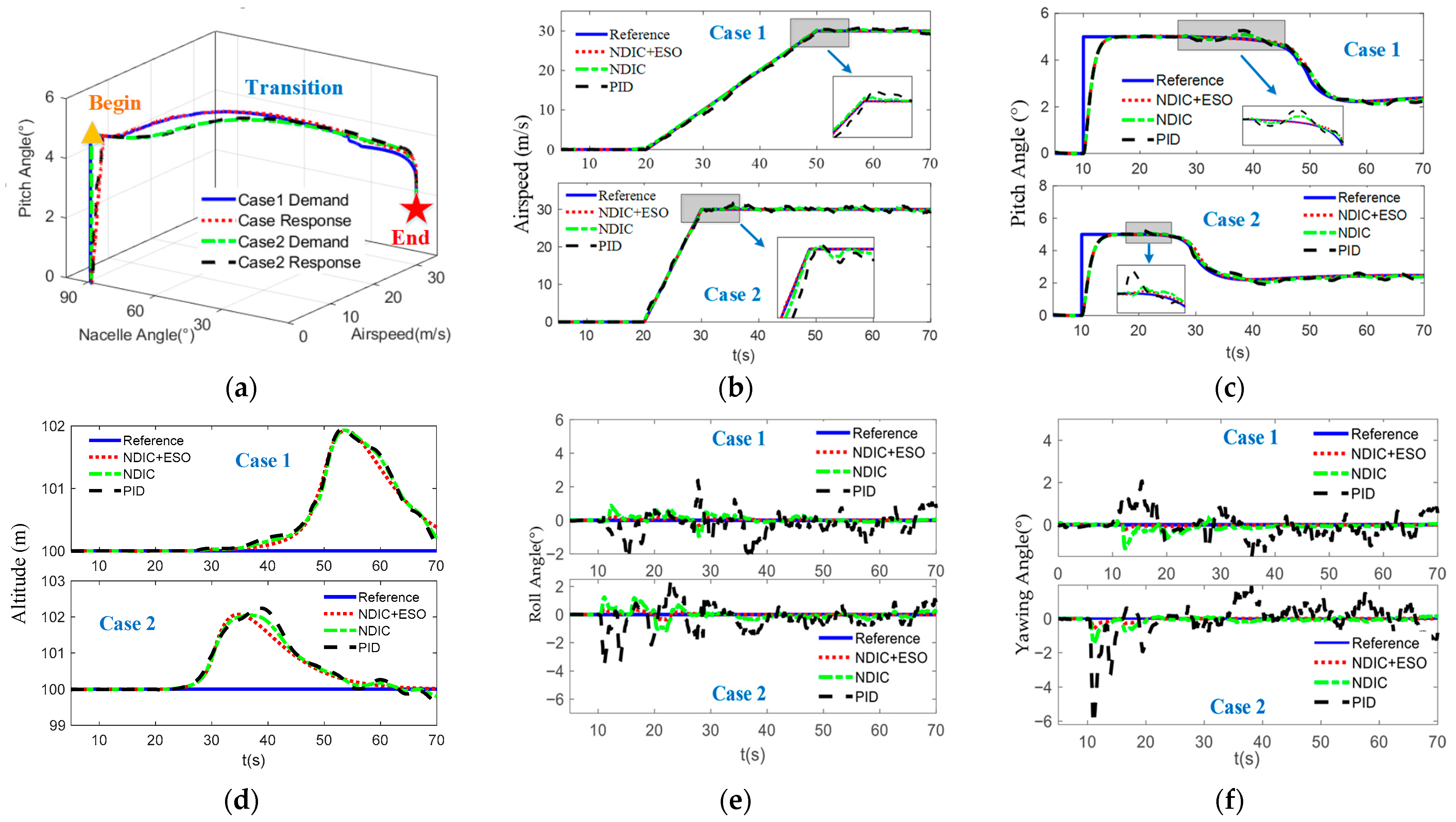
- A two-level control allocation framework combining nonlinear dynamic inversion control (NDIC) and an extended state observer (ESO) (denoted as NDIC–ESO) achieves accurate transition trajectory tracking while coordinating rotor and aerodynamic surface control subsystems.
- The proposed approach improves robustness and adaptability during the transition phase, thereby expanding the operational envelope of QTR UAVs.
- The control framework provides a practical solution for control authority distribution in QTR UAVs with heterogeneous actuators.
Abstract
1. Introduction
- (1)
- Time-varying CG shift with nacelle angle changes alters rotor moment arms and may induce pitch oscillations, degrading stability and lift establishment; thus, an effective transition strategy is required to mitigate pitch fluctuations.
- (2)
- The QTR UAV is equipped with rotor and aerodynamic-surface control systems [12,15,16], the control effectiveness of which is governed by the nacelle angle and the dynamic pressure, respectively. During the tilt transition phase, both variables vary continuously, leading to a dynamic redistribution of control authority between these systems. Consequently, developing an appropriate control allocation strategy [17] is essential for ensuring safe transition flight.
- (3)
- The transition control laws [18,19] must address not only the challenges posed by the time-varying CG and control-system effectiveness but also the nonlinearities inherent in transition dynamics and the unmodeled dynamic introduced by rotor downwash [20]. Therefore, the proposed control law must exhibit strong robustness to ensure stable transition flight.
- (1)
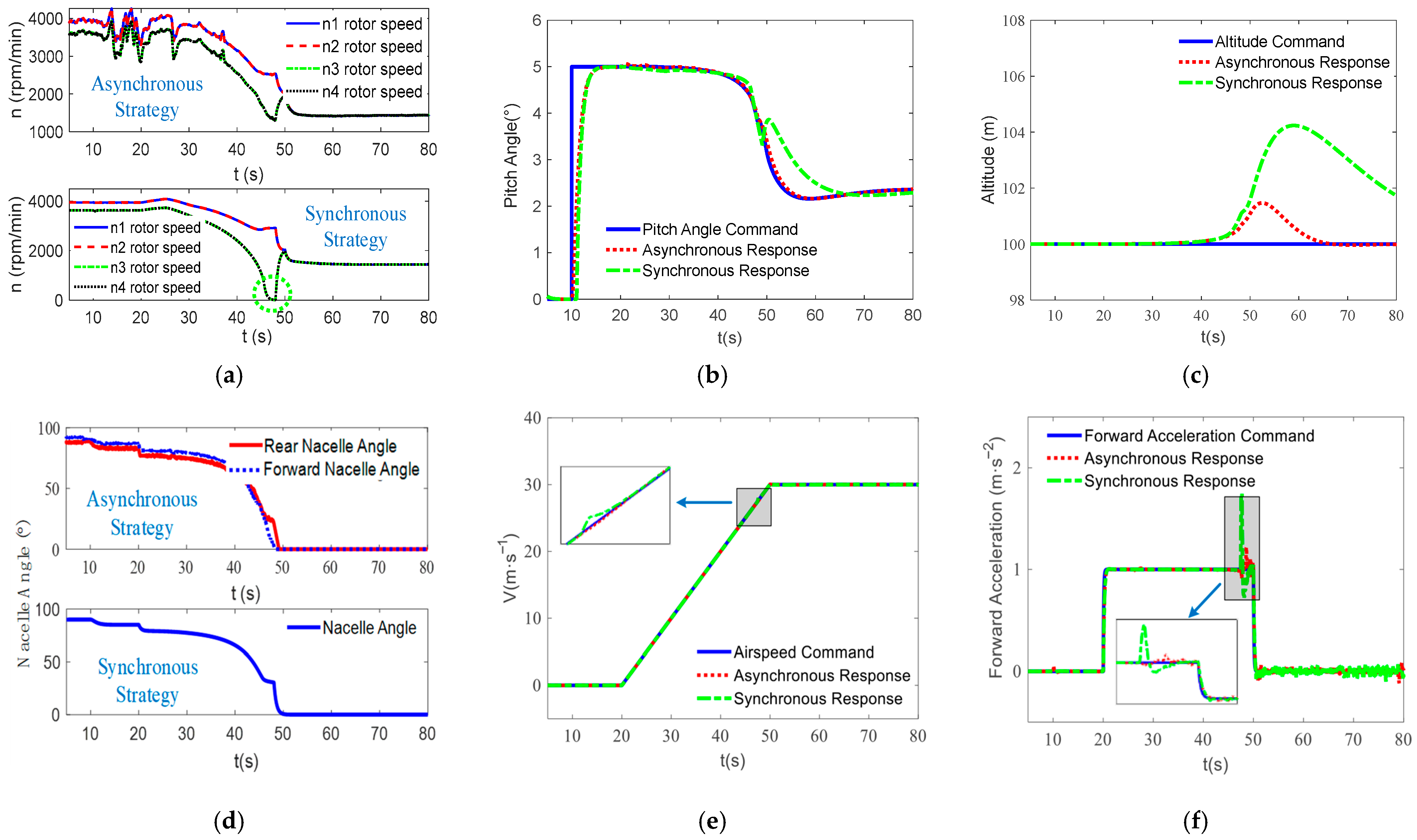
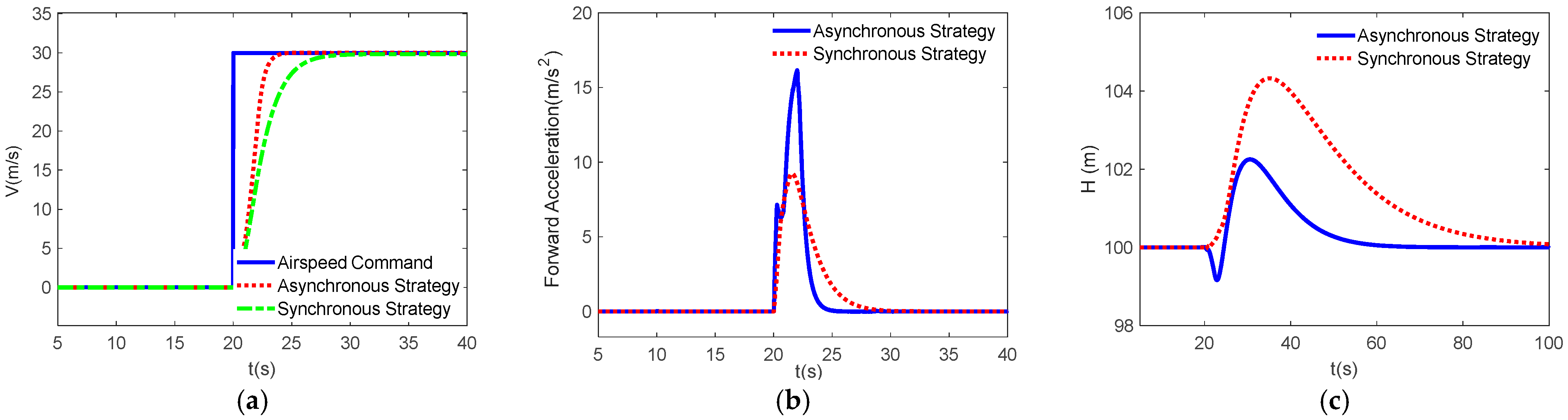
- Asynchronous transition strategy. Compared with the traditional synchronous transition strategy, the proposed asynchronous one offers superior adaptability to variations in CG and maximum forward acceleration. In particular, under CG shift conditions, the asynchronous tilt strategy maintains a safe and controllable transition, whereas the synchronous strategy suffers from actuator saturation and loss of transition feasibility. Consequently, the proposed approach enhances transition capability and extends the range of feasible flight conditions.
- (2)
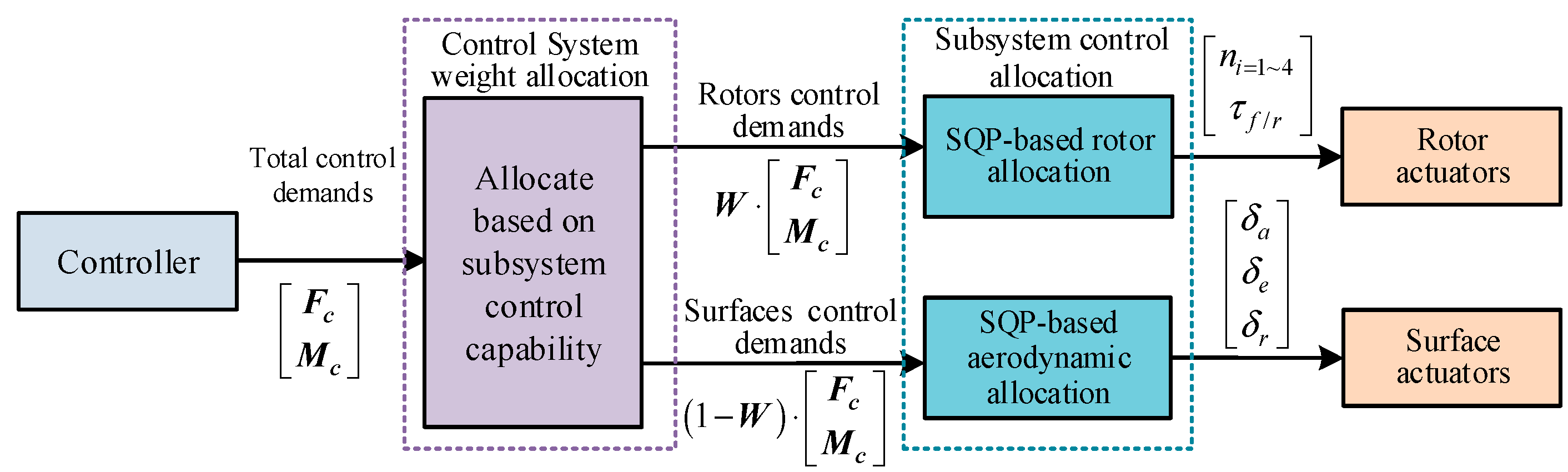
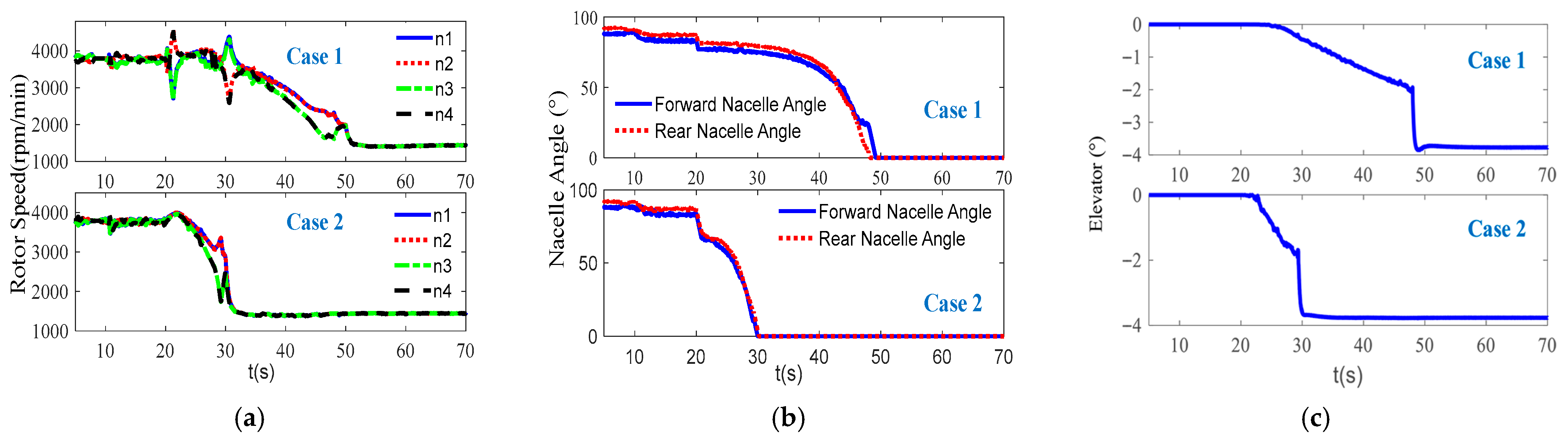
- Two-level control allocation. The proposed two-level control allocation method dynamically distributes control authority between two control subsystems based on their real control capability. This approach enables automatic and reasonable matching of control demand with actuator capacity, avoiding actuator saturation or idleness and ensuring coordinated utilization of the rotor and aerodynamic-surface control subsystems.
- (3)
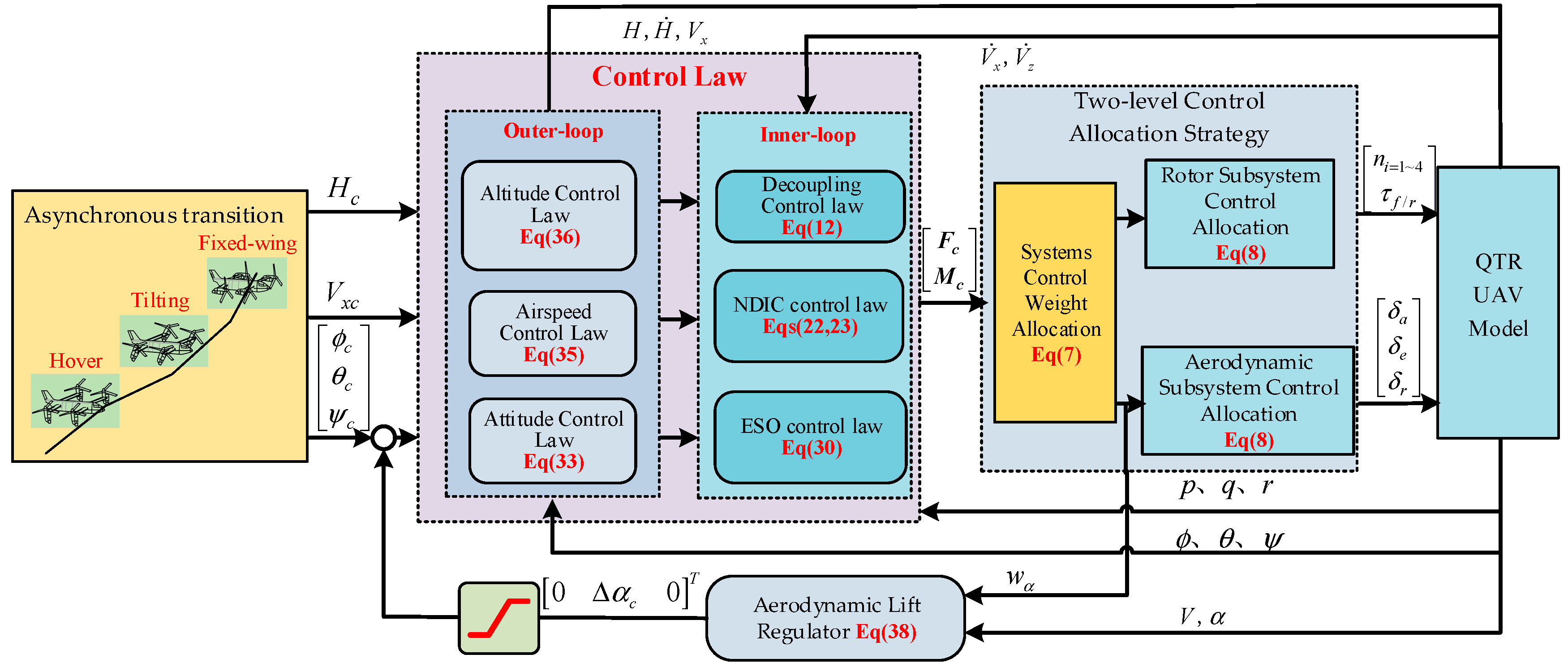
- NDIC-ESO control law. An NDIC–ESO control framework is developed for precise trajectory tracking. The NDIC is responsible for tracking the desired trajectory, while the ESO estimates and compensates for lumped disturbances, thereby enhancing system robustness and dynamic performance.
2. Integrated Modeling of QTR UAV
3. Design of Two-Level Control Allocation Strategy
3.1. Control Weight Allocation for Rotor and Aerodynamic-Surface Subsystems
3.2. Subsystem Control Allocation with SQP
4. Transition Control Based on NDIC and ESO
4.1. Design Concept of NDIC-ESO Controller
4.2. Design of Inner-Loop Control Law
4.3. Design of Outer-Loop Control Law
4.3.1. Design of Attitude-Angle Control Law
4.3.2. Design of Airspeed Control Law
4.3.3. Design of Altitude Control Law
4.4. Design of Aerodynamic Lift Regulator
5. Simulations and Results
5.1. Simulation Results of Asynchronous Tilt Control Scheme
5.1.1. Analysis of Control Allocation Strategy
5.1.2. Analysis of Control Performance with NDIC and ESO
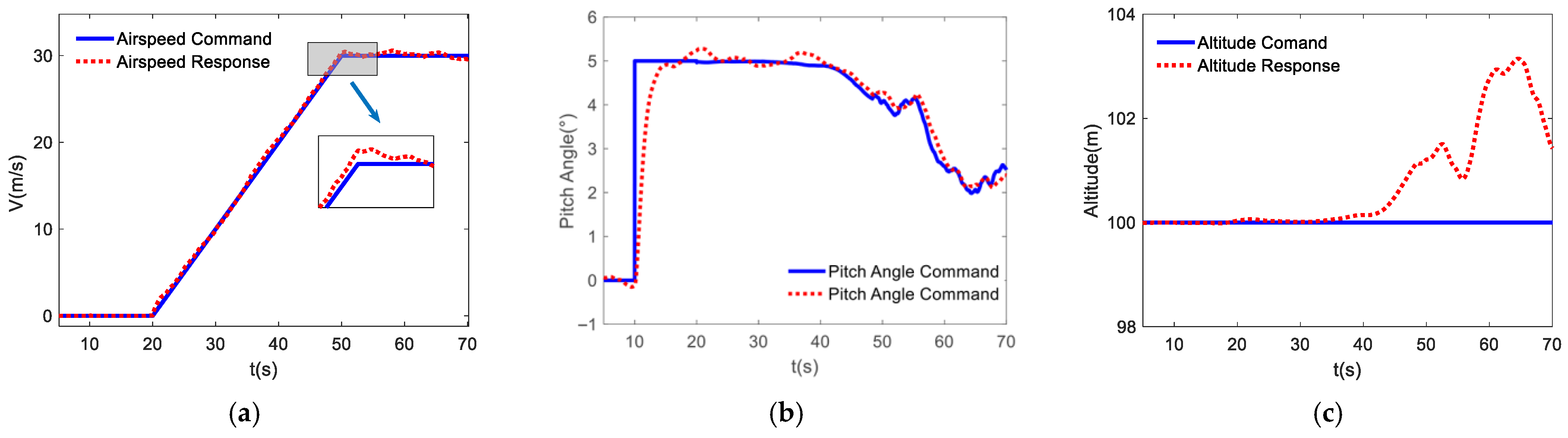
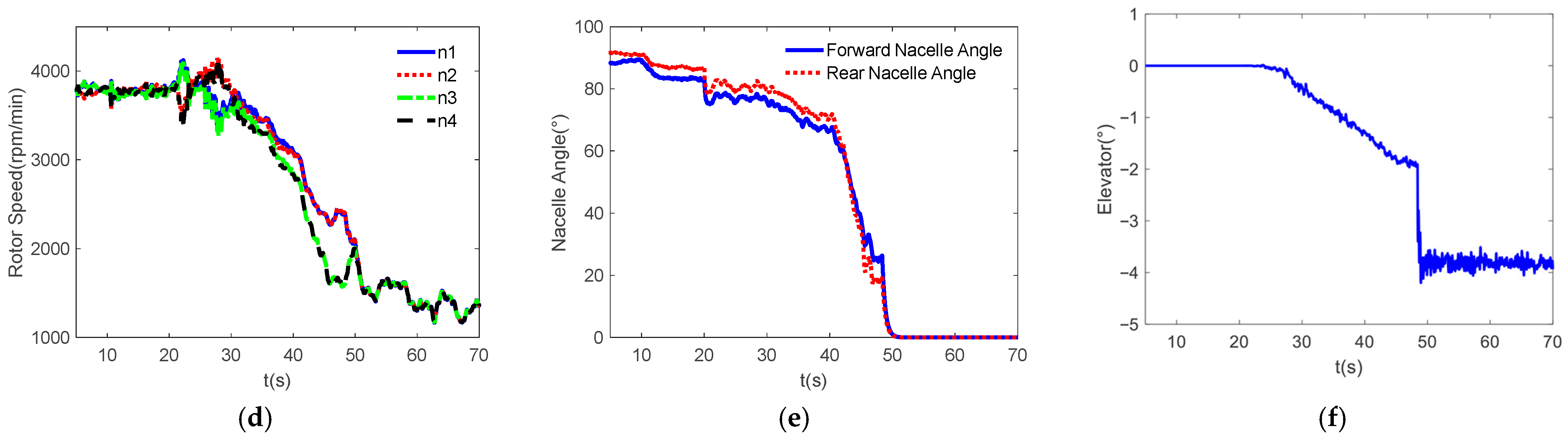
5.1.3. Robustness Analysis
5.2. Simulation Results of Tilt Transition Strategies
5.2.1. Sensitivity Analysis of CG
5.2.2. Capability Analysis of Maximum Acceleration
6. Discussion
7. Conclusions
Author Contributions
Funding
Data Availability Statement
Conflicts of Interest
References
- Samadikhoshkho, Z.; Lipsett, M. Real-time optimal control design for quad-tilt-wing unmanned aerial vehicles. Drones 2025, 9, 233. [Google Scholar] [CrossRef]
- Zhang, S.; Yang, Y.; Wang, X.; Zhu, J.; Zhang, X. Modeling and dynamic analysis of a distributed propulsion tilt-rotor aircraft. In Proceedings of the AIAA Aviation 2022 Forum, Chicago, IL, USA, 27 June–1 July 2022. [Google Scholar] [CrossRef]
- Mancinelli, A.; Remes, B.; Croon, G.; Smeur, E. Unified incremental nonlinear controller for the transition control of a hybrid dual-axis tilting rotor quad-plane. IEEE Trans. Robot. 2025, 41, 306–325. [Google Scholar] [CrossRef]
- Muraoka, K.; Okada, N.; Kubo, D. Quad tilt wing VTOL UAV: Aerodynamic characteristics and prototype flight. In Proceedings of the AIAA Infotech@Aerospace Conference, Washington, DC, USA, 6–9 April 2009; AIAA: Reston, VA, USA, 2009; pp. 1–10. [Google Scholar] [CrossRef]
- Rysdyk, R.T.; Calise, A.J. Adaptive model inversion flight control for tilt-rotor aircraft. J. Guid. Control Dyn. 1999, 22, 402–407. [Google Scholar] [CrossRef]
- Song, W.; Sun, L.; Wang, Q. Nonlinear constrained optimization method for dynamic conversion corridor of tilt-rotor aircraft. J. Guid. Control Dyn. 2024, 47, 2661–2666. [Google Scholar] [CrossRef]
- Yeo, H.; Johnson, W. Performance and design investigation of heavy-lift tilt-rotor with aerodynamic interference effects. J. Aircr. 2009, 46, 1231–1239. [Google Scholar] [CrossRef]
- Zhao, H.; Wang, B.; Shen, Y.; Zhang, Y.; Li, N.; Gao, Z. Development of multimode flight transition strategy for tilt-rotor VTOL UAVs. Drones 2023, 7, 580. [Google Scholar] [CrossRef]
- Yayla, M.; Kutay, A.T.; Senipek, M.; Gungor, O. An adaptive flight controller design for a tilt-prop fixed wing UAV for all flight modes. In Proceedings of the AIAA Scitech 2020 Forum, Orlando, FL, USA, 6–10 January 2020; p. 0593. [Google Scholar] [CrossRef]
- Panish, L.; Bacic, M. Tiltwing eVTOL transition trajectory optimization. J. Aircr. 2025, 62, 81–93. [Google Scholar] [CrossRef]
- Chen, R.; Yuan, Y.; Thomson, D. A review of mathematical modelling techniques for advanced rotorcraft configurations. Prog. Aerosp. Sci. 2021, 120, 100618. [Google Scholar] [CrossRef]
- Wang, Z.; Li, P.; Zhu, Z.; Chen, R.; Shen, J. Control allocation design for equal control sensitivity of tiltrotor aircraft. Aerospace Sci. Technol. 2025, 161, 110134. [Google Scholar] [CrossRef]
- Sato, M.; Muraoka, K. Flight controller design and demonstration of quad-tilt-wing unmanned aerial vehicle. J. Guid. Control Dyn. 2015, 38, 1071–1082. [Google Scholar] [CrossRef]
- Wang, Z.; Wang, Q.; Yu, H.; Duan, D.; Ding, Z.; Li, J. Trimming analysis method of quad tilt rotor based on aerodynamic interference model. J. Aircr. 2020, 58, 253–265. [Google Scholar] [CrossRef]
- He, G.; Yu, L.; Huang, H.; Wang, X. A nonlinear robust sliding mode controller with auxiliary dynamic system for the hovering flight of a tilt tri-rotor UAV. Appl. Sci. 2020, 10, 6551. [Google Scholar] [CrossRef]
- Wilson, E.; Prazenica, R. Autonomous autorotation of tilt-rotor aircraft using nonlinear model predictive control. In Proceedings of the AIAA SciTech 2020 Forum, Orlando, FL, USA, 6–10 January 2020; p. 1488. [Google Scholar] [CrossRef]
- Li, K.; Liu, M.; Li, X.; Yu, X.; Liu, K. Control allocation strategy based on min–max optimization and simple neural network. Drones 2025, 9, 372. [Google Scholar] [CrossRef]
- Liu, Z.; He, Y.; Yang, L.; Han, J. Control techniques of tilt rotor unmanned aerial vehicle systems: A review. Chin. J. Aeronaut. 2017, 30, 135–148. [Google Scholar] [CrossRef]
- Shen, S.; Xu, J.; Chen, P.; Xia, Q. Adaptive neural-network extended-state observer-based finite-time convergent sliding-mode control for a quad tiltrotor UAV. IEEE Trans. Aerosp. Electron. Syst. 2023, 59, 6360–6373. [Google Scholar] [CrossRef]
- Xiang, B.; Tao, G.; Jin, L.; Zhang, J.; Chen, J. CFD Aerodynamic Analysis of Tandem Tilt-Wing UAVs in Cruise Flight and Tilt Transition Flight. Drones 2025, 9, 522. [Google Scholar] [CrossRef]
- Li, H.; Qu, X.; Wang, W. Multi-body motion modeling and simulation for tilt rotor aircraft. Chin. J. Aeronaut. 2010, 23, 415–422. [Google Scholar] [CrossRef]
- Yang, L.; Fan, Y.; Zhu, J. Transition flight control of two vertical/short takeoff and landing aircraft. J. Guid. Control Dyn. 2008, 31, 371–385. [Google Scholar] [CrossRef]
- Fu, R.; Zeng, J.; Wang, Y. Conversion flight control for tilt rotor aircraft using nonlinear time-varying perspective. J. Aerosp. Eng. 2020, 33, 04020062. [Google Scholar] [CrossRef]
- Deng, B.; Xu, J.; Yuan, X.; Yu, S. Active disturbance rejection flight control and simulation of unmanned quad tilt rotor eVTOL based on adaptive neural network. Drones 2024, 8, 560. [Google Scholar] [CrossRef]
- Liang, Z.; Yang, X.; Liu, D.; Hou, Z.; Fan, L. Multi-Objective Optimal Control Allocation for Tilt-Rotor UAVs under Uncertain Conditions. In Proceedings of the 2025 IEEE International Conference on Unmanned Systems (ICUS), Changzhou, China, 18–19 September 2025; pp. 370–379. [Google Scholar] [CrossRef]
- May, M.S.; Milz, D.; Looye, G. Transition strategies for tilt-wing aircraft. In Proceedings of the AIAA SciTech 2024 Forum, Orlando, FL, USA, 8–12 January 2024. [Google Scholar] [CrossRef]
- Wang, Z.; Zhao, H.; Duan, D.; Jiao, Y.; Li, J. Application of improved active disturbance rejection control algorithm in tilt quad rotor. Chin. J. Aeronaut. 2020, 33, 1625–1641. [Google Scholar] [CrossRef]
- Zhen, P.; Wang, W.; Song, S.; Lu, K. Nonlinear attitude control of tiltrotor aircraft based on active disturbance rejection sliding mode method. In Proceedings of the 2016 IEEE Chinese Guidance, Navigation and Control Conference (CGNCC), Nanjing, China, 12–14 August 2016; pp. 1351–1356. [Google Scholar]
- Pans, S.; Lovera, M.; Sato, M.; Muraoka, K. Structured μ-synthesis of robust attitude control laws for quad-tilt-wing unmanned aerial vehicle. J. Guid. Control Dyn. 2020, 43, 2258–2274. [Google Scholar] [CrossRef]
- Singh, K.; Mehndiratta, M.; Feroskhan, M. QuadPlus: Design, Modeling, and Receding-Horizon-Based Control of a Hyperdynamic Quadrotor. IEEE Trans. Aerosp. Electron. Syst. 2022, 58, 1766–1779. [Google Scholar] [CrossRef]
- Papachristos, C.; Alexis, K.; Tzes, A. Dual-Authority Thrust-Vectoring of a Tri-Tiltrotor Employing Model Predictive Control. J. Intell. Robot. Syst. 2015, 81, 471–504. [Google Scholar] [CrossRef]
- Liu, H.; Peng, F.; Lewis, F.; Wan, Y. Robust Tracking Control for Tail-Sitters in Flight Mode Transitions. IEEE Trans. Aerosp. Electron. Syst. 2019, 55, 2023–2035. [Google Scholar] [CrossRef]
- Chang, W.; Lin, Y.; Lee, Y.; Ku, C. Investigating Formation and Containment Problem for Nonlinear Multiagent Systems by Interval Type-2 Fuzzy Sliding Mode Tracking Approach. IEEE Trans. Fuzzy Syst. 2024, 32, 4163–4177. [Google Scholar] [CrossRef]
- Liu, H.; Wang, H.; Sun, J. Attitude Control for QTR Using Exponential Nonsingular Terminal Sliding Mode Control. J. Syst. Eng. Electron. 2019, 30, 191–200. [Google Scholar] [CrossRef]
- Wang, X.; Cai, L. Mathematical modeling and control of a tilt-rotor aircraft. Aerosp. Sci. Technol. 2015, 47, 473–492. [Google Scholar] [CrossRef]
- Yunus, G.; Sheikh, M.B.; Raunak, R.; Basman, E.; Erdal, K. Unsteady aerodynamic modeling and control of pusher and tilt-rotor quadplane configurations. Aerosp. Sci. Technol. 2019, 94, 105421. [Google Scholar] [CrossRef]
- Pei, J.; Roithmayr, C. Equations of motion for a generic multibody tilt-rotor aircraft. In Proceedings of the AIAA Aviation 2022 Forum, Chicago, IL, USA, 27 June–1 July 2022. AIAA 2022-3511. [Google Scholar] [CrossRef]
- Karcher, C. Logspace sequential quadratic programming for design optimization. AIAA J. 2022, 60, 1471–1481. [Google Scholar] [CrossRef]
- Su, Z.; Xing, Z.; Li, X.; Li, C.; Wang, X.; Wang, H. Constrained docking control for shipborne UAV SideArm recovery. Chin. J. Aeronaut. 2024, 37, 39–59. [Google Scholar] [CrossRef]
- Tian, M.; Wang, B.; Yu, Y.; Dong, Q.; Xu, D. Adaptive active disturbance rejection control for uncertain current ripples suppression of PMSM drives. IEEE Trans. Ind. Electron. 2024, 71, 2320–2331. [Google Scholar] [CrossRef]



| Case | Transition Command |
|---|---|
| 1 | |
| 2 |
| Parameter | Value |
|---|---|
| Mass (kg) | 100 |
| Nacelle angle (°) | |
| Nacelle deflection rate (°/s) | [−20, 20] |
| Thrust coefficient | [1.70, 1.55, 1.64, 1.60, 1.55, 1.55, 1.45, 1.40] × |
| Torque coefficient | [8.86, 8.61, 8.67, 9.11, 9.00, 10.01, 9.97, 10.68] × |
| Rotor speed (rpm/min) | [0, 5500] |
| Aerodynamic surfaces (°) | |
| Reference area (m2) | 2.317 |
| Wing span/chord [] (m) | [1.55, 0.55] |
| Distance from CG to i-th rotor along x/y axis (m) | |
| Moments of inertia () | |
| NDIC gains | , , , , , , |
| ESO parameters | |
| PID gains | , , |
| Cases 1 and 2 | Proposed Control Allocation | Only SQP Control Allocation |
|---|---|---|
| Forward force | 2.6% and 3.3% | 5.6% and 6.3% |
| Vertical force | 3.1% and 3.7% | 5.5% and 6.9% |
| Roll moment | 5.2% and 6.1% | 9.2% and 10.1% |
| Pitch moment | 3.6% and 4.3% | 5.1% and 7.3% |
| Yaw moment | 5.6% and 6.3% | 7.1% and 9.6% |
| Cases 1 and 2 | NDIC–ESO | NDIC | PID |
|---|---|---|---|
| Max airspeed error | [0.1, 0.1] m/s | [0.3, 0.4] m/s | [0.6, 0.7] m/s |
| Max pitch error | [0.1, 0.1]° | [0.2, 0.2]° | [0.4, 0.5]° |
| Max roll error | [0.2, 0.2]° | [0.9, 1.0]° | [2.1, 3.5]° |
| Max yaw error | [0.2, 0.2]° | [1.5, 1.7]° | [2.2, 5.5]° |
| Max altitude deviation | [1.8, 1.9] m | [1.8, 2.0] m | [1.9, 2.2] m |
| A: External Disturbances | B: Model Uncertainties |
|---|---|
| Wind: Dryden gust model | Mass variation: ±15% |
| Sensor noise: White Gaussian Noise | Surface effectiveness: ±15% |
| Time delay: 50 ms | Aerodynamic efficiency: ±15% |
| Cases 1 | External Disturbances | Model Uncertainties |
|---|---|---|
| Max airspeed error | 0.5 m/s | 0.2 m/s |
| Max pitch error | 0.5° | 0.6° |
| Max altitude deviation | 3.5 m | 6.2 m |
| Asynchronous Strategy | Synchronous Strategy | |
|---|---|---|
| Max airspeed error | 0.1 m/s | 0.5 m/s |
| Max pitch angle error | 0.2° | 1.2° |
| Max altitude deviation | 2.0 m | 4.2 m |
Disclaimer/Publisher’s Note: The statements, opinions and data contained in all publications are solely those of the individual author(s) and contributor(s) and not of MDPI and/or the editor(s). MDPI and/or the editor(s) disclaim responsibility for any injury to people or property resulting from any ideas, methods, instructions or products referred to in the content. |
© 2026 by the authors. Licensee MDPI, Basel, Switzerland. This article is an open access article distributed under the terms and conditions of the Creative Commons Attribution (CC BY) license.
Share and Cite
Li, X.; Su, Z.; Chen, X.; Jiang, C.; Hou, M. Asynchronous Tilt Transition Control of Quad Tilt Rotor UAV. Drones 2026, 10, 76. https://doi.org/10.3390/drones10010076
Li X, Su Z, Chen X, Jiang C, Hou M. Asynchronous Tilt Transition Control of Quad Tilt Rotor UAV. Drones. 2026; 10(1):76. https://doi.org/10.3390/drones10010076
Chicago/Turabian StyleLi, Xuebing, Zikang Su, Xin Chen, Changhui Jiang, and Mi Hou. 2026. "Asynchronous Tilt Transition Control of Quad Tilt Rotor UAV" Drones 10, no. 1: 76. https://doi.org/10.3390/drones10010076
APA StyleLi, X., Su, Z., Chen, X., Jiang, C., & Hou, M. (2026). Asynchronous Tilt Transition Control of Quad Tilt Rotor UAV. Drones, 10(1), 76. https://doi.org/10.3390/drones10010076