
Seamless Quantification of Wet and Dry Riverscape Topography Using UAV Topo-Bathymetric LiDAR


Highlights
- A UAV-mounted lightweight topo-bathymetric LiDAR sensor captured high density point clouds with low mean vertical error.
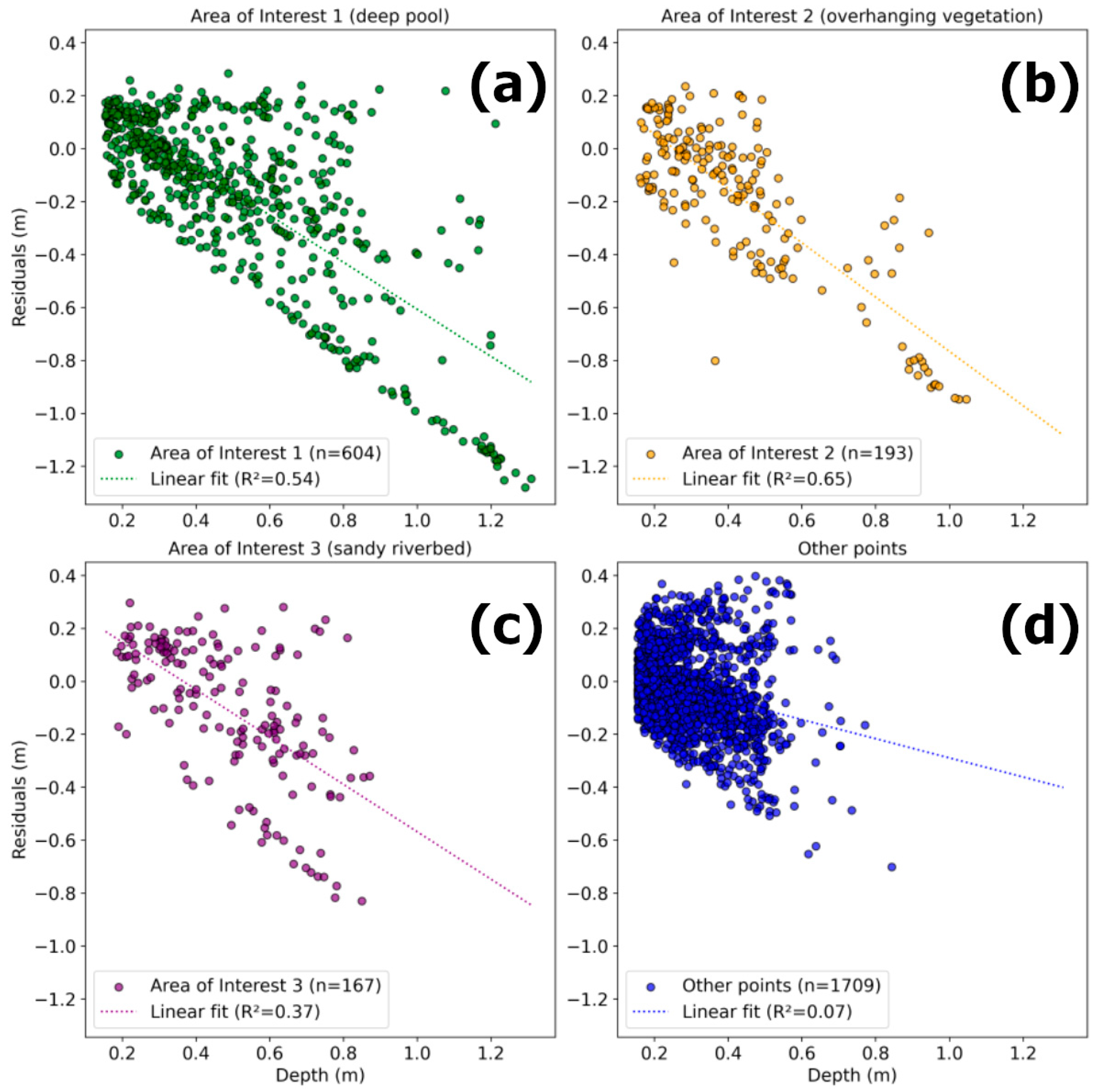
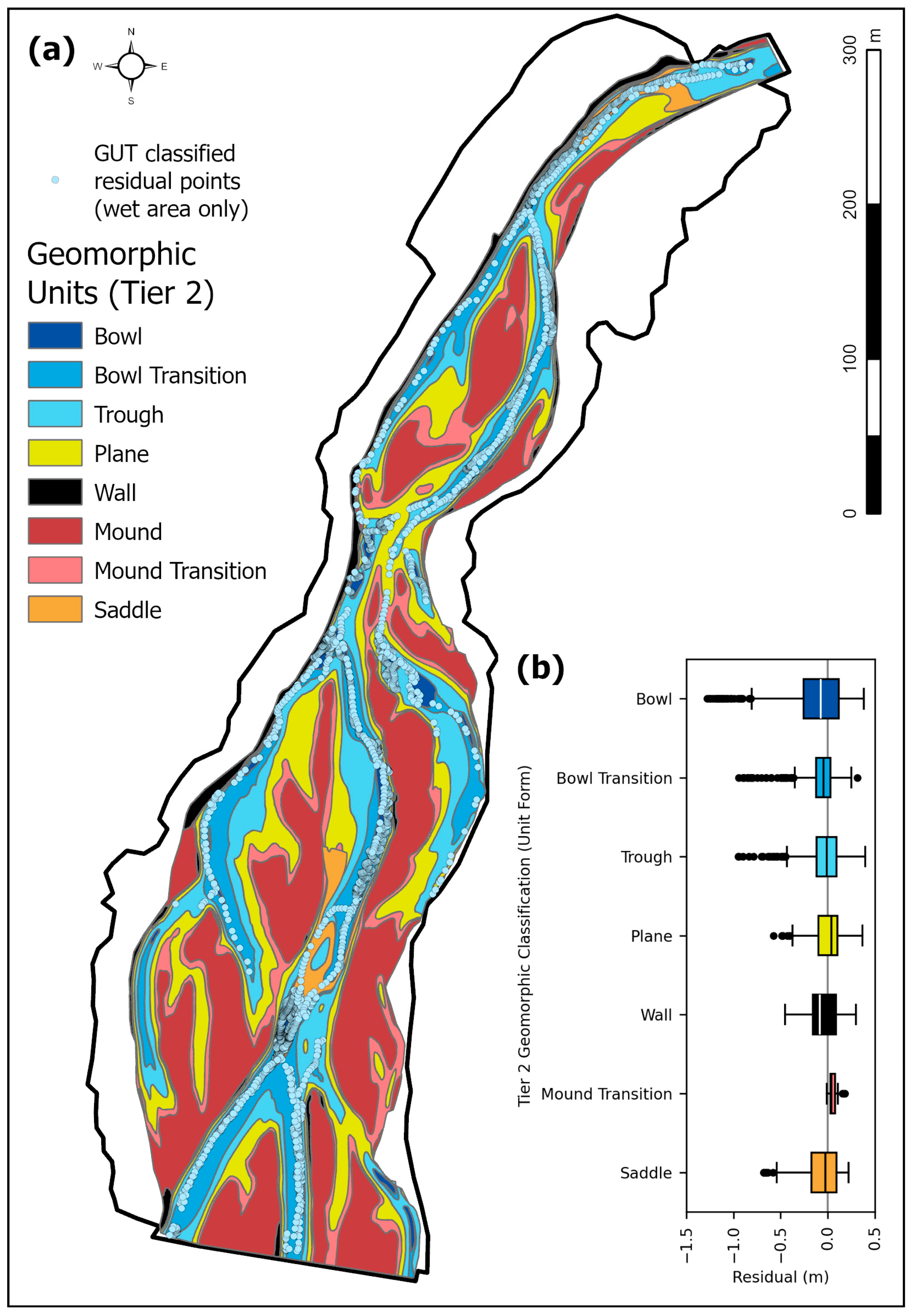
- Vertical errors are higher for wet areas with concave three-dimensional shapes.
- A new generation of lightweight topo-bathymetric LiDAR sensors that can increase the efficiency of topographic surveys.
- Targeted ground-based surveys of deep areas are necessary to minimise spatial bias in error.
Abstract
1. Introduction
1.1. General Background
1.2. Related Works: State of the Art
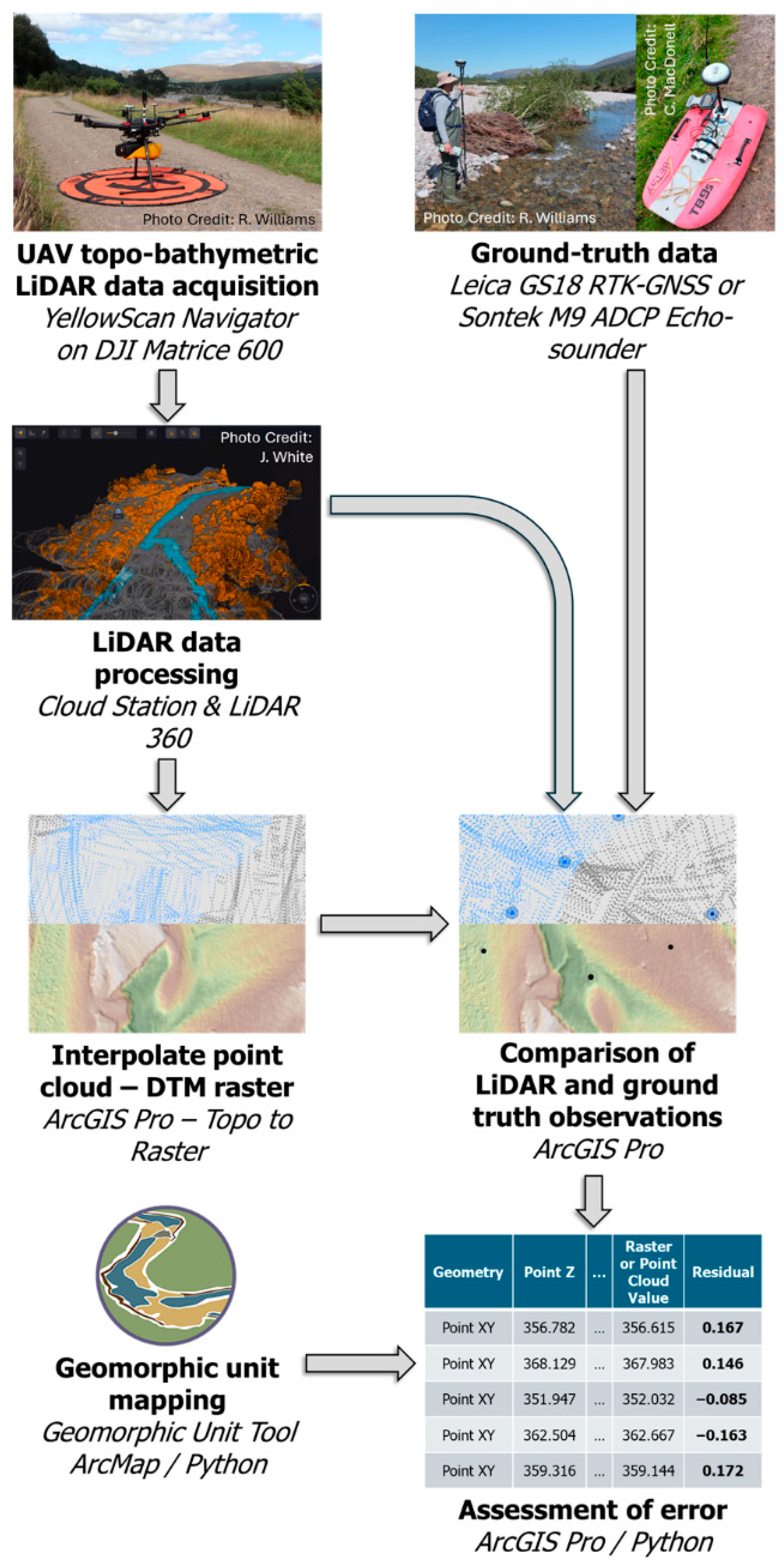
1.3. Aim, Methodological Overview and Methodology
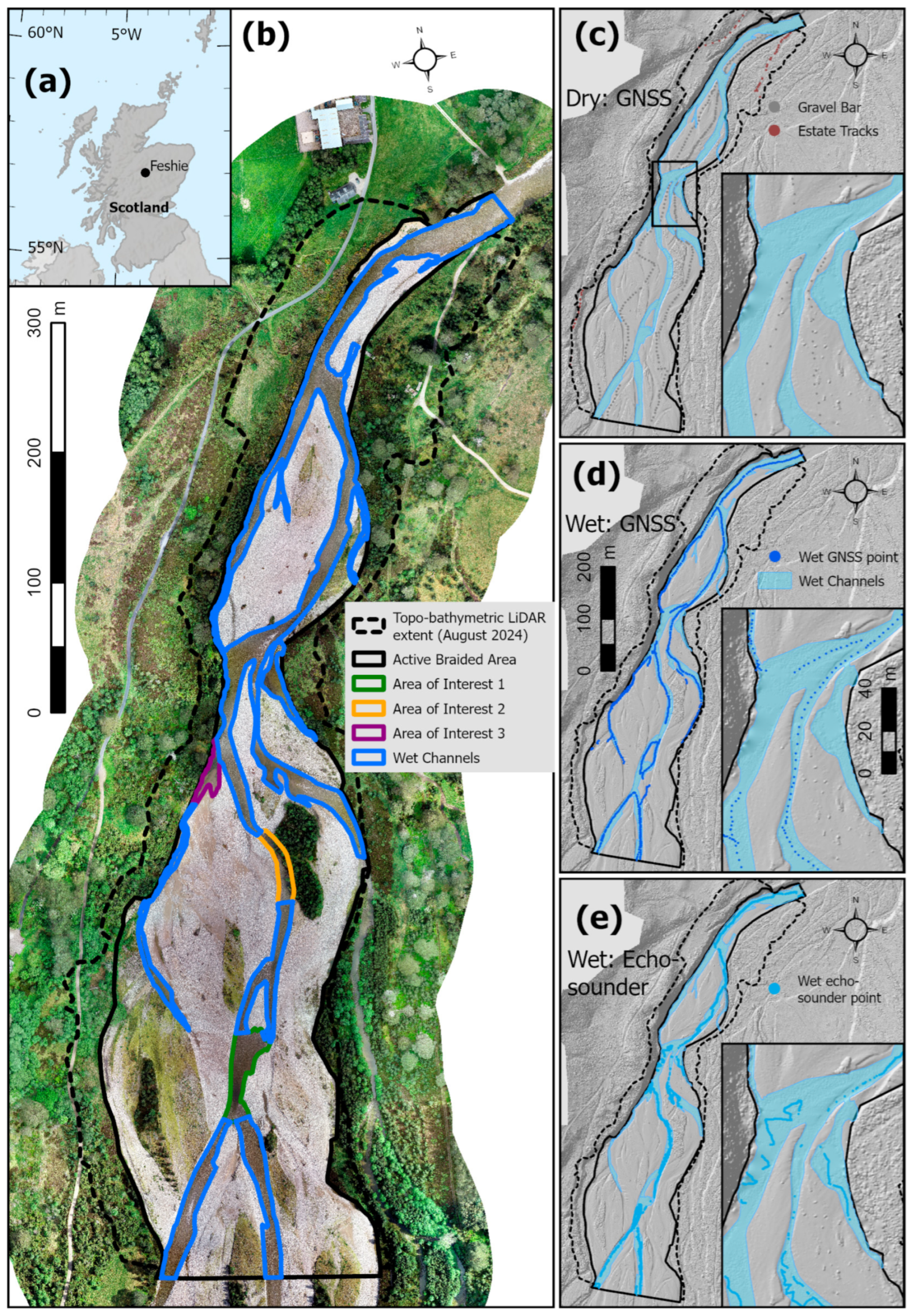
2. Study Area
3. Methods
3.1. UAV Topo-Bathymetric LiDAR Data Acquisition
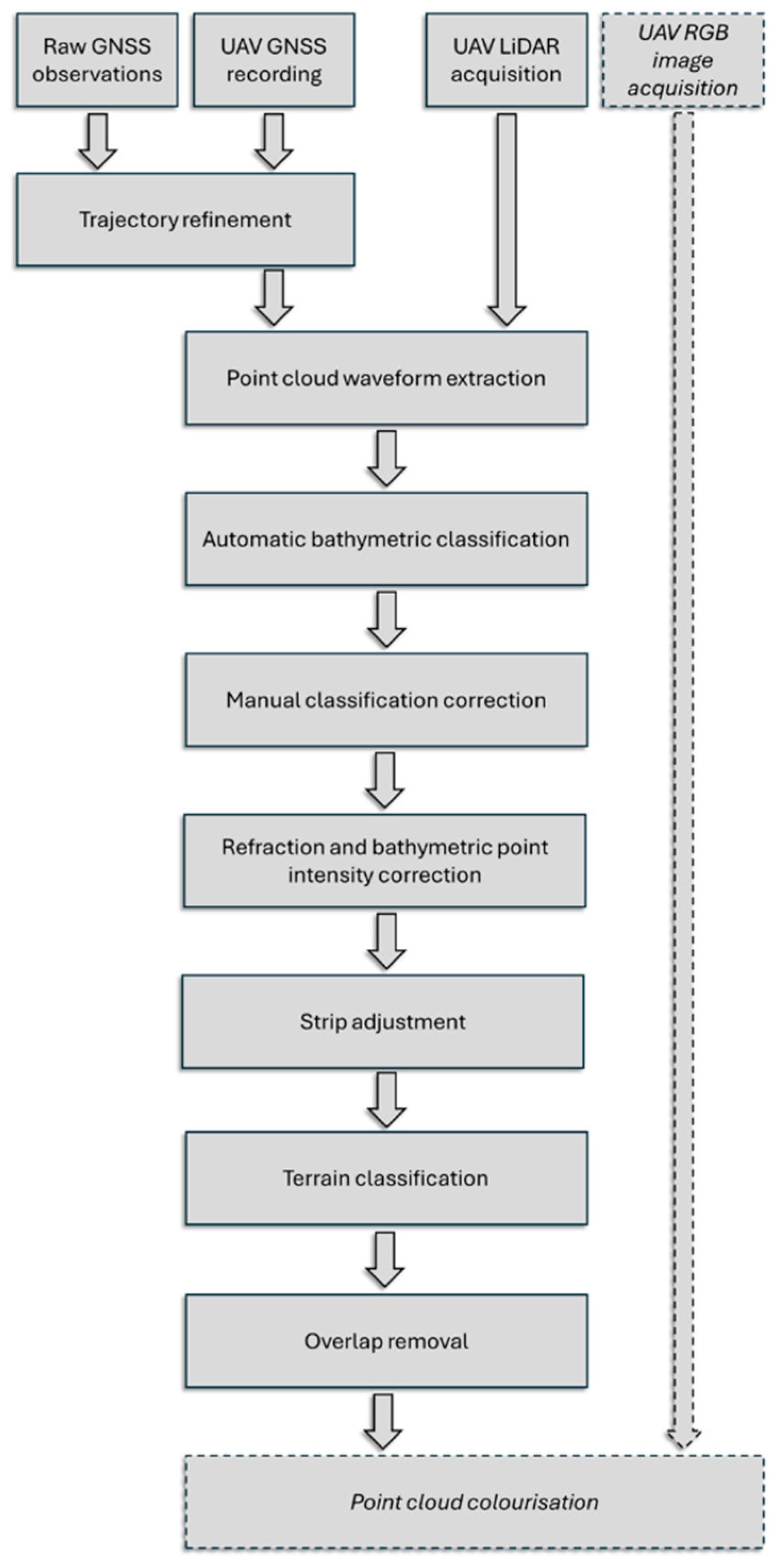
3.2. LiDAR Data Processing
3.3. Ground Truth Data
3.4. Comparison of LiDAR and Ground Truth Observations
3.5. Interpolation to Produce Digital Terrain Model
3.6. Assessment of Error and Geomorphic Unit Form
4. Results
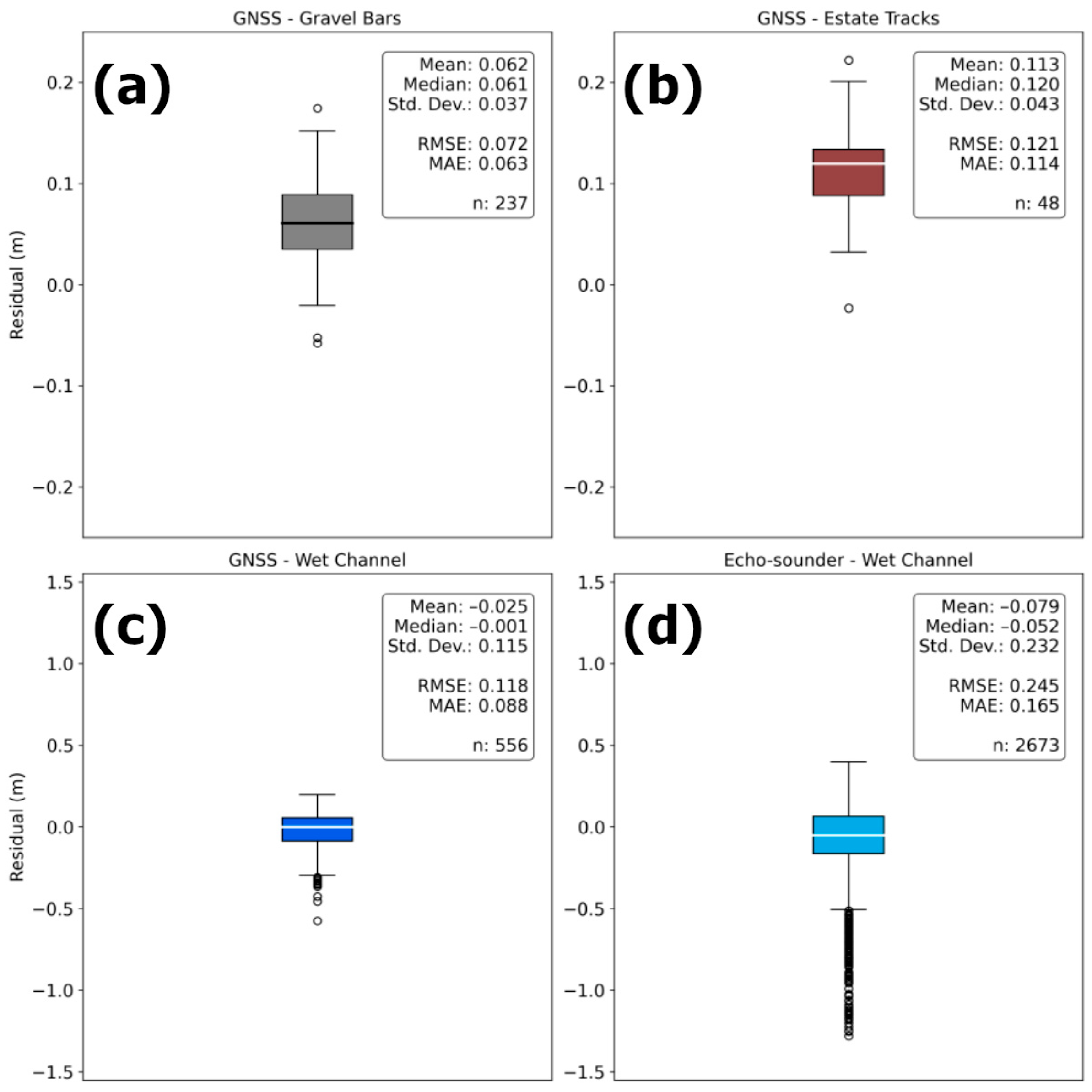
4.1. Vertical Error Assessment
4.2. Areas of Interest Segmented Residuals
4.3. GUT Segmented Residuals
4.4. DEM Residuals to Ground-Truth Data
5. Discussion
5.1. UAV Topo-Bathymetric LiDAR Errors
5.2. Remote Sensing of Riverscape Topography
6. Conclusions
- The sensor is capable of producing high density (62 points/m2) point clouds at the reach scale.
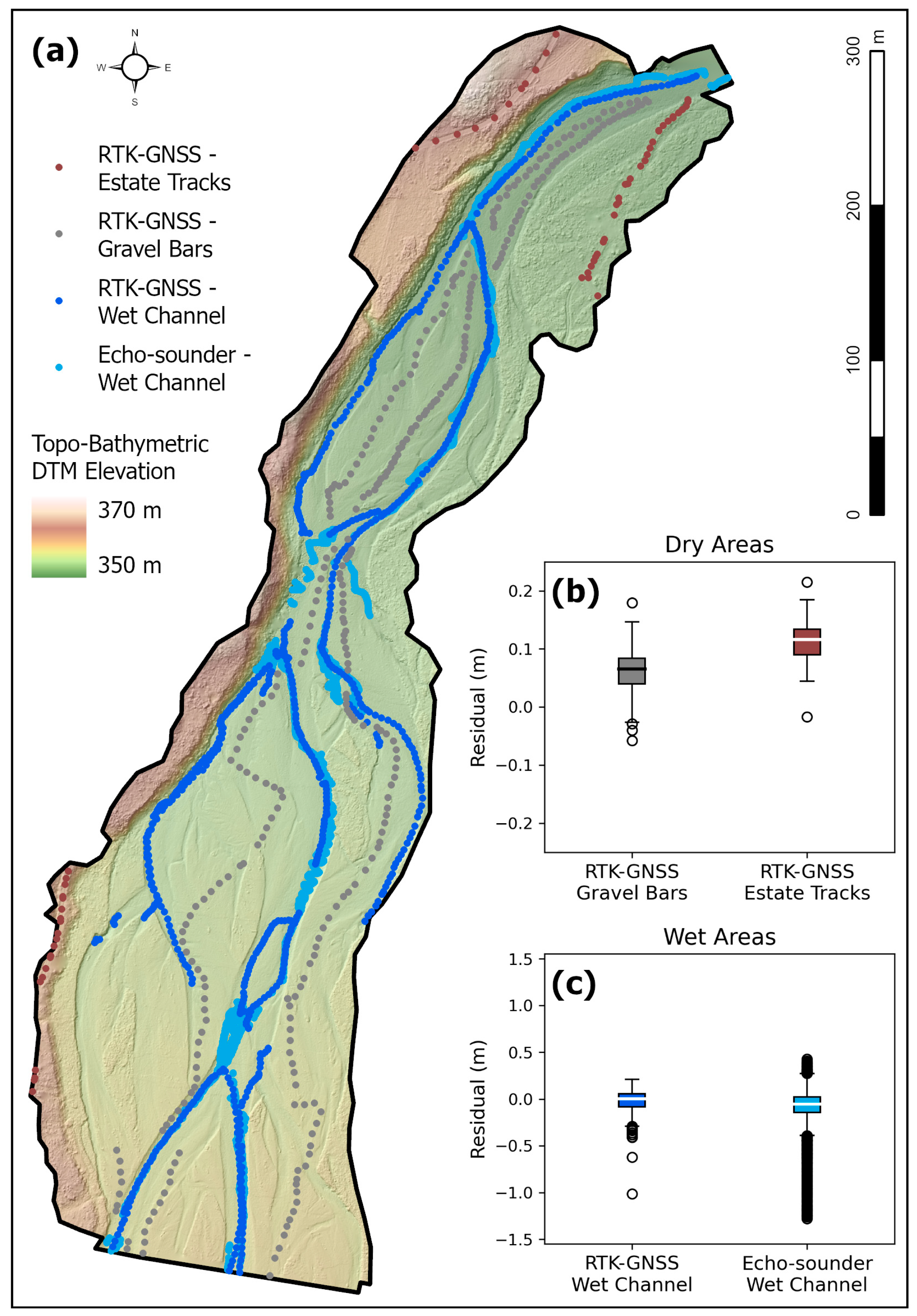
- Mean vertical errors, with associated standard deviations, were acceptable for dry gravel bars (0.06 ± 0.04 m, n = 237), shallow wet channels (−0.03 ± 0.12 m, n = 556) and deeper wet channels (−0.08 m ± 0.23 m, n = 2673).
- The spatial distribution of vertical errors in wet areas corresponds to geomorphic unit distribution, with units with a concave three-dimensional shape (bowls and troughs, which are associated with deeper water) having larger negative errors and wider ranges of residuals than units with planar or convex shapes.
Supplementary Materials
Author Contributions
Funding
Data Availability Statement
Acknowledgments
Conflicts of Interest
Abbreviations
| DEM | Digital Elevation Model |
| LiDAR | Light Detection and Ranging |
| UAV | Unoccupied Aerial Vehicle |
| RTK-GNSS | Real-Time Kinematic Global Navigation Satellite System |
| SfM | Structure from Motion—photogrammetry |
| n | Sample size |
| RMSE | Root Mean Square Error |
| RGB | Red, Green, Blue (“true colour” imagery) |
| MBES | Multi-Beam Echo-Sounder |
| ADCP | Acoustic Doppler Current Profiler |
| UGCS | Universal Ground Control System |
| AoI | Area of Interest |
| KML | Keyhole Markup Language (file type) |
| TOLS | Take-Off and Landing Site |
| INS | Inertial Navigation System |
| IMU | Inertial Measurement Unit |
| CAA | Civil Aviation Authority (United Kingdom) |
| OS | Ordnance Survey—national mapping agency for Great Britain |
| RINEX | Receiver INdependent Exchange—GNSS data format |
| DTM | Digital Terrain Model |
| GUT | Geomorphic Unit Tool |
| MAE | Mean Absolute Error |
| GU | Geomorphic Unit |
References
- Williams, R.; Brasington, J.; Vericat, D.; Hicks, D.M. Hyperscale terrain modelling of braided rivers: Fusing mobile terrestrial laser scanning and optical bathymetric mapping. Earth Surf. Process. Landf. 2014, 39, 167–183. [Google Scholar] [CrossRef]
- He, J.; Zhang, S.; Cui, X.; Feng, W. Remote sensing for shallow bathymetry: A systematic review. Earth-Sci. Rev. 2024, 258, 104957. [Google Scholar] [CrossRef]
- Chone, G.; Biron, P.M. Assessing the relationship between river mobility and habitat. River Res. Appl. 2016, 32, 528–539. [Google Scholar] [CrossRef]
- Frizzle, C.; Trudel, M.; Daniel, S.; Noman, J. LiDAR topo-bathymetry for riverbed elevation assessment: A review of approaches and performance for hydrodynamic modelling of flood plains. Earth Surf. Process. Landf. 2024, 49, 2585–2600. [Google Scholar] [CrossRef]
- Quick, L.; Williams, R.; Boothroyd, R.J.; Hoey, T.B.; Tolentino, P.L.M.; MacDonell, C.; Guardian, E.; Reyes, J.; Sabillo, C.; Perez, J.; et al. Confined and mined, anthropogenic river modification as a driver of flood risk change. Npj Nat. Hazards 2025, 2, 4. [Google Scholar] [CrossRef]
- Glassic, H.C.; McGwire, K.C.; Macfarlane, W.W.; Rasmussen, C.; Bouwes, N.; Wheaton, J.M.; Al-Chokhachy, R. From pixels to riverscapes: How remote sensing and geospatial tools can prioritize riverscape restoration at multiple scales. WIREs Water 2024, 11, e1716. [Google Scholar] [CrossRef]
- Mandlburger, G.; Hauer, C.; Wieser, M.; Pfeifer, N. Topo-bathymetric LiDAR for monitoring river morphodynamics and instream habitats—A case study at the Pielach River. Remote Sens. 2015, 7, 6160–6195. [Google Scholar] [CrossRef]
- Williams, R.D.; Lamy, M.-L.; Maniatis, G.; Stott, E. Three-dimensional reconstruction of fluvial surface sedimentology and topography using personal mobile laser scanning. Earth Surf. Process. Landf. 2020, 45, 251–261. [Google Scholar] [CrossRef]
- Steer, P.; Guerit, L.; Lague, D.; Crave, A.; Gourdon, A. Size, shape and orientation matter: Fast and semi-automatic measurement of grain geometries from 3D point clouds. Earth Surf. Dyn. 2022, 10, 1211–1232. [Google Scholar] [CrossRef]
- Tarolli, P.; Mudd, S.M. (Eds.) Developments in Earth Surface Processes. In Remote Sensing of Geomorphology; Elsevier: Amsterdam, The Netherlands, 2020; Volume 23, ISBN 978-0-444-64177-9. [Google Scholar]
- Westaway, R.M.; Lane, S.N.; Hicks, D.M. Remote survey of large-scale braided, gravel-bed rivers using digital photogrammetry and image analysis. Int. J. Remote Sens. 2003, 24, 795–815. [Google Scholar] [CrossRef]
- Legleiter, C.J. Remote measurement of river morphology via fusion of LiDAR topography and spectrally based bathymetry. Earth Surf. Process. Landf. 2012, 37, 499–518. [Google Scholar] [CrossRef]
- Glennie, C.; Carter, W.; Shrestha, R.; Dietrich, W. Geodetic imaging with airborne LiDAR: The Earth’s surface revealed. Rep. Prog. Phys. 2013, 76, 086801. [Google Scholar] [CrossRef]
- Mandlburger, G.; Pfennigbauer, M.; Schwarz, R.; Pöppel, F. A decade of progress in topo-bathymetric laser scanning exemplified by the Pielach River dataset. ISPRS Ann. Photogramm. Remote Sens. Spat. Inf. Sci. 2023, X-1/W1-2023, 1123–1130. [Google Scholar] [CrossRef]
- Pan, Z.; Glennie, C.; Fernandez-Diaz, J.C.; Carter, W.E. Performance assessment of high-resolution airborne full-waveform LiDAR for shallow river bathymetry. Remote Sens. 2015, 7, 5133–5159. [Google Scholar] [CrossRef]
- Mandlburger, G.; Pfennigbauer, M.; Schwarz, R.; Flener, C.; Wimmer, A.; Pfeifer, N. Concept and performance evaluation of a novel UAV-borne topo-bathymetric LiDAR sensor. Remote Sens. 2020, 12, 986. [Google Scholar] [CrossRef]
- Kinzel, P.J.; Legleiter, C.J.; Grams, P.E. Field evaluation of a compact, polarizing topo-bathymetric lidar across a range of river conditions. River Res. Appl. 2021, 37, 531–543. [Google Scholar] [CrossRef]
- Mandlburger, G. A review of active and passive optical methods in hydrography. Int. Hydrogr. Rev. 2022, 28, 8–52. [Google Scholar] [CrossRef]
- Williams, R.D.; Measures, R.; Hicks, D.M.; Brasington, J. Linking the spatial distribution of bed load transport to morphological change during high-flow events in a shallow braided river. J. Geophys. Res. Earth Surf. 2015, 120, 604–622. [Google Scholar] [CrossRef]
- Kaplinski, M.; Hazel, J.E., Jr.; Grams, P.E.; Kohl, K.; Buscombe, D.D.; Tusso, R.B. Channel Mapping River Miles 29–62 of the Colorado River in Grand Canyon National Park, Arizona, May 2009; Open-File Report, 2017-1030; U.S. Geological Survey: Reston, VA, USA, 2017; 35p. [Google Scholar] [CrossRef]
- Bangen, S.G.; Wheaton, J.M.; Bouwes, N.; Bouwes, B.; Jordan, C.E. A methodological intercomparison of topographic survey techniques for characterizing wadeable streams and rivers. Geomorphology 2014, 206, 343–361. [Google Scholar] [CrossRef]
- Lyzenga, D.R. Passive remote sensing techniques for mapping water depth and bottom features. Appl. Opt. 1978, 17, 379–383. [Google Scholar] [CrossRef] [PubMed]
- Flener, C.; Kos, A.; Pfeifer, N.; Briese, C. Seamless mapping of river channels at high resolution using mobile LiDAR and UAV-photography. Remote Sens. 2013, 5, 6382–6407. [Google Scholar] [CrossRef]
- Legleiter, C.J. The optical river bathymetry toolkit. River Res. Appl. 2021, 37, 555–568. [Google Scholar] [CrossRef]
- Lejot, J.; Delacourt, C.; Piégay, H.; Fournier, T.; Trémélo, M.-L.; Allemand, P. Very high spatial resolution imagery for channel bathymetry and topography from an unmanned mapping controlled platform. Earth Surf. Process. Landf. 2007, 32, 1705–1725. [Google Scholar] [CrossRef]
- Legleiter, C.J.; Roberts, D.A.; Marcus, W.A.; Fonstad, M.A. Passive optical remote sensing of river channel morphology and in-stream habitat: Physical basis and feasibility. Remote Sens. Environ. 2004, 93, 493–510. [Google Scholar] [CrossRef]
- Legleiter, C.J.; Roberts, D.A.; Lawrence, R.L. Spectrally based remote sensing of river bathymetry. Earth Surf. Process. Landf. 2009, 34, 1039–1059. [Google Scholar] [CrossRef]
- Carbonneau, P.E.; Lane, S.N.; Bergeron, N. Feature-based image processing methods applied to bathymetric measurements from airborne remote sensing in fluvial environments. Earth Surf. Process. Landf. 2006, 31, 1413–1423. [Google Scholar] [CrossRef]
- Smith, M.W.; Carrivick, J.L.; Quincey, D.J. Structure from motion photogrammetry in physical geography. Prog. Phys. Geogr. 2015, 40, 247–275. [Google Scholar] [CrossRef]
- Woodget, A.S.; Carbonneau, P.E.; Visser, F.; Maddock, I.P. Quantifying submerged fluvial topography using hyperspatial resolution UAS imagery and Structure-from-Motion photogrammetry. Earth Surf. Process. Landf. 2015, 40, 47–64. [Google Scholar] [CrossRef]
- Dietrich, J.T. Bathymetric Structure-from-Motion: Extracting shallow stream bathymetry from multi-view stereo photogrammetry. Earth Surf. Process. Landf. 2017, 42, 355–364. [Google Scholar] [CrossRef]
- Woodget, A.S.; Dietrich, J.T.; Wilson, R.T. Quantifying below-water fluvial geomorphic change: The implications of refraction correction, water surface elevations, and spatially variable error. Remote Sens. 2019, 11, 2415. [Google Scholar] [CrossRef]
- Mancini, D.; Antoniazza, G.; Roncoroni, M.; Métra, F.; Lane, S.N. Heuristic estimation of river bathymetry in braided streams using digital image processing. Earth Surf. Process. Landf. 2024, 49, 3889–3912. [Google Scholar] [CrossRef]
- Chan, T.O.; Zhang, S.; Xia, L.; Luo, M.; Wu, J.; Awange, J. A novel reflectance transformation and convolutional neural network framework for generating bathymetric data for long rivers: A case study on the Bei River in South China. Int. J. Appl. Earth Obs. Geoinf. 2024, 127, 103682. [Google Scholar] [CrossRef]
- Szafarczyk, A.; Tos, C. The use of green laser in LiDAR bathymetry: State of the art and recent advancements. Sensors 2023, 23, 292. [Google Scholar] [CrossRef] [PubMed]
- Hilldale, R.C.; Raff, D. Assessing the ability of airborne LiDAR to map river bathymetry. Earth Surf. Process. Landf. 2008, 33, 773–783. [Google Scholar] [CrossRef]
- Bailly, J.-S.; Le Coarer, Y.; Languille, P.; Stigermark, C.; Allouis, T. Geostatistical estimations of bathymetric LiDAR errors on rivers. Earth Surf. Process. Landf. 2010, 35, 1199–1210. [Google Scholar] [CrossRef]
- Kinzel, P.J.; Legleiter, C.J.; Nelson, J.M. Mapping river bathymetry with a small footprint green LiDAR: Applications and challenges. J. Am. Water Resour. Assoc. 2013, 49, 183–204. [Google Scholar] [CrossRef]
- Tonina, D.; McKean, J.; Benjankar, R.; Wright, C.W.; Goode, J.R.; Chen, Q.; Reeder, W.J.; Carmichael, R.A.; Edmondson, M.R. Mapping river bathymetries: Evaluating topobathymetric LiDAR survey. Earth Surf. Process. Landf. 2019, 44, 507–520. [Google Scholar] [CrossRef]
- Awadallah, M.O.M.; Malmquist, C.; Sticker, M.; Alfredsen, K. Quantitative evaluation of bathymetric LiDAR sensors and acquisition approaches in Lærdal River in Norway. Remote Sens. 2023, 15, 263. [Google Scholar] [CrossRef]
- Kastdalen, L.; Stickler, M.; Malmquist, C.; Heggenes, J. Evaluating methods for measuring in-river bathymetry: Remote sensing green LiDAR provides high-resolution channel bed topography limited by water penetration capability. River Res. Appl. 2024, 40, 467–482. [Google Scholar] [CrossRef]
- Velez-Nicolas, M.; García-López, S.; Barbero, L.; Ruiz-Ortiz, V.; Sánchez-Bellón, Á. Applications of unmanned aerial systems (UASs) in hydrology: A review. Remote Sens. 2021, 13, 1359. [Google Scholar] [CrossRef]
- Specht, M.; Wiśniewska, M.; Stateczny, A.; Specht, C.; Szostak, B.; Lewicka, O.; Stateczny, M.; Widźgowski, S.; Halicki, A. Analysis of methods for determining shallow waterbody depths based on images taken by unmanned aerial vehicles. Sensors 2022, 22, 1844. [Google Scholar] [CrossRef]
- Zhou, G.; Wu, G.; Zhou, X.; Xu, C.; Zhao, D.; Lin, J.; Liu, Z.; Zhang, H.; Wang, Q.; Xu, J.; et al. Adaptive model for the water depth bias correction of bathymetric LiDAR point cloud data. Int. J. Appl. Earth Obs. Geoinf. 2023, 118, 103253. [Google Scholar] [CrossRef]
- MacDonell, C.J.; Williams, R.D.; Maniatis, G.; Roberts, K.; Naylor, M. Consumer-grade UAV solid-state LiDAR accurately quantifies topography in a vegetated fluvial environment. Earth Surf. Process. Landf. 2023, 48, 2211–2229. [Google Scholar] [CrossRef]
- Pricope, N.G.; Bashit, M.S. Emerging trends in topobathymetric LiDAR technology and mapping. Int. J. Remote Sens. 2023, 44, 7706–7731. [Google Scholar] [CrossRef]
- Islam, M.T.; Yoshida, K.; Nishiyama, S.; Sakai, K.; Tsuda, T. Characterizing vegetated rivers using novel unmanned aerial vehicle-borne topo-bathymetric green LiDAR: Seasonal applications and challenges. River Res. Appl. 2022, 38, 44–58. [Google Scholar] [CrossRef]
- Wang, D.; Xing, S.; He, Y.; Yu, J.; Xu, Q.; Li, P. Evaluation of a new lightweight UAV-borne topo-bathymetric LiDAR for shallow water bathymetry and object detection. Sensors 2022, 22, 1379. [Google Scholar] [CrossRef]
- Brasington, J.; Rumsby, B.; McVey, R. Monitoring and modelling morphological change in a braided gravel-bed river using high resolution GPS-based survey. Earth Surf. Process. Landf. 2000, 25, 973–990. [Google Scholar] [CrossRef]
- Rumsby, B.; McVey, R.; Brasington, J. The potential for high resolution fluvial archives in braided rivers: Quantifying historic reach-scale channel and floodplain development in the River Feshie, Scotland. In River Basin Sediment Systems: Archives of Environmental Change; Maddy, D., Macklin, M.G., Woodward, J.C., Eds.; Balkema: Rotterdam, The Netherlands, 2001; pp. 445–467. [Google Scholar] [CrossRef]
- Brasington, J.; Langham, J.; Rumsby, B. Methodological sensitivity of morphometric estimates of coarse fluvial sediment transport. Geomorphology 2003, 53, 299–316. [Google Scholar] [CrossRef]
- Vericat, D.; Brasington, J.; Wheaton, J.; Cowie, M. Accuracy assessment of aerial photographs acquired using lighter-than-air blimps: Low-cost tools for mapping river corridors. River Res. Appl. 2008, 25, 985–1000. [Google Scholar] [CrossRef]
- Brasington, J.; Vericat, D.; Rychkov, I. Modeling river bed morphology, roughness, and surface sedimentology using high-resolution terrestrial laser scanning. Water Resour. Res. 2012, 48, 11. [Google Scholar] [CrossRef]
- Stott, E.; Williams, R.D.; Hoey, T.B. Ground control point distribution for accurate kilometre-scale topographic mapping using an RTK-GNSS unmanned aerial vehicle and SfM photogrammetry. Drones 2020, 4, 55. [Google Scholar] [CrossRef]
- Matthews, B.; Naylor, M.; Sinclair, H.; Black, A.; Williams, R.D.; Cuthill, C.; Gervais, M.; Dietze, M.; Smith, A. Sounding out the river: Seismic and hydroacoustic monitoring of bedload transport. Earth Surf. Process. Landf. 2024, 49, 3840–3854. [Google Scholar] [CrossRef]
- Ballantyne, C.K.; Gordon, J.E. (Eds.) Scotland’s changing landscape. In Landscapes and Landforms of Scotland; Springer: Cham, Switzerland, 2021; pp. 97–114. [Google Scholar] [CrossRef]
- Gullett, P.R.; Leslie, C.; Mason, R.; Ratcliffe, P.; Sargent, I.; Beck, A.; Cameron, T.; Cowie, N.R.; Hetherington, D.; MacDonell, T.; et al. Woodland expansion in the presence of deer: 30 years of evidence from the Cairngorms Connect landscape restoration partnership. J. Appl. Ecol. 2023, 60, 2298–2308. [Google Scholar] [CrossRef]
- Hutchinson, M.F. A new procedure for gridding elevation and stream line data with automatic removal of spurious pits. J. Hydrol. 1989, 106, 211–232. [Google Scholar] [CrossRef]
- Smith, S.L.; Holland, D.A.; Longley, P.A. Investigating the spatial structure of error in digital surface models derived from laser scanning. In Proceedings of the ISPRS XXXIV, Commission 3/WG 3/W13, Dresden, Germany, 8–10 October 2003; pp. 1–7. Available online: https://www.isprs.org/proceedings/XXXIV/3-W13/papers/Smith_ALSDD2003.pdf (accessed on 2 September 2025).
- Wheaton, J.M.; Fryirs, K.A.; Brierley, G.J.; Bangen, S.G.; Bouwes, N.; O’Brien, G. Geomorphic mapping and taxonomy of fluvial landforms. Geomorphology 2015, 248, 273–295. [Google Scholar] [CrossRef]
- Llena, M.; Batalla, R.J.; Vericat, D. Inferring on fluvial resilience from multi-temporal high-resolution topography and geomorphic unit diversity. Geomorphology 2024, 465, 109412. [Google Scholar] [CrossRef]
- Wheaton, J.M. Uncertainty in Morphological Sediment Budgeting of Rivers. Ph.D. Thesis, University of Southampton, Southampton, UK, 2008; 412p. [Google Scholar]
- Berthelot, J.; Gintz, A.; Kennel, P.; Doukkali, N.; Allouis, T. Advanced Bathymetric Survey Using the YellowScan Navigator: Applications in Erosion and Soil Movement Tracking. In International Archives of the Photogrammetry, Remote Sensing and Spatial Information Sciences, Proceedings of the 3D Underwater Mapping from Above and Below—3rd International Workshop, TU Wien, Vienna, Austria, 8–11 July 2025; Copernicus Publications: Göttingen, Germany, 2025; Volume XLVIII-2/W10-2025, pp. 13–18. Available online: https://isprs-archives.copernicus.org/articles/XLVIII-2-W10-2025/13/2025/isprs-archives-XLVIII-2-W10-2025-13-2025.pdf (accessed on 5 December 2025).


| Specification | Value |
|---|---|
| Laser wavelength | 532 nm |
| Scanner field of view | 20° |
| Scanning pattern | Circular conical scan pattern |
| Echoes per shot | Full waveform |
| Maximum depth | 2 Secchi |
| Manufacturer recommended flying height | 80 m |
| Manufacturer recommended flying speed | 5 ms−1 |
| Weight | 3.7 kg (battery excluded) |
| Power consumption | 120 W |
| Laser class | Class 3B (avoid direct exposure to beam) |
| Remote Sensing Method | Instrument | Reference | Areal Coverage of Example | Average Point Cloud Density | Error Assessment Methodology | Error Assessment Results |
|---|---|---|---|---|---|---|
| UAV Topo-Bathymetric LiDAR | YellowScan Navigator | This study | 0.135 km2 (1 km long × 150 m wide reach) | 62 points/m2 | RTK-GNSS points across wet and dry surfaces, and echo-sounder water depths compared to average LiDAR points within 0.1 m | RMSE: dry topography = 0.072 to 0.121 m; wet bathymetry = 0.118 to 0.245 m |
| UAV Topo-Bathymetric LiDAR | ASTRALiTe EDGE™ polarizing sensor | [17] | 6 cross-sections, approx. 2 m wide swath | Unreported—but variable with depth | Relationship between ground-truth depth (RTK-GNSS or multi-beam echo sounding (MBES)) and LiDAR depth | R2 between 0.6 and 0.97 for different cross-sections |
| UAV Topo-Bathymetric LiDAR | Riegl VQ-840-G | [16] | 650 m long river reach | 20–50 points/m2 | Ground Control targets both on land (RTK-GNSS) and submerged on river bed (Total Station) | Absolute Accuracy (dry) = −0.045 to 0.013 m (Table 5 in [16]); maximum residual (bathymetric) = −0.078 m (Table 6 in [16]) |
| UAV Topo-Bathymetric LiDAR | TDOT Green | [47] | 0.36 km2 (1.2 km long × 300 m wide reach) | ~100 points/m2 | Total Station points—underwater bed elevation, bare ground, beneath canopy vegetation | RMSE: underwater = 0.068 to 0.090 m; bare ground = 0.020 to 0.050 m; beneath canopy vegetation = 0.121 to 0.129 m |
| UAV Topo-Bathymetric LiDAR | Mapper4000U | [48] | 0.0456 km2 (two offshore transects: 1.2 km × 38 m) | 42 points/m2 | Mapper5000 manned bathymetric LiDAR and MBES | RMSE: water surface = 0.123 m; water bottom = 0.127 m |
| Bathymetric correction of UAV SfM imagery (raster based) | UAV SfM imagery | [30] | 0.002–0.004 km2 (across four sites) | DEM resolution: 0.018–0.020 m | Total Station and RTK-GNSS | Mean residuals: dry areas = 0.004 to 0.111 m; submerged areas (corrected) = 0.008 to 0.053 m. |
| Bathymetric correction of UAV SfM imagery (point cloud based) | UAV SfM imagery | [31] | 0.03 km2 (250 m long × 120 m wide reach) | 160–390 points/m2 | RTK-GNSS survey of Ground Control Points, water edge and streambed | RMSE = 0.061 to 0.077 m |
| Optical empirical bathymetric mapping | Aerial imagery camera | [11] | 3.3 km reach, width varies between 1–4 km | DEM resolution: 1 m | Total Station and RTK-GNSS | Mean Error = −0.015 m; Standard Deviation Error = 0.199 m |
Disclaimer/Publisher’s Note: The statements, opinions and data contained in all publications are solely those of the individual author(s) and contributor(s) and not of MDPI and/or the editor(s). MDPI and/or the editor(s) disclaim responsibility for any injury to people or property resulting from any ideas, methods, instructions or products referred to in the content. |
© 2025 by the authors. Licensee MDPI, Basel, Switzerland. This article is an open access article distributed under the terms and conditions of the Creative Commons Attribution (CC BY) license (https://creativecommons.org/licenses/by/4.0/).
Share and Cite
MacDonell, C.J.; Williams, R.D.; White, J.; Roberts, K. Seamless Quantification of Wet and Dry Riverscape Topography Using UAV Topo-Bathymetric LiDAR. Drones 2025, 9, 872. https://doi.org/10.3390/drones9120872
MacDonell CJ, Williams RD, White J, Roberts K. Seamless Quantification of Wet and Dry Riverscape Topography Using UAV Topo-Bathymetric LiDAR. Drones. 2025; 9(12):872. https://doi.org/10.3390/drones9120872
Chicago/Turabian StyleMacDonell, Craig John, Richard David Williams, Jon White, and Kenny Roberts. 2025. "Seamless Quantification of Wet and Dry Riverscape Topography Using UAV Topo-Bathymetric LiDAR" Drones 9, no. 12: 872. https://doi.org/10.3390/drones9120872
APA StyleMacDonell, C. J., Williams, R. D., White, J., & Roberts, K. (2025). Seamless Quantification of Wet and Dry Riverscape Topography Using UAV Topo-Bathymetric LiDAR. Drones, 9(12), 872. https://doi.org/10.3390/drones9120872