Article

A Cooperative Decision-Making Approach Based on a Soar Cognitive Architecture for Multi-Unmanned Vehicles


1
School of Intelligent Systems Engineering, Sun Yat-sen University, Shenzhen 517108, China
2
Southern Marine Science and Engineering Guangdong Laboratory, Zhuhai 519000, China
3
School of Civil Aviation, Northwestern Polytechnical University, Xi’an 710072, China
4
Unmanned Aerial System Co., Ltd., Aviation Industry Corporation of China (Chengdu), Chengdu 610091, China
*
Author to whom correspondence should be addressed.
Drones 2024, 8(4), 155; https://doi.org/10.3390/drones8040155
Submission received: 28 February 2024 / Revised: 1 April 2024 / Accepted: 16 April 2024 / Published: 18 April 2024

Abstract

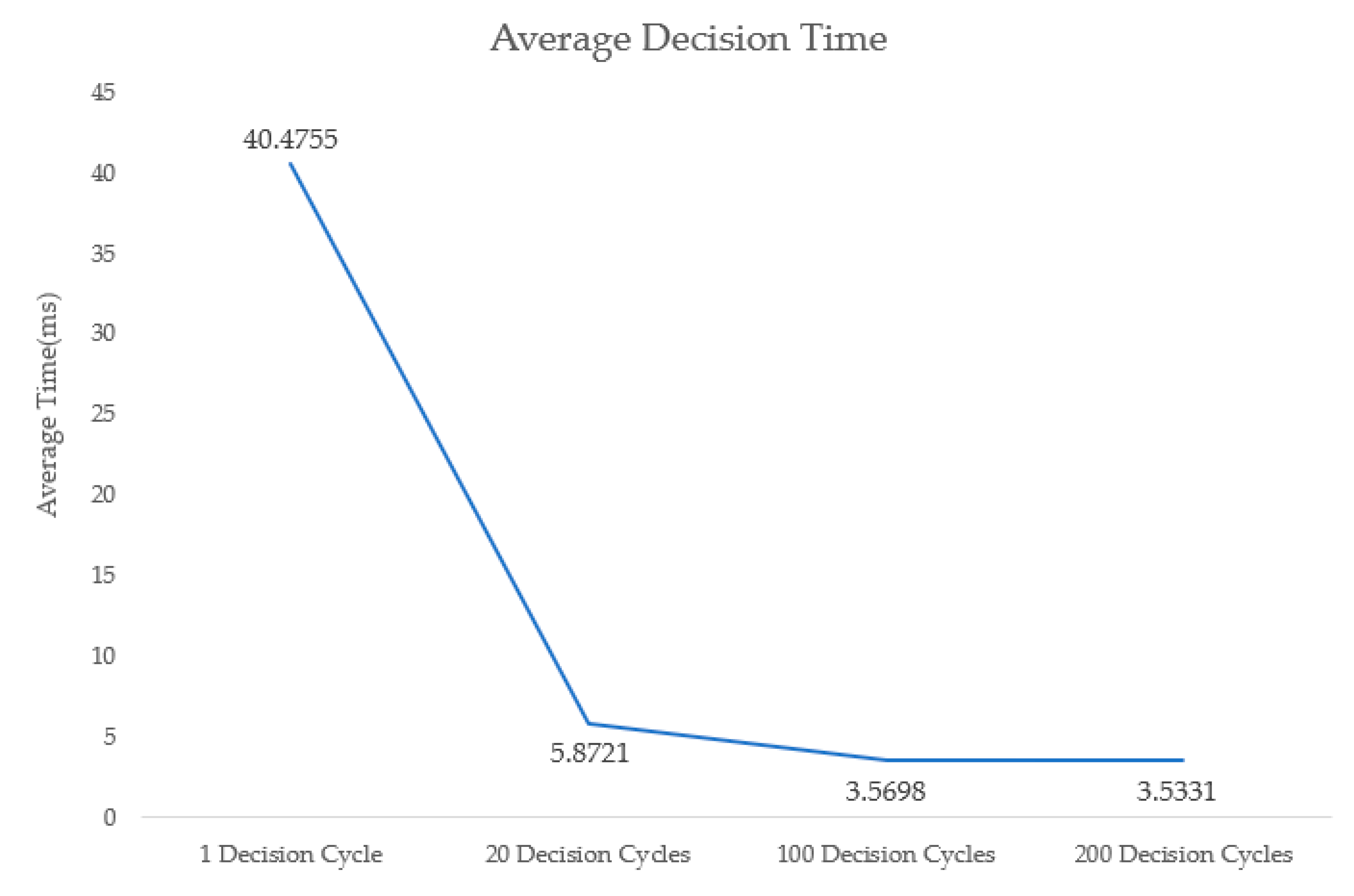
Multi-unmanned systems have demonstrated significant applications across various fields under complex or extreme operating environments. In order to make such systems highly efficient and reliable, cooperative decision-making methods have been utilized as a critical technology for successful future applications. However, current multi-agent decision-making algorithms pose many challenges, including difficulties understanding human decision processes, poor time efficiency, and reduced interpretability. Thus, a real-time online collaborative decision-making model simulating human cognition is presented in this paper to solve those problems under unknown, complex, and dynamic environments. The provided model based on the Soar cognitive architecture aims to establish domain knowledge and simulate the process of human cooperation and adversarial cognition, fostering an understanding of the environment and tasks to generate real-time adversarial decisions for multi-unmanned systems. This paper devised intricate forest environments to evaluate the collaborative capabilities of agents and their proficiency in implementing various tactical strategies while assessing the effectiveness, reliability, and real-time action of the proposed model. The results reveal significant advantages for the agents in adversarial experiments, demonstrating strong capabilities in understanding the environment and collaborating effectively. Additionally, decision-making occurs in milliseconds, with time consumption decreasing as experience accumulates, mirroring the growth pattern of human decision-making.
Keywords: multi-unmanned vehicle; cooperative decision-making; cognitive architecture multi-unmanned vehicle; cooperative decision-making; cognitive architecture