1. Introduction
Unmanned aerial vehicles (UAVs), a highlight of the aviation fields, have driven profound industrial transformations, with far-reaching implications for the low-altitude economy [
1,
2]. As mission requirements become increasingly complex and diversified, a single UAV can hardly meet operational demands. Benefiting from advances in communication and networking technologies [
3,
4], cooperative UAV swarm systems, with superior scalability, fault tolerance and task-execution capacity, have garnered extensive research interest for applications such as emergency rescue, regional inspection, and logistics transportation [
5,
6,
7,
8,
9].
Faced with concurrent task requirements, deploying multiple UAVs for simultaneous response is thus more effective, and as a key link in decision-making, task allocation directly determines the collaborative operation of UAV swarms in mission scenarios. In recent years, benefiting from the development of communication technology, networked information transmission enables UAVs to synergistically collaborate for task allocation [
10]. Hence, the networked task allocation problem of UAV swarms has been studied extensively [
11,
12]. For target allocation modeling, it is essentially formulated as an optimization problem aiming to generate strategies for high-efficiency UAV swarm mission execution. Hence, various algorithms are widely studied in solving task allocation problems, which can be mainly divided into two types: market-based and optimization-based. Optimization-based algorithms exhibit desired stability, but the scalability and adaptability are insufficient [
13,
14,
15,
16,
17]. The metaheuristics-based optimization methods, especially, may suffer from task conflicts, allocate redundant tasks to agents, and easily fall into a local extreme point. As for market-based algorithms, the dynamic allocation can balance efficiency and robustness, exhibiting better flexibility and decentralized superiority. According to the market mechanism design, consensus-based bundle algorithm (CBBA) and contract network protocol (CNP) constitute two main branches of market-based algorithms [
18,
19,
20,
21,
22]. However, the CNP algorithm heavily relies on the communication structure, leading to a high computational burden, which renders its applications difficult in resource-limited UAV task allocation [
19]. Although CBBA-based methods possess high dynamic adaptability to tasks, their inherent mechanism yields insufficient robustness in the face of task uncertainty and time-sensitive scenarios [
20,
21,
22].
The performance impact (PI) algorithm is a well-known optimization method, inspired by CBBA, and exhibits prominent merits in swarm task allocation [
23,
24]. It can balance individual agent benefits and global swarm performance, realize distributed decision-making with moderate communication overhead, and exhibit favorable extensibility for diverse multi-agent mission scenarios, thus arousing widespread research interest. Ref. [
25] studied an improved PI-based distributed scheduling algorithm combined with a task removal inference strategy and a deadlock avoidance mechanism. Ref. [
26] designed a disturbance mechanism and two types of local search refinement strategies, namely decoupled and coupled optimization phases, and expanded the model to support three categories of heterogeneous ground robots and multi-type time-critical rescue tasks. Further considering the characteristic of UAV, a two-stage PI-based algorithm was designed in [
27] for a resource-constrained scenario of UAV cooperation. The classic PI mechanism relies on homogeneous agent hypothesis and ideal connected communication topology. Without appropriate adaptations, the original PI framework faces inconsistent reward evaluation over heterogeneous UAVs, biased local performance impact estimates under disconnected time-varying communication, and redundant invalid negotiation conflicts due to the absence of coalition filtering mechanisms, leading to poor convergence efficiency. Further considering networked communication, ref. [
28] studied a PI-based algorithm to improve the robustness of task allocation under non-ideal communication. Concentrating on the communication efficiency, ref. [
29] developed a decentralized grouping PI algorithm. Obviously, the simplified theoretical allocation model is not suitable for the UAV swarm cooperation with various physical constraints. Nevertheless, existing PI-based allocation frameworks face obvious challenges, which are mainly manifested in three aspects:
Simplified theoretical agent models in Refs. [
23,
24,
25,
26], seldom integrating diverse physical constraints of UAV platforms, ill-suit the implicit premise of primitive PI and restrict the practicability of the PI-based method for flight swarm cooperative missions;
Existing PI-based schemes target homogeneous agents [
23,
24,
25,
26,
27], built upon a unified reward evaluation standard, lacking tailored mechanisms to handle UAV cooperation with heterogeneous capability;
External environmental interference and internal performance deficiencies hinder continuous and stable network communication for cooperation [
30,
31,
32]. Since most existing PI methods depend on consistent global information, unreliable communication may induce biased evaluation, repeated task execution and task conflicts, potentially resulting in mission failure.
As the key to efficient decision-making for a networked UAV swarm, task allocation is challenged by limited communication performance and heterogeneous resource conflicts. Therefore, a PI-based distributed dynamic algorithm is proposed to maximize the overall effectiveness of the networked UAV swarm. The contributions are summarized:
Task allocation is modelled as an optimization problem, considering the non-ideal communication factors, heterogeneous flight performance and task requirements. By introducing the communication-reachable cluster, a distributed UAV swarm can achieve the task allocation with higher cooperative performance.
Based on inclusion-performance-impact (IPI) and removal-performance-impact (RPI), the multi-phase DPI algorithm is proposed. By integrating IPI-based task inclusion and RPI-contribution-based conflict resolution mechanisms, the proposed algorithm can preclude invalid task sequences, resolve conflicts, and release redundant resources, thus avoiding the competitive iteration of the classic PI algorithm.
Different from existing PI algorithms in Refs. [
27,
28,
29], a dual-fallback mechanism is constructed with the pruning-redundancy coalition formation scheme and the greedy task segmentation scheme. It transforms the rigid all-or-nothing assignment mode into flexible allocation, leveraging fragmented resources to achieve a higher task completion rate.
The remainder of this paper is organized as follows:
Section 2 formulates the problem of a heterogeneous networked UAV swarm under a non-ideal environment and establishes a fitness function to evaluate the quality of allocation results.
Section 3 elaborates on the design of the DPI algorithm.
Section 4 provides the analysis of the proposed DPI algorithm. Simulation results are provided in
Section 5.
Section 6 concludes this paper.
2. Problem Formulation
In the scenario of multi-UAV task allocation with insufficient communication performance and heterogeneous resource conflicts, it is essential to ensure task completion under constraints. Accordingly, the task-allocation problem is subject to the following assumptions.
UAVs and task targets are treated as ideal particle models, ignoring their shape and weight. All the cruising velocities of UAVs are assumed to be fixed.
The networked UAV swarm is heterogeneous, with UAVs possessing resources that differ in both type and quantity. Each UAV can carry all required resource types, and the resources are non-renewable consumables, that is, the quantity of a specific resource type decreases once consumed to support a task.
Network communication operates under non-ideal conditions. Packet loss and bit errors are inevitable during cooperative information transmission.
Given the narrow decision-making time window, all new tasks only arise per-allocation, with fully transparent task information.
The task set is denoted as , where is the number of tasks to be allocated. Assume that there are n types of resources required to support the task and the UAV swarm can carry task-required types of resources, which means the task resource is adequate. For i-th task , different resources are required and can be denoted as , where n is the quantity of the j-th type of resources required by .
The heterogeneous UAV swarm, which consists of UAVs, is defined as . The capability set represents the available resources of the k-th UAV , where .
The allocation matrix is correspondingly defined as , where if is assigned to ; otherwise, , wherein . By comprehensively considering the task requirements, heterogeneous performance and networked communication constraints, the constrained task allocation is formulated as an optimization problem, whose objective is to maximize the total reward under complex practical constraints.
2.1. Task Requirement
The task requirement index is evaluated from three aspects: time constraint, contribution ratio and resource requirement.
Tasks exhibit high time-criticality, which necessitates ensuring task completion within a specified time window. Thus, the task time constraint is defined as follows:
where
represents the time required for UAV
to complete task
,
represents the upper time bound for
.
Let
be the contribution ratio, which means the proportion of actual allocated resources
to the total resources
required by the task
; that is,
If the task
can be independently executed by individual UAV
, the contribution rate
is
.
When a task
cannot be independently accomplished by a single UAV, multiple UAVs can be organized to improve the task completion rate. For each resource type, the total quantity allocated to
must be no less than the total resource requirement of the tasks. Although the available resources can be utilized to ensure a single task, unbalanced allocation will lead to the degradation of global allocation efficiency. Accordingly, the task resource requirement constraint is expressed as
2.2. Heterogeneous Performance
The heterogeneous performance index is considered from two aspects: endurance capability and payload capability.
Endurance capability is an inherent characteristic of each UAV. In task allocation, each UAV is required to accomplish its assigned tasks without exceeding endurance limitation. Hence, the endurance capability limitation is given as
where
is the actual flight range, and
is the upper boundary of endurance range.
Considering the payload capability, the number of tasks
allocated to
is constrained by
where
is the maximum number of tasks that
can perform.
2.3. Networked Communication
The communication topology within the UAV swarm is described by a graph
, which consist of UAV set
, edge set
and the weighted adjacency matrix
[
33]. If there is an undirected communication link from
to
,
, otherwise
. According to the task set, UAVs in swarm form multiple networked sub-coalitions, denoted as
, where
represents the UAV set participating in the task
.
Considering the non-ideal networked communication factors, the networked communication index is defined from two aspects: communication connectivity and communication reliability.
For any pair of UAVs, cooperation is premised on communication topology and information exchange. Hence, communication connectivity
is defined as an index to describe states of UAV coalition formation. Obviously, a connected communication path can always be found between any pair of UAVs in
, and it has
, which means the information reachability is guaranteed; that is,
The package loss and bit error will significantly degrade the quality of communication information, especially resulting in conflicts in networked task allocation.
The Rayleigh fading model is utilized to quantitatively describe the package loss by the dynamic attenuation variation process of wireless signals [
34], and the log-normal model of signal-to-noise ratio
is formulated as
where
is transmitted power;
is a gain based on equipment characteristics;
is the path loss at reference distance
;
d is the distance between a pair of UAV receiver and transmitter;
is the noise term with
and
representing mean and variance, respectively; and
is the path loss exponent related to the obstacle density within a task region.
Bit error rate, as an essential index for evaluating communication performance, provides an intuitive reflection of the bit error probability in data transmission, which refers to the ratio of erroneously decoded bits at the receiver to the total bits transmitted by the sender. The reception quality of
is influenced by the current signal-to-noise ratio [
35]. Accordingly, the bit error rate
between two neighboring UAVs can be expressed as
where
is the modulation constellation.
Considering the large quantities of bits during the task process, even if
is small, the error probability is non-negligible. For a locally connected restricted UAV network, if the bit error rate is lower than the threshold, the communication is reliable, and it can be outlined as
In local communication network
, for
executing
, the communication reliability is modelled as
where
denotes the bit-error rate of the communication link between UAV
and UAV
, which is dynamically computed for each pairwise link according to Equation (
7). The metric
characterizes the overall communication reliability of UAV
when executing task
within sub-coalition
.
The communication indices jointly define the acceptable conditions of UAV sub-coalitions . The connectivity constraint guarantees information reachability within the coalition, while the threshold constraint and communication reliability quantify the transmission quality. Only sub-coalitions satisfying all communication requirements are permitted to participate in task allocation optimization and are included within the feasible domain of the optimization problem. Coalitions failing to satisfy the bit error threshold will be pre-excluded, to avoid generating allocation schemes based on distorted information caused by severe packet loss. In the distributed task allocation framework, each UAV independently evaluates communication constraints with its neighbors locally, and only negotiates task assignment with UAVs that can form qualified communication sub-coalitions.
2.4. Task Allocation Objective Function
According to the above analysis, the task allocation problem is transformed into an optimization problem with the objective function given below
where
is the static reward of task
.
Constrained by non-ideal communication and heterogeneous characteristics, the networked multi-UAV cooperation problem is formulated as an optimization problem, whose goal is to maximize task success rate while improving resource utilization efficiency.
3. DPI Algorithm Design
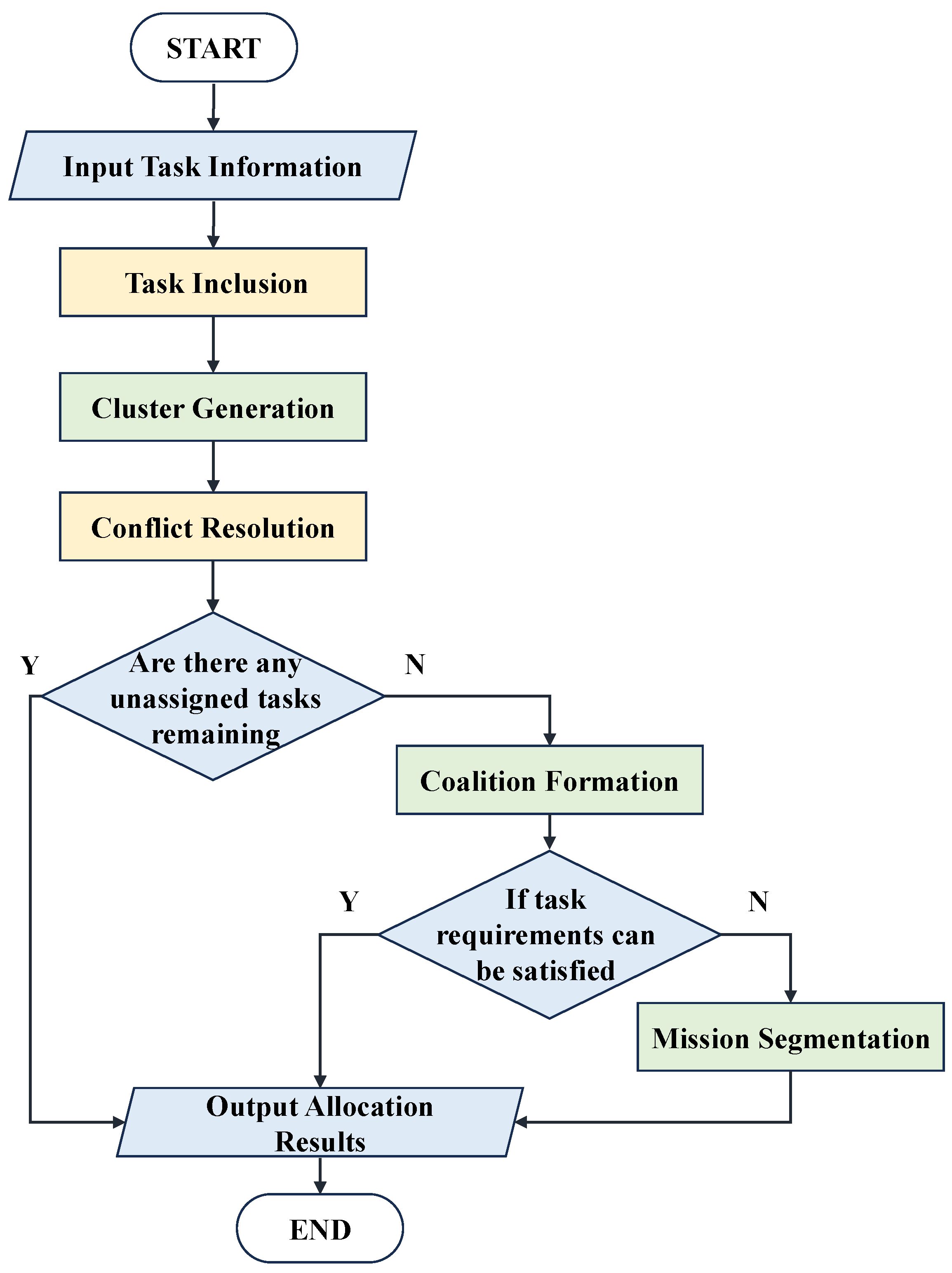
This section introduces the improved multi-phase DPI algorithm, whose baseline workflow is illustrated as
Figure 1, consisting of five sequential phases: IPI-based task inclusion, communication-reachable cluster generation, RPI-contribution-based conflict resolution, pruning-redundancy coalition formation, and greedy task segmentation.
3.1. Task Inclusion
In the task inclusion phase, the top priority is to allocate, on a preferential basis, independent tasks with higher rewards. Based on the independent executability and IPI, the task inclusion strategy is designed.
3.1.1. Independently Executable Task Allocation
First, identify tasks from three dimensions: (1) resource feasibility—the UAV’s remaining resources are sufficient and satisfy task requirements; (2) time feasibility—the task can be completed within the time upper bound once it is incorporated into the UAV’s task sequence; and (3) endurance feasibility—the total flight endurance of the new task sequence will not exceed the maximum endurance limit.
Then, candidate tasks are ranked by and task reward values , so as to prioritize high-matching-degree tasks.
On this basis, the initial allocation sequentially adds candidate tasks to the execution sequence until resource exhaustion. Optimal insertion search can ensure that the addition of a new task will not compromise the integrity and feasibility, and it strives to maximize the execution efficiency.
3.1.2. IPI-Based Task Inclusion
Let
denote as an ordered task sequence of
containing
tasks; its total rewards
can be formulated as
Accordingly, IPI index is established to quantify the local performance impact of the new task generated by
, and it is defined as the maximum reward difference during the execution of
where
is IPI of
exectuing in
;
represents that
is inserted as the
l-th task in
.
Following the allocation of independently executable tasks, the next step is filtering out the candidate task sequence. For UAVs with residual resources and capacity, candidate tasks feature a common characteristic: they remain unassigned to any UAV, have not reached the upper boundary of allocation times, and are awaiting allocation.
By internal loop and iterative optimization, add tasks with higher IPI and update swarm resources. IPI gain is defined as
that is, allocating utility-improving tasks to the UAV until no further positive-gain tasks are available.
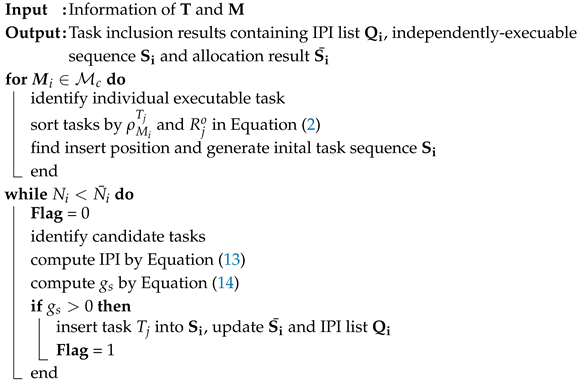
Hence, the IPI-based task inclusion strategy is summarized in Algorithm 1.
Remark 1. In Algorithm 1, the indices i and j iterate over local candidate sets maintained onboard each UAV, rather than all UAVs () and all tasks () of the whole swarm. Each UAV executes this algorithm in parallel, and computations only depend on information from neighboring UAVs within its communication cluster , without central coordination.
| Algorithm 1: IPI-based task inclusion |
 |
3.2. Cluster Generation
Based on the task inclusion, the communication-reachable cluster generation method is designed as Algorithm 2. According to the communication quality, Breadth-First Search (BFS) is utilized to identify all connected components in the UAV swarm communication network and the proposed method can dynamically and adaptively establish a connectivity topology. The clustering generation algorithm is executed independently on every UAV in a parallel manner. Each UAV only collects state information from neighbors connected via reliable links satisfying the communication threshold, and builds its local view of the communication topology without accessing global swarm information or relying on a central coordinator.
| Algorithm 2: Communication-reachable cluster communication topology generation |
 |
3.3. Conflict Resolution
In the task inclusion phase, the same task may be repeatedly allocated to different UAVs with surplus performance. To avoid waste of resources, each task shall be performed by a single UAV or by a cooperative UAV cluster.
For conflict resolution, conflict identification and conflict arbitration are executed as preparation. First, through local network communication, identify and prioritize duplicate tasks within a cluster. Then, identify fake conflicts, to ensure that the conflicting task is indeed retained in the current task sequence. Furthermore, execute the task removal by
and RPI index
where
represents removing
from task sequence
.
When multiple UAVs obtain equal contribution ratios, the contribution ratio alone cannot determine the arbitration result. RPI quantifies the reward loss caused by removing a task from the UAV’s sequence and characterizes the task’s importance within the local coalition, and it acts as the tie-breaking criterion to retain allocation schemes achieving higher total coalition reward. If a UAV holds a higher contribution ratio, a superior resource–task matching level corresponds to enhanced potential efficiency in task execution. When there is a tie in the contribution ratio, RPI is employed to break the deadlock, which implies better performance. On this basis, the only winning UAV is selected as the actuator. Correspondingly, the task is removed from the other UAV’s task sequence. As presented in Algorithm 3, the mechanism can effectively avoid redundant task allocation, and achieve improvements in operation efficiency.
Notably, all conflict negotiation processes are restricted to the local connected communication cluster
. Each UAV implements the above decision-making using only local neighbor information, and global swarm information is not required throughout the negotiation.
| Algorithm 3: RPI-contribution-based conflict resolution |
 |
3.4. Coalition Formation
To further improve resource utilization, coalitions are organized to fulfill the task requirements (as shown in Algorithm 4). Hence, a pruning-redundancy coalition formation scheme consists of four major steps. First, select out UAVs with remaining heterogeneous performance. Second, rank potential candidate UAVs by their total resource contribution to task requirements, thereby quickly identifying and prioritizing UAVs to ensure the tasks with a smaller alliance scale and faster resource accumulation rate. Third, a greedy strategy is applied to organize UAV members of coalition formation. Fourth, prune redundant members whose existence has no impact on task completion.
| Algorithm 4: Pruning-redundancy coalition formation |
 |
3.5. Task Segmentation
Although the aforementioned steps have enabled the allocation of tasks with unmet resource requirements, considering the constraints, it remains challenging to form a coalition when a task demands relatively large quantities of resources. Even with adequate resources, UAVs may violate endurance constraints and time constraints, and fail to form a coalition to complete the task. Thus, task segmentation is investigated as a supplementary fallback mechanism (as shown in Algorithm 5). Based on the feasibility-constrained greedy contribution, UAVs with residual capacity are directed to maximize the contribution of remaining resources, thereby partially or fully satisfying the requirements.
3.6. Comparison with PI Algorithm
To distinctly clarify the innovations of the proposed DPI algorithm and highlight its differences from classical PI-based methods, this section conducts a systematic paradigm-level comparison. PI-based algorithms have been widely applied in UAV task allocation, but they still retain the core inherent limitations of the original PI framework in conflict negotiation, resource utilization and decision-making modes.
Table 1 summarizes the fundamental differences and improvements between the proposed DPI and classical PI-based algorithms.
Conflict resolution paradigm: Classical PI resolves conflicts via iterative negotiation, where the inherent RPI metric only serves for task-removal sorting rather than conflict arbitration. By contrast, DPI adopts RPI and contribution ratio to implement local quantitative arbitration exclusively for intra-cluster conflicts within , while inter-cluster conflicts are discarded to reduce negotiation overhead. This mechanism covers the task inclusionand conflict resolution phases.
Information dependency: Classical PI requires global swarm information for negotiation. By contrast, DPI builds local connected communication clusters by the cluster generation and coalition formation phases, and each UAV makes decisions merely relying on local-range neighbor information.
Resource utilization mode: Classical PI adopts the all-or-nothing assignment rule. The proposed dual-fallback mechanism in the mission segmentation phase breaks this limitation and improves the utilization efficiency of fragmented heterogeneous resources.
| Algorithm 5: Greedy task segmentation |
 |
4. Analysis of DPI
4.1. Convergence Analysis
This section analyzes the convergence of the proposed algorithm.
In the proposed framework, the outer iteration loop is triggered only when unassigned tasks or tasks with insufficient resource support remain. If all tasks are fully allocated and resource requirements are satisfied, the algorithm terminates directly and outputs the final allocation scheme. The core characteristics of each module that guarantee convergence are summarized as follows:
In the IPI-based task inclusion phase, only tasks with positive performance gain are inserted into UAV task sequences, while tasks with gains are discarded.
The RPI-based conflict resolution phase eliminates duplicate task assignments by preserving the optimal UAV executor for each conflicting task, which releases redundant occupied resources.
The coalition formation and task segmentation dual-fallback mechanisms only adopt residual resources to compensate for unsatisfied task resource demands, without removing any existing valid assignments, guaranteeing that the global reward evolves in a non-decreasing manner.
According to the iteration logic, the core premise of the convergence analysis is twofold: (1) the global reward is monotonically non-decreasing after each complete iteration of the five-stage pipeline; (2) the global reward has a finite upper boundary.
4.1.1. Boundedness of Global Reward Function
The global optimization objective function is defined as Equation (
11), with the allocation indicator
. The boundedness of
J can be derived from the following constraints:
The total number of tasks is fixed and the static reward of each task is a finite constant.
The resource matching ratio , communication reliability , and timeliness term all take values within the interval .
Each UAV has a maximum payload limit , which restricts the maximum number of tasks assignable to an individual UAV.
Hence, the global reward possesses a rigorous finite upper bound:
that is,
. Reward sequence
, generated at
k-th iteration is uniformly bounded.
Remark 2. The upper bound defined as the sum of static rewards of all tasks may be loose when some tasks cannot be accomplished. Nevertheless, the convergence analysis only requires the reward sequence to be bounded from above, and a tight upper bound is not a necessary condition. Constructing a tighter closed-form upper bound requires the coupled consideration of heterogeneous UAV resource limits, segmented task demands and time-varying communication topology, which leads to complicated implicit expressions. Hence, this simple computationally tractable upper bound is adopted for theoretical tractability.
4.1.2. Monotonicity of Global Reward Function
Furthermore, analyze the reward variation introduced by each phase in one full iteration to verify .
IPI-based task inclusion. Only candidates satisfying are inserted into UAV sequences. All pre-existing assignments are preserved, and no tasks are removed. If eligible high-gain tasks exist, J strictly increases; otherwise, the allocation scheme remains unchanged and J stays constant.
Comunication-reachable cluster generation. This phase only partitions UAV swarm into connected sub-clusters by BFS. The allocation matrix remains untouched, so that the global reward J remains unchanged.
RPI-based conflict resolution. When is redundantly assigned to multiple UAVs, the algorithm retains the UAV with higher resource contribution ratio and removes task from the sequence of . Although individual local reward may decrease during this intermediate operation, the released resources can be reused for higher-quality task assignments in the subsequent phases within the same iteration. Accordingly, no persistent global reward degradation occurs after finishing the full iteration, and redundant resource occupation is eliminated to facilitate further reward improvement.
The dual-fallback mechanism only adds new valid task assignments by utilizing idle UAV resources for tasks with insufficient resource supply, and merely removes coalition members that contribute nothing to task completion without altering UAV task matching relations. Both phases continuously lift the global reward.
After executing all five phases sequentially, the global reward satisfies . Therefore, the reward sequence generated by iterations is monotonically non-decreasing.
Remark 3. In the RPI-based conflict resolution phase, it should be emphasized that such a reward drop is only a transient intermediate state inside a single iteration. The monotonic property applies to the global reward evaluated after all four phases of one iteration are fully executed, rather than arbitrary intermediate states during the iteration.
4.2. Complexity Analysis
Based on the analysis, the complexity analysis is essential to reveal the multi-phase DPI algorithm’s asymptotic computational cost and scalability with growing numbers of UAVs and tasks.
According to the pseudocode of the proposed DPI algorithm, the execution flow is divided into five sequential stages: coalition initialization, local performance impact calculation, distributed conflict resolution, redundant member pruning, and coalition status update. Let D denote the local scale of each connected sub-coalition () in dynamic swarm topologies), and K represents the maximum number of local negotiation iterations. The asymptotic computational complexity of each stage is analyzed below.
Coalition initialization. Each UAV independently evaluates task matching benefits based on local information, yielding a complexity of .
Local performance impact calculation: All benefit computations are performed within individual sub-coalitions, with a local complexity of .
Conflict resolution. Negotiation and conflict elimination are strictly restricted inside each connected sub-coalition. No global interaction is required. Each round of local negotiation costs , and the total complexity is .
Redundant pruning. Each sub-coalition locally screens invalid members according to regional resource demand, with complexity .
Coalition status update. Information synchronization only occurs within neighboring UAVs in the local coalition, resulting in negligible overhead.
The global asymptotic complexity of the proposed DPI algorithm is .
The distributed conflict resolution stage constitutes the primary computational overhead. A critical feature of the DPI framework is that negotiation only proceeds within locally connected sub-coalitions. In practice, under a time-varying communication topology, the size of sub-coalition is far smaller than the total number of UAVs, thereby reducing computational and communication overhead compared with global interaction. In terms of scalability, this distributed scheme avoids the exponential complexity suffered by centralized combinatorial optimization methods. Compared with the original PI algorithm, the additional pruning and coalition update modules introduce only negligible extra overhead, while achieving better convergence under heterogeneous UAV platforms and unreliable communication environments.
Remark 4. Different from classical PI, whose computational overhead grows rapidly with rising UAV and task quantities, the proposed DPI algorithm significantly improves practical scalability through distributed communication, restricting core decision-making within locally connected clusters. Specifically, the cluster generation and coalition formation procedures partition the entire swarm into multiple independent local subgroups. Core conflict resolution is restricted to intra-cluster quantitative arbitration, while inter-cluster conflicts are discarded to avoid swarm-wide iterative negotiation. This distributed mechanism fundamentally decouples the algorithm’s computational complexity from the total swarm scale, enabling stable and efficient task allocation even for large-scale heterogeneous UAV swarms.
5. Simulation
In the scenario of airdrop transportation tasks in a mountainous area, a series of numerical simulations are performed to evaluate the proposed DPI algorithm from three perspectives: effectiveness, robustness and superiority.
Randomly generate the location distribution of the UAV swarm and tasks within a 10 km × 10 km mountain region. Considering the aerial flight characteristics of UAVs, tasks are executed under relatively free-space propagation and UAVs can fly continuously for 30 min, due to the task timeliness and endurance capability. The endurance limitation is uniformly set as 30 km.
Resource demands for each type of task are randomly sampled within the interval
, and the task requirements are provided as
Table 2.
In the initial task inclusion phase, set the maximum assignable tasks of each UAV as the total number of tasks, that is,
. Equipped with three kinds of task-required resources, denoted as
, the parameters of the heterogeneous UAV swarm are given in
Table 3, with
km execution limitation.
Referring to [
34], the communication conditions are set as
dB,
km,
dBm,
dB,
dBm,
dBm and
.
5.1. Effectiveness Verification
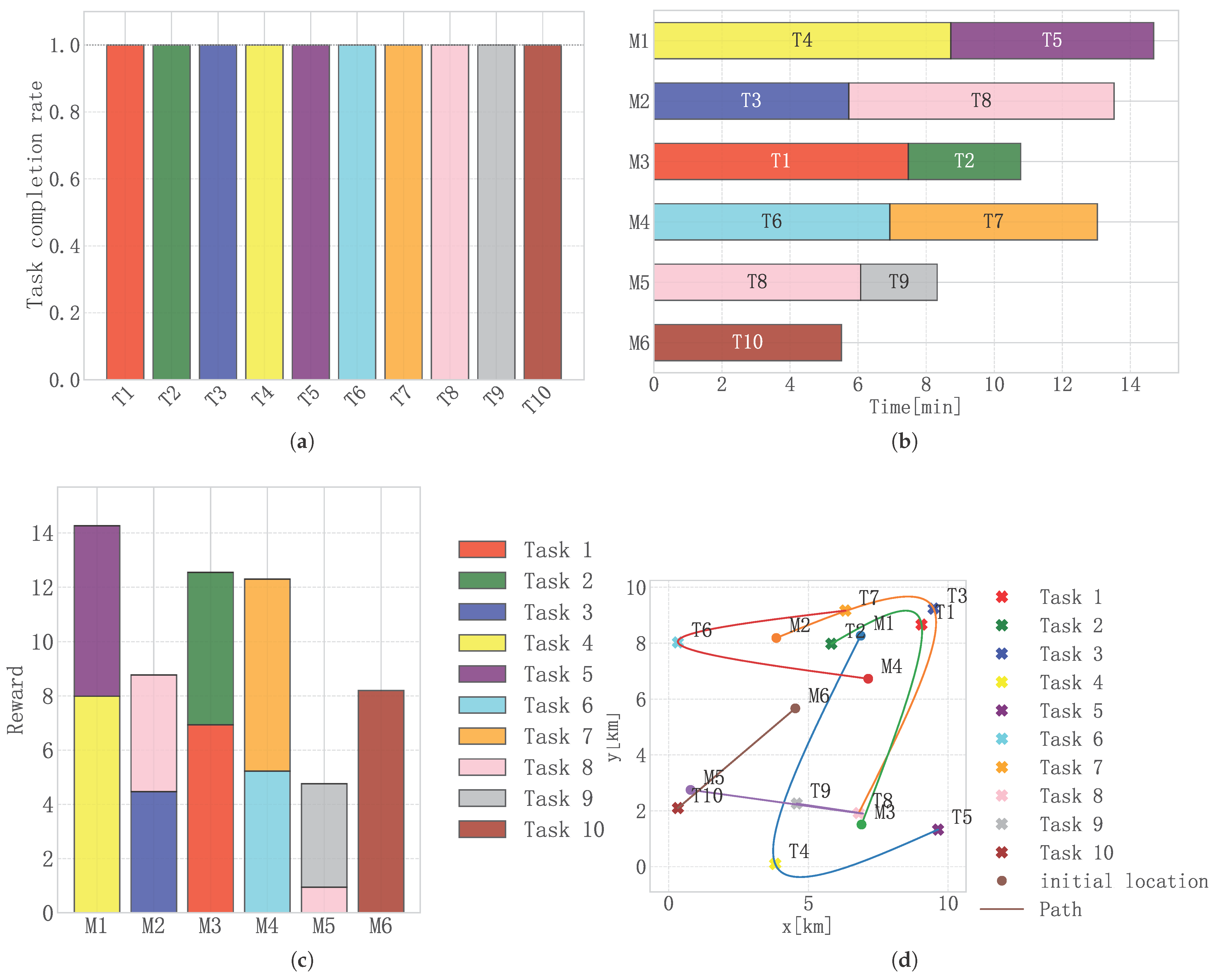
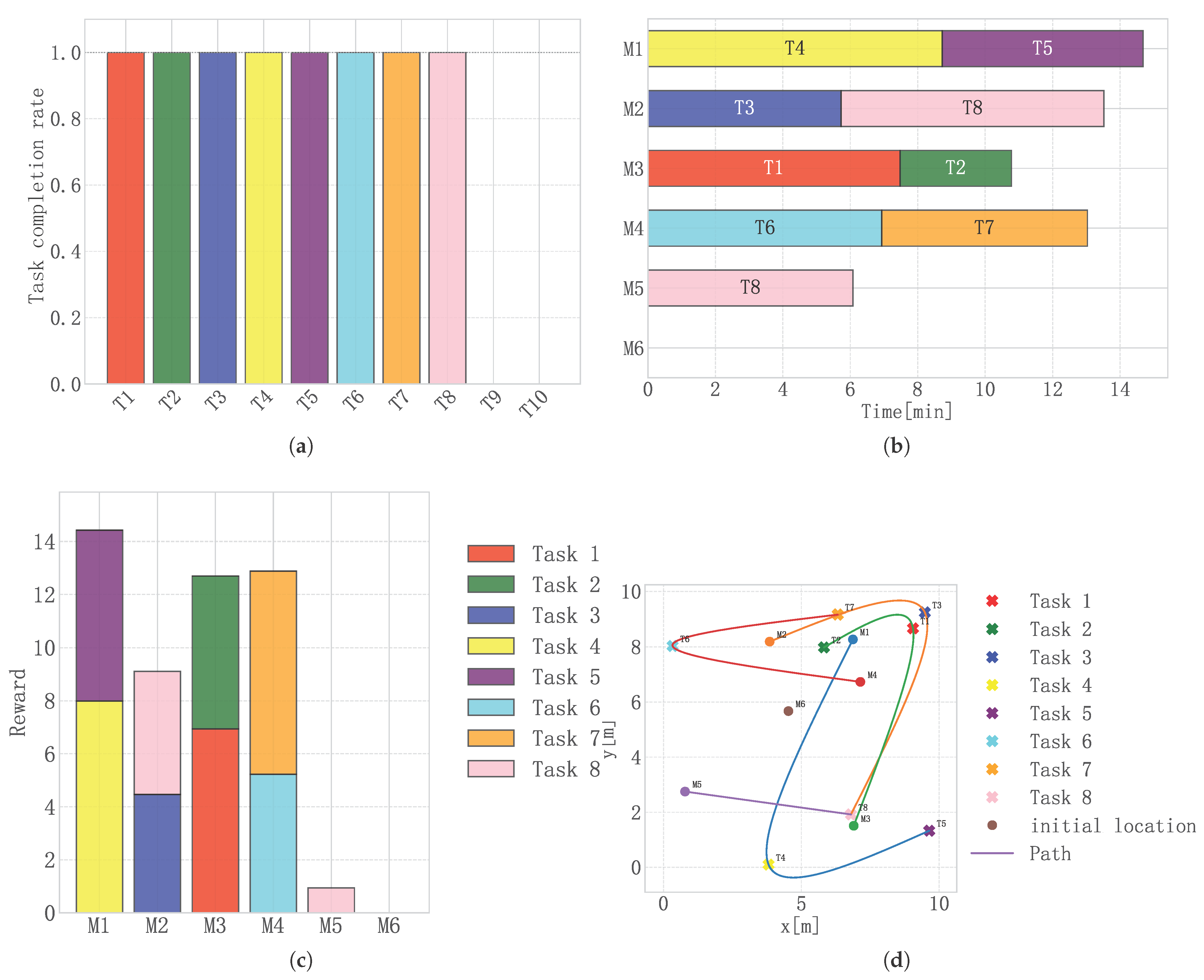
In this subsection, the effectiveness of DPI is verified and the simulation results are provided in
Figure 2.
It shows that the proposed DPI can achieve the completion under non-ideal communication. With the exception of , the other UAVs are assigned multiple tasks. UAV executes followed by within the time window of 0–14 min. From the reward and timeline schedule, and form a coalition to ensure . This scheduling decision is made after a comprehensive evaluation of multiple constraints, containing resource limits, time deadlines, path constraints and maximum global reward. After the conflict resolution phase, some UAVs have reached the upper limit on the number of tasks they can remove from their sequences. Simultaneously, constrained by individual endurance, payload and other inherent limitations, a single UAV cannot satisfy all resource demands of , which requires cooperative execution by a UAV coalition. The other tasks can be completed by individual UAVs.
5.2. Robustness Verification
To further verify the robustness and adaptability of the proposed DPI algorithm, Monte Carlo experiments are carried out. Partial parameters are regenerated referring to
Table 2 and
Table 3. The resource requirement of
is set to
.
,
,
process
as
,
and
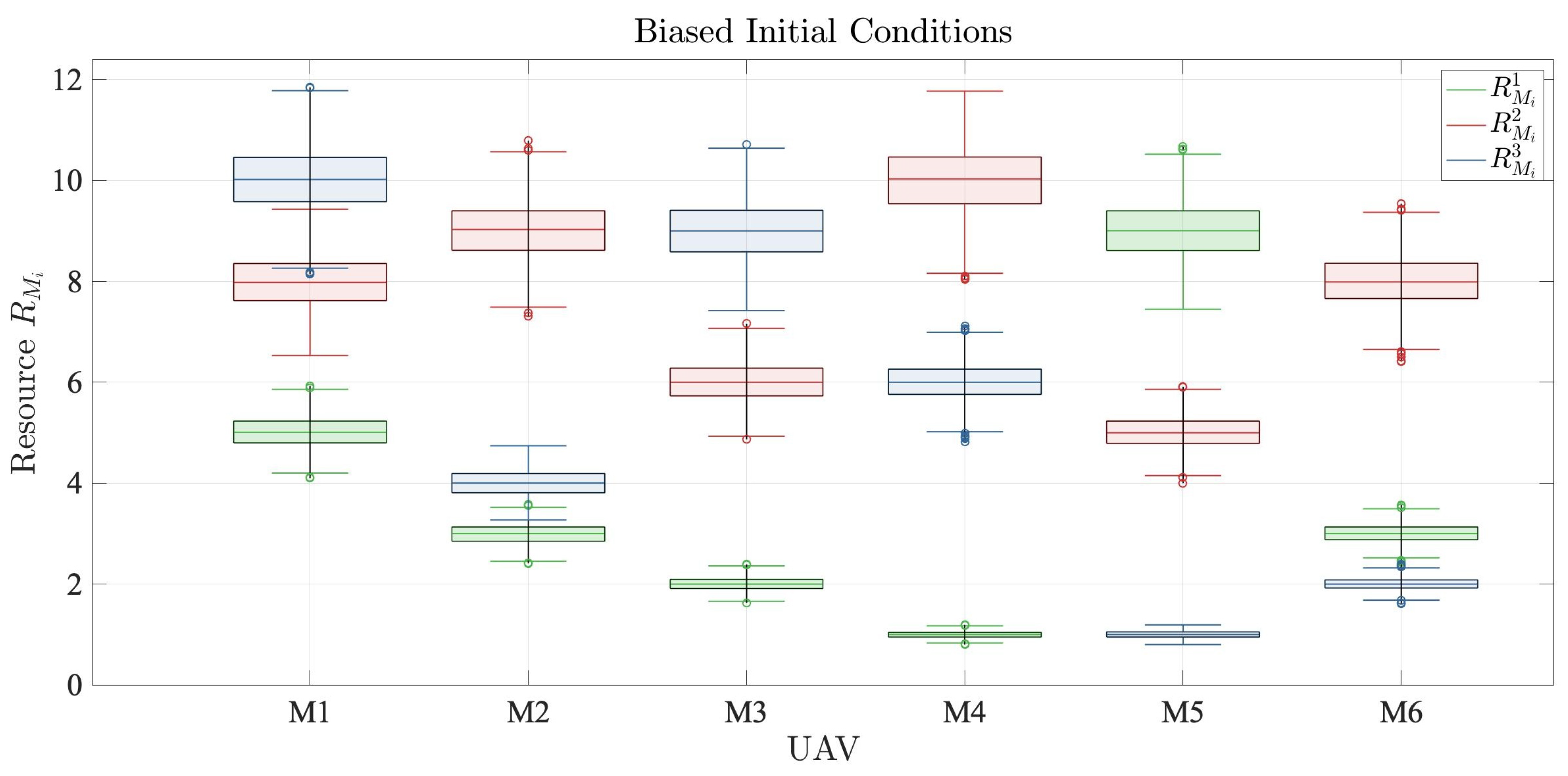
, respectively. On this basis, 1000 groups of initial conditions are generated following the
rule with a relative resource bias of
, as visualized in
Figure 3.
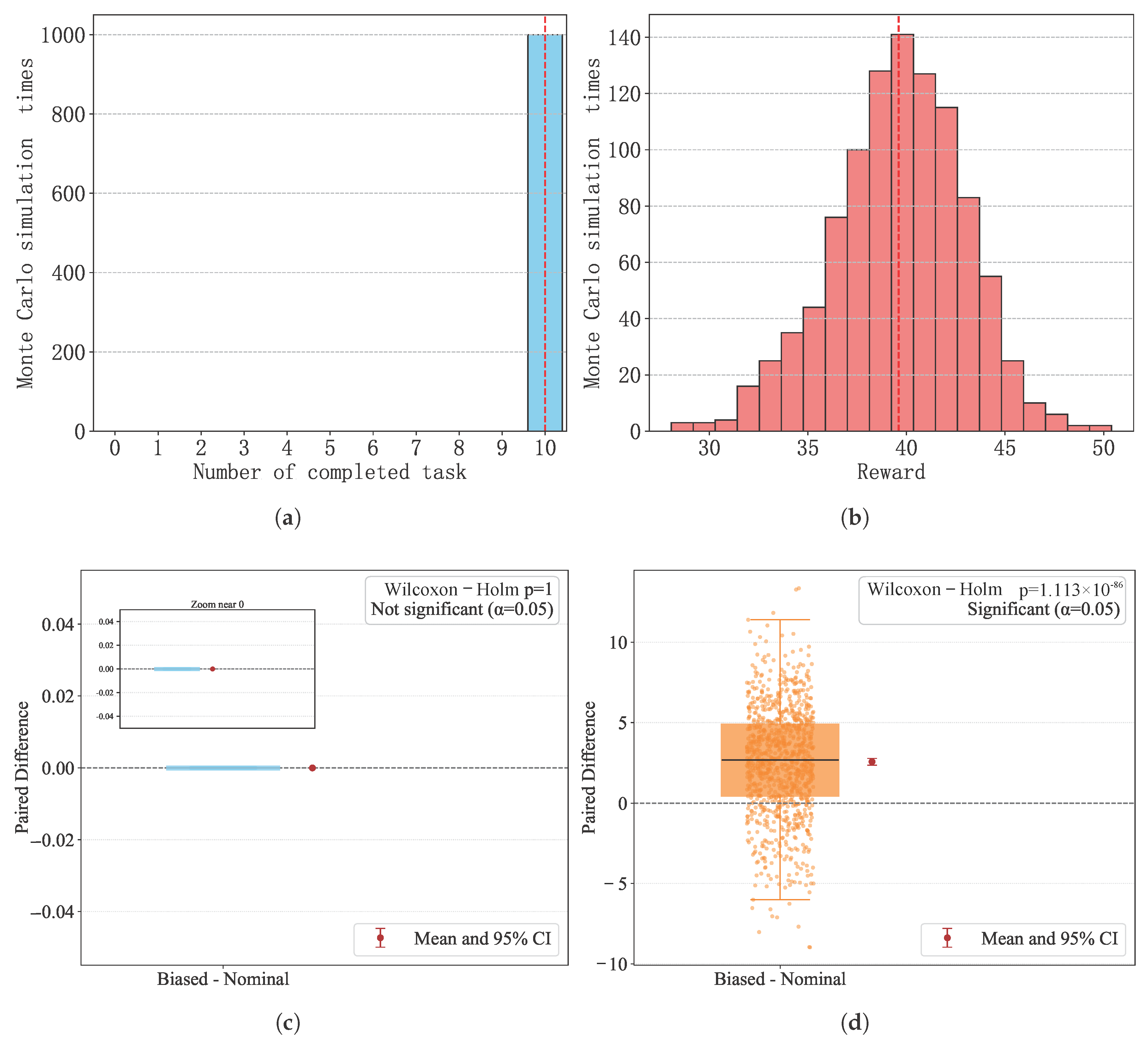
According to 1000 Monte Carlo simulation results presented in
Figure 4, the task completion rate is
. The value of reward ranges from
to
, which originates from random initial resource perturbations and resulting differences in task allocation outcomes. The mean and standard deviation of reward are
and
, respectively. The
confidence interval for mean reward is
. The total allocation reward is determined by the coupling of multi-dimensional resource distribution and spatial topology. Simulation 439 yields a reward of
, while Simulation 548 yields the minimum reward of
. Although Simulation 439 exhibits a larger negative deviation in the total supply of resource 1, the spatial distribution of UAVs in this case achieves better overlap with task locations, which reduces flight overhead. Benefiting from the favorable combination of resource configuration and spatial layout, it achieves a higher overall reward than Simulation 548. By comparing the resource variation trend of UAVs across different simulation cases, it can be found that UAVs
and
obtain increased resource supply in Simulation 438, while the resources carried by the remaining UAVs decrease. Simulation 548 presents an opposite variation pattern. Such differentiated resource perturbations reshape the contribution ratio of each UAV, which further determines the task assignment scheme. The final total reward is closely related to the base reward of assigned tasks as well as the flight distance overhead incurred by UAVs. This phenomenon indicates that single-resource stock cannot serve as a direct indicator of allocation performance; spatial proximity and the matching degree of multi-resource supply and demand jointly affect the final mission benefit. Variations in available UAV resources modify the resource contribution ratio relative to task resource demands, generating distinct allocation strategies and changing the total reward. Furthermore, different assignment schemes produce divergent flight trajectories for UAVs, altering time-dependent cost terms and further influencing the final reward.
Paired Wilcoxon rank-sum tests with the Wilcoxon–Holm correction are conducted to examine statistical significance between nominal and resource-biased scenarios. As shown in
Figure 4c, no statistically significant difference exists in task completion performance (
). In contrast,
Figure 4d reveals a significant difference in allocation reward (
) under
resource bias. Despite the statistically detectable reward variation, the proposed algorithm maintains full task completion, demonstrating favorable robustness in randomly generated mission environments.
Variations in UAV available resources modify the resource contribution ratio relative to task resource requirements, producing distinct allocation strategies and further changing the total reward. In addition, different assignment schemes lead to disparate flight trajectories for UAVs, thereby modifying the time-related term and impacting the final reward. The simulation results demonstrate that the improved algorithm achieves a relatively high task completion rate and favorable stability under the constructed random mission environments.
5.3. Superiority Verification
Due to the task requiring overloading resources, the proposed DPI is improved with a dual-fallback mechanism. To verify the superiority, part of the tasks’ initial requirements are regenerated based on
Table 2, where
and
require
and
, respectively.
According to
Figure 5, without task segmentation,
and
are unable to be allocated, yielding the completion rate of
. Under identical experimental conditions, the UAV swarm retains abundant residual resources, and UAV 6 keeps idle throughout the mission, which leads to severe resource waste of UAV platforms. The root cause of such an allocation outcome lies in path feasibility constraints. Although several UAVs carry surplus resources, they cannot form a valid coalition that satisfies all the resource demands of
and
due to path limitations, resulting in these two tasks having to be discarded under the all-or-nothing assignment rule.
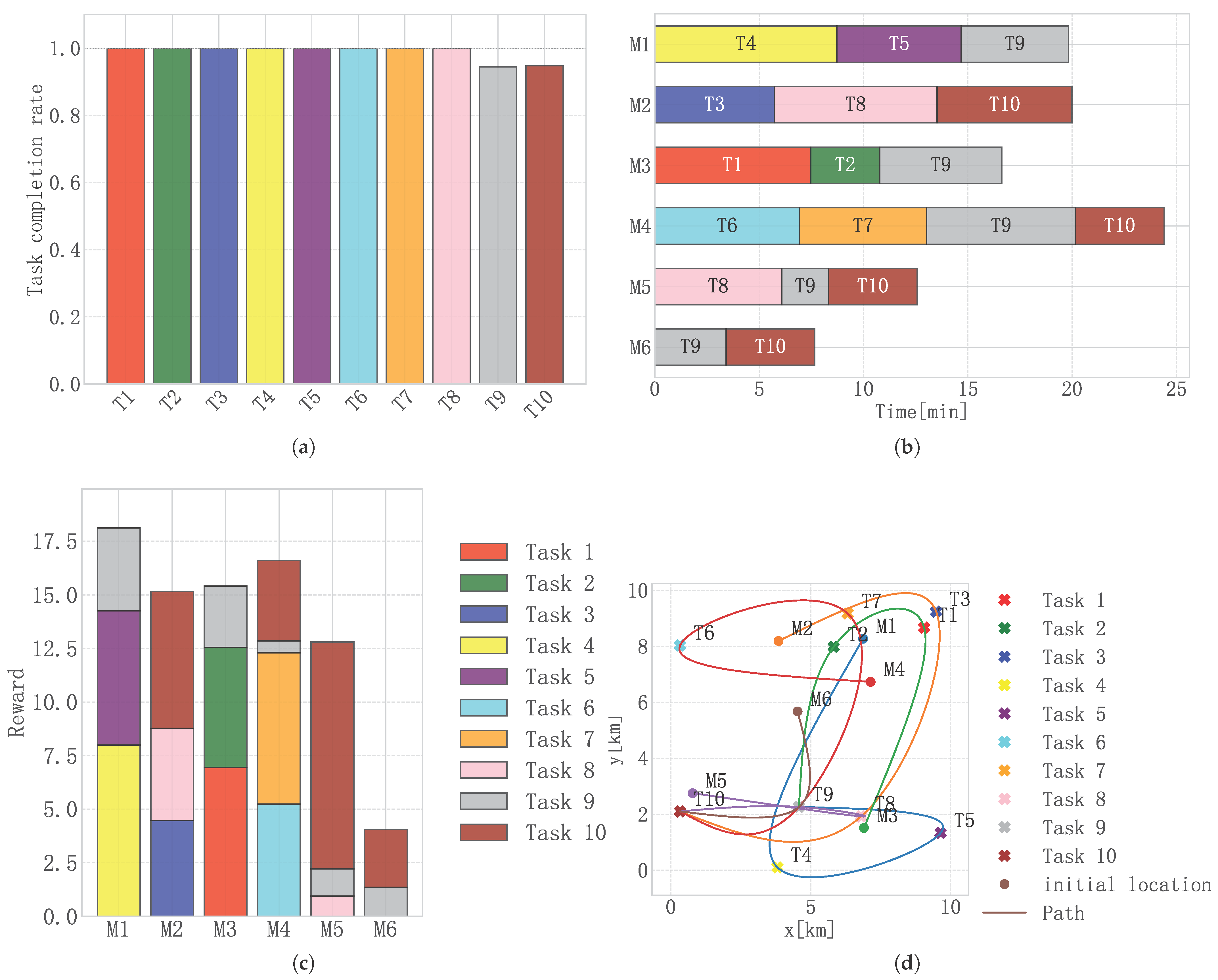
As shown in
Figure 6, the task segmentation mechanism enables most resource requirements of originally unsatisfiable overloaded tasks to be satisfied. Different from the rigid all-or-nothing mode, the mechanism improves the task effectiveness and completion rate up to
with dynamic fragmented resources. The core advantage stems from task segmentation, which breaks the traditional all-or-nothing assignment paradigm. Under this novel mechanism, UAVs and UAV coalitions that were previously unable to undertake an entire mission due to insufficient resources can now contribute by taking charge of partial subtasks. That is, any UAV with residual resources can be effectively mobilized to participate in mission completion provided that its flight performance, payload capacity and other attributes satisfy the constraints of the corresponding subtask. Consequently, fragmented residual capacities that would otherwise be unused are fully exploited, and the global resource utilization of the UAV swarm is improved.
Simulations demonstrate the effectiveness and superiority of the embedded task segmentation mechanism within DPI. Benefiting from partial-assignment capability under local-cluster communication constraints, the proposed algorithm is well-suited for heterogeneous multi-UAV swarm missions such as disaster monitoring, infrastructure inspection and emergency response. In practical scenarios, task segmentation enables flexible decomposition and redistribution of heavy-load tasks when UAV resources are limited or communication links are fragmented. Furthermore, the core framework of DPI can be further extended to other distributed task-allocation applications, including logistics delivery and swarm-based cooperative missions.
6. Conclusions
Targeting the task allocation for heterogeneous multi-UAV under non-ideal communication, this paper developed a multi-phase DPI algorithm, delivering an alternative distributed cooperative paradigm and providing useful insights for future research on multi-UAV task allocation. The following conclusions are summarized:
The proposed DPI algorithm achieves the desired robustness through a multi-phase mechanism, enabling effective task allocation under non-ideal communication and heterogeneous UAV performance constraints.
IPI-based task inclusion and an RPI-contribution-based conflict resolution mechanism improve theoretical performance while reducing conflicts and eliminating redundant competition iterations in traditional PI algorithms.
For overloaded tasks, the dual-fallback mechanism exhibits resilience by exploiting fragmented available resources and improving the task completion rate.
The robustness against multiple disturbances induced by complex mission environments remains insufficient. Although the proposed algorithm is developed for static task scenarios, it lacks mechanisms for dynamic task arrivals, which require better dynamic real-time replanning capability, and the segmentation mechanism needs further detailed investigation. Considering the inherent insufficiency of the proposed algorithm in handling frequent dynamic task changes, future work will refine task allocation mechanisms by dynamic programming and real-time replanning, and validate dynamic task allocation scenarios through hardware-in-the-loop tests or real-UAV flight practical experiments.
Author Contributions
Conceptualization, W.M. and S.L.; methodology, W.M. and S.L.; software, W.M. and H.Z.; validation, W.M. and H.Z.; formal analysis, W.M., H.Z. and S.L.; investigation, W.M., H.Z. and S.L.; resources, W.M. and S.L.; data curation, W.M. and S.L.; writing—original draft preparation, W.M. and S.L.; visualization, W.M. and H.Z.; supervision, S.L.; project administration, S.L.; funding acquisition, W.M. and S.L. All authors have read and agreed to the published version of the manuscript.
Funding
Scientific Research Program Funded by Education Department of Shaanxi Provincial Government (Program No. 25JK0491) and Natural Science Foundation of Hunan Province of China (2025JJ60072).
Data Availability Statement
The data used to support the findings of this study are included within the article.
Acknowledgments
The authors would like to express sincere gratitude to Zhenqiang Wang.
Conflicts of Interest
The authors declare no conflicts of interest.
References
- Li, J.; Liu, S.; Huang, W.; Yan, B. Artificial intelligence in low-altitude flight: Developmental opportunity or ethical challenge? Aeronaut. J. 2025, 129, 1683–1701. [Google Scholar] [CrossRef] [Scilit]
- Yang, X.; Yao, W.; Zhang, Y.; Yu, H.; Wang, C. Multi-UAV Cooperative Search in Partially Observable Low-Altitude Environments Based on Deep Reinforcement Learning. Drones 2025, 9, 825. [Google Scholar] [CrossRef] [Scilit]
- Bassolillo, S.R.; D’Amato, E.; Mattei, M.; Notaro, I. Distributed navigation in emergency scenarios: A case study on post-avalanche search and rescue using drones. Appl. Sci. 2023, 13, 11186. [Google Scholar] [CrossRef] [Scilit]
- Feng, R.; Liu, S.; Huang, W.; Han, T.; Yan, B.; Wang, Z.; Niu, Y. Bridging game theory and multi-agent systems: Development status and future prospects. Prog. Aerosp. Sci. 2026, 161, 101183. [Google Scholar] [CrossRef] [Scilit]
- Xin, Z.; Li, J.; Li, J.; Liu, C. Collaborative search and package delivery strategy for uav swarms under area restrictions. J. Adv. Comput. Intell. Intell. Inform. 2023, 27, 932–941. [Google Scholar] [CrossRef] [Scilit]
- Ma, W.; Fang, Y.; Fu, W.; Liu, S.; Guo, E. Cooperative localisation of uav swarm based on adaptive sa-pso algorithm. Aeronaut. J. 2023, 127, 57–75. [Google Scholar] [CrossRef] [Scilit]
- Byeon, H.; Ramesh, J.V.N.; AlGhamdi, A.; Soni, M.; Nimma, D.; Pothumarthi, S.; Shabaz, M. Multi-constraint smart uav healthcare transportation path using imperial competition algorithm for smart cities. Discov. Internet Things 2025, 5, 59. [Google Scholar] [CrossRef] [Scilit]
- Zhu, J.; Zhou, X.; Zi, Z.; Xie, Y.; Jiang, X.; Zhang, Z. Cooperative Search Method of Multi-UAVs for Mountain Search and Rescue. Drones 2026, 10, 493. [Google Scholar] [CrossRef] [Scilit]
- Liu, Q.; Zhang, D.; Li, S.; Dai, P.; Li, W. HGR-QL: Optimized Q-Learning for Multi-UAV Path Planning in Mountain Search and Rescue. Drones 2026, 10, 223. [Google Scholar] [CrossRef] [Scilit]
- Skaltsis, G.M.; Shin, H.S.; Tsourdos, A. A review of task allocation methods for uavs. J. Intell. Robot. Syst. 2023, 109, 76. [Google Scholar] [CrossRef] [Scilit]
- Yan, S.; Feng, J.; Pan, F. A distributed task allocation method for multi-uav systems in communication-constrained environments. Drones 2024, 8, 342. [Google Scholar] [CrossRef] [Scilit]
- Zhang, H.; Zhan, A.; Han, J.; Wu, C.; Wang, Z. Integrated path planning, spectrum and power allocation for multi-uav via deep reinforcement learning. IEICE Trans. Fundam. Electron. Commun. Comput. Sci. 2025, E108.A, 856–860. [Google Scholar] [CrossRef] [Scilit]
- Tan, Y.; Zhou, C.; Qian, F. Cooperative task allocation method for multi-unmanned aerial vehicles based on the modified genetic algorithm. IET Intell. Transp. Syst. 2024, 18, 1164–1173. [Google Scholar] [CrossRef] [Scilit]
- Yan, F.; Chu, J.; Hu, J.; Zhu, X. Cooperative task allocation with simultaneous arrival and resource constraint for multi-uav using a genetic algorithm. Expert Syst. Appl. 2024, 245, 123023. [Google Scholar] [CrossRef] [Scilit]
- Zhai, S.; Li, G.; Wu, G.; Hou, M.; Jia, Q. Cooperative task allocation for multi heterogeneous aerial vehicles using particle swarm optimization algorithm and entropy weight method. Appl. Soft Comput. 2023, 148, 110918. [Google Scholar] [CrossRef] [Scilit]
- Zhou, Z.; Liu, H.; Dai, Y.; Qin, L. A tent-lévy-based seagull optimization algorithm for the multi-uav collaborative task allocation problem. Appl. Sci. 2024, 14, 5398. [Google Scholar] [CrossRef] [Scilit]
- Xu, H.; Xie, Z.; Sheng, S.; Song, K. Balancing real-time and batch data collection for AoI minimization in UAV-assisted maritime networks. Robot. Auton. Syst. 2026, 202, 105474. [Google Scholar] [CrossRef] [Scilit]
- Chen, Z.; Li, J.; Liu, C.; Li, J. Task assignment of uav swarms based on auction algorithm in poor communication environments. J. Adv. Comput. Intell. Intell. Inform. 2023, 27, 1142–1150. [Google Scholar] [CrossRef] [Scilit]
- Zhen, Z.; Wen, L.; Wang, B.; Hu, Z.; Zhang, D. Improved contract network protocol algorithm based cooperative target allocation of heterogeneous uav swarm. Aerosp. Sci. Technol. 2021, 119, 107054. [Google Scholar] [CrossRef] [Scilit]
- Kim, K.S.; Kim, H.Y.; Choi, H.L. A bid-based grouping method for communication-efficient decentralized multi-uav task allocation. Int. J. Aeronaut. Space Sci. 2020, 21, 290–302. [Google Scholar] [CrossRef] [Scilit]
- Chen, J.; Qing, X.; Ye, F.; Xiao, K.; You, K.; Sun, Q. Consensus-based bundle algorithm with local replanning for heterogeneous multi-uav system in the time-sensitive and dynamic environment. J. Supercomput. 2022, 78, 1712–1740. [Google Scholar] [CrossRef] [Scilit]
- Yue, W.; Zhang, X.; Liu, Z. Distributed cooperative task allocation for heterogeneous uav swarms under complex constraints. Comput. Commun. 2025, 231, 108043. [Google Scholar] [CrossRef] [Scilit]
- Whitbrook, A.; Meng, Q.; Chung, P.W. A novel distributed scheduling algorithm for time-critical multi-agent systems. In Proceedings of the 2015 IEEE/RSJ International Conference on Intelligent Robots and Systems (IROS), Hamburg, Germany, 28 September–2 October 2015; pp. 6451–6458. [Google Scholar] [CrossRef] [Scilit]
- Turner, J.; Meng, Q.; Schaefer, G.; Whitbrook, A.; Soltoggio, A. Distributed Task Rescheduling with Time Constraints for the Optimization of Total Task Allocations in a Multirobot System. IEEE Trans. Cybern. 2018, 48, 2583–2597. [Google Scholar] [CrossRef] [Scilit] [PubMed]
- Li, J.; Chen, R.; Wang, C.; Chen, Y.; Huang, Y.; Wang, X. A performance-impact based multi-task distributed scheduling algorithm with task removal inference and deadlock avoidance. Auton. Agents Multi-Agent Syst. 2023, 37, 30. [Google Scholar] [CrossRef] [Scilit]
- Bai, X.; Li, C.; Zhang, B.; Wu, Z.; Ge, S.S. Efficient Performance Impact Algorithms for Multirobot Task Assignment with Deadlines. IEEE Trans. Ind. Electron. 2024, 71, 14373–14382. [Google Scholar] [CrossRef] [Scilit]
- Yang, M.; Zhang, A.; Bi, W.; Wang, Y. A resource-constrained distributed task allocation method based on a two-stage coalition formation methodology for multi-uavs. J. Supercomput. 2022, 78, 10025–10062. [Google Scholar] [CrossRef] [Scilit]
- Yan, S.; Xia, Y. A distributed task allocation method for heterogeneous uavs in dynamic and communication-constrained environments. J. Supercomput. 2024, 81, 11. [Google Scholar] [CrossRef] [Scilit]
- Wang, S.; Li, S.; Huangfu, Y.; Qiu, Y.; Liu, Y. Communication-efficient decentralized task allocation for large-scale multi-agent systems. IEEE Robot. Autom. Lett. 2025, 10, 10074–10081. [Google Scholar] [CrossRef] [Scilit]
- Nie, Y.; Zhao, C.; Shi, K.; Chen, Y. Novel stability analysis for time-delay systems via two new lemmas and genetic algorithm. Chaos Solitons Fractals 2026, 208, 118232. [Google Scholar] [CrossRef] [Scilit]
- Fan, H.; Shi, K.; Guo, Z.; Zhou, A.; Cai, J. Finite-Time Synchronization and Mittag–Leffler Synchronization for Uncertain Fractional-Order Delayed Cellular Neural Networks with Fuzzy Operators via Nonlinear Adaptive Control. Fractal Fract. 2025, 9, 634. [Google Scholar] [CrossRef] [Scilit]
- Fan, H.; Shi, K.; Zhou, A.; Meng, F.; Jiang, L. Exploring Fixed-Time Synchronization of Fractional-Order Fuzzy Cellular Neural Networks with Information Interactions and Time-Varying Delays via Adaptive Multi-Module Control. Fractal Fract. 2026, 10, 253. [Google Scholar] [CrossRef] [Scilit]
- Yu, W.; Wen, G.; Chen, G.; Cao, J. Distributed Cooperative Control of Multi-Agent Systems; John Wiley & Sons: Singapore, 2017. [Google Scholar]
- Cao, Y.; Long, T.; Sun, J.; Wang, Z.; Xu, G. Comparison of distributed task allocation algorithms considering non-ideal communication factors for multi-uav collaborative visit missions. IEEE Robot. Autom. Lett. 2025, 10, 1928–1935. [Google Scholar] [CrossRef] [Scilit]
- Yan, Y.; Mostofi, Y. Robotic router formation in realistic communication environments. IEEE Trans. Robot. 2012, 28, 810–827. [Google Scholar] [CrossRef] [Scilit]
| Disclaimer/Publisher’s Note: The statements, opinions and data contained in all publications are solely those of the individual author(s) and contributor(s) and not of MDPI and/or the editor(s). MDPI and/or the editor(s) disclaim responsibility for any injury to people or property resulting from any ideas, methods, instructions or products referred to in the content. |