
Joint Position–Orientation Deployment Design of UAV-Borne Linear-Array Angle-of-Arrival Sensors for Target UAV Localization



Highlights
- For unmanned aerial vehicle (UAV)-borne one-dimensional (1-D) angle-of-arrival (AOA) sensing, the rank-one Fisher information matrix (FIM) structure enables exact onboard array-orientation elimination on the line-of-sight tangent plane.
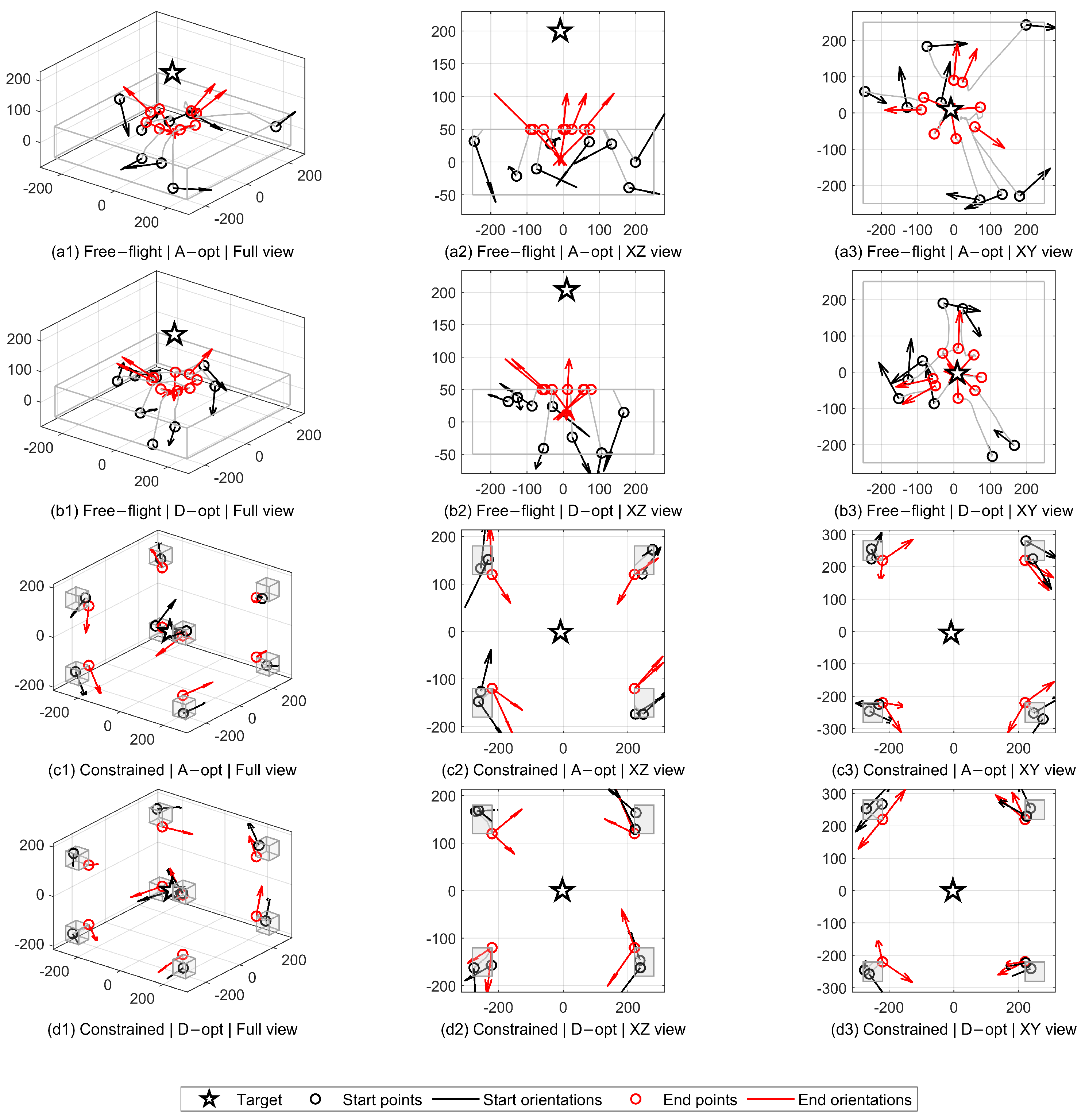
- The proposed geometry-structured sequential quadratic programming (GS-SQP) method consistently improves the deployment objective and Monte Carlo localization accuracy in both free-flight and constrained hovering-region scenarios.
- Joint UAV position–orientation deployment can be solved through a reduced UAV coordinate optimization problem while preserving the essential sensing geometry of the original formulation.
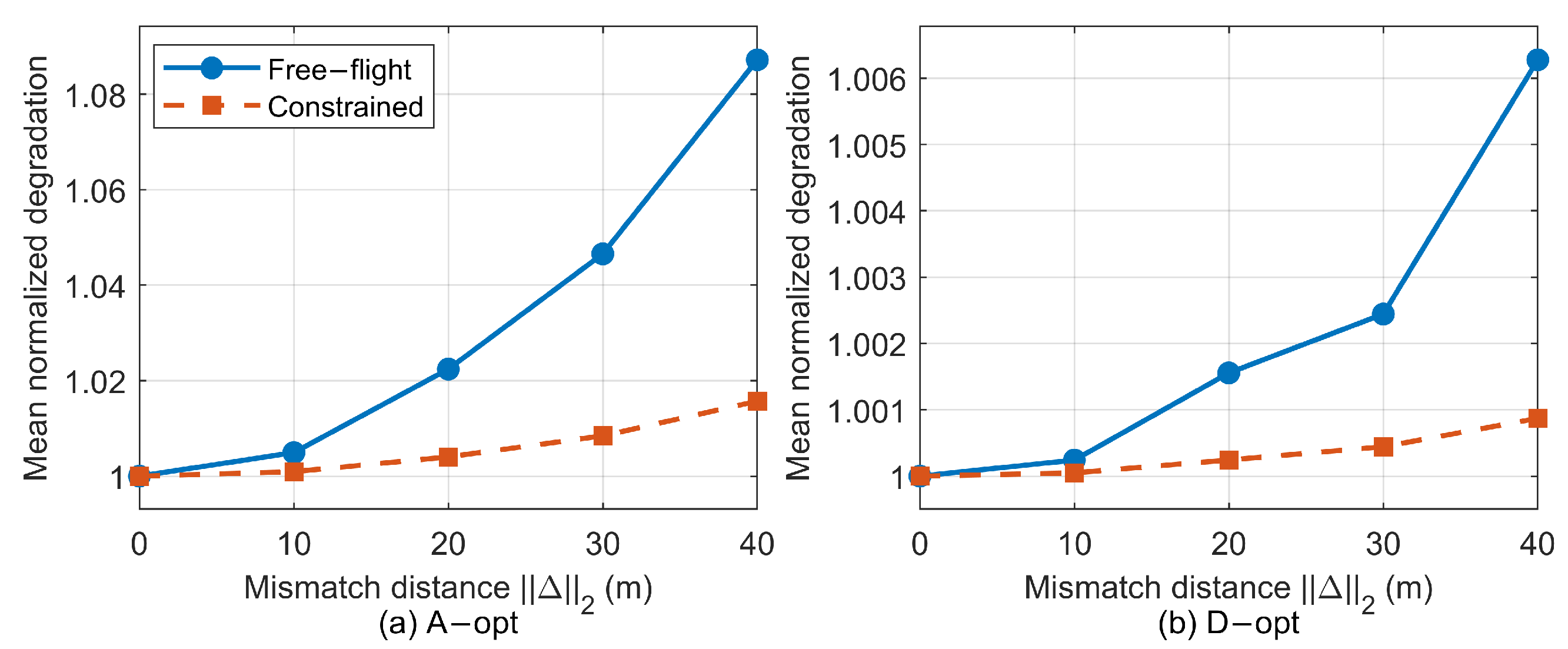
- For UAV localization planning, waypoint freedom provides most of the performance gain, while orientation control is mainly useful as a low-dimensional refinement when feasible hovering regions are tight.
Abstract
1. Introduction
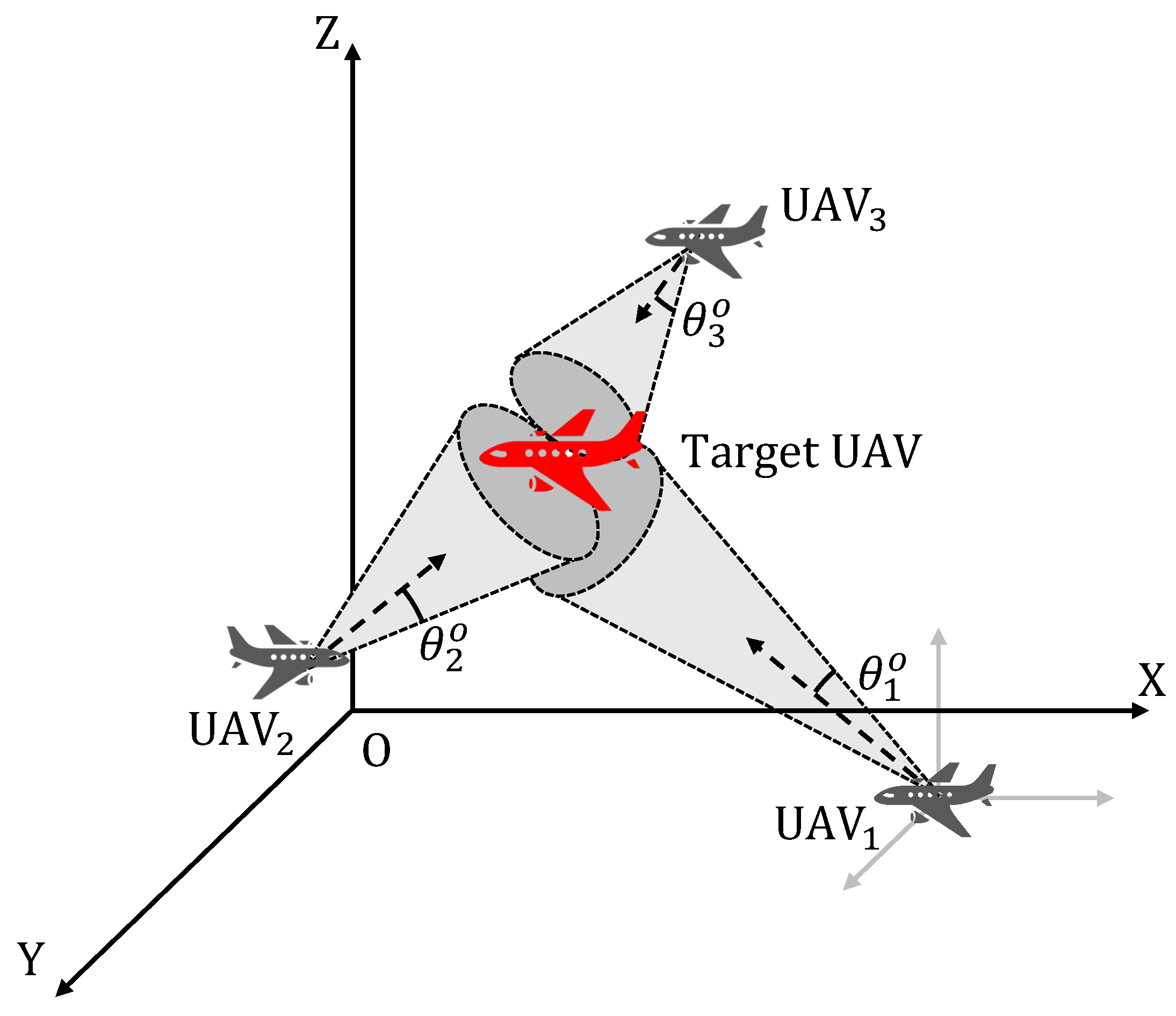
- We formulate a CRLB-driven joint position–orientation deployment problem for multiple UAV-borne 1-D AOA sensors under both A- and D-optimality criteria. The formulation explicitly captures the conic measurement geometry and distinguishes the problem from conventional coordinate-only deployment designs.
- We reveal a structural property of the 1-D AOA FIM: for fixed UAV positions, the array orientations can be optimized through an exact low-dimensional subproblem. This yields an orientation-eliminated deployment criterion over UAV coordinates, rather than a black-box joint optimization over positions and orientations.
- We develop a GS-SQP algorithm for the orientation-eliminated deployment problem. Unlike generic SQP or isotropic surrogate methods, the proposed local model captures the LOS-induced radial and tangential sensitivities of the 1-D AOA FIM, making the algorithm tailored to the anisotropic information geometry of linear-array measurements.
2. Related Works
2.1. Optimal Deployment and Array Orientation Design
2.2. 1-D AOA Localization
Notations
3. Problem Formulation
4. Proposed Method
4.1. Orientation Elimination on the LOS Tangent Plane
4.2. GS-SQP for the Reduced Coordinate Problem
4.3. Convergence and Complexity Discussion
| Algorithm 1 Geometry-structured SQP for UAV-borne 1-D AOA deployment |
|
5. Numerical Simulations
5.1. Simulation Settings
5.2. Algorithmic Effectiveness
5.3. Position–Orientation Ablation
5.4. Robustness to Nominal-Target Mismatch
5.5. Localization Performance Before and After Optimization
6. Conclusions
Author Contributions
Funding
Data Availability Statement
Conflicts of Interest
References
- Win, M.Z.; Dai, W.; Shen, Y.; Chrisikos, G.; Vincent Poor, H. Network Operation Strategies for Efficient Localization and Navigation. Proc. IEEE 2018, 106, 1224–1254. [Google Scholar] [CrossRef]
- Karcı, E.O.; Kangal, A.M.; Öncü, S. Improvement of Cooperative Localization for Heterogeneous Mobile Robots. Drones 2025, 9, 507. [Google Scholar] [CrossRef]
- Shen, X.; Xu, L.; Liu, Y.; Shen, Y. A Theoretical Framework for Relative Localization. IEEE Trans. Inf. Theory 2024, 70, 735–762. [Google Scholar] [CrossRef]
- Bednarz, K.; Wojtuń, J.; Szczepanik, R.; Kelner, J.M. UAV Equipped with SDR-Based Doppler Localization Sensor for Positioning Tactical Radios. Drones 2025, 9, 698. [Google Scholar] [CrossRef]
- Ding, X.; Xu, Y.; Li, G.; Yang, K.; Yuan, J.; An, J. Design and Performance Evaluation for BILCM-ID System with Improved Stopping Criterion. IEEE Trans. Veh. Technol. 2025, 74, 6779–6784. [Google Scholar] [CrossRef]
- Ding, X.; Lu, Q.; Zhang, Y.; Li, G.; Gao, X.; Ye, N.; Niyato, D.; Yang, K. Few-Shot Recognition and Classification Framework for Jamming Signal: A CGAN-Based Fusion CNN Approach. IEEE Trans. Veh. Technol. 2026, 1–16. [Google Scholar] [CrossRef]
- Sahu, N.; Wu, L.; Babu, P.; M. R., B.S.; Ottersten, B. Optimal Sensor Placement for Source Localization: A Unified ADMM Approach. IEEE Trans. Veh. Technol. 2022, 71, 4359–4372. [Google Scholar] [CrossRef]
- Huang, W.; Lu, J.; Xu, T.; Shu, J.; Meng, K.; Wu, Y. Optimal Anchor Deployment and Topology Design for Large-Scale AUV Navigation. IEEE Sens. J. 2026, 26, 6964–6975. [Google Scholar] [CrossRef]
- Xu, S.; Wu, L.; Li, X.; Wu, X.; Xu, T. AOA Sensor Placement for Anchor-Assisted Target Localization in GNSS-Denied Environment: Formulation, Bounds and Optimization. IEEE Trans. Mob. Comput. 2025, 24, 10792–10806. [Google Scholar] [CrossRef]
- Sun, Y.; Ho, K.C.; Gao, L.; Zou, J.; Yang, Y.; Chen, L. Three Dimensional Source Localization Using Arrival Angles from Linear Arrays: Analytical Investigation and Optimal Solution. IEEE Trans. Signal Process. 2022, 70, 1864–1879. [Google Scholar] [CrossRef]
- Chen, Y.; Yu, H.; Li, J.; Wang, Q.; Ji, F.; Chen, F. Three-Dimensional Source Localization Based on 1-D AOA Measurements: Low-Complexity and Effective Estimator. IEEE Trans. Instrum. Meas. 2023, 72, 9510615. [Google Scholar] [CrossRef]
- Li, P.; Li, J.; Zhang, X.; Wu, Q. 3-D Rigid Body Localization Using 1-D AOA: Boundary Condition Analysis and Generic Majorization-Minimization Framework. IEEE Trans. Signal Process. 2024, 72, 3502–3518. [Google Scholar] [CrossRef]
- Zou, Y.; Xiao, Y.; Wu, W.; Sun, Y.; Liu, H. A New Iterative Weighted Least Squares Algorithm for 1-D SA Localization. IEEE Signal Process. Lett. 2025, 32, 1740–1744. [Google Scholar] [CrossRef]
- Li, P.; Li, J.; Zhang, X.; Wu, Q. Orientation-Unaware 3D Self-Localization of a Linear Array Under Anchor Position Uncertainty. IEEE Trans. Wirel. Commun. 2026, 25, 6425–6441. [Google Scholar] [CrossRef]
- Xing, T.; Sun, Y.; Zhang, K.; Peng, X.; Ni, L.; Wang, Z.; Liu, N.; Wan, Q. 3-D Localization Integrating 1-D SA and TDOA Measurements: Analysis and Bias-Reduced Solutions. IEEE Trans. Veh. Technol. 2026, 75, 3099–3114. [Google Scholar] [CrossRef]
- Yan, Y.; Lin, C.; Wang, H. A Low-Complexity 3-D Source Localization Method Using 1-D AOAs of Multiple Linear Arrays. IEEE Internet Things J. 2025, 12, 44838–44850. [Google Scholar] [CrossRef]
- Xu, S.; Wu, L.; Doğançay, K.; Alaee-Kerahroodi, M. A Hybrid Approach to Optimal TOA-Sensor Placement with Fixed Shared Sensors for Simultaneous Multi-Target Localization. IEEE Trans. Signal Process. 2022, 70, 1197–1212. [Google Scholar] [CrossRef]
- Wu, L.; Sahu, N.; Xu, S.; Babu, P.; Ciuonzo, D. Optimization Based Sensor Placement for Multi-Target Localization with Coupling Sensor Clusters. IEEE Trans. Signal Inf. Process. Netw. 2023, 9, 596–611. [Google Scholar] [CrossRef]
- Panwar, K.; Fatima, G.; Babu, P. Optimal Sensor Placement for Hybrid Source Localization Using Fused TOA–RSS–AOA Measurements. IEEE Trans. Aerosp. Electron. Syst. 2023, 59, 1643–1657. [Google Scholar] [CrossRef]
- Aubry, A.; Babu, P.; De Maio, A.; Fatima, G.; Sahu, N. A Robust Framework to Design Optimal Sensor Locations for TOA or RSS Source Localization Techniques. IEEE Trans. Signal Process. 2023, 71, 1293–1306. [Google Scholar] [CrossRef]
- Fatima, G.; Stoica, P.; Aubry, A.; De Maio, A.; Babu, P. Optimal Placement of the Receivers for Multistatic Target Localization. IEEE Trans. Radar Syst. 2024, 2, 391–403. [Google Scholar] [CrossRef]
- Xu, S.; Zhu, B.; Wu, X.; Doğançay, K. Optimal TOA-Based Sensor-Anchor-Source Geometries and Estimation Bounds for Simultaneous Sensor and Source Localization. IEEE Trans. Signal Process. 2025, 73, 1727–1743. [Google Scholar] [CrossRef]
- Xu, S.; Doğançay, K. Optimal Sensor Placement for 3-D Angle-of-Arrival Target Localization. IEEE Trans. Aerosp. Electron. Syst. 2017, 53, 1196–1211. [Google Scholar] [CrossRef]
- Aubry, A.; Babu, P.; Braca, P.; De Maio, A.; Panwar, K. Sensor Placement Strategies for Target Localization via 3-D AOA Measurements. IEEE Trans. Aerosp. Electron. Syst. 2025, 61, 2134–2148. [Google Scholar] [CrossRef]
- Li, P.; Li, J.; You, M.; Xiao, J.; Wu, Q. Sensor Placement Strategies for 3-D AOA Localization under General Convex Deployment Constraints. IEEE Trans. Aerosp. Electron. Syst. 2026, 62, 8613–8623. [Google Scholar] [CrossRef]
- Zheng, Y.; Sheng, M.; Liu, J.; Li, J. OpArray: Exploiting Array Orientation for Accurate Indoor Localization. IEEE Trans. Commun. 2019, 67, 847–858. [Google Scholar] [CrossRef]
- Sheng, M.; Zheng, Y.; Liu, J.; Valaee, S.; Li, J. Accurate Indoor Localization Assisted with Optimizing Array Orientations and Receiver Positions. IEEE Trans. Veh. Technol. 2020, 69, 509–521. [Google Scholar] [CrossRef]
- Li, P.; Li, J.; Zhou, F.; Zhang, X.; Wu, Q. Optimal Array Geometric Structures for Direct Position Determination Systems. IEEE Trans. Commun. 2022, 70, 7549–7561. [Google Scholar] [CrossRef]
- Li, P.; Li, J.; Zhou, F.; Zhang, X.; Wu, Q. Optimal linear array orientation design for 3D direct position determination via semi-Definite relaxation. Signal Process. 2023, 212, 109149. [Google Scholar] [CrossRef]
- Li, P.; Li, J.; Zhou, F.; Zhang, X.; Wu, Q. Joint Sensor Array Path Planning and Attitude Determination for Optimal Emitter Localization. IEEE Trans. Wirel. Commun. 2024, 23, 1489–1502. [Google Scholar] [CrossRef]
- Tian, J.; Yang, M.; Chao, T. Optimal Deployment of Target Localization with Distance-Dependent Noise. IEEE Internet Things J. 2025, 12, 20959–20972. [Google Scholar] [CrossRef]
- Tian, J.; Yang, M.; Ni, S.; Chao, T. The CRLB for target localization using Gaussian process regression with distance-dependent noise. Measurement 2024, 226, 114127. [Google Scholar] [CrossRef]
- Chang, T.; Tang, J.; Liu, D.; Yu, M.; Bu, X. INS/AOA Fusion for Dual-UAV Relative Positioning: An Asymptotically Efficient Closed-Form Solution. IEEE Trans. Consum. Electron. 2025, 71, 10868–10879. [Google Scholar] [CrossRef]
- Tang, J.; Chang, T.; Yu, M.; Yu, Z.; Liu, D. Block Majorization–Minimization for Dynamic Network Localization From Asynchronous TOA/FOA Measurements. IEEE Commun. Lett. 2026, 30, 367–371. [Google Scholar] [CrossRef]
- Lange, K.; Won, J.H.; Landeros, A.; Zhou, H. Nonconvex optimization via MM algorithms: Convergence theory. arXiv 2021, arXiv:2106.02805. [Google Scholar] [CrossRef]
- Sun, Y.; Babu, P.; Palomar, D.P. Majorization-Minimization Algorithms in Signal Processing, Communications, and Machine Learning. IEEE Trans. Signal Process. 2017, 65, 794–816. [Google Scholar] [CrossRef]
- Shi, Q.; Hong, M. Penalty Dual Decomposition Method for Nonsmooth Nonconvex Optimization—Part I: Algorithms and Convergence Analysis. IEEE Trans. Signal Process. 2020, 68, 4108–4122. [Google Scholar] [CrossRef]
- Borja-Jaimes, V.; Garcia-Morales, J.; Escobar-Jimenez, R.F.; Guerrero-Ramirez, G.V.; Adam-Medina, M. A Backstepping Sliding Mode Control of a Quadrotor UAV Using a Super-Twisting Observer. Appl. Sci. 2025, 15, 10120. [Google Scholar] [CrossRef]
- Borja-Jaimes, V.; Valdez-Martinez, J.S.; Beltran-Escobar, M.; Ramirez-Zuniga, G.; Reyes-Mayer, A.; Calixto-Rodriguez, M. Robust Backstepping-Sliding Control of a Quadrotor UAV with Disturbance Compensation. Computation 2026, 14, 51. [Google Scholar] [CrossRef]
- Boumal, N.; Mishra, B.; Absil, P.A.; Sepulchre, R. Manopt, a Matlab Toolbox for Optimization on Manifolds. J. Mach. Learn. Res. 2014, 15, 1455–1459. [Google Scholar]
- Nocedal, J.; Öztoprak, F.; Waltz, R.A. An interior point method for nonlinear programming with infeasibility detection capabilities. Optim. Methods Softw. 2014, 29, 837–854. [Google Scholar] [CrossRef]
- Clerc, M.; Kennedy, J. The Particle Swarm—Explosion, Stability, and Convergence in a Multidimensional Complex Space. IEEE Trans. Evol. Comput. 2002, 6, 58–73. [Google Scholar] [CrossRef]
- Storn, R.; Price, K. Differential Evolution—A Simple and Efficient Heuristic for Global Optimization over Continuous Spaces. J. Glob. Optim. 1997, 11, 341–359. [Google Scholar] [CrossRef]



| Symbol | Description |
|---|---|
| M | Number of sensing UAVs. |
| i | Index of the sensing UAV, . |
| Unknown target position in . | |
| Nominal target position used for deployment design. | |
| Position of the ith sensing UAV. | |
| Stacked UAV coordinate matrix. | |
| Unit orientation vector of the 1-D linear array mounted on the ith UAV. | |
| Stacked array orientation matrix. | |
| Feasible coordinate set of the ith UAV. | |
| Feasible orientation set of the ith linear array. | |
| Relative position vector from the ith UAV to the target. | |
| Range between the ith UAV and the target. | |
| Unit line-of-sight vector. | |
| Noiseless 1-D AOA measurement of the ith UAV. | |
| Noisy 1-D AOA measurement of the ith UAV. | |
| Additive measurement noise of the ith UAV. | |
| Variance of the 1-D AOA measurement noise. | |
| Stacked noiseless measurement vector. | |
| Measurement-noise covariance matrix. | |
| Jacobian vector of the ith noiseless measurement. | |
| Orthogonal projector onto the LOS tangent plane. | |
| Effective information-bearing direction of the ith UAV. | |
| Range- and noise-dependent information weight of the ith UAV. | |
| FIM contribution of the ith sensing UAV. | |
| Total FIM for estimating the target position. | |
| Total FIM evaluated at the nominal target position. | |
| Background FIM formed by all sensing UAVs except the ith UAV. | |
| , | A- and D-optimal deployment objectives. |
| Orientation-eliminated global objective. | |
| , | Matrix criteria associated with A- and D-optimality. |
| Conditional block objective before orientation elimination. | |
| Conditional block objective after orientation elimination. | |
| , , | Two-dimensional matrices used in the orientation eigenvalue updates. |
| Orthonormal basis of the LOS tangent plane. | |
| Two-dimensional unit vector in the LOS tangent-plane basis. | |
| Gradient of the reduced block objective with respect to . | |
| Local quadratic model in the GS-SQP coordinate update. | |
| Coordinate update step of the ith UAV. | |
| Geometry-structured curvature matrix in GS-SQP. | |
| Tangential projection matrix used in the GS-SQP local model. | |
| , | Radial and tangential curvature coefficients in GS-SQP. |
| Regularization parameter in the GS-SQP curvature matrix. | |
| Probing step for estimating radial and tangential curvatures. | |
| Backtracking step length of the ith UAV update. | |
| Maximum number of GS-SQP outer iterations. | |
| Relative convergence tolerance of GS-SQP. | |
| Target-position mismatch vector in robustness tests. | |
| Estimated target position. | |
| Number of Monte Carlo trials. | |
| Optimality criterion index, . | |
| t | Outer iteration index. |
| Method | Main Settings |
|---|---|
| GS-SQP | Maximum global iterations: 100. One global iteration updates all sensing UAVs once. Coordinate subproblem: MATLAB quadprog. Maximum iterations inside each coordinate subproblem: 20. Optimality/constraint tolerances: /. |
| Iso-SQP | Maximum global iterations: 100. Same coordinate-subproblem settings as GS-SQP. Curvature model: isotropic. |
| Manopt | Maximum iterations: 50. Gradient-norm tolerance: . Finite-difference step: . |
| TR-SQP | Maximum trust-region iterations: 80. Each trust-region step is solved by fmincon with SQP. Maximum inner fmincon iterations: 20. Maximum function evaluations per inner call: 800. Initial/minimum/maximum trust-region radius: 60//300 m. |
| PSO | Swarm size: 40. Maximum iterations: 80. Inertia weight: 0.72. Cognitive/social coefficients: 1.49/1.49. |
| DE | Population size: 50. Maximum iterations: 80. Mutation factor: 0.8. Crossover rate: 0.9. |
| Scenario | Criterion | Random | Optimized | Improvement |
|---|---|---|---|---|
| Free-flight | A | 861.47 | 265.44 | 69.19% |
| Free-flight | D | 16.47 | 13.28 | 19.31% |
| Constrained hovering-region | A | 1931.32 | 1119.22 | 42.05% |
| Constrained hovering-region | D | 18.93 | 17.77 | 6.16% |
| Test Scenario | Angular-Noise Model | Tr(CRLB) (m2) | UAV Deployment | Total MSE (m2) | Bias (m) |
|---|---|---|---|---|---|
| Constrained hovering regions, | Nonuniform | 115.93 | Random | 548.58 | 0.33 |
| Optimized | 118.89 | 0.16 | |||
| Uniform | 434.37 | Random | 1205.95 | 0.83 | |
| Optimized | 445.74 | 0.73 | |||
| Constrained hovering regions, | Nonuniform | 30.80 | Random | 69.96 | 0.19 |
| Optimized | 31.29 | 0.15 | |||
| Uniform | 193.15 | Random | 324.15 | 0.72 | |
| Optimized | 198.95 | 0.67 | |||
| Free-flight region, | Nonuniform | 129.98 | Random | 675.32 | 0.54 |
| Optimized | 132.55 | 0.26 | |||
| Uniform | 769.76 | Random | 2232.80 | 1.36 | |
| Optimized | 794.79 | 0.74 | |||
| Free-flight region, | Nonuniform | 117.02 | Random | 369.58 | 0.58 |
| Optimized | 121.15 | 0.39 | |||
| Uniform | 516.72 | Random | 1144.31 | 0.95 | |
| Optimized | 522.19 | 1.11 |
Disclaimer/Publisher’s Note: The statements, opinions and data contained in all publications are solely those of the individual author(s) and contributor(s) and not of MDPI and/or the editor(s). MDPI and/or the editor(s) disclaim responsibility for any injury to people or property resulting from any ideas, methods, instructions or products referred to in the content. |
© 2026 by the authors. Licensee MDPI, Basel, Switzerland. This article is an open access article distributed under the terms and conditions of the Creative Commons Attribution (CC BY) license.
Share and Cite
Tang, J.; Chang, T.; Liu, H.; Yu, Z.; Liu, D.; Ding, X. Joint Position–Orientation Deployment Design of UAV-Borne Linear-Array Angle-of-Arrival Sensors for Target UAV Localization. Drones 2026, 10, 446. https://doi.org/10.3390/drones10060446
Tang J, Chang T, Liu H, Yu Z, Liu D, Ding X. Joint Position–Orientation Deployment Design of UAV-Borne Linear-Array Angle-of-Arrival Sensors for Target UAV Localization. Drones. 2026; 10(6):446. https://doi.org/10.3390/drones10060446
Chicago/Turabian StyleTang, Jiawei, Tian Chang, Haiqi Liu, Zhe Yu, Dekang Liu, and Xuhui Ding. 2026. "Joint Position–Orientation Deployment Design of UAV-Borne Linear-Array Angle-of-Arrival Sensors for Target UAV Localization" Drones 10, no. 6: 446. https://doi.org/10.3390/drones10060446
APA StyleTang, J., Chang, T., Liu, H., Yu, Z., Liu, D., & Ding, X. (2026). Joint Position–Orientation Deployment Design of UAV-Borne Linear-Array Angle-of-Arrival Sensors for Target UAV Localization. Drones, 10(6), 446. https://doi.org/10.3390/drones10060446