1. Introduction
Maritime sports support refers to teaching, training, and competition activities conducted in confined or semi-confined water areas, such as sailing, rowing, paddle sports, and open-water swimming [
1,
2]. In these scenarios, support vehicles are often required to patrol buoy-marked boundaries, inspect floating markers, escort athletes or training boats, supervise lane safety, and respond rapidly to emergency events. Conventional manned support boats can accomplish these tasks, but they may increase labor intensity, operating cost, and safety risk, especially when the support area contains athletes, instructor boats, floating markers, and temporary competition facilities [
3]. USVs provide a promising autonomous platform for such support tasks because they can repeatedly execute boundary tracking, escorting, and monitoring missions while reducing direct human exposure to uncertain marine environments [
4,
5]. These operational characteristics make maritime sports support a meaningful application scenario for USV trajectory tracking and collision avoidance, especially because recent studies have already explored USV-assisted maritime sports course teaching, autonomous buoy inspection, and robotic water-rescue assistance [
1,
6,
7,
8]. Nevertheless, maritime sports support differs from general path following because the USV must maintain stable trajectory tracking under wind-, wave-, and current-induced disturbances, keep a safe distance from athletes and moving vessels, and satisfy task-level time constraints such as completing boundary patrols or emergency approach maneuvers within a specified time window [
9,
10,
11].
Trajectory tracking control is a key prerequisite for ensuring that unmanned surface vehicles (USVs) can successfully accomplish tasks such as boundary containment, escort cruising, and emergency close-range response. For maritime autonomous surface platforms, trajectory tracking is a core component of autonomous navigation control systems, and related studies have gradually evolved from conventional guidance and attitude control to integrated control frameworks that simultaneously consider environmental disturbances, dynamic uncertainties, and engineering constraints [
12]. Compared with general path-following tasks, maritime sports support differs from general USV path following in three aspects. First, the USV is usually required to move along a buoy-marked course boundary or an escorting trajectory, and large tracking errors may lead to lane intrusion or unsafe interaction with athletes and training boats. Second, support missions such as boundary patrol and emergency approach often involve task-level time requirements. Third, the operating area may contain static obstacles, such as buoys and floating barriers, and moving obstacles, such as instructor boats, support vessels, and athletes. These features motivate a control framework that can combine time-constrained robust tracking with reactive collision avoidance. Therefore, USVs are required not only to maintain stable tracking of the desired trajectory, but also to achieve small tracking errors, rapid convergence, and satisfactory transient performance under external disturbances [
13,
14,
15].
To improve the trajectory-tracking performance of USVs, extensive studies have been conducted, leading to the development of several representative control approaches, including model predictive control (MPC) [
16], line-of-sight (LOS) guidance [
17,
18], backstepping [
19], sliding mode control (SMC) [
20,
21,
22], and neural network-based control [
23,
24]. Among these approaches, SMC has been widely adopted in USV control because of its rapid response, strong tolerance to external disturbances and model uncertainties, and simple control architecture [
25]. From the perspective of control-theoretic development, sliding mode control originates from variable structure control theory, and its classical foundations can be traced back to Utkin’s seminal studies on variable structure systems and sliding modes [
26]. To further improve the convergence characteristics of conventional sliding mode control, terminal sliding mode control was subsequently proposed, followed by the development of nonsingular terminal sliding mode control to avoid the singularity problem. In particular, the nonsingular terminal sliding mode design proposed by Feng et al. [
27] effectively overcomes the potential singularity of conventional terminal sliding mode control while retaining finite-time convergence properties. From the viewpoint of stability theory, Bhat and Bernstein [
28] established a rigorous finite-time stability framework for continuous autonomous systems, although the corresponding settling time generally depends on the initial conditions. To eliminate this dependence, Polyakov [
29] further developed fixed-time stability theory, in which the upper bound of the settling time is independent of the initial conditions.
Based on these developments in sliding mode control and time-constrained stability theory, the related concepts have gradually been introduced into USV trajectory-tracking control. First, Xiao et al. [
30] combine an improved LOS scheme with adaptive sliding mode control and develop a path-following control method for USVs, which achieves uniform asymptotic stability and improves path-tracking performance. Subsequently, Qiu et al. [
31] propose a SMC method that integrates neural networks, an auxiliary dynamic system, and an adaptive mechanism to address modeling uncertainties and input saturation in USVs. With neural networks employed to identify unknown nonlinear dynamics and an auxiliary compensation mechanism incorporated to offset input saturation, this method strengthens the system’s robustness against disturbances and model uncertainties. However, the convergence time of such methods is generally difficult to prescribe explicitly. To overcome the difficulty of explicitly specifying the convergence time, Lei et al. [
32] introduce a finite-time adaptive SMC method for underactuated surface vessels in the presence of disturbance, model uncertainty, and input saturation. This method employs neural networks to approximate model uncertainties and adopts the dynamic surface technique to suppress the “explosion of complexity”, thereby ensuring the boundedness of all closed-loop signals while achieving finite-time convergence of the trajectory-tracking error. Furthermore, Zhang et al. [
33] propose a nonsingular fixed-time terminal SMC method. By constructing a fixed-time sliding surface and an anti-disturbance compensation mechanism, this method enables marine surface vessels to track predefined trajectories within a fixed time independent of the initial conditions, thereby further improving convergence speed and robustness. Overall, research on SMC for USVs has gradually evolved from conventional robust tracking toward integrated control frameworks that account for both uncertainty compensation and convergence-time constraints.
Although finite-time and fixed-time SMC exhibit clear advantages in improving convergence speed, their upper bounds on convergence time are still mainly theoretical estimates and are difficult to use directly as explicit design parameters to match task deadlines. In recent years, the emergence of predefined-time stability theory has provided a new avenue for addressing this problem. Sánchez-Torres et al. [
34] first introduce the concept of predefined-time stable systems and point out that such systems allow the upper bound of the convergence time to be explicitly specified in advance, while the notion of strong predefined-time stability alleviates the conservativeness of convergence-time estimation in conventional fixed-time analysis. On this basis, Jiménez-Rodríguez et al. [
35] further refine the theoretical criteria for predefined-time stability from a Lyapunov-analysis perspective. They not only prove the equivalence among existing Lyapunov theorems for predefined-time stability, but also extend the related results to the analysis of predefined-time ultimate boundedness, thus providing a more unified theoretical foundation for the stability analysis and robust controller design of uncertain systems. Furthermore, Xiao et al. [
36] establish a unified framework of sufficient conditions for predefined-time stability by incorporating multiple Lyapunov criteria into a common analytical framework and presenting the corresponding standard controller design methods, thereby further promoting the systematization and engineering-oriented application of predefined-time stability theory. Based on these theoretical developments, the concept of predefined-time control has gradually been applied to various complex nonlinear systems. Fang et al. [
37] combine neural networks, adaptive backstepping, and a predefined-time mechanism to study predefined-time tracking control for pure-feedback nonlinear systems, and verify the effectiveness of the method in terms of fast convergence and robustness to uncertainties using a robotic exoskeleton case. Bi et al. [
38], on the other hand, investigate predefined-time output-feedback consensus control for fractional-order nonlinear multi-agent systems and show that the consensus error still converges within a predefined time even in the presence of unknown nonlinearities and unmeasurable states. These studies indicate that predefined-time control not only overcomes, at the theoretical level, the difficulty of directly assigning convergence time in conventional finite-time and fixed-time control, but it also demonstrates promising dynamic performance and application potential in different dynamical systems. This, in turn, provides an important basis for its further extension to USV trajectory-tracking control.
For the USV trajectory-tracking problem, Jiang et al. [
39] combine predefined-time stability theory with an adaptive SMC and provide a unified performance guarantee for both transient and steady-state tracking behavior while accounting for input quantization, actuator faults, and dead zones. Subsequently, Zhai et al. [
40] consider trajectory tracking under complex time-varying disturbances and develop a fast control strategy with predefined-time convergence, together with a predefined-time disturbance observer, thereby enhancing tracking accuracy and robustness in dynamically uncertain environments. Furthermore, Li et al. [
41] investigate the practical prescribed-time tracking problem of USVs in the presence of actuator saturation and unknown disturbances. By incorporating a barrier Lyapunov function, a prescribed-time observer, and an anti-saturation compensation mechanism, their method provides unified guarantees for both transient and steady-state performance.
In addition to trajectory-tracking accuracy, collision avoidance is also a critical requirement for USVs in maritime sports teaching scenarios. The operational area often contains both static obstacles, such as anchored buoys, floating markers, and starting platforms, and dynamic obstacles, such as instructor boats, support vessels, and athletes in the water. Traditional artificial potential field (APF) methods were originally introduced by Khatib [
42] for real-time obstacle avoidance of manipulators and mobile robots, and the method remains attractive because of its simple structure and real-time implementation capability. However, classical APF methods may suffer from local minima and may be insufficient for moving obstacles when only relative position information is considered. Dynamic-obstacle avoidance has also been extensively studied from the velocity-space perspective, with the velocity-obstacle method proposed by Fiorini and Shiller [
43] serving as a representative example. Unlike velocity-obstacle planning, the present study focuses on an APF-based reactive avoidance strategy that can be conveniently integrated with the trajectory-tracking controller for the considered maritime sports support scenario.
Overall, existing studies have mainly focused on time-constrained trajectory-tracking problems under quantization constraints, external disturbances, actuator nonlinearities, or prescribed-performance requirements, whereas research on specific application scenarios such as maritime sports support—where both time-constrained trajectory tracking and dynamic obstacle avoidance must be considered simultaneously—remains relatively limited. Compared with the existing studies, the present work further considers a maritime sports support scenario, in which the USV is required not only to maintain time-constrained trajectory tracking, but also to reactively avoid both static and moving obstacles such as buoys, instructor boats, and support vessels. Therefore, the main contribution of this paper does not lie in establishing a new predefined-time stability theorem, but in developing a unified control framework for maritime sports support tasks that integrates adaptive predefined-time tracking, disturbance-bound estimation, and velocity-modulated artificial-potential-field-based obstacle avoidance.
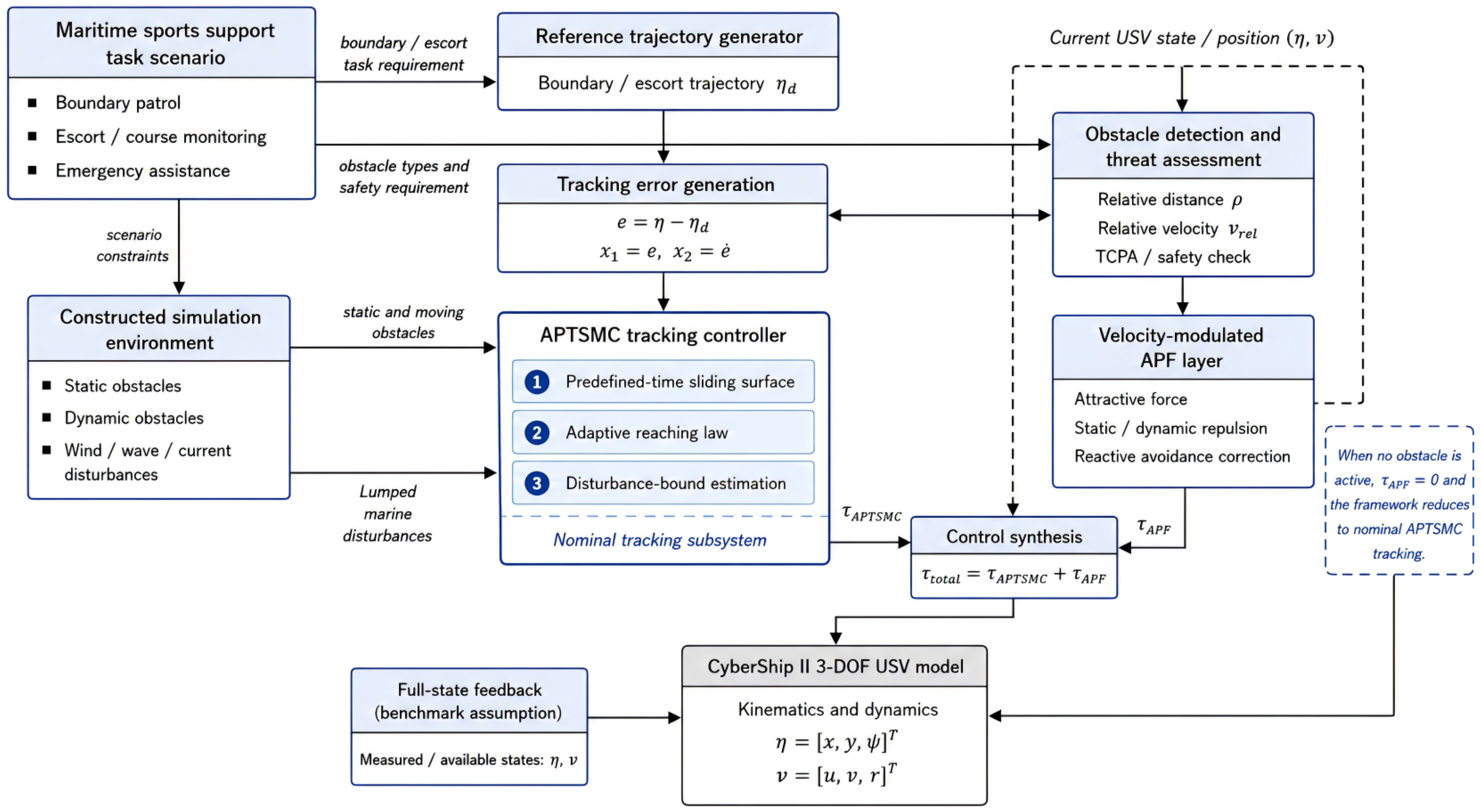
Motivated by these considerations, this paper proposes an adaptive predefined-time sliding mode control (APTSMC) framework integrated with a velocity-modulated APF-based reactive avoidance layer for USV trajectory tracking and obstacle avoidance in maritime sports teaching support scenarios. The main contributions of this work are summarized as follows:
(1) An adaptive predefined-time sliding mode tracking controller is formulated for the considered USV error dynamics. By introducing a predefined-time sliding surface and a predefined-time reaching law, the controller provides an explicit upper bound on the convergence time of the nominal tracking subsystem.
(2) An adaptive disturbance-bound estimation mechanism is incorporated into the reaching law to compensate for unknown lumped disturbances without requiring their prior upper bound. This improves robustness against wind-, wave-, and current-induced disturbances while reducing excessive switching gains.
(3) A velocity-modulated APF correction is integrated as a reactive avoidance layer. The proposed formulation modifies the repulsive potential according to the relative motion between the USV and obstacles and introduces the resulting correction into the tracking controller in a bounded and gradually recoverable manner.
(4) Numerical simulations based on the CyberShip II model are conducted to evaluate the proposed framework under wave-shaped, high-curvature, and constructed maritime sports boundary-tracking scenarios. The results demonstrate the potential of the integrated method to balance tracking accuracy, convergence speed, disturbance rejection, and collision avoidance safety in simulation.
3. Design of the Trajectory Tracking Control Strategy
3.1. Design of the APTSMC
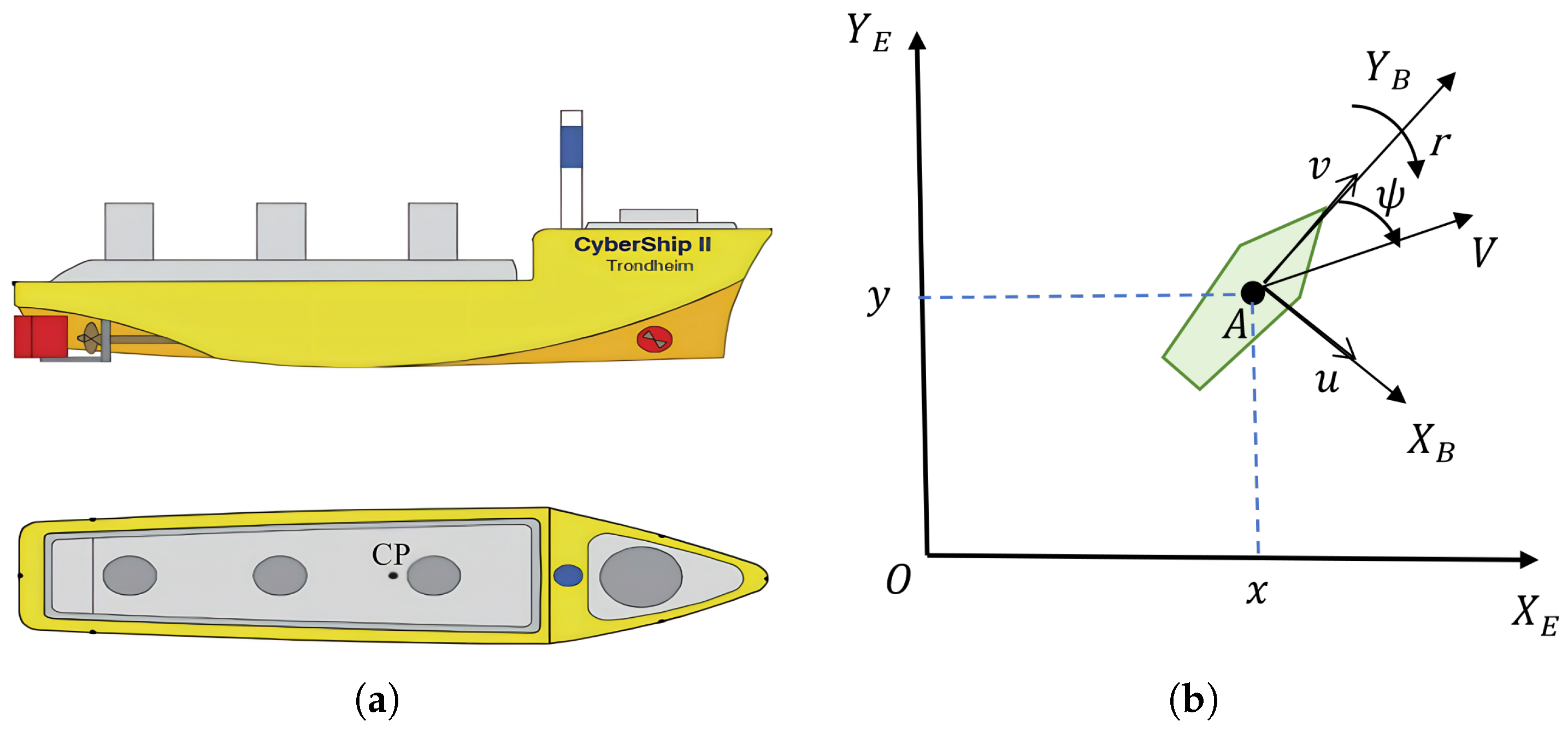
Before presenting the APTSMC design, the tracking-error dynamics are first established from the benchmark 3-DOF USV model introduced in
Section 2.2. By defining the tracking error as the difference between the actual state and the desired state, the original kinematic-dynamic model can be transformed into a compact error-state form. This error system serves as the basis for the subsequent predefined-time sliding-surface construction, adaptive reaching-law design, and APF-integrated avoidance control.
The tracking error
e is defined as follows:
where
denotes the desired trajectory.
Define
and
; then, it can be obtained that
where
,
, and
. Since matrices
R and
M are both invertible,
is always invertible.
The adaptive predefined-time sliding mode surface (APTSMS) is designed as follows:
where
satisfies the following:
where
,
,
, and
are all positive constants, and
is defined as in Equation (
10):
where
and
, and
is an arbitrarily small positive constant.
Taking the time derivative of the APTSMS in Equation (
8)
Then, it can be obtained that
where
satisfies the following:
Without the consideration of the disturbance term
, the equivalent control law
is designed by setting
as follows:
The predefined-time reaching law is designed as follows:
where
is the estimated value of the disturbance upper bound, whose derivative satisfies
with
. The auxiliary variable
is defined by the following expression:
where
,
, and
are positive constants, and
.
By combining Equations (
14) and (
15), the Adaptive Predefined-Time Sliding Mode Control (APTSMC) strategy for the USV system is designed as follows:
Theorem 1. Considering the error system of the USV subject to external disturbances, the proposed Adaptive Predefined-Time Sliding Mode Control (APTSMC) strategy can achieve effective trajectory tracking. Furthermore, the system stability is guaranteed within a predefined time , which is given by the following: Proof of Theorem 1. In the reaching phase, to verify the effectiveness of the theorem, the following Lyapunov function candidate is designed:
where
, and
denotes the error between the estimated disturbance upper bound
and its actual value
K, which satisfies
. Taking the time derivative of
and further reasoning yields the following:
where
.
According to Lemma 1, it can be obtained that the system enters the pre-specified region within the predefined time .
In the sliding phase, the Lyapunov function candidate
is defined as follows:
Taking the time derivative of
:
According to Lemma 2, the system state can converge to a neighborhood of the origin within the predefined time .
Consequently, it is proved that the USV system can achieve stable convergence within a predefined time T that satisfies . □
3.2. Improved Artificial Potential Field Method for Obstacle Avoidance
In practical maritime sports teaching scenarios, USVs must not only accurately track predefined boundary paths but also safely avoid both static and dynamic obstacles, including anchored buoys, floating barriers, instructor boats, and support vessels. To address this challenge, an improved artificial potential field (APF) method is integrated with the proposed APTSMC-TC framework. This subsection presents the complete mathematical formulation of the obstacle avoidance strategy and subsequently validates its effectiveness through numerical simulations.
The fundamental principle of the APF method is to construct a virtual potential field over the USV’s operational space, where the target destination generates an attractive potential that pulls the USV toward the desired path, while obstacles produce repulsive potentials that push the USV away from collision threats. The resultant force, derived as the negative gradient of the total potential, is then incorporated into the control framework as a virtual guidance correction. The APF layer is implemented as an event-triggered reactive correction rather than a continuously active global planner. At each sampling instant, the distance, relative velocity, TCPA, and predicted minimum separation are evaluated for each obstacle. If an obstacle enters the detection region but is not predicted to violate the safety margin, only monitoring is performed. If the predicted minimum distance falls below the safety margin or the obstacle enters the APF influence radius, the repulsive term is activated. Once all obstacles satisfy the clearance condition, the APF correction is gradually reduced to zero through a recovery factor to avoid abrupt switching and to allow the USV to return smoothly to nominal trajectory tracking.
The total potential field
is defined as the sum of an attractive potential
and a repulsive potential
:
where
is the number of detected obstacles.
The attractive potential is designed to guide the USV toward the desired trajectory. Unlike conventional formulations that define attraction toward a fixed goal point, for trajectory tracking, the attractive force should act toward a moving virtual target point on the reference path. The attractive potential is defined as follows:
where
is the attractive gain, and
is the nearest point on the desired trajectory or a look-ahead point determined by the USV’s current position and velocity. The corresponding attractive force is as follows:
For static obstacles, the conventional repulsive potential is formulated as follows:
where
is the repulsive gain,
is the Euclidean distance between the USV and the obstacle,
is the influence radius of the obstacle, and
denotes the obstacle position. The corresponding repulsive force is as follows:
For dynamic obstacles such as moving support vessels or instructor boats, the conventional APF is insufficient because it only considers relative positions and ignores relative velocities. To address this limitation, an improved repulsive potential that incorporates relative velocity information is proposed. The improved repulsive potential for a dynamic obstacle is defined as follows:
where
is the relative velocity vector, and
is a velocity modulation function defined as follows:
where
,
is a scaling factor, and
is a small positive constant to avoid division by zero. With the above convention,
means that the relative distance is decreasing and the USV is approaching the obstacle. In this case, the exponent becomes positive and
, thereby amplifying the repulsive effect. Conversely, when
, the USV and the obstacle are moving apart, and
, which reduces unnecessary repulsion and helps the USV recover the reference trajectory smoothly.
The repulsive force from a dynamic obstacle is then computed as follows:
The gradient with respect to the USV position can be derived using the chain rule, considering the dependence of on through the relative position direction.
The resultant virtual guidance force
is obtained as the superposition of the attractive force and all repulsive forces:
To integrate obstacle avoidance into the trajectory tracking controller, the resultant APF force is transformed into a desired velocity correction
through a first-order dynamic mapping:
where
is a time constant that determines the responsiveness of the avoidance maneuver. The corrected reference trajectory
is then obtained by integrating the APF-induced velocity correction:
Remark 2. Stability scope of the APF-integrated controller. The predefined-time convergence proof in Theorem 1 applies to the nominal APTSMC tracking subsystem. When the APF layer is activated, the total control input becomes Substituting into the sliding dynamics yieldswhere is the additional avoidance-induced term. In the implementation, the APF correction is activated only within the obstacle-influence region and is bounded by saturation: Since is bounded for the considered USV model, there exists a positive constant such that Thus, the total lumped term during active avoidance is bounded as Therefore, the APF correction can be regarded as a bounded auxiliary input. The adaptive reaching law compensates for the enlarged lumped bound and keeps the sliding variable practically bounded during active avoidance. When no obstacle is active, , and the closed-loop system reduces to the nominal APTSMC tracking subsystem. Consequently, the predefined-time convergence guarantee is recovered after the avoidance correction is removed. This paper therefore claims predefined-time stability for the nominal tracking subsystem and bounded tracking behavior during active APF-based avoidance, rather than strict predefined-time stability of the complete hybrid tracking-avoidance system for all possible obstacle configurations.
This additive structure allows the APF term to act as a bounded auxiliary correction during active obstacle avoidance. The predefined-time stability result is retained for the nominal APTSMC tracking subsystem when , while bounded tracking behavior during active avoidance is evaluated through simulation metrics such as tracking error, minimum obstacle distance, and recovery time.
To ensure reliable operation in cluttered environments, the following avoidance decision logic is implemented:
Detection: For each obstacle, compute the relative distance and relative velocity . If (detection threshold), the obstacle is considered active.
Threat assessment: A threat level is assigned to each active obstacle based on the time to closest point of approach (TCPA) and the minimum separation distance.
Avoidance activation: If (influence radius) or the predicted minimum distance falls below a safety margin, the repulsive potential for that obstacle is activated.
Force superposition: The total APF force is computed by summing contributions from all active obstacles and the attractive target.
Recovery: When all obstacles are cleared ( for all obstacles with ), the APF correction is gradually ramped down to zero, allowing the USV to resume pure trajectory tracking.
It should be noted that the improved APF layer is a reactive local avoidance method rather than a global motion planner. Therefore, it may still suffer from several known limitations of potential-field-based methods. First, local minima may occur when the attractive and repulsive forces are balanced. Second, oscillatory behavior may appear when the USV moves close to obstacle boundaries or between multiple obstacles. Third, in narrow channels or dense obstacle environments, APF-based repulsion may generate conservative detours or even fail to find a feasible passage. In this work, these issues are mitigated by three practical mechanisms. The relative-velocity modulation reduces unnecessary repulsion when the obstacle is moving away from the USV, thereby alleviating over-conservative avoidance. The activation and recovery thresholds, especially , introduce a hysteresis effect that reduces repeated switching near the obstacle-influence boundary. In addition, the APF correction is bounded to avoid excessive control commands. Nevertheless, the proposed APF layer does not guarantee global optimality in all obstacle configurations. For dense obstacle fields, narrow passages, or highly interactive multi-vessel encounters, it should be combined with a higher-level global planner, velocity-obstacle method, or MPC-based local planning strategy.
The proposed framework is particularly relevant to maritime sports support. First, boundary patrol and escorting tasks often involve explicit time requirements, which motivates the use of predefined-time convergence. Second, the operating area is affected by wind, waves, and currents, which requires disturbance-robust tracking. Third, the USV may encounter athletes, instructor boats, buoys, and floating barriers, making reactive collision avoidance necessary. The same idea may also be applicable to other USV trajectory-tracking missions with similar time and safety constraints, which will be investigated in future work.
4. Numerical Simulation and Analysis
This section presents a series of rigorous numerical simulations to evaluate the efficacy of the proposed APTSMC-TC scheme for USV operating in maritime sports instruction support scenarios. Three comparative simulation trials are carried out to demonstrate the enhanced tracking performance of the APTSMC-TC algorithm relative to conventional adaptive sliding mode control (ASMC-TC), nonsingular fast terminal sliding mode control (NFTSMC), and fractional-order sliding mode control (FSMC). In addition, a realistic boundary-tracking scenario in maritime sports involving multiple static and dynamic obstacles is constructed to test the integrated obstacle avoidance capability achieved by an improved artificial potential field method.
4.1. Parameter Tuning and Simulation Settings
To ensure the fairness and reproducibility of the numerical comparison, the controller parameters are selected according to the following principles. All results reported in this section are obtained from numerical simulations based on the benchmark CyberShip II model, with its key parameters listed in
Table 3. The maritime sports boundary-tracking case is a constructed simulation scenario designed to reflect typical operational features, including buoy-marked boundaries, static floating obstacles, and moving support vessels. In the present study, a full-state feedback benchmark setting is adopted to focus on the controller-level performance of the proposed APTSMC-APF framework. In practical USV systems, the position, heading, and velocity states are typically obtained from GNSS, IMU, compass, Doppler log, or sensor-fusion modules. Therefore, sensor noise, state-estimation errors, and communication/control delays may affect both the sliding variable and the APF-based threat-assessment process. In addition, practical implementation may also be constrained by actuator saturation, rate limits, and onboard computational resources. These effects are not explicitly modeled in the present study, and the real-time applicability of the proposed framework on embedded USV platforms will be further investigated in future hardware-in-the-loop and field experiments.
For the proposed APTSMC-TC strategy, the predefined-time constants and are determined by the task-level convergence-time requirement. The nonlinear exponents and are introduced to shape the convergence profile and are selected by balancing rapid error convergence against control smoothness. The parameters and are employed to regulate the convergence behavior of the predefined-time sliding surface and reaching law. The adaptive gain b is chosen to ensure adequate disturbance-bound adaptation while avoiding excessive switching gains. For the APF-based avoidance layer, the corresponding gains are tuned according to the safety-distance requirement, the obstacle influence range, and the acceptable trajectory deviation during avoidance. Moreover, the comparison methods are tuned under the same simulation conditions to ensure that each controller is evaluated within a consistent setting. Unless otherwise specified, the APTSMC parameters are set as , , , and .
In addition, a brief sensitivity analysis is carried out for several representative parameters by varying one parameter at a time around its nominal value while keeping the others unchanged in
Table 4. To maintain consistency with the main comparison in
Table 5, the same performance indicators, including
,
,
,
, safety violation,
, and
, are adopted whenever applicable. The results indicate that smaller values of
and
generally improve transient convergence, but they may also lead to more aggressive control action and increased chattering. By contrast, larger predefined-time constants enhance smoothness at the cost of slower response. Similarly,
affects the trade-off between convergence speed and chattering suppression. The adaptive gain
b primarily influences the disturbance-bound estimation rate: a larger value improves disturbance compensation, but it may also increase switching activity if chosen excessively large. For the APF module, a larger velocity-modulation factor
enhances anticipatory obstacle avoidance and generally increases the minimum separation distance, but it may also cause larger temporary trajectory deviations. Overall, the selected nominal parameters provide a reasonable balance among tracking accuracy, convergence speed, robustness, and avoidance smoothness under the considered simulation conditions.
4.2. Comparative Analysis of Tracking Performance
To comprehensively evaluate the tracking performance of the proposed APTSMC-TC strategy, two distinct reference trajectories are designed: (1) a wave-shaped trajectory subject to constant complex environmental disturbances, and (2) a high-curvature complex trajectory with time-varying disturbances. The ASMC-TC method serves as the primary baseline for comparison. The APTSMC parameters are chosen as , , , and .
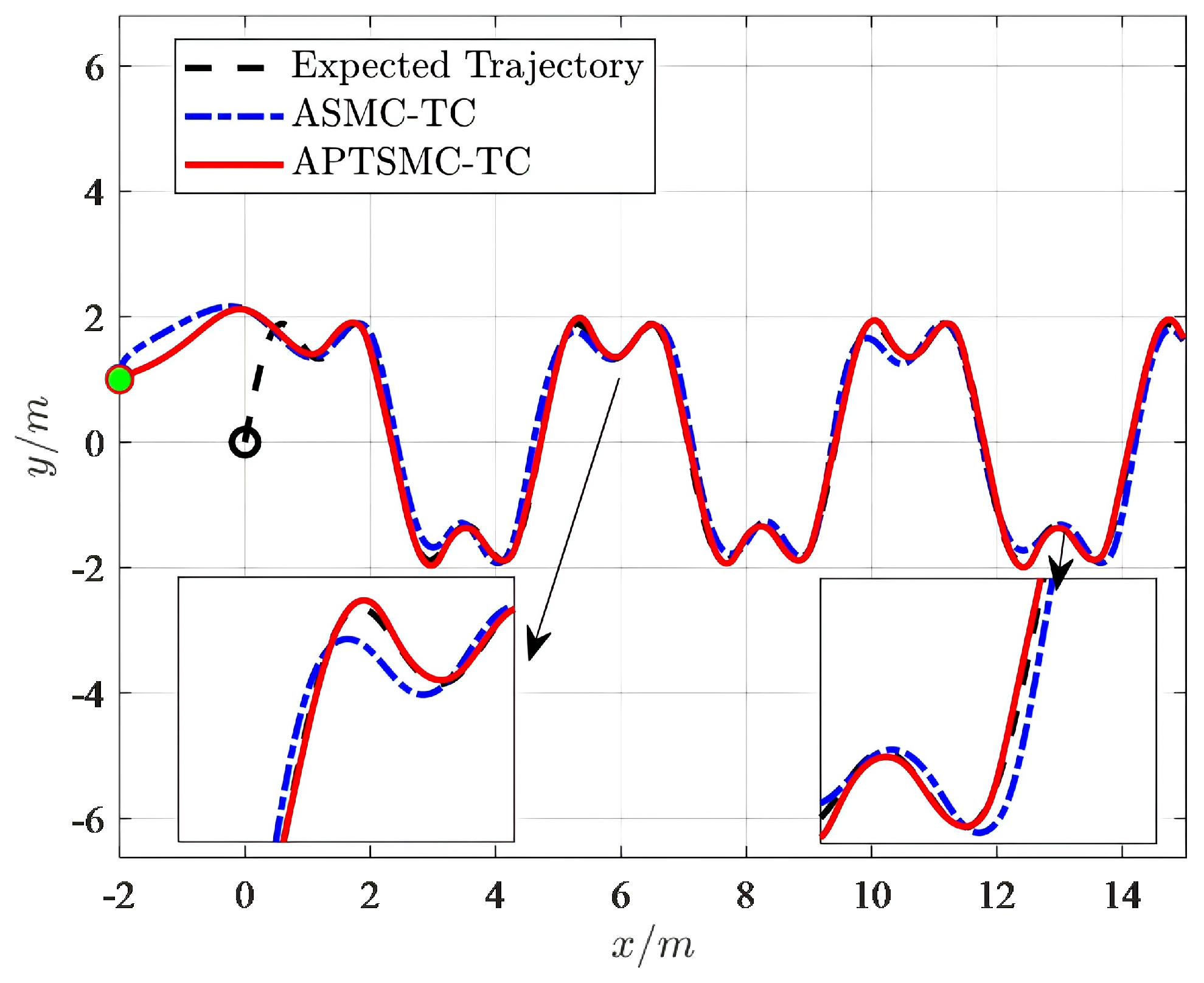
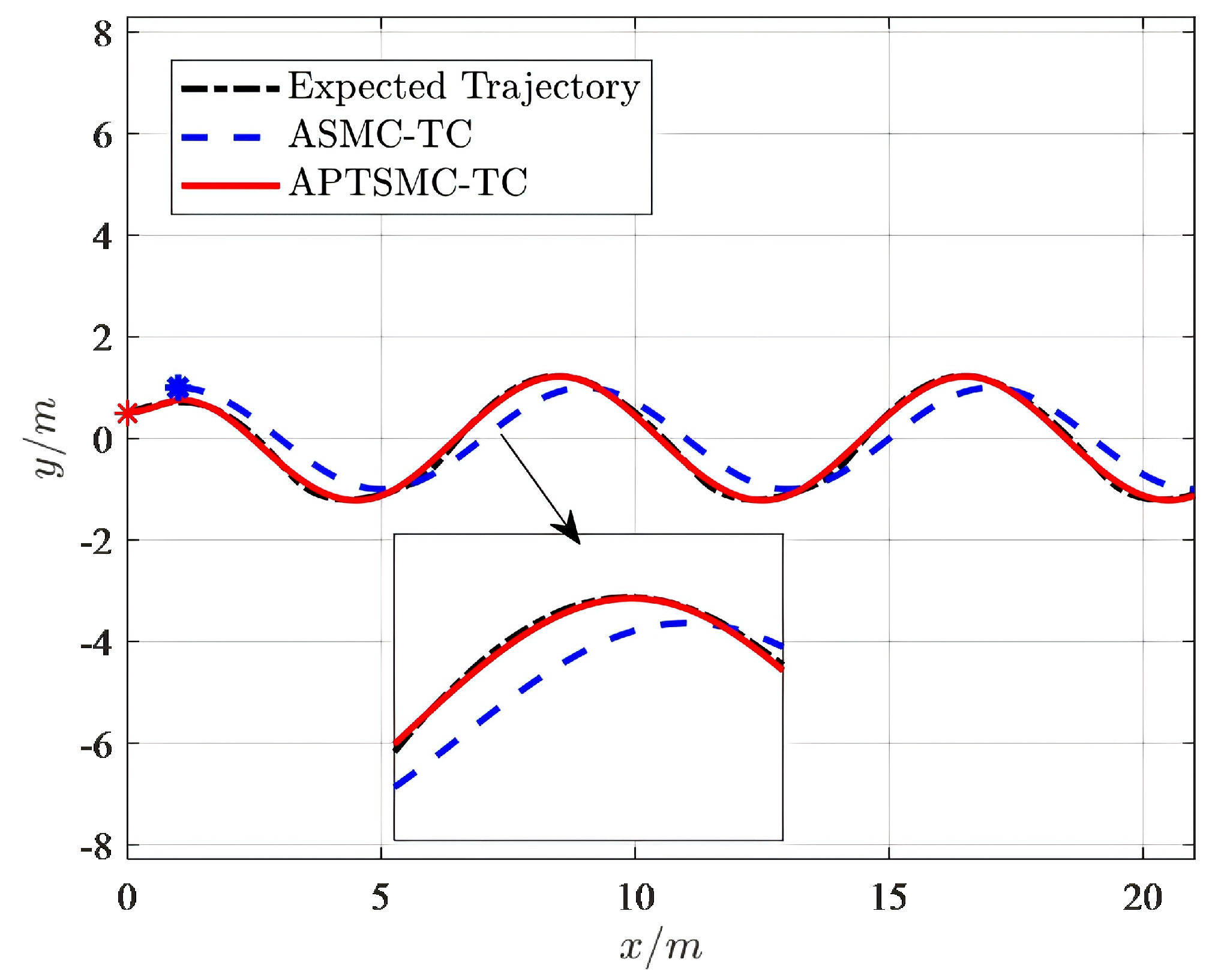
Figure 3 presents the trajectory tracking curves of the USV under a wave-shaped reference path with constant complex disturbances. It can be observed that both the APTSMC-TC and ASMC-TC algorithms enable the USV to approximately follow the desired wave trajectory. However, the proposed APTSMC-TC method exhibits significantly faster convergence to the reference path during the initial phase, with substantially smaller overshoot and oscillations. In contrast, the ASMC-TC method demonstrates noticeable lag and larger tracking deviations, particularly at the turning points of the wave trajectory. This improvement is attributed to the predefined-time convergence property of the sliding surface design, which ensures that the tracking error converges within a user-specified time window regardless of initial conditions.
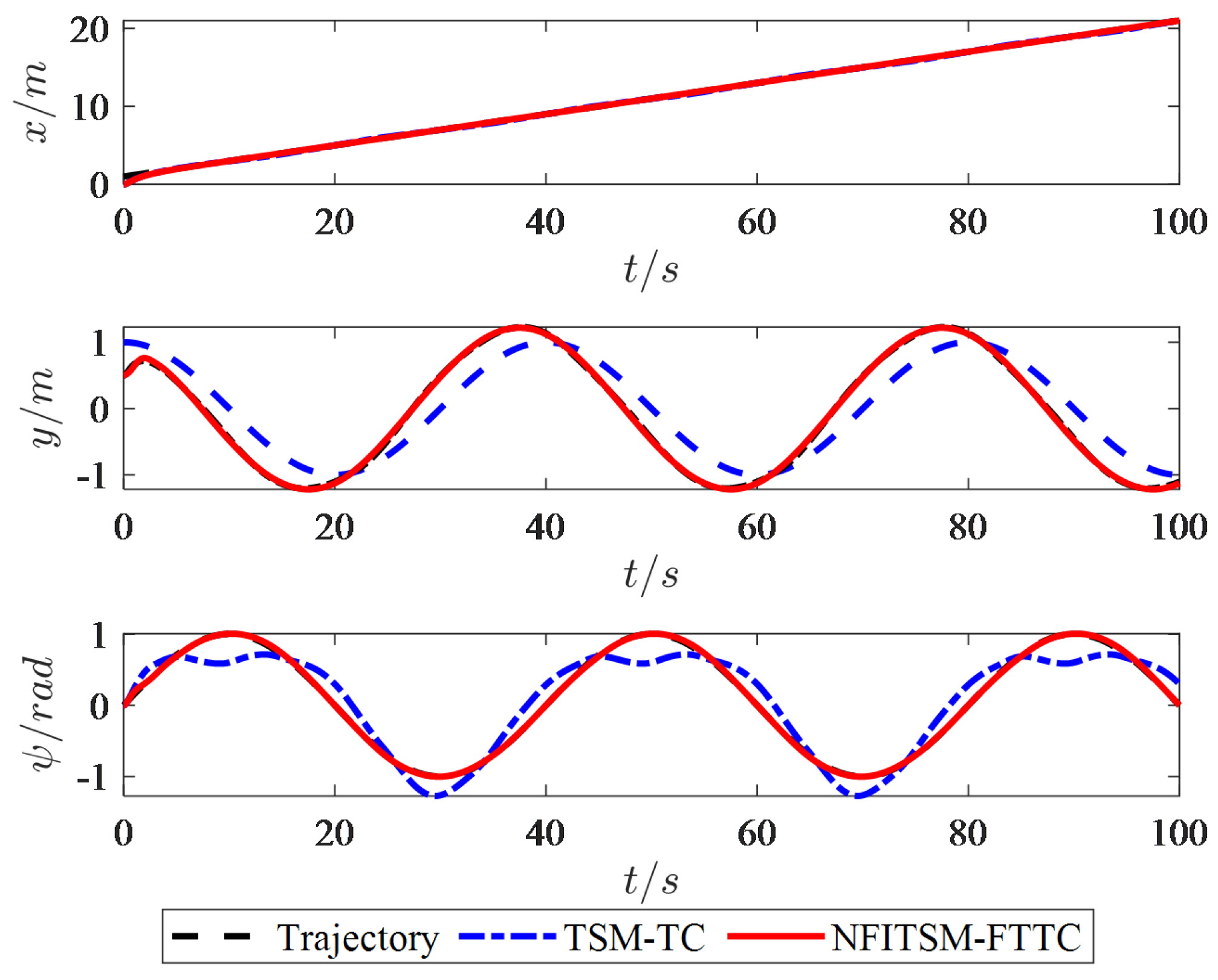
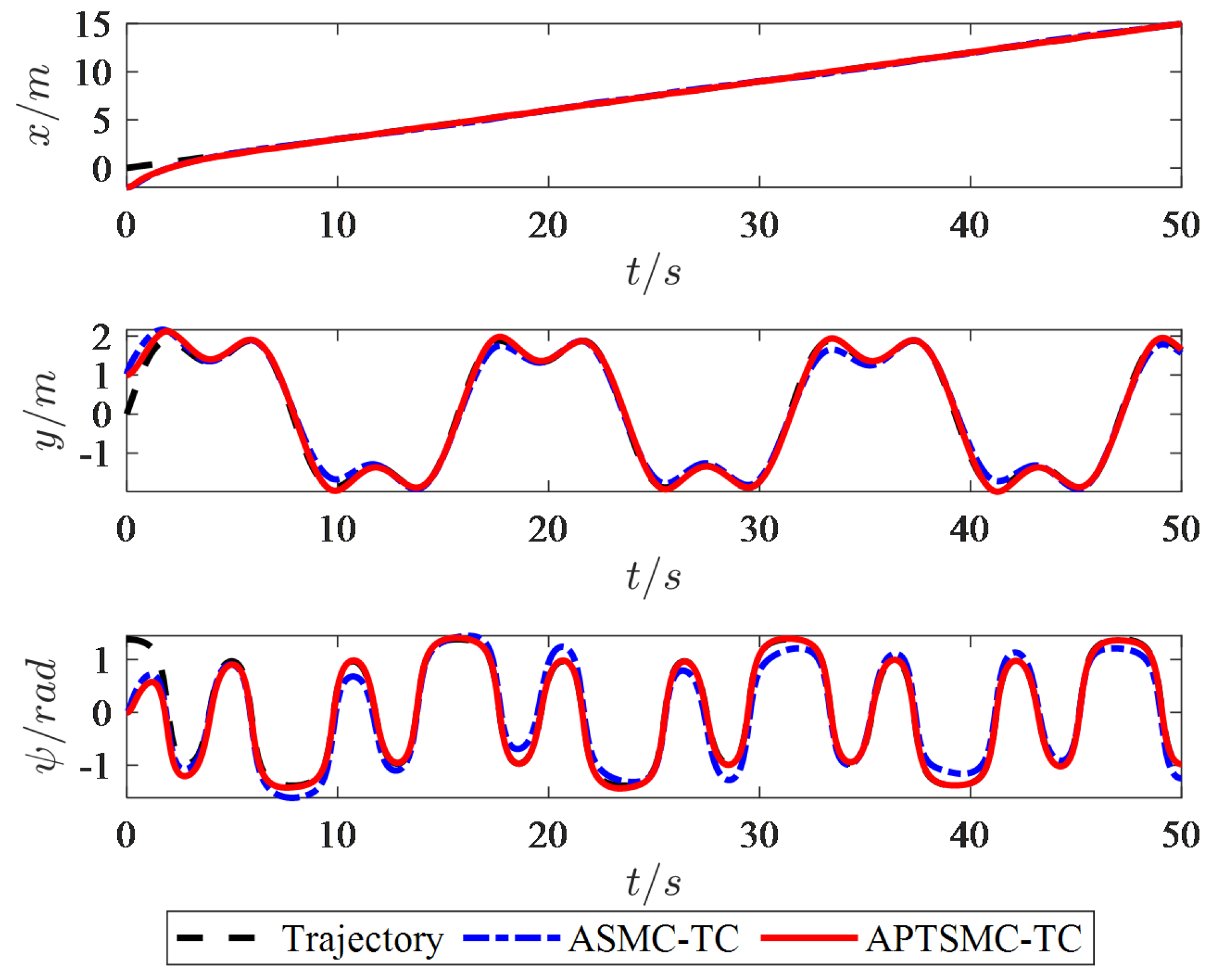
Figure 4 illustrates the position tracking curves in the
x- and
y-directions corresponding to the wave trajectory scenario. The APTSMC-TC strategy achieves precise tracking of both coordinates with minimal phase delay and amplitude attenuation. By contrast, the ASMC-TC method exhibits evident tracking errors, especially in the
y-direction where the reference signal varies more rapidly. In the nominal representative case, the maximum absolute tracking error of APTSMC-TC is reduced by approximately 62% compared with ASMC. This value should be interpreted as a representative-case improvement rather than a universal statistical conclusion. Therefore, Monte Carlo simulations with randomized disturbances, initial states, sensor noise, and obstacle configurations are further conducted to evaluate the statistical robustness of the proposed method.
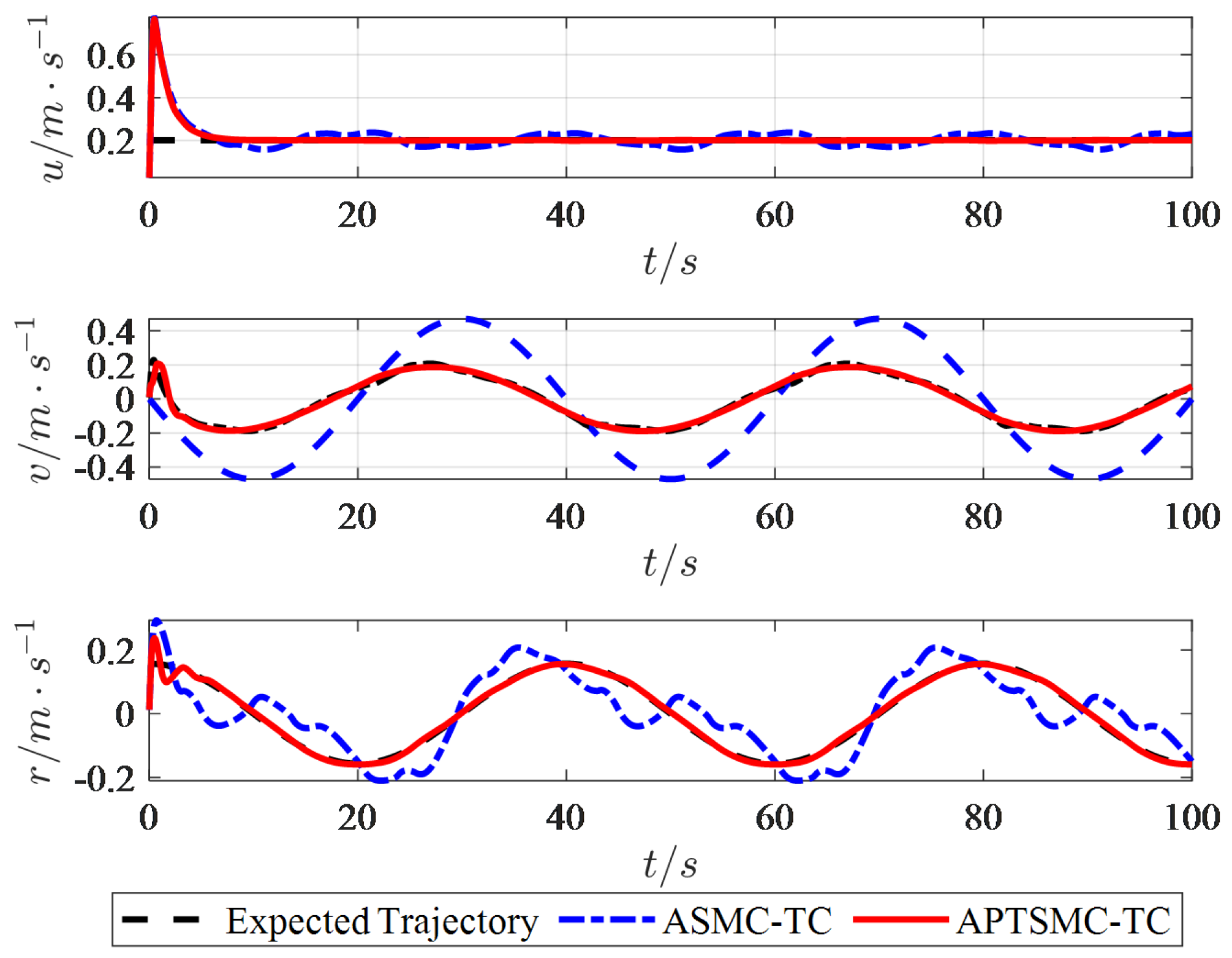
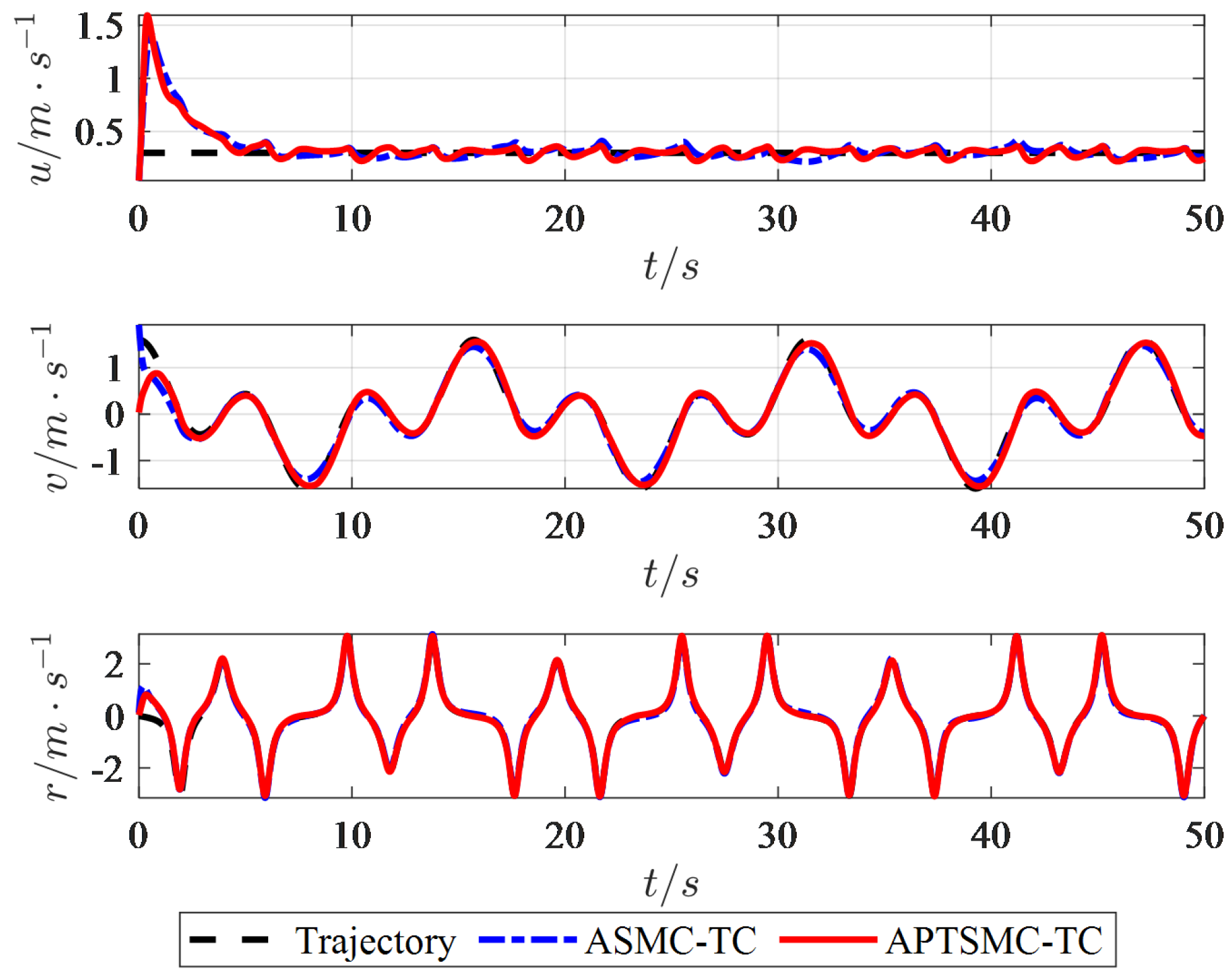
Figure 5 shows the velocity tracking performance under the same wave trajectory. The proposed APTSMC-TC method accurately tracks the desired surge and sway velocities with smooth control responses and negligible chattering. The ASMC-TC method, while maintaining bounded tracking, produces more pronounced velocity fluctuations and slower convergence after abrupt reference changes. The improved velocity tracking directly contributes to the overall trajectory accuracy and operational safety in maritime sports teaching scenarios, where smooth and predictable USV motion is essential for tasks such as athlete escort and buoy deployment.
To further challenge the robustness of the proposed controller, a complex trajectory with large curvature variations and time-varying external disturbances is designed.
Figure 6 depicts the overall trajectory tracking comparison. The APTSMC-TC method maintains stable and accurate tracking throughout the entire maneuver, successfully negotiating sharp turns and straight segments alike. The ASMC-TC method, however, exhibits accumulating errors during high-curvature segments and struggles to maintain tight tracking performance under time-varying disturbances. These results highlight the enhanced adaptability of the predefined-time sliding surface combined with the adaptive disturbance upper bound estimation.
Figure 7 and
Figure 8 present the detailed position and velocity tracking curves for the complex trajectory scenario. The APTSMC-TC method achieves rapid error convergence and maintains steady-state errors, whereas the ASMC-TC method yields errors approximately three times larger. The predefined-time reaching law, parameterized by
, ensures that the sliding variable converges strictly within the specified time, while the adaptive law
effectively compensates for the unknown disturbance upper bound without overestimation.
To further position the proposed method within the broader USV control landscape, additional comparative simulations are conducted under a constructed maritime sports support scenario. This scenario is designed to represent a typical boundary-patrol task in a confined or semi-confined maritime sports area, where the USV is required to track a closed or semi-closed reference boundary while avoiding static floating markers and moving support vessels. The reference trajectory is generated by the task module according to the prescribed boundary-patrol route and the desired cruising speed.
In the constructed scenario, static obstacles are used to represent anchored buoys, floating barriers, and temporary course markers, whereas dynamic obstacles are used to represent instructor boats or support vessels that cross or approach the USV path. Each obstacle is assigned an influence region, and a safety violation is recorded when the minimum distance between the USV and any obstacle becomes smaller than the prescribed safety distance. The APF layer is activated only when an obstacle enters the detection or influence region so that the controller can balance nominal trajectory tracking and reactive collision avoidance.
To evaluate robustness rather than only a single representative trajectory, 100 Monte Carlo trials are performed for each controller. In each trial, the initial tracking error, wave phase, wind–current disturbance realization, sensor-noise sequence, obstacle position, and obstacle velocity are randomly varied within the same predefined ranges. All controllers are tested under the same set of randomized scenarios to ensure a fair comparison. The comparative results are summarized in
Table 5, where the reported values are given as the mean and standard deviation over these 100 trials.
The performance indicators are defined as follows. and denote the root-mean-square and maximum Euclidean tracking errors, respectively. denotes the practical settling time. denotes the minimum separation distance between the USV and all obstacles. The safety violation ratio is the percentage of trials in which is smaller than the prescribed safety distance. is the normalized chattering index, and is the normalized control-energy index. For and , the ASMC value is normalized to 1.00.
As shown in
Table 5, the proposed APTSMC-APF method achieves the lowest RMS tracking error among the compared methods under the constructed maritime sports support simulation scenario. Compared with ASMC, the RMS tracking error decreases from 0.318 m to 0.154 m, corresponding to a reduction of approximately 51.6% under the mixed stochastic and wave-spectrum-based disturbance condition. Compared with NFTSMC and FSMC, the proposed method also provides smaller maximum tracking error and faster practical convergence, indicating that the predefined-time reaching law and adaptive disturbance-bound estimation improve transient tracking performance under uncertain marine disturbances. Meanwhile, the proposed method maintains a safe minimum distance from obstacles and avoids safety violations in the Monte Carlo trials. Compared with NMPC and GP-MPC, the proposed method requires less online computation, although predictive optimization methods still have advantages in explicit constraint handling.
It is also observed that NMPC and GP-MPC show strong performance in safety-distance maintenance and chattering suppression, which is consistent with their ability to explicitly handle constraints through predictive optimization. However, their average computation times are significantly higher than those of the SMC-based and proposed methods. GP-MPC achieves tracking performance close to the proposed method, but its computational burden is the highest because the Gaussian-process-based prediction correction needs to be evaluated online. The RL-based controller has relatively low online computational cost and acceptable tracking performance, but its error variance is larger under randomized disturbances and obstacle configurations, indicating that its generalization capability depends strongly on the training conditions.
Overall, the proposed APTSMC-APF framework does not claim universal superiority over MPC/NMPC or learning-based controllers. Instead, the results indicate that it provides a favorable balance among tracking accuracy, convergence speed, collision-avoidance safety, and online computational efficiency under the tested simulation conditions. This makes it suitable for maritime sports support tasks requiring explicit convergence-time adjustment, disturbance robustness, and reactive obstacle avoidance. Nevertheless, optimization-based and learning-based controllers remain important alternatives, especially when constraint handling, prediction over a longer horizon, or data-driven adaptation is prioritized.
Finally,
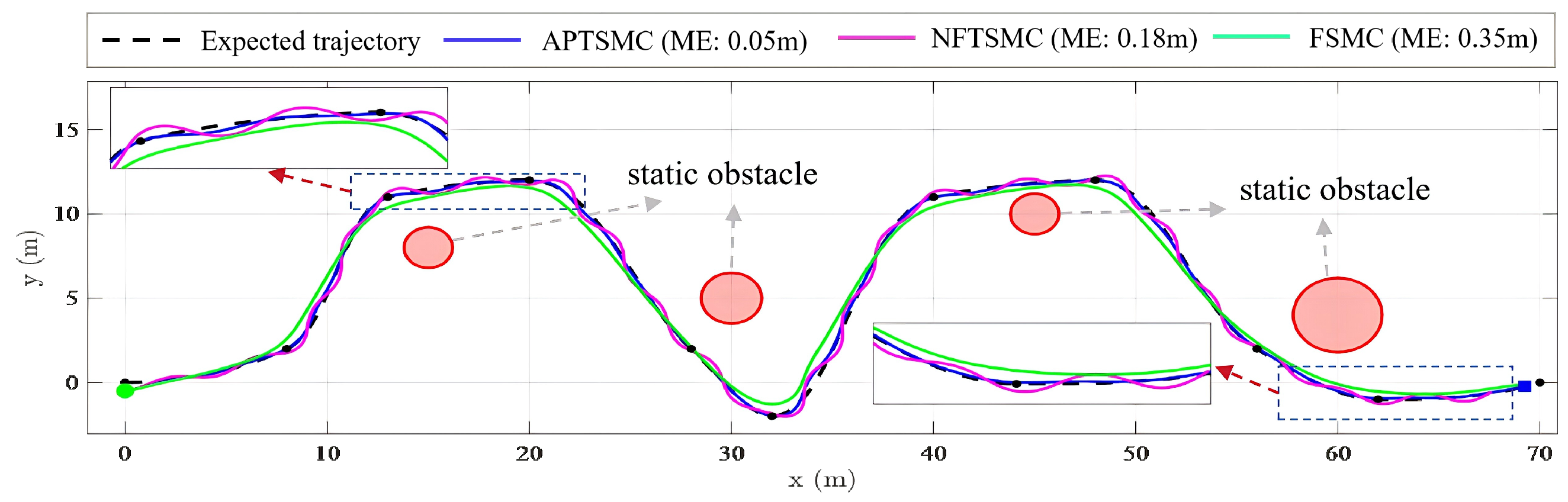
Figure 9 compares the tracking performance of APTSMC-TC against NFTSMC and FSMC in a high-fidelity maritime sports competition scenario. The APTSMC-TC method consistently outperforms both alternative sliding mode strategies, achieving the smallest maximum error, the fastest convergence, and the smoothest control effort. NFTSMC exhibits faster convergence than conventional SMC but suffers from residual chattering and sensitivity to time-varying disturbances. FSMC, while benefiting from fractional-order dynamics, demonstrates slower error reduction during the initial transient. The predefined-time framework of APTSMC-TC uniquely provides explicit temporal guarantees on tracking error convergence, which is particularly valuable in time-critical maritime sports teaching operations such as boundary patrolling within a fixed competition schedule.
4.3. Simulation Results for Obstacle Avoidance
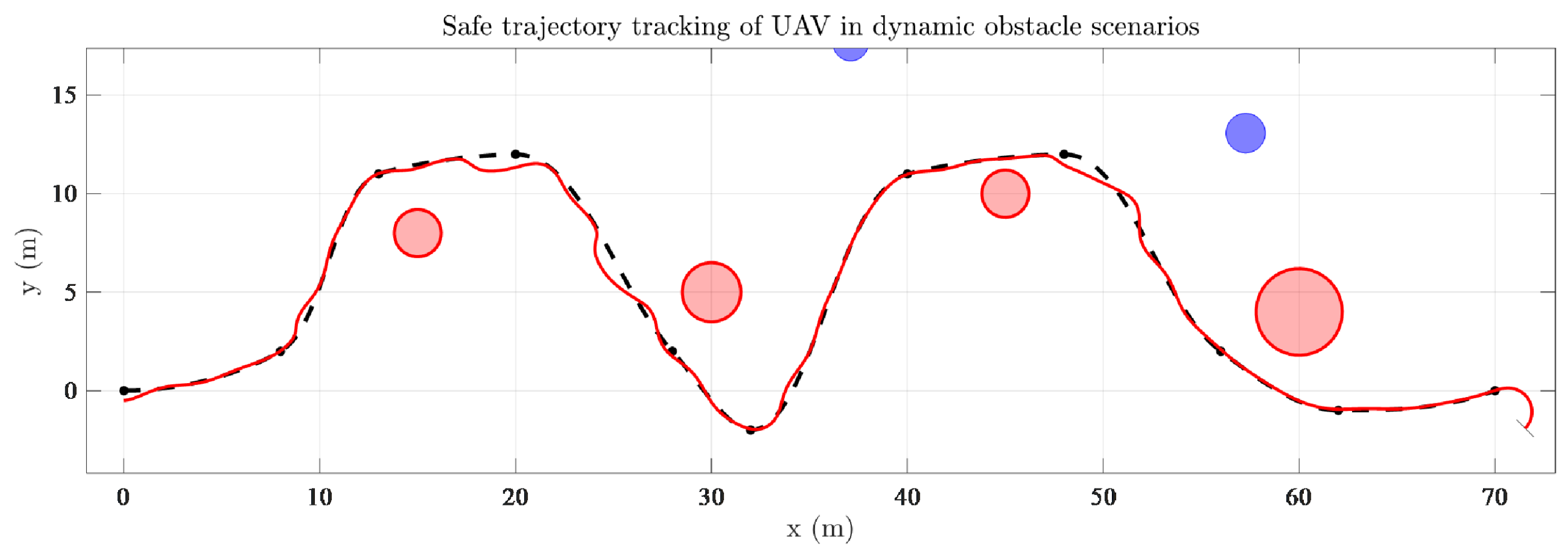
Based on the proposed APF-integrated APTSMC-TC framework, a realistic maritime sports boundary tracking scenario is constructed. As shown in
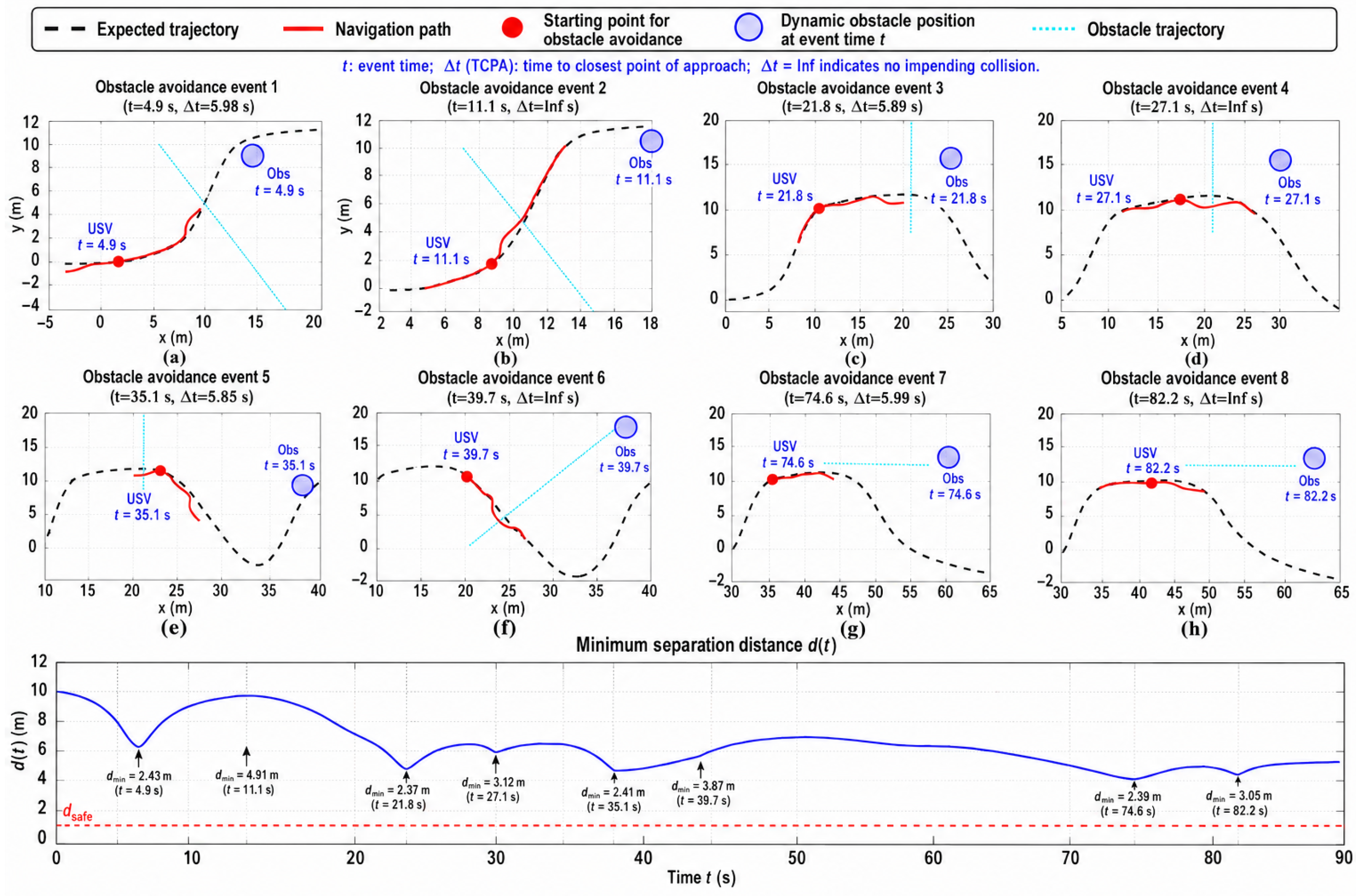
Figure 10, the simulation environment contains multiple static obstacles (simulating anchored buoys and floating barriers) and dynamic obstacles (simulating instructor boats and support vessels following deterministic paths). Two USVs are tasked with tracking the predefined competition boundary while safely avoiding all obstacles. Specifically, at
, USV1 successfully avoids a dynamic obstacle while maintaining trajectory tracking, and USV2 actively deviates from the desired path to avoid a collision threat before promptly returning to the boundary. At
, both USVs continue stable tracking after completing avoidance maneuvers. At
, a more challenging scenario is encountered where multiple obstacles appear in close succession; both USVs demonstrate robust avoidance without losing tracking stability. At
, the USVs have successfully traversed the entire boundary while maintaining safe separation from all obstacles.
Figure 11 illustrates the effective collision avoidance performance during navigation. The trajectories clearly show that when a static or dynamic obstacle encroaches upon the USV’s path, the APF-induced repulsive force generates a smooth deviation that steers the USV away from the threat. Once the obstacle is cleared, the attractive force seamlessly restores the USV to the original reference trajectory. Notably, the improved repulsive potential for dynamic obstacles enables the USV to anticipate collisions based on relative velocity, resulting in earlier and smoother avoidance maneuvers compared to conventional APF methods. The time-labeled markers in
Figure 11 clarify the relative positions of the USV and moving obstacles at the same time instants. Although some projected trajectories appear close in the two-dimensional plane, the corresponding time markers show that the USV and obstacles do not occupy the same location at the same time. The minimum-distance curve further confirms that
remains above the prescribed safety threshold during the whole simulation. Temporary increases in tracking error appear when the APF layer is activated, but the tracking accuracy is recovered after the collision threat disappears.
The tracking errors during obstacle avoidance, shown in the inset of
Figure 11, demonstrate that the USVs maintain bounded tracking errors throughout the entire operation. Although temporary increases in tracking error occur during active avoidance, the USVs rapidly recover to nominal tracking accuracy once the threat is resolved. This behavior confirms that the integrated APF-APTSMC-TC framework successfully balances the dual objectives of trajectory accuracy and collision safety.