
Predefined-Time Control for Automatic Carrier Landing Under Complex Wind Disturbances with Disturbance Observation and Prediction

Highlights
- An active anti-disturbance control framework integrating predefined-time control, disturbance observation, and online disturbance prediction is proposed for automatic carrier landing under complex wind disturbances.
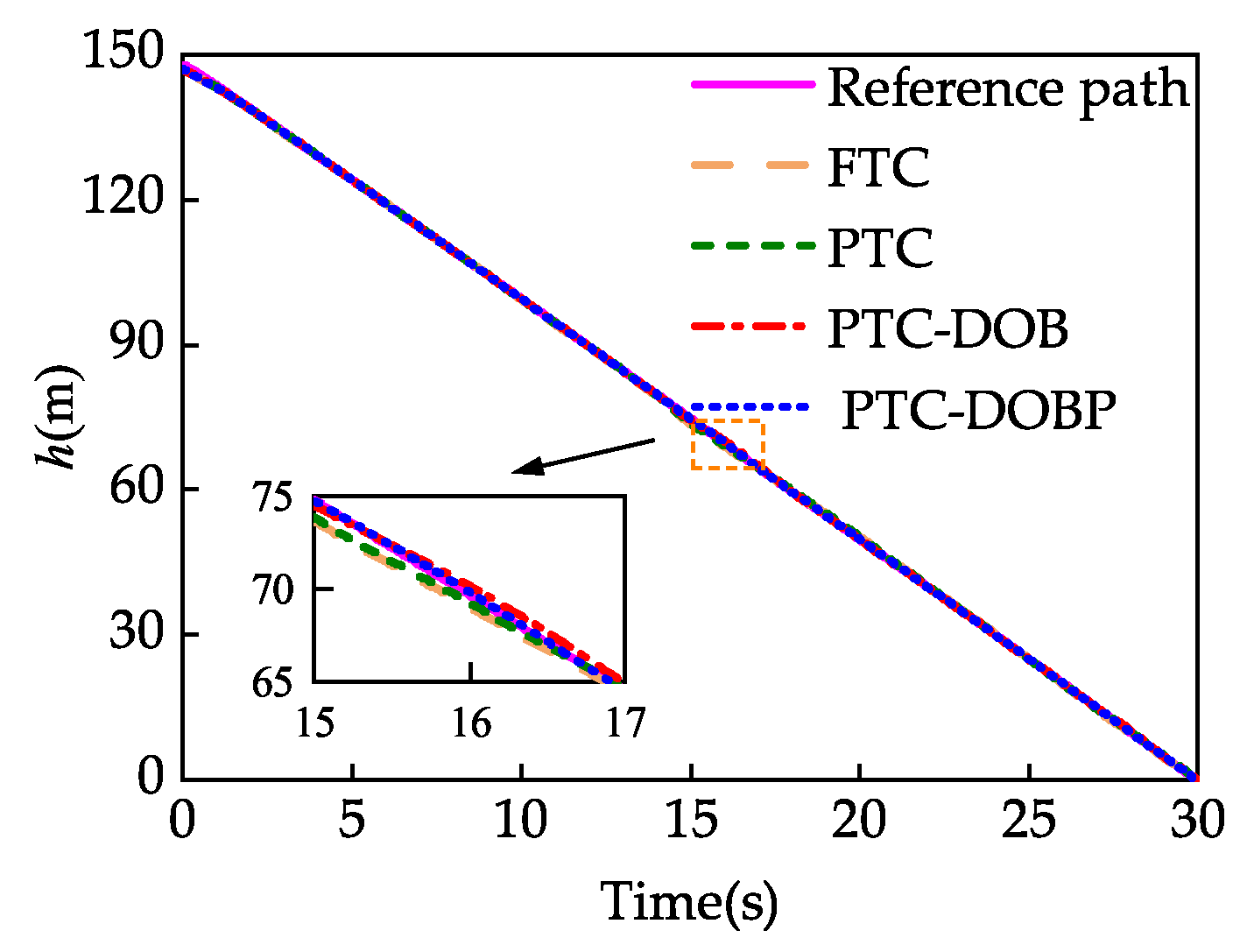
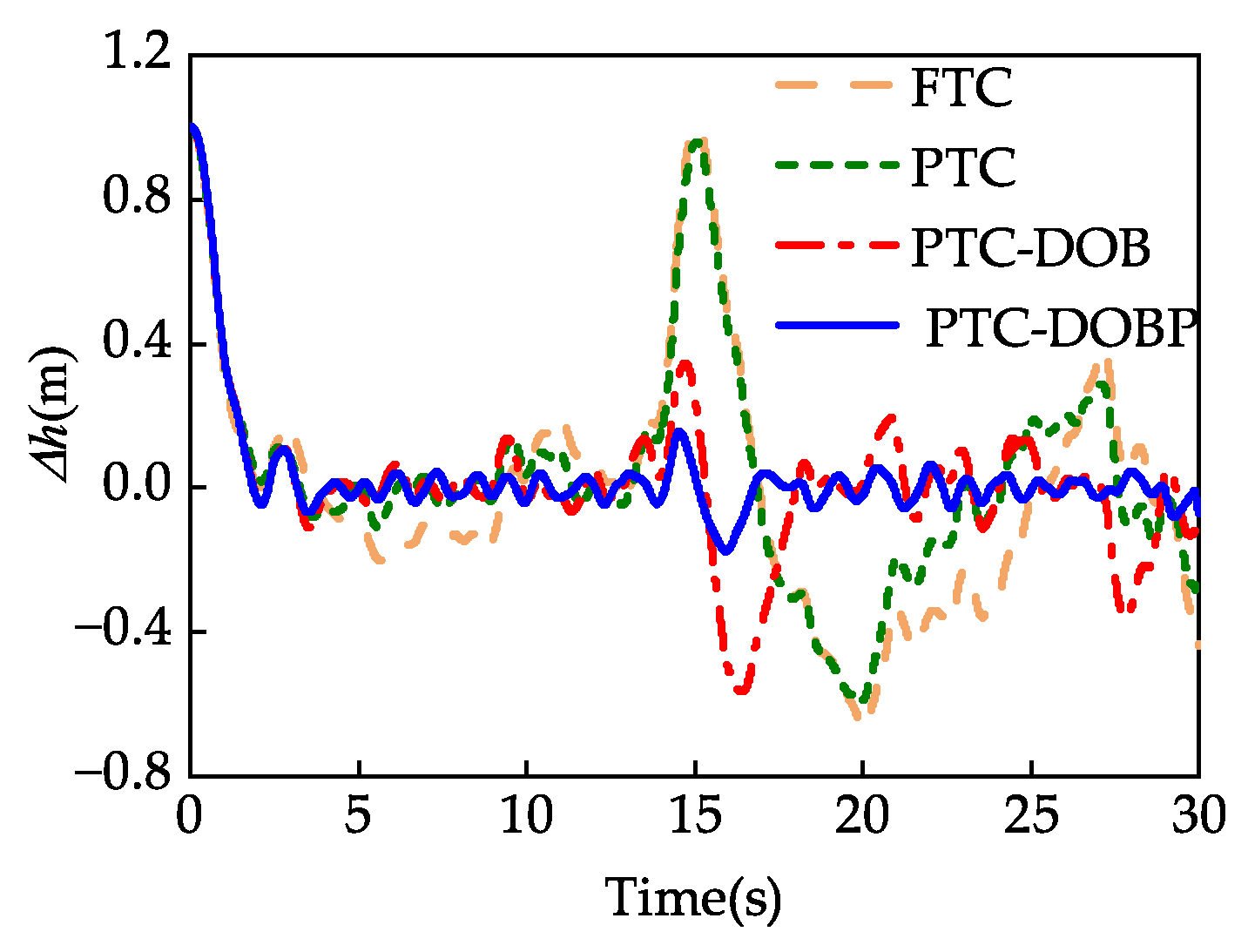
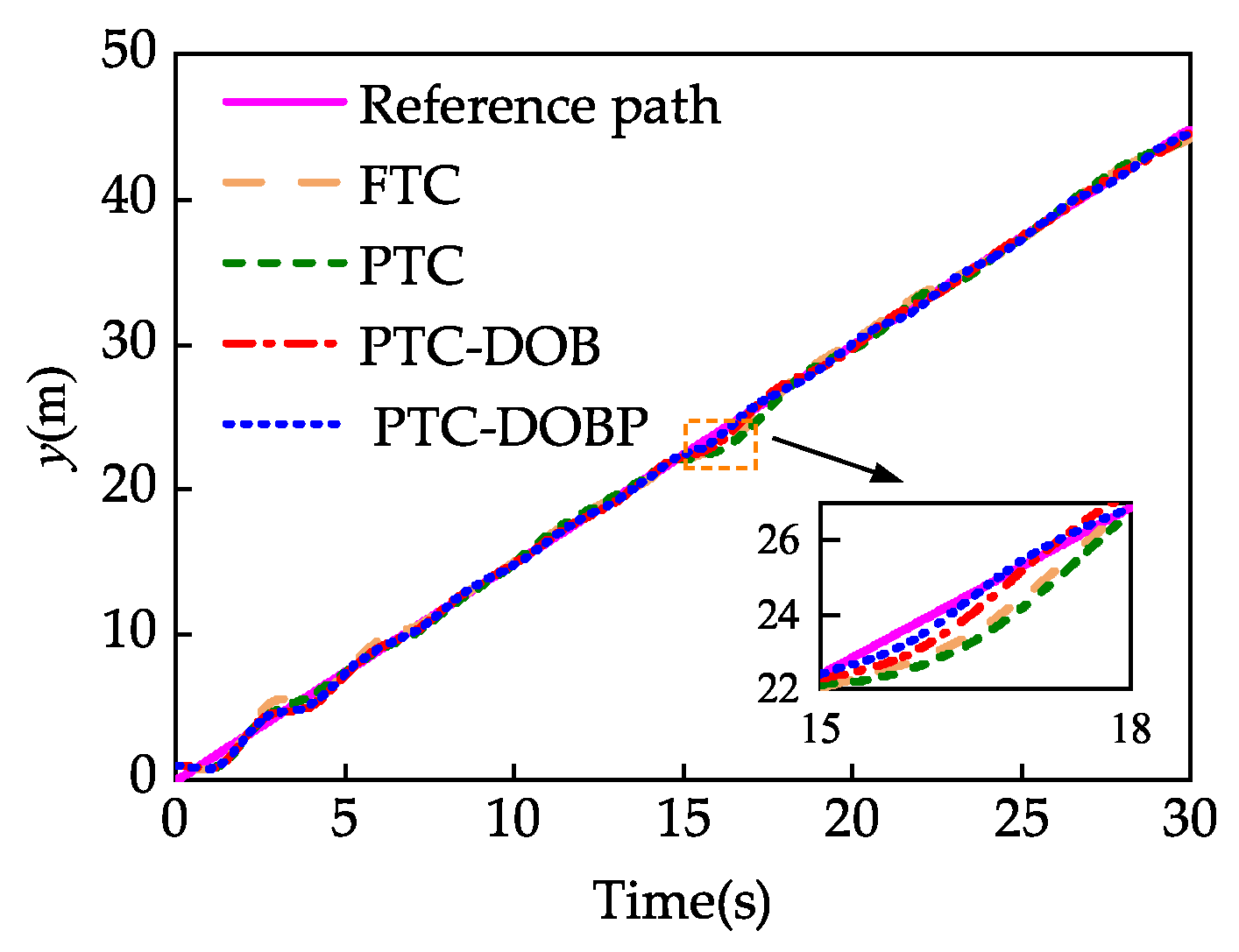
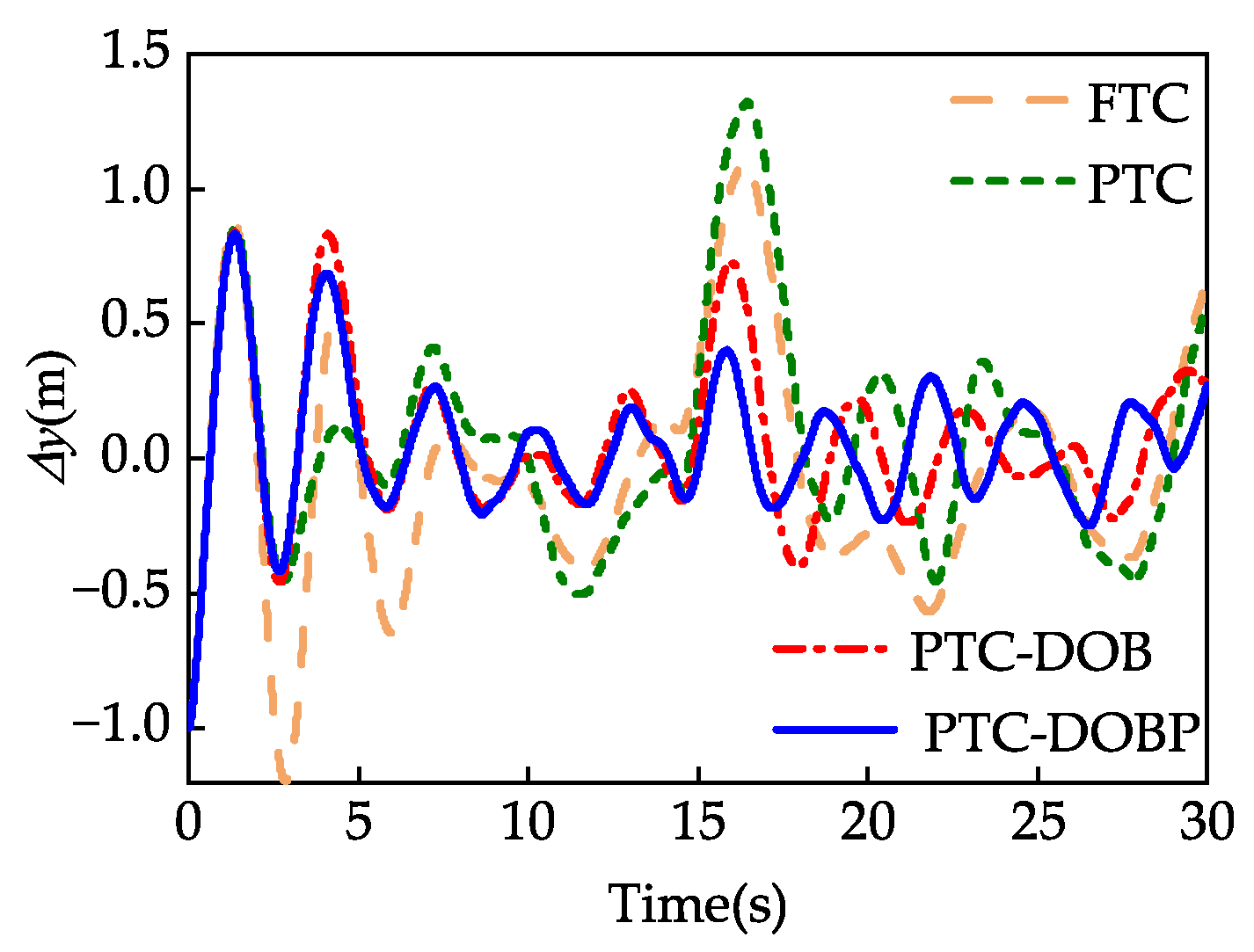
- Simulation results show that the proposed method reduces the maximum following error by 16.9–82.0% and the touchdown error by 53.4–84.1%, compared with baseline methods.
- The proposed method improves anti-disturbance capability and landing accuracy of carrier-based UAVs in composite wind environments, including airwake, steady wind, and gusts.
Abstract
1. Introduction
- A predefined-time sliding mode control method is developed for the ACLS. By introducing an explicit time parameter into the controller, the flight state errors are guaranteed to converge within a user-specified time, regardless of the initial conditions. Furthermore, a predefined-time reference model is incorporated into the ACLS to avoid the explosion of complexity in high-order systems while guaranteeing the system’s global predefined-time stability.
- To enhance the active anti-disturbance performance of the ACLS, a predefined-time disturbance observer is designed to achieve rapid estimation of external disturbances. On this basis, an online short-term disturbance prediction method based on recursive least squares with a forgetting factor is proposed to predict the observed disturbances, thereby enhancing the effectiveness of ACLS in compensating for fast time-varying disturbances caused by airwake, steady wind, and gust.
2. Problem Formulation
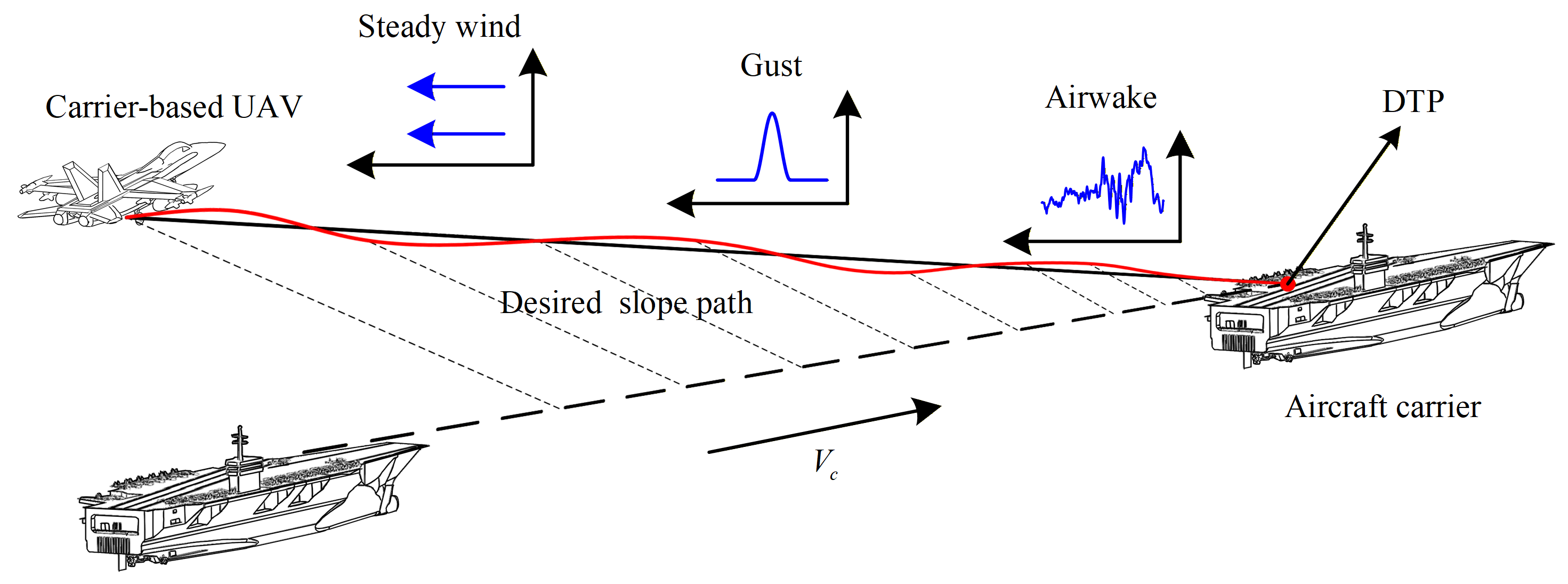
2.1. Problem Statement
2.2. UAV Model
2.3. Airwake Model
2.4. Steady Wind and Gust Model
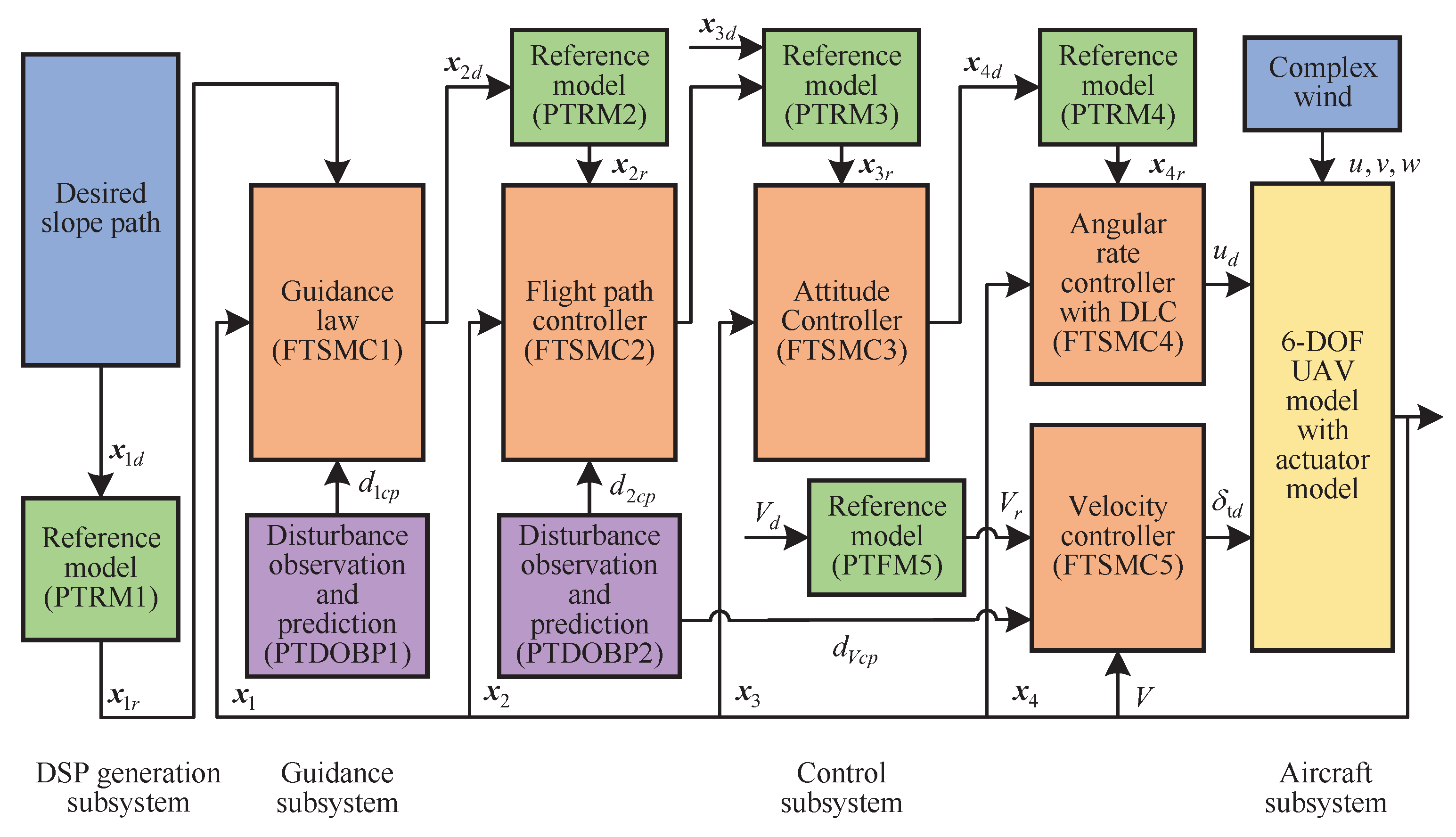
2.5. Control Framework of the ACLS
3. Preliminaries
3.1. Nomenclature
3.2. Predefined-Time Reference Model
3.3. Predefined-Time Disturbance Observer Design
3.4. Predefined-Time Sliding Mode Control
3.5. Disturbance Predictor
- Gain matrix update
- Parameter vector update
- Covariance matrix update
4. ACLS Design and Stability Analysis
4.1. Guidance Law
4.2. Heading Angle Control
4.3. Attitude Control
4.4. Angular Rate Control with DLC
4.5. Approach Power Compensation System
4.6. Stability Analysis
5. Simulations
5.1. Simulation Conditions
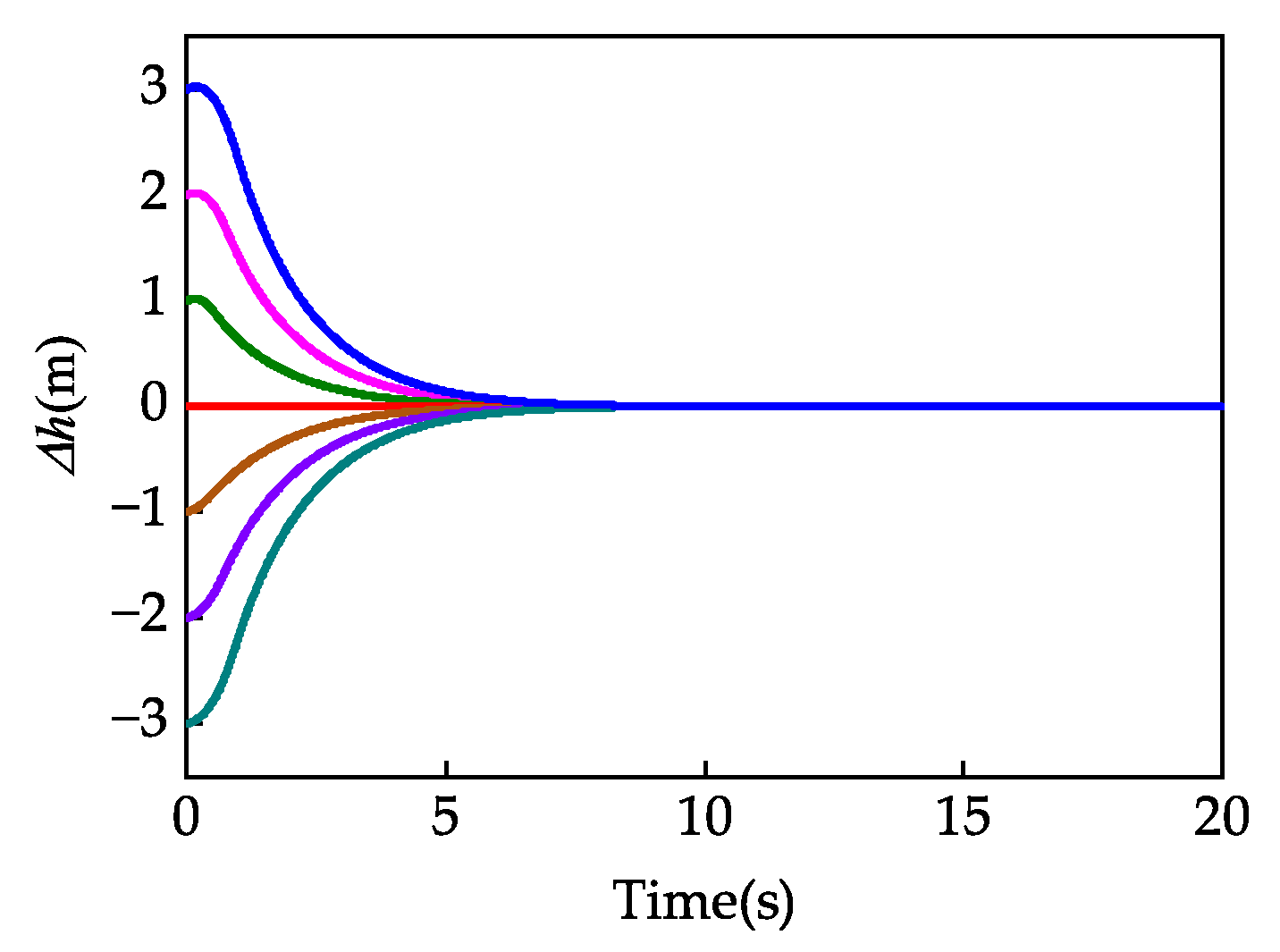
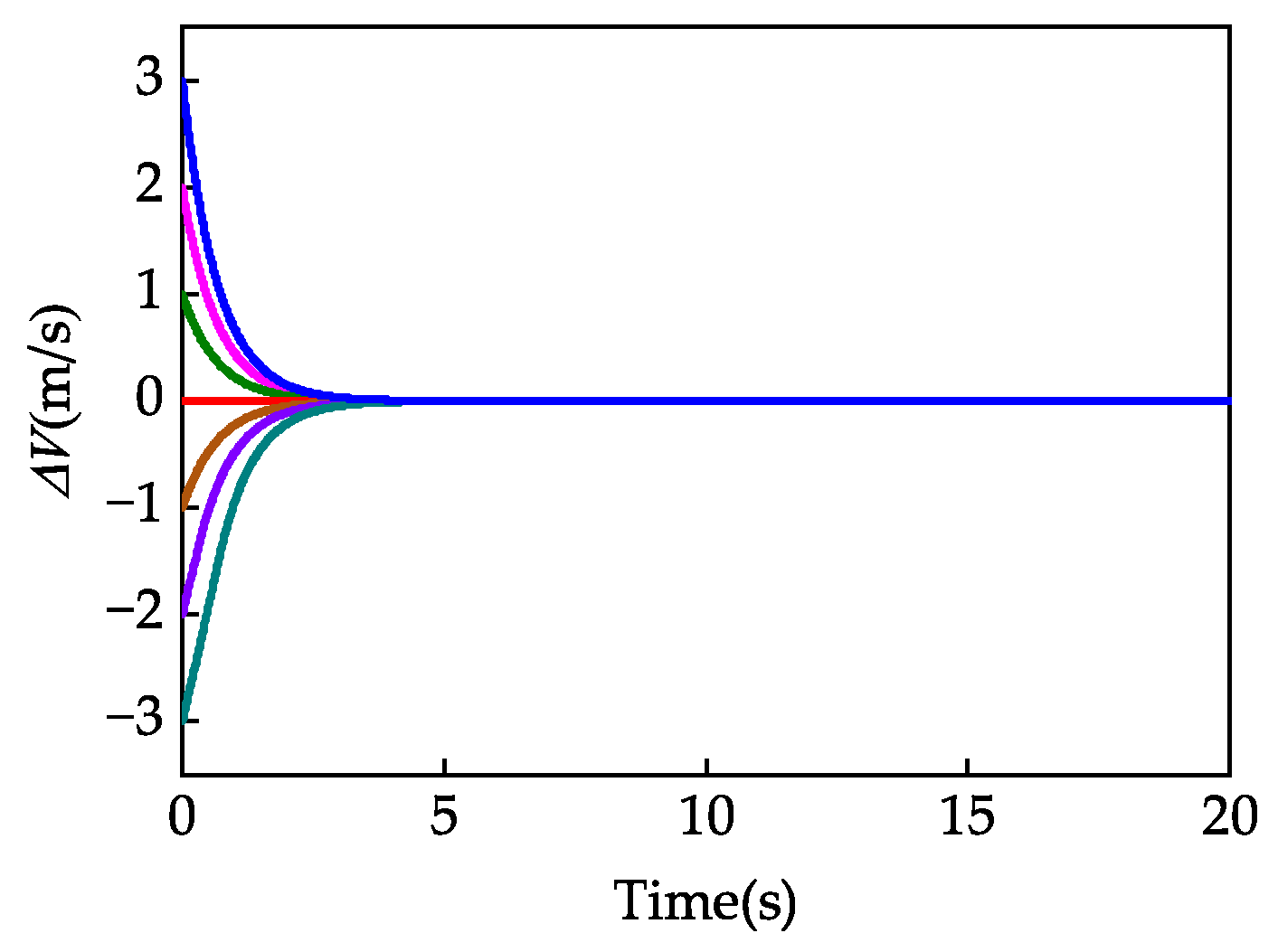
5.2. Experiment 1
5.3. Experiment 2
6. Conclusions
Author Contributions
Funding
Data Availability Statement
Conflicts of Interest
Appendix A

| State | Value | State | Value |
|---|---|---|---|
| (m) | (m) | ||
| (°/s) | |||
| Actuators | Limit (°) | Rate (°/s) | Model |
|---|---|---|---|
| Flap | () | () | |
| Elevator | () | () | |
| Aileron | () | () | |
| Rudder | () | () |
| Acronym | Definition | Acronym | Definition |
|---|---|---|---|
| Automatic carrier landing system | Unmanned aerial vehicle | ||
| Desired slope path | Desired touchdown point | ||
| Six degrees of freedom | Angle of attack | ||
| Climb angle | Approach power compensation system | ||
| Direct lift control | Sliding mode control | ||
| Fixed-time control | Predefined-time control | ||
| Predefined-time stability | Predefined-time reference model | ||
| Predefined-time sliding mode control | Predefined-time disturbance observer | ||
| Predefined-time disturbance observer and predictor | Extended state observer | ||
| Autoregressive | Recursive least squares with forgetting factor | ||
| Predefined-time control with disturbance observer | Predefined-time control with disturbance observer and prediction | ||
| Maximum error | Position error | ||
| Integral of absolute error | Integral of time absolute error |
References
- Jia, B.; Sun, L.; Liu, X.; Xu, S.; Tan, W.; Jiao, J. Carrier aircraft flight controller design by synthesizing preview and nonlinear control laws. Drones 2023, 7, 200. [Google Scholar] [CrossRef]
- Duan, H.; Chen, L.; Zeng, Z. Automatic landing for carrier-based aircraft under the conditions of deck motion and carrier airwake disturbances. IEEE Trans. Aerosp. Electron. Syst. 2022, 58, 5276–5291. [Google Scholar] [CrossRef]
- Chen, H.A.; Wen, Z.Y.; Zhang, Y.; Su, G.Q.; Wu, L.N.; Xie, K. Wind-resistant UAV landing control based on drift angle control strategy. Aerospace 2025, 12, 678. [Google Scholar] [CrossRef]
- Citroni, R.; Di Paolo, F.; Livreri, P. A novel energy harvester for powering small UAVs: Performance analysis, model validation and flight results. Sensors 2019, 19, 1771. [Google Scholar] [CrossRef]
- Sun, N.; Duan, H.; Huo, M. Automatic carrier landing control of carrier-based UAV under actuator failure condition. Aerosp. Sci. Technol. 2025, 160, 110067. [Google Scholar] [CrossRef]
- Fu, M.; Wang, L. Finite-time path following control of an underactuated marine surface vessel with input and output constraints. Appl. Sci. 2020, 10, 6447. [Google Scholar] [CrossRef]
- Zhang, S.; Nan, Y.; Li, Z. Moving path following with adaptive neural network finite-time recursive sliding mode control for carrier landing with uncertain dynamics and saturation. Aerosp. Sci. Technol. 2024, 150, 109220. [Google Scholar] [CrossRef]
- Liu, Z.; Zhang, O.; Gao, Y.; Zhao, Y.; Sun, Y.; Liu, J. Adaptive neural network-based fixed-time control for trajectory tracking of robotic systems. IEEE Trans. Circuits Syst. II Express Briefs 2022, 70, 241–245. [Google Scholar] [CrossRef]
- Kumar, S.; Sinha, A.; Kumar, S.R. Robust path-following guidance for an autonomous vehicle in the presence of wind. Aerosp. Sci. Technol. 2024, 150, 109225. [Google Scholar] [CrossRef]
- Guan, Z.; Liu, H.; Zheng, Z.; Lungu, M.; Ma, Y. Fixed-time control for automatic carrier landing with disturbance. Aerosp. Sci. Technol. 2021, 108, 106403. [Google Scholar] [CrossRef]
- Nguyen, V.C.; Kim, S.H. A novel fixed-time prescribed performance sliding mode control for uncertain wheeled mobile robots. Sci. Rep. 2025, 15, 5340. [Google Scholar] [CrossRef]
- Li, Y.; Liu, X.; Zhen, Z.; Wen, C.Y.; Zheng, Y. Direct lift control for carrier-based aircraft with predefined-time incremental strategy. IEEE Trans. Aerosp. Electron. Syst. 2025, 61, 11528–11542. [Google Scholar] [CrossRef]
- Yao, Z.; Kan, Z.; Li, D.; Shao, H.; Xiang, J. Global fast terminal sliding mode control for automatic carrier landing with environmental disturbances. Aircr. Eng. Aerosp. Technol. 2024, 96, 465–474. [Google Scholar] [CrossRef]
- Vilcica, D.; Lungu, M.; Chen, M.; Tudosie, A. Four-stage cascaded adaptive sliding mode control for automatic carrier landing with airwake disturbances and uncertainties. Appl. Math. Model. 2025, 138, 115729. [Google Scholar] [CrossRef]
- Yao, Z.; Li, D.; Kan, Z. Adaptive terminal sliding combined super twisting control design and flight tests for automatic carrier landing system. Chin. J. Aeronaut. 2025, 38, 103202. [Google Scholar] [CrossRef]
- Yu, Y.; Chen, J.; Zheng, Z.; Yuan, J. Distributed finite-time ESO-based consensus control for multiple fixed-wing UAVs subjected to external disturbances. Drones 2024, 8, 260. [Google Scholar] [CrossRef]
- Yuan, Y.; Duan, H.; Zeng, Z. Automatic carrier landing control with external disturbance and input constraint. IEEE Trans. Aerosp. Electron. Syst. 2022, 59, 1426–1438. [Google Scholar] [CrossRef]
- Yao, Z.; Kan, Z.; Li, D.; Shao, H.; Jiang, Y.; Xiang, J. Active anti-disturbance carrier landing control with integrated direct lift. Comput. Electr. Eng. 2024, 120, 109699. [Google Scholar] [CrossRef]
- Wu, Q.; Zhu, Q. Fault-tolerant control of automatic carrier landing using direct lift control based on nonsingular terminal sliding mode and active disturbance rejection control. Trans. Inst. Meas. Control 2025, 47, 29–40. [Google Scholar] [CrossRef]
- Zhen, Z.; Jiang, S.; Ma, K. Automatic carrier landing control for unmanned aerial vehicles based on preview control and particle filtering. Aerosp. Sci. Technol. 2018, 81, 99–107. [Google Scholar] [CrossRef]
- Meng, Y.; Wang, W.; Han, H. Flight control method using neural network in prediction for suppressing ship airwake impact in carrier landing. IEEE Aerosp. Electron. Syst. Mag. 2023, 38, 20–32. [Google Scholar] [CrossRef]
- Wang, L.; Zhang, Z.; Zhu, Q.; Wen, Z. Longitudinal automatic carrier-landing control law rejecting disturbances and coupling based on adaptive dynamic inversion. Bull. Pol. Acad. Sci. Tech. Sci. 2021, 69, e136217. [Google Scholar] [CrossRef]
- Duan, H.; Yuan, Y.; Zeng, Z. Automatic carrier landing system with fixed time control. IEEE Trans. Aerosp. Electron. Syst. 2022, 58, 3586–3600. [Google Scholar] [CrossRef]
- Guan, Z.; Ma, Y.; Zheng, Z.; Guo, N. Prescribed performance control for automatic carrier landing with disturbance. Nonlinear Dyn. 2018, 94, 1335–1349. [Google Scholar] [CrossRef]
- Beard, R.; Ferrin, J.; Humpherys, J. Fixed wing UAV path following in wind with input constraints. IEEE Trans. Control. Syst. Technol. 2014, 22, 2103–2117. [Google Scholar] [CrossRef]
- United States Department of Defense. MIL-F-8785C. In Flying Qualities of Piloted Airplanes, Revision C Nov.; United States Department of Defense: Washington, DC, USA, 1980. [Google Scholar]
- Lungu, M.; Dinu, D.; Chen, M.; Flores, G. Inverse optimal control for autonomous carrier landing with disturbances. Aerosp. Sci. Technol. 2023, 139, 108382. [Google Scholar] [CrossRef]
- Zhang, S.; Qiu, Y.; Sun, J.; Wang, B.; Gao, Z. Gust load alleviation control strategies for large civil aircraft through wing camber technology. Actuator 2024, 13, 229. [Google Scholar] [CrossRef]
- Zhang, M.; Zang, H.; Bai, L. A new predefined-time sliding mode control scheme for synchronizing chaotic systems. Chaos Solitons Fractals 2022, 164, 112745. [Google Scholar] [CrossRef]
- Xie, S.; Chen, Q. Predefined-time disturbance estimation and attitude control for rigid spacecraft. IEEE Trans. Circuits Syst. II Express Briefs 2023, 71, 2089–2093. [Google Scholar] [CrossRef]
- Polycarpou, M.M.; Weaver, S.E. Stable adaptive neural control of nonlinear systems. In Proceedings of the American Control Conference, Seattle, WA, USA, 21–23 June 1995; pp. 847–851. [Google Scholar]
- Xie, S.; Chen, Q.; Yang, Q. Adaptive fuzzy predefined-time dynamic surface control for attitude tracking of spacecraft with state constraints. IEEE Trans. Fuzzy Syst. 2022, 31, 2292–2304. [Google Scholar] [CrossRef]
- Liu, Z.; Bechlioulis, C.P.; Huang, J.; Wen, C. Nonlinear dynamic surface control for a class of uncertain systems with novel nonlinear filters. IEEE Trans. Autom. Control 2025, 70, 8290–8297. [Google Scholar] [CrossRef]
- Chen, J.; Chen, Z.; Zhang, H.; Xiao, B.; Cao, L. Predefined-time observer-based nonsingular sliding-mode control for spacecraft attitude stabilization. IEEE Trans. Circuits Syst. II Express Briefs 2023, 71, 1291–1295. [Google Scholar] [CrossRef]
- Wang, Z.; Zhu, Q.; Zhao, T.; Wang, L. An optimal guidance law based on deep reinforcement learning for compensating the lag in time-varying slope path following. Aerosp. Sci. Technol. 2026, 168, 110948. [Google Scholar] [CrossRef]
- Chen, Y.; Huang, Y.; Song, Z. Vehicle state estimation by integrating the recursive least squares method with a variable forgetting factor with an adaptive iterative extended kalman filter. World Electr. Veh. J. 2024, 15, 399. [Google Scholar] [CrossRef]
- Tan, M.; Xiang, G.; Xiang, X.; Yu, S.; Rao, K.; Soares, C. Directional and adaptive forgetting factor based recursive least square algorithms for maneuvering dynamic identification and motion prediction of unmanned surface vessel. Ocean Eng. 2025, 342, 122948. [Google Scholar] [CrossRef]
- Steinert, A.; Raab, S.; Hafner, S.; Holzapfel, F.; Hong, H.C. From fundamentals to applications of incremental nonlinear dynamic inversion: A survey on INDI - Part I. Chin. J. Aeronaut. 2025, 38, 103553. [Google Scholar] [CrossRef]
- Lungu, M.; Chen, M.; Ebrahimpour, M.; Guo, H. Dynamic inversion- and neural network-based five-stage cascaded control for automatic carrier landing subject to multiple disturbances and uncertainties. J. Frankl. Inst. 2025, 362, 107719. [Google Scholar] [CrossRef]
- Varriale, C.; Lombaerts, T.; Looye, G. Direct lift control: A review of its principles, merits, current and future implementations. Prog. Aerosp. Sci. 2025, 152, 101073. [Google Scholar] [CrossRef]
- Peng, X.; Li, Y.; Wang, Z. Observer-enhanced sliding mode control for fixed-wing aircraft automatic carrier landing. ISA Trans. 2025, 167, 1431–1445. [Google Scholar] [CrossRef]



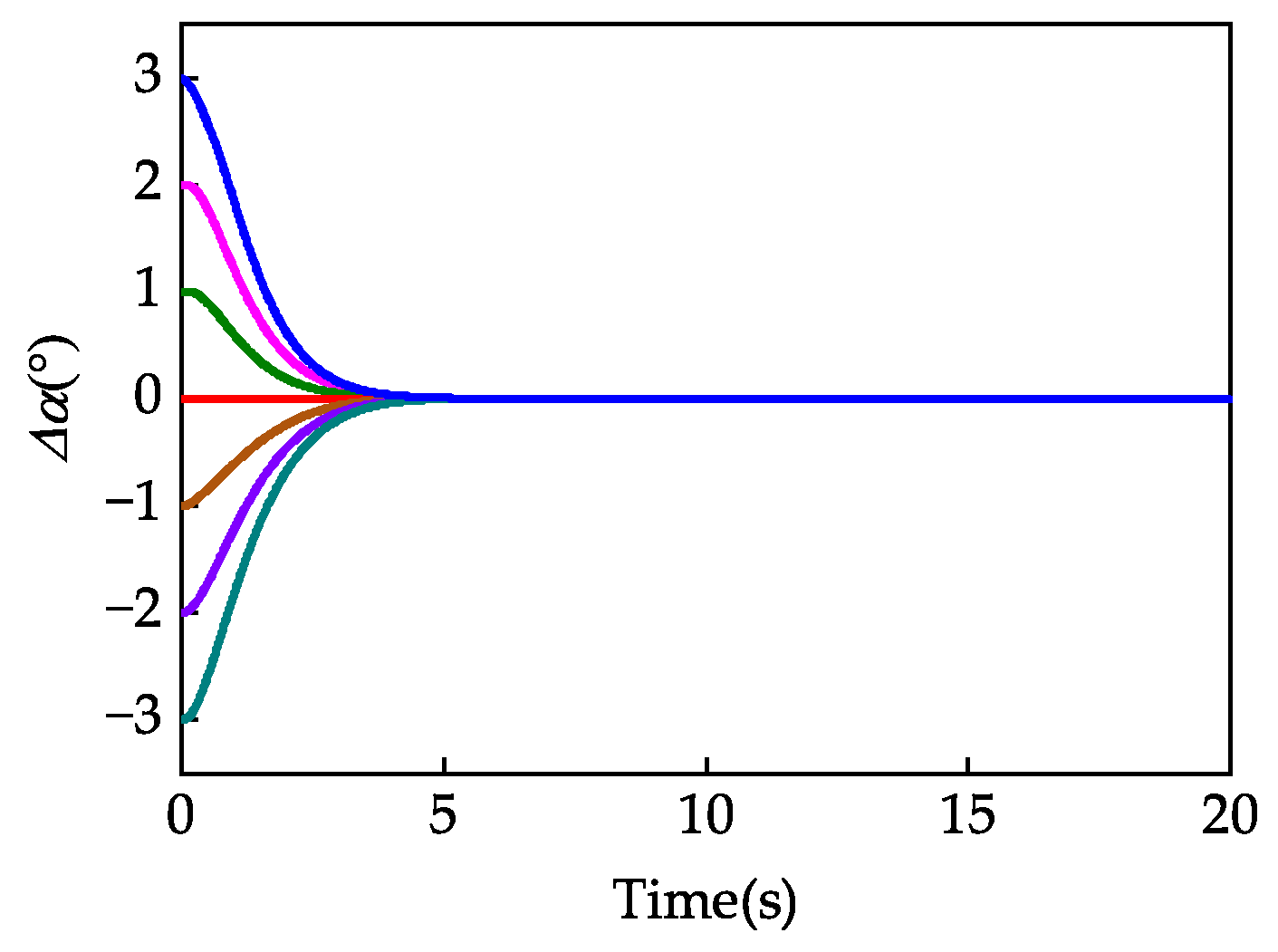
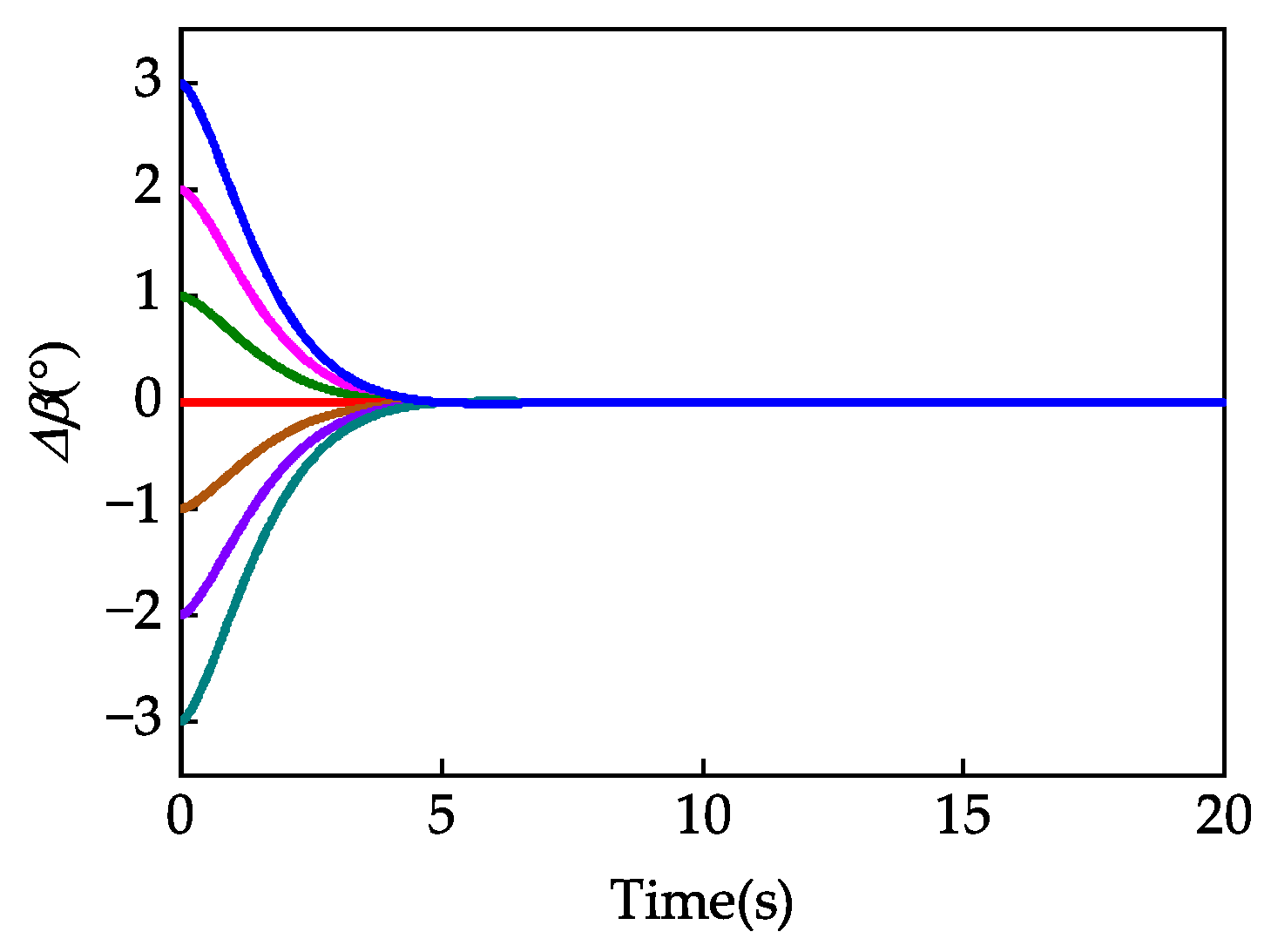


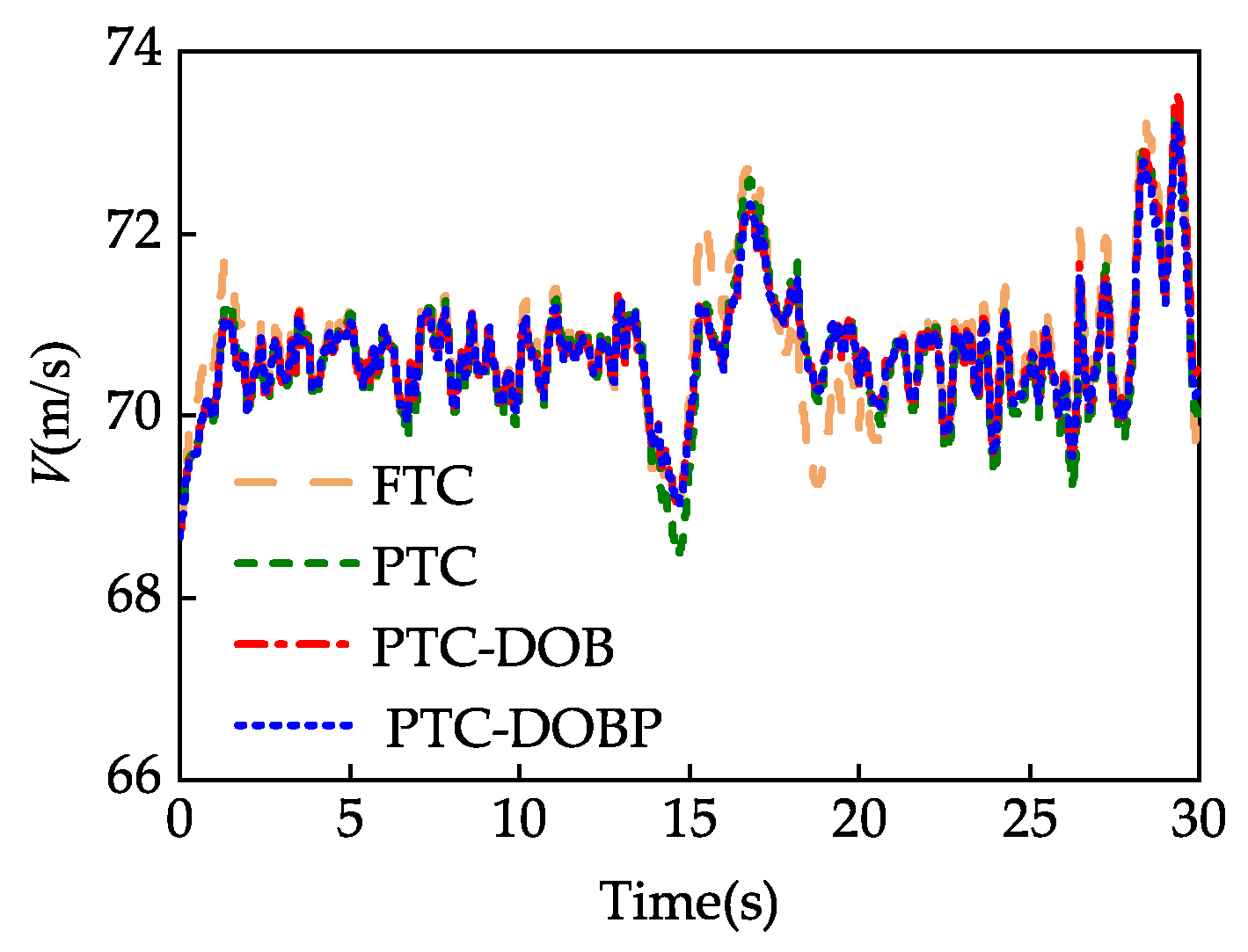
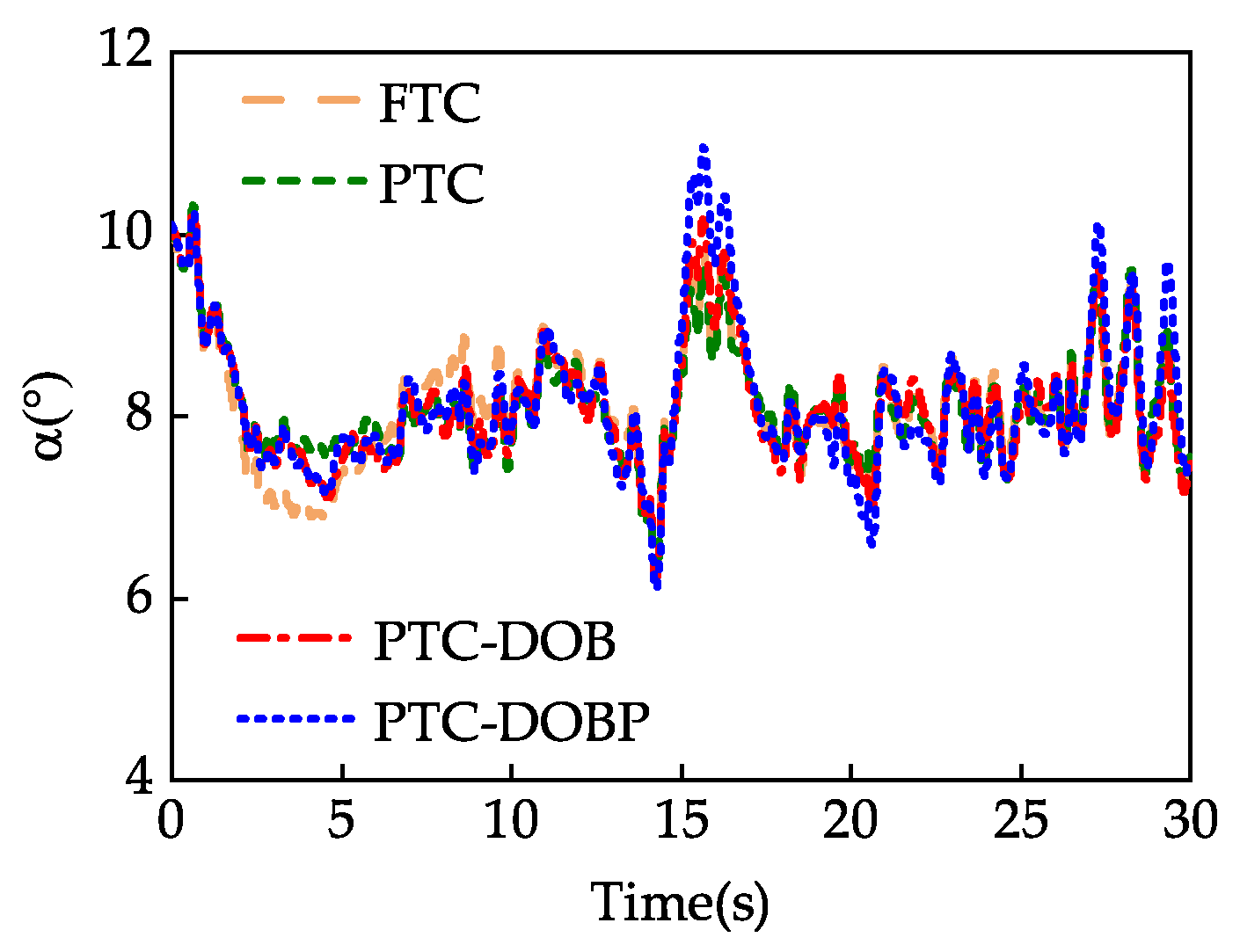


| Method | ME | IAE | ITAE | PE |
|---|---|---|---|---|
| FTC | 1.00 | 7.41 | 115.78 | 7.14 |
| PTC | 0.96 | 5.98 | 92.36 | 5.44 |
| PTC-DOB | 0.57 | 3.57 | 48.15 | 2.60 |
| PTC-DOBP | 0.18 | 1.84 | 14.64 | 1.13 |
| Method | ME | IAE | ITAE | PE |
|---|---|---|---|---|
| FTC | 1.14 | 10.29 | 138.28 | 0.67 |
| PTC | 1.32 | 9.13 | 135.07 | 0.58 |
| PTC-DOB | 0.83 | 6.52 | 77.83 | 0.29 |
| PTC-DOBP | 0.69 | 5.50 | 62.90 | 0.27 |
Disclaimer/Publisher’s Note: The statements, opinions and data contained in all publications are solely those of the individual author(s) and contributor(s) and not of MDPI and/or the editor(s). MDPI and/or the editor(s) disclaim responsibility for any injury to people or property resulting from any ideas, methods, instructions or products referred to in the content. |
© 2026 by the authors. Licensee MDPI, Basel, Switzerland. This article is an open access article distributed under the terms and conditions of the Creative Commons Attribution (CC BY) license.
Share and Cite
Wang, Z.; Zhu, Q.; Sun, P.; Jiang, W.; Wang, L. Predefined-Time Control for Automatic Carrier Landing Under Complex Wind Disturbances with Disturbance Observation and Prediction. Drones 2026, 10, 308. https://doi.org/10.3390/drones10040308
Wang Z, Zhu Q, Sun P, Jiang W, Wang L. Predefined-Time Control for Automatic Carrier Landing Under Complex Wind Disturbances with Disturbance Observation and Prediction. Drones. 2026; 10(4):308. https://doi.org/10.3390/drones10040308
Chicago/Turabian StyleWang, Zibo, Qidan Zhu, Pujing Sun, Wenqiang Jiang, and Lipeng Wang. 2026. "Predefined-Time Control for Automatic Carrier Landing Under Complex Wind Disturbances with Disturbance Observation and Prediction" Drones 10, no. 4: 308. https://doi.org/10.3390/drones10040308
APA StyleWang, Z., Zhu, Q., Sun, P., Jiang, W., & Wang, L. (2026). Predefined-Time Control for Automatic Carrier Landing Under Complex Wind Disturbances with Disturbance Observation and Prediction. Drones, 10(4), 308. https://doi.org/10.3390/drones10040308